EP2000883A2 - Appareil de traitement d'informations et procédé de contrôle de celui-ci - Google Patents
Appareil de traitement d'informations et procédé de contrôle de celui-ci Download PDFInfo
- Publication number
- EP2000883A2 EP2000883A2 EP08156853A EP08156853A EP2000883A2 EP 2000883 A2 EP2000883 A2 EP 2000883A2 EP 08156853 A EP08156853 A EP 08156853A EP 08156853 A EP08156853 A EP 08156853A EP 2000883 A2 EP2000883 A2 EP 2000883A2
- Authority
- EP
- European Patent Office
- Prior art keywords
- mode
- communications
- communication speed
- unit
- predetermined state
- Prior art date
- Legal status (The legal status is an assumption and is not a legal conclusion. Google has not performed a legal analysis and makes no representation as to the accuracy of the status listed.)
- Withdrawn
Links
Images


Classifications
-
- G—PHYSICS
- G06—COMPUTING OR CALCULATING; COUNTING
- G06F—ELECTRIC DIGITAL DATA PROCESSING
- G06F1/00—Details not covered by groups G06F3/00 - G06F13/00 and G06F21/00
- G06F1/26—Power supply means, e.g. regulation thereof
- G06F1/32—Means for saving power
- G06F1/3203—Power management, i.e. event-based initiation of a power-saving mode
Definitions
- the present invention relates to an information processing apparatus such as a personal computer and, more particularly, to an information processing apparatus having a radio connection function and a method of controlling the information processing apparatus.
- Jpn. Pat. Appln. KOKAI Publication 2000-106605 discloses that a communication speed is varied in accordance with a remaining battery quantity and the communications can be thereby continued. In other words, when the remaining battery quantity is reduced, the communication speed is lowered, the power consumption is reduced and weakening of the battery is delayed.
- the present invention has been accomplished in consideration of the above-described circumstances.
- the object of the present invention is to provide an information processing apparatus, capable of limiting a communication speed to the lowest necessary communication speed and saving the electric power even if the influences are not caused by lowering the computer communication quality.
- an aspect of the present invention is an information processing apparatus having a radio communications unit, and having a first mode in which communications are established at a first communication speed and a second mode in which communications are established at a second communication speed lower than the first communication speed.
- the apparatus comprises a discriminating unit configured to discriminate whether or not the apparatus is in a predetermined state, and a control unit configured to lower the communication speed of the radio communications unit and shift the first mode to the second mode if it is discriminated by the discriminating unit that the apparatus is in the predetermined state in the first mode.
- Another aspect of the present invention is a control method employed in an information processing apparatus having a radio communications unit, and having a first mode in which communications are established at a first communication speed and a second mode in which communications are established at a second communication speed lower than the first communication speed.
- the method comprises discriminating whether or not the apparatus is in a predetermined state; and lowering the communication speed of the radio communications unit and shifting the first mode to the second mode if it is discriminated by the discriminating unit that the apparatus is in the predetermined state in the first mode.
- a communication speed can be limited to the lowest necessary communication speed and the electric power can be saved when the computer is in a standby status.
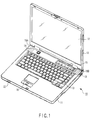
- the information processing apparatus is implemented as, for example, a notebook-type personal computer 10.
- FIG. 1 is a perspective view showing the notebook-type personal computer 10 with a display unit thereof opened.
- the computer 10 is composed of a main body 11 and a display unit 12.
- a display device composed of a TFT-LCD (Thin Film Transistor Liquid Crystal Display) 17 is embedded in the display unit 12.
- a display screen of the LCD 17 is located approximately in the center of the display unit 12.
- the display unit 12 is attached to the main body 11 so as to freely pivot between an opened position and a closed position.
- the main body 11 has a housing shaped in a thin box, and comprises on the top face thereof a keyboard 13, a power button 14 for power-on/power-off of the computer 10, an input operation panel 15, a touch pad 16, speakers 18A, 18B and the like.
- the input operation panel 15 is an input unit which inputs an event corresponding to a pushed button, and comprises a plurality of buttons for activating a plurality of functions.
- a remote controller unit interface 20 for executing communications with a remote controller unit which controls a TV function of the computer 10 is provided.
- the remote controller unit interface 20 is composed of an infrared signal receiver and the like.
- the computer 10 comprises a CPU 101, a north bridge 102, a main memory 103, a south bridge 104, a graphics processing controller (GPU) 105, a video memory (VRAM) 105A, a sound controller 106, a BIOS-ROM 109, a 3G module 110, a hard disk drive (HDD) 111, an embedded controller/keyboard controller IC (EC/KBC) 116, a temperature detecting circuit 115 which detects temperature of the 3G module 110, and the like.
- GPU graphics processing controller
- VRAM video memory
- BIOS-ROM BIOS-ROM
- 3G module 110 a hard disk drive
- HDD hard disk drive
- EC/KBC embedded controller/keyboard controller IC
- a temperature detecting circuit 115 which detects temperature of the 3G module 110, and the like.
- the CPU 101 is a processor controlling the operations of the computer 10.
- the CPU 101 executes the operating system, a 3G operation 30, and the like loaded on the main memory 103 by the hard disk drive (HDD) 111.
- the CPU 101 also executes the BIOS (Basic Input Output System) stored in the BIOS-ROM 109.
- BIOS is a program for the hardware control.
- the north bridge 102 is a bridge device which makes a connection between a local bus of the CPU 101 and the south bridge 104.
- a memory controller which controls an access of the main memory 103 is also built in the north bridge 102.
- the north bridge 102 also has a function of executing communications with the GPU 105 via a serial bus based on the PCI Express standard, or the like.
- the GPU 105 is a display controller which controls the LCD 17 employed as a display monitor of the computer 10. A display signal generated by the GPU 105 is transmitted to the LCD 17.
- the south bridge 104 controls each device on an LPC (Low Pin Count) bus and each device on a PCI (Peripheral Component Interconnect) bus.
- an IDE (Integrated Drive Electronics) controller for controlling the HDD 111 is built in the south bridge 104.
- the south bridge 104 also has a function of executing communications with the sound controller 106.
- the sound controller 106 is a sound source device, which outputs audio data to be reproduced to the speakers 18A, 18B.
- the embedded controller/keyboard controller IC (EC/KBC) 116 is a one-chip microcomputer on which an embedded controller for power supply management, and a keyboard controller for controlling the keyboard (KB) 13, the touch pad 15, the temperature detecting circuit 115 and the like are integrated.
- the embedded controller/keyboard controller IC (EC/KBC) 116 has a function of power-on/power-off of the computer 10, in cooperation with the power supply circuit 120, in accordance with the user's operation of the power button 14.
- the embedded controller/keyboard controller IC (EC/KBC) 116 has a function of executing communications with the remote controller unit interface 20.
- FIG. 4 is a block diagram showing a function configuration of the 3G application and the like.
- the 3G application 30 comprises a control section 201, a memory unit 202, a discriminating section 203, a communications unit 204 and the like.
- the control section 201 is the CPU 101 or the like, which controls the 3G application 30.
- the memory unit 202 is a configuration memory or the like, which stores a value of a communication speed in a general mode (described later) or a power saving mode (described later) and a threshold value of the temperature of the 3G module 110 detected by the temperature detecting circuit 115.
- the discriminating section 203 discriminates a timing of shifting the general mode to the power saving mode.
- the communications unit 204 executes 3G-standard radio communications.
- the communications unit 204 is also capable of making a connection to Internet via a 3G communications network.
- the computer 10 has a function of returning from a wait status (standby or the like) to a general status, by WakeUp from the 3G module 110.
- the 3G module 110 can also establish communications by itself even when the computer 10 is in a standby status. For example, when a mail of a predetermined keyword is received by the 3G module 110, the computer 10 can be made to wake up by the 3G module 110 and become in the general activation status.
- control section 201 of the computer 10 controls communications of the 3G application 30 and the like, in a general mode (described later).
- the CPU 101 of the computer 10 loads the 3G application 30 to the main memory 103.
- the discriminating section 203 of the 3G application 30 discriminates whether or not the communication speed can be lowered (block S101). If it is discriminated by the discriminating section 203 that the communication speed can be lowered (YES in block S101), the general mode (power consuming status in which the computer 10 is generally employed) is shifted to the power saving mode (status in which the power consumption is reduced to the lowest level necessary for the communications) (block S102).
- the "status in which the communication speed may be lowered” is a status in which, for example, the computer 10 is under a standby condition, the temperature of the 3G module 110 is higher than a predetermined threshold value, the communications quality of the 3G module 110 is lower than a predetermined communications quality, or the like.
- priority is set for each communications system as shown in FIG. 5 .
- the priority of 1xEVDO Re1.0 (communication speed at 2 Mbps) is set to 1
- the priority of cdmaOne (IS-95B) (communication speed at 115 Kbps)
- the priority of cdmaOne (IS-95A) (communication speed at 14.4 Mbps) is set to 3.
- the general mode is set as 1xEVDO Re1.0 (communication speed at 2 Mbps)
- the power saving mode is set as cdmaOne (IS-95B) (communication speed at 115 Kbps) or cdmaOne (IS-95A) (communication speed at 14.4 Mbps).
- the power consumption is more reduced as the communication speed becomes lower.
- the electric power can be saved by setting the communication speed to the lowest speed that is necessary for mail confirmation or the like of the 3G module 110, in the standby status or the like of the computer 10 (since the 3G module 110 does not need to establish communications with the base station at any time in the standby status or the like).
- the 3G module 110 makes the computer 10 return from WakeUp status and generally activate.
- the power saving mode is shifted to the general mode, and the communications system is shifted to the general system to establish communications at a high communication speed.
- a text of the mail is entirely received.
- the standby status of the computer 10 indicates a status in which the electric power is more saved than in the general operation status of the computer, as represented by the suspend mode, standby mode, pause state, shutdown state and the like.
- the general mode is shifted to the power saving mode to lower the communication speed.
- a predetermined temperature for example, 60°C
- the power consumption can be reduced and the temperature can be lower to a temperature at which the 3G module 110 normally operates.
- the power saving mode may be shifted to the general mode at the time when the temperature is lower to a temperature at which the 3G module 110 normally operates, for example, 45°C.
- the temperature level may be separated to three steps, and threshold values of corresponding temperatures may be set to change the communication mode.
- the communications mode is changed to 1xEVDO Re1.0 (communication speed at 2 Mbps) of priority 1 at a temperature ranging from 0 to 35°C, cdmaOne (IS-95B) (communication speed at 115 Kbps) of priority 2 at a temperature ranging from 36 to 45°C, and cdmaOne (IS-95A) (communication speed at 14.4 Mbps) of priority 3 at a temperature not lower than 46°C.
- 1xEVDO Re1.0 communication speed at 2 Mbps
- cdmaOne IS-95B
- IS-95A communication speed at 14.4 Mbps
- the communications can be made stable by shifting the communications mode to the power saving mode and changing the communications system to that of a lower communication speed.
- the communications quality levels can be separated to three and the communications speed can be changed to the communications speed (communications mode of lower priority) in accordance with the communications quality levels.
- the communications mode is changed to 1xEVDO Re1.0 (communication speed at 2 Mbps) of priority 1 when the communications quality is a top level, cdmaOne (IS-95B) (communication speed at 115 Kbps) of priority 2 when the communications quality is a second level, and cdmaOne (IS-95A) (communication speed at 14.4 Mbps) of priority 3 when the communications quality is a third level.
- 1xEVDO Re1.0 communication speed at 2 Mbps
- cdmaOne IS-95B
- cdmaOne (IS-95A) (communication speed at 14.4 Mbps) of priority 3 when the communications quality is a third level.
- the communications mode is changed in accordance with the level of the communications quality. For example, the communications quality is improved when the communications are established in cdmaOne (IS-95A) (communication speed at 14.4 Mbps) of priority 3. If the communications quality is the second level, the communications mode is changed to cdmaOne (IS-95B) (communication speed at 115 Kbps) of priority 2.
- IS-95A communication speed at 14.4 Mbps
- IS-95B communication speed at 115 Kbps
- the communication speed can be set to a lowest communication speed that is necessary for the communications and the electric power can be saved if bad influence is not caused by lowering the computer communications quality.
- the present invention is not limited to the embodiments described above but the constituent elements of the invention can be modified in various manners without departing from the spirit and scope of the invention.
- Various aspects of the invention can also be extracted from any appropriate combination of a plurality of constituent elements disclosed in the embodiments. Some constituent elements may be deleted in all of the constituent elements disclosed in the embodiments. The constituent elements described in different embodiments may be combined arbitrarily.
Landscapes
- Engineering & Computer Science (AREA)
- Theoretical Computer Science (AREA)
- Physics & Mathematics (AREA)
- General Engineering & Computer Science (AREA)
- General Physics & Mathematics (AREA)
- Power Sources (AREA)
- Communication Control (AREA)
Applications Claiming Priority (1)
| Application Number | Priority Date | Filing Date | Title |
|---|---|---|---|
| JP2007145272A JP2008299612A (ja) | 2007-05-31 | 2007-05-31 | 情報処理装置および情報処理装置の制御方法 |
Publications (1)
| Publication Number | Publication Date |
|---|---|
| EP2000883A2 true EP2000883A2 (fr) | 2008-12-10 |
Family
ID=39496145
Family Applications (1)
| Application Number | Title | Priority Date | Filing Date |
|---|---|---|---|
| EP08156853A Withdrawn EP2000883A2 (fr) | 2007-05-31 | 2008-05-23 | Appareil de traitement d'informations et procédé de contrôle de celui-ci |
Country Status (3)
| Country | Link |
|---|---|
| US (1) | US20080298528A1 (fr) |
| EP (1) | EP2000883A2 (fr) |
| JP (1) | JP2008299612A (fr) |
Families Citing this family (10)
| Publication number | Priority date | Publication date | Assignee | Title |
|---|---|---|---|---|
| JP5132388B2 (ja) * | 2008-03-28 | 2013-01-30 | キヤノン株式会社 | 通信装置、通信装置の制御方法、およびプログラム |
| JP5235490B2 (ja) * | 2008-05-13 | 2013-07-10 | キヤノン株式会社 | 通信システム及び通信装置 |
| US9195296B2 (en) * | 2009-09-24 | 2015-11-24 | Qualcomm Incorporated | Apparatus and methods for optimizing power consumption in a wireless device |
| CN102939790B (zh) * | 2010-04-06 | 2017-02-15 | 富士通株式会社 | 无线通信装置、信息处理装置和无线通信控制方法 |
| JP5300099B2 (ja) * | 2011-03-23 | 2013-09-25 | Necアクセステクニカ株式会社 | ネットワーク制御装置、通信速度変更方法及びプログラム |
| JP5238864B2 (ja) * | 2011-09-12 | 2013-07-17 | 株式会社東芝 | 電子機器及びその駆動方法 |
| JP2013135403A (ja) * | 2011-12-27 | 2013-07-08 | Canon Inc | 通信装置及びその制御方法、並びにプログラム |
| JP6964687B2 (ja) * | 2017-01-25 | 2021-11-10 | 華為技術有限公司Huawei Technologies Co., Ltd. | 電子デバイスおよび装置の電力消費を削減する方法 |
| TWI732573B (zh) * | 2020-05-29 | 2021-07-01 | 技嘉科技股份有限公司 | 多熱源的溫度管理方法以及多熱源無線通訊裝置 |
| JP7367723B2 (ja) * | 2021-03-30 | 2023-10-24 | トヨタ自動車株式会社 | 自動運転装置、自動運転方法、及びプログラム |
Citations (1)
| Publication number | Priority date | Publication date | Assignee | Title |
|---|---|---|---|---|
| JP2000106605A (ja) | 1998-07-29 | 2000-04-11 | Denso Corp | 無線通信装置 |
-
2007
- 2007-05-31 JP JP2007145272A patent/JP2008299612A/ja active Pending
-
2008
- 2008-05-23 EP EP08156853A patent/EP2000883A2/fr not_active Withdrawn
- 2008-05-30 US US12/130,890 patent/US20080298528A1/en not_active Abandoned
Patent Citations (1)
| Publication number | Priority date | Publication date | Assignee | Title |
|---|---|---|---|---|
| JP2000106605A (ja) | 1998-07-29 | 2000-04-11 | Denso Corp | 無線通信装置 |
Also Published As
| Publication number | Publication date |
|---|---|
| JP2008299612A (ja) | 2008-12-11 |
| US20080298528A1 (en) | 2008-12-04 |
Similar Documents
| Publication | Publication Date | Title |
|---|---|---|
| US20080298528A1 (en) | Information processing apparatus and method of controlling the same | |
| US20030226047A1 (en) | Portable terminal with enhanced power management function and method for managing power of the same | |
| US8335549B2 (en) | Method for power management of mobile communication terminal and mobile communication terminal using this method | |
| RU2691640C2 (ru) | Способ и аппаратура для сокращения потребления энергии в мобильном электронном устройстве | |
| US10025380B2 (en) | Electronic devices with gaze detection capabilities | |
| EP2857929B1 (fr) | Appareil de traitement d'informations, système de traitement d'informations et procédé de commande de puissance | |
| CN104243671B (zh) | 音量调节方法、装置及电子设备 | |
| CN101334687B (zh) | 信息处理设备 | |
| WO2021052413A1 (fr) | Procédé de détermination et de configuration de temps de surveillance de signal d'économie d'énergie, et dispositif associé | |
| CN106250223A (zh) | 一种后台进程管理方法及终端设备 | |
| US20070282978A1 (en) | Information processing apparatus and method of controlling the same | |
| EP3713279A1 (fr) | Procédé de commande de mesure de rrm de cellule adjacente, terminal de communication mobile et dispositif côté réseau | |
| US20070204181A1 (en) | Information processing apparatus and power consumption method | |
| KR101431712B1 (ko) | 웨이크 온 랜 기능의 설정 상태를 알려 주는 장치 및 방법 | |
| CN110069333A (zh) | 应用的后台管控方法、移动终端及计算机可读存储介质 | |
| JP2014120070A (ja) | 電子機器、電子機器の制御方法、電子機器の制御プログラム | |
| US20070263588A1 (en) | Information processing apparatus and connection control method | |
| US7321977B2 (en) | Information processing apparatus and method | |
| CN107404569B (zh) | 一种系统控制方法、终端和计算机可读存储介质 | |
| CN111309133A (zh) | 省电控制方法及电子设备 | |
| US7752481B2 (en) | Information processing apparatus and resume control method | |
| US20070150929A1 (en) | Electronic apparatus and method for controlling data transfer rate in electronic apparatus | |
| JP2007188472A (ja) | 携帯電子機器のテレビモジュールを用いて利用される電力制御方法 | |
| JP2015011432A (ja) | 情報処理装置および情報処理方法 | |
| JP2014003501A (ja) | 電子機器、電子機器の制御方法、電子機器の制御プログラム |
Legal Events
| Date | Code | Title | Description |
|---|---|---|---|
| PUAI | Public reference made under article 153(3) epc to a published international application that has entered the european phase |
Free format text: ORIGINAL CODE: 0009012 |
|
| 17P | Request for examination filed |
Effective date: 20080523 |
|
| AK | Designated contracting states |
Kind code of ref document: A2 Designated state(s): AT BE BG CH CY CZ DE DK EE ES FI FR GB GR HR HU IE IS IT LI LT LU LV MC MT NL NO PL PT RO SE SI SK TR |
|
| AX | Request for extension of the european patent |
Extension state: AL BA MK RS |
|
| STAA | Information on the status of an ep patent application or granted ep patent |
Free format text: STATUS: THE APPLICATION HAS BEEN WITHDRAWN |
|
| 18W | Application withdrawn |
Effective date: 20090605 |
|
| R18W | Application withdrawn (corrected) |
Effective date: 20090605 |
|
| RTI1 | Title (correction) |
Free format text: CONTROL OF RADIO COMMUNICATION FUNCTION IN AN INFORMATION PROCESSING APPARATUS |