EP1998534B1 - Verfahren und Vorrichtung zur Aufzeichnung von Transaktionen mit einer tragbaren Protokollierungsvorrichtung - Google Patents
Verfahren und Vorrichtung zur Aufzeichnung von Transaktionen mit einer tragbaren Protokollierungsvorrichtung Download PDFInfo
- Publication number
- EP1998534B1 EP1998534B1 EP08153371.3A EP08153371A EP1998534B1 EP 1998534 B1 EP1998534 B1 EP 1998534B1 EP 08153371 A EP08153371 A EP 08153371A EP 1998534 B1 EP1998534 B1 EP 1998534B1
- Authority
- EP
- European Patent Office
- Prior art keywords
- log
- media
- hash
- checksum
- portable
- Prior art date
- Legal status (The legal status is an assumption and is not a legal conclusion. Google has not performed a legal analysis and makes no representation as to the accuracy of the status listed.)
- Active
Links
Images





Classifications
-
- G—PHYSICS
- G06—COMPUTING OR CALCULATING; COUNTING
- G06F—ELECTRIC DIGITAL DATA PROCESSING
- G06F21/00—Security arrangements for protecting computers, components thereof, programs or data against unauthorised activity
- G06F21/30—Authentication, i.e. establishing the identity or authorisation of security principals
- G06F21/31—User authentication
-
- G—PHYSICS
- G06—COMPUTING OR CALCULATING; COUNTING
- G06Q—INFORMATION AND COMMUNICATION TECHNOLOGY [ICT] SPECIALLY ADAPTED FOR ADMINISTRATIVE, COMMERCIAL, FINANCIAL, MANAGERIAL OR SUPERVISORY PURPOSES; SYSTEMS OR METHODS SPECIALLY ADAPTED FOR ADMINISTRATIVE, COMMERCIAL, FINANCIAL, MANAGERIAL OR SUPERVISORY PURPOSES, NOT OTHERWISE PROVIDED FOR
- G06Q20/00—Payment architectures, schemes or protocols
- G06Q20/08—Payment architectures
- G06Q20/10—Payment architectures specially adapted for electronic funds transfer [EFT] systems; specially adapted for home banking systems
- G06Q20/105—Payment architectures specially adapted for electronic funds transfer [EFT] systems; specially adapted for home banking systems involving programming of a portable memory device, e.g. IC cards, "electronic purses"
-
- H—ELECTRICITY
- H04—ELECTRIC COMMUNICATION TECHNIQUE
- H04L—TRANSMISSION OF DIGITAL INFORMATION, e.g. TELEGRAPHIC COMMUNICATION
- H04L63/00—Network architectures or network communication protocols for network security
- H04L63/08—Network architectures or network communication protocols for network security for authentication of entities
- H04L63/0853—Network architectures or network communication protocols for network security for authentication of entities using an additional device, e.g. smartcard, SIM or a different communication terminal
-
- H—ELECTRICITY
- H04—ELECTRIC COMMUNICATION TECHNIQUE
- H04L—TRANSMISSION OF DIGITAL INFORMATION, e.g. TELEGRAPHIC COMMUNICATION
- H04L67/00—Network arrangements or protocols for supporting network services or applications
- H04L67/01—Protocols
- H04L67/12—Protocols specially adapted for proprietary or special-purpose networking environments, e.g. medical networks, sensor networks, networks in vehicles or remote metering networks
-
- H—ELECTRICITY
- H04—ELECTRIC COMMUNICATION TECHNIQUE
- H04L—TRANSMISSION OF DIGITAL INFORMATION, e.g. TELEGRAPHIC COMMUNICATION
- H04L67/00—Network arrangements or protocols for supporting network services or applications
- H04L67/50—Network services
- H04L67/535—Tracking the activity of the user
-
- G—PHYSICS
- G06—COMPUTING OR CALCULATING; COUNTING
- G06F—ELECTRIC DIGITAL DATA PROCESSING
- G06F2221/00—Indexing scheme relating to security arrangements for protecting computers, components thereof, programs or data against unauthorised activity
- G06F2221/21—Indexing scheme relating to G06F21/00 and subgroups addressing additional information or applications relating to security arrangements for protecting computers, components thereof, programs or data against unauthorised activity
- G06F2221/2129—Authenticate client device independently of the user
Definitions
- the present invention relates to the field of digital object distribution; more particularly, the present invention relates to associating information using document logs.
- a Web log is an online document management tool used to record information.
- Web logs use a client-server framework to permit the addition or subtraction of content from one or more client locations to a server that hosts the web log. Because one server hosts each web log, web logs are typically anchored to a particular HTTP location.
- US 5,978,475 discloses a hash-based method for encrypting sensitive information which is communicated between a trusted and an untrusted computer.
- Method and apparatus for recording transactions with a portable logging device are described. In one embodiment, examining a first log stored on a first, portable device and a second log associated with a second device; and determining that the portable device interacted with the second device based on one or more entries in the first and second logs.
- the portable logging device is able to generate media identifiers and log media identifiers and media in a log that corresponds to transactions and/or interactions with another device (e.g., a copier, MFP, a peripheral, PC, etc.) regarding the media.
- the portable logging device is also able to provide an upgrade to such a device.
- the present invention also relates to apparatus for performing the operations herein.
- This apparatus may be specially constructed for the required purposes, or it may comprise a general purpose computer selectively activated or reconfigured by a computer program stored in the computer.
- a computer program may be stored in a computer readable storage medium, such as, but is not limited to, any type of disk including floppy disks, optical disks, CD-ROMs, and magnetic-optical disks, read-only memories (ROMs), random access memories (RAMs), EPROMs, EEPROMs, magnetic or optical cards, or any type of media suitable for storing electronic instructions, and each coupled to a computer system bus.
- a machine-readable medium includes any mechanism for storing or transmitting information in a form readable by a machine (e.g., a computer).
- a machine-readable medium includes read only memory ("ROM”); random access memory (“RAM”); magnetic disk storage media; optical storage media; flash memory devices; electrical, optical, acoustical or other form of propagated signals (e.g., carrier waves, infrared signals, digital signals, etc.); etc.
- a document, video, song, piece of paper, or electronic file by an identifier.
- the document, video, song, piece of paper, or electronic file is referred herein to as the media.
- An identifier used to identify the media is called a media identifier and, in one embodiment, is a string of bytes.
- the identifier is generated by applying a cryptographic hash function on the bytes of the file.
- Cyptographic hash functions are well known in the security literature and have been standardized in various federal and international standards, and software toolkits.
- Cryptographic hash functions meet the properties described above so well that we will sometimes refer to the process of determining an identifier for a piece of media as "hashing” and sometimes refer to the media identifier as a "hash,” even if a different technique is used to form the identifier.
- a server could keep a copy of every file and assign a previously unused string randomly to each new file. This method works very well for properties B, C, and D, but only meets property A if everyone can contact the server, and the server cannot be changed, even if taken off-line by, for example, by a denial of service attack.
- Pieces of paper can be assigned an identifier, for example, by scanning the paper and computing a cryptographic hash of the scanned file that results.
- a barcode or other machine readable identifier e.g., a RFID tag
- Use of a machine readable ID makes it easy for anyone to get the same identifier; however, it is also possible to attach the same ID value to different media, so property B is not well met in this case.
- a form of "finger printing” is used to identify physical media. Since finger printing associates values with the physical device, it can be very hard or impossible to make a new "finger” or piece of paper with the same finger print. However, in many cases, the "finger print” reveals something about the physical media, also it may be possible to change the physical media slightly without changing the finger print. Thus, in such a case, properties C and D might not be held perfectly.
- identifiers there may be multiple identifiers associated with a single piece of media. For example, there could be an identifier formed by using the SHA1 cryptographic hash function on the media, and an identifier formed by using the SHA256 or MD5 cryptographic hashes on the same media.
- keyed-hash message authentication codes or HMAC are used to compute media identifiers. These message authentication codes like HMAC-MD5 or HMAC-SHA 1 can be better than the underlying cryptographic hash functions (MD5 and SHA1) for properties B, C, and D because they use a key which can change. However, property A is more difficult with message authentication codes because in order to compute the same hash, all places computing it must have access to the key.
- identifiers associated with different formats of the same data. For example, the hash of a file, and the hash of the same file compressed losslessly with ZIP, are different identifiers, but they are associated with the same final data.
- identifiers formed for part of the media For example, in the case of video, there could be an identifier formed for each different frame. Because of packet loss in a network, two people watching the same video might not end up with the same file, and thus they would be unable to compute the same identifier. However, each person would receive several identical frames of the video. So if they computed a hash of each frame they received, they could determine that they were watching the same video because of the large number of identical hashes.
- a server When video is not stored in a scalable format, a server typically stores multiple versions of a video at different resolutions. The server can thus compute a hash of all frames of all resolutions it has stored, and thus any frame received completely by a client can be hashed and the hashes later compared with those on the server to identify the video.
- part of a large XML document may be requested.
- the request may be, for example, by an XPATH query.
- the portion of the document received by the client is different from the whole document available at the server.
- a client with a subset ofthe XML document can compute hashes on the subtrees and nodes that it receives, and these can be matched against a large list of hashes at the server.
- relevant subsets of the data can often be determined and these subsets can be hashed in addition to the hash of the complete media.
- the data is processed so that the portion delivered does not actually appear in the data as a whole.
- a color image might be converted to grayscale and then delivered, or the sum of entries in a spreadsheet might be computed and reported.
- the data exists at two places (e.g. the server and client), then even if only modified data is delivered, it is possible for both server and client to record hashes of the modified data and the association between the received data and it's source can be made at a later time.
- the "server" might not have the modified data initially. For example, if an intermediate processing device performs the computation on the data. However, if the type of computation is known, it could be later run on the server to associate the original media with the received data. For example, a server might send a high bit rate video, but due to network congestion, this may be truncated by removing a quality layer at an intermediate router. A client thus receives a medium bit-rate video that can be hashed. In order to determine the same hashes, the server runs the hash on the the high rate video without the quality layer that the router discarded.
- logs have a property that it is easy to add a new record to the end, but difficult to change a record already in the log without such a change being easily detected.
- the log file may be made available to a large number of people or systems so that some records can be checked, but the content of most of the records can remain secret.
- a conceptually simple way to implement a log is a tamper proof write once memory. Each record is written in order into the memory. This meets the goal of easy to add and hard to modify, but it is difficult to remotely verify that the "tamper proof" memory has not been changed.
- the log in this case consists of a sequence of messages and checksums (M i , r i ).
- an addition to the log may be made by taking the last checksum and the current message, concatenating the two, and computing the hash.
- a message and checksum generator 101 receives a new message, M i+3 and the checksum r i+2 of the last entry in log 110.
- a concatenation module 102 concatenates the previous checksum r i+2 with the message M i+3 .
- Hash module 103 applies a hash function, as described herein, to produce the next checksum r i+3 .
- Message M i+3 and checksum r i+3 are then stored in log 110.
- message and checksum generator 101 may comprise a processing unit (e.g., a microprocessor) with concatenation module 102 and hash unit 103 being software modules of instructions that are executed by the processing unit.
- processing unit e.g., a microprocessor
- concatenation module 102 and hash unit 103 being software modules of instructions that are executed by the processing unit.
- these functions could be implemented in hardware.
- the hash function could be a simple checksum, be preferably is a cryptographic hash function.
- m i hash M i
- a message and checksum generator 201 receives a new message, M i+3 and the checksum r i+2 of the last entry in log 210.
- a concatenation module 102 concatenates the previous checksum r i+2 with the message M i+3 .
- Hash module 103 applies a hash function, as described herein, to produce the next checksum r i+3 .
- Hash module 203 applies a hash function to message M i+3 to produce hashed message m i+3 .
- the hash function applied by hash module 203 is the same as the hash function applied by hash module 103; alternatively, the hash function applied by hash module 203 is not the same as the hash function applied by hash module 103.
- Hashed message m i+3 and checksum r i+3 are then stored in log 210.
- Message and checksum generator 101 may comprise a processing unit (e.g., a microprocessor) with concatenation module 102, hash unit 103, hash unit 203 being software modules of instructions that are executed by the processing unit. Alternatively, these functions could be implemented in hardware.
- This method has the advantage of producing fixed length records provided that the hash function has a fixed length, which is commonly true.
- This method has the further advantage of not having any message content in the log. Thus, if the message was some customer information (e.g., a purchase order with name, address, and order information), it would not be desireable to publish the message. However, if the hash used does not reveal information about the message, then the entire sequence of (m i ,r i ) i.e. the log, can be published without publishing this information.
- t i This format is quite general because the t i portion could contain further structure (e.g., always a date and a type and a file name) while the messages could also be structured.
- further structure e.g., always a date and a type and a file name
- the order of the previous rolling checksum, the current message or message hash, and "plain text" information can be changed, as long as the order is known to all applications needing to generate or verify a checksum.
- Another way to provide partial access to information in a log is to encrypt some of the information stored in the log.
- the encrypted information for a log is E i
- the hash of E i is e i .
- either E i or e i can be stored in the log.
- a log entry might consist of (t i , m i , E i , r i ), i.e. a plain text portion, a hash of the message, some encrypted data and a hash of the previous hash in the log and concatenated with the hash of the message.
- there could be a mix of times and a record might have several plain text portions, several encrypted portions, and several hashes of messages.
- the format for log entries is a set of header "lines" and a body with data, e.g.
- Content-Length 567 567 bytes of DATA
- this type of format is used for http and email.
- several well-known headers have been defined and could be used in a log.
- Different keys can be used for different encrypted entries or different types of encrypted entries in the log. For example, all entanglement information might be encrypted with one key, all classification values with a different key. If the log is associated with a single document and that document is encrypted, then the entries in the log might be encrypted with the same key as used for the document. That way, anyone with access to the document is also granted access to the information in the log.
- a log supports different multiple rolling hashes or different types of hashes, i.e. hashes computed with different cryptographic hash functions.
- s i SHA ⁇ 256 ⁇ s i - 1 . t i . m i This allows the same log to be used with systems that only support one type of hash, and if one hash function is broken, the other hash function may still be valid, and the combination of both is likely to be even harder to break. Other arrangements with logs using two or more hash functions would be apparent to those skilled in the art.
- log entries can be added which retrospectively add new hash chains to a log.
- New messages can be added to the log which consists of the old messages and a new rolling hash computed with a different hash function.
- message N+1 could be the first message concatenated with a rolling checksum computed using a new hash function.
- M N + 1 M i .
- a log is stored sequentially in a single file. This sort of log is very easy to create because the rolling hash from the last entry is read, and new data is appended to the end of the file. If the entries are fixed length, it is easy to find a specific entry in the file. In many cases, a single file is sufficient especially if the log is for a single document that does not have too many entries.
- the log may become very long, usually because a record of a common event is being made. If a log is used to accumulate data from multiple sources, there could be several entries per second. In this case, it may be useful to break a log into multiple files, for example, after every 10,000 entries.
- each log entry is stored in a separate file.
- a pointer to the most recent entry is used for fast access.
- the record has a sequence number inside it, and the most recent record can be determined by examining all record numbers.
- One technique is to name the file with the rolling hash, and include the rolling hash of the previous record in the file. In this way, it is possible to go from the most recent entry back through all the entries by following the pointer.
- each log entry is a record in a database. This is quite useful to enable rapid search for a particular message hash, rolling hash, range of times, plain text, or whatever the rest of the content of the log entry contains.
- a database implementation is useful when large numbers of entries are being made in the log because databases provide transactional integrity.
- a physical tamper proof device is used to store a sequence of events.
- the physical tamper proof device is a write once memory that stores the hashes of messages in order. Changing the entries in this sort of log would require changing the memory.
- a tamper proof system provides digital signatures or other authentication techniques for its content.
- the rolling checksum has that property. Each checksum depends on the previous checksum and the other data in the log entry. Thus, if any part of a log entry is changed, the rolling checksum changes, and the rolling checksums after that point also change. Regardless of the computation function used for the "hash,” if the messages or records are longer than the hash, there exist multiple messages or records that have the same hash. However, if the function used for the rolling checksums are well chosen, e.g. a cryptographic hash function, it is extremely difficult to find these messages.
- the log being used is storing pairs of message hashes and rolling hashes, i.e. (m i , r i ), and the message hash for an entry in the second log is replaced by the rolling hash from the first log.
- all rolling hashes after that entry in the second log depend on the rolling hash from the first log.
- a message can be formed which contains the rolling hash from the first log and the location of the first log (e.g., a server name, a log name, a file name, URL, etc.).
- the location of the rolling hash in the first log is included (e.g. a sequence number, date, etc.). This embodiment allows a log to be followed backwards and allows determination of the other logs on which the current log depends.
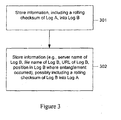
- FIG. 3 is a flow diagram of one embodiment of a process for entangling a pair of logs. The process is performed by processing logic that may comprise hardware (circuitry, dedicated logic, etc.), software (such as is run on a general purpose computer system or a dedicated machine), or a combination of both.
- processing logic may comprise hardware (circuitry, dedicated logic, etc.), software (such as is run on a general purpose computer system or a dedicated machine), or a combination of both.
- the process begins by processing logic storing information, including the current rolling checksum of log A into a log entry in log B (processing block 301).
- processing logic stores information about log B in log A (processing block 302).
- the information stored in log A about log B may include the server name, file name, or URL of log B and the position in the log where the entanglement is stored.
- the information stored in log A may also include a rolling checksum from log B. If this checksum is stored, the entanglement is both from log B to log A and from log A to log B.
- verification software (such as in a computer system of Figure 9 (or dedicated machine) recomputes the rolling hash for each entry in the log. If the rolling hash computed by the verification software matches the rolling hash stored in the log, then that entry has not been changed unless the hash function has been compromised.
- the hash function "being compromised" means two distinct sequences of bytes have been found that yield the same hash.
- entries in a log must be consistent from the message of interest up to and including a rolling checksum that is stored (entangled) in another log.
- the entries in the second log must be self consistent before and after the entanglement entry.
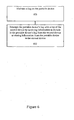
- FIG. 4 is a flow diagram of one embodiment of a process for performing entanglement detection.
- the process is performed by processing logic that may comprise hardware (circuitry, dedicated logic, etc.), software (such as is run on a general purpose computer system or a dedicated machine), or a combination of both.
- the process begins by processing logic initializing a list of servers that have evidence to the empty set, initializing the list of messages or hashes of interest to the single message or hash desired and searching for the message or message hash of interest on all known logs (processing block 401). If the message or its hash is not found anywhere, no verification is possible and the process ends.
- the processing logic verifies the rolling checksums following the entry containing the message or hash, for every log where the message or message hash is found (processing block 402). In one embodiment, this is done by recomputing the checksums r i for the log using the verification software.
- Processing logic adds all rolling hashes that appear after the hash of interest to a list of hashes, and adds any logs referenced by the current log to a list of logs of interest (processing block 403). Some logs will not list other logs, in which case there is nothing to perform for this sub-step.
- Processing logic searches for all hashes in the hashes of interest list in one of the known logs that hasn't been searched (processing block 404). Afterwards, processing logic tests whether a rolling hash appears in the log (processing block 405). If not, the process transitions to processing block 404 where the process continues. If a rolling hash appears in a log, processing logic adds that log to the list of logs with evidence about the original message or hash (processing block 406), and adds all rolling checksums that appear in the log after the hash of interest to the hash list (processing block 407) and adds any logs referenced by that log the log list (processing block 408).
- Processing logic then checks whether there are any more known logs to search (processing block 409). If not, the process ends. If so, processing transitions to processing block 404 and repeats the process until no new hashes are added to the list of hashes of interest, and no new logs are added to the list logs.
- logs may be stored on the same device, same office, or same company.
- a log is entangled with logs on multiple physical devices, or with logs which are under the control of different companies, then someone verifying the logs will have more confidence that the log has not changed.
- This benefit of entangling with different devices means that the logs should be able to store addresses of entangled logs that cross company and device boundaries.
- One way to do this is to use a URL to identify a log.
- the python source code below determines logs that confirm the message hash in another log.
- This source code is designed to work for a particular form of log that doesn't contain references to other logs. Thus, it only finds evidence in the logs it initialized to check and new hashes are searched for only in the known logs.
- the source code is designed to access logs from multiple independent http servers. The source implementation currently uses only one log per sever, but the URLs could be modified to allow multiple logs per server.
- the technique described above to verify logs can involve a lot of operations.
- the complexity can be reduced by keeping better track of hashes and logs that have been previously searched.
- Complexity can also be reduced by only considering log entries occurring before a certain time, or searching certain logs first, for example if it is known that certain logs are used for entangling more often these can be searched earlier.
- the rolling checksum in a log can be used as part of an authentication mechanism. For example, knowledge ofthe most recent rolling checksum rN could be used as permission to write an additional entry to a log. A device keeping a log could insist that the most recent checksum be provided with the new log entry. By doing so, if two other devices know the current checksum, and both request to write to the log, only one will succeed. The first device to provide a new log entry will cause the checksum to change, and then the second device will not have the correct checksum. This technique provides a way to insure that new data is added to the log only if the provider of the data has the most up-to-date information about the log. Thus, the checksum can be used to as a form of "lock" on the log to prevent race conditions.
- the rolling checksum can also be used to prove that the same log is being used again. In this case, the full contents of the log should not be publicly available.
- the system could ask for the rolling hash used to make the deposit. If more security is desired, in one embodiment, the system asks for information about that rolling hash (e.g., the hash of that rolling hash and a challenge string). The system could ask for several pieces of information about a previous interaction, that could only be answered by someone in possession of the log.
- logging and techniques described above are used by a portable logging device for recording transactions such as, for example, print and scan transactions.
- the portable logging device also facilitates providing access to related documents.
- the portable logging device comprises a SIM card or other card-like device that has some computational capability.
- the card is insertable into a copier or other peripheral device and can compute a media identifier (e.g., a hash) of a document being scanned or otherwise being processed, and stores the media identifier on both the copier (or other peripheral device) and on the portable logging device.
- the media identifier may be stored in a log on the portable logging device.
- FIG. 5 is a diagram illustrating a portable logging device and a second device, copier 520.
- the second device could be an MFP, a scanner, or any other device, and copier 520 is only used as an example of the second device.
- portable device 500 includes a processing unit 501 (e.g., a processor, microcontroller, etc.) that performs functions and processes data.
- processing unit 501 executes instructions to generate media identifiers (e.g., hash values) and log entries and stores the log entries in a log 511.
- Portable device 500 also includes memory 502 that stores log 511, instructions for hash functions and other functions 512 performed by processing unit 501, and may store media 513.
- portable logging device 500 interacts with copier 520.
- the portable logging device and the copier 520 interact such that the logs of the portable logging device and copier 520 are entangled.
- device 520 is a copier
- the copier scans a document
- a media identifier is generated by device 520 or portable logging device 500 corresponding to the media scanned and the media identifier could be stored on logs in device 520 and/or portable logging device 500.
- the time of the scan and an indication that the operation was performed could also be logged.
- the operation performed by device 520, the machine identifier of the media, and time information may be logged.
- Other operations include copying, sending, and printing.
- Device 520 could also be a PC, another portable device, or even a device traditionally without computation like, for example, but not limited to an electronic doorway.
- the portable logging device interacts with another device by exchanging rolling checksums with other devices, e.g. several security doors. Later examination of the log in the portable device and the log at the door can verify that the particular logging device was used to access the door.
- the media exchanged in this case might be a random challenge string.
- the portable logging device could add the string and compute a new rolling checksum, that the door can verify. With each access both, the door and the portable logging device can update the string that is expected to be used for the next access.
- Figure 6 illustrates a flow diagram of one embodiment of a process for interacting between a portable logging device and a second device.
- the process is performed by processing logic that may comprise hardware (circuitry, dedicated logic, etc.), software (such as is run on a general purpose computer system or a dedicated machine), or a combination of both.
- the process begins with processing logic maintaining a log on the portable device (processing block 601) and entangling the portable device's log with a log of the second device (e.g., a copier, scanner, MFP) by receiving information to include in the portable device's log from the second device (processing block 602).
- processing logic maintaining a log on the portable device (processing block 601) and entangling the portable device's log with a log of the second device (e.g., a copier, scanner, MFP) by receiving information to include in the portable device's log from the second device (processing block 602).
- a log of the second device e.g., a copier, scanner, MFP
- the interaction between the portable logging device and the second device is such that the second device receives a rolling checksum and a message and provides a new rolling checksum.
- the portable logging device calculates the rolling checksum with the message for the second device and sends both the rolling checksum and the message for storage on the log of the second device.
- the second device generates a new rolling checksum and provides it to the portable logging device.
- the portable logging device stores this new rolling checksum and may use it when calculating a new rolling checksum on behalf of the second device during a future interaction between the two.
- these two rolling checksums are calculated with the same hash functions; alternatively, different hash functions could be used.
- FIG. 7 is a flow diagram of one embodiment of a process for exchanging information between a portable logging device and a second device.
- the process is performed by processing logic that may comprise hardware (circuitry, dedicated logic, etc.), software (such as is run on a general purpose computer system or a dedicated machine), or a combination of both.
- the process begins with a portable device having an interaction with a second device regarding media (processing block 701).
- the interaction involves the portable logging device providing the media to the second device.
- the interaction may include the portable logging device receiving media from the second device.
- processing logic in the portable device generates the first media identifier corresponding to the media (processing block 702) and provides a media identifier corresponding to the media to the second device for inclusion in a log associated with the second device (processing block 703).
- the portable device may generate the media identifier corresponding to the media in response to receiving the media from the second device.
- the portable device providing the media identifier to the second device for inclusion in a log associated with the second device includes providing an indication to the second device that the media identifier corresponds to the media provided by the second device.
- the process of Figure 7 also includes processing logic receiving another media identifier from the second device after providing the portable logging device sends the first media identifier to the second device (processing block 704) and the portable device storing this second media identifier in a log maintained by the portable device (processing block 705).
- the first and second media identifiers are generated with the same hash functions; alternatively, different hash functions could be used.
- a portable logging device is used to keep track of interactions with a multi-function peripheral (MFP).
- the portable logging device consists only of write once memory. Prior to making a print or scan (or perform another interaction) with a MFP, the portable logging device is "connected" to the MFP either by insertion or wirelessly. Then a document is placed on the MFP and scanned. The MFP accesses the portable logging device to determine the hash function to compute on the scanned data (the hash function to use might be stored only as a name in which case the MFP would have to already know the algorithm, or the hash function could be stored as a set of computational instructions for the MFP).
- the MFP uses the hash function to compute the hash of the scanned document and stores that hash on the portable logging device.
- the MFP may also store the instructions performed with the scan on the portable logging device, such as, for example, how many copiers were made, or an email address that the document was sent to.
- the MFP may also store a rolling checksum from the MFP's log on the portable logging device.
- the MFP may store the hash of the document in a log on the MFP.
- the MFP may also store any rolling checksums computed for the portable logging device in the log of the MFP.
- a portable logging device is used that is able to compute hash functions on the portable device.
- the portable logging device is used to gain access to a doorway, a PC, or an MFP, or in general, a service device.
- the portable logging device is initialized with a rolling checksum ro, and the service device might be configured to allow access to a portable device that can prove knowledge of that checksum.
- the service device issues a challenge string, M i .
- this string contains the information about the type of access being requested, the data, and some random bytes.
- the service device can make the same computation to determine if the portable device started with r i . Then the service device and the portable logging device record the new value of r i+1 in the log which is used the next time access is requested. Because both devices keep a record of access, further authentication is possible.
- the service device can issue a challenge regarding a previous interaction, e.g. by providing r k where k ⁇ i, and asking for the portable device to return the strings that will hash to r k .
- a portable logging device examines the entries of a second log, and add entries to that log that apply additional hashing functions to the original entries of that second log.
- the device would retain a log of all such entries it has made. This in effect entangles the log of the portable device with that second log, and adds verification entries to the second log that indicates its entries have been examined.
- the portable logging device can include, as a part of the entry, the hash of the first log's entry concatenated with a secret.
- This secret would never be revealed by the portable logging device.
- the device could be asked to perform a similar hash at any time, allowing independent verification of the entries at a later time. This would have the effect of producing an "external certification" of the second log, where new entries are added which guarantee that the second log's entries have been read by a particular device, and applying additional hashing information to the second log.
- this hashing of entry concatenated with a secret is implemented by tamper resistant hardware.
- portable logging device 500 stores one or more hash functions 512 in its memory and is able to transfer one or more hash functions to copier 520 (or other peripheral device) when inserted into copier 520.
- the process of Figure 7 further comprises the portable device providing the second device with information to upgrade functionality of the second device to generate media identifiers (processing block 706). This is optional.
- the information may include one or more hash functions that the second device does not possess.
- the portable logging device may be used to compute a log that is associated with a person, a workgroup, a particular task (e.g., it could be attached to a pallet of goods or other work related item, and each person (e.g., fork-lift, or truck, or inspector, could make a log entry). In this way, all interactions that are made with respect to that person, workgroup, or task can be recorded.
- the portable logging device has a set of shared log entries with copier 520.
- Portable logging device 500 provides a series of one or more challenges to copier 520 to assure itself of the identity of copier 520.
- portable logging device 500 and copier 520 may use an old rolling checksum and its corresponding entry in a log for gaining access to (logging-in) to copier 520.
- the two devices can then agree on a new log entry and rolling checksum to serve as a login value the next time the two are to interact.
- portable logging device 500 may prompt copier 520 to append a random sequence provided by portable logging device 500 to a particular entry in log 531 of copier 520 (e.g., entry 36) and requests copier 520 to return to portable logging device 500 a hash of that concatenation. Because portable logging device 500 knows what is in that entry, provides the random sequence to copier 520 and knows the hash function that copier 520 is to use, portable logging device 500 is able to determine the answer and compare it with the answer provided by copier 520. The random sequence could be media. This process may be repeated a number of times. By choosing random entries and random additional secrets, portable logging device 500 assures itself of the identity of the second device.
- transfers of information between portable logging device 500 and copier 520 can be performed wirelessly using wireless communication functionality on both portable logging device 500 (shown as wireless communication functionality 505) and copier 520 (not shown).
- other forms of wired communication may occur without the use of interface 503.
- the processing unit adds a media identifier to its log and causes the wireless communication interface to transmit information to and/or receive information from copier 520.
- the processing unit adds an entry to its log, where the entry includes a media identifier that is based on content of media that was the subject of an interaction with second device.
- the portable logging device could be a company badge or ID card, and used for official company activities.
- the log on the card is entangled with logs of various devices in the office and, thus, provide irrefutable evidence that the portable logging device participated in transactions with these devices.
- the log on the portable logging device is used as an ID card because it contains a list of previous transactions that could not have been duplicated without access to the data from the card and without doing all the actions done with the card.
- FIG. 8 is a flow diagram of one embodiment of a process for authenticating an interaction between a portable logging device and a second device.
- the process is performed by processing logic that may comprise hardware (circuitry, dedicated logic, etc.), software (such as is run on a general purpose computer system or a dedicated machine), or a combination of both.
- the process begins by processing logic examining a first log stored on the portable device and a second log associated with the second device (processing block 801).
- processing logic determining that the portable device interacted with the second device based on one or more entries in at least one of the logs associated with the portable device and the second device (processing block 802).
- determining that the portable device interacted with the second device is based on one or more identical entries appearing in both the first and second logs.
- at least one of the entries includes a media identifier that is based on content of media that was the subject of the interaction between the portable logging device and the second device.
- a determination that the portable logging device interacted with the second device is based the results of one or more challenges put forth by the portable logging device to the second device using entries appearing in at least the log of the second device.
- a determination that the portable logging device interacted with the second device may be performed by sending one or more challenges to the second device that require a the second device to send information to the portable logging device, and thereafter, determining whether the information matches data generated by the portable logging device. If it matches, the portable logging device is able to confirm the identify of the second device.
- at least one of the challenges involves performing one or more operations on one log entry of a log associated with the second device and providing results of the one or more operations as the information received from the second device.
- a third device determines whether the portable device interacted with the second device by accessing the logs of the portable logging device and the second device and determining that the portable device interacted with the second device based on one or more entries in the first and second logs.
- the process of Figure 8 may further comprise processing logic in the portable device identifying a new media identifer for use in authentication with the second device in the future (processing bock 803), sending that media identifier to the second device (processing block 804), and storing the new identifier in a log of the portable logging device and a log of the second device (processing block 805).
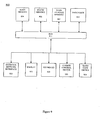
- FIG. 9 is a block diagram of a computer system that may perform one or more of the operations described herein.
- computer system 900 may comprise an exemplary client or a server computer system.
- Computer system 900 comprises a communication mechanism or bus 911 for communicating information, and a processor 912 coupled with bus 911 for processing information.
- Processor 912 includes a microprocessor, but is not limited to a microprocessor, such as, for example, PentiumTM, etc.
- System 900 further comprises a random access memory (RAM), or other dynamic storage device 104 (referred to as main memory) coupled to bus 911 for storing information and instructions to be executed by processor 912.
- main memory 904 also may be used for storing temporary variables or other intermediate information during execution of instructions by processor 912.
- Computer system 900 also comprises a read only memory (ROM) and/or other static storage device 906 coupled to bus 911 for storing static information and instructions for processor 912, and a data storage device 907, such as a magnetic disk or optical disk and its corresponding disk drive.
- ROM read only memory
- Data storage device 907 is coupled to bus 911 for storing information and instructions.
- Computer system 900 may further be coupled to a display device 921, such as a cathode ray tube (CRT) or liquid crystal display (LCD), coupled to bus 911 for displaying information to a computer user.
- a display device 921 such as a cathode ray tube (CRT) or liquid crystal display (LCD)
- An alphanumeric input device 922 may also be coupled to bus 911 for communicating information and command selections to processor 912.
- cursor control 923 such as a mouse, trackball, trackpad, stylus, or cursor direction keys, coupled to bus 911 for communicating direction information and command selections to processor 912, and for controlling cursor movement on display 921.
- bus 911 Another device that may be coupled to bus 911 is hard copy device 924, which may be used for printing instructions, data, or other information on a medium such as paper, film, or similar types of media. Furthermore, a sound recording and playback device, such as a speaker and/or microphone may optionally be coupled to bus 911 for audio interfacing with computer system 900. Another device that may be coupled to bus 911 is a wired/wireless communication capability 925 to communication to a phone or handheld palm device.
- system 900 any or all of the components of system 900 and associated hardware may be used in the present invention. However, it can be appreciated that other configurations of the computer system may include some or all of the devices.
Landscapes
- Engineering & Computer Science (AREA)
- Business, Economics & Management (AREA)
- Accounting & Taxation (AREA)
- Theoretical Computer Science (AREA)
- Signal Processing (AREA)
- Computer Security & Cryptography (AREA)
- Computer Networks & Wireless Communication (AREA)
- Computer Hardware Design (AREA)
- General Engineering & Computer Science (AREA)
- Finance (AREA)
- General Physics & Mathematics (AREA)
- Computing Systems (AREA)
- Physics & Mathematics (AREA)
- Development Economics (AREA)
- Medical Informatics (AREA)
- General Health & Medical Sciences (AREA)
- Health & Medical Sciences (AREA)
- Economics (AREA)
- Software Systems (AREA)
- Strategic Management (AREA)
- General Business, Economics & Management (AREA)
- Storage Device Security (AREA)
- Debugging And Monitoring (AREA)
Claims (14)
- Tragbare Einrichtung, umfassend:ein Mittel zum Empfangen einer elektronischen Datei (513, 541) von einer zweiten Einrichtung (520), wobei die elektronische Datei Gegenstand eines Druckvorgangs oder eines Abtastvorgangs zwischen der tragbaren Einrichtung und der zweiten Einrichtung ist, wobei die zweite Einrichtung eine Kopier- bzw. Abtast- bzw. Druckfunktion aufweist;ein Mittel (501) zum Berechnen (702) eines Medienidentifikators der elektronischen Datei (513, 541), wobei der Medienidentifikator ein Hashwert ist, der sich aus Anwendung einer Hashfunktion auf einen in der elektronischen Datei enthaltenen Klartextbereich ergibt;ein Mittel zum Erzeugen einer fortlaufenden Prüfsumme durch Bereitstellen einer Verkettung einer vorherigen Prüfsumme und eines Nachrichteninhalts des elektronischen Datei (513, 541) oder des Medienidentifikators mit einer Hashfunktion, wobei die vorherige Prüfsumme eine der elektronischen Datei (513, 514) von der zweiten Einrichtung (520) zugewiesene Prüfsumme ist;gekennzeichnet durch (513, 541) ein Mittel (500) zum Erzeugen des Medienidentifikators in Erwiderung auf ein Empfangen der elektronischen Datei (513, 541), wobei die tragbare Einrichtung ein Mittel zum Senden der fortlaufenden Prüfsumme an die zweite Einrichtung (520) durch Bereitstellen einer Angabe für die zweite Einrichtung (520), dass die fortlaufende Prüfsumme der von der zweiten Einrichtung (520) bereitgestellten elektronischen Datei (513, 541) entspricht, enthält.
- Einrichtung wie in Anspruch 1 definiert, ferner gekennzeichnet durch:ein Mittel zum Empfangen eines zweiten Medienidentifikators von der zweiten Ein richtung (520) nach Bereitstellen der fortlaufenden Prüfsumme für die zweite Einrichtung (520); wobeidie tragbare Einrichtung Mittel (502) zum Speichern des zweiten Medienidentifikators in einem von der tragbaren Einrichtung bereit gehaltenen Protokoll (511) enthält.
- Einrichtung wie in Anspruch 2 definiert, dadurch gekennzeichnet, dass der erste Medienidentifikator und der zweite Medienidentifikator mit unterschiedlichen Hashfunktionen(512) erzeugt werden.
- Einrichtung wie in Anspruch 1 definiert, ferner dadurch gekennzeichnet, dass die tragbare Einrichtung eingerichtet ist, das Medium (513) für die zweite Einrichtung (520) bereitzustellen.
- Einrichtung wie in Anspruch 1 definiert, dadurch gekennzeichnet, dass die Hashfunktion (512) ein MD5-Hashalgorithmus ist.
- Einrichtung wie in Anspruch 1 definiert, dadurch gekennzeichnet, dass das Medium (513, 541) ein Dokument ist und der Medienidentifikator ein Dokumentenidentifikator ist.
- Einrichtung wie in Anspruch 1 definiert, dadurch gekennzeichnet, dass die tragbare Einrichtung ein Mittel zum Bereitstellen (706) von Informationen zum Höherstufen der Funktionalität der zweiten Einrichtung (520) für die zweite Einrichtung (520) enthält.
- Verfahren, umfassend:Empfangen, an einer tragbaren Einrichtung, einer elektronischen Datei (513, 541) von einer zweiten Einrichtung (520), wobei die elektronische Datei (513, 541) Gegenstand eines Druckvorgangs oder eines Abtastvorgangs zwischen der tragbaren Einrichtung und der zweiten Einrichtung ist, wobei die zweite Einrichtung eine Kopier- bzw. Abtast- bzw. Druckfunktion aufweist;Berechnen (702), auf der tragbaren Einrichtung, eines Medienidentifikators der elektronischen Datei (513, 541), wobei der Medienidentifikator ein Hashwert ist, der sich aus Anwendung einer Hashfunktion auf einen in der elektronischen Datei enthaltenen Klartextbereich ergibt;Erzeugen einer fortlaufenden Prüfsumme durch Bereitstellen einer Verkettung einer vorherigen Prüfsumme und eines Nachrichteninhalts des elektronischen Datei (513, 541) oder des Medienidentifikators mit einer Hashfunktion, wobei die vorherige Prüfsumme eine der elektronischen Datei (513, 514) von der zweiten Einrichtung (520) zugewiesene Prüfsumme ist; undSenden der fortlaufenden Prüfsumme von der tragbaren Einrichtung an die zweite Einrichtung (520);gekennzeichnet durch (513, 541) Erzeugen, auf der tragbaren Einrichtung, des Medienidentifikators in Erwiderung auf ein Empfangen der elektronischen Datei (513, 541), wobei die tragbare Einrichtung ein Mittel zum Senden der fortlaufenden Prüfsumme an die zweite Einrichtung (520) durch Bereitstellen einer Angabe für die zweite Einrichtung (520), dass die fortlaufende Prüfsumme der von der zweiten Einrichtung (520) bereitgestellten elektronischen Datei (513, 541) entspricht.
- Verfahren wie in Anspruch 8 definiert, ferner gekennzeichnet durch:Empfangen eines zweiten Medienidentifikators von der zweiten Einrichtung (520) nach Bereitstellen der fortlaufenden Prüfsumme für die zweite Einrichtung (520); undferner dadurch gekennzeichnet, dass die tragbare Einrichtung den zweiten Medienidentifikator in einem von der tragbaren Einrichtung bereit gehaltenen Protokoll speichert.
- Verfahren wie in Anspruch 9 definiert, dadurch gekennzeichnet, dass der erste Medienidentifikator und der zweite Medienidentifikator mit unterschiedlichen Hashfunktionen(512) erzeugt werden.
- Verfahren wie in Anspruch 8 definiert, ferner gekennzeichnet dadurch, dass die tragbare Einrichtung das Medium (513) für die zweite Einrichtung bereitstellt.
- Verfahren wie in Anspruch 8 definiert, dadurch gekennzeichnet, dass die Hashfunktion (512) ein M DS-Hashalgorithmus ist.
- Verfahren wie in Anspruch 8 definiert, dadurch gekennzeichnet, dass das Medium (513, 541) ein Dokument ist und der Medienidentifikator ein Dokumentenidentifikator ist.
- Verfahren wie in Anspruch 8 definiert, dadurch gekennzeichnet, dass die tragbare Einrichtung Informationen zum Höherstufen der Funktionalität der zweiten Einrichtung (520) für die zweite Einrichtung (520) bereitstellt (706).
Applications Claiming Priority (1)
| Application Number | Priority Date | Filing Date | Title |
|---|---|---|---|
| US11/692,784 US20080243688A1 (en) | 2007-03-28 | 2007-03-28 | Method and Apparatus for Recording Transactions with a Portable Logging Device |
Publications (2)
| Publication Number | Publication Date |
|---|---|
| EP1998534A1 EP1998534A1 (de) | 2008-12-03 |
| EP1998534B1 true EP1998534B1 (de) | 2015-06-03 |
Family
ID=39795980
Family Applications (1)
| Application Number | Title | Priority Date | Filing Date |
|---|---|---|---|
| EP08153371.3A Active EP1998534B1 (de) | 2007-03-28 | 2008-03-27 | Verfahren und Vorrichtung zur Aufzeichnung von Transaktionen mit einer tragbaren Protokollierungsvorrichtung |
Country Status (3)
| Country | Link |
|---|---|
| US (1) | US20080243688A1 (de) |
| EP (1) | EP1998534B1 (de) |
| JP (1) | JP5053146B2 (de) |
Families Citing this family (15)
| Publication number | Priority date | Publication date | Assignee | Title |
|---|---|---|---|---|
| US7047488B2 (en) | 2002-07-19 | 2006-05-16 | Open Invention Network | Registry driven interoperability and exchange of documents |
| US7949666B2 (en) | 2004-07-09 | 2011-05-24 | Ricoh, Ltd. | Synchronizing distributed work through document logs |
| US8479004B2 (en) | 2006-08-31 | 2013-07-02 | Ricoh Co., Ltd | Paper-based document logging |
| US8006094B2 (en) * | 2007-02-21 | 2011-08-23 | Ricoh Co., Ltd. | Trustworthy timestamps and certifiable clocks using logs linked by cryptographic hashes |
| US8996483B2 (en) | 2007-03-28 | 2015-03-31 | Ricoh Co., Ltd. | Method and apparatus for recording associations with logs |
| US8447989B2 (en) | 2008-10-02 | 2013-05-21 | Ricoh Co., Ltd. | Method and apparatus for tamper proof camera logs |
| US8185733B2 (en) | 2008-10-02 | 2012-05-22 | Ricoh Co., Ltd. | Method and apparatus for automatically publishing content based identifiers |
| JP5137783B2 (ja) * | 2008-10-31 | 2013-02-06 | 三菱電機株式会社 | ハッシュ生成装置及び検証装置及びハッシュ生成プログラム及びハッシュ生成方法 |
| US8504480B2 (en) | 2011-02-03 | 2013-08-06 | Ricoh Co., Ltd | Creation of signatures for authenticating applications |
| US9324057B2 (en) * | 2011-07-22 | 2016-04-26 | Avaya Inc. | System and method for establishing a relationship based on a prior association |
| JP2013029939A (ja) * | 2011-07-27 | 2013-02-07 | Kyocera Document Solutions Inc | 制御装置 |
| US9529568B1 (en) * | 2014-12-19 | 2016-12-27 | Amazon Technologies, Inc. | Systems and methods for low interference logging and diagnostics |
| US11271751B2 (en) * | 2019-06-21 | 2022-03-08 | Oracle International Corporation | Distributed data records |
| JP2022167527A (ja) * | 2021-04-23 | 2022-11-04 | Necスペーステクノロジー株式会社 | メモリアクセス装置、メモリアクセス方法、及びメモリアクセスプログラム |
| CN113722358B (zh) * | 2021-08-20 | 2023-11-17 | 河北环鼎石油设备有限责任公司 | 一种泵出测井方式的大文件回放算法及系统、装置 |
Citations (1)
| Publication number | Priority date | Publication date | Assignee | Title |
|---|---|---|---|---|
| US5978475A (en) * | 1997-07-18 | 1999-11-02 | Counterpane Internet Security, Inc. | Event auditing system |
Family Cites Families (102)
| Publication number | Priority date | Publication date | Assignee | Title |
|---|---|---|---|---|
| US4809158A (en) * | 1985-10-23 | 1989-02-28 | Mccauley Peter B | Sorting method and apparatus |
| US6345288B1 (en) * | 1989-08-31 | 2002-02-05 | Onename Corporation | Computer-based communication system and method using metadata defining a control-structure |
| US6044205A (en) * | 1996-02-29 | 2000-03-28 | Intermind Corporation | Communications system for transferring information between memories according to processes transferred with the information |
| EP0444358B1 (de) * | 1990-02-27 | 1998-08-19 | Oracle Corporation | Dynamische Optimierung eines einzelnen relationalen Zugriffs |
| US5396622A (en) * | 1991-12-23 | 1995-03-07 | International Business Machines Corporation | Efficient radix sorting system employing a dynamic branch table |
| US5815722A (en) * | 1992-11-18 | 1998-09-29 | Canon Information Systems, Inc. | In an interactive network board, a method and apparatus for remotely downloading and executing files in a memory |
| US6019287A (en) * | 1993-10-06 | 2000-02-01 | 3M Innovative Properties Company | Security reader for automatic detection of tampering and alteration |
| CA2212574C (en) * | 1995-02-13 | 2010-02-02 | Electronic Publishing Resources, Inc. | Systems and methods for secure transaction management and electronic rights protection |
| US7289643B2 (en) * | 2000-12-21 | 2007-10-30 | Digimarc Corporation | Method, apparatus and programs for generating and utilizing content signatures |
| US6308175B1 (en) * | 1996-04-04 | 2001-10-23 | Lycos, Inc. | Integrated collaborative/content-based filter structure employing selectively shared, content-based profile data to evaluate information entities in a massive information network |
| US20020046072A1 (en) * | 1996-06-18 | 2002-04-18 | Toshikatsu Arai | Workflow system |
| US6044381A (en) * | 1997-09-11 | 2000-03-28 | Puma Technology, Inc. | Using distributed history files in synchronizing databases |
| GB2329044B (en) * | 1997-09-05 | 2002-10-09 | Ibm | Data retrieval system |
| US6661933B1 (en) * | 1998-01-13 | 2003-12-09 | Matsushita Electric Industrial Co., Ltd. | Apparatus and method for image data processing |
| US6807632B1 (en) * | 1999-01-21 | 2004-10-19 | Emc Corporation | Content addressable information encapsulation, representation, and transfer |
| US5975475A (en) * | 1998-05-14 | 1999-11-02 | Chaplin; Gregg S. | Fire extinguisher holder |
| US6226618B1 (en) * | 1998-08-13 | 2001-05-01 | International Business Machines Corporation | Electronic content delivery system |
| US6360215B1 (en) * | 1998-11-03 | 2002-03-19 | Inktomi Corporation | Method and apparatus for retrieving documents based on information other than document content |
| US6363381B1 (en) * | 1998-11-03 | 2002-03-26 | Ricoh Co., Ltd. | Compressed document matching |
| GB9825102D0 (en) * | 1998-11-16 | 1999-01-13 | Insignia Solutions Plc | Computer system |
| US6607948B1 (en) * | 1998-12-24 | 2003-08-19 | Kabushiki Kaisha Toshiba | Method of manufacturing a substrate using an SiGe layer |
| US6463427B1 (en) * | 1999-03-16 | 2002-10-08 | Microsoft Corporation | Use of object signature property as a search parameter during synchronization of objects on a computer |
| US6631496B1 (en) * | 1999-03-22 | 2003-10-07 | Nec Corporation | System for personalizing, organizing and managing web information |
| US6400845B1 (en) * | 1999-04-23 | 2002-06-04 | Computer Services, Inc. | System and method for data extraction from digital images |
| US6697948B1 (en) * | 1999-05-05 | 2004-02-24 | Michael O. Rabin | Methods and apparatus for protecting information |
| US7278115B1 (en) * | 1999-06-18 | 2007-10-02 | Microsoft Corporation | Methods, apparatus and data structures for providing a user interface to objects, the user interface exploiting spatial memory and visually indicating at least one object parameter |
| US6640301B1 (en) * | 1999-07-08 | 2003-10-28 | David Way Ng | Third-party e-mail authentication service provider using checksum and unknown pad characters with removal of quotation indents |
| US6546385B1 (en) * | 1999-08-13 | 2003-04-08 | International Business Machines Corporation | Method and apparatus for indexing and searching content in hardcopy documents |
| WO2001018688A2 (en) * | 1999-09-10 | 2001-03-15 | Avantgo, Inc. | System, method, and computer program product for interactive interfacing with mobile devices |
| JP2001101232A (ja) * | 1999-10-04 | 2001-04-13 | Sony Corp | 情報処理装置および情報処理方法、並びに記録媒体 |
| US7134021B2 (en) * | 1999-10-22 | 2006-11-07 | Hitachi, Ltd. | Method and system for recovering the validity of cryptographically signed digital data |
| JP2001217822A (ja) * | 2000-01-31 | 2001-08-10 | Toshiba Corp | 暗号化記録装置 |
| US6771885B1 (en) * | 2000-02-07 | 2004-08-03 | Koninklijke Philips Electronics N.V. | Methods and apparatus for recording programs prior to or beyond a preset recording time period |
| US7152047B1 (en) * | 2000-05-24 | 2006-12-19 | Esecure.Biz, Inc. | System and method for production and authentication of original documents |
| AU2001275082A1 (en) * | 2000-06-02 | 2001-12-17 | Iprint.Com, Inc. | Integrated electronic shopping cart system and method |
| JP2002024177A (ja) * | 2000-07-10 | 2002-01-25 | Asia Shoken Insatsu Kk | 電子公証システムおよび電子公証方法 |
| US6631469B1 (en) * | 2000-07-17 | 2003-10-07 | Intel Corporation | Method and apparatus for periodic low power data exchange |
| US6687696B2 (en) * | 2000-07-26 | 2004-02-03 | Recommind Inc. | System and method for personalized search, information filtering, and for generating recommendations utilizing statistical latent class models |
| US6499665B1 (en) * | 2000-08-21 | 2002-12-31 | Xerox Corporation | Method for indexing and retrieval of physical documents |
| US6582138B1 (en) * | 2000-08-21 | 2003-06-24 | Xerox Corporation | Authenticated sheet material |
| US6615208B1 (en) * | 2000-09-01 | 2003-09-02 | Telcordia Technologies, Inc. | Automatic recommendation of products using latent semantic indexing of content |
| US8032542B2 (en) * | 2000-10-26 | 2011-10-04 | Reynolds Mark L | Creating, verifying, managing, and using original digital files |
| US6810398B2 (en) * | 2000-11-06 | 2004-10-26 | Avamar Technologies, Inc. | System and method for unorchestrated determination of data sequences using sticky byte factoring to determine breakpoints in digital sequences |
| US20020103920A1 (en) * | 2000-11-21 | 2002-08-01 | Berkun Ken Alan | Interpretive stream metadata extraction |
| US20040030681A1 (en) * | 2000-11-21 | 2004-02-12 | Shannon Paul Thurmond | System and process for network site fragmented search |
| US20020161850A1 (en) * | 2001-01-29 | 2002-10-31 | Ulrich Thomas R. | Data path accelerator for storage systems |
| US20020120484A1 (en) * | 2001-02-23 | 2002-08-29 | International Business Machines Corporation | Method and system for providing intelligent rules-based engine with heuristics for determining optimal routing and processing of business events |
| US7200627B2 (en) * | 2001-03-21 | 2007-04-03 | Nokia Corporation | Method and apparatus for generating a directory structure |
| US7668718B2 (en) * | 2001-07-17 | 2010-02-23 | Custom Speech Usa, Inc. | Synchronized pattern recognition source data processed by manual or automatic means for creation of shared speaker-dependent speech user profile |
| US20030028494A1 (en) * | 2001-08-06 | 2003-02-06 | King Shawn L. | Electronic document management system and method |
| GB2395100B (en) * | 2001-08-16 | 2005-11-23 | Goldpocket Interactive | Digital data monitoring and logging in an ITV system |
| US20030046586A1 (en) * | 2001-09-05 | 2003-03-06 | Satyam Bheemarasetti | Secure remote access to data between peers |
| US7007074B2 (en) * | 2001-09-10 | 2006-02-28 | Yahoo! Inc. | Targeted advertisements using time-dependent key search terms |
| US7756724B2 (en) * | 2001-11-21 | 2010-07-13 | Merge Healthcare Incorporated | System and methods for real-time worklist service |
| US7180895B2 (en) * | 2001-12-31 | 2007-02-20 | 3Com Corporation | System and method for classifying network packets with packet content |
| US7302576B2 (en) * | 2002-01-07 | 2007-11-27 | Xerox Corporation | Systems and methods for authenticating documents |
| US7356845B2 (en) * | 2002-01-30 | 2008-04-08 | Lucent Technologies Inc. | Method and apparatus for identification tagging documents in a computer system |
| US20030158944A1 (en) * | 2002-02-19 | 2003-08-21 | International Business Machines Corporation | Software control in a business transaction environment |
| JP4366040B2 (ja) * | 2002-03-07 | 2009-11-18 | インターナショナル・ビジネス・マシーンズ・コーポレーション | ネットワークサービスシステム、サーバ及びプログラム |
| JP4078454B2 (ja) * | 2002-03-22 | 2008-04-23 | 株式会社日立製作所 | ディジタル署名管理方法とディジタル署名処理装置およびプログラムと記録媒体 |
| US7143098B2 (en) * | 2002-05-10 | 2006-11-28 | International Business Machines Corporation | Systems, methods, and computer program products to reduce computer processing in grid cell size determination for indexing of multidimensional databases |
| JP2004040344A (ja) * | 2002-07-02 | 2004-02-05 | Hitachi Ltd | 原本保証方法および原本保証システム |
| KR20040032260A (ko) * | 2002-10-08 | 2004-04-17 | 전자부품연구원 | 메타데이터를 이용한 광고 디스플레이 장치 및 그 서비스방법 |
| US7555196B1 (en) * | 2002-09-19 | 2009-06-30 | Microsoft Corporation | Methods and systems for synchronizing timecodes when sending indices to client devices |
| US7792799B2 (en) * | 2002-10-10 | 2010-09-07 | Perlego Systems, Inc. | Backing up a wireless computing device |
| US20040075866A1 (en) * | 2002-10-18 | 2004-04-22 | Thormodsen Arne D. | Poster preparation system and method |
| US7197644B2 (en) * | 2002-12-16 | 2007-03-27 | Xerox Corporation | Systems and methods for providing hardcopy secure documents and for validation of such documents |
| CA2516741C (en) * | 2003-02-21 | 2013-10-08 | Caringo, Inc. | Additional hash functions in content-based addressing |
| JP2004272439A (ja) * | 2003-03-06 | 2004-09-30 | Konica Minolta Holdings Inc | ディレクトリ検索方法、ディレクトリ検索装置、記憶媒体及びプログラム |
| JP4381012B2 (ja) * | 2003-03-14 | 2009-12-09 | ヒューレット・パッカード・カンパニー | 万物識別子を用いたデータ検索システムおよびデータ検索方法 |
| GB0317571D0 (en) * | 2003-07-26 | 2003-08-27 | Koninkl Philips Electronics Nv | Content identification for broadcast media |
| US7406487B1 (en) * | 2003-08-29 | 2008-07-29 | Symantec Operating Corporation | Method and system for performing periodic replication using a log |
| US8229932B2 (en) * | 2003-09-04 | 2012-07-24 | Oracle International Corporation | Storing XML documents efficiently in an RDBMS |
| CA2442796A1 (en) * | 2003-09-26 | 2005-03-26 | Ibm Canada Limited - Ibm Canada Limitee | Binding a workflow engine to a data model |
| US7451167B2 (en) * | 2003-10-24 | 2008-11-11 | Network Appliance, Inc. | Verification of file system log data using per-entry checksums |
| US7203796B1 (en) * | 2003-10-24 | 2007-04-10 | Network Appliance, Inc. | Method and apparatus for synchronous data mirroring |
| US20050114709A1 (en) * | 2003-10-25 | 2005-05-26 | Macrovision Corporation | Demand based method for interdiction of unauthorized copying in a decentralized network |
| US7519726B2 (en) * | 2003-12-12 | 2009-04-14 | International Business Machines Corporation | Methods, apparatus and computer programs for enhanced access to resources within a network |
| EP1697818B1 (de) * | 2003-12-23 | 2018-05-30 | Wells Fargo Bank, N.A. | Authentifikationssystem für vernetzte computeranwendungen |
| RU2380750C2 (ru) * | 2004-03-12 | 2010-01-27 | Инджениа Текнолоджи Лимитед | Способы и устройства для создания печатных изделий с возможностью установления их подлинности и с последующей их проверкой |
| US7669117B2 (en) * | 2004-03-18 | 2010-02-23 | International Business Machines Corporation | Method and system for creation and retrieval of global annotations |
| US7478120B1 (en) * | 2004-04-27 | 2009-01-13 | Xiaohai Zhang | System and method for providing a peer indexing service |
| US7313555B2 (en) * | 2004-04-30 | 2007-12-25 | Anácapa North | Method for computing the minimum edit distance with fine granularity suitably quickly |
| US8977859B2 (en) * | 2004-05-04 | 2015-03-10 | Elsevier, Inc. | Systems and methods for data compression and decompression |
| US7392533B2 (en) * | 2004-05-19 | 2008-06-24 | Microsoft Corporation | System and method for management of a componentized electronic document retrievable over a network |
| JP2005346338A (ja) * | 2004-06-02 | 2005-12-15 | Dainippon Printing Co Ltd | 携帯型情報記憶媒体、そのプログラム及び携帯型情報記憶媒体の処理解析方法 |
| US7949666B2 (en) * | 2004-07-09 | 2011-05-24 | Ricoh, Ltd. | Synchronizing distributed work through document logs |
| JP2006033729A (ja) * | 2004-07-21 | 2006-02-02 | Ricoh Co Ltd | 文書電子化方法、文書電子化装置及び文書電子化プログラム |
| US20060047967A1 (en) * | 2004-08-31 | 2006-03-02 | Akhan Mehmet B | Method and system for data authentication for use with computer systems |
| JP4155956B2 (ja) * | 2004-09-16 | 2008-09-24 | 三洋電機株式会社 | 電子透かし埋め込み装置と方法ならびに電子透かし抽出装置と方法 |
| JP4631398B2 (ja) * | 2004-11-04 | 2011-02-16 | 富士ゼロックス株式会社 | 文書管理装置、および文書管理方法、並びにコンピュータ・プログラム |
| US8230326B2 (en) * | 2004-12-17 | 2012-07-24 | International Business Machines Corporation | Method for associating annotations with document families |
| US20060271787A1 (en) * | 2005-05-31 | 2006-11-30 | Xerox Corporation | System and method for validating a hard-copy document against an electronic version |
| JP4235193B2 (ja) * | 2005-06-07 | 2009-03-11 | 日本電信電話株式会社 | イベント履歴蓄積装置、イベント情報検証装置、イベント履歴蓄積方法、イベント情報検証方法およびイベント情報処理システム |
| EP1907987A4 (de) * | 2005-07-25 | 2010-11-10 | Silverbrook Res Pty Ltd | Produktartikel mit ein layout identifizierenden codierten daten |
| JP4093494B2 (ja) * | 2005-09-08 | 2008-06-04 | インターナショナル・ビジネス・マシーンズ・コーポレーション | 秘密情報へのアクセスを制御するシステムおよびその方法 |
| US7796285B2 (en) * | 2005-10-18 | 2010-09-14 | Dialogic Corporation | Supplementing facsimile image data |
| JP4668763B2 (ja) * | 2005-10-20 | 2011-04-13 | 株式会社日立製作所 | ストレージ装置のリストア方法及びストレージ装置 |
| US20070143356A1 (en) * | 2005-12-15 | 2007-06-21 | Kleinsmith Richard A | Enforcing workflow for implementing unique identification |
| US7588192B2 (en) * | 2006-01-20 | 2009-09-15 | Xerox Corporation | Hard copy protection and confirmation method |
| US7940926B2 (en) * | 2006-06-08 | 2011-05-10 | Novell, Inc. | Cooperative encoding of data by pluralities of parties |
| US8479004B2 (en) * | 2006-08-31 | 2013-07-02 | Ricoh Co., Ltd | Paper-based document logging |
-
2007
- 2007-03-28 US US11/692,784 patent/US20080243688A1/en not_active Abandoned
-
2008
- 2008-03-27 JP JP2008084944A patent/JP5053146B2/ja not_active Expired - Fee Related
- 2008-03-27 EP EP08153371.3A patent/EP1998534B1/de active Active
Patent Citations (1)
| Publication number | Priority date | Publication date | Assignee | Title |
|---|---|---|---|---|
| US5978475A (en) * | 1997-07-18 | 1999-11-02 | Counterpane Internet Security, Inc. | Event auditing system |
Also Published As
| Publication number | Publication date |
|---|---|
| JP5053146B2 (ja) | 2012-10-17 |
| EP1998534A1 (de) | 2008-12-03 |
| JP2008269591A (ja) | 2008-11-06 |
| US20080243688A1 (en) | 2008-10-02 |
Similar Documents
| Publication | Publication Date | Title |
|---|---|---|
| EP1998534A1 (de) | Verfahren und Vorrichtung zur Aufzeichnung von Transaktionen mit einer tragbaren Protokollierungsvorrichtung | |
| JP5103243B2 (ja) | 書類画像を認証するサーバーシステム及び方法 | |
| US8788830B2 (en) | Method and apparatus for logging based identification | |
| US8185733B2 (en) | Method and apparatus for automatically publishing content based identifiers | |
| US9282088B2 (en) | Request authentication token | |
| US8447989B2 (en) | Method and apparatus for tamper proof camera logs | |
| JP4949232B2 (ja) | 署名付きファイルに証明書をリンクする方法およびシステム | |
| US9473568B2 (en) | Detecting code injections through cryptographic methods | |
| US7039805B1 (en) | Electronic signature method | |
| US8996483B2 (en) | Method and apparatus for recording associations with logs | |
| US7249258B2 (en) | Method and system for assuring an original | |
| US20110161674A1 (en) | Document authentication using document digest verification by remote server | |
| EP2173058B1 (de) | Kontextfreie und kontextsensitive digitale XML-Signaturen für SOAP Botschaften | |
| JPH11338780A (ja) | 電子文書を認定し安全に保管するための方法及び装置 | |
| US7966492B1 (en) | System and method for allowing an e-mail message recipient to authenticate the message | |
| US8255340B2 (en) | Method and apparatus for risk analysis of published logs | |
| US20030188167A1 (en) | Group signature apparatus and method | |
| US9223784B2 (en) | Method and apparatus for archiving media using a log | |
| EP1975822A1 (de) | Verfahren und Vorrichtung zur Aufzeichnung von Zuordnungen zu Protokollen | |
| US6993521B2 (en) | System and method for arranging digital certificates on a hardware token | |
| US20080243752A1 (en) | Method and Apparatus for Process Logging | |
| JP2004046590A (ja) | 契約書保管装置、システム及びその方法 | |
| Codona | Analysis and Evaluation of the Windows Event Log for Forensic Purposes |
Legal Events
| Date | Code | Title | Description |
|---|---|---|---|
| PUAI | Public reference made under article 153(3) epc to a published international application that has entered the european phase |
Free format text: ORIGINAL CODE: 0009012 |
|
| 17P | Request for examination filed |
Effective date: 20080327 |
|
| AK | Designated contracting states |
Kind code of ref document: A1 Designated state(s): AT BE BG CH CY CZ DE DK EE ES FI FR GB GR HR HU IE IS IT LI LT LU LV MC MT NL NO PL PT RO SE SI SK TR |
|
| AX | Request for extension of the european patent |
Extension state: AL BA MK RS |
|
| AKX | Designation fees paid |
Designated state(s): DE FR GB |
|
| 17Q | First examination report despatched |
Effective date: 20110722 |
|
| GRAP | Despatch of communication of intention to grant a patent |
Free format text: ORIGINAL CODE: EPIDOSNIGR1 |
|
| INTG | Intention to grant announced |
Effective date: 20150116 |
|
| GRAS | Grant fee paid |
Free format text: ORIGINAL CODE: EPIDOSNIGR3 |
|
| GRAA | (expected) grant |
Free format text: ORIGINAL CODE: 0009210 |
|
| AK | Designated contracting states |
Kind code of ref document: B1 Designated state(s): DE FR GB |
|
| REG | Reference to a national code |
Ref country code: GB Ref legal event code: FG4D |
|
| REG | Reference to a national code |
Ref country code: DE Ref legal event code: R096 Ref document number: 602008038398 Country of ref document: DE Effective date: 20150716 |
|
| REG | Reference to a national code |
Ref country code: DE Ref legal event code: R097 Ref document number: 602008038398 Country of ref document: DE |
|
| REG | Reference to a national code |
Ref country code: FR Ref legal event code: PLFP Year of fee payment: 9 |
|
| PLBE | No opposition filed within time limit |
Free format text: ORIGINAL CODE: 0009261 |
|
| STAA | Information on the status of an ep patent application or granted ep patent |
Free format text: STATUS: NO OPPOSITION FILED WITHIN TIME LIMIT |
|
| 26N | No opposition filed |
Effective date: 20160304 |
|
| REG | Reference to a national code |
Ref country code: FR Ref legal event code: PLFP Year of fee payment: 10 |
|
| REG | Reference to a national code |
Ref country code: FR Ref legal event code: PLFP Year of fee payment: 11 |
|
| REG | Reference to a national code |
Ref country code: DE Ref legal event code: R079 Ref document number: 602008038398 Country of ref document: DE Free format text: PREVIOUS MAIN CLASS: H04L0029080000 Ipc: H04L0065000000 |
|
| P01 | Opt-out of the competence of the unified patent court (upc) registered |
Effective date: 20230522 |
|
| PGFP | Annual fee paid to national office [announced via postgrant information from national office to epo] |
Ref country code: GB Payment date: 20260324 Year of fee payment: 19 |
|
| PGFP | Annual fee paid to national office [announced via postgrant information from national office to epo] |
Ref country code: DE Payment date: 20260319 Year of fee payment: 19 |
|
| PGFP | Annual fee paid to national office [announced via postgrant information from national office to epo] |
Ref country code: FR Payment date: 20260320 Year of fee payment: 19 |