EP1995221A1 - Verfahren zur Behandlung von Wasser oder Flüssigrückständen und Anordnung elektrochemischer Reaktoren zur Wasser- oder Flüssigrückstandsbehandlung nach dem Verfahren - Google Patents
Verfahren zur Behandlung von Wasser oder Flüssigrückständen und Anordnung elektrochemischer Reaktoren zur Wasser- oder Flüssigrückstandsbehandlung nach dem Verfahren Download PDFInfo
- Publication number
- EP1995221A1 EP1995221A1 EP08154573A EP08154573A EP1995221A1 EP 1995221 A1 EP1995221 A1 EP 1995221A1 EP 08154573 A EP08154573 A EP 08154573A EP 08154573 A EP08154573 A EP 08154573A EP 1995221 A1 EP1995221 A1 EP 1995221A1
- Authority
- EP
- European Patent Office
- Prior art keywords
- stage
- reactor
- electrochemical
- treatment
- anode
- Prior art date
- Legal status (The legal status is an assumption and is not a legal conclusion. Google has not performed a legal analysis and makes no representation as to the accuracy of the status listed.)
- Withdrawn
Links
- 238000000034 method Methods 0.000 title claims abstract description 62
- 239000003643 water by type Substances 0.000 title claims abstract description 36
- 239000007788 liquid Substances 0.000 title claims abstract description 23
- 238000011282 treatment Methods 0.000 claims abstract description 58
- 239000000126 substance Substances 0.000 claims abstract description 57
- 239000000356 contaminant Substances 0.000 claims abstract description 46
- 238000002203 pretreatment Methods 0.000 claims abstract description 34
- 238000005189 flocculation Methods 0.000 claims abstract description 28
- 238000001914 filtration Methods 0.000 claims abstract description 24
- 239000007787 solid Substances 0.000 claims abstract description 20
- 230000009466 transformation Effects 0.000 claims abstract description 20
- 238000000926 separation method Methods 0.000 claims abstract description 3
- XLYOFNOQVPJJNP-UHFFFAOYSA-N water Substances O XLYOFNOQVPJJNP-UHFFFAOYSA-N 0.000 claims description 32
- 238000006056 electrooxidation reaction Methods 0.000 claims description 22
- 230000009467 reduction Effects 0.000 claims description 21
- 239000000463 material Substances 0.000 claims description 16
- QGZKDVFQNNGYKY-UHFFFAOYSA-O Ammonium Chemical compound [NH4+] QGZKDVFQNNGYKY-UHFFFAOYSA-O 0.000 claims description 12
- 239000003153 chemical reaction reagent Substances 0.000 claims description 11
- 238000005406 washing Methods 0.000 claims description 7
- 229910002651 NO3 Inorganic materials 0.000 claims description 3
- NHNBFGGVMKEFGY-UHFFFAOYSA-N Nitrate Chemical compound [O-][N+]([O-])=O NHNBFGGVMKEFGY-UHFFFAOYSA-N 0.000 claims description 3
- UFHFLCQGNIYNRP-UHFFFAOYSA-N Hydrogen Chemical compound [H][H] UFHFLCQGNIYNRP-UHFFFAOYSA-N 0.000 claims description 2
- 238000005868 electrolysis reaction Methods 0.000 claims description 2
- 230000003311 flocculating effect Effects 0.000 claims description 2
- 239000001257 hydrogen Substances 0.000 claims description 2
- 229910052739 hydrogen Inorganic materials 0.000 claims description 2
- 230000008569 process Effects 0.000 description 17
- 238000006722 reduction reaction Methods 0.000 description 17
- IJGRMHOSHXDMSA-UHFFFAOYSA-N Atomic nitrogen Chemical compound N#N IJGRMHOSHXDMSA-UHFFFAOYSA-N 0.000 description 10
- 229910052751 metal Inorganic materials 0.000 description 9
- 239000002184 metal Substances 0.000 description 9
- 150000002739 metals Chemical class 0.000 description 8
- 238000007254 oxidation reaction Methods 0.000 description 7
- -1 so that the physical Substances 0.000 description 7
- CBENFWSGALASAD-UHFFFAOYSA-N Ozone Chemical compound [O-][O+]=O CBENFWSGALASAD-UHFFFAOYSA-N 0.000 description 6
- QVGXLLKOCUKJST-UHFFFAOYSA-N atomic oxygen Chemical compound [O] QVGXLLKOCUKJST-UHFFFAOYSA-N 0.000 description 6
- 230000008901 benefit Effects 0.000 description 6
- 238000006555 catalytic reaction Methods 0.000 description 6
- WQYVRQLZKVEZGA-UHFFFAOYSA-N hypochlorite Chemical compound Cl[O-] WQYVRQLZKVEZGA-UHFFFAOYSA-N 0.000 description 6
- 239000007800 oxidant agent Substances 0.000 description 6
- 230000003647 oxidation Effects 0.000 description 6
- 239000001301 oxygen Substances 0.000 description 6
- 229910052760 oxygen Inorganic materials 0.000 description 6
- XEEYBQQBJWHFJM-UHFFFAOYSA-N Iron Chemical compound [Fe] XEEYBQQBJWHFJM-UHFFFAOYSA-N 0.000 description 5
- PXHVJJICTQNCMI-UHFFFAOYSA-N Nickel Chemical compound [Ni] PXHVJJICTQNCMI-UHFFFAOYSA-N 0.000 description 5
- 238000009297 electrocoagulation Methods 0.000 description 5
- 238000005259 measurement Methods 0.000 description 5
- 239000002245 particle Substances 0.000 description 5
- 150000002978 peroxides Chemical class 0.000 description 5
- 239000002351 wastewater Substances 0.000 description 5
- OAICVXFJPJFONN-UHFFFAOYSA-N Phosphorus Chemical compound [P] OAICVXFJPJFONN-UHFFFAOYSA-N 0.000 description 4
- 239000000956 alloy Substances 0.000 description 4
- 229910045601 alloy Inorganic materials 0.000 description 4
- 230000015556 catabolic process Effects 0.000 description 4
- OSVXSBDYLRYLIG-UHFFFAOYSA-N dioxidochlorine(.) Chemical compound O=Cl=O OSVXSBDYLRYLIG-UHFFFAOYSA-N 0.000 description 4
- 150000002823 nitrates Chemical class 0.000 description 4
- 229910052757 nitrogen Inorganic materials 0.000 description 4
- 239000005416 organic matter Substances 0.000 description 4
- 229910052698 phosphorus Inorganic materials 0.000 description 4
- 239000011574 phosphorus Substances 0.000 description 4
- 150000003212 purines Chemical class 0.000 description 4
- 150000003839 salts Chemical class 0.000 description 4
- 239000000725 suspension Substances 0.000 description 4
- 241000283690 Bos taurus Species 0.000 description 3
- 239000002253 acid Substances 0.000 description 3
- 239000002585 base Substances 0.000 description 3
- 230000015572 biosynthetic process Effects 0.000 description 3
- 230000003197 catalytic effect Effects 0.000 description 3
- 238000006243 chemical reaction Methods 0.000 description 3
- 229910052802 copper Inorganic materials 0.000 description 3
- 239000010949 copper Substances 0.000 description 3
- 230000006378 damage Effects 0.000 description 3
- 235000013305 food Nutrition 0.000 description 3
- 229910052742 iron Inorganic materials 0.000 description 3
- 238000001471 micro-filtration Methods 0.000 description 3
- 229910052759 nickel Inorganic materials 0.000 description 3
- 150000002989 phenols Chemical class 0.000 description 3
- 230000001105 regulatory effect Effects 0.000 description 3
- 238000000108 ultra-filtration Methods 0.000 description 3
- 239000002699 waste material Substances 0.000 description 3
- QGZKDVFQNNGYKY-UHFFFAOYSA-N Ammonia Chemical compound N QGZKDVFQNNGYKY-UHFFFAOYSA-N 0.000 description 2
- 241000894006 Bacteria Species 0.000 description 2
- KZBUYRJDOAKODT-UHFFFAOYSA-N Chlorine Chemical compound ClCl KZBUYRJDOAKODT-UHFFFAOYSA-N 0.000 description 2
- ZAMOUSCENKQFHK-UHFFFAOYSA-N Chlorine atom Chemical compound [Cl] ZAMOUSCENKQFHK-UHFFFAOYSA-N 0.000 description 2
- 239000004155 Chlorine dioxide Substances 0.000 description 2
- VYZAMTAEIAYCRO-UHFFFAOYSA-N Chromium Chemical compound [Cr] VYZAMTAEIAYCRO-UHFFFAOYSA-N 0.000 description 2
- RYGMFSIKBFXOCR-UHFFFAOYSA-N Copper Chemical compound [Cu] RYGMFSIKBFXOCR-UHFFFAOYSA-N 0.000 description 2
- HCHKCACWOHOZIP-UHFFFAOYSA-N Zinc Chemical compound [Zn] HCHKCACWOHOZIP-UHFFFAOYSA-N 0.000 description 2
- 150000007513 acids Chemical class 0.000 description 2
- 239000004411 aluminium Substances 0.000 description 2
- 229910052782 aluminium Inorganic materials 0.000 description 2
- XAGFODPZIPBFFR-UHFFFAOYSA-N aluminium Chemical compound [Al] XAGFODPZIPBFFR-UHFFFAOYSA-N 0.000 description 2
- 239000010405 anode material Substances 0.000 description 2
- 229910052793 cadmium Inorganic materials 0.000 description 2
- 239000003638 chemical reducing agent Substances 0.000 description 2
- 239000000149 chemical water pollutant Substances 0.000 description 2
- 239000000460 chlorine Substances 0.000 description 2
- 229910052801 chlorine Inorganic materials 0.000 description 2
- 150000001805 chlorine compounds Chemical class 0.000 description 2
- 235000019398 chlorine dioxide Nutrition 0.000 description 2
- 229910052804 chromium Inorganic materials 0.000 description 2
- 239000011651 chromium Substances 0.000 description 2
- 150000001875 compounds Chemical class 0.000 description 2
- 238000010586 diagram Methods 0.000 description 2
- 229910001873 dinitrogen Inorganic materials 0.000 description 2
- 230000000694 effects Effects 0.000 description 2
- 230000005611 electricity Effects 0.000 description 2
- 230000008030 elimination Effects 0.000 description 2
- 238000003379 elimination reaction Methods 0.000 description 2
- 150000004679 hydroxides Chemical class 0.000 description 2
- 150000002500 ions Chemical class 0.000 description 2
- 239000011133 lead Substances 0.000 description 2
- 244000144972 livestock Species 0.000 description 2
- 238000004519 manufacturing process Methods 0.000 description 2
- 230000000813 microbial effect Effects 0.000 description 2
- 239000000203 mixture Substances 0.000 description 2
- 239000004006 olive oil Substances 0.000 description 2
- 235000008390 olive oil Nutrition 0.000 description 2
- 239000008188 pellet Substances 0.000 description 2
- BASFCYQUMIYNBI-UHFFFAOYSA-N platinum Chemical compound [Pt] BASFCYQUMIYNBI-UHFFFAOYSA-N 0.000 description 2
- 229920000867 polyelectrolyte Polymers 0.000 description 2
- 239000002243 precursor Substances 0.000 description 2
- 230000000384 rearing effect Effects 0.000 description 2
- 229910052725 zinc Inorganic materials 0.000 description 2
- 239000011701 zinc Substances 0.000 description 2
- QDHHCQZDFGDHMP-UHFFFAOYSA-N Chloramine Chemical class ClN QDHHCQZDFGDHMP-UHFFFAOYSA-N 0.000 description 1
- 241001465754 Metazoa Species 0.000 description 1
- ZOKXTWBITQBERF-UHFFFAOYSA-N Molybdenum Chemical compound [Mo] ZOKXTWBITQBERF-UHFFFAOYSA-N 0.000 description 1
- XUIMIQQOPSSXEZ-UHFFFAOYSA-N Silicon Chemical compound [Si] XUIMIQQOPSSXEZ-UHFFFAOYSA-N 0.000 description 1
- BQCADISMDOOEFD-UHFFFAOYSA-N Silver Chemical compound [Ag] BQCADISMDOOEFD-UHFFFAOYSA-N 0.000 description 1
- ATJFFYVFTNAWJD-UHFFFAOYSA-N Tin Chemical compound [Sn] ATJFFYVFTNAWJD-UHFFFAOYSA-N 0.000 description 1
- RTAQQCXQSZGOHL-UHFFFAOYSA-N Titanium Chemical compound [Ti] RTAQQCXQSZGOHL-UHFFFAOYSA-N 0.000 description 1
- 239000002250 absorbent Substances 0.000 description 1
- 230000002745 absorbent Effects 0.000 description 1
- 238000010521 absorption reaction Methods 0.000 description 1
- 229910021529 ammonia Inorganic materials 0.000 description 1
- 229910052787 antimony Inorganic materials 0.000 description 1
- WATWJIUSRGPENY-UHFFFAOYSA-N antimony atom Chemical compound [Sb] WATWJIUSRGPENY-UHFFFAOYSA-N 0.000 description 1
- 229910052785 arsenic Inorganic materials 0.000 description 1
- BDOSMKKIYDKNTQ-UHFFFAOYSA-N cadmium atom Chemical compound [Cd] BDOSMKKIYDKNTQ-UHFFFAOYSA-N 0.000 description 1
- 229910052792 caesium Inorganic materials 0.000 description 1
- TVFDJXOCXUVLDH-UHFFFAOYSA-N caesium atom Chemical compound [Cs] TVFDJXOCXUVLDH-UHFFFAOYSA-N 0.000 description 1
- 238000009924 canning Methods 0.000 description 1
- 239000010406 cathode material Substances 0.000 description 1
- 150000001768 cations Chemical class 0.000 description 1
- 239000013043 chemical agent Substances 0.000 description 1
- 238000001311 chemical methods and process Methods 0.000 description 1
- 238000004140 cleaning Methods 0.000 description 1
- 238000005345 coagulation Methods 0.000 description 1
- 230000015271 coagulation Effects 0.000 description 1
- 229910017052 cobalt Inorganic materials 0.000 description 1
- 239000010941 cobalt Substances 0.000 description 1
- GUTLYIVDDKVIGB-UHFFFAOYSA-N cobalt atom Chemical compound [Co] GUTLYIVDDKVIGB-UHFFFAOYSA-N 0.000 description 1
- 239000000084 colloidal system Substances 0.000 description 1
- 230000003750 conditioning effect Effects 0.000 description 1
- 238000007796 conventional method Methods 0.000 description 1
- 238000010908 decantation Methods 0.000 description 1
- 230000018044 dehydration Effects 0.000 description 1
- 238000006297 dehydration reaction Methods 0.000 description 1
- 229910003460 diamond Inorganic materials 0.000 description 1
- 239000010432 diamond Substances 0.000 description 1
- 239000003344 environmental pollutant Substances 0.000 description 1
- 231100000584 environmental toxicity Toxicity 0.000 description 1
- 239000003925 fat Substances 0.000 description 1
- 230000016615 flocculation Effects 0.000 description 1
- 238000005188 flotation Methods 0.000 description 1
- PCHJSUWPFVWCPO-UHFFFAOYSA-N gold Chemical compound [Au] PCHJSUWPFVWCPO-UHFFFAOYSA-N 0.000 description 1
- 229910052737 gold Inorganic materials 0.000 description 1
- 239000010931 gold Substances 0.000 description 1
- 229910001385 heavy metal Inorganic materials 0.000 description 1
- QWPPOHNGKGFGJK-UHFFFAOYSA-N hypochlorous acid Chemical compound ClO QWPPOHNGKGFGJK-UHFFFAOYSA-N 0.000 description 1
- 239000010842 industrial wastewater Substances 0.000 description 1
- 150000002484 inorganic compounds Chemical class 0.000 description 1
- 229910010272 inorganic material Inorganic materials 0.000 description 1
- 230000001788 irregular Effects 0.000 description 1
- 229910052746 lanthanum Inorganic materials 0.000 description 1
- FZLIPJUXYLNCLC-UHFFFAOYSA-N lanthanum atom Chemical compound [La] FZLIPJUXYLNCLC-UHFFFAOYSA-N 0.000 description 1
- 229910052745 lead Inorganic materials 0.000 description 1
- 239000011572 manganese Substances 0.000 description 1
- WPBNNNQJVZRUHP-UHFFFAOYSA-L manganese(2+);methyl n-[[2-(methoxycarbonylcarbamothioylamino)phenyl]carbamothioyl]carbamate;n-[2-(sulfidocarbothioylamino)ethyl]carbamodithioate Chemical compound [Mn+2].[S-]C(=S)NCCNC([S-])=S.COC(=O)NC(=S)NC1=CC=CC=C1NC(=S)NC(=O)OC WPBNNNQJVZRUHP-UHFFFAOYSA-L 0.000 description 1
- 239000011159 matrix material Substances 0.000 description 1
- 239000012528 membrane Substances 0.000 description 1
- 238000011169 microbiological contamination Methods 0.000 description 1
- 230000004048 modification Effects 0.000 description 1
- 238000012986 modification Methods 0.000 description 1
- 229910052750 molybdenum Inorganic materials 0.000 description 1
- 239000011733 molybdenum Substances 0.000 description 1
- 230000035772 mutation Effects 0.000 description 1
- 229910052758 niobium Inorganic materials 0.000 description 1
- 239000010955 niobium Substances 0.000 description 1
- GUCVJGMIXFAOAE-UHFFFAOYSA-N niobium atom Chemical compound [Nb] GUCVJGMIXFAOAE-UHFFFAOYSA-N 0.000 description 1
- 235000015097 nutrients Nutrition 0.000 description 1
- 235000014593 oils and fats Nutrition 0.000 description 1
- 239000000575 pesticide Substances 0.000 description 1
- 229910052697 platinum Inorganic materials 0.000 description 1
- 231100000719 pollutant Toxicity 0.000 description 1
- 230000008092 positive effect Effects 0.000 description 1
- 238000012545 processing Methods 0.000 description 1
- 230000001737 promoting effect Effects 0.000 description 1
- 230000007420 reactivation Effects 0.000 description 1
- 238000007670 refining Methods 0.000 description 1
- 230000008929 regeneration Effects 0.000 description 1
- 238000011069 regeneration method Methods 0.000 description 1
- 229910052703 rhodium Inorganic materials 0.000 description 1
- 239000010948 rhodium Substances 0.000 description 1
- MHOVAHRLVXNVSD-UHFFFAOYSA-N rhodium atom Chemical compound [Rh] MHOVAHRLVXNVSD-UHFFFAOYSA-N 0.000 description 1
- 229910052710 silicon Inorganic materials 0.000 description 1
- 239000010703 silicon Substances 0.000 description 1
- 229910052709 silver Inorganic materials 0.000 description 1
- 239000004332 silver Substances 0.000 description 1
- 239000002904 solvent Substances 0.000 description 1
- 238000001179 sorption measurement Methods 0.000 description 1
- 229910052712 strontium Inorganic materials 0.000 description 1
- CIOAGBVUUVVLOB-UHFFFAOYSA-N strontium atom Chemical compound [Sr] CIOAGBVUUVVLOB-UHFFFAOYSA-N 0.000 description 1
- 238000012360 testing method Methods 0.000 description 1
- 229910052718 tin Inorganic materials 0.000 description 1
- 239000011135 tin Substances 0.000 description 1
- 239000010936 titanium Substances 0.000 description 1
- 229910052719 titanium Inorganic materials 0.000 description 1
- 238000000844 transformation Methods 0.000 description 1
- WFKWXMTUELFFGS-UHFFFAOYSA-N tungsten Chemical compound [W] WFKWXMTUELFFGS-UHFFFAOYSA-N 0.000 description 1
- 229910052720 vanadium Inorganic materials 0.000 description 1
- GPPXJZIENCGNKB-UHFFFAOYSA-N vanadium Chemical compound [V]#[V] GPPXJZIENCGNKB-UHFFFAOYSA-N 0.000 description 1
- 238000004065 wastewater treatment Methods 0.000 description 1
Images
Classifications
-
- C—CHEMISTRY; METALLURGY
- C02—TREATMENT OF WATER, WASTE WATER, SEWAGE, OR SLUDGE
- C02F—TREATMENT OF WATER, WASTE WATER, SEWAGE, OR SLUDGE
- C02F1/00—Treatment of water, waste water, or sewage
- C02F1/46—Treatment of water, waste water, or sewage by electrochemical methods
- C02F1/461—Treatment of water, waste water, or sewage by electrochemical methods by electrolysis
- C02F1/463—Treatment of water, waste water, or sewage by electrochemical methods by electrolysis by electrocoagulation
-
- C—CHEMISTRY; METALLURGY
- C02—TREATMENT OF WATER, WASTE WATER, SEWAGE, OR SLUDGE
- C02F—TREATMENT OF WATER, WASTE WATER, SEWAGE, OR SLUDGE
- C02F1/00—Treatment of water, waste water, or sewage
- C02F1/46—Treatment of water, waste water, or sewage by electrochemical methods
- C02F1/461—Treatment of water, waste water, or sewage by electrochemical methods by electrolysis
- C02F1/467—Treatment of water, waste water, or sewage by electrochemical methods by electrolysis by electrochemical disinfection; by electrooxydation or by electroreduction
-
- C—CHEMISTRY; METALLURGY
- C02—TREATMENT OF WATER, WASTE WATER, SEWAGE, OR SLUDGE
- C02F—TREATMENT OF WATER, WASTE WATER, SEWAGE, OR SLUDGE
- C02F1/00—Treatment of water, waste water, or sewage
- C02F1/001—Processes for the treatment of water whereby the filtration technique is of importance
-
- C—CHEMISTRY; METALLURGY
- C02—TREATMENT OF WATER, WASTE WATER, SEWAGE, OR SLUDGE
- C02F—TREATMENT OF WATER, WASTE WATER, SEWAGE, OR SLUDGE
- C02F1/00—Treatment of water, waste water, or sewage
- C02F1/44—Treatment of water, waste water, or sewage by dialysis, osmosis or reverse osmosis
- C02F1/444—Treatment of water, waste water, or sewage by dialysis, osmosis or reverse osmosis by ultrafiltration or microfiltration
-
- C—CHEMISTRY; METALLURGY
- C02—TREATMENT OF WATER, WASTE WATER, SEWAGE, OR SLUDGE
- C02F—TREATMENT OF WATER, WASTE WATER, SEWAGE, OR SLUDGE
- C02F1/00—Treatment of water, waste water, or sewage
- C02F1/46—Treatment of water, waste water, or sewage by electrochemical methods
- C02F1/461—Treatment of water, waste water, or sewage by electrochemical methods by electrolysis
- C02F1/467—Treatment of water, waste water, or sewage by electrochemical methods by electrolysis by electrochemical disinfection; by electrooxydation or by electroreduction
- C02F1/4672—Treatment of water, waste water, or sewage by electrochemical methods by electrolysis by electrochemical disinfection; by electrooxydation or by electroreduction by electrooxydation
-
- C—CHEMISTRY; METALLURGY
- C02—TREATMENT OF WATER, WASTE WATER, SEWAGE, OR SLUDGE
- C02F—TREATMENT OF WATER, WASTE WATER, SEWAGE, OR SLUDGE
- C02F1/00—Treatment of water, waste water, or sewage
- C02F1/46—Treatment of water, waste water, or sewage by electrochemical methods
- C02F1/461—Treatment of water, waste water, or sewage by electrochemical methods by electrolysis
- C02F1/467—Treatment of water, waste water, or sewage by electrochemical methods by electrolysis by electrochemical disinfection; by electrooxydation or by electroreduction
- C02F1/4676—Treatment of water, waste water, or sewage by electrochemical methods by electrolysis by electrochemical disinfection; by electrooxydation or by electroreduction by electroreduction
-
- C—CHEMISTRY; METALLURGY
- C02—TREATMENT OF WATER, WASTE WATER, SEWAGE, OR SLUDGE
- C02F—TREATMENT OF WATER, WASTE WATER, SEWAGE, OR SLUDGE
- C02F1/00—Treatment of water, waste water, or sewage
- C02F1/46—Treatment of water, waste water, or sewage by electrochemical methods
- C02F1/461—Treatment of water, waste water, or sewage by electrochemical methods by electrolysis
- C02F1/46104—Devices therefor; Their operating or servicing
- C02F1/46109—Electrodes
- C02F2001/46133—Electrodes characterised by the material
-
- C—CHEMISTRY; METALLURGY
- C02—TREATMENT OF WATER, WASTE WATER, SEWAGE, OR SLUDGE
- C02F—TREATMENT OF WATER, WASTE WATER, SEWAGE, OR SLUDGE
- C02F2101/00—Nature of the contaminant
- C02F2101/10—Inorganic compounds
- C02F2101/16—Nitrogen compounds, e.g. ammonia
- C02F2101/163—Nitrates
-
- C—CHEMISTRY; METALLURGY
- C02—TREATMENT OF WATER, WASTE WATER, SEWAGE, OR SLUDGE
- C02F—TREATMENT OF WATER, WASTE WATER, SEWAGE, OR SLUDGE
- C02F2101/00—Nature of the contaminant
- C02F2101/30—Organic compounds
-
- C—CHEMISTRY; METALLURGY
- C02—TREATMENT OF WATER, WASTE WATER, SEWAGE, OR SLUDGE
- C02F—TREATMENT OF WATER, WASTE WATER, SEWAGE, OR SLUDGE
- C02F2103/00—Nature of the water, waste water, sewage or sludge to be treated
- C02F2103/06—Contaminated groundwater or leachate
-
- C—CHEMISTRY; METALLURGY
- C02—TREATMENT OF WATER, WASTE WATER, SEWAGE, OR SLUDGE
- C02F—TREATMENT OF WATER, WASTE WATER, SEWAGE, OR SLUDGE
- C02F2103/00—Nature of the water, waste water, sewage or sludge to be treated
- C02F2103/20—Nature of the water, waste water, sewage or sludge to be treated from animal husbandry
-
- C—CHEMISTRY; METALLURGY
- C02—TREATMENT OF WATER, WASTE WATER, SEWAGE, OR SLUDGE
- C02F—TREATMENT OF WATER, WASTE WATER, SEWAGE, OR SLUDGE
- C02F2103/00—Nature of the water, waste water, sewage or sludge to be treated
- C02F2103/22—Nature of the water, waste water, sewage or sludge to be treated from the processing of animals, e.g. poultry, fish, or parts thereof
-
- C—CHEMISTRY; METALLURGY
- C02—TREATMENT OF WATER, WASTE WATER, SEWAGE, OR SLUDGE
- C02F—TREATMENT OF WATER, WASTE WATER, SEWAGE, OR SLUDGE
- C02F2103/00—Nature of the water, waste water, sewage or sludge to be treated
- C02F2103/32—Nature of the water, waste water, sewage or sludge to be treated from the food or foodstuff industry, e.g. brewery waste waters
-
- C—CHEMISTRY; METALLURGY
- C02—TREATMENT OF WATER, WASTE WATER, SEWAGE, OR SLUDGE
- C02F—TREATMENT OF WATER, WASTE WATER, SEWAGE, OR SLUDGE
- C02F2103/00—Nature of the water, waste water, sewage or sludge to be treated
- C02F2103/34—Nature of the water, waste water, sewage or sludge to be treated from industrial activities not provided for in groups C02F2103/12 - C02F2103/32
-
- C—CHEMISTRY; METALLURGY
- C02—TREATMENT OF WATER, WASTE WATER, SEWAGE, OR SLUDGE
- C02F—TREATMENT OF WATER, WASTE WATER, SEWAGE, OR SLUDGE
- C02F2201/00—Apparatus for treatment of water, waste water or sewage
- C02F2201/46—Apparatus for electrochemical processes
- C02F2201/461—Electrolysis apparatus
- C02F2201/46105—Details relating to the electrolytic devices
- C02F2201/4618—Supplying or removing reactants or electrolyte
-
- C—CHEMISTRY; METALLURGY
- C02—TREATMENT OF WATER, WASTE WATER, SEWAGE, OR SLUDGE
- C02F—TREATMENT OF WATER, WASTE WATER, SEWAGE, OR SLUDGE
- C02F9/00—Multistage treatment of water, waste water or sewage
Definitions
- This invention relates to a process for treating waters or liquid residues and to an electrochemical reactor assembly for treating said waters or liquid residues.
- the most commonly used treatment systems are the physico-chemical and biological systems. Also known are systems of treatment by advanced oxidation which employ chemical oxidants such as ozone, UV rays or peroxides in order to reduce the levels of COD/BOD (chemical/biological oxygen demand), or electrochemical treatment systems that use electrochemical reactors to carry out reactions of electrocoagulation-flocculation and/or electro-oxidation and electro-reduction of contaminating substances.
- chemical oxidants such as ozone, UV rays or peroxides
- COD/BOD chemical/biological oxygen demand
- electrochemical treatment systems that use electrochemical reactors to carry out reactions of electrocoagulation-flocculation and/or electro-oxidation and electro-reduction of contaminating substances.
- the treatment systems described have the main disadvantage of not being valid for treating residues that contain multiple pollutants, such as leachates from landfills, waters from abattoirs, pig or cattle purines, galvanic and metallurgical waters, or other contaminated effluents.
- the physico-chemical treatment systems find little application to waters with high organic content, since they generate a large amount of sludges and do not remove the soluble organic matter or the ammonium.
- the biological treatment systems have the disadvantage of requiring many stages for the removal of nitrogenated nutrients, and of being extremely sensitive to variations in the characteristics of the effluent, in climatology (temperature, rainfall and atmospheric pressure) and in mutations of the microbial population, which means that their performance is in practice irregular.
- the electrochemical treatment systems that employ reactors have the disadvantage that the electricity consumption levels required for carrying out the treatment of flows with high contaminant load are excessively high. This leads in practice to such electrochemical treatment systems being used as a prior step in assimilating certain industrial liquid residues into urban waste, so that their treatment is usually associated at all times with conventional treatments of, say, the biological type.
- treatment processes have been described that combine electrochemical-type processes with advanced-oxidation chemical processes that basically employ ozone.
- the objective of the present invention is to resolve the disadvantages mentioned by developing a method and a electrochemical reactor assembly for treating wastewaters or liquid residues that has the advantage of permitting any type of water or residue to be treated, including those containing multiple contaminants and a high organic load, in a fast and highly effective manner and at moderate cost.
- the present invention relates to a process for treating waters or liquid residues that includes the step of substantially reducing the contaminant load of said residue by means of electrocoagulation-flocculation and subsequent separation of flocculated solid matter, and is characterised in that before said contaminant load reduction step a prior step of electrochemical treatment is carried out, which step includes physical, chemical and/or electrochemical transformation of the contaminant substances from said water or residue by means of at least one electrochemical reactor that includes at least one anode and at least one cathode between which said water or residue circulates, with the materials of said anode and said cathode being selected in function of the nature of said contaminant substances, so that the physical, chemical and electrochemical transformation carried out facilitates said subsequent step of substantial reduction of the contaminant load.
- waters to be treated is taken to mean contaminated natural waters (from rivers, lakes, phreatic waters, etc.), or industrial wastewaters or sanitary wastewaters of human or animal origin (pig, cattle purines, etc.), or any mixture of said waters.
- liquid residues is taken to mean any liquid residue which due to its characteristics in terms of proportion of water or other solvent permits the application of an electrochemical treatment by means of reactors.
- the method of the present invention differs from the processes of the state of the art, and especially from the process disclosed in US patent 6,960,301 , in that before the treatment process proper carried out by means of electrocoagulation-flocculation, a prior stage of electrochemical treatment is carried out in which the contaminant substances are transformed by means of electrical current. Said transformation can be physical, chemical and/or electrochemical, but in any case pursues the objective of facilitating the subsequent stage of treatment in which there arises a substantial reduction of the contaminant load of the water or residue.
- the method permits the treatment of effluents with a high contaminant load in a manner that is fast and highly efficient both technically and economically.
- the electrochemical pre-treatment carried out on the effluent before carrying out the reduction of contaminant load constitutes a pre-treatment phase that facilitates the subsequent process of electrocoagulation-flocculation and makes it more efficient.
- the subsequent stage of treatment proper can be carried out very speedily (in-line treatment) and with moderate electricity consumption, even where the flow of contaminant load is very high.
- the consumption of reagents is also found to be very low, since the chemical substances that the effluent itself contains can be used in the pre-treatment phase to act as precursors of electro-oxidation and electro-reduction reactions depending on the reactor used (as is known, the materials of the reactor plates are powerful continuous generators of ozone, peroxides, hydroxyl radicals, chlorine and hypochlorous acid and hypochlorite).
- Another advantage of the method of the present invention in relation to the systems of the state of the art lies in the fact that during the aforesaid phase or step of electrochemical pre-treatment the effluent is partially cleansed and disinfected, which has a very positive effect on the quality of the sludges produced in the following phase of treatment.
- the oxidising agents formed in the reactors involve eliminating the microbial load of the effluent, which makes it easier to handle and reuse the sludges produced in the subsequent phase of treatment.
- the method of the present invention also has the advantage in relation to other systems in the state of the art of being very versatile and easy to apply to any type of waters or liquid residues, allowing large volumes of water to be recovered and reused, as well as many contaminants to be removed in a single process (metals, organic substances, pesticides, ammonia, phosphorus, solids, etc.).
- the anode of the reactor with which said pre-treatment stage is carried out is an insoluble anode or a soluble anode, depending on the type of effluent to be treated.
- the application of soluble anodes will be particularly suitable for residues with a high content of solid particles in suspension, since in such cases it is useful to boost particularly the transformations that facilitate the subsequent electrocoagulation of said particles.
- said pre-treatment stage also includes the stage of electrochemically preparing said water or liquid residue by adding chemical products.
- Said products permit the pH, conductivity and redox potential of the effluent to be adjusted, and assist the formation of oxidising agents.
- the products to be used can be salts, acids, bases, chlorine gas, chlorine dioxide, hypochlorite, permanganates, ferrates, peroxides, catalytic metals, ozone, oxygen, air, etc.
- said reactor of the pre-treatment stage includes an anode whose material is selected in order to catalyse partial or total oxidation of contaminant substances and, preferably, the stage of substantial reduction of contaminant load includes the stage of electrocoagulating and flocculating the effluent from the pre-treatment stage, and the stage of electro-oxidation the effluent from said electrocoagulation-flocculation stage, once the flocculated solids have been removed.
- This embodiment is especially useful for treating waters or residues with a high organic load such as waters or liquid residues from livestock rearing operations, food processing industries, abattoirs or leachates from landfill sites, among others.
- the method of the present invention allows such residues to be treated very simply, speedily and at low cost, without the need to have recourse to conventional procedures of the biological and/or physico-chemical type.
- the anode material of the reactor in the pre-treatment stage is selected for catalysing the electrochemical reduction of contaminant substances and, advantageously, said contaminant substances are nitrates which are reduced to ammonium ions, which ammonium ions are subsequently electro-oxidised to nitrogen gas when carrying out said stage of substantial reduction of the contaminant load of the residue.
- This embodiment is particularly useful when the waters or residues to be treated are heavily contaminated with nitrates, since the method of the present invention permits the nitrate content of the effluent to be reduced simply, quickly and at low cost.
- said stage of electrocoagulation will be carried out by at least one electrochemical reactor that includes at least one soluble anode, such that the metallic hydroxides generated will allow coagulation of the contaminants and the formation of floccules, which will subsequently separate out of themselves or by the addition of polyelectrolytes.
- said stage of electro-oxidation will be carried out by means of at least one electrochemical reactor that includes at least one insoluble anode whose function will be to electrochemically oxidise all the molecules, ions or soluble substances that may or may not have been partially treated in the stage of transformation.
- the aim in this stage of electro-oxidation is to drastically reduce the content in soluble organic matter, both that which is easily oxidisable and refractory matter, as well as other substances such as ammonium or nitrogenated compounds.
- the washing water for the filters used in the filtration will preferably be treated by electrocoagulation and recirculated to the pre-treatment stage for subsequent treatment thereof.
- the method thus enables elimination of the contaminating residues produced using the aforesaid filtration methods, which residues must be managed separately in conventional treatment systems.
- the stage of destroying the excess of oxidising substances generated during the electrochemical treatment of the previous stages is carried out.
- said destruction is carried out by means of contact and/or absorption catalytic filters.
- washing water from said filters is recirculated to said prior stage of pre-treatment in order to be treated later.
- said method includes a stage of recovering the hydrogen from the electrolysis of the water which is carried out in said reactors in treating said water or residue. The process thus also permits an energy source to be recovered.
- the present invention provides a electrochemical reactor assembly to treat waters or liquid residues according to the method claimed, which is characterised in that it includes at least one first reactor in order to carry out a prior electrochemical treatment of said water or residue, said first reactor being associated with at least a second electrochemical reactor, in such a way that the effluent from said first reactor is treated by electrocoagulation-flocculation in said second reactor, and in that said first reactor includes at least one anode and at least one cathode between which said water or residue circulates, with the materials of said anode and cathode being selected in function of the nature of the contaminant substances in the water or residue, in order to carry out a physical, chemical and/or electrochemical transformation of said substances that facilitates said subsequent electrocoagulation-flocculation.
- the assembly of reactors of the present invention presents the advantage in relation to the other treatment systems of the state of the art that it occupies very little space and does not require civil engineering/building work. Moreover, said assembly of reactors can in most cases be placed in a container that is perfectly easily transportable to the site where the residue is generated.
- the assembly of reactors claimed is very versatile, since it allows the treatment of very varied flows of waters or residues with high organic loads, and with very surprising results.
- said first reactor includes an anode whose material is selected in order to catalyse the partial or total electro-oxidation of said contaminant substances and, preferably, said assembly include a third electrochemical reactor to treat by electro-oxidation the effluent coming from said second reactor, once the flocculated solids have been removed.
- said first reactor includes an anode whose material is selected in order to catalyse the electrochemical reduction of said contaminant substances.
- said waters or liquid residues treated by the system claimed are residues of high organic load, such as livestock rearing wastes, residues from the transformation of foods, from abattoirs, landfills, etc.
- the method and the assembly of reactors of the present invention is especially indicated for the treatment of chemically complex waters or liquid residues containing multiple contaminants, as in the case of waters and liquid residues from landfill leachates, waters from abattoirs, pig or cattle purines, waters from olive-oil manufacturing, food industries, canning and chemical-pharmaceutical industries, among others.
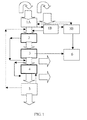
- the method starts with filtration 1 of the effluent to be treated in order to reduce its total solids content.
- Said stage of filtration can consist in a simple cleaning or filtering 1A with sieves, permitting the removal of particles of a maximum size of 0.1 mm.
- a microfiltration and/or ultrafiltration 1B in order to remove solid particles smaller than 0.1 mm.
- the effluent from said stage of filtration 1A, 1B enters directly into an electrochemical pre-treatment unit 2 that includes at least one electrochemical reactor in which, as commented, a physical, chemical and electrochemical transformation of the contaminant substances that the effluent includes is carried out, in order to facilitate their subsequent treatment and removal.
- an adjustment of the pH and conductivity of the effluent can if necessary be carried out by adding appropriate reagents or chemical products.
- chemical products salts, acids, bases, chlorine gas, chlorine dioxide, hypochlorite acid, permanganates, ferrates, peroxides, catalytic metals, ozone, oxygen, air, etc.
- the actual chemical substances making up the effluent are precursors of oxidising or reducing agents, depending on the type of reactor employed.
- the aim is to transform the contaminant substances by promoting either breakdown of their molecules (physical transformation), their ionisation (electrochemical transformation) or their partial or total oxidation, or reduction (chemical transformation).
- said transformation pursues the objective of facilitating the subsequent stage of treatment as such, in which a substantial reduction of the contaminant load of the effluent is achieved by means of electrocoagulation-flocculation techniques.
- the anode and cathode materials employed in the reactor or reactors in this transformation phase can be of two types:
- the configurations of the anode and of the cathode can be any from the forms of mesh, plate, cylinder, pellets, balls, flakes, etc.
- the amperage applied in the reactor is regulated automatically in function of the waste to be treated, but preferably ranges between 1 A/cm 2 and 0.01 A/cm 2 in order to facilitate molecular breakdown and/or ionisation of particles.
- the treatment in the reactor can be carried out in line or by batches, in function of the effluent load to be treated.
- the effluent from the pre-treatment stage 2 described enters a treatment unit in which electrocoagulation-flocculation 3 of contaminant substances is carried out and, following that, electro-oxidation 4 of the molecules, ions, cations or soluble contaminant substances still present in the wastewaters.
- consumable or sacrificial metallic reactors (from 1 to n) of the type described above are used, made of base material of aluminium, iron or other, or any alloys thereof, that permit the generation of metallic hydroxides that coagulate the contaminants and produce flocculates.
- Said flocculates separate out by themselves or by addition following electrocoagulation of a polyelectrolyte that aggregates them and permits them to be evacuated by flotation or similar systems (decantation, filtration, etc.).
- the sludges resulting from the process are sent for dehydration 6 by means of conventional techniques.
- the effluent On exit from electrocoagulation-flocculation, the effluent has a transparent appearance and is free from solids and colloids. Alongside the elimination of solids, this phase also achieves the removal, molecular modification and destruction of a significant part of the organic matter, heavy metals, inorganic compounds, ecotoxicity and microbiological contamination. Usually, however, the effluent still possesses a high content of solid contaminating substances, for which reason an electro-oxidation treatment 4 is then provided with one or several reactors having insoluble, chemically stable anodes of long duration. This stage 4 achieves a drastic reduction of the content of soluble organic matter, both that which is easily oxidisable and the refractory matter, as well as other substances such as ammonium or nitrogenated compounds.
- the configuration of the anode and of the cathode can be any from the forms of mesh, plate, cylinder, pellets, balls, flakes, etc.
- the amperage and voltage are regulated automatically in function of the type of effluent treated.
- Stage 4 of electro-oxidation is followed where necessary by a stage 5 of filtration, catalysis and refining that achieves destruction of the excess oxidising molecules produced during the electrochemical process of the preceding stages (ozone, peroxides, free chlorine, chloramines, etc.).
- Various known techniques can be used for this purpose, among which are adsorption filters, catalysation, addition of chemical products, etc.
- the method of the present invention permits highly effective, low-cost treatment of very complex wastewaters or liquid residues. Indeed, unlike the systems of the state of the art, thanks to the existence of the aforesaid stage 2 of pre-electrochemical treatment by means of reactors, the treatment proper of the water or residue is very fast and does not require the use of large quantities of chemical products nor a high consumption of electrical current.
- the method of the present invention permits treatment of the washing waters coming from the microfiltration/ultrafiltration 1B and filtration of the final fining stage 5.
- the washing waters are first passed through an electrocoagulation-flocculation reactor 3B in order to reduce their content in solids.
- the system likewise permits electro-oxidation regeneration of the mother liquors of absorbent reactivation used, if applicable, in the final stage 5.
- the method of the present invention has the advantage of being very versatile, permitting the treatment of very varied flows that range, for example, from 1 m 3 /week up to flows exceeding 1000 m 3 /day, and adjustment of the phases of the process to the needs of the water or residue.
- it may in some cases not prove necessary to carry out the electro-oxidation 4, so that after the stage of electrocoagulation-flocculation 3 the water or residue can be discharged or reused.
- stage of electrochemical pre-treatment 2 means that the sludges treated and produced from the electrocoagulation-flocculation 3 stage are partially disinfected, thereby enormously facilitating handling thereof (lower risk of putrefaction and greater chance of reutilisation, including the possibility of direct agricultural application).
- the method comprises the stages 1 (filtration), 2 (pre-treatment), 3 (electrocoagulation-flocculation), 4 (electro-oxidation) and 5 (filtration and catalysis).
- Stage 2 of pre-electrochemical treatment was carried out with addition of electrochemical reagents and by means of reactors with anodes of insoluble type.
- Measurement Units Parameters on entering treatment Parameters on leaving treatment PH PH Units 6.2 7.4 conductivity ⁇ S/cm 2880 2315 Matter in suspension mg/l 6025 30 Decanted COD mg O 2 /l 8763 114 Total nitrogen mg/l 658.3 6 Ammonium mg/l 304.7 Less than 4 Phosphorus mg/l 122.3 Less than 1 Oils and fats mg/l 3753 7
- Example 2 pig purines; high content in total nitrogen, ammonium, COD (chemical oxygen demand), phosphorus, matter in suspension, bacteria and metals
- the method comprises the stages 1 (filtration), 2 (pre-treatment), 3 (electrocoagulation-flocculation), 4 (electro-oxidation) and 5 (filtration and catalysis).
- the pre-treatment stage 2 was carried out without addition of electrochemical reagents and by means of reactors with anodes of soluble type.
- Measurement Units Parameters on entering treatment Parameters on leaving treatment PH PH Units 7.8 6.8 conductivity ⁇ S/cm 24930 19600 Matter in suspension mg/l 23000 57 Total nitrogen mg/l 4300 21 Ammonium mg/l 2750 Less than 4 COD mg O 2 /l 18500 277 Phosphorus mg/l 815 Less than 1 Zinc mg/l 19 Less than 0.1 Copper mg/l 6 Less than 0.1 Chromium mg/l 1,6 Less than 0.1 Nickel mg/l 1,7 Less than 0.1
- Example 3 Landfill leachate: high content in COD (chemical oxygen demand), ammonium, conductivity, chlorides, phenols, total metals (Mn, An, As, Cd, Ni, Pb, Hg, Se, Cu, Fe).
- the method comprises the stages 1 (filtration), 2 (pre-treatment), 3 (electrocoagulation-flocculation), 4 ) (electro-oxidation) and 5 (filtration and catalysis).
- Stage 2 of pre-treatment was carried out without addition of electrochemical reagents and by means of reactors with anodes of insoluble type.
- Measurement Units Parameters on entering treatment Parameters on leaving treatment PH PH Units 8,4 6,6 conductivity ⁇ S/cm 34000 17000 COD mg O 2 /l 8375 114 Ammonium mg/l 4830 Less than 4 Chlorides mg/l 5200 2215 Phenols mg/l 15 Less than 0.1 Total metals mg/l 56 Less than 0.1
- Example 4 oil-mill waters (olive oil production): waters from the washing process plus centrifuge waters.
- the method comprises the stages 1 (filtration), 2 (pre-treatment), 3 (electrocoagulation-flocculation), 4 (electro-oxidation) and 5 (filtration and catalysis).
- the pre-treatment stage 2 was carried out with addition of electrochemical reagents and by means of reactors with anodes of soluble type.
- Measurement Units Parameters on entering treatment Parameters on leaving treatment PH PH Units 5.5 6.7 conductivity ⁇ S/cm 4500 2315 COD mg O 2 /l 21000 117 phenols mg/l 320 Less than 0.1
- Example 5 underground waters contaminated with nitrates.
- the method comprises the stages 1 (filtration), 2 (pre-treatment), 3 (electrocoagulation-flocculation), 4 (electro-oxidation) and 5 (filtration and catalysis).
- the pre-treatment stage 2 was carried out with addition of electrochemical reagents and by means of reactors with anodes of insoluble type that catalyse reduction of the nitrate to ammonium ion.
- stage 4 the electro-oxidation of the ammonium ion to nitrogen gas was carried out.
- Measurement Units Parameters on entering treatment Parameters on leaving treatment nitrates mg/l 168 Less than 10
Landscapes
- Chemical & Material Sciences (AREA)
- Chemical Kinetics & Catalysis (AREA)
- Electrochemistry (AREA)
- General Chemical & Material Sciences (AREA)
- Life Sciences & Earth Sciences (AREA)
- Hydrology & Water Resources (AREA)
- Engineering & Computer Science (AREA)
- Environmental & Geological Engineering (AREA)
- Water Supply & Treatment (AREA)
- Organic Chemistry (AREA)
- Water Treatment By Electricity Or Magnetism (AREA)
Applications Claiming Priority (1)
| Application Number | Priority Date | Filing Date | Title |
|---|---|---|---|
| ES200701061A ES2327808B1 (es) | 2007-04-16 | 2007-04-16 | Procedimiento para tratar aguas o residuos liquidos y conjunto de reactores electroquimicos para tratar dichas aguas o residuos segun dicho procedimiento. |
Publications (1)
| Publication Number | Publication Date |
|---|---|
| EP1995221A1 true EP1995221A1 (de) | 2008-11-26 |
Family
ID=39590845
Family Applications (1)
| Application Number | Title | Priority Date | Filing Date |
|---|---|---|---|
| EP08154573A Withdrawn EP1995221A1 (de) | 2007-04-16 | 2008-04-15 | Verfahren zur Behandlung von Wasser oder Flüssigrückständen und Anordnung elektrochemischer Reaktoren zur Wasser- oder Flüssigrückstandsbehandlung nach dem Verfahren |
Country Status (2)
| Country | Link |
|---|---|
| EP (1) | EP1995221A1 (de) |
| ES (1) | ES2327808B1 (de) |
Cited By (16)
| Publication number | Priority date | Publication date | Assignee | Title |
|---|---|---|---|---|
| ITPD20080357A1 (it) * | 2008-12-02 | 2010-06-03 | Univ Padova | Metodo per l'abbattimento di concentrazioni recalcitranti di cromo in reflui acquosi con sostanze organiche |
| WO2010102418A3 (fr) * | 2009-03-09 | 2011-02-17 | F-Tec Systems S.A. | Procede d'electrolyse et procede et installation de pré -traitement d'eau brute |
| WO2012110841A1 (en) * | 2011-02-14 | 2012-08-23 | Council Of Scientific & Industrial Research | An improved electrochemical coagulation process for the removal of nitrate from drinking water |
| ES2395458A1 (es) * | 2011-05-09 | 2013-02-12 | Universidad De Castilla La Mancha | Proceso de electrocoagulación para regeneración de agua depurada |
| FR3005651A1 (fr) * | 2013-05-16 | 2014-11-21 | Concept Rolland Dev | Procede de traitement d'effluents d'elevage et dispositif correspondant |
| ES2473440R1 (es) * | 2013-12-13 | 2014-12-18 | Inversiones De Las Cinco Villas 2008, S.L. | Procedimiento de tratamiento de purines. |
| CN105692813A (zh) * | 2016-01-07 | 2016-06-22 | 沈阳建筑大学 | 一种电混凝和电催化氧化耦合装置及其使用方法 |
| WO2019092761A1 (en) * | 2017-11-10 | 2019-05-16 | Newster System S.R.L. | Plant and method for the treatment of waste, in particular waste from laboratories for medical analysis |
| CN110655241A (zh) * | 2019-11-15 | 2020-01-07 | 国网天津市电力公司 | 一种变电站生活污水电化学处理系统 |
| CN110902899A (zh) * | 2019-12-20 | 2020-03-24 | 广东工业大学 | 一种垃圾压沥液处理装置与方法 |
| IT201800009628A1 (it) * | 2018-10-19 | 2020-04-19 | Intecna Srl | Processo e apparecchiatura di elettrocoagulazione per trattamenti di depurazione di liquidi contaminati |
| CN113816540A (zh) * | 2021-10-13 | 2021-12-21 | 无锡市道格环保科技有限公司 | 一种处理重金属离子废水的电絮凝装置及处理方法 |
| CN114590874A (zh) * | 2020-12-04 | 2022-06-07 | 香港科技大学 | 垃圾渗滤液反渗透浓缩液的双重电化学处理方法及其装置 |
| CN115093068A (zh) * | 2022-07-27 | 2022-09-23 | 成都硕特科技股份有限公司 | 一种含高浓度腐植酸的垃圾渗滤液浓缩液处理系统以及处理方法 |
| CN115231765A (zh) * | 2022-04-12 | 2022-10-25 | 兰州交通大学 | 一种便携式电生物耦合过滤净水装置 |
| WO2023161888A1 (en) * | 2022-02-25 | 2023-08-31 | Igl Innovation Foundry S.R.L. | Water purification process and plant |
Families Citing this family (1)
| Publication number | Priority date | Publication date | Assignee | Title |
|---|---|---|---|---|
| ES2364261B1 (es) * | 2010-02-17 | 2012-09-06 | Train Automatic Solutions In & Out, S.L. | Procedimiento para tratar aguas residuales mediante electrolisis |
Citations (9)
| Publication number | Priority date | Publication date | Assignee | Title |
|---|---|---|---|---|
| JPS5075574A (de) * | 1973-11-07 | 1975-06-20 | ||
| JP2000102790A (ja) * | 1998-09-28 | 2000-04-11 | Kajima Corp | 排水処理装置 |
| US20010047934A1 (en) * | 1999-12-09 | 2001-12-06 | Yukimasa Satoh | Process and apparatus for eliminating dioxins |
| US20020088710A1 (en) * | 1998-02-27 | 2002-07-11 | Powell Scott Wade | Method and apparatus for electrocoagulation of liquids |
| JP2004097964A (ja) * | 2002-09-10 | 2004-04-02 | Sanyo Electric Co Ltd | 電解式汚水処理装置及びこれを用いた汚水処理施設 |
| WO2004056711A1 (en) * | 2002-12-23 | 2004-07-08 | Envirogain Inc. | Method and apparatus for the electrochemical treatment of contaminated aqueous media |
| JP2004243221A (ja) * | 2003-02-13 | 2004-09-02 | Niwahiro:Kk | 水素回収型汚水汚泥処理装置 |
| US6960301B2 (en) | 2002-03-15 | 2005-11-01 | New Earth Systems, Inc. | Leachate and wastewater remediation system |
| WO2005121029A1 (fr) * | 2004-06-10 | 2005-12-22 | Envirogain Inc. | Traitement de liquides contamines par electrocoagulation et decantation flottation |
-
2007
- 2007-04-16 ES ES200701061A patent/ES2327808B1/es active Active
-
2008
- 2008-04-15 EP EP08154573A patent/EP1995221A1/de not_active Withdrawn
Patent Citations (9)
| Publication number | Priority date | Publication date | Assignee | Title |
|---|---|---|---|---|
| JPS5075574A (de) * | 1973-11-07 | 1975-06-20 | ||
| US20020088710A1 (en) * | 1998-02-27 | 2002-07-11 | Powell Scott Wade | Method and apparatus for electrocoagulation of liquids |
| JP2000102790A (ja) * | 1998-09-28 | 2000-04-11 | Kajima Corp | 排水処理装置 |
| US20010047934A1 (en) * | 1999-12-09 | 2001-12-06 | Yukimasa Satoh | Process and apparatus for eliminating dioxins |
| US6960301B2 (en) | 2002-03-15 | 2005-11-01 | New Earth Systems, Inc. | Leachate and wastewater remediation system |
| JP2004097964A (ja) * | 2002-09-10 | 2004-04-02 | Sanyo Electric Co Ltd | 電解式汚水処理装置及びこれを用いた汚水処理施設 |
| WO2004056711A1 (en) * | 2002-12-23 | 2004-07-08 | Envirogain Inc. | Method and apparatus for the electrochemical treatment of contaminated aqueous media |
| JP2004243221A (ja) * | 2003-02-13 | 2004-09-02 | Niwahiro:Kk | 水素回収型汚水汚泥処理装置 |
| WO2005121029A1 (fr) * | 2004-06-10 | 2005-12-22 | Envirogain Inc. | Traitement de liquides contamines par electrocoagulation et decantation flottation |
Cited By (25)
| Publication number | Priority date | Publication date | Assignee | Title |
|---|---|---|---|---|
| ITPD20080357A1 (it) * | 2008-12-02 | 2010-06-03 | Univ Padova | Metodo per l'abbattimento di concentrazioni recalcitranti di cromo in reflui acquosi con sostanze organiche |
| AU2010223782B2 (en) * | 2009-03-09 | 2015-12-03 | F-Tec Systems S.A. | Electrolysis method, and method and plant for the pretreatment of raw water |
| WO2010102418A3 (fr) * | 2009-03-09 | 2011-02-17 | F-Tec Systems S.A. | Procede d'electrolyse et procede et installation de pré -traitement d'eau brute |
| EP2406187B1 (de) * | 2009-03-09 | 2016-05-04 | F-Tec Systems S.A. | Anlage und Verfahren zur Vorbehandlung von Rohwasser |
| WO2012110841A1 (en) * | 2011-02-14 | 2012-08-23 | Council Of Scientific & Industrial Research | An improved electrochemical coagulation process for the removal of nitrate from drinking water |
| ES2395458A1 (es) * | 2011-05-09 | 2013-02-12 | Universidad De Castilla La Mancha | Proceso de electrocoagulación para regeneración de agua depurada |
| FR3005651A1 (fr) * | 2013-05-16 | 2014-11-21 | Concept Rolland Dev | Procede de traitement d'effluents d'elevage et dispositif correspondant |
| WO2015086869A1 (es) * | 2013-12-13 | 2015-06-18 | Inversiones De Las Cinco Villas 2008, S.L. | Procedimiento de tratamiento de purines |
| ES2473440R1 (es) * | 2013-12-13 | 2014-12-18 | Inversiones De Las Cinco Villas 2008, S.L. | Procedimiento de tratamiento de purines. |
| CN105692813A (zh) * | 2016-01-07 | 2016-06-22 | 沈阳建筑大学 | 一种电混凝和电催化氧化耦合装置及其使用方法 |
| JP2021502251A (ja) * | 2017-11-10 | 2021-01-28 | ニュースター システム エス.アール.エル.Newster System S.R.L. | 廃棄物、特に医学分析実験室からの廃棄物を処理するためのプラント及び方法 |
| WO2019092761A1 (en) * | 2017-11-10 | 2019-05-16 | Newster System S.R.L. | Plant and method for the treatment of waste, in particular waste from laboratories for medical analysis |
| CN111315501A (zh) * | 2017-11-10 | 2020-06-19 | 纽斯泰尔系统有限责任公司 | 用于处理废料、特别是来自医学分析实验室的废料的设备和方法 |
| IT201800009628A1 (it) * | 2018-10-19 | 2020-04-19 | Intecna Srl | Processo e apparecchiatura di elettrocoagulazione per trattamenti di depurazione di liquidi contaminati |
| CN110655241A (zh) * | 2019-11-15 | 2020-01-07 | 国网天津市电力公司 | 一种变电站生活污水电化学处理系统 |
| CN110902899A (zh) * | 2019-12-20 | 2020-03-24 | 广东工业大学 | 一种垃圾压沥液处理装置与方法 |
| CN114590874A (zh) * | 2020-12-04 | 2022-06-07 | 香港科技大学 | 垃圾渗滤液反渗透浓缩液的双重电化学处理方法及其装置 |
| CN114590874B (zh) * | 2020-12-04 | 2023-12-08 | 香港科技大学 | 垃圾渗滤液反渗透浓缩液的双重电化学处理方法及其装置 |
| CN113816540A (zh) * | 2021-10-13 | 2021-12-21 | 无锡市道格环保科技有限公司 | 一种处理重金属离子废水的电絮凝装置及处理方法 |
| CN113816540B (zh) * | 2021-10-13 | 2024-03-29 | 无锡市道格环保科技有限公司 | 一种处理重金属离子废水的电絮凝装置及处理方法 |
| WO2023161888A1 (en) * | 2022-02-25 | 2023-08-31 | Igl Innovation Foundry S.R.L. | Water purification process and plant |
| CN115231765A (zh) * | 2022-04-12 | 2022-10-25 | 兰州交通大学 | 一种便携式电生物耦合过滤净水装置 |
| CN115231765B (zh) * | 2022-04-12 | 2023-10-24 | 兰州交通大学 | 一种便携式电生物耦合过滤净水装置 |
| CN115093068A (zh) * | 2022-07-27 | 2022-09-23 | 成都硕特科技股份有限公司 | 一种含高浓度腐植酸的垃圾渗滤液浓缩液处理系统以及处理方法 |
| CN115093068B (zh) * | 2022-07-27 | 2024-04-19 | 成都硕特科技股份有限公司 | 一种含高浓度腐植酸的垃圾渗滤液浓缩液处理系统以及处理方法 |
Also Published As
| Publication number | Publication date |
|---|---|
| ES2327808B1 (es) | 2010-07-08 |
| ES2327808A1 (es) | 2009-11-03 |
Similar Documents
| Publication | Publication Date | Title |
|---|---|---|
| ES2327808B1 (es) | Procedimiento para tratar aguas o residuos liquidos y conjunto de reactores electroquimicos para tratar dichas aguas o residuos segun dicho procedimiento. | |
| Drogui et al. | Review of electrochemical technologies for environmental applications | |
| Kobya et al. | Treatment of the baker's yeast wastewater by electrocoagulation | |
| Tirado et al. | Treatment of cheese whey wastewater by combined electrochemical processes | |
| Linares-Hernández et al. | A combined electrocoagulation–electrooxidation treatment for industrial wastewater | |
| Ghernaout | Electrocoagulation and electrooxidation for disinfecting water: New breakthroughs and implied mechanisms | |
| Top et al. | Characterization and electrocaogulative treatment of nanofiltration concentrate of a full-scale landfill leachate treatment plant | |
| Ghernaout et al. | Electrocoagulation process intensification for disinfecting water—a review | |
| Zarei et al. | Disinfecting poultry slaughterhouse wastewater using copper electrodes in the electrocoagulation process | |
| US20160167985A1 (en) | Method for treating wastewater and device for carrying out said method | |
| AT412470B (de) | Verfahren zur reinigung von abwässern | |
| Hamid et al. | Clinoptilolite augmented electrocoagulation process for the reduction of high‐strength ammonia and color from stabilized landfill leachate | |
| WO2014165998A1 (en) | Treatment of a waste stream through production and utilization of oxyhydrogen gas | |
| Aboutaleb et al. | Investigation of effective treatment techniques for olive mill wastewater | |
| KR20170010679A (ko) | 전해산화에 의한 가축분뇨 처리시스템 및 그 처리방법 | |
| WO2021101366A1 (en) | Process for treating palm oil mill effluent | |
| Mouli et al. | Electrochemical processes for the remediation of wastewater and contaminated soil: emerging technology | |
| Girón-Navarro et al. | Electrocoagulation vs. coagulation–flocculation applied to real wastewater and set up to pilot/full scale | |
| Mavros et al. | Complete treatment of olive pomace leachate by coagulation, activated-carbon adsorption and electrochemical oxidation | |
| Farshi et al. | Reduction of color and COD of anaerobically treated distillary wastewater by electrochemical method | |
| US6902674B2 (en) | Treating method for coating material waste water | |
| Le et al. | Reduction of COD in Nam Son landfill leachate by electro-Fenton as secondary treatment after electrocoagulation pretreatment | |
| KR101032619B1 (ko) | 전기화학 방식을 이용한 색도 함유 폐수의 처리방법 | |
| Trifonova et al. | An integrated innovative technology for the treatment of municipal solid waste landfill leachate | |
| Thapa et al. | Remediation of feedlot nutrients runoff by electrocoagulation process |
Legal Events
| Date | Code | Title | Description |
|---|---|---|---|
| PUAI | Public reference made under article 153(3) epc to a published international application that has entered the european phase |
Free format text: ORIGINAL CODE: 0009012 |
|
| AK | Designated contracting states |
Kind code of ref document: A1 Designated state(s): AT BE BG CH CY CZ DE DK EE ES FI FR GB GR HR HU IE IS IT LI LT LU LV MC MT NL NO PL PT RO SE SI SK TR |
|
| AX | Request for extension of the european patent |
Extension state: AL BA MK RS |
|
| AKX | Designation fees paid | ||
| REG | Reference to a national code |
Ref country code: DE Ref legal event code: 8566 |
|
| STAA | Information on the status of an ep patent application or granted ep patent |
Free format text: STATUS: THE APPLICATION IS DEEMED TO BE WITHDRAWN |
|
| 18D | Application deemed to be withdrawn |
Effective date: 20090527 |