EP1990523A2 - Brennkraftmaschine sowie Verfahren zum Betreiben einer Brennkraftmaschine - Google Patents
Brennkraftmaschine sowie Verfahren zum Betreiben einer Brennkraftmaschine Download PDFInfo
- Publication number
- EP1990523A2 EP1990523A2 EP08008494A EP08008494A EP1990523A2 EP 1990523 A2 EP1990523 A2 EP 1990523A2 EP 08008494 A EP08008494 A EP 08008494A EP 08008494 A EP08008494 A EP 08008494A EP 1990523 A2 EP1990523 A2 EP 1990523A2
- Authority
- EP
- European Patent Office
- Prior art keywords
- fuel
- combustion engine
- injection
- internal combustion
- gas
- Prior art date
- Legal status (The legal status is an assumption and is not a legal conclusion. Google has not performed a legal analysis and makes no representation as to the accuracy of the status listed.)
- Withdrawn
Links
Images
Classifications
-
- F—MECHANICAL ENGINEERING; LIGHTING; HEATING; WEAPONS; BLASTING
- F02—COMBUSTION ENGINES; HOT-GAS OR COMBUSTION-PRODUCT ENGINE PLANTS
- F02D—CONTROLLING COMBUSTION ENGINES
- F02D19/00—Controlling engines characterised by their use of non-liquid fuels, pluralities of fuels, or non-fuel substances added to the combustible mixtures
- F02D19/06—Controlling engines characterised by their use of non-liquid fuels, pluralities of fuels, or non-fuel substances added to the combustible mixtures peculiar to engines working with pluralities of fuels, e.g. alternatively with light and heavy fuel oil, other than engines indifferent to the fuel consumed
- F02D19/0639—Controlling engines characterised by their use of non-liquid fuels, pluralities of fuels, or non-fuel substances added to the combustible mixtures peculiar to engines working with pluralities of fuels, e.g. alternatively with light and heavy fuel oil, other than engines indifferent to the fuel consumed characterised by the type of fuels
- F02D19/0642—Controlling engines characterised by their use of non-liquid fuels, pluralities of fuels, or non-fuel substances added to the combustible mixtures peculiar to engines working with pluralities of fuels, e.g. alternatively with light and heavy fuel oil, other than engines indifferent to the fuel consumed characterised by the type of fuels at least one fuel being gaseous, the other fuels being gaseous or liquid at standard conditions
-
- F—MECHANICAL ENGINEERING; LIGHTING; HEATING; WEAPONS; BLASTING
- F02—COMBUSTION ENGINES; HOT-GAS OR COMBUSTION-PRODUCT ENGINE PLANTS
- F02D—CONTROLLING COMBUSTION ENGINES
- F02D19/00—Controlling engines characterised by their use of non-liquid fuels, pluralities of fuels, or non-fuel substances added to the combustible mixtures
- F02D19/06—Controlling engines characterised by their use of non-liquid fuels, pluralities of fuels, or non-fuel substances added to the combustible mixtures peculiar to engines working with pluralities of fuels, e.g. alternatively with light and heavy fuel oil, other than engines indifferent to the fuel consumed
- F02D19/0663—Details on the fuel supply system, e.g. tanks, valves, pipes, pumps, rails, injectors or mixers
- F02D19/0686—Injectors
- F02D19/0689—Injectors for in-cylinder direct injection
-
- F—MECHANICAL ENGINEERING; LIGHTING; HEATING; WEAPONS; BLASTING
- F02—COMBUSTION ENGINES; HOT-GAS OR COMBUSTION-PRODUCT ENGINE PLANTS
- F02D—CONTROLLING COMBUSTION ENGINES
- F02D19/00—Controlling engines characterised by their use of non-liquid fuels, pluralities of fuels, or non-fuel substances added to the combustible mixtures
- F02D19/06—Controlling engines characterised by their use of non-liquid fuels, pluralities of fuels, or non-fuel substances added to the combustible mixtures peculiar to engines working with pluralities of fuels, e.g. alternatively with light and heavy fuel oil, other than engines indifferent to the fuel consumed
- F02D19/0663—Details on the fuel supply system, e.g. tanks, valves, pipes, pumps, rails, injectors or mixers
- F02D19/0686—Injectors
- F02D19/0692—Arrangement of multiple injectors per combustion chamber
-
- F—MECHANICAL ENGINEERING; LIGHTING; HEATING; WEAPONS; BLASTING
- F02—COMBUSTION ENGINES; HOT-GAS OR COMBUSTION-PRODUCT ENGINE PLANTS
- F02D—CONTROLLING COMBUSTION ENGINES
- F02D19/00—Controlling engines characterised by their use of non-liquid fuels, pluralities of fuels, or non-fuel substances added to the combustible mixtures
- F02D19/06—Controlling engines characterised by their use of non-liquid fuels, pluralities of fuels, or non-fuel substances added to the combustible mixtures peculiar to engines working with pluralities of fuels, e.g. alternatively with light and heavy fuel oil, other than engines indifferent to the fuel consumed
- F02D19/08—Controlling engines characterised by their use of non-liquid fuels, pluralities of fuels, or non-fuel substances added to the combustible mixtures peculiar to engines working with pluralities of fuels, e.g. alternatively with light and heavy fuel oil, other than engines indifferent to the fuel consumed simultaneously using pluralities of fuels
- F02D19/081—Adjusting the fuel composition or mixing ratio; Transitioning from one fuel to the other
-
- F—MECHANICAL ENGINEERING; LIGHTING; HEATING; WEAPONS; BLASTING
- F02—COMBUSTION ENGINES; HOT-GAS OR COMBUSTION-PRODUCT ENGINE PLANTS
- F02D—CONTROLLING COMBUSTION ENGINES
- F02D41/00—Electrical control of supply of combustible mixture or its constituents
- F02D41/0025—Controlling engines characterised by use of non-liquid fuels, pluralities of fuels, or non-fuel substances added to the combustible mixtures
- F02D41/0027—Controlling engines characterised by use of non-liquid fuels, pluralities of fuels, or non-fuel substances added to the combustible mixtures the fuel being gaseous
-
- F—MECHANICAL ENGINEERING; LIGHTING; HEATING; WEAPONS; BLASTING
- F02—COMBUSTION ENGINES; HOT-GAS OR COMBUSTION-PRODUCT ENGINE PLANTS
- F02D—CONTROLLING COMBUSTION ENGINES
- F02D41/00—Electrical control of supply of combustible mixture or its constituents
- F02D41/30—Controlling fuel injection
- F02D41/3094—Controlling fuel injection the fuel injection being effected by at least two different injectors, e.g. one in the intake manifold and one in the cylinder
-
- F—MECHANICAL ENGINEERING; LIGHTING; HEATING; WEAPONS; BLASTING
- F02—COMBUSTION ENGINES; HOT-GAS OR COMBUSTION-PRODUCT ENGINE PLANTS
- F02B—INTERNAL-COMBUSTION PISTON ENGINES; COMBUSTION ENGINES IN GENERAL
- F02B75/00—Other engines
- F02B75/12—Other methods of operation
- F02B2075/125—Direct injection in the combustion chamber for spark ignition engines, i.e. not in pre-combustion chamber
-
- F—MECHANICAL ENGINEERING; LIGHTING; HEATING; WEAPONS; BLASTING
- F02—COMBUSTION ENGINES; HOT-GAS OR COMBUSTION-PRODUCT ENGINE PLANTS
- F02B—INTERNAL-COMBUSTION PISTON ENGINES; COMBUSTION ENGINES IN GENERAL
- F02B2275/00—Other engines, components or details, not provided for in other groups of this subclass
- F02B2275/16—Indirect injection
-
- F—MECHANICAL ENGINEERING; LIGHTING; HEATING; WEAPONS; BLASTING
- F02—COMBUSTION ENGINES; HOT-GAS OR COMBUSTION-PRODUCT ENGINE PLANTS
- F02D—CONTROLLING COMBUSTION ENGINES
- F02D19/00—Controlling engines characterised by their use of non-liquid fuels, pluralities of fuels, or non-fuel substances added to the combustible mixtures
- F02D19/06—Controlling engines characterised by their use of non-liquid fuels, pluralities of fuels, or non-fuel substances added to the combustible mixtures peculiar to engines working with pluralities of fuels, e.g. alternatively with light and heavy fuel oil, other than engines indifferent to the fuel consumed
- F02D19/0602—Control of components of the fuel supply system
- F02D19/0613—Switch-over from one fuel to another
- F02D19/0615—Switch-over from one fuel to another being initiated by automatic means, e.g. based on engine or vehicle operating conditions
-
- F—MECHANICAL ENGINEERING; LIGHTING; HEATING; WEAPONS; BLASTING
- F02—COMBUSTION ENGINES; HOT-GAS OR COMBUSTION-PRODUCT ENGINE PLANTS
- F02D—CONTROLLING COMBUSTION ENGINES
- F02D19/00—Controlling engines characterised by their use of non-liquid fuels, pluralities of fuels, or non-fuel substances added to the combustible mixtures
- F02D19/06—Controlling engines characterised by their use of non-liquid fuels, pluralities of fuels, or non-fuel substances added to the combustible mixtures peculiar to engines working with pluralities of fuels, e.g. alternatively with light and heavy fuel oil, other than engines indifferent to the fuel consumed
- F02D19/0639—Controlling engines characterised by their use of non-liquid fuels, pluralities of fuels, or non-fuel substances added to the combustible mixtures peculiar to engines working with pluralities of fuels, e.g. alternatively with light and heavy fuel oil, other than engines indifferent to the fuel consumed characterised by the type of fuels
- F02D19/0642—Controlling engines characterised by their use of non-liquid fuels, pluralities of fuels, or non-fuel substances added to the combustible mixtures peculiar to engines working with pluralities of fuels, e.g. alternatively with light and heavy fuel oil, other than engines indifferent to the fuel consumed characterised by the type of fuels at least one fuel being gaseous, the other fuels being gaseous or liquid at standard conditions
- F02D19/0647—Controlling engines characterised by their use of non-liquid fuels, pluralities of fuels, or non-fuel substances added to the combustible mixtures peculiar to engines working with pluralities of fuels, e.g. alternatively with light and heavy fuel oil, other than engines indifferent to the fuel consumed characterised by the type of fuels at least one fuel being gaseous, the other fuels being gaseous or liquid at standard conditions the gaseous fuel being liquefied petroleum gas [LPG], liquefied natural gas [LNG], compressed natural gas [CNG] or dimethyl ether [DME]
-
- F—MECHANICAL ENGINEERING; LIGHTING; HEATING; WEAPONS; BLASTING
- F02—COMBUSTION ENGINES; HOT-GAS OR COMBUSTION-PRODUCT ENGINE PLANTS
- F02M—SUPPLYING COMBUSTION ENGINES IN GENERAL WITH COMBUSTIBLE MIXTURES OR CONSTITUENTS THEREOF
- F02M21/00—Apparatus for supplying engines with non-liquid fuels, e.g. gaseous fuels stored in liquid form
- F02M21/02—Apparatus for supplying engines with non-liquid fuels, e.g. gaseous fuels stored in liquid form for gaseous fuels
- F02M21/0218—Details on the gaseous fuel supply system, e.g. tanks, valves, pipes, pumps, rails, injectors or mixers
- F02M21/0248—Injectors
- F02M21/0257—Details of the valve closing elements, e.g. valve seats, stems or arrangement of flow passages
- F02M21/026—Lift valves, i.e. stem operated valves
- F02M21/0269—Outwardly opening valves, e.g. poppet valves
-
- Y—GENERAL TAGGING OF NEW TECHNOLOGICAL DEVELOPMENTS; GENERAL TAGGING OF CROSS-SECTIONAL TECHNOLOGIES SPANNING OVER SEVERAL SECTIONS OF THE IPC; TECHNICAL SUBJECTS COVERED BY FORMER USPC CROSS-REFERENCE ART COLLECTIONS [XRACs] AND DIGESTS
- Y02—TECHNOLOGIES OR APPLICATIONS FOR MITIGATION OR ADAPTATION AGAINST CLIMATE CHANGE
- Y02T—CLIMATE CHANGE MITIGATION TECHNOLOGIES RELATED TO TRANSPORTATION
- Y02T10/00—Road transport of goods or passengers
- Y02T10/10—Internal combustion engine [ICE] based vehicles
- Y02T10/12—Improving ICE efficiencies
-
- Y—GENERAL TAGGING OF NEW TECHNOLOGICAL DEVELOPMENTS; GENERAL TAGGING OF CROSS-SECTIONAL TECHNOLOGIES SPANNING OVER SEVERAL SECTIONS OF THE IPC; TECHNICAL SUBJECTS COVERED BY FORMER USPC CROSS-REFERENCE ART COLLECTIONS [XRACs] AND DIGESTS
- Y02—TECHNOLOGIES OR APPLICATIONS FOR MITIGATION OR ADAPTATION AGAINST CLIMATE CHANGE
- Y02T—CLIMATE CHANGE MITIGATION TECHNOLOGIES RELATED TO TRANSPORTATION
- Y02T10/00—Road transport of goods or passengers
- Y02T10/10—Internal combustion engine [ICE] based vehicles
- Y02T10/30—Use of alternative fuels, e.g. biofuels
Definitions
- the present invention relates to an internal combustion engine having a gaseous fuel injector and a liquid fuel injector. Furthermore, the invention relates to a method for operating an internal combustion engine.
- the internal combustion engine according to the invention with the features of claim 1 has the advantage that it can be operated with a fuel gas and / or with a liquid fuel and still reduced Emissions and reduced consumption.
- the internal combustion engine has a Gaseinblas founded, which is arranged on the combustion chamber to directly inject a fuel gas into the combustion chamber.
- a fuel injector for injecting a liquid fuel is provided, which is arranged on a suction pipe of the internal combustion engine, and performs an injection of the liquid fuel into the intake manifold for an external mixture formation.
- Main fuel in the internal combustion engine according to the invention is preferably the fuel gas, wherein the fuel injection device is preferably provided only when starting or emergency operation.
- the gas injection device is arranged in the combustion chamber adjacent to the inlet valve. In this way, in particular, optimum mixing with the combustion air supplied through the inlet valve can be achieved.
- the internal combustion engine comprises exactly one fuel injection device on the intake manifold.
- the cost of the equipment with the fuel injection device can be reduced and on the other hand, a central outer mixture formation can be ensured when using a single fuel injection device.
- the fuel injection device can be particularly simple and inexpensive, since it should preferably be used only when starting the engine and / or for emergency operation. Further preferred while also only a small fuel tank for the liquid fuel, for example, with a volume of 15 1 or less, provided.
- the internal combustion engine comprises a control device which controls the operating strategy of the internal combustion engine.
- the internal combustion engine can basically be operated only in gas mode or only in liquid fuel operation or in a combined operation in which both fuel gas and liquid fuel is burned.
- the storage device switches periodically or operating point-dependent or when starting the internal combustion engine for a short time only to the injection of fuel gas or only to the injection of liquid fuel. This is to ensure that at least briefly both the gas injection device and the fuel injection device are actuated at predetermined intervals. As a result, in particular high thermal loads are avoided. Furthermore, deposits on the gas injection device can thereby be avoided, in particular in the combustion chamber. In the case of liquid fuel, in particular vapor vapor formation by heating the fuel or volatilization of low-boiling fuel constituents can be avoided.
- the control means controls an operating point-dependent switching to only the injection of fuel gas or only the injection of fuel based on a predetermined load value or a predetermined speed value or a predetermined pressure value or a predetermined temperature.
- the internal combustion engine comprises corresponding sensors in order to detect the respective values, wherein the control device comprises a memory in which the predetermined values are stored and a comparison of the stored values with the detected values takes place. The comparison result then serves to control the switching time.
- control device performs a control of the internal combustion engine such that in an upper part-load range and in a full load range, the injection of the fuel gas begins towards the end of an intake stroke or at the beginning of a compression stroke of the internal combustion engine.
- the internal combustion engine comprises a compressor device in order to allow a charge of the air supplied through the intake manifold.
- the gas injection device preferably has an outwardly opening valve member.
- the present invention relates to a method for operating an internal combustion engine with a gas injection device, which injects a fuel gas directly into a combustion chamber and a fuel injection device, which injects a liquid fuel into a suction pipe.
- the injection of fuel gas into the combustion chamber and the injection of fuel into the intake manifold can each be carried out independently of each other or together.
- an injection into the combustion chamber and at the same time an injection of the liquid fuel into the intake manifold are particularly preferably carried out when starting the internal combustion engine.
- an operating strategy for operating the internal combustion engine ie whether only a gas injection or only a fuel injection or both takes place together, is carried out operating point-dependent, for example when a predetermined load value or a predetermined speed value or a predetermined temperature value or a predetermined Pressure value is reached.
- Switching between the three possible operating modes is particularly preferably short-term, ie in the range of a few seconds, for example 5 to 10 seconds.
- the internal combustion engine according to the invention is particularly preferably used in vehicles.
- the use of a gaseous fuel for the internal combustion engine can be ensured according to the invention, which is inexpensive, and only when starting the internal combustion engine or in an emergency situation, e.g. if no gaseous fuel is left in the vehicle, be switched to the liquid fuel.
- a switch between the two types of drive can be easily carried out during operation of the internal combustion engine.
- a simultaneous operation of both fuel systems is easily possible because they are self-sufficient from each other.
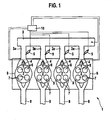
- FIG. 1 An internal combustion engine 1 according to a preferred embodiment described in detail.
- FIG. 1 schematically shows an internal combustion engine with four cylinders 9, which is designed as a gasoline engine.
- the Internal combustion engine 1 comprises a suction pipe 3, four combustion chambers 2, which are each arranged in one of the four cylinders 9, two intake valves 6 per cylinder and two exhaust valves 7 per cylinder.
- the reference numeral 8 in each case designates an outlet channel from the cylinders 9.
- the internal combustion engine 1 further comprises in each case one gas injection device 4 per cylinder, which is provided for direct injection of a fuel gas, for example natural gas, into the combustion chamber 2.
- the internal combustion engine includes four fuel injectors 5, which are respectively arranged around a supply passage 3a from the suction pipe 3 to inject a liquid fuel into the supply passage 3a.
- a control or regulating device 10 controls the opening and closing of the gas injection devices 4 and of the fuel injection devices 5.
- the internal combustion engine 1 is thus a bivalent internal combustion engine with a direct gas injection and a gasoline intake manifold injection.
- the Gaseinblas sharken 4 are special gas injectors.
- the fuel injectors 5 are simple gasoline injectors.
- the fuel injectors 5 can be constructed in a particularly simple and cost-effective manner, since they are used only when the internal combustion engine 1 is started and / or for an emergency operation, for example when the gaseous fuel has run out. In this respect, only a small fuel tank for the liquid fuel can be provided. Since the liquid fuel is used only in exceptional cases, the internal combustion engine 1 can be designed entirely for optimization in operation with gaseous fuel.
- the gas injection devices 4 are arranged in the region of the intake valves 6, they can be installed in a lateral installation position.
- An injection pressure for the fuel gas is preferably below 20 ⁇ 10 5 Pa.
- the gas injection devices 4 comprise outwardly opening valve members.
- an injection of the fuel gas in a lower part load range during the intake phase. In an upper part-load range and at full load, the injection of the fuel gas preferably begins towards the end of the intake stroke or at the beginning of the compression stroke.
- the short-term switching or addition of the injection of liquid fuel can be periodic, for example, after a certain period of the internal combustion engine or after a predetermined number of engine revolutions.
- the short-term switching or connection can also be carried out operating point-dependent, for example, upon reaching predetermined load and / or speed and / or pressure and / or temperature values.
- short-term switching or short-term switching of the gas injection can also be carried out in order to ensure an exchange of the fuel gas present at the gas injection device and to cool the gas injection device 4 by newly flowing fuel gas.
- the short-term switching or connection can be done periodically or operating point dependent. Switching or connecting the respective other fuel system thus avoids damage, in particular thermal damage to the respective system.
- the internal combustion engine can also be operated with a charge having a compression ratio greater than 10.
- suction engine is the compression ratio over 11. This allows the engine to achieve high performance with low consumption and low emissions.
Landscapes
- Engineering & Computer Science (AREA)
- Chemical & Material Sciences (AREA)
- Combustion & Propulsion (AREA)
- Mechanical Engineering (AREA)
- General Engineering & Computer Science (AREA)
- Oil, Petroleum & Natural Gas (AREA)
- Output Control And Ontrol Of Special Type Engine (AREA)
- Combustion Methods Of Internal-Combustion Engines (AREA)
- Electrical Control Of Air Or Fuel Supplied To Internal-Combustion Engine (AREA)
Abstract
Description
- Die vorliegende Erfindung betrifft eine Brennkraftmaschine mit einer Einblaseinrichtung für gasförmige Kraftstoffe und einer Einspritzeinrichtung für flüssigen Kraftstoff. Ferner betrifft die Erfindung ein Verfahren zum Betreiben einer Brennkraftmaschine.
- Brennkraftmaschinen sind aus dem Stand der Technik in unterschiedlichsten Ausgestaltungen bekannt. Hierbei sind beispielsweise Erdgasmotoren für Kraftfahrzeugantriebe bekannt, welche als bivalente Motoren ausgelegt sind, d.h. dass sie sowohl für den Betrieb mit Erdgas als auch für den Betrieb mit Benzin geeignet sind. Für derartige bivalente Erdgasmotoren wird eine äußere Gemischbildung gewählt. Hierdurch können die bekannten bivalenten Motoren jedoch nicht die durch in jüngster Zeit verstärkt eingesetzte Benzindirekteinspritzung möglichen Reduzierungen bei Verbrauch und Emission erreichen.
- Die erfindungsgemäße Brennkraftmaschine mit den Merkmalen des Patentanspruchs 1 weist demgegenüber den Vorteil auf, dass sie mit einem Brenngas und/oder mit einem flüssigen Kraftstoff betrieben werden kann und trotzdem reduzierte Emissionen und einen reduzierten Verbrauch aufweist. Dies wird erfindungsgemäß dadurch erreicht, dass die Brennkraftmaschine eine Gaseinblaseinrichtung aufweist, welche am Brennraum angeordnet ist, um direkt ein Brenngas in den Brennraum einzublasen. Ferner ist eine Kraftstoffeinspritzeinrichtung zur Einspritzung eines flüssigen Kraftstoffs vorgesehen, welche an einem Saugrohr der Brennkraftmaschine angeordnet ist, und eine Einspritzung des flüssigen Kraftstoffs in das Saugrohr für eine äußere Gemischbildung durchführt. Somit können erfindungsgemäß die Vorteile einer direkten Zuführung des Kraftstoffs in den Brennraum und die Vorteile der Verwendung eines Brenngases, wie beispielsweise Erdgas, als kostengünstiger Brennstoff kombiniert werden. Hauptbrennstoff bei der erfindungsgemäßen Brennkraftmaschine ist dabei vorzugsweise das Brenngas, wobei die Kraftstoffeinspritzeinrichtung vorzugsweise nur beim Starten oder als Notbetrieb vorgesehen ist.
- Die Unteransprüche zeigen bevorzugte Weiterbildungen der Erfindung.
- Vorzugsweise ist die Gaseinblaseinrichtung im Brennraum benachbart zum Einlassventil angeordnet. Hierdurch kann insbesondere eine optimale Vermischung mit der durch das Einlassventil zugeführten Verbrennungsluft erreicht werden.
- Weiter bevorzugt umfasst die Brennkraftmaschine genau eine Kraftstoffeinspritzeinrichtung am Saugrohr. Hierdurch können einerseits die Kosten für die Ausrüstung mit der Kraftstoffeinspritzeinrichtung reduziert werden und andererseits kann eine zentrale äußere Gemischbildung bei einer Verwendung einer einzigen Kraftstoff einspritzeinrichtung sichergestellt werden. Die Kraftstoffeinspritzeinrichtung kann dabei besonders einfach aufgebaut und kostengünstig sein, da diese vorzugsweise lediglich beim Starten der Brennkraftmaschine und/oder für einen Notbetrieb verwendet werden soll. Weiter bevorzugt ist dabei auch nur ein kleiner Kraftstoffbehälter für den flüssigen Kraftstoff, z.B. mit einem Volumen von 15 1 oder weniger, vorgesehen.
- Weiter bevorzugt umfasst die Brennkraftmaschine eine Steuereinrichtung, welche die Betriebsstrategie der Brennkraftmaschine steuert. Die Brennkraftmaschine kann grundsätzlich nur im Gasbetrieb oder nur im flüssigen Kraftstoffbetrieb oder in einem kombinierten Betrieb, in welchem sowohl Brenngas als auch flüssiger Kraftstoff verbrannt wird, betrieben werden. Die Speichereinrichtung schaltet dabei periodisch oder betriebspunktabhängig oder beim Starten der Brennkraftmaschine kurzzeitig nur auf das Einblasen von Brenngas oder nur auf das Einspritzen von flüssigem Kraftstoff um. Hierdurch soll sichergestellt werden, dass in vorbestimmten Abständen zumindest kurzzeitig sowohl die Gaseinblaseinrichtung als auch die Kraftstoffeinspritzeinrichtung betätigt werden. Dadurch werden insbesondere hohe thermische Belastungen vermieden. Ferner können dadurch insbesondere im Brennraum Ablagerungen an der Gaseinblaseinrichtung vermieden werden. Beim flüssigen Kraftstoff können insbesondere eine Dampfblasenbildung durch Aufheizen des Kraftstoffs oder eine Verflüchtigung niedrig siedender Kraftstoffbestandteile vermieden werden.
- Besonders bevorzugt steuert die Steuereinrichtung ein betriebspunktabhängiges Umschalten auf nur das Einblasen von Brenngas oder nur das Einspritzen von Kraftstoff basierend auf einem vorbestimmten Lastwert oder einem vorbestimmten Drehzahlwert oder einem vorbestimmten Druckwert oder einer vorbestimmten Temperatur. Hierzu umfasst die Brennkraftmaschine entsprechende Sensoren, um die jeweiligen Werte zu erfassen, wobei die Steuereinrichtung einen Speicher umfasst, in welchem die vorgegebenen Werte abgespeichert sind und ein Vergleich der abgespeicherten Werte mit den erfassten Werten erfolgt. Das Vergleichsergebnis dient dann zur Steuerung des Umschaltzeitpunkts.
- Weiter bevorzugt nimmt die Steuereinrichtung eine Steuerung der Brennkraftmaschine derart vor, dass in einem oberen Teillastbereich und in einem Volllastbereich das Einblasen des Brenngases gegen Ende eines Ansaugtaktes oder zu Beginn eines Kompressionstaktes der Brennkraftmaschine beginnt.
- Gemäß einer weiteren bevorzugten Ausgestaltung der Erfindung umfasst die Brennkraftmaschine eine Verdichtereinrichtung, um eine Aufladung der durch das Saugrohr zugeführten Luft zu ermöglichen.
- Um die erforderlichen großen Durchlässe des gasförmigen Brennstoffs zu ermöglichen, weist die Gaseinblaseinrichtung vorzugsweise ein nach außen öffnendes Ventilglied auf.
- Ferner betrifft die vorliegende Erfindung ein Verfahren zum Betreiben einer Brennkraftmaschine mit einer Gaseinblaseinrichtung, welche ein Brenngas direkt in einen Brennraum einbläst und einer Kraftstoffeinspritzeinrichtung, welche einen flüssigen Kraftstoff in ein Saugrohr einspritzt. Das Einblasen von Brenngas in den Brennraum und das Einspritzen von Kraftstoff in das Saugrohr kann dabei jeweils unabhängig voneinander oder auch gemeinsam erfolgen.
- Bei dem erfindungsgemäßen Verfahren wird besonders bevorzugt beim Starten der Brennkraftmaschine eine Einblasung in den Brennraum und gleichzeitig eine Einspritzung des flüssigen Kraftstoffs in das Saugrohr ausgeführt.
- Weiter bevorzugt wird bei dem erfindungsgemäßen Verfahren eine Betriebsstrategie zum Betreiben der Brennkraftmaschine, d.h. ob nur eine Gaseinblasung oder nur eine Kraftstoffeinspritzung oder beides gemeinsam erfolgt, betriebspunktabhängig durchgeführt, beispielsweise wenn ein vorbestimmter Lastwert oder ein vorbestimmter Drehzahlwert oder ein vorbestimmter Temperaturwert oder ein vorbestimmter Druckwert erreicht wird. Eine Umschaltung zwischen den drei möglichen Betriebsarten ist dabei besonders bevorzugt kurzzeitig, d.h. im Bereich von wenigen Sekunden, z.B. 5 bis 10 Sekunden.
- Die erfindungsgemäße Brennkraftmaschine wird besonders bevorzugt in Fahrzeugen verwendet. Hierbei kann erfindungsgemäß die Verwendung eines gasförmigen Brennstoffs für die Brennkraftmaschine sichergestellt werden, welcher kostengünstig ist, und nur beim Starten der Brennkraftmaschine oder in einer Notsituation, z.B. wenn im Fahrzeug kein gasförmiger Brennstoff mehr vorhanden ist, auf den flüssigen Kraftstoff umgeschaltet werden. Eine Umschaltung zwischen den beiden Antriebsarten kann dabei problemlos während des Betriebs der Brennkraftmaschine durchgeführt werden. Auch ein gleichzeitiger Betrieb beider Brennstoffsysteme ist problemlos möglich, da diese autark voneinander vorgesehen sind.
- Nachfolgend wird unter Bezugnahme auf die begleitende Zeichnung ein Ausführungsbeispiel der Erfindung im Detail beschrieben. In der Zeichnung ist:
- Figur 1
- eine schematische Darstellung einer Brennkraftmaschine gemäß einem Ausführungsbeispiel der Erfindung.
- Nachfolgend wird unter Bezugnahme auf
Figur 1 eine Brennkraftmaschine 1 gemäß einem bevorzugten Ausführungsbeispiel im Detail beschrieben. -
Figur 1 zeigt schematisch eine Brennkraftmaschine mit vier Zylindern 9, welche als Ottomotor ausgelegt ist. Die Brennkraftmaschine 1 umfasst ein Saugrohr 3, vier Brennräume 2, welche jeweils in einem der vier Zylinder 9 angeordnet sind, jeweils zwei Einlassventile 6 pro Zylinder und jeweils zwei Auslassventile 7 pro Zylinder. Das Bezugszeichen 8 kennzeichnet jeweils einen Auslasskanal aus den Zylindern 9. Die Brennkraftmaschine 1 umfasst ferner jeweils eine Gaseinblaseinrichtung 4 je Zylinder, welche zur direkten Einblasung eines Brenngases, z.B. Erdgas, in den Brennraum 2 vorgesehen ist. Weiter umfasst die Brennkraftmaschine vier Kraftstoffeinspritzeinrichtungen 5, welche jeweils um einen Zufuhrkanal 3a aus dem Saugrohr 3 angeordnet sind, um einen flüssigen Kraftstoff in den Zufuhrkanal 3a einzuspritzen. Eine Steuerungs- bzw, Regelungseinrichtung 10 steuert dabei das Öffnen und Schließen der Gaseinblaseinrichtungen 4 und der Kraftstoffeinspritzeinrichtungen 5. - Die erfindungsgemäße Brennkraftmaschine 1 ist somit ein bivalenter Verbrennungsmotor mit einer Gasdirekteinblasung und einer Benzin-Saugrohreinspritzung. Die Gaseinblaseinrichtungen 4 sind dabei spezielle Gasinjektoren. Die Kraftstoffeinspritzeinrichtungen 5 sind einfach aufgebaute Benzin-Injektoren. Die Kraftstoffeinspritzeinrichtungen 5 können dabei besonders einfach und kostengünstig aufgebaut sein, da sie lediglich bei einem Start der Brennkraftmaschine 1 und/oder für einen Notbetrieb, z.B. wenn der gasförmige Brennstoff ausgegangen ist, verwendet werden. Insofern kann auch nur ein kleiner Kraftstoffbehälter für den flüssigen Kraftstoff vorgesehen werden. Da der flüssige Kraftstoff nur in Ausnahmefällen verwendet wird, kann die Brennkraftmaschine 1 ganz auf eine Optimierung bei einem Betrieb mit gasförmigem Brennstoff ausgelegt werden. Da die Gaseinblaseinrichtungen 4 im Bereich der Einlassventile 6 angeordnet sind, können diese in einer seitlichen Einbaulage eingebaut werden. Ein Einblasdruck für das Brenngas beträgt dabei vorzugsweise unter 20 x 105 Pa. Die Gaseinblaseinrichtungen 4 umfassen nach außen öffnende Ventilglieder. Für eine optimale Verbrauchs- und Emissionscharakteristik erfolgt eine Einblasung des Brenngases in einem unteren Teillastbereich während der Ansaugphase. In einem oberen Teillastbereich und bei Volllast beginnt das Einblasen des Brenngases vorzugsweise gegen Ende des Ansaugtaktes oder zu Beginn des Kompressionstaktes.
- Um einen Austausch des flüssigen Kraftstoffs, welcher vorne am Kraftstoffeinspritzventil 5 ansteht, von Zeit zu Zeit zu gewährleisten, erfolgt vorzugsweise ein kurzzeitiges Umschalten oder Zuschalten auf die Kraftstoffeinspritzung. Hierdurch können insbesondere hohe thermische Belastungen der Kraftstoff einspritzeinrichtungen 5 vermieden werden, da nur beim Gasbetrieb eine Kühlung der Kraftstoffeinspritzeinrichtungen 5 durch durchlaufenden Kraftstoff entfällt. Es sei angemerkt, dass das kurzzeitige Um- oder Zuschalten der Einspritzung von flüssigem Kraftstoff periodisch erfolgen kann, beispielsweise nach einer bestimmten Laufzeit der Brennkraftmaschine oder nach einer vorbestimmten Anzahl von Motorumdrehungen. Ferner kann das kurzzeitige Um- oder Zuschalten auch betriebspunktabhängig erfolgen, beispielsweise bei Erreichen von vorbestimmten Last- und/oder Drehzahl- und/oder Druck- und/oder Temperaturwerten.
- Wenn nur ein Betrieb mit flüssigem Kraftstoff durchgeführt wird, kann ebenfalls ein kurzzeitiges Umschalten oder ein kurzzeitiges Zuschalten der Gaseinblasung durchgeführt werden, um einen Austausch des an der Gaseinblaseinrichtung anliegenden Brenngases zu gewährleisten und die Gaseinblaseinrichtung 4 durch neu nachströmendes Brenngas zu kühlen. Auch hierbei kann das kurzzeitige Um- oder Zuschalten periodisch oder betriebspunktabhängig erfolgen. Das Umschalten bzw. Zuschalten des jeweils anderen Brennstoffsystems vermeidet somit Schäden, insbesondere thermische Schäden an dem jeweiligen System.
- Es sei angemerkt, dass die Brennkraftmaschine auch mit einer Aufladung mit einem Verdichtungsverhältnis größer 10 betrieben werden kann. Bei dem in
Figur 1 dargestellten Saugmotor beträgt das Verdichtungsverhältnis über 11. Dadurch kann die Brennkraftmaschine eine hohe Leistung bei geringem Verbrauch und niedrigen Emissionswerten erreichen.
Claims (11)
- Brennkraftmaschine, umfassend einen Brennraum (2), ein Saugrohr (3, 3a), wenigstens ein Einlassventil (6), wenigstens ein Auslassventil (7), eine Gaseinblaseinrichtung (4), welche am Brennraum (2) zum direkten Einblasen eines Brenngases in den Brennraum (2) angeordnet ist, und eine Kraftstoffeinspritzeinrichtung (5), welche am Saugrohr (3, 3a) zur Einspritzung eines flüssigen Kraftstoffs in das Saugrohr angeordnet ist.
- Brennkraftmaschine nach Anspruch 1, dadurch gekennzeichnet, dass die Gaseinblaseinrichtung (4) im Brennraum (2) benachbart zum Einlassventil (6) angeordnet ist.
- Brennkraftmaschine nach einem der vorhergehenden Ansprüche, umfassend genau eine Kraftstoffeinspritzeinrichtung für eine zentrale äußere Gemischbildung im Saugrohr (3, 3a).
- Brennkraftmaschine nach einem der vorhergehenden Ansprüche, ferner umfassend eine Steuereinrichtung (10), welche periodisch oder betriebspunktabhängig oder beim Starten der Brennkraftmaschine kurzzeitig nur auf das Einblasen von Brenngas oder nur auf das Einspritzen von Kraftstoff oder auf ein gleichzeitiges Einblasen von Brenngas und Einspritzen von Kraftstoff umschaltet.
- Brennkraftmaschine nach Anspruch 4, dadurch gekennzeichnet, dass die Steuereinrichtung (10) das betriebspunktabhängige Umschalten oder Zuschalten auf nur das Einblasen von Brenngas oder nur das Einspritzen von Kraftstoff bei einem vorbestimmten Lastwert oder bei einem vorbestimmten Drehzahlwert oder bei einem vorbestimmten Druckwert oder bei einer vorbestimmten Temperatur ausführt.
- Brennkraftmaschine nach Anspruch 4 oder 5, dadurch gekennzeichnet, dass die Steuereinrichtung (10) eine Steuerung der Brennkraftmaschine derart vornimmt, dass in einem oberen Teillastbereich und in einem Volllastbereich das Einblasen des Brenngases gegen Ende des Ansaugtaktes oder zu Beginn des Kompressionstaktes beginnt.
- Brennkraftmaschine nach einem der vorhergehenden Ansprüche, ferner umfassend eine Verdichtereinrichtung, um eine Aufladung im Saugrohr (3, 3a) bereitzustellen.
- Brennkraftmaschine nach einem der vorhergehenden Ansprüche, dadurch gekennzeichnet, dass die Gaseinblaseinrichtung (4) ein nach außen öffnendes Ventilglied umfasst.
- Verfahren zum Betreiben einer Brennkraftmaschine (1) mit einer Gaseinblaseinrichtung (4), welche ein Brenngas direkt in einen Brennraum (2) einbläst, und mit einer Kraftstoffeinspritzeinrichtung (5), welche einen flüssigen Kraftstoff in ein Saugrohr (3, 3a) einspritzt, wobei die Einblasung von Brenngas und das Einspritzen von Kraftstoff jeweils unabhängig voneinander oder gemeinsam erfolgt.
- Verfahren nach Anspruch 9, dadurch gekennzeichnet, dass beim Starten der Brennkraftmaschine eine Einblasung von Brenngas in den Brennraum (2) und gleichzeitig eine Einspritzung von flüssigem Kraftstoff in das Saugrohr (3, 3a) erfolgt.
- Verfahren nach Anspruch 9 oder 10, dadurch gekennzeichnet, dass ein Zuschalten oder Umschalten der Kraftstoffeinspritzeinrichtung (5) oder der Gaseinblaseinrichtung (4) periodisch oder betriebspunktabhängig, insbesondere bei Erreichen eines vorbestimmten Lastwertes und/oder eines vorbestimmten Drehzahlwertes und/oder eines vorbestimmten Temperaturwertes und/oder eines vorbestimmten Druckwertes, erfolgt.
Applications Claiming Priority (1)
| Application Number | Priority Date | Filing Date | Title |
|---|---|---|---|
| DE102007021477A DE102007021477A1 (de) | 2007-05-08 | 2007-05-08 | Brennkraftmaschine sowie Verfahren zum Betreiben einer Brennkraftmaschine |
Publications (2)
| Publication Number | Publication Date |
|---|---|
| EP1990523A2 true EP1990523A2 (de) | 2008-11-12 |
| EP1990523A3 EP1990523A3 (de) | 2013-10-30 |
Family
ID=39567889
Family Applications (1)
| Application Number | Title | Priority Date | Filing Date |
|---|---|---|---|
| EP08008494.0A Withdrawn EP1990523A3 (de) | 2007-05-08 | 2008-05-06 | Brennkraftmaschine sowie Verfahren zum Betreiben einer Brennkraftmaschine |
Country Status (2)
| Country | Link |
|---|---|
| EP (1) | EP1990523A3 (de) |
| DE (1) | DE102007021477A1 (de) |
Cited By (1)
| Publication number | Priority date | Publication date | Assignee | Title |
|---|---|---|---|---|
| WO2011061062A1 (de) * | 2009-11-19 | 2011-05-26 | Twintec Ag | Verfahren und vorrichtung zur einspritzung eines alternativen kraftstoffes |
Families Citing this family (2)
| Publication number | Priority date | Publication date | Assignee | Title |
|---|---|---|---|---|
| DE102012017930A1 (de) | 2012-09-12 | 2014-03-13 | Daimler Ag | Verbrennungskraftmaschine und Verfahren zum Betreiben einer Verbrennungskraftmaschine |
| DE102014019554A1 (de) | 2014-12-23 | 2016-06-23 | Daimler Ag | Verfahren zum Betreiben einer mit einem gasförmigen Kraftstoff betreibbaren Verbrennungskraftmaschine |
Family Cites Families (9)
| Publication number | Priority date | Publication date | Assignee | Title |
|---|---|---|---|---|
| DE2418423A1 (de) * | 1974-04-17 | 1975-10-30 | Daimler Benz Ag | Verfahren zum betrieb einer brennkraftmaschine und vorrichtung zur durchfuehrung des verfahrens |
| AUPM632494A0 (en) * | 1994-06-21 | 1994-07-14 | Biocom Pty Ltd | Auxiliary injector |
| DE19945544A1 (de) * | 1999-03-23 | 2000-10-05 | Daimler Chrysler Ag | Brennstoffzuführsystem für eine fremdgezündete Brennkraftmaschine und Verfahren zum Betrieb einer solchen Brennkraftmaschine |
| AU2001261245A1 (en) * | 2000-05-08 | 2001-11-20 | Cummins, Inc. | Multiple operating mode engine and method of operation |
| DE10328166A1 (de) * | 2003-06-24 | 2005-01-13 | Daimlerchrysler Ag | Brennstoffzuführsystem und Einblasventil für eine Brennkraftmaschine |
| DE10341089A1 (de) * | 2003-09-05 | 2005-04-28 | Siemens Ag | Verfahren zur Steuerung der Direkteinspritzung von Autogas in einen Zylinder einer Brennkraftmaschine sowie Vorrichtung |
| JP2005256675A (ja) * | 2004-03-10 | 2005-09-22 | Toyota Motor Corp | 内燃機関の運転制御方法及び内燃機関運転制御装置、並びに内燃機関 |
| JP2005299525A (ja) * | 2004-04-13 | 2005-10-27 | Toyota Motor Corp | 内燃機関の制御装置 |
| DE102004043934A1 (de) * | 2004-09-11 | 2006-03-30 | Daimlerchrysler Ag | Verfahren zum Betrieb einer Brennkraftmaschine |
-
2007
- 2007-05-08 DE DE102007021477A patent/DE102007021477A1/de not_active Withdrawn
-
2008
- 2008-05-06 EP EP08008494.0A patent/EP1990523A3/de not_active Withdrawn
Cited By (1)
| Publication number | Priority date | Publication date | Assignee | Title |
|---|---|---|---|---|
| WO2011061062A1 (de) * | 2009-11-19 | 2011-05-26 | Twintec Ag | Verfahren und vorrichtung zur einspritzung eines alternativen kraftstoffes |
Also Published As
| Publication number | Publication date |
|---|---|
| EP1990523A3 (de) | 2013-10-30 |
| DE102007021477A1 (de) | 2008-11-20 |
Similar Documents
| Publication | Publication Date | Title |
|---|---|---|
| DE102009027296B4 (de) | Verbrennungsmotorstartvorrichtung | |
| DE112013005285T5 (de) | Temperaturgesteuertes Abgasrückführungssystem und Verfahren für Dualkraftstoff-Motoren | |
| DE102009045686A1 (de) | Verfahren, Steuergerät und Brennkraftmaschine mit Zylinderabschaltung für einen Start-Stopp-Betrieb mit Direktstart | |
| WO2017157754A1 (de) | Brennkraftmaschine und verfahren zum betreiben einer brennkraftmaschine | |
| DE10158872A1 (de) | Brennkraftmaschine und Verfahren zum Betrieb einer Brennkraftmaschine | |
| EP2165063B1 (de) | Verfahren zum betreiben einer brennkraftmaschine | |
| DE102015117089A1 (de) | Unterschiedliche Brennstoffzufuhr zwischen Geber- und Nichtgeberzylindern in Motoren | |
| EP2209977A1 (de) | Brennkraftmaschine, die mit unterschiedlichen typen von flüssigem kraftstoff betrieben werden kann | |
| EP3417164A1 (de) | Brennkraftmaschine und verfahren zum betreiben einer brennkraftmaschine | |
| DE102023118309A1 (de) | Wasserstoffeindüsungssystem, Verbrennungsmotor zum Betrieb mit Wasserstoff als Kraftstoff und Verfahren zur Steuerung eines Wasserstoffeindüsungssystems | |
| EP2876275B1 (de) | Hubkolben-Brennkraftmaschine und Verfahren zum Betrieb einer Hubkolben-Brennkraftmaschine | |
| DE102010064166A1 (de) | Einspritzvorrichtung, Brennkraftmaschine und Verfahren zum Betrieb einer Einspritzvorrichtung | |
| EP3227543B1 (de) | Einspritzungssteuergerät und verfahren zum ansteuern einer kraftstoffeinspritzung eines dieselmotors im mischbetrieb mit einem diesel-gas-kraftstoffgemisch | |
| EP1990523A2 (de) | Brennkraftmaschine sowie Verfahren zum Betreiben einer Brennkraftmaschine | |
| EP2024623B1 (de) | Vorrichtung für eine gasbetriebene brennkraftmaschine | |
| DE102012221046A1 (de) | Verfahren zum Betreiben eines Verbrennungsmotors | |
| DE102008041237A1 (de) | Verfahren zur Kraftstoffeinbringung in einen Brennraum einer Brennkraftmaschine | |
| EP4028659B1 (de) | Verfahren zum betreiben einer brennkraftmaschine | |
| WO2018069206A1 (de) | Verfahren und vorrichtung zur ansteuerung einer kühlfluidpumpe | |
| DE102008050696B4 (de) | Verfahren zum Steuern einer Brennkraftmaschine und Brennkraftmaschine | |
| DE102016219864A1 (de) | Verfahren und Vorrichtung zur Einspritzung eines Kühlfluids in einen Motor | |
| DE102016219152B4 (de) | Verbrennungsmotor für ein Bifuel-Kraftfahrzeug | |
| EP2233724A1 (de) | Elektronische Steuereinheit zur Steuerung eines Satzes von Brennstoffinjektoren | |
| EP1781919B1 (de) | Verfahren zum start einer brennkraftmaschine | |
| DE102024209636A1 (de) | Antriebseinrichtungen für ein Kraftfahrzeug, Verfahren zum Betreiben |
Legal Events
| Date | Code | Title | Description |
|---|---|---|---|
| PUAI | Public reference made under article 153(3) epc to a published international application that has entered the european phase |
Free format text: ORIGINAL CODE: 0009012 |
|
| AK | Designated contracting states |
Kind code of ref document: A2 Designated state(s): AT BE BG CH CY CZ DE DK EE ES FI FR GB GR HR HU IE IS IT LI LT LU LV MC MT NL NO PL PT RO SE SI SK TR |
|
| AX | Request for extension of the european patent |
Extension state: AL BA MK RS |
|
| PUAL | Search report despatched |
Free format text: ORIGINAL CODE: 0009013 |
|
| AK | Designated contracting states |
Kind code of ref document: A3 Designated state(s): AT BE BG CH CY CZ DE DK EE ES FI FR GB GR HR HU IE IS IT LI LT LU LV MC MT NL NO PL PT RO SE SI SK TR |
|
| AX | Request for extension of the european patent |
Extension state: AL BA MK RS |
|
| RIC1 | Information provided on ipc code assigned before grant |
Ipc: F02D 41/00 20060101ALI20130926BHEP Ipc: F02D 19/10 20060101AFI20130926BHEP |
|
| AKY | No designation fees paid | ||
| REG | Reference to a national code |
Ref country code: DE Ref legal event code: R108 |
|
| REG | Reference to a national code |
Ref country code: DE Ref legal event code: R108 Effective date: 20140709 |
|
| STAA | Information on the status of an ep patent application or granted ep patent |
Free format text: STATUS: THE APPLICATION IS DEEMED TO BE WITHDRAWN |
|
| 18D | Application deemed to be withdrawn |
Effective date: 20140501 |