EP1984638B1 - Sliding member and method for manufacturing the same - Google Patents
Sliding member and method for manufacturing the same Download PDFInfo
- Publication number
- EP1984638B1 EP1984638B1 EP07713913.7A EP07713913A EP1984638B1 EP 1984638 B1 EP1984638 B1 EP 1984638B1 EP 07713913 A EP07713913 A EP 07713913A EP 1984638 B1 EP1984638 B1 EP 1984638B1
- Authority
- EP
- European Patent Office
- Prior art keywords
- sliding
- sliding member
- projection
- minute
- face
- Prior art date
- Legal status (The legal status is an assumption and is not a legal conclusion. Google has not performed a legal analysis and makes no representation as to the accuracy of the status listed.)
- Ceased
Links
- 238000004519 manufacturing process Methods 0.000 title claims description 77
- 238000000034 method Methods 0.000 title claims description 45
- 239000002245 particle Substances 0.000 claims description 363
- 239000000463 material Substances 0.000 claims description 99
- 238000012546 transfer Methods 0.000 claims description 91
- VYPSYNLAJGMNEJ-UHFFFAOYSA-N Silicium dioxide Chemical compound O=[Si]=O VYPSYNLAJGMNEJ-UHFFFAOYSA-N 0.000 claims description 84
- ODINCKMPIJJUCX-UHFFFAOYSA-N calcium oxide Inorganic materials [Ca]=O ODINCKMPIJJUCX-UHFFFAOYSA-N 0.000 claims description 47
- UQSXHKLRYXJYBZ-UHFFFAOYSA-N Iron oxide Chemical compound [Fe]=O UQSXHKLRYXJYBZ-UHFFFAOYSA-N 0.000 claims description 41
- 239000011324 bead Substances 0.000 claims description 40
- 239000010881 fly ash Substances 0.000 claims description 40
- 239000000395 magnesium oxide Substances 0.000 claims description 35
- CPLXHLVBOLITMK-UHFFFAOYSA-N magnesium oxide Inorganic materials [Mg]=O CPLXHLVBOLITMK-UHFFFAOYSA-N 0.000 claims description 35
- AXZKOIWUVFPNLO-UHFFFAOYSA-N magnesium;oxygen(2-) Chemical compound [O-2].[Mg+2] AXZKOIWUVFPNLO-UHFFFAOYSA-N 0.000 claims description 35
- XAGFODPZIPBFFR-UHFFFAOYSA-N aluminium Chemical compound [Al] XAGFODPZIPBFFR-UHFFFAOYSA-N 0.000 claims description 34
- 229910052782 aluminium Inorganic materials 0.000 claims description 33
- KZHJGOXRZJKJNY-UHFFFAOYSA-N dioxosilane;oxo(oxoalumanyloxy)alumane Chemical compound O=[Si]=O.O=[Si]=O.O=[Al]O[Al]=O.O=[Al]O[Al]=O.O=[Al]O[Al]=O KZHJGOXRZJKJNY-UHFFFAOYSA-N 0.000 claims description 30
- 229910052863 mullite Inorganic materials 0.000 claims description 30
- XEEYBQQBJWHFJM-UHFFFAOYSA-N Iron Chemical compound [Fe] XEEYBQQBJWHFJM-UHFFFAOYSA-N 0.000 claims description 28
- 239000000292 calcium oxide Substances 0.000 claims description 26
- BRPQOXSCLDDYGP-UHFFFAOYSA-N calcium oxide Chemical compound [O-2].[Ca+2] BRPQOXSCLDDYGP-UHFFFAOYSA-N 0.000 claims description 24
- 239000000377 silicon dioxide Substances 0.000 claims description 20
- PNEYBMLMFCGWSK-UHFFFAOYSA-N aluminium oxide Inorganic materials [O-2].[O-2].[O-2].[Al+3].[Al+3] PNEYBMLMFCGWSK-UHFFFAOYSA-N 0.000 claims description 18
- 239000011575 calcium Substances 0.000 claims description 16
- 229910052742 iron Inorganic materials 0.000 claims description 13
- 238000000227 grinding Methods 0.000 claims description 11
- OYPRJOBELJOOCE-UHFFFAOYSA-N Calcium Chemical compound [Ca] OYPRJOBELJOOCE-UHFFFAOYSA-N 0.000 claims description 10
- 229910052791 calcium Inorganic materials 0.000 claims description 10
- 235000008733 Citrus aurantifolia Nutrition 0.000 claims description 3
- 235000011941 Tilia x europaea Nutrition 0.000 claims description 3
- 239000004571 lime Substances 0.000 claims description 3
- 239000004411 aluminium Substances 0.000 claims 1
- 239000010687 lubricating oil Substances 0.000 description 54
- 230000000052 comparative effect Effects 0.000 description 45
- 238000005461 lubrication Methods 0.000 description 35
- 238000012360 testing method Methods 0.000 description 33
- 230000003746 surface roughness Effects 0.000 description 31
- 230000000694 effects Effects 0.000 description 28
- 239000007789 gas Substances 0.000 description 23
- 239000003921 oil Substances 0.000 description 23
- 230000008569 process Effects 0.000 description 20
- 238000002441 X-ray diffraction Methods 0.000 description 17
- 239000012159 carrier gas Substances 0.000 description 17
- 229910000838 Al alloy Inorganic materials 0.000 description 13
- 238000004453 electron probe microanalysis Methods 0.000 description 12
- 230000001603 reducing effect Effects 0.000 description 12
- QVGXLLKOCUKJST-UHFFFAOYSA-N atomic oxygen Chemical compound [O] QVGXLLKOCUKJST-UHFFFAOYSA-N 0.000 description 11
- 238000009826 distribution Methods 0.000 description 11
- NDLPOXTZKUMGOV-UHFFFAOYSA-N oxo(oxoferriooxy)iron hydrate Chemical compound O.O=[Fe]O[Fe]=O NDLPOXTZKUMGOV-UHFFFAOYSA-N 0.000 description 11
- 238000004458 analytical method Methods 0.000 description 10
- 239000000203 mixture Substances 0.000 description 10
- 239000001301 oxygen Substances 0.000 description 10
- 229910052760 oxygen Inorganic materials 0.000 description 10
- 230000015572 biosynthetic process Effects 0.000 description 9
- 238000005755 formation reaction Methods 0.000 description 9
- 229910052751 metal Inorganic materials 0.000 description 9
- 239000002184 metal Substances 0.000 description 9
- 230000000717 retained effect Effects 0.000 description 9
- 238000000921 elemental analysis Methods 0.000 description 8
- 239000010408 film Substances 0.000 description 8
- 230000014759 maintenance of location Effects 0.000 description 8
- 238000005259 measurement Methods 0.000 description 8
- 230000009467 reduction Effects 0.000 description 8
- 238000003860 storage Methods 0.000 description 8
- XUIMIQQOPSSXEZ-UHFFFAOYSA-N Silicon Chemical compound [Si] XUIMIQQOPSSXEZ-UHFFFAOYSA-N 0.000 description 6
- 230000006872 improvement Effects 0.000 description 6
- 229910003480 inorganic solid Inorganic materials 0.000 description 6
- 229910052710 silicon Inorganic materials 0.000 description 6
- 239000010703 silicon Substances 0.000 description 6
- 239000010935 stainless steel Substances 0.000 description 6
- 229910001220 stainless steel Inorganic materials 0.000 description 6
- 239000000470 constituent Substances 0.000 description 5
- 230000003247 decreasing effect Effects 0.000 description 5
- 239000000853 adhesive Substances 0.000 description 4
- 230000001070 adhesive effect Effects 0.000 description 4
- 238000005229 chemical vapour deposition Methods 0.000 description 4
- 238000010276 construction Methods 0.000 description 4
- 239000011777 magnesium Substances 0.000 description 4
- 239000007787 solid Substances 0.000 description 4
- 238000002233 thin-film X-ray diffraction Methods 0.000 description 4
- 239000010723 turbine oil Substances 0.000 description 4
- 238000010521 absorption reaction Methods 0.000 description 3
- 238000005516 engineering process Methods 0.000 description 3
- 239000012530 fluid Substances 0.000 description 3
- 239000002440 industrial waste Substances 0.000 description 3
- 150000002739 metals Chemical class 0.000 description 3
- 238000013404 process transfer Methods 0.000 description 3
- 239000000126 substance Substances 0.000 description 3
- IJGRMHOSHXDMSA-UHFFFAOYSA-N Atomic nitrogen Chemical compound N#N IJGRMHOSHXDMSA-UHFFFAOYSA-N 0.000 description 2
- FYYHWMGAXLPEAU-UHFFFAOYSA-N Magnesium Chemical compound [Mg] FYYHWMGAXLPEAU-UHFFFAOYSA-N 0.000 description 2
- 230000008901 benefit Effects 0.000 description 2
- 238000002485 combustion reaction Methods 0.000 description 2
- 229910001873 dinitrogen Inorganic materials 0.000 description 2
- -1 e.g. Substances 0.000 description 2
- 238000011156 evaluation Methods 0.000 description 2
- 239000000314 lubricant Substances 0.000 description 2
- 229910052749 magnesium Inorganic materials 0.000 description 2
- 238000002156 mixing Methods 0.000 description 2
- 239000004570 mortar (masonry) Substances 0.000 description 2
- 229910001018 Cast iron Inorganic materials 0.000 description 1
- 229910001209 Low-carbon steel Inorganic materials 0.000 description 1
- KEAYESYHFKHZAL-UHFFFAOYSA-N Sodium Chemical compound [Na] KEAYESYHFKHZAL-UHFFFAOYSA-N 0.000 description 1
- 229910000831 Steel Inorganic materials 0.000 description 1
- 230000002159 abnormal effect Effects 0.000 description 1
- 230000004913 activation Effects 0.000 description 1
- 239000002956 ash Substances 0.000 description 1
- 239000006227 byproduct Substances 0.000 description 1
- 238000005266 casting Methods 0.000 description 1
- 239000003245 coal Substances 0.000 description 1
- 239000000567 combustion gas Substances 0.000 description 1
- 150000001875 compounds Chemical class 0.000 description 1
- 238000001816 cooling Methods 0.000 description 1
- 238000010586 diagram Methods 0.000 description 1
- 238000004512 die casting Methods 0.000 description 1
- 239000000428 dust Substances 0.000 description 1
- 230000005611 electricity Effects 0.000 description 1
- 230000020169 heat generation Effects 0.000 description 1
- 230000001788 irregular Effects 0.000 description 1
- 230000001050 lubricating effect Effects 0.000 description 1
- 230000004048 modification Effects 0.000 description 1
- 238000012986 modification Methods 0.000 description 1
- 238000005498 polishing Methods 0.000 description 1
- 238000007517 polishing process Methods 0.000 description 1
- 239000000047 product Substances 0.000 description 1
- 230000003068 static effect Effects 0.000 description 1
- 239000010959 steel Substances 0.000 description 1
Images











Classifications
-
- F—MECHANICAL ENGINEERING; LIGHTING; HEATING; WEAPONS; BLASTING
- F16—ENGINEERING ELEMENTS AND UNITS; GENERAL MEASURES FOR PRODUCING AND MAINTAINING EFFECTIVE FUNCTIONING OF MACHINES OR INSTALLATIONS; THERMAL INSULATION IN GENERAL
- F16C—SHAFTS; FLEXIBLE SHAFTS; ELEMENTS OR CRANKSHAFT MECHANISMS; ROTARY BODIES OTHER THAN GEARING ELEMENTS; BEARINGS
- F16C33/00—Parts of bearings; Special methods for making bearings or parts thereof
- F16C33/02—Parts of sliding-contact bearings
- F16C33/04—Brasses; Bushes; Linings
- F16C33/043—Sliding surface consisting mainly of ceramics, cermets or hard carbon, e.g. diamond like carbon [DLC]
-
- F—MECHANICAL ENGINEERING; LIGHTING; HEATING; WEAPONS; BLASTING
- F16—ENGINEERING ELEMENTS AND UNITS; GENERAL MEASURES FOR PRODUCING AND MAINTAINING EFFECTIVE FUNCTIONING OF MACHINES OR INSTALLATIONS; THERMAL INSULATION IN GENERAL
- F16C—SHAFTS; FLEXIBLE SHAFTS; ELEMENTS OR CRANKSHAFT MECHANISMS; ROTARY BODIES OTHER THAN GEARING ELEMENTS; BEARINGS
- F16C33/00—Parts of bearings; Special methods for making bearings or parts thereof
- F16C33/02—Parts of sliding-contact bearings
- F16C33/04—Brasses; Bushes; Linings
- F16C33/06—Sliding surface mainly made of metal
- F16C33/12—Structural composition; Use of special materials or surface treatments, e.g. for rust-proofing
-
- F—MECHANICAL ENGINEERING; LIGHTING; HEATING; WEAPONS; BLASTING
- F16—ENGINEERING ELEMENTS AND UNITS; GENERAL MEASURES FOR PRODUCING AND MAINTAINING EFFECTIVE FUNCTIONING OF MACHINES OR INSTALLATIONS; THERMAL INSULATION IN GENERAL
- F16C—SHAFTS; FLEXIBLE SHAFTS; ELEMENTS OR CRANKSHAFT MECHANISMS; ROTARY BODIES OTHER THAN GEARING ELEMENTS; BEARINGS
- F16C33/00—Parts of bearings; Special methods for making bearings or parts thereof
- F16C33/02—Parts of sliding-contact bearings
- F16C33/04—Brasses; Bushes; Linings
- F16C33/06—Sliding surface mainly made of metal
- F16C33/10—Construction relative to lubrication
-
- F—MECHANICAL ENGINEERING; LIGHTING; HEATING; WEAPONS; BLASTING
- F16—ENGINEERING ELEMENTS AND UNITS; GENERAL MEASURES FOR PRODUCING AND MAINTAINING EFFECTIVE FUNCTIONING OF MACHINES OR INSTALLATIONS; THERMAL INSULATION IN GENERAL
- F16C—SHAFTS; FLEXIBLE SHAFTS; ELEMENTS OR CRANKSHAFT MECHANISMS; ROTARY BODIES OTHER THAN GEARING ELEMENTS; BEARINGS
- F16C33/00—Parts of bearings; Special methods for making bearings or parts thereof
- F16C33/02—Parts of sliding-contact bearings
- F16C33/04—Brasses; Bushes; Linings
- F16C33/06—Sliding surface mainly made of metal
- F16C33/10—Construction relative to lubrication
- F16C33/1025—Construction relative to lubrication with liquid, e.g. oil, as lubricant
- F16C33/106—Details of distribution or circulation inside the bearings, e.g. details of the bearing surfaces to affect flow or pressure of the liquid
-
- F—MECHANICAL ENGINEERING; LIGHTING; HEATING; WEAPONS; BLASTING
- F16—ENGINEERING ELEMENTS AND UNITS; GENERAL MEASURES FOR PRODUCING AND MAINTAINING EFFECTIVE FUNCTIONING OF MACHINES OR INSTALLATIONS; THERMAL INSULATION IN GENERAL
- F16C—SHAFTS; FLEXIBLE SHAFTS; ELEMENTS OR CRANKSHAFT MECHANISMS; ROTARY BODIES OTHER THAN GEARING ELEMENTS; BEARINGS
- F16C33/00—Parts of bearings; Special methods for making bearings or parts thereof
- F16C33/02—Parts of sliding-contact bearings
- F16C33/04—Brasses; Bushes; Linings
- F16C33/06—Sliding surface mainly made of metal
- F16C33/14—Special methods of manufacture; Running-in
-
- F—MECHANICAL ENGINEERING; LIGHTING; HEATING; WEAPONS; BLASTING
- F16—ENGINEERING ELEMENTS AND UNITS; GENERAL MEASURES FOR PRODUCING AND MAINTAINING EFFECTIVE FUNCTIONING OF MACHINES OR INSTALLATIONS; THERMAL INSULATION IN GENERAL
- F16C—SHAFTS; FLEXIBLE SHAFTS; ELEMENTS OR CRANKSHAFT MECHANISMS; ROTARY BODIES OTHER THAN GEARING ELEMENTS; BEARINGS
- F16C2206/00—Materials with ceramics, cermets, hard carbon or similar non-metallic hard materials as main constituents
- F16C2206/40—Ceramics, e.g. carbides, nitrides, oxides, borides of a metal
- F16C2206/42—Ceramics, e.g. carbides, nitrides, oxides, borides of a metal based on ceramic oxides
-
- F—MECHANICAL ENGINEERING; LIGHTING; HEATING; WEAPONS; BLASTING
- F16—ENGINEERING ELEMENTS AND UNITS; GENERAL MEASURES FOR PRODUCING AND MAINTAINING EFFECTIVE FUNCTIONING OF MACHINES OR INSTALLATIONS; THERMAL INSULATION IN GENERAL
- F16C—SHAFTS; FLEXIBLE SHAFTS; ELEMENTS OR CRANKSHAFT MECHANISMS; ROTARY BODIES OTHER THAN GEARING ELEMENTS; BEARINGS
- F16C2240/00—Specified values or numerical ranges of parameters; Relations between them
- F16C2240/40—Linear dimensions, e.g. length, radius, thickness, gap
-
- F—MECHANICAL ENGINEERING; LIGHTING; HEATING; WEAPONS; BLASTING
- F16—ENGINEERING ELEMENTS AND UNITS; GENERAL MEASURES FOR PRODUCING AND MAINTAINING EFFECTIVE FUNCTIONING OF MACHINES OR INSTALLATIONS; THERMAL INSULATION IN GENERAL
- F16C—SHAFTS; FLEXIBLE SHAFTS; ELEMENTS OR CRANKSHAFT MECHANISMS; ROTARY BODIES OTHER THAN GEARING ELEMENTS; BEARINGS
- F16C2240/00—Specified values or numerical ranges of parameters; Relations between them
- F16C2240/40—Linear dimensions, e.g. length, radius, thickness, gap
- F16C2240/44—Hole or pocket sizes
-
- F—MECHANICAL ENGINEERING; LIGHTING; HEATING; WEAPONS; BLASTING
- F16—ENGINEERING ELEMENTS AND UNITS; GENERAL MEASURES FOR PRODUCING AND MAINTAINING EFFECTIVE FUNCTIONING OF MACHINES OR INSTALLATIONS; THERMAL INSULATION IN GENERAL
- F16C—SHAFTS; FLEXIBLE SHAFTS; ELEMENTS OR CRANKSHAFT MECHANISMS; ROTARY BODIES OTHER THAN GEARING ELEMENTS; BEARINGS
- F16C2240/00—Specified values or numerical ranges of parameters; Relations between them
- F16C2240/40—Linear dimensions, e.g. length, radius, thickness, gap
- F16C2240/48—Particle sizes
-
- F—MECHANICAL ENGINEERING; LIGHTING; HEATING; WEAPONS; BLASTING
- F16—ENGINEERING ELEMENTS AND UNITS; GENERAL MEASURES FOR PRODUCING AND MAINTAINING EFFECTIVE FUNCTIONING OF MACHINES OR INSTALLATIONS; THERMAL INSULATION IN GENERAL
- F16C—SHAFTS; FLEXIBLE SHAFTS; ELEMENTS OR CRANKSHAFT MECHANISMS; ROTARY BODIES OTHER THAN GEARING ELEMENTS; BEARINGS
- F16C2362/00—Apparatus for lighting or heating
- F16C2362/52—Compressors of refrigerators, e.g. air-conditioners
-
- Y—GENERAL TAGGING OF NEW TECHNOLOGICAL DEVELOPMENTS; GENERAL TAGGING OF CROSS-SECTIONAL TECHNOLOGIES SPANNING OVER SEVERAL SECTIONS OF THE IPC; TECHNICAL SUBJECTS COVERED BY FORMER USPC CROSS-REFERENCE ART COLLECTIONS [XRACs] AND DIGESTS
- Y10—TECHNICAL SUBJECTS COVERED BY FORMER USPC
- Y10T—TECHNICAL SUBJECTS COVERED BY FORMER US CLASSIFICATION
- Y10T428/00—Stock material or miscellaneous articles
- Y10T428/24—Structurally defined web or sheet [e.g., overall dimension, etc.]
- Y10T428/24479—Structurally defined web or sheet [e.g., overall dimension, etc.] including variation in thickness
- Y10T428/24612—Composite web or sheet
-
- Y—GENERAL TAGGING OF NEW TECHNOLOGICAL DEVELOPMENTS; GENERAL TAGGING OF CROSS-SECTIONAL TECHNOLOGIES SPANNING OVER SEVERAL SECTIONS OF THE IPC; TECHNICAL SUBJECTS COVERED BY FORMER USPC CROSS-REFERENCE ART COLLECTIONS [XRACs] AND DIGESTS
- Y10—TECHNICAL SUBJECTS COVERED BY FORMER USPC
- Y10T—TECHNICAL SUBJECTS COVERED BY FORMER US CLASSIFICATION
- Y10T428/00—Stock material or miscellaneous articles
- Y10T428/249921—Web or sheet containing structurally defined element or component
- Y10T428/249953—Composite having voids in a component [e.g., porous, cellular, etc.]
- Y10T428/249978—Voids specified as micro
Definitions
- the present invention relates to sliding members used for sliding portions that come into contact and slide with each other when various industrial equipments, such as compressors for refrigerator-freezers, machine tools, and internal-combustion engines for automobiles, are driven, and to methods for manufacturing such sliding members.
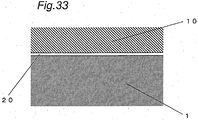
- Fig. 33 is a cross-sectional view of conventional sliding members used for a sliding portion.
- a first sliding member 1 and an opposing second sliding member 10 are members that slide with each other, as typified by a crankshaft and a piston pin of a compressor for a refrigerator-freezer, for example.
- a contact sliding portion 20 is Provided between the first and second sliding members 1 and 10 .
- the conventional sliding members i.e., the first and second sliding members 1 and 10, are formed by an iron-based material and/or an aluminum-based material, consisting mainly of iron and/or aluminum that are/is easily worked and relatively inexpensive.
- both sliding faces of the first sliding member 1 and the opposing second sliding member 10 are microscopically viewed, surface roughness or undulation is observed in each surface. It is known that, in the actuality of sliding at the contact sliding portion 20, a metal contact portion formed by inequalities of the sliding faces, and an oil film portion formed by lubricating oil between the sliding members, support each other, thus providing a so-called mixed lubrication region where a boundary lubrication region and a fluid lubrication region coexist.
- the thickness of the oil film in the contact sliding portion 20 is calculated at the order of 1 ⁇ m to 2 ⁇ m, or at 1 ⁇ m or less.
- the inequalities of the sliding faces have been decreased, and the sliding faces of the first and second sliding members 1 and 10 have been smoothed, thus suppressing the wear due to the sliding at the contact sliding portion 20, and reducing frictional loss.
- Such a conventional technology is disclosed in Japanese Unexamined Patent Publication NO. 2000-145637 .
- the sliding faces of the first and second sliding members 1 and 10 have both been ground to a surface roughness of about Ra 0.3 ⁇ m to Ra 0.6 ⁇ m, and then been finished to a surface roughness of Ra 0.2 ⁇ m or less by lapping, honing or the like.
- the surface roughness or undulation has substantially been eliminated from both of the sliding faces of the first and second sliding members 1 and 10.
- the present invention has been made to solve the problems in the above-described conventional technology, and its object is to provide a highly reliable sliding member by reducing wear even in the situation where an oil film thickness is relatively thin, i.e., even at a boundary lubrication region.
- a sliding member according to claim 1 and a manufacturing method according to claim 10 are provided.
- the sliding member according to the invention comprises a transfer layer, which is formed at a sliding face of the sliding member by projecting, onto a base material of the sliding member, projection particles containing at least one component selected from the group consisting of alumina, silica, mullite, calcium oxide, magnesium oxide and iron oxide and causing a component of each projection particle to be adhered and interfused to the surface of the base material, and wherein, due to an impact force, a large number of minute cavities are formed, each formed by a part of a substantially spherical surface, which are provided at the sliding face of the sliding member, and wherein a minute groove is formed at the sliding face of the sliding member.
- the sliding member manufacturing method comprises the step of forming the transfer layer by projecting, onto a base material of the sliding member, projection particles containing at least one component selected from the group consisting of alumina, silica, mullite, calcium oxide, magnesium oxide and iron oxide and causing a component of each projection particle to be adhered and interfused to the surface of the base material, wherein, in the step of forming the transfer layer, a large number of minute cavities, each formed by a part of a substantially spherical surface, are provided at the sliding face of the sliding member.
- the sliding member formed in this manner can provide the sliding face with at least one or more of the following properties of the component(s) of the transfer layer: mechanical strength, solid lubrication, fracture toughness, and sliding property. Therefore, the wear resistance and seizing resistance of the sliding face of the sliding member are improved, and the wear at a boundary lubrication region is considerably reduced.
- a sliding member according to the present invention is based on the aspect, wherein a large number of minute cavities, each formed by a concave face, are provided at the sliding face of the sliding member.
- the sliding member according to the second aspect, formed in this manner, allows each minute cavity to function as an oil receiver.
- the lubricating oil at a contact sliding portion is retained to enable a reduction in the wear, thereby making it possible to provide a highly reliable sliding member.
- the maximum diameter of each minute cavity at a sliding face opening is preferably in the range between 10 ⁇ m and 200 ⁇ m. If the maximum diameter of each minute cavity is more than 200 ⁇ m, the minute cavities are connected together and the lubricating oil retained therein becomes more likely to flow out. On the other hand, if the maximum diameter of each minute cavity is less than 10 ⁇ m, a substantial difference in the retention of the lubricating oil from a smooth surface is reduced.
- the sliding member according to the fourth aspect is provided to avoid such problems.
- the maximum diameter of each minute cavity at an appropriate value within the above range, the wear can be reduced even at a boundary lubrication region, thereby making it possible to provide a highly reliable sliding member.
- the base material of the sliding member can preferably be made of an aluminum-based material.
- the sliding member according to the fifth aspect can reduce the wear at a boundary lubrication region, thereby making it possible to provide a highly reliable sliding member.
- the base material of the sliding member can also be made of an iron-based material.
- a material used widely as a sliding member such as a cast iron, a sintered iron or a mild steel, is employed, the sliding member according to the sixth aspect can reduce the wear at a boundary lubrication region, thereby making it possible to provide a highly reliable sliding member.
- a minute groove is formed at the sliding face of the sliding member.
- the sliding member according to this aspect allows the minute groove to function as an oil receiver.
- the lubricating oil between the sliding members is retained to enable a reduction in the wear, thereby making it possible to provide a highly reliable sliding member.
- the minute groove preferably extends in a direction that forms a predetermined angle with respect to a sliding direction.
- the sliding member according to this aspect allows the minute groove to efficiently function as an oil receiver. Thus, even in the situation where the supply of lubricating oil from outside is interrupted, the lubricating oil between the sliding members is retained to enable a reduction in the wear, thereby making it possible to provide a highly reliable sliding member.
- the minute groove can also extend in a direction in parallel with a sliding direction.
- the sliding member according to this aspect allows the minute groove to efficiently function as an oil receiver.
- the lubricating oil between the sliding members is retained to enable a reduction in the wear, thereby making it possible to provide a highly reliable sliding member.
- the minute groove can also extend in mutually perpendicular directions.
- the sliding member according to this aspect allows the minute groove to efficiently function as an oil receiver. Thus, even in the situation where the supply of lubricating oil from outside is interrupted, the lubricating oil between the sliding members is retained to enable a reduction in the wear, thereby making it possible to provide a highly reliable sliding member.
- the ratio between, the width of the minute groove and the length of the sliding face along a direction perpendicular to an extending direction of the minute groove is preferably in the range between 0.05 and 0.6.
- the ratio of the minute groove at the sliding face is set at an appropriate value, thereby allowing the minute groove to efficiently function as an oil receiver.
- An extremely minute concave having a maximum diameter of 3 ⁇ m or less is preferably formed at an inner face of each minute cavity.
- the sliding member according to this aspect, formed in this manner allows the extremely minute concave to serve as a wedge between the sliding face and lubricating oil.
- the wear is reduced even at a boundary lubrication region, thereby making it possible to provide a highly reliable sliding member.
- the sliding member manufacturing method according to the invention due to application of an impact load resulting from the projection of the projection particle, the surface temperatures of the sliding member and the projection particle are increased to activate both of the surfaces, thereby making it possible to efficiently transfer the component(s) of the projection particle onto the sliding face. Furthermore, in the sliding member manufacturing method according to the invention, due to an impact force, a large number of minute cavities are formed at the sliding face, and the refinement of surface composition of the sliding face is caused to increase the internal stress. Thus, properties such as high hardness and high fracture toughness are provided, thereby making it possible to fabricate a highly reliable and highly productive sliding member.
- the projection particle is substantially spherically shaped and has an average particle diameter in the range between 3 ⁇ m and 200 ⁇ m. If the average particle diameter is more than 200 ⁇ m, the opening diameter of each minute cavity formed at the sliding face of the sliding member becomes excessively large, so that the minute cavities are connected together and the lubricating oil retained therein becomes more likely to flow out. On the other hand, if the average particle diameter is less than 3 ⁇ m, the diameter of each minute cavity becomes excessively small, so that a substantial difference in the retention of the lubricating oil from a smooth surface is reduced. To avoid such problems, each minute cavity is formed into an appropriate shape and the sliding face opening diameter is set at an appropriate value for the retention of the lubricating oil. Thus, the sliding member manufacturing method can fabricate a highly reliable sliding member.
- fly ash is used as the projection particle.
- the fly ash contains 70% to 80% of alumina, silica and mullite components, and 20% to 30% of calcium oxide, magnesium oxide and iron oxide components. Therefore, by projecting the fly ash onto the sliding face of the sliding member, at least two or more components of these compounds are simultaneously transferred onto the sliding face, and thus the sliding face of the sliding member can be simultaneously provided with at least two or more of the following excellent properties: a high mechanical strength, a hard solid lubrication layer, a high fracture toughness, and a high sliding property. Consequently, the sliding member manufacturing method according to the eighteenth aspect can fabricate an efficient and highly reliable sliding member.
- a preferred sliding member manufacturing method further includes, prior to the step of forming the transfer layer, a grinding step for forming a minute groove at a face of the base material which is to be the sliding face.
- the minute groove is formed at the sliding face of the sliding member, thereby making it possible to fabricate a sliding member in which the minute groove functions as an oil receiver.
- Another preferred sliding member manufacturing method further includes, prior to the step of forming the transfert layer, a grinding step for forming a minute groove at a face of the base material which is to be the sliding face, and the minute groove formed in the grinding step extends in a direction that forms a predetermined angle with respect to a sliding direction.
- a desired minute groove can be formed at the sliding face of the sliding member.
- a minute cavity in the step of forming the transfer layer, a minute cavity, whose maximum diameter at a sliding face opening is in the range between 10 ⁇ m and 200 ⁇ m, is formed. If the maximum diameter of each minute cavity is more than 200 ⁇ m, the minute cavities are connected together, and the lubricating oil retained therein becomes more likely to flow out. On the other hand, if the maximum diameter of each minute cavity is less than 10 ⁇ m, a substantial difference in the retention of the lubricating oil from a smooth surface is reduced.
- the sliding member manufacturing method according to this aspect can avoid such problems.
- the maximum diameter of each minute cavity at an appropriate value within the above range, the wear can be reduced even at a boundary lubrication region, thereby making it possible to fabricate a highly reliable sliding member.
- an extremely minute concave having a maximum diameter of 3 ⁇ m or less is formed at an inner face of a minute cavity.
- the extremely minute concave is allowed to serve as a wedge between the sliding face and lubricating oil.
- the transfer layer is formed by projecting, onto the base material, a mixed projection particle in which the projection particle having a particle diameter of 1 ⁇ m or less is mixed with a carrier bead having a substantially spherical shape and having an average particle diameter in the range between 3 ⁇ m and 200 ⁇ m.
- a minute cavity having an appropriate diameter within the above range is formed for the retention of lubricating oil at the sliding face, thus enabling the transfer of the component of the projection particle having a small particle diameter.
- the sliding member manufacturing method can fabricate a highly reliable and highly productive sliding member.
- the mixed projection particle is formed in such a manner that a large number of the projection particles are attached to a surface of the carrier bead.
- the sliding member manufacturing method according to this aspect at the time of collision of the carrier bead, an impact energy is generated, and in addition, each projection particle is pushed into the sliding face by the carrier bead, thus facilitating the transfer of the component of each projection particle onto the base material.
- a minute cavity and an extremely minute concave can be effectively formed, thus making it possible to fabricate a highly reliable and highly productive sliding member.
- At at least one of calcium oxide and calcium lime is used as the projection particle.
- the transfer layer composed mainly of calcium oxide is formed to a thickness of a few ⁇ m onto the sliding face, the wear reduction is significantly achieved at a boundary lubrication region, thus making it possible to fabricate a highly reliable sliding member.
- a sliding member according to the present invention and a manufacturing method thereof can achieve the advantageous effect of remarkably reducing the wear even in the situation where an oil film thickness at a contact sliding portion is relatively thin, i.e., even at a boundary lubrication region, thus making it possible to provide a highly reliable sliding member.
- Embodiment 1 which is a preferred embodiment of the present invention, will be described with reference to the appended drawings. It should be noted that since the embodiments described below are each illustrated as a specific example of an inventive sliding member, the designs of these embodiments are not intended to limit the present invention.
- Fig. 1 shows an enlarged schematic cross-sectional view partially illustrating a sliding member in Embodiment 1 according to the present invention.
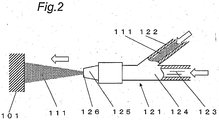
- Fig. 2 shows a schematic view illustrating a method for manufacturing the sliding member of Embodiment 1.
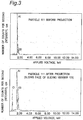
- Fig. 3 shows characteristic graphs indicating results of EPMA elemental analysis on a sliding face of the sliding member of Embodiment 1.
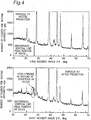
- Fig. 4 shows characteristic graphs indicating results of X-ray diffraction analysis on the sliding face of the sliding member of Embodiment 1.
- a sliding member 101 of Embodiment 1 according to the present invention will be described below.
- the sliding member 101 is formed using, as a base material 102, an aluminum alloy (JIS: A6063) made of an aluminum-based material.
- JIS: A6063 aluminum alloy
- a transfer layer 104 in which silica (SiO 2 ) is transferred to have a thickness of a few ⁇ m, is formed.
- the term "transfer” means a process of causing a component of each projection particle 111 to be adhered and interfused to a surface of the base material 102 and the vicinity of the surface.
- the transfer is realized by projecting the projection particles 111, having components which are desired to be transferred, onto the sliding face of the sliding member 101 at a predetermined velocity.
- the surface of the base material 102 which is to be the sliding face of the sliding member 101, is ground so as to be finished to a surface roughness of about Ra 0.3 ⁇ m.
- a projection particle supply device 121 (see Fig. 2 ) is used to project the projection particles 111 onto the surface of the base material 102.
- a projection particle transport pipe 122 transporting the projection particles 111 stored in a storage tank (not shown), is connected with a gas-pipe 124 flowing a carrier gas 123, and a nozzle 125 is disposed at a tip of the gas pipe 124.
- Embodiment 1 approximately spherically shaped particles, each made of silica (SiO 2 ) having a high purity of 99% or more, are used as the projection particles 111.
- the average particle diameter of the projection particles 111 is 20 ⁇ m, and there is shown a normal distribution in which the projection particles 111, each having a particle diameter ranging from 10 ⁇ m to 30 ⁇ m, occupy 90% or more of the entire projection particles 111.
- the .projection particles 111 stored in the storage tank, are allowed to pass through the projection particle transport pipe 122 by means of an electric gear pump (not shown), and are transported to a connection between the projection particle transport pipe 122 and the gas pipe 124.
- the carrier gas 123 inside the gas pipe 124 is a dry air provided by utilizing an air pump (not shown), and the gas pressure is adjusted so as to be in the range between 0.3 MPa and 0.6 MPa.
- the projection particles 111 are projected approximately perpendicularly to the' sliding face of the sliding member 101 through a tip outlet 126 of the nozzle 125 at a velocity of about 100 m/s by means of the carrier gas 123. It should be noted that the distance between the tip outlet 126 of the nozzle 125 and the sliding face of the sliding member 101 is in the range between 30 mm and 40 mm.
- the diameter R of each extremely minute cavity 105 (i.e., sliding face opening diameter), formed at the sliding face of the sliding member 101, is about 40 ⁇ m at the most from shape measurement results.
- sliding face opening diameter means the diameter of an approximately circular opening at a flat sliding face.
- Fig. 3 shows graphs indicating comparison results of analysis on the sliding face of the sliding member 101 before and after the projection of the projection particles 111, which are obtained by utilizing an EPMA analyzer.
- the horizontal axis represents an applied voltage [keV]
- the vertical axis represents the number of counts per second (intensity) [cps].
- the analytical results shown in Fig. 3 are obtained under the analytical condition in which the applied voltage is 15 keV at the most, and there is shown information about elements existing at a depth of about 2 ⁇ m from the surface. From these results, it can be seen that the peaks of silicon (Si) and oxygen (O), which are constituent elements of the projection particles 111, after the projection are significantly higher than those of silicon (Si) and oxygen (O) before the projection.
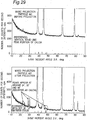
- Fig. 4 shows graphs indicating comparison results of analysis on the sliding face of the sliding member 101 before and after the projection of the projection particles 111, which are obtained by utilizing an X-ray diffraction analyzer.
- the horizontal axis represents an X-ray incident angle (diffraction angle 2 ⁇ ) [deg]
- the vertical axis represents the number of counts per second (intensity) [cps].
- the analytical results shown in Fig. 4 are obtained by carrying out a thin film X-ray diffraction method, and there is shown information about a compositional structure at a depth of about 5 ⁇ m from the surface.
- the transfer layer 104 in which a component of each projection particle 111, i.e., silica (SiO 2 ), has been transferred, is formed at the sliding face of the sliding member 101.
- the results of the X-ray diffraction analysis, conducted on the compositional structure at a depth of 10 ⁇ m or more from the surface indicate that the peak of silica (SiO 2 ) becomes extremely low. Therefore, the thickness of the transfer layer 104, containing a large amount of silica (SiO 2 ), is estimated to be about a few ⁇ m.
- the frictional wear properties of the sliding member 101 are evaluated by utilizing a ball-on-disk tester.
- the test is carried out in the following manner : a stainless steel (SUS304) ball, made of an iron-based material and having a spherical diameter of 9.5 mm and a surface roughness of Ra 0.2 or less, is used as a sliding member (not shown) to be opposed to the sliding member 101; turbine oil is used as lubricating oil; and the test is performed in an atmosphere at a temperature of 22°C to 28°C and at a relative humidity of 55% to 65%.
- the test condition includes a vertical load of 19.6 N and a sliding velocity of 0.1 m/s.
- a sliding face of a sliding member is ground to have a surface roughness of Ra 0.3 ⁇ m, and then projection particles are projected onto the sliding face of the sliding member.
- the projection particles approximately spherically shaped projection particles, each containing 99% or more of silica (SiO 2 ) component, are used. It should be noted that the average particle diameter of the projection particles is 7 ⁇ m, and there is shown a normal distribution in which the projection particles, each having a particle diameter ranging from 3 ⁇ m to 16 ⁇ m, occupy 90% or more of the entire projection particles.
- a transfer layer in which the component of each projection particle is transferred, and minute cavities, each formed into an approximately hemispherical surface, are provided.
- the diameter R of each minute cavity i.e., sliding face opening diameter
- the diameter R of each minute cavity is about 20 ⁇ m at the most, which is smaller than that of each minute cavity in Condition 1 of Embodiment 1.
- a sliding face of a sliding member is ground to have a surface roughness of Ra 0.3 ⁇ m, and then projection particles are projected onto the sliding face of the sliding member.
- the projection particles approximately spherically shaped projection particles, each containing 99% or more of silica (SiO 2 ) component, are used. It should be noted that the average particle diameter of the projection particles is 60 ⁇ m, and there is shown a normal distribution in which the projection particles, each having a particle diameter ranging from 40 ⁇ m to 70 ⁇ m, occupy 90% or more of the entire projection particles.
- a transfer layer in which the component of each projection particle is transferred, and minute cavities, each formed into an approximately hemispherical surface, are provided.
- the diameter R of each minute cavity i.e., sliding face opening diameter
- the diameter R of each minute cavity is about 80 ⁇ m at the most, which is larger than that of each minute cavity in Condition 1 of Embodiment 1.
- a sliding face of a sliding member is ground to have a surface roughness of Ra 0.3 ⁇ m, and then projection particles are projected onto the sliding face of the sliding member.
- the projection particles approximately spherically shaped projection particles, each containing 99% or more of silica (SiO 2 ) component, are used. It should be noted that the average particle diameter of the projection particles is 200 ⁇ m, and there is shown a normal distribution in which the projection particles, each having a particle diameter ranging from 180 ⁇ m to 220 ⁇ m, occupy 90% or more of the entire projection particles.
- a transfer layer in which the component of each projection particle is transferred, and minute cavities, each formed into an approximately hemispherical surface,' are provided.
- the diameter R of each minute cavity i.e., sliding face opening diameter
- Condition 4 of Embodiment 1 a large number of regions where the minute cavities' are connected together are confirmed.
- a sliding face of a sliding member is ground to have a surface roughness of Ra 0.3 ⁇ m, and then projection particles are projected onto the sliding face of the sliding member.
- the projection particles approximately angularly shaped projection particles, each containing 99% or more of silica (SiO 2 ) component, are used. It should be noted that the average particle diameter of the projection particles is 100 ⁇ m, and there is shown a normal distribution in which the projection particles, each having a particle diameter ranging from 50 ⁇ m to 150 ⁇ m, occupy 90% or more of the entire projection particles.
- a conventional sliding member is ground to a surface roughness of about Ra 0.3 ⁇ m to about 0.6 ⁇ m, and is then finished to a surface roughness of Ra 0.2 ⁇ m or less by lapping.
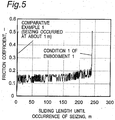
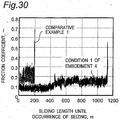
- Fig. 5 shows a characteristic graph indicating changes in friction coefficient with time in Condition 1 of Embodiment 1 according to the present invention, and in Comparative Example 1. That is to say, shown in this graph are the friction coefficients measured in real time for each sliding length.
- the measurement results shown in Fig. 5 indicate the following facts. According to Comparative Example 1 in which the conventional sliding member is used, seizing has occurred promptly at a sliding length of about 1 m. On the other hand, according to Condition 1 of Embodiment 1, the friction coefficient of the sliding member 101 remains at about 0.1 to about 0.2 so as to maintain the sliding at a boundary lubrication region, and the sliding length until the occurrence of seizing is approximately 240 times as much as that in Comparative Example 1. Accordingly, it is confirmed that the sliding member 101 in Condition 1 of Embodiment 1 is significantly improved in wear resistance and seizing resistance.
- Fig. 6 shows a characteristic graph concerning sliding lengths until the occurrence of seizing in the sliding members in Conditions 1 to 5 of Embodiment 1, and in Comparative Example 1. That is to say, shown in this graph are results of comparisons made about sliding lengths until the occurrence of seizing for each condition.
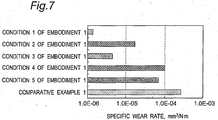
- Fig. 7 shows a characteristic graph indicating specific wear rates in Conditions 1 to 5 of Embodiment 1 and in Comparative Example 1. That is to say, shown in this graph are results of comparisons made about the specific wear rates [mm3/N ⁇ m], which are calculated by dividing the wear volume after the test by the sliding length and vertical load for each condition.
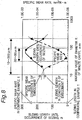
- Fig. 8 shows a characteristic graph indicating correlations among the maximum values of the minute cavity diameters, the sliding lengths until the occurrence of seizing, and the specific wear rates in Conditions 1 to 5 of Embodiment 1 and in Comparative Example 1, in the case where the projection particles are each formed into an approximately spherical shape. That is to say, shown in this graph are results of evaluation on the correlations.
- the horizontal axis represents the maximum value of the minute cavity diameter R [ ⁇ m]
- the first vertical axis i.e., the vertical axis at the left side of Fig. 8
- the second vertical axis i.e., the vertical axis at the right side of Fig.
- Fig. 9 shows a characteristic graph indicating correlations among the average particle diameters, sliding lengths and specific wear rates in the case where the projection particles are each formed into an approximately spherical shape. That is to say, shown in this graph are results of evaluation on the correlations.
- the horizontal axis represents the average particle diameter of the projection particles [ ⁇ m]
- the first vertical axis i.e., the vertical axis at the left side of Fig. 9
- the second vertical axis i.e., the vertical axis at the right side of Fig. 9
- the specific wear rate [mm3/N ⁇ m].
- the sliding lengths until the occurrence of seizing in Conditions 1 to 5 of Embodiment 1 are each denoted by the square mark with black color ( ⁇ ). However, the sliding length until the occurrence of seizing in Condition 5 of Embodiment 1 is denoted by the square mark with gray color ( ). Furthermore, the sliding length until the occurrence of seizing in Comparative Example 1 is denoted by the square mark with white color ( ⁇ ).
- the specific wear rates in Conditions 1 to 5 of Embodiment 1 are each denoted by the triangle mark with black color ( ⁇ ). However, the specific wear rate in Condition 5 of Embodiment 1 is denoted by the triangle mark with gray color ( ). Also, the specific wear rate in Comparative Example 1 is denoted by the triangle mark with white color ( ⁇ ).
- the maximum value of the diameter R of each minute cavity 105 is preferably in the range between 10 ⁇ m and 200 ⁇ m. In order to further improve the seizing resistance and wear resistance, the maximum value of the diameter R of each minute cavity 105 is more preferably in the range between 30 ⁇ m and 90 ⁇ m.
- the average particle diameter of the projection particles 111 to be projected is preferably in the range between 3 ⁇ m and 200 ⁇ m; furthermore, in order to drastically improve the seizing resistance and wear resistance, the average particle diameter of the projection particles 111 to be projected is more preferably in the range between 15 ⁇ m and 80 ⁇ m.
- the projection particles 111 are more preferably spherically shaped.
- the projection particles 111 are projected onto the sliding face of the sliding member 101, thereby forming the transfer layer 104 in which the component of each projection particle 111 is transferred and the composition is dense, and forming the minute cavities 105. Therefore, the mechanical strength and fracture toughness of the sliding face are increased, and the wear at the contact sliding portion is decreased, thus providing a highly reliable sliding member and a manufacturing method thereof.
- the material properties, shapes and projecting conditions of the projection particles 111 are adjusted.
- silica (SiO 2 ) is used as the material for the projection particles 111 in the sliding member manufacturing method according to Embodiment 1
- alumina (Al 2 O 3 ) and/or mullite (3Al 2 O 3 -2SiO 2 ) may alternatively be used. Even in that case, since alumina and mullite each have the properties similar to those of silica (SiO 2 ), such as a high hardness and a high mechanical strength, the mechanical strength of the sliding face of the sliding member 101 is improved due to these component characteristics, thus achieving the same wear reducing effect as in the case where silica (SiO 2 is used.
- calcium oxide (CaO) is used as the material for the projection particles 111, since calcium oxide (CaO) has a property such as an inorganic solid lubrication effect, the metal contact at the sliding face of the sliding member 101 is suppressed due to this component property, thus achieving the wear reducing effect.
- magnesium oxide MgO
- MgO magnesium oxide
- properties such as high ductility and high fracture toughness
- microscopic chipping at the sliding face of the sliding member 101. is suppressed due to this component property, thus achieving the wear reducing effect.
- the projection particles 111 are projected onto the sliding face of the sliding member 101 through the tip outlet 126 of the nozzle 125 at a velocity of about 100 m/sec by means of the carrier gas 123.
- the present inventors confirmed that if the projection velocity of the projection particles 111 is too low, a sufficient kinetic energy cannot be transmitted to the base material 102 at the time of collision, resulting in insufficient formation of the transfer layer 104 and the minute cavities 105; on the other hand, if the projection velocity is too high, the roughness of the sliding face of the sliding member 101 becomes significant.
- the projection velocity of the projection particles 111 is preferably appropriately selected in accordance with, for example, the following factors: the material property (e.g., hardness) of the base material 102; the material property, (e.g., hardness) of each projection particle 111 to be projected; the particle diameter - of each projection particle 111 to be projected; the required surface roughness of the sliding face after the projection; and/or the diameter R of each minute cavity to be formed.
- the material property e.g., hardness
- the material property e.g., hardness
- the transfer layer 104 and the minute cavities 105 are formed at the sliding member 101 made of an aluminum-based material. Therefore, it is preferable to project the projection particles 111 onto the sliding face of the sliding member 101 that is a softer one of the sliding members opposed to each other. This is because when the projection particles 111 are projected, some convex protrusions are formed around' the minute cavities 105 at the sliding- face of the sliding member 101, which might cause surface roughness to damage the opposing sliding member.
- the sliding member, onto which the projection particles are projected is a softer one of the sliding members as in Embodiment 1, the convex protrusions are planarized due to instantaneous plastic deformation at the time of application of a sliding load upon the sliding portion, thus making it possible to avoid damaging the opposing member during sliding.
- the projection of the projection particles 111 onto the sliding face of the sliding member 101, which is a softer one of the sliding members opposed to each other, as described above is similarly applied even if a sliding portion is provided between similar metals, e.g., iron-based materials or aluminum-based materials. That is to say, if similar metals are used for the sliding members opposed to each other, it is preferable to project the projection particles 111 onto the sliding face of the sliding member 101, which is a softer one of the sliding members opposed to each other, thus forming, the transfer layer and the minute cavities.
- similar metals e.g., iron-based materials or aluminum-based materials. That is to say, if similar metals are used for the sliding members opposed to each other, it is preferable to project the projection particles 111 onto the sliding face of the sliding member 101, which is a softer one of the sliding members opposed to each other, thus forming, the transfer layer and the minute cavities.
- Embodiment 1 Although a structure in which the projection particles 111 are transported to the projection particle supply device by means of a gear pump (not shown) is exemplified in Embodiment 1, the present invention is not limited to this. Alternatively, any other structure may be used as long as the projection particles 111 can be stably supplied, and even in that case, the similar effects can be achieved.
- Embodiment 1 Although air, which is an incompressible fluid, is used as the carrier gas 123 in Embodiment 1, the similar effects can be obtained even if a nitrogen gas containing no oxygen is used.
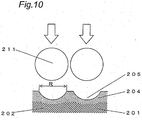
- Fig. 10 shows an enlarged schematic cross-sectional view partially illustrating a sliding member in Embodiment 2 according to the present invention.
- Fig. 11 shows a schematic view illustrating a method for manufacturing the sliding member of Embodiment 2.
- Fig. 12 shows characteristic graphs indicating results of EPMA elemental analysis on a sliding face of the sliding member of Embodiment 2.
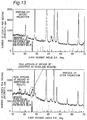
- Fig. 13 shows characteristic graphs indicating results of X-ray diffraction analysis on the sliding face of the sliding member of Embodiment 2.
- a sliding member 201 according to the present invention will be described in detail below.
- the sliding member 201 is formed using, as a base material 202, an aluminum alloy (JIS: A6063) made of an aluminum-based material.
- JIS: A6063 aluminum alloy
- a transfer layer 204 in which mullite (3Al 2 O 3 ⁇ 2SiO 2 ), silica (SiO 2 ) and calcium oxide (CaO) are transferred to a thickness of a few ⁇ m, is formed.
- the term "transfer” means a process of causing a component of each projection particle 211 to be adhered and interfused to a surface of the base material 202 and the vicinity of the surface.
- the transfer is realized by projecting the projection particles 211, having components which are desired to be transferred, onto the sliding face of the sliding member 201 at a predetermined velocity.
- the surface of the base material 202 which is to be the sliding face of the sliding member 201, is ground so as to be finished to a surface roughness of about Ra 0.3 ⁇ m.
- a projection particle supply device 221 (see Fig. 11 ) is used to project the projection particles 211 onto the sliding face of the sliding member 201.
- a projection particle transport pipe 222 transporting' the projection particles 211 stored in a storage tank (not shown), is connected with a gas pipe 224 flowing a carrier gas 223 flows, and a nozzle 225 is disposed at a tip of the gas pipe 224.
- approximately spherically shaped fly ash 70% to 80% of which is occupied by silica (SiO 2 ), alumina (Al 2 O 3 ) and mullite (3Al 2 O 3 ⁇ 2SiO 2 ), and the remainder of which is constituted by calcium oxide (CaO), magnesium oxide (MgO), iron oxide and the like, is used as the material for the projection particles 211.
- the average particle diameter of the projection particles 211 is 7 ⁇ m, and there is shown a normal distribution in which the projection particles, each having a particle diameter ranging from 3 ⁇ m to 16 ⁇ m, occupy 90% or more of the entire projection particles.
- the fly ash used in this embodiment complies with JIS Class 5 or Class 10.
- “Fly ash” is an industrial waste produced in the following manner.
- an ash particle which has been molten due to the combustion of pulverized coal, floats within a high-temperature combustion gas, and becomes a microscopic particle so as to be colleted, as an industrial waste, by an electric dust collector with a temperature reduction at the boiler exit.
- the Fly ash produced in this manner is stored in the dry state', and is further compounded or subjected to particle size control by a classifier depending on usage such as recycle and/or reuse so as to be stored in a silo on a product-by-product basis.
- fly ash is a microscopic particle and is normally approximately spherically shaped, the use of fly ash increases fluidity during concrete construction and/or mortar construction. Therefore, by utilizing this property, fly ash is generally used in the field of civil engineering and construction. Accordingly, the fly ash, which has been repeatedly used for the projection of the projection particles 211 as in Embodiment 1, is not straightly discarded but can be reused as an admixture for concrete and/or mortar, resulting in an advantage that the projection particles 211 are global-environment-friendly.
- the projection particles 211 stored in the storage tank, are allowed to pass through the projection particle transport pipe 222 by means of an electric gear pump (not shown), and are transported to a connection between the projection particle transport pipe 222 and the gas pipe 224.
- the carrier gas 223 inside the gas pipe 224 is a dry air provided by utilizing an air pump (not shown), and the gas pressure is adjusted so as to be in the range between 0.3 MPa and 0.6 Mpa.
- the projection particles 211 are projected approximately perpendicularly to the sliding face of the sliding member 201 through a tip outlet 226 of the nozzle 225 at a velocity of about 100 m/s by means of the carrier gas 223. It should be noted that the distance between the tip outlet 226 of the nozzle 225 and the sliding face of the sliding member 201 is in the range between 30 mm and 40 mm.
- the diameter R of each extremely minute cavity 205 (i.e., sliding face opening diameter), formed at the sliding face of the sliding member 201, is about 20 ⁇ m at the most from shape measurement results.
- sliding face opening diameter means the diameter of an approximately circular opening at a flat sliding face.
- Fig. 12 shows comparison results of analysis on the sliding face of the sliding member 201 before and after the projection of the projection particles 211, which are obtained, by utilizing an EPMA analyzer.
- the horizontal axis represents an applied voltage [keV]
- the vertical axis represents the number of counts per second (intensity) [cps].
- the' analytical results- shown in Fig. 12 are obtained under the analytical condition in which the applied voltage is 15 keV at the most, and there is shown information about elements existing at a depth of about 2 ⁇ m from the surface.
- Fig. 13 shows comparison results of analysis on the sliding face of the sliding member 201 before and after the projection of the projection particles 211, which are obtained by utilizing an X-ray diffraction analyzer.
- the horizontal axis represents an X-ray incident angle (diffraction angle 2 ⁇ ) [deg]
- the vertical axis represents the number of counts per second (intensity) [cps].
- the analytical results shown in Fig. 13 are obtained by currying, out a thin film X-ray diffraction method, and there is shown information about a compositional structure at a depth of about 5 ⁇ m from the surface.
- the transfer layer 204 in which components of each projection particle 211, i.e., mullite (3Al 2 O 3 ⁇ 2SiO 2 ), silica (SiO 2 ) and calcium oxide (CaO), have been transferred, is formed at the sliding face of the sliding member 201.
- the results of the X-ray diffraction analysis, conducted on the compositional structure at a depth of 10 ⁇ m or more from the surface indicate that the peaks of mullite (3Al 2 O 3 ⁇ 2SiO 2 ) and silica. (SiO 2 ) become extremely low. Therefore, the thickness of the transfer layer 204, containing a large amount of fly ash component, is estimated to be about a few ⁇ m.
- the frictional wear properties of the sliding member 201 are evaluated by utilizing a ball-on-disk tester.
- the test is carried out in the following manner: a stainless steel (SUS304) ball, made of an iron-based material and having a spherical diameter of 9.5 mm and a surface roughness of Ra 0.2 or less, is used as an opposing sliding member (not shown); turbine oil is used as lubricating oil; and the test is performed in an atmosphere at a temperature of 22°C to 28°C, and at a relative humidity of 55% to 65%.
- the test condition includes a vertical load of 19.6 N and a sliding velocity of 0.1 m/s.
- a sliding face of a sliding member is ground to a surface roughness of Ra 0.3 ⁇ m, and then projection particles are projected onto the sliding face of the sliding member.
- the projection particles approximately spherically shaped projection particles, each containing 99% or more of silica (SiO 2 ) component, are used. It should be noted that the average particle diameter of the projection particles is 7 ⁇ m, and there is shown a normal distribution in which the projection particles, each having a particle diameter, ranging from 3 ⁇ m to 16 ⁇ m, occupy 90% or more of the entire projection particles.
- a transfer layer in which silica (SiO 2 ) component is transferred, and minute cavities each formed into an approximately hemispherical surface, are provided.
- the diameter R of each minute cavity i.e., sliding face opening diameter
- the diameter R of each minute cavity is about 20 ⁇ m at the most, which is substantially similar to that of each minute cavity in Condition 1 of Embodiment 2.
- a sliding face of a sliding member is ground to a surface roughness of Ra 0.3 ⁇ m, and then projection particles are projected onto the sliding face of the sliding member.
- the material for the projection particles approximately angularly shaped fly ash, 70% to 80% of which is occupied by silica (SiO 2 ), alumina (Al 2 O 3 ), and mullite, (3Al 2 O 3 ⁇ 2SiO 2 ), and the remainder of which is constituted by calcium oxide (CaO), magnesium oxide (MgO), iron oxide and the like, is used.
- the average particle diameter of the projection particles is 9.4 ⁇ m, and there is shown a normal distribution in which the projection particles, each having a particle diameter ranging from 3 ⁇ m to 24 ⁇ m, occupy 90% or more of the entire projection particles.
- a transfer layer in which the component of each projection particle is transferred, is confirmed at the sliding face of the sliding member by analysis, a small variation in the component ratio is recognized.
- minute cavities as those found in the case of the spherically shaped projection particles are not formed, but the existence of a large number of extremely minute striations is confirmed as if the sliding face has been scraped.
- a conventional sliding member is ground to a surface roughness of about Ra 0.3 ⁇ m to about 0.6 ⁇ m, and is then finished to a surface roughness of Ra 0.2 ⁇ m or less by lapping.
- Fig. 14 shows a characteristic graph indicating changes in friction coefficient with time in Condition 1 of Embodiment 2 according to the present invention, and in Comparative Example 1. That is to say, shown in this graph are the friction coefficients measured in real time for each sliding length.
- the measurement results shown in Fig. 14 indicate the following facts. According to Comparative Example 1 in which the conventional sliding member is used, seizing has occurred promptly at a sliding length of about 1 m. On the other hand, according to Condition 1 of Embodiment 2, the friction coefficient of the sliding member 201 remains at about 0.15 to about 0.25 so as to maintain the sliding at a boundary lubrication region, and the sliding length until the occurrence of seizing is approximately 240 times as much as that in Comparative Example 1. Accordingly, it is confirmed that the sliding member 201 according to Condition 1 'of Embodiment 2 is significantly improved in wear resistance and seizing resistance.
- Fig. 15 shows a characteristic graph concerning sliding lengths until the occurrence of seizing in Conditions 1 to 3 of Embodiment 2, and in Comparative Example 1. That is to say, shown in this graph are results of comparisons made about sliding lengths until the occurrence of seizing for each condition.
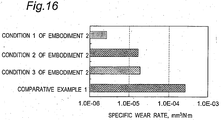
- Fig. 16 shows a characteristic graph indicating specific wear rates in Conditions 1 to 3 of Embodiment 2, and in Comparative Example 1. That is to say, shown in this graph are results of comparisons made about the specific wear rates [mm3/N ⁇ m], which are calculated by dividing the wear volume after the test by the sliding length and vertical load for each condition.
- Condition 1 of Embodiment 2 is compared with Condition 2 of Embodiment 2 in which silica (SiO 2 ) having the same average particle diameter and the same spherical shape as in Condition 1 of Embodiment 2, is projected.
- the sliding length until the occurrence of seizing in Condition 1 of Embodiment 2 is 1.4 times as much as that in Condition 2 of Embodiment 2, while the specific wear rate (i.e., wear volume per unit sliding length) in Condition 1 of Embodiment 2 is about 1/10 of that in Condition 2 of Embodiment 2.
- each of these minute cavities 205 serves as an oil receiver even in the situation where the oil film thickness is thin, thus providing the lubrication effect at the contact sliding potion. Furthermore, it is believed that the refinement of composition of the transfer layer 204 is caused to increase the internal stress, and therefore, fracture toughness is improved.
- the projection particles are preferably spherically shaped.
- the projection particles 211 are projected onto the sliding face of the sliding member 201, thereby forming the transfer layer 204 in which the component of each projection particle 211 is transferred and the composition is dense, and providing the minute cavities 205, each' formed into an approximately hemispherical surface.
- the mechanical strength and fracture toughness of the sliding face are increased, thus providing the contact sliding portion with the inorganic solid lubrication effect.
- the wear at the contact sliding portion is synergistically decreased, thus making it possible to fabricate a highly reliable sliding member.
- the material properties, shapes and projecting conditions of the projection particles 211 are adjusted.
- the sliding member' manufacturing method according to Embodiment 2 needs no complicated apparatus unlike a PVD or CVD method, and thus can inexpensively fabricate the sliding member.
- fly ash is solely used as the material for the projection particles 211 in the method for manufacturing the sliding member 201 according to Embodiment 2
- at least two or more components selected from alumina, silica, mullite, calcium oxide, magnesium oxide, and iron oxide, may alternatively be simultaneously transferred onto the sliding face of the sliding member 201.
- fly ash is an industrial waste, the reuse thereof has been limited to the field of construction and/or civil engineering thus far.
- the manufacturing method shown in Embodiment 2 can create a new usage of fly ash so as to manufacture the sliding member 201 having high wear resistance and high seizing resistance.
- Fly ash according to JIS, used in Embodiment 2 has the following slightly variable chemical composition: 44.6% to 74.0% of silica (SiO 2 ) content; 16.4% to 38.3% of alumina (Al 2 O 3 ) content; 0.1% to 14.3% of calcium oxide (CaO) content; 0.2% to 2.8% of magnesium oxide (MgO) content; and 0.6% to 22.7% of ferric oxide (Fe 2 O3) content.
- fly ash containing large amounts of mullite, (3Al 2 O 3 ⁇ 2SiO 2 ), silica (SiO 2 ) and calcium oxide (CaO) is used as the material for the projection particle 211 in Embodiment 2
- fly ash containing relatively large amounts of alumina (Al 2 O 3 ) and magnesium oxide (MgO) may alternatively be used. Even in such a case, the wear reducing effect can be similarly achieved, although the effect at the contact sliding portion differs.
- magnesium oxide (MgO) since magnesium oxide (MgO) has properties such as high ductility and high fracture toughness, microscopic chipping at the sliding face of the sliding member 201 is suppressed, thus achieving the wear reducing effect.
- triiron tetroxide Fe 3 O 4
- Fe 3 O 4 triiron tetroxide
- Fe 3 O 4 the adhesive wear at the sliding face of the sliding member 201 is suppressed because triiron tetroxide (Fe 3 O 4 has a high sliding property, thus achieving the wear reducing effect.
- fly ash is used as the material for the projection particles 211 containing at least two components selected from alumina, silica, mullite, calcium oxide, magnesium oxide and iron oxide, so that two or more components are efficiently transferred.
- other projection particles similarly containing two or more components may be used, and even in such a case, the similar effects can be obtained.
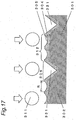
- Fig. 17 shows an enlarged schematic cross-sectional view partially illustrating a sliding member in Embodiment 3 according to the present invention.
- Fig. 18 shows a schematic view illustrating a method for manufacturing the sliding member of Embodiment 3.
- Fig. 19 shows an enlarged schematic cross-sectional view illustrating minute cavities and minute grooves in Embodiment 3.
- Fig. 20 shown characteristic graphs indicating results of EPMA elemental analysis on a sliding face of the sliding member of Embodiment 3.
- Fig. 21 shows characteristic, graphs indicating results of X-ray diffraction analysis on the sliding face of the sliding member of Embodiment 3.
- a sliding member 301 of Embodiment 3 according to the present invention will be described in detail below.
- the sliding member 301 is formed using, as a base material 302, an aluminum alloy (JIS: A6063) made of an aluminum-based material.
- JIS: A6063 aluminum alloy
- a transfer layer 304 in which mullite (3Al 2 O 3 ⁇ 2SiO 2 ), silica (SiO 2 ) and calcium oxide (CaO) are transferred to a thickness of a few ⁇ m, is formed.
- the term "transfer” means a process of causing a component of each projection particle 311 to be adhered and interfused to a surface of the base material 302 and the vicinity of the surface.
- the transfer is realized by projecting the projection particles 311, having components which are desired to be transferred, onto the sliding face of the sliding member 301 at a predetermined velocity.
- minute grooves 306 each having a wedge-shaped concave portion 331, and approximately flat portions 312 having a large number of extremely minute cavities 305, each formed into an approximately hemispherical surface, are alternately provided over the entire sliding face of the sliding member 301.
- the surface of the sliding member 301 is ground in parallel with the sliding direction by using No 180 sandpaper. Then, a projection particle supply device 321 (see Fig. 18 ) is used to project the projection particles 311 onto the sliding face of the sliding member 301.
- a projection particle transport pipe 322 through which the projection particles 311 stored in a storage tank (not shown) are transported, is connected with a gas pipe 324, through which a carrier gas 323 flows, and a nozzle 325 is disposed at a tip of the gas pipe 324.
- Embodiment 3 approximately spherically shaped fly ash, 70% to 80% of which is occupied by silica (SiO 2 ), alumina (Al 2 O 3 ) and mullite (3Al 2 O 3 ⁇ 2SiO 2 ), and the remainder of which is constituted by calcium oxide (CaO), magnesium oxide (MgO), iron oxide and the like, is used as the material for the projection particles 311.
- the average particle diameter of the projection particles is 7 ⁇ m, and there is shown a normal distribution in which the projection particles, each having a particle diameter ranging from 3 ⁇ m to 16 ⁇ m, occupy 90% or more of the entire projection particles.
- the fly ash used in this embodiment complies with JIS Class 5 or Class 10. It should be noted that the fly ash used in Embodiment 3 is similar to that used in Embodiment 2'described above.
- the projection particles 311, stormed in the storage tank, are allowed to pass through the projection particle transport pipe 322 by means of an electric gear pump (not shown), and are transported to a connection between the projection particle transport pipe 322 and the gas pipe 324.
- the carrier gas 323 inside the gas pipe 324 is a dry air provided by utilizing an air pump (not shown), and the gas pressure is adjusted so as to be in the range between 0.3 MPa and 0.6 MPa
- the diameter R of each extremely minute cavity 305 (i.e., sliding face opening diameter), formed at the sliding face of the sliding member 301, is about 20 ⁇ m at the most from shape measurement results.
- sliding face opening diameter means the diameter of an approximately circular opening at a flat sliding face.
- the sliding face of the sliding member 301 is irregular, and there exist convex portions 330 each having a wedge-shaped tip (which is indicated by the imaginary broken line 330L in Fig. 19 ) and the concave portions 331.
- the projection particles 311 are projected onto and collided against this sliding face, thus plastically deforming or removing the convex portions 330 on the sliding face. Since the convex portions 330 are apparently disappeared, only the concave portions 331 seem to remain on the sliding face.
- the minute grooves 306 consisting, of the remaining wedge-shaped concave portions 331, and the approximately flat portions 312 having the minute cavities 305 are alternately formed over the entire sliding face of the sliding member 301.
- each concave portion 331 of each minute groove 306 tends to be generally greater than the depth H1 of each minute cavity 305 (see Fig. 19 ). Further, the ratio W2/ (W1 + W2) between the width W2 of each minute groove 306 and the width W1 of each approximately flat portion 312 is in the range between about 0.05 and about 0.6 although it varies with location.
- Fig. 20 shows comparison results of analysis on the sliding face of the sliding member 301 before and after the projection of the projection particles 311, which are obtained by utilizing an EPMA analyzer.
- the horizontal axis represents an applied voltage [keV]
- the vertical axis represents the number of counts per second (intensity) [cps].
- the analytical results shown in Fig. 20 are obtained under the analytical condition in which the applied voltage is 15 keV at the most, and there is shown information about elements existing at a depth of about 2 ⁇ m from the surface.
- Fig. 21 shows comparison results of analysis on the sliding face of the sliding member 301 before and after the projection of the projection particles 311, which are obtained by utilizing an X-ray diffraction analyzer.
- the horizontal axis represents an X-ray incident angle (diffraction angle 2 ⁇ ) [deg]
- the vertical axis represents the number of counts per second (intensity) [cps].
- the analytical results, shown in Fig. 21 are obtained by carrying out a thin film X-ray diffraction method, and there is shown information about a compositional structure at a depth of about 5 ⁇ m from the surface.
- the transfer layer 304 in which components of each projection particle 311, i.e., mullite (3Al 2 O 3 ⁇ 2SiO 2 ), silica (SiO 2 ) and calcium oxide (CaO), have been transferred, is formed at the sliding face of the sliding member 301.
- the results of the X-ray diffraction analysis, conducted on the compositional structure at a depth of 10 ⁇ m or more from the surface indicate that the peaks of mullite (3Al 2 O 3 ⁇ 2SiO 2 ) and silica (SiO 2 ) become extremely low. Therefore,' the thickness of the transfer layer 304, containing a large amount of fly ash component, is estimated to be about a few ⁇ m.
- the frictional wear properties of the sliding member 301 are evaluated by utilizing a ball-on-disk tester.
- the test is carried out in the following manner: a stainless steel (SUS304) ball, made of an iron-based material and having a spherical diameter of 9.5 mm and a surface roughness of Ra 0.2 or less, is used as a sliding member (not shown) to be opposed to the sliding member 301; turbine oil is used as lubricating oil; and the test is performed in an atmosphere at a temperature of 22°C to 28°C and at a relative humidity of 55% to 65%.
- the test condition includes a vertical load of 19.6 N and a sliding velocity of 0.1 m/s.
- a sliding face of a sliding member is ground to a surface roughness of Ra 0.3 ⁇ m, and then projection particles are projected onto the sliding face of the sliding member.
- the material for the projection particles approximately spherically shaped fly ash, 70% to 80% of which is occupied by silica (SiO 2 ), alumina (Al 2 O 3 ) and mullite (3Al2O 3 ⁇ 2SiO 2 ), and the remainder of which is constituted by calcium oxide (CaO), magnesium oxide (MgO), iron oxide and the like, is used.
- the average particle diameter of the projection particles is 7 ⁇ m, and there is shown a normal distribution in which the projection particles, each having a particle diameter of 16 ⁇ m at the most, occupy 90% or more of the entire projection particles.
- a transfer layer in which the component of fly ash is transferred, and minute cavities, each formed into an approximately hemispherical surface, are provided.
- the component ratio detected from the transfer layer is substantially similar to that in Condition 1 of Embodiment 3, and the diameter R of each minute cavity is about 20 ⁇ m at the most, which is also similar to that of each minute cavity in Condition 1 of Embodiment 3.
- a grinding process is performed on a sliding face of a sliding member by using No.180 sandpaper so that only process striations, consisting of convex and concave portions each having a wedge-shaped tip, are provided in parallel with the sliding direction.
- a conventional sliding member is ground to a surface roughness of about Ra 0.3 ⁇ m to about 0.6 ⁇ m, and is then finished to a surface roughness of Ra 0.2 ⁇ m or less by lapping.
- Fig. 22 stows a characteristic graph indicating changes in friction coefficient with time in Condition 1 of Embodiment 3 and in Comparative Example 1. That is to say, shown in this graph are the friction coefficients measured in real time for each sliding length.
- the measurement results shown in Fig. 22 indicate the following facts. According to Comparative Example 1 in which the conventional sliding member is used, seizing has occurred promptly at a sliding length of about 1 m. On the other hand, according to Condition 1 of Embodiment 3, the friction coefficient of the sliding member 301 remains at about 0.05 to about 0.2 so as to maintain the sliding at a boundary lubrication region, and therefore seizing does not occur in the range of this test condition (although only the results up to a sliding length of 300 m are shown in Fig. 22 , the test is carried out up to a sliding length of 700 m at the most). Accordingly, it is confirmed that the sliding member 301 in Condition 1 of Embodiment 3 is significantly improved in wear resistance and seizing resistance
- Fig. 23 shows a characteristic graph indicating sliding length until the occurrence of seizing in the sliding members in Conditions 1 to 3 of Embodiment 3 and in Comparative Example 1. That is to say, shown in this graph are results of comparisons made about sliding lengths until the occurrence of seizing for each condition.
- Fig. 24 shows a characteristic graph indicating specific wear rates in Conditions 1 to 3 of Embodiment 3 and in Comparative Example 1. That is to say, shown in this graph are results of comparisons made about the specific wear rates [mm3/N ⁇ m], which are calculated by dividing the wear volume after the test by the sliding length and vertical load for each condition.
- the sliding face is subjected to a grinding process so that minute grooves are provided to extend in parallel with the sliding direction, thereby forming only the process striations consisting of: the convex portions 330, each located on both sides of the minute groove and having a wedge-shaped tip (which is indicated by the imaginary line 330L in Fig. 19 ); and the concave portions 331.
- the effect of improving the sliding length until the occurrence of seizing and the specific wear rate are achieved in the Condition 3 of Embodiment 3, compared with those in Comparative Example 1.
- this effect is relatively small, and this is believed to be due to the fact that the transfer layer 304 and the minute cavities 305 are not formed.
- the projection particles 311, each composed of approximately spherically shaped fly ash, are projected onto the sliding face of the sliding member 301.
- the transfer layer 304 in which the component of each projection particle 311 is transferred and the composition is dense, and the minute grooves 305, each formed into an approximately hemispherical surface; in addition, the minute grooves 306, extending in parallel with the sliding direction, and the approximately flat portions 312 are alternately formed. Accordingly, the mechanical strength and fracture toughness of the sliding face are improved, and the property such as the inorganic solid lubrication effect is provided.
- the lubrication effect of a lubricant agent since the lubrication effect of a lubricant agent is provided, the wear at the contact sliding portion is synergistically decreased, thus making it possible to provide a highly reliable sliding member and a manufacturing method thereof.
- the material properties, shapes and projecting conditions of the projection particles are adjusted.
- the sliding member manufacturing method according to Embodiment 3 needs no complicated apparatus unlike a PVD or CVD method, and thus can inexpensively fabricate the sliding member.
- the sliding face of the sliding member 301 is subjected to a grinding process by using No.180 sandpaper so that minute grooves are provided to extend in parallel with the sliding direction, and then, the projection particles 311 are projected onto the sliding face.
- the process striations caused by, for example, a grinding or rough polishing process, i.e., so-called "remnant grooves” may be used as they are as the minute grooves 306.
- Such a manufacturing method needs no process of mirror polishing and finishing, thus further improving productivity.
- Embodiment 3 has been described as an example in which the minute grooves 306 are provided to extend in parallel with the sliding direction, the minute grooves 306 may each be formed at an appropriate angle with respect to the sliding direction in accordance with sliding embodiment or condition. Furthermore, the minute grooves 306 may be provided to extend in a direction perpendicular to the sliding direction in accordance with the sliding formations or various conditions.
- the ratio W2/(W1 + W2.) between the width W2 of each minute groove 306 and the width W1 of each approximately flat portion 312 is in the range between about 0.05 and about 0.6 although it varies with location. If the ratio W2/ (W1 + W2) is less than 0.05, the advantages over the case where only the minute cavities 305 are substantially formed are reduced.
- the ratio W2/ (W1 + W2) is equal to or more than 0.6, it is expected that the width W2 of each minute groove 306 and the depth H2 of each concave portion 331 become inevitably too large, thus causing lubricating oil to flow out of the contact sliding portion, and decreasing the wear reducing effect. Accordingly, the ratio W2/ (W1 + W2) between the width W2 of each minute groove 306 and the width W1 of each approximately flat portion 312 is preferably in the range between about 0.05 and about 0.6.
- Fig. 25 shows an enlarged schematic cross-sectional view partially illustrating a sliding member in Embodiment 4 according to the present invention.
- Fig. 26 shows a schematic view illustrating a method for manufacturing the sliding member in Embodiment 4.
- Fig. 27 shows a schematic view illustrating a mixed projection particle in Embodiment 4.
- Fig. 28 shows characteristic graphs indicating results of EPMA elemental analysis on a sliding face of the sliding member of Embodiment 4.
- Fig. 29 shows characteristic graphs indicating results of X-ray diffraction analysis on the sliding face of the sliding member of Embodiment 4.
- Fig. 30 shows a characteristic graph indicating changes in friction coefficient with time in Embodiment 4.
- Fig. 31 shows a characteristic graph indicating sliding length until the occurrence of seizing in Embodiment 4.
- Fig. 32 shows a characteristic graph indicating disk-side specific wear rate in Embodiment 4.
- the sliding member 401 is formed using, as a base material 402, an aluminum alloy (JIS: A6063) made of an aluminum-based material.
- a sliding face of the sliding member 401 is subjected to a grinding process in advance so as to be finished to a surface roughness of about Ra 0.3 ⁇ m.
- a projection particle supply device 421 (see Fig. 26 ) is used to project mixed projection particles 441 (see Fig. 27 ), in which projection particles 411 and carrier beads 440 are mixed, onto the surface of the base material 402.
- a projection particle transport pipe 422 transporting the mixed projection particles 441 stored in a storage tank (not shown), is connected with a gas pipe 424 flowing a carrier gas 423, and a nozzle 425 is disposed at a tip of the gas pipe 424.
- the material for the projection particles 411 high-purity calcium oxide containing 99% or more of calcium oxide (CaO) component is used.
- the projection particles 411 are each formed to have a plurality of round convex portions at its circumferential face, and have an average particle diameter of 1 ⁇ m or less.
- carrier beads 440 As the material for carrier beads 440, silica (SiO 2 ), having a high purity of 99% or more and formed into an approximately spherical shape, is used.
- the average particle diameter of the carrier beads 440 is 20 ⁇ m, and there is shown a normal distribution in which the carrier beads 440, each having a particle diameter ranging from 10 ⁇ m to 30 ⁇ m, occupy 90% or more of the entire carrier beads 440.
- the projection particles 411 and the carrier beads 440 are supposed to be mixed at a volume ratio of 1:3, and are put into a predetermined container in which the projection particles 411 and the carrier beads 440 are mixed for about an hour using a planetary ball mill, thereby producing the mixed projection particles 441.
- the present inventors confirmed that, in the mixed projection particles 441, a large number of the projection particles 411 are attached to the spherical surface of each carrier bead 440 due to static electricity and the like, as shown in Fig. 27 .
- the mixed projection particles 441, stored in the storage tank, are allowed to pass through the projection particle transport pipe 422 by means of an electric gear pump (not shown), and are transported to a connection between the projection particle transport pipe 422 and the gas pipe 424.
- the carrier gas 423 inside the gas pipe 424 is a dry air provided by utilizing an air pump (not shown), and the gas pressure is adjusted so as to be in the range between 0.3 MPa and 0.6 Mpa.
- a transfer layer 404 in which calcium oxide (CaO) is transferred to a thickness of about a few ⁇ m as the principal component, is formed on the base material 402 made of an aluminum alloy (JIS: A6063).
- the term "transfer” means a process of causing components of the projection particles 411 and the carrier beads 440 to be adhered and interfused to a surface of the base material 402 and the vicinity of the surface.
- the transfer is realized by projecting, the projection particles 411, having components which are desired to be transferred, onto the sliding face of the sliding member 401 at a predetermined velocity.
- each minute cavity 405 i.e., sliding face opening diameter
- the diameter D2 of each extremely minute concave 407 is about 1 ⁇ m at the most.
- sliding face opening diameter means the diameter of an approximately circular opening at a flat sliding face.
- Fig. 28 shows graphs indicating comparison results of analysis on the sliding face of the sliding member 401 before and after the projection of the mixed projection particles 441, which are obtained by utilizing an EPMA analyzer.
- the horizontal axis represents an applied voltage [keV]
- the vertical axis represents the number of counts per second (intensity), [cps].
- the analytical results shown in Fig. 28 are obtained under the analytical condition in which the applied voltage is 15 keV at the most, and there is shown information about elements existing at a depth of 2 ⁇ m to 4 ⁇ m from the surface.
- Fig. 29 shows comparison results of analysis on the sliding face of the sliding member 401 before and after the projection of the mixed projection particles 441, which are' obtained by utilizing an X-ray diffraction analyzer.
- the horizontal axis represents an X-ray incident angle (diffraction angle 2 ⁇ ) [deg]
- the vertical axis represents the number of counts per second (intensity) [cps].
- the analytical results shown in Fig. 29 are obtained by carrying out a thin film X-ray diffraction method, and there is shown information about a compositional structure at a depth of about ⁇ m from the surface.
- the transfer layer 404 in which calcium oxide (CaO), i.e., the principal component of each projection particle 411, is transferred is formed at the sliding face of the sliding member 401. Also, the thickness of the transfer layer 404 can be presumed to be about 3 ⁇ m to 4 ⁇ m.
- silica (SiO 2 ) which is the component of the carrier beads 440, is not detected from the results shown in Figs. 28 and 29 , it is natural to think that silica (SiO 2 ) component is also slightly transferred.
- the sliding member 401 is placed as a disk, and a ring, formed by an aluminum alloy (A6063) made of an aluminum-based material, is used as an opposing sliding member (not shown), a sliding face of which has an inner diameter of 38 mm, an outer diameter of 40 mm and a surface roughness of Ra 0.2 ⁇ m or less.
- the test condition includes, in an atmosphere at a temperature of 22 °C to 28 °C and at a. relative humidity of 55% to 65%, a vertical load of 49 N and a sliding velocity of 0.47 m/s.
- Turbine oil is used as lubricating oil. Only 0.007 mL of the lubricating oil is dropped before the test, and the lubricating oil is consumed in accordance with an increase in sliding length (sliding distance). In the middle of the test, wear proceeds at a contact sliding portion, and at the point in time when the friction coefficient has reached 0.3 or more, it is determined that the lubricating oil has been depleted and seizing has occurred, thus bringing the test to an end.
- the above-described condition is shown in Table 4 below as Condition 1 of Embodiment 4.
- a conventional sliding member is ground to have a surface roughness of the order of Ra 0.3 ⁇ m to 0.6 ⁇ m, and is then finished to a surface roughness of Ra 0.2 ⁇ m or less by lapping.
- Fig. 30 shows a characteristic graph indicating changes in friction coefficient with time in Condition 1 of Embodiment 4 according to the present invention and in Comparative Example 1. That is to say, shown in this graph are the friction coefficients measured in real time for each sliding length.
- Fig. 31 shows a characteristic graph concerning sliding length until the occurrence of seizing in the sliding members in Condition 1 of Embodiment 4 and in Comparative Example 1. That is to say, shown in this graph are results of comparisons made about sliding lengths until the occurrence of seizing for each condition.
- Fig. 32 shows a characteristic graph indicating disk-side specific wear rates in Condition 1 of Embodiment 4 and in Comparative Example 1. That is to say, shown in this graph are results of comparisons made about the specific wear rates [mm3/N ⁇ m], which, are calculated by dividing the wear volume after the test by the sliding length and vertical load for each condition.
- the transfer layer 404 formed at the surface of the sliding member 401 and composed mainly of calcium oxide (CaO), functions as a self-lubricating material, and in addition, the minute cavities 405 and the extremely minute concaves 407, formed along with the transfer layer-404, each function as an oil receiver for supplying and retaining lubricating oil for the contact sliding portion. Therefore, even in the situation where the supply of lubricating oil from outside is interrupted, it is possible to maintain the wear resistance and seizing resistance of the sliding face of the sliding member 401 in Condition 1 of Embodiment 4.
- the composition of the base material 402 located directly below the transfer layer 404 becomes dense due to the projection of the mixed projection particles 441, thus improving the mechanical strength.
- the average particle diameter of calcium oxide used in Embodiment 4 is about 1 ⁇ m and thus its own weight is light. Therefore, in order to achieve a collision energy required for the transfer of components onto the sliding face and the formation of the minute cavities 405 by sorely using calcium oxide, it is necessary to project the projection particles 411 at a very high pressure (high velocity) in view of the impulse relationship.
- Embodiment 4 uses such small-diameter projection particles 411 mixed with the relatively large diameter carrier beads 440 having an average particle diameter of 20 ⁇ m.
- the carrier beads 440 in Embodiment 4 each have the function of transporting the projection particles 411 to the sliding face, and the function of providing the sliding face with a collision energy required for the transfer of the components of the projection particles 411 onto the sliding face, the formation of the minute cavities 405, and the formation of the extremely minute concaves 407 even at a relatively low pressure (velocity).
- the mixed projection particles 441 are collided against the sliding face of the sliding member 401, thereby causing the large-diameter carrier beads 440 to provide a collision energy.
- the temperatures at the sliding face and at the surface of each mixed projection particle 441 are instantaneously increased, resulting in the surface activation required for the transfer.
- the components of the projection particles 411, attached to the surfaces of the carrier beads 440 are transferred onto the sliding face of the sliding member 401.
- the relatively small diameter projection particles 411 are pushed into the sliding face by the large-diameter carrier beads 440, thus facilitating the transfer of components of the projection particles 411.
- the mixed projection particles 441 in which a large number of the projection particles 411 are attached to the surfaces of the carrier beads 440, are projected onto the sliding face, thus making it possible to efficiently form the minute cavities 405 and the extremely minute concaves 407 at the sliding face of the sliding member 401.
- the extremely minute concaves 407 each serve as a connection, i.e., so-called "wedge", between lubricating oil and the sliding face, the retention and absorption of the lubricating oil stored in the minute cavities 405 are improved, thereby suppressing the depletion of the lubricating oil between contact sliding portions during sliding.
- the projection of the mixed projection particles 441 onto the sliding face of the sliding member 401 makes it possible to form the transfer layer 404 in which the components of the projection particles 411 and the carrier beads 440 are transferred, and to cause the composition of the base material 402, located directly below the transfer layer 404, to become dense. Furthermore, in Embodiment 4, since the minute cavities 405, each formed into an approximately hemispherical surface, and the extremely minute concaves 407 are provided, the mechanical strength and fracture toughness of the sliding face are increased, and in addition to the inorganic solid lubrication effect, the effect of retaining the lubricating oil between the contact sliding portions is provided. As a result, the sliding member manufacturing method according to Embodiment 4 can suppress the wear and seizing at the contact sliding portion, and thus can provide a highly reliable sliding member.
- the material properties, shapes and projecting conditions of the projection particles are adjusted.
- the sliding member manufacturing method according to Embodiment 4 needs no complicated apparatus unlike a PVD or CVD method, and thus can inexpensively fabricate the sliding member.
- the carrier beads 440 having an average particle diameter of 20 ⁇ m and the projection particles 411 are mixed and projected onto the sliding face in order to provide the sliding face with the collision energy required for the transfer of components of the projection particles 411 onto the sliding face and the formation of the minute cavities 405 and the extremely minute concaves 407 even at a relatively low pressure (low velocity) projecting condition.
- the average particle diameter of the projection particles 411 composed mainly of calcium oxide (CaO) is 3 ⁇ m to 200 ⁇ m, the similar effects are obtainable even if the projection particles 411 are solely projected onto the sliding face without mixing the projection particles 411 with the carrier beads 440 having different material property.
- the diameter D1 of each minute cavity 405, which is believed to be formed mainly due to the carrier beads 440, is about 30 ⁇ m at the most from shape measurement results. According to the results of the wear test conducted by the present inventors, it is confirmed that if the maximum value of the diameter D1 of each minute cavity 405 is in the range between 30 ⁇ m and 90 ⁇ m, the sliding length until the occurrence of seizing reaches the maximal value, and the specific wear rate reaches the minimal value.
- the maximum value of the diameter D1 of each minute cavity 405 is preferably in the range between 10 ⁇ m and 200 ⁇ m. In order to further improve the seizing resistance and wear resistance, the maximum value of the diameter D1 of each minute cavity 405 is more preferably in the range between 30 ⁇ m and 90 ⁇ m.
- the average particle diameter of the carrier beads 440 is preferably in the range between 3 ⁇ m and 200 ⁇ m if the mixed projection particles are projected as in Embodiment 4, and the average particle diameter of the projection particles 411 is preferably in the range between 3 ⁇ m and 200 ⁇ m if the projection particles are solely projected. Furthermore, in order to drastically improve the seizing resistance and wear resistance, the average particle diameter of the carrier beads 440 or the projection particles 411 is more preferably in the range between 15 ⁇ m and 80 ⁇ m.
- silica (SiO 2 ), having a high purity of 99% or more and formed into an approximately spherical shape, is used as the material for the carrier beads 440 in Embodiment 4, the similar effects are obtainable even if other beads having hardness (e.g., Mohs hardness) equal to or more than that of silica (SiO 2 ) and high mechanical strength properties are used.
- hardness e.g., Mohs hardness
- the formation of the transfer layer 404 having the components of the projection particles 411 is confirmed at the sliding face even if approximately angularly shaped beads are used.
- the angularly shaped particles having an average particle diameter of 100 ⁇ m are projected onto the sliding face, the maximum value of the diameter D1 of each minute cavity 405 does not even reach 10 ⁇ m, and thus the minute cavities 405 are each unable to sufficiently function as an oil receiver for supplying and retaining lubricating oil for the contact sliding portion.
- the angularly shaped carrier beads 440 cause the wear of the contact sliding portion to proceed quickly compared with the spherically shaped particles, which might result in the occurrence of seizing at the contact sliding portion. Accordingly, if the carrier beads 440 are used in the case where the mixed projection particles are projected as in Embodiment 4, or if the projection particles are solely projected, the carrier beads 440 or the projection particles 411 are more preferably spherically shaped.
- the mixed projection particles 441 are projected onto the sliding face of the sliding member' 401 through the tip outlet 426 of the nozzle 425 at a velocity of about 100 m/sec by means of the carrier gas 423.
- the projection velocity is too low, a sufficient impact energy cannot be transmitted to the base material 402 at the time of collision, resulting in insufficient formation of the transfer layer 404, the minute cavities 405 and the extremely minute concaves 407.
- the present inventors confirmed that if the projection velocity is too high, the roughness of the sliding face of the sliding member 401 significantly appears.
- the projection velocity is preferably appropriately selected in accordance with, for example, the following factors: the material property (e.g., hardness) of the base material 402; the material property (e.g., hardness) of each projection particle 411; the particle diameter of each projection particle 411; the material property (e.g., hardness) of each carrier bead 440; the particle diameter of each carrier bead 440; the required surface roughness of the sliding face after the projection; the shape of each minute cavity 405 to be formed; and/or the shape of each extremely minute concave 407 to be formed.
- the material property e.g., hardness of the base material 402
- the material property (e.g., hardness) of each projection particle 411 the particle diameter of each projection particle 411
- the material property (e.g., hardness) of each carrier bead 440 the particle diameter of each carrier bead 440
- the required surface roughness of the sliding face after the projection the shape of each minute cavity 405 to be formed
- Embodiment 4 has been described as an example in which the projection particle supply device 421 is used to transport the mixed projection particles 441 by means of a gear pump (not shown), and to project the mixed projection particles 441 onto the sliding member 401 by mingling the mixed projection particles 441 with the carrier gas 423.
- a gear pump not shown
- any other structure may be used as long as the mixed projection particles 441 are stably supplied, and are projected onto the sliding member 401 with a necessary energy.
- An inventive sliding member is inexpensive and is highly reliable, and therefore, the inventive sliding member can be applied to sliding portions of various industrial equipments in which lubricating oil is used.
Landscapes
- Engineering & Computer Science (AREA)
- General Engineering & Computer Science (AREA)
- Mechanical Engineering (AREA)
- Chemical & Material Sciences (AREA)
- Ceramic Engineering (AREA)
- Oil, Petroleum & Natural Gas (AREA)
- Sliding-Contact Bearings (AREA)
- Other Surface Treatments For Metallic Materials (AREA)
Applications Claiming Priority (2)
| Application Number | Priority Date | Filing Date | Title |
|---|---|---|---|
| JP2006028145 | 2006-02-06 | ||
| PCT/JP2007/052161 WO2007091617A1 (en) | 2006-02-06 | 2007-02-01 | Sliding member and method for manufacturing the same |
Publications (2)
| Publication Number | Publication Date |
|---|---|
| EP1984638A1 EP1984638A1 (en) | 2008-10-29 |
| EP1984638B1 true EP1984638B1 (en) | 2016-08-31 |
Family
ID=38030224
Family Applications (1)
| Application Number | Title | Priority Date | Filing Date |
|---|---|---|---|
| EP07713913.7A Ceased EP1984638B1 (en) | 2006-02-06 | 2007-02-01 | Sliding member and method for manufacturing the same |
Country Status (6)
| Country | Link |
|---|---|
| US (1) | US20090092796A1 (enExample) |
| EP (1) | EP1984638B1 (enExample) |
| JP (1) | JP5122457B2 (enExample) |
| KR (1) | KR101363188B1 (enExample) |
| CN (1) | CN101379313B (enExample) |
| WO (1) | WO2007091617A1 (enExample) |
Families Citing this family (8)
| Publication number | Priority date | Publication date | Assignee | Title |
|---|---|---|---|---|
| JP2009138249A (ja) * | 2007-12-10 | 2009-06-25 | Inax Corp | 被処理物の表面処理方法 |
| JP5801034B2 (ja) * | 2010-02-01 | 2015-10-28 | 日本航空電子工業株式会社 | 摺動部品、摺動部品表面の加工方法および生産方法 |
| JP2011196543A (ja) | 2010-02-23 | 2011-10-06 | Nsk Ltd | ころ軸受およびその製造方法 |
| CN102639890A (zh) | 2010-11-12 | 2012-08-15 | 日本精工株式会社 | 动作装置及其制造方法 |
| EP2818716B1 (en) * | 2012-02-20 | 2018-05-30 | Panasonic Corporation | Slide member, refrigerant compressor incorporating slide member, refrigerator and air conditioner |
| JP2016505123A (ja) * | 2013-02-06 | 2016-02-18 | アクティエボラゲット・エスコーエッフ | 改善されたマイクロピッチング耐性を有する軸受 |
| JP7629316B2 (ja) * | 2021-02-26 | 2025-02-13 | 高周波熱錬株式会社 | ラックバーの研磨方法 |
| CN116336070A (zh) * | 2022-09-23 | 2023-06-27 | 广东极亚精机科技有限公司 | 曲柄轴及rv减速机 |
Family Cites Families (19)
| Publication number | Priority date | Publication date | Assignee | Title |
|---|---|---|---|---|
| US3055769A (en) * | 1958-12-08 | 1962-09-25 | Bendix Corp | High temperature antifriction seal, material, and method of manufacture |
| US3747944A (en) * | 1971-12-27 | 1973-07-24 | A Roy | Dry lubricated materials, members and systems with boron nitride and graphite |
| GB1410673A (en) * | 1971-12-27 | 1975-10-22 | Chrysler Corp | Bearing materials and method of preparing them |
| US4123122A (en) * | 1976-07-06 | 1978-10-31 | The Torrington Company | Bearing element |
| JPS5551162A (en) * | 1978-10-09 | 1980-04-14 | Kioritz Corp | Cylinder in aluminum alloy and its preparation |
| JPS61281880A (ja) * | 1985-06-07 | 1986-12-12 | Matsushita Electric Ind Co Ltd | 絶縁耐摩耗被覆層を有する物品 |
| US4881681A (en) * | 1988-09-13 | 1989-11-21 | Pond Sr Robert B | Process for modifying the surface of metal or metal alloy substrates and surface modified products produced thereby |
| DE4125165A1 (de) * | 1991-07-30 | 1993-02-04 | Hoechst Ceram Tec Ag | Gebranntes, keramisches erzeugnis mit strukturierter oberflaeche und verfahren zu seiner herstellung |
| DE4316012C2 (de) * | 1993-05-13 | 1998-09-24 | Gehring Gmbh & Co Maschf | Verfahren zur Feinbearbeitung von Werkstück-Oberflächen |
| US5433531A (en) * | 1993-09-21 | 1995-07-18 | Federal-Mogul Corporation | Engine bearing surface treatment |
| JP2850941B2 (ja) * | 1994-03-18 | 1999-01-27 | 大豊工業株式会社 | すべり軸受 |
| EP0791760A3 (en) * | 1996-02-20 | 1997-09-10 | Ebara Corporation | Water lubricated bearing or water lubricated seal |
| US5834094A (en) * | 1996-09-30 | 1998-11-10 | Surface Technologies Ltd. | Bearing having micropores and design method thereof |
| JP3305979B2 (ja) * | 1997-03-18 | 2002-07-24 | 大同メタル工業株式会社 | すべり軸受 |
| JP2000145637A (ja) | 1998-11-12 | 2000-05-26 | Matsushita Refrig Co Ltd | 密閉型電動圧縮機 |
| CN2504432Y (zh) * | 2001-08-15 | 2002-08-07 | 陈荣明 | 改进的自润轴承 |
| US20030156769A1 (en) * | 2002-02-19 | 2003-08-21 | Whang Cheol H. | Fluid suspended bearing |
| JP4153848B2 (ja) * | 2003-08-21 | 2008-09-24 | 三菱重工業株式会社 | 航空宇宙機器用チタン合金部材の表面処理方法 |
| US7771821B2 (en) * | 2003-08-21 | 2010-08-10 | Nissan Motor Co., Ltd. | Low-friction sliding member and low-friction sliding mechanism using same |
-
2007
- 2007-02-01 JP JP2008527250A patent/JP5122457B2/ja active Active
- 2007-02-01 KR KR1020087019223A patent/KR101363188B1/ko not_active Expired - Fee Related
- 2007-02-01 EP EP07713913.7A patent/EP1984638B1/en not_active Ceased
- 2007-02-01 US US12/278,169 patent/US20090092796A1/en not_active Abandoned
- 2007-02-01 CN CN2007800045335A patent/CN101379313B/zh not_active Expired - Fee Related
- 2007-02-01 WO PCT/JP2007/052161 patent/WO2007091617A1/en not_active Ceased
Also Published As
| Publication number | Publication date |
|---|---|
| CN101379313B (zh) | 2011-03-02 |
| KR101363188B1 (ko) | 2014-02-13 |
| KR20080094023A (ko) | 2008-10-22 |
| CN101379313A (zh) | 2009-03-04 |
| US20090092796A1 (en) | 2009-04-09 |
| JP2009526126A (ja) | 2009-07-16 |
| WO2007091617A1 (en) | 2007-08-16 |
| EP1984638A1 (en) | 2008-10-29 |
| JP5122457B2 (ja) | 2013-01-16 |
Similar Documents
| Publication | Publication Date | Title |
|---|---|---|
| US20090092796A1 (en) | Sliding member and method for manufacturing the same | |
| EP2135969B1 (en) | Surface-oxide abrasion-resistant lubricant coating and method for forming the same | |
| JP4964636B2 (ja) | 超砥粒メタルボンド砥石 | |
| JP2003148103A (ja) | タービンおよびその製造方法 | |
| CN102712989A (zh) | 带有曲轴箱的内燃机以及用于制造曲轴箱的方法 | |
| CN107541694A (zh) | 一种动密封环表面润滑抗磨涂层的制备方法 | |
| CN101653832A (zh) | 制造活塞式内燃机的缸套的缸壁上的工作面的加工方法 | |
| US5173202A (en) | Lubricant coating material: its characteristics and method of manufacture | |
| EP2138695A2 (en) | Cylinder block, internal combustion engine, transportation apparatus, and method for producing cylinder block | |
| JP3993204B2 (ja) | 摺動部の表面処理方法 | |
| CA2479032A1 (en) | Multifunctional composite coating and process | |
| CN104651015A (zh) | 一种跑合用复合添加剂及制备方法 | |
| JP2005214012A (ja) | 圧縮機の摺動部材 | |
| WO2006134061A1 (en) | Anti-friction and anti-wear compound | |
| Buchmann et al. | Ceramic light metal composites–product development and industrial application | |
| JP2009030082A (ja) | 摺動部材及びその製造方法 | |
| Kondoh et al. | Lubrication pump made of rapidly solidified aluminum alloy for high performance engine | |
| CN113862056B (zh) | 汽轮机轴瓦用耐磨自修复材料及其制备方法 | |
| CN211648468U (zh) | 涡旋压缩机用耐磨件和涡旋压缩机 | |
| JP2007182618A (ja) | シンクロナイザーリングおよびその製造方法、その製造に用いられる溶射粉末 | |
| JP2008002368A (ja) | 圧縮機 | |
| CN120138544A (zh) | 一种润滑抗磨Fe基涂层及其制备方法和应用 | |
| Katz | Wear applications of silicon carbide and nitride ceramics | |
| Ekberg | Wear-some notes | |
| JP2007291871A (ja) | 圧縮機および圧縮機の製造方法 |
Legal Events
| Date | Code | Title | Description |
|---|---|---|---|
| PUAI | Public reference made under article 153(3) epc to a published international application that has entered the european phase |
Free format text: ORIGINAL CODE: 0009012 |
|
| 17P | Request for examination filed |
Effective date: 20080908 |
|
| AK | Designated contracting states |
Kind code of ref document: A1 Designated state(s): DE IT |
|
| RAP1 | Party data changed (applicant data changed or rights of an application transferred) |
Owner name: PANASONIC CORPORATION |
|
| DAX | Request for extension of the european patent (deleted) | ||
| RBV | Designated contracting states (corrected) |
Designated state(s): DE IT |
|
| 17Q | First examination report despatched |
Effective date: 20091120 |
|
| GRAP | Despatch of communication of intention to grant a patent |
Free format text: ORIGINAL CODE: EPIDOSNIGR1 |
|
| INTG | Intention to grant announced |
Effective date: 20160316 |
|
| GRAS | Grant fee paid |
Free format text: ORIGINAL CODE: EPIDOSNIGR3 |
|
| GRAA | (expected) grant |
Free format text: ORIGINAL CODE: 0009210 |
|
| AK | Designated contracting states |
Kind code of ref document: B1 Designated state(s): DE IT |
|
| REG | Reference to a national code |
Ref country code: DE Ref legal event code: R096 Ref document number: 602007047707 Country of ref document: DE |
|
| REG | Reference to a national code |
Ref country code: DE Ref legal event code: R097 Ref document number: 602007047707 Country of ref document: DE |
|
| PLBE | No opposition filed within time limit |
Free format text: ORIGINAL CODE: 0009261 |
|
| STAA | Information on the status of an ep patent application or granted ep patent |
Free format text: STATUS: NO OPPOSITION FILED WITHIN TIME LIMIT |
|
| 26N | No opposition filed |
Effective date: 20170601 |
|
| PGFP | Annual fee paid to national office [announced via postgrant information from national office to epo] |
Ref country code: IT Payment date: 20210222 Year of fee payment: 15 |
|
| PGFP | Annual fee paid to national office [announced via postgrant information from national office to epo] |
Ref country code: DE Payment date: 20210217 Year of fee payment: 15 |
|
| REG | Reference to a national code |
Ref country code: DE Ref legal event code: R119 Ref document number: 602007047707 Country of ref document: DE |
|
| PG25 | Lapsed in a contracting state [announced via postgrant information from national office to epo] |
Ref country code: DE Free format text: LAPSE BECAUSE OF NON-PAYMENT OF DUE FEES Effective date: 20220901 |
|
| PG25 | Lapsed in a contracting state [announced via postgrant information from national office to epo] |
Ref country code: IT Free format text: LAPSE BECAUSE OF NON-PAYMENT OF DUE FEES Effective date: 20220201 |