EP1980556A1 - 4-(4-Trifluormethyl-3-thiobenzoyl)pyrazole und ihre Verwendung als Herbizide - Google Patents
4-(4-Trifluormethyl-3-thiobenzoyl)pyrazole und ihre Verwendung als Herbizide Download PDFInfo
- Publication number
- EP1980556A1 EP1980556A1 EP07007493A EP07007493A EP1980556A1 EP 1980556 A1 EP1980556 A1 EP 1980556A1 EP 07007493 A EP07007493 A EP 07007493A EP 07007493 A EP07007493 A EP 07007493A EP 1980556 A1 EP1980556 A1 EP 1980556A1
- Authority
- EP
- European Patent Office
- Prior art keywords
- methyl
- ethyl
- formula
- alkyl
- compounds
- Prior art date
- Legal status (The legal status is an assumption and is not a legal conclusion. Google has not performed a legal analysis and makes no representation as to the accuracy of the status listed.)
- Withdrawn
Links
- 239000004009 herbicide Substances 0.000 title claims abstract description 17
- 150000003217 pyrazoles Chemical class 0.000 title claims description 5
- 230000002363 herbicidal effect Effects 0.000 claims abstract description 16
- -1 pyrazole compound Chemical class 0.000 claims abstract description 15
- 150000003839 salts Chemical class 0.000 claims abstract description 8
- 125000003236 benzoyl group Chemical group [H]C1=C([H])C([H])=C(C([H])=C1[H])C(*)=O 0.000 claims abstract description 7
- 125000001797 benzyl group Chemical group [H]C1=C([H])C([H])=C(C([H])=C1[H])C([H])([H])* 0.000 claims abstract description 7
- 125000003170 phenylsulfonyl group Chemical group C1(=CC=CC=C1)S(=O)(=O)* 0.000 claims abstract description 6
- 150000001875 compounds Chemical class 0.000 claims description 71
- 239000000203 mixture Substances 0.000 claims description 45
- 125000002496 methyl group Chemical group [H]C([H])([H])* 0.000 claims description 29
- 125000001495 ethyl group Chemical group [H]C([H])([H])C([H])([H])* 0.000 claims description 27
- 229910052739 hydrogen Inorganic materials 0.000 claims description 19
- 239000001257 hydrogen Substances 0.000 claims description 18
- 238000000034 method Methods 0.000 claims description 16
- 230000009261 transgenic effect Effects 0.000 claims description 16
- 125000004178 (C1-C4) alkyl group Chemical group 0.000 claims description 14
- UFHFLCQGNIYNRP-UHFFFAOYSA-N Hydrogen Chemical compound [H][H] UFHFLCQGNIYNRP-UHFFFAOYSA-N 0.000 claims description 13
- 244000038559 crop plants Species 0.000 claims description 9
- 125000004435 hydrogen atom Chemical group [H]* 0.000 claims description 7
- 229910052736 halogen Inorganic materials 0.000 claims description 5
- 150000002367 halogens Chemical class 0.000 claims description 5
- 125000004169 (C1-C6) alkyl group Chemical group 0.000 claims description 4
- 125000004739 (C1-C6) alkylsulfonyl group Chemical group 0.000 claims description 3
- 230000008635 plant growth Effects 0.000 claims description 2
- 230000000694 effects Effects 0.000 abstract description 8
- 125000000229 (C1-C4)alkoxy group Chemical group 0.000 abstract description 2
- OXZYBOLWRXENKT-UHFFFAOYSA-N 4-(trifluoromethyl)benzoyl chloride Chemical compound FC(F)(F)C1=CC=C(C(Cl)=O)C=C1 OXZYBOLWRXENKT-UHFFFAOYSA-N 0.000 abstract 1
- 125000001475 halogen functional group Chemical group 0.000 abstract 1
- 230000010534 mechanism of action Effects 0.000 abstract 1
- 125000004123 n-propyl group Chemical group [H]C([H])([H])C([H])([H])C([H])([H])* 0.000 description 94
- 241000196324 Embryophyta Species 0.000 description 68
- 125000000959 isobutyl group Chemical group [H]C([H])([H])C([H])(C([H])([H])[H])C([H])([H])* 0.000 description 31
- 125000001449 isopropyl group Chemical group [H]C([H])([H])C([H])(*)C([H])([H])[H] 0.000 description 31
- 125000004108 n-butyl group Chemical group [H]C([H])([H])C([H])([H])C([H])([H])C([H])([H])* 0.000 description 31
- 125000002914 sec-butyl group Chemical group [H]C([H])([H])C([H])([H])C([H])(*)C([H])([H])[H] 0.000 description 31
- 125000000999 tert-butyl group Chemical group [H]C([H])([H])C(*)(C([H])([H])[H])C([H])([H])[H] 0.000 description 31
- 125000000175 2-thienyl group Chemical group S1C([*])=C([H])C([H])=C1[H] 0.000 description 27
- 150000002148 esters Chemical class 0.000 description 27
- 125000001037 p-tolyl group Chemical group [H]C1=C([H])C(=C([H])C([H])=C1*)C([H])([H])[H] 0.000 description 27
- 238000009472 formulation Methods 0.000 description 16
- 239000004480 active ingredient Substances 0.000 description 14
- JEXVQSWXXUJEMA-UHFFFAOYSA-N pyrazol-3-one Chemical compound O=C1C=CN=N1 JEXVQSWXXUJEMA-UHFFFAOYSA-N 0.000 description 14
- XLYOFNOQVPJJNP-UHFFFAOYSA-N water Substances O XLYOFNOQVPJJNP-UHFFFAOYSA-N 0.000 description 14
- VEXZGXHMUGYJMC-UHFFFAOYSA-N Hydrochloric acid Chemical compound Cl VEXZGXHMUGYJMC-UHFFFAOYSA-N 0.000 description 12
- ZMANZCXQSJIPKH-UHFFFAOYSA-N Triethylamine Chemical compound CCN(CC)CC ZMANZCXQSJIPKH-UHFFFAOYSA-N 0.000 description 12
- 239000000047 product Substances 0.000 description 12
- 230000009471 action Effects 0.000 description 11
- 239000000460 chlorine Substances 0.000 description 11
- RTZKZFJDLAIYFH-UHFFFAOYSA-N ether Substances CCOCC RTZKZFJDLAIYFH-UHFFFAOYSA-N 0.000 description 11
- 239000008187 granular material Substances 0.000 description 11
- 108090000623 proteins and genes Proteins 0.000 description 10
- 239000002904 solvent Substances 0.000 description 10
- 239000000126 substance Substances 0.000 description 10
- ZMXDDKWLCZADIW-UHFFFAOYSA-N N,N-Dimethylformamide Chemical compound CN(C)C=O ZMXDDKWLCZADIW-UHFFFAOYSA-N 0.000 description 9
- 239000004495 emulsifiable concentrate Substances 0.000 description 9
- 239000000843 powder Substances 0.000 description 9
- 239000004562 water dispersible granule Substances 0.000 description 9
- QTBSBXVTEAMEQO-UHFFFAOYSA-N Acetic acid Chemical compound CC(O)=O QTBSBXVTEAMEQO-UHFFFAOYSA-N 0.000 description 8
- 239000012074 organic phase Substances 0.000 description 8
- 238000005160 1H NMR spectroscopy Methods 0.000 description 7
- DGAQECJNVWCQMB-PUAWFVPOSA-M Ilexoside XXIX Chemical compound C[C@@H]1CC[C@@]2(CC[C@@]3(C(=CC[C@H]4[C@]3(CC[C@@H]5[C@@]4(CC[C@@H](C5(C)C)OS(=O)(=O)[O-])C)C)[C@@H]2[C@]1(C)O)C)C(=O)O[C@H]6[C@@H]([C@H]([C@@H]([C@H](O6)CO)O)O)O.[Na+] DGAQECJNVWCQMB-PUAWFVPOSA-M 0.000 description 7
- 238000002360 preparation method Methods 0.000 description 7
- 229910052708 sodium Inorganic materials 0.000 description 7
- 239000011734 sodium Substances 0.000 description 7
- WEVYAHXRMPXWCK-UHFFFAOYSA-N Acetonitrile Chemical compound CC#N WEVYAHXRMPXWCK-UHFFFAOYSA-N 0.000 description 6
- XEKOWRVHYACXOJ-UHFFFAOYSA-N Ethyl acetate Chemical compound CCOC(C)=O XEKOWRVHYACXOJ-UHFFFAOYSA-N 0.000 description 6
- 239000005562 Glyphosate Substances 0.000 description 6
- 239000013543 active substance Substances 0.000 description 6
- 239000000839 emulsion Substances 0.000 description 6
- FOUWCSDKDDHKQP-UHFFFAOYSA-N flumioxazin Chemical compound FC1=CC=2OCC(=O)N(CC#C)C=2C=C1N(C1=O)C(=O)C2=C1CCCC2 FOUWCSDKDDHKQP-UHFFFAOYSA-N 0.000 description 6
- 239000000463 material Substances 0.000 description 6
- 239000002689 soil Substances 0.000 description 6
- OORLZFUTLGXMEF-UHFFFAOYSA-N sulfentrazone Chemical compound O=C1N(C(F)F)C(C)=NN1C1=CC(NS(C)(=O)=O)=C(Cl)C=C1Cl OORLZFUTLGXMEF-UHFFFAOYSA-N 0.000 description 6
- 238000010626 work up procedure Methods 0.000 description 6
- 230000015572 biosynthetic process Effects 0.000 description 5
- KIEDNEWSYUYDSN-UHFFFAOYSA-N clomazone Chemical compound O=C1C(C)(C)CON1CC1=CC=CC=C1Cl KIEDNEWSYUYDSN-UHFFFAOYSA-N 0.000 description 5
- 235000014113 dietary fatty acids Nutrition 0.000 description 5
- 239000006185 dispersion Substances 0.000 description 5
- 239000003995 emulsifying agent Substances 0.000 description 5
- 239000000194 fatty acid Substances 0.000 description 5
- 229930195729 fatty acid Natural products 0.000 description 5
- 230000012010 growth Effects 0.000 description 5
- 150000004702 methyl esters Chemical class 0.000 description 5
- 238000005191 phase separation Methods 0.000 description 5
- 229920000151 polyglycol Polymers 0.000 description 5
- 239000010695 polyglycol Substances 0.000 description 5
- 239000004094 surface-active agent Substances 0.000 description 5
- 238000003786 synthesis reaction Methods 0.000 description 5
- SAWRDAGRTBILDG-UHFFFAOYSA-N 5-benzoyl-1,2-dihydropyrazol-3-one Chemical compound N1C(O)=CC(C(=O)C=2C=CC=CC=2)=N1 SAWRDAGRTBILDG-UHFFFAOYSA-N 0.000 description 4
- DVOODWOZJVJKQR-UHFFFAOYSA-N 5-tert-butyl-3-(2,4-dichloro-5-prop-2-ynoxyphenyl)-1,3,4-oxadiazol-2-one Chemical group O=C1OC(C(C)(C)C)=NN1C1=CC(OCC#C)=C(Cl)C=C1Cl DVOODWOZJVJKQR-UHFFFAOYSA-N 0.000 description 4
- MDBGGTQNNUOQRC-UHFFFAOYSA-N Allidochlor Chemical compound ClCC(=O)N(CC=C)CC=C MDBGGTQNNUOQRC-UHFFFAOYSA-N 0.000 description 4
- FDNBWBAHQKZDSN-UHFFFAOYSA-N F5231 Chemical compound C1=C(Cl)C(NS(=O)(=O)CC)=CC(N2C(N(CCCF)N=N2)=O)=C1F FDNBWBAHQKZDSN-UHFFFAOYSA-N 0.000 description 4
- AOQMRUTZEYVDIL-UHFFFAOYSA-N Flupoxam Chemical compound C=1C=C(Cl)C(COCC(F)(F)C(F)(F)F)=CC=1N1N=C(C(=O)N)N=C1C1=CC=CC=C1 AOQMRUTZEYVDIL-UHFFFAOYSA-N 0.000 description 4
- VGHPMIFEKOFHHQ-UHFFFAOYSA-N Metosulam Chemical compound N1=C2N=C(OC)C=C(OC)N2N=C1S(=O)(=O)NC1=C(Cl)C=CC(C)=C1Cl VGHPMIFEKOFHHQ-UHFFFAOYSA-N 0.000 description 4
- LTUNNEGNEKBSEH-UHFFFAOYSA-N Prosulfuron Chemical compound COC1=NC(C)=NC(NC(=O)NS(=O)(=O)C=2C(=CC=CC=2)CCC(F)(F)F)=N1 LTUNNEGNEKBSEH-UHFFFAOYSA-N 0.000 description 4
- 239000005616 Rimsulfuron Substances 0.000 description 4
- PNRAZZZISDRWMV-UHFFFAOYSA-N Terbucarb Chemical compound CNC(=O)OC1=C(C(C)(C)C)C=C(C)C=C1C(C)(C)C PNRAZZZISDRWMV-UHFFFAOYSA-N 0.000 description 4
- KDWQYMVPYJGPHS-UHFFFAOYSA-N Thenylchlor Chemical compound C1=CSC(CN(C(=O)CCl)C=2C(=CC=CC=2C)C)=C1OC KDWQYMVPYJGPHS-UHFFFAOYSA-N 0.000 description 4
- YIJZJEYQBAAWRJ-UHFFFAOYSA-N Thiazopyr Chemical compound N1=C(C(F)F)C(C(=O)OC)=C(CC(C)C)C(C=2SCCN=2)=C1C(F)(F)F YIJZJEYQBAAWRJ-UHFFFAOYSA-N 0.000 description 4
- 235000021307 Triticum Nutrition 0.000 description 4
- 241000209140 Triticum Species 0.000 description 4
- 239000002253 acid Substances 0.000 description 4
- 239000008346 aqueous phase Substances 0.000 description 4
- HFEJHAAIJZXXRE-UHFFFAOYSA-N cafenstrole Chemical compound CCN(CC)C(=O)N1C=NC(S(=O)(=O)C=2C(=CC(C)=CC=2C)C)=N1 HFEJHAAIJZXXRE-UHFFFAOYSA-N 0.000 description 4
- WYKYKTKDBLFHCY-UHFFFAOYSA-N chloridazon Chemical compound O=C1C(Cl)=C(N)C=NN1C1=CC=CC=C1 WYKYKTKDBLFHCY-UHFFFAOYSA-N 0.000 description 4
- 239000012141 concentrate Substances 0.000 description 4
- MZZBPDKVEFVLFF-UHFFFAOYSA-N cyanazine Chemical compound CCNC1=NC(Cl)=NC(NC(C)(C)C#N)=N1 MZZBPDKVEFVLFF-UHFFFAOYSA-N 0.000 description 4
- JHIVVAPYMSGYDF-UHFFFAOYSA-N cyclohexanone Chemical compound O=C1CCCCC1 JHIVVAPYMSGYDF-UHFFFAOYSA-N 0.000 description 4
- 230000014509 gene expression Effects 0.000 description 4
- XDDAORKBJWWYJS-UHFFFAOYSA-N glyphosate Chemical compound OC(=O)CNCP(O)(O)=O XDDAORKBJWWYJS-UHFFFAOYSA-N 0.000 description 4
- 229940097068 glyphosate Drugs 0.000 description 4
- 150000002431 hydrogen Chemical group 0.000 description 4
- HZDIJTXDRLNTIS-DAXSKMNVSA-N n-[[(z)-but-2-enoxy]methyl]-2-chloro-n-(2,6-diethylphenyl)acetamide Chemical compound CCC1=CC=CC(CC)=C1N(COC\C=C/C)C(=O)CCl HZDIJTXDRLNTIS-DAXSKMNVSA-N 0.000 description 4
- UYMQWGLCXYHTES-UHFFFAOYSA-N phenyl(1h-pyrazol-5-yl)methanone Chemical class C=1C=CC=CC=1C(=O)C1=CC=NN1 UYMQWGLCXYHTES-UHFFFAOYSA-N 0.000 description 4
- 150000003254 radicals Chemical class 0.000 description 4
- 239000011541 reaction mixture Substances 0.000 description 4
- MEFOUWRMVYJCQC-UHFFFAOYSA-N rimsulfuron Chemical compound CCS(=O)(=O)C1=CC=CN=C1S(=O)(=O)NC(=O)NC1=NC(OC)=CC(OC)=N1 MEFOUWRMVYJCQC-UHFFFAOYSA-N 0.000 description 4
- 239000007787 solid Substances 0.000 description 4
- RJKCKKDSSSRYCB-UHFFFAOYSA-N tebutam Chemical compound CC(C)(C)C(=O)N(C(C)C)CC1=CC=CC=C1 RJKCKKDSSSRYCB-UHFFFAOYSA-N 0.000 description 4
- IAJOBQBIJHVGMQ-UHFFFAOYSA-N 2-amino-4-[hydroxy(methyl)phosphoryl]butanoic acid Chemical compound CP(O)(=O)CCC(N)C(O)=O IAJOBQBIJHVGMQ-UHFFFAOYSA-N 0.000 description 3
- JECYHAUUPAXQEF-UHFFFAOYSA-N 3-fluoro-2-methyl-4-(trifluoromethyl)benzoic acid Chemical compound CC1=C(F)C(C(F)(F)F)=CC=C1C(O)=O JECYHAUUPAXQEF-UHFFFAOYSA-N 0.000 description 3
- 239000005995 Aluminium silicate Substances 0.000 description 3
- 239000005499 Clomazone Substances 0.000 description 3
- 108091026890 Coding region Proteins 0.000 description 3
- 229920000742 Cotton Polymers 0.000 description 3
- 108020004414 DNA Proteins 0.000 description 3
- 239000005561 Glufosinate Substances 0.000 description 3
- 244000299507 Gossypium hirsutum Species 0.000 description 3
- 240000005979 Hordeum vulgare Species 0.000 description 3
- 235000007340 Hordeum vulgare Nutrition 0.000 description 3
- IMNFDUFMRHMDMM-UHFFFAOYSA-N N-Heptane Chemical compound CCCCCCC IMNFDUFMRHMDMM-UHFFFAOYSA-N 0.000 description 3
- 108091028043 Nucleic acid sequence Proteins 0.000 description 3
- 240000007594 Oryza sativa Species 0.000 description 3
- 235000007164 Oryza sativa Nutrition 0.000 description 3
- 239000004372 Polyvinyl alcohol Substances 0.000 description 3
- VYPSYNLAJGMNEJ-UHFFFAOYSA-N Silicium dioxide Chemical compound O=[Si]=O VYPSYNLAJGMNEJ-UHFFFAOYSA-N 0.000 description 3
- HEMHJVSKTPXQMS-UHFFFAOYSA-M Sodium hydroxide Chemical compound [OH-].[Na+] HEMHJVSKTPXQMS-UHFFFAOYSA-M 0.000 description 3
- 229920002472 Starch Polymers 0.000 description 3
- 240000006694 Stellaria media Species 0.000 description 3
- XJCLWVXTCRQIDI-UHFFFAOYSA-N Sulfallate Chemical compound CCN(CC)C(=S)SCC(Cl)=C XJCLWVXTCRQIDI-UHFFFAOYSA-N 0.000 description 3
- QAOWNCQODCNURD-UHFFFAOYSA-N Sulfuric acid Chemical compound OS(O)(=O)=O QAOWNCQODCNURD-UHFFFAOYSA-N 0.000 description 3
- 108700019146 Transgenes Proteins 0.000 description 3
- 240000008042 Zea mays Species 0.000 description 3
- 235000016383 Zea mays subsp huehuetenangensis Nutrition 0.000 description 3
- 235000002017 Zea mays subsp mays Nutrition 0.000 description 3
- 229960000583 acetic acid Drugs 0.000 description 3
- 235000012211 aluminium silicate Nutrition 0.000 description 3
- 150000001412 amines Chemical class 0.000 description 3
- 239000000969 carrier Substances 0.000 description 3
- 238000006555 catalytic reaction Methods 0.000 description 3
- 238000006243 chemical reaction Methods 0.000 description 3
- 238000004587 chromatography analysis Methods 0.000 description 3
- 239000000084 colloidal system Substances 0.000 description 3
- 150000004665 fatty acids Chemical class 0.000 description 3
- 150000002191 fatty alcohols Chemical class 0.000 description 3
- 239000003337 fertilizer Substances 0.000 description 3
- 239000004615 ingredient Substances 0.000 description 3
- 230000005764 inhibitory process Effects 0.000 description 3
- NLYAJNPCOHFWQQ-UHFFFAOYSA-N kaolin Chemical compound O.O.O=[Al]O[Si](=O)O[Si](=O)O[Al]=O NLYAJNPCOHFWQQ-UHFFFAOYSA-N 0.000 description 3
- 235000009973 maize Nutrition 0.000 description 3
- 238000004519 manufacturing process Methods 0.000 description 3
- VLKZOEOYAKHREP-UHFFFAOYSA-N n-Hexane Chemical compound CCCCCC VLKZOEOYAKHREP-UHFFFAOYSA-N 0.000 description 3
- 239000003960 organic solvent Substances 0.000 description 3
- 229920002451 polyvinyl alcohol Polymers 0.000 description 3
- 235000009566 rice Nutrition 0.000 description 3
- 238000000926 separation method Methods 0.000 description 3
- 239000007921 spray Substances 0.000 description 3
- 238000001694 spray drying Methods 0.000 description 3
- 239000008107 starch Substances 0.000 description 3
- 235000019698 starch Nutrition 0.000 description 3
- 125000001424 substituent group Chemical group 0.000 description 3
- 239000000725 suspension Substances 0.000 description 3
- 239000004546 suspension concentrate Substances 0.000 description 3
- 239000004563 wettable powder Substances 0.000 description 3
- GXEKYRXVRROBEV-FBXFSONDSA-N (1r,2s,3r,4s)-7-oxabicyclo[2.2.1]heptane-2,3-dicarboxylic acid Chemical compound C1C[C@@H]2[C@@H](C(O)=O)[C@@H](C(=O)O)[C@H]1O2 GXEKYRXVRROBEV-FBXFSONDSA-N 0.000 description 2
- HTBQOINACZOEPC-UHFFFAOYSA-N (2,4-dichlorophenyl)-(1-methyl-5-phenylmethoxypyrazol-4-yl)methanone Chemical compound C=1C=CC=CC=1COC=1N(C)N=CC=1C(=O)C1=CC=C(Cl)C=C1Cl HTBQOINACZOEPC-UHFFFAOYSA-N 0.000 description 2
- IPPAUTOBDWNELX-UHFFFAOYSA-N (2-ethoxy-2-oxoethyl) 5-[2-chloro-4-(trifluoromethyl)phenoxy]-2-nitrobenzoate Chemical group C1=C([N+]([O-])=O)C(C(=O)OCC(=O)OCC)=CC(OC=2C(=CC(=CC=2)C(F)(F)F)Cl)=C1 IPPAUTOBDWNELX-UHFFFAOYSA-N 0.000 description 2
- ROBSGBGTWRRYSK-SNVBAGLBSA-N (2r)-2-[4-(4-cyano-2-fluorophenoxy)phenoxy]propanoic acid Chemical compound C1=CC(O[C@H](C)C(O)=O)=CC=C1OC1=CC=C(C#N)C=C1F ROBSGBGTWRRYSK-SNVBAGLBSA-N 0.000 description 2
- MPPOHAUSNPTFAJ-SECBINFHSA-N (2r)-2-[4-[(6-chloro-1,3-benzoxazol-2-yl)oxy]phenoxy]propanoic acid Chemical compound C1=CC(O[C@H](C)C(O)=O)=CC=C1OC1=NC2=CC=C(Cl)C=C2O1 MPPOHAUSNPTFAJ-SECBINFHSA-N 0.000 description 2
- NYHLMHAKWBUZDY-QMMMGPOBSA-N (2s)-2-[2-chloro-5-[2-chloro-4-(trifluoromethyl)phenoxy]benzoyl]oxypropanoic acid Chemical compound C1=C(Cl)C(C(=O)O[C@@H](C)C(O)=O)=CC(OC=2C(=CC(=CC=2)C(F)(F)F)Cl)=C1 NYHLMHAKWBUZDY-QMMMGPOBSA-N 0.000 description 2
- XUHGTGGPZFJRMF-UHFFFAOYSA-N 1,3-dihydropyrazole-2-carboxylic acid Chemical compound OC(=O)N1CC=CN1 XUHGTGGPZFJRMF-UHFFFAOYSA-N 0.000 description 2
- GVROBYMTUJVBJZ-UHFFFAOYSA-N 1-(3-methylphenyl)-5-phenyl-1,2,4-triazole-3-carboxamide Chemical compound CC1=CC=CC(N2C(=NC(=N2)C(N)=O)C=2C=CC=CC=2)=C1 GVROBYMTUJVBJZ-UHFFFAOYSA-N 0.000 description 2
- JLUPSFKBYGTZJQ-UHFFFAOYSA-N 1-tert-butyl-5-cyano-n-methylpyrazole-4-carboxamide Chemical compound CNC(=O)C=1C=NN(C(C)(C)C)C=1C#N JLUPSFKBYGTZJQ-UHFFFAOYSA-N 0.000 description 2
- 239000002794 2,4-DB Substances 0.000 description 2
- YOYAIZYFCNQIRF-UHFFFAOYSA-N 2,6-dichlorobenzonitrile Chemical compound ClC1=CC=CC(Cl)=C1C#N YOYAIZYFCNQIRF-UHFFFAOYSA-N 0.000 description 2
- KGKGSIUWJCAFPX-UHFFFAOYSA-N 2,6-dichlorothiobenzamide Chemical compound NC(=S)C1=C(Cl)C=CC=C1Cl KGKGSIUWJCAFPX-UHFFFAOYSA-N 0.000 description 2
- BDQWWOHKFDSADC-UHFFFAOYSA-N 2-(2,4-dichloro-3-methylphenoxy)-n-phenylpropanamide Chemical compound C=1C=CC=CC=1NC(=O)C(C)OC1=CC=C(Cl)C(C)=C1Cl BDQWWOHKFDSADC-UHFFFAOYSA-N 0.000 description 2
- QXQHMMGSXSAAAY-UHFFFAOYSA-N 2-(4-chloro-2-fluoro-5-prop-2-ynoxyphenyl)-4,5,6,7-tetrahydroindazole Chemical compound FC1=CC(Cl)=C(OCC#C)C=C1N1N=C2CCCCC2=C1 QXQHMMGSXSAAAY-UHFFFAOYSA-N 0.000 description 2
- WNTGYJSOUMFZEP-UHFFFAOYSA-N 2-(4-chloro-2-methylphenoxy)propanoic acid Chemical compound OC(=O)C(C)OC1=CC=C(Cl)C=C1C WNTGYJSOUMFZEP-UHFFFAOYSA-N 0.000 description 2
- CLQMBPJKHLGMQK-UHFFFAOYSA-N 2-(4-isopropyl-4-methyl-5-oxo-4,5-dihydro-1H-imidazol-2-yl)nicotinic acid Chemical compound N1C(=O)C(C(C)C)(C)N=C1C1=NC=CC=C1C(O)=O CLQMBPJKHLGMQK-UHFFFAOYSA-N 0.000 description 2
- GOCUAJYOYBLQRH-UHFFFAOYSA-N 2-(4-{[3-chloro-5-(trifluoromethyl)pyridin-2-yl]oxy}phenoxy)propanoic acid Chemical compound C1=CC(OC(C)C(O)=O)=CC=C1OC1=NC=C(C(F)(F)F)C=C1Cl GOCUAJYOYBLQRH-UHFFFAOYSA-N 0.000 description 2
- YUVKUEAFAVKILW-UHFFFAOYSA-N 2-(4-{[5-(trifluoromethyl)pyridin-2-yl]oxy}phenoxy)propanoic acid Chemical compound C1=CC(OC(C)C(O)=O)=CC=C1OC1=CC=C(C(F)(F)F)C=N1 YUVKUEAFAVKILW-UHFFFAOYSA-N 0.000 description 2
- OWZPCEFYPSAJFR-UHFFFAOYSA-N 2-(butan-2-yl)-4,6-dinitrophenol Chemical compound CCC(C)C1=CC([N+]([O-])=O)=CC([N+]([O-])=O)=C1O OWZPCEFYPSAJFR-UHFFFAOYSA-N 0.000 description 2
- ISERORSDFSDMDV-UHFFFAOYSA-N 2-(n-(2-chloroacetyl)-2,6-diethylanilino)acetic acid Chemical compound CCC1=CC=CC(CC)=C1N(CC(O)=O)C(=O)CCl ISERORSDFSDMDV-UHFFFAOYSA-N 0.000 description 2
- MAYMYMXYWIVVOK-UHFFFAOYSA-N 2-[(4,6-dimethoxypyrimidin-2-yl)carbamoylsulfamoyl]-4-(methanesulfonamidomethyl)benzoic acid Chemical compound COC1=CC(OC)=NC(NC(=O)NS(=O)(=O)C=2C(=CC=C(CNS(C)(=O)=O)C=2)C(O)=O)=N1 MAYMYMXYWIVVOK-UHFFFAOYSA-N 0.000 description 2
- YXBDMGSFNUJTBR-NFSGWXFISA-N 2-[(E)-N-[(E)-3-chloroprop-2-enoxy]-C-propylcarbonimidoyl]-5-(2-ethylsulfanylpropyl)-3-hydroxycyclohex-2-en-1-one Chemical compound Cl/C=C/CO\N=C(/CCC)C1=C(O)CC(CC(C)SCC)CC1=O YXBDMGSFNUJTBR-NFSGWXFISA-N 0.000 description 2
- GQQIAHNFBAFBCS-UHFFFAOYSA-N 2-[2-chloro-5-(1,3-dioxo-4,5,6,7-tetrahydroisoindol-2-yl)-4-fluorophenoxy]acetic acid Chemical compound C1=C(Cl)C(OCC(=O)O)=CC(N2C(C3=C(CCCC3)C2=O)=O)=C1F GQQIAHNFBAFBCS-UHFFFAOYSA-N 0.000 description 2
- OOLBCHYXZDXLDS-UHFFFAOYSA-N 2-[4-(2,4-dichlorophenoxy)phenoxy]propanoic acid Chemical compound C1=CC(OC(C)C(O)=O)=CC=C1OC1=CC=C(Cl)C=C1Cl OOLBCHYXZDXLDS-UHFFFAOYSA-N 0.000 description 2
- MPPOHAUSNPTFAJ-UHFFFAOYSA-N 2-[4-[(6-chloro-1,3-benzoxazol-2-yl)oxy]phenoxy]propanoic acid Chemical compound C1=CC(OC(C)C(O)=O)=CC=C1OC1=NC2=CC=C(Cl)C=C2O1 MPPOHAUSNPTFAJ-UHFFFAOYSA-N 0.000 description 2
- CABMTIJINOIHOD-UHFFFAOYSA-N 2-[4-methyl-5-oxo-4-(propan-2-yl)-4,5-dihydro-1H-imidazol-2-yl]quinoline-3-carboxylic acid Chemical compound N1C(=O)C(C(C)C)(C)N=C1C1=NC2=CC=CC=C2C=C1C(O)=O CABMTIJINOIHOD-UHFFFAOYSA-N 0.000 description 2
- ONNQFZOZHDEENE-UHFFFAOYSA-N 2-[5-(but-3-yn-2-yloxy)-4-chloro-2-fluorophenyl]-4,5,6,7-tetrahydro-1H-isoindole-1,3(2H)-dione Chemical compound C1=C(Cl)C(OC(C)C#C)=CC(N2C(C3=C(CCCC3)C2=O)=O)=C1F ONNQFZOZHDEENE-UHFFFAOYSA-N 0.000 description 2
- IZYLQXRDYNBRIT-UHFFFAOYSA-N 2-[7-[2-chloro-4-(trifluoromethyl)phenoxy]naphthalen-2-yl]oxypropanoic acid Chemical compound C=1C2=CC(OC(C)C(O)=O)=CC=C2C=CC=1OC1=CC=C(C(F)(F)F)C=C1Cl IZYLQXRDYNBRIT-UHFFFAOYSA-N 0.000 description 2
- CMJUNAQINNWKAU-KTKRTIGZSA-N 2-[[(z)-2-oxononadec-10-enyl]amino]ethanesulfonic acid Chemical compound CCCCCCCC\C=C/CCCCCCCC(=O)CNCCS(O)(=O)=O CMJUNAQINNWKAU-KTKRTIGZSA-N 0.000 description 2
- WUZNHSBFPPFULJ-UHFFFAOYSA-N 2-[[4-chloro-6-(cyclopropylamino)-1,3,5-triazin-2-yl]amino]-2-methylpropanenitrile Chemical compound N#CC(C)(C)NC1=NC(Cl)=NC(NC2CC2)=N1 WUZNHSBFPPFULJ-UHFFFAOYSA-N 0.000 description 2
- ZGGSVBWJVIXBHV-UHFFFAOYSA-N 2-chloro-1-(4-nitrophenoxy)-4-(trifluoromethyl)benzene Chemical compound C1=CC([N+](=O)[O-])=CC=C1OC1=CC=C(C(F)(F)F)C=C1Cl ZGGSVBWJVIXBHV-UHFFFAOYSA-N 0.000 description 2
- QEGVVEOAVNHRAA-UHFFFAOYSA-N 2-chloro-6-(4,6-dimethoxypyrimidin-2-yl)sulfanylbenzoic acid Chemical compound COC1=CC(OC)=NC(SC=2C(=C(Cl)C=CC=2)C(O)=O)=N1 QEGVVEOAVNHRAA-UHFFFAOYSA-N 0.000 description 2
- JLYFCTQDENRSOL-UHFFFAOYSA-N 2-chloro-N-(2,4-dimethylthiophen-3-yl)-N-(1-methoxypropan-2-yl)acetamide Chemical compound COCC(C)N(C(=O)CCl)C=1C(C)=CSC=1C JLYFCTQDENRSOL-UHFFFAOYSA-N 0.000 description 2
- WVQBLGZPHOPPFO-UHFFFAOYSA-N 2-chloro-N-(2-ethyl-6-methylphenyl)-N-(1-methoxypropan-2-yl)acetamide Chemical compound CCC1=CC=CC(C)=C1N(C(C)COC)C(=O)CCl WVQBLGZPHOPPFO-UHFFFAOYSA-N 0.000 description 2
- KZNDFYDURHAESM-UHFFFAOYSA-N 2-chloro-n-(2-ethyl-6-methylphenyl)-n-(propan-2-yloxymethyl)acetamide Chemical compound CCC1=CC=CC(C)=C1N(COC(C)C)C(=O)CCl KZNDFYDURHAESM-UHFFFAOYSA-N 0.000 description 2
- IRCMYGHHKLLGHV-UHFFFAOYSA-N 2-ethoxy-3,3-dimethyl-2,3-dihydro-1-benzofuran-5-yl methanesulfonate Chemical compound C1=C(OS(C)(=O)=O)C=C2C(C)(C)C(OCC)OC2=C1 IRCMYGHHKLLGHV-UHFFFAOYSA-N 0.000 description 2
- MWFMGBPGAXYFAR-UHFFFAOYSA-N 2-hydroxy-2-methylpropanenitrile Chemical compound CC(C)(O)C#N MWFMGBPGAXYFAR-UHFFFAOYSA-N 0.000 description 2
- HTIIKIFPVNPWRA-UHFFFAOYSA-N 2-methyl-3-methylsulfanyl-4-(trifluoromethyl)benzoic acid Chemical compound CSC1=C(C)C(C(O)=O)=CC=C1C(F)(F)F HTIIKIFPVNPWRA-UHFFFAOYSA-N 0.000 description 2
- NUHFJFXYAKTQLZ-UHFFFAOYSA-N 2-methyl-3-methylsulfonyl-4-(trifluoromethyl)benzoic acid Chemical compound CC1=C(C(O)=O)C=CC(C(F)(F)F)=C1S(C)(=O)=O NUHFJFXYAKTQLZ-UHFFFAOYSA-N 0.000 description 2
- LLWADFLAOKUBDR-UHFFFAOYSA-N 2-methyl-4-chlorophenoxybutyric acid Chemical compound CC1=CC(Cl)=CC=C1OCCCC(O)=O LLWADFLAOKUBDR-UHFFFAOYSA-N 0.000 description 2
- ABOOPXYCKNFDNJ-UHFFFAOYSA-N 2-{4-[(6-chloroquinoxalin-2-yl)oxy]phenoxy}propanoic acid Chemical compound C1=CC(OC(C)C(O)=O)=CC=C1OC1=CN=C(C=C(Cl)C=C2)C2=N1 ABOOPXYCKNFDNJ-UHFFFAOYSA-N 0.000 description 2
- UPMXNNIRAGDFEH-UHFFFAOYSA-N 3,5-dibromo-4-hydroxybenzonitrile Chemical compound OC1=C(Br)C=C(C#N)C=C1Br UPMXNNIRAGDFEH-UHFFFAOYSA-N 0.000 description 2
- XMTQQYYKAHVGBJ-UHFFFAOYSA-N 3-(3,4-DICHLOROPHENYL)-1,1-DIMETHYLUREA Chemical compound CN(C)C(=O)NC1=CC=C(Cl)C(Cl)=C1 XMTQQYYKAHVGBJ-UHFFFAOYSA-N 0.000 description 2
- GSNZNZUNAJCHDO-UHFFFAOYSA-N 3-(4-bromophenyl)-1,1-dimethylurea Chemical compound CN(C)C(=O)NC1=CC=C(Br)C=C1 GSNZNZUNAJCHDO-UHFFFAOYSA-N 0.000 description 2
- SCFGLMLXZAQXGC-UHFFFAOYSA-N 3-(5-tert-butyl-1,2-oxazol-3-yl)-4-hydroxy-1-methylimidazolidin-2-one Chemical compound O=C1N(C)CC(O)N1C1=NOC(C(C)(C)C)=C1 SCFGLMLXZAQXGC-UHFFFAOYSA-N 0.000 description 2
- AMVYOVYGIJXTQB-UHFFFAOYSA-N 3-[4-(4-methoxyphenoxy)phenyl]-1,1-dimethylurea Chemical compound C1=CC(OC)=CC=C1OC1=CC=C(NC(=O)N(C)C)C=C1 AMVYOVYGIJXTQB-UHFFFAOYSA-N 0.000 description 2
- WYJOEQHHWHAJRB-UHFFFAOYSA-N 3-[5-[2-chloro-4-(trifluoromethyl)phenoxy]-2-nitrophenoxy]oxolane Chemical compound C1=C(OC2COCC2)C([N+](=O)[O-])=CC=C1OC1=CC=C(C(F)(F)F)C=C1Cl WYJOEQHHWHAJRB-UHFFFAOYSA-N 0.000 description 2
- FWSZIIZJRPKGFU-UHFFFAOYSA-N 3-ethylsulfanyl-2-methyl-4-(trifluoromethyl)benzoic acid Chemical compound CCSC1=C(C)C(C(O)=O)=CC=C1C(F)(F)F FWSZIIZJRPKGFU-UHFFFAOYSA-N 0.000 description 2
- DXBQEHHOGRVYFF-UHFFFAOYSA-N 3-pyridin-4-ylpentane-2,4-dione Chemical group CC(=O)C(C(C)=O)C1=CC=NC=C1 DXBQEHHOGRVYFF-UHFFFAOYSA-N 0.000 description 2
- ZXVONLUNISGICL-UHFFFAOYSA-N 4,6-dinitro-o-cresol Chemical compound CC1=CC([N+]([O-])=O)=CC([N+]([O-])=O)=C1O ZXVONLUNISGICL-UHFFFAOYSA-N 0.000 description 2
- ADZSGNDOZREKJK-UHFFFAOYSA-N 4-amino-6-tert-butyl-3-ethylsulfanyl-1,2,4-triazin-5-one Chemical compound CCSC1=NN=C(C(C)(C)C)C(=O)N1N ADZSGNDOZREKJK-UHFFFAOYSA-N 0.000 description 2
- ZOGDSYNXUXQGHF-UHFFFAOYSA-N 5-(3-butanoyl-2,4,6-trimethylphenyl)-2-(N-ethoxy-C-ethylcarbonimidoyl)-3-hydroxycyclohex-2-en-1-one Chemical compound CCCC(=O)C1=C(C)C=C(C)C(C2CC(=O)C(C(CC)=NOCC)=C(O)C2)=C1C ZOGDSYNXUXQGHF-UHFFFAOYSA-N 0.000 description 2
- NYRMIJKDBAQCHC-UHFFFAOYSA-N 5-(methylamino)-2-phenyl-4-[3-(trifluoromethyl)phenyl]furan-3(2H)-one Chemical compound O1C(NC)=C(C=2C=C(C=CC=2)C(F)(F)F)C(=O)C1C1=CC=CC=C1 NYRMIJKDBAQCHC-UHFFFAOYSA-N 0.000 description 2
- QQOGZMUZAZWLJH-UHFFFAOYSA-N 5-[2-chloro-6-fluoro-4-(trifluoromethyl)phenoxy]-n-ethylsulfonyl-2-nitrobenzamide Chemical compound C1=C([N+]([O-])=O)C(C(=O)NS(=O)(=O)CC)=CC(OC=2C(=CC(=CC=2F)C(F)(F)F)Cl)=C1 QQOGZMUZAZWLJH-UHFFFAOYSA-N 0.000 description 2
- CTSLUCNDVMMDHG-UHFFFAOYSA-N 5-bromo-3-(butan-2-yl)-6-methylpyrimidine-2,4(1H,3H)-dione Chemical compound CCC(C)N1C(=O)NC(C)=C(Br)C1=O CTSLUCNDVMMDHG-UHFFFAOYSA-N 0.000 description 2
- KPKRDNDXPAJNQS-UHFFFAOYSA-N 5-fluoro-2-phenyl-3,1-benzoxazin-4-one Chemical compound O1C(=O)C=2C(F)=CC=CC=2N=C1C1=CC=CC=C1 KPKRDNDXPAJNQS-UHFFFAOYSA-N 0.000 description 2
- YIRZOVGSKSAOEK-UHFFFAOYSA-N 5-phenoxy-1-[3-(trifluoromethyl)phenyl]tetrazole Chemical compound FC(F)(F)C1=CC=CC(N2C(=NN=N2)OC=2C=CC=CC=2)=C1 YIRZOVGSKSAOEK-UHFFFAOYSA-N 0.000 description 2
- HZKBYBNLTLVSPX-UHFFFAOYSA-N 6-[(6,6-dimethyl-5,7-dihydropyrrolo[2,1-c][1,2,4]thiadiazol-3-ylidene)amino]-7-fluoro-4-prop-2-ynyl-1,4-benzoxazin-3-one Chemical compound C#CCN1C(=O)COC(C=C2F)=C1C=C2N=C1SN=C2CC(C)(C)CN21 HZKBYBNLTLVSPX-UHFFFAOYSA-N 0.000 description 2
- OOHIAOSLOGDBCE-UHFFFAOYSA-N 6-chloro-4-n-cyclopropyl-2-n-propan-2-yl-1,3,5-triazine-2,4-diamine Chemical compound CC(C)NC1=NC(Cl)=NC(NC2CC2)=N1 OOHIAOSLOGDBCE-UHFFFAOYSA-N 0.000 description 2
- IFUWJMZLOGBPRG-UHFFFAOYSA-N 6-chloro-n-(3-chloroprop-2-enyl)-5-methyl-n-phenylpyridazin-3-amine Chemical compound N1=C(Cl)C(C)=CC(N(CC=CCl)C=2C=CC=CC=2)=N1 IFUWJMZLOGBPRG-UHFFFAOYSA-N 0.000 description 2
- ZCYVEMRRCGMTRW-UHFFFAOYSA-N 7553-56-2 Chemical compound [I] ZCYVEMRRCGMTRW-UHFFFAOYSA-N 0.000 description 2
- VTNQPKFIQCLBDU-UHFFFAOYSA-N Acetochlor Chemical compound CCOCN(C(=O)CCl)C1=C(C)C=CC=C1CC VTNQPKFIQCLBDU-UHFFFAOYSA-N 0.000 description 2
- 239000002890 Aclonifen Substances 0.000 description 2
- XKJMBINCVNINCA-UHFFFAOYSA-N Alfalone Chemical compound CON(C)C(=O)NC1=CC=C(Cl)C(Cl)=C1 XKJMBINCVNINCA-UHFFFAOYSA-N 0.000 description 2
- 239000003666 Amidosulfuron Substances 0.000 description 2
- CTTHWASMBLQOFR-UHFFFAOYSA-N Amidosulfuron Chemical compound COC1=CC(OC)=NC(NC(=O)NS(=O)(=O)N(C)S(C)(=O)=O)=N1 CTTHWASMBLQOFR-UHFFFAOYSA-N 0.000 description 2
- KLSJWNVTNUYHDU-UHFFFAOYSA-N Amitrole Chemical compound NC1=NC=NN1 KLSJWNVTNUYHDU-UHFFFAOYSA-N 0.000 description 2
- QGZKDVFQNNGYKY-UHFFFAOYSA-N Ammonia Chemical compound N QGZKDVFQNNGYKY-UHFFFAOYSA-N 0.000 description 2
- NXQDBZGWYSEGFL-UHFFFAOYSA-N Anilofos Chemical compound COP(=S)(OC)SCC(=O)N(C(C)C)C1=CC=C(Cl)C=C1 NXQDBZGWYSEGFL-UHFFFAOYSA-N 0.000 description 2
- 244000075850 Avena orientalis Species 0.000 description 2
- AFIIBUOYKYSPKB-UHFFFAOYSA-N Aziprotryne Chemical compound CSC1=NC(NC(C)C)=NC(N=[N+]=[N-])=N1 AFIIBUOYKYSPKB-UHFFFAOYSA-N 0.000 description 2
- 239000005471 Benfluralin Substances 0.000 description 2
- QGQSRQPXXMTJCM-UHFFFAOYSA-N Benfuresate Chemical compound CCS(=O)(=O)OC1=CC=C2OCC(C)(C)C2=C1 QGQSRQPXXMTJCM-UHFFFAOYSA-N 0.000 description 2
- 239000005472 Bensulfuron methyl Substances 0.000 description 2
- RRNIZKPFKNDSRS-UHFFFAOYSA-N Bensulide Chemical compound CC(C)OP(=S)(OC(C)C)SCCNS(=O)(=O)C1=CC=CC=C1 RRNIZKPFKNDSRS-UHFFFAOYSA-N 0.000 description 2
- 239000005476 Bentazone Substances 0.000 description 2
- JDWQITFHZOBBFE-UHFFFAOYSA-N Benzofenap Chemical compound C=1C=C(Cl)C(C)=C(Cl)C=1C(=O)C=1C(C)=NN(C)C=1OCC(=O)C1=CC=C(C)C=C1 JDWQITFHZOBBFE-UHFFFAOYSA-N 0.000 description 2
- DTCJYIIKPVRVDD-UHFFFAOYSA-N Benzthiazuron Chemical compound C1=CC=C2SC(NC(=O)NC)=NC2=C1 DTCJYIIKPVRVDD-UHFFFAOYSA-N 0.000 description 2
- 241000219310 Beta vulgaris subsp. vulgaris Species 0.000 description 2
- 239000005484 Bifenox Substances 0.000 description 2
- WKBOTKDWSSQWDR-UHFFFAOYSA-N Bromine atom Chemical compound [Br] WKBOTKDWSSQWDR-UHFFFAOYSA-N 0.000 description 2
- XTFNPKDYCLFGPV-OMCISZLKSA-N Bromofenoxim Chemical compound C1=C(Br)C(O)=C(Br)C=C1\C=N\OC1=CC=C([N+]([O-])=O)C=C1[N+]([O-])=O XTFNPKDYCLFGPV-OMCISZLKSA-N 0.000 description 2
- 239000005489 Bromoxynil Substances 0.000 description 2
- OEYOMNZEMCPTKN-UHFFFAOYSA-N Butamifos Chemical compound CCC(C)NP(=S)(OCC)OC1=CC(C)=CC=C1[N+]([O-])=O OEYOMNZEMCPTKN-UHFFFAOYSA-N 0.000 description 2
- SWMGXKSQWDSBKV-UHFFFAOYSA-N Buthidazole Chemical compound O=C1N(C)CC(O)N1C1=NN=C(C(C)(C)C)S1 SWMGXKSQWDSBKV-UHFFFAOYSA-N 0.000 description 2
- SPNQRCTZKIBOAX-UHFFFAOYSA-N Butralin Chemical compound CCC(C)NC1=C([N+]([O-])=O)C=C(C(C)(C)C)C=C1[N+]([O-])=O SPNQRCTZKIBOAX-UHFFFAOYSA-N 0.000 description 2
- BMTAFVWTTFSTOG-UHFFFAOYSA-N Butylate Chemical compound CCSC(=O)N(CC(C)C)CC(C)C BMTAFVWTTFSTOG-UHFFFAOYSA-N 0.000 description 2
- OYPRJOBELJOOCE-UHFFFAOYSA-N Calcium Chemical compound [Ca] OYPRJOBELJOOCE-UHFFFAOYSA-N 0.000 description 2
- VTYYLEPIZMXCLO-UHFFFAOYSA-L Calcium carbonate Chemical compound [Ca+2].[O-]C([O-])=O VTYYLEPIZMXCLO-UHFFFAOYSA-L 0.000 description 2
- 239000005490 Carbetamide Substances 0.000 description 2
- DXXVCXKMSWHGTF-UHFFFAOYSA-N Chlomethoxyfen Chemical compound C1=C([N+]([O-])=O)C(OC)=CC(OC=2C(=CC(Cl)=CC=2)Cl)=C1 DXXVCXKMSWHGTF-UHFFFAOYSA-N 0.000 description 2
- HSSBORCLYSCBJR-UHFFFAOYSA-N Chloramben Chemical compound NC1=CC(Cl)=CC(C(O)=O)=C1Cl HSSBORCLYSCBJR-UHFFFAOYSA-N 0.000 description 2
- NLYNUTMZTCLNOO-UHFFFAOYSA-N Chlorbromuron Chemical compound CON(C)C(=O)NC1=CC=C(Br)C(Cl)=C1 NLYNUTMZTCLNOO-UHFFFAOYSA-N 0.000 description 2
- ULBXWWGWDPVHAO-UHFFFAOYSA-N Chlorbufam Chemical compound C#CC(C)OC(=O)NC1=CC=CC(Cl)=C1 ULBXWWGWDPVHAO-UHFFFAOYSA-N 0.000 description 2
- 239000005493 Chloridazon (aka pyrazone) Substances 0.000 description 2
- ZAMOUSCENKQFHK-UHFFFAOYSA-N Chlorine atom Chemical compound [Cl] ZAMOUSCENKQFHK-UHFFFAOYSA-N 0.000 description 2
- 239000005494 Chlorotoluron Substances 0.000 description 2
- 239000005647 Chlorpropham Substances 0.000 description 2
- 239000005496 Chlorsulfuron Substances 0.000 description 2
- WMLPCIHUFDKWJU-UHFFFAOYSA-N Cinosulfuron Chemical compound COCCOC1=CC=CC=C1S(=O)(=O)NC(=O)NC1=NC(OC)=NC(OC)=N1 WMLPCIHUFDKWJU-UHFFFAOYSA-N 0.000 description 2
- 239000005497 Clethodim Substances 0.000 description 2
- 239000005498 Clodinafop Substances 0.000 description 2
- 239000005500 Clopyralid Substances 0.000 description 2
- VYNOULHXXDFBLU-UHFFFAOYSA-N Cumyluron Chemical compound C=1C=CC=CC=1C(C)(C)NC(=O)NCC1=CC=CC=C1Cl VYNOULHXXDFBLU-UHFFFAOYSA-N 0.000 description 2
- DFCAFRGABIXSDS-UHFFFAOYSA-N Cycloate Chemical compound CCSC(=O)N(CC)C1CCCCC1 DFCAFRGABIXSDS-UHFFFAOYSA-N 0.000 description 2
- OFSLKOLYLQSJPB-UHFFFAOYSA-N Cyclosulfamuron Chemical compound COC1=CC(OC)=NC(NC(=O)NS(=O)(=O)NC=2C(=CC=CC=2)C(=O)C2CC2)=N1 OFSLKOLYLQSJPB-UHFFFAOYSA-N 0.000 description 2
- 239000005501 Cycloxydim Substances 0.000 description 2
- DQZCVNGCTZLGAQ-UHFFFAOYSA-N Cycluron Chemical compound CN(C)C(=O)NC1CCCCCCC1 DQZCVNGCTZLGAQ-UHFFFAOYSA-N 0.000 description 2
- FMGYKKMPNATWHP-UHFFFAOYSA-N Cyperquat Chemical compound C1=C[N+](C)=CC=C1C1=CC=CC=C1 FMGYKKMPNATWHP-UHFFFAOYSA-N 0.000 description 2
- 241000234653 Cyperus Species 0.000 description 2
- NPOJQCVWMSKXDN-UHFFFAOYSA-N Dacthal Chemical group COC(=O)C1=C(Cl)C(Cl)=C(C(=O)OC)C(Cl)=C1Cl NPOJQCVWMSKXDN-UHFFFAOYSA-N 0.000 description 2
- NNYRZQHKCHEXSD-UHFFFAOYSA-N Daimuron Chemical compound C1=CC(C)=CC=C1NC(=O)NC(C)(C)C1=CC=CC=C1 NNYRZQHKCHEXSD-UHFFFAOYSA-N 0.000 description 2
- NDUPDOJHUQKPAG-UHFFFAOYSA-N Dalapon Chemical compound CC(Cl)(Cl)C(O)=O NDUPDOJHUQKPAG-UHFFFAOYSA-N 0.000 description 2
- 239000005503 Desmedipham Substances 0.000 description 2
- HCRWJJJUKUVORR-UHFFFAOYSA-N Desmetryn Chemical compound CNC1=NC(NC(C)C)=NC(SC)=N1 HCRWJJJUKUVORR-UHFFFAOYSA-N 0.000 description 2
- SPANOECCGNXGNR-UITAMQMPSA-N Diallat Chemical compound CC(C)N(C(C)C)C(=O)SC\C(Cl)=C\Cl SPANOECCGNXGNR-UITAMQMPSA-N 0.000 description 2
- 239000005504 Dicamba Substances 0.000 description 2
- 239000005506 Diclofop Substances 0.000 description 2
- LBGPXIPGGRQBJW-UHFFFAOYSA-N Difenzoquat Chemical compound C[N+]=1N(C)C(C=2C=CC=CC=2)=CC=1C1=CC=CC=C1 LBGPXIPGGRQBJW-UHFFFAOYSA-N 0.000 description 2
- 239000005507 Diflufenican Substances 0.000 description 2
- DHWRNDJOGMTCPB-UHFFFAOYSA-N Dimefuron Chemical compound ClC1=CC(NC(=O)N(C)C)=CC=C1N1C(=O)OC(C(C)(C)C)=N1 DHWRNDJOGMTCPB-UHFFFAOYSA-N 0.000 description 2
- 239000005508 Dimethachlor Substances 0.000 description 2
- IKYICRRUVNIHPP-UHFFFAOYSA-N Dimethametryn Chemical compound CCNC1=NC(NC(C)C(C)C)=NC(SC)=N1 IKYICRRUVNIHPP-UHFFFAOYSA-N 0.000 description 2
- PHVNLLCAQHGNKU-UHFFFAOYSA-N Dimethipin Chemical compound CC1=C(C)S(=O)(=O)CCS1(=O)=O PHVNLLCAQHGNKU-UHFFFAOYSA-N 0.000 description 2
- OFDYMSKSGFSLLM-UHFFFAOYSA-N Dinitramine Chemical compound CCN(CC)C1=C([N+]([O-])=O)C=C(C(F)(F)F)C(N)=C1[N+]([O-])=O OFDYMSKSGFSLLM-UHFFFAOYSA-N 0.000 description 2
- IIPZYDQGBIWLBU-UHFFFAOYSA-N Dinoterb Chemical compound CC(C)(C)C1=CC([N+]([O-])=O)=CC([N+]([O-])=O)=C1O IIPZYDQGBIWLBU-UHFFFAOYSA-N 0.000 description 2
- QAHFOPIILNICLA-UHFFFAOYSA-N Diphenamid Chemical compound C=1C=CC=CC=1C(C(=O)N(C)C)C1=CC=CC=C1 QAHFOPIILNICLA-UHFFFAOYSA-N 0.000 description 2
- NPWMZOGDXOFZIN-UHFFFAOYSA-N Dipropetryn Chemical compound CCSC1=NC(NC(C)C)=NC(NC(C)C)=N1 NPWMZOGDXOFZIN-UHFFFAOYSA-N 0.000 description 2
- 239000005630 Diquat Substances 0.000 description 2
- YUBJPYNSGLJZPQ-UHFFFAOYSA-N Dithiopyr Chemical compound CSC(=O)C1=C(C(F)F)N=C(C(F)(F)F)C(C(=O)SC)=C1CC(C)C YUBJPYNSGLJZPQ-UHFFFAOYSA-N 0.000 description 2
- 239000005510 Diuron Substances 0.000 description 2
- GUVLYNGULCJVDO-UHFFFAOYSA-N EPTC Chemical compound CCCN(CCC)C(=O)SCC GUVLYNGULCJVDO-UHFFFAOYSA-N 0.000 description 2
- 241000192043 Echinochloa Species 0.000 description 2
- BXEHUCNTIZGSOJ-UHFFFAOYSA-N Esprocarb Chemical compound CC(C)C(C)N(CC)C(=O)SCC1=CC=CC=C1 BXEHUCNTIZGSOJ-UHFFFAOYSA-N 0.000 description 2
- PTFJIKYUEPWBMS-UHFFFAOYSA-N Ethalfluralin Chemical compound CC(=C)CN(CC)C1=C([N+]([O-])=O)C=C(C(F)(F)F)C=C1[N+]([O-])=O PTFJIKYUEPWBMS-UHFFFAOYSA-N 0.000 description 2
- KCOCSOWTADCKOL-UHFFFAOYSA-N Ethidimuron Chemical compound CCS(=O)(=O)C1=NN=C(N(C)C(=O)NC)S1 KCOCSOWTADCKOL-UHFFFAOYSA-N 0.000 description 2
- 239000005512 Ethofumesate Substances 0.000 description 2
- ICWUMLXQKFTJMH-UHFFFAOYSA-N Etobenzanid Chemical compound C1=CC(OCOCC)=CC=C1C(=O)NC1=CC=CC(Cl)=C1Cl ICWUMLXQKFTJMH-UHFFFAOYSA-N 0.000 description 2
- ZLSWBLPERHFHIS-UHFFFAOYSA-N Fenoprop Chemical compound OC(=O)C(C)OC1=CC(Cl)=C(Cl)C=C1Cl ZLSWBLPERHFHIS-UHFFFAOYSA-N 0.000 description 2
- PQKBPHSEKWERTG-UHFFFAOYSA-N Fenoxaprop ethyl Chemical group C1=CC(OC(C)C(=O)OCC)=CC=C1OC1=NC2=CC=C(Cl)C=C2O1 PQKBPHSEKWERTG-UHFFFAOYSA-N 0.000 description 2
- 239000005513 Fenoxaprop-P Substances 0.000 description 2
- 239000005514 Flazasulfuron Substances 0.000 description 2
- HWATZEJQIXKWQS-UHFFFAOYSA-N Flazasulfuron Chemical compound COC1=CC(OC)=NC(NC(=O)NS(=O)(=O)C=2C(=CC=CN=2)C(F)(F)F)=N1 HWATZEJQIXKWQS-UHFFFAOYSA-N 0.000 description 2
- 239000005530 Fluazifop-P Substances 0.000 description 2
- MNFMIVVPXOGUMX-UHFFFAOYSA-N Fluchloralin Chemical compound CCCN(CCCl)C1=C([N+]([O-])=O)C=C(C(F)(F)F)C=C1[N+]([O-])=O MNFMIVVPXOGUMX-UHFFFAOYSA-N 0.000 description 2
- 239000005531 Flufenacet Substances 0.000 description 2
- RXCPQSJAVKGONC-UHFFFAOYSA-N Flumetsulam Chemical compound N1=C2N=C(C)C=CN2N=C1S(=O)(=O)NC1=C(F)C=CC=C1F RXCPQSJAVKGONC-UHFFFAOYSA-N 0.000 description 2
- HHMCAJWVGYGUEF-UHFFFAOYSA-N Fluorodifen Chemical compound C1=CC([N+](=O)[O-])=CC=C1OC1=CC=C(C(F)(F)F)C=C1[N+]([O-])=O HHMCAJWVGYGUEF-UHFFFAOYSA-N 0.000 description 2
- YWBVHLJPRPCRSD-UHFFFAOYSA-N Fluridone Chemical compound O=C1C(C=2C=C(C=CC=2)C(F)(F)F)=CN(C)C=C1C1=CC=CC=C1 YWBVHLJPRPCRSD-UHFFFAOYSA-N 0.000 description 2
- 239000005535 Flurochloridone Substances 0.000 description 2
- 239000005558 Fluroxypyr Substances 0.000 description 2
- 239000005559 Flurtamone Substances 0.000 description 2
- 239000005560 Foramsulfuron Substances 0.000 description 2
- 241001295925 Gegenes Species 0.000 description 2
- 244000068988 Glycine max Species 0.000 description 2
- 235000010469 Glycine max Nutrition 0.000 description 2
- LXKOADMMGWXPJQ-UHFFFAOYSA-N Halosulfuron Chemical compound COC1=CC(OC)=NC(NC(=O)NS(=O)(=O)C=2N(N=C(Cl)C=2C(O)=O)C)=N1 LXKOADMMGWXPJQ-UHFFFAOYSA-N 0.000 description 2
- FMGZEUWROYGLAY-UHFFFAOYSA-N Halosulfuron-methyl Chemical compound ClC1=NN(C)C(S(=O)(=O)NC(=O)NC=2N=C(OC)C=C(OC)N=2)=C1C(=O)OC FMGZEUWROYGLAY-UHFFFAOYSA-N 0.000 description 2
- 239000005565 Haloxyfop-P Substances 0.000 description 2
- CAWXEEYDBZRFPE-UHFFFAOYSA-N Hexazinone Chemical compound O=C1N(C)C(N(C)C)=NC(=O)N1C1CCCCC1 CAWXEEYDBZRFPE-UHFFFAOYSA-N 0.000 description 2
- 239000005981 Imazaquin Substances 0.000 description 2
- XVOKUMIPKHGGTN-UHFFFAOYSA-N Imazethapyr Chemical compound OC(=O)C1=CC(CC)=CN=C1C1=NC(C)(C(C)C)C(=O)N1 XVOKUMIPKHGGTN-UHFFFAOYSA-N 0.000 description 2
- 239000005567 Imazosulfuron Substances 0.000 description 2
- NAGRVUXEKKZNHT-UHFFFAOYSA-N Imazosulfuron Chemical compound COC1=CC(OC)=NC(NC(=O)NS(=O)(=O)C=2N3C=CC=CC3=NC=2Cl)=N1 NAGRVUXEKKZNHT-UHFFFAOYSA-N 0.000 description 2
- SBYAVOHNDJTVPA-UHFFFAOYSA-N Isocarbamid Chemical compound CC(C)CNC(=O)N1CCNC1=O SBYAVOHNDJTVPA-UHFFFAOYSA-N 0.000 description 2
- NEKOXWSIMFDGMA-UHFFFAOYSA-N Isopropalin Chemical compound CCCN(CCC)C1=C([N+]([O-])=O)C=C(C(C)C)C=C1[N+]([O-])=O NEKOXWSIMFDGMA-UHFFFAOYSA-N 0.000 description 2
- JLLJHQLUZAKJFH-UHFFFAOYSA-N Isouron Chemical compound CN(C)C(=O)NC=1C=C(C(C)(C)C)ON=1 JLLJHQLUZAKJFH-UHFFFAOYSA-N 0.000 description 2
- 239000005570 Isoxaben Substances 0.000 description 2
- ANFHKXSOSRDDRQ-UHFFFAOYSA-N Isoxapyrifop Chemical compound C1CCON1C(=O)C(C)OC(C=C1)=CC=C1OC1=NC=C(Cl)C=C1Cl ANFHKXSOSRDDRQ-UHFFFAOYSA-N 0.000 description 2
- UQVYUTAMNICZNI-UHFFFAOYSA-N Karbutilate Chemical compound CN(C)C(=O)NC1=CC=CC(NC(=O)OC(C)(C)C)=C1 UQVYUTAMNICZNI-UHFFFAOYSA-N 0.000 description 2
- 239000005572 Lenacil Substances 0.000 description 2
- 239000005573 Linuron Substances 0.000 description 2
- SUSRORUBZHMPCO-UHFFFAOYSA-N MC-4379 Chemical compound C1=C([N+]([O-])=O)C(C(=O)OC)=CC(OC=2C(=CC(Cl)=CC=2)Cl)=C1 SUSRORUBZHMPCO-UHFFFAOYSA-N 0.000 description 2
- 239000005574 MCPA Substances 0.000 description 2
- 239000005575 MCPB Substances 0.000 description 2
- 101150039283 MCPB gene Proteins 0.000 description 2
- 239000005577 Mesosulfuron Substances 0.000 description 2
- 239000005578 Mesotrione Substances 0.000 description 2
- 239000005579 Metamitron Substances 0.000 description 2
- 239000005580 Metazachlor Substances 0.000 description 2
- RRVIAQKBTUQODI-UHFFFAOYSA-N Methabenzthiazuron Chemical compound C1=CC=C2SC(N(C)C(=O)NC)=NC2=C1 RRVIAQKBTUQODI-UHFFFAOYSA-N 0.000 description 2
- LRUUNMYPIBZBQH-UHFFFAOYSA-N Methazole Chemical compound O=C1N(C)C(=O)ON1C1=CC=C(Cl)C(Cl)=C1 LRUUNMYPIBZBQH-UHFFFAOYSA-N 0.000 description 2
- BWPYBAJTDILQPY-UHFFFAOYSA-N Methoxyphenone Chemical compound C1=C(C)C(OC)=CC=C1C(=O)C1=CC=CC(C)=C1 BWPYBAJTDILQPY-UHFFFAOYSA-N 0.000 description 2
- FMINYZXVCTYSNY-UHFFFAOYSA-N Methyldymron Chemical compound C=1C=CC=CC=1N(C)C(=O)NC(C)(C)C1=CC=CC=C1 FMINYZXVCTYSNY-UHFFFAOYSA-N 0.000 description 2
- 239000005581 Metobromuron Substances 0.000 description 2
- WLFDQEVORAMCIM-UHFFFAOYSA-N Metobromuron Chemical compound CON(C)C(=O)NC1=CC=C(Br)C=C1 WLFDQEVORAMCIM-UHFFFAOYSA-N 0.000 description 2
- 239000005582 Metosulam Substances 0.000 description 2
- 239000005583 Metribuzin Substances 0.000 description 2
- 239000005584 Metsulfuron-methyl Substances 0.000 description 2
- KXGYBSNVFXBPNO-UHFFFAOYSA-N Monalide Chemical compound CCCC(C)(C)C(=O)NC1=CC=C(Cl)C=C1 KXGYBSNVFXBPNO-UHFFFAOYSA-N 0.000 description 2
- LKJPSUCKSLORMF-UHFFFAOYSA-N Monolinuron Chemical compound CON(C)C(=O)NC1=CC=C(Cl)C=C1 LKJPSUCKSLORMF-UHFFFAOYSA-N 0.000 description 2
- WXZVAROIGSFCFJ-UHFFFAOYSA-N N,N-diethyl-2-(naphthalen-1-yloxy)propanamide Chemical compound C1=CC=C2C(OC(C)C(=O)N(CC)CC)=CC=CC2=C1 WXZVAROIGSFCFJ-UHFFFAOYSA-N 0.000 description 2
- ZJMZZNVGNSWOOM-UHFFFAOYSA-N N-(butan-2-yl)-N'-ethyl-6-methoxy-1,3,5-triazine-2,4-diamine Chemical compound CCNC1=NC(NC(C)CC)=NC(OC)=N1 ZJMZZNVGNSWOOM-UHFFFAOYSA-N 0.000 description 2
- LRHPLDYGYMQRHN-UHFFFAOYSA-N N-Butanol Chemical compound CCCCO LRHPLDYGYMQRHN-UHFFFAOYSA-N 0.000 description 2
- MZRVEZGGRBJDDB-UHFFFAOYSA-N N-Butyllithium Chemical compound [Li]CCCC MZRVEZGGRBJDDB-UHFFFAOYSA-N 0.000 description 2
- LVKTWOXHRYGDMM-UHFFFAOYSA-N Naproanilide Chemical compound C=1C=C2C=CC=CC2=CC=1OC(C)C(=O)NC1=CC=CC=C1 LVKTWOXHRYGDMM-UHFFFAOYSA-N 0.000 description 2
- 239000005585 Napropamide Substances 0.000 description 2
- CCGPUGMWYLICGL-UHFFFAOYSA-N Neburon Chemical compound CCCCN(C)C(=O)NC1=CC=C(Cl)C(Cl)=C1 CCGPUGMWYLICGL-UHFFFAOYSA-N 0.000 description 2
- 239000005586 Nicosulfuron Substances 0.000 description 2
- UMKANAFDOQQUKE-UHFFFAOYSA-N Nitralin Chemical compound CCCN(CCC)C1=C([N+]([O-])=O)C=C(S(C)(=O)=O)C=C1[N+]([O-])=O UMKANAFDOQQUKE-UHFFFAOYSA-N 0.000 description 2
- 239000005587 Oryzalin Substances 0.000 description 2
- 239000005588 Oxadiazon Substances 0.000 description 2
- CHNUNORXWHYHNE-UHFFFAOYSA-N Oxadiazon Chemical compound C1=C(Cl)C(OC(C)C)=CC(N2C(OC(=N2)C(C)(C)C)=O)=C1Cl CHNUNORXWHYHNE-UHFFFAOYSA-N 0.000 description 2
- 239000005590 Oxyfluorfen Substances 0.000 description 2
- OQMBBFQZGJFLBU-UHFFFAOYSA-N Oxyfluorfen Chemical compound C1=C([N+]([O-])=O)C(OCC)=CC(OC=2C(=CC(=CC=2)C(F)(F)F)Cl)=C1 OQMBBFQZGJFLBU-UHFFFAOYSA-N 0.000 description 2
- SGEJQUSYQTVSIU-UHFFFAOYSA-N Pebulate Chemical compound CCCCN(CC)C(=O)SCCC SGEJQUSYQTVSIU-UHFFFAOYSA-N 0.000 description 2
- 239000005591 Pendimethalin Substances 0.000 description 2
- WHTBVLXUSXVMEV-UHFFFAOYSA-N Perfluidone Chemical compound C1=C(NS(=O)(=O)C(F)(F)F)C(C)=CC(S(=O)(=O)C=2C=CC=CC=2)=C1 WHTBVLXUSXVMEV-UHFFFAOYSA-N 0.000 description 2
- PWEOEHNGYFXZLI-UHFFFAOYSA-N Phenisopham Chemical compound C=1C=CC=CC=1N(CC)C(=O)OC1=CC=CC(NC(=O)OC(C)C)=C1 PWEOEHNGYFXZLI-UHFFFAOYSA-N 0.000 description 2
- 239000005594 Phenmedipham Substances 0.000 description 2
- NBIIXXVUZAFLBC-UHFFFAOYSA-N Phosphoric acid Chemical compound OP(O)(O)=O NBIIXXVUZAFLBC-UHFFFAOYSA-N 0.000 description 2
- 239000005595 Picloram Substances 0.000 description 2
- 239000005597 Pinoxaden Substances 0.000 description 2
- UNLYSVIDNRIVFJ-UHFFFAOYSA-N Piperophos Chemical compound CCCOP(=S)(OCCC)SCC(=O)N1CCCCC1C UNLYSVIDNRIVFJ-UHFFFAOYSA-N 0.000 description 2
- ZLMJMSJWJFRBEC-UHFFFAOYSA-N Potassium Chemical compound [K] ZLMJMSJWJFRBEC-UHFFFAOYSA-N 0.000 description 2
- YLPGTOIOYRQOHV-UHFFFAOYSA-N Pretilachlor Chemical compound CCCOCCN(C(=O)CCl)C1=C(CC)C=CC=C1CC YLPGTOIOYRQOHV-UHFFFAOYSA-N 0.000 description 2
- ITVQAKZNYJEWKS-UHFFFAOYSA-N Profluralin Chemical compound [O-][N+](=O)C=1C=C(C(F)(F)F)C=C([N+]([O-])=O)C=1N(CCC)CC1CC1 ITVQAKZNYJEWKS-UHFFFAOYSA-N 0.000 description 2
- 239000005600 Propaquizafop Substances 0.000 description 2
- 239000005601 Propoxycarbazone Substances 0.000 description 2
- 239000005602 Propyzamide Substances 0.000 description 2
- 239000005603 Prosulfocarb Substances 0.000 description 2
- 239000005604 Prosulfuron Substances 0.000 description 2
- BGNQYGRXEXDAIQ-UHFFFAOYSA-N Pyrazosulfuron-ethyl Chemical group C1=NN(C)C(S(=O)(=O)NC(=O)NC=2N=C(OC)C=C(OC)N=2)=C1C(=O)OCC BGNQYGRXEXDAIQ-UHFFFAOYSA-N 0.000 description 2
- 239000005606 Pyridate Substances 0.000 description 2
- JTZCTMAVMHRNTR-UHFFFAOYSA-N Pyridate Chemical compound CCCCCCCCSC(=O)OC1=CC(Cl)=NN=C1C1=CC=CC=C1 JTZCTMAVMHRNTR-UHFFFAOYSA-N 0.000 description 2
- JUJWROOIHBZHMG-UHFFFAOYSA-N Pyridine Chemical compound C1=CC=NC=C1 JUJWROOIHBZHMG-UHFFFAOYSA-N 0.000 description 2
- CNILNQMBAHKMFS-UHFFFAOYSA-M Pyrithiobac-sodium Chemical compound [Na+].COC1=CC(OC)=NC(SC=2C(=C(Cl)C=CC=2)C([O-])=O)=N1 CNILNQMBAHKMFS-UHFFFAOYSA-M 0.000 description 2
- 239000005608 Quinmerac Substances 0.000 description 2
- 239000005609 Quizalofop-P Substances 0.000 description 2
- 239000005615 Quizalofop-P-tefuryl Substances 0.000 description 2
- OKUGPJPKMAEJOE-UHFFFAOYSA-N S-propyl dipropylcarbamothioate Chemical compound CCCSC(=O)N(CCC)CCC OKUGPJPKMAEJOE-UHFFFAOYSA-N 0.000 description 2
- 235000007238 Secale cereale Nutrition 0.000 description 2
- 244000082988 Secale cereale Species 0.000 description 2
- CSPPKDPQLUUTND-NBVRZTHBSA-N Sethoxydim Chemical compound CCO\N=C(/CCC)C1=C(O)CC(CC(C)SCC)CC1=O CSPPKDPQLUUTND-NBVRZTHBSA-N 0.000 description 2
- JXVIIQLNUPXOII-UHFFFAOYSA-N Siduron Chemical compound CC1CCCCC1NC(=O)NC1=CC=CC=C1 JXVIIQLNUPXOII-UHFFFAOYSA-N 0.000 description 2
- DWAQJAXMDSEUJJ-UHFFFAOYSA-M Sodium bisulfite Chemical compound [Na+].OS([O-])=O DWAQJAXMDSEUJJ-UHFFFAOYSA-M 0.000 description 2
- 244000062793 Sorghum vulgare Species 0.000 description 2
- 235000021536 Sugar beet Nutrition 0.000 description 2
- 239000005618 Sulcotrione Substances 0.000 description 2
- HBPDKDSFLXWOAE-UHFFFAOYSA-N Tebuthiuron Chemical compound CNC(=O)N(C)C1=NN=C(C(C)(C)C)S1 HBPDKDSFLXWOAE-UHFFFAOYSA-N 0.000 description 2
- 239000005620 Tembotrione Substances 0.000 description 2
- NBQCNZYJJMBDKY-UHFFFAOYSA-N Terbacil Chemical compound CC=1NC(=O)N(C(C)(C)C)C(=O)C=1Cl NBQCNZYJJMBDKY-UHFFFAOYSA-N 0.000 description 2
- 239000005621 Terbuthylazine Substances 0.000 description 2
- BBJPZPLAZVZTGR-UHFFFAOYSA-N Thiazafluron Chemical compound CNC(=O)N(C)C1=NN=C(C(F)(F)F)S1 BBJPZPLAZVZTGR-UHFFFAOYSA-N 0.000 description 2
- 239000005622 Thiencarbazone Substances 0.000 description 2
- 239000005623 Thifensulfuron-methyl Substances 0.000 description 2
- QHTQREMOGMZHJV-UHFFFAOYSA-N Thiobencarb Chemical compound CCN(CC)C(=O)SCC1=CC=C(Cl)C=C1 QHTQREMOGMZHJV-UHFFFAOYSA-N 0.000 description 2
- PHSUVQBHRAWOQD-UHFFFAOYSA-N Tiocarbazil Chemical compound CCC(C)N(C(C)CC)C(=O)SCC1=CC=CC=C1 PHSUVQBHRAWOQD-UHFFFAOYSA-N 0.000 description 2
- 239000005624 Tralkoxydim Substances 0.000 description 2
- WHKUVVPPKQRRBV-UHFFFAOYSA-N Trasan Chemical compound CC1=CC(Cl)=CC=C1OCC(O)=O WHKUVVPPKQRRBV-UHFFFAOYSA-N 0.000 description 2
- 239000005625 Tri-allate Substances 0.000 description 2
- MWBPRDONLNQCFV-UHFFFAOYSA-N Tri-allate Chemical compound CC(C)N(C(C)C)C(=O)SCC(Cl)=C(Cl)Cl MWBPRDONLNQCFV-UHFFFAOYSA-N 0.000 description 2
- HEDRZPFGACZZDS-MICDWDOJSA-N Trichloro(2H)methane Chemical compound [2H]C(Cl)(Cl)Cl HEDRZPFGACZZDS-MICDWDOJSA-N 0.000 description 2
- 239000005627 Triclopyr Substances 0.000 description 2
- IBZHOAONZVJLOB-UHFFFAOYSA-N Tridiphane Chemical compound ClC1=CC(Cl)=CC(C2(CC(Cl)(Cl)Cl)OC2)=C1 IBZHOAONZVJLOB-UHFFFAOYSA-N 0.000 description 2
- HFBWPRKWDIRYNX-UHFFFAOYSA-N Trietazine Chemical compound CCNC1=NC(Cl)=NC(N(CC)CC)=N1 HFBWPRKWDIRYNX-UHFFFAOYSA-N 0.000 description 2
- 239000005628 Triflusulfuron Substances 0.000 description 2
- 241000990144 Veronica persica Species 0.000 description 2
- 244000047670 Viola x wittrockiana Species 0.000 description 2
- 235000004031 Viola x wittrockiana Nutrition 0.000 description 2
- 241000607479 Yersinia pestis Species 0.000 description 2
- AMRQXHFXNZFDCH-SECBINFHSA-N [(2r)-1-(ethylamino)-1-oxopropan-2-yl] n-phenylcarbamate Chemical compound CCNC(=O)[C@@H](C)OC(=O)NC1=CC=CC=C1 AMRQXHFXNZFDCH-SECBINFHSA-N 0.000 description 2
- NUFNQYOELLVIPL-UHFFFAOYSA-N acifluorfen Chemical compound C1=C([N+]([O-])=O)C(C(=O)O)=CC(OC=2C(=CC(=CC=2)C(F)(F)F)Cl)=C1 NUFNQYOELLVIPL-UHFFFAOYSA-N 0.000 description 2
- DDBMQDADIHOWIC-UHFFFAOYSA-N aclonifen Chemical compound C1=C([N+]([O-])=O)C(N)=C(Cl)C(OC=2C=CC=CC=2)=C1 DDBMQDADIHOWIC-UHFFFAOYSA-N 0.000 description 2
- XCSGPAVHZFQHGE-UHFFFAOYSA-N alachlor Chemical compound CCC1=CC=CC(CC)=C1N(COC)C(=O)CCl XCSGPAVHZFQHGE-UHFFFAOYSA-N 0.000 description 2
- ORFLOUYIJLPLPL-WOJGMQOQSA-N alloxydim Chemical compound CCC\C(=N/OCC=C)C1=C(O)CC(C)(C)C(C(=O)OC)C1=O ORFLOUYIJLPLPL-WOJGMQOQSA-N 0.000 description 2
- RQVYBGPQFYCBGX-UHFFFAOYSA-N ametryn Chemical compound CCNC1=NC(NC(C)C)=NC(SC)=N1 RQVYBGPQFYCBGX-UHFFFAOYSA-N 0.000 description 2
- VGPYEHKOIGNJKV-UHFFFAOYSA-N asulam Chemical compound COC(=O)NS(=O)(=O)C1=CC=C(N)C=C1 VGPYEHKOIGNJKV-UHFFFAOYSA-N 0.000 description 2
- MXWJVTOOROXGIU-UHFFFAOYSA-N atrazine Chemical compound CCNC1=NC(Cl)=NC(NC(C)C)=N1 MXWJVTOOROXGIU-UHFFFAOYSA-N 0.000 description 2
- OTSAMNSACVKIOJ-UHFFFAOYSA-N azane;carbamoyl(ethoxy)phosphinic acid Chemical compound [NH4+].CCOP([O-])(=O)C(N)=O OTSAMNSACVKIOJ-UHFFFAOYSA-N 0.000 description 2
- MAHPNPYYQAIOJN-UHFFFAOYSA-N azimsulfuron Chemical compound COC1=CC(OC)=NC(NC(=O)NS(=O)(=O)C=2N(N=CC=2C2=NN(C)N=N2)C)=N1 MAHPNPYYQAIOJN-UHFFFAOYSA-N 0.000 description 2
- MCOQHIWZJUDQIC-UHFFFAOYSA-N barban Chemical compound ClCC#CCOC(=O)NC1=CC=CC(Cl)=C1 MCOQHIWZJUDQIC-UHFFFAOYSA-N 0.000 description 2
- 239000011324 bead Substances 0.000 description 2
- SMDHCQAYESWHAE-UHFFFAOYSA-N benfluralin Chemical compound CCCCN(CC)C1=C([N+]([O-])=O)C=C(C(F)(F)F)C=C1[N+]([O-])=O SMDHCQAYESWHAE-UHFFFAOYSA-N 0.000 description 2
- XMQFTWRPUQYINF-UHFFFAOYSA-N bensulfuron-methyl Chemical group COC(=O)C1=CC=CC=C1CS(=O)(=O)NC(=O)NC1=NC(OC)=CC(OC)=N1 XMQFTWRPUQYINF-UHFFFAOYSA-N 0.000 description 2
- ZOMSMJKLGFBRBS-UHFFFAOYSA-N bentazone Chemical compound C1=CC=C2NS(=O)(=O)N(C(C)C)C(=O)C2=C1 ZOMSMJKLGFBRBS-UHFFFAOYSA-N 0.000 description 2
- CNBGNNVCVSKAQZ-UHFFFAOYSA-N benzidamine Natural products C12=CC=CC=C2C(OCCCN(C)C)=NN1CC1=CC=CC=C1 CNBGNNVCVSKAQZ-UHFFFAOYSA-N 0.000 description 2
- GINJFDRNADDBIN-FXQIFTODSA-N bilanafos Chemical compound OC(=O)[C@H](C)NC(=O)[C@H](C)NC(=O)[C@@H](N)CCP(C)(O)=O GINJFDRNADDBIN-FXQIFTODSA-N 0.000 description 2
- FUHMZYWBSHTEDZ-UHFFFAOYSA-M bispyribac-sodium Chemical compound [Na+].COC1=CC(OC)=NC(OC=2C(=C(OC=3N=C(OC)C=C(OC)N=3)C=CC=2)C([O-])=O)=N1 FUHMZYWBSHTEDZ-UHFFFAOYSA-M 0.000 description 2
- 238000009835 boiling Methods 0.000 description 2
- GDTBXPJZTBHREO-UHFFFAOYSA-N bromine Substances BrBr GDTBXPJZTBHREO-UHFFFAOYSA-N 0.000 description 2
- 229910052794 bromium Inorganic materials 0.000 description 2
- WZDDLAZXUYIVMU-UHFFFAOYSA-N bromobutide Chemical compound CC(C)(C)C(Br)C(=O)NC(C)(C)C1=CC=CC=C1 WZDDLAZXUYIVMU-UHFFFAOYSA-N 0.000 description 2
- HKPHPIREJKHECO-UHFFFAOYSA-N butachlor Chemical compound CCCCOCN(C(=O)CCl)C1=C(CC)C=CC=C1CC HKPHPIREJKHECO-UHFFFAOYSA-N 0.000 description 2
- VAIZTNZGPYBOGF-UHFFFAOYSA-N butyl 2-(4-{[5-(trifluoromethyl)pyridin-2-yl]oxy}phenoxy)propanoate Chemical group C1=CC(OC(C)C(=O)OCCCC)=CC=C1OC1=CC=C(C(F)(F)F)C=N1 VAIZTNZGPYBOGF-UHFFFAOYSA-N 0.000 description 2
- 239000011575 calcium Substances 0.000 description 2
- 229910052791 calcium Inorganic materials 0.000 description 2
- 125000004432 carbon atom Chemical group C* 0.000 description 2
- GYSSRZJIHXQEHQ-UHFFFAOYSA-N carboxin Chemical compound S1CCOC(C)=C1C(=O)NC1=CC=CC=C1 GYSSRZJIHXQEHQ-UHFFFAOYSA-N 0.000 description 2
- 230000003197 catalytic effect Effects 0.000 description 2
- 235000013339 cereals Nutrition 0.000 description 2
- GGWHBJGBERXSLL-NBVRZTHBSA-N chembl113137 Chemical compound C1C(=O)C(C(=N/OCC)/CCC)=C(O)CC1C1CSCCC1 GGWHBJGBERXSLL-NBVRZTHBSA-N 0.000 description 2
- 239000003795 chemical substances by application Substances 0.000 description 2
- QZXCCPZJCKEPSA-UHFFFAOYSA-N chlorfenac Chemical compound OC(=O)CC1=C(Cl)C=CC(Cl)=C1Cl QZXCCPZJCKEPSA-UHFFFAOYSA-N 0.000 description 2
- NSWAMPCUPHPTTC-UHFFFAOYSA-N chlorimuron-ethyl Chemical group CCOC(=O)C1=CC=CC=C1S(=O)(=O)NC(=O)NC1=NC(Cl)=CC(OC)=N1 NSWAMPCUPHPTTC-UHFFFAOYSA-N 0.000 description 2
- 229910052801 chlorine Inorganic materials 0.000 description 2
- JXCGFZXSOMJFOA-UHFFFAOYSA-N chlorotoluron Chemical compound CN(C)C(=O)NC1=CC=C(C)C(Cl)=C1 JXCGFZXSOMJFOA-UHFFFAOYSA-N 0.000 description 2
- IVUXTESCPZUGJC-UHFFFAOYSA-N chloroxuron Chemical compound C1=CC(NC(=O)N(C)C)=CC=C1OC1=CC=C(Cl)C=C1 IVUXTESCPZUGJC-UHFFFAOYSA-N 0.000 description 2
- CWJSHJJYOPWUGX-UHFFFAOYSA-N chlorpropham Chemical compound CC(C)OC(=O)NC1=CC=CC(Cl)=C1 CWJSHJJYOPWUGX-UHFFFAOYSA-N 0.000 description 2
- VJYIFXVZLXQVHO-UHFFFAOYSA-N chlorsulfuron Chemical compound COC1=NC(C)=NC(NC(=O)NS(=O)(=O)C=2C(=CC=CC=2)Cl)=N1 VJYIFXVZLXQVHO-UHFFFAOYSA-N 0.000 description 2
- SILSDTWXNBZOGF-JWGBMQLESA-N clethodim Chemical compound CCSC(C)CC1CC(O)=C(C(CC)=NOC\C=C\Cl)C(=O)C1 SILSDTWXNBZOGF-JWGBMQLESA-N 0.000 description 2
- YUIKUTLBPMDDNQ-MRVPVSSYSA-N clodinafop Chemical compound C1=CC(O[C@H](C)C(O)=O)=CC=C1OC1=NC=C(Cl)C=C1F YUIKUTLBPMDDNQ-MRVPVSSYSA-N 0.000 description 2
- JBDHZKLJNAIJNC-LLVKDONJSA-N clodinafop-propargyl Chemical group C1=CC(O[C@H](C)C(=O)OCC#C)=CC=C1OC1=NC=C(Cl)C=C1F JBDHZKLJNAIJNC-LLVKDONJSA-N 0.000 description 2
- HUBANNPOLNYSAD-UHFFFAOYSA-N clopyralid Chemical compound OC(=O)C1=NC(Cl)=CC=C1Cl HUBANNPOLNYSAD-UHFFFAOYSA-N 0.000 description 2
- 230000000052 comparative effect Effects 0.000 description 2
- WZJZMXBKUWKXTQ-UHFFFAOYSA-N desmedipham Chemical compound CCOC(=O)NC1=CC=CC(OC(=O)NC=2C=CC=CC=2)=C1 WZJZMXBKUWKXTQ-UHFFFAOYSA-N 0.000 description 2
- IWEDIXLBFLAXBO-UHFFFAOYSA-N dicamba Chemical compound COC1=C(Cl)C=CC(Cl)=C1C(O)=O IWEDIXLBFLAXBO-UHFFFAOYSA-N 0.000 description 2
- WYEHFWKAOXOVJD-UHFFFAOYSA-N diflufenican Chemical compound FC1=CC(F)=CC=C1NC(=O)C1=CC=CN=C1OC1=CC=CC(C(F)(F)F)=C1 WYEHFWKAOXOVJD-UHFFFAOYSA-N 0.000 description 2
- 239000003085 diluting agent Substances 0.000 description 2
- SCCDDNKJYDZXMM-UHFFFAOYSA-N dimethachlor Chemical compound COCCN(C(=O)CCl)C1=C(C)C=CC=C1C SCCDDNKJYDZXMM-UHFFFAOYSA-N 0.000 description 2
- SYJFEGQWDCRVNX-UHFFFAOYSA-N diquat Chemical compound C1=CC=[N+]2CC[N+]3=CC=CC=C3C2=C1 SYJFEGQWDCRVNX-UHFFFAOYSA-N 0.000 description 2
- 201000010099 disease Diseases 0.000 description 2
- 208000037265 diseases, disorders, signs and symptoms Diseases 0.000 description 2
- 239000002270 dispersing agent Substances 0.000 description 2
- 239000000428 dust Substances 0.000 description 2
- 238000005516 engineering process Methods 0.000 description 2
- ZINJLDJMHCUBIP-UHFFFAOYSA-N ethametsulfuron-methyl Chemical group CCOC1=NC(NC)=NC(NC(=O)NS(=O)(=O)C=2C(=CC=CC=2)C(=O)OC)=N1 ZINJLDJMHCUBIP-UHFFFAOYSA-N 0.000 description 2
- DNJIEGIFACGWOD-UHFFFAOYSA-N ethanethiol Chemical compound CCS DNJIEGIFACGWOD-UHFFFAOYSA-N 0.000 description 2
- 150000002170 ethers Chemical class 0.000 description 2
- PQKBPHSEKWERTG-LLVKDONJSA-N ethyl (2r)-2-[4-[(6-chloro-1,3-benzoxazol-2-yl)oxy]phenoxy]propanoate Chemical group C1=CC(O[C@H](C)C(=O)OCC)=CC=C1OC1=NC2=CC=C(Cl)C=C2O1 PQKBPHSEKWERTG-LLVKDONJSA-N 0.000 description 2
- YESXTECNXIKUMM-UHFFFAOYSA-N ethyl 2-[[4-chloro-6-(ethylamino)-1,3,5-triazin-2-yl]amino]acetate Chemical group CCNC1=NC(Cl)=NC(NCC(=O)OCC)=N1 YESXTECNXIKUMM-UHFFFAOYSA-N 0.000 description 2
- QQADVTSTCZBBOE-UHFFFAOYSA-N ethyl 2-[[4-chloro-6-(propan-2-ylamino)-1,3,5-triazin-2-yl]amino]acetate Chemical group CCOC(=O)CNC1=NC(Cl)=NC(NC(C)C)=N1 QQADVTSTCZBBOE-UHFFFAOYSA-N 0.000 description 2
- OSUHJPCHFDQAIT-UHFFFAOYSA-N ethyl 2-{4-[(6-chloroquinoxalin-2-yl)oxy]phenoxy}propanoate Chemical group C1=CC(OC(C)C(=O)OCC)=CC=C1OC1=CN=C(C=C(Cl)C=C2)C2=N1 OSUHJPCHFDQAIT-UHFFFAOYSA-N 0.000 description 2
- 125000004494 ethyl ester group Chemical group 0.000 description 2
- QMTNOLKHSWIQBE-FGTMMUONSA-N exo-(+)-cinmethylin Chemical compound O([C@H]1[C@]2(C)CC[C@@](O2)(C1)C(C)C)CC1=CC=CC=C1C QMTNOLKHSWIQBE-FGTMMUONSA-N 0.000 description 2
- XXOYNJXVWVNOOJ-UHFFFAOYSA-N fenuron Chemical compound CN(C)C(=O)NC1=CC=CC=C1 XXOYNJXVWVNOOJ-UHFFFAOYSA-N 0.000 description 2
- 239000000945 filler Substances 0.000 description 2
- 238000001914 filtration Methods 0.000 description 2
- YUVKUEAFAVKILW-SECBINFHSA-N fluazifop-P Chemical compound C1=CC(O[C@H](C)C(O)=O)=CC=C1OC1=CC=C(C(F)(F)F)C=N1 YUVKUEAFAVKILW-SECBINFHSA-N 0.000 description 2
- VAIZTNZGPYBOGF-CYBMUJFWSA-N fluazifop-P-butyl Chemical group C1=CC(O[C@H](C)C(=O)OCCCC)=CC=C1OC1=CC=C(C(F)(F)F)C=N1 VAIZTNZGPYBOGF-CYBMUJFWSA-N 0.000 description 2
- GINFBXXYGUODAT-UHFFFAOYSA-N flucarbazone Chemical compound O=C1N(C)C(OC)=NN1C(=O)NS(=O)(=O)C1=CC=CC=C1OC(F)(F)F GINFBXXYGUODAT-UHFFFAOYSA-N 0.000 description 2
- IANUJLZYFUDJIH-UHFFFAOYSA-N flufenacet Chemical compound C=1C=C(F)C=CC=1N(C(C)C)C(=O)COC1=NN=C(C(F)(F)F)S1 IANUJLZYFUDJIH-UHFFFAOYSA-N 0.000 description 2
- OQZCSNDVOWYALR-UHFFFAOYSA-N flurochloridone Chemical compound FC(F)(F)C1=CC=CC(N2C(C(Cl)C(CCl)C2)=O)=C1 OQZCSNDVOWYALR-UHFFFAOYSA-N 0.000 description 2
- MEFQWPUMEMWTJP-UHFFFAOYSA-N fluroxypyr Chemical compound NC1=C(Cl)C(F)=NC(OCC(O)=O)=C1Cl MEFQWPUMEMWTJP-UHFFFAOYSA-N 0.000 description 2
- ZCNQYNHDVRPZIH-UHFFFAOYSA-N fluthiacet-methyl Chemical compound C1=C(Cl)C(SCC(=O)OC)=CC(N=C2N3CCCCN3C(=O)S2)=C1F ZCNQYNHDVRPZIH-UHFFFAOYSA-N 0.000 description 2
- BGZZWXTVIYUUEY-UHFFFAOYSA-N fomesafen Chemical compound C1=C([N+]([O-])=O)C(C(=O)NS(=O)(=O)C)=CC(OC=2C(=CC(=CC=2)C(F)(F)F)Cl)=C1 BGZZWXTVIYUUEY-UHFFFAOYSA-N 0.000 description 2
- PXDNXJSDGQBLKS-UHFFFAOYSA-N foramsulfuron Chemical compound COC1=CC(OC)=NC(NC(=O)NS(=O)(=O)C=2C(=CC=C(NC=O)C=2)C(=O)N(C)C)=N1 PXDNXJSDGQBLKS-UHFFFAOYSA-N 0.000 description 2
- BDAGIHXWWSANSR-UHFFFAOYSA-N formic acid Substances OC=O BDAGIHXWWSANSR-UHFFFAOYSA-N 0.000 description 2
- 239000012634 fragment Substances 0.000 description 2
- 239000007789 gas Substances 0.000 description 2
- 238000010353 genetic engineering Methods 0.000 description 2
- 238000005469 granulation Methods 0.000 description 2
- 230000003179 granulation Effects 0.000 description 2
- GOCUAJYOYBLQRH-MRVPVSSYSA-N haloxyfop-P Chemical compound C1=CC(O[C@H](C)C(O)=O)=CC=C1OC1=NC=C(C(F)(F)F)C=C1Cl GOCUAJYOYBLQRH-MRVPVSSYSA-N 0.000 description 2
- RUCAXVJJQQJZGU-UHFFFAOYSA-M hydron;2-(phosphonatomethylamino)acetate;trimethylsulfanium Chemical compound C[S+](C)C.OP(O)(=O)CNCC([O-])=O RUCAXVJJQQJZGU-UHFFFAOYSA-M 0.000 description 2
- 239000002917 insecticide Substances 0.000 description 2
- 239000011630 iodine Substances 0.000 description 2
- 229910052740 iodine Inorganic materials 0.000 description 2
- NRXQIUSYPAHGNM-UHFFFAOYSA-N ioxynil Chemical compound OC1=C(I)C=C(C#N)C=C1I NRXQIUSYPAHGNM-UHFFFAOYSA-N 0.000 description 2
- PUIYMUZLKQOUOZ-UHFFFAOYSA-N isoproturon Chemical compound CC(C)C1=CC=C(NC(=O)N(C)C)C=C1 PUIYMUZLKQOUOZ-UHFFFAOYSA-N 0.000 description 2
- PMHURSZHKKJGBM-UHFFFAOYSA-N isoxaben Chemical compound O1N=C(C(C)(CC)CC)C=C1NC(=O)C1=C(OC)C=CC=C1OC PMHURSZHKKJGBM-UHFFFAOYSA-N 0.000 description 2
- CONWAEURSVPLRM-UHFFFAOYSA-N lactofen Chemical compound C1=C([N+]([O-])=O)C(C(=O)OC(C)C(=O)OCC)=CC(OC=2C(=CC(=CC=2)C(F)(F)F)Cl)=C1 CONWAEURSVPLRM-UHFFFAOYSA-N 0.000 description 2
- ZTMKADLOSYKWCA-UHFFFAOYSA-N lenacil Chemical compound O=C1NC=2CCCC=2C(=O)N1C1CCCCC1 ZTMKADLOSYKWCA-UHFFFAOYSA-N 0.000 description 2
- 230000004807 localization Effects 0.000 description 2
- XIGAUIHYSDTJHW-UHFFFAOYSA-N mefenacet Chemical compound N=1C2=CC=CC=C2SC=1OCC(=O)N(C)C1=CC=CC=C1 XIGAUIHYSDTJHW-UHFFFAOYSA-N 0.000 description 2
- KPUREKXXPHOJQT-UHFFFAOYSA-N mesotrione Chemical compound [O-][N+](=O)C1=CC(S(=O)(=O)C)=CC=C1C(=O)C1C(=O)CCCC1=O KPUREKXXPHOJQT-UHFFFAOYSA-N 0.000 description 2
- AFCCDDWKHLHPDF-UHFFFAOYSA-M metam-sodium Chemical compound [Na+].CNC([S-])=S AFCCDDWKHLHPDF-UHFFFAOYSA-M 0.000 description 2
- VHCNQEUWZYOAEV-UHFFFAOYSA-N metamitron Chemical compound O=C1N(N)C(C)=NN=C1C1=CC=CC=C1 VHCNQEUWZYOAEV-UHFFFAOYSA-N 0.000 description 2
- STEPQTYSZVCJPV-UHFFFAOYSA-N metazachlor Chemical compound CC1=CC=CC(C)=C1N(C(=O)CCl)CN1N=CC=C1 STEPQTYSZVCJPV-UHFFFAOYSA-N 0.000 description 2
- USSIUIGPBLPCDF-JMIUGGIZSA-N methyl 2-(4,6-dimethoxypyrimidin-2-yl)oxy-6-[(z)-n-methoxy-c-methylcarbonimidoyl]benzoate Chemical compound CO\N=C(\C)C1=CC=CC(OC=2N=C(OC)C=C(OC)N=2)=C1C(=O)OC USSIUIGPBLPCDF-JMIUGGIZSA-N 0.000 description 2
- RBNIGDFIUWJJEV-UHFFFAOYSA-N methyl 2-(n-benzoyl-3-chloro-4-fluoroanilino)propanoate Chemical group C=1C=C(F)C(Cl)=CC=1N(C(C)C(=O)OC)C(=O)C1=CC=CC=C1 RBNIGDFIUWJJEV-UHFFFAOYSA-N 0.000 description 2
- JTHMVYBOQLDDIY-UHFFFAOYSA-N methyl 2-[(4-methyl-5-oxo-3-propoxy-1,2,4-triazole-1-carbonyl)sulfamoyl]benzoate Chemical compound O=C1N(C)C(OCCC)=NN1C(=O)NS(=O)(=O)C1=CC=CC=C1C(=O)OC JTHMVYBOQLDDIY-UHFFFAOYSA-N 0.000 description 2
- GAIFAPDHLCPUMF-IWIPYMOSSA-N methyl 2-[(e)-[1-[5-[2-chloro-4-(trifluoromethyl)phenoxy]-2-nitrophenyl]-2-methoxyethylidene]amino]oxyacetate Chemical compound C1=C([N+]([O-])=O)C(C(=N\OCC(=O)OC)/COC)=CC(OC=2C(=CC(=CC=2)C(F)(F)F)Cl)=C1 GAIFAPDHLCPUMF-IWIPYMOSSA-N 0.000 description 2
- BACHBFVBHLGWSL-UHFFFAOYSA-N methyl 2-[4-(2,4-dichlorophenoxy)phenoxy]propanoate Chemical group C1=CC(OC(C)C(=O)OC)=CC=C1OC1=CC=C(Cl)C=C1Cl BACHBFVBHLGWSL-UHFFFAOYSA-N 0.000 description 2
- ZTYVMAQSHCZXLF-UHFFFAOYSA-N methyl 2-[[4,6-bis(difluoromethoxy)pyrimidin-2-yl]carbamoylsulfamoyl]benzoate Chemical group COC(=O)C1=CC=CC=C1S(=O)(=O)NC(=O)NC1=NC(OC(F)F)=CC(OC(F)F)=N1 ZTYVMAQSHCZXLF-UHFFFAOYSA-N 0.000 description 2
- LINPVWIEWJTEEJ-UHFFFAOYSA-N methyl 2-chloro-9-hydroxyfluorene-9-carboxylate Chemical group C1=C(Cl)C=C2C(C(=O)OC)(O)C3=CC=CC=C3C2=C1 LINPVWIEWJTEEJ-UHFFFAOYSA-N 0.000 description 2
- KABSXJFKDZOTFH-UHFFFAOYSA-N methyl 5-[(4,6-dimethylpyrimidin-2-yl)carbamoylsulfamoyl]-1-pyridin-2-ylpyrazole-4-carboxylate Chemical compound COC(=O)C=1C=NN(C=2N=CC=CC=2)C=1S(=O)(=O)NC(=O)NC1=NC(C)=CC(C)=N1 KABSXJFKDZOTFH-UHFFFAOYSA-N 0.000 description 2
- MYURAHUSYDVWQA-UHFFFAOYSA-N methyl n'-(4-chlorophenyl)-n,n-dimethylcarbamimidate Chemical compound COC(N(C)C)=NC1=CC=C(Cl)C=C1 MYURAHUSYDVWQA-UHFFFAOYSA-N 0.000 description 2
- NDNKHWUXXOFHTD-UHFFFAOYSA-N metizoline Chemical compound CC=1SC2=CC=CC=C2C=1CC1=NCCN1 NDNKHWUXXOFHTD-UHFFFAOYSA-N 0.000 description 2
- 229960002939 metizoline Drugs 0.000 description 2
- DSRNRYQBBJQVCW-UHFFFAOYSA-N metoxuron Chemical compound COC1=CC=C(NC(=O)N(C)C)C=C1Cl DSRNRYQBBJQVCW-UHFFFAOYSA-N 0.000 description 2
- FOXFZRUHNHCZPX-UHFFFAOYSA-N metribuzin Chemical compound CSC1=NN=C(C(C)(C)C)C(=O)N1N FOXFZRUHNHCZPX-UHFFFAOYSA-N 0.000 description 2
- RSMUVYRMZCOLBH-UHFFFAOYSA-N metsulfuron methyl Chemical group COC(=O)C1=CC=CC=C1S(=O)(=O)NC(=O)NC1=NC(C)=NC(OC)=N1 RSMUVYRMZCOLBH-UHFFFAOYSA-N 0.000 description 2
- 239000002480 mineral oil Substances 0.000 description 2
- 238000002156 mixing Methods 0.000 description 2
- DEDOPGXGGQYYMW-UHFFFAOYSA-N molinate Chemical compound CCSC(=O)N1CCCCCC1 DEDOPGXGGQYYMW-UHFFFAOYSA-N 0.000 description 2
- BMLIZLVNXIYGCK-UHFFFAOYSA-N monuron Chemical compound CN(C)C(=O)NC1=CC=C(Cl)C=C1 BMLIZLVNXIYGCK-UHFFFAOYSA-N 0.000 description 2
- LCGPAEGODAEUGN-UHFFFAOYSA-N n,n-diethyl-3-(2-ethyl-6-methylphenyl)sulfonyl-1,2,4-triazole-1-carboxamide Chemical compound CCN(CC)C(=O)N1C=NC(S(=O)(=O)C=2C(=CC=CC=2C)CC)=N1 LCGPAEGODAEUGN-UHFFFAOYSA-N 0.000 description 2
- XESCSVABNVAQQS-UHFFFAOYSA-N n-(3-chloro-4-propan-2-ylphenyl)-2-methylpentanamide Chemical compound CCCC(C)C(=O)NC1=CC=C(C(C)C)C(Cl)=C1 XESCSVABNVAQQS-UHFFFAOYSA-N 0.000 description 2
- KGMBZDZHRAFLBY-UHFFFAOYSA-N n-(butoxymethyl)-n-(2-tert-butyl-6-methylphenyl)-2-chloroacetamide Chemical compound CCCCOCN(C(=O)CCl)C1=C(C)C=CC=C1C(C)(C)C KGMBZDZHRAFLBY-UHFFFAOYSA-N 0.000 description 2
- LKVOXDJKFRBRQV-UHFFFAOYSA-N n-(dimethyl-$l^{4}-sulfanylidene)-4-(dipropylamino)-3,5-dinitrobenzenesulfonamide Chemical compound CCCN(CCC)C1=C([N+]([O-])=O)C=C(S(=O)(=O)N=S(C)C)C=C1[N+]([O-])=O LKVOXDJKFRBRQV-UHFFFAOYSA-N 0.000 description 2
- IDFXUDGCYIGBDC-UHFFFAOYSA-N n-[4-ethylsulfanyl-2-(trifluoromethyl)phenyl]methanesulfonamide Chemical compound CCSC1=CC=C(NS(C)(=O)=O)C(C(F)(F)F)=C1 IDFXUDGCYIGBDC-UHFFFAOYSA-N 0.000 description 2
- KDOKZLSGPVBDLS-UHFFFAOYSA-N n-[5-(1-chloro-2-methylpropan-2-yl)-1,3,4-thiadiazol-2-yl]cyclopropanecarboxamide Chemical compound S1C(C(C)(CCl)C)=NN=C1NC(=O)C1CC1 KDOKZLSGPVBDLS-UHFFFAOYSA-N 0.000 description 2
- DGPBHERUGBOSFZ-UHFFFAOYSA-N n-but-3-yn-2-yl-2-chloro-n-phenylacetamide Chemical compound C#CC(C)N(C(=O)CCl)C1=CC=CC=C1 DGPBHERUGBOSFZ-UHFFFAOYSA-N 0.000 description 2
- NMBXMBCZBXUXAM-UHFFFAOYSA-N n-butyl-1-dibutoxyphosphorylcyclohexan-1-amine Chemical compound CCCCOP(=O)(OCCCC)C1(NCCCC)CCCCC1 NMBXMBCZBXUXAM-UHFFFAOYSA-N 0.000 description 2
- JXTHEWSKYLZVJC-UHFFFAOYSA-N naptalam Chemical compound OC(=O)C1=CC=CC=C1C(=O)NC1=CC=CC2=CC=CC=C12 JXTHEWSKYLZVJC-UHFFFAOYSA-N 0.000 description 2
- RTCOGUMHFFWOJV-UHFFFAOYSA-N nicosulfuron Chemical compound COC1=CC(OC)=NC(NC(=O)NS(=O)(=O)C=2C(=CC=CN=2)C(=O)N(C)C)=N1 RTCOGUMHFFWOJV-UHFFFAOYSA-N 0.000 description 2
- XITQUSLLOSKDTB-UHFFFAOYSA-N nitrofen Chemical compound C1=CC([N+](=O)[O-])=CC=C1OC1=CC=C(Cl)C=C1Cl XITQUSLLOSKDTB-UHFFFAOYSA-N 0.000 description 2
- NVGOPFQZYCNLDU-UHFFFAOYSA-N norflurazon Chemical compound O=C1C(Cl)=C(NC)C=NN1C1=CC=CC(C(F)(F)F)=C1 NVGOPFQZYCNLDU-UHFFFAOYSA-N 0.000 description 2
- 108020004707 nucleic acids Proteins 0.000 description 2
- 102000039446 nucleic acids Human genes 0.000 description 2
- 150000007523 nucleic acids Chemical class 0.000 description 2
- 239000003921 oil Substances 0.000 description 2
- LLLFASISUZUJEQ-UHFFFAOYSA-N orbencarb Chemical compound CCN(CC)C(=O)SCC1=CC=CC=C1Cl LLLFASISUZUJEQ-UHFFFAOYSA-N 0.000 description 2
- UNAHYJYOSSSJHH-UHFFFAOYSA-N oryzalin Chemical compound CCCN(CCC)C1=C([N+]([O-])=O)C=C(S(N)(=O)=O)C=C1[N+]([O-])=O UNAHYJYOSSSJHH-UHFFFAOYSA-N 0.000 description 2
- CTSLXHKWHWQRSH-UHFFFAOYSA-N oxalyl chloride Chemical compound ClC(=O)C(Cl)=O CTSLXHKWHWQRSH-UHFFFAOYSA-N 0.000 description 2
- FIKAKWIAUPDISJ-UHFFFAOYSA-L paraquat dichloride Chemical compound [Cl-].[Cl-].C1=C[N+](C)=CC=C1C1=CC=[N+](C)C=C1 FIKAKWIAUPDISJ-UHFFFAOYSA-L 0.000 description 2
- CHIFOSRWCNZCFN-UHFFFAOYSA-N pendimethalin Chemical compound CCC(CC)NC1=C([N+]([O-])=O)C=C(C)C(C)=C1[N+]([O-])=O CHIFOSRWCNZCFN-UHFFFAOYSA-N 0.000 description 2
- 150000002978 peroxides Chemical class 0.000 description 2
- 239000000575 pesticide Substances 0.000 description 2
- 239000003090 pesticide formulation Substances 0.000 description 2
- IDOWTHOLJBTAFI-UHFFFAOYSA-N phenmedipham Chemical compound COC(=O)NC1=CC=CC(OC(=O)NC=2C=C(C)C=CC=2)=C1 IDOWTHOLJBTAFI-UHFFFAOYSA-N 0.000 description 2
- 125000001997 phenyl group Chemical group [H]C1=C([H])C([H])=C(*)C([H])=C1[H] 0.000 description 2
- NQQVFXUMIDALNH-UHFFFAOYSA-N picloram Chemical compound NC1=C(Cl)C(Cl)=NC(C(O)=O)=C1Cl NQQVFXUMIDALNH-UHFFFAOYSA-N 0.000 description 2
- MGOHCFMYLBAPRN-UHFFFAOYSA-N pinoxaden Chemical compound CCC1=CC(C)=CC(CC)=C1C(C1=O)=C(OC(=O)C(C)(C)C)N2N1CCOCC2 MGOHCFMYLBAPRN-UHFFFAOYSA-N 0.000 description 2
- 239000011591 potassium Substances 0.000 description 2
- 229910052700 potassium Inorganic materials 0.000 description 2
- ISEUFVQQFVOBCY-UHFFFAOYSA-N prometon Chemical compound COC1=NC(NC(C)C)=NC(NC(C)C)=N1 ISEUFVQQFVOBCY-UHFFFAOYSA-N 0.000 description 2
- AAEVYOVXGOFMJO-UHFFFAOYSA-N prometryn Chemical compound CSC1=NC(NC(C)C)=NC(NC(C)C)=N1 AAEVYOVXGOFMJO-UHFFFAOYSA-N 0.000 description 2
- MFOUDYKPLGXPGO-UHFFFAOYSA-N propachlor Chemical compound ClCC(=O)N(C(C)C)C1=CC=CC=C1 MFOUDYKPLGXPGO-UHFFFAOYSA-N 0.000 description 2
- OYJMHAFVOZPIOY-UHFFFAOYSA-N propan-2-yl 2-chloro-5-[3-methyl-2,6-dioxo-4-(trifluoromethyl)pyrimidin-1-yl]benzoate Chemical compound C1=C(Cl)C(C(=O)OC(C)C)=CC(N2C(N(C)C(=CC2=O)C(F)(F)F)=O)=C1 OYJMHAFVOZPIOY-UHFFFAOYSA-N 0.000 description 2
- LFULEKSKNZEWOE-UHFFFAOYSA-N propanil Chemical compound CCC(=O)NC1=CC=C(Cl)C(Cl)=C1 LFULEKSKNZEWOE-UHFFFAOYSA-N 0.000 description 2
- FROBCXTULYFHEJ-OAHLLOKOSA-N propaquizafop Chemical compound C1=CC(O[C@H](C)C(=O)OCCON=C(C)C)=CC=C1OC1=CN=C(C=C(Cl)C=C2)C2=N1 FROBCXTULYFHEJ-OAHLLOKOSA-N 0.000 description 2
- WJNRPILHGGKWCK-UHFFFAOYSA-N propazine Chemical compound CC(C)NC1=NC(Cl)=NC(NC(C)C)=N1 WJNRPILHGGKWCK-UHFFFAOYSA-N 0.000 description 2
- VXPLXMJHHKHSOA-UHFFFAOYSA-N propham Chemical compound CC(C)OC(=O)NC1=CC=CC=C1 VXPLXMJHHKHSOA-UHFFFAOYSA-N 0.000 description 2
- PHNUZKMIPFFYSO-UHFFFAOYSA-N propyzamide Chemical compound C#CC(C)(C)NC(=O)C1=CC(Cl)=CC(Cl)=C1 PHNUZKMIPFFYSO-UHFFFAOYSA-N 0.000 description 2
- NQLVQOSNDJXLKG-UHFFFAOYSA-N prosulfocarb Chemical compound CCCN(CCC)C(=O)SCC1=CC=CC=C1 NQLVQOSNDJXLKG-UHFFFAOYSA-N 0.000 description 2
- DWSPRBSLSXQIEJ-UHFFFAOYSA-N pyrasulfotole Chemical compound CC1=NN(C)C(O)=C1C(=O)C1=CC=C(C(F)(F)F)C=C1S(C)(=O)=O DWSPRBSLSXQIEJ-UHFFFAOYSA-N 0.000 description 2
- FKERUJTUOYLBKB-UHFFFAOYSA-N pyrazoxyfen Chemical compound C=1C=C(Cl)C=C(Cl)C=1C(=O)C=1C(C)=NN(C)C=1OCC(=O)C1=CC=CC=C1 FKERUJTUOYLBKB-UHFFFAOYSA-N 0.000 description 2
- FFSSWMQPCJRCRV-UHFFFAOYSA-N quinclorac Chemical compound ClC1=CN=C2C(C(=O)O)=C(Cl)C=CC2=C1 FFSSWMQPCJRCRV-UHFFFAOYSA-N 0.000 description 2
- ALZOLUNSQWINIR-UHFFFAOYSA-N quinmerac Chemical compound OC(=O)C1=C(Cl)C=CC2=CC(C)=CN=C21 ALZOLUNSQWINIR-UHFFFAOYSA-N 0.000 description 2
- ABOOPXYCKNFDNJ-SNVBAGLBSA-N quizalofop-P Chemical compound C1=CC(O[C@H](C)C(O)=O)=CC=C1OC1=CN=C(C=C(Cl)C=C2)C2=N1 ABOOPXYCKNFDNJ-SNVBAGLBSA-N 0.000 description 2
- BBKDWPHJZANJGB-IKJXHCRLSA-N quizalofop-P-tefuryl Chemical group O=C([C@H](OC=1C=CC(OC=2N=C3C=CC(Cl)=CC3=NC=2)=CC=1)C)OCC1CCCO1 BBKDWPHJZANJGB-IKJXHCRLSA-N 0.000 description 2
- BACHBFVBHLGWSL-JTQLQIEISA-N rac-diclofop methyl Natural products C1=CC(O[C@@H](C)C(=O)OC)=CC=C1OC1=CC=C(Cl)C=C1Cl BACHBFVBHLGWSL-JTQLQIEISA-N 0.000 description 2
- 230000002829 reductive effect Effects 0.000 description 2
- DCKVNWZUADLDEH-UHFFFAOYSA-N sec-butyl acetate Chemical compound CCC(C)OC(C)=O DCKVNWZUADLDEH-UHFFFAOYSA-N 0.000 description 2
- ODCWYMIRDDJXKW-UHFFFAOYSA-N simazine Chemical compound CCNC1=NC(Cl)=NC(NCC)=N1 ODCWYMIRDDJXKW-UHFFFAOYSA-N 0.000 description 2
- MGLWZSOBALDPEK-UHFFFAOYSA-N simetryn Chemical compound CCNC1=NC(NCC)=NC(SC)=N1 MGLWZSOBALDPEK-UHFFFAOYSA-N 0.000 description 2
- 238000009331 sowing Methods 0.000 description 2
- 241000894007 species Species 0.000 description 2
- 238000001228 spectrum Methods 0.000 description 2
- PQTBTIFWAXVEPB-UHFFFAOYSA-N sulcotrione Chemical compound ClC1=CC(S(=O)(=O)C)=CC=C1C(=O)C1C(=O)CCCC1=O PQTBTIFWAXVEPB-UHFFFAOYSA-N 0.000 description 2
- ZDXMLEQEMNLCQG-UHFFFAOYSA-N sulfometuron methyl Chemical group COC(=O)C1=CC=CC=C1S(=O)(=O)NC(=O)NC1=NC(C)=CC(C)=N1 ZDXMLEQEMNLCQG-UHFFFAOYSA-N 0.000 description 2
- 239000000454 talc Substances 0.000 description 2
- 229910052623 talc Inorganic materials 0.000 description 2
- IUQAXCIUEPFPSF-UHFFFAOYSA-N tembotrione Chemical compound ClC1=C(COCC(F)(F)F)C(S(=O)(=O)C)=CC=C1C(=O)C1C(=O)CCCC1=O IUQAXCIUEPFPSF-UHFFFAOYSA-N 0.000 description 2
- BCQMBFHBDZVHKU-UHFFFAOYSA-N terbumeton Chemical compound CCNC1=NC(NC(C)(C)C)=NC(OC)=N1 BCQMBFHBDZVHKU-UHFFFAOYSA-N 0.000 description 2
- IROINLKCQGIITA-UHFFFAOYSA-N terbutryn Chemical compound CCNC1=NC(NC(C)(C)C)=NC(SC)=N1 IROINLKCQGIITA-UHFFFAOYSA-N 0.000 description 2
- FZXISNSWEXTPMF-UHFFFAOYSA-N terbutylazine Chemical compound CCNC1=NC(Cl)=NC(NC(C)(C)C)=N1 FZXISNSWEXTPMF-UHFFFAOYSA-N 0.000 description 2
- 238000012360 testing method Methods 0.000 description 2
- GLDAZAQRGCSFNP-UHFFFAOYSA-N thiencarbazone Chemical compound O=C1N(C)C(OC)=NN1C(=O)NS(=O)(=O)C1=C(C)SC=C1C(O)=O GLDAZAQRGCSFNP-UHFFFAOYSA-N 0.000 description 2
- AHTPATJNIAFOLR-UHFFFAOYSA-N thifensulfuron-methyl Chemical group S1C=CC(S(=O)(=O)NC(=O)NC=2N=C(OC)N=C(C)N=2)=C1C(=O)OC AHTPATJNIAFOLR-UHFFFAOYSA-N 0.000 description 2
- 125000004149 thio group Chemical group *S* 0.000 description 2
- 239000003053 toxin Substances 0.000 description 2
- 231100000765 toxin Toxicity 0.000 description 2
- 108700012359 toxins Proteins 0.000 description 2
- DQFPEYARZIQXRM-LTGZKZEYSA-N tralkoxydim Chemical compound C1C(=O)C(C(/CC)=N/OCC)=C(O)CC1C1=C(C)C=C(C)C=C1C DQFPEYARZIQXRM-LTGZKZEYSA-N 0.000 description 2
- XOPFESVZMSQIKC-UHFFFAOYSA-N triasulfuron Chemical compound COC1=NC(C)=NC(NC(=O)NS(=O)(=O)C=2C(=CC=CC=2)OCCCl)=N1 XOPFESVZMSQIKC-UHFFFAOYSA-N 0.000 description 2
- YMXOXAPKZDWXLY-QWRGUYRKSA-N tribenuron methyl Chemical group COC(=O)[C@H]1CCCC[C@@H]1S(=O)(=O)NC(=O)N(C)C1=NC(C)=NC(OC)=N1 YMXOXAPKZDWXLY-QWRGUYRKSA-N 0.000 description 2
- REEQLXCGVXDJSQ-UHFFFAOYSA-N trichlopyr Chemical compound OC(=O)COC1=NC(Cl)=C(Cl)C=C1Cl REEQLXCGVXDJSQ-UHFFFAOYSA-N 0.000 description 2
- ZSDSQXJSNMTJDA-UHFFFAOYSA-N trifluralin Chemical compound CCCN(CCC)C1=C([N+]([O-])=O)C=C(C(F)(F)F)C=C1[N+]([O-])=O ZSDSQXJSNMTJDA-UHFFFAOYSA-N 0.000 description 2
- AKTQJCBOGPBERP-UHFFFAOYSA-N triflusulfuron Chemical compound FC(F)(F)COC1=NC(N(C)C)=NC(NC(=O)NS(=O)(=O)C=2C(=CC=CC=2C)C(O)=O)=N1 AKTQJCBOGPBERP-UHFFFAOYSA-N 0.000 description 2
- IMEVJVISCHQJRM-UHFFFAOYSA-N triflusulfuron-methyl Chemical compound COC(=O)C1=CC=CC(C)=C1S(=O)(=O)NC(=O)NC1=NC(OCC(F)(F)F)=NC(N(C)C)=N1 IMEVJVISCHQJRM-UHFFFAOYSA-N 0.000 description 2
- 230000009105 vegetative growth Effects 0.000 description 2
- 238000009736 wetting Methods 0.000 description 2
- 239000000080 wetting agent Substances 0.000 description 2
- JNYAEWCLZODPBN-JGWLITMVSA-N (2r,3r,4s)-2-[(1r)-1,2-dihydroxyethyl]oxolane-3,4-diol Chemical class OC[C@@H](O)[C@H]1OC[C@H](O)[C@H]1O JNYAEWCLZODPBN-JGWLITMVSA-N 0.000 description 1
- 108091032973 (ribonucleotides)n+m Proteins 0.000 description 1
- 0 *c1c(C(F)(F)F)ccc(C(O)=O)c1* Chemical compound *c1c(C(F)(F)F)ccc(C(O)=O)c1* 0.000 description 1
- XUJLWPFSUCHPQL-UHFFFAOYSA-N 11-methyldodecan-1-ol Chemical compound CC(C)CCCCCCCCCCO XUJLWPFSUCHPQL-UHFFFAOYSA-N 0.000 description 1
- JXPVQFCUIAKFLT-UHFFFAOYSA-N 2,5-dimethyl-1h-pyrazol-3-one Chemical compound CC1=CC(=O)N(C)N1 JXPVQFCUIAKFLT-UHFFFAOYSA-N 0.000 description 1
- MZHCENGPTKEIGP-UHFFFAOYSA-N 2-(2,4-dichlorophenoxy)propanoic acid Chemical compound OC(=O)C(C)OC1=CC=C(Cl)C=C1Cl MZHCENGPTKEIGP-UHFFFAOYSA-N 0.000 description 1
- NGNBDVOYPDDBFK-UHFFFAOYSA-N 2-[2,4-di(pentan-2-yl)phenoxy]acetyl chloride Chemical compound CCCC(C)C1=CC=C(OCC(Cl)=O)C(C(C)CCC)=C1 NGNBDVOYPDDBFK-UHFFFAOYSA-N 0.000 description 1
- CAPZMPOPNQPBFS-UHFFFAOYSA-N 2-[[1-[5-[2-chloro-4-(trifluoromethyl)phenoxy]-2-nitrophenyl]-2-methoxyethylidene]amino]oxyacetic acid Chemical compound C1=C([N+]([O-])=O)C(C(=NOCC(O)=O)COC)=CC(OC=2C(=CC(=CC=2)C(F)(F)F)Cl)=C1 CAPZMPOPNQPBFS-UHFFFAOYSA-N 0.000 description 1
- KJTDKFTXEARORY-UHFFFAOYSA-N 2-[[1-[5-[2-chloro-4-(trifluoromethyl)phenoxy]-2-nitrophenyl]-2-methoxyethylidene]amino]oxypropanoic acid Chemical compound CC(C(=O)O)ON=C(COC)C1=C(C=CC(=C1)OC1=C(C=C(C=C1)C(F)(F)F)Cl)[N+](=O)[O-] KJTDKFTXEARORY-UHFFFAOYSA-N 0.000 description 1
- QZVRXWBKQJFSLP-UHFFFAOYSA-N 2-ethyl-1h-pyrazol-3-one Chemical compound CCN1NC=CC1=O QZVRXWBKQJFSLP-UHFFFAOYSA-N 0.000 description 1
- FOGYNLXERPKEGN-UHFFFAOYSA-N 3-(2-hydroxy-3-methoxyphenyl)-2-[2-methoxy-4-(3-sulfopropyl)phenoxy]propane-1-sulfonic acid Chemical compound COC1=CC=CC(CC(CS(O)(=O)=O)OC=2C(=CC(CCCS(O)(=O)=O)=CC=2)OC)=C1O FOGYNLXERPKEGN-UHFFFAOYSA-N 0.000 description 1
- FPQQSJJWHUJYPU-UHFFFAOYSA-N 3-(dimethylamino)propyliminomethylidene-ethylazanium;chloride Chemical compound Cl.CCN=C=NCCCN(C)C FPQQSJJWHUJYPU-UHFFFAOYSA-N 0.000 description 1
- HRIHSNPFVGMAKX-UHFFFAOYSA-N 3-fluoro-4-(trifluoromethyl)benzoic acid Chemical compound OC(=O)C1=CC=C(C(F)(F)F)C(F)=C1 HRIHSNPFVGMAKX-UHFFFAOYSA-N 0.000 description 1
- OSWFIVFLDKOXQC-UHFFFAOYSA-N 4-(3-methoxyphenyl)aniline Chemical compound COC1=CC=CC(C=2C=CC(N)=CC=2)=C1 OSWFIVFLDKOXQC-UHFFFAOYSA-N 0.000 description 1
- NPRXQXFTKCBAAY-UHFFFAOYSA-N 4-benzoylpyrazole Chemical class C=1C=CC=CC=1C(=O)C=1C=NNC=1 NPRXQXFTKCBAAY-UHFFFAOYSA-N 0.000 description 1
- 125000006418 4-methylphenylsulfonyl group Chemical group 0.000 description 1
- HBAQYPYDRFILMT-UHFFFAOYSA-N 8-[3-(1-cyclopropylpyrazol-4-yl)-1H-pyrazolo[4,3-d]pyrimidin-5-yl]-3-methyl-3,8-diazabicyclo[3.2.1]octan-2-one Chemical class C1(CC1)N1N=CC(=C1)C1=NNC2=C1N=C(N=C2)N1C2C(N(CC1CC2)C)=O HBAQYPYDRFILMT-UHFFFAOYSA-N 0.000 description 1
- 241000219144 Abutilon Species 0.000 description 1
- 240000006995 Abutilon theophrasti Species 0.000 description 1
- 241000209136 Agropyron Species 0.000 description 1
- 241000748223 Alisma Species 0.000 description 1
- 241000743985 Alopecurus Species 0.000 description 1
- 241000219318 Amaranthus Species 0.000 description 1
- 244000237956 Amaranthus retroflexus Species 0.000 description 1
- 235000013479 Amaranthus retroflexus Nutrition 0.000 description 1
- GEHMBYLTCISYNY-UHFFFAOYSA-N Ammonium sulfamate Chemical compound [NH4+].NS([O-])(=O)=O GEHMBYLTCISYNY-UHFFFAOYSA-N 0.000 description 1
- 108020005544 Antisense RNA Proteins 0.000 description 1
- 241001666377 Apera Species 0.000 description 1
- 235000003826 Artemisia Nutrition 0.000 description 1
- 235000003261 Artemisia vulgaris Nutrition 0.000 description 1
- 240000006891 Artemisia vulgaris Species 0.000 description 1
- 235000005781 Avena Nutrition 0.000 description 1
- 235000007320 Avena fatua Nutrition 0.000 description 1
- 241000209764 Avena fatua Species 0.000 description 1
- 235000007319 Avena orientalis Nutrition 0.000 description 1
- 241000193830 Bacillus <bacterium> Species 0.000 description 1
- 241000193388 Bacillus thuringiensis Species 0.000 description 1
- 241000894006 Bacteria Species 0.000 description 1
- 239000005711 Benzoic acid Substances 0.000 description 1
- 241000339490 Brachyachne Species 0.000 description 1
- 240000002791 Brassica napus Species 0.000 description 1
- 235000004977 Brassica sinapistrum Nutrition 0.000 description 1
- 108090000994 Catalytic RNA Proteins 0.000 description 1
- 102000053642 Catalytic RNA Human genes 0.000 description 1
- 240000006122 Chenopodium album Species 0.000 description 1
- 235000009344 Chenopodium album Nutrition 0.000 description 1
- 244000192528 Chrysanthemum parthenium Species 0.000 description 1
- 241000132536 Cirsium Species 0.000 description 1
- 241000207892 Convolvulus Species 0.000 description 1
- 235000004035 Cryptotaenia japonica Nutrition 0.000 description 1
- 235000017896 Digitaria Nutrition 0.000 description 1
- 241001303487 Digitaria <clam> Species 0.000 description 1
- 244000152970 Digitaria sanguinalis Species 0.000 description 1
- 235000010823 Digitaria sanguinalis Nutrition 0.000 description 1
- 244000058871 Echinochloa crus-galli Species 0.000 description 1
- 241000202829 Eleocharis Species 0.000 description 1
- IAYPIBMASNFSPL-UHFFFAOYSA-N Ethylene oxide Chemical compound C1CO1 IAYPIBMASNFSPL-UHFFFAOYSA-N 0.000 description 1
- 241001289540 Fallopia convolvulus Species 0.000 description 1
- 239000005532 Flumioxazine Substances 0.000 description 1
- PXGOKWXKJXAPGV-UHFFFAOYSA-N Fluorine Chemical compound FF PXGOKWXKJXAPGV-UHFFFAOYSA-N 0.000 description 1
- 241000233866 Fungi Species 0.000 description 1
- 241001101998 Galium Species 0.000 description 1
- 240000005702 Galium aparine Species 0.000 description 1
- 235000014820 Galium aparine Nutrition 0.000 description 1
- 241000238631 Hexapoda Species 0.000 description 1
- MHAJPDPJQMAIIY-UHFFFAOYSA-N Hydrogen peroxide Chemical compound OO MHAJPDPJQMAIIY-UHFFFAOYSA-N 0.000 description 1
- 240000007171 Imperata cylindrica Species 0.000 description 1
- JUJFQMPKBJPSFZ-UHFFFAOYSA-M Iodosulfuron-methyl-sodium Chemical compound [Na+].COC(=O)C1=CC=C(I)C=C1S(=O)(=O)[N-]C(=O)NC1=NC(C)=NC(OC)=N1 JUJFQMPKBJPSFZ-UHFFFAOYSA-M 0.000 description 1
- 235000021506 Ipomoea Nutrition 0.000 description 1
- 241000207783 Ipomoea Species 0.000 description 1
- 239000005909 Kieselgur Substances 0.000 description 1
- 241000520028 Lamium Species 0.000 description 1
- 240000006503 Lamium purpureum Species 0.000 description 1
- 235000009193 Lamium purpureum Nutrition 0.000 description 1
- 229920001732 Lignosulfonate Polymers 0.000 description 1
- WHXSMMKQMYFTQS-UHFFFAOYSA-N Lithium Chemical compound [Li] WHXSMMKQMYFTQS-UHFFFAOYSA-N 0.000 description 1
- 241000209082 Lolium Species 0.000 description 1
- 244000100545 Lolium multiflorum Species 0.000 description 1
- 235000007688 Lycopersicon esculentum Nutrition 0.000 description 1
- FYYHWMGAXLPEAU-UHFFFAOYSA-N Magnesium Chemical compound [Mg] FYYHWMGAXLPEAU-UHFFFAOYSA-N 0.000 description 1
- 240000003183 Manihot esculenta Species 0.000 description 1
- 235000016735 Manihot esculenta subsp esculenta Nutrition 0.000 description 1
- 235000017945 Matricaria Nutrition 0.000 description 1
- 235000007232 Matricaria chamomilla Nutrition 0.000 description 1
- OKIBNKKYNPBDRS-UHFFFAOYSA-N Mefluidide Chemical compound CC(=O)NC1=CC(NS(=O)(=O)C(F)(F)F)=C(C)C=C1C OKIBNKKYNPBDRS-UHFFFAOYSA-N 0.000 description 1
- BZLVMXJERCGZMT-UHFFFAOYSA-N Methyl tert-butyl ether Chemical compound COC(C)(C)C BZLVMXJERCGZMT-UHFFFAOYSA-N 0.000 description 1
- 238000005481 NMR spectroscopy Methods 0.000 description 1
- CTQNGGLPUBDAKN-UHFFFAOYSA-N O-Xylene Chemical compound CC1=CC=CC=C1C CTQNGGLPUBDAKN-UHFFFAOYSA-N 0.000 description 1
- 235000011999 Panicum crusgalli Nutrition 0.000 description 1
- 241000745991 Phalaris Species 0.000 description 1
- 240000004713 Pisum sativum Species 0.000 description 1
- 235000010582 Pisum sativum Nutrition 0.000 description 1
- 241000205407 Polygonum Species 0.000 description 1
- 229920001214 Polysorbate 60 Polymers 0.000 description 1
- RSVPPPHXAASNOL-UHFFFAOYSA-N Prodiamine Chemical compound CCCN(CCC)C1=C([N+]([O-])=O)C=C(C(F)(F)F)C(N)=C1[N+]([O-])=O RSVPPPHXAASNOL-UHFFFAOYSA-N 0.000 description 1
- GOOHAUXETOMSMM-UHFFFAOYSA-N Propylene oxide Chemical compound CC1CO1 GOOHAUXETOMSMM-UHFFFAOYSA-N 0.000 description 1
- 239000005614 Quizalofop-P-ethyl Substances 0.000 description 1
- 241000219053 Rumex Species 0.000 description 1
- 240000009132 Sagittaria sagittifolia Species 0.000 description 1
- 241000202758 Scirpus Species 0.000 description 1
- 235000005775 Setaria Nutrition 0.000 description 1
- 241000232088 Setaria <nematode> Species 0.000 description 1
- 240000003461 Setaria viridis Species 0.000 description 1
- 235000002248 Setaria viridis Nutrition 0.000 description 1
- 241000220261 Sinapis Species 0.000 description 1
- DBMJMQXJHONAFJ-UHFFFAOYSA-M Sodium laurylsulphate Chemical compound [Na+].CCCCCCCCCCCCOS([O-])(=O)=O DBMJMQXJHONAFJ-UHFFFAOYSA-M 0.000 description 1
- 229920002125 Sokalan® Polymers 0.000 description 1
- 240000003768 Solanum lycopersicum Species 0.000 description 1
- 244000061456 Solanum tuberosum Species 0.000 description 1
- 235000002595 Solanum tuberosum Nutrition 0.000 description 1
- 235000011684 Sorghum saccharatum Nutrition 0.000 description 1
- 229940100389 Sulfonylurea Drugs 0.000 description 1
- 102000007641 Trefoil Factors Human genes 0.000 description 1
- 235000015724 Trifolium pratense Nutrition 0.000 description 1
- OKJPEAGHQZHRQV-UHFFFAOYSA-N Triiodomethane Natural products IC(I)I OKJPEAGHQZHRQV-UHFFFAOYSA-N 0.000 description 1
- 241000404538 Tripleurospermum maritimum subsp. inodorum Species 0.000 description 1
- 241001166549 Veronica hederifolia Species 0.000 description 1
- 241000700605 Viruses Species 0.000 description 1
- 244000067505 Xanthium strumarium Species 0.000 description 1
- SSBRSHIQIANGKS-UHFFFAOYSA-N [amino(hydroxy)methylidene]azanium;hydrogen sulfate Chemical compound NC(N)=O.OS(O)(=O)=O SSBRSHIQIANGKS-UHFFFAOYSA-N 0.000 description 1
- 230000000895 acaricidal effect Effects 0.000 description 1
- 239000000642 acaricide Substances 0.000 description 1
- 230000002378 acidificating effect Effects 0.000 description 1
- 239000000654 additive Substances 0.000 description 1
- 239000000853 adhesive Substances 0.000 description 1
- 230000001070 adhesive effect Effects 0.000 description 1
- 239000002671 adjuvant Substances 0.000 description 1
- 230000000274 adsorptive effect Effects 0.000 description 1
- 238000005054 agglomeration Methods 0.000 description 1
- 230000002776 aggregation Effects 0.000 description 1
- 239000003905 agrochemical Substances 0.000 description 1
- 125000002877 alkyl aryl group Chemical group 0.000 description 1
- 125000000217 alkyl group Chemical group 0.000 description 1
- 230000004075 alteration Effects 0.000 description 1
- 229910021529 ammonia Inorganic materials 0.000 description 1
- 150000003863 ammonium salts Chemical class 0.000 description 1
- 229940051880 analgesics and antipyretics pyrazolones Drugs 0.000 description 1
- 230000002528 anti-freeze Effects 0.000 description 1
- 230000000692 anti-sense effect Effects 0.000 description 1
- 235000009052 artemisia Nutrition 0.000 description 1
- 229940097012 bacillus thuringiensis Drugs 0.000 description 1
- 239000000440 bentonite Substances 0.000 description 1
- 229910000278 bentonite Inorganic materials 0.000 description 1
- SVPXDRXYRYOSEX-UHFFFAOYSA-N bentoquatam Chemical compound O.O=[Si]=O.O=[Al]O[Al]=O SVPXDRXYRYOSEX-UHFFFAOYSA-N 0.000 description 1
- PASDCCFISLVPSO-UHFFFAOYSA-N benzoyl chloride Chemical class ClC(=O)C1=CC=CC=C1 PASDCCFISLVPSO-UHFFFAOYSA-N 0.000 description 1
- 238000009395 breeding Methods 0.000 description 1
- 125000000484 butyl group Chemical group [H]C([*])([H])C([H])([H])C([H])([H])C([H])([H])[H] 0.000 description 1
- 229910000019 calcium carbonate Inorganic materials 0.000 description 1
- 159000000007 calcium salts Chemical class 0.000 description 1
- OOCMUZJPDXYRFD-UHFFFAOYSA-L calcium;2-dodecylbenzenesulfonate Chemical compound [Ca+2].CCCCCCCCCCCCC1=CC=CC=C1S([O-])(=O)=O.CCCCCCCCCCCCC1=CC=CC=C1S([O-])(=O)=O OOCMUZJPDXYRFD-UHFFFAOYSA-L 0.000 description 1
- 239000002775 capsule Substances 0.000 description 1
- 150000004649 carbonic acid derivatives Chemical class 0.000 description 1
- 150000001805 chlorine compounds Chemical class 0.000 description 1
- 238000013375 chromatographic separation Methods 0.000 description 1
- 239000004927 clay Substances 0.000 description 1
- 239000003184 complementary RNA Substances 0.000 description 1
- 239000007859 condensation product Substances 0.000 description 1
- 238000001514 detection method Methods 0.000 description 1
- 239000003599 detergent Substances 0.000 description 1
- 229940079593 drug Drugs 0.000 description 1
- 239000003814 drug Substances 0.000 description 1
- 239000000975 dye Substances 0.000 description 1
- 230000001804 emulsifying effect Effects 0.000 description 1
- 238000011156 evaluation Methods 0.000 description 1
- 238000001704 evaporation Methods 0.000 description 1
- 230000008020 evaporation Effects 0.000 description 1
- 238000001125 extrusion Methods 0.000 description 1
- 239000011737 fluorine Substances 0.000 description 1
- 229910052731 fluorine Inorganic materials 0.000 description 1
- 235000019253 formic acid Nutrition 0.000 description 1
- 239000000417 fungicide Substances 0.000 description 1
- 238000012239 gene modification Methods 0.000 description 1
- 230000005017 genetic modification Effects 0.000 description 1
- 235000013617 genetically modified food Nutrition 0.000 description 1
- 230000035784 germination Effects 0.000 description 1
- 239000012362 glacial acetic acid Substances 0.000 description 1
- 208000037824 growth disorder Diseases 0.000 description 1
- 239000003630 growth substance Substances 0.000 description 1
- 229940093915 gynecological organic acid Drugs 0.000 description 1
- 238000003306 harvesting Methods 0.000 description 1
- 125000004051 hexyl group Chemical group [H]C([H])([H])C([H])([H])C([H])([H])C([H])([H])C([H])([H])C([H])([H])* 0.000 description 1
- 238000004128 high performance liquid chromatography Methods 0.000 description 1
- 150000004678 hydrides Chemical class 0.000 description 1
- 229930195733 hydrocarbon Natural products 0.000 description 1
- 150000002430 hydrocarbons Chemical class 0.000 description 1
- 150000004679 hydroxides Chemical class 0.000 description 1
- 239000005457 ice water Substances 0.000 description 1
- 239000003112 inhibitor Substances 0.000 description 1
- INQOMBQAUSQDDS-UHFFFAOYSA-N iodomethane Chemical compound IC INQOMBQAUSQDDS-UHFFFAOYSA-N 0.000 description 1
- 239000002563 ionic surfactant Substances 0.000 description 1
- 230000002147 killing effect Effects 0.000 description 1
- 230000000670 limiting effect Effects 0.000 description 1
- 239000007788 liquid Substances 0.000 description 1
- 229910052744 lithium Inorganic materials 0.000 description 1
- 239000011777 magnesium Substances 0.000 description 1
- 229910052749 magnesium Inorganic materials 0.000 description 1
- 230000004060 metabolic process Effects 0.000 description 1
- 244000005700 microbiome Species 0.000 description 1
- 239000003094 microcapsule Substances 0.000 description 1
- 235000019713 millet Nutrition 0.000 description 1
- 238000003801 milling Methods 0.000 description 1
- 235000010446 mineral oil Nutrition 0.000 description 1
- 150000007522 mineralic acids Chemical class 0.000 description 1
- 238000001823 molecular biology technique Methods 0.000 description 1
- 238000010369 molecular cloning Methods 0.000 description 1
- 238000002703 mutagenesis Methods 0.000 description 1
- 231100000350 mutagenesis Toxicity 0.000 description 1
- 125000001280 n-hexyl group Chemical group C(CCCCC)* 0.000 description 1
- 239000002736 nonionic surfactant Substances 0.000 description 1
- 229920000847 nonoxynol Polymers 0.000 description 1
- SNQQPOLDUKLAAF-UHFFFAOYSA-N nonylphenol Chemical class CCCCCCCCCC1=CC=CC=C1O SNQQPOLDUKLAAF-UHFFFAOYSA-N 0.000 description 1
- 238000007339 nucleophilic aromatic substitution reaction Methods 0.000 description 1
- 229920002113 octoxynol Polymers 0.000 description 1
- 210000000056 organ Anatomy 0.000 description 1
- 150000007524 organic acids Chemical class 0.000 description 1
- 235000005985 organic acids Nutrition 0.000 description 1
- 230000008520 organization Effects 0.000 description 1
- 230000002018 overexpression Effects 0.000 description 1
- 230000003647 oxidation Effects 0.000 description 1
- 238000007254 oxidation reaction Methods 0.000 description 1
- 230000036961 partial effect Effects 0.000 description 1
- 244000052769 pathogen Species 0.000 description 1
- 230000000149 penetrating effect Effects 0.000 description 1
- 125000001147 pentyl group Chemical group C(CCCC)* 0.000 description 1
- 235000020030 perry Nutrition 0.000 description 1
- 230000000885 phytotoxic effect Effects 0.000 description 1
- 239000013612 plasmid Substances 0.000 description 1
- 239000004584 polyacrylic acid Substances 0.000 description 1
- 229920000570 polyether Polymers 0.000 description 1
- 229920001522 polyglycol ester Polymers 0.000 description 1
- 230000032361 posttranscriptional gene silencing Effects 0.000 description 1
- 230000008569 process Effects 0.000 description 1
- 125000001436 propyl group Chemical group [H]C([*])([H])C([H])([H])C([H])([H])[H] 0.000 description 1
- 102000004169 proteins and genes Human genes 0.000 description 1
- UMJSCPRVCHMLSP-UHFFFAOYSA-N pyridine Natural products COC1=CC=CN=C1 UMJSCPRVCHMLSP-UHFFFAOYSA-N 0.000 description 1
- 229910052903 pyrophyllite Inorganic materials 0.000 description 1
- 239000010453 quartz Substances 0.000 description 1
- OSUHJPCHFDQAIT-GFCCVEGCSA-N quizalofop-P-ethyl Chemical group C1=CC(O[C@H](C)C(=O)OCC)=CC=C1OC1=CN=C(C=C(Cl)C=C2)C2=N1 OSUHJPCHFDQAIT-GFCCVEGCSA-N 0.000 description 1
- 230000008707 rearrangement Effects 0.000 description 1
- 230000006798 recombination Effects 0.000 description 1
- 238000005215 recombination Methods 0.000 description 1
- 238000010992 reflux Methods 0.000 description 1
- 238000011160 research Methods 0.000 description 1
- 108091092562 ribozyme Proteins 0.000 description 1
- 239000004576 sand Substances 0.000 description 1
- 229940079827 sodium hydrogen sulfite Drugs 0.000 description 1
- 235000010267 sodium hydrogen sulphite Nutrition 0.000 description 1
- 235000019333 sodium laurylsulphate Nutrition 0.000 description 1
- 229920005552 sodium lignosulfonate Polymers 0.000 description 1
- RMBAVIFYHOYIFM-UHFFFAOYSA-M sodium methanethiolate Chemical compound [Na+].[S-]C RMBAVIFYHOYIFM-UHFFFAOYSA-M 0.000 description 1
- KZOJQMWTKJDSQJ-UHFFFAOYSA-M sodium;2,3-dibutylnaphthalene-1-sulfonate Chemical compound [Na+].C1=CC=C2C(S([O-])(=O)=O)=C(CCCC)C(CCCC)=CC2=C1 KZOJQMWTKJDSQJ-UHFFFAOYSA-M 0.000 description 1
- 239000004550 soluble concentrate Substances 0.000 description 1
- 238000001179 sorption measurement Methods 0.000 description 1
- 238000005507 spraying Methods 0.000 description 1
- 238000010561 standard procedure Methods 0.000 description 1
- 239000007858 starting material Substances 0.000 description 1
- 230000003068 static effect Effects 0.000 description 1
- 230000000707 stereoselective effect Effects 0.000 description 1
- 238000003860 storage Methods 0.000 description 1
- 230000036435 stunted growth Effects 0.000 description 1
- 238000006467 substitution reaction Methods 0.000 description 1
- 150000003462 sulfoxides Chemical class 0.000 description 1
- 230000001629 suppression Effects 0.000 description 1
- 125000002088 tosyl group Chemical group [H]C1=C([H])C(=C([H])C([H])=C1C([H])([H])[H])S(*)(=O)=O 0.000 description 1
- 125000002023 trifluoromethyl group Chemical group FC(F)(F)* 0.000 description 1
- 125000001889 triflyl group Chemical group FC(F)(F)S(*)(=O)=O 0.000 description 1
- 235000013311 vegetables Nutrition 0.000 description 1
- 230000000007 visual effect Effects 0.000 description 1
- 239000001993 wax Substances 0.000 description 1
- 238000001238 wet grinding Methods 0.000 description 1
- 239000002023 wood Substances 0.000 description 1
- 239000008096 xylene Substances 0.000 description 1
Classifications
-
- C—CHEMISTRY; METALLURGY
- C07—ORGANIC CHEMISTRY
- C07D—HETEROCYCLIC COMPOUNDS
- C07D231/00—Heterocyclic compounds containing 1,2-diazole or hydrogenated 1,2-diazole rings
- C07D231/02—Heterocyclic compounds containing 1,2-diazole or hydrogenated 1,2-diazole rings not condensed with other rings
- C07D231/10—Heterocyclic compounds containing 1,2-diazole or hydrogenated 1,2-diazole rings not condensed with other rings having two or three double bonds between ring members or between ring members and non-ring members
- C07D231/14—Heterocyclic compounds containing 1,2-diazole or hydrogenated 1,2-diazole rings not condensed with other rings having two or three double bonds between ring members or between ring members and non-ring members with hetero atoms or with carbon atoms having three bonds to hetero atoms with at the most one bond to halogen, e.g. ester or nitrile radicals, directly attached to ring carbon atoms
- C07D231/18—One oxygen or sulfur atom
- C07D231/20—One oxygen atom attached in position 3 or 5
-
- A—HUMAN NECESSITIES
- A01—AGRICULTURE; FORESTRY; ANIMAL HUSBANDRY; HUNTING; TRAPPING; FISHING
- A01N—PRESERVATION OF BODIES OF HUMANS OR ANIMALS OR PLANTS OR PARTS THEREOF; BIOCIDES, e.g. AS DISINFECTANTS, AS PESTICIDES OR AS HERBICIDES; PEST REPELLANTS OR ATTRACTANTS; PLANT GROWTH REGULATORS
- A01N43/00—Biocides, pest repellants or attractants, or plant growth regulators containing heterocyclic compounds
- A01N43/48—Biocides, pest repellants or attractants, or plant growth regulators containing heterocyclic compounds having rings with two nitrogen atoms as the only ring hetero atoms
- A01N43/56—1,2-Diazoles; Hydrogenated 1,2-diazoles
-
- A—HUMAN NECESSITIES
- A61—MEDICAL OR VETERINARY SCIENCE; HYGIENE
- A61P—SPECIFIC THERAPEUTIC ACTIVITY OF CHEMICAL COMPOUNDS OR MEDICINAL PREPARATIONS
- A61P13/00—Drugs for disorders of the urinary system
-
- Y—GENERAL TAGGING OF NEW TECHNOLOGICAL DEVELOPMENTS; GENERAL TAGGING OF CROSS-SECTIONAL TECHNOLOGIES SPANNING OVER SEVERAL SECTIONS OF THE IPC; TECHNICAL SUBJECTS COVERED BY FORMER USPC CROSS-REFERENCE ART COLLECTIONS [XRACs] AND DIGESTS
- Y02—TECHNOLOGIES OR APPLICATIONS FOR MITIGATION OR ADAPTATION AGAINST CLIMATE CHANGE
- Y02P—CLIMATE CHANGE MITIGATION TECHNOLOGIES IN THE PRODUCTION OR PROCESSING OF GOODS
- Y02P20/00—Technologies relating to chemical industry
- Y02P20/50—Improvements relating to the production of bulk chemicals
- Y02P20/55—Design of synthesis routes, e.g. reducing the use of auxiliary or protecting groups
Definitions
- the invention relates to the technical field of herbicides, in particular that of herbicides for the selective control of weeds and weeds in crops.
- the object of the present invention is therefore to provide herbicidally active compounds with improved herbicidal properties compared with the compounds known from the prior art.
- the compounds of the general formula (I) contain an acidic proton which can be removed by reaction with a base.
- bases are, for example, hydrides, hydroxides and carbonates of lithium, sodium, potassium, magnesium and calcium and ammonia and organic amines such as triethylamine and pyridine.
- salts can be formed by addition of organic acids, such as formic or acetic acid, and inorganic acids, such as phosphoric, hydrochloric or sulfuric acid. Such salts are also the subject of the invention.
- alkyl radicals having more than two carbon atoms may be straight-chain or branched.
- Alkyl radicals mean e.g. Methyl, ethyl, n- or i-propyl, n-, i-, t- or 2-butyl, pentyls, hexyls, such as n-hexyl, i-hexyl and 1,3-dimethylbutyl.
- Halogen is fluorine, chlorine, bromine or iodine.
- Tosyl means 4-methylphenylsulfonyl.
- the compounds of the general formula (I) can exist as stereoisomers. For example, if one or more asymmetric carbon atoms are present, enantiomers and diastereomers may occur.
- Stereoisomers can be obtained from the mixtures obtained in the preparation by customary separation methods, for example by chromatographic separation methods.
- stereoisomers can be selectively prepared by using stereoselective reactions using optically active sources and / or adjuvants.
- the invention also relates to all stereoisomers and mixtures thereof which include but are not specifically defined by the general formula (I).
- the abovementioned compounds of the formula (III) can be prepared, for example, by reaction with acid chlorides from the compounds of the formula (IIIb) according to methods known to the person skilled in the art.
- the starting compounds used in the above schemes are either commercially available or can be prepared by methods known per se.
- the pyrazolones of the formula (II) can be prepared, for example, according to the in EP-A 0 240 001 and J. Prakt. Chem. 315, 382, (1973 ) and the benzoyl chlorides of the formula (III) according to the in EP-A 0 527 036 .
- WO 98/42678 and in JP 11292849 be prepared described methods.
- the compounds of the formula (I) according to the invention have excellent herbicidal activity against a broad spectrum of economically important monocotyledonous and dicotyledonous harmful plants. Even difficult to control perennial weeds, which expel from rhizomes, rhizomes or other permanent organs, are well detected by the active ingredients. It is usually irrelevant whether the substances are applied in the pre-sowing, pre-emergence or postemergence process. Specifically, by way of example, some representatives of the monocotyledonous and dicotyledonous weed flora can be mentioned, which can be controlled by the compounds according to the invention, without the intention of limiting them to certain species.
- Harmful plants occurring under the specific culture conditions in rice such as Echinochloa, Sagittaria, Alisma, Eleocharis, Scirpus and Cyperus are also excellently controlled by the active compounds according to the invention. If the compounds according to the invention are applied to the surface of the earth before germination, then either the emergence of the weed seedlings is completely prevented, or the weeds are completely prevented grow to the cotyledon stage but then stop growing and eventually die off after three to four weeks.
- the compounds according to the invention show an outstanding activity against Apera spica venti, Chenopodium album, Lamium purpureum, Polygonum convulvulus, Stellaria media, Veronica hederifolia, Veronica persica and Viola tricolor.
- the compounds according to the invention have excellent herbicidal activity against monocotyledonous and dicotyledonous weeds, crops of economically important crops such as wheat, barley, rye, rice, maize, sugarbeet, cotton and soya undergo only insignificant or no damage. In particular, they have excellent compatibility in cereals, such as wheat, barley and maize, especially wheat. For these reasons, the present compounds are very well suited for the selective control of undesired plant growth in agricultural crops or in ornamental plantings.
- the active compounds can also be used for controlling harmful plants in crops of known or yet to be developed genetically modified plants.
- the transgenic plants are usually characterized by particular advantageous properties, for example by resistance to certain pesticides, especially certain herbicides, resistance to plant diseases or pathogens of plant diseases such as certain insects or microorganisms such as fungi, bacteria or viruses.
- Other special properties concern, for example, the crop in terms of quantity, quality, shelf life, composition and special ingredients. So are transgenic Plants with increased starch content or altered quality of the starch or those with other fatty acid composition of the crop.
- the compounds of the formula (I) can be used as herbicides in crop plants which are resistant to the phytotoxic effects of the herbicides or have been made genetically resistant.
- nucleic acid molecules can be introduced into plasmids that allow mutagenesis or sequence alteration by recombination of DNA sequences.
- Base exchanges are made, partial sequences removed or natural or synthetic sequences added.
- adapters or linkers can be attached to the fragments.
- the production of plant cells having a reduced activity of a gene product can be achieved, for example, by the expression of at least one corresponding antisense RNA, a sense RNA to obtain a cosuppression effect or the expression of at least one appropriately engineered ribozyme which specifically cleaves transcripts of the above gene product.
- DNA molecules may be used which comprise the entire coding sequence of a gene product, including any flanking sequences that may be present, as well as DNA molecules which comprise only parts of the coding sequence, which parts must be long enough to be present in the cells to cause an antisense effect. It is also possible to use DNA sequences which have a high degree of homology to the coding sequences of a gene product, but are not completely identical.
- the synthesized protein may be located in any compartment of the plant cell.
- the coding region can be linked to DNA sequences that ensure localization in a particular compartment.
- sequences are known to the person skilled in the art (see, for example Braun et al., EMBO J. 11 (1992), 3219-3227 ; Wolter et al., Proc. Natl. Acad. Sci. USA 85 (1988), 846-850 ; Sonnewald et al., Plant J. 1 (1991), 95-106 ).
- the transgenic plant cells can be regenerated to whole plants by known techniques.
- the transgenic plants may in principle be plants of any plant species, i. both monocotyledonous and dicotyledonous plants.
- the active compounds according to the invention in addition to the effects observed in other crops on harmful plants, effects which are specific for the application in the respective transgenic crop often occur, for example a modified or specially extended weed spectrum which can be controlled Application rates that can be used for the application, preferably good combinability with the herbicides to which the transgenic culture is resistant, and influencing growth and yield of the transgenic crops.
- the invention therefore also relates to the use of the compounds according to the invention as herbicides for controlling harmful plants in transgenic crop plants.
- the substances according to the invention have excellent growth-regulatory properties in crop plants. They regulate the plant's metabolism and can thus be used to specifically influence plant ingredients and facilitate harvesting, eg by triggering desiccation and stunted growth. Furthermore they are also suitable for the general control and inhibition of unwanted vegetative growth, without killing the plants. Inhibition of vegetative growth plays an important role in many monocotyledonous and dicotyledonous cultures, as storage can be reduced or completely prevented.
- the compounds according to the invention can be used in the form of wettable powders, emulsifiable concentrates, sprayable solutions, dusts or granules in the customary formulations.
- Another object of the invention therefore also herbicidal agents containing compounds of formula (I).
- the compounds of the formula (I) can be formulated in various ways, depending on which biological and / or chemical-physical parameters are predetermined.
- Possible formulation options are, for example: wettable powder (WP), water-soluble powders (SP), water-soluble concentrates, emulsifiable concentrates (EC), emulsions (EW), such as oil-in-water and water-in-oil emulsions, sprayable solutions , Suspension concentrates (SC), oil- or water-based dispersions, oil-miscible solutions, capsule suspensions (CS), dusts (DP), mordants, granules for litter and soil application, granules (GR) in the form of microspray, spray , Elevator and adsorption granules, water-dispersible granules (WG), water-soluble granules (SG), ULV formulations, microcapsules and waxes.
- WP wettable powder
- SP water-soluble powders
- EC emulsifiable concentrates
- EW emulsions
- SC Suspension concentrates
- SC oil- or
- Injectable powders are preparations which are uniformly dispersible in water and contain surfactants of the ionic and / or nonionic type (wetting agent, dispersing agent) in addition to the active ingredient, apart from a diluent or inert substance.
- the herbicidal active ingredients are finely ground, for example in customary apparatus such as hammer mills, blower mills and air jet mills, and mixed simultaneously or subsequently with the formulation auxiliaries.
- Emulsifiable concentrates are prepared by dissolving the active ingredient in an organic solvent such as butanol, cyclohexanone, dimethylformamide, xylene or higher-boiling aromatics or hydrocarbons or mixtures of organic solvents with the addition of one or more ionic and / or nonionic surfactants (emulsifiers).
- organic solvent such as butanol, cyclohexanone, dimethylformamide, xylene or higher-boiling aromatics or hydrocarbons or mixtures of organic solvents.
- alkylarylsulfonic acid calcium salts such as calcium dodecylbenzenesulfonate or nonionic emulsifiers
- fatty acid polyglycol esters alkylaryl polyglycol ethers, fatty alcohol polyglycol ethers, propylene oxide / ethylene oxide condensation products
- alkyl polyethers sorbitan esters such as sorbitan fatty acid esters or polyoxethylenesorbitan esters such as polyoxyethylene sorbitan fatty acid esters.
- Dusts are obtained by milling the active ingredient with finely divided solids, e.g. Talc, natural clays such as kaolin, bentonite and pyrophyllite, or diatomaceous earth.
- finely divided solids e.g. Talc, natural clays such as kaolin, bentonite and pyrophyllite, or diatomaceous earth.
- Suspension concentrates may be water or oil based. They can be prepared, for example, by wet grinding using commercially available bead mills and, if appropriate, addition of surfactants, as described, for example, in US Pat. are already listed above for the other formulation types.
- Emulsions e.g. Oil-in-water (EW) emulsions may be prepared, for example, by means of stirrers, colloid mills and / or static mixers using aqueous organic solvents and optionally surfactants such as those described e.g. listed above for the other formulation types.
- EW Oil-in-water
- Granules can either be prepared by atomizing the active ingredient on adsorptive, granulated inert material or by applying active substance concentrates by means of adhesives, e.g. Polyvinyl alcohol, polyacrylic acid sodium or mineral oils, on the surface of carriers such as sand, kaolinites or granulated inert material. It is also possible to granulate suitable active ingredients in the manner customary for the production of fertilizer granules, if desired in admixture with fertilizers.
- adhesives e.g. Polyvinyl alcohol, polyacrylic acid sodium or mineral oils
- Water-dispersible granules are generally prepared by the usual methods such as spray drying, fluidized bed granulation, plate granulation, mixing with high-speed mixers and extrusion without solid inert material.
- the agrochemical preparations generally contain from 0.1 to 99% by weight, in particular from 0.1 to 95% by weight, of active compound of the formula (I).
- the drug concentration is e.g. about 10 to 90 wt .-%, the balance to 100 wt .-% consists of conventional formulation ingredients.
- the active ingredient concentration may be about 1 to 90, preferably 5 to 80 wt .-%.
- Dusty formulations contain 1 to 30 wt .-% of active ingredient, preferably usually 5 to 20 wt .-% of active ingredient, sprayable solutions contain about 0.05 to 80, preferably 2 to 50 wt .-% of active ingredient.
- the active ingredient content depends, in part, on whether the active compound is liquid or solid and which granulating aids, fillers, etc. are used.
- the content of active ingredient is, for example, between 1 and 95% by weight, preferably between 10 and 80% by weight.
- the active substance formulations mentioned optionally contain the customary adhesion, wetting, dispersing, emulsifying, penetrating, preserving, antifreeze and solvent, fillers, carriers and dyes, antifoams, evaporation inhibitors and the pH and the Viscosity-influencing agent.
- the formulations present in commercial form are optionally diluted in a customary manner, e.g. for wettable powders, emulsifiable concentrates, dispersions and water-dispersible granules by means of water. Dust-like preparations, ground or scattered granules and sprayable solutions are usually no longer diluted with other inert substances before use.
- the required application rate of the compounds of the formula (I) varies. It can fluctuate within wide limits, eg between 0.001 and 1.0 kg / ha or more of active substance, but is preferably between 0.005 and 750 g / ha.
- the mixture was extracted with diethyl ether, then the organic phase was extracted with 1 M NaOH.
- the aqueous phase was acidified and then extracted with diethyl ether.
- the organic phase was washed with water, dried and freed from the solvent. The residue was stirred with n-heptane and the solid was separated via filtration. 13.5 g of the clean product were isolated.
- Step 4 Synthesis of 1-ethyl-4- (3'-ethylsulfonyl-2'-methyl-4'-trifluoromethyl) benzoyl-5-hydroxypyrazole
- the mixture was extracted three times with ethyl acetate, the combined organic phases were washed with an aqueous saturated sodium bisulfite solution, and after analytically detecting the absence of peroxides, the mixture was acidified with 1 M HCl. The organic phase was dried and freed from the solvents. 1.67 g of the clean product were isolated.
- Step 3 Synthesis of 5-hydroxy-1,3-dimethyl-4- (2'-methyl-3'-methylsulfonyl-4'-trifluoromethyl) benzoylpyrazole
- the residue was taken up in 20 ml of acetonitrile and 143 mg (1.42 mmol) of triethylamine and mixed with eight drops of acetone cyanohydrin and a spatula tip KCN. The mixture was stirred at RT for 16 h and was concentrated. The residue was mixed with 15 ml of CH 2 Cl 2 and then with 2 ml of 1 M HCl. After phase separation, the aqueous phase was extracted with CH 2 Cl 2 . The combined organic phases were dried and concentrated. The residue was purified by chromatography. 112.7 mg of clean product were isolated.
- a dust is obtained by mixing 10 parts by weight of a compound of general formula (I) and 90 parts by weight of talc as an inert material and comminuting in a hammer mill.
- a wettable powder readily dispersible in water is obtained by reacting 25 parts by weight of a compound of the general formula (I), 64 parts by weight of kaolin-containing quartz as an inert material, 10 parts by weight of potassium lignosulfonate and 1 part by weight Part by weight of oleoylmethyltaurine sodium as wetting and dispersing agent and ground in a pin mill.
- a dispersion concentrate readily dispersible in water is obtained by reacting 20 parts by weight of a compound of the general formula (I), 6 parts by weight of alkylphenol polyglycol ether (®Triton X 207), 3 parts by weight of isotridecanol polyglycol ether (8 EO) and 71% by weight.
- Parts of paraffinic mineral oil (boiling range, for example, about 255 to about 277 ° C) mixed and ground in a ball mill to a fineness of less than 5 microns.
- An emulsifiable concentrate is obtained from 15 parts by weight of a compound of general formula (I), 75 parts by weight of cyclohexanone as solvent and 10 parts by weight of ethoxylated nonylphenol as emulsifier.
- a water-dispersible granule is obtained by 75 Parts by weight of a compound of the general formula (I), 10 " lignosulfonic acid calcium, 5 " sodium lauryl sulfate, 3 " Polyvinyl alcohol and 7 " kaolin milled, ground on a pin mill and granulated the powder in a fluidized bed by spraying water as Granulier crampkeit.
- a water-dispersible granule is also obtained by 25 Parts by weight of a compound of the general formula (I), 5 " 2,2'-dinaphthylmethane-6,6'-disulfonic acid sodium, 2 " oleoylmethyl tauric acid sodium, 1 " polyvinyl alcohol, 17 " Calcium carbonate and 50 " water Homogenized on a colloid mill and pre-crushed, then ground on a bead mill and the suspension thus obtained in a spray tower by means of a Einstoffdüse atomized and dried.
- a compound of the general formula (I) 5 " 2,2'-dinaphthylmethane-6,6'-disulfonic acid sodium, 2 " oleoylmethyl tauric acid sodium, 1 " polyvinyl alcohol, 17 “ Calcium carbonate and 50 " water Homogenized on a colloid mill and pre-crushed, then ground on a bead mill and the suspension thus obtained in a spray tower by means of a
- Seeds or rhizome pieces of monocotyledonous and dicotyledonous harmful plants are placed in sandy loam soil in pots of 9 to 13 cm in diameter and covered with soil.
- the herbicides formulated as emulsifiable concentrates or dusts are applied to the surface of the cover soil in the form of aqueous dispersions or suspensions or emulsions with a water application rate of 300 to 800 l / ha in different dosages.
- the pots are kept for optimal cultivation of the plants in the greenhouse under optimal conditions.
- the visual evaluation of the damage to the harmful plants takes place 3-4 weeks after the treatment.
- the selected compounds according to the invention have a better herbicidal activity against a broad spectrum of economically important monocotyledonous and dicotyledonous harmful plants than those disclosed in the prior art
Landscapes
- Chemical & Material Sciences (AREA)
- Life Sciences & Earth Sciences (AREA)
- Organic Chemistry (AREA)
- Health & Medical Sciences (AREA)
- General Health & Medical Sciences (AREA)
- Engineering & Computer Science (AREA)
- Zoology (AREA)
- Wood Science & Technology (AREA)
- Dentistry (AREA)
- Plant Pathology (AREA)
- Environmental Sciences (AREA)
- Pest Control & Pesticides (AREA)
- Agronomy & Crop Science (AREA)
- General Chemical & Material Sciences (AREA)
- Public Health (AREA)
- Veterinary Medicine (AREA)
- Animal Behavior & Ethology (AREA)
- Pharmacology & Pharmacy (AREA)
- Nuclear Medicine, Radiotherapy & Molecular Imaging (AREA)
- Medicinal Chemistry (AREA)
- Chemical Kinetics & Catalysis (AREA)
- Urology & Nephrology (AREA)
- Bioinformatics & Cheminformatics (AREA)
- Agricultural Chemicals And Associated Chemicals (AREA)
- Plural Heterocyclic Compounds (AREA)
- Organic Low-Molecular-Weight Compounds And Preparation Thereof (AREA)
Abstract
Description
- Die Erfindung betrifft das technische Gebiet der Herbizide, insbesondere das der Herbizide zur selektiven Bekämpfung von Unkräutern und Ungräsem in Nutzpflanzenkulturen.
- Aus verschiedenen Schriften ist bereits bekannt, daß bestimmte Benzoylpyrazole herbizide Eigenschaften besitzen. So werden in
DE 2513750 ,EP 0 352 543 ,EP 0 203 428 ,WO 97/41106 WO 00/03993 US 4,557,753 Benzoylpyrazole genannt, die durch verschiedene Reste substituiert sind. - Die aus diesen Schriften bekannten Verbindungen zeigen jedoch häufig eine nicht ausreichende herbizide Wirksamkeit. Aufgabe der vorliegenden Erfindung ist daher die Bereitstellung von herbizid wirksamen Verbindungen mit - gegenüber den aus dem Stand der Technik bekannten Verbindungen - verbesserten herbiziden Eigenschaften.
- Es wurde nun gefunden, daß bestimmte 4-Benzoylpyrazole, deren Phenylring in 3-Position eine Thiogruppe und in 4-Position eine Trifluormethylgruppe trägt, als Herbizide besonders gut geeignet sind. Ein Gegenstand der vorliegenden Erfindung sind 4-(4-Trifluormethyl-3-thiobenzoyl)pyrazole der Formel (I) oder deren Salze

- R1
- bedeutet (C1-C4)-Alkyl,
- R2
- bedeutet Wasserstoff oder (C1-C4)-Alkyl,
- R3
- bedeutet (C1-C4)-Alkyl,
- R4
- bedeutet (C1-C4)-Alkyl,
- Y
- bedeutet Wasserstoff, (C1-C6)-Alkylsulfonyl, (C1-C4)-Alkoxy-(C1-C6)-alkylsulfonyl, oder jeweils durch m gleiche oder verschiedene Reste aus der Gruppe bestehend aus Halogen, (C1-C4)-Alkyl und (C1-C4)-Alkoxy substituiertes Phenylsulfonyl, Thiophenyl-2-sulfonyl, Benzoyl, Benzoyl-(C1-C6)-alkyl oder Benzyl,
- m
- bedeutet 0,1, 2 oder 3,
- n
- bedeutet 0, 1 oder 2.
- Für den Fall, daß Y Wasserstoff bedeutet, können die erfindungsgemäßen Verbindungen der Formel (I) in Abhängigkeit von äußeren Bedingungen, wie Lösungsmittel und pH-Wert, in unterschiedlichen tautomeren Strukturen auftreten:

- Je nach Art der Substituenten enthalten die Verbindungen der allgemeinen Formel (I) ein acides Proton, das durch Umsetzung mit einer Base entfernt werden kann. Als Basen eignen sich beispielsweise Hydride, Hydroxide und Carbonate von Lithium, Natrium, Kalium, Magnesium und Calcium sowie Ammoniak und organische Amine wie Triethylamin und Pyridin. Ebenso können Salze gebildet werden durch Anlagerung von organischen Säuren, wie Ameisen- oder Essigsäure, und anorganischen Säuren, wie Phosphor-, Salz- oder Schwefelsäure. Solche Salze sind ebenfalls Gegenstand der Erfindung.
- In der Formel (I) und allen nachfolgenden Formeln können Alkylreste mit mehr als zwei Kohlenstoffatomen geradkettig oder verzweigt sein. Alkylreste bedeuten z.B. Methyl, Ethyl, n- oder i-Propyl, n-, i-, t- oder 2-Butyl, Pentyle, Hexyle, wie n-Hexyl, i-Hexyl und 1,3-Dimethylbutyl. Halogen steht für Fluor, Chlor, Brom oder Iod. Tosyl bedeutet 4-Methylphenylsulfonyl.
- Ist eine Gruppe mehrfach durch Reste substituiert, so ist darunter zu verstehen, daß diese Gruppe durch ein oder mehrere gleiche oder verschiedene der genannten Reste substituiert ist.
- Die Verbindungen der allgemeinen Formel (I) können je nach Art und Verknüpfung der Substituenten als Stereoisomere vorliegen. Sind beispielsweise ein oder mehrere asymmetrische Kohlenstoffatome vorhanden, so können Enantiomere und Diastereomere auftreten. Stereoisomere lassen sich aus den bei der Herstellung anfallenden Gemischen nach üblichen Trennmethoden, beispielsweise durch chromatographische Trennverfahren, erhalten. Ebenso können Stereoisomere durch Einsatz stereoselektiver Reaktionen unter Verwendung optisch aktiver Ausgangs- und/oder Hilfsstoffe selektiv hergestellt werden. Die Erfindung betrifft auch alle Stereoisomeren und deren Gemische, die von der allgemeinen Formel (I) umfaßt, jedoch nicht spezifisch definiert sind.
- Bevorzugt sind Verbindungen der allgemeinen Formel (I), worin
- R1
- bedeutet Methyl oder Ethyl,
- R2
- bedeutet Wasserstoff, Methyl oder Ethyl,
- R3
- bedeutet Methyl oder Ethyl,
- R4
- bedeutet Methyl oder Ethyl,
- Y
- bedeutet Wasserstoff, (C1-C3)-Alkylsulfonyl, (C1-C2)-Alkoxy-(C1-C4)-alkylsulfonyl, oder jeweils durch m Methylgruppen substituiertes Phenylsulfonyl, Thiophenyl-2-sulfonyl, Benzoyl, Benzoyl-(C1-C6)-alkyl oder Benzyl,
- m
- bedeutet 0 oder 1,
- n
- bedeutet 0, 1 oder 2.
- Besonders bevorzugt sind Verbindungen der allgemeinen Formel (I), worin
- R1
- bedeutet Methyl oder Ethyl,
- R2
- bedeutet Wasserstoff, Methyl oder Ethyl,
- R3
- bedeutet Methyl oder Ethyl,
- R4
- bedeutet Methyl oder Ethyl,
- Y
- bedeutet Wasserstoff,
- n
- bedeutet 0, 1 oder 2.
- In allen nachfolgend genannten Formeln haben die Substituenten und Symbole, sofern nicht anders definiert, dieselbe Bedeutung wie unter Formel (I) beschrieben.
- Erfindungsgemäße Verbindungen, in denen Y für Wasserstoff steht, können beispielsweise nach dem in Schema 1 angegebenen und aus
WO 98/42678 EP-A 0 186 117 bekannten Verfahren durch basenkatalysierte Umsetzung eines Benzoesäurehalogenids (II) mit einem Pyrazolon (III) und anschließender Umlagerung hergestellt werden.

- Erfindungsgemäße Verbindungen, in denen Y eine andere Bedeutung als Wasserstoff hat, werden gemäß Schema 3 zweckmäßigerweise aus den nach Schema 1 oder 2 erhältlichen Verbindungen durch basenkatalysierte Reaktion mit einem geeigneten Acylierungsmittel Y-X der Formel (V), worin X für eine Abgangsgruppe wie Halogen steht, hergestellt. Solche Methoden sind dem Fachmann grundsätzlich bekannt und beispielsweise in DOS 25 13 750 beschrieben.

- Erfindungsgemäße Verbindungen können auch gemäß dem in Schema 4 angegebenen und aus
WO 98/42678 
- Die oben genannten Verbindungen der Formel (III) können beispielsweise durch Umsetzung mit Säurechloriden aus den Verbindungen der Formel (IIIb) gemäß dem Fachmann bekannten Methoden hergestellt werden.

- Verbindungen der Formel (III) und (IIIb), worin R3, R4 und n wie für Formel (I) definiert sind, sind neu und ebenfalls Gegenstand der vorliegenden Anmeldung.
- Die in obigen Schemata verwendeten Ausgangsverbindungen sind entweder käuflich oder nach an sich bekannten Methoden herstellbar. So können die Pyrazolone der Formel (II) beispielsweise nach den in
EP-A 0 240 001 und J. Prakt. Chem. 315, 382, (1973) beschriebenen Methoden und die Benzoylchloride der Formel (III) nach den inEP-A 0 527 036 ,WO 98/42678 JP 11292849 - Die erfindungsgemäßen Verbindungen der Formel (I) weisen eine ausgezeichnete herbizide Wirksamkeit gegen ein breites Spektrum wirtschaftlich wichtiger mono- und dikotyler Schadpflanzen auf. Auch schwer bekämpfbare perennierende Unkräuter, die aus Rhizomen, Wurzelstöcken oder anderen Dauerorganen austreiben, werden durch die Wirkstoffe gut erfaßt. Dabei ist es in der Regel unerheblich, ob die Substanzen im Vorsaat-, Vorauflauf- oder Nachauflaufverfahren ausgebracht werden. Im einzelnen seien beispielhaft einige Vertreter der mono- und dikotylen Unkrautflora genannt, die durch die erfindungsgemäßen Verbindungen kontrolliert werden können, ohne daß durch die Nennung eine Beschränkung auf bestimmte Arten erfolgen soll. Auf der Seite der monokotylen Unkrautarten werden z.B. Avena, Lolium, Alopecurus, Phalaris, Echinochloa, Digitaria, Setaria sowie Cyperusarten aus der annuellen Gruppe und auf seiten der perennierenden Spezies Agropyron, Cynodon, Imperata sowie Sorghum und auch ausdauernde Cyperusarten gut erfaßt. Bei dikotylen Unkrautarten erstreckt sich das Wirkungsspektrum auf Arten wie z.B. Galium, Viola, Veronica, Lamium, Stellaria, Amaranthus, Sinapis, Ipomoea, Sida, Matricaria und Abutilon auf der annuellen Seite sowie Convolvulus, Cirsium, Rumex und Artemisia bei den perennierenden Unkräutern. Unter den spezifischen Kulturbedingungen im Reis vorkommende Schadpflanzen wie z.B. Echinochloa, Sagittaria, Alisma, Eleocharis, Scirpus und Cyperus werden von den erfindungsgemäßen Wirkstoffen ebenfalls hervorragend bekämpft. Werden die erfindungsgemäßen Verbindungen vor dem Keimen auf die Erdoberfläche appliziert, so wird entweder das Auflaufen der Unkrautkeimlinge vollständig verhindert oder die Unkräuter wachsen bis zum Keimblattstadium heran, stellen jedoch dann ihr Wachstum ein und sterben schließlich nach Ablauf von drei bis vier Wochen vollkommen ab. Bei Applikation der Wirkstoffe auf die grünen Pflanzenteile im Nachauflaufverfahren tritt ebenfalls sehr rasch nach der Behandlung ein drastischer Wachstumsstop ein und die Unkrautpflanzen bleiben in dem zum Applikationszeitpunkt vorhandenen Wachstumsstadium stehen oder sterben nach einer gewissen Zeit ganz ab, so daß auf diese Weise eine für die Kulturpflanzen schädliche Unkrautkonkurrenz sehr früh und nachhaltig beseitigt wird. Insbesondere zeigen die erfindungsgemäßen Verbindungen eine hervorragende Wirkung gegen Apera spica venti, Chenopodium album, Lamium purpureum, Polygonum convulvulus, Stellaria media, Veronica hederifolia, Veronica persica und Viola tricolor.
- Obgleich die erfindungsgemäßen Verbindungen eine ausgezeichnete herbizide Aktivität gegenüber mono- und dikotylen Unkräutern aufweisen, werden Kulturpflanzen wirtschaftlich bedeutender Kulturen wie z.B. Weizen, Gerste, Roggen, Reis, Mais, Zuckerrübe, Baumwolle und Soja nur unwesentlich oder gar nicht geschädigt. Insbesondere weisen sie eine ausgezeichnete Verträglichkeit in Getreide, wie Weizen, Gerste und Mais, insbesondere Weizen, auf.
Die vorliegenden Verbindungen eignen sich aus diesen Gründen sehr gut zur selektiven Bekämpfung von unerwünschtem Pflanzenwuchs in landwirtschaftlichen Nutzpflanzungen oder in Zierpflanzungen. - Aufgrund ihrer herbiziden Eigenschaften können die Wirkstoffe auch zur Bekämpfung von Schadpflanzen in Kulturen von bekannten oder noch zu entwickelnden gentechnisch veränderten Pflanzen eingesetzt werden. Die transgenen Pflanzen zeichnen sich in der Regel durch besondere vorteilhafte Eigenschaften aus, beispielsweise durch Resistenzen gegenüber bestimmten Pestiziden, vor allem bestimmten Herbiziden, Resistenzen gegenüber Pflanzenkrankheiten oder Erregern von Pflanzenkrankheiten wie bestimmten Insekten oder Mikroorganismen wie Pilzen, Bakterien oder Viren. Andere besondere Eigenschaften betreffen z.B. das Erntegut hinsichtlich Menge, Qualität, Lagerfähigkeit, Zusammensetzung und spezieller Inhaltsstoffe. So sind transgene Pflanzen mit erhöhtem Stärkegehalt oder veränderter Qualität der Stärke oder solche mit anderer Fettsäurezusammensetzung des Ernteguts bekannt.
- Bevorzugt ist die Anwendung der erfindungsgemäßen Verbindungen der Formel (I) oder deren Salze in wirtschaftlich bedeutenden transgenen Kulturen von Nutz- und Zierpflanzen, z.B. von Getreide wie Weizen, Gerste, Roggen, Hafer, Hirse, Reis, Maniok und Mais oder auch Kulturen von Zuckerrübe, Baumwolle, Soja, Raps, Kartoffel, Tomate, Erbse und anderen Gemüsesorten. Vorzugsweise können die Verbindungen der Formel (I) als Herbizide in Nutzpflanzen-kulturen eingesetzt werden, welche gegenüber den phytotoxischen Wirkungen der Herbizide resistent sind bzw. gentechnisch resistent gemacht worden sind.
- Herkömmliche Wege zur Herstellung neuer Pflanzen, die im Vergleich zu bisher vorkommenden Pflanzen modifizierte Eigenschaften aufweisen, bestehen beispielsweise in klassischen Züchtungsverfahren und der Erzeugung von Mutanten. Alternativ können neue Pflanzen mit veränderten Eigenschaften mit Hilfe gentechnischer Verfahren erzeugt werden (siehe z.B.
EP-A-0221044 ,EP-A-0131624 ). Beschrieben wurden beispielsweise in mehreren Fällen - gentechnische Veränderungen von Kulturpflanzen zwecks Modifikation der in den Pflanzen synthetisierten Stärke (z.B.
WO 92/11376 WO 92/14827 WO 91/19806 - transgene Kulturpflanzen, welche gegen bestimmte Herbizide vom Typ Glufosinate (vgl. z.B.
EP-A-0242236 ,EP-A-242246 WO 92/00377 EP-A-0257993 ,US-A-5013659 ) resistent sind, - transgene Kulturpflanzen, beispielsweise Baumwolle, mit der Fähigkeit Bacillus thuringiensis-Toxine (Bt-Toxine) zu produzieren, welche die Pflanzen gegen bestimmte Schädlinge resistent machen (
EP-A-0142924 ,EP-A-0193259 ). - transgene Kulturpflanzen mit modifizierter Fettsäurezusammensetzung (
WO 91/13972 - Zahlreiche molekularbiologische Techniken, mit denen neue transgene Pflanzen mit veränderten Eigenschaften hergestellt werden können, sind im Prinzip bekannt; siehe z.B. Sambrook et al., 1989, Molecular Cloning, A Laboratory Manual, 2. Aufl. Cold Spring Harbor Laboratory Press, Cold Spring Harbor, NY; oder Winnacker "Gene und Klone", VCH Weinheim 2. Auflage 1996 oder Christou, "Trends in Plant Science" 1 (1996) 423-431).
- Für derartige gentechnische Manipulationen können Nucleinsäuremoleküle in Plasmide eingebracht werden, die eine Mutagenese oder eine Sequenzveränderung durch Rekombination von DNA-Sequenzen erlauben. Mit Hilfe der obengenannten Standardverfahren können z.B. Basenaustausche vorgenommen, Teilsequenzen entfernt oder natürliche oder synthetische Sequenzen hinzugefügt werden. Für die Verbindung der DNA-Fragmente untereinander können an die Fragmente Adaptoren oder Linker angesetzt werden.
- Die Herstellung von Pflanzenzellen mit einer verringerten Aktivität eines Genprodukts kann beispielsweise erzielt werden durch die Expression mindestens einer entsprechenden antisense-RNA, einer sense-RNA zur Erzielung eines Cosuppressionseffektes oder die Expression mindestens eines entsprechend konstruierten Ribozyms, das spezifisch Transkripte des obengenannten Genprodukts spaltet.
- Hierzu können zum einen DNA-Moleküle verwendet werden, die die gesamte codierende Sequenz eines Genprodukts einschließlich eventuell vorhandener flankierender Sequenzen umfassen, als auch DNA-Moleküle, die nur Teile der codierenden Sequenz umfassen, wobei diese Teile lang genug sein müssen, um in den Zellen einen antisense-Effekt zu bewirken. Möglich ist auch die Verwendung von DNA-Sequenzen, die einen hohen Grad an Homologie zu den codiereden Sequenzen eines Genprodukts aufweisen, aber nicht vollkommen identisch sind.
- Bei der Expression von Nucleinsäuremolekülen in Pflanzen kann das synthetisierte Protein in jedem beliebigen Kompartiment der pflanzlichen Zelle lokalisiert sein. Um aber die Lokalisation in einem bestimmten Kompartiment zu erreichen, kann z.B. die codierende Region mit DNA-Sequenzen verknüpft werden, die die Lokalisierung in einem bestimmten Kompartiment gewährleisten. Derartige Sequenzen sind dem Fachmann bekannt (siehe beispielsweise Braun et al., EMBO J. 11 (1992), 3219-3227; Wolter et al., Proc. Natl. Acad. Sci. USA 85 (1988), 846-850; Sonnewald et al., Plant J. 1 (1991), 95-106).
- Die transgenen Pflanzenzellen können nach bekannten Techniken zu ganzen Pflanzen regeneriert werden. Bei den transgenen Pflanzen kann es sich prinzipiell um Pflanzen jeder beliebigen Pflanzenspezies handeln, d.h. sowohl monokotyle als auch dikotyle Pflanzen. So sind transgene Pflanzen erhältlich, die veränderte Eigenschaften durch Überexpression, Suppression oder Inhibierung homologer (= natürlicher) Gene oder Gensequenzen oder Expression heterologer (= fremder) Gene oder Gensequenzen aufweisen.
- Bei der Anwendung der erfindungsgemäßen Wirkstoffe in transgenen Kulturen treten neben den in anderen Kulturen zu beobachtenden Wirkungen gegenüber Schadpflanzen oftmals Wirkungen auf, die für die Applikation in der jeweiligen transgenen Kultur spezifisch sind, beispielsweise ein verändertes oder speziell erweitertes Unkrautspektrum, das bekämpft werden kann, veränderte Aufwandmengen, die für die Applikation eingesetzt werden können, vorzugsweise gute Kombinierbarkeit mit den Herbiziden, gegenüber denen die transgene Kultur resistent ist, sowie Beeinflussung von Wuchs und Ertrag der transgenen Kulturpflanzen. Gegenstand der Erfindung ist deshalb auch die Verwendung der erfindungsgemäßen Verbindungen als Herbizide zur Bekämpfung von Schadpflanzen in transgenen Kulturpflanzen.
- Darüberhinaus weisen die erfindungsgemäßen Substanzen hervorragende wachstumsregulatorische Eigenschaften bei Kulturpflanzen auf. Sie greifen regulierend in den pflanzeneigenen Stoffwechsel ein und können damit zur gezielten Beeinflussung von Pflanzeninhaltsstoffen und zur Ernteerleichterung wie z.B. durch Auslösen von Desikkation und Wuchsstauchung eingesetzt werden. Desweiteren eignen sie sich auch zur generellen Steuerung und Hemmung von unerwünschtem vegetativen Wachstum, ohne dabei die Pflanzen abzutöten. Eine Hemmung des vegetativen Wachstums spielt bei vielen mono- und dikotylen Kulturen eine große Rolle, da das Lagern hierdurch verringert oder völlig verhindert werden kann.
- Die erfindungsgemäßen Verbindungen können in Form von Spritzpulvern, emulgierbaren Konzentraten, versprühbaren Lösungen, Stäubemitteln oder Granulaten in den üblichen Zubereitungen angewendet werden. Ein weiterer Gegenstand der Erfindung sind deshalb auch herbizide Mittel, die Verbindungen der Formel (I) enthalten. Die Verbindungen der Formel (I) können auf verschiedene Art formuliert werden, je nachdem welche biologischen und/oder chemischphysikalischen Parameter vorgegeben sind. Als Formulierungsmöglichkeiten kommen beispielsweise in Frage: Spritzpulver (WP), wasserlösliche Pulver (SP), wasserlösliche Konzentrate, emulgierbare Konzentrate (EC), Emulsionen (EW), wie ÖI-in-Wasser- und Wasser-in-Öl-Emulsionen, versprühbare Lösungen, Suspensionskonzentrate (SC), Dispersionen auf Öl- oder Wasserbasis, ölmischbare Lösungen, Kapsel-suspensionen (CS), Stäubemittel (DP), Beizmittel, Granulate für die Streu- und Bodenapplikation, Granulate (GR) in Form von Mikro-, Sprüh-, Aufzugs- und Adsorptionsgranulaten, wasserdispergierbare Granulate (WG), wasserlösliche Granulate (SG), ULV-Formulierungen, Mikrokapseln und Wachse. Diese einzelnen Formulierungstypen sind im Prinzip bekannt und werden beispielsweise beschrieben in: Winnacker-Küchler, "Chemische Technologie", Band 7, C. Hauser Verlag München, 4. Aufl. 1986, Wade van Valkenburg, "Pesticide Formulations", Marcel Dekker, N.Y., 1973; K. Martens, "Spray Drying" Handbook, 3rd Ed. 1979, G. Goodwin Ltd. London.
- Die notwendigen Formulierungshilfsmittel wie Inertmaterialien, Tenside, Lösungsmittel und weitere Zusatzstoffe sind ebenfalls bekannt und werden beispielsweise beschrieben in: Watkins, "Handbook of Insecticide Dust Diluents and Carriers", 2nd Ed., Darland Books, Caldwell N.J., H.v. Olphen, "Introduction to Clay Colloid Chemistry"; 2nd Ed., J. Wiley & Sons, N.Y.; C. Marsden, "Solvents Guide"; 2nd Ed., Interscience, N.Y. 1963; McCutcheon's "Detergents and Emulsifiers Annual", MC Publ. Corp., Ridgewood N.J.; Sisley and Wood, "Encyclopedia of Surface Active Agents", Chem. Publ. Co. Inc., N.Y. 1964; Schönfeldt, "Grenzflächenaktive Äthylenoxidaddukte", Wiss. Verlagsgesell., Stuttgart 1976; Winnacker-Küchler, "Chemische Technologie", Band 7, C. Hauser Verlag München, 4. Aufl. 1986.
- Spritzpulver sind in Wasser gleichmäßig dispergierbare Präparate, die neben dem Wirkstoff außer einem Verdünnungs- oder Inertstoff noch Tenside ionischer und/oder nichtionischer Art (Netzmittel, Dispergiermittel), z.B. polyoxyethylierte Alkylphenole, polyoxethylierte Fettalkohole, polyoxethylierte Fettamine, Fettalkoholpolyglykolethersulfate, Alkansulfonate, Alkylbenzolsulfonate, 2,2'-dinaphthylmethan-6,6'-disulfonsaures Natrium, ligninsulfonsaures Natrium, dibutylnaphthalin-sulfonsaures Natrium oder auch oleoylmethyltaurinsaures Natrium enthalten. Zur Herstellung der Spritzpulver werden die herbiziden Wirkstoffe beispielsweise in üblichen Apparaturen wie Hammermühlen, Gebläsemühlen und Luftstrahlmühlen fein gemahlen und gleichzeitig oder anschließend mit den Formulierungshilfsmitteln vermischt.
- Emulgierbare Konzentrate werden durch Auflösen des Wirkstoffes in einem organischen Lösungsmittel z.B. Butanol, Cyclohexanon, Dimethylformamid, Xylol oder auch höhersiedenden Aromaten oder Kohlenwasserstoffen oder Mischungen der organischen Lösungsmittel unter Zusatz von einem oder mehreren Tensiden ionischer und/oder nichtionischer Art (Emulgatoren) hergestellt. Als Emulgatoren können beispielsweise verwendet werden: Alkylarylsulfonsaure Calzium-Salze wie Ca-dodecylbenzolsulfonat oder nichtionische Emulgatoren wie Fettsäurepolyglykolester, Alkylarylpolyglykolether, Fettalkoholpolyglykolether, Propylenoxid-Ethylenoxid-Kondensationsprodukte, Alkylpolyether, Sorbitanester wie z.B. Sorbitanfettsäureester oder Polyoxethylensorbitanester wie z.B. Polyoxyethylensorbitanfettsäureester.
- Stäubemittel erhält man durch Vermahlen des Wirkstoffes mit fein verteilten festen Stoffen, z.B. Talkum, natürlichen Tonen, wie Kaolin, Bentonit und Pyrophyllit, oder Diatomeenerde.
- Suspensionskonzentrate können auf Wasser- oder Ölbasis sein. Sie können beispielsweise durch Naß-Vermahlung mittels handelsüblicher Perlmühlen und gegebenenfalls Zusatz von Tensiden, wie sie z.B. oben bei den anderen Formulierungstypen bereits aufgeführt sind, hergestellt werden.
- Emulsionen, z.B. Öl-in-Wasser-Emulsionen (EW), lassen sich beispielsweise mittels Rührern, Kolloidmühlen und/oder statischen Mischern unter Verwendung von wäßrigen organischen Lösungsmitteln und gegebenenfalls Tensiden, wie sie z.B. oben bei den anderen Formulierungstypen bereits aufgeführt sind, herstellen.
- Granulate können entweder durch Verdüsen des Wirkstoffes auf adsorptionsfähiges, granuliertes Inertmaterial hergestellt werden oder durch Aufbringen von Wirkstoffkonzentraten mittels Klebemitteln, z.B. Polyvinylalkohol, polyacrylsaurem Natrium oder auch Mineralölen, auf die Oberfläche von Trägerstoffen wie Sand, Kaolinite oder von granuliertem Inertmaterial. Auch können geeignete Wirkstoffe in der für die Herstellung von Düngemittelgranulaten üblichen Weise - gewünschtenfalls in Mischung mit Düngemitteln - granuliert werden.
- Wasserdispergierbare Granulate werden in der Regel nach den üblichen Verfahren wie Sprühtrocknung, Wirbelbett-Granulierung, Teller-Granulierung, Mischung mit Hochgeschwindigkeitsmischern und Extrusion ohne festes Inertmaterial hergestellt.
- Zur Herstellung von Teller-, Fließbett-, Extruder- und Sprühgranulate siehe z.B. Verfahren in "Spray-Drying Handbook" 3rd ed. 1979, G. Goodwin Ltd., London; J.E. Browning, "Agglomeration", Chemical and Engineering 1967, Seiten 147 ff; "Perry's Chemical Engineer's Handbook", 5th Ed., McGraw-Hill, New York 1973, S. 8-57.
- Für weitere Einzelheiten zur Formulierung von Pflanzenschutzmitteln siehe z.B. G.C. Klingman, "Weed Control as a Science", John Wiley and Sons, Inc., New York, 1961, Seiten 81-96 und J.D. Freyer, S.A. Evans, "Weed Control Handbook", 5th Ed., Blackwell Scientific Publications, Oxford, 1968, Seiten 101-103.
- Die agrochemischen Zubereitungen enthalten in der Regel 0,1 bis 99 Gew.-%, insbesondere 0,1 bis 95 Gew.-%, Wirkstoff der Formel (I). In Spritzpulvern beträgt die Wirkstoffkonzentration z.B. etwa 10 bis 90 Gew.-%, der Rest zu 100 Gew.-% besteht aus üblichen Formulierungsbestandteilen. Bei emulgierbaren Konzentraten kann die Wirkstoffkonzentration etwa 1 bis 90, vorzugsweise 5 bis 80 Gew.-% betragen. Staubförmige Formulierungen enthalten 1 bis 30 Gew.-% Wirkstoff, vorzugsweise meistens 5 bis 20 Gew.-% an Wirkstoff, versprühbare Lösungen enthalten etwa 0,05 bis 80, vorzugsweise 2 bis 50 Gew.-% Wirkstoff. Bei wasserdispergierbaren Granulaten hängt der Wirkstoffgehalt zum Teil davon ab, ob die wirksame Verbindung flüssig oder fest vorliegt und welche Granulierhilfsmittel, Füllstoffe usw. verwendet werden. Bei den in Wasser dispergierbaren Granulaten liegt der Gehalt an Wirkstoff beispielsweise zwischen 1 und 95 Gew.-%, vorzugsweise zwischen 10 und 80 Gew.-%.
- Daneben enthalten die genannten Wirkstofformulierungen gegebenenfalls die jeweils üblichen Haft-, Netz-, Dispergier-, Emulgier-, Penetrations-, Konservierungs-, Frostschutz- und Lösungsmittel, Füll-, Träger- und Farbstoffe, Entschäumer, Verdunstungshemmer und den pH-Wert und die Viskosität beeinflussende Mittel.
- Auf der Basis dieser Formulierungen lassen sich auch Kombinationen mit anderen pestizid wirksamen Stoffen, wie z.B. Insektiziden, Akariziden, Herbiziden, Fungiziden, sowie mit Safenern, Düngemitteln und/oder Wachstumsregulatoren herstellen, z.B. in Form einer Fertigformulierung oder als Tankmix.
- Als Kombinationspartner für die erfindungsgemäßen Wirkstoffe in Mischungsformulierungen oder im Tank-Mix sind beispielsweise bekannte Wirkstoffe einsetz-bar, wie sie z.B. in Weed Research 26, 441-445 (1986) oder "The Pesticide Manual", 11th edition, The British Crop Protection Council and the Royal Soc. of Chemistry, 1997 und dort zitierter Literatur beschrieben sind. Als bekannte Herbizide, die mit den Verbindungen der Formel (I) kombiniert werden können, sind z.B. folgende Wirkstoffe zu nennen (Anmerkung: Die Verbindungen sind entweder mit dem "common name" nach der International Organization for Standardization (ISO) oder mit dem chemischen Namen, ggf. zusammen mit einer üblichen Codenummer bezeichnet):
- acetochlor; acifluorfen; aclonifen; AKH 7088, d.h. [[[1-[5-[2-Chloro-4-(trifluoromethyl)-phenoxy]-2-nitrophenyl]-2-methoxyethylidene]-amino]-oxy]-essigsäure und -essigsäuremethylester; alachlor; alloxydim; ametryn; amidosulfuron; amitrol; AMS, d.h. Ammoniumsulfamat; anilofos; asulam; atrazin; azimsulfurone (DPX-A8947); aziprotryn; barban; BAS 516 H, d.h. 5-Fluor-2-phenyl-4H-3,1-benzoxazin-4-on; benazolin; benfluralin; benfuresate; bensulfuron-methyl; bensulide; bentazone; benzofenap; benzofluor; benzoylprop-ethyl; benzthiazuron; bialaphos; bifenox; bromacil; bromobutide; bromofenoxim; bromoxynil; bromuron; buminafos; busoxinone; butachlor; butamifos; butenachlor; buthidazole; butralin; butylate; cafenstrole (CH-900); carbetamide; cafentrazone; CDAA, d.h. 2-Chlor-N,N-di-2-propenylacetamid; CDEC, d.h. Diethyldithiocarbaminsäure-2-chlorallylester; chlomethoxyfen; chloramben; chlorazifop-butyl; chlorbromuron; chlorbufam; chlorfenac; chlorflurecol-methyl; chloridazon; chlorimuron ethyl; chlomitrofen, chlorotoluron; chloroxuron; chlorpropham; chlorsulfuron; chlorthal-dimethyl; chlorthiamid; cinmethylin; cinosulfuron; clethodim; clodinafop und dessen Esterderivate (z.B. clodinafop-propargyl); clomazone; clomeprop; cloproxydim; clopyralid; cumyluron (JC 940); cyanazine; cycloate; cyclosulfamuron (AC 104); cycloxydim; cycluron; cyhalofop und dessen Esterderivate (z.B. Butylester, DEH-112); cyperquat; cyprazine; cyprazole; daimuron; 2,4-DB; dalapon; desmedipham; desmetryn; di-allate; dicamba; dichlobenil; dichlorprop; diclofop und dessen Ester wie diclofop-methyl; diethatyl; difenoxuron; difenzoquat; diflufenican; dimefuron; dimethachlor; dimethametryn; dimethenamid (SAN-582H); dimethazone, clomazon; dimethipin; dimetrasulfuron, dinitramine; dinoseb; dinoterb; diphenamid; dipropetryn; diquat; dithiopyr; diuron; DNOC; eglinazine-ethyl; EL 77, d.h. 5-Cyano-1-(1,1-dimethylethyl)-N-methyl-1H-pyrazole-4-carboxamid; endothal; EPTC; esprocarb; ethalfluralin; ethametsulfuron-methyl; ethidimuron; ethiozin; ethofumesate; F5231, d.h. N-[2-Chlor-4-fluor-5-[4-(3-fluorpropyl)-4,5-dihydro-5-oxo-1 H-tetrazol-1-yl]-phenyl]-ethansulfonamid; ethoxyfen und dessen Ester (z.B. Ethylester, HN-252); etobenzanid (HW 52); fenoprop; fenoxan, fenoxaprop und fenoxaprop-P sowie deren Ester, z.B. fenoxaprop-P-ethyl und fenoxaprop-ethyl; fenoxydim; fenuron; flamprop-methyl; flazasulfuron; fluazifop und fluazifop-P und deren Ester, z.B. fluazifop-butyl und fluazifop-P-butyl; fluchloralin; flucarbazone; flufenacet; flumetsulam; flumeturon; flumiclorac und dessen Ester (z.B. Pentylester, S-23031); flumioxazin (S-482); flumipropyn; flupoxam (KNW-739); fluorodifen; fluoroglycofen-ethyl; flupropacil (UBIC-4243); fluridone; flurochloridone; fluroxypyr; flurtamone; fomesafen; foramsulfuron; fosamine; furyloxyfen; glufosinate; glyphosate; halosafen; halosulfuron und dessen Ester (z.B. Methylester, NC-319); haloxyfop und dessen Ester; haloxyfop-P (= R-haloxyfop) und dessen Ester; hexazinone; imazapyr; imazamethabenz-methyl; imazaquin und Salze wie das Ammoniumsalz; ioxynil; imazethamethapyr; imazethapyr; imazosulfuron; iodosulfuron-methyl-natrium; isocarbamid; isopropalin; isoproturon; isouron; isoxaben; isoxapyrifop; karbutilate; lactofen; lenacil; linuron; MCPA; MCPB; mecoprop; mefenacet; mefluidid; mesosulfuron; mesotrione; metamitron; metazachlor; metham; methabenzthiazuron; methazole; methoxyphenone; methyldymron; metabenzuron, methobenzuron; metobromuron; metolachlor; metosulam (XRD 511); metoxuron; metribuzin; metsulfuron-methyl; MH; molinate; monalide; monolinuron; monuron; monocarbamide dihydrogensulfate; MT 128, d.h. 6-Chlor-N-(3-chlor-2-propenyl)-5-methyl-N-phenyl-3-pyridazinamin; MT 5950, d.h. N-[3-Chlor-4-(1-methylethyl)-phenyl]-2-methylpentanamid; naproanilide; napropamide; naptalam; NC 310, d.h. 4-(2,4-dichlorbenzoyl)-1-methyl-5-benzyloxypyrazol; neburon; nicosulfuron; nipyraclophen; nitralin; nitrofen; nitrofluorfen; norflurazon; orbencarb; oryzalin; oxadiargyl (RP-020630); oxadiazon; oxyfluorfen; paraquat; pebulate; pendimethalin; perfluidone; phenisopham; phenmedipham; picloram; pinoxaden; piperophos; piributicarb; pirifenop-butyl; pretilachlor; primisulfuron-methyl; procyazine; prodiamine; profluralin; proglinazine-ethyl; prometon; prometryn; propachlor; propanil; propaquizafop und dessen Ester; propazine; propham; propisochlor; propoxycarbazone; propyzamide; prosulfalin; prosulfocarb; prosulfuron (CGA-152005); prynachlor; pyrazolinate; pyrazon; pyrasulfotole; pyrazosulfuron-ethyl; pyrazoxyfen; pyridate; pyrithiobac (KIH-2031); pyroxofop und dessen Ester (z.B. Propargylester); quinclorac; quinmerac; quinofop und dessen Esterderivate, quizalofop und quizalofop-P und deren Esterderivate z.B. quizalofop-ethyl; quizalofop-P-tefuryl und -ethyl; renriduron; rimsulfuron (DPX-E 9636); S 275, d.h. 2-[4-Chlor-2-fluor-5-(2-propynyloxy)-phenyl]-4,5,6,7-tetrahydro-2H-indazol; secbumeton; sethoxydim; siduron; simazine; simetryn; SN 106279, d.h. 2-[[7-[2-Chlor-4-(trifluor-methyl)-phenoxy]-2-naphthalenyl]-oxy]-propansäure und -methylester; sulcotrione; sulfentrazon (FMC-97285, F-6285); sulfazuron; sulfometuron-methyl; sulfosate (ICI-A0224); TCA; tebutam (GCP-5544); tebuthiuron; tembotrione; terbacil; terbucarb; terbuchlor; terbumeton; terbuthylazine; terbutryn; TFH 450, d.h. N,N-Diethyl-3-[(2-ethyl-6-methylphenyl)-sulfonyl]-1H-1,2,4-triazol-1-carboxamid; thenylchlor (NSK-850); thiazafluron; thiencarbazone; thiazopyr (Mon-13200); thidiazimin (SN-24085); thiobencarb; thifensulfuron-methyl; tiocarbazil; tralkoxydim; tri-allate; triasulfuron; triazofenamide; tribenuron-methyl; triclopyr; tridiphane; trietazine; trifluralin; triflusulfuron und Ester (z.B. Methylester, DPX-66037); trimeturon; tsitodef; vernolate; WL 110547, d.h. 5-Phenoxy-1-[3-(trifluormethyl)-phenyl]-1H-tetrazol; UBH-509; D-489; LS 82-556; KPP-300; NC-324; NC-330; KH-218; DPX-N8189; SC-0774; DOWCO-535; DK-8910; V-53482; PP-600; MBH-001; KIH-9201; ET-751; KIH-6127 und KIH-2023.
- Zur Anwendung werden die in handelsüblicher Form vorliegenden Formulierungen gegebenenfalls in üblicher Weise verdünnt z.B. bei Spritzpulvern, emulgierbaren Konzentraten, Dispersionen und wasserdispergierbaren Granulaten mittels Wasser. Staubförmige Zubereitungen, Boden- bzw. Streugranulate sowie versprühbare Lösungen werden vor der Anwendung üblicherweise nicht mehr mit weiteren inerten Stoffen verdünnt.
- Mit den äußeren Bedingungen wie Temperatur, Feuchtigkeit, der Art des verwendeten Herbizids, u.a. variiert die erforderliche Aufwandmenge der Verbindungen der Formel (I). Sie kann innerhalb weiter Grenzen schwanken, z.B. zwischen 0,001 und 1,0 kg/ha oder mehr Aktivsubstanz, vorzugsweise liegt sie jedoch zwischen 0,005 und 750 g/ha.
- Die nachstehenden Beispiele erläutern die Erfindung.
- 25.0 g (120.1 mmol) 3-Fluor-4-trifluormethylbenzoesäure wurden in 250 ml THF gelöst, und 100.9 ml (2.5M in Hexan, 252.3 mmol) n-Butyllithium wurden bei -40 °C tropfenweise zugegeben. Das Gemisch wurde 3.5 h gerührt, anschließend wurde eine Lösung von 51.2 g (360.4 mmol) lodmethan in 50 ml trockenem THF tropfenweise zugegeben. Das Gemisch wurde 16 h gerührt, wobei nach einer halben Stunde die Temperatur langsam auf Raumtemperatur (RT) anstieg. Zur Aufarbeitung wurden vorsichtig 150 ml 1M HCl zugegeben. Das Gemisch wurde mit Diethylether extrahiert, anschließend wurde die organische Phase mit 1 M NaOH extrahiert. Die wäßrige Phase wurde angesäuert und danach mit Diethylether extrahiert. Die organische Phase wurde mit Wasser gewaschen, getrocknet und vom Lösungsmittel befreit. Der Rückstand wurde mit n-Heptan verrührt, und der Feststoff wurde über eine Filtration abgetrennt. Es wurden 13.5 g des sauberen Produkts isoliert.
- 3.00 g (13.5 mmol) 3-Fluor-2-methyl-4-trifluormethylbenzoesäure wurden in 50 ml N,N-Dimethylformamid vorgelegt. 1.68 g (60 Gew.-% Reinheit, 41.9 mmol) NaH wurden portionsweise zugegeben. Gegen Beendigung der Gasabspaltung wurden 1.77 g (95 Gew.-% Reinheit, 27.0 mmol) Ethanthiol tropfenweise zugegeben. Das Gemisch wurde 2 h lang bei RT gerührt und danach 10 h lang auf 80°C erhitzt. Das Reaktionsgemisch wurde abgekühlt, zur Aufarbeitung auf Eiswasser gegossen und danach mit konzentrierter Salzsäure angesäuert. Das Produkt fiel aus und wurde über eine Filtration abgetrennt. Es wurden 3.7 g des sauberen Produkts isoliert.
- 300 mg (1.14 mmol) 3-Ethylthio-2-methyl-4-trifluormethylbenzoesäure wurden in 20 ml trockenem CH2Cl2 vorgelegt und mit 288 mg (2.27 mmol) Oxalsäuredichlorid versetzt. Das Gemisch wurde für 15 min. auf Rückfluss erhitzt, danach war keine Gasabspaltung mehr zu beobachten. Der Inhalt wurde auf RT abgekühlt und eingeengt. Das so erhaltene Säurechlorid wurde in 20 ml trockenem CH2Cl2 gelöst und die Lösung wurde zu einem Gemisch aus 140 mg (1.25 mmol) 1-Ethyl-5-hydroxypyrazol und katalytischen Mengen 4-N,N-Dimethylaminopyridin gegeben. Danach wurden 230 mg (2.27 mmol) Triethylamin langsam zugetropft, und das Reaktionsgemisch wurde 16 h bei RT gerührt. Zur Aufarbeitung wurden 3 ml 1 M HCl zugegeben und nach der Phasentrennung wurde die organische Phase vom Lösungsmittel befreit. Der so erhaltene Enolester wurde in 20 ml Acetonitril aufgenommen, und es wurden 230 mg (2.27 mmol) Triethylamin zugegeben. Anschließend wurden acht Tropfen Acetoncyanhydrin sowie eine Spatelspitze KCN zugegeben. Das Gemisch wurde 16 h bei RT gerührt und wurde dann eingeengt. Der Rückstand wurde mit 20 ml CH2Cl2 und anschließend mit 3 ml 1 M HCl versetzt. Nach der Phasentrennung wurde das Lösungsmittel abgetrennt. Der Rückstand wurde chromatographisch gereinigt, wobei 182 mg sauberes Produkt isoliert wurden.
- 182 mg (0.51 mmol) 1-Ethyl-4-(3'-ethylthio-2'-methyl-4'-trifluormethyl)benzoyl-5-hydroxypyrazol wurden in 20 ml CH2Cl2 gelöst und anschließend mit 376 mg (70 Gew.-% Reinheit, 1.52 mmol) Metachlorperbenzoesäure versetzt. Danach wurde das Gemisch 16 h bei RT gerührt. Zur Aufarbeitung wurde mit CH2Cl2 verdünnt und mit 10 %-iger wässriger Natriumhydrogensulfit-Lösung gewaschen. Es wurde mit 1 M HCl angesäuert, anschließend wurde nach der Phasentrennung und nach dem analytischen Nachweis der Abwesenheit von Peroxiden die organische Phase getrocknet und vom Lösungsmittel befreit. Der Rückstand wurde chromatographisch gereinigt, wobei 88.8 mg sauberes Produkt isoliert wurden.
- 300 mg (1.35 mmol) 3-Fluor-2-methyl-4-trifluormethylbenzoesäure wurden in 5 ml N,N-Dimethylformamid vorgelegt, und 59 mg (60 Gew.-% Reinheit, 1.49 mmol) NaH wurden zugegeben. Das Gemisch wurde 10 min. gerührt, anschließend wurden 199 mg (95 Gew.-% Reinheit, 2.70 mmol) Natriumthiomethylat zugegeben. Das Gemisch wurde 1.5 h lang bei RT gerührt und danach 16 h lang auf 80 °C erhitzt. Das Reaktionsgemisch wurde abgekühlt, zur Aufarbeitung auf Wasser gegossen, mit Essigsäureethylester extrahiert, und danach wurde die wässrige Phase mit konzentrierter HCl angesäuert. Das Gemisch wurde zweimal mit t-Butylmethylether extrahiert, getrocknet und eingeengt. Es wurden 310 mg des Produkts isoliert.
- 1.50 g (5.99 mmol) 2-Methyl-3-methylthio-4-trifluormethylbenzoesäure wurden in 20 ml Eisessig vorgelegt. 59 mg (0.18 mmol) Natriumwolframat(VI)dihydrat wurden zugegeben, danach wurde das Gemisch auf 50- 60°C erhitzt. Bei dieser Temperatur wurden vorsichtig 2.45 ml (30 %-ig, 23.98 mmol) einer wäßrigen Wasserstoffperoxid-Lösung tropfenweise zugegeben. Das Gemisch wurde einige Stunden bei dieser Temperatur gerührt, bis die HPLC-Analyse kein Edukt und kein Sulfoxid mehr anzeigte. Das Reaktionsgemisch wurde abgekühlt und zur Aufarbeitung auf Wasser gegossen. Das Gemisch wurde dreimal mit Essigsäureethylester extrahiert, die vereinigten organischen Phasen wurden mit einer wäßrigen gesättigten Natriumhydrogensulfit-Lösung gewaschen, und nach dem analytischen Nachweis der Abwesenheit von Peroxiden wurde das Gemisch mit 1 M HCl angesäuert. Die organische Phase wurde getrocknet und von den Lösungsmitteln befreit. Es wurden 1.67 g des sauberen Produkts isoliert.
- 200 mg (0.71 mmol) 2-Methyl-3-methylsulfonyl-4-trifluormethylbenzoesäure wurden zusammen mit 87 mg (0.78 mmol) 5-Hydroxy-1,3-dimethylpyrazol sowie einer katalytischen Menge 4-N,N-Dimethylaminopyridin in 20 ml trockenem CH2Cl2 vorgelegt und mit 163 mg (0.85 mmol) 1-(3-Dimethylaminopropyl)-3-ethylcarbodiimid Hydrochlorid versetzt. Das Gemisch wurde 3 h bei RT gerührt und dann mit 3 ml 1 M HCl versetzt. Nach der Phasentrennung wurde die wässrige Phase mit CH2Cl2 extrahiert. Die organischen Phasen wurden getrocknet und eingeengt. Der Rückstand wurde in 20 ml Acetonitril und 143 mg (1.42 mmol) Triethylamin aufgenommen und mit acht Tropfen Acetoncyanhydrin sowie einer Spatelspitze KCN versetzt. Das Gemisch wurde 16 h bei RT gerührt und wurde eingeengt. Der Rückstand wurde mit 15 ml CH2Cl2 und anschließend mit 2 ml 1 M HCl versetzt. Nach der Phasentrennung wurde die wässrige Phase mit CH2Cl2 extrahiert. Die vereinigten organischen Phasen wurden getrocknet und eingengt. Der Rückstand wurde chromatographisch gereinigt. Es wurden 112.7 mg sauberes Produkt isoliert.
- Die in nachfolgenden Tabellen aufgeführten Beispiele wurden analog oben genannten Methoden hergestellt beziehungsweise sind analog oben genannten Methoden erhältlich. Diese Verbindungen sind besonders bevorzugt.
- Die verwendeten Abkürzungen bedeuten:
Bu = Butyl Et = Ethyl Me = Methyl Pr = Propyl i = iso s = sekundär t = tertiär Ph = Phenyl Tabelle A: Erfindungsgemäße Verbindungen der allgemeinen Formel (I), worin R1 für Methyl steht, sowie R2 und Y jeweils Wasserstoff bedeuten 
Nr. R3 R4 n Physikalische Daten:
1H-NMR: δ [CDCl3]1-1 Me Me 0 7.68 (d, 1 H), 7.45 (d, 1 H), 7.30 (s, 1 H), 3.71 (s, 3H), 2.68 (s, 3H), 2.31 (s, 3H) 1-2 Et Me 0 7.69 (d, 1 H), 7.44 (d, 1 H), 7.31 (s, 1 H), 3.72 (s, 3H), 2.77 (q, 2H), 2.66 (s, 3H), 1.22 (t, 3H) 1-3 n-Pr Me 0 1-4 i-Pr Me 0 1-5 n-Bu Me 0 1-6 i-Bu Me 0 1-7 s-Bu Me 0 1-8 t-Bu Me 0 1-9 Me Me 1 7.71 (d, 1 H), 7.56 (d, 1 H), 7.28 (s, 1 H), 3.72 (s, 3H), 3.03 (s, 3H), 2.90 (s, 3H) 1-10 Et Me 1 7.71 (d, 1 H), 7.56 (d, 1H), 7.26 (s, 1 H), 3.72 (s, 3H), 3.47 (dq, 1 H), 2.96 (dq, 1 H), 2.85 (s, 3H), 1.43 (t, 3H) 1-11 n-Pr Me 1 1-12 i-Pr Me 1 1-13 n-Bu Me 1 1-14 i-Bu Me 1 1-15 s-Bu Me 1 1-16 t-Bu Me 1 1-17 Me Me 2 7.91 (d, 1 H), 7.67 (d, 1 H), 7.27 (s, 1 H), 3.72 (s, 3H), 3.27 (s, 3H), 2.76 (s, 3H) 1-18 Et Me 2 1-19 n-Pr Me 2 1-20 i-Pr Me 2 1-21 n-Bu Me 2 1-22 i-Bu Me 2 1-23 s-Bu Me 2 1-24 t-Bu Me 2 1-25 Me Et 0 7.68 (d, 1 H), 7.42 (d, 1 H), 7.30 (s, 1 H), 3.71 (s, 3H), 3.16 (q, 2H), 2.36 (s, 3H), 1.19 (t, 3H) 1-26 Et Et 0 1-27 n-Pr Et 0 1-28 i-Pr Et 0 1-29 n-Bu Et 0 1-30 i-Bu Et 0 1-31 s-Bu Et 0 1-32 t-Bu Et 0 1-33 Me Et 1 1-34 Et Et 1 1-35 n-Pr Et 1 1-36 i-Pr Et 1 1-37 n-Bu Et 1 1-38 i-Bu Et 1 1-39 s-Bu Et 1 1-40 t-Bu Et 1 1-41 Me Et 2 1-42 Et Et 2 1-43 n-Pr Et 2 1-44 i-Pr Et 2 1-45 n-Bu Et 2 1-46 i-Bu Et 2 1-47 s-Bu Et 2 1-48 t-Bu Et 2 Tabelle B: Erfindungsgemäße Verbindungen der allgemeinen Formel (I), worin R1 für Ethyl steht, sowie R2 und Y jeweils Wasserstoff bedeuten 
Nr. R3 R4 n Physikalische Daten:
1H-NMR: δ [CDCl3]2-1 Me Me 0 7.69 (d, 1 H), 7.47 (d, 1 H), 7.31 (s, 1 H), 4.08 (q, 2H), 2.69 (s, 3H), 2.31 (s, 3H), 1.46 (t, 3H) 2-2 Et Me 0 7.68 (d, 1 H), 7.46 (d, 1 H), 7.31 (s, 1 H), 4.07 (q, 2H), 2.76 (q, 2H), 2.66 (s, 3H), 1.45 (t, 3H), 1.22 (t, 3H) 2-3 n-Pr Me 0 2-4 i-Pr Me 0 2-5 n-Bu Me 0 2-6 i-Bu Me 0 2-7 s-Bu Me 0 2-8 t-Bu Me 0 2-9 Me Me 1 7.71 (d, 1 H), 7.57 (d, 1 H), 7.29 (s, 1 H), 4.09 (q, 2H), 3.03 (s, 3H), 2.90 (s, 3H), 1.46 (t, 3H) 2-10 Et Me 1 7.72 (d, 1 H), 7.57 (d, 1 H), 7.27 (s, 1 H), 4.08 (q, 2H), 3.47 (dq, 1 H), 2.96 (dq, 1 H), 2.87 (s, 3H), 1.49 -1.41 (m, 6H) 2-11 n-Pr Me 1 2-12 i-Pr Me 1 2-13 n-Bu Me 1 2-14 i-Bu Me 1 2-15 s-Bu Me 1 2-16 t-Bu Me 1 2-17 Me Me 2 7.91 (d, 1 H), 7.67 (d, 1 H), 7.28 (s, 1 H), 4.08 (q, 2H), 3.27 (s, 3H), 2.78 (s, 3H), 1.46 (t, 3H) 2-18 Et Me 2 7.91 (d, 1 H), 7.65 (d, 1 H), 7.27 (s, 1 H), 4.10 (q, 2H), 3.36 (q, 2H), 2.77 (s, 3H), 1.51 - 1.42 (m, 6H) 2-19 n-Pr Me 2 2-20 i-Pr Me 2 2-21 n-Bu Me 2 2-22 i-Bu Me 2 2-23 s-Bu Me 2 2-24 t-Bu Me 2 2-25 Me Et 0 7.69 (d, 1H), 7.45 (d, 1H), 7.30 (s, 1 H), 4.08 (q, 2H), 3.16 (q, 2H), 2.36 (s, 3H), 1.46 (t, 3H), 1.20 (t, 3H) 2-26 Et Et 0 2-27 n-Pr Et 0 2-28 i-Pr Et 0 2-29 n-Bu Et 0 2-30 i-Bu Et 0 2-31 s-Bu Et 0 2-32 t-Bu Et 0 2-33 Me Et 1 2-34 Et Et 1 2-35 n-Pr Et 1 2-36 i-Pr Et 1 2-37 n-Bu Et 1 2-38 i-Bu Et 1 2-39 s-Bu Et 1 2-40 t-Bu Et 1 2-41 Me Et 2 7.90 (d, 1H), 7.65 (d, 1 H), 7.28 (s, 1 H), 4.10 (q, 2H), 3.32 (q, 2H), 3.29 (s, 3H), 1.46 (t, 3H), 1.23 (t, 3H) 2-42 Et Et 2 2-43 n-Pr Et 2 2-44 i-Pr Et 2 2-45 n-Bu Et 2 2-46 i-Bu Et 2 2-47 s-Bu Et 2 2-48 t-Bu Et 2 Tabelle C: Erfindungsgemäße Verbindungen der allgemeinen Formel (I), worin R1 und R2 jeweils Methyl bedeuten, sowie Y für Wasserstoff steht 
Nr. R3 R4 n Physikalische Daten:
1H-NMR: δ [CDCl3]3-1 Me Me 0 7.69 (d, 1 H), 7.29 (d, 1 H), 3.62 (s, 3H), 2.60 (s, 3H), 2.29 (s, 3H), 1.62 (s, 3H) 3-2 Et Me 0 7.72 (d, 1 H), 7.30 (d, 1 H), 3.66 (s, 3H), 2.78 (q, 2H), 2.59 (s, 3H), 1.66 (s, 3H), 1.26 (t, 3H) 3-3 n-Pr Me 0 3-4 i-Pr Me 0 3-5 n-Bu Me 0 3-6 i-Bu Me 0 3-7 s-Bu Me 0 3-8 t-Bu Me 0 3-9 Me Me 1 7.72 (d, 1 H), 7.42 (d, 1 H), 3.66 (s, 3H), 3.01 (s, 3H), 2.82 (s, 3H), 1.69 (s, 3H) 3-10 Et Me 1 400 MHz-1 H-NMR (CDCl3): 7.72 (d, 1 H), 7.42 (d, 1 H), 3.65 (s, 3H), 3.44 (dq, 1 H), 2.93 (dq, 1 H), 2.78 (s, 3H), 1.67 (s, 3H), 1.42 (t, 3H) 3-11 n-Pr Me 1 3-12 i-Pr Me 1 3-13 n-Bu Me 1 3-14 i-Bu Me 1 3-15 s-Bu Me 1 3-16 t-Bu Me 1 3-17 Me Me 2 7.91 (d, 1 H), 7.53 (d, 1 H), 3.65 (s, 3H), 3.23 (s, 3H), 2.71 (s, 3H), 1.68 (s, 3H) 3-18 Et Me 2 3-19 n-Pr Me 2 3-20 i-Pr Me 2 3-21 n-Bu Me 2 3-22 i-Bu Me 2 3-23 s-Bu Me 2 3-24 t-Bu Me 2 3-25 Me Et 0 7.70 (d, 1H), 7.28 (d, 1 H), 3.63 (s, 3H), 3.42 (q, 2H), 2.32 (s, 3H), 1.63 (s, 3H), 1.18 (t, 3H) 3-26 Et Et 0 3-27 n-Pr Et 0 3-28 i-Pr Et 0 3-29 n-Bu Et 0 3-30 i-Bu Et 0 3-31 s-Bu Et 0 3-32 t-Bu Et 0 3-33 Me Et 1 3-34 Et Et 1 3-35 n-Pr Et 1 3-36 i-Pr Et 1 3-37 n-Bu Et 1 3-38 i-Bu Et 1 3-39 s-Bu Et 1 3-40 t-Bu Et 1 3-41 Me Et 2 3-42 Et Et 2 3-43 n-Pr Et 2 3-44 i-Pr Et 2 3-45 n-Bu Et 2 3-46 i-Bu Et 2 3-47 s-Bu Et 2 3-48 t-Bu Et 2 Tabelle D: Erfindungsgemäße Verbindungen der allgemeinen Formel (I) 
Nr. R1 R2 R3 R4 n Y Physikalische Daten:
1H-NMR: δ [CDCl3]4-1 Me H Me Me 0 - SO2-n-Pr 4-2 Me H Et Me 0 - SO2-n-Pr 4-3 Me H n-Pr Me 0 - SO2-n-Pr 4-4 Me H Me Me 1 - SO2-n-Pr 4-5 Me H Et Me 1 - SO2-n-Pr 4-6 Me H n-Pr Me 1 - SO2-n-Pr 4-7 Me H Me Me 2 - SO2-n-Pr 4-8 Me H Et Me 2 -SO2-n-Pr 4-9 Me H n-Pr Me 2 -SO2-n-Pr 4-10 Me H Me Me 0 -SO2-(CH2)2OMe 4-11 Me H Et Me 0 - SO2-(CH2)2OMe 4-12 Me H n-Pr Me 0 - SO2-(CH2)2OMe 4-13 Me H Me Me 1 - SO2-(CH2)2OMe 4-14 Me H Et Me 1 - SO2-(CH2)2OMe 4-15 Me H n-Pr Me 1 - SO2-(CH2)2OMe 4-16 Me H Me Me 2 - SO2-(CH2)2OMe 4-17 Me H Et Me 2 - SO2-(CH2)2OMe 4-18 Me H n-Pr Me 2 - SO2-(CH2)2OMe 4-19 Me H Me Me 0 -SO2-Ph 4-20 Me H Et Me 0 -SO2-Ph 4-21 Me H n-Pr Me 0 -SO2-Ph 4-22 Me H Me Me 1 -SO2-Ph 4-23 Me H Et Me 1 -SO2-Ph 4-24 Me H n-Pr Me 1 -SO2-Ph 4-25 Me H Me Me 2 -SO2-Ph 4-26 Me H Et Me 2 -SO2-Ph 4-27 Me H n-Pr Me 2 - SO2-Ph 4-28 Me H Me Me 0 - SO2-(4-Me-Ph) 4-29 Me H Et Me 0 - SO2-(4-Me-Ph) 4-30 Me H n-Pr Me 0 - SO2-(4-Me-Ph) 4-31 Me H Me Me 1 - SO2-(4-Me-Ph) 4-32 Me H Et Me 1 - SO2-(4-Me-Ph) 4-33 Me H n-Pr Me 1 - SO2-(4-Me-Ph) 4-34 Me H Me Me 2 - SO2-(4-Me-Ph) 4-35 Me H Et Me 2 - SO2-(4-Me-Ph) 4-36 Me H n-Pr Me 2 - SO2-(4-Me-Ph) 4-37 Me H Me Me 0 - SO2-(Thien-2-yl) 4-38 Me H Et Me 0 - SO2-(Thien-2-yl) 4-39 Me H n-Pr Me 0 - SO2-(Thien-2-yl) 4-40 Me H Me Me 1 - SO2-(Thien-2-yl) 4-41 Me H Et Me 1 - SO2-(Thien-2-yl) 4-42 Me H n-Pr Me 1 - SO2-(Thien-2-yl) 4-43 Me H Me Me 2 - SO2-(Thien-2-yl) 4-44 Me H Et Me 2 - SO2-(Thien-2-yl) 4-45 Me H n-Pr Me 2 - SO2-(Thien-2-yl) 4-46 Me H Me Me 0 - CO-Ph 4-47 Me H Et Me 0 - CO-Ph 4-48 Me H n-Pr Me 0 -CO-Ph 4-49 Me H Me Me 1 -CO-Ph 4-50 Me H Et Me 1 -CO-Ph 4-51 Me H n-Pr Me 1 -CO-Ph 4-52 Me H Me Me 2 -CO-Ph 4-53 Me H Et Me 2 -CO-Ph 4-54 Me H n-Pr Me 2 -CO-Ph 4-55 Me H Me Me 0 -CH2-CO-Ph 4-56 Me H Et Me 0 -CH2-CO-Ph 4-57 Me H n-Pr Me 0 - CH2-CO-Ph 4-58 Me H Me Me 1 - CH2-CO-Ph 4-59 Me H Et Me 1 - CH2-CO-Ph 4-60 Me H n-Pr Me 1 - CH2-CO-Ph 4-61 Me H Me Me 2 - CH2-CO-Ph 4-62 Me H Et Me 2 - CH2-CO-Ph 4-63 Me H n-Pr Me 2 - CH2-CO-Ph 4-64 Et H Me Me 0 - SO2-n-Pr 4-65 Et H Et Me 0 - SO2-n-Pr 4-66 Et H n-Pr Me 0 - SO2-n-Pr 4-67 Et H Me Me 1 - SO2-n-Pr 4-68 Et H Et Me 1 - SO2-n-Pr 4-69 Et H n-Pr Me 1 - SO2-n-Pr 4-70 Et H Me Me 2 - SO2-n-Pr 4-71 Et H Et Me 2 - SO2-n-Pr 4-72 Et H n-Pr Me 2 - SO2-n-Pr 4-73 Et H Me Me 0 - SO2-(CH2)2OMe 4-74 Et H Et Me 0 - SO2-(CH2)2OMe 4-75 Et H n-Pr Me 0 - SO2-(CH2)2OMe 4-76 Et H Me Me 1 - SO2-(CH2)2OMe 4-77 Et H Et Me 1 - SO2-(CH2)2OMe 4-78 Et H n-Pr Me 1 - SO2-(CH2)2OMe 4-79 Et H Me Me 2 - SO2-(CH2)2OMe 4-80 Et H Et Me 2 - SO2-(CH2)2OMe 4-81 Et H n-Pr Me 2 - SO2-(CH2)2OMe 4-82 Et H Me Me 0 - SO2-Ph 4-83 Et H Et Me 0 - SO2-Ph 4-84 Et H n-Pr Me 0 - SO2-Ph 4-85 Et H Me Me 1 - SO2-Ph 4-86 Et H Et Me 1 - SO2-Ph 4-87 Et H n-Pr Me 1 - SO2-Ph 4-88 Et H Me Me 2 - SO2-Ph 4-89 Et H Et Me 2 - SO2-Ph 4-90 Et H n-Pr Me 2 - SO2-Ph 4-91 Et H Me Me 0 - SO2-(4-Me-Ph) 4-92 Et H Et Me 0 - SO2-(4-Me-Ph) 4-93 Et H n-Pr Me 0 - SO2-(4-Me-Ph) 4-94 Et H Me Me 1 - SO2-(4-Me-Ph) 4-95 Et H Et Me 1 - SO2-(4-Me-Ph) 4-96 Et H n-Pr Me 1 - SO2-(4-Me-Ph) 4-97 Et H Me Me 2 - SO2-(4-Me-Ph) 4-98 Et H Et Me 2 - SO2-(4-Me-Ph) 4-99 Et H n-Pr Me 2 - SO2-(4-Me-Ph) 4-100 Et H Me Me 0 - SO2-(Thien-2-yl) 4-101 Et H Et Me 0 - SO2-(Thien-2-yl) 4-102 Et H n-Pr Me 0 - SO2-(Thien-2-yl) 4-103 Et H Me Me 1 - SO2-(Thien-2-yl) 4-104 Et H Et Me 1 -SO2-(Thien-2-yl) 4-105 Et H n-Pr Me 1 - SO2-(Thien-2-yl) 4-106 Et H Me Me 2 - SO2-(Thien-2-yl) 4-107 Et H Et Me 2 - SO2-(Thien-2-yl) 4-108 Et H n-Pr Me 2 - SO2-(Thien-2-yl) 4-109 Et H Me Me 0 -CO-Ph 4-110 Et H Et Me 0 -CO-Ph 4-111 Et H n-Pr Me 0 -CO-Ph 4-112 Et H Me Me 1 -CO-Ph 4-113 Et H Et Me 1 - CO-Ph 4-114 Et H n-Pr Me 1 -CO-Ph 4-115 Et H Me Me 2 -CO-Ph 4-116 Et H Et Me 2 -CO-Ph 4-117 Et H n-Pr Me 2 -CO-Ph 4-118 Et H Me Me 0 -CH2-CO-Ph 4-119 Et H Et Me 0 - CH2-CO-Ph 4-120 Et H n-Pr Me 0 -CH2-CO-Ph 4-121 Et H Me Me 1 -CH2-CO-Ph 4-122 Et H Et Me 1 -CH2-CO-Ph 4-123 Et H n-Pr Me 1 - CH2-CO-Ph 4-124 Et H Me Me 2 - CH2-CO-Ph 4-125 Et H Et Me 2 - CH2-CO-Ph 4-126 Et H n-Pr Me 2 - CH2-CO-Ph 4-127 Me Me Me Me 0 - SO2-n-Pr 4-128 Me Me Et Me 0 - SO2-n-Pr 4-129 Me Me n-Pr Me 0 - SO2-n-Pr 4-130 Me Me Me Me 1 - SO2-n-Pr 4-131 Me Me Et Me 1 - SO2-n-Pr 4-132 Me Me n-Pr Me 1 - SO2-n-Pr 4-133 Me Me Me Me 2 - SO2-n-Pr 4-134 Me Me Et Me 2 - SO2-n-Pr 4-135 Me Me n-Pr Me 2 - SO2-n-Pr 4-136 Me Me Me Me 0 - SO2-(CH2)2OMe 4-137 Me Me Et Me 0 - SO2-(CH2)2OMe 4-138 Me Me n-Pr Me 0 - SO2-(CH2)2OMe 4-139 Me Me Me Me 1 - SO2-(CH2)2OMe 4-140 Me Me Et Me 1 - SO2-(CH2)2OMe 4-141 Me Me n-Pr Me 1 - SO2-(CH2)2OMe 4-142 Me Me Me Me 2 - SO2-(CH2)2OMe 4-143 Me Me Et Me 2 - SO2-(CH2)2OMe 4-144 Me Me n-Pr Me 2 - SO2-(CH2)2OMe 4-145 Me Me Me Me 0 - SO2-Ph 4-146 Me Me Et Me 0 - SO2-Ph 4-147 Me Me n-Pr Me 0 - SO2-Ph 4-148 Me Me Me Me 1 - SO2-Ph 4-149 Me Me Et Me 1 - SO2-Ph 4-150 Me Me n-Pr Me 1 - SO2-Ph 4-151 Me Me Me Me 2 - SO2-Ph 4-152 Me Me Et Me 2 - SO2-Ph 4-153 Me Me n-Pr Me 2 - SO2-Ph 4-154 Me Me Me Me 0 - SO2-(4-Me-Ph) 4-155 Me Me Et Me 0 - SO2-(4-Me-Ph) 4-156 Me Me n-Pr Me 0 - SO2-(4-Me-Ph) 4-157 Me Me Me Me 1 - SO2-(4-Me-Ph) 4-158 Me Me Et Me 1 - SO2-(4-Me-Ph) 4-159 Me Me n-Pr Me 1 -SO2-(4-Me-Ph) 4-160 Me Me Me Me 2 -SO2-(4-Me-Ph) 4-161 Me Me Et Me 2 - SO2-(4-Me-Ph) 4-162 Me Me n-Pr Me 2 -SO2-(4-Me-Ph) 4-163 Me Me Me Me 0 - SO2-(Thien-2-yl) 4-164 Me Me Et Me 0 - SO2-(Thien-2-yl) 4-165 Me Me n-Pr Me 0 - SO2-(Thien-2-yl) 4-166 Me Me Me Me 1 - SO2-(Thien-2-yl) 4-167 Me Me Et Me 1 - SO2-(Thien-2-yl) 4-168 Me Me n-Pr Me 1 - SO2-(Thien-2-yl) 4-169 Me Me Me Me 2 -SO2-(Thien-2-yl) 4-170 Me Me Et Me 2 - SO2-(Thien-2-yl) 4-171 Me Me n-Pr Me 2 - SO2-(Thien-2-yl) 4-172 Me Me Me Me 0 -CO-Ph 4-173 Me Me Et Me 0 -CO-Ph 4-174 Me Me n-Pr Me 0 -CO-Ph 4-175 Me Me Me Me 1 -CO-Ph 4-176 Me Me Et Me 1 -CO-Ph 4-177 Me Me n-Pr Me 1 -CO-Ph 4-178 Me Me Me Me 2 -CO-Ph 4-179 Me Me Et Me 2 - CO-Ph 4-180 Me Me n-Pr Me 2 - CO-Ph 4-181 Me Me Me Me 0 - CH2-CO-Ph 4-182 Me Me Et Me 0 - CH2-CO-Ph 4-183 Me Me n-Pr Me 0 - CH2-CO-Ph 4-184 Me Me Me Me 1 - CH2-CO-Ph 4-185 Me Me Et Me 1 - CH2-CO-Ph 4-186 Me Me n-Pr Me 1 - CH2-CO-Ph 4-187 Me Me Me Me 2 - CH2-CO-Ph 4-188 Me Me Et Me 2 - CH2-CO-Ph 4-189 Me Me n-Pr Me 2 - CH2-CO-Ph Tabelle E: Erfindungsgemäße Verbindungen der allgemeinen Formel (IIIb) 
Nr. R3 R4 n Physikalische Daten:
1H-NMR: δ [CDCl3]5-1 Me Me 0 7.98 (d, 1 H), 7.66 (d, 1 H), 2.92 (s, 3H), 2.28 (s, 3H) 5-2 Et Me 0 400 MHz-1H-NMR (CDCl3): 7.98 (d, 1 H), 7.67 (d, 1 H), 2.91 (s, 3H), 2.75 (q, 2H), 1.22 (t, 3H) 5-3 n-Pr Me 0 5-4 i-Pr Me 0 5-5 n-Bu Me 0 5-6 i-Bu Me 0 5-7 s-Bu Me 0 5-8 t-Bu Me 0 5-9 Me Me 1 (DMSO-d6): 7.92 (d, 1 H), 7.81 (d, 1 H), 3.04 (s, 3H), 2.91 (s, 3H) 5-10 Et Me 1 (DMSO-d6): 7.92 (d, 1 H), 7.82 (d, 1 H), 3.46 (dq, 1 H), 3.02 (dq, 1 H), 2.88 (s, 3H), 1.27 (t, 3H) 5-11 n-Pr Me 1 5-12 i-Pr Me 1 5-13 n-Bu Me 1 5-14 i-Bu Me 1 5-15 s-Bu Me 1 5-16 t-Bu Me 1 5-17 Me Me 2 8.11 (d, 1H), 7.87 (d, 1H), 3.30 (s, 3H), 2.96 (s, 3H) 5-18 Et Me 2 5-19 n-Pr Me 2 5-20 i-Pr Me 2 5-21 n-Bu Me 2 5-22 i-Bu Me 2 5-23 s-Bu Me 2 5-24 t-Bu Me 2 5-25 Me Et 0 5-26 Et Et 0 5-27 n-Pr Et 0 5-28 i-Pr Et 0 5-29 n-Bu Et 0 5-30 i-Bu Et 0 5-31 s-Bu Et 0 5-32 t-Bu Et 0 5-33 Me Et 1 5-34 Et Et 1 5-35 n-Pr Et 1 5-36 i-Pr Et 1 5-37 n-Bu Et 1 5-38 i-Bu Et 1 5-39 s-Bu Et 1 5-40 t-Bu Et 1 5-41 Me Et 2 8.07 (d, 1 H), 7.87 (d, 1H), 3.50 (q, 2H), 3.29 (s, 3H), 1.36 (t, 3H) 5-42 Et Et 2 5-43 n-Pr Et 2 5-44 i-Pr Et 2 5-45 n-Bu Et 2 5-46 i-Bu Et 2 5-47 s-Bu Et 2 5-48 t-Bu Et 2 Tabelle F: Erfindungsgemäße Verbindungen der allgemeinen Formel (III) 
Nr. R3 R4 n Physikalische Daten:
1H-NMR: δ [CDCl3]6-1 Me Me 0 6-2 Et Me 0 6-3 n-Pr Me 0 6-4 i-Pr Me 0 6-5 n-Bu Me 0 6-6 i-Bu Me 0 6-7 s-Bu Me 0 6-8 t-Bu Me 0 6-9 Me Me 1 6-10 Et Me 1 6-11 n-Pr Me 1 6-12 i-Pr Me 1 6-13 n-Bu Me 1 6-14 i-Bu Me 1 6-15 s-Bu Me 1 6-16 t-Bu Me 1 6-17 Me Me 2 6-18 Et Me 2 6-19 n-Pr Me 2 6-20 i-Pr Me 2 6-21 n-Bu Me 2 6-22 i-Bu Me 2 6-23 s-Bu Me 2 6-24 t-Bu Me 2 6-25 Me Et 0 6-26 Et Et 0 6-27 n-Pr Et 0 6-28 i-Pr Et 0 6-29 n-Bu Et 0 6-30 i-Bu Et 0 6-31 s-Bu Et 0 6-32 t-Bu Et 0 6-33 Me Et 1 6-34 Et Et 1 6-35 n-Pr Et 1 6-36 i-Pr Et 1 6-37 n-Bu Et 1 6-38 i-Bu Et 1 6-39 s-Bu Et 1 6-40 t-Bu Et 1 6-41 Me Et 2 6-42 Et Et 2 6-43 n-Pr Et 2 6-44 i-Pr Et 2 6-45 n-Bu Et 2 6-46 i-Bu Et 2 6-47 s-Bu Et 2 6-48 t-Bu Et 2 - Ein Stäubemittel wird erhalten, indem man 10 Gew.-Teile einer Verbindung der allgemeinen Formel (I) und 90 Gew.-Teile Talkum als Inertstoff mischt und in einer Schlagmühle zerkleinert.
- Ein in Wasser leicht dispergierbares, benetzbares Pulver wird erhalten, indem man 25 Gewichtsteile einer Verbindung der allgemeinen Formel (I), 64 Gewichtsteile kaolinhaltigen Quarz als Inertstoff, 10 Gewichtsteile ligninsulfonsaures Kalium und 1 Gew.-Teil oleoylmethyltaurinsaures Natrium als Netz- und Dispergiermittel mischt und in einer Stiftmühle mahlt.
- Ein in Wasser leicht dispergierbares Dispersionskonzentrat wird erhalten, indem man 20 Gewichtsteile einer Verbindung der allgemeinen Formel (I), 6 Gew.-Teile Alkylphenolpolyglykolether (®Triton X 207), 3 Gew.-Teile Isotridecanolpolyglykolether (8 EO) und 71 Gew.-Teile paraffinischem Mineralöl (Siedebereich z.B. ca. 255 bis über 277°C) mischt und in einer Reibkugelmühle auf eine Feinheit von unter 5 Mikron vermahlt.
- Ein emulgierbares Konzentrat wird erhalten aus 15 Gew.-Teilen einer Verbindung der allgemeinen Formel (I), 75 Gew.Teilen Cyclohexanon als Lösemittel und 10 Gew.-Teilen oxethyliertes Nonylphenol als Emulgator.
- Ein in Wasser dispergierbares Granulat wird erhalten, indem man
75 Gew.-Teile einer Verbindung der allgemeinen Formel (I), 10 " ligninsulfonsaures Calcium, 5 " Natriumlaurylsulfat, 3 " Polyvinylalkohol und 7 " Kaolin - Ein in Wasser dispergierbares Granulat wird auch erhalten, indem man
25 Gew.-Teile einer Verbindung der allgemeinen Formel (I), 5 " 2,2'-dinaphthylmethan-6,6'-disulfonsaures Natrium, 2 " oleoylmethyltaurinsaures Natrium, 1 " Polyvinylalkohol, 17 " Calciumcarbonat und 50 " Wasser - Samen beziehungsweise Rhizomstücke Mono- und dikotyler Schadpflanzen werden in Töpfen von 9 bis 13 cm Durchmesser in sandiger Lehmerde ausgelegt und mit Erde bedeckt. Die als emulgierbare Konzentrate oder Stäubemittel formulierten Herbizide werden in Form wäßriger Dispersionen oder Suspensionen bzw. Emulsionen mit einer Wasseraufwandmenge von umgerechnet 300 bis 800l/ha in unterschiedlichen Dosierungen auf die Oberfläche der Abdeckerde appliziert. Anschließend werden die Töpfe zur weiteren Kultivierung der Pflanzen im Gewächshaus unter optimalen Bedingungen gehalten. Die optische Bewertung der Schäden an den Schadpflanzen erfolgt 3-4 Wochen nach der Behandlung. Wie die Ergebnisse dieser Vergleichstabellen zeigen, weisen die ausgewählten erfindungsgemäßen Verbindungen dabei eine besssere herbizide Wirksamkeit gegen ein breites Spektrum wirtschaftlich wichtiger mono- und dikotyler Schadpflanzen auf als die im Stand der Technik offenbarten
- Samen von mono- und dikotylen Schadpflanzen werden in Papptöpfen in sandigem Lehmboden ausgelegt, mit Erde abgedeckt und im Gewächshaus unter guten Wachstumsbedingungen angezogen. Zwei bis drei Wochen nach der Aussaat werden die Versuchspflanzen im Dreiblattstudium behandelt. Die als Spritzpulver bzw. als Emulsionskonzentrate formulierten erfindungsgemäßen Verbindungen werden mit einer Wasseraufwandmenge von umgerechnet 600 bis 800 I/ha in einer in den Tabellen 1 bis 5 angegebenen Dosierung auf die Oberfläche der grünen Pflanzenteile gesprüht. Nach 3 bis 4 Wochen Standzeit der Versuchspflanzen im Gewächshaus unter optimalen Wachstumsbedingungen wird die Wirkung der erfindungsgemäßen Verbindungen im Vergleich zu Verbindungen, die im Stand der Technik offenbart sind, bonitiert. Wie die Ergebnisse dieser Vergleichstabellen zeigen, weisen die ausgewählten erfindungsgemäßen Verbindungen dabei eine besssere herbizide Wirksamkeit gegen ein breites Spektrum wirtschaftlich wichtiger mono- und dikotyler Schadpflanzen auf als die im Stand der Technik offenbarten.
- Die in folgenden Vergleichstabellen verwendeten Abkürzungen bedeuten:
ABUTH Abutilon theophrasti AMARE Amaranthus retroflexus AVEFA Avena fatua DIGSA Digitaria sanguinalis ECHCG Echinochloa crus galli GALAP Galium aparine LOLMU Lolium multiflorum MATIN Matricaria inodora POLCO Polygonum convolvulus SETVI Setaria viridis STEME Stellaria media VERPE Veronica persica VIOTR Viola tricolor XANST Xanthium strumarium StdT Stand der Technik -
Verbindung Nr. Dosierung [ga.i./ha] Wirkung gegen Schadpflanzen ECHCG LOLMU ABUTH 
80 100% 70% 100% erfindungsgemäße Verbindung 
80 30% 0% 0% aus dem StdT bekannte Verbindung -
Verbindung Nr. Dosierung [g a.i/.ha] Wirkung gegen Schadpflanzen AMARE STEME VERPE 
80 90% 90% 90% erfindungsgemäße Verbindung 
80 0% 40% 0% aus dem StdT bekannte Verbindung -
Verbindung Nr. Dosierung [g a.i./ha] Wirkung gegen Schadpflanzen ECHCG LOLMU SETVI 
80 90% 60% 100% erfindungsgemäße Verbindung 
80 0% 0% 0% aus dem StdT bekannte Verbindung -
Verbindung Nr. Dosierung [g a.i./ha] Wirkung gegen Schadpflanzen ABUTH AMARE MATIN 
80 90% 100% 90% erfindungsgemäße Verbindung 
80 80% 0% 0% aus dem StdT bekannte Verbindung -
Verbindung Nr Dosierung [g a.i./ha] Wirkung gegen Schädpflänzen POLCO STEME VERPE VIOTR 
80 100% 90% 90% 80% erfindungsgemäße Verbindung 
80 60% 0% 0% 0% aus dem StdT bekannte Verbindung -
Verbindung Nr. Dosierung [g a.i./ha] Wirkung gegen Schadpflanzen AVESA LOLMU SETVI AMARE 
320 90% 90% 100% 100% erfindungsgemäße Verbindung 
320 20% 20% 20% 50% aus dem StdT bekannte Verbindung -
Verbindung Nr. Dosierung [g a.i./ha] Wirkung gegen Schadpflanzen AVESA ECHCG LOLMU SETVI 
80 70% 90% 80% 90% erfindungsgemäße Verbindung 
320 20% 0% 20% 30% aus dem StdT bekannte Verbindung -
Verbindung Nr. Dosierung [g a.i./ha] Wirkung gegen Schadpflanzen LOLMU GALAP POLCO 
80 70% 80% 50% erfindungsgemäße Verbindung 
80 0% 60% 30% aus dem StdT bekannte Verbindung -
Verbindung Nr. Dosierung [g a.i./ha] Wirkung gegen Schadpflanzen VERPE VIOTR XANST 
80 90% 90% 100% erfindungsgemäße Verbindung 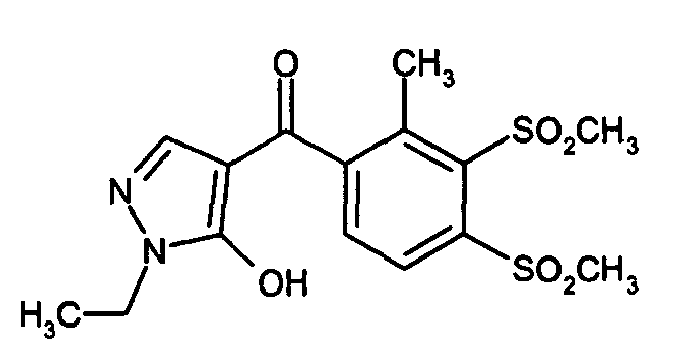
80 80% 20% 40% aus dem StdT bekannte Verbindung -
Verbindung Nr. Dosierung [g a.i./ha] Wirkung gegen Schadpflanzen DIGSA ECHCG LOLMU SETVI 
80 100% 90% 60% 100% erfindungsgemäße Verbindung 
80 80% 80% 20% 80% aus dem StdT bekannte Verbindung -
Verbindung Nr. Dosierung [g a.i./ha] Wirkung gegen Schadpflanzen MATIN VERPE VIOTR XANST 
80 90% 90% 80% 100% erfindungsgemäße Verbindung 
80 40% 80% 50% 70% aus dem StdT bekannte Verbindung
Claims (11)
- 4-(4-Trifluormethyl-3-thiobenzoyl)pyrazole der Formel (I) oder deren Salze
 R1 bedeutet (C1-C4)-Alkyl,R2 bedeutet Wasserstoff oder (C1-C4)-Alkyl,R3 bedeutet (C1-C4)-Alkyl,R4 bedeutet (C1-C4)-Alkyl,Y bedeutet Wasserstoff, (C1-C6)-Alkylsulfonyl, (C1-C4)-Alkoxy-(C1-C6)-alkylsulfonyl, oder jeweils durch m gleiche oder verschiedene Reste aus der Gruppe bestehend aus Halogen, (C1-C4)-Alkyl und (C1-C4)-Alkoxy substituiertes Phenylsulfonyl, Thiophenyl-2-sulfonyl, Benzoyl, Benzoyl-(C1-C6)-alkyl oder Benzyl,m bedeutet 0,1, 2 oder 3,n bedeutet 0, 1 oder 2.
- 4-(4-Trifluormethyl-3-thiobenzoyl)pyrazole der Formel (I) nach Anspruch 1, worinR1 bedeutet Methyl oder Ethyl,R2 bedeutet Wasserstoff, Methyl oder Ethyl,R3 bedeutet Methyl oder Ethyl,R4 bedeutet Methyl oder Ethyl,Y bedeutet Wasserstoff, (C1-C3)-Alkylsulfonyl, (C1-C2)-Alkoxy-(C1-C4)-alkylsulfonyl, oder jeweils durch m Methylgruppen substituiertes Phenylsulfonyl, Thiophenyl-2-sulfonyl, Benzoyl, Benzoyl-(C1-C6)-alkyl oder Benzyl,m bedeutet 0 oder 1,n bedeutet 0, 1 oder 2.
- 4-(4-Trifluormethyl-3-thiobenzoyl)pyrazole der Formel (I) nach Anspruch 1, worinR1 bedeutet Methyl oder Ethyl,R2 bedeutet Wasserstoff, Methyl oder Ethyl,R3 bedeutet Methyl oder Ethyl,R4 bedeutet Methyl oder Ethyl,Y bedeutet Wasserstoff,n bedeutet 0,1 oder 2.
- Herbizide Mittel, gekennzeichnet durch einen herbizid wirksamen Gehalt an mindestens einer Verbindung der Formel (I) gemäß einem der Ansprüche 1 bis 3.
- Herbizide Mittel nach Anspruch 4 in Mischung mit Formullerungshilfsmitteln.
- Verfahren zur Bekämpfung unerwünschter Pflanzen, dadurch gekennzeichnet, daß man eine wirksame Menge mindestens einer Verbindung der Formel (I) gemäß einem der Ansprüche 1 bis 3 oder eines herbiziden Mittels nach Anspruch 4 oder 5 auf die Pflanzen oder auf den Ort des unerwünschten Pflanzenwachstums appliziert.
- Verwendung von Verbindungen der Formel (I) gemäß einem der Ansprüche 1 bis 3 oder von herbiziden Mitteln nach Anspruch 4 oder 5 zur Bekämpfung unerwünschter Pflanzen.
- Verwendung nach Anspruch7, dadurch gekennzeichnet, daß die Verbindungen der Formel (I) zur Bekämpfung unerwünschter Pflanzen in Kulturen von Nutzpflanzen eingesetzt werden.
- Verwendung nach Anspruch 8, dadurch gekennzeichnet, daß die Nutzpflanzen transgene Nutzpflanzen sind.
- Verbindungen der Formel (III)

- Verbindungen der Formel (IIIb)

Priority Applications (21)
| Application Number | Priority Date | Filing Date | Title |
|---|---|---|---|
| EP07007493A EP1980556A1 (de) | 2007-04-12 | 2007-04-12 | 4-(4-Trifluormethyl-3-thiobenzoyl)pyrazole und ihre Verwendung als Herbizide |
| EP08734920A EP2137160B1 (de) | 2007-04-12 | 2008-04-01 | 4-(4-trifluormethyl-3-thiobenzoyl)pyrazole und ihre verwendung als herbizide |
| AT08734920T ATE486062T1 (de) | 2007-04-12 | 2008-04-01 | 4-(4-trifluormethyl-3-thiobenzoyl)pyrazole und ihre verwendung als herbizide |
| EA200901234A EA016883B1 (ru) | 2007-04-12 | 2008-04-01 | 4-(4-трифторметил-3-тиобензоил)пиразолы и их применение в качестве гербицидов |
| PL08734920T PL2137160T3 (pl) | 2007-04-12 | 2008-04-01 | 4-(4-trifluorometylo-3-tiobenzoilo)pirazole i ich zastosowanie jako herbicydów |
| KR1020097023445A KR20100016400A (ko) | 2007-04-12 | 2008-04-01 | 4-(4-트리플루오로메틸-3-티오벤조일)피라졸 및 그의 제초제로서의 용도 |
| AU2008238298A AU2008238298B2 (en) | 2007-04-12 | 2008-04-01 | 4-(4-trifluoromethyl-3-thiobenzoyl)pyrazoles, and use thereof as herbicides |
| DE502008001660T DE502008001660D1 (de) | 2007-04-12 | 2008-04-01 | 4-(4-trifluormethyl-3-thiobenzoyl)pyrazole und ihre verwendung als herbizide |
| ES08734920T ES2353449T3 (es) | 2007-04-12 | 2008-04-01 | 4-(4-trifluorometil-3-tiobenzoil)pirazoles y su utilización como herbicidas. |
| CA002687029A CA2687029A1 (en) | 2007-04-12 | 2008-04-01 | 4-(4-trifluoromethyl-3-thiobenzoyl)pyrazoles, and use thereof as herbicides |
| JP2010502447A JP2010523609A (ja) | 2007-04-12 | 2008-04-01 | 4−(4−トリフルオロメチル−3−チオベンゾイル)ピラゾール類及び除草剤としてのその使用 |
| BRPI0810181A BRPI0810181B1 (pt) | 2007-04-12 | 2008-04-01 | 4-(4-trifluormetil-3-tiobenzoil)pirazóis, seus usos e seus intermediários, composições herbicidas, e processo para combate de plantas indesejadas |
| MX2009010945A MX2009010945A (es) | 2007-04-12 | 2008-04-01 | 4-(4-trifluorometil-3-tiobenzoil)pirazoles y su uso como herbicidas. |
| CN2008800164748A CN101679284B (zh) | 2007-04-12 | 2008-04-01 | 4-(4-三氟甲基-3-硫代苯甲酰基)吡唑及其作为除草剂的用途 |
| UAA200911547A UA96029C2 (en) | 2007-04-12 | 2008-04-01 | 4-(4-trifluoromethyl-3-thiobenzoyl)pyrazoles, and use thereof as herbicides |
| PCT/EP2008/002568 WO2008125214A1 (de) | 2007-04-12 | 2008-04-01 | 4-(4-trifluormethyl-3-thiobenzoyl)pyrazole und ihre verwendung als herbizide |
| US12/100,819 US7932211B2 (en) | 2007-04-12 | 2008-04-10 | 4-(4-trifluoromethyl-3-thiobenzoyl)pyrazoles and their use as herbicides |
| TW097113060A TW200901883A (en) | 2007-04-12 | 2008-04-10 | 4-(4-trifluoromethyl-3-thiobenzoyl)pyrazoles and their use as herbicides |
| ARP080101484A AR066011A1 (es) | 2007-04-12 | 2008-04-10 | 4-(4- trifluorometil-3- tiobenzoil) pirazoles, su utilizacion como herbicidas, agentes herbicidas, compuestos intermediarios |
| CL200801053A CL2008001053A1 (es) | 2007-04-12 | 2008-04-11 | Compuestos derivados de 4-(4-trifluoro-3-tiobenzoil)pirazol; composiciones herbicidas que contienen a dichos compuestos; procedimiento para la represion de plantas indeseadas; y uso de dichos compuestos. |
| CO09111713A CO6220877A2 (es) | 2007-04-12 | 2009-10-08 | 4-(4-trifluorometil-3-tiobenzoil)pirazoles y su utilizacion como herbicidas |
Applications Claiming Priority (1)
| Application Number | Priority Date | Filing Date | Title |
|---|---|---|---|
| EP07007493A EP1980556A1 (de) | 2007-04-12 | 2007-04-12 | 4-(4-Trifluormethyl-3-thiobenzoyl)pyrazole und ihre Verwendung als Herbizide |
Publications (1)
| Publication Number | Publication Date |
|---|---|
| EP1980556A1 true EP1980556A1 (de) | 2008-10-15 |
Family
ID=38521860
Family Applications (2)
| Application Number | Title | Priority Date | Filing Date |
|---|---|---|---|
| EP07007493A Withdrawn EP1980556A1 (de) | 2007-04-12 | 2007-04-12 | 4-(4-Trifluormethyl-3-thiobenzoyl)pyrazole und ihre Verwendung als Herbizide |
| EP08734920A Not-in-force EP2137160B1 (de) | 2007-04-12 | 2008-04-01 | 4-(4-trifluormethyl-3-thiobenzoyl)pyrazole und ihre verwendung als herbizide |
Family Applications After (1)
| Application Number | Title | Priority Date | Filing Date |
|---|---|---|---|
| EP08734920A Not-in-force EP2137160B1 (de) | 2007-04-12 | 2008-04-01 | 4-(4-trifluormethyl-3-thiobenzoyl)pyrazole und ihre verwendung als herbizide |
Country Status (20)
| Country | Link |
|---|---|
| US (1) | US7932211B2 (de) |
| EP (2) | EP1980556A1 (de) |
| JP (1) | JP2010523609A (de) |
| KR (1) | KR20100016400A (de) |
| CN (1) | CN101679284B (de) |
| AR (1) | AR066011A1 (de) |
| AT (1) | ATE486062T1 (de) |
| AU (1) | AU2008238298B2 (de) |
| BR (1) | BRPI0810181B1 (de) |
| CA (1) | CA2687029A1 (de) |
| CL (1) | CL2008001053A1 (de) |
| CO (1) | CO6220877A2 (de) |
| DE (1) | DE502008001660D1 (de) |
| EA (1) | EA016883B1 (de) |
| ES (1) | ES2353449T3 (de) |
| MX (1) | MX2009010945A (de) |
| PL (1) | PL2137160T3 (de) |
| TW (1) | TW200901883A (de) |
| UA (1) | UA96029C2 (de) |
| WO (1) | WO2008125214A1 (de) |
Cited By (1)
| Publication number | Priority date | Publication date | Assignee | Title |
|---|---|---|---|---|
| EP2595954B1 (de) * | 2010-07-21 | 2016-05-04 | Bayer Intellectual Property GmbH | (4-trifluormethyl-3-thiobenzoyl)cyclohexandione und ihre verwendung als herbizide |
Families Citing this family (10)
| Publication number | Priority date | Publication date | Assignee | Title |
|---|---|---|---|---|
| DE102007026875A1 (de) * | 2007-06-11 | 2008-12-24 | Bayer Cropscience Ag | 3-Cyclopropyl-4-(3-thiobenzoyl)pyrazole und ihre Verwendung als Herbizide |
| AU2010278334A1 (en) * | 2009-07-29 | 2012-03-08 | Bayer Cropscience Ag | 4-(3-alkylthiobenzoyl)pyrazoles and use thereof as herbicides |
| MX2013000589A (es) | 2010-07-21 | 2013-03-05 | Bayer Ip Gmbh | 4-(4-halogenoalquil-3-tiobenzoil) pirazoles y uso de los mismos como herbicidas. |
| BR112013001567B1 (pt) | 2010-07-21 | 2019-01-29 | Bayer Intellectual Property Gmbh | (4-halogenalquil-3-tiobenzoil)ciclo-hexandionas, seu uso, agentes herbicidas, e processo para controle de plantas indesejáveis |
| US8455657B2 (en) * | 2010-12-28 | 2013-06-04 | Bayer Cropscience Ag | Process for the preparation of 3-alkylsulfinylbenzoyl derivatives |
| US9167819B2 (en) | 2012-02-21 | 2015-10-27 | Bayer Intellectual Property Gmbh | Herbicidal 3-(sulfin-/sulfonimidoyl)-benzamides |
| WO2013124230A1 (de) | 2012-02-21 | 2013-08-29 | Bayer Intellectual Property Gmbh | Herbizid wirksame sulfinimidoyl- und sulfonimidoylbenzoylderivate |
| CN103980202B (zh) * | 2014-05-27 | 2017-01-18 | 青岛清原化合物有限公司 | 一种具有除草活性的4‑苯甲酰吡唑类化合物 |
| TWI708758B (zh) | 2015-10-26 | 2020-11-01 | 德商拜耳作物科學公司 | 製備2-烷基-4-三氟甲基-3-烷基磺醯基苯甲酸之方法 |
| TWI721034B (zh) * | 2015-11-30 | 2021-03-11 | 德商拜耳作物科學公司 | 藉由化學選擇性硫醚氧化製備2-烷基-4-三氟甲基-3-烷基磺醯基苯甲酸之方法 |
Citations (3)
| Publication number | Priority date | Publication date | Assignee | Title |
|---|---|---|---|---|
| US4261729A (en) * | 1974-03-28 | 1981-04-14 | Sankyo Company Limited | Herbicidal compositions and pyrazole derivatives |
| EP0203428A1 (de) * | 1985-05-11 | 1986-12-03 | Nissan Chemical Industries Ltd. | 4-Benzoyl-1-alkyl(alkenyl)-pyrazole als Herbizide |
| WO2005097754A1 (de) * | 2004-04-03 | 2005-10-20 | Bayer Cropscience Gmbh | Herbizid wirksame 3-amino-2 thiomethyl -benzoylpyrazole |
Family Cites Families (4)
| Publication number | Priority date | Publication date | Assignee | Title |
|---|---|---|---|---|
| JPS58185568A (ja) * | 1982-04-24 | 1983-10-29 | Nissan Chem Ind Ltd | ピラゾ−ル誘導体,その製造方法および該誘導体を含有する選択性除草剤 |
| US4986845A (en) | 1988-07-15 | 1991-01-22 | Nissan Chemical Industries Ltd. | Pyrazole derivatives and herbicides containing them |
| WO2000003993A1 (en) | 1998-07-16 | 2000-01-27 | Ishihara Sangyo Kaisha Ltd. | Pyrazole-type compounds, process for producing the same and herbicides containing the same |
| EP2127521A1 (de) * | 2008-05-29 | 2009-12-02 | Bayer CropScience Aktiengesellschaft | Herbizid wirksame 4-(3-Alkylsulfinylbenzoyl)pyrazole |
-
2007
- 2007-04-12 EP EP07007493A patent/EP1980556A1/de not_active Withdrawn
-
2008
- 2008-04-01 KR KR1020097023445A patent/KR20100016400A/ko not_active Withdrawn
- 2008-04-01 AT AT08734920T patent/ATE486062T1/de active
- 2008-04-01 CA CA002687029A patent/CA2687029A1/en not_active Abandoned
- 2008-04-01 CN CN2008800164748A patent/CN101679284B/zh not_active Expired - Fee Related
- 2008-04-01 JP JP2010502447A patent/JP2010523609A/ja active Pending
- 2008-04-01 BR BRPI0810181A patent/BRPI0810181B1/pt not_active IP Right Cessation
- 2008-04-01 ES ES08734920T patent/ES2353449T3/es active Active
- 2008-04-01 AU AU2008238298A patent/AU2008238298B2/en not_active Expired - Fee Related
- 2008-04-01 DE DE502008001660T patent/DE502008001660D1/de active Active
- 2008-04-01 UA UAA200911547A patent/UA96029C2/ru unknown
- 2008-04-01 PL PL08734920T patent/PL2137160T3/pl unknown
- 2008-04-01 EP EP08734920A patent/EP2137160B1/de not_active Not-in-force
- 2008-04-01 EA EA200901234A patent/EA016883B1/ru not_active IP Right Cessation
- 2008-04-01 WO PCT/EP2008/002568 patent/WO2008125214A1/de not_active Ceased
- 2008-04-01 MX MX2009010945A patent/MX2009010945A/es active IP Right Grant
- 2008-04-10 TW TW097113060A patent/TW200901883A/zh unknown
- 2008-04-10 US US12/100,819 patent/US7932211B2/en active Active
- 2008-04-10 AR ARP080101484A patent/AR066011A1/es not_active Application Discontinuation
- 2008-04-11 CL CL200801053A patent/CL2008001053A1/es unknown
-
2009
- 2009-10-08 CO CO09111713A patent/CO6220877A2/es unknown
Patent Citations (3)
| Publication number | Priority date | Publication date | Assignee | Title |
|---|---|---|---|---|
| US4261729A (en) * | 1974-03-28 | 1981-04-14 | Sankyo Company Limited | Herbicidal compositions and pyrazole derivatives |
| EP0203428A1 (de) * | 1985-05-11 | 1986-12-03 | Nissan Chemical Industries Ltd. | 4-Benzoyl-1-alkyl(alkenyl)-pyrazole als Herbizide |
| WO2005097754A1 (de) * | 2004-04-03 | 2005-10-20 | Bayer Cropscience Gmbh | Herbizid wirksame 3-amino-2 thiomethyl -benzoylpyrazole |
Cited By (1)
| Publication number | Priority date | Publication date | Assignee | Title |
|---|---|---|---|---|
| EP2595954B1 (de) * | 2010-07-21 | 2016-05-04 | Bayer Intellectual Property GmbH | (4-trifluormethyl-3-thiobenzoyl)cyclohexandione und ihre verwendung als herbizide |
Also Published As
| Publication number | Publication date |
|---|---|
| CN101679284A (zh) | 2010-03-24 |
| UA96029C2 (en) | 2011-09-26 |
| ES2353449T3 (es) | 2011-03-02 |
| WO2008125214A1 (de) | 2008-10-23 |
| BRPI0810181B1 (pt) | 2016-11-01 |
| BRPI0810181A2 (pt) | 2015-05-05 |
| US20090069184A1 (en) | 2009-03-12 |
| CA2687029A1 (en) | 2008-10-23 |
| EA200901234A1 (ru) | 2010-04-30 |
| KR20100016400A (ko) | 2010-02-12 |
| DE502008001660D1 (de) | 2010-12-09 |
| EP2137160B1 (de) | 2010-10-27 |
| AR066011A1 (es) | 2009-07-15 |
| EA016883B1 (ru) | 2012-08-30 |
| ATE486062T1 (de) | 2010-11-15 |
| CO6220877A2 (es) | 2010-11-19 |
| MX2009010945A (es) | 2009-10-29 |
| AU2008238298A1 (en) | 2008-10-23 |
| EP2137160A1 (de) | 2009-12-30 |
| BRPI0810181A8 (pt) | 2016-01-26 |
| TW200901883A (en) | 2009-01-16 |
| CL2008001053A1 (es) | 2008-08-08 |
| AU2008238298B2 (en) | 2012-11-08 |
| PL2137160T3 (pl) | 2011-04-29 |
| CN101679284B (zh) | 2013-03-27 |
| JP2010523609A (ja) | 2010-07-15 |
| US7932211B2 (en) | 2011-04-26 |
Similar Documents
| Publication | Publication Date | Title |
|---|---|---|
| EP1280778B1 (de) | Benzoylpyrazole und ihre verwendung als herbizide | |
| EP2137160B1 (de) | 4-(4-trifluormethyl-3-thiobenzoyl)pyrazole und ihre verwendung als herbizide | |
| EP1527067B1 (de) | 4-trifluormethylpyrazolyl substituierte pyridine und pyrimidine | |
| EP1866287B1 (de) | Substituierte pyrazolyloxyphenylderivate als herbizide | |
| EP1725103A1 (de) | Substituierte 4-(4-trifluormethylpyrazolyl)-pyrimidine als herbizide | |
| EP1871746A1 (de) | Substituierte n-[ypyrimidin-2-yl-methyl]carboxamide und ihre verwendung als herbizide und pflanzenwachstumsregulatoren | |
| EP1585742B1 (de) | Substituierte benzoylderivate als herbizide | |
| EP2167473A2 (de) | 3-cyclopropyl-4-(3-thiobenzoyl)pyrazole und ihre verwendung als herbizide | |
| EP1735283A1 (de) | Herbizid wirksame 3-amino-2 thiomethyl -benzoylpyrazole | |
| EP2146966B1 (de) | 4-(3-aminobenzoyl)-1-methylpyrazole und ihre verwendung als herbizide | |
| EP2146965B1 (de) | 4-(3-aminobenzoyl)-1,3-dimethylpyrazole und ihre verwendung als herbizide | |
| WO2005122768A1 (de) | Substituierte benzoylpyrazole als herbizide | |
| EP1824338B1 (de) | 3-cyclopropyl-4-(3-amino-2-methylbenzoyl)pyrazole und ihre verwendung als herbizide | |
| EP1379497B1 (de) | Derivate von benzoylcyclohexandionen und ihre verwendung als herbizide | |
| EP1980554A1 (de) | 4-(3-Aminobenzoyl)-1-ehtylpyrazole und ihre Verwendung als Herbizide |
Legal Events
| Date | Code | Title | Description |
|---|---|---|---|
| PUAI | Public reference made under article 153(3) epc to a published international application that has entered the european phase |
Free format text: ORIGINAL CODE: 0009012 |
|
| AK | Designated contracting states |
Kind code of ref document: A1 Designated state(s): AT BE BG CH CY CZ DE DK EE ES FI FR GB GR HU IE IS IT LI LT LU LV MC MT NL PL PT RO SE SI SK TR |
|
| AX | Request for extension of the european patent |
Extension state: AL BA HR MK RS |
|
| AKX | Designation fees paid | ||
| STAA | Information on the status of an ep patent application or granted ep patent |
Free format text: STATUS: THE APPLICATION IS DEEMED TO BE WITHDRAWN |
|
| 18D | Application deemed to be withdrawn |
Effective date: 20090416 |
|
| REG | Reference to a national code |
Ref country code: DE Ref legal event code: 8566 |
|
| RIN1 | Information on inventor provided before grant (corrected) |
Inventor name: HILLS, MARTIN Inventor name: SCHMITT, MONIKA, DR. Inventor name: DITTGEN, JAN, DR. Inventor name: LEHR, STEFAN, DR. Inventor name: KEHNE, HEINZ, DR. Inventor name: VAN ALMSICK, ANDREAS, DR. Inventor name: ROSINGER, CHRISTOPHER, DR. Inventor name: AHRENS, HARTMUT, DR. Inventor name: FEUCHT, DIETER, DR. |