EP1973100A2 - Rauschsteuervorrichtung - Google Patents
Rauschsteuervorrichtung Download PDFInfo
- Publication number
- EP1973100A2 EP1973100A2 EP08151967A EP08151967A EP1973100A2 EP 1973100 A2 EP1973100 A2 EP 1973100A2 EP 08151967 A EP08151967 A EP 08151967A EP 08151967 A EP08151967 A EP 08151967A EP 1973100 A2 EP1973100 A2 EP 1973100A2
- Authority
- EP
- European Patent Office
- Prior art keywords
- noise
- stimulus source
- pressure level
- sound
- sound pressure
- Prior art date
- Legal status (The legal status is an assumption and is not a legal conclusion. Google has not performed a legal analysis and makes no representation as to the accuracy of the status listed.)
- Withdrawn
Links
- 238000000034 method Methods 0.000 claims abstract description 39
- 239000004744 fabric Substances 0.000 claims description 33
- 230000004044 response Effects 0.000 claims description 28
- 229920000642 polymer Polymers 0.000 claims description 24
- 230000008859 change Effects 0.000 claims description 23
- 238000001514 detection method Methods 0.000 claims 4
- -1 poly p-phenylene vinylene Polymers 0.000 description 29
- 229920001940 conductive polymer Polymers 0.000 description 12
- 239000002608 ionic liquid Substances 0.000 description 11
- 150000002500 ions Chemical class 0.000 description 11
- 230000006870 function Effects 0.000 description 10
- 239000000463 material Substances 0.000 description 9
- KAESVJOAVNADME-UHFFFAOYSA-N 1H-pyrrole Natural products C=1C=CNC=1 KAESVJOAVNADME-UHFFFAOYSA-N 0.000 description 7
- 238000004519 manufacturing process Methods 0.000 description 7
- 150000001768 cations Chemical class 0.000 description 6
- 238000013016 damping Methods 0.000 description 6
- 229920001971 elastomer Polymers 0.000 description 6
- 239000000806 elastomer Substances 0.000 description 6
- 238000009434 installation Methods 0.000 description 6
- 239000004973 liquid crystal related substance Substances 0.000 description 6
- 230000008569 process Effects 0.000 description 6
- 239000004997 Liquid crystal elastomers (LCEs) Substances 0.000 description 4
- NBIIXXVUZAFLBC-UHFFFAOYSA-N Phosphoric acid Chemical compound OP(O)(O)=O NBIIXXVUZAFLBC-UHFFFAOYSA-N 0.000 description 4
- 230000000694 effects Effects 0.000 description 4
- 150000007524 organic acids Chemical class 0.000 description 4
- 241000282414 Homo sapiens Species 0.000 description 3
- 239000002253 acid Substances 0.000 description 3
- 238000004458 analytical method Methods 0.000 description 3
- 150000001450 anions Chemical class 0.000 description 3
- 230000005540 biological transmission Effects 0.000 description 3
- 229920001577 copolymer Polymers 0.000 description 3
- 238000010586 diagram Methods 0.000 description 3
- 230000005611 electricity Effects 0.000 description 3
- 239000000835 fiber Substances 0.000 description 3
- 239000012535 impurity Substances 0.000 description 3
- 150000007522 mineralic acids Chemical class 0.000 description 3
- 239000000178 monomer Substances 0.000 description 3
- 230000009467 reduction Effects 0.000 description 3
- 230000035939 shock Effects 0.000 description 3
- 230000006641 stabilisation Effects 0.000 description 3
- 238000011105 stabilization Methods 0.000 description 3
- RAXXELZNTBOGNW-UHFFFAOYSA-O Imidazolium Chemical compound C1=C[NH+]=CN1 RAXXELZNTBOGNW-UHFFFAOYSA-O 0.000 description 2
- 229910000147 aluminium phosphate Inorganic materials 0.000 description 2
- 239000003431 cross linking reagent Substances 0.000 description 2
- 238000011156 evaluation Methods 0.000 description 2
- 238000005187 foaming Methods 0.000 description 2
- 238000012986 modification Methods 0.000 description 2
- 230000004048 modification Effects 0.000 description 2
- VLTRZXGMWDSKGL-UHFFFAOYSA-N perchloric acid Chemical compound OCl(=O)(=O)=O VLTRZXGMWDSKGL-UHFFFAOYSA-N 0.000 description 2
- 229920000058 polyacrylate Polymers 0.000 description 2
- 230000000379 polymerizing effect Effects 0.000 description 2
- 229920001296 polysiloxane Polymers 0.000 description 2
- QAOWNCQODCNURD-UHFFFAOYSA-N sulfuric acid Substances OS(O)(=O)=O QAOWNCQODCNURD-UHFFFAOYSA-N 0.000 description 2
- OTPDWCMLUKMQNO-UHFFFAOYSA-N 1,2,3,4-tetrahydropyrimidine Chemical compound C1NCC=CN1 OTPDWCMLUKMQNO-UHFFFAOYSA-N 0.000 description 1
- CTWQGTOWGFCWNW-UHFFFAOYSA-N 1,3-dimethylpyrrole Chemical compound CC=1C=CN(C)C=1 CTWQGTOWGFCWNW-UHFFFAOYSA-N 0.000 description 1
- OXHNLMTVIGZXSG-UHFFFAOYSA-N 1-Methylpyrrole Chemical compound CN1C=CC=C1 OXHNLMTVIGZXSG-UHFFFAOYSA-N 0.000 description 1
- RGKHJCJLLHLXDX-UHFFFAOYSA-N 1-dodecylpyrrole Chemical compound CCCCCCCCCCCCN1C=CC=C1 RGKHJCJLLHLXDX-UHFFFAOYSA-N 0.000 description 1
- RILZRCJGXSFXNE-UHFFFAOYSA-N 2-[4-(trifluoromethoxy)phenyl]ethanol Chemical compound OCCC1=CC=C(OC(F)(F)F)C=C1 RILZRCJGXSFXNE-UHFFFAOYSA-N 0.000 description 1
- OJFOWGWQOFZNNJ-UHFFFAOYSA-N 3,4-dimethyl-1h-pyrrole Chemical compound CC1=CNC=C1C OJFOWGWQOFZNNJ-UHFFFAOYSA-N 0.000 description 1
- NBQWWKHLFUKXRZ-UHFFFAOYSA-N 3-dodecyl-1-ethylpyrrole Chemical compound CCCCCCCCCCCCC=1C=CN(CC)C=1 NBQWWKHLFUKXRZ-UHFFFAOYSA-N 0.000 description 1
- HGICMYITGGLHHY-UHFFFAOYSA-N 3-dodecyl-1h-pyrrole Chemical compound CCCCCCCCCCCCC=1C=CNC=1 HGICMYITGGLHHY-UHFFFAOYSA-N 0.000 description 1
- RPAKERVUJYIROB-UHFFFAOYSA-N 3-dodecyl-4-methyl-1h-pyrrole Chemical compound CCCCCCCCCCCCC1=CNC=C1C RPAKERVUJYIROB-UHFFFAOYSA-N 0.000 description 1
- RLLBWIDEGAIFPI-UHFFFAOYSA-N 3-ethyl-1h-pyrrole Chemical compound CCC=1C=CNC=1 RLLBWIDEGAIFPI-UHFFFAOYSA-N 0.000 description 1
- QGZKDVFQNNGYKY-UHFFFAOYSA-O Ammonium Chemical compound [NH4+] QGZKDVFQNNGYKY-UHFFFAOYSA-O 0.000 description 1
- LSNNMFCWUKXFEE-UHFFFAOYSA-M Bisulfite Chemical compound OS([O-])=O LSNNMFCWUKXFEE-UHFFFAOYSA-M 0.000 description 1
- CPELXLSAUQHCOX-UHFFFAOYSA-M Bromide Chemical compound [Br-] CPELXLSAUQHCOX-UHFFFAOYSA-M 0.000 description 1
- VEXZGXHMUGYJMC-UHFFFAOYSA-M Chloride anion Chemical compound [Cl-] VEXZGXHMUGYJMC-UHFFFAOYSA-M 0.000 description 1
- NHNBFGGVMKEFGY-UHFFFAOYSA-N Nitrate Chemical compound [O-][N+]([O-])=O NHNBFGGVMKEFGY-UHFFFAOYSA-N 0.000 description 1
- 229920000144 PEDOT:PSS Polymers 0.000 description 1
- 239000004793 Polystyrene Substances 0.000 description 1
- QAOWNCQODCNURD-UHFFFAOYSA-L Sulfate Chemical compound [O-]S([O-])(=O)=O QAOWNCQODCNURD-UHFFFAOYSA-L 0.000 description 1
- ZMZDMBWJUHKJPS-UHFFFAOYSA-M Thiocyanate anion Chemical compound [S-]C#N ZMZDMBWJUHKJPS-UHFFFAOYSA-M 0.000 description 1
- 238000010521 absorption reaction Methods 0.000 description 1
- 150000007513 acids Chemical class 0.000 description 1
- 238000007259 addition reaction Methods 0.000 description 1
- 125000003545 alkoxy group Chemical group 0.000 description 1
- 125000000217 alkyl group Chemical group 0.000 description 1
- 150000001410 amidinium cations Chemical class 0.000 description 1
- DMLAVOWQYNRWNQ-UHFFFAOYSA-N azobenzene Chemical compound C1=CC=CC=C1N=NC1=CC=CC=C1 DMLAVOWQYNRWNQ-UHFFFAOYSA-N 0.000 description 1
- 230000015572 biosynthetic process Effects 0.000 description 1
- 238000007664 blowing Methods 0.000 description 1
- KGBXLFKZBHKPEV-UHFFFAOYSA-N boric acid Chemical compound OB(O)O KGBXLFKZBHKPEV-UHFFFAOYSA-N 0.000 description 1
- 239000004327 boric acid Substances 0.000 description 1
- 229940006460 bromide ion Drugs 0.000 description 1
- 238000004364 calculation method Methods 0.000 description 1
- 150000001735 carboxylic acids Chemical class 0.000 description 1
- 229920002301 cellulose acetate Polymers 0.000 description 1
- 238000006243 chemical reaction Methods 0.000 description 1
- 238000002485 combustion reaction Methods 0.000 description 1
- 238000007334 copolymerization reaction Methods 0.000 description 1
- 229940071161 dodecylbenzenesulfonate Drugs 0.000 description 1
- 238000005516 engineering process Methods 0.000 description 1
- 239000006260 foam Substances 0.000 description 1
- 239000011521 glass Substances 0.000 description 1
- 230000036541 health Effects 0.000 description 1
- 125000000623 heterocyclic group Chemical group 0.000 description 1
- MBAKFIZHTUAVJN-UHFFFAOYSA-I hexafluoroantimony(1-);hydron Chemical compound F.F[Sb](F)(F)(F)F MBAKFIZHTUAVJN-UHFFFAOYSA-I 0.000 description 1
- MTNDZQHUAFNZQY-UHFFFAOYSA-N imidazoline Chemical compound C1CN=CN1 MTNDZQHUAFNZQY-UHFFFAOYSA-N 0.000 description 1
- 230000002452 interceptive effect Effects 0.000 description 1
- 238000002156 mixing Methods 0.000 description 1
- UWHRNIXHZAWBMF-UHFFFAOYSA-N n-dodecyl-n-methyldodecan-1-amine Chemical compound CCCCCCCCCCCCN(C)CCCCCCCCCCCC UWHRNIXHZAWBMF-UHFFFAOYSA-N 0.000 description 1
- VLTRZXGMWDSKGL-UHFFFAOYSA-M perchlorate Chemical compound [O-]Cl(=O)(=O)=O VLTRZXGMWDSKGL-UHFFFAOYSA-M 0.000 description 1
- NBIIXXVUZAFLBC-UHFFFAOYSA-K phosphate Chemical compound [O-]P([O-])([O-])=O NBIIXXVUZAFLBC-UHFFFAOYSA-K 0.000 description 1
- 229940085991 phosphate ion Drugs 0.000 description 1
- 150000003014 phosphoric acid esters Chemical class 0.000 description 1
- 229920000553 poly(phenylenevinylene) Polymers 0.000 description 1
- 229920002627 poly(phosphazenes) Polymers 0.000 description 1
- 229920001467 poly(styrenesulfonates) Polymers 0.000 description 1
- 229920000193 polymethacrylate Polymers 0.000 description 1
- 229920002223 polystyrene Polymers 0.000 description 1
- 239000011970 polystyrene sulfonate Substances 0.000 description 1
- 229960002796 polystyrene sulfonate Drugs 0.000 description 1
- DOYOPBSXEIZLRE-UHFFFAOYSA-N pyrrole-3-carboxylic acid Chemical compound OC(=O)C=1C=CNC=1 DOYOPBSXEIZLRE-UHFFFAOYSA-N 0.000 description 1
- 150000003233 pyrroles Chemical class 0.000 description 1
- 230000000717 retained effect Effects 0.000 description 1
- 150000003839 salts Chemical class 0.000 description 1
- PNGLEYLFMHGIQO-UHFFFAOYSA-M sodium;3-(n-ethyl-3-methoxyanilino)-2-hydroxypropane-1-sulfonate;dihydrate Chemical compound O.O.[Na+].[O-]S(=O)(=O)CC(O)CN(CC)C1=CC=CC(OC)=C1 PNGLEYLFMHGIQO-UHFFFAOYSA-M 0.000 description 1
- 238000003786 synthesis reaction Methods 0.000 description 1
Images





Classifications
-
- G—PHYSICS
- G10—MUSICAL INSTRUMENTS; ACOUSTICS
- G10K—SOUND-PRODUCING DEVICES; METHODS OR DEVICES FOR PROTECTING AGAINST, OR FOR DAMPING, NOISE OR OTHER ACOUSTIC WAVES IN GENERAL; ACOUSTICS NOT OTHERWISE PROVIDED FOR
- G10K11/00—Methods or devices for transmitting, conducting or directing sound in general; Methods or devices for protecting against, or for damping, noise or other acoustic waves in general
- G10K11/16—Methods or devices for protecting against, or for damping, noise or other acoustic waves in general
- G10K11/162—Selection of materials
-
- G—PHYSICS
- G10—MUSICAL INSTRUMENTS; ACOUSTICS
- G10K—SOUND-PRODUCING DEVICES; METHODS OR DEVICES FOR PROTECTING AGAINST, OR FOR DAMPING, NOISE OR OTHER ACOUSTIC WAVES IN GENERAL; ACOUSTICS NOT OTHERWISE PROVIDED FOR
- G10K11/00—Methods or devices for transmitting, conducting or directing sound in general; Methods or devices for protecting against, or for damping, noise or other acoustic waves in general
- G10K11/16—Methods or devices for protecting against, or for damping, noise or other acoustic waves in general
-
- F—MECHANICAL ENGINEERING; LIGHTING; HEATING; WEAPONS; BLASTING
- F02—COMBUSTION ENGINES; HOT-GAS OR COMBUSTION-PRODUCT ENGINE PLANTS
- F02B—INTERNAL-COMBUSTION PISTON ENGINES; COMBUSTION ENGINES IN GENERAL
- F02B77/00—Component parts, details or accessories, not otherwise provided for
- F02B77/11—Thermal or acoustic insulation
- F02B77/13—Acoustic insulation
-
- G—PHYSICS
- G10—MUSICAL INSTRUMENTS; ACOUSTICS
- G10K—SOUND-PRODUCING DEVICES; METHODS OR DEVICES FOR PROTECTING AGAINST, OR FOR DAMPING, NOISE OR OTHER ACOUSTIC WAVES IN GENERAL; ACOUSTICS NOT OTHERWISE PROVIDED FOR
- G10K2210/00—Details of active noise control [ANC] covered by G10K11/178 but not provided for in any of its subgroups
- G10K2210/10—Applications
- G10K2210/128—Vehicles
- G10K2210/1282—Automobiles
-
- G—PHYSICS
- G10—MUSICAL INSTRUMENTS; ACOUSTICS
- G10K—SOUND-PRODUCING DEVICES; METHODS OR DEVICES FOR PROTECTING AGAINST, OR FOR DAMPING, NOISE OR OTHER ACOUSTIC WAVES IN GENERAL; ACOUSTICS NOT OTHERWISE PROVIDED FOR
- G10K2210/00—Details of active noise control [ANC] covered by G10K11/178 but not provided for in any of its subgroups
- G10K2210/30—Means
- G10K2210/321—Physical
- G10K2210/3223—Materials, e.g. special compositions or gases
Definitions
- the invention generally relates to a noise control device and method, and particularly, but not exclusively, to device and method for providing internal silence by reducing the noise generated from a noise source. Aspects of the invention relate to a device, to an apparatus, to a method and to a vehicle.
- a noise source e.g., mechanical structures such as an internal combustion engine of a vehicle.
- the active noise control technique is designed to reduce or counter the noise by generating another sound wave, which has the same amplitude as the noise but an opposite phase, thereby interfering with the noise. This is based on the concept that the sound is a type of wave phenomenon that propagates through the air by the density change of the air.
- Japanese Patent Application Laid-Open No. 2005-280650 discloses a technique for reducing vehicular interior noise by detecting the noise invading into the vehicle by means of a microphone. Then, a sound wave ("noise damping wave") is generated to counter the noise by using a speaker installed inside the vehicle so as to reduce the noise generated while driving, for example.
- Japanese Patent Application Laid-Open No. 2005-120833 discloses another technique for reducing noise that invades into the inside of a vehicle.
- a technique uses a variable resonator structure in order to change the sound absorbing property of a sound absorbing member.
- the techniques known so far require the following steps: detecting noise, calculating a noise damping wave corresponding to the frequency, amplitude and phase of the detected noise, and outputting the calculated noise damping wave from a speaker.
- the noise can be somewhat reduced since the time taken until the noise damping wave is output after detecting the noise is relatively shorter than the time taken to achieve one cycle of the noise frequency.
- the frequency components of the noise have a high frequency band (such as equal to or higher than 1 kHz)
- the noise is not effectively reduced since the time taken until the noise damping wave is output after detecting the noise is relatively longer than the time taken to achieve one cycle of the noise frequency. As such, it becomes difficult to match the phase of the noise with that of the noise damping wave.
- variable resonator structure should be increased in size to counter the low frequency band (e.g., the frequency lower than 1 kHz).
- the low frequency band e.g., the frequency lower than 1 kHz.
- Embodiments of the invention may provide a noise control device and method that can effectively reduce the noise from a low frequency band to a high frequency band and which may be sized and configured to be used in a confined space such as the interior of a vehicle.
- a noise control device and method that can effectively reduce the noise from a low frequency band to a high frequency band and which may be sized and configured to be used in a confined space such as the interior of a vehicle.
- a noise control device comprising a noise detecting part configured and arranged to detect a noise generated from a noise source, a stimulus source control part configured to output a stimulus source control signal according to a frequency of the noise, a stimulus source providing part configured to provide a stimulus source based on the stimulus source control signal and a sound absorptivity variable member configured to change its sound absorptivity against the noise in response to receiving the stimulus source.
- the sound absorptivity variable member may be arranged to change its sound absorption characteristics or performance.
- the stimulus source control part further comprises a first sound pressure level calculating part configured to analyze a frequency of the noise and to calculate a sound pressure level for each frequency of the noise and a threshold determining part configured to determine whether the sound pressure level reaches a threshold sound pressure level, wherein the stimulus source control part is configured to output the stimulus source control signal to the stimulus source providing part when the threshold determining part determines the sound pressure level reaches the threshold sound pressure level.
- the device may comprise a second noise detecting part configured and arranged to detect noise after sound is absorbed by the sound absorptivity variable member; and wherein the stimulus source control part includes a sound pressure level calculating part configured to analyze a frequency of the noise detected by the second noise detecting part and to calculate a sound pressure level for each frequency and a sound pressure level determining part configured to determine whether the sound pressure level reaches a target sound pressure level; and wherein the stimulus source control part is configured to output to the stimulus source providing part a new stimulus source control signal according to the frequency of the noise detected by the second noise detecting part when the sound pressure level does not reach the target sound pressure level.
- the stimulus source control part includes a sound pressure level calculating part configured to analyze a frequency of the noise detected by the second noise detecting part and to calculate a sound pressure level for each frequency and a sound pressure level determining part configured to determine whether the sound pressure level reaches a target sound pressure level; and wherein the stimulus source control part is configured to output to the stimulus source providing part a new stimulus source control
- the sound absorptivity variable member is an elastic modulus variable fabric or an elastic modulus variable film configured to change an elastic modulus and the sound absorptivity against the noise in response to the electric stimulus.
- the stimulus source is an electric stimulus.
- the sound absorptivity variable member is an air flow rate variable fabric configured to change an air flow rate and the sound absorptivity against the noise in response to the electric stimulus.
- the sound absorptivity variable member is an air flow rate variable fabric configured to change an air flow rate and the sound absorptivity against the noise in response to the stimulus source.
- the sound absorptivity variable member is an elastic modulus variable fabric or an elastic modulus variable film configured to change an elastic modulus and the sound absorptivity against the noise in response to the stimulus source.
- the sound absorptivity variable member is a combination of at least two or more of an air flow rate variable fabric, an elastic modulus variable fabric and an elastic modulus variable film.
- the sound absorptivity variable member comprises a stimulus responsive polymer.
- a noise control method comprising detecting a noise generated from a noise source, outputting a stimulus source control signal according to a frequency of the noise and providing a stimulus source based on the stimulus source control signal to a sound absorptivity variable member configured to change sound absorptivity against the noise in response to receiving the stimulus source.
- the method may comprise analyzing a frequency of the noise, calculating a sound pressure level for each frequency of the noise, determining whether the sound pressure level reaches a threshold sound pressure level and outputting the stimulus source control signal when the sound pressure level reaches the threshold sound pressure level.
- detecting the noise generated from the noise source includes detecting the noise at a first location, the method further comprising detecting noise at a second location after sound is absorbed by the sound absorptivity variable member, analyzing a frequency of the noise detected at the second location, calculating a sound pressure level for each frequency of the noise detected at the second location, determining whether the sound pressure level reaches a target sound pressure level and outputting a new stimulus source control signal according to the frequency of the noise detected at the second location when the sound pressure level does not reach the target sound pressure level.
- providing the stimulus source comprises providing an electric stimulus.
- the sound absorptivity variable member is at least one of an air flow rate variable fabric configured to change an air flow rate and the sound absorptivity against the noise in response to the stimulus source, an elastic modulus variable fabric configured to change an elastic modulus and the sound absorptivity against the noise in response to the stimulus source, an elastic modulus variable film configured to change an elastic modulus and the sound absorptivity against the noise in response to the stimulus source and a stimulus responsive polymer.
- One noise control device includes, for example, a noise detecting part configured and arranged to detect a noise generated from a noise source, a stimulus source control part configured to output a stimulus source control signal according to a frequency of the noise, a stimulus source providing part configured to provide a stimulus source based on the stimulus source control signal and a sound absorptivity variable member configured to change sound absorptivity against the noise in response to receiving the stimulus source.
- One embodiment of a noise control method taught herein comprises, by example, detecting a noise generated from a noise source, outputting a stimulus source control signal according to a frequency of the noise and providing a stimulus source based on the stimulus source control signal to a sound absorptivity variable member configured to change sound absorptivity against the noise in response to receiving the stimulus source.
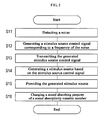
- FIGS. 1 and 2 illustrate a noise control device constructed in accordance with a first embodiment of the invention.
- a noise control device 10 of the first embodiment comprises a noise detecting part 11, a stimulus source control part 12, a stimulus providing part 13 and a sound absorptivity variable member 14.
- the sound absorptivity variable member 14 can change the sound absorptivity (that is, the sound absorbing property) against a sound wave when receiving stimulus sources such as temperature, humidity, electricity, light, magnetic source, etc. That is, the sound absorptivity variable member 14 can change the sound absorptivity against the noise by receiving the stimulus source.
- the sound absorptivity variable member 14 may comprise, for example, an air flow rate variable fabric, an elastic modulus variable fabric or an elastic modulus variable film.
- the sound absorptivity variable member 14 may include a stimulus responsive polymer, which generates deformation or stress as a response when receiving the stimulus sources such as temperature, humidity, electricity, light, magnetic source, etc.
- the stimulus responsive polymer may comprise a polymer gel in response to a temperature stimulus; a cellulose acetate in response to a humidity stimulus; an ion gel in response to an electric stimulus; and a conductive polymer, a liquid crystal elastomer and a polymer that uses azobenzene in response to a light stimulus.
- the stimulus responsive polymer in response to the electric stimulus may be a conductive polymer, a liquid crystal elastomer, an ion gel, or a combination thereof.
- a fabric which is prepared by forming the above polymers into fiber, changes the air flow rate when receiving the stimulus source.
- the difference between the air flow rates changes the peak of absorbing the noise of a specific frequency band so as to cause a difference in the sound absorptivity.
- the elastic modulus of the polymers is changed before and after receiving the stimulus source.
- the difference between the above elastic moduli changes the peak of absorbing the noise of a specific frequency band so as to cause a difference in the sound absorptivity.
- the polymer is made into the fiber to form the fabric (an air flow rate variable fabric or an elastic modulus variable fabric) or is formed in a film type (an elastic modulus variable film), and is used as the sound absorptivity variable member 14.
- the conductive polymer may comprise conductive polymers selected from the groups consisting of: acetylenic polymer; 5-memberd heterocyclic polymer (pyrrolic polymer obtained by polymerizing pyrroles); 3-alkyl pyrrole such as 3-methly pyrrole, 3-ethyl pyrrole and 3-dodecyl pyrrole; 3,4-dialkyl pyrrole such as 3,4-dimethyl pyrrole and 3-methyl-4-dodecyl pyrrole; N-alkyl pyrrole such N-methyl pyrrole and N-dodecyl pyrrole; N-alkyl-3-alkyl pyrrole such as N-methyl-3-methyl pyrrole and N-ethyl-3-dodecyl pyrrole; and 3-carboxy pyrrole, etc., or thiophenic polymer or isothianaphthenic polymer monomers, phenylenic polymer, etc.
- the materials that can be easily obtained as a fiber may comprise PEDOT/PSS ["Baytron P (registered trademark)" produced by Bayer Company] prepared by doping poly4-styrenesulfonate (PSS) to poly3,4-ethylenedioxythiophene (PEDOT) of thiophenic conductive polymer, or phenylenic poly p-phenylene vinylene (PPV).
- PEDOT/PSS "Baytron P (registered trademark)” produced by Bayer Company] prepared by doping poly4-styrenesulfonate (PSS) to poly3,4-ethylenedioxythiophene (PEDOT) of thiophenic conductive polymer, or phenylenic poly p-phenylene vinylene (PPV).
- the impurities used herein may comprise at least one ion selected from: halide ion such as chloride ion, bromide ion, etc.; perchlorate ion; tetrafluoroborate ion; hexafluoroarsenate ion; sulfate ion; nitrate ion; thiocyanate ion; hexafluorosilicate ion; phosphoric acid based ion such as phosphate ion, phenylphospate ion and hexafluorophosphate ion; trifluoroacetate ion; alkylbenzene sulfonate ion such as tosylate ion, ethylbenzene sulfonate ion, dodecylbenzene sulfonate ion, etc.; alkylbenzene sulfonate ion such as tosylate
- the liquid crystal elastomer is essentially formed by binding a mesogenic group, which is a central framework of the liquid crystal molecules, into the polymer chain as a pendant chain to generate the liquid crystal phase state of the elastomer.
- a polysiloxanes based material can be used to obtain a large deformation.
- liquid crystal elastomer may comprise polymethacrylate, polychloroacrylate or polystyrene derivative, which exists in a glass state at room temperature.
- a more preferred elastomer, which exists in a liquid crystal state at room temperature, may comprise polyacrylate, polysiloxane, polyphosphazene or a copolymer thereof.
- the mesogenic group can include, for example, alkyl, alkoxy and oxaalkyl group, which have, for example, up to 15 (fifteen) chain elements in a longer axis of a mesogen unit.
- the elastomer is synthesized, for example, by simple random copolymerization or by a random polymer similar addition reaction with multi-functional cross-linking agent molecule.
- a mesogen monomer is copolymerized with a multi-functional comonomer to form a liquid crystal copolymer, which is changed into a network structure by the cross-linking agent in the second reaction process.
- the ratio of the elastomer : the liquid crystal framework, which becomes the framework is approximately 1 : 1.
- this ratio is preferred, in actual operation, a ratio from 10:1 to 1:10 is possible. Since the operable amount becomes less, however, such ratios tend to make it more difficult to maintain the shape.
- an ionic liquid can be incorporated into the gel framework of the polymer.
- a method of incorporating the ionic liquid into the framework may comprise previously mixing and dispersing the ionic liquid into a monomer of foam and then blowing the ionic liquid into the framework when performing foaming and polymerizing operations.
- such a method may comprise incorporating the ionic liquid into the framework by an impregnating operation after a foaming operation. Since the ionic liquid is generally non-volatile at room temperature, the ionic liquid is retained within the framework.
- the amount of the ionic liquid to be incorporated into the framework is up to 50 % of a weight of the framework material when considering maintaining the framework strength or implementing an actual operation, although the invention is not limited thereto.
- An example of the ionic liquid comprises at least one cation or anion, wherein the cation or anion is an organic acid, and ambient temperature molten salt having a molten point equal to or lower than the room temperature, although the present invention is not limited thereto.
- the cation of the ionic liquid may include amidinium cation such as imidazolinium cation, imidazolium cation, tetrahydropyrimidinium cation, dihydropyrimidinium cation, etc.; guanidinium cation such as guanidinium cation having an imidazolinium framework, guanidinium cation having an imidazolium framework, guanidinium cation having tetrahydropyrimidinium, guanidinium cation having dihydropyrimidinium framework, etc.; and third grade ammonium cation such as methyldilauryl ammonium.
- the described cation may be used alone or in a combination of two or more cations.
- the anion of the ionic liquid may include an organic acid and/or an inorganic acid.
- the organic acid may comprise, for example, carboxylic acid, sulfuric acid ester, high alkyl ether sulfuric acid ester, sulfonic acid, phosphoric acid ester, etc.
- the inorganic acid may comprise, for example, super strong acid (e.g., fluoroboric acid, tetrafluoroboric acid, perchloric acid, hexafluorophosphoric acid such as hexafluoroantimonic acid and hexafluoroarsenic acid), phosphoric acid, boric acid, etc.
- the organic and inorganic acids may be used alone or in a combination of two or more acids.
- the noise control device 10 of the present embodiment is next explained in more detail.
- the noise detecting part 11 is formed on a desired indoor or outdoor position (may be formed within a member separating the indoor from the outdoor) to detect the noise generated from the noise source.
- the noise detecting part 11 may include a sound level meter or a microphone functioning as a sensor.
- the noise detecting part 11 converts the noise generated from the noise source (that is, noise) into an electric signal, which is proportional to a magnitude thereof, and transmits the signal to the stimulus source control part 12.
- the noise detecting part 11 is not specifically limited as long as it has the function of measuring various noises such as normal noise, fluctuating noise, intermittent noise, shock noise, separate shock noise or quasi-steady shock noise, and may be appropriately varied depending on the type of the noise to be measured.
- this embodiment describes an example using one noise detecting part, the invention is not limited to such a configuration. That is, the noise may be detected by arranging a plurality of noise detecting parts 11 at various positions.
- the stimulus source control part 12 receives the signal from the noise detecting part 11 and generates a stimulus source control signal based on the received signal.
- the stimulus source control signal generated by the stimulus source control part 12 is transmitted to the stimulus source providing part 13.
- the stimulus source control signal includes information for instructing a magnitude of the stimulus source assigned to the sound absorptivity variable member 14 or the generation of the stimulus source.
- the stimulus source control part 12 generally comprises a central processing unit (CPU) for performing calculation processing required for generating the stimulus source control signal based on signals received from the noise detecting part 11 and a memory unit having an area used for temporarily storing the signals received from the noise detecting part 11 and/or a memory area for storing a program required for generating the stimulus source control signal or performing a frequency analysis of the signal received from the noise detecting part 11.
- CPU central processing unit
- a table for generating the stimulus source control signal is stored in the memory unit, and the stimulus source control signal is generated using the table.
- the magnitude of the signal from the noise detecting part 11 (the frequency or sound pressure level of the noise) and the stimulus source control signal to be generated are stored in a corresponding relationship.
- the relationship could be generated mathematically.
- the functions of the stimulus source control part 12 are preferably implemented in software operating on a CPU as described, its functions can be implemented in whole or in part by hardware, including discrete components.
- the stimulus source providing part 13 receives the stimulus source control signal from the stimulus source control part 12, generates the stimulus source based on the received stimulus source control signal, and outputs the generated stimulus source to the sound absorptivity variable member 14.
- the stimulus source providing part 13 is not specifically limited as long as it is capable of generating the stimulus source, where the stimulus source may include, for example, temperature, humidity, electricity, light or magnetic source.
- the stimulus source providing part 13 can be a direct current stabilization power source such as "AD-8735D" produced by A&D Co., Ltd.
- the first embodiment illustrates an example wherein the sound absorptivity variable member 14, the sound absorptivity of which is changed by receiving an electric stimulus (e.g., a voltage), is applied to a vehicle.
- an electric stimulus e.g., a voltage
- the invention is not limited thereto. That is, the invention may be applied to any place requiring silence, e.g., the interior of a building.
- the noise is first detected by the noise detecting part 11 in step S11.
- the detected noise is converted into an electrical signal proportional to its magnitude and then transmitted to the stimulus source control part 12.
- the noise detecting part 11 is arranged at an appropriate position for detecting the noise generated from the noise source. For example, an engine mounted in the vehicle or another noise source generated according to an operating state of the vehicle is appropriate.
- the stimulus source control part 12 receives the signal from the noise detecting part 11 and generates the stimulus source control signal based on the received signal in step S12.
- the stimulus source control part 12 generates the stimulus source control signal corresponding to the frequency of the noise detected by the noise detecting part 11 based on the frequency of the noise detected by the noise detecting part 11 and the table for generating the stimulus source control signal.
- the stimulus source control signal includes information for instructing a magnitude of the voltage, which the stimulus source providing part 13 is configured to generate. Further, the stimulus source control part 12 transmits the generated control signal to the stimulus source providing part 13 at step S13.
- the stimulus source providing part 13 receives the stimulus source control signal from the stimulus source control part 12 and generates an electric stimulus (voltage) assigned to the sound absorptivity variable member 14 based on the received stimulus source control signal.
- the stimulus source providing part 13 generates the electric stimulus by using a battery mounted in the vehicle.
- the stimulus source providing part 13 is configured to generate a desired degree of the voltage from the battery via a stabilization power source device (not shown). Further, the stimulus source providing part 13 outputs the generated electric stimulus to the sound absorptivity variable member 14 at step S15.
- the sound absorptivity variable member 14 receives the electric stimulus output from the stimulus source providing part 13, thereby changing the sound absorptivity against the noise at step S16.
- the sound absorptivity of the sound absorptivity variable member 14 against the noise is changed according to the voltage value received from the stimulus source providing part 13.
- a place for arranging the sound absorptivity variable member 14 is not specifically limited as long as the noise from the outdoor can be effectively reduced.
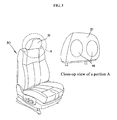
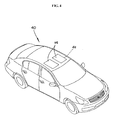
- the sound absorptivity variable member 14 may be placed in a head rest 31 arranged at an upper portion of the passenger seat 30 (shown in FIG. 3 ) or at a head lining 41 (protruding inwardly from the indoor top surface of the vehicle) of the vehicle 40 (shown in FIG. 4 ).
- the stimulus source is generated based on the frequency of the noise and is output to the sound absorptivity variable member.
- the time until absorbing the sound after detecting the noise can be significantly reduced.
- the sound absorptivity variable member includes an air flow rate variable fabric, an elastic modulus variable fabric, an elastic modulus variable film or a combination thereof, the passive sound absorbing property of the sound absorbing member can be changed into an active property without using an area equal to or more than a conventional space.
- the noise control device that can effectively reduce the noise from the low frequency band to the high frequency band and can be used in a limited installation space.
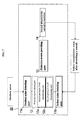
- FIGS. 5 and 6 show a noise control device constructed in accordance with a second embodiment of the invention.
- the first and second embodiments differ from each other in that a sound pressure level calculating part 12a and a threshold determining part 12b are provided in FIG. 5 . Since other elements are the same as in FIG. 1 , the explanation thereof is omitted herein. Also, since FIG. 5 includes certain elements other than those shown in FIG. 1 , the functions of the elements may be different. Only the differences between the two embodiments are explained below.
- a noise control device 20 is configured to calculate the sound pressure level for each frequency of the noise by performing a frequency analysis of the noise detected by the noise detecting part 11. It then generates a stimulus source control signal by means of the stimulus source control part 12 when the calculated sound pressure level reaches a desired sound pressure level.
- the stimulus source control part 12 includes the sound pressure level calculating part 12a and the threshold determining part 12b, and performs the frequency analysis of the noise detected by the noise detecting part 11. The stimulus source control part 12 then calculates the sound pressure level for each frequency of the noise, generates the stimulus source control signal when the calculated sound pressure level reaches a desired sound pressure level, and outputs the generated stimulus source control signal.
- the stimulus source control part 12 also serves as a sound pressure level calculating part and a threshold determining part.
- the sound pressure level calculating part 12a analyzes the frequency of the noise detected by the noise detecting part 11 and calculates the sound pressure level for each frequency of the noise. Since methods of calculating such a sound pressure level are already known, the details thereof are omitted herein. Further, the noise detecting part 11 may be configured to include the function of the sound pressure level calculating part 12a. In such a case, the sound pressure level calculated by the noise detecting part 11 is transmitted to the stimulus source control part 13.
- the threshold determining part 12b determines whether the sound pressure level calculated by the sound pressure level calculating part 12a reaches a threshold sound pressure level.
- the threshold sound pressure level can be any sound pressure level depending on the objectives.
- FIG. 6 is an operational flow chart for the noise control device 20 in accordance with the second embodiment.
- the second embodiment illustrates an example wherein the sound absorptivity variable member 14, the sound absorptivity of which is changed by receiving an electric stimulus (e.g., voltage), is applied to a vehicle.
- an electric stimulus e.g., voltage
- the invention is not limited thereto and may be applied in other locations, such as the interior of a building.
- the explanation of operation procedures identical to those of FIG. 2 is omitted in this description of FIG. 6 .
- the noise generated from the noise source is first detected by the noise detecting part 11 at step S21.
- the detected noise is converted into an electrical signal and is transmitted to the stimulus source control part 12.
- the sound pressure level calculating part 12a receives a signal from the noise detecting part 11 and calculates a sound pressure level for each frequency by analyzing the frequency of the received signal.
- the threshold determining part 12b determines whether the sound pressure level calculated in S22 reaches a threshold sound pressure level at step S23. If the calculated sound pressure level does not reach the threshold sound pressure level, that is, the response to the query of step S23 is "NO,” then the process returns to step S21. However, if the calculated sound pressure level reaches (or exceeds) the threshold sound pressure level, that is, the response to the query of step S23 is "YES,” then a stimulus source control signal is generated based on the frequency reaching the sound pressure level at step S24. Thereafter, the stimulus source control part 12 transmits the generated control signal to the stimulus source providing part 13 at step S25.
- the stimulus source providing part 13 receives the stimulus source control signal from the stimulus source control part 12 and generates an electric stimulus (e.g., voltage) to be assigned to the sound absorptivity variable member 14 based on the received stimulus source control signal. Then, the stimulus source providing part 13 outputs the generated electric stimulus to the sound absorptivity variable member 14 at step S27.
- an electric stimulus e.g., voltage
- the sound absorptivity variable member 14 then receives the electric stimulus output from the stimulus source providing part 13 and changes the sound absorptivity against the noise at step S28. The process then ends.
- the stimulus source is generated and applied to the sound absorptivity variable member.
- the noise control device when the noise control device is applied to a place that does not require the noise to be reduced unless a desired sound pressure level is reached, a noise control device with excellent convenience can be provided.
- FIGS. 7 and 8 show a noise control device constructed in accordance with a third embodiment of the invention.
- the second and third embodiments differ from each other in that an outdoor noise detecting part 11 a and an indoor noise detecting part 11 b for detecting two types of noise are provided in FIG. 7 as the noise detecting part.
- the third embodiment includes a sound pressure level determining part 12c. Since the other elements are identical to those shown in FIG. 5 , the explanation thereof is omitted herein. Also, since FIG. 7 includes certain elements other than those shown in FIG. 5 , the functions of the elements may be different. Only the differences between the two embodiments are explained below.
- a noise control device 30 of the third embodiment is configured to detect the noise generated from an outdoor noise source and the indoor noise by using the outdoor noise detecting part 11a and the indoor noise detecting part 11 b.
- the outdoor noise detecting part 11a detects the outdoor noise.
- the noise detecting part 11 shown in FIGS. 1 and 5 serves as the outdoor noise detecting part 11a.
- the indoor noise detecting part 11 b detects the indoor noise and serves as a second noise detecting part.
- the third embodiment illustrates an example using two noise detecting parts 11a and 11 b, the invention is not limited thereto. That is, the invention may include a plurality of noise detecting parts for each noise detecting part 11a and 11b.
- the stimulus source control part 12 includes the sound pressure level calculating part 12a and the sound pressure level determining part 12c.
- the stimulus source control part 12 receives a signal from the outdoor noise detecting part 11a or the indoor noise detecting part 11 b, generates the stimulus source control signal based on the received signal, and outputs the generated stimulus source control signal.
- the stimulus source control signal generated by the stimulus source control part 12 is transmitted to the stimulus source providing part 13.
- the sound pressure level calculating part 12a analyzes the frequency of the noise detected by the noise detecting part 11 b and calculates the sound pressure level for each frequency of the noise.
- the sound pressure level calculating part 12a thus serves as a second sound pressure level calculating part.
- the noise detecting part 11 b may be configured to include the function of the sound pressure level calculating part 12a. In such a case, the sound pressure level calculated by the noise detecting part 11 b is transmitted to the stimulus source control part 13.
- the sound pressure level determining part 12c determines whether the sound pressure level calculated by the sound pressure level calculating part 12a reaches a target sound pressure level. Specifically, the target sound pressure level determining part 12c determines whether a sound pressure level (after the noise from outdoors is absorbed by the sound absorptivity variable member 14) reaches the target sound pressure level. If it is determined by the target sound pressure level determining part 12c that the target sound pressure level is not reached, then the stimulus source control part 12 is configured to generate a new stimulus source control signal by referring to the frequency of the indoor noise detected by the noise detecting part 11 b and the table for generating the stimulus source control signal.
- the noise control device 30 of the third embodiment employs a feedback function in addition to the function of the noise control device 10 shown in FIG. 1 .
- the noise control device 30 determines whether the indoor noise changed by the sound absorptivity variable member 14 is changed to the target sound pressure level by means of the target sound pressure level determining part 12c.
- the noise control device 30 then generates a new stimulus source control signal based on the frequency of the noise detected by the indoor noise detecting part 11 b if the indoor noise is not changed to the target sound pressure level.
- the third embodiment also illustrates an example wherein the sound absorptivity variable member 14, the sound absorptivity of which is changed by receiving an electric stimulus (e.g., voltage), is applied to a vehicle.
- an electric stimulus e.g., voltage
- the noise generated from the noise source is first detected by the outdoor noise detecting part 11a in step S31.
- the detected noise is converted into an electrical signal and transmitted to the stimulus source control part 12.
- the stimulus source control part 12 receives a signal from the outdoor noise detecting part 11a and generates a stimulus source control signal based on the received signal at step S32. Also, the stimulus source control part 12 transmits the generated stimulus source control signal to the stimulus source providing part 13 at step S33.
- the stimulus source providing part 13 receives the stimulus source control signal from the stimulus source control part 12 and generates the electric stimulus (e.g., voltage) assigned to the sound absorptivity variable member 14 based on the received stimulus source control signal. Then, the stimulus source providing part 13 outputs the generated electric stimulus to the sound absorptivity variable member 14.
- the electric stimulus e.g., voltage
- the sound absorptivity variable member 14 receives the electric stimulus outputted from the stimulus source providing part 13, thereby changing the sound absorptivity against the noise at step S35.
- the indoor noise of a vehicle is detected by the indoor noise detecting part 11 b.
- the noise detected by the indoor noise detecting part 11 b is converted into an electrical signal proportional to the magnitude thereof and transmitted to the stimulus source control part 12. Further, although a place for arranging the indoor noise detecting part 11b is not limited, the indoor noise detecting part 11 b is arranged at a place where the vehicular indoor noise can be effectively detected.
- the stimulus source control part 12 determines whether the frequency of the noise detected by the indoor noise detecting part 11 b reaches a target sound pressure level at step S37. If the frequency does not reach the target sound pressure level as indicated by step S37, then the process returns to step S22. At this time, the stimulus source control part 12 is configured to generate the stimulus source control signal based on the frequency of the noise detected by the indoor noise detecting part 11 b. Then, the stimulus source control part 12 transmits the generated stimulus source control signal to the stimulus source providing part 13, and the processes below step S23 are performed again. However, when the frequency reaches or falls below the target sound pressure level, that is, the response to the query of step S37 is "YES," the process ends.
- the vehicular outdoor noise is detected by the outdoor noise detecting part 11a, and the stimulus source assigned to the sound absorptivity variable member 14 is controlled. Then, the vehicular indoor noise after absorbing the sound is detected by the indoor noise detecting part 11 b. When the frequency of the noise does not reach the target frequency, a feedback control is performed to thereby newly generate a stimulus source assigned to the sound absorptivity variable member 14. Thus, it becomes possible to ensure quietness.
- the sound absorptivity variable member 14 which changes the sound absorptivity in response to other stimulus sources such as temperature, humidity, light or magnetic source, may be used in the invention.
- Embodiments of the noise control device of the invention are further explained below based on the following examples, which are described in order to facilitate the understanding of the invention.
- the technical range of the invention is not limited to such examples.
- the present invention is applied to a vehicle.
- a microphone is used and installed within a front pillar as the vehicular indoor noise detecting part 11.
- a control circuit is a portion of the stimulus source control part 12 and is configured to have a transmission function for a relationship between the installation location of the microphone and the head rest neighbourhood of the vehicle.
- the stimulus source providing part 13 is electrically connected to the sound absorptivity variable member 14 by using a direct current stabilization power source ("AD-8735D" produced by A&D Co., Ltd. in this example).
- an air flow rate variable fabric formed by a conductive polymer is used in the sound absorptivity variable part 14.
- the air flow rate variable fabric is obtained by the manufacturing method disclosed in Japanese Laid-Open Patent Application No. 2007-277791 .
- the air flow rate variable fabric obtained by such manufacturing method is formed to have a thickness of 10 mm and an area density of 1000 g/cm 2 and is installed on the head linings of a driver seat and a passenger seat to have a side of 30 cm, respectively (0.09 m 2 ) (see FIG. 4 ).
- the SKYLINE (“V35" produced by Nissan Motors Company) is used as the vehicle.
- the stimulus source control part 12, the stimulus source providing part 13, the sound absorptivity variable member 14 (including its installation location) and the vehicle are the same as in the first example.
- a microphone is used and installed at 5 cm from a center console wall surface and a dash panel of the driver seat side to a vehicular indoor side and a height of 20 cm from a vehicular indoor floor surface.
- the stimulus source control part 12, the stimulus source providing part 13, the sound absorptivity variable member 14 (including its installation location) and the vehicle are the same as in the first example.
- the outdoor noise detecting part 11a a microphone for detecting the noise of an engine mounted in a vehicle is used and installed on an engine cover.
- the stimulus source control part 12, the stimulus source providing part 13, the sound absorptivity variable member 14 (including its installation location) and the vehicle are the same as in the first example.
- the outdoor noise detecting part 11a is installed on the engine cover as in the third example.
- the microphone as the indoor noise detecting part 11 b is used and installed at 5 cm from a center console wall surface and a dash panel of the driver seat side to a vehicular indoor side and a height of 20 cm from a vehicular indoor floor surface, which is the same as in the second example.
- the stimulus source control part 12, the stimulus providing part 13, the noise detecting part 11a and 11 b and the vehicle are the same as in the fourth example.
- an elastic modulus variable fabric formed by a conductive polymer is used as for the sound absorptivity variable member 14.
- the elastic modulus variable fabric is obtained by the manufacturing method disclosed in Japanese Laid-Open Patent Application No. 2007-277791 .
- the elastic modulus variable fabric obtained by such manufacturing method is formed to have a thickness of 2 mm and an area density of 1500 g/cm 2 .
- Two sheets of the elastic modulus fabric having a diameter of 10 cm are installed at the rear surface side of a skin material of a head rest in the driver seat and the passenger seat, respectively. Thus, a total of four sheets is installed (see FIG. 3 ).
- the stimulus source control part 12, the stimulus source providing part 13, the noise detecting part 11 a and 11 b and the vehicle are the same as in the fourth example.
- an elastic modulus variable film formed by a conductive polymer is used as for the sound absorptivity variable member 14.
- the elastic modulus variable film is obtained by the manufacturing method disclosed in Japanese Patent Publication Nos. 3039994 and 3102773 .
- the elastic modulus variable film obtained by such method is formed to have a thickness of 200 ⁇ m.
- Two sheets of the elastic modulus film having a size of ⁇ 10cm are installed at the rear surface side of a skin material of a head rest in the driver seat and the passenger seat, respectively. Thus, a total of four sheets is installed (see FIG. 3 ).
- the stimulus source control part 12, the stimulus providing part 13, the noise detecting part 11 a and 11 b and the vehicle are the same as in the fourth example.
- an air flow rate variable fabric is formed by a conductive polymer to have a thickness of 10 mm and an area density of 1000 g/cm 2 and is installed on the head lining of the driver seat and the passenger seat, respectively, to have a size of 0.09 m 2 (see FIG. 4 ).
- the noise detecting part 11 b, the stimulus source control part 12, the stimulus source providing part 13, the sound absorptivity variable member 14 (including its installation location) and the vehicle are the same as in the second example.
- the operational processes are performed as in the second embodiment.
- an evaluation is performed by using a measuring device 80 shown in FIG. 9 .
- the measuring device is configured to have a structure obtained from scaling down a transmission loss detecting device according to JISA1416.
- the measuring device comprises two reverberation boxes 80a and 80b and a compartment 82 separating the reverberation boxes 80a and 80b.
- a speaker 81 as a sound source is installed in one reverberation box 80a.
- the compartment 82 an acryl plate having a thickness of 1 cm is used, which is the same material as that for forming an outer surface of the measuring device 80.
- sound pressure measuring devices 83a and 83b for detecting the sound pressure are assembled in the reverberation boxes 80a and 80b, respectively.
- an air flow rate variable fabric formed by a conductive polymer is used as for the sound absorptivity variable member 14.
- the air flow rate variable fabric is obtained by the manufacturing method disclosed in Japanese Laid-Open Patent Application No. 2007-277791 .
- the air flow rate variable fabric obtained by such manufacturing method is formed to have a thickness of 20 mm and an area density of 800 g/cm 2 and is installed in an entire surface of an inner wall of the reverberation box 80b except for the compartment 82.
- a resonator for 640 Hz in the form of a plate having a thickness of 0.1 cm is produced by preparing a container having an inner volume of 3.125 cm 3 (length of 2.5 cm, width of 2.5 cm and height of 0.5 cm) and opening a hole having a diameter of 0.1 cm in an upper surface of the container.
- a total of 50 resonators is prepared in order to install 25 resonators at positions corresponding to the left and right ear positions of the passenger in the head rest, respectively (see FIG. 3 ).
- the total volume is 78 cm 3 .
- the resonators are installed in the vehicle, which is the same as in the first to nine examples, during a normal driving at a speed of 60 km/h. Then, the sound pressure value at the human ear position is measured.
- a resonator for 1000 Hz in the form of a plate having a thickness of 0.1 cm is produced by preparing a container having an inner volume of 1.5625 cm 3 (length of 2.5 cm, width of 2.5 cm and height of 0.25 cm) and opening a hole having a diameter of 0.1 cm in an upper surface of the container.
- a total of 50 resonators is prepared in order to install 25 containers at positions contacting the right and left ear positions in the head rest, respectively. The total volume is 39 cm 3 .
- the vehicles are driven in a normal operation at a speed of 30 km/h and 60 km/h along a straight road.
- the sound pressure level difference between the noise source (at the position of the noise detecting part) and an ear sound pressure (at a position 15 cm front of the head rest of the driver seat) is recorded for 30 seconds.
- the sound is recorded for cases using and not using the noise control device of the invention.
- the sounds are fast Fourier converted (using FFT), indicated as a sound pressure level difference in each 1/3 octave band, and compared to each other.
- the measured results in each example and comparison example are indicated in Table 1 below.
- the noise reduction is focused in a frequency band of 630 Hz when the driving speed is 30 km/h.
- the noise reduction is focused in a frequency band of 1 kHz. That is, for the vehicle used in the present examples, the frequency bands are those required to reduce the noise.
- Table 1 when using the sound absorptivity variable member 14 in the first to ninth examples, significant sound absorbing effects can be obtained according to the sound pressure level difference between before providing the stimulus source (stimulus source control off) and after providing the stimulus source (stimulus source control on).
- the sound absorbing effects are not significantly recognized in the frequency band of 1 kHz in the first comparison example and the frequency band of 630 Hz in the second comparison example. However, the sound absorbing effects are significantly recognized in both frequency bands of each example using embodiments of the invention.
- the noise control device of the present invention can effectively reduce the noise throughout a broader frequency band, it is possible to increase the silence compared to the known devices.
- the sound absorptivity variable member can be installed as a replacement material of a cushion or backing material and is not a rigid material. Therefore, there is no discomfort although the sound absorptivity variable member is installed in a region contacting human beings. Accordingly, it is also effective to apply the invention to regions contacting human beings.
Landscapes
- Engineering & Computer Science (AREA)
- Physics & Mathematics (AREA)
- Acoustics & Sound (AREA)
- Multimedia (AREA)
- Chemical & Material Sciences (AREA)
- Combustion & Propulsion (AREA)
- Mechanical Engineering (AREA)
- General Engineering & Computer Science (AREA)
- Soundproofing, Sound Blocking, And Sound Damping (AREA)
- Vehicle Interior And Exterior Ornaments, Soundproofing, And Insulation (AREA)
Applications Claiming Priority (1)
| Application Number | Priority Date | Filing Date | Title |
|---|---|---|---|
| JP2007050515A JP2008213547A (ja) | 2007-02-28 | 2007-02-28 | 騒音制御装置 |
Publications (1)
| Publication Number | Publication Date |
|---|---|
| EP1973100A2 true EP1973100A2 (de) | 2008-09-24 |
Family
ID=39672576
Family Applications (1)
| Application Number | Title | Priority Date | Filing Date |
|---|---|---|---|
| EP08151967A Withdrawn EP1973100A2 (de) | 2007-02-28 | 2008-02-26 | Rauschsteuervorrichtung |
Country Status (5)
| Country | Link |
|---|---|
| US (1) | US20080219465A1 (de) |
| EP (1) | EP1973100A2 (de) |
| JP (1) | JP2008213547A (de) |
| KR (1) | KR20080080022A (de) |
| CN (1) | CN101256767A (de) |
Cited By (1)
| Publication number | Priority date | Publication date | Assignee | Title |
|---|---|---|---|---|
| JP2017181414A (ja) * | 2016-03-31 | 2017-10-05 | 三井化学株式会社 | 音響特性測定システムおよび音響特性測定方法 |
Families Citing this family (8)
| Publication number | Priority date | Publication date | Assignee | Title |
|---|---|---|---|---|
| DE102009032600A1 (de) * | 2009-07-10 | 2011-01-13 | GM Global Technology Operations, Inc., Detroit | Verfahren zur geräuschmindernden Steuerung einer Heiz-, Belüftungs- und/oder Klimaanlage eines Kraftfahrzeugs |
| CN103542678B (zh) * | 2013-10-31 | 2016-07-27 | 合肥美的电冰箱有限公司 | 冰箱 |
| JP6475503B2 (ja) * | 2014-02-12 | 2019-02-27 | 本田技研工業株式会社 | 車両用振動騒音低減装置 |
| CN104002750B (zh) * | 2014-05-30 | 2016-06-29 | 长城汽车股份有限公司 | 一种消除车内轰鸣噪音的控制装置 |
| CN104578895A (zh) * | 2014-12-26 | 2015-04-29 | 黑龙江大学 | 窗用阻尼式抗噪声闭环控制装置 |
| CN108978128B (zh) * | 2017-05-31 | 2020-11-06 | 青岛海尔智能技术研发有限公司 | 一种洗衣机的降噪装置的设计方法 |
| CN113665315B (zh) * | 2021-08-19 | 2024-03-08 | 浙江吉利控股集团有限公司 | 一种用于车辆的噪音控制方法、控制系统及车辆 |
| CN116356488B (zh) * | 2023-03-15 | 2024-07-30 | 江南大学 | 一种宽频噪音吸收纤维材料及其制备方法 |
Citations (6)
| Publication number | Priority date | Publication date | Assignee | Title |
|---|---|---|---|---|
| JPH0339994B2 (de) | 1986-04-16 | 1991-06-17 | ||
| JP3102773B2 (ja) | 1997-05-08 | 2000-10-23 | 利夫 功刀 | ピロール系高分子フィルムまたは繊維の高感度伸縮方法 |
| JP2005120833A (ja) | 2003-10-14 | 2005-05-12 | Kojima Press Co Ltd | 可変周波数消音システム |
| JP2005280650A (ja) | 2004-03-31 | 2005-10-13 | Hitachi Ltd | アクティブノイズコントロールシステムを備えた鉄道車両車体構造 |
| JP2007050515A (ja) | 2005-08-12 | 2007-03-01 | Star Micronics Co Ltd | 印刷装置 |
| JP2007277791A (ja) | 2006-03-16 | 2007-10-25 | Nissan Motor Co Ltd | 通気量可変布帛、吸音材、車両用部品 |
Family Cites Families (27)
| Publication number | Priority date | Publication date | Assignee | Title |
|---|---|---|---|---|
| US5315661A (en) * | 1992-08-12 | 1994-05-24 | Noise Cancellation Technologies, Inc. | Active high transmission loss panel |
| WO1995005136A1 (en) * | 1993-08-12 | 1995-02-23 | Noise Cancellation Technologies, Inc. | Active foam for noise and vibration control |
| EP0836737A1 (de) * | 1995-07-05 | 1998-04-22 | Alumax Inc. | Verfahren und vorrichtung zur aktiven geräuschverminderung für moden höherer ordnung |
| FR2750527B1 (fr) * | 1996-06-28 | 1998-08-21 | Bertin & Cie | Structures d'absorption de bruit et parois constituees de ces structures |
| JP3510427B2 (ja) * | 1996-08-15 | 2004-03-29 | 三菱重工業株式会社 | 能動吸音壁 |
| FI963988A0 (fi) * | 1996-10-04 | 1996-10-04 | Kari Johannes Kirjavainen | Ljud- och vibrationsisoleringsfoerfarande |
| WO1998035529A2 (en) * | 1997-02-07 | 1998-08-13 | Sri International | Elastomeric dielectric polymer film sonic actuator |
| US6295363B1 (en) * | 1997-03-20 | 2001-09-25 | Digisonix, Inc. | Adaptive passive acoustic attenuation system |
| KR100369212B1 (ko) * | 1999-07-07 | 2003-01-24 | 한국과학기술연구원 | 내연 기관의 배기 소음 및/또는 기체 이송 시스템의 덕트내부의 소음을 제어하기 위한 장치 및 방법 |
| US7064472B2 (en) * | 1999-07-20 | 2006-06-20 | Sri International | Electroactive polymer devices for moving fluid |
| FR2799873B1 (fr) * | 1999-10-18 | 2002-02-08 | Comptoir De La Technologie | Dispositif actif d'attenuation de l'intensite sonore |
| FI108204B (fi) * | 1999-11-25 | 2001-11-30 | Kari Johannes Kirjavainen | Kalvo energioiden muuntamiseksi |
| JP3656732B2 (ja) * | 2000-04-21 | 2005-06-08 | 日産自動車株式会社 | エネルギー変換繊維体および吸音材 |
| US6497951B1 (en) * | 2000-09-21 | 2002-12-24 | Milliken & Company | Temperature dependent electrically resistive yarn |
| US7244497B2 (en) * | 2001-09-21 | 2007-07-17 | Outlast Technologies, Inc. | Cellulosic fibers having enhanced reversible thermal properties and methods of forming thereof |
| DE10201494A1 (de) * | 2002-01-17 | 2003-07-31 | Mann & Hummel Filter | Resonator |
| US20060076540A1 (en) * | 2002-08-09 | 2006-04-13 | Eamex Corporation | Process for producing conductive polymer |
| US6792907B1 (en) * | 2003-03-04 | 2004-09-21 | Visteon Global Technologies, Inc. | Helmholtz resonator |
| DK1665880T3 (da) * | 2003-09-03 | 2013-02-25 | Stanford Res Inst Int | Elektroaktive overfladedeformations- polymertransducere |
| US6979050B2 (en) * | 2003-12-04 | 2005-12-27 | General Motors Corporation | Airflow control devices based on active materials |
| US7059664B2 (en) * | 2003-12-04 | 2006-06-13 | General Motors Corporation | Airflow control devices based on active materials |
| US7118652B2 (en) * | 2003-12-04 | 2006-10-10 | General Motors Corporation | Airflow control devices based on active materials |
| US20050194207A1 (en) * | 2004-03-04 | 2005-09-08 | York International Corporation | Apparatus and method of sound attenuation in a system employing a VSD and a quarter-wave resonator |
| US20050201567A1 (en) * | 2004-03-12 | 2005-09-15 | Browne Alan L. | Tunable exhaust system |
| US7710371B2 (en) * | 2004-12-16 | 2010-05-04 | Xerox Corporation | Variable volume between flexible structure and support surface |
| WO2006104595A2 (en) * | 2005-02-19 | 2006-10-05 | General Motors Global Technology Operations, Inc. | Panels having active material based fold lines |
| US7757808B1 (en) * | 2009-02-04 | 2010-07-20 | Gm Global Technology Operations, Inc. | Noise reduction system |
-
2007
- 2007-02-28 JP JP2007050515A patent/JP2008213547A/ja active Pending
-
2008
- 2008-01-30 US US12/022,542 patent/US20080219465A1/en not_active Abandoned
- 2008-02-26 EP EP08151967A patent/EP1973100A2/de not_active Withdrawn
- 2008-02-27 KR KR1020080017560A patent/KR20080080022A/ko not_active Abandoned
- 2008-02-28 CN CNA2008100806741A patent/CN101256767A/zh active Pending
Patent Citations (6)
| Publication number | Priority date | Publication date | Assignee | Title |
|---|---|---|---|---|
| JPH0339994B2 (de) | 1986-04-16 | 1991-06-17 | ||
| JP3102773B2 (ja) | 1997-05-08 | 2000-10-23 | 利夫 功刀 | ピロール系高分子フィルムまたは繊維の高感度伸縮方法 |
| JP2005120833A (ja) | 2003-10-14 | 2005-05-12 | Kojima Press Co Ltd | 可変周波数消音システム |
| JP2005280650A (ja) | 2004-03-31 | 2005-10-13 | Hitachi Ltd | アクティブノイズコントロールシステムを備えた鉄道車両車体構造 |
| JP2007050515A (ja) | 2005-08-12 | 2007-03-01 | Star Micronics Co Ltd | 印刷装置 |
| JP2007277791A (ja) | 2006-03-16 | 2007-10-25 | Nissan Motor Co Ltd | 通気量可変布帛、吸音材、車両用部品 |
Cited By (1)
| Publication number | Priority date | Publication date | Assignee | Title |
|---|---|---|---|---|
| JP2017181414A (ja) * | 2016-03-31 | 2017-10-05 | 三井化学株式会社 | 音響特性測定システムおよび音響特性測定方法 |
Also Published As
| Publication number | Publication date |
|---|---|
| CN101256767A (zh) | 2008-09-03 |
| JP2008213547A (ja) | 2008-09-18 |
| KR20080080022A (ko) | 2008-09-02 |
| US20080219465A1 (en) | 2008-09-11 |
Similar Documents
| Publication | Publication Date | Title |
|---|---|---|
| EP1973100A2 (de) | Rauschsteuervorrichtung | |
| EP1570461B1 (de) | Ultraleichtes verkleidungslaminat | |
| EP2233373A1 (de) | Automobil mit Lautsprechereinheit | |
| CN104105624B (zh) | 改进的能量吸收系统 | |
| WO1998033170A1 (en) | Acoustically insulated apparatus | |
| US20090038881A1 (en) | Sound-absorbing material, production method for sound-absorbing material, and sound-absorbing structure | |
| EP1430215B1 (de) | Ansaugkrümmer einer brennkraftmaschine aus einem lärmschutzverbundwerkstoff | |
| CN105089386B (zh) | 用于车辆的行李舱的开启和关闭装置 | |
| US20170282815A1 (en) | Soundproof cover | |
| JP5315861B2 (ja) | 車体構造体およびインストルメントパネル | |
| US7836998B2 (en) | Crash sensor | |
| Mao et al. | Inertial actuator with virtual mass for active vibration control | |
| KR20110122347A (ko) | 스피커 일체형 범퍼 및 이의 제어방법 | |
| CN214280088U (zh) | 一种带有防盗结构的电池包结构 | |
| KR200380489Y1 (ko) | 압전감쇠를 이용한 도로용 소음감쇠기 | |
| JP3800083B2 (ja) | 不織布構造体を用いた制振吸音材 | |
| JP2012251661A (ja) | 自動車用制振シート | |
| US11636838B2 (en) | Soundproof member | |
| JP2009241486A (ja) | 自動車用制振シート | |
| JP2009053142A (ja) | センサ取付構造 | |
| KR20200005767A (ko) | 전기 자동차용 배터리 팩의 소음 저감장치 | |
| CN108692864B (zh) | 停车空间封闭度检测方法、系统、停车预警方法及车辆 | |
| Henjes et al. | Peshkov transducers of second sound | |
| WO2024153318A1 (en) | Magneto-rheological device for noise, vibration & harshness | |
| DA ROCHA | Attenuation of Noise and Vibration Using Piezoelectric Patches and Dissipative Shunt Circuits Atenuação de Ruído e Vibração Utilizando Pastilhas Piezoelétricas e Circuitos Elétricos |
Legal Events
| Date | Code | Title | Description |
|---|---|---|---|
| PUAI | Public reference made under article 153(3) epc to a published international application that has entered the european phase |
Free format text: ORIGINAL CODE: 0009012 |
|
| AK | Designated contracting states |
Kind code of ref document: A2 Designated state(s): AT BE BG CH CY CZ DE DK EE ES FI FR GB GR HR HU IE IS IT LI LT LU LV MC MT NL NO PL PT RO SE SI SK TR |
|
| AX | Request for extension of the european patent |
Extension state: AL BA MK RS |
|
| STAA | Information on the status of an ep patent application or granted ep patent |
Free format text: STATUS: THE APPLICATION IS DEEMED TO BE WITHDRAWN |
|
| 18D | Application deemed to be withdrawn |
Effective date: 20100831 |