EP1969371B1 - Verfahren zur herstellung eines multimeren einfangmittels zur bindung eines liganden - Google Patents
Verfahren zur herstellung eines multimeren einfangmittels zur bindung eines liganden Download PDFInfo
- Publication number
- EP1969371B1 EP1969371B1 EP06843125A EP06843125A EP1969371B1 EP 1969371 B1 EP1969371 B1 EP 1969371B1 EP 06843125 A EP06843125 A EP 06843125A EP 06843125 A EP06843125 A EP 06843125A EP 1969371 B1 EP1969371 B1 EP 1969371B1
- Authority
- EP
- European Patent Office
- Prior art keywords
- peptide
- 2dos
- hydrophobic
- peptides
- ligand
- Prior art date
- Legal status (The legal status is an assumption and is not a legal conclusion. Google has not performed a legal analysis and makes no representation as to the accuracy of the status listed.)
- Not-in-force
Links
- 239000003446 ligand Substances 0.000 title claims abstract description 100
- 239000003795 chemical substances by application Substances 0.000 title claims abstract description 96
- 230000027455 binding Effects 0.000 title claims abstract description 94
- 238000000034 method Methods 0.000 title claims abstract description 66
- 239000000178 monomer Substances 0.000 claims abstract description 74
- 239000000758 substrate Substances 0.000 claims abstract description 54
- 238000004519 manufacturing process Methods 0.000 claims abstract description 13
- 108090000765 processed proteins & peptides Proteins 0.000 claims description 313
- 102000004196 processed proteins & peptides Human genes 0.000 claims description 121
- 230000002209 hydrophobic effect Effects 0.000 claims description 81
- 235000001014 amino acid Nutrition 0.000 claims description 79
- 229940024606 amino acid Drugs 0.000 claims description 79
- 150000001413 amino acids Chemical class 0.000 claims description 73
- 125000003396 thiol group Chemical group [H]S* 0.000 claims description 45
- 239000000539 dimer Substances 0.000 claims description 29
- 230000015572 biosynthetic process Effects 0.000 claims description 28
- 239000007790 solid phase Substances 0.000 claims description 22
- LRQKBLKVPFOOQJ-YFKPBYRVSA-N L-norleucine Chemical compound CCCC[C@H]([NH3+])C([O-])=O LRQKBLKVPFOOQJ-YFKPBYRVSA-N 0.000 claims description 19
- 238000003786 synthesis reaction Methods 0.000 claims description 19
- 125000000539 amino acid group Chemical group 0.000 claims description 16
- 239000000126 substance Substances 0.000 claims description 11
- 235000018417 cysteine Nutrition 0.000 claims description 9
- 230000003993 interaction Effects 0.000 claims description 9
- 125000002887 hydroxy group Chemical group [H]O* 0.000 claims description 6
- 125000002924 primary amino group Chemical group [H]N([H])* 0.000 claims description 5
- COLNVLDHVKWLRT-QMMMGPOBSA-N L-phenylalanine Chemical compound OC(=O)[C@@H](N)CC1=CC=CC=C1 COLNVLDHVKWLRT-QMMMGPOBSA-N 0.000 claims description 4
- COLNVLDHVKWLRT-UHFFFAOYSA-N phenylalanine Natural products OC(=O)C(N)CC1=CC=CC=C1 COLNVLDHVKWLRT-UHFFFAOYSA-N 0.000 claims description 4
- SNDPXSYFESPGGJ-BYPYZUCNSA-N L-2-aminopentanoic acid Chemical compound CCC[C@H](N)C(O)=O SNDPXSYFESPGGJ-BYPYZUCNSA-N 0.000 claims description 3
- AGPKZVBTJJNPAG-WHFBIAKZSA-N L-isoleucine Chemical compound CC[C@H](C)[C@H](N)C(O)=O AGPKZVBTJJNPAG-WHFBIAKZSA-N 0.000 claims description 3
- ROHFNLRQFUQHCH-YFKPBYRVSA-N L-leucine Chemical compound CC(C)C[C@H](N)C(O)=O ROHFNLRQFUQHCH-YFKPBYRVSA-N 0.000 claims description 3
- FFEARJCKVFRZRR-BYPYZUCNSA-N L-methionine Chemical compound CSCC[C@H](N)C(O)=O FFEARJCKVFRZRR-BYPYZUCNSA-N 0.000 claims description 3
- SNDPXSYFESPGGJ-UHFFFAOYSA-N L-norVal-OH Natural products CCCC(N)C(O)=O SNDPXSYFESPGGJ-UHFFFAOYSA-N 0.000 claims description 3
- QIVBCDIJIAJPQS-VIFPVBQESA-N L-tryptophane Chemical compound C1=CC=C2C(C[C@H](N)C(O)=O)=CNC2=C1 QIVBCDIJIAJPQS-VIFPVBQESA-N 0.000 claims description 3
- OUYCCCASQSFEME-QMMMGPOBSA-N L-tyrosine Chemical compound OC(=O)[C@@H](N)CC1=CC=C(O)C=C1 OUYCCCASQSFEME-QMMMGPOBSA-N 0.000 claims description 3
- KZSNJWFQEVHDMF-BYPYZUCNSA-N L-valine Chemical compound CC(C)[C@H](N)C(O)=O KZSNJWFQEVHDMF-BYPYZUCNSA-N 0.000 claims description 3
- ROHFNLRQFUQHCH-UHFFFAOYSA-N Leucine Natural products CC(C)CC(N)C(O)=O ROHFNLRQFUQHCH-UHFFFAOYSA-N 0.000 claims description 3
- QIVBCDIJIAJPQS-UHFFFAOYSA-N Tryptophan Natural products C1=CC=C2C(CC(N)C(O)=O)=CNC2=C1 QIVBCDIJIAJPQS-UHFFFAOYSA-N 0.000 claims description 3
- KZSNJWFQEVHDMF-UHFFFAOYSA-N Valine Natural products CC(C)C(N)C(O)=O KZSNJWFQEVHDMF-UHFFFAOYSA-N 0.000 claims description 3
- 150000001945 cysteines Chemical group 0.000 claims description 3
- 229910052739 hydrogen Inorganic materials 0.000 claims description 3
- 239000001257 hydrogen Substances 0.000 claims description 3
- 229960000310 isoleucine Drugs 0.000 claims description 3
- AGPKZVBTJJNPAG-UHFFFAOYSA-N isoleucine Natural products CCC(C)C(N)C(O)=O AGPKZVBTJJNPAG-UHFFFAOYSA-N 0.000 claims description 3
- 229930182817 methionine Natural products 0.000 claims description 3
- OUYCCCASQSFEME-UHFFFAOYSA-N tyrosine Natural products OC(=O)C(N)CC1=CC=C(O)C=C1 OUYCCCASQSFEME-UHFFFAOYSA-N 0.000 claims description 3
- 239000004474 valine Substances 0.000 claims description 3
- -1 keto aldehyde Chemical class 0.000 description 134
- WEVYAHXRMPXWCK-UHFFFAOYSA-N Acetonitrile Chemical compound CC#N WEVYAHXRMPXWCK-UHFFFAOYSA-N 0.000 description 72
- QKNYBSVHEMOAJP-UHFFFAOYSA-N 2-amino-2-(hydroxymethyl)propane-1,3-diol;hydron;chloride Chemical compound Cl.OCC(N)(CO)CO QKNYBSVHEMOAJP-UHFFFAOYSA-N 0.000 description 43
- 239000004743 Polypropylene Substances 0.000 description 40
- 229920001155 polypropylene Polymers 0.000 description 40
- 238000002073 fluorescence micrograph Methods 0.000 description 32
- 230000014759 maintenance of location Effects 0.000 description 31
- IAZDPXIOMUYVGZ-UHFFFAOYSA-N Dimethylsulphoxide Chemical compound CS(C)=O IAZDPXIOMUYVGZ-UHFFFAOYSA-N 0.000 description 24
- 229960001760 dimethyl sulfoxide Drugs 0.000 description 23
- 239000000203 mixture Substances 0.000 description 22
- FAPWRFPIFSIZLT-UHFFFAOYSA-M Sodium chloride Chemical compound [Na+].[Cl-] FAPWRFPIFSIZLT-UHFFFAOYSA-M 0.000 description 21
- ABZLKHKQJHEPAX-UHFFFAOYSA-N tetramethylrhodamine Chemical group C=12C=CC(N(C)C)=CC2=[O+]C2=CC(N(C)C)=CC=C2C=1C1=CC=CC=C1C([O-])=O ABZLKHKQJHEPAX-UHFFFAOYSA-N 0.000 description 20
- PZBFGYYEXUXCOF-UHFFFAOYSA-N TCEP Chemical compound OC(=O)CCP(CCC(O)=O)CCC(O)=O PZBFGYYEXUXCOF-UHFFFAOYSA-N 0.000 description 18
- 239000000243 solution Substances 0.000 description 17
- 238000006243 chemical reaction Methods 0.000 description 16
- PEDCQBHIVMGVHV-UHFFFAOYSA-N Glycerine Chemical compound OCC(O)CO PEDCQBHIVMGVHV-UHFFFAOYSA-N 0.000 description 15
- 238000003491 array Methods 0.000 description 12
- 230000000717 retained effect Effects 0.000 description 11
- 230000035945 sensitivity Effects 0.000 description 10
- 239000011780 sodium chloride Substances 0.000 description 10
- AJPJDKMHJJGVTQ-UHFFFAOYSA-M sodium dihydrogen phosphate Chemical compound [Na+].OP(O)([O-])=O AJPJDKMHJJGVTQ-UHFFFAOYSA-M 0.000 description 10
- 229910000162 sodium phosphate Inorganic materials 0.000 description 10
- 239000007787 solid Substances 0.000 description 10
- 230000005661 hydrophobic surface Effects 0.000 description 9
- 0 Cc1c(CC([C@](NCC(O)O)O)N*)cccc1 Chemical compound Cc1c(CC([C@](NCC(O)O)O)N*)cccc1 0.000 description 8
- 238000001035 drying Methods 0.000 description 8
- 239000011521 glass Substances 0.000 description 8
- 238000011002 quantification Methods 0.000 description 8
- 150000007970 thio esters Chemical class 0.000 description 8
- PEEHTFAAVSWFBL-UHFFFAOYSA-N Maleimide Chemical compound O=C1NC(=O)C=C1 PEEHTFAAVSWFBL-UHFFFAOYSA-N 0.000 description 7
- XUJNEKJLAYXESH-UHFFFAOYSA-N cysteine Natural products SCC(N)C(O)=O XUJNEKJLAYXESH-UHFFFAOYSA-N 0.000 description 6
- 238000002474 experimental method Methods 0.000 description 6
- 239000007791 liquid phase Substances 0.000 description 6
- 239000000463 material Substances 0.000 description 6
- 239000012071 phase Substances 0.000 description 6
- 125000003607 serino group Chemical group [H]N([H])[C@]([H])(C(=O)[*])C(O[H])([H])[H] 0.000 description 6
- 239000006228 supernatant Substances 0.000 description 6
- 238000005406 washing Methods 0.000 description 6
- 150000008574 D-amino acids Chemical class 0.000 description 5
- 108010068647 P2 peptide Proteins 0.000 description 5
- 239000004793 Polystyrene Substances 0.000 description 5
- 125000003295 alanine group Chemical group N[C@@H](C)C(=O)* 0.000 description 5
- 230000008901 benefit Effects 0.000 description 5
- 239000013642 negative control Substances 0.000 description 5
- 238000010647 peptide synthesis reaction Methods 0.000 description 5
- 239000004033 plastic Substances 0.000 description 5
- 229920003023 plastic Polymers 0.000 description 5
- 229920001184 polypeptide Polymers 0.000 description 5
- 229920002223 polystyrene Polymers 0.000 description 5
- 239000002904 solvent Substances 0.000 description 5
- 125000003088 (fluoren-9-ylmethoxy)carbonyl group Chemical group 0.000 description 4
- COCMHKNAGZHBDZ-UHFFFAOYSA-N 4-carboxy-3-[3-(dimethylamino)-6-dimethylazaniumylidenexanthen-9-yl]benzoate Chemical class C=12C=CC(=[N+](C)C)C=C2OC2=CC(N(C)C)=CC=C2C=1C1=CC(C([O-])=O)=CC=C1C(O)=O COCMHKNAGZHBDZ-UHFFFAOYSA-N 0.000 description 4
- YMZMTOFQCVHHFB-UHFFFAOYSA-N 5-carboxytetramethylrhodamine Chemical compound C=12C=CC(N(C)C)=CC2=[O+]C2=CC(N(C)C)=CC=C2C=1C1=CC=C(C(O)=O)C=C1C([O-])=O YMZMTOFQCVHHFB-UHFFFAOYSA-N 0.000 description 4
- YXFVVABEGXRONW-UHFFFAOYSA-N Cc1ccccc1 Chemical compound Cc1ccccc1 YXFVVABEGXRONW-UHFFFAOYSA-N 0.000 description 4
- 150000008575 L-amino acids Chemical class 0.000 description 4
- DTQVDTLACAAQTR-UHFFFAOYSA-N Trifluoroacetic acid Chemical compound OC(=O)C(F)(F)F DTQVDTLACAAQTR-UHFFFAOYSA-N 0.000 description 4
- 150000001576 beta-amino acids Chemical class 0.000 description 4
- 125000001165 hydrophobic group Chemical group 0.000 description 4
- 238000002493 microarray Methods 0.000 description 4
- 238000011084 recovery Methods 0.000 description 4
- 238000012360 testing method Methods 0.000 description 4
- 101001008922 Homo sapiens Kallikrein-11 Proteins 0.000 description 3
- 102100027612 Kallikrein-11 Human genes 0.000 description 3
- 239000012062 aqueous buffer Substances 0.000 description 3
- 150000001540 azides Chemical class 0.000 description 3
- 210000004899 c-terminal region Anatomy 0.000 description 3
- ZSWFCLXCOIISFI-UHFFFAOYSA-N cyclopentadiene Chemical compound C1C=CC=C1 ZSWFCLXCOIISFI-UHFFFAOYSA-N 0.000 description 3
- 125000000151 cysteine group Chemical group N[C@@H](CS)C(=O)* 0.000 description 3
- 238000001704 evaporation Methods 0.000 description 3
- 230000008020 evaporation Effects 0.000 description 3
- 238000001506 fluorescence spectroscopy Methods 0.000 description 3
- 238000011534 incubation Methods 0.000 description 3
- 125000003588 lysine group Chemical group [H]N([H])C([H])([H])C([H])([H])C([H])([H])C([H])([H])C([H])(N([H])[H])C(*)=O 0.000 description 3
- 239000011159 matrix material Substances 0.000 description 3
- 235000019799 monosodium phosphate Nutrition 0.000 description 3
- 230000002688 persistence Effects 0.000 description 3
- 125000000405 phenylalanyl group Chemical group 0.000 description 3
- 238000002360 preparation method Methods 0.000 description 3
- 230000036962 time dependent Effects 0.000 description 3
- MLMXSSNNXMWLAT-UHFFFAOYSA-N 2-nitrosulfanylpyridine Chemical compound [O-][N+](=O)SC1=CC=CC=N1 MLMXSSNNXMWLAT-UHFFFAOYSA-N 0.000 description 2
- 125000001433 C-terminal amino-acid group Chemical group 0.000 description 2
- 238000005698 Diels-Alder reaction Methods 0.000 description 2
- 108091034117 Oligonucleotide Proteins 0.000 description 2
- 101100008569 Rattus norvegicus Cst4 gene Proteins 0.000 description 2
- 125000003277 amino group Chemical group 0.000 description 2
- 238000013459 approach Methods 0.000 description 2
- 239000007864 aqueous solution Substances 0.000 description 2
- 239000003125 aqueous solvent Substances 0.000 description 2
- 239000011324 bead Substances 0.000 description 2
- 239000011230 binding agent Substances 0.000 description 2
- 150000007942 carboxylates Chemical group 0.000 description 2
- 239000011248 coating agent Substances 0.000 description 2
- 238000000576 coating method Methods 0.000 description 2
- 230000008878 coupling Effects 0.000 description 2
- 238000010168 coupling process Methods 0.000 description 2
- 238000005859 coupling reaction Methods 0.000 description 2
- 230000001419 dependent effect Effects 0.000 description 2
- 238000010511 deprotection reaction Methods 0.000 description 2
- 230000002349 favourable effect Effects 0.000 description 2
- 239000000017 hydrogel Substances 0.000 description 2
- 238000002372 labelling Methods 0.000 description 2
- 230000000670 limiting effect Effects 0.000 description 2
- 239000007788 liquid Substances 0.000 description 2
- 239000002207 metabolite Substances 0.000 description 2
- 125000002496 methyl group Chemical group [H]C([H])([H])* 0.000 description 2
- 239000003960 organic solvent Substances 0.000 description 2
- 230000000144 pharmacologic effect Effects 0.000 description 2
- 229920000642 polymer Polymers 0.000 description 2
- 102000040430 polynucleotide Human genes 0.000 description 2
- 108091033319 polynucleotide Proteins 0.000 description 2
- 239000002157 polynucleotide Substances 0.000 description 2
- 235000018102 proteins Nutrition 0.000 description 2
- 108090000623 proteins and genes Proteins 0.000 description 2
- 102000004169 proteins and genes Human genes 0.000 description 2
- 239000011347 resin Substances 0.000 description 2
- 229920005989 resin Polymers 0.000 description 2
- 238000001228 spectrum Methods 0.000 description 2
- 125000001984 thiazolidinyl group Chemical group 0.000 description 2
- 125000005413 thiopyridyl group Chemical group 0.000 description 2
- 239000011534 wash buffer Substances 0.000 description 2
- XLYOFNOQVPJJNP-UHFFFAOYSA-N water Substances O XLYOFNOQVPJJNP-UHFFFAOYSA-N 0.000 description 2
- FZTIWOBQQYPTCJ-UHFFFAOYSA-N 4-[4-(4-carboxyphenyl)phenyl]benzoic acid Chemical compound C1=CC(C(=O)O)=CC=C1C1=CC=C(C=2C=CC(=CC=2)C(O)=O)C=C1 FZTIWOBQQYPTCJ-UHFFFAOYSA-N 0.000 description 1
- PGDJBKQDZFBXHB-UHFFFAOYSA-O CC(NC(CCCC#CC=CC)C(C)(NC1C(CCC[NH3+])C1)O)O Chemical compound CC(NC(CCCC#CC=CC)C(C)(NC1C(CCC[NH3+])C1)O)O PGDJBKQDZFBXHB-UHFFFAOYSA-O 0.000 description 1
- WLTSVTFHUKGYAI-UHFFFAOYSA-N CC(NCC(N=N)O)O Chemical compound CC(NCC(N=N)O)O WLTSVTFHUKGYAI-UHFFFAOYSA-N 0.000 description 1
- UTJZXRLEUUVUGL-MJCQNMSJSA-N CN[C@@H](CC(O)O)[C@@H](N[C@@H](CC(O)OC)C(C=O)NC)O Chemical compound CN[C@@H](CC(O)O)[C@@H](N[C@@H](CC(O)OC)C(C=O)NC)O UTJZXRLEUUVUGL-MJCQNMSJSA-N 0.000 description 1
- DCLWLCMEHFZKDI-JECWYVHBSA-N C[C@H](C[O](C)C(C)O)NCC(N)O Chemical compound C[C@H](C[O](C)C(C)O)NCC(N)O DCLWLCMEHFZKDI-JECWYVHBSA-N 0.000 description 1
- 102000001189 Cyclic Peptides Human genes 0.000 description 1
- 108010069514 Cyclic Peptides Proteins 0.000 description 1
- BWGNESOTFCXPMA-UHFFFAOYSA-N Dihydrogen disulfide Chemical compound SS BWGNESOTFCXPMA-UHFFFAOYSA-N 0.000 description 1
- 229930194542 Keto Natural products 0.000 description 1
- 241001465754 Metazoa Species 0.000 description 1
- 238000006845 Michael addition reaction Methods 0.000 description 1
- 238000006957 Michael reaction Methods 0.000 description 1
- 238000005481 NMR spectroscopy Methods 0.000 description 1
- 102000015636 Oligopeptides Human genes 0.000 description 1
- 108010038807 Oligopeptides Proteins 0.000 description 1
- GLUBLISJVJFHQS-VIFPVBQESA-N Phe-Gly Chemical compound OC(=O)CNC(=O)[C@@H](N)CC1=CC=CC=C1 GLUBLISJVJFHQS-VIFPVBQESA-N 0.000 description 1
- 229920001213 Polysorbate 20 Polymers 0.000 description 1
- 102000029797 Prion Human genes 0.000 description 1
- 108091000054 Prion Proteins 0.000 description 1
- 230000010799 Receptor Interactions Effects 0.000 description 1
- 235000001537 Ribes X gardonianum Nutrition 0.000 description 1
- 235000001535 Ribes X utile Nutrition 0.000 description 1
- 235000016919 Ribes petraeum Nutrition 0.000 description 1
- 244000281247 Ribes rubrum Species 0.000 description 1
- 235000002355 Ribes spicatum Nutrition 0.000 description 1
- 241000700605 Viruses Species 0.000 description 1
- 238000004847 absorption spectroscopy Methods 0.000 description 1
- 230000003213 activating effect Effects 0.000 description 1
- 230000004913 activation Effects 0.000 description 1
- 239000013566 allergen Substances 0.000 description 1
- HSFWRNGVRCDJHI-UHFFFAOYSA-N alpha-acetylene Natural products C#C HSFWRNGVRCDJHI-UHFFFAOYSA-N 0.000 description 1
- QWCKQJZIFLGMSD-UHFFFAOYSA-N alpha-aminobutyric acid Chemical group CCC(N)C(O)=O QWCKQJZIFLGMSD-UHFFFAOYSA-N 0.000 description 1
- 239000012491 analyte Substances 0.000 description 1
- 238000004630 atomic force microscopy Methods 0.000 description 1
- 210000001124 body fluid Anatomy 0.000 description 1
- 238000006664 bond formation reaction Methods 0.000 description 1
- 238000007707 calorimetry Methods 0.000 description 1
- 238000009924 canning Methods 0.000 description 1
- 238000005251 capillar electrophoresis Methods 0.000 description 1
- 150000001720 carbohydrates Chemical class 0.000 description 1
- 150000001732 carboxylic acid derivatives Chemical group 0.000 description 1
- 238000004587 chromatography analysis Methods 0.000 description 1
- 238000003776 cleavage reaction Methods 0.000 description 1
- 150000001875 compounds Chemical class 0.000 description 1
- 230000002596 correlated effect Effects 0.000 description 1
- 238000006352 cycloaddition reaction Methods 0.000 description 1
- 125000000058 cyclopentadienyl group Chemical group C1(=CC=CC1)* 0.000 description 1
- YECHEDVCXXVLIY-UHFFFAOYSA-N cyclotriveratrylene Chemical group C1C2=CC(OC)=C(OC)C=C2CC2=CC(OC)=C(OC)C=C2CC2=C1C=C(OC)C(OC)=C2 YECHEDVCXXVLIY-UHFFFAOYSA-N 0.000 description 1
- 125000001295 dansyl group Chemical group [H]C1=C([H])C(N(C([H])([H])[H])C([H])([H])[H])=C2C([H])=C([H])C([H])=C(C2=C1[H])S(*)(=O)=O 0.000 description 1
- 238000001514 detection method Methods 0.000 description 1
- 150000001993 dienes Chemical class 0.000 description 1
- BNIILDVGGAEEIG-UHFFFAOYSA-L disodium hydrogen phosphate Chemical compound [Na+].[Na+].OP([O-])([O-])=O BNIILDVGGAEEIG-UHFFFAOYSA-L 0.000 description 1
- 229910000397 disodium phosphate Inorganic materials 0.000 description 1
- 238000009826 distribution Methods 0.000 description 1
- 230000000694 effects Effects 0.000 description 1
- 238000001962 electrophoresis Methods 0.000 description 1
- 125000002534 ethynyl group Chemical group [H]C#C* 0.000 description 1
- 210000003527 eukaryotic cell Anatomy 0.000 description 1
- 239000007850 fluorescent dye Substances 0.000 description 1
- 125000000291 glutamic acid group Chemical group N[C@@H](CCC(O)=O)C(=O)* 0.000 description 1
- 125000003630 glycyl group Chemical group [H]N([H])C([H])([H])C(*)=O 0.000 description 1
- PCHJSUWPFVWCPO-UHFFFAOYSA-N gold Chemical compound [Au] PCHJSUWPFVWCPO-UHFFFAOYSA-N 0.000 description 1
- 239000010931 gold Substances 0.000 description 1
- 229910052737 gold Inorganic materials 0.000 description 1
- 239000012535 impurity Substances 0.000 description 1
- 238000011065 in-situ storage Methods 0.000 description 1
- 150000002484 inorganic compounds Chemical class 0.000 description 1
- 229910010272 inorganic material Inorganic materials 0.000 description 1
- 238000005304 joining Methods 0.000 description 1
- 150000002632 lipids Chemical class 0.000 description 1
- 125000005439 maleimidyl group Chemical group C1(C=CC(N1*)=O)=O 0.000 description 1
- 238000004949 mass spectrometry Methods 0.000 description 1
- 230000007246 mechanism Effects 0.000 description 1
- 230000009871 nonspecific binding Effects 0.000 description 1
- 108020004707 nucleic acids Proteins 0.000 description 1
- 102000039446 nucleic acids Human genes 0.000 description 1
- 150000007523 nucleic acids Chemical class 0.000 description 1
- 230000000269 nucleophilic effect Effects 0.000 description 1
- 239000002773 nucleotide Substances 0.000 description 1
- 125000003729 nucleotide group Chemical group 0.000 description 1
- 238000002966 oligonucleotide array Methods 0.000 description 1
- 150000002894 organic compounds Chemical class 0.000 description 1
- AHLPHDHHMVZTML-BYPYZUCNSA-N ornithyl group Chemical group N[C@@H](CCCN)C(=O)O AHLPHDHHMVZTML-BYPYZUCNSA-N 0.000 description 1
- 230000003647 oxidation Effects 0.000 description 1
- 238000007254 oxidation reaction Methods 0.000 description 1
- 239000008363 phosphate buffer Substances 0.000 description 1
- 229920002401 polyacrylamide Polymers 0.000 description 1
- 239000000256 polyoxyethylene sorbitan monolaurate Substances 0.000 description 1
- 235000010486 polyoxyethylene sorbitan monolaurate Nutrition 0.000 description 1
- 210000001236 prokaryotic cell Anatomy 0.000 description 1
- 150000003254 radicals Chemical class 0.000 description 1
- 230000002285 radioactive effect Effects 0.000 description 1
- 230000009257 reactivity Effects 0.000 description 1
- 230000002829 reductive effect Effects 0.000 description 1
- 230000002441 reversible effect Effects 0.000 description 1
- 239000001022 rhodamine dye Substances 0.000 description 1
- 238000007363 ring formation reaction Methods 0.000 description 1
- 150000003839 salts Chemical class 0.000 description 1
- 238000004574 scanning tunneling microscopy Methods 0.000 description 1
- 230000007017 scission Effects 0.000 description 1
- 238000012216 screening Methods 0.000 description 1
- 238000001338 self-assembly Methods 0.000 description 1
- 238000012163 sequencing technique Methods 0.000 description 1
- 150000003384 small molecules Chemical class 0.000 description 1
- 239000006104 solid solution Substances 0.000 description 1
- 238000010897 surface acoustic wave method Methods 0.000 description 1
- 238000002198 surface plasmon resonance spectroscopy Methods 0.000 description 1
- 238000004381 surface treatment Methods 0.000 description 1
- 239000008399 tap water Substances 0.000 description 1
- 235000020679 tap water Nutrition 0.000 description 1
- KJLXVAPBVMFHOL-UHFFFAOYSA-N thiolane-2,4-dione Chemical class O=C1CSC(=O)C1 KJLXVAPBVMFHOL-UHFFFAOYSA-N 0.000 description 1
- 125000002221 trityl group Chemical group [H]C1=C([H])C([H])=C([H])C([H])=C1C([*])(C1=C(C(=C(C(=C1[H])[H])[H])[H])[H])C1=C([H])C([H])=C([H])C([H])=C1[H] 0.000 description 1
- 241001515965 unidentified phage Species 0.000 description 1
Images






Classifications
-
- C—CHEMISTRY; METALLURGY
- C07—ORGANIC CHEMISTRY
- C07K—PEPTIDES
- C07K19/00—Hybrid peptides, i.e. peptides covalently bound to nucleic acids, or non-covalently bound protein-protein complexes
-
- C—CHEMISTRY; METALLURGY
- C07—ORGANIC CHEMISTRY
- C07K—PEPTIDES
- C07K17/00—Carrier-bound or immobilised peptides; Preparation thereof
-
- C—CHEMISTRY; METALLURGY
- C12—BIOCHEMISTRY; BEER; SPIRITS; WINE; VINEGAR; MICROBIOLOGY; ENZYMOLOGY; MUTATION OR GENETIC ENGINEERING
- C12Q—MEASURING OR TESTING PROCESSES INVOLVING ENZYMES, NUCLEIC ACIDS OR MICROORGANISMS; COMPOSITIONS OR TEST PAPERS THEREFOR; PROCESSES OF PREPARING SUCH COMPOSITIONS; CONDITION-RESPONSIVE CONTROL IN MICROBIOLOGICAL OR ENZYMOLOGICAL PROCESSES
- C12Q1/00—Measuring or testing processes involving enzymes, nucleic acids or microorganisms; Compositions therefor; Processes of preparing such compositions
- C12Q1/68—Measuring or testing processes involving enzymes, nucleic acids or microorganisms; Compositions therefor; Processes of preparing such compositions involving nucleic acids
- C12Q1/6813—Hybridisation assays
- C12Q1/6834—Enzymatic or biochemical coupling of nucleic acids to a solid phase
-
- G—PHYSICS
- G01—MEASURING; TESTING
- G01N—INVESTIGATING OR ANALYSING MATERIALS BY DETERMINING THEIR CHEMICAL OR PHYSICAL PROPERTIES
- G01N33/00—Investigating or analysing materials by specific methods not covered by groups G01N1/00 - G01N31/00
- G01N33/48—Biological material, e.g. blood, urine; Haemocytometers
- G01N33/50—Chemical analysis of biological material, e.g. blood, urine; Testing involving biospecific ligand binding methods; Immunological testing
- G01N33/53—Immunoassay; Biospecific binding assay; Materials therefor
- G01N33/531—Production of immunochemical test materials
-
- G—PHYSICS
- G01—MEASURING; TESTING
- G01N—INVESTIGATING OR ANALYSING MATERIALS BY DETERMINING THEIR CHEMICAL OR PHYSICAL PROPERTIES
- G01N33/00—Investigating or analysing materials by specific methods not covered by groups G01N1/00 - G01N31/00
- G01N33/48—Biological material, e.g. blood, urine; Haemocytometers
- G01N33/50—Chemical analysis of biological material, e.g. blood, urine; Testing involving biospecific ligand binding methods; Immunological testing
- G01N33/68—Chemical analysis of biological material, e.g. blood, urine; Testing involving biospecific ligand binding methods; Immunological testing involving proteins, peptides or amino acids
-
- G—PHYSICS
- G01—MEASURING; TESTING
- G01N—INVESTIGATING OR ANALYSING MATERIALS BY DETERMINING THEIR CHEMICAL OR PHYSICAL PROPERTIES
- G01N33/00—Investigating or analysing materials by specific methods not covered by groups G01N1/00 - G01N31/00
- G01N33/48—Biological material, e.g. blood, urine; Haemocytometers
- G01N33/50—Chemical analysis of biological material, e.g. blood, urine; Testing involving biospecific ligand binding methods; Immunological testing
- G01N33/68—Chemical analysis of biological material, e.g. blood, urine; Testing involving biospecific ligand binding methods; Immunological testing involving proteins, peptides or amino acids
- G01N33/6803—General methods of protein analysis not limited to specific proteins or families of proteins
- G01N33/6845—Methods of identifying protein-protein interactions in protein mixtures
Definitions
- the currant invention relates to novel methods of fabricating a dimeric capture agent at a surface. Also described are capture agents produced by the novel method, and arrays of such capture agents.
- the present invention provides a method of fabricating a set of dimeric peptide capture agents each of said capture agents being suitable for binding a ligand and comprising first and second peptide monomer units each comprising a ligand binding moiety and said first and second peptide monomer units being covalently linked to form a dimer, said method comprising the steps of:
- the reactive groups are thiol groups. More preferably, the method comprises covalently linking the capture agents to the substrate. More preferably, the method comprises attaching capture agents to the substrate by native chemical ligation between thioester-derivatised capture agents and cysteine-derivatised surfaces. More preferably the method comprises attaching the capture agents to the substrate by native chemical ligation between capture agents with N-terminal cysteines and thioester-derivatised surfaces. Alternatively, the method comprises immobilising the capture agent on the substrate by hydrophobic interaction.
- the method includes the further step (c) of immobilising the set of dimeric peptide capture agents on a substrate by means of the attachment moiety, wherein step (b) is performed before, simultaneously with or subsequent to step (c).
- the first and second peptide monomer units each comprise between 2 and 50 amino acids. More preferably, said first and second peptides comprise 3 to 10 ligand binding amino acid residues.
- the said first and second peptides include amino acids for ligand binding selected from amino acids with side chains providing a positive charge for ligand binding, amino acids providing a hydroxyl group capable of acting as a hydrogen bond donor and/or acceptor for ligand binding, amino acids providing a hydrophobic moiety for ligand binding and amino acids providing a negative charge for ligand binding.
- the attachment moiety is formed by each peptide comprising a plurality of hydrophobic amino acids. More preferably, the first peptide comprises a primary structure comprising alternating hydrophobic and non-hydrophobic amino acid residues.
- the method comprises selecting the hydrophobic amino acids from the group consisting of leucine, isoleucine, norleucine, valine, norvaline, methionine, tyrosine, tryptophan and phenylalanine.
- the first peptide has the sequence set out in SEQ ID No. 1.
- the second peptide has the sequence set out in SEQ ID No. 2.
- a method of fabricating a dimeric capture agent for binding a ligand or to form part of the set fabricated above said capture agent comprising at least first and second peptide monomers units, said first monomer unit further comprising a first ligand-binding moiety, a first reactive group and an attachment moiety, said second monomer unit further comprising a second ligand-binding moiety, and a second reactive group, wherein the reactive groups may be the same or different for each monomer unit, said method comprising the steps of;
- the described method further includes the step of immobilising the capture agent on a substrate.
- the first and second peptide monomer units are covalently linked. It will be understood that immobilisation may be, for example, by covalent, or hydrophobic, interactions.
- the attachment moiety comprises covalent or hydrophobic means for immobilising the capture agent on the substrate.
- polypeptide it is meant a chain of 2 or more amino acids.
- the first and second monomer units are synthesised.
- the first and second monomer units are synthesised on a solid phase and are different.
- the monomer units are cleaved from the solid phase prior to reacting said omits to form a co-valent bond.
- peptides Syntheses of peptides and their salts and derivatives, including both solid phase and solution phase peptide syntheses, are well established. See, e.g., Stewart, et al. (1984) Solid Phase Peptide Synthesis (2nd Ed .); and Chan (2000) "FMOC Solid Phase Peptide Synthesis, A Practical Approach," Oxford University Press .
- Peptides may be synthesized using an automated peptide synthesizer (e.g., a PioneerTM Peptide Synthesizer, Applied Biosystems, Foster City, CA).
- a peptide may be prepared on Rink amide resin using FMOC solid phase peptide synthesis followed by trifluoroacetic acid (95%) deprotection and cleavage from the resin.
- the capture agent comprises a peptide dimes
- the first and second peptides have different primary amino acid sequences.
- first and second peptides can be synthesised from first and second amino acid sets and that each amino acid set is different.
- the first and second peptides are between 2 and 100 amino acids in length, more preferably, 2 to 50 amino acids in length, and most preferably, 5 to 25 amino acids in length.
- each amino acid forming the ligand-binding moiety is selected from a set consisting essentially of fewer than 20 amino acids, more preferably fewer than 12 amino acids, even more preferably fewer than 6 amino acids and most preferably 4 amino acids.
- each amino acid in the set can be an L-amino acid, a D-amino acid, an amino acid mimetic, a spacer amino acid, a beta amino acid, or any other chiral amino acid monomer.
- the amino acids are L-amino acids and/or D-amino acids.
- each amino acid in the set is substantially enantiomerically pure.
- the first and second peptides for use in the method of the current invention each contains 10 or fewer ligand-binding residues; more preferably, 8 or fewer; more preferably, 6 or fewer; even more preferably, 4 or fewer; and most preferably 3 or fewer.
- the reactive groups may be protected during peptide synthesis and deprotected prior to use in production of capture agents according to the first aspect.
- Such techniques are well known to those skilled in the art, for example, standard FMOC-based solid-phase peptide assembly.
- resin bound peptides with protected side chains and free amino termini are generated.
- the amino groups at the N-terminus may then be reacted with any compatible carboxylic acid reactive group conjugate under standard peptide synthesis conditions.
- cysteine with a trityl or methoxytrityl protected thiol group could be incorporated.
- Deprotection with trifluoroacetic acid would yield the unprotected peptide in solution.
- said reactive groups for use in any embodiment of the current invention are selected from, but not limited to, thiol groups, maleimide, cyclopentadiene, azide, phosphinothioesters, thioesters and (nitro) thiopyridine activated thiols. More preferably, the reactive groups are thiol groups. Preferably, when' the reactive groups are thiol groups, at least one thiol group is an activated thiol. Preferably, the thiol group is activated with either a thionitropyridyl or thiopyridyl group.
- reaction scheme outlined in Figure 4 shows a possible route for generating peptides comprising various reactive groups.
- any suitable reaction may be used in the method of the current invention to form the multimeric capture agent, for example, Diels Alder reaction between e.g. cyclopentadienyl functionalised peptides and maleimide functionalised peptides, Michael reaction between a thiol functionalised peptide and a maleimide functionalised peptide, reaction between a thiol functionalised peptide and a peptide containing an activated thiol group (activated with, for example, a (nitro) thiopyridine moiety) to form a disulfide; Staudinger ligation between an azide functionalised peptide and a phosphinothioester functionalised peptide, and native chemical ligation between a thioester and a N-terminal cysteine.
- Diels Alder reaction between e.g. cyclopentadienyl functionalised peptides and maleimide functionalised peptides
- Michael reaction between a thio
- the capture agents will have different characteristics.
- the side chains may provide a positive charge for ligand binding.
- the positive charge is provided by a lysyl residue (four CH 2 groups between the peptide chain and the positive charge), an ornithyl residue (three CH 2 groups between the peptide chain and the positive charge) or most preferably, a diaminobutyryl residue (with two CH 2 groups between the peptide chain and the positive charge).
- the amino acid may alternatively provide a hydroxyl group capable of acting as a hydrogen bond donor and/or acceptor for ligand binding.
- the hydroxyl group is provided by a seryl residue (one CH 2 group between the peptide chain and the OH group), or more preferably a homoseryl residue (with two CH 2 groups between the peptide chain and the OH group).
- the amino acid may provide a hydrophobic moiety for ligand binding.
- an alanyl residue no CH 2 group between the peptide chain and the methyl group
- an aminobutyryl residue with one CH 2 group between the peptide chain and the methyl group
- the amino acid may provide' a negative charge for ligand binding.
- the negative charge is provided by a glutamyl residue (two CH 2 groups between the peptide chain and the carboxylate group), or more preferably, an aspartyl residue (one CH 2 group between the peptide chain and the carboxylate group).
- the peptides are produced from the set of amino acids in a combinatorial manner, as is well known in the art, such that all possible combinations of amino acids present in the set may be produced, for example, if there are N amino acids in the set and the peptide is of length L, the complete set will comprise N L peptides.
- a subset of the possible combinatorial peptides which can be produced from any given set of amino acids will be employed.
- the subset can be determined through the inclusion of specific rules in the synthesis of the peptide, for example, maximum and minimum levels of each amino acid in the set can be provided, or maximum and minimum levels of the percentage hydrophobic amino acids incorporated can be provided.
- the method of the current invention results in the production of capture agents having increased diversity. This arises from the fact that the combinatorially fabricated capture agents produced by the method are multimeric. For example, because the multimeric capture agent is a dimer, the possible diversity for any given length of ligand-binding moiety is squared due to the presence of two peptide chains. Therefore, it is necessary to carry out a reduced number of initial syntheses.
- the peptides are immobilised such that the' side chains are located in space in a manner which is favourable for ligand-binding.
- the capture agents When the capture agents are immobilised through a covalent interaction, this may be achieved by, for example, synthesising peptides having alternating L- and D- amino acids as shown in Figure 5 .
- the peptides may be synthesised using a set comprising beta amino acids as shown in Figure 6 , or any other chiral amino acid monomer with an even number of atoms per peptide repeat unit.
- the peptides are synthesised such that only every second amino acid in the ligand binding region is varied, as shown in Figure 7 .
- This embodiment has the advantage that the side' chains are spaced in the most natural and advantageous manner for ligand-binding.
- each peptide can comprise one or more of the above types of amino acid and that the specific combinations employed will affect the characteristics of the capture agent containing the varying peptide chains.
- the capture agents When immobilisation of the capture agents to the substrate is via covalent attachment, the capture agents maybe "arrayed" on a substrate, and the array may take any convenient form.
- the method of the invention is applicable to all types of "high density” arrays, including single-molecule arrays.
- the covalently immobilised capture agents produced by the method of the first aspect are located at discrete spatially encoded loci on an array.
- all of the said capture agents at a given locus on the array are comprised of the same pairs of peptides. More preferably, each locus on the array comprises a different capture agent.
- immobilised When referring to immobilisation of molecules (e.g. peptides) to a substrate, the terms “immobilised” and “attached” are used interchangeably herein and in this embodiment, both terms are intended to encompass direct or indirect, covalent attachment, unless indicated otherwise, either explicitly or by context.
- Certain embodiments of the invention may make use of substrates comprised of an inert substrate or matrix (e.g. glass slides, polymer beads etc) which has been "functionalised", for example by application of a layer or coating of an intermediate material comprising reactive groups which permit covalent attachment to biomolecules such as peptides.
- substrates comprised of an inert substrate or matrix (e.g. glass slides, polymer beads etc) which has been "functionalised", for example by application of a layer or coating of an intermediate material comprising reactive groups which permit covalent attachment to biomolecules such as peptides.
- supports include, but are not limited to, polyacrylamide hydrogels supported on an inert substrate such as glass.
- the biomolecules e.g. peptides
- the intermediate material e.g. the hydrogel
- the intermediate material may itself be non-covalently attached to the substrate or matrix (e.g. the glass substrate).
- covalent attachment to a substrate is to be interpreted accordingly as encompassing this type of arrangement.
- distinct regions on the array comprise multiple peptide molecules.
- each site on the array comprises multiple copies of one individual peptide dimer.
- Preferred reaction schemes for the covalent attachment of capture agents to substrates include, but are not limited to; reaction between sulfhydryls and maleimide derivatised surfaces, Diels-Alder reaction between maleimide derivatised surfaces and diene functionalised capture agents, azide and acetylene 3+2 cycloaddition, thiazolidine ring formation, and the modified Staudinger ligation.
- covalent attachment of the capture agents to the substrates may be effected in the reverse fashion, for example by reaction between a thiol derivatised surface and maleimide substituted peptides.
- native chemical ligation between thioester-derivatised capture agents and cysteine-derivatised surfaces that present both the amino group and the sulfhydryl group of the cysteine is used to covalently link the capture agents to the substrate.
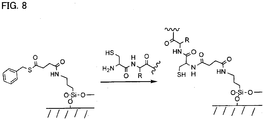
- the most preferable reaction scheme uses native chemical ligation between capture agents with N-terminal cysteines and thioester-derivatised surfaces as shown in Figure 8 .
- Native chemical ligation generates a peptide bond between an N-terminal cysteine on a peptide and a surface-attached thioester.
- a particular advantage of this embodiment of the current invention is that protection of peptide side chains is not required.
- a further particular advantage of this embodiment of the current invention is that the resulting surface-attached peptide has an internal cysteine that may be exploited for the formation of dimeric receptors by disulfide bond formation, or reaction between a thiol and a maleimide functionalised peptide.
- the capture agent is assembled on the substrate surface, a preferred reaction scheme is shown in Figure 10 .
- the first peptide is covalently bound to the functionalised substrate via reaction between a thioester group and an N-terminal cysteine residue via native chemical ligation.
- the multimeric capture agent is produced by formation of disulfide bonds between the peptides.
- a more preferable route for the preparation of thioester surfaces involves the reaction between an aminated surface and thiolane 2,4-diones of the type shown below:
- Thioester surfaces may also be made by derivatising hydroxylated surfaces with thioester silylchloride conjugates of the type shown below.
- the dimer When the capture agent is immobilised to a substrate through a covalent bond, the dimer may be constructed wherein the first and second peptides each have a thiol group (which may or may not be activated) located at a site in the peptide sequence that is on the N-terminal side of the ligand-binding site or on the C-terminal side of the ligand-binding site or located internally within a bipartite ligand-binding site.
- the thiol group moieties may have the same or opposite orientation as the ligand-binding residues and that the location of each thiol group in the first and second peptides is independent.
- the capture agent is immobilised on the substrate by a hydrophobic interaction between the capture agent and the substrate.
- the capture agents fabricated according to the method of the current invention comprise at least two peptide monomer units, the first and second monomer units each comprising at least one hydrophobic moiety, at least one reactive group and at least one ligand-binding moiety.
- the capture agent fabricated according to the method comprises two peptides, the first and second peptides each comprising at least one hydrophobic amino acid residue, at least one reactive group, and at least one ligand-binding moiety, wherein, the at least one hydrophobic amino acid residue and the at least one ligand-binding moiety are positioned in the peptide primary structure so as to result in a hydrophobic face, and a substantially non hydrophobic ligand-binding face.
- the hydrophobic face of the peptides forms the attachment moiety.
- each peptide comprises a plurality of hydrophobic amino acids forming the attachment moiety.
- the .first peptide for use in the method of the current invention comprises 4 to 40 hydrophobic amino acid residues, more preferably 6 to 25 and most preferably 6 to 12.
- the ligand-binding moiety comprises at least one amino acid. More preferably, the ligand-binding moiety comprises a plurality of amino acids.
- amino acids positioned on the ligand-binding face may also include hydrophobic residues, for example, aminobutyrate residues.
- each peptide for use in this embodiment comprises a primary structure comprising alternating hydrophobic and non hydrophobic amino acid residues, as shown in Figure 11 .
- peptide sequences which result in distribution of the side chains so as to result in a hydrophobic and substantially non hydrophobic face can be easily designed, for example, there may be three non hydrophobic amino acid residues between hydrophobic residues, or any combination of odd numbers of amino acids.
- the' peptide may comprise a combination of, for example, L-, D-, and beta- amino acids so as to result in a hydrophobic and a substantially non hydrophobic face.
- each amino acid positioned so as to be located on the ligand-binding face is selected from a set consisting essentially of fewer than 20 amino acids, more preferably fewer than 12 amino acids, even more preferably fewer than 6 amino acids and most preferably 4 amino acids.
- each peptide for use in this embodiment comprises 10% to 90% hydrophobic amino acid residues, more preferably, 20% to 80%, even more preferably, 30% to 70%, and most preferably 40% to 60% hydrophobic amino acid residues.
- the first peptide comprises 50% hydrophobic amino acid residues.
- the hydrophobic amino acids are selected from the group consisting of leucine, isoleucine, norleucine, valine, norvaline, methionine, tyrosine, tryptophan and phenylalanine. More preferably, the hydrophobic amino acids are phenylalanine.
- the capture agent is located on a hydrophobic substrate such that the substantially non hydrophobic ligand-binding face is accessible for ligand-binding.
- the substrate for use in the method may be any suitable hydrophobic substrate, for example, gold modified by hydrophobic organic thiol treatment, glass modified by surface treatment, or plastic.
- the substrate is plastic.
- the substrate may be coated in a hydrophobic compound which allows the capture agents to be immobilised thereon in the presence of a substantially aqueous solvent.
- the second peptide for use in this embodiment of the current invention comprises fewer amino acids than the first peptide, and contains fewer hydrophobic residues such that the interaction between the peptide and the hydrophobic surface is relatively weak.
- first and second peptides and the numbers of hydrophobic amino acid residues required to retain them on the substrate will depend upon the hydrophobicity of the surface and on the hydrophobic amino acids present in the first and second peptides, and also on the nature of the ligand to be bound.
- the amount of peptide retained at the substrate will depend upon the stringency of washing to which the substrate is subjected.
- the substrate is washed with, for example, 1.0 M NaCl in 10 mM tris-HCl (pH 8.0).
- the second peptide comprises 1-6 hydrophobic amino acid residues, more preferably, 2-5, and most preferably 2-4 hydrophobic amino acid residues on the hydrophobic face.
- the ligand-binding residues are positioned on the substantially non hydrophobic ligand-binding face.
- the reactive groups may be located in the primary peptide structure of the first and second peptides at any suitable position, for example, the reactive groups may be positioned in the primary peptide sequence such that they are positioned on the substantially non hydrophobic ligand-binding face of the peptides and located on the N-terminal side of the ligand-binding site.
- the reactive groups may be located in the primary peptide structure of the first and second peptides such that they are positioned on the substantially non hydrophobic ligand-binding face of the peptides, and in the first peptide, on the N-terminal side of the ligand-binding site, and in the second peptide to the C-terminal side of the ligand-binding site.
- the reactive group may be located in the primary peptide structure of the first and second peptides such that in the first peptide, it is positioned on the substantially non hydrophobic ligand-binding face of the peptides and to the N-terminal side of the ligand-binding site, and in the second peptide it is located on the opposite (hydrophobic) face to the ligand-binding site and to the C-terminal side of the ligand-binding site.
- the reactive group on the first peptide is located in the primary amino acid structure on the substantially non hydrophobic ligand-binding face and to the N-terminal side of the ligand-binding site and in the second peptide, in the hydrophobic face and to the N-terminal side of the ligand-binding site as shown in Figure 10 .
- the capture agents are bound to the substrate so as to produce an array.
- the array may take any' convenient form.
- the method of the invention is applicable to all types of "high density" arrays, including single-molecule arrays.
- the array comprises a number of discrete addressable spatially encoded loci.
- each locus on the array comprises a different capture agent, and more preferably each locus comprises multiple copies of the capture agent.
- immobilisation of molecules e.g. peptides
- the terms "immobilised” and “attached” are used interchangeably herein and both terms are intended to encompass hydrophobic interactions, unless indicated otherwise, either explicitly or by context. Generally all that is required is that the molecules (e.g. peptides) remain immobilised or attached to the substrate under the conditions in which it is intended to use the substrate, for example in applications requiring peptide ligand-binding.
- Certain embodiments of the invention may make use of solid supports comprised of an inert substrate or matrix (e.g. glass slides, polymer beads etc) which has been "functionalised", for example by application of a layer or coating of an intermediate material comprising reactive groups which permit hydrophobic attachment of biomolecules such as peptides.
- an inert substrate or matrix e.g. glass slides, polymer beads etc
- an intermediate material comprising reactive groups which permit hydrophobic attachment of biomolecules such as peptides.
- distinct regions on the array comprise multiple peptide molecules.
- each site on the array comprises multiple copies of one individual peptide.
- the first peptide has the structure set out in SEQ ID No 1; (Phe-Gly) n -Phe-Cys-Phe-X-Phe-Y-Phe-Z-Phe-Gly-Phe where X, Y, and Z are the ligand-binding residues and Cys provides a nucleophilic thiol used for dimer formation.
- the second peptide has the preferred structure set out in SEQ ID No 2; CysS(N)P-X'-Phe-Y'-Phe-Z'-Phe where X', Y', and Z' are the ligand-binding residues and CysS(N)P is an activated thiol used for dimer formation (most preferably activated with either a thionitropyridyl group or a thiopyridyl group).
- the capture agents fabricated according to the method of the current invention are dispensed onto a suitable substrate to form an addressable spatially encoded array of combinatorially varying dimers.
- the peptides are individually dispensed on to the substrate using a non-contact dispenser (Piezorray System, Perkin Elmer LAS) and assembled in situ.
- the capture agent is immobilised through a covalent or hydrophobic interaction.
- kits comprising a multimeric capture agent fabricated according to the method described herein and a suitable substrate for immobilisation.
- the kit may comprise first and second monomer units produced for use in the method described herein .
- the kit further comprises a suitable substrate.
- Also described herein is a method of identifying a multimeric capture agent fabricated according to the method which binds to a ligand of interest, said method comprising producing an array of combinatorial capture agents according to any previous aspect, contacting the ligand of interest with the array, and identifying to which capture agent(s) the ligand binds.
- bind is intended to encompass direct or indirect, covalent or non-covalent attachment, unless indicated otherwise, either explicitly or by context.
- covalent attachment may be preferred, but generally all that is required is that the ligands remain bound to the immobilised peptide under the conditions in which it is intended to use the substrate, for example in applications requiring further ligand receptor interactions.
- the binding of the ligand to a capture agent can be identified in various ways known in the art, for example, the ligand or the capture agent may be' labelled so that the location on the array to which the ligand binds can be identified.
- This label may, for example, be a radioactive or fluorescent label using, for example, fluorophores.
- binding of the ligand of interest to a capture agent may be detected by a variety of other techniques known in the art, for example, calorimetry, absorption spectroscopy, NMR methods, atomic force microscopy and scanning tunnelling microscopy, electrophoresis or chromatography, mass spectroscopy, capillary electrophoresis, surface plasmon resonance detection, surface acoustic wave sensing and numerous microcantilever-based approaches.
- the dimeric capture agents arrays produced by the methods of the current invention can be used to identify any analyte of choice, since the specific ligand which will be bound by the capture agent will be dependent upon the length and sequence of the peptides from which the capture agent is formed.
- the ligand comprises a eukaryotic cell, a prokaryotic cell, a virus, a bacteriophage, a prion, a spore, a pollen grain, an allergen, a nucleic acid, a protein, a peptide, a carbohydrate, a lipid, an organic compound, or an inorganic compound.
- the ligands are preferably physiological or pharmacological metabolites and most preferably physiological or pharmacological metabolites in human or animal bodily fluids that may be used as diagnostic or prognostic healthcare markers.
- spacer amino acid refers to an amino acid, a synthetic amino acid, an amino acid analogue or amino acid mimetic in which the side chains play no part in ligand-binding.
- capture agent refers to a dimeric molecule having a structure such that when a ligand is brought into contact with the capture agent it is bound thereto.
- peptide refers to a chain comprising two or more amino acid residues, synthetic amino acids, amino acid analogues or amino acid mimetics, or any combination thereof.
- peptide, oligopeptide and polypeptide are used interchangeably in this specification.
- oligonucleotide and polynucleotide refer to a chain of two or more nucleotides, and are used interchangeably in this specification.
- substantially enantiomerically pure indicates that the residue comprises substantially one type of isomer, with any other isomeric forms being there only as an impurity.
- the term located in space in a manner favourable to ligand-binding indicates that the side chains of the peptides which make up the multimeric capture agent are positioned such that they are able to contact and interact with a ligand.
- substantially non hydrophobic means comprising substantially more hydrophilic residues than hydrophobic residues.
- Figure 1 shows a schematic representation of a method of producing capture' agents
- a first set of monomer units (A) is prepared on a solid phase.
- the monomer units comprise a ligand-binding moiety (R1 - R4) and a reactive group X. If wished X may be protected during synthesis and then deprotected before use.
- a second set of monomer units (B) is prepared on a solid phase.
- These monomer units comprise a ligand-binding moiety (R'1 - R'4), a reactive group Y, which may be protected during synthesis and then deprotected before use, and an attachment moiety Z. If wished Z may also be protected during synthesis and then deprotected before use.
- Each of the monomer units in set (A) is cleaved off the solid support to give monomer units (C) in solution.
- Each of the monomer units in set (B) is cleaved off the solid support to give monomer units (D) in solution.
- Each of the monomer units in set D is then contacted with the surface of a solid support (E) at a spatially encoded location in an array such that Z is used to bring about attachment to the said surface.
- Reactions are then performed wherein surface-bound monomer units (F) from set D are reacted with an excess or equimolar amount of a given solution phase monomer unit (C) such that residue X reacts with residue Y to form a dimeric structure (G) bound to the solid phase.
- the arrayed and spatially encoded dimeric structures (G) can then be used for binding to ligands of interest that will bind with suitable affinity, and selectivity.
- Figure 2 shows a schematic representation of a further method of producing capture agents.
- a first set of monomer units (A) is prepared on a solid phase.
- the monomer units comprise a ligand-binding moiety (R1 - R4) and a reactive group X, which may be protected during synthesis and then deprotected before use.
- a second set of monomer units (B) is also prepared on a solid phase.
- These monomer units comprise a ligand-binding. moiety (R'1 - R'4) and a reactive group Y, which may be protected during synthesis and then deprotected before use, and an attachment moiety Z. If wished Z may also be protected during synthesis and then deprotected before use.
- Each of the monomer units (B) is cleaved off the solid support to give monomer units (C) in solution. Reactions are then performed wherein a given solid phase-bound monomer unit from set (A) is reacted with an excess of a given solution phase monomer unit (C) such that residue X reacts with residue Y to form a dimeric structure (D) bound to the solid phase.
- Each dimeric structure (D) bound to the solid phase is then cleaved off the solid support to give a solution phase dimeric structure (E).
- Each solution phase dimeric structure (E) is finally contacted with a solid surface (F) at a spatially encoded location in an array such that group Z is used to attach the dimeric structure to the said surface.
- the arrayed and spatially encoded dimeric structures (G) can then be used for binding to ligands of interest that will bind with suitable affinity, and selectivity.
- Figure 3 shows a schematic representation of a further method of producing capture agents.
- a first set of monomer units (A) is prepared on a solid phase.
- the monomer units comprise a ligand-binding moiety (R1 - R4) and a reactive group X. If wished X may be protected during synthesis,and then deprotected before use.
- a second set of monomer units (B) is prepared on a solid phase.
- These monomer units comprise a ligand-binding moiety (R'1 - R'4), a reactive group Y, which may be protected during synthesis and then deprotected before use, and an attachment moiety Z. If wished Z may also be protected during synthesis and then deprotected before use.
- Each of the monomer units in set (A) is cleaved off the solid support to give monomer' units (C) in solution.
- Each of the monomer units in set (B) is cleaved off the solid support to give monomer units (D) in solution.
- Each of the monomer units in set D is then contacted with an excess or equimolar amount of a given solution phase monomer unit (C) and the surface of a solid support (E) at a spatially encoded location in an array such that Z is used to bring about attachment to the said surface and such that residue X reacts with residue Y to form a dimeric structure (G) bound to the solid phase.
- the arrayed and spatially encoded dimeric structures (G) can then be used for binding to ligands of interest that will bind with suitable affinity, and selectivity.
- the most significant advantage of the current invention is the 'squaring' (or raising to a higher power) of sequence diversity by the combinatorial joining of pairs (or greater numbers) of monomer units at the array surface.
- residue side chains projecting in front of the plane of the paper represent the combinatorially varied 'ligand-binding face'.
- the residue side chains projecting behind the plane of the paper represent the 'hydrophobic face' (or negative control residues).
- microtitre plate was imaged at 200 ⁇ m resolution on a Typhoon Trio Plus variable mode imager (Amersham Biosciences) with the green (532 nm) laser and the 580 BP 30 filter at the PMT voltages indicated below and at normal sensitivity.
- the scan height was set at +3 mm and the sample was pressed during scanning.
- the peptides were allowed to evaporate to dryness overnight in the dark and the microtitre plate was again scanned as described above.
- the polypropylene sheet was wiped with 50% (v/v) aqueous acetonitrile prior to use.
- the slide was imaged at 10 ⁇ m resolution on a Typhoons Trio Plus variable mode imager (Amersham Biosciences) with the green (532 nm) laser and the 580 BP 30 filter at a PMT voltage of 600 V and at normal sensitivity.
- the scan height was set at the platen and the samples were pressed during scanning.
- the fluorescence image was analysed using ImageQuant TL v2003.03 (Amersham Biosciences).
- the lower half of the slide (containing the test array) was then washed in 100 ml of 1 M NaCl containing 10 mM 'tris-HCl (pH 8.0) for one minute and were re-scanned as described above.
- the peptide samples were allowed to evaporate to dryness in the dark.
- the peptide samples were allowed to evaporate to dryness in the dark.
- the dried peptide samples in wells 1-10 were incubated with 250 ⁇ l of 1 M NaCl in 10 mM tris-HCl (pH 8.0) for the time indicated below at room temperature. All supernatants were pipetted up and down 8 times after incubation and the supernatants were then removed and placed in the wells of the bottom row of the microtitre plate.
- the residual surface-bound peptides in all twelve wells were finally resuspended in 50 ⁇ l of 10 mM, tris-HCl (pH 8.0) in 50% (v/v) aqueous acetonitrile and the microtitre plates were imaged at 200 ⁇ m resolution on a Typhoon Trio Plus variable mode imager (Amersham Biosciences) with the green (532 nm) laser and the 580 BP 30 filter at the PMT voltages indicated below and at normal sensitivity. The scan height was set at +3 mm and the sample was pressed during scanning.
- the peptide samples were allowed to evaporate to dryness in the dark.
- peptide samples in the top two rows of the microtitre plates were then incubated for 15 minutes at room temperature in 250 ⁇ l of 1 M NaCl in 10 mM tris-HCl (pH 8.0). After incubation, the wash buffer was pipetted up and down eight times in the well before removing the supernatant.
- microtitre plates were imaged at 200 ⁇ m resolution on a Typhoon Trio Plus variable mode imager (Amersham Biosciences) with the green (532 nm) laser and the 580 BP 30 filter at the PMT voltages indicated below and at normal sensitivity.
- the scan height was set at the platen and the sample was pressed during, canning.
- the peptide samples were allowed to evaporate to dryness in the dark.
- peptide samples in the top two rows of the microtitre plates were then incubated for 15 minutes at room temperature in 250 ⁇ l of 1 M NaCl in 10 mM tris-HCl (pH 8.0). After incubation, the wash buffer was pipetted up and down eight times in the well before removing the supernatant.
- microtitre plates were imaged at 200 ⁇ m resolution on a Typhoon Trio Plus variable mode imager (Amersham Biosciences) with the green (532 nm) laser and the 580 BP 30 filter at the PMT voltages indicated below and at normal sensitivity.
- the scan height was set at +3 mm and the sample was pressed during scanning.
- peptides were synthesised that contain a 'surface-binding face' consisting of seven phenylalanyl residues. These peptides also contain a central region consisting of charged and uncharged residues and a variable penultimate residue.
- the variable penultimate residue was alanyl, seryl, cysteiyl, or nitropyridylthio activated cysteiyl.
- TAMRA-labelled fluorescent peptides were also synthesised that contain an N-terminal TAMRA fluorophore attached to a glycyl residue that is attached to a variable C-terminal residue.
- the variable C-terminal residue was alanyl, seryl, cysteiyl, or nitropyridylthio activated cysteiyl.
- the peptides SB-1 to SB-4 and TLSP-1 to TLSP-4 were used in order to investigate dimer formation.
- the SB peptides were mixed with the TLSP peptides and both were then dried down together onto a polypropylene surface prior to washing the wells and assaying for retained fluorescent material.
- the microtitre plate was imaged at 200 ⁇ m resolution on a Typhoon Trio Plus variable mode imager (Amersham Biosciences) with the green (532 nm) laser and the 580 BP 30 filter at a PMT voltage of 500 V and at normal sensitivity.
- the scan height was set at +3 mm and the sample was pressed during scanning.
- the fluorescence image was analysed using ImageQuant TL v2003.03 (Amersham Biosciences).
- the microtitre plate was imaged at 200 ⁇ m resolution on a Typhoon Trio Plus variable mode imager (Amersham Biosciences) with the green (532 nm) laser and the 580 BP 30 filter at a PMT voltage of 500 V and at normal sensitivity.
- the scan height was set at +3 mm and the sample was pressed during scanning.
- the fluorescence image was analysed using ImageQuant TL v2003.03 (Amersham Biosciences).
- the yield of dimer is assayed by the retention of fluorescently labelled peptide which is conditional upon the presence of an unlabelled peptide that can bind to both the polypropylene surface and to the fluorescently labelled peptide.
- Dimer formation is also observed when the surface peptide possesses an S-nitropyridyl activated thiol group and the solution peptide also possesses an S-nitropyridyl activated thiol group; when the surface peptide possesses a free thiol group and the solution peptide also possesses a free thiol group; and when the surface peptide possesses an S-nitropyridyl activated thiol group and the solution peptide possesses a free thiol group.
- Free thiol coupling to free thiols may be due to simple aerobic oxidation, forming disulfide bonds.
- S-nitropyridyl activated thiol coupling to S-nitropyridyl activated thiols may be a result of incomplete thiol activation, leaving some free thiols able to 'react with the remaining S-nitropyridyl activated thiols, or some other mechanism.
- peptide dimers are fabricated on a planar plastic surface using a Piezorray (PerkinElmer LAS) non-contact dispenser.
- the Piezorray (PerkinElmer LAS) is specifically designed for pipetting nanolitre volumes to dense arrays. Liquid volumes are controlled by a piezoelectric tip.
- the Piezorray system contains a source plate holder, an ultrasonic washbowl, a computer and monitor, and a bottle for system liquid.
- Polypropylene sheet was obtained from SBA plastics (http://www.sba.co.uk/, Propylex Natural Polypropylene Sheet 2440 x 1220 x 1 mm) and was wiped with 50% (v/v) aqueous acetonitrile prior to use.
- the microtitre plate was imaged at 10 ⁇ m resolution on a Typhoon Trio Plus variable mode imager (Amersham Biosciences) with the green (532 nm) laser and the 580 BP 30 filter at a PMT voltage of 400 V and at normal sensitivity.
- the scan height was set at the platen and the sample was pressed during scanning.
- the fluorescence image was analysed using ImageQuant TL v2003.03 (Amersham Biosciences).
- the yield of dimer is assayed by the retention of fluorescently labelled peptide that is conditional upon the pretence of an unlabelled peptide that can bind to both the polypropylene surface and to the' fluorescently labelled peptide.
- Dimer formation is therefore seen when the surface peptide possesses a free thiol group and the solution peptide possesses an S-nitropyridyl activated thiol group.
- the simple protocol (without glycerol to prevent evaporation) gives a higher yield of dimer.
- the slide was imaged at 10 ⁇ m resolution on a Typhoon Trio Plus variable mode imager (Amersham Biosciences) with the green (532 nm) laser and the 580 BP 30 filter at a PMT voltage of 500V and at normal sensitivity.
- the scan height was set at the platen.
- the fluorescence image was analysed using ImageQuant TL v2003.03 (Amersham Biosciences).
- Fluorescent signal is observable for each L1-P1. peptide column dispensed to the array. This indicates that each of the L1-P1 peptides has been successfully dispensed, and is capable of dimer formation. The fluorescent signal is also observable for each L1-P2 peptide row dispensed to the array. This indicates that each of the L1-P2 peptides has been successfully dispensed, and is capable of dimer formation.
- the dimer fluorescence is greater for the samples with only TAMRA-labelled P2 peptides compared to the dimer fluorescence for the 16x16 array fabricated with both unlabelled P2 peptides and TAMRA-labelled P2 peptides competing for the L1-P1 peptide thiol groups. This indicates that all of the L1-P2 peptides have successfully competed with their TAMRA-labelled counterparts and have therefore successfully formed peptide dimers between all sixteen L1-P1 peptides and all sixteen L1-P2 peptides.
Landscapes
- Life Sciences & Earth Sciences (AREA)
- Health & Medical Sciences (AREA)
- Chemical & Material Sciences (AREA)
- Molecular Biology (AREA)
- Engineering & Computer Science (AREA)
- Biochemistry (AREA)
- Organic Chemistry (AREA)
- Immunology (AREA)
- General Health & Medical Sciences (AREA)
- Proteomics, Peptides & Aminoacids (AREA)
- Biomedical Technology (AREA)
- Medicinal Chemistry (AREA)
- Urology & Nephrology (AREA)
- Hematology (AREA)
- Biophysics (AREA)
- Physics & Mathematics (AREA)
- Analytical Chemistry (AREA)
- Biotechnology (AREA)
- Microbiology (AREA)
- Genetics & Genomics (AREA)
- Pathology (AREA)
- Food Science & Technology (AREA)
- General Physics & Mathematics (AREA)
- Cell Biology (AREA)
- Bioinformatics & Cheminformatics (AREA)
- Wood Science & Technology (AREA)
- Zoology (AREA)
- Bioinformatics & Computational Biology (AREA)
- General Engineering & Computer Science (AREA)
- Peptides Or Proteins (AREA)
Claims (14)
- Verfahren zum Herstellen einer Menge dimerer Peptid-Einfangwirkstoffe, wobei jeder der Einfangwirkstoffe einen Liganden binden kann und erste und zweite Peptidraonomer-Einheiten enthält, die jeweils einen Ligandenbindungsanteil enthalten, und wobei die ersten und zweiten Peptidmonomer-Einheiten kovalent gebunden sind, um ein Dimer zu bilden, wobei das Verfahren die folgenden Schritte enthält:a) Synthetisieren auf kombinatorische Weise aus einer ersten und einer zweiten Menge von Aminosäuren, wobei jede Ammosäurenmenge unterschiedlich ist, erster und zweiter Peptidmonomer-Einheiten, wobei jede Peptidmonomer-Einheit eine andere primäre Aminosäurmsequenz besitzt, wobei jede erste Peptidmonomer-Einheit eine erste reaktive Gruppe und einen Anlagerungsanteil, der hydrophobe oder kovalente Mittel zum Immobilisieren des dimeren Einfangwirkstoffs auf einem Substrat aufweist, enthält und jede zweite Peptidmonoiner-Einheit eine zweite reaktive Gruppe enthält; undb) Reagierenlassen der ersten Peptidmonomer-Einheiten mit den zwei,-ten Peptidmonomer-Einheiten, so dass die erste und die zweite reaktive Gruppe reagieren, um eine kovalente Bindung zu bilden, wodurch eine kombinatorisch variierte Menge dimerer Peptid-Einfangwirkstoffe gebildet wird, wobei die kombinatorische Synthese an einer festen Phase ausgeführt wird und wobei vor dem Schritt (b) die ersten und zweiten Peptidmonomer-Einheiten von der festen Phase abgespalten werden.
- Verfahren nach Anspruch 1, wobei die reaktiven Gruppen Thiol-Gruppen sind.
- Verfahren nach Anspruch 1, das den weiteren Schritt (c) des Immobilisierens der Menge dimerer Peptid-Einfangwirkstoffe auf einem Substrat mittels des Anlagerungsanteils enthält,
wobei der Schritt (b) vor, gleichzeitig mit oder nach dem Schritt (c) ausgeführt wird. - Verfahren nach Anspruch 1, wobei die ersten und zweiten Peptidmonomer-Einheiten jeweils Aminosäuren in einer Anzahl im Bereich von 2 bis 50 enthalten.
- Verfahren nach Anspruch 1 oder Anspruch 2, wobei die ersten und zweiten Peptide Aminosäuren für eine Ligandenbindung enthalten, die aus Aminosäuren mit Seitenketten, die eine positive Ladung für die Ligandenbindung schaffen, aus Aminosäuren, die eine Hydroxylgruppe bereitstellen, die als ein Wasserstoffbindungs-Donor und/oder als ein Wazserstoffbindurigs-Akzeptor für die Ligandenbindung wirken kann, aus Aminosäuren, die einen hydrophoben Anteil für die Ligandenbindung schaffen, und aus Aminosäuren, die eine negative Ladung für die Ligandenbindung schaffen, ausgewählt werden.
- Verfahren nach Anspruch 3, das das kovalente Binden der Einfangwirkstoffe an das Substrat enthält.
- Verfahren nach Anspruch 6, das das Anlagern von Einfangwixkstoffen an dem Substrat durch eine native chemische Ligation zwischen Thioester-derivatisierten Einfangwirkstoffen und Cystein-derivatisierten Oberflächen enthält.
- Verfahren nach Anspruch 6, das das Anlagern der Einfangwirkstoffe an dem Substrat durch native chemische Ligation zwischen Einfangwirkstoffen mit N-Abschlusscysteinen und Thioester-derivatisierten Oberflächen enthält.
- Verfahren nach Anspruch 3, das das Immobilisieren des Einfangwirkstoffs auf dem Substrat durch hydrophobe Wechselwirkung enthält.
- Verfahren nach einem der Ansprüche 1, 2 oder 9, wobei der Anlagerungsanteil durch jedes Peptid, das mehrere hydrophobe Aminosäuren enthält, gebildet wird.
- Verfahren nach Anspruch 10, wobei das erste Peptid eine primäre Struktur enthält, die abwechselnde hydrophobe und nicht hydrophobe Aminosäurenreste enthält.
- Verfahren nach einem der Ansprüche 9 bis 11, das das Auszählen der hydrophoben Aminosäuren aus der Gruppe, die aus Leucin, Isoleucin, Norleucin, Valin, Normalin, Methionin, Tyrosin, Tryptophan und Phenylalanin besteht, enthält.
- Verfahren nach einem der Ansprüche 9 bis 12, wobei das erste Peptid die Sequenz besitzt, die in SEQ ID Nr. 1 angegeben ist.
- Verfahren nach einem der Ansprüche 9 bis 13, wobei das zweite Peptid die Sequenz besitzt, die in SEQ ID Nr. 2 angegeben ist.
Applications Claiming Priority (2)
| Application Number | Priority Date | Filing Date | Title |
|---|---|---|---|
| GB0525918A GB2433506A (en) | 2005-12-20 | 2005-12-20 | A method of producing a multimeric capture agent |
| PCT/JP2006/325698 WO2007072976A1 (en) | 2005-12-20 | 2006-12-19 | A method of producing a multimeric capture agent for binding a ligand |
Publications (3)
| Publication Number | Publication Date |
|---|---|
| EP1969371A1 EP1969371A1 (de) | 2008-09-17 |
| EP1969371A4 EP1969371A4 (de) | 2009-04-22 |
| EP1969371B1 true EP1969371B1 (de) | 2012-05-16 |
Family
ID=35840795
Family Applications (1)
| Application Number | Title | Priority Date | Filing Date |
|---|---|---|---|
| EP06843125A Not-in-force EP1969371B1 (de) | 2005-12-20 | 2006-12-19 | Verfahren zur herstellung eines multimeren einfangmittels zur bindung eines liganden |
Country Status (6)
| Country | Link |
|---|---|
| US (1) | US20090192048A1 (de) |
| EP (1) | EP1969371B1 (de) |
| JP (1) | JP4750187B2 (de) |
| CN (1) | CN101331400B (de) |
| GB (1) | GB2433506A (de) |
| WO (1) | WO2007072976A1 (de) |
Families Citing this family (5)
| Publication number | Priority date | Publication date | Assignee | Title |
|---|---|---|---|---|
| GB2433591A (en) * | 2005-12-20 | 2007-06-27 | Sharp Kk | Method for functionalising a hydrophobic substrate |
| GB2433505A (en) * | 2005-12-20 | 2007-06-27 | Sharp Kk | Capture agents for binding a ligand |
| EP2310855B1 (de) | 2008-06-18 | 2015-01-28 | California Institute of Technology | Multi-liganden einfangmittel, sowie damit verbundene zusammensetzungen, methoden und systeme |
| CN107759799B (zh) * | 2017-09-21 | 2020-10-23 | 中山大学 | 一种三联吡啶钌-赖氨酸聚合物固相合成方法 |
| GB201917630D0 (en) * | 2019-12-03 | 2020-01-15 | Ge Healthcare Bio Sciences Ab | Method for determination of aggregates |
Family Cites Families (50)
| Publication number | Priority date | Publication date | Assignee | Title |
|---|---|---|---|---|
| US5200526A (en) * | 1987-04-27 | 1993-04-06 | The Governors Of The University Of Alberta | Syntheses of optically pure α-amino acids from 3-amino-2-oxetanone salts |
| JPH0753108B2 (ja) * | 1988-09-16 | 1995-06-07 | 松下電器産業株式会社 | タンパク質固定化法 |
| US5120829A (en) * | 1989-03-20 | 1992-06-09 | La Jolla Cancer Research Foundation | Hydrophobic attachment site for adhesion peptides |
| CA1337639C (en) * | 1989-08-01 | 1995-11-28 | Joseph Eugene Celebuski | Dna probe assay using neutrally charged probe strands |
| US5650489A (en) * | 1990-07-02 | 1997-07-22 | The Arizona Board Of Regents | Random bio-oligomer library, a method of synthesis thereof, and a method of use thereof |
| WO1993016176A1 (en) * | 1992-02-13 | 1993-08-19 | Bio-Metric Systems, Inc. | Immobilization of chemical species in crosslinked matrices |
| JP3329868B2 (ja) * | 1992-09-30 | 2002-09-30 | 株式会社クラレ | ペプチドおよびこれを担体上に固定化してなる吸着剤 |
| US5491074A (en) * | 1993-04-01 | 1996-02-13 | Affymax Technologies Nv | Association peptides |
| EP0736103A4 (de) * | 1993-12-17 | 1999-07-28 | Roger S Cubicciotti | Auf nukleotide gerichtete zusammenstellung von bimolekularen und multimolekularen medikamenten vorrichtungen |
| DE69508382D1 (de) * | 1994-01-19 | 1999-04-22 | Us Health | Peptomere mit erhöhter immunogenizität |
| US5738996A (en) * | 1994-06-15 | 1998-04-14 | Pence, Inc. | Combinational library composition and method |
| US5824483A (en) * | 1994-05-18 | 1998-10-20 | Pence Inc. | Conformationally-restricted combinatiorial library composition and method |
| US5549748A (en) * | 1995-01-12 | 1996-08-27 | University Of Chicago | Method for harvesting single crystals from a peritectic melt |
| US5780221A (en) * | 1995-05-03 | 1998-07-14 | Whitehead Institute For Biomedical Research | Identification of enantiomeric ligands |
| US6083708A (en) * | 1995-08-11 | 2000-07-04 | Dade Behring Inc. | Polypeptide: dendrimer complexes |
| WO1997041425A1 (en) * | 1996-04-25 | 1997-11-06 | Pence, Inc. | Biosensor device and method |
| US6107080A (en) * | 1996-04-25 | 2000-08-22 | Mcgill University | Biosensor device and method |
| US6165335A (en) * | 1996-04-25 | 2000-12-26 | Pence And Mcgill University | Biosensor device and method |
| US5955379A (en) * | 1996-04-25 | 1999-09-21 | Mcgill University | Biosensor device and method |
| US6130037A (en) * | 1996-04-25 | 2000-10-10 | Pence And Mcgill University | Biosensor device and method |
| US6709814B1 (en) * | 1998-04-02 | 2004-03-23 | Rigel Pharmaceuticals, Inc. | Peptides causing formation of compact structures |
| US7115396B2 (en) * | 1998-12-10 | 2006-10-03 | Compound Therapeutics, Inc. | Protein scaffolds for antibody mimics and other binding proteins |
| US6787368B1 (en) * | 1999-03-02 | 2004-09-07 | Helix Biopharma Corporation | Biosensor method for detecting analytes in a liquid |
| EP1207897A2 (de) * | 1999-08-09 | 2002-05-29 | Tripep Ab | Tripeptid enthaltende pharmazeutische zusammensetzung |
| US6994964B1 (en) * | 1999-09-01 | 2006-02-07 | Affymetrix, Inc. | Macromolecular arrays on polymeric brushes and methods for preparing the same |
| US7429466B2 (en) * | 2000-01-24 | 2008-09-30 | Hypromatrix, Inc | Methods and arrays for detecting biological molecules |
| US8143195B2 (en) * | 2000-01-24 | 2012-03-27 | Yingjian Wang | Arrays for bringing two or more reagents in contact with one or more biological targets and methods for making and using the arrays |
| US6827579B2 (en) * | 2000-11-16 | 2004-12-07 | Rutgers, The State University Of Nj | Method and apparatus for rehabilitation of neuromotor disorders |
| AU2002253934A1 (en) * | 2001-02-09 | 2002-08-28 | Massachusetts Institute Of Technology | Peptides that inhibit poly-glutamine aggregation |
| CA2439750A1 (en) * | 2001-03-09 | 2002-09-19 | Boston Probes, Inc. | Methods, kits and compositions pertaining to combination oligomers and libraries for their preparation |
| US20050089932A1 (en) * | 2001-04-26 | 2005-04-28 | Avidia Research Institute | Novel proteins with targeted binding |
| US20050048512A1 (en) * | 2001-04-26 | 2005-03-03 | Avidia Research Institute | Combinatorial libraries of monomer domains |
| US20040175756A1 (en) * | 2001-04-26 | 2004-09-09 | Avidia Research Institute | Methods for using combinatorial libraries of monomer domains |
| US20050053973A1 (en) * | 2001-04-26 | 2005-03-10 | Avidia Research Institute | Novel proteins with targeted binding |
| CA2444854A1 (en) * | 2001-04-26 | 2002-11-07 | Avidia Research Institute | Combinatorial libraries of monomer domains |
| US20060223114A1 (en) * | 2001-04-26 | 2006-10-05 | Avidia Research Institute | Protein scaffolds and uses thereof |
| US20030157561A1 (en) * | 2001-11-19 | 2003-08-21 | Kolkman Joost A. | Combinatorial libraries of monomer domains |
| US6833441B2 (en) * | 2001-08-01 | 2004-12-21 | Abmaxis, Inc. | Compositions and methods for generating chimeric heteromultimers |
| WO2003018797A2 (en) * | 2001-08-22 | 2003-03-06 | Helix Biopharma Corporation | Method and device for integrated protein expression, purification and detection |
| JP2005504309A (ja) * | 2001-10-01 | 2005-02-10 | ワン,インジアン | 生体分子を検出する方法およびアレイ |
| AU2002364207A1 (en) * | 2001-12-21 | 2003-07-30 | Applera Corporation | Heteroconfigurational polynucleotide and methods of use |
| JP2003284552A (ja) * | 2002-03-28 | 2003-10-07 | Hitachi Software Eng Co Ltd | イオン性高分子同定用高分子チップ及びイオン性高分子の同定方法 |
| US20040014946A1 (en) * | 2002-04-25 | 2004-01-22 | Heman Chao | Protein interaction method and composition |
| US20040043508A1 (en) * | 2002-09-03 | 2004-03-04 | Frutos Anthony G. | Polymer-coated substrates for binding biological molecules |
| JP4486893B2 (ja) * | 2002-12-22 | 2010-06-23 | ザ スクリップス リサーチ インスティテュート | タンパク質アレイ |
| US20060292438A1 (en) * | 2002-12-23 | 2006-12-28 | Applera Corporation; Applied Biosystems Group | Heteroconfigurational Polynucleotides and Methods of Use |
| JP5057781B2 (ja) * | 2003-06-25 | 2012-10-24 | マサチューセッツ インスティテュート オブ テクノロジー | 修飾を組み込んだ自己集合ペプチドおよびそれを使用する方法 |
| EP1675878A2 (de) * | 2003-10-24 | 2006-07-05 | Avidia, Inc. | Ldl-rezeptor-klasse-a- und egf-domänen-monomere und multimere |
| US20060008844A1 (en) * | 2004-06-17 | 2006-01-12 | Avidia Research Institute | c-Met kinase binding proteins |
| GB2433505A (en) * | 2005-12-20 | 2007-06-27 | Sharp Kk | Capture agents for binding a ligand |
-
2005
- 2005-12-20 GB GB0525918A patent/GB2433506A/en not_active Withdrawn
-
2006
- 2006-12-19 WO PCT/JP2006/325698 patent/WO2007072976A1/en not_active Ceased
- 2006-12-19 EP EP06843125A patent/EP1969371B1/de not_active Not-in-force
- 2006-12-19 US US12/097,791 patent/US20090192048A1/en not_active Abandoned
- 2006-12-19 CN CN200680047001.5A patent/CN101331400B/zh not_active Expired - Fee Related
- 2006-12-19 JP JP2008529069A patent/JP4750187B2/ja not_active Expired - Fee Related
Non-Patent Citations (3)
| Title |
|---|
| CHERONIS J C ET AL: "A new class of bradykinin antagonists: synthesis and in vitro activity of bissuccinimidoalkane peptide dimers", JOURNAL OF MEDICINAL CHEMISTRY, AMERICAN CHEMICAL SOCIETY, US, vol. 35, no. 9, 1 May 1992 (1992-05-01), pages 1563 - 1572, XP002246182, ISSN: 0022-2623, DOI: 10.1021/JM00087A010 * |
| KAZUNORI MATSUURA ET AL: "Artificial Peptide-Nanospheres Self-Assembled from Three-Way Junctions of alpha-Sheet-Forming Peptides", JOURNAL OF THE AMERICAN CHEMICAL SOCIETY, AMERICAN CHEMICAL SOCIETY, US, vol. 127, 1 January 2005 (2005-01-01), pages 10148 - 10149, XP007916431, ISSN: 0002-7863, [retrieved on 20050630], DOI: 10.1021/JA052644I * |
| ZHULI WAN ET AL: "Enhancing the Activity of Insulin at the Receptor Interface: Crystal Structure and Photo-Cross-Linking of A8 Analogues", BIOCHEMISTRY, AMERICAN CHEMICAL SOCIETY, US, vol. 43, no. 51, 1 January 2004 (2004-01-01), pages 16119 - 16133, XP007914939, ISSN: 0006-2960, [retrieved on 20041125], DOI: 10.1021/BI048223F * |
Also Published As
| Publication number | Publication date |
|---|---|
| WO2007072976A1 (en) | 2007-06-28 |
| EP1969371A1 (de) | 2008-09-17 |
| GB2433506A (en) | 2007-06-27 |
| JP2009519433A (ja) | 2009-05-14 |
| CN101331400B (zh) | 2012-09-26 |
| EP1969371A4 (de) | 2009-04-22 |
| GB0525918D0 (en) | 2006-02-01 |
| JP4750187B2 (ja) | 2011-08-17 |
| CN101331400A (zh) | 2008-12-24 |
| US20090192048A1 (en) | 2009-07-30 |
Similar Documents
| Publication | Publication Date | Title |
|---|---|---|
| US8163567B2 (en) | Methods and compositions comprising capture agents | |
| US5541061A (en) | Methods for screening factorial chemical libraries | |
| ES2321477T3 (es) | Sintesis de segmentos. | |
| EP1969371B1 (de) | Verfahren zur herstellung eines multimeren einfangmittels zur bindung eines liganden | |
| EP1969369B1 (de) | Neue einfangmittel zur bindung eines liganden | |
| US20090312192A1 (en) | Method for functionalising a hydrophobic substrate | |
| Hoff et al. | Chemolabile cellular microarrays for screening small molecules and peptides | |
| US20220243360A1 (en) | Peptide libraries having enhanced subsequence diversity and methods for use thereof | |
| US10641778B2 (en) | System and method for analysis of peptide synthesis fidelity | |
| AU2016251501A1 (en) | Specific peptide binders to proteins identified via systemic discovery, maturation and extension process | |
| US20070141724A1 (en) | Solid phase immobilized trifunctional linker |
Legal Events
| Date | Code | Title | Description |
|---|---|---|---|
| PUAI | Public reference made under article 153(3) epc to a published international application that has entered the european phase |
Free format text: ORIGINAL CODE: 0009012 |
|
| 17P | Request for examination filed |
Effective date: 20080716 |
|
| AK | Designated contracting states |
Kind code of ref document: A1 Designated state(s): DE FR GB |
|
| DAX | Request for extension of the european patent (deleted) | ||
| RBV | Designated contracting states (corrected) |
Designated state(s): DE FR GB |
|
| A4 | Supplementary search report drawn up and despatched |
Effective date: 20090323 |
|
| 17Q | First examination report despatched |
Effective date: 20091023 |
|
| REG | Reference to a national code |
Ref country code: DE Ref legal event code: R079 Ref document number: 602006029585 Country of ref document: DE Free format text: PREVIOUS MAIN CLASS: G01N0033530000 Ipc: G01N0033543000 |
|
| RIC1 | Information provided on ipc code assigned before grant |
Ipc: G01N 33/68 20060101ALI20111004BHEP Ipc: G01N 33/543 20060101AFI20111004BHEP |
|
| GRAJ | Information related to disapproval of communication of intention to grant by the applicant or resumption of examination proceedings by the epo deleted |
Free format text: ORIGINAL CODE: EPIDOSDIGR1 |
|
| GRAP | Despatch of communication of intention to grant a patent |
Free format text: ORIGINAL CODE: EPIDOSNIGR1 |
|
| GRAP | Despatch of communication of intention to grant a patent |
Free format text: ORIGINAL CODE: EPIDOSNIGR1 |
|
| GRAS | Grant fee paid |
Free format text: ORIGINAL CODE: EPIDOSNIGR3 |
|
| GRAA | (expected) grant |
Free format text: ORIGINAL CODE: 0009210 |
|
| AK | Designated contracting states |
Kind code of ref document: B1 Designated state(s): DE FR GB |
|
| REG | Reference to a national code |
Ref country code: GB Ref legal event code: FG4D |
|
| REG | Reference to a national code |
Ref country code: DE Ref legal event code: R096 Ref document number: 602006029585 Country of ref document: DE Effective date: 20120712 |
|
| PLBE | No opposition filed within time limit |
Free format text: ORIGINAL CODE: 0009261 |
|
| STAA | Information on the status of an ep patent application or granted ep patent |
Free format text: STATUS: NO OPPOSITION FILED WITHIN TIME LIMIT |
|
| 26N | No opposition filed |
Effective date: 20130219 |
|
| REG | Reference to a national code |
Ref country code: DE Ref legal event code: R097 Ref document number: 602006029585 Country of ref document: DE Effective date: 20130219 |
|
| PGFP | Annual fee paid to national office [announced via postgrant information from national office to epo] |
Ref country code: DE Payment date: 20131220 Year of fee payment: 8 Ref country code: GB Payment date: 20131218 Year of fee payment: 8 |
|
| PGFP | Annual fee paid to national office [announced via postgrant information from national office to epo] |
Ref country code: FR Payment date: 20131212 Year of fee payment: 8 |
|
| REG | Reference to a national code |
Ref country code: DE Ref legal event code: R119 Ref document number: 602006029585 Country of ref document: DE |
|
| GBPC | Gb: european patent ceased through non-payment of renewal fee |
Effective date: 20141219 |
|
| REG | Reference to a national code |
Ref country code: FR Ref legal event code: ST Effective date: 20150831 |
|
| PG25 | Lapsed in a contracting state [announced via postgrant information from national office to epo] |
Ref country code: DE Free format text: LAPSE BECAUSE OF NON-PAYMENT OF DUE FEES Effective date: 20150701 Ref country code: GB Free format text: LAPSE BECAUSE OF NON-PAYMENT OF DUE FEES Effective date: 20141219 |
|
| PG25 | Lapsed in a contracting state [announced via postgrant information from national office to epo] |
Ref country code: FR Free format text: LAPSE BECAUSE OF NON-PAYMENT OF DUE FEES Effective date: 20141231 |