EP1959124A2 - Vorrichtung zur Steuerung der Düsenschubrichtung eines Raketentriebwerks - Google Patents
Vorrichtung zur Steuerung der Düsenschubrichtung eines Raketentriebwerks Download PDFInfo
- Publication number
- EP1959124A2 EP1959124A2 EP07021964A EP07021964A EP1959124A2 EP 1959124 A2 EP1959124 A2 EP 1959124A2 EP 07021964 A EP07021964 A EP 07021964A EP 07021964 A EP07021964 A EP 07021964A EP 1959124 A2 EP1959124 A2 EP 1959124A2
- Authority
- EP
- European Patent Office
- Prior art keywords
- control surfaces
- control
- nozzle
- segments
- swirl
- Prior art date
- Legal status (The legal status is an assumption and is not a legal conclusion. Google has not performed a legal analysis and makes no representation as to the accuracy of the status listed.)
- Granted
Links
Images


Classifications
-
- F—MECHANICAL ENGINEERING; LIGHTING; HEATING; WEAPONS; BLASTING
- F02—COMBUSTION ENGINES; HOT-GAS OR COMBUSTION-PRODUCT ENGINE PLANTS
- F02K—JET-PROPULSION PLANTS
- F02K9/00—Rocket-engine plants, i.e. plants carrying both fuel and oxidant therefor; Control thereof
- F02K9/80—Rocket-engine plants, i.e. plants carrying both fuel and oxidant therefor; Control thereof characterised by thrust or thrust vector control
- F02K9/90—Rocket-engine plants, i.e. plants carrying both fuel and oxidant therefor; Control thereof characterised by thrust or thrust vector control using deflectors
-
- B—PERFORMING OPERATIONS; TRANSPORTING
- B64—AIRCRAFT; AVIATION; COSMONAUTICS
- B64C—AEROPLANES; HELICOPTERS
- B64C15/00—Attitude, flight direction, or altitude control by jet reaction
- B64C15/02—Attitude, flight direction, or altitude control by jet reaction the jets being propulsion jets
-
- F—MECHANICAL ENGINEERING; LIGHTING; HEATING; WEAPONS; BLASTING
- F42—AMMUNITION; BLASTING
- F42B—EXPLOSIVE CHARGES, e.g. FOR BLASTING, FIREWORKS, AMMUNITION
- F42B10/00—Means for influencing, e.g. improving, the aerodynamic properties of projectiles or missiles; Arrangements on projectiles or missiles for stabilising, steering, range-reducing, range-increasing or fall-retarding
- F42B10/60—Steering arrangements
- F42B10/66—Steering by varying intensity or direction of thrust
- F42B10/665—Steering by varying intensity or direction of thrust characterised by using a nozzle provided with at least a deflector mounted within the nozzle
-
- F—MECHANICAL ENGINEERING; LIGHTING; HEATING; WEAPONS; BLASTING
- F05—INDEXING SCHEMES RELATING TO ENGINES OR PUMPS IN VARIOUS SUBCLASSES OF CLASSES F01-F04
- F05D—INDEXING SCHEME FOR ASPECTS RELATING TO NON-POSITIVE-DISPLACEMENT MACHINES OR ENGINES, GAS-TURBINES OR JET-PROPULSION PLANTS
- F05D2250/00—Geometry
- F05D2250/30—Arrangement of components
- F05D2250/32—Arrangement of components according to their shape
- F05D2250/324—Arrangement of components according to their shape divergent
Definitions
- the invention relates to a device for controlling the thrust direction of the nozzle of the rocket engine of a missile.
- thrusters In order to influence the thrust direction of a supersonic jet, it is known to use thrusters, swiveling nozzles, jet spoilers which can be swiveled into the exhaust jet, gas or liquid jets emerging from the inner wall of the divergent section of the nozzle, and a plurality of engines which have blow-out or asymmetrical nozzles in different directions, their shear thrust components neutralize each other, so that there is a resulting shear thrust by switching off or throttling individual engines.
- the object of the invention is to provide a device for controlling the thrust direction of a supersonic nozzle, which works largely lossless and even with an extremely hot, dense and particle-laden exhaust jet has a long service life.
- control surfaces are provided for controlling the thrust direction of a rocket thrust nozzle, which are movable into the exhaust gas jet in the nozzle.
- control surfaces may be designed to be displaceable, for example by storage in a backdrop. Preferably, however, they are hinged to the nozzle about a transverse pivot axis extending in the transverse direction.
- the number of control surfaces can be three or more.
- the Einschwenkwinkel the control surfaces and optionally the combination of several pivoted control surfaces define the thrust vector to be reached.
- the control surfaces are preferably part of the divergent section of the nozzle. That is, they are formed by pivotable segments of the divergent nozzle section. If the thrust vector control is not used, the segments are in the rest position, i. H. they were aligned with the divergent mantle of the nozzle. In the rest position, the nozzle works lossless, so without affecting their efficiency.
- the remaining part of the divergent nozzle section is preferably formed by webs between the pivotable segments.
- the webs are designed analogously to the neutral nozzle geometry.
- electromechanical actuators may be provided for pivoting the control surfaces.
- the pivot axis is preferably provided in the region of the front edges of the control surfaces.
- This gap can also be further sealed, for example, by a front edge of the control surface which engages over the opposite edge of the nozzle.
- the gaps on the longitudinal edges of the pivoted-in control surfaces can be sealed, for example, by sealing faces which are approximately perpendicular to the outside from both longitudinal edges of each control surface. In general, however, these longitudinal gaps can remain open, provided in the vicinity of the nozzle no temperature-sensitive parts, such as cables, are provided, which can be damaged by exiting through the longitudinal gaps exhaust gas.
- the control surfaces preferably have a protective layer protecting their supporting structure from the hot exhaust jet, which covers the inside of the supporting structure and the edge region of the control surfaces.
- the protective layer preferably consists of a consumable, abladierenden heat insulation, but can also by a non-consuming, thermal insulation, for. B. be formed on silicon carbide basis.
- other parts in particular force-bearing parts, such as joints, may be provided with such a protective layer.
- swirl-producing surfaces may be provided on the nozzle.
- a pair of opposing swirl-producing surfaces is preferably provided for each rolling direction.
- the swirl-producing surfaces are preferably by a z. B. obliquely to the exhaust gas flow direction or surface line of the diverging nozzle portion extending pivot axis pivotable.
- the angle of this pivot axis to the exhaust gas flow direction or surface line of the diverging Nozzle section can be for example 30 to 60 °.
- the swirl-producing surfaces may also connect to the rear edge of the nozzle.
- the invention is particularly intended for missiles with aerodynamic rudders.
- the control of the control surfaces is then coupled to the control of the aerodynamic rudder.
- the coupling of this control is carried out in such a non-linear or non-proportional manner that only the aerodynamic rudder are driven with low control requirements, and only when a predetermined minimum excursion of the aerodynamic rudder is exceeded, the control surfaces.
- the transverse thrust generating action of the control surfaces which not only lead to a reduction in the nozzle efficiency in the exhaust gas jet position, but are also subject to increased wear due to the exhaust jet impinging on them, can be limited to short periods of a few seconds, during the large control forces must be generated.
- the rash of the control surfaces may increase exponentially with the rash of the aerodynamic rudder. That the rash of the control surfaces increases slowly with little deflection of the rudders, but becomes increasingly larger with increasing rudder deflection.
- control surfaces can also be pivoted about several axes pivotally mounted on the nozzle, for example with a universal joint.
- a resulting power contribution to the generation of a swirl or roll acceleration or roll delay can be generated, with a small power contribution because of in general low moment of inertia around the roll axis is sufficient.
- the swirl-producing surfaces usually have a smaller area than the control surfaces.
- control surfaces may also be disposed within a nozzle having a closed divergent section.
- This embodiment has the advantage over control surfaces, which are formed by segments of the divergent nozzle section, that no gaps are produced in the nozzle when the control surfaces are actuated.
- a more complex control may be required because it must be passed through the closed divergent nozzle section.
- the control surfaces may also be slid through slots in the divergent nozzle section into the exhaust jet in the nozzle.
- the displacement may be parallel to the nozzle longitudinal axis or, for example, with curved control surfaces and a corresponding slotted guide on a curved path. This can be advantageous, for example, in confined spaces. Even in tight spaces, a combination of rotary and sliding movement of the control surfaces is possible.
- control device can also be used in nozzles that do not have a round cross-section.
- the control device according to the invention has the advantage that, if they are not used for control will not affect the nozzle efficiency. Also, only a minimal impact on nozzle efficiency occurs if small lateral force components are needed.
- the device according to the invention is therefore particularly suitable for rocket motors with a long burning time.
- control surfaces are preferably part of the divergent nozzle section, the mass of the engine is practically not increased. The same applies to engine dimensions.
- a long service life is achieved even with an extremely hot, dense and possibly particle-laden exhaust jet, because only the abladierenden protective layers of the control surfaces are thermally acted, being exposed only briefly during the phase of transverse force generation of increased thermal stress.
- the bearing of the control surfaces can be arranged such that the bearings and the load-bearing elements are not subjected to significant thermal stress. All functions can be separated and clearly assigned to specific components and components, such as storage, thermal insulation, power transmission, heat absorption, etc.
- FIG. 1 and 2 joins the combustion chamber 1 of a rocket engine, the exhaust nozzle 2, which has a divergent section 3.
- the rear part of the divergent nozzle section 3 consists of four segments 4 to 7 and four longitudinal webs 8, which are each arranged between two segments 4 to 7.
- the webs 8 are rigid and integrally formed with the divergent nozzle portion 3.
- the segments form 4 to 7 control surfaces for thrust vector control of the rocket engine.
- the segments or control surfaces 4 to 7 from their rest position in which they, as shown by the segments 4 and 5, both with the outside as the inside of the divergent nozzle portion 3 are aligned, in the exhaust jet shown by the arrows 9 in the Nozzle 2 can be pivoted in, as represented by the segments 6 and 7.
- the segments 4 to 7 are pivotable about transversely to these longitudinal axes extending pivot axes 11, which are arranged at the front end of the segments 4 to 7, to the divergent nozzle portion 3 and that on bearing blocks 12, the both sides of each segment 4 to 7 to the adjacent Longitudinal webs 8 are arranged.
- the segments 4 to 7 are to their storage in each case with an outwardly projecting projection 13 at its front End provided.
- lever arms 15 which are secured via a cross bar 14 to the respective segment 4 to 7.
- the nozzle 1 has a supporting structure which is provided on its inside with a protective layer to protect it from the hot exhaust gas jet. Accordingly, the longitudinal webs formed integrally on the divergent nozzle portion 3 are formed of the supporting structure 16 and the protective layer 17 of the divergent nozzle portion 3. In the same way, the segments 4 to 7 consist of a supporting structure 16 ', which is provided on its inside with a protective layer 17' ( Fig. 2 ).
- the protective layer 17 'on the segments 4 to 7 and the protective layer 17 extends to the webs 8 also over the edge region of the segments 4 to 7 and the webs 8 (FIGS. Fig. 1 ).
- an example electromotive actuator 18 is provided in the rear structure 19, which extends from the chamber 1 via the front part of the nozzle 2.
- the actuator 18 is connected via a coupling rod 21 with the projection 13 on the segments 4 to 7 articulated.
- aerodynamic rudder 22 are pivotally mounted about an axis extending transversely to the longitudinal axis of the nozzle 23, which are actuated for example by electromotive actuators 24.
- the control of the control surfaces formed by the segments 4 to 7 is coupled to the control of the aerodynamic rudder 22 such that the segments 4 to 7 are actuated by the actuators 18 only when the aerodynamic rudder 22, actuated by the actuators 24, a predetermined Minimum rash have taken to the missile longitudinal axis. It is also possible to jointly control the aerodynamic rudders and the segments by means of a common actuator and linkage.
- control surfaces 10 may also be curved into the exhaust gas jet 9. It is also possible, the rear part of the control surface 10 slidably and additionally form the front part in the exhaust gas jet 9 in turn.
- pivotable swirl-generating surfaces 29 may be provided on the divergent nozzle section 3 in the exhaust gas jet 9. It is for each rolling direction, as in FIG. 3 shown, in each case a pair of opposing swirl-generating surfaces 29 are provided.
- the pivot axis 31 of the swirl-generating surfaces 29 extends at an angle ⁇ of, for example, 45 ° to the generatrix 32 of the divergent nozzle section 3.
- the swirl-generating surfaces 29 are arranged at the rear end of the longitudinal webs 8, so that they, if they from the in FIG. 3 shown pivoted position are pivoted back to the rest position, aligned with its rear edge with the rear edge of the nozzle 2.
Landscapes
- Engineering & Computer Science (AREA)
- Chemical & Material Sciences (AREA)
- Combustion & Propulsion (AREA)
- General Engineering & Computer Science (AREA)
- Mechanical Engineering (AREA)
- Physics & Mathematics (AREA)
- Fluid Mechanics (AREA)
- Aviation & Aerospace Engineering (AREA)
- Aerodynamic Tests, Hydrodynamic Tests, Wind Tunnels, And Water Tanks (AREA)
- Testing Of Engines (AREA)
Abstract
Description
- Die Erfindung bezieht sich auf eine Vorrichtung zur Steuerung der Schubrichtung der Düse des Raketentriebwerks eines Flugkörpers.
- Zur Beeinflussung der Schubrichtung einer Überschalldüse ist es bekannt, Strahlruder, schwenkbare Düsen, in den Abgasstrahl einschwenkbare Strahlspoiler, aus der Innenwand des divergenten Abschnitts der Düse austretende Gas- oder Flüssigkeitsstrahlen sowie mehrere Triebwerke zu verwenden, die in verschiedene Richtungen ausblasende oder asymmetrische Düsen aufweisen, deren Querschubkomponenten sich gegenseitig neutralisieren, sodass sich durch das Abschalten oder Drosseln einzelner Triebwerke ein resultierende Querschub ergibt.
- Während bei typischen Feststofftriebwerken extrem heiße, dichte und gegebenenfalls partikelbeladene Abgasstrahlen schon nach einigen Sekunden zur Abstumpfung der Vorderkante der Strahlruder führen, was eine Erhöhung des Widerstands der Strahlruder und eine Verminderung des effektiven spezifischen Impulses des Antriebs zur Folge hat, bereitet die bewegliche Lagerung und deren Dichtung bei verschwenkbaren Düsen erhebliche Probleme. Auf das Lager wirken große Kräfte ein, die abgefangen werden müssen. Auch sind die gebräuchlichen Gummi-Metall-Schichtlager nur bei großen Düsen einsetzbar, nicht aber miniaturisierbar und erfordern eine in den Brennraum eintauchende Düse. Bei Strahlspoilern stellt der erhebliche Widerstand einen wesentlichen Nachteil dar. Zudem weisen sie eine geringe Standfestigkeit bei einem sehr heißen, dichten, gegebenenfalls partikelbeladenen Abgasstrahl auf.
- Für aus der Innenwand des divergenten Abschnitts der Düse austretende Gas- oder Flüssigkeitsstrahlen ist entweder eine separate Gas- bzw. Flüssigkeitsversorgung notwendig, oder es müssen Ventile und Leitungen eingesetzt werden, welche den hohen Temperaturen des der Brennkammer entnommenen Abgases standhalten. Demgegenüber erfordern mehreren abschaltbare Triebwerke mit in verschiedenen Richtungen ausblasenden oder asymmetrischen Düsen bei Feststoffantrieben mit einem extrem heißen, dichten und gegebenenfalls partikelbeladenen Abgasstrahl sehr aufwändige Stellglieder, insbesondere bei Triebwerken mit hohem Schub.
- Aufgabe der Erfindung ist es, eine Vorrichtung zur Steuerung der Schubrichtung einer Überschalldüse bereitzustellen, die weitgehend verlustfrei arbeitet und auch bei einem extrem heißen, dichten und partikelbeladenen Abgasstrahl eine hohe Standzeit besitzt.
- Dies wird erfindungsgemäß mit der im Anspruch 1 gekennzeichneten Vorrichtung zur Schubvektorsteuerung erreicht. In den Unteransprüchen sind vorteilhafte Ausgestaltungen der Erfindung wiedergegeben.
- Nach der Erfindung sind zur Steuerung der Schubrichtung einer Raketenschubdüse Steuerflächen vorgesehen, die in den Abgasstrahl in der Düse hinein bewegbar sind.
- Auch ist es möglich, die Steuerflächen nach außen aus dem Abgasstrahl zu bewegen. Dies trägt jedoch nur dann zu einer Querkraft bei, wenn die Machzahl des Abgasstrahles gering ist.
- Die Steuerflächen können verschiebbar ausgebildet sein, beispielsweise durch Lagerung in einer Kulisse. Vorzugsweise sind sie jedoch an der Düse um eine in Querrichtung verlaufende Schwenkachse verschwenkbar angelenkt.
- Die Anzahl der Steuerflächen kann drei oder mehr betragen. Die Einschwenkwinkel der Steuerflächen sowie gegebenenfalls die Kombination mehrerer eingeschwenkter Steuerflächen definieren den zu erreichenden Schubvektor.
- Die Steuerflächen stellen vorzugsweise einen Bestandteil des divergenten Abschnitts der Düse dar. Das heißt, sie werden durch einschwenkbare Segmente des divergierenden Düsenabschnitts gebildet. Wird die Schubvektorsteuerung nicht genutzt, stehen die Segmente in der Ruheposition, d. h. sie fluchten mit dem divergenten Mantel der Düse. In der Ruheposition arbeitet die Düse verlustfrei, also ohne dass ihr Wirkungsgrad beeinträchtigt wird.
- Der restliche Teil des divergenten Düsenabschnitts wird vorzugsweise durch Stege zwischen den einschwenkbaren Segmenten gebildet. Die Stege sind analog zur neutralen Düsengeometrie ausgeführt.
- Zur Verschwenkung der Steuerflächen können beispielsweise elektromechanische Aktuatoren vorgesehen sein. Damit der Spalt an der vorderen Kante der Steuerflächen eng ausgebildet ist, ist die Schwenkachse vorzugsweise im Bereich der vorderen Kanten der Steuerflächen vorgesehen. Dieser Spalt kann zudem weiter abgedichtet werden, beispielsweise durch eine die gegenüberliegende Kante der Düse übergreifende vordere Kante der Steuerfläche. Die Spalte an den Längskanten der eingeschwenkten Steuerflächen können beispielsweise durch von beiden Längskanten jeder Steuerfläche nach außen etwa senkrecht stehende Dichtflächen abgedichtet sein. In der Regel können diese Längsspalten jedoch offen bleiben, sofern in der Umgebung der Düse keine temperaturempfindlichen Teile, wie Kabel, vorgesehen sind, die durch durch die Längsspalte austretendes Abgas beschädigt werden können.
- Die Steuerflächen weisen vorzugsweise eine ihre tragende Struktur vor dem heißen Abgasstrahl schützende Schutzschicht auf, die die Innenseite der tragenden Struktur und den Randbereich der Steuerflächen bedeckt. Die Schutzschicht besteht vorzugsweise aus einer sich verzehrenden, abladierenden Wärmeisolation, kann jedoch auch durch eine nicht verzehrende, thermische Isolation, z. B. auf Siliziumcarbid-Basis gebildet sein. Außer der tragenden Struktur der Steuerflächen können auch andere Teile, insbesondere krafttragende Teile, wie Gelenke, mit einer solchen Schutzschicht versehen sein.
- Um den Flugkörper in Rollbewegung zu versetzen, können an der Düse verschwenkbar angelenkte, Drall erzeugende Flächen vorgesehen sein. Dabei ist für jede Rollrichtung vorzugsweise jeweils ein Paar gegenüberliegender Drall erzeugender Flächen vorgesehen.
- Die Drall erzeugenden Flächen sind vorzugsweise um eine z. B. schräg zur Abgasströmungsrichtung oder Mantellinie des divergierenden Düsenabschnitts verlaufende Schwenkachse verschwenkbar. Der Winkel dieser Schwenkachse zur Abgasströmungsrichtung bzw. Mantellinie des divergierenden Düsenabschnitts kann beispielsweise 30 bis 60° betragen. Die Drall erzeugenden Flächen können sich auch an die hintere Kante der Düse anschließen.
- Die Erfindung ist insbesondere für Flugkörper mit aerodynamischen Rudern bestimmt. Vorzugsweise ist dann die Ansteuerung der Steuerflächen mit der Ansteuerung der aerodynamischen Ruder gekoppelt. Nach einer bevorzugten Ausführungsform ist die Koppelung dieser Ansteuerung derart nicht linear oder nicht proportional ausgeführt, dass bei geringem Steuerungsbedarf nur die aerodynamischen Ruder angesteuert werden, und erst bei Überschreiten eines vorgegebenen Mindestausschlags der aerodynamischen Ruder die Steuerflächen. Damit kann die Querschub erzeugende Aktion der Steuerflächen, die in der in den Abgasstrahl eingeschwenkten Position nicht nur zu einer Herabsetzung des Düsenwirkungsgrades führen, sondern durch den auf sie auftreffenden Abgasstrahl auch einem erhöhten Verschleiß unterliegen, auf kurze Zeitspannen von wenigen Sekunden begrenzt werden, während der große Steuerkräfte erzeugt werden müssen. Aus dem gleichen Grunde kann der Ausschlag der Steuerflächen exponentiell mit dem Ausschlag der aerodynamischen Ruder ansteigen. D.h. der Ausschlag der Steuerflächen nimmt bei geringem Ausschlag der Ruder nur langsam zu, wird jedoch mit steigendem Ausschlag der Ruder zunehmend größer.
- Die Steuerflächen können auch um mehrere Achsen verschwenkbar an der Düse angelenkt sein, beispielsweise mit einem Universalgelenk. Durch eine gegebenenfalls überlagerte Kippbewegung der Steuerflächen kann damit ein resultierender Kraftbeitrag zur Erzeugung einer Drall- oder Rollbeschleunigung oder Rollverzögerung erzeugt werden, wobei ein geringer Kraftbeitrag wegen des im allgemeinen geringen Trägheitsmoments um die Rollachse ausreicht. Aus diesem Grunde weisen auch die Drall erzeugenden Flächen üblicherweise eine kleinere Fläche als die Steuerflächen auf.
- Die Steuerflächen können auch innerhalb einer Düse angeordnet sein, die einen geschlossenen divergenten Abschnitt aufweist. Diese Ausführungsform hat gegenüber Steuerflächen, die durch Segmente des divergenten Düsenabschnitts gebildet werden, den Vorteil, dass bei Betätigung der Steuerflächen keine Spalte in der Düse erzeugt werden. Allerdings kann bei dieser Ausführungsform eine aufwändigere Ansteuerung erforderlich sein, da diese durch den geschlossenen divergenten Düsenabschnitt hindurch geführt werden muss.
- Die Steuerflächen können auch durch Schlitze in dem divergenten Düsenabschnitt in den Abgasstrahl in der Düse geschoben werden. Die Verschiebung kann dabei parallel zur Düsenlängsachse erfolgen oder beispielsweise mit gewölbten Steuerflächen und einer entsprechenden Kulissenführung auf einer gekrümmten Bahn. Dies kann beispielsweise bei beengten Platzverhältnissen vorteilhaft sein. Auch ist bei beengten Platzverhältnissen eine Kombination von Dreh- und Schiebebewegung der Steuerflächen möglich.
- Die erfindungsgemäße Steuerungsvorrichtung kann auch bei Düsen eingesetzt werden, die keinen runden Querschnitt besitzen. Auch ist die Erfindung bei Unterschalldüsen, die keinen divergenten Düsenabschnitt, sondern zylindrisch oder konvergent ausgebildet sind, einsetzbar.
- Die erfindungsgemäße Steuervorrichtung weist den Vorteil auf, dass sie, falls sie nicht zur Steuerung herangezogen wird, den Düsenwirkungsgrad nicht beeinträchtigt. Auch tritt nur eine minimale Beeinträchtigung des Düsenwirkungsgrades auf, falls kleine Querkraftkomponenten benötigt werden. Die erfindungsgemäße Vorrichtung ist daher besonders geeignet für Raketenmotore mit langer Brenndauer.
- Da die Steuerflächen vorzugsweise Bestandteil des divergenten Düsenabschnitts sind, wird die Masse des Triebwerks praktisch nicht erhöht. Gleiches gilt für Triebwerkabmessungen. Zudem wird eine hohe Standzeit auch bei einem extrem heißen, dichten und gegebenenfalls partikelbeladenen Abgasstrahl erreicht, weil nur die abladierenden Schutzschichten der Steuerflächen thermisch beaufschlagt werden, wobei sie nur kurzzeitig während der Phase der Querkrafterzeugung einer erhöhten thermischen Belastung ausgesetzt sind. Auch kann nach der Erfindung die Lagerung der Steuerflächen derart angeordnet werden, dass die Lager und die Last aufnehmenden Elemente keiner nennenswerten thermischen Belastung ausgesetzt werden. Alle Funktionen können dabei getrennt und eindeutig bestimmten Komponenten und Bauteilen zugeordnet werden, beispielsweise Lagerung, thermische Isolierung, Kraftübertragung, Wärmeabsorption, usw.
- Nachstehend ist die erfindungsgemäße Steuervorrichtung anhand der beigefügten Zeichnung beispielhaft näher erläutert. Darin zeigen jeweils schematisch:
-
Figur 1 eine perspektivische Ansicht der Düse eines Raketentriebwerks; -
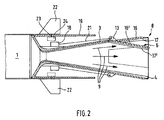
Figur 2 einen Längsschnitt der Düse nachFigur 1 mit der die aerodynamischen Ruder tragenden Heckstruktur; -
Figur 3 eine perspektivische Ansicht der Düse, wobei die einschwenkbaren Segmente weggelassen und nur zwei Drall erzeugende Flächen dargestellt sind; und -
Figur 4 einen Längsschnitt durch die obere Hälfte einer Düse nach einer anderen Ausführungsform der Erfindung. - Gemäß
Figur 1 und2 schließt sich an die Brennkammer 1 eines Raketentriebwerks die Schubdüse 2 an, die einen divergenten Abschnitt 3 aufweist. Der hintere Teil des divergenten Düsenabschnitts 3 besteht aus vier Segmenten 4 bis 7 und vier Längsstegen 8, die jeweils zwischen zwei Segmenten 4 bis 7 angeordnet sind. - Die Stege 8 sind starr und einteilig mit dem divergenten Düsenabschnitt 3 ausgebildet. Demgegenüber bilden die Segmente 4 bis 7 Steuerflächen zur Schubvektorsteuerung des Raketentriebwerks. Dazu sind die Segmente bzw. Steuerflächen 4 bis 7 von ihrer Ruheposition, in der sie, wie durch die Segmente 4 und 5 dargestellt, sowohl mit der Außenseite wie der Innenseite des divergenten Düsenabschnitts 3 fluchten, in den durch die Pfeile 9 dargestellten Abgasstrahl in der Düse 2 einschwenkbar, wie durch die Segmente 6 und 7 dargestellt.
- Die Segmente 4 bis 7 sind um quer zu diesen Längsachsen verlaufende Schwenkachsen 11, die am vorderen Ende der Segmente 4 bis 7 angeordnet sind, an dem divergenten Düsenabschnitt 3 verschwenkbar gelagert und zwar an Lagerböcken 12, die beiderseits jedes Segments 4 bis 7 an den benachbarten Längsstegen 8 angeordnet sind.
- Die Segmente 4 bis 7 sind zu ihrer Lagerung jeweils mit einem nach außen ragenden Vorsprung 13 an ihrem vorderen Ende versehen. Von den beiden Lagerböcken 12 beiderseits jedes Segments 4 bis 7 erstrecken sich Hebelarme 15, die über eine Querstange 14 an dem jeweiligen Segment 4 bis 7 befestigt sind.
- Wie üblich, weist die Düse 1 eine tragende Struktur auf, die an ihrer Innenseite mit einer Schutzschicht versehen ist, um sie vor dem heißen Abgasstrahl zu schützen. Demgemäß sind auch die einstückig auf dem divergenten Düsenabschnitt 3 gebildeten Längsstege aus der tragenden Struktur 16 und der Schutzschicht 17 des divergenten Düsenabschnitts 3 gebildet. In gleicher Weise bestehen die Segmente 4 bis 7 aus einer tragenden Struktur 16', die an ihrer Innenseite mit einer Schutzschicht 17' versehen ist (
Fig. 2 ). - Da die Segmente 4 bis 7 nach dem Einschwenken, wie durch die eingeschwenkten Segmente 6 und 7 verdeutlicht, auch im Randbereich dem heißen Abgasstrahl ausgesetzt sind, und auch der Randbereich der Stege 8 von dem heißen Abgas beaufschlagt wird, das aus dem Spalt zwischen den eingeschwenkten Segmenten 6, 7 und den Längsstegen 8 austritt, erstreckt sich die Schutzschicht 17' an den Segmenten 4 bis 7 und die Schutzschicht 17 an den Stegen 8 auch über den Randbereich der Segmente 4 bis 7 bzw. der Stege 8 (
Fig. 1 ). - Zur Betätigung der Segmente 4 bis 7 ist ein beispielsweise elektromotorischer Aktuator 18 in der Heckstruktur 19 vorgesehen, die sich von der Kammer 1 über den vorderen Teil der Düse 2 erstreckt. Der Aktuator 18 ist über eine Koppelstange 21 mit dem Vorsprung 13 an den Segmenten 4 bis 7 gelenkig verbunden.
- An der Heckstruktur 19 sind ferner aerodynamische Ruder 22 um eine quer zur Düsenlängsachse verlaufende Achse 23 verschwenkbar gelagert, die beispielsweise durch elektromotorische Aktuatoren 24 betätigt werden.
- Die Ansteuerung der durch die Segmente 4 bis 7 gebildeten Steuerflächen ist mit der Ansteuerung der aerodynamischen Ruder 22 derart gekoppelt, dass die Segmente 4 bis 7 von den Aktuatoren 18 erst betätigt werden, wenn die aerodynamischen Ruder 22, betätigt durch die Aktuatoren 24, einen vorgegebenen Mindestausschlag zur Flugkörperlängsachse eingenommen haben. Es ist auch eine gemeinsame Ansteuerung der aerodynamischen Ruder und der Segmente mittels eines gemeinsamen Aktuators und eines Gestänges möglich.
- Während bei der Ausführungsform nach
Figur 1 und2 die die Steuerflächen bildenden Segmente 4 bis 7 einen Bestandteil des divergenten Düsenabschnitts 3 bilden, sind nach der Ausführungsform nachFigur 4 die Steuerflächen 10 in den Abgasstrahl 9 in dem divergenten Düsenabschnitt 3 gemäß dem Doppelpfeil 26 verschiebbar. Dazu sind in dem divergenten Düsenabschnitt 3 Querschlitze 27 vorgesehen und außen an dem Düsenabschnitt 3 im Bereich der Querschlitze 27 jeweils eine Führung 28 für die betreffende verschiebbare Steuerfläche 10. - Wenn eine gekrümmte Kulissenführung vorgesehen ist, können die Steuerflächen 10 auch in den Abgasstrahl 9 hinein gekrümmt ausgebildet sein. Auch ist es möglich, den hinteren Teil der Steuerfläche 10 verschiebbar und den vorderen Teil zusätzlich in den Abgasstrahl 9 hinein verschwenkbar auszubilden.
- Zur Rollbewegung des Flugkörpers können gemäß
Figur 3 an dem divergenten Düsenabschnitt 3 in den Abgasstrahl 9 verschwenkbare Drall erzeugende Flächen 29 vorgesehen sein. Dabei ist für jede Rollrichtung, wie inFigur 3 dargestellt, jeweils ein Paar gegenüberliegender Drall erzeugender Flächen 29 vorgesehen. Die Schwenkachse 31 der Drall erzeugenden Flächen 29 verläuft in einem Winkel □ von beispielsweise 45° zu der Mantellinie 32 des divergenten Düsenabschnitts 3. Die Drall erzeugenden Flächen 29 sind an dem hinteren Ende der Längsstege 8 angeordnet, sodass sie, wenn sie aus der inFigur 3 dargestellten eingeschwenkten Position in die Ruheposition zurück geschwenkt sind, mit ihrer hinteren Kante mit der hinteren Kante der Düse 2 fluchten.
Claims (13)
- Vorrichtung zur Steuerung der Schubrichtung der Düse des Raketentriebwerks eines Flugkörpers, gekennzeichnet durch in oder aus dem Abgasstrahl (9) in der Düse (2) bewegbare Steuerflächen (4 bis 7, 10).
- Vorrichtung nach Anspruch 1, dadurch gekennzeichnet, dass die Steuerflächen (4 bis 7) verschwenkbar ausgebildet sind.
- Vorrichtung nach Anspruch 2, dadurch gekennzeichnet, dass die Schwenkachsen (11) der Steuerflächen (4 bis 7) in Querrichtung verlaufen und im vorderen Endbereich der Steuerflächen (4 bis 7) angeordnet sind.
- Vorrichtung nach Anspruch 2 oder 3, dadurch gekennzeichnet, dass die Steuerflächen durch schwenkbare Segmente des divergenten Düsenabschnitts (3) gebildet sind.
- Vorrichtung nach Anspruch 4, dadurch gekennzeichnet, dass der restliche Teil des divergenten Düsenabschnitts (3) im Bereich der Segmente (4 bis 7) durch Stege (8) zwischen den Segmenten (4 bis 7) gebildet wird.
- Vorrichtung nach Anspruch 4 oder 5, dadurch gekennzeichnet, dass die schwenkbaren Segmente (4 bis 7) an der Außenseite des divergenten Düsenabschnitts (3) gelagert sind.
- Vorrichtung nach einem der vorstehenden Ansprüche, dadurch gekennzeichnet, dass die Steuerflächen (4 bis 7, 10) eine ihre tragende Struktur (16') vor dem heißen Abgasstrahl (9) schützende Schutzschicht (17') aufweisen.
- Vorrichtung nach einem der vorstehenden Ansprüche, dadurch gekennzeichnet, dass an dem divergenten Düsenabschnitt (3) verschwenkbare Drall erzeugende Flächen (29) vorgesehen sind.
- Vorrichtung nach Anspruch 8, dadurch gekennzeichnet, dass die Schwenkachse (31) der Drall erzeugenden Flächen (29) schräg zur Mantellinie (32) des divergenten Düsenabschnitts (3) verläuft.
- Vorrichtung nach Anspruch 8 oder 9, dadurch gekennzeichnet, dass die Drall erzeugenden Flächen (29) im hinteren Endbereich des divergenten Düsenabschnitts (3) angeordnet sind.
- Vorrichtung nach Anspruch 5 sowie 8 bis 10, dadurch gekennzeichnet, dass die Drall erzeugenden Flächen (29) an den Stegen (8) verschwenkbar angelenkt sind.
- Vorrichtung nach einem der vorstehenden Ansprüche, dadurch gekennzeichnet, dass der Flugkörper mit aerodynamischen Rudern (22) versehen ist, deren Ansteuerung mit der Ansteuerung der Steuerflächen (4 bis 7, 10) derart gekoppelt ist, dass die Steuerflächen (4 bis 7, 10) erst nach einem vorgegebenen Mindestausschlag der aerodynamischen Ruder (22) betätigt werden.
- Vorrichtung nach einem der Ansprüche 1 bis 11, dadurch gekennzeichnet, dass der Flugkörper mit aerodynamischen Rudern (22) versehen ist, deren Ansteuerung mit der Ansteuerung der Steuerflächen (4 bis 7, 10) derart gekoppelt ist, dass der Ausschlag der Steuerflächen (4 bis 7, 10) exponentiell mit dem Ausschlag der aerodynamischen Ruder (22) ansteigt.
Applications Claiming Priority (1)
| Application Number | Priority Date | Filing Date | Title |
|---|---|---|---|
| DE200710007568 DE102007007568B4 (de) | 2007-02-15 | 2007-02-15 | Vorrichtung zur Steuerung der Düsenschubrichtung eines Raketentriebwerks |
Publications (3)
| Publication Number | Publication Date |
|---|---|
| EP1959124A2 true EP1959124A2 (de) | 2008-08-20 |
| EP1959124A3 EP1959124A3 (de) | 2014-08-20 |
| EP1959124B1 EP1959124B1 (de) | 2017-06-14 |
Family
ID=38896039
Family Applications (1)
| Application Number | Title | Priority Date | Filing Date |
|---|---|---|---|
| EP07021964.7A Not-in-force EP1959124B1 (de) | 2007-02-15 | 2007-11-13 | Vorrichtung zur Steuerung der Düsenschubrichtung eines Raketentriebwerks |
Country Status (2)
| Country | Link |
|---|---|
| EP (1) | EP1959124B1 (de) |
| DE (1) | DE102007007568B4 (de) |
Cited By (3)
| Publication number | Priority date | Publication date | Assignee | Title |
|---|---|---|---|---|
| WO2015011198A1 (fr) * | 2013-07-26 | 2015-01-29 | Astrium Sas | Tuyère d'éjection de gaz de combustion d'un moteur fusée pourvue d'un dispositif d'étanchéité entre une partie fixe et une partie mobile de la tuyère |
| CN112943481A (zh) * | 2021-02-11 | 2021-06-11 | 西北工业大学 | 一种机械式可调的s弯喷管喷口结构 |
| CN116537975A (zh) * | 2023-07-06 | 2023-08-04 | 北京凌空天行科技有限责任公司 | 一种可回收飞行器喷流控制装置 |
Families Citing this family (1)
| Publication number | Priority date | Publication date | Assignee | Title |
|---|---|---|---|---|
| CN110594044B (zh) * | 2019-10-17 | 2022-03-18 | 哈尔滨工程大学 | 一种自适应高度的柔性延伸喷管 |
Family Cites Families (13)
| Publication number | Priority date | Publication date | Assignee | Title |
|---|---|---|---|---|
| US384A (en) | 1837-09-12 | Stove foe | ||
| US2694898A (en) * | 1948-08-09 | 1954-11-23 | France Etat | Device for deflecting a high-speed jet of gas ejected through a nozzle |
| US2919544A (en) * | 1956-01-10 | 1960-01-05 | Jr E Quimby Smith | Steering mechanism for jet propelled craft |
| US3096049A (en) * | 1960-01-25 | 1963-07-02 | Edward S Karasinski | Steering means for space vehicles missiles and high altitude flying craft |
| US3049876A (en) * | 1960-03-30 | 1962-08-21 | James F Connors | Annular rocket motor and nozzle configuration |
| US3441219A (en) * | 1966-11-29 | 1969-04-29 | Thiokol Chemical Corp | Directional control apparatus for rocket motors |
| GB1243641A (en) * | 1968-06-27 | 1971-08-25 | Imp Metal Ind Kynoch Ltd | Improvements in rocket motor exhaust nozzle assemblies |
| US4274610A (en) * | 1978-07-14 | 1981-06-23 | General Dynamics, Pomona Division | Jet tab control mechanism for thrust vector control |
| USH384H (en) * | 1987-05-28 | 1987-12-01 | The United States Of America As Represented By The Secretary Of The Navy | Stowable three-axis reaction-steering system |
| JP2684916B2 (ja) * | 1992-03-11 | 1997-12-03 | 日産自動車株式会社 | ロケットの推力方向制御装置 |
| US5398887A (en) * | 1993-10-12 | 1995-03-21 | Thiokol Corporation | Finless aerodynamic control system |
| US5511745A (en) * | 1994-12-30 | 1996-04-30 | Thiokol Corporation | Vectorable nozzle having jet vanes |
| JPH10238409A (ja) * | 1997-02-24 | 1998-09-08 | Nissan Motor Co Ltd | ロケットの姿勢制御装置 |
-
2007
- 2007-02-15 DE DE200710007568 patent/DE102007007568B4/de not_active Expired - Fee Related
- 2007-11-13 EP EP07021964.7A patent/EP1959124B1/de not_active Not-in-force
Cited By (10)
| Publication number | Priority date | Publication date | Assignee | Title |
|---|---|---|---|---|
| WO2015011198A1 (fr) * | 2013-07-26 | 2015-01-29 | Astrium Sas | Tuyère d'éjection de gaz de combustion d'un moteur fusée pourvue d'un dispositif d'étanchéité entre une partie fixe et une partie mobile de la tuyère |
| FR3009029A1 (fr) * | 2013-07-26 | 2015-01-30 | Astrium Sas | Tuyere d'ejection de gaz de combustion d'un moteur fusee pourvue d'un dispositif d'etancheite entre une partie fixe et une partie mobile de la tuyere |
| CN105408610A (zh) * | 2013-07-26 | 2016-03-16 | 空中客车防务和空间公司 | 用于火箭发动机的在喷嘴的固定部与移动部之间设置有密封装置的燃烧气体排放喷嘴 |
| CN105408610B (zh) * | 2013-07-26 | 2018-04-20 | 空中客车防务和空间公司 | 用于火箭发动机的在喷嘴的固定部与移动部之间设置有密封装置的燃烧气体排放喷嘴 |
| RU2673032C2 (ru) * | 2013-07-26 | 2018-11-21 | Эйрбас Дифенс Энд Спейс Сас | Выпускное сопло для газообразных продуктов сгорания ракетного двигателя, ракетный двигатель с таким соплом и летательный аппарат с указанным двигателем |
| US10316796B2 (en) | 2013-07-26 | 2019-06-11 | Airbus Safran Launchers Sas | Combustion gas discharge nozzle for a rocket engine provided with a sealing device between a stationary part and a moving part of the nozzle |
| CN112943481A (zh) * | 2021-02-11 | 2021-06-11 | 西北工业大学 | 一种机械式可调的s弯喷管喷口结构 |
| CN112943481B (zh) * | 2021-02-11 | 2022-08-05 | 西北工业大学 | 一种机械式可调的s弯喷管喷口结构 |
| CN116537975A (zh) * | 2023-07-06 | 2023-08-04 | 北京凌空天行科技有限责任公司 | 一种可回收飞行器喷流控制装置 |
| CN116537975B (zh) * | 2023-07-06 | 2023-10-20 | 北京凌空天行科技有限责任公司 | 一种可回收飞行器喷流控制装置 |
Also Published As
| Publication number | Publication date |
|---|---|
| DE102007007568A1 (de) | 2008-08-21 |
| EP1959124A3 (de) | 2014-08-20 |
| EP1959124B1 (de) | 2017-06-14 |
| DE102007007568B4 (de) | 2011-01-05 |
Similar Documents
| Publication | Publication Date | Title |
|---|---|---|
| DE3121653C2 (de) | ||
| DE3030581C2 (de) | ||
| DE3940472C2 (de) | Schubumlenkungseinrichtung | |
| DE2644092C2 (de) | Verstellbare konvergent-divergente Schubdüse für ein Gasturbinentriebwerk | |
| DE69300530T2 (de) | Querschnittsveränderliche schwenkbare Schubdüse für Gasturbinen. | |
| DE2638883C2 (de) | Schubdüse | |
| DE2618600A1 (de) | Schubduese mit variabler flaeche | |
| CH683117A5 (de) | Auslenkbare axialsymmetrische Düse. | |
| DE2529543C2 (de) | Vorrichtung zur Betätigung der beweglichen Klappen von Schubdüsen | |
| DE69717344T2 (de) | Klappen mit Leitflächen für eine Schubumkehrvorrichtung eines Bläsertriebwerkes | |
| DE2815259A1 (de) | Schubduesenklappen-dichtungs-aufbau | |
| DE4024016A1 (de) | Abgasduese | |
| EP1959124B1 (de) | Vorrichtung zur Steuerung der Düsenschubrichtung eines Raketentriebwerks | |
| DE2617781A1 (de) | Betaetigungsvorrichtung fuer ein gasturbinentriebwerk mit schwenkschubduese | |
| DE69918531T2 (de) | Verstelleinrichtung für den Auslassquerschnitt einer konvergent-divergenten Schubdüse | |
| DE4210804A1 (de) | Einrichtung zur Abdichtung eines Spaltes zwischen winkelversetzt und fest oder relativ zueinander beweglich angeordneten Wandelementen | |
| DE69723381T2 (de) | Durch Druck ausgeglichene Schubdüse mit Synchronring | |
| DE60034404T2 (de) | Halterung und lineare Betätigungsvorrichtung für den Verstellring einer allseits beweglichen Schubdüse | |
| DE2540537B1 (de) | Gasturbinenstrahltriebwerk zum antrieb und zur steuerung eines flugzeugs | |
| DE69304863T2 (de) | Divergente Nebenklappe bei Austrittsdüsen variabler Geometrie für Gasturbinen-Antriebseinheiten | |
| DE102006031625A1 (de) | Vorrichtung zur Giersteuerung einer Düse mit rechteckigem Austrittsquerschnitt | |
| DE60017491T2 (de) | Allseitig schwenkbare konvergente - divergente Schubdüse mit einem kardanischen Bedienungsring | |
| DE60013678T2 (de) | Kardanisch gelagerte schwenkbare Schubdüse | |
| DE3730412A1 (de) | Schubduese fuer gasturbinentriebwerke | |
| DE60027822T2 (de) | Axialsymmetrische konvergent-divergente Schubdüse |
Legal Events
| Date | Code | Title | Description |
|---|---|---|---|
| PUAI | Public reference made under article 153(3) epc to a published international application that has entered the european phase |
Free format text: ORIGINAL CODE: 0009012 |
|
| AK | Designated contracting states |
Kind code of ref document: A2 Designated state(s): AT BE BG CH CY CZ DE DK EE ES FI FR GB GR HU IE IS IT LI LT LU LV MC MT NL PL PT RO SE SI SK TR |
|
| AX | Request for extension of the european patent |
Extension state: AL BA HR MK RS |
|
| PUAL | Search report despatched |
Free format text: ORIGINAL CODE: 0009013 |
|
| AK | Designated contracting states |
Kind code of ref document: A3 Designated state(s): AT BE BG CH CY CZ DE DK EE ES FI FR GB GR HU IE IS IT LI LT LU LV MC MT NL PL PT RO SE SI SK TR |
|
| AX | Request for extension of the european patent |
Extension state: AL BA HR MK RS |
|
| RIC1 | Information provided on ipc code assigned before grant |
Ipc: B64C 9/38 20060101ALI20140716BHEP Ipc: F42B 10/66 20060101ALI20140716BHEP Ipc: F02K 9/90 20060101AFI20140716BHEP |
|
| 17P | Request for examination filed |
Effective date: 20150220 |
|
| AKX | Designation fees paid |
Designated state(s): AT BE BG CH CY CZ DE DK EE ES FI FR GB GR HU IE IS IT LI LT LU LV MC MT NL PL PT RO SE SI SK TR |
|
| AXX | Extension fees paid |
Extension state: BA Extension state: RS Extension state: MK Extension state: HR Extension state: AL |
|
| 17Q | First examination report despatched |
Effective date: 20151028 |
|
| GRAP | Despatch of communication of intention to grant a patent |
Free format text: ORIGINAL CODE: EPIDOSNIGR1 |
|
| INTG | Intention to grant announced |
Effective date: 20170102 |
|
| GRAS | Grant fee paid |
Free format text: ORIGINAL CODE: EPIDOSNIGR3 |
|
| GRAA | (expected) grant |
Free format text: ORIGINAL CODE: 0009210 |
|
| AK | Designated contracting states |
Kind code of ref document: B1 Designated state(s): AT BE BG CH CY CZ DE DK EE ES FI FR GB GR HU IE IS IT LI LT LU LV MC MT NL PL PT RO SE SI SK TR |
|
| REG | Reference to a national code |
Ref country code: GB Ref legal event code: FG4D Free format text: NOT ENGLISH |
|
| REG | Reference to a national code |
Ref country code: CH Ref legal event code: EP Ref country code: AT Ref legal event code: REF Ref document number: 901217 Country of ref document: AT Kind code of ref document: T Effective date: 20170615 |
|
| REG | Reference to a national code |
Ref country code: IE Ref legal event code: FG4D Free format text: LANGUAGE OF EP DOCUMENT: GERMAN |
|
| REG | Reference to a national code |
Ref country code: DE Ref legal event code: R096 Ref document number: 502007015695 Country of ref document: DE |
|
| REG | Reference to a national code |
Ref country code: NL Ref legal event code: MP Effective date: 20170614 |
|
| REG | Reference to a national code |
Ref country code: LT Ref legal event code: MG4D |
|
| PG25 | Lapsed in a contracting state [announced via postgrant information from national office to epo] |
Ref country code: ES Free format text: LAPSE BECAUSE OF FAILURE TO SUBMIT A TRANSLATION OF THE DESCRIPTION OR TO PAY THE FEE WITHIN THE PRESCRIBED TIME-LIMIT Effective date: 20170614 Ref country code: LT Free format text: LAPSE BECAUSE OF FAILURE TO SUBMIT A TRANSLATION OF THE DESCRIPTION OR TO PAY THE FEE WITHIN THE PRESCRIBED TIME-LIMIT Effective date: 20170614 Ref country code: GR Free format text: LAPSE BECAUSE OF FAILURE TO SUBMIT A TRANSLATION OF THE DESCRIPTION OR TO PAY THE FEE WITHIN THE PRESCRIBED TIME-LIMIT Effective date: 20170915 Ref country code: FI Free format text: LAPSE BECAUSE OF FAILURE TO SUBMIT A TRANSLATION OF THE DESCRIPTION OR TO PAY THE FEE WITHIN THE PRESCRIBED TIME-LIMIT Effective date: 20170614 |
|
| PG25 | Lapsed in a contracting state [announced via postgrant information from national office to epo] |
Ref country code: SE Free format text: LAPSE BECAUSE OF FAILURE TO SUBMIT A TRANSLATION OF THE DESCRIPTION OR TO PAY THE FEE WITHIN THE PRESCRIBED TIME-LIMIT Effective date: 20170614 Ref country code: BG Free format text: LAPSE BECAUSE OF FAILURE TO SUBMIT A TRANSLATION OF THE DESCRIPTION OR TO PAY THE FEE WITHIN THE PRESCRIBED TIME-LIMIT Effective date: 20170914 Ref country code: LV Free format text: LAPSE BECAUSE OF FAILURE TO SUBMIT A TRANSLATION OF THE DESCRIPTION OR TO PAY THE FEE WITHIN THE PRESCRIBED TIME-LIMIT Effective date: 20170614 Ref country code: NL Free format text: LAPSE BECAUSE OF FAILURE TO SUBMIT A TRANSLATION OF THE DESCRIPTION OR TO PAY THE FEE WITHIN THE PRESCRIBED TIME-LIMIT Effective date: 20170614 |
|
| PG25 | Lapsed in a contracting state [announced via postgrant information from national office to epo] |
Ref country code: RO Free format text: LAPSE BECAUSE OF FAILURE TO SUBMIT A TRANSLATION OF THE DESCRIPTION OR TO PAY THE FEE WITHIN THE PRESCRIBED TIME-LIMIT Effective date: 20170614 Ref country code: EE Free format text: LAPSE BECAUSE OF FAILURE TO SUBMIT A TRANSLATION OF THE DESCRIPTION OR TO PAY THE FEE WITHIN THE PRESCRIBED TIME-LIMIT Effective date: 20170614 Ref country code: CZ Free format text: LAPSE BECAUSE OF FAILURE TO SUBMIT A TRANSLATION OF THE DESCRIPTION OR TO PAY THE FEE WITHIN THE PRESCRIBED TIME-LIMIT Effective date: 20170614 Ref country code: SK Free format text: LAPSE BECAUSE OF FAILURE TO SUBMIT A TRANSLATION OF THE DESCRIPTION OR TO PAY THE FEE WITHIN THE PRESCRIBED TIME-LIMIT Effective date: 20170614 |
|
| PG25 | Lapsed in a contracting state [announced via postgrant information from national office to epo] |
Ref country code: IS Free format text: LAPSE BECAUSE OF FAILURE TO SUBMIT A TRANSLATION OF THE DESCRIPTION OR TO PAY THE FEE WITHIN THE PRESCRIBED TIME-LIMIT Effective date: 20171014 Ref country code: IT Free format text: LAPSE BECAUSE OF FAILURE TO SUBMIT A TRANSLATION OF THE DESCRIPTION OR TO PAY THE FEE WITHIN THE PRESCRIBED TIME-LIMIT Effective date: 20170614 Ref country code: PL Free format text: LAPSE BECAUSE OF FAILURE TO SUBMIT A TRANSLATION OF THE DESCRIPTION OR TO PAY THE FEE WITHIN THE PRESCRIBED TIME-LIMIT Effective date: 20170614 |
|
| REG | Reference to a national code |
Ref country code: DE Ref legal event code: R097 Ref document number: 502007015695 Country of ref document: DE |
|
| PLBE | No opposition filed within time limit |
Free format text: ORIGINAL CODE: 0009261 |
|
| STAA | Information on the status of an ep patent application or granted ep patent |
Free format text: STATUS: NO OPPOSITION FILED WITHIN TIME LIMIT |
|
| PG25 | Lapsed in a contracting state [announced via postgrant information from national office to epo] |
Ref country code: DK Free format text: LAPSE BECAUSE OF FAILURE TO SUBMIT A TRANSLATION OF THE DESCRIPTION OR TO PAY THE FEE WITHIN THE PRESCRIBED TIME-LIMIT Effective date: 20170614 |
|
| 26N | No opposition filed |
Effective date: 20180315 |
|
| REG | Reference to a national code |
Ref country code: DE Ref legal event code: R119 Ref document number: 502007015695 Country of ref document: DE |
|
| PG25 | Lapsed in a contracting state [announced via postgrant information from national office to epo] |
Ref country code: MC Free format text: LAPSE BECAUSE OF FAILURE TO SUBMIT A TRANSLATION OF THE DESCRIPTION OR TO PAY THE FEE WITHIN THE PRESCRIBED TIME-LIMIT Effective date: 20170614 |
|
| GBPC | Gb: european patent ceased through non-payment of renewal fee |
Effective date: 20171113 |
|
| PG25 | Lapsed in a contracting state [announced via postgrant information from national office to epo] |
Ref country code: CH Free format text: LAPSE BECAUSE OF NON-PAYMENT OF DUE FEES Effective date: 20171130 Ref country code: LI Free format text: LAPSE BECAUSE OF NON-PAYMENT OF DUE FEES Effective date: 20171130 |
|
| PG25 | Lapsed in a contracting state [announced via postgrant information from national office to epo] |
Ref country code: SI Free format text: LAPSE BECAUSE OF FAILURE TO SUBMIT A TRANSLATION OF THE DESCRIPTION OR TO PAY THE FEE WITHIN THE PRESCRIBED TIME-LIMIT Effective date: 20170614 Ref country code: LU Free format text: LAPSE BECAUSE OF NON-PAYMENT OF DUE FEES Effective date: 20171113 |
|
| REG | Reference to a national code |
Ref country code: FR Ref legal event code: ST Effective date: 20180731 Ref country code: BE Ref legal event code: MM Effective date: 20171130 |
|
| REG | Reference to a national code |
Ref country code: IE Ref legal event code: MM4A |
|
| PG25 | Lapsed in a contracting state [announced via postgrant information from national office to epo] |
Ref country code: MT Free format text: LAPSE BECAUSE OF FAILURE TO SUBMIT A TRANSLATION OF THE DESCRIPTION OR TO PAY THE FEE WITHIN THE PRESCRIBED TIME-LIMIT Effective date: 20170614 |
|
| PG25 | Lapsed in a contracting state [announced via postgrant information from national office to epo] |
Ref country code: DE Free format text: LAPSE BECAUSE OF NON-PAYMENT OF DUE FEES Effective date: 20180602 Ref country code: FR Free format text: LAPSE BECAUSE OF NON-PAYMENT OF DUE FEES Effective date: 20171130 Ref country code: IE Free format text: LAPSE BECAUSE OF NON-PAYMENT OF DUE FEES Effective date: 20171113 |
|
| PG25 | Lapsed in a contracting state [announced via postgrant information from national office to epo] |
Ref country code: GB Free format text: LAPSE BECAUSE OF NON-PAYMENT OF DUE FEES Effective date: 20171113 Ref country code: BE Free format text: LAPSE BECAUSE OF NON-PAYMENT OF DUE FEES Effective date: 20171130 |
|
| REG | Reference to a national code |
Ref country code: AT Ref legal event code: MM01 Ref document number: 901217 Country of ref document: AT Kind code of ref document: T Effective date: 20171113 |
|
| PG25 | Lapsed in a contracting state [announced via postgrant information from national office to epo] |
Ref country code: AT Free format text: LAPSE BECAUSE OF NON-PAYMENT OF DUE FEES Effective date: 20171113 |
|
| PG25 | Lapsed in a contracting state [announced via postgrant information from national office to epo] |
Ref country code: HU Free format text: LAPSE BECAUSE OF FAILURE TO SUBMIT A TRANSLATION OF THE DESCRIPTION OR TO PAY THE FEE WITHIN THE PRESCRIBED TIME-LIMIT; INVALID AB INITIO Effective date: 20071113 |
|
| PG25 | Lapsed in a contracting state [announced via postgrant information from national office to epo] |
Ref country code: CY Free format text: LAPSE BECAUSE OF NON-PAYMENT OF DUE FEES Effective date: 20170614 |
|
| PG25 | Lapsed in a contracting state [announced via postgrant information from national office to epo] |
Ref country code: TR Free format text: LAPSE BECAUSE OF FAILURE TO SUBMIT A TRANSLATION OF THE DESCRIPTION OR TO PAY THE FEE WITHIN THE PRESCRIBED TIME-LIMIT Effective date: 20170614 |
|
| PG25 | Lapsed in a contracting state [announced via postgrant information from national office to epo] |
Ref country code: PT Free format text: LAPSE BECAUSE OF FAILURE TO SUBMIT A TRANSLATION OF THE DESCRIPTION OR TO PAY THE FEE WITHIN THE PRESCRIBED TIME-LIMIT Effective date: 20170614 |