EP1958908A1 - Control system for elevator - Google Patents
Control system for elevator Download PDFInfo
- Publication number
- EP1958908A1 EP1958908A1 EP05814476A EP05814476A EP1958908A1 EP 1958908 A1 EP1958908 A1 EP 1958908A1 EP 05814476 A EP05814476 A EP 05814476A EP 05814476 A EP05814476 A EP 05814476A EP 1958908 A1 EP1958908 A1 EP 1958908A1
- Authority
- EP
- European Patent Office
- Prior art keywords
- landing
- time period
- floor
- elevator
- traveling time
- Prior art date
- Legal status (The legal status is an assumption and is not a legal conclusion. Google has not performed a legal analysis and makes no representation as to the accuracy of the status listed.)
- Granted
Links
Images


Classifications
-
- B—PERFORMING OPERATIONS; TRANSPORTING
- B66—HOISTING; LIFTING; HAULING
- B66B—ELEVATORS; ESCALATORS OR MOVING WALKWAYS
- B66B1/00—Control systems of elevators in general
- B66B1/02—Control systems without regulation, i.e. without retroactive action
- B66B1/06—Control systems without regulation, i.e. without retroactive action electric
- B66B1/14—Control systems without regulation, i.e. without retroactive action electric with devices, e.g. push-buttons, for indirect control of movements
- B66B1/18—Control systems without regulation, i.e. without retroactive action electric with devices, e.g. push-buttons, for indirect control of movements with means for storing pulses controlling the movements of several cars or cages
-
- B—PERFORMING OPERATIONS; TRANSPORTING
- B66—HOISTING; LIFTING; HAULING
- B66B—ELEVATORS; ESCALATORS OR MOVING WALKWAYS
- B66B1/00—Control systems of elevators in general
- B66B1/24—Control systems with regulation, i.e. with retroactive action, for influencing travelling speed, acceleration, or deceleration
- B66B1/2408—Control systems with regulation, i.e. with retroactive action, for influencing travelling speed, acceleration, or deceleration where the allocation of a call to an elevator car is of importance, i.e. by means of a supervisory or group controller
- B66B1/2458—For elevator systems with multiple shafts and a single car per shaft
-
- B—PERFORMING OPERATIONS; TRANSPORTING
- B66—HOISTING; LIFTING; HAULING
- B66B—ELEVATORS; ESCALATORS OR MOVING WALKWAYS
- B66B1/00—Control systems of elevators in general
- B66B1/24—Control systems with regulation, i.e. with retroactive action, for influencing travelling speed, acceleration, or deceleration
- B66B1/2408—Control systems with regulation, i.e. with retroactive action, for influencing travelling speed, acceleration, or deceleration where the allocation of a call to an elevator car is of importance, i.e. by means of a supervisory or group controller
-
- B—PERFORMING OPERATIONS; TRANSPORTING
- B66—HOISTING; LIFTING; HAULING
- B66B—ELEVATORS; ESCALATORS OR MOVING WALKWAYS
- B66B1/00—Control systems of elevators in general
- B66B1/34—Details, e.g. call counting devices, data transmission from car to control system, devices giving information to the control system
- B66B1/46—Adaptations of switches or switchgear
- B66B1/468—Call registering systems
-
- B—PERFORMING OPERATIONS; TRANSPORTING
- B66—HOISTING; LIFTING; HAULING
- B66B—ELEVATORS; ESCALATORS OR MOVING WALKWAYS
- B66B3/00—Applications of devices for indicating or signalling operating conditions of elevators
-
- B—PERFORMING OPERATIONS; TRANSPORTING
- B66—HOISTING; LIFTING; HAULING
- B66B—ELEVATORS; ESCALATORS OR MOVING WALKWAYS
- B66B2201/00—Aspects of control systems of elevators
- B66B2201/10—Details with respect to the type of call input
- B66B2201/103—Destination call input before entering the elevator car
-
- B—PERFORMING OPERATIONS; TRANSPORTING
- B66—HOISTING; LIFTING; HAULING
- B66B—ELEVATORS; ESCALATORS OR MOVING WALKWAYS
- B66B2201/00—Aspects of control systems of elevators
- B66B2201/20—Details of the evaluation method for the allocation of a call to an elevator car
- B66B2201/211—Waiting time, i.e. response time
-
- B—PERFORMING OPERATIONS; TRANSPORTING
- B66—HOISTING; LIFTING; HAULING
- B66B—ELEVATORS; ESCALATORS OR MOVING WALKWAYS
- B66B2201/00—Aspects of control systems of elevators
- B66B2201/20—Details of the evaluation method for the allocation of a call to an elevator car
- B66B2201/231—Sequential evaluation of plurality of criteria
- B66B2201/232—Sequential evaluation of plurality of criteria where the time needed for a passenger to arrive at the allocated elevator car from where the call is made is taken into account
-
- B—PERFORMING OPERATIONS; TRANSPORTING
- B66—HOISTING; LIFTING; HAULING
- B66B—ELEVATORS; ESCALATORS OR MOVING WALKWAYS
- B66B2201/00—Aspects of control systems of elevators
- B66B2201/40—Details of the change of control mode
- B66B2201/46—Switches or switchgear
- B66B2201/4607—Call registering systems
- B66B2201/4615—Wherein the destination is registered before boarding
-
- B—PERFORMING OPERATIONS; TRANSPORTING
- B66—HOISTING; LIFTING; HAULING
- B66B—ELEVATORS; ESCALATORS OR MOVING WALKWAYS
- B66B2201/00—Aspects of control systems of elevators
- B66B2201/40—Details of the change of control mode
- B66B2201/46—Switches or switchgear
- B66B2201/4607—Call registering systems
- B66B2201/463—Wherein the call is registered through physical contact with the elevator system
-
- B—PERFORMING OPERATIONS; TRANSPORTING
- B66—HOISTING; LIFTING; HAULING
- B66B—ELEVATORS; ESCALATORS OR MOVING WALKWAYS
- B66B2201/00—Aspects of control systems of elevators
- B66B2201/40—Details of the change of control mode
- B66B2201/46—Switches or switchgear
- B66B2201/4607—Call registering systems
- B66B2201/4661—Call registering systems for priority users
-
- B—PERFORMING OPERATIONS; TRANSPORTING
- B66—HOISTING; LIFTING; HAULING
- B66B—ELEVATORS; ESCALATORS OR MOVING WALKWAYS
- B66B2201/00—Aspects of control systems of elevators
- B66B2201/40—Details of the change of control mode
- B66B2201/46—Switches or switchgear
- B66B2201/4607—Call registering systems
- B66B2201/4676—Call registering systems for checking authorization of the passengers
Definitions
- the present invention relates to a control system for elevators for controlling operations of elevator apparatuses.
- an elevator group control device for supervising traveling of a plurality of elevator apparatuses as a group.
- elevator doorways corresponding to each of the elevator apparatuses are provided at each single floor.
- a call registration command device which is operated by passengers to call cars, is provided at that floor. When the call registration command device is operated, the allocation of those of the cars which are to be moved to that floor is carried out.
- the allocation of the cars is carried out by comparing time periods required until the arrival of the cars at that floor with time periods required until the arrival of passengers at the elevator doorways. In this case, when the time period required until the arrival of a certain one of the cars at that floor is shorter than the time period required until the arrival of a passenger at a corresponding one of the elevator doorways, this elevator doorway is excluded from targets for allocation. Thus, that one of the cars which arrives after the arrival of the passenger at the elevator doorway can be allocated, so the passenger is prevented from missing that car (see Patent Document 1).
- Patent Document 1 P 3040524
- the present invention has been made to solve the above-mentioned problem, and it is therefore an obj ect of the present invention to provide a control system for elevators which makes it possible to shorten the waiting time periods of passengers and prevent the passengers from missing cars.
- a control system for elevators controls operations of a plurality of elevator apparatuses, which have cars that can stop at a common landing floor and elevator doorways provided at the landing floor for allowing passengers to get on/off the cars stopped at the landing floor from/to the landing floor.
- the control system includes: a landing call registration device provided at the landing floor to be operable at the landing floor; a landing call automatic registration portion for setting as a car call floor the landing floor where the landing call registration device is operated, and making a car call registration for stopping any one of the cars at the car call floor; a response selection portion for selecting as a selected elevator that one of the elevator apparatuses which responds to the car call registration, based on information from the elevator apparatuses and information from the landing call automatic registration portion; a passenger traveling time period calculation portion for setting as a selected doorway that one of the elevator doorways of the selected elevator, which is provided at the car call floor, based on information from the response selection portion, and calculating a passenger traveling time period required for traveling of passengers from the landing call registration device to the selected doorway; and an opening/closing control portion for controlling opening/closing operations of the selected doorway based on information from the selected elevator and information from the passenger traveling time period calculation portion.
- FLG. 1 is a schematic diagram showing a control system for elevators according to Embodiment 1 of the present invention.
- FIG. 1 is a schematic diagram showing a control system for elevators according to Embodiment 1 of the present invention.
- a building is provided with a plurality of (three in this example) elevator apparatuses 1 to 3.
- the building is also provided with a plurality of landing floors 4 where the elevator apparatuses 1 to 3 can be used.
- the elevator apparatuses 1 to 3 have cars 5 and elevator doorways 6.
- the cars 5 can stop at the landing floors 4.
- the elevator doorways 6 are provided at each of the landing floors 4 so that passengers can get on/off the cars 5 from/to each of the landing floors 4.
- An elevator hall 7 is provided at each of the landing floors 4.
- the elevator doorways 6 of the elevator apparatuses 1 to 3 are provided horizontally apart from one another in the elevator hall 7.
- Each of the elevator doorways 6 is provided with a pair of elevator doors 8 for opening/closing the elevator doorway 6.
- a plurality of (three in this example) hall lanterns 9 for reporting to the elevator hall 7 that one of the elevator doorways 6 which is to be opened subsequently and the arrival of the corresponding one of the cars 5 are provided at each of the landing floors 4.
- Each of the hall lanterns 9 is provided in the vicinity of a corresponding one of the elevator doorways 6.
- that one of the elevator doorways 6 which is to be opened is reported through the lighting of the corresponding one of the hall lanterns 9, and the arrival of the corresponding one of the cars 5 is reported through the blinking of the corresponding one of the hall lanterns 9.
- a landing call registration device 10 that can be operated there.
- the landing call registration device 10 is installed at a hall doorway through which passengers get into/out of the elevator hall 7.
- the landing call registration device 10 is provided with a destination floor selector 11 for selecting target floors through the operations by passengers, and an indicator 12 for indicating the target floors selected by the passengers.
- the target floor selector 11 has a general-purpose selector designed for the selection of target floors by able-bodied persons, and a disabled-accessible selector disposed below the general-purpose selector to help disabled persons such as wheelchair users and the like select target floors.
- Each of the general-purpose selector and the disabled-accessible selector is provided with a plurality of target floor buttons.
- the in-car call registration device 13 is provided with a destination floor selector (not shown) for selecting destination floors of the car 5 through the operation by passengers, and an indicator (not shown) for indicating the current position of the car 5.
- the destination floor selector is provided with a plurality of destination floor buttons.
- Information from the landing call registration device 10 and information from the elevator apparatuses 1 to 3 are transmitted to a control system body 14 for controlling the operations of the elevator apparatuses 1 to 3 comprehensively.
- the control system body 14 controls the operations of the elevator apparatuses 1 to 3 based on the information from the landing call registration device 10 and the information from the elevator apparatuses 1 to 3.
- the control system body 14 has a group supervision/control device 15 for operating and supervising the elevator apparatuses 1 to 3 as a group, and a plurality of (three in this example) individual control devices 16 for controlling the operations of the elevator apparatuses 1 to 3 individually based on information from the group supervision/control device 15.
- FIG. 2 is a functional block diagram showing the control system for the elevators shown in FIG. 1 .
- the control system body 14 has a landing call automatic registration portion 17, an in-car call automatic registration portion 18, a response selection portion 19, a database (storage portion) 20, a passenger traveling time period calculation portion 21, and an opening/closing control portion 22.
- the landing call automatic registration portion 17 sets as a car call floor that one of the landing floors 4 whose landing call registration device 10 is operated, based on information from landing call registration devices 10, and automatically makes a car call registration for stopping one of the cars 5 of the elevator apparatuses 1 to 3 at the car call floor.
- the in-car call automatic registration portion 18 automatically makes a car call registration for stopping the car 5 at a destination floor selected through the operation of each of in-car call registration devices 13, based on information from the in-car call registration devices 13.
- the response selection portion 19 selects as a selected elevator that one of the elevator apparatuses 1 to 3 which responds to a car call registration made by the landing call automatic registration portion 17, based on information from the elevator apparatuses 1 to 3, information from the landing call automatic registration portion 17, and information from the in-car call automatic registration portion 18. That is, the response selection portion 19 calculates as evaluation values waiting time periods at a car call floor which are required until the arrival of the cars 5 of the elevator apparatuses 1 to 3 (performs calculation of the evaluation values), and selects as a selected elevator that one of the elevator apparatuses which has the best evaluation value. In other words, the response selection portion 19 performs calculation of the evaluation values of the elevator apparatuses 1 to 3 to select the selected elevator.
- the selected elevator is selected based on information on the positions and the speeds of the cars 5 of the elevator apparatuses 1 to 3, information on whether or not each of the cars 5 is fully loaded, information on the number of stops of each of the cars 5 before the arrival thereof at the car call floor, and the like.
- the selected elevator is selected by the group supervision/control device 15.
- Time periods required for the traveling of passengers from the landing call registration device 10 to the elevator doorways 6 are stored in the database 20 in advance.
- the passenger traveling time period calculation portion 21 sets as a selected doorway that one of the elevator doorways 6 of the selected elevator which is provided at the car call floor, based on information from the response selection portion 19 and information from the database 20, and calculates a passenger traveling time period required for the traveling of a passenger from the landing call registration device 10 to the selected doorway.
- the passenger traveling time period is calculated by reading from the database 20 that one of the passenger traveling time periods which corresponds to the selected doorway.
- the opening/closing control portion 22 controls the opening/closing operations of the selected doorway based on operational information from the selected elevator and information from the passenger traveling time period calculation portion 21. That is, when the car 5 of the selected elevator stops at the car call floor and a door-opening operation of the selected doorway is completed before the passenger traveling time period calculated by the passenger traveling time period calculation portion 21 elapses after the making of the car call registration by the landing call automatic registration portion 17, the opening/closing control portion 22 holds the selected doorway in a door-open state until the passenger traveling time period elapses.
- the opening/closing control portion 22 When the door-opening operation of the selected doorway is completed after the lapse of the passenger traveling time period, the opening/closing control portion 22 performs normal opening/closing operations for maintaining the door-open state only for a preset normal door-open time period.
- the opening/closing operations of the selected doorway are controlled by the corresponding one of the individual control devices 16 based on opening/closing commands from the group supervision/control device 15.
- the control system body 14 is constituted by a computer having a central processing unit (CPU), a storage portion (ROM, RAM, and the like), and signal input/output portions.
- CPU central processing unit
- ROM read-only memory
- RAM random access memory
- the functions of the landing call automatic registration portion 17, the in-car call automatic registration portion 18, the response selection portion 19, the database 20, the passenger traveling time period calculation portion 21, and the opening/closing control portion 22 are realized by the computer constituting the control system body 14.
- programs for realizing the functions of the landing call automatic registration portion 17, the in-car call automatic registration portion 18, the response selection portion 19, the database 20, the passenger traveling time period calculation portion 21, and the opening/closing control portion 22 are stored in the storage portion of the computer.
- Information on passenger traveling time periods, information on normal door-open time periods, and the like are also stored in the storage portion.
- the central processing unit performs calculation processings regarding the functions of the control system body 14 based on the programs stored in the storage portion.
- FIG. 3 is a flowchart for explaining processing operations of the control system body 14 of FIG. 2 .
- the landing call automatic registration portion 17 makes a car call registration for setting as a car call floor that one of the landing floors 4 where the landing call registration device 10 is installed (S2).
- the response selection portion 19 performs calculation of evaluation values of the elevator apparatuses 1 to 3 based on operational information on the elevator apparatuses 1 to 3, information on a car call floor registered by the landing call automatic registration portion 17, and information on a destination floor registered by the in-car call automatic registration portion 18. As a result, that one of the elevator apparatuses 1 to 3 which responds to the car call registration made by the landing call automatic registration portion 17 is selected as the selected elevator (S3). After that, the indicator 12 of the landing call registration device 10 indicates the selected elevator based on information from the response selection portion 19 (S4).
- the passenger traveling time period calculation portion 21 calculates a time period required for the traveling of a passenger from the landing call registration device 10 to a selected doorway (the elevator doorway 6 of the selected elevator).
- the passenger traveling time period is calculated by reading that one of the passenger traveling time periods stored in the database 20 in advance so as to correspond to the respective elevator doorways 6 which corresponds to the selected doorway (S5).
- control system body 14 determines, based on the operational information on the selected elevator, whether or not the car 5 of the selected elevator has arrived at the car call floor (S6). When it is determined that the car 5 has not arrived at the car call floor, it is determined whether or not the car 5 has arrived at the car call floor, until the car 5 arrives at the car call floor.
- the opening/closing control portion 22 performs control to perform the door-opening operation of the selected doorway (S7). After the door-opening operation of the selected doorway is completed, it is determined whether or not the passenger traveling time period calculated by the passenger traveling time period calculation portion 21 has elapsed after the making of the car call registration by the landing call automatic registration portion 17 (S8).
- the opening/closing control portion 22 performs control to hold the selected doorway in the door-open state until the passenger traveling time period elapses (S9).
- the opening/closing control portion 22 When it is determined that the passenger traveling time period has elapsed, the opening/closing control portion 22 performs control to perform a door-closing operation after the lapse of a normal door-open time period, thereby terminating the processing (S10).
- the control system for the elevators configured as described above has the passenger traveling time period calculation portion 21 for calculating the time period required for the traveling of a passenger from the landing call registration device 10 to the selected doorway, and the opening/closing control portion 22 for controlling the opening/closing operations of the selected doorway based on information from the passenger traveling time period calculation portion 21. Therefore, even in the case where a long time period is required for the traveling of the passenger because of a long distance from the landing call registration device 10 to the elevator doorway 6, the door-closing operation of the elevator doorway 6 can be prevented from being performed before the passenger arrives at the elevator doorway 6, so the passenger can be prevented frommissing the corresponding one of the cars 5.
- a selected elevator is selected from all the elevator apparatuses 1 to 3, and none of those elevator apparatuses 1 to 3 is excluded from the elevators to be selected. Therefore, the selected elevator can be selected efficiently, so the time period required until each of the cars 5 arrives at the car call floor after the operation of the landing call registration device 10 can be shortened. Accordingly, the waiting time periods of passengers can be shortened.
- the opening/closing control portion 22 holds the selected doorway in the door-open state until the passenger traveling time period elapses. Therefore, passengers can be prevented more reliably from missing the cars 5.
- one passenger traveling time period is stored in the database 20 for each of the elevator doorways 6.
- a passenger traveling time period for able-bodied persons and a passenger traveling time period for disabled persons may be stored separately for each of the elevator doorways 6.
- the passenger traveling time period calculation portion 21 calculates a passenger traveling time period by reading the passenger traveling time period for the able-bodied persons from the database 20 when a car call registration is made through the operation of the general-purpose selector, and by reading the passenger traveling time period for the disabled persons from the database 20 when a car call registration is made through the operation of the disabled-accessible selector. In this manner, even disabled passengers can be prevented from missing the cars 5.
- Embodiment 2 In the foregoing example, the door-opening operation of the selected doorway is started immediately after the arrival of the car 5 at the car call floor. However, it is also appropriate to hold the selected doorway in the door-closed state until the passenger traveling time period elapses and perform the door-opening operation of the selected doorway after the passenger traveling time period has elapsed, instead of performing the door-opening operation of the selected doorway immediately after the stoppage of the car 5 at the car call floor.
- FIG. 4 is a flowchart for explaining the processing operations of a control system for elevators according to Embodiment 2 of the present invention. As shown in FIG. 4 , the same processing operations as in Embodiment 1 of the present invention are performed until it is determined whether or not the car 5 of the selected elevator has arrived at the car call floor (S6).
- control system body 14 determines that the car 5 has not arrived at the car call floor, it is determined whether or not the car 5 has arrived at the car call floor, until the car 5 arrives at the car call floor.
- control system body 14 determines whether or not the passenger traveling time period has elapsed after the making of the car call registration by the landing call automatic registration portion 17 (S11).
- the opening/closing control portion 22 performs control to hold the selected doorway in the door-closed state (S12). After that, the control systembody 14 determines again whether or not the passenger traveling time period has elapsed (S11). When it is determined that the passenger traveling time period has not elapsed, the foregoing operations are repeated. Thus, the selected doorway is held in the door-closed state until the passenger traveling time period elapses.
- Embodiment 2 of the present invention is identical to Embodiment 1 of the present invention in other configurational details and other operational details.
- the opening/closing control portion 22 performs control to hold the selected doorway in the door-closed state until the passenger traveling time period elapses. Therefore, a user other than the passenger who has operated the landing call registration device 10 can be prevented from getting on the car 5 of the selected elevator by mistake.
- the selected doorway is held in the door-closed state until the passenger traveling time period elapses.
- the door-opening operation should not necessarily be started upon the lapse of the passenger traveling time period.
- the selected doorway may be held in the door-closed state until an operation starting time instant set on the basis of the lapse of the passenger traveling time period. For instance, if the operation starting time instant is set upon the lapse of a time period shorter than the passenger traveling time period by a predetermined time period, the door-opening operation of the selected doorway can be performed immediately before the passenger arrives at the selected doorway, so the passenger is allowed to get on the car 5 of the selected elevator smoothly.
- the user-friendliness of the elevator apparatuses 1 to 3 can be enhanced.
- FIG. 5 is a functional block diagram showing a control system for elevators according to Embodiment 3 of the present invention.
- information from the in-car call automatic registration portion 18 is transmitted to the opening/closing control portion 22 as well as the response selection portion 19.
- the opening/closing control portion 22 controls the opening/closing operations of a selected doorway based on information from a selected elevator, information from the passenger traveling time period calculation portion 21, and information from the in-car call automatic registration portion 18.
- the opening/closing control portion 22 performs normal opening/closing operations of the selected doorway which are irrelevant to the passenger traveling time period.
- the opening/closing control portion 22 performs the opening/closing operations based on the passenger traveling time period.
- Embodiment 3 of the present invention is identical to Embodiment 2 of the present invention in other configurational details.
- FIG. 6 is a flowchart for explaining the processing operations of the control system for the elevators shown in FIG. 5 . As shown in FIG. 6 , the same operations (S1 to S5) as in Embodiment 2 of the present invention are performed until the passenger traveling time period calculation portion 21 calculates a passenger traveling time period after the start of the processing operations.
- the control system body 14 determines whether or not deceleration of the car 5 for stopping the car 5 at a car call floor has been started (stoppage of the car 5 at the car call floor has been determined) (S21). When it is determined that deceleration of the car 5 has not been started, it is repeatedly determined whether or not deceleration of the car 5 has been started, until deceleration of the car 5 is started.
- the control system body 14 determines whether or not a car call registration has been made by the in-car call automatic registration portion 18 (S22).
- the opening/closing control portion 22 performs control to cause a selected doorway to perform normal opening/closing operations (S13, S14), thereby terminating the processing.
- the opening/closing control portion 22 assumes that there is no passenger in the car 5 of the selected elevator. After that, the control system body 14 determines, based on operational information on the selected elevator, whether or not the car 5 of the selected elevator has arrived at the car call floor (S6). The subsequent operations are the same as in Embodiment 2 of the present invention.
- the opening/closing control portion 22 holds the selected doorway in the door-closed state until the operation starting time instant set on the basis of the lapse of the passenger traveling time period, and starts the door-opening operation of the selected doorway after the operation starting time instant. Therefore, the start of the door-opening operation of the selected doorway can be retarded only when there is no passenger in the car 5 of the selected elevator. Accordingly, the door-opening operation of the selected doorway can be prevented frombeing retarded when there is a passenger in the car 5 of the selected elevator, so the operating efficiency of the elevators can be enhanced.
- the opening/closing operations based on the passenger traveling time period are the same as in Embodiment 2 of the present invention.
- the same opening/closing operations as in Embodiment 1 of the present invention may be performed to hold the selected doorway in the door-open state until the passenger traveling time period elapses.
- Embodiment 4 In each of the foregoing examples, the passenger traveling time period corresponding to each of the elevator doorways 6 does not differ depending on the degree of crowdedness of a car call floor. However, the passenger traveling time period may differ depending on the degree of crowdedness of the car call floor.
- time zone information including information on a peak time zone in which the respective landing floors 4 are crowded with passengers and information on an off-peak time zone in which the landing floors 4 are uncrowded
- passenger traveling time period information including information on passenger traveling time periods corresponding to the peak time zone and information on passenger traveling time periods corresponding to the off-peak time zone are stored in the database 20.
- the passenger traveling time periods included in the passenger traveling time period information are so set as to correspond to each of the elevator doorways 6.
- the passenger traveling time period calculation portion 21 selects either the passenger traveling time periods in the peak time zone or the passenger traveling time periods in the off-peak time zone based on information at the time of the making of a car call registration by the landing call automatic registration portion 17, and reads that one of the selected passenger traveling time periods which corresponds to a selected elevator. In this manner, the passenger traveling time period calculation portion 21 calculates the passenger traveling time period corresponding to the selected elevator.
- Embodiment 4 of the present invention is identical to Embodiment 1 of the present invention in other configurational details.
- Embodiment 4 of the present invention Processing operations in Embodiment 4 of the present invention are the same as in Embodiment 1 of the present invention except the processing operations in calculating the passenger traveling time period. Therefore, only the processing operations in calculating the passenger traveling time period will be described.
- FIG. 7 is a flowchart for explaining the processing operations in calculating the passenger traveling time period in a control system for elevators according to Embodiment 4 of the present invention.
- the passenger traveling time period calculation portion 21 reads the time zone information from the database (S32).
- the passenger traveling time period calculation portion 21 compares the detected time instant with the time zone information. Thus, the passenger traveling time period calculation portion 21 determines whether or not the time instant when the landing call automatic registration portion 17 makes the car call registration is within the peak time zone (S33).
- the passenger traveling time period calculation portion 21 reads from the database 20 that one of the passenger traveling time periods which corresponds to the peak time zone and a selected elevator (S34). In this manner, the passenger traveling time period corresponding to a selected doorway is calculated.
- the passenger traveling time period calculation portion 21 reads from the database 20 that one of the passenger traveling time periods which corresponds to the off-peak time zone and the selected elevator (S35). In this manner, the passenger traveling time period corresponding to the selected doorway is calculated.
- the subsequent operations are the same as in Embodiment 1 of the present invention.
- the passenger traveling time periods in the peak time zone and the off-peak time zone are set in the database 20 in advance, and it is determined to which one of the time zones the time instant when the landing call automatic registration portion 17 makes the car call registration belongs, so the passenger traveling time period corresponding to the degree of crowdedness of the car call floor with passengers is calculated. Therefore, the passenger traveling time period at the car call floor can be calculated more reliably with a simple configuration, so the passengers can further be prevented from missing the respective cars 5.
- Embodiment 5 In the foregoing example, a determination on the degree of crowdedness at the car call floor is made according to each of the time zones. However, the determination on the degree of crowdedness at the car call floor may be made according to the number of car call registrations made by the landing call automatic registration portion 17.
- the passenger traveling time period calculation portion 21 detects the number of car call registrations made by the landing call automatic registration portion 17 per unit time (e.g., per minute), and determines, based on the detected number of the car call registrations, whether or not the car call floor is crowded. That is, when the number of the car call registrations made by the landing call automatic registration portion 17 per unit time is larger than a preset reference number, the passenger traveling time period calculation portion 21 determines that the car call floor is crowded. When the number of the car call registrations is equal to or smaller than the reference number, the passenger traveling time period calculation portion 21 determines that the car call floor is uncrowded.
- Passenger traveling time periods in a crowded state and passenger traveling time periods in an uncrowded state are so stored in the database 20 in advance as to correspond to the respective elevator doorways 6.
- the passenger traveling time period calculation portion 21 selects, based on a result of the determination made on the crowdedness of the car call floor, either the passenger traveling time periods in the crowded state or the passenger traveling time periods in the uncrowded state, and reads that one of the selected passenger traveling time periods which corresponds to a selected elevator. In this manner, the passenger traveling time period calculation portion 21 calculates the passenger traveling time period corresponding to the selected elevator.
- Embodiment 5 of the present invention is identical to Embodiment 1 of the present invention in other configurational details.
- Embodiment 5 of the present invention Processing operations in Embodiment 5 of the present invention are the same as in Embodiment 1 of the present invention except the processing operations in calculating the passenger traveling time period. Therefore, only the processing operations in calculating the passenger traveling time period will be described.
- FIG. 8 is a flowchart for explaining the processing operations in calculating the passenger traveling time period in a control system for elevators according to Embodiment 5 of the present invention.
- the passenger traveling time period calculation portion 21 detects the number of car call registrations made by the landing call automatic registration portion 17 per unit time (S41). After that, the passenger traveling time period calculation portion 21 determines whether or not the detected number of the car call registrations is larger than a reference number (S42).
- the passenger traveling time period calculation portion 21 reads the passenger traveling time periods in the crowded state from the database 20 (S43).
- the passenger traveling time period calculation portion 21 reads the passenger traveling time periods in the uncrowded state from the database 20 (S44).
- the passenger traveling time period calculation portion 21 determines, based on the number of the car call registrations made by the landing call automatic registration portion 17, whether or not the car call floor is crowded, and calculates the passenger traveling time period based on the result of the determination. Therefore, even in the case where the number of passengers increases temporarily, for example, when a group of visitors use the elevators, the passenger traveling time period at the car call floor can be calculated more reliably with a simple configuration, so the passengers can further be prevented from missing the respective cars 5.
- FIG. 9 is a schematic diagram showing a control system for elevators according to Embodiment 6 of the present invention.
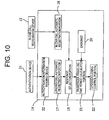
- FIG. 10 is a functional block diagram showing the control system for the elevators shown in FIG. 9 .
- an authentication device 31 which can acquire personal information on passengers stored in, for example, contact-type magnetic cards, non-contact-type IC cards, non-contact tag components or the like so as to authenticate individuals based on the acquired personal information, is installed at each of the landing floors 4 as a landing call registration device.
- the hall doorway of the elevator hall 7 is provided with a security gate for allowing a passenger to enter the elevator hall 7 only when the personal information on the passenger is authenticated by the authentication device 31.
- the hall doorway may be provided with a door that is usually locked but temporarily unlocked through an authentication made by the authentication device 31.
- the hall doorway may be provided with a door that automatically opens the hall doorway only when an authentication is made by the authentication device 31.
- the control system body 14 further has an authentication information reading device 32 for analyzing personal information acquired by the authentication device 31.
- the personal information contains detailed information on, for example, passenger traveling time periods corresponding to the respective elevator doorways 6, target floors, car call floors, and the like.
- the authentication information reading device 32 analyzes the personal information to detect the above-mentioned detailed information.
- the landing call automatic registration portion 17 makes a car call registration only when a passenger is authenticated by the authentication device 31.
- the passenger traveling time period calculation portion 21 calculates a passenger traveling time period corresponding to the personal information authenticated by the authentication device 31, based on the information from the authentication information reading device 32. That is, the passenger traveling time period calculation portion 21 reads the information on the passenger traveling time periods from the detailed information analyzed by the authentication information reading device 32, thereby calculating a passenger traveling time period corresponding to the personal information.
- Embodiment 6 of the present invention is identical to Embodiment 1 of the present invention in other configurational details.
- the landing call automatic registration portion 17 makes a car call registration only when a passenger is authenticated by the authentication device 31. Therefore, a car call registration can be prevented from being made by an outsider, so an improvement in security effect can be achieved.
- the passenger traveling time period calculation portion 21 calculates the passenger traveling time period corresponding to the personal information authenticated by the authentication device 31, so the passenger traveling time period can be set elaborately for each of the passengers. As a result, the passengers can be prevented more reliably from missing the respective cars 5.
- the information on the passenger traveling time periods is included in the personal information.
- information such as gender, age, and the like may be included in the personal information, and information on passenger traveling time periods corresponding to gender, age, and the like may be stored in the database 20.
- the passenger traveling time period calculation portion 21 reads from the database 20 that one of the passenger traveling time periods which corresponds to the personal information authenticated by the authentication device 31.
- the present invention is applied to the control system for the elevators which controls the plurality of the elevator apparatuses 1 to 3 comprehensively.
- the present invention may be applied to a control system for an elevator which controls a single elevator apparatus.
- the control system body 14 does not have the group supervision/control device 15.
- the control system body 14 is not required to select a selected elevator, so information from the landing call automatic registration portion 17 is directly input to the passenger traveling time period calculation portion 21.
- each of the elevator doorways 6 is held in the door-open state until the passenger traveling time period elapses. Therefore, the door-closing operation of each of the elevator doorways 6 can be prevented from being performed before a passenger arrives at the elevator doorway 6, so the passenger can be prevented frommissing the car 5.
Landscapes
- Engineering & Computer Science (AREA)
- Automation & Control Theory (AREA)
- Computer Networks & Wireless Communication (AREA)
- Elevator Control (AREA)
Abstract
Description
- The present invention relates to a control system for elevators for controlling operations of elevator apparatuses.
- Conventionally, there has been proposed an elevator group control device for supervising traveling of a plurality of elevator apparatuses as a group. In a building provided with this conventional elevator group control device, elevator doorways corresponding to each of the elevator apparatuses are provided at each single floor. A call registration command device, which is operated by passengers to call cars, is provided at that floor. When the call registration command device is operated, the allocation of those of the cars which are to be moved to that floor is carried out.
- The allocation of the cars is carried out by comparing time periods required until the arrival of the cars at that floor with time periods required until the arrival of passengers at the elevator doorways. In this case, when the time period required until the arrival of a certain one of the cars at that floor is shorter than the time period required until the arrival of a passenger at a corresponding one of the elevator doorways, this elevator doorway is excluded from targets for allocation. Thus, that one of the cars which arrives after the arrival of the passenger at the elevator doorway can be allocated, so the passenger is prevented from missing that car (see Patent Document 1).
- Patent Document 1:
P 3040524 - However, in the conventional elevator group control device, those of the cars which can arrive before a passenger arrives at each of the elevator doorways are excluded from allocated objects. Therefore, even when, for example, one of the cars is stopped at that floor and the other cars are located far from that floor and take a long time to arrive at that floor, those cars located far from that floor are allocated. As a result, the passenger can arrive at each of the elevator doorways before those cars arrive at that floor. However, the passenger must wait for the arrival of those cars in front of each of the elevator doorways for a long time.
- The present invention has been made to solve the above-mentioned problem, and it is therefore an obj ect of the present invention to provide a control system for elevators which makes it possible to shorten the waiting time periods of passengers and prevent the passengers from missing cars.
- A control system for elevators according to the present invention controls operations of a plurality of elevator apparatuses, which have cars that can stop at a common landing floor and elevator doorways provided at the landing floor for allowing passengers to get on/off the cars stopped at the landing floor from/to the landing floor. The control system includes: a landing call registration device provided at the landing floor to be operable at the landing floor; a landing call automatic registration portion for setting as a car call floor the landing floor where the landing call registration device is operated, and making a car call registration for stopping any one of the cars at the car call floor; a response selection portion for selecting as a selected elevator that one of the elevator apparatuses which responds to the car call registration, based on information from the elevator apparatuses and information from the landing call automatic registration portion; a passenger traveling time period calculation portion for setting as a selected doorway that one of the elevator doorways of the selected elevator, which is provided at the car call floor, based on information from the response selection portion, and calculating a passenger traveling time period required for traveling of passengers from the landing call registration device to the selected doorway; and an opening/closing control portion for controlling opening/closing operations of the selected doorway based on information from the selected elevator and information from the passenger traveling time period calculation portion.
- FLG. 1 is a schematic diagram showing a control system for elevators according to Embodiment 1 of the present invention.
-
FIG. 2 is a functional block diagram showing the control system for the elevators shown inFIG. 1 . -
FIG. 3 is a flowchart for explaining processing operations of the control system body ofFIG. 2 . -
FIG. 4 is a flowchart for explaining the processing operations of a control system for elevators according toEmbodiment 2 of the present invention. -
FIG. 5 is a functional block diagram showing a control system for elevators according toEmbodiment 3 of the present invention. -
FIG. 6 is a flowchart for explaining the processing operations of the control system for the elevators shown inFIG. 5 . -
FIG. 7 is a flowchart for explaining the processing operations in calculating the passenger traveling time period in a control system for elevators according toEmbodiment 4 of the present invention. -
FIG. 8 is a flowchart for explaining the processing operations in calculating the passenger traveling time period in a control system for elevators according toEmbodiment 5 of the present invention. -
FIG. 9 is a schematic diagram showing a control system for elevators according toEmbodiment 6 of the present invention. -
FIG. 10 is a functional block diagram showing the control system for the elevators shown inFIG. 9 . - Preferred embodiments of the present invention will be described hereinafter with reference to the drawings.
-
FIG. 1 is a schematic diagram showing a control system for elevators according to Embodiment 1 of the present invention. Referring toFIG. 1 , a building is provided with a plurality of (three in this example) elevator apparatuses 1 to 3. The building is also provided with a plurality oflanding floors 4 where the elevator apparatuses 1 to 3 can be used. The elevator apparatuses 1 to 3 havecars 5 andelevator doorways 6. Thecars 5 can stop at thelanding floors 4. Theelevator doorways 6 are provided at each of thelanding floors 4 so that passengers can get on/off thecars 5 from/to each of thelanding floors 4. - An
elevator hall 7 is provided at each of thelanding floors 4. Theelevator doorways 6 of the elevator apparatuses 1 to 3 are provided horizontally apart from one another in theelevator hall 7. Each of theelevator doorways 6 is provided with a pair ofelevator doors 8 for opening/closing theelevator doorway 6. - A plurality of (three in this example)
hall lanterns 9 for reporting to theelevator hall 7 that one of theelevator doorways 6 which is to be opened subsequently and the arrival of the corresponding one of thecars 5 are provided at each of thelanding floors 4. Each of thehall lanterns 9 is provided in the vicinity of a corresponding one of theelevator doorways 6. In this example, that one of theelevator doorways 6 which is to be opened is reported through the lighting of the corresponding one of thehall lanterns 9, and the arrival of the corresponding one of thecars 5 is reported through the blinking of the corresponding one of thehall lanterns 9. - Provided at each of the
landing floors 4 is a landingcall registration device 10 that can be operated there. In this example, the landingcall registration device 10 is installed at a hall doorway through which passengers get into/out of theelevator hall 7. The landingcall registration device 10 is provided with adestination floor selector 11 for selecting target floors through the operations by passengers, and anindicator 12 for indicating the target floors selected by the passengers. Thetarget floor selector 11 has a general-purpose selector designed for the selection of target floors by able-bodied persons, and a disabled-accessible selector disposed below the general-purpose selector to help disabled persons such as wheelchair users and the like select target floors. Each of the general-purpose selector and the disabled-accessible selector is provided with a plurality of target floor buttons. - Provided in the
car 5 of each of the elevator apparatuses 1 to 3 is an in-carcall registration device 13 that can be operated therein. The in-carcall registration device 13 is provided with a destination floor selector (not shown) for selecting destination floors of thecar 5 through the operation by passengers, and an indicator (not shown) for indicating the current position of thecar 5. The destination floor selector is provided with a plurality of destination floor buttons. - Information from the landing
call registration device 10 and information from the elevator apparatuses 1 to 3 are transmitted to acontrol system body 14 for controlling the operations of the elevator apparatuses 1 to 3 comprehensively. Thecontrol system body 14 controls the operations of the elevator apparatuses 1 to 3 based on the information from the landingcall registration device 10 and the information from the elevator apparatuses 1 to 3. - The
control system body 14 has a group supervision/control device 15 for operating and supervising the elevator apparatuses 1 to 3 as a group, and a plurality of (three in this example)individual control devices 16 for controlling the operations of the elevator apparatuses 1 to 3 individually based on information from the group supervision/control device 15. -
FIG. 2 is a functional block diagram showing the control system for the elevators shown inFIG. 1 . Referring toFIG. 2 , thecontrol system body 14 has a landing callautomatic registration portion 17, an in-car callautomatic registration portion 18, aresponse selection portion 19, a database (storage portion) 20, a passenger traveling timeperiod calculation portion 21, and an opening/closing control portion 22. - The landing call
automatic registration portion 17 sets as a car call floor that one of thelanding floors 4 whose landingcall registration device 10 is operated, based on information from landingcall registration devices 10, and automatically makes a car call registration for stopping one of thecars 5 of the elevator apparatuses 1 to 3 at the car call floor. - The in-car call
automatic registration portion 18 automatically makes a car call registration for stopping thecar 5 at a destination floor selected through the operation of each of in-carcall registration devices 13, based on information from the in-carcall registration devices 13. - The
response selection portion 19 selects as a selected elevator that one of the elevator apparatuses 1 to 3 which responds to a car call registration made by the landing callautomatic registration portion 17, based on information from the elevator apparatuses 1 to 3, information from the landing callautomatic registration portion 17, and information from the in-car callautomatic registration portion 18. That is, theresponse selection portion 19 calculates as evaluation values waiting time periods at a car call floor which are required until the arrival of thecars 5 of the elevator apparatuses 1 to 3 (performs calculation of the evaluation values), and selects as a selected elevator that one of the elevator apparatuses which has the best evaluation value. In other words, theresponse selection portion 19 performs calculation of the evaluation values of the elevator apparatuses 1 to 3 to select the selected elevator. The selected elevator is selected based on information on the positions and the speeds of thecars 5 of the elevator apparatuses 1 to 3, information on whether or not each of thecars 5 is fully loaded, information on the number of stops of each of thecars 5 before the arrival thereof at the car call floor, and the like. In this example, the selected elevator is selected by the group supervision/control device 15. - Time periods required for the traveling of passengers from the landing
call registration device 10 to the elevator doorways 6 (passenger traveling time periods) are stored in thedatabase 20 in advance. - The passenger traveling time
period calculation portion 21 sets as a selected doorway that one of theelevator doorways 6 of the selected elevator which is provided at the car call floor, based on information from theresponse selection portion 19 and information from thedatabase 20, and calculates a passenger traveling time period required for the traveling of a passenger from the landingcall registration device 10 to the selected doorway. The passenger traveling time period is calculated by reading from thedatabase 20 that one of the passenger traveling time periods which corresponds to the selected doorway. - The opening/
closing control portion 22 controls the opening/closing operations of the selected doorway based on operational information from the selected elevator and information from the passenger traveling timeperiod calculation portion 21. That is, when thecar 5 of the selected elevator stops at the car call floor and a door-opening operation of the selected doorway is completed before the passenger traveling time period calculated by the passenger traveling timeperiod calculation portion 21 elapses after the making of the car call registration by the landing callautomatic registration portion 17, the opening/closing control portion 22 holds the selected doorway in a door-open state until the passenger traveling time period elapses. When the door-opening operation of the selected doorway is completed after the lapse of the passenger traveling time period, the opening/closing control portion 22 performs normal opening/closing operations for maintaining the door-open state only for a preset normal door-open time period. The opening/closing operations of the selected doorway are controlled by the corresponding one of theindividual control devices 16 based on opening/closing commands from the group supervision/control device 15. - The
control system body 14 is constituted by a computer having a central processing unit (CPU), a storage portion (ROM, RAM, and the like), and signal input/output portions. The functions of the landing callautomatic registration portion 17, the in-car callautomatic registration portion 18, theresponse selection portion 19, thedatabase 20, the passenger traveling timeperiod calculation portion 21, and the opening/closing control portion 22 are realized by the computer constituting thecontrol system body 14. - That is, programs for realizing the functions of the landing call
automatic registration portion 17, the in-car callautomatic registration portion 18, theresponse selection portion 19, thedatabase 20, the passenger traveling timeperiod calculation portion 21, and the opening/closing control portion 22 are stored in the storage portion of the computer. Information on passenger traveling time periods, information on normal door-open time periods, and the like are also stored in the storage portion. The central processing unit performs calculation processings regarding the functions of thecontrol system body 14 based on the programs stored in the storage portion. - Next, an operation thereof will be described.
FIG. 3 is a flowchart for explaining processing operations of thecontrol system body 14 ofFIG. 2 . As shown inFIG. 3 , when the landingcall registration device 10 is operated (S1), the landing callautomatic registration portion 17 makes a car call registration for setting as a car call floor that one of thelanding floors 4 where the landingcall registration device 10 is installed (S2). - After that, the
response selection portion 19 performs calculation of evaluation values of the elevator apparatuses 1 to 3 based on operational information on the elevator apparatuses 1 to 3, information on a car call floor registered by the landing callautomatic registration portion 17, and information on a destination floor registered by the in-car callautomatic registration portion 18. As a result, that one of the elevator apparatuses 1 to 3 which responds to the car call registration made by the landing callautomatic registration portion 17 is selected as the selected elevator (S3). After that, theindicator 12 of the landingcall registration device 10 indicates the selected elevator based on information from the response selection portion 19 (S4). - After that, the passenger traveling time
period calculation portion 21 calculates a time period required for the traveling of a passenger from the landingcall registration device 10 to a selected doorway (theelevator doorway 6 of the selected elevator). The passenger traveling time period is calculated by reading that one of the passenger traveling time periods stored in thedatabase 20 in advance so as to correspond to therespective elevator doorways 6 which corresponds to the selected doorway (S5). - After that, the
control system body 14 determines, based on the operational information on the selected elevator, whether or not thecar 5 of the selected elevator has arrived at the car call floor (S6). When it is determined that thecar 5 has not arrived at the car call floor, it is determined whether or not thecar 5 has arrived at the car call floor, until thecar 5 arrives at the car call floor. - After that, when it is determined that the
car 5 of the selected elevator has arrived at the car call floor, the opening/closing control portion 22 performs control to perform the door-opening operation of the selected doorway (S7). After the door-opening operation of the selected doorway is completed, it is determined whether or not the passenger traveling time period calculated by the passenger traveling timeperiod calculation portion 21 has elapsed after the making of the car call registration by the landing call automatic registration portion 17 (S8). - When it is determined that the passenger traveling time period has not elapsed, the opening/
closing control portion 22 performs control to hold the selected doorway in the door-open state until the passenger traveling time period elapses (S9). - When it is determined that the passenger traveling time period has elapsed, the opening/
closing control portion 22 performs control to perform a door-closing operation after the lapse of a normal door-open time period, thereby terminating the processing (S10). - The control system for the elevators configured as described above has the passenger traveling time
period calculation portion 21 for calculating the time period required for the traveling of a passenger from the landingcall registration device 10 to the selected doorway, and the opening/closing control portion 22 for controlling the opening/closing operations of the selected doorway based on information from the passenger traveling timeperiod calculation portion 21. Therefore, even in the case where a long time period is required for the traveling of the passenger because of a long distance from the landingcall registration device 10 to theelevator doorway 6, the door-closing operation of theelevator doorway 6 can be prevented from being performed before the passenger arrives at theelevator doorway 6, so the passenger can be prevented frommissing the corresponding one of thecars 5. A selected elevator is selected from all the elevator apparatuses 1 to 3, and none of those elevator apparatuses 1 to 3 is excluded from the elevators to be selected. Therefore, the selected elevator can be selected efficiently, so the time period required until each of thecars 5 arrives at the car call floor after the operation of the landingcall registration device 10 can be shortened. Accordingly, the waiting time periods of passengers can be shortened. - When the door-opening operation of the selected doorway is completed before the passenger traveling time period elapses after the operation of the landing
call registration device 10, the opening/closing control portion 22 holds the selected doorway in the door-open state until the passenger traveling time period elapses. Therefore, passengers can be prevented more reliably from missing thecars 5. - In the foregoing example, one passenger traveling time period is stored in the
database 20 for each of theelevator doorways 6. However, a passenger traveling time period for able-bodied persons and a passenger traveling time period for disabled persons may be stored separately for each of theelevator doorways 6. In this case, the passenger traveling timeperiod calculation portion 21 calculates a passenger traveling time period by reading the passenger traveling time period for the able-bodied persons from thedatabase 20 when a car call registration is made through the operation of the general-purpose selector, and by reading the passenger traveling time period for the disabled persons from thedatabase 20 when a car call registration is made through the operation of the disabled-accessible selector. In this manner, even disabled passengers can be prevented from missing thecars 5. -
Embodiment 2
In the foregoing example, the door-opening operation of the selected doorway is started immediately after the arrival of thecar 5 at the car call floor. However, it is also appropriate to hold the selected doorway in the door-closed state until the passenger traveling time period elapses and perform the door-opening operation of the selected doorway after the passenger traveling time period has elapsed, instead of performing the door-opening operation of the selected doorway immediately after the stoppage of thecar 5 at the car call floor. -
FIG. 4 is a flowchart for explaining the processing operations of a control system for elevators according toEmbodiment 2 of the present invention. As shown inFIG. 4 , the same processing operations as in Embodiment 1 of the present invention are performed until it is determined whether or not thecar 5 of the selected elevator has arrived at the car call floor (S6). - When the
control system body 14 determines that thecar 5 has not arrived at the car call floor, it is determined whether or not thecar 5 has arrived at the car call floor, until thecar 5 arrives at the car call floor. - After that, when it is determined that the
car 5 of the selected elevator has arrived at the car call floor, thecontrol system body 14 determines whether or not the passenger traveling time period has elapsed after the making of the car call registration by the landing call automatic registration portion 17 (S11). - When it is determined that the passenger traveling time period has not elapsed, the opening/
closing control portion 22 performs control to hold the selected doorway in the door-closed state (S12). After that, thecontrol systembody 14 determines again whether or not the passenger traveling time period has elapsed (S11). When it is determined that the passenger traveling time period has not elapsed, the foregoing operations are repeated. Thus, the selected doorway is held in the door-closed state until the passenger traveling time period elapses. - When it is determined that the passenger traveling time period has elapsed, the opening/
closing control portion 22 performs control to perform the door-opening operation of the selected doorway (S13). After the door-opening operation is completed, the door-closing operation is performed to terminate the processing upon the lapse of the normal door-open time period (S14).Embodiment 2 of the present invention is identical to Embodiment 1 of the present invention in other configurational details and other operational details. - In the control system for the elevators configured as described above, when the
car 5 arrives at the car call floor before the passenger traveling time period elapses after the making of the car call registration by the landing callautomatic registration portion 17, the opening/closing control portion 22 performs control to hold the selected doorway in the door-closed state until the passenger traveling time period elapses. Therefore, a user other than the passenger who has operated the landingcall registration device 10 can be prevented from getting on thecar 5 of the selected elevator by mistake. - In the foregoing example, the selected doorway is held in the door-closed state until the passenger traveling time period elapses. However, the door-opening operation should not necessarily be started upon the lapse of the passenger traveling time period. Instead, the selected doorway may be held in the door-closed state until an operation starting time instant set on the basis of the lapse of the passenger traveling time period. For instance, if the operation starting time instant is set upon the lapse of a time period shorter than the passenger traveling time period by a predetermined time period, the door-opening operation of the selected doorway can be performed immediately before the passenger arrives at the selected doorway, so the passenger is allowed to get on the
car 5 of the selected elevator smoothly. Thus, the user-friendliness of the elevator apparatuses 1 to 3 can be enhanced. -
Embodiment 3
FIG. 5 is a functional block diagram showing a control system for elevators according toEmbodiment 3 of the present invention. Referring toFIG. 5 , information from the in-car callautomatic registration portion 18 is transmitted to the opening/closing control portion 22 as well as theresponse selection portion 19. The opening/closing control portion 22 controls the opening/closing operations of a selected doorway based on information from a selected elevator, information from the passenger traveling timeperiod calculation portion 21, and information from the in-car callautomatic registration portion 18. - That is, when there is a car call registration made by the in-car call
automatic registration portion 18, the opening/closing control portion 22 performs normal opening/closing operations of the selected doorway which are irrelevant to the passenger traveling time period. When there is no car call registration made by the in-car callautomatic registration portion 18 and thecar 5 stops at a car call floor before the passenger traveling time period elapses after the making of a car call registration by the landing callautomatic registration portion 17, the opening/closing control portion 22 performs the opening/closing operations based on the passenger traveling time period. - The opening/closing operations based on the passenger traveling time period are the same as in the foregoing
Embodiment 2 of the present invention. That is, the selected doorway is held in the door-closed state until the operation starting time instant set on the basis of the lapse of the passenger traveling time period, and the door-opening operation of the selected doorway is started after the operation starting time instant.Embodiment 3 of the present invention is identical toEmbodiment 2 of the present invention in other configurational details. -
FIG. 6 is a flowchart for explaining the processing operations of the control system for the elevators shown inFIG. 5 . As shown inFIG. 6 , the same operations (S1 to S5) as inEmbodiment 2 of the present invention are performed until the passenger traveling timeperiod calculation portion 21 calculates a passenger traveling time period after the start of the processing operations. - After the passenger traveling time period is calculated, the
control system body 14 determines whether or not deceleration of thecar 5 for stopping thecar 5 at a car call floor has been started (stoppage of thecar 5 at the car call floor has been determined) (S21). When it is determined that deceleration of thecar 5 has not been started, it is repeatedly determined whether or not deceleration of thecar 5 has been started, until deceleration of thecar 5 is started. - When it is determined that deceleration of the
car 5 has been started, thecontrol system body 14 determines whether or not a car call registration has been made by the in-car call automatic registration portion 18 (S22). When it is determined that the car call registration has been made by the in-car callautomatic registration portion 18, the opening/closing control portion 22 performs control to cause a selected doorway to perform normal opening/closing operations (S13, S14), thereby terminating the processing. - When it is determined that no car call registration has been made by the in-car call
automatic registration portion 18, the opening/closing control portion 22 assumes that there is no passenger in thecar 5 of the selected elevator. After that, thecontrol system body 14 determines, based on operational information on the selected elevator, whether or not thecar 5 of the selected elevator has arrived at the car call floor (S6). The subsequent operations are the same as inEmbodiment 2 of the present invention. - As described above, when there is no car call registration made by the in-car call
automatic registration portion 18 and thecar 5 stops at the car call floor before the passenger traveling time period elapses after the operation of the landingcall registration device 10, the opening/closing control portion 22 holds the selected doorway in the door-closed state until the operation starting time instant set on the basis of the lapse of the passenger traveling time period, and starts the door-opening operation of the selected doorway after the operation starting time instant. Therefore, the start of the door-opening operation of the selected doorway can be retarded only when there is no passenger in thecar 5 of the selected elevator. Accordingly, the door-opening operation of the selected doorway can be prevented frombeing retarded when there is a passenger in thecar 5 of the selected elevator, so the operating efficiency of the elevators can be enhanced. - In the foregoing example, the opening/closing operations based on the passenger traveling time period are the same as in
Embodiment 2 of the present invention. However, the same opening/closing operations as in Embodiment 1 of the present invention may be performed to hold the selected doorway in the door-open state until the passenger traveling time period elapses. -
Embodiment 4
In each of the foregoing examples, the passenger traveling time period corresponding to each of theelevator doorways 6 does not differ depending on the degree of crowdedness of a car call floor. However, the passenger traveling time period may differ depending on the degree of crowdedness of the car call floor. - That is, time zone information including information on a peak time zone in which the
respective landing floors 4 are crowded with passengers and information on an off-peak time zone in which thelanding floors 4 are uncrowded, and passenger traveling time period information including information on passenger traveling time periods corresponding to the peak time zone and information on passenger traveling time periods corresponding to the off-peak time zone are stored in thedatabase 20. The passenger traveling time periods included in the passenger traveling time period information are so set as to correspond to each of theelevator doorways 6. - The passenger traveling time
period calculation portion 21 selects either the passenger traveling time periods in the peak time zone or the passenger traveling time periods in the off-peak time zone based on information at the time of the making of a car call registration by the landing callautomatic registration portion 17, and reads that one of the selected passenger traveling time periods which corresponds to a selected elevator. In this manner, the passenger traveling timeperiod calculation portion 21 calculates the passenger traveling time period corresponding to the selected elevator.Embodiment 4 of the present invention is identical to Embodiment 1 of the present invention in other configurational details. - Next, an operation thereof will be described. Processing operations in
Embodiment 4 of the present invention are the same as in Embodiment 1 of the present invention except the processing operations in calculating the passenger traveling time period. Therefore, only the processing operations in calculating the passenger traveling time period will be described. -
FIG. 7 is a flowchart for explaining the processing operations in calculating the passenger traveling time period in a control system for elevators according toEmbodiment 4 of the present invention. As shown inFIG. 7 , after detecting a time instant when the landing callautomatic registration portion 17 makes a car call registration (S31), the passenger traveling timeperiod calculation portion 21 reads the time zone information from the database (S32). - After that, the passenger traveling time
period calculation portion 21 compares the detected time instant with the time zone information. Thus, the passenger traveling timeperiod calculation portion 21 determines whether or not the time instant when the landing callautomatic registration portion 17 makes the car call registration is within the peak time zone (S33). - When it is determined that the time instant when the car call registration is made is within the peak time zone, the passenger traveling time
period calculation portion 21 reads from thedatabase 20 that one of the passenger traveling time periods which corresponds to the peak time zone and a selected elevator (S34). In this manner, the passenger traveling time period corresponding to a selected doorway is calculated. - When it is determined that the time instant when the car call registration is made is not within the peak time zone, the passenger traveling time
period calculation portion 21 reads from thedatabase 20 that one of the passenger traveling time periods which corresponds to the off-peak time zone and the selected elevator (S35). In this manner, the passenger traveling time period corresponding to the selected doorway is calculated. The subsequent operations are the same as in Embodiment 1 of the present invention. - In the control system for the elevators configured as described above, the passenger traveling time periods in the peak time zone and the off-peak time zone are set in the
database 20 in advance, and it is determined to which one of the time zones the time instant when the landing callautomatic registration portion 17 makes the car call registration belongs, so the passenger traveling time period corresponding to the degree of crowdedness of the car call floor with passengers is calculated. Therefore, the passenger traveling time period at the car call floor can be calculated more reliably with a simple configuration, so the passengers can further be prevented from missing therespective cars 5. -
Embodiment 5
In the foregoing example, a determination on the degree of crowdedness at the car call floor is made according to each of the time zones. However, the determination on the degree of crowdedness at the car call floor may be made according to the number of car call registrations made by the landing callautomatic registration portion 17. - That is, in
Embodiment 5 of the present invention, the passenger traveling timeperiod calculation portion 21 detects the number of car call registrations made by the landing callautomatic registration portion 17 per unit time (e.g., per minute), and determines, based on the detected number of the car call registrations, whether or not the car call floor is crowded. That is, when the number of the car call registrations made by the landing callautomatic registration portion 17 per unit time is larger than a preset reference number, the passenger traveling timeperiod calculation portion 21 determines that the car call floor is crowded. When the number of the car call registrations is equal to or smaller than the reference number, the passenger traveling timeperiod calculation portion 21 determines that the car call floor is uncrowded. - Passenger traveling time periods in a crowded state and passenger traveling time periods in an uncrowded state are so stored in the
database 20 in advance as to correspond to therespective elevator doorways 6. The passenger traveling timeperiod calculation portion 21 selects, based on a result of the determination made on the crowdedness of the car call floor, either the passenger traveling time periods in the crowded state or the passenger traveling time periods in the uncrowded state, and reads that one of the selected passenger traveling time periods which corresponds to a selected elevator. In this manner, the passenger traveling timeperiod calculation portion 21 calculates the passenger traveling time period corresponding to the selected elevator.Embodiment 5 of the present invention is identical to Embodiment 1 of the present invention in other configurational details. - Next, an operation thereof will be described. Processing operations in
Embodiment 5 of the present invention are the same as in Embodiment 1 of the present invention except the processing operations in calculating the passenger traveling time period. Therefore, only the processing operations in calculating the passenger traveling time period will be described. -
FIG. 8 is a flowchart for explaining the processing operations in calculating the passenger traveling time period in a control system for elevators according toEmbodiment 5 of the present invention. As shown inFIG. 8 , in calculating the passenger traveling time period, the passenger traveling timeperiod calculation portion 21 detects the number of car call registrations made by the landing callautomatic registration portion 17 per unit time (S41). After that, the passenger traveling timeperiod calculation portion 21 determines whether or not the detected number of the car call registrations is larger than a reference number (S42). - When the number of the car call registrations is larger than the reference number, the car call floor is considered to be crowded, so the passenger traveling time
period calculation portion 21 reads the passenger traveling time periods in the crowded state from the database 20 (S43). - When the number of the car call registrations is equal to or smaller than the reference number, the car call floor is considered to be uncrowded, so the passenger traveling time
period calculation portion 21 reads the passenger traveling time periods in the uncrowded state from the database 20 (S44). - In this manner, after the passenger traveling time period corresponding to the selected doorway has been calculated, the processing operations are performed in the same manner as in Embodiment 1 of the present invention.
- As described above, the passenger traveling time
period calculation portion 21 determines, based on the number of the car call registrations made by the landing callautomatic registration portion 17, whether or not the car call floor is crowded, and calculates the passenger traveling time period based on the result of the determination. Therefore, even in the case where the number of passengers increases temporarily, for example, when a group of visitors use the elevators, the passenger traveling time period at the car call floor can be calculated more reliably with a simple configuration, so the passengers can further be prevented from missing therespective cars 5. -
Embodiment 6
FIG. 9 is a schematic diagram showing a control system for elevators according toEmbodiment 6 of the present invention.FIG. 10 is a functional block diagram showing the control system for the elevators shown inFIG. 9 . Referring toFIGS. 9 and10 , anauthentication device 31, which can acquire personal information on passengers stored in, for example, contact-type magnetic cards, non-contact-type IC cards, non-contact tag components or the like so as to authenticate individuals based on the acquired personal information, is installed at each of thelanding floors 4 as a landing call registration device. - The hall doorway of the
elevator hall 7 is provided with a security gate for allowing a passenger to enter theelevator hall 7 only when the personal information on the passenger is authenticated by theauthentication device 31. The hall doorway may be provided with a door that is usually locked but temporarily unlocked through an authentication made by theauthentication device 31. Alternatively, the hall doorway may be provided with a door that automatically opens the hall doorway only when an authentication is made by theauthentication device 31. - The
control system body 14 further has an authenticationinformation reading device 32 for analyzing personal information acquired by theauthentication device 31. The personal information contains detailed information on, for example, passenger traveling time periods corresponding to therespective elevator doorways 6, target floors, car call floors, and the like. The authenticationinformation reading device 32 analyzes the personal information to detect the above-mentioned detailed information. - Information from the authentication
information reading device 32 is transmitted to the landing callautomatic registration portion 17. The landing callautomatic registration portion 17 makes a car call registration only when a passenger is authenticated by theauthentication device 31. - The passenger traveling time
period calculation portion 21 calculates a passenger traveling time period corresponding to the personal information authenticated by theauthentication device 31, based on the information from the authenticationinformation reading device 32. That is, the passenger traveling timeperiod calculation portion 21 reads the information on the passenger traveling time periods from the detailed information analyzed by the authenticationinformation reading device 32, thereby calculating a passenger traveling time period corresponding to the personal information.Embodiment 6 of the present invention is identical to Embodiment 1 of the present invention in other configurational details. - In the control system for the elevators configured as described above, the landing call
automatic registration portion 17 makes a car call registration only when a passenger is authenticated by theauthentication device 31. Therefore, a car call registration can be prevented from being made by an outsider, so an improvement in security effect can be achieved. - The passenger traveling time
period calculation portion 21 calculates the passenger traveling time period corresponding to the personal information authenticated by theauthentication device 31, so the passenger traveling time period can be set elaborately for each of the passengers. As a result, the passengers can be prevented more reliably from missing therespective cars 5. - In the foregoing example, the information on the passenger traveling time periods is included in the personal information. However, information such as gender, age, and the like may be included in the personal information, and information on passenger traveling time periods corresponding to gender, age, and the like may be stored in the
database 20. In this case, the passenger traveling timeperiod calculation portion 21 reads from thedatabase 20 that one of the passenger traveling time periods which corresponds to the personal information authenticated by theauthentication device 31. - In each of the foregoing embodiments of the present invention, the present invention is applied to the control system for the elevators which controls the plurality of the elevator apparatuses 1 to 3 comprehensively. However, the present invention may be applied to a control system for an elevator which controls a single elevator apparatus. In this case, the
control system body 14 does not have the group supervision/control device 15. Thecontrol system body 14 is not required to select a selected elevator, so information from the landing callautomatic registration portion 17 is directly input to the passenger traveling timeperiod calculation portion 21. - In the control system for the elevator which controls the single elevator apparatus as described above, even when the door-opening operation of each of the
elevator doorways 6 is completed before a passenger traveling time period elapses after the making of a car call registration by the landing callautomatic registration portion 17, each of theelevator doorways 6 is held in the door-open state until the passenger traveling time period elapses. Therefore, the door-closing operation of each of theelevator doorways 6 can be prevented from being performed before a passenger arrives at theelevator doorway 6, so the passenger can be prevented frommissing thecar 5.
Claims (7)
- A control system for elevators for controlling operations of a plurality of elevator apparatuses, which have cars that can stop at a common landing floor and elevator doorways provided at the landing floor for allowing passengers to get on/off the cars stopped at the landing floor from/to the landing floor, the control system being characterized by comprising:a landing call registration device provided at the landing floor to be operable at the landing floor;a landing call automatic registration portion for setting as a car call floor the landing floor where the landing call registration device is operated, and making a car call registration for stopping any one of the cars at the car call floor;a response selection portion for selecting as a selected elevator that one of the elevator apparatuses which responds to the car call registration, based on information from the elevator apparatuses and information from the landing call automatic registration portion;a passenger traveling time period calculation portion for setting as a selected doorway that one of the elevator doorways of the selected elevator, which is provided at the car call floor, based on information from the response selection portion, and calculating a passenger traveling time period required for traveling of passengers from the landing call registration device to the selected doorway; andan opening/closing control portion for controlling opening/closing operations of the selected doorway based on information from the selected elevator and information from the passenger traveling time period calculation portion.
- A control system for elevators for controlling a single elevator apparatus, which has a car that can stop at a landing floor and an elevator doorway provided at the landing floor for allowing passengers to get on/off the car stopped at the landing floor from/to the landing floor, the control system being characterized by comprising:a landing call registration device provided at the landing floor to be operable at the landing floor;a landing call automatic registration portion for setting as a car call floor the landing floor where the landing call registration device is operated, and making a car call registration for stopping the car at the car call floor;a passenger traveling time period calculation portion for setting as a selected doorway that the elevator doorway which is provided at the car call floor, and calculating a passenger traveling time period required for traveling of passengers from the landing call registration device to the selected doorway; andan opening/closing control portion for controlling opening/closing operations of the selected doorway based on information from the elevator apparatus and information from the passenger traveling time period calculation portion.
- A control system for elevators according to Claim 1 or 2, characterized in that the passenger traveling time period calculation portion calculates the passenger traveling time period corresponding to a degree of crowdedness of the car call floor with the passengers.
- A control system for elevators according to Claim 1 or 2, characterized in that the opening/closing control portion holds the selected doorway in a door-open state until the passenger traveling time period elapses, when the car stops at the car call floor and a door-opening operation of the selected doorway is completed before the passenger traveling time period elapses after making of a car call registration by the landing call automatic registration portion.
- A control system for elevators according to Claim 1 or 2, characterized in that the opening/closing control portion holds the selected doorway in a door-closed state until an operation starting time instant set on a basis of a lapse of the passenger traveling time period, when the car stops at the car call floor before the passenger traveling time period elapses after making of a car call registration by the landing call automatic registration portion.
- A control system for elevators according to Claim 1 or 2,
characterized in that:the landing call registration device is an authentication device capable of acquiring personal information on the passengers to conduct personal authentication based on the personal information; andthe landing call automatic registration portion makes the car call registration when each of the passengers is authenticated through the personal authentication. - A control system for elevators according to Claim 6, characterized in that the passenger traveling time period calculation portion calculates the passenger traveling time period corresponding to the personal information on each of the passengers authenticated by the authentication device.
Applications Claiming Priority (1)
| Application Number | Priority Date | Filing Date | Title |
|---|---|---|---|
| PCT/JP2005/022462 WO2007066390A1 (en) | 2005-12-07 | 2005-12-07 | Control system for elevator |
Publications (3)
| Publication Number | Publication Date |
|---|---|
| EP1958908A1 true EP1958908A1 (en) | 2008-08-20 |
| EP1958908A4 EP1958908A4 (en) | 2013-01-09 |
| EP1958908B1 EP1958908B1 (en) | 2019-04-03 |
Family
ID=38122543
Family Applications (1)
| Application Number | Title | Priority Date | Filing Date |
|---|---|---|---|
| EP05814476.7A Expired - Lifetime EP1958908B1 (en) | 2005-12-07 | 2005-12-07 | Control system for elevator |
Country Status (6)
| Country | Link |
|---|---|
| US (1) | US7913820B2 (en) |
| EP (1) | EP1958908B1 (en) |
| JP (1) | JP5031371B2 (en) |
| KR (1) | KR100990547B1 (en) |
| CN (1) | CN101272976B (en) |
| WO (1) | WO2007066390A1 (en) |
Cited By (4)
| Publication number | Priority date | Publication date | Assignee | Title |
|---|---|---|---|---|
| EP2779117A1 (en) * | 2013-03-15 | 2014-09-17 | Inventio AG | Access control for areas with multiple doors |
| EP2779118A1 (en) * | 2013-03-15 | 2014-09-17 | Inventio AG | Adaptive access control for areas with multiple doors |
| EP2517996A4 (en) * | 2009-12-24 | 2014-12-10 | Mitsubishi Electric Corp | ELEVATOR SYSTEM |
| EP1988046B1 (en) | 2006-02-21 | 2018-08-08 | Mitsubishi Electric Corporation | Control system for elevator |
Families Citing this family (29)
| Publication number | Priority date | Publication date | Assignee | Title |
|---|---|---|---|---|
| EP2261160B1 (en) * | 2008-04-03 | 2018-10-24 | Mitsubishi Electric Corporation | Group management device of elevator |
| CN102548888A (en) * | 2009-10-23 | 2012-07-04 | 三菱电机株式会社 | Elevator operating device |
| WO2011067848A1 (en) * | 2009-12-03 | 2011-06-09 | 三菱電機株式会社 | Elevator system |
| JP5500253B2 (en) | 2010-06-29 | 2014-05-21 | 三菱電機株式会社 | Elevator control device |
| US20130048436A1 (en) * | 2011-08-29 | 2013-02-28 | Mark Kit Jiun Chan | Automated elevator car call prompting |
| JP5403526B2 (en) * | 2012-01-13 | 2014-01-29 | 東芝エレベータ株式会社 | Elevator group management control system |
| JP5894842B2 (en) * | 2012-04-11 | 2016-03-30 | 株式会社日立製作所 | Elevator system |
| JP2013241230A (en) * | 2012-05-18 | 2013-12-05 | Toshiba Elevator Co Ltd | Group management control apparatus and method for elevator |
| FI124131B (en) * | 2012-11-14 | 2014-03-31 | Kone Corp | Lift arrangement |
| JP5684307B2 (en) * | 2013-03-08 | 2015-03-11 | 東芝エレベータ株式会社 | Elevator auto-lock interlocking operation system |
| CN104044968B (en) * | 2013-03-12 | 2016-01-27 | 上海三菱电梯有限公司 | Elevator landing call device control method is set |
| JP5863206B2 (en) * | 2014-06-09 | 2016-02-16 | 東芝エレベータ株式会社 | Elevator group management device |
| JP6299468B2 (en) * | 2014-06-17 | 2018-03-28 | 三菱電機ビルテクノサービス株式会社 | Elevator control system |
| JP6365178B2 (en) * | 2014-09-24 | 2018-08-01 | フジテック株式会社 | Elevator group management system |
| CN106315316A (en) | 2015-06-16 | 2017-01-11 | 奥的斯电梯公司 | Elevator system and control method for same |
| CN107848736B (en) * | 2015-07-30 | 2023-05-30 | 因温特奥股份公司 | Latching system for car doors |
| JP6381810B2 (en) * | 2015-08-10 | 2018-08-29 | 三菱電機株式会社 | Elevator control device and elevator notification timing control method |
| US11827491B2 (en) | 2015-12-22 | 2023-11-28 | Otis Elevator Company | Elevator service request using user device |
| JP6627638B2 (en) * | 2016-04-28 | 2020-01-08 | フジテック株式会社 | Elevator group management system and elevator system |
| WO2018213008A1 (en) * | 2017-05-18 | 2018-11-22 | Carrier Corporation | System and method for calling elevator |
| JP6517306B1 (en) * | 2017-11-15 | 2019-05-22 | 東芝エレベータ株式会社 | Control device and control method for elevator |
| CN110950206B (en) * | 2018-09-26 | 2022-08-02 | 奥的斯电梯公司 | Passenger movement detection system, passenger movement detection method, passenger call control method, readable storage medium, and elevator system |
| CN109534112A (en) * | 2018-12-14 | 2019-03-29 | 江苏威尔曼科技有限公司 | One kind passing through elevator outer calling automated log on floor information system |
| JP2020125196A (en) * | 2019-02-06 | 2020-08-20 | 東芝エレベータ株式会社 | Elevator operation control system |
| US20200354196A1 (en) * | 2019-05-06 | 2020-11-12 | Otis Elevator Company | Self-tuning door timing parameters |
| CN110615329A (en) * | 2019-09-26 | 2019-12-27 | 马鞍山问鼎网络科技有限公司 | Intelligent elevator system based on remote data connection |
| JP7171773B2 (en) * | 2021-01-04 | 2022-11-15 | 東芝エレベータ株式会社 | ELEVATOR CONTROLLER, ELEVATOR CONTROL SYSTEM, METHOD AND PROGRAM |
| KR102583584B1 (en) * | 2022-06-30 | 2023-10-06 | 현대엘리베이터주식회사 | Robotic Linked Elevator Control Method |
| CN116873677B (en) * | 2023-07-19 | 2026-02-03 | 上海三菱电梯有限公司 | Elevator call registration system |
Family Cites Families (21)
| Publication number | Priority date | Publication date | Assignee | Title |
|---|---|---|---|---|
| JPS5582270U (en) * | 1978-11-29 | 1980-06-06 | ||
| JPS5582270A (en) | 1978-12-15 | 1980-06-20 | Nippon Denso Co | Refrigerating plant |
| ATE102893T1 (en) | 1990-02-05 | 1994-04-15 | Inventio Ag | GROUP CONTROL FOR ELEVATORS WITH IMMEDIATE ALLOCATION OF DESTINATION CALLS DEPENDENT ON THE CALL INPUT LOCATION ON A FLOOR. |
| EP0452130A3 (en) | 1990-04-12 | 1992-01-22 | Otis Elevator Company | Controlling door dwell time |
| JPH04317968A (en) * | 1991-02-21 | 1992-11-09 | Otis Elevator Co | Method for calculating arrival time of incoming passenger in elevator |
| JPH04358682A (en) | 1991-06-04 | 1992-12-11 | Mitsubishi Electric Corp | Elevator control device |
| US5329076A (en) * | 1992-07-24 | 1994-07-12 | Otis Elevator Company | Elevator car dispatcher having artificially intelligent supervisor for crowds |
| JPH1121031A (en) * | 1997-07-02 | 1999-01-26 | Hitachi Ltd | Elevator group management device |
| JPH1171080A (en) * | 1997-08-29 | 1999-03-16 | Toshiba Corp | Elevator control device |
| JPH11121031A (en) | 1997-10-17 | 1999-04-30 | Mitsubishi Heavy Ind Ltd | Beta alumina electrolyte structure body and secondary battery |
| JP2000016729A (en) | 1998-06-17 | 2000-01-18 | Otis Elevator Co | Group supervisory operation elevator |
| US6397976B1 (en) * | 1999-10-04 | 2002-06-04 | Otis Elevator Company | Automatic elevator destination call processing |
| JP2002220177A (en) * | 2001-01-24 | 2002-08-06 | Mitsubishi Electric Corp | Elevator operation control system |
| FI112062B (en) * | 2002-03-05 | 2003-10-31 | Kone Corp | A method of allocating passengers in an elevator group |
| JP4226293B2 (en) | 2002-09-06 | 2009-02-18 | 住友ゴム工業株式会社 | Elastic crawler |
| JP2004250191A (en) * | 2003-02-20 | 2004-09-09 | Toshiba Elevator Co Ltd | Elevator operation system and elevator operation switch method |
| JP2005263362A (en) | 2004-03-16 | 2005-09-29 | Toshiba Elevator Co Ltd | User riding guide device of elevator supervisory operation system |
| JP4358682B2 (en) | 2004-05-25 | 2009-11-04 | 日東電工株式会社 | Conductivity inspection method for conductor pattern of suspension board with circuit |
| US7328775B2 (en) * | 2004-09-27 | 2008-02-12 | Otis Elevator Company | Destination entry system with delayed elevator car assignment |
| US7849974B2 (en) * | 2005-03-18 | 2010-12-14 | Otis Elevator Company | Method of dispatching an elevator car |
| CN101102952A (en) * | 2005-11-01 | 2008-01-09 | 三菱电机株式会社 | elevator control system |
-
2005
- 2005-12-07 JP JP2006538580A patent/JP5031371B2/en not_active Expired - Fee Related
- 2005-12-07 US US12/066,456 patent/US7913820B2/en not_active Expired - Fee Related
- 2005-12-07 CN CN2005800517214A patent/CN101272976B/en not_active Expired - Fee Related
- 2005-12-07 EP EP05814476.7A patent/EP1958908B1/en not_active Expired - Lifetime
- 2005-12-07 WO PCT/JP2005/022462 patent/WO2007066390A1/en not_active Ceased
- 2005-12-07 KR KR1020087006766A patent/KR100990547B1/en not_active Expired - Fee Related
Cited By (10)
| Publication number | Priority date | Publication date | Assignee | Title |
|---|---|---|---|---|
| EP1988046B1 (en) | 2006-02-21 | 2018-08-08 | Mitsubishi Electric Corporation | Control system for elevator |
| EP2517996A4 (en) * | 2009-12-24 | 2014-12-10 | Mitsubishi Electric Corp | ELEVATOR SYSTEM |
| US9174824B2 (en) | 2009-12-24 | 2015-11-03 | Mitsubishi Electric Corporation | Elevator system having remote call registration request |
| EP2779117A1 (en) * | 2013-03-15 | 2014-09-17 | Inventio AG | Access control for areas with multiple doors |
| EP2779118A1 (en) * | 2013-03-15 | 2014-09-17 | Inventio AG | Adaptive access control for areas with multiple doors |
| WO2014140048A1 (en) * | 2013-03-15 | 2014-09-18 | Inventio Ag | Access control for areas with multiple doors |
| WO2014140050A1 (en) * | 2013-03-15 | 2014-09-18 | Inventio Ag | Adaptive access control for areas with multiple doors |
| AU2014230867B2 (en) * | 2013-03-15 | 2017-05-25 | Inventio Ag | Access control for areas with multiple doors |
| US10026246B2 (en) | 2013-03-15 | 2018-07-17 | Inventio Ag | Adaptive access control for areas with multiple doors |
| US10043325B2 (en) | 2013-03-15 | 2018-08-07 | Inventio Ag | Access control for areas with multiple doors |
Also Published As
| Publication number | Publication date |
|---|---|
| US20080196979A1 (en) | 2008-08-21 |
| KR100990547B1 (en) | 2010-10-29 |
| EP1958908B1 (en) | 2019-04-03 |
| JPWO2007066390A1 (en) | 2009-05-14 |
| CN101272976B (en) | 2011-02-16 |
| EP1958908A4 (en) | 2013-01-09 |
| US7913820B2 (en) | 2011-03-29 |
| JP5031371B2 (en) | 2012-09-19 |
| KR20080047405A (en) | 2008-05-28 |
| CN101272976A (en) | 2008-09-24 |
| WO2007066390A1 (en) | 2007-06-14 |
Similar Documents
| Publication | Publication Date | Title |
|---|---|---|
| US7913820B2 (en) | Control system for elevator | |
| US7918321B2 (en) | Control system for elevators | |
| US8061485B2 (en) | Elevator installation operating method for transporting elevator users | |
| US7793762B2 (en) | Destination entry passenger interface with multiple functions | |
| EP2644555B1 (en) | Elevator system and group management system for elevator | |
| JP5856977B2 (en) | Elevator system | |
| CN107539849B (en) | Elevator system and group management control device | |
| JP2015020888A (en) | Elevator control system and control method thereof | |
| EP1930276A1 (en) | Elevator control device | |
| JP5407820B2 (en) | Elevator system | |
| JP2003276957A (en) | Access control device | |
| JP5847640B2 (en) | Elevator control system | |
| CN106256743B (en) | The control method of lift appliance and lift appliance | |
| KR100553486B1 (en) | Elevator reservation floor for security gates and method | |
| HK1234382B (en) | Elevator system | |
| HK1234382A1 (en) | Elevator system |
Legal Events
| Date | Code | Title | Description |
|---|---|---|---|
| PUAI | Public reference made under article 153(3) epc to a published international application that has entered the european phase |
Free format text: ORIGINAL CODE: 0009012 |
|
| 17P | Request for examination filed |
Effective date: 20080304 |
|
| AK | Designated contracting states |
Kind code of ref document: A1 Designated state(s): DE NL |
|
| RIC1 | Information provided on ipc code assigned before grant |
Ipc: B66B 3/00 20060101ALI20080924BHEP Ipc: B66B 1/18 20060101AFI20080924BHEP |
|
| RBV | Designated contracting states (corrected) |
Designated state(s): DE NL |
|
| DAX | Request for extension of the european patent (deleted) | ||
| A4 | Supplementary search report drawn up and despatched |
Effective date: 20121207 |
|
| RIC1 | Information provided on ipc code assigned before grant |
Ipc: B66B 1/24 20060101ALI20121203BHEP Ipc: B66B 1/18 20060101AFI20121203BHEP Ipc: B66B 3/00 20060101ALI20121203BHEP |
|
| 17Q | First examination report despatched |
Effective date: 20171012 |
|
| GRAP | Despatch of communication of intention to grant a patent |
Free format text: ORIGINAL CODE: EPIDOSNIGR1 |
|
| INTG | Intention to grant announced |
Effective date: 20180814 |
|
| GRAS | Grant fee paid |
Free format text: ORIGINAL CODE: EPIDOSNIGR3 |
|
| GRAJ | Information related to disapproval of communication of intention to grant by the applicant or resumption of examination proceedings by the epo deleted |
Free format text: ORIGINAL CODE: EPIDOSDIGR1 |
|
| GRAL | Information related to payment of fee for publishing/printing deleted |
Free format text: ORIGINAL CODE: EPIDOSDIGR3 |
|
| INTC | Intention to grant announced (deleted) | ||
| GRAR | Information related to intention to grant a patent recorded |
Free format text: ORIGINAL CODE: EPIDOSNIGR71 |
|
| INTG | Intention to grant announced |
Effective date: 20190117 |
|
| GRAA | (expected) grant |
Free format text: ORIGINAL CODE: 0009210 |
|
| AK | Designated contracting states |
Kind code of ref document: B1 Designated state(s): DE NL |
|
| REG | Reference to a national code |
Ref country code: DE Ref legal event code: R096 Ref document number: 602005055607 Country of ref document: DE |
|
| REG | Reference to a national code |
Ref country code: NL Ref legal event code: FP |
|
| REG | Reference to a national code |
Ref country code: DE Ref legal event code: R097 Ref document number: 602005055607 Country of ref document: DE |
|
| PGFP | Annual fee paid to national office [announced via postgrant information from national office to epo] |
Ref country code: NL Payment date: 20191114 Year of fee payment: 15 Ref country code: DE Payment date: 20191126 Year of fee payment: 15 |
|
| PLBE | No opposition filed within time limit |
Free format text: ORIGINAL CODE: 0009261 |
|
| STAA | Information on the status of an ep patent application or granted ep patent |
Free format text: STATUS: NO OPPOSITION FILED WITHIN TIME LIMIT |
|
| 26N | No opposition filed |
Effective date: 20200106 |
|
| REG | Reference to a national code |
Ref country code: DE Ref legal event code: R119 Ref document number: 602005055607 Country of ref document: DE |
|
| REG | Reference to a national code |
Ref country code: NL Ref legal event code: MM Effective date: 20210101 |
|
| PG25 | Lapsed in a contracting state [announced via postgrant information from national office to epo] |
Ref country code: NL Free format text: LAPSE BECAUSE OF NON-PAYMENT OF DUE FEES Effective date: 20210101 |
|
| PG25 | Lapsed in a contracting state [announced via postgrant information from national office to epo] |
Ref country code: DE Free format text: LAPSE BECAUSE OF NON-PAYMENT OF DUE FEES Effective date: 20210701 |