EP1947660A2 - Noncontact power-transmission coil, portable terminal and terminal charging device, planar coil magnetic layer formation device, and magnetic layer formation method - Google Patents
Noncontact power-transmission coil, portable terminal and terminal charging device, planar coil magnetic layer formation device, and magnetic layer formation method Download PDFInfo
- Publication number
- EP1947660A2 EP1947660A2 EP08250066A EP08250066A EP1947660A2 EP 1947660 A2 EP1947660 A2 EP 1947660A2 EP 08250066 A EP08250066 A EP 08250066A EP 08250066 A EP08250066 A EP 08250066A EP 1947660 A2 EP1947660 A2 EP 1947660A2
- Authority
- EP
- European Patent Office
- Prior art keywords
- planar coil
- planar
- coil
- magnetic
- magnetic layer
- Prior art date
- Legal status (The legal status is an assumption and is not a legal conclusion. Google has not performed a legal analysis and makes no representation as to the accuracy of the status listed.)
- Granted
Links
Images










Classifications
-
- H—ELECTRICITY
- H01—ELECTRIC ELEMENTS
- H01F—MAGNETS; INDUCTANCES; TRANSFORMERS; SELECTION OF MATERIALS FOR THEIR MAGNETIC PROPERTIES
- H01F38/00—Adaptations of transformers or inductances for specific applications or functions
- H01F38/14—Inductive couplings
-
- H—ELECTRICITY
- H01—ELECTRIC ELEMENTS
- H01F—MAGNETS; INDUCTANCES; TRANSFORMERS; SELECTION OF MATERIALS FOR THEIR MAGNETIC PROPERTIES
- H01F41/00—Apparatus or processes specially adapted for manufacturing or assembling magnets, inductances or transformers; Apparatus or processes specially adapted for manufacturing materials characterised by their magnetic properties
- H01F41/14—Apparatus or processes specially adapted for manufacturing or assembling magnets, inductances or transformers; Apparatus or processes specially adapted for manufacturing materials characterised by their magnetic properties for applying magnetic films to substrates
- H01F41/16—Apparatus or processes specially adapted for manufacturing or assembling magnets, inductances or transformers; Apparatus or processes specially adapted for manufacturing materials characterised by their magnetic properties for applying magnetic films to substrates the magnetic material being applied in the form of particles, e.g. by serigraphy, to form thick magnetic films or precursors therefor
-
- H—ELECTRICITY
- H01—ELECTRIC ELEMENTS
- H01F—MAGNETS; INDUCTANCES; TRANSFORMERS; SELECTION OF MATERIALS FOR THEIR MAGNETIC PROPERTIES
- H01F5/00—Coils
- H01F5/003—Printed circuit coils
-
- H—ELECTRICITY
- H02—GENERATION; CONVERSION OR DISTRIBUTION OF ELECTRIC POWER
- H02J—ELECTRIC POWER NETWORKS; CIRCUIT ARRANGEMENTS OR SYSTEMS FOR SUPPLYING OR DISTRIBUTING ELECTRIC POWER; SYSTEMS FOR STORING ELECTRIC ENERGY
- H02J50/00—Circuit arrangements or systems for wireless supply or distribution of electric power
- H02J50/005—Mechanical details of housing or structure aiming to accommodate the power transfer means, e.g. mechanical integration of coils, antennas or transducers into emitting or receiving devices
-
- H—ELECTRICITY
- H02—GENERATION; CONVERSION OR DISTRIBUTION OF ELECTRIC POWER
- H02J—ELECTRIC POWER NETWORKS; CIRCUIT ARRANGEMENTS OR SYSTEMS FOR SUPPLYING OR DISTRIBUTING ELECTRIC POWER; SYSTEMS FOR STORING ELECTRIC ENERGY
- H02J50/00—Circuit arrangements or systems for wireless supply or distribution of electric power
- H02J50/10—Circuit arrangements or systems for wireless supply or distribution of electric power using inductive coupling
-
- H—ELECTRICITY
- H02—GENERATION; CONVERSION OR DISTRIBUTION OF ELECTRIC POWER
- H02J—ELECTRIC POWER NETWORKS; CIRCUIT ARRANGEMENTS OR SYSTEMS FOR SUPPLYING OR DISTRIBUTING ELECTRIC POWER; SYSTEMS FOR STORING ELECTRIC ENERGY
- H02J50/00—Circuit arrangements or systems for wireless supply or distribution of electric power
- H02J50/60—Circuit arrangements or systems for wireless supply or distribution of electric power responsive to the presence of foreign objects, e.g. detection of living beings
-
- H—ELECTRICITY
- H02—GENERATION; CONVERSION OR DISTRIBUTION OF ELECTRIC POWER
- H02J—ELECTRIC POWER NETWORKS; CIRCUIT ARRANGEMENTS OR SYSTEMS FOR SUPPLYING OR DISTRIBUTING ELECTRIC POWER; SYSTEMS FOR STORING ELECTRIC ENERGY
- H02J7/00—Circuit arrangements for charging or discharging batteries or for supplying loads from batteries
- H02J7/40—Circuit arrangements for charging or discharging batteries or for supplying loads from batteries characterised by the exchange of charge or discharge related data
- H02J7/47—Arrangements for checking compatibility or authentication between one component, e.g. a battery or a battery charger, and another component, e.g. a power source
-
- H—ELECTRICITY
- H01—ELECTRIC ELEMENTS
- H01F—MAGNETS; INDUCTANCES; TRANSFORMERS; SELECTION OF MATERIALS FOR THEIR MAGNETIC PROPERTIES
- H01F27/00—Details of transformers or inductances, in general
- H01F27/24—Magnetic cores
-
- H—ELECTRICITY
- H01—ELECTRIC ELEMENTS
- H01F—MAGNETS; INDUCTANCES; TRANSFORMERS; SELECTION OF MATERIALS FOR THEIR MAGNETIC PROPERTIES
- H01F27/00—Details of transformers or inductances, in general
- H01F27/28—Coils; Windings; Conductive connections
- H01F27/2871—Pancake coils
-
- Y—GENERAL TAGGING OF NEW TECHNOLOGICAL DEVELOPMENTS; GENERAL TAGGING OF CROSS-SECTIONAL TECHNOLOGIES SPANNING OVER SEVERAL SECTIONS OF THE IPC; TECHNICAL SUBJECTS COVERED BY FORMER USPC CROSS-REFERENCE ART COLLECTIONS [XRACs] AND DIGESTS
- Y10—TECHNICAL SUBJECTS COVERED BY FORMER USPC
- Y10T—TECHNICAL SUBJECTS COVERED BY FORMER US CLASSIFICATION
- Y10T29/00—Metal working
- Y10T29/49—Method of mechanical manufacture
- Y10T29/49002—Electrical device making
- Y10T29/4902—Electromagnet, transformer or inductor
- Y10T29/49073—Electromagnet, transformer or inductor by assembling coil and core
-
- Y—GENERAL TAGGING OF NEW TECHNOLOGICAL DEVELOPMENTS; GENERAL TAGGING OF CROSS-SECTIONAL TECHNOLOGIES SPANNING OVER SEVERAL SECTIONS OF THE IPC; TECHNICAL SUBJECTS COVERED BY FORMER USPC CROSS-REFERENCE ART COLLECTIONS [XRACs] AND DIGESTS
- Y10—TECHNICAL SUBJECTS COVERED BY FORMER USPC
- Y10T—TECHNICAL SUBJECTS COVERED BY FORMER US CLASSIFICATION
- Y10T29/00—Metal working
- Y10T29/53—Means to assemble or disassemble
- Y10T29/5313—Means to assemble electrical device
- Y10T29/53165—Magnetic memory device
Definitions
- This invention relates to a noncontact power-transmission coil, portable terminal and terminal charging device, planar coil magnetic layer formation device, and magnetic layer formation method.
- Japanese Patent Application Publication No. 2006-42519 discloses a planar coil as a noncontact power-transmission coil mounted on a portable terminal desired to be thin, such as a mobile phone unit.
- the planar coil is constructed such that an electric wire is formed of a single or twisted wire.
- the surface of the wire is provided with an insulating layer.
- the wire is spirally wound in a substantially same plane.
- this Patent Document also discloses that the formation of a magnetic sheet. That is, a planer coil on the power-transmitting side and a planar coil on the power-receiving side are arranged facing to each other. Then, the counter surface of each coil, which is opposite to the surface facing to the other coil, is entirely covered with a magnetic sheet to prevent undesired radiation with the magnetic field generated from both coils.
- FIG. 1 and FIG. 2 show in summary the construction of a noncontact power-transmission coil 200 employing a spiral-shape planar coil of the related art.
- an electric wire 201 which employs either single wire or twisted wire, is wound in a spiral shape within a single plane.
- An electric wire end portion (for example, the electric wire end portion on the side at the end of the winding) 205 on the outer periphery 203 of the planar coil is drawn to the outside.
- the electric wire end portion (the electric wire end portion at the beginning of the winding, for example) 204 on the inner periphery 202 passes over (or under) an electric wire portion wound into the spiral shape and is drawn to the outside.
- a magnetic sheet 210 is affixed on one planar portion of the planar coil of the noncontact power-transmission coil 200 through an adhesive sheet 211 or similar.
- the other planar portion is affixed, as necessary, to the inner wall or similar of a terminal housing 213 using an adhesive sheet 211 or similar.
- a metal sheet, of aluminum or similar is also affixed to the outside of the magnetic sheet 210.
- the adhesive sheet 211 used to affix a magnetic sheet 210 to the planar coil for magnetic path formation a sheet of approximately a certain thickness and having elasticity is used. That is, because depressions and protrusions are formed in the planar portion of the planar coil by the windings of electric wire 201, if a thin adhesive sheet, for example, is used, the adhesive properties of the planar coil and the magnetic sheet may not be sufficient, and the magnetic sheet may separate from the planar coil. Hence in order to absorb depressions and protrusions in the planar coil surface and enhance the adhesion between the planar coil and the magnetic sheet, the adhesive sheet 211 is used which has approximately a certain thickness, and which moreover has elasticity.
- the magnetic sheet 210 is provided in order to efficiently form a magnetic path and improve the power-transmission characteristics.
- a noncontact power-transmission coil having such a magnetic sheet may have less efficiency compared with power transmission performed by direct connection using an ordinary connector or similar, and so further enhancement of power-transmission efficiency by noncontact power-transmission coils may be required.
- a noncontact power-transmission coil including a planar coil, formed by winding a linear conductor in a spiral shape substantially within the same plane, and a magnetic layer, formed by applying a liquid-form magnetic solution, in which magnetic particles are mixed into a binder solvent, so as to cover one planar portion of the planar coil and a side-face portion of the planar coil.
- a portable terminal including a rechargeable battery; a noncontact power-transmission coil, having a planar coil, formed by winding a linear conductor in a spiral shape substantially within the same plane, and a magnetic layer formed by applying a liquid-form magnetic solution, in which magnetic particles are mixed into a binder solvent, so as to cover one planar portion of the planar coil and a side-face portion of the planar coil.
- the portable terminal includes a charging control circuit, which executes control so as to charge the rechargeable battery with power received via the noncontact power-transmission coil.
- a terminal charging device including a terminal mounting base, in which a predetermined portable terminal provided with a rechargeable battery is mounted; a noncontact power-transmission coil; and a power supply control unit.
- the noncontact power-transmission coil has a planar coil, formed by winding a linear conductor in a spiral shape substantially within the same plane, and a magnetic layer formed by applying a liquid-form magnetic solution, in which magnetic particles are mixed into a binder solvent, so as to cover one planar portion of the planar coil and a side-face portion of the planar coil.
- the noncontact power-transmission coil uses electromagnetic induction with a coil installed in the predetermined portable terminal to charge the rechargeable battery of the portable terminal in a noncontact manner.
- the power supply control unit controls the supply of power to the noncontact power-transmission coil.
- a planar coil magnetic layer formation device including a planar coil-fitting portion and a magnetic solution application portion.
- the planar coil-fitting portion has a bottom-face portion on which is placed the other planar-portion side of the planar coil formed by winding a linear conductor in a spiral shape substantially within the same plane, and an inner-wall portion which is larger than at least the outer-perimeter diameter of the planar coil, and in which is formed a depressed shape which is at least deeper than the thickness of the planar coil.
- the magnetic solution application portion forms a magnetic layer covering one planar portion of the planar coil and a side-face portion of the planar coil in a state in which a planar coil is fitted into the planar coil-fitting portion, by applying from an aperture portion of the planar coil-fitting portion a magnetic solution in liquid form in which magnetic particles are mixed into a binder solvent.
- planar coil magnetic layer formation method including the steps of:
- a magnetic path can be formed efficiently, and moreover linked magnetic flux can be increased.
- a noncontact power-transmission coil can be made even thinner and power-transmission efficiency can be improved, and moreover a portable terminal and terminal charging device can also be made thinner.
- the present invention relates to a noncontact power-transmission coil for use in power transmission in a noncontact manner using electromagnetic induction, when charging a rechargeable battery incorporated in a small-size, thin portable terminal such as a mobile phone unit.
- the invention further preferably relates to a portable terminal and terminal charging device incorporating such a noncontact power-transmission coil, and to a magnetic layer formation device and magnetic layer formation method for forming a magnetic layer in a planar coil of such a noncontact power-transmission coil.
- FIG. 38 is a characteristic diagram showing the relation between the bridge-connected magnetic path between planar coils and the output voltage and transmission efficiency, for a case in which a magnetic layer having a permeability of 50 is formed.
- FIG. 39 is a characteristic diagram showing the relation between the bridge-connected magnetic path between planar coils and the output voltage and transmission efficiency, for a case in which a magnetic layer having a permeability of 70 is formed.
- a mobile phone unit is described as an example of a portable terminal including a noncontact power-transmission coil having a spiral-shape planar coil according to an embodiment of the invention, and a cradle capable of charging at least the above mobile phone unit is described as an example of a terminal charging device according to an embodiment of the invention; of course these explanations are examples, and the invention is not limited to these examples.
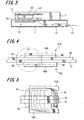
- FIG. 3 is a schematic diagram showing the internal construction of principal portions of a mobile phone unit 2 and a cradle 1 according to an embodiment of the invention.
- the mobile phone unit 2 of this embodiment includes, within a housing thereof, at least a battery 22 having a rechargeable battery which generates the operating power for the unit; a secondary transmission coil 21 which is the receiving-side noncontact power-transmission coil during charging of the battery 22; and a circuit board 23 on which are mounted various electronic circuits including a charging control circuit to supply the power received via the secondary transmission coil 21 to the battery 22 to charge the battery 22.
- a battery 22 having a rechargeable battery which generates the operating power for the unit includes, within a housing thereof, at least a battery 22 having a rechargeable battery which generates the operating power for the unit; a secondary transmission coil 21 which is the receiving-side noncontact power-transmission coil during charging of the battery 22; and a circuit board 23 on which are mounted various electronic circuits including a charging control circuit to supply the power received via the secondary transmission coil 21 to the battery 22 to charge the battery 22.
- other constituent elements provided in general mobile phone units are omitted from the drawings and from the explanations.
- the battery 22 can be attached and detached, and a battery cover 20, which can be opened and closed (or attached and detached) when attaching and detaching the battery 22, is provided on the mobile phone unit 2.
- the secondary transmission coil 21 employs a planar coil in which a linear conductor having electric conductivity is formed in a spiral shape.
- One of the planar portions of the secondary transmission coil 21 is affixed to the inner-wall face of the battery cover 20, or to the outer surface on the battery cover side of the battery 22.
- the secondary transmission coil 21 is affixed to the inner-wall face of the battery cover 20. Details of the configuration of the secondary transmission coil 21 are explained below.
- the cradle 1 of this embodiment includes, within the cradle housing, at least a primary transmission coil 10, which is the transmitting-side noncontact transmission coil during charging of the battery 22 of the mobile phone unit 2; a control board portion 11 which supplies power to the primary transmission coil 10 and controls the supply thereof; and an electric power cord 12 connected to, for example, a commercial power supply.
- a primary transmission coil 10 which is the transmitting-side noncontact transmission coil during charging of the battery 22 of the mobile phone unit 2
- a control board portion 11 which supplies power to the primary transmission coil 10 and controls the supply thereof
- an electric power cord 12 connected to, for example, a commercial power supply.
- other constituent elements provided in general cradles are omitted from the drawings and from the explanations.
- the primary transmission coil 10 of the cradle is a planar coil formed by winding a linear conductor having electric conductivity in a spiral shape.
- One planar portion of this primary transmission coil 10 is affixed to a housing inner-wall face of the terminal mounting base provided in the cradle 1.
- the mobile phone unit 2 is placed on the terminal mounting base of the cradle 1. Through the proximate positioning of the secondary transmission coil 21 of the mobile phone unit 2 and the primary transmission coil 10 of the cradle 1, the state of the magnetic field within the primary transmission coil 10 changes. Then, the control board portion 11 monitors changes in the state of the magnetic field in the primary transmission coil 10 when the secondary transmission coil 21 is positioned in proximity, by intermittent driving or similar.
- the charging control circuit of the mobile phone unit 2 of this embodiment is able to detect voltage changes through changes in magnetic field states when the terminal is placed in the terminal mounting base of the cradle 1 and the secondary transmission coil 21 is placed in proximity with the primary transmission coil 10 of the cradle 1, as a result of the occurrence of changes in the magnetic field within the secondary transmission coil 21. Accordingly, the charging control circuit of the mobile phone unit 2 determines that the unit has been placed in the terminal mounting base of the cradle 1, as follows. That is, the charging control circuit of the mobile phone unit 2 detects that the unit has been placed, when the voltage value due to voltage fluctuations caused by changes in the magnetic field state in the secondary transmission coil 21 with the primary transmission coil 10 being placed in proximity is equal to a predetermined voltage value determined in advance.
- the cradle 1 and mobile phone unit 2 can transmit information via the primary transmission coil 10 and the secondary transmission coil 21.
- the cradle 1 and the mobile phone unit 2 can transmit information via the primary transmission coil 10 and the secondary transmission coil 21.
- the cradle 1 and the mobile phone unit 2 exchange identification information for use in mutual recognition. Such information may be exchanged via the primary transmission coil 10 and secondary transmission coil 21.
- the placement in proximity of the primary coil 10 and secondary coil 21 is detected by both the cradle 1 and by the mobile phone unit 2, and when moreover the cradle 1 and the mobile phone unit 2 have authenticated each other, power is transmitted from the cradle 1. Accordingly, the battery 22 of the mobile phone unit 2 is charged with the transmitted power.
- the control board portion 11 of the cradle 1 converts the commercial AC voltage supplied via the power supply cord 12 into a predetermined DC voltage, and uses the DC voltage to generate an AC voltage of predetermined frequency.
- the generated AC voltage is supplied to the primary transmission coil 10.
- the induced AC voltage is rectified and converted into a DC voltage, and the DV voltage is used to charge the battery 22.
- the voltage value based on the change in state of the magnetic field of the primary transmission coil 10 may not be a predetermined voltage value determined in advance. Further, the voltage value based on the change in state of the magnetic field of the primary transmission coil 10 may reach the predetermined voltage value determined in advance, but authentication of the other device based on the identification information may not be possible. In such cases, the control board portion 11 of the cradle 1 determines that the state change of the magnetic field of the primary transmission coil 10 has occurred due to the presence on the terminal mounting base of a metal object, such as a coin, or another conductive object, and executes control so that power is not supplied to the primary transmission coil 10.
- a metal object such as a coin, or another conductive object
- charging information is transmitted between the cradle 1 and the mobile phone unit 2 via the primary transmission coil 10 and the secondary transmission coil 21. That is, the charging control circuit of the mobile phone unit 2 transmits charging information for the battery 22 to the cradle 1 during charging of the battery 22 by power transmission from the cradle 1.
- the control board portion 11 of the cradle 1 uses the charging information transmitted from the mobile phone unit 2 to monitor the charging state of the battery 22 of the terminal 2. When the fact that charging of the battery 22 is not completed is ascertained from the charging information, the control board portion 11 continues power transmission via the primary transmission coil 10.
- control board portion 11 halts power transmission. Otherwise, the control board portion 11 executes control to halt power transmission when, for example, information indicating some anomaly is supplied from the mobile phone unit 2.
- the magnetic sheet is affixed onto a planar portion of a planar coil in which electric wire which is either single wire or twisted wire is wound in a spiral shape substantially within the same plane.
- FIG. 4 through FIG. 9 are schematic cross-sectional views showing the state of placement in proximity, with the respective housing walls intervening, of a noncontact power-transmission coil in a mobile phone unit and of a noncontact power-transmission coil in the cradle.
- the number of coil windings and the dimensions, positioning, and other details of each of the portions are different from those of an actual case. Components are modified as necessary to facilitate explanation of an embodiment of the invention. Further, in FIG. 4 through FIG. 9 the adhesive sheets are omitted from the figures.
- FIG. 4 is a schematic cross-sectional view of the portion in proximity to a noncontact power-transmission coil 21A of a mobile phone unit, with a magnetic sheet 44A affixed onto only a planar portion of the planar coil, formed by winding electric wire 40 which may, for example, be single wire or twisted wire in a spiral shape, with the planar coil affixed onto the wall 25 of the battery cover.
- the figure shows the portion in proximity to the coil (the terminal mounting base proximity) of a noncontact power-transmission coil 10A affixed to a housing wall 13 of a cradle, with magnetic sheet 84A formed only on a planar portion of the planar coil, of wound electric wire 80.
- FIG. 4 is a schematic cross-sectional view of the portion in proximity to a noncontact power-transmission coil 21A of a mobile phone unit, with a magnetic sheet 44A affixed onto only a planar portion of the planar coil, formed by winding electric wire 40 which may, for example,
- FIG. 6 is a schematic cross-sectional view of the portion in proximity to the noncontact power-transmission coil 21B of the mobile phone unit, with a magnetic sheet 46B larger than the planar portion of the planar coil affixed onto only the planar portion of the planar coil.
- the figure shows the portion in proximity to the noncontact power-transmission coil 10B in the cradle, with a magnetic sheet 86B similarly larger than the planar coil affixed only onto the planar portion of the planar coil.
- FIG. 8 is a schematic cross-sectional view showing the portion in proximity to the noncontact power-transmission coil 21C of the mobile phone unit, with a magnetic sheet 43C larger than the planar portion of the planar coil affixed so as to cover the planar portion and the wall 25.
- the figure shows the portion in proximity to the noncontact power-transmission coil 10C in the cradle, with a magnetic sheet 83C larger than the planar portion of the planar coil affixed so as to cover the planar portion and the housing wall 13.
- FIG. 5 shows the portion surrounded by the ellipse E1 in FIG. 4 in an enlarged manner and also shows the flow of magnetic flux M formed by both the planar coils in the mobile phone unit and in the cradle.
- FIG. 7 shows the portion surrounded by the ellipse E2 in FIG. 6 and also shows the flow of magnetic flux M formed by both the planar coils.
- FIG. 9 shows the portion surrounded by the ellipse E3 in FIG. 5 and also shows the flow of magnetic flux M formed by both the planar coils.
- the direction of the magnetic flux M is drawn in one direction to simplify the drawing; however, because an AC voltage is used in actual power transmission, the direction of the flux M is inverted in alternation.
- FIG. 4 through FIG. 9 as shown in FIG. 4 and FIG. 5 , for example, when magnetic sheets 44A, 84A of size substantially matching the shapes of the planar portions of the planar coils are affixed, the magnetic sheets exist only on the upper faces of the planar coils, so that a magnetic path is not formed efficiently, and the amount of linked magnetic flux is small.
- FIG. 6 and FIG. 9 when magnetic sheets 44A, 84A of size substantially matching the shapes of the planar portions of the planar coils are affixed, the magnetic sheets exist only on the upper faces of the planar coils, so that a magnetic path is not formed efficiently, and the amount of linked magnetic flux is small.
- the magnetic sheets 43C and 83C are affixed so as to cover the planar portions of the planar coils and the wall-face portions of the housing or similar, because the magnetic sheets 43C and 83C exist in the vicinity on the outer periphery of the planar coils, a magnetic path is formed which passes through these portions of the magnetic sheets 43C and 83C.
- FIG. 8 and FIG. 9 because certain gaps occur between the magnetic sheets 43C, 83C and the planar coils at the outer periphery of the planar coils, to this extent the magnetic path is elongated and is not efficiently formed, and the amount of linked magnetic flux may not be large.
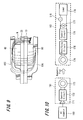
- FIG. 11 is a diagram showing the characteristics on the output voltage and output current measured using the characteristic comparison measurement circuit shown in FIG. 10 .
- the measurement is carried out for the noncontact power-transmission coils of an example (condition J1) in which the magnetic sheets 43C, 83C are affixed so as to cover the planar portions of the planar coils and the wall-face portions of the housing or similar as in FIG. 8 and FIG. 9 .
- the measurement is carried out for the noncontact power-transmission coils of an example (condition J2) in which the magnetic sheets 46B, 86B larger than the planar portions of the planar coils are affixed only onto the planar portions. Those results are then compared. Further, FIG.
- FIG. 12 is a diagram comparing the characteristics on the output current and power-transmission efficiency for the noncontact power-transmission coils of the example of FIG. 8 and FIG. 9 (condition J1) and for the noncontact power-transmission coils of the example of FIG. 6 and FIG. 7 (condition J2).
- DC power supplied from an AC adapter 160 is supplied via the connector 171 to a primary circuit 161.
- the control circuit 172 of the primary circuit 161 uses power supplied from the connector 171 to generate an AC voltage at a measurement reference frequency for supply to the primary coil 173.
- the secondary circuit 162 the AC voltage from the primary coil 173 induces an AC voltage in the secondary- coil 174, and the AC voltage is converted into a DC voltage in the rectifying circuit 175.
- the DC voltage passes through the control circuit and is sent to an ammeter 178 and voltmeter 177 connected to a load 179.
- characteristic comparison results for output voltage and output current are obtained as in FIG. 11 and FIG. 12 .
- a magnetic solution is applied onto the planar portions and side-face portions of the planar coils.
- ferrite powder or another magnetic metal powder or similar is mixed into a binder solvent in which a rubber or epoxy resin is dissolved into a volatile solvent to obtain the magnetic solution.
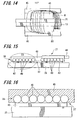
- magnetic layers 45, 85 are formed which completely adhere closely not only to the planar portions, but also to the side-face portions of the planar coils, as shown in FIG. 13 and FIG. 14 .
- FIG. 13 is a diagram schematically showing a cross-section of the portion in proximity to the coil of a mobile phone unit 2 of this embodiment, and of the portion in proximity to the coil (terminal mounting base) of the cradle 1.
- the noncontact power-transmission coil 21 with magnetic layer 45 applied to the planar portion and side-face portion of a planar coil formed from electric wire 40 which is single wire or twisted wire wound into a spiral shape, is affixed to the wall 25 of a battery lid.
- the noncontact power-transmission coil 10 with magnetic layer 85 applied to the planar portion and side-face portion of a planar coil of wound electric wire 80, is affixed to the housing wall 13.
- FIG. 13 is a diagram schematically showing a cross-section of the portion in proximity to the coil of a mobile phone unit 2 of this embodiment, and of the portion in proximity to the coil (terminal mounting base) of the cradle 1.
- the noncontact power-transmission coil 21 with magnetic layer 45 applied to the planar portion and side-face
- FIG. 14 shows the portion surrounded by the ellipse E4 in FIG. 13 in an enlarged manner, and also shows the flow of magnetic flux M formed by both planar coils in the mobile phone unit 2 and cradle 1.
- the direction of the magnetic flux M is drawn in one direction to simplify the drawing; but because an AC voltage is used in actual power transmission, the direction of the flux M is inverted in alternation.
- magnetic layers are formed by application on the planar portions and side-face portions of the planar coils. Accordingly, magnetic layers closely adhere not only to the upper faces of the planar coils but also to the side-face portions, and moreover magnetic layers exist so as to completely adhere closely onto the depression/protrusion portions on the planar coils due to the electric wire windings. As a result, a magnetic path is formed efficiently, and a large amount of linked magnetic flux is formed. Hence, using the example of configuration shown in FIG. 13 and FIG. 14 , the efficiency of power transmission by the noncontact power-transmission coils can be further increased.
- the magnetic layers are formed by application, the magnetic material adheres more firmly and closely to the electric wire, so that separation of the magnetic sheet as described above when affixing magnetic sheet using an adhesive sheet or similar does not occur, and power-transmission characteristics can be stabilized.
- the magnetic layers are formed by application, so that there is no longer a need to use an adhesive sheet having a certain thickness and elasticity as explained above.
- the noncontact power-transmission coils can be made extremely thin.
- the thickness of a mobile phone unit or similar provided with this noncontact power-transmission coil can also be reduced.
- a planar coil on which a magnetic layer has been formed by application is handled as a unit of noncontact power-transmission coil.
- processes such as affixing a magnetic sheet as described above may be unnecessary and, for example, processes can be eliminated and handling may be simplified when assembling mobile phone units and similar.
- FIG. 15 and FIG. 16 show an example of the configuration of a noncontact power-transmission coil 21 of this embodiment, in which, as in the example of the above-described FIG. 1 , a magnetic layer is formed by application onto the planar portion and side-face portion of a planar coil formed by winding electric wire 40 into a spiral shape.
- examples are mainly provided for the noncontact power-transmission coil (secondary transmission coil 21) mounted in the mobile phone unit 2.
- FIG. 15 shows a schematic cross-section of the noncontact power-transmission coil 21 of this embodiment.
- the noncontact power-transmission coil 21 has a planar coil in which electric wire 40 that is a single wire or twisted wire is wound in a spiral shape in the same plane.
- the electric wire end portion on an outer-periphery portion (for example, the electric wire end portion at the end of the windings) 38 of the planar coil is directly drawn to the outside.
- the electric wire end portion 44 on an inner-periphery portion (for example, the electric wire end portion at the beginning of the windings) 37 is passed over (or under) the electric wire portion wound into the spiral shape and drawn to the outer periphery portion 38.
- FIG. 16 shows the portion surrounded by the ellipse E5 shown in FIG. 15 in an enlarged manner.
- the magnetic layer 45 is formed by application so as to cover, at least, the top of the planar portion of the planar coil on the side on which the electric wire end portion 44 of the inner-periphery portion 37 is drawn to the outer-periphery portion 38, and the side-face portion of the planar coil. Further, the magnetic layer 45 is also applied to the central hole portion of the inner-periphery portion 37 of the spiral-shape electric wire 40 of the planar coil, and is formed so as to substantially fill this central hole portion.
- an adhesive sheet 42 or similar is used to affix the planar portion side on which the magnetic layer 45 is not formed to the inner-wall face of the battery lid 20 of the mobile phone unit 2 of this embodiment.
- a metal sheet of aluminum or similar is also affixed to the outside of the magnetic layer 45.
- the magnetic layer 45 is formed to closely adhere not only to the upper face of the planar coil, but also to the side-face portion. Further, the magnetic layer 45 exists so as to completely adhere closely to the depression/protrusion portions due to the electric wire 40 wound into the planar coil. Therefore, a magnetic path is formed efficiently, and a large amount of linked magnetic flux is formed. Further, because the magnetic layer 45 is formed by application, manufacturing processes can be reduced, handling can be simplified, and characteristics can be stabilized, compared with cases in which a magnetic sheet is affixed.
- FIG. 17 through FIG. 20 show an example of the configuration of a noncontact power-transmission coil 21WD of an embodiment.
- a magnetic layer is formed by application on both the planar portion and the side-face portion of a planar coil in which electric wire 40 is wound in a spiral shape.
- the electric wire end portion of the inner-periphery portion 37 of the electric wire 40 (for example, the electric wire end portion at the beginning of the windings) is drawn out to the outer-periphery portion 38 using a flexible printed-circuit board 90.
- FIG. 17 is a diagram schematically showing, from the front, the state in which the planar coil is affixed onto the board 90.
- FIG. 18 is a diagram schematically showing, from the front, the board 90 in a state in which the planar coil is not affixed.
- FIG. 19 shows a schematic cross-sectional view of the noncontact power-transmission coil 21WD of this embodiment.
- FIG. 20 shows the portion surrounded by the ellipse E6 shown in FIG. 19 in an enlarged manner.
- the planar portion on one side of the planar coil formed by winding the electric wire 40 of the noncontact power-transmission coil 21WD of this embodiment is affixed, for example, using an adhesive sheet 42, to the surface of the flexible printed-circuit board 90.
- a magnetic layer 100 is formed by applying the magnetic solution to the other planar portion and to the side-face portion of the planar coil.
- the magnetic layer 100 is also applied to the central hole portion at the inner-periphery portion 37 of the spiral-wound electric wire 40 of the planar coil, so that the central hole portion is substantially filled.
- a metal sheet of aluminum or similar is affixed if necessary to the outside of the magnetic layer 100.
- the face of the flexible printed-circuit board 90 on the side opposite the face to which the noncontact power-transmission coil 21WD is affixed is affixed to the inner-wall face of the battery lid 20 of the mobile phone unit 2, using an adhesive sheet or similar, not shown.
- the flexible printed-circuit board 90 is an extremely thin sheet-shape board employing a polyimide resin or similar as the base material. On the surface is formed an insulating layer, and moreover the board has a shape which substantially matches the planar portion of the planar coil.
- the surface insulating layer is not formed on a first coil connection portion 36 positioned in the inner-periphery portion 37 of the planar coil, on a second coil connection portion 35 positioned in the outer vicinity of the planar coil outer periphery 38, on a first external connection terminal portion 31 and on a second external connection terminal portion 32. Hence, an inner conductor of the flexible printed-circuit board 90 is exposed to the outside.
- the first coil connection portion 36 and first external connection terminal portion 31 are electrically connected via a first inner conductor pattern 33 formed below the surface insulating layer, and the second coil connection portion 35 and second external connection terminal portion 32 are electrically connected via a second inner conductor pattern 34 formed below the surface insulating layer.
- the planar coil is affixed to the flexible printed-circuit board 90, the winding-beginning electric wire end portion in the inner-periphery portion 37 of the planar coil is electrically connected to the first coil connection portion 36.
- the winding-ending electric wire end portion of the outer-periphery portion 38 of the planar coil is electrically connected to the second coil connection portion 35.
- this embodiment as shown in FIG. 17 and FIG.
- the flexible printed-circuit board 90 has a protruding portion 39, and the first external connection terminal portion 31 and second external connection terminal portion 32 are positioned on this protruding portion 39.
- the shape of the protruding portion 39 is not limited to the example shown in FIG. 17 and FIG. 18 .
- the noncontact power-transmission coil 21WD can be made extremely thin compared with a configuration example in which the electric wire end portion 44 of the inner-periphery portion 37 is drawn to the side of the outer periphery portion 38 over (or under) the electric wire portion wound into the planar coil, as in the example shown in FIG. 15 .
- the magnetic layer 100 is formed by application so as to completely adhere closely to the planar portion and side-face portion of the planar coil, and also in the depressions/protrusions of the planar coil due to the windings of the electric wire 40. Accordingly, a magnetic path is formed efficiently with the noncontact power-transmission coil in the cradle 1 during charging of the mobile phone unit 2, and a large amount of linked magnetic flux is formed, so that efficient power transmission is possible. Also, because the magnetic layer 100 is formed by application, manufacturing processes can be reduced, handling can be simplified, and characteristics can be stabilized, compared with cases in which a magnetic sheet is affixed.
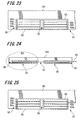
- FIG. 21 through FIG. 23 show a schematic configuration of a noncontact power-transmission coil 21PD with a multilayer structure, in which a plurality of flexible printed-circuit boards, in each of which is formed a planar coil pattern from a spiral-shape conductor pattern, are laminated.
- FIG. 21 is a schematic diagram, seen from the front, the noncontact power-transmission coil 21PD formed from flexible printed-circuit boards having a multilayer structure.
- FIG. 22 is a schematic cross-sectional view of the noncontact power-transmission coil 21PD of the embodiment, formed from flexible printed-circuit boards and having a multilayer structure.
- FIG. 23 shows the portion surrounded by the ellipse E7 shown in FIG. 22 in an enlarged manner.
- the noncontact power-transmission coil 21PD of this embodiment has a four-layer construction, for example.
- the first layer board 64a, second layer board 64b, third layer board 64c, and fourth layer board 64d are each sheet-shaped boards of, for example, a polyimide resin or other base material, on which is formed a linear conductor pattern 60 in a spiral shape.
- a surface insulating layer 62 is formed on the surface of the first layer board 64a which is the uppermost layer.
- an adhesive layer and interlayer insulating layer 63a are formed between the first layer board 64a and second layer board 64b.
- an adhesive layer and interlayer insulating layer 63b are formed between the second layer board 64b and third layer board 64c, and an adhesive layer and interlayer insulating layer 63c are formed between the third layer board 64c and the fourth layer board 64d.
- At least an insulating layer 65 is formed on the rear side of the lowermost fourth layer board 64d and on the side-face portion of the multilayer flexible printed-circuit board.
- a magnetic layer 101 is formed on the outside of the insulating layer 65, by application of a magnetic solution similar to the above.
- a central hole is formed in the noncontact power-transmission coil 21PD of this embodiment.
- the magnetic layer 101 is also applied to this central hole portion, formed such that the central hole portion is substantially filled. Also, although not shown, a metal sheet of aluminum or similar is also affixed if necessary to the outside of the magnetic layer 101. Further, the surface side of the surface insulating layer 62 is affixed to the inner-wall face of the battery lid 20 of the mobile phone unit 2 using an adhesive sheet, not shown.
- the pattern end portions (winding-beginning end portions) in the inner peripheral portions 57 of each conductor pattern 60 of the first layer board 64a through fourth layer board 64d are electrically connected via first through-holes 56.
- the pattern end portions (winding-ending end portions) in the outer peripheral portions 58 of each of the conductor patterns 60 of the first layer board 64a through fourth layer board 64d are electrically connected via second through-holes 55.
- the first through-holes 56 in the inner peripheral portion 57 of the conductor pattern 60 in each layer are electrically connected to through-holes 61 in the outer peripheral portion 58 of the conductor pattern 60 in each layer.
- the second through-hole 55 of the fourth layer board 64d is electrically connected to the second external connection terminal portion 52 via the second inner conductor pattern 54
- the first through-hole 56 of the fourth layer board 64d is electrically connected to the first external connection terminal portion 51 via the through-hole 61 and the first inner conductor pattern 53.
- the multilayer-structure flexible printed-circuit board has a protruding portion 59, and the first external connection terminal portion 51 and second external connection terminal portion 52 are positioned on this protruding portion 59;,but the shape of the protruding portion 59 is not limited to the example of FIG. 21 .
- planar coils are formed from conductor patterns 60 on a multilayer flexible printed-circuit board which is extremely thin compared with electric wire.
- the pattern end portions of the inner peripheral portions 57 of the conductor patterns 60 are connected to the first external connection terminal portion 51 via the first through-holes 56, through-holes 61, and first inner conductor pattern 53.
- the pattern end portions of the outer peripheral portions 58 of the conductor patterns 60 are connected to the second external connection terminal portion 52 via the second through-holes 55 and second inner conductor pattern 54, so that the noncontact power-transmission coil 21PD can be made extremely thin.
- conductor patterns 60 on multilayer flexible printed-circuit board are used to form a planar coil which is extremely thin compared with electric wire.
- the pattern end portion (winding-beginning pattern end portion) in the inner peripheral portion 57 of each conductor pattern 60 of the planar coil is electrically connected to the first through-hole 56 and first external connection terminal portion 51, via the through-hole 61 and first inner conductor pattern 53.
- the pattern end portion (winding-ending pattern end portion) in the outer peripheral portion 58 of each conductor pattern of the planar coil is electrically connected to the second through-hole 55 and second external connection terminal portion 52 via the second inner conductor pattern 54. Accordingly, there is no portion in which electric wire overlaps as in the above-described FIG. 1 and FIG. 2 , and hence the noncontact power-transmission coil 21PD can be made extremely thin.
- the magnetic layer 101 is formed by application so as to completely adhere closely to the planar portion and side-face portion of the planar coil pattern. Consequently, a magnetic path is efficiently formed with the noncontact power-transmission coil of the cradle 1 during charging of the mobile phone unit 2, the amount of linked flux formed is large, and highly efficient power transmission is possible.
- the magnetic layers 45, 100 are formed so as to substantially fill the central hole portions in the inner peripheral portions 37 of the planar coils formed by winding electric wire 40.
- the magnetic layer 101 is formed so as to substantially fill the central hole portion opened in the inner peripheral portion 57 of the planar coil of the multilayer flexible printed-circuit board.
- magnetic flux can be concentrated by the magnetic layer in the central hole portion, a magnetic path can be formed efficiently, and a large amount of linked magnetic flux is formed, so that efficient power transmission is possible.
- a magnetic layer be formed so as to substantially completely fill the central hole portion, as described above.
- the central hole portion may be used as a hole for positioning when fixing the planar coil in a jig. Further, the central hole portion may be used for positioning when incorporating the noncontact power-transmission coil into the mobile phone unit or similar. In those cases, only a part of the central hole portion may be filled with the magnetic layer (midway in the planar coil thickness direction), without completely filling the central hole portion with the magnetic layer.
- FIG. 24 and FIG. 25 show a schematic configuration of a noncontact power-transmission coil in which the magnetic layer 101 is formed in a part of the central hole portion opened in, for example, a multilayer flexible printed-circuit board planar coil.
- FIG. 24 is a schematic cross-sectional view of the noncontact power-transmission coil of the example.
- FIG. 25 shows the portion surrounded by the ellipse E8 shown in FIG. 24 in an enlarged manner.
- a magnetic layer formation device which forms a magnetic layer on the planar portion and on the side-face portion of a planar coil by applying a magnetic solution as described above, and the magnetic layer formation processes for the magnetic layer formation device, are explained.
- the magnetic layer formation device and magnetic layer formation processes are employed when applying a magnetic solution to a planar coil formed by winding electric wire 40 in a spiral shape.
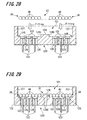
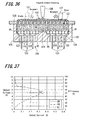
- FIG. 26 through FIG. 34 show a schematic configuration of principal portions of a magnetic layer formation device 120 and the magnetic layer formation processes in which, by injecting a magnetic solution, a magnetic layer can be formed on a planar portion and on the side-face portion of a planar coil.
- FIG. 26 , and FIGS. 28 through 33 are schematic cross-sectional views, seen from a side, of the magnetic layer formation device 120.
- FIG. 27 is a schematic front view of the magnetic layer formation device 120, seen from the side from which the planar coil is fitted.
- FIG. 34 shows a state in which a magnetic layer is formed on a planar coil using the magnetic layer formation processes of this embodiment.
- the number, positioning, and shapes of the plurality of ejection pins are examples, and the invention is not limited to these examples.
- a planar coil-fitting portion 121 has a bottom-face portion and an inner-wall portion 127 and is formed into a substantially cylindrical depression of predetermined depth greater than the thickness of the planar coil.
- one planar portion of the planar coil, formed by winding electric wire 40 in a spiral shape, is mounted, with the planar coil positioned.
- the wall portion 127 has the shape substantially similar to the outer-perimeter shape of the planar coil, but has the diameter greater by a predetermined length than the diameter of the outer-periphery portion 38 of the planar coil.
- the predetermined length in the planar coil-fitting portion 121 is a value determined by the thickness of the magnetic layer resulting from application to the outside peripheral portion (side-face portion of the planar coil) of the electric wire 40 on the outer periphery 38 of the planar coil.
- the predetermined depth is a value determined by the thickness of the magnetic layer applied onto the electric wire 40 in the planar portion of the planar coil.
- a cylindrical-shape protruding portion 124 In the center portion of the bottom-face portion of the cylindrical depression of the planar coil-fitting portion 121.
- the cylindrical-shape protruding portion 124 determines the planar coil fitting position and has an outer-periphery portion 124C of diameter substantially close contact with the inner-periphery portion 37 of the planar coil (with diameter slightly smaller than the diameter of the inner-periphery portion 37), when the planar coil is fitted. Moreover, the cylindrical-shape protruding portion 124 is lower by a predetermined thickness than the thickness of the planar coil.
- the predetermined thickness in this planar coil-fitting portion 121 is a value determined by the thickness of the magnetic layer applied so as to fill the inner-periphery portion 37 of the planar coil.
- a circular protruding portion 125 determines the planar coil fitting position.
- the circular protruding portion 125 is lower by a predetermined thickness than the planar coil thickness and has a curved shape such that, when the planar coil is loaded, the electric wire 40 on the side of the outer periphery 38 of the planar coil is substantially in close contact from the circular-shape contact position contact with the bottom-face portion to the outer-periphery portion of the electric wire 40, that is, to the end of the outer-periphery portion 38 of the planar coil.
- the predetermined thickness in the planar coil-fitting portion 121 is a value which determines the magnetic layer height on the side of the outer periphery 38 of the planar coil from the plane position of the magnetic layer applied to the planar portion of the planar coil.
- a plurality of ejection pin portions are provided in the bottom-face portion of the planar coil-fitting portion 121.
- Each of the plurality of ejection pins has an ejection pin head 122, ejection pin column 123, and ejection pin hole 126.
- the ejection pin holes 126 are, for example, cylindrical in shape, and are formed so as to penetrate from the bottom-face portion of the planar coil-fitting portion 121 to the bottom portion of the magnetic layer formation device 120.
- the ejection pin heads 122 have diameter slightly smaller than the diameter of the ejection pin holes 126 in the bottom-face portion of the planar coil-fitting portion 121, and are of cylindrical shape having an outer periphery which slides against the inner wall of the ejection pin holes 126.
- the diameter of the cylindrical shape of the ejection pin hole 126 is made to be the same diameter from the bottom-face portion of the planar coil-fitting portion 121 to the bottom portion of the magnetic layer formation device 120.
- the diameter on the side lower than the portion in which the ejection pin heads 122 match the bottom portion of the planar coil-fitting portion 121 may be smaller than the outer-periphery diameter of the ejection pin heads 122 (and may be larger than the diameter of the ejection pin columns 123). Accordingly, plane positioning such that the head plane position of the ejection pin heads 122 is substantially the same as the bottom-face plane position of the planar coil-fitting portion 121 is possible, and the ejection pin heads 122 can be prevented from falling into the bottom side of the magnetic layer formation device 120.
- the ejection pin column 123 is formed from a column-shaped member such that one end is fixed to the rear face of an ejection pin head 122 (the face opposite the side of the bottom portion of the planar coil-fitting portion 121), and the other end is formed to protrude from the bottom portion of the magnetic layer formation device 120.
- the other ends of the ejection pin columns 123 are capable of pressing the ejection pin columns 123 into the side of the planar coil-fitting portion 121 if necessary, using an ejection mechanism, not shown.
- the following process is carried out as a first process.
- the head plane positions of the respective ejection pin heads 122 are positioned so as to be substantially in the same plane as the bottom-face plane position of the planar coil-fitting portion 121, as shown in FIG. 28 and FIG. 29 .
- the inner-periphery portion 37 of the planar coil is fitted in substantially close contact with the outer-periphery portion 124C of the cylindrical protruding portion 124 of the planar coil-fitting portion 121.
- the outer-periphery portion 38 of the planar coil is fitted in substantially close contact with the curved shape of the cylindrical protruding portion 125 of the planar coil-fitting portion 121.
- a magnetic solution injection mechanism is positioned above an aperture of the planar coil-fitting portion 121 in the state in which the planar coil is fitted.
- a predetermined amount of magnetic solution 131 is injected into the planar coil-fitting portion 121.
- the predetermined amount of magnetic solution 131 injected by the magnetic solution injection mechanism 130 is an amount which determines the thickness of the magnetic layer on the planar coil after a compression-molding process and a drying process, which are subsequent processes.
- the magnetic solution 131 within the planar coil-fitting portion 121 is compression-molded until the magnetic solution 131 within the planar coil-fitting portion 121 reaches a predetermined height (thickness) from the bottom face of the planar coil-fitting portion 121.
- the compression-molding mechanism 132 is formed in, for example, a cylindrical shape and has an outer periphery of diameter slightly smaller than the diameter of the inner-wall portion 127 of the planar coil-fitting portion 121. The outer periphery slides along the wall face of the inner-wall portion 127 of the planar coil-fitting portion 121.
- the predetermined height (thickness) of the magnetic solution 131 after compression-molding by the compression-molding mechanism 132 is an amount which determines the thickness of the magnetic layer on the planar coil after the drying process, which is a subsequent process. Then, when compression-molding to the predetermined height is completed, the compression-molding mechanism 132 is removed, and thereafter an ejection mechanism, not shown, is used to press the other ends of the ejection pin columns 123 toward the side of the planar coil-fitting portion 121. As a result, the planar coil, in a state in which the compression-molded magnetic solution 131 has been applied, is removed from the planar coil-fitting portion 121.
- the planar coil which has been removed is sent to a drying process, which is the fourth process.
- the magnetic solution 131 in the state of being applied onto the planar coil is dried by a drying mechanism 133.
- the volatile matter in the magnetic solution evaporates, so that the ferrite powder or other magnetic metal powder remains in a state of close adhesion to the planar coil, and the magnetic layer 100 is formed.
- FIG. 26 through FIG. 34 explains a device and processes of using a magnetic solution injection mechanism 130 to inject a magnetic solution and form a magnetic layer.
- a magnetic solution formation device can use a screen application method to apply the magnetic solution and form a magnetic layer on a planar portion and side-face portion of a planar coil.
- FIG. 35 and FIG. 36 are schematic cross-sectional views, seen from a side, of a magnetic layer formation device 120.
- the first process, the third process and the fourth process are similar to the processes described above, and so drawings and explanations of these processes are omitted. Specifically, fitting the planar coil into the planar coil-fitting portion 121, removing the coil after compression-molding of the magnetic solution in the planar coil-fitting portion 121 using a compression-molding mechanism 132, and drying the magnetic solution in the state of being applied onto the removed planar coil to form the magnetic layer in a state of deposition, are not described here.
- a porous screen 135, magnetic solution dispenser 136, and blade mechanism 137 are positioned above the aperture of the planar coil-fitting portion 121 in the state in which the planar coil is fitted, as shown in FIG. 35 and FIG. 36 .
- the porous screen 135 is a sheet-shaped utensil in which numerous minute holes are opened, and is positioned so as to cover the aperture of the planar coil-fitting portion 121.
- the magnetic solution is dispensed from the magnetic solution dispenser 136 onto the porous screen 135 covering the planar coil-fitting portion 121.
- the blade mechanism 137 is moved over the porous screen 135, to cause the magnetic solution which has been dispensed from the magnetic solution dispenser 136 onto the porous screen 135 to be pressed into the minute holes of the porous screen 135 and to drip down from the minute holes into the planar coil-fitting portion 121. Accordingly, the magnetic solution which has passed through the minute holes of the porous screen 135 is injected evenly into the planar coil-fitting portion 121.
- the third process described above is performed.
- magnetic solution is injected by a magnetic solution injection mechanism 130, so that concentration irregularities occur within the magnetic layer formed on the planar coil.
- the device configuration and processes can be made extremely simple, and as the magnetic powder in the magnetic solution, magnetic powder having large particle diameters, which is an extremely effective means of raising the relative permeability, can be used.
- FIG. 37 to FIG. 39 show the relationship between a bridge-connected magnetic path between planar coils and the output voltage and transmission efficiency, measured when determining the value of the relative permeability of the magnetic layer in this embodiment.
- the dashed lines BR in FIG. 37 through FIG. 39 describe the output voltage versus output current characteristic for the bridge-connected magnetic path; the dot-dot-dash lines OV describe the changes in output voltage; and the dot-dash lines EF in the figures describe the transmission efficiency characteristics.
- FIG. 37 shows an example in which the permeability of the magnetic layer is 30;
- FIG. 38 shows an example in which the permeability of the magnetic layer is 50; and
- FIG. 39 shows an example in which the permeability of the magnetic layer is 70.
- an output voltage of approximately 4.5 V to 5.5 V and an output current of approximately 0.4 A to 0.6 A may be necessary, and so a magnetic layer with a high permeability may be used.
- the concentration of the magnetic material relative to the binder solvent is adjusted.
- the magnetic solution used with the above-described magnetic layer formation device and magnetic layer formation processes there is used such magnetic solution that the relative permeability of the magnetic layer after formation on the planar coil is 50 or higher.
- the noncontact power-transmission coil has functions of only transmitting power or receiving the power; but this invention can be applied to a noncontact power-transmission coil which is provided with functions for both power transmission and for power reception.
- a mobile phone unit 2 and cradle 1 are combined.
- the invention is not limited to such a combination and, for example, application to planar coils used in combinations of a PDA (Personal Digital Assistant) or various other portable terminals with cradles, as well as to noncontact IC cards and reader/writers therefore, and similar are also possible.
- PDA Personal Digital Assistant
Landscapes
- Engineering & Computer Science (AREA)
- Power Engineering (AREA)
- Computer Networks & Wireless Communication (AREA)
- Manufacturing & Machinery (AREA)
- Charge And Discharge Circuits For Batteries Or The Like (AREA)
- Coils Or Transformers For Communication (AREA)
- Secondary Cells (AREA)
Abstract
Description
- This invention relates to a noncontact power-transmission coil, portable terminal and terminal charging device, planar coil magnetic layer formation device, and magnetic layer formation method.
- In the past, systems have been known in which charging power to charge a rechargeable battery incorporated within a portable terminal, for example, has been transmitted by electromagnetic induction using a noncontact power-transmission coil.
- In addition, Japanese Patent Application Publication No.
2006-42519 FIG. 2 andFIG. 3 ) discloses a planar coil as a noncontact power-transmission coil mounted on a portable terminal desired to be thin, such as a mobile phone unit. In this case, the planar coil is constructed such that an electric wire is formed of a single or twisted wire. The surface of the wire is provided with an insulating layer. In addition, the wire is spirally wound in a substantially same plane. Furthermore, this Patent Document also discloses that the formation of a magnetic sheet. That is, a planer coil on the power-transmitting side and a planar coil on the power-receiving side are arranged facing to each other. Then, the counter surface of each coil, which is opposite to the surface facing to the other coil, is entirely covered with a magnetic sheet to prevent undesired radiation with the magnetic field generated from both coils. -
FIG. 1 and FIG. 2 show in summary the construction of a noncontact power-transmission coil 200 employing a spiral-shape planar coil of the related art. - As shown in
FIG. 1 , in a spiral-shape planar coil, anelectric wire 201, which employs either single wire or twisted wire, is wound in a spiral shape within a single plane. An electric wire end portion (for example, the electric wire end portion on the side at the end of the winding) 205 on theouter periphery 203 of the planar coil is drawn to the outside. On the other hand, the electric wire end portion (the electric wire end portion at the beginning of the winding, for example) 204 on theinner periphery 202 passes over (or under) an electric wire portion wound into the spiral shape and is drawn to the outside. As shown inFIG. 2 , amagnetic sheet 210 is affixed on one planar portion of the planar coil of the noncontact power-transmission coil 200 through anadhesive sheet 211 or similar. The other planar portion is affixed, as necessary, to the inner wall or similar of aterminal housing 213 using anadhesive sheet 211 or similar. Although not shown in the figure, a metal sheet, of aluminum or similar, is also affixed to the outside of themagnetic sheet 210. - However, in recent years there has been a desire for still thinner mobile phone units and similar, and to this end there has been a desire to reduce the thicknesses not only of the various electronic components themselves arranged in the terminal housing, but to reduce the thickness of the noncontact power-transmission coils having the above-described spiral-shape planar coils.
- In the case of noncontact power-
transmission coils 200 such as shown in the aboveFIG. 1 and FIG. 2 , as theadhesive sheet 211 used to affix amagnetic sheet 210 to the planar coil for magnetic path formation, a sheet of approximately a certain thickness and having elasticity is used. That is, because depressions and protrusions are formed in the planar portion of the planar coil by the windings ofelectric wire 201, if a thin adhesive sheet, for example, is used, the adhesive properties of the planar coil and the magnetic sheet may not be sufficient, and the magnetic sheet may separate from the planar coil. Hence in order to absorb depressions and protrusions in the planar coil surface and enhance the adhesion between the planar coil and the magnetic sheet, theadhesive sheet 211 is used which has approximately a certain thickness, and which moreover has elasticity. - However, use of the
adhesive sheet 211 which is thick is not preferable from the standpoint of reducing the thickness of the noncontact power-transmission coil, and may be the cause of not sufficiently reducing the thickness of mobile phone units. - Further, in the above-described noncontact power-transmission coil, the
magnetic sheet 210 is provided in order to efficiently form a magnetic path and improve the power-transmission characteristics. However, even a noncontact power-transmission coil having such a magnetic sheet may have less efficiency compared with power transmission performed by direct connection using an ordinary connector or similar, and so further enhancement of power-transmission efficiency by noncontact power-transmission coils may be required. - It is desirable to provide a noncontact power-transmission coil with a thinner shape and enabling higher-efficiency power transmission, and to provide a portable terminal and terminal charging device incorporating such a noncontact power-transmission coil, and a planar coil magnetic layer formation device and magnetic layer formation method.
- According to an embodiment of the present invention, there is provided a noncontact power-transmission coil including a planar coil, formed by winding a linear conductor in a spiral shape substantially within the same plane, and a magnetic layer, formed by applying a liquid-form magnetic solution, in which magnetic particles are mixed into a binder solvent, so as to cover one planar portion of the planar coil and a side-face portion of the planar coil.
- According to another embodiment of the present invention, there is provided a portable terminal including a rechargeable battery; a noncontact power-transmission coil, having a planar coil, formed by winding a linear conductor in a spiral shape substantially within the same plane, and a magnetic layer formed by applying a liquid-form magnetic solution, in which magnetic particles are mixed into a binder solvent, so as to cover one planar portion of the planar coil and a side-face portion of the planar coil. Further, the portable terminal includes a charging control circuit, which executes control so as to charge the rechargeable battery with power received via the noncontact power-transmission coil.
- According to further embodiment of the present invention, there is provided a terminal charging device including a terminal mounting base, in which a predetermined portable terminal provided with a rechargeable battery is mounted; a noncontact power-transmission coil; and a power supply control unit. The noncontact power-transmission coil has a planar coil, formed by winding a linear conductor in a spiral shape substantially within the same plane, and a magnetic layer formed by applying a liquid-form magnetic solution, in which magnetic particles are mixed into a binder solvent, so as to cover one planar portion of the planar coil and a side-face portion of the planar coil. The noncontact power-transmission coil uses electromagnetic induction with a coil installed in the predetermined portable terminal to charge the rechargeable battery of the portable terminal in a noncontact manner. The power supply control unit controls the supply of power to the noncontact power-transmission coil.
- According to further another embodiment of the present invention, there is provided a planar coil magnetic layer formation device including a planar coil-fitting portion and a magnetic solution application portion. The planar coil-fitting portion has a bottom-face portion on which is placed the other planar-portion side of the planar coil formed by winding a linear conductor in a spiral shape substantially within the same plane, and an inner-wall portion which is larger than at least the outer-perimeter diameter of the planar coil, and in which is formed a depressed shape which is at least deeper than the thickness of the planar coil. The magnetic solution application portion forms a magnetic layer covering one planar portion of the planar coil and a side-face portion of the planar coil in a state in which a planar coil is fitted into the planar coil-fitting portion, by applying from an aperture portion of the planar coil-fitting portion a magnetic solution in liquid form in which magnetic particles are mixed into a binder solvent.
- According to still another embodiment of the present invention, there is provided a planar coil magnetic layer formation method including the steps of:
- fitting a planar coil, formed by winding a linear conductor in a spiral shape substantially within the same plane, into a planar coil-fitting portion, having a bottom-face portion on which one planar portion side of the planar coil is placed and an inner-wall portion which is larger than at least the outer-perimeter diameter of the planar coil, and in which is formed a depressed shape which is at least deeper' than the thickness of the planar coil; and
- forming a magnetic layer which covers one planar portion of the planar coil and a side-face portion of the planar coil, by applying, in a state in which the planar coil is fitted into the planar coil-fitting portion, a liquid-form magnetic solution in which magnetic particles are mixed into a binder solvent, from an aperture in the planar coil-fitting portion, using a magnetic solution application portion.
- That is, according to the embodiments of this invention, by applying a magnetic layer so as to cover one planar portion and a side-face portion of the planar coil, a magnetic path can be formed efficiently, and moreover linked magnetic flux can be increased.
- According to the embodiments of the invention, by applying a magnetic layer so as to cover one planar portion and the side-face portion of the planar coil, a noncontact power-transmission coil can be made even thinner and power-transmission efficiency can be improved, and moreover a portable terminal and terminal charging device can also be made thinner.
- Preferably, the present invention relates to a noncontact power-transmission coil for use in power transmission in a noncontact manner using electromagnetic induction, when charging a rechargeable battery incorporated in a small-size, thin portable terminal such as a mobile phone unit. The invention further preferably relates to a portable terminal and terminal charging device incorporating such a noncontact power-transmission coil, and to a magnetic layer formation device and magnetic layer formation method for forming a magnetic layer in a planar coil of such a noncontact power-transmission coil.
- Various respective aspects and features of the invention are defined in the appended claims. Combinations of features from the dependent claims may be combined with features of the independent claims as appropriate and not merely as explicitly set out in the claims.
- Embodiments of the invention will now be described with reference to the accompanying drawings, throughout which like parts are referred to by like references, and in which:
-
FIG. 1 is a schematic diagram seen from the front of a planar coil of the related art, in which an electric wire end on the inner-periphery side of an electric wire wound into a spiral shape passes over or under an electric wire portion wound into the spiral shape and is drawn to the outside. -
FIG. 2 is a schematic cross-sectional view of the planar coil inFIG. 1 . -
FIG. 3 is a schematic diagram showing an internal construction of principal portions of a mobile phone unit and a cradle according to an embodiment of the invention. -
FIG. 4 is a schematic cross-sectional view of a portion in proximity to two noncontact power-transmission coils, positioned in proximity, in a mobile phone unit and in a cradle, with a magnetic sheet affixed only onto planar portions of planar coils. -
FIG. 5 is a diagram showing a portion ofFIG. 4 in an enlarged manner, and showing the flow of magnetic flux formed between the two coils. -
FIG. 6 is a schematic cross-sectional view of the portion in proximity to two noncontact power-transmission coils, positioned in proximity, in a mobile phone unit and in a cradle, with a magnetic sheet, larger than the planar portion of the planar coils, affixed only onto the planar portions of the planar coils. -
FIG. 7 is a diagram showing a portion ofFIG. 6 in an enlarged manner, and showing the flow of magnetic flux formed between the two coils. -
FIG. 8 is a schematic cross-sectional view of the portion in proximity to two noncontact power-transmission coils, positioned in proximity, in a mobile phone unit and in a cradle, with a magnetic sheet, larger than the planar portion of the planar coils, affixed so as to cover the planar portions and wall-face portions of the housings and similar. -
FIG. 9 is a diagram showing a portion ofFIG. 8 in an enlarged manner, and showing the flow of magnetic flux formed between the two coils. -
FIG. 10 is a block circuit diagram showing a characteristic comparison measurement circuit used to compare the output voltage and output current characteristics in noncontact power transmission. -
FIG. 11 is a diagram showing the comparison between the output voltage and output current characteristics for a noncontact power-transmission coil of the example ofFIG. 8 andFIG. 9 (condition J1), and for a noncontact power-transmission coil of the example ofFIG. 6 and FIG. 7 (condition J2). -
FIG. 12 is a diagram for comparing the output current and power-transmission efficiency characteristics for a noncontact power-transmission coil of the configuration example ofFIG. 8 andFIG. 9 (condition J1), and for a noncontact power-transmission coil of the configuration example ofFIG. 6 and FIG. 7 (condition J2). -
FIG. 13 is a schematic cross-sectional view of the portion in proximity to two noncontact power-transmission coils of an embodiment, positioned in proximity, in a mobile phone unit and in a cradle, formed by applying a magnetic layer to the planar portions and side-face portions of the planar coils. -
FIG. 14 is a diagram showing an enlarged-portion ofFIG. 13 and the flow of magnetic flux formed between the two coils. -
FIG. 15 is a schematic cross-sectional view of a noncontact power-transmission coil of an embodiment, devised such that the electric wire end portion at the inner-periphery portion of the planar coil passes over (or under) the planar coil and is drawn to the outer-periphery side. -
FIG. 16 is a diagram showing an enlarged-portion ofFIG. 15 . -
FIG. 17 is a schematic diagram showing from the front a noncontact power-transmission coil, prepared by affixing a planar coil, formed by winding an electric wire in a spiral shape, onto a flexible printed-circuit board with a shape substantially matching the planar coil. -
FIG. 18 is a schematic diagram showing from the front the flexible printed-circuit board ofFIG. 17 , with the planar coil affixed. -
FIG. 19 is a schematic cross-sectional view of the noncontact power-transmission coil ofFIG. 17 , with a magnetic layer formed on a planar portion and side-face portion of the planar coil. -
FIG. 20 is a partially-enlarged view of the noncontact power-transmission coil ofFIG. 19 . -
FIG. 21 is a schematic diagram showing from the front a noncontact power-transmission coil, having a multilayer flexible printed-circuit board in a shape substantially matching the planar coil pattern formed of a spiral-shape conductor pattern. -
FIG. 22 is a schematic cross-sectional view of the noncontact power-transmission coil ofFIG. 21 , with a magnetic layer formed on a planar portion and side-face portion of the planar coil on the multilayer flexible printed-circuit board. -
FIG. 23 is partly-enlarged view of the noncontact power-transmission coil ofFIG. 22 . -
FIG. 24 is a schematic cross-sectional view of a noncontact power-transmission coil, with a magnetic layer formed up to midway through a hole provided in the planar coil inner-periphery portion of a multilayer flexible printed-circuit board in a shape substantially matching the planar coil pattern formed of a spiral-shape conductor pattern. -
FIG. 25 is a partly-enlarged view of the noncontact power-transmission coil ofFIG. 24 . -
FIG. 26 is a schematic cross-sectional view shown from a side face of principal portions of a magnetic layer formation device of an embodiment, which is capable of forming a magnetic layer on a planar portion and on a side-face portion of a planar coil by injecting a magnetic solution. -
FIG. 27 is a schematic front view of a magnetic layer formation device, seen from the side from which the planar coil is fitted. -
FIG. 28 is a diagram showing a state in which a planar coil is fitted into a planar coil-fitting portion of the magnetic layer formation device of an embodiment. -
FIG. 29 is a diagram showing a state in which a planar coil is completely fitted into the planar coil-fitting portion -
FIG. 30 is a diagram showing a state in which a magnetic solution is being injected into the planar coil-fitting portion of the magnetic layer formation device of an embodiment. -
FIG. 31 is a diagram showing a state in which a magnetic solution is completely injected into the planar coil-fitting portion of the magnetic layer formation device of an embodiment. -
FIG. 32 is a diagram showing a state in which a magnetic solution, injected into the planar coil-fitting portion of the magnetic layer formation device of an embodiment, is being compression-molded. -
FIG. 33 is a diagram showing a state in which a magnetic solution, injected into the planar coil-fitting portion of the magnetic layer formation device of an embodiment, has been completely compression-molded. -
FIG. 34 is a diagram showing a process of drying a planar coil to which a magnetic solution has been applied in an embodiment. -
FIG. 35 is a diagram showing a state in which a porous screen is positioned at the planar coil-fitting portion of the magnetic layer formation device of an embodiment. -
FIG. 36 is a diagram showing a state in which a magnetic solution is applied via a porous screen to the planar coil-fitting portion of the magnetic layer formation device of an embodiment. -
FIG. 37 is a characteristic diagram showing the relation between a bridge-connected magnetic path between planar coils and the output voltage and transmission efficiency, for a case -
FIG. 38 is a characteristic diagram showing the relation between the bridge-connected magnetic path between planar coils and the output voltage and transmission efficiency, for a case in which a magnetic layer having a permeability of 50 is formed. -
FIG. 39 is a characteristic diagram showing the relation between the bridge-connected magnetic path between planar coils and the output voltage and transmission efficiency, for a case in which a magnetic layer having a permeability of 70 is formed. - In the embodiments, a mobile phone unit is described as an example of a portable terminal including a noncontact power-transmission coil having a spiral-shape planar coil according to an embodiment of the invention, and a cradle capable of charging at least the above mobile phone unit is described as an example of a terminal charging device according to an embodiment of the invention; of course these explanations are examples, and the invention is not limited to these examples.
-
FIG. 3 is a schematic diagram showing the internal construction of principal portions of amobile phone unit 2 and acradle 1 according to an embodiment of the invention. - The
mobile phone unit 2 of this embodiment includes, within a housing thereof, at least abattery 22 having a rechargeable battery which generates the operating power for the unit; asecondary transmission coil 21 which is the receiving-side noncontact power-transmission coil during charging of thebattery 22; and acircuit board 23 on which are mounted various electronic circuits including a charging control circuit to supply the power received via thesecondary transmission coil 21 to thebattery 22 to charge thebattery 22. In this embodiment, other constituent elements provided in general mobile phone units are omitted from the drawings and from the explanations. - The
battery 22 can be attached and detached, and abattery cover 20, which can be opened and closed (or attached and detached) when attaching and detaching thebattery 22, is provided on themobile phone unit 2. - As explained below, the
secondary transmission coil 21 employs a planar coil in which a linear conductor having electric conductivity is formed in a spiral shape. One of the planar portions of thesecondary transmission coil 21 is affixed to the inner-wall face of thebattery cover 20, or to the outer surface on the battery cover side of thebattery 22. In this embodiment, an example is explained in which thesecondary transmission coil 21 is affixed to the inner-wall face of thebattery cover 20. Details of the configuration of thesecondary transmission coil 21 are explained below. - On the other hand, the
cradle 1 of this embodiment includes, within the cradle housing, at least aprimary transmission coil 10, which is the transmitting-side noncontact transmission coil during charging of thebattery 22 of themobile phone unit 2; acontrol board portion 11 which supplies power to theprimary transmission coil 10 and controls the supply thereof; and anelectric power cord 12 connected to, for example, a commercial power supply. In this embodiment, other constituent elements provided in general cradles are omitted from the drawings and from the explanations. - The
primary transmission coil 10 of thecradle 1, substantially similarly to thesecondary transmission coil 21 of themobile phone unit 2, is a planar coil formed by winding a linear conductor having electric conductivity in a spiral shape. One planar portion of thisprimary transmission coil 10 is affixed to a housing inner-wall face of the terminal mounting base provided in thecradle 1. - The
mobile phone unit 2 is placed on the terminal mounting base of thecradle 1. Through the proximate positioning of thesecondary transmission coil 21 of themobile phone unit 2 and theprimary transmission coil 10 of thecradle 1, the state of the magnetic field within theprimary transmission coil 10 changes. Then, thecontrol board portion 11 monitors changes in the state of the magnetic field in theprimary transmission coil 10 when thesecondary transmission coil 21 is positioned in proximity, by intermittent driving or similar. - The charging control circuit of the
mobile phone unit 2 of this embodiment is able to detect voltage changes through changes in magnetic field states when the terminal is placed in the terminal mounting base of thecradle 1 and thesecondary transmission coil 21 is placed in proximity with theprimary transmission coil 10 of thecradle 1, as a result of the occurrence of changes in the magnetic field within thesecondary transmission coil 21. Accordingly, the charging control circuit of themobile phone unit 2 determines that the unit has been placed in the terminal mounting base of thecradle 1, as follows. That is, the charging control circuit of themobile phone unit 2 detects that the unit has been placed, when the voltage value due to voltage fluctuations caused by changes in the magnetic field state in thesecondary transmission coil 21 with theprimary transmission coil 10 being placed in proximity is equal to a predetermined voltage value determined in advance. - Further, in this embodiment, the
cradle 1 andmobile phone unit 2 can transmit information via theprimary transmission coil 10 and thesecondary transmission coil 21. For example, when themobile phone unit 2 is placed in the terminal mounting base of thecradle 1, and theprimary coil 10 andsecondary coil 21 are detected as being positioned in mutual proximity based on changes in the magnetic field state as described above, thecradle 1 and themobile phone unit 2, exchange identification information for use in mutual recognition. Such information may be exchanged via theprimary transmission coil 10 andsecondary transmission coil 21. - Further, in this embodiment, the placement in proximity of the
primary coil 10 andsecondary coil 21 is detected by both thecradle 1 and by themobile phone unit 2, and when moreover thecradle 1 and themobile phone unit 2 have authenticated each other, power is transmitted from thecradle 1. Accordingly, thebattery 22 of themobile phone unit 2 is charged with the transmitted power. - When charging of the
battery 22 of themobile phone unit 2 is started as described above, thecontrol board portion 11 of thecradle 1 converts the commercial AC voltage supplied via thepower supply cord 12 into a predetermined DC voltage, and uses the DC voltage to generate an AC voltage of predetermined frequency. The generated AC voltage is supplied to theprimary transmission coil 10. On the other hand, on the side of themobile phone unit 2, when an AC voltage is induced in thesecondary transmission coil 21 by the AC voltage from theprimary transmission coil 10 of thecradle 1, the induced AC voltage is rectified and converted into a DC voltage, and the DV voltage is used to charge thebattery 22. - Further, in this embodiment, the voltage value based on the change in state of the magnetic field of the
primary transmission coil 10 may not be a predetermined voltage value determined in advance. Further, the voltage value based on the change in state of the magnetic field of theprimary transmission coil 10 may reach the predetermined voltage value determined in advance, but authentication of the other device based on the identification information may not be possible. In such cases, thecontrol board portion 11 of thecradle 1 determines that the state change of the magnetic field of theprimary transmission coil 10 has occurred due to the presence on the terminal mounting base of a metal object, such as a coin, or another conductive object, and executes control so that power is not supplied to theprimary transmission coil 10. - Further, in this embodiment, when the
battery 22 of themobile phone unit 2 is being charged by the power transmitted from thecradle 1, charging information is transmitted between thecradle 1 and themobile phone unit 2 via theprimary transmission coil 10 and thesecondary transmission coil 21. That is, the charging control circuit of themobile phone unit 2 transmits charging information for thebattery 22 to thecradle 1 during charging of thebattery 22 by power transmission from thecradle 1. Thecontrol board portion 11 of thecradle 1 uses the charging information transmitted from themobile phone unit 2 to monitor the charging state of thebattery 22 of theterminal 2. When the fact that charging of thebattery 22 is not completed is ascertained from the charging information, thecontrol board portion 11 continues power transmission via theprimary transmission coil 10. However, when the fact that charging of thebattery 22 is completed is ascertained from the charging information, thecontrol board portion 11 halts power transmission. Otherwise, thecontrol board portion 11 executes control to halt power transmission when, for example, information indicating some anomaly is supplied from themobile phone unit 2. - Prior to explaining the noncontact power-transmission coil according to the embodiment of the invention, first, the change in linked magnetic flux resulting from the manner of affixing a magnetic sheet to a noncontact power-transmission coil is explained. The magnetic sheet is affixed onto a planar portion of a planar coil in which electric wire which is either single wire or twisted wire is wound in a spiral shape substantially within the same plane.
-
FIG. 4 through FIG. 9 are schematic cross-sectional views showing the state of placement in proximity, with the respective housing walls intervening, of a noncontact power-transmission coil in a mobile phone unit and of a noncontact power-transmission coil in the cradle. The number of coil windings and the dimensions, positioning, and other details of each of the portions are different from those of an actual case. Components are modified as necessary to facilitate explanation of an embodiment of the invention. Further, inFIG. 4 through FIG. 9 the adhesive sheets are omitted from the figures. -
FIG. 4 is a schematic cross-sectional view of the portion in proximity to a noncontact power-transmission coil 21A of a mobile phone unit, with amagnetic sheet 44A affixed onto only a planar portion of the planar coil, formed by windingelectric wire 40 which may, for example, be single wire or twisted wire in a spiral shape, with the planar coil affixed onto thewall 25 of the battery cover. In addition, the figure shows the portion in proximity to the coil (the terminal mounting base proximity) of a noncontact power-transmission coil 10A affixed to ahousing wall 13 of a cradle, withmagnetic sheet 84A formed only on a planar portion of the planar coil, of woundelectric wire 80. Similarly,FIG. 6 is a schematic cross-sectional view of the portion in proximity to the noncontact power-transmission coil 21B of the mobile phone unit, with amagnetic sheet 46B larger than the planar portion of the planar coil affixed onto only the planar portion of the planar coil. In addition, the figure shows the portion in proximity to the noncontact power-transmission coil 10B in the cradle, with amagnetic sheet 86B similarly larger than the planar coil affixed only onto the planar portion of the planar coil.FIG. 8 is a schematic cross-sectional view showing the portion in proximity to the noncontact power-transmission coil 21C of the mobile phone unit, with amagnetic sheet 43C larger than the planar portion of the planar coil affixed so as to cover the planar portion and thewall 25. In addition, the figure shows the portion in proximity to the noncontact power-transmission coil 10C in the cradle, with amagnetic sheet 83C larger than the planar portion of the planar coil affixed so as to cover the planar portion and thehousing wall 13. - Further,
FIG. 5 shows the portion surrounded by the ellipse E1 inFIG. 4 in an enlarged manner and also shows the flow of magnetic flux M formed by both the planar coils in the mobile phone unit and in the cradle. Similarly,FIG. 7 shows the portion surrounded by the ellipse E2 inFIG. 6 and also shows the flow of magnetic flux M formed by both the planar coils.FIG. 9 shows the portion surrounded by the ellipse E3 inFIG. 5 and also shows the flow of magnetic flux M formed by both the planar coils. In the examples ofFIG. 5 ,FIG. 7 andFIG. 9 , the direction of the magnetic flux M is drawn in one direction to simplify the drawing; however, because an AC voltage is used in actual power transmission, the direction of the flux M is inverted in alternation. - In
FIG. 4 through FIG. 9 , as shown inFIG. 4 and FIG. 5 , for example, whenmagnetic sheets FIG. 6 and FIG. 7 , for example,magnetic sheets magnetic sheets magnetic sheets FIG. 8 andFIG. 9 , for example, themagnetic sheets magnetic sheets magnetic sheets FIG. 8 andFIG. 9 , because certain gaps occur between themagnetic sheets - Next,
FIG. 11 is a diagram showing the characteristics on the output voltage and output current measured using the characteristic comparison measurement circuit shown inFIG. 10 . The measurement is carried out for the noncontact power-transmission coils of an example (condition J1) in which themagnetic sheets FIG. 8 andFIG. 9 . Further, the measurement is carried out for the noncontact power-transmission coils of an example (condition J2) in which themagnetic sheets FIG. 12 is a diagram comparing the characteristics on the output current and power-transmission efficiency for the noncontact power-transmission coils of the example ofFIG. 8 andFIG. 9 (condition J1) and for the noncontact power-transmission coils of the example ofFIG. 6 and FIG. 7 (condition J2). - In the characteristic comparison measurement circuit shown in
FIG. 10 , DC power supplied from anAC adapter 160 is supplied via theconnector 171 to aprimary circuit 161. Thecontrol circuit 172 of theprimary circuit 161 uses power supplied from theconnector 171 to generate an AC voltage at a measurement reference frequency for supply to theprimary coil 173. On the other hand, in thesecondary circuit 162, the AC voltage from theprimary coil 173 induces an AC voltage in the secondary-coil 174, and the AC voltage is converted into a DC voltage in therectifying circuit 175. The DC voltage passes through the control circuit and is sent to anammeter 178 andvoltmeter 177 connected to aload 179. Using the characteristic comparison measurement circuit, characteristic comparison results for output voltage and output current are obtained as inFIG. 11 andFIG. 12 . - That is, according to
FIG. 11 andFIG. 12 , in the case of magnetic sheets being affixed to the planar coils, a preferable result is obtained for transmission efficiency when affixing themagnetic sheets magnetic sheets magnetic sheets FIG. 8 andFIG. 9 , themagnetic sheets - Hence, in noncontact power-transmission coils according to the embodiment, a magnetic solution is applied onto the planar portions and side-face portions of the planar coils. For example, ferrite powder or another magnetic metal powder or similar is mixed into a binder solvent in which a rubber or epoxy resin is dissolved into a volatile solvent to obtain the magnetic solution. Accordingly,
magnetic layers FIG. 13 andFIG. 14 . -
FIG. 13 is a diagram schematically showing a cross-section of the portion in proximity to the coil of amobile phone unit 2 of this embodiment, and of the portion in proximity to the coil (terminal mounting base) of thecradle 1. In the mobile phone unit, the noncontact power-transmission coil 21, withmagnetic layer 45 applied to the planar portion and side-face portion of a planar coil formed fromelectric wire 40 which is single wire or twisted wire wound into a spiral shape, is affixed to thewall 25 of a battery lid. In thecradle 1, the noncontact power-transmission coil 10, withmagnetic layer 85 applied to the planar portion and side-face portion of a planar coil of woundelectric wire 80, is affixed to thehousing wall 13.FIG. 14 shows the portion surrounded by the ellipse E4 inFIG. 13 in an enlarged manner, and also shows the flow of magnetic flux M formed by both planar coils in themobile phone unit 2 andcradle 1. In the example ofFIG. 14 , the direction of the magnetic flux M is drawn in one direction to simplify the drawing; but because an AC voltage is used in actual power transmission, the direction of the flux M is inverted in alternation. - According to this embodiment, as shown in
FIG. 13 andFIG. 14 , magnetic layers are formed by application on the planar portions and side-face portions of the planar coils. Accordingly, magnetic layers closely adhere not only to the upper faces of the planar coils but also to the side-face portions, and moreover magnetic layers exist so as to completely adhere closely onto the depression/protrusion portions on the planar coils due to the electric wire windings. As a result, a magnetic path is formed efficiently, and a large amount of linked magnetic flux is formed. Hence, using the example of configuration shown inFIG. 13 andFIG. 14 , the efficiency of power transmission by the noncontact power-transmission coils can be further increased. - Further, according to this embodiment, the magnetic layers are formed by application, the magnetic material adheres more firmly and closely to the electric wire, so that separation of the magnetic sheet as described above when affixing magnetic sheet using an adhesive sheet or similar does not occur, and power-transmission characteristics can be stabilized.
- Further, according to this embodiment, the magnetic layers are formed by application, so that there is no longer a need to use an adhesive sheet having a certain thickness and elasticity as explained above. As a result, the noncontact power-transmission coils can be made extremely thin. Hence according to this embodiment, the thickness of a mobile phone unit or similar provided with this noncontact power-transmission coil can also be reduced.
- Moreover, according to this embodiment, a planar coil on which a magnetic layer has been formed by application is handled as a unit of noncontact power-transmission coil. Hence, processes such as affixing a magnetic sheet as described above may be unnecessary and, for example, processes can be eliminated and handling may be simplified when assembling mobile phone units and similar.
-
FIG. 15 and FIG. 16 show an example of the configuration of a noncontact power-transmission coil 21 of this embodiment, in which, as in the example of the above-describedFIG. 1 , a magnetic layer is formed by application onto the planar portion and side-face portion of a planar coil formed by windingelectric wire 40 into a spiral shape. In each of the embodiments explained below, examples are mainly provided for the noncontact power-transmission coil (secondary transmission coil 21) mounted in themobile phone unit 2. - The example of
FIG. 15 shows a schematic cross-section of the noncontact power-transmission coil 21 of this embodiment. The noncontact power-transmission coil 21 has a planar coil in whichelectric wire 40 that is a single wire or twisted wire is wound in a spiral shape in the same plane. The electric wire end portion on an outer-periphery portion (for example, the electric wire end portion at the end of the windings) 38 of the planar coil is directly drawn to the outside. The electricwire end portion 44 on an inner-periphery portion (for example, the electric wire end portion at the beginning of the windings) 37 is passed over (or under) the electric wire portion wound into the spiral shape and drawn to theouter periphery portion 38.FIG. 16 shows the portion surrounded by the ellipse E5 shown inFIG. 15 in an enlarged manner. - In the noncontact power-
transmission coil 21 shown inFIG. 15 and FIG. 16 , themagnetic layer 45 is formed by application so as to cover, at least, the top of the planar portion of the planar coil on the side on which the electricwire end portion 44 of the inner-periphery portion 37 is drawn to the outer-periphery portion 38, and the side-face portion of the planar coil. Further, themagnetic layer 45 is also applied to the central hole portion of the inner-periphery portion 37 of the spiral-shapeelectric wire 40 of the planar coil, and is formed so as to substantially fill this central hole portion. In addition, in this noncontact power-transmission coil 21, anadhesive sheet 42 or similar is used to affix the planar portion side on which themagnetic layer 45 is not formed to the inner-wall face of thebattery lid 20 of themobile phone unit 2 of this embodiment. Also, although not shown, a metal sheet of aluminum or similar is also affixed to the outside of themagnetic layer 45. - According to the noncontact power-transmission coil shown in
FIG. 15 and FIG. 16 , themagnetic layer 45 is formed to closely adhere not only to the upper face of the planar coil, but also to the side-face portion. Further, themagnetic layer 45 exists so as to completely adhere closely to the depression/protrusion portions due to theelectric wire 40 wound into the planar coil. Therefore, a magnetic path is formed efficiently, and a large amount of linked magnetic flux is formed. Further, because themagnetic layer 45 is formed by application, manufacturing processes can be reduced, handling can be simplified, and characteristics can be stabilized, compared with cases in which a magnetic sheet is affixed. -
FIG. 17 through FIG. 20 show an example of the configuration of a noncontact power-transmission coil 21WD of an embodiment. In the noncontact power-transmission coil 21WD, a magnetic layer is formed by application on both the planar portion and the side-face portion of a planar coil in whichelectric wire 40 is wound in a spiral shape. Further, the electric wire end portion of the inner-periphery portion 37 of the electric wire 40 (for example, the electric wire end portion at the beginning of the windings) is drawn out to the outer-periphery portion 38 using a flexible printed-circuit board 90.FIG. 17 is a diagram schematically showing, from the front, the state in which the planar coil is affixed onto theboard 90.FIG. 18 is a diagram schematically showing, from the front, theboard 90 in a state in which the planar coil is not affixed.FIG. 19 shows a schematic cross-sectional view of the noncontact power-transmission coil 21WD of this embodiment.FIG. 20 shows the portion surrounded by the ellipse E6 shown inFIG. 19 in an enlarged manner. - As shown in
FIG. 17 through FIG. 20 , the planar portion on one side of the planar coil formed by winding theelectric wire 40 of the noncontact power-transmission coil 21WD of this embodiment is affixed, for example, using anadhesive sheet 42, to the surface of the flexible printed-circuit board 90. Further, amagnetic layer 100 is formed by applying the magnetic solution to the other planar portion and to the side-face portion of the planar coil. Themagnetic layer 100 is also applied to the central hole portion at the inner-periphery portion 37 of the spiral-woundelectric wire 40 of the planar coil, so that the central hole portion is substantially filled. Also, although not shown, a metal sheet of aluminum or similar is affixed if necessary to the outside of themagnetic layer 100. Further, the face of the flexible printed-circuit board 90 on the side opposite the face to which the noncontact power-transmission coil 21WD is affixed is affixed to the inner-wall face of thebattery lid 20 of themobile phone unit 2, using an adhesive sheet or similar, not shown. - The flexible printed-
circuit board 90 is an extremely thin sheet-shape board employing a polyimide resin or similar as the base material. On the surface is formed an insulating layer, and moreover the board has a shape which substantially matches the planar portion of the planar coil. On the flexible printed-circuit board 90 according to this embodiment, the surface insulating layer is not formed on a firstcoil connection portion 36 positioned in the inner-periphery portion 37 of the planar coil, on a secondcoil connection portion 35 positioned in the outer vicinity of the planar coilouter periphery 38, on a first externalconnection terminal portion 31 and on a second externalconnection terminal portion 32. Hence, an inner conductor of the flexible printed-circuit board 90 is exposed to the outside. The firstcoil connection portion 36 and first externalconnection terminal portion 31 are electrically connected via a firstinner conductor pattern 33 formed below the surface insulating layer, and the secondcoil connection portion 35 and second externalconnection terminal portion 32 are electrically connected via a secondinner conductor pattern 34 formed below the surface insulating layer. When the planar coil is affixed to the flexible printed-circuit board 90, the winding-beginning electric wire end portion in the inner-periphery portion 37 of the planar coil is electrically connected to the firstcoil connection portion 36. The winding-ending electric wire end portion of the outer-periphery portion 38 of the planar coil is electrically connected to the secondcoil connection portion 35. In the case of this embodiment, as shown inFIG. 17 and FIG. 18 , the flexible printed-circuit board 90 has a protrudingportion 39, and the first externalconnection terminal portion 31 and second externalconnection terminal portion 32 are positioned on this protrudingportion 39. However, the shape of the protrudingportion 39 is not limited to the example shown inFIG. 17 and FIG. 18 . - As explained above, using the noncontact power-transmission coil 21WD shown in
FIG. 17 through FIG. 20 , the firstcoil connection portion 36 and first externalconnection terminal portion 31 are electrically connected via the firstinner conductor pattern 33 of the flexible printed-circuit board 90. The secondcoil connection portion 35 and second externalconnection terminal portion 32 are electrically connected via the secondinner conductor pattern 34 of the flexible printed-circuit board 90. Hence, the noncontact power-transmission coil 21WD can be made extremely thin compared with a configuration example in which the electricwire end portion 44 of the inner-periphery portion 37 is drawn to the side of theouter periphery portion 38 over (or under) the electric wire portion wound into the planar coil, as in the example shown inFIG. 15 . - Further, in the noncontact power-transmission coil 21WD of
FIG. 17 through FIG. 20 , themagnetic layer 100 is formed by application so as to completely adhere closely to the planar portion and side-face portion of the planar coil, and also in the depressions/protrusions of the planar coil due to the windings of theelectric wire 40. Accordingly, a magnetic path is formed efficiently with the noncontact power-transmission coil in thecradle 1 during charging of themobile phone unit 2, and a large amount of linked magnetic flux is formed, so that efficient power transmission is possible. Also, because themagnetic layer 100 is formed by application, manufacturing processes can be reduced, handling can be simplified, and characteristics can be stabilized, compared with cases in which a magnetic sheet is affixed. -
FIG. 21 through FIG. 23 show a schematic configuration of a noncontact power-transmission coil 21PD with a multilayer structure, in which a plurality of flexible printed-circuit boards, in each of which is formed a planar coil pattern from a spiral-shape conductor pattern, are laminated.FIG. 21 is a schematic diagram, seen from the front, the noncontact power-transmission coil 21PD formed from flexible printed-circuit boards having a multilayer structure.FIG. 22 is a schematic cross-sectional view of the noncontact power-transmission coil 21PD of the embodiment, formed from flexible printed-circuit boards and having a multilayer structure.FIG. 23 shows the portion surrounded by the ellipse E7 shown inFIG. 22 in an enlarged manner. - As shown in
FIG. 21 through FIG. 23 , the noncontact power-transmission coil 21PD of this embodiment has a four-layer construction, for example. Thefirst layer board 64a,second layer board 64b,third layer board 64c, andfourth layer board 64d are each sheet-shaped boards of, for example, a polyimide resin or other base material, on which is formed alinear conductor pattern 60 in a spiral shape. On the surface of thefirst layer board 64a which is the uppermost layer, asurface insulating layer 62 is formed. Between thefirst layer board 64a andsecond layer board 64b, an adhesive layer and interlayer insulatinglayer 63a are formed. Similarly, an adhesive layer and interlayer insulatinglayer 63b are formed between thesecond layer board 64b andthird layer board 64c, and an adhesive layer and interlayer insulatinglayer 63c are formed between thethird layer board 64c and thefourth layer board 64d. At least an insulatinglayer 65 is formed on the rear side of the lowermostfourth layer board 64d and on the side-face portion of the multilayer flexible printed-circuit board. In addition, amagnetic layer 101 is formed on the outside of the insulatinglayer 65, by application of a magnetic solution similar to the above. In the noncontact power-transmission coil 21PD of this embodiment, by performing machining or similar to open a hole slightly smaller than the innerperipheral portion 57 in the spiral-shape conductor pattern 50, a central hole is formed. Themagnetic layer 101 is also applied to this central hole portion, formed such that the central hole portion is substantially filled. Also, although not shown, a metal sheet of aluminum or similar is also affixed if necessary to the outside of themagnetic layer 101. Further, the surface side of thesurface insulating layer 62 is affixed to the inner-wall face of thebattery lid 20 of themobile phone unit 2 using an adhesive sheet, not shown. - Further, in the noncontact power-transmission coil 21PD of this example, the pattern end portions (winding-beginning end portions) in the inner
peripheral portions 57 of eachconductor pattern 60 of thefirst layer board 64a throughfourth layer board 64d are electrically connected via first through-holes 56. The pattern end portions (winding-ending end portions) in the outerperipheral portions 58 of each of theconductor patterns 60 of thefirst layer board 64a throughfourth layer board 64d are electrically connected via second through-holes 55. The first through-holes 56 in the innerperipheral portion 57 of theconductor pattern 60 in each layer are electrically connected to through-holes 61 in the outerperipheral portion 58 of theconductor pattern 60 in each layer. Further, in this noncontact power-transmission coil 21PD, for example, the second through-hole 55 of thefourth layer board 64d is electrically connected to the second externalconnection terminal portion 52 via the secondinner conductor pattern 54, and the first through-hole 56 of thefourth layer board 64d is electrically connected to the first externalconnection terminal portion 51 via the through-hole 61 and the firstinner conductor pattern 53. In the case of this embodiment, as shown inFIG. 21 , the multilayer-structure flexible printed-circuit board has a protrudingportion 59, and the first externalconnection terminal portion 51 and second externalconnection terminal portion 52 are positioned on this protrudingportion 59;,but the shape of the protrudingportion 59 is not limited to the example ofFIG. 21 . - As explained above, according to the noncontact power-transmission 21PD of the embodiment shown in
FIG. 21 through FIG. 23 , planar coils are formed fromconductor patterns 60 on a multilayer flexible printed-circuit board which is extremely thin compared with electric wire. In addition, the pattern end portions of the innerperipheral portions 57 of theconductor patterns 60 are connected to the first externalconnection terminal portion 51 via the first through-holes 56, through-holes 61, and firstinner conductor pattern 53. Similarly, the pattern end portions of the outerperipheral portions 58 of theconductor patterns 60 are connected to the second externalconnection terminal portion 52 via the second through-holes 55 and secondinner conductor pattern 54, so that the noncontact power-transmission coil 21PD can be made extremely thin. - As explained above, using the noncontact power-transmission coil 21PD of this embodiment shown in
FIG. 21 through FIG. 23 ,conductor patterns 60 on multilayer flexible printed-circuit board are used to form a planar coil which is extremely thin compared with electric wire. The pattern end portion (winding-beginning pattern end portion) in the innerperipheral portion 57 of eachconductor pattern 60 of the planar coil is electrically connected to the first through-hole 56 and first externalconnection terminal portion 51, via the through-hole 61 and firstinner conductor pattern 53. similarly, the pattern end portion (winding-ending pattern end portion) in the outerperipheral portion 58 of each conductor pattern of the planar coil is electrically connected to the second through-hole 55 and second externalconnection terminal portion 52 via the secondinner conductor pattern 54. Accordingly, there is no portion in which electric wire overlaps as in the above-describedFIG. 1 and FIG. 2 , and hence the noncontact power-transmission coil 21PD can be made extremely thin. - Further, in the noncontact power-transmission coil 21PD shown in
FIG. 21 through FIG. 23 , themagnetic layer 101 is formed by application so as to completely adhere closely to the planar portion and side-face portion of the planar coil pattern. Consequently, a magnetic path is efficiently formed with the noncontact power-transmission coil of thecradle 1 during charging of themobile phone unit 2, the amount of linked flux formed is large, and highly efficient power transmission is possible. - In the noncontact power-
transmission coils 21, 21WD explained using the above-describedFIG. 15 through FIG. 20 , themagnetic layers peripheral portions 37 of the planar coils formed by windingelectric wire 40. In the noncontact power-transmission coil 21PD of the embodiment explained usingFIG. 21 through FIG. 23 , themagnetic layer 101 is formed so as to substantially fill the central hole portion opened in the innerperipheral portion 57 of the planar coil of the multilayer flexible printed-circuit board. Hence, using the noncontact power-transmission coils of each of these embodiments, magnetic flux can be concentrated by the magnetic layer in the central hole portion, a magnetic path can be formed efficiently, and a large amount of linked magnetic flux is formed, so that efficient power transmission is possible. - Here, in order to efficiently form a magnetic path, it is desirable that a magnetic layer be formed so as to substantially completely fill the central hole portion, as described above. However, at the time of application of the magnetic layer the central hole portion may be used as a hole for positioning when fixing the planar coil in a jig. Further, the central hole portion may be used for positioning when incorporating the noncontact power-transmission coil into the mobile phone unit or similar. In those cases, only a part of the central hole portion may be filled with the magnetic layer (midway in the planar coil thickness direction), without completely filling the central hole portion with the magnetic layer.
-
FIG. 24 and FIG. 25 show a schematic configuration of a noncontact power-transmission coil in which themagnetic layer 101 is formed in a part of the central hole portion opened in, for example, a multilayer flexible printed-circuit board planar coil.FIG. 24 is a schematic cross-sectional view of the noncontact power-transmission coil of the example.FIG. 25 shows the portion surrounded by the ellipse E8 shown inFIG. 24 in an enlarged manner. - Hereinafter, the configuration of a magnetic layer formation device, which forms a magnetic layer on the planar portion and on the side-face portion of a planar coil by applying a magnetic solution as described above, and the magnetic layer formation processes for the magnetic layer formation device, are explained. In the following explanation, an example is described in which the magnetic layer formation device and magnetic layer formation processes are employed when applying a magnetic solution to a planar coil formed by winding
electric wire 40 in a spiral shape. -
FIG. 26 through FIG. 34 show a schematic configuration of principal portions of a magneticlayer formation device 120 and the magnetic layer formation processes in which, by injecting a magnetic solution, a magnetic layer can be formed on a planar portion and on the side-face portion of a planar coil.FIG. 26 , andFIGS. 28 through 33 are schematic cross-sectional views, seen from a side, of the magneticlayer formation device 120.FIG. 27 is a schematic front view of the magneticlayer formation device 120, seen from the side from which the planar coil is fitted.FIG. 34 shows a state
in which a magnetic layer is formed on a planar coil using the magnetic layer formation processes of this embodiment. The number, positioning, and shapes of the plurality of ejection pins (ejection pin heads 122, ejection pin columns, ejection pin holes 126) are examples, and the invention is not limited to these examples. - As shown in
FIG. 26 through FIG. 33 , a planar coil-fitting portion 121 has a bottom-face portion and an inner-wall portion 127 and is formed into a substantially cylindrical depression of predetermined depth greater than the thickness of the planar coil. In the bottom-face portion, one planar portion of the planar coil, formed by windingelectric wire 40 in a spiral shape, is mounted, with the planar coil positioned. Thewall portion 127 has the shape substantially similar to the outer-perimeter shape of the planar coil, but has the diameter greater by a predetermined length than the diameter of the outer-periphery portion 38 of the planar coil. Further, the predetermined length in the planar coil-fitting portion 121 is a value determined by the thickness of the magnetic layer resulting from application to the outside peripheral portion (side-face portion of the planar coil) of theelectric wire 40 on theouter periphery 38 of the planar coil. The predetermined depth is a value determined by the thickness of the magnetic layer applied onto theelectric wire 40 in the planar portion of the planar coil. In the center portion of the bottom-face portion of the cylindrical depression of the planar coil-fitting portion 121 is provided a cylindrical-shape protruding portion 124. The cylindrical-shape protruding portion 124 determines the planar coil fitting position and has an outer-periphery portion 124C of diameter substantially close contact with the inner-periphery portion 37 of the planar coil (with diameter slightly smaller than the diameter of the inner-periphery portion 37), when the planar coil is fitted. Moreover, the cylindrical-shape protruding portion 124 is lower by a predetermined thickness than the thickness of the planar coil. The predetermined thickness in this planar coil-fitting portion 121 is a value determined by the thickness of the magnetic layer applied so as to fill the inner-periphery portion 37 of the planar coil. Further, in the bottom-face portion in the vicinity of the inner-wall portion 127 of the planar coil-fitting portion 121 is formed a circular protrudingportion 125. The circularprotruding portion 125 determines the planar coil fitting position. The circularprotruding portion 125 is lower by a predetermined thickness than the planar coil thickness and has a curved shape such that, when the planar coil is loaded, theelectric wire 40 on the side of theouter periphery 38 of the planar coil is substantially in close contact from the circular-shape contact position contact with the bottom-face portion to the outer-periphery portion of theelectric wire 40, that is, to the end of the outer-periphery portion 38 of the planar coil. The predetermined thickness in the planar coil-fitting portion 121 is a value which determines the magnetic layer height on the side of theouter periphery 38 of the planar coil from the plane position of the magnetic layer applied to the planar portion of the planar coil. - Further, a plurality of ejection pin portions are provided in the bottom-face portion of the planar coil-
fitting portion 121. Each of the plurality of ejection pins has anejection pin head 122,ejection pin column 123, andejection pin hole 126. - The ejection pin holes 126 are, for example, cylindrical in shape, and are formed so as to penetrate from the bottom-face portion of the planar coil-
fitting portion 121 to the bottom portion of the magneticlayer formation device 120. The ejection pin heads 122 have diameter slightly smaller than the diameter of the ejection pin holes 126 in the bottom-face portion of the planar coil-fitting portion 121, and are of cylindrical shape having an outer periphery which slides against the inner wall of the ejection pin holes 126. In the case of the example shown inFIG. 26 and other figures, the diameter of the cylindrical shape of theejection pin hole 126 is made to be the same diameter from the bottom-face portion of the planar coil-fitting portion 121 to the bottom portion of the magneticlayer formation device 120. However, the diameter on the side lower than the portion in which the ejection pin heads 122 match the bottom portion of the planar coil-fitting portion 121 (the bottom side of the magnetic layer formation device 120) may be smaller than the outer-periphery diameter of the ejection pin heads 122 (and may be larger than the diameter of the ejection pin columns 123). Accordingly, plane positioning such that the head plane position of the ejection pin heads 122 is substantially the same as the bottom-face plane position of the planar coil-fitting portion 121 is possible, and the ejection pin heads 122 can be prevented from falling into the bottom side of the magneticlayer formation device 120. Theejection pin column 123 is formed from a column-shaped member such that one end is fixed to the rear face of an ejection pin head 122 (the face opposite the side of the bottom portion of the planar coil-fitting portion 121), and the other end is formed to protrude from the bottom portion of the magneticlayer formation device 120. In the magneticlayer formation device 120 of this embodiment, the other ends of theejection pin columns 123 are capable of pressing theejection pin columns 123 into the side of the planar coil-fitting portion 121 if necessary, using an ejection mechanism, not shown. - In the magnetic
layer formation device 120 of this embodiment, configured as described above, when a magnetic solution is applied to a planar coil, formed by windingelectric wire 40 in a spiral shape, to form a magnetic layer, the following process is carried out as a first process. The head plane positions of the respective ejection pin heads 122 are positioned so as to be substantially in the same plane as the bottom-face plane position of the planar coil-fitting portion 121, as shown inFIG. 28 and FIG. 29 . In that state, the inner-periphery portion 37 of the planar coil is fitted in substantially close contact with the outer-periphery portion 124C of the cylindrical protrudingportion 124 of the planar coil-fitting portion 121. Also, the outer-periphery portion 38 of the planar coil is fitted in substantially close contact with the curved shape of the cylindrical protrudingportion 125 of the planar coil-fitting portion 121. - Next, in a second process, as shown in
FIG. 30 and FIG. 31 , a magnetic solution injection mechanism is positioned above an aperture of the planar coil-fitting portion 121 in the state in which the planar coil is fitted. In this second process, while moving the magneticsolution injection mechanism 130 above the aperture of the planar coil-fitting portion 121, a predetermined amount ofmagnetic solution 131 is injected into the planar coil-fitting portion 121. In this second process, the predetermined amount ofmagnetic solution 131 injected by the magneticsolution injection mechanism 130 is an amount which determines the thickness of the magnetic layer on the planar coil after a compression-molding process and a drying process, which are subsequent processes. - Next, as a third process, as shown in
FIG. 32 and FIG. 33 , using a compression-molding mechanism 132, themagnetic solution 131 within the planar coil-fitting portion 121 is compression-molded until themagnetic solution 131 within the planar coil-fitting portion 121 reaches a predetermined height (thickness) from the bottom face of the planar coil-fitting portion 121. The compression-molding mechanism 132 is formed in, for example, a cylindrical shape and has an outer periphery of diameter slightly smaller than the diameter of the inner-wall portion 127 of the planar coil-fitting portion 121. The outer periphery slides along the wall face of the inner-wall portion 127 of the planar coil-fitting portion 121. In this third process, the predetermined height (thickness) of themagnetic solution 131 after compression-molding by the compression-molding mechanism 132 is an amount which determines the thickness of the magnetic layer on the planar coil after the drying process, which is a subsequent process. Then, when compression-molding to the predetermined height is completed, the compression-molding mechanism 132 is removed, and thereafter an ejection mechanism, not shown, is used to press the other ends of theejection pin columns 123 toward the side of the planar coil-fitting portion 121. As a result, the planar coil, in a state in which the compression-moldedmagnetic solution 131 has been applied, is removed from the planar coil-fitting portion 121. - Next, the planar coil which has been removed is sent to a drying process, which is the fourth process. In this drying process, the
magnetic solution 131 in the state of being applied onto the planar coil is dried by adrying mechanism 133. By means of drying, the volatile matter in the magnetic solution evaporates, so that the ferrite powder or other magnetic metal powder remains in a state of close adhesion to the planar coil, and themagnetic layer 100 is formed. - The example shown in
FIG. 26 through FIG. 34 explains a device and processes of using a magneticsolution injection mechanism 130 to inject a magnetic solution and form a magnetic layer. However, as shown inFIG. 35 andFIG. 36 , a magnetic solution formation device according to an embodiment of this invention can use a screen application method to apply the magnetic solution and form a magnetic layer on a planar portion and side-face portion of a planar coil.FIG. 35 andFIG. 36 are schematic cross-sectional views, seen from a side, of a magneticlayer formation device 120. - In the case of forming a magnetic layer by such screen application method, the first process, the third process and the fourth process are similar to the processes described above, and so drawings and explanations of these processes are omitted. Specifically, fitting the planar coil into the planar coil-
fitting portion 121, removing the coil after compression-molding of the magnetic solution in the planar coil-fitting portion 121 using a compression-molding mechanism 132, and drying the magnetic solution in the state of being applied onto the removed planar coil to form the magnetic layer in a state of deposition, are not described here. - When using a screen application method to form the magnetic layer, as the second process, a
porous screen 135,magnetic solution dispenser 136, andblade mechanism 137 are positioned above the aperture of the planar coil-fitting portion 121 in the state in which the planar coil is fitted, as shown inFIG. 35 andFIG. 36 . Theporous screen 135 is a sheet-shaped utensil in which numerous minute holes are opened, and is positioned so as to cover the aperture of the planar coil-fitting portion 121. In this second process, the magnetic solution is dispensed from themagnetic solution dispenser 136 onto theporous screen 135 covering the planar coil-fitting portion 121. Also, in this second process, theblade mechanism 137 is moved over theporous screen 135, to cause the magnetic solution which has been dispensed from themagnetic solution dispenser 136 onto theporous screen 135 to be pressed into the minute holes of theporous screen 135 and to drip down from the minute holes into the planar coil-fitting portion 121. Accordingly, the magnetic solution which has passed through the minute holes of theporous screen 135 is injected evenly into the planar coil-fitting portion 121. After this second process, the third process described above is performed. - In the case of the above-described method of magnetic solution injection, magnetic solution is injected by a magnetic
solution injection mechanism 130, so that concentration irregularities occur within the magnetic layer formed on the planar coil. However, the device configuration and processes can be made extremely simple, and as the magnetic powder in the magnetic solution, magnetic powder having large particle diameters, which is an extremely effective means of raising the relative permeability, can be used. - On the other hand, when adopting the above-described screen application method, there is some increase in the device complexity and in the processes required, and moreover there are limitations to an extent on the sizes of magnetic particles passing through the screen and on the viscosity at the time of magnetic solution application. However, concentration irregularities do not readily occur within the magnetic layer formed on the planar coil, and a uniform magnetic layer can be formed, so that such a method is extremely useful when a somewhat lower relative permeability is acceptable.
-
FIG. 37 to FIG. 39 show the relationship between a bridge-connected magnetic path between planar coils and the output voltage and transmission efficiency, measured when determining the value of the relative permeability of the magnetic layer in this embodiment. The dashed lines BR inFIG. 37 through FIG. 39 describe the output voltage versus output current characteristic for the bridge-connected magnetic path; the dot-dot-dash lines OV describe the changes in output voltage; and the dot-dash lines EF in the figures describe the transmission efficiency characteristics.FIG. 37 shows an example in which the permeability of the magnetic layer is 30;FIG. 38 shows an example in which the permeability of the magnetic layer is 50; andFIG. 39 shows an example in which the permeability of the magnetic layer is 70. - In the case of an application in which rapid charging of a mobile phone unit is performed, for example, an output voltage of approximately 4.5 V to 5.5 V and an output current of approximately 0.4 A to 0.6 A may be necessary, and so a magnetic layer with a high permeability may be used. Hence, in this embodiment, based on the characteristic curves of
FIG. 37 through FIG. 39 and on the output voltage and output current values necessary for noncontact power transmission between a mobile phone unit and a cradle, the concentration of the magnetic material relative to the binder solvent is adjusted. Specifically, as the magnetic solution used with the above-described magnetic layer formation device and magnetic layer formation processes, there is used such magnetic solution that the relative permeability of the magnetic layer after formation on the planar coil is 50 or higher. - The explanations of the above embodiments are examples of the invention. Hence, the invention is not limited to the above-described embodiments, and of course various modifications are possible according to design and other requirements, as long as there is no deviation from the technical gist of the invention.
- In the above-described embodiments, an example of a
mobile phone unit 2 is explained with respect to reducing the thickness of the noncontact power-transmission coil; but the invention can also be applied to acradle 1. In addition, in those embodiments, the noncontact power-transmission coil has functions of only transmitting power or receiving the power; but this invention can be applied to a noncontact power-transmission coil which is provided with functions for both power transmission and for power reception. - Further, in these embodiments, examples are explained in which a
mobile phone unit 2 andcradle 1 are combined. However, the invention is not limited to such a combination and, for example, application to planar coils used in combinations of a PDA (Personal Digital Assistant) or various other portable terminals with cradles, as well as to noncontact IC cards and reader/writers therefore, and similar are also possible. - It should be understood by those skilled in the art that various modifications, combinations, sub-combinations, and alterations may occur, depending on design requirements and other factors, insofar as they are within the scope of the appended claims.
Claims (30)
- A noncontact power-transmission coil, comprising:a planar coil, formed by winding a linear conductor in a spiral shape substantially in a single plane; and,a magnetic layer, formed by applying a liquid-form magnetic solution in which magnetic particles are mixed with a binder solvent, so as to cover one planar portion of the planar coil and a side-face portion of the planar coil.
- A noncontact power-transmission coil according to claim 1, wherein
the planar coil is formed by winding the linear conductor, including either single wire or twisted wire, in a spiral shape substantially in the same plane. - A noncontact power-transmission coil according to claim 2, further comprising
a flexible printed-circuit board on which are formed first and second external connection terminal portions, a first contact portion connected to an inner periphery-side end portion of the linear conductor wound into a spiral shape, a second contact portion connected to an outer periphery-side end portion of the linear conductor wound into a spiral shape, a first conductor pattern connecting the first contact portion and the first external connection terminal portion, and a second conductor pattern connecting the second contact portion and the second external connection terminal portion, wherein
the other planar portion of the planar coil is affixed to the surface of the flexible printed-circuit board. - A noncontact power-transmission coil according to claim 1,
wherein the planar coil has a plurality of laminated flexible printed-circuit boards, on each of which is formed a spiral-shape conductor pattern, and which are formed into a shape which substantially matches the outer-perimeter shape of the spiral-shape conductor pattern, a first through-hole which electrically connects inner-periphery pattern end portions of the conductor patterns of each layer of the laminated flexible printed-circuit boards, and a second through-hole which electrically connects outer-periphery pattern end portions of the conductor patterns of each layer of the laminated flexible printed-circuit boards, and
wherein one flexible printed-circuit board layer among the layers of the flexible printed-circuit board has first and second external connection terminal portions, a first conductor pattern which electrically connects the first through-hole with the first external connection terminal portion, and a second conductor pattern which electrically connects the second through-hole with the second external connection terminal portion. - A noncontact power-transmission coil according to claim 1, wherein
the planar coil has a central hole in an inner-periphery portion of the linear conductor wound into a spiral shape and has the magnetic layer formed by applying the magnetic solution so as to fill the central hole of the planar coil. - A portable terminal, comprising:a noncontact power-transmission coil, having a rechargeable battery, a planar coil formed by winding a linear conductor in a spiral shape in substantially the same plane, and a magnetic layer formed by applying a liquid-form magnetic solution, in which magnetic particles are mixed with a binder solvent, so as to cover one planar portion of the planar coil and a side-face portion of the planar coil; and,a charging control circuit, which executes control to charge the rechargeable battery with power received via the noncontact power-transmission coil.
- A portable terminal according to claim 6, wherein
the planar coil of the noncontact power-transmission coil is formed by winding the linear conductor, including a single wire or twisted wire, in a spiral shape in substantially the same plane. - A portable terminal according to claim 7,
wherein the noncontact power-transmission coil has a flexible printed-circuit board, on which are formed first and second external connection terminal portions, a first contact portion connected to an inner periphery-side end portion of the linear conductor wound into a spiral shape, a second contact portion connected to an outer periphery-side end portion of the linear conductor wound into a spiral shape, a first conductor pattern connecting the first contact portion and the first external connection terminal portion, and a second conductor pattern connecting the second contact portion and the second external connection terminal portion, and
wherein the other planar portion of the planar coil is affixed to the surface of the flexible printed-circuit board. - A portable terminal according to claim 6,
wherein the planar coil of the noncontact power-transmission coil has a plurality of laminated flexible printed-circuit boards, on each of which is formed a spiral-shape conductor pattern, and which are formed into a shape which substantially matches the outer-perimeter shape of the spiral-shape conductor pattern, a first through-hole which electrically connects inner-periphery pattern end portions of the conductor patterns of each layer of the laminated flexible printed-circuit boards, and a second through-hole which electrically connects outer-periphery pattern end portions of the conductor patterns of each layer of the laminated flexible printed-circuit boards, and
wherein one flexible printed-circuit board layer among the layers of the flexible printed-circuit board has first and second external connection terminal portions, a first conductor pattern which electrically connects the first through-hole with the first external connection terminal portion, and a second conductor pattern which connects the second through-hole with the second external connection terminal portion. - A portable terminal according to claim 6, wherein
the planar coil of the noncontact power-transmission coil has a central hole in an inner-periphery portion of the linear conductor wound into a spiral shape, and having the magnetic layer formed by applying the magnetic solution so as to fill the central hole of the planar coil. - A terminal charging device, comprising:a terminal mounting base, on which a predetermined portable terminal including a rechargeable battery is mounted;a noncontact power-transmission coil, having a planar coil, formed by winding a linear conductor in a spiral shape substantially in the same plane, and a magnetic layer formed by applying a liquid-form magnetic solution, in which magnetic particles are mixed into a binder solvent, so as to cover one planar portion of the planar coil and a side-face portion of the planar coil, and using electromagnetic induction with a coil installed in the predetermined portable terminal to charge the rechargeable battery of the portable terminal in a noncontact manner; anda power supply control unit which controls power supply to the noncontact power-transmission coil.
- A terminal charging device according to claim 11,
wherein
the planar coil of the noncontact power-transmission coil is formed by winding a linear conductor, comprising a single wire or twisted wire, in a spiral shape in substantially the same plane. - A terminal charging device according to claim 12,
wherein the noncontact power-transmission coil has a flexible printed-circuit board, on which are formed first and second external connection terminal portions, a first contact portion connected to an inner periphery-side end portion of the linear conductor wound into a spiral shape, a second contact portion connected to an outer periphery-side end portion of the linear conductor wound into a spiral shape, a first conductor pattern connecting the first contact portion and the first external connection terminal portion, and a second conductor pattern connecting the second contact portion and the second external connection terminal portion, and
wherein the other planar portion of the planar coil is affixed to the surface of the flexible printed-circuit board. - A terminal charging device according to claim 11,
wherein the planar coil of the noncontact power-transmission coil has a plurality of laminated flexible printed-circuit boards, on each of which is formed a spiral-shape conductor pattern, and which are formed into a shape which substantially matches the outer-perimeter shape of the spiral-shape conductor pattern, a first through-hole which electrically connects inner-periphery pattern end portions of the conductor patterns of each layer of the laminated flexible printed-circuit boards, and a second through-hole which electrically connects outer-periphery pattern end portions of the conductor patterns of each layer of the laminated flexible printed-circuit boards, and
wherein one flexible printed-circuit board layer among the layers of the flexible printed-circuit board has first and second external connection terminal portions, a first conductor pattern which electrically connects the first through-hole with the first external connection terminal portion, and a second conductor pattern which connects the second through-hole with the second external connection terminal portion. - A terminal charging device according to claim 11,
wherein
the planar coil of the noncontact power-transmission coil has a central hole in an inner-periphery portion of the linear conductor wound into a spiral shape, and having the magnetic layer formed by applying the magnetic solution so as to fill the central hole of the planar coil. - A planar coil magnetic layer formation device, comprising:a planar coil-fitting portion, having a bottom-face portion on which is placed the other planar-portion side of a planar coil formed by winding a linear conductor in a spiral shape substantially in the same plane, and an inner-wall portion which is larger than at least the outer-perimeter diameter of the planar coil, and in which is formed a depressed shape which is at least deeper than the thickness of the planar coil; and,a magnetic solution application portion, which, in a state in which the planar coil is fitted into the planar coil-fitting portion, by applying from an aperture portion of the planar coil-fitting portion a magnetic solution in liquid form in which magnetic particles are mixed into a binder solvent, forms a magnetic layer covering one planar portion of the planar coil and a side-face portion of the planar coil.
- A planar coil magnetic layer formation device according to claim 16, further comprising
a positioning protruding portion, to determine the fitting position of the planar coil, in the bottom-face portion of the planar coil-fitting portion. - A planar coil magnetic layer formation device according to claim 16, further comprising
a compression-molding mechanism which performs compression of the magnetic solution applied by the magnetic solution application portion so as to cover one planar portion of the planar coil and the side-face portion of the planar coil. - A planar coil magnetic layer formation device according to claim 16, further comprising
a planar coil ejection portion, on the bottom-face portion of the planar coil-fitting portion, which ejects and removes a planar coil fitted into the planar coil-fitting portion from the bottom-face portion side. - A planar coil magnetic layer formation device according to claim 19, further comprising
a drying mechanism which dries the magnetic solution applied onto the planar coil removed from the planar coil-fitting portion. - A planar coil magnetic layer formation device according to claim 16, wherein
the magnetic solution application portion has a magnetic solution injection mechanism which injects the magnetic solution from an aperture of the planar coil-fitting portion. - A planar coil magnetic layer formation device according to claim 16, wherein
the magnetic solution application portion has a porous screen in which are opened numerous minute holes, a magnetic solution dispenser which dispenses the magnetic solution onto the porous screen positioned so as to cover an aperture portion of the planar coil-fitting portion, and a blade mechanism which moves over the porous screen and causes magnetic solution dispensed onto the porous screen to be pressed into the minute holes and to drip from the minute holes onto the planar coil-fitting portion. - A planar coil magnetic layer formation device according to claim 16, wherein
the concentration of the magnetic particles and binder solvent of the magnetic solution is a concentration such that the relative permeability is 50 or higher. - A planar coil magnetic layer formation method, comprising the steps of:fitting a planar coil, formed by winding a linear conductor in a spiral shape substantially in the same plane, into a planar coil-fitting portion, having a bottom-face portion on which one planar portion side of the planar coil is placed and an inner-wall portion which is larger than at least the outer-perimeter diameter of the planar coil, and in which is formed a depressed shape which is at least deeper than the thickness of the planar coil; and,forming a magnetic layer which covers one planar portion of the planar coil and a side-face portion of the planar coil, by applying, in a state in which the planar coil is fitted into the planar coil-fitting portion, a liquid-form magnetic solution in which magnetic particles are mixed into a binder solvent, from an aperture in the planar coil-fitting portion, using a magnetic solution application portion.
- A planar coil magnetic layer formation method according to claim 24, further comprising the step of
compressing, using a compression-molding mechanism, the magnetic solution applied by the magnetic solution application portion so as to cover one planar portion of the planar coil and the side-face portion of the planar coil. - A planar coil magnetic layer formation method according to claim 24, further comprising the step of
ejecting and removing the planar coil, in the state of having the magnetic solution applied, from the side of the bottom-face portion of the planar coil-fitting portion, using a planar coil ejection portion provided on the side of the bottom-face portion of the planar coil-fitting portion. - A planar coil magnetic layer formation method according to claim 26, further comprising the step of
drying, using a drying mechanism, the magnetic solution applied onto a planar coil removed from the planar coil-fitting portion. - A planar coil magnetic layer formation method according to claim 24, wherein
the process of applying a magnetic solution includes a process of injecting, using a magnetic solution injection mechanism, the magnetic solution from an aperture portion of the planar coil-fitting portion. - A planar coil magnetic layer formation method according to claim 24, wherein
the process of applying the magnetic solution has a process of positioning a porous screen in which are opened numerous minute holes over an aperture portion of the planar coil-fitting portion, a process of dispensing the magnetic solution from a magnetic solution dispenser into the porous screen, and a process of moving a blade mechanism over the porous screen, causing the magnetic solution dispensed onto the porous screen to be pressed into the minute holes and to drip from the minute holes into the planar coil-fitting portion. - A planar coil magnetic layer formation method according to claim 24, wherein
the concentration of the magnetic particles and binder solvent of the magnetic solution is a concentration such that the relative permeability is 50 or higher.
Applications Claiming Priority (1)
| Application Number | Priority Date | Filing Date | Title |
|---|---|---|---|
| JP2007001642A JP4960710B2 (en) | 2007-01-09 | 2007-01-09 | Non-contact power transmission coil, portable terminal, terminal charging device, planar coil magnetic layer forming apparatus and magnetic layer forming method |
Publications (3)
| Publication Number | Publication Date |
|---|---|
| EP1947660A2 true EP1947660A2 (en) | 2008-07-23 |
| EP1947660A3 EP1947660A3 (en) | 2014-10-15 |
| EP1947660B1 EP1947660B1 (en) | 2017-03-08 |
Family
ID=39495938
Family Applications (1)
| Application Number | Title | Priority Date | Filing Date |
|---|---|---|---|
| EP08250066.1A Active EP1947660B1 (en) | 2007-01-09 | 2008-01-08 | Noncontact power-transmission coil, portable terminal and terminal charging device, planar coil magnetic layer formation device, and magnetic layer formation method |
Country Status (4)
| Country | Link |
|---|---|
| US (1) | US8072304B2 (en) |
| EP (1) | EP1947660B1 (en) |
| JP (1) | JP4960710B2 (en) |
| CN (1) | CN101304183B (en) |
Cited By (7)
| Publication number | Priority date | Publication date | Assignee | Title |
|---|---|---|---|---|
| WO2011031473A3 (en) * | 2009-08-25 | 2011-06-23 | Access Business Group International Llc | Flux concentrator and method of making a magnetic flux concentrator |
| CN102593896A (en) * | 2012-02-16 | 2012-07-18 | 华为终端有限公司 | Mobile terminal and method for carrying out wireless charging on mobile terminal |
| EP2546843A4 (en) * | 2010-03-09 | 2014-06-11 | Nitto Denko Corp | Magnetic element for wireless power transmission and power supply device |
| EP2750145A1 (en) * | 2012-12-28 | 2014-07-02 | Samsung Electro-Mechanics Co., Ltd | Coil for cordless charging and cordless charging apparatus using the same |
| EP2795641A1 (en) * | 2011-12-22 | 2014-10-29 | DSM IP Assets B.V. | Inductive wireless charging system |
| CN104467124A (en) * | 2014-12-31 | 2015-03-25 | 深圳市泰金田科技有限公司 | Underground electric vehicle wireless charging device |
| GB2551990A (en) * | 2016-07-04 | 2018-01-10 | Bombardier Primove Gmbh | Transferring energy by magnetic induction using a primary unit conductor arrangement and a layer comprising magnetic and/or magnetizable material |
Families Citing this family (97)
| Publication number | Priority date | Publication date | Assignee | Title |
|---|---|---|---|---|
| JP5266665B2 (en) * | 2007-05-16 | 2013-08-21 | セイコーエプソン株式会社 | Electronic equipment, charger and charging system |
| JP4900077B2 (en) * | 2007-06-20 | 2012-03-21 | パナソニック電工株式会社 | Non-contact power transmission equipment |
| US20110133691A1 (en) * | 2007-11-20 | 2011-06-09 | Nokia Corporation | Wireless Galvanic Charging Device,Method of Operation Thereof and Mobile Electric Device to be Charged |
| KR100933864B1 (en) * | 2008-03-31 | 2009-12-24 | 삼성에스디아이 주식회사 | Battery pack |
| US7855529B2 (en) * | 2008-07-16 | 2010-12-21 | ConvenientPower HK Ltd. | Inductively powered sleeve for mobile electronic device |
| CN201252539Y (en) * | 2008-09-12 | 2009-06-03 | 汪玉华 | Supporting stand for placing and charging for cell phone and Bluetooth headset |
| JP4849142B2 (en) * | 2009-02-27 | 2012-01-11 | ソニー株式会社 | Power supply device and power transmission system |
| US11476566B2 (en) | 2009-03-09 | 2022-10-18 | Nucurrent, Inc. | Multi-layer-multi-turn structure for high efficiency wireless communication |
| JP5689587B2 (en) * | 2009-03-31 | 2015-03-25 | 富士通株式会社 | Power transmission equipment |
| US20140211360A1 (en) * | 2009-06-02 | 2014-07-31 | Correlated Magnetics Research, Llc | System and method for producing magnetic structures |
| WO2011001812A1 (en) * | 2009-06-30 | 2011-01-06 | 株式会社村田製作所 | Coil, coil producing method, and coil module |
| USD611898S1 (en) | 2009-07-17 | 2010-03-16 | Lin Wei Yang | Induction charger |
| USD611899S1 (en) | 2009-07-31 | 2010-03-16 | Lin Wei Yang | Induction charger |
| USD611900S1 (en) | 2009-07-31 | 2010-03-16 | Lin Wei Yang | Induction charger |
| CN102484229B (en) * | 2009-08-25 | 2014-10-15 | 株式会社村田制作所 | battery package |
| WO2011030256A2 (en) * | 2009-09-09 | 2011-03-17 | Koninklijke Philips Electronics N.V. | An electronic device as well as a base part and an electronic element suitable for use in such an electronic device |
| CN102695629B (en) | 2010-01-05 | 2015-03-25 | 捷通国际有限公司 | Inductive charging system for electric vehicle |
| JP2011187559A (en) * | 2010-03-05 | 2011-09-22 | Tsuchiya Co Ltd | Contactless power transmission film |
| JP2011210937A (en) * | 2010-03-30 | 2011-10-20 | Murata Mfg Co Ltd | Coil module and electronic device having the same |
| JP5530783B2 (en) * | 2010-03-31 | 2014-06-25 | 日本写真印刷株式会社 | Method for producing molded product with coil |
| KR101806955B1 (en) * | 2010-05-19 | 2017-12-11 | 삼성전자주식회사 | Apparatus for contactless charge of mobile terminal |
| US20130293191A1 (en) * | 2011-01-26 | 2013-11-07 | Panasonic Corporation | Non-contact charging module and non-contact charging instrument |
| US20120274148A1 (en) * | 2011-04-27 | 2012-11-01 | Samsung Electro-Mechanics Co., Ltd. | Contactless power transmission device and electronic device having the same |
| EP3425651A3 (en) | 2011-06-14 | 2019-01-16 | Panasonic Corporation | Communication apparatus |
| JP5457478B2 (en) * | 2011-06-14 | 2014-04-02 | パナソニック株式会社 | Mobile device |
| KR101246692B1 (en) | 2011-07-14 | 2013-03-21 | 주식회사 한림포스텍 | Wireless power transmitting device for wireless power communication system |
| EP2775632A4 (en) | 2011-11-02 | 2015-07-01 | Panasonic Corp | COIL FOR CONTACTLESS WIRELESS COMMUNICATION, TRANSMISSION COIL, MOBILE WIRELESS TERMINAL |
| US10204734B2 (en) | 2011-11-02 | 2019-02-12 | Panasonic Corporation | Electronic device including non-contact charging module and near field communication antenna |
| JP6099020B2 (en) * | 2011-12-14 | 2017-03-22 | パナソニックIpマネジメント株式会社 | Information transmission apparatus and system |
| EP2793358A4 (en) * | 2011-12-14 | 2015-06-10 | Panasonic Ip Man Co Ltd | Contactless connector device and system |
| US11967839B2 (en) | 2011-12-30 | 2024-04-23 | Analog Devices, Inc. | Electromagnetic connector for an industrial control system |
| US10834820B2 (en) | 2013-08-06 | 2020-11-10 | Bedrock Automation Platforms Inc. | Industrial control system cable |
| US9600434B1 (en) | 2011-12-30 | 2017-03-21 | Bedrock Automation Platforms, Inc. | Switch fabric having a serial communications interface and a parallel communications interface |
| US9437967B2 (en) | 2011-12-30 | 2016-09-06 | Bedrock Automation Platforms, Inc. | Electromagnetic connector for an industrial control system |
| US10834094B2 (en) | 2013-08-06 | 2020-11-10 | Bedrock Automation Platforms Inc. | Operator action authentication in an industrial control system |
| US8862802B2 (en) * | 2011-12-30 | 2014-10-14 | Bedrock Automation Platforms Inc. | Switch fabric having a serial communications interface and a parallel communications interface |
| US9467297B2 (en) | 2013-08-06 | 2016-10-11 | Bedrock Automation Platforms Inc. | Industrial control system redundant communications/control modules authentication |
| US8971072B2 (en) | 2011-12-30 | 2015-03-03 | Bedrock Automation Platforms Inc. | Electromagnetic connector for an industrial control system |
| US12061685B2 (en) | 2011-12-30 | 2024-08-13 | Analog Devices, Inc. | Image capture devices for a secure industrial control system |
| US9191203B2 (en) | 2013-08-06 | 2015-11-17 | Bedrock Automation Platforms Inc. | Secure industrial control system |
| US9727511B2 (en) | 2011-12-30 | 2017-08-08 | Bedrock Automation Platforms Inc. | Input/output module with multi-channel switching capability |
| JP2013169122A (en) | 2012-02-17 | 2013-08-29 | Panasonic Corp | Non-contact charge module and portable terminal having the same |
| KR101339486B1 (en) * | 2012-03-29 | 2013-12-10 | 삼성전기주식회사 | Thin film coil and electronic device having the same |
| US9325388B2 (en) * | 2012-06-21 | 2016-04-26 | Siemens Energy, Inc. | Wireless telemetry system including an induction power system |
| JP6008237B2 (en) | 2012-06-28 | 2016-10-19 | パナソニックIpマネジメント株式会社 | Mobile device |
| JP6112383B2 (en) | 2012-06-28 | 2017-04-12 | パナソニックIpマネジメント株式会社 | Mobile device |
| JP2014027094A (en) * | 2012-07-26 | 2014-02-06 | Dexerials Corp | Coil module and power receiving device |
| US9179558B1 (en) | 2012-09-17 | 2015-11-03 | Brite Case, LLC | Case with panel for display |
| EP2907363B1 (en) * | 2012-10-11 | 2018-06-27 | Arçelik Anonim Sirketi | A wireless cooking appliance operated on an induction heating cooktop |
| CN102945742B (en) * | 2012-11-19 | 2015-12-02 | 深圳顺络电子股份有限公司 | A kind of charge coil component |
| KR101343883B1 (en) | 2012-11-27 | 2013-12-20 | 앰코 테크놀로지 코리아 주식회사 | Wireless charging package structure and method for fabricating the package |
| JP6306288B2 (en) * | 2013-05-13 | 2018-04-04 | 日東電工株式会社 | Coil printed wiring board, power receiving module, battery unit and power receiving communication module |
| US10613567B2 (en) | 2013-08-06 | 2020-04-07 | Bedrock Automation Platforms Inc. | Secure power supply for an industrial control system |
| KR101532052B1 (en) * | 2013-08-29 | 2015-06-29 | 주식회사 이랜텍 | Antenna patch comprising common terminals for wireless charging and nfc communication |
| JP6095224B2 (en) * | 2013-10-04 | 2017-03-15 | 新電元工業株式会社 | Contactless power supply system |
| WO2015116111A1 (en) * | 2014-01-30 | 2015-08-06 | Hewlett-Packard Development Company, L.P. | Wireless power alignment |
| KR101762778B1 (en) | 2014-03-04 | 2017-07-28 | 엘지이노텍 주식회사 | Wireless communication and charge substrate and wireless communication and charge device |
| CN105281061A (en) | 2014-07-07 | 2016-01-27 | 基岩自动化平台公司 | Industrial control system cable |
| JP5991355B2 (en) * | 2014-09-02 | 2016-09-14 | 株式会社村田製作所 | COIL MODULE AND ELECTRONIC DEVICE HAVING THE COIL MODULE |
| JP2016073059A (en) * | 2014-09-29 | 2016-05-09 | セイコーインスツル株式会社 | Non-contact power transmission device, electronic apparatus with non-contact power transmission device mounted thereon, and manufacturing method of non-contact power transmission device |
| US11205848B2 (en) | 2015-08-07 | 2021-12-21 | Nucurrent, Inc. | Method of providing a single structure multi mode antenna having a unitary body construction for wireless power transmission using magnetic field coupling |
| US10636563B2 (en) | 2015-08-07 | 2020-04-28 | Nucurrent, Inc. | Method of fabricating a single structure multi mode antenna for wireless power transmission using magnetic field coupling |
| US10063100B2 (en) | 2015-08-07 | 2018-08-28 | Nucurrent, Inc. | Electrical system incorporating a single structure multimode antenna for wireless power transmission using magnetic field coupling |
| US10658847B2 (en) | 2015-08-07 | 2020-05-19 | Nucurrent, Inc. | Method of providing a single structure multi mode antenna for wireless power transmission using magnetic field coupling |
| US10985465B2 (en) | 2015-08-19 | 2021-04-20 | Nucurrent, Inc. | Multi-mode wireless antenna configurations |
| JPWO2017038797A1 (en) * | 2015-09-02 | 2018-06-14 | 住友電工プリントサーキット株式会社 | Flexible printed wiring board and non-contact charging system |
| CN108292552B (en) * | 2015-10-26 | 2020-11-06 | 鲲腾科技有限公司 | Magnetic structures with self-closing magnetic circuits |
| US9872379B2 (en) | 2016-03-16 | 2018-01-16 | Microsoft Technology Licensing Llc | Flexible printed circuit with radio frequency choke |
| US20170287626A1 (en) * | 2016-03-31 | 2017-10-05 | Tyco Electronics Corporation | Coil assembly for wireless power transfer having a shaped flux-control body |
| US9839117B2 (en) | 2016-04-11 | 2017-12-05 | Microsoft Technology Licensing, Llc | Flexible printed circuit with enhanced ground plane connectivity |
| US10756572B2 (en) * | 2016-05-20 | 2020-08-25 | Lear Corporation | Wireless charging pad having coolant assembly |
| JP7102396B2 (en) | 2016-08-26 | 2022-07-19 | ニューカレント インコーポレイテッド | Wireless connector system |
| US10245963B2 (en) | 2016-12-05 | 2019-04-02 | Lear Corporation | Air cooled wireless charging pad |
| US10892646B2 (en) | 2016-12-09 | 2021-01-12 | Nucurrent, Inc. | Method of fabricating an antenna having a substrate configured to facilitate through-metal energy transfer via near field magnetic coupling |
| US11431200B2 (en) | 2017-02-13 | 2022-08-30 | Nucurrent, Inc. | Method of operating a wireless electrical energy transmission system |
| US11369801B2 (en) * | 2017-04-05 | 2022-06-28 | Medtronic, Inc. | Assemblies and headgear thereof for recharging implantable medical electrical systems |
| US11283295B2 (en) | 2017-05-26 | 2022-03-22 | Nucurrent, Inc. | Device orientation independent wireless transmission system |
| US10601330B1 (en) * | 2017-09-06 | 2020-03-24 | Apple Inc. | Tertiary winding for coupled inductor structures |
| JP2019062135A (en) * | 2017-09-28 | 2019-04-18 | 京セラ株式会社 | Coil device for power transmission, non-contact power transmission system and manufacturing method of coil device for power transmission |
| WO2020044203A1 (en) * | 2018-08-31 | 2020-03-05 | 3M Innovative Properties Company | Coil and method of making same |
| JP2020053522A (en) * | 2018-09-26 | 2020-04-02 | 矢崎総業株式会社 | Power transmission unit |
| JP7321726B2 (en) | 2019-03-12 | 2023-08-07 | 日東電工株式会社 | inductor |
| JP7286354B2 (en) | 2019-03-12 | 2023-06-05 | 日東電工株式会社 | inductor |
| JP7294833B2 (en) | 2019-03-12 | 2023-06-20 | 日東電工株式会社 | inductor |
| JP7219641B2 (en) * | 2019-03-12 | 2023-02-08 | 日東電工株式会社 | inductor |
| JP7325197B2 (en) * | 2019-03-12 | 2023-08-14 | 日東電工株式会社 | inductor |
| US11227712B2 (en) | 2019-07-19 | 2022-01-18 | Nucurrent, Inc. | Preemptive thermal mitigation for wireless power systems |
| US11271430B2 (en) | 2019-07-19 | 2022-03-08 | Nucurrent, Inc. | Wireless power transfer system with extended wireless charging range |
| US11056922B1 (en) | 2020-01-03 | 2021-07-06 | Nucurrent, Inc. | Wireless power transfer system for simultaneous transfer to multiple devices |
| US11283303B2 (en) | 2020-07-24 | 2022-03-22 | Nucurrent, Inc. | Area-apportioned wireless power antenna for maximized charging volume |
| US11881716B2 (en) | 2020-12-22 | 2024-01-23 | Nucurrent, Inc. | Ruggedized communication for wireless power systems in multi-device environments |
| US11876386B2 (en) | 2020-12-22 | 2024-01-16 | Nucurrent, Inc. | Detection of foreign objects in large charging volume applications |
| US11695302B2 (en) | 2021-02-01 | 2023-07-04 | Nucurrent, Inc. | Segmented shielding for wide area wireless power transmitter |
| CN214755753U (en) * | 2021-05-13 | 2021-11-16 | 宁波微鹅电子科技有限公司 | Wireless charging device |
| US12003116B2 (en) | 2022-03-01 | 2024-06-04 | Nucurrent, Inc. | Wireless power transfer system for simultaneous transfer to multiple devices with cross talk and interference mitigation |
| US11831174B2 (en) | 2022-03-01 | 2023-11-28 | Nucurrent, Inc. | Cross talk and interference mitigation in dual wireless power transmitter |
| US20250118476A1 (en) * | 2023-10-05 | 2025-04-10 | Delta Electronics, Inc. | Flex pcb winding with thermal cooling |
Family Cites Families (20)
| Publication number | Priority date | Publication date | Assignee | Title |
|---|---|---|---|---|
| KR890004585B1 (en) * | 1980-09-11 | 1989-11-16 | 아사히가세이고교가부시키가이샤 | Microcoil assembly |
| JP2521818B2 (en) | 1989-09-01 | 1996-08-07 | キヤノン株式会社 | Output control device |
| JPH0390371U (en) * | 1989-12-28 | 1991-09-13 | ||
| JP2941484B2 (en) * | 1991-05-31 | 1999-08-25 | 株式会社東芝 | Plane transformer |
| JPH07263935A (en) * | 1994-03-24 | 1995-10-13 | Hochiki Corp | Antenna device |
| TW282594B (en) * | 1994-06-30 | 1996-08-01 | Yokogawa Electric Corp | |
| US6103157A (en) * | 1997-07-02 | 2000-08-15 | Ciba Specialty Chemicals Corp. | Process for impregnating electrical coils |
| JPH11103531A (en) * | 1997-09-29 | 1999-04-13 | Nec Mori Energy Kk | Noncontact charger |
| JP2000200725A (en) * | 1998-12-29 | 2000-07-18 | Tokin Corp | Non-contact power transmission device |
| JP4684461B2 (en) * | 2000-04-28 | 2011-05-18 | パナソニック株式会社 | Method for manufacturing magnetic element |
| DE10024824A1 (en) * | 2000-05-19 | 2001-11-29 | Vacuumschmelze Gmbh | Inductive component and method for its production |
| JP2004515056A (en) * | 2000-11-21 | 2004-05-20 | コーニンクレッカ フィリップス エレクトロニクス エヌ ヴィ | Systems, printed circuit boards, chargers, user equipment and appliances |
| KR100606307B1 (en) * | 2001-05-23 | 2006-07-28 | 안태영 | Contactless power train for human implant |
| US6501364B1 (en) * | 2001-06-15 | 2002-12-31 | City University Of Hong Kong | Planar printed-circuit-board transformers with effective electromagnetic interference (EMI) shielding |
| US7042325B2 (en) * | 2002-05-31 | 2006-05-09 | International Rectifier Corporation | Planar transformer arrangement |
| JP2004047700A (en) * | 2002-07-11 | 2004-02-12 | Jfe Steel Kk | Flat magnetic element for contactless charger |
| JP4852829B2 (en) | 2004-07-28 | 2012-01-11 | セイコーエプソン株式会社 | Non-contact power transmission device |
| US6996892B1 (en) * | 2005-03-24 | 2006-02-14 | Rf Micro Devices, Inc. | Circuit board embedded inductor |
| JP2006339329A (en) * | 2005-06-01 | 2006-12-14 | Seiko Epson Corp | Planar coil device, substrate, and planar coil fixing method |
| JP4947637B2 (en) * | 2007-01-09 | 2012-06-06 | ソニーモバイルコミュニケーションズ株式会社 | Non-contact power transmission coil, portable terminal and terminal charging device |
-
2007
- 2007-01-09 JP JP2007001642A patent/JP4960710B2/en active Active
-
2008
- 2008-01-07 US US12/007,077 patent/US8072304B2/en active Active
- 2008-01-08 EP EP08250066.1A patent/EP1947660B1/en active Active
- 2008-01-09 CN CN2008101277942A patent/CN101304183B/en active Active
Cited By (14)
| Publication number | Priority date | Publication date | Assignee | Title |
|---|---|---|---|---|
| WO2011031473A3 (en) * | 2009-08-25 | 2011-06-23 | Access Business Group International Llc | Flux concentrator and method of making a magnetic flux concentrator |
| CN102598168A (en) * | 2009-08-25 | 2012-07-18 | 捷通国际有限公司 | Flux concentrator and method of making a magnetic flux concentrator |
| US8692639B2 (en) | 2009-08-25 | 2014-04-08 | Access Business Group International Llc | Flux concentrator and method of making a magnetic flux concentrator |
| US9390849B2 (en) | 2010-03-09 | 2016-07-12 | Nitto Denko Corporation | Magnetic element for wireless power transmission and power supply device |
| EP2546843A4 (en) * | 2010-03-09 | 2014-06-11 | Nitto Denko Corp | Magnetic element for wireless power transmission and power supply device |
| EP2795641A1 (en) * | 2011-12-22 | 2014-10-29 | DSM IP Assets B.V. | Inductive wireless charging system |
| CN102593896B (en) * | 2012-02-16 | 2014-12-03 | 华为终端有限公司 | Mobile terminal and method for carrying out wireless charging on mobile terminal |
| CN102593896A (en) * | 2012-02-16 | 2012-07-18 | 华为终端有限公司 | Mobile terminal and method for carrying out wireless charging on mobile terminal |
| EP2750145A1 (en) * | 2012-12-28 | 2014-07-02 | Samsung Electro-Mechanics Co., Ltd | Coil for cordless charging and cordless charging apparatus using the same |
| US9355766B2 (en) | 2012-12-28 | 2016-05-31 | Samsung Electro-Mechanics Co., Ltd. | Coil for cordless charging and cordless charging apparatus using the same |
| CN104467124A (en) * | 2014-12-31 | 2015-03-25 | 深圳市泰金田科技有限公司 | Underground electric vehicle wireless charging device |
| CN104467124B (en) * | 2014-12-31 | 2017-04-19 | 深圳市泰金田科技有限公司 | Underground electric vehicle wireless charging device |
| GB2551990A (en) * | 2016-07-04 | 2018-01-10 | Bombardier Primove Gmbh | Transferring energy by magnetic induction using a primary unit conductor arrangement and a layer comprising magnetic and/or magnetizable material |
| US11179745B2 (en) | 2016-07-04 | 2021-11-23 | Bombardier Primove Gmbh | Manufacturing an arrangement for transferring energy from a primary unit conductor arrangement by a magnetic or an electromagnetic field to a secondary unit conductor arrangement |
Also Published As
| Publication number | Publication date |
|---|---|
| US8072304B2 (en) | 2011-12-06 |
| EP1947660A3 (en) | 2014-10-15 |
| US20080164844A1 (en) | 2008-07-10 |
| CN101304183B (en) | 2012-12-05 |
| EP1947660B1 (en) | 2017-03-08 |
| JP4960710B2 (en) | 2012-06-27 |
| JP2008172873A (en) | 2008-07-24 |
| CN101304183A (en) | 2008-11-12 |
Similar Documents
| Publication | Publication Date | Title |
|---|---|---|
| EP1947660B1 (en) | Noncontact power-transmission coil, portable terminal and terminal charging device, planar coil magnetic layer formation device, and magnetic layer formation method | |
| KR101890326B1 (en) | Wireless power transfer module and portable auxiliary battery including the same | |
| EP2348517B1 (en) | Noncontact power-transmission coil, portable terminal, and terminal charging device | |
| EP1944851B1 (en) | Noncontact charging device | |
| US8421574B2 (en) | Contactless power transmission apparatus and a method of manufacturing a secondary side thereof | |
| CN107482791B (en) | Power receiving device, power transmitting device, and power transmitting system | |
| CN203366973U (en) | Non-contact charging module, receiving-side non-contact charging device and sending-side non-contact charging device using the non-contact charging module | |
| US9653942B2 (en) | Receiver for wireless charging system | |
| KR101452093B1 (en) | Thin film coil, shield part including the same, and contactless power transmission device having the shield part | |
| US20090284341A1 (en) | Coil unit and electronic apparatus using the same | |
| CN203910505U (en) | Non-contact charging module, electronic equipment and non-contact charging equipment | |
| US20170018953A1 (en) | Wireless charging module and mobile terminal including the same | |
| US20160248272A1 (en) | Non-contact power reception apparatus for non-contact charging and electronic settlement performed in a single portable terminal | |
| JP2008294385A (en) | Non-contact power transmission device and method for manufacturing coil block for receiving power | |
| EP2693454B1 (en) | Power-receiving coil, power-reception device, and contactless power-transmission system | |
| EP2744119B1 (en) | Wireless power receiver and method of manufacturing the same | |
| JP2013541832A (en) | Wireless power system and multilayer shim assembly | |
| US20130264886A1 (en) | Non-contact power supply system | |
| KR100543779B1 (en) | Portable terminal with built-in battery pack and built-in battery pack with radio frequency identification technology | |
| EP3605792A1 (en) | Wireless power transmission system and sheet coil | |
| KR20150002044A (en) | Wireless charging discerning battery pack comprising nfc communication part | |
| JP2020123523A (en) | Battery pack, wireless power transmission system and hearing aid | |
| JP2019040860A (en) | Battery pack, wireless power transmission system and hearing aid |
Legal Events
| Date | Code | Title | Description |
|---|---|---|---|
| PUAI | Public reference made under article 153(3) epc to a published international application that has entered the european phase |
Free format text: ORIGINAL CODE: 0009012 |
|
| AK | Designated contracting states |
Kind code of ref document: A2 Designated state(s): AT BE BG CH CY CZ DE DK EE ES FI FR GB GR HR HU IE IS IT LI LT LU LV MC MT NL NO PL PT RO SE SI SK TR |
|
| AX | Request for extension of the european patent |
Extension state: AL BA MK RS |
|
| RAP1 | Party data changed (applicant data changed or rights of an application transferred) |
Owner name: SEIKO EPSON CORPORATION Owner name: SONY MOBILE COMMUNICATIONS JAPAN, INC. |
|
| PUAL | Search report despatched |
Free format text: ORIGINAL CODE: 0009013 |
|
| AK | Designated contracting states |
Kind code of ref document: A3 Designated state(s): AT BE BG CH CY CZ DE DK EE ES FI FR GB GR HR HU IE IS IT LI LT LU LV MC MT NL NO PL PT RO SE SI SK TR |
|
| AX | Request for extension of the european patent |
Extension state: AL BA MK RS |
|
| RIC1 | Information provided on ipc code assigned before grant |
Ipc: H01F 38/14 20060101AFI20140908BHEP Ipc: H01F 41/14 20060101ALI20140908BHEP |
|
| 17P | Request for examination filed |
Effective date: 20150325 |
|
| RBV | Designated contracting states (corrected) |
Designated state(s): AT BE BG CH CY CZ DE DK EE ES FI FR GB GR HR HU IE IS IT LI LT LU LV MC MT NL NO PL PT RO SE SI SK TR |
|
| AKX | Designation fees paid |
Designated state(s): DE FR GB |
|
| AXX | Extension fees paid |
Extension state: RS Extension state: MK Extension state: AL Extension state: BA |
|
| GRAP | Despatch of communication of intention to grant a patent |
Free format text: ORIGINAL CODE: EPIDOSNIGR1 |
|
| INTG | Intention to grant announced |
Effective date: 20160802 |
|
| RAP1 | Party data changed (applicant data changed or rights of an application transferred) |
Owner name: SONY MOBILE COMMUNICATIONS, INC. Owner name: SEIKO EPSON CORPORATION |
|
| GRAJ | Information related to disapproval of communication of intention to grant by the applicant or resumption of examination proceedings by the epo deleted |
Free format text: ORIGINAL CODE: EPIDOSDIGR1 |
|
| STAA | Information on the status of an ep patent application or granted ep patent |
Free format text: STATUS: REQUEST FOR EXAMINATION WAS MADE |
|
| GRAR | Information related to intention to grant a patent recorded |
Free format text: ORIGINAL CODE: EPIDOSNIGR71 |
|
| GRAS | Grant fee paid |
Free format text: ORIGINAL CODE: EPIDOSNIGR3 |
|
| STAA | Information on the status of an ep patent application or granted ep patent |
Free format text: STATUS: GRANT OF PATENT IS INTENDED |
|
| INTC | Intention to grant announced (deleted) | ||
| INTG | Intention to grant announced |
Effective date: 20161219 |
|
| GRAA | (expected) grant |
Free format text: ORIGINAL CODE: 0009210 |
|
| STAA | Information on the status of an ep patent application or granted ep patent |
Free format text: STATUS: THE PATENT HAS BEEN GRANTED |
|
| AK | Designated contracting states |
Kind code of ref document: B1 Designated state(s): DE FR GB |
|
| REG | Reference to a national code |
Ref country code: GB Ref legal event code: FG4D |
|
| REG | Reference to a national code |
Ref country code: DE Ref legal event code: R096 Ref document number: 602008049056 Country of ref document: DE |
|
| REG | Reference to a national code |
Ref country code: DE Ref legal event code: R097 Ref document number: 602008049056 Country of ref document: DE |
|
| PLBE | No opposition filed within time limit |
Free format text: ORIGINAL CODE: 0009261 |
|
| STAA | Information on the status of an ep patent application or granted ep patent |
Free format text: STATUS: NO OPPOSITION FILED WITHIN TIME LIMIT |
|
| REG | Reference to a national code |
Ref country code: FR Ref legal event code: PLFP Year of fee payment: 11 |
|
| 26N | No opposition filed |
Effective date: 20171211 |
|
| REG | Reference to a national code |
Ref country code: DE Ref legal event code: R082 Ref document number: 602008049056 Country of ref document: DE Representative=s name: DENNEMEYER & ASSOCIATES S.A., DE Ref country code: DE Ref legal event code: R082 Ref document number: 602008049056 Country of ref document: DE Representative=s name: D YOUNG & CO LLP, DE |
|
| REG | Reference to a national code |
Ref country code: DE Ref legal event code: R082 Ref document number: 602008049056 Country of ref document: DE Representative=s name: DENNEMEYER & ASSOCIATES S.A., DE Ref country code: DE Ref legal event code: R081 Ref document number: 602008049056 Country of ref document: DE Owner name: SEIKO EPSON CORPORATION, JP Free format text: FORMER OWNERS: SEIKO EPSON CORPORATION, TOKYO, JP; SONY MOBILE COMMUNICATIONS INC., TOKYO, JP Ref country code: DE Ref legal event code: R082 Ref document number: 602008049056 Country of ref document: DE Representative=s name: DENNEMEYER & ASSOCIATES RECHTSANWALTSGESELLSCH, DE |
|
| REG | Reference to a national code |
Ref country code: GB Ref legal event code: 732E Free format text: REGISTERED BETWEEN 20241003 AND 20241009 |
|
| REG | Reference to a national code |
Ref country code: GB Ref legal event code: 732E Free format text: REGISTERED BETWEEN 20241010 AND 20241016 |
|
| REG | Reference to a national code |
Ref country code: DE Ref legal event code: R082 Ref document number: 602008049056 Country of ref document: DE Representative=s name: DENNEMEYER & ASSOCIATES RECHTSANWALTSGESELLSCH, DE |
|
| PGFP | Annual fee paid to national office [announced via postgrant information from national office to epo] |
Ref country code: GB Payment date: 20260123 Year of fee payment: 19 |
|
| PGFP | Annual fee paid to national office [announced via postgrant information from national office to epo] |
Ref country code: DE Payment date: 20260121 Year of fee payment: 19 |
|
| PGFP | Annual fee paid to national office [announced via postgrant information from national office to epo] |
Ref country code: FR Payment date: 20260123 Year of fee payment: 19 |