EP1944752A2 - Vorrichtung und Verfahren zur Tonverarbeitung - Google Patents
Vorrichtung und Verfahren zur Tonverarbeitung Download PDFInfo
- Publication number
- EP1944752A2 EP1944752A2 EP08100049A EP08100049A EP1944752A2 EP 1944752 A2 EP1944752 A2 EP 1944752A2 EP 08100049 A EP08100049 A EP 08100049A EP 08100049 A EP08100049 A EP 08100049A EP 1944752 A2 EP1944752 A2 EP 1944752A2
- Authority
- EP
- European Patent Office
- Prior art keywords
- data
- tone
- descriptor
- section
- fragments
- Prior art date
- Legal status (The legal status is an assumption and is not a legal conclusion. Google has not performed a legal analysis and makes no representation as to the accuracy of the status listed.)
- Withdrawn
Links
Images

Classifications
-
- G—PHYSICS
- G10—MUSICAL INSTRUMENTS; ACOUSTICS
- G10H—ELECTROPHONIC MUSICAL INSTRUMENTS; INSTRUMENTS IN WHICH THE TONES ARE GENERATED BY ELECTROMECHANICAL MEANS OR ELECTRONIC GENERATORS, OR IN WHICH THE TONES ARE SYNTHESISED FROM A DATA STORE
- G10H7/00—Instruments in which the tones are synthesised from a data store, e.g. computer organs
- G10H7/02—Instruments in which the tones are synthesised from a data store, e.g. computer organs in which amplitudes at successive sample points of a tone waveform are stored in one or more memories
-
- G—PHYSICS
- G10—MUSICAL INSTRUMENTS; ACOUSTICS
- G10H—ELECTROPHONIC MUSICAL INSTRUMENTS; INSTRUMENTS IN WHICH THE TONES ARE GENERATED BY ELECTROMECHANICAL MEANS OR ELECTRONIC GENERATORS, OR IN WHICH THE TONES ARE SYNTHESISED FROM A DATA STORE
- G10H1/00—Details of electrophonic musical instruments
- G10H1/02—Means for controlling the tone frequencies, e.g. attack or decay; Means for producing special musical effects, e.g. vibratos or glissandos
- G10H1/06—Circuits for establishing the harmonic content of tones, or other arrangements for changing the tone colour
- G10H1/14—Circuits for establishing the harmonic content of tones, or other arrangements for changing the tone colour during execution
-
- G—PHYSICS
- G10—MUSICAL INSTRUMENTS; ACOUSTICS
- G10H—ELECTROPHONIC MUSICAL INSTRUMENTS; INSTRUMENTS IN WHICH THE TONES ARE GENERATED BY ELECTROMECHANICAL MEANS OR ELECTRONIC GENERATORS, OR IN WHICH THE TONES ARE SYNTHESISED FROM A DATA STORE
- G10H1/00—Details of electrophonic musical instruments
- G10H1/18—Selecting circuits
- G10H1/183—Channel-assigning means for polyphonic instruments
-
- G—PHYSICS
- G10—MUSICAL INSTRUMENTS; ACOUSTICS
- G10H—ELECTROPHONIC MUSICAL INSTRUMENTS; INSTRUMENTS IN WHICH THE TONES ARE GENERATED BY ELECTROMECHANICAL MEANS OR ELECTRONIC GENERATORS, OR IN WHICH THE TONES ARE SYNTHESISED FROM A DATA STORE
- G10H1/00—Details of electrophonic musical instruments
- G10H1/32—Constructional details
- G10H1/34—Switch arrangements, e.g. keyboards or mechanical switches specially adapted for electrophonic musical instruments
- G10H1/344—Structural association with individual keys
-
- G—PHYSICS
- G10—MUSICAL INSTRUMENTS; ACOUSTICS
- G10H—ELECTROPHONIC MUSICAL INSTRUMENTS; INSTRUMENTS IN WHICH THE TONES ARE GENERATED BY ELECTROMECHANICAL MEANS OR ELECTRONIC GENERATORS, OR IN WHICH THE TONES ARE SYNTHESISED FROM A DATA STORE
- G10H1/00—Details of electrophonic musical instruments
- G10H1/36—Accompaniment arrangements
- G10H1/40—Rhythm
-
- G—PHYSICS
- G10—MUSICAL INSTRUMENTS; ACOUSTICS
- G10H—ELECTROPHONIC MUSICAL INSTRUMENTS; INSTRUMENTS IN WHICH THE TONES ARE GENERATED BY ELECTROMECHANICAL MEANS OR ELECTRONIC GENERATORS, OR IN WHICH THE TONES ARE SYNTHESISED FROM A DATA STORE
- G10H1/00—Details of electrophonic musical instruments
- G10H1/46—Volume control
-
- G—PHYSICS
- G10—MUSICAL INSTRUMENTS; ACOUSTICS
- G10H—ELECTROPHONIC MUSICAL INSTRUMENTS; INSTRUMENTS IN WHICH THE TONES ARE GENERATED BY ELECTROMECHANICAL MEANS OR ELECTRONIC GENERATORS, OR IN WHICH THE TONES ARE SYNTHESISED FROM A DATA STORE
- G10H7/00—Instruments in which the tones are synthesised from a data store, e.g. computer organs
- G10H7/008—Means for controlling the transition from one tone waveform to another
-
- G—PHYSICS
- G10—MUSICAL INSTRUMENTS; ACOUSTICS
- G10H—ELECTROPHONIC MUSICAL INSTRUMENTS; INSTRUMENTS IN WHICH THE TONES ARE GENERATED BY ELECTROMECHANICAL MEANS OR ELECTRONIC GENERATORS, OR IN WHICH THE TONES ARE SYNTHESISED FROM A DATA STORE
- G10H2210/00—Aspects or methods of musical processing having intrinsic musical character, i.e. involving musical theory or musical parameters or relying on musical knowledge, as applied in electrophonic musical tools or instruments
- G10H2210/095—Inter-note articulation aspects, e.g. legato or staccato
-
- G—PHYSICS
- G10—MUSICAL INSTRUMENTS; ACOUSTICS
- G10H—ELECTROPHONIC MUSICAL INSTRUMENTS; INSTRUMENTS IN WHICH THE TONES ARE GENERATED BY ELECTROMECHANICAL MEANS OR ELECTRONIC GENERATORS, OR IN WHICH THE TONES ARE SYNTHESISED FROM A DATA STORE
- G10H2210/00—Aspects or methods of musical processing having intrinsic musical character, i.e. involving musical theory or musical parameters or relying on musical knowledge, as applied in electrophonic musical tools or instruments
- G10H2210/375—Tempo or beat alterations; Music timing control
- G10H2210/381—Manual tempo setting or adjustment
-
- G—PHYSICS
- G10—MUSICAL INSTRUMENTS; ACOUSTICS
- G10H—ELECTROPHONIC MUSICAL INSTRUMENTS; INSTRUMENTS IN WHICH THE TONES ARE GENERATED BY ELECTROMECHANICAL MEANS OR ELECTRONIC GENERATORS, OR IN WHICH THE TONES ARE SYNTHESISED FROM A DATA STORE
- G10H2210/00—Aspects or methods of musical processing having intrinsic musical character, i.e. involving musical theory or musical parameters or relying on musical knowledge, as applied in electrophonic musical tools or instruments
- G10H2210/555—Tonality processing, involving the key in which a musical piece or melody is played
- G10H2210/565—Manual designation or selection of a tonality
-
- G—PHYSICS
- G10—MUSICAL INSTRUMENTS; ACOUSTICS
- G10H—ELECTROPHONIC MUSICAL INSTRUMENTS; INSTRUMENTS IN WHICH THE TONES ARE GENERATED BY ELECTROMECHANICAL MEANS OR ELECTRONIC GENERATORS, OR IN WHICH THE TONES ARE SYNTHESISED FROM A DATA STORE
- G10H2220/00—Input/output interfacing specifically adapted for electrophonic musical tools or instruments
- G10H2220/155—User input interfaces for electrophonic musical instruments
- G10H2220/221—Keyboards, i.e. configuration of several keys or key-like input devices relative to one another
-
- G—PHYSICS
- G10—MUSICAL INSTRUMENTS; ACOUSTICS
- G10H—ELECTROPHONIC MUSICAL INSTRUMENTS; INSTRUMENTS IN WHICH THE TONES ARE GENERATED BY ELECTROMECHANICAL MEANS OR ELECTRONIC GENERATORS, OR IN WHICH THE TONES ARE SYNTHESISED FROM A DATA STORE
- G10H2220/00—Input/output interfacing specifically adapted for electrophonic musical tools or instruments
- G10H2220/155—User input interfaces for electrophonic musical instruments
- G10H2220/395—Acceleration sensing or accelerometer use, e.g. 3D movement computation by integration of accelerometer data, angle sensing with respect to the vertical, i.e. gravity sensing
-
- G—PHYSICS
- G10—MUSICAL INSTRUMENTS; ACOUSTICS
- G10H—ELECTROPHONIC MUSICAL INSTRUMENTS; INSTRUMENTS IN WHICH THE TONES ARE GENERATED BY ELECTROMECHANICAL MEANS OR ELECTRONIC GENERATORS, OR IN WHICH THE TONES ARE SYNTHESISED FROM A DATA STORE
- G10H2240/00—Data organisation or data communication aspects, specifically adapted for electrophonic musical tools or instruments
- G10H2240/121—Musical libraries, i.e. musical databases indexed by musical parameters, wavetables, indexing schemes using musical parameters, musical rule bases or knowledge bases, e.g. for automatic composing methods
- G10H2240/131—Library retrieval, i.e. searching a database or selecting a specific musical piece, segment, pattern, rule or parameter set
- G10H2240/135—Library retrieval index, i.e. using an indexing scheme to efficiently retrieve a music piece
-
- G—PHYSICS
- G10—MUSICAL INSTRUMENTS; ACOUSTICS
- G10H—ELECTROPHONIC MUSICAL INSTRUMENTS; INSTRUMENTS IN WHICH THE TONES ARE GENERATED BY ELECTROMECHANICAL MEANS OR ELECTRONIC GENERATORS, OR IN WHICH THE TONES ARE SYNTHESISED FROM A DATA STORE
- G10H2240/00—Data organisation or data communication aspects, specifically adapted for electrophonic musical tools or instruments
- G10H2240/121—Musical libraries, i.e. musical databases indexed by musical parameters, wavetables, indexing schemes using musical parameters, musical rule bases or knowledge bases, e.g. for automatic composing methods
- G10H2240/155—Library update, i.e. making or modifying a musical database using musical parameters as indices
-
- G—PHYSICS
- G10—MUSICAL INSTRUMENTS; ACOUSTICS
- G10H—ELECTROPHONIC MUSICAL INSTRUMENTS; INSTRUMENTS IN WHICH THE TONES ARE GENERATED BY ELECTROMECHANICAL MEANS OR ELECTRONIC GENERATORS, OR IN WHICH THE TONES ARE SYNTHESISED FROM A DATA STORE
- G10H2250/00—Aspects of algorithms or signal processing methods without intrinsic musical character, yet specifically adapted for or used in electrophonic musical processing
- G10H2250/025—Envelope processing of music signals in, e.g. time domain, transform domain or cepstrum domain
- G10H2250/035—Crossfade, i.e. time domain amplitude envelope control of the transition between musical sounds or melodies, obtained for musical purposes, e.g. for ADSR tone generation, articulations, medley, remix
-
- G—PHYSICS
- G10—MUSICAL INSTRUMENTS; ACOUSTICS
- G10H—ELECTROPHONIC MUSICAL INSTRUMENTS; INSTRUMENTS IN WHICH THE TONES ARE GENERATED BY ELECTROMECHANICAL MEANS OR ELECTRONIC GENERATORS, OR IN WHICH THE TONES ARE SYNTHESISED FROM A DATA STORE
- G10H2250/00—Aspects of algorithms or signal processing methods without intrinsic musical character, yet specifically adapted for or used in electrophonic musical processing
- G10H2250/315—Sound category-dependent sound synthesis processes [Gensound] for musical use; Sound category-specific synthesis-controlling parameters or control means therefor
- G10H2250/455—Gensound singing voices, i.e. generation of human voices for musical applications, vocal singing sounds or intelligible words at a desired pitch or with desired vocal effects, e.g. by phoneme synthesis
-
- G—PHYSICS
- G10—MUSICAL INSTRUMENTS; ACOUSTICS
- G10H—ELECTROPHONIC MUSICAL INSTRUMENTS; INSTRUMENTS IN WHICH THE TONES ARE GENERATED BY ELECTROMECHANICAL MEANS OR ELECTRONIC GENERATORS, OR IN WHICH THE TONES ARE SYNTHESISED FROM A DATA STORE
- G10H2250/00—Aspects of algorithms or signal processing methods without intrinsic musical character, yet specifically adapted for or used in electrophonic musical processing
- G10H2250/541—Details of musical waveform synthesis, i.e. audio waveshape processing from individual wavetable samples, independently of their origin or of the sound they represent
- G10H2250/621—Waveform interpolation
- G10H2250/625—Interwave interpolation, i.e. interpolating between two different waveforms, e.g. timbre or pitch or giving one waveform the shape of another while preserving its frequency or vice versa
-
- G—PHYSICS
- G10—MUSICAL INSTRUMENTS; ACOUSTICS
- G10H—ELECTROPHONIC MUSICAL INSTRUMENTS; INSTRUMENTS IN WHICH THE TONES ARE GENERATED BY ELECTROMECHANICAL MEANS OR ELECTRONIC GENERATORS, OR IN WHICH THE TONES ARE SYNTHESISED FROM A DATA STORE
- G10H2250/00—Aspects of algorithms or signal processing methods without intrinsic musical character, yet specifically adapted for or used in electrophonic musical processing
- G10H2250/541—Details of musical waveform synthesis, i.e. audio waveshape processing from individual wavetable samples, independently of their origin or of the sound they represent
- G10H2250/641—Waveform sampler, i.e. music samplers; Sampled music loop processing, wherein a loop is a sample of a performance that has been edited to repeat seamlessly without clicks or artifacts
Definitions
- the present invention relates to techniques for selectively using a plurality of pre-recorded tone data to generate a tone.
- Japanese Patent Application Laid-open Publication No. 2006-106754 discloses a system where is defined in advance correspondence relationship (or mapping) between tone data of individual sections of music pieces and operator members of an electronic musical instrument. Once a user of the disclosed system operates a particular one of the operator members, tone data corresponding to the operated operator member is reproduced.
- the present invention provides an improved tone processing apparatus, which comprises: a storage section that, for at least one music piece, stores tone data of each of a plurality of fragments segmented from the music piece and stores a first descriptor indicative of a musical character of each of the fragments in association with the fragment; a descriptor generation section that receives input data based on operation by a user and generates a second descriptor, indicative of a musical character, on the basis of the received input data; a determination section that determines similarity between the second descriptor and the first descriptor of each of the fragments; a selection section that selects the tone data of at least one of the fragments from the storage section on the basis of a result of similarity determination by the determination section; and a data generation section that, on the basis of the tone data of the fragment selected by the selection section, generates tone data to be output.
- the present invention can eliminate the need for defining in advance relationship (or mapping) between input data and first descriptors stored in the storage section; thus, the cumbersome advance definition (mapping) processing can be dispensed with.
- tone data to be output is generated on the basis of the tone data of the thus-selected fragment, the present invention can generate tone data appropriately reflecting therein an intension of the user.
- the determination section calculates a similarity index value indicative of a degree of similarity, to the second descriptor, of the first descriptor of each of the fragments, and the selection section selects, from the storage section, the tone data of at least one of the fragments on the basis of the similarity index value calculated by the determination section.
- the similarity determination result is quantified as a similarity index value indicative of a degree of the first descriptor of each of the fragments, and thus, the selection process based on the similarity determination result can be facilitated.
- the descriptor generation section receives input data from a performance device that generates the input data in response to performance operation by the user.
- the present invention can generate tone data reflecting therein real-time performance operation by the user.
- each "fragment” is one of a plurality of sections or segments obtained by dividing (i.e., divided from) a music piece.
- each fragment is one of segments obtained by dividing a music pieces every one or a predetermined number of beats, or one of segments obtained by dividing an interval between successive beat points (e.g., segment of a time length corresponding to a 1/2 or 1/4 beat).
- the present invention can generate tones with a natural rhythm feeling.
- first and second descriptors may be chosen as desired, and the following are examples of forms of the first and second descriptors that may be used in the invention.
- the first descriptor may include a combination of information indicative of a pitch of a tone included in the fragment associated therewith and information indicative of a volume of the tone (e.g., HPCP (Harmonic Pitch Class Profile) and LPF-HPCP in Fig. 2 that will be described later).
- the input data includes operator data (e.g., note number) indicative of a performance operator member operated by the user on the performance device and intensity data (e.g., velocity) indicative of intensity of operation, by the user, of the performance operator member
- the descriptor generation section generates the second descriptor that includes a combination of information indicative of a pitch corresponding to the operator data and information indicative of a volume corresponding to the intensity data.
- a fragment with the first descriptor including a combination of a tone pitch and volume which is similar to a combination of a tone pitch and volume designated by the user through operation on the performance device is selected for generation of the tone data to be output.
- the first descriptor may include information indicative of a volume of a tone included in the fragment associated therewith.
- the input data includes intensity data indicative of intensity of operation, by the user, of a performance operator member of the performance device, and the descriptor generation section generates the second descriptor that includes information indicative of a volume corresponding to the intensity data.
- the first descriptor may include information indicative of a spectral center of gravity of a chord included in the fragment associated therewith.
- the descriptor generation section determines a chord on the basis of the input data, determines a spectral center of gravity of the determined chord and generates the second descriptor including information indicative of the determined spectral center of gravity of the determined chord.
- the first descriptor may include information indicative of a degree of variation of a tone within the fragment associated therewith.
- the input data includes after-touch data indicative of a sustained operating state of a performance operator member of the performance device following operational triggering, by the user, of the performance operator member, and the descriptor generation section generates the second descriptor that includes degree-of-variation information corresponding to the after-touch data.
- the first descriptor may include information indicative of a tempo in the fragment associated therewith.
- the input data includes beat point data indicative of a beat point synchronous with an input motion of the user
- the descriptor generation section generates the second descriptor that includes information indicative of a tempo corresponding to the beat point indicated by the beat point data.
- a fragment with the first descriptor including a tempo similar to a tempo designated by the user through input operation is selected for generation of the tone data to be output.
- the input data includes beat point data indicative of a beat point synchronous with an input motion of the user
- the data generation section includes a connecting section that time-serially arranges the tone data of the fragments, sequentially selected by the selection section, in such a manner that the tone data synchronizes with the beat point indicated by the beat point data. Because the tone data to be output is generated by time-serially arranging the tone data of each of the fragments in such a manner that the tone data synchronizes with the beat point indicated by the beat point data, the user can advantageously control a tone tempo of the tone data to be output.
- the data generation section preferably further includes a processing section that processes a respective time length of the tone data of each of the fragments, sequentially selected by the selection section, in such a manner that the tone data has a time length corresponding to a time interval between the beat points indicated by the beat point data.
- the first descriptor and the second descriptor each include a character value of each of a plurality of types of musical character elements
- the tone processing apparatus further comprises a setting section that sets weighting, as desired by the user, individually for each of the plurality of types of musical character elements, the determination section using a character value, weighted for each of the musical character elements, to determine similarity between the second descriptor and the first descriptor of each of the musical character elements. Because the similarity is determined after the individual character values are weighted independently of each other, the present invention can select fragments with similarity of a particular character value given priority consideration.
- the present invention may be constructed and implemented not only as the apparatus invention as discussed above but also as a method invention. Also, the present invention may be arranged and implemented as a software program for execution by a processor such as a computer or DSP, as well as a storage medium storing such a software program. Further, the processor used in the present invention may comprise a dedicated processor with dedicated logic built in hardware, not to mention a computer or other general-purpose type processor capable of running a desired software program.
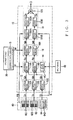
- Fig. 1 is a block diagram showing an example general setup of a tone processing apparatus in accordance with an embodiment of the present invention.
- the tone processing apparatus 100 is implemented by a computer system which comprises a control device 10, a storage device 30, an input device 40 and an output device 50.
- Performance device 60 is connected to the control device 10.
- the control device 10 is an arithmetic processing unit (CPU) that controls various sections of the tone processing apparatus 100 by executing programs.
- the storage device 30 stores a program to be executed by the control device 10 and various data to be used for processing by the control device 10. Any of a semiconductor storage device, magnetic storage device and optical storage device, for example, is suitably used as the storage device 30.
- the storage device 30 stores one or more music piece data sets of one or more music pieces.
- Each music piece is segmented into a plurality of sections or segments (hereinafter referred to as "fragments") with time points synchronous with beat points used as dividing boundaries.
- the fragment is a section of a time length corresponding to one beat of a music piece.
- each segment obtained by dividing a measure of the music piece into four equal sections is set as a "fragment”.
- each segment obtained by dividing a beat of a music piece e.g., each segment of a time length corresponding to a 1/2 or 1/4 beat
- each segment obtained by segmenting a music piece independently of the beat e.g., each segment of a fixed time length unrelated to the beat
- each segment of a predetermined time length from a sounding start point of a tone e.g., high-volume tone, such as a drum tone
- Fig. 2 is a conceptual diagram showing an example structure of music piece data.
- a music piece data set of a music piece includes respective fragment data DS of a plurality of fragments obtained by dividing the music piece.
- the music piece data set may include either fragment data DS of all of the fragments of the music piece or fragment data DS of only fragments belonging to a particular section (e.g., "bridge" section) of the music piece.
- the fragment data DS of each fragment includes tone data M indicative of a waveform of a tone included in the fragment, and a descriptor (first descriptor) P indicative of a musical character of the tone.
- each music piece data set comprises tone data M of the individual fragments, and first descriptors P associated with the fragments.
- the descriptor (first descriptor) P comprises respective character values of a plurality of types of character elements, including HPCP (Harmonic Pitch Class Profile), LPF(Low Pass Filter)-HPCP, volume (average energy value) of a tone within the fragment, spectral center of gravity, tempo, degree of variation, etc.
- the HPCP is a character value indicative of a combination of a pitch and volume of one tone or each of a plurality of tones (i.e., chord) included in the fragment.
- the LPF-HPCP is an HPCP of a tone below a predetermined frequency among tones included in the fragment.
- the spectral center of gravity (spectral centroid) is a frequency corresponding to a gravity of center of a frequency spectrum of a tone (particularly a chord) included in the fragment.
- the tempo is defined as the number of beat points within a unit time (BPM: Beat Per Minute).
- the degree of variation is a character value indicative of a degree with which a tone varies in the fragment. Namely, the degree of variation is a character element that increases in value as the number of the tone included in the fragment increases or as the number of times the tone pitch changes in the fragment increases; in other words, the degree of variation is low when the tone is stable in the fragment.
- the input device 40 shown in Fig. 1 is equipment, such as a mouse and keyboard, operable by a user to input various instructions to the tone processing device 100.
- the performance device 60 is an input device that generates data I (hereinafter referred to as "input data I") corresponding to content of a performance by the user.
- the control device 10 generates output data O by selectively using the fragment data DS of a fragment, corresponding to the input data I, from among a plurality of music piece data sets stored in the storage device 30.
- the output device 50 audibly generates a tone on the basis of the output data O output from the control device 10.
- the output device 50 includes, for example, a D/A converter that generates an analog signal from the output data O, an amplifier that amplifies the analog signal output from the D/A converter, and sounding equipment, such as a speaker or headphone, that outputs a sound wave corresponding to the signal output from the amplifier.
- a D/A converter that generates an analog signal from the output data O
- an amplifier that amplifies the analog signal output from the D/A converter
- sounding equipment such as a speaker or headphone
- the control device 10 generates output data O using a group of a plurality of fragment data DS (hereinafter referred to as "candidate data group G") extracted in advance from a plurality of music piece data sets stored in the storage device 30.
- One or more conditions with which fragment data DS are selected as a candidate data group G are determined in accordance with operation performed by the user on the input device 40. For example, as the user designates a particular character value by operating the input device 40, the control device 10 selects, as a candidate data group G, a plurality of fragment data DS of which the particular character value in the descriptor P is above a predetermined value.
- bibliographic data such as a genre and name of a singer
- bibliographic data may be added in advance to each music piece data set stored in the storage device 30 so that the control device 10 can select, as a candidate data group G, only fragment data DS of a music piece matching bibliographic data designated or input by the user via the input device 40.
- Fig. 3 is a block diagram showing example detailed constructions of the performance device 60 and control device 10.
- the performance device 60 includes an electronic musical instrument 62 and a detector 64.
- the electronic musical instrument 62 is a keyboard having a plurality of keys (operator members) to be depressed by the user, which outputs in real time input data I (I A , I B ), compliant with the MIDI (Musical Instrument Digital Instrument) standard, in response to performance operation thereon by the user.
- I input data
- I B MIDI
- the electronic musical instrument 62 is divided into a higher-pitch section 621 and lower-pitch section 622 with a predetermined tone pitch used as a dividing boundary point.
- the electronic musical instrument 62 generates input data I A in response to user's operation of a key belonging to the higher-pitch section 621 and generates input data I B in response to user's operation of a key belonging to the lower-pitch section 621. Further, the electronic musical instrument 62 outputs pitch-bend data PB, designating tone pitch variation, in response to user's operation. Note that a specific form of the electronic musical instrument 62 may be chosen as desired; for example, the electronic musical instrument 62 may be of a string instrument type.
- Fig. 4 is a conceptual diagram showing details of input data I (I A , I B , I C ) generated by the performance device 60.
- the input data I A and I B are each event data instructing tone generation start or tone generation end (tone deadening), or after-touch data indicative of a sustained operating (or depressing) state after key depression (i.e., key-on triggering) by the user.
- the event data includes data of a note number indicative of a pitch of a tone corresponding to a key of the instrument 62 having been operated by the user, and data of velocity indicative of intensity of the key depression (key-on triggering).
- the after-touch data includes pressure data designating depression pressure (channel pressure or polyphonic key pressure) after the key depression (key-on triggering).
- the detector 64 shown in Figs. 3 and 4 includes a sensor (e.g., acceleration sensor) 642 that detects a motion of the user.
- the detector 64 outputs beat point data B (input data I C ) designating, as a beat point, a time point synchronous with the motion detected via the sensor 642.
- the beat point data B designates, as a beat point, a time point at which the acceleration detected by the sensor 642 reaches a maximum value.
- the detector 64 keeps continuously outputting beat point data B designating, as a beat point, a time point synchronous with the user's motion detected immediately before the stop.
- the control device 10 can operate as a plurality of functioning members (e.g., descriptor generation section 12, similarity calculation section 14, fragment selection section 16 and data generation section 18) each of which performs separate or independent processing.
- the descriptor generation section 12 generates a second descriptor Q (Q A , Q B , Q C ) on the basis of input data I (I A , I B , I C ) supplied from the performance device 60.
- the second descriptor Q describes a musical character of a performance, executed by the user on the performance device 60, in a similar manner to the aforementioned first descriptor P.
- the second descriptor generation section 12 includes generation sections 12 A , 12 B and 12 C .
- the generation sections 12 A generates a descriptor Q A on the basis of the input data I A .
- the generation sections 12B generates a descriptor Q B on the basis of the input data I B .
- the descriptor Q A includes an HPCP, spectral center of gravity, tone volume and degree of variation
- the descriptor Q B includes an LPF-HPCP, volume and degree of variation.
- the generation section 12A In the case where the input data I A is event data, the generation section 12A generates an HPCP indicative of a combination of a tone designated by a note number of the input data I A and tone volume corresponding to velocity of the input data I A . Further, the generation section 12 A determines a spectral center of gravity on the basis of an average value of a plurality of note numbers (tone pitches) of the input data I A and determines a tone volume on the basis of velocity. Further, in the case where the input data I A is after-touch data, the generation section 12 A determines a degree of variation on the basis of key depression pressure designated by the input data I A . For example, the generation section 12 A sets a degree of variation such that the degree increases as the key depression pressure value increases.
- the generation section 12B determines an LPF-HPCP and tone volume on the basis of the input data I B (event data) including a note number and velocity and determines a degree of variation on the basis of the input data I B (after-touch data) including key depression pressure.
- the beat point data B output from the detector 64 is supplied not only to the data generation section 18 but also to the generation section 12 C of the descriptor generation section 12 as input data I C .
- the generation section 12 C generates a descriptor Q C on the basis of the input data I C .
- the descriptor Q C includes a temp.
- the generation section 12 C determines, as a tempo, the number of beat points designated by the input data I C (beat point data B) within a unit time and includes the determined tempo in the descriptor Q C .
- the similarity calculation (determination) section 14 determines similarity between the descriptors Q (Q A , Q B , Q C ) generated by the descriptor generation section 12 and descriptor P of each fragment data D S in a candidate data group G; more particularly, the similarity calculation section 14 calculates similarity index values R (R A , R B ) indicative of degrees of similarity between the generated descriptors Q (Q A , Q B , Q C ) and descriptor P of each fragment data D S . As shown in Fig. 3 , the similarity calculation section 14 includes calculation sections 14 A and 14 B and a setting section 14 C .
- the calculation section 14 A calculates a similarity index value R A for each fragment data D S in the candidate data group G through comparison between the descriptors Q A and Q B and the descriptor P of each fragment data D S .
- the calculation section 14 B calculates a similarity index value R B for each fragment data D S in the candidate data group G through comparison between the descriptors Q B and Q C and the descriptor P of each fragment data D S .
- the setting section 14 C shown in Fig. 3 sets a weighting value for each of the character values included in the descriptors P an Q. In the instant embodiment, the setting section 14 C sets a weighting value for each of the character values in accordance with content of operation performed on the input device 40.
- degrees of similarity ⁇ 1 - ⁇ 5 are calculated between 1) four types of character values (i.e., HPCP, spectral center of gravity, tone volume and degree of variation) in (or belonging to) the descriptor Q A and one type of character value (i.e., tempo) in the descriptor Q C and 2) the same types (five types) of character values in the descriptor P.
- the degree of similarity ⁇ i is calculated on the basis of a predetermined mathematical expression such that it takes a greater value as the descriptors Q A and Q C and the descriptor P approximate each other more closely in character value. More specifically, the degree of similarity ⁇ i is an inverse number of a square of a difference between the character value in the descriptor Q A or Q C and the character value in the descriptor P.
- the weighting value ⁇ i in Mathematical Expression (1) above is a weighting value set by the setting section 14 C for an i-th character value.
- the similarity index value R A takes a greater value as the descriptors Q A and Q C and the descriptor P approximate each other more closely in character value.
- the similarity index value R A takes a greater value as the descriptors Q A and Q C and the descriptor P approximate each other more closely in character value to which is assigned a great weighting value ⁇ i.
- the calculation section 14 B calculates a similarity index value R B in a similar manner to the aforementioned. Namely, the similarity index value R B takes a greater value as individual character values of the descriptors Q A and Q C and the same types of character values of the descriptor P approximate each other, and it also takes a greater value as the descriptors Q A and Q C and the descriptor P approximate each other more closely in character value to which is assigned a great weighting value set by the weighting section 14C.
- the fragment selection section 16 of Fig. 1 selects one or more fragment data DS from the candidate data group G on the basis of the similarity index value R (R A , R B ) calculated by the similarity calculation section 14 for each of the fragment, acquires the tone data M (M A , M B ) of the fragment data D S from the storage device 30 and then outputs the acquired tone data to the data generation section 18.
- the fragment selection section 16 includes selection sections 16 A and 16 B .
- the selection section 16 A selects, from the candidate data group G, a predetermined number of fragment data in decreasing order of the similarity index values R A calculated by the similarity calculation section 14, reads out the tone data M (M A ) of each of the selected fragment data DS from the storage device 30 and sequentially outputs the read-out tone data to the data generation section 18.
- the tone data M A of fragments similar in musical character to a performance executed by the user with respect to the higher-pitch section 621 of the electronic musical instrument 62 and detector 64 i.e., fragments having a chord feeling or tone color feeling similar to content of the performance
- the selection section 16 B selects, from the candidate data group G, a predetermined number of fragment data D S in decreasing order of the similarity index values R B , reads out the tone data M (M B ) of each of the selected fragment data D S from the storage device 30 and sequentially outputs the read-out music piece data to the data generation section 18.
- the tone data M B of fragments similar in musical character to a performance executed by the user with respect to the lower-pitch section 622 of the electronic musical instrument 62 and detector 64 are selectively output to the data generation section 18.
- the tone data M (M A , M B ) may be output to the data generation section 18 either in the increasing order of the similarity index values R (R A , R B ) or in arranged order in the candidate data group G.
- the data generation section 18 of Fig. 1 generates output data O on the basis of the tone data M (M A , M B ) output from the fragment selection section 16.
- the data generation section 18 in the instant embodiment includes processing sections 181 A and 181 B , connecting sections 183 A and 183 B , and an adder 185.
- the processing sections 181 A processes the tone data M A supplied from the selection section 16 A and sequentially outputs the processed tone data M A .
- the processing sections 181 B processes the tone data M B supplied from the selection section 16 B and sequentially outputs the processed tone data M B .
- the following paragraphs describe details of the processing performed by the processing sections 181 A and 181 B .
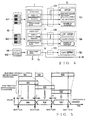
- Fig. 5 is a conceptual diagram explanatory of the processing performed by the data generation section 18.
- each beat point designated by beat point data B is shown by an arrow on the time axis.
- Tones represented by tone data M (M 1 - M 3 ) have different time lengths.
- the processing section 181 A expands or contracts tone data M A so that the tone data M A has a time length corresponding to an interval between beat points designated by beat point data B supplied from the detector 64.
- tone data M 1 and M 2 each having a time length greater than the interval between the beat points, are expanded, while tone data M 3 having a time length smaller than the interval between the beat points is contracted.
- the tone data expansion/contraction may be effected using any of the various conventionally-known techniques for adjusting a tempo without involving a tone pitch change.
- the processing section 181 A varies the pitch of the tone data M A in accordance with pitch-bend data PB supplied from the electronic musical instrument 62. Further, the processing section 181 A performs tone volume adjustment and equalization on the tone data M A and then performs a filter process on the tone data M A for cutting off frequency components lower than a predetermined frequency (that is, for example, the frequency corresponding to the pitch of the dividing boundary point between the higher- and lower-pitch sections 621 and 622 of the electronic musical instrument 62).
- a predetermined frequency that is, for example, the frequency corresponding to the pitch of the dividing boundary point between the higher- and lower-pitch sections 621 and 622 of the electronic musical instrument 62.
- the processing section 181 B performs time length adjustment responsive to the beat point data B and pitch adjustment responsive to the pitch-bend data PB on the tone data M B and then performs a filter process on the tone data M B for cutting off frequency components lower than the predetermined frequency.
- the connecting section 183 A of Fig. 3 generates output data O A by interconnecting the individual tone data M A processed by the processing section 181 A .
- the connecting section 183 A interconnects the individual tone data M A so that reproduction of each of the tone data M A is started at the beat point indicated by the beat point data B and the successive or adjoining tone data M A overlap with each other in a cross-fading fashion; for example, from a start point to an end point of a time period T (e.g., about 20 msec) starting at the beat point, a trailing end portion of one tone data M 1 gradually decreases in tone volume while a leading end portion of another or succeeding tone data M 2 gradually increases in tone volume.
- T e.g., about 20 msec
- the connecting section 183B In a similar manner to the connecting section 183 A , the connecting section 183B generates output data O B by interconnecting the individual tone data MB processed by the processing section 181 B .
- Adder section 183 A adds together the output data O A generated by the connecting section 183 A and output data O B generated by the connecting section 183 B , to thereby generate output data O. Tone is reproduced by the thus-generated output data O being supplied to the output device 50.
- fragments are selected in accordance with similarity index values R between the descriptors Q and P, and thus, there is no need to define in advance (correspondence) relationship between the input data I and the descriptors P.
- fragments closely related to content of a user's performance in terms of musical characters are selectively used for generation of output data O, the instant embodiment can reproduce tones appropriately reflecting therein an intension of the user's performance.
- the similarity index values R are calculated on the basis of character values weighted in accordance with user's instructions, the instant embodiment can generate a variety of tones preferentially reflecting therein a character value to which the user attaches particular importance.
- the instant embodiment there are individually set the channel for generating higher-pitch-side output data O A and lower-pitch-side output data O B , so that fragment data D S of different music pieces can be selected on the higher-pitch side and lower-pitch side.
- the instant embodiment can generate a variety of tones with melody tones (of higher pitches) and bass tones (of lower pitches) clearly differentiated.
- Tone data M are sequentially reproduced in synchronism with beat points designated by beat point data B.
- the user can set a desired tempo of tones by controlling a cyclic period of his or her body motion.
- tone data M is generated for each fragment obtained by segmenting a music piece on a beat-by-beat basis and because the tone data M is adjusted by the data generation section 18 to have a time length synchronous with the beat point designated by the beat point data B, the instant embodiment can generate tones that progress naturally with a unified rhythm feeling.
- the above-described embodiment is advantageous in that processing loads on the control device 10 (e.g., the load involved when the similarity calculation section 14 calculates a similarity index value R and the load involved when the fragment selection section 16 selects a fragment) can be reduced as compared to the conventional construction where all of fragment data D S are processed. Further, because fragment data D S satisfying user-designated conditions are extracted as a candidate data group G, the above-described embodiment can advantageously generate tones conforming to a user's intention.
- Character values included in the descriptors P and Q are not limited to the aforementioned.
- the descriptors P may include pitches of tones included in corresponding fragments of a music piece
- the descriptors Q may include pitches of tones corresponding to note numbers of input data I (event data).
- Tone data M of a fragment including a pitch similar to that of a key operated by the user on the electronic musical instrument 62 is used for generation of output data O.
- a numerical value indicative of a degree of tone color complexity (hereinafter referred to simply as "degree of complexity") of tones within a fragment may be included in the descriptor P.
- degree of complexity a degree of tone color complexity
- the descriptor Q generated on the basis of the input data I too includes such a degree of complexity.
- the descriptor generation section 12 calculates the degree of complexity of the descriptor Q such that the degree of complexity takes a greater value if a range of tone pitches designated by note numbers of input data I is greater (i.e., value of a difference between the highest-pitch tone and the lowest-pitch tone is greater).
- the descriptor P only has to include at least one character value indicative of a musical character of a tone within a fragment
- the descriptor Q only has to include at least one character value indicative of a musical character of a performance executed by the user.
- tone data M is adjusted to synchronize with a beat point designated by beat point data B
- tone data M are arranged in synchronism with beat points or in succession (without being necessarily synchronized with beat points) regardless of excess/deficiency of the time length.
- tone data M are expanded or contracted too, specific contents of the processing may be modified as necessary.
- the time length (tempo) of tone data M may be adjusted in such a manner that the tone pitch too is changed with the adjusted time length (tempo), or the time length (tempo) of tone data M may be adjusted by interpolating, as necessary, a waveform of a particular tone included in tone data M. If tone data M are reproduced for a time period, shorter than the beat-to-beat interval, from a particular beat point, rhythmical tones, rich in auditory interest or attractiveness, can be generated because a silent section is set to an interval between beat points.
- fragment data D S may be selected in decreasing order of similarity index values R
- the way of selecting fragment data D S may be modified as necessary. For example, fragment data D S of which the similarity index value R exceeds a predetermined threshold value may be selected, or only one fragment data D S of which the similarity index value R is the greatest may be selected.
- output data O may be generated in accordance with positional arrangement of individual tone data M
- the way of generating output data O may be chosen as desired without being limited to the aforementioned example.
- output data O may be generated by mixing a plurality of tone data, selected by the fragment selection section 16, at a predetermined ratio.
- the pitch of a tone indicated by tone data M may be converted into a pitch of a note number included in input data I (I A , I B ) and then used for generation of output data O.
- Character value determined on the basis of after-touch data is not limited to one indicative of a degree of variation.
- a time length of a fragment, corresponding to after-touch data may be determined by the descriptor generation section 12 (12A, 12B) as a character value. More specifically, the greater the pressure designated by after-touch data, the shorter the time lengths of fragments included as character values in the descriptors Q (Q A , Q B ). On the other hand, time lengths of individual fragments of a music piece are included in the descriptors P. With such an arrangement, a fragment of a time length corresponding to after-touch data is selected by the fragment selection section 16.
- a numerical value functioning as an index indicative of a degree of tone color variation (e.g., amount or frequency of tone color variation) within a fragment may be included in the descriptor P so that the descriptor generation section 12 can determine, as a character value, a degree of tone color variation corresponding to after-touch data.
- the descriptor generation section 12 may determine a degree of tone color variation such that the variation degree increases if a greater pressure is designated by after-touch data.
- the number of fragments to be reproduced simultaneously may be controlled in accordance with after-touch data.
- the data generation section 18 generates output data O by mixing a particular number of tone data M, corresponding to after-touch data (input data I A , I B ) output from the electronic musical instrument 62, from among tone data M of a plurality of fragments selected by the fragment selection section 16.
- an input to an assignable controller such as a pitch-bend wheel or modulation wheel, may be used in place of the after-touch data.
- the way of calculating the similarity index value R may be chosen as desired without being limited to the aforementioned.
- the similarity index value R has been described as increasing as similarity in character value between the descriptors P and Q increases (Mathematical Expression (1))
- the similarity index value R may be a value decreasing as similarity in character value between the descriptors P and Q increases.
- weighting by the setting section 14 C may be dispensed with.
- coordinates corresponding to the descriptors P and Q may be set in an N-dimensional space, and a distance between such coordinates (or inverse number of the distance) may be calculated as the similarity index value R.
- the tone processing apparatus 100 may be implemented by hardware (electronic circuit), such as a DSP, that performs processing similar to that performed by the control device 10 of Fig. 1 .
Landscapes
- Engineering & Computer Science (AREA)
- Physics & Mathematics (AREA)
- Acoustics & Sound (AREA)
- Multimedia (AREA)
- General Engineering & Computer Science (AREA)
- Electrophonic Musical Instruments (AREA)
- Auxiliary Devices For Music (AREA)
Applications Claiming Priority (1)
| Application Number | Priority Date | Filing Date | Title |
|---|---|---|---|
| JP2007001058A JP4548424B2 (ja) | 2007-01-09 | 2007-01-09 | 楽音処理装置およびプログラム |
Publications (2)
| Publication Number | Publication Date |
|---|---|
| EP1944752A2 true EP1944752A2 (de) | 2008-07-16 |
| EP1944752A3 EP1944752A3 (de) | 2008-11-19 |
Family
ID=39301477
Family Applications (1)
| Application Number | Title | Priority Date | Filing Date |
|---|---|---|---|
| EP08100049A Withdrawn EP1944752A3 (de) | 2007-01-09 | 2008-01-03 | Vorrichtung und Verfahren zur Tonverarbeitung |
Country Status (3)
| Country | Link |
|---|---|
| US (1) | US7750228B2 (de) |
| EP (1) | EP1944752A3 (de) |
| JP (1) | JP4548424B2 (de) |
Cited By (2)
| Publication number | Priority date | Publication date | Assignee | Title |
|---|---|---|---|---|
| EP2372691A3 (de) * | 2010-02-05 | 2016-07-27 | Yamaha Corporation | Tondatensuchvorrichtung und -verfahren |
| WO2022013553A1 (en) * | 2020-07-17 | 2022-01-20 | WeJam Limited | Method of performing a piece of music |
Families Citing this family (8)
| Publication number | Priority date | Publication date | Assignee | Title |
|---|---|---|---|---|
| US20070276668A1 (en) * | 2006-05-23 | 2007-11-29 | Creative Technology Ltd | Method and apparatus for accessing an audio file from a collection of audio files using tonal matching |
| US20110208703A1 (en) * | 2006-05-24 | 2011-08-25 | Damien Fisher | Selectivity estimation |
| TWI394142B (zh) * | 2009-08-25 | 2013-04-21 | Inst Information Industry | 歌聲合成系統、方法、以及裝置 |
| JP5168297B2 (ja) * | 2010-02-04 | 2013-03-21 | カシオ計算機株式会社 | 自動伴奏装置および自動伴奏プログラム |
| JP5782677B2 (ja) | 2010-03-31 | 2015-09-24 | ヤマハ株式会社 | コンテンツ再生装置および音声処理システム |
| EP2573761B1 (de) | 2011-09-25 | 2018-02-14 | Yamaha Corporation | Anzeigen von inhalt im verhältnis zur musikreproduktion mittels einer informationsverarbeitungsvorrichtung unabhängig von der musikreproduktionsvorrichtung |
| JP5494677B2 (ja) | 2012-01-06 | 2014-05-21 | ヤマハ株式会社 | 演奏装置及び演奏プログラム |
| JP7052339B2 (ja) * | 2017-12-25 | 2022-04-12 | カシオ計算機株式会社 | 鍵盤楽器、方法及びプログラム |
Citations (3)
| Publication number | Priority date | Publication date | Assignee | Title |
|---|---|---|---|---|
| EP1220195A2 (de) | 2000-12-28 | 2002-07-03 | Yamaha Corporation | Vorrichtung und Verfahren zur Synthese einer singenden Stimme und Programm zur Realisierung des Verfahrens |
| EP1646035A1 (de) | 2004-10-05 | 2006-04-12 | Sony France S.A. | Wiedergabegerät für metadata indexiertes Ton und hierfür verwendbares Audio Sampling/Sample Verarbeitungssystem |
| WO2006106754A1 (ja) | 2005-03-31 | 2006-10-12 | Matsushita Electric Industrial Co., Ltd. | 画像処理方法、表示画像処理方法、画像処理装置、画像処理プログラム、およびその画像処理装置を含む集積回路 |
Family Cites Families (15)
| Publication number | Priority date | Publication date | Assignee | Title |
|---|---|---|---|---|
| US5018430A (en) * | 1988-06-22 | 1991-05-28 | Casio Computer Co., Ltd. | Electronic musical instrument with a touch response function |
| US5536902A (en) * | 1993-04-14 | 1996-07-16 | Yamaha Corporation | Method of and apparatus for analyzing and synthesizing a sound by extracting and controlling a sound parameter |
| FR2785438A1 (fr) * | 1998-09-24 | 2000-05-05 | Baron Rene Louis | Procede et dispositif de generation musicale |
| JP3631650B2 (ja) * | 1999-03-26 | 2005-03-23 | 日本電信電話株式会社 | 音楽検索装置,音楽検索方法および音楽検索プログラムを記録した計算機読み取り可能な記録媒体 |
| JP3612272B2 (ja) * | 2000-10-13 | 2005-01-19 | 日本電信電話株式会社 | 音楽情報検索装置、音楽情報検索方法および音楽情報検索用プログラムを記録したコンピュータ読み取り可能な記録媒体 |
| JP4406811B2 (ja) * | 2001-03-16 | 2010-02-03 | ソニー株式会社 | 配信システム |
| JP4153220B2 (ja) * | 2002-02-28 | 2008-09-24 | ヤマハ株式会社 | 歌唱合成装置、歌唱合成方法及び歌唱合成用プログラム |
| JP3823930B2 (ja) * | 2003-03-03 | 2006-09-20 | ヤマハ株式会社 | 歌唱合成装置、歌唱合成プログラム |
| JP4305022B2 (ja) * | 2003-03-27 | 2009-07-29 | ヤマハ株式会社 | データ作成装置、プログラム及び楽音合成装置 |
| JP2005234304A (ja) * | 2004-02-20 | 2005-09-02 | Kawai Musical Instr Mfg Co Ltd | 演奏音判定装置および演奏音判定プログラム |
| JP4202964B2 (ja) * | 2004-05-06 | 2008-12-24 | 大日本印刷株式会社 | 映像データへの楽曲データ付加装置 |
| JP4265501B2 (ja) * | 2004-07-15 | 2009-05-20 | ヤマハ株式会社 | 音声合成装置およびプログラム |
| JP2006084749A (ja) | 2004-09-16 | 2006-03-30 | Sony Corp | コンテンツ生成装置およびコンテンツ生成方法 |
| DE102004050368A1 (de) * | 2004-10-15 | 2006-04-20 | Siemens Ag | Verfahren zum Erstellen eines Musikstücks |
| JP2006114174A (ja) | 2004-10-18 | 2006-04-27 | Sony Corp | コンテンツ再生方法およびコンテンツ再生装置 |
-
2007
- 2007-01-09 JP JP2007001058A patent/JP4548424B2/ja not_active Expired - Fee Related
-
2008
- 2008-01-03 EP EP08100049A patent/EP1944752A3/de not_active Withdrawn
- 2008-01-07 US US12/006,918 patent/US7750228B2/en not_active Expired - Fee Related
Patent Citations (4)
| Publication number | Priority date | Publication date | Assignee | Title |
|---|---|---|---|---|
| EP1220195A2 (de) | 2000-12-28 | 2002-07-03 | Yamaha Corporation | Vorrichtung und Verfahren zur Synthese einer singenden Stimme und Programm zur Realisierung des Verfahrens |
| EP1646035A1 (de) | 2004-10-05 | 2006-04-12 | Sony France S.A. | Wiedergabegerät für metadata indexiertes Ton und hierfür verwendbares Audio Sampling/Sample Verarbeitungssystem |
| JP2006106754A (ja) | 2004-10-05 | 2006-04-20 | Sony France Sa | メタデータマッピング音再生装置及びこれに使用可能なオーディオサンプリング/サンプル処理システム |
| WO2006106754A1 (ja) | 2005-03-31 | 2006-10-12 | Matsushita Electric Industrial Co., Ltd. | 画像処理方法、表示画像処理方法、画像処理装置、画像処理プログラム、およびその画像処理装置を含む集積回路 |
Cited By (2)
| Publication number | Priority date | Publication date | Assignee | Title |
|---|---|---|---|---|
| EP2372691A3 (de) * | 2010-02-05 | 2016-07-27 | Yamaha Corporation | Tondatensuchvorrichtung und -verfahren |
| WO2022013553A1 (en) * | 2020-07-17 | 2022-01-20 | WeJam Limited | Method of performing a piece of music |
Also Published As
| Publication number | Publication date |
|---|---|
| US20080236364A1 (en) | 2008-10-02 |
| JP4548424B2 (ja) | 2010-09-22 |
| US7750228B2 (en) | 2010-07-06 |
| JP2008170504A (ja) | 2008-07-24 |
| EP1944752A3 (de) | 2008-11-19 |
Similar Documents
| Publication | Publication Date | Title |
|---|---|---|
| US7750228B2 (en) | Tone processing apparatus and method | |
| US5850051A (en) | Method and apparatus for creating an automatic accompaniment pattern on the basis of analytic parameters | |
| US5939654A (en) | Harmony generating apparatus and method of use for karaoke | |
| US8314320B2 (en) | Automatic accompanying apparatus and computer readable storing medium | |
| US8735709B2 (en) | Generation of harmony tone | |
| EP2515296A1 (de) | Leistungsdatensuche mittels einer Anfrage mit Hinweis auf ein Tonerzeugungsmuster | |
| US6525255B1 (en) | Sound signal analyzing device | |
| JP2806351B2 (ja) | 演奏情報分析装置及びそれを用いた自動編曲装置 | |
| US5942710A (en) | Automatic accompaniment apparatus and method with chord variety progression patterns, and machine readable medium containing program therefore | |
| EP1638077B1 (de) | Vorrichtung, Verfahren und Computerprogramm zur automatischen Bestimmung eines Wiedergabestils | |
| JP2000315081A (ja) | 自動作曲装置及び方法並びに記憶媒体 | |
| JP2745865B2 (ja) | 楽音合成装置 | |
| JP3724347B2 (ja) | 自動作曲装置及び方法並びに記憶媒体 | |
| US9263016B2 (en) | Sorting a plurality of inputted sound generation instructions to generate tones corresponding to the sound generation instruction in a sorted order | |
| GB2209425A (en) | Music sequencer | |
| JP3664126B2 (ja) | 自動作曲装置 | |
| JPH0968980A (ja) | 電子鍵盤楽器の音色制御装置 | |
| JP3704901B2 (ja) | 自動演奏装置、自動演奏方法及び記録媒体 | |
| JP4695781B2 (ja) | 音響信号の符号化方法 | |
| JPH05188953A (ja) | 電子楽器 | |
| JPH0145077B2 (de) | ||
| JPH10254448A (ja) | 自動伴奏装置及び自動伴奏制御プログラムを記録した媒体 | |
| JP3783566B2 (ja) | 楽音データ変換装置および楽音データ変換方法 | |
| JPH0795233B2 (ja) | 電子楽器のタッチレスポンス装置 | |
| JPH056168A (ja) | 電子楽器 |
Legal Events
| Date | Code | Title | Description |
|---|---|---|---|
| PUAI | Public reference made under article 153(3) epc to a published international application that has entered the european phase |
Free format text: ORIGINAL CODE: 0009012 |
|
| AK | Designated contracting states |
Kind code of ref document: A2 Designated state(s): AT BE BG CH CY CZ DE DK EE ES FI FR GB GR HR HU IE IS IT LI LT LU LV MC MT NL NO PL PT RO SE SI SK TR |
|
| AX | Request for extension of the european patent |
Extension state: AL BA MK RS |
|
| PUAL | Search report despatched |
Free format text: ORIGINAL CODE: 0009013 |
|
| AK | Designated contracting states |
Kind code of ref document: A3 Designated state(s): AT BE BG CH CY CZ DE DK EE ES FI FR GB GR HR HU IE IS IT LI LT LU LV MC MT NL NO PL PT RO SE SI SK TR |
|
| AX | Request for extension of the european patent |
Extension state: AL BA MK RS |
|
| 17P | Request for examination filed |
Effective date: 20090518 |
|
| AKX | Designation fees paid |
Designated state(s): AT BE BG CH CY CZ DE DK EE ES FI FR GB GR HR HU IE IS IT LI LT LU LV MC MT NL NO PL PT RO SE SI SK TR |
|
| 17Q | First examination report despatched |
Effective date: 20160517 |
|
| GRAP | Despatch of communication of intention to grant a patent |
Free format text: ORIGINAL CODE: EPIDOSNIGR1 |
|
| INTG | Intention to grant announced |
Effective date: 20171009 |
|
| STAA | Information on the status of an ep patent application or granted ep patent |
Free format text: STATUS: THE APPLICATION IS DEEMED TO BE WITHDRAWN |
|
| 18D | Application deemed to be withdrawn |
Effective date: 20180220 |