EP1933796B1 - Verfahren zum herstellen einer vielzahl von einen windelhauptteil und daran angefügte vordere und hintere windelseitenteile aufweisenden inkontinenzwegwerfwindeln - Google Patents
Verfahren zum herstellen einer vielzahl von einen windelhauptteil und daran angefügte vordere und hintere windelseitenteile aufweisenden inkontinenzwegwerfwindeln Download PDFInfo
- Publication number
- EP1933796B1 EP1933796B1 EP06753961A EP06753961A EP1933796B1 EP 1933796 B1 EP1933796 B1 EP 1933796B1 EP 06753961 A EP06753961 A EP 06753961A EP 06753961 A EP06753961 A EP 06753961A EP 1933796 B1 EP1933796 B1 EP 1933796B1
- Authority
- EP
- European Patent Office
- Prior art keywords
- diaper
- diaper side
- side part
- longitudinal
- longitudinal direction
- Prior art date
- Legal status (The legal status is an assumption and is not a legal conclusion. Google has not performed a legal analysis and makes no representation as to the accuracy of the status listed.)
- Active
Links
Images




Classifications
-
- A—HUMAN NECESSITIES
- A61—MEDICAL OR VETERINARY SCIENCE; HYGIENE
- A61F—FILTERS IMPLANTABLE INTO BLOOD VESSELS; PROSTHESES; DEVICES PROVIDING PATENCY TO, OR PREVENTING COLLAPSING OF, TUBULAR STRUCTURES OF THE BODY, e.g. STENTS; ORTHOPAEDIC, NURSING OR CONTRACEPTIVE DEVICES; FOMENTATION; TREATMENT OR PROTECTION OF EYES OR EARS; BANDAGES, DRESSINGS OR ABSORBENT PADS; FIRST-AID KITS
- A61F13/00—Bandages or dressings; Absorbent pads
- A61F13/15—Absorbent pads, e.g. sanitary towels, swabs or tampons for external or internal application to the body; Supporting or fastening means therefor; Tampon applicators
- A61F13/45—Absorbent pads, e.g. sanitary towels, swabs or tampons for external or internal application to the body; Supporting or fastening means therefor; Tampon applicators characterised by the shape
- A61F13/49—Absorbent pads, e.g. sanitary towels, swabs or tampons for external or internal application to the body; Supporting or fastening means therefor; Tampon applicators characterised by the shape specially adapted to be worn around the waist, e.g. diapers, nappies
- A61F13/49007—Form-fitting, self-adjusting disposable diapers
- A61F13/49009—Form-fitting, self-adjusting disposable diapers with elastic means
- A61F13/49014—Form-fitting, self-adjusting disposable diapers with elastic means the elastic means is located at the side panels
- A61F13/49015—Form-fitting, self-adjusting disposable diapers with elastic means the elastic means is located at the side panels the elastic means being elastic panels
-
- A—HUMAN NECESSITIES
- A61—MEDICAL OR VETERINARY SCIENCE; HYGIENE
- A61F—FILTERS IMPLANTABLE INTO BLOOD VESSELS; PROSTHESES; DEVICES PROVIDING PATENCY TO, OR PREVENTING COLLAPSING OF, TUBULAR STRUCTURES OF THE BODY, e.g. STENTS; ORTHOPAEDIC, NURSING OR CONTRACEPTIVE DEVICES; FOMENTATION; TREATMENT OR PROTECTION OF EYES OR EARS; BANDAGES, DRESSINGS OR ABSORBENT PADS; FIRST-AID KITS
- A61F13/00—Bandages or dressings; Absorbent pads
- A61F13/15—Absorbent pads, e.g. sanitary towels, swabs or tampons for external or internal application to the body; Supporting or fastening means therefor; Tampon applicators
- A61F13/15203—Properties of the article, e.g. stiffness or absorbency
-
- A—HUMAN NECESSITIES
- A61—MEDICAL OR VETERINARY SCIENCE; HYGIENE
- A61F—FILTERS IMPLANTABLE INTO BLOOD VESSELS; PROSTHESES; DEVICES PROVIDING PATENCY TO, OR PREVENTING COLLAPSING OF, TUBULAR STRUCTURES OF THE BODY, e.g. STENTS; ORTHOPAEDIC, NURSING OR CONTRACEPTIVE DEVICES; FOMENTATION; TREATMENT OR PROTECTION OF EYES OR EARS; BANDAGES, DRESSINGS OR ABSORBENT PADS; FIRST-AID KITS
- A61F13/00—Bandages or dressings; Absorbent pads
- A61F13/15—Absorbent pads, e.g. sanitary towels, swabs or tampons for external or internal application to the body; Supporting or fastening means therefor; Tampon applicators
- A61F13/15577—Apparatus or processes for manufacturing
- A61F13/15699—Forming webs by bringing together several webs, e.g. by laminating or folding several webs, with or without additional treatment of the webs
-
- A—HUMAN NECESSITIES
- A61—MEDICAL OR VETERINARY SCIENCE; HYGIENE
- A61F—FILTERS IMPLANTABLE INTO BLOOD VESSELS; PROSTHESES; DEVICES PROVIDING PATENCY TO, OR PREVENTING COLLAPSING OF, TUBULAR STRUCTURES OF THE BODY, e.g. STENTS; ORTHOPAEDIC, NURSING OR CONTRACEPTIVE DEVICES; FOMENTATION; TREATMENT OR PROTECTION OF EYES OR EARS; BANDAGES, DRESSINGS OR ABSORBENT PADS; FIRST-AID KITS
- A61F13/00—Bandages or dressings; Absorbent pads
- A61F13/15—Absorbent pads, e.g. sanitary towels, swabs or tampons for external or internal application to the body; Supporting or fastening means therefor; Tampon applicators
- A61F13/15577—Apparatus or processes for manufacturing
- A61F13/15756—Applying tabs, strips, tapes, loops; Knotting the ends of pads
-
- Y—GENERAL TAGGING OF NEW TECHNOLOGICAL DEVELOPMENTS; GENERAL TAGGING OF CROSS-SECTIONAL TECHNOLOGIES SPANNING OVER SEVERAL SECTIONS OF THE IPC; TECHNICAL SUBJECTS COVERED BY FORMER USPC CROSS-REFERENCE ART COLLECTIONS [XRACs] AND DIGESTS
- Y10—TECHNICAL SUBJECTS COVERED BY FORMER USPC
- Y10T—TECHNICAL SUBJECTS COVERED BY FORMER US CLASSIFICATION
- Y10T156/00—Adhesive bonding and miscellaneous chemical manufacture
- Y10T156/10—Methods of surface bonding and/or assembly therefor
- Y10T156/1052—Methods of surface bonding and/or assembly therefor with cutting, punching, tearing or severing
-
- Y—GENERAL TAGGING OF NEW TECHNOLOGICAL DEVELOPMENTS; GENERAL TAGGING OF CROSS-SECTIONAL TECHNOLOGIES SPANNING OVER SEVERAL SECTIONS OF THE IPC; TECHNICAL SUBJECTS COVERED BY FORMER USPC CROSS-REFERENCE ART COLLECTIONS [XRACs] AND DIGESTS
- Y10—TECHNICAL SUBJECTS COVERED BY FORMER USPC
- Y10T—TECHNICAL SUBJECTS COVERED BY FORMER US CLASSIFICATION
- Y10T156/00—Adhesive bonding and miscellaneous chemical manufacture
- Y10T156/10—Methods of surface bonding and/or assembly therefor
- Y10T156/1052—Methods of surface bonding and/or assembly therefor with cutting, punching, tearing or severing
- Y10T156/1056—Perforating lamina
-
- Y—GENERAL TAGGING OF NEW TECHNOLOGICAL DEVELOPMENTS; GENERAL TAGGING OF CROSS-SECTIONAL TECHNOLOGIES SPANNING OVER SEVERAL SECTIONS OF THE IPC; TECHNICAL SUBJECTS COVERED BY FORMER USPC CROSS-REFERENCE ART COLLECTIONS [XRACs] AND DIGESTS
- Y10—TECHNICAL SUBJECTS COVERED BY FORMER USPC
- Y10T—TECHNICAL SUBJECTS COVERED BY FORMER US CLASSIFICATION
- Y10T156/00—Adhesive bonding and miscellaneous chemical manufacture
- Y10T156/10—Methods of surface bonding and/or assembly therefor
- Y10T156/1052—Methods of surface bonding and/or assembly therefor with cutting, punching, tearing or severing
- Y10T156/1062—Prior to assembly
- Y10T156/1067—Continuous longitudinal slitting
-
- Y—GENERAL TAGGING OF NEW TECHNOLOGICAL DEVELOPMENTS; GENERAL TAGGING OF CROSS-SECTIONAL TECHNOLOGIES SPANNING OVER SEVERAL SECTIONS OF THE IPC; TECHNICAL SUBJECTS COVERED BY FORMER USPC CROSS-REFERENCE ART COLLECTIONS [XRACs] AND DIGESTS
- Y10—TECHNICAL SUBJECTS COVERED BY FORMER USPC
- Y10T—TECHNICAL SUBJECTS COVERED BY FORMER US CLASSIFICATION
- Y10T156/00—Adhesive bonding and miscellaneous chemical manufacture
- Y10T156/10—Methods of surface bonding and/or assembly therefor
- Y10T156/1089—Methods of surface bonding and/or assembly therefor of discrete laminae to single face of additional lamina
Definitions
- the invention relates to a method of making a plurality of incontinence disposable diapers having a diaper body and front and back diaper side panels attached thereto.
- the attached diaper side panels are typically bulky. They are used for correct positioning of the hygiene article on the body and can also be designed to be elastic or elasticized.
- Disposable diapers having front substantially inextensible and rear stretchable bilateral diaper side panels are for example out EP-A-0 923 920 known.
- WO 2005/110314 discloses a method for the endless back-to-front production of disposable diapers wherein the front and back diaper side panels are made from the same web while reducing the cut waste.
- the present invention has for its object to provide a cost-effective and process technology advantageously feasible method for producing such incontinence disposable diapers.
- Elongation is understood to mean the ratio between a length increase of a diaper side part as a result of a force effect and the original length.
- the stretchability property thus means the extent of the stretch of the diaper side part when a force in the diaper transverse direction acts. That is, the higher the amount of stretch, the higher the stretchability.
- a rear diaper side part has a greater extensibility than a front diaper side part when the force of force normally applied in the diaper is used.
- a rear diaper side part at a force of 45 N a higher elongation than a front diaper side part.
- a rear diaper side part preferably has an elongation of at least 20%, in particular at least 25% and more particularly at least 30%, at a force of 45 N.
- a front diaper side part only has an elongation of preferably at most 15%, in particular at most 10% and more particularly at most 8% at a force of 45 N.
- At least one rear diaper side part is elastically extensible at least in the transverse direction.
- the extensibility of the diaper side member is referred to as elastic, when a short-term exposure of a force, an elongation of at least 40% is possible and when taking away this force an elongation (permanent elongation) of at most 20% remains.
- the elastic extensibility of a rear diaper side part in the transverse direction is at least 40%, in particular at least 50%.
- the absolute extent of the elastic elongation of a rear diaper side part is at least 3 cm, in particular at least 5 cm and more particularly at least 7 cm.
- a diaper main web is endlessly conveyed, and diaper side panels are added to this main diaper web in the claimed manner in the manufacturing machine.
- the diaper side parts in turn originate from an endlessly fed diaper side part web, separated from the longitudinal sections and then applied to the endlessly supported diaper main part web and fixed thereto.
- a separating cut is passed through a respective longitudinal section, so that the one Part of this longitudinal section belongs to the one incontinence article and the other section to the adjacent incontinence article.
- the respective areas of the diaper side part web are formed in terms of their extensibility, as already explained, and the mentioned longitudinal sections of the Windel providedteilbahn so separated and the separating cut when separating the incontinence disposable articles out so that a rear Windelateteil, ie a Windel providedteil, which is attached to the rear waist region or back region of the diaper main body, has a higher extensibility than a front diaper side member which is attached to a front waist region or abdominal region of the diaper main body.
- a rear Windeluttonteil ie a Windel providedteil
- a front diaper side member which is attached to a front waist region or abdominal region of the diaper main body.
- the diaper main part or the diaper main part web can, in principle, be produced continuously in the longitudinal direction, in particular from nonwoven or film material or from a nonwoven / film composite. It turns out to be as well advantageous if a respective diaper main part has a liquid-storing, preferably superabsorbent materials comprising absorbent core which can be applied in particular as a prefabricated unit on a carrier web of the diaper main web.
- this carrier web could comprise a film layer or even a composite film with a thin nonwoven fabric overlay on the later outer side, wherein absorption cores are then applied to this carrier web in the longitudinal direction successively and at a distance from one another and preferably fixed against the carrier web.
- this may be a prefabricated absorbent core, often also referred to as an absorbent body, or the absorbent core may be constructively formed by depositing absorbent fiber material, preferably with superabsorbent polymer materials.
- first elastic elements extended in the first longitudinal direction are attached to the diaper main part web, on both sides. These elastic elements may also be provided following a certain contour along the leg openings. But you can also run exactly in the longitudinal direction.
- second elastic elements in particular in the form of so-called and per se, for example EP0263720A1 known upstanding cuff elements are attached to the diaper main web.
- These preferably upstanding second elastic members so to speak, flank a center of the diaper body or absorbent body; they can be provided in the region of the suction body edges, within the suction body edges or outside the suction body edges. They form a side leakage protection of the incontinence article.
- the longitudinal sections are fed to the application station at a serious speed v1 and the endless diaper main web is fed to the application station at a second speed v2, the first speed v1 being less than the second speed v2.
- the longitudinal sections of the diaper side part web are separated at a relatively low speed v1 and then preferably accelerated to the speed v2, so that the longitudinal sections are preferably deposited on the diaper main part web at the same speed v2.
- This acceleration can be effected, for example, by an application roller which can be subjected to a vacuum and which is arranged in the transport direction of the diaper side part web of a separating or cutting station, where the longitudinal sections are separated, in particular immediately following.
- the second speed may, according to a preferred embodiment of the invention, be greater than the first speed v1 by at least 40%, in particular by at least 70%, in particular by at least 90%, in particular by at most 200%.
- the diaper side part web may comprise a first carrier material which has a regular pattern, in particular window-like recesses, which are covered by elastically extensible material or elastic elements such as elastic films or elastic nonwovens.
- the fact that recesses are introduced into the carrier material, which are covered by elastic material in the broadest sense, can be achieved deviating from the extensibility of the substrate stretchability.
- the backing material is substantially inextensible, less extensible, or at least less extensible than the diaper side member being made should, as in the manner described modified carrier material with openings which are covered by elastic material, a greater elasticity than the original carrier material.
- the mentioned recesses may be provided in the carrier material of the diaper side part web even before entry into the production machine, or they are advantageously cut out or punched out only in the manufacture of the incontinence disposable diapers according to the invention in the diaper production machine.
- the latter is advantageous insofar as the carrier material from the roll without prior. Prepositioning can be introduced endlessly into the manufacturing machine, which also makes a role change less problematic appear.
- the elastic material or the elastic elements may be applied in the carrier material of the diaper side part web via the recesses in the carrier material before entering the production machine and provided fixed relative to the carrier material, or they are advantageously only directly in the production of the invention Incontinence disposable diapers are applied within the machine via the recesses in the carrier material and fixed relative to the carrier material.
- the recesses are introduced into the carrier material in such a way and the longitudinal sections are separated from the diaper side partial web in such a way that the recesses are advantageously arranged only within the second partial sections.
- a respective first partial section is thus essentially unchanged in relation to the extensibility properties of the first carrier material.
- the respective second subsection is stretchable as a result of the elastic material covering the recess.
- a further possibility of achieving a regional modification of the extensibility properties is that the diaper side part web is in turn weakened, in regions and alternately, preferably by a technology known as "ring rolling".
- This technology is for example in EP 0 573 586 B1 and EP 0 650 714 A1 described.
- ring rolling a material which can not be stretched per se, for example a film material or a nonwoven / film laminate, is overstretched by excessive deflection between rollers which mesh with one another. In this overstretched state, the previously inherently non-stretchable material provides substantially no resistance to elongation.
- the elastic regions of the diaper side part web are formed by applying elastic material to the carrier material and areawise overstretching of the carrier material.
- the elastically extensible material which may be provided in the diaper side part web could be arranged alternately in the longitudinal direction, that is to say with a spacing from one another on the diaper side part web. It may also prove advantageous if the elastic members of the diaper side panel web are in the longitudinal direction the diaper side part web continuously formed, in particular strip-shaped elastic material is formed, but which is activated only in sections in the longitudinal direction. This section-wise activation can, as previously discussed, be realized by a local weakening of the carrier material, for example by providing recesses or by "ring rolling" or in some other way, for example also by providing perforations. Although the arrangement of a longitudinally continuous elastic material is associated with corresponding material costs, this proves constructionally easier in high-speed machines than an intermittent application of elastic material.
- At least two preferably exactly two extensible, preferably elastically extensible regions are provided in the second section of the diaper side part web.
- the rear diaper side part is provided with a higher extensibility right there, where, according to experience, in use, for example, when closing the incontinence disposable diaper, which act at most forces. Tearing off the diaper side parts from the main body can thereby be prevented.
- the elastic material or elastic material portions could be provided on an upper side or underside of the substrate of the diaper side part web. However, it proves to be advantageous if the elastic material is sandwiched between a first and a second carrier material of the diaper side part web.
- the diaper side panel or the mentioned longitudinal section of the diaper side panel could be separated into left and right parts before being applied to the diaper main part panel in the longitudinal direction, which are then applied to and secured to left and right side edges of the diaper main part panel.
- a longitudinal section of the diaper side part web is integrally formed continuously in a transverse direction of the diaper so that it overhangs the respective front or rear hip area of the diaper main part continuously.
- the singulation of incontinence disposable diapers finally takes place after the application and fixing of the sections of the diaper side part web to the diaper main part web.
- a substantially single separating cut can be passed through the longitudinal section and the diaper main part web.
- the separating cut covers only the longitudinal section, namely when the diaper main part web would have previously been separated transversely to the longitudinal direction to form isolated diaper main parts, which are then conveyed at a certain distance from one another to the application station, where the longitudinal section this distance covered like a bridge.
- the front diaper side parts are substantially inextensible, while the rear diaper side parts are stretchable, in particular elastically extensible.
- the length of the rear diaper side parts ie their extent in diaper length is at least 10 cm, in particular at least 15 cm, more particularly at least 18 cm and more particularly at least 22 cm. It also proves to be advantageous if the length of the rear diaper side parts is at least 10%, in particular at least 15%, more particularly at least 20% and more particularly at least 22% of the total length of the incontinence disposable diaper.
- the total length of the incontinence disposable diaper is 50-120 cm, in particular 60-110 cm and more particularly 70-110 cm.
- the front Diaper side parts have a smaller, in particular a by at least 5%, more particularly by at least 10%, more particularly by at least 15% and more particularly by at most 50% lower longitudinal extent than the rear diaper side parts.
- the width of the diaper side parts ie the extension of the diaper side parts over the side edge of the diaper main part addition 10-40 cm, in particular 12-30 cm, more particularly 13-25 cm.
- the front diaper side part has the same width as the rear diaper side part.
- the diaper side parts attached to the diaper main part are preferably at least partially formed from a nonwoven fabric, and in particular and preferably spunbond materials (S) or spunbond meltblown materials (SM), or both sides provided with spunbond materials meltblown layers (SMS) or Carded nonwoven materials are used.
- nonwoven laminates so in particular two-ply, three-ply or multi-ply combinations of the aforementioned nonwovens, can be used.
- the connection of the individual layers can be done by conventional and known methods, for example by thermal joining methods (welding, in particular laser welding, hotmelt, air-through) or by ultrasonic welding; The cold pressing, needling, stitching or bonding of nonwoven materials is also conceivable.
- the diaper side parts attached laterally to the main part of the diaper are preferably made breathable at least in sections, wherein in particular a porosity is considered to be advantageous which provides both an exchange of air and a permeability to moisture in the form of Steam allowed.
- the diaper side part material advantageously has a weight per unit area of 10 to 150 g / m 2 , in particular 20 to 100 g / m 2 , more particularly 25 to 50 g / m 2 .
- the diaper side parts are folded on at least one in the first longitudinal direction extending fold line on itself and / or on the diaper main body. It turns out in development of this idea to be advantageous if the diaper side parts like this in DE202004006951.2 disclosed is releasably fixed in the folded configuration at joints or joint areas, in particular by ultrasonic white dots. On the disclosure of the DE202004006951.2 is hereby incorporated by reference. In this way, the respective diaper side part can be kept within the production machine in a stable controllable configuration in terms of process technology; a flutter can be so safely prevented.
- the folding and optionally the releasable fixation of the folding of the diaper side parts preferably takes place before the separation of the longitudinal sections. It is thus preferably a convolution of the still endless Windel formatteilbahn. This has the advantage of the more compact design of the subsequent application station.
- a gripping area for unfolding the diaper side part is provided on a part of a respective folded diaper side part forming in the transverse direction the free end of the diaper side part.
- this grip region can be formed by a longitudinal side edge section of the mentioned subarea, which can be grasped with the fingers of a user. It would also be conceivable that a separate manually engageable gripping element is provided at the relevant sub-area, but this would mean an additional manufacturing effort.
- the detachable fixation at all joints or joining regions during deployment can be separated by pulling once on a grasping region of the respective diaper side parts.
- the handling is further simplified and the incontinence article is hereby still easy to use, especially in terms of the application of people in high need of care.
- a respective diaper side part is folded onto itself about a fold line, so that two partial regions lie on one another or rest against one another.
- the diaper side part is folded over itself by at least two fold lines, so that a Z-shaped configuration results.
- the diaper side parts are folded on themselves about three fold lines.
- the diaper side parts are folded on four fold lines on itself.
- the respective grasping areas are turned outwards in the transverse direction before deployment of the diaper side parts, ie from one another and from a longitudinal center axis of the flat support spread diaper main body away from each other so that they are comfortable to the left hand of a user from the left and with the right hand from the right touch.
- the releasable fixation of the folded-together portions of the diaper side parts to each other and possibly also with the diaper main part is preferably formed by a plurality of substantially punctiform joints.
- a punctiform joint of the aforementioned type means that the joint has an area (in projection on the XY plane of the diaper body) of less than 5 mm 2 , in particular less than 2 mm 2 and more particularly less than 1 mm 2 .
- the joints do not have to be strictly punctiform or circular. Also conceivable and advantageous are shapes deviating from the point or circular shape, such as triangular, quadrangular, polygonal or oval shapes.
- the number, the distribution or the area fraction of the joints or the adhesive force of the detachably joined subregions can be chosen such that the releasable fixation can be separated at all joints or joining regions during deployment by pulling once on the respective gripping region of the diaper side parts is. This can advantageously be assisted by the fact that the number or area fraction of the joints or the adhesive force of the detachably joined subregions decreases with the distance from the gripping region of the diaper side part.
- the diaper side parts before putting the folded article inwards are wrapped around a longitudinal axis of impact on the body-facing side of the diaper main part to form a superimposed arrangement, such that a first rear diaper side part -
- the right - comes at least partially below the second - for example, the left - rear diaper side part to lie.
- a respective diaper side part can advantageously, as described above, in turn be folded onto itself at least about a longitudinal fold line.
- this embossed arrangement is releasably fixed to a first joint. It is in this regard to the disclosure of the DE102005035544.7 Referenced.
- the diaper side parts preferably the rear diaper side parts on closure elements, the may be formed mechanically adhesive or adhesive, and which are preferably in turn arranged in a folded, deployed for use configuration on the diaper side parts. It proves to be expedient if the closure elements can cooperate with an impact area on the outside of the diaper main part and / or on the diaper side parts releasably adhering or adhesive.
- a diaper side member attached to the diaper body is separated along a side longitudinal edge of the diaper body to destroy the attachment.
- a blade or scissors can be used.
- the diaper side member is then centrally centered with a longitudinal side edge centered on a lower clamp of the tensile tester over its entire length (in the longitudinal direction of the incontinence article) with which it had previously been attached to the diaper body (clamping depth: 15mm).
- the lower clamp of the tensile tester must therefore have a corresponding length, suitably a length of 300 mm.
- the movable clamp of the Switzerlandprüf réelles is also firmly clamped over its entire length (clamping depth: 15mm).
- the output length to be released from the tensile force thus corresponds to the full diaper side part width minus the clamping depth into the clamps.
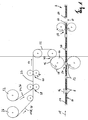
- FIG. 1 illustrates the inventive method for producing a plurality of Incontinenzwegwerfwindeln 2, which in the plan view schematically in FIG. 2 are shown.
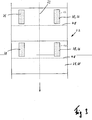
- the incontinence disposable diapers 2 (hereafter referred to as diapers 2) to be produced comprise a diaper body 4 with an absorbent core 6 applied thereon, the longitudinal extent of which is less than the longitudinal extent of the diaper body 4, and front diaper side portions 8 and back diaper side portions 10.
- the length of the diaper body L1 is in Fig. 2 Case shown 815 mm.
- the width B1 of the diaper body is 320 mm.
- the length L2 of the rear diaper side parts is 230 mm.
- the length of the front diaper side parts L3 is 170 mm.
- the width B2 of the front and rear diaper side panels is uniformly 170 mm.
- the front and rear diaper side parts 8 and 10 are permanently attached to a front waist region 12 and to a rear waist region 14 of the diaper main part 4, respectively (in the case shown in FIG FIG. 2 each side).
- the rear diaper side panels 10 have greater extensibility than the front diaper side panels 8, which is schematically indicated by an elastically stretchable area or section 16 in the rear diaper side panels 10.
- first elastic elements 20 are indicated on both sides of the absorbent core 6.
- Other second elastic elements not shown here may be in the form of upstanding cuff or cuff elements which form a side leakage protector substantially at the edges of the absorbent core 6.
- Visible are indicated schematically attached to the rear diaper side panels closure elements 90 which can cooperate in use with the outside of the diaper main body and preferably also with the front diaper side parts adhesive.
- FIG. 1 For the preparation of the diaper 2 is according to FIG. 1 (Upper area) a Windelgnateilbahn 22 formed and promoted towards an application station 24.
- the diaper side partial web 22 comprises a first first web 28, which can be unrolled endlessly from a supply roll 26, of a substantially in particular undeformable carrier material 30 and a second web 34, which can be unwound endlessly from a supply roll 32, made of an elastically extensible material 36
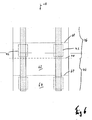
- FIG. 1 For example, only schematically illustrated second track 34 may comprise two strip-shaped transversely spaced tracks, as discussed below in connection with FIG FIG. 6 is shown. Trains 28 and 34 are conveyed one above the other and permanently connected to each other by any joining techniques, which is indicated by two rollers forming a joining station 38.
- the joining station 38 is followed in the conveying direction by an activation station 40, in which the elastically extensible properties of the elastically extensible material 36 are activated, specifically by the fact that in certain regions - as shown in FIG FIG. 6 indicated is the non-stretchable substrate 30 of the first web 28 in a region 42 (s. FIG. 6 ) is treated so that it is no longer able to resist stretching.
- This can be achieved, for example, by a partial overstretching by the process of "ring rolling", where the composite material formed from first web 28 and second web 34 is stretched in area 42 by intermeshing roll surfaces such that the inherently non-stretchable substrate 30 overstretches and thereby plastically deformed.
- the diaper web 22 After passing through the activating station 40, the diaper web 22 is at least in the position shown in FIG. 6 indicated area 42 elastically stretchable. In the other regions outside the region 42, the strip-shaped elastically stretchable material 36 can not develop its elasticizing effect, since the non-stretchable carrier material 30 prevents substantial stretching of the diaper side part web 22.
- the diaper side part web thus treated is further conveyed at the speed v1 in the direction of a separating station 44, where longitudinal sections 46 are separated transversely to the conveying direction from the diaper side part web 22 and accelerated to a speed v2 via a schematically indicated acceleration roller 47 and fed to the application station 24 already mentioned ,
- These longitudinal portions 46 are in the FIGS. 3 to 10 each bounded by a dividing line with reference numeral 48.
- FIG. 1 Below, the feeding and conveying of an endless diaper main web 50 is shown.
- the diaper main web carries an endless number of successively deposited and spaced absorbent cores 6. Further indicated is a topsheet 54.
- the absorbent core 6 and topsheet 54 will be hereinafter referred to as the diaper main web 50.
- the diaper main web is endlessly conveyed in the direction of the application station 24 at the speed v2.
- the longitudinal portions 46 of the diaper side part web 22, as shown FIG. 1 can be seen applied to the diaper main web 50, such that they overlap the region 52 between two absorbent cores 6 or arranged in this area. This is for example in the plan view of the FIGS. 8 and 9 seen.
- the applied longitudinal sections 46 are connected inseparably to the diaper main part web 50, ie fixed thereto.
- a fixed area is, for example, in Figures 2 . 8th and 9 each designated by the reference numeral 56.
- the composite obtained in this way is conveyed further in the direction of a separating station 58, where a separating cut is carried out substantially transversely to the conveying direction corresponding to the longitudinal direction 18 of the diapers 2 to be produced, for example with a rotating knife roller or with a punching tool.
- the separating cut is indicated by the reference numeral 60 in the figures.
- the second section forms the diaper side parts 10 provided in the rear hip region 14 and the first section 62 forms the diaper side parts 8 provided in the front hip region 12.
- a diaper side part web 22 is conveyed in the arrow direction.
- the elastic material 36 was not continuous in the conveying direction (as in FIG FIG. 6 shown), but applied to the first web 28 in spaced apart portions 70.
- the substrate 30 of the first web 28 is substantially inextensible.
- the inelastic carrier material 30 must be treated in these areas as described above. In particular, a local overstretching of the carrier material 30 can be carried out there, or it would be conceivable to provide recesses in the carrier material 30 there.
- the diaper side panel web 22 is split longitudinally into left and right panels, which then, as in FIG FIG. 2 indicated to be attached to lateral areas of the diaper main web 4.
- FIG. 4 illustrates the course of a parting line 48 to form longitudinal portions 46 in the separation station 44.
- the dividing line 48 is guided in a rectangular shape, so that a rectangular portion 72 to be discarded is separated from the diaper side part web 22.
- the dividing line 48 is guided in such a way that it grasps the end of a respective strip-shaped section 70 of elastically extensible material 36. In this way position inaccuracies can be compensated and it is ensured that a respective strip-shaped Section 70 extends flush to the rear waist edge of the diaper 2 and the respective diaper main part 4.
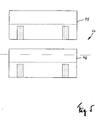
- FIG. 5 shows the separated longitudinal sections 46 of the diaper side part web 22.
- the strip-shaped section 70 extends from elastically extensible material to the rear waist edge, but it can also be ensured that no elastic material enters the front hip region 12 of the adjacent diaper 4 or of the adjacent diaper main part 4 extends. This is related to FIG. 9 clarified and will be discussed below.
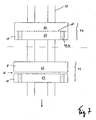
- FIG. 7 schematically shows a diaper main part web 50, have been applied to the spaced longitudinal portions 46 of a diaper side part web 22 and, for example by ultrasonic welding, by adhesive or otherwise inseparably connected to the diaper main web 50.
- a separation cut 60 for singulating the diapers 2 merely indicated, while in FIG. 7 below the separating station 58 has already been passed through and the separating cut 60 was executed.
- a first partial section 62 is formed, which has no elastically extensible material 36, and a second partial section 64, which has the strip-shaped section or region 70 of elastically extensible material 36.
- the first section 62 forms front diaper side panels 8, and the rear section 64 forms rear diaper side panels 10.
- the Diaper side panel 22 is not separated along its longitudinal direction into a left and a right part, but a respective formed longitudinal portion 46 extends in the transverse direction of the diaper 2 in one piece through the width of the diaper; so he traps the diaper in the transverse direction throughout (unlike the schematic representation of FIG. 2 ).
- a diaper side part web 22 is conveyed in the arrow direction.
- each two strip-shaped portions 70a, 70b of elastically extensible material 36a, 36b are provided.
- no elastically stretchable portion is provided in a respective first section 62 forming a front diaper side member. This has, like FIG.
- a respective rear diaper side member 10 at or near an upper transverse edge 170 of the diaper side member has a first stretchable region 16a and at or near a lower transverse edge 171 has a second stretchable region 16b.
- a substantially inextensible region 161 remains between the stretchable regions 16a, 16b.
- the back diaper side part is provided with higher extensibility precisely where experience has shown that the highest forces act in use, for example when closing the incontinence disposable diaper. Tearing off the diaper side parts from the main body can thereby be prevented.
- the inextensible portion 161 also provides greater stability of the diaper side panel, which benefits both handling of the incontinent disposable diaper in use and its manufacture in the high-speed diaper machine.
- FIG. 11 can be provided discontinuously arranged elastically stretchable areas as described above by only cyclic activation of previously continuously applied in the conveying direction elastic material in the manner described above.
- FIG. 8 shows another embodiment in which the diaper side panel web 22 has been separated longitudinally into left and right parts. This advantageously, but not necessarily, occurs before the separation station 44, where the longitudinal sections 46 are formed. Accordingly, a left and a right longitudinal portion 46 is applied to the diaper main part web 50 in the application station 24 and fixed inextricably.
- the course of a separating cut 60 formed as an contour cut 78 is also indicated, in the course of which a portion 80 to be rejected is formed.
- FIG. 4 1 it is achieved on the one hand that the strip-shaped region 70 of elastic material 36 extends flush to the rear waist edge of the singulated diaper 2, and on the other hand prevents elastic material 36 from entering the first section 62.
- the execution of a single particular straight separating section 60 is in FIG. 9 indicated.
- FIG. 10 shows a further alternative variant of the method according to the invention, in which in each case the entire width of the available diaper side part web 22 is used as the left or right diaper side part.
- the region 42 could designate an "annular rolling" overstretched region.
- the respective area 42 is, as in Conveying direction shown below, with a portion or portion 70 of elastically stretchable material 36 overlapped.
- the peculiarity of in FIG. 10 illustrated method variant is that alternately a right diaper side part and a left diaper side part is formed.
- a first longitudinal section 46a and subsequently a second longitudinal section 46b is cut off, which are attached to one and the other side of the diaper main part web 50.
- a respective separating cut 60 for separating the diapers does not fundamentally change here. According to this method variant, as mentioned, a greater width of the diaper side parts 8, 10 can be realized.
- the diaper side panels 8, 10 may be in a self-folded configuration as well DE202004006951.2 reveals and teaches.
- this folding or on itself folds along a longitudinally extending fold line before the separation station 44, where the longitudinal sections 46 are formed.
- the sections folded onto one another are preferably detachable, in particular fixed to one another by ultrasonic welding points or by weakly acting adhesive points, so that they can easily be manually unfolded again.
Landscapes
- Health & Medical Sciences (AREA)
- Engineering & Computer Science (AREA)
- Vascular Medicine (AREA)
- Epidemiology (AREA)
- Biomedical Technology (AREA)
- Heart & Thoracic Surgery (AREA)
- Life Sciences & Earth Sciences (AREA)
- Animal Behavior & Ethology (AREA)
- General Health & Medical Sciences (AREA)
- Public Health (AREA)
- Veterinary Medicine (AREA)
- Manufacturing & Machinery (AREA)
- Absorbent Articles And Supports Therefor (AREA)
- Orthopedics, Nursing, And Contraception (AREA)
Priority Applications (1)
| Application Number | Priority Date | Filing Date | Title |
|---|---|---|---|
| PL06753961T PL1933796T3 (pl) | 2005-10-12 | 2006-05-30 | Sposób wytwarzania wielu pieluch jednorazowego użytku składających się z głównej części pieluchy i połączonych z nią przednich i tylnych części bocznych pieluchy |
Applications Claiming Priority (2)
| Application Number | Priority Date | Filing Date | Title |
|---|---|---|---|
| DE102005048868A DE102005048868A1 (de) | 2005-10-12 | 2005-10-12 | Verfahren zum Herstellen einer Vielzahl von einen Windelhauptteil und daran angefügte vordere und hintere Windelseitenteile aufweisenden Inkontinenzwegwerfwindeln |
| PCT/EP2006/005125 WO2007042084A1 (de) | 2005-10-12 | 2006-05-30 | Verfahren zum herstellen einer vielzahl von einen windelhauptteil und daran angefügte vordere und hintere windelseitenteile aufweisenden inkontinenzwegwerfwindeln |
Publications (2)
| Publication Number | Publication Date |
|---|---|
| EP1933796A1 EP1933796A1 (de) | 2008-06-25 |
| EP1933796B1 true EP1933796B1 (de) | 2010-07-28 |
Family
ID=37000110
Family Applications (1)
| Application Number | Title | Priority Date | Filing Date |
|---|---|---|---|
| EP06753961A Active EP1933796B1 (de) | 2005-10-12 | 2006-05-30 | Verfahren zum herstellen einer vielzahl von einen windelhauptteil und daran angefügte vordere und hintere windelseitenteile aufweisenden inkontinenzwegwerfwindeln |
Country Status (9)
| Country | Link |
|---|---|
| US (1) | US8216414B2 (pl) |
| EP (1) | EP1933796B1 (pl) |
| JP (1) | JP4902885B2 (pl) |
| AT (1) | ATE475393T1 (pl) |
| AU (1) | AU2006301655B2 (pl) |
| DE (2) | DE102005048868A1 (pl) |
| ES (1) | ES2348925T3 (pl) |
| PL (1) | PL1933796T3 (pl) |
| WO (1) | WO2007042084A1 (pl) |
Cited By (3)
| Publication number | Priority date | Publication date | Assignee | Title |
|---|---|---|---|---|
| US9918881B2 (en) | 2011-11-22 | 2018-03-20 | Kimberly-Clark Worldwide, Inc. | Method of folding pant-like disposable absorbent garments in a trough |
| US10118754B2 (en) | 2011-11-22 | 2018-11-06 | Kimberly-Clark Worldwide, Inc. | Method of folding pant-like disposable absorbent garments in a chute |
| US11123230B2 (en) | 2011-11-22 | 2021-09-21 | Kimberly-Clark Worldwide, Inc. | Method of folding pant-like disposable absorbent garments in a chute |
Families Citing this family (54)
| Publication number | Priority date | Publication date | Assignee | Title |
|---|---|---|---|---|
| US8417374B2 (en) | 2004-04-19 | 2013-04-09 | Curt G. Joa, Inc. | Method and apparatus for changing speed or direction of an article |
| US7638014B2 (en) | 2004-05-21 | 2009-12-29 | Curt G. Joa, Inc. | Method of producing a pants-type diaper |
| US7780052B2 (en) | 2006-05-18 | 2010-08-24 | Curt G. Joa, Inc. | Trim removal system |
| US9433538B2 (en) | 2006-05-18 | 2016-09-06 | Curt G. Joa, Inc. | Methods and apparatus for application of nested zero waste ear to traveling web and formation of articles using a dual cut slip unit |
| US10456302B2 (en) | 2006-05-18 | 2019-10-29 | Curt G. Joa, Inc. | Methods and apparatus for application of nested zero waste ear to traveling web |
| US8172977B2 (en) | 2009-04-06 | 2012-05-08 | Curt G. Joa, Inc. | Methods and apparatus for application of nested zero waste ear to traveling web |
| US9622918B2 (en) | 2006-05-18 | 2017-04-18 | Curt G. Joe, Inc. | Methods and apparatus for application of nested zero waste ear to traveling web |
| PL1915977T3 (pl) | 2006-10-27 | 2015-09-30 | Hartmann Paul Ag | Chłonny artykuł na nietrzymanie moczu z ulepszonym systemem zapinania |
| US9944487B2 (en) | 2007-02-21 | 2018-04-17 | Curt G. Joa, Inc. | Single transfer insert placement method and apparatus |
| US9550306B2 (en) | 2007-02-21 | 2017-01-24 | Curt G. Joa, Inc. | Single transfer insert placement and apparatus with cross-direction insert placement control |
| DE102007024180A1 (de) * | 2007-05-24 | 2008-11-27 | Paul Hartmann Ag | Verfahren zur Herstellung einer Windel |
| CN101686889B (zh) * | 2007-06-26 | 2013-06-12 | Sca卫生用品公司 | 制备吸收性物品的方法 |
| US9387131B2 (en) | 2007-07-20 | 2016-07-12 | Curt G. Joa, Inc. | Apparatus and method for minimizing waste and improving quality and production in web processing operations by automated threading and re-threading of web materials |
| US8398793B2 (en) | 2007-07-20 | 2013-03-19 | Curt G. Joa, Inc. | Apparatus and method for minimizing waste and improving quality and production in web processing operations |
| EP2020215B1 (de) * | 2007-08-02 | 2015-04-29 | Paul Hartmann AG | Absorbierende Inkontinenzwegwerfwindel |
| DE102007063209A1 (de) | 2007-12-20 | 2009-06-25 | Paul Hartmann Aktiengesellschaft | Verfahren zum Herstellen von Inkontinenzartikeln in Höschenform |
| EP2231094A4 (en) * | 2007-12-21 | 2011-05-04 | Sca Hygiene Prod Ab | CLEANABLE CLOTHING PIECE WITH SIDE PIECES OR BELT ELEMENTS |
| AU2009216277B2 (en) * | 2008-02-19 | 2014-03-06 | Unicharm Corporation | Absorptive article |
| DE102008046358A1 (de) * | 2008-09-09 | 2010-03-11 | Paul Hartmann Ag | Absorbierende Inkontinenzwegwerfwindel |
| US7901534B2 (en) | 2008-09-25 | 2011-03-08 | Attends Healthcare Products, Inc. | Method of making diapers with substantially reduced production of discarded waste material |
| DE102009015041A1 (de) * | 2009-03-26 | 2010-09-30 | Paul Hartmann Ag | Absorbierende Inkontinenzwegwerfwindel mit Seitenabschnitten |
| DE102009016381B4 (de) | 2009-04-04 | 2011-02-17 | Paul Hartmann Aktiengesellschaft | Verfahren zum Herstellen einer absorbierenden Inkontinenzwegwerfwindel und Vorrichtung zur Durchführung des Verfahrens |
| DE102009022529A1 (de) * | 2009-05-25 | 2010-12-02 | Paul Hartmann Ag | Gefalteter Inkontinenzartikel |
| US8460495B2 (en) | 2009-12-30 | 2013-06-11 | Curt G. Joa, Inc. | Method for producing absorbent article with stretch film side panel and application of intermittent discrete components of an absorbent article |
| US9089453B2 (en) | 2009-12-30 | 2015-07-28 | Curt G. Joa, Inc. | Method for producing absorbent article with stretch film side panel and application of intermittent discrete components of an absorbent article |
| US8663411B2 (en) | 2010-06-07 | 2014-03-04 | Curt G. Joa, Inc. | Apparatus and method for forming a pant-type diaper with refastenable side seams |
| US9603752B2 (en) | 2010-08-05 | 2017-03-28 | Curt G. Joa, Inc. | Apparatus and method for minimizing waste and improving quality and production in web processing operations by automatic cuff defect correction |
| US9498386B2 (en) * | 2010-09-10 | 2016-11-22 | The Procter & Gamble Company | Method of making disposable absorbent diaper pants |
| EP2629730B1 (en) | 2010-10-19 | 2018-09-12 | Medline Industries, Inc., | Absorbent articles and methods of manufacturing the same |
| US10117792B2 (en) | 2010-10-19 | 2018-11-06 | Medline Industries, Inc. | Absorbent articles and methods of manufacturing the same |
| US9566193B2 (en) | 2011-02-25 | 2017-02-14 | Curt G. Joa, Inc. | Methods and apparatus for forming disposable products at high speeds with small machine footprint |
| US8656817B2 (en) | 2011-03-09 | 2014-02-25 | Curt G. Joa | Multi-profile die cutting assembly |
| USD684613S1 (en) | 2011-04-14 | 2013-06-18 | Curt G. Joa, Inc. | Sliding guard structure |
| US8820380B2 (en) | 2011-07-21 | 2014-09-02 | Curt G. Joa, Inc. | Differential speed shafted machines and uses therefor, including discontinuous and continuous side by side bonding |
| CA2807809C (en) | 2012-02-20 | 2019-07-23 | Curt G. Joa, Inc. | Method of forming bonds between discrete components of disposable articles |
| EP2839818B1 (en) * | 2012-04-19 | 2017-11-29 | Zuiko Corporation | Method and device for producing disposable wearable article |
| US9908739B2 (en) | 2012-04-24 | 2018-03-06 | Curt G. Joa, Inc. | Apparatus and method for applying parallel flared elastics to disposable products and disposable products containing parallel flared elastics |
| DE102012025437A1 (de) | 2012-12-21 | 2014-07-10 | Paul Hartmann Ag | Absorbierender Inkontinenzartikel mit Windelhülle und Absorptionseinlage |
| US9283683B2 (en) | 2013-07-24 | 2016-03-15 | Curt G. Joa, Inc. | Ventilated vacuum commutation structures |
| USD703712S1 (en) | 2013-08-23 | 2014-04-29 | Curt G. Joa, Inc. | Ventilated vacuum commutation structure |
| USD703248S1 (en) | 2013-08-23 | 2014-04-22 | Curt G. Joa, Inc. | Ventilated vacuum commutation structure |
| USD703711S1 (en) | 2013-08-23 | 2014-04-29 | Curt G. Joa, Inc. | Ventilated vacuum communication structure |
| USD704237S1 (en) | 2013-08-23 | 2014-05-06 | Curt G. Joa, Inc. | Ventilated vacuum commutation structure |
| USD703247S1 (en) | 2013-08-23 | 2014-04-22 | Curt G. Joa, Inc. | Ventilated vacuum commutation structure |
| US9289329B1 (en) | 2013-12-05 | 2016-03-22 | Curt G. Joa, Inc. | Method for producing pant type diapers |
| DE102014110941A1 (de) | 2014-08-01 | 2016-02-04 | Paul Hartmann Ag | Verfahren zum Herstellen von Inkontinenzwegwerfwindeln |
| PL3325387T3 (pl) | 2015-07-24 | 2022-06-20 | Curt G. Joa, Inc. | Urządzenie do komutacji próżniowej oraz sposoby |
| DE102016102684A1 (de) * | 2016-02-16 | 2017-08-17 | Paul Hartmann Ag | Inkontinenzwegwerfwindel |
| DE102018104533A1 (de) | 2018-02-28 | 2019-08-29 | Paul Hartmann Ag | Inkontinenzwegwerfwindel mit elastischer Komponente |
| DE102018104539A1 (de) | 2018-02-28 | 2019-08-29 | Paul Hartmann Ag | Inkontinenzwegwerfwindel mit Seitenabschnitten und elastischer Komponente |
| DE102018120495A1 (de) * | 2018-08-22 | 2020-02-27 | Paul Hartmann Ag | Verfahren zur Herstellung von Inkontinenzwegwerfwindeln |
| DE102018129674A1 (de) * | 2018-11-26 | 2020-05-28 | Paul Hartmann Ag | Verfahren zur Herstellung von Inkontinenzwegwerfwindeln |
| KR102767465B1 (ko) * | 2019-12-20 | 2025-02-14 | 킴벌리-클라크 월드와이드, 인크. | 재체결 가능한 측면 이음부를 갖는 흡수 용품 |
| US11737930B2 (en) | 2020-02-27 | 2023-08-29 | Curt G. Joa, Inc. | Configurable single transfer insert placement method and apparatus |
Family Cites Families (31)
| Publication number | Priority date | Publication date | Assignee | Title |
|---|---|---|---|---|
| US4338938A (en) * | 1980-05-19 | 1982-07-13 | Seavitt Susan A | Washable diaper |
| JPH04261655A (ja) | 1990-12-31 | 1992-09-17 | Zuikou:Kk | 紙おむつの製造方法 |
| US5167897A (en) * | 1991-02-28 | 1992-12-01 | The Procter & Gamble Company | Method for incrementally stretching a zero strain stretch laminate web to impart elasticity thereto |
| JP3350094B2 (ja) * | 1992-05-22 | 2002-11-25 | ザ、プロクター、エンド、ギャンブル、カンパニー | 改良された伸縮性サイドパネルを有する使い捨てトレーニングパンツ |
| US5409476A (en) * | 1993-08-11 | 1995-04-25 | Coates; Fredrica | Reusable diaper having gusseted pad insert |
| JPH07116191A (ja) * | 1993-09-02 | 1995-05-09 | Kao Corp | パンツ型の使い捨ておむつ |
| JP3373611B2 (ja) * | 1993-09-20 | 2003-02-04 | 花王株式会社 | 使い捨てパンツ型おむつの製造方法 |
| US5407513A (en) | 1993-10-14 | 1995-04-18 | The Procter & Gamble Company | Apparatus and process for cyclically accelerating and decelerating a strip of material |
| EP0650714A1 (en) * | 1993-11-01 | 1995-05-03 | The Procter & Gamble Company | Method of making an absorbent article using an activatable composite elastic member |
| US6319347B1 (en) * | 1994-01-25 | 2001-11-20 | Kimberly-Clark Worldwide, Inc. | Method for placing discrete parts transversely onto a moving web |
| US5705013A (en) * | 1995-02-10 | 1998-01-06 | The Procter & Gamble Company | Method for manufacturing extensible side panels for absorbent articles |
| US5716478A (en) * | 1995-10-17 | 1998-02-10 | Kimberly-Clark Worldwide, Inc. | Apparatus and method for applying discrete parts onto a moving web |
| SE505392C2 (sv) * | 1995-11-16 | 1997-08-18 | Moelnlycke Ab | Vätskeabsorberande artikel försedd med krökt elastik för bildande av läckagespärr |
| US5846232A (en) * | 1995-12-20 | 1998-12-08 | Kimberly-Clark Worldwide, Inc. | Absorbent article containing extensible zones |
| JP3784131B2 (ja) | 1997-04-11 | 2006-06-07 | ユニ・チャーム株式会社 | 使い捨て着用物品 |
| US6193701B1 (en) * | 1997-12-31 | 2001-02-27 | Kimberly-Clark Worldwide, Inc. | Personal care article having zones with different resistance-to stretch |
| TR200003484T2 (tr) * | 1998-05-28 | 2001-03-21 | The Procter & Gamble Company | Atılabilir emici ürün. |
| US6761711B1 (en) * | 1998-12-18 | 2004-07-13 | Kimberly-Clark Worldwide, Inc. | Absorbent articles with refastenable side seams |
| JP3865546B2 (ja) | 1999-11-04 | 2007-01-10 | 花王株式会社 | 吸収性物品の製造方法 |
| JP2003038565A (ja) * | 2001-05-23 | 2003-02-12 | Zuiko Corp | 使い捨て着用物品の製造装置および方法 |
| SE0200988D0 (sv) * | 2002-04-02 | 2002-04-02 | Sca Hygiene Prod Ab | Förfarande för tillverkning av en byxblöja |
| JP4012042B2 (ja) * | 2002-11-01 | 2007-11-21 | 株式会社瑞光 | 着用物品の製造装置 |
| JP4318451B2 (ja) * | 2002-12-10 | 2009-08-26 | ユニ・チャーム株式会社 | 使い捨ておむつの製造方法 |
| US7347914B2 (en) * | 2002-12-13 | 2008-03-25 | Zuiko Corporation | Method for producing an article having an elastic bonded between two webs |
| US20040167489A1 (en) * | 2003-02-14 | 2004-08-26 | Kellenberger Stanley R. | Compact absorbent article |
| US7749212B2 (en) * | 2003-11-06 | 2010-07-06 | Zuiko Corporation | Disposable wearing article and method of manufacturing the same |
| DE10361856A1 (de) * | 2003-12-30 | 2005-07-28 | Paul Hartmann Ag | Verfahren und Vorrichtung zum Applizieren eines Flachmaterialbahnabschnitts |
| EP1719484B1 (en) * | 2004-02-23 | 2014-11-05 | Zuiko Corporation | Worn article and method for producing the same |
| DE202004006951U1 (de) * | 2004-04-23 | 2005-09-01 | Paul Hartmann Ag | Absorbierender Inkontinenzartikel |
| US20050256495A1 (en) | 2004-04-29 | 2005-11-17 | Kimberly-Clark Worldwide, Inc. | Composite web and use in an absorbent article |
| EP1736127B1 (en) * | 2005-06-09 | 2019-12-04 | Paul Hartmann AG | Composite web, disposable diaper and process for manufacturing thereof |
-
2005
- 2005-10-12 DE DE102005048868A patent/DE102005048868A1/de not_active Withdrawn
-
2006
- 2006-05-30 US US11/992,583 patent/US8216414B2/en not_active Expired - Fee Related
- 2006-05-30 ES ES06753961T patent/ES2348925T3/es active Active
- 2006-05-30 AU AU2006301655A patent/AU2006301655B2/en not_active Ceased
- 2006-05-30 WO PCT/EP2006/005125 patent/WO2007042084A1/de not_active Ceased
- 2006-05-30 AT AT06753961T patent/ATE475393T1/de active
- 2006-05-30 JP JP2008534881A patent/JP4902885B2/ja not_active Expired - Fee Related
- 2006-05-30 EP EP06753961A patent/EP1933796B1/de active Active
- 2006-05-30 DE DE502006007549T patent/DE502006007549D1/de active Active
- 2006-05-30 PL PL06753961T patent/PL1933796T3/pl unknown
Cited By (3)
| Publication number | Priority date | Publication date | Assignee | Title |
|---|---|---|---|---|
| US9918881B2 (en) | 2011-11-22 | 2018-03-20 | Kimberly-Clark Worldwide, Inc. | Method of folding pant-like disposable absorbent garments in a trough |
| US10118754B2 (en) | 2011-11-22 | 2018-11-06 | Kimberly-Clark Worldwide, Inc. | Method of folding pant-like disposable absorbent garments in a chute |
| US11123230B2 (en) | 2011-11-22 | 2021-09-21 | Kimberly-Clark Worldwide, Inc. | Method of folding pant-like disposable absorbent garments in a chute |
Also Published As
| Publication number | Publication date |
|---|---|
| DE102005048868A1 (de) | 2007-04-19 |
| US20090084497A1 (en) | 2009-04-02 |
| US8216414B2 (en) | 2012-07-10 |
| DE502006007549D1 (de) | 2010-09-09 |
| ES2348925T3 (es) | 2010-12-17 |
| ATE475393T1 (de) | 2010-08-15 |
| WO2007042084A1 (de) | 2007-04-19 |
| JP2009511139A (ja) | 2009-03-19 |
| EP1933796A1 (de) | 2008-06-25 |
| AU2006301655A1 (en) | 2007-04-19 |
| AU2006301655A2 (en) | 2008-08-07 |
| AU2006301655B2 (en) | 2012-10-18 |
| JP4902885B2 (ja) | 2012-03-21 |
| PL1933796T3 (pl) | 2011-01-31 |
Similar Documents
| Publication | Publication Date | Title |
|---|---|---|
| EP1933796B1 (de) | Verfahren zum herstellen einer vielzahl von einen windelhauptteil und daran angefügte vordere und hintere windelseitenteile aufweisenden inkontinenzwegwerfwindeln | |
| EP2337541B1 (de) | Absorbierende inkontinenzwegwerfwindel | |
| EP2020215B1 (de) | Absorbierende Inkontinenzwegwerfwindel | |
| DE69711181T2 (de) | Elastisches laminat für absorbierende gegenstände und verfahren zum herstellen eines elastischen laminates | |
| DE69618996T2 (de) | Verfahren zur herstellung von wiederver schliessbaren, absorbierenden kleindungsstücken und damit hergestellte kleidungsstüke | |
| DE69704851T2 (de) | Verfahren zur herstellung von seiteneinsatzstücken für wegwerfartikel | |
| DE69621236T2 (de) | Herstellungsverfahren für laminiertes band | |
| EP2413859B1 (de) | Verfahren zum herstellen einer absorbierenden inkontinenzwegwerfwindel und vorrichtung zur durchführung des verfahrens | |
| DE19813334B4 (de) | Windel- oder Inkontinenzhöschen und Verfahren zu deren Herstellung | |
| DE102006050971A1 (de) | Absorbierender Inkontinenzartikel | |
| DE10140622A1 (de) | Hygieneartikel mit Befestigungselementen | |
| EP1651157B1 (de) | Wegwerfwindel mit hüftgürtel | |
| WO2010051934A1 (de) | Verfahren zum herstellen einer absorbierenden inkontinenzwegwerfwindel | |
| EP2629727B1 (de) | Verfahren zur herstellung einer inkontinenzwegwerfwindel mit konturierten windelseitenteilen | |
| EP3174509B1 (de) | Verfahren zum herstellen von inkontinenzwegwerfwindeln | |
| DE60303933T2 (de) | Verfahren zum ausschneiden diskreter befestigungselemente und zum anlegen dieser elemente an einen saugfähigen artikel | |
| EP3558196B1 (de) | Verfahren zum herstellen von inkontinenzwegwerfwindeln | |
| WO2007006474A2 (de) | Verfahren zum herstellen einer vielzahl von elastischen, körperflüssigkeiten absorbierenden wegwerfinkontinenzwindeln | |
| EP3886780B1 (de) | Verfahren zur herstellung von inkontinenzwegwerfwindeln | |
| EP2564821B1 (de) | Verfahren zum Herstellen von Laminatabschnitten für medizinische Einwegartikel und Vorrichtung zur Durchführung des Verfahrens | |
| EP3840706A1 (de) | Verfahren zur herstellung von inkontinenzwegwerfwindeln |
Legal Events
| Date | Code | Title | Description |
|---|---|---|---|
| PUAI | Public reference made under article 153(3) epc to a published international application that has entered the european phase |
Free format text: ORIGINAL CODE: 0009012 |
|
| 17P | Request for examination filed |
Effective date: 20080117 |
|
| AK | Designated contracting states |
Kind code of ref document: A1 Designated state(s): AT BE BG CH CY CZ DE DK EE ES FI FR GB GR HU IE IS IT LI LT LU LV MC NL PL PT RO SE SI SK TR |
|
| DAX | Request for extension of the european patent (deleted) | ||
| 17Q | First examination report despatched |
Effective date: 20090408 |
|
| GRAP | Despatch of communication of intention to grant a patent |
Free format text: ORIGINAL CODE: EPIDOSNIGR1 |
|
| GRAS | Grant fee paid |
Free format text: ORIGINAL CODE: EPIDOSNIGR3 |
|
| GRAA | (expected) grant |
Free format text: ORIGINAL CODE: 0009210 |
|
| AK | Designated contracting states |
Kind code of ref document: B1 Designated state(s): AT BE BG CH CY CZ DE DK EE ES FI FR GB GR HU IE IS IT LI LT LU LV MC NL PL PT RO SE SI SK TR |
|
| REG | Reference to a national code |
Ref country code: GB Ref legal event code: FG4D Free format text: NOT ENGLISH |
|
| REG | Reference to a national code |
Ref country code: CH Ref legal event code: EP |
|
| REG | Reference to a national code |
Ref country code: CH Ref legal event code: NV Representative=s name: MICHELI & CIE SA |
|
| REG | Reference to a national code |
Ref country code: IE Ref legal event code: FG4D Free format text: LANGUAGE OF EP DOCUMENT: GERMAN |
|
| REF | Corresponds to: |
Ref document number: 502006007549 Country of ref document: DE Date of ref document: 20100909 Kind code of ref document: P |
|
| REG | Reference to a national code |
Ref country code: SE Ref legal event code: TRGR |
|
| REG | Reference to a national code |
Ref country code: NL Ref legal event code: VDEP Effective date: 20100728 |
|
| REG | Reference to a national code |
Ref country code: ES Ref legal event code: FG2A Effective date: 20101203 |
|
| LTIE | Lt: invalidation of european patent or patent extension |
Effective date: 20100728 |
|
| PG25 | Lapsed in a contracting state [announced via postgrant information from national office to epo] |
Ref country code: NL Free format text: LAPSE BECAUSE OF FAILURE TO SUBMIT A TRANSLATION OF THE DESCRIPTION OR TO PAY THE FEE WITHIN THE PRESCRIBED TIME-LIMIT Effective date: 20100728 Ref country code: FI Free format text: LAPSE BECAUSE OF FAILURE TO SUBMIT A TRANSLATION OF THE DESCRIPTION OR TO PAY THE FEE WITHIN THE PRESCRIBED TIME-LIMIT Effective date: 20100728 Ref country code: LT Free format text: LAPSE BECAUSE OF FAILURE TO SUBMIT A TRANSLATION OF THE DESCRIPTION OR TO PAY THE FEE WITHIN THE PRESCRIBED TIME-LIMIT Effective date: 20100728 |
|
| REG | Reference to a national code |
Ref country code: PL Ref legal event code: T3 |
|
| PG25 | Lapsed in a contracting state [announced via postgrant information from national office to epo] |
Ref country code: IS Free format text: LAPSE BECAUSE OF FAILURE TO SUBMIT A TRANSLATION OF THE DESCRIPTION OR TO PAY THE FEE WITHIN THE PRESCRIBED TIME-LIMIT Effective date: 20101128 Ref country code: PT Free format text: LAPSE BECAUSE OF FAILURE TO SUBMIT A TRANSLATION OF THE DESCRIPTION OR TO PAY THE FEE WITHIN THE PRESCRIBED TIME-LIMIT Effective date: 20101129 Ref country code: BG Free format text: LAPSE BECAUSE OF FAILURE TO SUBMIT A TRANSLATION OF THE DESCRIPTION OR TO PAY THE FEE WITHIN THE PRESCRIBED TIME-LIMIT Effective date: 20101028 Ref country code: SI Free format text: LAPSE BECAUSE OF FAILURE TO SUBMIT A TRANSLATION OF THE DESCRIPTION OR TO PAY THE FEE WITHIN THE PRESCRIBED TIME-LIMIT Effective date: 20100728 Ref country code: CY Free format text: LAPSE BECAUSE OF FAILURE TO SUBMIT A TRANSLATION OF THE DESCRIPTION OR TO PAY THE FEE WITHIN THE PRESCRIBED TIME-LIMIT Effective date: 20100728 |
|
| REG | Reference to a national code |
Ref country code: IE Ref legal event code: FD4D |
|
| PG25 | Lapsed in a contracting state [announced via postgrant information from national office to epo] |
Ref country code: LV Free format text: LAPSE BECAUSE OF FAILURE TO SUBMIT A TRANSLATION OF THE DESCRIPTION OR TO PAY THE FEE WITHIN THE PRESCRIBED TIME-LIMIT Effective date: 20100728 Ref country code: GR Free format text: LAPSE BECAUSE OF FAILURE TO SUBMIT A TRANSLATION OF THE DESCRIPTION OR TO PAY THE FEE WITHIN THE PRESCRIBED TIME-LIMIT Effective date: 20101029 |
|
| PG25 | Lapsed in a contracting state [announced via postgrant information from national office to epo] |
Ref country code: DK Free format text: LAPSE BECAUSE OF FAILURE TO SUBMIT A TRANSLATION OF THE DESCRIPTION OR TO PAY THE FEE WITHIN THE PRESCRIBED TIME-LIMIT Effective date: 20100728 Ref country code: IE Free format text: LAPSE BECAUSE OF FAILURE TO SUBMIT A TRANSLATION OF THE DESCRIPTION OR TO PAY THE FEE WITHIN THE PRESCRIBED TIME-LIMIT Effective date: 20100728 |
|
| PG25 | Lapsed in a contracting state [announced via postgrant information from national office to epo] |
Ref country code: SK Free format text: LAPSE BECAUSE OF FAILURE TO SUBMIT A TRANSLATION OF THE DESCRIPTION OR TO PAY THE FEE WITHIN THE PRESCRIBED TIME-LIMIT Effective date: 20100728 Ref country code: CZ Free format text: LAPSE BECAUSE OF FAILURE TO SUBMIT A TRANSLATION OF THE DESCRIPTION OR TO PAY THE FEE WITHIN THE PRESCRIBED TIME-LIMIT Effective date: 20100728 Ref country code: IT Free format text: LAPSE BECAUSE OF FAILURE TO SUBMIT A TRANSLATION OF THE DESCRIPTION OR TO PAY THE FEE WITHIN THE PRESCRIBED TIME-LIMIT Effective date: 20100728 Ref country code: RO Free format text: LAPSE BECAUSE OF FAILURE TO SUBMIT A TRANSLATION OF THE DESCRIPTION OR TO PAY THE FEE WITHIN THE PRESCRIBED TIME-LIMIT Effective date: 20100728 Ref country code: EE Free format text: LAPSE BECAUSE OF FAILURE TO SUBMIT A TRANSLATION OF THE DESCRIPTION OR TO PAY THE FEE WITHIN THE PRESCRIBED TIME-LIMIT Effective date: 20100728 |
|
| PLBE | No opposition filed within time limit |
Free format text: ORIGINAL CODE: 0009261 |
|
| STAA | Information on the status of an ep patent application or granted ep patent |
Free format text: STATUS: NO OPPOSITION FILED WITHIN TIME LIMIT |
|
| 26N | No opposition filed |
Effective date: 20110429 |
|
| REG | Reference to a national code |
Ref country code: DE Ref legal event code: R097 Ref document number: 502006007549 Country of ref document: DE Effective date: 20110429 |
|
| BERE | Be: lapsed |
Owner name: PAUL HARTMANN A.G. Effective date: 20110531 |
|
| PG25 | Lapsed in a contracting state [announced via postgrant information from national office to epo] |
Ref country code: MC Free format text: LAPSE BECAUSE OF NON-PAYMENT OF DUE FEES Effective date: 20110531 |
|
| PG25 | Lapsed in a contracting state [announced via postgrant information from national office to epo] |
Ref country code: BE Free format text: LAPSE BECAUSE OF NON-PAYMENT OF DUE FEES Effective date: 20110531 |
|
| PG25 | Lapsed in a contracting state [announced via postgrant information from national office to epo] |
Ref country code: LU Free format text: LAPSE BECAUSE OF NON-PAYMENT OF DUE FEES Effective date: 20110530 |
|
| PG25 | Lapsed in a contracting state [announced via postgrant information from national office to epo] |
Ref country code: TR Free format text: LAPSE BECAUSE OF FAILURE TO SUBMIT A TRANSLATION OF THE DESCRIPTION OR TO PAY THE FEE WITHIN THE PRESCRIBED TIME-LIMIT Effective date: 20100728 |
|
| PG25 | Lapsed in a contracting state [announced via postgrant information from national office to epo] |
Ref country code: HU Free format text: LAPSE BECAUSE OF FAILURE TO SUBMIT A TRANSLATION OF THE DESCRIPTION OR TO PAY THE FEE WITHIN THE PRESCRIBED TIME-LIMIT Effective date: 20100728 |
|
| REG | Reference to a national code |
Ref country code: FR Ref legal event code: PLFP Year of fee payment: 11 |
|
| REG | Reference to a national code |
Ref country code: FR Ref legal event code: PLFP Year of fee payment: 12 |
|
| REG | Reference to a national code |
Ref country code: FR Ref legal event code: PLFP Year of fee payment: 13 |
|
| PGFP | Annual fee paid to national office [announced via postgrant information from national office to epo] |
Ref country code: FR Payment date: 20210521 Year of fee payment: 16 |
|
| PGFP | Annual fee paid to national office [announced via postgrant information from national office to epo] |
Ref country code: PL Payment date: 20210521 Year of fee payment: 16 Ref country code: SE Payment date: 20210521 Year of fee payment: 16 Ref country code: AT Payment date: 20210518 Year of fee payment: 16 Ref country code: CH Payment date: 20210525 Year of fee payment: 16 Ref country code: GB Payment date: 20210525 Year of fee payment: 16 |
|
| REG | Reference to a national code |
Ref country code: CH Ref legal event code: PL |
|
| REG | Reference to a national code |
Ref country code: SE Ref legal event code: EUG |
|
| REG | Reference to a national code |
Ref country code: AT Ref legal event code: MM01 Ref document number: 475393 Country of ref document: AT Kind code of ref document: T Effective date: 20220530 |
|
| GBPC | Gb: european patent ceased through non-payment of renewal fee |
Effective date: 20220530 |
|
| PG25 | Lapsed in a contracting state [announced via postgrant information from national office to epo] |
Ref country code: SE Free format text: LAPSE BECAUSE OF NON-PAYMENT OF DUE FEES Effective date: 20220531 Ref country code: LI Free format text: LAPSE BECAUSE OF NON-PAYMENT OF DUE FEES Effective date: 20220531 Ref country code: CH Free format text: LAPSE BECAUSE OF NON-PAYMENT OF DUE FEES Effective date: 20220531 Ref country code: AT Free format text: LAPSE BECAUSE OF NON-PAYMENT OF DUE FEES Effective date: 20220530 |
|
| PG25 | Lapsed in a contracting state [announced via postgrant information from national office to epo] |
Ref country code: FR Free format text: LAPSE BECAUSE OF NON-PAYMENT OF DUE FEES Effective date: 20220531 |
|
| PG25 | Lapsed in a contracting state [announced via postgrant information from national office to epo] |
Ref country code: GB Free format text: LAPSE BECAUSE OF NON-PAYMENT OF DUE FEES Effective date: 20220530 |
|
| P01 | Opt-out of the competence of the unified patent court (upc) registered |
Effective date: 20230518 |
|
| PG25 | Lapsed in a contracting state [announced via postgrant information from national office to epo] |
Ref country code: PL Free format text: LAPSE BECAUSE OF NON-PAYMENT OF DUE FEES Effective date: 20220530 |
|
| PGFP | Annual fee paid to national office [announced via postgrant information from national office to epo] |
Ref country code: DE Payment date: 20240517 Year of fee payment: 19 |
|
| PGFP | Annual fee paid to national office [announced via postgrant information from national office to epo] |
Ref country code: ES Payment date: 20240614 Year of fee payment: 19 |
|
| REG | Reference to a national code |
Ref country code: DE Ref legal event code: R119 Ref document number: 502006007549 Country of ref document: DE |