EP1933119B1 - Fault detection device and method for a scale - Google Patents
Fault detection device and method for a scale Download PDFInfo
- Publication number
- EP1933119B1 EP1933119B1 EP07254076.8A EP07254076A EP1933119B1 EP 1933119 B1 EP1933119 B1 EP 1933119B1 EP 07254076 A EP07254076 A EP 07254076A EP 1933119 B1 EP1933119 B1 EP 1933119B1
- Authority
- EP
- European Patent Office
- Prior art keywords
- weight
- item
- error
- scale
- terminal
- Prior art date
- Legal status (The legal status is an assumption and is not a legal conclusion. Google has not performed a legal analysis and makes no representation as to the accuracy of the status listed.)
- Active
Links
- 238000000034 method Methods 0.000 title claims description 27
- 238000001514 detection method Methods 0.000 title description 3
- 238000005259 measurement Methods 0.000 claims description 20
- 230000006870 function Effects 0.000 description 9
- 230000008569 process Effects 0.000 description 6
- 238000013459 approach Methods 0.000 description 5
- 238000012360 testing method Methods 0.000 description 5
- 238000005303 weighing Methods 0.000 description 5
- 230000000694 effects Effects 0.000 description 4
- 206010048828 underweight Diseases 0.000 description 4
- 238000004891 communication Methods 0.000 description 3
- 206010033307 Overweight Diseases 0.000 description 2
- 230000004075 alteration Effects 0.000 description 2
- 230000008901 benefit Effects 0.000 description 2
- 230000001186 cumulative effect Effects 0.000 description 2
- 230000004048 modification Effects 0.000 description 2
- 238000012986 modification Methods 0.000 description 2
- 238000012795 verification Methods 0.000 description 2
- 240000005561 Musa balbisiana Species 0.000 description 1
- 208000037063 Thinness Diseases 0.000 description 1
- 230000009471 action Effects 0.000 description 1
- 235000021015 bananas Nutrition 0.000 description 1
- 230000001010 compromised effect Effects 0.000 description 1
- 230000001419 dependent effect Effects 0.000 description 1
- 230000000994 depressogenic effect Effects 0.000 description 1
- 230000001627 detrimental effect Effects 0.000 description 1
- 238000010586 diagram Methods 0.000 description 1
- 230000036541 health Effects 0.000 description 1
- 230000003116 impacting effect Effects 0.000 description 1
- 230000010354 integration Effects 0.000 description 1
- 235000020825 overweight Nutrition 0.000 description 1
- 230000001737 promoting effect Effects 0.000 description 1
- 230000004044 response Effects 0.000 description 1
- 238000012549 training Methods 0.000 description 1
- 239000011800 void material Substances 0.000 description 1
Images




Classifications
-
- G—PHYSICS
- G01—MEASURING; TESTING
- G01G—WEIGHING
- G01G19/00—Weighing apparatus or methods adapted for special purposes not provided for in the preceding groups
- G01G19/40—Weighing apparatus or methods adapted for special purposes not provided for in the preceding groups with provisions for indicating, recording, or computing price or other quantities dependent on the weight
- G01G19/413—Weighing apparatus or methods adapted for special purposes not provided for in the preceding groups with provisions for indicating, recording, or computing price or other quantities dependent on the weight using electromechanical or electronic computing means
- G01G19/414—Weighing apparatus or methods adapted for special purposes not provided for in the preceding groups with provisions for indicating, recording, or computing price or other quantities dependent on the weight using electromechanical or electronic computing means using electronic computing means only
- G01G19/4144—Weighing apparatus or methods adapted for special purposes not provided for in the preceding groups with provisions for indicating, recording, or computing price or other quantities dependent on the weight using electromechanical or electronic computing means using electronic computing means only for controlling weight of goods in commercial establishments, e.g. supermarket, P.O.S. systems
-
- G—PHYSICS
- G01—MEASURING; TESTING
- G01G—WEIGHING
- G01G23/00—Auxiliary devices for weighing apparatus
- G01G23/18—Indicating devices, e.g. for remote indication; Recording devices; Scales, e.g. graduated
- G01G23/36—Indicating the weight by electrical means, e.g. using photoelectric cells
- G01G23/37—Indicating the weight by electrical means, e.g. using photoelectric cells involving digital counting
- G01G23/3728—Indicating the weight by electrical means, e.g. using photoelectric cells involving digital counting with wireless means
-
- G—PHYSICS
- G01—MEASURING; TESTING
- G01G—WEIGHING
- G01G23/00—Auxiliary devices for weighing apparatus
- G01G23/18—Indicating devices, e.g. for remote indication; Recording devices; Scales, e.g. graduated
- G01G23/36—Indicating the weight by electrical means, e.g. using photoelectric cells
- G01G23/37—Indicating the weight by electrical means, e.g. using photoelectric cells involving digital counting
- G01G23/3728—Indicating the weight by electrical means, e.g. using photoelectric cells involving digital counting with wireless means
- G01G23/3735—Indicating the weight by electrical means, e.g. using photoelectric cells involving digital counting with wireless means using a digital network
-
- G—PHYSICS
- G07—CHECKING-DEVICES
- G07G—REGISTERING THE RECEIPT OF CASH, VALUABLES, OR TOKENS
- G07G1/00—Cash registers
- G07G1/0036—Checkout procedures
-
- G—PHYSICS
- G07—CHECKING-DEVICES
- G07G—REGISTERING THE RECEIPT OF CASH, VALUABLES, OR TOKENS
- G07G1/00—Cash registers
- G07G1/0036—Checkout procedures
- G07G1/0045—Checkout procedures with a code reader for reading of an identifying code of the article to be registered, e.g. barcode reader or radio-frequency identity [RFID] reader
- G07G1/0054—Checkout procedures with a code reader for reading of an identifying code of the article to be registered, e.g. barcode reader or radio-frequency identity [RFID] reader with control of supplementary check-parameters, e.g. weight or number of articles
- G07G1/0072—Checkout procedures with a code reader for reading of an identifying code of the article to be registered, e.g. barcode reader or radio-frequency identity [RFID] reader with control of supplementary check-parameters, e.g. weight or number of articles with means for detecting the weight of the article of which the code is read, for the verification of the registration
Definitions
- the present invention relates generally to a retail checkout terminal, and especially to self-service terminals. More particularly, the invention concerns systems and methods for improving the security of self-service checkout processes and to personalize the security features based on customer metrics.
- the impetus to reduce labor costs has focused on reducing or eliminating the amount of time required to handle and/or process the products purchased by the customer.
- a number of self-service checkout terminals have been developed which substantially eliminate the need for a checkout clerk, as e.g. described in US 4 787 467 .
- the typical self-service checkout terminal is operated by the customer without the aid of a checkout clerk.
- the customer scans individual items for purchase across a scanner and then places the scanned items into a grocery bag.
- the customer pays for the purchases either at the self-service terminal itself or at a central payment area staffed by a store cashier.
- the customer typically has little or no training in the operation of a self-service checkout terminal prior to his/her initial use of the terminal.
- Customer inexperience and sometimes more nefarious intentions in the use of the self-service checkout require the integration of some form of security into the checkout terminal.
- Such security prevents a customer from either inadvertently or deliberately placing an item into a grocery bag without first scanning the item to enter the price of the item onto the final bill.
- the typical self-service terminal includes security systems that monitor the operation of the terminal and the activities of the customer.
- weight scales are incorporated into the terminal to monitor the total weight of the items brought by the customer to the terminal and the total weight of the items placed in a grocery bag.
- a software routine is executed by a computer or processor associated with the terminal that analyzes the signal output from the weight scale, as well as other user-interfaces of the terminal.
- the typical software routine compares the weight of each item as it is scanned with a database of expected weight values. Any discrepancy results in the generation of an error message and a pause in the checkout routine until the customer takes appropriate corrective action, such as re-scanning the merchandise.
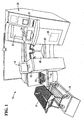
- the terminal 10 includes a product weight scale 12 used to sell items by weight and a scanner 14 associated with the scale.
- a bagging scale 20 is provided adjacent the scanner to support grocery bags 40 into which the customer places each newly scanned item.
- the terminal 10 includes a cart scale sized to support a fully loaded shopping cart 21 and a basket scale 19 configured to support a shopping basket 23 full of products.
- Each of the scales 12, 18, 19 and 20 include at least one weight detector, such as a pressure sensor or a load cell sensor, which is operable to generate a signal in response to the weight of the item(s) placed on the scale.
- a kiosk 24 includes a display 32, data input device 34 and a payment device 30.
- a computer or processor 26 is resident within the terminal and executes various software routines associated with the self-checkout process.
- One of those routines accepts weight signals from the scales 18, 19 and 20.
- the mean weight M n of each product or item 1 through n available in the supermarket is stored in a database along with a weight standard deviation SD n for each item.
- the weight measured at the scale 18,19 or 20 is compared to a weight range calculated from the mean and standard deviation data extracted from the database for that item. If the weight falls within a calculated range M n ⁇ the standard deviation SD n (optionally multiplied by an arbitrary constant A), the entry is accepted. If the weight falls outside this range the entry is rejected and the customer is instructed to re-scan and/or re-weigh the item.
- a weight error is communicated to a store attendant as part of the terminal security measures.
- the routine continuously updates the mean weight and standard deviation values for each item with each new accepted observation of the weight of that item.
- the weight scale is a common point of error or failure for the checkout terminal due to the high likelihood of spillage or the collection of debris in the working elements of the scales that ultimately interferes with the normal scale operation.
- a very common failure occurs when a foreign object becomes lodged between the top plate of the scale and the adjacent cabinetry. When the object prevents movement of the scale, the failure is easily detected but the scale is rendered unusable. However, in the worst case, the foreign object simply increases the drag on the scale movement, typically producing a low weight error.
- the system and method should be capable of operating generally transparently to the customer, meaning that there is no appreciable effect on the amount of time necessary for a customer to complete a sales transaction at the terminal.
- the present invention contemplates a system and method for determining a fault condition in a weight scale that can be readily integrated into an existing checkout terminal system.
- the method comprises the steps of obtaining weight data for a plurality of items being weighed at the weight scale during a common transaction.
- the items are individually weighed at the weight scale to obtain a weight value for the current item. This weight value is compared to the weight data obtained for the particular item and an error is calculated as a function thereof.
- an accumulated error is calculated as a function of the error for each of the weight measurements for each of the items.
- the accumulated error is the summation of all of the individual weight measurement errors.
- a fault condition of the weight scale is indicated if the accumulated error exceeds a threshold.
- a first threshold may be provided as an indication that a fault condition may be arising.
- a second threshold may then be provided indicative of a total failure of the weight scale.
- the weight data includes the mean weight M n and standard deviation SD n for each of the plurality of items 1-n.
- This weight data is maintained in a centralized database and is based on a history of item weights obtained from every checkout terminal in the system.
- the weight values for each of the items processed in the current transaction are added to the centralized database and used to calculate a new mean weight and standard deviation.
- error E n for each item is a function of the mean weight and standard deviation for that item.
- E n (W n - M n ) / SD n , where W n is the measured weight for item n.
- the accumulated error is thus the arithmetic sum of all of the errors E n for the items processed during the common transaction.
- the average of the absolute value or magnitude of each of the errors E n may be calculated.
- the accumulated error and average error may then be compared to corresponding thresholds. If either calculated error value exceeds its respective threshold, a fault condition is determined to exist for the particular weight scale.
- the steps for determining a fault condition are integrated into the processor of each checkout terminal.
- the processor in each terminal includes a first routine operable to obtain weight data for each of the plurality of items scanned at the terminal during the transaction, a second routine operable to calculate an error for the measured weight of each item relative to the weight data for that item, and a third routine operable to determine an accumulated error as a function of the error for each of the weighed items.
- the processor further includes a fault indicator operable to indicate a fault condition of the weight scale if the accumulated error exceeds a threshold.
- each checkout terminal forms part of a network in communication with a central processor where the centralized weight database is maintained.
- Each terminal communicates the weight data obtained during each transaction to the central processor to be integrated into the weight database.
- Each terminal may also communicate the status of its weight scale to the central processor, especially if a fault condition has been detected.
- the fault detection routine may be located in the central processor.
- one benefit of the present invention is that it provides a system for evaluating the health of the weight scale continuously during the operation of the checkout terminal without the intervention of customers or store employees. Another benefit is that the system is software based so that it does not interfere with the normal operation of the terminal and does not require a distinct test operation.
- the present invention provides a system and method for interactively testing all self-service checkout terminals at a retail facility.
- the facility includes terminals 10a-10d, as shown in FIG. 2 , all linked via data lines 52 to a central processor or computer 50.
- the central computer 50 maintains a centralized weight database that is accessed by each of the checkout terminals 10a-10d.
- each terminal is provided with access to a centralized database, while the weight verification routines may remain resident at each terminal.
- the central computer 50 preferably updates the mean weight M n and standard deviation SD n data based on the item weights measured at each of the terminals 10a-10d.
- the centralized weight and weight variance data is used to detect a measurement bias in any given checkout terminal 10a-10d.
- the invention provides means to detect exceptional behavior in one terminal relative to the history of weights and deviations among all of the terminals in the system.
- the centralized weight database is based on data points accumulated from several weight scales over a long period of time, the weight and variance data is more accurate, which means that short term failures in multiple product weight scales may be detected with ease.
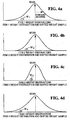
- FIGS. 3a-3d and 4a-4d show a hypothetical weight distribution for four items, each represented by the typical bell distribution curve centered about the mean weight value M n .
- M n the mean weight value
- SD n is a measure of the variation from that mean and is used to establish an acceptable range of weights for the subject item. It is known that about two-thirds of the new weight samples W n will fall within the 1 ⁇ deviation about the mean. It is also known that the distribution curve will "tighten up" as more sample weights are added to the weight database.
- the weight observations W n for each item measured by the particular scale falls within the envelope of the weight distribution curve.
- Some of the weight observations, such as weights W 1 and W 2 shown in FIGS. 3a and 3b are clustered closely around the mean weight M n , while the other two observations W 3 and W 4 shown in FIGS. 3c and 3d ,deviate more widely but still fall within the distribution curve.
- an error function is defined that provides an ongoing measure of the behavior or accuracy of each scale in a retail system.
- the error function is: E n ⁇ W n - M n / SD n , where E n is the error for the particular scale weighing each item n, M n is the mean weight of item n, W n is the new weight measurement by the particular scale for item n, and SD n is the standard deviation among all of the weight measurements for item n.
- the particular scale will generate an accumulated error ⁇ E n corresponding to the error value for all the items weighed at that scale. For any properly functioning scale weighing numerous distinct items this accumulated error ⁇ E n will converge toward zero over time because each weight observation will gradually approach the overall mean weight W n for each item n. However, if the particular scale is malfunctioning, the accumulated error ⁇ E n will diverge or increase over time.
- the graphs of FIGS. 4a-4d represent weight samples obtained by the same scale used to generate the weight samples plotted in FIGS. 3a-3d .
- the later weight samples are significantly offset to the lower weight side of the weight distribution curves.
- the accumulated error ⁇ E n ' for the transaction depicted in FIGS. 4a-4d will be noticeably greater than the accumulated error in the transaction depicted in FIGS. 3a-3d .
- the direction of the measurement shift is toward the lower weight for each item sampled.
- weight measurements W 1 and W 4 are lower than their respective means, while weights W 2 and W 3 are greater than the mean.
- all of the weight measurements W 1 ' - W 4 ' are shifted toward the low weight region of the distribution curve.
- the weight samples in the second transaction depicted in FIGS. 4a-4d can be interpreted in two ways to reveal a failure in the particular weight scale.
- the accumulated error has increased from the earlier transaction ( FIGS. 3a-d ) to the later transaction ( FIGS. 4a-d ).
- Second, all of the weight samples W 1 ' -W 4 ' are skewed to one side of the mean weight in this case suggesting that a foreign object is preventing the weight scale from being depressed under the weight of the items being weighed.
- the weight samples all fall within the weight distribution curves for the respective items.
- the failure occurring in the second sample can be readily diagnosed because the accumulated error ⁇ E n ' is greater than the earlier accumulated error ⁇ E n .
- the weight samples W 1 " - W 4 " plotted in FIGS. 5a-5d represent a failure that may not be easily detected using the accumulated error alone.
- the weight errors depicted in FIGS. 5a-5d are outside the weight distribution curve, or more particularly outside the 3 ⁇ band about the mean weight M n , so it is apparent that there is something dramatically wrong with the particular weight scale.
- the accumulated error ⁇ E n " for this transaction is very small because the wide swing in weight samples are substantially offset on either side of the mean.
- the extremely low weight W 1 " in FIG. 5a producing a large negative error value E 1 " is substantially offset by the extremely high weight W 4 " in FIG. 5d (producing an equally large positive error value E 4 ").
- the same offset can be found by comparing the positive error E 2 " in FIG. 5b with the comparable negative error E 3 " in FIG. 5c .
- the resulting accumulated error ⁇ E n " is in the range of the accumulated error for the first transaction of FIGS. 3a-3d .
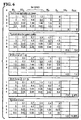
- the table of FIG. 6 illustrates the various weight measurement conditions that may arise in a multiple self-checkout terminal system.
- the tables contemplate the same four products or items being measured in each of the five scenarios.
- the typical implementation of the present invention may involve from one to a few dozen items to be weighed.
- the error detection features of the present invention do not depend upon the same items being scanned over successive transactions on a given terminal or being scanned among the various terminals 10a-10d ( FIG. 2 ) of the system.
- the first table of data corresponds to an initial calibration measurement that is conducted for each product/item being sold. It is contemplated that a sufficient random number of each item is weighed to generate a statistically significant mean weight M n and standard deviation SD n .
- the standard deviation value is used to establish a bandwidth about the mean corresponding to an acceptable product weight when scanned at the checkout terminals.
- the three sigma band is applied to encompass 97% of the weights within the weight distribution curve.
- the standard deviation values SD n and three sigma band for each item are applied to every product weighing transaction.
- the standard deviation values are not dependent upon the actual weight of the item.
- the three sigma range for the two lightest items 1 and 4 correspond to about 60% of the mean weight.
- the three sigma ranges for the heavier items 2 and 3 are 24% and 8% respectively.
- the lighter items 1 and 4 will have flatter or broader distribution curves, corresponding to the curves depicted in FIGS. 3a and 3d .
- the other two items will have narrower distribution curves, on the order of the curves shown in FIGS. 3b and 3c .
- These standard deviation and three sigma values reflect the realities in measuring consumer products - some products will have a more consistent weight, such as products sold be weight rather than by volume. On the other hand, some products will normally have greater variability to their accepted weight, such as a bunch of bananas. In the latter case, the wider three sigma band means that greater variability in actual scale measurement will be tolerated for that particular item.
- the second table in FIG. 6 represents typical data for a properly functioning product weight scale. Although each error value E n is greater than 1.0, the accumulated error ⁇ E n is less than 1.0 because the errors falls on both sides of the respective item mean weights M n . The average error value E ave is also minimal since the magnitude of each "over-weight" and "under-weight” error value is not large.
- the third and fourth tables illustrate the effects of relatively small measurement errors across multiple items.
- the shift corresponds to a one standard deviation error shift
- the fourth table illustrates the effects of a -0.1 lb. error in cumulative weight measurement.
- the average error was identical to the average error for the normally functioning scale in the second table.
- the accumulated error ⁇ E n ' is significantly greater.
- even a modest cumulative weight error of -0.1 lbs. produces an accumulated error ⁇ E n " that is even greater still.
- the final example in FIG. 6 corresponds to random errors in the measured weight of the four products.
- the accumulated error ⁇ E n '" is less than for the prior two examples, and not significantly larger than the accumulated error for a properly functioning scale.
- the average error E ave '" is dramatically larger than any other average error. This fault condition corresponds to the wide positive and negative swing in weight measurement depicted in FIGS. 5a-5d .
- each scale is continually monitored as it is being used.
- Software routines within the processor 26 ( FIG. 1 ) of the terminal 24 can implement the steps diagrammed in the flowchart of FIG. 7 .
- the first step 61 is to scan and identify the item.
- that scanned information is used to extract the weight data from the centralized database 50 ( FIG. 2 ), including the mean weight M n and standard deviation SD n for that item.
- the scale 18, 19 or 20 is read to obtain a weight value W n for the item in step 65. That measured weight value is held in temporary memory until the status of the scale has been verified.
- the centralized weight database is constantly updated by the measured weights of product actually purchased using the checkout terminal. However, until it can be verified that the weight value W n for the current item is legitimate, the value cannot be added to the database.
- the processor 26 of the terminal 24 calculates the error E n for the scanned item n in step 67 and then determines in step 69 whether the last item has been scanned by the customer. In a typical self-service checkout terminal, a prompt appears on the display 32 and the customer makes an entry on the device 34 when the customer is ready to complete the checkout process. In the absence of such an indication, the processor 26 returns to step 61 and repeats steps 61-67 for each newly scanned item 1-n.
- the processor calculates, in step 71, the accumulated error ⁇ E n and the average error E ave among all the items 1-n that have been scanned and weighed at the terminal 10.
- the appropriate threshold values are preferably maintained in the central processor 50 to ensure uniform performance among all of the terminals 10a-10d and their associated weight scales 18, 19 and 20.
- the threshold values can be assigned to suit the needs for the particular facility and/or as a function of the standard deviation data for each item. In the examples shown in the charts of FIG.
- a threshold value for the accumulated error ⁇ E n may be ⁇ 2.0, while a threshold value for the average error E ave may be 3.0. With these thresholds, each of the last three samples of FIG. 6 would produce an error condition. Higher threshold values mean that only significant faults in the weight scales will generate an error condition. Conversely, lower threshold values will trigger error conditions at the first hint of trouble.
- multiple threshold values may be provided for each error parameter ⁇ E n and E ave .
- a first threshold may be used to generate a warning that the particular scale may need to be inspected at the first available opportunity.
- a second threshold may be used to generate an immediate error condition that would render the current transaction void.
- the processor 26 and/or the central processor 50 can issue an error message at step 77. This error message may be simply logged at the central processor 50 and/or may be transmitted to an on-site clerk.
- the processor transmits the temporarily stored weight values W n to the centralized database in step 75 and the checkout process is allowed to continue.
- the threshold values are preferably item specific and maintained in the centralized database.
- the thresholds may be a function of the standard deviation SD n for each item so that items having a smaller deviation (and therefore narrower three sigma weight range) will ideally have a lower threshold.
- the weight standard deviation values take into account variations in product weight
- the threshold values take into account variations in performance of the weight scales. It is of course appreciated that no weight scale will measure the true weight of each item every time. Thus, the threshold values build in a certain acceptable error factor that is superimposed onto the range of acceptable weights for each item incorporated into the standard deviation value for that item. Simply assigning a weight error value independent of the standard deviation does not account for improvements or changes in the normal expected weight range for products.
- the calculation of the error values E n automatically takes into account any changes in the weight standard deviation without operator intervention.
- each checkout terminal 10a-10d may be accomplished in any fashion, such through a local network.
- the central processor may be off-site and the data lines 55 may be in the form of wireless communication.
- the centralized database may thus be maintained not only for weight data input by the terminals 10a-10d in one store, the database may also accept weight data from several stores. With this approach, the standard deviation SD n for each item n should be decrease over time since more data samples can be obtained. It is also contemplated that the centralized database may be populated with mean weight and standard deviation data from the producer of the associated product.
- the accumulated error is the mathematical sum of each weight error for each item.
- certain weight errors may be weighted or even ignored in generating the accumulated error.
- certain products may be very light so that the available weight scale may not be able to respond accurately to that light weight, thereby yielding a large weight error value. This particular weight error may be ignored when generating the accumulated error.
- a weight error for one item may fall well outside the range of errors experienced when weighing all other items during the transaction. This error may ignored as an aberration due to customer error, for instance.
- the step 71 in the method steps of FIG. 7 may be changed to calculate a modified accumulated error ⁇ E n and average error E ave .
- the threshold values may themselves be calculated with each checkout transaction.
- the error thresholds used to determine the existence of a fault condition may be maintained in the centralized database and accessed by each terminal.
- the threshold values may be calculated as a function of the standard deviation and/or mean weight of all of the items weighed in the transaction, or even all the items maintained in the centralized database.
Landscapes
- Physics & Mathematics (AREA)
- General Physics & Mathematics (AREA)
- Engineering & Computer Science (AREA)
- Mathematical Physics (AREA)
- Theoretical Computer Science (AREA)
- Computer Networks & Wireless Communication (AREA)
- Cash Registers Or Receiving Machines (AREA)
Applications Claiming Priority (1)
| Application Number | Priority Date | Filing Date | Title |
|---|---|---|---|
| US11/639,075 US7533799B2 (en) | 2006-12-14 | 2006-12-14 | Weight scale fault detection |
Publications (3)
| Publication Number | Publication Date |
|---|---|
| EP1933119A2 EP1933119A2 (en) | 2008-06-18 |
| EP1933119A3 EP1933119A3 (en) | 2011-05-04 |
| EP1933119B1 true EP1933119B1 (en) | 2015-03-25 |
Family
ID=39046773
Family Applications (1)
| Application Number | Title | Priority Date | Filing Date |
|---|---|---|---|
| EP07254076.8A Active EP1933119B1 (en) | 2006-12-14 | 2007-10-16 | Fault detection device and method for a scale |
Country Status (5)
| Country | Link |
|---|---|
| US (1) | US7533799B2 (enExample) |
| EP (1) | EP1933119B1 (enExample) |
| JP (1) | JP5083963B2 (enExample) |
| CN (1) | CN101206782B (enExample) |
| AU (1) | AU2007231674B2 (enExample) |
Families Citing this family (35)
| Publication number | Priority date | Publication date | Assignee | Title |
|---|---|---|---|---|
| DE102007013333A1 (de) * | 2007-03-20 | 2008-09-25 | Bizerba Gmbh & Co. Kg | Verfahren zur Parametrierung und zum Betrieb von Waagen |
| US8794524B2 (en) * | 2007-05-31 | 2014-08-05 | Toshiba Global Commerce Solutions Holdings Corporation | Smart scanning system |
| US7988045B2 (en) * | 2007-05-31 | 2011-08-02 | International Business Machines Corporation | Portable device-based shopping checkout |
| US8544736B2 (en) * | 2007-07-24 | 2013-10-01 | International Business Machines Corporation | Item scanning system |
| US20090026270A1 (en) * | 2007-07-24 | 2009-01-29 | Connell Ii Jonathan H | Secure checkout system |
| US8746557B2 (en) * | 2008-02-26 | 2014-06-10 | Toshiba Global Commerce Solutions Holding Corporation | Secure self-checkout |
| US8280763B2 (en) * | 2008-02-26 | 2012-10-02 | Connell Ii Jonathan H | Customer rewarding |
| US7889068B2 (en) * | 2008-03-20 | 2011-02-15 | International Business Machines Corporation | Alarm solution for securing shopping checkout |
| US8061603B2 (en) * | 2008-03-20 | 2011-11-22 | International Business Machines Corporation | Controlling shopper checkout throughput |
| US8229158B2 (en) * | 2008-04-29 | 2012-07-24 | International Business Machines Corporation | Method, system, and program product for determining a state of a shopping receptacle |
| US20090272801A1 (en) * | 2008-04-30 | 2009-11-05 | Connell Ii Jonathan H | Deterring checkout fraud |
| US8704821B2 (en) | 2008-09-18 | 2014-04-22 | International Business Machines Corporation | System and method for managing virtual world environments based upon existing physical environments |
| JP5558468B2 (ja) * | 2009-06-30 | 2014-07-23 | 株式会社東芝 | チェックアウト装置、および作業状況計測装置 |
| US10121137B2 (en) | 2010-06-29 | 2018-11-06 | Ncr Corporation | Methods and apparatus for self-service checkout |
| US8286868B2 (en) | 2010-09-02 | 2012-10-16 | Ncr Corporation | Checkout methods and apparatus |
| US20120122447A1 (en) * | 2010-11-17 | 2012-05-17 | Michael Craft | System and Method for On-Demand Diagnostics of a Device Utilizing Secure Data to Interact Wirelessly with One or More Third Party Systems |
| US8599025B2 (en) * | 2011-01-04 | 2013-12-03 | General Electric Company | System and method to determine an infant weight while minimizing disturbance to the infant |
| US8789757B2 (en) | 2011-02-02 | 2014-07-29 | Metrologic Instruments, Inc. | POS-based code symbol reading system with integrated scale base and system housing having an improved produce weight capturing surface design |
| US8822848B2 (en) | 2011-09-02 | 2014-09-02 | Metrologic Instruments, Inc. | Bioptical point of sale (POS) checkout system employing a retractable weigh platter support subsystem |
| US8498903B2 (en) * | 2011-09-29 | 2013-07-30 | Ncr Corporation | System and method for performing a security check at a checkout terminal |
| JP6026771B2 (ja) * | 2012-05-11 | 2016-11-16 | 大和製衡株式会社 | 計量装置 |
| US8841564B1 (en) | 2013-04-29 | 2014-09-23 | R+L Carriers, Inc. | Weigh scaled vehicle calibration systems and methods |
| US9033227B2 (en) | 2013-05-20 | 2015-05-19 | Ncr Corporation | Methods and systems for performing security weight checks at checkouts |
| USD730901S1 (en) * | 2014-06-24 | 2015-06-02 | Hand Held Products, Inc. | In-counter barcode scanner |
| JP6283295B2 (ja) * | 2014-09-30 | 2018-02-21 | 東芝テック株式会社 | 商品情報登録端末、販売処理システム、及び、プログラム。 |
| US20160110791A1 (en) | 2014-10-15 | 2016-04-21 | Toshiba Global Commerce Solutions Holdings Corporation | Method, computer program product, and system for providing a sensor-based environment |
| US9518862B2 (en) | 2014-11-04 | 2016-12-13 | Mettler-Toledo, LLC | Weighing apparatus rezero fault prediction and remote alerting |
| US9898635B2 (en) * | 2014-12-30 | 2018-02-20 | Hand Held Products, Inc. | Point-of-sale (POS) code sensing apparatus |
| IL255088B (en) * | 2015-05-03 | 2022-07-01 | Cleper Yair | Retail store checkout system and method |
| JP6942560B2 (ja) * | 2017-08-24 | 2021-09-29 | 東芝テック株式会社 | セルフチェックアウト装置およびプログラム |
| US12181333B2 (en) * | 2018-05-04 | 2024-12-31 | United States Postal Service | Systems and methods for accurate measurement of items in a distribution network |
| CN109036497B (zh) * | 2018-07-24 | 2021-04-23 | 上海昆涞生物科技有限公司 | 一种医学实验室检测结果的分析方法及装置 |
| CN114623912B (zh) * | 2020-12-11 | 2024-08-20 | 顺丰科技有限公司 | 动态秤的称重异常检测方法、装置、电子设备及存储介质 |
| CN113188642B (zh) * | 2021-03-24 | 2023-05-09 | 中交第二航务工程局有限公司 | 一种用于物料称重的自诊断装置及其控制方法 |
| KR102724638B1 (ko) * | 2022-10-12 | 2024-10-31 | 삼진정밀(주) | 배터리 케이스 정삭가공 자동화 시스템 |
Family Cites Families (11)
| Publication number | Priority date | Publication date | Assignee | Title |
|---|---|---|---|---|
| JPH0685002B2 (ja) * | 1986-02-18 | 1994-10-26 | ミノルタ株式会社 | プラスチツク光学部品の反射防止膜 |
| US4715457A (en) * | 1986-05-27 | 1987-12-29 | Ncr Corporation | Method for fast weighing |
| US4779706A (en) * | 1986-12-17 | 1988-10-25 | Ncr Corporation | Self-service system |
| US4787467A (en) * | 1987-07-31 | 1988-11-29 | Johnson Neldon P | Automated self-service checkout system |
| US5883968A (en) * | 1994-07-05 | 1999-03-16 | Aw Computer Systems, Inc. | System and methods for preventing fraud in retail environments, including the detection of empty and non-empty shopping carts |
| US6594668B1 (en) * | 2000-07-17 | 2003-07-15 | John Joseph Hudy | Auto-norming process and system |
| WO2003005313A2 (en) * | 2001-07-02 | 2003-01-16 | Psc Scanning, Inc. | Checkout system with a flexible security verification system |
| JP4007004B2 (ja) * | 2001-12-28 | 2007-11-14 | 富士通株式会社 | 精算システムにより実行されるプログラム、精算チェックシステムにより実行されるプログラム、精算方法、精算システム、及び記録媒体 |
| US6794586B1 (en) * | 2002-06-27 | 2004-09-21 | Ncr Corporation | System and method for controlling weighing operations at a scale of a self-checkout terminal |
| US20050173527A1 (en) * | 2004-02-11 | 2005-08-11 | International Business Machines Corporation | Product checkout system with anti-theft device |
| US8452660B2 (en) * | 2006-06-06 | 2013-05-28 | Fujitsu Frontech North America Inc. | Self-checkout security system and method therefor |
-
2006
- 2006-12-14 US US11/639,075 patent/US7533799B2/en not_active Expired - Fee Related
-
2007
- 2007-10-16 EP EP07254076.8A patent/EP1933119B1/en active Active
- 2007-10-26 AU AU2007231674A patent/AU2007231674B2/en active Active
- 2007-11-13 CN CN2007101696570A patent/CN101206782B/zh active Active
- 2007-12-11 JP JP2007319405A patent/JP5083963B2/ja active Active
Also Published As
| Publication number | Publication date |
|---|---|
| JP2008151783A (ja) | 2008-07-03 |
| US20080141755A1 (en) | 2008-06-19 |
| JP5083963B2 (ja) | 2012-11-28 |
| EP1933119A2 (en) | 2008-06-18 |
| AU2007231674A1 (en) | 2008-07-03 |
| CN101206782B (zh) | 2011-11-09 |
| CN101206782A (zh) | 2008-06-25 |
| AU2007231674B2 (en) | 2012-07-12 |
| EP1933119A3 (en) | 2011-05-04 |
| US7533799B2 (en) | 2009-05-19 |
Similar Documents
| Publication | Publication Date | Title |
|---|---|---|
| EP1933119B1 (en) | Fault detection device and method for a scale | |
| US7673797B2 (en) | Personalization of self-checkout security | |
| US7040455B2 (en) | System and method for tracking items at a scale of a self-checkout terminal | |
| US6794586B1 (en) | System and method for controlling weighing operations at a scale of a self-checkout terminal | |
| US8856032B2 (en) | Adjustment of a security level of a self-checkout system based on shopper assistant intervention | |
| CN104748832B (zh) | 经由重量转移模式分析来确定车辆衡健康状况和适用性的方法 | |
| US20140338987A1 (en) | Checkout Methods and Apparatus | |
| JP2008151783A5 (enExample) | ||
| EP0786725A1 (en) | Improvements in or relating to the prediction of product defects | |
| EP1986066B1 (en) | Combined-information processing apparatus, method for processing combined-information, program, and recording medium | |
| Lass et al. | Impacts of the northeast dairy compact on New England retail prices | |
| JP4693950B2 (ja) | 計量システム | |
| JPH10274555A (ja) | 電子秤 | |
| JP2004086908A (ja) | 通貨受容装置 | |
| CN111551483B (zh) | 监测金属腐蚀的装置和金属腐蚀的监测方法 | |
| JP5890140B2 (ja) | 計量装置 | |
| US6801866B1 (en) | Method for minimizing error in weighing devices | |
| US20040138908A1 (en) | Method for analyzing warranty claim data | |
| JP4842368B2 (ja) | 計量システム | |
| JP3005593B2 (ja) | 診断アルゴリズム構築方法およびその装置 | |
| WO2023009715A1 (en) | Smart cash drawer auto weighing system | |
| JP2003150231A (ja) | 工場認定方法およびそのシステム並びに工場認定用プログラム | |
| GB2407172A (en) | Counting cash by weighing | |
| JP4842366B2 (ja) | 計量システム | |
| KR20200111956A (ko) | 로드 모니터링 장치 및 방법 |
Legal Events
| Date | Code | Title | Description |
|---|---|---|---|
| PUAI | Public reference made under article 153(3) epc to a published international application that has entered the european phase |
Free format text: ORIGINAL CODE: 0009012 |
|
| AK | Designated contracting states |
Kind code of ref document: A2 Designated state(s): AT BE BG CH CY CZ DE DK EE ES FI FR GB GR HU IE IS IT LI LT LU LV MC MT NL PL PT RO SE SI SK TR |
|
| AX | Request for extension of the european patent |
Extension state: AL BA HR MK RS |
|
| RAP1 | Party data changed (applicant data changed or rights of an application transferred) |
Owner name: NCR CORPORATION |
|
| PUAL | Search report despatched |
Free format text: ORIGINAL CODE: 0009013 |
|
| AK | Designated contracting states |
Kind code of ref document: A3 Designated state(s): AT BE BG CH CY CZ DE DK EE ES FI FR GB GR HU IE IS IT LI LT LU LV MC MT NL PL PT RO SE SI SK TR |
|
| AX | Request for extension of the european patent |
Extension state: AL BA HR MK RS |
|
| RIC1 | Information provided on ipc code assigned before grant |
Ipc: G07G 1/00 20060101ALI20110325BHEP Ipc: G01G 19/414 20060101AFI20080218BHEP |
|
| 17P | Request for examination filed |
Effective date: 20111104 |
|
| AKX | Designation fees paid |
Designated state(s): DE FR GB |
|
| GRAP | Despatch of communication of intention to grant a patent |
Free format text: ORIGINAL CODE: EPIDOSNIGR1 |
|
| INTG | Intention to grant announced |
Effective date: 20150116 |
|
| GRAS | Grant fee paid |
Free format text: ORIGINAL CODE: EPIDOSNIGR3 |
|
| GRAA | (expected) grant |
Free format text: ORIGINAL CODE: 0009210 |
|
| AK | Designated contracting states |
Kind code of ref document: B1 Designated state(s): DE FR GB |
|
| REG | Reference to a national code |
Ref country code: GB Ref legal event code: FG4D |
|
| REG | Reference to a national code |
Ref country code: DE Ref legal event code: R084 Ref document number: 602007040760 Country of ref document: DE |
|
| REG | Reference to a national code |
Ref country code: GB Ref legal event code: 746 Effective date: 20150407 |
|
| REG | Reference to a national code |
Ref country code: DE Ref legal event code: R096 Ref document number: 602007040760 Country of ref document: DE Effective date: 20150507 |
|
| REG | Reference to a national code |
Ref country code: DE Ref legal event code: R084 Ref document number: 602007040760 Country of ref document: DE Effective date: 20150415 |
|
| REG | Reference to a national code |
Ref country code: FR Ref legal event code: PLFP Year of fee payment: 9 |
|
| REG | Reference to a national code |
Ref country code: DE Ref legal event code: R097 Ref document number: 602007040760 Country of ref document: DE |
|
| PLBE | No opposition filed within time limit |
Free format text: ORIGINAL CODE: 0009261 |
|
| STAA | Information on the status of an ep patent application or granted ep patent |
Free format text: STATUS: NO OPPOSITION FILED WITHIN TIME LIMIT |
|
| 26N | No opposition filed |
Effective date: 20160105 |
|
| REG | Reference to a national code |
Ref country code: FR Ref legal event code: PLFP Year of fee payment: 10 |
|
| REG | Reference to a national code |
Ref country code: FR Ref legal event code: PLFP Year of fee payment: 11 |
|
| REG | Reference to a national code |
Ref country code: FR Ref legal event code: PLFP Year of fee payment: 12 |
|
| REG | Reference to a national code |
Ref country code: DE Ref legal event code: R081 Ref document number: 602007040760 Country of ref document: DE Owner name: NCR VOYIX CORP., ATLANTA, US Free format text: FORMER OWNER: NCR CORP., DULUTH, GA., US Ref country code: DE Ref legal event code: R082 Ref document number: 602007040760 Country of ref document: DE Representative=s name: V. BEZOLD & PARTNER PATENTANWAELTE - PARTG MBB, DE Ref country code: DE Ref legal event code: R081 Ref document number: 602007040760 Country of ref document: DE Owner name: NCR CORPORATION, ATLANTA, US Free format text: FORMER OWNER: NCR CORP., DULUTH, GA., US |
|
| P01 | Opt-out of the competence of the unified patent court (upc) registered |
Effective date: 20230505 |
|
| REG | Reference to a national code |
Ref country code: DE Ref legal event code: R081 Ref document number: 602007040760 Country of ref document: DE Owner name: NCR VOYIX CORP., ATLANTA, US Free format text: FORMER OWNER: NCR CORPORATION, ATLANTA, GA, US |
|
| PGFP | Annual fee paid to national office [announced via postgrant information from national office to epo] |
Ref country code: DE Payment date: 20241029 Year of fee payment: 18 |
|
| PGFP | Annual fee paid to national office [announced via postgrant information from national office to epo] |
Ref country code: GB Payment date: 20241028 Year of fee payment: 18 |
|
| PGFP | Annual fee paid to national office [announced via postgrant information from national office to epo] |
Ref country code: FR Payment date: 20241025 Year of fee payment: 18 |