EP1930872A2 - Perkussionsinstrumente mit geschmolzenem oder geweichtem Metall - Google Patents
Perkussionsinstrumente mit geschmolzenem oder geweichtem Metall Download PDFInfo
- Publication number
- EP1930872A2 EP1930872A2 EP07023335A EP07023335A EP1930872A2 EP 1930872 A2 EP1930872 A2 EP 1930872A2 EP 07023335 A EP07023335 A EP 07023335A EP 07023335 A EP07023335 A EP 07023335A EP 1930872 A2 EP1930872 A2 EP 1930872A2
- Authority
- EP
- European Patent Office
- Prior art keywords
- instrument
- cymbal
- percussion
- percussion instrument
- metal
- Prior art date
- Legal status (The legal status is an assumption and is not a legal conclusion. Google has not performed a legal analysis and makes no representation as to the accuracy of the status listed.)
- Withdrawn
Links
- 239000002184 metal Substances 0.000 title claims abstract description 74
- 229910052751 metal Inorganic materials 0.000 title claims abstract description 74
- 238000009527 percussion Methods 0.000 title claims description 52
- 238000000034 method Methods 0.000 claims abstract description 66
- 238000003466 welding Methods 0.000 claims abstract description 54
- 230000008569 process Effects 0.000 claims abstract description 52
- 150000001875 compounds Chemical class 0.000 claims abstract description 32
- 239000011324 bead Substances 0.000 claims abstract description 20
- 238000010309 melting process Methods 0.000 claims abstract description 7
- 239000000956 alloy Substances 0.000 claims description 33
- 239000000463 material Substances 0.000 claims description 33
- 229910045601 alloy Inorganic materials 0.000 claims description 32
- 229910000906 Bronze Inorganic materials 0.000 claims description 11
- XEEYBQQBJWHFJM-UHFFFAOYSA-N Iron Chemical compound [Fe] XEEYBQQBJWHFJM-UHFFFAOYSA-N 0.000 claims description 8
- PXHVJJICTQNCMI-UHFFFAOYSA-N Nickel Chemical compound [Ni] PXHVJJICTQNCMI-UHFFFAOYSA-N 0.000 claims description 8
- ATJFFYVFTNAWJD-UHFFFAOYSA-N Tin Chemical compound [Sn] ATJFFYVFTNAWJD-UHFFFAOYSA-N 0.000 claims description 7
- 238000004519 manufacturing process Methods 0.000 claims description 7
- 238000005553 drilling Methods 0.000 claims description 4
- 229910052742 iron Inorganic materials 0.000 claims description 4
- 238000002844 melting Methods 0.000 claims description 4
- 230000008018 melting Effects 0.000 claims description 4
- 229910052759 nickel Inorganic materials 0.000 claims description 4
- RYGMFSIKBFXOCR-UHFFFAOYSA-N Copper Chemical compound [Cu] RYGMFSIKBFXOCR-UHFFFAOYSA-N 0.000 claims description 3
- 229910052802 copper Inorganic materials 0.000 claims description 3
- 239000010949 copper Substances 0.000 claims description 3
- BHEPBYXIRTUNPN-UHFFFAOYSA-N hydridophosphorus(.) (triplet) Chemical compound [PH] BHEPBYXIRTUNPN-UHFFFAOYSA-N 0.000 claims description 3
- 239000003795 chemical substances by application Substances 0.000 claims description 2
- 238000007670 refining Methods 0.000 claims description 2
- 239000011573 trace mineral Substances 0.000 claims description 2
- 235000013619 trace mineral Nutrition 0.000 claims description 2
- 229910000851 Alloy steel Inorganic materials 0.000 claims 1
- 229910001128 Sn alloy Inorganic materials 0.000 description 7
- 239000010974 bronze Substances 0.000 description 6
- KUNSUQLRTQLHQQ-UHFFFAOYSA-N copper tin Chemical compound [Cu].[Sn] KUNSUQLRTQLHQQ-UHFFFAOYSA-N 0.000 description 6
- UGKDIUIOSMUOAW-UHFFFAOYSA-N iron nickel Chemical compound [Fe].[Ni] UGKDIUIOSMUOAW-UHFFFAOYSA-N 0.000 description 6
- 230000008901 benefit Effects 0.000 description 5
- OAICVXFJPJFONN-UHFFFAOYSA-N Phosphorus Chemical compound [P] OAICVXFJPJFONN-UHFFFAOYSA-N 0.000 description 4
- 230000008859 change Effects 0.000 description 4
- 229910000831 Steel Inorganic materials 0.000 description 3
- 230000004075 alteration Effects 0.000 description 3
- 238000005336 cracking Methods 0.000 description 3
- 238000005304 joining Methods 0.000 description 3
- 238000005096 rolling process Methods 0.000 description 3
- 239000010959 steel Substances 0.000 description 3
- 230000003466 anti-cipated effect Effects 0.000 description 2
- 239000002131 composite material Substances 0.000 description 2
- 230000000694 effects Effects 0.000 description 2
- 230000004927 fusion Effects 0.000 description 2
- 238000010438 heat treatment Methods 0.000 description 2
- 150000002739 metals Chemical class 0.000 description 2
- 239000004033 plastic Substances 0.000 description 2
- 229920003023 plastic Polymers 0.000 description 2
- 230000009467 reduction Effects 0.000 description 2
- 230000000630 rising effect Effects 0.000 description 2
- 230000002889 sympathetic effect Effects 0.000 description 2
- 239000002023 wood Substances 0.000 description 2
- 241001311547 Patina Species 0.000 description 1
- 230000015572 biosynthetic process Effects 0.000 description 1
- 238000005219 brazing Methods 0.000 description 1
- 239000000919 ceramic Substances 0.000 description 1
- 238000013016 damping Methods 0.000 description 1
- 239000006260 foam Substances 0.000 description 1
- 239000011521 glass Substances 0.000 description 1
- 238000010426 hand crafting Methods 0.000 description 1
- 239000011159 matrix material Substances 0.000 description 1
- 238000003908 quality control method Methods 0.000 description 1
- 238000007493 shaping process Methods 0.000 description 1
- 238000001228 spectrum Methods 0.000 description 1
- 238000003756 stirring Methods 0.000 description 1
- 238000004381 surface treatment Methods 0.000 description 1
- 239000000725 suspension Substances 0.000 description 1
- 230000008719 thickening Effects 0.000 description 1
- 230000000007 visual effect Effects 0.000 description 1
- 239000002699 waste material Substances 0.000 description 1
Images









Classifications
-
- G—PHYSICS
- G10—MUSICAL INSTRUMENTS; ACOUSTICS
- G10D—STRINGED MUSICAL INSTRUMENTS; WIND MUSICAL INSTRUMENTS; ACCORDIONS OR CONCERTINAS; PERCUSSION MUSICAL INSTRUMENTS; AEOLIAN HARPS; SINGING-FLAME MUSICAL INSTRUMENTS; MUSICAL INSTRUMENTS NOT OTHERWISE PROVIDED FOR
- G10D13/00—Percussion musical instruments; Details or accessories therefor
- G10D13/01—General design of percussion musical instruments
- G10D13/06—Castanets, cymbals, triangles, tambourines without drumheads or other single-toned percussion musical instruments
-
- G—PHYSICS
- G10—MUSICAL INSTRUMENTS; ACOUSTICS
- G10D—STRINGED MUSICAL INSTRUMENTS; WIND MUSICAL INSTRUMENTS; ACCORDIONS OR CONCERTINAS; PERCUSSION MUSICAL INSTRUMENTS; AEOLIAN HARPS; SINGING-FLAME MUSICAL INSTRUMENTS; MUSICAL INSTRUMENTS NOT OTHERWISE PROVIDED FOR
- G10D13/00—Percussion musical instruments; Details or accessories therefor
- G10D13/10—Details of, or accessories for, percussion musical instruments
- G10D13/24—Material for manufacturing percussion musical instruments; Treatment of the material
Definitions
- This invention related to percussion instruments, including cymbals and percussion sheet style instruments constructed using molten or plasticized metal processes to obtain desired unique sounds and overtones and including cymbals and bells and various combinations and shapes thereof and the unique overtones attained thereby.
- Cymbals have always been constructed of a single piece of metal. Thin, relatively flat or "sheet” instruments such as thundersheets were never welded or constructed using molten or plasticized metal after reduction - they were always plain sheet metal or flat rolled metal.
- cymbals have always utilized metal which is first cast of molten metal which is then cooled, then reduced into a thinner section through cold or hot hammering or rolling.
- a thinner section is defined here as metal which is under 3/16 (0.187) inch thick.
- cymbals were typically lathed, hot rolled, cold rolled or hammered.
- Cymbals were welded at the center node only as a mounting system for a single cymbal to a stand or holding device. Two or more cymbals have never been welded together to form a compound instrument.
- the overall sound of a percussion instrument such as a cymbal or thin, sheet-like instrument consists of a multiplicity of sounds- each of differing frequency. These partial tones which combine to make the overall sound are called overtones.
- a bell as used hereinafter is considered to be synonymous with a percussion instrument similar to a cymbal in concept, except made with a thicker gauge material.
- thinner more flexible metal sections are used, the added flexibility can result in the formation of the complex overtone structures of cymbals.
- the ratio of thickness to diameter or surface area is important in the distinction between bell versus cymbal sounds.
- the resulting sound will resemble that of a small bell. If however the same .040 thickness were used to make a 20 inch diameter instrument, the resulting sound would resemble, (due to flexibility and the complex swell and overtone structure), the sound of a cymbal.
- the radius of the "bow” also affects a bell versus cymbal sound. A deep or smaller radius bow can sound more like a bell where a larger or shallow radius can result in a more cymbal-like sound.
- the present invention utilizes molten or plasticized metal after the metal has been reduced to a thin section or sections.
- a bead is defined as any amount of molten metal which is fused onto or added to the surface of an existing part of the product.
- Cymbals and thin "sheets” can also be welded together to form "hybrid” multi-cymbals.
- Thermal or friction drilling or stir welding can also be used as a form of welding.
- Benefits of this invention include:
- the invention further demonstrates that cymbals and bells can be joined together in intimate contact through welding or any process which results in a molecular bond between the sections to create a bell or cymbal instrument with 2 or more distinct sections which vibrate both independently and through shared vibration to form a new and novel instrument.
- These new instruments can also feature a shared, resonant air chamber or cavity created by the gap and close proximity of the multiple sections. Such an air cavity can amplify the low frequency overtones of said instrument to create a novel sound.
- two or more members are welded together to form a bell and/or cymbal instrument with a common resonating air cavity which can increase the amplitude of the instrument, especially in the low and mid-range frequency spectrum.
- the size or diameter of the weld area in such embodiments influences the independence of the vibrating sections. A small weld area which is closer to the center node area will result in more independent vibration, while a large weld area which is farther from the center node area will result in less independent vibration.
- a bell and a cymbal can be combined to form a hybrid instrument.
- the shape of the sections to be welded together, the gap between the sections, the method of fusion, the surface treatment such as hammered or pressed or rolled deformations in the material, the hardness of the material, the basic material or alloys used, the use of heat affected zones, the size and thickness of the sections and the area where fusion takes place all influence the sound and performance of this invention.
- Metal is the preferred material of choice for this instrument class, although other materials could be used such as ceramics, glass, wood, plastics, or composite materials.
- the preferred method of joining metal would be a welding process whereby two or more sections would be first formed, then welded to join the sections, said welding process being one of the later stages of production.
- One possible shape which is effective in the creation of a common resonating air cavity is to join two sections which resemble two cymbals whereby the center "cups" are formed in a direction opposite that of a conventional western or turkish style cymbal.
- the said aforementioned cups in this embodiment are formed by making a curved depression in the center of the domed section, said depression forming a curve in the opposite direction of the primary curve or "bow" of the cymbal or bell.
- the creation of said cups allow the two sections to be joined in the center while the dome or bow of each section form opposing curves which form an air cavity between the sections which, through resonance, boosts the amplitude of lower frequency overtones.
- each section will feature a center hole.
- the smaller of the two holes will be known here as the primary hole which is used for mounting or attaching the bell or cymbal to a cymbal stand or other method of mounting the instrument.
- One of the two sections will usually have a larger secondary hole in the center than the other section. Around this larger hole, a weld joint will cover a larger area rather than a single point of contact.
- the size of the weld area will affect the invention in two ways: The larger weld area will be much stronger than a single point of contact.
- Variation in the size of the weld area will affect sound conduction between the sections of metal, hence affecting the sound quality of the invention.
- Embodiments of this instrument which feature a larger secondary hole will conduct more vibration between the sections yielding a sound of generally higher amplitude and will feature less independence of vibration between the two sections.
- Embodiments of this instrument which feature a smaller secondary hole will conduct less vibration between the sections yielding a sound of generally lower amplitude and will feature more independence of vibration between the two sections.
- each cup within each singular section of metal is to form two separate dome shapes for each section, then to cut a hole in each large section and weld domes into said large sections.
- Such an instrument will be constructed of four sections with a total of three weld areas.
- the said weld can be a ring shaped circular weld or other shapes.
- One advantage of this method is that it allows the center welded cup area to be of substantially different thickness or "gauge" versus the outer, large dome. This also allows the mounting hole to be of a thicker gauge to add strength.
- the main difference between bells and cymbals lies within the thickness of the metals used and the relative diameters of the sections.
- Figs. 1A and 1B depict a cymbal 12 having one or more holes 14 at desired locations with a thicker section 16 of metal around an edge of said one or more holes 14, wherein said one or more holes 14 are created by a melting or use of friction drilling of an existing metal section at respective locations where said one or more holes 14 are desired, resulting in the thicker section 16 of metal around the edge of said one or more holes 14.
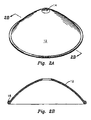
- Figs. 2A and 2B depict a cymbal 12 having a thicker metal section 18 around said cymbal edge, wherein said formed thickened metal edge 18 is formed by a melting process to a desired edge of said cymbal and said melting process minimizes the creation of scrap material by leaving the thicker metal section 18.
- a cymbal is also a percussion instrument that can be made from thin sheet material
- this embodiment also applies to thin sheet percussion instruments.
- Figs. 3A and 3B are representative of a conceptual depiction of a cymbal 12, wherein the cymbal 12 is formed using a welding process in the manufacture of the cymbal 12, wherein material of different thicknesses 22a,22b,22c and/or different alloys and hardness 24a,24b,24c are joined by said welding process and Fig. 3A is also be representative of molten beads 26 of weld material being added to one or more desired locations on a surface of the cymbal 12.
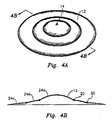
- Figs. 4A and 4B are representative of a conceptual depiction of a cymbal 12, wherein one or more sections of differing alloys and/or hardness 24a,24b,24c are joined by said welding process.
- Figs. 5A and 5B are representative of a conceptual depiction of one example of where multiple cymbals 12 are joined by said welding 20 process to form a compound cymbal.
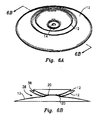
- Figs. 6A and 6B are representative of a conceptual depiction of another example of where multiple cymbals 12 are joined or stacked by said welding 20 process to form a compound cymbal.
- Figs. 7A and 7B are representative of a conceptual depiction of still another example of where multiple cymbals 12 are joined by said welding 20 process to form a compound cymbal.
- Figs. 8A and 8B are representative of a conceptual depiction of still another example of where multiple cymbals 12 are joined by said welding 20 process to form a compound cymbal.
- Fig. 8B is also representative of one example an instrument made by forming an inverted depression in the center area of each of two dome shaped sections 12 and then joining said sections together by said welding process to form a compound cymbal/bell instrument. This process can be continued by welding multiple similar made instruments in a stacked configuration.
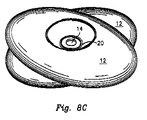
- Fig. 8C is a conceptual depiction of two cymbals 12, by way of example, two oval-shaped cymbals, joined together by the welding process to form a compound percussion instrument.
- the actual shape of the cymbals can be varied as desired to achieve the sound desired, such as oval shapes, polygonal shapes, round shapes and combinations thereof.
- Figs. 9A and 9B are representative of a conceptual depiction of a cymbal 12, wherein other objects 28 such as a thin sheet instrument 30 are joined to the main section using said welding 20 process.
- Figs. 10A and 10B are representative of a conceptual depiction of a thin sheet instrument 30, wherein multiple thin sheet instruments 30 or objects 28 are joined by said welding 20 process to form a compound instrument
- sheet instruments 30 which are typically made from generally flat thin sheet material.
- Figs. 11A and 11B depict a thin sheet instrument 30 having one or more holes 14 at desired locations with a thicker section of metal around an edge 16 of said one or more holes 14, wherein said one or more holes 14 are created by a melting of an existing metal section or use of friction drilling at respective locations where said one or more holes 14 are desired, resulting in the thicker section of metal around the edge 16 of said one or more holes 14.
- a thin sheet instrument 30 can also have edges at desired locations with a thicker metal section around the edges.
- the thickened metal edge in this case can be formed by melting a desired edge of the thin sheet instrument 30 and the melting process minimizes the creation of scrap material by leaving the thicker metal section.
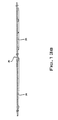
- Fig. 12 depicts a thin sheet instrument 30 wherein the instrument is formed using a welding process in the manufacture of the instrument (see weld joint 20).
- This drawing is also representative of an instrument 30 that can be made where one or more sections of differing alloys or hardness 24a,24b,24c being joined by the welding process, where one or more sections of differing thicknesses 22a,22b,22c are joined by the welding process.
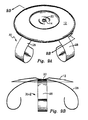
- Figs. 13A and 13B depict a thin sheet instrument 30 made by a welding process, where a molten bead or section of metal 26 is added to one more desired locations on a surface of the instrument 30.
- Figs. 13C and 13D depict conceptually a percussion instrument 12 in the form of a cymbal where a molten weld bead or section of metal 26 has been applied in a desired pattern, in the example a radial pattern, with the bead or metal 26 is progressively thinner toward the outer edge, in this case thicker toward the center and thinner toward the perimeter
- Figs. 13E and 13F depict conceptually a cymbal 12, wherein a molten bead or section of metal 26 is added to one more desired locations on a surface of the instrument 12.
- Figs. 14A-14C depict a hole in portion of a percussion instrument, which can be a cymbal 12 or a thin sheet percussion instrument 30, wherein the inside edge 36 is initially flared; and then coiled or curved back to form a smooth interior edge 36.
- the aforementioned compound instruments depicted above can be stacked upon each other by means of a common center bolt or post to form a rattling instrument capable of considerably high amplitude.
- Compound bells and cymbals can also be placed upon or affixed to soft or semi-soft surfaces or radiating devices such as foam or wood to yield a novel sound quality.
- bells can be tuned to different notes within a pair which is welded together.
- the top section could be tuned to a different note than the bottom. While the difference in frequency between the sections can be as random if desired, precise tuning to any scale system is possible. This system is effective in round or geometrically shaped embodiments.
- two or more instruments are welded together or one or more sections of metal are welded together to create the instrument.
- some sections may be a simple domed curve with no secondary curves. Sections with multiple or complex curves within each section can also be utilized.
- the upper sections are curved in a direction which is opposite that of the larger, lower section. In some embodiments, the upper sections are curved in a direction In some embodiments, the upper sections are curved in a direction which is the same as that of the lower section.
- each is of reduced size or diameter.
- Geometric shapes such as square instrument shapes or round shapes can be utilized.
- an unexpected result of the addition of one or more upward curved cups is a substantial increase in amplitude when compared to conventional cymbals of similar weight. This is useful in saving valuable material cost as an instrument of a given loudness can be now made from less mass of material.
- the one or more center sections seem to serve a similar vibrational function to that of the center "cup" found in traditional turkish style cymbals, yet the instrument vibrates in ways sufficiently different than traditional cymbals as to form a novel sounding instrument.
- One important distinction between this embodiment and conventional cymbals is that the sections of this embodiment vibrate both independently and with shared vibration.
- the center section or sections can of considerably differing gauge or thickness versus the main underlying section.
- the effect called "tapering" in conventional cymbals which increases swell and adds complexity to overtone structure, is achieved by lathing the cymbal progressively deeper toward the outer edge of the cymbal, thus removing material and creating a cymbal with an outer edge which is thinner than its center.
- This invention allows for a more dramatic change in gauge without wasting valuable material through material removed processes such as lathing.
- this embodiment is capable of producing a louder and more complex series of midrange overtones, as well as a hum note of lower frequency and lower amplitude.
- the hum-note in cymbals can often be intrusive as it produces an isolated and defined "note" or frequency. It is therefore often desirable for a cymbal to either feature a hum note of low frequency and low amplitude, or a series of richly complex multiple hum notes.
- this embodiment can produce a series of sounds which resemble conventional cymbals in some ways, it can perform several innovative functions.
- One such function is the relative independence with which the center welded cup can ring. If the musician strikes the instrument and then dampens the outer edge of the instrument by touching or grabbing the edge in a way which would silence a conventional cymbal, the cup in this embodiment can still continue to vibrate with a bell-like tone.
- the center welded cup or "bell” can also be shaped in a form which creates a common resonating air cavity 38, which is the spacing created by the welded configuration.
- Such an embodiment can yield a center bell of markedly independent vibration.
- the said center bell also conducts vibration throughout the instrument in a manner which yields a novel sound, as well as a substantial increase in overall amplitude.
- Such an embodiment of a given weight is capable of producing a sound of overall loudness which is equal to or greater than conventional instruments of similar mass or weight.
- the welded center cup can also be used as a handle to hold two such cymbals to allow the cymbals to be "crashed" together in a manner similar to that used with orchestral crash cymbals.
- the size or diameter of the ring-shaped weld area in all such embodiments influences the independence of the vibrating sections.
- a small weld area which is closer to the center node area will result in more independent vibration.
- a weld area which extends outward farther from the center node area will result in less independent and a more shared vibration which seems to be a vibrational composite of the sections.
- the welding of bells or cymbals to a common base can result in increased loudness or amplitude and shared vibration among the various vibration bells or cymbals, as well as an alteration of overtone structure.
- the base can be a variety of shapes, including but not limited to, a circular disc or plate. Said plate can also be struck to vibrate. Said base can also feature a center hole to facilitate mounting on a cymbal stand or other mounting system.
- the base can also be made of a different alloy than the bells or cymbals which are welded to it. If the bells were made of bronze for maximum brilliance of high frequency overtones, said base could possibly be made of a different alloy such as steel. A process called "brazing" could be used to join the differing alloys. The use of steel in the more massive member could result in a cost savings.
- Said bells or cymbals can be arranged in any order or orientation.
- One example is to mount small bells in a circular arrangement around the outer area of a disc or dome.
- Said bells can be of many sizes. Small diameter bells and thicker bells will vibrate at higher frequencies. Bells which are tuned to specific frequencies can also be welded to a common base in an arrangement which resembles that of a piano keyboard.
- a hole can be created in the ringing bell (or cymbal) member followed by a weld process called plug welding, whereby the bell is placed on the base and the hole is filled by the welder, thus fusing the bell to the surface.
- the hole can also be placed in the base and welded from the underside.
- flared holes aid to a great degree in reducing wear to the instrument, as well as wear to the rigid bolt of a cymbal stand.
- flaring the mounting hole greatly reduces wear to the soft sleeve on the mounting bolt of a cymbal stand.
- the sharp edge of a conventional hole seen in traditional cymbals would quickly wear out the soft sleeve and the steel bolt of the stand would then begin to exert force on the hole in the instrument causing wear or cracking.
- the center area can become softened or annealed by welding. This can weaken the center area. By flaring said holes, into the stronger shape depicted, the hole can now retain sufficient strength for the invention.
- a small hole is first created. This hole can then be formed in a process called swaging, whereby the hole is expanded in diameter with the remaining material pushed down and outward, to form a shape similar to a trumpet bell. This process can increase the surface area and strength of the hole.
- the flared shape, with its continuous bell shaped curve prevents abrasive friction from wearing down the cymbal stand rubber or plastic sleeve.
- Ductility and strength are necessary to form the shapes in this invention.
- the metal is quite ductile (easily deformed without cracking or failure) when in the soft or partially softened state. These softer states of metal, while quite ductile, are not as strong as the hardened levels of temper in any given alloy.
- Temper ratings of certain alloys are rated by the percent of elongation remaining in the alloy before the metal will fail in tension.
- Phosphor bronze is hardened and strengthened by cold work.
- Phosphor bronze alloys are typically composed of copper, tin and a small amount of phosphorous.
- a typical phosphor bronze, when hardened to a strength rating of extra spring temper, can only be elongated by an additional 2% before failing and breaking or cracking in tension.
- iron and nickel can refine and reduce grain size and hence, increase strength. Through the addition of said iron and nickel, ideally in ranges of between .05 to .20% each, can increase strength considerably. By utilizing these grain refiners, a temper with more elongation remaining in the alloy can be used.
- a temper rating of extra hard in such an alloy will possess strength equal to extra spring in a typical bronze alloy.
- This extra hard temper can be elongated considerably more than extra spring temper hence allowing the deformation needed to easily form this invention.
- the weld area can become softened or annealed due to the heat of the weld process. This can weaken the weld area.
- nickel-iron grain refiners the weld area can still remain, due to the added strength of said refiners, at a level of strength needed for this invention.
- the softer and more ductile temper of grain refined bronze can be stronger than a hard, more brittle temper of traditional bronze.
- Low tin bronze alloys are thought to be to high pitched, and of narrow range compared to equal high tin alloys in sound quality.
- the instrument is a bronze alloy instrument composed of about 7 to 16 percent tin, said alloy containing between about .02 to .50 percent each of nickel and iron for use as grain refining agents, less than .50% phosphorous and less than 1% total trace elements, and the remainder copper.
- the inventor has found that by using nickel iron grain refiners in low tin, more affordable and workable alloys, a percussion and cymbal maker can increase taper, use of heat zones, depth and greater variations of hammering and other processes which create a structurally more complex instrument to realize a product of superior complexity of overtone structure, higher strength and a product which lends itself to greater affordability of quality control.
- Such processes such as greatly increased tapering would weaken common alloys but the added strength provided by nickel iron grain refiners allows the use of these special processes and features.
- the Zildjian company (the leading cymbal maker) advertises "ultra modem crafting techniques", “higher pitch”, “more focused overtones", “identical discs”. Such phrases teach away from very high quality to cymbal consumers, who regard hand crafting and a wider range of overtones desirable in cymbals. See http://www.zildjian.com/en-US/products/default.ad2. Conversely the same companies promote their high tin products as works of art with centuries old secret processes which yield high quality, all of which begins with their 20% tin alloy.
- the use of nickel- iron grain refiners in this invention offers a method to create new cymbal and bell embodiments of high quality and novel sound.
Landscapes
- Physics & Mathematics (AREA)
- Engineering & Computer Science (AREA)
- Acoustics & Sound (AREA)
- Multimedia (AREA)
- Pressure Welding/Diffusion-Bonding (AREA)
- Arc Welding In General (AREA)
- Laminated Bodies (AREA)
Applications Claiming Priority (1)
| Application Number | Priority Date | Filing Date | Title |
|---|---|---|---|
| US11/566,343 US7626106B2 (en) | 2005-12-05 | 2006-12-04 | Percussion instruments using molten or plasticized metal |
Publications (2)
| Publication Number | Publication Date |
|---|---|
| EP1930872A2 true EP1930872A2 (de) | 2008-06-11 |
| EP1930872A3 EP1930872A3 (de) | 2011-07-06 |
Family
ID=39182404
Family Applications (1)
| Application Number | Title | Priority Date | Filing Date |
|---|---|---|---|
| EP07023335A Withdrawn EP1930872A3 (de) | 2006-12-04 | 2007-12-03 | Perkussionsinstrumente mit geschmolzenem oder geweichtem Metall |
Country Status (2)
| Country | Link |
|---|---|
| US (1) | US7626106B2 (de) |
| EP (1) | EP1930872A3 (de) |
Families Citing this family (10)
| Publication number | Priority date | Publication date | Assignee | Title |
|---|---|---|---|---|
| US8857040B2 (en) | 2012-02-01 | 2014-10-14 | Ford Global Technologies, Llc | Method of flow drill screwing parts |
| US8841527B2 (en) * | 2012-09-12 | 2014-09-23 | Al-Musics Technology Inc. | Electric drum and cymbal with spider web-like sensor |
| US8865986B1 (en) * | 2012-11-16 | 2014-10-21 | Jerry A. Twyford | Jazz flat ride and methods of making the same |
| RU2570051C2 (ru) * | 2013-01-22 | 2015-12-10 | Андрей Владимирович Ремянников | Ударный инструмент и вибрирующий языковый элемент ударного инструмента |
| EP3036734B1 (de) * | 2013-11-08 | 2018-09-19 | Flicek, Brian, G. | Perkussionsinstrument |
| US9245510B2 (en) * | 2014-03-12 | 2016-01-26 | Avedis Zildjian Co. | Electronic cymbal trigger |
| US9767774B2 (en) * | 2015-10-23 | 2017-09-19 | Tufts University | Synthesizer with cymbal actuator |
| US9990909B1 (en) * | 2017-07-12 | 2018-06-05 | Rtom Corporation | Cymbal |
| US10460708B2 (en) * | 2018-01-19 | 2019-10-29 | Sabian Ltd. | Frequency control cymbal |
| US11009332B2 (en) | 2019-02-19 | 2021-05-18 | Stanley Black & Decker, Inc. | Tape measure end hook protection |
Family Cites Families (6)
| Publication number | Priority date | Publication date | Assignee | Title |
|---|---|---|---|---|
| DE196068C (de) * | ||||
| US3185014A (en) * | 1962-12-04 | 1965-05-25 | Ross Russel | Stand with improved sock cymbals |
| US4079163A (en) * | 1974-11-29 | 1978-03-14 | Nippon Steel Corporation | Weldable coated steel sheet |
| JP3756661B2 (ja) * | 1998-03-20 | 2006-03-15 | ローランド株式会社 | シンバル |
| US20050082756A1 (en) * | 2003-10-15 | 2005-04-21 | Duncan Linda M. | Casino card game |
| KR20050082756A (ko) * | 2004-02-20 | 2005-08-24 | 최선규 | 심벌즈를 이용한 타악기 |
-
2006
- 2006-12-04 US US11/566,343 patent/US7626106B2/en not_active Expired - Fee Related
-
2007
- 2007-12-03 EP EP07023335A patent/EP1930872A3/de not_active Withdrawn
Also Published As
| Publication number | Publication date |
|---|---|
| US7626106B2 (en) | 2009-12-01 |
| EP1930872A3 (de) | 2011-07-06 |
| US20070131090A1 (en) | 2007-06-14 |
Similar Documents
| Publication | Publication Date | Title |
|---|---|---|
| EP2015287B1 (de) | Das G-PAN-Musikinstrument | |
| US8492632B1 (en) | Tuned bell harmonic musical instrument | |
| US7626106B2 (en) | Percussion instruments using molten or plasticized metal | |
| CN103943100B (zh) | 音板声学换能器 | |
| US20080105104A1 (en) | Slotted percussion instruments | |
| US10373594B1 (en) | Hand pan tongue drum | |
| US7199297B2 (en) | Cymbal system and method of making | |
| MX2010012261A (es) | Proguanil para tratar enfermedades de la piel/mucosa. | |
| US7750218B2 (en) | Vibrato based percussion instrument | |
| JP2009031359A (ja) | 金属シェルの補強構造及び金属シェルの製造方法 | |
| US7952009B2 (en) | Non-conventional use of cups in cymbals | |
| US6034313A (en) | Tonal cymbal | |
| US7518050B2 (en) | Folded percussion instruments | |
| US20090107319A1 (en) | Cymbal with low fundamental frequency | |
| JP6179536B2 (ja) | 楽器用音板 | |
| WO2017164154A1 (ja) | 音管 | |
| US7799982B2 (en) | Quick change rattle suspendable percussion instruments | |
| JP3191831U (ja) | リン | |
| EP2023336A2 (de) | Vibrato-basierte Schlaginstrumente | |
| JP5716150B2 (ja) | リン | |
| Murr et al. | Materials science and metallurgy of the Caribbean steel drum Part I Fabrication, deformation phenomena and acoustic fundamentals | |
| Bucur | Struck Idiophones Played with Mallets: Gongs, Cymbals, Chimes, Sound Plates, Triangle | |
| US20120222537A1 (en) | Vertical sides banjo tone ring and methods | |
| Murr et al. | Fabrication of an aluminum, Caribbean-style, musical pan: Metallurgical and acoustical characterization | |
| US20230012191A1 (en) | Musical instrument structure with applause sound |
Legal Events
| Date | Code | Title | Description |
|---|---|---|---|
| PUAI | Public reference made under article 153(3) epc to a published international application that has entered the european phase |
Free format text: ORIGINAL CODE: 0009012 |
|
| AK | Designated contracting states |
Kind code of ref document: A2 Designated state(s): AT BE BG CH CY CZ DE DK EE ES FI FR GB GR HU IE IS IT LI LT LU LV MC MT NL PL PT RO SE SI SK TR |
|
| AX | Request for extension of the european patent |
Extension state: AL BA HR MK RS |
|
| PUAL | Search report despatched |
Free format text: ORIGINAL CODE: 0009013 |
|
| AK | Designated contracting states |
Kind code of ref document: A3 Designated state(s): AT BE BG CH CY CZ DE DK EE ES FI FR GB GR HU IE IS IT LI LT LU LV MC MT NL PL PT RO SE SI SK TR |
|
| AX | Request for extension of the european patent |
Extension state: AL BA HR MK RS |
|
| STAA | Information on the status of an ep patent application or granted ep patent |
Free format text: STATUS: THE APPLICATION IS DEEMED TO BE WITHDRAWN |
|
| 18D | Application deemed to be withdrawn |
Effective date: 20110701 |