EP1928205A2 - Optischer Schalter und Steuerverfahren für einen optischen Schalter - Google Patents
Optischer Schalter und Steuerverfahren für einen optischen Schalter Download PDFInfo
- Publication number
- EP1928205A2 EP1928205A2 EP07023033A EP07023033A EP1928205A2 EP 1928205 A2 EP1928205 A2 EP 1928205A2 EP 07023033 A EP07023033 A EP 07023033A EP 07023033 A EP07023033 A EP 07023033A EP 1928205 A2 EP1928205 A2 EP 1928205A2
- Authority
- EP
- European Patent Office
- Prior art keywords
- polarization
- light
- signal light
- controller
- control
- Prior art date
- Legal status (The legal status is an assumption and is not a legal conclusion. Google has not performed a legal analysis and makes no representation as to the accuracy of the status listed.)
- Withdrawn
Links
Images


Classifications
-
- H—ELECTRICITY
- H04—ELECTRIC COMMUNICATION TECHNIQUE
- H04Q—SELECTING
- H04Q11/00—Selecting arrangements for multiplex systems
- H04Q11/0001—Selecting arrangements for multiplex systems using optical switching
- H04Q11/0005—Switch and router aspects
-
- G—PHYSICS
- G02—OPTICS
- G02F—OPTICAL DEVICES OR ARRANGEMENTS FOR THE CONTROL OF LIGHT BY MODIFICATION OF THE OPTICAL PROPERTIES OF THE MEDIA OF THE ELEMENTS INVOLVED THEREIN; NON-LINEAR OPTICS; FREQUENCY-CHANGING OF LIGHT; OPTICAL LOGIC ELEMENTS; OPTICAL ANALOGUE/DIGITAL CONVERTERS
- G02F1/00—Devices or arrangements for the control of the intensity, colour, phase, polarisation or direction of light arriving from an independent light source, e.g. switching, gating or modulating; Non-linear optics
- G02F1/01—Devices or arrangements for the control of the intensity, colour, phase, polarisation or direction of light arriving from an independent light source, e.g. switching, gating or modulating; Non-linear optics for the control of the intensity, phase, polarisation or colour
- G02F1/0126—Opto-optical modulation, i.e. control of one light beam by another light beam, not otherwise provided for in this subclass
-
- H—ELECTRICITY
- H04—ELECTRIC COMMUNICATION TECHNIQUE
- H04J—MULTIPLEX COMMUNICATION
- H04J14/00—Optical multiplex systems
- H04J14/08—Time-division multiplex systems
-
- H—ELECTRICITY
- H04—ELECTRIC COMMUNICATION TECHNIQUE
- H04J—MULTIPLEX COMMUNICATION
- H04J14/00—Optical multiplex systems
- H04J14/06—Polarisation multiplex systems
-
- H—ELECTRICITY
- H04—ELECTRIC COMMUNICATION TECHNIQUE
- H04Q—SELECTING
- H04Q11/00—Selecting arrangements for multiplex systems
- H04Q11/0001—Selecting arrangements for multiplex systems using optical switching
- H04Q11/0005—Switch and router aspects
- H04Q2011/0007—Construction
- H04Q2011/0035—Construction using miscellaneous components, e.g. circulator, polarisation, acousto/thermo optical
-
- H—ELECTRICITY
- H04—ELECTRIC COMMUNICATION TECHNIQUE
- H04Q—SELECTING
- H04Q11/00—Selecting arrangements for multiplex systems
- H04Q11/0001—Selecting arrangements for multiplex systems using optical switching
- H04Q11/0005—Switch and router aspects
- H04Q2011/0037—Operation
- H04Q2011/0039—Electrical control
-
- H—ELECTRICITY
- H04—ELECTRIC COMMUNICATION TECHNIQUE
- H04Q—SELECTING
- H04Q11/00—Selecting arrangements for multiplex systems
- H04Q11/0001—Selecting arrangements for multiplex systems using optical switching
- H04Q11/0005—Switch and router aspects
- H04Q2011/0037—Operation
- H04Q2011/0041—Optical control
Definitions
- the present art relates to an optical switch in which a nonlinear optical effect produced in a nonlinear medium is used, an optical waveform measuring device, and a method for controlling an optical switch.
- optical waveform measuring devices that measure the waveform of signal light are mandatory to monitor and evaluate the quality of signal light.
- a switch that appropriately samples signal light is used to measure the waveform of signal light with an optical waveform measuring device.
- photoelectric conversion of light signals is first performed with a photoelectric converter, and converted electrical signals are electrically sampled with an electronic circuit to measure the waveform of light.
- the performance is restricted by the speed (band) of processing electrical signals because signals are processed entirely by an electric circuit after the photoelectric converter.
- the electric circuit has a speed of processing electrical signals of 40 GHz, when signal light of 40 Gb/s or more is switched, signal light in a band exceeding 40 GHz cannot be correctly switched.
- an optical signal processing technique for processing signals by controlling an optical signal with another optical signal, using a nonlinear optical effect produced in a nonlinear medium.
- the nonlinear medium may use Japanese laid-open Patent No. 2006-184851 .
- the response speed of a nonlinear optical effect is said to be about a femtosecond, and the speed of processing signals in an optical switch to which this effect is applied greatly exceeds the aforementioned speed of processing electrical signals.
- An optical waveform measuring device that can measure signal light of Tb/s can be implemented by applying this optical switch to an optical waveform measuring device.
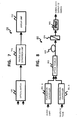
- FIG. 8 is a block diagram showing the structure of a known optical switch.
- a known optical switch 800 includes a polarization controller 801a, a polarization controller 801b, an optical coupler 802, a highly nonlinear fiber 803, a polarizer 804, and an optical band-pass filter 805, as shown in Fig. 8 .
- the polarization controller 801a adjusts the polarization direction of input signal light to a polarization direction inclined 90° with respect to a pass axis of the polarizer 804.
- the polarization controller 801 b adjusts the polarization direction of an input sampling pulse to a polarization direction inclined about 45° with respect to the pass axis of the polarizer 804.
- the optical coupler 802 couples the signal light and the sampling pulse, the polarization directions of which are respectively adjusted by the polarization controller 801 a and the polarization controller 801 b.
- the highly nonlinear fiber 803 passes the signal light and the sampling pulse coupled by the optical coupler 802 and generates an intensity correlation signal of the signal light and the sampling pulse.
- the polarization direction of the signal light is rotated by a nonlinear optical effect in the highly nonlinear fiber, and the signal light is output, with the polarization direction of the signal light being close to the polarization direction of the sampling pulse.
- the polarizer 804 has a pass axis oriented in a predetermined direction of signal light and a sampling pulse and passes only polarized components the polarization direction of which is parallel to the pass axis.
- the optical band-pass filter 805 passes and outputs only a polarized component of signal light out of polarized components of signal light and sampling pulse, the polarized components having passed through the polarizer 804.
- switching of signal light is performed by controlling the timing of input of a sampling pulse into the highly nonlinear fiber 803.
- photoelectric conversion of signal light output from the optical switch 800 is performed with a photo detector, and the waveforms of converted electrical signals are displayed to measure the waveform of signal light.
- an optical switch comprises:
- the condition for stably and correctly switching signal light is that signal light and sampling pulses the polarization states of which are stable are input.
- signal light the polarization state of which is unstable because, for example, the signal light propagates through a long-distance optical fiber cannot be correctly switched.
- waveform of signal light cannot be correctly measured because signal light cannot be correctly switched.
- an arrangement can be considered.
- the polarization state of signal light the polarization direction of which is adjusted by the polarization controller 801 a is monitored, and feedback control is performed in adjustment of the polarization direction of signal light on the basis of the result of monitoring.
- an unstable polarization state of signal light may occur in the optical switch 800 due to changes in the external environment, for example, a change in the temperature or vibrations, so that a correct polarization state of signal light at the time signal light passes through the polarizer 804 may not be monitored.
- a problem exists in that the polarization direction of signal light cannot be appropriately adjusted, so that signal light cannot be correctly switched.
- This embodiment solves the aforementioned problems, and it is an object of the embodiment to provide an optical switch that can stably switch signal light and an optical waveform measuring device that can stably and correctly measure the waveform of signal light, regardless of the polarization states of input signal light and sampling pulses, and a control method.
- FIG. 1 is a block diagram showing the structure of an optical switch according to the embodiment.
- An optical switch 100 includes a signal light input unit 101a, a control light input unit 101b, a polarization controller 102a, a polarization controller 102b, a coupling unit 103, a nonlinear medium 104, a monitoring-and-extracting unit 105, a optical power splitter 106, an input detection unit 107, a blocking unit 108, a control unit 109, a drive unit 110, a drive unit 111a, a drive unit 111b, a memory 112, and a signal light output unit 113, as shown in Fig. 1 .
- Signal light is input to the signal light input unit 101a, and the signal light input unit 101a outputs the signal light to the polarization controller 102a.
- the signal light is signal light subjected to switching, the output of the signal light being turned on/off by the optical switch 100.
- the optical switch 100 is applied to an optical waveform measuring device, the signal light is signal light subjected to measurement, the waveform of the signal light being measured by the optical waveform measuring device.
- Control light is input to the control light input unit 101b at predetermined intervals, and the control light input unit 101 b outputs the control light to the polarization controller 102b.
- the control light is pulsed light that is input when the output of signal light from the optical switch 100 is turned on.
- the control light is a sampling pulse that is input when signal light is sampled.
- the wavelength of control light is different from the wavelength of signal light.
- the wavelength of control light is, for example, an average zero-dispersion wavelength of the nonlinear medium 104.
- the polarization controller 102a adjusts the polarization direction of signal light output from the signal light input unit 101a to a predetermined polarization direction and outputs signal light to the coupling unit 103.
- the polarization controller 102b adjusts the polarization direction of control light output from the control light input unit 101b to a predetermined polarization direction and outputs control light to the coupling unit 103.
- the polarization controller 102a and the polarization controller 102b are driven respectively by the drive unit 111a and the drive unit 111b to adjust the polarization direction of signal light.
- the polarization controller 102a and the polarization controller 102b each include a wave plate, an optical fiber stress applying polarization control unit, or the like.
- the coupling unit 103 couples signal light output from the polarization controller 102a and control light output from the polarization controller 102b and outputs the signal light and the control light to the nonlinear medium 104.
- the coupling unit 103 includes an optical coupler. Since signal light is different from control light in wavelength, even when signal light and control light are coupled, signal light and control light can be coupled without interference between them.
- the nonlinear medium 104 passes signal light and control light output from the coupling unit 103 and generates an intensity correlation signal of the signal light and the control light.
- An intensity correlation signal is a correlation signal of a part in which signal light and control light coincide with each other and is output, with the intensity of the intensity correlation signal being proportional to the intensity of signal light.
- signal light is output, with the polarization direction of the signal light being close to the polarization direction of control light.
- the nonlinear medium 104 includes, for example, a highly nonlinear fiber.
- the monitoring-and-extracting unit 105 monitors the polarization states of signal light and control light having passed through the nonlinear medium 104. In this case, the monitoring-and-extracting unit 105 obtains pieces of intensity information of various polarized components of signal light and control light and outputs the obtained individual pieces of intensity information to the control unit 109.
- the intensity information of various polarized components of signal light and control light is information necessary to calculate Stokes parameters described below.
- the monitoring-and-extracting unit 105 extracts a polarized component of signal light having passed through the nonlinear medium 104, the polarization angle of the polarized component being parallel to a predetermined polarization direction (hereinafter referred to as a polarization direction x) and outputs the polarized component to the signal light output unit 113.
- the monitoring-and-extracting unit 105 extracts a polarized component the polarization angle of which is parallel to the polarization direction x by including a polarizer that passes only polarized components in the polarization direction x.
- the polarization direction x is determined by the angle of a pass axis through which the polarizer passes light.
- the optical power splitter 106 separates a part of signal light output from the signal light input unit 101 a to the polarization controller 102a and outputs the part of the signal light to the input detection unit 107.
- the optical power splitter 106 includes an optical coupler.
- the input detection unit 107 detects the input of signal light into the signal light input unit 101a on the basis of signal light output from the optical power splitter 106 and outputs the result of detection to the control unit 109.
- the blocking unit 108 passes only signal light out of signal light and control light that have passed through the nonlinear medium 104 and are to be output to the monitoring-and-extracting unit 105.
- the blocking unit 108 includes, for example, a band-pass filter that passes only light having the same wavelength as signal light or a band-rejection filter that blocks only light having the same wavelength as control light.
- the blocking unit 108 blocks or passes control light under the control of the control unit 109. Specifically, the blocking unit 108 blocks or passes control light by changing the position to a position such that signal light and control light that have passed through the nonlinear medium 104 and are to be output to the monitoring-and-extracting unit 105 enter or another position such that such signal light and control light do not enter, under the control of the control unit 109.
- the control unit 109 controls the polarization controller 102a and the polarization controller 102b on the basis of the monitoring state monitored by the monitoring-and-extracting unit 105.
- the monitoring state monitored by the monitoring-and-extracting unit 105 is the intensity information of various polarized components of signal light and control light output from the monitoring-and-extracting unit 105.
- the control unit 109 calculates Stokes parameters on the basis of the intensity information of various polarized components of signal light and control light.
- the control unit 109 controls the polarization controller 102a via the drive unit 111a on the basis of the calculated Stokes parameters of signal light so that the polarization direction of signal light is inclined 90° (including about 85° to 95°, hereinafter the same applies) with respect to the polarization direction x.
- the control unit 109 controls the polarization controller 102b via the drive unit 111b on the basis of the calculated Stokes parameters of control light so that the polarization direction of control light is inclined 45° (including about 40° to 50°, hereinafter the same applies) with respect to the polarization direction x.
- control unit 109 controls the blocking unit 108 so as to pass control light and controls the polarization controller 102b so that the polarization direction of control light is inclined 45° with respect to the polarization direction x.
- control unit 109 controls the blocking unit 108 so as to block control light and controls the polarization controller 102a so that the polarization direction of signal light is inclined 90° with respect to the polarization direction x.
- the drive unit 110 changes the position of the blocking unit 108 to a position such that signal light and control light that have passed through the nonlinear medium 104 and are to be output to the monitoring-and-extracting unit 105 enter or another position such that such signal light and control light do not enter, under the control of the control unit 109. Specifically, the drive unit 110 puts the blocking unit 108 on a light path of signal light and control light or removes the blocking unit 108 from the light path, under the control of the control unit 109.
- the drive unit 111a and the drive unit 111b drive the polarization controller 102a and the polarization controller 102b, respectively, under the control of the control unit 109 so as to adjust the polarization directions of signal light and control light to predetermined polarization directions.
- the polarization controller 102a and the polarization controller 102b each include a wave plate
- the polarization directions of signal light and control light are adjusted by changing the crystal orientation of the wave plate.
- the polarization controller 102a and the polarization controller 102b each include an optical fiber stress applying polarization control unit
- the polarization directions of signal light and control light are adjusted by changing stress on the polarization control unit.
- the memory 112 stores the drive conditions (control conditions) of the drive unit 111a or the drive unit 111b at the time the polarization controller 102a or the polarization controller 102b is controlled by the control unit 109.
- the control unit 109 sequentially stores the drive conditions in the memory 112 when controlling the polarization controller 102a or the polarization controller 102b.
- control unit 109 drives the polarization controller 102a or the polarization controller 102b again on the basis of the last saved drive conditions to control the polarization controller 102a or the polarization controller 102b.
- the signal light output unit 113 outputs a polarized component of signal light extracted by and output from the monitoring-and-extracting unit 105 as switched signal light.
- the optical switch 100 includes the control light input unit 101 b, and control light is input from the outside.
- the optical switch 100 may include a generation unit that generates control light.
- the blocking unit 108 include a band-rejection filter that blocks only light having the same wavelength as control light. In this arrangement, switching can be performed in response to signal light beams having various wavelengths.
- polarization control unit for example, an LiNbO3 (LN) modulator type, a liquid crystal type, and a Faraday rotator type, can be used as the polarization controller 102a and the polarization controller 102b.
- LN LiNbO3
- Fig. 2 shows the basic principle of the switching operation of the optical switch according to the embodiment.
- a highly nonlinear fiber 201 corresponds to the aforementioned nonlinear medium 104.
- a polarizer 202 is a polarizer included in the aforementioned monitoring-and-extracting unit 105.
- the direction of a pass axis 202a of the polarizer is the aforementioned polarization direction x.
- a polarized component 203a the polarization direction of which is parallel to the pass axis 202a of the polarizer 202 is generated in the signal light 203, and the polarized component 203a passes through the polarizer 202.
- the higher the intensity of the control light 204 input together with the signal light 203 the larger the rotation of the polarization direction of the signal light 203, so that a large number of the polarized components 203a, the polarization direction of which is parallel to the pass axis 202a of the polarizer 202, are generated.
- the polarization direction of the signal light 203 is not rotated, so that the signal light 203 does not pass through the polarizer 202. That is to say, only when the intense control light 204 is input to the highly nonlinear fiber 201, the signal light 203 passes through the polarizer 202.
- Switching of the signal light 203 can be performed by controlling the timing of input of the control light 204 into the highly nonlinear fiber 201, using this effect. In this case, not only the signal light 203 but also the control light 204 passes through the polarizer 202. Thus, when switching is performed, the control light 204 is blocked by the blocking unit 108.
- Fig. 3 is a first block diagram showing the structure of the monitoring-and-extracting unit of the optical switch according to the embodiment.
- the monitoring-and-extracting unit 105 includes a dividing unit 310, a polarizer 320, a dividing unit 330, a polarizer 341, a polarizer 342, a quarter wave plate 343, a polarizer 344, and four photo detectors (PDs) 350 to 353, as shown in Fig. 3 .
- the dividing unit 310 splits signal light and control light having passed through the nonlinear medium 104 to output one split light component to the polarizer 320 and the other split light component to the dividing unit 330.
- the polarizer 320 corresponds to the aforementioned polarizer 202 (see Fig. 2 ).
- the polarizer 320 passes only a polarized component of the light component output from the dividing unit 310, the polarization direction of the polarized component being parallel to the polarization direction x, and outputs the polarized component to the signal light output unit 113.
- the dividing unit 330 splits the light component output from the dividing unit 310 into four split light components.
- the dividing unit 330 includes optical couplers 331 to 333.
- the optical coupler 331 outputs, to the polarizer 341, one fourth of the light component output from the dividing unit 310, and outputs, to the optical coupler 332, the other three fourths of the light component output from the dividing unit 310.
- the optical coupler 332 outputs, to the polarizer 342, one third of the light component output from the optical coupler 331, and outputs, to the optical coupler 333, the other two thirds of the light component output from the optical coupler 331.
- the optical coupler 333 outputs, to the quarter wave plate 343, one half of the light component output from the optical coupler 332, and outputs, to the PD 350, the other half of the light component output from the optical coupler 332.
- the polarizer 341 is a polarizer that passes only a polarized component of the split light component output from the optical coupler 331, the polarization direction of the polarized component being parallel to the polarization direction x.
- the polarizer 341 may be a polarizer that passes only a polarized component of the split light component output from the optical coupler 331, the polarization direction of the polarized component being inclined 90° with respect to the polarization direction x.
- the PD 351 is a photo detector that receives the split light component having passed through the polarizer 341 and converts the split light component to electrical signals.
- the polarizer 342 is a polarizer that passes only a polarized component of the split light component output from the optical coupler 332, the polarization direction of the polarized component being inclined 45° with respect to the polarization direction x.
- the PD 352 is a photo detector that receives the split light component having passed through the polarizer 342 and converts the split light component to electrical signals.
- the quarter wave plate 343 passes only a circularly polarized component of the split light component output from the optical coupler 333.
- the polarizer 344 is a polarizer that passes only a polarized component of the split light component output from the optical coupler 333, the polarization direction of the polarized component being inclined 45° with respect to the polarization direction x.
- the PD 353 is a photo detector that receives the split light component having passed through the polarizer 344 and converts the split light component to electrical signals.
- the PD 350 is a photo detector that directly receives the split light component output from the optical coupler 333 and converts the split light component to electrical signals.
- the electrical signals converted by the PDs are output to the control unit 109 as the aforementioned intensity information of various polarized components of signal light and control light.
- the control unit 109 calculates Stokes parameters (S 0 , S 1 , S 2 , S 3 ) using Equations (1) to. (4) described below.
- PD 0 to PD 3 represent the intensities of electrical signals that are received and converted by the PDs 350 to 353.
- S 0 P ⁇ D 0
- S 1 2 ⁇ P ⁇ D 1 - P ⁇ D 0
- S 2 2 ⁇ P ⁇ D 2 - P ⁇ D 0
- S 3 2 ⁇ P ⁇ D 3 - P ⁇ D 0
- Fig. 4 shows a Poincare sphere that represents Stokes parameters.
- Each of the Stokes parameters (S 0 , S 1 , S 2 , S 3 ) calculated by the control unit 109 is represented by a point on the Poincare sphere, as shown in Fig. 4 .
- S 0 corresponds to the radius of the sphere and represents the intensity.
- S 1 represents horizontally polarized light and vertically polarized light.
- S 2 represents diagonally polarized components.
- S 3 represents circularly polarized light.
- the relationships between the individual values S 0 to S 3 of the Stokes parameters are shown by the following Equation (5).
- S 0 2 S 1 2 + S 2 2 + S 3 2
- monitored light is linearly polarized light that is parallel to the polarization direction x and passes through the polarizer 320.
- monitored light is linearly polarized light that is inclined 90° with respect to the polarization direction x and does not pass through the polarizer 320.
- monitored light is linearly polarized light that is inclined 45° with respect to the polarization direction x.
- this light includes a polarized component that passes through the polarizer 320 and a polarized component that does not pass through the polarizer 320.
- the value of S 1 described here is a value in a case where the polarizer 341 is a polarizer that passes only a polarized component the polarization direction of which is parallel to the polarization direction x.
- the polarizer 341 is a polarizer that passes only a polarized component the polarization direction of which is inclined 90° with respect to the polarization direction x, the sign of the value of S 1 is reversed.
- Fig. 5 is a second block diagram showing the structure of the monitoring-and-extracting unit of the optical switch according to the embodiment.
- the same reference numerals as in the monitoring-and-extracting unit 105 shown in Fig. 3 are assigned to corresponding components, and the description is omitted.
- the monitoring-and-extracting unit 105 of the optical switch 100 according to the embodiment may further include a dividing unit 501, as shown in Fig. 5 .
- the dividing unit 501 splits light output from the polarizer 341 to the PD 351 to output one split light component to the PD 351 and the other split light component to the signal light output unit 113.
- the function of the aforementioned polarizer 320 can be added to the polarizer 341.
- the polarizer 320 can be omitted.
- a function of monitoring the polarization states of signal light and control light having passed through the nonlinear medium 104 and a function of extracting a polarized component of signal light having passed through the nonlinear medium 104, the polarization direction of the polarized component being parallel to the polarization direction x, and outputting the polarized component to the signal light output unit 113 can be implemented via a single component.
- a situation in which, after the polarization states of signal light and control light are monitored, the polarization state of signal light changes before a polarized component of signal light is extracted can be avoided.
- the dividing unit 501 splits light output from the polarizer 341 to the PD 351.
- the dividing unit 501 may split light output from the polarizer 342 to the PD 352 or light output from the polarizer 344 to the PD 353 to output one split light component to the signal light output unit 113.
- the aforementioned polarization direction x is a polarization direction that is parallel to a pass axis of the polarizer 342 or the polarizer 344.
- the optical switch since the polarization states of signal light and control light having passed through the nonlinear medium 104 are monitored, and feedback control of the polarization controller 102a and the polarization controller 102b is performed on the basis of the monitored polarization states, polarization can be appropriately adjusted in response to the polarization states of signal light and control light. Thus, signal light can be stably and correctly switched regardless of the polarization states of signal light and control light.
- Fig. 6 is a flowchart showing the operation of the optical switch according to the embodiment. It is first determined by the input detection unit 107 whether signal light is being input to the signal light input unit 101a (step S601), as shown in Fig. 6 . When signal light is being input, a waiting operation is kept until signal light is not input (step S601: Loop for Yes).
- step S601 When signal light is not being input in step S601 (step S601: No), the control unit 109 controls the blocking unit 108 via the drive unit 110 to pass control light to be output to the monitoring-and-extracting unit 105 (step S602). In this case, only control light is output to the monitoring-and-extracting unit 105. Then, the polarization state of control light is monitored by the monitoring-and-extracting unit 105 (step S603).
- control unit 109 controls the polarization controller 102b on the basis of the polarization state monitored in step S603 to adjust the polarization direction of control light (step S604).
- the control unit 109 performs adjustment such that the polarization direction of control light is inclined 45° with respect to the polarization direction x.
- control unit 109 stores, in the memory 112, control conditions at the time the polarization direction of control light is inclined 45° with respect to the polarization direction x (step S605). Then, it is again determined by the input detection unit 107 whether signal light is being input to the signal light input unit 101a (step S606). When signal light is not being input, a waiting operation is kept until signal light is input (step S606: Loop for No).
- step S606 When signal light is being input in step S606 (step S606: Yes), the control unit 109 controls the blocking unit 108 to block control light to be output to the monitoring-and-extracting unit 105 (step S607). In this case, only signal light is output to the monitoring-and-extracting unit 105. Then, the polarization state of signal light is monitored by the monitoring-and-extracting unit 105 (step S608).
- control unit 109 controls the polarization controller 102a on the basis of the polarization state monitored in step S608 to adjust the polarization direction of signal light (step S609).
- the control unit 109 performs adjustment such that the polarization direction of signal light is inclined 90° with respect to the polarization direction x.
- the polarization direction of signal light is adjusted to a polarization direction that is inclined 90° with respect to the polarization direction x, and the polarization direction of control light is adjusted to a polarization direction that is inclined 45° with respect to the polarization direction x.
- the polarization direction of signal light is rotated toward the polarization direction x by inputting signal light and control light to the nonlinear medium 104, thereby enabling switching by the optical switch 100.
- control unit 109 controls the polarization controller 102a on the basis of control conditions adjusted in step S609 to adjust the polarization direction of signal light, and controls the polarization controller 102b on the basis of the control conditions saved in step S605 to adjust the polarization direction of control light (step S610). Switching of signal light by the optical switch 100 is started by this operation.
- the control unit 109 may control the polarization controller 102b to block control light before control light and signal light are coupled in the coupling unit 103 so as not to output control light to the nonlinear medium 104.
- the polarization controller 102b needs to be controlled so as to again output control light to the nonlinear medium 104.
- FIG. 7 is a block diagram showing the structure of an optical waveform measuring device according to the embodiment.
- An optical waveform measuring device 700 according to the embodiment includes the aforementioned optical switch 100, a photoelectric conversion unit 701, and a display unit 702, as shown in Fig. 7 .
- the optical waveform measuring device 700 inputs signal light subjected to measurement to the signal light input unit 101 a of the optical switch 100, and inputs sampling pulses to the control light input unit 101 b of the optical switch 100 as control light.
- the photoelectric conversion unit 701 converts signal light that is sampled and output from the signal light output unit 113 of the optical switch 100 to electrical signals.
- the display unit 702 displays the waveforms of electrical signals converted by the photoelectric conversion unit 701.
- waveforms sampled by the optical switch 100 which can appropriately adjust polarization in response to the polarization states of signal light and control light, can be displayed.
- an accurate waveform of light can be stably measured regardless of the polarization states of signal light and control light.
- signal light can be stably and correctly switched regardless of the polarization states of signal light and control light.
- the waveform of signal light can be stably and correctly measured regardless of the polarization states of signal light and control light.
- the optical switch can be stably operated regardless of the polarization states of signal light and control light.
- an optical switch, an optical waveform measuring device, and a control method according to the embodiments are useful as an optical switch in which a nonlinear optical effect produced in a nonlinear medium is used, an optical waveform measuring device, and a method for controlling an optical switch, especially when the polarization states of input signal light and control light are unstable.
Landscapes
- Physics & Mathematics (AREA)
- Engineering & Computer Science (AREA)
- Computer Networks & Wireless Communication (AREA)
- Nonlinear Science (AREA)
- Signal Processing (AREA)
- General Physics & Mathematics (AREA)
- Optics & Photonics (AREA)
- Optical Modulation, Optical Deflection, Nonlinear Optics, Optical Demodulation, Optical Logic Elements (AREA)
Applications Claiming Priority (1)
| Application Number | Priority Date | Filing Date | Title |
|---|---|---|---|
| JP2006323449A JP5162889B2 (ja) | 2006-11-30 | 2006-11-30 | 光スイッチ、光波形測定装置および制御方法 |
Publications (2)
| Publication Number | Publication Date |
|---|---|
| EP1928205A2 true EP1928205A2 (de) | 2008-06-04 |
| EP1928205A3 EP1928205A3 (de) | 2012-02-01 |
Family
ID=39027645
Family Applications (1)
| Application Number | Title | Priority Date | Filing Date |
|---|---|---|---|
| EP07023033A Withdrawn EP1928205A3 (de) | 2006-11-30 | 2007-11-28 | Optischer Schalter und Steuerverfahren für einen optischen Schalter |
Country Status (3)
| Country | Link |
|---|---|
| US (1) | US7953322B2 (de) |
| EP (1) | EP1928205A3 (de) |
| JP (1) | JP5162889B2 (de) |
Families Citing this family (3)
| Publication number | Priority date | Publication date | Assignee | Title |
|---|---|---|---|---|
| US8849129B2 (en) | 2012-07-20 | 2014-09-30 | Finisar Corporation | Method and apparatus for stabilization of optical transmitter |
| JP6079192B2 (ja) * | 2012-12-11 | 2017-02-15 | 富士通株式会社 | 光周波数多重装置及び偏光制御方法 |
| JP6197590B2 (ja) * | 2013-11-11 | 2017-09-20 | 富士通株式会社 | 光受信器、光信号処理方法、および光伝送システム |
Family Cites Families (10)
| Publication number | Priority date | Publication date | Assignee | Title |
|---|---|---|---|---|
| US6859268B2 (en) * | 2000-02-16 | 2005-02-22 | Massachusetts Institute Of Technology | Compensating polarization mode dispersion in fiber optic transmission systems |
| JP3517220B2 (ja) * | 2001-03-15 | 2004-04-12 | アンリツ株式会社 | 光サンプリング波形測定装置 |
| JP2003083812A (ja) * | 2001-09-10 | 2003-03-19 | Ando Electric Co Ltd | 解析中の光を出力可能な偏波アナライザ装置 |
| JP3784691B2 (ja) * | 2001-10-30 | 2006-06-14 | 富士通株式会社 | 伝送特性補償制御システム |
| JP2003287717A (ja) * | 2002-03-28 | 2003-10-10 | Acterna R & D Kk | 偏光制御装置と偏光制御方法 |
| JP4053389B2 (ja) * | 2002-09-19 | 2008-02-27 | 富士通株式会社 | 光信号対雑音比のモニタ方法およびそれを用いた光伝送システム |
| DE602004021510D1 (de) * | 2004-03-25 | 2009-07-23 | Fujitsu Ltd | Gangslichts polarisationserhaltender wellenleiterbauelemente |
| JP3920297B2 (ja) | 2004-09-01 | 2007-05-30 | 富士通株式会社 | 光スイッチおよび光スイッチを利用した光波形モニタ装置 |
| JP4328724B2 (ja) * | 2005-01-17 | 2009-09-09 | 富士通株式会社 | 光波形測定装置および光波形測定方法 |
| US7372568B1 (en) * | 2005-06-22 | 2008-05-13 | General Photonics Corporation | Low cost polametric detector |
-
2006
- 2006-11-30 JP JP2006323449A patent/JP5162889B2/ja not_active Expired - Fee Related
-
2007
- 2007-11-28 EP EP07023033A patent/EP1928205A3/de not_active Withdrawn
- 2007-11-30 US US11/987,576 patent/US7953322B2/en not_active Expired - Fee Related
Also Published As
| Publication number | Publication date |
|---|---|
| JP2008139406A (ja) | 2008-06-19 |
| EP1928205A3 (de) | 2012-02-01 |
| US20080131137A1 (en) | 2008-06-05 |
| JP5162889B2 (ja) | 2013-03-13 |
| US7953322B2 (en) | 2011-05-31 |
Similar Documents
| Publication | Publication Date | Title |
|---|---|---|
| US7978319B2 (en) | Optical switching method and optical switch | |
| JP4328724B2 (ja) | 光波形測定装置および光波形測定方法 | |
| US7853145B2 (en) | Optical switch and optical waveform monitoring apparatus | |
| US8385548B2 (en) | System and method for entangled photons generation and measurement | |
| US20100208334A1 (en) | System and method for entangled photons generation and measurement | |
| US6765670B2 (en) | Spectrometer module and applications thereof | |
| US7518711B2 (en) | Optical waveform measurement apparatus and optical waveform measurement method | |
| EP1928205A2 (de) | Optischer Schalter und Steuerverfahren für einen optischen Schalter | |
| JP3751547B2 (ja) | 光サンプリング波形観測装置 | |
| CN101345583A (zh) | 光信号质量监视装置 | |
| US6541951B2 (en) | Optical measurement of target-light waveform | |
| KR100483023B1 (ko) | 광전송 시스템의 편광 모드 분산 보상 장치 및 그 보상 방법 | |
| EP1868029A1 (de) | Optischer Schalter | |
| JP4235704B2 (ja) | 量子干渉計測システム | |
| CN110365403A (zh) | 一种太赫兹宽带调制信号测量装置及方法 | |
| US7068411B2 (en) | Method and apparatus for optical sampling | |
| JPH11118614A (ja) | 光信号監視方法および光信号監視装置 | |
| US7697123B2 (en) | Method of measuring the differential group delay of an optical fiber connection | |
| JP2008116468A (ja) | 光波形測定方法 | |
| JPH08278224A (ja) | 光強度変調器の特性測定方法及び制御方法 | |
| JP4991830B2 (ja) | サンプリング波形測定装置及びサンプリング波形測定方法 | |
| US6661549B1 (en) | Method of and a device for polarization-independent optical demultiplexing | |
| JPS6282338A (ja) | 光フアイバ試験装置 | |
| JP2005091130A (ja) | 光計測機器における偏光依存性を解消した測定方法、及びそのために使用される装置、測定用補償モジュール | |
| KR100204843B1 (ko) | 극초단 광 펄스열의 펄스 폭 및 펄스 파형 측정 장치 |
Legal Events
| Date | Code | Title | Description |
|---|---|---|---|
| PUAI | Public reference made under article 153(3) epc to a published international application that has entered the european phase |
Free format text: ORIGINAL CODE: 0009012 |
|
| AK | Designated contracting states |
Kind code of ref document: A2 Designated state(s): AT BE BG CH CY CZ DE DK EE ES FI FR GB GR HU IE IS IT LI LT LU LV MC MT NL PL PT RO SE SI SK TR |
|
| AX | Request for extension of the european patent |
Extension state: AL BA HR MK RS |
|
| PUAL | Search report despatched |
Free format text: ORIGINAL CODE: 0009013 |
|
| AK | Designated contracting states |
Kind code of ref document: A3 Designated state(s): AT BE BG CH CY CZ DE DK EE ES FI FR GB GR HU IE IS IT LI LT LU LV MC MT NL PL PT RO SE SI SK TR |
|
| AX | Request for extension of the european patent |
Extension state: AL BA HR MK RS |
|
| RIC1 | Information provided on ipc code assigned before grant |
Ipc: H04Q 11/00 20060101AFI20111228BHEP Ipc: H04J 14/06 20060101ALN20111228BHEP Ipc: G02F 1/01 20060101ALI20111228BHEP Ipc: H04J 14/08 20060101ALN20111228BHEP |
|
| 17P | Request for examination filed |
Effective date: 20120726 |
|
| AKX | Designation fees paid |
Designated state(s): DE FR GB |
|
| STAA | Information on the status of an ep patent application or granted ep patent |
Free format text: STATUS: THE APPLICATION HAS BEEN WITHDRAWN |
|
| 18W | Application withdrawn |
Effective date: 20171228 |