EP1925676A1 - Method for assay on the effect of vascularization inhibitor - Google Patents
Method for assay on the effect of vascularization inhibitor Download PDFInfo
- Publication number
- EP1925676A1 EP1925676A1 EP06768437A EP06768437A EP1925676A1 EP 1925676 A1 EP1925676 A1 EP 1925676A1 EP 06768437 A EP06768437 A EP 06768437A EP 06768437 A EP06768437 A EP 06768437A EP 1925676 A1 EP1925676 A1 EP 1925676A1
- Authority
- EP
- European Patent Office
- Prior art keywords
- group
- substituent
- hydrogen atom
- chloro
- methoxy
- Prior art date
- Legal status (The legal status is an assumption and is not a legal conclusion. Google has not performed a legal analysis and makes no representation as to the accuracy of the status listed.)
- Withdrawn
Links
- 0 CCCC*=C(*)N(*)*(C)C Chemical compound CCCC*=C(*)N(*)*(C)C 0.000 description 5
- MROGTPNQSHMKIG-UHFFFAOYSA-N CC(C)(c(cc1)ccc1-c(nc(Nc1ccc(CCN2CCOCC2)cc1)nc1)c1C#N)N Chemical compound CC(C)(c(cc1)ccc1-c(nc(Nc1ccc(CCN2CCOCC2)cc1)nc1)c1C#N)N MROGTPNQSHMKIG-UHFFFAOYSA-N 0.000 description 1
- UHEBDUAFKQHUBV-UHFFFAOYSA-N CC(C)OCc1ccc2[n](CCCOC(CN(C)C)=O)c(c(Cc3ccccc3-3)c-3c3c4CNC3=O)c4c2c1 Chemical compound CC(C)OCc1ccc2[n](CCCOC(CN(C)C)=O)c(c(Cc3ccccc3-3)c-3c3c4CNC3=O)c4c2c1 UHEBDUAFKQHUBV-UHFFFAOYSA-N 0.000 description 1
- HUUPVABNAQUEJW-UHFFFAOYSA-N CN(CC1)CCC1=O Chemical compound CN(CC1)CCC1=O HUUPVABNAQUEJW-UHFFFAOYSA-N 0.000 description 1
- SJRJJKPEHAURKC-UHFFFAOYSA-N CN1CCOCC1 Chemical compound CN1CCOCC1 SJRJJKPEHAURKC-UHFFFAOYSA-N 0.000 description 1
- VHOGYURTWQBHIL-UHFFFAOYSA-N Cc([o]nc1)c1C(Nc1ccc(C(F)(F)F)cc1)=O Chemical compound Cc([o]nc1)c1C(Nc1ccc(C(F)(F)F)cc1)=O VHOGYURTWQBHIL-UHFFFAOYSA-N 0.000 description 1
- YCOYDOIWSSHVCK-UHFFFAOYSA-N Clc(cc1)ccc1Nc1c(cccc2)c2c(Cc2ccncc2)nn1 Chemical compound Clc(cc1)ccc1Nc1c(cccc2)c2c(Cc2ccncc2)nn1 YCOYDOIWSSHVCK-UHFFFAOYSA-N 0.000 description 1
Images


Classifications
-
- A—HUMAN NECESSITIES
- A61—MEDICAL OR VETERINARY SCIENCE; HYGIENE
- A61K—PREPARATIONS FOR MEDICAL, DENTAL OR TOILETRY PURPOSES
- A61K31/00—Medicinal preparations containing organic active ingredients
- A61K31/33—Heterocyclic compounds
- A61K31/395—Heterocyclic compounds having nitrogen as a ring hetero atom, e.g. guanethidine or rifamycins
- A61K31/495—Heterocyclic compounds having nitrogen as a ring hetero atom, e.g. guanethidine or rifamycins having six-membered rings with two or more nitrogen atoms as the only ring heteroatoms, e.g. piperazine or tetrazines
- A61K31/505—Pyrimidines; Hydrogenated pyrimidines, e.g. trimethoprim
- A61K31/517—Pyrimidines; Hydrogenated pyrimidines, e.g. trimethoprim ortho- or peri-condensed with carbocyclic ring systems, e.g. quinazoline, perimidine
-
- A—HUMAN NECESSITIES
- A61—MEDICAL OR VETERINARY SCIENCE; HYGIENE
- A61K—PREPARATIONS FOR MEDICAL, DENTAL OR TOILETRY PURPOSES
- A61K31/00—Medicinal preparations containing organic active ingredients
- A61K31/33—Heterocyclic compounds
- A61K31/395—Heterocyclic compounds having nitrogen as a ring hetero atom, e.g. guanethidine or rifamycins
- A61K31/435—Heterocyclic compounds having nitrogen as a ring hetero atom, e.g. guanethidine or rifamycins having six-membered rings with one nitrogen as the only ring hetero atom
- A61K31/47—Quinolines; Isoquinolines
-
- A—HUMAN NECESSITIES
- A61—MEDICAL OR VETERINARY SCIENCE; HYGIENE
- A61P—SPECIFIC THERAPEUTIC ACTIVITY OF CHEMICAL COMPOUNDS OR MEDICINAL PREPARATIONS
- A61P35/00—Antineoplastic agents
-
- A—HUMAN NECESSITIES
- A61—MEDICAL OR VETERINARY SCIENCE; HYGIENE
- A61P—SPECIFIC THERAPEUTIC ACTIVITY OF CHEMICAL COMPOUNDS OR MEDICINAL PREPARATIONS
- A61P35/00—Antineoplastic agents
- A61P35/02—Antineoplastic agents specific for leukemia
-
- A—HUMAN NECESSITIES
- A61—MEDICAL OR VETERINARY SCIENCE; HYGIENE
- A61P—SPECIFIC THERAPEUTIC ACTIVITY OF CHEMICAL COMPOUNDS OR MEDICINAL PREPARATIONS
- A61P43/00—Drugs for specific purposes, not provided for in groups A61P1/00-A61P41/00
-
- G—PHYSICS
- G01—MEASURING; TESTING
- G01N—INVESTIGATING OR ANALYSING MATERIALS BY DETERMINING THEIR CHEMICAL OR PHYSICAL PROPERTIES
- G01N33/00—Investigating or analysing materials by specific methods not covered by groups G01N1/00 - G01N31/00
- G01N33/48—Biological material, e.g. blood, urine; Haemocytometers
- G01N33/50—Chemical analysis of biological material, e.g. blood, urine; Testing involving biospecific ligand binding methods; Immunological testing
- G01N33/5005—Chemical analysis of biological material, e.g. blood, urine; Testing involving biospecific ligand binding methods; Immunological testing involving human or animal cells
- G01N33/5008—Chemical analysis of biological material, e.g. blood, urine; Testing involving biospecific ligand binding methods; Immunological testing involving human or animal cells for testing or evaluating the effect of chemical or biological compounds, e.g. drugs, cosmetics
- G01N33/5011—Chemical analysis of biological material, e.g. blood, urine; Testing involving biospecific ligand binding methods; Immunological testing involving human or animal cells for testing or evaluating the effect of chemical or biological compounds, e.g. drugs, cosmetics for testing antineoplastic activity
-
- G—PHYSICS
- G01—MEASURING; TESTING
- G01N—INVESTIGATING OR ANALYSING MATERIALS BY DETERMINING THEIR CHEMICAL OR PHYSICAL PROPERTIES
- G01N33/00—Investigating or analysing materials by specific methods not covered by groups G01N1/00 - G01N31/00
- G01N33/48—Biological material, e.g. blood, urine; Haemocytometers
- G01N33/50—Chemical analysis of biological material, e.g. blood, urine; Testing involving biospecific ligand binding methods; Immunological testing
- G01N33/53—Immunoassay; Biospecific binding assay; Materials therefor
- G01N33/575—Immunoassay; Biospecific binding assay; Materials therefor for cancer
-
- G—PHYSICS
- G01—MEASURING; TESTING
- G01N—INVESTIGATING OR ANALYSING MATERIALS BY DETERMINING THEIR CHEMICAL OR PHYSICAL PROPERTIES
- G01N2333/00—Assays involving biological materials from specific organisms or of a specific nature
- G01N2333/435—Assays involving biological materials from specific organisms or of a specific nature from animals; from humans
- G01N2333/475—Assays involving growth factors
- G01N2333/485—Epidermal growth factor [EGF] (urogastrone)
-
- G—PHYSICS
- G01—MEASURING; TESTING
- G01N—INVESTIGATING OR ANALYSING MATERIALS BY DETERMINING THEIR CHEMICAL OR PHYSICAL PROPERTIES
- G01N2333/00—Assays involving biological materials from specific organisms or of a specific nature
- G01N2333/435—Assays involving biological materials from specific organisms or of a specific nature from animals; from humans
- G01N2333/475—Assays involving growth factors
- G01N2333/515—Angiogenesic factors; Angiogenin
Definitions
- the present invention relates to a novel method for predicting the effect of angiogenesis inhibitors, such as substances having vascular endotheial growth factor (hereinafter, sometimes referred to as "VEGF”) inhibitory activity (hereinafter, sometimes referred to as "VEGF inhibitors").
- angiogenesis inhibitors such as substances having vascular endotheial growth factor (hereinafter, sometimes referred to as "VEGF”) inhibitory activity (hereinafter, sometimes referred to as "VEGF inhibitors”).
- the present invention also relates to a pharmaceutical composition
- a pharmaceutical composition comprising a combination of a VEGF receptor kinase inhibitor and a substance having EGF inhibitory activity (hereinafter, sometimes referred to as "EGF inhibitor"); a kit comprising the composition; and a method of treating cancers.
- EGF inhibitor a substance having EGF inhibitory activity
- angiogenesis inhibitors are useful as antitumor agents.
- bevacizumab that is an antibody neutralizing VEGF, one of the most important angiogenic processes, is reported to have shown an antitumor effect against colorectal cancer in clinical trials (Reference 5).
- DCE-MRI dynamic contrast-enhanced magnetic resonance imaging
- PET positron emission tomograpy
- interstitial fluid pressure VEGF
- the present invention has been made. It is an object of the invention to find a method for predicting the effect of angiogenesis inhibitors.
- an angiogenesis inhibitor 4-(3-chloro-4-(cyclopropylaminocarbonyl)aminophenoxy)-7-methoxy-6-quinolinecarboxamide correlates with the expression level and/or the degree of phosphorylation of epidermal growth factor (hereinafter, sometimes abbreviated to "EGF") receptor.
- EGF epidermal growth factor
- the inventors have examined the antitumor effect of 4-(3-chloro-4-(cyclopropylaminocarbonyl)aminophenoxy)-7-methoxy-6-quinolinecarboxamide against in vivo models in which 15 types of human cancer cell lines were subcutaneously transplanted, and then classified the 15 types of human cancer cell lines into high sensitive lines (3), medium sensitive lines (4) and low sensitive lines (8) based on the degree of antitumor effect against them.
- the inventors have found that it is possible to predict the antitumor effect of angiogenesis inhibitors, without administration to patients, by evaluating the EGF dependency of a tumor cell for proliferation and/or survival and using the evaluated EGF dependency for proliferation and/or survival as an indicator.
- angiogenesis inhibitors correlates with the EGF dependency of tumor cells for proliferation and/or survival, it has been found that angiogenesis inhibitors manifest superior antitumor effect when used in combination with EGF inhibitors.
- the present invention relates to the following.
- a method of predicting the antitumor effect of angiogenesis inhibitors is provided.
- the method according to the present invention is capable of predicting the antitumor effect of angiogenesis inhibitors without administering those inhibitors to patients, it is possible to select and treat those patients who are expected to show higher antitumor effect. Thus, it has become possible to contribute to patients' QOL.
- a pharmaceutical composition and/or a kit comprising a combination of a VEGF receptor kinase inhibitor and an EGF inhibitor, and a method of treating cancers are provided. It has become possible to use such a pharmaceutical composition and/or a kit in cancer treatment.
- the present invention provides a method of predicting the antitumor effect of angiogenesis inhibitors, comprising a step of evaluating the EGF dependency of a tumor cell for proliferation and/or survival and a step of judging whether or not a cancer patient is highly sensitive to angiogenesis inhibitors by using the evaluated EGF dependency for proliferation and/or survival as an indicator.
- the present invention also provides a novel pharmaceutical composition comprising a VEGF receptor kinase inhibitor in combination with an EGF inhibitor, a kit comprising the composition, and a method of treating cancers.
- the tumor cell is preferably tumor cells taken from a cancer patient.
- the tumor cells from a cancer patient may be obtained by removing a tumor sample by surgical treatment (e.g., biopsy).
- the size of tumor sample to be removed from a cancer patient is not particularly limited. Any size may be used as long as the tumor sample is capable of determination of the EGF dependency of the tumor cell for proliferation and/or survival.
- the size of tumor sample to be removed may be a size of a tumor sample taken by biopsy (e.g., 2-3 mm) or a size of a tissue section removed with a surgical knife (e.g., the size of grain of rice).
- the type of tumor used in the present invention is not particularly limited.
- the EGF dependency of a tumor cell for proliferation and/or survival means the apoptosis inducing ability of the tumor cell which is caused by depletion of signals concerning proliferation and/or survival delivered by EGF and the like.
- EGF dependency means that the tumor cell can not survive without EGF.
- the survival of normal epithelial cells largely depends on adhesion-mediated survival signaling, and these cells have a mechanism of causing apoptosis induction when they have perceived depletion of survival signaling.
- the mechanism of apoptosis induction is the same in both normal cells and tumor cells, but the cause of apoptosis induction is depletion of adhesion signaling in normal cells, whereas the cause is depletion of EGF signaling in tumor cells.
- EGF signaling is activated by biological substances that stimulate EGF signaling, e.g. EGF, heparin-binding EGF like growth factor (hereinafter, sometimes abbreviated to "HB-EGF”), transforming growth factor- ⁇ (hereinafter, sometimes abbreviated to "TGF- ⁇ ", epiregulin ( ⁇ -cellulin, amphiregulin ( Nature Reviews Molecular Cell Biology 2, pp. 127-137, 2001 )), etc. It is believed that the expression levels of EGF, HB-EGF, TGF- ⁇ , epiregulin and the like are increased in organisms which have tumor cells with high EGF dependency.
- EGF heparin-binding EGF like growth factor
- TGF- ⁇ transforming growth factor- ⁇
- epiregulin ⁇ -cellulin, amphiregulin ( Nature Reviews Molecular Cell Biology 2, pp. 127-137, 2001 )
- EGF dependency of tumor cells for proliferation and/or survival by using the expression levels of EGF, HB-EGF, TGF- ⁇ , epiregulin and the like as indicators.
- EGF, HB-EGF, TGF- ⁇ and epiregulin in tumor cells but also their expression levels in biological fluids (such as blood, spinal fluid, infiltrate, urine, saliva, lymph or celomic fluid) may be used as indicators.
- biological fluids such as blood, spinal fluid, infiltrate, urine, saliva, lymph or celomic fluid
- the expression levels of these substances in tumor cells or biological fluids may serve as indicators for evaluating the EGF dependency of each tumor cell for proliferation and/or survival.
- the expression levels of EGF, HB-EGF, TGF- ⁇ and epiregulin may be analyzed by measuring the proteins and/or mRNAs of EGF, HB-EGF, TGF- ⁇ and epiregulin.
- the EGF dependency of tumor cells for proliferation and/or survival may be evaluated, for example, by using the expression level of EGF receptor ( Proc Am Assoc Cancer Res 2002;43:A3901 ) in the tumor cells.
- the expression level of EGF receptor may be analyzed by measuring the protein and/or mRNA of EGF receptor.
- Measurement of proteins may be performed by known methods, e.g., immunochemical methods (such as ELISA, EIA, RIA, immunohistochemical methods, Western blotting, or flowcytometry), methods by mass spectrometric analysis, or the like.
- immunochemical methods such as ELISA, EIA, RIA, immunohistochemical methods, Western blotting, or flowcytometry
- mass spectrometric analysis or the like.
- immunochemical methods may be used.
- ELISA is particularly preferable. These methods may be performed according to conventional procedures.
- Measurement of mRNAs may be performed by known methods. For example, in situ hybridization, Northern blotting, DNA microarray, RT-PCR, quantitative RT-PCR and the like may be enumerated. Preferably, quantitative RT-PCR may be used. These methods may be performed according to conventional procedures.
- the expression level or the degree of phosphorylation of EGF receptor in tumor cells indicates the EGF dependency of individual tumor cells for proliferation and/or survival. Therefore, the EGF dependency of a tumor cell for proliferation and/or survival may be evaluated by using, for example, the degree of phosphorylation of the EGF receptor expressed in the tumor cell as an indicator.
- Measurement of the phosphorylation of EGF receptor may be performed by known methods.
- immunochemical methods such as immunohistochemical methods or Western blotting
- methods by mass spectrometric analysis or the like.
- immunochemical methods may be used.
- Western blotting is particularly preferable. These methods may be performed according to conventional procedures.
- the degree of phosphorylation of EGF receptor expressed in tumor cells may be measured by immunoprecipitation and Western blotting.
- Immunoprecipitation and Western blotting may be performed according to conventional procedures ( Special Issue of Cell Engineering, Visual Experimental Note Series, Illustrated Biological Experiments, Vol. 5 "Who's Afraid of Proteins", Chapter 1, SDS-PAGE pp. 13-62 , Chapter 4, Western Blotting pp. 105-126, Chapter 7, Immunoprecipitation pp. 171-182, published by Shujunsha Co., Ltd., 1997).
- a cell lysate is prepared from tumor cells collected from a patient.
- a tumor cell lysate may be prepared by conventional procedures. Briefly, a tumor cell lysate may be obtained by adding to the tumor cells a cell lysis solution containing various protease inhibitors (Leupeptin, p-APMSF, EDTA and o-NaVO4) and 10% glycerol.
- various protease inhibitors Leupeptin, p-APMSF, EDTA and o-NaVO4
- immunoprecipitation may be performed on the resultant tumor cell lysate.
- the tumor cell lysate is contacted with anti-EGF receptor antibody, anti-phosphorylation antibody or the like and incubated for a specific period of time. Subsequently, protein A-adsorbed agarose beads, protein A-adsorbed Sepharose beads or the like are added to the tumor cell lysate, which is incubated again for a specific period of time. Subsequently, the tumor cell lysate to which a carrier (to be bound to the antibody) was added is subjected to centrifugation or the like according to conventional procedures to thereby separate the antibody-binding carrier. Various conditions of reactions (such as reaction solution, antibody concentration, reaction time, reaction temperature, washing procedure, etc.) may be appropriately selected depending on the protein to be measured and the antibody to be used.
- a sample obtained from immunoprecipitation may be subjected to Western blotting.
- a buffer such as SDS sample buffer is added to the sample obtained from immunoprecipitation to thereby separate the sample from the immunoprecipitated carrier.
- the resultant sample is electrophoresed by conventional procedures.
- electrophoresis include sodium dodecyl sulfate-polyacrylamide gel electrophoresis (SDS-PAGE), non-reduced SDS-PAGE, native-PAGE, isoelectric focusing and two-dimensional electrophoresis.
- SDS-PAGE sodium dodecyl sulfate-polyacrylamide gel electrophoresis
- the sample is transferred onto a membrane by conventional procedures.
- the membrane nitrocellulose membrane, nylon membrane, PVDF membrane or the like may be used.
- nitrocellulose membrane is used.
- the membrane is pretreated with a solution containing BSA, Triton-X100, tween 20, skim milk, casein or the like.
- the method of pretreatment is not particularly limited and may be appropriately selected depending on the protein to be measured and the antibody to be used.
- the pretreated membrane is contacted with an antibody such as anti-EGF receptor antibody, anti-phosphorylation EGF receptor antibody, anti-phosphorylation antibody or the like (hereinafter, sometimes referred to as the "primary antibody").
- anti-EGF receptor antibody used in immunoprecipitation, the primary antibody may be, for example, anti-phosphorylation EGF receptor antibody, anti-phosphorylation antibody or anti-phosphorylation tyrosine antibody.
- anti-phosphorylation tyrosine antibody is used.
- the primary antibody may be, for example, anti-phosphorylation EGF receptor antibody or anti-EGF receptor antibody.
- anti-phosphorylation EGF receptor antibody is used.
- the primary antibody may be a commercially available antibody. Alternatively, the primary antibody may be prepared.
- the primary antibody may be labeled with a labeling agent or may not be labeled.
- an antibody that recognizes the primary antibody hereinafter, sometimes referred to as the "secondary antibody" may be contacted therewith.
- the secondary antibody is preferably labeled with a labeling agent.
- the labeling agent examples include enzymes (such as alkaline phosphatase, peroxidase, glucose oxidase, ⁇ -galactosidase), fluorescent substances (such as FITC (fluorescein isothiocyanate), Alexa488, PE, Rhodamin, Texas Red, Cy3, Cy5, allophycocyanin, PharRed, DsRed, AmCyan, ZsGreen, ZsYellow, AsRed, HcRed) and biotin.
- enzymes such as alkaline phosphatase, peroxidase, glucose oxidase, ⁇ -galactosidase
- fluorescent substances such as FITC (fluorescein isothiocyanate), Alexa488, PE, Rhodamin, Texas Red, Cy3, Cy5, allophycocyanin, PharRed, DsRed, AmCyan, ZsGreen, ZsYellow, AsRed, HcRed
- biotin avidin or str
- labeling agent examples include enzymes (such as alkaline phosphatase, peroxidase, glucose oxidase, ⁇ -galactosidase) and fluorescent substances (such as FITC, Alexa488, PE, Rhodamin, Texas Red, Cy3, Cy5, allophycocyanin, PharRed, DsRed, AmCyan, ZsGreen, ZsYellow, AsRed, HcRed).
- enzymes such as alkaline phosphatase, peroxidase, glucose oxidase, ⁇ -galactosidase
- fluorescent substances such as FITC, Alexa488, PE, Rhodamin, Texas Red, Cy3, Cy5, allophycocyanin, PharRed, DsRed, AmCyan, ZsGreen, ZsYellow, AsRed, HcRed.
- Various conditions of reactions such as reaction solution, antibody concentration, reaction time, reaction temperature, washing procedure, etc. may be appropriately selected depending on the protein to
- the labeling agent is an enzyme
- a substrate and/or a coloring reagent is contacted with the membrane for coloring. By observing this coloring, it is possible to measure the phosphorylation of EGF receptor.
- a substrate such as H 2 O 2 and a coloring reagent such as diaminobenzidine (DAB) may be contacted with the membrane.
- DAB diaminobenzidine
- the enzyme it is also possible to perform a chemiluminescence reaction by contacting a substrate such as H 2 O 2 and a coloring reagent such as luminol with the membrane.
- a substrate such as 5-bromo-4-chloro-3-indolyl phosphate and a coloring reagent such as nitrobluetetrazorium may be contacted with the membrane.
- a coloring substrate such as CSPD (disodium 3-(4-methoxyspiro ⁇ 1,2-dioxetane-3,2'-(5'-chloro)tricyclo[3.3.1.1 3,7 ]-decan ⁇ -4-yl)phenylphosphate) with the membrane.
- x-ray films may be used.
- Image analyzers which detect luminescence with a CCD camera may also be used.
- the labeling agent is a fluorescent substance
- the phosphorylation of EGF receptor may be measured by irradiating the membrane with excitation light for luminescence and observing the resultant fluorescence.
- the phosphorylation of EGF receptor in tumor cells may be measured by an immunohistochemical method using anti-phosphorylation antibody.
- the immunohistochemical method may be performed according to conventional procedures ( Special Issue of Cell Engineering, Visual Experimental Note Series, Illustrated Biological Experiments, Vol. 5 "Who's Afraid of Proteins", Chapter 5 , Immunostaining pp. 127-163, published by Shujunsha Co., Ltd., 1997 ).
- tissue sections are prepared from tumor samples taken from patients.
- tissue sections include frozen sections and paraffin sections.
- Tumor samples taken from patients may be either untreated or treated for fixation.
- the tumor samples may be embedded with OCT compound or the like.
- Fixation treatment may be performed with formaldehyde, preferably 4% PFA/PBS(-). Then, the formaldehyde may be replaced with 20% sucrose/phosphate buffer or the like.
- the tissue section may be retained on a slide glass and pretreated to make staining possible.
- the method of this pretreatment is not particularly limited and may be appropriately selected depending on the protein to be measured and the antibody to be used.
- the tissue section may be pretreated with a solution containing xylene, formaldehyde, acetone, methanol, etc.
- the tissue section may be pretreated with a solution containing BSA, Triton-X100, tween 20, skim milk, casein, etc.
- anti-phosphorylation EGF receptor antibody (hereinafter, sometimes referred to as the "primary antibody”) is contacted with the pretreated tissue section.
- the primary antibody may be a commercially available antibody or may be prepared.
- the primary antibody may be labeled with a labeling agent or may not be labeled.
- an antibody that recognizes the primary antibody (hereinafter, sometimes referred to as the "secondary antibody”) may be contacted therewith
- the secondary antibody is preferably labeled with a labeling agent.
- the labeling agent examples include enzymes (such as alkaline phosphatase, peroxidase, glucose oxidase, ⁇ -galactosidase), fluorescent substances (such as FITC (fluorescein isothiocyanate), Alexa488, PE, Rhodamin, Texas Red, Cy3, Cy5, allophycocyanin, PharRed, DsRed, AmCyan, ZsGreen, ZsYellow, AsRed, HcRed) and biotin.
- enzymes such as alkaline phosphatase, peroxidase, glucose oxidase, ⁇ -galactosidase
- fluorescent substances such as FITC (fluorescein isothiocyanate), Alexa488, PE, Rhodamin, Texas Red, Cy3, Cy5, allophycocyanin, PharRed, DsRed, AmCyan, ZsGreen, ZsYellow, AsRed, HcRed
- biotin avidin or str
- labeling agent examples include enzymes (such as alkaline phosphatase, peroxidase, glucose oxidase, ⁇ -galactosidase) and fluorescent substances (such as FITC, Alexa488, PE, Rhodamin, Texas Red, Cy3, Cy5, allophycocyanin, PharRed, DsRed, AmCyan, ZsGreen, ZsYellow, AsRed, HcRed).
- enzymes such as alkaline phosphatase, peroxidase, glucose oxidase, ⁇ -galactosidase
- fluorescent substances such as FITC, Alexa488, PE, Rhodamin, Texas Red, Cy3, Cy5, allophycocyanin, PharRed, DsRed, AmCyan, ZsGreen, ZsYellow, AsRed, HcRed.
- Various conditions of reactions such as reaction solution, antibody concentration, reaction time, reaction temperature, washing procedure, etc. may be appropriately selected depending on the protein to
- the labeling agent is an enzyme
- a substrate and/or a coloring reagent is contacted with the tissue section for coloring. By observing this coloring, it is possible to measure the phosphorylation of EGF receptor expressed in tumor cells.
- a substrate such as H 2 O 2 and a coloring reagent such as diaminobenzidine (DAB) may be contacted with the tissue section.
- DAB diaminobenzidine
- a substrate such as 5-bromo-4-chloro-3-indolyl phosphate and a coloring reagent such as nitrobluetetrazorium may be contacted with the tissue section.
- a coloring substrate such as CSPD (disodium 3-(4-methoxyspiro ⁇ 1,2-dioxetane-3,2'-(5'-chloro)tricyclo[3.3.1.1 3,7 ]-decan ⁇ -4-yl)phenylphosphate) with the tissue section.
- the labeling agent is a fluorescent substance
- the phosphorylation of EGF receptor may be measured by irradiating the tissue section with excitation light for luminescence and observing the resultant fluorescence.
- the pretreated tissue section may be nuclear stained with hematoxylin or methyl green.
- the pretreated tissue section may be mounted with an aqueous mounting medium.
- Methods for measuring the proliferation and/or survival of tumor cells induced by EGF include cell proliferation assay and survival assay.
- Cell proliferation assay includes, for example, by the tritium-thymidine uptake method, the MTT method, the XTT method (Cell Counting Kit-8; Dojindo Co.), the Alamar Blue method, the neutral red method, the BrdU method, the Ki67 staining method and the PCNA staining method.
- the PCNA staining method is used.
- Survival assay includes, for example, the TUNNEL staining method, the Caspase-3 cleavage detection method and the PARP cleavage detection method.
- the Caspase-3 cleavage detection method is used. These methods may be performed according to conventional procedures.
- the EGF dependency of a tumor cell for proliferation and/or survival may be evaluated by using, as an indicator, the results of measuring the protein and/or mRNA of EGF receptor expressed in the tumor cell, the phosphorylation of EGF receptor expressed in the tumor cell, the proliferation and/or survival of the tumor cell induced by EGF, and the like.
- the EGF dependency of the tumor cell for proliferation and/or survival is high, it is judged that the cancer patient is highly sensitive to angiogenesis inhibitors.
- cases where the EGF dependency of tumor cells for proliferation and/or survival are high include those cases where a significant amount of EGF receptor is expressed in tumor cells (e.g., EGF receptor expression is positive); those cases where EGF receptor is phosphorylate; and those cases where EGF, HB-EGF, TGF- ⁇ , epiregulin, etc. are expressed highly.
- the case where EGF, HB-EGF, TGF- ⁇ , epiregulin, etc. are expressed highly refers to, for example, a case where the expression levels of EGF, HB-EGF, TGF- ⁇ , epiregulin, etc.
- EGF, HB-EGF, TGF- ⁇ , epiregulin, etc. are expressed highly also refers to a case, for example, where the expression levels of EGF, HB-EGF, TGF- ⁇ , epiregulin, etc. in body fluids of a patient of interest are 1.5-fold or more, preferably 2-fold or more, more preferably 3-fold or more, still preferably 4-fold or more, compared to the corresponding expression levels in body fluids of normal persons or average patients.
- a method in which patients who will show high sensitivity to angiogenesis inhibitors are selected by using the EGF dependency of a target tumor cell for proliferation and/or survival as an indicator. From the results of evaluation of EGF dependency, it is possible to judge that when the EGF dependency of a target tumor cell for proliferation and/or survival is high, patients having that tumor cell will show high sensitivity to angiogenesis inhibitors, as described above. Therefore, these patients may be selected as patients who will show high sensitivity to angiogenesis inhibitors.
- a method in which patients to be administered angiogenesis inhibitors are selected by using the EGF dependency of a target tumor cell for proliferation and/or survival as an indicator. Those patients with high EGF dependency of the tumor cell for proliferation and/or survival are selected as patients to be administered angiogenesis inhibitors.
- a method in which the therapeutic effects of angiogenesis inhibitors in patients are predicted by using the EGF dependency of a target tumor cell for proliferation and/or survival as an indicator.
- the therapeutic effects of angiogenesis inhibitors on the tumor cell or patients with the tumor cell can be predicted high.
- the present invention encompasses a method of evaluating the EGF dependency of a patient-derived tumor cell for proliferation and/or survival, in order to predict the degree of sensitivity of the patient to angiogenesis inhibitors.
- the evaluation method is as described in item 1 above.
- the angiogenesis inhibitor is as described previously.
- the angiogenesis inhibitor is 4-(3-chloro-4-(cyclopropylaminocarbonyl)aminophenoxy)-7-methoxy-6-quinolinecarboxamide, a pharmacologically acceptable salt thereof, or a solvate of the compound or the salt.
- the methods according to the present invention may be used prior to administration of angiogenesis inhibitors to patients in order to predict the degree of efficacy of angiogenesis inhibitors in patients. Then, those patients in whom larger effect of angiogenesis inhibitors can be expected may be selected and treated. Therefore, the present invention is clinically very useful.
- angiogenesis inhibitors are not particularly limited. Any substance may be used as long as it has inhibitory activity against angiogenesis.
- angiogenesis inhibitors examples include:
- VEGF inhibitors are preferable. More preferable is VEGF receptor kinase inhibitor, anti-VEGF receptor antibody or anti-VEGF antibody. Particularly preferable is VEGF receptor kinase inhibitor.
- halogen atom used in the present specification means fluorine atom, chlorine atom, bromine atom or iodine atom.
- halogen atom are fluorine atom and chlorine atom.
- C 1-6 alkyl group used in the present specification means a straight-chain or branched-chain alkyl group with 1 to 6 carbon atoms. Specific examples include methyl group, ethyl group, 1-propyl group (n-propyl group), 2-propyl group (i-propyl group), 2-methyl-1-propyl group (i-butyl group), 2-methyl-2-propyl group (t-butyl group), 1-butyl group (n-butyl group), 2-butyl group (s(sec)-butyl group), 1-pentyl group, 2-pentyl group, 3-pentyl group, 2-methyl-1-butyl group, 3-methyl-1-butyl group, 2-methyl-2-butyl group, 3-methyl-2-butyl group, 2,2-dimethyl-1-propyl group, 1-hexyl group, 2-hexyl group, 3-hexyl group, 2-methyl-1-pentyl group, 3-methyl-1-pentyl group, 4-methyl-1-propy
- C 1-6 alkyl group methyl group, ethyl group, 1-propyl group, 2-propyl group, 2-methyl-1-propyl group, 2-methyl-2-propyl group, 1-butyl group, 2-butyl group, 1-pentyl group, 2-pentyl group, 3-pentyl group, 2-methyl-1-butyl group, 3-methyl-1-butyl group, 2-methyl-2-butyl group, 3-methyl-2-butyl group and 2,2-dimethyl-1-propyl group may be enumerated.
- methyl group, ethyl group, 1-propyl group, 2-propyl group, 2-methyl-1-propyl group, 2-methyl-2-propyl group, 1-butyl group and 2-butyl group may be enumerated.
- methyl group, ethyl group, 1-propyl group and 2-propyl group may be enumerated.
- methyl group and ethyl group may be enumerated.
- C 1-6 alkylene group used in the present specification means a divalent group which is derived from the above-defined "C 1-6 alkyl group” by removing any one hydrogen atom.
- Specific examples include methylene group, 1,2-ethylene group, 1,1-ethylene group, 1,3-propylene group, tetramethylene group, pentamethylene group, hexamethylene group, or the like.
- C 2-6 alkenyl group used in the present specification means a straight-chain or branched-chain alkenyl group with 2 to 6 carbon atoms, having one double bond. Specific examples include ethenyl group (vinyl group), 1-propenyl group, 2-propenyl group (allyl group), 1-butenyl group, 2-butenyl group, 3-butenyl group, pentenyl group, hexenyl group or the like.
- C 2-6 alkynyl group used in the present specification means a straight-chain or branched-chain alkynyl group with 2 to 6 carbon atoms, having one triple bond. Specific examples include ethynyl group, 1-propynyl group, 2-propynyl group, 1-butynyl group, 2-butynyl group, 3-butynyl group, pentynyl group, hexynyl group or the like.
- C 3-8 cycloalkyl group used in the present specification means a monocyclic or bicyclic saturated aliphatic hydrocarbon group with 3 to 8 carbon atoms. Specific examples include cyclopropyl group, cyclobutyl group, cyclopentyl group, cyclohexyl group, cycloheptyl group, cyclooctyl group, bicyclo[2.1.0]pentyl group, bicyclo[3.1.0]hexyl group, bicyclo[2.1.1]hexyl group, bicyclo[4.1.0]heptyl group, bicyclo[2.2.1]heptyl group (norbornyl group), bicyclo[3.3.0]octyl group, bicyclo[3.2.1]octyl group, bicyclo[2.2.2]octyl group, or the like.
- C 3-8 cycloalkyl group cyclopropyl group, cyclobutyl group and cyclopentyl group may be enumerated.
- cyclopropyl group may be given.
- C 6-10 aryl group used in the present specification means an aromatic hydrocarbon cyclic group with 6 to 10 carbon atoms. Specific examples include phenyl group, 1-naphthyl group, 2-naphthyl group, indenyl group, azulenyl group, or the like.
- phenyl group may be given.
- heteroatom used in the present specification means nitrogen atom, oxygen atom or sulfur atom.
- the term "5- to 10-membered heteroaryl group” used in the present specification means an aromatic cyclic group in which the ring is composed of 5 to 10 atoms comprising 1 to 5 heteroatoms.
- Specific examples include furyl group, thienyl group, pyrrolyl group, imidazolyl group, triazolyl group, tetrazolyl group, thiazolyl group, pyrazolyl group, oxazolyl group, isooxazolyl group, isothiazolyl group, furazanyl group, thiadiazolyl group, oxadiazolyl group, pyridyl group, pyrazinyl group, pyridazinyl group, pyrimidinyl group, triazinyl group, purinyl group, pteridinyl group, quinolyl group, isoquinolyl group, naphthyridinyl group, quinoxalinyl group, cinnolinyl group,
- furyl group As preferable examples of "5- to 10-membered heteroaryl group", furyl group, thienyl group, pyrrolyl group, imidazolyl group, thiazolyl group, pyrazolyl group, oxazolyl group, isooxazolyl group, isothiazolyl group, pyridyl group and pyrimidinyl group may be enumerated.
- 3- to 10-membered non-aromatic heterocyclic group include aziridinyl group, azetidinyl group, pyrrolidinyl group, piperidinyl group, azepanyl group, azocanyl group, piperadinyl group, diazepanyl group, diazocanyl group, diazabicyclo[2.2.1]heptyl group, morpholinyl group, thiomorpholinyl group, 1,1-dioxo-thiomorpholinyl group, oxiranyl group, oxetanyl group, tetrahydrofuryl group, dioxoranyl group, tetrahydropyranyl group, dioxanyl group, tetrahydrothienyl group, tetrahydrothiopyranyl group, oxazolidinyl group, thiazolidinyl group or the like.
- 3- to 10-membered non-aromatic heterocyclic group aziridinyl group, azetidinyl group, pyrrolidinyl group, piperidinyl group, azepanyl group, piperadinyl group, diazepanyl group, morpholinyl group, thiomorpholinyl group, 1,1-dioxo-thiomorpholinyl group, tetrahydrofuryl group and tetrahydropyranyl group may be enumerated.
- C 1-6 alkoxy group used in the present specification means the above-defined "C 1-6 alkyl group” to which an oxygen atom is attached at one end. Specific examples include methoxy group, ethoxy group, 1-propoxy group (n-propoxy group), 2-propoxy group (i-propoxy group), 2-methyl-l-propoxy group (i-butoxy group), 2-methyl-2-propoxy group (t-butoxy group), 1-butoxy group (n-butoxy group), 2-butoxy group (s-butoxy group), 1-pentyloxy group, 2-pentyloxy group, 3-pentyloxy group, 2-methyl-1-butoxy group, 3-methyl-1-butoxy group, 2-methyl-2-butoxy group, 3-methyl-2-butoxy group, 2,2-dimethyl-1-propoxy group, 1-hexyloxy group, 2-hexyloxy group, 3-hexyloxy group, 2-methyl-1-pentyloxy group, 3-methyl-1-pentyloxy group, 4-methyl-1-pentyloxy group, 2-methyl
- C 1-6 alkoxy group methoxy group, ethoxy group, 1-propoxy group, 2-propoxy group, 2-methyl-1-propoxy group, 2-methyl-2-propoxy group, 1-butoxy group, 2-butoxy group, 1-pentyloxy group, 2-pentyloxy group, 3-pentyloxy group, 2-methyl-1-butoxy group, 3-methyl-1-butoxy group, 2-methyl-2-butoxy group, 3-methyl-2-butoxy group and 2,2-dimethyl-1-propoxy group may be enumerated.
- methoxy group, ethoxy group, 1-propoxy group, 2-propoxy group, 2-methyl-1-propoxy group, 2-methyl-2-propoxy group, 1-butoxy group and 2-butoxy group may be enumerated.
- methoxy group, ethoxy group, 1-propoxy group and 2-propoxy group may be enumerated.
- methoxy group and ethoxy group may be enumerated.
- C 1-6 alkylthio group used in the present specification means the above-defined "C 1-6 alkyl group” to which a sulfur atom is attached to at one end. Specific examples include methylthio group, ethylthio group, 1-propylthio group (n-propylthio group), 2-propylthio group (i-propylthio group), 2-methyl-1-propylthio group (i-butylthio group), 2-methyl-2-propylthio group (t-butylthio group), 1-butylthio group (n-butylthio group), 2-butylthio group (s-butylthio group), 1-pentylthio group, 2-pentylthio group, 3-pentylthio group, 2-methyl-1-butylthio group, 3-methyl-1-butylthio group, 2-methyl-2-butylthio group, 3-methyl-2-butylthio group, 2,2-dimethyl-1-propylthio
- C 1-6 alkylthio group methylthio group, ethylthio group, 1-propylthio group (n-propylthio group), 2-propylthio group (i-propylthio group), 2-methyl-1-propylthio group (i-butylthio group), 2-methyl-2-propylthio group (t-butylthio group), 1-butylthio group (n-butylthio group) and 2-butylthio group (s-butylthio group) may be enumerated.
- C 3-8 cycloalkoxy group used in the present specification means the above-defined “C 3-8 cycloalkyl group” to which an oxygen atom is attached at one end.
- Specific examples include cyclopropoxy group, cyclobutoxy group, cyclopentyloxy group, cyclohexyloxy group, cycloheptyloxy group, cyclooctyloxy group, bicyclo[2.1.0]pentyloxy group, bicyclo[3.1.0]hexyloxy group, bicyclo[2.1.1]hexyloxy group, bicyclo[4.1.0]heptyloxy group, bicyclo[2.2.1]heptyloxy group (norbornyloxy group), bicyclo[3.3.0]octyloxy group, bicyclo[3.2.1]octyloxi group, bicyclo[2.2.2]octyloxy group, or the like.
- C 3-8 cycloalkoxy group cyclopropoxy group, cyclobutoxy group and cyclopentyloxy group may be enumerated.
- cyclopropoxy group may be given.
- the term "mono-C 1-6 alkylamino group” used in the present specification means an amino group in which one hydrogen atom is replaced with the above-defined "C 1-6 alkyl group". Specific examples include methylamino group, ethylamino group, 1-propylamino group (n-propylamino group), 2-propylamino group (i-propylamino group), 2-methyl-1-propylamino group (i-butylamino group), 2-methyl-2-propylamino group (t-butylamino group), 1-butylamino group (n-butylamino group), 2-butylamino group (s-butylamino group), 1-pentylamino group, 2-pentylamino group, 3-pentylamino group, 2-methyl-1-butylamino group, 3-methyl-1-butylamino group, 2-methyl-2-butylamino group, 3-methyl-2-butylamino group, 2,2-dimethyl-1-propy
- di-C 1-6 alkylamino group used in the present specification means an amino group in which two hydrogen atoms are replaced with two of the above-defined “C 1-6 alkyl group", respectively. These two C 1-6 alkyl groups may be the same or different.
- C 2-7 acyl group used in the present specification means a carbonyl group to which the above-defined “C 1-6 alkyl group” is attached. Specific examples include acetyl group, propionyl group, isopropionyl group, butylyl group, isobutylyl group, valeryl group, isovaleryl group, pivaloyl group, or the like.
- C 2-7 alkoxycarbonyl group used in the present specification means a carbonyl group to which the above-defined “C 1-6 alkoxy group” is attached. Specific examples include methoxycarbonyl group, ethoxycarbonyl group, 1-propyloxycarbonyl group, 2-propyloxycarbonyl group, 2-methyl-2-propoxycarbonyl, or the like.
- substituents include halogen atoms, hydroxyl group, thiol group, nitro group, cyano group, formyl group, carboxyl group, amino group, silyl group, methanesulfonyl group, C 1-6 alkyl group, C 2-6 alkenyl group, C 2-6 alkynyl group, C 3-8 cycloalkyl group, C 6-10 aryl group, 5- to 10-membered heteroaryl group, 3- to 10-membered non-aromatic heterocyclic group, C 1-6 alkoxy group, C 1-6 alkylthio group, C 3-8 cycloalkoxy group, mono-C 1-6 alkylamino group, di-C 1-6 alkylamino group, C 2-7 acyl group, C 2-7 alkoxycarbonyl group or the like (provided that
- Halogen atom hydroxyl group, thiol group, nitro group, cyano group, C 1-6 alkyl group, C 3-8 cycloalkoxy group, C 2-6 alkenyl group, C 2-6 alkynyl group, C 6-10 aryl group, 5- to 10-membered heteroaryl group, 3- to 10-membered non-aromatic heterocyclic group, C 1-6 alkoxy group and C 1-6 alkylthio group.
- the VEGF receptor kinase inhibitor may be, for example, a compound represented by the following general formula (I):
- the VEGF receptor kinase inhibitor is a compound represented by the following general formula (II):
- General formula (II) represents preferable examples in the compounds represented by general formula (I).
- R 5 a methyl group, an ethyl group or a cyclopropyl group may be given.
- Preferable examples of the compounds represented by general formula (II) include the following compounds.
- Those compounds represented by general formula (II) may be prepared by known methods. For example, those compounds may be prepared by the method described in WO 02/32872 or WO 2005/063713 .
- the VEGF receptor kinase inhibitor is a compound represented by the following general formula (III):
- General formula (III) represents preferable examples in the compounds represented by general formula (I).
- R 11 is as defined above.
- R 11 3- to 10-membered non-aromatic heterocyclic groups which may have a substituent(s) or mono-C 1-6 alkylamino groups which may have a substituent(s) may be given.
- any one group selected from the groups represented by the following formulas may be given:
- the above group may have a substituent(s) selected from the group of substituents described below.
- R N1 and R N2 independently of each other represent a hydrogen atom or a C 1-6 alkyl group which may have a substituent(s).
- any one group selected from the groups represented by the following formulas may be given:
- the compounds represented by general formula (III) may be prepared by known methods, e.g., the method described in WO 2004/020434 .
- examples of the VEGF receptor kinase inhibitor include, but are not limited to, the following compounds.
- ZD4190, ZD6474, SU5416, SU6668, SU11248, CEP-7055, CP-547,632, KRN633, PTK787/ZK222584, KRN951, AZD2171, AG013736, SU14813, OSI930, TKI-28, ABP309, BAY 57-9352, BAY 43-9006, CHIR258, JNJ17029259, AEE-788, CEP-5214, KI-8751, ABT-869, AG-028262, BMS-540215, BMS-582664, AGN-199659, pazopanib, YM-231146 and KI-23057 may be prepared by known methods. For example, they may be prepared by the methods described in respective references.
- VEGF receptor kinase inhibitor examples include BIBF1120 ( WO 01/27081 ), ZK304709 (Proceedings of the American Association for Cancer Research, 46, (Abstract 5842), 2005), Exe17647 (EORTC-NCI-AACR Symp Mol Targets Cancer Ther., (Abstract 134), 2004), AMG706 (EORTC-NCI-AACR Symp Mol Targets Cancer Ther., 2, (Abstract 151), 2004) and GW-654652 ( Blood, 103, 3474-3479, 2004 ; Proceedings of the American Association for Cancer Research, 44, 9, (Abstract 39), 2003 ; Proceedings of the American Association for Cancer Research, 44, 9, (Abstract 40), 2003 ).
- BIBF1120, ZK304709, Exe17647, AMG706 and GW-654652 may be prepared by known methods.
- anti-VEGF receptor antibody is an antibody which has affinity for VEGF receptor or a partial fragment thereof
- this anti-VEGF receptor antibody is a neutralizing antibody that recognizes and binds to VEGF receptor and thereby inhibits the activity of VEGF (such as vascular endothelial cell growth activity).
- Anti-VEGF receptor antibody may be prepared in the same manner as described later for the preparation of anti-VEGF antibody.
- Anti-VEGF receptor antibody may be either a polyclonal antibody or a monoclonal antibody.
- the isotype of the anti-VEGF receptor antibody is not particularly limited. Further, the anti-VEGF receptor antibody may be a fragment of an antibody or a single-chain antibody (see the description of anti-VEGF antibody provided later).
- anti-VEGF receptor antibody examples include, but are not limited to, 2C3 antibody ( US Patent 6524583 , US Patent 6676941 ), IMC-1121b ( US Patent 6811779 ), IMC-18F1 ( Proceedings of the American Association for Cancer Research, 45, 694, (Abstract 3005), 2004 ), IMC-1C11 ( US Patent 5747651 ) and IMC-2C6 ( Proceedings of the American Association for Cancer Research, 44, 1479, (Abstract 6454), 2003 ).
- 2C3 antibody, IMC-1121b, IMC-18F1, IMC-1C11 and IMC-2C6 may be prepared by known methods. For example, they may be prepared by the methods described in respective references.
- examples of the VEGF inhibitor include PI88, AVE-0005 ( Proc. Am. Soc. Clin. Oncology, (Abstract 776), 2003 ), EG-3306 ( Biochem Biophys Res Commun., 302, 793-799, 2003 ), RPI-4610 (Angiozyme TM , US Patent 5180818 , US Patent 6346398 ), 2-(8-hydroxy-6-methoxy-1-oxo-1H-benzopyran-3-yl)propionic acid (hereinafter, sometimes referred to as "NM-3"; WO 97/48693 ), 5-[N-methyl-N-(4-octadecyloxyphenyl)acetyl]amino-2-methylthiobenzoic acid (hereinafter, sometimes referred to as "VGA-1155"; Anticancer Research, 24, 3009-3017, 2004 ) (See formula (LII) below): , VEGF trap ( The Journal of Clinical Endo
- PI88, AVE-0005, EG-3306, RPI-4610, NM-3, VGA-1155 and VEGF trap may be prepared by known methods. For example, they may be prepared by the methods described in respective references.
- Pegaptanib sodium may be obtained by purchasing Macugen TM from Pfizer.
- examples of the FGF receptor kinase inhibitor include, but are not limited to, the following compounds.
- PD166866, PD173074, BMS-582664, CT-052923, CHIR258, KI-23057 and SU6668 may be prepared by known methods. For example, they may be prepared by the methods described in respective references.
- anti-FGF receptor antibody is an antibody which has affinity for FGF receptor or a partial fragment thereof.
- this anti-FGF receptor antibody is a neutralizing antibody that recognizes and binds to FGF receptor and thereby inhibits the activity of FGF (such as vascular endothelial cell growth activity).
- Anti-FGF receptor antibody may be prepared in the same manner as described later for the preparation of anti-VEGF antibody.
- Anti-FGF receptor antibody may be either a polyclonal antibody or a monoclonal antibody.
- the isotype of the anti-FGF receptor antibody is not particularly limited. Further, the anti-FGF receptor antibody may be a fragment of an antibody or a single-chain antibody (see the description of anti-VEGF antibody provided later).
- PDGF receptor kinase inhibitor may be given.
- examples of the PDGF receptor kinase inhibitor include, but are not limited to, the following compounds.
- Imatinib, AG013736, CP-673451, CT-052923, CHIR258, KI-6896, leflunomide, RPR-127963E, SU6668, SU11248, PTK787/ZK222584 and ABT-869 may be prepared by known methods. For example, they may be prepared by the methods described in respective references.
- Imatinib may be obtained by purchasing Glivec TM from Novartis.
- anti-PDGF receptor antibody is an antibody which has affinity for PDGF receptor or a partial fragment thereof
- this anti-PDGF receptor antibody is a neutralizing antibody that recognizes and binds to PDGF receptor and thereby inhibits the activity of PDGF (such as vascular endothelial cell growth activity).
- Anti-PDGF receptor antibody may be prepared in the same manner as described later for the preparation of anti-VEGF antibody.
- Anti-PDGF receptor antibody may be either a polyclonal antibody or a monoclonal antibody.
- the isotype of the anti-PDGF receptor antibody is not particularly limited. Further, the anti-PDGF receptor antibody may be a fragment of an antibody or a single-chain antibody (see the description of anti-VEGF antibody provided later).
- EGF receptor kinase inhibitor examples include gefitinib and derivatives thereof Gefitinib refers to 4-(3-chloro-4-fluorophenylamino)-7-methoxy-6-(3-(4-morpholino)propoxy-quinazoline).
- Gefitinib refers to 4-(3-chloro-4-fluorophenylamino)-7-methoxy-6-(3-(4-morpholino)propoxy-quinazoline).
- the structural formula thereof is shown in formula (XLVI) below:
- Gefitinib and derivatives thereof may be prepared by known methods. For example, they may be prepared by the method described in any one of WO 96/33980 , Japanese Patent 3040486 and US Patent 5770599 .
- gefitinib may be obtained by purchasing Iressa TM from Astrazeneca.
- EGF receptor kinase inhibitor examples include erlotinib and derivatives thereof
- Erlotinib refers to 4-(3-ethynylphenylamino)-6,7-bis(2-methoxyethoxy)-quinazoline.
- the structural formula thereof is shown in formula (XLVII) below:
- Erlotinib and derivatives thereof may be prepared by known methods. For example, they may be prepared by the method described in any one of WO 96/30347 , Japanese Patent 3088018 and Japanese Patent 3420549 .
- erlotinib may be obtained by purchasing Tarceva TM from Genentech.
- EGF receptor kinase inhibitor examples include the following compounds.
- the EGF receptor kinase inhibitor is preferably 4-(3-ethynylphenylamino)-6,7-bis(2-methoxyethoxy)-quinazoline (erlotinib: formula (XLVII) above).
- Lapatinib, canertinib, pelitinib, AEE-788 and HKI-272 may be prepared by known methods. For example, they may be prepared the methods described in respective references.
- examples of the EGF receptor kinase inhibitor also include ARRY-334543 ( Am Assoc. Cancer Research, A3399, 2005 ) and MP-412 ( Am Assoc. Cancer Research, A3394, 2005 ; Am. Assoc. Cancer Research, A3405, 2005 ).
- ARRY-334543 and MP-412 may be prepared by known methods.
- anti-EGF receptor antibody is an antibody which has affinity for EGF receptor or a partial fragment thereof
- this anti-EGF receptor antibody is a neutralizing antibody that recognizes and binds to EGF receptor and thereby inhibits the activity of EGF (such as vascular endothelial cell growth activity).
- Anti-EGF receptor antibody may be prepared in the same manner as described later for the preparation of anti-VEGF antibody.
- Anti-EGF receptor antibody may be either a polyclonal antibody or a monoclonal antibody.
- the isotype of the anti-EGF receptor antibody is not particularly limited.
- the anti-EGF receptor antibody may be a fragment of an antibody or a single-chain antibody (see the description of anti-VEGF antibody provided later).
- a preferable example of the anti-EGF receptor antibody is cetuximab.
- Cetuximab may be prepared by the method described in Japanese Unexamined Patent Publication No. 2002-114710 or No. Hei 2-291295 .
- cetuximab may be obtained by purchasing Erbitux TM from Merck.
- nimotuzumab may be given as another example of the anti-EGF receptor antibody.
- Nimotuzumab may be prepared by the method described in European Patent 203126 or US Patent 5891996 .
- examples of the anti-EGF receptor antibody further include panitumumab (CAS 339177-26-3; Clinical Colorectal Cancer. 2005; 5(1):21-3 ), matuzumab (CAS 339186-68-4; Curr Opin Mol Ther. 2004; 6(1):96-103 ), IMC-11F8 (Am. Assoc. Cancer Research, A5353, 2005) and MDX-447 (ASCO 18: 433, 1999).
- the angiogenesis inhibitor may form a pharmacologically acceptable salt with acid or base.
- the above-described angiogenesis inhibitor in the present invention includes such pharmacologically acceptable salts.
- salts formed with acid include, but are not limited to, inorganic acid salts such as hydrochlorides, hydrobromates, sulfates and phosphates; and organic acid salts such as formates, acetates, lactates, succinates, fumarates, maleates, citrates, tartrates, stearates, benzoates, methanesulfonates, benzenesulfonates, p-toluenesulfonates and trifluoroacetates.
- salts formed with base include, but are not limited to, alkali metal salts such as sodium salts and potassium salts; alkaline earth metal salts such as calcium salts and magnesium salts; organic base salts such as trimethylamine salts, triethylamine salts, pyridine salts, picoline salts, dicyclohexylamine salts, N',N'-dibenzylethylenediamine salts, arginine salts and lysine salts; and ammonium salts.
- alkali metal salts such as sodium salts and potassium salts
- alkaline earth metal salts such as calcium salts and magnesium salts
- organic base salts such as trimethylamine salts, triethylamine salts, pyridine salts, picoline salts, dicyclohexylamine salts, N',N'-dibenzylethylenediamine salts, arginine salts and lysine salts
- ammonium salts such as sodium salts and
- the angiogenesis inhibitor includes the solvates of these compounds and, when these compounds have optical isomers, the solvates thereof and the optical isomers.
- the solvate include, but are not limited to, hydrates and non-hydrates. Hydrates are preferable.
- solvents include, but are not limited to, water, alcohols (such as methanol, ethanol, n-propanol) and dimethylformamide.
- the angiogenesis inhibitor may be in the form of crystal or non-crystal.
- the angiogenesis inhibitor may be a single product of any one of the crystal forms or a mixture of such forms.
- the angiogenesis inhibitor also includes those angiogenesis inhibitors which undergo metabolism (such as oxidation, reduction, hydrolysis or conjugation) in the body. Further, in the present invention, the angiogenesis inhibitor also includes those compounds which produce angiogenesis inhibitor in the body as a result of metabolism (such as oxidation, reduction of hydrolysis).
- anti-VEGF antibody is an antibody which has affinity for VEGF or a partial fragment thereof.
- this anti-VEGF antibody is a neutralizing antibody that recognizes and binds to VEGF and thereby inhibits the vascular endothelial cell growth activity of VEGF.
- anti-VEGF antibody may be, for example, a polyclonal antibody, monoclonal antibody, chimeric antibody, single-chain antibody (scFV) ( Huston et aL (1988) Proc. Natl. Acad. Sci. USA 85: 5879-83 ; The Pharmacology of Monoclonal Antibody, vol. 113, Rosenburg and Moore ed., Springer Verlag (1994) pp.
- humanized antibody multispecific antibody ( LeDoussal et al. (1992) Int. J. Cancer Suppl. 7: 58-62 ; Paulus (1985) Behring Inst. Mitt. 78: 118-32 ; Millstein and Cuello (1983) Nature 305: 537-9 ; Zimmermann (1986) Rev. Physiol. Biochem. Pharmacol. 105: 176-260 ; Van Dijk et al. (1989) Int. J. Cancer 43: 944-9 ), human antibody or an antibody fragment such as Fab, Fab', F(ab') 2 , Fc or Fv.
- a monoclonal antibody is used.
- the anti-VEGF antibody may be modified with polyethylene glycol (PEG) or the like, if necessary. Further, the anti-VEGF antibody may be prepared as a fusion protein with ⁇ -galactosidase, MBP, GST, GFP or the like. Thus, it is possible to detect the anti-VEGF antibody without using a secondary antibody in methods such as ELISA. Alternatively, the anti-VEGF antibody may be labeled and modified with a substance such as biotin so that the antibody can be recovered with avidin, streptavidin, or the like.
- the anti-VEGF antibody may be prepared by conventional methods using VEGF, a partial fragment thereof or a cell expressing one of them as a sensitizing antigen ( Current Protocols in Molecular Biology, John Wiley & Sons (1987 ), Section 11.4-11.13).
- VEGF or a partial fragment thereof may be a fusion protein with Fc region, GST, MBP, GFP, AP or the like.
- Polyclonal antibodies and monoclonal antibodies may be prepared by methods well known to those skilled in the art (Antibodies: A Laboratory Manual, E. Harlow and D. Lane, ed., Cold Spring Harbor Laboratory, Cold Spring Harbor, NY, 1988 ).
- polyclonal antibodies may be obtained, for example, by administering an antigen to a mammal such as mouse, rabbit, rat, etc., collecting blood from the mammal, isolating antibodies from the collected blood and purifying the antibodies.
- Methods of immunization are known to those skilled in the art.
- immunization may be performed by administering an antigen once or more.
- the antigen (VEGF or a partial fragment thereof) may be dissolved in an appropriate buffer containing a conventionally used adjuvant (such as complete Freund's adjuvant or aluminium hydroxide). However, sometimes, no adjuvant is used depending on the administration routes or other conditions.
- blood is collected from the mammal and subjected to conventional methods such as centrifugation, precipitation with ammonium sulfate or polyethylene glycol, various chromatographies or the like for separation and purification.
- conventional methods such as centrifugation, precipitation with ammonium sulfate or polyethylene glycol, various chromatographies or the like for separation and purification.
- polyclonal antibodies are obtained as polyclonal antisera.
- the hybridoma method may be given.
- a mammal is immunized in the same manner as in the production of polyclonal antibodies. After an appropriate number of days from the immunization, it is preferable to collect some blood and to measure the antibody titer by known methods such as ELISA.
- the B cells are fused to myeloma cells according to conventional procedures to thereby prepare antibody-producing hybridomas.
- the myeloma cell used for this purpose is not particularly limited, and known myeloma cells may be used.
- a cell fusion method any of known methods in the art (such as the Sendai virus method, polyethylene glycol method or protoplast method) may be used.
- the resultant hybridomas may be cultured in HAT medium (medium containing hypoxanthine, aminopterin and thymidine) for an appropriate period according to conventional methods to thereby select appropriate hybridomas.
- screening for hybridomas producing the antibody of interest is performed. Then, the resultant hybridoma can be cloned.
- a known method for antibody detection such as ELISA or radioimmunoassay
- a cloning method a method known in the art (such as the limiting dilution method or FACS method) may be used.
- the resultant hybridoma may be cultured in an appropriate culture broth or administered to, for example, mouse which is compatible with the hybridoma intraperitoneally. From the thus obtained culture broth or abdominal dropsy, the monoclonal antibody of interest may be isolated and purified by such methods as salting out, ion exchange chromatography, gel filtration, affinity chromatography or the like.
- bevacizumab is a human anti-VEGF monoclonal antibody and is sold by Genentech as Avastin TM .
- Bevacizumab may be obtained by purchasing Avastin TM from Genentech.
- anti-FGF antibody is an antibody which has affinity for FGF or a partial fragment thereof
- the anti-FGF antibody is a neutralizing antibody which recognizes and binds to FGF and thereby inhibits the vascular endothelial cell growth activity of FGF.
- the anti-FGF antibody may be prepared in the same manner as described above for the preparation of anti-VEGF antibody.
- anti-PDGF antibody is an antibody which has affinity for PDGF or a partial fragment thereof
- the anti-PDGF antibody is a neutralizing antibody which recognizes and binds to PDGF and thereby inhibits the vascular endothelial cell growth activity of PDGF.
- the anti-PDGF antibody may be prepared in the same manner as described above for the preparation of VEGF antibody.
- anti-EGF antibody is an antibody which has affinity for EGF or a partial fragment thereof
- the anti-EGF antibody is a neutralizing antibody which recognizes and binds to EGF and thereby inhibits the vascular endothelial cell growth activity of EGF.
- the anti-EGF antibody may be prepared in the same manner as described above for the preparation of VEGF antibody.
- the present invention provides a kit for use in the method of predicting the antitumor effect of angiogenesis inhibitors, comprising at least one antibody selected from the group consisting of anti-TGF- ⁇ antibody, anti-HB-EGF antibody, anti-EGF antibody, anti-epiregulin antibody, anti-EGF receptor antibody, anti-phosphorylated EGF receptor antibody and anti-phosphorylation antibody.
- the antibody is anti-EGF receptor antibody or anti- phosphorylated EGF receptor antibody
- the antibody may be prepared in the same manner as described above for the preparation of VEGF antibody.
- the antibody contained in the kit may be used for measuring the EGF dependency of a tumor cell for its proliferation and/or survival.
- the kit of the present invention may also comprise other components conventionally used in common measurement, in addition to the above antibody.
- the present invention provides a kit for use in the method of predicting the antitumor effect of angiogenesis inhibitors, comprising a polynucleotide complementary to at least a part of a transcript RNA from at least one gene selected from the group consisting of TGF- ⁇ gene, HB-EGF gene, EGF gene, epiregulin gene and EGF receptor gene.
- the gene is EGF receptor gene.
- the polynucleotide which is a component of the kit of the present invention is a primer and/or a probe used, for example, in in situ hybridization, Northern blot analysis, DNA microarray, RT-PCR or the like.
- Such a polynucleotide may be designed using, for example, Primer Expression (Perkin-Elmer Applied Biosystems).
- a desired polynucleotide may be prepared by known methods.
- the polynucleotide contained in the kit may be used for measuring the EGF dependency of a tumor cell for its proliferation and/or survival.
- the kit of the present invention may also comprise other components conventionally used in common measurement, in addition to the above polynucleotide.
- nucleotide sequences of the above-mentioned genes are registered in various databases.
- nucleotide sequence information may be available with the following GenBank accession numbers.
- RNA refers to a nucleotide sequence with at least 15 bases, preferably 15-50 bases, more preferably 20-35 bases, still more preferably 20-30 bases. Those skilled in the art could appropriately select the length of the sequence.
- the present invention relates to a pharmaceutical composition, a kit and a method for treating cancert, each of which is characterized by a combination of a VEGF receptor kinase inhibitor and an EGF inhibitor.
- the VEGF receptor kinase inhibitor is as described earlier in "3. Angiogenesis Inhibitors". Specific examples include those compounds represented by general formula (I). As a preferable example, 4-(3-chloro-4-(cyclopropylaminocarbonyl) aminophenoxy)-7-methoxy-6-quinolinecarboxamide may be given.
- the EGF inhibitor is not particularly limited as long as it has inhibitory activity against EGF.
- the EGF inhibitor include, but are not limited to, EGF receptor kinase inhibitor and anti-EGF receptor antibody.
- gefitinib, erlotinib, lapatinib, canertinib, pelitinib, AEE-788, HKI-272, cetuximab, panitumumab, matuzumab, nimotuzumab, IMC-11F8 and MDX-447 may be enumerated.
- gefitinib, erlotinib and cetuximab may be enumerated.
- Particularly preferable is erlotinib.
- the VEGF receptor kinase inhibitor and the EGF inhibitor encompass pharmacologically acceptable salts thereof and solvates of these inhibitors or the salts.
- the expression “comprising a combination of” means a combination for using compounds jointly.
- This expression includes both forms of administration: (A) separate substances are applied together at the time of administration and (B) a mixture of two substances is administered.
- the preparation contained in the kit of the present invention is not particularly limited in formulation as long as the preparation contains a VEGF receptor kinase inhibitor and/or an EGF inhibitor.
- the pharmaceutical composition and/or kit of the present invention is useful as a therapeutic pharmaceutical composition and/or kit for cancer treatment.
- the pharmaceutical composition and/or kit and the method of treating cancers according to the present invention may be further combined with one or more other antitumor agents.
- Other antitumor agents are not particularly limited as long as they are preparations with antitumor effect.
- Specific examples of other antitumor agents include, but are not limited to, irinotecan hydrochloride (CPT-11), oxaliplatin, 5-fluorouracil (5-FU), docetaxel (Taxotere TM ), gemcitabine hydrochloride (Gemzar TM ), calcium folinate (Leucovorin) and bevacizumab (Avastin TM ).
- the other antitumor agent When the cancer to be treated is large bowel cancer, preferable examples of the other antitumor agent are irinotecan hydrochloride, oxaliplatin, 5-fluorouracil, calcium folinate and bevacizumab; when the cancer to be treated is pancreatic cancer, preferable examples of the other antitumor agent are gemcitabine hydrochloride and bevacizumab; when the cancer to be treated is renal cancer, bevacizumab is particularly preferable as the other antitumor agent; and when the cancer to be treated is lung cancer, docetaxel is particularly preferable as the other antitumor agent.
- the pharmaceutical composition and/or kit of the present invention may be used as a therapeutic for cancers.
- the term "therapeutic for cancers” includes antitumor agents, cancer prognosis improving agents, cancer recurrence preventing agents, cancer metastasis inhibiting agents and the like.
- the effect of cancer treatment can be confirmed with X-ray photographs, observations on CT, histopathology of biopsy and levels of tumor markers.
- the pharmaceutical composition and/or kit of the present invention may be administered to a mammal (e.g., human, rat, rabbit, sheep, pig, cattle, cat, dog, monkey, etc.).
- a mammal e.g., human, rat, rabbit, sheep, pig, cattle, cat, dog, monkey, etc.
- the type of cancer to be treated with the therapeutic for cancers is not particularly limited.
- the composition and/or kit of the present invention may be administered orally or parenterally
- the dose of VEGF receptor kinase inhibitor varies depending on the degree of symptoms, the age, sexuality, body weight and sensitivity difference of the patient, method of administration, time of administration, interval of administration, the nature, prescription and type of pharmaceutical preparation, the type of active ingredient and so on, and is not particularly limited.
- the VEGF receptor kinase inhibitor may be administered at 0.1-1000 mg/day, preferably 0.5-100 mg/day, more preferably 1-30 mg/day, for adult (body weight: 60 kg). This amount may be administered once or divided into two or three administrations a day.
- the dose of EGF receptor kinase inhibitor is not particularly limited.
- the EGF receptor kinase inhibitor may be administered at 0.1-6000 mg/day, preferably 10-4000 mg/day, more preferably 50-2000 mg/day, for adult. This amount may be administered once or divided into two or three administrations a day.
- the dose of anti-EGF receptor antibody is not particularly limited.
- the anti-EGF receptor antibody may be administered at 1-6000 mg/day, preferably 10-2000 mg/day, more preferably 10-1000 mg/day This amount may be administered once in one to seven days.
- the dose of anti-EGF antibody is not particularly limited.
- the anti-EGF antibody may be administered at 1-6000 mg/day, preferably 10-2000 mg/day, more preferably 10-1000 mg/day This amount may be administered once in one to seven days.
- the amount of VEGF receptor kinase inhibitor to be used is not particularly limited. This amount varies depending on individual combinations with an EGF inhibitor. For example, the amount of VEGF receptor kinase inhibitor is about 0.01- to 100-fold of the amount of EGF inhibitor (in weight ratio). More preferably, the amount is about 0.1- to 10-fold (in weight ratio).
- composition of the present invention may be formulated into solid preparations for oral administration, injections or the like.
- VEGF receptor kinase inhibitor and the EGF inhibitor contained in the kit of the present invention may be independently formulated into a solid preparation for oral administration, injection or the like.
- excipients and, if necessary, binders, disintegrants, lubricants, coloring agents, flavoring/aromatic agents, etc. are added to a base component. Then, the resultant mixture may be made into tablets, coated tablets, granules, fine granules, powder, capsules and so on by conventional methods.
- excipients include lactose, corn starch, white sugar, glucose, sorbitol, crystalline cellulose and silicon dioxide;
- examples of binders include polyvinyl alcohol, ethylcellulose, methylcellulose, gum arabic, hydroxypropylcellulose and hydroxypropylmethylcellulose;
- examples of lubricants include magnesium stearate, talc and silica;
- examples of coloring agents include those agents which are allowed to be added to pharmaceuticals;
- flavoring/aromatic agents include cocoa powder, peppermint crystal, aromatic acid, peppermint oil, borneol and cinnamon powder. Needless to say, these tablets and granules may be appropriately coated with a sugar coating, gelatin coating or the like.
- pH adjusting agents When injections are prepared, pH adjusting agents, buffers, dispersing agents dissolution aids, stabilizers, isotonizing agents, preservatives and so on are added to a base component, if necessary. Then, the resultant mixture may be made into intravenous injections, subcutaneous injections or intramuscular injections by conventional methods. If necessary, these injections may be made into freeze-dried products by conventional methods.
- dispersing agents examples include methylcellulose, Polysorbate 80, hydroxyethylcellulose, gum arabic, Tragacanth powder, sodium carboxymethylcellulose and polyoxyethylene sorbitan monolaurate.
- dissolution aids include polyoxyethylene hydrogenated castor oil, Polysorbate 80, nicotinamide, polyoxyethylene sorbitan monolaurate, macrogol and castor oil fatty acid ethyl ester.
- stabilizers include sodium sulfite and sodium metasulfite
- preservatives include methyl paraoxybenzoate, ethyl paraoxybenzoate, sorbic acid, phenol, cresol and chlorocresol.
- a preparation comprising a VEGF receptor kinase inhibitor and a preparation comprising an EGF inhibitor may be in the form of a mixture.
- the two preparations may be packed separately in one wrapping container.
- the order of administration is not particularly limited.
- the two preparations may be administered simultaneously. Alternatively, one of them may be administered first.
- the pharmaceutical composition and/or kit of the present invention may comprise, in addition to the above-described VEGF receptor kinase inhibitor and EGF inhibitor, a wrapping container, a handling instruction, an accompanying document or the like.
- a wrapping container In the wrapping container, handling instruction, accompanying document or the like, combinations of substances for combined application may be described.
- usage and dose may be described for each of the embodiments (A) separate substances are applied together at the time of administration and (B) the substances are administered as a mixture. The usage and dose may be described in reference to the description provided above.
- the kit of the present invention may comprise the following (a) and (b): (a) at least one selected from the group consisting of a wrapping container, a handling instruction and an accompanying document, each of which is stating that a VEGF receptor kinase inhibitor and an EGF inhibitor are to be used in combination, and (b) a pharmaceutical composition comprising a VEGF receptor kinase inhibitor.
- a kit is useful as a kit for treating cancers.
- the pharmaceutical composition comprising a VEGF receptor kinase inhibitor is useful as a pharmaceutical composition for treating cancers.
- the handling instruction or the accompanying document combined application of compounds may be described.
- usage and dose may be described for each of the embodiments (A) separate substances are applied together at the time of administration and (B) the substances are administered as a mixture, usage and dose may be described. The usage and dose may be described in reference to the description provided above.
- the present invention includes use of a VEGF receptor kinase inhibitor in preparing a pharmaceutical composition comprising a combination with an EGF inhibitor.
- the pharmaceutical composition is useful as a pharmaceutical composition for treating cancers.
- the present invention also includes a VEGF receptor kinase inhibitor for use in a pharmaceutical composition comprising a combination with an EGF inhibitor.
- the present invention also includes a method of treating cancers, which is characterized by administering to a patient a VEGF receptor kinase inhibitor and an EGF inhibitor simultaneously or at different times.
- the administration route and administration method for the VEGF receptor kinase inhibitor and EGF inhibitor are not particularly limited.
- the description provided for the pharmaceutical composition of the present invention may be consulted.
- the present invention also includes a pharmaceutical composition comprising a VEGF receptor kinase inhibitor, characterized by being administered to a patient with a EGF inhibitor simultaneously or at a different time.
- a pharmaceutical composition comprising a VEGF receptor kinase inhibitor, characterized by being administered to a patient with a EGF inhibitor simultaneously or at a different time.
- the administration route and administration method for the VEGF receptor kinase inhibitor and EGF inhibitor are not particularly limited.
- the description provided for the pharmaceutical composition of the present invention may be consulted.
- Human tumor cell lines MDA-MB-231, MDA-MB-468, DU145, AsPC-1 (these four lines were purchased from ATCC), A549 (purchased from Dainippon Pharmaceutical Co., Ltd.), Lovo, SK-OV-3, H526, PC-3, DLD-1, HCT116 (these six lines were purchased from ATCC), SEKI, HMV-1 (these two lines were purchased from JCRB cell bank, National Institute of Biomedical Innovation), LOX (purchased from AntiCancer) and A375 (purchased from Dainippon Pharmaceutical Co., Ltd.) were cultured with RPMI1640 (containing 10% FBS) in a 5% CO 2 gas incubator until they reached about 80% confluence.
- RPMI1640 containing 10% FBS
- the 4-(3-chloro-4-(cyclopropylaminocarbonyl)aminophenoxy)-7-methoxy 6-quinolinecarboxamide (a methanesulfonate) was prepared based on the disclosure in WO 02/32872 and WO 2005/063713 .
- the major axis and minor axis of tumor were measured with a Digimatic Caliper (Mitsutoyo).
- Tumor volume TV Tumor major axis ( mm ) ⁇ Tumor minor axis 2 mm 2 / 2 Relative Tumor volume
- RTV Tumor volume on the measurement day / tumor volume on the starting day of administration
- ⁇ T / C ( tumor volume at day 8 of administration groups - tumor volume at day 1 of administration groups ) / tumor volume at day 8 of control group - tumor volume at day 1 of control group ⁇ 100
- day 1 means the day when administration started and “day 8” means the 8th day from the start of the administration.
- Tumor cell lines which showed ⁇ T/C ⁇ -30% were classified as high sensitivity lines; tumor cell lines which showed -30% ⁇ T/C ⁇ 10% (AsPC-1, A549, Lovo and SK-OV-3) were classified as medium sensitivity lines; and tumor cell lines which showed 10% ⁇ T/C (H526, PC-3, DLD-1, HCT116, SEKI, HMV-1, LOX andA375) were classified as low sensitivity lines.
- Human tumor cell lines MDA-MB-231, MDA-MB-468, DU145, AsPC-1 (these four lines were purchased from ATCC), A549 (purchased from Dainippon Pharmaceutical Co., Ltd.), Lovo, SK-OV-3, H526, PC-3, DLD-1, HCT116 (these six lines were purchased from ATCC), SEKI, HMV- 1 (these two lines were purchased from JCRB cell bank, National Institute of Biomedical Innovation), LOX (purchased from AntiCancer) and A375 (purchased from Dainippon Pharmaceutical Co., Ltd.) were cultured with RPMI1640 (containing 10% FBS) in a 5% CO 2 gas incubator until they reached about 80% confluence.
- RPMI1640 containing 10% FBS
- tumor cells from each line were recovered with trypsin-EDTA by conventional procedures.
- the 15 types of tumor cells (MDA-MB-231, MDA-MB-468, DU145, AsPC-1, A549, Lovo, SK-OV-3, H526, PC-3, DLD-1, HCT116, SEKI, HNlV-1, LOX and A375) were subcutaneously transplanted into nude mice at 3-10 x 10 6 cells/mouse.
- tumor cell lysates were prepared with a cell lysis solution containing various protease inhibitors (Leupeptin, p-APMSF, EDTA, o-NaV04) and 10% glycerol.
- a specific amount of protein (20 ⁇ g or 8 ⁇ g) was fractionated by SDS-PAGE and transferred onto a nitrocellulose membrane (Hybond ECL; Amersham Bioscience). Then, Western blotting was performed by conventional methods using anti-EGF receptor antibody (Santa Cruz Biotechnology), anti-EGF receptor pY1068 antibody (anti-EGF receptor tyrosine phosphorylation antibody) (Cell Signaling) and anti-EGF receptor pY1148 antibody (anti-EGF receptor tyrosine phosphorylation antibody) (Cell Signaling).
- EGF receptor and the degrees of phosphorylation thereof in individual cell lines were compared with the sensitivity to 4-(3-chloro-4-(cyclopropylaminocarbonyl)aminophenoxy)-7-methoxy-6-quinolinecarboxamide in those cell lines.
- a substantial amount of expression of EGF receptor and/or phosphorylation thereof was recognized in 6 lines out of the 7 high sensitivity and medium sensitivity tumor cell lines, whereas a substantial amount of expression of EGF receptor and/or phosphorylation thereof was recognized in only one line out of the 8 low sensitivity tumor cell lines ( Fig. 1 ).
- tumor cell lines with higher EGF dependency i.e., cell lines which were classified into high sensitivity and medium sensitivity lines in Example 1 have been found to be more sensitive to 4-(3-chloro-4-(cyclopropylaminocarbonyl)aminophenoxy)-7-methoxy 6-quinolinecarboxamide.
- an angiogenesis inhibitor can be predicted by evaluating the EGF dependency of a tumor cell of interest for its proliferation and/or survival and using the resultant EGF dependency as an indicator.
- Human non-small cell lung cancer cell line A549 (purchased from Dainippon Pharmaceutical Co., Ltd.) was cultured at 37°C with RPMI1640 (containing 10% FBS) in a 5% CO 2 gas incubator until cells reached about 80% confluence. Then, cells were recovered with trypsin-EDTA. A cell suspension (5 x 10 7 cells/ml) was prepared with phosphate buffer containing 50% matrigeL The resultant cell suspension was subcutaneously transplanted into the flank of nude (0.1 ml/mouse).
- 4-(3-chloro-4-(cyclopropylaminocarbonyl)aminophenoxy)-7-methoxy-6-quinolinecarboxamide (a methanesulfonate) and erlotinib were orally administered independently or in combination.
- 4-(3-chloro-4-(cyclopropylaminocarbonyl)aminophenoxy)-7-methoxy-6-quinolinecarboxamide (a methanesulfonate) it was administered at 3 mg/kg, 10 mg/kg or 30 mg/kg; once a day; for 4 weeks.
- erlotinib it was administered at 50 mg/kg, once a day, for 4 weeks.
- Tumor volume TV Tumor major axis ( mm ) ⁇ Tumor minor axis 2 mm 2 / 2 Relative Tumor volume
- RTV Tumor volume on the measurement day / tumor volume on the starting day of administration
- Table 1 Compound Administration Relative Tumor Volume at Day 29 Mean ⁇ Standard Deviation Control (no treatment) 9.94 ⁇ 0.77 Erlotinib 50 mg/kg 5.71 ⁇ 1.84 Compound A 3 mg/kg 4.34 ⁇ 0.80 Compound A 3 mg/kg + Erlotinib 50 mg/kg 1.44 ⁇ 0.34
- Table 1 shows the antitumor effects produced by 4-(3-chloro-4-(cyclopropylaminocarbonyl)aminophenoxy)-7-methoxy-6-quino linecarboxamide (indicated as Compound A in Table 1), erlotinib and a combined application of these two compounds in a human non-small cell lung cancer cell line (A549) subcutaneous xenograft model. The day when administration was started is counted as day 1.
- Table 2 shows the antitumor effects produced by 4-(3-chloro-4-(cyclopropylaminocarbonyl)aminophenoxy)-7-methoxy-6-quino linecarboxamide (indicated as Compound A in Table 2), erlotinib and a combined application of these two compounds in a human non-small cell lung cancer cell line (A549) subcutaneous xenograft model. The day when administration was started is counted as day 1.
- Table 3 shows the antitumor effects produced by 4-(3-chloro-4-(cyclopropylaminocarbonyl)aminophenoxy)-7-methoxy-6-quinolinecarboxamide (indicated as Compound A in Table 3), erlotinib and a combined application of these two compounds in a human non-small cell lung cancer cell line (A549) subcutaneous xenograft model. The day when administration was started is counted as day 1.
- Human non-small cell lung cancer cell strain PC-9 (purchased from Immuno-Biological Laboratories Co., Ltd.) was cultured at 37°C with RPMI1640 (containing 10% FBS) in a 5% CO 2 gas incubator until cells reached about 80% confluence. Then, cells were recovered with trypsin-EDTA. A cell suspension (5 x 10 7 cells/ml) was prepared with phosphate buffer. The resultant cell suspension was subcutaneously transplanted into the flank of nude mice (0.1 ml/mouse).
- Tumor volume TV Tumor major axis ( mm ) ⁇ Tumor minor axis 2 mm 2 / 2 Relative Tumor volume
- RTV Tumor volume on the measurement day / tumor volume on the starting day of administration
- EGF receptor an activation mutation of EGF receptor is recognized in PC-9. It is a tumor cell line in which phosphorylation of EGF receptor has been enhanced.
- the pharmaceutical composition of the present invention comprising a combination of a VEGF receptor kinase inhibitor and an EGF inhibitor produces more antitumor effect against tumor cells with higher EGF dependency for their proliferation and/or survival.
- Table 4 Compound Administration Relative Tumor Volume at Day 29 Mean ⁇ Standard Deviation Two-way ANOVA Control (no treatment) 7.51 ⁇ 1.69 Compound A 10 mg/kg 2.24 ⁇ 0.54 Erlotinib 50 mg/kg 3.30 ⁇ 0.19 Compound A 10 mg/kg + Erlotinib 50 mg/kg 0.33 ⁇ 0.13 p ⁇ 0.01 Synergistic effect
- Table 4 shows the antitumor effects produced by 4-(3-chloro-4-(cyclopropyl-aminocarbonyl)aminophenoxy)-7-methoxy 6-quinolinecarboxamide (indicated as Compound A in Table 4), erlotinib and the combined application of 4-(3-chloro-4-(cyclopropylaminocarbonyl)aminophenoxy)-7-methoxy-6-quinolinecarboxamide and erlotinib. The day when administration was started is counted as day 1.
- Crystals of a methanesulfonate of 4-(3-chloro-4-(cyclopropylaminocarbonyl)-aminophenoxy)-7-methoxy-6-quinolinecarboxamide (C) (hereinafter, sometimes referred to as "crystal (C)"; the crystal (C) was prepared according to the method described in Example 7 of WO 2005/063713 ) (24 g) and light silicic anhydride (antigelling agent; product name: AEROSIL TM 200; Nippon Aerosil) (192 g) were mixed in a 20 L super-mixer.
- croscarmellose sodium disintegrant; product name: Ac-Di-Sol; FMC International Inc.
- lubricant lubricant; JRS Pharma LP
- Crystal (C) 60 g) and light silicic anhydride (antigelling agent; product name: AEROSIL TM 200; Nippon Aerosil) (192 g) were mixed in a 20 L super-mixer.
- AEROSIL TM 200 a 20 L super-mixer.
- 1200 g of D-mannitol excipient; Towa Chemical Industry
- 720 g of crystalline cellulose excipient; product name: Avicel TM PH101; Asahi Kasei Corporation
- 72 g of hydroxypropylcellulose biner; product name: HPC-L; Nippon Soda
- an appropriate amount of absolute ethanol was added thereto to thereby obtain crystal (C)-containing rude granules.
- anhydrous dibasic calcium phosphate excipient; Kyowa Chemical Industry
- 10 g of low-substituted hydroxypropylcellulose (binder; product name: L-HPC (LH-21); Shin-Etsu Chemical) and 3 g of hydroxypropylcellulose (binder; product name: HPC-L; Nippon Soda) were added and mixed.
- the method according to the present invention is capable of predicting the antitumor effect of angiogenesis inhibitors without administering those agents to patients, it is possible to select and treat those patients who are expected to show higher antitumor effect. Thus, it has become possible to contribute to patients' QOL.
- a pharmaceutical composition and/or a kit comprising a combination of a VEGF receptor kinase inhibitor and an EGF inhibitor has been provided, and it has become possible to use such a pharmaceutical composition and/or a kit for treating cancers.
Landscapes
- Health & Medical Sciences (AREA)
- Life Sciences & Earth Sciences (AREA)
- Chemical & Material Sciences (AREA)
- Engineering & Computer Science (AREA)
- Immunology (AREA)
- Medicinal Chemistry (AREA)
- General Health & Medical Sciences (AREA)
- Biomedical Technology (AREA)
- Hematology (AREA)
- Urology & Nephrology (AREA)
- Molecular Biology (AREA)
- Pharmacology & Pharmacy (AREA)
- Animal Behavior & Ethology (AREA)
- Public Health (AREA)
- Veterinary Medicine (AREA)
- Epidemiology (AREA)
- General Physics & Mathematics (AREA)
- Physics & Mathematics (AREA)
- Pathology (AREA)
- Biochemistry (AREA)
- Analytical Chemistry (AREA)
- Biotechnology (AREA)
- Cell Biology (AREA)
- Microbiology (AREA)
- Food Science & Technology (AREA)
- Bioinformatics & Cheminformatics (AREA)
- Chemical Kinetics & Catalysis (AREA)
- Nuclear Medicine, Radiotherapy & Molecular Imaging (AREA)
- General Chemical & Material Sciences (AREA)
- Organic Chemistry (AREA)
- Toxicology (AREA)
- Tropical Medicine & Parasitology (AREA)
- Oncology (AREA)
- Pharmaceuticals Containing Other Organic And Inorganic Compounds (AREA)
- Medicines That Contain Protein Lipid Enzymes And Other Medicines (AREA)
- Hospice & Palliative Care (AREA)
- Investigating Or Analysing Biological Materials (AREA)
- Measuring Or Testing Involving Enzymes Or Micro-Organisms (AREA)
- Quinoline Compounds (AREA)
- Medicines Containing Antibodies Or Antigens For Use As Internal Diagnostic Agents (AREA)
Abstract
The present invention provides a method of predicting the antitumor effect of an angiogenesis inhibitor. It is possible to predict the antitumor effect of an angiogenesis inhibitor by evaluating the EGF dependency of a tumor cell for proliferation and/or survival and using the EGF dependency as an indicator. Since the antitumor effect of an angiogenesis inhibitor correlates with the EGF dependency of a tumor cell for proliferation and/or survival, the angiogenesis inhibitors is capable of producing excellent antitumor effect when combined with a substance having EGF inhibitory activity.
Description
- The present invention relates to a novel method for predicting the effect of angiogenesis inhibitors, such as substances having vascular endotheial growth factor (hereinafter, sometimes referred to as "VEGF") inhibitory activity (hereinafter, sometimes referred to as "VEGF inhibitors").
- The present invention also relates to a pharmaceutical composition comprising a combination of a VEGF receptor kinase inhibitor and a substance having EGF inhibitory activity (hereinafter, sometimes referred to as "EGF inhibitor"); a kit comprising the composition; and a method of treating cancers.
- Clinical trials have made it clear that angiogenesis inhibitors are useful as antitumor agents. For example, bevacizumab that is an antibody neutralizing VEGF, one of the most important angiogenic processes, is reported to have shown an antitumor effect against colorectal cancer in clinical trials (Reference 5).
- As an angiogenesis inhibitor, 4-(3-chloro-4-(cyclopropylaminocarbonyl)aminophenoxy)-7-methoxy-6-quinolinecarboxamide is known (
References 1, 2 and 3). - Evaluating the effect of angiogenesis inhibitors, determining the effective dose of angiogenesis inhibitors and predicting the effect of angiogenesis inhibitors prior to administration thereof are very useful for efficiently performing treatment with angiogenesis inhibitors and for contributing to the improvement of patients' QOL (Reference 6). With respect to the former two matters, a great number of researches are now being carried out (Reference 7). Specifically, methods such as dynamic contrast-enhanced magnetic resonance imaging (DCE-MRI), positron emission tomograpy (PET), interstitial fluid pressure and serum VEGF are known. Among all, DCE-MRI is believed to be effective as a method for evaluating the effect of angiogenesis inhibitors (Reference 8).
- On the other hand, predicting the effect of angiogenesis inhibitors is very beneficial and important to patients for avoiding the administration of inefficient medicine and reducing adverse effect (Reference 6). However, no effective method for predicting the effect of angiogenesis inhibitors prior to administration thereof has been found yet.
- Recently, methods of cancer treatment using a substance with VEGF inhibitory activity and a substance with EGF inhibitory activity in combination have been reported (References 4 and 9 to 11). However, it has not been elucidated yet what specific substances with VEGF inhibitory activity and EGF inhibitory activity are effective for cancer treatment.
-
- 1.
WO 02/32872 - 2.
WO 2004/080462 - 3.
WO 2005/063713 - 4.
WO 2002/041882 - 5. Bevacizumab plus irinotecan, fluorouracil, and leucovorin for metastatic colorectal cancer, New England Journal of Medicine. 2004, 350, 2335-2342.
- 6. Inhibition of vascular endothelial growth factor (VEGF) signaling in cancer causes loss of endothelial fenestrations, regression of tumor vessels, and appearance of basement membrane ghosts. American Journal of Pathology., 2004, 165, 35-52.
- 7. Direct evidence that the VEGF-specific antibody bevacizumab has antivascular effects in human rectal cancer, Nature Medicine, 2004, 10, 145-147.
- 8. Dynamic contrast-enhanced magnetic resonance imaging as a biomarker for the pharmacological response of PTK787/ZK 222584, an inhibitor of the vascular endothelial growth factor receptor tyrosine kinases, in patients with advanced colorectal cancer and liver metastases: results from two phase I studies., Journal of Clinical Oncology., 2003, 21, 3955-3964.
- 9. The Antitumor and Antiangiogenic Activity of Vascular Endothelial Growth Factor Receptor Inhibition Is Potentiated by ErbB1 Blockade, Clinical Cancer Research 2005, 11, 4521-4532.
- 10. Effects of combination anti-vascular endothelial growth factor receptor and anti-epidermal growth factor receptor therapies on the growth of gastric cancer in a nude mouse model, European Journal of Cancer. 2002, 38, 1133-1140.
- 11. Blockade of Vascular Endothelial Growth Factor Receptor and Epidermal Growth Factor Receptor Signaling for Therapy of Metastatic Human Pancreatic Cancer, Cancer Research. 2002, 62, 1996-2003.
- Under such circumstances, the present invention has been made. It is an object of the invention to find a method for predicting the effect of angiogenesis inhibitors.
- It is another object of the present invention to find a pharmaceutical composition having excellent antitumor effect, a kit having the same, and a method of treating cancers.
- As a result of extensive and intensive researches toward the solution of the above problems, the present inventors have found that the antitumor effect of an angiogenesis inhibitor 4-(3-chloro-4-(cyclopropylaminocarbonyl)aminophenoxy)-7-methoxy-6-quinolinecarboxamide correlates with the expression level and/or the degree of phosphorylation of epidermal growth factor (hereinafter, sometimes abbreviated to "EGF") receptor.
- More specifically, the inventors have examined the antitumor effect of 4-(3-chloro-4-(cyclopropylaminocarbonyl)aminophenoxy)-7-methoxy-6-quinolinecarboxamide against in vivo models in which 15 types of human cancer cell lines were subcutaneously transplanted, and then classified the 15 types of human cancer cell lines into high sensitive lines (3), medium sensitive lines (4) and low sensitive lines (8) based on the degree of antitumor effect against them.
- Subsequently, the expression level and the degree of phosphorylation of EGF receptor in individual cell lines proliferated subcutaneously in the human cancer cell line transplanted models were analyzed by Western blotting.
- When the expression level and the degree of phosphorylation of EGF receptor in individual cell lines were compared with the sensitivity to 4-(3-chloro-4-(cyclopropylaminocarbonyl)aminophenoxy)-7-methoxy-6-quinolinecarboxamide in those cell lines, a significant amount of expression and/or a significant degree of phosphorylation of EGF receptor was recognized in 6 cell lines out of the 7 lines of high sensitivity and medium sensitivity. However, in low sensitivity lines, a significant amount of expression and/or a significant degree of phosphorylation of EGF receptor was recognized in only one cell line out of the 8 lines.
- Since it is believed that the expression level and/or the degree of phosphorylation of EGF receptor in tumor cells reveals the EGF dependency of individual cell lines when they proliferate and/or survive, it has become clear that cancer cell lines with higher EGF dependency have higher sensitivity to 4-(3-chloro-4-(cyclopropylaminocarbonyl)-aminophenoxy)-7-methoxy-6-quinolinecarboxamide.
- Therefore, the inventors have found that it is possible to predict the antitumor effect of angiogenesis inhibitors, without administration to patients, by evaluating the EGF dependency of a tumor cell for proliferation and/or survival and using the evaluated EGF dependency for proliferation and/or survival as an indicator.
- Further, since the antitumor effect of angiogenesis inhibitors correlates with the EGF dependency of tumor cells for proliferation and/or survival, it has been found that angiogenesis inhibitors manifest superior antitumor effect when used in combination with EGF inhibitors.
- It has been confirmed that 4-(3-chloro-4-(cyclopropylaminocarbonyl)-aminophenoxy)-7-methoxy-6-quinolinecarboxamide shows excellent antitumor effect when used in combination with an EGF inhibitor 4-(3-ethynylphenylamino)-6,7-bis(2-methoxyethoxy)-quinazoline (hereinafter, sometimes referred to as "erlotinib").
- The present invention relates to the following.
- 1. A method of predicting the antitumor effect of an angiogenesis inhibitor, comprising a step of evaluating the EGF dependency of a tumor cell for proliferation and/or survival and a step of judging whether or not a cancer patient is highly sensitive to the angiogenesis inhibitor by using the evaluated EGF dependency as an indicator.
In the present invention, the tumor cell may be a cell collected from the cancer patient.
In the present invention, the evaluation of EGF dependency may be performed using, as an indicator, the expression level of at least one substance selected from the group consisting of TGF-α, HB-EGF, EGF, epiregulin and EGF receptor. Alternatively, the evaluation may be performed using, as an indicator, the degree of phosphorylation of EGF receptor. The determination of the phosphorylation of EGF receptor may be performed by an immunochemical method such as Western blotting.
The angiogenesis inhibitors which is a target of the method of the present invention is, for example, a VEGF receptor kinase inhibitor. Examples of VEGF receptor kinase inhibitors may be given as follows.
A compound represented by the following general formula (I), a pharmacologically acceptable salt thereof, or a solvate of the compound or the salt:

- R2 is a cyano group, a C1-6 alkoxy group which may have a substituent(s), a carboxyl group, a C2-7 alkoxycarbonyl group which may have a substituent(s) or a group represented by a formula -CONVa11Va12 (where Va11 is a hydrogen atom, a C1-6 alkyl group which may have a substituent(s), a C2-6 alkenyl group which may have a substituent(s), a C2-6 alkynyl group which may have a substituent(s), a C3-8 cycloalkyl group which may have a substituent(s); a C6-10 aryl group which may have a substituent(s), a 5- to 10-membered heteroaryl group which may have a substituent(s) or a 3- to 10-membered non-aromatic heterocyclic group which may have a substituent(s); and Va12 is a hydrogen atom, a C1-6 alkyl group which may have a substituent(s), a C2-6 alkenyl group which may have a substituent(s), a C2-6 alkynyl group which may have a substituent(s), a C3-8 cycloalkyl group which may have a substituent(s); a C6-10 aryl group which may have a substituent(s), a 5- to 10-membered heteroaryl group which may have a substituent(s), a 3- to 10-membered non-aromatic heterocyclic group which may have a substituent(s), a hydroxyl group, a C1-6 alkoxy group which may have a substituent(s) or a C3-8 cycloalkoxy group which may have a substituent(s));
- A1 is a carbon atom which may have a substituent or a nitrogen atom;
- R11 is a hydrogen atom, a C1-6 alkyl group which may have a substituent(s), a C2-6 alkenyl group which may have a substituent(s), a C2-6 alkynyl group which may have a substituent(s), a C3-8 cycloalkyl group which may have a substituent(s); a C6-10 aryl group which may have a substituent(s), a 5- to 10-membered heteroaryl group which may have a substituent(s), a 3-to 10-membered non-aromatic heterocyclic group which may have a substituent(s) or a mono-C1-6 alkylamino group which may have a substituent(s);
- R12 is a hydrogen atom or a C1-6 alkyl group which may have a substituent(s);
- Va13 is an oxygen atom or a sulfur atom;
- A11 is a carbon atom which may have a substituent or a nitrogen atom;
- R13 is a hydrogen atom, a C1-6 alkyl group which may have a substituent(s) or a C3-8 cycloalkyl group which may have a substituent(s);
- R14 is a group represented by a formula Va14-Va15 (where Va14 is a single bond or a carbonyl group; and Va15 is a hydrogen atom, a hydroxyl group, a C1-6 alkyl group which may have a substituent(s), a C2-6 alkenyl group which may have a substituent(s), a C2-6 alkynyl group which may have a substituent(s), a C3-8 cycloalkyl group which may have a substituent(s); a C6-10 aryl group which may have a substituent(s), a 5- to 10-membered heteroaryl group which may have a substituent(s), a 3- to 10-membered non-aromatic heterocyclic group which may have a substituent(s), an amino group, a mono-C1-6 alkylamino group which may have a substituent(s), a di-C1-6 alkylamino group which may have a substituent(s), a formyl group, a carboxyl group or a C2-7 alkoxycarbonyl group which may have a substituent(s));
- X is an oxygen atom or a sulfur atom;
- Y is a group represented by one of the following formulas:

- R7 and R8 independently of each other represent a hydrogen atom, a halogen atom, a cyano group, a nitro group, an amino group, a C1-6 alkyl group which may have a substituent(s), a C3-8 cycloalkyl group which may have a substituent(s), a C1-6 alkoxy group which may have a substituent(s), a C1-6 alkylthio group which may have a substituent(s), a formyl group, a C2-7 acyl group which may have a substituent(s), a C2-7 alkoxycarbonyl group which may have a substituent(s) or a group represented by a formula -CONVd1Vd2 (where Vd1 and Vd2 independently of each other represent a hydrogen atom or a C1-6 alkyl group which may have a substituent(s));
- R9 is a hydrogen atom, a halogen atom or a C1-6 alkyl group which may have a substituent(s); and
- W1 and W2 independently of each other represent a carbon atom which may have a substituent or a nitrogen atom);
- R4 is a hydrogen atom, a C1-6 alkyl group which may have a substituent(s), a C2-6 alkenyl group which may have a substituent(s), a C2-6 alkynyl group which may have a substituent(s), a C3-8 cycloalkyl group which may have a substituent(s), a C2-7 acyl group which may have a substituent(s) or a C2-7 alkoxycarbonyl group which may have a substituent(s); and
- R5 is a hydrogen atom, a C1-6 alkyl group which may have a substituent(s), a C2-6 alkenyl group which may have a substituent(s), a C2-6 alkynyl group which may have a substituent(s), a C3-8 cycloalkyl group which may have a substituent(s), a C6-10 aryl group which may have a substituent(s), a 5- to 10-membered heteroaryl group which may have a substituent(s) or a 3-to 10-membered non-aromatic heterocyclic group which may have a substituent(s).
Further, in the present invention, the following compounds may be enumerated as examples of VEGF receptor kinase inhibitors.
At least one compound selected from the group consisting of:- (1) N-(4-brcmo-2-fluorophenyl)-6-methoxy-7-[2-(1H-1,2,3-trizole-1-yl)ethoxy]-quinazo line-4-amine
- (2) N-(4-bromo-2-fluorophenyl)-6-methoxy-7-[(1-methylpiperidine-4-yl)methoxy]-quinazo line-4-amine
- (3) 3-[(2,4-dimethylpyrrol-5-yl)methylene]-2-indolinone
- (4) (Z)-3-[(2,4-dimethyl-5-(2-oxo-1,2-dihydroindole-3-ylidenemethyl)-1H-pyrrole-3-yl)-propionic acid
- (5) 5-(5-fluoro-2-oxo-1,2-dihydroindole-3-ylidenemethyl)-2,4-dimethyl-1H-pyrrole-3-carboxylic acid (2-diethylaminoethyl)amide
- (6) N,N-dimethylglycine-3-{5,6,7,13-tetrahydro-9-[(1-methylethoxy)methyl]-5-oxo-12H-indeno(2,1-a)pyrrolo(3,4-c)carbazole-12-yl}propylester
- (7) 3-(4-bromo-2,6-difluoro-benzyloxy)-5-[3-(4-pyrrolizine-1-yl-butyl)-ureido]-isothiazole-4-carboxylic acid amide
- (8) N-{2-chloro-4-[(6,7-dimethoxy-4-quinazolinyl)oxy]phenyl}-N'-propylurea
- (9) 1-(4-chlor-oanilino)-4-(4-pyridylmethyl)phthalazine
- (10) N-{2-chloro-4-[(6,7-dimethoxy-4-quinolyl)oxy]phenyl}-N'-[5-methyl-3-isoxazolyl]-urea
- (11) 4-[(4-fluoro-2-methylindole-5-yl)oxy]-6-methoxy-7-[3-(pyrrolizine-1-yl)propoxy]-quinazoline
- (12) 6-[2-(methylcarbamoyl)phenylsulphanyl]-3-E-[2-(pyridine-2-yl)ethenyl]indazole
- (13) 5-((Z)-(5-fluoro-2-oxo-1,2-dihydro-3H-indole-3-ylidene)methyl)-N-((2S)-2-hydroxy-3-morpholine-4-ylpropyl)-2,4-dimethyl-1H-pyrrole-3-carboxamide
- (14) 3-((quinoline-4-ylmethyl)amino)-N-(4-(trifluoromethoxy)phenyl)thiophene-2-carboxamide
- (15) 6-(2,6-dichlorophenyl)-8-methyl-2-phenylamino-8H-pyrido[2,3-d]pyrimidine-7-one
- (16) 2-((1,6-dihydro-6-oxo-pyridine-3-ylmethyl)amino)-N-(3-(trifluoromethyl)phenyl)-3-pyridine-carboxamide
- (17) 4-(4-(4-chloro-phenylamino)-furo[2,3-d]pyridazine-7-yloxymethyl)-pyridine-2-carboxylic acid methylamide
- (18) N-(3-trifluoromethyl-4-chlorophenyl)-N'-(4-(2-methylcarbamoylpyridine-4-yl)-oxyphenyl)urea
- (19) 4-amino-5-fluoro-3-(6-(4-methyl-piperazine-1-yl)-1H-benzimidazole-2-yl)-1H-quinoline-2-one
- (20) 4-(4-(1-amino-1-methyl-ethyl)-phenyl)-2-(4-(2-morpholine-4-yl-ethyl)-phenylamino)-pyrimidine-5-carbonitrile
- (21) [6-[4-[(4-ethylpiperazine-1-yl)methyl]phenyl]-7H-pyrrolo[2,3-d]pyrimidine-4-yl]-((R)-1-phenylethyl)amine
- (22) 9-(1-methylethoxy)methyl-12-(3-hydroxypropyl)-6H,7H,13H-indeno[2,1-a]-pyrrole[3,4-c]carbazole-5-one
- (23) N-(2,4-difluorophenyl)-N'-{4-[(6,7-dimethoxy-4-quinolyl)-oxy]-2-fluorophenyl}urea
- (24) N-[4-(3-amino-1H-indazole-4-yl)phenyl]-N'-(2-fluoro-5-methylphenyl)urea
- (25) 2-methyl-6-[2-(1-methyl-1H-imidazole-2-yl)-thieno[3,2-b]pyridine-7-yloxy]-benzo[b]thiophene-3-carboxylic acid methylamide
- (26) (R)-1-(4-(4-fluoro-2-methyl-1H-indole-5-yloxy)-5-methylpyrrolo[1,2-f]-[1,2,4]triazine-6-yloxy)propane-2-ol
- (27) (S)-((R)-1-(4-(4-fluoro-2-methyl-1H-indole-5-yloxy)-5-methylpyrrolo[1,2-f]-[1,2,4]triazine-6-yloxy)propane-2-ol)2-aminopropanoate
- (28) 3-[(4-morpholine-4-yl-phenylamino)-methylene]-1,3-dihydroindole-2-one
- (29) 5-[[4-[(2,3-dimethyl-2H-indazole-6-yl)methylamino]pyrimidine-2-yl]amino]-2-methylbenzenesulfonamide
- (30) (3Z)-3-[6-(2-morpholine-4-ylethoxy)quinoline-2(1H)-ylidene]-1,3-dihydro-2H-indole-2-one, and
- (31) 2-((2-((4-(4-(4-(tert-butyl)anilino)phenoxy)-6methoxy-7-quinolyl)oxy)ethyl)amino)-1-ethanol;
or a pharmacologically acceptable salt of the compound, or a solvate of the compound or the salt.
The angiogenesis inhibitor of interest in the method of the present invention may be at least one selected from the group consisting of anti-VEGF receptor antibody, anti-VEGF antibody, FGF receptor kinase inhibitor, PDGF receptor kinase inhibitor, EGF receptor kinase inhibitor, anti-FGF receptor antibody, anti-PDGF receptor antibody, anti-EGF receptor antibody, anti-FGF antibody, anti-PDGF antibody and anti-EGF antibody. - 2. The present invention provides the following kits (1) to (4), which are for use in the method described in
item 1 above.- (1) A kit comprising at least one antibody selected from the group consisting of anti-TGF-α antibody, anti-HB-EGF antibody, anti-EGF antibody, anti-epiregulin antibody, anti-EGF receptor antibody, anti-phosphorylated EGF receptor antibody and anti-phosphorylated antibody.
- (2) A kit comprising an anti-EGF receptor antibody and/or an anti-phosphorylated EGF receptor antibody
- (3) A kit comprising a polynucleotide comprising a sequence complementary to at least a part of a transcript RNA from at least one gene selected from the group consisting of TGF-α gene, HB-EGF gene, EGF gene, epiregulin gene and EGF receptor gene.
- (4) A kit comprising a polynucleotide comprising a sequence complementary to at least a part of a transcript RNA from EGF receptor gene.
- 3. A pharmaceutical composition comprising a VEGF receptor kinase inhibitor in combination with a substance having EGF inhibitory activity.
In the pharmaceutical composition of the present invention, those substances enumerated in 1 above may be used as the VEGF receptor kinase inhibitor. The substance having EGF inhibitory activity may be at least one substance selected from the group consisting of EGF receptor kinase inhibitor, anti-EGF receptor antibody and anti-EGF antibody.
Specific examples of EGF receptor kinase inhibitors may be given as follows.
At least one compound selected from the group consisting of:- (1) 4-(3-chloro-4-fluorophenylamino)-7-methoxy-6-(3-(4-morpholino)propoxy-quinazoline)
- (2) 4-(3-ethynylphenylamino)-6,7-bis(2-methoxyethoxy)-quinazoline
- (3) N-[3-chloro-4-[(3-fluorobenzyl)oxy]phenyl]-6-[5-[[[2-(methylsulfonyl)ethyl]-amino]methyl]furan-2-yl]quinazoline-4-amine
- (4) N-[4-[N-(3-chloro-4-fluorophenyl)amino]-7-[3-(4-morpholinyl)propoxy]-quinazoline-6-yl]acrylamide
- (5) (2E)-N-[4-[(3-chloro-4-fluorophenyl)amino]-3-cyano-7-ethoxy-6-quinolinyl]-4-(dimethylamino)-2-butenamide
- (6) [6-[4-[(4-ethylpiperazine-1-yl)methyl]phenyl]-7H-pyrrolo[2,3-d]pyrimidine-4-yl]-((R)-1-phenylethyl)amine, and
- (7) (E)-N-{4-[3-chloro-4-(2-pyridinylmethoxy)anilino]-3-cyano-7-ethoxy-6-quinolinyl}-4-(dimethylamino)-2-butenamide;
or a pharmacologically acceptable salt of the compound, or a solvate of the compound or the salt.
Preferably, the EGF receptor kinase inhibitor is 4-(3-ethynylphenylamino)-6,7-bis(2-methoxyethoxy)-quinazoline, a pharmacologically acceptable salt thereof, or a solvate of this compound or the salt.
As the EGF receptor antibody, at least one antibody selected from the group consisting of cetuximab, panitumumab, matuzumab, nimotuzumab, IMC-11F8 and MDX-447 may be given. - 4. A kit comprising the following (a) and (b):
- (a) at least one selected from the group consisting of a wrapping container, a handling instruction and an accompanying document, each of which is stating that a VEGF receptor kinase inhibitor and a substance having EGF inhibitory activity should be used in combination, and
- (b) a pharmaceutical composition comprising a VEGF receptor kinase inhibitor.
In the kit of the present invention, the VEGF receptor kinase inhibitor and the substance having EGF inhibitory activity may be the substances illustrated initems - 5. A kit characterized by containing a combination of a preparation comprising a VEGF receptor kinase inhibitor and a preparation comprising a substance having EGF inhibitory activity.
In the kit of the present invention, the VEGF receptor kinase inhibitor and the substance having EGF inhibitory activity may be the substances illustrated initems - 6. A pharmaceutical composition comprising a VEGF receptor kinase inhibitor, which is to be administered in combination with a substance having EGF inhibitory activity.
In the pharmaceutical composition of the present invention, the VEGF receptor kinase inhibitor and the substance having EGF inhibitory activity may be the substances illustrated initems - 7. The present invention provides use of a VEGF receptor kinase inhibitor in preparing a pharmaceutical composition comprising a combination of a substance having EGF inhibitory activity and a VEGF receptor kinase inhibitor.
In the use of the present invention, the VEGF receptor kinase inhibitor and the substance having EGF inhibitory activity may be the substances illustrated initems - 8. The present invention also provides a method of treating a cancer, which is characterized by combined administration (e.g., administration to a patient simultaneously or separately) of a VEGF receptor kinase inhibitor and a substance having EGF inhibitory activity. In the cancer treating method of the present invention, the VEGF receptor kinase inhibitor and the substance having EGF inhibitory activity may be the substances illustrated in
items - According to the present invention, a method of predicting the antitumor effect of angiogenesis inhibitors is provided.
- More specifically, it has become possible to predict the antitumor effect of angiogenesis inhibitors by evaluating the EGF dependency of a tumor cell for proliferation and/or survival and using the resultant EGF dependency as an indicator.
- Since the method according to the present invention is capable of predicting the antitumor effect of angiogenesis inhibitors without administering those inhibitors to patients, it is possible to select and treat those patients who are expected to show higher antitumor effect. Thus, it has become possible to contribute to patients' QOL.
- Further, according to the present invention, a pharmaceutical composition and/or a kit comprising a combination of a VEGF receptor kinase inhibitor and an EGF inhibitor, and a method of treating cancers are provided. It has become possible to use such a pharmaceutical composition and/or a kit in cancer treatment.
-
-
Fig. 1 shows the relations between the antitumor effect of 4-(3-chloro-4-(cyclopropylaminocarbonyl)aminophenoxy)-7-methoxy-6-quino linecarboxamide in human cancer cell line subcutaneous xenograft models and the degree of phosphorylation of EGF receptor in tumor tissues. -
Fig. 2 shows the effect of combined administration of a VEGF receptor kinase inhibitor and an EGF inhibitor in a model in which a human non-small-cell lung cancer cell line (A549) was subcutaneously transplanted. InFig. 2 , compound A represents 4-(3-chloro-4-(cyclopropylaminocarbonyl)aminophenoxy)-7-methoxy-6-quino linecarboxamide and compound B represents erlotinib. -
Fig. 3 shows the effect of combined administration of a VEGF receptor kinase inhibitor and an EGF inhibitor in a model in which a human non-small-cell lung cancer cell line (A549) was subcutaneously transplanted. InFig. 3 , compound A represents 4-(3-chloro-4-(cyclopropylaminocarbonyl)aminophenoxy)-7-methoxy-6-quinolinecarboxamide and compound B represents erlotinib. -
Fig. 4 shows the effect of combined administration of a VEGF receptor kinase inhibitor and an EGF inhibitor in a model in which a human non-small-cell lung cancer cell line (A549) was subcutaneously transplanted. InFig. 4 , compound A represents 4-(3-chloro-4-(cyclopropylaminocarbonyl)aminophenoxy)-7-methoxy-6-quinolinecarboxamide and compound B represents erlotinib. -
Fig. 5 shows the effect of combined administration of a VEGF receptor kinase inhibitor and an EGF inhibitor in a model in which a human non-small-cell lung cancer cell line (PC-9) was subcutaneously transplanted. InFig. 5 , compound A represents 4-(3-chloro-4-(cyclopropylaminocarbonyl)aminophenoxy)-7-methoxy-6-quinolinecarboxamide and compound B represents erlotinib. - Hereinbelow, embodiments of the present invention will be described. The following embodiments are provided for the purpose of illustration only and should not be construed as limiting the present invention to those embodiments. The present invention may be practiced in various ways without departure of the gist of the present invention.
- All publications, patent publications, patents and other patent documents cited herein are incorporated herein by reference in their entirety.
- The present specification encompasses the contents of the specifications of Japanese Patent Applications Nos.
2005-224173 2006-164700 - The present invention provides a method of predicting the antitumor effect of angiogenesis inhibitors, comprising a step of evaluating the EGF dependency of a tumor cell for proliferation and/or survival and a step of judging whether or not a cancer patient is highly sensitive to angiogenesis inhibitors by using the evaluated EGF dependency for proliferation and/or survival as an indicator.
- The present invention also provides a novel pharmaceutical composition comprising a VEGF receptor kinase inhibitor in combination with an EGF inhibitor, a kit comprising the composition, and a method of treating cancers.
- In the present step, the tumor cell is preferably tumor cells taken from a cancer patient. The tumor cells from a cancer patient may be obtained by removing a tumor sample by surgical treatment (e.g., biopsy).
- The size of tumor sample to be removed from a cancer patient is not particularly limited. Any size may be used as long as the tumor sample is capable of determination of the EGF dependency of the tumor cell for proliferation and/or survival. For example, if the tumor is a solid cancer, the size of tumor sample to be removed may be a size of a tumor sample taken by biopsy (e.g., 2-3 mm) or a size of a tissue section removed with a surgical knife (e.g., the size of grain of rice).
- The type of tumor used in the present invention is not particularly limited. For example, brain tumor, head&neck cancer, esophageal cancer, tongue cancer, lung cancer, breast cancer, pancreatic cancer, gastric cancer, cancer of the small intestine or duodenum, large bowel cancer (colon cancer, rectal cancer), bladder cancer, renal cancer, liver cancer, prostate cancer, uterine cancer, ovary cancer, thyroid cancer, gallbladder cancer, pharyngeal cancer, sarcoma (e.g., osteosarcoma, chondrosarcoma, Kaposi sarcoma, myosarcoma, angiosarcoma, fibrosarcoma or the like), leukemia (e.g., chronic myelogenous leukemia (CML), acute myelogenous leukemia (AML), chronic lymphocytic leukemia (CLL), acute lymphocytic leukemia (ALL), lymphoma, malignant lymphoma, multiple myeloma (MM) or the like), melanoma and so forth may be enumerated.
- The EGF dependency of a tumor cell for proliferation and/or survival means the apoptosis inducing ability of the tumor cell which is caused by depletion of signals concerning proliferation and/or survival delivered by EGF and the like. In other words, EGF dependency means that the tumor cell can not survive without EGF. The survival of normal epithelial cells largely depends on adhesion-mediated survival signaling, and these cells have a mechanism of causing apoptosis induction when they have perceived depletion of survival signaling. On the other hand, a part of those cells which have already lost dependency on adhesion (such as immortalized cells and tumor cells) is known to cause apoptosis induction when perceived depletion of growth factor (such as EGF) signaling instead of adhesion signaling, via a mechanism similar to that seen in normal cells (J.Biol.Chem. Vol. 279, No. 40, pp. 41280-41285, 2004). In some types of cell lines in which EGF receptors are activated in a ligand dependent manner, apoptosis induction by promoting EGF signal depletion (e.g., removal of ligands or treatment with EGF signal inhibitors) is reported (Oncogene. 2003 May 8;22(18):2812-22). Briefly, the mechanism of apoptosis induction is the same in both normal cells and tumor cells, but the cause of apoptosis induction is depletion of adhesion signaling in normal cells, whereas the cause is depletion of EGF signaling in tumor cells.
- EGF signaling is activated by biological substances that stimulate EGF signaling, e.g. EGF, heparin-binding EGF like growth factor (hereinafter, sometimes abbreviated to "HB-EGF"), transforming growth factor-α (hereinafter, sometimes abbreviated to "TGF-α", epiregulin (β-cellulin, amphiregulin (Nature Reviews Molecular Cell Biology 2, pp. 127-137, 2001)), etc. It is believed that the expression levels of EGF, HB-EGF, TGF-α, epiregulin and the like are increased in organisms which have tumor cells with high EGF dependency. Therefore, it is possible to evaluate the EGF dependency of tumor cells for proliferation and/or survival by using the expression levels of EGF, HB-EGF, TGF-α, epiregulin and the like as indicators. Not only the expression levels of EGF, HB-EGF, TGF-α and epiregulin in tumor cells but also their expression levels in biological fluids (such as blood, spinal fluid, infiltrate, urine, saliva, lymph or celomic fluid) may be used as indicators. The expression levels of these substances in tumor cells or biological fluids may serve as indicators for evaluating the EGF dependency of each tumor cell for proliferation and/or survival.
- The expression levels of EGF, HB-EGF, TGF-α and epiregulin may be analyzed by measuring the proteins and/or mRNAs of EGF, HB-EGF, TGF-α and epiregulin.
- Further, the EGF dependency of tumor cells for proliferation and/or survival may be evaluated, for example, by using the expression level of EGF receptor (Proc Am Assoc Cancer Res 2002;43:A3901) in the tumor cells. The expression level of EGF receptor may be analyzed by measuring the protein and/or mRNA of EGF receptor.
- Measurement of proteins may be performed by known methods, e.g., immunochemical methods (such as ELISA, EIA, RIA, immunohistochemical methods, Western blotting, or flowcytometry), methods by mass spectrometric analysis, or the like. Preferably, immunochemical methods may be used. Among all, ELISA is particularly preferable. These methods may be performed according to conventional procedures.
- Measurement of mRNAs may be performed by known methods. For example, in situ hybridization, Northern blotting, DNA microarray, RT-PCR, quantitative RT-PCR and the like may be enumerated. Preferably, quantitative RT-PCR may be used. These methods may be performed according to conventional procedures.
- The expression level or the degree of phosphorylation of EGF receptor in tumor cells indicates the EGF dependency of individual tumor cells for proliferation and/or survival. Therefore, the EGF dependency of a tumor cell for proliferation and/or survival may be evaluated by using, for example, the degree of phosphorylation of the EGF receptor expressed in the tumor cell as an indicator.
- Measurement of the phosphorylation of EGF receptor may be performed by known methods. For example, immunochemical methods (such as immunohistochemical methods or Western blotting), methods by mass spectrometric analysis, or the like. Preferably, immunochemical methods may be used. Among all, Western blotting is particularly preferable. These methods may be performed according to conventional procedures.
- Hereinbelow, one example of a method for measuring the degree of phosphorylation of EGF receptor expressed in tumor cells will be described.
- The degree of phosphorylation of EGF receptor expressed in tumor cells may be measured by immunoprecipitation and Western blotting.
- Immunoprecipitation and Western blotting may be performed according to conventional procedures (Special Issue of Cell Engineering, Visual Experimental Note Series, Illustrated Biological Experiments, Vol. 5 "Who's Afraid of Proteins", , Chapter 4, Western Blotting pp. 105-126, Chapter 7, Immunoprecipitation pp. 171-182, published by Shujunsha Co., Ltd., 1997).
- First, a cell lysate is prepared from tumor cells collected from a patient. A tumor cell lysate may be prepared by conventional procedures. Briefly, a tumor cell lysate may be obtained by adding to the tumor cells a cell lysis solution containing various protease inhibitors (Leupeptin, p-APMSF, EDTA and o-NaVO4) and 10% glycerol.
- Then, immunoprecipitation may be performed on the resultant tumor cell lysate.
- In one example, the tumor cell lysate is contacted with anti-EGF receptor antibody, anti-phosphorylation antibody or the like and incubated for a specific period of time. Subsequently, protein A-adsorbed agarose beads, protein A-adsorbed Sepharose beads or the like are added to the tumor cell lysate, which is incubated again for a specific period of time. Subsequently, the tumor cell lysate to which a carrier (to be bound to the antibody) was added is subjected to centrifugation or the like according to conventional procedures to thereby separate the antibody-binding carrier. Various conditions of reactions (such as reaction solution, antibody concentration, reaction time, reaction temperature, washing procedure, etc.) may be appropriately selected depending on the protein to be measured and the antibody to be used.
- Subsequently, a sample obtained from immunoprecipitation may be subjected to Western blotting.
- In one example, first, a buffer such as SDS sample buffer is added to the sample obtained from immunoprecipitation to thereby separate the sample from the immunoprecipitated carrier. Then, the resultant sample is electrophoresed by conventional procedures. Examples of electrophoresis include sodium dodecyl sulfate-polyacrylamide gel electrophoresis (SDS-PAGE), non-reduced SDS-PAGE, native-PAGE, isoelectric focusing and two-dimensional electrophoresis. Preferably, SDS-PAGE is used. After electrophoresis, the sample is transferred onto a membrane by conventional procedures. As the membrane, nitrocellulose membrane, nylon membrane, PVDF membrane or the like may be used. Preferably, nitrocellulose membrane is used.
- The membrane is pretreated with a solution containing BSA, Triton-X100,
tween 20, skim milk, casein or the like. The method of pretreatment is not particularly limited and may be appropriately selected depending on the protein to be measured and the antibody to be used. - Subsequently, the pretreated membrane is contacted with an antibody such as anti-EGF receptor antibody, anti-phosphorylation EGF receptor antibody, anti-phosphorylation antibody or the like (hereinafter, sometimes referred to as the "primary antibody"). When anti-EGF receptor antibody is used in immunoprecipitation, the primary antibody may be, for example, anti-phosphorylation EGF receptor antibody, anti-phosphorylation antibody or anti-phosphorylation tyrosine antibody. Preferably, anti-phosphorylation tyrosine antibody is used. When anti-phosphorylation antibody is used in immunoprecipitation, the primary antibody may be, for example, anti-phosphorylation EGF receptor antibody or anti-EGF receptor antibody. Preferably, anti-phosphorylation EGF receptor antibody is used. The primary antibody may be a commercially available antibody. Alternatively, the primary antibody may be prepared. The primary antibody may be labeled with a labeling agent or may not be labeled. When the primary antibody is not labeled, an antibody that recognizes the primary antibody (hereinafter, sometimes referred to as the "secondary antibody") may be contacted therewith. The secondary antibody is preferably labeled with a labeling agent. Examples of the labeling agent include enzymes (such as alkaline phosphatase, peroxidase, glucose oxidase, β-galactosidase), fluorescent substances (such as FITC (fluorescein isothiocyanate), Alexa488, PE, Rhodamin, Texas Red, Cy3, Cy5, allophycocyanin, PharRed, DsRed, AmCyan, ZsGreen, ZsYellow, AsRed, HcRed) and biotin. When the labeling agent is biotin, avidin or streptavidin may be contacted further. Such avidin or streptavidin is preferably labeled with a labeling agent. Examples of the labeling agent include enzymes (such as alkaline phosphatase, peroxidase, glucose oxidase, β-galactosidase) and fluorescent substances (such as FITC, Alexa488, PE, Rhodamin, Texas Red, Cy3, Cy5, allophycocyanin, PharRed, DsRed, AmCyan, ZsGreen, ZsYellow, AsRed, HcRed). Various conditions of reactions (such as reaction solution, antibody concentration, reaction time, reaction temperature, washing procedure, etc.) may be appropriately selected depending on the protein to be measured and the antibody to be used.
- When the labeling agent is an enzyme, a substrate and/or a coloring reagent is contacted with the membrane for coloring. By observing this coloring, it is possible to measure the phosphorylation of EGF receptor.
- When the enzyme is peroxidase, a substrate such as H2O2 and a coloring reagent such as diaminobenzidine (DAB) may be contacted with the membrane. When the enzyme is peroxidase, it is also possible to perform a chemiluminescence reaction by contacting a substrate such as H2O2 and a coloring reagent such as luminol with the membrane.
- When the enzyme is alkaline phosphatase, a substrate such as 5-bromo-4-chloro-3-indolyl phosphate and a coloring reagent such as nitrobluetetrazorium may be contacted with the membrane. When the enzyme is alkaline phosphatase, it is also possible to perform a chemiluminescent reaction by contacting a coloring substrate such as CSPD (disodium 3-(4-methoxyspiro {1,2-dioxetane-3,2'-(5'-chloro)tricyclo[3.3.1.13,7]-decan}-4-yl)phenylphosphate) with the membrane.
- For detection, x-ray films may be used. Image analyzers which detect luminescence with a CCD camera may also be used.
- When the labeling agent is a fluorescent substance, the phosphorylation of EGF receptor may be measured by irradiating the membrane with excitation light for luminescence and observing the resultant fluorescence.
- Thus, it is possible to measure the phosphorylation of the EGF receptor expressed in tumor cells.
- Hereinbelow, one example of another method for measuring the phosphorylation of the EGF receptor expressed in tumor cells will be described.
- The phosphorylation of EGF receptor in tumor cells may be measured by an immunohistochemical method using anti-phosphorylation antibody.
- The immunohistochemical method may be performed according to conventional procedures (Special Issue of Cell Engineering, Visual Experimental Note Series, Illustrated Biological Experiments, Vol. 5 "Who's Afraid of Proteins", , Immunostaining pp. 127-163, published by Shujunsha Co., Ltd., 1997).
- First, tissue sections are prepared from tumor samples taken from patients. Examples of tissue sections include frozen sections and paraffin sections.
- Tumor samples taken from patients may be either untreated or treated for fixation. The tumor samples may be embedded with OCT compound or the like.
- Fixation treatment may be performed with formaldehyde, preferably 4% PFA/PBS(-). Then, the formaldehyde may be replaced with 20% sucrose/phosphate buffer or the like.
- Various conditions for these operations may be selected appropriately depending on the protein to be measured and the antibody to be used.
- The tissue section may be retained on a slide glass and pretreated to make staining possible. The method of this pretreatment is not particularly limited and may be appropriately selected depending on the protein to be measured and the antibody to be used. For example, the tissue section may be pretreated with a solution containing xylene, formaldehyde, acetone, methanol, etc. Alternatively, the tissue section may be pretreated with a solution containing BSA, Triton-X100,
tween 20, skim milk, casein, etc. - Subsequently, anti-phosphorylation EGF receptor antibody (hereinafter, sometimes referred to as the "primary antibody") is contacted with the pretreated tissue section. The primary antibody may be a commercially available antibody or may be prepared. The primary antibody may be labeled with a labeling agent or may not be labeled. When the primary antibody is not labeled, an antibody that recognizes the primary antibody (hereinafter, sometimes referred to as the "secondary antibody") may be contacted therewith The secondary antibody is preferably labeled with a labeling agent. Examples of the labeling agent include enzymes (such as alkaline phosphatase, peroxidase, glucose oxidase, β-galactosidase), fluorescent substances (such as FITC (fluorescein isothiocyanate), Alexa488, PE, Rhodamin, Texas Red, Cy3, Cy5, allophycocyanin, PharRed, DsRed, AmCyan, ZsGreen, ZsYellow, AsRed, HcRed) and biotin. When the labeling agent is biotin, avidin or streptavidin may be contacted further. Such avidin or streptavidin is preferably labeled with a labeling agent. Examples of the labeling agent include enzymes (such as alkaline phosphatase, peroxidase, glucose oxidase, β-galactosidase) and fluorescent substances (such as FITC, Alexa488, PE, Rhodamin, Texas Red, Cy3, Cy5, allophycocyanin, PharRed, DsRed, AmCyan, ZsGreen, ZsYellow, AsRed, HcRed). Various conditions of reactions (such as reaction solution, antibody concentration, reaction time, reaction temperature, washing procedure, etc.) may be appropriately selected depending on the protein to be measured and the antibody to be used.
- When the labeling agent is an enzyme, a substrate and/or a coloring reagent is contacted with the tissue section for coloring. By observing this coloring, it is possible to measure the phosphorylation of EGF receptor expressed in tumor cells.
- When the enzyme is peroxidase, a substrate such as H2O2 and a coloring reagent such as diaminobenzidine (DAB) may be contacted with the tissue section.
- When the enzyme is alkaline phosphatase, a substrate such as 5-bromo-4-chloro-3-indolyl phosphate and a coloring reagent such as nitrobluetetrazorium may be contacted with the tissue section. When the enzyme is alkaline phosphatase, it is also possible to perform a chemiluminescent reaction by contacting a coloring substrate such as CSPD (disodium 3-(4-methoxyspiro{1,2-dioxetane-3,2'-(5'-chloro)tricyclo[3.3.1.13,7]-decan}-4-yl)phenylphosphate) with the tissue section.
- When the labeling agent is a fluorescent substance, the phosphorylation of EGF receptor may be measured by irradiating the tissue section with excitation light for luminescence and observing the resultant fluorescence.
- Thus, it is possible to measure the phosphorylation of the EGF receptor expressed in tumor cells.
- Further, the pretreated tissue section may be nuclear stained with hematoxylin or methyl green.
- Further, the pretreated tissue section may be mounted with an aqueous mounting medium.
- Further, it is possible to evaluate the EGF dependency of tumor cells for proliferation and/or survival by using, as an indicator, the proliferation and/or survival of tumor cells induced by EGF. Methods for measuring the proliferation and/or survival of tumor cells induced by EGF include cell proliferation assay and survival assay. Cell proliferation assay includes, for example, by the tritium-thymidine uptake method, the MTT method, the XTT method (Cell Counting Kit-8; Dojindo Co.), the Alamar Blue method, the neutral red method, the BrdU method, the Ki67 staining method and the PCNA staining method. Preferably, the PCNA staining method is used. Survival assay includes, for example, the TUNNEL staining method, the Caspase-3 cleavage detection method and the PARP cleavage detection method. Preferably, the Caspase-3 cleavage detection method is used. These methods may be performed according to conventional procedures.
- In this step, whether or not cancer patients are highly sensitive to angiogenesis inhibitors is judged by using, as an indicator, the EGF dependency of a tumor cell for proliferation and/or survival. The EGF dependency of a tumor cell for proliferation and/or survival may be evaluated by using, as an indicator, the results of measuring the protein and/or mRNA of EGF receptor expressed in the tumor cell, the phosphorylation of EGF receptor expressed in the tumor cell, the proliferation and/or survival of the tumor cell induced by EGF, and the like. When the EGF dependency of the tumor cell for proliferation and/or survival is high, it is judged that the cancer patient is highly sensitive to angiogenesis inhibitors.
- Examples of cases where the EGF dependency of tumor cells for proliferation and/or survival are high include those cases where a significant amount of EGF receptor is expressed in tumor cells (e.g., EGF receptor expression is positive); those cases where EGF receptor is phosphorylate; and those cases where EGF, HB-EGF, TGF-α, epiregulin, etc. are expressed highly. The case where EGF, HB-EGF, TGF-α, epiregulin, etc. are expressed highly refers to, for example, a case where the expression levels of EGF, HB-EGF, TGF-α, epiregulin, etc. in a target tumor cell are 1.5-fold or more, preferably 2-fold or more, more preferably 3-fold or more, still preferably 4-fold or more, compared to the corresponding expression levels in normal cells (non-tumor cells) or average tumor cells. The case where EGF, HB-EGF, TGF-α, epiregulin, etc. are expressed highly also refers to a case, for example, where the expression levels of EGF, HB-EGF, TGF-α, epiregulin, etc. in body fluids of a patient of interest are 1.5-fold or more, preferably 2-fold or more, more preferably 3-fold or more, still preferably 4-fold or more, compared to the corresponding expression levels in body fluids of normal persons or average patients.
- As another embodiment of the present invention, a method is provided in which patients who will show high sensitivity to angiogenesis inhibitors are selected by using the EGF dependency of a target tumor cell for proliferation and/or survival as an indicator. From the results of evaluation of EGF dependency, it is possible to judge that when the EGF dependency of a target tumor cell for proliferation and/or survival is high, patients having that tumor cell will show high sensitivity to angiogenesis inhibitors, as described above. Therefore, these patients may be selected as patients who will show high sensitivity to angiogenesis inhibitors.
- As another embodiment of the present invention, a method is provided in which patients to be administered angiogenesis inhibitors are selected by using the EGF dependency of a target tumor cell for proliferation and/or survival as an indicator. Those patients with high EGF dependency of the tumor cell for proliferation and/or survival are selected as patients to be administered angiogenesis inhibitors.
- As another embodiment of the present invention, a method is provided in which the therapeutic effects of angiogenesis inhibitors in patients are predicted by using the EGF dependency of a target tumor cell for proliferation and/or survival as an indicator. In the method of the present invention, since it is possible to judge that patients having a target tumor cell will show high sensitivity to angiogenesis inhibitors when the EGF dependency of the target tumor cell was found high upon evaluation of EGF dependency, the therapeutic effects of angiogenesis inhibitors on the tumor cell or patients with the tumor cell can be predicted high.
- Further, the present invention encompasses a method of evaluating the EGF dependency of a patient-derived tumor cell for proliferation and/or survival, in order to predict the degree of sensitivity of the patient to angiogenesis inhibitors. The evaluation method is as described in
item 1 above. - In the present step, the angiogenesis inhibitor is as described previously. Preferably, the angiogenesis inhibitor is 4-(3-chloro-4-(cyclopropylaminocarbonyl)aminophenoxy)-7-methoxy-6-quinolinecarboxamide, a pharmacologically acceptable salt thereof, or a solvate of the compound or the salt.
- The methods according to the present invention may be used prior to administration of angiogenesis inhibitors to patients in order to predict the degree of efficacy of angiogenesis inhibitors in patients. Then, those patients in whom larger effect of angiogenesis inhibitors can be expected may be selected and treated. Therefore, the present invention is clinically very useful.
- In the present invention, angiogenesis inhibitors are not particularly limited. Any substance may be used as long as it has inhibitory activity against angiogenesis.
- Examples of angiogenesis inhibitors include:
- VEGF inhibitors (e.g., VEGF receptor kinase inhibitor, anti-VEGF receptor antibody, anti-VEGF antibody (Cancer Research, 55, 5296-5301, 1995));
- FGF (fibroblast growth factor) inhibitors (e.g., FGF receptor kinase inhibitor, anti-FGF receptor antibody, anti-FGF antibody (Cancer Research, 51, 6180-4, 1991));
- PDGF (platelet-derived growth factor) inhibitors (e.g., PDGF receptor kinase inhibitor (J. Clinical Investigation, 111, 1287-95), anti-PDGF receptor antibody, anti-PDGF antibody);
- EGF (epidermal growth factor) inhibitors (e.g., EGF receptor kinase inhibitor (Cancer Research, 51, 6180-4, 1991), anti-FGF receptor antibody, anti-EGF antibody);
- Integrin inhibitors (e.g., αvβ3 integrin inhibitor, αvβ5 integrin inhibitor (Clinical Cancer Research, 6, 3056-61, 2000));
- Endogenous inhibitors (e.g., IL-12, trombospondin-1, endostatin, angiostatin (International J. Cancer., 78, 361-5, 1998), COX-2 inhibitor (Annuals of N.Y. Acad. Science., 84-6, 1999));
- Matrix metalloprotein inhibitors (International J. PancreatoL, 21, 1-12, 1997);
- Other inhibitors (e.g., farnesyltransferase inhibitor, nitric oxide inhibitor, antiotensin-converting enzyme inhibitor, HMG-CoA reductase inhibitor, vascular target inhibitor, methionine aminopeptidase inhibitor (Science, 282, 1324-1327, 1998)); and so on.
- Among all, VEGF inhibitors are preferable. More preferable is VEGF receptor kinase inhibitor, anti-VEGF receptor antibody or anti-VEGF antibody. Particularly preferable is VEGF receptor kinase inhibitor.
- The term "halogen atom" used in the present specification means fluorine atom, chlorine atom, bromine atom or iodine atom.
- Preferable examples of "halogen atom" are fluorine atom and chlorine atom.
- The term "C1-6 alkyl group" used in the present specification means a straight-chain or branched-chain alkyl group with 1 to 6 carbon atoms. Specific examples include methyl group, ethyl group, 1-propyl group (n-propyl group), 2-propyl group (i-propyl group), 2-methyl-1-propyl group (i-butyl group), 2-methyl-2-propyl group (t-butyl group), 1-butyl group (n-butyl group), 2-butyl group (s(sec)-butyl group), 1-pentyl group, 2-pentyl group, 3-pentyl group, 2-methyl-1-butyl group, 3-methyl-1-butyl group, 2-methyl-2-butyl group, 3-methyl-2-butyl group, 2,2-dimethyl-1-propyl group, 1-hexyl group, 2-hexyl group, 3-hexyl group, 2-methyl-1-pentyl group, 3-methyl-1-pentyl group, 4-methyl-1-pentyl group, 2-methyl-2-pentyl group, 3-methyl-2-pentyl group, 4-methyl-2-pentyl group, 2-methyl-3-pentyl group, 3-methyl-3-pentyl group, 2,3-dimethyl-1-butyl group, 3,3-dimethyl-1-butyl group, 2,2-dimethyl-1-butyl group, 2-ethyl-1-butyl group, 3,3-dimethyl-2-butyl group, 2,3-dimethyl-2-butyl group, or the like.
- As preferable examples of "C1-6 alkyl group", methyl group, ethyl group, 1-propyl group, 2-propyl group, 2-methyl-1-propyl group, 2-methyl-2-propyl group, 1-butyl group, 2-butyl group, 1-pentyl group, 2-pentyl group, 3-pentyl group, 2-methyl-1-butyl group, 3-methyl-1-butyl group, 2-methyl-2-butyl group, 3-methyl-2-butyl group and 2,2-dimethyl-1-propyl group may be enumerated. As more preferable examples, methyl group, ethyl group, 1-propyl group, 2-propyl group, 2-methyl-1-propyl group, 2-methyl-2-propyl group, 1-butyl group and 2-butyl group may be enumerated. As still more preferable examples, methyl group, ethyl group, 1-propyl group and 2-propyl group may be enumerated. As most preferable example, methyl group and ethyl group may be enumerated.
- The term "C1-6 alkylene group" used in the present specification means a divalent group which is derived from the above-defined "C1-6 alkyl group" by removing any one hydrogen atom. Specific examples include methylene group, 1,2-ethylene group, 1,1-ethylene group, 1,3-propylene group, tetramethylene group, pentamethylene group, hexamethylene group, or the like.
- The term "C2-6 alkenyl group" used in the present specification means a straight-chain or branched-chain alkenyl group with 2 to 6 carbon atoms, having one double bond. Specific examples include ethenyl group (vinyl group), 1-propenyl group, 2-propenyl group (allyl group), 1-butenyl group, 2-butenyl group, 3-butenyl group, pentenyl group, hexenyl group or the like.
- The term "C2-6 alkynyl group" used in the present specification means a straight-chain or branched-chain alkynyl group with 2 to 6 carbon atoms, having one triple bond. Specific examples include ethynyl group, 1-propynyl group, 2-propynyl group, 1-butynyl group, 2-butynyl group, 3-butynyl group, pentynyl group, hexynyl group or the like.
- The term "C3-8 cycloalkyl group" used in the present specification means a monocyclic or bicyclic saturated aliphatic hydrocarbon group with 3 to 8 carbon atoms. Specific examples include cyclopropyl group, cyclobutyl group, cyclopentyl group, cyclohexyl group, cycloheptyl group, cyclooctyl group, bicyclo[2.1.0]pentyl group, bicyclo[3.1.0]hexyl group, bicyclo[2.1.1]hexyl group, bicyclo[4.1.0]heptyl group, bicyclo[2.2.1]heptyl group (norbornyl group), bicyclo[3.3.0]octyl group, bicyclo[3.2.1]octyl group, bicyclo[2.2.2]octyl group, or the like.
- As preferable examples of "C3-8 cycloalkyl group", cyclopropyl group, cyclobutyl group and cyclopentyl group may be enumerated. As a more preferable example, cyclopropyl group may be given.
- The term "C6-10 aryl group" used in the present specification means an aromatic hydrocarbon cyclic group with 6 to 10 carbon atoms. Specific examples include phenyl group, 1-naphthyl group, 2-naphthyl group, indenyl group, azulenyl group, or the like.
- As a preferable example of "C6-10 aryl group", phenyl group may be given.
- The term "heteroatom" used in the present specification means nitrogen atom, oxygen atom or sulfur atom.
- The term "5- to 10-membered heteroaryl group" used in the present specification means an aromatic cyclic group in which the ring is composed of 5 to 10 atoms comprising 1 to 5 heteroatoms. Specific examples include furyl group, thienyl group, pyrrolyl group, imidazolyl group, triazolyl group, tetrazolyl group, thiazolyl group, pyrazolyl group, oxazolyl group, isooxazolyl group, isothiazolyl group, furazanyl group, thiadiazolyl group, oxadiazolyl group, pyridyl group, pyrazinyl group, pyridazinyl group, pyrimidinyl group, triazinyl group, purinyl group, pteridinyl group, quinolyl group, isoquinolyl group, naphthyridinyl group, quinoxalinyl group, cinnolinyl group, quinazolinyl group, phthalazinyl group, imidazopyridyl group, imidazothiazolyl group, imidazooxazolyl group, benzothiazolyl group, benzoxazolyl group, benzimidazolyl group, indolyl group, isoindolyl group, indazolyl group, pyrrolopyridyl group, thienopyridyl group, furopyridyl group, benzothiadiazolyl group, benzoxadiazolyl group, pyridopyrimidinyl group, benzofuryl group, benzothienyl group, thienofuryl group, or the like.
- As preferable examples of "5- to 10-membered heteroaryl group", furyl group, thienyl group, pyrrolyl group, imidazolyl group, thiazolyl group, pyrazolyl group, oxazolyl group, isooxazolyl group, isothiazolyl group, pyridyl group and pyrimidinyl group may be enumerated.
- The term "3- to 10-membered non-aromatic heterocyclic group" used in the present specification is defined as follows:
- (1) the ring thereof is composed of 3 to 10 atoms;
- (2) 1 to 2 heteroatoms are included in those atoms;
- (3) the ring may contain 1 to 2 double bonds;
- (4) the ring may contain 1 to 3 carbonyl groups, sulfinyl groups or sulfonyl groups;
- (5) the term means a monocyclic or heterocyclic, non-aromatic cyclic group; and when the atoms constituting its ring contain nitrogen atom(s), the nitrogen atom(s) may have a bond extended therefrom.
- Specific examples of "3- to 10-membered non-aromatic heterocyclic group" include aziridinyl group, azetidinyl group, pyrrolidinyl group, piperidinyl group, azepanyl group, azocanyl group, piperadinyl group, diazepanyl group, diazocanyl group, diazabicyclo[2.2.1]heptyl group, morpholinyl group, thiomorpholinyl group, 1,1-dioxo-thiomorpholinyl group, oxiranyl group, oxetanyl group, tetrahydrofuryl group, dioxoranyl group, tetrahydropyranyl group, dioxanyl group, tetrahydrothienyl group, tetrahydrothiopyranyl group, oxazolidinyl group, thiazolidinyl group or the like.
- As preferable examples of "3- to 10-membered non-aromatic heterocyclic group", aziridinyl group, azetidinyl group, pyrrolidinyl group, piperidinyl group, azepanyl group, piperadinyl group, diazepanyl group, morpholinyl group, thiomorpholinyl group, 1,1-dioxo-thiomorpholinyl group, tetrahydrofuryl group and tetrahydropyranyl group may be enumerated.
- The term "C1-6 alkoxy group" used in the present specification means the above-defined "C1-6 alkyl group" to which an oxygen atom is attached at one end. Specific examples include methoxy group, ethoxy group, 1-propoxy group (n-propoxy group), 2-propoxy group (i-propoxy group), 2-methyl-l-propoxy group (i-butoxy group), 2-methyl-2-propoxy group (t-butoxy group), 1-butoxy group (n-butoxy group), 2-butoxy group (s-butoxy group), 1-pentyloxy group, 2-pentyloxy group, 3-pentyloxy group, 2-methyl-1-butoxy group, 3-methyl-1-butoxy group, 2-methyl-2-butoxy group, 3-methyl-2-butoxy group, 2,2-dimethyl-1-propoxy group, 1-hexyloxy group, 2-hexyloxy group, 3-hexyloxy group, 2-methyl-1-pentyloxy group, 3-methyl-1-pentyloxy group, 4-methyl-1-pentyloxy group, 2-methyl-2-pentyloxy group, 3-methyl-2-pentyloxy group, 4-methyl-2-pentyloxy group, 2-methyl-3-pentyloxy group, 3-methyl-3-pentyloxy group, 2,3-dimethyl-1-butoxy group, 3,3-dimethyl-1-butoxy group, 2,2-dimethyl-1-butoxy group, 2-ethyl-1-butoxy group, 3,3-dimethyl-2-butoxy group, 2,3-dimethyl-2-butoxy group, or the like.
- As preferable examples of "C1-6 alkoxy group", methoxy group, ethoxy group, 1-propoxy group, 2-propoxy group, 2-methyl-1-propoxy group, 2-methyl-2-propoxy group, 1-butoxy group, 2-butoxy group, 1-pentyloxy group, 2-pentyloxy group, 3-pentyloxy group, 2-methyl-1-butoxy group, 3-methyl-1-butoxy group, 2-methyl-2-butoxy group, 3-methyl-2-butoxy group and 2,2-dimethyl-1-propoxy group may be enumerated. As more preferable examples, methoxy group, ethoxy group, 1-propoxy group, 2-propoxy group, 2-methyl-1-propoxy group, 2-methyl-2-propoxy group, 1-butoxy group and 2-butoxy group, may be enumerated. As still more preferable examples, methoxy group, ethoxy group, 1-propoxy group and 2-propoxy group may be enumerated. As most preferable examples, methoxy group and ethoxy group may be enumerated.
- The term "C1-6 alkylthio group" used in the present specification means the above-defined "C1-6 alkyl group" to which a sulfur atom is attached to at one end. Specific examples include methylthio group, ethylthio group, 1-propylthio group (n-propylthio group), 2-propylthio group (i-propylthio group), 2-methyl-1-propylthio group (i-butylthio group), 2-methyl-2-propylthio group (t-butylthio group), 1-butylthio group (n-butylthio group), 2-butylthio group (s-butylthio group), 1-pentylthio group, 2-pentylthio group, 3-pentylthio group, 2-methyl-1-butylthio group, 3-methyl-1-butylthio group, 2-methyl-2-butylthio group, 3-methyl-2-butylthio group, 2,2-dimethyl-1-propylthio group, 1-hexylthio group, 2-hexylthio group, 3-hexylthio group, 2-methyl-1-pentylthio group, 3-methyl-1-pentylthio group, 4-methyl-1-pentylthio group, 2-methyl-2-pentylthio group, 3-methyl-2-pentylthio group, 4-methyl-2-pentylthio group, 2-methyl-3-pentylthio group, 3-methyl-3-pentylthio group, 2,3-dimethyl-1-butylthio group, 3,3-dimethyl-1-butylthio group, 2,2-dimethyl-1-butylthio group, 2-ethyl-1-butylthio group, 3,3-dimethyl-2-butylthio group, 2,3-dimethyl-2-butylthio group, or the like.
- As preferable examples of "C1-6 alkylthio group", methylthio group, ethylthio group, 1-propylthio group (n-propylthio group), 2-propylthio group (i-propylthio group), 2-methyl-1-propylthio group (i-butylthio group), 2-methyl-2-propylthio group (t-butylthio group), 1-butylthio group (n-butylthio group) and 2-butylthio group (s-butylthio group) may be enumerated.
- The term "C3-8 cycloalkoxy group" used in the present specification means the above-defined "C3-8 cycloalkyl group" to which an oxygen atom is attached at one end. Specific examples include cyclopropoxy group, cyclobutoxy group, cyclopentyloxy group, cyclohexyloxy group, cycloheptyloxy group, cyclooctyloxy group, bicyclo[2.1.0]pentyloxy group, bicyclo[3.1.0]hexyloxy group, bicyclo[2.1.1]hexyloxy group, bicyclo[4.1.0]heptyloxy group, bicyclo[2.2.1]heptyloxy group (norbornyloxy group), bicyclo[3.3.0]octyloxy group, bicyclo[3.2.1]octyloxi group, bicyclo[2.2.2]octyloxy group, or the like.
- As preferable examples of "C3-8 cycloalkoxy group", cyclopropoxy group, cyclobutoxy group and cyclopentyloxy group may be enumerated. As a more preferable example, cyclopropoxy group may be given.
- The term "mono-C1-6 alkylamino group" used in the present specification means an amino group in which one hydrogen atom is replaced with the above-defined "C1-6 alkyl group". Specific examples include methylamino group, ethylamino group, 1-propylamino group (n-propylamino group), 2-propylamino group (i-propylamino group), 2-methyl-1-propylamino group (i-butylamino group), 2-methyl-2-propylamino group (t-butylamino group), 1-butylamino group (n-butylamino group), 2-butylamino group (s-butylamino group), 1-pentylamino group, 2-pentylamino group, 3-pentylamino group, 2-methyl-1-butylamino group, 3-methyl-1-butylamino group, 2-methyl-2-butylamino group, 3-methyl-2-butylamino group, 2,2-dimethyl-1-propylamino group, 1-hexylamino group, 2-hexylamino group, 3-hexylamino group, 2-methyl-1-pentylamino group, 3-methyl-1-pentylamino group, 4-methyl-1-pentylamino group, 2-methyl-2-pentylamino group, 3-methyl-2-pentylamino group, 4-methyl-2-pentylamino group, 2-methyl-3-pentylamino group, 3-methyl-3-pentylamino group, 2,3-dimethyl-1-butylamino group, 3,3-dimethyl-1-butylamino group, 2,2-dimethyl-1-butylamino group, 2-ethyl-1-butylamino group, 3,3-dimethyl-2-butylamino group, 2,3-dimethyl-2-butylamino group, or the like.
- The term "di-C1-6 alkylamino group" used in the present specification means an amino group in which two hydrogen atoms are replaced with two of the above-defined "C1-6 alkyl group", respectively. These two C1-6 alkyl groups may be the same or different. Specific examples include N,N-dimethylamino group, N,N-diethylamino group, N,N-di-n-propylamino group, N,N-di-i-propylamino group, N,N-di-n-butylamino group, N,N-di-i-butylamino group, N,N-di-s-butylamino group, N,N-di-t-butylamino group, N-ethyl-N-methylamino group, N-n-propyl-N-methylamino group, N-i-propyl-N-methylamino group, N-n-butyl-N-methylamino group, N-i-butyl-N-methylamino group, N-s-butyl-N-methylamino group, N-t-butyl-N-methylamino group, or the like.
- The term "C2-7 acyl group" used in the present specification means a carbonyl group to which the above-defined "C1-6 alkyl group" is attached. Specific examples include acetyl group, propionyl group, isopropionyl group, butylyl group, isobutylyl group, valeryl group, isovaleryl group, pivaloyl group, or the like.
- The term "C2-7 alkoxycarbonyl group" used in the present specification means a carbonyl group to which the above-defined "C1-6 alkoxy group" is attached. Specific examples include methoxycarbonyl group, ethoxycarbonyl group, 1-propyloxycarbonyl group, 2-propyloxycarbonyl group, 2-methyl-2-propoxycarbonyl, or the like.
- The expression "may have a substituent(s)" means "may have one or a plurality of substituents in any combination at a position(s) capable of substitution". Specific examples of substituents include halogen atoms, hydroxyl group, thiol group, nitro group, cyano group, formyl group, carboxyl group, amino group, silyl group, methanesulfonyl group, C1-6 alkyl group, C2-6 alkenyl group, C2-6 alkynyl group, C3-8 cycloalkyl group, C6-10 aryl group, 5- to 10-membered heteroaryl group, 3- to 10-membered non-aromatic heterocyclic group, C1-6 alkoxy group, C1-6 alkylthio group, C3-8 cycloalkoxy group, mono-C1-6 alkylamino group, di-C1-6 alkylamino group, C2-7 acyl group, C2-7 alkoxycarbonyl group or the like (provided that C1-6 alkyl group, C2-6 alkenyl group, C2-6 alkynyl group, C3-8 cycloalkyl group, C6-10 aryl group, 5- to 10-membered heteroaryl group, 3- to 10-membered non-aromatic heterocyclic group, C1-6 alkoxy group, C1-6 alkylthio group, C3-8 cycloalkoxy group, mono-C1-6 alkylamino group, di-C1-6 alkylamino group, C2-7 acyl group and C2-7 alkoxycarbonyl group independently of each other may have 1 to 3 groups selected from the group of substituents described below).
- Halogen atom, hydroxyl group, thiol group, nitro group, cyano group, C1-6 alkyl group, C3-8 cycloalkoxy group, C2-6 alkenyl group, C2-6 alkynyl group, C6-10 aryl group, 5- to 10-membered heteroaryl group, 3- to 10-membered non-aromatic heterocyclic group, C1-6 alkoxy group and C1-6 alkylthio group.
- In the present invention, the VEGF receptor kinase inhibitor may be, for example, a compound represented by the following general formula (I):

- (i) A
A in general formula (I) is a group represented by one of the following formulas:
In the above formulas, R1 is a group represented by a formula -V1-V2-V3 (where V1 is a C1-6 alkylene group which may have a substituent(s); V2 is a single bond, an oxygen atom, a sulfur atom, a carbonyl group, a sulfinyl group, a sulfonyl group, a group represented by a formula -CONR6-, a group represented by a formula -SO2NR6-, a group represented by a formula -NR6SO2-, a group represented by a formula -NR6CO- or a group represented by a formula -NR6- (where R6 is a hydrogen atom, a C1-6 alkyl group which may have a substituent(s) or a C3-8 cycloalkyl group which may have a substituent(s)); and V3 is a hydrogen atom, a C1-6 alkyl group which may have a substituent(s), a C2-6 alkenyl group which may have a substituent(s), a C2-6 alkynyl group which may have a substituent(s), a C3-8 cycloalkyl group which may have a substituent(s); a C6-10 aryl group which may have a substituent(s), a 5- to 10-membered heteroaryl group which may have a substituent(s) or a 3-to 10-membered non-aromatic heterocyclic group which may have a substituent(s)).
R2 is a cyano group, a C1-6 alkoxy group which may have a substituent(s), a carboxyl group, a C2-7 alkoxycarbonyl group which may have a substituent(s) or a group represented by a formula -CONVa11Va12 (where Va11 is a hydrogen atom, a C1-6 alkyl group which may have a substituent(s), a C2-6 alkenyl group which may have a substituent(s), a C2-6 alkynyl group which may have a substituent(s), a C3-8 cycloalkyl group which may have a substituent(s); a C6-10 aryl group which may have a substituent(s), a 5- to 10-membered heteroaryl group which may have a substituent(s) or a 3- to 10-membered non-aromatic heterocyclic group which may have a substituent(s); and Va12 is a hydrogen atom, a C1-6 alkyl group which may have a substituent(s), a C2-6 alkenyl group which may have a substituent(s), a C2-6 alkynyl group which may have a substituent(s), a C3-8 cycloalkyl group which may have a substituent(s); a C6-10 aryl group which may have a substituent(s), a 5- to 10-membered heteroaryl group which may have a substituent(s), a 3- to 10-membered non-aromatic heterocyclic group which may have a substituent(s), a hydroxyl group, a C1-6 alkoxy group which may have a substituent(s) or a C3-8 cycloalkoxy group which may have a substituent(s)).
A1 is a carbon atom which may have a substituent or a nitrogen atom.
R11 is a hydrogen atom, a C1-6 alkyl group which may have a substituent(s), a C2-6 alkenyl group which may have a substituent(s), a C2-6 alkynyl group which may have a substituent(s), a C3-8 cycloalkyl group which may have a substituent(s); a C6-10 aryl group which may have a substituent(s), a 5- to 10-membered heteroaryl group which may have a substituent(s), a 3- to 10-membered non-aromatic heterocyclic group which may have a substituent(s) or a mono-C1-6 alkylamino group which may have a substituent(s).
R12 is a hydrogen atom or a C1-6 alkyl group which may have a substituent(s).
Va13 is an oxygen atom or a sulfur atom.
A11 is a carbon atom which may have a substituent or a nitrogen atom.
R13 is a hydrogen atom, a C1-6 alkyl group which may have a substituent(s) or a C3-8 cycloalkyl group which may have a substituent(s).
R14 is a group represented by a formula -Va14-Va15 (where Va14 is a single bond or a carbonyl group; and Va15 is a hydrogen atom, a hydroxyl group, a C1-6 alkyl group which may have a substituent(s), a C2-6 alkenyl group which may have a substituent(s), a C2-6 alkynyl group which may have a substituent(s), a C3-8 cycloalkyl group which may have a substituent(s); a C6-10 aryl group which may have a substituent(s), a 5- to 10-membered heteroaryl group which may have a substituent(s), a 3- to 10-membered non-aromatic heterocyclic group which may have a substituent(s), an amino group, a mono-C1-6 alkylamino group which may have a substituent(s), a di-C1-6 alkylamino group which may have a substituent(s), a formyl group, a carboxyl group or a C2-7 alkoxycarbonyl group which may have a substituent(s)). - (ii) X
X in general formula (I) is an oxygen atom or a sulfur atom. - (iii) Y
Y in general formula (I) is a group represented by one of the following formulas:
In the above formulas, R3 is a hydrogen atom, a C1-6 alkyl group which may have a substituent(s), a C2-6 alkenyl group which may have a substituent(s), a C2-6 alkynyl group which may have a substituent(s), a C3-8 cycloalkyl group which may have a substituent(s), a C2-7 acyl group which may have a substituent(s) or a C2-7 alkoxycarbonyl group which may have a substituent(s).
R7 and R8 independently of each other represent a hydrogen atom, a halogen atom, a cyano group, a nitro group, an amino group, a C1-6 alkyl group which may have a substituent(s), a C3-8 cycloalkyl group which may have a substituent(s), a C1-6 alkoxy group which may have a substituent(s), a C1-6 alkylthio group which may have a substituent(s), a formyl group, a C2-7 acyl group which may have a substituent(s), a C2-7 alkoxycarbonyl group which may have a substituent(s) or a group represented by a formula -CONVd1Vd2 (where Vd1 and Vd2 independently of each other represent a hydrogen atom or a C1-6 alkyl group which may have a substituent(s)).
R9 is a hydrogen atom, a halogen atom or a C1-6 alkyl group which may have a substituent(s).
W1 and W2 independently of each other represent a carbon atom which may have a substituent or a nitrogen atom. - (iv) R4
R4 in general formula (I) is a hydrogen atom, a C1-6 alkyl group which may have a substituent(s), a C2-6 alkenyl group which may have a substituent(s), a C2-6 alkynyl group which may have a substituent(s), a C3-8 cycloalkyl group which may have a substituent(s), a C2-7 acyl group which may have a substituent(s) or a C2-7 alkoxycarbonyl group which may have a substituent(s). - (v) R5
R5 in general formula (I) is a hydrogen atom, a C1-6 alkyl group which may have a substituent(s), a C2-6 alkenyl group which may have a substituent(s), a C2-6 alkynyl group which may have a substituent(s), a C3-8 cycloalkyl group which may have a substituent(s), a C6-10 aryl group which may have a substituent(s), a 5- to 10-membered heteroaryl group which may have a substituent(s) or a 3- to 10-membered non-aromatic heterocyclic group which may have a substituent(s).
Those compounds represented by general formula (I) may be prepared by known methods. For example, those compounds may be prepared by the method described in any of the following references:WO 02/32872 WO 2004/020434 WO 2005/063713 - In the present invention, preferably, the VEGF receptor kinase inhibitor is a compound represented by the following general formula (II):

- (i) R1
R1 is as defined above.
As preferable examples of R1, C1-6 alkyl groups may be given. For example, when V1 is a C1-6 alkylene group, V2 is a single bond; and V3 is a hydrogen atom in the definition of R1, R1 is a C1-6 alkyl group. In this case, however, R1 may have a substituent(s) selected from 3- to 10-membered non-aromatic heterocyclic group which may have C1-6 alkyl group(s), hydroxyl group, C1-6 alkoxy group, amino group, mono-C1-6 alkylamino group and di-C1-6 alkylamino group.
As more preferable examples of R1, methyl group or a group represented by any of the following formulas may be given:
In the above formulas, Ra3 is a methyl group; Ra1 is a hydrogen atom or a hydroxyl group; and Ra2 is a methoxy group, an ethoxy group, a 1-pyrrolidinyl group, a 1-piperidinyl group, a 4-moipholinyl group, a dimethylamino group or a diethylamino group.
A still more preferable example of R1 is methyl group or 2-methoxyethyl group. - (ii) R2
R2 is as defined above.
As preferable examples of R2, cyano group or a group represented by a formula CONVa11Va12 (where Va11 and Va12 are as defined above) may be given.
As more preferable examples of R2, cyano group or a group represented by a formula -CONHVa16 (where Va16 is a hydrogen atom, a C1-6 alkyl group, a C3-8 cycloalkyl group, a C1-6 alkoxy group or a C3-8 cycloalkoxy group, provided that Va16 may have at least one substituent selected from the group consisting of halogen atoms, cyano group, hydroxyl group and C1-6 alkoxy group) may be given.
As a still more preferable example of R2, a group represented by a formula -CONHVa17 (where Va17 is a hydrogen atom, a C1-6 alkyl group or a C1-6 alkoxy group) may be given.
As a most preferable example of R2, a group represented by a formula -CONHVa18 (where Va18 is a hydrogen atom, a methyl group or a methoxy group) may be given. - (iii) Y1
Y1 in general formula (II) is a group represented by one of the following formulas:
As a preferable example of Y1, a group represented by the following formula may be given.
- (iv) R3 and R4
R3 and R4 in general formula (II) are as defined above.
As a preferable example of R3 and R4, a hydrogen atom may be given for each of them - (v) R5
R5 in general formula (II) is as defined above.
As preferable examples of R5, a hydrogen atom, a C1-6 alkyl group, a C3-8 cycloalkyl group or a C6-10 aryl group may be given, provided that R5 may have a substituent(s) selected from the group consisting of halogen atoms and methanesulfonyl group. - As a more preferable example of R5, a methyl group, an ethyl group or a cyclopropyl group may be given.
- Preferable examples of the compounds represented by general formula (II) include the following compounds.
- N-(4-(6-cyano-7-(2-methoxyethoxy)-4-quinolyl)oxy-2-fluorophenyl)-N'-(4-fluorophenyl)urea,
- N-(2-chloro-4-((6-cyano-7-((1-methyl-4-piperidyl)methoxy)-4-quinolyl)oxy)phenyl)-N'-cyclopropylurea,
- N-(4-((6-cyano-7-(((2R)-3-(diethylamino)-2-hydroxypropyl)oxy)-4-quinolyl)oxy)phenyl)-N'-(4-fluorophenyl)urea,
- N-(4-((6-cyano-7-(((2R)-2-hydroxy-3-(1-pyrrolizino)propyl)oxy)-4-quinolyl)oxy)phenyl)-N'-(4-fluorophenyl)urea,
- 4-(3-chloro-4-(cyclopropylaminocarbonyl)aminophenoxy)-7-methoxy-6-quinolinecarboxamide,
- 4-(3-chloro-4-(cyclopropylaminocarbonyl)aminophenoxy)-7-(2-methoxyethoxy)-6-quinolinecarboxamide,
- N6-cyclopropyl-4-(3-chloro-4-(((cyclopropylamino)carbonyl)amino)phenoxy)-7-methoxy-6-quinolinecarboxamide,
- N6-(2-methoxyethyl)-4-(3-chloro-4-(((cyclopropylamino)carbonyl)amino)-phenoxy)-7-methoxy-6-quinolinecarboxamide,
- N6-(2-fluoroethyl)-4-(3-chloro-4-(((cyclopropylamino)carbonyl)amino)-phenoxy)-7-methoxy-6-quinolinecarboxamide,
- N6-methoxy-4-(3-chloro-4-(((cyclopropylamino)carbonyl)amino)phenoxy)-7-methoxy-6-quinolinecarboxamide,
- N6-methyl-4-(3-chloro-4-(((cyclopropylamino)carbonyl)amino)phenoxy)-7-methoxy-6-quinolinecarboxamide,
- N6-ethyl-4-(3-chloro-4-(((cyclopropylamino)carbonyl)amino)phenoxy)-7-methoxy-6-quinolinecarboxamide,
- 4-(3-fluoro-4-(cyclopropylaminocarbonyl)aminophenoxy)-7-(2-methoxyethoxy)-6-quinolinecarboxamide,
- 4-(3-chloro-4-(cyclopropylaminocarbonyl)aminophenoxy)-7-(2-hydroxyethoxy)-6-quinolinecarboxamide,
- 4-(3-chloro-4-(cyclopropylaminocarbonyl)aminophenoxy)-7-((2S)-2,3-dihydroxypropyl)oxy-6-quinolinecarboxamide,
- 4-(3-chloro-4-(methylaminocarbonyl)ammophenoxy)-7-methoxy-6-quinolinecarboxamide,
- 4-(3-chloro-4-(ethylaminocarbonyl)aminophenoxy)-7-methoxy-6-quinolinecarboxamide,
- N6-methoxy-4-(3-chloro-4-(((ethylamino)carbonyl)amino)phenoxy)-7-methoxy-6-quinolinecarboxamide,
- 4-(3-chloro-4-(cyclopropylaminocarbonyl)aminophenoxy)-7-(2-ethoxyethoxy)-6-quinolinecarboxamide,
- 4-(4-((cyclopropylamino)carbonyl)aminophenoxy)-7-(2-methoxyethoxy)-6-quinolinecarboxamide,
- N-(2-fluoro-4-((6-carbamoyl-7-methoxy-4-quinolyl)oxy)phenyl)-N'-cyclopropylurea,
- N6-(2-hydroxyethyl)-4-(3-chloro-4-(((cyclopropylamino)carbonyl)amino)-phenoxy)-7-methoxy-6-quinolinecarboxamide,
- 4-(3-chloro-4-(1-propylaminocarbonyl)aminophenoxy)-7-methoxy-6-quinolinecarboxamide,
- 4-(3-chloro-4-(cis-2-fluoro-cyclopropylaminocarbonyl)aminophenoxy)-7-methoxy-6-quinolinecarboxamide,
- N6-methyl-4-(3-chloro-4-(((cyclopropylamino)carbonyl)amino)phenoxy)-7-(2-methoxyethoxy)-6-quinolinecarboxamide,
- N6-methyl-4-(3-chloro-4-(((ethylamino)carbonyl)amino)phenoxy)-7-methoxy-6-quinolinecarboxamide,
- 4-(3-chloro-4-(cyclopropylaminocarbonyl)aminophenoxy)-7-(2-(4-morpholino)ethoxy)-6-quinolinecarboxamide,
- 4-(3-chloro-4-(2-fluoroethylaminocarbonyl)aminophenoxy)-7-methoxy-6-quinolinecarboxamide,
- N6-((2R)tetrahydro-2-fimanylinethyl)-4-(3-chloro-4-(((methylamino)carbonyl)-amino)phenoxy)-7-methoxy-6-quinolinecarboxamide,
- 4-(3-fluoro-4-(ethylaminocarbonyl)aminophenoxy)-7-methoxy-6-quinolinecarboxamide,
- 4-(3-chloro-4-(((cyclopropylamino)carbonyl)amino)phenoxy)-7-((2R)-2-hydroxy-3-(1-pyrrolizino)propoxy)-6-quinolinecarboxamide,
- N6-methyl-4-(3-chloro-4-(((methylamino)carbonyl)amino)phenoxy)-7-((2R)-3-diethylamino-2-hydroxypropoxy)-6-quino linecarboxamide,
- N6-methyl-4-(3-chloro-4-(((ethylamino)carbonyl)amino)phenoxy)-7-((2R)-3-diethylamino-2-hydroxypropoxy)-6-quinolinecarboxamide,
- N6-methyl-4-(3-chloro-4-(((methylamino)carbonyl)amino)phenoxy)-7-((2R)-2-hydroxy-3-(1-pyrrolizino)propoxy)-6-quinolinecarboxamide,
- N6-methyl-4-(3-chloro-4-(((ethylamino)carbonyl)amino)phenoxy)-7-((2R)-2-hydroxy-3-(1-pyrrolizino)propoxy)-6-quinolinecarboxamide,
- N6-methyl-4-(3-chloro-4-(((methylamino)carbonyl)amino)phenoxy)-7-((1-methyl-4-piperidyl)methoxy)-6-quinolinecarboxamide,
- N6-methyl-4-(3-chloro-4-(((ethylamino)carbonyl)amino)phenoxy)-7-((1-methyl-4-piperidyl)methoxy)-6-quinolinecarboxamide,
- N-(4-(6-cyano-7-(2-methoxyethoxy)-4-quinolyl)oxy-2-fluorophenyl)-N'-cyclopropylurea,
- N-(4-(6-cyano-7-(3-(4-morpholino)propoxy)-4-quinolyl)oxyphenyl)-N'-(3-methylsulfonyl)phenyl)urea,
- 4-(4-((cyclopropylamino)carbonyl)aminophenoxy)-7-methoxy-6-quinolinecarboxamide,
- 4-(3-fluoro-4-((2-fluoroethylamino)carbonyl)aminophenoxy)-7-methoxy-6-quinolinecarboxamide,
- N6-(2-ethoxyethyl)-4-(3-chloro-4-(((methylamino)carbonyl)amino)phenoxy)-7-methoxy-6-quinolinecarboxamide,
- 4-(4-(3-ethylureido)-3-fluoro-phenoxy)-7-methoxyquinoline-6-carboxylic acid (2-cyanoethyl)amide, and
- N-(4-(6-(2-cyanoethyl)carbamoyl-7-methoxy-4-quinolyl)oxy-2-fluorophenyl)-N'-cyclopropylurea.
- As more preferable examples of the compound represented by general formula (II) include the following compounds.
- 4-(3-chloro-4-(cyclopropylaminocarbonyl)aminophenoxy)-7-methoxy-6-quinolinecarboxamide,
- 4-(3-chloro-4-(ethylaminocarbonyl)aminophenoxy)-7-methoxy-6-quinolinecarboxamide,
- N6-methoxy-4-(3-chloro-4-(((cyclopropylamino)carbonyl)amino)phenoxy)-7-methoxy-6-quinolinecarboxamide,
- 4-(3-chlor-o-4-(methylaminocarbonyl)aminophenoxy)-7-methoxy-6-quinolinecarboxamide, and
- N6-methoxy-4-(3-chloro-4-(((ethylamino)carbonyl)amino)phenoxy)-7-methoxy-6-quino linecarboxamide.
- Further, as a still more preferable example of the compound represented by general formula (II), 4-(3-chloro-4-(cyclopropylaminocarbonyl)aminophenoxy-7-methoxy-6-quinolinecarboxamide (see formula (IV)) may be given. As one of the most preferable examples of VEGF receptor kinase inhibitors, the methanesulfonic acid salt of 4-(3-chloro-4-(cyclopropylaminocarbonyl)aminophenoxy-7-methoxy-6-quinolinecarboxamide may be given.
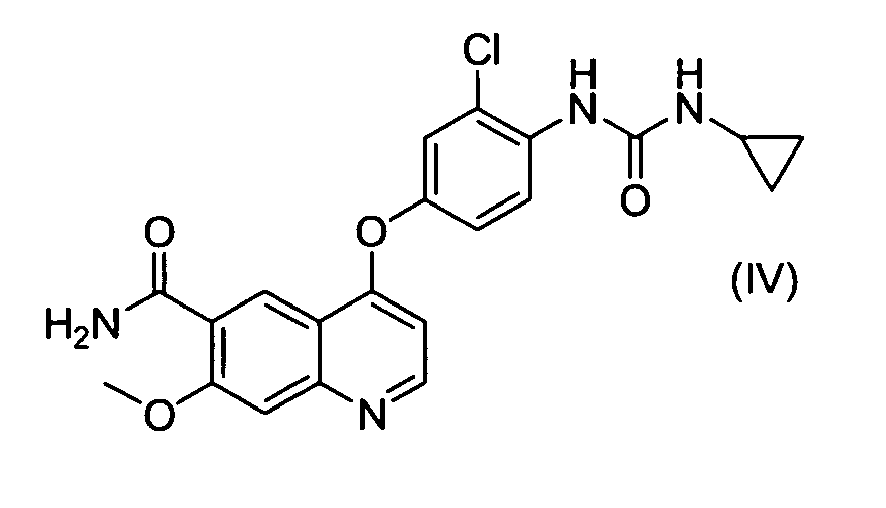
- Those compounds represented by general formula (II) may be prepared by known methods. For example, those compounds may be prepared by the method described in
WO 02/32872 WO 2005/063713 - In the present invention, preferably, the VEGF receptor kinase inhibitor is a compound represented by the following general formula (III):

- (i) R11
- R11 is as defined above.
- As preferable examples of R11, 3- to 10-membered non-aromatic heterocyclic groups which may have a substituent(s) or mono-C1-6 alkylamino groups which may have a substituent(s) may be given.
- As a more preferable example of R11, any one group selected from the groups represented by the following formulas may be given:


- Hydroxyl group, C1-6 alkyl group, C3-8 cycloalkyl group and groups represented by the formulas:


- As a still more preferable example of R11, any one group selected from the groups represented by the following formulas may be given:

- (ii) R12
R12 is as defined above.
As a preferable example of R12, a hydrogen atom may be given. - (iii) Va13
Va13 is as defined above.
As a preferable example of Va13, an oxygen atom may be given. - (iv) A11
A11 is as defined above.
As a preferable example of A11, a carbon atom may be given. - (v) R4
R4 is as defined above.
As a preferable example of R4, a hydrogen atom may be given. - (vi) R5
R5 is as defined above.
As a preferable example of R5, a C1-6 alkyl group or a C3-8 cycloalkyl group may be given.
As a more preferable of R5, a methyl group may be given. - (vii) R9
R9 is as defined above.
As a preferable example of R9, a hydrogen atom may be given. - Preferable examples of the compounds represented by general formula (III) include the following compounds.
- 5-(2-(((4-hydroxy-4-methylpiperidine-1-yl)carbonyl)amino)pyridine-4-yloxy)-1H-indole-1-carboxylic acid methylamide,
- N1-methyl-5-(2-((4-hydroxypiperidino)carbonyl)amino-4-pyridyl)oxy-1H-1-indolecarboxamide,
- N1-methyl-5-(2-(((4-pyrrolizine-1-yl)piperidine-1-yl)carbonyl)amino)pyridine-4-yloxy)-1H-1-indolecarboxamide,
- N1-methyl-5-(2-(((4-piperidine-1-yl)piperidine-1-yl)carbonyl)amino)pyridine-4-yloxy)-1H-1-indolecarboxamide, and
- N4-(4-(1-(methylamino)carbonyl-1H-5-indolyl)oxy-2-pyridyl)-4-morpho linecarboxamide.
- The compounds represented by general formula (III) may be prepared by known methods, e.g., the method described in
WO 2004/020434 - In the present invention, examples of the VEGF receptor kinase inhibitor include, but are not limited to, the following compounds.
- (1) N-(4-brcmo-2-fluorophenyl)-6-methoxy-7-[2-(1H-1,2,3-tiazole-1-yl)-ethoxy]quinazoline-4-amine (hereinafter, sometimes referred to as "ZD4190". Cancer Research., 60, 970-975, 2000, Journal of Medicinal Chemistry., 42: 5369-5389, 1999.) (See formula (V) below):

- (2) N-(4-bromo-2-fluorophenyl)-6-methoxy-7-[(1-methylpiperidine-4-yl)-methoxy]quinazoline-4-amine (hereinafter, sometimes referred to as "ZD6474" or "vandetanib". Proc. Am. Assoc. Cancer Research., 42, 583, 2001, Journal of Medicinal Chemistry., 45: 1300-1312, 2002.) (See formula (VI) below):

- (3) 3-[(2,4-dimethylpyrrol-5-yl)methylene]-2-indolinone (hereinafter, sometimes referred to as "SU5416" or "semaxanib". Cancer Research, 59, 99-106, 1999, Journal of Medicinal Chemistry., 41: 2588-2603, 1998;
US Patent 5792783 .) (See formula (VII) below):
- (4) (Z)-3-[(2,4-dimethyl-5-(2-oxo-1,2-dihydroindole-3-ylidenemethyl)-1H-pyrole-3-yl)-propionic acid (hereinafter, sometimes referred to as "SU6668". Cancer Research, 60, 4152-4160, 2000, Journal of Medicinal Chemistry., 42: 5120-5130, 1999.) (See formula (VIII) below):

- (5) 5-(5-fluoro-2-oxo-1,2-dihydroindole-3-ylidenemethyl)-2,4-dimethyl-1H-pyrrole-3-carboxylic acid (2-diethylaminoethyl)amide (hereinafter, sometimes referred to as "SU11248". Clinical Cancer Research, 9, 327-337, 2003, Journal of Medicinal Chemistry., 46: 1116-9, 2003.) (See formula (IX) below):

- (6) N,N-dimethylglycine-3-{5,6,7,13-tetrahydro-9-[(1-methylethoxy)methyl]-5-oxo-12H-indeno(2,1-a)pyrrolo(3,4-c)carbazole-12-yl}propylester (hereinafter, sometimes referred to as "CEP-7055". Pro. Am Assoc. Cancer Research, 43, 1080, 2002, Journal of Medicinal Chemistry., 46: 5375-88, 2003.) (See formula (X) below):
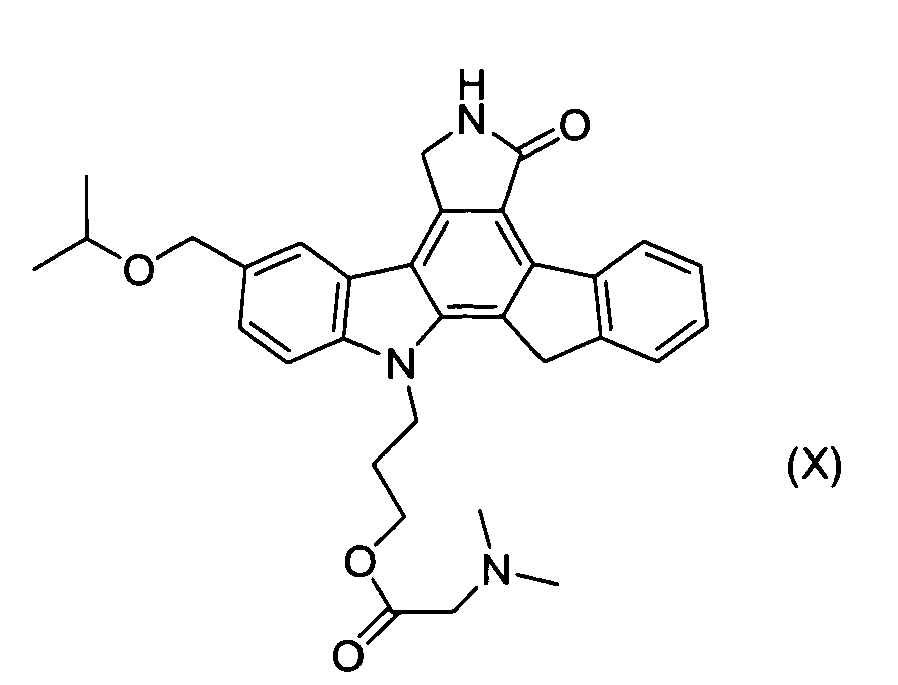
- (7) 3-(4-bromo-2,6-difluoro-benzyloxy)-5-[3-(4-pyrrolizine-1-yl-butyl)-ureido]-isothiazole-4-carboxylic acid amide (hereinafter, sometimes referred to as "CP-547,632". Cancer Research. 63:7301-9, 2003,
WO 99/62890 
- (8) N-{2-chloro-4-[(6,7-dimethoxy 4-quinazolinyl)oxy]phenyl}-N'-propylurea (hereinafter, sometimes referred to as "KRN633". Molecular Cancer Therapeutics., 3:1639-49,2004.,
WO 00/43366 
- (9) 1-(4-chloroanilino)-4-(4-pyridylmethyl)phthalazine (hereinafter, sometimes referred to as "PTK787/ZK222584" or "vatalanib". Cancer Research, 60, 2179-2189, 2000, J. Med. Chem., 43:2310-23, 2000;
WO 98/35958 
- (10) N-{2-chloro-4-[(6,7-dimethoxy-4-quinolyl)oxy]phenyl}-N'-[5-methyl-3-isoxazolyl]urea (hereinafter, sometimes referred to as "KRN951";
WO 2002/088110 
- (11) 4-[(4-fluoro-2-methylindole-5-yl)oxy]-6-methoxy-7-[3-(pyrrolizine-1-yl)-propoxy]quinazoline (hereinafter, sometimes referred to as "AZD2171". Cancer Research. 65:4389-400, 2005;
WO 00/47212 
- (12) 6-[2-(methylcarbamoyl)phenylsulphanyl]-3-E-[2-(pyridine-2-yl)-ethenyl]indazole (hereinafter, sometimes referred to as "AG013736". American Journal of Pathology. 165:35-52, 2004;
WO 01/002369 
- (13) 5-((Z)-(5-fluoro-2-oxo-1,2-dihydro-3H-indole-3-ylidene)methyl)-N-((2S)-2-hydroxy-3-morpholine-4-ylpropyl)-2,4-dimethyl-1H-pyrrole-3-carboxamide (hereinafter, sometimes referred to as "SU14813". Proceedings of the American Association for Cancer Research, 46, (Abstract 2031), 2005.) (See formula (XVII) below):

- (14) 3-((quinoline-4-ylmethyl)amino)-N-(4-(trifluoromethoxy)phenyl)thiophene-2-carboxamide (hereinafter, sometimes referred to as "OSI930". Molecular Cancer Therapeutics., 4:1186-1197, 2005.) (See formula (XVIII) below):

- (15) 6-(2,6-dichlorophenyl)-8-methyl-2-phenylamino-8H-pyrido[2,3-d]-pyrimidine-7-one (hereinafter, sometimes referred to as "TKI-28". Cancer Biol Ther., 4, 2005.) (See formula (XIX) below):

- (16) 2-((1,6-dihydro-6-oxo-pyridine-3-ylmethyl)amino)-N-(3-(trifluoromethyl)-phenyl)-3-pyridine-carboxamide (hereinafter, sometimes referred to as "ABP309". EORTC-NCI-AACR Symp Mol Targets Cancer Ther., 2, (Abstract 172), 2004.) (See formula (XX) below):
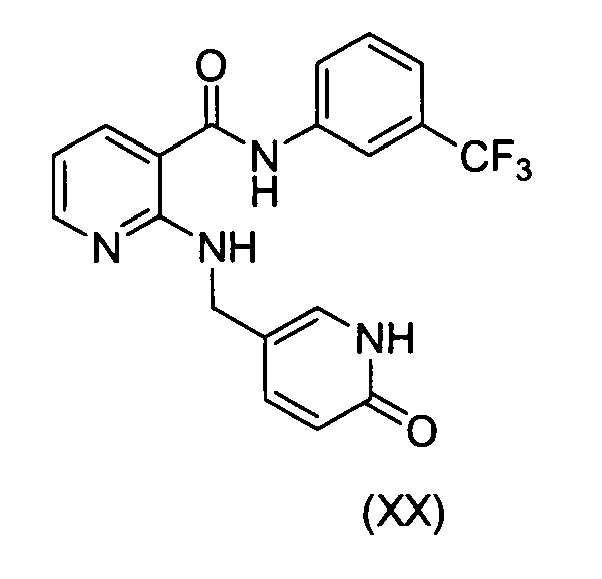
- (17) 4-(4-(4-chloro-phenylamino)-furo[2,3-d]pyridazine-7-yloxymethyl)-pyridine-2-carboxylic acid methylamide (hereinafter, sometimes referred to as "BAY 57-9352".
WO 01/23375 
- (18) N-(3-trifluoromethyl-4-chlorophenyl)-N'-(4-(2-methylcarbamoylpyridine-4-yl)oxyphenyl)urea (hereinafter, sometimes referred to as "BAY 43-9006" or "sorafenib". Cancer Research., 64, 7099-7109, 2004, Organic Process Res Dev., 6, 777-81, 2002.) (See formulas(XXII) below):

- (19) 4-amino-5-fluoro-3-(6-(4-methyl-piperazine-1-yl)-1H-benzimidazole-2-yl)-1H-quinoline-2-one (hereinafter, sometimes referred to as "CHIR258". Clinical Cancer Research., 11, 3633-3641, 2005.) (See formula (XXIII) below):

- (20) 4-(4-(1-ambo-1-methyl-ethyl)-phenyl)-2-(4-(2-morpholine-4-yl-ethyl)-phenylamino)-pyrimidine-5-carbonitrile (hereinafter, sometimes referred to as "JNJ17029259". Molecular Pharmacology., 66, 635-647, 2004.) (See formula (XXIV) below):

- (21) [6-[4-[(4-ethylpiperazine-1-yl)methyl]phenyl]-7H-pyrrolo[2,3-d]pyrimidine-4-yl]-((R)-1-phenylethyl)amine (hereinafter, sometimes referred to as "AEE-788". Cancer Research., 64, 4931-4941, 2004; Cancer Research., 64, 7977-7984, 2004.) (See formula (XXV) below):

- (22) 9-(1-methylethoxy)methyl-12-(3-hydroxypropyl)-6H,7H,13H-indeno[2,1-a]-pyrrole[3,4-c]carbazole-5-one (hereinafter, sometimes referred to as "CEP-5214". Journal of Medicinal Chemistry., 46, 5375-5388, 2003; Cancer Research, 63, 5978-5991, 2003.) (See formula (XXVI) below):

- (23) N-(2,4-difluorophenyl)-N'-{4-[(6,7-dimethoxy-4-quinolyl)-oxy]-2-fluorophenyl}urea (hereinafter, sometimes referred to as "KI-8751". Journal of Medicinal Chemistry., 48, 1359-1366, 2005.) (See formula (XXVII) below):

- (24) N-[4-(3-amino-1H-indazole-4-yl)phenyl]-N'-(2-fluoro-5-methylphenyl)urea (hereinafter, sometimes referred to as "ABT-869". Proceedings of the American Association for Cancer Research., 46, 1407, (Abstract 5981), 2005.) (See formula (XXIX) below):

- (25) 2-methyl-6-[2-(1-methyl-1H-imidazole-2-yl)-thieno[3,2-b]pyridine-7-yloxy]-benzo[b]thiophene-3-carboxylic acid methylamide (hereinafter, sometimes referred to as "AG-028262".
WO 03/06462 US Patent 2004/009965 ) (See formula (XXX) below):
- (26) (R)-1-(4-(4-fluoro-2-methyl-1H-indole-5-yloxy)-5-methylpyrrolo[1,2-f]-[1,2,4]triazine-6-yloxy)propane-2-ol (hereinafter, sometimes referred to as "BMS-540215". Proceedings of the American Association for Cancer Research., 46, (Abstract 3033), 2005.) (See formula (XXXI) below):
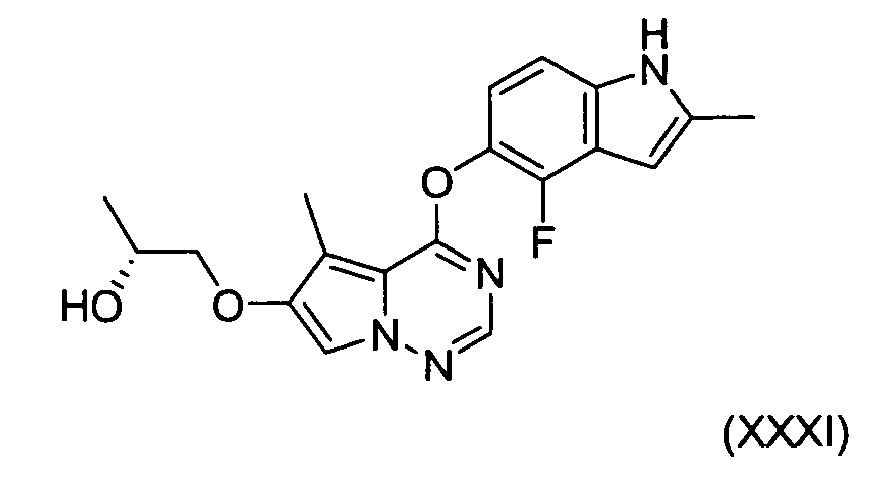
- (27) (S)-((R)-1-(4-(4-fluoro-2-methyl-1H-indole-5-yloxy)-5-methylpyrrolo[1,2-f][1,2,4]triazine-6-yloxy)propane-2-ol)2-aminopropanoate (hereinafter, sometimes referred to as "BMS-582664". Proceedings of the American Association for Cancer Research., 46, (Abstract 3033), 2005.) (See formulas(XXXII) below):

- (28) 3-[(4-morpholine-4-yl-phenylamino)-methylene]-1,3-dihydroindole-2-one (hereinafter, sometimes referred to as "AGN-199659".
WO 2003/027102 
- (29) 5-[[4-(2,3-dimethyl-2H-indazole-6-yl)methylamino]pyrimidine-2-yl]amino]-2-methylbenzenesulfonamide (hereinafter, sometimes referred to as "pazopanib" or "GW-786034". Proc. Am Soc. Clin. Oncology, (Abstract 3054), 2004.) (See formula (XXXIV) below):

- (30) (3Z)-3-[6-(2-morpholine-4-ylethoxy)quinoline-2(1H)-ylidene]-1,3-dihydro-2H-indole-2-one (hereinafter, sometimes referred to as "YM-231146". Biological and Pharmaceutical Bulletin. 28:2096-2101, 2005.) (See formula (XXXV) below):

- (31) 2-((2-((4-(4-(4-(tert-butyl)anilino)phenoxy)-6-methoxy-7-quinolyl)oxy)ethyl)amino)-1-ethanol (hereinafter, sometimes referred to as "KI-23057".
WO 2003/033472 
- The above-described ZD4190, ZD6474, SU5416, SU6668, SU11248, CEP-7055, CP-547,632, KRN633, PTK787/ZK222584, KRN951, AZD2171, AG013736, SU14813, OSI930, TKI-28, ABP309, BAY 57-9352, BAY 43-9006, CHIR258, JNJ17029259, AEE-788, CEP-5214, KI-8751, ABT-869, AG-028262, BMS-540215, BMS-582664, AGN-199659, pazopanib, YM-231146 and KI-23057 may be prepared by known methods. For example, they may be prepared by the methods described in respective references.
- In the present invention, other examples of the VEGF receptor kinase inhibitor include BIBF1120 (
WO 01/27081 - In the present invention, as one example of the VEGF inhibitor, anti-VEGF receptor antibody may be given. Anti-VEGF receptor antibody is an antibody which has affinity for VEGF receptor or a partial fragment thereof Preferably, this anti-VEGF receptor antibody is a neutralizing antibody that recognizes and binds to VEGF receptor and thereby inhibits the activity of VEGF (such as vascular endothelial cell growth activity). Anti-VEGF receptor antibody may be prepared in the same manner as described later for the preparation of anti-VEGF antibody. Anti-VEGF receptor antibody may be either a polyclonal antibody or a monoclonal antibody. The isotype of the anti-VEGF receptor antibody is not particularly limited. Further, the anti-VEGF receptor antibody may be a fragment of an antibody or a single-chain antibody (see the description of anti-VEGF antibody provided later).
- Preferable examples of the anti-VEGF receptor antibody include, but are not limited to, 2C3 antibody (
US Patent 6524583 ,US Patent 6676941 ), IMC-1121b (US Patent 6811779 ), IMC-18F1 (Proceedings of the American Association for Cancer Research, 45, 694, (Abstract 3005), 2004), IMC-1C11 (US Patent 5747651 ) and IMC-2C6 (Proceedings of the American Association for Cancer Research, 44, 1479, (Abstract 6454), 2003). 2C3 antibody, IMC-1121b, IMC-18F1, IMC-1C11 and IMC-2C6 may be prepared by known methods. For example, they may be prepared by the methods described in respective references. - In the present invention, examples of the VEGF inhibitor include PI88, AVE-0005 (Proc. Am. Soc. Clin. Oncology, (Abstract 776), 2003), EG-3306 (Biochem Biophys Res Commun., 302, 793-799, 2003), RPI-4610 (Angiozyme™,
US Patent 5180818 ,US Patent 6346398 ), 2-(8-hydroxy-6-methoxy-1-oxo-1H-benzopyran-3-yl)propionic acid (hereinafter, sometimes referred to as "NM-3";WO 97/48693 
- In the present invention, examples of the FGF receptor kinase inhibitor include, but are not limited to, the following compounds.
- (1) 1-[2-amino-6-(3,5-dimethoxyphenyl)-pyrido(2,3-d)pyrimidine-7-yl]-3-tert-butylurea (hereinafter, sometimes referred to as "PD166866"; Journal of Medicinal Chemistry., 40, 2296-2303, 1997) (See formula (XXXVII) below):

- (2) 1-tert-butyl-3-[2-(4-diethylamino)butylamino-6-(3,5-dimethoxyphenyl)-pyrido(2,3-d)pyrimidine-7-yl]urea (hereinafter, sometimes referred to as "PD173074"; EMBO J., 17,5896-5904, 1998;
US Patent 5733913 ) (See formula (XXXVIII) below):
- (3) (S)-((R)-1-(4-(4-fluoro-2-methyl-1H-indole-5-yloxy)-5-methylpyrroto[1,2-f]-[1,2,4]triazine-6-yloxy)propane-2-ol)2-aminopropanoate (BMS-582664) (See formula (XXXII))
- (4) 4-[4-[N-(4-nitrophenyl)carbamoyl]-1-piperazinyl]-6,7-dimethoxyquinazoline (hereinafter, sometimes referred to as "CT-052923";
WO 98/14437 
- (5) 4-amino-5-fluorc-3-(6-(4-methyl-piperazine-1-yl)-1H-benzimidazole-2-yl)-1H-quinoline-2-one (CHIR258) (See formula (XXIII))
- (6) 2-((2-((4-(4-(4-(tert-butyl)anilino)phenoxy)-6-methoxy-7-quinolyl)oxy)ethyl)-amino)-1-ethanol (KI-23057) (See formula (XXXVI))
- (7) (Z)-3-[(2,4-dimethyl-5-(2-oxo-1,2-dilxydroindole-3-ylidenemethyl)-1H-pyrrole-3-yl)-propionic acid (SU6668) (See formula (VIII))
- PD166866, PD173074, BMS-582664, CT-052923, CHIR258, KI-23057 and SU6668 may be prepared by known methods. For example, they may be prepared by the methods described in respective references.
- In the present invention, as one example of the FGF inhibitor, anti-FGF receptor antibody may be given. Anti-FGF receptor antibody is an antibody which has affinity for FGF receptor or a partial fragment thereof. Preferably, this anti-FGF receptor antibody is a neutralizing antibody that recognizes and binds to FGF receptor and thereby inhibits the activity of FGF (such as vascular endothelial cell growth activity). Anti-FGF receptor antibody may be prepared in the same manner as described later for the preparation of anti-VEGF antibody. Anti-FGF receptor antibody may be either a polyclonal antibody or a monoclonal antibody. The isotype of the anti-FGF receptor antibody is not particularly limited. Further, the anti-FGF receptor antibody may be a fragment of an antibody or a single-chain antibody (see the description of anti-VEGF antibody provided later).
- In the present invention, as one example of the PDGF inhibitor, PDGF receptor kinase inhibitor may be given. Examples of the PDGF receptor kinase inhibitor include, but are not limited to, the following compounds.
- (1) 4-(4-methylpiperazine-1-ylmethyl)-N-[4-methyl-3-[4-(3-pyridyl)pyrimidine-2-ylamino]phenyl]benzeneamide (hereinafter, sometimes referred to as "imatinib") (See formula (XL) below):

- (2) 6-[2-(methylcarbamoyl)phenylsulphanyl]-3-E-[2-(pyridine-2-yl)ethenyl]-indazole (AG013736) (See formula (XVI))
- (3) 1-{2-[5-(2-methoxy-ethoxy)-benzoimidazole-1-yl]-quinoline-8-yl}-piperidine-4-ylamine (hereinafter, sometimes referred to as "CP-673451";
WO 2001/040217 
- (4) 4-[4-[N-(4-nitrophenyl)carbamoyl]-1-piperazinyl]-6,7-dimethoxyquinazoUne (CT-052923) (See formula (XXXIX))
- (5) 4-amino-5-fluoro-3-(6-(4-methyl-piperazine-1-yl)-1H-benzimidazole-2-yl)-1H-quinoline-2-one (CHIR258) (See formula (XXIII))
- (6) (4-tert-butylphenyl){4-[(6,7-dimethoxy4-quinolyl)oxy]phenyl}methaneone (hereinafter, sometimes referred to as "KI-6896"; Bioorganic and Medicinal Chemistry Letters., 7,2935-2940,1997.) (See formula (XLIII) below):

- (7) 5-methyl-N-[4-(trifluoromethyl)phenyl]-4-isoxazolecarboxamide (hereinafter, sometimes referred to as "leflunomide".) (See formula (XLIV) below):

- (8) trans-4-[(6,7-dimethoxyquinoxaline-2-yl)amino]cyclohexanol (hereinafter, sometimes referred to as "RPR-127963E".) (See formula (XLV) below):

- (9) (Z)-3-[(2,4-dimethyl-5-(2-oxo-1,2-dihydroindole-3-ylidenemethyl)-1H-pyrrole-3-yl)-propionic acid (SU6668) (See formula (VIII))
- (10) 5-(5-fluor-o-2-oxo-1,2-dihydroindole-3-ylidenemethyl)-2,4-dimethyl-1H-pyrrole-3-carboxylic acid (2-diethylaminoethyl)amide (SU11248) (See formula (IX))
- (11) 1-(4-chloroanilino)-4-(4-pyridylinethyl)phthalazine (PTK787/ZK222584) (See formula (XIII))
- (12) N-[4-(3-amino-1H-indazole-4-yl)phenyl-N'-(2-fluoro-5-methylphenyl)urea (ABT-869) (See formula (XXIX))
- Imatinib, AG013736, CP-673451, CT-052923, CHIR258, KI-6896, leflunomide, RPR-127963E, SU6668, SU11248, PTK787/ZK222584 and ABT-869 may be prepared by known methods. For example, they may be prepared by the methods described in respective references.
- Imatinib may be obtained by purchasing Glivec™ from Novartis.
- In the present invention, as one example of the PDGF inhibitor, anti-PDGF receptor antibody may be given. Anti-PDGF receptor antibody is an antibody which has affinity for PDGF receptor or a partial fragment thereof Preferably, this anti-PDGF receptor antibody is a neutralizing antibody that recognizes and binds to PDGF receptor and thereby inhibits the activity of PDGF (such as vascular endothelial cell growth activity). Anti-PDGF receptor antibody may be prepared in the same manner as described later for the preparation of anti-VEGF antibody. Anti-PDGF receptor antibody may be either a polyclonal antibody or a monoclonal antibody. The isotype of the anti-PDGF receptor antibody is not particularly limited. Further, the anti-PDGF receptor antibody may be a fragment of an antibody or a single-chain antibody (see the description of anti-VEGF antibody provided later).
- In the present invention, as one example of the EGF inhibitor, EGF receptor kinase inhibitor may be given. Specifically, examples of the EGF receptor kinase inhibitor include gefitinib and derivatives thereof Gefitinib refers to 4-(3-chloro-4-fluorophenylamino)-7-methoxy-6-(3-(4-morpholino)propoxy-quinazoline). The structural formula thereof is shown in formula (XLVI) below:

- As derivatives of gefitinib, the compounds disclosed in
WO 96/33980 - Gefitinib and derivatives thereof may be prepared by known methods. For example, they may be prepared by the method described in any one of
WO 96/33980 3040486 US Patent 5770599 . - Alternatively, gefitinib may be obtained by purchasing Iressa™ from Astrazeneca.
- In the present invention, further examples of the EGF receptor kinase inhibitor include erlotinib and derivatives thereof Erlotinib refers to 4-(3-ethynylphenylamino)-6,7-bis(2-methoxyethoxy)-quinazoline. The structural formula thereof is shown in formula (XLVII) below:

- As derivatives of erlotinib, the compounds disclosed in
WO 96/30347 - Erlotinib and derivatives thereof may be prepared by known methods. For example, they may be prepared by the method described in any one of
WO 96/30347 3088018 3420549 - Alternatively, erlotinib may be obtained by purchasing Tarceva™ from Genentech.
- In the present invention, other examples of the EGF receptor kinase inhibitor include the following compounds.
- (1) N-[3-chloro-4-[(3-fluorobenzyl)oxy]phenyl]-6-[5-[[[2-(methylsulfonyl)ethyl]-amino]methyl]furan-2-yl]quinazolin-4-amine (hereinafter, sometimes referred to as "lapatinib";
WO 99/35146 
- (2) N-[4-[N-(3-chloro-4-fluorophenyl)amino]-7-[3-(4-morpholinyl)propoxy]-quinazolin-6-yl]acrylamide (hereinafter, sometimes referred to as "canertinib"; Clinical Cancer Research., 10:691-700, 2004;
WO 2000/31048 
- (3) (2E)-N-[4-[(3-chloro-4-fluorophenyl)amino]-3-cyano-7-ethoxy-6-quinolinyl]-4-(dimethylamino)-2-butenamide (hereinafter, sometimes referred to as "pelitinib";
WO 2003/50090 
- (4) [6-[4-[(4-ethylpiperazine-1-yl)methyl]phenyl]-7H-pyrrolo[2,3-d]pyrimidine-4-yl]-((R)-1-phenylethyl)amine (AEE-788) (See formula (XXV))
- (5) (E)-N-{4-[3-chloro-4-(2-pyridinylmethoxy)anilino]-3-cyano-7-ethoxy-6-quinolinyl}-4-(dimethylamino)-2-butenamide (hereinafter, sometimes referred to as "HKI-272"; Cancer Research., 64, 3958-3965, 2004; Journal of Medicinal Chemistry., 48, 1107-1131, 2005.) (See formula (LI) below):

- In the present invention, the EGF receptor kinase inhibitor is preferably 4-(3-ethynylphenylamino)-6,7-bis(2-methoxyethoxy)-quinazoline (erlotinib: formula (XLVII) above).
- Lapatinib, canertinib, pelitinib, AEE-788 and HKI-272 may be prepared by known methods. For example, they may be prepared the methods described in respective references.
- Further, in the present invention, examples of the EGF receptor kinase inhibitor also include ARRY-334543 (Am Assoc. Cancer Research, A3399, 2005) and MP-412 (Am Assoc. Cancer Research, A3394, 2005; Am. Assoc. Cancer Research, A3405, 2005). ARRY-334543 and MP-412 may be prepared by known methods.
- In the present invention, as one example of the EGF inhibitor, anti-EGF receptor antibody may be given. Anti-EGF receptor antibody is an antibody which has affinity for EGF receptor or a partial fragment thereof Preferably, this anti-EGF receptor antibody is a neutralizing antibody that recognizes and binds to EGF receptor and thereby inhibits the activity of EGF (such as vascular endothelial cell growth activity). Anti-EGF receptor antibody may be prepared in the same manner as described later for the preparation of anti-VEGF antibody. Anti-EGF receptor antibody may be either a polyclonal antibody or a monoclonal antibody. The isotype of the anti-EGF receptor antibody is not particularly limited. Further, the anti-EGF receptor antibody may be a fragment of an antibody or a single-chain antibody (see the description of anti-VEGF antibody provided later).
- In the present invention, a preferable example of the anti-EGF receptor antibody is cetuximab.
- Cetuximab may be prepared by the method described in Japanese Unexamined Patent Publication No.
2002-114710 No. Hei 2-291295 - Alternatively, cetuximab may be obtained by purchasing Erbitux™ from Merck.
- In the present invention, as another example of the anti-EGF receptor antibody, nimotuzumab may be given. Nimotuzumab may be prepared by the method described in European Patent
203126 US Patent 5891996 . - In the present invention, examples of the anti-EGF receptor antibody further include panitumumab (CAS 339177-26-3; Clinical Colorectal Cancer. 2005; 5(1):21-3), matuzumab (CAS 339186-68-4; Curr Opin Mol Ther. 2004; 6(1):96-103), IMC-11F8 (Am. Assoc. Cancer Research, A5353, 2005) and MDX-447 (ASCO 18: 433, 1999).
- In the present invention, the angiogenesis inhibitor may form a pharmacologically acceptable salt with acid or base. The above-described angiogenesis inhibitor in the present invention includes such pharmacologically acceptable salts. Examples of salts formed with acid include, but are not limited to, inorganic acid salts such as hydrochlorides, hydrobromates, sulfates and phosphates; and organic acid salts such as formates, acetates, lactates, succinates, fumarates, maleates, citrates, tartrates, stearates, benzoates, methanesulfonates, benzenesulfonates, p-toluenesulfonates and trifluoroacetates. Examples of salts formed with base include, but are not limited to, alkali metal salts such as sodium salts and potassium salts; alkaline earth metal salts such as calcium salts and magnesium salts; organic base salts such as trimethylamine salts, triethylamine salts, pyridine salts, picoline salts, dicyclohexylamine salts, N',N'-dibenzylethylenediamine salts, arginine salts and lysine salts; and ammonium salts.
- Further, in the present invention, the angiogenesis inhibitor includes the solvates of these compounds and, when these compounds have optical isomers, the solvates thereof and the optical isomers. Examples of the solvate include, but are not limited to, hydrates and non-hydrates. Hydrates are preferable. Examples of solvents include, but are not limited to, water, alcohols (such as methanol, ethanol, n-propanol) and dimethylformamide.
- Further, in the present invention, the angiogenesis inhibitor may be in the form of crystal or non-crystal. When there is crystalline polymorphism, the angiogenesis inhibitor may be a single product of any one of the crystal forms or a mixture of such forms.
- In the present invention, the angiogenesis inhibitor also includes those angiogenesis inhibitors which undergo metabolism (such as oxidation, reduction, hydrolysis or conjugation) in the body. Further, in the present invention, the angiogenesis inhibitor also includes those compounds which produce angiogenesis inhibitor in the body as a result of metabolism (such as oxidation, reduction of hydrolysis).
- In the present invention, anti-VEGF antibody is an antibody which has affinity for VEGF or a partial fragment thereof. Preferably, this anti-VEGF antibody is a neutralizing antibody that recognizes and binds to VEGF and thereby inhibits the vascular endothelial cell growth activity of VEGF. In the present invention, anti-VEGF antibody may be, for example, a polyclonal antibody, monoclonal antibody, chimeric antibody, single-chain antibody (scFV) (Huston et aL (1988) Proc. Natl. Acad. Sci. USA 85: 5879-83; The Pharmacology of Monoclonal Antibody, vol. 113, Rosenburg and Moore ed., Springer Verlag (1994) pp. 269-315), humanized antibody, multispecific antibody (LeDoussal et al. (1992) Int. J. Cancer Suppl. 7: 58-62; Paulus (1985) Behring Inst. Mitt. 78: 118-32; Millstein and Cuello (1983) Nature 305: 537-9; Zimmermann (1986) Rev. Physiol. Biochem. Pharmacol. 105: 176-260; Van Dijk et al. (1989) Int. J. Cancer 43: 944-9), human antibody or an antibody fragment such as Fab, Fab', F(ab')2, Fc or Fv. Preferably, a monoclonal antibody is used. Further, the anti-VEGF antibody may be modified with polyethylene glycol (PEG) or the like, if necessary. Further, the anti-VEGF antibody may be prepared as a fusion protein with β-galactosidase, MBP, GST, GFP or the like. Thus, it is possible to detect the anti-VEGF antibody without using a secondary antibody in methods such as ELISA. Alternatively, the anti-VEGF antibody may be labeled and modified with a substance such as biotin so that the antibody can be recovered with avidin, streptavidin, or the like.
- The anti-VEGF antibody may be prepared by conventional methods using VEGF, a partial fragment thereof or a cell expressing one of them as a sensitizing antigen (Current Protocols in Molecular Biology, John Wiley & Sons (1987), Section 11.4-11.13). VEGF or a partial fragment thereof may be a fusion protein with Fc region, GST, MBP, GFP, AP or the like.
- Polyclonal antibodies and monoclonal antibodies may be prepared by methods well known to those skilled in the art (Antibodies: A Laboratory Manual, E. Harlow and D. Lane, ed., Cold Spring Harbor Laboratory, Cold Spring Harbor, NY, 1988).
- Briefly, polyclonal antibodies may be obtained, for example, by administering an antigen to a mammal such as mouse, rabbit, rat, etc., collecting blood from the mammal, isolating antibodies from the collected blood and purifying the antibodies. Methods of immunization are known to those skilled in the art. For example, immunization may be performed by administering an antigen once or more. The antigen (VEGF or a partial fragment thereof) may be dissolved in an appropriate buffer containing a conventionally used adjuvant (such as complete Freund's adjuvant or aluminium hydroxide). However, sometimes, no adjuvant is used depending on the administration routes or other conditions.
- One or two months after the final immunization, blood is collected from the mammal and subjected to conventional methods such as centrifugation, precipitation with ammonium sulfate or polyethylene glycol, various chromatographies or the like for separation and purification. As a result, polyclonal antibodies are obtained as polyclonal antisera.
- As a method for producing monoclonal antibodies, the hybridoma method may be given. First, a mammal is immunized in the same manner as in the production of polyclonal antibodies. After an appropriate number of days from the immunization, it is preferable to collect some blood and to measure the antibody titer by known methods such as ELISA.
- Subsequently, the spleen is removed from the immunized animal after sensitization to obtain B cells. The B cells are fused to myeloma cells according to conventional procedures to thereby prepare antibody-producing hybridomas. The myeloma cell used for this purpose is not particularly limited, and known myeloma cells may be used. As a cell fusion method, any of known methods in the art (such as the Sendai virus method, polyethylene glycol method or protoplast method) may be used. The resultant hybridomas may be cultured in HAT medium (medium containing hypoxanthine, aminopterin and thymidine) for an appropriate period according to conventional methods to thereby select appropriate hybridomas. Subsequently, screening for hybridomas producing the antibody of interest is performed. Then, the resultant hybridoma can be cloned.
- As a screening method, a known method for antibody detection (such as ELISA or radioimmunoassay) may be used. As a cloning method, a method known in the art (such as the limiting dilution method or FACS method) may be used. The resultant hybridoma may be cultured in an appropriate culture broth or administered to, for example, mouse which is compatible with the hybridoma intraperitoneally. From the thus obtained culture broth or abdominal dropsy, the monoclonal antibody of interest may be isolated and purified by such methods as salting out, ion exchange chromatography, gel filtration, affinity chromatography or the like.
- In the present invention, as a preferable example of the anti-VEGF antibody, bevacizumab may be given. Bevacizumab is a human anti-VEGF monoclonal antibody and is sold by Genentech as Avastin™.
- Bevacizumab may be obtained by purchasing Avastin™ from Genentech.
- In the present invention, anti-FGF antibody is an antibody which has affinity for FGF or a partial fragment thereof Preferably, the anti-FGF antibody is a neutralizing antibody which recognizes and binds to FGF and thereby inhibits the vascular endothelial cell growth activity of FGF. The anti-FGF antibody may be prepared in the same manner as described above for the preparation of anti-VEGF antibody.
- In the present invention, anti-PDGF antibody is an antibody which has affinity for PDGF or a partial fragment thereof Preferably, the anti-PDGF antibody is a neutralizing antibody which recognizes and binds to PDGF and thereby inhibits the vascular endothelial cell growth activity of PDGF. The anti-PDGF antibody may be prepared in the same manner as described above for the preparation of VEGF antibody.
- In the present invention, anti-EGF antibody is an antibody which has affinity for EGF or a partial fragment thereof Preferably, the anti-EGF antibody is a neutralizing antibody which recognizes and binds to EGF and thereby inhibits the vascular endothelial cell growth activity of EGF. The anti-EGF antibody may be prepared in the same manner as described above for the preparation of VEGF antibody.
- The present invention provides a kit for use in the method of predicting the antitumor effect of angiogenesis inhibitors, comprising at least one antibody selected from the group consisting of anti-TGF-α antibody, anti-HB-EGF antibody, anti-EGF antibody, anti-epiregulin antibody, anti-EGF receptor antibody, anti-phosphorylated EGF receptor antibody and anti-phosphorylation antibody. Preferably, the antibody is anti-EGF receptor antibody or anti- phosphorylated EGF receptor antibody The antibody may be prepared in the same manner as described above for the preparation of VEGF antibody. The antibody contained in the kit may be used for measuring the EGF dependency of a tumor cell for its proliferation and/or survival. The kit of the present invention may also comprise other components conventionally used in common measurement, in addition to the above antibody.
- Further, the present invention provides a kit for use in the method of predicting the antitumor effect of angiogenesis inhibitors, comprising a polynucleotide complementary to at least a part of a transcript RNA from at least one gene selected from the group consisting of TGF-α gene, HB-EGF gene, EGF gene, epiregulin gene and EGF receptor gene. Preferably, the gene is EGF receptor gene. The polynucleotide which is a component of the kit of the present invention is a primer and/or a probe used, for example, in in situ hybridization, Northern blot analysis, DNA microarray, RT-PCR or the like. Such a polynucleotide may be designed using, for example, Primer Expression (Perkin-Elmer Applied Biosystems). A desired polynucleotide may be prepared by known methods. The polynucleotide contained in the kit may be used for measuring the EGF dependency of a tumor cell for its proliferation and/or survival. The kit of the present invention may also comprise other components conventionally used in common measurement, in addition to the above polynucleotide.
- The nucleotide sequences of the above-mentioned genes are registered in various databases. For example, nucleotide sequence information may be available with the following GenBank accession numbers.
- TGF-α gene: NM_003236
- HB-EGF gene: NM_001945
- EGF gene: NM_001963
- Epiregulin gene: NM_001432
- EGF receptor gene: NM_005228
- The expression "at least a part of... RNA" refers to a nucleotide sequence with at least 15 bases, preferably 15-50 bases, more preferably 20-35 bases, still more preferably 20-30 bases. Those skilled in the art could appropriately select the length of the sequence.
- The present invention relates to a pharmaceutical composition, a kit and a method for treating cancert, each of which is characterized by a combination of a VEGF receptor kinase inhibitor and an EGF inhibitor.
- In the present invention, the VEGF receptor kinase inhibitor is as described earlier in "3. Angiogenesis Inhibitors". Specific examples include those compounds represented by general formula (I). As a preferable example, 4-(3-chloro-4-(cyclopropylaminocarbonyl) aminophenoxy)-7-methoxy-6-quinolinecarboxamide may be given.
- In the present invention, the EGF inhibitor is not particularly limited as long as it has inhibitory activity against EGF. Examples of the EGF inhibitor include, but are not limited to, EGF receptor kinase inhibitor and anti-EGF receptor antibody. Preferably, gefitinib, erlotinib, lapatinib, canertinib, pelitinib, AEE-788, HKI-272, cetuximab, panitumumab, matuzumab, nimotuzumab, IMC-11F8 and MDX-447 may be enumerated. More preferably, gefitinib, erlotinib and cetuximab may be enumerated. Particularly preferable is erlotinib.
- In the present invention, the VEGF receptor kinase inhibitor and the EGF inhibitor encompass pharmacologically acceptable salts thereof and solvates of these inhibitors or the salts.
- In the present invention, the expression "comprising a combination of" means a combination for using compounds jointly. This expression includes both forms of administration: (A) separate substances are applied together at the time of administration and (B) a mixture of two substances is administered.
- The preparation contained in the kit of the present invention is not particularly limited in formulation as long as the preparation contains a VEGF receptor kinase inhibitor and/or an EGF inhibitor. The pharmaceutical composition and/or kit of the present invention is useful as a therapeutic pharmaceutical composition and/or kit for cancer treatment.
- The pharmaceutical composition and/or kit and the method of treating cancers according to the present invention may be further combined with one or more other antitumor agents. Other antitumor agents are not particularly limited as long as they are preparations with antitumor effect. Specific examples of other antitumor agents include, but are not limited to, irinotecan hydrochloride (CPT-11), oxaliplatin, 5-fluorouracil (5-FU), docetaxel (Taxotere™), gemcitabine hydrochloride (Gemzar™), calcium folinate (Leucovorin) and bevacizumab (Avastin™). When the cancer to be treated is large bowel cancer, preferable examples of the other antitumor agent are irinotecan hydrochloride, oxaliplatin, 5-fluorouracil, calcium folinate and bevacizumab; when the cancer to be treated is pancreatic cancer, preferable examples of the other antitumor agent are gemcitabine hydrochloride and bevacizumab; when the cancer to be treated is renal cancer, bevacizumab is particularly preferable as the other antitumor agent; and when the cancer to be treated is lung cancer, docetaxel is particularly preferable as the other antitumor agent.
- The pharmaceutical composition and/or kit of the present invention may be used as a therapeutic for cancers.
- In the present invention, the term "therapeutic for cancers" includes antitumor agents, cancer prognosis improving agents, cancer recurrence preventing agents, cancer metastasis inhibiting agents and the like.
- The effect of cancer treatment can be confirmed with X-ray photographs, observations on CT, histopathology of biopsy and levels of tumor markers.
- The pharmaceutical composition and/or kit of the present invention may be administered to a mammal (e.g., human, rat, rabbit, sheep, pig, cattle, cat, dog, monkey, etc.).
- The type of cancer to be treated with the therapeutic for cancers is not particularly limited. For example, brain tumor, neck cancer, esophageal cancer, tongue cancer, lung cancer, breast cancer, pancreatic cancer, gastric cancer, cancer of the intestine or duodenum, large bowel cancer (colon cancer, rectal cancer), bladder cancer, renal cancer, liver cancer, prostate cancer, uterine cancer, ovary cancer, thyroid cancer, gallbladder cancer, pharyngeal cancer, sarcoma (e.g., osteosarcoma, chondrosarcoma, Kaposi sarcoma, myosarcoma, angiosarcoma, fibrosarcoma or the like), leukemia (e.g., chronic myelogenous leukemia (CML), acute myelogenous leukemia (AML), chronic lymphocytic leukemia (CLL), acute lymphocytic leukemia (ALL), lymphoma, malignant lymphoma, multiple myeloma (MM) or the like), melanoma and so forth may be enumerated.
- When the pharmaceutical composition and/or kit of the present invention is used, the composition and/or kit may be administered orally or parenterally When the pharmaceutical composition and/or kit of the present invention is used, the dose of VEGF receptor kinase inhibitor varies depending on the degree of symptoms, the age, sexuality, body weight and sensitivity difference of the patient, method of administration, time of administration, interval of administration, the nature, prescription and type of pharmaceutical preparation, the type of active ingredient and so on, and is not particularly limited. Usually, the VEGF receptor kinase inhibitor may be administered at 0.1-1000 mg/day, preferably 0.5-100 mg/day, more preferably 1-30 mg/day, for adult (body weight: 60 kg). This amount may be administered once or divided into two or three administrations a day.
- When the pharmaceutical composition and/or kit of the present invention is used, the dose of EGF receptor kinase inhibitor is not particularly limited. Usually, the EGF receptor kinase inhibitor may be administered at 0.1-6000 mg/day, preferably 10-4000 mg/day, more preferably 50-2000 mg/day, for adult. This amount may be administered once or divided into two or three administrations a day.
- When the pharmaceutical composition and/or kit of the present invention is used, the dose of anti-EGF receptor antibody is not particularly limited. Usually, the anti-EGF receptor antibody may be administered at 1-6000 mg/day, preferably 10-2000 mg/day, more preferably 10-1000 mg/day This amount may be administered once in one to seven days.
- When the pharmaceutical composition and/or kit of the present invention is used, the dose of anti-EGF antibody is not particularly limited. Usually, the anti-EGF antibody may be administered at 1-6000 mg/day, preferably 10-2000 mg/day, more preferably 10-1000 mg/day This amount may be administered once in one to seven days.
- The amount of VEGF receptor kinase inhibitor to be used is not particularly limited. This amount varies depending on individual combinations with an EGF inhibitor. For example, the amount of VEGF receptor kinase inhibitor is about 0.01- to 100-fold of the amount of EGF inhibitor (in weight ratio). More preferably, the amount is about 0.1- to 10-fold (in weight ratio).
- The pharmaceutical composition of the present invention may be formulated into solid preparations for oral administration, injections or the like.
- Further, the VEGF receptor kinase inhibitor and the EGF inhibitor contained in the kit of the present invention may be independently formulated into a solid preparation for oral administration, injection or the like.
- When solid preparations for oral administration are prepared, excipients and, if necessary, binders, disintegrants, lubricants, coloring agents, flavoring/aromatic agents, etc. are added to a base component. Then, the resultant mixture may be made into tablets, coated tablets, granules, fine granules, powder, capsules and so on by conventional methods.
- Examples of excipients include lactose, corn starch, white sugar, glucose, sorbitol, crystalline cellulose and silicon dioxide; examples of binders include polyvinyl alcohol, ethylcellulose, methylcellulose, gum arabic, hydroxypropylcellulose and hydroxypropylmethylcellulose; examples of lubricants include magnesium stearate, talc and silica; examples of coloring agents include those agents which are allowed to be added to pharmaceuticals; examples of flavoring/aromatic agents include cocoa powder, peppermint crystal, aromatic acid, peppermint oil, borneol and cinnamon powder. Needless to say, these tablets and granules may be appropriately coated with a sugar coating, gelatin coating or the like.
- When injections are prepared, pH adjusting agents, buffers, dispersing agents dissolution aids, stabilizers, isotonizing agents, preservatives and so on are added to a base component, if necessary. Then, the resultant mixture may be made into intravenous injections, subcutaneous injections or intramuscular injections by conventional methods. If necessary, these injections may be made into freeze-dried products by conventional methods.
- Examples of dispersing agents include methylcellulose, Polysorbate 80, hydroxyethylcellulose, gum arabic, Tragacanth powder, sodium carboxymethylcellulose and polyoxyethylene sorbitan monolaurate.
- Examples of dissolution aids include polyoxyethylene hydrogenated castor oil, Polysorbate 80, nicotinamide, polyoxyethylene sorbitan monolaurate, macrogol and castor oil fatty acid ethyl ester.
- Examples of stabilizers include sodium sulfite and sodium metasulfite; and examples of preservatives include methyl paraoxybenzoate, ethyl paraoxybenzoate, sorbic acid, phenol, cresol and chlorocresol.
- In the kit of the present invention, a preparation comprising a VEGF receptor kinase inhibitor and a preparation comprising an EGF inhibitor may be in the form of a mixture. Alternatively, the two preparations may be packed separately in one wrapping container. When these two preparations are packed separately, the order of administration is not particularly limited. The two preparations may be administered simultaneously. Alternatively, one of them may be administered first.
- The pharmaceutical composition and/or kit of the present invention may comprise, in addition to the above-described VEGF receptor kinase inhibitor and EGF inhibitor, a wrapping container, a handling instruction, an accompanying document or the like. In the wrapping container, handling instruction, accompanying document or the like, combinations of substances for combined application may be described. Also, for each of the embodiments (A) separate substances are applied together at the time of administration and (B) the substances are administered as a mixture, usage and dose may be described. The usage and dose may be described in reference to the description provided above.
- In another embodiment, the kit of the present invention may comprise the following (a) and (b): (a) at least one selected from the group consisting of a wrapping container, a handling instruction and an accompanying document, each of which is stating that a VEGF receptor kinase inhibitor and an EGF inhibitor are to be used in combination, and (b) a pharmaceutical composition comprising a VEGF receptor kinase inhibitor. Such a kit is useful as a kit for treating cancers. The pharmaceutical composition comprising a VEGF receptor kinase inhibitor is useful as a pharmaceutical composition for treating cancers. In the wrapping container, the handling instruction or the accompanying document, combined application of compounds may be described. For each of the embodiments (A) separate substances are applied together at the time of administration and (B) the substances are administered as a mixture, usage and dose may be described. The usage and dose may be described in reference to the description provided above.
- Further, the present invention includes use of a VEGF receptor kinase inhibitor in preparing a pharmaceutical composition comprising a combination with an EGF inhibitor. In the use of the present invention, the pharmaceutical composition is useful as a pharmaceutical composition for treating cancers.
- Further, the present invention also includes a VEGF receptor kinase inhibitor for use in a pharmaceutical composition comprising a combination with an EGF inhibitor.
- Further, the present invention also includes a method of treating cancers, which is characterized by administering to a patient a VEGF receptor kinase inhibitor and an EGF inhibitor simultaneously or at different times. In the method of treating cancers of the present invention, the administration route and administration method for the VEGF receptor kinase inhibitor and EGF inhibitor are not particularly limited. For the administration route and administration method, the description provided for the pharmaceutical composition of the present invention may be consulted.
- Further, the present invention also includes a pharmaceutical composition comprising a VEGF receptor kinase inhibitor, characterized by being administered to a patient with a EGF inhibitor simultaneously or at a different time. In the pharmaceutical composition of the present invention, the administration route and administration method for the VEGF receptor kinase inhibitor and EGF inhibitor are not particularly limited. For the administration route and administration method, the description provided for the pharmaceutical composition of the present invention may be consulted.
- Hereinbelow, the present invention will be described more specifically with reference to the following Examples. However, the present invention is not limited to these
- Human tumor cell lines MDA-MB-231, MDA-MB-468, DU145, AsPC-1 (these four lines were purchased from ATCC), A549 (purchased from Dainippon Pharmaceutical Co., Ltd.), Lovo, SK-OV-3, H526, PC-3, DLD-1, HCT116 (these six lines were purchased from ATCC), SEKI, HMV-1 (these two lines were purchased from JCRB cell bank, National Institute of Biomedical Innovation), LOX (purchased from AntiCancer) and A375 (purchased from Dainippon Pharmaceutical Co., Ltd.) were cultured with RPMI1640 (containing 10% FBS) in a 5% CO2 gas incubator until they reached about 80% confluence. After culturing, cells from each line were recovered with trypsin-EDTA by conventional procedures. The cells were suspended in phosphate buffer to prepare a cell suspension of 1 x 10⁸ cells/ml or 5 x 10⁷ cells/ml. Subsequently, 0.1 ml of the cell suspension was subcutaneously transplanted on the flank of each nude mouse. After transplantation, when the tumor volume reached about 100-200 mm3, administration of 4-(3-chloro-4-(cyclopropylaminocarbonyl)aminophenoxy)-7-methoxy-6-quinolinecarboxamide (a methanesulfonate) (100 mg/kg; twice a day; one week; oral administration) was started. The 4-(3-chloro-4-(cyclopropylaminocarbonyl)aminophenoxy)-7-methoxy 6-quinolinecarboxamide (a methanesulfonate) was prepared based on the disclosure in
WO 02/32872 WO 2005/063713 


- In the above formulas, "
day 1" means the day when administration started and "day 8" means the 8th day from the start of the administration. - Depending on the intensity of the antitumor effect of 4-(3-chloro-4-(cyclopropylaminocarbonyl)aminophenoxy)-7-methoxy-6-quinolinecarboxamide, individual tumor cell lines were classified into high sensitivity lines, medium sensitivity lines and low sensitivity lines. Tumor cell lines which showed ΔT/C<-30% (MDA-MB-231, MDA-MB-468 and DU145) were classified as high sensitivity lines; tumor cell lines which showed -30%<ΔT/C<10% (AsPC-1, A549, Lovo and SK-OV-3) were classified as medium sensitivity lines; and tumor cell lines which showed 10%<ΔT/C (H526, PC-3, DLD-1, HCT116, SEKI, HMV-1, LOX andA375) were classified as low sensitivity lines.
- Human tumor cell lines MDA-MB-231, MDA-MB-468, DU145, AsPC-1 (these four lines were purchased from ATCC), A549 (purchased from Dainippon Pharmaceutical Co., Ltd.), Lovo, SK-OV-3, H526, PC-3, DLD-1, HCT116 (these six lines were purchased from ATCC), SEKI, HMV- 1 (these two lines were purchased from JCRB cell bank, National Institute of Biomedical Innovation), LOX (purchased from AntiCancer) and A375 (purchased from Dainippon Pharmaceutical Co., Ltd.) were cultured with RPMI1640 (containing 10% FBS) in a 5% CO2 gas incubator until they reached about 80% confluence. After culturing, cells from each line were recovered with trypsin-EDTA by conventional procedures. The 15 types of tumor cells (MDA-MB-231, MDA-MB-468, DU145, AsPC-1, A549, Lovo, SK-OV-3, H526, PC-3, DLD-1, HCT116, SEKI, HNlV-1, LOX and A375) were subcutaneously transplanted into nude mice at 3-10
x 106 cells/mouse. When the tumor volume expanded to about 100-200 mm3, each tumor was resected. Then, tumor cell lysates were prepared with a cell lysis solution containing various protease inhibitors (Leupeptin, p-APMSF, EDTA, o-NaV04) and 10% glycerol. - For each of the thus prepared tumor cell lysates, a specific amount of protein (20 µg or 8 µg) was fractionated by SDS-PAGE and transferred onto a nitrocellulose membrane (Hybond ECL; Amersham Bioscience). Then, Western blotting was performed by conventional methods using anti-EGF receptor antibody (Santa Cruz Biotechnology), anti-EGF receptor pY1068 antibody (anti-EGF receptor tyrosine phosphorylation antibody) (Cell Signaling) and anti-EGF receptor pY1148 antibody (anti-EGF receptor tyrosine phosphorylation antibody) (Cell Signaling).
- Then, the expression levels of EGF receptor and the degrees of phosphorylation thereof in individual cell lines were compared with the sensitivity to 4-(3-chloro-4-(cyclopropylaminocarbonyl)aminophenoxy)-7-methoxy-6-quinolinecarboxamide in those cell lines. As a result, a substantial amount of expression of EGF receptor and/or phosphorylation thereof was recognized in 6 lines out of the 7 high sensitivity and medium sensitivity tumor cell lines, whereas a substantial amount of expression of EGF receptor and/or phosphorylation thereof was recognized in only one line out of the 8 low sensitivity tumor cell lines (
Fig. 1 ). - Since it is believed that the expression level of EGF receptor and/or the degree of phosphorylation thereof in tumor cells indicates the EGF dependency of individual cell lines for their proliferation and/or survival, tumor cell lines with higher EGF dependency (i.e., cell lines which were classified into high sensitivity and medium sensitivity lines in Example 1) have been found to be more sensitive to 4-(3-chloro-4-(cyclopropylaminocarbonyl)aminophenoxy)-7-methoxy 6-quinolinecarboxamide.
- Therefore, it has become clear that the antitumor effect of an angiogenesis inhibitor can be predicted by evaluating the EGF dependency of a tumor cell of interest for its proliferation and/or survival and using the resultant EGF dependency as an indicator.
- Human non-small cell lung cancer cell line A549 (purchased from Dainippon Pharmaceutical Co., Ltd.) was cultured at 37°C with RPMI1640 (containing 10% FBS) in a 5% CO2 gas incubator until cells reached about 80% confluence. Then, cells were recovered with trypsin-EDTA. A cell suspension (5 x 10⁷ cells/ml) was prepared with phosphate buffer containing 50% matrigeL The resultant cell suspension was subcutaneously transplanted into the flank of nude (0.1 ml/mouse). From
day 10 of transplantation, 4-(3-chloro-4-(cyclopropylaminocarbonyl)aminophenoxy)-7-methoxy-6-quinolinecarboxamide (a methanesulfonate) and erlotinib were orally administered independently or in combination. With respect to 4-(3-chloro-4-(cyclopropylaminocarbonyl)aminophenoxy)-7-methoxy-6-quinolinecarboxamide (a methanesulfonate), it was administered at 3 mg/kg, 10 mg/kg or 30 mg/kg; once a day; for 4 weeks. With respect to erlotinib, it was administered at 50 mg/kg, once a day, for 4 weeks. The major axis and minor axis of tumor were measured with a Digimatic Caliper (Mitsutoyo). Then, tumor volume and relative tumor volume were calculated using the following formulas:

- As a result, by combining 4-(3-chloro-4-(cyclopropylaminocarbonyl)-aminophenoxy)-7-methoxy-6-quinolinecarboxamide (Compound A) with erlotinib (Compound B), an excellent antitumor effect was obtained, compared to their effects produced independently (see Tables 1 to 3 and
Figures 2 to 4 ). Further, the combined application of 4-(3-chloro-4-(cyclopropylaminocarbonyl)aminophenoxy)-7-methoxy 6-quinolinecarboxamide and erlotinib produced an excellent antitumor effect (such as tumor reduction effect) which erlotinib alone cannot produce (see Tables 1 to 3 andFigures 2 to 4 ).Table 1 Compound Administration Relative Tumor Volume at Day 29 Mean ± Standard Deviation Control (no treatment) 9.94±0.77 Erlotinib 50 mg/kg5.71±1.84 Compound A 3 mg/kg4.34±0.80 Compound A 3 mg/kg +Erlotinib 50 mg/kg1.44±0.34 - Table 1 shows the antitumor effects produced by 4-(3-chloro-4-(cyclopropylaminocarbonyl)aminophenoxy)-7-methoxy-6-quino linecarboxamide (indicated as Compound A in Table 1), erlotinib and a combined application of these two compounds in a human non-small cell lung cancer cell line (A549) subcutaneous xenograft model. The day when administration was started is counted as
day 1.Table 2 Compound Administration Relative Tumor Volume at Day 29 Mean ± Standard Deviation Control (no treatment) 9.94±0.77 Erlotinib 50 mg/kg5.71±1.84 Compound A 10 mg/kg2.65±0.45 Compound A 10 mg/kg +Erlotinib 50 mg/kg1.30±0.31 - Table 2 shows the antitumor effects produced by 4-(3-chloro-4-(cyclopropylaminocarbonyl)aminophenoxy)-7-methoxy-6-quino linecarboxamide (indicated as Compound A in Table 2), erlotinib and a combined application of these two compounds in a human non-small cell lung cancer cell line (A549) subcutaneous xenograft model. The day when administration was started is counted as
day 1.Table 3 Compound Administration Relative Tumor Volume at Day 29 Mean ± Standard Deviation Control (no treatment) 9.94±0.77 Erlotinib 50 mg/kg5.71±1.84 Compound A 30 mg/kg1.65±0.31 Compound A 30 mg/kg +Erlotinib 50 mg/kg0.73±0.15 - Table 3 shows the antitumor effects produced by 4-(3-chloro-4-(cyclopropylaminocarbonyl)aminophenoxy)-7-methoxy-6-quinolinecarboxamide (indicated as Compound A in Table 3), erlotinib and a combined application of these two compounds in a human non-small cell lung cancer cell line (A549) subcutaneous xenograft model. The day when administration was started is counted as
day 1. - Human non-small cell lung cancer cell strain PC-9 (purchased from Immuno-Biological Laboratories Co., Ltd.) was cultured at 37°C with RPMI1640 (containing 10% FBS) in a 5% CO2 gas incubator until cells reached about 80% confluence. Then, cells were recovered with trypsin-EDTA. A cell suspension (5 x 10⁷ cells/ml) was prepared with phosphate buffer. The resultant cell suspension was subcutaneously transplanted into the flank of nude mice (0.1 ml/mouse). From day 13 of transplantation, 4-(3-chloro-4-(cyclopropylaminocarbonyl)aminophenoxy)-7-methoxy-6-quinolinecarboxamide (a methanesulfonate) (10 mg/kg, once a day, 4 weeks) and erlotinib (50 mg/kg, once a day, 4 weeks) were orally administered independently or in combination. The major axis and minor axis of tumor were measured with a Digimatic Caliper (Mitsutoyo). Then, tumor volume and relative tumor volume were calculated using the following formulas:


- When a statistically significant interaction was recognized in the combined application group by two-way ANOVA analysis, such interaction was judged synergistic effect.
- As a result, by combining 4-(3-chloro-4-(cyclopropylaminocarbonyl)-aminophenoxy)-7-methoxy-6-quinolinecarboxamide (Compound A) with erlotinib (Compound B), a synergistic effect was observed. The combined application of these compounds produced excellent antitumor effect compared to their effects produced independently (see Table 4 and
Fig. 5 ). Further, by combining 4-(3-chloro-4-(cyclopropylaminocarbonyl)aminophenoxy)-7-methoxy-6-quinolinecarboxamide with erlotinib, an excellent antitumor effect (such as tumor reduction effect) which erlotinib alone cannot produce was observed (see Table 4 andFig. 5 ). - It should be noted here that an activation mutation of EGF receptor is recognized in PC-9. It is a tumor cell line in which phosphorylation of EGF receptor has been enhanced.
- Considering from what has been described, it is believed that the pharmaceutical composition of the present invention comprising a combination of a VEGF receptor kinase inhibitor and an EGF inhibitor produces more antitumor effect against tumor cells with higher EGF dependency for their proliferation and/or survival.
Table 4 Compound Administration Relative Tumor Volume at Day 29 Mean ± Standard Deviation Two-way ANOVA Control (no treatment) 7.51±1.69 Compound A 10 mg/kg2.24±0.54 Erlotinib 50 mg/kg3.30±0.19 Compound A 10 mg/kg +Erlotinib 50 mg/kg0.33±0.13 p<0.01
Synergistic effect - Table 4 shows the antitumor effects produced by 4-(3-chloro-4-(cyclopropyl-aminocarbonyl)aminophenoxy)-7-methoxy 6-quinolinecarboxamide (indicated as Compound A in Table 4), erlotinib and the combined application of 4-(3-chloro-4-(cyclopropylaminocarbonyl)aminophenoxy)-7-methoxy-6-quinolinecarboxamide and erlotinib. The day when administration was started is counted as
day 1. - From these results, a pharmaceutical composition and a kit with excellent antitumor effect have been provided by combining 4-(3-chloro-4-(cyclopropylaminocarbonyl)-aminophenoxy)-7-methoxy-6-quinolinecarboxamide with erlotinib, and it has become possible to use such a pharmaceutical composition and a kit for treatment of cancers.
- Hereinbelow, a method of producing a preparation of 4-(3-chloro-4-(cyclopropyl aminocarbonyl)aminophenoxy)-7-methoxy-6-quinolinecarboxamide, one of VEGF receptor kinase inhibitors, will be described as a reference example.
- Crystals of a methanesulfonate of 4-(3-chloro-4-(cyclopropylaminocarbonyl)-aminophenoxy)-7-methoxy-6-quinolinecarboxamide (C) (hereinafter, sometimes referred to as "crystal (C)"; the crystal (C) was prepared according to the method described in Example 7 of
WO 2005/063713 - Crystal (C) (60 g) and light silicic anhydride (antigelling agent; product name: AEROSIL™ 200; Nippon Aerosil) (192 g) were mixed in a 20 L super-mixer. To the resultant mixture, 1200 g of D-mannitol (excipient; Towa Chemical Industry), 720 g of crystalline cellulose (excipient; product name: Avicel™ PH101; Asahi Kasei Corporation) and 72 g of hydroxypropylcellulose (binder; product name: HPC-L; Nippon Soda) were added and mixed. Subsequently, an appropriate amount of absolute ethanol was added thereto to thereby obtain crystal (C)-containing rude granules. These rude granules were dried in a shelf-type dryer (60°C) and processed in a power mill to thereby obtain granules. Together with these granules, 120 g of croscarmellose sodium (disintegrant; product name: Ac-Di-Sol; FMC International Inc.) and 36 g of sodium stearyl fumarate (lubricant; JRS Pharma LP) were put in a 20 L tumbler mixer and mixed. The resultant mixture was processed with a tableting machine to thereby obtain tablets with a total mass of 400 mg/tablet. Further, the tablets were coated with an aqueous solution of 10% Opadry Yellow (Opadry 03F42069 Yellow; Colorcon Japan) using a tablet coating machine to thereby obtain coated tablets with a total mass of 411 mg/tablet.
- Crystal (C) (31.4 g) and light silicic anhydride (antigelling agent; product name: AEROSIL™ 200; Nippon Aerosil) (4 g) were mixed in a 1 L super-mixer. To the resultant mixture, 40.1 g of anhydrous dibasic calcium phosphate (excipient; Kyowa Chemical Industry), 10 g of low-substituted hydroxypropylcellulose (binder; product name: L-HPC (LH-21); Shin-Etsu Chemical) and 3 g of hydroxypropylcellulose (binder; product name: HPC-L; Nippon Soda) were added and mixed. Subsequently, an appropriate amount of absolute ethanol was added thereto to thereby obtain crystal (C)-containing rude granules. These rude granules were dried in a shelf-type dryer (60°C) and processed in a power mill to thereby obtain granules. Together with these granules, 10 g of croscarmellose sodium (disintegrant; product name: Ac-Di-Sol; FMC International Inc.) and 1.5 g of sodium stearyl fumarate (lubricant; JRS Pharma LP) were mixed. The resultant mixture was processed with a tableting machine to thereby obtain tablets with a total mass of 400 mg/tablet.
- According to the present invention, a method of predicting the antitumor effect of angiogenesis inhibitors has been provided.
- More specifically, it has become possible to predict the antitumor effect of angiogenesis inhibitors by evaluating the EGF dependency of a tumor cell of interest for its proliferation and/or survival and by using the EGF dependency as an indicator.
- Since the method according to the present invention is capable of predicting the antitumor effect of angiogenesis inhibitors without administering those agents to patients, it is possible to select and treat those patients who are expected to show higher antitumor effect. Thus, it has become possible to contribute to patients' QOL.
- Further, according to the present invention, a pharmaceutical composition and/or a kit comprising a combination of a VEGF receptor kinase inhibitor and an EGF inhibitor has been provided, and it has become possible to use such a pharmaceutical composition and/or a kit for treating cancers.
Claims (80)
- A method of predicting the antitumor effect of an angiogenesis inhibitor, comprising a step of evaluating the EGF dependency of a tumor cell for proliferation and/or survival and a step of judging whether or not a cancer patient is highly sensitive to the angiogenesis inhibitor by using the evaluated EGF dependency as an indicator.
- The method according to claim 1, wherein the tumor cell has been collected from the cancer patient.
- The method according to claim 1, wherein the evaluation of EGF dependency is performed using, as an indicator, the expression level of at least one substance selected from the group consisting of TGF-α, HB-EGF, EGF, epiregulin and EGF receptor.
- The method according to claim 1, wherein the evaluation of EGF dependency is performed using, as an indicator, the degree ofphosphorylation of EGF receptor.
- The method according to claim 4, wherein the phosphorylation of EGF receptor is determined by an immunochemical method.
- The method according to claim 5, wherein the immunochemical method is Western blotting.
- The method according to any one of claims 1 to 6, wherein the angiogenesis inhibitor is a VEGF receptor kinase inhibitor.
- The method according to claim 7, wherein the VEGF receptor kinase inhibitor is a compound represented by the following general formula (I), a pharmacologically acceptable salt thereof, or a solvate of said compound or said salt:

 R2 is a cyano group, a C1-6 alkoxy group which may have a substituent(s), a carboxyl group, a C2-7 alkoxycarbonyl group which may have a substituent(s) or a group represented by a formula -CONVa11Va12 (where Va11 is a hydrogen atom, a C1-6 alkyl group which may have a substituent(s), a C2-6 alkenyl group which may have a substituent(s), a C2-6 alkynyl group which may have a substituent(s), a C3-8 cycloalkyl group which may have a substituent(s); a C6-10 aryl group which may have a substituent(s), a 5- to 10-membered heteroaryl group which may have a substituent(s) or a 3- to 10-membered non-aromatic heterocyclic group which may have a substituent(s); and Va12 is a hydrogen atom, a C1-6 alkyl group which may have a substituent(s), a C2-6 alkenyl group which may have a substituent(s), a C2-6 alkynyl group which may have a substituent(s), a C3-8 cycloalkyl group which may have a substituent(s); a C6-10 aryl group which may have a substituent(s), a 5- to 10-membered heteroaryl group which may have a substituent(s), a 3- to 10-membered non-aromatic heterocyclic group which may have a substituent(s), a hydroxyl group, a C1-6 alkoxy group which may have a substituent(s) or a C3-8 cycloalkoxy group which may have a substituent(s));A1 is a carbon atom which may have a substituent or a nitrogen atom;R11 is a hydrogen atom, a C1-6 alkyl group which may have a substituent(s), a C2-6 alkenyl group which may have a substituent(s), a C2-6 alkynyl group which may have a substituent(s), a C3-8 cycloalkyl group which may have a substituent(s); a C6-10 aryl group which may have a substituent(s), a 5- to 10-membered heteroaryl group which may have a substituent(s), a 3-to 10-membered non-aromatic heterocyclic group which may have a substituent(s) or a mono-C1-6 alkylamino group which may have a substituent(s);R12 is a hydrogen atom or a C1-6 alkyl group which may have a substituent(s);Va13 is an oxygen atom or a sulfur atom;A11 is a carbon atom which may have a substituent or a nitrogen atom;R13 is a hydrogen atom, a C1-6 alkyl group which may have a substituent(s) or a C3-8 cycloalkyl group which may have a substituent(s);R14 is a group represented by a formula -Va14-Va15 (where Va14 is a single bond or a carbonyl group; and Va15 is a hydrogen atom, a hydroxyl group, a C1-6 alkyl group which may have a substituent(s), a C2-6 alkenyl group which may have a substituent(s), a C2-6 alkynyl group which may have a substituent(s), a C3-8 cycloalkyl group which may have a substituent(s); a C6-10 aryl group which may have a substituent(s), a 5- to 10-membered heteroaryl group which may have a substituent(s), a 3- to 10-membered non-aromatic heterocyclic group which may have a substituent(s), an amino group, a mono-C1-6 alkylamino group which may have a substituent(s), a di-C1-6 alkylamino group which may have a substituent(s), a formyl group, a carboxyl group or a C2-7 alkoxycarbonyl group which may have a substituent(s));X is an oxygen atom or a sulfur atom;Y is a group represented by one of the following formulas:
 R7 and R8 independently of each other represent a hydrogen atom, a halogen atom, a cyano group, a nitro group, an amino group, a C1-6 alkyl group which may have a substituent(s), a C3-8 cycloalkyl group which may have a substituent(s), a C1-6 alkoxy group which may have a substituent(s), a C1-6 alkylthio group which may have a substituent(s), a formyl group, a C2-7 acyl group which may have a substituent(s), a C2-7 alkoxycarbonyl group which may have a substituent(s) or a group represented by a formula -CONVd1Vd2 (where Vd1 and Vd2 independently of each other represent a hydrogen atom or a C1-6 alkyl group which may have a substituent(s));R9 is a hydrogen atom, a halogen atom or a C1-6 alkyl group which may have a substituent(s); andW1 and W2 independently of each other represent a carbon atom which may have a substituent or a nitrogen atom);R4 is a hydrogen atom, a C1-6 alkyl group which may have a substituent(s), a C2-6 alkenyl group which may have a substituent(s), a C2-6 alkynyl group which may have a substituent(s), a C3-8 cycloalkyl group which may have a substituent(s), a C2-7 acyl group which may have a substituent(s) or a C2-7 alkoxycarbonyl group which may have a substituent(s); andR5 is a hydrogen atom, a C1-6 alkyl group which may have a substituent(s), a C2-6 alkenyl group which may have a substituent(s), a C2-6 alkynyl group which may have a substituent(s), a C3-8 cycloalkyl group which may have a substituent(s), a C6-10 aryl group which may have a substituent(s), a 5- to 10-membered heteroaryl group which may have a substituent(s) or a 3-to 10-membered non-aromatic heterocyclic group which may have a substituent(s).
 - The method according to claim 7, wherein the VEGF receptor kinase inhibitor is a compound represented by the following general formula (II), a pharmacologically acceptable salt thereof, or a solvate of said compound or said salt:
 R2 is a cyano group, a C1-6 alkoxy group which may have a substituent(s), a carboxyl group, a C2-7 alkoxycarbonyl group which may have a substituent(s) or a group represented by a formula -CONVa11Va12 (where Va11 is a hydrogen atom, a C1-6 alkyl group which may have a substituent(s), a C2-6 alkenyl group which may have a substituent(s), a C2-6 alkynyl group which may have a substituent(s), a C3-8 cycloalkyl group which may have a substituent(s); a C6-10 aryl group which may have a substituent(s), a 5- to 10-membered heteroaryl group which may have a substituent(s) or a 3- to 10-membered non-aromatic heterocyclic group which may have a substituent(s); and Va12 is a hydrogen atom, a C1-6 alkyl group which may have a substituent(s), a C2-6 alkenyl group which may have a substituent(s), a C2-6 alkynyl group which may have a substituent(s), a C3-8 cycloalkyl group which may have a substituent(s); a C6-10 aryl group which may have a substituent(s), a 5- to 10-membered heteroaryl group which may have a substituent(s), a 3- to 10-membered non-aromatic heterocyclic group which may have a substituent(s), a hydroxyl group, a C1-6 alkoxy group which may have a substituent(s) or a C3-8 cycloalkoxy group which may have a substituent(s));Y1 is a group represented by one of the following formulas:
 W1 and W2 independently of each other represent a carbon atom which may have a substituent or a nitrogen atom);R3 and R4 independently of each other represent a hydrogen atom, a C1-6 alkyl group which may have a substituent(s), a C2-6 alkenyl group which may have a substituent(s), a C2-6 alkynyl group which may have a substituent(s), a C3-8 cycloalkyl group which may have a substituent(s), a C2-7 acyl group which may have a substituent(s) or a C2-7 alkoxycarbonyl group which may have a substituent(s); andR5 is a hydrogen atom, a C1-6 alkyl group which may have a substituent(s), a C2-6 alkenyl group which may have a substituent(s), a C2-6 alkynyl group which may have a substituent(s), a C3-8 cycloalkyl group which may have a substituent(s), a C6-10 aryl group which may have a substituent(s), a 5- to 10-membered heteroaryl group which may have a substituent(s) or a 3-to 10-membered non-aromatic heterocyclic group which may have a substituent(s).
 - The method according to claim 9, wherein R1 is a C1-6 alkyl group, provided that R1 may have at least one substituent selected from the group consisting of 3- to 10-membered non-aromatic heterocyclic group which may have a C1-6 alkyl group(s), hydroxyl group, C1-6 alkoxy group, amino group, mono-C1-6 alkylamino group and di- C1-6 alkylamino group.
- The method according to claim 9, wherein R1 is a methyl group or a group represented by any one of the following formulas:

- The method according to claim 9, wherein R1 is a methyl group or a 2-methoxyethyl group.
- The method according to claim 9, wherein R2 is a cyano group or a group represented by a formula -CONVa11Va12 (where Va11 is a hydrogen atom, a C1-6 alkyl group which may have a substituent(s), a C2-6 alkenyl group which may have a substituent(s), a C2-6 alkynyl group which may have a substituent(s), a C3-8 cycloalkyl group which may have a substituent(s); a C6-10 aryl group which may have a substituent(s), a 5- to 10-membered heteroaryl group which may have a substituent(s) or a 3- to 10-membered non-aromatic heterocyclic group which may have a substituent(s); and Va12 is a hydrogen atom, a C1-6 alkyl group which may have a substituent(s), a C2-6 alkenyl group which may have a substituent(s), a C2-6 alkynyl group which may have a substituent(s), a C3-8 cycloalkyl group which may have a substituent(s); a C6-10 aryl group which may have a substituent(s), a 5- to 10-membered heteroaryl group which may have a substituent(s), a 3- to 10-membered non-aromatic heterocyclic group which may have a substituent(s), a hydroxyl group, a C1-6 alkoxy group which may have a substituent(s) or a C3-8 cycloalkoxy group which may have a substituent(s)).
- The method according to claim 9, wherein R2 is a cyano group or a group represented by a formula -CONHVa16 (where Va16 is a hydrogen atom, a C1-6 alkyl group, a C3-8 cycloalkyl group, a C1-6 alkoxy group or a C3-8 cycloalkoxy group, provided that Va16 may have at least one substituent selected from the group consisting of halogen atoms, cyano group, hydroxyl group and C1-6 alkoxy group).
- The method according to claim 9, wherein R2 is a group represented by a formula -CONHVa17 (where Va17 is a hydrogen atom, a C1-6 alkyl group or a C1-6 alkoxy group).
- The method according to claim 9, wherein R2 is a group represented by a formula -CONHVa18 (where Va18 is a hydrogen atom, a methyl group or a methoxy group).
- The method according to claim 9, wherein Y1 is a group represented by the following formula:

- The method according to claim 9, wherein R3 and R4 individually represent a hydrogen atom.
- The method according to claim 9, wherein R5 is a hydrogen atom, a C1-6 alkyl group, a C3-8 cycloalkyl group or a C6-10 aryl group, provided that R5 may have at least one substituent selected from the group consisting of halogen atom and methanesulfonyl group.
- The method according to claim 9, wherein R5 is a methyl group, an ethyl group or a cyclopropyl group.
- The method according to claim 7, wherein the VEGF receptor kinase inhibitor is at least one compound selected from the group consisting ofN-(4-(6-cyano-7-(2-methoxyethoxy)-4-quinolyl)oxy-2-fluorophenyl)-N'-(4-fluorophenyl)urea,N-(2-chloro-4-((6-cyano-7-((1-methyl-4-piperidyl)methoxy)-4-quinolyl)oxy)phenyl)-N'-cyclopropylurea,N-(4-((6-cyano-7-(((2R)-3-(diethylamino)-2-hydroxypropyl)oxy)-4-quinolyl)oxy)phenyl)-N'-(4-fluorophenyl)urea,N-(4-((6-cyano-7-(((2R)-2-hydroxy-3-(1-pyrrolizino)propyl)oxy)-4-quinolyl)oxy)phenyl)-N'-(4-fluorophenyl)urea,4-(3-chloro-4-(cyclopropylaminocarbonyl)aminophenoxy)-7-methoxy-6-quinolinecarboxamide,4-(3-chloro-4-(cyclopropylaminocarbonyl)aminophenoxy)-7-(2-methoxyethoxy)-6-quinolinecarboxamide,N6-cyclopropyl-4-(3-chloro-4-(((cyclopropylamino)carbonyl)amino)phenoxy)-7-methoxy-6-quinolinecarboxamide,N6-(2-methoxyethyl)-4-(3-chloro-4-(((cyclopropylamino)carbonyl)amino)-phenoxy)-7-methoxy-6-quinolinecarboxamide,N6-(2-fluoroethyl)-4-(3-chloro-4-(((cyclopropylamino)carbonyl)amino)-phenoxy)-7-methoxy-6-quinolinecarboxamide,N6-methoxy-4-(3-chloro-4-(((cyclopropylamino)carbonyl)amino)phenoxy)-7-methoxy-6-quinolinecarboxamide,N6-methyl-4-(3-chloro-4-(((cyclopropylamino)carbonyl)amino)phenoxy)-7-methoxy-6-quinolinecarboxamide,N6-ethyl-4-(3-chloro-4-(((cyclopropylamino)carbonyl)amino)phenoxy)-7-methoxy-6-quinolinecarboxamide,4-(3-fluoro-4-(cyclopropylaminocarbonyl)aminophenoxy)-7-(2-methoxyethoxy)-6-quinolinecarboxamide,4-(3-chloro-4-(cyclopropylaminocarbonyl)aminophenoxy)-7-(2-hydroxyethoxy)-6-quinolinecarboxamide,4-(3-chloro-4-(cyclopropylaminocarbonyl)aminophenoxy)-7-((2S)-2,3-dihydroxypropyl)oxy-6-quino linecarboxamide,4-(3-chloro-4-(methylaminocarbonyl)aminophenoxy)-7-methoxy-6-quinolinecarboxamide,4-(3-chloro-4-(ethylaminocarbonyl)aminophenoxy)-7-methoxy-6-quinolinecarboxamide,N6-methoxy-4-(3-chloro-4-(((ethylamino)carbonyl)amino)phenoxy)-7-methoxy 6-quinolinecarboxamide,4-(3-chloro-4-(cyclopropylaminocarbonyl)aminophenoxy)-7-(2-ethoxyethoxy)-6-quinolinecarboxamide,4-(4-((cyclopropylamino)carbonyl)aminophenoxy)-7-(2-methoxyethoxy)-6-quinolinecarboxamide,N-(2-fluoro-4-((6-carbamoyl-7-methoxy 4-quinolyl)oxy)phenyl)-N'-cyclopropylurea,N6-(2-hydroxyethyl)-4-(3-chloro-4-(((cyclopropylamino)carbonyl)amino)-phenoxy)-7-methoxy-6-quinolinecarboxamide,4-(3-chloro-4-(1-propylaminocarbonyl)aminophenoxy)-7-methoxy-6-quinolinecarboxamide,4-(3-chloro-4-(cis-2-fluoro-cyclopropylaminocarbonyl)aminophenoxy)-7-methoxy-6-quinolinecarboxamide,N6-methyl-4-(3-chloro-4-(((cyclopropylamino)carbonyl)amino)phenoxy)-7-(2-methoxyethoxy)-6-quinolinecarboxamide,N6-methyl-4-(3-chloro-4-(((ethylamino)carbonyl)amino)phenoxy)-7-methoxy-6-quinolinecarboxamide,4-(3-chloro-4-(cyclopropylaminocarbonyl)aminophenoxy)-7-(2-(4-motpholino)ethoxy)-6-quinolinecarboxamide,4-(3-chloro-4-(2-fluoroethylaminocarbonyl)aminophenoxy)-7-methoxy-6-quinolinecarboxamide,N6-((2R)tetrahydro-2-furanylmethyl)-4-(3-chloro-4-(((methylamino)carbonyl)-amino)phenoxy)-7-methoxy 6-quinolinecarboxamide,4-(3-fluoro-4-(ethylaminocarbonyl)aminophenoxy)-7-methoxy-6-quinolinecarboxamide,4-(3-chloro-4-(((cyclopropylamino)carbonyl)amino)phenoxy)-7-((2R)-2-hydroxy-3-(1-pyrrolizino)propoxy)-6-quinolinecarboxamide,N6-methyl-4-(3-chloro-4-(((methylamino)carbonyl)amino)phenoxy)-7-((2R)-3-diethylamino-2-hydroxypropoxy)-6-quinolinecarboxamide,N6-methyl-4-(3-chloro-4-(((ethylamino)carbonyl)amino)phenoxy)-7-((2R)-3-diethylamino-2-hydroxypropoxy)-6-quinolinecarboxamide,N6-methyl-4-(3-chloro-4-(((methylamino)carbonyl)amino)phenoxy)-7-((2R)-2-hydroxy-3-(1-pyrrolizino)propoxy)-6-quinolinecarboxamide,N6-methyl-4-(3-chloro-4-(((ethylamino)carbonyl)amino)phenoxy)-7-((2R)-2-hydroxy-3-(1-pyrrolizino)propoxy)-6-quinolinecarboxamide,N6-methyl-4-(3-chloro-4-(((methylamino)carbonyl)amino)phenoxy)-7-((1-methyl-4-piperidyl)methoxy)-6-quinolinecarboxamide,N6-methyl-4-(3-chloro-4-(((ethylamino)carbonyl)amino)phenoxy)-7-((1-methyl-4-piperidyl)methoxy)-6-quinolinecarboxamide,N-(4-(6-cyano-7-(2-methoxyethoxy)-4-quinolyl)oxy-2-fluorophenyl)-N'-cyclopropylurea,N-(4-(6-cyano-7-(3-(4-morpholino)propoxy)-4-quinolyl)oxyphenyl)-N'-(3-methylsulfonyl)phenyl)urea,4-(4-((cyclopropylamino)carbonyl)aminophenoxy)-7-methoxy-6-quinolinecarboxamide,4-(3-fluoro-4-((2-fluoroethylamino)carbonyl)aminophenoxy)-7-methoxy-6-quinolinecarboxamide,N6-(2-ethoxyethyl)-4-(3-chloro-4-(((methylamino)carbonyl)amino)phenoxy)-7-methoxy-6-quinolinecarboxamide,4-(4-(3-ethylureido)-3-fluoro-phenoxy)-7-methoxyquinoline-6-carboxylic acid (2-cyanoethyl)amide, andN-(4-(6-(2-cyanoethyl)carbamoyl-7-methoxy-4-quinolyl)oxy-2-fluorophenyl)-N'-cyclopropylurea;or a pharmacologically acceptable salt of said compound, or a solvate of said compound or said salt.
- The method according to claim 7, wherein the VEGF receptor kinase inhibitor is a compound selected from the group consisting of4-(3-chloro-4-(cyclopropylaminocarbonyl)aminophenoxy)-7-methoxy-6-quinolinecarboxamide,4-(3-chloro-4-(ethylaminocarbonyl)aminophenoxy)-7-methoxy-6-quinolinecarboxamide,N6-methoxy-4-(3-chloro-4-(((cyclopropylamino)carbonyl)amino)phenoxy)-7-methoxy-6-quinolinecarboxamide,4-(3-chloro-4-(methylaminocarbonyl)aminophenoxy)-7-methoxy-6-quinolinecarboxamide, andN6-methoxy 4-(3-chloro-4-(((ethylamino)carbonyl)amino)phenoxy)-7-methoxy-6-quinolinecarboxamide,or a pharmacologically acceptable salt of said compound, or a solvate of said compound or said salt.
- The method according to claim 7, wherein the VEGF receptor kinase inhibitor is 4-(3-chloro-4-(cyclopropylaminocarbonyl)aminophenoxy)-7-methoxy-6-quinolinecarboxamide, a pharmacologically acceptable salt thereof or a solvate of said compound or said salt.
- The method according to claim 7, wherein the VEGF receptor kinase inhibitor is a methanesulfonic acid salt of 4-(3-chloro-4-(cyclopropylaminocarbonyl)aminophenoxy)-7-methoxy-6-quinolinecarboxamide.
- The method according to claim 7, wherein the VEGF receptor kinase inhibitor is a compound represented by the following general formula (III), a pharmacologically acceptable salt thereof, or a solvate of said compound or said salt:
 R12 a hydrogen atom or a C1-6 alkyl group which may have a substituent(s);Va13 is a hydrogen atom or a sulfur atom;A11 is a carbon atom which may have a substituent or a nitrogen atom;R4 is a hydrogen atom, a C1-6 alkyl group which may have a substituent(s), a C2-6 alkenyl group which may have a substituent(s), a C2-6 alkynyl group which may have a substituent(s), a C3-8 cycloalkyl group which may have a substituent(s), a C2-7 acyl group which may have a substituent(s) or a C2-7 alkoxycarbonyl group which may have a substituent(s);R5 is a hydrogen atom, a C1-6 alkyl group which may have a substituent(s), a C2-6 alkenyl group which may have a substituent(s), a C2-6 alkynyl group which may have a substituent(s), a C3-8 cycloalkyl group which may have a substituent(s), a C6-10 aryl group which may have a substituent(s), a 5- to 10-membered heteroaryl group which may have a substituent(s) or a 3-to 10-membered non-aromatic heterocyclic group which may have a substituent(s); andR9 is a hydrogen atom, a halogen atom or a C1-6 alkyl group which may have a substituent(s).
 - The method according to claim 25, wherein R11 is a 3- to 10-membered non-aromatic heterocyclic group which may have a substituent(s) or a mono-C1-6 alkylamino group which may have a substituent(s).
- The method according to claim 25, wherein R11 is any one group selected from the groups represented by the following formulas:




- The method according to claim 25, wherein R11 is any one group selected from the group consisting of groups represented by the following formulas:

- The method according to claim 25, wherein R12 is a hydrogen atom
- The method according to claim 25, wherein Va13 is an oxygen atom.
- The method according to claim 25, wherein A11 is a carbon atom.
- The method according to claim 25, wherein R4 is a hydrogen atom.
- The method according to claim 25, wherein R5 is a C1-6 alkyl group or a C3-8 cycloalkyl group.
- The method according to claim 25, wherein R5 is a methyl group.
- The method according to claim 25, wherein R9 is a hydrogen atom.
- The method according to claim 7, wherein the VEGF receptor kinase inhibitor is at least one compound selected from the group consisting of5-(2-(((4-hydroxy-4-methylpiperidine-1-yl)carbonyl)amino)pyridine-4-yloxy)-1H-indole-1-carboxylic acid methylamide,N1-methyl-5-(2-((4-hydroxypiperidino)carbonyl)amino-4-pyridyl)oxy-1H-1-indolecarboxamide,N1-methyl-5-(2-(((4-pyrrolizine-1-yl)piperidine-1-yl)carbonyl)amino)pyridine-4-yloxy)-1H-1-indolecarboxamide,N1-methyl-5-(2-(((4-piperidine-1-yl)piperidine-1-yl)carbonyl)amino)pyridine-4-yloxy)-1H-1-indolecarboxamide, andN4-(4-(1-(methylamino)carbonyl-1 H-5-indo lyl)oxy-2-pyridyl)-4-morpho linecarboxamide;or a pharmacologically acceptable salt of said compound, or a solvate of said compound or said salt.
- The method according to claim 7, wherein the VEGF receptor kinase inhibitor is at least one compound selected from the group consisting of(1) N-(4-bromo-2-fluorophenyl)-6-methoxy-7-[2-(1H-1,2,3-triazole-1-yl)-ethoxy]quinazoline-4-amine(2) N-(4-bromo-2-fluorophenyl)-6-methoxy-7-[(1-methylpiperidine-4-yl)-methoxy]quinazoline-4-amine(3) 3-[(2,4-dimethylpyrrol-5-yl)methylene]-2-indolinone(4) (Z)-3-[(2,4-dimethyl-5-(2-oxo-1,2-dihydroindole-3-ylidenemethyl)-1H-pyrrole-3-yl)-propionic acid(5) 5-(5-fluoro-2-oxo-1,2-dihydroindole-3-ylidenemethyl)-2,4-dimethyl-1H-pyrrole-3-carboxylic acid (2-diethylaminoethyl)amide(6) N,N-dimethylglycine-3-{5,6,7,13-tetrahydro-9-[(1-methylethoxy)methyl]-5-oxo-12H-indeno(2,1-a)pyrrolo(3,4-c)carbazole-12-yl}propylester(7) 3-(4-bromo-2,6-difluoro-benzyloxy)-5-[3-(4-pyrrolizine-1-yl-butyl)-ureido]-isothiazole-4-carboxylic acid amide(8) N-{2-chloro-4-[(6,7-dimethoxy-4-quinazolinyl)oxy]phenyl}-N'-propylurea(9) 1-(4-chloroanilino)-4-(4-pyridylmethyl)phthalazine(10) N-{2-chloro-4-[(6,7-dimethoxy-4-quinolyl)oxy]phenyl}-N'-[5-methyl-3-isoxazo lyl]urea(11) 4-[(4-fluoro-2-methylindole-5-yl)oxy]-6-methoxy-7-[3-(pyrrolizine-1-yl)-propoxy]quinazoline(12) 6-[2-(methylcarbamoyl)phenylsulphanyl]-3-E-[2-(pyridine-2-yl)-ethenyl]indazole(13) 5-((Z)-(5-fluoro-2-oxo-1,2-dihydro-3H-indole-3-ylidene)methyl)-N-((2S)-2-hydroxy-3-morpholine-4-ylpropyl)-2,4-dimethyl- H-pyrrole-3-carboxamide(14) 3-((quinoline-4-ylmethyl)amino)-N-(4-(trifluoromethoxy)phenyl)thiophene-2-carboxamide(15) 6-(2,6-dichlorophenyl)-8-methyl-2-phenylamino-8H-pyrido[2,3-d]-pyrimidine-7-one(16) 2-((1,6-dihydro-6-oxo-pyridine-3-ylmethyl)amino)-N-(3-(trifluoromethyl)-phenyl)-3-pyridine-carboxamide(17) 4-(4-(4-chloro-phenylamino)-furo[2,3-d]pyridazine-7-yloxymethyl)-pyridine-2-carboxylic acid methylamide(18) N-(3-trifluoromethyl-4-chlorophenyl)-N'-(4-(2-methylcarbamoylpyridine-4-yl)oxyphenyl)urea(19) 4-amino-5-fluoro-3-(6-(4-methyl-piperazine-1-yl)-1H-benzimidazole-2-yl)-1H-quinoline-2-one(20) 4-(4-(1-amino-1-methyl-ethyl)-phenyl)-2-(4-(2-morpholine-4-yl-ethyl)-phenylamino)-pyrimidine-5-carbonitrile(21) [6-[4-[(4-ethylpiperazine-1-yl)methyl]phenyl]-7H-pymolo[2,3-d]pyrimidine-4-yl]-((R)-1-phenylethyl)amine(22) 9-(1-methylethoxy)methyl-12-(3-hydroxypropyl)-6H,7H,13H-indeno[2,1-a]-pyrrole[3,4-c]carbazole-5-one(23) N-(2,4-difluorophenyl)-N'-{4-[(6,7-dimethoxy-4-quinolyl)-oxy]-2-fluorophenyl}urea(24) N-[4-(3-amino-1H-indazole-4-yl)phenyl]-N'-(2-fluoro-5-methylphenyl)urea(25) 2-methyl-6-[2-(1-methyl-1H-imidazole-2-yl)-thieno[3,2-b]pyridine-7-yloxy]-benzo[b]thiophene-3-carboxylic acid methylamide(26) (R)-1-(4-(4-fluoro-2-methyl-1H-indole-5-yloxy)-5-methylpyrrolo[1,2-f]-[1,2,4]triazine-6-yloxy)propane-2-ol(27) (S)-((R)-1-(4-(4-fluoro-2-methyl-1H-indole-5-yloxy)-5-methylpyrrolo[1,2-f][1,2,4]triazine-6-yloxy)propane-2-ol)2-aminopropanoate(28) 3-[(4-morpholine-4-yl-phenylamino)-methylene]-1,3-dihydroindole-2-one(29) 5-[[4-(2,3-dimethyl-2H-indazole-6-yl)methylamino]pyrimidine-2-yl]amino]-2-methylbenzenesulfonamide(30) (3Z)-3-[6-(2-morpholine-4-ylethoxy)quinoline-2(1H)-ylidene]-1,3-dihydro-2H-indole-2-one, and(31) 2-((2-((4-(4-(4-(tert-butyl)anilino)phenoxy)-6-methoxy-7-quinolyl)oxy)ethyl)amino)-1-ethanol;or a pharmacologically acceptable salt of said compound, or a solvate of said compound or said salt.
- The method according to any one of claims 1 to 6, wherein the angiogenesis inhibitor is an anti-VEGF receptor antibody.
- The method according to claim 38, wherein the anti-VEGF receptor antibody is at least one antibody selected from the group consisting of 2C3 antibody, IMC-1121b, IMC-18F1, IMC-1C11 and IMC-2C6.
- The method according to any one of claims 1 to 6, wherein the angiogenesis inhibitor is an anti-VEGF antibody.
- The method according to claim 40, wherein the anti-VEGF antibody is bevacizumab.
- The method according to any one of claim 1 to 6, wherein the angiogenesis inhibitor is at least one agent selected from the group consisting of PI88, AVE-0005, EG-3306, RPI-4610, NM-3, VGA-1155, VEGF trap and pegaptanib sodium.
- The method according to any one of claim 1 to 6, wherein the angiogenesis inhibitor is at least one agent selected from the group consisting of FGF receptor kinase inhibitor, PDGF receptor kinase inhibitor, EGF receptor kinase inhibitor, anti-FGF receptor antibody, anti-PDGF receptor antibody, anti-EGF receptor antibody, anti-FGF antibody, anti-PDGF antibody and anti-EGF antibody.
- The method according to claim 43, wherein the FGF receptor kinase inhibitor is at least one compound selected from the group consisting of:(1) 1-[2-amino-6-(3,5-dimethoxyphenyl)-pyrido(2,3-d)pyrimidine-7-yl]-3-tert-butylurea(2) 1-tert-butyl-3-[2-(4-diethylamino)butylamino-6-(3,5-dimethoxyphenyl)-pyrido(2,3-d)pyrimidine-7-yl]urea(3) (S)-((R)-1-(4-(4-fluoro-2-methyl-1H-indole-5-yloxy)-5-methylpyrrolo[1,2-f]-[1,2,4]triazine-6-yloxy)propane-2-ol)2-aminopropanoate(4) 4-[4-[N-(4-nitrophenyl)carbamoyl]-1-piperazinyl]-6,7-dimethoxyquinazoline(5) 4-amino-5-fluoro-3-(6-(4-methyl-piperazine-1-yl)-1H-benzimidazole-2-yl)-1 H-quinoline-2-one(6) 2-((2-((4-(4-(4-(tert-butyl)anilino)phenoxy)-6-methoxy-7-quinolyl)oxy)ethyl)-amino)-1-ethanol, and(7) (Z)-3-[(2,4-dimethyl-5-(2-oxo-1,2-dihydroindole-3-ylidenemethyl)-1H-pyrrole-3-yl)-propionic acid;or a pharmacologically acceptable salt of said compound, or a solvate of said compound or said salt.
- The method according to claim 43, wherein the PDGF receptor kinase inhibitor is at least one compound selected from the group consisting of:(1) 4-(4-methylpiperazine-1-ylmethyl)-N-[4-methyl-3-[4-(3-pyridyl)pyrimidine-2-ylamino]phenyl]benzeneamide(2) 6-[2-(methylcarbamoyl)phenylsulphanyl]-3-E-[2-(pyridine-2-yl)ethenyl]-indazole(3) 1-{2-[5-(2-methoxy-ethoxy)-benzoimidazole-1-yl]-quinoline-8-yl}-piperidine-4-ylamine(4) 4-[4-[N-(4-nitrophenyl)carbamoyl]-1-piperazinyl]-6,7-dimethoxyquinazoline(5) 4-amino-5-fluoro-3-(6-(4-methyl-piperazine-1-yl)-1H-benzimidazole-2-yl)-1H-quinoline-2-one(6) (4-tert-butylphenyl){4-[(6,7-dimethoxy-4-quinolyl)oxy]phenyl}methaneone(7) 5-methyl-N-[4-(trifluoromethyl)phenyl]-4-isoxazolecarboxamide(8) trans-4-[(6,7-dimethoxyquinoxaline-2-yl)amino]cyclohexanol(9) (Z)-3-[(2,4-dimethyl-5-(2-oxo-1,2-dihydroindole-3-ylidenemethyl)-1H-pyrrole-3-yl)-propionic acid(10) 5-(5-fluoro-2-oxo-1,2-dihydroindole-3-ylidenemethyl)-2,4-dimethyl-1H-pyrrole-3-carboxylic acid (2-diethylaminoethyl)amide(11) 1-(4-chloroanilino)-4-(4-pyridylinethyl)phthalazine, and(12) N-[4-(3-amino-1H-indazole-4-yl)phenyl]-N'-(2-fluoro-5-methylphenyl)urea;or a pharmacologically acceptable salt of said compound, or a solvate of said compound or said salt.
- The method according to claim 43, wherein the EGF receptor kinase inhibitor is at least one compound selected from the group consisting of:(1) 4-(3-chloro-4-fluorophenylamino)-7-methoxy-6-(3-(4-morpholino)propoxy quinazoline)(2) 4-(3-ethynylphenylamino)-6,7-bis(2-methoxyethoxy)-quinazoline(3) N-[3-chloro-4-[(3-fluorobenzyl)oxy]phenyl]-6-[5-[[[2-(methylsulfonyl)ethyl]-amino] methyl] furan-2-yl]quinazo line-4-amine(4) N-[4-[N-(3-chloro-4-fluorophenyl)amino]-7-[3-(4-morpholinyl)propoxy]-quinazoline-6-yl]acrylamide(5) (2E)-N-[4-[(3-chloro-4-fluorophenyl)amino]-3-cyano-7-ethoxy-6-quinolinyl]-4-(dimethylamino)-2-butenamide(6) [6-[4-[(4-ethylpiperazine-1-yl)methyl]phenyl]-7H-pyrrolo[2,3-d]pyrimidine-4-yl]-((R)-1-phenylethyl)amine, and(7) (E)-N-{4-[3-chloro-4-(2-pyridinylmethoxy)anilino]-3-cyano-7-ethoxy-6-quinolinyl}-4-(dimethylamino)-2-butenamide;or a pharmacologically acceptable salt of said compound, or a solvate of said compound or said salt.
- The method according to claim 43, wherein the EGF receptor kinase inhibitor is 4-(3-ethynylphenylamino)-6,7-bis(2-methoxyethoxy)-quinazoline, or a pharmacologically acceptable salt thereof or a solvate of said compound or said salt.
- The method according to claim 43, wherein the anti-EGF receptor antibody is at least one antibody selected from the group consisting of cetuximab, panitumumab, matuzumab, nimotuzumab, IMC-11F8 and MDX-447.
- A kit for use in the method according to any one of claims 1 to 48, comprising at least one antibody selected from the group consisting of anti-TGF-α antibody, anti-HB-EGF antibody, anti-EGF antibody, anti-epiregulin antibody, anti-EGF receptor antibody, anti-phosphorylated EGF receptor antibody and anti-phosphorylation antibody.
- A kit for use in the method according to any one of claims 1 to 48, comprising anti-EGF receptor antibody and/or anti-phosphorylated EGF receptor antibody.
- A kit for use in the method according to any one of claims 1 to 48, comprising a polynucleotide comprising a sequence complementary to at least a part of a transcript RNA from at least one gene selected from the group consisting of TGF-α gene, HB-EGF gene, EGF gene, epiregulin gene and EGF receptor gene.
- A kit for use in the method according to any one of claims 1 to 48, comprising a polynucleotide comprising a sequence complementary to at least a part of a transcript RNA from EGF receptor gene.
- A pharmaceutical composition comprising a VEGF receptor kinase inhibitor in combination with a substance having EGF inhibitory activity, wherein the VEGF receptor kinase inhibitor is a compound represented by the following general formula (I), a pharmacologically acceptable salt thereof, or a solvate of said compound or said salt:

 R2 is a cyano group, a C1-6 alkoxy group which may have a substituent(s), a carboxyl group, a C2-7 alkoxycarbonyl group which may have a substituent(s) or a group represented by a formula -CONVa11Va12 (where Va11 is a hydrogen atom, a C1-6 alkyl group which may have a substituent(s), a C2-6 alkenyl group which may have a substituent(s), a C2-6 alkynyl group which may have a substituent(s), a C3-8 cycloalkyl group which may have a substituent(s); a C6-10 aryl group which may have a substituent(s), a 5- to 10-membered heteroaryl group which may have a substituent(s) or a 3- to 10-membered non-aromatic heterocyclic group which may have a substituent(s); and Va12 is a hydrogen atom, a C1-6 alkyl group which may have a substituent(s), a C2-6 alkenyl group which may have a substituent(s), a C2-6 alkynyl group which may have a substituent(s), a C3-8 cycloalkyl group which may have a substituent(s); a C6-10 aryl group which may have a substituent(s), a 5- to 10-membered heteroaryl group which may have a substituent(s), a 3- to 10-membered non-aromatic heterocyclic group which may have a substituent(s), a hydroxyl group, a C1-6 alkoxy group which may have a substituent(s) or a C3-8 cycloalkoxy group which may have a substituent(s));A1 is a carbon atom which may have a substituent or a nitrogen atom;R11 is a hydrogen atom, a C1-6 alkyl group which may have a substituent(s), a C2-6 alkenyl group which may have a substituent(s), a C2-6 alkynyl group which may have a substituent(s), a C3-8 cycloalkyl group which may have a substituent(s); a C6-10 aryl group which may have a substituent(s), a 5- to 10-membered heteroaryl group which may have a substituent(s), a 3-to 10-membered non-aromatic heterocyclic group which may have a substituent(s) or a mono-C1-6 alkylamino group which may have a substituent(s);R12 is a hydrogen atom or a C1-6 alkyl group which may have a substituent(s);Va13 is an oxygen atom or a sulfur atom;A11 is a carbon atom which may have a substituent or a nitrogen atom;R13 is a hydrogen atom, a C1-6 alkyl group which may have a substituent(s) or a C3-8 cycloalkyl group which may have a substituent(s);R14 is a group represented by a formula -Va14-Va15 (where Va14 is a single bond or a carbonyl group; and Va15 is a hydrogen atom, a hydroxyl group, a C1-6 alkyl group which may have a substituent(s), a C2-6 alkenyl group which may have a substituent(s), a C2-6 alkynyl group which may have a substituent(s), a C3-8 cycloalkyl group which may have a substituent(s); a C6-10 aryl group which may have a substituent(s), a 5- to 10-membered heteroaryl group which may have a substituent(s), a 3- to 10-membered non-aromatic heterocyclic group which may have a substituent(s), an amino group, a mono-C1-6 alkylamino group which may have a substituent(s), a di-C1-6 alkylamino group which may have a substituent(s), a formyl group, a carboxyl group or a C2-7 alkoxycarbonyl group which may have a substituent(s));X is an oxygen atom or a sulfur atom;Y is a group represented by one of the following formulas:
 R7 and R8 independently of each other represent a hydrogen atom, a halogen atom, a cyano group, a nitro group, an amino group, a C1-6 alkyl group which may have a substituent(s), a C3-8 cycloalkyl group which may have a substituent(s), a C1-6 alkoxy group which may have a substituent(s), a C1-6 alkylthio group which may have a substituent(s), a formyl group, a C2-7 acyl group which may have a substituent(s), a C2-7 alkoxycarbonyl group which may have a substituent(s) or a group represented by a formula -CONVd1Vd2 (where Vd1 and Vd2 independently of each other represent a hydrogen atom or a C1-6 alkyl group which may have a substituent(s));R9 is a hydrogen atom, a halogen atom or a C1-6 alkyl group which may have a substituent(s); andW1 and W2 independently of each other represent a carbon atom which may have a substituent or a nitrogen atom);R4 is a hydrogen atom, a C1-6 alkyl group which may have a substituent(s), a C2-6 alkenyl group which may have a substituent(s), a C2-6 alkynyl group which may have a substituent(s), a C3-8 cycloalkyl group which may have a substituent(s), a C2-7 acyl group which may have a substituent(s) or a C2-7 alkoxycarbonyl group which may have a substituent(s); andR5 is a hydrogen atom, a C1-6 alkyl group which may have a substituent(s), a C2-6 alkenyl group which may have a substituent(s), a C2-6 alkynyl group which may have a substituent(s), a C3-8 cycloalkyl group which may have a substituent(s), a C6-10 aryl group which may have a substituent(s), a 5- to 10-membered heteroaryl group which may have a substituent(s) or a 3-to 10-membered non-aromatic heterocyclic group which may have a substituent(s).
 - The pharmaceutical composition according to claim 53, wherein the VEGF receptor kinase inhibitor is a compound represented by the following general formula (II), a pharmacologically acceptable salt thereof, or a solvate of said compound or said salt:
 R2 is a cyano group, a C1-6 alkoxy group which may have a substituent(s), a carboxyl group, a C2-7 alkoxycarbonyl group which may have a substituent(s) or a group represented by a formula -CONVa11Va12 (where Va11 is a hydrogen atom, a C1-6 alkyl group which may have a substituent(s), a C2-6 alkenyl group which may have a substituent(s), a C2-6 alkynyl group which may have a substituent(s), a C3-8 cycloalkyl group which may have a substituent(s); a C6-10 aryl group which may have a substituent(s), a 5- to 10-membered heteroaryl group which may have a substituent(s) or a 3- to 10-membered non-aromatic heterocyclic group which may have a substituent(s); and Va12 is a hydrogen atom, a C1-6 alkyl group which may have a substituent(s), a C2-6 alkenyl group which may have a substituent(s), a C2-6 alkynyl group which may have a substituent(s), a C3-8 cycloalkyl group which may have a substituent(s); a C6-10 aryl group which may have a substituent(s), a 5- to 10-membered heteroaryl group which may have a substituent(s), a 3- to 10-membered non-aromatic heterocyclic group which may have a substituent(s), a hydroxyl group, a C1-6 alkoxy group which may have a substituent(s) or a C3-8 cycloalkoxy group which may have a substituent(s));Y1 is a group represented by one of the following formulas:
 W1 and W2 independently of each other represent a carbon atom which may have a substituent or a nitrogen atom);R3 and R4 independently of each other represent a hydrogen atom, a C1-6 alkyl group which may have a substituent(s), a C2-6 alkenyl group which may have a substituent(s), a C2-6 alkynyl group which may have a substituent(s), a C3-8 cycloalkyl group which may have a substituent(s), a C2-7 acyl group which may have a substituent(s) or a C2-7 alkoxycarbonyl group which may have a substituent(s); andR5 is a hydrogen atom, a C1-6 alkyl group which may have a substituent(s), a C2-6 alkenyl group which may have a substituent(s), a C2-6 alkynyl group which may have a substituent(s), a C3-8 cycloalkyl group which may have a substituent(s), a C6-10 aryl group which may have a substituent(s), a 5- to 10-membered heteroaryl group which may have a substituent(s) or a 3-to 10-membered non-aromatic heterocyclic group which may have a substituent(s).
 - The pharmaceutical composition according to claim 54, wherein R1 is a C1-6 alkyl group, provided that R1 may have at least one substituent selected from the group consisting of 3- to 10-membered non-aromatic heterocyclic group which may have a C1-6 alkyl group(s), hydroxyl group, C1-6 alkoxy group, amino group, mono-C1-6 alkylamino group and di- C1-6 alkylamino group.
- The pharmaceutical composition according to claim 54, wherein R1 is a methyl group or a group represented by any one of the following formulas:

- The pharmaceutical composition according to claim 54, wherein R1 is a methyl group or a 2-methoxyethyl group.
- The pharmaceutical composition according to claim 54, wherein R2 is a cyano group or a group represented by a formula -CONVa11Va12 (where Va11 is a hydrogen atom, a C1-6 alkyl group which may have a substituent(s), a C2-6 alkenyl group which may have a substituent(s), a C2-6 alkynyl group which may have a substituent(s), a C3-8 cycloalkyl group which may have a substituent(s); a C6-10 aryl group which may have a substituent(s), a 5- to 10-membered heteroaryl group which may have a substituent(s) or a 3- to 10-membered non-aromatic heterocyclic group which may have a substituent(s); and Va12 is a hydrogen atom, a C1-6 alkyl group which may have a substituent(s), a C2-6 alkenyl group which may have a substituent(s), a C2-6 alkynyl group which may have a substituent(s), a C3-8 cycloalkyl group which may have a substituent(s); a C6-10 aryl group which may have a substituent(s), a 5- to 10-membered heteroaryl group which may have a substituent(s), a 3- to 10-membered non-aromatic heterocyclic group which may have a substituent(s), a hydroxyl group, a C1-6 alkoxy group which may have a substituent(s) or a C3-8 cycloalkoxy group which may have a substituent(s)).
- The pharmaceutical composition according to claim 54, wherein R2 is a cyano group or a group represented by a formula -CONHVa16 (where Va16 is a hydrogen atom, a C1-6 alkyl group, a C3-8 cycloalkyl group, a C1-6 alkoxy group or a C3-8 cycloalkoxy group, provided that Va16 may have at least one substituent selected from the group consisting of halogen atoms, cyano group, hydroxyl group and C1-6 alkoxy group).
- The pharmaceutical composition according to claim 54, wherein R2 is a group represented by a formula -CONHVa17 (where Va17 is a hydrogen atom, a C1-6 alkyl group or a C1-6 alkoxy group).
- The pharmaceutical composition according to claim 54, wherein R2 is a group represented by a formula -CONHVa18 (where Va18 is a hydrogen atom, a methyl group or a methoxy group).
- The pharmaceutical composition according to claim 54, wherein Y1 is a group represented by the following formula:
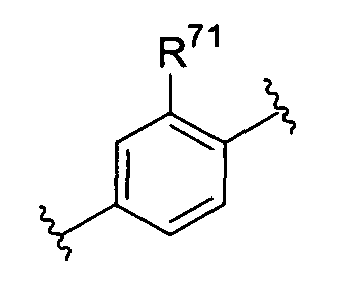
- The pharmaceutical composition according to claim 54, wherein R3 and R4 individually represent a hydrogen atom.
- The pharmaceutical composition according to claim 54, wherein R5 is a hydrogen atom, a C1-6 alkyl group, a C3-8 cycloalkyl group or a C6-10 aryl group, provided that R5 may have at least one substituent selected from the group consisting of halogen atoms and methanesulfonyl group.
- The pharmaceutical composition according to claim 54, wherein R5 is a methyl group, an ethyl group or a cyclopropyl group.
- The pharmaceutical composition according to claim 53, wherein the VEGF receptor kinase inhibitor is at least one compound selected from the group consisting of:N-(4-(6-cyano-7-(2-methoxyethoxy)-4-quinolyl)oxy-2-fluorophenyl)-N'-(4-fluorophenyl)urea,N-(2-chloro-4-((6-cyano-7-((1-methyl-4-piperidyl)methoxy)-4-quinolyl)oxy)phenyl)-N'-cyclopropylurea,N-(4-((6-cyano-7-(((2R)-3-(diethylamino)-2-hydroxypropyl)oxy)-4-quinolyl)oxy)phenyl)-N'-(4-fluorophenyl)urea,N-(4-((6-cyano-7-(((2R)-2-hydroxy-3-(1-pyrrofizino)prcpyl)oxy)-4-quinolyl)oxy)phenyl)-N'-(4-fluorophenyl)urea,4-(3-chloro-4-(cyclopropylaminocarbonyl)aminophenoxy)-7-methoxy-6-quinolinecarboxamide,4-(3-chloro-4-(cyclopropylaminocarbonyl)aminophenoxy)-7-(2-methoxyethoxy)-6-quino linecarboxamide,N6-cyclopropyl-4-(3-chloro-4-(((cyclopropylamino)carbonyl)amino)phenoxy)-7-methoxy-6-quinolinecarboxamide,N6-(2-methoxyethyl)-4-(3-chloro-4-(((cyclopropylamino)carbonyl)amino)-phenoxy)-7-methoxy-6-quinolinecarboxamide,N6-(2-fluoroethyl)-4-(3-chloro-4-(((cyclopropylamino)carbonyl)amino)-phenoxy)-7-methoxy-6-quinolinecarboxamide,N6-methoxy 4-(3-chloro-4-(((cyclopropylamino)carbonyl)amino)phenoxy)-7-methoxy-6-quinolinecarboxamide,N6-methyl-4-(3-chloro-4-(((cyclopropylamino)carbonyl)amino)phenoxy)-7-methoxy-6-quinolinecarboxamide,N6-ethyl-4-(3-chloro-4-(((cyclopropylamino)carbonyl)amino)phenoxy)-7-methoxy-6-quinolinecarboxamide,4-(3-fluoro-4-(cyclopropylaminocarbonyl)aminophenoxy)-7-(2-methoxyethoxy)-6-quinolinecarboxamide,4-(3-chloro-4-(cyclopropylaminocarbonyl)aminophenoxy)-7-(2-hydroxyethoxy)-6-quinolinecarboxamide,4-(3-chloro-4-(cyclopropylaminocarbonyl)aminophenoxy)-7-((2S)-2,3-dihydroxypropyl)oxy-6-quinolinecarboxamide,4-(3-chloro-4-(methylaminocarbonyl)aminophenoxy)-7-methoxy-6-quinolinecarboxamide,4-(3-chloro-4-(ethylaminocarbonyl)aminophenoxy)-7-methoxy-6-quinolinecarboxamide,N6-methoxy-4-(3-chloro-4-(((ethylamino)carbonyl)amino)phenoxy)-7-methoxy-6-quinolinecarboxamide,4-(3-chloro-4-(cyclopropylaminocarbonyl)aminophenoxy)-7-(2-ethoxyethoxy)-6-quinolinecarboxamide,4-(4-((cyclopropylamino)carbonyl)aminophenoxy)-7-(2-methoxyethoxy)-6-quinolinecarboxamide,N-(2-fluoro-4-((6-carbamoyl-7-methoxy-4-quinolyl)oxy)phenyl)-N'-cyclopropylurea,N6-(2-hydroxyethyl)-4-(3-chloro-4-(((cyclopropylamino)carbonyl)amino)-phenoxy)-7-methoxy-6-quinolinecarboxamide,4-(3-chloro-4-(1-propylaminocarbonyl)aminophenoxy)-7-methoxy 6-quinolinecarboxamide,4-(3-chloro-4-(cis-2-fluoro-cyclopropylaminocarbonyl)aminophenoxy)-7-methoxy-6-quinolinecarboxamide,N6-methyl-4-(3-chloro-4-(((cyclopropylamino)carbonyl)amino)phenoxy)-7-(2-methoxyethoxy)-6-quinolinecarboxamide,N6-methyl-4-(3-chloro-4-(((ethylamino)carbonyl)amino)phenoxy)-7-methoxy-6-quinolinecarboxamide,4-(3-chloro-4-(cyclopropylaminocarbonyl)aminophenoxy)-7-(2-(4-morpholino)ethoxy)-6-quinolinecarboxamide,4-(3-chloro-4-(2-fluoroethylaminocarbonyl)aminophenoxy)-7-methoxy 6-quinolinecarboxamide,N6-((2R)tetrahydro-2-furanylmethyl)-4-(3-chloro-4-(((methylamino)carbonyl)-amino)phenoxy)-7-methoxy-6-quinolinecarboxamide,4-(3-fluoro-4-(ethylaminocarbonyl)aminophenoxy)-7-methoxy-6-quinolinecarboxamide,4-(3-chloro-4-(((cyclopropylamino)carbonyl)amino)phenoxy)-7-((2R)-2-hydroxy-3-(1-pyrrolizino)propoxy)-6-quinolinecarboxamide,N6-methyl-4-(3-chloro-4-(((methylamino)carbonyl)amino)phenoxy)-7-((2R)-3-diethylamino-2-hydroxypropoxy)-6-quinolinecarboxamide,N6-methyl-4-(3-chloro-4-(((ethylamino)carbonyl)amino)phenoxy)-7-((2R)-3-diethylamino-2-hydroxypropoxy)-6-quinolinecarboxamide,N6-methyl-4-(3-chloro-4-(((methylamino)carbonyl)amino)phenoxy)-7-((2R)-2-hydroxy-3-(1-pyrrolizino)propoxy)-6-quinolinecarboxamide,N6-methyl-4-(3-chloro-4-(((ethylamino)carbonyl)amino)phenoxy)-7-((2R)-2-hydroxy-3-(1-pyrrolizmo)propoxy)-6-quinolinecarboxamide,N6-methyl-4-(3-chloro-4-(((methylamino)carbonyl)amino)phenoxy)-7-((1-methyl-4-piperidyl)methoxy)-6-quinolinecarboxamide,N6-methyl-4-(3-chloro-4-(((ethylamino)carbonyl)amino)phenoxy)-7-((1-methyl-4-piperidyl)methoxy)-6-quinolinecarboxamide,N-(4-(6-cyano-7-(2-methoxyethoxy)-4-quinolyl)oxy-2-fluorophenyl)-N'-cyclopropylurea,N-(4-(6-cyano-7-(3-(4-morpholino)propoxy)-4-quinolyl)oxyphenyl)-N'-(3-methylsulfonyl)phenyl)urea,4-(4-((cyclopropylamino)carbonyl)aminophenoxy)-7-methoxy-6-quinolinecarboxamide,4-(3-fluoro-4-((2-fluoroethylamino)carbonyl)aminophenoxy)-7-methoxy-6-quinolinecarboxamide,N6-(2-ethoxyethyl)-4-(3-chloro-4-(((methylamino)carbonyl)amino)phenoxy)-7-methoxy-6-quinolinecarboxamide,4-(4-(3-ethylureido)-3-fluoro-phenoxy)-7-methoxyquinoline-6-carboxylic acid (2-cyanoethyl)amide, andN-(4-(6-(2-cyanoethyl)carbamoyl-7-methoxy-4-quinolyl)oxy-2-fluorophenyl)-N'-cyclopropylurea;or a pharmacologically acceptable salt of said compound, or a solvate of said compound or said salt.
- The pharmaceutical composition according to claim 53, wherein the VEGF receptor kinase inhibitor is a compound selected from the group consisting of4-(3-chloro-4-(cyclopropylaminocarbonyl)aminophenoxy)-7-methoxy-6-quinolinecarboxamide,4-(3-chloro-4-(ethylaminocarbonyl)aminophenoxy)-7-methoxy-6-quinolinecarboxamide,N6-methoxy-4-(3-chloro-4-(((cyclopropylamino)carbonyl)amino)phenoxy)-7-methoxy-6-quinolinecarboxamide,4-(3-chloro-4-(methylaminocarbonyl)aminophenoxy)-7-methoxy-6-quinolinecarboxamide, andN6-methoxy-4-(3-chloro-4-(((ethylamino)carbonyl)amino)phenoxy)-7-methoxy-6-quinolinecarboxamide;or a pharmacologically acceptable salt of said compound, or a solvate of said compound or said salt.
- The pharmaceutical composition according to claim 53, wherein the VEGF receptor kinase inhibitor is 4-(3-chloro-4-(cyclopropylaminocarbonyl)aminophenoxy)-7-methoxy-6-quinolinecarboxamide, a pharmacologically acceptable salt thereof, or a solvate of said compound or said salt.
- The pharmaceutical composition according to claim 53, wherein the VEGF receptor kinase inhibitor is a methanesulfonic acid salt of 4-(3-chloro-4-(cyclopropylaminocarbonyl)aminophenoxy)-7-methoxy-6-quinolinecarboxamide.
- The pharmaceutical composition according to any one of claims 53 to 69, wherein the substance having EGF inhibitory activity is an EGF receptor kinase inhibitor.
- The pharmaceutical composition according to claim 70, wherein the EGF receptor kinase inhibitor is at least one compound selected from the group consisting of:(1) 4-(3-chloro-4-fluorophenylamino)-7-methoxy-6-(3-(4-morpholino)propoxy-quinazoline)(2) 4-(3-ethynylphenylamino)-6,7-bis(2-methoxyethoxy)-quinazoline(3) N-[3-chloro-4-[(3-fluorobenzyl)oxy]phenyl]-6-[5-[[[2-(methylsulfonyl)ethyl]-amino]methyl]furan-2-yl]quinazoline-4-amine(4) N-[4-[N-(3-chloro-4-fluorophenyl)amino]-7-[3-(4-morpholinyl)propoxy]-quinazo line-6-yl] acrylamide(5) (2E)-N-[4-[(3-chloro-4-fluorophenyl)amino]-3-cyano-7-ethoxy-6-quinolinyl]-4-(dimethylamino)-2-butenamide(6) [6-[4-[(4-ethylpiperazine-1-yl)methyl]phenyl]-7H-pyrrolo[2,3-d]pyrimidine-4-yl]-((R)-1-phenylethyl)amine, and(7) (E)-N- {4-[3-chloro-4-(2-pyridinylmethoxy)anilino]-3-cyano-7-ethoxy-6-quinolinyl}-4-(dimethylamino)-2-butenamide;or a pharmacologically acceptable salt of said compound, or a solvate of said compound or said salt.
- The pharmaceutical composition according to claim 70, wherein the EGF receptor kinase inhibitor is 4-(3-ethynylphenylamino)-6,7-bis(2-methoxyethoxy)-quinazoline, or a pharmacologically acceptable salt thereof, or a solvate of said compound or said salt.
- The pharmaceutical composition according to any one of claims 53 to 69, wherein the substance having EGF inhibitory activity is anti-EGF receptor antibody.
- The pharmaceutical composition according to claim 73, wherein the anti-EGF receptor antibody is at least one antibody selected from the group consisting of cetuximab, panitumumab, matuzumab, nimotuzumab, IMC-11F8 and MDX-447.
- The pharmaceutical composition according to claim 73, wherein the anti-EGF receptor antibody is cetuximab.
- The pharmaceutical composition according to any one of claims 53 to 69, wherein the substance having EGF inhibitory activity is anti-EGF antibody.
- The pharmaceutical composition according to any one of claims 53 to 76, which is for use in treating cancers.
- A kit comprising the following (a) and (b):(a) at least one selected from the group consisting of a wrapping container, a handling instruction and an accompanying document, each of which is stating that a VEGF receptor kinase inhibitor and a substance having EGF inhibitory activity should be used in combination, and(b) a pharmaceutical composition comprising a VEGF receptor kinase inhibitor;wherein the VEGF receptor kinase inhibitor is a compound represented by the following general formula (I), a pharmacologically acceptable salt thereof, or a solvate of said compound or said salt:

 R2 is a cyano group, a C1-6 alkoxy group which may have a substituent(s), a carboxyl group, a C2-7 alkoxycarbonyl group which may have a substituent(s) or a group represented by a formula -CONVa11Va12 (where Va11 is a hydrogen atom, a C1-6 alkyl group which may have a substituent(s), a C2-6 alkenyl group which may have a substituent(s), a C2-6 alkynyl group which may have a substituent(s), a C3-8 cycloalkyl group which may have a substituent(s); a C6-10 aryl group which may have a substituent(s), a 5- to 10-membered heteroaryl group which may have a substituent(s) or a 3- to 10-membered non-aromatic heterocyclic group which may have a substituent(s); and Va12 is a hydrogen atom, a C1-6 alkyl group which may have a substituent(s), a C2-6 alkenyl group which may have a substituent(s), a C2-6 alkynyl group which may have a substituent(s), a C3-8 cycloalkyl group which may have a substituent(s); a C6-10 aryl group which may have a substituent(s), a 5- to 10-membered heteroaryl group which may have a substituent(s), a 3- to 10-membered non-aromatic heterocyclic group which may have a substituent(s), a hydroxyl group, a C1-6 alkoxy group which may have a substituent(s) or a C3-8 cycloalkoxy group which may have a substituent(s));A1 is a carbon atom which may have a substituent or a nitrogen atom;R11 is a hydrogen atom, a C1-6 alkyl group which may have a substituent(s), a C2-6 alkenyl group which may have a substituent(s), a C2-6 alkynyl group which may have a substituent(s), a C3-8 cycloalkyl group which may have a substituent(s); a C6-10 aryl group which may have a substituent(s), a 5- to 10-membered heteroaryl group which may have a substituent(s), a 3-to 10-membered non-aromatic heterocyclic group which may have a substituent(s) or a mono-C1-6 alkylamino group which may have a substituent(s);R12 is a hydrogen atom or a C1-6 alkyl group which may have a substituent(s);Va13 is an oxygen atom or a sulfur atom;A11 is a carbon atom which may have a substituent or a nitrogen atom;R13 is a hydrogen atom, a C1-6 alkyl group which may have a substituent(s) or a C3-8 cycloalkyl group which may have a substituent(s);R14 is a group represented by a formula -Va14-Va15 (where Va14 is a single bond or a carbonyl group; and Va15 is a hydrogen atom, a hydroxyl group, a C1-6 alkyl group which may have a substituent(s), a C2-6 alkenyl group which may have a substituent(s), a C2-6 alkynyl group which may have a substituent(s), a C3-8 cycloalkyl group which may have a substituent(s); a C6-10 aryl group which may have a substituent(s), a 5- to 10-membered heteroaryl group which may have a substituent(s), a 3- to 10-membered non-aromatic heterocyclic group which may have a substituent(s), an amino group, a mono-C1-6 alkylamino group which may have a substituent(s), a di-C1-6 alkylamino group which may have a substituent(s), a formyl group, a carboxyl group or a C2-7 alkoxycarbonyl group which may have a substituent(s));X is an oxygen atom or a sulfur atom;Y is a group represented by one of the following formulas:
 R7 and R8 independently of each other represent a hydrogen atom, a halogen atom, a cyano group, a nitro group, an amino group, a C1-6 alkyl group which may have a substituent(s), a C3-8 cycloalkyl group which may have a substituent(s), a C1-6 alkoxy group which may have a substituent(s), a C1-6 alkylthio group which may have a substituent(s), a formyl group, a C2-7 acyl group which may have a substituent(s), a C2-7 alkoxycarbonyl group which may have a substituent(s) or a group represented by a formula -CONVd1Vd2 (where Vd1 and Vd2 independently of each other represent a hydrogen atom or a C1-6 alkyl group which may have a substituent(s));R9 is a hydrogen atom, a halogen atom or a C1-6 alkyl group which may have a substituent(s); andW1 and W2 independently of each other represent a carbon atom which may have a substituent or a nitrogen atom);R4 is a hydrogen atom, a C1-6 alkyl group which may have a substituent(s), a C2-6 alkenyl group which may have a substituent(s), a C2-6 alkynyl group which may have a substituent(s), a C3-8 cycloalkyl group which may have a substituent(s), a C2-7 acyl group which may have a substituent(s) or a C2-7 alkoxycarbonyl group which may have a substituent(s); andR5 is a hydrogen atom, a C1-6 alkyl group which may have a substituent(s), a C2-6 alkenyl group which may have a substituent(s), a C2-6 alkynyl group which may have a substituent(s), a C3-8 cycloalkyl group which may have a substituent(s), a C6-10 aryl group which may have a substituent(s), a 5- to 10-membered heteroaryl group which may have a substituent(s) or a 3-to 10-membered non-aromatic heterocyclic group which may have a substituent(s).
 - A kit characterized by containing a combination of a preparation comprising a VEGF receptor kinase inhibitor and a preparation comprising a substance having EGF inhibitory activity, wherein the VEGF receptor kinase inhibitor is a compound represented by the following general formula (I), a pharmacologically acceptable salt thereof, or a solvate of said compound or said salt:

 R2 is a cyano group, a C1-6 alkoxy group which may have a substituent(s), a carboxyl group, a C2-7 alkoxycarbonyl group which may have a substituent(s) or a group represented by a formula -CONVa11Va12 (where Va11 is a hydrogen atom, a C1-6 alkyl group which may have a substituent(s), a C2-6 alkenyl group which may have a substituent(s), a C2-6 alkynyl group which may have a substituent(s), a C3-8 cycloalkyl group which may have a substituent(s); a C6-10 aryl group which may have a substituent(s), a 5- to 10-membered heteroaryl group which may have a substituent(s) or a 3- to 10-membered non-aromatic heterocyclic group which may have a substituent(s); and Va12 is a hydrogen atom, a C1-6 alkyl group which may have a substituent(s), a C2-6 alkenyl group which may have a substituent(s), a C2-6 alkynyl group which may have a substituent(s), a C3-8 cycloalkyl group which may have a substituent(s); a C6-10 aryl group which may have a substituent(s), a 5- to 10-membered heteroaryl group which may have a substituent(s), a 3- to 10-membered non-aromatic heterocyclic group which may have a substituent(s), a hydroxyl group, a C1-6 alkoxy group which may have a substituent(s) or a C3-8 cycloalkoxy group which may have a substituent(s));A1 is a carbon atom which may have a substituent or a nitrogen atom;R11 is a hydrogen atom, a C1-6 alkyl group which may have a substituent(s), a C2-6 alkenyl group which may have a substituent(s), a C2-6 alkynyl group which may have a substituent(s), a C3-8 cycloalkyl group which may have a substituent(s); a C6-10 aryl group which may have a substituent(s), a 5- to 10-membered heteroaryl group which may have a substituent(s), a 3-to 10-membered non-aromatic heterocyclic group which may have a substituent(s) or a mono-C1-6 alkylamino group which may have a substituent(s);R12 is a hydrogen atom or a C1-6 alkyl group which may have a substituent(s);Va13 is an oxygen atom or a sulfur atom;A11 is a carbon atom which may have a substituent or a nitrogen atom;R13 is a hydrogen atom, a C1-6 alkyl group which may have a substituent(s) or a C3-8 cycloalkyl group which may have a substituent(s);R14 is a group represented by a formula -Va14-Va15 (where Va14 is a single bond or a carbonyl group; and Va15 is a hydrogen atom, a hydroxyl group, a C1-6 alkyl group which may have a substituent(s), a C2-6 alkenyl group which may have a substituent(s), a C2-6 alkynyl group which may have a substituent(s), a C3-8 cycloalkyl group which may have a substituent(s); a C6-10 aryl group which may have a substituent(s), a 5- to 10-membered heteroaryl group which may have a substituent(s), a 3- to 10-membered non-aromatic heterocyclic group which may have a substituent(s), an amino group, a mono-C1-6 alkylamino group which may have a substituent(s), a di-C1-6 alkylamino group which may have a substituent(s), a formyl group, a carboxyl group or a C2-7 alkoxycarbonyl group which may have a substituent(s));X is an oxygen atom or a sulfur atom;Y is a group represented by one of the following formulas:
 R7 and R8 independently of each other represent a hydrogen atom, a halogen atom, a cyano group, a nitro group, an amino group, a C1-6 alkyl group which may have a substituent(s), a C3-8 cycloalkyl group which may have a substituent(s), a C1-6 alkoxy group which may have a substituent(s), a C1-6 alkylthio group which may have a substituent(s), a formyl group, a C2-7 acyl group which may have a substituent(s), a C2-7 alkoxycarbonyl group which may have a substituent(s) or a group represented by a formula -CONVd1Vd2 (where Vd1 and Vd2 independently of each other represent a hydrogen atom or a C1-6 alkyl group which may have a substituent(s));R9 is a hydrogen atom, a halogen atom or a C1-6 alkyl group which may have a substituent(s); andW1 and W2 independently of each other represent a carbon atom which may have a substituent or a nitrogen atom);R4 is a hydrogen atom, a C1-6 alkyl group which may have a substituent(s), a C2-6 alkenyl group which may have a substituent(s), a C2-6 alkynyl group which may have a substituent(s), a C3-8 cycloalkyl group which may have a substituent(s), a C2-7 acyl group which may have a substituent(s) or a C2-7 alkoxycarbonyl group which may have a substituent(s); andR5 is a hydrogen atom, a C1-6 alkyl group which may have a substituent(s), a C2-6 alkenyl group which may have a substituent(s), a C2-6 alkynyl group which may have a substituent(s), a C3-8 cycloalkyl group which may have a substituent(s), a C6-10 aryl group which may have a substituent(s), a 5- to 10-membered heteroaryl group which may have a substituent(s) or a 3-to 10-membered non-aromatic heterocyclic group which may have a substituent(s).
 - A pharmaceutical composition comprising a VEGF receptor kinase inhibitor, which is to be administered in combination with a substance having EGF inhibitory activity,
wherein the VEGF receptor kinase inhibitor is a compound represented by the following general formula (I), a pharmacologically acceptable salt thereof, or a solvate of said compound or said salt:
 R2 is a cyano group, a C1-6 alkoxy group which may have a substituent(s), a carboxyl group, a C2-7 alkoxycarbonyl group which may have a substituent(s) or a group represented by a formula -CONVa11Va12 (where Va11 is a hydrogen atom, a C1-6 alkyl group which may have a substituent(s), a C2-6 alkenyl group which may have a substituent(s), a C2-6 alkynyl group which may have a substituent(s), a C3-8 cycloalkyl group which may have a substituent(s); a C6-10 aryl group which may have a substituent(s), a 5- to 10-membered heteroaryl group which may have a substituent(s) or a 3- to 10-membered non-aromatic heterocyclic group which may have a substituent(s); and Va12 is a hydrogen atom, a C1-6 alkyl group which may have a substituent(s), a C2-6 alkenyl group which may have a substituent(s), a C2-6 alkynyl group which may have a substituent(s), a C3-8 cycloalkyl group which may have a substituent(s); a C6-10 aryl group which may have a substituent(s), a 5- to 10-membered heteroaryl group which may have a substituent(s), a 3- to 10-membered non-aromatic heterocyclic group which may have a substituent(s), a hydroxyl group, a C1-6 alkoxy group which may have a substituent(s) or a C3-8 cycloalkoxy group which may have a substituent(s));A1 is a carbon atom which may have a substituent or a nitrogen atom;R11 is a hydrogen atom, a C1-6 alkyl group which may have a substituent(s), a C2-6 alkenyl group which may have a substituent(s), a C2-6 alkynyl group which may have a substituent(s), a C3-8 cycloalkyl group which may have a substituent(s); a C6-10 aryl group which may have a substituent(s), a 5- to 10-membered heteroaryl group which may have a substituent(s), a 3-to 10-membered non-aromatic heterocyclic group which may have a substituent(s) or a mono-C1-6 alkylamino group which may have a substituent(s);R12 is a hydrogen atom or a C1-6 alkyl group which may have a substituent(s);Va13 is an oxygen atom or a sulfur atom;A11 is a carbon atom which may have a substituent or a nitrogen atom;R13 is a hydrogen atom, a C1-6 alkyl group which may have a substituent(s) or a C3-8 cycloalkyl group which may have a substituent(s);R14 is a group represented by a formula -Va14-Va15 (where Va14 is a single bond or a carbonyl group; and Va15 is a hydrogen atom, a hydroxyl group, a C1-6 alkyl group which may have a substituent(s), a C2-6 alkenyl group which may have a substituent(s), a C2-6 alkynyl group which may have a substituent(s), a C3-8 cycloalkyl group which may have a substituent(s); a C6-10 aryl group which may have a substituent(s), a 5- to 10-membered heteroaryl group which may have a substituent(s), a 3- to 10-membered non-aromatic heterocyclic group which may have a substituent(s), an amino group, a mono-C1-6 alkylamino group which may have a substituent(s), a di-C1-6 alkylamino group which may have a substituent(s), a formyl group, a carboxyl group or a C2-7 alkoxycarbonyl group which may have a substituent(s));X is an oxygen atom or a sulfur atom;Y is a group represented by one of the following formulas:
 R7 and R8 independently of each other represent a hydrogen atom, a halogen atom, a cyano group, a nitro group, an amino group, a C1-6 alkyl group which may have a substituent(s), a C3-8 cycloalkyl group which may have a substituent(s), a C1-6 alkoxy group which may have a substituent(s), a C1-6 alkylthio group which may have a substituent(s), a formyl group, a C2-7 acyl group which may have a substituent(s), a C2-7 alkoxycarbonyl group which may have a substituent(s) or a group represented by a formula -CONVd1Vd2 (where Vd1 and Vd2 independently of each other represent a hydrogen atom or a C1-6 alkyl group which may have a substituent(s));R9 is a hydrogen atom, a halogen atom or a C1-6 alkyl group which may have a substituent(s); andW1 and W2 independently of each other represent a carbon atom which may have a substituent or a nitrogen atom);R4 is a hydrogen atom, a C1-6 alkyl group which may have a substituent(s), a C2-6 alkenyl group which may have a substituent(s), a C2-6 alkynyl group which may have a substituent(s), a C3-8 cycloalkyl group which may have a substituent(s), a C2-7 acyl group which may have a substituent(s) or a C2-7 alkoxycarbonyl group which may have a substituent(s); andR5 is a hydrogen atom, a C1-6 alkyl group which may have a substituent(s), a C2-6 alkenyl group which may have a substituent(s), a C2-6 alkynyl group which may have a substituent(s), a C3-8 cycloalkyl group which may have a substituent(s), a C6-10 aryl group which may have a substituent(s), a 5- to 10-membered heteroaryl group which may have a substituent(s) or a 3-to 10-membered non-aromatic heterocyclic group which may have a substituent(s).
Priority Applications (1)
| Application Number | Priority Date | Filing Date | Title |
|---|---|---|---|
| EP10015141.4A EP2281901B1 (en) | 2005-08-02 | 2006-08-02 | Anti-tumour pharmaceutical composition with angiogenesis inhibitors |
Applications Claiming Priority (3)
| Application Number | Priority Date | Filing Date | Title |
|---|---|---|---|
| JP2005224173 | 2005-08-02 | ||
| JP2006164700 | 2006-06-14 | ||
| PCT/JP2006/315698 WO2007015578A1 (en) | 2005-08-02 | 2006-08-02 | Method for assay on the effect of vascularization inhibitor |
Publications (2)
| Publication Number | Publication Date |
|---|---|
| EP1925676A1 true EP1925676A1 (en) | 2008-05-28 |
| EP1925676A4 EP1925676A4 (en) | 2010-11-10 |
Family
ID=37708849
Family Applications (2)
| Application Number | Title | Priority Date | Filing Date |
|---|---|---|---|
| EP06768437A Withdrawn EP1925676A4 (en) | 2005-08-02 | 2006-08-02 | METHOD FOR ANALYZING THE EFFECT OF A VASCULARIZATION INHIBITOR |
| EP10015141.4A Active EP2281901B1 (en) | 2005-08-02 | 2006-08-02 | Anti-tumour pharmaceutical composition with angiogenesis inhibitors |
Family Applications After (1)
| Application Number | Title | Priority Date | Filing Date |
|---|---|---|---|
| EP10015141.4A Active EP2281901B1 (en) | 2005-08-02 | 2006-08-02 | Anti-tumour pharmaceutical composition with angiogenesis inhibitors |
Country Status (4)
| Country | Link |
|---|---|
| US (2) | US9006240B2 (en) |
| EP (2) | EP1925676A4 (en) |
| JP (1) | JP4989476B2 (en) |
| WO (1) | WO2007015578A1 (en) |
Cited By (24)
| Publication number | Priority date | Publication date | Assignee | Title |
|---|---|---|---|---|
| EP1964837A4 (en) * | 2005-11-22 | 2010-12-22 | Eisai R&D Man Co Ltd | Anti-tumor agent for multiple myeloma |
| US7973160B2 (en) | 2000-10-20 | 2011-07-05 | Eisai R&D Management Co., Ltd. | Nitrogen-containing aromatic derivatives |
| US7994159B2 (en) | 2003-03-10 | 2011-08-09 | Eisai R&D Management Co., Ltd. | c-Kit kinase inhibitor |
| US8058474B2 (en) | 2003-11-11 | 2011-11-15 | Eisai R&D Management Co., Ltd. | Urea derivative and process for preparing the same |
| EP2218712A4 (en) * | 2007-11-09 | 2012-07-18 | Eisai R&D Man Co Ltd | Combination of anti-angiogenic substance and anti-tumor platinum complex |
| US8815241B2 (en) | 2005-11-07 | 2014-08-26 | Eisai R&D Management Co., Ltd. | Use of combination of anti-angiogenic substance and c-kit kinase inhibitor |
| US8865737B2 (en) | 2006-08-28 | 2014-10-21 | Eisai R&D Management Co., Ltd. | Antitumor agent for undifferentiated gastric cancer |
| US8962655B2 (en) | 2007-01-29 | 2015-02-24 | Eisai R&D Management Co., Ltd. | Composition for treatment of undifferentiated gastric cancer |
| US8962650B2 (en) | 2011-04-18 | 2015-02-24 | Eisai R&D Management Co., Ltd. | Therapeutic agent for tumor |
| US8969344B2 (en) | 2005-08-02 | 2015-03-03 | Eisai R&D Management Co., Ltd. | Method for assay on the effect of vascularization inhibitor |
| US8969379B2 (en) | 2004-09-17 | 2015-03-03 | Eisai R&D Management Co., Ltd. | Pharmaceutical compositions of 4-(3-chloro-4-(cyclopropylaminocarbonyl)aminophenoxy)-7=methoxy-6-quinolinecarboxide |
| US9334239B2 (en) | 2012-12-21 | 2016-05-10 | Eisai R&D Management Co., Ltd. | Amorphous form of quinoline derivative, and method for producing same |
| US9945862B2 (en) | 2011-06-03 | 2018-04-17 | Eisai R&D Management Co., Ltd. | Biomarkers for predicting and assessing responsiveness of thyroid and kidney cancer subjects to lenvatinib compounds |
| US10259791B2 (en) | 2014-08-28 | 2019-04-16 | Eisai R&D Management Co., Ltd. | High-purity quinoline derivative and method for manufacturing same |
| US10517861B2 (en) | 2013-05-14 | 2019-12-31 | Eisai R&D Management Co., Ltd. | Biomarkers for predicting and assessing responsiveness of endometrial cancer subjects to lenvatinib compounds |
| CN110642837A (en) * | 2019-11-07 | 2020-01-03 | 江西科技师范大学 | Pyridine amide compounds containing triazole or quinolinone structure and their application |
| US11090386B2 (en) | 2015-02-25 | 2021-08-17 | Eisai R&D Management Co., Ltd. | Method for suppressing bitterness of quinoline derivative |
| US11369623B2 (en) | 2015-06-16 | 2022-06-28 | Prism Pharma Co., Ltd. | Anticancer combination of a CBP/catenin inhibitor and an immune checkpoint inhibitor |
| CN114920703A (en) * | 2022-05-26 | 2022-08-19 | 天津济坤医药科技有限公司 | Quinazoline derivative and preparation method and application thereof |
| US11547705B2 (en) | 2015-03-04 | 2023-01-10 | Merck Sharp & Dohme Llc | Combination of a PD-1 antagonist and a VEGF-R/FGFR/RET tyrosine kinase inhibitor for treating cancer |
| US12220398B2 (en) | 2015-08-20 | 2025-02-11 | Eisai R&D Management Co., Ltd. | Tumor therapeutic agent |
| US12226409B2 (en) | 2017-05-16 | 2025-02-18 | Eisai R&D Management Co., Ltd. | Treatment of hepatocellular carcinoma |
| US12303505B2 (en) | 2017-02-08 | 2025-05-20 | Eisai R&D Management Co., Ltd. | Tumor-treating pharmaceutical composition |
| US12508313B2 (en) | 2009-08-19 | 2025-12-30 | Eisai R&D Management Co., Ltd. | Quinoline derivative-containing pharmaceutical composition |
Families Citing this family (33)
| Publication number | Priority date | Publication date | Assignee | Title |
|---|---|---|---|---|
| CN108421044A (en) | 2005-02-03 | 2018-08-21 | 综合医院公司 | The method for treating gefitinib resistant cancer |
| WO2007015569A1 (en) * | 2005-08-01 | 2007-02-08 | Eisai R & D Management Co., Ltd. | Method for prediction of the efficacy of vascularization inhibitor |
| EP1938842A4 (en) * | 2005-09-01 | 2013-01-09 | Eisai R&D Man Co Ltd | Method for preparation of pharmaceutical composition having improved disintegradability |
| BRPI0618042A2 (en) | 2005-11-04 | 2011-08-16 | Wyeth Corp | uses of a rapamycin and herceptin, product, pharmaceutical package, and, pharmaceutical composition |
| WO2007136103A1 (en) | 2006-05-18 | 2007-11-29 | Eisai R & D Management Co., Ltd. | Antitumor agent for thyroid cancer |
| EP2044939A1 (en) * | 2006-06-29 | 2009-04-08 | Eisai R&D Management Co., Ltd. | Therapeutic agent for liver fibrosis |
| NZ601022A (en) * | 2006-10-12 | 2014-09-26 | Chugai Pharmaceutical Co Ltd | Diagnosis and treatment of cancer using anti-ereg antibody |
| US8022216B2 (en) | 2007-10-17 | 2011-09-20 | Wyeth Llc | Maleate salts of (E)-N-{4-[3-chloro-4-(2-pyridinylmethoxy)anilino]-3-cyano-7-ethoxy-6-quinolinyl}-4-(dimethylamino)-2-butenamide and crystalline forms thereof |
| US7772404B2 (en) * | 2007-10-19 | 2010-08-10 | Abbott Laboratories | Crystalline form 2 of the chemotherapeutic N-[4-(3-amino-1H-indazol-4-yl)phenyl]-N′-(2-fluoro-5-methylphenyl)urea |
| US7994208B2 (en) * | 2007-10-19 | 2011-08-09 | Abbott Laboratories | Crystalline chemotherapeutic |
| US7943782B2 (en) * | 2007-10-19 | 2011-05-17 | Abbott Laboratories | Crystalline chemotherapeutic |
| US7947843B2 (en) * | 2007-10-19 | 2011-05-24 | Abbott Laboratories | Crystalline chemotherapeutic |
| US7960564B2 (en) * | 2007-10-19 | 2011-06-14 | Abbott Laboratories | Crystalline chemotherapeutic |
| US20100324087A1 (en) * | 2008-01-29 | 2010-12-23 | Eisai R&D Management Co., Ltd. | Combined use of angiogenesis inhibitor and taxane |
| CN102641270A (en) | 2008-06-17 | 2012-08-22 | 惠氏有限责任公司 | Antineoplastic combinations containing HKI-272 and vinorelbine |
| US8669273B2 (en) | 2008-08-04 | 2014-03-11 | Wyeth Llc | Antineoplastic combinations of 4-anilino-3-cyanoquinolines and capecitabine |
| EP2376491B1 (en) | 2008-12-19 | 2015-03-04 | Cephalon, Inc. | Pyrrolotriazines as alk and jak2 inhibitors |
| IL264349B2 (en) | 2009-04-06 | 2024-01-01 | Wyeth Llc | Regimens containing neratinib for the treatment of cancer |
| EP2436397B1 (en) | 2009-05-29 | 2017-05-10 | Chugai Seiyaku Kabushiki Kaisha | Pharmaceutical composition containing antagonist of egf family ligand as component |
| CA2802644C (en) | 2010-06-25 | 2017-02-21 | Eisai R & D Management Co., Ltd. | Antitumor agent using compounds having kinase inhibitory effect in combination |
| TWI593705B (en) | 2011-12-28 | 2017-08-01 | Chugai Pharmaceutical Co Ltd | Humanized anti-epiregulin antibody and cancer therapeutic agent containing the antibody as an active ingredient |
| CA2900652C (en) | 2013-02-15 | 2021-05-04 | Kala Pharmaceuticals, Inc. | Therapeutic compounds and uses thereof |
| US9688688B2 (en) | 2013-02-20 | 2017-06-27 | Kala Pharmaceuticals, Inc. | Crystalline forms of 4-((4-((4-fluoro-2-methyl-1H-indol-5-yl)oxy)-6-methoxyquinazolin-7-yl)oxy)-1-(2-oxa-7-azaspiro[3.5]nonan-7-yl)butan-1-one and uses thereof |
| CN107915751A (en) | 2013-02-20 | 2018-04-17 | 卡拉制药公司 | Therapeutic compound and its purposes |
| AU2014299699B2 (en) | 2013-06-26 | 2019-10-10 | Eisai R&D Management Co., Ltd. | Use of eribulin and lenvatinib as combination therapy for treatment of cancer |
| WO2015066482A1 (en) | 2013-11-01 | 2015-05-07 | Kala Pharmaceuticals, Inc. | Crystalline forms of therapeutic compounds and uses thereof |
| US9890173B2 (en) | 2013-11-01 | 2018-02-13 | Kala Pharmaceuticals, Inc. | Crystalline forms of therapeutic compounds and uses thereof |
| JP2017206437A (en) * | 2014-08-18 | 2017-11-24 | エーザイ・アール・アンド・ディー・マネジメント株式会社 | 4-aminopyridine derivative |
| MX2019002629A (en) | 2016-09-08 | 2019-10-07 | Kala Pharmaceuticals Inc | Crystalline forms of therapeutic compounds and uses thereof. |
| AU2017324716B2 (en) | 2016-09-08 | 2020-08-13 | KALA BIO, Inc. | Crystalline forms of therapeutic compounds and uses thereof |
| AU2017324713B2 (en) | 2016-09-08 | 2020-08-13 | KALA BIO, Inc. | Crystalline forms of therapeutic compounds and uses thereof |
| CN110590839B (en) * | 2018-06-13 | 2022-04-05 | 四川海思科制药有限公司 | Levatinib derivative and preparation method and application thereof |
| WO2020055946A1 (en) * | 2018-09-12 | 2020-03-19 | The Broad Institute, Inc. | Targeting egln1 in cancer |
Family Cites Families (232)
| Publication number | Priority date | Publication date | Assignee | Title |
|---|---|---|---|---|
| SU11248A1 (en) | 1927-03-29 | 1929-09-30 | В.С. Григорьев | Anthracene cleaning method |
| SU14813A1 (en) | 1929-04-19 | 1930-03-31 | А.И. Студенцов | Gin feeder-cleaner with automatically controlled blowing through part of the loosening drum |
| CU22545A1 (en) | 1994-11-18 | 1999-03-31 | Centro Inmunologia Molecular | OBTAINING A CHEMICAL AND HUMANIZED ANTIBODY AGAINST THE RECEPTOR OF THE EPIDERMAL GROWTH FACTOR FOR DIAGNOSTIC AND THERAPEUTIC USE |
| JPS6328427Y2 (en) | 1979-06-28 | 1988-08-01 | ||
| JPS5857710A (en) | 1981-09-30 | 1983-04-06 | Matsushita Electric Works Ltd | Coil |
| JPS5944869U (en) | 1982-09-17 | 1984-03-24 | 近畿アルミニユ−ム工業株式会社 | Hinge with plate spacing correction tool |
| US4526988A (en) | 1983-03-10 | 1985-07-02 | Eli Lilly And Company | Difluoro antivirals and intermediate therefor |
| EP0154434B1 (en) * | 1984-02-17 | 1993-01-27 | Genentech, Inc. | Human transforming growth factor and precursor or fragment thereof, cells, dna, vectors and methods for their production, compositions and products containing them, and related antibodies and diagnostic methods |
| US4582789A (en) * | 1984-03-21 | 1986-04-15 | Cetus Corporation | Process for labeling nucleic acids using psoralen derivatives |
| DE8411409U1 (en) | 1984-04-11 | 1984-08-30 | Dr.-Ing. Walter Frohn-Betriebe, 8000 München | DEGASSING VALVE FOR STORAGE AND / OR TRANSPORT CONTAINERS |
| US4563417A (en) * | 1984-08-31 | 1986-01-07 | Miles Laboratories, Inc. | Nucleic acid hybridization assay employing antibodies to intercalation complexes |
| DE3474040D1 (en) | 1984-11-22 | 1988-10-20 | Holsten Brauerei Ag | Beer and process for its preparation |
| DE3587500T2 (en) | 1984-12-04 | 1993-12-16 | Lilly Co Eli | Tumor treatment in mammals. |
| JPS62168137A (en) | 1985-12-20 | 1987-07-24 | Fuji Photo Film Co Ltd | Silver halide color photographic sensitive material and its processing method |
| CA1339136C (en) | 1987-07-01 | 1997-07-29 | Sailesh Amilal Varia | Amorphous form of aztreonam |
| AU4128089A (en) | 1988-09-15 | 1990-03-22 | Rorer International (Overseas) Inc. | Monoclonal antibodies specific to human epidermal growth factor receptor and therapeutic methods employing same |
| US5143854A (en) * | 1989-06-07 | 1992-09-01 | Affymax Technologies N.V. | Large scale photolithographic solid phase synthesis of polypeptides and receptor binding screening thereof |
| US4983615A (en) | 1989-06-28 | 1991-01-08 | Hoechst-Roussel Pharmaceuticals Inc. | Heteroarylamino- and heteroaryloxypyridinamine compounds which are useful in treating skin disorders |
| US5180818A (en) | 1990-03-21 | 1993-01-19 | The University Of Colorado Foundation, Inc. | Site specific cleavage of single-stranded dna |
| US5210015A (en) | 1990-08-06 | 1993-05-11 | Hoffman-La Roche Inc. | Homogeneous assay system using the nuclease activity of a nucleic acid polymerase |
| WO1992010588A1 (en) * | 1990-12-06 | 1992-06-25 | Affymax Technologies N.V. | Sequencing by hybridization of a target nucleic acid to a matrix of defined oligonucleotides |
| GB9105677D0 (en) | 1991-03-19 | 1991-05-01 | Ici Plc | Heterocyclic compounds |
| US5367057A (en) | 1991-04-02 | 1994-11-22 | The Trustees Of Princeton University | Tyrosine kinase receptor flk-2 and fragments thereof |
| US5710158A (en) | 1991-05-10 | 1998-01-20 | Rhone-Poulenc Rorer Pharmaceuticals Inc. | Aryl and heteroaryl quinazoline compounds which inhibit EGF and/or PDGF receptor tyrosine kinase |
| US5721237A (en) | 1991-05-10 | 1998-02-24 | Rhone-Poulenc Rorer Pharmaceuticals Inc. | Protein tyrosine kinase aryl and heteroaryl quinazoline compounds having selective inhibition of HER-2 autophosphorylation properties |
| CA2102780C (en) | 1991-05-10 | 2007-01-09 | Alfred P. Spada | Bis mono-and bicyclic aryl and heteroaryl compounds which inhibit egf and/or pdgf receptor tyrosine kinase |
| JPH04341454A (en) | 1991-05-16 | 1992-11-27 | Canon Inc | seat storage device |
| US5750376A (en) * | 1991-07-08 | 1998-05-12 | Neurospheres Holdings Ltd. | In vitro growth and proliferation of genetically modified multipotent neural stem cells and their progeny |
| WO1993024627A1 (en) * | 1992-06-03 | 1993-12-09 | Case Western Reserve University | Bandage for continuous application of biologicals |
| GB9221220D0 (en) | 1992-10-09 | 1992-11-25 | Sandoz Ag | Organic componds |
| JPH06153952A (en) | 1992-11-26 | 1994-06-03 | Nobuaki Tamamaki | Method for pretreatment for carrying out amplifying and labeling of unknown double-stranded dna molecule in trace amount |
| GB9323290D0 (en) | 1992-12-10 | 1994-01-05 | Zeneca Ltd | Quinazoline derivatives |
| US6027880A (en) * | 1995-08-02 | 2000-02-22 | Affymetrix, Inc. | Arrays of nucleic acid probes and methods of using the same for detecting cystic fibrosis |
| US6156501A (en) * | 1993-10-26 | 2000-12-05 | Affymetrix, Inc. | Arrays of modified nucleic acid probes and methods of use |
| JPH07176103A (en) | 1993-12-20 | 1995-07-14 | Canon Inc | Magneto-optical recording / reproducing system, magnetic head and magneto-optical recording medium used therefor |
| GB9326136D0 (en) | 1993-12-22 | 1994-02-23 | Erba Carlo Spa | Biologically active 3-substituted oxindole derivatives useful as anti-angiogenic agents |
| IL112249A (en) | 1994-01-25 | 2001-11-25 | Warner Lambert Co | Pharmaceutical compositions containing di and tricyclic pyrimidine derivatives for inhibiting tyrosine kinases of the epidermal growth factor receptor family and some new such compounds |
| US6811779B2 (en) | 1994-02-10 | 2004-11-02 | Imclone Systems Incorporated | Methods for reducing tumor growth with VEGF receptor antibody combined with radiation and chemotherapy |
| JP3660391B2 (en) | 1994-05-27 | 2005-06-15 | 株式会社東芝 | Manufacturing method of semiconductor device |
| JPH0848078A (en) | 1994-08-05 | 1996-02-20 | Nippon Paper Ind Co Ltd | Heat-sensitive recorder |
| GB9510757D0 (en) | 1994-09-19 | 1995-07-19 | Wellcome Found | Therapeuticaly active compounds |
| US5656454A (en) * | 1994-10-04 | 1997-08-12 | President And Fellows Of Harvard College | Endothelial cell-specific enhancer |
| JP3207058B2 (en) * | 1994-11-07 | 2001-09-10 | 財団法人国際超電導産業技術研究センター | Superconductor thin film and method of manufacturing the same |
| IL115256A0 (en) | 1994-11-14 | 1995-12-31 | Warner Lambert Co | 6-Aryl pyrido (2,3-d) pyrimidines and naphthyridines and their use |
| JPH08176138A (en) | 1994-12-19 | 1996-07-09 | Mercian Corp | Isocoumarin derivative |
| US5948438A (en) * | 1995-01-09 | 1999-09-07 | Edward Mendell Co., Inc. | Pharmaceutical formulations having improved disintegration and/or absorptivity |
| US5658374A (en) | 1995-02-28 | 1997-08-19 | Buckman Laboratories International, Inc. | Aqueous lecithin-based release aids and methods of using the same |
| US5624937A (en) | 1995-03-02 | 1997-04-29 | Eli Lilly And Company | Chemical compounds as inhibitors of amyloid beta protein production |
| DE69536015D1 (en) | 1995-03-30 | 2009-12-10 | Pfizer Prod Inc | Quinazolinone derivatives |
| GB9508538D0 (en) | 1995-04-27 | 1995-06-14 | Zeneca Ltd | Quinazoline derivatives |
| US5880141A (en) | 1995-06-07 | 1999-03-09 | Sugen, Inc. | Benzylidene-Z-indoline compounds for the treatment of disease |
| EP0831829B1 (en) | 1995-06-07 | 2003-08-20 | Pfizer Inc. | Heterocyclic ring-fused pyrimidine derivatives |
| JPH0923885A (en) | 1995-07-12 | 1997-01-28 | Dai Ichi Seiyaku Co Ltd | Gene expression library and its production |
| GB9514265D0 (en) | 1995-07-13 | 1995-09-13 | Wellcome Found | Hetrocyclic compounds |
| AR004010A1 (en) | 1995-10-11 | 1998-09-30 | Glaxo Group Ltd | HETERO CYCLIC COMPOUNDS |
| GB9520822D0 (en) | 1995-10-11 | 1995-12-13 | Wellcome Found | Therapeutically active compounds |
| US6346398B1 (en) | 1995-10-26 | 2002-02-12 | Ribozyme Pharmaceuticals, Inc. | Method and reagent for the treatment of diseases or conditions related to levels of vascular endothelial growth factor receptor |
| WO1997017329A1 (en) | 1995-11-07 | 1997-05-15 | Kirin Beer Kabushiki Kaisha | Quinoline derivatives and quinazoline derivatives inhibiting autophosphorylation of growth factor receptor originating in platelet and pharmaceutical compositions containing the same |
| US5849759A (en) | 1995-12-08 | 1998-12-15 | Berlex Laboratories, Inc. | Naphthyl-substituted benzimidazole derivatives as anti-coagulants |
| GB9604361D0 (en) | 1996-02-29 | 1996-05-01 | Pharmacia Spa | 4-Substituted pyrrolopyrimidine compounds as tyrosine kinase inhibitors |
| JPH09234074A (en) | 1996-03-04 | 1997-09-09 | Sumitomo Electric Ind Ltd | Adapter double-stranded DNA and DNA amplification method using the same |
| NZ332173A (en) | 1996-04-17 | 2000-06-23 | Du Pont Pharm Co | N-(amidinophenyl)-n'-(subst.)-3h-2,4-benzodiazepin-3-one derivatives as factor xa inhibitors |
| AU3568897A (en) * | 1996-06-07 | 1998-01-05 | Eos Biotechnology, Inc. | Immobilised linear oligonucleotide arrays |
| CA2258093A1 (en) | 1996-06-28 | 1998-01-08 | Mark E. Duggan | Fibrinogen receptor antagonists |
| DE69716916T2 (en) | 1996-07-13 | 2003-07-03 | Glaxo Group Ltd., Greenford | CONDENSED HETEROCYCLIC COMPOUNDS AS PROTEIN KINASE INHIBITORS |
| EA199900021A1 (en) | 1996-07-13 | 1999-08-26 | Глаксо, Груп Лимитед | BICYCLIC HETEROAROMATIC COMPOUNDS AS PROTEINTHYROSINKINASE INHIBITORS |
| HRP970371A2 (en) | 1996-07-13 | 1998-08-31 | Kathryn Jane Smith | Heterocyclic compounds |
| AU733551B2 (en) | 1996-09-25 | 2001-05-17 | Astrazeneca Ab | Qinoline derivatives inhibiting the effect of growth factors such as VEGF |
| EP0930305B1 (en) | 1996-09-30 | 2003-05-14 | Nihon Nohyaku Co., Ltd. | 1,2,3-thiadiazole derivatives and salts thereof, disease controlling agents for agricultural and horticultural use, and method for the use thereof |
| EP0837063A1 (en) | 1996-10-17 | 1998-04-22 | Pfizer Inc. | 4-Aminoquinazoline derivatives |
| CA2272705C (en) | 1996-11-27 | 2003-03-18 | Pfizer Inc. | Fused bicyclic pyrimidine derivatives |
| JP2001511131A (en) | 1997-01-29 | 2001-08-07 | イーライ・リリー・アンド・カンパニー | Treatment of premenstrual discomfort |
| CO4950519A1 (en) | 1997-02-13 | 2000-09-01 | Novartis Ag | PHTHALAZINES, PHARMACEUTICAL PREPARATIONS THAT UNDERSTAND THEM AND THE PROCESS FOR THEIR PREPARATION |
| JP3040486U (en) | 1997-02-13 | 1997-08-19 | 有限会社ザップ | Fishing jacket |
| JP4495257B2 (en) | 1997-02-19 | 2010-06-30 | バーレツクス ラボラトリーズ インコーポレーテツド | N-heterocyclic derivatives as NOS inhibitors |
| US6090556A (en) | 1997-04-07 | 2000-07-18 | Japan Science & Technology Corporation | Method for quantitatively determining the expression of a gene |
| WO1998050346A2 (en) | 1997-04-18 | 1998-11-12 | Smithkline Beecham Plc | Acetamide and urea derivatives, process for their preparation and their use in the treatment of cns disorders |
| AU7585498A (en) | 1997-05-23 | 1998-12-11 | Bayer Corporation | Inhibition of p38 kinase activity by aryl ureas |
| US6093742A (en) | 1997-06-27 | 2000-07-25 | Vertex Pharmaceuticals, Inc. | Inhibitors of p38 |
| WO1999001738A2 (en) * | 1997-06-30 | 1999-01-14 | University Of Maryland, Baltimore | Heparin binding-epidermal growth factor in the diagnosis of interstitial cystitis |
| JP3765918B2 (en) | 1997-11-10 | 2006-04-12 | パイオニア株式会社 | Light emitting display and driving method thereof |
| JP4194678B2 (en) | 1997-11-28 | 2008-12-10 | キリンファーマ株式会社 | Quinoline derivative and pharmaceutical composition containing the same |
| WO1999032110A1 (en) | 1997-12-22 | 1999-07-01 | Bayer Corporation | INHIBITION OF p38 KINASE ACTIVITY USING ARYL AND HETEROARYL SUBSTITUTED HETEROCYCLIC UREAS |
| HUP0101704A3 (en) | 1997-12-22 | 2002-12-28 | Bayer Corp Pittsburgh | Kinease substituted heterocyclic ureas with raf inhibition activity and pharmaceutical compositions containing them |
| ES2154253T3 (en) | 1997-12-22 | 2012-01-27 | Bayer Healthcare Llc | INHIBITION OF THE ACTIVITY OF P38 CINASA USING REPLACED HETEROCYCLIC UREAS. |
| EP1049664B1 (en) | 1997-12-22 | 2005-03-16 | Bayer Pharmaceuticals Corporation | Inhibition of raf kinase using symmetrical and unsymmetrical substituted diphenyl ureas |
| GB9800575D0 (en) | 1998-01-12 | 1998-03-11 | Glaxo Group Ltd | Heterocyclic compounds |
| RS49779B (en) | 1998-01-12 | 2008-06-05 | Glaxo Group Limited, | BICYCLIC HETEROAROMATIC COMPOUNDS AS PROTEIN TYROSINE KINASE INHIBITORS |
| PL343007A1 (en) | 1998-02-25 | 2001-07-30 | Genetics Inst | Inhibitors of phospholipase enzymes |
| JPH11322596A (en) | 1998-05-12 | 1999-11-24 | Shionogi & Co Ltd | Anticancer agent containing platinum complex and cyclic phosphate amide |
| UA60365C2 (en) | 1998-06-04 | 2003-10-15 | Пфайзер Продактс Інк. | Isothiazole derivatives, a method for preparing thereof, a pharmaceutical composition and a method for treatment of hyperproliferative disease of mammal |
| ES2188254T3 (en) | 1998-11-19 | 2003-06-16 | Warner Lambert Co | N- (4- (3-CHLORO-4-FLUORO-PHENYLAMINE) -7- (3-MORFOLIN-4-IL-PROPOXI) -QUIN AZOLIN-6-IL) -ACRILAMADA, AN IRREVERSIBLE THYROSINE KINASE INHIBITOR. |
| EP1140840B1 (en) | 1999-01-13 | 2006-03-22 | Bayer Pharmaceuticals Corp. | -g(v)-carboxyaryl substituted diphenyl ureas as raf kinase inhibitors |
| UA73492C2 (en) | 1999-01-19 | 2005-08-15 | Aromatic heterocyclic compounds as antiinflammatory agents | |
| CA2361057C (en) | 1999-01-22 | 2010-04-06 | Kazuo Kubo | Quinoline derivatives and quinazoline derivatives |
| UA71945C2 (en) | 1999-01-27 | 2005-01-17 | Pfizer Prod Inc | Substituted bicyclic derivatives being used as anticancer agents |
| JP3270834B2 (en) | 1999-01-27 | 2002-04-02 | ファイザー・プロダクツ・インク | Heteroaromatic bicyclic derivatives useful as anticancer agents |
| BRPI0017548B8 (en) | 1999-02-10 | 2023-05-02 | Astrazeneca Ab | COMPOUND |
| GB9904103D0 (en) | 1999-02-24 | 1999-04-14 | Zeneca Ltd | Quinoline derivatives |
| JP2000328080A (en) | 1999-03-12 | 2000-11-28 | Shin Etsu Chem Co Ltd | Low friction treatment for seat belts |
| RS49836B (en) | 1999-03-31 | 2008-08-07 | Pfizer Products Inc., | PROCEDURES AND INTERMEDIATES FOR OBTAINING ANTI-CANCIN UNITS |
| IL145941A (en) | 1999-04-28 | 2007-08-19 | Univ Texas | Compositions and methods for cancer treatment by selectively inhibiting vegf |
| AU4778500A (en) | 1999-05-20 | 2000-12-12 | Takeda Chemical Industries Ltd. | Composition containing ascorbic acid salt |
| PE20010306A1 (en) | 1999-07-02 | 2001-03-29 | Agouron Pharma | INDAZOLE COMPOUNDS AND PHARMACEUTICAL COMPOSITIONS CONTAINING THEM USEFUL FOR THE INHIBITION OF PROTEIN KINASE |
| US6534535B1 (en) | 1999-08-12 | 2003-03-18 | Millennium Pharmaceuticals, Inc. | Inhibitors of factor Xa |
| CO5200835A1 (en) | 1999-09-28 | 2002-09-27 | Bayer Corp | PIRIDINES AND REPLACED PIRIDACINES WITH ANGIOGENESIS INHIBITION ACTIVITY |
| US6762180B1 (en) * | 1999-10-13 | 2004-07-13 | Boehringer Ingelheim Pharma Kg | Substituted indolines which inhibit receptor tyrosine kinases |
| UA75054C2 (en) | 1999-10-13 | 2006-03-15 | Бьорінгер Інгельхайм Фарма Гмбх & Ко. Кг | Substituted in position 6 indolinones, producing and use thereof as medicament |
| JP2001131071A (en) | 1999-10-29 | 2001-05-15 | Meiji Seika Kaisha Ltd | Amorphous substance and medical composition containing amorphous substance |
| US20080241835A1 (en) | 1999-11-01 | 2008-10-02 | Genentech, Inc. | Differentially expressed genes involved in angiogenesis, the polypeptides encoded thereby, and methods of using the same |
| CA2389751A1 (en) | 1999-11-01 | 2001-05-10 | Curagen Corporation | Differentially expressed genes involved in angiogenesis, the polypeptides encoded thereby, and methods of using the same |
| MXPA02004879A (en) | 1999-11-16 | 2002-08-30 | Boehringer Ingelheim Pharma | Urea derivatives as anti inflammatory agents. |
| UA75055C2 (en) | 1999-11-30 | 2006-03-15 | Пфайзер Продактс Інк. | Benzoimidazole derivatives being used as antiproliferative agent, pharmaceutical composition based thereon |
| JP5004392B2 (en) | 1999-12-22 | 2012-08-22 | スージェン, インク. | Method for regulating c-kit tyrosine protein kinase function using indolinone compounds |
| US7135466B2 (en) | 1999-12-24 | 2006-11-14 | Kirin Beer Kabushiki Kaisha | Quinoline and quinazoline derivatives and drugs containing the same |
| ES2238335T3 (en) | 1999-12-24 | 2005-09-01 | Kyowa Hakko Kogyo Co., Ltd. | CONDENSED PURINE DERIVATIVES. |
| AR034118A1 (en) | 2000-02-15 | 2004-02-04 | Sugen Inc | COMPOUNDS OF 2-INDOLINONES REPLACED WITH PROTEINQUINASE INHIBITING PIRROLS; YOUR PHARMACEUTICAL AND INTERMEDIARY SYNTHESIS COMPOSITIONS |
| JP3657203B2 (en) | 2000-04-21 | 2005-06-08 | エーザイ株式会社 | Copper chlorophyllin salt-containing liquid composition |
| WO2001096390A2 (en) * | 2000-06-09 | 2001-12-20 | Corixa Corporation | Compositions and methods for the therapy and diagnosis of colon cancer |
| WO2002016348A1 (en) | 2000-08-09 | 2002-02-28 | Astrazeneca Ab | Antiangiogenic bicyclic derivatives |
| EP1415987B1 (en) | 2000-10-20 | 2007-02-28 | Eisai R&D Management Co., Ltd. | Nitrogenous aromatic ring compounds as anti cancer agents |
| TWI283575B (en) | 2000-10-31 | 2007-07-11 | Eisai Co Ltd | Medicinal compositions for concomitant use as anticancer agent |
| AU2002223684A1 (en) * | 2000-11-22 | 2002-06-03 | Novartis Pharma Gmbh | Combination comprising an agent decreasing vegf activity and an agent decreasing egf activity |
| AU2002232439A1 (en) | 2000-11-29 | 2002-06-11 | Glaxo Group Limited | Benzimidazole derivatives useful as tie-2 and/or vegfr-2 inhibitors |
| WO2002070751A1 (en) * | 2001-03-02 | 2002-09-12 | University Of Pittsburgh Of The Commonwealth System Of Higher Education | Pcr method |
| AU2002254152A1 (en) | 2001-03-08 | 2002-09-24 | Millennium Pharmaceuticals | (homo) piperazine substituted quinolines for inhibiting the phosphorylation of kinases |
| CN1309421C (en) | 2001-04-06 | 2007-04-11 | 惠氏公司 | Antineoplastic combinations |
| EP1379545A2 (en) * | 2001-04-19 | 2004-01-14 | Gesellschaft für biotechnologische Forschung mbH (GBF) | Method for producing stable, regeneratable antibody arrays |
| DE60208364T2 (en) | 2001-04-27 | 2006-09-28 | Kirin Beer K.K. | CHINOLINE DERIVATIVES WITH AN AZOLYL GROUP AND CHINAZOLINE DERIVATIVES |
| JP3602513B2 (en) | 2001-04-27 | 2004-12-15 | 麒麟麦酒株式会社 | Quinoline derivatives and quinazoline derivatives having an azolyl group |
| JP2003026576A (en) | 2001-05-09 | 2003-01-29 | Eisai Co Ltd | Medicine having improved taste |
| US6812341B1 (en) * | 2001-05-11 | 2004-11-02 | Ambion, Inc. | High efficiency mRNA isolation methods and compositions |
| BR0209647A (en) | 2001-05-16 | 2004-07-27 | Novartis Ag | A combination comprising n- {5- [4- (4-methyl-piperazine-methyl) -benzoylamido] -2-methyl-phenyl} -4- (3-pyridyl) -2-pyrimidine-amine and a chemotherapeutic agent |
| CA2454538A1 (en) | 2001-06-22 | 2003-01-03 | Kirin Beer Kabushiki Kaisha | Quinoline derivatives and quinazoline derivatives capable of inhibiting autophosphorylation of hepatocyte growth factor receptors, and pharmaceutical composition comprising the same |
| US20030013208A1 (en) * | 2001-07-13 | 2003-01-16 | Milagen, Inc. | Information enhanced antibody arrays |
| GB0117144D0 (en) | 2001-07-13 | 2001-09-05 | Glaxo Group Ltd | Process |
| GB0119467D0 (en) | 2001-08-09 | 2001-10-03 | Smithkline Beecham Plc | Novel compound |
| US7063946B2 (en) * | 2001-09-10 | 2006-06-20 | Meso Scale Technologies, Llc. | Methods, reagents, kits and apparatus for protein function analysis |
| CA2460845A1 (en) | 2001-09-20 | 2003-03-27 | Ab Science | Use of potent, selective and non toxic c-kit inhibitors for treating interstitial cystitis |
| US20030225152A1 (en) | 2001-09-27 | 2003-12-04 | Andrews Steven W. | 3-(Arylamino)methylene-1, 3-dihydro-2h-indol-2-ones as kinase inhibitors |
| AU2002338807A1 (en) | 2001-09-27 | 2003-04-14 | Novartis Ag | Use of c-kit inhibitors for the treatment of myeloma |
| EP1435959A2 (en) | 2001-10-09 | 2004-07-14 | University of Cincinnati | Inhibitors of the egf receptor for the treatment of thyroid cancer |
| WO2003033472A1 (en) | 2001-10-17 | 2003-04-24 | Kirin Beer Kabushiki Kaisha | Quinoline or quinazoline derivatives inhibiting auto- phosphorylation of fibroblast growth factor receptors |
| IL161921A0 (en) | 2001-11-27 | 2005-11-20 | Wyeth Corp | 3-Cyanoquinolines as inhibitors of egf-r and her2 kinases |
| GB0201508D0 (en) * | 2002-01-23 | 2002-03-13 | Novartis Ag | Organic compounds |
| JP4542783B2 (en) | 2002-03-05 | 2010-09-15 | エーザイ・アール・アンド・ディー・マネジメント株式会社 | Antitumor agent comprising a combination of a sulfonamide-containing heterocyclic compound and an angiogenesis inhibitor |
| EP1488239A2 (en) | 2002-03-20 | 2004-12-22 | Dana-Farber Cancer Institute, Inc. | Methods and compositions for the identification, assessment, and therapy of small cell lung cancer |
| US7598258B2 (en) | 2002-05-01 | 2009-10-06 | Kirin Beer Kabushiki Kaisha | Quinoline derivatives and quinazoline derivatives inhibiting autophosphorylation of macrophage colony stimulating factor receptor |
| UA77303C2 (en) | 2002-06-14 | 2006-11-15 | Pfizer | Derivatives of thienopyridines substituted by benzocondensed heteroarylamide useful as therapeutic agents, pharmaceutical compositions and methods for their use |
| AU2003251968A1 (en) | 2002-07-16 | 2004-02-02 | Children's Medical Center Corporation | A method for the modulation of angiogenesis |
| US7252976B2 (en) * | 2002-08-28 | 2007-08-07 | Board Of Regents The University Of Texas System | Quantitative RT-PCR to AC133 to diagnose cancer and monitor angiogenic activity in a cell sample |
| WO2004020434A1 (en) | 2002-08-30 | 2004-03-11 | Eisai Co., Ltd. | Azaarene derivatives |
| GB0223380D0 (en) | 2002-10-09 | 2002-11-13 | Astrazeneca Ab | Combination therapy |
| JP2006504745A (en) | 2002-10-09 | 2006-02-09 | コーザン バイオサイエンシス インコーポレイテッド | Epo D and 5-FU / gemcitabine |
| EP1552833B1 (en) | 2002-10-16 | 2016-12-28 | Takeda Pharmaceutical Company Limited | Process for producing an amorphous optically active isomer of lansoprazole |
| JP4749660B2 (en) | 2002-10-16 | 2011-08-17 | 武田薬品工業株式会社 | Stable solid formulation |
| EP1566379A4 (en) | 2002-10-29 | 2005-11-09 | Kirin Brewery | QUINOLINE AND QUINAZOLINE DERIVATIVES INHIBITING THE AUTOPHOSPHORYLATION OF FLT3 AND MEDICAL COMPOSITIONS CONTAINING SAME |
| DE10250711A1 (en) * | 2002-10-31 | 2004-05-19 | Degussa Ag | Pharmaceutical and cosmetic preparations |
| AU2003276453A1 (en) | 2002-11-06 | 2004-06-07 | Cyclacel Limited | Pharmaceutical composition comprising a cdk inhibitor and gemcitabine |
| GB0226434D0 (en) | 2002-11-13 | 2002-12-18 | Astrazeneca Ab | Combination product |
| AR042042A1 (en) | 2002-11-15 | 2005-06-08 | Sugen Inc | COMBINED ADMINISTRATION OF AN INDOLINONE WITH A CHEMOTHERAPEUTIC AGENT FOR CELL PROLIFERATION DISORDERS |
| CA2511970C (en) | 2003-01-14 | 2012-06-26 | Cytokinetics, Inc. | Urea derivatives useful in the treatment of heart failure |
| BRPI0408005A (en) | 2003-03-05 | 2006-02-14 | Celgene Corp | compound, pharmaceutical composition, methods for inhibiting angiogenesis, pde4 activity in a cell and cancer cell proliferation, for inhibiting or reducing tubulin polymerization or tubulin stability in a cell, to treat or ameliorate an inflammatory disorder, a cancer and a central nervous system disorder and to target, block or destroy tumor vasculature function and tumor vessel endothelium |
| EP1604665B1 (en) | 2003-03-10 | 2011-05-11 | Eisai R&D Management Co., Ltd. | C-kit kinase inhibitor |
| WO2004080966A1 (en) | 2003-03-14 | 2004-09-23 | Ono Pharmaceutical Co., Ltd. | Nitrogen-containing heterocyclic derivatives and drugs containing the same as the active ingredient |
| KR20050108389A (en) * | 2003-03-14 | 2005-11-16 | 다이쇼 세이야꾸 가부시끼가이샤 | Monoclonal antibody and hybridoma producing the same |
| WO2004101526A1 (en) | 2003-04-22 | 2004-11-25 | Eisai Co., Ltd. | Polymorphous crystal of 4-(3-chloro-4-(cyclopropylaminocarbonyl)aminophenoxy)-7-methoxy-6-qunolinecarboxamide and method for preparation thereof |
| JP2005008534A (en) * | 2003-06-17 | 2005-01-13 | Soc De Conseils De Recherches & D'applications Scientifiques (Scras) | Anticancer agent and cancer treatment method |
| US20060167027A1 (en) | 2003-07-10 | 2006-07-27 | Wedge Stephen R | Use of the quinazoline derivative zd6474 combined with platinum compounds and optionally ionising radiation in the treatment of diseases associated with angiogenesis and/or increased vascular permeability |
| CA2535242A1 (en) | 2003-08-15 | 2005-02-24 | Ab Science | Use of c-kit inhibitors for treating type ii diabetes |
| WO2005021537A1 (en) | 2003-08-21 | 2005-03-10 | Osi Pharmaceuticals, Inc. | N-substituted pyrazolyl-amidyl-benzimidazolyl c-kit inhibitors |
| WO2005021531A1 (en) * | 2003-08-21 | 2005-03-10 | Osi Pharmaceuticals, Inc. | N-substituted benzimidazolyl c-kit inhibitors |
| US7485658B2 (en) * | 2003-08-21 | 2009-02-03 | Osi Pharmaceuticals, Inc. | N-substituted pyrazolyl-amidyl-benzimidazolyl c-Kit inhibitors |
| US20080085902A1 (en) | 2003-09-23 | 2008-04-10 | Guido Bold | Combination Of A Vegf Receptor Inhibitor Or With A Chemotherapeutic Agent |
| CA2744997A1 (en) | 2003-09-26 | 2005-04-07 | Exelixis, Inc. | C-met modulators and method of use |
| WO2005044788A1 (en) | 2003-11-11 | 2005-05-19 | Eisai Co., Ltd. | Urea derivative and process for producing the same |
| TW200529849A (en) | 2003-11-28 | 2005-09-16 | Novartis Ag | Diaryl urea derivatives in the treatment of protein kinase dependent diseases |
| WO2005056764A2 (en) | 2003-12-05 | 2005-06-23 | Compound Therapeutics, Inc. | Inhibitors of type 2 vascular endothelial growth factor receptors |
| KR100839554B1 (en) | 2003-12-25 | 2008-06-20 | 에자이 알앤드디 매니지먼트 가부시키가이샤 | Determination of salts of 4- (3-chloro-4- (cyclopropylaminocarbonyl) aminophenoxy) -7-methoxy-6-quinolinecarboxamide or solvates thereof and preparation method thereof |
| JP4423993B2 (en) | 2004-02-13 | 2010-03-03 | 味の素株式会社 | Shark fin processing method |
| EP1719762B1 (en) | 2004-02-27 | 2012-06-27 | Eisai R&D Management Co., Ltd. | Novel pyridine derivative and pyrimidine derivative (1) |
| KR20050091462A (en) | 2004-03-12 | 2005-09-15 | 한국과학기술연구원 | Furopyrimidine compound and ddr2 tyrosine kinase activity inhibitor comprising the same |
| KR100986945B1 (en) | 2004-06-03 | 2010-10-12 | 에프. 호프만-라 로슈 아게 | Treatment with gemcitabine and EVF-inhibitors |
| US20050288521A1 (en) | 2004-06-29 | 2005-12-29 | Phytogen Life Sciences Inc. | Semi-synthetic conversion of paclitaxel to docetaxel |
| US8772269B2 (en) * | 2004-09-13 | 2014-07-08 | Eisai R&D Management Co., Ltd. | Use of sulfonamide-including compounds in combination with angiogenesis inhibitors |
| EP1797877A4 (en) | 2004-09-13 | 2010-12-15 | Eisai Co Ltd | Joint use of sulfonamide based compound with angiogenesis inhibitor |
| ATE428421T1 (en) | 2004-09-17 | 2009-05-15 | Eisai R&D Man Co Ltd | MEDICAL COMPOSITION WITH IMPROVED STABILITY AND REDUCED GELING PROPERTIES |
| US20060079494A1 (en) * | 2004-09-27 | 2006-04-13 | Santi Daniel V | Specific kinase inhibitors |
| CA2586420A1 (en) | 2004-11-22 | 2007-04-12 | King Pharmaceuticals Research & Development, Inc. | Enhancing treatment of cancer and hif-1 mediated disoders with adenosine a3 receptor antagonists |
| JP4691973B2 (en) | 2004-12-06 | 2011-06-01 | 日立電線株式会社 | Shielded wire and manufacturing method thereof |
| JP2008523072A (en) | 2004-12-07 | 2008-07-03 | ルーカス ファーマシューティカルズ, インコーポレイテッド | Inhibitors of protein kinases |
| WO2006090931A1 (en) | 2005-02-28 | 2006-08-31 | Eisai R & D Management Co., Ltd. | Novel concomitant use of sulfonamide compound with anti-cancer agent |
| JPWO2006090930A1 (en) | 2005-02-28 | 2008-07-24 | エーザイ・アール・アンド・ディー・マネジメント株式会社 | New combination of sulfonamide compounds |
| CA2608733A1 (en) | 2005-05-17 | 2007-02-01 | Plexxikon, Inc. | Pyrrol (2,3-b) pyridine derivatives protein kinase inhibitors |
| DK2395004T3 (en) | 2005-06-22 | 2016-03-21 | Plexxikon Inc | Pyrrolo [2,3-b] pyridine derivatives as protein kinase inhibitors |
| AU2006260148B9 (en) | 2005-06-23 | 2009-09-17 | Eisai R&D Managment Co., Ltd. | Amorphous salt of 4-(3-chloro-4-(cyclopropylaminocarbonyl)aminophenoxy)- 7-methoxy-6-quinolinecarboxamide and process for producing the same |
| US7550483B2 (en) * | 2005-06-23 | 2009-06-23 | Eisai R&D Management Co., Ltd. | Amorphous salt of 4-(3-chloro-4-(cyclopropylaminocarbonyl)aminophenoxy)-7-methoxy-6-quinolinecarboxamide and process for preparing the same |
| WO2007000347A2 (en) | 2005-06-29 | 2007-01-04 | Roselli, Patrizia | Agonistic and antagonistic peptide mimetics of the vegf alpha-helix binding region for use in therapy |
| US8101799B2 (en) | 2005-07-21 | 2012-01-24 | Ardea Biosciences | Derivatives of N-(arylamino) sulfonamides as inhibitors of MEK |
| JP2009502960A (en) * | 2005-07-27 | 2009-01-29 | ザ・ボード・オブ・リージェンツ・オブ・ザ・ユニバーシティ・オブ・テキサス・システム | Combination comprising gemcitabine and tyrosine kinase inhibitor for the treatment of pancreatic cancer |
| WO2007015569A1 (en) | 2005-08-01 | 2007-02-08 | Eisai R & D Management Co., Ltd. | Method for prediction of the efficacy of vascularization inhibitor |
| EP1925676A4 (en) | 2005-08-02 | 2010-11-10 | Eisai R&D Man Co Ltd | METHOD FOR ANALYZING THE EFFECT OF A VASCULARIZATION INHIBITOR |
| PL1889836T3 (en) | 2005-08-24 | 2013-10-31 | Eisai R&D Man Co Ltd | Novel pyridine derivative and pyrimidine derivative (3) |
| CN101316590B (en) | 2005-11-07 | 2011-08-03 | 卫材R&D管理有限公司 | combined use of angiogenesis inhibitor and c-kit kinase inhibitor |
| WO2007061127A1 (en) | 2005-11-22 | 2007-05-31 | Eisai R & D Management Co., Ltd. | Anti-tumor agent for multiple myeloma |
| AR059066A1 (en) * | 2006-01-27 | 2008-03-12 | Amgen Inc | COMBINATIONS OF THE ANGIOPOYETINE INHIBITOR -2 (ANG2) AND THE VASCULAR ENDOTELIAL GROWTH FACTOR INHIBITOR (VEGF) |
| KR100728926B1 (en) | 2006-03-20 | 2007-06-15 | 삼성전자주식회사 | Portable electronic device with three axis hinge structure |
| WO2007136103A1 (en) | 2006-05-18 | 2007-11-29 | Eisai R & D Management Co., Ltd. | Antitumor agent for thyroid cancer |
| CN101454311B (en) | 2006-08-23 | 2013-03-27 | 卫材R&D管理有限公司 | Salts of phenoxypyridine derivatives and their crystals and their preparation methods |
| KR101472600B1 (en) * | 2006-08-28 | 2014-12-15 | 에자이 알앤드디 매니지먼트 가부시키가이샤 | Antitumor agent for undifferentiated gastric cancer |
| BRPI0806898A2 (en) | 2007-01-19 | 2015-07-14 | Ardea Biosciences Inc | Mek inhibitors |
| KR20090108086A (en) * | 2007-01-19 | 2009-10-14 | 에자이 알앤드디 매니지먼트 가부시키가이샤 | Pancreatic cancer treatment composition |
| EP2119707B1 (en) | 2007-01-29 | 2015-01-14 | Eisai R&D Management Co., Ltd. | Composition for treatment of undifferentiated-type of gastric cancer |
| CA2680161A1 (en) | 2007-03-05 | 2008-09-12 | Kyowa Hakko Kirin Co., Ltd. | Pharmaceutical composition |
| EP2133095A4 (en) | 2007-03-05 | 2012-09-26 | Kyowa Hakko Kirin Co Ltd | Pharmaceutical composition |
| PE20090368A1 (en) * | 2007-06-19 | 2009-04-28 | Boehringer Ingelheim Int | ANTI-IGF ANTIBODIES |
| CA2924418A1 (en) | 2007-07-30 | 2009-02-05 | Jean-Michel Vernier | Derivatives of n-(arylamino) sulfonamides including polymorphs as inhibitors of mek as well as compositions, methods of use and methods for preparing the same |
| CN101848895B (en) | 2007-11-09 | 2013-10-23 | 卫材R&D管理有限公司 | Combined use of angiogenesis inhibitory substance and antitumor platinum complex |
| JP2009132660A (en) | 2007-11-30 | 2009-06-18 | Eisai R & D Management Co Ltd | Composition for treating esophageal cancer |
| US20100324087A1 (en) * | 2008-01-29 | 2010-12-23 | Eisai R&D Management Co., Ltd. | Combined use of angiogenesis inhibitor and taxane |
| EP2259844A4 (en) * | 2008-03-05 | 2012-02-01 | Vicus Therapeutics Llc | COMPOSITIONS AND METHODS FOR MUCOSITIS AND ONCOLOGY THERAPIES |
| US8044240B2 (en) | 2008-03-06 | 2011-10-25 | Ardea Biosciences Inc. | Polymorphic form of N-(S)-(3,4-difluoro-2-(2-fluoro-4-iodophenylamino)-6-methoxyphenyl)-1-(2,3-dihydroxypropyl)cyclopropane-1-sulfonamide and uses thereof |
| US8808742B2 (en) | 2008-04-14 | 2014-08-19 | Ardea Biosciences, Inc. | Compositions and methods for preparing and using same |
| AU2009246263B2 (en) | 2008-05-14 | 2014-08-21 | Amgen Inc. | Combinations VEGF(R) inhibitors and hepatocyte growth factor (c-Met) inhibitors for the treatment of cancer |
| CA2729914A1 (en) | 2008-07-11 | 2010-01-14 | Novartis Ag | Combination of (a) a phosphoinositide 3-kinase inhibitor and (b) a modulator of ras/raf/mek pathway |
| EP2461835A4 (en) | 2009-08-07 | 2013-05-15 | Wistar Inst | COMPOSITION CONTAINING JARID1B INHIBITORS AND METHODS FOR TREATING CANCER |
| BR112012003592B8 (en) | 2009-08-19 | 2021-05-25 | Eisai R&D Man Co Ltd | pharmaceutical composition containing quinoline derivative |
| EP2467491A4 (en) * | 2009-08-21 | 2014-04-02 | Sinai School Medicine | METHODS OF USING CD44 FUSION PROTEINS TO TREAT CANCER |
| CA2802644C (en) | 2010-06-25 | 2017-02-21 | Eisai R & D Management Co., Ltd. | Antitumor agent using compounds having kinase inhibitory effect in combination |
| RU2568258C2 (en) * | 2011-02-28 | 2015-11-20 | Саншайн Лейк Фарма Ко., Лтд | Substituted quinoline compounds and methods of their application |
| EP2741784B1 (en) * | 2011-03-02 | 2017-05-17 | Board Of Regents, The University Of Texas System | Tusc2 therapies |
| WO2012122444A1 (en) * | 2011-03-10 | 2012-09-13 | Provectus Pharmaceuticals, Inc. | Combination of local and systemic immunomodulative therapies for enhanced treatment of cancer |
-
2006
- 2006-08-02 EP EP06768437A patent/EP1925676A4/en not_active Withdrawn
- 2006-08-02 EP EP10015141.4A patent/EP2281901B1/en active Active
- 2006-08-02 US US11/997,719 patent/US9006240B2/en active Active
- 2006-08-02 JP JP2007529600A patent/JP4989476B2/en not_active Expired - Fee Related
- 2006-08-02 WO PCT/JP2006/315698 patent/WO2007015578A1/en not_active Ceased
-
2012
- 2012-09-21 US US13/624,278 patent/US8969344B2/en active Active
Cited By (33)
| Publication number | Priority date | Publication date | Assignee | Title |
|---|---|---|---|---|
| US7973160B2 (en) | 2000-10-20 | 2011-07-05 | Eisai R&D Management Co., Ltd. | Nitrogen-containing aromatic derivatives |
| US8372981B2 (en) | 2000-10-20 | 2013-02-12 | Eisai R&D Management Co., Ltd. | Nitrogen-containing aromatic derivatives |
| US7994159B2 (en) | 2003-03-10 | 2011-08-09 | Eisai R&D Management Co., Ltd. | c-Kit kinase inhibitor |
| US8058474B2 (en) | 2003-11-11 | 2011-11-15 | Eisai R&D Management Co., Ltd. | Urea derivative and process for preparing the same |
| US8969379B2 (en) | 2004-09-17 | 2015-03-03 | Eisai R&D Management Co., Ltd. | Pharmaceutical compositions of 4-(3-chloro-4-(cyclopropylaminocarbonyl)aminophenoxy)-7=methoxy-6-quinolinecarboxide |
| US8969344B2 (en) | 2005-08-02 | 2015-03-03 | Eisai R&D Management Co., Ltd. | Method for assay on the effect of vascularization inhibitor |
| US8815241B2 (en) | 2005-11-07 | 2014-08-26 | Eisai R&D Management Co., Ltd. | Use of combination of anti-angiogenic substance and c-kit kinase inhibitor |
| EP1964837A4 (en) * | 2005-11-22 | 2010-12-22 | Eisai R&D Man Co Ltd | Anti-tumor agent for multiple myeloma |
| US8865737B2 (en) | 2006-08-28 | 2014-10-21 | Eisai R&D Management Co., Ltd. | Antitumor agent for undifferentiated gastric cancer |
| US8962655B2 (en) | 2007-01-29 | 2015-02-24 | Eisai R&D Management Co., Ltd. | Composition for treatment of undifferentiated gastric cancer |
| EP2218712A4 (en) * | 2007-11-09 | 2012-07-18 | Eisai R&D Man Co Ltd | Combination of anti-angiogenic substance and anti-tumor platinum complex |
| EP2218712B1 (en) | 2007-11-09 | 2015-07-01 | Eisai R&D Management Co., Ltd. | Combination of anti-angiogenic substance and anti-tumor platinum complex |
| US12508313B2 (en) | 2009-08-19 | 2025-12-30 | Eisai R&D Management Co., Ltd. | Quinoline derivative-containing pharmaceutical composition |
| US8962650B2 (en) | 2011-04-18 | 2015-02-24 | Eisai R&D Management Co., Ltd. | Therapeutic agent for tumor |
| US9945862B2 (en) | 2011-06-03 | 2018-04-17 | Eisai R&D Management Co., Ltd. | Biomarkers for predicting and assessing responsiveness of thyroid and kidney cancer subjects to lenvatinib compounds |
| US11598776B2 (en) | 2011-06-03 | 2023-03-07 | Eisai R&D Management Co., Ltd. | Biomarkers for predicting and assessing responsiveness of thyroid and kidney cancer subjects to lenvatinib compounds |
| US9334239B2 (en) | 2012-12-21 | 2016-05-10 | Eisai R&D Management Co., Ltd. | Amorphous form of quinoline derivative, and method for producing same |
| US10517861B2 (en) | 2013-05-14 | 2019-12-31 | Eisai R&D Management Co., Ltd. | Biomarkers for predicting and assessing responsiveness of endometrial cancer subjects to lenvatinib compounds |
| US10407393B2 (en) | 2014-08-28 | 2019-09-10 | Eisai R&D Management Co., Ltd. | High-purity quinoline derivative and method for manufacturing same |
| US11186547B2 (en) | 2014-08-28 | 2021-11-30 | Eisai R&D Management Co., Ltd. | High-purity quinoline derivative and method for manufacturing same |
| US10822307B2 (en) | 2014-08-28 | 2020-11-03 | Eisai R&D Management Co., Ltd. | High-purity quinoline derivative and method for manufacturing same |
| US10259791B2 (en) | 2014-08-28 | 2019-04-16 | Eisai R&D Management Co., Ltd. | High-purity quinoline derivative and method for manufacturing same |
| US11090386B2 (en) | 2015-02-25 | 2021-08-17 | Eisai R&D Management Co., Ltd. | Method for suppressing bitterness of quinoline derivative |
| US12083112B2 (en) | 2015-03-04 | 2024-09-10 | Eisai R&D Management Co., Ltd. | Combination of a PD-1 antagonist and a VEGFR/FGFR/RET tyrosine kinase inhibitor for treating cancer |
| US11547705B2 (en) | 2015-03-04 | 2023-01-10 | Merck Sharp & Dohme Llc | Combination of a PD-1 antagonist and a VEGF-R/FGFR/RET tyrosine kinase inhibitor for treating cancer |
| US11369623B2 (en) | 2015-06-16 | 2022-06-28 | Prism Pharma Co., Ltd. | Anticancer combination of a CBP/catenin inhibitor and an immune checkpoint inhibitor |
| US12220398B2 (en) | 2015-08-20 | 2025-02-11 | Eisai R&D Management Co., Ltd. | Tumor therapeutic agent |
| US12303505B2 (en) | 2017-02-08 | 2025-05-20 | Eisai R&D Management Co., Ltd. | Tumor-treating pharmaceutical composition |
| US12226409B2 (en) | 2017-05-16 | 2025-02-18 | Eisai R&D Management Co., Ltd. | Treatment of hepatocellular carcinoma |
| CN110642837A (en) * | 2019-11-07 | 2020-01-03 | 江西科技师范大学 | Pyridine amide compounds containing triazole or quinolinone structure and their application |
| WO2023226323A1 (en) * | 2022-05-26 | 2023-11-30 | 天津济坤医药科技有限公司 | Quinazoline derivative, and preparation method therefor and use thereof |
| CN114920703B (en) * | 2022-05-26 | 2024-01-09 | 天津济坤医药科技有限公司 | Quinazoline derivative and preparation method and application thereof |
| CN114920703A (en) * | 2022-05-26 | 2022-08-19 | 天津济坤医药科技有限公司 | Quinazoline derivative and preparation method and application thereof |
Also Published As
| Publication number | Publication date |
|---|---|
| JP4989476B2 (en) | 2012-08-01 |
| EP2281901B1 (en) | 2013-11-27 |
| US20130085152A1 (en) | 2013-04-04 |
| EP2281901A3 (en) | 2011-10-12 |
| US8969344B2 (en) | 2015-03-03 |
| JPWO2007015578A1 (en) | 2009-02-19 |
| US9006240B2 (en) | 2015-04-14 |
| EP1925676A4 (en) | 2010-11-10 |
| US20100092490A1 (en) | 2010-04-15 |
| WO2007015578A1 (en) | 2007-02-08 |
| EP2281901A2 (en) | 2011-02-09 |
Similar Documents
| Publication | Publication Date | Title |
|---|---|---|
| US9006240B2 (en) | Method for assay on the effect of vascularization inhibitor | |
| JP5066446B2 (en) | Methods for predicting the effects of angiogenesis inhibitors | |
| Nagpal et al. | Neoadjuvant neratinib promotes ferroptosis and inhibits brain metastasis in a novel syngeneic model of spontaneous HER2+ ve breast cancer metastasis | |
| US8772269B2 (en) | Use of sulfonamide-including compounds in combination with angiogenesis inhibitors | |
| KR101353763B1 (en) | USE OF COMBINATION OF ANTI-ANGIOGENIC SUBSTANCE AND c-kit KINASE INHIBITOR | |
| Regales et al. | Dual targeting of EGFR can overcome a major drug resistance mutation in mouse models of EGFR mutant lung cancer | |
| JP5368096B2 (en) | Anti-tumor agent for undifferentiated gastric cancer | |
| EP1797877A1 (en) | Joint use of sulfonamide based compound with angiogenesis inhibitor | |
| Dutta et al. | Angiogenin interacts with the plasminogen activation system at the cell surface of breast cancer cells to regulate plasmin formation and cell migration | |
| EP2119707A1 (en) | Composition for treatment of undifferentiated-type of gastric cancer | |
| JP5952810B2 (en) | Methods for predicting the effects of angiogenesis inhibitors | |
| AU2007252506C1 (en) | Antitumor agent for thyroid cancer | |
| KR20070108270A (en) | New combination of sulfonamide compounds | |
| JP2013005810A (en) | Therameutein modulator | |
| JP2020040959A (en) | Use of egfr biomarkers for treatment of gastric cancer with anti-egfr agents | |
| CA2452366A1 (en) | Use of potent, selective and non toxic c-kit inhibitors for treating tumor angiogenesis | |
| Peng et al. | Identification of Bruceine A as a novel HSP90AB1 inhibitor for suppressing hepatocellular carcinoma growth | |
| Bi | Integrated multi-omics analysis reveals that SMARCAL1 serves as an immune related prognostic marker and promotes liver cancer growth | |
| JP5134247B2 (en) | Combination of sulfonamide-containing compounds with angiogenesis inhibitors | |
| Grilli | NOTCH signaling pathway in head and neck squamous cell carcinomas | |
| Corsino | Cyclin-dependent kinases as tumor initiators and therapeutic targets |
Legal Events
| Date | Code | Title | Description |
|---|---|---|---|
| PUAI | Public reference made under article 153(3) epc to a published international application that has entered the european phase |
Free format text: ORIGINAL CODE: 0009012 |
|
| 17P | Request for examination filed |
Effective date: 20080227 |
|
| AK | Designated contracting states |
Kind code of ref document: A1 Designated state(s): AT BE BG CH CY CZ DE DK EE ES FI FR GB GR HU IE IS IT LI LT LU LV MC NL PL PT RO SE SI SK TR |
|
| AX | Request for extension of the european patent |
Extension state: AL BA HR MK RS |
|
| A4 | Supplementary search report drawn up and despatched |
Effective date: 20101011 |
|
| STAA | Information on the status of an ep patent application or granted ep patent |
Free format text: STATUS: THE APPLICATION IS DEEMED TO BE WITHDRAWN |
|
| 18D | Application deemed to be withdrawn |
Effective date: 20110510 |