EP1925459A2 - Heat-sensitive recording material with authentification feature - Google Patents
Heat-sensitive recording material with authentification feature Download PDFInfo
- Publication number
- EP1925459A2 EP1925459A2 EP07121262A EP07121262A EP1925459A2 EP 1925459 A2 EP1925459 A2 EP 1925459A2 EP 07121262 A EP07121262 A EP 07121262A EP 07121262 A EP07121262 A EP 07121262A EP 1925459 A2 EP1925459 A2 EP 1925459A2
- Authority
- EP
- European Patent Office
- Prior art keywords
- heat
- sensitive recording
- recording material
- methyl
- layer
- Prior art date
- Legal status (The legal status is an assumption and is not a legal conclusion. Google has not performed a legal analysis and makes no representation as to the accuracy of the status listed.)
- Granted
Links
Classifications
-
- B—PERFORMING OPERATIONS; TRANSPORTING
- B41—PRINTING; LINING MACHINES; TYPEWRITERS; STAMPS
- B41M—PRINTING, DUPLICATING, MARKING, OR COPYING PROCESSES; COLOUR PRINTING
- B41M5/00—Duplicating or marking methods; Sheet materials for use therein
- B41M5/26—Thermography ; Marking by high energetic means, e.g. laser otherwise than by burning, and characterised by the material used
- B41M5/40—Thermography ; Marking by high energetic means, e.g. laser otherwise than by burning, and characterised by the material used characterised by the base backcoat, intermediate, or covering layers, e.g. for thermal transfer dye-donor or dye-receiver sheets; Heat, radiation filtering or absorbing means or layers; combined with other image registration layers or compositions; Special originals for reproduction by thermography
- B41M5/42—Intermediate, backcoat, or covering layers
-
- B—PERFORMING OPERATIONS; TRANSPORTING
- B41—PRINTING; LINING MACHINES; TYPEWRITERS; STAMPS
- B41M—PRINTING, DUPLICATING, MARKING, OR COPYING PROCESSES; COLOUR PRINTING
- B41M5/00—Duplicating or marking methods; Sheet materials for use therein
- B41M5/26—Thermography ; Marking by high energetic means, e.g. laser otherwise than by burning, and characterised by the material used
- B41M5/30—Thermography ; Marking by high energetic means, e.g. laser otherwise than by burning, and characterised by the material used using chemical colour formers
- B41M5/337—Additives; Binders
- B41M5/3375—Non-macromolecular compounds
-
- B—PERFORMING OPERATIONS; TRANSPORTING
- B41—PRINTING; LINING MACHINES; TYPEWRITERS; STAMPS
- B41M—PRINTING, DUPLICATING, MARKING, OR COPYING PROCESSES; COLOUR PRINTING
- B41M2205/00—Printing methods or features related to printing methods; Location or type of the layers
- B41M2205/04—Direct thermal recording [DTR]
-
- B—PERFORMING OPERATIONS; TRANSPORTING
- B41—PRINTING; LINING MACHINES; TYPEWRITERS; STAMPS
- B41M—PRINTING, DUPLICATING, MARKING, OR COPYING PROCESSES; COLOUR PRINTING
- B41M2205/00—Printing methods or features related to printing methods; Location or type of the layers
- B41M2205/38—Intermediate layers; Layers between substrate and imaging layer
-
- B—PERFORMING OPERATIONS; TRANSPORTING
- B41—PRINTING; LINING MACHINES; TYPEWRITERS; STAMPS
- B41M—PRINTING, DUPLICATING, MARKING, OR COPYING PROCESSES; COLOUR PRINTING
- B41M2205/00—Printing methods or features related to printing methods; Location or type of the layers
- B41M2205/40—Cover layers; Layers separated from substrate by imaging layer; Protective layers; Layers applied before imaging
-
- B—PERFORMING OPERATIONS; TRANSPORTING
- B41—PRINTING; LINING MACHINES; TYPEWRITERS; STAMPS
- B41M—PRINTING, DUPLICATING, MARKING, OR COPYING PROCESSES; COLOUR PRINTING
- B41M5/00—Duplicating or marking methods; Sheet materials for use therein
- B41M5/26—Thermography ; Marking by high energetic means, e.g. laser otherwise than by burning, and characterised by the material used
- B41M5/30—Thermography ; Marking by high energetic means, e.g. laser otherwise than by burning, and characterised by the material used using chemical colour formers
- B41M5/323—Organic colour formers, e.g. leuco dyes
- B41M5/327—Organic colour formers, e.g. leuco dyes with a lactone or lactam ring
- B41M5/3275—Fluoran compounds
-
- B—PERFORMING OPERATIONS; TRANSPORTING
- B41—PRINTING; LINING MACHINES; TYPEWRITERS; STAMPS
- B41M—PRINTING, DUPLICATING, MARKING, OR COPYING PROCESSES; COLOUR PRINTING
- B41M5/00—Duplicating or marking methods; Sheet materials for use therein
- B41M5/26—Thermography ; Marking by high energetic means, e.g. laser otherwise than by burning, and characterised by the material used
- B41M5/30—Thermography ; Marking by high energetic means, e.g. laser otherwise than by burning, and characterised by the material used using chemical colour formers
- B41M5/333—Colour developing components therefor, e.g. acidic compounds
- B41M5/3333—Non-macromolecular compounds
-
- B—PERFORMING OPERATIONS; TRANSPORTING
- B41—PRINTING; LINING MACHINES; TYPEWRITERS; STAMPS
- B41M—PRINTING, DUPLICATING, MARKING, OR COPYING PROCESSES; COLOUR PRINTING
- B41M5/00—Duplicating or marking methods; Sheet materials for use therein
- B41M5/26—Thermography ; Marking by high energetic means, e.g. laser otherwise than by burning, and characterised by the material used
- B41M5/40—Thermography ; Marking by high energetic means, e.g. laser otherwise than by burning, and characterised by the material used characterised by the base backcoat, intermediate, or covering layers, e.g. for thermal transfer dye-donor or dye-receiver sheets; Heat, radiation filtering or absorbing means or layers; combined with other image registration layers or compositions; Special originals for reproduction by thermography
- B41M5/42—Intermediate, backcoat, or covering layers
- B41M5/423—Intermediate, backcoat, or covering layers characterised by non-macromolecular compounds, e.g. waxes
-
- B—PERFORMING OPERATIONS; TRANSPORTING
- B41—PRINTING; LINING MACHINES; TYPEWRITERS; STAMPS
- B41M—PRINTING, DUPLICATING, MARKING, OR COPYING PROCESSES; COLOUR PRINTING
- B41M5/00—Duplicating or marking methods; Sheet materials for use therein
- B41M5/26—Thermography ; Marking by high energetic means, e.g. laser otherwise than by burning, and characterised by the material used
- B41M5/40—Thermography ; Marking by high energetic means, e.g. laser otherwise than by burning, and characterised by the material used characterised by the base backcoat, intermediate, or covering layers, e.g. for thermal transfer dye-donor or dye-receiver sheets; Heat, radiation filtering or absorbing means or layers; combined with other image registration layers or compositions; Special originals for reproduction by thermography
- B41M5/42—Intermediate, backcoat, or covering layers
- B41M5/426—Intermediate, backcoat, or covering layers characterised by inorganic compounds, e.g. metals, metal salts, metal complexes
Definitions
- thermosensitive recording material having an authenticating feature comprising a substrate, optionally a pigmented intermediate layer applied to the substrate, and a thermosensitive recording layer containing color formers and color acceptors.
- Recording materials of this kind determine daily life in society and in professional life.
- recording materials the authorized use of which is generally to be demonstrated by a specific marking of the material approved for this purpose, various solutions of authenticity-proofing security features have already been proposed in the past.
- the present invention was then based on the object of providing an authentication feature for a recording material which should not be visible at all times and immediately, but only from a desired point in time at which the authenticity of the recording material carrying the feature should be visible.
- the specified object is achieved by a heat-sensitive recording material having an authentication feature comprising a substrate and a thermosensitive recording layer containing a color former and color acceptors, color formers and color acceptors reacting with each other in a color-forming manner under the action of heat.
- the proposed recording material has as an authentication feature an additional layer of non-colored, water-soluble and / or alcohol-soluble solid particles, the solid particles being strongly alkaline-reactive in an aqueous solution.
- color in connection with the solid particles does not mean that they appear whitish or whitish in the dry state, while a water or alcohol solution with these solid particles is transparent.
- the solid particles are highly alkaline reactive, which means that such an aqueous solution has a pH above 9.0, preferably above 10.0, and more preferably above 11.0.
- stamping and, in general, all analog printing methods, in particular offset printing have proven to be useful without being limited in any way.
- the application of the additional layer by means of inkjet printing is suitable.
- heat-sensitive recording materials having an additional layer stamped on the heat-sensitive recording layer are particularly preferred.
- a good example of the solid particles of the additional layer is guanidine carbonate.
- a 15% aqueous Guanidincarbonat solution with a pH of 11.5, in a preferred embodiment with an addition of, based on the aqueous guanidine carbonate solution, 5% ethanol provided, can be excellent as an authentication feature on the heat-sensitive recording layer Apply, with a layer formed in this way also quickly absorbs and dries.
- Guanidine carbonate is outstandingly capable of blocking the color-forming reaction of color formers and color acceptors when heat is given by the formation of a strongly alkaline environment, wherein this blocking is essentially sharply defined in the invention and takes place in the form of the intended pattern.
- a disadvantage of Guanidincarbonat is its low stability, which is characterized by a shows gray to yellowish discoloration. If, however, the recording material according to the invention is used only for a comparatively short period of a few hours up to a few days, guanidine carbonate is very easy to use owing to low procurement prices.
- Another example of the solid particles of the additional layer is arginine satisfying the following formula (1):
- Arginine does not have the disadvantages of low stability and at the same time is able to ensure very sharp-edged blockages of the color-forming reaction of color former and dye acceptors when heat is applied.
- a 3 to 5% aqueous arginine solution is preferably used for application to the heat-sensitive recording layer.
- a wetting agent, in particular olefin, and, based on the arginine solution, to 1 to 3.5%, for example, 12% polyvinylalcohol solution and 4 to 8% ethanol are added.
- Another example of the solid particles of the additional layer is lysine.
- the heat-sensitive recording material according to the invention may comprise as color former at least one substance selected from the group of phthalide, xanthene, fluoran, triarylmethane, diphenylmethane, fluorene, oxazine, thiazine or spiropyran compounds known from the prior art where xanthene compounds are considered preferred.
- Typical compounds of this type are, for example:
- the recording layer can also contain, for example, one or more of the following near infrared absorbing compounds:
- Very particularly preferred color formers in the heat-sensitive recording layer in the context of the present invention are those substances selected from the list comprising: 3-diethylamino-6-methyl-7-anilinofluoran, 3-dibutylamino-6-methyl-7-anilinofluoran, 3 (N-methyl-N-propyl) amino-6-methyl-7-anilinofluoran, 3- (N-ethyl-N-isoamyl) amino-6-methyl-7-anilinofluoran, 3- (N-methyl-N- cyclohexyl) amino-6-methyl-7-anilinofluoran, 3- (N-ethyl-N-tolyl) amino-6-methyl-7-anilinofluoran and 3- (N-ethyl-N-tetrahydrofuryl) -amino-6-methyl -7-anilinofluoran.
- the recording layer of the heat-sensitive recording material of the present invention can be basically any of those mentioned above, and in particular to the preferred color formers listed in the individual suitable Farbakzeptoren, in particular organic Farbakzeptoren include.
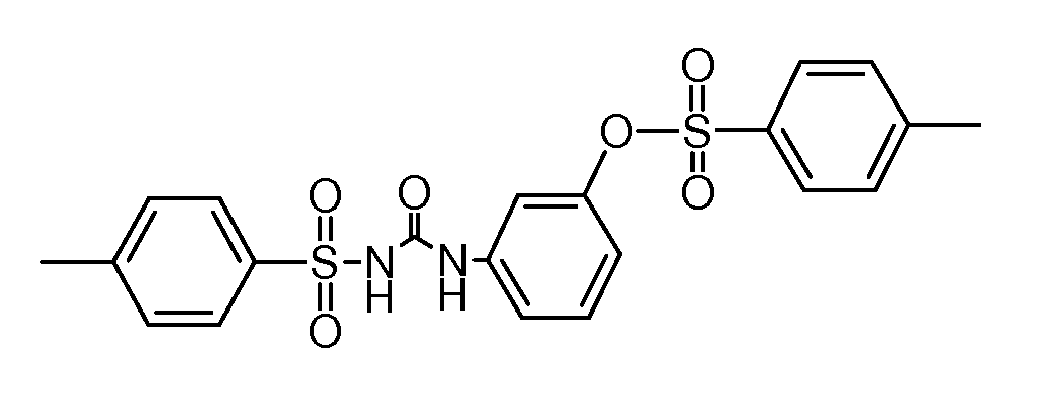
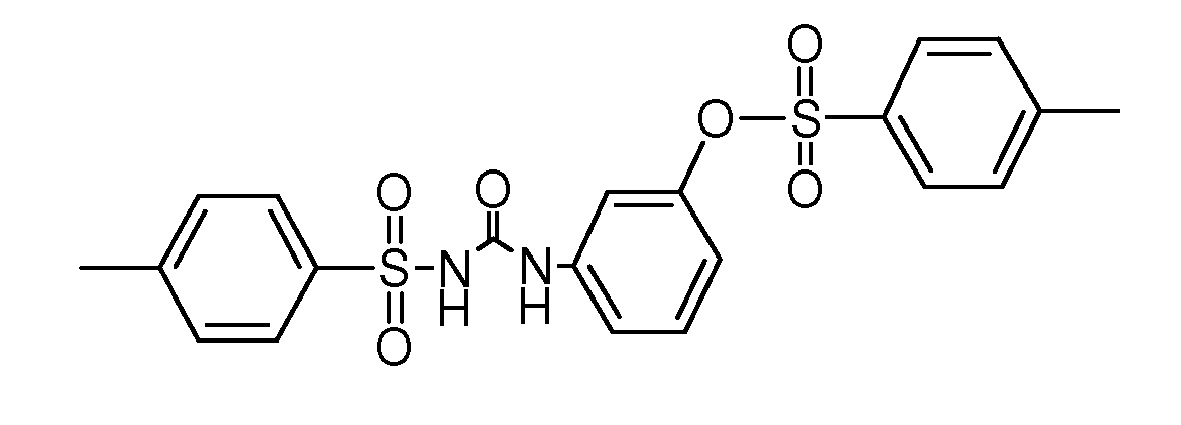
- the heat-sensitive recording layer has, as a color acceptor, N- (p-toluenesulphonyl) -N'-3- (p-toluenesulphonyl-oxy-phenyl) -urea according to the formula (2) on.
- the recording layer of the heat-sensitive recording material of the present invention may also preferably contain sensitisers having a melting point of preferably from 60 ° C to 180 ° C, more preferably having a melting point of from 80 ° C to 140 ° C, to increase the thermal responsiveness.
- Such sensitizers are, for example: benzyl p-benzyloxybenzoate, stearamide, N-methylol stearamide, p-benzylbiphenyl, 1,2-di (phenoxy) ethane, 1,2-di (m-methylphenoxy) ethane, m-terphenyl, Dibenzyl oxalate, benzyl naphthyl ether, diphenyl sulfone, etc., with benzyl naphthyl ether, diphenyl sulfone, 1,2-di (m-methylphenoxy) ethane and 1,2-di (phenoxy) ethane being preferred.
- Suitable binders for incorporation into the heat-sensitive recording layer are, for example, water-soluble binders such as starch, hydroxyethyl cellulose, methyl cellulose, carboxymethyl cellulose, gelatin, casein, polyvinyl alcohols, modified polyvinyl alcohols, sodium polyacrylates, acrylamide-acrylate copolymers, acrylamide-acrylate-methacrylate terpolymers, alkali metal salts of styrene.
- water-soluble binders such as starch, hydroxyethyl cellulose, methyl cellulose, carboxymethyl cellulose, gelatin, casein, polyvinyl alcohols, modified polyvinyl alcohols, sodium polyacrylates, acrylamide-acrylate copolymers, acrylamide-acrylate-methacrylate terpolymers, alkali metal salts of styrene.
- water-insoluble latex binders such as styrene-butadiene copolymers, acrylonitrile-butadiene copolymers, methyl acrylate-butadiene copolymers, etc. are suitable as binders for incorporation into the heat-sensitive recording layer.
- thermosensitive recording layer For the purposes of the present invention are polyvinyl alcohol alone and / or in conjunction with acrylate copolymers and / or in conjunction with methyl cellulose as particularly preferred binders which together, based on the total weight (atro) of the recording layer, in a range of 12 to 25 wt % (atro), preferably in a range of 18 to 22% by weight (atro), are incorporated in the thermosensitive recording layer.
- the heat-sensitive recording layer may further contain lubricants and release agents such as metal salts of higher fatty acids, for example, zinc stearate, calcium stearate, etc .; Waxes, for example paraffin, oxidized paraffin, polyethylene, polyethylene oxide, stearamides, castor wax, etc.
- Further constituents of the recording layer are, for example, pigments, preferably inorganic pigments such as, for example, aluminum (hydr) oxide, silicic acid and calcium carbonate, in which case calcium carbonate, which is preferred in from 10 to 18% by weight, based on the total weight of the recording layer, of being incorporated in the recording layer is considered preferable.
- roller coater, knife coater, curtain coater or air brush are particularly suitable as coating apparatus for applying the heat-sensitive recording layer.
- the coating composition used to form the recording layer is aqueous.
- the subsequent drying of the coating composition is usually done by a method in which heat is supplied, as is done by hot-air floating dryer or contact dryer. Proven is also a combination of the listed dry processes.
- the basis weight of the heat-sensitive recording layer is preferably from 2 to 6 g / m 2, and more preferably from 2.3 to 5.8 g / m 2 .
- a pigmented intermediate layer is expediently arranged between the recording layer and the substrate of the heat-sensitive recording material according to the invention.
- the intermediate layer is applied in a preferred embodiment with leveling coating devices, such as, for example, roller coater, doctor blade or doctor blade coaters, the intermediate layer can also make a positive contribution to equalization of the substrate surface, thus increasing the amount of coating material necessarily to be applied to the substrate heat-sensitive recording layer reduced.
- leveling coating devices such as, for example, roller coater, doctor blade or doctor blade coaters
- the intermediate layer can also make a positive contribution to equalization of the substrate surface, thus increasing the amount of coating material necessarily to be applied to the substrate heat-sensitive recording layer reduced.
- For the basis weight of the intermediate layer a preferred range between 5 and 20 g / m 2 and even better between 7 and 11 g / m 2 has proven.
- inorganic oil-absorbing pigments When inorganic oil-absorbing pigments are incorporated in the intermediate layer sandwiched between the recording layer and the substrate, these pigments can absorb the thermoset liquefied wax components of the thermosensitive recording layer in print image formation, thereby promoting still safer and faster operation of the thermally-induced recording, thus such an embodiment preferably applies.
- the pigments of the intermediate layer has an oil absorption of at least 80 cm3 / 100 g, and more preferably 100 cm3 / 100 g, determined according to the Japanese standard JIS K 5101, is having.
- Calcined kaolin has proven particularly useful due to its large absorption reservoir in the cavities.
- the following inorganic pigments are also very well suited as constituents of the intermediate layer: silicon oxide, bentonite, calcium carbonate and aluminum oxide and, in particular, boehmite here. Also mixtures of several different types of inorganic pigments are conceivable.
- the ratio between organic and inorganic pigment is a compromise of the effects caused by the two types of pigments, which is particularly advantageously solved when the pigment mixture to 5 to 30 wt .-% or better to 8 to 20 wt .-% of organic and 95 to 70 wt .-% or better to 92 to 80 wt .-% consists of inorganic pigment.
- Pigment mixtures of different organic pigments are conceivable.
- the pigmented intermediate layer contains at least one binder, preferably based on a synthetic polymer, wherein, for example, styrene-butadiene latex gives particularly good results.
- a synthetic binder with the addition of at least one natural polymer, particularly preferably starch, is a particularly suitable embodiment.
- the proposed recording material when the additional layer containing the non-colored, water-soluble and / or alcohol-soluble solid particles is stamped onto the heat-sensitive recording layer, the proposed recording material preferably has a protective layer, including any indication of a possible authentication feature or its shape to prevent.
- a protective layer for example, coating colors, as they are used in the EP-B-0 909 242 and secondly in the EP-B-1 333 991 be proposed.
- the protective layer combines high environmental resistance with recyclability and good printability in the wet offset process.
- the protective layers mentioned are both relatively cheap to produce and apply in one layer.
- inorganic pigments natural or precipitated calcium carbonate, kaolin or titanium oxide are possible for the protective layer.
- Crosslinking agents for the protective layer are, in particular, cyclic urea, methylolurea, polyamide-epichlorohydrin resin, ammonium zirconium carbonate.
- the protective layer with a basis weight in a range of 1.5 to 6 g / m 2 and especially between 1.8 and 4 g / m 2 , in particular roller coater, doctor blade or (roll) doctor blade coater , but also offer curtain coaters and airbrush application units as coating units for application of the protective layer.
- a protective layer which are curable by means of actinic radiation.
- actinic radiation UV or ionizing radiation, such as electron beams to understand.
- a non-surface treated base paper is to be understood as meaning a base paper which has not been treated in a size press or in a coating device.
- films of, for example, polyolefin and polyolefin-coated papers as a substrate are possible to the same extent, without such an embodiment having an exclusive character.
- a calcined kaolin pigment, styrene-butadiene latex as a binder and, in addition to other aids, starch as cobinder-containing intermediate layer having a basis weight of 9 g / m 2 is applied using a doctor blade.
- a heat-sensitive recording layer having a basis weight of 5.4 g / m 2 is applied by means of a roller doctor coater.
- the aqueous coating used for this purpose contains the following components according to the formulation shown in Table 1: ⁇ u> Table 1: ⁇ / u> Data in wt .-% (atro), based on the total weight of the heat-sensitive recording layer color formers 3-dibutylamino-6-methyl-7-anilinofluoran (ODB-2) 9 color acceptor N- (p-toluensulphonyl) -N'-3- (p-toluensulphonyl-oxyphenyl) -urea according to formula (2), which is Pergafast ® 201 (CIBA) 22 sensitizer Benzylnaphthyl ether (BNE) 22 binder Polyvinyl alcohol (PVA) 7 co-binder Acrylate copolymers 12 methylcellulose 2 pigment calcium carbonate 16
- heat-sensitive recording layer which are not stated in percent and based on the total weight in% by weight (atro) include dispersants, defoamers, optical brighteners, thickeners, waxes and crosslinkers.
- thermosensitive recording layer After drying the thermosensitive recording layer and smoothing the recording material, here a value of 150 Bekk sec is measured, carried out with the aid of a stamp, the application of an aqueous solution to the heat-sensitive recording layer, wherein for the solution, the following components according to the reproduced in Table 2 recipe be used: ⁇ u> Table 2: ⁇ / u> In wt .-% (atro), based on the total weight of the aqueous arginine solution Solid particles Arginine according to formula (1) 4 wetting agent Olfin 0.5 binder polyvinyl alcohol 1
- the heat-sensitive recording material is placed for 2 min in a drying oven at 120 ° C heat.
- the heat causes blackening of the heat-sensitive recording layer as a result of the color-forming reaction of color former and color acceptor, but this blackening does not occur in sharp-edged places where the aqueous arginine solution had previously been applied.
Landscapes
- Physics & Mathematics (AREA)
- Optics & Photonics (AREA)
- Chemical & Material Sciences (AREA)
- Chemical Kinetics & Catalysis (AREA)
- General Chemical & Material Sciences (AREA)
- Heat Sensitive Colour Forming Recording (AREA)
Abstract
Description
Die vorliegende Erfindung betrifft ein wärmeempfindliches Aufzeichnungsmaterial mit Authentifikationsmerkmal, umfassend ein Substrat, optional eine auf das Substrat aufgebrachte pigmentierte Zwischenschicht sowie eine Farbbildner und Farbakzeptoren enthaltende wärmeempfindliche Aufzeichnungsschicht.The present invention relates to a thermosensitive recording material having an authenticating feature comprising a substrate, optionally a pigmented intermediate layer applied to the substrate, and a thermosensitive recording layer containing color formers and color acceptors.
Aufzeichnungsmaterialien der genannten Art bestimmen das tägliche Leben in der Gesellschaft und innerhalb des Berufslebens. Für den Einsatz von Aufzeichnungsmaterialien, deren berechtigte Verwendung allgemein durch eine spezifische Markierung des für diesen Zweck zugelassenen Materials nachzuweisen ist, wurden in der Vergangenheit bereits verschiedene Lösungen authentizitätsnachweisender Sicherheitsmerkmale vorgeschlagen.Recording materials of this kind determine daily life in society and in professional life. For the use of recording materials, the authorized use of which is generally to be demonstrated by a specific marking of the material approved for this purpose, various solutions of authenticity-proofing security features have already been proposed in the past.
Authentizitätsnachweise für Dokumente in Form passiver Untersuchungen werden beispielsweise ermöglicht durch sich größter Beliebtheit erfreuender Wasserzeichen, das sind Zeichnungen im Papier, die in der Regel durch unterschiedliche Papierdicke hervorgerufen wird. Es wird unterschieden zwischen
- echten Wasserzeichen, die durch Verdrängung (so genannte Licht-Wasserzeichen) oder durch Anreicherung (so genannte Schatten-Wasserzeichen) der Fasermasse beispielsweise unter Verwendung eines Egoutteurs in der Siebpartie einer Papiermaschine hergestellt werden,
- halbechten, so genannten Moletten-Wasserzeichen, die durch die Prägung des noch nassen Papiers in der Pressenpartie einer Papiermaschine erzeugt werden, wobei die Ausbildung solcher wie auch echter Wasserzeichen in den Substraten wärmeempfindlicher Aufzeichnungsmaterialien unter anderem in der
EP 0 611 664 B1 - und schließlich unechten Wasserzeichen, wobei letztere gewöhnlich außerhalb der Papiermaschine entweder durch das Prägen oder durch das Bedrucken des fertig gestellten Papiers mit einem farblosen, gerne auch unter UV-Licht fluoreszierenden Lack erstellt werden, wie es unter anderem in der
EP-A-0 844 097
- genuine watermarks produced by displacement (so-called light watermarks) or by enrichment (so-called shadow watermarks) of the fiber mass, for example using a dandy cutter in the wire section of a paper machine,
- Halbchten, so-called Moletten watermark, which are produced by the embossing of the still wet paper in the press section of a paper machine, the formation of such as real watermarks in the substrates of heat-sensitive recording materials, inter alia in the
EP 0 611 664 B1 - and finally spurious watermarks, the latter usually being located outside the paper machine either by embossing or by printing the finished paper with a colorless, even UV light fluorescent paint can be created as it is in the
EP-A-0 844 097
Ausgehend von den bekannten unechten Wasserzeichen wurde es als ein Nachteil für bestimmte Anwendungen erkannt, dass dieses authentizitätsnachweisende Sicherheitsmerkmal jederzeit erkennbar ist. Der vorliegenden Erfindung lag dann die Aufgabe zugrunde, ein Authentifikationsmerkmal für ein Aufzeichnungsmaterial zur Verfügung zu stellen, das nicht jederzeit und unmittelbar, sondern nur ab einem gewünschten Zeitpunkt, in dem die Echtheit des das Merkmal tragenden Aufzeichnungsmaterials nachgewiesen werden soll, sichtbar sein soll.Based on the known spurious watermarks, it has been recognized as a disadvantage for certain applications that this authenticity-proofing security feature is recognizable at all times. The present invention was then based on the object of providing an authentication feature for a recording material which should not be visible at all times and immediately, but only from a desired point in time at which the authenticity of the recording material carrying the feature should be visible.
Die vorgegebene Aufgabe wird gelöst durch ein wärmeempfindliches Aufzeichnungsmaterial mit einem Authentifikationsmerkmal, umfassend ein Substrat sowie eine Farbbildner und Farbakzeptoren enthaltende wärmeempfindliche Aufzeichnungsschicht, wobei Farbbildner und Farbakzeptoren unter Einwirkung von Wärme farbbildend miteinander reagieren. Das vorgeschlagene Aufzeichnungsmaterial weist als Authentifikationsmerkmal eine zusätzliche Schicht mit nicht farbigen, in Wasser und/oder in Alkohol löslichen Feststoffpartikeln auf, wobei die Feststoffpartikel in einer wässerigen Lösung stark alkalisch reaktiv sind.The specified object is achieved by a heat-sensitive recording material having an authentication feature comprising a substrate and a thermosensitive recording layer containing a color former and color acceptors, color formers and color acceptors reacting with each other in a color-forming manner under the action of heat. The proposed recording material has as an authentication feature an additional layer of non-colored, water-soluble and / or alcohol-soluble solid particles, the solid particles being strongly alkaline-reactive in an aqueous solution.
Im Sinne der vorliegenden Erfindung bedeutet nicht farbig im Zusammenhang mit den Feststoffpartikeln, dass diese im trockenen Zustand weiß bzw. weißlich erscheinen, während eine Wasser- bzw. Alkohollösung mit diesen Feststoffpartikeln transparent ist.For the purposes of the present invention, color in connection with the solid particles does not mean that they appear whitish or whitish in the dry state, while a water or alcohol solution with these solid particles is transparent.
In einer wässerigen Lösung sind die Feststoffpartikel stark alkalisch reaktiv, was bedeutet, dass eine solche wässerige Lösung einen pH-Wert über 9,0, bevorzugt über 10,0 und noch besser über 11,0 aufweist.In an aqueous solution, the solid particles are highly alkaline reactive, which means that such an aqueous solution has a pH above 9.0, preferably above 10.0, and more preferably above 11.0.
Die zusätzliche Schicht wird bevorzugt in Form
- eines Musters,
- von Logos bzw. von fortlaufenden Nummerierungen
- eines diagonalen Streifengittermusters
- a pattern,
- logos or consecutive numbering
- a diagonal stripe grid pattern
Als mögliche Methoden zur Aufbringung der zusätzlichen Schicht auf die wärmeempfindliche Aufzeichnungsschicht haben sich Stempeln sowie generell alle analogen Druckverfahren wie insbesondere Offset-Drucken bewährt, ohne darauf in irgendeiner Art und Weise beschränkt zu sein. Auch ist die Aufbringung der zusätzlichen Schicht mittels Tintenstrahldruck geeignet. Jedoch gelten wärmeempfindliche Aufzeichnungsmaterialien mit auf die wärmeempfindliche Aufzeichnungsschicht gestempelter bzw. gedruckter zusätzlicher Schicht als besonders bevorzugt.As possible methods for applying the additional layer to the heat-sensitive recording layer, stamping and, in general, all analog printing methods, in particular offset printing, have proven to be useful without being limited in any way. Also, the application of the additional layer by means of inkjet printing is suitable. However, heat-sensitive recording materials having an additional layer stamped on the heat-sensitive recording layer are particularly preferred.
Ein gut geeignetes Beispiel für die Feststoffpartikel der zusätzlichen Schicht ist Guanidincarbonat. Eine 15%-tige wässerige Guanidincarbonat-Lösung mit einem pH-Wert von 11,5, in einer bevorzugten Ausführungsform mit einem Zusatz von, bezogen auf die wässerige Guanidincarbonat-Lösung, 5 % Ethanol versehen, lässt sich als Authentifikationsmerkmal hervorragend auf die wärmeempfindliche Aufzeichnungsschicht aufbringen, wobei eine derart ausgebildete Schicht zudem schnell einzieht und trocknet.A good example of the solid particles of the additional layer is guanidine carbonate. A 15% aqueous Guanidincarbonat solution with a pH of 11.5, in a preferred embodiment with an addition of, based on the aqueous guanidine carbonate solution, 5% ethanol provided, can be excellent as an authentication feature on the heat-sensitive recording layer Apply, with a layer formed in this way also quickly absorbs and dries.
Guanidincarbonat ist hervorragend in der Lage, die farbbildende Reaktion von Farbbildner und Farbakzeptoren bei Wärmezufuhr durch die Ausbildung einer stark alkalischen Umgebung zu blockieren, wobei diese Blockierung erfindungswesentlich scharf begrenzt und in Form des beabsichtigten Musters erfolgt. Nachteilig an Guanidincarbonat ist dessen geringe Stabilität, was sich durch eine graue bis gelbliche Verfärbung zeigt. Wird das erfindungsgemäße Aufzeichnungsmaterial hingegen nur für einen vergleichsweise kurzen Zeitraum von wenigen Stunden bis hin zu wenigen Tagen genutzt, ist Guanidincarbonat aufgrund niedriger Beschaffungspreise sehr gut zu nutzen.Guanidine carbonate is outstandingly capable of blocking the color-forming reaction of color formers and color acceptors when heat is given by the formation of a strongly alkaline environment, wherein this blocking is essentially sharply defined in the invention and takes place in the form of the intended pattern. A disadvantage of Guanidincarbonat is its low stability, which is characterized by a shows gray to yellowish discoloration. If, however, the recording material according to the invention is used only for a comparatively short period of a few hours up to a few days, guanidine carbonate is very easy to use owing to low procurement prices.
Ein weiteres Beispiel für die Feststoffpartikel der zusätzlichen Schicht ist Arginin, das der folgenden Formel (1) genügt:

Arginin weist nicht die Nachteile einer geringen Stabilität auf und ist gleichzeitig in der Lage, sehr scharfkantige Blockierungen der farbbildenden Reaktion von Farbbildner und Farbakzeptoren bei Wärmezufuhr zu gewährleisten. Dazu wird bevorzugt eine 3 bis 5%tige wässerige Argininlösung zur Aufbringung auf die wärmeempfindliche Aufzeichnungsschicht benutzt. In diese Lösung kann zusätzlich ein Netzmittel, insbesondere Olfin, und, bezogen auf die Argininlösung, zu 1 bis 3,5 % eine beispielsweise 12%tige Polyvinylalkohollösung und zu 4 bis 8 % Ethanol zugegeben werden.Arginine does not have the disadvantages of low stability and at the same time is able to ensure very sharp-edged blockages of the color-forming reaction of color former and dye acceptors when heat is applied. For this purpose, a 3 to 5% aqueous arginine solution is preferably used for application to the heat-sensitive recording layer. In this solution, in addition, a wetting agent, in particular olefin, and, based on the arginine solution, to 1 to 3.5%, for example, 12% polyvinylalcohol solution and 4 to 8% ethanol are added.
Ein weiteres Beispiel für die Feststoffpartikel der zusätzlichen Schicht ist Lysin.Another example of the solid particles of the additional layer is lysine.
Das erfindungsgemäße wärmeempfindliche Aufzeichnungsmaterial kann als Farbbildner mindestens eine Substanz enthalten, ausgewählt aus der Gruppe der aus dem Stand der Technik bekannten Phthalid-, Xanthen-, Fluoran-, Triarylmethan-, Diphenylmethan-, Fluoren-, Oxazin-, Thiazin- oder Spiropyran-Verbindungen, wobei Xanthen-Verbindungen als bevorzugt gelten.The heat-sensitive recording material according to the invention may comprise as color former at least one substance selected from the group of phthalide, xanthene, fluoran, triarylmethane, diphenylmethane, fluorene, oxazine, thiazine or spiropyran compounds known from the prior art where xanthene compounds are considered preferred.
Typische Verbindungen dieser Art sind beispielsweise:Typical compounds of this type are, for example:
Xanthen-Verbindungen:Xanthene compounds:
Rhodamine-B-anilinolactam, Rhodamine-B-p-chloroanilinolactam, 3-Diethylamino-7-dibenzylaminofluoran, 3-Diethylamino-7-octylaminofluoran, 3-Diethylamino-7-phenylfluoran, 3-Diethylamino-7-chlorofluoran, 3-Diethylamino-6-chloro-7-methylfluoran, 3-Diethylamino-7-(3,4-dichloroanilino)fluoran, 3-Diethylamino-7-(2-chloroanilino)fluoran, 3-Diethylamino-6-methyl-7-anilinofluoran, 3-(N-Ethyl, N-tolyl)amino-6-methyl-7-anilinofluoran, 3-Piperidino-6-methyl-7-anilino-fluoran, 3-(N-Ethyl, N-tolyl)amino-6-methyl-7-phenylethylfluoran, 3-Diethylamino-7-(4-nitroanilino)fluoran, 3-(N-Methyl, N-propyl)amino-6-methyl-7-anilinofluoran, 3-(N-Methyl, N-cyclohexyl)amino-6-methyl-7-anilino-fluoran, 3-(N-Ethyl, N-tetra-hydrofuryl)amino-6-methyl-7-anilinofluoran, etc.Rhodamine-B-anilinolactam, rhodamine-Bp-chloroanilinolactam, 3-diethylamino-7-dibenzylaminofluoran, 3-diethylamino-7-octylaminofluoran, 3-diethylamino-7-phenylfluoran, 3-diethylamino-7-chlorofluoran, 3-diethylamino-6- chloro-7-methylfluoran, 3-diethylamino-7- (3,4-dichloroanilino) fluoran, 3-diethylamino-7- (2-chloroanilino) fluoran, 3-diethylamino-6-methyl-7-anilinofluoran, 3- (N Ethyl, N-tolyl) amino-6-methyl-7-anilinofluoran, 3-piperidino-6-methyl-7-anilino-fluoran, 3- (N-ethyl, N-tolyl) amino-6-methyl-7- phenylethylfluoran, 3-diethylamino-7- (4-nitroanilino) fluoran, 3- (N -methyl, N-propyl) amino-6-methyl-7-anilinofluoran, 3- (N -methyl, N-cyclohexyl) amino-6 methyl 7-anilino-fluoran, 3- (N-ethyl, N-tetrahydrofuryl) amino-6-methyl-7-anilinofluoran, etc.
Triarylmethan-Verbindungen:Triarylmethane compounds:
3,3-Bis(p-dimethylaminophenyl)-6-dimethylaminophthalid (Kristall Violett Lacton), 3,3-Bis(p-dimethylaminophenyl)phthalid, 3-(p-Dimethylaminophenyl)-3-(1,2-dimethylindol-3-yl)phthalid, 3-(p-Dimethylaminophenyl)-3-(2-methylindol-3-yl)phthalid, 3-(p-Dimethylaminophenyl)-3-(2-phenylindol-3-yl)phthalid, 3,3-Bis(1,2-dimethylindol-3-yl)-5-dimethylaminophthalid, 3,3-Bis(1,2-dimethylindol-3-yl)-6-dimethylamino-phthalid, 3,3-Bis(9-ethylcarbazol-3-yl)-5-dimethylaminophthalid, 3,3-Bis(2-phenyl-indol-3-yl)-5-dimethylaminophthalid, 3-p-Dimethylaminophenyl-3(1-methylpyrrol-2-yl)-6-dimethylaminophthalid, etc.3,3-Bis (p-dimethylaminophenyl) -6-dimethylaminophthalide (Crystal Violet Lactone), 3,3-bis (p-dimethylaminophenyl) phthalide, 3- (p-dimethylaminophenyl) -3- (1,2-dimethylindole-3 -yl) phthalide, 3- (p-dimethylaminophenyl) -3- (2-methylindol-3-yl) phthalide, 3- (p-dimethylaminophenyl) -3- (2-phenylindol-3-yl) phthalide, 3.3 Bis (1,2-dimethylindol-3-yl) -5-dimethylaminophthalide, 3,3-bis (1,2-dimethylindol-3-yl) -6-dimethylamino-phthalide, 3,3-bis (9-ethylcarbazole 3-yl) -5-dimethylaminophthalide, 3,3-bis (2-phenyl-indol-3-yl) -5-dimethylaminophthalide, 3-p-dimethylaminophenyl-3 (1-methylpyrrol-2-yl) -6- dimethylaminophthalide, etc.
Diphenylmethan-Verbindungen:Diphenylmethane compounds:
4,4'-Bis-dimethylaminophenyl-benzhydrylbenzylether, N-Halophenylleucoauramine, N-2,4,5-Trichlorophenyl-leucoauramin, und dergleichen.4,4'-bis-dimethylaminophenyl benzhydryl benzyl ether, N-halophenyl leucoauramines, N-2,4,5-trichlorophenyl leucoauramine, and the like.
Thiazine-Verbindungen:Thiazine compounds:
Benzoylleucomethylenblau, p-Nitrobenzoylleucomethylenblau, etc.Benzoylleucomethylene blue, p-nitrobenzoylleucomethylene blue, etc.
Spiropyran-Verbindungen:Spiropyran compounds:
3-methylspiro-dinaphthopyran, 3-ethylspiro-dinaphthopyran, 3,3-dichlorospiro-dinaphthopyran, 3-benzylspiro-dinaphthopyran, 3-methyl-naphtho-(3-methoxy-benzo)spiropyran, 3-propyl-spiro-benzopyran, etc.3-methylspiro-dinaphthopyran, 3-ethylspiro-dinaphthopyran, 3,3-dichlorospiro-dinaphthopyran, 3-benzylspiro-dinaphthopyran, 3-methyl-naphtho (3-methoxy-benzo) spiropyran, 3-propyl-spiro-benzopyran, etc ,
Weiterhin kann die Aufzeichnungsschicht beispielsweise auch eine oder mehrere der folgenden, im nahen Infrarot-Bereich absorbierenden Verbindungen enthalten:Furthermore, the recording layer can also contain, for example, one or more of the following near infrared absorbing compounds:
3,6-Bis(dimethylamino)fluoren-9-spiro-3'-(6'-dimethylaminophthalid), 3-Diethylamino-6-dimethylaminofluoren-9-spiro-3'-(6'-dimethylaminophthalid), 3,6-Bis(diethylamino)-fluoren-9-spiro-3'-(6'-dimethylaminophthalid), 3-Dibutylamino-6-dimethylaminofluoren-9-spiro-3'-(6'-dimethylaminophthalid), 3-Dibutylamino-6-diethylaminofluoren-9-spiro-3'-(6'-dimethylaminophthalid), 3,6-Bis(dimethylamino)fluoren-9-spiro-3'-(6'-diethylamino-phthalid), 3-Diethylamino-6-dimethylaminofluoren-9-spiro-3'-(6'-diethylaminophthalid), 3-Dibutylamino-6-dimethylaminofluoren-9-spiro-3'-(6'-diethylaminophthalid), 3,6-Bis-(diethylamino)fluoren-9-spiro-3'-(6'-diethylaminophthalid), 3,6-Bis-(dimethylamino)-fluoren-9-spiro-3'-(6'-dibutylaminophthalid), 3-Dibutylamino-6-di-ethylaminofluoren-9-spiro-3'-(6'-diethylaminophthalid), 3-Diethylamino-6-dimethylaminofluoren-9-spiro-3'-(6'-dibutylaminophthalid), 3,3-Bis[2-(4-dimethylamino-phenyl)-2-(4-methoxyphenyl)-ethenyl]-4,5,6,7-tetrachlorophthalid, etc.3,6-Bis (dimethylamino) fluorene-9-spiro-3 '- (6'-dimethylaminophthalide), 3-diethylamino-6-dimethylaminofluorene-9-spiro-3' - (6'-dimethylaminophthalide), 3.6- Bis (diethylamino) -fluorene-9-spiro-3 '- (6'-dimethylaminophthalide), 3-dibutylamino-6-dimethylaminofluorene-9-spiro-3' - (6'-dimethylaminophthalide), 3-dibutylamino-6-diethylaminofluorene -9-spiro-3 '- (6'-dimethylaminophthalide), 3,6-bis (dimethylamino) fluorene-9-spiro-3' - (6'-diethylamino-phthalide), 3-diethylamino-6-dimethylaminofluorene-9 -spiro-3 '- (6'-diethylaminophthalide), 3-dibutylamino-6-dimethylaminofluorene-9-spiro-3' - (6'-diethylaminophthalide), 3,6-bis (diethylamino) fluorene-9-spiro 3 '- (6'-diethylaminophthalide), 3,6-bis (dimethylamino) -fluorene-9-spiro-3' - (6'-dibutylaminophthalide), 3-dibutylamino-6-di-ethylaminofluorene-9-spiro 3 '- (6'-diethylaminophthalide), 3-diethylamino-6-dimethylaminofluorene-9-spiro-3' - (6'-dibutylaminophthalide), 3,3-bis [2- (4-dimethylamino-phenyl) -2- (4-methoxyphenyl) -ethenyl] -4,5,6,7-tetrachlorophthalide, etc.
Als ganz besonders bevorzugte Farbbildner in der wärmeempfindlichen Aufzeichnungsschicht gelten im Rahmen der vorliegenden Erfindung solche Substanzen, ausgesucht aus der Liste, umfassend: 3-diethylamino-6-methyl-7-Anilinofluoran, 3-dibutylamino-6-methyl-7-Anilinofluoran, 3-(N-methyl-N-propyl)amino-6-methyl-7-Anilinofluoran, 3-(N-ethyl-N-isoamyl)amino-6-methyl-7-Anilinofluoran, 3-(N-methyl-N-cyclohexyl)amino-6-methyl-7-Anilinofluoran, 3-(N-ethyl-N-tolyl)amino-6-methyl-7-Anilinofluoran und 3-(N-ethyl-N-tetrahydrofuryl)-amino-6-methyl-7-Anilinofluoran.Very particularly preferred color formers in the heat-sensitive recording layer in the context of the present invention are those substances selected from the list comprising: 3-diethylamino-6-methyl-7-anilinofluoran, 3-dibutylamino-6-methyl-7-anilinofluoran, 3 (N-methyl-N-propyl) amino-6-methyl-7-anilinofluoran, 3- (N-ethyl-N-isoamyl) amino-6-methyl-7-anilinofluoran, 3- (N-methyl-N- cyclohexyl) amino-6-methyl-7-anilinofluoran, 3- (N-ethyl-N-tolyl) amino-6-methyl-7-anilinofluoran and 3- (N-ethyl-N-tetrahydrofuryl) -amino-6-methyl -7-anilinofluoran.
Die Aufzeichnungsschicht des erfindungsgemäßen wärmeempfindlichen Aufzeichnungsmaterials kann grundsätzlich alle zu den genannten und insbesondere zu den bevorzugt aufgeführten Farbbildner im einzelnen passenden Farbakzeptoren, insbesondere organische Farbakzeptoren beinhalten. Bevorzugt weist die wärmeempfindliche Aufzeichnungsschicht als Farbakzeptor N-(p-toluensulphonyl)-N'-3-(p-toluensulphonyl-Oxy-phenyl)-harnstoff gemäß der Formel (2)
Die Aufzeichnungsschicht des erfindungsgemäßen wärmeempfindlichen Aufzeichnungsmaterials kann zur Erhöhung der thermischen Ansprechempfindlichkeit bevorzugt auch Sensibilisatoren mit einem Schmelzpunkt idealerweise von 60°C bis 180°C, besonders bevorzugt mit einem Schmelzpunkt von 80°C bis 140°C, enthalten. Derartige Sensibilisatoren sind beispielsweise: Benzyl-p-benzyloxy-benzoat, Stearamid, N-Methylolstearamid, p-Benzylbiphenyl, 1,2-Di(phenoxy)-ethan, 1,2-Di(m-methylphenoxy)ethan, m-Terphenyl, Dibenzyloxalat, Benzyl-naphthylether, Diphenylsulfon, etc., wobei Benzylnaphthylether, Diphenylsulfon, 1,2-Di(m-methylphenoxy)ethan und 1,2-Di(phenoxy)-ethan als bevorzugt gelten.The recording layer of the heat-sensitive recording material of the present invention may also preferably contain sensitisers having a melting point of preferably from 60 ° C to 180 ° C, more preferably having a melting point of from 80 ° C to 140 ° C, to increase the thermal responsiveness. Such sensitizers are, for example: benzyl p-benzyloxybenzoate, stearamide, N-methylol stearamide, p-benzylbiphenyl, 1,2-di (phenoxy) ethane, 1,2-di (m-methylphenoxy) ethane, m-terphenyl, Dibenzyl oxalate, benzyl naphthyl ether, diphenyl sulfone, etc., with benzyl naphthyl ether, diphenyl sulfone, 1,2-di (m-methylphenoxy) ethane and 1,2-di (phenoxy) ethane being preferred.
Geeignete Bindemittel zur Einbindung in die wärmeempfindliche Aufzeichnungsschicht sind beispielsweise wasserlösliche Bindemittel wie Stärke, Hydroxyethylzellulose, Methylzellulose, Carboxymethylzellulose, Gelatine, Kasein, Polyvinylalkohole, modifizierte Polyvinylalkohole, Natriumpolyacrylate, Acrylamid-Acrylat-Copolymere, Acrylamid-Acrylat-Methacrylat-Terpolymere, Alkalisalze von Styrol-Maleinsäure-anhydrid-Copolymeren oder Ethylen-Maleinsäureanhydrid-Copolymeren, etc., die allein oder in Kombination untereinander eingesetzt werden können; auch wasserunlösliche Latexbinder wie Styrol-Butadiene-Copolymere, Acrylnitril-Butadien-Copolymere, Methyl-Acrylat-Butadien-Copolymere, etc. bieten sich als Bindemittel zur Einbindung in die wärmeempfindliche Aufzeichnungsschicht an. Im Sinne der vorliegenden Erfindung gelten Polyvinylalkohol allein und/oder in Verbindung mit Acrylat-Copolymere und/oder in Verbindung mit Methylcellulose als besonders bevorzugte Bindemittel, die zusammen, bezogen auf das Gesamtgewicht (atro) der Aufzeichnungsschicht, in einem Bereich von 12 bis 25 Gew.-% (atro), bevorzugt in einem Bereich von 18 bis 22 Gew.-% (atro) in die wärmeempfindliche Aufzeichnungsschicht eingebunden sind.Suitable binders for incorporation into the heat-sensitive recording layer are, for example, water-soluble binders such as starch, hydroxyethyl cellulose, methyl cellulose, carboxymethyl cellulose, gelatin, casein, polyvinyl alcohols, modified polyvinyl alcohols, sodium polyacrylates, acrylamide-acrylate copolymers, acrylamide-acrylate-methacrylate terpolymers, alkali metal salts of styrene. Maleic anhydride copolymers or ethylene-maleic anhydride copolymers, etc., which may be used alone or in combination with each other; also water-insoluble latex binders such as styrene-butadiene copolymers, acrylonitrile-butadiene copolymers, methyl acrylate-butadiene copolymers, etc. are suitable as binders for incorporation into the heat-sensitive recording layer. For the purposes of the present invention are polyvinyl alcohol alone and / or in conjunction with acrylate copolymers and / or in conjunction with methyl cellulose as particularly preferred binders which together, based on the total weight (atro) of the recording layer, in a range of 12 to 25 wt % (atro), preferably in a range of 18 to 22% by weight (atro), are incorporated in the thermosensitive recording layer.
Zur Vermeidung des Klebens an einem Thermokopf und zur Vermeidung einer übermäßigen Abnutzung des Thermokopfes kann die wärmeempfindliche Aufzeichnungsschicht weiterhin Gleit- und Trennmittel enthalten wie Metallsalze höherer Fettsäuren, zum Beispiel Zinkstearat, Kalziumstearat, usw.; Wachse, zum Beispiel Paraffin, oxidiertes Paraffin, Polyethylen, Polyethylenoxid, Stearamide, Kastorwachs, usw. Weitere Bestandteile der Aufzeichnungsschicht sind beispielsweise Pigmente, bevorzugt anorganische Pigmente wie beispielsweise Aluminium(hydr)oxid, Kieselsäure und Kalziumkarbonat, wobei hier insbesondere Kalziumkarbonat, das bevorzugt in einer Menge von 10 bis 18 Gew.-%, bezogen auf das Gesamtgewicht der Aufzeichnungsschicht, in die Aufzeichnungsschicht eingebunden sein soll, als bevorzugt gilt.In order to prevent sticking to a thermal head and to avoid excessive wear of the thermal head, the heat-sensitive recording layer may further contain lubricants and release agents such as metal salts of higher fatty acids, for example, zinc stearate, calcium stearate, etc .; Waxes, for example paraffin, oxidized paraffin, polyethylene, polyethylene oxide, stearamides, castor wax, etc. Further constituents of the recording layer are, for example, pigments, preferably inorganic pigments such as, for example, aluminum (hydr) oxide, silicic acid and calcium carbonate, in which case calcium carbonate, which is preferred in from 10 to 18% by weight, based on the total weight of the recording layer, of being incorporated in the recording layer is considered preferable.
Als Beschichtungsvorrichtung zum Auftrag der wärmeempfindlichen Aufzeichnungsschicht bieten sich insbesondere Rollrakelstreichwerk, Messerstreichwerk, Vorhangbeschichter oder Luftbürste an. Entsprechend einer bevorzugten Ausführungsform ist die zur Ausbildung der Aufzeichnungsschicht genutzte Beschichtungsmasse wässerig. Die anschließende Trocknung der Beschichtungsmasse geschieht üblicherweise durch ein Verfahren, bei dem Wärme zugeführt wird, wie es durch Heißluft-Schwebetrockner oder auch Kontakttrockner geschieht. Bewährt ist auch eine Kombination aus den aufgeführten Trockenverfahren. Die flächenbezogene Masse der wärmeempfindlichen Aufzeichnungsschicht liegt bevorzugt zwischen 2 und 6 g/m2 und noch besser zwischen 2,3 und 5,8 g/m2.Roller coater, knife coater, curtain coater or air brush are particularly suitable as coating apparatus for applying the heat-sensitive recording layer. According to a preferred embodiment, the coating composition used to form the recording layer is aqueous. The subsequent drying of the coating composition is usually done by a method in which heat is supplied, as is done by hot-air floating dryer or contact dryer. Proven is also a combination of the listed dry processes. The basis weight of the heat-sensitive recording layer is preferably from 2 to 6 g / m 2, and more preferably from 2.3 to 5.8 g / m 2 .
Zwischen der Aufzeichnungsschicht und dem Substrat des erfindungsgemäßen wärmeempfindlichen Aufzeichnungsmaterials ist zweckmäßigerweise eine pigmentierte Zwischenschicht angeordnet. Ist die Zwischenschicht in einer bevorzugten Ausführungsform mit egalisierenden Beschichtungsvorrichtungen aufgetragen, wie sie beispielsweise Walzenstreichwerke, Streichmesser- oder (Roll-) Rakelstreichwerke darstellen, kann die Zwischenschicht ferner einen positiven Beitrag zur Egalisierung der Substratoberfläche leisten, womit sich die Menge an notwendigerweise aufzubringender Beschichtungsmasse für die wärmeempfindliche Aufzeichnungsschicht reduziert. Für die flächenbezogene Masse der Zwischenschicht hat sich ein bevorzugter Bereich zwischen 5 und 20 g/m2 und noch besser zwischen 7 und 11 g/m2 bewährt.Between the recording layer and the substrate of the heat-sensitive recording material according to the invention, a pigmented intermediate layer is expediently arranged. If the intermediate layer is applied in a preferred embodiment with leveling coating devices, such as, for example, roller coater, doctor blade or doctor blade coaters, the intermediate layer can also make a positive contribution to equalization of the substrate surface, thus increasing the amount of coating material necessarily to be applied to the substrate heat-sensitive recording layer reduced. For the basis weight of the intermediate layer, a preferred range between 5 and 20 g / m 2 and even better between 7 and 11 g / m 2 has proven.
Werden in die zwischen der Aufzeichnungsschicht und Substrat gelegene Zwischenschicht anorganische ölabsorbierende Pigmente eingebunden, können diese Pigmente die durch Hitzeeinwirkung des Thermokopfes verflüssigten Wachsbestandteile der wärmeempfindlichen Aufzeichnungsschicht bei der Druckbildausbildung aufnehmen und begünstigen damit eine noch sichere und schnellere Funktionsweise der wärmeinduzierten Aufzeichnung, weshalb eine solche Ausführungsform als bevorzugt gilt.When inorganic oil-absorbing pigments are incorporated in the intermediate layer sandwiched between the recording layer and the substrate, these pigments can absorb the thermoset liquefied wax components of the thermosensitive recording layer in print image formation, thereby promoting still safer and faster operation of the thermally-induced recording, thus such an embodiment preferably applies.
Besonders vorteilhaft ist es, wenn die Pigmente der Zwischenschicht eine Ölabsorption von mindestens 80 cm3/100 g und noch besser von 100 cm3/100 g, bestimmt nach der japanischen Norm JIS K 5101, aufweisen. Kalziniertes Kaolin hat sich aufgrund seines großen Absorptionsreservoirs in den Hohlräumen besonders bewährt. Jedoch auch folgende anorganische Pigmente sind als Bestandteile der Zwischenschicht sehr gut geeignet: Siliziumoxid, Bentonit, Kalziumkarbonat sowie Aluminiumoxid und hier besonders Böhmit. Auch Mischungen aus mehreren verschiedenartigen anorganischen Pigmenten sind vorstellbar.It is particularly advantageous if the pigments of the intermediate layer has an oil absorption of at least 80 cm3 / 100 g, and more preferably 100 cm3 / 100 g, determined according to the Japanese standard JIS K 5101, is having. Calcined kaolin has proven particularly useful due to its large absorption reservoir in the cavities. However, the following inorganic pigments are also very well suited as constituents of the intermediate layer: silicon oxide, bentonite, calcium carbonate and aluminum oxide and, in particular, boehmite here. Also mixtures of several different types of inorganic pigments are conceivable.
In Versuchen zeigte sich, dass auch die Einbindung von organischen Pigmenten in die pigmentierte Zwischenschicht sehr vorteilhaft sein kann, was damit begründet wird, dass solche organischen Pigmente in einem besonderen Maße einem hohen Wärmereflexionsvermögen der Zwischenschicht zuträglich sind. Die in einer Zwischenschicht eines wärmeempfindlichen Aufzeichnungsmaterials angeordneten organischen, so genannten Hohlkörperpigmente weisen in ihrem Inneren Luft auf, die einen guten Wärmeisolator darstellt. Die so als Wärmereflexionsschicht optimierte Zwischenschicht erhöht das Ansprechverhalten der Aufzeichnungsschicht gegenüber Wärme, was das Auflösungsvermögen des wärmeempfindlichen Aufzeichnungsmaterials deutlich erhöht und ferner die Druckgeschwindigkeit im Thermodrucker nach oben zu setzen vermag.Experiments have shown that the incorporation of organic pigments into the pigmented intermediate layer can also be very advantageous, which is justified by the fact that such organic pigments in a particular extent contribute to a high heat reflectivity of the intermediate layer are. The arranged in an intermediate layer of a heat-sensitive recording material organic, so-called hollow body pigments have in their interior air, which is a good heat insulator. The intermediate layer thus optimized as the heat reflection layer increases the response of the recording layer to heat, which remarkably increases the resolving power of the thermosensitive recording material and further raises the printing speed in the thermal printer.
Das Mengenverhältnis zwischen organischem und anorganischem Pigment ist ein Kompromiss der von den beiden Pigmentarten bewirkten Effekte, der besonders vorteilhaft gelöst wird, wenn die Pigmentmischung zu 5 bis 30 Gew.-% bzw. besser zu 8 bis 20 Gew.-% aus organischem und zu 95 bis 70 Gew.-% bzw. besser zu 92 bis 80 Gew.-% aus anorganischem Pigment besteht. Pigmentmischungen aus unterschiedlichen organischen Pigmenten sind vorstellbar.The ratio between organic and inorganic pigment is a compromise of the effects caused by the two types of pigments, which is particularly advantageously solved when the pigment mixture to 5 to 30 wt .-% or better to 8 to 20 wt .-% of organic and 95 to 70 wt .-% or better to 92 to 80 wt .-% consists of inorganic pigment. Pigment mixtures of different organic pigments are conceivable.
Neben den anorganischen und gegebenenfalls auch organischen Pigmenten enthält die pigmentierte Zwischenschicht mindestens ein Bindemittel bevorzugt auf Basis eines synthetischen Polymers, wobei beispielsweise Styrol-Butadien-Latex besonders gute Ergebnisse liefert. Die Verwendung eines synthetischen Bindemittels unter Beimischung mindestens eines natürlichen Polymers, wie besonders bevorzugt Stärke, stellt eine besonders geeignete Ausführungsform dar. Im Rahmen von Versuchen mit anorganischen Pigmenten wurde ferner festgestellt, dass mit einem Bindemittel-Pigment-Verhältnis innerhalb der pigmentierten Zwischenschicht zwischen 3:7 und 1:9, jeweils bezogen auf Gew.-%, eine besonders geeignete Ausführungsform vorliegt.In addition to the inorganic and optionally also organic pigments, the pigmented intermediate layer contains at least one binder, preferably based on a synthetic polymer, wherein, for example, styrene-butadiene latex gives particularly good results. The use of a synthetic binder with the addition of at least one natural polymer, particularly preferably starch, is a particularly suitable embodiment. In the context of inorganic pigment experiments, it has also been found that with a binder-pigment ratio within the pigmented intermediate layer between 3: 7 and 1: 9, in each case based on wt .-%, a particularly suitable embodiment is present.
Insbesondere, wenn die zusätzliche Schicht mit den nicht farbigen, in Wasser und/oder in Alkohol löslichen Feststoffpartikeln auf die wärmeempfindliche Aufzeichnungsschicht aufgestempelt bzw. aufgedruckt ist, weist das vorgeschlagene Aufzeichnungsmaterial bevorzugt eine Schutzschicht auf, auch um jeglichen Hinweis auf ein mögliches Authentifikationsmerkmal oder dessen Form zu verhindern.In particular, when the additional layer containing the non-colored, water-soluble and / or alcohol-soluble solid particles is stamped onto the heat-sensitive recording layer, the proposed recording material preferably has a protective layer, including any indication of a possible authentication feature or its shape to prevent.
Zur Ausbildung einer solchen Schutzschicht eignen sich beispielsweise Streichfarben, wie sie zum einen in der
Als anorganische Pigmente sind für die Schutzschicht natürliches oder gefälltes Calciumcarbonat, Kaolin oder Titanoxid möglich Als Vernetzungsmittel für die Schutzschicht bieten sich insbesondere zyklischer Harnstoff, Methylolharnstoff, Polyamidepichlorhydrinharz, Amoniumzirkoniumkarbonat an.As inorganic pigments, natural or precipitated calcium carbonate, kaolin or titanium oxide are possible for the protective layer. Crosslinking agents for the protective layer are, in particular, cyclic urea, methylolurea, polyamide-epichlorohydrin resin, ammonium zirconium carbonate.
Es ist bevorzugt, die Schutzschicht mit einer flächenbezogenen Masse in einem Bereich von 1,5 bis 6 g/m2 und besonders zwischen 1,8 und 4 g/m2 aufzutragen, wobei sich insbesondere Walzenstreichwerke, Streichmesser- oder (Roll-) Rakelstreichwerke, aber auch Curtain Coater und Luftbürsten-Auftragswerke als Streichaggregate zur Aufbringung der Schutzschicht anbieten.It is preferred to apply the protective layer with a basis weight in a range of 1.5 to 6 g / m 2 and especially between 1.8 and 4 g / m 2 , in particular roller coater, doctor blade or (roll) doctor blade coater , but also offer curtain coaters and airbrush application units as coating units for application of the protective layer.
In einem besonderen Maße gilt die drucktechnische Aufbringung einer Schutzschicht als bevorzugt. Verarbeitungstechnisch und hinsichtlich ihrer technologischen Eigenschaften besonders geeignet sind solche Schutzschichten, die mittels aktinischer Strahlung härtbar sind. Unter dem Begriff "aktinische Strahlung" sind UV- oder ionisierende Strahlungen, wie beispielsweise Elektronenstrahlen, zu verstehen.To a particular extent, the printing technology application of a protective layer is preferred. Processing technology and in terms of their technological properties are particularly suitable such protective layers which are curable by means of actinic radiation. The term "actinic radiation" UV or ionizing radiation, such as electron beams to understand.
Auch wenn nicht auf Papier als Substrat beschränkt, ist Papier und hier speziell ein nicht oberflächenbehandeltes Streichrohpapier bevorzugt in einem Bereich für die flächenbezogene Masse zwischen 45 und 130 g/m2 das Substrat, das sich am Markt auch mit Blick auf die gute Umweltverträglichkeit wegen der guten Recyclingfähigkeit durchgesetzt hat und das im Sinne der Erfindung bevorzugt ist. Unter einem nicht oberflächenbehandelten Streichrohpapier ist ein nicht in einer Leimpresse oder in einer Beschichtungsvorrichtung behandeltes Streichrohpapier zu verstehen. Im Sinne der vorliegenden Erfindung wird dabei insbesondere ein nicht oberflächenbehandeltes, in der Masse geleimtes Streichrohpapier mit einem anorganischem Pigment, insbesondere Kalziumkarbonat, in der Masse als geeignet angesehen. Für die Erfindung sind im gleichen Maße Folien beispielsweise aus Polyolefin und mit Polyolefin beschichtete Papiere als Substrat möglich, ohne dass eine solche Ausführung ausschließenden Charakter aufweist.Although not limited to paper as a substrate, paper and especially a non-surface treated base paper preferred in a range for the basis weight between 45 and 130 g / m 2, the substrate, which is also in the market with regard to the good environmental performance because of Good recycling ability has prevailed and is preferred for the purposes of the invention. A non-surface treated base paper is to be understood as meaning a base paper which has not been treated in a size press or in a coating device. For the purposes of the present invention is in particular a non-surface treated, mass-sized base paper with an inorganic pigment, in particular calcium carbonate, considered suitable in the mass. For the invention, films of, for example, polyolefin and polyolefin-coated papers as a substrate are possible to the same extent, without such an embodiment having an exclusive character.
Die in der Beschreibung und in den Ansprüchen gemachten Angaben zur flächenbezogenen Masse, zu Gew.-% (Gewichts-%) beziehen sich jeweils auf das "atro"-Gewicht, d.h. absolut trockene Gewichtsteile.The basis weight,% by weight (% by weight) given in the specification and in the claims refer to the "atro" weight, respectively. absolutely dry parts by weight.
Die Erfindung soll anhand des folgenden Beispiels weiter verdeutlicht werden:The invention will be further clarified by the following example :
Als Substrat wird auf einer Langsieb-Papiermaschine aus gebleichten und gemahlenen Laub- und Nadelholzzellstoffen unter Zugabe von, bezogen auf den Gesamtfeststoffgehalt (atro) der der Papiermaschine zugeführten Pulpe, 0,6 Gew.-% (atro) Harzleim als Masseleimung sowie weiterer üblicher Beischlagstoffe ein Trägerpapier mit einer flächenbezogenen Masse von 53 g/m2 hergestellt. Frontseitig wird eine kalziniertes Kaolin als Pigment, Styrol-Butadien-Latex als Bindemittel und neben weiteren Hilfsmitteln Stärke als Cobinder aufweisende Zwischenschicht mit einer flächenbezogenen Masse von 9 g/m2 unter Nutzung eines Streichmessers aufgebracht.The substrate used on a fourdrinier paper machine made of bleached and ground hardwood and softwood pulps with the addition of, based on the total solids content (atro) of the pulp fed to the paper machine, 0.6 wt .-% (atro) Harzleim as engine sizing and other conventional admixtures a support paper having a basis weight of 53 g / m 2 was produced. On the front side, a calcined kaolin pigment, styrene-butadiene latex as a binder and, in addition to other aids, starch as cobinder-containing intermediate layer having a basis weight of 9 g / m 2 is applied using a doctor blade.
Auf diese pigmentierte Zwischenschicht wird mittels Rollrakel-Streicheinrichtung eine wärmeempfindliche Aufzeichnungsschicht mit einer flächenbezogenen Masse von 5,4 g/m2 aufgetragen. Die dazu verwendete wässerige Streichmasse enthält die folgenden Komponenten nach der in Tabelle 1 wiedergegebenen Rezeptur:
Weitere nicht prozentual und bezogen auf das Gesamtgewicht in Gew.-% (atro) angegebene Bestandteile der wärmeempfindlichen Aufzeichnungsschicht sind unter anderem Dispergiermittel, Entschäumer, optische Aufheller, Verdicker, Wachse und Vernetzer.Other components of the heat-sensitive recording layer which are not stated in percent and based on the total weight in% by weight (atro) include dispersants, defoamers, optical brighteners, thickeners, waxes and crosslinkers.
Nach Trocknung der wärmeempfindlichen Aufzeichnungsschicht und Glättung des Aufzeichnungsmaterials, wobei hier ein Wert von 150 Bekk Sek gemessen wird, erfolgt unter Zuhilfenahme eines Stempels die Aufbringung einer wässerigen Lösung auf die wärmeempfindliche Aufzeichnungsschicht, wobei für die Lösung die folgenden Komponenten nach der in Tabelle 2 wiedergegebenen Rezeptur eingesetzt werden:
Bezogen auf 100 Teile der fertig gestellten Argininlösung werden schließlich noch 7 Teile Ethanol zugegeben.Finally, 7 parts of ethanol are added based on 100 parts of the finished arginine solution.
Zur Kenntlichmachung des derart ausgebildeten Authentifikationsmerkmals wird das wärmeempfindliche Aufzeichnungsmaterial für 2 min in einen Trockenschrank bei 120 °C Hitze gelegt. Die Hitze bewirkt eine Schwärzung der wärmeempfindlichen Aufzeichnungsschicht in Folge der farbbildenden Reaktion von Farbbildner und Farbakzeptor, wobei diese Schwärzung jedoch scharfkantig an den Stellen nicht erfolgt, wo zuvor die wässerige Argininlösung aufgebracht worden war.To identify the thus formed authentication feature, the heat-sensitive recording material is placed for 2 min in a drying oven at 120 ° C heat. The heat causes blackening of the heat-sensitive recording layer as a result of the color-forming reaction of color former and color acceptor, but this blackening does not occur in sharp-edged places where the aqueous arginine solution had previously been applied.
Der Versuch zeigt sehr anschaulich, dass es mit der vorgeschlagenen Erfindung überzeugend gelungen ist, für ein Aufzeichnungsmaterial ein Authentifikationsmerkmal zur Verfügung zu stellen, das nicht unmittelbar, sondern nur ab einem gewünschten Zeitpunkt, in dem die Echtheit des das Merkmal tragenden Aufzeichnungsmaterials nachgewiesen werden soll, sichtbar gemacht werden kann. Dieser Zeitpunkt ist im beschriebenen Fall die Ausbildung der wärmeinduzierten Schwärzung der Aufzeichnungsschicht, die selbstverständlich nicht nur flächendeckend, sondern genauso auch unter Zuhilfenahme eines Thermodruckers gemäß eines Druckbildes erfolgen kann. Genauso ist es möglich, im Rahmen eines Schnelltests eine Lösemitteltinktur auf die Aufzeichnungsschicht mit der zusätzlichen Schicht als Authentifikationsmerkmal aufzubringen, beispielsweise mit einem entsprechend präparierten Filzstiftes. In diesem Fall würde das Lösemittel eine Schwärzung der Aufzeichnungsschicht bewirken, wobei diese Schwärzung jedoch scharfkantig an den Stellen nicht erfolgt, wo zuvor die wässerige Argininlösung aufgebracht worden war.The experiment very clearly shows that the proposed invention has convincingly succeeded in providing an authentication feature for a recording material which is not directly but only from a desired point in time at which the authenticity of the recording material carrying the feature is to be demonstrated. can be made visible. In the case described, this point in time is the formation of the heat-induced blackening of the recording layer, which, of course, can not only be applied nationwide, but also with the aid of a thermal printer according to a printed image. It is equally possible to apply a solvent tincture to the recording layer with the additional layer as an authentication feature in the context of a rapid test, for example with a correspondingly prepared felt-tip pen. In this case, the solvent would cause blackening of the recording layer, but this blackening does not occur in sharp-edged places where the aqueous arginine solution had previously been applied.
Claims (9)

Applications Claiming Priority (1)
| Application Number | Priority Date | Filing Date | Title |
|---|---|---|---|
| DE200610056003 DE102006056003B4 (en) | 2006-11-24 | 2006-11-24 | Heat-sensitive recording material with authentication feature |
Publications (3)
| Publication Number | Publication Date |
|---|---|
| EP1925459A2 true EP1925459A2 (en) | 2008-05-28 |
| EP1925459A3 EP1925459A3 (en) | 2009-01-07 |
| EP1925459B1 EP1925459B1 (en) | 2014-03-12 |
Family
ID=39295740
Family Applications (1)
| Application Number | Title | Priority Date | Filing Date |
|---|---|---|---|
| EP07121262.5A Not-in-force EP1925459B1 (en) | 2006-11-24 | 2007-11-22 | Method of producing a heat-sensitive recording material with authentification feature |
Country Status (2)
| Country | Link |
|---|---|
| EP (1) | EP1925459B1 (en) |
| DE (1) | DE102006056003B4 (en) |
Cited By (1)
| Publication number | Priority date | Publication date | Assignee | Title |
|---|---|---|---|---|
| WO2019149806A1 (en) * | 2018-01-31 | 2019-08-08 | Mitsubishi Hitec Paper Europe Gmbh | Heat-sensitive recording material |
Citations (7)
| Publication number | Priority date | Publication date | Assignee | Title |
|---|---|---|---|---|
| US3916068A (en) | 1972-11-08 | 1975-10-28 | Mitsubishi Paper Mills Ltd | Heat sensitive recording material containing decolorizing agent |
| EP0611664B1 (en) | 1993-02-13 | 1997-10-22 | KANZAN SPEZIALPAPIERE GmbH | Webbed recording material |
| JPH10109477A (en) | 1996-08-12 | 1998-04-28 | Naigai Kaaboninki Kk | Multicolor thermosensible recording material |
| EP0844097A1 (en) | 1996-11-21 | 1998-05-27 | Ncr International Inc. | Thermal paper with security features and security ink therefor |
| EP1041448A1 (en) | 1999-03-31 | 2000-10-04 | Kabushiki Kaisha Toshiba | Decolorable material and method for decoloring the same |
| EP0909242B1 (en) | 1997-04-02 | 2001-01-03 | Mitsubishi HiTec Paper Flensburg GmbH | Thermosensitive recording paper |
| EP1333991B1 (en) | 2000-10-16 | 2004-08-18 | Mitsubishi Hitec Paper Flensburg GmbH | Heat-sensitive recording sheet and use of the same |
Family Cites Families (3)
| Publication number | Priority date | Publication date | Assignee | Title |
|---|---|---|---|---|
| DE19911484B4 (en) * | 1998-03-16 | 2008-04-03 | Ricoh Co., Ltd. | Material for indicating the history of the temperature, method for producing the same and method using the same |
| WO2000016986A1 (en) * | 1998-09-19 | 2000-03-30 | Mitsubishi Hitec Paper Flensburg Gmbh | Heat-sensitive recording materials and method for authenticity checking |
| DE19842867C2 (en) * | 1998-09-19 | 2000-08-03 | Mitsubishi Hitec Paper Flensbu | Heat-sensitive recording material and a method for checking authenticity |
-
2006
- 2006-11-24 DE DE200610056003 patent/DE102006056003B4/en not_active Expired - Fee Related
-
2007
- 2007-11-22 EP EP07121262.5A patent/EP1925459B1/en not_active Not-in-force
Patent Citations (7)
| Publication number | Priority date | Publication date | Assignee | Title |
|---|---|---|---|---|
| US3916068A (en) | 1972-11-08 | 1975-10-28 | Mitsubishi Paper Mills Ltd | Heat sensitive recording material containing decolorizing agent |
| EP0611664B1 (en) | 1993-02-13 | 1997-10-22 | KANZAN SPEZIALPAPIERE GmbH | Webbed recording material |
| JPH10109477A (en) | 1996-08-12 | 1998-04-28 | Naigai Kaaboninki Kk | Multicolor thermosensible recording material |
| EP0844097A1 (en) | 1996-11-21 | 1998-05-27 | Ncr International Inc. | Thermal paper with security features and security ink therefor |
| EP0909242B1 (en) | 1997-04-02 | 2001-01-03 | Mitsubishi HiTec Paper Flensburg GmbH | Thermosensitive recording paper |
| EP1041448A1 (en) | 1999-03-31 | 2000-10-04 | Kabushiki Kaisha Toshiba | Decolorable material and method for decoloring the same |
| EP1333991B1 (en) | 2000-10-16 | 2004-08-18 | Mitsubishi Hitec Paper Flensburg GmbH | Heat-sensitive recording sheet and use of the same |
Cited By (3)
| Publication number | Priority date | Publication date | Assignee | Title |
|---|---|---|---|---|
| WO2019149806A1 (en) * | 2018-01-31 | 2019-08-08 | Mitsubishi Hitec Paper Europe Gmbh | Heat-sensitive recording material |
| KR20200112943A (en) * | 2018-01-31 | 2020-10-05 | 미츠비시 하이텍 페이퍼 유럽 게엠베하 | Thermosensitive recording material |
| US11752793B2 (en) | 2018-01-31 | 2023-09-12 | Mitsubishi Hitec Paper Europe Gmbh | Heat-sensitive recording material |
Also Published As
| Publication number | Publication date |
|---|---|
| EP1925459B1 (en) | 2014-03-12 |
| DE102006056003A1 (en) | 2008-05-29 |
| EP1925459A3 (en) | 2009-01-07 |
| DE102006056003B4 (en) | 2008-08-14 |
Similar Documents
| Publication | Publication Date | Title |
|---|---|---|
| EP2033799B1 (en) | Heat-sensitive recording material | |
| EP3109059B1 (en) | Heat sensitive recording material | |
| EP2993054B1 (en) | Sheet-form heat-sensitive recording material with at least two layers | |
| EP3305538A1 (en) | Heat sensitive recording material | |
| DE102019126220A1 (en) | Heat-sensitive recording material comprising phenol-free organic color developers | |
| EP3746309B1 (en) | Heat-sensitive recording material | |
| WO2011067004A1 (en) | Heat-sensitive recording material with barrier coating | |
| EP2033801B1 (en) | Heat sensitive recording material | |
| DE102004004204A1 (en) | Heat-sensitive recording material for fax machines and thermal printers, has recording layer with sensitiser, pigment, binder, color formers and a color developer comprising Bisphenol A and a urea-urethane compound | |
| EP2033800B1 (en) | Heat-sensitive recording material | |
| EP1925459B1 (en) | Method of producing a heat-sensitive recording material with authentification feature | |
| EP2329955B1 (en) | Heat-sensitive recording material with authenticity characteristic | |
| EP2112000B1 (en) | Heat sensitive recording material | |
| EP2033802B1 (en) | Heat sensitive recording material with reverse coating | |
| DE4104525C2 (en) | ||
| EP2765007B1 (en) | Heat-sensitive recording material | |
| DE102006050420B3 (en) | Heat-sensitive recording material, useful for printing tickets, has recording layer containing fluoran derivative color former and sulfonyl-urea and diphenyl sulfone derivative dye acceptors | |
| DE10392446T5 (en) | Thermal recording material for offset printing | |
| EP2505374B1 (en) | Heat-sensitive recording material, method for its manufacture and application | |
| DE68918287T2 (en) | HEAT SENSITIVE RECORDING PAPER. | |
| DE60103480T2 (en) | Heat-sensitive recording material | |
| EP2174794B1 (en) | Heat-sensitive recording material with printed recording layer | |
| EP2480415B1 (en) | Heat-sensitive recording material with reverse face coating | |
| EP1527900B1 (en) | Thermosensitive recording material, its' use and its' method of preparation. | |
| EP2414173B1 (en) | Heat-sensitive recording material |
Legal Events
| Date | Code | Title | Description |
|---|---|---|---|
| PUAI | Public reference made under article 153(3) epc to a published international application that has entered the european phase |
Free format text: ORIGINAL CODE: 0009012 |
|
| 17P | Request for examination filed |
Effective date: 20071122 |
|
| AK | Designated contracting states |
Kind code of ref document: A2 Designated state(s): AT BE BG CH CY CZ DE DK EE ES FI FR GB GR HU IE IS IT LI LT LU LV MC MT NL PL PT RO SE SI SK TR |
|
| AX | Request for extension of the european patent |
Extension state: AL BA HR MK RS |
|
| PUAL | Search report despatched |
Free format text: ORIGINAL CODE: 0009013 |
|
| AK | Designated contracting states |
Kind code of ref document: A3 Designated state(s): AT BE BG CH CY CZ DE DK EE ES FI FR GB GR HU IE IS IT LI LT LU LV MC MT NL PL PT RO SE SI SK TR |
|
| AX | Request for extension of the european patent |
Extension state: AL BA HR MK RS |
|
| 17Q | First examination report despatched |
Effective date: 20090224 |
|
| AKX | Designation fees paid |
Designated state(s): AT BE BG CH CY CZ DE DK EE ES FI FR GB GR HU IE IS IT LI LT LU LV MC MT NL PL PT RO SE SI SK TR |
|
| RAP1 | Party data changed (applicant data changed or rights of an application transferred) |
Owner name: MITSUBISHI HITEC PAPER EUROPE GMBH |
|
| GRAP | Despatch of communication of intention to grant a patent |
Free format text: ORIGINAL CODE: EPIDOSNIGR1 |
|
| INTG | Intention to grant announced |
Effective date: 20131018 |
|
| GRAS | Grant fee paid |
Free format text: ORIGINAL CODE: EPIDOSNIGR3 |
|
| GRAA | (expected) grant |
Free format text: ORIGINAL CODE: 0009210 |
|
| AK | Designated contracting states |
Kind code of ref document: B1 Designated state(s): AT BE BG CH CY CZ DE DK EE ES FI FR GB GR HU IE IS IT LI LT LU LV MC MT NL PL PT RO SE SI SK TR |
|
| REG | Reference to a national code |
Ref country code: GB Ref legal event code: FG4D Free format text: NOT ENGLISH |
|
| REG | Reference to a national code |
Ref country code: CH Ref legal event code: EP |
|
| REG | Reference to a national code |
Ref country code: AT Ref legal event code: REF Ref document number: 656006 Country of ref document: AT Kind code of ref document: T Effective date: 20140315 |
|
| REG | Reference to a national code |
Ref country code: IE Ref legal event code: FG4D Free format text: LANGUAGE OF EP DOCUMENT: GERMAN |
|
| REG | Reference to a national code |
Ref country code: DE Ref legal event code: R096 Ref document number: 502007012848 Country of ref document: DE Effective date: 20140424 |
|
| REG | Reference to a national code |
Ref country code: NL Ref legal event code: VDEP Effective date: 20140312 |
|
| PG25 | Lapsed in a contracting state [announced via postgrant information from national office to epo] |
Ref country code: LT Free format text: LAPSE BECAUSE OF FAILURE TO SUBMIT A TRANSLATION OF THE DESCRIPTION OR TO PAY THE FEE WITHIN THE PRESCRIBED TIME-LIMIT Effective date: 20140312 |
|
| REG | Reference to a national code |
Ref country code: LT Ref legal event code: MG4D |
|
| PG25 | Lapsed in a contracting state [announced via postgrant information from national office to epo] |
Ref country code: CY Free format text: LAPSE BECAUSE OF FAILURE TO SUBMIT A TRANSLATION OF THE DESCRIPTION OR TO PAY THE FEE WITHIN THE PRESCRIBED TIME-LIMIT Effective date: 20140312 Ref country code: SE Free format text: LAPSE BECAUSE OF FAILURE TO SUBMIT A TRANSLATION OF THE DESCRIPTION OR TO PAY THE FEE WITHIN THE PRESCRIBED TIME-LIMIT Effective date: 20140312 Ref country code: FI Free format text: LAPSE BECAUSE OF FAILURE TO SUBMIT A TRANSLATION OF THE DESCRIPTION OR TO PAY THE FEE WITHIN THE PRESCRIBED TIME-LIMIT Effective date: 20140312 |
|
| PG25 | Lapsed in a contracting state [announced via postgrant information from national office to epo] |
Ref country code: LV Free format text: LAPSE BECAUSE OF FAILURE TO SUBMIT A TRANSLATION OF THE DESCRIPTION OR TO PAY THE FEE WITHIN THE PRESCRIBED TIME-LIMIT Effective date: 20140312 |
|
| PG25 | Lapsed in a contracting state [announced via postgrant information from national office to epo] |
Ref country code: RO Free format text: LAPSE BECAUSE OF FAILURE TO SUBMIT A TRANSLATION OF THE DESCRIPTION OR TO PAY THE FEE WITHIN THE PRESCRIBED TIME-LIMIT Effective date: 20140312 Ref country code: BG Free format text: LAPSE BECAUSE OF FAILURE TO SUBMIT A TRANSLATION OF THE DESCRIPTION OR TO PAY THE FEE WITHIN THE PRESCRIBED TIME-LIMIT Effective date: 20140612 Ref country code: EE Free format text: LAPSE BECAUSE OF FAILURE TO SUBMIT A TRANSLATION OF THE DESCRIPTION OR TO PAY THE FEE WITHIN THE PRESCRIBED TIME-LIMIT Effective date: 20140312 Ref country code: NL Free format text: LAPSE BECAUSE OF FAILURE TO SUBMIT A TRANSLATION OF THE DESCRIPTION OR TO PAY THE FEE WITHIN THE PRESCRIBED TIME-LIMIT Effective date: 20140312 Ref country code: IS Free format text: LAPSE BECAUSE OF FAILURE TO SUBMIT A TRANSLATION OF THE DESCRIPTION OR TO PAY THE FEE WITHIN THE PRESCRIBED TIME-LIMIT Effective date: 20140712 Ref country code: CZ Free format text: LAPSE BECAUSE OF FAILURE TO SUBMIT A TRANSLATION OF THE DESCRIPTION OR TO PAY THE FEE WITHIN THE PRESCRIBED TIME-LIMIT Effective date: 20140312 |
|
| PG25 | Lapsed in a contracting state [announced via postgrant information from national office to epo] |
Ref country code: SK Free format text: LAPSE BECAUSE OF FAILURE TO SUBMIT A TRANSLATION OF THE DESCRIPTION OR TO PAY THE FEE WITHIN THE PRESCRIBED TIME-LIMIT Effective date: 20140312 Ref country code: ES Free format text: LAPSE BECAUSE OF FAILURE TO SUBMIT A TRANSLATION OF THE DESCRIPTION OR TO PAY THE FEE WITHIN THE PRESCRIBED TIME-LIMIT Effective date: 20140312 Ref country code: PL Free format text: LAPSE BECAUSE OF FAILURE TO SUBMIT A TRANSLATION OF THE DESCRIPTION OR TO PAY THE FEE WITHIN THE PRESCRIBED TIME-LIMIT Effective date: 20140312 |
|
| REG | Reference to a national code |
Ref country code: DE Ref legal event code: R097 Ref document number: 502007012848 Country of ref document: DE |
|
| PG25 | Lapsed in a contracting state [announced via postgrant information from national office to epo] |
Ref country code: PT Free format text: LAPSE BECAUSE OF FAILURE TO SUBMIT A TRANSLATION OF THE DESCRIPTION OR TO PAY THE FEE WITHIN THE PRESCRIBED TIME-LIMIT Effective date: 20140714 |
|
| PLBE | No opposition filed within time limit |
Free format text: ORIGINAL CODE: 0009261 |
|
| STAA | Information on the status of an ep patent application or granted ep patent |
Free format text: STATUS: NO OPPOSITION FILED WITHIN TIME LIMIT |
|
| PG25 | Lapsed in a contracting state [announced via postgrant information from national office to epo] |
Ref country code: DK Free format text: LAPSE BECAUSE OF FAILURE TO SUBMIT A TRANSLATION OF THE DESCRIPTION OR TO PAY THE FEE WITHIN THE PRESCRIBED TIME-LIMIT Effective date: 20140312 |
|
| 26N | No opposition filed |
Effective date: 20141215 |
|
| REG | Reference to a national code |
Ref country code: DE Ref legal event code: R097 Ref document number: 502007012848 Country of ref document: DE Effective date: 20141215 |
|
| PG25 | Lapsed in a contracting state [announced via postgrant information from national office to epo] |
Ref country code: IT Free format text: LAPSE BECAUSE OF FAILURE TO SUBMIT A TRANSLATION OF THE DESCRIPTION OR TO PAY THE FEE WITHIN THE PRESCRIBED TIME-LIMIT Effective date: 20140312 |
|
| PG25 | Lapsed in a contracting state [announced via postgrant information from national office to epo] |
Ref country code: MC Free format text: LAPSE BECAUSE OF FAILURE TO SUBMIT A TRANSLATION OF THE DESCRIPTION OR TO PAY THE FEE WITHIN THE PRESCRIBED TIME-LIMIT Effective date: 20140312 Ref country code: BE Free format text: LAPSE BECAUSE OF NON-PAYMENT OF DUE FEES Effective date: 20141130 Ref country code: LU Free format text: LAPSE BECAUSE OF FAILURE TO SUBMIT A TRANSLATION OF THE DESCRIPTION OR TO PAY THE FEE WITHIN THE PRESCRIBED TIME-LIMIT Effective date: 20141122 |
|
| REG | Reference to a national code |
Ref country code: CH Ref legal event code: PL |
|
| PG25 | Lapsed in a contracting state [announced via postgrant information from national office to epo] |
Ref country code: SI Free format text: LAPSE BECAUSE OF FAILURE TO SUBMIT A TRANSLATION OF THE DESCRIPTION OR TO PAY THE FEE WITHIN THE PRESCRIBED TIME-LIMIT Effective date: 20140312 Ref country code: CH Free format text: LAPSE BECAUSE OF NON-PAYMENT OF DUE FEES Effective date: 20141130 Ref country code: LI Free format text: LAPSE BECAUSE OF NON-PAYMENT OF DUE FEES Effective date: 20141130 |
|
| REG | Reference to a national code |
Ref country code: IE Ref legal event code: MM4A |
|
| PG25 | Lapsed in a contracting state [announced via postgrant information from national office to epo] |
Ref country code: IE Free format text: LAPSE BECAUSE OF NON-PAYMENT OF DUE FEES Effective date: 20141122 |
|
| REG | Reference to a national code |
Ref country code: FR Ref legal event code: PLFP Year of fee payment: 9 |
|
| REG | Reference to a national code |
Ref country code: AT Ref legal event code: MM01 Ref document number: 656006 Country of ref document: AT Kind code of ref document: T Effective date: 20141122 |
|
| PG25 | Lapsed in a contracting state [announced via postgrant information from national office to epo] |
Ref country code: AT Free format text: LAPSE BECAUSE OF NON-PAYMENT OF DUE FEES Effective date: 20141122 |
|
| PG25 | Lapsed in a contracting state [announced via postgrant information from national office to epo] |
Ref country code: GR Free format text: LAPSE BECAUSE OF FAILURE TO SUBMIT A TRANSLATION OF THE DESCRIPTION OR TO PAY THE FEE WITHIN THE PRESCRIBED TIME-LIMIT Effective date: 20140613 |
|
| PG25 | Lapsed in a contracting state [announced via postgrant information from national office to epo] |
Ref country code: MT Free format text: LAPSE BECAUSE OF FAILURE TO SUBMIT A TRANSLATION OF THE DESCRIPTION OR TO PAY THE FEE WITHIN THE PRESCRIBED TIME-LIMIT Effective date: 20140312 Ref country code: HU Free format text: LAPSE BECAUSE OF FAILURE TO SUBMIT A TRANSLATION OF THE DESCRIPTION OR TO PAY THE FEE WITHIN THE PRESCRIBED TIME-LIMIT; INVALID AB INITIO Effective date: 20071122 Ref country code: TR Free format text: LAPSE BECAUSE OF FAILURE TO SUBMIT A TRANSLATION OF THE DESCRIPTION OR TO PAY THE FEE WITHIN THE PRESCRIBED TIME-LIMIT Effective date: 20140312 |
|
| REG | Reference to a national code |
Ref country code: FR Ref legal event code: PLFP Year of fee payment: 10 |
|
| REG | Reference to a national code |
Ref country code: FR Ref legal event code: PLFP Year of fee payment: 11 |
|
| PGFP | Annual fee paid to national office [announced via postgrant information from national office to epo] |
Ref country code: DE Payment date: 20191128 Year of fee payment: 13 |
|
| PGFP | Annual fee paid to national office [announced via postgrant information from national office to epo] |
Ref country code: FR Payment date: 20191124 Year of fee payment: 13 |
|
| PGFP | Annual fee paid to national office [announced via postgrant information from national office to epo] |
Ref country code: GB Payment date: 20191122 Year of fee payment: 13 |
|
| REG | Reference to a national code |
Ref country code: DE Ref legal event code: R119 Ref document number: 502007012848 Country of ref document: DE |
|
| GBPC | Gb: european patent ceased through non-payment of renewal fee |
Effective date: 20201122 |
|
| PG25 | Lapsed in a contracting state [announced via postgrant information from national office to epo] |
Ref country code: FR Free format text: LAPSE BECAUSE OF NON-PAYMENT OF DUE FEES Effective date: 20201130 |
|
| PG25 | Lapsed in a contracting state [announced via postgrant information from national office to epo] |
Ref country code: GB Free format text: LAPSE BECAUSE OF NON-PAYMENT OF DUE FEES Effective date: 20201122 Ref country code: DE Free format text: LAPSE BECAUSE OF NON-PAYMENT OF DUE FEES Effective date: 20210601 |