EP1914087A1 - Synthetic nonwoven wallcoverings with aqueous ground coating - Google Patents
Synthetic nonwoven wallcoverings with aqueous ground coating Download PDFInfo
- Publication number
- EP1914087A1 EP1914087A1 EP20070010742 EP07010742A EP1914087A1 EP 1914087 A1 EP1914087 A1 EP 1914087A1 EP 20070010742 EP20070010742 EP 20070010742 EP 07010742 A EP07010742 A EP 07010742A EP 1914087 A1 EP1914087 A1 EP 1914087A1
- Authority
- EP
- European Patent Office
- Prior art keywords
- nonwoven substrate
- wallcovering
- sheet according
- wallcovering sheet
- ground coating
- Prior art date
- Legal status (The legal status is an assumption and is not a legal conclusion. Google has not performed a legal analysis and makes no representation as to the accuracy of the status listed.)
- Granted
Links
- 238000000576 coating method Methods 0.000 title claims abstract description 68
- 239000011248 coating agent Substances 0.000 title claims abstract description 54
- 239000000758 substrate Substances 0.000 claims abstract description 109
- 239000000049 pigment Substances 0.000 claims abstract description 46
- 239000011230 binding agent Substances 0.000 claims abstract description 43
- 239000000203 mixture Substances 0.000 claims abstract description 38
- 229910052500 inorganic mineral Inorganic materials 0.000 claims abstract description 33
- 239000011707 mineral Substances 0.000 claims abstract description 33
- 239000004908 Emulsion polymer Substances 0.000 claims abstract description 25
- 238000013461 design Methods 0.000 claims abstract description 18
- 238000007639 printing Methods 0.000 claims abstract description 17
- XLYOFNOQVPJJNP-UHFFFAOYSA-N water Substances O XLYOFNOQVPJJNP-UHFFFAOYSA-N 0.000 claims abstract description 5
- 239000000835 fiber Substances 0.000 claims description 34
- 239000000976 ink Substances 0.000 claims description 31
- 239000011247 coating layer Substances 0.000 claims description 24
- 229920002994 synthetic fiber Polymers 0.000 claims description 22
- 239000012209 synthetic fiber Substances 0.000 claims description 22
- 238000012360 testing method Methods 0.000 claims description 22
- 239000000839 emulsion Substances 0.000 claims description 19
- 229920000139 polyethylene terephthalate Polymers 0.000 claims description 19
- 239000005020 polyethylene terephthalate Substances 0.000 claims description 19
- 239000010410 layer Substances 0.000 claims description 18
- 239000004927 clay Substances 0.000 claims description 17
- 238000000034 method Methods 0.000 claims description 17
- -1 polyethylene terephthalate Polymers 0.000 claims description 16
- 229920005989 resin Polymers 0.000 claims description 14
- 239000011347 resin Substances 0.000 claims description 14
- 229920000642 polymer Polymers 0.000 claims description 11
- 229920000728 polyester Polymers 0.000 claims description 9
- VTYYLEPIZMXCLO-UHFFFAOYSA-L Calcium carbonate Chemical compound [Ca+2].[O-]C([O-])=O VTYYLEPIZMXCLO-UHFFFAOYSA-L 0.000 claims description 8
- 239000004744 fabric Substances 0.000 claims description 8
- 239000004094 surface-active agent Substances 0.000 claims description 8
- VYPSYNLAJGMNEJ-UHFFFAOYSA-N Silicium dioxide Chemical compound O=[Si]=O VYPSYNLAJGMNEJ-UHFFFAOYSA-N 0.000 claims description 6
- GWEVSGVZZGPLCZ-UHFFFAOYSA-N Titan oxide Chemical compound O=[Ti]=O GWEVSGVZZGPLCZ-UHFFFAOYSA-N 0.000 claims description 6
- XLOMVQKBTHCTTD-UHFFFAOYSA-N Zinc monoxide Chemical compound [Zn]=O XLOMVQKBTHCTTD-UHFFFAOYSA-N 0.000 claims description 6
- 239000008199 coating composition Substances 0.000 claims description 6
- PNEYBMLMFCGWSK-UHFFFAOYSA-N aluminium oxide Inorganic materials [O-2].[O-2].[O-2].[Al+3].[Al+3] PNEYBMLMFCGWSK-UHFFFAOYSA-N 0.000 claims description 5
- 238000001035 drying Methods 0.000 claims description 5
- HDERJYVLTPVNRI-UHFFFAOYSA-N ethene;ethenyl acetate Chemical group C=C.CC(=O)OC=C HDERJYVLTPVNRI-UHFFFAOYSA-N 0.000 claims description 5
- 229920000058 polyacrylate Polymers 0.000 claims description 5
- 150000004684 trihydrates Chemical class 0.000 claims description 5
- 229910000019 calcium carbonate Inorganic materials 0.000 claims description 4
- 229920001038 ethylene copolymer Polymers 0.000 claims description 4
- 230000009477 glass transition Effects 0.000 claims description 4
- 229920005596 polymer binder Polymers 0.000 claims description 4
- 229920001059 synthetic polymer Polymers 0.000 claims description 4
- OYPRJOBELJOOCE-UHFFFAOYSA-N Calcium Chemical compound [Ca] OYPRJOBELJOOCE-UHFFFAOYSA-N 0.000 claims description 3
- 229910021536 Zeolite Inorganic materials 0.000 claims description 3
- WNROFYMDJYEPJX-UHFFFAOYSA-K aluminium hydroxide Chemical compound [OH-].[OH-].[OH-].[Al+3] WNROFYMDJYEPJX-UHFFFAOYSA-K 0.000 claims description 3
- 239000011575 calcium Substances 0.000 claims description 3
- 229910052791 calcium Inorganic materials 0.000 claims description 3
- 229910052570 clay Inorganic materials 0.000 claims description 3
- HNPSIPDUKPIQMN-UHFFFAOYSA-N dioxosilane;oxo(oxoalumanyloxy)alumane Chemical compound O=[Si]=O.O=[Al]O[Al]=O HNPSIPDUKPIQMN-UHFFFAOYSA-N 0.000 claims description 3
- TWNQGVIAIRXVLR-UHFFFAOYSA-N oxo(oxoalumanyloxy)alumane Chemical compound O=[Al]O[Al]=O TWNQGVIAIRXVLR-UHFFFAOYSA-N 0.000 claims description 3
- 229920002401 polyacrylamide Polymers 0.000 claims description 3
- 239000000377 silicon dioxide Substances 0.000 claims description 3
- 239000000454 talc Substances 0.000 claims description 3
- 229910052623 talc Inorganic materials 0.000 claims description 3
- 239000004408 titanium dioxide Substances 0.000 claims description 3
- 229920001567 vinyl ester resin Polymers 0.000 claims description 3
- 239000010457 zeolite Substances 0.000 claims description 3
- 239000011787 zinc oxide Substances 0.000 claims description 3
- 229920001577 copolymer Polymers 0.000 claims description 2
- 230000036541 health Effects 0.000 abstract description 5
- 230000007613 environmental effect Effects 0.000 abstract description 4
- 238000004519 manufacturing process Methods 0.000 abstract 1
- 239000000178 monomer Substances 0.000 description 10
- 230000008569 process Effects 0.000 description 9
- 125000000391 vinyl group Chemical group [H]C([*])=C([H])[H] 0.000 description 9
- 238000004132 cross linking Methods 0.000 description 8
- 239000004800 polyvinyl chloride Substances 0.000 description 8
- 229920002554 vinyl polymer Polymers 0.000 description 8
- 229920000915 polyvinyl chloride Polymers 0.000 description 7
- 239000000853 adhesive Substances 0.000 description 5
- 230000001070 adhesive effect Effects 0.000 description 5
- 150000004756 silanes Chemical class 0.000 description 5
- 239000000084 colloidal system Substances 0.000 description 4
- 150000001875 compounds Chemical class 0.000 description 4
- 238000004049 embossing Methods 0.000 description 4
- 230000001681 protective effect Effects 0.000 description 4
- 239000004593 Epoxy Substances 0.000 description 3
- 229920001944 Plastisol Polymers 0.000 description 3
- HEMHJVSKTPXQMS-UHFFFAOYSA-M Sodium hydroxide Chemical compound [OH-].[Na+] HEMHJVSKTPXQMS-UHFFFAOYSA-M 0.000 description 3
- 239000000654 additive Substances 0.000 description 3
- 239000002585 base Substances 0.000 description 3
- 235000014113 dietary fatty acids Nutrition 0.000 description 3
- 239000000194 fatty acid Substances 0.000 description 3
- 229930195729 fatty acid Natural products 0.000 description 3
- 150000004665 fatty acids Chemical class 0.000 description 3
- 238000007646 gravure printing Methods 0.000 description 3
- 230000000704 physical effect Effects 0.000 description 3
- 239000004999 plastisol Substances 0.000 description 3
- 239000007787 solid Substances 0.000 description 3
- 238000010998 test method Methods 0.000 description 3
- MYRTYDVEIRVNKP-UHFFFAOYSA-N 1,2-Divinylbenzene Chemical group C=CC1=CC=CC=C1C=C MYRTYDVEIRVNKP-UHFFFAOYSA-N 0.000 description 2
- QLAJNZSPVITUCQ-UHFFFAOYSA-N 1,3,2-dioxathietane 2,2-dioxide Chemical compound O=S1(=O)OCO1 QLAJNZSPVITUCQ-UHFFFAOYSA-N 0.000 description 2
- QGZKDVFQNNGYKY-UHFFFAOYSA-N Ammonia Chemical compound N QGZKDVFQNNGYKY-UHFFFAOYSA-N 0.000 description 2
- IJGRMHOSHXDMSA-UHFFFAOYSA-N Atomic nitrogen Chemical compound N#N IJGRMHOSHXDMSA-UHFFFAOYSA-N 0.000 description 2
- ROSDSFDQCJNGOL-UHFFFAOYSA-N Dimethylamine Chemical compound CNC ROSDSFDQCJNGOL-UHFFFAOYSA-N 0.000 description 2
- IAYPIBMASNFSPL-UHFFFAOYSA-N Ethylene oxide Chemical compound C1CO1 IAYPIBMASNFSPL-UHFFFAOYSA-N 0.000 description 2
- 229920000881 Modified starch Polymers 0.000 description 2
- ATUOYWHBWRKTHZ-UHFFFAOYSA-N Propane Chemical compound CCC ATUOYWHBWRKTHZ-UHFFFAOYSA-N 0.000 description 2
- XTXRWKRVRITETP-UHFFFAOYSA-N Vinyl acetate Chemical compound CC(=O)OC=C XTXRWKRVRITETP-UHFFFAOYSA-N 0.000 description 2
- NIXOWILDQLNWCW-UHFFFAOYSA-N acrylic acid group Chemical group C(C=C)(=O)O NIXOWILDQLNWCW-UHFFFAOYSA-N 0.000 description 2
- 230000032683 aging Effects 0.000 description 2
- 239000003513 alkali Substances 0.000 description 2
- 229910052783 alkali metal Inorganic materials 0.000 description 2
- 125000000217 alkyl group Chemical group 0.000 description 2
- 230000008901 benefit Effects 0.000 description 2
- 231100000357 carcinogen Toxicity 0.000 description 2
- 239000003183 carcinogenic agent Substances 0.000 description 2
- 239000003093 cationic surfactant Substances 0.000 description 2
- 239000003795 chemical substances by application Substances 0.000 description 2
- 239000002131 composite material Substances 0.000 description 2
- IQDGSYLLQPDQDV-UHFFFAOYSA-N dimethylazanium;chloride Chemical compound Cl.CNC IQDGSYLLQPDQDV-UHFFFAOYSA-N 0.000 description 2
- 239000002270 dispersing agent Substances 0.000 description 2
- 239000003995 emulsifying agent Substances 0.000 description 2
- 230000002209 hydrophobic effect Effects 0.000 description 2
- 239000000314 lubricant Substances 0.000 description 2
- 239000000463 material Substances 0.000 description 2
- 238000012986 modification Methods 0.000 description 2
- 230000004048 modification Effects 0.000 description 2
- 235000019426 modified starch Nutrition 0.000 description 2
- 230000035699 permeability Effects 0.000 description 2
- 239000004014 plasticizer Substances 0.000 description 2
- 229920001707 polybutylene terephthalate Polymers 0.000 description 2
- 229920002451 polyvinyl alcohol Polymers 0.000 description 2
- 239000006254 rheological additive Substances 0.000 description 2
- 238000007650 screen-printing Methods 0.000 description 2
- 229910052710 silicon Inorganic materials 0.000 description 2
- 239000010703 silicon Substances 0.000 description 2
- 239000000779 smoke Substances 0.000 description 2
- 238000013112 stability test Methods 0.000 description 2
- 239000003381 stabilizer Substances 0.000 description 2
- 239000003760 tallow Substances 0.000 description 2
- 239000003053 toxin Substances 0.000 description 2
- 231100000765 toxin Toxicity 0.000 description 2
- 108700012359 toxins Proteins 0.000 description 2
- 230000000007 visual effect Effects 0.000 description 2
- LGNQGTFARHLQFB-UHFFFAOYSA-N 1-dodecyl-2-phenoxybenzene Chemical compound CCCCCCCCCCCCC1=CC=CC=C1OC1=CC=CC=C1 LGNQGTFARHLQFB-UHFFFAOYSA-N 0.000 description 1
- HGUFODBRKLSHSI-UHFFFAOYSA-N 2,3,7,8-tetrachloro-dibenzo-p-dioxin Chemical compound O1C2=CC(Cl)=C(Cl)C=C2OC2=C1C=C(Cl)C(Cl)=C2 HGUFODBRKLSHSI-UHFFFAOYSA-N 0.000 description 1
- BJELTSYBAHKXRW-UHFFFAOYSA-N 2,4,6-triallyloxy-1,3,5-triazine Chemical compound C=CCOC1=NC(OCC=C)=NC(OCC=C)=N1 BJELTSYBAHKXRW-UHFFFAOYSA-N 0.000 description 1
- STMDPCBYJCIZOD-UHFFFAOYSA-N 2-(2,4-dinitroanilino)-4-methylpentanoic acid Chemical compound CC(C)CC(C(O)=O)NC1=CC=C([N+]([O-])=O)C=C1[N+]([O-])=O STMDPCBYJCIZOD-UHFFFAOYSA-N 0.000 description 1
- SMZOUWXMTYCWNB-UHFFFAOYSA-N 2-(2-methoxy-5-methylphenyl)ethanamine Chemical compound COC1=CC=C(C)C=C1CCN SMZOUWXMTYCWNB-UHFFFAOYSA-N 0.000 description 1
- XSCRXCDDATUDLB-UHFFFAOYSA-N 2-(2-methylpropoxymethyl)prop-2-enamide Chemical compound CC(C)COCC(=C)C(N)=O XSCRXCDDATUDLB-UHFFFAOYSA-N 0.000 description 1
- JAHNSTQSQJOJLO-UHFFFAOYSA-N 2-(3-fluorophenyl)-1h-imidazole Chemical compound FC1=CC=CC(C=2NC=CN=2)=C1 JAHNSTQSQJOJLO-UHFFFAOYSA-N 0.000 description 1
- JJRUAPNVLBABCN-UHFFFAOYSA-N 2-(ethenoxymethyl)oxirane Chemical compound C=COCC1CO1 JJRUAPNVLBABCN-UHFFFAOYSA-N 0.000 description 1
- 125000003903 2-propenyl group Chemical group [H]C([*])([H])C([H])=C([H])[H] 0.000 description 1
- IRLPACMLTUPBCL-KQYNXXCUSA-N 5'-adenylyl sulfate Chemical compound C1=NC=2C(N)=NC=NC=2N1[C@@H]1O[C@H](COP(O)(=O)OS(O)(=O)=O)[C@@H](O)[C@H]1O IRLPACMLTUPBCL-KQYNXXCUSA-N 0.000 description 1
- HRPVXLWXLXDGHG-UHFFFAOYSA-N Acrylamide Chemical compound NC(=O)C=C HRPVXLWXLXDGHG-UHFFFAOYSA-N 0.000 description 1
- NIXOWILDQLNWCW-UHFFFAOYSA-M Acrylate Chemical compound [O-]C(=O)C=C NIXOWILDQLNWCW-UHFFFAOYSA-M 0.000 description 1
- 229920000178 Acrylic resin Polymers 0.000 description 1
- 239000004925 Acrylic resin Substances 0.000 description 1
- 239000005995 Aluminium silicate Substances 0.000 description 1
- 241000609240 Ambelania acida Species 0.000 description 1
- QGZKDVFQNNGYKY-UHFFFAOYSA-O Ammonium Chemical compound [NH4+] QGZKDVFQNNGYKY-UHFFFAOYSA-O 0.000 description 1
- NLXLAEXVIDQMFP-UHFFFAOYSA-N Ammonium chloride Substances [NH4+].[Cl-] NLXLAEXVIDQMFP-UHFFFAOYSA-N 0.000 description 1
- LSNNMFCWUKXFEE-UHFFFAOYSA-M Bisulfite Chemical compound OS([O-])=O LSNNMFCWUKXFEE-UHFFFAOYSA-M 0.000 description 1
- 240000000491 Corchorus aestuans Species 0.000 description 1
- 235000011777 Corchorus aestuans Nutrition 0.000 description 1
- 235000010862 Corchorus capsularis Nutrition 0.000 description 1
- 229920000742 Cotton Polymers 0.000 description 1
- 239000004971 Cross linker Substances 0.000 description 1
- 239000004641 Diallyl-phthalate Substances 0.000 description 1
- QXNVGIXVLWOKEQ-UHFFFAOYSA-N Disodium Chemical compound [Na][Na] QXNVGIXVLWOKEQ-UHFFFAOYSA-N 0.000 description 1
- VGGSQFUCUMXWEO-UHFFFAOYSA-N Ethene Chemical compound C=C VGGSQFUCUMXWEO-UHFFFAOYSA-N 0.000 description 1
- 239000005977 Ethylene Substances 0.000 description 1
- 244000207543 Euphorbia heterophylla Species 0.000 description 1
- VEXZGXHMUGYJMC-UHFFFAOYSA-N Hydrochloric acid Chemical compound Cl VEXZGXHMUGYJMC-UHFFFAOYSA-N 0.000 description 1
- DGAQECJNVWCQMB-PUAWFVPOSA-M Ilexoside XXIX Chemical compound C[C@@H]1CC[C@@]2(CC[C@@]3(C(=CC[C@H]4[C@]3(CC[C@@H]5[C@@]4(CC[C@@H](C5(C)C)OS(=O)(=O)[O-])C)C)[C@@H]2[C@]1(C)O)C)C(=O)O[C@H]6[C@@H]([C@H]([C@@H]([C@H](O6)CO)O)O)O.[Na+] DGAQECJNVWCQMB-PUAWFVPOSA-M 0.000 description 1
- 240000006240 Linum usitatissimum Species 0.000 description 1
- 235000004431 Linum usitatissimum Nutrition 0.000 description 1
- 241001148717 Lygeum spartum Species 0.000 description 1
- CERQOIWHTDAKMF-UHFFFAOYSA-N Methacrylic acid Chemical compound CC(=C)C(O)=O CERQOIWHTDAKMF-UHFFFAOYSA-N 0.000 description 1
- 239000004368 Modified starch Substances 0.000 description 1
- CNCOEDDPFOAUMB-UHFFFAOYSA-N N-Methylolacrylamide Chemical compound OCNC(=O)C=C CNCOEDDPFOAUMB-UHFFFAOYSA-N 0.000 description 1
- AFCARXCZXQIEQB-UHFFFAOYSA-N N-[3-oxo-3-(2,4,6,7-tetrahydrotriazolo[4,5-c]pyridin-5-yl)propyl]-2-[[3-(trifluoromethoxy)phenyl]methylamino]pyrimidine-5-carboxamide Chemical compound O=C(CCNC(=O)C=1C=NC(=NC=1)NCC1=CC(=CC=C1)OC(F)(F)F)N1CC2=C(CC1)NN=N2 AFCARXCZXQIEQB-UHFFFAOYSA-N 0.000 description 1
- 229920001890 Novodur Polymers 0.000 description 1
- 239000004952 Polyamide Substances 0.000 description 1
- 239000004698 Polyethylene Substances 0.000 description 1
- 239000004743 Polypropylene Substances 0.000 description 1
- 239000004372 Polyvinyl alcohol Substances 0.000 description 1
- 239000004820 Pressure-sensitive adhesive Substances 0.000 description 1
- GOOHAUXETOMSMM-UHFFFAOYSA-N Propylene oxide Chemical compound CC1CO1 GOOHAUXETOMSMM-UHFFFAOYSA-N 0.000 description 1
- 229920000297 Rayon Polymers 0.000 description 1
- BLRPTPMANUNPDV-UHFFFAOYSA-N Silane Chemical compound [SiH4] BLRPTPMANUNPDV-UHFFFAOYSA-N 0.000 description 1
- DBMJMQXJHONAFJ-UHFFFAOYSA-M Sodium laurylsulphate Chemical compound [Na+].CCCCCCCCCCCCOS([O-])(=O)=O DBMJMQXJHONAFJ-UHFFFAOYSA-M 0.000 description 1
- 229920002125 Sokalan® Polymers 0.000 description 1
- BZHJMEDXRYGGRV-UHFFFAOYSA-N Vinyl chloride Chemical compound ClC=C BZHJMEDXRYGGRV-UHFFFAOYSA-N 0.000 description 1
- 230000002745 absorbent Effects 0.000 description 1
- 239000002250 absorbent Substances 0.000 description 1
- 238000010521 absorption reaction Methods 0.000 description 1
- 150000003926 acrylamides Chemical class 0.000 description 1
- 125000005250 alkyl acrylate group Chemical group 0.000 description 1
- 150000003973 alkyl amines Chemical class 0.000 description 1
- 125000005599 alkyl carboxylate group Chemical group 0.000 description 1
- 125000005907 alkyl ester group Chemical group 0.000 description 1
- 229940045714 alkyl sulfonate alkylating agent Drugs 0.000 description 1
- 150000008052 alkyl sulfonates Chemical class 0.000 description 1
- 125000005211 alkyl trimethyl ammonium group Chemical group 0.000 description 1
- 235000012211 aluminium silicate Nutrition 0.000 description 1
- 150000001412 amines Chemical class 0.000 description 1
- 229910021529 ammonia Inorganic materials 0.000 description 1
- 235000019270 ammonium chloride Nutrition 0.000 description 1
- 125000000129 anionic group Chemical group 0.000 description 1
- 239000003945 anionic surfactant Substances 0.000 description 1
- 239000002518 antifoaming agent Substances 0.000 description 1
- 238000013459 approach Methods 0.000 description 1
- 239000012736 aqueous medium Substances 0.000 description 1
- 238000003556 assay Methods 0.000 description 1
- 230000002238 attenuated effect Effects 0.000 description 1
- 239000010905 bagasse Substances 0.000 description 1
- 239000000440 bentonite Substances 0.000 description 1
- 229910000278 bentonite Inorganic materials 0.000 description 1
- SVPXDRXYRYOSEX-UHFFFAOYSA-N bentoquatam Chemical compound O.O=[Si]=O.O=[Al]O[Al]=O SVPXDRXYRYOSEX-UHFFFAOYSA-N 0.000 description 1
- ZPOLOEWJWXZUSP-WAYWQWQTSA-N bis(prop-2-enyl) (z)-but-2-enedioate Chemical compound C=CCOC(=O)\C=C/C(=O)OCC=C ZPOLOEWJWXZUSP-WAYWQWQTSA-N 0.000 description 1
- QUDWYFHPNIMBFC-UHFFFAOYSA-N bis(prop-2-enyl) benzene-1,2-dicarboxylate Chemical compound C=CCOC(=O)C1=CC=CC=C1C(=O)OCC=C QUDWYFHPNIMBFC-UHFFFAOYSA-N 0.000 description 1
- 229920001400 block copolymer Polymers 0.000 description 1
- 125000004432 carbon atom Chemical group C* 0.000 description 1
- 150000001732 carboxylic acid derivatives Chemical class 0.000 description 1
- 125000002091 cationic group Chemical group 0.000 description 1
- 239000001913 cellulose Substances 0.000 description 1
- 229920002678 cellulose Polymers 0.000 description 1
- 239000003431 cross linking reagent Substances 0.000 description 1
- 238000007766 curtain coating Methods 0.000 description 1
- 239000013530 defoamer Substances 0.000 description 1
- 230000008021 deposition Effects 0.000 description 1
- VKKVMDHHSINGTJ-UHFFFAOYSA-M di(docosyl)-dimethylazanium;chloride Chemical compound [Cl-].CCCCCCCCCCCCCCCCCCCCCC[N+](C)(C)CCCCCCCCCCCCCCCCCCCCCC VKKVMDHHSINGTJ-UHFFFAOYSA-M 0.000 description 1
- OCTAKUVKMMLTHX-UHFFFAOYSA-M di(icosyl)-dimethylazanium;chloride Chemical compound [Cl-].CCCCCCCCCCCCCCCCCCCC[N+](C)(C)CCCCCCCCCCCCCCCCCCCC OCTAKUVKMMLTHX-UHFFFAOYSA-M 0.000 description 1
- 238000010586 diagram Methods 0.000 description 1
- OGQYPPBGSLZBEG-UHFFFAOYSA-N dimethyl(dioctadecyl)azanium Chemical compound CCCCCCCCCCCCCCCCCC[N+](C)(C)CCCCCCCCCCCCCCCCCC OGQYPPBGSLZBEG-UHFFFAOYSA-N 0.000 description 1
- UAKOZKUVZRMOFN-JDVCJPALSA-M dimethyl-bis[(z)-octadec-9-enyl]azanium;chloride Chemical compound [Cl-].CCCCCCCC\C=C/CCCCCCCC[N+](C)(C)CCCCCCCC\C=C/CCCCCCCC UAKOZKUVZRMOFN-JDVCJPALSA-M 0.000 description 1
- RSHHCURRBLAGFA-UHFFFAOYSA-M dimethyl-di(tetradecyl)azanium;chloride Chemical compound [Cl-].CCCCCCCCCCCCCC[N+](C)(C)CCCCCCCCCCCCCC RSHHCURRBLAGFA-UHFFFAOYSA-M 0.000 description 1
- REZZEXDLIUJMMS-UHFFFAOYSA-M dimethyldioctadecylammonium chloride Chemical compound [Cl-].CCCCCCCCCCCCCCCCCC[N+](C)(C)CCCCCCCCCCCCCCCCCC REZZEXDLIUJMMS-UHFFFAOYSA-M 0.000 description 1
- 235000019329 dioctyl sodium sulphosuccinate Nutrition 0.000 description 1
- YHAIUSTWZPMYGG-UHFFFAOYSA-L disodium;2,2-dioctyl-3-sulfobutanedioate Chemical compound [Na+].[Na+].CCCCCCCCC(C([O-])=O)(C(C([O-])=O)S(O)(=O)=O)CCCCCCCC YHAIUSTWZPMYGG-UHFFFAOYSA-L 0.000 description 1
- AROZNDPYQZUZKK-UHFFFAOYSA-L disodium;2-octadecyl-2-sulfobutanedioate Chemical compound [Na+].[Na+].CCCCCCCCCCCCCCCCCCC(S(O)(=O)=O)(C([O-])=O)CC([O-])=O AROZNDPYQZUZKK-UHFFFAOYSA-L 0.000 description 1
- 239000006185 dispersion Substances 0.000 description 1
- SQEDZTDNVYVPQL-UHFFFAOYSA-N dodecylbenzene;sodium Chemical compound [Na].CCCCCCCCCCCCC1=CC=CC=C1 SQEDZTDNVYVPQL-UHFFFAOYSA-N 0.000 description 1
- 150000002118 epoxides Chemical group 0.000 description 1
- CYKDLUMZOVATFT-UHFFFAOYSA-N ethenyl acetate;prop-2-enoic acid Chemical compound OC(=O)C=C.CC(=O)OC=C CYKDLUMZOVATFT-UHFFFAOYSA-N 0.000 description 1
- 230000001747 exhibiting effect Effects 0.000 description 1
- 238000002474 experimental method Methods 0.000 description 1
- 230000009970 fire resistant effect Effects 0.000 description 1
- 239000006260 foam Substances 0.000 description 1
- 230000002431 foraging effect Effects 0.000 description 1
- 125000000524 functional group Chemical group 0.000 description 1
- 125000003055 glycidyl group Chemical group C(C1CO1)* 0.000 description 1
- 230000005802 health problem Effects 0.000 description 1
- 229910001385 heavy metal Inorganic materials 0.000 description 1
- 239000003906 humectant Substances 0.000 description 1
- 125000002887 hydroxy group Chemical group [H]O* 0.000 description 1
- 230000001939 inductive effect Effects 0.000 description 1
- 238000009434 installation Methods 0.000 description 1
- NLYAJNPCOHFWQQ-UHFFFAOYSA-N kaolin Chemical compound O.O.O=[Al]O[Si](=O)O[Si](=O)O[Al]=O NLYAJNPCOHFWQQ-UHFFFAOYSA-N 0.000 description 1
- 239000004816 latex Substances 0.000 description 1
- 229920000126 latex Polymers 0.000 description 1
- FQPSGWSUVKBHSU-UHFFFAOYSA-N methacrylamide Chemical compound CC(=C)C(N)=O FQPSGWSUVKBHSU-UHFFFAOYSA-N 0.000 description 1
- LVHBHZANLOWSRM-UHFFFAOYSA-N methylenebutanedioic acid Natural products OC(=O)CC(=C)C(O)=O LVHBHZANLOWSRM-UHFFFAOYSA-N 0.000 description 1
- 150000002825 nitriles Chemical class 0.000 description 1
- 229910052757 nitrogen Inorganic materials 0.000 description 1
- 239000002736 nonionic surfactant Substances 0.000 description 1
- 239000004745 nonwoven fabric Substances 0.000 description 1
- 229920001778 nylon Polymers 0.000 description 1
- 230000003287 optical effect Effects 0.000 description 1
- RPQRDASANLAFCM-UHFFFAOYSA-N oxiran-2-ylmethyl prop-2-enoate Chemical compound C=CC(=O)OCC1CO1 RPQRDASANLAFCM-UHFFFAOYSA-N 0.000 description 1
- 150000004714 phosphonium salts Chemical group 0.000 description 1
- 125000005498 phthalate group Chemical class 0.000 description 1
- 229920002647 polyamide Polymers 0.000 description 1
- 229920000573 polyethylene Polymers 0.000 description 1
- 239000002491 polymer binding agent Substances 0.000 description 1
- 229920001155 polypropylene Polymers 0.000 description 1
- 239000003755 preservative agent Substances 0.000 description 1
- GOPSAMYJSPYXPL-UHFFFAOYSA-N prop-2-enyl n-(hydroxymethyl)carbamate Chemical compound OCNC(=O)OCC=C GOPSAMYJSPYXPL-UHFFFAOYSA-N 0.000 description 1
- 239000001294 propane Substances 0.000 description 1
- 239000002964 rayon Substances 0.000 description 1
- 238000005201 scrubbing Methods 0.000 description 1
- 238000000926 separation method Methods 0.000 description 1
- 229910000077 silane Inorganic materials 0.000 description 1
- 239000002002 slurry Substances 0.000 description 1
- 239000000344 soap Substances 0.000 description 1
- 239000008149 soap solution Substances 0.000 description 1
- 229910052708 sodium Inorganic materials 0.000 description 1
- 239000011734 sodium Substances 0.000 description 1
- 235000019333 sodium laurylsulphate Nutrition 0.000 description 1
- 230000007480 spreading Effects 0.000 description 1
- 239000010902 straw Substances 0.000 description 1
- 239000000126 substance Substances 0.000 description 1
- BDHFUVZGWQCTTF-UHFFFAOYSA-M sulfonate Chemical compound [O-]S(=O)=O BDHFUVZGWQCTTF-UHFFFAOYSA-M 0.000 description 1
- 230000003746 surface roughness Effects 0.000 description 1
- 229920003002 synthetic resin Polymers 0.000 description 1
- 239000000057 synthetic resin Substances 0.000 description 1
- 239000004753 textile Substances 0.000 description 1
- 239000002562 thickening agent Substances 0.000 description 1
- 231100000331 toxic Toxicity 0.000 description 1
- 230000002588 toxic effect Effects 0.000 description 1
- 238000012546 transfer Methods 0.000 description 1
- BPSIOYPQMFLKFR-UHFFFAOYSA-N trimethoxy-[3-(oxiran-2-ylmethoxy)propyl]silane Chemical compound CO[Si](OC)(OC)CCCOCC1CO1 BPSIOYPQMFLKFR-UHFFFAOYSA-N 0.000 description 1
- 238000005406 washing Methods 0.000 description 1
- 238000009736 wetting Methods 0.000 description 1
- 210000002268 wool Anatomy 0.000 description 1
- 238000004383 yellowing Methods 0.000 description 1
Images


Classifications
-
- B—PERFORMING OPERATIONS; TRANSPORTING
- B41—PRINTING; LINING MACHINES; TYPEWRITERS; STAMPS
- B41M—PRINTING, DUPLICATING, MARKING, OR COPYING PROCESSES; COLOUR PRINTING
- B41M3/00—Printing processes to produce particular kinds of printed work, e.g. patterns
- B41M3/18—Particular kinds of wallpapers
-
- B—PERFORMING OPERATIONS; TRANSPORTING
- B44—DECORATIVE ARTS
- B44C—PRODUCING DECORATIVE EFFECTS; MOSAICS; TARSIA WORK; PAPERHANGING
- B44C7/00—Paperhanging
-
- D—TEXTILES; PAPER
- D06—TREATMENT OF TEXTILES OR THE LIKE; LAUNDERING; FLEXIBLE MATERIALS NOT OTHERWISE PROVIDED FOR
- D06N—WALL, FLOOR, OR LIKE COVERING MATERIALS, e.g. LINOLEUM, OILCLOTH, ARTIFICIAL LEATHER, ROOFING FELT, CONSISTING OF A FIBROUS WEB COATED WITH A LAYER OF MACROMOLECULAR MATERIAL; FLEXIBLE SHEET MATERIAL NOT OTHERWISE PROVIDED FOR
- D06N3/00—Artificial leather, oilcloth or other material obtained by covering fibrous webs with macromolecular material, e.g. resins, rubber or derivatives thereof
- D06N3/0056—Artificial leather, oilcloth or other material obtained by covering fibrous webs with macromolecular material, e.g. resins, rubber or derivatives thereof characterised by the compounding ingredients of the macro-molecular coating
- D06N3/0063—Inorganic compounding ingredients, e.g. metals, carbon fibres, Na2CO3, metal layers; Post-treatment with inorganic compounds
-
- D—TEXTILES; PAPER
- D06—TREATMENT OF TEXTILES OR THE LIKE; LAUNDERING; FLEXIBLE MATERIALS NOT OTHERWISE PROVIDED FOR
- D06N—WALL, FLOOR, OR LIKE COVERING MATERIALS, e.g. LINOLEUM, OILCLOTH, ARTIFICIAL LEATHER, ROOFING FELT, CONSISTING OF A FIBROUS WEB COATED WITH A LAYER OF MACROMOLECULAR MATERIAL; FLEXIBLE SHEET MATERIAL NOT OTHERWISE PROVIDED FOR
- D06N7/00—Flexible sheet materials not otherwise provided for, e.g. textile threads, filaments, yarns or tow, glued on macromolecular material
- D06N7/0002—Wallpaper or wall covering on textile basis
-
- E—FIXED CONSTRUCTIONS
- E04—BUILDING
- E04F—FINISHING WORK ON BUILDINGS, e.g. STAIRS, FLOORS
- E04F13/00—Coverings or linings, e.g. for walls or ceilings
- E04F13/07—Coverings or linings, e.g. for walls or ceilings composed of covering or lining elements; Sub-structures therefor; Fastening means therefor
- E04F13/08—Coverings or linings, e.g. for walls or ceilings composed of covering or lining elements; Sub-structures therefor; Fastening means therefor composed of a plurality of similar covering or lining elements
- E04F13/18—Coverings or linings, e.g. for walls or ceilings composed of covering or lining elements; Sub-structures therefor; Fastening means therefor composed of a plurality of similar covering or lining elements of organic plastics with or without reinforcements or filling materials or with an outer layer of organic plastics with or without reinforcements or filling materials; plastic tiles
-
- D—TEXTILES; PAPER
- D06—TREATMENT OF TEXTILES OR THE LIKE; LAUNDERING; FLEXIBLE MATERIALS NOT OTHERWISE PROVIDED FOR
- D06N—WALL, FLOOR, OR LIKE COVERING MATERIALS, e.g. LINOLEUM, OILCLOTH, ARTIFICIAL LEATHER, ROOFING FELT, CONSISTING OF A FIBROUS WEB COATED WITH A LAYER OF MACROMOLECULAR MATERIAL; FLEXIBLE SHEET MATERIAL NOT OTHERWISE PROVIDED FOR
- D06N2201/00—Chemical constitution of the fibres, threads or yarns
- D06N2201/02—Synthetic macromolecular fibres
-
- D—TEXTILES; PAPER
- D06—TREATMENT OF TEXTILES OR THE LIKE; LAUNDERING; FLEXIBLE MATERIALS NOT OTHERWISE PROVIDED FOR
- D06N—WALL, FLOOR, OR LIKE COVERING MATERIALS, e.g. LINOLEUM, OILCLOTH, ARTIFICIAL LEATHER, ROOFING FELT, CONSISTING OF A FIBROUS WEB COATED WITH A LAYER OF MACROMOLECULAR MATERIAL; FLEXIBLE SHEET MATERIAL NOT OTHERWISE PROVIDED FOR
- D06N2205/00—Condition, form or state of the materials
- D06N2205/02—Dispersion
- D06N2205/023—Emulsion, aqueous dispersion, latex
-
- D—TEXTILES; PAPER
- D06—TREATMENT OF TEXTILES OR THE LIKE; LAUNDERING; FLEXIBLE MATERIALS NOT OTHERWISE PROVIDED FOR
- D06N—WALL, FLOOR, OR LIKE COVERING MATERIALS, e.g. LINOLEUM, OILCLOTH, ARTIFICIAL LEATHER, ROOFING FELT, CONSISTING OF A FIBROUS WEB COATED WITH A LAYER OF MACROMOLECULAR MATERIAL; FLEXIBLE SHEET MATERIAL NOT OTHERWISE PROVIDED FOR
- D06N2209/00—Properties of the materials
- D06N2209/16—Properties of the materials having other properties
- D06N2209/1657—Printability
-
- Y—GENERAL TAGGING OF NEW TECHNOLOGICAL DEVELOPMENTS; GENERAL TAGGING OF CROSS-SECTIONAL TECHNOLOGIES SPANNING OVER SEVERAL SECTIONS OF THE IPC; TECHNICAL SUBJECTS COVERED BY FORMER USPC CROSS-REFERENCE ART COLLECTIONS [XRACs] AND DIGESTS
- Y10—TECHNICAL SUBJECTS COVERED BY FORMER USPC
- Y10T—TECHNICAL SUBJECTS COVERED BY FORMER US CLASSIFICATION
- Y10T442/00—Fabric [woven, knitted, or nonwoven textile or cloth, etc.]
- Y10T442/20—Coated or impregnated woven, knit, or nonwoven fabric which is not [a] associated with another preformed layer or fiber layer or, [b] with respect to woven and knit, characterized, respectively, by a particular or differential weave or knit, wherein the coating or impregnation is neither a foamed material nor a free metal or alloy layer
- Y10T442/2861—Coated or impregnated synthetic organic fiber fabric
Definitions
- the present invention relates generally to wallcoverings comprising synthetic nonwoven substrates which are provided with a ground coating layer.
- the ground coating includes an aqueous emulsion resin and a mineral pigment composition.
- the wallcoverings exhibit improved strength and durability, and are desirable from a health and environmental perspective.
- Wallcovering products have traditionally been made from paper substrates or fabric-backed vinyl materials.
- Paper wallcoverings generally include a substrate of bonded pulp fibers which include a ground coating on one surface comprising mineral pigments.
- the wallpaper is usually machine printed with a design.
- paper-based wallcoverings are inexpensive, they suffer from significant drawbacks including low strength, inconsistent wet expansion and dimensional stability during handling and hanging, and poor strippability when the wallcovering is replaced. Paper based wallcoverings are also associated with health and safety concerns, because they are not fire resistant and tend to support mold growth.
- Vinyl-based wallcoverings which are widely used in commercial establishments, typically include a printed polyvinyl chloride (PVC) substrate which is attached to a fabric scrim backing.
- the scrim backing is added to give the PVC substrate more strength and support.
- the scrim backing is also included to provide dimensional stability during installation, as PVC substrates exhibit excessive stretching when hung.
- PVC wallcoverings are somewhat more durable than paper wallcoverings, they are associated with numerous health concerns. For example, aside from having an offensive odor, the PVC wallcoverings contain toxins and carcinogens such as residual vinyl chloride monomer, and heavy metals or phthalates which are used as vinyl additives.
- PVC wallcoverings also produce toxic emissions when ignited, such as HCl and dioxin, which are dangerous in cases of accidental fire. Furthermore, vinyl wallcoverings have a low air permeability which can promote dangerous mold growth inside walls in high humidity environments. From an environmental standpoint, PVC wallcoverings are problematic because they are not biodegradable in landfills.
- wallcoverings which are commercially available today include a nonwoven substrate which comprises pulp fibers and a minor amount of synthetic fibers (about 15 wt. %). While the inclusion of synthetic fibers increases the strength of the substrates, they do not approach the durability of vinyl substrates, and still have many of the drawbacks associated with cellulosic wallcoverings. Moreover, wallcovering sheets which include minor amounts of synthetic fiber are generally produced by wet laid processes which are not preferred for economic reasons.
- Nonwovens comprising predominantly synthetic fibers are not usually employed as wallcoverings because the webs generally have inadequate physical properties.
- spunbond synthetic webs generally have poor opacity and are not smooth enough to print properly.
- Spunlaced nonwoven webs exhibit too much stretching for wallcovering applications.
- United States Patent Nos. 5,876,551 and 6,238,789 both to Jackson , relate to a breathable wallcovering which includes a layer of plastisol that is fused to a nonwoven hydroentagled substrate of cellulosic and synthetic fibers. According to Jackson, the nonwoven ply improves the moisture permeability of the wallcoverings, and the plastisol layer provides a smooth layer which may be printed with a polymer-receptive ink.
- United States Patent No. 5,302,404 to Rissanen et al. relates to a wallcovering which includes a cellulosic base substrate, and a ground coating layer which includes a latex binder and a water-insoluble pigment.
- the wallcovering composition in Rissanen et al. is stated to have superior physical properties to PVC wallcoverings, and reduced environmental and health problems.
- United States Patent No. 4,460,643 to Stevens et al. discloses a wallcovering comprising a multilayered nonwoven backing which is coupled to a plastisol coating. According to Stevens et al., the nonwoven backing provides a wallcovering with better toughness, embossability, and strippability, among other features.
- United States Patent Nos. 4,874,019 and 4,925,726, both to Whetstone describe a nonwoven gauze backing for a vinyl wallcovering, where the backing includes textured multifilament yarn made from synthetic polymers.
- the gauze backing used in Whetstone is rendered more hydrophilic via the addition of surfactants to the yarn, and the gauze is said to be advantageous because it allows the adhesion of vinyl wallcoverings to walls using water-based adhesives.
- United States Patent Application Publication No. 2004/0248488 to Tebbetts also discloses a wallcovering with a top sheet and a scrim backing which is adhered thereto.
- the top sheet may be a vinyl material and the scrim backing may be a synthetic nonwoven.
- United States Patent Application Publication No. 2005/0233662 to Kimbrell et al. discloses a composite material that may be used as a wallcovering where the composite includes a synthetic substrate coupled to a backing which has a pressure sensitive adhesive. According to Kimbrell et al., the face of the textile may be transfer printed. The product in Kimbrell et al. is intended to provide a wallcovering which is convenient to apply to walls.
- European Patent No. 0375244 to Boodaghians et al. relates to the use of aqueous emulsion resins in pigmented ground coatings for cellulosic wallpaper coverings.
- the emulsion resins include acrylic or ethylene/vinyl acetate polymers which are reacted with an effective amount of epoxy silane composition.
- the emulsion polymers are combined with a clay- based coating prior to application on the wallpaper.
- wallcoverings that do not present health or fire hazards, are environmentally friendly, and meet several design criteria.
- Design objectives include high strength, durable, economical, dimensionally stable, easily strippable, and good printability, among other considerations. It has been discovered according to the invention that wallcoverings may be produced which have excellent properties by employing synthetic nonwoven webs having a ground coating layer and a design printed thereon.
- the wallcoverings of the invention (1) do not emit substantial amounts of toxins or carcinogens; (2) may be made flame resistant; (3) are not malodorous; (4) have excellent physical properties; and (5) are economical.
- a wallcovering sheet which comprises a nonwoven substrate with a front and back side, where the nonwoven substrate includes at least 50 wt. percent of synthetic polymer fibers.
- a ground coating which includes an emulsion binder and a mineral pigment composition, is applied and directly bonded to the front side of the nonwoven. The ground coating layer is then printed to provide a design, pattern, or the like.
- the nonwoven substrate may include at least 75 weight percent synthetic fibers, and usually includes at least 95 weight percent synthetic fibers.
- the synthetic fibers preferably include polyester fibers, such as polyethylene terephthalate fibers.
- the nonwoven substrate may formed by spunbond processes, and is suitably substantially free of saturant binder resins.
- the nonwoven substrate may have a basis weight in the range of from 50 to 300 gsm.
- the ground coating used in the inventive wallcoverings may include from 5 to 50 weight percent of emulsion polymer, and from 50 to 95 weight percent of a mineral pigment composition on a dry basis. More preferably, the coating includes from 15 to 35 weight percent emulsion polymer and from 65 to 85 weight percent of mineral pigment composition.
- the mineral pigment composition used in the ground coating may include, for example, one or more of the following components: clay, calcium carbonate, titanium dioxide, alumina trihydrate, aluminum hydroxide, aluminum oxide, zeolite, talc, calcium sulfoaluminate, silica, zinc oxide, and combinations thereof. If clay is used it may be calcined clay, delaminated clay, or combinations thereof.
- the emulsion polymer binder used in the ground coating is not particularly limited and may include acrylic polymers, vinyl ester polymers, acrylamide polymers, styrenic polymers, and combinations thereof. Copolymers of the foregoing are also contemplated, such as vinyl acetate-ethylene copolymers.
- the emulsion polymers may be stabilized with surfactants.
- the resins generally have glass transition temperature of less than 40°C, and preferably less than 25°C.
- the ground coating is generally applied to the nonwoven substrate such that the ground covering comprises from 5 to 20 weight percent, preferably from 8 to 15 weight percent, of the total wallcovering sheet.
- a wallcovering sheet which includes a nonwoven substrate, ground coating layer, a design on the ground coating layer, and optionally, a prepaste layer.
- the wallcovering sheet is substantially opaque, and the design may be printed and/or embossed on the wallcovering.
- a wallcovering which includes a spun-bond nonwoven substrate and a ground coating applied thereto, where the nonwoven substrate includes polyester fibers and is substantially free of saturant binder.
- the wallcovering sheet may exhibit ink holdout/receptivity ratios in suitable ranges of from 1:1 to 15:1, or from 2:1 to 10:1.
- a wallcovering sheet which comprises a nonwoven substrate, a ground coating, and a printing layer, where the nonwoven substrate includes at least 75 wt. percent of polyethylene terephthalate fibers, and the ground coating includes a vinyl acetate-ethylene copolymer and a mineral pigment composition.
- the present invention also provides for a method of producing a wallcovering sheet, where the method includes the steps of (a) forming a nonwoven substrate which includes at least 50 wt. percent of synthetic fiber; (b) applying an aqueous ground coating composition to at least one side of the nonwoven substrate, where the ground coating composition includes an emulsion polymer and a mineral pigment composition; (c) drying the coated nonwoven substrate; and (d) printing a design on the coated surface of the substrate.
- wallcoverings which include a nonwoven web, a ground coating layer, and a pattern or design which is printed on the coating layer.
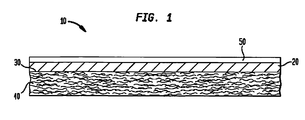
- Fig. 1 shows a cross-sectional view of a wallcovering of the invention.
- the wallcovering (10) includes a ground coating layer (20) that is applied directly to the surface (30) of a synthetic nonwoven web (40).
- the ground coating layer (20) includes an emulsion polymer pigment binder and a mineral pigment composition.
- Layer (50) represents the printing on the ground coating which imparts the desired pattern or design to the wallcovering.
- the nonwoven substrates of the invention primarily comprise synthetic fiber, i.e., have at least 50 percent by weight synthetic fiber.
- the substrate may desirably be at least 75 wt. percent synthetic fiber, at least 95 wt. percent synthetic fiber, and in many embodiments are entirely synthetic fiber.
- synthetic fibers include polyester fibers such as polyethylene terephthalate (PET) or polybutylene terephthalate (PBT), polypropylene fibers, polyamide fibers, nylon fibers, polyethylene fibers, and the like.
- PET polyethylene terephthalate
- PBT polybutylene terephthalate
- polypropylene fibers polyamide fibers
- nylon fibers polyethylene fibers
- polyethylene fibers polyethylene fibers
- polyethylene fibers polyethylene fibers
- the synthetic fibers used in the invention are PET fibers.
- Natural fibers may also be included in the nonwoven substrate in amounts of 50 wt. percent or less. Suitable natural fibers include, for example, long fibers such as cotton, rayon, and wool; woody fibers such as those from deciduous and coniferous trees; and other cellulosics such as flax, esparto grass, milkweed, straw, jute, and bagasse, among others. If included, cellulosic fibers are generally added to the nonwoven substrate by coforming techniques.
- the nonwoven substrates may be made by various methods, the most preferred being spunbond processes.
- the polymer composition is heated until molten and extruded through a spinneret which contains a plurality of small orifices. Upon exiting the spinneret, the molten fibers are quenched with air. The fibers are then attenuated mechanically or pneumatically at high speeds, prior to being deposited on a moving belt or wire.
- the individual filaments may need to be separated before being deposited on a forming belt. This may be accomplished by inducing an electrostatic charge onto the fiber bundles before deposition.
- the filaments may be randomly deposited on the forming belt, or may be oriented somewhat by mechanical or pneumatic means.
- the deposited web may be further bonded by mechanical needling, thermal bonding, and/or chemical bonding.
- Various apparatuses and methods for producing spunbond substrates are described in United States Patent Nos. 6,338,814 to Hills ; 6,692,601 to Na journey et al. ; and 4,627,811 to Greiser et al. , the entireties of which are incorporated herein by reference.
- a saturant binder or like composition in the synthetic nonwoven substrate of the present invention, as is common in cellulosic substrates.
- “Saturants” refer to polymer binders which are applied to the nonwoven substrate and are substantially impregnated throughout the thickness of the web to bind the fibers together, or in some cases to promote adhesion with other layers.
- the nonwoven substrate is substantially free of saturants, i.e., less than about 1 wt. percent. Notwithstanding, the hydrophilic ground coatings of the invention adhere well to the hydrophobic synthetic fibers, even in the absence of saturant binders or adhesive tie layers.
- the synthetic nonwoven is provided with an aqueous ground coating layer which includes emulsion resin and a mineral pigment composition.
- the ground coating provides the substrate with numerous properties that are desirable for wallcovering applications, including increased durability, improved printability, higher opaqueness, and surface smoothness, among others.
- opacity is generally a desired feature, and the composition of the ground coating is chosen and the coating is applied in amounts and in a manner such that the coated nonwoven substrate (dried) is substantially opaque.
- opacity is measured by TAPPI test method T 425 om-06. If the wallcovering substrate exhibits an opacity of at least about 90 percent on the TAPPI test, the substrate is considered "substantially opaque.”
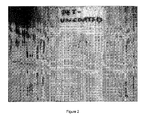
- Figs. 2 and 3 show two photographs of spunbond PET webs. Fig.
- FIG. 2 shows a PET substrate which does not include a ground coating, where the substrate was placed in front of two dark (oxidized) pennies; as can be seen, the outlines of the coins are still notably visible through the substrate.
- Fig. 3 is a photograph of a spunbond PET web that is coated with an aqueous ground coating according to the invention.
- the coins that have been placed behind the coated substrate are, for the most part, indiscernible.
- the aqueous ground coatings of the invention typically include from 5 to 50 wt. percent of emulsion resin, and from 50 to 95 wt. percent mineral pigment composition, on a dry basis. More preferably, the coating has 10 to 30 wt. percent emulsion resin, and from 60 to 90 wt. percent of mineral pigment, on a dry basis.
- the ground coatings used in the invention are provided as aqueous slurries or dispersions and may have a typical solids content ranging from 10 to 90 percent, and more preferably from 40 to 70 percent.
- the coatings may have viscosities in the following suitable ranges 1 to 2,000 cps, 100 to 1,500 cps, and preferably from 250 to 750 cps.
- the emulsion polymer binder used in the aqueous ground coating is not particularly limited.
- the emulsion polymer may include any synthetic resin which is emulsion polymerized in an aqueous medium and stabilized with emulsifiers and/or protective colloids.
- Suitable polymers may include, among others, acrylic resins such as those having alkyl acrylate monomers or alkyl methacrylate monomers; vinyl esters resins such as vinyl acetate, vinyl acetate-ethylene copolymers, and VeoVa containing polymers; styrenic resins; and acrylamide polymers.
- the emulsion polymers may also include functional monomers, for example, carboxylic acid functionalized, hydroxyl functionalized, or sulfonic acid functionalized monomers.
- functional monomers include acrylic acid, methacrylic acid, itaconic acid, AMPS, and the like.
- the emulsion resins may be either crosslinking or non-crosslinking.
- Crosslinking resins may include pre-crosslinking or post-crosslinking monomers.
- Pre-crosslinking monomers include those with two functional groups such as divinyl benzene, allyl (meth)acrylate, diallyl phthalate, diallyl maleate, and triallyl cyanurate.
- Post-crosslinking monomers include those which react with themselves upon drying/curing.
- Post-crosslinking monomers include N-methylol (meth)acrylamide and/or N-alkoxy methyl (meth)acrylamide compounds. Specifically, there is contemplated N-methylol acrylamide, N-methylol allyl carbamate, iso-butoxy methyl acrylamide, n-butyoxy methyl acrylamide, or combinations thereof.
- Silicon and/or epoxy compounds may also be used as crosslinking agents, including, for example, gamma-acryl- and gamma-methacryloxypropyltri-(alkoxy)silanes, gamma-methacyloxymethyltri(alkoxy)silanes, gammametharcyloxypropylmethyldi(alkoxy)silanes, vinylalkyldi(alkoxy)silanes, vinyltri(alkoxy)silanes, and combinations thereof.
- Epoxysilanes may be used as crosslinkers as well, such as glycidyloxypropyltrimethoxysilane.
- the polymers may include comonomers with epoxide groups, as may be present in, for example, glycidyl acrylate, glycidyl metharcylate, allyl glycidyl ether, and vinyl glycidyl ether.
- comonomers with epoxide groups as may be present in, for example, glycidyl acrylate, glycidyl metharcylate, allyl glycidyl ether, and vinyl glycidyl ether.
- Other suitable silicon and/or epoxy compounds may be disclosed in United States Patent No. 6,624,243 to Stark et al. (see, col. 4) and United States Patent Application Publication No.2004/0077781 to Murase et al. , the entireties of which are incorporated herein by reference.
- the emulsion resins used in the invention typically have a glass transition temperature (T g ) such that they are able to form films at room temperature.
- T g values may include those of less than 40°C, and preferably less than 25°C.
- the polymer composition may include fugitive plasticizers to reduce the effective film forming temperature of the polymer. Suitable fugitive plasticizers are described in United States Patent No. 4,071,645 to Kahn , the entirety of which is incorporated herein by reference.
- the emulsion polymer may include surfactants and/or protective colloids as stabilizers.
- the composition includes surfactants, because it is believed that the surfactants may somewhat promote the adhesion between the ground coating and the synthetic fibers, as the surfactants tend to wet out the hydrophobic fibers.
- Suitable surfactants may be either anionic, non-ionic, or cationic.
- Possible anionic surfactants include fatty acid soaps, alkyl carboxylates, alkyl surlates, alkyl sulfonates, alkali metal alkyl aryl sulfonates, alkali metal alkyl sulfates and sulfonated alkyl esters; specific examples include sodium dodecylbenzene sufonate, sodium disecondary-butylnaphtalne sulfonate, sodium lauryl sulfate, disodium dodecyldiphenyl ether disulfonate, disodium n-octadecylsulfosuccinate, sodium dioctyl sulfosuccinate, among others.
- non-ionic surfactants are the addition products of 5 to 50 moles of ethylene oxide adducted to straight-chained and branch-chained alkanols with 6 to 22 carbon atoms, or alkylphenols of higher fatty acids, or higher fatty acid amides, or primary and secondary higher alkyl amines; as well as block copolymers of propylene oxide with ethylene oxide and mixtures thereof.
- Cationic surfactants include amines, nitriles, and other nitrogen bases.
- Examples of cationic surfactants may include alkyl quaternary ammonium salts and alkyl quaternary phosphonium salts, such as: alkyl trimethyl ammonium chloride, dieicosyldimethyl ammonium chloride, didocosyldimethyl ammonium chloride, dioctadecyldimethyl ammonium chloride; dioctadecyldimethyl ammonium methosulphate, ditetradecyldimethyl ammonium chloride, and naturally occurring mixtures of above fatty groups, e.g., di(hydrogenated tallow) dimethyl ammonium chloride; di(hydrogenated tallow) dimethyl ammonium methosulfate, ditallow dimethyl ammonium chloride, and dioleyldimethyl ammonium chloride.
- Cationically modified polyvinyl alcohol and cationically modified starch may also be used as emulsifying agents.
- Protective colloids may also be used as stabilizing agents.
- Protective colloids used in the art include polyvinyl alcohol polymers, starch derivatives, and cellulose derivatives.
- the ground coatings used in the invention also include a mineral pigment composition.
- the mineral pigment composition used in the invention may be present in the ground coating in amounts of at least about twice that of the emulsion polymer on a dry basis, and preferably at least about three times as much.
- Non-limiting examples of mineral pigments include clay, calcium carbonate, titanium dioxide, alumina trihydrate, aluminum hydroxide, aluminum oxide, zeolite, talc, calcium sulfoaluminate, silica, zinc oxide, and combinations thereof.
- Alumina trihydrate may also be used as a mineral pigment, and has the advantage of imparting flame resistance to the wallcovering.
- the mineral pigment composition includes clay compounds; suitable clay compounds include kaolin, bentonite, and the like. The clay may be calcined, delaminated, water-washed or airfloat hard clay.
- emulsion resin binder In addition to the emulsion resin binder and the mineral pigment composition, other additives may be included in the ground coating.
- Non-limiting examples include pigment dispersant, rheology modifiers, thickening agents, detackifying agents, lubricants, defoaming agents, fugitive alkali agents, humectants, and preservatives, among others.
- the ground coating should be prepared and applied to the nonwoven web, such that it is directly bonded to the surface of the synthetic substrate, creating a printable layer upon drying.
- the ground coatings of the invention may be applied to the synthetic nonwoven substrate by any suitable means, including blade coating, air knife, rod, roll coating methods, curtain coating, foam coating, and size press coating.
- the ground coating should be provided in amounts such that the coating comprises from 5 to 25 wt. percent of the wallcovering, preferably from 8 to 15 percent. As mentioned above, the ground coatings are generally operative to improve the optical and printing properties of the nonwoven web.
- ground coatings used in the invention are typically effective to increase the smoothness of the nonwoven substrate by at least 10 percent, preferably 20 percent, (when measured according to Parker-printing roughness test using a hard backing with 5 kg of force).
- the wallcoverings also exhibit good gloss, brightness, and yellowness, as is apparent from the examples which follow.
- the wallcovering sheets of the invention are readily provided with a pattern or design by printing and/or embossing.
- Fig. 4 is a photograph of a swatch of printed wallcovering which is produced according to the invention.
- the wallcovering in Fig. 4 comprises a spunbond PET web which includes a ground coating layer, and has a design printed thereon.
- Various printing and/or embossing processes may be used to impart a pattern or design to the surface of the wallcoverings. Suitable printing processes as are known in the art include gravure printing, screen printing, digital printing, and the like.
- inventive wallcoverings enable the use of water-based inks in printing, which are preferred in many processes. Toners may also be used in to print the inventive wallcoverings. Embossing processes entail subjecting the sheet to pressure and/or heat using textured rolls or plates, which imparts the texture pattern to the substrate. Methods of printing and/or embossing wallcoverings are described in United States Patent No. 5,989,380 to Frischer and United States Patent No. 5,950,533 to Kildune et al. , the entireties of which are incorporated herein by reference.
- the wallcoverings of the invention may optionally include a prepaste layer.
- Prepaste layers comprise an adhesive which is applied to the back of the wallcovering sheet and dried, such that the wallcovering may be conveniently installed by wetting the prepaste layer.
- the need for applying additional adhesive is obviated in embodiments which are provide with a prepaste layer.
- Additional layers may also be included in the wallcoverings of the invention; for example, additional nonwoven layers, polymeric film layers, other coatings and the like may be included.
- the wallcovering is formed such that it has a basis weight in the range of from 50 to 300 g/m 2 , and preferably in the range of from 100 to 200 g/m 2 .
- the emulsion pigment binders were combined with mineral pigment compositions to produce the ground coatings.
- the compositions of the aqueous ground coatings (dry weight basis) in Examples 1-12 are outlined in Table 2, below.
- Mineral Pigments (parts per hundred weight, dry basis) Delaminated clay (Imerys Astraplate®) 63 63 63 63 63 63 63 63 63 63 63 63 63 63 51 - Calcined clay (Imerys Alphatex®) 16 16 16 16 16 16 16 16 16 16 16 16 16 16 16 12 - Alumina trihydrate (Albermarle Martingloss®) - - - - - - - - 16 - Calcium carbonate (Omya Hydrocarb®) - - - - - - - - - - - - - 63 No.
- the fabric samples were prepared by coating the smoothest side of a PET spunbond stock using a wirewound rod to achieve a target coating weight in the range of about 15-20 gsm.
- the spunbond PET substrates had basis weights of about 130 gsm.
- the coated PET substrates were measured for gloss, brightness, brightness stability, yellowness, printability, scrubbability, opacity, ink holdout, ink receptivity, and in some cases flame resistance.
- C a web of spunbond PET fibers without any ground coating was tested as a control ("C.”).
- the brightness or whiteness of a substrate is inversely related to its yellowness.
- the brightness stability test measures the aging stability of the wallcovering color. This is also referred to as the light-fastness or QUV fluorescent test.
- swatches of coated substrate are exposed to UV light (simulating sunlight) for several days. Exposure to UV light can turn some substrates yellow, which is not desirable in wallcovering applications.
- the brightness stability test illustrates a substrate's resistance to yellowing with time.
- the "Hunter b value” test is another way to measure the whiteness of a substrate.
- the higher the b value the more yellow the color.
- a positive number relates to yellowness
- a negative number relates to blueness/whiteness. Accordingly, the lower the number, the whiter the substrate appears. Note, these samples were tested for aging stability as well.
- the Parker-print Roughness test (also referred to as the Parker-print Smoothness test) measures the surface smoothness of a substrate.
- the Parker-print test is measured in accordance with TAPPI T55 m-04 using a hard backing with either a 5 kg/cm 2 clamping force (H.5) or a 10 kg/cm 2 clamping force (H.10).
- the roughness results are reported in microns, with higher values corresponding to rougher surfaces. Roughness is generally considered undesirable because it negatively influences the printability of the substrate on gravure printing presses, which are commonly used to print wallcovering.
- the Gardner scrubbability test measures the durability of the wallcoverings to withstand routine washing, and is also indicative adhesion of the groundcoat to the spunbonded base.
- the scrubbability test is known in the wallcovering field and is conducted by scrubbing a swatch of the nonwoven substrate with a 1 % soap solution (pH 9.6 w/ NaOH), using a bristle brush. The test results indicate the number of cycles until the first visual sign of surface damage appears.
- the wallcoverings achieve values on the scrubbability test of at least 50, at least 100, or even as high as 150 or more.
- the opacity tests are measured according to TAPPI test method T 425 om-06. The opacity results are reported in percentage.
- the wallcoverings of the invention exhibit opacity values of at least about 90 percent.
- Ink Holdout TAPPI Brightness Stained Substrate TAPPI Brightness Unstained Substrate ⁇ 100
- Ink Receptivity 1 - ( TAPPI Brightness Stained Substrate TAPPI Brightness Unstained Substrate ) ⁇ 100
- the holdout and receptivity values add up to 100. It is generally preferred for the ink holdout to be somewhat higher than the ink receptivity. Preferred ink holdout to ink receptivity ratios are in the range of 1:1 to 15:1, and more preferably from 2:1 to 10:1.
- Table 4 The results of the above assays are illustrated in Table 4, below.
- the webs of the invention provide synthetic wallcoverings which have excellent durability and visual properties.
- the nonwoven substrate can be provided with acceptable brightness and yellowness values, which remain relatively stable upon aging.
- the gloss values are likewise acceptable, and may be varied by selecting the type and amounts of mineral pigments.
- the printability of the substrates is substantially improved, as evidenced by the smoother surface, greater opacity, and a good ink holdout to ink receptivity ratio.
- Other properties, such as the scrubbability of the substrates is significantly improved, with the coated substrates exhibiting results that are typically at least 8-fold, and in some instances 15-fold better than the uncoated surface.
Landscapes
- Engineering & Computer Science (AREA)
- Textile Engineering (AREA)
- Architecture (AREA)
- Inorganic Chemistry (AREA)
- Structural Engineering (AREA)
- Chemical & Material Sciences (AREA)
- Civil Engineering (AREA)
- Laminated Bodies (AREA)
- Paper (AREA)
- Synthetic Leather, Interior Materials Or Flexible Sheet Materials (AREA)
- Paints Or Removers (AREA)
- Medicinal Preparation (AREA)
- Treatments For Attaching Organic Compounds To Fibrous Goods (AREA)
Abstract
Description
- The present invention relates generally to wallcoverings comprising synthetic nonwoven substrates which are provided with a ground coating layer. The ground coating includes an aqueous emulsion resin and a mineral pigment composition. The wallcoverings exhibit improved strength and durability, and are desirable from a health and environmental perspective.
- Wallcovering products have traditionally been made from paper substrates or fabric-backed vinyl materials. Paper wallcoverings generally include a substrate of bonded pulp fibers which include a ground coating on one surface comprising mineral pigments. The wallpaper is usually machine printed with a design. Although paper-based wallcoverings are inexpensive, they suffer from significant drawbacks including low strength, inconsistent wet expansion and dimensional stability during handling and hanging, and poor strippability when the wallcovering is replaced. Paper based wallcoverings are also associated with health and safety concerns, because they are not fire resistant and tend to support mold growth.
- Vinyl-based wallcoverings, which are widely used in commercial establishments, typically include a printed polyvinyl chloride (PVC) substrate which is attached to a fabric scrim backing. The scrim backing is added to give the PVC substrate more strength and support. The scrim backing is also included to provide dimensional stability during installation, as PVC substrates exhibit excessive stretching when hung. While PVC wallcoverings are somewhat more durable than paper wallcoverings, they are associated with numerous health concerns. For example, aside from having an offensive odor, the PVC wallcoverings contain toxins and carcinogens such as residual vinyl chloride monomer, and heavy metals or phthalates which are used as vinyl additives. PVC wallcoverings also produce toxic emissions when ignited, such as HCl and dioxin, which are dangerous in cases of accidental fire. Furthermore, vinyl wallcoverings have a low air permeability which can promote dangerous mold growth inside walls in high humidity environments. From an environmental standpoint, PVC wallcoverings are problematic because they are not biodegradable in landfills.
- Many wallcoverings which are commercially available today include a nonwoven substrate which comprises pulp fibers and a minor amount of synthetic fibers (about 15 wt. %). While the inclusion of synthetic fibers increases the strength of the substrates, they do not approach the durability of vinyl substrates, and still have many of the drawbacks associated with cellulosic wallcoverings. Moreover, wallcovering sheets which include minor amounts of synthetic fiber are generally produced by wet laid processes which are not preferred for economic reasons.
- Nonwovens comprising predominantly synthetic fibers are not usually employed as wallcoverings because the webs generally have inadequate physical properties. For example, spunbond synthetic webs generally have poor opacity and are not smooth enough to print properly. Spunlaced nonwoven webs exhibit too much stretching for wallcovering applications. Brief descriptions of various prior art wallcoverings are summarized below.
-
United States Patent Nos. 5,876,551 and6,238,789, both to Jackson , relate to a breathable wallcovering which includes a layer of plastisol that is fused to a nonwoven hydroentagled substrate of cellulosic and synthetic fibers. According to Jackson, the nonwoven ply improves the moisture permeability of the wallcoverings, and the plastisol layer provides a smooth layer which may be printed with a polymer-receptive ink. -
United States Patent No. 5,302,404 to Rissanen et al. relates to a wallcovering which includes a cellulosic base substrate, and a ground coating layer which includes a latex binder and a water-insoluble pigment. The wallcovering composition in Rissanen et al. is stated to have superior physical properties to PVC wallcoverings, and reduced environmental and health problems. -
United States Patent No. 4,460,643 to Stevens et al. , discloses a wallcovering comprising a multilayered nonwoven backing which is coupled to a plastisol coating. According to Stevens et al., the nonwoven backing provides a wallcovering with better toughness, embossability, and strippability, among other features. Similarly,United States Patent Nos. 4,874,019 and4,925,726, both to Whetstone , describe a nonwoven gauze backing for a vinyl wallcovering, where the backing includes textured multifilament yarn made from synthetic polymers. The gauze backing used in Whetstone is rendered more hydrophilic via the addition of surfactants to the yarn, and the gauze is said to be advantageous because it allows the adhesion of vinyl wallcoverings to walls using water-based adhesives.United States Patent Application Publication No. 2004/0248488 to Tebbetts , also discloses a wallcovering with a top sheet and a scrim backing which is adhered thereto. The top sheet may be a vinyl material and the scrim backing may be a synthetic nonwoven. -
United States Patent No. 4,246,311 to Hirst discloses a wallcovering which comprises a polyester nonwoven web and a back coating to prevent the wallcovering adhesive from striking through the web. The nonwoven substrate is impregnated with a saturant, where the saturant is chosen to be compatible to the coating layer; according to Hirst this creates a bond between the two layers which prevents separation. A pattern may also be applied to the front surface of the polyester nonwoven by a gravure or screen printing process. -
United States Patent Application Publication No. 2005/0233662 to Kimbrell et al. , discloses a composite material that may be used as a wallcovering where the composite includes a synthetic substrate coupled to a backing which has a pressure sensitive adhesive. According to Kimbrell et al., the face of the textile may be transfer printed. The product in Kimbrell et al. is intended to provide a wallcovering which is convenient to apply to walls. -
European Patent No. 0375244 to Boodaghians et al. , relates to the use of aqueous emulsion resins in pigmented ground coatings for cellulosic wallpaper coverings. The emulsion resins include acrylic or ethylene/vinyl acetate polymers which are reacted with an effective amount of epoxy silane composition. The emulsion polymers are combined with a clay- based coating prior to application on the wallpaper. - Other references of interest include
United States Patent No. 6,368,990 ;United States Patent No. 6,620,746 ; andEuropean Patent Laid-Open No. 0896081, all to Jennergren et al. - Despite the advancements in this field, there still exists a need for wallcoverings that do not present health or fire hazards, are environmentally friendly, and meet several design criteria. Design objectives include high strength, durable, economical, dimensionally stable, easily strippable, and good printability, among other considerations. It has been discovered according to the invention that wallcoverings may be produced which have excellent properties by employing synthetic nonwoven webs having a ground coating layer and a design printed thereon. Among other desirable features, the wallcoverings of the invention (1) do not emit substantial amounts of toxins or carcinogens; (2) may be made flame resistant; (3) are not malodorous; (4) have excellent physical properties; and (5) are economical.
- According to one aspect of the present invention, there is provided a wallcovering sheet which comprises a nonwoven substrate with a front and back side, where the nonwoven substrate includes at least 50 wt. percent of synthetic polymer fibers. A ground coating, which includes an emulsion binder and a mineral pigment composition, is applied and directly bonded to the front side of the nonwoven. The ground coating layer is then printed to provide a design, pattern, or the like.
- In some embodiments, the nonwoven substrate may include at least 75 weight percent synthetic fibers, and usually includes at least 95 weight percent synthetic fibers. The synthetic fibers preferably include polyester fibers, such as polyethylene terephthalate fibers. The nonwoven substrate may formed by spunbond processes, and is suitably substantially free of saturant binder resins. Suitably, the nonwoven substrate may have a basis weight in the range of from 50 to 300 gsm.
- The ground coating used in the inventive wallcoverings may include from 5 to 50 weight percent of emulsion polymer, and from 50 to 95 weight percent of a mineral pigment composition on a dry basis. More preferably, the coating includes from 15 to 35 weight percent emulsion polymer and from 65 to 85 weight percent of mineral pigment composition.
- The mineral pigment composition used in the ground coating may include, for example, one or more of the following components: clay, calcium carbonate, titanium dioxide, alumina trihydrate, aluminum hydroxide, aluminum oxide, zeolite, talc, calcium sulfoaluminate, silica, zinc oxide, and combinations thereof. If clay is used it may be calcined clay, delaminated clay, or combinations thereof.
- The emulsion polymer binder used in the ground coating is not particularly limited and may include acrylic polymers, vinyl ester polymers, acrylamide polymers, styrenic polymers, and combinations thereof. Copolymers of the foregoing are also contemplated, such as vinyl acetate-ethylene copolymers. The emulsion polymers may be stabilized with surfactants. The resins generally have glass transition temperature of less than 40°C, and preferably less than 25°C.
- The ground coating is generally applied to the nonwoven substrate such that the ground covering comprises from 5 to 20 weight percent, preferably from 8 to 15 weight percent, of the total wallcovering sheet.
- The wallcoverings of the invention have good printing properties and may be printed with water based inks or toners. One measure of printability is smoothness; the wallcoverings of the invention may be at least 10 percent smoother, preferably at least 20 percent smoother, than the nonwoven substrate alone. Surface roughness is measured according to the Parker-print roughness test described in the examples below.
- In another aspect of the invention there is provided a wallcovering sheet which includes a nonwoven substrate, ground coating layer, a design on the ground coating layer, and optionally, a prepaste layer. The wallcovering sheet is substantially opaque, and the design may be printed and/or embossed on the wallcovering.
- In still another aspect of the invention there is provided a wallcovering which includes a spun-bond nonwoven substrate and a ground coating applied thereto, where the nonwoven substrate includes polyester fibers and is substantially free of saturant binder. The wallcovering sheet may exhibit ink holdout/receptivity ratios in suitable ranges of from 1:1 to 15:1, or from 2:1 to 10:1.
- In yet another aspect of the invention there is provided a wallcovering sheet which comprises a nonwoven substrate, a ground coating, and a printing layer, where the nonwoven substrate includes at least 75 wt. percent of polyethylene terephthalate fibers, and the ground coating includes a vinyl acetate-ethylene copolymer and a mineral pigment composition.
- The present invention also provides for a method of producing a wallcovering sheet, where the method includes the steps of (a) forming a nonwoven substrate which includes at least 50 wt. percent of synthetic fiber; (b) applying an aqueous ground coating composition to at least one side of the nonwoven substrate, where the ground coating composition includes an emulsion polymer and a mineral pigment composition; (c) drying the coated nonwoven substrate; and (d) printing a design on the coated surface of the substrate.
- Still further features and advantages of the invention are apparent from the following description.
- The invention is described in detail below with reference to the following drawings:
- Fig. 1 is a schematic diagram of a cross-section of a wallcovering sheet prepared according to the invention;
- Fig. 2 is a photograph of a spunbond web of polyethylene terephthalate fibers without a ground coating layer, where it is seen that two coins placed behind the substrate are visible through the web;
- Fig. 3 is a photograph of a spunbond web of polyethylene terephthalate fibers provided with a ground coating layer, where it is seen that two coins placed behind the substrate are not distinctly visible; and
- Fig. 4 is a photograph of a swatch of wallcovering produced according to the invention that is printed with a design.
- The invention is described in detail below with reference to numerous embodiments for purposes of exemplification and illustration only. Modifications to particular embodiments within the spirit and scope of the present invention, set forth in the appended claims, will be readily apparent to those of skill in the art.
- Unless more specifically defined below, terminology as used herein is given its ordinary meaning.
- According to the invention, wallcoverings are provided which include a nonwoven web, a ground coating layer, and a pattern or design which is printed on the coating layer. The structure of the present invention is illustrated in Fig. 1, which shows a cross-sectional view of a wallcovering of the invention. As seen in Fig. 1, the wallcovering (10) includes a ground coating layer (20) that is applied directly to the surface (30) of a synthetic nonwoven web (40). The ground coating layer (20) includes an emulsion polymer pigment binder and a mineral pigment composition. Layer (50) represents the printing on the ground coating which imparts the desired pattern or design to the wallcovering.
- As noted above, the nonwoven substrates of the invention primarily comprise synthetic fiber, i.e., have at least 50 percent by weight synthetic fiber. The substrate may desirably be at least 75 wt. percent synthetic fiber, at least 95 wt. percent synthetic fiber, and in many embodiments are entirely synthetic fiber. Non-limiting examples of synthetic fibers include polyester fibers such as polyethylene terephthalate (PET) or polybutylene terephthalate (PBT), polypropylene fibers, polyamide fibers, nylon fibers, polyethylene fibers, and the like. The use of bi-component fibers is likewise contemplated. Preferably, the synthetic fibers used in the invention are PET fibers.
- Natural fibers may also be included in the nonwoven substrate in amounts of 50 wt. percent or less. Suitable natural fibers include, for example, long fibers such as cotton, rayon, and wool; woody fibers such as those from deciduous and coniferous trees; and other cellulosics such as flax, esparto grass, milkweed, straw, jute, and bagasse, among others. If included, cellulosic fibers are generally added to the nonwoven substrate by coforming techniques.
- The nonwoven substrates may be made by various methods, the most preferred being spunbond processes. According to typical spunbond processes, the polymer composition is heated until molten and extruded through a spinneret which contains a plurality of small orifices. Upon exiting the spinneret, the molten fibers are quenched with air. The fibers are then attenuated mechanically or pneumatically at high speeds, prior to being deposited on a moving belt or wire. Depending on the type of die, the individual filaments may need to be separated before being deposited on a forming belt. This may be accomplished by inducing an electrostatic charge onto the fiber bundles before deposition. The filaments may be randomly deposited on the forming belt, or may be oriented somewhat by mechanical or pneumatic means. The deposited web may be further bonded by mechanical needling, thermal bonding, and/or chemical bonding. Various apparatuses and methods for producing spunbond substrates are described in
United States Patent Nos. 6,338,814 to Hills ;6,692,601 to Najour et al. ; and4,627,811 to Greiser et al. , the entireties of which are incorporated herein by reference. - Advantageously, there is no particular need to use a saturant binder or like composition in the synthetic nonwoven substrate of the present invention, as is common in cellulosic substrates. "Saturants" refer to polymer binders which are applied to the nonwoven substrate and are substantially impregnated throughout the thickness of the web to bind the fibers together, or in some cases to promote adhesion with other layers. In many embodiments of the present invention, the nonwoven substrate is substantially free of saturants, i.e., less than about 1 wt. percent. Notwithstanding, the hydrophilic ground coatings of the invention adhere well to the hydrophobic synthetic fibers, even in the absence of saturant binders or adhesive tie layers. This is unique, as certain synthetic fibers, particularly PET fibers, are notoriously difficult to bond with. In contrast to the present invention, the '311 Hirst reference discussed above, for example, teaches that a saturant which is compatible with the coating must first be imbued in the polyester web to achieve adequate adhesion. See, col. 3, lines 14-18.
- According to the invention, the synthetic nonwoven is provided with an aqueous ground coating layer which includes emulsion resin and a mineral pigment composition. The ground coating provides the substrate with numerous properties that are desirable for wallcovering applications, including increased durability, improved printability, higher opaqueness, and surface smoothness, among others.
- In many wallcoverings opacity is generally a desired feature, and the composition of the ground coating is chosen and the coating is applied in amounts and in a manner such that the coated nonwoven substrate (dried) is substantially opaque. For purposes of the present invention, opacity is measured by TAPPI test method T 425 om-06. If the wallcovering substrate exhibits an opacity of at least about 90 percent on the TAPPI test, the substrate is considered "substantially opaque." In this regard, reference is made to Figs. 2 and 3, which show two photographs of spunbond PET webs. Fig. 2 shows a PET substrate which does not include a ground coating, where the substrate was placed in front of two dark (oxidized) pennies; as can be seen, the outlines of the coins are still notably visible through the substrate. In contrast, Fig. 3 is a photograph of a spunbond PET web that is coated with an aqueous ground coating according to the invention. Here, the coins that have been placed behind the coated substrate are, for the most part, indiscernible.
- The aqueous ground coatings of the invention typically include from 5 to 50 wt. percent of emulsion resin, and from 50 to 95 wt. percent mineral pigment composition, on a dry basis. More preferably, the coating has 10 to 30 wt. percent emulsion resin, and from 60 to 90 wt. percent of mineral pigment, on a dry basis. The ground coatings used in the invention are provided as aqueous slurries or dispersions and may have a typical solids content ranging from 10 to 90 percent, and more preferably from 40 to 70 percent. The coatings may have viscosities in the following suitable ranges 1 to 2,000 cps, 100 to 1,500 cps, and preferably from 250 to 750 cps.
- The emulsion polymer binder used in the aqueous ground coating is not particularly limited. The emulsion polymer may include any synthetic resin which is emulsion polymerized in an aqueous medium and stabilized with emulsifiers and/or protective colloids. Suitable polymers may include, among others, acrylic resins such as those having alkyl acrylate monomers or alkyl methacrylate monomers; vinyl esters resins such as vinyl acetate, vinyl acetate-ethylene copolymers, and VeoVa containing polymers; styrenic resins; and acrylamide polymers. The emulsion polymers may also include functional monomers, for example, carboxylic acid functionalized, hydroxyl functionalized, or sulfonic acid functionalized monomers. Examples of functional monomers include acrylic acid, methacrylic acid, itaconic acid, AMPS, and the like.
- The emulsion resins may be either crosslinking or non-crosslinking. Crosslinking resins may include pre-crosslinking or post-crosslinking monomers. Pre-crosslinking monomers include those with two functional groups such as divinyl benzene, allyl (meth)acrylate, diallyl phthalate, diallyl maleate, and triallyl cyanurate. Post-crosslinking monomers include those which react with themselves upon drying/curing. Post-crosslinking monomers include N-methylol (meth)acrylamide and/or N-alkoxy methyl (meth)acrylamide compounds. Specifically, there is contemplated N-methylol acrylamide, N-methylol allyl carbamate, iso-butoxy methyl acrylamide, n-butyoxy methyl acrylamide, or combinations thereof.
- Silicon and/or epoxy compounds may also be used as crosslinking agents, including, for example, gamma-acryl- and gamma-methacryloxypropyltri-(alkoxy)silanes, gamma-methacyloxymethyltri(alkoxy)silanes, gammametharcyloxypropylmethyldi(alkoxy)silanes, vinylalkyldi(alkoxy)silanes, vinyltri(alkoxy)silanes, and combinations thereof. Epoxysilanes may be used as crosslinkers as well, such as glycidyloxypropyltrimethoxysilane. Additionally, the polymers may include comonomers with epoxide groups, as may be present in, for example, glycidyl acrylate, glycidyl metharcylate, allyl glycidyl ether, and vinyl glycidyl ether. Other suitable silicon and/or epoxy compounds may be disclosed in
United States Patent No. 6,624,243 to Stark et al. (see, col. 4) andUnited States Patent Application Publication No.2004/0077781 to Murase et al. , the entireties of which are incorporated herein by reference. - The emulsion resins used in the invention typically have a glass transition temperature (Tg) such that they are able to form films at room temperature. Suitable Tg values may include those of less than 40°C, and preferably less than 25°C. Additionally, the polymer composition may include fugitive plasticizers to reduce the effective film forming temperature of the polymer. Suitable fugitive plasticizers are described in
United States Patent No. 4,071,645 to Kahn , the entirety of which is incorporated herein by reference. - As mentioned, the emulsion polymer may include surfactants and/or protective colloids as stabilizers. Preferably, the composition includes surfactants, because it is believed that the surfactants may somewhat promote the adhesion between the ground coating and the synthetic fibers, as the surfactants tend to wet out the hydrophobic fibers.
- Suitable surfactants may be either anionic, non-ionic, or cationic. Possible anionic surfactants include fatty acid soaps, alkyl carboxylates, alkyl surlates, alkyl sulfonates, alkali metal alkyl aryl sulfonates, alkali metal alkyl sulfates and sulfonated alkyl esters; specific examples include sodium dodecylbenzene sufonate, sodium disecondary-butylnaphtalne sulfonate, sodium lauryl sulfate, disodium dodecyldiphenyl ether disulfonate, disodium n-octadecylsulfosuccinate, sodium dioctyl sulfosuccinate, among others. Examples of suitable non-ionic surfactants are the addition products of 5 to 50 moles of ethylene oxide adducted to straight-chained and branch-chained alkanols with 6 to 22 carbon atoms, or alkylphenols of higher fatty acids, or higher fatty acid amides, or primary and secondary higher alkyl amines; as well as block copolymers of propylene oxide with ethylene oxide and mixtures thereof. Cationic surfactants include amines, nitriles, and other nitrogen bases. Examples of cationic surfactants may include alkyl quaternary ammonium salts and alkyl quaternary phosphonium salts, such as: alkyl trimethyl ammonium chloride, dieicosyldimethyl ammonium chloride, didocosyldimethyl ammonium chloride, dioctadecyldimethyl ammonium chloride; dioctadecyldimethyl ammonium methosulphate, ditetradecyldimethyl ammonium chloride, and naturally occurring mixtures of above fatty groups, e.g., di(hydrogenated tallow) dimethyl ammonium chloride; di(hydrogenated tallow) dimethyl ammonium methosulfate, ditallow dimethyl ammonium chloride, and dioleyldimethyl ammonium chloride. Cationically modified polyvinyl alcohol and cationically modified starch may also be used as emulsifying agents.
- Protective colloids may also be used as stabilizing agents. Protective colloids used in the art include polyvinyl alcohol polymers, starch derivatives, and cellulose derivatives.
- The ground coatings used in the invention also include a mineral pigment composition. The mineral pigment composition used in the invention may be present in the ground coating in amounts of at least about twice that of the emulsion polymer on a dry basis, and preferably at least about three times as much. Non-limiting examples of mineral pigments include clay, calcium carbonate, titanium dioxide, alumina trihydrate, aluminum hydroxide, aluminum oxide, zeolite, talc, calcium sulfoaluminate, silica, zinc oxide, and combinations thereof. Alumina trihydrate may also be used as a mineral pigment, and has the advantage of imparting flame resistance to the wallcovering. In preferred embodiments, the mineral pigment composition includes clay compounds; suitable clay compounds include kaolin, bentonite, and the like. The clay may be calcined, delaminated, water-washed or airfloat hard clay.
- In addition to the emulsion resin binder and the mineral pigment composition, other additives may be included in the ground coating. Non-limiting examples include pigment dispersant, rheology modifiers, thickening agents, detackifying agents, lubricants, defoaming agents, fugitive alkali agents, humectants, and preservatives, among others.
- The ground coating should be prepared and applied to the nonwoven web, such that it is directly bonded to the surface of the synthetic substrate, creating a printable layer upon drying. The ground coatings of the invention may be applied to the synthetic nonwoven substrate by any suitable means, including blade coating, air knife, rod, roll coating methods, curtain coating, foam coating, and size press coating. The ground coating should be provided in amounts such that the coating comprises from 5 to 25 wt. percent of the wallcovering, preferably from 8 to 15 percent. As mentioned above, the ground coatings are generally operative to improve the optical and printing properties of the nonwoven web. For example, smoother surfaces are better for printing, and the ground coatings used in the invention are typically effective to increase the smoothness of the nonwoven substrate by at least 10 percent, preferably 20 percent, (when measured according to Parker-printing roughness test using a hard backing with 5 kg of force). The wallcoverings also exhibit good gloss, brightness, and yellowness, as is apparent from the examples which follow.
- In this regard, the wallcovering sheets of the invention are readily provided with a pattern or design by printing and/or embossing. See, for example, Fig. 4 which is a photograph of a swatch of printed wallcovering which is produced according to the invention. The wallcovering in Fig. 4 comprises a spunbond PET web which includes a ground coating layer, and has a design printed thereon. Various printing and/or embossing processes may be used to impart a pattern or design to the surface of the wallcoverings. Suitable printing processes as are known in the art include gravure printing, screen printing, digital printing, and the like. Additionally, due to the presence of the hydrophilic ground coating, the inventive wallcoverings enable the use of water-based inks in printing, which are preferred in many processes. Toners may also be used in to print the inventive wallcoverings. Embossing processes entail subjecting the sheet to pressure and/or heat using textured rolls or plates, which imparts the texture pattern to the substrate. Methods of printing and/or embossing wallcoverings are described in
United States Patent No. 5,989,380 to Frischer andUnited States Patent No. 5,950,533 to Kildune et al. , the entireties of which are incorporated herein by reference. - The wallcoverings of the invention may optionally include a prepaste layer. Prepaste layers comprise an adhesive which is applied to the back of the wallcovering sheet and dried, such that the wallcovering may be conveniently installed by wetting the prepaste layer. Thus, the need for applying additional adhesive is obviated in embodiments which are provide with a prepaste layer.
- Additional layers may also be included in the wallcoverings of the invention; for example, additional nonwoven layers, polymeric film layers, other coatings and the like may be included.
- Desirably, the wallcovering is formed such that it has a basis weight in the range of from 50 to 300 g/m2, and preferably in the range of from 100 to 200 g/m2.
- Further features of the invention are illustrated in the examples which follow.
- Twelve aqueous ground coatings of the invention were prepared with emulsion pigment binders and mineral pigments, and then applied to spunbond PET substrates. The general composition of the emulsion pigment binders used in examples 1-12 is outlined in Table 1, below. The pH of each emulsion pigment binder was adjusted to a minimum of about 5 to 5.5 with ammonium to enhance pigment compatibility.
Table 1-Emulsion Binder Composition Emulsion Binder Name pH (adjusted) Tg (°C) Binder # 1 NACRYLIC® 4460 5.4 -30 Binder # 2 NACRYLIC® 4484 5.2 -37 Binder # 3 VINACRYL® 8961 8.0 3 Binder # 4 NACRYLIC® 4104 7.2 0 Binder # 5 MOWILITH® LDM 7411S 8.0 -10 Binder # 6 DUR-O-SET® 135A 5.2 5 Binder # 7 Experimental Binder A (Acrylic polymer) 5.2 -10 Binder # 8 Experimental Binder B (Acrylic polymer) 5.3 -8 Binder # 9 Experimental Binder C (Vinyl Acetate-Acrylate polymer) 5.2 7 Binder # 10AP AIRFLEX® 100HS 6.0 7 - The emulsion pigment binders were combined with mineral pigment compositions to produce the ground coatings. The compositions of the aqueous ground coatings (dry weight basis) in Examples 1-12 are outlined in Table 2, below.
Table 2-Ground Coating Composition EXAMPLE 1 2 3 4 5 6 7 8 9 10 11 12 Mineral Pigments (parts per hundred weight, dry basis) Delaminated clay (Imerys Astraplate®) 63 63 63 63 63 63 63 63 63 63 51 - Calcined clay (Imerys Alphatex®) 16 16 16 16 16 16 16 16 16 16 12 - Alumina trihydrate (Albermarle Martingloss®) - - - - - - - - - - 16 - Calcium carbonate (Omya Hydrocarb®) - - - - - - - - - - - 63 No. 1 High Brightness Clay (Huber Hydrafine®) - - - - - - - - - - - 16 Emulsion Binder (parts per hundred weight, dry basis) Binder # 1 20 - - - - - - - - - - - Binder #2 - 20 - - - - - - - - - - Binder #3 - - 20 - - - - - - - - - Binder #4 - - - 20 - - - - - - - - Binder #5 - - - - 20 - - - - - - - Binder #6 - - - - - 20 - - - - - - Binder #7 - - - - - - 20 - - - - - Binder #8 - - - - - - - 20 - - - - Binder #9 - - - - - - - - 20 - - - Binder #10 - - - - - - - - - 20 - - Binder #6 - - - - - - - - - - 20 - Binder #6 - - - - - - - - - - - 20 Other Additives (parts per hundred weight, dry basis) Pigment dispersant (Alco Alcosperse® 149) 0.2 0.2 0.2 0.2 0.2 0.2 0.2 0.2 0.2 0.2 0.2 0.2 Rheology modifier (Hercules CMC 7LT) 0.2 0.2 0.2 0.2 0.2 0.2 0.2 0.2 0.2 0.2 0.2 0.2 Lubricant (Bercen Berchem® 4000) 0.6 0.6 0.6 0.6 0.6 0.6 0.6 0.6 0.6 0.6 0.6 0.6 Defoamer (Cognis Foamaster® VMS) .008 .008 .008 .008 .008 .008 .008 .008 .008 .008 .008 .008 Fugitive Alkali (Aq. Ammonia) .008 .008 .008 .008 .008 .008 .008 .008 .008 .008 .008 - - The above ground coating compositions were measured for percent solids, Brookfield viscosity, and coating pH; the results are shown in Table 3, below.
Table 3-Coating Properties Example Solids (%) Brookfield Viscosity (cps) Coating pH 1 55 1385 7.0 2 55 1045 6.9 3 55 695 7.6 4 55 566 7.0 5 55 575 7.5 6 55 870 7.0 7 55 675 7.0 8 55 700 7.0 9 55 615 7.0 10 55 1040 7.0 11 55 695 7.0 12 60 510 7.2 - The fabric samples were prepared by coating the smoothest side of a PET spunbond stock using a wirewound rod to achieve a target coating weight in the range of about 15-20 gsm. The spunbond PET substrates had basis weights of about 130 gsm. The coated PET substrates were measured for gloss, brightness, brightness stability, yellowness, printability, scrubbability, opacity, ink holdout, ink receptivity, and in some cases flame resistance. For comparison, a web of spunbond PET fibers without any ground coating was tested as a control ("C."). A brief description of the test procedures follows.
- The 75 degree Hunter gloss test measures the reflectance of light when it hits the surface of the substrate at a 75 degree incidence angle. Higher values indicate higher gloss.
- The TAPPI Brightness (sometimes referred to as whiteness) defines substrate brightness as the reflectance of blue light at 457nm, and is measured according to TAPPI method T452 om-02. Higher brightness values indicate a whiter substrate (scale 0 to 100, where 100 = perfect white), which is generally preferred in the wallcoverings industry. The brightness or whiteness of a substrate is inversely related to its yellowness.
- The brightness stability test measures the aging stability of the wallcovering color. This is also referred to as the light-fastness or QUV fluorescent test. In this experiment, swatches of coated substrate are exposed to UV light (simulating sunlight) for several days. Exposure to UV light can turn some substrates yellow, which is not desirable in wallcovering applications. The brightness stability test illustrates a substrate's resistance to yellowing with time.
- The "Hunter b value" test is another way to measure the whiteness of a substrate. Here, the higher the b value, the more yellow the color. A positive number relates to yellowness, and a negative number relates to blueness/whiteness. Accordingly, the lower the number, the whiter the substrate appears. Note, these samples were tested for aging stability as well.
- The Parker-print Roughness test (also referred to as the Parker-print Smoothness test) measures the surface smoothness of a substrate. The Parker-print test is measured in accordance with TAPPI T55 m-04 using a hard backing with either a 5 kg/cm2 clamping force (H.5) or a 10 kg/cm2 clamping force (H.10). The roughness results are reported in microns, with higher values corresponding to rougher surfaces. Roughness is generally considered undesirable because it negatively influences the printability of the substrate on gravure printing presses, which are commonly used to print wallcovering.
- The Gardner scrubbability test measures the durability of the wallcoverings to withstand routine washing, and is also indicative adhesion of the groundcoat to the spunbonded base. The scrubbability test is known in the wallcovering field and is conducted by scrubbing a swatch of the nonwoven substrate with a 1 % soap solution (pH 9.6 w/ NaOH), using a bristle brush. The test results indicate the number of cycles until the first visual sign of surface damage appears. Preferably, the wallcoverings achieve values on the scrubbability test of at least 50, at least 100, or even as high as 150 or more.
- The opacity tests are measured according to TAPPI test method T 425 om-06. The opacity results are reported in percentage. Preferably the wallcoverings of the invention exhibit opacity values of at least about 90 percent.
- The K&N Ink holdout and Ink receptivity tests are measures of printability; the "ink receptivity" refers to the ink adhesion to the substrate and the "ink holdout" refers to the amount of ink that remains on the surface of a substrate. Printers require a balance in ink receptivity/absorption (for good ink adhesion to the surface of the substrate) and ink holdout (desirable for high print gloss upon drying). The K&N tests are conducted as follows: First, a lab technician tests the brightness (TAPPI) of the substrate as received. Next, a thick coating of K&N ink (dark gray color) is applied to the surface of the substrate and allowed to absorb for 2 minutes. After 2 minutes, the ink is removed with a spatula and wiped clean with a non-absorbent fabric, leaving the surface stained by the ink. The brightness of the stained surface is measured again. Ink holdout and ink receptivity are calculated as follows:


- Higher brightness values on the stained surface correspond to higher ink holdouts, and vice versa. The holdout and receptivity values add up to 100. It is generally preferred for the ink holdout to be somewhat higher than the ink receptivity. Preferred ink holdout to ink receptivity ratios are in the range of 1:1 to 15:1, and more preferably from 2:1 to 10:1.
- To test for fire resistance, swatches of the substrates were exposed to the flame of a propane torch and the observed time to ignition, flame spreading, and smoke color were recorded.
- The results of the above assays are illustrated in Table 4, below.
Table 4-Coated Fabric Properties Example C. 1 2 3 4 5 6 7 8 9 10 11 12 Basis weight (gsm) Avg. 115 132 133 132 133 133 136 133 134 133 134 134 134 STDx2 4.7 7.0 2.7 7.5 4.2 2.7 4.6 4.4 4.6 5.5 4.3 4.4 5.2 High 120 139 136 140 137 136 141 137 139 139 138 139 139 Low 111 125 130 125 128 131 131 129 130 128 129 130 129 Coating weight (gsm) Avg. 0.0 18 18 18 17 17 17 16 16 17 18 18 19 STDx2 0.0 1.0 0.8 0.4 0.7 1.2 1.4 1.3 0.9 0.8 1.0 0.9 1.1 High 0.0 19 19 18 17.5 19 18 17 17 18 19 19 20 Low 0.0 17 17 17 16.2 16 16 14 15 16 17 17 18 75° Hunter Gloss Avg. 3.9 15 14 14 16 17 15 19 19 19 13 15 6.3 STDx2 1.2 1.4 1.3 2.6 3.7 3.4 3.0 2.7 1.6 2.7 2.1 4.1 2.0 High 5.1 17 15 17 20 21 18 22 21 22 15 19 8.3 Low 2.7 14 13 12 12 14 12 16 18 17 11 10 4.3 TAPPI Brightness Avg. 85 80 80 81 80 80 82 80 80 81 81 82 83 STDx2 1.6 0.1 0.9 0.9 0.2 0.2 1.4 0.9 0.6 0.3 1.1 0.8 1.3 High 86 80 81 82 80 80 83 81 80 81 82 83 84 Low 83 80 79 80 80 80 80 79 79 80 80 81 81 Table 4-Coated Fabric Properties Example C. 1 2 3 4 5 6 7 8 9 10 11 12 Brightness Stability, 3 days. Avg. 84 79 80 79 79 78 81 79 79 79 81 82 82 STDx2 1.6 05 0.6 1.0 0.2 0.3 1.1 0.8 0 0.5 0.2 1.3 0.9 High 86 79 81 80 80 79 82 79 79 80 81 83 83 Low 82 78 79 78 79 78 80 78 79 79 81 80 81 Brightness Stability, 1 week. Avg. 81 78 79 79 79 78 80 78 78 78 80 80 80 ST Dx2 0.9 0.3 1.0 0.4 0.7 0.7 0.9 0.6 0.6 0.8 1.1 0.9 0.8 High 82 78 80 79 80 78 81 79 79 79 81 81 81 Low 81 78 78 79 78 77 79 78 77 77 79 78 80 Hunter yellowness Avg. -1.5 4.7 4.7 4.8 4.7 4.9 3.8 4.9 4.9 4.4 4.3 2.1 -1.5 STDx2 0.1 0.09 0.05 0.12 0.1 0.13 0.13 0.07 0.12 0.11 0.16 0.18 0.17 High -1.4 4.8 4.8 4.9 4.8 5.0 3.9 4.9 5.1 4.5 4.5 2.3 -1.3 Low -1.6 4.6 4.7 4.7 4.6 4.8 3.6 4.8 4.8 4.3 4.1 2.0 -1.6 Yellowness, 3 days Avg. -1.3 5.1 5.0 5.5 5.0 5.3 4.0 5.0 5.0 4.9 4.4 4.0 1.5 STDx2 0.09 0.07 0.07 0.05 0.15 0.14 0.09 0.09 0.09 0.19 0.20 0.22 0.04 High -1.2 5.2 5.0 5.6 5.1 5.4 4.1 5.1 5.1 5.0 4.6 4.3 1.5 Low -1.4 5.0 4.9 5.5 4.8 5.1 4.0 4.9 4.9 4.7 4.2 3.8 1.5 Table 4-Coated Fabric Properties Example C. 1 2 3 4 5 6 7 8 9 10 11 12 Yellowness, 1 week Avg. -1.0 5.3 5.4 5.6 5.3 5.5 4.5 5.5 5.3 5.0 4.5 4.3 2.0 STDx2 0.24 0.04 0.04 0.02 0.07 0.05 0.05 0.11 0.02 0.11 0.02 0.11 0.12 High -.78 5.3 5.4 5.7 5.4 5.6 4.5 5.6 5.4 5.1 4.6 4.4 2.1 Low -1.3 5.2 5.3 5.6 5.2 5.5 4.4 5.4 5.3 4.9 4.5 4.2 1.9 Parker-print Roughness H.5 (µm) Avg. 9.6 7.2 7.2 7.4 7.1 7.2 7.2 7.9 7.0 7.2 7.8 7.3 7.8 STDx2 0.2 0.09 0.19 0.09 0.09 0.25 0.25 0.25 0.16 0.09 0.16 0.25 0.09 High 9.8 7.3 7.4 7.5 7.2 7.4 7.5 8.2 7.2 7.3 8.0 7.6 7.9 Low 9.4 7.1 7.0 7.3 7.0 6.9 7.0 7.7 6.8 7.1 7.6 7.1 7.7 Parker-print Roughness H.10 (µm) Avg. 7.6 6.4 6.4 6.5 6.6 6.8 6.4 6.2 6.4 6.3 6.3 6.3 6.1 STDx2 0.21 0.09 0.09 0.09 0.25 0.38 0.16 0.16 0.09 0.25 0.25 0.19 0.09 High 7.8 6.5 6.5 6.6 6.8 7.2 6.6 6.4 6.5 6.5 6.6 6.5 6.2 Low 7.4 6.3 6.3 6.4 6.3 6.4 6.2 6.0 6.3 6.0 6.0 6.1 6.0 Gardner Scrubbability (cycles) Avg. 12 219 195 203 196 228 186 175 189 203 160 103 94 STDx2 10 16 16 16 14 14 12 16 12 16 14 2 12 High 22 235 211 219 210 242 198 191 201 219 174 105 106 Low 2 203 179 187 182 214 174 159 177 187 146 101 82 Table 4-Coated Fabric Properties Example C. 1 2 3 4 5 6 7 8 9 10 11 12 TAPPI Opacity (%) Avg. 84.5 92.2 92.6 94.7 95.0 93.1 95.8 92.0 92.8 95.0 93.9 91.4 89.9 STDx2 1.1 0.3 0.6 0.3 0.1 0.2 0.3 0.2 0.7 0.4 0.8 0.6 0.1 High 85.6 92.5 93.2 95.0 95.1 93.3 96.1 92.2 93.5 95.4 94.7 92.0 90.0 Low 83.4 91.9 92.0 94.4 94.9 92.9 95.5 91.8 92.1 94.6 93.1 90.8 89.8 K & N Ink Holdout% 46.8 84.5 83.6 89.9 86.7 92.5 81.2 91.3 91.1 85.4 80.0 81.1 65.3 K & N Ink Receptivity % 53.2 15.5 16.4 10.1 13.3 7.5 18.8 8.7 8.9 14.6 20.0 18.9 34.7 Flame Resistance Time to ignition (s) n/a - - - - - 4 - - - - 6 - Flame spread No, melt s - - - Yes, fast - - - - Yes slow - Smoke Yes, blk. - - - - - Yes, blk. - - - - Yes, blk. - - As can be seen from the above data, the webs of the invention provide synthetic wallcoverings which have excellent durability and visual properties. For example, the nonwoven substrate can be provided with acceptable brightness and yellowness values, which remain relatively stable upon aging. The gloss values are likewise acceptable, and may be varied by selecting the type and amounts of mineral pigments. Further, the printability of the substrates is substantially improved, as evidenced by the smoother surface, greater opacity, and a good ink holdout to ink receptivity ratio. Other properties, such as the scrubbability of the substrates is significantly improved, with the coated substrates exhibiting results that are typically at least 8-fold, and in some instances 15-fold better than the uncoated surface.
- Significantly, the above examples illustrate that superior wallcoverings can be provided using a wide variety of emulsion polymers and mineral pigments in the ground coating layer.
- While the invention has been illustrated in connection with several examples, modifications to these examples within the spirit and scope of the invention will be readily apparent to those of skill in the art. In view of the foregoing discussion, relevant knowledge in the art and references discussed above in connection with the Background and Detailed Description, the disclosures of which are all incorporated herein by reference, further description is deemed unnecessary
Claims (30)
- A wallcovering sheet comprising:a) a nonwoven substrate having a front side and a back side, wherein the nonwoven substrate includes at least 50 wt. percent synthetic polymer fibers;b) a ground coating layer applied to the front side of the nonwoven substrate and directly bonded thereto, wherein said ground coating includesi) an emulsion polymer pigment binder; andii) a mineral pigment composition,andc) printing which is applied on the ground coating layer.
- The wallcovering sheet according to claim 1, wherein the nonwoven substrate includes at least 75 wt. percent synthetic fibers.
- The wallcovering sheet according to claim 1, wherein the nonwoven substrate includes at least 95 wt. percent synthetic fibers.
- The wallcovering sheet according to claim 3, wherein the nonwoven substrate includes polyester fibers.
- The wallcovering sheet according to claim 4, wherein the polyester fibers include polyethylene terephthalate fibers.
- The wallcovering sheet according to claim 1, wherein the nonwoven substrate is substantially free of saturant binder resin.
- The wallcovering sheet according to claim 1, wherein the ground coating includes from 5 to 50 wt. percent of emulsion polymer, and from 50 to 95 wt. percent of the mineral pigment composition, on a dry basis.
- The wallcovering sheet according to claim 1, wherein the ground coating includes from 15 to 35 wt. percent of emulsion polymer, and from 65 to 85 wt. percent of the mineral pigment composition, on a dry basis.
- The wallcovering sheet according to claim 1, wherein the mineral pigment composition is selected from the group consisting of clay, calcium carbonate, titanium dioxide, alumina trihydrate, aluminum hydroxide, aluminum oxide, zeolite, talc, calcium sulfoaluminate, silica, zinc oxide, and combinations thereof.
- The wallcovering sheet according to claim 1, wherein the mineral pigment composition includes clay.
- The wallcovering sheet according to claim 12, wherein the clay includes calcined clay, delaminated clay, or combinations thereof.
- The wallcovering sheet according to claim 1, wherein the emulsion polymer is selected from the group consisting of acrylic polymers, vinyl ester polymers, acrylamide polymers, styrenic polymers, and combinations thereof.
- The wallcovering sheet according to claim 1, wherein the emulsion polymer includes a vinyl acetate-ethylene copolymer.
- The wallcovering sheet according to claim 1, wherein the emulsion polymer includes surfactants.
- The wallcovering sheet according to claim 1, wherein the emulsion polymer has a glass transition temperature of less than 40°C.
- The wallcovering sheet according to claim 1, wherein the emulsion polymer has a glass transition temperature of less than 25°C.
- The wallcovering sheet according to claim 1, wherein the ground coating comprises from 5 to 20 weight percent of the wallcovering sheet.
- The wallcovering sheet according to claim 1, wherein the ground coating comprises from 8 to 15 weight percent of the wallcovering sheet.
- The wallcovering sheet according to claim 1, wherein the ground coating is applied such that the nonwoven substrate exhibits a decrease in roughness of at least about a 10 percent when measured according to the Parker-print roughness test using hard backing and a 5 kg clamping force.
- The wallcovering sheet according to claim 1, wherein the ground coating is applied such that the nonwoven substrate exhibits a decrease in roughness of at least about a 20 percent when measured according to the Parker-print roughness test using a hard backing and a 5 kg clamping force.
- The wallcovering sheet according to claim 1, wherein the pattern is printed with water-based inks and/or toners.
- The wallcovering sheet according to claim 1, wherein the nonwoven substrate is a spun-bond fabric.
- The wallcovering sheet according to claim 1, wherein the nonwoven substrate has a basis weight in the range of from 50 to 300 g/m2.
- A wallcovering sheet comprising:a) a nonwoven substrate having a front side and a back side, wherein the nonwoven substrate includes at least 75 wt. percent synthetic polymer fibers;b) a ground coating layer applied to the front side of the nonwoven substrate and directly bonded thereto,
wherein said ground coating includesi) an emulsion polymer pigment binder; andii) a mineral pigment composition,c) a design which is provided on the ground coating layer, andd) optionally, a prepaste layer applied to the back side of the nonwoven substrate,wherein the composition and thickness of the ground coating layer are controlled such that the wallcovering sheet is substantially opaque. - The wallcovering sheet according to claim 24, wherein the design is embossed.
- A wallcovering sheet comprising:a) a spun-bond nonwoven substrate comprising polyester fibers; andb) a ground coating layer applied to at least one side of the non-woven substrate, wherein said ground coating includeswherein the nonwoven substrate is substantially free of saturant binder.i) an emulsion polymer pigment binder; andii) an opacifying mineral pigment composition,
- The wallcovering sheet according to claim 26, wherein the wallcovering sheet exhibits an ink holdout to in receptivity ratio in the range of from 1:1 to 15:1, as measured by the K&N test.
- The wallcovering sheet according to claim 26, wherein the wallcovering sheet exhibits an ink holdout to in receptivity ratio in the range of from 2:1 to 10:1, as measured by the K&N test.
- A wallcovering sheet comprising:a) a nonwoven substrate having a front side and a back side, wherein the nonwoven substrate comprises at least 75 wt. percent of polyethylene terephthalate fibers;b) a ground coating layer which is applied to the front side of the nonwoven substrate and includes:i) an vinyl acetate-ethylene emulsion copolymer; andii) a mineral pigment composition,andc) printing which is applied on the ground coating layer.
- A method of producing a wallcovering sheet comprising the steps of:a) forming a nonwoven substrate which comprises at least 50 wt. percent of synthetic fiber;b) applying an aqueous ground coating composition to at least one side of the nonwoven substrate, said coating composition comprisingi) an emulsion polymer binder, andii) a mineral pigment composition,c) drying the coated nonwoven substrate; andd) printing a design on a coated surface of the nonwoven substrate.
Applications Claiming Priority (1)
| Application Number | Priority Date | Filing Date | Title |
|---|---|---|---|
| US11/450,752 US20070287345A1 (en) | 2006-06-09 | 2006-06-09 | Synthetic nonwoven wallcovering with aqueous ground coating |
Publications (2)
| Publication Number | Publication Date |
|---|---|
| EP1914087A1 true EP1914087A1 (en) | 2008-04-23 |
| EP1914087B1 EP1914087B1 (en) | 2010-01-20 |
Family
ID=38822534
Family Applications (1)
| Application Number | Title | Priority Date | Filing Date |
|---|---|---|---|
| EP20070010742 Not-in-force EP1914087B1 (en) | 2006-06-09 | 2007-05-31 | Synthetic nonwoven wallcoverings with aqueous ground coating |
Country Status (8)
| Country | Link |
|---|---|
| US (1) | US20070287345A1 (en) |
| EP (1) | EP1914087B1 (en) |
| JP (1) | JP5179098B2 (en) |
| CN (1) | CN101122164B (en) |
| AT (1) | ATE455652T1 (en) |
| CA (1) | CA2589608A1 (en) |
| DE (1) | DE602007004399D1 (en) |
| MX (1) | MX2007006874A (en) |
Cited By (3)
| Publication number | Priority date | Publication date | Assignee | Title |
|---|---|---|---|---|
| EP2682522A1 (en) | 2012-07-03 | 2014-01-08 | Ahlstrom Corporation | Dimensionally stable paper and production method thereof |
| EP2949812A1 (en) | 2014-05-27 | 2015-12-02 | Jokiel & Ullmann Consulting GbR | Mixture for preparing an impregnation liquor for the impregnation of papers and nonwoven hybrid fabrics |
| WO2023066883A1 (en) * | 2021-10-18 | 2023-04-27 | Marburger Tapetenfabrik J.B. Schaefer Gmbh & Co. Kg | Wallcovering having mineral surface and process for production thereof |
Families Citing this family (22)
| Publication number | Priority date | Publication date | Assignee | Title |
|---|---|---|---|---|
| WO2012134455A1 (en) | 2011-03-29 | 2012-10-04 | Hewlett-Packard Development Company, L.P. | Inkjet media |
| EP2623310A1 (en) * | 2012-02-03 | 2013-08-07 | Ahlstrom Corporation | Gypsum board suitable for wet or humid areas |
| CN104204053B (en) | 2012-03-30 | 2018-01-30 | 凸版印刷株式会社 | Resin composition for foam, foam, and wallpaper |
| US10590601B2 (en) | 2012-08-31 | 2020-03-17 | Hewlett-Packard Development Company, L.P. | Printable medium |
| EP2951028B1 (en) * | 2013-01-30 | 2018-03-07 | Hewlett-Packard Development Company, L.P. | Printable medium |
| US8563100B1 (en) * | 2013-03-14 | 2013-10-22 | Hewlett-Packard Development Company, L.P. | Wall covering |
| CN103276534A (en) * | 2013-06-06 | 2013-09-04 | 绍兴叶鹰纺化有限公司 | Method for processing non-woven wall fabrics |
| KR101376729B1 (en) * | 2013-10-07 | 2014-03-26 | 유규상 | Manufacturing method of talisman printed clothes, and talisman printed clothes made by the same |
| CN103774814A (en) * | 2013-11-29 | 2014-05-07 | 淮北龙盘工贸有限责任公司 | Environment-friendly and waterproof wallpaper |
| CN103774813A (en) * | 2013-11-29 | 2014-05-07 | 淮北龙盘工贸有限责任公司 | Novel fire-retardant wallpaper |
| CN103774506A (en) * | 2013-11-29 | 2014-05-07 | 淮北龙盘工贸有限责任公司 | Environment-friendly wall paper |
| TW201544652A (en) * | 2014-05-20 | 2015-12-01 | Georgia Pacific Consumer Prod | Non-wood fiber bleaching and planting impurity reduction method |
| CN104790607A (en) * | 2015-02-12 | 2015-07-22 | 郑雪松 | Inner wall decorative wall coating and manufacturing method and construction method thereof |
| CN106739603B (en) * | 2016-11-29 | 2018-09-21 | 安徽紫荆花壁纸股份有限公司 | A wall cloth processing technology using transfer film printing |
| WO2018136034A1 (en) | 2017-01-17 | 2018-07-26 | Hewlett-Packard Development Company, L.P. | Printable medium |
| JP7336827B2 (en) * | 2017-03-02 | 2023-09-01 | 凸版印刷株式会社 | wallpaper |
| KR102173710B1 (en) * | 2020-07-31 | 2020-11-03 | 주식회사 폴리쉘 | Method for securing the strap for mask |
| CN114392908A (en) * | 2021-12-17 | 2022-04-26 | 沪东中华造船(集团)有限公司 | Method for spraying surface coating on fine cloth of faucet in cabin |
| WO2023142139A1 (en) * | 2022-01-31 | 2023-08-03 | Heubach Holding Switzerland Ltd | Pigmented ink receiving layer for decorative building boards |
| CN114808471B (en) * | 2022-03-31 | 2023-09-22 | 潍坊佳诚数码材料有限公司 | High-hiding-power flame-retardant wall cloth and preparation process thereof |
| JP7519399B2 (en) * | 2022-04-04 | 2024-07-19 | 龍旦貿易有限公司 | Remake Sheet |
| CN116653381A (en) * | 2023-05-30 | 2023-08-29 | 和欢新材料(杭州)有限公司 | A kind of dipping slurry, flat base card and decorative board and its preparation method and application |
Citations (5)
| Publication number | Priority date | Publication date | Assignee | Title |
|---|---|---|---|---|
| GB1566273A (en) * | 1976-01-15 | 1980-04-30 | Ici Ltd | Laminated sheet-type wall covering or ceiling covering |
| GB2079630A (en) * | 1980-07-22 | 1982-01-27 | Montedison Spa | Improvements in and relating to removable wallpaper |
| US4460643A (en) * | 1983-02-07 | 1984-07-17 | The Dexter Corporation | Nonwoven fibrous backing for vinyl wallcover |
| EP0375244A2 (en) * | 1988-12-14 | 1990-06-27 | Unilever Plc | Preparation of a wallpaper pigmented ground coat |
| EP1139710A2 (en) * | 2000-03-30 | 2001-10-04 | AD-Tech. Co., Ltd. | Wallpaper for shielding electromagnetic waves |
Family Cites Families (25)
| Publication number | Priority date | Publication date | Assignee | Title |
|---|---|---|---|---|
| US407164A (en) * | 1889-07-16 | Car-coupling | ||
| US4246311A (en) * | 1979-01-23 | 1981-01-20 | Chelsea Industries, Inc. | Wall covering comprising a web having an impregnation and a back coating |
| DE3401639A1 (en) * | 1984-01-19 | 1985-07-25 | Hoechst Ag, 6230 Frankfurt | DEVICE FOR PRODUCING A SPINNING FLEECE |
| US4925726A (en) * | 1988-01-22 | 1990-05-15 | Unifi, Inc. | Wallcovering substrate formed of textured, continuous, multi-filament yarns having hydrophilic characteristics |
| US4874019A (en) * | 1988-01-22 | 1989-10-17 | Whetstone James H | Wallcovering substrate formed of textured, continuous, multi-filament yarns having hydrophilic characteristics |
| JPH02191782A (en) * | 1989-01-13 | 1990-07-27 | Reader:Kk | Decorative sheet |
| JPH04255767A (en) * | 1991-02-08 | 1992-09-10 | Nichiban Kenkyusho:Kk | Coating composition and textile material |
| CA2083068C (en) * | 1991-11-18 | 2002-08-20 | Pentti Rissanen | Wallpaper |
| US6238789B1 (en) * | 1994-03-22 | 2001-05-29 | Omnova Solutions Inc. | Breathable wallcovering |
| US5989380A (en) * | 1997-01-08 | 1999-11-23 | Frischer; Paul | Process of dry printing a paper-like non-woven wall covering material |
| US6368990B1 (en) * | 1997-08-04 | 2002-04-09 | Bba Nonwovens Sweden Ab | Fabrics formed of hollow filaments and fibers and methods of making the same |
| US5950533A (en) * | 1997-11-10 | 1999-09-14 | Gencorp Inc. | Method and apparatus for treating embossed webs to provide a shadow effect and embossed web with a shadow effect |
| JP2000129595A (en) * | 1998-10-16 | 2000-05-09 | Nippon Paper Industries Co Ltd | Printing sheet supporting titanium oxide |
| US6338814B1 (en) * | 1999-02-02 | 2002-01-15 | Hills, Inc. | Spunbond web formation |
| US6379136B1 (en) * | 1999-06-09 | 2002-04-30 | Gerald C. Najour | Apparatus for production of sub-denier spunbond nonwovens |
| US20040151886A1 (en) * | 2000-03-06 | 2004-08-05 | Bobsein Barrett Richard | Binder composition |
| DE10022992A1 (en) * | 2000-05-11 | 2001-12-06 | Wacker Polymer Systems Gmbh | Functionalized copolymers for the production of coating materials |
| JP2002179970A (en) * | 2000-12-18 | 2002-06-26 | National Institute Of Advanced Industrial & Technology | Photocatalyst-supported printed matter |
| JP3599677B2 (en) * | 2001-03-19 | 2004-12-08 | クラリアントポリマー株式会社 | Coating composition for inkjet recording medium and inkjet recording medium |
| CN2479114Y (en) * | 2001-06-08 | 2002-02-27 | 常州天辉复合材料有限公司 | Fireproof decorative wall bunting |
| CN2509277Y (en) * | 2001-12-28 | 2002-09-04 | 常州华碧宝特种新材料有限公司 | Glass fibre metal foil composite wall cloth |
| US20040248488A1 (en) * | 2003-06-05 | 2004-12-09 | Tebbetts Carly P. | Wallcovering backing fabric |
| US20050233662A1 (en) * | 2004-04-16 | 2005-10-20 | Kimbrell William C | Self-adhesive textile surface covering |
| US20050282928A1 (en) * | 2004-06-21 | 2005-12-22 | Tyau-Jeen Lin | Ink jet ink |
| JP2006111994A (en) * | 2004-10-13 | 2006-04-27 | Nakakubo Yoshiko | Material to be printed mixed with diatomaceous earth and method for producing the same |
-
2006
- 2006-06-09 US US11/450,752 patent/US20070287345A1/en not_active Abandoned
-
2007
- 2007-05-18 CA CA 2589608 patent/CA2589608A1/en not_active Abandoned
- 2007-05-31 AT AT07010742T patent/ATE455652T1/en not_active IP Right Cessation
- 2007-05-31 DE DE200760004399 patent/DE602007004399D1/en active Active
- 2007-05-31 EP EP20070010742 patent/EP1914087B1/en not_active Not-in-force
- 2007-06-08 MX MX2007006874A patent/MX2007006874A/en active IP Right Grant
- 2007-06-08 JP JP2007153261A patent/JP5179098B2/en not_active Expired - Fee Related
- 2007-06-08 CN CN2007101102623A patent/CN101122164B/en not_active Expired - Fee Related
Patent Citations (5)
| Publication number | Priority date | Publication date | Assignee | Title |
|---|---|---|---|---|
| GB1566273A (en) * | 1976-01-15 | 1980-04-30 | Ici Ltd | Laminated sheet-type wall covering or ceiling covering |
| GB2079630A (en) * | 1980-07-22 | 1982-01-27 | Montedison Spa | Improvements in and relating to removable wallpaper |
| US4460643A (en) * | 1983-02-07 | 1984-07-17 | The Dexter Corporation | Nonwoven fibrous backing for vinyl wallcover |
| EP0375244A2 (en) * | 1988-12-14 | 1990-06-27 | Unilever Plc | Preparation of a wallpaper pigmented ground coat |
| EP1139710A2 (en) * | 2000-03-30 | 2001-10-04 | AD-Tech. Co., Ltd. | Wallpaper for shielding electromagnetic waves |
Cited By (4)
| Publication number | Priority date | Publication date | Assignee | Title |
|---|---|---|---|---|
| EP2682522A1 (en) | 2012-07-03 | 2014-01-08 | Ahlstrom Corporation | Dimensionally stable paper and production method thereof |
| EP2949812A1 (en) | 2014-05-27 | 2015-12-02 | Jokiel & Ullmann Consulting GbR | Mixture for preparing an impregnation liquor for the impregnation of papers and nonwoven hybrid fabrics |
| WO2015181129A1 (en) | 2014-05-27 | 2015-12-03 | Jokiel & Ullmann Consulting Gbr | Mixture for producing an impregnation liquor for impregnating papers and nonwoven hybrids |
| WO2023066883A1 (en) * | 2021-10-18 | 2023-04-27 | Marburger Tapetenfabrik J.B. Schaefer Gmbh & Co. Kg | Wallcovering having mineral surface and process for production thereof |
Also Published As
| Publication number | Publication date |
|---|---|
| CN101122164B (en) | 2011-09-14 |
| CA2589608A1 (en) | 2007-12-09 |
| US20070287345A1 (en) | 2007-12-13 |
| JP2007332527A (en) | 2007-12-27 |
| JP5179098B2 (en) | 2013-04-10 |
| EP1914087B1 (en) | 2010-01-20 |
| CN101122164A (en) | 2008-02-13 |
| ATE455652T1 (en) | 2010-02-15 |
| DE602007004399D1 (en) | 2010-03-11 |
| MX2007006874A (en) | 2009-02-18 |
Similar Documents
| Publication | Publication Date | Title |
|---|---|---|
| EP1914087B1 (en) | Synthetic nonwoven wallcoverings with aqueous ground coating | |
| KR102034577B1 (en) | Wall covering | |
| US9855781B2 (en) | Printable medium | |
| KR20010100896A (en) | Paper having improved print quality and method of making the same | |
| US9707790B2 (en) | Printable media | |
| US9370958B2 (en) | Printable medium | |
| CN106029390A (en) | printable media | |
| EP3174726B1 (en) | Printing substrate | |
| KR20060019574A (en) | Nonwoven Printing Media and Manufacturing Method Thereof | |
| KR102062044B1 (en) | Printable media | |
| US20220267648A1 (en) | Pre-pasted wall cover and a method of producing the same | |
| JP2619404B2 (en) | Non-woven coated material with excellent printability | |
| JP7519399B2 (en) | Remake Sheet | |
| JP5593599B2 (en) | Coating liner and corrugated cardboard sheet using the same | |
| JP2010084241A (en) | Method for producing coating liner | |
| JP2003063133A (en) | Base paper for ink jet recording decorative paper, decorative paper sheet and their manufacturing method | |
| JPH1121795A (en) | Base paper for release paper | |
| JP2001020184A (en) | Record sheet |
Legal Events
| Date | Code | Title | Description |
|---|---|---|---|
| PUAI | Public reference made under article 153(3) epc to a published international application that has entered the european phase |
Free format text: ORIGINAL CODE: 0009012 |
|
| AK | Designated contracting states |
Kind code of ref document: A1 Designated state(s): AT BE BG CH CY CZ DE DK EE ES FI FR GB GR HU IE IS IT LI LT LU LV MC MT NL PL PT RO SE SI SK TR |
|
| AX | Request for extension of the european patent |
Extension state: AL BA HR MK RS |
|
| 17P | Request for examination filed |
Effective date: 20081023 |
|
| AKX | Designation fees paid |
Designated state(s): AT BE BG CH CY CZ DE DK EE ES FI FR GB GR HU IE IS IT LI LT LU LV MC MT NL PL PT RO SE SI SK TR |
|
| GRAP | Despatch of communication of intention to grant a patent |
Free format text: ORIGINAL CODE: EPIDOSNIGR1 |
|
| GRAS | Grant fee paid |
Free format text: ORIGINAL CODE: EPIDOSNIGR3 |
|
| GRAA | (expected) grant |
Free format text: ORIGINAL CODE: 0009210 |
|
| AK | Designated contracting states |
Kind code of ref document: B1 Designated state(s): AT BE BG CH CY CZ DE DK EE ES FI FR GB GR HU IE IS IT LI LT LU LV MC MT NL PL PT RO SE SI SK TR |
|
| REG | Reference to a national code |
Ref country code: GB Ref legal event code: FG4D |
|
| REG | Reference to a national code |
Ref country code: CH Ref legal event code: EP |
|
| REG | Reference to a national code |
Ref country code: IE Ref legal event code: FG4D |
|
| REF | Corresponds to: |
Ref document number: 602007004399 Country of ref document: DE Date of ref document: 20100311 Kind code of ref document: P |
|
| REG | Reference to a national code |
Ref country code: NL Ref legal event code: T3 |
|
| PG25 | Lapsed in a contracting state [announced via postgrant information from national office to epo] |
Ref country code: AT Free format text: LAPSE BECAUSE OF FAILURE TO SUBMIT A TRANSLATION OF THE DESCRIPTION OR TO PAY THE FEE WITHIN THE PRESCRIBED TIME-LIMIT Effective date: 20100120 |
|
| PG25 | Lapsed in a contracting state [announced via postgrant information from national office to epo] |
Ref country code: PT Free format text: LAPSE BECAUSE OF FAILURE TO SUBMIT A TRANSLATION OF THE DESCRIPTION OR TO PAY THE FEE WITHIN THE PRESCRIBED TIME-LIMIT Effective date: 20100520 Ref country code: ES Free format text: LAPSE BECAUSE OF FAILURE TO SUBMIT A TRANSLATION OF THE DESCRIPTION OR TO PAY THE FEE WITHIN THE PRESCRIBED TIME-LIMIT Effective date: 20100501 Ref country code: IS Free format text: LAPSE BECAUSE OF FAILURE TO SUBMIT A TRANSLATION OF THE DESCRIPTION OR TO PAY THE FEE WITHIN THE PRESCRIBED TIME-LIMIT Effective date: 20100520 |
|
| PG25 | Lapsed in a contracting state [announced via postgrant information from national office to epo] |
Ref country code: FI Free format text: LAPSE BECAUSE OF FAILURE TO SUBMIT A TRANSLATION OF THE DESCRIPTION OR TO PAY THE FEE WITHIN THE PRESCRIBED TIME-LIMIT Effective date: 20100120 Ref country code: PL Free format text: LAPSE BECAUSE OF FAILURE TO SUBMIT A TRANSLATION OF THE DESCRIPTION OR TO PAY THE FEE WITHIN THE PRESCRIBED TIME-LIMIT Effective date: 20100120 Ref country code: SI Free format text: LAPSE BECAUSE OF FAILURE TO SUBMIT A TRANSLATION OF THE DESCRIPTION OR TO PAY THE FEE WITHIN THE PRESCRIBED TIME-LIMIT Effective date: 20100120 |
|
| PG25 | Lapsed in a contracting state [announced via postgrant information from national office to epo] |
Ref country code: RO Free format text: LAPSE BECAUSE OF FAILURE TO SUBMIT A TRANSLATION OF THE DESCRIPTION OR TO PAY THE FEE WITHIN THE PRESCRIBED TIME-LIMIT Effective date: 20100120 Ref country code: CY Free format text: LAPSE BECAUSE OF FAILURE TO SUBMIT A TRANSLATION OF THE DESCRIPTION OR TO PAY THE FEE WITHIN THE PRESCRIBED TIME-LIMIT Effective date: 20100120 Ref country code: EE Free format text: LAPSE BECAUSE OF FAILURE TO SUBMIT A TRANSLATION OF THE DESCRIPTION OR TO PAY THE FEE WITHIN THE PRESCRIBED TIME-LIMIT Effective date: 20100120 Ref country code: GR Free format text: LAPSE BECAUSE OF FAILURE TO SUBMIT A TRANSLATION OF THE DESCRIPTION OR TO PAY THE FEE WITHIN THE PRESCRIBED TIME-LIMIT Effective date: 20100421 Ref country code: SE Free format text: LAPSE BECAUSE OF FAILURE TO SUBMIT A TRANSLATION OF THE DESCRIPTION OR TO PAY THE FEE WITHIN THE PRESCRIBED TIME-LIMIT Effective date: 20100120 |
|
| PLBE | No opposition filed within time limit |
Free format text: ORIGINAL CODE: 0009261 |
|
| STAA | Information on the status of an ep patent application or granted ep patent |
Free format text: STATUS: NO OPPOSITION FILED WITHIN TIME LIMIT |
|
| PG25 | Lapsed in a contracting state [announced via postgrant information from national office to epo] |
Ref country code: SK Free format text: LAPSE BECAUSE OF FAILURE TO SUBMIT A TRANSLATION OF THE DESCRIPTION OR TO PAY THE FEE WITHIN THE PRESCRIBED TIME-LIMIT Effective date: 20100120 Ref country code: BG Free format text: LAPSE BECAUSE OF FAILURE TO SUBMIT A TRANSLATION OF THE DESCRIPTION OR TO PAY THE FEE WITHIN THE PRESCRIBED TIME-LIMIT Effective date: 20100420 Ref country code: CZ Free format text: LAPSE BECAUSE OF FAILURE TO SUBMIT A TRANSLATION OF THE DESCRIPTION OR TO PAY THE FEE WITHIN THE PRESCRIBED TIME-LIMIT Effective date: 20100120 |
|
| 26N | No opposition filed |
Effective date: 20101021 |
|
| PG25 | Lapsed in a contracting state [announced via postgrant information from national office to epo] |
Ref country code: MC Free format text: LAPSE BECAUSE OF NON-PAYMENT OF DUE FEES Effective date: 20100531 |
|
| PG25 | Lapsed in a contracting state [announced via postgrant information from national office to epo] |
Ref country code: DK Free format text: LAPSE BECAUSE OF FAILURE TO SUBMIT A TRANSLATION OF THE DESCRIPTION OR TO PAY THE FEE WITHIN THE PRESCRIBED TIME-LIMIT Effective date: 20100120 |
|
| PG25 | Lapsed in a contracting state [announced via postgrant information from national office to epo] |
Ref country code: IT Free format text: LAPSE BECAUSE OF NON-PAYMENT OF DUE FEES Effective date: 20100531 |
|
| PG25 | Lapsed in a contracting state [announced via postgrant information from national office to epo] |
Ref country code: MT Free format text: LAPSE BECAUSE OF FAILURE TO SUBMIT A TRANSLATION OF THE DESCRIPTION OR TO PAY THE FEE WITHIN THE PRESCRIBED TIME-LIMIT Effective date: 20100120 Ref country code: IE Free format text: LAPSE BECAUSE OF NON-PAYMENT OF DUE FEES Effective date: 20100531 |
|
| REG | Reference to a national code |
Ref country code: CH Ref legal event code: PL |
|
| PG25 | Lapsed in a contracting state [announced via postgrant information from national office to epo] |
Ref country code: CH Free format text: LAPSE BECAUSE OF NON-PAYMENT OF DUE FEES Effective date: 20110531 Ref country code: LI Free format text: LAPSE BECAUSE OF NON-PAYMENT OF DUE FEES Effective date: 20110531 |
|
| PGFP | Annual fee paid to national office [announced via postgrant information from national office to epo] |
Ref country code: NL Payment date: 20120515 Year of fee payment: 6 Ref country code: LT Payment date: 20120417 Year of fee payment: 6 Ref country code: DE Payment date: 20120523 Year of fee payment: 6 |
|
| PGFP | Annual fee paid to national office [announced via postgrant information from national office to epo] |
Ref country code: GB Payment date: 20120530 Year of fee payment: 6 Ref country code: LV Payment date: 20120418 Year of fee payment: 6 Ref country code: BE Payment date: 20120514 Year of fee payment: 6 Ref country code: FR Payment date: 20120608 Year of fee payment: 6 |
|
| PG25 | Lapsed in a contracting state [announced via postgrant information from national office to epo] |
Ref country code: LU Free format text: LAPSE BECAUSE OF NON-PAYMENT OF DUE FEES Effective date: 20100531 Ref country code: HU Free format text: LAPSE BECAUSE OF FAILURE TO SUBMIT A TRANSLATION OF THE DESCRIPTION OR TO PAY THE FEE WITHIN THE PRESCRIBED TIME-LIMIT Effective date: 20100721 |
|
| PGFP | Annual fee paid to national office [announced via postgrant information from national office to epo] |
Ref country code: IT Payment date: 20120519 Year of fee payment: 6 |
|
| PG25 | Lapsed in a contracting state [announced via postgrant information from national office to epo] |
Ref country code: TR Free format text: LAPSE BECAUSE OF FAILURE TO SUBMIT A TRANSLATION OF THE DESCRIPTION OR TO PAY THE FEE WITHIN THE PRESCRIBED TIME-LIMIT Effective date: 20100120 |
|
| BERE | Be: lapsed |
Owner name: CELANESE INTERNATIONAL CORP. Effective date: 20130531 |
|
| REG | Reference to a national code |
Ref country code: NL Ref legal event code: V1 Effective date: 20131201 |
|
| REG | Reference to a national code |
Ref country code: LT Ref legal event code: MM4D Effective date: 20130531 |
|
| GBPC | Gb: european patent ceased through non-payment of renewal fee |
Effective date: 20130531 |
|
| PG25 | Lapsed in a contracting state [announced via postgrant information from national office to epo] |
Ref country code: LT Free format text: LAPSE BECAUSE OF NON-PAYMENT OF DUE FEES Effective date: 20130531 Ref country code: DE Free format text: LAPSE BECAUSE OF NON-PAYMENT OF DUE FEES Effective date: 20131203 |
|
| REG | Reference to a national code |
Ref country code: DE Ref legal event code: R119 Ref document number: 602007004399 Country of ref document: DE Effective date: 20131203 |
|
| PG25 | Lapsed in a contracting state [announced via postgrant information from national office to epo] |
Ref country code: LV Free format text: LAPSE BECAUSE OF NON-PAYMENT OF DUE FEES Effective date: 20130531 Ref country code: BE Free format text: LAPSE BECAUSE OF NON-PAYMENT OF DUE FEES Effective date: 20130531 Ref country code: NL Free format text: LAPSE BECAUSE OF NON-PAYMENT OF DUE FEES Effective date: 20131201 Ref country code: IT Free format text: LAPSE BECAUSE OF NON-PAYMENT OF DUE FEES Effective date: 20130531 |
|
| REG | Reference to a national code |
Ref country code: FR Ref legal event code: ST Effective date: 20140131 |
|
| PG25 | Lapsed in a contracting state [announced via postgrant information from national office to epo] |
Ref country code: GB Free format text: LAPSE BECAUSE OF NON-PAYMENT OF DUE FEES Effective date: 20130531 |
|
| PG25 | Lapsed in a contracting state [announced via postgrant information from national office to epo] |
Ref country code: FR Free format text: LAPSE BECAUSE OF NON-PAYMENT OF DUE FEES Effective date: 20130531 |