EP1908418B1 - Applicateur d'anastomose - Google Patents
Applicateur d'anastomose Download PDFInfo
- Publication number
- EP1908418B1 EP1908418B1 EP06021055A EP06021055A EP1908418B1 EP 1908418 B1 EP1908418 B1 EP 1908418B1 EP 06021055 A EP06021055 A EP 06021055A EP 06021055 A EP06021055 A EP 06021055A EP 1908418 B1 EP1908418 B1 EP 1908418B1
- Authority
- EP
- European Patent Office
- Prior art keywords
- distal
- proximal
- anvil
- actuating
- surgical instrument
- Prior art date
- Legal status (The legal status is an assumption and is not a legal conclusion. Google has not performed a legal analysis and makes no representation as to the accuracy of the status listed.)
- Active
Links
- 230000006835 compression Effects 0.000 claims abstract description 89
- 238000007906 compression Methods 0.000 claims abstract description 89
- 230000014759 maintenance of location Effects 0.000 claims abstract description 28
- 238000005520 cutting process Methods 0.000 claims description 32
- 230000004044 response Effects 0.000 claims description 15
- 230000007246 mechanism Effects 0.000 claims description 12
- 230000000916 dilatatory effect Effects 0.000 claims description 9
- 238000003780 insertion Methods 0.000 claims description 9
- 230000037431 insertion Effects 0.000 claims description 9
- 241001417534 Lutjanidae Species 0.000 claims description 5
- 210000001519 tissue Anatomy 0.000 description 35
- 230000003872 anastomosis Effects 0.000 description 17
- 210000002784 stomach Anatomy 0.000 description 8
- 208000008589 Obesity Diseases 0.000 description 6
- 230000015572 biosynthetic process Effects 0.000 description 6
- 208000012696 congenital leptin deficiency Diseases 0.000 description 5
- 238000000034 method Methods 0.000 description 5
- 208000001022 morbid obesity Diseases 0.000 description 5
- 238000013459 approach Methods 0.000 description 4
- 239000012530 fluid Substances 0.000 description 4
- 230000002496 gastric effect Effects 0.000 description 4
- 230000008901 benefit Effects 0.000 description 3
- 235000013305 food Nutrition 0.000 description 3
- 238000002513 implantation Methods 0.000 description 3
- 239000000463 material Substances 0.000 description 3
- 210000000056 organ Anatomy 0.000 description 3
- 210000000813 small intestine Anatomy 0.000 description 3
- 238000001356 surgical procedure Methods 0.000 description 3
- 230000001419 dependent effect Effects 0.000 description 2
- 238000006073 displacement reaction Methods 0.000 description 2
- 230000037406 food intake Effects 0.000 description 2
- 235000012631 food intake Nutrition 0.000 description 2
- 230000002452 interceptive effect Effects 0.000 description 2
- 230000000968 intestinal effect Effects 0.000 description 2
- 230000004048 modification Effects 0.000 description 2
- 238000012986 modification Methods 0.000 description 2
- 208000019693 Lung disease Diseases 0.000 description 1
- 206010025476 Malabsorption Diseases 0.000 description 1
- 208000004155 Malabsorption Syndromes Diseases 0.000 description 1
- 235000013290 Sagittaria latifolia Nutrition 0.000 description 1
- 208000006011 Stroke Diseases 0.000 description 1
- 230000009471 action Effects 0.000 description 1
- 229920000249 biocompatible polymer Polymers 0.000 description 1
- 210000004204 blood vessel Anatomy 0.000 description 1
- 235000015246 common arrowhead Nutrition 0.000 description 1
- 238000009223 counseling Methods 0.000 description 1
- 230000008878 coupling Effects 0.000 description 1
- 238000010168 coupling process Methods 0.000 description 1
- 238000005859 coupling reaction Methods 0.000 description 1
- 230000007812 deficiency Effects 0.000 description 1
- 238000011161 development Methods 0.000 description 1
- 206010012601 diabetes mellitus Diseases 0.000 description 1
- 235000005911 diet Nutrition 0.000 description 1
- 230000000378 dietary effect Effects 0.000 description 1
- 230000000694 effects Effects 0.000 description 1
- 238000005401 electroluminescence Methods 0.000 description 1
- 208000019622 heart disease Diseases 0.000 description 1
- 238000002347 injection Methods 0.000 description 1
- 239000007924 injection Substances 0.000 description 1
- 230000007794 irritation Effects 0.000 description 1
- 238000005304 joining Methods 0.000 description 1
- 238000002357 laparoscopic surgery Methods 0.000 description 1
- 230000007774 longterm Effects 0.000 description 1
- 238000004519 manufacturing process Methods 0.000 description 1
- 229910052751 metal Inorganic materials 0.000 description 1
- 239000002184 metal Substances 0.000 description 1
- 150000002739 metals Chemical class 0.000 description 1
- 235000020824 obesity Nutrition 0.000 description 1
- 230000000144 pharmacologic effect Effects 0.000 description 1
- 230000036186 satiety Effects 0.000 description 1
- 235000019627 satiety Nutrition 0.000 description 1
- 239000000243 solution Substances 0.000 description 1
- 210000001562 sternum Anatomy 0.000 description 1
- 238000002560 therapeutic procedure Methods 0.000 description 1
- 238000013519 translation Methods 0.000 description 1
Images



Classifications
-
- A—HUMAN NECESSITIES
- A61—MEDICAL OR VETERINARY SCIENCE; HYGIENE
- A61B—DIAGNOSIS; SURGERY; IDENTIFICATION
- A61B17/00—Surgical instruments, devices or methods
- A61B17/11—Surgical instruments, devices or methods for performing anastomosis; Buttons for anastomosis
- A61B17/1114—Surgical instruments, devices or methods for performing anastomosis; Buttons for anastomosis of the digestive tract, e.g. bowels or oesophagus
-
- A—HUMAN NECESSITIES
- A61—MEDICAL OR VETERINARY SCIENCE; HYGIENE
- A61B—DIAGNOSIS; SURGERY; IDENTIFICATION
- A61B17/00—Surgical instruments, devices or methods
- A61B17/068—Surgical staplers, e.g. containing multiple staples or clamps
- A61B17/0682—Surgical staplers, e.g. containing multiple staples or clamps for applying U-shaped staples or clamps, e.g. without a forming anvil
- A61B17/0686—Surgical staplers, e.g. containing multiple staples or clamps for applying U-shaped staples or clamps, e.g. without a forming anvil having a forming anvil staying below the tissue during stapling
-
- A—HUMAN NECESSITIES
- A61—MEDICAL OR VETERINARY SCIENCE; HYGIENE
- A61B—DIAGNOSIS; SURGERY; IDENTIFICATION
- A61B17/00—Surgical instruments, devices or methods
- A61B17/11—Surgical instruments, devices or methods for performing anastomosis; Buttons for anastomosis
- A61B17/115—Staplers for performing anastomosis, e.g. in a single operation
-
- A—HUMAN NECESSITIES
- A61—MEDICAL OR VETERINARY SCIENCE; HYGIENE
- A61B—DIAGNOSIS; SURGERY; IDENTIFICATION
- A61B17/00—Surgical instruments, devices or methods
- A61B17/11—Surgical instruments, devices or methods for performing anastomosis; Buttons for anastomosis
- A61B2017/1135—End-to-side connections, e.g. T- or Y-connections
-
- A—HUMAN NECESSITIES
- A61—MEDICAL OR VETERINARY SCIENCE; HYGIENE
- A61B—DIAGNOSIS; SURGERY; IDENTIFICATION
- A61B17/00—Surgical instruments, devices or methods
- A61B17/11—Surgical instruments, devices or methods for performing anastomosis; Buttons for anastomosis
- A61B2017/1139—Side-to-side connections, e.g. shunt or X-connections
Definitions
- the present invention relates, in general, to devices for surgically modifying organs and vessels and more particularly to an applier for an anastomotic ring device for joining two organs or two parts of the same organ, such as the stomach and the small intestine and, within certain limits, blood vessels.
- morbid obesity The percentage of the world population suffering from morbid obesity is steadily increasing. Severely obese persons are susceptible to increased risk of heart disease, stroke, diabetes, pulmonary disease, and accidents. Because of the effect of morbid obesity to the life of a patient, methods for treating morbid obesity are being researched.
- Surgical methods of treating morbid obesity have been increasingly used with greater success. These approaches may be generalized as those that reduce the effective size of the stomach, limiting the amount of food intake, and those that create malabsorption of the food that has been eaten.
- AGB adjustable gastric bands
- a fluid conduit communicates between an inwardly presented fluid bladder of the AGB to a fluid injection port subcutaneously placed in front of the patients sternum.
- a syringe needle may then inject or withdraw fluid as desired to adjust the AGB.
- an anastomotic ring device requires additional operational steps in order for instance to approximate the tissues involved in the anastomosis, create the anastomotic passage by pearcing, tissue widening or incision, as well as the withdrawal and transportation out of the body of the surgical instruments or parts of the anastomotic applier.
- a prior art example of a surgical stapler is disclosed in WO 01/54594 A1 and an example of a known anastomic fastening ring is disclosed e.g. in EP 0 517 488 A1 .
- Document EP 0 517 488 A1 also discloses a surgical instrument for implanting this anastomotic fastening ring, which includes an anvil, an actuating member, a handle including an actuating mechanism and an elongate shaft connecting the handle with the actuating member for transmitting of tensile force for approximation of the ring parts.
- the aim of the present invention is therefore to provide a surgical instrument for implanting an anastomotic ring device in a laparoscopic or open surgery intervention having features which overcome the drawbacks cited with reference to the prior art.
- a particular aim of the present invention is to propose an anastomotic applier that incorporates a plurality of the above listed functions without increasing the complexity of the structure and handling of the applier itself.
- a further aim of the present invention is to provide an anastomotic applier which enables the surgeon to create an anastomosis requiring less dexterity for the correct reciprocal positioning of the instrument parts and of the body tissue to be connected.
- a surgical instrument for implanting an anastomotic ring device comprising:
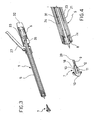
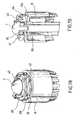
- figure 1 depicts an applier 1 that advantageously laparoscopically, but also through a hand port or under open surgery conditions, or endoscopically if the dimension of the natural duct allows it, deploys and actuates an anastomotic ring device 2 having a distal compression ring 2A and a proximal compression ring 2B with a retention element or a separate retention element 2C suitable to snap connect the two compression rings 2A, 2B to another in order to form an anastomotic attachment between a distal tissue 3 (for instance intestinal wall tissue) and a proximal tissue 4 (for instance intestinal or gastric wall tissue) at an anastomosis target size, such as in a bariatric gastric bypass of a morbidly obese patient.
- a distal tissue 3 for instance intestinal wall tissue
- a proximal tissue 4 for instance intestinal or gastric wall tissue
- the applier 1 comprises an elongate insertion shaft 5, a handle 6 proximally connected with an elongate shaft 5 and a detachable anvil 7 connectable with an actuating member 8 of the applier arranged at the distal end of the elongate shaft 5.
- the anvil 7 includes a first snap connecting part 9 for distally snap connect the anvil 7 in the anastomosis site with the actuating member 8 of the applier.
- the anvil 7 further defines a seat for receiving the distal compression ring 2A and holding it in position during the actuation of the anastomotic ring device 2.
- the seat may hold the distal compression ring 2A by press-fit, snap-fit, friction fit or shape fit.
- the anvil 7 includes a distal, preferably conical, head 10 connected to a central rod 11 extending proximally from the head 10 and supporting a retractable holder 12.
- the anvil head 10 has an outer diameter less than the inner diameter of a central passage aperture of the anastomotic ring device formed by corresponding passage apertures of both compression rings 2A, 2B and the retention element 2C.
- the retractable holder 12 includes a radially deflectable or displaceable elongate release portion 13 with sloping release surfaces 14 and opposite holding teeth 15 extending radially outward from a distal end of the elongate release portion 13.
- the holding teeth 15 bear against a proximal bearing surface of the anvil head 10 and their ends protrude radially over the anvil head's outer periphery and are configured to engage corresponding holding surfaces, for instance one ore more circumferential grooves 16, of the distal compression ring 2A.
- a radial flexural displacement of the elongate release portion 13 causes the holding teeth 15 to retract radially inwardly and disconnect from the distal compression ring 2A for enabling the anvil head 10 together with the retracted holder 12 to be withdrawn in proximal direction through the center opening of the anastomotic ring device 2.
- a proximal free end of the central rod 11 of the anvil forms a longitudinally slotted tubular seat with a substantially circumferential retaining edge forming the above mentioned first connecting part 9 suitable to snap receive a corresponding arrowhead shaped second connecting part 17 of the actuating member 8.
- the detachable anvil 7 comprises a tapered dilating portion 18 which extends proximally from the anvil head 10 and has a transverse dimension or diameter which increases in distal direction.
- the dilating portion 18 is preferably approximately cone-shaped and suitable to dilate the distal tissue 3 pierced by the anvil during approximation of the anvil towards the actuating member.
- the truncated cone of the dilating portion 18 is arranged radially outside the elongate release portion 13 and separated from the latter by a circumferential gap which allows the access of a releasing part 19 of the actuating member to the release portion.
- the cone shaped dilating portion 18 is arranged around the elongate release portion 13 and comprises two opposite longitudinal grooves receiving the sloping release surfaces 14 of the retractable holder and exposing them to the action of the corresponding releasing part 19 of the actuating member.
- a trocar 20 is directly formed on or connected with the proximal end of the first connecting part 9 of the anvil and suitable to pierce through the distal tissue 3 in order to create an initial hole for the subsequent formation of the anastomotic orifice.
- the elongate shaft 5 is preferably, but not necessarily rigid and substantially straight and includes an outer tube 21 having a distal end defining a seat 22 for receiving the proximal compression ring 2B and a proximal end connected with the handle 6.
- the seat 22 has a substantially circular shape with a size suitable to receive the proximal compression ring 2B with friction fit or snap fit in order to hold it in position during the insertion of the elongate shaft in the body of the patient and during the formation of the anastomosis.
- a substantially tubular actuating rod 23 is slidingly arranged inside the outer tube 21 and has a distal end defining a preferably annular pushing surface 24 which forms together with an internal cylindrical surface of the outer tube 21 a seat for slidingly receiving the retention element 2C which, in this embodiment, is separate from the proximal compression ring 2B.
- a proximal end of the actuating rod reaches inside the handle 6 and forms an annular flange 25.
- a compression spring element 26 is arranged between the flange 25 and a proximal end portion of the outer tube 21 or a spring seat especially formed in the handle, in order to elastically bias the tubular actuating rod 23 in proximal direction and maintain its proximal end in contact against a manual actuating trigger 27.
- the actuating trigger 27 is suitable for pushing the actuating rod 23 from a proximal rest position in distal direction for moving the retention element 2C towards and in snap engagement with the distal compression ring 2A to snap connect the compression rings 2A,
- the manual actuating trigger 27 includes a hinged trigger lever able to multiply the manually operated actuating force.
- the retention element 2C of the anastomotic ring device 2 comprises an annular proximal shoulder 28 suitable to engage a proximal surface of the proximal compression ring 2B and a longitudinal portion which distally protrudes from the proximal shoulder and forms elastically supported snapper teeth 29 extending radially outwardly from the longitudinal portion to enable snap engagement of the distal compression ring 2A.
- the longitudinal portion and the snapper teeth of the retention element 2C define slots or window openings 30 in alignment with the holding teeth 15 of the retractable holder 12 to enable the retention element 2C to be shifted in engagement with the distal compression ring 2A without interfering with the retractable holder 12.
- the elongate insertion shaft 5 further houses a central approximating rod 31 which is slidingly received inside the outer tube 21 and has a distal end defining the above mentioned second connecting part 17.
- the second connecting part 17 is preferably arrow head shaped and configured to snap-engage the first connecting part 9 of the detachable anvil for connecting the anvil with the actuating member 8.
- a proximal end of the central approximating rod 31 reaches inside the handle 6 where it is connected with a manual approximating knob 32 suitable for translating the approximating rod 31 from a distally advanced position in proximal direction to approximate the anvil carrying the distal compression ring towards the proximal compression ring.
- the approximating rod 31 is rotatably locked and the manual approximating knob 32 engages the its proximal end by means of a threaded connector 33 such that a rotation of the knob 32 causes the approximating rod 31 to translate along the threaded connector 33.
- a distal end of the second connecting part 17 has a trocar or a sharp tip formed or connected on it, suitable to pierce through the proximal tissue in order to create an initial hole for the subsequent formation of the anastomotic orifice.
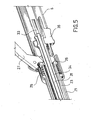
- the elongate shaft 5 further houses a preferably substantially tubular releasing rod 34 which is slidably arranged inside the outer tube 21 and has a distal end defining the above mentioned releasing part 19 (e.g. a tubular push portion or two oppositely arranged push pins positioned such as to be in alignment with the opposite longitudinal grooves of the dilating portion 18 of the anvil) and suitable to contact with pressure the sloping release surfaces 14 of the anvil's retractable holder 12 to retract the holding teeth 15 from the distal compression ring 2A.
- a preferably substantially tubular releasing rod 34 which is slidably arranged inside the outer tube 21 and has a distal end defining the above mentioned releasing part 19 (e.g. a tubular push portion or two oppositely arranged push pins positioned such as to be in alignment with the opposite longitudinal grooves of the dilating portion 18 of the anvil) and suitable to contact with pressure the sloping release surfaces 14 of the anvil's retractable holder 12 to retract the
- a proximal end of the releasing rod 34 extends inside the handle 6 and is there connected with a manual releasing slider 35 suitable for pushing the releasing rod 34 from a proximal rest position in distal direction in order to retract the retractable holder.
- the manual release slider 35 includes a longitudinally adjustable sliding button directly connected with the proximal end of the release rod 34.
- the central approximating rod 31 is slidingly arranged inside the tubular release rod 34 in order that the tensioned approximating rod guides the release rod 34 (which transmits a compression force) and increases its lateral stability.
- the distal and proximal tissue to be attached in anastomosis is held between the two compression rings 2A, 2B by the compressive force operated through their snap engagement.
- the surfaces of the compression rings in contact with the tissue have preferably an enhanced roughness for increasing the friction between the anastomotic ring device and the tissue.
- the actuating member 8 of the anastomotic applier includes a needle applier configured to hold a group of needles or staples for piercing and fixating the tissue held between the distal and proximal compression ring.
- the needle applier is movable from a proximal rest position in distal direction, in response to a compressive needle force, for pushing the group of needles or staples into the anastomotic ring device.
- Such a needle force can be operated by a separate actuating mechanism and transmitted to the group of needles or staples by a separate pushing part or, which is preferable, the anastomotic applier 1 and the group of needles or staples are configured such that the needles can be applied by the same operation that causes the snap engagement of the two compression rings.
- the retention element 2C of the anastomotic ring device itself defines a seat for receiving a group of needles 36 or staples such that, in response to a distal movement of the above mentioned actuating part, i.e. the pushing surface 24, the retention element 2C moves in snap engagement with the compression rings 2A, 2B and pushes contemporaneously the group of needles 36 or staples in the anastomotic ring device piercing the tissue 3, 4 held between the proximal and distal compression rings.
- the group of needles might advantageously comprise a self supporting needle ring which can be arranged on the annular shoulder 28 of the retention element 2C.
- the detachable anvil is initially separate from the actuating member of the anastomotic applier 1 and can be positioned, for instance by means of surgical graspers or guide-devices (by laparoscopy, open surgery or through an endoscopic route) on the side of the tissue to be subject to anastomosis.
- the actuating member 8 of the anastomotic applier is inserted in the body of the patient, e.g. through a trocar port leading to the proximal side of the proximal tissue to be subject to anastomosis.
- the anvil trocar 20 By pushing the anvil first connecting part against the distal tissue 3, the anvil trocar 20 will pierce the distal tissue defining an initial distal lumen for the anastomosis. Analogously, by pushing the sharp tip of the second connecting portion of the actuating member against the proximal tissue, a proximal initial lumen is created. The distal and proximal tissue can now be placed proximate to another and correctly aligned by moving the insertion shaft 5 towards the anvil 7 or vice versa and snap connect the two snap connecting parts 9, 17 to connect the anvil with the actuating member 8 of the applier ( fig. 8 ).
- the increasing diameter of the cone shaped dilating portion 18 dilates the distal and proximal tissue to a diameter approximately equal to the inner diameter of the compression rings ( fig. 10 ).
- the retention element might be provided with different coupling features, e.g. friction fit features, or screw on features.
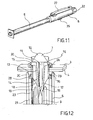
- the needle ring 36 is pushed into both compression rings and pierces the rings of proximal and distal tissue clamped between them ( fig. 12 ).
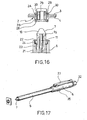
- the holding teeth are retracted within a circumference smaller than the internal diameter of the anastomotic ring device, it is possible to withdraw the anvil, without detaching it from the applier, proximally through the anastomotic lumen.
- the anastomotic applier can now be removed from the anastomosis ( fig.16, 17 ) and taken out of the patient.
- Figures 18 and 19 depict an alternative embodiment of the present invention, according to which the actuating member includes a cutting edge 38 movable from a proximal rest position in distal direction, in response to a compressive cutting force, for cutting the proximal and distal tissue clamped between the proximal and distal compression rings to create the anastomotic orifice.
- the handle includes an actuating mechanism for producing said compressive cutting force and the elongate shaft includes means for transmitting said compressive cutting force to the cutting edge.
- the cutting edge might be operatively coupled with the actuating part 24 such that the cutting of the anastomotic lumen is performed contemporaneously with the snap engagement of the ring device or at least due to the same actuating force, obviating a separate cutting mechanism.
- the detachable anvil may comprise a cut washer 39 providing a cutting surface for the cutting edge 38 to press against in order to complete the cut.
- the cut washer 39 includes a holding part 40 projecting radially outward from the anvil and being configured to hold the distal compression ring 2A for connecting it to the anvil 7.
- the cutting edge 38 is configured to cut away said projecting holding part 40 for disconnecting the distal compression ring from the anvil and enabling the anvil to be withdrawn in proximal direction through the center opening of the anastomotic ring device.
- Figures 18 and 19 show also an anastomotic ring device which differs slightly from that shown in the previous figures.
- the retention element is integral with the proximal compression ring and the rings have a circumferentially wavy shape which consents the formation of anastomotic lumen having a larger diameter than the ring devices itself as the wavy shape of the tissues forming the anastomosis will flatten and circumferentially lengthen after removing of the bio-absorbable or bio-fragmentable compression rings.
- These features of the ring device itself can be readily applied also to the previously described embodiments.
- the respective seats for receiving the wavy compression rings are advantageously, but not necessarily, wavy, too.
- such a cutting edge 38 might be also formed on the distal end of the snapper portion 2C for cutting through residual tissue projecting in the anastomotic lumen after widening, which would otherwise hinder the insertion of the snapper portion.
- the elongate insertion shaft might be curved or flexible in order to allow access through a long lumen, such as a section of the small intestine.
- the rods housed inside the elongate shaft for transmitting the approximation, actuation, release and cutting movements might be flexible in order to allow the flexion of the whole insertion shaft.
- Preferred materials for the fabrication of the applier and its single components are biocompatible polymers and/or metals.
- Preferred materials for the anastomotic ring device are biocompatible and advantageously bio-fragmentable or bio-absorbable materials.
- the applier 1 might advantageously include illuminating means, comprising an illuminating power source and an electroluminescence device known in the art and therefore not shown in the figures.
Landscapes
- Health & Medical Sciences (AREA)
- Surgery (AREA)
- Life Sciences & Earth Sciences (AREA)
- Medical Informatics (AREA)
- Animal Behavior & Ethology (AREA)
- Engineering & Computer Science (AREA)
- Biomedical Technology (AREA)
- Heart & Thoracic Surgery (AREA)
- Veterinary Medicine (AREA)
- Molecular Biology (AREA)
- Nuclear Medicine, Radiotherapy & Molecular Imaging (AREA)
- General Health & Medical Sciences (AREA)
- Public Health (AREA)
- Physiology (AREA)
- Surgical Instruments (AREA)
- Medical Preparation Storing Or Oral Administration Devices (AREA)
- Investigating Or Analyzing Non-Biological Materials By The Use Of Chemical Means (AREA)
- Packages (AREA)
Claims (17)
- Instrument chirurgical (1) pour implanter un dispositif annulaire anastomotique, comprenant :- une enclume (7) incluant une première partie de connexion (9) et un siège (15) pour recevoir une bague de compression distale (2A) dudit dispositif annulaire anastomotique (2), et- un élément d'actionnement (8) comprenant :- un ou plusieurs sièges (22) pour recevoir une bague de compression proximale (2B) et un élément de rétention (2C) dudit dispositif annulaire anastomotique (2),- une seconde partie de connexion (17) configurée pour engager la première partie de connexion (9) pour connecter l'enclume (7) avec l'élément d'actionnement (8), dans laquelle la seconde partie de connexion (17) est mobile depuis une position distale en direction proximale en réponse à une force de traction, pour approcher l'enclume (7) vers l'élément d'actionnement (8), et- une partie d'actionnement (24) configurée pour agir sur l'élément de rétention (2C) du dispositif annulaire anastomotique (2), la partie d'actionnement (24) étant mobile depuis une position de repos proximale dans une direction distale, en réponse à une force de compression, pour déplacer l'élément de rétention (2C) vers la bague de compression distale (2A) et en engagement avec celle-ci pour connecter les bagues de compression ;- une poignée (6) incluant un mécanisme d'actionnement (32, 33, 25, 26, 27) pour produire ladite force d'approche par traction et ladite force d'actionnement par compression, et- une tige allongée (5) qui connecte la poignée (6) avec l'élément d'actionnement (8), ladite tige incluant des moyens pour transmettre ladite force d'approche par traction à la seconde partie de connexion (17) et ladite force d'actionnement par compression à la partie d'actionnement (24).
- Instrument chirurgical (1) selon la revendication 1, dans lequel ladite première partie de connexion (9) et ladite seconde partie de connexion (17) sont appropriées pour se connecter l'une à l'autre par encliquetage.
- Instrument chirurgical (1) selon la revendication 1 ou 2, dans lequel l'enclume (7) comprend un organe de maintien rétractable (12) configuré pour maintenir ladite bague de compression distale (2A) et incluant une portion de libération (13), dans laquelle un remplacement de la portion de libération (13) amène l'organe de maintien rétractable (12) à se rétracter radialement vers l'intérieur et se déconnecter de la bague de compression distale (2A) pour permettre d'extraire l'enclume (7) en direction proximale via les ouvertures centrales du dispositif annulaire anastomotique (2),
dans lequel ledit élément d'actionnement (8) comprend une partie de libération (19) configurée pour agir sur la portion de libération (13) de l'organe de maintien rétractable (12), la partie de libération (19) étant mobile depuis une position de repos vers une position de libération, en réponse à une force de libération, pour déplacer ladite portion de libération (13),
dans lequel la poignée inclut un mécanisme d'actionnement (35) pour produire ladite force de libération, et la tige allongée (5) inclut des moyens pour transmettre ladite force de libération à la partie de libération (19). - Instrument chirurgical (1) selon la revendication 2, dans lequel ledit organe de maintien rétractable (12) inclut une portion de libération allongée (13) radialement déplaçable avec des surfaces de libération en pente (14) et des dents de maintien (15) s'étendant radialement vers l'extérieur depuis une extrémité distale de la portion de libération allongée (13) et configurées pour engager des surfaces de maintien correspondantes (16) de la bague de compression distale (2A), et
dans lequel la partie de libération (19) est mobile depuis une position de repos proximale dans une direction distale, en réponse à une force de libération par compression, pour pousser contre les surfaces de libération en pente (14) de la portion de libération allongée pour déplacer ladite portion de libération afin de rétracter les dents de maintien depuis la bague de compression distale. - Instrument chirurgical (1) selon l'une quelconque des revendications précédentes, dans lequel l'enclume (7) est détachable et comprend une portion de dilatation effilée (18) ayant un diamètre qui augmente en direction distale, ladite portion de dilatation (18) étant appropriée pour dilater les tissus percés par l'enclume.
- Instrument chirurgical (1) selon l'une quelconque des revendications précédentes, dans lequel l'élément d'actionnement (8) inclut un bord de coupe (38) mobile depuis une position de repos proximale dans une direction radiale, en réponse à une force de coupe par compression, pour couper les tissus proximaux et distaux comprimés entre la bague de compression proximale et la bague de compression distale (2A, 2B) pour créer l'orifice anastomotique,
dans lequel la poignée (6) inclut un mécanisme d'actionnement pour produire ladite force de coupe par compression et la tige allongée (5) inclut des moyens pour transmettre ladite force de coupe par compression au bord de coupe (38). - Instrument chirurgical (1) selon la revendication précédente, dans lequel l'enclume (7) comprend une rondelle de découpe (39) présentant une surface de coupe pour la traversée du bord de coupe (38) afin de terminer la coupe.
- Instrument chirurgical (1) selon la revendication précédente, dans lequel la rondelle de coupe (39) inclut une partie de maintien (40) qui se projette radialement vers l'extérieur depuis l'enclume (7) et qui est configurée pour maintenir la bague de compression distale (2A) et la connecter à l'enclume, dans lequel le bord de coupe (38) est configuré pour enlever par découpe ladite partie de maintien en projection (40) et déconnecter la bague de compression distale (2A) vis-à-vis de l'enclume (7) et permettre d'extraire l'enclume en direction proximale à travers les ouvertures centrales du dispositif annulaire anastomotique.
- Instrument chirurgical (1) selon l'une quelconque des revendications précédentes, dans lequel l'élément d'actionnement (8) inclut un applicateur d'aiguilles (24) configuré pour tenir un groupe d'aiguilles (36) ou d'agrafes pour percer et fixer les tissus maintenus entre la bague de compression distale et la bague de compression proximale,
dans lequel ledit applicateur d'aiguilles (24) est mobile depuis une position de repos proximale en direction distale, en réponse à une force de compression destinée aux aiguilles, afin de pousser le groupe d'aiguilles (36) ou d'agrafes dans le dispositif annulaire anastomotique,
dans lequel la poignée (6) inclut un mécanisme d'actionnement pour produire ladite force de compression destinée aux aiguilles, et la tige allongée (5) inclut des moyens pour transmettre ladite force de compression destinée aux aiguilles vers l'applicateur d'aiguilles (24). - Instrument chirurgical (1) selon la revendication 9, dans lequel ledit élément de rétention (2C) définit un siège (28) pour recevoir un groupe d'aiguilles (36) ou d'agrafes de telle façon que, en réponse à un mouvement distal de ladite partie d'actionnement (24), la portion d'encliquetage (2C) se déplace en engagement en encliquetage avec les bagues de compression (2A, 2B) et pousse simultanément le groupe d'aiguilles (36) ou d'agrafes dans le dispositif annulaire anastomotique en perçant les tissus maintenus entre la bague de compression proximale et la bague de compression distale.
- Instrument chirurgical (1) selon l'une quelconque des revendications précédentes, dans lequel la tige allongée (5) inclut :- un tube extérieur (21), une extrémité distale du tube extérieur définissant un siège (22) pour recevoir la bague de compression proximale (2A) et une extrémité proximale du tube extérieur étant connectée à un boîtier de poignée (6) qui enveloppe le mécanisme d'actionnement de l'instrument chirurgical,- une tige d'actionnement sensiblement tubulaire (23) agencée en coulissement à l'intérieur du tube extérieur (21), une extrémité distale de la tige d'actionnement définissant un siège (24) pour l'élément de rétention (2C) du dispositif annulaire anastomotique (2) et une extrémité proximale (25) de la tige d'actionnement atteignant l'intérieur du boîtier de poignée (6) et étant élastiquement sollicitée en direction proximale en contact contre un déclencheur d'actionnement (27) qui convient pour pousser la tige d'actionnement (23) en direction distale,- une tige d'approche (31) reçu en coulissement à l'intérieur du tube extérieur (21), une extrémité distale de la tige d'approche (31) définissant ladite seconde partie de connexion (17) et une extrémité proximale de ladite tige d'approximation atteignant l'intérieur du boîtier de poignée (6) et étant connecté avec un bouton d'approche (32) approprié pour mettre la tige d'approximation (31) en translation en direction proximale.
- Instrument chirurgical (1) selon la revendication précédente, dans lequel la tige allongée (5) inclut une tige de libération sensiblement tubulaire (34) agencée en coulissement à l'intérieur du tube extérieur (21), une extrémité distale de la tige de libération définissant ladite partie de libération (19) et une extrémité proximale de la tige de libération s'étendant à l'intérieur du boîtier de poignée (6) et étant connectée à un coulisseau de libération (35) approprié pour pousser la tige de libération en direction distale afin de rétracter l'organe de maintien rétractable (12).
- Instrument chirurgical (1) selon l'une quelconque des revendications 11 à 12, dans lequel ledit déclencheur d'actionnement (27) inclut un levier de déclenchement articulé et le bouton d'approche (32) engage extrémité proximale, bloquée en rotation, de la tige d'approche (31) au moyen d'un connecteur à pas de vis de telle façon qu'une rotation du bouton (32) amène la tige d'approche à se déplacer en translation le long du connecteur à pas de vis.
- Instrument chirurgical (1) selon la revendication 12 ou 13, dans lequel ledit coulisseau de libération manuel (35) inclut un bouton coulissant, ajustable longitudinalement, directement connecté à l'extrémité proximale de la tige de libération (34).
- Instrument chirurgical (1) selon l'une quelconque des revendications précédentes, dans lequel la première partie de connexion (9) de l'enclume inclut une extrémité proximale comportant un trocart, formé sur elle-même ou connecté à elle-même, approprié pour percer à travers une couche de tissu.
- Instrument chirurgical (1) selon l'une quelconque des revendications précédentes, dans lequel la seconde partie de connexion (17) inclut une extrémité distale ayant un trocart ou un embout pointu formé sur elle-même ou connecté à elle-même, approprié pour percer à travers une couche de tissu.
- Instrument chirurgical (1) selon l'une quelconque des revendications précédentes, dans lequel la tige d'insertion allongée comprend une portion flexible pour permettre un accès via un lumen incurvé, et dans lequel les tiges abritées à l'intérieur de la tige allongée pour transmettre les mouvements d'approche, d'actionnement, de libération et de coupe comprennent des portions flexibles afin de permettre la flexion de la tige d'insertion.
Priority Applications (5)
| Application Number | Priority Date | Filing Date | Title |
|---|---|---|---|
| EP06021055A EP1908418B1 (fr) | 2006-10-06 | 2006-10-06 | Applicateur d'anastomose |
| DE602006012054T DE602006012054D1 (de) | 2006-10-06 | 2006-10-06 | Anastomosenapplikator |
| AT06021055T ATE456328T1 (de) | 2006-10-06 | 2006-10-06 | Anastomosenapplikator |
| CN2007800373043A CN101522112B (zh) | 2006-10-06 | 2007-07-16 | 吻合施放器 |
| PCT/EP2007/057300 WO2008040580A1 (fr) | 2006-10-06 | 2007-07-16 | Applicateur anastomotique |
Applications Claiming Priority (1)
| Application Number | Priority Date | Filing Date | Title |
|---|---|---|---|
| EP06021055A EP1908418B1 (fr) | 2006-10-06 | 2006-10-06 | Applicateur d'anastomose |
Publications (2)
| Publication Number | Publication Date |
|---|---|
| EP1908418A1 EP1908418A1 (fr) | 2008-04-09 |
| EP1908418B1 true EP1908418B1 (fr) | 2010-01-27 |
Family
ID=37806195
Family Applications (1)
| Application Number | Title | Priority Date | Filing Date |
|---|---|---|---|
| EP06021055A Active EP1908418B1 (fr) | 2006-10-06 | 2006-10-06 | Applicateur d'anastomose |
Country Status (5)
| Country | Link |
|---|---|
| EP (1) | EP1908418B1 (fr) |
| CN (1) | CN101522112B (fr) |
| AT (1) | ATE456328T1 (fr) |
| DE (1) | DE602006012054D1 (fr) |
| WO (1) | WO2008040580A1 (fr) |
Families Citing this family (54)
| Publication number | Priority date | Publication date | Assignee | Title |
|---|---|---|---|---|
| US8663220B2 (en) | 2009-07-15 | 2014-03-04 | Ethicon Endo-Surgery, Inc. | Ultrasonic surgical instruments |
| WO2011020099A1 (fr) * | 2009-08-14 | 2011-02-17 | Correx, Inc. | Procédé et appareil pour réaliser une anastomose distale minimalement invasive pour un pontage de valvule sigmoïde |
| US11090104B2 (en) | 2009-10-09 | 2021-08-17 | Cilag Gmbh International | Surgical generator for ultrasonic and electrosurgical devices |
| US8469981B2 (en) | 2010-02-11 | 2013-06-25 | Ethicon Endo-Surgery, Inc. | Rotatable cutting implement arrangements for ultrasonic surgical instruments |
| US9439668B2 (en) | 2012-04-09 | 2016-09-13 | Ethicon Endo-Surgery, Llc | Switch arrangements for ultrasonic surgical instruments |
| US20140005705A1 (en) | 2012-06-29 | 2014-01-02 | Ethicon Endo-Surgery, Inc. | Surgical instruments with articulating shafts |
| US9393037B2 (en) | 2012-06-29 | 2016-07-19 | Ethicon Endo-Surgery, Llc | Surgical instruments with articulating shafts |
| US9351754B2 (en) | 2012-06-29 | 2016-05-31 | Ethicon Endo-Surgery, Llc | Ultrasonic surgical instruments with distally positioned jaw assemblies |
| US9408622B2 (en) | 2012-06-29 | 2016-08-09 | Ethicon Endo-Surgery, Llc | Surgical instruments with articulating shafts |
| TWI626922B (zh) * | 2012-09-20 | 2018-06-21 | 卡波諾凡股份有限公司 | 用於吻合裝置的固定工具 |
| US9095367B2 (en) | 2012-10-22 | 2015-08-04 | Ethicon Endo-Surgery, Inc. | Flexible harmonic waveguides/blades for surgical instruments |
| CN104632813A (zh) * | 2013-11-12 | 2015-05-20 | 张造伦 | 多角型连接孔结构 |
| US9737355B2 (en) | 2014-03-31 | 2017-08-22 | Ethicon Llc | Controlling impedance rise in electrosurgical medical devices |
| US9913680B2 (en) | 2014-04-15 | 2018-03-13 | Ethicon Llc | Software algorithms for electrosurgical instruments |
| US10765470B2 (en) | 2015-06-30 | 2020-09-08 | Ethicon Llc | Surgical system with user adaptable techniques employing simultaneous energy modalities based on tissue parameters |
| US20170086909A1 (en) | 2015-09-30 | 2017-03-30 | Ethicon Endo-Surgery, Llc | Frequency agile generator for a surgical instrument |
| US10595930B2 (en) | 2015-10-16 | 2020-03-24 | Ethicon Llc | Electrode wiping surgical device |
| JP7093917B2 (ja) * | 2015-11-17 | 2022-07-01 | サージカル スタビライゼーション テクノロジーズ インク. | トロカール支持体 |
| EP3376975B1 (fr) * | 2015-11-19 | 2022-04-20 | Summit Access, LLC | Systèmes d'accès percutané |
| US11129670B2 (en) | 2016-01-15 | 2021-09-28 | Cilag Gmbh International | Modular battery powered handheld surgical instrument with selective application of energy based on button displacement, intensity, or local tissue characterization |
| US11229471B2 (en) | 2016-01-15 | 2022-01-25 | Cilag Gmbh International | Modular battery powered handheld surgical instrument with selective application of energy based on tissue characterization |
| US12193698B2 (en) | 2016-01-15 | 2025-01-14 | Cilag Gmbh International | Method for self-diagnosing operation of a control switch in a surgical instrument system |
| US11134978B2 (en) | 2016-01-15 | 2021-10-05 | Cilag Gmbh International | Modular battery powered handheld surgical instrument with self-diagnosing control switches for reusable handle assembly |
| US10456193B2 (en) | 2016-05-03 | 2019-10-29 | Ethicon Llc | Medical device with a bilateral jaw configuration for nerve stimulation |
| US10463374B2 (en) * | 2016-05-17 | 2019-11-05 | Covidien Lp | Adapter assembly for a flexible circular stapler |
| GB201611306D0 (en) | 2016-06-29 | 2016-08-10 | Norwegian Univ Of Science And Tech (Ntnu) | Surgical stapler and a method of stapling tissue |
| US10376305B2 (en) | 2016-08-05 | 2019-08-13 | Ethicon Llc | Methods and systems for advanced harmonic energy |
| US11266430B2 (en) | 2016-11-29 | 2022-03-08 | Cilag Gmbh International | End effector control and calibration |
| US12076006B2 (en) | 2019-12-30 | 2024-09-03 | Cilag Gmbh International | Surgical instrument comprising an orientation detection system |
| US12262937B2 (en) | 2019-12-30 | 2025-04-01 | Cilag Gmbh International | User interface for surgical instrument with combination energy modality end-effector |
| US11950797B2 (en) | 2019-12-30 | 2024-04-09 | Cilag Gmbh International | Deflectable electrode with higher distal bias relative to proximal bias |
| US11786291B2 (en) | 2019-12-30 | 2023-10-17 | Cilag Gmbh International | Deflectable support of RF energy electrode with respect to opposing ultrasonic blade |
| US11452525B2 (en) | 2019-12-30 | 2022-09-27 | Cilag Gmbh International | Surgical instrument comprising an adjustment system |
| US12336747B2 (en) | 2019-12-30 | 2025-06-24 | Cilag Gmbh International | Method of operating a combination ultrasonic / bipolar RF surgical device with a combination energy modality end-effector |
| US12082808B2 (en) | 2019-12-30 | 2024-09-10 | Cilag Gmbh International | Surgical instrument comprising a control system responsive to software configurations |
| US11707318B2 (en) | 2019-12-30 | 2023-07-25 | Cilag Gmbh International | Surgical instrument with jaw alignment features |
| US20210196361A1 (en) | 2019-12-30 | 2021-07-01 | Ethicon Llc | Electrosurgical instrument with monopolar and bipolar energy capabilities |
| US12064109B2 (en) | 2019-12-30 | 2024-08-20 | Cilag Gmbh International | Surgical instrument comprising a feedback control circuit |
| US12114912B2 (en) | 2019-12-30 | 2024-10-15 | Cilag Gmbh International | Non-biased deflectable electrode to minimize contact between ultrasonic blade and electrode |
| US11779387B2 (en) | 2019-12-30 | 2023-10-10 | Cilag Gmbh International | Clamp arm jaw to minimize tissue sticking and improve tissue control |
| US11779329B2 (en) | 2019-12-30 | 2023-10-10 | Cilag Gmbh International | Surgical instrument comprising a flex circuit including a sensor system |
| US11986201B2 (en) | 2019-12-30 | 2024-05-21 | Cilag Gmbh International | Method for operating a surgical instrument |
| US12053224B2 (en) | 2019-12-30 | 2024-08-06 | Cilag Gmbh International | Variation in electrode parameters and deflectable electrode to modify energy density and tissue interaction |
| US11944366B2 (en) | 2019-12-30 | 2024-04-02 | Cilag Gmbh International | Asymmetric segmented ultrasonic support pad for cooperative engagement with a movable RF electrode |
| US12023086B2 (en) | 2019-12-30 | 2024-07-02 | Cilag Gmbh International | Electrosurgical instrument for delivering blended energy modalities to tissue |
| US20210196357A1 (en) | 2019-12-30 | 2021-07-01 | Ethicon Llc | Electrosurgical instrument with asynchronous energizing electrodes |
| US11986234B2 (en) | 2019-12-30 | 2024-05-21 | Cilag Gmbh International | Surgical system communication pathways |
| US11911063B2 (en) | 2019-12-30 | 2024-02-27 | Cilag Gmbh International | Techniques for detecting ultrasonic blade to electrode contact and reducing power to ultrasonic blade |
| US11660089B2 (en) | 2019-12-30 | 2023-05-30 | Cilag Gmbh International | Surgical instrument comprising a sensing system |
| US12349961B2 (en) | 2019-12-30 | 2025-07-08 | Cilag Gmbh International | Electrosurgical instrument with electrodes operable in bipolar and monopolar modes |
| US12343063B2 (en) | 2019-12-30 | 2025-07-01 | Cilag Gmbh International | Multi-layer clamp arm pad for enhanced versatility and performance of a surgical device |
| US11937863B2 (en) | 2019-12-30 | 2024-03-26 | Cilag Gmbh International | Deflectable electrode with variable compression bias along the length of the deflectable electrode |
| US11812957B2 (en) | 2019-12-30 | 2023-11-14 | Cilag Gmbh International | Surgical instrument comprising a signal interference resolution system |
| US11696776B2 (en) | 2019-12-30 | 2023-07-11 | Cilag Gmbh International | Articulatable surgical instrument |
Family Cites Families (5)
| Publication number | Priority date | Publication date | Assignee | Title |
|---|---|---|---|---|
| DE1177768B (de) * | 1960-12-09 | 1964-09-10 | Dr Reindert Brummelkamp | Chirurgische Vorrichtung fuer die Resektion und Verbindung von Darmteilen |
| GR1002290B (el) * | 1991-06-03 | 1996-05-02 | Ethicon Inc. | Απορροφησιμο αναστομωτικο μεσο συνδεσεως. |
| HU225908B1 (en) * | 2000-01-24 | 2007-12-28 | Ethicon Endo Surgery Europe | Surgical circular stapling head |
| US20040254590A1 (en) * | 2003-06-16 | 2004-12-16 | Hoffman Gary H. | Method and instrument for the performance of stapled anastamoses |
| US7527185B2 (en) * | 2006-07-12 | 2009-05-05 | Niti Surgical Solutions Ltd. | Compression anastomosis ring assembly and applicator for use therewith |
-
2006
- 2006-10-06 EP EP06021055A patent/EP1908418B1/fr active Active
- 2006-10-06 AT AT06021055T patent/ATE456328T1/de not_active IP Right Cessation
- 2006-10-06 DE DE602006012054T patent/DE602006012054D1/de active Active
-
2007
- 2007-07-16 WO PCT/EP2007/057300 patent/WO2008040580A1/fr not_active Ceased
- 2007-07-16 CN CN2007800373043A patent/CN101522112B/zh not_active Expired - Fee Related
Also Published As
| Publication number | Publication date |
|---|---|
| CN101522112B (zh) | 2012-01-11 |
| WO2008040580A1 (fr) | 2008-04-10 |
| EP1908418A1 (fr) | 2008-04-09 |
| ATE456328T1 (de) | 2010-02-15 |
| CN101522112A (zh) | 2009-09-02 |
| DE602006012054D1 (de) | 2010-03-18 |
Similar Documents
| Publication | Publication Date | Title |
|---|---|---|
| EP1908418A1 (fr) | Applicateur d'anastomose | |
| EP1908422B1 (fr) | Améliorations concernant un applicateur de bagues d'anastomose | |
| EP1520530B1 (fr) | Applicateur et une bague d'anastomose | |
| JP4531514B2 (ja) | 内腔間吻合のための単一内腔配置用リング | |
| JP4658557B2 (ja) | 自己配置ファスナーのための単一内腔吻合用アプライヤー | |
| US8211142B2 (en) | Method for hybrid gastro-jejunostomy | |
| AU2004216631A1 (en) | Unfolding anastomosis ring device | |
| CN101522111B (zh) | 用于吻合装置的锁定装置 | |
| WO2004037064A2 (fr) | Methode et dispositif utilises dans des interventions endoscopiques d'organes | |
| AU2007201158B2 (en) | Method for hybrid gastro-jejunostomy |
Legal Events
| Date | Code | Title | Description |
|---|---|---|---|
| PUAI | Public reference made under article 153(3) epc to a published international application that has entered the european phase |
Free format text: ORIGINAL CODE: 0009012 |
|
| AK | Designated contracting states |
Kind code of ref document: A1 Designated state(s): AT BE BG CH CY CZ DE DK EE ES FI FR GB GR HU IE IS IT LI LT LU LV MC NL PL PT RO SE SI SK TR |
|
| AX | Request for extension of the european patent |
Extension state: AL BA HR MK RS |
|
| 17P | Request for examination filed |
Effective date: 20080917 |
|
| 17Q | First examination report despatched |
Effective date: 20081013 |
|
| AKX | Designation fees paid |
Designated state(s): AT BE BG CH CY CZ DE DK EE ES FI FR GB GR HU IE IS IT LI LT LU LV MC NL PL PT RO SE SI SK TR |
|
| AXX | Extension fees paid |
Extension state: BA Payment date: 20080917 Extension state: RS Payment date: 20080917 Extension state: MK Payment date: 20080917 Extension state: AL Payment date: 20080917 Extension state: HR Payment date: 20080917 |
|
| GRAP | Despatch of communication of intention to grant a patent |
Free format text: ORIGINAL CODE: EPIDOSNIGR1 |
|
| GRAS | Grant fee paid |
Free format text: ORIGINAL CODE: EPIDOSNIGR3 |
|
| GRAA | (expected) grant |
Free format text: ORIGINAL CODE: 0009210 |
|
| AK | Designated contracting states |
Kind code of ref document: B1 Designated state(s): AT BE BG CH CY CZ DE DK EE ES FI FR GB GR HU IE IS IT LI LT LU LV MC NL PL PT RO SE SI SK TR |
|
| AX | Request for extension of the european patent |
Extension state: AL BA HR MK RS |
|
| REG | Reference to a national code |
Ref country code: GB Ref legal event code: FG4D |
|
| REG | Reference to a national code |
Ref country code: CH Ref legal event code: EP |
|
| REG | Reference to a national code |
Ref country code: IE Ref legal event code: FG4D |
|
| REF | Corresponds to: |
Ref document number: 602006012054 Country of ref document: DE Date of ref document: 20100318 Kind code of ref document: P |
|
| REG | Reference to a national code |
Ref country code: NL Ref legal event code: VDEP Effective date: 20100127 |
|
| LTIE | Lt: invalidation of european patent or patent extension |
Effective date: 20100127 |
|
| PG25 | Lapsed in a contracting state [announced via postgrant information from national office to epo] |
Ref country code: AT Free format text: LAPSE BECAUSE OF FAILURE TO SUBMIT A TRANSLATION OF THE DESCRIPTION OR TO PAY THE FEE WITHIN THE PRESCRIBED TIME-LIMIT Effective date: 20100127 |
|
| PG25 | Lapsed in a contracting state [announced via postgrant information from national office to epo] |
Ref country code: IS Free format text: LAPSE BECAUSE OF FAILURE TO SUBMIT A TRANSLATION OF THE DESCRIPTION OR TO PAY THE FEE WITHIN THE PRESCRIBED TIME-LIMIT Effective date: 20100527 Ref country code: ES Free format text: LAPSE BECAUSE OF FAILURE TO SUBMIT A TRANSLATION OF THE DESCRIPTION OR TO PAY THE FEE WITHIN THE PRESCRIBED TIME-LIMIT Effective date: 20100508 Ref country code: PT Free format text: LAPSE BECAUSE OF FAILURE TO SUBMIT A TRANSLATION OF THE DESCRIPTION OR TO PAY THE FEE WITHIN THE PRESCRIBED TIME-LIMIT Effective date: 20100527 Ref country code: LT Free format text: LAPSE BECAUSE OF FAILURE TO SUBMIT A TRANSLATION OF THE DESCRIPTION OR TO PAY THE FEE WITHIN THE PRESCRIBED TIME-LIMIT Effective date: 20100127 Ref country code: NL Free format text: LAPSE BECAUSE OF FAILURE TO SUBMIT A TRANSLATION OF THE DESCRIPTION OR TO PAY THE FEE WITHIN THE PRESCRIBED TIME-LIMIT Effective date: 20100127 |
|
| PG25 | Lapsed in a contracting state [announced via postgrant information from national office to epo] |
Ref country code: SI Free format text: LAPSE BECAUSE OF FAILURE TO SUBMIT A TRANSLATION OF THE DESCRIPTION OR TO PAY THE FEE WITHIN THE PRESCRIBED TIME-LIMIT Effective date: 20100127 Ref country code: LV Free format text: LAPSE BECAUSE OF FAILURE TO SUBMIT A TRANSLATION OF THE DESCRIPTION OR TO PAY THE FEE WITHIN THE PRESCRIBED TIME-LIMIT Effective date: 20100127 Ref country code: FI Free format text: LAPSE BECAUSE OF FAILURE TO SUBMIT A TRANSLATION OF THE DESCRIPTION OR TO PAY THE FEE WITHIN THE PRESCRIBED TIME-LIMIT Effective date: 20100127 Ref country code: PL Free format text: LAPSE BECAUSE OF FAILURE TO SUBMIT A TRANSLATION OF THE DESCRIPTION OR TO PAY THE FEE WITHIN THE PRESCRIBED TIME-LIMIT Effective date: 20100127 |
|
| PG25 | Lapsed in a contracting state [announced via postgrant information from national office to epo] |
Ref country code: GR Free format text: LAPSE BECAUSE OF FAILURE TO SUBMIT A TRANSLATION OF THE DESCRIPTION OR TO PAY THE FEE WITHIN THE PRESCRIBED TIME-LIMIT Effective date: 20100428 Ref country code: EE Free format text: LAPSE BECAUSE OF FAILURE TO SUBMIT A TRANSLATION OF THE DESCRIPTION OR TO PAY THE FEE WITHIN THE PRESCRIBED TIME-LIMIT Effective date: 20100127 Ref country code: SE Free format text: LAPSE BECAUSE OF FAILURE TO SUBMIT A TRANSLATION OF THE DESCRIPTION OR TO PAY THE FEE WITHIN THE PRESCRIBED TIME-LIMIT Effective date: 20100127 Ref country code: CY Free format text: LAPSE BECAUSE OF FAILURE TO SUBMIT A TRANSLATION OF THE DESCRIPTION OR TO PAY THE FEE WITHIN THE PRESCRIBED TIME-LIMIT Effective date: 20100127 Ref country code: BE Free format text: LAPSE BECAUSE OF FAILURE TO SUBMIT A TRANSLATION OF THE DESCRIPTION OR TO PAY THE FEE WITHIN THE PRESCRIBED TIME-LIMIT Effective date: 20100127 Ref country code: RO Free format text: LAPSE BECAUSE OF FAILURE TO SUBMIT A TRANSLATION OF THE DESCRIPTION OR TO PAY THE FEE WITHIN THE PRESCRIBED TIME-LIMIT Effective date: 20100127 |
|
| PGFP | Annual fee paid to national office [announced via postgrant information from national office to epo] |
Ref country code: MC Payment date: 20100929 Year of fee payment: 5 |
|
| PG25 | Lapsed in a contracting state [announced via postgrant information from national office to epo] |
Ref country code: CZ Free format text: LAPSE BECAUSE OF FAILURE TO SUBMIT A TRANSLATION OF THE DESCRIPTION OR TO PAY THE FEE WITHIN THE PRESCRIBED TIME-LIMIT Effective date: 20100127 Ref country code: SK Free format text: LAPSE BECAUSE OF FAILURE TO SUBMIT A TRANSLATION OF THE DESCRIPTION OR TO PAY THE FEE WITHIN THE PRESCRIBED TIME-LIMIT Effective date: 20100127 Ref country code: BG Free format text: LAPSE BECAUSE OF FAILURE TO SUBMIT A TRANSLATION OF THE DESCRIPTION OR TO PAY THE FEE WITHIN THE PRESCRIBED TIME-LIMIT Effective date: 20100427 |
|
| PLBE | No opposition filed within time limit |
Free format text: ORIGINAL CODE: 0009261 |
|
| STAA | Information on the status of an ep patent application or granted ep patent |
Free format text: STATUS: NO OPPOSITION FILED WITHIN TIME LIMIT |
|
| 26N | No opposition filed |
Effective date: 20101028 |
|
| PG25 | Lapsed in a contracting state [announced via postgrant information from national office to epo] |
Ref country code: DK Free format text: LAPSE BECAUSE OF FAILURE TO SUBMIT A TRANSLATION OF THE DESCRIPTION OR TO PAY THE FEE WITHIN THE PRESCRIBED TIME-LIMIT Effective date: 20100127 |
|
| PGFP | Annual fee paid to national office [announced via postgrant information from national office to epo] |
Ref country code: IE Payment date: 20101015 Year of fee payment: 5 Ref country code: NL Payment date: 20101009 Year of fee payment: 5 |
|
| PGFP | Annual fee paid to national office [announced via postgrant information from national office to epo] |
Ref country code: CH Payment date: 20101012 Year of fee payment: 5 Ref country code: LU Payment date: 20101111 Year of fee payment: 5 |
|
| PG25 | Lapsed in a contracting state [announced via postgrant information from national office to epo] |
Ref country code: MC Free format text: LAPSE BECAUSE OF NON-PAYMENT OF DUE FEES Effective date: 20111031 |
|
| REG | Reference to a national code |
Ref country code: CH Ref legal event code: PL |
|
| PG25 | Lapsed in a contracting state [announced via postgrant information from national office to epo] |
Ref country code: CH Free format text: LAPSE BECAUSE OF NON-PAYMENT OF DUE FEES Effective date: 20111031 Ref country code: LI Free format text: LAPSE BECAUSE OF NON-PAYMENT OF DUE FEES Effective date: 20111031 |
|
| REG | Reference to a national code |
Ref country code: IE Ref legal event code: MM4A |
|
| PG25 | Lapsed in a contracting state [announced via postgrant information from national office to epo] |
Ref country code: HU Free format text: LAPSE BECAUSE OF FAILURE TO SUBMIT A TRANSLATION OF THE DESCRIPTION OR TO PAY THE FEE WITHIN THE PRESCRIBED TIME-LIMIT Effective date: 20100728 |
|
| PG25 | Lapsed in a contracting state [announced via postgrant information from national office to epo] |
Ref country code: IE Free format text: LAPSE BECAUSE OF NON-PAYMENT OF DUE FEES Effective date: 20111006 Ref country code: TR Free format text: LAPSE BECAUSE OF FAILURE TO SUBMIT A TRANSLATION OF THE DESCRIPTION OR TO PAY THE FEE WITHIN THE PRESCRIBED TIME-LIMIT Effective date: 20100127 |
|
| PG25 | Lapsed in a contracting state [announced via postgrant information from national office to epo] |
Ref country code: LU Free format text: LAPSE BECAUSE OF NON-PAYMENT OF DUE FEES Effective date: 20111006 |
|
| REG | Reference to a national code |
Ref country code: FR Ref legal event code: PLFP Year of fee payment: 11 |
|
| REG | Reference to a national code |
Ref country code: FR Ref legal event code: PLFP Year of fee payment: 12 |
|
| REG | Reference to a national code |
Ref country code: FR Ref legal event code: PLFP Year of fee payment: 13 |
|
| PGFP | Annual fee paid to national office [announced via postgrant information from national office to epo] |
Ref country code: DE Payment date: 20180925 Year of fee payment: 13 |
|
| PGFP | Annual fee paid to national office [announced via postgrant information from national office to epo] |
Ref country code: FR Payment date: 20190913 Year of fee payment: 14 |
|
| PGFP | Annual fee paid to national office [announced via postgrant information from national office to epo] |
Ref country code: IT Payment date: 20191009 Year of fee payment: 14 |
|
| PGFP | Annual fee paid to national office [announced via postgrant information from national office to epo] |
Ref country code: GB Payment date: 20191003 Year of fee payment: 14 |
|
| REG | Reference to a national code |
Ref country code: DE Ref legal event code: R119 Ref document number: 602006012054 Country of ref document: DE |
|
| PG25 | Lapsed in a contracting state [announced via postgrant information from national office to epo] |
Ref country code: DE Free format text: LAPSE BECAUSE OF NON-PAYMENT OF DUE FEES Effective date: 20200501 |
|
| GBPC | Gb: european patent ceased through non-payment of renewal fee |
Effective date: 20201006 |
|
| PG25 | Lapsed in a contracting state [announced via postgrant information from national office to epo] |
Ref country code: FR Free format text: LAPSE BECAUSE OF NON-PAYMENT OF DUE FEES Effective date: 20201031 |
|
| PG25 | Lapsed in a contracting state [announced via postgrant information from national office to epo] |
Ref country code: GB Free format text: LAPSE BECAUSE OF NON-PAYMENT OF DUE FEES Effective date: 20201006 |
|
| PG25 | Lapsed in a contracting state [announced via postgrant information from national office to epo] |
Ref country code: IT Free format text: LAPSE BECAUSE OF NON-PAYMENT OF DUE FEES Effective date: 20201006 |