EP1892182A1 - Durchsichtiges und verbundartiges Karosserieanbauteil, Zwischenprodukt und Verfahren zum Herstellen eines solchen Karosserieanbauteils - Google Patents
Durchsichtiges und verbundartiges Karosserieanbauteil, Zwischenprodukt und Verfahren zum Herstellen eines solchen Karosserieanbauteils Download PDFInfo
- Publication number
- EP1892182A1 EP1892182A1 EP20060017341 EP06017341A EP1892182A1 EP 1892182 A1 EP1892182 A1 EP 1892182A1 EP 20060017341 EP20060017341 EP 20060017341 EP 06017341 A EP06017341 A EP 06017341A EP 1892182 A1 EP1892182 A1 EP 1892182A1
- Authority
- EP
- European Patent Office
- Prior art keywords
- film
- panel
- transparent
- layer
- body attachment
- Prior art date
- Legal status (The legal status is an assumption and is not a legal conclusion. Google has not performed a legal analysis and makes no representation as to the accuracy of the status listed.)
- Withdrawn
Links
- 238000000034 method Methods 0.000 title claims abstract description 13
- 239000013067 intermediate product Substances 0.000 title abstract description 6
- 150000001875 compounds Chemical class 0.000 title 1
- 239000010410 layer Substances 0.000 claims abstract description 37
- 238000004040 coloring Methods 0.000 claims abstract description 16
- 239000000463 material Substances 0.000 claims abstract description 16
- 239000003973 paint Substances 0.000 claims abstract description 14
- 239000011241 protective layer Substances 0.000 claims abstract description 13
- 238000004519 manufacturing process Methods 0.000 claims abstract description 10
- 238000005187 foaming Methods 0.000 claims description 8
- 239000011888 foil Substances 0.000 claims description 5
- 239000011521 glass Substances 0.000 claims description 3
- 239000003365 glass fiber Substances 0.000 description 5
- 239000006260 foam Substances 0.000 description 3
- 230000003760 hair shine Effects 0.000 description 3
- 229920003023 plastic Polymers 0.000 description 3
- 239000000835 fiber Substances 0.000 description 2
- 238000002347 injection Methods 0.000 description 2
- 239000007924 injection Substances 0.000 description 2
- 238000010422 painting Methods 0.000 description 2
- 229920005830 Polyurethane Foam Polymers 0.000 description 1
- 238000004026 adhesive bonding Methods 0.000 description 1
- XAGFODPZIPBFFR-UHFFFAOYSA-N aluminium Chemical compound [Al] XAGFODPZIPBFFR-UHFFFAOYSA-N 0.000 description 1
- 229910052782 aluminium Inorganic materials 0.000 description 1
- 238000005452 bending Methods 0.000 description 1
- 239000003086 colorant Substances 0.000 description 1
- 238000011109 contamination Methods 0.000 description 1
- 238000001035 drying Methods 0.000 description 1
- 239000004922 lacquer Substances 0.000 description 1
- 239000007788 liquid Substances 0.000 description 1
- 239000011253 protective coating Substances 0.000 description 1
- 238000005096 rolling process Methods 0.000 description 1
- 239000007921 spray Substances 0.000 description 1
- 238000005507 spraying Methods 0.000 description 1
- 238000010345 tape casting Methods 0.000 description 1
- 230000000007 visual effect Effects 0.000 description 1
Images

Classifications
-
- B—PERFORMING OPERATIONS; TRANSPORTING
- B62—LAND VEHICLES FOR TRAVELLING OTHERWISE THAN ON RAILS
- B62D—MOTOR VEHICLES; TRAILERS
- B62D25/00—Superstructure or monocoque structure sub-units; Parts or details thereof not otherwise provided for
- B62D25/06—Fixed roofs
-
- B—PERFORMING OPERATIONS; TRANSPORTING
- B29—WORKING OF PLASTICS; WORKING OF SUBSTANCES IN A PLASTIC STATE IN GENERAL
- B29C—SHAPING OR JOINING OF PLASTICS; SHAPING OF MATERIAL IN A PLASTIC STATE, NOT OTHERWISE PROVIDED FOR; AFTER-TREATMENT OF THE SHAPED PRODUCTS, e.g. REPAIRING
- B29C44/00—Shaping by internal pressure generated in the material, e.g. swelling or foaming ; Producing porous or cellular expanded plastics articles
- B29C44/02—Shaping by internal pressure generated in the material, e.g. swelling or foaming ; Producing porous or cellular expanded plastics articles for articles of definite length, i.e. discrete articles
- B29C44/12—Incorporating or moulding on preformed parts, e.g. inserts or reinforcements
- B29C44/1271—Incorporating or moulding on preformed parts, e.g. inserts or reinforcements the preformed parts being partially covered
-
- B—PERFORMING OPERATIONS; TRANSPORTING
- B32—LAYERED PRODUCTS
- B32B—LAYERED PRODUCTS, i.e. PRODUCTS BUILT-UP OF STRATA OF FLAT OR NON-FLAT, e.g. CELLULAR OR HONEYCOMB, FORM
- B32B1/00—Layered products having a non-planar shape
-
- B—PERFORMING OPERATIONS; TRANSPORTING
- B32—LAYERED PRODUCTS
- B32B—LAYERED PRODUCTS, i.e. PRODUCTS BUILT-UP OF STRATA OF FLAT OR NON-FLAT, e.g. CELLULAR OR HONEYCOMB, FORM
- B32B17/00—Layered products essentially comprising sheet glass, or glass, slag, or like fibres
- B32B17/02—Layered products essentially comprising sheet glass, or glass, slag, or like fibres in the form of fibres or filaments
- B32B17/04—Layered products essentially comprising sheet glass, or glass, slag, or like fibres in the form of fibres or filaments bonded with or embedded in a plastic substance
-
- B—PERFORMING OPERATIONS; TRANSPORTING
- B32—LAYERED PRODUCTS
- B32B—LAYERED PRODUCTS, i.e. PRODUCTS BUILT-UP OF STRATA OF FLAT OR NON-FLAT, e.g. CELLULAR OR HONEYCOMB, FORM
- B32B27/00—Layered products comprising a layer of synthetic resin
- B32B27/04—Layered products comprising a layer of synthetic resin as impregnant, bonding, or embedding substance
-
- B—PERFORMING OPERATIONS; TRANSPORTING
- B32—LAYERED PRODUCTS
- B32B—LAYERED PRODUCTS, i.e. PRODUCTS BUILT-UP OF STRATA OF FLAT OR NON-FLAT, e.g. CELLULAR OR HONEYCOMB, FORM
- B32B27/00—Layered products comprising a layer of synthetic resin
- B32B27/06—Layered products comprising a layer of synthetic resin as the main or only constituent of a layer, which is next to another layer of the same or of a different material
- B32B27/08—Layered products comprising a layer of synthetic resin as the main or only constituent of a layer, which is next to another layer of the same or of a different material of synthetic resin
-
- B—PERFORMING OPERATIONS; TRANSPORTING
- B32—LAYERED PRODUCTS
- B32B—LAYERED PRODUCTS, i.e. PRODUCTS BUILT-UP OF STRATA OF FLAT OR NON-FLAT, e.g. CELLULAR OR HONEYCOMB, FORM
- B32B27/00—Layered products comprising a layer of synthetic resin
- B32B27/40—Layered products comprising a layer of synthetic resin comprising polyurethanes
-
- B—PERFORMING OPERATIONS; TRANSPORTING
- B32—LAYERED PRODUCTS
- B32B—LAYERED PRODUCTS, i.e. PRODUCTS BUILT-UP OF STRATA OF FLAT OR NON-FLAT, e.g. CELLULAR OR HONEYCOMB, FORM
- B32B3/00—Layered products comprising a layer with external or internal discontinuities or unevennesses, or a layer of non-planar shape; Layered products comprising a layer having particular features of form
- B32B3/02—Layered products comprising a layer with external or internal discontinuities or unevennesses, or a layer of non-planar shape; Layered products comprising a layer having particular features of form characterised by features of form at particular places, e.g. in edge regions
- B32B3/04—Layered products comprising a layer with external or internal discontinuities or unevennesses, or a layer of non-planar shape; Layered products comprising a layer having particular features of form characterised by features of form at particular places, e.g. in edge regions characterised by at least one layer folded at the edge, e.g. over another layer ; characterised by at least one layer enveloping or enclosing a material
-
- B—PERFORMING OPERATIONS; TRANSPORTING
- B32—LAYERED PRODUCTS
- B32B—LAYERED PRODUCTS, i.e. PRODUCTS BUILT-UP OF STRATA OF FLAT OR NON-FLAT, e.g. CELLULAR OR HONEYCOMB, FORM
- B32B3/00—Layered products comprising a layer with external or internal discontinuities or unevennesses, or a layer of non-planar shape; Layered products comprising a layer having particular features of form
- B32B3/10—Layered products comprising a layer with external or internal discontinuities or unevennesses, or a layer of non-planar shape; Layered products comprising a layer having particular features of form characterised by a discontinuous layer, i.e. formed of separate pieces of material
- B32B3/14—Layered products comprising a layer with external or internal discontinuities or unevennesses, or a layer of non-planar shape; Layered products comprising a layer having particular features of form characterised by a discontinuous layer, i.e. formed of separate pieces of material characterised by a face layer formed of separate pieces of material which are juxtaposed side-by-side
- B32B3/16—Layered products comprising a layer with external or internal discontinuities or unevennesses, or a layer of non-planar shape; Layered products comprising a layer having particular features of form characterised by a discontinuous layer, i.e. formed of separate pieces of material characterised by a face layer formed of separate pieces of material which are juxtaposed side-by-side secured to a flexible backing
-
- B—PERFORMING OPERATIONS; TRANSPORTING
- B32—LAYERED PRODUCTS
- B32B—LAYERED PRODUCTS, i.e. PRODUCTS BUILT-UP OF STRATA OF FLAT OR NON-FLAT, e.g. CELLULAR OR HONEYCOMB, FORM
- B32B5/00—Layered products characterised by the non- homogeneity or physical structure, i.e. comprising a fibrous, filamentary, particulate or foam layer; Layered products characterised by having a layer differing constitutionally or physically in different parts
- B32B5/18—Layered products characterised by the non- homogeneity or physical structure, i.e. comprising a fibrous, filamentary, particulate or foam layer; Layered products characterised by having a layer differing constitutionally or physically in different parts characterised by features of a layer of foamed material
- B32B5/20—Layered products characterised by the non- homogeneity or physical structure, i.e. comprising a fibrous, filamentary, particulate or foam layer; Layered products characterised by having a layer differing constitutionally or physically in different parts characterised by features of a layer of foamed material foamed in situ
-
- B—PERFORMING OPERATIONS; TRANSPORTING
- B62—LAND VEHICLES FOR TRAVELLING OTHERWISE THAN ON RAILS
- B62D—MOTOR VEHICLES; TRAILERS
- B62D29/00—Superstructures, understructures, or sub-units thereof, characterised by the material thereof
- B62D29/001—Superstructures, understructures, or sub-units thereof, characterised by the material thereof characterised by combining metal and synthetic material
- B62D29/002—Superstructures, understructures, or sub-units thereof, characterised by the material thereof characterised by combining metal and synthetic material a foamable synthetic material or metal being added in situ
-
- B—PERFORMING OPERATIONS; TRANSPORTING
- B62—LAND VEHICLES FOR TRAVELLING OTHERWISE THAN ON RAILS
- B62D—MOTOR VEHICLES; TRAILERS
- B62D29/00—Superstructures, understructures, or sub-units thereof, characterised by the material thereof
- B62D29/04—Superstructures, understructures, or sub-units thereof, characterised by the material thereof predominantly of synthetic material
- B62D29/043—Superstructures
-
- Y—GENERAL TAGGING OF NEW TECHNOLOGICAL DEVELOPMENTS; GENERAL TAGGING OF CROSS-SECTIONAL TECHNOLOGIES SPANNING OVER SEVERAL SECTIONS OF THE IPC; TECHNICAL SUBJECTS COVERED BY FORMER USPC CROSS-REFERENCE ART COLLECTIONS [XRACs] AND DIGESTS
- Y10—TECHNICAL SUBJECTS COVERED BY FORMER USPC
- Y10T—TECHNICAL SUBJECTS COVERED BY FORMER US CLASSIFICATION
- Y10T428/00—Stock material or miscellaneous articles
- Y10T428/31504—Composite [nonstructural laminate]
Definitions
- the invention relates to a method for producing a body component and such a body component. Furthermore, the invention relates to an intermediate product in the manufacture of a body attachment.
- Body attachment parts are attached to a vehicle body, define the outer skin of the vehicle when fully assembled at least in sections, and are visible from the outside.
- Body attachments can u. a. Doors (doors, lids), bumpers or roof modules.
- LFI Long Fiber Injection
- a deep-drawn, through-colored film which consists of plastic or aluminum, is placed in a foaming mold and backfoamed. The colored film replaces an exterior paint and forms the outer skin of the vehicle.
- the color of the body attachment does not differ from the color of the adjacent, painted body, so that there is a continuous color area.
- shades may occur at corners and edges, in particular in metallic colors, which interrupt the uniform color surface. It is also disadvantageous that a larger amount of correspondingly colored foil would have to be prefabricated by each species color.
- the object of the invention is to provide a body attachment which has a continuous outer surface without height offset. Furthermore, the object of the invention is to provide a method for producing a body attachment, with which a continuous outer surface without height offset having body attachment can be manufactured inexpensively and easily. Furthermore, the object of the invention is to provide an intermediate in the manufacture of a body attachment, which has a continuous outer surface without height offset.
- the outer skin is a transparent, colorless film with a preferred thickness in the range of 0.5 to 2 mm, which is reshaped.
- a preferably inherently rigid panel made of transparent or translucent material is applied to the back of the film, wherein the panel is provided with a protective layer.
- a paint on the back of the film is applied wet, that is, the coloring layer is not one Foil, which is eg glued on.
- the paint is dried after application and forms a coloring layer for the outside of the body attachment, which is no longer painted on the outside.
- the film is back-foamed at least in the areas in which the film is not covered by the panel, that is, preferably in all areas not covered by the panel.
- the protective layer provided on the back of the panel protects the panel from “soiling" which may occur during wet application of the paint, for example due to the spray or when applying the PU material.
- the protective layer can be easily removed after the wet application of the paint or the foam backing together with the dirt (color, PU material).
- the film serving as the outer skin is not self-dyed in contrast to the prior art, but the separate coloring layer shines through the colorless, transparent film and gives the body part in the areas in which it is provided.
- the color of the body attachment corresponds to that of the rest of the body.
- a body attachment can be made with a transparent or translucent area and a stable foaming layer, which has a continuous outer surface without gaps between the different areas and in which the color reaches gap-free exactly to the panel.
- the panel may additionally be made in the periphery so as to have geometries permitting positive engagement between the foamed layer and the panel, e.g. tapered to the back side edges, grooves, undercuts, bars or the like.
- the invention relates to a body attachment for a vehicle, in particular a roof module, with a transparent film which completely forms the outer skin of the body attachment, a rear panel attached to a part of the film panel, which consists of transparent or translucent material, a foamed layer, the on the reverse side of the film in areas not covered by the panel, and a coloring layer provided between the foamed layer and the film.
- the panel is a inherently rigid sheet, the panel having a higher flexural rigidity than the film serving as the skin to achieve the required rigidity of the body panel.
- the panel is made of glass.
- the invention relates to an intermediate product in the manufacture of a body component with a transparent film, a back attached to the film, this partially covering panel, which consists of transparent or translucent material, produced by back-foaming the film in not covered by the panel areas foamed Layer, a coloring layer, which is provided between the foamed layer and the film, and a removable protective layer, which is applied to the back of the panel.
- FIG. 1 shows a body attachment 10 in the form of a roof module in a state mounted on a vehicle.
- the body attachment 10 could also be a fender, door or hatch (hood, trunk lid) of a vehicle.
- FIG. 1 The basic structure of the body attachment part is shown in FIG. 1
- the body attachment part 10 has a visible in the mounted state on the vehicle outer skin, which is formed by a thin, transparent, thermoformed film 12.
- the film 12 is made of transparent or translucent plastic and has a front side 14, which is visible from the outside when installed, and a rear side 16.
- the film 12 is provided in regions with at least one transparent or translucent panel 18 (shown are two), which is a rigid film or made of glass.
- the panel 18 is e.g. glued to the film 12.
- a resulting foamed layer 20 consists of a glass fiber reinforced PU foam.
- the glass fibers F are in the foam by the LFI (Long Fiber Injection) method introduced and reinforce the foamed layer 20, which has a higher bending stiffness than serving as the outer skin film 12 and forms a kind of support frame.
- a coloring layer 22 e.g. is designed as a lacquer layer and takes over the task of exterior painting, since the coloring layer 22 shines through the colorless and transparent film 12 and is visible from the outside.
- the film 12 is reshaped by being thermoformed or thermoformed.
- the panel 18 is adhered to the back 16 of the film 12, the panel 18 on the back carrying a protective layer 24, in particular a peelable film (Fig. 2).
- a paint is applied wet, whereby the wet application can be done by knife coating, rolling or spray coating. After drying the wet-applied paint, the coloring layer 22 is formed.
- liquid PU material is applied to the back of the film 12, at least in the areas of the film 12, which are not covered by the panel 18, whereby glass fibers F are injected (LFI method).
- the two-part foaming tool is collapsed, and the PU material foams, fills the cavity formed between the lower and upper parts (not shown), and forms the foamed layer 20 after foaming.
- the intermediate product (FIG. 3) is removed from the foaming tool (not shown).
- the intermediate product has on the back the protective layer 24, which protects the panel 18 from contamination (paint, PU material).
- the edge region of the panel 18 has geometries 26 (undercuts, grooves, chamfers, webs, etc., see Fig. 2, broken lines), which allow a positive connection between the panel 18 and layer 20.
- the protective layer 24 is removed from the panel 18, so that the dirt, which may have occurred during application of the paint or application of the PU material, from the back 16 of the panel 18 are removed.
- the body attachment remains transparent or translucent, and in the area in which the coloring layer 22 is provided, this appears through the film 12, whereby an exterior painting of the body attachment part 10 is omitted.
- the coloring layer 22, which shines through the film 12, does not differ from the color of the remaining body.
- a body attachment in particular a panoramic roof
- a body attachment can be produced simply and cost-effectively with a continuous outer surface. So there are no gaps between the body parts consisting of several parts, which had to be sealed consuming.
- the panel 18 and the foamed layer 20 have a greater flexural rigidity than the foil 12 so that a stable body attachment 10 is formed and the required rigidity is achieved.
Landscapes
- Engineering & Computer Science (AREA)
- Mechanical Engineering (AREA)
- Chemical & Material Sciences (AREA)
- Combustion & Propulsion (AREA)
- Transportation (AREA)
- Architecture (AREA)
- Structural Engineering (AREA)
- Body Structure For Vehicles (AREA)
Abstract
Ein Verfahren zum Herstellen eines Karosserieanbauteils (10) weist folgende Schritte auf:
- Umformen einer als Außenhaut dienenden transparenten Folie (12), wobei die Folie eine Außenseite ("Vorderseite") (14) und eine Rückseite (16) hat,
- bereichsweise Aufbringen eines Paneels (18) auf die Rückseite (16) der Folie (12), wobei das Paneel (18) aus transparentem oder transluzentem Material besteht und rückseitig eine Schutzschicht (24) trägt,
- Naßauftrag einer Farbe auf der Rückseite (16) der Folie (12) zur Bildung einer farbgebenden Schicht (22) und
- rückseitiges Hinterschäumen der Folie (12) zumindest in Bereichen, in denen die Folie (12) nicht vom Paneel (18) bedeckt ist, wobei eine geschäumte Schicht (20) gebildet wird.
Dieses Verfahren ersetzt eine außenseitige Lackierung bei teilweise durchsichtige Karosseriebauteilen.
Die Erfindung betrifft ferner ein Karosserieanbauteil und ein Zwischenprodukt bei der Herstellung des Karosserieanbauteils.
Description
- Die Erfindung betrifft ein Verfahren zum Herstellen eines Karosserieanbauteils und ein solches Karosserieanbauteil. Ferner betrifft die Erfindung ein Zwischenprodukt bei der Herstellung eines Karosserieanbauteils.
- Karosserieanbauteile werden an einer Fahrzeugkarosserie angebracht, definieren die Außenhaut des Fahrzeugs im fertig montierten Zustand wenigstens abschnittsweise und sind von außen sichtbar. Karosserieanbauteile können u. a. Klappen (Türen, Deckel), Stoßfänger oder Dachmodule sein. Es gibt Karosserieanbauteile mit einem glasfaserverstärkten PU-Material, wobei die Glasfasern beispielsweise im sogenannten LFI (Long Fibre Injection)-Verfahren in den Kunststoff eingeschossen werden. Eine tiefgezogene, durchgefärbte Folie, die aus Kunststoff oder Aluminium besteht, wird dabei in ein Schäumwerkzeug eingelegt und hinterschäumt. Die durchgefärbte Folie ersetzt eine außenseitige Lackierung und bildet die Außenhaut des Fahrzeugs.
- Wichtig bei der Herstellung eines Karosserieanbauteils ist es, daß sich die Farbe des Karosserieanbauteils nicht von der Farbe der angrenzenden, lackierten Karosserie unterscheidet, so daß sich eine durchgehende Farbfläche ergibt. Beim Umformen der aus dem Stand der Technik bekannten, durchgefärbten Folie können jedoch an Ecken und Kanten, insbesondere bei Metallikfarben Schattierungen auftreten, die die gleichmäßige Farbfläche unterbrechen. Nachteilig ist auch, daß von jeder Artenfarbe eine größere Menge an entsprechend durchgefärbter Folie vorgefertigt werden müßte.
- Um transparente oder transluzente Bereiche in Karosserieanbauteile zu integrieren und so beispielsweise Panoramadächer zu bilden, ist es aus der
EP 1 669 277 bekannt, die transparenten oder transluzenten Bauteile an einem angrenzenden Rahmenbauteil durch Aufkleben zu befestigen. Nachteilig an solchen Karosserieanbauteilen ist, daß in dem Spalt zwischen den Bauteilen Dichtungen erforderlich sind, die Verschleiß ausgesetzt sind und die das optische Erscheinungsbild stören. - Die Aufgabe der Erfindung besteht darin, ein Karosserieanbauteil bereitzustellen, das eine durchgehende Außenfläche ohne Höhenversatz aufweist. Ferner besteht die Aufgabe der Erfindung darin, ein Verfahren zur Herstellung eines Karosserieanbauteils bereitzustellen, mit dem das eine durchgehende Außenfläche ohne Höhenversatz aufweisende Karosserieanbauteil kostengünstig und einfach hergestellt werden kann. Des weiteren besteht die Aufgabe der Erfindung darin, ein Zwischenprodukt bei der Herstellung eines Karosserieanbauteils zu schaffen, das eine durchgehende Außenfläche ohne Höhenversatz aufweist.
- Dies wird durch ein erfindungsgemäßes Verfahren zum Herstellen eines Karosserieanbauteils erreicht, das folgende Schritte aufweist:
- Umformen einer als Außenhaut dienenden transparenten Folie, wobei die Folie eine Vorderseite und eine Rückseite hat,
- bereichsweise Aufbringen eines Paneels auf die Rückseite der Folie, wobei das Paneel aus transparentem oder transluzentem Material besteht und rückseitig eine Schutzschicht trägt,
- Naßauftrag einer Farbe auf der Rückseite der Folie zur Bildung einer farbgebenden Schicht und
- rückseitiges Hinterschäumen der Folie zumindest in Bereichen, in denen die Folie nicht vom Paneel bedeckt ist, wobei eine geschäumte Schicht gebildet wird.
- Die Außenhaut ist eine transparente, farblose Folie mit einer bevorzugten Dicke im Bereich zwischen 0,5 und 2 mm, die umgeformt wird. Anschließend wird ein vorzugsweise eigensteifes Paneel aus transparentem oder transluzentem Material auf die Rückseite der Folie aufgebracht, wobei das Paneel mit einer Schutzschicht versehen ist. Danach wird eine Farbe auf der Rückseite der Folie naß aufgetragen, d.h. bei der farbgebenden Schicht handelt es sich nicht um eine Folie, die z.B. aufgeklebt wird. Die Farbe wird nach dem Aufbringen getrocknet und bildet eine farbgebende Schicht für die Außenseite des Karosserieanbauteils, das außenseitig nicht mehr lackiert wird. Anschließend wird die Folie rückseitig zumindest in den Bereichen, in denen die Folie nicht vom Paneel bedeckt ist, also vorzugsweise in allen nicht vom Paneel abgedeckten Bereichen, hinterschäumt. In den Bereichen, in denen das Paneel vorgesehen ist, schützt die rückseitig auf dem Paneel vorgesehene Schutzschicht das Paneel vor "Verschmutzungen", die beim Naßauftragen der Farbe z.B. durch den Sprühnebel bzw. beim Aufbringen des PU-Materials entstehen können. Die Schutzschicht kann nach dem Naßauftrag der Farbe bzw. dem Hinterschäumen einfach samt der Verschmutzungen (Farbe, PU-Material) entfernt werden. Die als Außenhaut dienende Folie ist im Gegensatz zum Stand der Technik nicht selbst durchgefärbt, sondern die separate farbgebende Schicht scheint durch die farblose, transparente Folie und gibt dem Karosserieanbauteil in den Bereichen seine Farbe, in denen sie vorgesehen ist. Die Farbe des Karosserieanbauteils entspricht der der restlichen Karosserie. So kann ein Karosserieanbauteil hergestellt werden mit einem transparenten oder transluzenten Bereich und einer stabilen Schäumschicht, das eine durchgehende Außenfläche ohne Spalte zwischen den unterschiedlichen Bereichen hat und bei der die Farbe spaltfrei exakt bis zum Paneel reicht.
- Das Paneel kann zusätzlich im Randbereich so ausgeführt sein, daß es Geometrien aufweist, die einen Formschluß zwischen der geschäumten Schicht und dem Paneel ermöglichen, z.B. konisch zur Rückseite verlaufende Seitenränder, Nuten, Hinterschnitte, Stege oder dgl.
- Ferner betrifft die Erfindung ein Karosserieanbauteil für ein Fahrzeug, insbesondere ein Dachmodul, mit einer transparenten Folie, die die Außenhaut des Karosserieanbauteils vollständig bildet, einem rückseitig auf einen Teil der Folie befestigten Paneel, das aus transparentem oder transluzentem Material besteht, einer geschäumten Schicht, die rückseitig auf der Folie in nicht durch das Paneel abgedeckten Bereichen vorgesehen ist, und einer farbgebenden Schicht, die zwischen der geschäumten Schicht und der Folie vorgesehen ist. Hinsichtlich der Vorteile wird auf die obigen Erläuterungen verwiesen.
- Gemäß einer Ausführungsform ist das Paneel eine eigensteife Folie, wobei das Paneel eine höhere Biegesteifigkeit als die als Außenhaut dienende Folie hat, um die erforderliche Steifigkeit des Karosserieanbauteils zu erreichen.
- Gemäß einer weiteren Ausführungsform ist das Paneel aus Glas.
- Ferner betrifft die Erfindung ein Zwischenprodukt bei der Herstellung eines Karosserieanbauteils mit einer transparenten Folie, einem rückseitig auf der Folie befestigten, diese teilweise bedeckenden Paneel, das aus transparentem oder transluzentem Material besteht, einer durch Hinterschäumen der Folie in nicht durch das Paneel bedeckten Bereichen hergestellten geschäumten Schicht, einer farbgebenden Schicht, die zwischen der geschäumten Schicht und der Folie vorgesehen ist, und einer entfernbaren Schutzschicht, die rückseitig auf das Paneel aufgebracht ist.
- Weitere Merkmale und Vorteile ergeben sich aus der nachfolgenden Beschreibung und den Zeichnungen. Die Erfindung wird anhand einer Ausführungsform beschrieben. In den Zeichnungen zeigen:
- Figur 1 eine perspektivische Ansicht eines Fahrzeugs mit einem erfindungsgemäßen Karosserieanbauteil in Form eines Dachmoduls, und
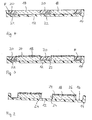
- Figuren 2 bis 4 den grundsätzlichen Aufbau des erfindungsgemäßen Karosserieanbauteils in unterschiedlichen Verfahrensschritten, wobei Figur 4 das fertiggestellte Karosserieanbauteil und Figur 3 ein erfindungsgemäßes Zwischenprodukt zeigt.
- In Figur 1 ist ein Karosserieanbauteil 10 in Form eines Dachmoduls in einem an einem Fahrzeug montierten Zustand gezeigt. Das Karosserieanbauteil 10 könnte auch ein Kotflügel, Tür oder Klappe (Motorhaube, Kofferraumdeckel) eines Fahrzeugs sein.
- Der grundsätzliche Aufbau des Karosserieanbauteils ist in Figur 4 gezeigt.
- Das Karosserieanbauteil 10 hat eine im montierten Zustand am Fahrzeug von außen sichtbare Außenhaut, die durch eine dünne, transparente, thermisch umgeformte Folie 12 gebildet ist. Die Folie 12 besteht aus transparentem oder transluzentem Kunststoff und hat eine Vorderseite 14, die im eingebauten Zustand von außen sichtbar ist, und eine Rückseite 16. Rückseitig ist die Folie 12 bereichsweise mit wenigstens einem transparenten oder transluzenten Paneel 18 (gezeigt sind zwei) versehen, das eine eigensteife Folie ist oder aus Glas besteht. Das Paneel 18 wird z.B. auf die Folie 12 geklebt.
- In den Bereichen, in denen kein Paneel 18 auf die Rückseite 16 der Folie 12 aufgebracht ist, ist die Folie 12 rückseitig hinterschäumt. Eine dabei entstehende geschäumte Schicht 20 besteht aus einem glasfaserverstärkten PU-Schaum. Die Glasfasern F sind durch das LFI (Long Fibre Injection)-Verfahren in den Schaum eingebracht und verstärken dabei die geschäumte Schicht 20, die eine höhere Biegesteifigkeit als die als Außenhaut dienende Folie 12 aufweist und eine Art Tragrahmen bildet.
- Zwischen der Folie 12 und der geschäumten Schicht ist eine farbgebende Schicht 22 vorgesehen, die z.B. als Lackschicht ausgebildet ist und die Aufgabe der Außenlackierung übernimmt, da die farbgebende Schicht 22 durch die farblose und transparente Folie 12 scheint und von außen sichtbar ist.
- Bei dem Verfahren zum Herstellen des Karosserieanbauteils 10 wird die Folie 12 umgeformt, indem sie tiefgezogen bzw. thermoplastisch umgeformt wird.
- Anschließend wird das Paneel 18 auf die Rückseite 16 der Folie 12 aufgeklebt, wobei das Paneel 18 rückseitig eine Schutzschicht 24 trägt, insbesondere eine abziehbare Folie (Fig. 2).
- Auf der Rückseite 16 der Folie 12, vorzugsweise auf das gesamte Teil (d.h. auf die Folie 12 und auf die Schutzschicht 24), wird eine Farbe naß aufgetragen, wobei der Naßauftrag durch Aufrakeln, Walzen oder beim Sprühlackverfahren erfolgen kann. Nach dem Trocknen der naß aufgetragenen Farbe ist die farbgebende Schicht 22 gebildet.
- Bei geöffnetem Schäumwerkzeug (nicht gezeigt) wird flüssiges PU-Material rückseitig zumindest in den Bereichen der Folie 12 auf die Folie 12 aufgebracht, die nicht vom Paneel 18 bedeckt sind, wobei Glasfasern F eingeschossen werden (LFI-Verfahren).
- Das zweiteilige Schäumwerkzeug wird zusammengefahren, und das PU-Material schäumt aus, füllt den sich zwischen dem Unter- und dem Oberteil (nicht gezeigt) bildenden Hohlraum aus und bildet nach dem Schäumen die geschäumte Schicht 20. Nach dem Auseinanderfahren des Unter- und des Oberteils wird das Zwischenprodukt (Fig. 3) dem nicht gezeigten Schäumwerkzeug entnommen. Das Zwischenprodukt weist rückseitig die Schutzschicht 24 auf, die das Paneel 18 vor Verschmutzungen (Farbe, PU-Material) schützt. Der Randbereich des Paneels 18 weist Geometrien 26 (Hinterschneidungen, Nuten, Abschrägungen, Stege, etc., siehe Fig. 2, unterbrochene Linien) auf, die einen Formschluß zwischen Paneel 18 und Schicht 20 ermöglichen.
- Anschließend wird die Schutzschicht 24 von dem Paneel 18 entfernt, so daß die Verschmutzungen, die gegebenenfalls beim Auftragen der Farbe bzw. Aufbringen des PU-Materials entstanden sind, von der Rückseite 16 des Paneels 18 entfernt werden. Im Bereich des Paneels 18 bleibt das Karosserieanbauteil transparent oder transluzent, und im Bereich, in dem die farbgebende Schicht 22 vorgesehen ist, scheint diese durch die Folie 12, wodurch eine Außenlackierung des Karosserieanbauteils 10 entfällt. Die farbgebende Schicht 22, die durch die Folie 12 scheint, unterscheidet sich von der Farbe der restlichen Karosserie nicht.
- Mit dem beschriebenen Verfahren kann ein Karosserieanbauteil, insbesondere ein Panoramadach einfach und kostengünstig mit einer durchgehenden Außenfläche hergestellt werden. Es sind also keine Spalte zwischen den aus mehreren Teilen bestehenden Karosserieanbauteilen vorhanden, die aufwendig abgedichtet werden mußten. Das Paneel 18 und die geschäumte Schicht 20 haben eine größere Biegesteifigkeit als die Folie 12, so daß ein stabiles Karosserieanbauteil 10 gebildet wird und die erforderliche Steifigkeit erreicht wird.
Claims (9)
- Verfahren zum Herstellen eines Karosserieanbauteils (10), gekennzeichnet durch folgende Schritte:- Umformen einer als Außenhaut dienenden transparenten Folie (12), wobei die Folie eine Vorderseite (14) und eine Rückseite (16) hat,- bereichsweise Aufbringen eines Paneels (18) auf die Rückseite (16) der Folie (12), wobei das Paneel (18) aus transparentem oder transluzentem Material besteht und rückseitig eine Schutzschicht (24) trägt,- Naßauftrag einer Farbe auf der Rückseite (16) der Folie (12) zur Bildung einer farbgebenden Schicht (22) und- rückseitiges Hinterschäumen der Folie (12) zumindest in Bereichen, in denen die Folie (12) nicht vom Paneel (18) bedeckt ist, wobei eine geschäumte Schicht (20) gebildet wird.
- Verfahren nach Anspruch 1, dadurch gekennzeichnet, daß die geschäumte Schicht (20) nach dem Trocknen der Farbe auf die farbgebende Schicht (22) aufgebracht wird.
- Verfahren nach Anspruch 1 oder 2, dadurch gekennzeichnet, daß die Schutzschicht (24) nach dem Auftragen der Farbe und/oder der geschäumten Schicht (20) von dem Paneel (18) entfernt wird.
- Verfahren nach einem der vorhergehenden Ansprüche, dadurch gekennzeichnet, daß die Schutzschicht (24) eine Folie ist.
- Verfahren nach einem der vorhergehenden Ansprüche, dadurch gekennzeichnet, daß das Paneel (18) auf die Rückseite der Folie (12) aufgeklebt wird.
- Karosserieanbauteil für ein Fahrzeug, insbesondere Dachmodul, miteiner transparenten Folie (12), die die Außenhaut des Karosserieanbauteils (10) vollständig bildet,einem rückseitig auf einen Teil der Folie (12) befestigten Paneel (18), das aus transparentem oder transluzentem Material besteht,einer geschäumten Schicht (20), die rückseitig auf der Folie (12) in nicht durch das Paneel (18) abgedeckten Bereichen vorgesehen ist, undeiner farbgebenden Schicht (22), die zwischen der geschäumten Schicht (20) und der Folie (12) vorgesehen ist.
- Karosserieanbauteil nach Anspruch 6, dadurch gekennzeichnet, daß das Paneel (18) eine eigensteife Folie ist.
- Karosserieanbauteil nach Anspruch 6 oder 7, dadurch gekennzeichnet, daß das Paneel (18) aus Glas besteht.
- Zwischenprodukt bei der Herstellung eines Karosserieanbauteils (10) miteiner transparenten Folie (12),einem rückseitig auf der Folie (12) befestigten, diese teilweise bedeckenden Paneel (18), das aus transparentem oder transluzentem Material besteht,einer durch Hinterschäumen der Folie (12) in nicht durch das Paneel (18) bedeckten Bereichen hergestellten geschäumten Schicht (20),einer farbgebenden Schicht (22), die zwischen der geschäumten Schicht (20) und der Folie (12) vorgesehen ist, undeiner entfernbaren Schutzschicht (24), die rückseitig auf das Paneel (18) aufgebracht ist.
Priority Applications (3)
| Application Number | Priority Date | Filing Date | Title |
|---|---|---|---|
| EP20060017341 EP1892182A1 (de) | 2006-08-21 | 2006-08-21 | Durchsichtiges und verbundartiges Karosserieanbauteil, Zwischenprodukt und Verfahren zum Herstellen eines solchen Karosserieanbauteils |
| US11/839,568 US20080044658A1 (en) | 2006-08-21 | 2007-08-16 | Method of manufacturing a vehicle body panel part, vehicle body panel part, and intermediate product in manufacturing a vehicle body panel part |
| CNA2007101452913A CN101130292A (zh) | 2006-08-21 | 2007-08-21 | 制造车身面板部件的方法、车身面板部件以及车身面板部件制造中的中间产品 |
Applications Claiming Priority (1)
| Application Number | Priority Date | Filing Date | Title |
|---|---|---|---|
| EP20060017341 EP1892182A1 (de) | 2006-08-21 | 2006-08-21 | Durchsichtiges und verbundartiges Karosserieanbauteil, Zwischenprodukt und Verfahren zum Herstellen eines solchen Karosserieanbauteils |
Publications (1)
| Publication Number | Publication Date |
|---|---|
| EP1892182A1 true EP1892182A1 (de) | 2008-02-27 |
Family
ID=37562276
Family Applications (1)
| Application Number | Title | Priority Date | Filing Date |
|---|---|---|---|
| EP20060017341 Withdrawn EP1892182A1 (de) | 2006-08-21 | 2006-08-21 | Durchsichtiges und verbundartiges Karosserieanbauteil, Zwischenprodukt und Verfahren zum Herstellen eines solchen Karosserieanbauteils |
Country Status (3)
| Country | Link |
|---|---|
| US (1) | US20080044658A1 (de) |
| EP (1) | EP1892182A1 (de) |
| CN (1) | CN101130292A (de) |
Cited By (7)
| Publication number | Priority date | Publication date | Assignee | Title |
|---|---|---|---|---|
| DE102009040609A1 (de) * | 2009-09-08 | 2011-03-10 | Webasto Ag | Verdeckkastendeckel |
| US10434846B2 (en) | 2015-09-07 | 2019-10-08 | Sabic Global Technologies B.V. | Surfaces of plastic glazing of tailgates |
| US10597097B2 (en) | 2015-09-07 | 2020-03-24 | Sabic Global Technologies B.V. | Aerodynamic features of plastic glazing of tailgates |
| DE102018130347A1 (de) * | 2018-11-29 | 2020-06-04 | Bayerische Motoren Werke Aktiengesellschaft | Fahrzeugbauteil und Verfahren zur Herstellung eines Fahrzeugbauteils |
| US10690314B2 (en) | 2015-09-07 | 2020-06-23 | Sabic Global Technologies B.V. | Lighting systems of tailgates with plastic glazing |
| US11267173B2 (en) | 2015-09-07 | 2022-03-08 | Sabic Global Technologies B.V. | Molding of plastic glazing of tailgates |
| US11466834B2 (en) | 2015-11-23 | 2022-10-11 | Sabic Global Technologies B.V. | Lighting systems for windows having plastic glazing |
Families Citing this family (3)
| Publication number | Priority date | Publication date | Assignee | Title |
|---|---|---|---|---|
| CN103260842B (zh) * | 2010-08-13 | 2017-09-19 | 奥托·威斯迈耶 | 密封壳及其应用、用于制造成型发泡件的装置和方法 |
| CN102114873A (zh) * | 2011-03-13 | 2011-07-06 | 江苏奥新新能源汽车有限公司 | 一种轻量化电动汽车 |
| US9623624B2 (en) * | 2014-11-10 | 2017-04-18 | Ford Global Technologies, Llc | Wrapped part assembly with edge/corner defining inserts |
Citations (8)
| Publication number | Priority date | Publication date | Assignee | Title |
|---|---|---|---|---|
| DE19956930A1 (de) | 1999-11-26 | 2001-05-31 | Bayerische Motoren Werke Ag | Fahrzeug-Außenhautteil mit einer außenseitigen Lackfolie oder Dekorfolie |
| EP1234753A1 (de) | 2001-02-26 | 2002-08-28 | Compagnie Plastic Omnium | Hinterscheide mit Anzeichengerät |
| EP1316495A1 (de) | 2001-11-29 | 2003-06-04 | Compagnie Plastic Omnium | Kraftfahrzeugkarrosseriebauteil mit granulierter Aussicht |
| US20030134130A1 (en) | 2001-10-31 | 2003-07-17 | Nissan Motor Co., Ltd. | Modified silica compositions, transparent resin compositions and thermoplastic resin laminates and automotive parts formed therefrom, and production method thereof |
| DE10200750A1 (de) | 2002-01-10 | 2003-07-24 | Peguform Gmbh & Co Kg | Fahrzeugdach aus transparentem oder transluzentem Kunststoff |
| DE10236736A1 (de) | 2002-08-09 | 2004-03-04 | Webasto Vehicle Systems International Gmbh | Verbundbauteil für eine Fahrzeugkarosserie sowie Verfahren zum Herstellen desselben |
| DE10346219A1 (de) | 2003-09-23 | 2005-04-28 | Decoma Germany Gmbh | Strukturbauteil und Verfahren und Werkzeugvorrichtung zu dessen Herstellung |
| EP1669277A1 (de) | 2005-03-18 | 2006-06-14 | ArvinMeritor GmbH | Karosserieanbauteil, Zwischenprodukt und Verfahren zum Herstellen eines solchen Karosserieanbauteils |
-
2006
- 2006-08-21 EP EP20060017341 patent/EP1892182A1/de not_active Withdrawn
-
2007
- 2007-08-16 US US11/839,568 patent/US20080044658A1/en not_active Abandoned
- 2007-08-21 CN CNA2007101452913A patent/CN101130292A/zh active Pending
Patent Citations (8)
| Publication number | Priority date | Publication date | Assignee | Title |
|---|---|---|---|---|
| DE19956930A1 (de) | 1999-11-26 | 2001-05-31 | Bayerische Motoren Werke Ag | Fahrzeug-Außenhautteil mit einer außenseitigen Lackfolie oder Dekorfolie |
| EP1234753A1 (de) | 2001-02-26 | 2002-08-28 | Compagnie Plastic Omnium | Hinterscheide mit Anzeichengerät |
| US20030134130A1 (en) | 2001-10-31 | 2003-07-17 | Nissan Motor Co., Ltd. | Modified silica compositions, transparent resin compositions and thermoplastic resin laminates and automotive parts formed therefrom, and production method thereof |
| EP1316495A1 (de) | 2001-11-29 | 2003-06-04 | Compagnie Plastic Omnium | Kraftfahrzeugkarrosseriebauteil mit granulierter Aussicht |
| DE10200750A1 (de) | 2002-01-10 | 2003-07-24 | Peguform Gmbh & Co Kg | Fahrzeugdach aus transparentem oder transluzentem Kunststoff |
| DE10236736A1 (de) | 2002-08-09 | 2004-03-04 | Webasto Vehicle Systems International Gmbh | Verbundbauteil für eine Fahrzeugkarosserie sowie Verfahren zum Herstellen desselben |
| DE10346219A1 (de) | 2003-09-23 | 2005-04-28 | Decoma Germany Gmbh | Strukturbauteil und Verfahren und Werkzeugvorrichtung zu dessen Herstellung |
| EP1669277A1 (de) | 2005-03-18 | 2006-06-14 | ArvinMeritor GmbH | Karosserieanbauteil, Zwischenprodukt und Verfahren zum Herstellen eines solchen Karosserieanbauteils |
Cited By (16)
| Publication number | Priority date | Publication date | Assignee | Title |
|---|---|---|---|---|
| DE102009040609A1 (de) * | 2009-09-08 | 2011-03-10 | Webasto Ag | Verdeckkastendeckel |
| US11458709B2 (en) | 2015-09-07 | 2022-10-04 | Sabic Global Technologies B.V. | Three shot plastic tailgate |
| US11845240B2 (en) | 2015-09-07 | 2023-12-19 | Sabic Global Technologies B.V. | Three shot plastic tailgate |
| US12390967B2 (en) | 2015-09-07 | 2025-08-19 | Sabic Global Technologies B.V. | Molding of plastic glazing of tailgates |
| US10690314B2 (en) | 2015-09-07 | 2020-06-23 | Sabic Global Technologies B.V. | Lighting systems of tailgates with plastic glazing |
| US10717348B2 (en) | 2015-09-07 | 2020-07-21 | Sabic Global Technologies B.V. | Surfaces of plastic glazing of tailgates |
| US10948152B2 (en) | 2015-09-07 | 2021-03-16 | Sabic Global Technologies B.V. | Lighting systems of tailgates with plastic glazing |
| US10597097B2 (en) | 2015-09-07 | 2020-03-24 | Sabic Global Technologies B.V. | Aerodynamic features of plastic glazing of tailgates |
| US12330397B2 (en) | 2015-09-07 | 2025-06-17 | Sabic Global Technologies B.V. | Three shot plastic tailgate |
| US11267173B2 (en) | 2015-09-07 | 2022-03-08 | Sabic Global Technologies B.V. | Molding of plastic glazing of tailgates |
| US10434846B2 (en) | 2015-09-07 | 2019-10-08 | Sabic Global Technologies B.V. | Surfaces of plastic glazing of tailgates |
| US11766965B2 (en) | 2015-11-23 | 2023-09-26 | Sabic Global Technologies B.V. | Illuminated graphic in an automotive plastic glazing |
| US12145498B2 (en) | 2015-11-23 | 2024-11-19 | Sabic Global Technologies B.V. | Illuminated graphic in an automotive plastic glazing |
| US11466834B2 (en) | 2015-11-23 | 2022-10-11 | Sabic Global Technologies B.V. | Lighting systems for windows having plastic glazing |
| US12090778B2 (en) | 2018-11-29 | 2024-09-17 | Bayerische Motoren Werke Aktiengesellschaft | Vehicle component and method for producing a vehicle component |
| DE102018130347A1 (de) * | 2018-11-29 | 2020-06-04 | Bayerische Motoren Werke Aktiengesellschaft | Fahrzeugbauteil und Verfahren zur Herstellung eines Fahrzeugbauteils |
Also Published As
| Publication number | Publication date |
|---|---|
| CN101130292A (zh) | 2008-02-27 |
| US20080044658A1 (en) | 2008-02-21 |
Similar Documents
| Publication | Publication Date | Title |
|---|---|---|
| DE60130413T2 (de) | Fahrzeugharzfenster mit einem integrierten Randbereich | |
| DE102008038647B4 (de) | Fahrzeugflächenbauteil mit einer Solarzellenanordnung | |
| EP0630763B1 (de) | Verfahren zum Herstellen von lackierten Teilen | |
| DE10033232C2 (de) | Fahrzeugdachteil mit einer Kunststoff-Außenhaut, Verfahren und Vorrichtung zur Herstellung desselben | |
| EP1319582B1 (de) | Fahrzeugkarosserieteil in Verbundbauweise | |
| US20080044658A1 (en) | Method of manufacturing a vehicle body panel part, vehicle body panel part, and intermediate product in manufacturing a vehicle body panel part | |
| EP1479499B1 (de) | Verfahren zum Herstellen eines Verbundbauteils und Zwischenprodukt | |
| DE10200750A1 (de) | Fahrzeugdach aus transparentem oder transluzentem Kunststoff | |
| EP1338496B1 (de) | Karosserieanbauteil und Verfahren zu seiner Herstellung | |
| EP1857350B1 (de) | Fahrzeugdach mit einem zumindest in Teilbereichen in seiner Transparenz veränderten Dachteil aus Kunststoff | |
| DE10252912A1 (de) | Verfahren zum Herstellen eines Fahrzeugdaches mit einem Dachmodul | |
| DE3233675A1 (de) | Formteil, vorzugsweise zur innenverkleidung von fahrgastzellen fuer fahrzeuge aller art | |
| EP1669277B1 (de) | Karosserieanbauteil, Zwischenprodukt und Verfahren zum Herstellen eines solchen Karosserieanbauteils | |
| DE102004044159A1 (de) | Verbundbauteil, insbesondere Karosserieanbauteil für ein Fahrzeug, und Verfahren zum Herstellen eines solchen Verbundbauteils | |
| DE10115568B4 (de) | Dachelement für ein Fahrzeug | |
| DE102016110586B3 (de) | Dachmodul für ein Fahrzeug sowie Verfahren zur Herstellung eines Dachmoduls | |
| DE19703505A1 (de) | Farbiges Karosserieteil | |
| DE60118001T2 (de) | Vakuumumgeformte kraftfahrzeugteile | |
| DE19951682A1 (de) | Verfahren zur Herstellung eines Ausstattungsteils eines Fahrzeugs und Ausstattungsteil eines Fahrzeugs | |
| EP1876087B1 (de) | Verfahren zum Herstellen eines geschäumten Fahrzeugteils und ein geschäumtes Fahrzeugteil | |
| DE60221468T2 (de) | Verfahren zur Herstellung eines Fahrzeugaußenelementes | |
| DE10300919A1 (de) | Mehrlagiges Dekorband und Verfahren zur Herstellung eines mehrlagigen Dekorbandes | |
| EP1245478B1 (de) | Karosserie-Aussenteil für ein Fahrzeug | |
| EP1498295B1 (de) | Heckklappe für ein Kraftfahrzeug | |
| DE10119410A1 (de) | Auskleidungsteil für den Fahrzeuginnenraum |
Legal Events
| Date | Code | Title | Description |
|---|---|---|---|
| PUAI | Public reference made under article 153(3) epc to a published international application that has entered the european phase |
Free format text: ORIGINAL CODE: 0009012 |
|
| AK | Designated contracting states |
Kind code of ref document: A1 Designated state(s): AT BE BG CH CY CZ DE DK EE ES FI FR GB GR HU IE IS IT LI LT LU LV MC NL PL PT RO SE SI SK TR |
|
| AX | Request for extension of the european patent |
Extension state: AL BA HR MK YU |
|
| 17P | Request for examination filed |
Effective date: 20080820 |
|
| AKX | Designation fees paid |
Designated state(s): DE FR NL |
|
| STAA | Information on the status of an ep patent application or granted ep patent |
Free format text: STATUS: THE APPLICATION IS DEEMED TO BE WITHDRAWN |
|
| 18D | Application deemed to be withdrawn |
Effective date: 20090901 |