EP1885184B2 - Zusammensetzungen, die einen agrochemischen partikulären film enthalten - Google Patents
Zusammensetzungen, die einen agrochemischen partikulären film enthalten Download PDFInfo
- Publication number
- EP1885184B2 EP1885184B2 EP06758761.8A EP06758761A EP1885184B2 EP 1885184 B2 EP1885184 B2 EP 1885184B2 EP 06758761 A EP06758761 A EP 06758761A EP 1885184 B2 EP1885184 B2 EP 1885184B2
- Authority
- EP
- European Patent Office
- Prior art keywords
- agricultural
- kaolin
- substrate
- particles
- water
- Prior art date
- Legal status (The legal status is an assumption and is not a legal conclusion. Google has not performed a legal analysis and makes no representation as to the accuracy of the status listed.)
- Active
Links
Images


Classifications
-
- A—HUMAN NECESSITIES
- A01—AGRICULTURE; FORESTRY; ANIMAL HUSBANDRY; HUNTING; TRAPPING; FISHING
- A01N—PRESERVATION OF BODIES OF HUMANS OR ANIMALS OR PLANTS OR PARTS THEREOF; BIOCIDES, e.g. AS DISINFECTANTS, AS PESTICIDES OR AS HERBICIDES; PEST REPELLANTS OR ATTRACTANTS; PLANT GROWTH REGULATORS
- A01N59/00—Biocides, pest repellants or attractants, or plant growth regulators containing elements or inorganic compounds
-
- A—HUMAN NECESSITIES
- A01—AGRICULTURE; FORESTRY; ANIMAL HUSBANDRY; HUNTING; TRAPPING; FISHING
- A01N—PRESERVATION OF BODIES OF HUMANS OR ANIMALS OR PLANTS OR PARTS THEREOF; BIOCIDES, e.g. AS DISINFECTANTS, AS PESTICIDES OR AS HERBICIDES; PEST REPELLANTS OR ATTRACTANTS; PLANT GROWTH REGULATORS
- A01N25/00—Biocides, pest repellants or attractants, or plant growth regulators, characterised by their forms, or by their non-active ingredients or by their methods of application, e.g. seed treatment or sequential application; Substances for reducing the noxious effect of the active ingredients to organisms other than pests
- A01N25/08—Biocides, pest repellants or attractants, or plant growth regulators, characterised by their forms, or by their non-active ingredients or by their methods of application, e.g. seed treatment or sequential application; Substances for reducing the noxious effect of the active ingredients to organisms other than pests containing solids as carriers or diluents
-
- A—HUMAN NECESSITIES
- A01—AGRICULTURE; FORESTRY; ANIMAL HUSBANDRY; HUNTING; TRAPPING; FISHING
- A01N—PRESERVATION OF BODIES OF HUMANS OR ANIMALS OR PLANTS OR PARTS THEREOF; BIOCIDES, e.g. AS DISINFECTANTS, AS PESTICIDES OR AS HERBICIDES; PEST REPELLANTS OR ATTRACTANTS; PLANT GROWTH REGULATORS
- A01N25/00—Biocides, pest repellants or attractants, or plant growth regulators, characterised by their forms, or by their non-active ingredients or by their methods of application, e.g. seed treatment or sequential application; Substances for reducing the noxious effect of the active ingredients to organisms other than pests
- A01N25/12—Powders or granules
-
- A—HUMAN NECESSITIES
- A01—AGRICULTURE; FORESTRY; ANIMAL HUSBANDRY; HUNTING; TRAPPING; FISHING
- A01N—PRESERVATION OF BODIES OF HUMANS OR ANIMALS OR PLANTS OR PARTS THEREOF; BIOCIDES, e.g. AS DISINFECTANTS, AS PESTICIDES OR AS HERBICIDES; PEST REPELLANTS OR ATTRACTANTS; PLANT GROWTH REGULATORS
- A01N59/00—Biocides, pest repellants or attractants, or plant growth regulators containing elements or inorganic compounds
- A01N59/06—Aluminium; Calcium; Magnesium; Compounds thereof
-
- A—HUMAN NECESSITIES
- A01—AGRICULTURE; FORESTRY; ANIMAL HUSBANDRY; HUNTING; TRAPPING; FISHING
- A01N—PRESERVATION OF BODIES OF HUMANS OR ANIMALS OR PLANTS OR PARTS THEREOF; BIOCIDES, e.g. AS DISINFECTANTS, AS PESTICIDES OR AS HERBICIDES; PEST REPELLANTS OR ATTRACTANTS; PLANT GROWTH REGULATORS
- A01N59/00—Biocides, pest repellants or attractants, or plant growth regulators containing elements or inorganic compounds
- A01N59/16—Heavy metals; Compounds thereof
- A01N59/20—Copper
-
- Y—GENERAL TAGGING OF NEW TECHNOLOGICAL DEVELOPMENTS; GENERAL TAGGING OF CROSS-SECTIONAL TECHNOLOGIES SPANNING OVER SEVERAL SECTIONS OF THE IPC; TECHNICAL SUBJECTS COVERED BY FORMER USPC CROSS-REFERENCE ART COLLECTIONS [XRACs] AND DIGESTS
- Y02—TECHNOLOGIES OR APPLICATIONS FOR MITIGATION OR ADAPTATION AGAINST CLIMATE CHANGE
- Y02A—TECHNOLOGIES FOR ADAPTATION TO CLIMATE CHANGE
- Y02A50/00—TECHNOLOGIES FOR ADAPTATION TO CLIMATE CHANGE in human health protection, e.g. against extreme weather
- Y02A50/30—Against vector-borne diseases, e.g. mosquito-borne, fly-borne, tick-borne or waterborne diseases whose impact is exacerbated by climate change
Definitions
- Minerals such as kaolin
- the present invention is directed to the water processing of highly impure to slightly impure minerals to make them useable, functional, improved in performance, and generally safer for agricultural particle film depositions.
- This processing is commonly referred to as either water processing or water washing in the mineral industry.
- Kaolin clay for example, generally uses two different processing methods to produce a "beneficiated", marketable material. These methods are commonly referred to as dry processing and wet processing.
- the dry process method generally produces a product that closely mirrors the properties originally found in the crude kaolin. Because of this, final products containing the desired particle size distribution, having low abrasivity, and having elevated brightness are typically determined by reliance on the quality of the deposit as determined by testing of the drilled core samples. With dry processing, the crude kaolin is simply crushed, dried, pulverized, and air floated to remove coarse grit particles.
- Serina Filler Grade water-washed kaolin from Serina Kaolin in South Africa referred to as Serina Filler Grade may be used as a pesticide carrier.
- a finer particle size product called Serina Ultrafine is listed for paint, rubber, and ceramic applications but not for pesticide carrier use. In the following Table 1, the Serina properties are summarized.
- Vines and bushes usually require about half of these amounts and low-growing row crops about a fourth to half of these amounts.
- Maximum use of a kaolin wettable powder or dry flowable for very large trees using 200 gallons per acre of water would be about 12 lbs per acre.
- Kaolin typically makes up 80 to 95% of the composition but may be less as cited by commonly assigned US Patent 7,018,643B2 on Pesticide Delivery System.
- Kaolin wettable powder and dry flowable chemical pesticide sprays contain additives such as pesticides.
- SURROUND ® WP crop protectant is used as an agricultural particle film.
- Surround WP crop protectant instructs on its labels to use concentrations of 20.8 to 50 Ibs per 100 gallons or 2.5 to 6% wt/wt in sprays.
- concentrations 20.8 to 50 Ibs per 100 gallons or 2.5 to 6% wt/wt in sprays.
- medium sized trees use 20.8 to 50 lbs per acre per spray. Vines and bushes usually require about half of these amounts, and low-growing row crops about a fourth to half of this amount.
- Use of Surround WP crop protectant for very large trees using 200 gallons per acre of water would be 50 to 100 lbs per acre.
- a commercially available wax and bentonite agricultural product called Raynox delivers about 1 lb of bentonite mineral component per acre.
- the labeled rate of Raynox is up to 2.5 gallons per acre. If the density of Raynox is 8 Ibs per gallon at 5% mineral, this equals only 1 lb of bentonite per acre.
- US Patent Application Publication 2004/0146617 discloses the use of bentonite for application to fruits and vegetables.
- the abrasive particle contaminates can produce wounding of the horticultural surface which may further result in decreased disease tolerance, decreased pest resistance and increased phytotoxicity.
- Fine crystalline silica particle fractions are undesirable because they are a pulmonary carcinogen and inhalation hazard and are typically not adequately removed through non-water washed, processing methods. IARC has classified crystalline silica as a carcinogen.
- the sedimentary kaolin deposits found in the United States are considered to be of a higher crude quality as they contain lower levels of crystalline silica, are of a finer particle size distribution, are generally brighter, are relatively abundant and are found close to the surface allowing for ease of mining and recovery.
- One negative aspect of these kaolins is that they contain higher levels of titanium-based impurities. Titanium oxides can negatively affect color. Therefore, a less intense method of processing is necessary to remove the crystalline silica fraction which may be present, but special water processing steps are required to lower the levels of the base metal oxide.
- the removal of the titanium oxide impurities will generally increase the optical brightness of the finished material and produce a product containing a higher concentration of kaolin mineral.
- Non-water-washed products are manufactured by drying, crushing, and milling crude minerals. In some, through air "floating" the useful fine particle segment is captured and the coarse product is discarded. Air floating has the ability to remove particles that are either greater in mass than the desired mineral or are not attached to the desired mineral. The resulting non-water washed product has a crystalline silica content from about 3 to about 36 weight percent.
- Table 2 the properties of commercially available agricultural compositions comprising air processed kaolin are summarized and PSD stands for (average) particle size distribution.
- a chemical such as a surfactant to aid slurry handling and deposition properties.
- the chemical additive is dispersed in the slurry.
- a slurry of unrefined or air-floated minerals such as kaolin or calcium carbonate, or other minerals, have been commonly made by growers in spray tanks, often with a chemical dispersant added prior to application to a substrate.
- These compositions do not have the chemical additive "uniformly distributed among or on the functional particles" (as defined later).
- SunBrite is a commercially available agricultural composition comprising a blend of limestone and titanium dioxide.
- a commercial agricultural product called Raynox comprises primarily wax but it also has been found to contain hydrous kaolin that is not extensively processed and contains a high level of the surfactant and/or solvent morpholine.
- a Material Safety Data Sheet from Columbia River Carbonates for Microna Shade calcium carbonate discloses that the limestone contains crystalline silica, typical levels are below 0.3 (w/w) in the product. No mention is made of the presence of a chemical additive.
- WO 2004/028250 discloses a composition for combating or repelling at least one living organism, said composition comprising as an active agent hydrophobic silicon containing particles with an average primary particle size of less than 100nm.
- WO 98/38867 discloses a method for protecting surfaces from arthropod infestation which involves treating the surface with an effective amount of finely divided calcined kaolins, hydrophobic calcined kaolins, hydrous kaolins, hydrophobic hydrous kaolins, hydrophobic calcium carbonates, calcium carbonates or mixtures thereof.
- WO 98/38855 discloses an aqueous dispersion of a particulate solid containing a low boiling organic liquid in which the particulate solid has a hydrophobic outer surface which is suitable for applying to a substrate to form a continuous hydrophobic film thereon.
- WO 02/28178 discloses a pesticide delivery system, containing a continuous film having a thickness from 1-1,000 ⁇ m and noncontinuous areas having sizes less than about 100 ⁇ m, the continuous film containing a particulate material wherein at least 90 % by weight of the particulate material has a particle size of about 10 ⁇ m or less, and a pest control agent at least partially coating the particulate material.
- An agricultural substrate having an agricultural particle film according to claim 1 is provided.
- the compositions on the substrate result from processing in a slurry mix.
- the result of this liquid processing is functional particle compositions that are substantially free of crystalline silica and optionally contain a chemical additive that is uniformly distributed among or on the particles.
- the agricultural composition comprises a functional mineral (defined below) that is substantially free of crystalline silica (defined below).
- mineral as used herein includes finely divided (defined below) rocks such as granite, shale and the like that can contain silica in crude form but excludes hydrous kaolin, calcined kaolin, and bentonite.
- functional mineral as used herein means that the mineral forms a functional film deposition of particles known as an agricultural particle film.
- substantially free of crystalline silica means crystalline silica content below 0.2 percent as determined using the NIOSH Manual of Analytical Methods, Fourth Edition, Crystalline Silica by xrd; Method 7500, Issue 3 (January 15, 1998). This crystalline silica content is achieved by processing the starting material in a slurry mix.
- slurry as used herein means a suspension or mixture of insoluble starting material in a liquid medium or vehicle.
- the present invention provides an agricultural substrate having an agricultural composition thereon.
- the agricultural composition comprises a functional particle that is substantially free of crystalline silica selected from the group consisting of hydrous kaolin (defined below) or bentonite (defined below) and the composition is present at greater than or equal to an average of 20 micrograms per square centimeter on the substrate.
- hydrous kaolin as used herein means finely divided (defined below) kaolin that comprises substantially the original hydrous kaolin crystal structure with crystalline bound hydroxyl groups known as the water of hydration.
- "Hydrous kaolin” as used herein may be heat treated up to 400°C as long as the original hydrous kaolin crystal structure with crystalline bound hydroxyl groups are substantially present or, at least, partially present.
- the phrase "functional hydrous kaolin” as used herein means that the finely divided (as defined below) hydrous kaolin forms a functional film deposition of particles known as an agricultural particle film. This use is in contrast to hydrous kaolin inert fillers, diluents, and adjuvants discussed above that are not applied in concentrations high enough nor are formulated to form a functional film of particles.
- bentonite as used herein means finely divided (defined below) bentonite that is not heat treated at 175°C or greater.
- functional bentonite as used herein means that the bentonite forms a functional film deposition of particles known as an agricultural particle film. This use is in contrast to bentonite inert fillers, diluents, and adjuvants discussed above that are not applied in concentrations high enough nor are formulated to form a functional film of particles.
- uniformly distributed among or on the functional particles means that the chemical additive or active ingredient is substantially homogeneously distributed throughout the composition of dry particles or particles in a slurry or paste form that are concentrated well above the normal spray use level prior to application to the substrate; and was accomplished in a slurry mix.
- slurries for example, made in agricultural spray mix tanks with a chemical that is dispersed throughout the composition, and applied to a substrate without being converted into a dry, paste or concentrated slurry form even if the slurry was concentrated at 2 to 4 times during the mixing process.
- soluble chemical additives will be dissolved and thus, be more evenly distributed among or on the particles.
- colloidal or non-colloidal chemical additives are dispersed in the slurry and are, or can be, in a smaller particle size than before being added to the slurry mix.
- the divided colloidal additives are evenly distributed among or on the particles.
- insoluble chemical additives are evenly distributed among or on the particles.
- a spray-dried bead is one final product form that is only achieved through spray drying of slurry mix and generally has a diameter of about 10 to about 150 microns; these beads can be further heat treated to dehydroxylate the kaolin and thereby form what are referred to as microspheres.
- the ingredients in Surround ® WP in the dry form before use would not be considered to be uniformly distributed as defined herein.
- Uniformly distributed as defined above may occur at the micro scale, macro scale, or both.
- uniformity may not be observed at the microscopic level.
- any relatively large aliquot derived from a batch that has uniform distribution on the macro scale may have the chemical additive evenly distributed in such a way that any large aliquot has the same amount of chemical additive.
- the chemical additive may not be observed to be evenly distributed. For example, in a batch of 100 cubic meters, any given aliquot of one cubic meter may have the same amount of chemical additive. However, in the same batch, aliquots of one cubic centimeter may not have the same amount of chemical additive.
- slurry as used herein means a suspension or mixture of insoluble particles in a liquid medium or vehicle.
- the present invention provides an agricultural substrate having an agricultural composition thereon.
- the agricultural composition comprises functional kaolin particles that are substantially free of crystalline silica and the composition is present at greater than or equal to about an average of 20 micrograms per square centimeter on the substrate.
- a chemical additive is uniformly distributed among or on the functional kaolin particles.
- natural calcium carbonate as used herein means finely divided (defined below) ground carbonitic rock such as limestone, dolomite, or marble including both wet-ground and dry-ground in either slurry or dry form.
- functional natural calcium carbonate as used herein means that the natural calcium carbonate forms a functional film deposition of particles known as an agricultural particle film.
- synthetic substance as used herein means finely divided (defined below), man-made, and generally is substantially free of crystalline silica.
- functional synthetic substance as used herein means that the synthetic substance forms a functional film deposition of particles known as an agricultural film.
- the present invention provides an end use composition (defined below) comprising or consisting essentially of: (a) a functional particle that is substantially free of silica selected from the group consisting of hydrous kaolin and bentonite, and (b) a chemical additive that is uniformly distributed within or on the functional particle.
- end use composition means a composition and/or product that is used as-is by the final consumer without being added to another substance(s), being mixed or blended with another substance(s), or being applied to another substance(s), or otherwise being further processed before being used.
- end use composition does not exclude compositions and/or products that are mixed with a liquid vehicle such as water or oil by the final consumer. End use compositions are commonly referred to as consumer products.
- consumer products are commonly referred to as consumer products.
- the "consumer” as defined here is not limited to single persons and includes business consumers.
- the present invention provides a method of making an agricultural composition comprising the steps of: (a) combining functional particles selected from the group consisting of hydrous kaolin, or bentonite with a chemical additive in slurry mix to uniformly distribute said chemical additive among or on the functional particles; and (b) removing the liquid from the slurry combination.
- the present invention provides the use of water-processed and thereby refined industrial functional hydrous kaolin, and functional bentonite as improved particle film products.
- the present invention yields a concentrated form of functional hydrous kaolin, and functional bentonite that are substantially free of crystalline silica.
- Agricultural particle films usually require a fine particle sized distribution product of high purity with a high number of finely divided individual particles per given weight. Increasing the sheer number of particles dramatically increases the product performance. This is accomplished through the water processes of dispersion, screening, centrifugation, filtration, delamination, and/or a variety of other processes. Purification via water processing removes crystalline silica to levels that are generally undetectable by standard test. Levels of coarse contaminants that hamper practical use are also removed. In addition, an increase in final product brightness may be achieved through further processes such as bleaching, ultraflotation, trepping, ozonation, and magnetic separation.
- Products made of water washed ingredients are more efficient in their performance and thus, require a lower material concentration to be applied compared with known products made by non-water washed methods. Products can also be created in improved product physical forms such as spray-dried beads which offer convenience and performance improvements. Water processing also offers the advantages of intimate blending of particles to create improved products and the capability of adding other functional chemicals that become homogenous in the product.
- the present invention provides an agricultural composition comprising of at least one functional hydrous kaolin, or functional bentonite that is substantially free of crystalline silica and may alternately contain residual chemicals that enhance performance.
- the composition is then applied through dusting, spraying, foaming, painting or the like, preferably in a liquid vehicle carrier, or otherwise applied to leave a functional deposition, which is substantially greater than 90% mineral or less as disclosed in commonly assigned US Patent 7,018,643B2 on Pesticide Delivery System.
- This application of the present composition generates a particle film.
- active ingredient means a chemical substance that has a biological effect.
- useful agricultural active ingredients include the functional substance in pesticides, plant growth regulators, sterilants, fertilizers, and biocides.
- TREP Titanium Removal and Extraction Process as practiced by certain kaolin producers.
- densified means the process in which dried particles are re-wet and then dried in order to increase the mass per unit volume of the final product.
- the foregoing process is commonly referred to as prilling or agglomerating for the purpose of producing a better dry flowing product.
- densified also includes a characteristic of the product resulting from spray drying which inherently increases density.
- kaolin types are commercially available from Engelhard Corporation.
- the phrase "crude kaolin” comprises 10-99 weight percent kaolin, sand, mica, dolomite, iron, titanium dioxide and other clays such as bentonite and sepiolite. These contaminants can either be loosely distributed in the crude or are attached to the kaolin particle.
- the functional hydrous kaolin, or functional bentonite suitable for use in the present invention is finely divided.
- the term "finely divided" when utilized herein means that the functional hydrous kaolin, or functional bentonite has a median individual particle size (average diameter) below about 100 microns.
- the functional hydrous kaolin, or functional bentonite has a median individual particle size of equal to or less than about 10 microns or less.
- the GE brightness of the functional hydrous kaolin, and functional bentonite is greater than or equal to 85.
- the functional hydrous kaolin, or functional bentonite has an average particle size finer than 70% ⁇ 2 microns. Average is defined as the point where 50% of the mass of particles is finer and 50% of the mass of particles is coarser.
- Preferred water-processed minerals for making the present agricultural composition include, but are not limited to, HT ® , LUSTRA ® , ASP ® 170, ASP101, Gordon 70, ASP 400, ASP 900, and NU-CLAY ® kaolin, available from Engelhard Corporation.
- Crude kaolin, or bentonite is selected that has characteristics that allow the manufacture of particular products.
- the crude kaolin, or bentonite is examined for such attributes as color, lack of impurities, ability to be refined, viscosity effects in slurry, particle size, mineral content, consistency of the deposit, particle shape, and chemical or crystalline composition.
- Crude blending may occur prior to beneficiation or, more optimally during water processing.
- Kaolin, or bentonite is made into an aqueous slurry and are blunged or otherwise beaten to separate it into individual particles.
- Processing chemicals are usually used to assist the separation into individual particles and to reduce viscosity such that processing solids can advantageously be raised. Selections of dispersed slurries from different crudes, or different raw crudes, or different mineral types, or different types of the same mineral can be blended to attain the best properties for a given product.
- Degritting involves the removal of often non-targeted large particle size relatively hard mineral species including sand, crystalline silica, mica, and calcium carbonate from the crude. As a result, the degritted material has lower abrasion. Degritting may be partially done by air floating, or much more completely and thus preferably, by slurry passage through screens, centrifuges, hydrocyclones, or settling of gritty particles from the slurry.
- Desliming involves settling of the desired fraction to leave the very fine particles of a colloidal nature in the supernatant liquor.
- the supernatant is pumped off and discarded or may be further processed and used as an industrial mineral itself.
- Filtration commonly involves a cloth, paper, or screen filter such as a cloth drum filter with a vacuum to remove water, soluble contaminants such as salts, and excess processing chemicals. Alternatively, a filter press or Buchner filter may be used. The water washing process also has the added ability to remove water soluble reactive contaminates. These materials can be inherently phytotoxic in themselves and may react negatively when present in tank mixes with other chemical additives.
- Dispersants are usually added to the centrifuge feed slurry material prior to the centrifuge in order to lower viscosity and help to separate particles. Centrifugation creates new particle size distributions through fractionation that are coarser or finer than the stream that was fed into the centrifuge. In the centrifuge, coarse particles are separated from fine particles in a controlled manner and both are separately captured.
- Centrifugation is also a useful method for reducing the amount of impurities present in mineral.
- One useful centrifugation method is disclosed in US Patent 5,311 997 .
- Particles are settled for fixed periods of time and particles that settle are separated both from excess water and fine particles that do not settle as rapidly as the others.
- delamination relatively coarse plate-shaped particles such as kaolin are passed in slurry form through a delamination system comprised of various types of beads or other delamination media.
- the beads impact the kaolin "booklet,” shear the booklet, and thus fracture the kaolin booklet particle into platelets. This results in a greater number of particles per given mass. These particles have a higher aspect ratio than the particles fed to the delaminator.
- the same may be accomplished by chemical intercalation whereby chemical separation of the individual platelets produces a more efficient lamina.
- An added benefit of delamination and chemical intercalation is that free impurities such as iron and titanium trapped within the kaolin lamina are able to be removed.
- Bleaching may be accomplished through both oxidative and reduction means.
- the reductive method is preferred as it renders soluble therefore removable via washing and filtering certain trace compounds, such as iron that stains the particles and reactive compounds such as free iron.
- the pH of the kaolin slurry is lowered to an acid pH where reduction bleaches typically work best.
- Sodium hydrosulfite or other reducing chemicals are introduced.
- the slurry is pumped to a filter where the excess bleach and other soluble chemicals are pulled out by vacuum action.
- Flotation is a useful method for reducing the amount of trace impurities such as titanium present in minerals like kaolin.
- One useful flotation method is disclosed in commonly assigned US Patent 6,378,703 .
- Dispersed kaolin pulp is transferred to a conditioning vessel prior to passage through a flotation cell.
- the conditioning vessel is a high intensity mill capable of increasing the pulp temperature. Any agitated equipment provided with mechanical means to increase pulp temperature may be used in the conditioning step.
- the flotation collector added to the dispersed pulp during the conditioning step is an anionic hydroxamate.
- the quantity of hydroxamate flotation collector required will vary with the crude characteristics and slurry solids and pH.
- the conditioned pulp while still hot is transferred to a flotation cell for aeration and flotation.
- a flotation cell for aeration and flotation.
- the flotation cells handle pulps at relatively high solids.
- the conditioning time is such as to allow liberation of the titanium oxide particles from kaolin and attachment of hydroxamate to the titanium oxide particles.
- the conditioning time will vary with the crude characteristics, slurry solids, and pH.
- the froth product which is a concentrate of colored titaniferous impurities, is removed from the pulp of purified kaolin clay.
- One benefit of this invention is that virtually any soluble or insoluble substance or otherwise liquid-mixable chemical may be advantageously homogeneously distributed throughout the mix. Another benefit is an improvement in process efficiency.
- Chemical additives may be used throughout the water manufacturing process to improve product quality, improve manufacturing, or reduce cost of the final product. If the functional hydrous kaolin, functional bentonite, or functional mineral is not calcined or otherwise heat treated, the chemical largely or completely remains on, associated with, or evenly distributed among the kaolin, bentonite, or functional mineral. Upon drying, the chemical additive is physically forced to associate with and deposit on the surface of the particle and therefore is found at higher concentration on the particle surface rather than when originally in the vehicle. These particles may now be concentrated to be chemically and/or physically surface modified. Surface modification can result in improved or retarded lipophilicity or hydrophobicity for example.
- chemical additives can have improved functionality when associated with, or evenly distributed among or on the functional hydrous kaolin, functional bentonite, or functional mineral. These chemical additives may advantageously improve the optical properties, sprayability, mixability, deposition, or other properties of an agricultural particle film. Chemical additives may also be added after the water processed product has been dried or while the water processed product is being dried. For example, additives may be added during the pulverization or milling step, or during spray drying.
- the chemical additive is present at an amount up to about one weight percent of the particle type, but higher concentrations can be used.
- Processing Aids One non-limiting example of a chemical additive is a processing aid. Certain chemicals are typically used in the processing and manufacture of water purified kaolin, bentonite, or minerals. These processing aids may fit in the described classes of surfactants stated in the examples below, but are not limited to these specific examples.
- Processing aids are typically used in water processed industrial minerals and rocks to help remove impurities, increase particle brightness, defoam, lower or raise viscosity, coagulate, disperse and suspend particles, modify the iso electric point, zeta potential, or pH (for example surface or internal pH), modify the particle surface to become hydrophobic or hydrophilic, render sprayed bead agglomerates to be hardened to an extent to control film attrition, etc.
- processing aids include but are not limited to acids and bases.
- processing aids have been shown to have the added benefit of improving the deposition qualities, optical properties, and pesticidal properties of a sprayed particle film.
- the processing aids are delivered along with the mineral product to enhance depositions to hydrophobic and hydrophilic surfaces by promoting spray droplet height, film formation and droplet retention to an applied surface.
- residual additive chemicals contained with either the dried kaolin product or in the liquid kaolin slurry may be further considered to be deposition aids.
- a processing aid is a surfactant. While not being bound by any specific description, the broadest definition for the word, surfactant can be simply stated as a word derived from the term "surface active agent". (Amphiphilic molecules that have the unique property of getting absorbed at various interfaces and changing the properties of the interface are called surfactants.) Generally speaking, a surfactant is a substance that may be adsorbed on to a surface, absorbed into a surface, reacted with a surface chemically through covalent or ionic bonds, attracted to a surface by weak hydrogen bonding and Vander Walls forces, or may be forced together through means of external pressure. Under certain instances, there may be no attachment of the surfactant to the surface.
- the materials may be organic, inorganic, synthetic, monomeric, polymeric, aliphatic, aromatic, linear, nonlinear and may be found in solid, liquid, gas, or azeotropic state, and may be blends in any combination of these substances. With respect to water, these substances may render a surface hydrophobic or hydrophilic.
- materials may be categorized further by their utility including emulsifiers, dispersants, flocculants/coagulants, solvents and the like.
- an emulsifier is a surface active substance which will provide an intermediate or bridge between two or several substances to produce greater similarity and subsequent homogeneity between them.
- These surfactant materials generally can be considered cationic, anionic, nonionic, amphoteric, and/or blends of these compounds.
- a typical example of their use is to suspend oils in water and water in oil. While not being bound by any definition, these substances can also be classified as detergents.
- a surfactant is that of a dispersant.
- a dispersant in itself may be further categorized by function.
- a dispersant is used to modify particles to facilitate easy incorporation into a formulated substance. Note that either the particles or the formulation can range from the molecular to the colloidal to aggregate state and may be solids, liquids, gasses, azeotropes, or blends there of.
- dispersants are used to separate particles within a formulation to hold them in their finest divided form while prevent them from coming together and reassociating. A specific example may be found in water processed kaolin, where kaolin particles are modified with dispersants to facilitate high solids processing.
- alkali compounds can be used to neutralize the surface charge, then poly-ionic-polymeric compounds are attached to the surface to provide stearic hindrance.
- This formulated product compound is then dried and further processed.
- the resultant, dried kaolin product is considered to be "pre-dispersed" for water based or solvent based systems and is considered to be organically modified and more hydrophilic or lipophilic respectively.
- a surfactant is a flocculating agent or coagulant.
- the surfactant is added to a system to form large agglomerates of specific substances for ease of separation and removal.
- the particles or the formulation can range from the molecular level to the colloidal level to aggregate state and may be solids, liquids, gasses, azeotropes, or blends there of.
- a specific example of their utility may be found in water treatment facilities, where contaminate particles are drawn together using poly-ionic-polymeric compounds to entrap, entangle and concentrate impurities.
- surfactants can be stated as, but are not limited to, the functions, chemistries and blends of the above examples, of buffering agents; pH modifiers; salts; viscosity modifiers; rheological additives; micells; protective colloids; solvents; foaming agents; anti-foaming agents; soaps; chemically, mechanically, radiologically, physically, or thermally modified hydrophiles; chemically, mechanically, radiologically, physically, or thermally modified lipophiles; or formulated ingredient products to deliver desired surfactant properties.
- a preferred type of surfactant is ethoxylated alkyl phenols.
- Deposition Aids One non-limiting example of a chemical additive is a deposition aid.
- chemical additives have been shown to have the added benefit of improving the deposition qualities of a sprayed particle film.
- the residual chemicals are delivered along with the mineral product to enhance depositions to hydrophobic and hydrophilic surfaces by promoting characteristics such as spray droplet height, film formation, and droplet retention to an applied surface.
- residual additive chemicals contained with either the dried kaolin product or in the liquid kaolin slurry may be further considered to be deposition aids. Since calcination and other heat treatment steps may burn off residual chemicals, deposition aids would be added to the mineral after such heat treatment.
- deposition aids include binders, adhesives, thixotropes, surface tension modifiers, and spreading agents, Delivery vehicle - As a further benefit beyond improving the deposition qualities of particle films, water processing allows for a simple, practical and economical way to modify, formulate and deliver an adjuvant or active ingredient compound to a targeted substrate.
- Delivered substances in agriculture may be but are not limited to, adjuvants such as spreaders, binders, stickers, drift control agents, penetrators, inhibitors, adhesives, and formulated commercial adjuvants, and active ingredients such as the functional substances in pesticides, plant growth regulators, hormones, disinfectants, nutrients, fungicides, solar protectants, fertilizers, entomopathogens, pheromones, attractants, insect growth regulators, chemosterilants, microbial pest control agents, repellents, viruses, and phagostimulents.
- pesticides include insecticides, acaracides, fungicides, bactericides, herbicides, antibiotics, antimicrobials, nemacides, molluscides, and rodenticides.
- Some delivered substances may also act as a processing aid, deposition aid, or both.
- Blending The use of water-processed minerals advantageously allows for the even and homogeneous mixture and distribution of additives within the water-processed minerals.
- Water-washed minerals can be blended in the dry or wet state after they are processed to attain improved properties for a particle film product.
- blends of calcined and hydrous minerals can have improved optical, physical, and thermal properties. Minerals mixed in slurry form can attain highly intimate mixing and association and produce homogenous mixtures down to the single particle level.
- Useful blends comprise calcined minerals and hydrous minerals.
- water-washed mineral alone or the preceding blends of hydrous water-washed mineral and calcined mineral can be used with other minerals such as titanium dioxide.
- Such additives include but are not limited to various colors. Such colored particles may be non-reflective. Examples include dark colored pigments such as, but not limited to, natural iron oxides such as yellow limonite, red hematite, brown limonite; black iron oxides such as Pigment Black 10; synthetic iron oxides such as coppers red and ferrite; precipitated red iron oxide; brown iron oxides such as Pigment Brown 6 and brown ocher; synthetic black iron oxides such as Pigment Black 1 and synthetic magnetite; copper-black; chrome-black; zinc magnesium ferrite pigments such as Pigment Brown 11 and mapioc tans; carbon black pigments such as Pigment Black 6 or 7, furnace black, channel black, acetylene black, furnace black, bone black and lampblack; graphite including natural and synthetic graphites such as electrographite or artificial graphite; aniline black such as Pigment black 1; logwood black lakes such as Natural Black 3, Lake Logwood Pigment; yellow sulfur, pigments which directly absorb in the red, blue or green regions or
- the pigment ingredient useful for this application may be adsorbed on to a surface, absorbed into a surface, reacted with a surface chemically through covalent or ionic bonds, attracted to a surface by weak hydrogen bonding and Vander Walls forces, or may be forced together through means of external pressure.
- Other materials may also be attached by use of an accessory ingredient that provides a bridge or link between the two surfaces. Under certain instances, there may be no attachment of the pigment to the particle surface.
- Certain pigments may be extremely limited in utility to specific particulate compounds or classes of particulate substances, while others may be more universal.
- the pigment material may be carried by the insoluble particle to be dislodged and delivered into a liquid based system, or may remain attached to the insoluble particle.
- Additional useful pigmenting materials can also include those considered to be "colored", or those pigments which directly absorb in the red, blue or green regions or the like. These materials will generally be reflective of light in the in the visible range. These materials can be either comprised of either organic or inorganic materials or blends there of.
- effect pigments are platelet-like pigments.
- the platelets may be made of any substrate material including but not limited to natural mica, synthetic mica, platy glass, platy aluminum oxide, bismuth oxychloride, platy iron oxide, platy graphite, platy silica, bronze, stainless steel, natural pearl, boron nitride, silicon dioxide, copper flake, copper alloy flake, zinc flake, zinc alloy flake, enamel, china clay, porcelain, and mixtures thereof.
- substrate mixture different materials and/or substrates used in the present invention may have any morphology including platelet, spherical, cubical, acicular, whiskers, or fibrous.
- metal oxide is coated onto the substrate.
- useful metal oxides include but not are limited to titanium dioxide including both the anatase and rutile forms, TiO x where x ⁇ 2, iron oxide including Fe 2 O 3 and Fe 3 O 4 , silicon oxide, zinc oxide, zirconium oxide, and mixtures thereof. Multiple layers of different metal oxides may be used.
- Natural pearlescent pigments include natural pearlescence and the synthetic pigments include metal oxide-coated mica pigments, metal oxide-coated glass flakes, iron-coated aluminum flakes, and reduced titanium-coated micas.
- Platy pigments such as the platy titanium dioxide disclosed in commonly assigned US Patent 4,192,691 or 5,611,691 may also be used in the present invention.
- the surface of minerals can be treated in either slurry or dry form as noted above. This process usually involves the association of an additive onto the mineral surface resulting in a deposition on the particles in a proportion of 0.1-100% surface coverage on 0.1-100% of the total number of particles. Available surface area of the particles and their relative affinity for the chemical will determine percent coating and quantity of particles covered.
- Biocidal Additives Additional materials may be added to liquid emulsions or liquid slurry products to act as biological inhibiters and retard or prevent the growth of unwanted animal, plant, bacterial, viral, fungal as well as other single celled or colonial microscopic organisms. This group of chemicals is more commonly referred to collectively as biocides.
- calcined materials include metakaolin, calcined calcium carbonate, calcined talc, calcined kaolin, baked kaolin, fired kaolin, hydrophobic treated heat treated kaolin, calcined bentonites, calcined attapulgite, calcined clays, calcined pyrophyllite, calcined non-crystalline silica, calcined feldspar, calcined sand, calcined chalk, calcined limestone, calcined precipitated calcium carbonate, baked calcium carbonate, calcined diatomaceous earth, calcined barytes, calcined aluminum trihydrate, calcined pyrogenic silica, and calcined titanium dioxide.
- heat treatment involves heating a particulate material at a temperature from about 400°C to about 1,200°C for about 10 seconds to about 24 hours. In yet another embodiment, heat treatment involves heating a particulate material at a temperature from about 500°C to about 1,000°C for about 10 minutes to about 10 hours. The heat treatment may be carried out in air, in an inert atmosphere or under a vacuum.
- Water washed mineral slurries can be spray dried by introducing misted or atomized slurry droplets into a chamber that is heated in order to dry the droplets. This process can be controlled to influence bead size, shape, porosity, strength, hardness, dispersibility, and integrity. Bead performance can be functional in applications due, for example, to their flowability, sorptivity, friability, lack of dusting, moisture content and density. Beads have been shown to exhibit improved friability and softness of film deposition qualities when applied as a particle film. When applied as a re-dispersed slurry, bead integrity in solution may be controlled by chemical additives that inhibit bead breakdown and re-dissociation upon mixing so that the greatest distribution of beads to individual particles may be applied.
- Typical re-dispersion of a dried product involves the use of high shear mixing, such as a cowles mixer during which time, additional additives or other minerals may be added to improve the final product formulation.
- Calcined kaolin may be further processed by additional processing methods to reduce product abrasion and increase bulk density. This typically occurs under prolonged, high shear mixing or milling.
- Densifying through water addition to dried particles Wet processed particles that have been dried can be densified through the addition of water or other chemicals. The amount of water or other chemicals that is used is typically less than that used to create a slurry. Optionally, additives may be included. The end result is to create a densified, prilled, granulated, or otherwise bound agglomerate, that results in a higher bulk density, better flowing, or otherwise better performing agricultural particle film product. If desired, higher amounts of water may be used to create pastes.
- Pulverization Spray dried beads or dried mineral slurry cake can be pulverized in order to reduce bead/particle cohesion, and thereby reduce the particle size of the dry-form mineral. Pulverization can also be employed as a mixing process in which additives, or other substances, are co-pulverized and thus intimately blended into the mineral.
- Blends of minerals, hydrous kaolin, calcined kaolin, bentonite, natural calcium carbonate, and synthetic substances may be advantageously used to provide economical and convenient agricultural compositions.
- the horticultural crops to which this invention relate are usually actively growing and fruiting agricultural and ornamental crops and the products thereof, including those selected from the group consisting of fruits, vegetables, trees, flowers, grasses, roots, seeds and landscape and ornamental plants.
- Particle films can also be applied to picked crops, dormant crops, plants to reduce bark insect infestation, sunburn and cracking, for example, and on the ground under or near plants to improve reflection of useful light onto the plants and control pests.
- Particle films can be applied to animal surfaces for the purpose of protection from insects and other pests, heat stress, and solar injury.
- the substrates or surfaces to which the present invention is applied may be porous and nonporous, homogeneous and heterogeneous, solid, liquid or gaseous, hydrophobic and hydrophilic surfaces that are smooth or rough, and can be purified, oxidized, contaminated or otherwise modified.
- surfaces include but are not limited to any natural surface including plant surfaces, or surfaces of man-made structures, or other natural and man-made surfaces.
- Agricultural substrates include plant substrates or surfaces. Plant surfaces include those found on crops, household and ornamental plants, greenhouses, forests with types of surfaces that include leaves, stems, roots, trunks, or fruits, and include soil or other growth mediums, and the like.
- man-made structures include, but is not limited to, those found on walls, floors, shelves, ceilings, stairs and the like in buildings, barns, pens, cages, animal bedding, greenhouses, electrical boxes and the like.
- man-made surfaces include metal, alloys, paper, ceramics, glass, concrete, plastic, polystyrene, asphalt, lumber, and the like.
- natural surfaces include hides, soil, stone, sand, crude oils, tars, water, ice, wood, lumber, and the like. All of such surfaces shall be collectively referred to as target surfaces.
- the uses of the present agricultural composition include but are not limited to crop protectant, pest control and pesticide, growth regulator, delivery vehicle, protective tree paint, animal protectant, heat stress reducer, growth enhancer, agricultural aid, sunburn reducer, frost/freeze preventing agent, nucleating agent, mineral wick, ground-applied light reflectant, and remedy for certain physiological disorders, and coating aid.
- the slurry is applied to the target surfaces by spraying, or other suitable means.
- the particle treatment may be applied as one or more layers.
- the amount of material applied varies depending upon a number of factors, such as the identity of the substrate, the purpose of the application, and the identity of the particulate material, etc. In any given instance, the amount of material applied can be determined by one of ordinary skill in the art. The amount may be sufficient to form a continuous film, intermittent film, or purposely spotted film over all or a portion of the substrate to which the particle treatment is applied.
- One or more layers of this dust, slurry, cream or foam may be dusted, sprinkled, sprayed, foamed, brushed on or otherwise applied to the surface.
- the resultant particulate film residue may result in coatings that are hydrophilic or hydrophobic.
- the particle treatment may form a continuous layer.
- continuous it is meant that, where applied, the resultant dry film is continuous (or substantially continuous).
- the film covering the upper third of the fruit is continuous or substantially continuous while the bottom two-thirds of the fruit is not covered with the particulate material mixture.
- the maximum average size (average diameter) of pores or non-continuous areas in the particulate film is generally less than about 100 ⁇ m. In another embodiment, the maximum average size of openings or non-continuous areas in the particulate film is generally less than about 10 ⁇ m. In yet another embodiment, the maximum average size of openings or non-continuous areas in the particulate film is generally less than about 5 ⁇ m.
- the thickness of the particulate film applied using a dust, slurry, or paste ranges from about 1 ⁇ m to about 1 cm. In another embodiment, the thickness of the particulate film ranges from about 3 ⁇ m to about 750 ⁇ m. In yet another embodiment, the thickness of the particulate film ranges from about 5 ⁇ m to about 500 ⁇ m.
- the particulate films made in accordance with the present invention do not materially affect the exchange of gases, liquids, solids, or azeotropes on, or with, the target surface.
- gases that pass through the particle treatment are those that are typically exchanged through the target surface and the environment (for example: plant, soil or plant-producing surfaces, mammalian skin, fur or other surfaces).
- gases, vapors or scents include water vapor, carbon dioxide, oxygen, nitrogen, volatile and non-volatile organics, volatile and non-volatile inorganics, fumigants, pheromones and the like.
- Liquids, solids, and azeotropes include, but are not limited to, such substances as: aqueous-borne sprays, horticultural oils, minerals like sulfur and copper compounds, or blends of liquids, solids, and azeotropes.
- the particulate materials may be used to form a gas, liquid, solid, or azeotrope-impermeable film that restricts the exchange of gases, liquids, solids, or azeotropes on the surface of the substrate.
- gases which do not pass through the particle treatment of this embodiment are those which are typically exchanged through the substrates and the environment (for example: plant, soil or plant-producing surfaces, mammalian skin, fur or other surfaces).
- gases, vapors or scents include water vapor, carbon dioxide, oxygen, nitrogen, volatile organics, pheromones, fumigants and the like.
- the present agricultural compositions may be used to enhance photosynthesis as disclosed in US Patent 6,110,867 .
- Enhanced photosynthesis has many benefits including increased yields/productivity, e.g., increased fruit size or production (usually measured in weight/acre), improved color, increased soluble solids, e.g. sugar, acidity, etc., reduced plant temperature, increased storage life, increased turgor.
- the present agricultural composition may be used in the particle film applications disclosed in US Patents 5,908,708 ; 6,027,740 ; 6,060,521 ; 6,069,112 ; 6,156,327 ; 6,235,683 ; 6,464,995 ; and 6,514,512 .
- the present agricultural composition may be applied from 20 up to 5,000 micrograms of particulate material per cm 2 of surface for particles having specific density of 2-3 g/cm 3 , more typically from 100 up to 3,000, and preferably from 100 up to 500.
- environmental conditions such as wind, temperature, contaminants, pollution, and rain may reduce coverage of the particulate material and therefore, multiple applications may be desirable.
- the present compositions may include a spreading agent. Upon applying the present composition including a spreading agent to a substrate, the spreading agent increases the substrate area covered by the composition.
- the present compositions may also include a volumization agent. Upon applying the present composition including a volumization agent to a substrate, the volumization agent increases the separation of a given mass of particles.
- Crystalline Silica The test for the amount of crystalline silica is the NIOSH Manual of Analytical Methods, Crystalline Silica by xrd, Method 7500, Issue 3, Fourth Edition (January 15, 1998 ). 1. Obtain a qualitative X-ray diffraction scan (e.g., 10 to 8020) of the area air sample (or bulk settled dust) to determine the presence of free or crystalline silica polymorphs and interferences. The expected diffraction peaks are: Peak (2-Theta Degrees) Mineral Primary Secondary Tertiary Crystalline silica 26.66 20.85 50.16 Cristobalite 21.93 36.11 31.46 Tridymite 21.62 20.50 23.28 Silver 38.12 44.28 77.47 2.
- Field blanks may be analyzed by scanning the 2-theta range used for the analyte and silver peaks to verify that contamination of the filters has not occurred.
- the analyte peak should be absent.
- the normalized intensity of the silver peak should match that of the media blank.
- Each laboratory should determine the specifics of field blank use for its application. When contamination does occur, the reason should be investigated and appropriate action taken. In practice, contamination of field blanks is extremely rare and usually is not consistent across filters.
- the analysis of blanks may be abbreviated if experience indicates that contamination is not likely with current field and laboratory operations; however, occasional confirmation of non-contamination is prudent. 3.
- C [Î x •f(t)-b]/(m•V) in mg/m 3
- Î x is the normalized intensity for the sample peak
- b is the intercept of the calibration graph
- m is the slope of the calibration graph in counts/microgram
- f(t) is-R In T(1-T R ) (an absorption coefficient factor)
- R is sin theta Ag /sin theta x
- T is Î Ag /average I 0 Ag average (sample transmittance)
- Î Ag is the normalized silver peak intensity from the sample
- I 0 A g is the normalized silver peak intensity from media blanks (an average of six values).
- the available surface area of a particle, percent coating and relative particle affinity for chemical species may be determined through surface area analysis, oil absorption determination and other physical means.
- Some example test methods are as follows.
- Surface area (ASTM D 3663-78) is determined by measuring the volume of nitrogen gas adsorbed by the sample at several pressure levels. The B.E.T (1) equation in its linear form is then used to determine the volume of adsorbed gas equivalent to a monomolecular layer. This is done by fitting a straight line to three relative pressure points (0.08, 0.014 and 0.30) on the linear portion of the isotherm, and determining the slope and intercept corresponding to the line of least squares. From the slope and effective cross-sectional areas of a single nitrogen molecule (0.162 sq. meters), the surface area of the sample is calculated.
- This method can be used to determine the total surface area of materials that have Type II of Type IV nitrogen adsorption isotherms, and whose physical geometry and inert chemical nature are changed by the outgassing procedure.
- the specific surface area must be at least 1 sq. meter per gram. If this method is applied to zeolitic materials, the reported surface area is a measure of nitrogen uptake by condensation in the zeolite pores as well as adsorption on the surface. Allocation of gas between pores and surface cannot be done by the B.E.T. method.
- the testing is carried out by attaching a clean, dry tube to the port of an outgassing station.
- the tube must have a matching, marked stopper that is either fritted which remains on the tube when it is attached to the port or, a separate rubber stopper which is removed.
- the tube is evacuated while heating to 250 degrees centigrade, with maintenance of heat for 15 minutes.
- the tube is then cooled and backfilled with helium to ambient pressure or slightly above.
- the tube is then removed from the outgassing station and capped immediately.
- the tube and stopper are weighed while it is filled with the helium. This tare weight is then used for subsequent runs as long as the tube and stopper do not change weight due to tear or chipping.
- a sample of not less than 10 sq, meters total surface area is pulverized or broken to enable placement into the tube. If the surface area is expected to be 50 sq.
- sample weight final sample weight - original sample weight.
- Particle Size Particle size and particle size distribution as used herein are measured with a Micromeritics Sedigraph 5100 Particle Size Analyzer. Measurements are recorded in deionized water for hydrophilic particles. Dispersions are prepared by weighing 4 grams of dry sample into a plastic beaker, adding dispersant and diluting to the 80 ml mark with deionized water. The slurries are then stirred and set in an ultrasonic bath for 290 seconds. Typically, for kaolin 0.5% tetrasodium pyrophosphate is used as a dispersant; with calcium carbonate 1.0% Calgon T is used.
- Typical densities for the various powders are programmed into the sedigraph, for example, 2.58 g/ml for kaolin.
- the sample cells are filled with the sample slurries and the X-rays are recorded and converted to particle size distribution curves by the Stokes equation.
- the median particle size is determined at the 50% level.
- ppt means pounds of reagent per ton of clay solids.
- the percent titanium dioxide was determined by x-ray fluorescence (xrf).
- the TAPPI brightness was measured according to TAPPI Standard T-646 OS75 on a Technidyne S-4 Brightness Tester.
- Serina is a commercially available agricultural composition as reported in Table 1 above.
- the composition was spray dried to form beads.
- the chemical additive was uniformly distributed on, associated with, or evenly distributed among the hydrous kaolin.
- An agricultural composition is made from this kaolin and is applied to a substrate in an amount greater than or equal to about an average of 20 micrograms per square centimeter on the substrate.
- Example 1 Inventive Example 1 was repeated except that the chemical additives also included a defoamer and a non-ionic detergent which were added prior to spray drying in an amount of less than one weight percent.
- Inventive Example 2 was repeated except that a cationic polymeric coagulant was added in an amount of less than one weight percent.
- Inventive Example 1, 2, or 3 is repeated except that processing is halted before spray drying and the product is slurried to form a concentrated product.
- Inventive Example 4 is repeated except that a biocide is added at the end.
- Inventive Examples 1-3 are repeated except that calcined kaolin is blended with the hydrous kaolin in an amount of 20-50 weight percent based on the solids content.
- the resulting blend has 20-50 weight percent calcined kaolin and 50-80 weight percent of the Inventive Example 1 product.
- Example 1, 2, or 3 is repeated except that an active ingredient consisting of copper fungicide is added before drying.
- the copper fungicide is uniformly distributed on, associated with, or evenly among the hydrous kaolin.
- Example 1 Inventive Example 1 above is repeated except that a chemical additive is used during the spray drying process.
- Example 1 Inventive Example 1 above is repeated except that prior to or after spray drying, a non-water processed particle is mixed in.
- Inventive Example 1 above was repeated except that the anionic polymer was replaced by a nonionic surfactant and a defoamer.
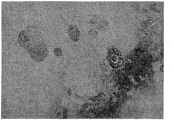
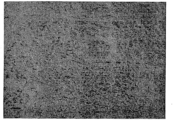
- Figure 2 shows the resulting product wherein the chemical additives are uniformly distributed among or on the hydrous kaolin. This is in contrast to Figure 1 showing SURROUND ® WP crop protectant.
- the product of Inventive Example 1 above is blended with water processed calcined kaolin at a 50:50 ratio.
- a spreading agent and volumization agent are added to the blend.
- the resulting blend has unexpectedly good rainfastness and optical properties.
- Example 1 Inventive Example 1 is repeated except that calcined kaolin is used instead of hydrous kaolin.
- a water processed hydrous kaolin was prepared and a liquid and one dry-form additive were added into the kaolin slurry.
- the additives were two different deposition aids.
- the slurry was then dried and milled to form Inventive Example 28.
- Comparative C Comparative B was repeated except that the additives were tumbled in and not milled.
- Inventive Example 28 The products of Inventive Example 28 and Comparative B were also sprayed onto clear polyethylene over a black surface as shown in Figure 3 .
- This polyethylene was a hydrophobic surface that resembles an agricultural surface to which it is difficult to apply chemical additives.
- Inventive Example 28 showed excellent film formation and few or no specks of undissolved additives while Comparative B showed poor film formation and specks of undissolved additives and kaolin due to inefficient action of the additive when sprayed.
- a water processed hydrous kaolin that was not beaded was used for Inventive Example 30.
- Comparative D was an air floated hydrous kaolin that was not beaded (sold by DBK Co., now Imerys).
- Inventive Example 31 was prepared using the water processed hydrous kaolin of Inventive Example 1 above and then, a chemical additive was added at the pulverizer and was functional as a deposition aid.
- the product of Inventive Example 1 was applied to an apple and is shown on the left side of Figure 5 .
- the product of Inventive Example 31 was applied to another apple and is shown on the right side of Figure 5 .
- the benefit of adding a chemical additive at the pulverizer is clearly shown in the intimate blend on the apple on the right side of Figure 5 .
- Kaolin was purified via water processing to remove crystalline silica and other contaminants and was treated with an acidic chemical additive to reduce the pH.
- the chemical additive was uniformly distributed on, associated with, or evenly distributed among the hydrous kaolin.
- the composition was dried and milled.
- An agricultural composition is made from this kaolin and is applied to a substrate in an amount greater than or equal to about an average of 20 micrograms per square centimeter on the substrate.
- the graph in Figure 6 shows the products of Inventive Examples 32 and 33 compared with Comparatives E (Snow brand kaolin described in Table 2 above) and F (Sunguard brand kaolin described in Table 2 above).
Landscapes
- Life Sciences & Earth Sciences (AREA)
- Health & Medical Sciences (AREA)
- General Health & Medical Sciences (AREA)
- Dentistry (AREA)
- Wood Science & Technology (AREA)
- Plant Pathology (AREA)
- Environmental Sciences (AREA)
- Engineering & Computer Science (AREA)
- Agronomy & Crop Science (AREA)
- Zoology (AREA)
- Pest Control & Pesticides (AREA)
- Chemical & Material Sciences (AREA)
- Inorganic Chemistry (AREA)
- Toxicology (AREA)
- Agricultural Chemicals And Associated Chemicals (AREA)
- Pigments, Carbon Blacks, Or Wood Stains (AREA)
- Catching Or Destruction (AREA)
- Protection Of Plants (AREA)
Claims (14)
- Landwirtschaftliches Substrat mit einem landwirtschaftlichen Partikelfilm darauf, wobei der landwirtschaftliche Partikelfilm wasserbehandelte funktionelle Partikel umfasst, wobei die funktionellen Partikel einen Gehalt an kristallinem Siliciumdioxid von unter 0,2 Prozent aufweisen und wobei die funktionellen Partikel ausgewählt sind aus der Gruppe bestehend aus wasserbehandeltem wasserhaltigem Kaolin oder wasserbehandeltem Bentonit oder einem Gemisch davon, wobei die funktionellen Partikel mit mehr als oder gleich im Mittel 20 Mikrogramm pro Quadratzentimeter des Substrats vorhanden sind.
- Landwirtschaftliches Substrat gemäß Anspruch 1, wobei die funktionellen Partikel eine bimodale Partikelgrößenverteilung aufweisen, um das Durchtreten photosynthetiseaktiver Strahlung durch einen Partikelfilm zu erlauben, während gleichzeitig schädliche infrarote und ultraviolette Strahlung gefiltert oder ausgeschlossen wird.
- Landwirtschaftliches Substrat gemäß Anspruch 1, wobei der landwirtschaftliche Partikelfilm zusätzlich einen chemischen Zusatzstoff umfasst.
- Landwirtschaftliches Substrat gemäß Anspruch 3, wobei der chemische Zusatzstoff gleichmäßig unter oder auf den funktionellen Partikeln verteilt ist.
- Landwirtschaftliches Substrat gemäß Anspruch 1, wobei die funktionellen Partikel in körniger oder agglomerierter Form vorliegen.
- Landwirtschaftliches Substrat gemäß Anspruch 1, wobei das wasserhaltige Kaolin einen TiO2-Äquivalent-Gehalt von weniger als einem Prozent aufweist.
- Landwirtschaftliches Substrat gemäß Anspruch 1, wobei der landwirtschaftliche Film im Wesentlichen aus: (a) funktionellen Partikeln ausgewählt aus der Gruppe bestehend aus wasserbehandeltem wasserhaltigem Kaolin, wasserbehandeltem Bentonit und wasserbehandeltem natürlichem Calciumcarbonat und (b) einem chemischen Zusatzstoff, der gleichmäßig in oder auf den funktionellen Partikeln verteilt ist, besteht.
- Landwirtschaftliches Substrat gemäß Anspruch 1, wobei die funktionellen Partikel wasserbehandeltes wasserhaltiges Kaolin sind.
- Landwirtschaftliches Substrat gemäß Anspruch 1, wobei die funktionellen Partikel wasserbehandelter Bentonit sind.
- Landwirtschaftliches Substrat gemäß Anspruch 1, wobei der landwirtschaftliche Film mit einer Menge von 100 bis zu 3000 Mikrogramm an Partikelmaterial pro Quadratzentimeter auf dem Substrat vorhanden ist und wobei die Partikel eine spezifische Dichte von 2-3 g/cm3 aufweisen.
- Landwirtschaftliches Substrat gemäß Anspruch 1, wobei die funktionellen Partikel eine mediane Einzelpartikelgröße von gleich oder weniger als 3 Mikrometer aufweisen.
- Landwirtschaftliches Substrat gemäß Anspruch 1, wobei der landwirtschaftliche Partikelfilm ferner ein grenzflächenaktives Mittel enthält.
- Landwirtschaftliches Substrat gemäß Anspruch 1, wobei der landwirtschaftliche Partikelfilm mit einer Menge von 100 bis zu 3000 Mikrogramm an Partikelmaterial pro Quadratzentimeter auf dem Substrat vorhanden ist und wobei die Partikel eine spezifische Dichte von 2-3 g/cm3 aufweisen und wobei die funktionellen Partikel wasserhaltiges Kaolin mit einer GE-Helligkeit von wenigstens 85 sind.
- Landwirtschaftliches Substrat gemäß Anspruch 1, wobei die funktionellen Partikel eine GE-Helligkeit von wenigstens 85 aufweisen.
Priority Applications (1)
| Application Number | Priority Date | Filing Date | Title |
|---|---|---|---|
| PL06758761T PL1885184T3 (pl) | 2005-05-03 | 2006-04-28 | Kompozycje zawierające rolniczą warstewkę cząsteczkową |
Applications Claiming Priority (4)
| Application Number | Priority Date | Filing Date | Title |
|---|---|---|---|
| US59474505P | 2005-05-03 | 2005-05-03 | |
| US59491805P | 2005-05-18 | 2005-05-18 | |
| US11/380,639 US8637091B2 (en) | 2005-05-03 | 2006-04-27 | Compositions comprising particles resulting from processing in a slurry mix |
| PCT/US2006/016318 WO2006119043A2 (en) | 2005-05-03 | 2006-04-28 | Agricultural compositions comprising functional particles |
Publications (3)
| Publication Number | Publication Date |
|---|---|
| EP1885184A2 EP1885184A2 (de) | 2008-02-13 |
| EP1885184B1 EP1885184B1 (de) | 2018-11-14 |
| EP1885184B2 true EP1885184B2 (de) | 2024-06-12 |
Family
ID=37054634
Family Applications (1)
| Application Number | Title | Priority Date | Filing Date |
|---|---|---|---|
| EP06758761.8A Active EP1885184B2 (de) | 2005-05-03 | 2006-04-28 | Zusammensetzungen, die einen agrochemischen partikulären film enthalten |
Country Status (13)
| Country | Link |
|---|---|
| US (1) | US8637091B2 (de) |
| EP (1) | EP1885184B2 (de) |
| JP (1) | JP2008539725A (de) |
| KR (1) | KR20080009151A (de) |
| BR (1) | BRPI0610893B1 (de) |
| CA (1) | CA2611004A1 (de) |
| DK (1) | DK1885184T3 (de) |
| ES (1) | ES2707782T3 (de) |
| HU (1) | HUE042784T2 (de) |
| LT (1) | LT1885184T (de) |
| PL (1) | PL1885184T3 (de) |
| PT (1) | PT1885184T (de) |
| WO (1) | WO2006119043A2 (de) |
Families Citing this family (21)
| Publication number | Priority date | Publication date | Assignee | Title |
|---|---|---|---|---|
| US8486430B2 (en) * | 2006-08-23 | 2013-07-16 | The Andersons, Inc. | Adjustable density, partially water-dispersible carrier for active agents |
| US20040107871A1 (en) * | 2002-08-09 | 2004-06-10 | Defeo Maureen A. | Aluminum trihydrate containing slurries |
| NL2001370C2 (nl) * | 2008-03-13 | 2009-09-15 | Natural Power Res B V | Bestrijding van gewasziekten. |
| WO2010124131A1 (en) * | 2009-04-23 | 2010-10-28 | State Of Oregon Acting By And Through The State Board Of Higher Education On Behalf Of Oregaon State University | Flexible films and methods of making and using flexible films |
| WO2013123176A1 (en) * | 2012-02-14 | 2013-08-22 | University Of Florida Research Foundation, Inc. | Engineered particulate systems for controlled release of pesticides and repellants |
| JP5938653B2 (ja) * | 2012-05-11 | 2016-06-22 | パナソニックIpマネジメント株式会社 | 害虫防除照明システム |
| US9826750B2 (en) | 2013-03-14 | 2017-11-28 | Oregon State University | Nano-cellulose coatings to prevent damage in foodstuffs |
| US10400128B2 (en) | 2013-03-14 | 2019-09-03 | Oregon State University | Nano-cellulose edible coatings and uses thereof |
| KR102645367B1 (ko) * | 2015-01-16 | 2024-03-07 | 스톨러 엔터프라이지즈, 인크. | 원소 황 및 수화 점토를 포함하는 유동성 혼합물 |
| CA2976783A1 (en) | 2015-02-19 | 2016-08-25 | Christopher SCANNELL | Use of bentonite for improving plant growth-related traits |
| KR101834634B1 (ko) | 2015-04-21 | 2018-03-05 | 김남호 | 실리카를 주성분으로 하는 항균조성물질 및 그 조성물질을 이용한 위생용품 제조방법 |
| US9763440B2 (en) * | 2015-07-30 | 2017-09-19 | University Of Florida Research Foundation, Inc. | Colored clays for agricultural and other industrial applications |
| CN105503394B (zh) * | 2015-12-22 | 2019-02-19 | 史丹利化肥扶余有限公司 | 一种通过无机二级吸附制备缓释肥料的方法 |
| US20170197891A1 (en) * | 2016-01-08 | 2017-07-13 | Sanho Agricultural Energy Technology Ltd. | Quantum carrier for improving soil function and method of preparation thereof |
| CN106269275B (zh) * | 2016-10-09 | 2018-09-28 | 广东省矿产应用研究所 | 一种瓷土矿除铁增白浮选捕收剂及其应用 |
| KR102636985B1 (ko) | 2017-01-31 | 2024-02-15 | 오리건 스테이트 유니버시티 | 식품 코팅물 |
| JP7284154B2 (ja) | 2017-09-11 | 2023-05-30 | ビーエーエスエフ ソシエタス・ヨーロピア | 多孔性金属酸化物ミクロスフィア |
| MX2020002743A (es) * | 2017-09-11 | 2020-10-01 | Harvard College | Microesferas que comprenden nanoesferas polimericas polidispersas y microesferas de oxido de metal poroso. |
| CN108416775B (zh) * | 2018-03-12 | 2020-05-19 | 华中科技大学 | 一种基于深度学习的矿石粒度检测方法 |
| WO2020068915A1 (en) * | 2018-09-25 | 2020-04-02 | University Of Florida Research Foundation, Inc. | Dye-containing kaolin compositions for crop protection and improving plant physiology |
| US11267985B2 (en) | 2019-04-08 | 2022-03-08 | Polymer Solutions Group | Anti-tack formulation of high solids content, diluted anti-tack formulation and method of use of diluted anti-tack formulation |
Citations (4)
| Publication number | Priority date | Publication date | Assignee | Title |
|---|---|---|---|---|
| US3879283A (en) † | 1970-10-29 | 1975-04-22 | Engelhard Min & Chem | Purification of quartz contaminated clay by selective flocculation |
| US5261539A (en) † | 1992-10-07 | 1993-11-16 | American Cyanamid Company | Flotation process for purifying calcite |
| WO1998038866A1 (en) † | 1997-03-05 | 1998-09-11 | Engelhard Corporation | Treated horticultural substrates |
| WO2005058014A1 (en) † | 2003-12-16 | 2005-06-30 | Ultimate Nominees Pty Ltd | Fruit ripening method and liquid coating composition |
Family Cites Families (44)
| Publication number | Priority date | Publication date | Assignee | Title |
|---|---|---|---|---|
| US2373911A (en) * | 1941-07-18 | 1945-04-17 | Harbison Walker Refractories | Production of magnesia and calcium carbonate from dolomite |
| US3159536A (en) * | 1960-04-22 | 1964-12-01 | Monsanto Co | Hydrophobic siliceous insecticidal compositions |
| US3120445A (en) * | 1961-12-08 | 1964-02-04 | Aluisi Donald | Agricultural spray |
| US3231365A (en) * | 1963-02-12 | 1966-01-25 | Mo Och Domsjoe Ab | Plant growth with fertilizer including nonionic wetting agent |
| US3586523A (en) * | 1968-01-15 | 1971-06-22 | Engelhard Min & Chem | Calcined kaolin clay pigment |
| US3490932A (en) * | 1968-09-30 | 1970-01-20 | Leonard L Smith | Hydrophilic adhesive composition for use as an adjuvant in liquid coating materials |
| US4010278A (en) * | 1969-10-13 | 1977-03-01 | E. I. Du Pont De Nemours And Co. | Compositions of alkyl 4-[o-(substituted amino)phenyl]-3-thioallophanates and methods of use |
| US3956487A (en) * | 1972-07-17 | 1976-05-11 | Nihon Tokushu Noyaku Seizo Kabushiki Kaisha | Novel antifungal antibiotic substance, and agricultural and horticultural fungicidal composition containing said substance |
| US3914469A (en) * | 1972-08-09 | 1975-10-21 | Richard Delano | Method of controlling solar heat and light in green houses |
| JPS5498325A (en) * | 1978-01-19 | 1979-08-03 | Nippon Kayaku Co Ltd | Agricultural and horticultural fungicidal composition |
| US4192691A (en) * | 1978-10-26 | 1980-03-11 | The Mearl Corporation | Metal oxide platelets as nacreous pigments |
| US4371626A (en) * | 1981-04-13 | 1983-02-01 | Aurora Industries, Inc. | Method of upgrading crude sodium bentonite |
| JPS5865201A (ja) | 1981-10-12 | 1983-04-18 | Shinsaku Murakami | 植物の裁培助成剤 |
| EP0108842B1 (de) * | 1982-11-10 | 1987-03-18 | Ciba Specialty Chemicals Water Treatments Limited | Calciumcarbonat dispersionen |
| GB8331808D0 (en) * | 1983-11-29 | 1984-01-04 | Unilever Plc | Food product |
| US4738726A (en) * | 1985-05-06 | 1988-04-19 | Engelhard Corporation | Treatment of clays with cationic polymers to prepare high bulking pigments |
| US4804403A (en) * | 1986-08-18 | 1989-02-14 | Melamine Chemicals, Inc. | Attrition-resistant, controlled release fertilizers |
| US4781298A (en) * | 1986-10-07 | 1988-11-01 | Engelhard Corporation | Process for beneficiating clay at high solids |
| DE3835592A1 (de) * | 1988-10-19 | 1990-04-26 | Degussa | Insektizide |
| US5171349A (en) * | 1991-01-31 | 1992-12-15 | Vetanovetz Richard P | Solubility compound fertilizer compositions |
| EP0591406A1 (de) * | 1991-07-03 | 1994-04-13 | Engelhard Corporation | Selektive abtrennung von feinverteilten mineralien durch zufügung von einem selektiven sammler und zentrifugation |
| US5252118A (en) * | 1992-06-04 | 1993-10-12 | Brown Paul W | Biological-chemical film-coating cryoprotectant for plants |
| WO1994000009A1 (en) * | 1992-06-19 | 1994-01-06 | Nonomura Arthur M | Methods and compositions for enhancing carbon fixation in plants |
| US5521144A (en) * | 1992-09-18 | 1996-05-28 | Central Soya Company, Inc. | Herbicide composition |
| US5690897A (en) * | 1994-11-21 | 1997-11-25 | Minerals Technologies Inc. | Method for purification of calcium carbonate |
| US5611691A (en) * | 1995-01-17 | 1997-03-18 | Serge A. Atlan | Modular construction kit using electronic control modules |
| US5741355A (en) * | 1995-01-27 | 1998-04-21 | Topy Industries, Limited | Pearlescent pigment, and paint composition, cosmetic material, ink and plastics blended with the new pearlescent pigment |
| US5624488A (en) * | 1995-06-30 | 1997-04-29 | Engelhard Corporation | Ultrahigh brightness calcined clay pigment, manufacture & use thereof |
| CN1098120C (zh) * | 1996-05-23 | 2003-01-08 | 大正制药株式会社 | 微滴乳状液 |
| DE69730900T2 (de) * | 1996-05-24 | 2006-02-23 | Mizusawa Industrial Chemicals, Ltd. | Harzadditiv, Verfahren zu seiner Herstellung und dieses Additiv verwendende Olefinharzzusammensetzung |
| US6045914A (en) * | 1996-06-03 | 2000-04-04 | Engelhard Corporation | Pearlescent glass pigment |
| US6077495A (en) * | 1997-03-03 | 2000-06-20 | Engelhard Corporation | Method, composition and system for the controlled release of chlorine dioxide gas |
| TW529906B (en) * | 1997-03-05 | 2003-05-01 | Engelhard Corp | Method for protecting surfaces from arthropod infestation |
| US6069112A (en) * | 1997-03-05 | 2000-05-30 | Englehard Corporation | Method for preventing physiological disorders without diminishing photosynthesis |
| US5908708A (en) * | 1997-03-05 | 1999-06-01 | Engelhard Corporation | Aqueous dispersion of a particulate solid having a hydrophobic outer surface and films produced thereby |
| US6235683B1 (en) * | 1997-03-05 | 2001-05-22 | Engelhard Corporation | Method for enhanced supercooling of plants to provide frost protection |
| JP2000065531A (ja) * | 1998-08-26 | 2000-03-03 | Minolta Co Ltd | 複屈折板を用いた干渉像入力装置 |
| US7222455B2 (en) * | 1998-10-27 | 2007-05-29 | Washington State University Research Foundation | Compositions and methods for suppressing cracking and water loss from cherries |
| US6514512B1 (en) * | 2000-10-02 | 2003-02-04 | Engelhard Corporation | Pesticide delivery system |
| EP1199338A3 (de) * | 2000-10-17 | 2004-01-21 | Imerys Kaolin, Inc. | Kalcinierte Kaolinpigmente mit verbesserten physikalischen und anwendungstechnischen Eigenschaften, ihre Herstellung und Verwendung |
| US6378703B1 (en) * | 2000-11-30 | 2002-04-30 | Engelhard Corporation | Flotation method for removing colored impurities from kaolin clay |
| US6877275B2 (en) * | 2002-02-19 | 2005-04-12 | Engelhard Corporation | Method of weed control |
| CN1642565A (zh) * | 2002-04-04 | 2005-07-20 | 株式会社钟化 | 含有甘草蔬水性成分的油脂组合物的制备方法 |
| US20040067247A1 (en) * | 2002-09-27 | 2004-04-08 | Xavier De Sloovere | Composition for combating/repelling insects, birds, dirts and parasites |
-
2006
- 2006-04-27 US US11/380,639 patent/US8637091B2/en active Active
- 2006-04-28 ES ES06758761T patent/ES2707782T3/es active Active
- 2006-04-28 BR BRPI0610893A patent/BRPI0610893B1/pt active IP Right Grant
- 2006-04-28 KR KR1020077028264A patent/KR20080009151A/ko not_active Withdrawn
- 2006-04-28 PL PL06758761T patent/PL1885184T3/pl unknown
- 2006-04-28 LT LTEP06758761.8T patent/LT1885184T/lt unknown
- 2006-04-28 CA CA002611004A patent/CA2611004A1/en not_active Abandoned
- 2006-04-28 EP EP06758761.8A patent/EP1885184B2/de active Active
- 2006-04-28 HU HUE06758761A patent/HUE042784T2/hu unknown
- 2006-04-28 JP JP2008510076A patent/JP2008539725A/ja active Pending
- 2006-04-28 DK DK06758761.8T patent/DK1885184T3/en active
- 2006-04-28 WO PCT/US2006/016318 patent/WO2006119043A2/en not_active Ceased
- 2006-04-28 PT PT06758761T patent/PT1885184T/pt unknown
Patent Citations (4)
| Publication number | Priority date | Publication date | Assignee | Title |
|---|---|---|---|---|
| US3879283A (en) † | 1970-10-29 | 1975-04-22 | Engelhard Min & Chem | Purification of quartz contaminated clay by selective flocculation |
| US5261539A (en) † | 1992-10-07 | 1993-11-16 | American Cyanamid Company | Flotation process for purifying calcite |
| WO1998038866A1 (en) † | 1997-03-05 | 1998-09-11 | Engelhard Corporation | Treated horticultural substrates |
| WO2005058014A1 (en) † | 2003-12-16 | 2005-06-30 | Ultimate Nominees Pty Ltd | Fruit ripening method and liquid coating composition |
Non-Patent Citations (9)
| Title |
|---|
| "Handbook Of Adhesives Raw Materials", 1989, article ERNEST W. FLICK † |
| Aerogem Calcium’Carbonate material safety data sheet(1991) † |
| Engelhard Surround WP Crop protect 12 pages, 2004 † |
| Hydrocarb 60 OG Slurry datasheet (1987) † |
| JAMESON, M.P. ET AL.: "Removal of mineral impurities from kaolin using flotation", ADVANCES IN COAL AND MINERAL PROCESSING USING FLOTATION, 1989, pages 206 - 210 † |
| MICHAEL GLENN ET AL.: "A Reflective, Processed-Kaolin Particle Film Affects Fruit Temperature, Radiation Reflection, and Solar Injury in Apple", J. AMER. SOC. HORT. SCI, vol. 127, no. 2, 2002, pages 188 - 193, ISSN: 0003-1062, DOI: 10.21273/JASHS.127.2.188 † |
| Millicarb datasheet (1979) † |
| S.Chandler and.RR. Klimpel (Editors) Chapter.22, pages 206-210 1989 † |
| W:F. Hillebrand, US Geological Survey, Bulletin No-. 305, Series E, Chemistry and Physics-(1907) † |
Also Published As
| Publication number | Publication date |
|---|---|
| PL1885184T3 (pl) | 2019-04-30 |
| KR20080009151A (ko) | 2008-01-24 |
| BRPI0610893A2 (pt) | 2010-09-14 |
| EP1885184B1 (de) | 2018-11-14 |
| JP2008539725A (ja) | 2008-11-20 |
| US20060252649A1 (en) | 2006-11-09 |
| HUE042784T2 (hu) | 2019-07-29 |
| WO2006119043A2 (en) | 2006-11-09 |
| LT1885184T (lt) | 2019-02-11 |
| EP1885184A2 (de) | 2008-02-13 |
| BRPI0610893B1 (pt) | 2015-11-17 |
| US8637091B2 (en) | 2014-01-28 |
| PT1885184T (pt) | 2019-02-06 |
| ES2707782T3 (es) | 2019-04-05 |
| WO2006119043A3 (en) | 2008-04-17 |
| DK1885184T3 (en) | 2019-02-11 |
| CA2611004A1 (en) | 2006-11-09 |
Similar Documents
| Publication | Publication Date | Title |
|---|---|---|
| EP1885184B2 (de) | Zusammensetzungen, die einen agrochemischen partikulären film enthalten | |
| EP2367552B1 (de) | Antibakterielle und antimykotische nanoformulierung auf kieselerdebasis | |
| TWI616478B (zh) | 包含銅鹽的經改質以礦物爲基底的塡料 | |
| DE102008045121A1 (de) | Pigmentgranulate, die anorganische Filterhilfsmittel enthalten | |
| EP2988794A1 (de) | Verfahren zum herstellen eines dotierten oder undotierten mischoxids für einen verbundwerkstoff und verbundwerkstoff mit einem solchen mischoxid | |
| EP2007832B1 (de) | Schwarzpigment-hilfsmittel-kombination mit einer verbesserten farbstärke | |
| Lopez et al. | ZnO recovered from spent alkaline batteries as antimicrobial additive for waterborne paints | |
| CN109418268A (zh) | 一种杀菌制剂及其应用 | |
| KR20190005165A (ko) | 종자 코팅 포뮬레이션 | |
| US11350632B2 (en) | Methods, compositions and systems for killing arthropods | |
| CN101282649A (zh) | 由浆料混合物处理得到的包括颗粒的组合物 | |
| US20080190324A1 (en) | Organic/inorganic complexes as color compositions | |
| JP2022530494A (ja) | シリカ肥料およびその使用 | |
| MX2007013724A (en) | Compositions comprising particles resulting from processing in a slurry mix | |
| US20070033747A1 (en) | Organic/Inorganic Lewis Acid Composite Materials | |
| BR122015020965B1 (pt) | Substrato agrícola | |
| Kumar et al. | Enhanced antimicrobial properties of mural colours by the addition of titanium dioxide nanoparticles | |
| Jalees et al. | Green synthesis of silver oxide nanoparticles prepared from waste part of mango peels | |
| Chris-Okafor et al. | Pigment-Extender Effect of Umunze Clay on Screeding Paint | |
| DE102005057747A1 (de) | Beschichtungszusammensetzung (II) | |
| Parwate et al. | Green synthesis and characterization of CuO nanoparticles using Angelonia angustifolia plant extract for biological application | |
| DE102006017110A1 (de) | Schwarzpigment-Hilfsmittel-Kombination mit einer verbesserten Farbstärke |
Legal Events
| Date | Code | Title | Description |
|---|---|---|---|
| PUAI | Public reference made under article 153(3) epc to a published international application that has entered the european phase |
Free format text: ORIGINAL CODE: 0009012 |
|
| 17P | Request for examination filed |
Effective date: 20071202 |
|
| AK | Designated contracting states |
Kind code of ref document: A2 Designated state(s): AT BE BG CH CY CZ DE DK EE ES FI FR GB GR HU IE IS IT LI LT LU LV MC NL PL PT RO SE SI SK TR |
|
| AX | Request for extension of the european patent |
Extension state: AL BA HR MK YU |
|
| R17D | Deferred search report published (corrected) |
Effective date: 20080417 |
|
| 17Q | First examination report despatched |
Effective date: 20080611 |
|
| DAX | Request for extension of the european patent (deleted) | ||
| GRAP | Despatch of communication of intention to grant a patent |
Free format text: ORIGINAL CODE: EPIDOSNIGR1 |
|
| STAA | Information on the status of an ep patent application or granted ep patent |
Free format text: STATUS: GRANT OF PATENT IS INTENDED |
|
| INTG | Intention to grant announced |
Effective date: 20170816 |
|
| RIN1 | Information on inventor provided before grant (corrected) |
Inventor name: MOSKO, JOHN, T. Inventor name: PLUTA, RICHARD, CHARLES |
|
| RAP1 | Party data changed (applicant data changed or rights of an application transferred) |
Owner name: TESSENDERLO KERLEY, INC. |
|
| GRAJ | Information related to disapproval of communication of intention to grant by the applicant or resumption of examination proceedings by the epo deleted |
Free format text: ORIGINAL CODE: EPIDOSDIGR1 |
|
| STAA | Information on the status of an ep patent application or granted ep patent |
Free format text: STATUS: EXAMINATION IS IN PROGRESS |
|
| GRAP | Despatch of communication of intention to grant a patent |
Free format text: ORIGINAL CODE: EPIDOSNIGR1 |
|
| STAA | Information on the status of an ep patent application or granted ep patent |
Free format text: STATUS: GRANT OF PATENT IS INTENDED |
|
| INTC | Intention to grant announced (deleted) | ||
| INTG | Intention to grant announced |
Effective date: 20180518 |
|
| GRAS | Grant fee paid |
Free format text: ORIGINAL CODE: EPIDOSNIGR3 |
|
| GRAA | (expected) grant |
Free format text: ORIGINAL CODE: 0009210 |
|
| STAA | Information on the status of an ep patent application or granted ep patent |
Free format text: STATUS: THE PATENT HAS BEEN GRANTED |
|
| AK | Designated contracting states |
Kind code of ref document: B1 Designated state(s): AT BE BG CH CY CZ DE DK EE ES FI FR GB GR HU IE IS IT LI LT LU LV MC NL PL PT RO SE SI SK TR |
|
| REG | Reference to a national code |
Ref country code: GB Ref legal event code: FG4D |
|
| REG | Reference to a national code |
Ref country code: CH Ref legal event code: EP Ref country code: AT Ref legal event code: REF Ref document number: 1063742 Country of ref document: AT Kind code of ref document: T Effective date: 20181115 |
|
| REG | Reference to a national code |
Ref country code: DE Ref legal event code: R096 Ref document number: 602006056821 Country of ref document: DE |
|
| REG | Reference to a national code |
Ref country code: IE Ref legal event code: FG4D |
|
| REG | Reference to a national code |
Ref country code: CH Ref legal event code: NV Representative=s name: E. BLUM AND CO. AG PATENT- UND MARKENANWAELTE , CH |
|
| REG | Reference to a national code |
Ref country code: RO Ref legal event code: EPE |
|
| REG | Reference to a national code |
Ref country code: PT Ref legal event code: SC4A Ref document number: 1885184 Country of ref document: PT Date of ref document: 20190206 Kind code of ref document: T Free format text: AVAILABILITY OF NATIONAL TRANSLATION Effective date: 20190130 |
|
| REG | Reference to a national code |
Ref country code: DK Ref legal event code: T3 Effective date: 20190207 |
|
| REG | Reference to a national code |
Ref country code: NL Ref legal event code: FP |
|
| REG | Reference to a national code |
Ref country code: ES Ref legal event code: FG2A Ref document number: 2707782 Country of ref document: ES Kind code of ref document: T3 Effective date: 20190405 |
|
| REG | Reference to a national code |
Ref country code: GR Ref legal event code: EP Ref document number: 20190400310 Country of ref document: GR Effective date: 20190422 |
|
| PG25 | Lapsed in a contracting state [announced via postgrant information from national office to epo] |
Ref country code: FI Free format text: LAPSE BECAUSE OF FAILURE TO SUBMIT A TRANSLATION OF THE DESCRIPTION OR TO PAY THE FEE WITHIN THE PRESCRIBED TIME-LIMIT Effective date: 20181114 Ref country code: LV Free format text: LAPSE BECAUSE OF FAILURE TO SUBMIT A TRANSLATION OF THE DESCRIPTION OR TO PAY THE FEE WITHIN THE PRESCRIBED TIME-LIMIT Effective date: 20181114 Ref country code: IS Free format text: LAPSE BECAUSE OF FAILURE TO SUBMIT A TRANSLATION OF THE DESCRIPTION OR TO PAY THE FEE WITHIN THE PRESCRIBED TIME-LIMIT Effective date: 20190314 |
|
| PG25 | Lapsed in a contracting state [announced via postgrant information from national office to epo] |
Ref country code: SE Free format text: LAPSE BECAUSE OF FAILURE TO SUBMIT A TRANSLATION OF THE DESCRIPTION OR TO PAY THE FEE WITHIN THE PRESCRIBED TIME-LIMIT Effective date: 20181114 |
|
| REG | Reference to a national code |
Ref country code: SK Ref legal event code: T3 Ref document number: E 29978 Country of ref document: SK |
|
| REG | Reference to a national code |
Ref country code: HU Ref legal event code: AG4A Ref document number: E042784 Country of ref document: HU |
|
| REG | Reference to a national code |
Ref country code: DE Ref legal event code: R026 Ref document number: 602006056821 Country of ref document: DE |
|
| PLBI | Opposition filed |
Free format text: ORIGINAL CODE: 0009260 |
|
| PLAX | Notice of opposition and request to file observation + time limit sent |
Free format text: ORIGINAL CODE: EPIDOSNOBS2 |
|
| PG25 | Lapsed in a contracting state [announced via postgrant information from national office to epo] |
Ref country code: EE Free format text: LAPSE BECAUSE OF FAILURE TO SUBMIT A TRANSLATION OF THE DESCRIPTION OR TO PAY THE FEE WITHIN THE PRESCRIBED TIME-LIMIT Effective date: 20181114 |
|
| 26 | Opposition filed |
Opponent name: OMYA INTERNATIONAL AG Effective date: 20190812 |
|
| PG25 | Lapsed in a contracting state [announced via postgrant information from national office to epo] |
Ref country code: SI Free format text: LAPSE BECAUSE OF FAILURE TO SUBMIT A TRANSLATION OF THE DESCRIPTION OR TO PAY THE FEE WITHIN THE PRESCRIBED TIME-LIMIT Effective date: 20181114 |
|
| PG25 | Lapsed in a contracting state [announced via postgrant information from national office to epo] |
Ref country code: MC Free format text: LAPSE BECAUSE OF FAILURE TO SUBMIT A TRANSLATION OF THE DESCRIPTION OR TO PAY THE FEE WITHIN THE PRESCRIBED TIME-LIMIT Effective date: 20181114 Ref country code: LU Free format text: LAPSE BECAUSE OF NON-PAYMENT OF DUE FEES Effective date: 20190428 |
|
| PLBB | Reply of patent proprietor to notice(s) of opposition received |
Free format text: ORIGINAL CODE: EPIDOSNOBS3 |
|
| REG | Reference to a national code |
Ref country code: AT Ref legal event code: UEP Ref document number: 1063742 Country of ref document: AT Kind code of ref document: T Effective date: 20181114 |
|
| PG25 | Lapsed in a contracting state [announced via postgrant information from national office to epo] |
Ref country code: IE Free format text: LAPSE BECAUSE OF NON-PAYMENT OF DUE FEES Effective date: 20190428 |
|
| PG25 | Lapsed in a contracting state [announced via postgrant information from national office to epo] |
Ref country code: CY Free format text: LAPSE BECAUSE OF FAILURE TO SUBMIT A TRANSLATION OF THE DESCRIPTION OR TO PAY THE FEE WITHIN THE PRESCRIBED TIME-LIMIT Effective date: 20181114 |
|
| APBM | Appeal reference recorded |
Free format text: ORIGINAL CODE: EPIDOSNREFNO |
|
| APBP | Date of receipt of notice of appeal recorded |
Free format text: ORIGINAL CODE: EPIDOSNNOA2O |
|
| APAH | Appeal reference modified |
Free format text: ORIGINAL CODE: EPIDOSCREFNO |
|
| APBQ | Date of receipt of statement of grounds of appeal recorded |
Free format text: ORIGINAL CODE: EPIDOSNNOA3O |
|
| P01 | Opt-out of the competence of the unified patent court (upc) registered |
Effective date: 20230526 |
|
| APBU | Appeal procedure closed |
Free format text: ORIGINAL CODE: EPIDOSNNOA9O |
|
| PGFP | Annual fee paid to national office [announced via postgrant information from national office to epo] |
Ref country code: SK Payment date: 20240402 Year of fee payment: 19 |
|
| PUAH | Patent maintained in amended form |
Free format text: ORIGINAL CODE: 0009272 |
|
| STAA | Information on the status of an ep patent application or granted ep patent |
Free format text: STATUS: PATENT MAINTAINED AS AMENDED |
|
| PGFP | Annual fee paid to national office [announced via postgrant information from national office to epo] |
Ref country code: NL Payment date: 20240426 Year of fee payment: 19 |
|
| 27A | Patent maintained in amended form |
Effective date: 20240612 |
|
| AK | Designated contracting states |
Kind code of ref document: B2 Designated state(s): AT BE BG CH CY CZ DE DK EE ES FI FR GB GR HU IE IS IT LI LT LU LV MC NL PL PT RO SE SI SK TR |
|
| REG | Reference to a national code |
Ref country code: DE Ref legal event code: R102 Ref document number: 602006056821 Country of ref document: DE |
|
| PGFP | Annual fee paid to national office [announced via postgrant information from national office to epo] |
Ref country code: GB Payment date: 20240429 Year of fee payment: 19 |
|
| PGFP | Annual fee paid to national office [announced via postgrant information from national office to epo] |
Ref country code: LT Payment date: 20240402 Year of fee payment: 19 |
|
| PGFP | Annual fee paid to national office [announced via postgrant information from national office to epo] |
Ref country code: DE Payment date: 20240429 Year of fee payment: 19 |
|
| PGFP | Annual fee paid to national office [announced via postgrant information from national office to epo] |
Ref country code: DK Payment date: 20240425 Year of fee payment: 19 |
|
| PGFP | Annual fee paid to national office [announced via postgrant information from national office to epo] |
Ref country code: GR Payment date: 20240429 Year of fee payment: 19 |
|
| PGFP | Annual fee paid to national office [announced via postgrant information from national office to epo] |
Ref country code: CH Payment date: 20240501 Year of fee payment: 19 |
|
| PGFP | Annual fee paid to national office [announced via postgrant information from national office to epo] |
Ref country code: ES Payment date: 20240503 Year of fee payment: 19 |
|
| PGFP | Annual fee paid to national office [announced via postgrant information from national office to epo] |
Ref country code: CZ Payment date: 20240408 Year of fee payment: 19 Ref country code: AT Payment date: 20240404 Year of fee payment: 19 |
|
| PGFP | Annual fee paid to national office [announced via postgrant information from national office to epo] |
Ref country code: RO Payment date: 20240405 Year of fee payment: 19 Ref country code: IT Payment date: 20240422 Year of fee payment: 19 Ref country code: FR Payment date: 20240425 Year of fee payment: 19 Ref country code: BG Payment date: 20240410 Year of fee payment: 19 |
|
| PGFP | Annual fee paid to national office [announced via postgrant information from national office to epo] |
Ref country code: PL Payment date: 20240404 Year of fee payment: 19 Ref country code: PT Payment date: 20240405 Year of fee payment: 19 |
|
| REG | Reference to a national code |
Ref country code: SK Ref legal event code: T5 Ref document number: E 29978 Country of ref document: SK |
|
| PGFP | Annual fee paid to national office [announced via postgrant information from national office to epo] |
Ref country code: TR Payment date: 20240408 Year of fee payment: 19 Ref country code: HU Payment date: 20240409 Year of fee payment: 19 Ref country code: BE Payment date: 20240429 Year of fee payment: 19 |
|
| PG25 | Lapsed in a contracting state [announced via postgrant information from national office to epo] |
Ref country code: GR Free format text: LAPSE BECAUSE OF FAILURE TO SUBMIT A TRANSLATION OF THE DESCRIPTION OR TO PAY THE FEE WITHIN THE PRESCRIBED TIME-LIMIT Effective date: 20240913 |
|
| PG25 | Lapsed in a contracting state [announced via postgrant information from national office to epo] |
Ref country code: NL Free format text: LAPSE BECAUSE OF FAILURE TO SUBMIT A TRANSLATION OF THE DESCRIPTION OR TO PAY THE FEE WITHIN THE PRESCRIBED TIME-LIMIT Effective date: 20181114 |
|
| PG25 | Lapsed in a contracting state [announced via postgrant information from national office to epo] |
Ref country code: ES Free format text: LAPSE BECAUSE OF FAILURE TO SUBMIT A TRANSLATION OF THE DESCRIPTION OR TO PAY THE FEE WITHIN THE PRESCRIBED TIME-LIMIT Effective date: 20240612 |
|
| PG25 | Lapsed in a contracting state [announced via postgrant information from national office to epo] |
Ref country code: CZ Free format text: LAPSE BECAUSE OF FAILURE TO SUBMIT A TRANSLATION OF THE DESCRIPTION OR TO PAY THE FEE WITHIN THE PRESCRIBED TIME-LIMIT Effective date: 20181114 |
|
| PG25 | Lapsed in a contracting state [announced via postgrant information from national office to epo] |
Ref country code: NL Free format text: LAPSE BECAUSE OF FAILURE TO SUBMIT A TRANSLATION OF THE DESCRIPTION OR TO PAY THE FEE WITHIN THE PRESCRIBED TIME-LIMIT Effective date: 20181114 Ref country code: GR Free format text: LAPSE BECAUSE OF FAILURE TO SUBMIT A TRANSLATION OF THE DESCRIPTION OR TO PAY THE FEE WITHIN THE PRESCRIBED TIME-LIMIT Effective date: 20240913 Ref country code: ES Free format text: LAPSE BECAUSE OF FAILURE TO SUBMIT A TRANSLATION OF THE DESCRIPTION OR TO PAY THE FEE WITHIN THE PRESCRIBED TIME-LIMIT Effective date: 20240612 Ref country code: CZ Free format text: LAPSE BECAUSE OF FAILURE TO SUBMIT A TRANSLATION OF THE DESCRIPTION OR TO PAY THE FEE WITHIN THE PRESCRIBED TIME-LIMIT Effective date: 20181114 |
|
| REG | Reference to a national code |
Ref country code: AT Ref legal event code: MK05 Ref document number: 1063742 Country of ref document: AT Kind code of ref document: T Effective date: 20181114 |
|
| PG25 | Lapsed in a contracting state [announced via postgrant information from national office to epo] |
Ref country code: PT Free format text: LAPSE BECAUSE OF FAILURE TO SUBMIT A TRANSLATION OF THE DESCRIPTION OR TO PAY THE FEE WITHIN THE PRESCRIBED TIME-LIMIT Effective date: 20241023 |
|
| PG25 | Lapsed in a contracting state [announced via postgrant information from national office to epo] |
Ref country code: PT Free format text: LAPSE BECAUSE OF FAILURE TO SUBMIT A TRANSLATION OF THE DESCRIPTION OR TO PAY THE FEE WITHIN THE PRESCRIBED TIME-LIMIT Effective date: 20241023 |
|
| PG25 | Lapsed in a contracting state [announced via postgrant information from national office to epo] |
Ref country code: AT Free format text: LAPSE BECAUSE OF FAILURE TO SUBMIT A TRANSLATION OF THE DESCRIPTION OR TO PAY THE FEE WITHIN THE PRESCRIBED TIME-LIMIT Effective date: 20181114 |
|
| PG25 | Lapsed in a contracting state [announced via postgrant information from national office to epo] |
Ref country code: AT Free format text: LAPSE BECAUSE OF FAILURE TO SUBMIT A TRANSLATION OF THE DESCRIPTION OR TO PAY THE FEE WITHIN THE PRESCRIBED TIME-LIMIT Effective date: 20181114 |
|
| PG25 | Lapsed in a contracting state [announced via postgrant information from national office to epo] |
Ref country code: DK Free format text: LAPSE BECAUSE OF FAILURE TO SUBMIT A TRANSLATION OF THE DESCRIPTION OR TO PAY THE FEE WITHIN THE PRESCRIBED TIME-LIMIT Effective date: 20240612 |
|
| PG25 | Lapsed in a contracting state [announced via postgrant information from national office to epo] |
Ref country code: GR Free format text: LAPSE BECAUSE OF NON-PAYMENT OF DUE FEES Effective date: 20241004 |
|
| REG | Reference to a national code |
Ref country code: CH Ref legal event code: H13 Free format text: ST27 STATUS EVENT CODE: U-0-0-H10-H13 (AS PROVIDED BY THE NATIONAL OFFICE) Effective date: 20251125 Ref country code: LT Ref legal event code: MM4D Effective date: 20250428 |
|
| REG | Reference to a national code |
Ref country code: SK Ref legal event code: MM4A Ref document number: E 29978 Country of ref document: SK Effective date: 20250428 |
|
| PG25 | Lapsed in a contracting state [announced via postgrant information from national office to epo] |
Ref country code: HU Free format text: LAPSE BECAUSE OF NON-PAYMENT OF DUE FEES Effective date: 20250429 |