EP1874936B1 - Improved methods controlling gene expression - Google Patents
Improved methods controlling gene expression Download PDFInfo
- Publication number
- EP1874936B1 EP1874936B1 EP06754739.8A EP06754739A EP1874936B1 EP 1874936 B1 EP1874936 B1 EP 1874936B1 EP 06754739 A EP06754739 A EP 06754739A EP 1874936 B1 EP1874936 B1 EP 1874936B1
- Authority
- EP
- European Patent Office
- Prior art keywords
- expression
- plant
- sequence
- gene
- genes
- Prior art date
- Legal status (The legal status is an assumption and is not a legal conclusion. Google has not performed a legal analysis and makes no representation as to the accuracy of the status listed.)
- Expired - Lifetime
Links
Images


Classifications
-
- C—CHEMISTRY; METALLURGY
- C12—BIOCHEMISTRY; BEER; SPIRITS; WINE; VINEGAR; MICROBIOLOGY; ENZYMOLOGY; MUTATION OR GENETIC ENGINEERING
- C12N—MICROORGANISMS OR ENZYMES; COMPOSITIONS THEREOF; PROPAGATING, PRESERVING, OR MAINTAINING MICROORGANISMS; MUTATION OR GENETIC ENGINEERING; CULTURE MEDIA
- C12N15/00—Mutation or genetic engineering; DNA or RNA concerning genetic engineering, vectors, e.g. plasmids, or their isolation, preparation or purification; Use of hosts therefor
- C12N15/09—Recombinant DNA-technology
- C12N15/63—Introduction of foreign genetic material using vectors; Vectors; Use of hosts therefor; Regulation of expression
- C12N15/79—Vectors or expression systems specially adapted for eukaryotic hosts
- C12N15/82—Vectors or expression systems specially adapted for eukaryotic hosts for plant cells, e.g. plant artificial chromosomes (PACs)
- C12N15/8216—Methods for controlling, regulating or enhancing expression of transgenes in plant cells
- C12N15/8218—Antisense, co-suppression, viral induced gene silencing [VIGS], post-transcriptional induced gene silencing [PTGS]
-
- C—CHEMISTRY; METALLURGY
- C12—BIOCHEMISTRY; BEER; SPIRITS; WINE; VINEGAR; MICROBIOLOGY; ENZYMOLOGY; MUTATION OR GENETIC ENGINEERING
- C12N—MICROORGANISMS OR ENZYMES; COMPOSITIONS THEREOF; PROPAGATING, PRESERVING, OR MAINTAINING MICROORGANISMS; MUTATION OR GENETIC ENGINEERING; CULTURE MEDIA
- C12N15/00—Mutation or genetic engineering; DNA or RNA concerning genetic engineering, vectors, e.g. plasmids, or their isolation, preparation or purification; Use of hosts therefor
- C12N15/09—Recombinant DNA-technology
- C12N15/63—Introduction of foreign genetic material using vectors; Vectors; Use of hosts therefor; Regulation of expression
- C12N15/79—Vectors or expression systems specially adapted for eukaryotic hosts
-
- C—CHEMISTRY; METALLURGY
- C12—BIOCHEMISTRY; BEER; SPIRITS; WINE; VINEGAR; MICROBIOLOGY; ENZYMOLOGY; MUTATION OR GENETIC ENGINEERING
- C12N—MICROORGANISMS OR ENZYMES; COMPOSITIONS THEREOF; PROPAGATING, PRESERVING, OR MAINTAINING MICROORGANISMS; MUTATION OR GENETIC ENGINEERING; CULTURE MEDIA
- C12N15/00—Mutation or genetic engineering; DNA or RNA concerning genetic engineering, vectors, e.g. plasmids, or their isolation, preparation or purification; Use of hosts therefor
- C12N15/09—Recombinant DNA-technology
- C12N15/63—Introduction of foreign genetic material using vectors; Vectors; Use of hosts therefor; Regulation of expression
- C12N15/79—Vectors or expression systems specially adapted for eukaryotic hosts
- C12N15/82—Vectors or expression systems specially adapted for eukaryotic hosts for plant cells, e.g. plant artificial chromosomes (PACs)
- C12N15/8216—Methods for controlling, regulating or enhancing expression of transgenes in plant cells
-
- Y—GENERAL TAGGING OF NEW TECHNOLOGICAL DEVELOPMENTS; GENERAL TAGGING OF CROSS-SECTIONAL TECHNOLOGIES SPANNING OVER SEVERAL SECTIONS OF THE IPC; TECHNICAL SUBJECTS COVERED BY FORMER USPC CROSS-REFERENCE ART COLLECTIONS [XRACs] AND DIGESTS
- Y02—TECHNOLOGIES OR APPLICATIONS FOR MITIGATION OR ADAPTATION AGAINST CLIMATE CHANGE
- Y02A—TECHNOLOGIES FOR ADAPTATION TO CLIMATE CHANGE
- Y02A40/00—Adaptation technologies in agriculture, forestry, livestock or agroalimentary production
- Y02A40/10—Adaptation technologies in agriculture, forestry, livestock or agroalimentary production in agriculture
- Y02A40/146—Genetically Modified [GMO] plants, e.g. transgenic plants
Definitions
- the present invention is in the field of genetics, especially plant genetics, and provides methods of controlling gene expression.
- the invention provides for a method to reduce or eliminate leakiness of transgene expression in monocotyledonous plants by incorporating sequences complementary to naturally occurring, tissue specifically expressed microRNAs into transgenic expression constructs.
- the methods of the invention can be used to enhance performance of agricultural relevant crops.
- the present invention is in the field of genetics, especially plant genetics, and provides methods for gene-specific silencing.
- the present invention specifically provides methods to reduce or eliminate leakiness of transgene expression in monocotyledonous plants by incorporating sequences complementary to naturally occurring, tissue specifically expressed microRNAs into transgenic expression constructs.
- RNA silencing a sequence-specific RNA degradation process that is triggered by double-stranded RNA (dsRNA) (see Vance and Vaucheret (2001) Science 292:2277-2280 , and Zamore (2001) Nat Struct Biol 8:746-750 for recent reviews on RNA silencing in plants and animals, respectively).
- dsRNA double-stranded RNA
- RNA silencing plays a natural role in defense against foreign nucleic acids including virus resistance in plants and control of transposons in a number of organisms.
- siRNAs are double-stranded with small 3' overhangs and derive from longer dsRNAs that induce silencing. They serve as guides to direct destruction of target RNAs and have been implicated as primers in the amplification of dsRNA via the activity of a cellular RNA dependent RNA polymerase.
- si-like RNAs have also been associated with dsRNA-induced transcriptional gene silencing (TGS), a process in which dsRNA with homology to promoter regions triggers DNA methylation and inhibits transcription.
- TGS dsRNA-induced transcriptional gene silencing
- miRNAs are known generically as short temporal RNAs (stRNAs) and more broadly as micro-RNAs (miRNAs). miRNAs have emerged as evolutionarily conserved, RNA-based regulators of gene expression in animals and plants. miRNAs (approx. 21 to 25 nt) arise from larger precursors with a stem loop structure that are transcribed from non-protein-coding genes. miRNAs are single-stranded, and their accumulation is developmentally regulated and/or regulated by environmental stimuli. They derive from partially double-stranded precursor RNAs that are transcribed from genes that do not encode protein.
- miRNAs appear to be transcribed as hairpin RNA precursors, which are processed to their mature, about 21 nt forms by Dicer ( Lee RD, and Ambros, V. Science 294: 862-864 (2001 )). miRNA targets a specific mRNA to suppress gene expression at post-transcriptional level (i.e. degrades mRNA) or at translational level ( i.e. inhibits protein synthesis). microRNAs (miRNAs) have emerged as evolutionarily conserved. There are several hundred of miRNAs have been recently identified through computational analysis and experimental approaches from many plant and animal species. A body of miRNAs is well conserved within plant kingdom or animal kingdom, but some are species or genus specific.
- miRNA genes are first transcribed by Pol II RNA polymerase resulting in pri-miRNA with Cap structure at 5' end and poly tail at 3' end.
- Pri-miRNA is subjected to cleavage by an RNase III-like enzyme, Dicer, to generate mature miRNA.
- miRNA is then recruited into RISC (RNA induced silencing complex) and targets a specific mRNA in cytoplasm to suppress gene expression at post-transcriptional level (i.e. degrades mRNA).
- RISC RNA induced silencing complex
- MiRNA can also inhibit protein synthesis after targeting a mRNA in a sequence-specific manner. The mechanism of such translational inhibition is to be uncovered.
- RNAi machinery small, endogenously encoded hairpin RNAs could stably regulate gene expression via elements of the RNAi machinery.
- stRNAs and unlike siRNAs involved in RNA silencing, most of the miRNAs lack complete complementarity to any putative target mRNA. Although their functions are, as yet, not known, it is hypothesized that they regulate gene expression during development, perhaps at the level of development. However, given the vast numbers of these small regulatory RNAs, it is likely that they are functionally more diverse and regulate gene expression at more than one level. In plant, majority of miRNA target genes are transcription factors which are required for meristem identity, cell division, organ separation, and organ polarity. Some miRNAs have unique tissues-specific and/or temporal expression pattern.
- McManus et al. (RNA 8:842-850 (2002 ) also studied miRNA mimics containing 19 nucleotides of uninterrupted RNA duplex, a 12-nucleotide loop length and one asymmetric stem-loop bulge composed of a single uridine opposing a double uridine.
- Synthetic miRNA can either be transfected into cells or expressed in the cell under the control of an RNA polymerase III promoter and cause the decreased expression of a specific target nucleotide sequence ( McManus et al. (2002) RNA 8:842-850 ).
- miR164 targets NAC-domai genes, which encodes a family of transcription factors including (CUP-SHAPED COTYLEDON1, CUC1 and CUC2). Expression of miR164-resistant version of CUC1 mRNA from the CUC1 promoter causes alterations in Arabidopsis embryonic vegetative, and floral development ( Mallory A et al., Current Biology 14:1035-1046, (2004 )).
- MiR166 mediates leaf polarity in Arabidopsis and maize ( Juarez M et al., Nature 428: 84-88, (2004 ) and Kidner C and Martlenssen R, Nature 428: 81-84,(2004 )).
- MiR172 directs flower development through regulating APETALA2 gene expression ( Chen X, Science, 303: 2022-2025 (2004 )).
- MiRNAs also regulate plant gene expression in response to environmental stimuli such as abiotic stress. For example, the expression of miR395, the sulfurylase-targeting miRNA, is increased upon sulfate starvation ( Jone-Rhoades MW and Bartel D, Molecular Cell 14: 787-799, (2004 )).
- MiR319c expression is upregulated by cold but not dehydration, NaCl or ABA ( Sunkar R and Zhu JK, The Plant Cell 16:2001:2019, (2004 )).
- Some miRNAs have unique tissues-specific and/or temporal expression patterns. For example, miR398b is expressed predominantly in Arabidopsis leaf ( Sunkar R and Zhu JK., The Plant Cell 16:2001:2019, 2004 )
- miRNAs In animals, miRNAs also play a key role in growth and development. For example, in mammals, miR181 modulates hematopietic lineage differentiation ( Chen CZ et al., Science 303:83-86, (2004 )), and MiR196 direct cleavage of HOXB8 mRNA ( Yekta S et al., Science 304:594-596, (2004 )). In human, miR-124 is expressed only in brain with possible role in neuronal differentiation ( Sempere L.F. et al., Genome Biology 5:R13 (2004 )) while miR-1 is expressed in muscle ( Lagos-Quintana. M et al., Current Biology, (2002 ))
- US 20040268441 describes microRNA precursor constructs that can be designed to modulate expression of any nucleotide sequence of interest, either an endogenous plant gene or alternatively a transgene.
- Promoter is a major component to drive transcription. Some promoters are active in every tissue (e.g. actin promoters) while other promoters only active in limited tissues. It is quite often that a given promoter is predominantly active in one tissue type but weakly expressed in some other tissues, so called leaky promoters. Those promoters are undesirable for agriculture and pharmaceutical application because unintended expression of gene-of-interest resulted from leaky promoters could cause detrimental effects to crops or patients. It certainly would not meet requirement of regulatory agency.
- a major problem in chemotherapy and radiation therapy for cancer is the difficulty in achieving tumor-specific cell killing.
- the inability of radiation or cytotoxic chemotherapeutic agents to distinguish between tumor cells and normal cells necessarily limits the dosage that can be applied.
- disease relapse due to residual surviving tumor cells is frequently observed, and thus there exists a clear need for alternative non-surgical strategies.
- Development of gene therapy techniques is approaching clinical realization for the treatment of neoplastic and metabolic diseases, and numerous genes displaying anti-tumor activity have been identified.
- TNF.alpha tumor necrosis factor alpha
- Attempts have been made to overcome these problems. These include such strategies as the use of tissue-specific promoters to limit gene expression to specific tissues and the use of heat ( Voellmy R., et al., Proc. Natl. Acad. Sci. USA, 82:4949-4953 (1985 )) or ionizing radiation inducible enhancers and promoters ( Trainman, R.
- Adenoviral vectors possess a number of attributes that render them useful gene delivery vehicles for systemic gene therapy. Ideally, such a system would be designed so that systemically administered vector would home specifically to tumor target cells without ectopic infection of normal cells. However, a major stumbling block to this approach is the fact that the majority of adenoviral vectors administered systemically are sequestered in the liver. Therefore measures that specifically control the distribution of delivered transgene expression must be superimposed on the basic vector for optimal applicability of adenoviral vectors.
- Tissue specific promoters may add a further degree of transgene expression selectivity but there are few of these that have been validated in vivo and all are subject to some degree of non-specific activation or "leakiness".
- a versatile mechanism for controllable gene expression is therefore highly desired for gene therapy.
- a mechanism for controlling gene expression should ideally include both spatial and temporal control of gene expression.
- One existing strategy employs a chemically regulated signal, for example the tetracycline-inducible gene expression system ( Gossen & Bujard (1992) Proc Natl Acad Sci USA 89:5547-5551 ; Gossen & Bujard (1993) Nuc Acids Res 21(18):4411-4412 ; Gossen et al. (1995) Science 268:1766-1769 ).
- a similar approach involves the provision of ionizing radiation to activate a radiosensitive promoter, e.g. the EGR-1 promoter ( Weischelbaum et al. (1994) Cancer Res 54:4266-4269 ; Hallahan et al.
- CEA promoter is selectively expressed in cancer cells ( Hauck & Stanners (1995) J Biol Chem 270:3602 ; Richards et al. (1995) Human Gene Ther 6:881-893 ).
- US 20030045495 is disclosing modified inducible systems for selective expression of therapeutic genes by hyperthermia.
- hypothermia is also difficult to be applied to discrete cells or small tissue areas.
- US 20010049828 is discribing a method and system for controlling the expression of transgene products in specific tissues in a transgenic animal.
- the system is based on an interaction of various transactivators.
- the transcactivator activity is controlled by antisense which is under control of tissue-specific promoters, thereby suppressing expression in certain tissues.
- the system is rather complicated and relies on serveral expression constructs and transgenic transcription factors. A similar system is described in US 20020065243 .
- US 20020022018 described control of tissue-specificity by employing tissue-specific deletion or destruction of the expression-construct in the target organism by tissue-specific expression of a Cre recombinase.
- Cre recombinase expression the same or another vector that expresses the transgene in that tissue will be cut by the action of the Cre recombinase into several pieces due to LoxP sites that are strategically placed within the vector backbone. Consequently, unwanted transgene as well as viral gene expression are prevented.
- due to leakiness of the promoter driving Cre expression expression is expected to be lowered also in the target tissue itself, thereby decreasing overall efficiency of this approach.
- Parizotto et al. disclose tissue specific suppression of transgene expression in sde1 mutant Arabidopsis plants wherein a sequence complementary to the miR171 microRNA is introduced into the transgene expressing a marker gene under control of the constitutive 35S promoter. Parisotto et al. further disclose suppressionof transgene expression in all tissues when the same construct is introduced into WT Arabidopsis plants.
- WO2005/035769 discloses a method for inhibition of expression of a target gene in a plant comprising the steps of providing recombinant microRNA precursors comprising microRNAs substantially complementary to the sequence of a target gene and introducing said recombinant microRNA precursors into a plant and expressing said recombinant microRNA precursors comprising microRNAs substantially complementary to the sequence of a target gene in a plant thereby silencing said target gene.
- the present invention provides such means and methods thereby fulfilling this longstanding need and desire in the art.
- the expression construct for the expression of the nucleotide sequence comprising the microRNA-tag can be RNA, RNA and can be single- or double-stranded.
- the expression construct is DNA, more preferably double-stranded DNA.
- the expression construct can be part or a larger vector construct.
- the expression construct is in a plasmid.
- promoters can be used for expression of the nucleotide sequence comprising the microRNA-tag.
- the promoters can - for example - be selected from the group consisting of constitutive promoters, tissue-specific or tissue-preferential promoters, and inducible promoters.
- a tissue-specific promoter in this context does - preferably-mean which is leaky (i.e. having expression activity in other than the preferred or main tissue) to a small but measurable extent.
- the invention has broad opportunities of application, in the field of monocotyledonous plants.
- the promoter is a promoter functional in monocotyledonous plants.
- the expressed nucleotide sequence preferably modulates expression of a gene involved in agronomic traits, disease resistance, herbicide resistance, and/or grain characteristics.
- the person skilled in art is aware of numerous nucleotide sequences which can be used in the context and for which a enhanced expression specificity is advantageous.
- the expressed nucleotide sequence may modulate expression of a gene selected from the group consisting of genes involved in the synthesis and/or degradation of proteins, peptides, fatty acids, lipids, waxes, oils, starches, sugars, carbohydrates, flavors, odors, toxins, carotenoids, hormones, polymers, flavinoids, storage proteins, phenolic acids, alkaloids, lignins, tannins, celluloses, glycoproteins, and glycolipids.
- a gene selected from the group consisting of genes involved in the synthesis and/or degradation of proteins, peptides, fatty acids, lipids, waxes, oils, starches, sugars, carbohydrates, flavors, odors, toxins, carotenoids, hormones, polymers, flavinoids, storage proteins, phenolic acids, alkaloids, lignins, tannins, celluloses, glycoproteins, and glycolipids.
- the microRNA-tag has a natural expression profile in the plant selected from the group consisting of
- the microRNA is a plant microRNA selected from the group consisting of
- said derivate has an identity of at least 70%, preferably at least 80% or 85%, more preferably at least 90%, most preferably at least 95% to a sequence described by any of SEQ ID NO: 1, 2, 3, 4, 5, 6, 7, 8, 9, 10, 11, 12, 13, 14, 15, 16, 17, 18, 19, 20, 21, 22, 23, 24, 25, 26, 27, 28, 29, 30, 31, 32, 33, 34, 35, 36, 37, 38, 39, 40, 41, 42, 43, 44, 45, 46, 47, 48, 49, 50, 51, 52, 53, 54, 55, 225, 226, 227, 228, 229, 230, 231, 232, 233, 234, 235, 236, 237, 238, 239, 240, 241, 242, 243, 245, 245, 246, 247, 248, 249, 250, 251, 252, 253, 254, 255, 256, 257, 258, 259, 260, 261, 262, 263, 264, 265, and 266.
- a chimeric ribonucleotide sequence comprising
- sequences i) and/or ii) in said chimeric ribonucleotide sequence are preferably defined as above for the method of the invention.
- An expression construct comprising a promoter sequence functional in a eukaryotic organism and functionally linked thereto a nucleotide sequence to be expressed, said sequence comprising
- an expression vector comprising an expression construct as described above is disclosed.
- the expression vector is an eukaryotic expression vector. More preferably the eukaryotic expression vector is a viral vector, a plasmid vector or a binary vector.
- a transformed cell or organism comprising a chimeric ribonucleotide sequence, an expression construct or an expression vector as described above is disclosed.
- said expression construct or expression vector are inserted (at least in part) into the genome of the cell or organism.
- said cell or organism is selected from the group of mammalian, bacterial, fungal, nematode or plant cells and organism.
- BAP 6-benzylaminopurine
- 2,4-D - 2,4-dichlorophenoxyacetic acid MS - Mura-shige and Skoog medium
- NAA 1-naphtaleneacetic acid
- MES 2-(N-morpholino-ethanesulfonic acid, IAA indole acetic acid
- Kan Kanamycin sulfate
- GA3 Gibberellic acid
- TimentinTM ticarcillin disodium / clavulanate potassium.
- Agronomically valuable trait refers to any phenotype in a plant organism that is useful or advantageous for food production or food products, including plant parts and plant products. Non-food agricultural products such as paper, etc. are also included.
- a partial list of agronomically valuable traits includes pest resistance, vigor, development time (time to harvest), enhanced nutrient content, novel growth patterns, flavors or colors, salt, heat, drought and cold tolerance, and the like.
- agronomically valuable traits do not include selectable marker genes (e.g., genes encoding herbicide or antibiotic resistance used only to facilitate detection or selection of transformed cells), hormone biosynthesis genes leading to the production of a plant hormone (e.g., auxins, gibberllins, cytokinins, abscisic acid and ethylene that are used only for selection), or reporter genes (e.g . luciferase, glucuronidase, chloramphenicol acetyl transferase (CAT, etc. ).
- selectable marker genes e.g., genes encoding herbicide or antibiotic resistance used only to facilitate detection or selection of transformed cells
- hormone biosynthesis genes leading to the production of a plant hormone e.g., auxins, gibberllins, cytokinins, abscisic acid and ethylene that are used only for selection
- reporter genes e.g . luciferase, glucuronidase, chloramphenicol acetyl transfera
- a nucleotide sequence in a cell means that the level of expression of the nucleotide sequence in a cell after applying a method of the present invention is different from its expression in the cell before applying the method.
- to alter expression means that the expression of the nucleotide sequence in the plant is reduced after applying a method of the present invention as compared to before applying the method.
- Reduction of' or “to reduce” the expression of a target gene is to be understood in the broad sense and comprises the partial or essentially complete prevention or blocking of the expression of the target gene or the RNA, mRNA, rRNA, tRNA derived therefrom and/or of the protein product encoded by it in a cell, an organism or a part, tissue, organ, cell or seed thereof, which prevention or blockage may be based on different cell-biological mechanisms.
- reduced means herein lower, preferably significantly lower, more preferably the expression of the nucleotide sequence is not detectable.
- a reduction of the level of an agent such as a protein or mRNA means that the level is reduced relative to a cell or organism lacking a chimeric RNA molecule employed in the invention capable of reducing the agent.
- at least a partial reduction of the level of an agent means that the level is reduced at least 25%, preferably at least 50%, relative to a cell or organism lacking a chimeric RNA molecule employed in the invention capable of reducing said agent.
- a substantial reduction of the level of an agent such as a protein or mRNA means that the level is reduced relative to a cell or organism lacking a chimeric RNA molecule employed in the invention capable of reducing the agent, where the reduction of the level of the agent is at least 75%, preferably at least 85%,.
- an effective elimination of an agent such as a protein or mRNA is relative to a cell or organism lacking a chimeric RNA molecule employed in the invention capable of reducing the agent, where the reduction of the level of the agent is greater than 95%, preferably greater than 98%.
- the reduction can be determined by methods with which the skilled worker is familiar.
- the reduction of the protein quantity can be determined for example by an immunological detection of the protein.
- biochemical techniques such as Northern hybridization, nuclease protection assay, reverse transcription (quantitative RT-PCR), ELISA (enzyme-linked immunosorbent assay), Western blotting, radioimmunoassay (RIA) or other immunoassays and fluorescence-activated cell analysis (FACS) can be employed.
- RIA radioimmunoassay
- FACS fluorescence-activated cell analysis
- to alter expression means that the expression of the nucleotide sequence in the plant is increased after applying a method of the present invention as compared to before applying the method.
- amino acid sequence refers to a list of abbreviations, letters, characters or words representing amino acid residues. Amino acids may be referred to herein by either their commonly known three letter symbols or by the one-letter symbols recommended by the IUPAC-IUB Biochemical Nomenclature Commission. Nucleotides, likewise, may be referred to by their commonly accepted single-letter codes.
- animal refers to nonhuman vertebrates or invertebrates.
- Preferred vertebrates comprise, for example, fish species, nonhuman mammals such as cattle, horse, sheep, goat, mouse, rat or pig, and birds such as chicken or goose.
- Preferred animal cells comprise CHO, COS, HEK293 cells.
- Invertebrates comprise nematodes or other worms, and insects.
- Invertebrates comprise insect cells such as Drosophila S2 and Spodoptera Sf9 or Sf21 cells.
- nematodes which are capable of attacking animals or humans, such as those of the genera Ancylostoma, Ascaridia, Ascaris, Bunostomum, Caenorhabditis, Capillaria, Chabertia, Cooperia, Dictyocaulus, Haemonchus, Heterakis, Nematodirus, Oesophagostomum, Ostertagia, Oxyuris, Parascaris, Strongylus, Toxascaris, Trichuris, Trichostrongylus, Tfhchonema, Toxocara or Uncinaria.
- insects are capable of attacking plant organisms such as, for example, Bursaphalenchus, Criconemella, Diiylenchus, Ditylenchus, Globodera, Helicotylenchus, Heterodera, Longidorus, Melodoigyne, Nacobbus, Paratylenchus, Pratylenchus, Radopholus, Rotelynchus, Tylenchus or Xiphinema.
- Preferred insects comprise those of the genera Coleoptera, Diptera, Lepidoptera and Homoptera.
- Antiparallel refers herein to two nucleotide sequences paired through hydrogen bonds between complementary base residues with phosphodiester bonds running in the 5'-3' direction in one nucleotide sequence and in the 3'-5' direction in the other nucleotide sequence.
- Antisense refers to a nucleotide sequence that is inverted relative to its normal orientation for transcription and so expresses an RNA transcript that is complementary to a target gene mRNA molecule expressed within the host cell (e.g., it can hybridize to the target gene mRNA molecule through Watson-Crick base pairing).
- An antisense strand may be constructed in a number of different ways, provided that it is capable of interfering with the expression of a target gene.
- the antisense strand can be constructed by inverting the coding region (or a portion thereof) of the target gene relative to its normal orientation for transcription to allow the transcription of its complement, (e.g., RNAs encoded by the antisense and sense gene may be complementary).
- antisense oligonucleotide strand need not have the same intron or exon pattern as the target gene, and noncoding segments of the target gene may be equally effective in achieving antisense suppression of target gene expression as coding segments.
- antisense is understood to mean a nucleic acid having a sequence complementary to a target sequence, for example a messenger RNA (mRNA) sequence the blocking of whose expression is sought to be initiated by hybridization with the target sequence.
- mRNA messenger RNA
- Cell refers preferably to a single cell.
- the term “cells” refers to a population of cells.
- the population may be a pure population comprising one cell type. Likewise, the population may comprise more than one cell type. In the present invention, there is no limit on the number of cell types that a cell population may comprise.
- the cells may be synchronized or not synchronized.
- a cell within the meaning of this invention may be isolated ( e.g., in suspension culture) or comprised in a tissue, organ or organism at any developmental stage.
- Coding region when used in reference to a structural gene refers to the nucleotide sequences which encode the amino acids found in the nascent polypeptide as a result of translation of a mRNA molecule.
- the coding region is bounded, in eukaryotes, on the 5'-side by the nucleotide triplet "ATG” which encodes the initiator methionine and on the 3'-side by one of the three triplets which specify stop codons ( i.e. , TAA, TAG, TGA).
- genomic forms of a gene may also include sequences located on both the 5'- and 3'-end of the sequences which are present on the RNA transcript. These sequences are referred to as "flanking" sequences or regions (these flanking sequences are located 5' or 3' to the non-translated sequences present on the mRNA transcript).
- the 5'-flanking region may contain regulatory sequences such as promoters and enhancers which control or influence the transcription of the gene.
- the 3'-flanking region may contain sequences which direct the termination of transcription, post-transcriptional cleavage and polyadenylation.
- Complementary refers to two nucleotide sequences which comprise antiparallel nucleotide sequences capable of pairing with one another (by the base-pairing rules) upon formation of hydrogen bonds between the complementary base residues in the antiparallel nucleotide sequences.
- sequence 5'-AGT-3' is complementary to the sequence 5'-ACT-3'.
- Complementarity can be "partial” or “total.”
- Partial complementarity is where one or more nucleic acid bases is not matched according to the base pairing rules.
- Total or “complete” complementarity between nucleic acids is where each and every nucleic acid base is matched with another base under the base pairing rules.
- a "complement" of a nucleic acid sequence as used herein refers to a nucleotide sequence whose nucleic acids show total complementarity to the nucleic acids of the nucleic acid sequence.
- Chromosomal DNA The term "chromosomal DNA” or “chromosomal DNA-sequence” is to be understood as the genomic DNA of the cellular nucleus independent from the cell cycle status. Chromosomal DNA might therefore be organized in chromosomes or chromatids, they might be condensed or uncoiled. An insertion into the chromosomal DNA can be demonstrated and analyzed by various methods known in the art like e.g., polymerase chain reaction (PCR) analysis, Southern blot analysis, fluorescence in situ hybridization (FISH), and in situ PCR.
- PCR polymerase chain reaction
- FISH fluorescence in situ hybridization
- DNA shuffling is a method to rapidly, easily and efficiently introduce mutations or rearrangements, preferably randomly, in a DNA molecule or to generate exchanges of DNA sequences between two or more DNA molecules, preferably randomly.
- the DNA molecule resulting from DNA shuffling is a shuffled DNA molecule that is a non-naturally occurring DNA molecule derived from at least one template DNA molecule.
- the shuffled DNA encodes an enzyme modified with respect to the enzyme encoded by the template DNA, and preferably has an altered biological activity with respect to the enzyme encoded by the template DNA.
- Double-stranded RNA A "double-stranded RNA” molecule, “RNAi molecule”, or “dsR-NA” molecule comprises a sense RNA fragment of a nucleotide sequence and an antisense RNA fragment of the nucleotide sequence, which both comprise nucleotide sequences complementary to one another, thereby allowing the sense and antisense RNA fragments to pair and form a double-stranded RNA molecule.
- the terms refer to a double-stranded RNA molecule capable, when introduced into a cell or organism, of at least partially reducing the level of an mRNA species present in a cell or a cell of an organism.
- RNA interference RNAi, and “dsRNAi” refer to gene-specific silencing that is induced by the introduction of a double-stranded RNA molecule.
- Endogenous nucleotide sequence refers to a nucleotide sequence, which is present in the genome of the untransformed cell (e.g., a plant or mammalian cell).
- essential gene is a gene encoding a protein such as e.g. a biosynthetic enzyme, receptor, signal transduction protein, structural gene product, or transport protein that is essential to the growth or survival of the organism or cell (e.g., a plant).
- a protein such as e.g. a biosynthetic enzyme, receptor, signal transduction protein, structural gene product, or transport protein that is essential to the growth or survival of the organism or cell (e.g., a plant).
- Exon refers to the normal sense of the term as meaning a segment of nucleic acid molecules, usually DNA, that encodes part of or all of an expressed protein.
- Expression refers to the biosynthesis of a gene product, preferably to the transcription and/or translation of a nucleotide sequence, for example an endogenous gene or a heterologous gene, in a cell.
- expression involves transcription of the structural gene into mRNA and - optionally - the subsequent translation of mRNA into one or more polypeptides.
- expression may refer to the transcription of the antisense DNA only.
- Expression construct / expression construct "Expression construct” and “expression construct” as used herein are synonyms and mean a DNA sequence capable of directing expression of a particular nucleotide sequence in an appropriate host cell (e.g., a plant pr mammalian cell), comprising a promoter functional in said host cell into which it will be introduced, operatively linked to the nucleotide sequence of interest which is-optionally - operatively linked to termination signals. If translation is required, it also typically comprises sequences required for proper translation of the nucleotide sequence.
- an appropriate host cell e.g., a plant pr mammalian cell
- the coding region may code for a protein of interest but may also code for a functional RNA of interest, for example antisense RNA, dsRNA, or a nontranslated RNA, in the sense or antisense direction.
- the expression construct comprising the nucleotide sequence of interest may be chimeric, meaning that at least one of its components is heterologous with respect to at least one of its other components.
- the expression construct may also be one, which is naturally occurring but has been obtained in a recombinant form useful for heterologous expression.
- the expression construct is heterologous with respect to the host, i.e., the particular DNA sequence of the expression construct does not occur naturally in the host cell and must have been introduced into the host cell or an ancestor of the host cell by a transformation event.
- the expression of the nucleotide sequence in the expression construct may be under the control of a constitutive promoter or of an inducible promoter, which initiates transcription only when the host cell is exposed to some particular external stimulus.
- the promoter can also be specific to a particular tissue or organ or stage of development.
- Foreign gene refers to any nucleic acid (e.g., gene sequence) which is introduced into the genome of a cell by experimental manipulations and may include gene sequences found in that cell so long as the introduced gene contains some modification (e.g., a point mutation, the presence of a selectable marker gene, etc.) relative to the naturally-occurring gene.
- Gene refers to a coding region operably joined to appropriate regulatory sequences capable of regulating the expression of the gene product (e.g., a polypeptide or a functional RNA) in some manner.
- a gene includes untranslated regulatory regions of DNA (e.g., promoters, enhancers, repressors, etc.) preceding (up-stream) and following (downstream) the coding region (open reading frame, ORF) as well as, where applicable, intervening sequences ( i.e. , introns) between individual coding regions ( i.e. , exons).
- constructural gene as used herein is intended to mean a DNA sequence that is transcribed into mRNA which is then translated into a sequence of amino acids characteristic of a specific polypeptide.
- GMO Genetically modified organism
- Genome and genomic DNA are referring to the heritable genetic information of a host organism.
- Said genomic DNA comprises the DNA of the nucleus (also referred to as chromosomal DNA) but also the DNA of the plastids (e.g., chloroplasts) and other cellular organelles (e.g., mitochondria).
- the terms genome or genomic DNA is referring to the chromosomal DNA of the nucleus.
- hairpin RNA refers to any self-annealing double stranded RNA molecule.
- a hairpin RNA consists of a double stranded stem made up by the annealing RNA strands, connected by a single stranded RNA loop, and is also referred to as a "pan-handle RNA".
- the term “hairpin RNA” is also intended to encompass more complicated secondary RNA structures comprising self-annealing double stranded RNA sequences, but also internal bulges and loops.
- the specific secondary structure adapted will be determined by the free energy of the RNA molecule, and can be predicted for different situations using appropriate software such as FOLDRNA ( Zuker and Stiegler (1981) Nucleic Acids Res 9(1):133-48 ; Zuker, M. (1989) Methods Enzymol. 180, 262-288 ).
- Heterologous with respect to a nucleic acid or DNA refer to a nucleotide sequence which is ligated to, or is manipulated to become ligated to, a nucleic acid sequence to which it is not ligated in nature, or to which it is ligated at a different location in nature.
- a heterologous expression construct comprising a nucleic acid sequence and at least one regulatory sequence (such as an promoter or an transcription termination signal) linked thereto for example is a constructs originating by experimental manipulations in which either a) said nucleic acid sequence, or b) said regulatory sequence or c) both (i.e.(a) and (b)) is not located in its natural (native) genetic environment or has been modified by experimental manipulations, an example of a modification being a substitution, addition, deletion, inversion or insertion of one or more nucleotide residues.
- Natural genetic environment refers to the natural chromosomal locus in the organism of origin, or to the presence in a genomic library.
- the natural genetic environment of the nucleic acid sequence is preferably retained, at least in part.
- the environment flanks the nucleic acid sequence at least at one side and has a sequence of at least 50 bp, preferably at least 500 bp, especially preferably at least 1,000 bp, very especially preferably at least 5,000 bp, in length.
- a naturally occurring expression construct for example the naturally occurring combination of a promoter with the corresponding gene - becomes a transgenic expression construct when it is modified by non-natural, synthetic "artificial" methods such as, for example, mutagenization. Such methods have been described ( US 5,565,350 ; WO 00/15815 ).
- heterologous DNA is not endogenous to or not naturally associated with the cell into which it is introduced, but has been obtained from another cell.
- Heterologous DNA also includes an endogenous DNA sequence, which contains some modification, non-naturally occurring multiple copies of a endogenous DNA sequence, or a DNA sequence which is not naturally associated with another DNA sequence physically linked thereto.
- heterologous DNA encodes RNA and proteins that are not normally produced by the cell into which it is expressed.
- Homologous DNA Sequence a DNA sequence naturally associated with a host cell or another DNA sequence.
- Hybridization includes "any process by which a strand of nucleic acid joins with a complementary strand through base pairing.” ( J. Coombs (1994) Dictionary of Biotechnology, Stockton Press, New York ). Hybridization and the strength of hybridization (i.e. , the strength of the association between the nucleic acids) is impacted by such factors as the degree of complementarity between the nucleic acids, stringency of the conditions involved, the Tm of the formed hybrid, and the G:C ratio within the nucleic acids.
- Tm is used in reference to the "melting temperature.”
- the melting temperature is the temperature at which a population of double-stranded nucleic acid molecules becomes half dissociated into single strands.
- Low stringency conditions when used in reference to nucleic acid hybridization comprise conditions equivalent to binding or hybridization at 68°C in a solution consisting of 5x SSPE (43.8 g/L NaCl, 6.9 g/L NaH 2 PO 4 .H 2 O and 1.85 g/L EDTA, pH adjusted to 7.4 with NaOH), 1% SDS, 5x Denhardt's reagent [50x Denhardt's contains the following per 500 mL 5 g Ficoll (Type 400, Pharmacia), 5 g BSA (Fraction V; Sigma)] and 100 ⁇ g/mL denatured salmon sperm DNA followed by washing (preferably for one times 15 minutes, more preferably two times 15 minutes, more preferably three time 15 minutes) in a solution comprising 1xSSC (1 ⁇ SSC is 0.15 M NaC
- Medium stringency conditions when used in reference to nucleic acid hybridization comprise conditions equivalent to binding or hybridization at 68°C in a solution consisting of 5x SSPE (43.8 g/L NaCl, 6.9 g/L NaH 2 PO 4 .H 2 O and 1.85 g/L EDTA, pH adjusted to 7.4 with NaOH), 1% SDS, 5x Denhardt's reagent [50x Denhardt's contains the following per 500 mL 5 g Ficoll (Type 400, Pharmacia), 5 g BSA (Fraction V; Sigma)] and 100 ⁇ g/mL denatured salmon sperm DNA followed by washing (preferably for one times 15 minutes, more preferably two times 15 minutes, more preferably three time 15 minutes) in a solution comprising 0.1xSSC (1 ⁇ SSC is 0.15 M NaCl plus 0.015 M sodium citrate) and 1% SDS at room temperature or - preferably 37°C - when a DNA probe of preferably about 100 to about 1,000 nucleotides
- High stringency conditions when used in reference to nucleic acid hybridization comprise conditions equivalent to binding or hybridization at 68°C in a solution consisting of 5x SSPE, 1% SDS, 5x Denhardt's reagent and 100 ⁇ g/mL denatured salmon sperm DNA followed by washing (preferably for one times 15 minutes, more preferably two times 15 minutes, more preferably three time 15 minutes) in a solution comprising 0.1x SSC, and 1% SDS at 68°C, when a probe of preferably about 100 to about 1,000 nucleotides in length is employed.
- hybridization condition when made in reference to a hybridization condition as it relates to a hybridization condition of interest means that the hybridization condition and the hybridization condition of interest result in hybridization of nucleic acid sequences which have the same range of percent (%) homology.
- a hybridization condition of interest results in hybridization of a first nucleic acid sequence with other nucleic acid sequences that have from 80% to 90% homology to the first nucleic acid sequence
- another hybridization condition is said to be equivalent to the hybridization condition of interest if this other hybridization condition also results in hybridization of the first nucleic acid sequence with the other nucleic acid sequences that have from 80% to 90% homology to the first nucleic acid sequence.
- identity is a relationship between two or more polypeptide sequences or two or more nucleic acid molecule sequences, as determined by comparing the sequences. In the art, “identity” also means the degree of sequence relatedness between polypeptide or nucleic acid molecule sequences, as determined by the match between strings of such sequences. “Identity” as used herein can be measured between nucleic acid sequences of the same ribonucleic-type (such as between DNA and DNA sequences) or between different types (such as between RNA and DNA sequences).
- RNA sequences in comparing an RNA sequence to a DNA sequence, an "identical" RNA sequence will contain ribonucleotides where the DNA sequence contains deoxyribonucleotides, and further that the RNA sequence will contain a uracil at positions where the DNA sequence contains thymidine.
- uracil bases of RNA sequences are considered to be identical to thymidine bases of DNA sequences. "Identity" can be readily calculated by known methods including, but not limited to, those described in Computational Molecular Biology, Lesk, A. M., ed., Oxford University Press, New York (1988 ); Biocomputing: Informatics and Genome Projects, Smith, D.
- Computer programs which can be used to determine identity between two sequences include, but are not limited to, GCG ( Devereux, J., et al., Nucleic Acids Research 12(1):387 (1984 ); suite of five BLAST programs, three designed for nucleotide sequences queries (BLASTN, BLASTX, and TBLASTX) and two designed for protein sequence queries (BLASTP and TBLASTN) ( Coulson, Trends in Biotechnology, 12:76-80 (1994 ); Birren et al., Genome Analysis, 1:543-559 (1997 )).
- the BLASTX program is publicly available from NCBI and other sources ( BLAST Manual, Altschul, S., et al., NCBI NLM NIH, Bethesda, Md. 20894 ; Altschul, S., et al., J. Mol. Biol., 215:403-410 (1990 )).
- the well-known Smith Waterman algorithm can also be used to determine identity. Parameters for polypeptide sequence comparison typically include the following:
- % identity is determined using the above parameters as the default parameters for nucleic acid molecule sequence comparisons and the "gap” program from GCG, version 10.2.
- Infecting refers to coincubation of a target biological sample, (e.g., cell, tissue, etc. ) with the bacterium or virus under conditions such that nucleic acid sequences contained within the bacterium or virus are introduced into one or more cells of the target biological sample.
- a target biological sample e.g., cell, tissue, etc.
- intron refers to the normal sense of the term as meaning a segment of nucleic acid molecules, usually DNA, that does not encode part of or all of an expressed protein, and which, in endogenous conditions, is transcribed into RNA molecules, but which is spliced out of the endogenous RNA before the RNA is translated into a protein.
- the splicing i.e., intron removal, occurs at a defined splice site, e.g., typically at least about 4 nucleotides, between cDNA and intron sequence.
- a defined splice site e.g., typically at least about 4 nucleotides, between cDNA and intron sequence.
- the sense and antisense intron segments illustrated herein, which form a double-stranded RNA contained no splice sites.
- Isogenic organisms (e.g., plants), which are genetically identical, except that they may differ by the presence or absence of a heterologous DNA sequence.
- Isolated means that a material has been removed by the hand of man and exists apart from its original, native environment and is therefore not a product of nature.
- An isolated material or molecule (such as a DNA molecule or enzyme) may exist in a purified form or may exist in a non-native environment such as, for example, in a transgenic host cell.
- a naturally occurring polynucleotide or polypeptide present in a living animal is not isolated, but the same polynucleotide or polypeptide, separated from some or all of the coexisting materials in the natural system, is isolated.
- Such polynucleotides can be part of a vector and/or such polynucleotides or polypeptides could be part of a composition, and would be isolated in that such a vector or composition is not part of its original environment.
- isolated when used in relation to a nucleic acid, as in "an isolated nucleic acid sequence” refers to a nucleic acid sequence that is identified and separated from at least one contaminant nucleic acid with which it is ordinarily associated in its natural source. Isolated nucleic acid is nucleic acid present in a form or setting that is different from that in which it is found in nature.
- non-isolated nucleic acids are nucleic acids such as DNA and RNA, which are found in the state they exist in nature.
- a given DNA sequence e.g., a gene
- RNA sequences such as a specific mRNA sequence encoding a specific protein, are found in the cell as a mixture with numerous other mRNAs, which encode a multitude of proteins.
- an isolated nucleic acid sequence comprising for example SEQ ID NO: 1 includes, by way of example, such nucleic acid sequences in cells which ordinarily contain SEQ ID NO:1 where the nucleic acid sequence is in a chromosomal or extrachromosomal location different from that of natural cells, or is otherwise flanked by a different nucleic acid sequence than that found in nature.
- the isolated nucleic acid sequence may be present in single-stranded or double-stranded form.
- the nucleic acid sequence will contain at a minimum at least a portion of the sense or coding strand ( i.e ., the nucleic acid sequence may be single-stranded). Alternatively, it may contain both the sense and anti-sense strands ( i.e. , the nucleic acid sequence may be double-stranded).
- Mammal The terms "mammal” or “mammalian” are intended to encompass their normal meaning. While the invention is most desirably intended for efficacy in humans, it may also be employed in domestic mammals such as canines, felines, and equines, as well as in mammals of particular interest, e.g., zoo animals, farmstock and the like.
- Mature protein protein which is normally targeted to a cellular organelle, such as a chloroplast, and from which the transit peptide has been removed.
- Minimal Promoter promoter elements, particularly a TATA element, that are inactive or that have greatly reduced promoter activity in the absence of upstream activation. In the presence of a suitable transcription factor, the minimal promoter functions to permit transcription.
- Non-coding refers to sequences of nucleic acid molecules that do not encode part or all of an expressed protein. Non-coding sequences include but are not limited to introns, promoter regions, 3' untranslated regions, and 5' untranslated regions.
- Nucleic acids and nucleotides refer to naturally occurring or synthetic or artificial nucleic acid or nucleotides.
- nucleic acids and “nucleotides” comprise deoxyribonucleotides or ribonucleotides or any nucleotide analogue and polymers or hybrids thereof in either single- or double-stranded, sense or antisense form.
- a particular nucleic acid sequence also implicitly encompasses conservatively modified variants thereof (e.g., degenerate codon substitutions) and complementary sequences, as well as the sequence explicitly indicated.
- nucleic acid is used inter-changeably herein with “gene”, “cDNA, “mRNA”, “oligonucleotide,” and “polynucleotide”.
- Nucleotide analogues include nucleotides having modifications in the chemical structure of the base, sugar and/or phosphate, including, but not limited to, 5-position pyrimidine modifications, 8-position purine modifications, modifications at cytosine exocyclic amines, substitution of 5-bromo-uracil, and the like; and 2'-position sugar modifications, including but not limited to, sugar-modified ribonucleotides in which the 2'-OH is replaced by a group selected from H, OR, R, halo, SH, SR, NH2, NHR, NR2, or CN.
- shRNAs also can comprise non-natural elements such as non-natural bases, e.g., ionosin and xanthine, non-natural sugars, e.g., 2'-methoxy ribose, or non-natural phosphodiester linkages, e.g., methylphosphonates, phosphorothioates and peptides.
- non-natural bases e.g., ionosin and xanthine
- non-natural sugars e.g., 2'-methoxy ribose
- non-natural phosphodiester linkages e.g., methylphosphonates, phosphorothioates and peptides.
- nucleic acid sequence refers to a single or double-stranded polymer of deoxyribonucleotide or ribonucleotide bases read from the 5'-to the 3'-end. It includes chromosomal DNA, self-replicating plasmids, infectious polymers of DNA or RNA and DNA or RNA that performs a primarily structural role. "Nucle-ic acid sequence” also refers to a consecutive list of abbreviations, letters, characters or words, which represent nucleotides.
- a nucleic acid can be a "probe” which is a relatively short nucleic acid, usually less than 100 nucleotides in length.
- nucleic acid probe is from about 50 nucleotides in length to about 10 nucleotides in length.
- a "target region” of a nucleic acid is a portion of a nucleic acid that is identified to be of interest.
- a “coding region” of a nucleic acid is the portion of the nucleic acid, which is transcribed and translated in a sequence-specific manner to produce into a particular polypeptide or protein when placed under the control of appropriate regulatory sequences. The coding region is said to encode such a polypeptide or protein.
- Nucleotide sequence of interest refers to any nucleotide sequence, the manipulation of which may be deemed desirable for any reason (e.g., confer improved qualities), by one of ordinary skill in the art.
- Such nucleotide sequences include, but are not limited to, coding sequences of structural genes (e.g., reporter genes, selection marker genes, drug resistance genes, growth factors, etc.), and non-coding regulatory sequences which do not encode an mRNA or protein product, (e.g., promoter sequence, polyadenylation sequence, termination sequence, enhancer sequence, etc.).
- a nucleic acid sequence of interest may preferably encode for an agronomically valuable trait.
- Oligonucleotide refers to an oligomer or polymer of ribonucleic acid (RNA) or deoxyribonucleic acid (DNA) or mimetics thereof, as well as oligonucleotides having non-naturally-occurring portions which function similarly. Such modified or substituted oligonucleotides are often preferred over native forms because of desirable properties such as, for example, enhanced cellular uptake, enhanced affinity for nucleic acid target and increased stability in the presence of nucleases.
- An oligonucleotide preferably includes two or more nucleomonomers covalently coupled to each other by linkages (e.g., phosphodiesters) or substitute linkages.
- operably linked is to be understood as meaning, for example, the sequential arrangement of a regulatory element (e.g. a promoter) with a nucleic acid sequence to be expressed and, if appropriate, further regulatory elements (such as e.g., a terminator) in such a way that each of the regulatory elements can fulfill its intended function to allow, modify, facilitate or otherwise influence expression of said nucleic acid sequence.
- a regulatory element e.g. a promoter
- further regulatory elements such as e.g., a terminator
- each of the regulatory elements can fulfill its intended function to allow, modify, facilitate or otherwise influence expression of said nucleic acid sequence.
- the expression may result depending on the arrangement of the nucleic acid sequences in relation to sense or antisense RNA. To this end, direct linkage in the chemical sense is not necessarily required.
- Genetic control sequences such as, for example, enhancer sequences, can also exert their function on the target sequence from positions which are further away, or indeed from other DNA molecules.
- Preferred arrangements are those in which the nucleic acid sequence to be expressed recombinantly is positioned behind the sequence acting as promoter, so that the two sequences are linked covalently to each other.
- the distance between the promoter sequence and the nucleic acid sequence to be expressed recombinantly is preferably less than 200 base pairs, especially preferably less than 100 base pairs, very especially preferably less than 50 base pairs.
- the nucleic acid sequence to be transcribed is located behind the promoter in such a way that the transcription start is identical with the desired beginning of the chimeric RNA employed in the invention.
- Operable linkage, and an expression construct can be generated by means of customary recombination and cloning techniques as described ( e.g ., in Maniatis T, Fritsch EF and Sambrook J (1989) Molecular Cloning: A Laboratory Manual, 2nd Ed., Cold Spring Harbor Laboratory, Cold Spring Harbor (NY ); Silhavy et al. (1984) Experiments with Gene Fusions, Cold Spring Harbor Laboratory, Cold Spring Harbor (NY ); Ausubel et al. (1987) Current Protocols in Molecular Biology, Greene Publishing Assoc. and Wiley Interscience ; Gelvin et al. (Eds) (1990) Plant Molecular Biology Manual; Kluwer Academic Publisher, Dordrecht, The Netherlands ).
- sequences which, for example, act as a linker with specific cleavage sites for restriction enzymes, or as a signal peptide, may also be positioned between the two sequences.
- the insertion of sequences may also lead to the expression of fusion proteins.
- the expression construct consisting of a linkage of promoter and nucleic acid sequence to be expressed, can exist in a vector-integrated form and be inserted into a plant genome, for example by transformation.
- Organ means parts of a plant and may include (but shall not limited to) for example roots, fruits, shoots, stem, leaves, anthers, sepals, petals, pollen, seeds, etc.
- organ with respect to an animal (“animal organ”) means parts of an animal and may include (but shall not limited to) for example external organs (such as arms, legs, head, etc.) or internal organs (such as heart, kidney, liver, stomach, etc.).
- Overhang is a relatively short single-stranded nucleotide sequence on the 5'- or 3'-hydroxyl end of a double-stranded oligonucleotide molecule (also referred to as an "extension,” “protruding end,” or “sticky end”).
- Plant The terms “plant” or “plant organism” refer to any organism, which is capable of photosynthesis, and the cells, tissues, parts or propagation material (such as seeds or fruits) derived therefrom. Encompassed are all genera and species of higher and lower plants of the Plant Kingdom. Annual, perennial, monocotyledonous plants are preferred. A "plant” refers to any plant or part of a plant at any stage of development. Mature plants refer to plants at any developmental stage beyond the seedling stage. Encompassed are mature plant, seed, shoots and seedlings, and parts, propagation material (for example tubers, seeds or fruits) and cultures, for example cell cultures or callus cultures,) derived therefrom. Seedling refers to a young, immature plant at an early developmental stage.
- plant tissue includes, but is not limited to, whole plants, plant cells, plant organs, plant seeds, protoplasts, callus, cell cultures, and any groups of plant cells organized into structural and/or functional units.
- plant refers to a plurality of plant cells, which are largely differentiated into a structure that is present at any stage of a plant's development.
- Such structures include one or more plant organs including, but are not limited to, fruit, shoot, stem, leaf, flower petal, etc. More preferably, the term "plant” includes whole plants, shoot vegetative organs/structures (e.g.
- leaves, stems and tubers include roots, flowers and floral organs/structures (e.g. bracts, sepals, petals, stamens, carpels, anthers and ovules), seeds (including embryo, endosperm, and seed coat) and fruits (the mature ovary), plant tissues (e.g. vascular tissue, ground tissue, and the like) and cells (e.g. guard cells, egg cells, trichomes and the like), and progeny of same.
- the class of plants that can be used in the method of the invention is monocotyledonous plants. It includes plants of a variety of ploidy levels, including aneuploid, polyploid, diploid, haploid and hemizygous.
- plants and plant materials of the following plant families: , Liliaceae,. Annual, perennial, monocotyledonous plants are preferred host organisms for the generation of transgenic plants.
- the use of the recombination system, or method according to the invention is furthermore advantageous in all ornamental plants, forestry, fruit, or ornamental trees, flowers, cut flowers, shrubs or turf.
- Plants for the purposes of the invention may comprise the families of Iridaceae such as gladioli, iris, freesia and crocus, Liliaceae such as Drachaena, and many others.
- the transgenic plants employed in the invention are selected among monocotyledonous crop plants, such as, for example, cereals such as wheat, barley, sorghum and millet, rye, triticale, maize, rice or oats, and sugarcane.
- cereals such as wheat, barley, sorghum and millet, rye, triticale, maize, rice or oats, and sugarcane.
- corn (maize) Especially preferred are corn (maize), wheat,.
- Polynucleotide construct refers to a nucleic acid at least partly created by recombinant methods.
- DNA construct is referring to a polynucleotide construct consisting of deoxyribonucleotides.
- the construct may be single- or - preferably - double stranded.
- the construct may be circular or linear. The skilled worker is familiar with a variety of ways to obtain one of a DNA construct.
- Constructs can be prepared by means of customary recombination and cloning techniques as are described, for example, in Maniatis T, Fritsch EF and Sambrook J (1989) Molecular Cloning: A Laboratory Manual, 2nd Ed., Cold Spring Harbor Laboratory, Cold Spring Harbor (NY ); Silhavy et al. (1984) Experiments with Gene Fusions, Cold Spring Harbor Laboratory, Cold Spring Harbor (NY ); Ausubel et al. (1987) Current Protocols in Molecular Biology, Greene Publishing Assoc. and Wiley Interscience ; Gelvin et al. (Eds) (1990) Plant Molecular Biology Manual; Kluwer Academic Pub-lisher, Dordrecht, The Netherlands .
- Polypeptide The terms “polypeptide”, “peptide”, “oligopeptide”, “polypeptide”, “gene product”, “expression product” and “protein” are used interchangeably herein to refer to a polymer or oligomer of consecutive amino acid residues.
- Pre-protein Protein, which is normally targeted to a cellular organelle, such as a chloroplast, and still comprising its transit peptide.
- promoter refers to a DNA sequence which when ligated to a nucleotide sequence of interest is capable of controlling the transcription of the nucleotide sequence of interest into mRNA.
- a promoter is typically, though not necessarily, located 5' ( i.e. , upstream) of a nucleotide sequence of interest (e.g., proximal to the transcriptional start site of a structural gene) whose transcription into mRNA it controls, and provides a site for specific binding by RNA polymerase and other transcription factors for initiation of transcription.
- a polynucleotide sequence is "heterologous to" an organism or a second polynucleotide sequence if it originates from a foreign species, or, if from the same species, is modified from its original form.
- a promoter operably linked to a heterologous coding sequence refers to a coding sequence from a species different from that from which the promoter was derived, or, if from the same species, a coding sequence which is not naturally associated with the promoter (e.g. a genetically engineered coding sequence or an allele from a different ecotype or variety).
- Suitable promoters can be derived from genes of the host cells where expression should occur or from pathogens for this host cells (e.g., plants or plant pathogens like plant viruses). If a promoter is an inducible promoter, then the rate of transcription increases in response to an inducing agent. In contrast, the rate of transcription is not regulated by an inducing agent if the promoter is a constitutive promoter. Also, the promoter may be regulated in a tissue-specific or tissue preferred manner such that it is only active in transcribing the associated coding region in a specific tissue type(s) such as leaves, roots or meristem.
- tissue specific refers to a promoter that is capable of directing selective expression of a nucleotide sequence of interest to a specific type of tissue (e.g., petals) in the relative absence of expression of the same nucleotide sequence of interest in a different type of tissue (e.g., roots).
- Tissue specificity of a promoter may be evaluated by, for example, operably linking a reporter gene to the promoter sequence to generate a reporter construct, introducing the reporter construct into the genome of a plant such that the reporter construct is integrated into every tissue of the resulting transgenic plant, and detecting the expression of the reporter gene (e.g., detecting mRNA, protein, or the activity of a protein encoded by the reporter gene) in different tissues of the transgenic plant.
- the detection of a greater level of expression of the reporter gene in one or more tissues relative to the level of expression of the reporter gene in other tissues shows that the promoter is specific for the tissues in which greater levels of expression are detected.
- cell type specific refers to a promoter, which is capable of directing selective expression of a nucleotide sequence of interest in a specific type of cell in the relative absence of expression of the same nucleotide sequence of interest in a different type of cell within the same tissue.
- the term "cell type specific” when applied to a promoter also means a promoter capable of promoting selective expression of a nucleotide sequence of interest in a region within a single tissue. Cell type specificity of a promoter may be assessed using methods well known in the art, e.g., GUS activity staining or immunohistochemical staining.
- constitutive when made in reference to a promoter means that the promoter is capable of directing transcription of an operably linked nucleic acid sequence in the absence of a stimulus (e.g., heat shock, chemicals, light, etc. ) .
- constitutive promoters are capable of directing expression of a transgene in substantially any cell and any tissue.
- a “regulatable” promoter is one which is capable of directing a level of transcription of an operably linked nuclei acid sequence in the presence of a stimulus (e.g., heat shock, chemicals, light, etc.) which is different from the level of transcription of the operably linked nucleic acid sequence in the absence of the stimulus.
- purified refers to molecules, either nucleic or amino acid sequences that are removed from their natural environment, isolated or separated. “Substantially purified” molecules are at least 60% free, preferably at least 75% free, and more preferably at least 90% free from other components with which they are naturally associated.
- An purified nucleic acid sequence may be an isolated nucleic acid sequence.
- Recombinant refers to polypeptides or proteins produced by recombinant DNA techniques, i.e. , produced from cells transformed by an exogenous recombinant DNA construct encoding the desired polypeptide or protein.
- Recombinant nucleic acids and polypeptide may also comprise molecules, which as such does not exist in nature but are modified, changed, mutated or otherwise manipulated by man.
- a "recombinant polypeptide” is a non-naturally occurring polypeptide that differs in sequence from a naturally occurring polypeptide by at least one amino acid residue.
- Preferred methods for producing said recombinant polypeptide and/or nucleic acid may comprise directed or non-directed mutagenesis, DNA shuffling or other methods of recursive recombination.
- Sense is understood to mean a nucleic acid having a sequence which is homologous or identical to a target sequence, for example a sequence which binds to a protein transcription factor and which is involved in the expression of a given gene.
- the nucleic acid comprises a gene of interest and elements allowing the expression of the said gene of interest.
- An increase or decrease for example in enzymatic activity or in gene expression, that is larger than the margin of error inherent in the measurement technique, preferably an increase or decrease by about 2-fold or greater of the activity of the control enzyme or expression in the control cell, more preferably an increase or decrease by about 5-fold or greater, and most preferably an increase or decrease by about 10-fold or greater.
- Stabilize To "stabilize" the expression of a nucleotide sequence in a plant cell means that the level of expression of the nucleotide sequence after applying a method of the present invention is approximately the same in cells from the same tissue in different plants from the same generation or throughout multiple generations when the plants are grown under the same or comparable conditions.
- substantially complementary when used herein with respect to a nucleotide sequence in relation to a reference or target nucleotide sequence, means a nucleotide sequence having a percentage of identity between the substantially complementary nucleotide sequence and the exact complementary sequence of said reference or target nucleotide sequence of at least 60%, more desirably at least 70%, more desirably at least 80% or 85%, preferably at least 90%, more preferably at least 93%, still more preferably at least 95% or 96%, yet still more preferably at least 97% or 98%, yet still more preferably at least 99% or most preferably 100% (the later being equivalent to the term "identical" in this context).
- identity is assessed over a length of at least 19 nucleotides, preferably at least 50 nucleotides, more preferably the entire length of the nucleic acid sequence to said reference sequence (if not specified otherwise below). Sequence comparisons are carried out using default GAP analysis with the University of Wisconsin GCG, SEQWEB application of GAP, based on the algorithm of Needleman and Wunsch ( Needleman and Wunsch (1970) J Mol. Biol. 48: 443-453 ; as defined above). A nucleotide sequence "substantially complementary" to a reference nucleotide sequence hybridizes to the reference nucleotide sequence under low stringency conditions, preferably medium stringency conditions, most preferably high stringency conditions (as defined above).
- substantially identical when used herein with respect to a nucleotide sequence, means a nucleotide sequence corresponding to a reference or target nucleotide sequence, wherein the percentage of identity between the substantially identical nucleotide sequence and the reference or target nucleotide sequence is desirably at least 60%, more desirably at least 70%, more desirably at least 80% or 85%, preferably at least 90%, more preferably at least 93%, still more preferably at least 95% or 96%, yet still more preferably at least 97% or 98%, yet still more preferably at least 99% or most preferably 100% (the later being equivalent to the term "identical" in this context).
- identity is assessed over a length of at least 19 nucleotides, preferably at least 50 nucleotides, more preferably the entire length of the nucleic acid sequence to said reference sequence (if not specified otherwise below). Sequence comparisons are carried out using default GAP analysis with the University of Wisconsin GCG, SEQWEB application of GAP, based on the algorithm of Needleman and Wunsch ( Needleman and Wunsch (1970) J Mol. Biol. 48: 443-453 ; as defined above). A nucleotide sequence "substantially identical" to a reference nucleotide sequence hybridizes to the exact complementary sequence of the reference nucleotide sequence (i.e.
- Homologes of a specific nucleotide sequence include nucleotide sequences that encode an amino acid sequence that is at least 24% identical, more preferably at least 35% identical, yet more preferably at least 50% identical, yet more preferably at least 65% identical to the reference amino acid sequence, as measured using the parameters described above, wherein the amino acid sequence encoded by the homolog has the same biological activity as the protein encoded by the specific nucleotide.
- substantially identical when used herein with respect to a polypeptide, means a protein corresponding to a reference polypeptide, wherein the polypeptide has substantially the same structure and function as the reference protein, e.g. where only changes in amino acids sequence not affecting the polypeptide function occur.
- the percentage of identity between the substantially similar and the reference polypeptide or amino acid sequence desirably is at least 24%, more desirably at least 30%, more desirably at least 45%, preferably at least 60%, more preferably at least 75%, still more preferably at least 90%, yet still more preferably at least 95%, yet still more preferably at least 99%, using default GAP analysis parameters as described above.
- Homologes are amino acid sequences that are at least 24% identical, more preferably at least 35% identical, yet more preferably at least 50% identical, yet more preferably at least 65% identical to the reference polypeptide or amino acid sequence, as measured using the parameters described above, wherein the amino acid sequence encoded by the homolog has the same biological activity as the reference polypeptide.
- Synthetic means made wholly by chemical means, e.g. through the annealing of chemically-synthesized complementary oligonucleotides rather than by biological means, e.g. through the amplification of a chemically-synthesized template using the polymerase chain reaction (PCR) or other enzyme-mediated biological reactions such as ligation or phosphorylation.
- PCR polymerase chain reaction
- the oligonucleotides are synthesized using commercial oligonucleotide synthesis machines, including but not limited to the ABI 394 and ABI 3900 DNA/RNA Synthesizers available from Applied Biosystems, Inc. or other commercially-equivalent synthesizers.
- Target gene can be any gene of interest present in an eukaryotic organism (such as a plant).
- a target gene may be endogenous or introduced.
- a target gene is a gene of known function or is a gene whose function is unknown, but whose total or partial nucleotide sequence is known.
- the function of a target gene and its nucleotide sequence are both unknown.
- a target gene is a native gene of the eukaryotic cell or is a heterologous gene which has previously been introduced into the eukaryotic cell or a parent cell of said eukaryotic cell, for example by genetic transformation.
- a heterologous target gene is stably integrated in the genome of the eukaryotic cell or is present in the eukaryotic cell as an extrachromosomal molecule, e.g. as an autonomously replicating extrachromosomal molecule.
- a target gene may include polynucleotides comprising a region that encodes a polypeptide or polynucleotide region that regulates replication, transcription, translation, or other process important in expression of the target protein; or a polynucleotide comprising a region that encodes the target polypeptide and a region that regulates expression of the target polypeptide; or non-coding regions such as the 5' or 3' UTR or introns.
- a target gene may refer to, for example, an mRNA molecule produced by transcription a gene of interest.
- the term “correspond,” as in “an chimeric RNA comprising a sequence that corresponds to a target gene sequence,” means that the two sequences are complementary or homologous or bear such other biologically rational relationship to each other (e.g., based on the sequence of nucleomonomers and their base-pairing properties).
- the "target gene" to which an chimeric RNA molecule employed in the invention is directed may be associated with a pathological condition.
- the gene may be a pathogen-associated gene, e.g., a viral gene, a tumor-associated gene, a defective gene (e.g., an abnormal cancer-causing gene), or an autoimmune disease-associated gene.
- the target gene may also be a heterologous gene expressed in a recombinant cell or a genetically altered organism. By determining or modulating (e.g., inhibiting) the function of such a gene, valuable information and therapeutic benefits in medicine, veterinary medicine, and biology may be obtained.
- Tissue with respect to an organism (e.g., a plant; "plant tissue”) means arrangement of multiple cells including differentiated and undifferentiated tissues of the organism. Tissues may constitute part of an organ (e.g., the epidermis of a plant leaf or an animal skin) but may also constitute tumor tissues (e.g., callus tissue) and various types of cells in culture (e.g., single cells, protoplasts, embryos, calli, protocorm-like bodies, etc. ). The tissue may be in vivo (e.g., in planta), in organ culture, tissue culture, or cell culture.
- organ e.g., the epidermis of a plant leaf or an animal skin
- tumor tissues e.g., callus tissue
- various types of cells in culture e.g., single cells, protoplasts, embryos, calli, protocorm-like bodies, etc.
- the tissue may be in vivo (e.g., in planta), in organ culture, tissue culture, or cell culture.
- transformation refers to the introduction of genetic material (e.g., a transgene or heterologous nucleic acid molecules) into a cell, tissue or organism. Transformation of a cell may be stable or transient.
- transient transformation or “transiently transformed” refers to the introduction of one or more transgenes into a cell in the absence of integration of the transgene into the host cell's genome. Transient transformation may be detected by, for example, enzyme-linked immunosorbent assay (ELISA), which detects the presence of a polypeptide encoded by one or more of the transgenes.
- ELISA enzyme-linked immunosorbent assay
- transient transformation may be detected by detecting the activity of the protein (e.g ., ⁇ -glucuronidase) encoded by the transgene (e.g., the uid A gene).
- transgene e.g., the uid A gene.
- transient transformant refers to a cell which has transiently incorporated one or more transgenes.
- stable transformation or “stably transformed” refers to the introduction and integration of one or more transgenes into the genome of a cell, preferably resulting in chromosomal integration and stable heritability through meiosis.
- Stable transformation of a cell may be detected by Southern blot hybridization of genomic DNA of the cell with nucleic acid sequences, which are capable of binding to one or more of the transgenes.
- stable transformation of a cell may also be detected by the polymerase chain reaction of genomic DNA of the cell to amplify transgene sequences.
- stable transformant refers to a cell, which has stably integrated one or more transgenes into the genomic DNA.
- a stable transformant is distinguished from a transient transformant in that, whereas genomic DNA from the stable transformant contains one or more transgenes, genomic DNA from the transient transformant does not contain a transgene.
- Transformation also includes introduction of genetic material into plant cells in the form of plant viral vectors involving epichromosomal replication and gene expression, which may exhibit variable properties with respect to meiotic stability.
- Transformed cells, tissues, or plants are understood to encompass not only the end product of a transformation process, but also transgenic progeny thereof.
- transgene refers to any nucleic acid sequence, which is introduced into the genome of a cell by experimental manipulations.
- a transgene may be an "endogenous DNA sequence," or a “heterologous DNA sequence” (i.e ., “foreign DNA”).
- endogenous DNA sequence refers to a nu-cleotide sequence, which is naturally found in the cell into which it is introduced so long as it does not contain some modification (e.g., a point mutation, the presence of a selectable marker gene, etc. ) relative to the naturally-occurring sequence.
- transgenic when referring to a cell, tissue or organisms means transformed, preferably stably transformed, with a recombinant DNA molecule that preferably comprises a suitable promoter operatively linked to a DNA sequence of interest.
- Unaffected refers to a level of an agent such as a protein or mRNA transcript that is either not altered by a particular event or altered only to an extent that does not affect the physiological function of that agent.
- the level of the agent that is essentially unaffected is within 20%, more preferably within 10%, and even more preferably within 5% of the level at which it is found in a cell or organism that lacks a nucleic acid molecule capable of selectively reducing another agent.
- substantially unaffected refers to a level of an agent such as a protein or mRNA transcript in which the level of the agent that is substantially unaffected is within 49%, more preferably within 35%, and even more preferably within 24% of the level at which it is found in a cell or organism that lacks a nucleic acid molecule capable of selectively reducing another agent.
- partially unaffected refers to a level of an agent such as a protein or mRNA transcript in which the level of the agent that is partially unaffected is within 80%, more preferably within 65%, and even more preferably within 50% of the level at which it is found in a cell or organism that lacks a nucleic acid molecule capable of selectively reducing another agent.
- Vector refers to a nucleic acid molecule capable of transporting another nucleic acid to which it has been linked.
- a genomic integrated vector or "integrated vector” which can become integrated into the chromosomal DNA of the host cell.
- Another type of vector is an episomal vector, i.e., a nucleic acid capable of extra-chromosomal replication.
- Vectors capable of directing the expression of genes to which they are operatively linked are referred to herein as "expression vectors”.
- expression vectors vectors capable of directing the expression of genes to which they are operatively linked are referred to herein as "expression vectors".
- expression vectors In the present specification, "plasmid” and “vector” are used inter-changeably unless otherwise clear from the context.
- Expression vectors designed to produce RNAs as described herein in vitro or in vivo may contain sequences under the control of any RNA polymerase, including mitochondrial RNA polymerase, RNA pol I, RNA pol II, and RNA pol III. These vectors can be used to transcribe the desired RNA molecule in the cell according to this invention.
- Vectors may be desirably designed to utilize an endogenous mitochondrial RNA polymerase (e.g., human mitochondrial RNA polymerase, in which case such vectors may utilize the corresponding human mito-chondrial promoter).
- Mitochondrial polymerases may be used to generate capped (through expression of a capping enzyme) or uncapped messages in vivo.
- RNA pol I, RNA pol II, and RNA pol III transcripts may also be generated in vivo. Such RNAs may be capped or not, and if desired, cytoplasmic capping may be accomplished by various means including use of a capping enzyme such as a vaccinia capping enzyme or an alphavirus capping enzyme.
- the DNA vector is designed to contain one of the promoters or multiple promoters in combination (mitochondrial, RNA poll, II, or pol III, or viral, bacterial or bacteriophage promoters along with the cognate polymerases).
- the sequence encoding the RNA molecule has an open reading frame greater than about 300 nts to avoid degradation in the nucleus.
- plasmids or vectors can include plasmid sequences from bacteria, viruses or phages.
- vectors include chromosomal, episomal and virus-derived vectors e.g., vectors derived from bacterial plasmids, bacteriophages, yeast episomes, yeast chromosomal elements, and viruses, vectors derived from combinations thereof, such as those derived from plasmid and bacteriophage genetic elements, cosmids and phagemids.
- one exemplary vector is a single or double-stranded phage vector.
- Another exemplary vector is a single or double-stranded RNA or DNA viral vector.
- Such vectors may be introduced into cells as polynucleotides, preferably DNA, by well known techniques for introducing DNA and RNA into cells.
- the vectors, in the case of phage and viral vectors may also be and preferably are introduced into cells as packaged or encapsidated virus by well known techniques for infection and transduction.
- Viral vectors may be replication competent or replication defective. In the latter case, viral propagation generally occurs only in complementing host cells.
- Wild-type The term “wild-type”, “natural” or of “natural origin” means with respect to an organism, polypeptide, or nucleic acid sequence, that said organism is naturally occurring or available in at least one naturally occurring organism which is not changed, mutated, or otherwise manipulated by man.
- the essential, inventive feature of the invention disclosed herein is the incorporation of "at least one sequence substantially complementary to a microRNA sequence naturally expressed in said eukaryotic organism" (i.e. the target organism, where the enhanced expression specificity should be achieved).
- Said sequence - hereinafter also the "microRNA tag” - suppress or lower expression or will lead to enhanced degradation (thereby suppressing or lowering expression) of the chimeric RNA sequence in tissues, at times, and/or under environmental conditions where the endogenous miRNA is expressed.
- the endogenous miRNA is thought to interact with the miRNA-tag in the chimeric RNA sequence, thereby inducing its degradation (or gene silencing). This silencing is surprisingly found to be restricted to the tissue, time, and/or under environmental condition where the endogenous miRNA is naturally expressed and is found not to spread over the entire organism.
- the miRNA-tag a sequence, which is substantially complementary to a microRNA (miRNA) sequence naturally expressed in an eukaryotic organism (i.e. an endogenous miRNA).
- miRNA microRNA
- endogenous miRNA or micro RNA
- the miRNA-tags employed in the invention are complementary or substantially complementary to an endogenous miRNA. While the invention does not depend on miRNA-tags of a par-ticular size, the miRNA-tags will have a length similar to the length of the endogenous miRNAs, such miRNAs known in the art typically comprise between about 15 and 30 nucleotides. Thus, the miRNA-tag will preferably be a small sequence comprising about 15 to about 30 nucleotides, about 20 to about 28 nucleotides, more specifically about 21-24 nucleotides.
- the miRNA-tag will be completely complementary to the endogenous miRNA, however, mismatches may be tolerated, thus it is contemplated that the miRNA-tag is substantially complementary to the miRNA naturally expressed in an eukaryotic organism.
- substantially complementary as used in this context i.e. for the complementarity between the miRNA-tag and an endogenous miRNA means, that generally from 1 to about 6 mismatches may occur, more specifically about 2 to 3 mismatched nucleotides may be included in the miRNA-tag in comparison to the endogenous miRNA sequence.
- the complement of the miRNA-tag may have and identity to the sequence of the endogenous miRNA of at least 60% or 70%, preferably at least 80% or 85%, more preferably at least 90%, most preferably at least 95%.
- the mismatched nucleotides may occur throughout the miRNA sequence (i.e. in any position), preferably, they are located in the region near or in the 3' region of the endogenous miRNA.
- the 3'-region of the endogenous miRNA is complementary to the 5'-region of the miRNA tag. Accordingly, said mismatches are preferably in the 5'-region of the miRNA-tag.
- the term substantially complement means that 3.5 mismatches (i.e. 3 true mismatches plus one G:U wobble counted as 0.5) can occur between the miRNA-tag and the endogenous miRNA.
- a miRNA sequence can be designed to modulate the expression of any target sequence.
- the microRNA (to which the sequence comprised in the nucleotide sequence to be expressed is substantially complementary) is preferably not constitutively expressed, but is varying in expression in at least one parameter selected from the group consisting of tissue, special, time, development, environmental or other exogenous factors.
- the microRNA is tissue-specific or -preferentially expressed, spatially-regulated, developmental regulated, and/or regulated by other factors such as biotic or abiotic stress factors.
- a tissue-tissue specific - or preferentially expressed miRNA is understood herein as an miRNA which is not expressed to the same extent in all tissues of an organism at a given specific time (such expression profile may or may not change over time (e.g., during development or aging) or under other conditions (exogenous factors such as stress).
- the miRNA is expressed only in one or a few tissues, while it is not expressed to a significant amount (e.g., an amount which is readily detectable by standard RNA detection methods such as Northern blot) in other tissues.
- a miRNA regulated by other factors may include miRNAs which are up- or downregulated (in one, more or all tissues) upon interaction of the organism with a factor, preferably an exogenous factor, more preferably a stress stimuli.
- stress stimuli may comprise abiotic and biotic stress factors.
- maize miR160 is a stress-induced microRNA, it is very possible that some other miRNAs are induced by a range of environmental stimuli (e.g. biotic stress, and chemicals). Using similar strategies proposed above, one can control transgene expression in response to environmental stimuli in certain tissues.
- RNA is resolved on a denaturing 15% polyacrylamide gel.
- a gel fragment represents the size range of 15 to 26 nucleotides is excised, small RNA is eluted, and recovered.
- small RNA is ligated to 5' and 3' RNA/DNA chimeric oligonucleotide adapters. Reverse transcription reaction is performed using RT primer followed by PCR with appropriate primers.
- PCR products are then cloned into vector for sequencing ( Sunkar R and Zhu JK, The Plant Cell 16:2001:2019, 2004 )
- Several other techniques and methods have been applied to detect miRNA in an organism or tissues such as Northern blot analysis, ribonucleases protection-based PAGE, microarray-based miRNA profiling and qRT-PCR Tagman analysis.
- miRNA-tag designs to achieve a certain expression profile. For example, first, one chooses miRNA expressed in the tissue(s) (or at times or under conditions) where there is leaky expression of gene-of-interest, which should be prevented. Second, one determines complementary sequence of miRNA and insert such short nucleotide sequences into the gene-of-interest (e.g., the 5'UTR region, 3' UTR region, or even the coding region without affecting the function of gene-of-interest).
- the gene-of-interest e.g., the 5'UTR region, 3' UTR region, or even the coding region without affecting the function of gene-of-interest.
- sequence being substantially complementary to the microRNA is positioned in a location of the nucleotide sequence to be expressed corresponding to the 5'-untranslated region or the 3'-untranslated region of said sequence
- chimeric RNA or “chimeric RNA molecule” or “chimeric ribonucleotide sequence” are used interchangeable herein and are intended to mean an polynucleotide molecule, which is at least in part consisting of ribonucleotides, which comprises
- chimeric RNA sequence employed in the invention is "at least in part consisting of ribonucleotides" means - for example - that the chimeric RNA sequence may comprise other than ribonucleotide bases.
- the chimeric RNA molecule employed in the invention may also be obtained by chemically synthesis. By this method, other than natural occurring ribonucleotide residues (e.g., modified residues) may be incorporated).
- a chimeric ribonucleotide sequence comprising
- sequences i) and/or ii) in said chimeric ribonucleotide sequence are preferably defined as for the method of the invention.
- the chimeric RNA molecule (i.e. the RNA molecule comprising the miRNA tag) can be produced and applied to the host cell or organism by various means, familiar to the person skilled in the art.
- the chimeric RNA molecules employed in the invention can be produced or synthesized by any method known in the art, e.g., using recombinant expression, enzymatic synthesis or chemical synthesis.
- the RNA molecules can be synthesized in vitro (e.g., using enzymatic synthesis and chemical synthesis) or in vivo (using recombinant DNA technology well known in the art).
- the chimeric RNA may be produced recombinantly (e.g., by an expression construct) within the target cell.
- an agent such as an expression construct or vector
- the chimeric RNA molecule in vivo after delivery to the target cell or organism.
- the target cell or organism is a monocotyledonous plant cell or organism.
- chimeric RNA molecule can be expressed from an expression construct or an expression vector in the target cell or organism.
- RNA molecules employed in the invention are formed in vivo they are preferably produced employing an expression construct or expression vector. More preferably the expression construct or vector is comprising a nucleic acid sequence, preferably a double stranded DNA molecule, encoding at least one of the above-described chimeric RNA molecules employed in the invention, operably linked to a transcription regulating sequence (a promoter) which is capable to realize transcription of said nucleic acid sequence in the chosen host or target cell to produce a chimeric RNA employed in the invention.
- a transcription regulating sequence a transcription regulating sequence
- a promoter a transcription regulating sequence
- a number of promoters can be used in the practice of the invention. The promoters can be selected based on the desired outcome.
- the nucleotide sequence for expression of the chimeric RNA can be combined with constitutive, tissue-preferred, inducible, developmental, or other promoters for expression in plants depending upon the desired outcome. Specific promoters are described below.
- a regulatory region e.g., promoter, enhancer, silencer, splice donor and acceptor, polyadenylation
- Transcription may be targeted by specific transcription in an organ, tissue, or cell type; stimulation of an environmental condition (e.g., infection, stress, temperature, chemical inducers); and/or engineering transcription at a developmental stage or age.
- the RNA strands may or may not be polyadenylated.
- Various promoters can be used for expression of the nucleotide sequence comprising the microRNA-tag.
- the promoters can - for example - be selected from the group consisting of constitutive promoters, tissue-specific or tissue-preferential promoters, and inducible promoters.
- a tissue specific promoter in this context does - preferably - mean which is leaky (i.e. having expression activity in other than the preferred or main tissue) to a small but measurable extent. More specific examples for preferred expression constructs are described below for the specific application.
- the nucleotide sequence to be expressed to form a chimeric RNA molecule may have various form and/or functions. For example, it may comprise an open reading frame encoding a protein.
- the expression construct for the expression of the nucleotide sequence comprising the microRNA-tag can be DNA, RNA and can be single- or double-stranded.
- the expression construct is DNA, more preferably double-stranded DNA.
- the expression construct can be part or a larger vector construct.
- the expression construct is in a plasmid.
- the expression construct is preferably comprised in an expression vector.
- the expression vector can be a DNA or RNA molecule, can be single stranded or double stranded, can be a plasmid or other type of vector (as defined above and specified for the various application and technical field below in detail). More preferably the expression vector is a double-stranded, circular plasmid DNA vector.
- vectors can be plasmids, cosmids, phages, viruses or else Agrobacteria.
- the vector is a eukaryotic expression vector. More preferably, the eukaryotic expression vector is a viral vector or plasmid vector.
- the expression constructs or vectors are episomal, e.g., and transfection is transient.
- the expression constructs or vectors are chromosomally integrated, e.g., to produce a stably transfected cell line. Preferred vectors for forming such stable cell lines are described in US 6,025,192 and WO/9812339 .
- Vectors for expression in E.coli are preferably pQE70, pQE60 and pQE-9 (QIAGEN, Inc.); pBluescript vectors, Phagescript vectors, pNH8A, pNH16a, pNH18A, pNH46A (Stratagene Cloning Systems, Inc.); ptrc99a, pKK223-3, pKK233-3, pDR540, pRIT5 (Pharmacia Biotech, Inc.).
- the expression construct and vector may be introduced into monocotyledonous plant organisms or cells.
- said expression construct or expression vector is inserted into the genome (preferably the chromosomal or plastid DNA) of said monocotyledonous plant cell or organism.
- the expression construct can be inserted into the vector (preferably a plasmid vector) via a suitable restriction cleavage site.
- the resulting vector is first introduced into E.coli. Correctly transformed E.coli are selected, grown, and the recombinant vector is obtained by methods with which the skilled worker is familiar. Restriction analysis and sequencing can be employed for verifying the cloning step.
- Preferred vectors are those, which make possible a stable integration of the expression construct into the host genome. Suitable promoters and vector constructs are described in United States Patent Application No. 20040220130 .
- the vectors designed to produce the chimeric RNA employed in the invention may desirably be designed to generate two or more, including a number of different chimeric RNAs.
- This approach is desirable in that a single vector may produce many, independently operative chimeric RNAs rather than a single chimeric RNA molecule from a single transcription unit and by producing a multiplicity of different chimeric RNAs.
- Various means may be employed to achieve this, including autocatalytic sequences as well as sequences for cleavage to create random and/or predetermined splice sites.
- the construction of polynucleotide constructs generally requires the use of vectors able to replicate in bacteria. A plethora of kits are commercially available for the purification of plasmids from bacteria.
- the isolated and purified plasmids can then be further manipulated to produce other plasmids, used to transfect cells or incorporated into other vector systems (e.g., Agrobacterium tumefaciens) to infect and transform target monocotyledonous plant cells or organism.
- Agrobacterium tumefaciens e.g., Agrobacterium tumefaciens
- RNA agent chimeric RNA employed in the invention or its delivery or production agents (e.g., expression constructs or vectors)
- RNA agent can be introduced into a monocotyledonous plant organism or a cell in various ways with which the skilled worker is familiar.
- “To introduce” is to be understood in the broad sense and comprises, for the purposes of the present invention, all those methods which are suitable for directly or indirectly introducing, into an organism or a cell, compartment, tissue, organ or seed of same, a RNA agent employed in the invention, or generating it/them therein.
- the introduction can bring about the transient presence of a RNA agent, or else a stable presence.
- the cell having the target gene may be from the germ line or somatic, totipotent or pluripotent, dividing or non-dividing, parenchyma or epithelium, immortalized or transformed, or the like.
- the cell can be a gamete or an embryo; if an embryo, it can be a single cell embryo or a constituent cell or cells from a multicellular embryo.
- embryo thus also includes fetal tissue.
- the cell having the target gene may be an undifferentiated cell, such as a stem cell, or a differentiated cell, such as from a cell of an organ or tissue.
- Preferred prokaryotes are mainly bacteria such as bacteria of the genus Escherichia, Corynebacterium, Bacillus, Clostridium, Proionibacterium, Butyrivibrio, Eubacterium, Lactobacillus, Erwinia, Agrobacterium, Flavobacterium, Alcaligenes, Phaeodactylum, Colpidium, Mortierella, Entomophthora, Mucor, Crypthecodinium or Cyanobacteria, for example of the genus Synechocystis.
- Microorganisms which are preferred are mainly those which are capable of infecting plants and thus of transferring the constructs according to the invention.
- Preferred microorganisms are those of the genus Agrobacterium and in particular the species Agrobacterium tumefaciens and rhizogenes.
- Eukaryotic cells and organisms comprise monocotyledonous plant organisms and/or cells.
- a corresponding transgenic monocotyledonous plant can be generated for example by introducing the expression systems in question into a zygote, stem cell, protoplast or another suitable cell which is derived from the organism.
- a viral construct packaged into a viral particle would accomplish both efficient introduction of an expression construct into the cell and transcription of RNA encoded by the expression construct.
- Suitable vector are will known in the art (see e.g., Shi, Y. 2003. Trends Genet 2003 Jan 19 :9; Reichhart J M et al. Genesis. 2002. 34(1-2):160-4 , Yu et al. 2002. Proc Natl Acad Sci U S A 99:6047 ; Sui et al. 2002. Proc Natl Acad Sci U S A 99:5515 ).
- the plant may be a monocot
- Preferred as organisms are monocotyledonous plant organisms.
- Preferred monocotyledonous plants are selected in particular from among crop monocotyledonous plants. Most preferred are
- Plant varieties may be excluded, particularly registrable plant varieties according to Plant Breeders Rights. It is noted that a plant need not be considered a "plant variety" simply because it contains stably within its genome a transgene, introduced into a cell of the plant or an ancestor thereof.
- the present invention provides any clone of such a plant, seed, selfed or hybrid progeny and descendants, and any part or propagule of any of these, such as cuttings and seed, which may be used in reproduction or propagation, sexual or asexual.
- Also encompassed by the invention is a plant which is a sexually or asexually propagated off-spring, clone or descendant of such a plant, or any part or propagule of said plant, off- spring, clone or descendant.
- Genetically modified plants according to the invention which can be consumed by humans or animals, can also be used as food or feedstuffs, for example directly or following processing known in the art.
- the present invention also provides for parts of the organism especially plants, particularly reproductive or storage parts. Plant parts, without limitation, include seed, endosperm, ovule, pollen, roots, tubers, stems, leaves, stalks, fruit, berries, nuts, bark, pods, seeds and flowers. In a particularly preferred embodiment of the present invention, the plant part is a seed.
- the RNA agent (e.g., the chimeric RNA molecule employed in the invention) is typically is introduced or administered in an amount that allows delivery of at least one copy per cell. Higher amounts (for example at least 5, 10, 100, 500 or 1000 copies per cell) can, if appropriate, affect a more efficient phenotype (e.g., higher expression or higher suppression of the target genes).
- the amount of RNA agent administered to a cell, tissue, or organism depends on the nature of the cell, tissue, or organism, the nature of the target gene, and the nature of the RNA agent, and can readily be optimized to obtain the desired level of expression or inhibition.
- RNA agent Preferably at least about 100 molecules, preferably at least about 1000, more preferably at least about 10,000 of the RNA agent, most preferably at least about 100,000 of the RNA agent are introduced.
- the cells are preferably exposed to similar levels of RNA agent in the medium.
- RNA agent may be introduced into cells via transformation, transfection, injection, projection, conjugation, endocytosis, and phagocytosis.
- Preferred method for introduction comprise methods of the indirect introduction of chimeric RNA employed in the invention into the target cell or organism (e.g., by a first introduction of an expression construct and a subsequent intracellular expression).
- the RNA agent can be supplied to a cell indirectly by introducing (e.g., by transformation or transfection) one or more expression constructs or expression vectors that encode the chimeric RNA molecule employed in the invention.
- the expression of the chimeric RNA employed in the invention can be transient or - for example after integration into the genome (for example using selection markers) of the organism - stable.
- the chimeric RNA expression system is integrated stably into the genome - for example the chromosomal DNA or the DNA of the organelles (for example the plastids (e.g., chloroplasts), mitochondria and the like) - of a cell. Integration into the chromosomal DNA is preferred.
- Expression constructs and vectors are generally described above (see DEFINITION section and section 1.3.1). Preferred expression constructs are described in more detailed below for the specific applications the composition and methods of the present invention. Methods for supplying a cell with RNA by introducing an expression construct or vector from which it can be transcribed are set forth in WO 99/32619 . Principally also all the methods for direct introduction of RNA molecules into cells as described above can be employed for introduction of the nucleic acid molecules resembling the expression construct or vector.
- the invention has broad opportunities of application in the field of plants.
- the methods of the invention can be used to increase or decrease with higher specificity the expression of any gene or sequence of interest including genes to reproduce enzymatic pathways for chemical synthesis, genes to shunt an enzymatic pathway for enhanced expression of a particular intermediate or final product, industrial processes, and the like.
- the expressed nucleotide sequence preferably modulates expression of a gene involved in agronomic traits, disease resistance, herbicide resistance, and/or grain characteristics.
- the person skilled in art is aware of numerous nucleotide sequences which can be used in the context and for which a enhanced expression specificity is advantageous.
- the target nucleotide sequence comprises any nucleotide sequence or gene of interest, including genes, regulatory sequences, etc.
- Genes of interest include those encoding agronomic traits, insect resistance, disease resistance, herbicide resistance, sterility, grain characteristics, and the like.
- the genes may be involved in metabolism of oil, starch, carbohydrates, nutrients, etc.
- Genes or traits of interest include, but are not limited to, environmental- or stress-related traits, disease-related traits, and traits affecting agronomic performance.
- Target sequences also include genes responsible for the synthesis and/or degradation of proteins, peptides, fatty acids, lipids, waxes, oils, starches, sugars, carbohydrates, flavors, odors, toxins, carotenoids, hormones, polymers, flavonoids, storage proteins, phenolic acids, alkaloids, lignins, tannins, celluloses, glycoproteins, glycolipids, etc.
- the microRNA-tag has a natural expression profile in the plant selected from the group consisting of
- the microRNA is a plant microRNA selected from the group consisting of
- a derivative is preferably a sequence, which fulfills the same functional endogenous purpose (e.g., certain gene control functions) in an organism of a different species (i.e. different from the specie where the disclosed miRNA is derived from).
- Said derivates may have certain mismatches with respect to the specifically disclosed sequences, preferably a derivative is characterized by having an identity of at least 70%, preferably at least 80% or 85%, more preferably at least 90%, most preferably at least 95% to a sequence described by any of SEQ ID NO: 1, 2, 3, 4, 5, 6, 7, 8, 9, 10, 11, 12, 13, 14, 15, 16, 17, 18, 19, 20, 21, 22, 23, 24, 25, 26, 27, 28, 29, 30, 31, 32, 33, 34, 35, 36, 37, 38, 39, 40, 41, 42, 43, 44, 45, 46, 47, 48, 49, 50, 51, 52, 53, 54, 55, 225, 226, 227, 228, 229, 230, 231, 232, 233, 234, 235, 236, 237, 238, 239,
- chimeric RNA molecules employed in the invention, the expression constructs and the expression vectors for their expression, and the transgenic organism comprising said molecules could be utilized in gene silencing (i.e. to attenuate, reduce or suppress expression of target genes in target cells or organism).
- the chimeric RNA may comprise sequences, which are capable to provide an antisense RNA (for antisense RNA mediated gene silencing), double-stranded RNA (for dsRNA interference gene silencing) or sense-RNA (for co-suppression gene silencing)
- the methods of the invention will lead to better results and/or higher efficiencies when compared to the methods using conventional sense, antisense, or double-stranded RNA nucleotide sequences.
- a composition for altering, preferably reducing or attenuating, expression of a target gene, comprising at least one chimeric RNA employed in the invention is disclosed.
- An embodiment of the invention relates to a method for attenuating (or reducing or suppressing) expression of at least one target gene in an monocotyledonouscell, comprising introducing a chimeric RNA molecule employed in the invention (or an expression construct or vector encoding the same) into the cells in an amount sufficient to attenuate expression of the target gene, wherein the chimeric RNA molecule comprises at least one ribonucleotide sequence that is substantially identical to at least a part of the nucleotide sequence of the target gene.
- the chimeric RNA may be recombinantly produced by an expression construct or expression vector within the cell.
- the target gene expression is attenuated (or reduced or suppressed) by at least about 10%, preferably at least about 30%, more preferably at least about 50%, even more preferably at least about 70%, most preferably at least about 90%.
- the chimeric RNA employed in the invention comprises at least one ribonucleotide sequence that is substantially identical (as defined above), preferably identical, to at least a part of at least one target gene.
- said part of a target gene having substantial identity to said ribonucleotide sequence has a length of least 15 nucleotides, preferably at least 19 nucleotides, more preferably at least 50 nucleotides, even more preferably at least 100 nucleotides, most preferably at least 250 nucleotides.
- said nucleotide sequence has an identity of at least 65%, preferably at least 80%, more preferably at least 90%, most preferably 95%, even more preferably 100% to a sequence of at least 15 nucleotides, preferably at least 19 nucleotides, more preferably at least 50 nucleotides, even more preferably 100 nucleotides, most preferably at least 250 nucleotides of at least one target gene.
- said first ribonucleotide sequence hybridizes (preferably under stringent conditions, more preferably under low stringency conditions, most preferably under high stringency conditions) to a sequence of the target gene.
- the nucleotide sequence is substantially identical, preferably identical, to a part of the coding sequence or the non-coding sequence of the target gene.
- the non-coding sequence can be the 5'- or 3'-untranslated sequence or the introns but can also be a non-transcribed sequence.
- Non-coding sequences as target sequence are preferred in cases where the target gene encodes a member of a gene family (i.e. different genes encoding very similar proteins).
- Another embodiment of the present invention relates to a method for attenuating (or reducing) expression of at least one target gene in an monocotyledonous plant cell, comprising introducing a chimeric RNA molecule employed in the invention into the cell in an amount sufficient to attenuate expression of the target gene, wherein the chimeric RNA molecule comprises at least one ribonucleotide sequence that is substantially identical, preferably identical, to at least part of the nucleotide sequence of the target gene.
- the method may partially or completely inhibit expression of the gene in the cell.
- the chimeric RNA employed in the invention is capable of effectively eliminating, substantially reducing, or at least partially reducing the level of a RNA (preferably mRNA) transcript or protein encoded by the target gene (or gene family).
- a RNA preferably mRNA
- the expression of the target gene is reduced, inhibited or attenuated by at least 10%, preferably at least 30% or 40%, preferably at least 50% or 60%, more preferably at least 80%, most preferably at least 90% or 95%.
- the levels of target products such as transcripts or proteins may be decreased throughout a monocotyledonous plant, or such decrease in target products may be localized in one or more specific organs or tissues of the monocotyledonous plant.
- the levels of products may be decreased in one or more of the tissues and organs of a monocotyledonous plant including without limitation: roots, tubers, stems, leaves, stalks, fruit, berries, nuts, bark, pods, seeds and flowers.
- a preferred organ is a seed of a monocotyledonous plant.
- the expression of two or more genes can be attenuated concurrently by introducing two or more chimeric RNAs or one RNA capable to provide (e.g., by subsequent RNA processing) more than one chimeric RNA molecule into the cell in amounts sufficient to attenuate expression of their respective target genes.
- the method according to the invention is preferably employed for the purposes of plant biotechnology for generating monocotyledonous plants with advantageous properties.
- the suitability of the plants or their seeds as foodstuff or feeding stuff can be improved, for example via a modification of the compositions and/or the content of metabolites, in particular proteins, oils, vitamins and/or starch.
- growth rate, yield or resistance to biotic or abiotic stress factors can be increased.
- the subsequent applications in the field of plant biotechnology are particularly advantageous.
- a transgenic monocotyledonous plant or monocotyledonous plant cell comprising a chimeric RNA employed in the invention, or an expression construct or expression vector for expression of said chimeric RNA is disclosed.
- Triacylglycerides lipids, oils, fatty acids, starches, tocopherols and tocotrienols and carotenoids.
- Genetically modified monocotyledonous plants according to the invention which can be consumed by humans and animals can also be used as foodstuffs or feeding stuffs, for example directly or after undergoing a processing which is known per se.
- the bar and pat genes code for an enzyme, phosphinothricin acetyltransferase (PAT), which inactivates the herbicide phosphinothricin and prevents this compound from inhibiting glutamine synthetase enzymes.
- PAT phosphinothricin acetyltransferase
- the enzyme 5-enolpyruvylshikimate 3-phosphate synthase (EPSP Synthase) is normally inhibited by the herbicide N-(phosphonomethyl)glycine (glyphosate).
- genes are known that encode glyphosate-resistant EPSP Synthase enzymes.
- the deh gene encodes the enzyme dalapon dehalogenase and confers resistance to the herbicide dalapon.
- the bxn gene codes for a specific nitrilase enzyme that converts bromoxynil to a non-herbicidal degradation product.
- a miRNA-tag which allows for enhanced specific expression in green leafs is preferred for designing the miRNA-tag.
- Arabidopsis miR160b expressed in root and flower, but not in the leafs is good for such application.
- An important aspect of the present invention concerns the introduction of insect resistance-conferring genes into plants.
- Potential insect resistance genes which can be introduced include Bacillus thuringiensis crystal toxin genes or Bt genes (Watrud 1985). Bt genes may provide resistance to lepidopteran or coleopteran pests such as European Corn Borer (ECB) and corn rootworm (CRW).
- Bt toxin genes for use in such embodiments include the CryIA(b) and CryIA(c) genes.
- Endotoxin genes from other species of B. thuringiensis which affect insect growth or development may also be employed in this regard.
- Protease inhibitors may also provide insect resistance (Johnson 1989), and will thus have utility in plant transformation.
- protease inhibitor II gene from tomato or potato is envisioned to be particularly useful. Even more advantageous is the use of a pinll gene in combination with a Bt toxin gene, the combined effect of which has been discovered by the present inventors to produce synergistic insecticidal activity.
- genes encoding lectins may confer additional or alternative insecticide properties.
- Lectins (originally termed phytohemagglutinins) are multivalent carbohydrate-binding proteins which have the ability to agglutinate red blood cells from a range of species. Lectins have been identified recently as insecticidal agents with activity against weevils, ECB and rootworm (Murdock 1990; Czapla & Lang, 1990). Lectin genes contemplated to be useful include, for example, barley and wheat germ agglutinin (WGA) and rice lectins (Gatehouse 1984), with WGA being preferred.
- WGA barley and wheat germ agglutinin
- rice lectins Gatehouse 1984
- Genes controlling the production of large or small polypeptides active against insects when introduced into the insect pests such as, e.g., lytic peptides, peptide hormones and toxins and venoms, are disclosed.
- lytic peptides such as, e.g., lytic peptides, peptide hormones and toxins and venoms.
- juvenile hormone esterase directed towards specific insect pests, may also result in insecticidal activity, or perhaps cause cessation of metamorphosis (Hammock 1990).
- Transgenic plants expressing genes which encode enzymes that affect the integrity of the insect cuticle form yet another aspect are disclosed. Such genes include those encoding, e.g., chitinase, proteases, lipases and also genes for the production of nikkomycin, a compound that inhibits chitin synthesis, the introduction of any of which is contemplated to produce insect resistant maize plants. Genes that code for activities that affect insect molting, such those affecting the production of ecdysteroid UDP-glucosyl transferase, also fall within the scope of the useful transgenes of the present invention.
- Genes that code for enzymes that facilitate the production of compounds that reduce the nutritional quality of the host plant to insect pests are also encompassed by the present invention. It may be possible, for instance, to confer insecticidal activity on a plant by altering its sterol composition. Sterols are obtained by insects from their diet and are used for hormone synthesis and membrane stability. Therefore alterations in plant sterol composition by expression of novel genes, e.g., those that directly promote the production of undesirable sterols or those that convert desirable sterols into undesirable forms, could have a negative effect on insect growth and/or development and hence endow the plant with insecticidal activity. Lipoxygenases are naturally occurring plant enzymes that have been shown to exhibit anti-nutritional effects on insects and to reduce the nutritional quality of their diet.
- the present invention also provides methods and employs compositions by which to achieve qualitative or quantitative changes in plant secondary metabolites.
- One example concerns transforming plants to produce DIMBOA which, it is contemplated, will confer resistance to European corn borer, rootworm and several other maize insect pests.
- Candidate genes that are particularly considered for use in this regard include those genes at the bx locus known to be involved in the synthetic DIMBOA pathway (Dunn 1981).
- the introduction of genes that can regulate the production of maysin, and genes involved in the production of dhurrin in sorghum, is also contemplated to be of use in facilitating resistance to earworm and rootworm, respectively.
- Tripsacum dactyloides is a species of grass that is resistant to certain insects, including corn root worm. It is anticipated that genes encoding proteins that are toxic to insects or are involved in the biosynthesis of compounds toxic to insects will be isolated from Tripsacum and that these novel genes will be useful in conferring resistance to insects. It is known that the basis of insect resistance in Tripsacum is genetic, because said resistance has been transferred to Zea mays via sexual crosses (Branson & Guss, 1972).
- genes encoding proteins characterized as having potential insecticidal activity may also be used as transgenes in accordance herewith.
- Such genes include, for example, the cowpea trypsin inhibitor (CpTI; Hilder 1987) which may be used as a rootworm deterrent; genes encoding avermectin (Campbell 1989; Ikeda 1987) which may prove particularly useful as a corn rootworm deterrent; ribosome inactivating protein genes; and even genes that regulate plant structures.
- Transgenic maize including antiinsect antibody genes and genes that code for enzymes that can covert a non-toxic insecticide (pro-insecticide) applied to the outside of the plant into an insecticide inside the plant are also contemplated.
- a miRNA-tag which allows for enhanced specific expression in tissue, which presents the interaction or entry side for the insect (or other pathogen) (e.g., the epidermis) or a miRNA-tag corresponding to an miRNA, which is endogenously suppressed by the insect or pathogen induced stress factor is preferred to be employed for designing the miRNA-tag.
- maize miR167 is predominantly expressed in seed, use of Zm miR167 tag in a transgene construct expressing insecticidal molecules can prevent leaky expression of such molecules in the seeds. Some of them (e.g. lectin) is a potential allergen for human.
- Improvement of a plant's ability to tolerate various environmental stresses can also be effected through expression of heterologous, or overexpression of homologous genes.
- Benefits may be realized in terms of increased resistance to freezing temperatures through the introduction of an "antifreeze” protein such as that of the Winter Flounder (Cutler 1989) or synthetic gene derivatives thereof.
- Improved chilling tolerance may also be conferred through increased expression of glycerol-3-phosphate acetyltransferase in chloroplasts (Murata 1992; Wolter 1992).
- Resistance to oxidative stress can be conferred by expression of superoxide dismutase (Gupta 1993), and may be improved by glutathione reductase (Bowler 1992).
- superoxide dismutase Gupta 1993
- glutathione reductase Bowler 1992
- Such strategies may allow for tolerance to freezing in newly emerged fields as well as extending later maturity higher yielding varieties to earlier relative maturity zones.
- drought resistance and “drought tolerance” are used to refer to a plants increased resistance or tolerance to stress induced by a reduction in water availability, as compared to normal circumstances, and the ability of the plant to function and survive in lower-water environments, and perform in a relatively superior manner.
- the expression of a gene encoding the biosynthesis of osmotically-active solutes can impart protection against drought.
- mannitol dehydrogenase (Lee and Saier, 1982) and trehalose-6-phosphate synthase (Kaasen 1992).
- these introduced genes will result in the accumulation of either mannitol or trehalose, respectively, both of which have been well documented as protective compounds able to mitigate the effects of stress. Mannitol accumulation in transgenic tobacco has been verified and preliminary results indicate that plants expressing high levels of this metabolite are able to tolerate an applied osmotic stress (Tarczynski 1992).
- Naturally occurring metabolites that are osmotically active and/or provide some direct protective effect during drought and/or desiccation include sugars and sugar derivatives such as fructose, erythritol (Coxson 1992), sorbitol, dulcitol (Karsten 1992), glucosylglycerol (Reed 1984; Erdmann 1992), sucrose, stachyose (Koster & Leopold 1988; Blackman 1992), ononitol and pinitol (Vernon & Bohnert 1992), and raffinose (Bernal-Lugo & Leopold 1992).
- sugars and sugar derivatives such as fructose, erythritol (Coxson 1992), sorbitol, dulcitol (Karsten 1992), glucosylglycerol (Reed 1984; Erdmann 1992), sucrose, stachyose (Koster & Leopold 1988; Blackman 1992), ononitol and pinito
- osmotically active solutes which are not sugars include, but are not limited to, proline and glycine-betaine (Wyn-Jones and Storey, 1981).
- proline and glycine-betaine Widen-Jones and Storey, 1981.
- genes such as those controlling the osmotically active compounds discussed above and other such compounds, as represented in one exemplary embodiment by the enzyme myoinositol 0-methyltransferase.
- Late Embryogenic Proteins have been assigned based on structural similarities (see Dure 1989). All three classes of these proteins have been demonstrated in maturing (i.e., desiccating) seeds. Within these 3 types of proteins, the Type-II (dehydrin-type) have generally been implicated in drought and/or desiccation tolerance in vegetative plant parts (e.g.. Mundy and Chua, 1988; Piatkowski 1990; Ya-maguchi-Shinozaki 1992). Recently, expression of a Type-III LEA (HVA-1) in tobacco was found to influence plant height, maturity and drought tolerance (Fitzpatrick, 1993). Expression of structural genes from all three groups may therefore confer drought tolerance.
- HVA-1 Type-III LEA
- proteins induced during water stress include thiol proteases, aldolases and transmembrane transporters (Guerrero 1990), which may confer various protective and/or repair-type functions during drought stress.
- thiol proteases aldolases
- transmembrane transporters transmembrane transporters
- genes that improve drought resistance have complementary modes of action. Thus, combinations of these genes might have additive and/or synergistic effects in improving drought resistance in maize. Many of these genes also improve freezing tolerance (or resistance); the physical stresses incurred during freezing and drought are similar in nature and may be mitigated in similar fashion. Benefit may be conferred via constitutive expression of these genes, but the preferred means of expressing these novel genes may be through the use of a turgor-induced promoter (such as the promoters for the turgor-induced genes described in Guerrero et al. 1990 and Shagan 1993). Spatial and temporal expression patterns of these genes may enable maize to better withstand stress.
- a turgor-induced promoter such as the promoters for the turgor-induced genes described in Guerrero et al. 1990 and Shagan 1993. Spatial and temporal expression patterns of these genes may enable maize to better withstand stress.
- genes that are involved with specific morphological traits that allow for increased water extractions from drying soil would be of benefit. For example, introduction and expression of genes that alter root characteristics may enhance water uptake. Expression of genes that enhance reproductive fitness during times of stress would be of significant value. For example, expression of DNAs that improve the synchrony of pollen shed and receptiveness of the female flower parts, i.e., silks, would be of benefit. In addition, expression of genes that minimize kernel abortion during times of stress would increase the amount of grain to be harvested and hence be of value. Regulation of cytokinin levels in monocots, such as maize, by introduction and expression of an isopentenyl transferase gene with appropriate regulatory sequences can improve monocot stress resistance and yield (Gan 1995).
- Improved protection of the plant to abiotic stress factors such as drought, heat or chill can also be achieved - for example - by overexpressing antifreeze polypeptides from Myoxocephalus Scorpius ( WO 00/00512 ), Myoxocephalus octodecemspinosus, the Arabidopsis thaliana transcription activator CBF1, glutamate dehydrogenases ( WO 97/12983 , WO 98/11240 ), calcium-dependent protein kinase genes ( WO 98/26045 ), calcineurins ( WO 99/05902 ), casein kinase from yeast ( WO 02/052012 ), farnesyltrans-ferases ( WO 99/06580 ; Pei ZM et al.
- a miRNA-tag which allows for enhanced specific expression in stress-sensitive tissue (e.g., young seedling or embryo) or a miRNA-tag corresponding to an miRNA, which is endogenously suppressed by the stress factor is preferred to be employed for designing the miRNA-tag.
- Resistance to viruses may be produced through expression of novel genes. For example, it has been demonstrated that expression of a viral coat protein in a transgenic plant can impart resistance to infection of the plant by that virus and perhaps other closely related viruses (Cuozzo 1988, Hemenway 1988, Abel 1986). It is contemplated that expression of antisense genes targeted at essential viral functions may impart resistance to said virus. For example, an antisense gene targeted at the gene responsible for replication of viral nucleic acid may inhibit said replication and lead to resistance to the virus. It is believed that interference with other viral functions through the use of antisense genes may also increase resistance to viruses. Further it is proposed that it may be possible to achieve resistance to viruses through other approaches, including, but not limited to the use of satellite viruses.
- Peptide antibiotics are polypeptide sequences which are inhibitory to growth of bacteria and other microorganisms.
- the classes of peptides referred to as cecropins and magainins inhibit growth of many species of bacteria and fungi.
- expression of PR proteins in plants may be useful in conferring resistance to bacterial disease.
- PR proteins include ⁇ -1,3-glucanases, chitinases, and osmot-in and other proteins that are believed to function in plant resistance to disease organisms.
- Other genes have been identified that have antifungal properties, e.g., UDA (stinging nettle lectin) and hevein (Broakgert 1989; Barkai-Golan 1978).
- UDA stinging nettle lectin
- hevein Broakgert 1989; Barkai-Golan 1978.
- a novel gene that encodes an enzyme capable of degrading or otherwise inactivating the phytotoxin.
- Expression novel genes that alter the interactions between the host plant and pathogen may be useful in reducing the ability the disease organism to invade the tissues of the host plant, e.g., an increase in the waxiness of the leaf cuticle or other morphological characteristics.
- Plant parasitic nematodes are a cause of disease in many plants. It is proposed that it would be possible to make the plant resistant to these organisms through the expression of novel genes. It is anticipated that control of nematode infestations would be accomplished by altering the ability of the nematode to recognize or attach to a host plant and/or enabling the plant to produce nematicidal compounds, including but not limited to proteins.
- a resistance to fungi, insects, nematodes and diseases can be achieved by by targeted accumulation of certain metabolites or proteins.
- proteins include but are not limited to glucosinolates (defense against herbivores), chitinases or glucanases and other enzymes which destroy the cell wall of parasites, ribosome-inactivating proteins (RIPs) and other proteins of the plant resistance and stress reaction as are induced when plants are wounded or attacked by microbes, or chemically, by, for example, salicylic acid, jasmonic acid or ethylene, or lysozymes from nonplant sources such as, for example, T4-lysozyme or lysozyme from a variety of mammals, insecticidal proteins such as Bacillus thuringiensis endotoxin, a-amylase inhibitor or protease inhibitors (cowpea trypsin inhibitor), lectins such as wheatgerm agglutinin, RNAses or ribo
- nucleic acids which encode the Trichoderma harzianum chit42 endochitinase (GenBank Acc. No.: S78423) or the N-hydroxylating, multi-functional cytochrome P-450 (CYP79) protein from Sorghum bicolor (GenBank Acc. No.: U32624), or functional equivalents of these.
- the accumulation of glucosinolates as protection from pests Rask L et al. (2000) Plant Mol Biol 42:93-113 ; Menard R et al. (1999) Phytochemistry 52:29-35 ), the expression of Bacillus thuringiensis endotoxins ( Vaeck et al.
- cryIA(b) and cryIA(c) genes which encode lepidoptera-specific Bacillus thuringiensis D-endotoxins can bring about a resistance to insect pests in various plants ( Goyal RK et al. (2000) Crop Protection 19(5):307-312 ).
- Further target genes which are suitable for pathogen defense comprise "polygalacturonase-inhibiting protein" (PGIP), thaumatine, invertase and antimicrobial peptides such as lactoferrin ( Lee TJ et al. (2002) J Amer Soc Horticult Sci 127(2):158-164 ).
- a miRNA-tag which allows for enhanced specific expression in tissue, which presents the interaction or entry side for the pathogen (e.g., the epidermis) or a miRNA-tag corresponding to an miRNA, which is endogenously suppressed by the pathogen induced stress factor is preferred to be employed for designing the miRNA-tag.
- a miRNA-tag which allows for enhanced specific expression in tissue, which presents the interaction or entry side for the pathogen (e.g., the epidermis)
- a miRNA-tag corresponding to an miRNA which is endogenously suppressed by the pathogen induced stress factor is preferred to be employed for designing the miRNA-tag.
- maize miR167 is predominantly expressed in seeds, use of a Zm miR167 tag in a transgene construct expressing anti-pathogene molecules can prevent leaky expression of such molecules in the seeds.
- mycotoxins including aflatoxin and fumonisin
- fungi associated with plants are a significant factor in rendering the grain not useful.
- These fungal organisms do not cause disease symptoms and/or interfere with the growth of the plant, but they produce chemicals (mycotoxins) that are toxic to animals. Inhibition of the growth of these fungi would reduce the synthesis of these toxic substances and, therefore, reduce grain losses due to mycotoxin contamination.
- Novel genes may be introduced into plants that would inhibit synthesis of the mycotoxin without interfering with fungal growth. Expression of a novel gene which encodes an enzyme capable of rendering the mycotoxin nontoxic would be useful in order to achieve reduced mycotoxin contamination of grain. The result of any of the above mechanisms would be a reduced presence of mycotoxins on grain.
- a miRNA-tag which allows for enhanced specific expression in tissue, which presents the interaction or entry side for the fungal pathogen (e.g., the epidermis) or a miRNA-tag corresponding to an miRNA, which is endogenously suppressed by the fungal pathogen induced stress factor is preferred to be employed for designing the miRNA-tag.
- a miRNA-tag which ensures enhanced seed-specific or preferential expression can be employed.
- maize miR156 is expressed everywhere but seeds, use of miR156 tag could enhance seed-specific expression.
- Genes may be introduced into plants, particularly commercially important cereals such as maize, wheat or rice, to improve the grain for which the cereal is primarily grown.
- a wide range of novel transgenic plants produced in this manner may be envisioned depending on the particular end use of the grain.
- maize grain For example, the largest use of maize grain is for feed or food. Introduction of genes that alter the composition of the grain may greatly enhance the feed or food value.
- the primary components of maize grain are starch, protein, and oil. Each of these primary components of maize grain may be improved by altering its level or composition. Several examples may be mentioned for illustrative purposes but in no way provide an exhaustive list of possibilities.
- the protein of many cereal grains is suboptimal for feed and food purposes especially when fed to pigs, poultry, and humans.
- the protein is deficient in several amino acids that are essential in the diet of these species, requiring the addition of supplements to the grain.
- Limiting essential amino acids may include lysine, methionine, tryptophan, threonine, valine, arginine, and histidine.
- Some amino acids become limiting only after the grain is supplemented with other inputs for feed formulations. For example, when the grain is supplemented with soybean meal to meet lysine requirements, methionine becomes limiting.
- the levels of these essential amino acids in seeds and grain may be elevated by mechanisms which include, but are not limited to, the introduction of genes to increase the biosynthesis of the amino acids, decrease the degradation of the amino acids, increase the storage of the amino acids in proteins, or increase transport of the amino acids to the seeds or grain.
- One mechanism for increasing the biosynthesis of the amino acids is to introduce genes that deregulate the amino acid biosynthetic pathways such that the plant can no longer adequately control the levels that are produced. This may be done by deregulating or bypassing steps in the amino acid biosynthetic pathway which are normally regulated by levels of the amino acid end product of the pathway. Examples include the introduction of genes that encode deregulated versions of the enzymes aspartokinase or dihydrodipicolinic acid (DHDP)-synthase for increasing lysine and threonine production, and anthranilate synthase for increasing tryptophan production.
- DHDP dihydrodipicolinic acid
- Reduction of the catabolism of the amino acids may be accomplished by introduction of DNA sequences that reduce or eliminate the expression of genes encoding enzymes that catalyse steps in the catabolic pathways such as the enzyme lysine-ketoglutarate reductase.
- the protein composition of the grain may be altered to improve the balance of amino acids in a variety of ways including elevating expression of native proteins, decreasing expression of those with poor composition, changing the composition of native proteins, or introducing genes encoding entirely new proteins possessing superior composition.
- DNA may be introduced that decreases the expression of members of the zein family of storage proteins. This DNA may encode ribozymes or antisense sequences directed to impairing expression of zein proteins or expression of regulators of zein expression such as the opaque-2 gene product.
- the protein composition of the grain may be modified through the phenomenon of cosuppression, i.e., inhibition of expression of an endogenous gene through the expression of an identical structural gene or gene fragment introduced through transformation (Goring 1991).
- the introduced DNA may encode enzymes which degrade zeines.
- the decreases in zein expression that are achieved may be accompanied by increases in proteins with more desirable amino acid composition or increases in other major seed constituents such as starch.
- a chimeric gene may be introduced that comprises a coding sequence for a native protein of adequate amino acid composition such as for one of the globulin proteins or 10 kD zein of maize and a promoter or other regulatory sequence designed to elevate expression of said protein.
- the coding sequence of said gene may include additional or replacement codons for essential amino acids.
- a coding sequence obtained from another species, or, a partially or completely synthetic sequence encoding a completely unique peptide sequence designed to enhance the amino acid composition of the seed may be employed.
- genes that alter the oil content of the grain may be of value. Increases in oil content may result in increases in metabolizable energy content and density of the seeds for uses in feed and food.
- the introduced genes may encode enzymes that remove or reduce rate-limitations or regulated steps in fatty acid or lipid biosynthesis. Such genes may include, but are not limited to, those that encode acetyl-CoA carboxylase, ACP-acyltransferase, ⁇ -ketoacyl-ACP synthase, plus other well-known fatty acid biosynthetic activities. Other possibilities are genes that encode proteins that do not possess enzymatic activity such as acyl carrier protein.
- Additional examples include 2-acetyltransferase, oleosin pyruvate dehydrogenase complex, acetyl CoA synthetase, ATP citrate lyase, ADP-glucose pyrophosphorylase and genes of the carnitine-CoA-acetyl-CoA shuttles. It is anticipated that expression of genes related to oil biosynthesis will be targeted to the plastid, using a plastid transit peptide sequence and preferably expressed in the seed embryo. Genes may be introduced that alter the balance of fatty acids present in the oil providing a more healthful or nutritive feedstuff. The introduced DNA may also encode sequences that block expression of enzymes involved in fatty acid biosynthesis, altering the proportions of fatty acids present in the grain such as described below.
- Genes may be introduced that enhance the nutritive value of the starch component of the grain, for example by increasing the degree of branching, resulting in improved utilization of the starch in cows by delaying its metabolism.
- genes may be introduced that affect a variety of other nutritive, processing, or other quality aspects of the grain as used for feed or food.
- pigmentation of the grain may be increased or decreased. Enhancement and stability of yellow pigmentation is desirable in some animal feeds and may be achieved by introduction of genes that result in enhanced production of xanthophylls and carotenes by eliminating rate-limiting steps in their production.
- genes may encode altered forms of the enzymes phytoene synthase, phytoene desaturase, or lycopene synthase.
- unpigmented white corn is desirable for production of many food products and may be produced by the introduction of DNA which blocks or eliminates steps in pigment production pathways.
- Feed or food comprising some cereal grains possesses insufficient quantities of vitamins and must be supplemented to provide adequate nutritive value.
- Introduction of genes that enhance vitamin biosynthesis in seeds may be envisioned including, for example, vitamins A, E, B 12 , choline, and the like.
- maize grain also does not possess sufficient mineral content for optimal nutritive value.
- Genes that affect the accumulation or availability of compounds containing phosphorus, sulfur, calcium, manganese, zinc, and iron among others would be valuable.
- An example may be the introduction of a gene that reduced phytic acid production or encoded the enzyme phytase which enhances phytic acid breakdown. These genes would increase levels of available phosphate in the diet, reducing the need for supplementation with mineral phosphate.
- Improvement of cereals for feed and food purposes might be described.
- the improvements may not even necessarily involve the grain, but may, for example, improve the value of the grain for silage.
- Introduction of DNA to accomplish this might include sequences that alter lignin production such as those that result in the "brown midrib" phenotype associated with superior feed value for cattle.
- genes may also be introduced which improve the processing of grain and improve the value of the products resulting from the processing.
- the primary method of processing certain grains such as maize is via wetmilling. Maize may be improved though the expression of novel genes that increase the efficiency and reduce the cost of processing such as by decreasing steeping time.
- Improving the value of wetmilling products may include altering the quantity or quality of starch, oil, corn gluten meal, or the components of corn gluten feed. Elevation of starch may be achieved through the identification and elimination of rate limiting steps in starch biosynthesis or by decreasing levels of the other components of the grain resulting in proportional increases in starch.
- An example of the former may be the introduction of genes encoding ADP-glucose pyrophosphorylase enzymes with altered regulatory activity or which are expressed at higher level. Examples of the latter may include selective inhibitors of, for example, protein or oil biosynthesis expressed during later stages of kernel development.
- the properties of starch may be beneficially altered by changing the ratio of amylose to amylopectin, the size of the starch molecules, or their branching pattern.
- a broad range of properties may be modified which include, but are not limited to, changes in gelatinization temperature, heat of gelatinization, clarity of films and pastes, Theological properties, and the like.
- genes that encode granule-bound or soluble starch synthase activity or branching enzyme activity may be introduced alone or combination. DNA such as antisense constructs may also be used to decrease levels of endogenous activity of these enzymes.
- the introduced genes or constructs may possess regulatory sequences that time their expression to specific intervals in starch biosynthesis and starch granule development.
- glucose moieties of the starch molecule may be envisioned, limited only by the existence of enzymes that catalyze the derivatizations and the accessibility of appropriate substrates in the starch granule.
- important derivations may include the addition of functional groups such as amines, carboxyls, or phosphate groups which provide sites for subsequent in vitro derivatizations or affect starch properties through the introduction of ionic charges.
- other modifications may include direct changes of the glucose units such as loss of hydroxyl groups or their oxidation to aldehyde or carboxyl groups.
- Oil is another product of wetmilling of corn and other grains, the value of which may be improved by introduction and expression of genes.
- the quantity of oil that can be extracted by wetmilling may be elevated by approaches as described for feed and food above.
- Oil properties may also be altered to improve its performance in the production and use of cooking oil, shortenings, lubricants or other oil-derived products or improvement of its health attributes when used in the food-related applications.
- Novel fatty acids may also be synthesized which upon extraction can serve as starting materials for chemical syntheses.
- the changes in oil properties may be achieved by altering the type, level, or lipid arrangement of the fatty acids present in the oil.
- This in turn may be accomplished by the addition of genes that encode enzymes that catalyze the synthesis of novel fatty acids and the lipids possessing them or by increasing levels of native fatty acids while possibly reducing levels of precursors.
- DNA sequences may be introduced which slow or block steps in fatty acid biosynthesis resulting in the increase in precursor fatty acid intermediates.
- Genes that might be added include desaturases, epoxidases, hydratases, dehydratases, and other enzymes that catalyze reactions involving fatty acid intermediates.
- Representative examples of catalytic steps that might be blocked include the desaturations from stearic to oleic acid and oleic to linolenic acid resulting in the respective accumulations of stearic and oleic acids.
- Improvements in the other major cereal wetmilling products, gluten meal and gluten feed may also be achieved by the introduction of genes to obtain novel plants. Representative possibilities include but are not limited to those described above for improvement of food and feed value.
- the plant be used for the production or manufacturing of useful biological compounds that were either not produced at all, or not produced at the same level, in the plant previously.
- the novel plants producing these compounds are made possible by the introduction and expression of genes by transformation methods.
- the possibilities include, but are not limited to, any biological compound which is presently produced by any organism such as proteins, nucleic acids, primary and intermediary metabolites, carbohydrate polymers, etc.
- the compounds may be produced by the plant, extracted upon harvest and/or processing, and used for any presently recognized useful purpose such as pharmaceuticals, fragrances, industrial enzymes to name a few.
- Further possibilities to exemplify the range of grain traits or properties potentially encoded by introduced genes in transgenic plants include grain with less breakage susceptibility for export purposes or larger grit size when processed by dry milling through introduction of genes that enhance gamma-zein synthesis, popcorn with improved popping, quality and expansion volume through genes that increase pericarp thickness, corn with whiter grain for food uses though introduction of genes that effectively block expression of enzymes involved in pigment production pathways, and improved quality of alcoholic beverages or sweet corn through introduction of genes which affect flavor such as the shrunken gene (encoding sucrose synthase) for sweet corn.
- shrunken gene encoding sucrose synthase
- a miRNA-tag which ensures enhanced seed-specific or preferential expression can be employed.
- traits can be advantegously expressed especially in seeds or tubers to improve composition or quality.
- traits include but are not liited to:
- a miRNA-tag which ensures enhanced seed or tuber-specific or preferential expression
- maize miR156 is expressed everywhere but seeds, use of miR156 tag could enhance seed-specific expression.
- Two of the factors determining where plants can be grown are the average daily temperature during the growing season and the length of time between frosts.
- the plant to be grown in a particular area is selected for its ability to mature and dry down to harvestable moisture content within the required period of time with maximum possible yield. Therefore, plant of varying maturities are developed for different growing locations. Apart from the need to dry down sufficiently to permit harvest is the desirability of having maximal drying take place in the field to minimize the amount of energy required for additional drying post-harvest. Also the more readily the grain can dry down, the more time there is available for growth and kernel fill.
- Genes that influence maturity and/or dry down can be identified and introduced into plant lines using transformation techniques to create new varieties adapted to different growing locations or the same growing location but having improved yield to moisture ratio at harvest.
- Expression of genes that are involved in regulation of plant development may be especially useful, e.g., the liguleless and rough sheath genes that have been identified in plants.
- Genes may be introduced into plants that would improve standability and other plant growth characteristics. For example, expression of novel genes which confer stronger stalks, improved root systems, or prevent or reduce ear droppage would be of great value to the corn farmer. Introduction and expression of genes that increase the total amount of photoassimilate available by, for example, increasing light distribution and/or interception would be advantageous. In addition the expression of genes that increase the efficiency of photosynthesis and/or the leaf canopy would further increase gains in productivity. Such approaches would allow for increased plant populations in the field.
- Delay of late season vegetative senescence would increase the flow of assimilate into the grain and thus increase yield.
- Overexpression of genes within plants that are associated with "stay green” or the expression of any gene that delays senescence would be advantageous.
- a non-yellowing mutant has been identified in Festuca pratensis (Davies 1990). Expression of this gene as well as others may prevent premature breakdown of chlorophyll and thus maintain canopy function.
- a miRNA-tag which ensures enhanced seed-specific or preferential expression can be employed.
- maize miR156 is expressed everywhere but seeds, use of miR156 tag could enhance seed-specific expression.
- male sterility is useful in the production of hybrid seed. It is proposed that male sterility may be produced through expression of novel genes. For example, it has been shown that expression of genes that encode proteins that interfere with development of the male inflorescence and/or gametophyte result in male sterility. Chimeric ribonuclease genes that express in the anthers of transgenic tobacco and oilseed rape have been demonstrated to lead to male sterility (Mariani 1990). For example, a number of mutations were discovered in maize that confers cytoplasmic male sterility. One mutation in particular, referred to as T cytoplasm, also correlates with sensitivity to Southern corn leaf blight.
- a miRNA-tag which ensures enhanced pollen-specific or preferential expression can be employed.
- each of the abovementioned applications can be used as such on its own. Naturally, it is also possible to use more than one of the abovementioned approaches simultaneously. If, in this context, all approaches are used, the expression of at least two differing target genes as defined above is reduced. In this context, these target genes can originate from a single group of genes which is preferred for a use, or else be assigned to different use groups.
- a chimeric RNA employed in the invention can be expressed within a plant cell using conventional recombinant DNA technology. Generally, this involves inserting a nucleotide sequence encoding the chimeric RNA employed in the invention into an expression construct or expression vector using standard cloning procedures known in the art.
- the expression construct or expression construct employed in the invention comprises one or more genetic control sequences (or regulatory sequences) operably linked to a nucleic acid sequence encoding the chimeric RNA employed in the invention. These genetic control sequences regulate expression of the chimeric RNA in host cells. Genetic control sequences are described, for example, in “ Goeddel; Gene Expression Technology: Methods in Enzymology 185, Academic Press, San Diego, CA (1990 )” or “ Gruber and Crosby, in: Methods in Plant Molecular Biology and Biotechnolgy, CRC Press, Boca Raton, Florida, eds.: Glick and Thompson, Chapter 7, 89-108 " and the references cited therein.
- Sequences intended for expression in plants are first operatively linked to a suitable promoter functional in plants.
- Such expression constructs optionally comprise further sequences required or selected for the expression of the transgene.
- sequences include, but are not restricted to, transcription terminators, extraneous sequences to enhance expression.
- the nucleic acid sequence encoding the chimeric RNA employed in the invention is preferably operably linked to a plant-specific promoter.
- plant-specific promoter means principally any promoter which is capable of governing the expression of genes, in particular foreign nucleic acid sequences or genes, in plants or plant parts, plant cells, plant tissues, plant cultures.
- expression specificity of said plant-specific promoter can be for example constitutive, tissue-specific, inducible or development-specific. The following are preferred:
- a "constitutive" promoter which is generally active under most environmental conditions and states of development or cell differentiation.
- Useful promoters for plants also include those obtained from Ti-or Ri-plasmids, from plant cells, plant viruses or other organisms whose promoters are found to be functional in plants.
- Bacterial promoters that function in plants, and thus are suitable for use in the methods of the invention include the octopine synthetase promoter, the nopaline synthase promoter, and the mannopine synthetase promoter.
- the promoter controlling expression of the chimeric RNA employed in the invention (and/or selection marker) can be constitutive.
- Suitable constitutive promoters for use in plants include, for example, the cauliflower mosaic virus (CaMV) 35S transcription initiation region ( Franck et al. (1980) Cell 21:285-294 ; Odell et al. (1985) Nature 313:810-812 ; Shewmaker et al. (1985) Virology 140:281-288 ; Gardner et al.
- CaMV cauliflower mosaic virus
- Suitable promoters include the full-length transcript promoter from Figwort mosaic virus, actin promoters (e.g ., the rice actin promoter; McElroy et al. (1990) Plant Cell 2: 163-171 ), histone promoters, tubulin promoters, or the mannopine synthase promoter (MAS).
- Other constitutive plant promoters include various ubiquitin or poly-ubiquitin promoters ( Sun and Callis (1997) Plant J 11 (5): 1017-1027 , Cristensen et al. (1992) Plant Mol Biol 18:675-689 ; Christensen et al. (1989) Plant Mol. Biol. 12: 619-632 ; Bruce et al. (1989) Proc Natl Acad Sci USA 86:9692-9696 ; Holtorf et al. (1995) Plant Mol Biol 29:637-649 ), the mas, Mac or DoubleMac promoters ( US 5,106,739 ; Comai et al.
- the promoter of the nopaline synthase (NOS) from Agrobacterium the TR dual promoter, the octopine synthase (OCS) promoter from Agrobacterium, the Smas promoter, the cinnamyl alcohol dehydrogenase promoter ( US 5,683,439 ), the promoters of the vacuolar ATPase subunits, the pEMU promoter ( Last et al. (1991) Theor. Appl. Genet. 81, 581-588 ); the MAS promoter ( Velten et al. (1984) EMBO J. 3(12): 2723-2730 ), the maize H3 histone promoter ( Lepetit et al.
- NOS nopaline synthase
- OCS octopine synthase
- the method of the current invention does not rely on the presence of strong promoter regions to drive the transcriptional production of the chimeric RNA.
- a whole range of promoters, particularly plant expressible promoters, is available to direct the transcription.
- tissue-specific ES promoters can be employed which regulate expression in only one or some tissues or organs, such as leaves, roots, fruit, seeds, anthers, ovaries, pollen, meristem, stems or flowers, or parts thereof.
- tissue-specific ES promoter from tomato is particularly useful for directing gene expression so that a desired gene product is located in fruits (see, e.g., Lincoln et al. (1988) Proc Natl Acad Sci USA 84:2793-2797 ; Deikman et al. (1988) EMBO J 7:3315-3320 ; Deikman et al. (1992) Plant Physiol 100:2013-2017 ).
- Suitable seed specific promoters include those derived from the following genes: MAC1 from maize ( Sheridan et al. (1996) Genetics 142:1009-1020 ), Cat3 from maize (GenBank No. L05934), the gene encoding oleosin 18kD from maize (GenBank No. J05212) viviparous-1 from Arabidopsis (Genbank Acc.-No. U93215), the gene encoding oleosin from Arabidopsis (Genbank Acc.-No. Z17657), Atmycl from Arabidopsis ( Urao et al.
- Promoters which may advantageously be employed are the promoter of the lpt2 or lpt1 gene ( WO 95/15389 , WO 95/23230 ) or the promoters described in WO 99/16890 (promoters of the hordein gene, the glutelin gene, the oryzin gene, the prolamine gene, the gliadin gene, the zein gene, the kasirin gene or the secalin gene). Further preferred are a leaf-specific and light-induced promoter such as that from cab or Rubisco ( Timko et al. (1985) Nature 318: 579-582 ; Simpson et al.
- promoters are, for example, specific promoters for tubers, storage roots or roots such as, for example, the class I patatin promoter (B33), the potato cathepsin D inhibitor promoter, the starch synthase (GBSS1) promoter or the sporamin promoter, and fruit-specific promoters such as, for example, the tomato fruit-specific promoter ( EP-A 409 625 ). Promoters which are furthermore suitable are those which ensure leaf-specific expression.
- Promoters which may be mentioned are the potato cytosolic FBPase promoter ( WO 98/18940 ), the Rubisco (ribulose-1,5-bisphosphate carboxylase) SSU (small subunit) promoter or the potato ST-LSI promoter ( Stockhaus et al. (1989) EMBO J 8(9):2445-2451 ).
- Other preferred promoters are those which govern expression in seeds and plant embryos.
- suitable promoters are, for example, fruit-maturation-specific promoters such as, for example, the tomato fruit-maturation-specific promoter ( WO 94/21794 ), flower-specific promoters such as, for example, the phytoene synthase promoter ( WO 92/16635 ) or the promoter of the P1-rr gene ( WO 98/22593 ) or another node-specific promoter as described in EP-A 249676 may be used advantageously.
- the promoter may also be a pith-specific promoter, such as the promoter isolated from a plant TrpA gene as described in W0 93/07278 .
- An expression constructs may also contain a chemically inducible promoter (review article: Gatz et al. (1997) Annu Rev Plant Physiol Plant Mol Biol 48:89-108 ), by means of which the expression of the nucleic acid sequence encoding the chimeric RNA employed in the invention in the plant can be controlled at a particular point in time.
- a chemically inducible promoter such as, for example, a salicylic acid-inducible promoter ( WO 95/19443 ), a benzenesulfonamide-inducible promoter ( EP 0 388 186 ), a tetracycline-inducible promoter ( Gatz et al.
- an abscisic acid-inducible promoter EP 0 335 528 ) or an ethanol-cyclohexanone-inducible promoter can likewise be used.
- an abscisic acid-inducible promoter EP 0 335 528 ) or an ethanol-cyclohexanone-inducible promoter can likewise be used.
- the promoter of the glutathi-one-S transferase isoform II gene GST-II-27
- safeners such as, for example, N,N-diallyl-2,2-dichloroacetamide ( WO 93/01294 ) and which is operable in a large number of tissues of both monocotyledonous and dicotyledonous.
- inducible promoters that can be utilized in the instant invention include that from the ACE1 system which responds to copper ( Mett et al. PNAS 90: 4567-4571 (1993 )); or the ln2 promoter from maize which responds to benzenesulfonamide herbicide safeners ( Hershey et al. (1991) Mol Gen Genetics 227:229-237 ; Gatz et al. (1994) Mol Gen Genetics 243:32-38 ).
- a promoter that responds to an inducing agent to which plants do not normally respond can be utilized.
- An exemplary inducible promoter is the inducible promoter from a steroid hormone gene, the transcriptional activity of which is induced by a glucocorticosteroid hormone ( Schena et al. (1991) Proc Nat'l Acad Sci USA 88:10421 ).
- Other preferred promoters are promoters induced by biotic or abiotic stress, such as, for example, the pathogen-inducible promoter of the PRP1 gene ( Ward et al.
- environmental conditions that may affect transcription by inducible promoters include biotic or abiotic stress factors or other environmental conditions, for example, pathogen attack, anaerobic conditions, ethylene or the presence of light.
- Promoters inducible by biotic or abiotic stress include but are not limited to the pathogen-inducible promoter of the PRP1 gene ( Ward et al. (1993) Plant Mol Biol 22:361-366 ), the heat-inducible hsp70 or hsp80 promoter from tomato ( US 5,187,267 ), the chill-inducible alpha-amylase promoter from potato ( WO 96/12814 ), the light-inducible PPDK promoter or the wounding-inducible pinII promoter ( EP375091 ).
- the pathogen-inducible promoter of the PRP1 gene Ward et al. (1993) Plant Mol Biol 22:361-366
- the heat-inducible hsp70 or hsp80 promoter from tomato US 5,187,267
- the chill-inducible alpha-amylase promoter from potato
- the light-inducible PPDK promoter or the wounding-inducible pinII promoter EP375091
- Pathogen-inducible promoters comprise those of genes which are induced as the result of attack by pathogens such as, for example, genes of PR proteins, SAR proteins, b-1,3-glucanase, chitinase and the like (for example Redolfi et al. (1983) Neth J Plant Pathol 89:245-254 ; Uknes, et al. (1992) The Plant Cell 4:645-656 ; Van Loon (1985) Plant Mol Viral 4:111-116 ; Marineau et al. (1987) Plant Mol Biol 9:335-342 ; Matton et al. (1987) Molecular Plant-Microbe Interactions 2:325-342 ; Somssich et al.
- pathogens such as, for example, genes of PR proteins, SAR proteins, b-1,3-glucanase, chitinase and the like (for example Redolfi et al. (1983) Neth J Plant
- suitable promoters are, for example, fruit-maturation-specific promoters, such as, for example, the fruit-maturation-specific promoter from tomato ( WO 94/21794 , EP 409 625 ).
- Development-dependent promoters include partly the tissue-specific promoters described above since individual tissues are, naturally, formed as a function of the development.
- a development-regulated promoter is, inter alia, described ( Baerson and Lamppa (1993) Plant Mol Biol 22(2):255-67 ).
- Promoters may also encompass further promoters, promoter elements or minimal promoters capable of modifying the expression-governing characteristics.
- tissue-specific expression may take place in addition as a function of certain stress factors, owing to genetic control sequences.
- Such elements are, for example, described for water stress, abscisic acid ( Lam and Chua (1991) J Biol Chem 266(26):17131 -17135 ) and heat stress ( Schoffl et al. (1989) Molecular & General Genetics 217(2-3):246-53 ).
- Control sequences may in this context mean the specific flanking sequences (e.g., lox sequences), which later allow removal (e.g., by means of cre recombinase).
- transcriptional terminators are available for use in expression constructs. These are responsible for the termination of transcription beyond the transgene and its correct polyadenylation. Appropriate transcriptional terminators are those that are known to function in plants and include the CaMV 35S terminator, the tml terminator, the OCS (octopin synthase) terminator and the NOS (nopalin synthase) terminator and the pea rbcS E9 terminator. These can be used in both monocotyledons and dicotyledons.
- Genetic control sequences furthermore also comprise the 5'-untranslated regions, introns or noncoding 3' region of genes, such as, for example, the actin-1 intron, or the Adh1-S introns 1, 2 and 6 (general reference: The Maize Handbook, Chapter 116, Freeling and Walbot, Eds., Springer, New York (1994 )). It has been demonstrated that they can play a significant role in the regulation of gene expression and have been shown to enhance expression, particularly in monocotyledonous cells. Thus, it has been demonstrated that 5'-untranslated sequences can enhance the transient expression of heterologous genes.
- An example which may be mentioned of such translation enhancers is the tobacco mosaic virus 5' leader sequence ( Gallie et al. (1987) Nucl Acids Res 15:8693-8711 ) and the like. They can furthermore promote tissue specificity ( Rouster J et al. (1998) Plant J 15:435-440 ).
- the expression construct for expression of the chimeric RNA molecule employed in the invention is preferably comprised in an expression vector.
- transformation vectors for plant transformation are known to the person skilled in the plant transformation arts. The selection of vector will depend upon the preferred transformation technique and the target species for transformation.
- Expression constructs and the vectors derived therefrom may comprise further functional elements.
- the term functional element is to be understood in the broad sense and means all those elements, which have an effect on the generation, multiplication or function of the expression constructs, vectors or transgenic organisms according to the invention. The following may be mentioned by way of example, but not by limitation:
- Selectable marker genes are useful to select and separate successfully transformed cells.
- one marker may be employed for selection in a prokaryotic host, while another marker may be employed for selection in a eukaryotic host, particularly the plant species host.
- the marker may confer resistance against a biocide, such as antibiotics, toxins, heavy metals, or the like, or may function by complementation, imparting prototrophy to an auxotrophic host.
- Preferred selectable marker genes for plants may include but are not be limited to the following:
- Negative selection markers confer a resistance to a biocidal compound such as a metabolic inhibitor (e.g., 2-deoxyglucose-6-phosphate, WO 98/45456 ), antibiotics (e.g., kanamycin, G 418, bleomycin or hygromycin) or herbicides (e.g., phosphinothricin or glyphosate).
- a metabolic inhibitor e.g., 2-deoxyglucose-6-phosphate, WO 98/45456
- antibiotics e.g., kanamycin, G 418, bleomycin or hygromycin
- herbicides e.g., phosphinothricin or glyphosate
- Especially preferred negative selection markers are those which confer resistance to herbicides. These markers can be used - beside their function as a marker - to confer a herbicide resistance trait to the resulting plant. Examples, which may be mentioned, are:
- Additional negative selectable marker genes of bacterial origin that confer resistance to antibiotics include the aadA gene, which confers resistance to the antibiotic spectinomycin, gentamycin'acetyl transferase, streptomycin phosphotransferase (SPT), aminoglycoside-3-adenyl transferase and the bleomycin resistance determinant ( Svab et al.(1990) Plant Mol. Biol. 14:197 ; Jones et al.(1987) Mol. Gen. Genet. 210:86 ; Hille et al. (1986) Plant Mol. Biol. 7:171 (1986 ); Hayford et al. (1988) Plant Physiol. 86:1216 ).
- Especially preferred as negative selection marker in this contest are the daol gene (EC: 1.4. 3.3 : GenBank Acc.-No.: U60066) from the yeast Rhodotorula gracilis (Rhodosporidium toruloides) and the E. coli gene dsdA (D-serine dehydratase (D-serine deaminase) [EC: 4.3.
- D-amino acid oxidase markers can be employed as dual function marker offering negative selection (e.g., when combined with for example D-alanine or D-serine) or counter selection (e.g., when combined with D-leucine or D-isoleucine).
- Positive selection markers are conferring a growth advantage to a transformed plant in comparison with a non-transformed one.
- Genes like isopentenyltransferase from Agrobacterium tumefaciens may - as a key enzyme of the cytokinin biosynthesis - facilitate regeneration of transformed plants (e.g., by selection on cytokinin-free medium).
- Corresponding selection methods are described ( Ebinuma et al. (2000a) Proc Natl Acad Sci USA 94:2117-2121 ; Ebinuma et al.
- Growth stimulation selection markers may include (but shall not be limited to) ⁇ -Glucuronidase (in combination with e.g., cytokinin glucuronide), mannose-6-phosphate isomerase (in combination with mannose), UDP-galactose-4-epimerase (in combination with e.g., galactose), wherein mannose-6-phosphate isomerase in combination with mannose is especially preferred.
- ⁇ -Glucuronidase in combination with e.g., cytokinin glucuronide
- mannose-6-phosphate isomerase in combination with mannose
- UDP-galactose-4-epimerase in combination with e.g., galactose
- Counter selection markers are especially suitable to select organisms with defined deleted sequences comprising said marker ( Koprek et al. (1999) Plant J 19(6): 719-726 ).
- Examples for counter selection marker comprise thymidine kinases (TK), cytosine deaminases ( Gleave et al. (1999) Plant Mol Biol. 40(2):223-35 ; Perera et al. (1993) Plant Mol. Biol 23(4): 793-799 ; Stougaard (1993) Plant J 3:755-761 ), cytochrom P450 proteins ( Koprek et al.
- Reporter genes encode readily quantifiable proteins and, via their color or enzyme activity, make possible an assessment of the transformation efficacy, the site of expression or the time of expression.
- genes encoding reporter proteins Schenborn and Groskreutz (1999) Mol Biotechnol 13(1):29-44 ) such as the green fluorescent protein (GFP) ( Haseloff et al.(1997) Proc Natl Acad Sci USA 94(6):2122-2127 ; Sheen et al. (1995) Plant J 8(5):777-784 ; Reichel et al.(1996) Proc Natl Acad Sci USA 93(12):5888-5893 ; Chui et al.
- GFP green fluorescent protein
- GUS ⁇ -glucuronidase
- LUX bacterial luciferase
- LOC firefly luciferase
- galactosidase expression is detected by a bright blue color after the tissue was stained with 5-bromo-4-chloro-3-indolyl- ⁇ -D-galactopyranoside.
- Reporter genes may also be used as scorable markers as alternatives to antibiotic resistance markers. Such markers are used to detect the presence or to measure the level of expression of the transferred gene. The use of scorable markers in plants to identify or tag genetically modified cells works well only when efficiency of modification of the cell is high.
- Origins of replication which ensure amplification of the expression constructs or vectors ac-cording to the invention in, for example, E. coli.
- Examples which may be mentioned are ORI (origin of DNA replication), the pBR322 ori or the P15A ori ( Maniatis T, Fritsch EF and Sambrook J (1989) Molecular Cloning: A Laboratory Manual, 2nd Ed., Cold Spring Harbor Laboratory, Cold Spring Harbor (NY )).
- Additional examples for replication systems functional in E. coli are ColE1, pSC101, pACYC184, or the like. In addition to or in place of the E.
- coli replication system a broad host range replication system may be employed, such as the replication systems of the P-1 Incompatibility plasmids; e.g., pRK290. These plasmids are particularly effective with armed and disarmed Ti-plasmids for transfer of T-DNA to the plant host.
- P-1 Incompatibility plasmids e.g., pRK290.
- MCS Multiple cloning sites
- the expression construct is to be integrated into specific plasmids vectors, either into a shuttle, or intermediate, vector or into a binary vector. If a Ti or Ri plasmid is to be used for the transformation, at least the right border, but in most cases the right and the left border, of the Ti or Ri plasmid T-DNA is flanking the region with the expression construct to be introduced into the plant genome. It is preferred to use binary vectors for the Agrobacterium transformation. Binary vectors are capable of replicating both in E.coli and in Agrobacterium. They preferably comprise a selection marker gene and a linker or polylinker flanked by the right and - optionally - left T-DNA border sequence.
- Agrobacterium can be transformed directly into Agrobacterium ( Holsters et al. (1978) Mol Gen Genet 163:181-187 ).
- a selection marker gene may be included in the vector which permits a selection of transformed Agrobacteria (e.g., the nptIII gene).
- the Agrobacterium which acts as host organism in this case, should already comprise a disarmed (i.e., non-oncogenic) plasmid with the vir region. This region is required for transferring the T-DNA to the plant cell.
- T-DNA for the transformation of plant cells has been studied and described extensively ( EP 120 516 ; Hoekema, In: The Binary Plant Vector System, Offsetdrukkerij Kanters B.V., Alblasserdam, Chapter V ; An et al. (1985) EMBO J 4:277-287 ).
- a variety of binary vectors are known and available for transformation using Agrobacterium, such as, for example, pBI101.2 or pBIN19 ( Clontech Laboratories, Inc. USA; Bevan et al. (1984) Nucl Acids Res 12:8711 ), pBinAR, pPZP200 or pPTV.
- Transformation without the use of Agrobacterium tumefaciens circumvents the requirement for T-DNA sequences in the chosen transformation vector and consequently vectors lacking these sequences can be utilized in addition to vectors such as the ones described above which contain T-DNA sequences. Transformation techniques that do not rely on Agrobacterium include transformation via particle bombardment, protoplast uptake (e.g. PEG and electroporation) and microinjection. The choice of vector depends largely on the preferred selection for the species being transformed. Typical vectors suitable for non-Agrobacterium transformation include pCIB3064, pSOG19, and pSOG35. (See, for example, US 5,639,949 ).
- an expression construct or expression vector employed in the invention can be transformed into a plant cell.
- a variety of methods for introducing nucleic acid sequences (e.g., vectors) into the genome of plants and for the regeneration of plants from plant tissues or plant cells are known ( Plant Molecular Biology and Biotechnology (CRC Press, Boca Raton, Florida), chapter 6/7, pp. 71-119 (1993 ); White FF (1993) Vectors for Gene Transfer in Higher Plants; in: Transgenic Plants, vol. 1, Engineering and Utilization, Ed.: Kung and Wu R, Academic Press, 15-38 ; Jenes B et al. (1993) Techniques for Gene Transfer, in: Transgenic Plants, vol. 1, Engineering and Utilization, Ed.: Kung and R. Wu, Academic Press, pp. 128-143 ; Potrykus (1991) Annu Rev Plant Physiol Plant Molec Biol 42:205-225 ; Halford NG, Shewry PR (2000) Br Med Bull 56(1):62-73 ).
- Transformation methods may include direct and indirect methods of transformation. Suitable direct methods include polyethylene glycol induced DNA uptake, liposome-mediated transformation ( US 4,536,475 ), biolistic methods using the gene gun ("parti-cle bombardment"; Fromm ME et al. (1990) Bio/Technology. 8(9):833-9 ; Gordon-Kamm et al. (1990) Plant Cell 2:603 ), electroporation, incubation of dry embryos in DNA-comprising solution, and microinjection. In the case of these direct transformation methods, the plasmid used need not meet any particular requirements.
- Simple plasmids such as those of the pUC series, pBR322, M13mp series, pACYC184 and the like can be used. If intact plants are to be regenerated from the transformed cells, an additional selectable marker gene is preferably located on the plasmid.
- the direct transformation techniques are equally suitable for dicotyledonous and monocotyledonous plants.
- Transformation can also be carried out by bacterial infection by means of Agrobacterium (for example EP 0 116 718 ), viral infection by means of viral vectors ( EP 0 067 553 ; US 4,407,956 ; WO 95/34668 ; WO 93/03161 ) or by means of pollen ( EP 0 270 356 ; WO 85/01856 ; US 4,684,611 ).
- Agrobacterium based transformation techniques are well known in the art.
- the Agrobacterium strain (e.g., Agrobacterium tumefaciens or Agrobacterium rhizogenes) comprises a plasmid (Ti or Ri plasmid) and a T-DNA element which is transferred to the plant following infection with Agrobacterium.
- the T-DNA (transferred DNA) is integrated into the genome of the plant cell.
- the T-DNA may be localized on the Ri- or Ti-plasmid or is separately comprised in a so-called binary vector. Methods for the Agrobacterium- mediated transformation are described, for example, in Horsch RB et al. (1985) Science 225:1229f .
- the Agrobacterium-mediated transformation is best suited to dicotyledonous plants but has also be adopted to monocotyledonous plants.
- the transformation of plants by Agrobacteria is described ( White FF, Vectors for Gene Transfer in Higher Plants; in Transgenic Plants, Vol. 1, Engineering and Utilization, edited by S.D. Kung and R. Wu, Academic Press, 1993, pp. 15 - 38 ; Jenes B et al. (1993) Techniques for Gene Transfer, in: Transgenic Plants, Vol. 1, Engineering and Utilization, edited by S.D. Kung and R. Wu, Academic Press, pp. 128-143 ; Potrykus (1991) Annu Rev Plant Physiol Plant Molec Biol 42:205- 225 ).
- Transformation may result in transient or stable transformation and expression.
- tissue are suitable as starting material (explant) for the Agrobacterium- mediated transformation process including but not limited to callus ( US 5,591,616 ; EP-A1 604 662 ), immature embryos ( EP-A1 672 752 ), pollen ( US 54,929,300 ), shoot apex ( US 5,164,310 ), or in planta transformation ( US 5,994,624 ).
- callus US 5,591,616 ; EP-A1 604 662
- immature embryos EP-A1 672 752
- pollen US 54,929,300
- shoot apex US 5,164,310
- planta transformation US 5,994,624
- Preferred combinations include - but are not limited - to the following starting materials and methods: Table 1: Plant Transformation Methods Variety Material / Citation Monocotyledonous plants: Immature embryos ( EP-A1 672 752 ) Callus ( EP-A1 604 662 ) Embryogenic callus ( US 6,074,877 ) Inflorescence ( US 6,037,522 ) Flower (in planta) ( WO 01/12828 ) Barley WO 99/04618 Maize US 5,177,010 ; US 5,987,840 Rice EP-A1 897 013 ; US 6,215,051 ; WO 01/12828 Wheat AU-B 738 153 ; EP-A1 856 060
- a nucleotide sequence employed in the present invention is directly transformed into the plastid genome.
- Plastid expression in which genes are inserted by homologous recombination into the several thousand copies of the circular plastid genome present in each plant cell, takes advantage of the enormous copy number advantage over nuclear-expressed genes to permit high expression levels.
- the nucleotide sequence is inserted into a plastid targeting vector and transformed into the plastid genome of a desired plant host. Plants homoplasmic for plastid genomes containing the nucleotide sequence are obtained, and are preferentially capable of high expression of the nucleotide sequence.
- Plastid transformation technology is for example extensively described in U.S. Pat. Nos. 5,451,513 , 5,545,817 , 5,545,818 , and 5,877,462 in PCT application no. WO 95/16783 and WO 97/32977 , and in McBride et al. (1994) Proc. Natl. Acad. Sci. USA 91, 7301-7305 , all incorporated herein by reference in their entirety.
- the basic technique for plastid transformation involves introducing regions of cloned plastid DNA flanking a selectable marker together with the nucleotide sequence into a suitable target tissue, e.g., using biolistic or protoplast transformation (e.g., calcium chloride or PEG mediated transformation).
- a suitable target tissue e.g., using biolistic or protoplast transformation (e.g., calcium chloride or PEG mediated transformation).
- the 1 to 1.5 kb flanking regions termed targeting sequences, facilitate homologous recombination with the plastid genome and thus allow the replacement or modification of specific regions of the plastome.
- point mutations in the chloroplast 16S rRNA and rps12 genes conferring resistance to spectinomycin and/or streptomycin are utilized as selectable markers for transformation ( Svab et al. (1990) Proc. Natl.
- the skilled worker has available well-known tools, such as expression vectors with promoters which are suitable for plants, and methods for the transformation and regeneration of plants.
- a selectable marker which confers, to the cells which have successfully undergone transformation, a resistance to a biocide (for example a herbicide), a metabolism inhibitor such as 2-deoxyglucose-6-phosphate ( WO 98/45456 ) or an antibiotic.
- a biocide for example a herbicide
- a metabolism inhibitor such as 2-deoxyglucose-6-phosphate ( WO 98/45456 ) or an antibiotic.
- the selection marker permits the transformed cells to be selected from untransformed cells ( McCormick et al. (1986) Plant Cell Reports 5:81-84 ). Suitable selection markers are described above.
- Transgenic plants can be regenerated in the known manner from the transformed cells.
- the resulting plantlets can be planted and grown in the customary manner.
- two or more generations should be cultured to ensure that the genomic integration is stable and hereditary. Suitable methods are described ( Fennell et al. (1992) Plant Cell Rep. 11: 567-570 ; Stoeger et al (1995) Plant Cell Rep. 14:273-278 ; Jahne et al. (1994) Theor Appl Genet 89:525-533 ).
- oligonucleotides can be carried out for example in the known manner using the phosphoamidite method ( Voet, Voet, 2nd edition, Wiley Press New York, pages 896-897 ).
- the cloning steps carried out for the purpose of the present invention such as, for example, restriction cleavages, agarose gel electrophoresis, purification of DNA fragments, transfer of nucleic acids to nitrocellulose and nylon membranes, linking DNA fragments, transformation of E. coli cells, bacterial cultures, propagation of phages and sequence analysis of recombinant DNA, are carried out as described in Sambrook et al. (1989) Cold Spring Harbor Laboratory Press; ISBN 0-87969-309-6.
- Recombinant DNA molecules are sequenced using an ABI laser fluorescence DNA sequencer by the method of Sanger ( Sanger et al. (1977) Proc Natl Acad Sci USA 74:5463-5467 ).
- EXAMPLE 1 Agrobacterium -mediated transformation in dicotyledonous and monocotyledonous plants
- Agrobacterium tumefaciens (strain C58C1 pGV2260) is transformed with various ptxA or SbHRGP3 promoter/GUS vector constructs. The agrobacterial strains are subsequently used to generate transgenic plants. To this end, a single transformed Agrobacterium colony is incubated overnight at 28°C in a 4 mL culture (medium: YEB medium with 50 ⁇ g/mL kanamycin and 25 ⁇ g/mL rifampicin).
- This culture is subsequently used to inoculate a 400 mL culture in the same medium, and this is incubated overnight (28°C, 220 rpm) and spun down (GSA rotor, 8,000 rpm, 20 min).
- the pellet is resuspended in infiltration medium (1/2 MS medium; 0.5 g/L MES, pH 5.8; 50 g/L sucrose).
- the suspension is introduced into a plant box (Duchefa), and 100 mL of SILWET L-77 (heptamethyltrisiloxan modified with polyalkylene oxide; Osi Specialties Inc., Cat. P030196) was added to a final concentration of 0.02%.
- the plant box with 8 to 12 plants is exposed to a vacuum for 10 to 15 minutes, followed by spontaneous aeration. This is repeated twice or 3 times. Thereupon, all plants are planted into flowerpots with moist soil and grown under longday conditions (daytime temperature 22 to 24°C, nighttime temperature 19°C; relative atmospheric humidity 65%). The seeds are harvested after 6 weeks.
- transgenic Arabidopsis plants can be obtained by root transformation.
- White root shoots of plants with a maximum age of 8 weeks are used.
- plants which are kept under sterile conditions in 1 MS medium 1% sucrose; 100mg/L inositol; 1.0 mg/L thiamine; 0.5 mg/L pyridoxine; 0.5 mg/L nicotinic acid; 0.5 g MES, pH 5.7; 0.8 % agar
- Roots are grown on callus-inducing medium for 3 days (1x Gamborg's B5 medium; 2% glucose; 0.5 g/L mercaptoethanol; 0.8% agar; 0.5 mg/L 2,4-D (2,4-dichlorophenoxyacetic acid); 0.05 mg/L kinetin). Root sections 0.5 cm in length are transferred into 10 to 20 mL of liquid callus-inducing medium (composition as described above, but without agar supplementation), inoculated with 1 mL of the above-described overnight agrobacterial culture (grown at 28°C, 200 rpm in LB) and shaken for 2 minutes.
- the root explants are transferred to callus-inducing medium with agar, subsequently to callus-inducing liquid medium without agar (with 500 mg/L betabactyl, SmithKline Beecham Pharma GmbH, Kunststoff), incubated with shaking and finally transferred to shoot-inducing medium (5 mg/L 2-isopentenyladenine phosphate; 0.15 mg/L indole-3-acetic acid; 50 mg/L kanamycin; 500 mg/L betabactyl).
- the small green shoots are transferred to germination medium (1 MS medium; 1% sucrose; 100 mg/L inositol; 1.0 mg/L thiamine; 0.5 mg/L pyridoxine; 0.5 mg/L nicotinic acid; 0.5 g MES, pH 5.7; 0.8% agar) and regenerated into plants.
- MS medium 1% sucrose; 100 mg/L inositol; 1.0 mg/L thiamine; 0.5 mg/L pyridoxine; 0.5 mg/L nicotinic acid; 0.5 g MES, pH 5.7; 0.8% agar
- the Agrobacterium -mediated plant transformation using standard transformation and regeneration techniques may also be carried out for the purposes of transforming crop plants ( Gelvin & Schilperoort (1995) Plant Molecular Biology Manual, 2nd Edition, Dordrecht: Kluwer, Academic Publ. ISBN 0-7923-2731-4 ; Glick & Thompson (1993) Methods in Plant Molecular Biology and Biotechnology, Boca Raton: CRC Press, ISBN 0-8493-5164-2 )
- oilseed rape can be transformed by cotyledon or hypocotyl transformation ( Moloney et al. (1989) Plant Cell Reports 8: 238-242 , de Block et al. (1989) Plant Physiol. 91:694-701 )
- the use of antibiotics for the selection of Agrobacteria and plants depends on the binary vector and the Agrobacterium strain used for the transformation.
- the selection of oilseed rape is generally carried out using kanamycin as selectable plant marker.
- the Agrobacterium-mediated gene transfer in linseed Linum usitatissimum
- soya can be carried out using, for example, a technique described in EP-A1 0424 047 or in EP-A1 0397 687 , US 5,376,543 , US 5,169,770 .
- the transformation of maize or other monocotyledonous plants can be carried out using, for example, a technique described in US 5,591,616 .
- These experiments are performed by bombardment of plant tissues or culture cells (Example 2.1), by PEG-mediated (or similar methodology) introduction of DNA to plant protoplasts (Example 2.2), or by Agrobacterium -mediated transformation (Example 2.3).
- the target tissue for these experiments can be plant tissues (e.g . leaf tissue has been described to best support IRES-mediated translation (Urwin, et al ., 2000), cultured plant cells (e.g. maize BMS), or plant embryos for Agrobacterium protocols.
- the plasmid constructs are isolated using Qiagen plasmid kit (cat# 12143). DNA is precipitated onto 0.6 ⁇ M gold particles (Bio-Rad cat# 165-2262) according to the protocol described by Sanford et al. (1993) and accelerated onto target tissues (e.g. two week old maize leaves, BMS cultured cells, etc.) using a PDS-1000/He system device (Bio-Rad). All DNA precipitation and bombardment steps are performed under sterile conditions at room temperature.
- Two mg of gold particles (2 mg/3 shots) are resuspended in 100% ethanol followed by centrifugation in a Beckman Microfuge 18 Centrifuge at 2000 rpm in an Eppendorf tube.
- the pellet is rinsed once in sterile distilled water, centrifuged, and resuspended in 25 ⁇ L of 1 ⁇ g/ ⁇ L total DNA.
- the following reagents are added to the tube: 220 ⁇ L H 2 0, 250 ⁇ L 2.5M CaCl 2 , 50 ⁇ L 0.1M spermidine, freebase.
- the DNA solution is briefly vortexed and placed on ice for 5 min followed by centrifugation at 500 rpm for 5 min in a Beckman Microfuge 18 Centrifuge. The supernatant is removed.
- the pellet is resuspended in 600 ⁇ L ethanol followed by centrifugation for 1 min at 14,000 rpm.
- the final pellet is resuspended in 36 ⁇ L of ethanol and used immediately or stored on ice for up to 4 hr prior to bombardment.
- two-week-old maize leaves are cut in approximately 1 cm in length and located on 2 inches di noirr sterilized Whatman filter paper.
- 5 mL of one-week-old suspension cells are slowly vacuum filtered onto the 2 inches diameter filter paper placed on a filter unit to remove excess liquid.
- the filter papers holding the plant materials are placed on osmotic induction media (N6 1-100-25, 0.2 M mannitol, 0.2 M sorbitol) at 27°C in darkness for 2-3 hours prior to bombardment. A few minutes prior to shooting, filters are removed from the medium and placed onto sterile opened Petri dishes to allow the calli surface to partially dry. To keep the position of plant materials, a sterilized wire mesh screen is laid on top of the sample. Each plate is shot with 10 ⁇ L of gold-DNA solution once at 2,200 psi for the leaf materials and twice at 1100 psi for the BMS cultured cells.
- Transient expression levels of the reporter gene are determined quantification of expression of reporter genes or RT-PCR using the protocols in the art in order to determine potentially strong and tight terminator candidates.
- Isolation of protoplasts is conducted by following the protocol developed by Sheen (1990). Maize seedlings are kept in the dark at 25°C for 10 days and illuminated for 20 hours before protoplast preparation. The middle part of the leaves are cut to 0.5 mm strips (about 6 cm in length) and incubated in an enzyme solution containing 1% (w/v) cellulose RS, 0.1% (w/v) macerozyme R10 (both from Yakult Honsha, Nishinomiya, Japan), 0.6 M mannitol, 10 mM Mes (pH 5.7), 1 mM CaCl 2 , 1 mM MgCl 2 , 10 mM ⁇ -mercaptoethanol, and 0.1 % BSA (w/v) for 3 hr at 23°C followed by gentle shaking at 80 rpm for 10 min to release protoplasts.
- Protoplasts are collected by centrifugation at 100 x g for 2 min, washed once in cold 0.6 M mannitol solution, centrifuged, and resuspended in cold 0.6 M mannitol (2 x 10 6 /mL). A total of 50 ⁇ g plasmid DNA in a total volume of 100 ⁇ L sterile water is added into 0.5 mL of a suspension of maize protoplasts (1 x 10 6 cells/mL) and mix gently.
- 0.5 mL PEG solution (40 % PEG 4000, 100 mM CaNO 3 , 0.5 mannitol) is added and pre-warmed at 70°C with gentle shaking followed by addition of 4.5 mL MM solution (0.6 M mannitol, 15 mM MgCl 2 , and 0.1 % MES). This mixture is incubated for 15 minutes at room temperature. The protoplasts are washed twice by pelleting at 600 rpm for 5 min and resuspending in 1.0 mL of MMB solution [0.6 M mannitol, 4 mM Mes (pH 5.7), and brome mosaic virus (BMV) salts (optional)] and incubated in the dark at 25°C for 48 hr.
- MMB solution 0.6 M mannitol, 4 mM Mes (pH 5.7), and brome mosaic virus (BMV) salts (optional)
- a reporter gene which allows the determination of the expression activity.
- the ⁇ -glucuronidase activity can be detected in-planta by means of a chromogenic substrate such as 5-bromo-4-chloro-3-indolyl- ⁇ -D-glucuronic acid in an activity staining ( Jefferson et al. Plant Mol Biol Rep 5:387-405 (1987 )).
- the plant tissue is cut, embedded, stained and analyzed as described (for example Bäumlein et al. (1991a) Mol Gen Genet 225(3):459-467 , Bäumlein et al. (1991b) Mol Gen Genet 225:121-128 ).
- a second assay permits the quantitative determination of the GUS activity in the tissue studied.
- MUG 4-methylumbelliferyl- ⁇ -D-glucuronide
- MU methylumbelliferone
- a protein extract of the desired tissue is first prepared and the substrate of GUS is then added to the extract.
- the substrate can be measured fluorimetrically only after the GUS has been reacted. Samples that are subsequently measured in a fluorimeter are taken at various points in time.
- This assay may be carried out for example with linseed embryos at various developmental stages (21, 24 or 30 days after flowering). To this end, in each case one embryo is ground into a powder in a 2 mL reaction vessel in liquid nitrogen with the aid of a vibration-grinding mill (Type: Retsch MM 2000).
- EGL buffer 0.1 M KPO 4 , pH 7.8; 1 mM EDTA; 5% glycerol; 1 M DTT
- the mixture is centrifuged for 10 minutes at 25°C and 14,000 x g.
- the supernatant is removed and recentrifuged. Again, the supernatant is transferred to a new reaction vessel and kept on ice until further use.
- 25 ⁇ L of this protein extract are treated with 65 ⁇ L of EGL buffer (without DTT) and employed in the GUS assay.
- sample values were outside these concentrations, less protein extract was employed (10 ⁇ L, 1 ⁇ L, 1 ⁇ L from a 1:10 dilution), and shorter intervals were measured (0 h, 30 min, 1 h).
- the measurement was carried out at an excitation of 365 nm and an emission of 445 nm in a Fluoroscan II apparatus (Labsystem).
- the substrate cleavage can be monitored fluorimetrically under alkaline conditions (excitation at 365 nm, measurement of the emission at 455 nm; Spectro Fluorimeter BMG Polarstar+) as described in Bustos et al. (1989) Plant Cell 1(9):839-53 . All the samples were subjected to a protein concentration determination by the method of Bradford (1976) Anal. Biochem. 72:248-254 , thus allowing an identification of the promoter activity and promoter strength in various tissues and plants.
- fluorescent protein genes e.g. DsRed, ZsGreen, ZsYellow, ZsCyan and Ac-GFP (BD Biosciences) are derived from new species of reef coral and jelly fish. It has been shown that these fluorescent proteins can be used as reporters in multiple plant species ( Wenck A. et al., Plant Cell Report, 22:244-251, 2003 ).
- the plant materials (e.g. leaves and roots) carrying fluorescent proteins can be visualized using epifluoresecnce microscope with appropriate filter sets.
- the intensity of fluorescent protein which indicates the expression level of the protein, is analyzed by a fluorescence imaging instrument such as Typhoon 9400 (Amersham Biosciences) in a quantitative manner following the instruction recommended by the manufacturer.
- RNA-level e.g., by Northern blot analysis or real time qPCR.
- expression profiles can be evaluated by the representation of specific miRNA sequences in non-normalized tissue-specifc cDNA libraries and can - for example - be assessed in silico by "counting" the number of cDNA sequences for a specific miRNA in said library.
- a suitable method for determining the amount of transcription of a gene is to carry out a Northern blot analysis (by way of reference, see Ausubel et al. (1988) Current Protocols in Molecular Biology, Wiley: New York , or the abovementioned example section), where a primer which is designed in such a way that it binds to the gene of interest is labeled with a detectable label (usually a radioactive label or chemiluminescent label) so that, when the total RNA of a culture of the organism is extracted, separated on a gel, transferred to a stable matrix and incubated with this probe, the binding and the extent of the binding of the probe indicate the presence and also the amount of the mRNA for this gene.
- a detectable label usually a radioactive label or chemiluminescent label
- Cellular total RNA can be prepared from cells, tissues or organs in a plurality of methods, all of which are known in the art, such as, for example, the method described by Bormann, E.R., et al. (1992) Mol. Microbiol. 6:317-326 .
- RNA hybridization 20 ⁇ g of total RNA or 1 ⁇ g of poly(A) + RNA are separated by means of gel electrophoresis in agarose gels with a strength of 1.25% using formaldehyde, as described in Amasino (1986, Anal. Biochem. 152, 304 ), capillary-blotted to positively charged nylon membranes (Hybond N+, Amersham, Braunschweig) using 10 x SSC, immobilized by means of UV light and prehybridized for 3 hours at 68°C using hybridization buffer (10% dextran sulfate w/v, 1 M NaCl, 1% SDS, 100 mg herring sperm DNA).
- the DNA probe was labeled with the Highprime DNA labeling kit (Roche, Mannheim, Germany) during the prehybridization, using alpha- 32 P-dCTP (Amersham Pharmacia, Braunschweig, Germany). After the labeled DNA probe had been added, the hybridization was carried out in the same buffer at 68°C overnight. The washing steps were carried out twice for 15 minutes using 2 X SSC and twice for 30 minutes using 1 X SSC, 1% SDS, at 68°C. The sealed filters were exposed at -70°C over a period of 1 to 14 days.
- RNA is resolved on a denaturing 15% polyacrylamide gel.
- a gel fragment represents the size range of 15 to 26 nucleotides was excised, small RNA was eluted, and recovered.
- small RNA is ligated to 5' and 3' RNA/DNA chimeric oligonucleotide adapters. Reverse transcription reaction was performed using RT primer followed by PCR with appropriate primers. PCR products are then cloned into vector for sequencing ( Sunkar R and Zhu JK, The Plant Cell 16:2001:2019, 2004 )
- Kernals at 10 and 21 d post pollination 0 0 0.056 0 0.16 0.2 AC095 seed Kernals at early dent stage (R5) 0 0 0 0 0.08 0 AC099 RNA mix Combined mRNA long clone library 0.031 0.235 0 0 0.08 0 AC105 callus
- Callus from immature embros, infected with agro-bacteriurm 0.031 0 0 0 0 AC107 callus Normal callus from immature embryos at 7, 14, 31, 44, 65d after cultivation 0.108 0 0.444 0 0 0 AC113 shoot 3 sets: 1. Shoot, no water at V4 for 3, 7, 10d +- 6h recovery; 2.
- a typical plant transformation vector or binary vector contains two plant expression constructs: one for selection marker and the other for gene-of-interest.
- Each cassette consists of a promoter, a gene to be expressed and a terminator.
- the expression construct can be constructed into a binary vector via standard molecular cloning procedures, PCR or via Gateway system (Invitrogen, CA)
- Genomic DNA from maize and rice is extracted using the Qiagen DNAeasy Plant Mini Kit (Qiagen).
- the promoter regions were isolated from genomic DNA using conventional PCR. Approximately 0.1 ⁇ g of digested genomic DNA was uses for the regular PCR reaction (see below).
- the primers were designed based on the maize or rice genomic DNA sequences upstream of the EST candidates, maize genomic sequences, or promoter sequences disclosed in the public database (e.g.
- rice caffeoyl CoA- O - methyltransferase [CCoAMT1], GenBank accession number AB023482; rice unknown protein, AP002818; maize hydroxyproline-rich glycoprotein [HRGP], AJ131535; maize lactate dehydrogenase [LDH], Z11754; rice Chloroplast Protein12-like, NP914106.1).
- 1 ⁇ L of the diluted digested genomic DNA was used as the DNA template in the primary PCR reaction.
- the reaction comprised forward (5') and reverse (3') primers in a mixture containing Buffer 3 following the protocol outlined by an Expand Long PCR kit (Cat #1681-842, Roche-Boehringer Mannheim).
- the isolated DNA is employed as template DNA in a PCR amplification reaction using the following primers: Table 7: Primer sequences for isolation of the promoter region Promoter or Terminator* Size (bp) Primer Sequences Forward Primer (F) & Reverse Primer (R) Oryza sativa Caffeoyl-CoA- O- methyltransferase Promoter (Os.CCoAMT1-p) 1,035
- F 5'-CAACTACTGCACGGTAAAAGTGATAGG-3' (SEQ ID NO: 64)
- R 5'-GCAGCTTGCTTCGATCTCTCGCTCGCC-3'
- SEQ ID NO: 65 Oryza sativa C-8,7-sterol-isomerase Promoter (Os.SI-p) 813 FP: 5'-TGCCTCGATTCGACCGTG_ TAATGGAAT-3' (SEQ ID NO: 66)
- RP 5'-ACTCCTGGCTTCCTTCCGATCTGGACT-3'
- the promoter regions are amplified in the reaction solution [1 x PCR reaction buffer (Roche Diagnostics), 5 ⁇ L genomic DNA (corresponds to approximately 80 ng, 2.5 mM of each dATP, dCTP, dGTP and dTTP (Invitrogen: dNTP mix), 1 ⁇ L 5' primer (100 ⁇ M) 1 ⁇ L 3' primer (100 ⁇ M), 1 ⁇ L Taq DNA polymerase 5 U/ ⁇ L (Roche Diagnostics), in a final volume of 100 ⁇ L] under the optimized PCR thermocycler program (T3 Thermocycler Biometra; 1 cycle with 180 sec at 95°C, 30 cycles with 40 sec at 95°C, 60 sec at 53°C and 2 min at 72°C, and 1 cycle with 5 min at 72°C before stop the reaction at 4°C).
- T3 Thermocycler Biometra 1 cycle with 180 sec at 95°C, 30 cycles with 40 sec at 95°C, 60 sec at 53°C and 2 min at
- the PCR product was applied to a 1% (w/v) agarose gel and separated at 80V followed by excising from the gel and purified with the aid of the Qiagen Gel Extraction Kit (Qiagen, Hilden, Germany). If appropriate, the eluate of 50 ⁇ L can be evaporated.
- the PCR product was cloned directly into vector pCR4-TOPO (Invitrogen) following the manufacturer's instructions, i.e. the PCR product obtained is inserted into a vector having T overhangs with its A overhangs and a topoisomerase.
- Genomic DNA fragment containing the 3' untranslated regions of interest were isolated using sequence specific primers based on the sequences that disclosed in the public database (GenBank accession number AB023482, AJ131535, Z11754; Table 8). Plant genomic DNA isolation and conventional PCR amplification using sequence specific primers were conducted using the protocols in the art (Sambrook, 1987).
- Table 8 Primer sequences for isolation of terminator region Terminator Size (bp) Primer Sequences Forward Primer (F) & Reverse Primer (R) Oryza sativa Caffeoyl-CoA- O - methyltransferase Terminator (Os.CCoAMT1-t) 1,092 FP: 5'-GCCGATGCCCAAGAACTAGTCATTTTA-3' (SEQ ID NO: 74) RP: 5'-ATTAACACGTCAACCAAACCGCCGTCC-3' (SEQ ID NO: 75) Zea maize Hydroxyproline-rich glyco-protein Terminator (Zm.HRGP-t) 541 FP: 5'-AAAGCGATGCCTACCATACCACACTGC-3' (SEQ ID NO: 76) RP: 5'-TGCCCACATTTATTATGGTTTTACACCC-3' (SEQ ID NO: 77) Zea maize Lactate-dehydrogenase terminator (Zm.LDH-t) 475 FP
- the primer sequences given in the table abobe represent the 3'-part of the actual primer used.
- Said primers further comprised a Sac I-restriction site adapter (5'- GAGCTC -3') for the forward primer and a Pmel-resitrtiction site adapter (5'- GTTTAAAC -3') for the reverse primer (added to the sequence-specific primers for the further cloning purpose.
- the base vector comprises multiple cloning sites (MCS) followed by the first Zm.ubiquitin intron, the GUSint ORF (including the potato invertase [PIV]2 intron to prevent bacterial expression), and nopaline synthase (NOS) terminator in order (5' to 3').
- Maize ubiquitin intron can be replaced with an intron of interest that functions in intron-meidated enhancement at Bgl I and Xmal.
- the genomic DNA fragment containing promoter of interest (Os.CCoAMT1, Os.SI, Zm.HRGP, Zm.LDH, or Os.CP12 promoter) in the Topo vector (Invitrogen) was digested with PacI and Asc I followed by subcloning upstream of the Zm.ubiquitin intron into the GUS construct.
- the PCR fragment containing terminator of interest (e.g. 1,092 bp rice genomic DNA including CCoAMT1 terminator; 558 bp maize genomic DNA including HRGP terminator, 477 bp maize genomic DNA including LDH terminator) was digested with Sac I and Pmel enzymes. Nopaline synthase terminator region was replaced with terminator of interest.
- terminator of interest e.g. 1,092 bp rice genomic DNA including CCoAMT1 terminator; 558 bp maize genomic DNA including HRGP terminator, 477 bp maize genomic DNA including LDH terminator
- the complementary sequences (up to 21 bp) of the miRNAs of interest (Table 9) are chemically synthesized including a Sac I restriction enzyme site at both 5' and 3'-ends of the sequence followed by suncloning between GUS gene and terminator of interest.
- the tag can be inserted into 5'UTR or 3'UTG or the coding region of gene-of-interest without affecting gene function.
- BPS.MRT1 80 ACAGATCATGCTGGCAGCTTCA Predominantly in seed
- BPS.MRT2 81 TAGAGCTCCCTTCAATCCAAA
- Transformation binary vector (promoter constructs without a miRNA tag)
- the GUS chimeric cassettes in the pUC-based vectors were digested with AscI or Pac I (5') and Pme I (3') and subcloned into a monocot binary vector containing a plant selectable marker cassette (pBPSMM344) at Asc I or Pac I (5') and Pm /l (3') sites to generate promoter constructs for plant transformation (Table 10).
- Promoter constructs without a miRNA tag in a binary vector Promoter construct SEQ ID NO: Composition [promoter (p) ::IME-intron (i) ::GUS ::terminator (t)] (Numbers are indicating the nucleotide position in the construct) pBPSMM232 84 Zm.ubiquitin-p::Zm.ubiquitin-i::GUS (PIV2)::NOS-t Zm ubiquitin promoter and intron (1981 bp): 298-2278, GUS (2001bp):2305-4305, NOS terminator (253 bp):4376-4628 MiRNA tag insertion site: 4365 (Sac I) pBPSMM271 85 Os.CCoAMT1-p::Zm.ubiquitin-i::GUS (PIV2)::NOS-t Os CCoAMT1 promoter (1034bp):227-1260, Zm ubiquitin intron
- the promoters described above are preferably improvement for higher promoter specificity with miRNA tags as follows:
- the Os CCoAMT promoter with ubiquitin intron (pBPSMM271) or the Zm LDH promoter with ubiquitin intron (pBPSMM272) are active strongly in roots and kernel.
- pBPSMM271 The Os CCoAMT promoter with ubiquitin intron
- pBPSMM272 Zm LDH promoter with ubiquitin intron
- the Os CP12 promoter with ubiquitin intron is active strongly in leafs, but medium in endosperm, no activity is observed in roots and embryos.
- Zm miR167 tag By use of Zm miR167 tag, the expression in endosperm is eliminated and gene-of-interest becomes expressed predominantly in leaves.
- Zm miR166h tag By use of a Zm miR166h tag, expression in leaves is reduced or eliminated and gene-of-interest is expressed predominantly in endosperm.
- the Os SI promoter with ubiquitin intron is active strongly in roots and kernel, but weakly in leaves.
- a Zm miR166h tag By use of a Zm miR166h tag, expression in leaves is eliminated and the gene-of-interest is predominantly expressed in roots.
- a miRNA tag can be introduced into the beginning of the terminator after the stop codon of GUS gene using PCR and standard cloning methods.
- the insertion can be realized by utilizing a unique SacI site (Sac I and Pac I are unique sites to remove NOS terminator from pBPSMM271).
- the miRNA-tag for miR166h is incorporated into NOS terminator region by PCR with following primers:
- the template DNA is the vector prior to insertion of the miRNA-tag.
- the PCR product is subsequently cut with restriction enzyme Sac I and Pac I. This fragment is then 'swaped' with Sac I-Pac I fragment in MM271 by subcloning. This strategy can be used to engineer miRNA tags into NOS terminator for other binary vectors such as pBPS MM 272, MM232 and MM304.
- Example 5 Engineering binary vector with tissue-specific miRNA tags to target DsRed mRNA
- a binary vector, pBPSLM185 contains a reporter gene expression construct: ScBV promoter (1398bp), a full-length DsRed cDNA (678bp) and a NOS terminator (253bp).
- ScBV promoter was isolated from sugarcane bacilliform badnavirus ( Schenk et al., Plant Mol Biol. 39:1221-1230, (2004 ))).
- DsRed is red fluorescent protein from Discosoma sp. reef coral ( Baird, G. S., et al., Proc. Natl. Acas. Sci USA 97:11984-11989, (2000 )).
- NOS terminator is 3' untranslated region of nopaline synthase gene isolated from Agrobacterium. In transgenic maize carrying LM185 construct, strong red fluorescence was readily detected through out plants by fluorescence microscopy analysis. The quantitative analysis of expression of DsRed was achieved by using an imaging instrument (Typhoon 9400, Amersham Biosciences). The ubiquitous expression of DsRed was resulted from ScBV promoter which is active in every maize tissues.
- a modified LM185 binary vector, PR100 is constructed.
- PR100 a short nucleotide sequence or 'tag' is cloned into NOS terminator region by PCR using LM185 DNA as a template.
- the PCR product is subsequently cut with restriction enzyme Sac I and Fsel. This fragment is then 'swaped' with Sac I-Fsel fragment in LM185 by subcloning..
- the resulted PCR product contains 'tag 1' at the beginning of NOS terminator.
- the restriction sites at each end of PCR product facilitates subcloning such modified NOS terminator into binary vector following DsRed coding sequence.
- This strategy applies to introduce any miRNA tags into expression cassette.
- the 'tag 1' sequence, 5' GGGGAATGAAGCCTGGTCCGA 3' (SEQ ID NO: 82) is completely complementary to maize miRNA miR166h, 5' TCGGAC-CAGGCTTCATTCCCC 3'.
- Transgenic maize carrying PR100 express DsRed mRNA with a 'tag 1' in every maize tissue. Because miR166h is only expressed in leaves and tassels, miR166h recognizes and binds to the 'tag' specifically in DsRed mRNA in the leaves and tassels. As a result, DsRed mRNA levels in these tissues are reduced or eliminated through miRNA-mediated gene silencing. The red fluorescence is reduced or undetectable in leaves and tassels but is not affected in other tissues.
- a binary vector, PR101 is the same as PR100 except the 'tag 2' is used instead of 'tag 1'.
- the 'tag 2',5' GGGGAATGAAGCgTGGaCCGA 3' contains two mutations 'C to g' and 'T to a' comparing to 'tag 1'. This results in two mismatches between 'tag 2' and miR166h.
- Transgenic maize carrying PR101 has reduced red fluorescence in leaves and tassels. Furthermore, quantitative analysis on multiple events of transgenic maize carrying PR100 or PR101 using an imaging instrument (e.g.
- Typhoon 9400 shows that statistically the intensity of red fluorescence from PR100 maize is lower than that from PR101 maize in leaves and tassels. This is because perfect complementarity between 'tag 1' and miR166h in PR100 causing great reduction of DsRed expression, whereas mismatches between 'tag 2' and miR166h in PR101 causing less reduction of DsRed expression in leaves and tassels.
- Example 6 Engineering binary vector with tissue-specific miRNA tags to target a trait gene or selection marker
- Seeds are the most relevant agronomical product, which is heavily used for feed and food purposes. However, expression of transgenes in seeds is in most cases neither necessary nor beneficial. For example, traits like herbicide resistance, resistance against insects, fungi, or nematode, cold or drought resistance do not need to be expressed in seeds, since expression is only required in roots or green tissues. Expression in seeds can have one or more of the following disadvantageous:
- a point mutation of a single nucleotide in AHAS (acetohydroxyacid synthase) gene generates resistance to herbicide imidazolinone.
- a mutated version of AHAS is also used as a selection marker for crop transformation towards commercial application.
- a binary vector carrying miR-167 tag can be constructed. Maize miR167 is predominantly expressed in seeds including different stages of seed development.
- Ubi promoter drives AHAS expression.
- a short nucleotide sequence or 'tag' is cloned into NOS terminator by PCR and standard cloning procedure.
- the 'tag 3' sequence, 5' ACAGATCATGCTGGCAGCTTCA 3' (SEQ ID NO: 80) is completely complementary to maize miRNA miR167, 5' TGAA-GCTGCCAGCATGATCTGT 3'.
- Transgenic maize carrying PR102 express AHAS mRNA with a 'tag 3' in every maize tissue. Because miR167 is predominantly expressed in seeds, miR167 recognizes and binds to the 'tag' specifically in AHAS mRNA in the seeds. As a result, AHAS mRNA levels in seeds is reduced or eliminated through miRNA-mediated gene silencing. The AHAS expression in other tissues is largely unaffected determined by Western blot analysis using an antibody specifically recognize a mutated AHAS.
- rice CCoAMT1 promoter in combination with Zm.ubiquitin intron and CCoAMT1 terminator showed medium to strong constitutive and ubiquitous expression in all tissues and organs at different developmental stages. Strong ubiquitous expression can also be detected in in vitro plants.
- BPS.MRT1 or BPS.MRT2 is inserted between GUS gene and NOS terminator at Sac I site in pBPSMM232, pBPSMM247, or pBPSMM235 to generate pBPSPR1 or pBPSPR002, pBPSPR003 or pBPSPR004, or pBPSPR005 or pBPSPR006, respectively.
- a chimeric construct composed of a miRNA tag can be transformed into monocotyledonous or dicotyledonous plants such as rice, barley, maize, wheat, ryegrass, Arabidoposis, canola, soybean, tobacco, but is not restricted to these plant species.
- Any methods for improving expression in monocotyledonous plants are applicable such as addition of intron or exon with intron in 5'UTR either non-spliced or spliced. Standard methods for transformation in the art can be used if required.
- Transformed plants are selected under the selection agent of interest and regenerated using known methods. Selection scheme is examined at early developmental stages of tissues or tissue culture cells. Gene expression levels can be determined at different stages of development and at different generations (T0 to T2 plants or further generations). Results of the evaluation in plants lead to determine appropriate genes to be used in this promoter construct.
- the following four promoter constructs showed root and kernel-preferable expression in maize (Table 12).
- rice Caffeoyl-CoA- O -methyltransferase (CCoAMT1) promoter::ubiquitin-intron::NOS terminator (pBPSMM271) showed low expression in leaves and stem of T1 plants but strong expression in roots. GUS stain was also detected in kernel and pollen.
- OsC-8,7-sterol-isomerase promoter::Zm.ubiquitinintron::NOS terminator (pBPSMM331) showed weak expression in most parts of the plants but good expression in roots and kernels.
- maize HRGP promoter containing the ubiquitin intron and the HRGP termiantor (pBPSET003) showed no expression in leaves but strong expression in roots and silk. In kernels expression is predominantly in the embryo and only weak in the endosperm.
- maize Lactate-dehydrogenase (LDH) promoter::Zm.ubiquitinintron::NOS or LDH terminator (pBPSMM272 or pBPSET007, respectively) showed weak expression in leaves but good expression in roots and kernels.
- GUS expression controlled by monocot root and kernel-preferable promoter can didates Tissues & Developmental stages Promoter (GUS expression levels) pBPSMM232* pBPSMM271 pBPSMM331 pBPSET003 pBPSMM272 or pBPSET007 3 days after co-cultivation ++++ + ND ND +++ Leaves at 5-leaf stage +++++ + + - ++ Roots at 5-leaf stage +++++++++++ +++ ++++++++++++++ Leaves at flowering stage +++++ + ++ - ++ Stem +++ + ND ND + Pre-pollination +++++ +++ ++++ ND +++ 5 days after pollination [DAP] +++++ +++ ND ND +++ 30 DAP ++++ +++ ++ ++ +++ Dry seeds ND ND ND ND Imbibition/germinaton +++++ +++ ND ND +++ *positive control as a constitutive promote
- BPS.MRT1 or BPS.MRT2 is inserted between GUS gene and NOS terminator at Sac I site in pBPSMM271, pBPSMM272, pBPSMM331, pBPSET003, or pBPSET007 to generate pBPSPR007 or pBPSPR008, pBPRPR009 or pBPSPR010, pBPRPR011 or pBPSPR012, pBPRPR013 or pBPSPR014, or pBPRPR015 or pBPSPR016, respectively.
- a chimeric construct composed of a miRNA tag can be transformed into monocotyledonous or dicotyledonous plants such as rice, barley, maize, wheat, ryegrass, Arabidoposis, canola, soybean, tobacco, but is not restricted to these plant species. Any methods for improving expression in monocotyledonous plants are applicable such as addition of intron or exon with intron in 5'UTR either non-spliced or spliced. Standard methods for transformation in the art can be used if required. Transformed plants are selected under the selection agent of interest and regenerated using known methods. Selection scheme is examined at early developmental stages of tissues or tissue culture cells. Gene expression levels can be determined at different stages of development and at different generations (T0 to T2 plants or further generations). Results of the evaluation in plants lead to determine appropriate genes to be used in this promoter construct.
- Os.CP12 promoter::Zm.ubiquitin intron::GUS (PIV2)::NOS terminator (pBPSMM304) showed strong expression in leaves and endosperm, but not in roots or embryo.
- BPS.MRT1 or BPS.MRT2 is inserted between GUS gene and NOS terminator at Sac I site in pBPS304 to generate pBPSPR017 or pBPSPR018, respectively.
- a chimeric construct composed of a miRNA tag can be transformed into monocotyledonous or dicotyledonous plants such as rice, barley, maize, wheat, ryegrass, Arabidoposis, canola, soybean, tobacco, but is not restricted to these plant species. Any methods for improving expression in monocotyledonous plants are applicable such as addition of intron or exon with intron in 5'UTR either non-spliced or spliced.
- Transformed plants are selected under the selection agent of interest and regenerated using known methods. Selection scheme is examined at early developmental stages of tissues or tissue culture cells. Gene expression levels can be determined at different stages of development and at different generations (T0 to T2 plants or further generations). Results of the evaluation in plants lead to determine appropriate genes to be used in this promoter construct.
- RNA from 11 different maize samples was extracted with Trizol reagent following the instruction recommended by manufactory (Invitrogen 15596-026).
- Maize glyceraldehyde-3-phosphate dehydrogenase (GADPH) subunit C was used for an internal control to normalize miRNA expression among different tissue samples. Table 14.
- Ath-miR156 UGACAGAAGAGAGUGAGCAC 225 Ath-miR156g CGACAGAAGAGAGUGAGCACA 226 Ath-miR156h UUGACAGAAGAAAGAGAGCAC 227 Ath-miR157 UUGACAGAAGAUAGAGAGCAC 228 Ath-miR158 UCCCAAAUGUAGACAAAGCA 229 Ath-miR159a UUUGGAUUGAAGGGAGCUCUA 230 Ath-miR159b UUUGGAUUGAAGGGAGCUCUU 231 Ath-miR159c UUUGGAUUGAAGGGAGCUCCU 232 Ath-miR160 UGCCUGGCUCCCUGUAUGCCA 1 Ath-miR161 UUGAAAGUGACUACAUCGGGG 233 Ath-miR162 UCGAUAAACCUCUGCAUCCAG 234 Ath-miR163 UUGA
- miR319 and miR398a are expressed in kernel and callus (embryogenic calli).
- MiR167d and miR167 family members are highly expressed in different developmental stages of kernel.
- MiR172 has relatively high expression in root, tassel and kernel.
- RPR40 SEQ ID NO: 216
- dsRed expression was under the control of ScBV promoter and NOS terminator.
- Two unique restriction enzyme sites, Sac I and Ava II, located between translation stop codon 'TAG' of dsRed and NOS terminator were used to insert a short nucleotide sequence to create RPR41, RPR42, RPR43, RPR44 and RPR45, respectively.
- Each short nucleotide sequence was determined by analyzing the region of mRNA potentially targeted by miRNA.
- maize glossy 15 is targeted by miR172 in the region 5' CTGCAGCATCATCAGGATTCC 3' (i.e. miRNA tag) which is nearly complementary to miR172, 5' AGAAUCUUGAUGAUGCUGCAC 3'.
- a short oligo SEQ ID NO: 220 containing miR172 target region plus 5 nt up and downstream, and Sac I and Ava II sites was chemically synthesized. This short oligo was then subcloned into RPR40 to create RPR42. Table 17.
- Immature maize embryos were transformed with Agrobacterium containing either plasmids RPR40, RPR41, or RPR42. The transformation and selection procedures are modified from Ishida et al. (1996, Nature Biotech 14:745-749 ). Immature embryos were excised and placed into infection media. Infection media was removed and replaced with a suspension of Agrobacterium pre-induced for 1-4 hours in infection media containing 200 ⁇ M acetosyringone. Agrobacterium and embryos remained in liquid for 30 minutes for infection. Following infection, Agrobacterium solution was removed and embryos placed on co-culture media (modified from Ishida with the addition of 150 mg/L L-cysteine).
- Co-culture was allowed to occur for 2 - 3 days. Following co-culture, embryos were placed on a recovery media containing antibiotics to inhibit Agrobacterium growth for 7-10 days. Embryos that formed callus were placed on a selection media capable of suppressing growth of non-transformed tissue.
- the transgene copy number in maize calli transformed with RPR40 and RPR41 was determined by TaqMan analysis ( Ingham et al., 2001, Biotechniques 31:132-4, 136-40 ).
- the TaqMan probe was chosen to target NOS terminator, which is located downstream of the DsRed2s as a common region in these three constructs. Only the transgenic maize calli were used for the following expression analysis for DsRed2.
- RNA was ground with a mortar and pestle in liquid nitrogen followed by addition of 600 ⁇ L of lysis/binding solution (mirVana miRNA Isolation Kit, Ambion, Inc. Austin, TX) in order to extract total RNA based on the mirVana total RNA isolation protocol.
- the isolated RNA was DNase treated with DNA-free (Ambion, Inc) following the manufacture's protocol.
- DsRed2 and the endogenous maize GpC1 first strand cDNAs were synthesized from RNA isolated from RPR40 and RPR41 maize transgenic calli.
- RNA was reversed transcribed with the ImProm-II Reverse Transcription System (Promega, Madison, WI) using DsRed and GpC1 specific primers and following the manufacture's protocol.
- the relative levels of DsRed2 RNA from the RPR40 and RPR41 transgenic calli were determined by quantitative Taqman PCR using probes specific to DsRed2 and GpC1.
- First strand cDNA synthesized from callus total RNA was used as template.
- the TaqMan assay was performed essentially as for copy number analysis. To compare the relative amounts of DsRed2 RNA between calli, the data were first normalized to the internal GpC1 endogenous control. Quantitation of DsRed2 RNA was repeated 3 times for each RNA sample.
- Each cluster of calli analyzed was confirmed to be transgenic by quantitative TaqMan PCR. This assay also provided a copy number of integrated DsRed2 constructs in each cluster of calli.
- RNA was isolated from individual transgenic positive calli and the amount of DsRed2 RNA determined by quantitative TaqMan analysis. The DsRed2 RNA is greatly reduced in RPR41 transgenic calli compared to RPR40 calli (Table 19). The difference in DsRed2 RNA levels between the RPR40 and RPR41 calli populations is significant with a p value of 0.0026. Table 19.
- a B C 1 RPR40 none 1 25.2 35.1 30.1 2 RPR40 none 1 46.8 43.0 48.3 3 RPR40 none 1 26.8 22.2 23.1 4 RPR40 none 1 50.6 30.6 38.5 5 RPR40 none 1 37.7 46.0 39.7 6 RPR40 none 1 7.8 8.5 11.1 7 RPR40 none 11.6 56.0 17.4 8 RPR41 mi319 3 8.9 8.6 9.6 9 RPR41 mi320 2 8.0 7.6 8.0 10 RPR41 mi321 1 1.1 1.0 1.4 11 RPR41 mi322 1 6.2 10.1 7.3 12 RPR41 mi323 1 11.5 12.5 14.3
Landscapes
- Health & Medical Sciences (AREA)
- Genetics & Genomics (AREA)
- Life Sciences & Earth Sciences (AREA)
- Engineering & Computer Science (AREA)
- Wood Science & Technology (AREA)
- Biomedical Technology (AREA)
- Organic Chemistry (AREA)
- Biotechnology (AREA)
- General Engineering & Computer Science (AREA)
- Chemical & Material Sciences (AREA)
- Bioinformatics & Cheminformatics (AREA)
- Zoology (AREA)
- Molecular Biology (AREA)
- Biophysics (AREA)
- Microbiology (AREA)
- Plant Pathology (AREA)
- Biochemistry (AREA)
- General Health & Medical Sciences (AREA)
- Physics & Mathematics (AREA)
- Cell Biology (AREA)
- Virology (AREA)
- Micro-Organisms Or Cultivation Processes Thereof (AREA)
- Breeding Of Plants And Reproduction By Means Of Culturing (AREA)
- Medicines That Contain Protein Lipid Enzymes And Other Medicines (AREA)
Description
- The present invention is in the field of genetics, especially plant genetics, and provides methods of controlling gene expression. The invention provides for a method to reduce or eliminate leakiness of transgene expression in monocotyledonous plants by incorporating sequences complementary to naturally occurring, tissue specifically expressed microRNAs into transgenic expression constructs. The methods of the invention can be used to enhance performance of agricultural relevant crops.
- The present invention is in the field of genetics, especially plant genetics, and provides methods for gene-specific silencing. The present invention specifically provides methods to reduce or eliminate leakiness of transgene expression in monocotyledonous plants by incorporating sequences complementary to naturally occurring, tissue specifically expressed microRNAs into transgenic expression constructs.
- Many factors affect gene expression in plants and other eukaryotic organisms. Recently, small RNAs, 21-26 nucleotides, have emerged as important regulators of eukaryotic gene expression. The known small regulatory RNAs fall into two basic classes. One class of small RNAs is the short interfering RNAs (siRNAs). These play essential roles in RNA silencing, a sequence-specific RNA degradation process that is triggered by double-stranded RNA (dsRNA) (see Vance and Vaucheret (2001) Science 292:2277-2280, and Zamore (2001) Nat Struct Biol 8:746-750 for recent reviews on RNA silencing in plants and animals, respectively). RNA silencing plays a natural role in defense against foreign nucleic acids including virus resistance in plants and control of transposons in a number of organisms. siRNAs are double-stranded with small 3' overhangs and derive from longer dsRNAs that induce silencing. They serve as guides to direct destruction of target RNAs and have been implicated as primers in the amplification of dsRNA via the activity of a cellular RNA dependent RNA polymerase. In plants, si-like RNAs have also been associated with dsRNA-induced transcriptional gene silencing (TGS), a process in which dsRNA with homology to promoter regions triggers DNA methylation and inhibits transcription. The TGS-associated small RNAs, unlike true siRNAs, are not involved in RNA degradation.
- Another group of small RNAs are known generically as short temporal RNAs (stRNAs) and more broadly as micro-RNAs (miRNAs). miRNAs have emerged as evolutionarily conserved, RNA-based regulators of gene expression in animals and plants. miRNAs (approx. 21 to 25 nt) arise from larger precursors with a stem loop structure that are transcribed from non-protein-coding genes. miRNAs are single-stranded, and their accumulation is developmentally regulated and/or regulated by environmental stimuli. They derive from partially double-stranded precursor RNAs that are transcribed from genes that do not encode protein. The miRNAs appear to be transcribed as hairpin RNA precursors, which are processed to their mature, about 21 nt forms by Dicer (Lee RD, and Ambros, V. Science 294: 862-864 (2001)). miRNA targets a specific mRNA to suppress gene expression at post-transcriptional level (i.e. degrades mRNA) or at translational level (i.e. inhibits protein synthesis). microRNAs (miRNAs) have emerged as evolutionarily conserved. There are several hundred of miRNAs have been recently identified through computational analysis and experimental approaches from many plant and animal species. A body of miRNAs is well conserved within plant kingdom or animal kingdom, but some are species or genus specific.
- miRNA genes are first transcribed by Pol II RNA polymerase resulting in pri-miRNA with Cap structure at 5' end and poly tail at 3' end. Pri-miRNA is subjected to cleavage by an RNase III-like enzyme, Dicer, to generate mature miRNA. miRNA is then recruited into RISC (RNA induced silencing complex) and targets a specific mRNA in cytoplasm to suppress gene expression at post-transcriptional level (i.e. degrades mRNA). MiRNA can also inhibit protein synthesis after targeting a mRNA in a sequence-specific manner. The mechanism of such translational inhibition is to be uncovered. It has been shown both in animal and plant, pairing of the miRNA 5' region to its target mRNA is crucial for miRNA actions (Mallory A et al., EMBO Journal 23:3356-3364, 2004; Doench J and Sharp P, Genes & Development 504-511, (2004)).
- Thus, it was realized that small, endogenously encoded hairpin RNAs could stably regulate gene expression via elements of the RNAi machinery. Like stRNAs (and unlike siRNAs involved in RNA silencing), most of the miRNAs lack complete complementarity to any putative target mRNA. Although their functions are, as yet, not known, it is hypothesized that they regulate gene expression during development, perhaps at the level of development. However, given the vast numbers of these small regulatory RNAs, it is likely that they are functionally more diverse and regulate gene expression at more than one level. In plant, majority of miRNA target genes are transcription factors which are required for meristem identity, cell division, organ separation, and organ polarity. Some miRNAs have unique tissues-specific and/or temporal expression pattern. McManus et al. (RNA 8:842-850 (2002)) also studied miRNA mimics containing 19 nucleotides of uninterrupted RNA duplex, a 12-nucleotide loop length and one asymmetric stem-loop bulge composed of a single uridine opposing a double uridine. Synthetic miRNA can either be transfected into cells or expressed in the cell under the control of an RNA polymerase III promoter and cause the decreased expression of a specific target nucleotide sequence (McManus et al. (2002) RNA 8:842-850).
- In plant, there have been increasing evidences that microRNAs target genes involved in many aspects of plant growth and development such as meristem identity, cell division, organ separation, and organ polarity. For example, miR164 targets NAC-domai genes, which encodes a family of transcription factors including (CUP-SHAPED COTYLEDON1, CUC1 and CUC2). Expression of miR164-resistant version of CUC1 mRNA from the CUC1 promoter causes alterations in Arabidopsis embryonic vegetative, and floral development (Mallory A et al., Current Biology 14:1035-1046, (2004)). MiR166 mediates leaf polarity in Arabidopsis and maize (Juarez M et al., Nature 428: 84-88, (2004) and Kidner C and Martlenssen R, Nature 428: 81-84,(2004)). MiR172 directs flower development through regulating APETALA2 gene expression (Chen X, Science, 303: 2022-2025 (2004)). MiRNAs also regulate plant gene expression in response to environmental stimuli such as abiotic stress. For example, the expression of miR395, the sulfurylase-targeting miRNA, is increased upon sulfate starvation (Jone-Rhoades MW and Bartel D, Molecular Cell 14: 787-799, (2004)). MiR319c expression is upregulated by cold but not dehydration, NaCl or ABA (Sunkar R and Zhu JK, The Plant Cell 16:2001:2019, (2004)). Some miRNAs have unique tissues-specific and/or temporal expression patterns. For example, miR398b is expressed predominantly in Arabidopsis leaf (Sunkar R and Zhu JK., The Plant Cell 16:2001:2019, 2004)
- In animals, miRNAs also play a key role in growth and development. For example, in mammals, miR181 modulates hematopietic lineage differentiation (Chen CZ et al., Science 303:83-86, (2004)), and MiR196 direct cleavage of HOXB8 mRNA (Yekta S et al., Science 304:594-596, (2004)). In human, miR-124 is expressed only in brain with possible role in neuronal differentiation (Sempere L.F. et al., Genome Biology 5:R13 (2004)) while miR-1 is expressed in muscle (Lagos-Quintana. M et al., Current Biology, (2002))
- In plant, so far disclosed applications of miRNAs are
- 1) overexpression and/or ectopic expression of a given miRNA to characterize its function or generate desired phenotypes (Palatnik J et al., Nature 425: 257-263, (2003));
- 2) engineering a miRNA precursor to produce new miRNA targeting gene-of-interest (
WO2004009779 ; - 3) engineering mRNA to be resistant to miRNA recognition and cleavage (i.e. silent mutation - by changing nucleotides in the codons for the same amino acid) (Palatnik J et al., Nature 425: 257-263, 2003; Mallory A et al., Current Biology 14:1035-1046, (2004)).
-
US 20040268441 describes microRNA precursor constructs that can be designed to modulate expression of any nucleotide sequence of interest, either an endogenous plant gene or alternatively a transgene. - One of the major obstacles in various field of biotechnology (including but not limited to gene therapy and plant biotechnology) is the difficulty to achieve cell or tissue specificity. Transcription is an essential process for every living organism to convert abstract genetic information into physical reality. Promoter is a major component to drive transcription. Some promoters are active in every tissue (e.g. actin promoters) while other promoters only active in limited tissues. It is quite often that a given promoter is predominantly active in one tissue type but weakly expressed in some other tissues, so called leaky promoters. Those promoters are undesirable for agriculture and pharmaceutical application because unintended expression of gene-of-interest resulted from leaky promoters could cause detrimental effects to crops or patients. It certainly would not meet requirement of regulatory agency.
- For example plant-parasitic nematodes cause diseases in all crops of economic importance, resulting in an estimated US$100 billion annual losses to world agriculture. In US, soybean cyst nematode is No. 1 pest - infecting nearly all soybean production states (approx. 80 million acres) and causes up to 30% yield loss each year. Chemical control measures are inadequate and environmentally unfriendly. Transgenic-plant technology offers a great potential, however, no significant success has been made yet. One major problem is the leaky activities of nematode feeding site 'specific' promoter. Although such promoter (e.g. TobRB7) could drive phytotoxic molecules to 'kill' the feeding cells and alleviate nematode infection, leaky expression of these phytotoxic molecules in other tissues (e.g. flower) causes detrimental effects on the host plants. Thus, a novel approach to control leaky expression is in high demand.
- For example a major problem in chemotherapy and radiation therapy for cancer is the difficulty in achieving tumor-specific cell killing. The inability of radiation or cytotoxic chemotherapeutic agents to distinguish between tumor cells and normal cells necessarily limits the dosage that can be applied. As a result, disease relapse due to residual surviving tumor cells is frequently observed, and thus there exists a clear need for alternative non-surgical strategies. Development of gene therapy techniques is approaching clinical realization for the treatment of neoplastic and metabolic diseases, and numerous genes displaying anti-tumor activity have been identified. However, the usefulness of gene therapy methods has been limited due to systemic toxicity of anti-tumor polypeptides encoded by gene therapy constructs (Spriggs & Yates (1992) in Bentler, ed., Tumor Necrosis Factor: The Molecules and Their Emerging Roles in Medicine, pp. 383-406 Raven Press, New York, N.Y.; Sigel & Puri (1991) J Clin Oncol 9:694-704; Ryffel (1997) Immunopathol 83:18-20). Problems with current state-of-the-art gene therapy strategies include the inability to deliver the therapeutic gene specifically to the target cells. This leads to toxicity in cells that are not the intended targets. For example, manipulation of-the p53 gene suppresses the growth of both tumor cells and normal cells, and intravenous administration of tumor necrosis factor alpha (TNF.alpha.) induces systemic toxicity with such clinical manifestations as fever and hypertension. Attempts have been made to overcome these problems. These include such strategies as the use of tissue-specific promoters to limit gene expression to specific tissues and the use of heat (Voellmy R., et al., Proc. Natl. Acad. Sci. USA, 82:4949-4953 (1985)) or ionizing radiation inducible enhancers and promoters (Trainman, R. H., et al., Cell 46: 567-574 (1986); Prowess, R., et al., Proc. Natl. Acad. Sci. USA 85, 7206-7210 (1988)) to enhance expression of the therapeutic gene in a temporally and spatially controlled manner.
- Adenoviral vectors possess a number of attributes that render them useful gene delivery vehicles for systemic gene therapy. Ideally, such a system would be designed so that systemically administered vector would home specifically to tumor target cells without ectopic infection of normal cells. However, a major stumbling block to this approach is the fact that the majority of adenoviral vectors administered systemically are sequestered in the liver. Therefore measures that specifically control the distribution of delivered transgene expression must be superimposed on the basic vector for optimal applicability of adenoviral vectors.
- Unfortunately, for most of the presently expression systems expression of the active ingrediant is not restricted to the tumor sites due to the 'leakiness' of the available promoters thereby limiting efficiency of such approaches. Tissue specific promoters may add a further degree of transgene expression selectivity but there are few of these that have been validated in vivo and all are subject to some degree of non-specific activation or "leakiness". A versatile mechanism for controllable gene expression is therefore highly desired for gene therapy.
- A mechanism for controlling gene expression should ideally include both spatial and temporal control of gene expression. One existing strategy employs a chemically regulated signal, for example the tetracycline-inducible gene expression system (Gossen & Bujard (1992) Proc Natl Acad Sci USA 89:5547-5551; Gossen & Bujard (1993) Nuc Acids Res 21(18):4411-4412; Gossen et al. (1995) Science 268:1766-1769). A similar approach involves the provision of ionizing radiation to activate a radiosensitive promoter, e.g. the EGR-1 promoter (Weischelbaum et al. (1994) Cancer Res 54:4266-4269; Hallahan et al. (1995) Nat Med 1(8):786-791; Joki et al. (1995) Hum Gen Ther 6:1507-1513). An alternative design relies on endogenous control of gene expression. For example, the CEA promoter is selectively expressed in cancer cells (Hauck & Stanners (1995) J Biol Chem 270:3602; Richards et al. (1995) Human Gene Ther 6:881-893).
- In the past, several approaches have been attempted to solve leakiness problem in plant gene expression without much success. By conducting a series of deletion of promoter sequence, one might eliminate the sequence in the promoter region which contributes to the leaky expression. For example, a deleted version of TbRB7 promoter drives GUS reporter gene expression in nematode feeding cells in the root upon nematode infection. Leaky expression, however, in flower tissue is still unsolved (Opperman CH et al., Science 263:221-223, (1994)). By making a chimeric promoter, i.e. a minimal promoter (e.g. 35S promoter) plus tissues-specific regulatory elements, one might restrict gene expression in desired tissues. However, if tissue-specific regulatory elements are leaky, the chimeric promoter will be leaky as well.
-
US 20030045495 is disclosing modified inducible systems for selective expression of therapeutic genes by hyperthermia. However, hypothermia is also difficult to be applied to discrete cells or small tissue areas. -
US 20010049828 is discribing a method and system for controlling the expression of transgene products in specific tissues in a transgenic animal. The system is based on an interaction of various transactivators. The transcactivator activity is controlled by antisense which is under control of tissue-specific promoters, thereby suppressing expression in certain tissues. The system is rather complicated and relies on serveral expression constructs and transgenic transcription factors. A similar system is described inUS 20020065243 . -
US 20020022018 described control of tissue-specificity by employing tissue-specific deletion or destruction of the expression-construct in the target organism by tissue-specific expression of a Cre recombinase. As a result of Cre recombinase expression, the same or another vector that expresses the transgene in that tissue will be cut by the action of the Cre recombinase into several pieces due to LoxP sites that are strategically placed within the vector backbone. Consequently, unwanted transgene as well as viral gene expression are prevented. However, due to leakiness of the promoter driving Cre expression, expression is expected to be lowered also in the target tissue itself, thereby decreasing overall efficiency of this approach. - Parizotto et al. (Genes and Development, 2004 18: 2237-2242) disclose tissue specific suppression of transgene expression in sde1 mutant Arabidopsis plants wherein a sequence complementary to the miR171 microRNA is introduced into the transgene expressing a marker gene under control of the constitutive 35S promoter. Parisotto et al. further disclose suppressionof transgene expression in all tissues when the same construct is introduced into WT Arabidopsis plants.
-
WO2005/035769 discloses a method for inhibition of expression of a target gene in a plant comprising the steps of providing recombinant microRNA precursors comprising microRNAs substantially complementary to the sequence of a target gene and introducing said recombinant microRNA precursors into a plant and expressing said recombinant microRNA precursors comprising microRNAs substantially complementary to the sequence of a target gene in a plant thereby silencing said target gene. - There remains substantial need for improvement of tissue-specificity or control of promoter leakiness. The present invention provides such means and methods thereby fulfilling this longstanding need and desire in the art.
- A first embodiment of the invention relates to a method to reduce or eliminate leakiness of transgene expression in monocotyledonous plants said method comprising the steps of:
- a) providing an expression construct comprising a promoter sequence functional in said plant or plant tissue and functionally linked thereto said transgene to transcribe a chimeric RNA sequence, said transgene comprising
- i) an open reading frame encoding a protein of interest that is capable to confer a preferred phenotype or beneficial effect to said plant, and
- ii) a sequence substantially complementary to an endogenous microRNA sequence,
wherein said endogenous microRNA is expressed in tissues, at times, and/or
under environmental conditions, where expression of the chimeric RNA sequence is not desired, and
wherein said endogenous microRNA is not or substantially less expressed in
tissues, at times, and/or under environmental conditions, where expression of the chimeric RNA sequence is desired,
wherein sequence i) and sequence ii) are heterologous to each other, and
- b) introducing said expression construct into a plant,
- The expression construct for the expression of the nucleotide sequence comprising the microRNA-tag can be RNA, RNA and can be single- or double-stranded. Preferably the expression construct is DNA, more preferably double-stranded DNA. The expression construct can be part or a larger vector construct. Preferably, the expression construct is in a plasmid.
- Various promoters can be used for expression of the nucleotide sequence comprising the microRNA-tag. The promoters can - for example - be selected from the group consisting of constitutive promoters, tissue-specific or tissue-preferential promoters, and inducible promoters. A tissue-specific promoter in this context, does - preferably-mean which is leaky (i.e. having expression activity in other than the preferred or main tissue) to a small but measurable extent.
- The invention has broad opportunities of application, in the field of monocotyledonous plants.
- In one preferred embodiment, the promoter is a promoter functional in monocotyledonous plants. The expressed nucleotide sequence preferably modulates expression of a gene involved in agronomic traits, disease resistance, herbicide resistance, and/or grain characteristics. The person skilled in art is aware of numerous nucleotide sequences which can be used in the context and for which a enhanced expression specificity is advantageous. For example, the expressed nucleotide sequence may modulate expression of a gene selected from the group consisting of genes involved in the synthesis and/or degradation of proteins, peptides, fatty acids, lipids, waxes, oils, starches, sugars, carbohydrates, flavors, odors, toxins, carotenoids, hormones, polymers, flavinoids, storage proteins, phenolic acids, alkaloids, lignins, tannins, celluloses, glycoproteins, and glycolipids.
- Various applications in monocotyledonous plants are contemplated herein for which modulation of the expression profile in certain directions is advantageous. This modulation is achieved by selection the microRNA-tag in a way, that the expression profile of the naturally occurring miRNA fits with the tissues, times, and/or under environmental conditions where no or lower expression should be achieved. For example, the microRNA has a natural expression profile in the plant selected from the group consisting of
- a) substantially constitutive expression but no expression in seed,
- b) predominant expression in seeds but not in other tissues,
- b) drought or other abiotic stress - induced expression,
- c) plant pathogen - induced expression,
- c) temporal expression (e.g., during early development, germination, pollination etc.),
and - d) chemical induced expression.
- Preferably, the microRNA is a plant microRNA selected from the group consisting of
- a) the sequences as described by SEQ ID NO: 1, 2, 3, 4, 5, 6, 7, 8, 9, 10, 11, 12, 13, 14, 15, 16, 17, 18, 19, 20, 21, 22, 23, 24, 25, 26, 27, 28, 29, 30, 31, 32, 33, 34, 35, 36, 37, 38, 39, 40, 41, 42, 43, 44, 45, 46, 47, 48, 49, 50, 51, 52, 53, 54, 55, 225, 226, 227, 228, 229, 230, 231, 232, 233, 234, 235, 236, 237, 238, 239, 240, 241, 242, 243, 245, 245, 246, 247, 248, 249, 250, 251, 252, 253, 254, 255, 256, 257, 258, 259, 260, 261, 262, 263, 264, 265, and 266 and
- b) derivatives of the sequences described by SEQ ID NO: 1, 2, 3, 4, 5, 6, 7, 8, 9, 10, 11, 12, 13, 14, 15, 16, 17, 18, 19, 20, 21, 22, 23, 24, 25, 26, 27, 28, 29, 30, 31, 32, 33, 34, 35, 36, 37, 38, 39, 40, 41, 42, 43, 44, 45, 46, 47, 48, 49, 50, 51, 52, 53, 54, 55, 225, 226, 227, 228, 229, 230, 231, 232, 233, 234, 235, 236, 237, 238, 239, 240, 241, 242, 243, 245, 245, 246, 247, 248, 249, 250, 251, 252, 253, 254, 255, 256, 257, 258, 259, 260, 261, 262, 263, 264, 265, and 266.
- In one preferred embodiment, said derivate has an identity of at least 70%, preferably at least 80% or 85%, more preferably at least 90%, most preferably at least 95% to a sequence described by any of SEQ ID NO: 1, 2, 3, 4, 5, 6, 7, 8, 9, 10, 11, 12, 13, 14, 15, 16, 17, 18, 19, 20, 21, 22, 23, 24, 25, 26, 27, 28, 29, 30, 31, 32, 33, 34, 35, 36, 37, 38, 39, 40, 41, 42, 43, 44, 45, 46, 47, 48, 49, 50, 51, 52, 53, 54, 55, 225, 226, 227, 228, 229, 230, 231, 232, 233, 234, 235, 236, 237, 238, 239, 240, 241, 242, 243, 245, 245, 246, 247, 248, 249, 250, 251, 252, 253, 254, 255, 256, 257, 258, 259, 260, 261, 262, 263, 264, 265, and 266.
- A chimeric ribonucleotide sequence comprising
- i) at least one sequence capable to confer a preferred phenotype or beneficial effect to a eukaryotic organism, and
- ii) at least one sequence substantially complementary to a microRNA sequence naturally occurring in a eukaryotic organism,
- The sequences i) and/or ii) in said chimeric ribonucleotide sequence are preferably defined as above for the method of the invention.
- An expression construct comprising a promoter sequence functional in a eukaryotic organism and functionally linked thereto a nucleotide sequence to be expressed, said sequence comprising
- i) at least one sequence capable to confer a preferred phenotype or beneficial effect to said eukaryotic organism, and
- ii) at least one sequence substantially complementary to a microRNA sequence naturally occurring in said eukaryotic organism,
- The expression construct and its elements are preferably defined as above for the method of the invention.
- An expression vector comprising an expression construct as described above is disclosed. Preferably, the expression vector is an eukaryotic expression vector. More preferably the eukaryotic expression vector is a viral vector, a plasmid vector or a binary vector.
- A transformed cell or organism (preferably a non-human organism) comprising a chimeric ribonucleotide sequence, an expression construct or an expression vector as described above is disclosed. Preferably, said expression construct or expression vector are inserted (at least in part) into the genome of the cell or organism. Preferably, said cell or organism is selected from the group of mammalian, bacterial, fungal, nematode or plant cells and organism.
- So that the matter in which the above-recited features, advantages and objects of the invention, as well as others which will become clear, are attained and can be understood in detail, more particular descriptions of the invention briefly summarized above may be had by reference to certain embodiments thereof which are illustrated in the appended drawings. These drawings form a part of the specification. It is to be noted, however, that the appended drawings illustrate preferred embodiments of the invention and therefore are not to be considered limiting in their scope.
- Fig. 1
- Biogenesis and Mode of Action of miRNAs in Plant (Bartel D, Cell 116:281-297, 2004)
Step 1: A miRNA gene is transcribed into Pri-miRNA by Pol II. There is an increasing evidence that, at least, some transcripts have Cap structure at 5' terminus and are polyadenylylated.at 3' terminus. The short-lived Pri-miRNA forms a stem-loop structure and quickly enters intoStep 2.
Step 2: Pri-miRNA is processed into Pre-miRNA by Dicer-1 resulting in exposure of one end of mature miRNA.
Step 3: Pre-miRNA is processed into mature miRNA:miRNA* duplex (approx. 22 nt) by DCL1 or another gene.
Step 4: miRNA is exported from nucleus into cytoplasm. Likely, HASTY, the plant orthologue of mammalian Exportin-5, is required for such exporting process.Step 5,6: A single-stranded miRNA is eventually incorporated into RISC (RNA-induced silencing complex) and binds specifically to target mRNA with perfect or near perfect sites complimentary to miRNA.
Step 7: miRNA inhibits gene expression at post-transcription levels or translational levels. - Fig. 2
- Specific Expression Patterns of Maize microRNA precursors in Zea mays gene expression database. A: Expression of miR166 Precursor in Leaves and Tassel B: Predominate Expression of miR167 Precursor in Seeds C: Expression of miR159 Precursor in Everywhere but Seeds D: Stress Induced Expression of miR160 Precursor
- Fig. 3
- Enhancing seed-specific expression Maize miR159 is expressed in all tissues except
(Fig. 3 - A) . If the gene of interest (GOI) is intended to express only in seeds with leaky 'seed-specific' promoter, one can incorporated a miRNA-tag (5'-AGAGCTCCCTTCAATCCAAA-3', which is complementary to miR159) into 3'UTR following the GOI to make a generic binary vector to control leaky expression of the GOI in non-seed tissues by endogenous miR159 (Fig. 3-B ). The GOI is only efficiently expressed in seeds, but its mRNA is broken down (symbolized by the pairs of scissors) in other tissues, where the endogenous miRNA159 is expressed. - Fig. 4
- Enhancing specificity of expression in non-seed tissues (preventing expression seeds) Maize miR167 is predominantly expressed in seeds (
Fig. 4-a ). If the gene of interest (GOI) is NOT intended to express in seeds (e.g., genes conferring pesticide activities), but promoter used is leaky in seeds, one can incorporate a tag (5'-TGAAGCTGCCAGCATGATCT-3', complementary to miR167) into the 3' UTR following the GOI to make a generic vector to control undesirable expression of the GOI in seeds by endogenous miR167 (Fig. 4-B ). The GOI is only efficiently broken down in seeds (symbolized by the pair of scissors), where the endogenous miRNA167 is expressed, in other tissues the GOI is expressed. - Fig. 5
- A Generic Vector to Control Leakiness of GOI Expression The invention disclosed herein can be employed to regulate transgene expression in spatial and/or temporal manner. Some traits (e.g. for animal feed) require the gene of interest (GOI) to express in certain stages (e.g. early or late embryos). Certain miRNAs could be regulated at different developmental stages. Therefore, one can incorporate miRNA target sites that are complementary to miRNA X (tissue-specific) and/or miRNA Y (developmental specific), so that expression of GOI can be controlled as a most desirable way.
- Abbreviations: BAP - 6-benzylaminopurine; 2,4-D - 2,4-dichlorophenoxyacetic acid; MS - Mura-shige and Skoog medium; NAA - 1-naphtaleneacetic acid; MES, 2-(N-morpholino-ethanesulfonic acid, IAA indole acetic acid; Kan: Kanamycin sulfate; GA3 - Gibberellic acid; Timentin™: ticarcillin disodium / clavulanate potassium.
- It is to be understood that this invention is not limited to the particular methodology, protocols, cell lines, plant species or genera, constructs, and reagents described as such. It is also to be understood that the terminology used herein is for the purpose of describing particular embodiments only, and is not intended to limit the scope of the present invention which will be limited only by the appended claims. It must be noted that as used herein and in the appended claims, the singular forms "a," "and," and "the" include plural reference unless the context clearly dictates otherwise. Thus, for example, reference to "a vector" is a reference to one or more vectors and includes equivalents thereof known to those skilled in the art, and so forth. The term "about" is used herein to mean approximately, roughly, around, or in the region of. When the term "about" is used in conjunction with a numerical range, it modifies that range by extending the boundaries above and below the numerical values set forth. In general, the term "about" is used herein to modify a numerical value above and below the stated value by a variance of 20 percent, preferably 10 percent up or down (higher or lower). As used herein, the word "or" means any one member of a particular list and also includes any combination of members of that list. The words "comprise," "comprising," "include," "including," and "includes" when used in this specification and in the following claims are intended to specify the presence of one or more stated features, integers, components, or steps, but they do not preclude the presence or addition of one or more other features, integers, components, steps, or groups thereof. For clarity, certain terms used in the specification are defined and used as follows:
- Agronomically valuable trait: The term "agronomically valuable trait" refers to any phenotype in a plant organism that is useful or advantageous for food production or food products, including plant parts and plant products. Non-food agricultural products such as paper, etc. are also included. A partial list of agronomically valuable traits includes pest resistance, vigor, development time (time to harvest), enhanced nutrient content, novel growth patterns, flavors or colors, salt, heat, drought and cold tolerance, and the like. Preferably, agronomically valuable traits do not include selectable marker genes (e.g., genes encoding herbicide or antibiotic resistance used only to facilitate detection or selection of transformed cells), hormone biosynthesis genes leading to the production of a plant hormone (e.g., auxins, gibberllins, cytokinins, abscisic acid and ethylene that are used only for selection), or reporter genes (e.g. luciferase, glucuronidase, chloramphenicol acetyl transferase (CAT, etc.). Such agronomically valuable important traits may include improvement of pest resistance (e.g., Melchers et al. (2000) Curr Opin Plant Biol 3(2):147-52), vigor, development time (time to harvest), enhanced nutrient content, novel growth patterns, flavors or colors, salt, heat, drought, and cold tolerance (e.g., Sakamoto et al. (2000) J Exp Bot 51(342):81-8; Saijo et al. (2000) Plant J 23(3): 319-327; Yeo et al. (2000) Mol Cells 10(3):263-8; Cushman et al. (2000) Curr Opin Plant Biol 3(2):117-24), and the like. Those of skill will recognize that there are numerous polynucleotides from which to choose to confer these and other agronomically valuable traits.
- Alter: To "alter" or "modulate" the expression of a nucleotide sequence in a cell (e.g., a plant cell) means that the level of expression of the nucleotide sequence in a cell after applying a method of the present invention is different from its expression in the cell before applying the method. In a preferred embodiment, to alter expression means that the expression of the nucleotide sequence in the plant is reduced after applying a method of the present invention as compared to before applying the method. "Reduction of' or "to reduce" the expression of a target gene is to be understood in the broad sense and comprises the partial or essentially complete prevention or blocking of the expression of the target gene or the RNA, mRNA, rRNA, tRNA derived therefrom and/or of the protein product encoded by it in a cell, an organism or a part, tissue, organ, cell or seed thereof, which prevention or blockage may be based on different cell-biological mechanisms. The term "reduced" means herein lower, preferably significantly lower, more preferably the expression of the nucleotide sequence is not detectable. As used herein, "a reduction" of the level of an agent such as a protein or mRNA means that the level is reduced relative to a cell or organism lacking a chimeric RNA molecule employed in the invention capable of reducing the agent. As used herein, "at least a partial reduction" of the level of an agent (such as a RNA, mRNA, rRNA, tRNA expressed by the target gene and/or of the protein product encoded by it) means that the level is reduced at least 25%, preferably at least 50%, relative to a cell or organism lacking a chimeric RNA molecule employed in the invention capable of reducing said agent. As used herein, "a substantial reduction" of the level of an agent such as a protein or mRNA means that the level is reduced relative to a cell or organism lacking a chimeric RNA molecule employed in the invention capable of reducing the agent, where the reduction of the level of the agent is at least 75%, preferably at least 85%,. As used herein, "an effective elimination" of an agent such as a protein or mRNA is relative to a cell or organism lacking a chimeric RNA molecule employed in the invention capable of reducing the agent, where the reduction of the level of the agent is greater than 95%, preferably greater than 98%. The reduction can be determined by methods with which the skilled worker is familiar. Thus, the reduction of the protein quantity can be determined for example by an immunological detection of the protein. Moreover, biochemical techniques such as Northern hybridization, nuclease protection assay, reverse transcription (quantitative RT-PCR), ELISA (enzyme-linked immunosorbent assay), Western blotting, radioimmunoassay (RIA) or other immunoassays and fluorescence-activated cell analysis (FACS) can be employed. Depending on the type of the reduced protein product, its activity or the effect on the phenotype of the organism or the cell may also be determined. Methods for determining the protein quantity are known to the skilled worker. Examples, which may be mentioned, are: the micro-Biuret method (Goa J (1953) Scand J Clin Lab Invest 5:218-222), the Folin-Ciocalteau method (Lowry OH et al. (1951) J Biol Chem 193:265-275) or measuring the absorption of CBB G-250 (Bradford MM (1976) Analyt Biochem 72:248-254). In another preferred embodiment, to alter expression means that the expression of the nucleotide sequence in the plant is increased after applying a method of the present invention as compared to before applying the method.
- Amino acid sequence: As used herein, the term "amino acid sequence" refers to a list of abbreviations, letters, characters or words representing amino acid residues. Amino acids may be referred to herein by either their commonly known three letter symbols or by the one-letter symbols recommended by the IUPAC-IUB Biochemical Nomenclature Commission. Nucleotides, likewise, may be referred to by their commonly accepted single-letter codes.
- Animal: The terms "animal" or "animal organism" refer to nonhuman vertebrates or invertebrates. Preferred vertebrates comprise, for example, fish species, nonhuman mammals such as cattle, horse, sheep, goat, mouse, rat or pig, and birds such as chicken or goose. Preferred animal cells comprise CHO, COS, HEK293 cells. Invertebrates comprise nematodes or other worms, and insects. Invertebrates comprise insect cells such as Drosophila S2 and Spodoptera Sf9 or Sf21 cells. Furthermore preferred are nematodes, which are capable of attacking animals or humans, such as those of the genera Ancylostoma, Ascaridia, Ascaris, Bunostomum, Caenorhabditis, Capillaria, Chabertia, Cooperia, Dictyocaulus, Haemonchus, Heterakis, Nematodirus, Oesophagostomum, Ostertagia, Oxyuris, Parascaris, Strongylus, Toxascaris, Trichuris, Trichostrongylus, Tfhchonema, Toxocara or Uncinaria. Furthermore preferred are those which are capable of attacking plant organisms such as, for example, Bursaphalenchus, Criconemella, Diiylenchus, Ditylenchus, Globodera, Helicotylenchus, Heterodera, Longidorus, Melodoigyne, Nacobbus, Paratylenchus, Pratylenchus, Radopholus, Rotelynchus, Tylenchus or Xiphinema. Preferred insects comprise those of the genera Coleoptera, Diptera, Lepidoptera and Homoptera.
- Antiparallel: "Antiparallel" refers herein to two nucleotide sequences paired through hydrogen bonds between complementary base residues with phosphodiester bonds running in the 5'-3' direction in one nucleotide sequence and in the 3'-5' direction in the other nucleotide sequence.
- Antisense: The term "antisense" refers to a nucleotide sequence that is inverted relative to its normal orientation for transcription and so expresses an RNA transcript that is complementary to a target gene mRNA molecule expressed within the host cell (e.g., it can hybridize to the target gene mRNA molecule through Watson-Crick base pairing). An antisense strand may be constructed in a number of different ways, provided that it is capable of interfering with the expression of a target gene. For example, the antisense strand can be constructed by inverting the coding region (or a portion thereof) of the target gene relative to its normal orientation for transcription to allow the transcription of its complement, (e.g., RNAs encoded by the antisense and sense gene may be complementary). Furthermore, the antisense oligonucleotide strand need not have the same intron or exon pattern as the target gene, and noncoding segments of the target gene may be equally effective in achieving antisense suppression of target gene expression as coding segments. In the context of gene silencing the term "antisense" is understood to mean a nucleic acid having a sequence complementary to a target sequence, for example a messenger RNA (mRNA) sequence the blocking of whose expression is sought to be initiated by hybridization with the target sequence.
- Cell: The term "cell" or "plant cell" as used herein refers preferably to a single cell. The term "cells" refers to a population of cells. The population may be a pure population comprising one cell type. Likewise, the population may comprise more than one cell type. In the present invention, there is no limit on the number of cell types that a cell population may comprise. The cells may be synchronized or not synchronized. A cell within the meaning of this invention may be isolated (e.g., in suspension culture) or comprised in a tissue, organ or organism at any developmental stage.
- Coding region: As used herein the term "coding region" when used in reference to a structural gene refers to the nucleotide sequences which encode the amino acids found in the nascent polypeptide as a result of translation of a mRNA molecule. The coding region is bounded, in eukaryotes, on the 5'-side by the nucleotide triplet "ATG" which encodes the initiator methionine and on the 3'-side by one of the three triplets which specify stop codons (i.e., TAA, TAG, TGA). In addition to containing introns, genomic forms of a gene may also include sequences located on both the 5'- and 3'-end of the sequences which are present on the RNA transcript. These sequences are referred to as "flanking" sequences or regions (these flanking sequences are located 5' or 3' to the non-translated sequences present on the mRNA transcript). The 5'-flanking region may contain regulatory sequences such as promoters and enhancers which control or influence the transcription of the gene. The 3'-flanking region may contain sequences which direct the termination of transcription, post-transcriptional cleavage and polyadenylation.
- Complementary: "Complementary" or "complementarity" refers to two nucleotide sequences which comprise antiparallel nucleotide sequences capable of pairing with one another (by the base-pairing rules) upon formation of hydrogen bonds between the complementary base residues in the antiparallel nucleotide sequences. For example, the sequence 5'-AGT-3' is complementary to the sequence 5'-ACT-3'. Complementarity can be "partial" or "total." "Partial" complementarity is where one or more nucleic acid bases is not matched according to the base pairing rules. "Total" or "complete" complementarity between nucleic acids is where each and every nucleic acid base is matched with another base under the base pairing rules. The degree of complementarity between nucleic acid strands has significant effects on the efficiency and strength of hybridization between nucleic acid strands. A "complement" of a nucleic acid sequence as used herein refers to a nucleotide sequence whose nucleic acids show total complementarity to the nucleic acids of the nucleic acid sequence.
- Chromosomal DNA: The term "chromosomal DNA" or "chromosomal DNA-sequence" is to be understood as the genomic DNA of the cellular nucleus independent from the cell cycle status. Chromosomal DNA might therefore be organized in chromosomes or chromatids, they might be condensed or uncoiled. An insertion into the chromosomal DNA can be demonstrated and analyzed by various methods known in the art like e.g., polymerase chain reaction (PCR) analysis, Southern blot analysis, fluorescence in situ hybridization (FISH), and in situ PCR.
- DNA shuffling: DNA shuffling is a method to rapidly, easily and efficiently introduce mutations or rearrangements, preferably randomly, in a DNA molecule or to generate exchanges of DNA sequences between two or more DNA molecules, preferably randomly. The DNA molecule resulting from DNA shuffling is a shuffled DNA molecule that is a non-naturally occurring DNA molecule derived from at least one template DNA molecule. The shuffled DNA encodes an enzyme modified with respect to the enzyme encoded by the template DNA, and preferably has an altered biological activity with respect to the enzyme encoded by the template DNA.
- Double-stranded RNA: A "double-stranded RNA" molecule, "RNAi molecule", or "dsR-NA" molecule comprises a sense RNA fragment of a nucleotide sequence and an antisense RNA fragment of the nucleotide sequence, which both comprise nucleotide sequences complementary to one another, thereby allowing the sense and antisense RNA fragments to pair and form a double-stranded RNA molecule. Preferably the terms refer to a double-stranded RNA molecule capable, when introduced into a cell or organism, of at least partially reducing the level of an mRNA species present in a cell or a cell of an organism. As used herein, "RNA interference", "RNAi, and "dsRNAi" refer to gene-specific silencing that is induced by the introduction of a double-stranded RNA molecule.
- Endogenous: An "endogenous" nucleotide sequence refers to a nucleotide sequence, which is present in the genome of the untransformed cell (e.g., a plant or mammalian cell).
- Essential: An "essential" gene is a gene encoding a protein such as e.g. a biosynthetic enzyme, receptor, signal transduction protein, structural gene product, or transport protein that is essential to the growth or survival of the organism or cell (e.g., a plant).
- Exon: The term "exon" as used herein refers to the normal sense of the term as meaning a segment of nucleic acid molecules, usually DNA, that encodes part of or all of an expressed protein.
- Expression: "Expression" refers to the biosynthesis of a gene product, preferably to the transcription and/or translation of a nucleotide sequence, for example an endogenous gene or a heterologous gene, in a cell. For example, in the case of a structural gene, expression involves transcription of the structural gene into mRNA and - optionally - the subsequent translation of mRNA into one or more polypeptides. In the case of antisense constructs, for example, expression may refer to the transcription of the antisense DNA only.
- Expression construct / expression construct: "Expression construct" and "expression construct" as used herein are synonyms and mean a DNA sequence capable of directing expression of a particular nucleotide sequence in an appropriate host cell (e.g., a plant pr mammalian cell), comprising a promoter functional in said host cell into which it will be introduced, operatively linked to the nucleotide sequence of interest which is-optionally - operatively linked to termination signals. If translation is required, it also typically comprises sequences required for proper translation of the nucleotide sequence. The coding region may code for a protein of interest but may also code for a functional RNA of interest, for example antisense RNA, dsRNA, or a nontranslated RNA, in the sense or antisense direction. The expression construct comprising the nucleotide sequence of interest may be chimeric, meaning that at least one of its components is heterologous with respect to at least one of its other components. The expression construct may also be one, which is naturally occurring but has been obtained in a recombinant form useful for heterologous expression. Typically, however, the expression construct is heterologous with respect to the host, i.e., the particular DNA sequence of the expression construct does not occur naturally in the host cell and must have been introduced into the host cell or an ancestor of the host cell by a transformation event. The expression of the nucleotide sequence in the expression construct may be under the control of a constitutive promoter or of an inducible promoter, which initiates transcription only when the host cell is exposed to some particular external stimulus. In the case of a multicellular organism, such as a plant, the promoter can also be specific to a particular tissue or organ or stage of development.
- Foreign gene: The term "foreign gene" refers to any nucleic acid (e.g., gene sequence) which is introduced into the genome of a cell by experimental manipulations and may include gene sequences found in that cell so long as the introduced gene contains some modification (e.g., a point mutation, the presence of a selectable marker gene, etc.) relative to the naturally-occurring gene.
- Gene: The term "gene" refers to a coding region operably joined to appropriate regulatory sequences capable of regulating the expression of the gene product (e.g., a polypeptide or a functional RNA) in some manner. A gene includes untranslated regulatory regions of DNA (e.g., promoters, enhancers, repressors, etc.) preceding (up-stream) and following (downstream) the coding region (open reading frame, ORF) as well as, where applicable, intervening sequences (i.e., introns) between individual coding regions (i.e., exons). The term "structural gene" as used herein is intended to mean a DNA sequence that is transcribed into mRNA which is then translated into a sequence of amino acids characteristic of a specific polypeptide.
- Genetically modified organism: The term "genetically-modified organism" or "GMO" refers to any organism that comprises heterologous DNA or a transgene. Exemplary organisms include plants, animals and microorganisms.
- Genome and genomic DNA: The terms "genome" or "genomic DNA" is referring to the heritable genetic information of a host organism. Said genomic DNA comprises the DNA of the nucleus (also referred to as chromosomal DNA) but also the DNA of the plastids (e.g., chloroplasts) and other cellular organelles (e.g., mitochondria). Preferably the terms genome or genomic DNA is referring to the chromosomal DNA of the nucleus.
- Hairpin RNA: As used herein "hairpin RNA" refers to any self-annealing double stranded RNA molecule. In its simplest representation, a hairpin RNA consists of a double stranded stem made up by the annealing RNA strands, connected by a single stranded RNA loop, and is also referred to as a "pan-handle RNA". However, the term "hairpin RNA" is also intended to encompass more complicated secondary RNA structures comprising self-annealing double stranded RNA sequences, but also internal bulges and loops. The specific secondary structure adapted will be determined by the free energy of the RNA molecule, and can be predicted for different situations using appropriate software such as FOLDRNA (Zuker and Stiegler (1981) Nucleic Acids Res 9(1):133-48; Zuker, M. (1989) Methods Enzymol. 180, 262-288).
- Heterologous: The terms "heterologous" with respect to a nucleic acid or DNA refer to a nucleotide sequence which is ligated to, or is manipulated to become ligated to, a nucleic acid sequence to which it is not ligated in nature, or to which it is ligated at a different location in nature. A heterologous expression construct comprising a nucleic acid sequence and at least one regulatory sequence (such as an promoter or an transcription termination signal) linked thereto for example is a constructs originating by experimental manipulations in which either a) said nucleic acid sequence, or b) said regulatory sequence or c) both (i.e.(a) and (b)) is not located in its natural (native) genetic environment or has been modified by experimental manipulations, an example of a modification being a substitution, addition, deletion, inversion or insertion of one or more nucleotide residues. Natural genetic environment refers to the natural chromosomal locus in the organism of origin, or to the presence in a genomic library. In the case of a genomic library, the natural genetic environment of the nucleic acid sequence is preferably retained, at least in part. The environment flanks the nucleic acid sequence at least at one side and has a sequence of at least 50 bp, preferably at least 500 bp, especially preferably at least 1,000 bp, very especially preferably at least 5,000 bp, in length. A naturally occurring expression construct - for example the naturally occurring combination of a promoter with the corresponding gene - becomes a transgenic expression construct when it is modified by non-natural, synthetic "artificial" methods such as, for example, mutagenization. Such methods have been described (
US 5,565,350 ;WO 00/15815 - Homologous DNA Sequence: a DNA sequence naturally associated with a host cell or another DNA sequence.
- Hybridization: The term "hybridization" as used herein includes "any process by which a strand of nucleic acid joins with a complementary strand through base pairing." (J. Coombs (1994) Dictionary of Biotechnology, Stockton Press, New York). Hybridization and the strength of hybridization (i.e., the strength of the association between the nucleic acids) is impacted by such factors as the degree of complementarity between the nucleic acids, stringency of the conditions involved, the Tm of the formed hybrid, and the G:C ratio within the nucleic acids. As used herein, the term "Tm" is used in reference to the "melting temperature." The melting temperature is the temperature at which a population of double-stranded nucleic acid molecules becomes half dissociated into single strands. The equation for calculating the Tm of nucleic acids is well known in the art. As indicated by standard references, a simple estimate of the Tm value may be calculated by the equation: Tm=81.5+0.41 (% G+C), when a nucleic acid is in aqueous solution at 1 M NaCl [see e.g., Anderson and Young, Quantitative Filter Hybridization, in Nucleic Acid Hybridization (1985)]. Other references include more sophisticated computations, which take structural as well as sequence characteristics into account for the calculation of Tm. Stringent conditions, are known to those skilled in the art and can be found in Current Protocols in Molecular Biology, John Wiley & Sons, N.Y. (1989), 6.3.1-6.3.6. Low stringency conditions when used in reference to nucleic acid hybridization comprise conditions equivalent to binding or hybridization at 68°C in a solution consisting of 5x SSPE (43.8 g/L NaCl, 6.9 g/L NaH2PO4.H2O and 1.85 g/L EDTA, pH adjusted to 7.4 with NaOH), 1% SDS, 5x Denhardt's reagent [50x Denhardt's contains the following per 500 mL 5 g Ficoll (Type 400, Pharmacia), 5 g BSA (Fraction V; Sigma)] and 100 µg/mL denatured salmon sperm DNA followed by washing (preferably for one
times 15 minutes, more preferably twotimes 15 minutes, more preferably threetime 15 minutes) in a solution comprising 1xSSC (1× SSC is 0.15 M NaCl plus 0.015 M sodium citrate) and 0.1% SDS at room temperature or-preferably 37°C - when a DNA probe of preferably about 100 to about 1,000 nucleotides in length is employed. Medium stringency conditions when used in reference to nucleic acid hybridization comprise conditions equivalent to binding or hybridization at 68°C in a solution consisting of 5x SSPE (43.8 g/L NaCl, 6.9 g/L NaH2PO4.H2O and 1.85 g/L EDTA, pH adjusted to 7.4 with NaOH), 1% SDS, 5x Denhardt's reagent [50x Denhardt's contains the following per 500 mL 5 g Ficoll (Type 400, Pharmacia), 5 g BSA (Fraction V; Sigma)] and 100 µg/mL denatured salmon sperm DNA followed by washing (preferably for onetimes 15 minutes, more preferably twotimes 15 minutes, more preferably threetime 15 minutes) in a solution comprising 0.1xSSC (1× SSC is 0.15 M NaCl plus 0.015 M sodium citrate) and 1% SDS at room temperature or - preferably 37°C - when a DNA probe of preferably about 100 to about 1,000 nucleotides in length is employed. High stringency conditions when used in reference to nucleic acid hybridization comprise conditions equivalent to binding or hybridization at 68°C in a solution consisting of 5x SSPE, 1% SDS, 5x Denhardt's reagent and 100 µg/mL denatured salmon sperm DNA followed by washing (preferably for onetimes 15 minutes, more preferably twotimes 15 minutes, more preferably threetime 15 minutes) in a solution comprising 0.1x SSC, and 1% SDS at 68°C, when a probe of preferably about 100 to about 1,000 nucleotides in length is employed. The term "equivalent" when made in reference to a hybridization condition as it relates to a hybridization condition of interest means that the hybridization condition and the hybridization condition of interest result in hybridization of nucleic acid sequences which have the same range of percent (%) homology. For example, if a hybridization condition of interest results in hybridization of a first nucleic acid sequence with other nucleic acid sequences that have from 80% to 90% homology to the first nucleic acid sequence, then another hybridization condition is said to be equivalent to the hybridization condition of interest if this other hybridization condition also results in hybridization of the first nucleic acid sequence with the other nucleic acid sequences that have from 80% to 90% homology to the first nucleic acid sequence. When used in reference to nucleic acid hybridization the art knows well that numerous equivalent conditions may be employed to comprise either low or high stringency conditions; factors such as the length and nature (DNA, RNA, base composition) of the probe and nature of the target (DNA, RNA, base composition, present in solution or immobilized, etc.) and the concentration of the salts and other components (e.g., the presence or absence of formamide, dextran sulfate, polyethylene glycol) are considered and the hybridization solution may be varied to generate conditions of either low or high stringency hybridization different from, but equivalent to, the above-listed conditions. Those skilled in the art know that whereas higher stringencies may be preferred to reduce or eliminate non-specific binding, lower stringencies may be preferred to detect a larger number of nucleic acid sequences having different homologies. - "Identity": The term "identity" is a relationship between two or more polypeptide sequences or two or more nucleic acid molecule sequences, as determined by comparing the sequences. In the art, "identity" also means the degree of sequence relatedness between polypeptide or nucleic acid molecule sequences, as determined by the match between strings of such sequences. "Identity" as used herein can be measured between nucleic acid sequences of the same ribonucleic-type (such as between DNA and DNA sequences) or between different types (such as between RNA and DNA sequences). It should be understood that in comparing an RNA sequence to a DNA sequence, an "identical" RNA sequence will contain ribonucleotides where the DNA sequence contains deoxyribonucleotides, and further that the RNA sequence will contain a uracil at positions where the DNA sequence contains thymidine. In case an identity is measured between RNA and DNA sequences, uracil bases of RNA sequences are considered to be identical to thymidine bases of DNA sequences. "Identity" can be readily calculated by known methods including, but not limited to, those described in Computational Molecular Biology, Lesk, A. M., ed., Oxford University Press, New York (1988); Biocomputing: Informatics and Genome Projects, Smith, D. W., ed., Academic Press, New York, 1993; Computer Analysis of Sequence Data, Part I, Griffin, A. M. and Griffin, H. G., eds., Humana Press, New Jersey (1994); Sequence Analysis in Molecular Biology, von Heinje, G., Academic Press (1987); Sequence Analysis Primer, Gribskov, M. and Devereux, J., eds., Stockton Press, New York (1991); and Carillo, H., and Lipman, D., SIAM J. Applied Math, 48:1073 (1988). Methods to determine identity are designed to give the largest match between the sequences tested. Moreover, methods to determine identity are codified in publicly available programs. Computer programs which can be used to determine identity between two sequences include, but are not limited to, GCG (Devereux, J., et al., Nucleic Acids Research 12(1):387 (1984); suite of five BLAST programs, three designed for nucleotide sequences queries (BLASTN, BLASTX, and TBLASTX) and two designed for protein sequence queries (BLASTP and TBLASTN) (Coulson, Trends in Biotechnology, 12:76-80 (1994); Birren et al., Genome Analysis, 1:543-559 (1997)). The BLASTX program is publicly available from NCBI and other sources (BLAST Manual, Altschul, S., et al., NCBI NLM NIH, Bethesda, Md. 20894; Altschul, S., et al., J. Mol. Biol., 215:403-410 (1990)). The well-known Smith Waterman algorithm can also be used to determine identity. Parameters for polypeptide sequence comparison typically include the following:
- Algorithm: Needleman and Wunsch, J. Mol. Biol., 48:443-453 (1970)
- Comparison matrix: BLOSUM62 from Hentikoff and Hentikoff, Proc. Natl. Acad. Sci. USA, 89:10915-10919 (1992)
- Gap Penalty: 12
- Gap Length Penalty: 4
- A program, which can be used with these parameters, is publicly available as the "gap" program from Genetics Computer Group, Madison, Wis. The above parameters along with no penalty for end gap are the default parameters for peptide comparisons. Parameters for nucleic acid molecule sequence comparison include the following:
- Algorithm: Needleman and Wunsch, J. Mol. Bio. 48:443-453 (1970)
- Comparison matrix: matches-+10; mismatches=0
- Gap Penalty: 50
- Gap Length Penalty: 3
- As used herein, "% identity" is determined using the above parameters as the default parameters for nucleic acid molecule sequence comparisons and the "gap" program from GCG, version 10.2.
- Infecting: The terms "infecting" and "infection" with a bacterium or virus refer to coincubation of a target biological sample, (e.g., cell, tissue, etc.) with the bacterium or virus under conditions such that nucleic acid sequences contained within the bacterium or virus are introduced into one or more cells of the target biological sample.
- Intron: The term "intron" as used herein refers to the normal sense of the term as meaning a segment of nucleic acid molecules, usually DNA, that does not encode part of or all of an expressed protein, and which, in endogenous conditions, is transcribed into RNA molecules, but which is spliced out of the endogenous RNA before the RNA is translated into a protein. The splicing, i.e., intron removal, occurs at a defined splice site, e.g., typically at least about 4 nucleotides, between cDNA and intron sequence. For example, without limitation, the sense and antisense intron segments illustrated herein, which form a double-stranded RNA contained no splice sites.
- Isogenic: organisms (e.g., plants), which are genetically identical, except that they may differ by the presence or absence of a heterologous DNA sequence.
- Isolated: The term "isolated" as used herein means that a material has been removed by the hand of man and exists apart from its original, native environment and is therefore not a product of nature. An isolated material or molecule (such as a DNA molecule or enzyme) may exist in a purified form or may exist in a non-native environment such as, for example, in a transgenic host cell. For example, a naturally occurring polynucleotide or polypeptide present in a living animal is not isolated, but the same polynucleotide or polypeptide, separated from some or all of the coexisting materials in the natural system, is isolated. Such polynucleotides can be part of a vector and/or such polynucleotides or polypeptides could be part of a composition, and would be isolated in that such a vector or composition is not part of its original environment. Preferably, the term "isolated" when used in relation to a nucleic acid, as in "an isolated nucleic acid sequence" refers to a nucleic acid sequence that is identified and separated from at least one contaminant nucleic acid with which it is ordinarily associated in its natural source. Isolated nucleic acid is nucleic acid present in a form or setting that is different from that in which it is found in nature. In contrast, non-isolated nucleic acids are nucleic acids such as DNA and RNA, which are found in the state they exist in nature. For example, a given DNA sequence (e.g., a gene) is found on the host cell chromosome in proximity to neighboring genes; RNA sequences, such as a specific mRNA sequence encoding a specific protein, are found in the cell as a mixture with numerous other mRNAs, which encode a multitude of proteins. However, an isolated nucleic acid sequence comprising for example SEQ ID NO: 1 includes, by way of example, such nucleic acid sequences in cells which ordinarily contain SEQ ID NO:1 where the nucleic acid sequence is in a chromosomal or extrachromosomal location different from that of natural cells, or is otherwise flanked by a different nucleic acid sequence than that found in nature. The isolated nucleic acid sequence may be present in single-stranded or double-stranded form. When an isolated nucleic acid sequence is to be utilized to express a protein, the nucleic acid sequence will contain at a minimum at least a portion of the sense or coding strand (i.e., the nucleic acid sequence may be single-stranded). Alternatively, it may contain both the sense and anti-sense strands (i.e., the nucleic acid sequence may be double-stranded).
- Mammal: The terms "mammal" or "mammalian" are intended to encompass their normal meaning. While the invention is most desirably intended for efficacy in humans, it may also be employed in domestic mammals such as canines, felines, and equines, as well as in mammals of particular interest, e.g., zoo animals, farmstock and the like. Mature protein: protein which is normally targeted to a cellular organelle, such as a chloroplast, and from which the transit peptide has been removed.
- Minimal Promoter: promoter elements, particularly a TATA element, that are inactive or that have greatly reduced promoter activity in the absence of upstream activation. In the presence of a suitable transcription factor, the minimal promoter functions to permit transcription.
- Non-coding: The term "non-coding" refers to sequences of nucleic acid molecules that do not encode part or all of an expressed protein. Non-coding sequences include but are not limited to introns, promoter regions, 3' untranslated regions, and 5' untranslated regions.
- Nucleic acids and nucleotides: The terms "Nucleic Acids" and "Nucleotides" refer to naturally occurring or synthetic or artificial nucleic acid or nucleotides. The terms "nucleic acids" and "nucleotides" comprise deoxyribonucleotides or ribonucleotides or any nucleotide analogue and polymers or hybrids thereof in either single- or double-stranded, sense or antisense form. Unless otherwise indicated, a particular nucleic acid sequence also implicitly encompasses conservatively modified variants thereof (e.g., degenerate codon substitutions) and complementary sequences, as well as the sequence explicitly indicated. The term "nucleic acid" is used inter-changeably herein with "gene", "cDNA, "mRNA", "oligonucleotide," and "polynucleotide". Nucleotide analogues include nucleotides having modifications in the chemical structure of the base, sugar and/or phosphate, including, but not limited to, 5-position pyrimidine modifications, 8-position purine modifications, modifications at cytosine exocyclic amines, substitution of 5-bromo-uracil, and the like; and 2'-position sugar modifications, including but not limited to, sugar-modified ribonucleotides in which the 2'-OH is replaced by a group selected from H, OR, R, halo, SH, SR, NH2, NHR, NR2, or CN. shRNAs also can comprise non-natural elements such as non-natural bases, e.g., ionosin and xanthine, non-natural sugars, e.g., 2'-methoxy ribose, or non-natural phosphodiester linkages, e.g., methylphosphonates, phosphorothioates and peptides.
- Nucleic acid sequence: The phrase "nucleic acid sequence" refers to a single or double-stranded polymer of deoxyribonucleotide or ribonucleotide bases read from the 5'-to the 3'-end. It includes chromosomal DNA, self-replicating plasmids, infectious polymers of DNA or RNA and DNA or RNA that performs a primarily structural role. "Nucle-ic acid sequence" also refers to a consecutive list of abbreviations, letters, characters or words, which represent nucleotides. In one embodiment, a nucleic acid can be a "probe" which is a relatively short nucleic acid, usually less than 100 nucleotides in length. Often a nucleic acid probe is from about 50 nucleotides in length to about 10 nucleotides in length. A "target region" of a nucleic acid is a portion of a nucleic acid that is identified to be of interest. A "coding region" of a nucleic acid is the portion of the nucleic acid, which is transcribed and translated in a sequence-specific manner to produce into a particular polypeptide or protein when placed under the control of appropriate regulatory sequences. The coding region is said to encode such a polypeptide or protein.
- Nucleotide sequence of interest: The term "nucleotide sequence of interest" refers to any nucleotide sequence, the manipulation of which may be deemed desirable for any reason (e.g., confer improved qualities), by one of ordinary skill in the art. Such nucleotide sequences include, but are not limited to, coding sequences of structural genes (e.g., reporter genes, selection marker genes, drug resistance genes, growth factors, etc.), and non-coding regulatory sequences which do not encode an mRNA or protein product, (e.g., promoter sequence, polyadenylation sequence, termination sequence, enhancer sequence, etc.). A nucleic acid sequence of interest may preferably encode for an agronomically valuable trait.
- Oligonucleotide: The term "oligonucleotide" refers to an oligomer or polymer of ribonucleic acid (RNA) or deoxyribonucleic acid (DNA) or mimetics thereof, as well as oligonucleotides having non-naturally-occurring portions which function similarly. Such modified or substituted oligonucleotides are often preferred over native forms because of desirable properties such as, for example, enhanced cellular uptake, enhanced affinity for nucleic acid target and increased stability in the presence of nucleases. An oligonucleotide preferably includes two or more nucleomonomers covalently coupled to each other by linkages (e.g., phosphodiesters) or substitute linkages.
- Operable linkage: The term "operable linkage" or "operably linked" is to be understood as meaning, for example, the sequential arrangement of a regulatory element (e.g. a promoter) with a nucleic acid sequence to be expressed and, if appropriate, further regulatory elements (such as e.g., a terminator) in such a way that each of the regulatory elements can fulfill its intended function to allow, modify, facilitate or otherwise influence expression of said nucleic acid sequence. The expression may result depending on the arrangement of the nucleic acid sequences in relation to sense or antisense RNA. To this end, direct linkage in the chemical sense is not necessarily required. Genetic control sequences such as, for example, enhancer sequences, can also exert their function on the target sequence from positions which are further away, or indeed from other DNA molecules. Preferred arrangements are those in which the nucleic acid sequence to be expressed recombinantly is positioned behind the sequence acting as promoter, so that the two sequences are linked covalently to each other. The distance between the promoter sequence and the nucleic acid sequence to be expressed recombinantly is preferably less than 200 base pairs, especially preferably less than 100 base pairs, very especially preferably less than 50 base pairs. In a preferred embodiment, the nucleic acid sequence to be transcribed is located behind the promoter in such a way that the transcription start is identical with the desired beginning of the chimeric RNA employed in the invention. Operable linkage, and an expression construct, can be generated by means of customary recombination and cloning techniques as described (e.g., in Maniatis T, Fritsch EF and Sambrook J (1989) Molecular Cloning: A Laboratory Manual, 2nd Ed., Cold Spring Harbor Laboratory, Cold Spring Harbor (NY); Silhavy et al. (1984) Experiments with Gene Fusions, Cold Spring Harbor Laboratory, Cold Spring Harbor (NY); Ausubel et al. (1987) Current Protocols in Molecular Biology, Greene Publishing Assoc. and Wiley Interscience; Gelvin et al. (Eds) (1990) Plant Molecular Biology Manual; Kluwer Academic Publisher, Dordrecht, The Netherlands). However, further sequences, which, for example, act as a linker with specific cleavage sites for restriction enzymes, or as a signal peptide, may also be positioned between the two sequences. The insertion of sequences may also lead to the expression of fusion proteins. Preferably, the expression construct, consisting of a linkage of promoter and nucleic acid sequence to be expressed, can exist in a vector-integrated form and be inserted into a plant genome, for example by transformation.
- Organ: The term "organ" with respect to a plant (or "plant organ") means parts of a plant and may include (but shall not limited to) for example roots, fruits, shoots, stem, leaves, anthers, sepals, petals, pollen, seeds, etc. The term "organ" with respect to an animal ("animal organ") means parts of an animal and may include (but shall not limited to) for example external organs (such as arms, legs, head, etc.) or internal organs (such as heart, kidney, liver, stomach, etc.).
- Overhang: An "overhang" is a relatively short single-stranded nucleotide sequence on the 5'- or 3'-hydroxyl end of a double-stranded oligonucleotide molecule (also referred to as an "extension," "protruding end," or "sticky end").
- Plant: The terms "plant" or "plant organism" refer to any organism, which is capable of photosynthesis, and the cells, tissues, parts or propagation material (such as seeds or fruits) derived therefrom. Encompassed are all genera and species of higher and lower plants of the Plant Kingdom. Annual, perennial, monocotyledonous plants are preferred. A "plant" refers to any plant or part of a plant at any stage of development. Mature plants refer to plants at any developmental stage beyond the seedling stage. Encompassed are mature plant, seed, shoots and seedlings, and parts, propagation material (for example tubers, seeds or fruits) and cultures, for example cell cultures or callus cultures,) derived therefrom. Seedling refers to a young, immature plant at an early developmental stage. Therein are also included cuttings, cell or tissue cultures and seeds. As used in conjunction with the present invention, the term "plant tissue" includes, but is not limited to, whole plants, plant cells, plant organs, plant seeds, protoplasts, callus, cell cultures, and any groups of plant cells organized into structural and/or functional units. Preferably, the term "plant" as used herein refers to a plurality of plant cells, which are largely differentiated into a structure that is present at any stage of a plant's development. Such structures include one or more plant organs including, but are not limited to, fruit, shoot, stem, leaf, flower petal, etc. More preferably, the term "plant" includes whole plants, shoot vegetative organs/structures (e.g. leaves, stems and tubers), roots, flowers and floral organs/structures (e.g. bracts, sepals, petals, stamens, carpels, anthers and ovules), seeds (including embryo, endosperm, and seed coat) and fruits (the mature ovary), plant tissues (e.g. vascular tissue, ground tissue, and the like) and cells (e.g. guard cells, egg cells, trichomes and the like), and progeny of same. The class of plants that can be used in the method of the invention is monocotyledonous plants. It includes plants of a variety of ploidy levels, including aneuploid, polyploid, diploid, haploid and hemizygous. Included are furthermore the mature plants, seed, shoots and seedlings, and parts, propagation material (for example seeds and fruit) and cultures, for example cell cultures, derived therefrom. Preferred are plants and plant materials of the following plant families: , Liliaceae,. Annual, perennial, monocotyledonous plants are preferred host organisms for the generation of transgenic plants. The use of the recombination system, or method according to the invention is furthermore advantageous in all ornamental plants, forestry, fruit, or ornamental trees, flowers, cut flowers, shrubs or turf. Plants for the purposes of the invention may comprise the families of Iridaceae such as gladioli, iris, freesia and crocus, Liliaceae such as Drachaena, and many others. The transgenic plants employed in the invention are selected among monocotyledonous crop plants, such as, for example, cereals such as wheat, barley, sorghum and millet, rye, triticale, maize, rice or oats, and sugarcane. Especially preferred are corn (maize), wheat,.
- Polynucleotide construct. The term "polynucleotide construct" refers to a nucleic acid at least partly created by recombinant methods. The term "DNA construct" is referring to a polynucleotide construct consisting of deoxyribonucleotides. The construct may be single- or - preferably - double stranded. The construct may be circular or linear. The skilled worker is familiar with a variety of ways to obtain one of a DNA construct. Constructs can be prepared by means of customary recombination and cloning techniques as are described, for example, in Maniatis T, Fritsch EF and Sambrook J (1989) Molecular Cloning: A Laboratory Manual, 2nd Ed., Cold Spring Harbor Laboratory, Cold Spring Harbor (NY); Silhavy et al. (1984) Experiments with Gene Fusions, Cold Spring Harbor Laboratory, Cold Spring Harbor (NY); Ausubel et al. (1987) Current Protocols in Molecular Biology, Greene Publishing Assoc. and Wiley Interscience; Gelvin et al. (Eds) (1990) Plant Molecular Biology Manual; Kluwer Academic Pub-lisher, Dordrecht, The Netherlands.
- Polypeptide: The terms "polypeptide", "peptide", "oligopeptide", "polypeptide", "gene product", "expression product" and "protein" are used interchangeably herein to refer to a polymer or oligomer of consecutive amino acid residues.
- Pre-protein: Protein, which is normally targeted to a cellular organelle, such as a chloroplast, and still comprising its transit peptide.
- Promoter: The terms "promoter," "promoter element," or "promoter sequence" are equivalents and as used herein, refers to a DNA sequence which when ligated to a nucleotide sequence of interest is capable of controlling the transcription of the nucleotide sequence of interest into mRNA. A promoter is typically, though not necessarily, located 5' (i.e., upstream) of a nucleotide sequence of interest (e.g., proximal to the transcriptional start site of a structural gene) whose transcription into mRNA it controls, and provides a site for specific binding by RNA polymerase and other transcription factors for initiation of transcription. A polynucleotide sequence is "heterologous to" an organism or a second polynucleotide sequence if it originates from a foreign species, or, if from the same species, is modified from its original form. For example, a promoter operably linked to a heterologous coding sequence refers to a coding sequence from a species different from that from which the promoter was derived, or, if from the same species, a coding sequence which is not naturally associated with the promoter (e.g. a genetically engineered coding sequence or an allele from a different ecotype or variety). Suitable promoters can be derived from genes of the host cells where expression should occur or from pathogens for this host cells (e.g., plants or plant pathogens like plant viruses). If a promoter is an inducible promoter, then the rate of transcription increases in response to an inducing agent. In contrast, the rate of transcription is not regulated by an inducing agent if the promoter is a constitutive promoter. Also, the promoter may be regulated in a tissue-specific or tissue preferred manner such that it is only active in transcribing the associated coding region in a specific tissue type(s) such as leaves, roots or meristem. The term "tissue specific" as it applies to a promoter refers to a promoter that is capable of directing selective expression of a nucleotide sequence of interest to a specific type of tissue (e.g., petals) in the relative absence of expression of the same nucleotide sequence of interest in a different type of tissue (e.g., roots). Tissue specificity of a promoter may be evaluated by, for example, operably linking a reporter gene to the promoter sequence to generate a reporter construct, introducing the reporter construct into the genome of a plant such that the reporter construct is integrated into every tissue of the resulting transgenic plant, and detecting the expression of the reporter gene (e.g., detecting mRNA, protein, or the activity of a protein encoded by the reporter gene) in different tissues of the transgenic plant. The detection of a greater level of expression of the reporter gene in one or more tissues relative to the level of expression of the reporter gene in other tissues shows that the promoter is specific for the tissues in which greater levels of expression are detected. The term "cell type specific" as applied to a promoter refers to a promoter, which is capable of directing selective expression of a nucleotide sequence of interest in a specific type of cell in the relative absence of expression of the same nucleotide sequence of interest in a different type of cell within the same tissue. The term "cell type specific" when applied to a promoter also means a promoter capable of promoting selective expression of a nucleotide sequence of interest in a region within a single tissue. Cell type specificity of a promoter may be assessed using methods well known in the art, e.g., GUS activity staining or immunohistochemical staining. The term "constitutive" when made in reference to a promoter means that the promoter is capable of directing transcription of an operably linked nucleic acid sequence in the absence of a stimulus (e.g., heat shock, chemicals, light, etc.). Typically, constitutive promoters are capable of directing expression of a transgene in substantially any cell and any tissue. In contrast, a "regulatable" promoter is one which is capable of directing a level of transcription of an operably linked nuclei acid sequence in the presence of a stimulus (e.g., heat shock, chemicals, light, etc.) which is different from the level of transcription of the operably linked nucleic acid sequence in the absence of the stimulus.
- Purified: As used herein, the term "purified" refers to molecules, either nucleic or amino acid sequences that are removed from their natural environment, isolated or separated. "Substantially purified" molecules are at least 60% free, preferably at least 75% free, and more preferably at least 90% free from other components with which they are naturally associated. An purified nucleic acid sequence may be an isolated nucleic acid sequence.
- Recombinant: The term "recombinant" with respect to polypeptides or proteins refer to polypeptides or proteins produced by recombinant DNA techniques, i.e., produced from cells transformed by an exogenous recombinant DNA construct encoding the desired polypeptide or protein. Recombinant nucleic acids and polypeptide may also comprise molecules, which as such does not exist in nature but are modified, changed, mutated or otherwise manipulated by man. Preferably, a "recombinant polypeptide" is a non-naturally occurring polypeptide that differs in sequence from a naturally occurring polypeptide by at least one amino acid residue. Preferred methods for producing said recombinant polypeptide and/or nucleic acid may comprise directed or non-directed mutagenesis, DNA shuffling or other methods of recursive recombination.
- Sense: The term "sense" is understood to mean a nucleic acid having a sequence which is homologous or identical to a target sequence, for example a sequence which binds to a protein transcription factor and which is involved in the expression of a given gene. According to a preferred embodiment, the nucleic acid comprises a gene of interest and elements allowing the expression of the said gene of interest.
- Significant Increase or Decrease: An increase or decrease, for example in enzymatic activity or in gene expression, that is larger than the margin of error inherent in the measurement technique, preferably an increase or decrease by about 2-fold or greater of the activity of the control enzyme or expression in the control cell, more preferably an increase or decrease by about 5-fold or greater, and most preferably an increase or decrease by about 10-fold or greater.
- Stabilize: To "stabilize" the expression of a nucleotide sequence in a plant cell means that the level of expression of the nucleotide sequence after applying a method of the present invention is approximately the same in cells from the same tissue in different plants from the same generation or throughout multiple generations when the plants are grown under the same or comparable conditions.
- Substantially complementary: In its broadest sense, the term "substantially complementary", when used herein with respect to a nucleotide sequence in relation to a reference or target nucleotide sequence, means a nucleotide sequence having a percentage of identity between the substantially complementary nucleotide sequence and the exact complementary sequence of said reference or target nucleotide sequence of at least 60%, more desirably at least 70%, more desirably at least 80% or 85%, preferably at least 90%, more preferably at least 93%, still more preferably at least 95% or 96%, yet still more preferably at least 97% or 98%, yet still more preferably at least 99% or most preferably 100% (the later being equivalent to the term "identical" in this context). Preferably identity is assessed over a length of at least 19 nucleotides, preferably at least 50 nucleotides, more preferably the entire length of the nucleic acid sequence to said reference sequence (if not specified otherwise below). Sequence comparisons are carried out using default GAP analysis with the University of Wisconsin GCG, SEQWEB application of GAP, based on the algorithm of Needleman and Wunsch (Needleman and Wunsch (1970) J Mol. Biol. 48: 443-453; as defined above). A nucleotide sequence "substantially complementary" to a reference nucleotide sequence hybridizes to the reference nucleotide sequence under low stringency conditions, preferably medium stringency conditions, most preferably high stringency conditions (as defined above).
- Substantially identical: In its broadest sense, the term "substantially identical", when used herein with respect to a nucleotide sequence, means a nucleotide sequence corresponding to a reference or target nucleotide sequence, wherein the percentage of identity between the substantially identical nucleotide sequence and the reference or target nucleotide sequence is desirably at least 60%, more desirably at least 70%, more desirably at least 80% or 85%, preferably at least 90%, more preferably at least 93%, still more preferably at least 95% or 96%, yet still more preferably at least 97% or 98%, yet still more preferably at least 99% or most preferably 100% (the later being equivalent to the term "identical" in this context). Preferably identity is assessed over a length of at least 19 nucleotides, preferably at least 50 nucleotides, more preferably the entire length of the nucleic acid sequence to said reference sequence (if not specified otherwise below). Sequence comparisons are carried out using default GAP analysis with the University of Wisconsin GCG, SEQWEB application of GAP, based on the algorithm of Needleman and Wunsch (Needleman and Wunsch (1970) J Mol. Biol. 48: 443-453; as defined above). A nucleotide sequence "substantially identical" to a reference nucleotide sequence hybridizes to the exact complementary sequence of the reference nucleotide sequence (i.e. its corresponding strand in a double-stranded molecule) under low stringency conditions, preferably medium stringency conditions, most preferably high stringency conditions (as defined above). Homologes of a specific nucleotide sequence include nucleotide sequences that encode an amino acid sequence that is at least 24% identical, more preferably at least 35% identical, yet more preferably at least 50% identical, yet more preferably at least 65% identical to the reference amino acid sequence, as measured using the parameters described above, wherein the amino acid sequence encoded by the homolog has the same biological activity as the protein encoded by the specific nucleotide. The term "substantially identical", when used herein with respect to a polypeptide, means a protein corresponding to a reference polypeptide, wherein the polypeptide has substantially the same structure and function as the reference protein, e.g. where only changes in amino acids sequence not affecting the polypeptide function occur. When used for a polypeptide or an amino acid sequence the percentage of identity between the substantially similar and the reference polypeptide or amino acid sequence desirably is at least 24%, more desirably at least 30%, more desirably at least 45%, preferably at least 60%, more preferably at least 75%, still more preferably at least 90%, yet still more preferably at least 95%, yet still more preferably at least 99%, using default GAP analysis parameters as described above. Homologes are amino acid sequences that are at least 24% identical, more preferably at least 35% identical, yet more preferably at least 50% identical, yet more preferably at least 65% identical to the reference polypeptide or amino acid sequence, as measured using the parameters described above, wherein the amino acid sequence encoded by the homolog has the same biological activity as the reference polypeptide.
- Synthetic: As used herein, "synthetic" means made wholly by chemical means, e.g. through the annealing of chemically-synthesized complementary oligonucleotides rather than by biological means, e.g. through the amplification of a chemically-synthesized template using the polymerase chain reaction (PCR) or other enzyme-mediated biological reactions such as ligation or phosphorylation. In preferred embodiments, the oligonucleotides are synthesized using commercial oligonucleotide synthesis machines, including but not limited to the ABI 394 and ABI 3900 DNA/RNA Synthesizers available from Applied Biosystems, Inc. or other commercially-equivalent synthesizers.
- Target gene: The terms "target", "target gene" and "target nucleotide sequence" are used equivalently. As used herein, a target gene can be any gene of interest present in an eukaryotic organism (such as a plant). A target gene may be endogenous or introduced. For example, a target gene is a gene of known function or is a gene whose function is unknown, but whose total or partial nucleotide sequence is known. Alternatively, the function of a target gene and its nucleotide sequence are both unknown. A target gene is a native gene of the eukaryotic cell or is a heterologous gene which has previously been introduced into the eukaryotic cell or a parent cell of said eukaryotic cell, for example by genetic transformation. A heterologous target gene is stably integrated in the genome of the eukaryotic cell or is present in the eukaryotic cell as an extrachromosomal molecule, e.g. as an autonomously replicating extrachromosomal molecule. A target gene may include polynucleotides comprising a region that encodes a polypeptide or polynucleotide region that regulates replication, transcription, translation, or other process important in expression of the target protein; or a polynucleotide comprising a region that encodes the target polypeptide and a region that regulates expression of the target polypeptide; or non-coding regions such as the 5' or 3' UTR or introns. A target gene may refer to, for example, an mRNA molecule produced by transcription a gene of interest. Furthermore, the term "correspond," as in "an chimeric RNA comprising a sequence that corresponds to a target gene sequence," means that the two sequences are complementary or homologous or bear such other biologically rational relationship to each other (e.g., based on the sequence of nucleomonomers and their base-pairing properties). The "target gene" to which an chimeric RNA molecule employed in the invention is directed may be associated with a pathological condition. For example, the gene may be a pathogen-associated gene, e.g., a viral gene, a tumor-associated gene, a defective gene (e.g., an abnormal cancer-causing gene), or an autoimmune disease-associated gene. The target gene may also be a heterologous gene expressed in a recombinant cell or a genetically altered organism. By determining or modulating (e.g., inhibiting) the function of such a gene, valuable information and therapeutic benefits in medicine, veterinary medicine, and biology may be obtained.
- Tissue: The term "tissue" with respect to an organism (e.g., a plant; "plant tissue") means arrangement of multiple cells including differentiated and undifferentiated tissues of the organism. Tissues may constitute part of an organ (e.g., the epidermis of a plant leaf or an animal skin) but may also constitute tumor tissues (e.g., callus tissue) and various types of cells in culture (e.g., single cells, protoplasts, embryos, calli, protocorm-like bodies, etc.). The tissue may be in vivo (e.g., in planta), in organ culture, tissue culture, or cell culture.
- Transformation: The term "transformation" as used herein refers to the introduction of genetic material (e.g., a transgene or heterologous nucleic acid molecules) into a cell, tissue or organism. Transformation of a cell may be stable or transient. The term "transient transformation" or "transiently transformed" refers to the introduction of one or more transgenes into a cell in the absence of integration of the transgene into the host cell's genome. Transient transformation may be detected by, for example, enzyme-linked immunosorbent assay (ELISA), which detects the presence of a polypeptide encoded by one or more of the transgenes. Alternatively, transient transformation may be detected by detecting the activity of the protein (e.g., β-glucuronidase) encoded by the transgene (e.g., the uid A gene). The term "transient transformant" refers to a cell which has transiently incorporated one or more transgenes. In contrast, the term "stable transformation" or "stably transformed" refers to the introduction and integration of one or more transgenes into the genome of a cell, preferably resulting in chromosomal integration and stable heritability through meiosis. Stable transformation of a cell may be detected by Southern blot hybridization of genomic DNA of the cell with nucleic acid sequences, which are capable of binding to one or more of the transgenes. Alternatively, stable transformation of a cell may also be detected by the polymerase chain reaction of genomic DNA of the cell to amplify transgene sequences. The term "stable transformant" refers to a cell, which has stably integrated one or more transgenes into the genomic DNA. Thus, a stable transformant is distinguished from a transient transformant in that, whereas genomic DNA from the stable transformant contains one or more transgenes, genomic DNA from the transient transformant does not contain a transgene. Transformation also includes introduction of genetic material into plant cells in the form of plant viral vectors involving epichromosomal replication and gene expression, which may exhibit variable properties with respect to meiotic stability. Transformed cells, tissues, or plants are understood to encompass not only the end product of a transformation process, but also transgenic progeny thereof.
- Transgene: The term "transgene" as used herein refers to any nucleic acid sequence, which is introduced into the genome of a cell by experimental manipulations. A transgene may be an "endogenous DNA sequence," or a "heterologous DNA sequence" (i.e., "foreign DNA"). The term "endogenous DNA sequence" refers to a nu-cleotide sequence, which is naturally found in the cell into which it is introduced so long as it does not contain some modification (e.g., a point mutation, the presence of a selectable marker gene, etc.) relative to the naturally-occurring sequence.
- Transgenic: The term transgenic when referring to a cell, tissue or organisms means transformed, preferably stably transformed, with a recombinant DNA molecule that preferably comprises a suitable promoter operatively linked to a DNA sequence of interest.
- Unaffected: As used herein, "essentially unaffected" refers to a level of an agent such as a protein or mRNA transcript that is either not altered by a particular event or altered only to an extent that does not affect the physiological function of that agent. In a preferred aspect, the level of the agent that is essentially unaffected is within 20%, more preferably within 10%, and even more preferably within 5% of the level at which it is found in a cell or organism that lacks a nucleic acid molecule capable of selectively reducing another agent. As used herein, "substantially unaffected" refers to a level of an agent such as a protein or mRNA transcript in which the level of the agent that is substantially unaffected is within 49%, more preferably within 35%, and even more preferably within 24% of the level at which it is found in a cell or organism that lacks a nucleic acid molecule capable of selectively reducing another agent. As used herein, "partially unaffected" refers to a level of an agent such as a protein or mRNA transcript in which the level of the agent that is partially unaffected is within 80%, more preferably within 65%, and even more preferably within 50% of the level at which it is found in a cell or organism that lacks a nucleic acid molecule capable of selectively reducing another agent.
- Vector: As used herein, the term "vector" refers to a nucleic acid molecule capable of transporting another nucleic acid to which it has been linked. One type of vector is a genomic integrated vector, or "integrated vector", which can become integrated into the chromosomal DNA of the host cell. Another type of vector is an episomal vector, i.e., a nucleic acid capable of extra-chromosomal replication. Vectors capable of directing the expression of genes to which they are operatively linked are referred to herein as "expression vectors". In the present specification, "plasmid" and "vector" are used inter-changeably unless otherwise clear from the context. Expression vectors designed to produce RNAs as described herein in vitro or in vivo may contain sequences under the control of any RNA polymerase, including mitochondrial RNA polymerase, RNA pol I, RNA pol II, and RNA pol III. These vectors can be used to transcribe the desired RNA molecule in the cell according to this invention. Vectors may be desirably designed to utilize an endogenous mitochondrial RNA polymerase (e.g., human mitochondrial RNA polymerase, in which case such vectors may utilize the corresponding human mito-chondrial promoter). Mitochondrial polymerases may be used to generate capped (through expression of a capping enzyme) or uncapped messages in vivo. RNA pol I, RNA pol II, and RNA pol III transcripts may also be generated in vivo. Such RNAs may be capped or not, and if desired, cytoplasmic capping may be accomplished by various means including use of a capping enzyme such as a vaccinia capping enzyme or an alphavirus capping enzyme. The DNA vector is designed to contain one of the promoters or multiple promoters in combination (mitochondrial, RNA poll, II, or pol III, or viral, bacterial or bacteriophage promoters along with the cognate polymerases). Preferably, where the promoter is RNA pol II, the sequence encoding the RNA molecule has an open reading frame greater than about 300 nts to avoid degradation in the nucleus. Such plasmids or vectors can include plasmid sequences from bacteria, viruses or phages. Such vectors include chromosomal, episomal and virus-derived vectors e.g., vectors derived from bacterial plasmids, bacteriophages, yeast episomes, yeast chromosomal elements, and viruses, vectors derived from combinations thereof, such as those derived from plasmid and bacteriophage genetic elements, cosmids and phagemids. Thus, one exemplary vector is a single or double-stranded phage vector. Another exemplary vector is a single or double-stranded RNA or DNA viral vector. Such vectors may be introduced into cells as polynucleotides, preferably DNA, by well known techniques for introducing DNA and RNA into cells. The vectors, in the case of phage and viral vectors may also be and preferably are introduced into cells as packaged or encapsidated virus by well known techniques for infection and transduction. Viral vectors may be replication competent or replication defective. In the latter case, viral propagation generally occurs only in complementing host cells.
- Wild-type: The term "wild-type", "natural" or of "natural origin" means with respect to an organism, polypeptide, or nucleic acid sequence, that said organism is naturally occurring or available in at least one naturally occurring organism which is not changed, mutated, or otherwise manipulated by man.
- A first embodiment of the invention relates to a method to reduce or eliminate leakiness of transgene expression in monocotyledonous plants said method comprising the steps of:
- a) providing an expression construct comprising a promoter sequence functional in said plant or plant tissue and functionally linked thereto said transgene to transcribe a chimeric RNA sequence, said transgene comprising
- i) an open reading frame encoding a protein of interest that is capable to confer a preferred phenotype or beneficial effect to said plant, and
- ii) a sequence substantially complementary to an endogenous microRNA sequence,
wherein said endogenous microRNA is expressed in tissues, at times, and/or
under environmental conditions, where expression of the chimeric RNA sequence is not desired, and
wherein said endogenous microRNA is not or substantially less expressed in
tissues, at times, and/or under environmental conditions, where expression of the chimeric RNA sequence is desired,
wherein sequence i) and sequence ii) are heterologous to each other, and
- b) introducing said expression construct into a plant,
- The essential, inventive feature of the invention disclosed herein is the incorporation of "at least one sequence substantially complementary to a microRNA sequence naturally expressed in said eukaryotic organism" (i.e. the target organism, where the enhanced expression specificity should be achieved). Said sequence - hereinafter also the "microRNA tag" - suppress or lower expression or will lead to enhanced degradation (thereby suppressing or lowering expression) of the chimeric RNA sequence in tissues, at times, and/or under environmental conditions where the endogenous miRNA is expressed.
- Without being limited to any specific functional mechanism of action, the endogenous miRNA is thought to interact with the miRNA-tag in the chimeric RNA sequence, thereby inducing its degradation (or gene silencing). This silencing is surprisingly found to be restricted to the tissue, time, and/or under environmental condition where the endogenous miRNA is naturally expressed and is found not to spread over the entire organism.
- The miRNA-tag a sequence, which is substantially complementary to a microRNA (miRNA) sequence naturally expressed in an eukaryotic organism (i.e. an endogenous miRNA). The terms naturally occurring miRNA (or microRNA) and endogenous miRNA (or micro RNA) have the same meaning and are used interchangeable herein.
- The miRNA-tags employed in the invention are complementary or substantially complementary to an endogenous miRNA. While the invention does not depend on miRNA-tags of a par-ticular size, the miRNA-tags will have a length similar to the length of the endogenous miRNAs, such miRNAs known in the art typically comprise between about 15 and 30 nucleotides. Thus, the miRNA-tag will preferably be a small sequence comprising about 15 to about 30 nucleotides, about 20 to about 28 nucleotides, more specifically about 21-24 nucleotides. Generally the miRNA-tag will be completely complementary to the endogenous miRNA, however, mismatches may be tolerated, thus it is contemplated that the miRNA-tag is substantially complementary to the miRNA naturally expressed in an eukaryotic organism. The term substantially complementary as used in this context (i.e. for the complementarity between the miRNA-tag and an endogenous miRNA) means, that generally from 1 to about 6 mismatches may occur, more specifically about 2 to 3 mismatched nucleotides may be included in the miRNA-tag in comparison to the endogenous miRNA sequence. Alternatively, the complement of the miRNA-tag may have and identity to the sequence of the endogenous miRNA of at least 60% or 70%, preferably at least 80% or 85%, more preferably at least 90%, most preferably at least 95%. While the mismatched nucleotides may occur throughout the miRNA sequence (i.e. in any position), preferably, they are located in the region near or in the 3' region of the endogenous miRNA. The 3'-region of the endogenous miRNA is complementary to the 5'-region of the miRNA tag. Accordingly, said mismatches are preferably in the 5'-region of the miRNA-tag. It has been demonstrated, that for example, 3 mismatches plus a G::U wobble can be engineered at 3' region of miRNA without affecting its function (Mallory et al., EMBO Journal, 23:3356-3364, (2004)). Accordingly, in the most preferred embodiment the term substantially complement means that 3.5 mismatches (i.e. 3 true mismatches plus one G:U wobble counted as 0.5) can occur between the miRNA-tag and the endogenous miRNA. In this manner, a miRNA sequence can be designed to modulate the expression of any target sequence.
- To allow for enhanced expression specificity, the microRNA (to which the sequence comprised in the nucleotide sequence to be expressed is substantially complementary) is preferably not constitutively expressed, but is varying in expression in at least one parameter selected from the group consisting of tissue, special, time, development, environmental or other exogenous factors. Preferably, the microRNA is tissue-specific or -preferentially expressed, spatially-regulated, developmental regulated, and/or regulated by other factors such as biotic or abiotic stress factors.
- A tissue-tissue specific - or preferentially expressed miRNA is understood herein as an miRNA which is not expressed to the same extent in all tissues of an organism at a given specific time (such expression profile may or may not change over time (e.g., during development or aging) or under other conditions (exogenous factors such as stress). Preferably, the miRNA is expressed only in one or a few tissues, while it is not expressed to a significant amount (e.g., an amount which is readily detectable by standard RNA detection methods such as Northern blot) in other tissues.
- A miRNA regulated by other factors may include miRNAs which are up- or downregulated (in one, more or all tissues) upon interaction of the organism with a factor, preferably an exogenous factor, more preferably a stress stimuli. Such stress stimuli may comprise abiotic and biotic stress factors. Given the fact that maize miR160 (see Examples for details) is a stress-induced microRNA, it is very possible that some other miRNAs are induced by a range of environmental stimuli (e.g. biotic stress, and chemicals). Using similar strategies proposed above, one can control transgene expression in response to environmental stimuli in certain tissues.
- There are several approaches to identify and isolate miRNAs in various organism and tissues. For example, after total RNA is isolated from an organism or specific tissues or cell types, RNA is resolved on a denaturing 15% polyacrylamide gel. A gel fragment represents the size range of 15 to 26 nucleotides is excised, small RNA is eluted, and recovered. Subsequently, small RNA is ligated to 5' and 3' RNA/DNA chimeric oligonucleotide adapters. Reverse transcription reaction is performed using RT primer followed by PCR with appropriate primers. PCR products are then cloned into vector for sequencing (Sunkar R and Zhu JK, The Plant Cell 16:2001:2019, 2004) Several other techniques and methods have been applied to detect miRNA in an organism or tissues such as Northern blot analysis, ribonucleases protection-based PAGE, microarray-based miRNA profiling and qRT-PCR Tagman analysis.
- There are various ways to "design" a miRNA-tag to achieve a certain expression profile. For example, first, one chooses miRNA expressed in the tissue(s) (or at times or under conditions) where there is leaky expression of gene-of-interest, which should be prevented. Second, one determines complementary sequence of miRNA and insert such short nucleotide sequences into the gene-of-interest (e.g., the 5'UTR region, 3' UTR region, or even the coding region without affecting the function of gene-of-interest).
- The sequence being substantially complementary to the microRNA is positioned in a location of the nucleotide sequence to be expressed corresponding to the 5'-untranslated region or the 3'-untranslated region of said sequence
- The term "chimeric RNA" or "chimeric RNA molecule" or "chimeric ribonucleotide sequence" are used interchangeable herein and are intended to mean an polynucleotide molecule, which is at least in part consisting of ribonucleotides, which comprises
- i) at least one sequence substantially complementary to a microRNA sequence naturally occurring in a eukaryotic organism, and
- i) at least one other sequence (preferably a sequence capable to confer a preferred phenotype or beneficial effect to an eukaryotic organism),
- The fact the chimeric RNA sequence employed in the invention is "at least in part consisting of ribonucleotides" means - for example - that the chimeric RNA sequence may comprise other than ribonucleotide bases. As described below, the chimeric RNA molecule employed in the invention may also be obtained by chemically synthesis. By this method, other than natural occurring ribonucleotide residues (e.g., modified residues) may be incorporated).
- A chimeric ribonucleotide sequence comprising
- i) at least one sequence capable to confer a preferred phenotype or beneficial effect to a eukaryotic organism, and
- ii) at least one sequence substantially complementary to a microRNA sequence naturally occurring in a eukaryotic organism,
- The sequences i) and/or ii) in said chimeric ribonucleotide sequence are preferably defined as for the method of the invention.
- The chimeric RNA molecule (i.e. the RNA molecule comprising the miRNA tag) can be produced and applied to the host cell or organism by various means, familiar to the person skilled in the art. The chimeric RNA molecules employed in the invention can be produced or synthesized by any method known in the art, e.g., using recombinant expression, enzymatic synthesis or chemical synthesis. The RNA molecules can be synthesized in vitro (e.g., using enzymatic synthesis and chemical synthesis) or in vivo (using recombinant DNA technology well known in the art).
- For example, the chimeric RNA may be produced recombinantly (e.g., by an expression construct) within the target cell. In one embodiment an agent (such as an expression construct or vector) generates the chimeric RNA molecule in vivo after delivery to the target cell or organism. The target cell or organism is a monocotyledonous plant cell or organism.
- For example the chimeric RNA molecule can be expressed from an expression construct or an expression vector in the target cell or organism.
- Where the RNA molecules employed in the invention are formed in vivo they are preferably produced employing an expression construct or expression vector. More preferably the expression construct or vector is comprising a nucleic acid sequence, preferably a double stranded DNA molecule, encoding at least one of the above-described chimeric RNA molecules employed in the invention, operably linked to a transcription regulating sequence (a promoter) which is capable to realize transcription of said nucleic acid sequence in the chosen host or target cell to produce a chimeric RNA employed in the invention. As discussed, a number of promoters can be used in the practice of the invention. The promoters can be selected based on the desired outcome. Thus, the nucleotide sequence for expression of the chimeric RNA can be combined with constitutive, tissue-preferred, inducible, developmental, or other promoters for expression in plants depending upon the desired outcome. Specific promoters are described below.
- The use and production of an expression construct are known in the art (see also
WO 97/32016 U.S. Pat. Nos. 5,593,874 ,5,698,425 ,5,712,135 ,5,789,214 , and5,804,693 ; and the references cited therein). - For transcription from a transgene in vivo or an expression construct, a regulatory region (e.g., promoter, enhancer, silencer, splice donor and acceptor, polyadenylation) may be used to transcribe the chimeric RNA. Transcription may be targeted by specific transcription in an organ, tissue, or cell type; stimulation of an environmental condition (e.g., infection, stress, temperature, chemical inducers); and/or engineering transcription at a developmental stage or age. The RNA strands may or may not be polyadenylated. Various promoters can be used for expression of the nucleotide sequence comprising the microRNA-tag. The promoters can - for example - be selected from the group consisting of constitutive promoters, tissue-specific or tissue-preferential promoters, and inducible promoters. A tissue specific promoter in this context, does - preferably - mean which is leaky (i.e. having expression activity in other than the preferred or main tissue) to a small but measurable extent. More specific examples for preferred expression constructs are described below for the specific application.
- The nucleotide sequence to be expressed to form a chimeric RNA molecule may have various form and/or functions. For example, it may comprise an open reading frame encoding a protein.
- The expression construct for the expression of the nucleotide sequence comprising the microRNA-tag can be DNA, RNA and can be single- or double-stranded. Preferably the expression construct is DNA, more preferably double-stranded DNA. The expression construct can be part or a larger vector construct. Preferably, the expression construct is in a plasmid. The expression construct is preferably comprised in an expression vector. The expression vector can be a DNA or RNA molecule, can be single stranded or double stranded, can be a plasmid or other type of vector (as defined above and specified for the various application and technical field below in detail). More preferably the expression vector is a double-stranded, circular plasmid DNA vector. Examples of vectors (see above in the DEFINITION section for details) can be plasmids, cosmids, phages, viruses or else Agrobacteria. Preferably, the vector is a eukaryotic expression vector. More preferably, the eukaryotic expression vector is a viral vector or plasmid vector. In certain embodiments, the expression constructs or vectors are episomal, e.g., and transfection is transient. In other embodiments, the expression constructs or vectors are chromosomally integrated, e.g., to produce a stably transfected cell line. Preferred vectors for forming such stable cell lines are described in
US 6,025,192 andWO/9812339 - As described above (and for specific organisms and cells below in more detail), the expression construct and vector may be introduced into monocotyledonous plant organisms or cells. Preferably, said expression construct or expression vector is inserted into the genome (preferably the chromosomal or plastid DNA) of said monocotyledonous plant cell or organism.
- The expression construct can be inserted into the vector (preferably a plasmid vector) via a suitable restriction cleavage site. The resulting vector is first introduced into E.coli. Correctly transformed E.coli are selected, grown, and the recombinant vector is obtained by methods with which the skilled worker is familiar. Restriction analysis and sequencing can be employed for verifying the cloning step. Preferred vectors are those, which make possible a stable integration of the expression construct into the host genome. Suitable promoters and vector constructs are described in United States Patent Application No.
20040220130 . - The vectors designed to produce the chimeric RNA employed in the invention may desirably be designed to generate two or more, including a number of different chimeric RNAs. This approach is desirable in that a single vector may produce many, independently operative chimeric RNAs rather than a single chimeric RNA molecule from a single transcription unit and by producing a multiplicity of different chimeric RNAs. Various means may be employed to achieve this, including autocatalytic sequences as well as sequences for cleavage to create random and/or predetermined splice sites. The construction of polynucleotide constructs generally requires the use of vectors able to replicate in bacteria. A plethora of kits are commercially available for the purification of plasmids from bacteria. For their proper use, follow the manufacturer's instructions (see, for example, EasyPrep™, FlexiPrep™, both from Pharmacia Biotech; Strata-Clean™, from Stratagene; and, QIAprep™, Qiagen). The isolated and purified plasmids can then be further manipulated to produce other plasmids, used to transfect cells or incorporated into other vector systems (e.g., Agrobacterium tumefaciens) to infect and transform target monocotyledonous plant cells or organism.
- The chimeric RNA employed in the invention or its delivery or production agents (e.g., expression constructs or vectors) (hereinafter together the "RNA agent") can be introduced into a monocotyledonous plant organism or a cell in various ways with which the skilled worker is familiar. "To introduce" is to be understood in the broad sense and comprises, for the purposes of the present invention, all those methods which are suitable for directly or indirectly introducing, into an organism or a cell, compartment, tissue, organ or seed of same, a RNA agent employed in the invention, or generating it/them therein. The introduction can bring about the transient presence of a RNA agent, or else a stable presence.
- The cell having the target gene may be from the germ line or somatic, totipotent or pluripotent, dividing or non-dividing, parenchyma or epithelium, immortalized or transformed, or the like. The cell can be a gamete or an embryo; if an embryo, it can be a single cell embryo or a constituent cell or cells from a multicellular embryo. The term "embryo" thus also includes fetal tissue. The cell having the target gene may be an undifferentiated cell, such as a stem cell, or a differentiated cell, such as from a cell of an organ or tissue.
- Preferred prokaryotes are mainly bacteria such as bacteria of the genus Escherichia, Corynebacterium, Bacillus, Clostridium, Proionibacterium, Butyrivibrio, Eubacterium, Lactobacillus, Erwinia, Agrobacterium, Flavobacterium, Alcaligenes, Phaeodactylum, Colpidium, Mortierella, Entomophthora, Mucor, Crypthecodinium or Cyanobacteria, for example of the genus Synechocystis. Microorganisms which are preferred are mainly those which are capable of infecting plants and thus of transferring the constructs according to the invention. Preferred microorganisms are those of the genus Agrobacterium and in particular the species Agrobacterium tumefaciens and rhizogenes.
- Eukaryotic cells and organisms comprise monocotyledonous plant organisms and/or cells. A corresponding transgenic monocotyledonous plant can be generated for example by introducing the expression systems in question into a zygote, stem cell, protoplast or another suitable cell which is derived from the organism. A viral construct packaged into a viral particle would accomplish both efficient introduction of an expression construct into the cell and transcription of RNA encoded by the expression construct. Suitable vector are will known in the art (see e.g., Shi, Y. 2003. Trends Genet 2003 Jan 19:9; Reichhart J M et al. Genesis. 2002. 34(1-2):160-4, Yu et al. 2002. Proc Natl Acad Sci U S A 99:6047; Sui et al. 2002. Proc Natl Acad Sci U S A 99:5515).
- The plant may be a monocot
- Preferred as organisms are monocotyledonous plant organisms. Preferred monocotyledonous plants are selected in particular from among crop monocotyledonous plants. Most preferred are
- a) Plants which are suitable for oil production such as, for example, maize, wheat,.
- b) Plants, which serve for the production of starch, such as, for example, maize or wheat.
- c) Plants, which are used as foodstuffs and/or feeding stuffs and/or useful plant and in which a resistance to pathogens would be advantageous such as, for example, barley, rye or rice.
- d) Plants, which can serve for the production of fine chemicals such as, for example, vitamins and/or carotenoids.
- Plant varieties may be excluded, particularly registrable plant varieties according to Plant Breeders Rights. It is noted that a plant need not be considered a "plant variety" simply because it contains stably within its genome a transgene, introduced into a cell of the plant or an ancestor thereof. In addition to a plant, the present invention provides any clone of such a plant, seed, selfed or hybrid progeny and descendants, and any part or propagule of any of these, such as cuttings and seed, which may be used in reproduction or propagation, sexual or asexual. Also encompassed by the invention is a plant which is a sexually or asexually propagated off-spring, clone or descendant of such a plant, or any part or propagule of said plant, off- spring, clone or descendant. Genetically modified plants according to the invention, which can be consumed by humans or animals, can also be used as food or feedstuffs, for example directly or following processing known in the art. The present invention also provides for parts of the organism especially plants, particularly reproductive or storage parts. Plant parts, without limitation, include seed, endosperm, ovule, pollen, roots, tubers, stems, leaves, stalks, fruit, berries, nuts, bark, pods, seeds and flowers. In a particularly preferred embodiment of the present invention, the plant part is a seed.
- The RNA agent (e.g., the chimeric RNA molecule employed in the invention) is typically is introduced or administered in an amount that allows delivery of at least one copy per cell. Higher amounts (for example at least 5, 10, 100, 500 or 1000 copies per cell) can, if appropriate, affect a more efficient phenotype (e.g., higher expression or higher suppression of the target genes). The amount of RNA agent administered to a cell, tissue, or organism depends on the nature of the cell, tissue, or organism, the nature of the target gene, and the nature of the RNA agent, and can readily be optimized to obtain the desired level of expression or inhibition.
- Preferably at least about 100 molecules, preferably at least about 1000, more preferably at least about 10,000 of the RNA agent, most preferably at least about 100,000 of the RNA agent are introduced. In the case of administration of RNA agent to a cell culture or to cells in tissue, by methods other than injection, for example by soaking, elec-troporation, or lipid-mediated transfection, the cells are preferably exposed to similar levels of RNA agent in the medium.
- For examples the RNA agent may be introduced into cells via transformation, transfection, injection, projection, conjugation, endocytosis, and phagocytosis. Preferred method for introduction comprise
methods of the indirect introduction of chimeric RNA employed in the invention into the target cell or organism (e.g., by a first introduction of an expression construct and a subsequent intracellular expression). - The RNA agent can be supplied to a cell indirectly by introducing (e.g., by transformation or transfection) one or more expression constructs or expression vectors that encode the chimeric RNA molecule employed in the invention. The expression of the chimeric RNA employed in the invention can be transient or - for example after integration into the genome (for example using selection markers) of the organism - stable. Preferably for applications in plants, the chimeric RNA expression system is integrated stably into the genome - for example the chromosomal DNA or the DNA of the organelles (for example the plastids (e.g., chloroplasts), mitochondria and the like) - of a cell. Integration into the chromosomal DNA is preferred.
- Expression constructs and vectors are generally described above (see DEFINITION section and section 1.3.1). Preferred expression constructs are described in more detailed below for the specific applications the composition and methods of the present invention. Methods for supplying a cell with RNA by introducing an expression construct or vector from which it can be transcribed are set forth in
WO 99/32619 - The invention has broad opportunities of application in the field of plants. Generally, the methods of the invention can be used to increase or decrease with higher specificity the expression of any gene or sequence of interest including genes to reproduce enzymatic pathways for chemical synthesis, genes to shunt an enzymatic pathway for enhanced expression of a particular intermediate or final product, industrial processes, and the like.
- For monocotyledonous plants, the expressed nucleotide sequence preferably modulates expression of a gene involved in agronomic traits, disease resistance, herbicide resistance, and/or grain characteristics. The person skilled in art is aware of numerous nucleotide sequences which can be used in the context and for which a enhanced expression specificity is advantageous. The target nucleotide sequence comprises any nucleotide sequence or gene of interest, including genes, regulatory sequences, etc. Genes of interest include those encoding agronomic traits, insect resistance, disease resistance, herbicide resistance, sterility, grain characteristics, and the like. The genes may be involved in metabolism of oil, starch, carbohydrates, nutrients, etc. Genes or traits of interest include, but are not limited to, environmental- or stress-related traits, disease-related traits, and traits affecting agronomic performance. Target sequences also include genes responsible for the synthesis and/or degradation of proteins, peptides, fatty acids, lipids, waxes, oils, starches, sugars, carbohydrates, flavors, odors, toxins, carotenoids, hormones, polymers, flavonoids, storage proteins, phenolic acids, alkaloids, lignins, tannins, celluloses, glycoproteins, glycolipids, etc.
- Various applications in monocotyledonous plants are contemplated herein for which modulation of the expression profile in certain directions is advantageous. This modulation is achieved by selection the microRNA-tag in a way, that the expression profile of the naturally occurring miRNA fits with the tissues, times, and/or under environmental conditions where no or lower expression should be achieved. For example, the microRNA has a natural expression profile in the plant selected from the group consisting of
- a) substantially constitutive expression but no expression in seed,
- b) predominant expression in seeds but not in other tissues,
- c) drought or other abiotic stress - induced expression,
- d) plant pathogen - induced expression,
- e) temporal expression (e.g., during early development, germination, pollination etc.),
and - f) chemical induced expression.
- Preferably, the microRNA is a plant microRNA selected from the group consisting of
- a) the sequences as described by SEQ ID NO: 1, 2, 3, 4, 5, 6, 7, 8, 9, 10, 11, 12, 13, 14, 15, 16, 17, 18, 19, 20, 21, 22, 23, 24, 25, 26, 27, 28, 29, 30, 31, 32, 33, 34, 35, 36, 37, 38, 39, 40, 41, 42, 43, 44, 45, 46, 47, 48, 49, 50, 51, 52, 53, 54, 55, 225, 226, 227, 228, 229, 230, 231, 232, 233, 234, 235, 236, 237, 238, 239, 240, 241, 242, 243, 245, 245, 246, 247, 248, 249, 250, 251, 252, 253, 254, 255, 256, 257, 258, 259, 260, 261, 262, 263, 264, 265, and 266, and
- b) derivatives of the sequences described by SEQ ID NO: 1, 2, 3, 4, 5, 6, 7, 8, 9, 10, 11, 12, 13, 14, 15, 16, 17, 18, 19, 20, 21, 22, 23, 24, 25, 26, 27, 28, 29, 30, 31, 32, 33, 34, 35, 36, 37, 38, 39, 40, 41, 42, 43, 44, 45, 46, 47, 48, 49, 50, 51, 52, 53, 54, 55, 225, 226, 227, 228, 229, 230, 231, 232, 233, 234, 235, 236, 237, 238, 239, 240, 241, 242, 243, 245, 245, 246, 247, 248, 249, 250, 251, 252, 253, 254, 255, 256, 257, 258, 259, 260, 261, 262, 263, 264, 265, and 266.
- A derivative is preferably a sequence, which fulfills the same functional endogenous purpose (e.g., certain gene control functions) in an organism of a different species (i.e. different from the specie where the disclosed miRNA is derived from). Said derivates may have certain mismatches with respect to the specifically disclosed sequences, preferably a derivative is characterized by having an identity of at least 70%, preferably at least 80% or 85%, more preferably at least 90%, most preferably at least 95% to a sequence described by any of SEQ ID NO: 1, 2, 3, 4, 5, 6, 7, 8, 9, 10, 11, 12, 13, 14, 15, 16, 17, 18, 19, 20, 21, 22, 23, 24, 25, 26, 27, 28, 29, 30, 31, 32, 33, 34, 35, 36, 37, 38, 39, 40, 41, 42, 43, 44, 45, 46, 47, 48, 49, 50, 51, 52, 53, 54, 55, 225, 226, 227, 228, 229, 230, 231, 232, 233, 234, 235, 236, 237, 238, 239, 240, 241, 242, 243, 245, 245, 246, 247, 248, 249, 250, 251, 252, 253, 254, 255, 256, 257, 258, 259, 260, 261, 262, 263, 264, 265, and 266. The mismatches with the specified miRNA maybe throughout the entire sequence but are preferably in the 3' region of the miRNA (corresponding to the 5'-region of the complementary miRNA-tag). More specific applications in plants are described herein below.
- The method for expression or over-expression of nucleotide sequences in various organism is well known to the person skilled in the art (Maniatis T, Fritsch EF and Sambrook J (1989) Molecular Cloning: A Laboratory Manual, 2nd Ed., Cold Spring Harbor Laboratory, Cold Spring Harbor (NY); Silhavy et al. (1984) Experiments with Gene Fusions, Cold Spring Harbor Laboratory, Cold Spring Harbor (NY); Ausubel et al. (1987) Current Protocols in Molecular Biology, Greene Publishing Assoc. and Wiley Interscience; see section 3.3 for some details).
- The chimeric RNA molecules employed in the invention, the expression constructs and the expression vectors for their expression, and the transgenic organism comprising said molecules could be utilized in gene silencing (i.e. to attenuate, reduce or suppress expression of target genes in target cells or organism). For this the chimeric RNA may comprise sequences, which are capable to provide an antisense RNA (for antisense RNA mediated gene silencing), double-stranded RNA (for dsRNA interference gene silencing) or sense-RNA (for co-suppression gene silencing)
- The methods of the invention will lead to better results and/or higher efficiencies when compared to the methods using conventional sense, antisense, or double-stranded RNA nucleotide sequences.
- A composition for altering, preferably reducing or attenuating, expression of a target gene, comprising at least one chimeric RNA employed in the invention is disclosed. An embodiment of the invention relates to a method for attenuating (or reducing or suppressing) expression of at least one target gene in an monocotyledonouscell, comprising introducing a chimeric RNA molecule employed in the invention (or an expression construct or vector encoding the same) into the cells in an amount sufficient to attenuate expression of the target gene, wherein the chimeric RNA molecule comprises at least one ribonucleotide sequence that is substantially identical to at least a part of the nucleotide sequence of the target gene.
- The chimeric RNA may be recombinantly produced by an expression construct or expression vector within the cell.
- Preferably, the target gene expression is attenuated (or reduced or suppressed) by at least about 10%, preferably at least about 30%, more preferably at least about 50%, even more preferably at least about 70%, most preferably at least about 90%.
- To achieve gene silencing the chimeric RNA employed in the invention comprises at least one ribonucleotide sequence that is substantially identical (as defined above), preferably identical, to at least a part of at least one target gene. Preferably, said part of a target gene having substantial identity to said ribonucleotide sequence has a length of least 15 nucleotides, preferably at least 19 nucleotides, more preferably at least 50 nucleotides, even more preferably at least 100 nucleotides, most preferably at least 250 nucleotides. More preferably, said nucleotide sequence has an identity of at least 65%, preferably at least 80%, more preferably at least 90%, most preferably 95%, even more preferably 100% to a sequence of at least 15 nucleotides, preferably at least 19 nucleotides, more preferably at least 50 nucleotides, even more preferably 100 nucleotides, most preferably at least 250 nucleotides of at least one target gene. Preferably, said first ribonucleotide sequence hybridizes (preferably under stringent conditions, more preferably under low stringency conditions, most preferably under high stringency conditions) to a sequence of the target gene.
- In a preferred embodiment the nucleotide sequence is substantially identical, preferably identical, to a part of the coding sequence or the non-coding sequence of the target gene. The non-coding sequence can be the 5'- or 3'-untranslated sequence or the introns but can also be a non-transcribed sequence. Non-coding sequences as target sequence are preferred in cases where the target gene encodes a member of a gene family (i.e. different genes encoding very similar proteins).
- Another embodiment of the present invention relates to a method for attenuating (or reducing) expression of at least one target gene in an monocotyledonous plant cell, comprising introducing a chimeric RNA molecule employed in the invention into the cell in an amount sufficient to attenuate expression of the target gene, wherein the chimeric RNA molecule comprises at least one ribonucleotide sequence that is substantially identical, preferably identical, to at least part of the nucleotide sequence of the target gene. Depending on the particular target gene and the dose of chimeric RNA delivered, the method may partially or completely inhibit expression of the gene in the cell. Preferably the chimeric RNA employed in the invention is capable of effectively eliminating, substantially reducing, or at least partially reducing the level of a RNA (preferably mRNA) transcript or protein encoded by the target gene (or gene family). Preferably, the expression of the target gene (as measured by the expressed RNA or protein) is reduced, inhibited or attenuated by at least 10%, preferably at least 30% or 40%, preferably at least 50% or 60%, more preferably at least 80%, most preferably at least 90% or 95%. The levels of target products such as transcripts or proteins may be decreased throughout a monocotyledonous plant, or such decrease in target products may be localized in one or more specific organs or tissues of the monocotyledonous plant. For example, the levels of products may be decreased in one or more of the tissues and organs of a monocotyledonous plant including without limitation: roots, tubers, stems, leaves, stalks, fruit, berries, nuts, bark, pods, seeds and flowers. A preferred organ is a seed of a monocotyledonous plant.
- The expression of two or more genes can be attenuated concurrently by introducing two or more chimeric RNAs or one RNA capable to provide (e.g., by subsequent RNA processing) more than one chimeric RNA molecule into the cell in amounts sufficient to attenuate expression of their respective target genes.
- The subsequent application of methods according to the invention may be mentioned by way of example, but not by limitation:
- The method according to the invention is preferably employed for the purposes of plant biotechnology for generating monocotyledonous plants with advantageous properties. Thus, the suitability of the plants or their seeds as foodstuff or feeding stuff can be improved, for example via a modification of the compositions and/or the content of metabolites, in particular proteins, oils, vitamins and/or starch. Also, growth rate, yield or resistance to biotic or abiotic stress factors can be increased. The subsequent applications in the field of plant biotechnology are particularly advantageous.
- A transgenic monocotyledonous plant or monocotyledonous plant cell comprising a chimeric RNA employed in the invention, or an expression construct or expression vector for expression of said chimeric RNA is disclosed. Use of the transgenic organism produced with the method of the invention (e.g., the transgenic plant) and of the cells, cell cultures, parts - such as, for example, in the case of transgenic plant organisms roots, leaves and the like - derived from them and transgenic propagation material such as seeds or fruits for the production of foodstuffs or feeding stuffs, pharmaceuticals or fine chemicals, such as, for example, enzymes, vitamins, amino acids, sugars, fatty acids, natural or synthetic flavorings, aromas and colorants is disclosed. Especially preferred is the production of triacylglycerides, lipids, oils, fatty acids, starches, tocopherols and tocotrienols and carotenoids. Genetically modified monocotyledonous plants according to the invention which can be consumed by humans and animals can also be used as foodstuffs or feeding stuffs, for example directly or after undergoing a processing which is known per se.
- The genes encoding phosphinothricin acetyltransferase (bar and pat), glyphosate tolerant EPSP synthase genes, the glyphosate degradative enzyme gene gox encoding glyphosate oxidoreductase, deh (encoding a dehalogenase enzyme that inactivates dalapon), herbicide resistant (e.g., sulfonylurea and imidazolinone) acetolactate synthase, and bxn genes (encoding a nitrilase enzyme that degrades bromoxynil) are good examples of herbicide resistant genes for use in transformation. The bar and pat genes code for an enzyme, phosphinothricin acetyltransferase (PAT), which inactivates the herbicide phosphinothricin and prevents this compound from inhibiting glutamine synthetase enzymes. The enzyme 5-enolpyruvylshikimate 3-phosphate synthase (EPSP Synthase), is normally inhibited by the herbicide N-(phosphonomethyl)glycine (glyphosate). However, genes are known that encode glyphosate-resistant EPSP Synthase enzymes. The deh gene encodes the enzyme dalapon dehalogenase and confers resistance to the herbicide dalapon. The bxn gene codes for a specific nitrilase enzyme that converts bromoxynil to a non-herbicidal degradation product.
- For this application either a miRNA-tag, which allows for enhanced specific expression in green leafs is preferred for designing the miRNA-tag. For example, Arabidopsis miR160b expressed in root and flower, but not in the leafs is good for such application.
- An important aspect of the present invention concerns the introduction of insect resistance-conferring genes into plants. Potential insect resistance genes which can be introduced include Bacillus thuringiensis crystal toxin genes or Bt genes (Watrud 1985). Bt genes may provide resistance to lepidopteran or coleopteran pests such as European Corn Borer (ECB) and corn rootworm (CRW). Preferred Bt toxin genes for use in such embodiments include the CryIA(b) and CryIA(c) genes. Endotoxin genes from other species of B. thuringiensis which affect insect growth or development may also be employed in this regard. Protease inhibitors may also provide insect resistance (Johnson 1989), and will thus have utility in plant transformation. The use of a protease inhibitor II gene, pinII, from tomato or potato is envisioned to be particularly useful. Even more advantageous is the use of a pinll gene in combination with a Bt toxin gene, the combined effect of which has been discovered by the present inventors to produce synergistic insecticidal activity. Other genes which encode inhibitors of the insects' digestive system, or those that encode enzymes or co-factors that facilitate the production of inhibitors, may also be useful. This group may be exemplified by cystatin and amylase inhibitors, such as those from wheat and barley.
- Also, genes encoding lectins may confer additional or alternative insecticide properties. Lectins (originally termed phytohemagglutinins) are multivalent carbohydrate-binding proteins which have the ability to agglutinate red blood cells from a range of species. Lectins have been identified recently as insecticidal agents with activity against weevils, ECB and rootworm (Murdock 1990; Czapla & Lang, 1990). Lectin genes contemplated to be useful include, for example, barley and wheat germ agglutinin (WGA) and rice lectins (Gatehouse 1984), with WGA being preferred.
- Genes controlling the production of large or small polypeptides active against insects when introduced into the insect pests, such as, e.g., lytic peptides, peptide hormones and toxins and venoms, are disclosed. For example, it is contemplated, that the expression of juvenile hormone esterase, directed towards specific insect pests, may also result in insecticidal activity, or perhaps cause cessation of metamorphosis (Hammock 1990).
- Transgenic plants expressing genes which encode enzymes that affect the integrity of the insect cuticle form yet another aspect are disclosed. Such genes include those encoding, e.g., chitinase, proteases, lipases and also genes for the production of nikkomycin, a compound that inhibits chitin synthesis, the introduction of any of which is contemplated to produce insect resistant maize plants. Genes that code for activities that affect insect molting, such those affecting the production of ecdysteroid UDP-glucosyl transferase, also fall within the scope of the useful transgenes of the present invention.
- Genes that code for enzymes that facilitate the production of compounds that reduce the nutritional quality of the host plant to insect pests are also encompassed by the present invention. It may be possible, for instance, to confer insecticidal activity on a plant by altering its sterol composition. Sterols are obtained by insects from their diet and are used for hormone synthesis and membrane stability. Therefore alterations in plant sterol composition by expression of novel genes, e.g., those that directly promote the production of undesirable sterols or those that convert desirable sterols into undesirable forms, could have a negative effect on insect growth and/or development and hence endow the plant with insecticidal activity. Lipoxygenases are naturally occurring plant enzymes that have been shown to exhibit anti-nutritional effects on insects and to reduce the nutritional quality of their diet.
- The present invention also provides methods and employs compositions by which to achieve qualitative or quantitative changes in plant secondary metabolites. One example concerns transforming plants to produce DIMBOA which, it is contemplated, will confer resistance to European corn borer, rootworm and several other maize insect pests. Candidate genes that are particularly considered for use in this regard include those genes at the bx locus known to be involved in the synthetic DIMBOA pathway (Dunn 1981). The introduction of genes that can regulate the production of maysin, and genes involved in the production of dhurrin in sorghum, is also contemplated to be of use in facilitating resistance to earworm and rootworm, respectively.
- Tripsacum dactyloides is a species of grass that is resistant to certain insects, including corn root worm. It is anticipated that genes encoding proteins that are toxic to insects or are involved in the biosynthesis of compounds toxic to insects will be isolated from Tripsacum and that these novel genes will be useful in conferring resistance to insects. It is known that the basis of insect resistance in Tripsacum is genetic, because said resistance has been transferred to Zea mays via sexual crosses (Branson & Guss, 1972).
- Further genes encoding proteins characterized as having potential insecticidal activity may also be used as transgenes in accordance herewith. Such genes include, for example, the cowpea trypsin inhibitor (CpTI; Hilder 1987) which may be used as a rootworm deterrent; genes encoding avermectin (Campbell 1989; Ikeda 1987) which may prove particularly useful as a corn rootworm deterrent; ribosome inactivating protein genes; and even genes that regulate plant structures. Transgenic maize including antiinsect antibody genes and genes that code for enzymes that can covert a non-toxic insecticide (pro-insecticide) applied to the outside of the plant into an insecticide inside the plant are also contemplated.
- For this application either a miRNA-tag, which allows for enhanced specific expression in tissue, which presents the interaction or entry side for the insect (or other pathogen) (e.g., the epidermis) or a miRNA-tag corresponding to an miRNA, which is endogenously suppressed by the insect or pathogen induced stress factor is preferred to be employed for designing the miRNA-tag. For example, maize miR167 is predominantly expressed in seed, use of Zm miR167 tag in a transgene construct expressing insecticidal molecules can prevent leaky expression of such molecules in the seeds. Some of them (e.g. lectin) is a potential allergen for human.
- Improvement of a plant's ability to tolerate various environmental stresses such as, but not limited to, drought, excess moisture, chilling, freezing, high temperature, salt, and oxidative stress, can also be effected through expression of heterologous, or overexpression of homologous genes. Benefits may be realized in terms of increased resistance to freezing temperatures through the introduction of an "antifreeze" protein such as that of the Winter Flounder (Cutler 1989) or synthetic gene derivatives thereof. Improved chilling tolerance may also be conferred through increased expression of glycerol-3-phosphate acetyltransferase in chloroplasts (Murata 1992; Wolter 1992). Resistance to oxidative stress (often exacerbated by conditions such as chilling temperatures in combination with high light intensities) can be conferred by expression of superoxide dismutase (Gupta 1993), and may be improved by glutathione reductase (Bowler 1992). Such strategies may allow for tolerance to freezing in newly emerged fields as well as extending later maturity higher yielding varieties to earlier relative maturity zones.
- Expression of novel genes that favorably effect plant water content, total water potential, osmotic potential, and turgor can enhance the ability of the plant to tolerate drought. As used herein, the terms "drought resistance" and "drought tolerance" are used to refer to a plants increased resistance or tolerance to stress induced by a reduction in water availability, as compared to normal circumstances, and the ability of the plant to function and survive in lower-water environments, and perform in a relatively superior manner. In this aspect of the invention it is proposed, for example, that the expression of a gene encoding the biosynthesis of osmotically-active solutes can impart protection against drought. Within this class of genes are DNAs encoding mannitol dehydrogenase (Lee and Saier, 1982) and trehalose-6-phosphate synthase (Kaasen 1992). Through the subsequent action of native phosphatases in the cell or by the introduction and coexpression of a specific phosphatase, these introduced genes will result in the accumulation of either mannitol or trehalose, respectively, both of which have been well documented as protective compounds able to mitigate the effects of stress. Mannitol accumulation in transgenic tobacco has been verified and preliminary results indicate that plants expressing high levels of this metabolite are able to tolerate an applied osmotic stress (Tarczynski 1992).
- Similarly, the efficacy of other metabolites in protecting either enzyme function (e.g. alanopine or propionic acid) or membrane integrity (e.g., alanopine) has been documented (Loomis 1989), and therefore expression of gene encoding the biosynthesis of these compounds can confer drought resistance in a manner similar to or complimentary to mannitol. Other examples of naturally occurring metabolites that are osmotically active and/or provide some direct protective effect during drought and/or desiccation include sugars and sugar derivatives such as fructose, erythritol (Coxson 1992), sorbitol, dulcitol (Karsten 1992), glucosylglycerol (Reed 1984; Erdmann 1992), sucrose, stachyose (Koster & Leopold 1988; Blackman 1992), ononitol and pinitol (Vernon & Bohnert 1992), and raffinose (Bernal-Lugo & Leopold 1992). Other osmotically active solutes which are not sugars include, but are not limited to, proline and glycine-betaine (Wyn-Jones and Storey, 1981). Continued canopy growth and increased reproductive fitness during times of stress can be augmented by introduction and expression of genes such as those controlling the osmotically active compounds discussed above and other such compounds, as represented in one exemplary embodiment by the enzyme myoinositol 0-methyltransferase.
- It is contemplated that the expression of specific proteins may also increase drought tolerance. Three classes of Late Embryogenic Proteins have been assigned based on structural similarities (see Dure 1989). All three classes of these proteins have been demonstrated in maturing (i.e., desiccating) seeds. Within these 3 types of proteins, the Type-II (dehydrin-type) have generally been implicated in drought and/or desiccation tolerance in vegetative plant parts (e.g.. Mundy and Chua, 1988; Piatkowski 1990; Ya-maguchi-Shinozaki 1992). Recently, expression of a Type-III LEA (HVA-1) in tobacco was found to influence plant height, maturity and drought tolerance (Fitzpatrick, 1993). Expression of structural genes from all three groups may therefore confer drought tolerance. Other types of proteins induced during water stress include thiol proteases, aldolases and transmembrane transporters (Guerrero 1990), which may confer various protective and/or repair-type functions during drought stress. The expression of a gene that effects lipid biosynthesis and hence membrane composition can also be useful in conferring drought resistance on the plant.
- Many genes that improve drought resistance have complementary modes of action. Thus, combinations of these genes might have additive and/or synergistic effects in improving drought resistance in maize. Many of these genes also improve freezing tolerance (or resistance); the physical stresses incurred during freezing and drought are similar in nature and may be mitigated in similar fashion. Benefit may be conferred via constitutive expression of these genes, but the preferred means of expressing these novel genes may be through the use of a turgor-induced promoter (such as the promoters for the turgor-induced genes described in Guerrero et al. 1990 and Shagan 1993). Spatial and temporal expression patterns of these genes may enable maize to better withstand stress.
- Expression of genes that are involved with specific morphological traits that allow for increased water extractions from drying soil would be of benefit. For example, introduction and expression of genes that alter root characteristics may enhance water uptake. Expression of genes that enhance reproductive fitness during times of stress would be of significant value. For example, expression of DNAs that improve the synchrony of pollen shed and receptiveness of the female flower parts, i.e., silks, would be of benefit. In addition, expression of genes that minimize kernel abortion during times of stress would increase the amount of grain to be harvested and hence be of value. Regulation of cytokinin levels in monocots, such as maize, by introduction and expression of an isopentenyl transferase gene with appropriate regulatory sequences can improve monocot stress resistance and yield (Gan 1995).
- Given the overall role of water in determining yield, it is contemplated that enabling plants to utilize water more efficiently, through the introduction and expression of novel genes, will improve overall performance even when soil water availability is not limiting. By introducing genes that improve the ability of plants to maximize water usage across a full range of stresses relating to water availability, yield stability or consistency of yield performance may be realized.
- Improved protection of the plant to abiotic stress factors such as drought, heat or chill, can also be achieved - for example - by overexpressing antifreeze polypeptides from Myoxocephalus Scorpius (
WO 00/00512 WO 97/12983 WO 98/11240 WO 98/26045 WO 99/05902 WO 02/052012 WO 99/06580 WO 99/04013 WO 97/42326 WO 97/50561 - For this application either a miRNA-tag, which allows for enhanced specific expression in stress-sensitive tissue (e.g., young seedling or embryo) or a miRNA-tag corresponding to an miRNA, which is endogenously suppressed by the stress factor is preferred to be employed for designing the miRNA-tag.
- It is proposed that increased resistance to diseases may be realized through introduction of genes into plants period. It is possible to produce resistance to diseases caused, by viruses, bacteria, fungi, root pathogens, insects and nematodes. It is also contemplated that control of mycotoxin producing organisms may be realized through expression of introduced genes.
- Resistance to viruses may be produced through expression of novel genes. For example, it has been demonstrated that expression of a viral coat protein in a transgenic plant can impart resistance to infection of the plant by that virus and perhaps other closely related viruses (Cuozzo 1988, Hemenway 1988, Abel 1986). It is contemplated that expression of antisense genes targeted at essential viral functions may impart resistance to said virus. For example, an antisense gene targeted at the gene responsible for replication of viral nucleic acid may inhibit said replication and lead to resistance to the virus. It is believed that interference with other viral functions through the use of antisense genes may also increase resistance to viruses. Further it is proposed that it may be possible to achieve resistance to viruses through other approaches, including, but not limited to the use of satellite viruses.
- It is proposed that increased resistance to diseases caused by bacteria and fungi may be realized through introduction of novel genes. It is contemplated that genes encoding so-called "peptide antibiotics," pathogenesis related (PR) proteins, toxin resistance, and proteins affecting host-pathogen interactions such as morphological characteristics will be useful. Peptide antibiotics are polypeptide sequences which are inhibitory to growth of bacteria and other microorganisms. For example, the classes of peptides referred to as cecropins and magainins inhibit growth of many species of bacteria and fungi. It is proposed that expression of PR proteins in plants may be useful in conferring resistance to bacterial disease. These genes are induced following pathogen attack on a host plant and have been divided into at least five classes of proteins (Bol 1990). Included amongst the PR proteins are β-1,3-glucanases, chitinases, and osmot-in and other proteins that are believed to function in plant resistance to disease organisms. Other genes have been identified that have antifungal properties, e.g., UDA (stinging nettle lectin) and hevein (Broakgert 1989; Barkai-Golan 1978). It is known that certain plant diseases are caused by the production of phytotoxins. Resistance to these diseases could be achieved through expression of a novel gene that encodes an enzyme capable of degrading or otherwise inactivating the phytotoxin. Expression novel genes that alter the interactions between the host plant and pathogen may be useful in reducing the ability the disease organism to invade the tissues of the host plant, e.g., an increase in the waxiness of the leaf cuticle or other morphological characteristics.
- Plant parasitic nematodes are a cause of disease in many plants. It is proposed that it would be possible to make the plant resistant to these organisms through the expression of novel genes. It is anticipated that control of nematode infestations would be accomplished by altering the ability of the nematode to recognize or attach to a host plant and/or enabling the plant to produce nematicidal compounds, including but not limited to proteins.
- Furthermore, a resistance to fungi, insects, nematodes and diseases, can be achieved by by targeted accumulation of certain metabolites or proteins. Such proteins include but are not limited to glucosinolates (defense against herbivores), chitinases or glucanases and other enzymes which destroy the cell wall of parasites, ribosome-inactivating proteins (RIPs) and other proteins of the plant resistance and stress reaction as are induced when plants are wounded or attacked by microbes, or chemically, by, for example, salicylic acid, jasmonic acid or ethylene, or lysozymes from nonplant sources such as, for example, T4-lysozyme or lysozyme from a variety of mammals, insecticidal proteins such as Bacillus thuringiensis endotoxin, a-amylase inhibitor or protease inhibitors (cowpea trypsin inhibitor), lectins such as wheatgerm agglutinin, RNAses or ribozymes. Further examples are nucleic acids which encode the Trichoderma harzianum chit42 endochitinase (GenBank Acc. No.: S78423) or the N-hydroxylating, multi-functional cytochrome P-450 (CYP79) protein from Sorghum bicolor (GenBank Acc. No.: U32624), or functional equivalents of these. The accumulation of glucosinolates as protection from pests (Rask L et al. (2000) Plant Mol Biol 42:93-113; Menard R et al. (1999) Phytochemistry 52:29-35), the expression of Bacillus thuringiensis endotoxins (Vaeck et al. (1987) Nature 328:33-37) or the protection against attack by fungi, by expression of chitinases, for example from beans (Broglie et al. (1991) Science 254:1194-1197), is advantageous. Resistance to pests such as, for example, the rice pest Nilaparvata lugens in rice plants can be achieved by expressing the snowdrop (Galanthus nivalis) lectin agglutinin (Rao et al. (1998) Plant J 15(4):469-77).The expression of synthetic cryIA(b) and cryIA(c) genes, which encode lepidoptera-specific Bacillus thuringiensis D-endotoxins can bring about a resistance to insect pests in various plants (Goyal RK et al. (2000) Crop Protection 19(5):307-312). Further target genes which are suitable for pathogen defense comprise "polygalacturonase-inhibiting protein" (PGIP), thaumatine, invertase and antimicrobial peptides such as lactoferrin (Lee TJ et al. (2002) J Amer Soc Horticult Sci 127(2):158-164).
For this application either a miRNA-tag, which allows for enhanced specific expression in tissue, which presents the interaction or entry side for the pathogen (e.g., the epidermis) or a miRNA-tag corresponding to an miRNA, which is endogenously suppressed by the pathogen induced stress factor is preferred to be employed for designing the miRNA-tag. For example, maize miR167 is predominantly expressed in seeds, use of a Zm miR167 tag in a transgene construct expressing anti-pathogene molecules can prevent leaky expression of such molecules in the seeds. - Production of mycotoxins, including aflatoxin and fumonisin, by fungi associated with plants is a significant factor in rendering the grain not useful. These fungal organisms do not cause disease symptoms and/or interfere with the growth of the plant, but they produce chemicals (mycotoxins) that are toxic to animals. Inhibition of the growth of these fungi would reduce the synthesis of these toxic substances and, therefore, reduce grain losses due to mycotoxin contamination. Novel genes may be introduced into plants that would inhibit synthesis of the mycotoxin without interfering with fungal growth. Expression of a novel gene which encodes an enzyme capable of rendering the mycotoxin nontoxic would be useful in order to achieve reduced mycotoxin contamination of grain. The result of any of the above mechanisms would be a reduced presence of mycotoxins on grain.
- For this application either a miRNA-tag, which allows for enhanced specific expression in tissue, which presents the interaction or entry side for the fungal pathogen (e.g., the epidermis) or a miRNA-tag corresponding to an miRNA, which is endogenously suppressed by the fungal pathogen induced stress factor is preferred to be employed for designing the miRNA-tag. Alternatively, a miRNA-tag, which ensures enhanced seed-specific or preferential expression can be employed. For example, maize miR156 is expressed everywhere but seeds, use of miR156 tag could enhance seed-specific expression.
- Genes may be introduced into plants, particularly commercially important cereals such as maize, wheat or rice, to improve the grain for which the cereal is primarily grown. A wide range of novel transgenic plants produced in this manner may be envisioned depending on the particular end use of the grain.
- For example, the largest use of maize grain is for feed or food. Introduction of genes that alter the composition of the grain may greatly enhance the feed or food value. The primary components of maize grain are starch, protein, and oil. Each of these primary components of maize grain may be improved by altering its level or composition. Several examples may be mentioned for illustrative purposes but in no way provide an exhaustive list of possibilities.
- The protein of many cereal grains is suboptimal for feed and food purposes especially when fed to pigs, poultry, and humans. The protein is deficient in several amino acids that are essential in the diet of these species, requiring the addition of supplements to the grain. Limiting essential amino acids may include lysine, methionine, tryptophan, threonine, valine, arginine, and histidine. Some amino acids become limiting only after the grain is supplemented with other inputs for feed formulations. For example, when the grain is supplemented with soybean meal to meet lysine requirements, methionine becomes limiting. The levels of these essential amino acids in seeds and grain may be elevated by mechanisms which include, but are not limited to, the introduction of genes to increase the biosynthesis of the amino acids, decrease the degradation of the amino acids, increase the storage of the amino acids in proteins, or increase transport of the amino acids to the seeds or grain.
- One mechanism for increasing the biosynthesis of the amino acids is to introduce genes that deregulate the amino acid biosynthetic pathways such that the plant can no longer adequately control the levels that are produced. This may be done by deregulating or bypassing steps in the amino acid biosynthetic pathway which are normally regulated by levels of the amino acid end product of the pathway. Examples include the introduction of genes that encode deregulated versions of the enzymes aspartokinase or dihydrodipicolinic acid (DHDP)-synthase for increasing lysine and threonine production, and anthranilate synthase for increasing tryptophan production. Reduction of the catabolism of the amino acids may be accomplished by introduction of DNA sequences that reduce or eliminate the expression of genes encoding enzymes that catalyse steps in the catabolic pathways such as the enzyme lysine-ketoglutarate reductase.
- The protein composition of the grain may be altered to improve the balance of amino acids in a variety of ways including elevating expression of native proteins, decreasing expression of those with poor composition, changing the composition of native proteins, or introducing genes encoding entirely new proteins possessing superior composition. DNA may be introduced that decreases the expression of members of the zein family of storage proteins. This DNA may encode ribozymes or antisense sequences directed to impairing expression of zein proteins or expression of regulators of zein expression such as the opaque-2 gene product. The protein composition of the grain may be modified through the phenomenon of cosuppression, i.e., inhibition of expression of an endogenous gene through the expression of an identical structural gene or gene fragment introduced through transformation (Goring 1991). Additionally, the introduced DNA may encode enzymes which degrade zeines. The decreases in zein expression that are achieved may be accompanied by increases in proteins with more desirable amino acid composition or increases in other major seed constituents such as starch. Alternatively, a chimeric gene may be introduced that comprises a coding sequence for a native protein of adequate amino acid composition such as for one of the globulin proteins or 10 kD zein of maize and a promoter or other regulatory sequence designed to elevate expression of said protein. The coding sequence of said gene may include additional or replacement codons for essential amino acids. Further, a coding sequence obtained from another species, or, a partially or completely synthetic sequence encoding a completely unique peptide sequence designed to enhance the amino acid composition of the seed may be employed.
- The introduction of genes that alter the oil content of the grain may be of value. Increases in oil content may result in increases in metabolizable energy content and density of the seeds for uses in feed and food. The introduced genes may encode enzymes that remove or reduce rate-limitations or regulated steps in fatty acid or lipid biosynthesis. Such genes may include, but are not limited to, those that encode acetyl-CoA carboxylase, ACP-acyltransferase, β-ketoacyl-ACP synthase, plus other well-known fatty acid biosynthetic activities. Other possibilities are genes that encode proteins that do not possess enzymatic activity such as acyl carrier protein. Additional examples include 2-acetyltransferase, oleosin pyruvate dehydrogenase complex, acetyl CoA synthetase, ATP citrate lyase, ADP-glucose pyrophosphorylase and genes of the carnitine-CoA-acetyl-CoA shuttles. It is anticipated that expression of genes related to oil biosynthesis will be targeted to the plastid, using a plastid transit peptide sequence and preferably expressed in the seed embryo. Genes may be introduced that alter the balance of fatty acids present in the oil providing a more healthful or nutritive feedstuff. The introduced DNA may also encode sequences that block expression of enzymes involved in fatty acid biosynthesis, altering the proportions of fatty acids present in the grain such as described below.
- Genes may be introduced that enhance the nutritive value of the starch component of the grain, for example by increasing the degree of branching, resulting in improved utilization of the starch in cows by delaying its metabolism.
- Besides affecting the major constituents of the grain, genes may be introduced that affect a variety of other nutritive, processing, or other quality aspects of the grain as used for feed or food. For example, pigmentation of the grain may be increased or decreased. Enhancement and stability of yellow pigmentation is desirable in some animal feeds and may be achieved by introduction of genes that result in enhanced production of xanthophylls and carotenes by eliminating rate-limiting steps in their production. Such genes may encode altered forms of the enzymes phytoene synthase, phytoene desaturase, or lycopene synthase. Alternatively, unpigmented white corn is desirable for production of many food products and may be produced by the introduction of DNA which blocks or eliminates steps in pigment production pathways.
- Feed or food comprising some cereal grains possesses insufficient quantities of vitamins and must be supplemented to provide adequate nutritive value. Introduction of genes that enhance vitamin biosynthesis in seeds may be envisioned including, for example, vitamins A, E, B12, choline, and the like. For example, maize grain also does not possess sufficient mineral content for optimal nutritive value. Genes that affect the accumulation or availability of compounds containing phosphorus, sulfur, calcium, manganese, zinc, and iron among others would be valuable. An example may be the introduction of a gene that reduced phytic acid production or encoded the enzyme phytase which enhances phytic acid breakdown. These genes would increase levels of available phosphate in the diet, reducing the need for supplementation with mineral phosphate.
- Numerous other examples of improvement of cereals for feed and food purposes might be described. The improvements may not even necessarily involve the grain, but may, for example, improve the value of the grain for silage. Introduction of DNA to accomplish this might include sequences that alter lignin production such as those that result in the "brown midrib" phenotype associated with superior feed value for cattle.
- In addition to direct improvements in feed or food value, genes may also be introduced which improve the processing of grain and improve the value of the products resulting from the processing. The primary method of processing certain grains such as maize is via wetmilling. Maize may be improved though the expression of novel genes that increase the efficiency and reduce the cost of processing such as by decreasing steeping time.
- Improving the value of wetmilling products may include altering the quantity or quality of starch, oil, corn gluten meal, or the components of corn gluten feed. Elevation of starch may be achieved through the identification and elimination of rate limiting steps in starch biosynthesis or by decreasing levels of the other components of the grain resulting in proportional increases in starch. An example of the former may be the introduction of genes encoding ADP-glucose pyrophosphorylase enzymes with altered regulatory activity or which are expressed at higher level. Examples of the latter may include selective inhibitors of, for example, protein or oil biosynthesis expressed during later stages of kernel development.
- The properties of starch may be beneficially altered by changing the ratio of amylose to amylopectin, the size of the starch molecules, or their branching pattern. Through these changes a broad range of properties may be modified which include, but are not limited to, changes in gelatinization temperature, heat of gelatinization, clarity of films and pastes, Theological properties, and the like. To accomplish these changes in properties, genes that encode granule-bound or soluble starch synthase activity or branching enzyme activity may be introduced alone or combination. DNA such as antisense constructs may also be used to decrease levels of endogenous activity of these enzymes. The introduced genes or constructs may possess regulatory sequences that time their expression to specific intervals in starch biosynthesis and starch granule development. Furthermore, it may be advisable to introduce and express genes that result in the in vivo derivatization, or other modification, of the glucose moieties of the starch molecule. The covalent attachment of any molecule may be envisioned, limited only by the existence of enzymes that catalyze the derivatizations and the accessibility of appropriate substrates in the starch granule. Examples of important derivations may include the addition of functional groups such as amines, carboxyls, or phosphate groups which provide sites for subsequent in vitro derivatizations or affect starch properties through the introduction of ionic charges. Examples of other modifications may include direct changes of the glucose units such as loss of hydroxyl groups or their oxidation to aldehyde or carboxyl groups.
- Oil is another product of wetmilling of corn and other grains, the value of which may be improved by introduction and expression of genes. The quantity of oil that can be extracted by wetmilling may be elevated by approaches as described for feed and food above. Oil properties may also be altered to improve its performance in the production and use of cooking oil, shortenings, lubricants or other oil-derived products or improvement of its health attributes when used in the food-related applications. Novel fatty acids may also be synthesized which upon extraction can serve as starting materials for chemical syntheses. The changes in oil properties may be achieved by altering the type, level, or lipid arrangement of the fatty acids present in the oil. This in turn may be accomplished by the addition of genes that encode enzymes that catalyze the synthesis of novel fatty acids and the lipids possessing them or by increasing levels of native fatty acids while possibly reducing levels of precursors. Alternatively DNA sequences may be introduced which slow or block steps in fatty acid biosynthesis resulting in the increase in precursor fatty acid intermediates. Genes that might be added include desaturases, epoxidases, hydratases, dehydratases, and other enzymes that catalyze reactions involving fatty acid intermediates. Representative examples of catalytic steps that might be blocked include the desaturations from stearic to oleic acid and oleic to linolenic acid resulting in the respective accumulations of stearic and oleic acids.
- Improvements in the other major cereal wetmilling products, gluten meal and gluten feed, may also be achieved by the introduction of genes to obtain novel plants. Representative possibilities include but are not limited to those described above for improvement of food and feed value.
- In addition it may further be considered that the plant be used for the production or manufacturing of useful biological compounds that were either not produced at all, or not produced at the same level, in the plant previously. The novel plants producing these compounds are made possible by the introduction and expression of genes by transformation methods. The possibilities include, but are not limited to, any biological compound which is presently produced by any organism such as proteins, nucleic acids, primary and intermediary metabolites, carbohydrate polymers, etc. The compounds may be produced by the plant, extracted upon harvest and/or processing, and used for any presently recognized useful purpose such as pharmaceuticals, fragrances, industrial enzymes to name a few.
- Further possibilities to exemplify the range of grain traits or properties potentially encoded by introduced genes in transgenic plants include grain with less breakage susceptibility for export purposes or larger grit size when processed by dry milling through introduction of genes that enhance gamma-zein synthesis, popcorn with improved popping, quality and expansion volume through genes that increase pericarp thickness, corn with whiter grain for food uses though introduction of genes that effectively block expression of enzymes involved in pigment production pathways, and improved quality of alcoholic beverages or sweet corn through introduction of genes which affect flavor such as the shrunken gene (encoding sucrose synthase) for sweet corn.
- For seed-based applications, a miRNA-tag, which ensures enhanced seed-specific or preferential expression can be employed.
- Various traits can be advantegously expressed especially in seeds or tubers to improve composition or quality. Such traits include but are not liited to:
- Expression of metabolic enzymes for use in the food-and-feed sector, for example of phytases and cellulases. Especially preferred are nucleic acids such as the artificial cDNA which encodes a microbial phytase (GenBank Acc. No.: A19451) or functional equivalents thereof.
- Expression of genes which bring about an accumulation of fine chemicals such as of tocopherols, tocotrienols or carotenoids. An example is phytoene desaturase. Preferred are nucleic acids which encode the Narcissus pseudonarcissus photoene desaturase (GenBank Acc. No.: X78815) or functional equivalents thereof.
- Production of nutraceuticals such as, for example, polyunsaturated fatty acids (for example arachidonic acid, eicosapentaenoic acid or docosahexaenoic acid) by expression of fatty acid elongases and/or desaturases, or production of proteins with improved nutritional value such as, for example, with a high content of essential amino acids (for example the high-methionine 2S albumin gene of the brazil nut). Preferred are nucleic acids which encode the Bertholletia excelsa high-methionine 2S albumin (GenBank Acc. No.: AB044391), the Physcomitrella patens Δ6-acyl-lipid desaturase (GenBank Acc. No.: AJ222980; Girke et al. (1998) Plant J 15:39-48), the Mortierella alpina Δ6-desaturase (Sakuradani et al. 1999 Gene 238:445-453), the Caenorhabditis elegans Δ5-desaturase (Michaelson et al. 1998, FEBS Letters 439:215-218), the Caenorhabditis elegans Δ5-fatty acid desaturase (des-5) (GenBank Acc. No.: AF078796), the Mortierella alpina Δ5-desaturase (Michaelson et al. JBC 273:19055-19059), the Caenorhabditis elegans Δ6-elongase (Beaudoin et al. 2000, PNAS 97:6421-6426), the Physcomitrella patens Δ6-elongase (Zank et al. 2000, Biochemical Society Transactions 28:654-657), or functional equivalents of these.
- Production of high-quality proteins and enzymes for industrial purposes (for example enzymes, such as lipases) or as pharmaceuticals (such as, for example, antibodies, blood clotting factors, interferons, lymphokins, colony stimulation factor, plasminogen activators, hormones or vaccines, as described by Hood EE, Jilka JM (1999) Curr Opin Biotechnol 10(4):382-6; Ma JK, Vine ND (1999) Curr Top Microbiol Immunol 236:275-92). For example, it has been possible to produce recombinant avidin from chicken albumen and bacterial b-glucuronidase (GUS) on a large scale in transgenic maize plants (Hood et al. (1999) Adv Exp Med Biol 464:127-47. Review).
- Obtaining an increased storability in cells which normally comprise fewer storage proteins or storage lipids, with the purpose of increasing the yield of these substances, for example by expression of acetyl-CoA carboxylase. Preferred nucleic acids are those which encode the Medicago sativa acetyl-CoA carboxylase (ACCase) (GenBank Acc. No.: L25042), or functional equivalents thereof.
- Reducing levels of α-glucan L-type tuber phosphorylase (GLTP) or α-glucan H-type tuber phosphorylase (GHTP) enzyme activity preferably within the potato tuber (see
US 5,998,701 ). The conversion of starches to sugars in potato tubers, particularly when stored at temperatures below 7°C., is reduced in tubers exhibiting reduced GLTP or GHTP enzyme activity. Reducing cold-sweetening in potatoes allows for potato storage at cooler temperatures, resulting in prolonged dormancy, reduced incidence of disease, and increased storage life. Reduction of GLTP or GHTP activity within the potato tuber may be accomplished by such techniques as suppression of gene expression using homologous antisense or double-stranded RNA, the use of co-suppression, regulatory silencing sequences. A potato plant having improved cold-storage characteristics, comprising a potato plant transformed with an expression cassette having a TPT promoter sequence operably linked to a DNA sequence comprising at least 20 nucleotides of a gene encoding an α-glucan phosphorylase selected from the group consisting of α-glucan L-type tuber phosphorylase (GLTP) and α-glucan H-type phosphorylase (GHTP). - Further examples of advantageous genes are mentioned for example in Dunwell JM, Transgenic approaches to crop improvement, J Exp Bot. 2000; 51 Spec No; pages 487-96.
- For seed-based applications, a miRNA-tag, which ensures enhanced seed or tuber-specific or preferential expression can be employed. For example, maize miR156 is expressed everywhere but seeds, use of miR156 tag could enhance seed-specific expression.
- Two of the factors determining where plants can be grown are the average daily temperature during the growing season and the length of time between frosts. Within the areas where it is possible to grow a particular plant, there are varying limitations on the maximal time it is allowed to grow to maturity and be harvested. The plant to be grown in a particular area is selected for its ability to mature and dry down to harvestable moisture content within the required period of time with maximum possible yield. Therefore, plant of varying maturities are developed for different growing locations. Apart from the need to dry down sufficiently to permit harvest is the desirability of having maximal drying take place in the field to minimize the amount of energy required for additional drying post-harvest. Also the more readily the grain can dry down, the more time there is available for growth and kernel fill. Genes that influence maturity and/or dry down can be identified and introduced into plant lines using transformation techniques to create new varieties adapted to different growing locations or the same growing location but having improved yield to moisture ratio at harvest. Expression of genes that are involved in regulation of plant development may be especially useful, e.g., the liguleless and rough sheath genes that have been identified in plants.
- Genes may be introduced into plants that would improve standability and other plant growth characteristics. For example, expression of novel genes which confer stronger stalks, improved root systems, or prevent or reduce ear droppage would be of great value to the corn farmer. Introduction and expression of genes that increase the total amount of photoassimilate available by, for example, increasing light distribution and/or interception would be advantageous. In addition the expression of genes that increase the efficiency of photosynthesis and/or the leaf canopy would further increase gains in productivity. Such approaches would allow for increased plant populations in the field.
- Delay of late season vegetative senescence would increase the flow of assimilate into the grain and thus increase yield. Overexpression of genes within plants that are associated with "stay green" or the expression of any gene that delays senescence would be advantageous. For example, a non-yellowing mutant has been identified in Festuca pratensis (Davies 1990). Expression of this gene as well as others may prevent premature breakdown of chlorophyll and thus maintain canopy function.
- The ability to utilize available nutrients and minerals may be a limiting factor in growth of many plants. It is proposed that it would be possible to alter nutrient uptake, tolerate pH extremes, mobilization through the plant, storage pools, and availability for metabolic activities by the introduction of novel genes. These modifications would allow a plant to more efficiently utilize available nutrients. It is contemplated that an increase in the activity of, for example, an enzyme that is normally present in the plant and involved in nutrient utilization would increase the availability of a nutrient. An example of such an enzyme would be phytase. It is also contemplated that expression of a novel gene may make a nutrient source available that was previously not accessible, e.g., an enzyme that releases a component of nutrient value from a more complex molecule, perhaps a macromolecule.
- For seed-based applications, a miRNA-tag, which ensures enhanced seed-specific or preferential expression can be employed. For example, maize miR156 is expressed everywhere but seeds, use of miR156 tag could enhance seed-specific expression.
- Male sterility is useful in the production of hybrid seed. It is proposed that male sterility may be produced through expression of novel genes. For example, it has been shown that expression of genes that encode proteins that interfere with development of the male inflorescence and/or gametophyte result in male sterility. Chimeric ribonuclease genes that express in the anthers of transgenic tobacco and oilseed rape have been demonstrated to lead to male sterility (Mariani 1990). For example, a number of mutations were discovered in maize that confers cytoplasmic male sterility. One mutation in particular, referred to as T cytoplasm, also correlates with sensitivity to Southern corn leaf blight. A DNA sequence, designated TURF-13 (Levings 1990), was identified that correlates with T cytoplasm. It would be possible through the introduction of TURF-13 via transformation to separate male sterility from disease sensitivity. As it is necessary to be able to restore male fertility for breeding purposes and for grain production, it is proposed that genes encoding restoration of male fertility may also be introduced.
- For this application, a miRNA-tag, which ensures enhanced pollen-specific or preferential expression can be employed.
- Each of the abovementioned applications can be used as such on its own. Naturally, it is also possible to use more than one of the abovementioned approaches simultaneously. If, in this context, all approaches are used, the expression of at least two differing target genes as defined above is reduced. In this context, these target genes can originate from a single group of genes which is preferred for a use, or else be assigned to different use groups.
- A chimeric RNA employed in the invention can be expressed within a plant cell using conventional recombinant DNA technology. Generally, this involves inserting a nucleotide sequence encoding the chimeric RNA employed in the invention into an expression construct or expression vector using standard cloning procedures known in the art.
- The expression construct or expression construct employed in the invention comprises one or more genetic control sequences (or regulatory sequences) operably linked to a nucleic acid sequence encoding the chimeric RNA employed in the invention. These genetic control sequences regulate expression of the chimeric RNA in host cells. Genetic control sequences are described, for example, in "Goeddel; Gene Expression Technology: Methods in Enzymology 185, Academic Press, San Diego, CA (1990)" or "Gruber and Crosby, in: Methods in Plant Molecular Biology and Biotechnolgy, CRC Press, Boca Raton, Florida, eds.: Glick and Thompson, " and the references cited therein. Sequences intended for expression in plants are first operatively linked to a suitable promoter functional in plants. Such expression constructs optionally comprise further sequences required or selected for the expression of the transgene. Such sequences include, but are not restricted to, transcription terminators, extraneous sequences to enhance expression. These expression constructs are easily transferred to the plant transformation vectors described infra.
- The nucleic acid sequence encoding the chimeric RNA employed in the invention is preferably operably linked to a plant-specific promoter. The term "plant-specific promoter" means principally any promoter which is capable of governing the expression of genes, in particular foreign nucleic acid sequences or genes, in plants or plant parts, plant cells, plant tissues, plant cultures. In this context, the expression specificity of said plant-specific promoter can be for example constitutive, tissue-specific, inducible or development-specific. The following are preferred:
- Where expression of a gene in all tissues of a transgenic plant or other organism is desired, one can use a "constitutive" promoter, which is generally active under most environmental conditions and states of development or cell differentiation. Useful promoters for plants also include those obtained from Ti-or Ri-plasmids, from plant cells, plant viruses or other organisms whose promoters are found to be functional in plants. Bacterial promoters that function in plants, and thus are suitable for use in the methods of the invention include the octopine synthetase promoter, the nopaline synthase promoter, and the mannopine synthetase promoter. The promoter controlling expression of the chimeric RNA employed in the invention (and/or selection marker) can be constitutive. Suitable constitutive promoters for use in plants include, for example, the cauliflower mosaic virus (CaMV) 35S transcription initiation region (Franck et al. (1980) Cell 21:285-294; Odell et al. (1985) Nature 313:810-812; Shewmaker et al. (1985) Virology 140:281-288; Gardner et al. (1986) Plant Mol Biol 6:221-228), the 19S transcription initiation region (
US 5,352,605 andWO 84/02913 US 5,106,739 ; Comai et al. (1990) Plant Mol Biol 15:373-381), the ubiquitin promoter (Holtorf et al. (1995) Plant Mol Biol 29:637-649), Rubisco small subunit (SSU) promoter (US 4,962,028 ), the legumin B promoter (GenBank Acc. No. X03677), the promoter of the nopaline synthase (NOS) from Agrobacterium, the TR dual promoter, the octopine synthase (OCS) promoter from Agrobacterium, the Smas promoter, the cinnamyl alcohol dehydrogenase promoter (US 5,683,439 ), the promoters of the vacuolar ATPase subunits, the pEMU promoter (Last et al. (1991) Theor. Appl. Genet. 81, 581-588); the MAS promoter (Velten et al. (1984) EMBO J. 3(12): 2723-2730), the maize H3 histone promoter (Lepetit et al. (1992) Mol. Gen. Genet. 231: 276-285; Atanassova et al. (1992) Plant J 2(3): 291-300), □-conglycinin promoter, the phaseolin promoter, the ADH promoter, and heatshock promoters, the nitrilase promoter from Arabidopsis thaliana (WO 03/008596 WO 91/13991 - However, it has to be noted that because of the high efficiency of the chimeric RNA employed in the invention, the method of the current invention does not rely on the presence of strong promoter regions to drive the transcriptional production of the chimeric RNA. In other words, a whole range of promoters, particularly plant expressible promoters, is available to direct the transcription.
- Alternatively promoters can be employed which regulate expression in only one or some tissues or organs, such as leaves, roots, fruit, seeds, anthers, ovaries, pollen, meristem, stems or flowers, or parts thereof. For example, the tissue-specific ES promoter from tomato is particularly useful for directing gene expression so that a desired gene product is located in fruits (see, e.g., Lincoln et al. (1988) Proc Natl Acad Sci USA 84:2793-2797; Deikman et al. (1988) EMBO J 7:3315-3320; Deikman et al. (1992) Plant Physiol 100:2013-2017). Suitable seed specific promoters include those derived from the following genes: MAC1 from maize (Sheridan et al. (1996) Genetics 142:1009-1020), Cat3 from maize (GenBank No. L05934), the gene encoding oleosin 18kD from maize (GenBank No. J05212) viviparous-1 from Arabidopsis (Genbank Acc.-No. U93215), the gene encoding oleosin from Arabidopsis (Genbank Acc.-No. Z17657), Atmycl from Arabidopsis (Urao et al. (1996) Plant Mol Biol 32:571-576), the 2S seed storage protein gene family from Arabidopsis (Conceicao et al. (1994) Plant 5:493-505) the gene encoding oleosin 20kD from Brassica napus (GenBank No. M63985), napin from Brassica napus (GenBank No. J02798, Joseffson et al. (1987) J Biol Chem 262:12196-12201), the napin gene family (e.g., from Brassica napus; Sjodahl et al. (1995) Planta 197:264-271),
US 5,608,152 ; Stalberg et al. (1996) Planta 199:515-519), the gene encoding the 2S storage protein from Brassica napus (Dasgupta et al. (1993) Gene 133: 301-302), the genes encoding oleosin A (Genbank Acc.-No. U09118) and oleosin B (Genbank No. U09119) from soybean, the gene encoding low molecular weight sulphur rich protein from soybean (Choi et al. (1995) Mol Gen Genet 246:266-268), the phaseolin gene (US 5,504,200 , Bustos et al. (1989) Plant Cell 1(9):839-53; Murai et al. (1983) Science 23: 476-482; Sengupta-Gopalan et al. (1985) Proc. Nat'l Acad. Sci. USA 82: 3320-3324 (1985)), the 2S albumin gene, the legumin gene (Shirsat et al. (1989) Mol Gen Genet 215(2):326-331), the USP (unknown seed protein) gene, the sucrose binding protein gene (WO 00/26388 WO 98/45461 WO 91/13980 WO 95/15389 WO 95/23230 WO 99/16890 EP-A 409 625 WO 98/18940 WO 94/21794 WO 92/16635 WO 98/22593 EP-A 249676 W0 93/07278 - An expression constructs may also contain a chemically inducible promoter (review article: Gatz et al. (1997) Annu Rev Plant Physiol Plant Mol Biol 48:89-108), by means of which the expression of the nucleic acid sequence encoding the chimeric RNA employed in the invention in the plant can be controlled at a particular point in time. Such promoters such as, for example, a salicylic acid-inducible promoter (
WO 95/19443 EP 0 388 186inducible promoter EP 0 335 528 ) or an ethanol-cyclohexanone-inducible promoter (WO 93/21334 WO 93/01294 US 5,187,267 ), the potato chill-inducible alpha-amylase promoter (WO 96/12814 EP- ).A1 0 375091 - One can use a promoter that directs expression environmental control. Examples of environmental conditions that may affect transcription by inducible promoters include biotic or abiotic stress factors or other environmental conditions, for example, pathogen attack, anaerobic conditions, ethylene or the presence of light.
- Promoters inducible by biotic or abiotic stress include but are not limited to the pathogen-inducible promoter of the PRP1 gene (Ward et al. (1993) Plant Mol Biol 22:361-366), the heat-inducible hsp70 or hsp80 promoter from tomato (
US 5,187,267 ), the chill-inducible alpha-amylase promoter from potato (WO 96/12814 EP375091 US 5,428,148 ), of the win1 and win2 gene (Stanford et al. (1989) Mol Gen Genet 215:200-208), of systemin (McGurl et al. (1992) Science 225:1570-1573), of the WIP1 gene (Rohmeier et al. (1993) Plant Mol Biol 22:783-792; Eckelkamp et al. (1993) FEBS Letters 323:73-76), of the MPI gene (Corderok et al. (1994) The Plant J 6(2):141-150) and the like. - Further suitable promoters are, for example, fruit-maturation-specific promoters, such as, for example, the fruit-maturation-specific promoter from tomato (
WO 94/21794 EP 409 625 - Promoters may also encompass further promoters, promoter elements or minimal promoters capable of modifying the expression-governing characteristics. Thus, for example, the tissue-specific expression may take place in addition as a function of certain stress factors, owing to genetic control sequences. Such elements are, for example, described for water stress, abscisic acid (Lam and Chua (1991) J Biol Chem 266(26):17131 -17135) and heat stress (Schoffl et al. (1989) Molecular & General Genetics 217(2-3):246-53).
- Genetic control sequences are furthermore to be understood as those permitting removal of the inserted sequences from the genome. Methods based on the cre/lox (Dale and Ow (1991) Proc Nat'l Acad Sci USA 88:10558-10562; Sauer (1998) Methods 14(4):381-92; Odell et al. (1990) Mol Gen Genet 223:369-378), FLP/FRT ( Lysnik et a/. (1993) NAR 21:969-975), or Ac/Ds system (Lawson et al. (1994) Mol Gen Genet 245:608-615;; Wader et al. (1987) in TOMATO TECHNOLOGY 189-198 (Alan R. Liss, Inc.);
US 5,225,341 ; Baker et al. (1987) EMBO J 6: 1547-1554) permit a - if appropriate tissue-specific and/or inducible - removal of a specific DNA sequence from the genome of the host organism. Control sequences may in this context mean the specific flanking sequences (e.g., lox sequences), which later allow removal (e.g., by means of cre recombinase). - A variety of transcriptional terminators are available for use in expression constructs. These are responsible for the termination of transcription beyond the transgene and its correct polyadenylation. Appropriate transcriptional terminators are those that are known to function in plants and include the CaMV 35S terminator, the tml terminator, the OCS (octopin synthase) terminator and the NOS (nopalin synthase) terminator and the pea rbcS E9 terminator. These can be used in both monocotyledons and dicotyledons.
- Genetic control sequences furthermore also comprise the 5'-untranslated regions, introns or noncoding 3' region of genes, such as, for example, the actin-1 intron, or the Adh1-
S introns - The expression construct for expression of the chimeric RNA molecule employed in the invention is preferably comprised in an expression vector. Numerous transformation vectors for plant transformation are known to the person skilled in the plant transformation arts. The selection of vector will depend upon the preferred transformation technique and the target species for transformation.
- Expression constructs and the vectors derived therefrom may comprise further functional elements. The term functional element is to be understood in the broad sense and means all those elements, which have an effect on the generation, multiplication or function of the expression constructs, vectors or transgenic organisms according to the invention. The following may be mentioned by way of example, but not by limitation:
- Selectable marker genes are useful to select and separate successfully transformed cells. Preferably, within the method of the invention one marker may be employed for selection in a prokaryotic host, while another marker may be employed for selection in a eukaryotic host, particularly the plant species host. The marker may confer resistance against a biocide, such as antibiotics, toxins, heavy metals, or the like, or may function by complementation, imparting prototrophy to an auxotrophic host. Preferred selectable marker genes for plants may include but are not be limited to the following:
- Negative selection markers confer a resistance to a biocidal compound such as a metabolic inhibitor (e.g., 2-deoxyglucose-6-phosphate,
WO 98/45456 - Phosphinothricin acetyltransferases (PAT; also named Bialophos resistance; bar; de Block et al. (1987) EMBO J 6:2513-2518;
EP 0 333 033US 4,975,374 ) - 5-enolpyruvylshikimate-3-phosphate synthase (EPSPS;
US 5,633,435 ) or glyphosate oxidoreductase gene (US 5,463,175 ) conferring resistance to Glyphosate (N-phosphonomethyl glycine) (Shah et al. (1986) Science 233: 478) - Glyphosate degrading enzymes (Glyphosate oxidoreductase; gox),
- Dalapon inactivating dehalogenases (deh)
- Sulfonylurea- and imidazolinone-inactivating acetolactate synthases (for example mutated ALS variants with, for example, the S4 and/or Hra mutation
- Bromoxynil degrading nitrilases (bxn)
- Kanamycin- or. G418- resistance genes (NPTII; NPTI) coding e.g., for neomycin phos-photransferases (Fraley et al. (1983) Proc Natl Acad Sci USA 80:4803), which expresses an enzyme conferring resistance to the antibiotic kanamycin and the related antibiotics neomycin, paromomycin, gentamicin, and G418,
- 2-Deoxyglucose-6-phosphate phosphatase (DOGR1-Gene product;
WO 98/45456 EP 0 807 836 - Hygromycin phosphotransferase (HPT), which mediates resistance to hygromycin (Vanden Elzen et al. (1985) Plant Mol Biol. 5:299).
- Dihydrofolate reductase (Eichholtz et al. (1987) Somatic Cell and Molecular Genetics 13, 67-76)
- Additional negative selectable marker genes of bacterial origin that confer resistance to antibiotics include the aadA gene, which confers resistance to the antibiotic spectinomycin, gentamycin'acetyl transferase, streptomycin phosphotransferase (SPT), aminoglycoside-3-adenyl transferase and the bleomycin resistance determinant (Svab et al.(1990) Plant Mol. Biol. 14:197; Jones et al.(1987) Mol. Gen. Genet. 210:86; Hille et al. (1986) Plant Mol. Biol. 7:171 (1986); Hayford et al. (1988) Plant Physiol. 86:1216).
- Especially preferred are negative selection markers which confer resistance against the toxic effects imposed by D-amino acids like e.g., D-alanine and D-serine (
WO 03/060133 - Positive selection markers are conferring a growth advantage to a transformed plant in comparison with a non-transformed one. Genes like isopentenyltransferase from Agrobacterium tumefaciens (strain:PO22; Genbank Acc.-No.: AB025109) may - as a key enzyme of the cytokinin biosynthesis - facilitate regeneration of transformed plants (e.g., by selection on cytokinin-free medium). Corresponding selection methods are described (Ebinuma et al. (2000a) Proc Natl Acad Sci USA 94:2117-2121; Ebinuma et al. (2000b) Selection of Marker-free transgenic plants using the oncogenes (ipt, rol A, B, C) of Agrobacterium as selectable markers, In Molecular Biology of Woody Plants. Kluwer Academic Publishers). Additional positive selection markers, which confer a growth advantage to a transformed plant in comparison with a non-transformed one, are described e.g., in
EP- . Growth stimulation selection markers may include (but shall not be limited to) □-Glucuronidase (in combination with e.g., cytokinin glucuronide), mannose-6-phosphate isomerase (in combination with mannose), UDP-galactose-4-epimerase (in combination with e.g., galactose), wherein mannose-6-phosphate isomerase in combination with mannose is especially preferred.A 0 601 092 - Counter selection markers are especially suitable to select organisms with defined deleted sequences comprising said marker (Koprek et al. (1999) Plant J 19(6): 719-726). Examples for counter selection marker comprise thymidine kinases (TK), cytosine deaminases (Gleave et al. (1999) Plant Mol Biol. 40(2):223-35; Perera et al. (1993) Plant Mol. Biol 23(4): 793-799; Stougaard (1993) Plant J 3:755-761), cytochrom P450 proteins (Koprek et al. (1999) Plant J 19(6): 719-726), haloalkan dehalogenases (Naested (1999) Plant J 18:571-576), iaaH gene products (Sundaresan et al. (1995) Gene Develop 9: 1797-1810), cytosine deaminase codA (Schlaman and Hooykaas (1997) Plant J 11:1377-1385), or tms2 gene products (Fedoroff and Smith (1993) Plant J 3:273-289).
- Reporter genes encode readily quantifiable proteins and, via their color or enzyme activity, make possible an assessment of the transformation efficacy, the site of expression or the time of expression. Very especially preferred in this context are genes encoding reporter proteins (Schenborn and Groskreutz (1999) Mol Biotechnol 13(1):29-44) such as the green fluorescent protein (GFP) (Haseloff et al.(1997) Proc Natl Acad Sci USA 94(6):2122-2127; Sheen et al. (1995) Plant J 8(5):777-784; Reichel et al.(1996) Proc Natl Acad Sci USA 93(12):5888-5893; Chui et al. (1996) Curr Biol 6:325-330; Leffel et al. (1997) Biotechniques. 23(5):912-8; Tian et al. (1997) Plant Cell Rep 16:267-271;
WO 97/41228 - Origins of replication which ensure amplification of the expression constructs or vectors ac-cording to the invention in, for example, E. coli. Examples which may be mentioned are ORI (origin of DNA replication), the pBR322 ori or the P15A ori (Maniatis T, Fritsch EF and Sambrook J (1989) Molecular Cloning: A Laboratory Manual, 2nd Ed., Cold Spring Harbor Laboratory, Cold Spring Harbor (NY)). Additional examples for replication systems functional in E. coli, are ColE1, pSC101, pACYC184, or the like. In addition to or in place of the E. coli replication system, a broad host range replication system may be employed, such as the replication systems of the P-1 Incompatibility plasmids; e.g., pRK290. These plasmids are particularly effective with armed and disarmed Ti-plasmids for transfer of T-DNA to the plant host.
- If Agrobacteria are used, the expression construct is to be integrated into specific plasmids vectors, either into a shuttle, or intermediate, vector or into a binary vector. If a Ti or Ri plasmid is to be used for the transformation, at least the right border, but in most cases the right and the left border, of the Ti or Ri plasmid T-DNA is flanking the region with the expression construct to be introduced into the plant genome. It is preferred to use binary vectors for the Agrobacterium transformation. Binary vectors are capable of replicating both in E.coli and in Agrobacterium. They preferably comprise a selection marker gene and a linker or polylinker flanked by the right and - optionally - left T-DNA border sequence. They can be transformed directly into Agrobacterium (Holsters et al. (1978) Mol Gen Genet 163:181-187). A selection marker gene may be included in the vector which permits a selection of transformed Agrobacteria (e.g., the nptIII gene). The Agrobacterium, which acts as host organism in this case, should already comprise a disarmed (i.e., non-oncogenic) plasmid with the vir region. This region is required for transferring the T-DNA to the plant cell. The use of T-DNA for the transformation of plant cells has been studied and described extensively (
EP 120 516 - Transformation without the use of Agrobacterium tumefaciens circumvents the requirement for T-DNA sequences in the chosen transformation vector and consequently vectors lacking these sequences can be utilized in addition to vectors such as the ones described above which contain T-DNA sequences. Transformation techniques that do not rely on Agrobacterium include transformation via particle bombardment, protoplast uptake (e.g. PEG and electroporation) and microinjection. The choice of vector depends largely on the preferred selection for the species being transformed. Typical vectors suitable for non-Agrobacterium transformation include pCIB3064, pSOG19, and pSOG35. (See, for example,
US 5,639,949 ). - Once an expression construct or expression vector employed in the invention has be established, it can be transformed into a plant cell. A variety of methods for introducing nucleic acid sequences (e.g., vectors) into the genome of plants and for the regeneration of plants from plant tissues or plant cells are known (Plant Molecular Biology and Biotechnology (CRC Press, Boca Raton, Florida), chapter 6/7, pp. 71-119 (1993); White FF (1993) Vectors for Gene Transfer in Higher Plants; in: Transgenic Plants, vol. 1, Engineering and Utilization, Ed.: Kung and Wu R, Academic Press, 15-38; Jenes B et al. (1993) Techniques for Gene Transfer, in: Transgenic Plants, vol. 1, Engineering and Utilization, Ed.: Kung and R. Wu, Academic Press, pp. 128-143; Potrykus (1991) Annu Rev Plant Physiol Plant Molec Biol 42:205-225; Halford NG, Shewry PR (2000) Br Med Bull 56(1):62-73).
- Transformation methods may include direct and indirect methods of transformation. Suitable direct methods include polyethylene glycol induced DNA uptake, liposome-mediated transformation (
US 4,536,475 ), biolistic methods using the gene gun ("parti-cle bombardment"; Fromm ME et al. (1990) Bio/Technology. 8(9):833-9; Gordon-Kamm et al. (1990) Plant Cell 2:603), electroporation, incubation of dry embryos in DNA-comprising solution, and microinjection. In the case of these direct transformation methods, the plasmid used need not meet any particular requirements. Simple plasmids, such as those of the pUC series, pBR322, M13mp series, pACYC184 and the like can be used. If intact plants are to be regenerated from the transformed cells, an additional selectable marker gene is preferably located on the plasmid. The direct transformation techniques are equally suitable for dicotyledonous and monocotyledonous plants. - Transformation can also be carried out by bacterial infection by means of Agrobacterium (for
example EP 0 116 718 ), viral infection by means of viral vectors (EP 0 067 553US 4,407,956 ;WO 95/34668 WO 93/03161 EP 0 270 356WO 85/01856 US 4,684,611 ). Agrobacterium based transformation techniques (especially for dicotyledonous plants) are well known in the art. The Agrobacterium strain (e.g., Agrobacterium tumefaciens or Agrobacterium rhizogenes) comprises a plasmid (Ti or Ri plasmid) and a T-DNA element which is transferred to the plant following infection with Agrobacterium. The T-DNA (transferred DNA) is integrated into the genome of the plant cell. The T-DNA may be localized on the Ri- or Ti-plasmid or is separately comprised in a so-called binary vector. Methods for the Agrobacterium-mediated transformation are described, for example, in Horsch RB et al. (1985) Science 225:1229f. The Agrobacterium-mediated transformation is best suited to dicotyledonous plants but has also be adopted to monocotyledonous plants. The transformation of plants by Agrobacteria is described (White FF, Vectors for Gene Transfer in Higher Plants; in Transgenic Plants, Vol. 1, Engineering and Utilization, edited by S.D. Kung and R. Wu, Academic Press, 1993, pp. 15 - 38; Jenes B et al. (1993) Techniques for Gene Transfer, in: Transgenic Plants, Vol. 1, Engineering and Utilization, edited by S.D. Kung and R. Wu, Academic Press, pp. 128-143; Potrykus (1991) Annu Rev Plant Physiol Plant Molec Biol 42:205- 225). - Various tissues are suitable as starting material (explant) for the Agrobacterium-mediated transformation process including but not limited to callus (
US 5,591,616 ;EP-A1 604 662 EP-A1 672 752 US 54,929,300 US 5,164,310 ), or in planta transformation (US 5,994,624 ). The method and material described herein can be combined with virtually all Agrobacterium mediated transformation methods known in the art. Preferred combinations include - but are not limited
- to the following starting materials and methods:Table 1: Plant Transformation Methods Variety Material / Citation Monocotyledonous plants: Immature embryos ( EP-A1 672 752 Callus ( EP-A1 604 662 Embryogenic callus ( US 6,074,877 )Inflorescence ( US 6,037,522 )Flower (in planta) ( WO 01/12828 Barley WO 99/04618 Maize US 5,177,010 ;US 5,987,840 Rice EP-A1 897 013 US 6,215,051 ;WO 01/12828 Wheat AU-B 738 153 EP-A1 856 060 - In another preferred embodiment, a nucleotide sequence employed in the present invention (preferably an expression construct for the chimeric RNA molecule employed in the invention) is directly transformed into the plastid genome. Plastid expression, in which genes are inserted by homologous recombination into the several thousand copies of the circular plastid genome present in each plant cell, takes advantage of the enormous copy number advantage over nuclear-expressed genes to permit high expression levels. In a preferred embodiment, the nucleotide sequence is inserted into a plastid targeting vector and transformed into the plastid genome of a desired plant host. Plants homoplasmic for plastid genomes containing the nucleotide sequence are obtained, and are preferentially capable of high expression of the nucleotide sequence.
- Plastid transformation technology is for example extensively described in
U.S. Pat. Nos. 5,451,513 ,5,545,817 ,5,545,818 , and5,877,462 inPCT application no. WO 95/16783 WO 97/32977 - For using the methods according to the invention, the skilled worker has available well-known tools, such as expression vectors with promoters which are suitable for plants, and methods for the transformation and regeneration of plants.
- To select cells which have successfully undergone transformation, it is preferred to introduce a selectable marker which confers, to the cells which have successfully undergone transformation, a resistance to a biocide (for example a herbicide), a metabolism inhibitor such as 2-deoxyglucose-6-phosphate (
WO 98/45456 - Transgenic plants can be regenerated in the known manner from the transformed cells. The resulting plantlets can be planted and grown in the customary manner. Preferably, two or more generations should be cultured to ensure that the genomic integration is stable and hereditary. Suitable methods are described (Fennell et al. (1992) Plant Cell Rep. 11: 567-570; Stoeger et al (1995) Plant Cell Rep. 14:273-278; Jahne et al. (1994) Theor Appl Genet 89:525-533).
- Those skilled in the art will recognize, or be able to ascertain using no more than routine experimentation, many equivalents to the specific embodiments of the invention described herein.
- The invention, now being generally described, will be more readily understood by reference to the following examples, which are included merely for purposes of illustration of certain aspects and embodiments of the present invention and are not intended to limit the invention.
- Unless otherwise specified, all chemicals are obtained from Fluka (Buchs), Merck (Darmstadt), Roth (Karlsruhe), Serva (Heidelberg) and Sigma (Deisenhofen). Restriction enzymes, DNA-modifying enzymes and molecular biology kits were from Amersham-Pharmacia (Freiburg), Biometra (Göttingen), Roche (Mannheim), New England Biolabs (Schwalbach), Novagen (Madison, Wisconsin, USA), Perkin-Elmer (Weiterstadt), Qiagen (Hilden), Stratagen (Amsterdam, Netherlands), Invitrogen (Karlsruhe) and Ambion (Cambridgeshire, United Kingdom). The reagents used were employed in accordance with the manufacturer's instructions.
- The practice of the present invention will employ, unless otherwise indicated, conventional techniques of cell biology, cell culture, molecular biology, microbiology, recombinant DNA, and immunology, which are within the skill of the art. Such techniques are explained fully in the literature. See, for example, Molecular Cloning A Laboratory Manual, 2nd Ed., ed. by Sambrook, J. et al. (Cold Spring Harbor Laboratory Press (1989)); Short Protocols in Molecular Biology, 3rd Ed., ed. by Ausubel, F. et al. (Wiley, N.Y. (1995)); DNA Cloning, Volumes I and II (D. N. Glover ed., 1985); Oligonucleotide Synthesis (M. J. Gait ed. (1984));
Mullis et al. U.S. Pat. No: 4,683,195 ; Nucleic Acid Hybridization (B. D. Hames & S. J. Higgins eds. (1984)); the treatise, Methods In Enzymology (Academic Press, Inc., N.Y.); Immunochemical Methods In Cell And Molecular Biology (Mayer and Walker, eds., Academic Press, London (1987)); Handbook Of Experimental Immunology, Volumes I-IV (D. M. Weir and C. C. Blackwell, eds. (1986)); and Miller, J. Experiments in Molecular Genetics (Cold Spring Harbor Press, Cold Spring Harbor, N.Y. (1972)). - The chemical synthesis of oligonucleotides can be carried out for example in the known manner using the phosphoamidite method (Voet, Voet, 2nd edition, Wiley Press New York, pages 896-897). The cloning steps carried out for the purpose of the present invention such as, for example, restriction cleavages, agarose gel electrophoresis, purification of DNA fragments, transfer of nucleic acids to nitrocellulose and nylon membranes, linking DNA fragments, transformation of E. coli cells, bacterial cultures, propagation of phages and sequence analysis of recombinant DNA, are carried out as described in Sambrook et al. (1989) Cold Spring Harbor Laboratory Press; ISBN 0-87969-309-6. Recombinant DNA molecules are sequenced using an ABI laser fluorescence DNA sequencer by the method of Sanger (Sanger et al. (1977) Proc Natl Acad Sci USA 74:5463-5467).
- To generate transgenic Arabidopsis plants, Agrobacterium tumefaciens (strain C58C1 pGV2260) is transformed with various ptxA or SbHRGP3 promoter/GUS vector constructs. The agrobacterial strains are subsequently used to generate transgenic plants. To this end, a single transformed Agrobacterium colony is incubated overnight at 28°C in a 4 mL culture (medium: YEB medium with 50 µg/mL kanamycin and 25 µg/mL rifampicin). This culture is subsequently used to inoculate a 400 mL culture in the same medium, and this is incubated overnight (28°C, 220 rpm) and spun down (GSA rotor, 8,000 rpm, 20 min). The pellet is resuspended in infiltration medium (1/2 MS medium; 0.5 g/L MES, pH 5.8; 50 g/L sucrose). The suspension is introduced into a plant box (Duchefa), and 100 mL of SILWET L-77 (heptamethyltrisiloxan modified with polyalkylene oxide; Osi Specialties Inc., Cat. P030196) was added to a final concentration of 0.02%. In a desiccator, the plant box with 8 to 12 plants is exposed to a vacuum for 10 to 15 minutes, followed by spontaneous aeration. This is repeated twice or 3 times. Thereupon, all plants are planted into flowerpots with moist soil and grown under longday conditions (daytime temperature 22 to 24°C, nighttime temperature 19°C; relative atmospheric humidity 65%). The seeds are harvested after 6 weeks.
- As an alternative, transgenic Arabidopsis plants can be obtained by root transformation. White root shoots of plants with a maximum age of 8 weeks are used. To this end, plants which are kept under sterile conditions in 1 MS medium (1% sucrose; 100mg/L inositol; 1.0 mg/L thiamine; 0.5 mg/L pyridoxine; 0.5 mg/L nicotinic acid; 0.5 g MES, pH 5.7; 0.8 % agar) are used. Roots are grown on callus-inducing medium for 3 days (1x Gamborg's B5 medium; 2% glucose; 0.5 g/L mercaptoethanol; 0.8% agar; 0.5 mg/
L 2,4-D (2,4-dichlorophenoxyacetic acid); 0.05 mg/L kinetin). Root sections 0.5 cm in length are transferred into 10 to 20 mL of liquid callus-inducing medium (composition as described above, but without agar supplementation), inoculated with 1 mL of the above-described overnight agrobacterial culture (grown at 28°C, 200 rpm in LB) and shaken for 2 minutes. After excess medium has been allowed to run off, the root explants are transferred to callus-inducing medium with agar, subsequently to callus-inducing liquid medium without agar (with 500 mg/L betabactyl, SmithKline Beecham Pharma GmbH, Munich), incubated with shaking and finally transferred to shoot-inducing medium (5 mg/L 2-isopentenyladenine phosphate; 0.15 mg/L indole-3-acetic acid; 50 mg/L kanamycin; 500 mg/L betabactyl). After 5 weeks, and after 1 or 2 medium changes, the small green shoots are transferred to germination medium (1 MS medium; 1% sucrose; 100 mg/L inositol; 1.0 mg/L thiamine; 0.5 mg/L pyridoxine; 0.5 mg/L nicotinic acid; 0.5 g MES, pH 5.7; 0.8% agar) and regenerated into plants. - The Agrobacterium-mediated plant transformation using standard transformation and regeneration techniques may also be carried out for the purposes of transforming crop plants (Gelvin & Schilperoort (1995) Plant Molecular Biology Manual, 2nd Edition, Dordrecht: Kluwer, Academic Publ. ISBN 0-7923-2731-4;Glick & Thompson (1993) Methods in Plant Molecular Biology and Biotechnology, Boca Raton: CRC Press, ISBN 0-8493-5164-2)
- For example, oilseed rape can be transformed by cotyledon or hypocotyl transformation (Moloney et al. (1989) Plant Cell Reports 8: 238-242, de Block et al. (1989) Plant Physiol. 91:694-701) The use of antibiotics for the selection of Agrobacteria and plants depends on the binary vector and the Agrobacterium strain used for the transformation. The selection of oilseed rape is generally carried out using kanamycin as selectable plant marker. The Agrobacterium-mediated gene transfer in linseed (Linum usitatissimum) can be carried out using for example a technique described by Mlynarova et al. ((1994), Plant Cell Report 13: 282-285). The transformation of soya can be carried out using, for example, a technique described in
EP-A1 0424 047 or inEP-A1 0397 687 ,US 5,376,543 ,US 5,169,770 . The transformation of maize or other monocotyledonous plants can be carried out using, for example, a technique described inUS 5,591,616 . - The transformation of plants using particle bombardment, polyethylene glycol-mediated DNA uptake or via the silicon carbonate fiber technique is described, for example, by Freeling & Walbot (1993) "The maize handbook" ISBN 3-540-97826-7, Springer Verlag New York).
- These experiments are performed by bombardment of plant tissues or culture cells (Example 2.1), by PEG-mediated (or similar methodology) introduction of DNA to plant protoplasts (Example 2.2), or by Agrobacterium-mediated transformation (Example 2.3). The target tissue for these experiments can be plant tissues (e.g. leaf tissue has been described to best support IRES-mediated translation (Urwin, et al., 2000), cultured plant cells (e.g. maize BMS), or plant embryos for Agrobacterium protocols.
- The plasmid constructs are isolated using Qiagen plasmid kit (cat# 12143). DNA is precipitated onto 0.6 µM gold particles (Bio-Rad cat# 165-2262) according to the protocol described by Sanford et al. (1993) and accelerated onto target tissues (e.g. two week old maize leaves, BMS cultured cells, etc.) using a PDS-1000/He system device (Bio-Rad). All DNA precipitation and bombardment steps are performed under sterile conditions at room temperature.
- Two mg of gold particles (2 mg/3 shots) are resuspended in 100% ethanol followed by centrifugation in a Beckman Microfuge 18 Centrifuge at 2000 rpm in an Eppendorf tube. The pellet is rinsed once in sterile distilled water, centrifuged, and resuspended in 25 µL of 1 µg/µL total DNA. The following reagents are added to the tube: 220
µL H 20, 250 µL 2.5M CaCl2, 50µL 0.1M spermidine, freebase. The DNA solution is briefly vortexed and placed on ice for 5 min followed by centrifugation at 500 rpm for 5 min in a Beckman Microfuge 18 Centrifuge. The supernatant is removed. The pellet is resuspended in 600 µL ethanol followed by centrifugation for 1 min at 14,000 rpm. The final pellet is resuspended in 36 µL of ethanol and used immediately or stored on ice for up to 4 hr prior to bombardment. For bombardment, two-week-old maize leaves are cut in approximately 1 cm in length and located on 2 inches diamenter sterilized Whatman filter paper. In the case of BMS cultured cells, 5 mL of one-week-old suspension cells are slowly vacuum filtered onto the 2 inches diameter filter paper placed on a filter unit to remove excess liquid. The filter papers holding the plant materials are placed on osmotic induction media (N6 1-100-25, 0.2 M mannitol, 0.2 M sorbitol) at 27°C in darkness for 2-3 hours prior to bombardment. A few minutes prior to shooting, filters are removed from the medium and placed onto sterile opened Petri dishes to allow the calli surface to partially dry. To keep the position of plant materials, a sterilized wire mesh screen is laid on top of the sample. Each plate is shot with 10 µL of gold-DNA solution once at 2,200 psi for the leaf materials and twice at 1100 psi for the BMS cultured cells. Following bombardment, the filters holding the samples are transferred onto MS basal media and incubated for 2 days in darkness at 27°C prior to transient assays. Transient expression levels of the reporter gene are determined quantification of expression of reporter genes or RT-PCR using the protocols in the art in order to determine potentially strong and tight terminator candidates. - Isolation of protoplasts is conducted by following the protocol developed by Sheen (1990). Maize seedlings are kept in the dark at 25°C for 10 days and illuminated for 20 hours before protoplast preparation. The middle part of the leaves are cut to 0.5 mm strips (about 6 cm in length) and incubated in an enzyme solution containing 1% (w/v) cellulose RS, 0.1% (w/v) macerozyme R10 (both from Yakult Honsha, Nishinomiya, Japan), 0.6 M mannitol, 10 mM Mes (pH 5.7), 1 mM CaCl2, 1 mM MgCl2, 10 mM β-mercaptoethanol, and 0.1 % BSA (w/v) for 3 hr at 23°C followed by gentle shaking at 80 rpm for 10 min to release protoplasts. Protoplasts are collected by centrifugation at 100 x g for 2 min, washed once in cold 0.6 M mannitol solution, centrifuged, and resuspended in cold 0.6 M mannitol (2 x 10⁶/mL). A total of 50 µg plasmid DNA in a total volume of 100 µL sterile water is added into 0.5 mL of a suspension of maize protoplasts (1 x 10⁶ cells/mL) and mix gently. 0.5 mL PEG solution (40 % PEG 4000, 100 mM CaNO3, 0.5 mannitol) is added and pre-warmed at 70°C with gentle shaking followed by addition of 4.5 mL MM solution (0.6 M mannitol, 15 mM MgCl2, and 0.1 % MES). This mixture is incubated for 15 minutes at room temperature. The protoplasts are washed twice by pelleting at 600 rpm for 5 min and resuspending in 1.0 mL of MMB solution [0.6 M mannitol, 4 mM Mes (pH 5.7), and brome mosaic virus (BMV) salts (optional)] and incubated in the dark at 25°C for 48 hr. After the final wash step, collect the protoplasts in 3 mL MMB medium, and incubate in the dark at 25 °C for 48 hr. Transient expression levels of the reporter gene are determined quantification of expression of reporter genes or RT-PCR using the protocols in the art in order to determine potentially strong and tight terminator candidates.
- To identify the characteristics of the promoter and the essential elements of the latter, which bring about its tissue specificity, it is necessary to place the promoter itself and various fragments thereof before what is known as a reporter gene, which allows the determination of the expression activity. An example, which may be mentioned, is the bacterial β-glucuronidase (Jefferson et al. EMBO J 6:3901-3907 (1987). The β-glucuronidase activity can be detected in-planta by means of a chromogenic substrate such as 5-bromo-4-chloro-3-indolyl-β-D-glucuronic acid in an activity staining (Jefferson et al. Plant Mol Biol Rep 5:387-405 (1987)). To study the tissue specificity, the plant tissue is cut, embedded, stained and analyzed as described (for example Bäumlein et al. (1991a) Mol Gen Genet 225(3):459-467, Bäumlein et al. (1991b) Mol Gen Genet 225:121-128).
- A second assay permits the quantitative determination of the GUS activity in the tissue studied. For the quantitative activity determination, MUG (4-methylumbelliferyl-β-D-glucuronide) is used as substrate for β-glucuronidase, and the MUG is cleaved into MU (methylumbelliferone) and glucuronic acid.
- To do this, a protein extract of the desired tissue is first prepared and the substrate of GUS is then added to the extract. The substrate can be measured fluorimetrically only after the GUS has been reacted. Samples that are subsequently measured in a fluorimeter are taken at various points in time. This assay may be carried out for example with linseed embryos at various developmental stages (21, 24 or 30 days after flowering). To this end, in each case one embryo is ground into a powder in a 2 mL reaction vessel in liquid nitrogen with the aid of a vibration-grinding mill (Type: Retsch MM 2000). After addition of 100 µL of EGL buffer (0.1 M KPO4, pH 7.8; 1 mM EDTA; 5% glycerol; 1 M DTT), the mixture is centrifuged for 10 minutes at 25°C and 14,000 x g. The supernatant is removed and recentrifuged. Again, the supernatant is transferred to a new reaction vessel and kept on ice until further use. 25 µL of this protein extract are treated with 65 µL of EGL buffer (without DTT) and employed in the GUS assay. 10 µL of the substrate MUG (10 mM 4-methylumbelliferyl-β-D-glucuronide) are now added, the mixture is vortexed, and 30 µL are removed immediately as zero value and treated with 470 µL of Stop buffer (0.2 M Na2CO3). This procedure is repeated for all of the samples at an interval of 30 seconds. The samples taken were stored in the refrigerator until measured. Further readings were taken after 1 h and after 2 h. A calibration series which contained concentrations from 0.1 mM to 10 mM MU (4-methylumbelliferone) was established for the fluorimetric measurement. If the sample values were outside these concentrations, less protein extract was employed (10 µL, 1 µL, 1 µL from a 1:10 dilution), and shorter intervals were measured (0 h, 30 min, 1 h). The measurement was carried out at an excitation of 365 nm and an emission of 445 nm in a Fluoroscan II apparatus (Labsystem). As an alternative, the substrate cleavage can be monitored fluorimetrically under alkaline conditions (excitation at 365 nm, measurement of the emission at 455 nm; Spectro Fluorimeter BMG Polarstar+) as described in Bustos et al. (1989) Plant Cell 1(9):839-53. All the samples were subjected to a protein concentration determination by the method of Bradford (1976) Anal. Biochem. 72:248-254, thus allowing an identification of the promoter activity and promoter strength in various tissues and plants.
- Several fluorescent protein genes, e.g. DsRed, ZsGreen, ZsYellow, ZsCyan and Ac-GFP (BD Biosciences) are derived from new species of reef coral and jelly fish. It has been shown that these fluorescent proteins can be used as reporters in multiple plant species (Wenck A. et al., Plant Cell Report, 22:244-251, 2003). The plant materials (e.g. leaves and roots) carrying fluorescent proteins can be visualized using epifluoresecnce microscope with appropriate filter sets. Furthermore, the intensity of fluorescent protein, which indicates the expression level of the protein, is analyzed by a fluorescence imaging instrument such as Typhoon 9400 (Amersham Biosciences) in a quantitative manner following the instruction recommended by the manufacturer.
- Analysis is performed on RNA-level (e.g., by Northern blot analysis or real time qPCR). Alternatively expression profiles can be evaluated by the representation of specific miRNA sequences in non-normalized tissue-specifc cDNA libraries and can - for example - be assessed in silico by "counting" the number of cDNA sequences for a specific miRNA in said library.
- A suitable method for determining the amount of transcription of a gene is to carry out a Northern blot analysis (by way of reference, see Ausubel et al. (1988) Current Protocols in Molecular Biology, Wiley: New York, or the abovementioned example section), where a primer which is designed in such a way that it binds to the gene of interest is labeled with a detectable label (usually a radioactive label or chemiluminescent label) so that, when the total RNA of a culture of the organism is extracted, separated on a gel, transferred to a stable matrix and incubated with this probe, the binding and the extent of the binding of the probe indicate the presence and also the amount of the mRNA for this gene. This information also indicates the degree of transcription of the transformed gene. Cellular total RNA can be prepared from cells, tissues or organs in a plurality of methods, all of which are known in the art, such as, for example, the method described by Bormann, E.R., et al. (1992) Mol. Microbiol. 6:317-326.
- To carry out the RNA hybridization, 20 µg of total RNA or 1 µg of poly(A)+ RNA are separated by means of gel electrophoresis in agarose gels with a strength of 1.25% using formaldehyde, as described in Amasino (1986, Anal. Biochem. 152, 304), capillary-blotted to positively charged nylon membranes (Hybond N+, Amersham, Braunschweig) using 10 x SSC, immobilized by means of UV light and prehybridized for 3 hours at 68°C using hybridization buffer (10% dextran sulfate w/v, 1 M NaCl, 1% SDS, 100 mg herring sperm DNA). The DNA probe was labeled with the Highprime DNA labeling kit (Roche, Mannheim, Germany) during the prehybridization, using alpha-32P-dCTP (Amersham Pharmacia, Braunschweig, Germany). After the labeled DNA probe had been added, the hybridization was carried out in the same buffer at 68°C overnight. The washing steps were carried out twice for 15 minutes using 2 X SSC and twice for 30 minutes using 1 X SSC, 1% SDS, at 68°C. The sealed filters were exposed at -70°C over a period of 1 to 14 days.
- After total RNA is isolated from an organism or specific tissues or cell types, RNA is resolved on a denaturing 15% polyacrylamide gel. A gel fragment represents the size range of 15 to 26 nucleotides was excised, small RNA was eluted, and recovered. Subsequently, small RNA is ligated to 5' and 3' RNA/DNA chimeric oligonucleotide adapters. Reverse transcription reaction was performed using RT primer followed by PCR with appropriate primers. PCR products are then cloned into vector for sequencing (Sunkar R and Zhu JK, The Plant Cell 16:2001:2019, 2004)
- The following tables present some of the expression profiles found for various miRNAs both in plant and animal or mammalian species. During cloning and subsequent sequencing of miRNA, some miRNA-clones have shown different nucleotides at the ends (especially 3'-end), which are represented herein by small letters. The 3' end of miRNA is usually less important.
Table 2. miRNAs identified from Arabidopsis thaliana libraries. At pri-miRNA ID At miR319b At miR160b At miR163 At miR167a At miR172b At miRNA sequence 



SEQ ID NO: 5 1 2 3 4 Hyseq clone ID 65631003 65987305 65613288 64879045 Contig1562 Library Name Library Synonym Description Relative Expression Relative Expression Relative Expression Relative Expression Relative Expression AC103 seedfill Developing siliques with seeds 1 to 14d postanthesis 0 0 0 0,667 0 AC104 shoot Normal rosettes prior to bolting 0 0 0 0 0 AC108 shoot Rosettes inoculated with conidia of Erysiphe cichoracearum, Blumeria f.sp. Hordei, Alternaria alternata, or A. brassicicloa for 12,24,48, 73H 0 0,059 0 0 0 AC109 flower Normal flower bud and seed development 0,333 0,235 0,714 0,333 0,778 AC114 stress Mixed treatment: 1. 2H dessication, 2.up to 6H 300mM NaCl, 3. Cold at -2C, or 0C or 6C, 4. 20mM hydrogen peroxide. (1,2,3) had some treatments allowing recovery. (1,2) entire plants harvested, (3,4) only shoots harvested. 0 0,176 0,286 0 0 AC115 callus Callus (Initiated from seeds) minimally induced to form either roots (5mg/L NAA+0.1 iP) or shoots (1 mg/L NAA+0.1 iP) 0,667 0,176 0 0 0 AC117 root.mix Roots from aerated hydroponics (continuous) with varying nutrient strength. 0 0,353 0 0 0,111 AC119 RNA Mix Mixed mRNA from all Arabidopsis libraris. 0 0 0 0 0,111 Preferred Use Prevent leakiness in leaf tissue Prevent leakiness in root and flowers Prevent leakiness in flowers Prevent leakiness in seeds and flowers Prevent leakiness in flowers 


Table 3-B (cont. from Table 3-A): miRNAs identified from Oryza sativa libraries. Os pri-miRNA ID Os 156a Os miR160f Os miR162a Os miR164a Os miR164d Os miR166a Os miRNA sequence 


SEQ ID NO: 6 9 10 11 12 13 Hyseq clone ID 35003089 35420108 39760468 34256080 34832815 35093513 Library Name Library Synonym Description Relative Expression Relative Expression Relative Expression Relative Expression Relative Expression Relative Expression AC003 shoot Shoots 0 0 0 0 0 0 AC004 shoot Shoot meristems 0.5 0 0.158 0.286 0 0.069 AC005 root Roots 0.5 0 0.158 0.143 0.333 0.241 AC007 seedling Seedling, shoots and roots 0 0 0 0 0 0 AC008 flower Flowers, male and female organs 0 0.25 0.053 0 0 0 AC009 shoot Cold shoots (3,6,12,24,48) 0 0 0 0 0.333 0 AC010 shoot Salt shoots (6,12,24,48H) 0 0 0 0 0 0 AC011 shoot Shoots (2+8H dark) 0 0 0 0 0 0 AC012 root Salt roots (6,12,24,48H) 0 0 0 0.143 0 0.034 AC013 seed Seedlings, seed and small shoot & root 0 0 0.105 0 0 0.241 AC014 shoot Flooding shoots (5,24,48,72+24,4 8H) 0 0 0.053 0 0 0 AC015 root Flooding roots (5,24,48+24,48H) 0 0 0 0 0 0.069 AC016 shoot Drought shoots (24,48+6,12H) 0 0 0.053 0 0 0.138 AC018 root Drought roots (24,48+6,12H) 0 0 0 0 0 0 AC019 panicle Panicles (pooled over 20 days) 0 0 0.263 0.286 0 0.103 AC020 embryo Immature embryos and endosperm 0 0 0 0.143 0 0 AC021 shoot Nipponbare biotic stress 1 0 0 0 0 0 0 AC022 flower Head flowers (1-5, 10 15 Days) 0 0.125 0 0 0 0.034 AC024 shoot Cypress shoots 0 0 0 0 0 0.034 AC025 shoot Nipponbare biotic stress 3 0 0 0.053 0 0 0.034 AC026 shoot Nopponbare biotic stress 2 0 0 0.053 0 0 0 AC027 flower Cypress flowers 0 0.625 0 0 0.333 0 AC092 RNA mix Combined mRNA long clone library 0 0 0.053 0 0 0 Preferred Use Prevent leakiness in root and shoot Prevent leakiness in flower Prevent leakiness in panicle and shoot Prevent leakiness in shoot tip and panicle Prevent leakiness in root, shoot (cold condition) and cypress flowers Table 4: miRNAs identified from Zea mays sativa libraries. Zm pri-miRNA ID Zm miR156 Zm miR159 Zm miR160b Zm miR166 Zm miR167 Zm miR171 ZmmiRNA sequence 


SEQ ID NO: 22 23 24 25 26 27 Hyseq clone ID 58989601 62202898 65442307 57507158 62178918 61430017 Library Name Library Synonym Description Relative Expression Relative Expression Relative Expression Relative Expression Relative Expression Relative Expression AC073 stem underground stem with meristem 0.015 0.176 0.056 0 0 0 AC079 roots root only from young to mid-age plant 0 0 0 0.25 0 0 AC080 tassel Tassel development 0 0 0 0 0 0 AC081 ear Ear development 0 0 0 0 0 0 AC082 Leaves Leaves of mixed ages, all prior to seed-fill 0.123 0 0 0.25 0 0 AC083 immature ears Ear shoots from 2 cm (V13) up to and including silking (unpollinated). 51 to 70 dap. 0.031 0.059 0 0 0 0 AC084 stem Stem tissue near ear at tassel emergence and during seed- fill 0 0 0 0 0 0 AC085 uppper leaves 56 (pretasseling) and 84 dap and 23 dpp (R3). Upper leaves at seed-fill 0.015 0 0 0.5 0 0 AC086 seed Kernals at early dough stage (R4). Developing 0 0 0 0 0.32 0 formed starch grains and well-formed embryo present. 30 d post pollination AC087 seed B73 inbreds. Kernals at 9 and 19 d post pollination 0 0 0 0 0 0 AC089 root oots only from young to mid-age plants 0.062 0 0 0 0 0 AC088 seed Kernel at 9 and 19 d post pollination 0.077 0.059 0 0 0 0 AC093 stem Shoot cold, 10d in chamber at 10C/4C 0.062 0.471 0.056 0 0 0.2 AC094 seed Very young kernels at blister stage 0 0 0 0 0.32 0 AC096 seed Mo17 inbreds. Kernals at 10 and 21 d post pollination 0 0 0.056 0 0.16 0.2 AC095 seed Kernals at early dent stage (R5) 0 0 0 0 0.08 0 AC099 RNA mix Combined mRNA long clone library 0.031 0.235 0 0 0.08 0 AC105 callus Callus from immature embros, infected with agro-bacteriurm 0.031 0 0 0 0 0 AC107 callus Normal callus from immature embryos at 7, 14, 31, 44, 65d after cultivation 0.108 0 0.444 0 0 0 AC113 shoot 3 sets: 1. Shoot, no water at V4 for 3, 7, 10d +- 6h recovery; 2. Shoot+root, dried 3,6,24h +- 6h water; 0.246 0 0.111 0 0.04 0 3. Shoot, no water at v15 for 6,9,13, 16d +/-6h water AC118 root 2 sets: 1. Root, no water at V4 for 3,7,10d +/- 6h recovery; 2. root, air-dried 3,6,24h +/- 6h rewater. 0 0 0.167 0 0 0 AC120 root Roots only 0.169 0 0.111 0 0 0.2 AC121 shoot Shoot only 0.031 0 0 0 0 0.4 Preferred use Prevent leakiness everywhere but seeds Prevent leakiness in stem Prevent leakiness in leaves and tassel Prevent leakiness in seeds Prevent leakiness in stem, root and shoot Table 5: Mammalian miRNA, their miRNA-tags and their expression profiles miRNA ID SEQ ID NO (for miRNA) miRNA Sequence (miRNA Tag) Length of miRNA (nt) Brain Liver Heart Skeletal muscle 56 Tag:TACATACTTCTTTACATTCCA mmu-miR-1b miRNA: UGGAAUGUAAAGAAGUAUGUA 21 X X 57 Tag: TCATACAGCTAGATAACCAAAGA- mmu-miR-9 miRNA: UCUUUGGUUAUCUAGCUGUAUGA 23 X 58 Tag: ACAAACACCATTGTCACACTCCA mmu-miR-122a miRNA: UGGAGUGUGACAAUGGUGUUUGU 23 X 59 Tag: TGGCATTCACCGCGTGCCTTAA mmu-miR-124a miRNA: UUAAGGCACGCGGUGAAUGCCA 22 X 60 Tag: AAAAGAGACCGGTTCACTGTGA mmu-miR-128 miRNA: UCACAGUGAACCGGUCUCUUUU 22 X X 61 Tag: TCCACATGGAGTTGCTGTTACA mmu-miR-194 miRNA:UGUAACAGCAACUCCAUGUGGA 22 X 62 Tag: CCACACACTTCCTTACATTCCA mmu-miR-206 miRNA: UGGAAUGUAAGGAAGUGUGUGG 22 X X 63 Tag: ACATGGTTAGATCAAGCACAA hsa-miR-218 miRNA: UUGUGCUUGAUCUAACCAUGU 21 X Note: Northern analysis on human tissues (Ref: Sempere LF et al., Genome Biology 2004, R13) Table 6: Maize miRNAs Identified in Hyseq Database miRNA ID SEQ ID NO: miRNA Sequence Length (nt) Maize miRNA Precursors 47 Contig9065 miR167-like UGAAGCUGCCAGCAUGAUCU 20 62178918ZM 53 Contig5235 miR171 UGAUUGAGCCGCGCCAAUAUC 21 61430017ZM 48 Contig9065 miR167-like UGAAGCUGCCAGCAUGAUCUG 21 62178918ZM 46 Contig9065 miR167 UGAAGCUGCCAGCAUGAUCUGG 22 62178918ZM 49 Contig9065 miR167-like UGAAGCUGCCAGCAUGAUCUAU 22 62178918ZM 54 Contig5235 miR171-like UGAUUGAGCCGCGCCAAUAU 20 61430017ZM 50 Contig9065 miR167-like AUGAAGCUGCCAGCAUGAUCUA 22 62178918ZM 55 Contig4340 miR390 AAGCUCAGGAGGGAUAGCGCC 21 59283967ZM 51 Contig9065 miR167-like GUGAAGCUGCCAGCAUGAUCUA 22 62178918ZM 42 57507158.f_k09_1 miR166 UCGGACCAGGCUUCAUUCCCC 21 57507158.f_k09_1 31 Contig3945 miR156 UGACAGAAGAGAGUGAGCAC 20 58989601ZM 35 Contig9470 miR159 UUUGGAUUGAAGGGAGCUCUA 21 62202898ZM 39 65442307.f_l16_1 miR160 UGCCUGGCUCCCUGUAUGCCA 21 65442307.f_l6_1 32 Contig3945 miR156-like UUGACAGAAGAGAGUGAGCAC 21 58989601ZM 28 Contig4340 ASRP754-like AGCUCAGGAGGGAUAGCGCC 20 59283967ZM 43 57507158.f_k09_1 miR166-like-1 UCGGACCAGGCUUCAUUCCCCC 22 57507158.f_k09_1 36 Contig9470 miR159-like UUUGGAUUGAAGGGAGCUCUU 21 62202898ZM 40 65442307.f_l16_1 miR160-like UGCCUGGCUCCCUGUAUGCCAU 22 65442307.f_l16_1 41 65442307.f_l16_1 miR160-like GCCUGGCUCCCUGUAUGCCA 20 65442307.f_l16_1 37 Contig9470 miR159-like UCUUUGGAUUGAAGGGAGCUC 21 62202898ZM 44 57507158.f_k09_1 miR166-like UUCGGACCAGGCUUCAUUCCCC 22 57507158.f_k09_1 45 57507158.f_k09_1 miR166-like UUCGGACCAGGCUUCAUUCCC 21 57507158.f_k09_1 33 Contig3945 miR156-like GUGACAGAAGAGAGUGAGCAC 21 58989601ZM 29 Contig4340 ASRP754-like AAGCUCAGGAGGGAUAGCGC 20 59283967ZM 38 Contig9470 62202898ZM miR159-like UUUGGAUUGAAGGGAGCUCU 20 52 58229137.f_c06_1 miR170-like UGAUUGAGCCGUGCCAAUAUC 21 58229137.f_c06_1 34 Contig3945 miR156-like UGACAGAAGAGAGUGAGCACA 21 58989601ZM 30 Contig4340 ASRP754-like AGCUCAGGAGGGAUAGCGCCA 21 59283967ZM - A typical plant transformation vector or binary vector contains two plant expression constructs: one for selection marker and the other for gene-of-interest. Each cassette consists of a promoter, a gene to be expressed and a terminator. The expression construct can be constructed into a binary vector via standard molecular cloning procedures, PCR or via Gateway system (Invitrogen, CA)
- Genomic DNA from maize and rice is extracted using the Qiagen DNAeasy Plant Mini Kit (Qiagen). The promoter regions were isolated from genomic DNA using conventional PCR. Approximately 0.1 µg of digested genomic DNA was uses for the regular PCR reaction (see below). The primers were designed based on the maize or rice genomic DNA sequences upstream of the EST candidates, maize genomic sequences, or promoter sequences disclosed in the public database (e.g. rice caffeoyl CoA-O- methyltransferase [CCoAMT1], GenBank accession number AB023482; rice unknown protein, AP002818; maize hydroxyproline-rich glycoprotein [HRGP], AJ131535; maize lactate dehydrogenase [LDH], Z11754; rice Chloroplast Protein12-like, NP914106.1). 1 µL of the diluted digested genomic DNA was used as the DNA template in the primary PCR reaction. The reaction comprised forward (5') and reverse (3') primers in a
mixture containing Buffer 3 following the protocol outlined by an Expand Long PCR kit (Cat #1681-842, Roche-Boehringer Mannheim). The isolated DNA is employed as template DNA in a PCR amplification reaction using the following primers:Table 7: Primer sequences for isolation of the promoter region Promoter or Terminator* Size (bp) Primer Sequences Forward Primer (F) & Reverse Primer (R) Oryza sativa Caffeoyl-CoA-O-methyltransferase Promoter (Os.CCoAMT1-p) 1,035 F: 5'-CAACTACTGCACGGTAAAAGTGATAGG-3' (SEQ ID NO: 64) R: 5'-GCAGCTTGCTTCGATCTCTCGCTCGCC-3' (SEQ ID NO: 65) Oryza sativa C-8,7-sterol-isomerase Promoter (Os.SI-p) 813 FP: 5'-TGCCTCGATTCGACCGTG_ TAATGGAAT-3' (SEQ ID NO: 66) RP: 5'-ACTCCTGGCTTCCTTCCGATCTGGACT-3' (SEQ ID NO: 67) Zea maize Hydroxyproline-rich 1,263 FP: 5'-CCGGTGACCTTCTTGCTTCTTCGATCG-3' (SEQ ID NO: 68) glycoprotein Promoter (Zm.HRGP-p) RP: 5'-CCTCTCTCTCACACACACTCTCAGTAA-3' (SEQ ID NO: 69) Zea maize Lactate-dehydrogenase promoter (Zm.LDH-p) 1,061 FP: 5'-AACAAATGGCGTACTTATATAACCACA-3' (SEQ ID NO: 70) RP: 5'-CGGGCGGAATGGGATGGGATTACGTGT-3' (SEQ ID NO: 71) Oryza sativa Chloroplast protein 12 Promoter (Os.CP12-p) 998 FP: 5'- TTTGTATTTAGGTCCCTAACGCCCTC -3' (SEQ ID NO:#72) RP: 5'-TGTTGATGCGGATTTCTGCGTGTGAT-3' (SEQ ID NO: 73) - The promoter regions are amplified in the reaction solution [1 x PCR reaction buffer (Roche Diagnostics), 5 µL genomic DNA (corresponds to approximately 80 ng, 2.5 mM of each dATP, dCTP, dGTP and dTTP (Invitrogen: dNTP mix), 1 µL 5' primer (100 µM) 1 µL 3' primer (100 µM), 1 µL Taq DNA polymerase 5 U/µL (Roche Diagnostics), in a final volume of 100 µL] under the optimized PCR thermocycler program (T3 Thermocycler Biometra; 1 cycle with 180 sec at 95°C, 30 cycles with 40 sec at 95°C, 60 sec at 53°C and 2 min at 72°C, and 1 cycle with 5 min at 72°C before stop the reaction at 4°C).
- The PCR product was applied to a 1% (w/v) agarose gel and separated at 80V followed by excising from the gel and purified with the aid of the Qiagen Gel Extraction Kit (Qiagen, Hilden, Germany). If appropriate, the eluate of 50 µL can be evaporated. The PCR product was cloned directly into vector pCR4-TOPO (Invitrogen) following the manufacturer's instructions, i.e. the PCR product obtained is inserted into a vector having T overhangs with its A overhangs and a topoisomerase.
- Genomic DNA fragment containing the 3' untranslated regions of interest were isolated using sequence specific primers based on the sequences that disclosed in the public database (GenBank accession number AB023482, AJ131535, Z11754; Table 8). Plant genomic DNA isolation and conventional PCR amplification using sequence specific primers were conducted using the protocols in the art (Sambrook, 1987).
Table 8: Primer sequences for isolation of terminator region Terminator Size (bp) Primer Sequences Forward Primer (F) & Reverse Primer (R) Oryza sativa Caffeoyl-CoA-O- methyltransferase Terminator (Os.CCoAMT1-t) 1,092 FP: 5'-GCCGATGCCCAAGAACTAGTCATTTTA-3' (SEQ ID NO: 74) RP: 5'-ATTAACACGTCAACCAAACCGCCGTCC-3' (SEQ ID NO: 75) Zea maize Hydroxyproline-rich glyco-protein Terminator (Zm.HRGP-t) 541 FP: 5'-AAAGCGATGCCTACCATACCACACTGC-3' (SEQ ID NO: 76) RP: 5'-TGCCCACATTTATTATGGTTTTACACCC-3' (SEQ ID NO: 77) Zea maize Lactate-dehydrogenase terminator (Zm.LDH-t) 475 FP: 5'-TGATCACATCACCGTCTCTCTTCATTAA-3' (SEQ ID NO: 78) RP: 5'-TATCCCAGTCTCGATATTGTCATCCGCT-3' (SEQ ID NO: 79) - The primer sequences given in the table abobe represent the 3'-part of the actual primer used. Said primers further comprised a SacI-restriction site adapter (5'- GAGCTC -3') for the forward primer and a Pmel-resitrtiction site adapter (5'- GTTTAAAC -3') for the reverse primer (added to the sequence-specific primers for the further cloning purpose.
- The base vector (pBPSMM270) comprises multiple cloning sites (MCS) followed by the first Zm.ubiquitin intron, the GUSint ORF (including the potato invertase [PIV]2 intron to prevent bacterial expression), and nopaline synthase (NOS) terminator in order (5' to 3'). Maize ubiquitin intron can be replaced with an intron of interest that functions in intron-meidated enhancement at BglI and Xmal.
- The genomic DNA fragment containing promoter of interest (Os.CCoAMT1, Os.SI, Zm.HRGP, Zm.LDH, or Os.CP12 promoter) in the Topo vector (Invitrogen) was digested with PacI and AscI followed by subcloning upstream of the Zm.ubiquitin intron into the GUS construct.
- The PCR fragment containing terminator of interest (e.g. 1,092 bp rice genomic DNA including CCoAMT1 terminator; 558 bp maize genomic DNA including HRGP terminator, 477 bp maize genomic DNA including LDH terminator) was digested with SacI and Pmel enzymes. Nopaline synthase terminator region was replaced with terminator of interest.
- In order to include a miRNA tag in the terminator region, the complementary sequences (up to 21 bp) of the miRNAs of interest (Table 9) are chemically synthesized including a SacI restriction enzyme site at both 5' and 3'-ends of the sequence followed by suncloning between GUS gene and terminator of interest. The tag can be inserted into 5'UTR or 3'UTG or the coding region of gene-of-interest without affecting gene function.
Table 9: BPS miRNA tag sequences and the expression patterns miRNA tag [MRT] ID SEQ ID NO Tag sequence (5' to 3') miRNA expression BPS.MRT1 80 ACAGATCATGCTGGCAGCTTCA Predominantly in seed BPS.MRT2 81 TAGAGCTCCCTTCAATCCAAA Non-seed tissues - The GUS chimeric cassettes in the pUC-based vectors were digested with AscI or PacI (5') and PmeI (3') and subcloned into a monocot binary vector containing a plant selectable marker cassette (pBPSMM344) at AscI or PacI (5') and Pm/l (3') sites to generate promoter constructs for plant transformation (Table 10).
Table 10: Promoter constructs without a miRNA tag in a binary vector Promoter construct SEQ ID NO: Composition [promoter (p) ::IME-intron (i) ::GUS ::terminator (t)] (Numbers are indicating the nucleotide position in the construct) pBPSMM232 84 Zm.ubiquitin-p::Zm.ubiquitin-i::GUS (PIV2)::NOS-t Zm ubiquitin promoter and intron (1981 bp): 298-2278, GUS (2001bp):2305-4305, NOS terminator (253 bp):4376-4628 MiRNA tag insertion site: 4365 (Sac I) pBPSMM271 85 Os.CCoAMT1-p::Zm.ubiquitin-i::GUS (PIV2)::NOS-t Os CCoAMT1 promoter (1034bp):227-1260, Zm ubiquitin intron (1051bp): 1319-2369, GUS (2001 bp):2389-4389, NOS terminator (253 bp).: 4461-4713 MiRNA tag insertion site: 4450 (Sac I) pBPSMM272 86 Zm.LDH-p::Zm.ubiquitin-i::GUS (PIV2)::NOS-t Zm LDH Promoter (1062bp): 255-1316, ubiquitin Intron (1051bp): 1355-2405, GUS (2001 bp): 2425-4425, NOS terminator (253 bp): 4497-4749 MiRNA tag insertion site: 4486 (SacI) PBPSMM304 87 Os.CP12-p::Zm.ubiquitin-i::GUS (PIV2)::NOS-t Os CP12 promoter (998bp): 3859-4856, Zm ubiquitin intron (1051bp): 2769-3819, GUS (2001bp): 749-2749, NOS terminator (253 bp): 426-678 MiRNA tag insertion site: 694 (Sac I) pBPSMM331 88 Os.SI-p::Zm.ubiquitin-i::GUS (PIV2)::NOS-t Os SI promoter (814bp): 3912-4725, Zm ubiquitin intron (1051bp): 2824-3874, GUS (2001bp): 804-2804, NOS terminator (253 bp): 481-733 MiRNA tag insertion site : 749 (Sac I) pBPSMM325 89 Os.CCoAMT1-p::Zm.ubiquitin-i:GUS (PIV2)::CCoAMT1-t Os CCoAMT1 promoter (1034bp): 305-1338, Zm ubiquitin intron :(1051bp) 1345-2395, GUS (2001bp): 2407-4407, CCoAMT1 terminator (1104 bp): 4446-5549. MiRNA tag insertion: 4793 (AgeI) pBPSET003 Zm.HRGP-p::Zm.ubiquitin-i::GUS (PIV2)::Zm.HRGP-t pBPSET007 Zm.LDH-p::Zm.ubiquitin-i::GUS (PIV2)::Zm.LDH-t - The promoters described above are preferably improvement for higher promoter specificity with miRNA tags as follows: The Os CCoAMT promoter with ubiquitin intron (pBPSMM271) or the Zm LDH promoter with ubiquitin intron (pBPSMM272)are active strongly in roots and kernel. By use of a Zm miR167 tag, the expression in kernel is eliminated and gene-of-interest becomes predominantly expressed in roots.
- The Os CP12 promoter with ubiquitin intron is active strongly in leafs, but medium in endosperm, no activity is observed in roots and embryos. By use of Zm miR167 tag, the expression in endosperm is eliminated and gene-of-interest becomes expressed predominantly in leaves. Alternatively, by use of a Zm miR166h tag, expression in leaves is reduced or eliminated and gene-of-interest is expressed predominantly in endosperm.
- The Os SI promoter with ubiquitin intron is active strongly in roots and kernel, but weakly in leaves. By use of a Zm miR166h tag, expression in leaves is eliminated and the gene-of-interest is predominantly expressed in roots.
- A miRNA tag can be introduced into the beginning of the terminator after the stop codon of GUS gene using PCR and standard cloning methods. For example, the insertion can be realized by utilizing a unique SacI site (Sac I and Pac I are unique sites to remove NOS terminator from pBPSMM271). The miRNA-tag for miR166h is incorporated into NOS terminator region by PCR with following primers:
- Forward primer (SEQ ID NO: 209):
- 5'-GGGAGCTC GGGGAATGAAGCCTGGTCCGAgaatttccccgatcgttcaaacatttggca
(The SacI-site is underlined; The miR166h-tag is in bold letters.
- 5'-GGGAGCTC GGGGAATGAAGCCTGGTCCGAgaatttccccgatcgttcaaacatttggca
- Reverse primer (SEQ ID NO: 210):
- 5' TCGGACCGTTAATTAACACAAACTGAAGGC
The Pac I site is underlined.
- 5' TCGGACCGTTAATTAACACAAACTGAAGGC
- The template DNA is the vector prior to insertion of the miRNA-tag. The PCR product is subsequently cut with restriction enzyme Sac I and Pac I. This fragment is then 'swaped' with Sac I-Pac I fragment in MM271 by subcloning. This strategy can be used to engineer miRNA tags into NOS terminator for other binary vectors such as pBPS MM 272, MM232 and MM304.
- A binary vector, pBPSLM185 (SEQ ID NO: 212), contains a reporter gene expression construct: ScBV promoter (1398bp), a full-length DsRed cDNA (678bp) and a NOS terminator (253bp). ScBV promoter was isolated from sugarcane bacilliform badnavirus (Schenk et al., Plant Mol Biol. 39:1221-1230, (2004))). DsRed is red fluorescent protein from Discosoma sp. reef coral (Baird, G. S., et al., Proc. Natl. Acas. Sci USA 97:11984-11989, (2000)). NOS terminator is 3' untranslated region of nopaline synthase gene isolated from Agrobacterium. In transgenic maize carrying LM185 construct, strong red fluorescence was readily detected through out plants by fluorescence microscopy analysis. The quantitative analysis of expression of DsRed was achieved by using an imaging instrument (Typhoon 9400, Amersham Biosciences). The ubiquitous expression of DsRed was resulted from ScBV promoter which is active in every maize tissues.
- To reduce or eliminate expression of DsRed in maize leaf and tassel, a modified LM185 binary vector, PR100, is constructed. In vector PR100, a short nucleotide sequence or 'tag' is cloned into NOS terminator region by PCR using LM185 DNA as a template.
- Forward primer (SEQ ID NO: 209):
- 5'-GGGAGCTC GGGGAATGAAGCCTGGTCCGAgaatttccccgatcgttcaaacatttggca
(The SacI-site is underlined; The miR166h-tag is in bold letters.
- 5'-GGGAGCTC GGGGAATGAAGCCTGGTCCGAgaatttccccgatcgttcaaacatttggca
- Reverse primer (SEQ ID NO: 211):
- 5' GATCTGGCCGGCCGGGCCCGAATTC
The Fsel site is underlined.
- 5' GATCTGGCCGGCCGGGCCCGAATTC
- The PCR product is subsequently cut with restriction enzyme Sac I and Fsel. This fragment is then 'swaped' with Sac I-Fsel fragment in LM185 by subcloning.. The resulted PCR product contains 'tag 1' at the beginning of NOS terminator. The restriction sites at each end of PCR product facilitates subcloning such modified NOS terminator into binary vector following DsRed coding sequence. This strategy applies to introduce any miRNA tags into expression cassette. The 'tag 1' sequence, 5' GGGGAATGAAGCCTGGTCCGA 3' (SEQ ID NO: 82) is completely complementary to maize miRNA miR166h, 5' TCGGAC-CAGGCTTCATTCCCC 3'. Transgenic maize carrying PR100 express DsRed mRNA with a 'tag 1' in every maize tissue. Because miR166h is only expressed in leaves and tassels, miR166h recognizes and binds to the 'tag' specifically in DsRed mRNA in the leaves and tassels. As a result, DsRed mRNA levels in these tissues are reduced or eliminated through miRNA-mediated gene silencing. The red fluorescence is reduced or undetectable in leaves and tassels but is not affected in other tissues.
- It has been shown both in animal and plant, complementarity between 5' region of miRNA (e.g. position 2-8 nt) and miRNA target site is crucial for miRNA action (Mallory et al., EMBO Journal, 23:3356-3364, (2004), Doench J and Sharp P, Genes & Development 504-511, (2004)), while 3' region of miRNA (e.g. position 12-19 nt) can be mismatched to its target site. Such mismatch might reduce the efficacy of miRNA-mediated gene silencing.
- A binary vector, PR101, is the same as PR100 except the 'tag 2' is used instead of 'tag 1'. The 'tag 2',5' GGGGAATGAAGCgTGGaCCGA 3' (SEQ ID NO: 82) contains two mutations 'C to g' and 'T to a' comparing to 'tag 1'. This results in two mismatches between 'tag 2' and miR166h. Transgenic maize carrying PR101 has reduced red fluorescence in leaves and tassels. Furthermore, quantitative analysis on multiple events of transgenic maize carrying PR100 or PR101 using an imaging instrument (e.g. Typhoon 9400) shows that statistically the intensity of red fluorescence from PR100 maize is lower than that from PR101 maize in leaves and tassels. This is because perfect complementarity between 'tag 1' and miR166h in PR100 causing great reduction of DsRed expression, whereas mismatches between 'tag 2' and miR166h in PR101 causing less reduction of DsRed expression in leaves and tassels.
- Seeds are the most relevant agronomical product, which is heavily used for feed and food purposes. However, expression of transgenes in seeds is in most cases neither necessary nor beneficial. For example, traits like herbicide resistance, resistance against insects, fungi, or nematode, cold or drought resistance do not need to be expressed in seeds, since expression is only required in roots or green tissues. Expression in seeds can have one or more of the following disadvantageous:
- 1. Unnecessary expression of traits in seeds may lead to lower germination rates or at least unnecessary consumption of transcription / translation capacity resulting in yield loss or negatively affecting composition of the seed.
- 2. Unnecessary expression of traits in seeds may raise higher hurdles in de-regulation proceedings (since a more substantial amount of the transgenic product is comprised in the feed or food materials).
- 3. Unnecessary expression of traits in seeds may negatively affect consumer acceptance.
- Flowers comprise the plants reproductive organs (carpels and stamens). Expression in these tissues is for some traits also regarded as disadvantageous. For example, expression of the Bt protein (conferring resistance against corn root borer and other insect pests) under a strong constitutive promoter resulted in expression in pollen and was discussed to have a toxic effect on beneficial pollen transferring insects like the monarch butterflies.
- A point mutation of a single nucleotide in AHAS (acetohydroxyacid synthase) gene generates resistance to herbicide imidazolinone. A mutated version of AHAS is also used as a selection marker for crop transformation towards commercial application. To eliminate AHAS marker in the seeds, a binary vector carrying miR-167 tag can be constructed. Maize miR167 is predominantly expressed in seeds including different stages of seed development. In a binary vector PR102, Ubi promoter drives AHAS expression. Following AHAS cDNA, a short nucleotide sequence or 'tag' is cloned into NOS terminator by PCR and standard cloning procedure. The 'tag 3' sequence, 5' ACAGATCATGCTGGCAGCTTCA 3' (SEQ ID NO: 80) is completely complementary to maize miRNA miR167, 5' TGAA-GCTGCCAGCATGATCTGT 3'. Transgenic maize carrying PR102 express AHAS mRNA with a 'tag 3' in every maize tissue. Because miR167 is predominantly expressed in seeds, miR167 recognizes and binds to the 'tag' specifically in AHAS mRNA in the seeds. As a result, AHAS mRNA levels in seeds is reduced or eliminated through miRNA-mediated gene silencing. The AHAS expression in other tissues is largely unaffected determined by Western blot analysis using an antibody specifically recognize a mutated AHAS.
- In comparison with maize ubiquitin promoter (Zm.ubiquitin promoter::Zm.ubiquitin intron) and sugarcane bacilliform virus promoter (pBPSMM247), rice CCoAMT1 promoter in combination with Zm.ubiquitin intron and CCoAMT1 terminator (pBPSMM325) showed medium to strong constitutive and ubiquitous expression in all tissues and organs at different developmental stages. Strong ubiquitous expression can also be detected in in vitro plants.
Table 11: GUS expression controlled bv monocot constitutive promoter candidates Tissues/Developmental stages Promoter (GUS expression levels) pBPSMM232* pBPSMM247* pBPSMM325 3 days after co-cultivation ++++ +++ +++ Leaves at 5-leaf stage +++++ +++++ ++++ Roots at 5-leaf stage +++++ +++++ ++++ Leaves at flowering stage +++++ +++++ +++ Stem +++ +++ +++ Pre-pollination +++++ +++++ ++ 5 days after pollination [DAP] +++++ +++ (7 DAP) ND 30 DAP +++++ +++++ ++ Dry seeds ND +++ ++ Imbibition/germination +++++ ++++ ND *Positive controls as a constitutive promoter (pBPSMM232=Zm.ubiquitin promoter::Zm.ubiquitin intron::GUS (PIV2)::NOS terminator; pBPSMM247=sugarcane bacilliform virus promoter::GUS (PIV2) ::NOS terminator); pBPSMM325=Os.CCoAMT1 promoter::Zm.ubiquitin intron::GUS (PIV)2::Os.CCoAMT1 terminator; a range of GUS expression levels measured by histochemical assay (- to +++++), ND: not determined yet - To control either vegetative tissue-specific or kernel-specific expression, BPS.MRT1 or BPS.MRT2 is inserted between GUS gene and NOS terminator at SacI site in pBPSMM232, pBPSMM247, or pBPSMM235 to generate pBPSPR1 or pBPSPR002, pBPSPR003 or pBPSPR004, or pBPSPR005 or pBPSPR006, respectively. A chimeric construct composed of a miRNA tag can be transformed into monocotyledonous or dicotyledonous plants such as rice, barley, maize, wheat, ryegrass, Arabidoposis, canola, soybean, tobacco, but is not restricted to these plant species. Any methods for improving expression in monocotyledonous plants are applicable such as addition of intron or exon with intron in 5'UTR either non-spliced or spliced. Standard methods for transformation in the art can be used if required. Transformed plants are selected under the selection agent of interest and regenerated using known methods. Selection scheme is examined at early developmental stages of tissues or tissue culture cells. Gene expression levels can be determined at different stages of development and at different generations (T0 to T2 plants or further generations). Results of the evaluation in plants lead to determine appropriate genes to be used in this promoter construct.
- The following four promoter constructs showed root and kernel-preferable expression in maize (Table 12). First, rice Caffeoyl-CoA-O-methyltransferase (CCoAMT1) promoter::ubiquitin-intron::NOS terminator (pBPSMM271) showed low expression in leaves and stem of T1 plants but strong expression in roots. GUS stain was also detected in kernel and pollen.
- Second, OsC-8,7-sterol-isomerase promoter::Zm.ubiquitinintron::NOS terminator (pBPSMM331) showed weak expression in most parts of the plants but good expression in roots and kernels. Third, maize HRGP promoter containing the ubiquitin intron and the HRGP termiantor (pBPSET003) showed no expression in leaves but strong expression in roots and silk. In kernels expression is predominantly in the embryo and only weak in the endosperm. Fourth, maize Lactate-dehydrogenase (LDH) promoter::Zm.ubiquitinintron::NOS or LDH terminator (pBPSMM272 or pBPSET007, respectively) showed weak expression in leaves but good expression in roots and kernels.
Table 12: GUS expression controlled by monocot root and kernel-preferable promoter candidates Tissues & Developmental stages Promoter (GUS expression levels) pBPSMM232* pBPSMM271 pBPSMM331 pBPSET003 pBPSMM272 or pBPSET007 3 days after co-cultivation ++++ + ND ND +++ Leaves at 5-leaf stage +++++ + + - ++ Roots at 5-leaf stage +++++ ++++ +++ ++++ ++++ Leaves at flowering stage +++++ + ++ - ++ Stem +++ + ND ND + Pre-pollination +++++ +++ ++++ ND +++ 5 days after pollination [DAP] +++++ +++ ND ND +++ 30 DAP ++++ +++ ++ ++ +++ Dry seeds ND ND ND ND ND Imbibition/germinaton +++++ +++ ND ND +++ *positive control as a constitutive promoter (pBPSMM232=Zm.ubiquitin promoter::Zm.ubiquitin intron::GUS (PIV2)::NOS terminator); a range of GUS expression levels measured by histochemical assay (- to +++++), ND: not determined yet - To control either root-specific or kernel-specific expression, BPS.MRT1 or BPS.MRT2 is inserted between GUS gene and NOS terminator at SacI site in pBPSMM271, pBPSMM272, pBPSMM331, pBPSET003, or pBPSET007 to generate pBPSPR007 or pBPSPR008, pBPRPR009 or pBPSPR010, pBPRPR011 or pBPSPR012, pBPRPR013 or pBPSPR014, or pBPRPR015 or pBPSPR016, respectively. A chimeric construct composed of a miRNA tag can be transformed into monocotyledonous or dicotyledonous plants such as rice, barley, maize, wheat, ryegrass, Arabidoposis, canola, soybean, tobacco, but is not restricted to these plant species. Any methods for improving expression in monocotyledonous plants are applicable such as addition of intron or exon with intron in 5'UTR either non-spliced or spliced. Standard methods for transformation in the art can be used if required. Transformed plants are selected under the selection agent of interest and regenerated using known methods. Selection scheme is examined at early developmental stages of tissues or tissue culture cells. Gene expression levels can be determined at different stages of development and at different generations (T0 to T2 plants or further generations). Results of the evaluation in plants lead to determine appropriate genes to be used in this promoter construct.
- Os.CP12 promoter::Zm.ubiquitin intron::GUS (PIV2)::NOS terminator (pBPSMM304) showed strong expression in leaves and endosperm, but not in roots or embryo.
Table 13: GUS expression controlled by leaf and endosperm-preferable monocot promoter Tissues/Developmental stages Promoter (GUS expression levels) pBPSMM232* pBPSMM304 3 days after co-cultivation ++++ + In vitro leaves +++++ ++++ In vitro roots +++++ - Leaves +++++ ++++ Roots +++++ - Kernel pre-pollination +++++ + Kernel 30 DAP - Endosperm +++++ ++++ Kernel 30 DAP - Embryo +++++ - Dry seeds ++++ ND *positive control as a constitutive promoter (pBPSMM232=Zm.ubiquitin promoter::Zm.ubiquitin intron::GUS (PIV2)::NOS terminator); a range of GUS expression levels measured by histochemical assay (- to +++++), ND: not determined yet - To control either leaf-specific or endosperm-specific expression, BPS.MRT1 or BPS.MRT2 is inserted between GUS gene and NOS terminator at SacI site in pBPS304 to generate pBPSPR017 or pBPSPR018, respectively. A chimeric construct composed of a miRNA tag can be transformed into monocotyledonous or dicotyledonous plants such as rice, barley, maize, wheat, ryegrass, Arabidoposis, canola, soybean, tobacco, but is not restricted to these plant species. Any methods for improving expression in monocotyledonous plants are applicable such as addition of intron or exon with intron in 5'UTR either non-spliced or spliced. Standard methods for transformation in the art can be used if required. Transformed plants are selected under the selection agent of interest and regenerated using known methods. Selection scheme is examined at early developmental stages of tissues or tissue culture cells. Gene expression levels can be determined at different stages of development and at different generations (T0 to T2 plants or further generations). Results of the evaluation in plants lead to determine appropriate genes to be used in this promoter construct.
- Expression profiling of mature miRNAs in maize tissues was obtained using the 46 Ara-bidopsis thaliana (Ath) miRNA assays developed by Applied Biosystems (Chen et al. 2005, Nucleic Acids Research. 33:e179). Table 14 represents the 46 miRNA sequences that were used for the profiling.
- Total RNA from 11 different maize samples (Table 14) was extracted with Trizol reagent following the instruction recommended by manufactory (Invitrogen 15596-026). Maize glyceraldehyde-3-phosphate dehydrogenase (GADPH) subunit C was used for an internal control to normalize miRNA expression among different tissue samples.
Table 14. miRNA sequence for the profiling Name Sequence SEQ ID NO Ath-miR156 UGACAGAAGAGAGUGAGCAC 225 Ath-miR156g CGACAGAAGAGAGUGAGCACA 226 Ath-miR156h UUGACAGAAGAAAGAGAGCAC 227 Ath-miR157 UUGACAGAAGAUAGAGAGCAC 228 Ath-miR158 UCCCAAAUGUAGACAAAGCA 229 Ath-miR159a UUUGGAUUGAAGGGAGCUCUA 230 Ath-miR159b UUUGGAUUGAAGGGAGCUCUU 231 Ath-miR159c UUUGGAUUGAAGGGAGCUCCU 232 Ath- miR160 UGCCUGGCUCCCUGUAUGCCA 1 Ath-miR161 UUGAAAGUGACUACAUCGGGG 233 Ath-miR162 UCGAUAAACCUCUGCAUCCAG 234 Ath- miR163 UUGAAGAGGACUUGGAACUUCGAU 2 Ath-miR164 UGGAGAAGCAGGGCACGUGCA 235 Ath-miR164c UGGAGAAGCAGGGCACGUGCG 236 Ath-miR165 UCGGACCAGGCUUCAUCCCCC 237 Ath-miR166 UCGGACCAGGCUUCAUUCCCC 238 Ath- miR167 UGAAGCUGCCAGCAUGAUCUA 3 Ath-miR167c UUAAGCUGCCAGCAUGAUCUU 239 Ath-miR167d UGAAGCUGCCAGCAUGAUCUGG 240 Ath-miR168 UCGCUUGGUGCAGGUCGGGAA 241 Ath-miR169 CAGCCAAGGAUGACUUGCCGA 242 Ath-miR169b CAGCCAAGGAUGACUUGCCGG 243 Ath-miR169d UGAGCCAAGGAUGACUUGCCG 244 Ath-miR169h UAGCCAAGGAUGACUUGCCUG 245 Ath-miR170 UGAUUGAGCCGUGUCAAUAUC 246 Ath-miR171 UGAUUGAGCCGCGCCAAUAUC 247 Ath-miR171b UUGAGCCGUGCCAAUAUCACG 248 Ath- miR172 AGAAUCUUGAUGAUGCUGCAU 4 Ath-miR173 UUCGCUUGCAGAGAGAAAUCAC 249 Ath-miR319 UUGGACUGAAGGGAGCUCCC 250 Ath-miR319c UUGGACUGAAGGGAGCUCCU 251 Ath-miR393a UCCAAAGGGAUCGCAUUGAUC 252 Ath-miR394a UUGGCAUUCUGUCCACCUCC 253 Ath-miR395a CUGAAGUGUUUGGGGGAACUC 254 Ath-miR395b CUGAAGUGUUUGGGGGGACUC 255 Ath-miR396a UUCCACAGCUUUCUUGAACUG 256 Ath-miR396b UUCCACAGCUUUCUUGAACUU 257 Ath-miR397a UCAUUGAGUGCAGCGUUGAUG 258 Ath-miR397b UCAUUGAGUGCAUCGUUGAUG 259 Ath-miR398a UGUGUUCUCAGGUCACCCCUU 260 Ath-miR398b UGUGUUCUCAGGUCACCCCUG 261 Ath-miR399a UGCCAAAGGAGAUUUGCCCUG 262 Ath-miR399b UGCCAAAGGAGAGUUGCCCUG 263 Ath-miR399d UGCCAAAGGAGAUUUGCCCCG 264 Ath-miR399e UGTCAAAGGAGAUUUGCCUCG 265 Ath-miR399f UGCCAAAGGAGAUUUGCCCGG 266 Table 15. Maize materials used for miRNA profiling Library ID Tissue Description AC094 Kernel 16 days post pollination. Kernels at blister stage R2 AC081 Kernel 23 days post pollination. Kernels only (milk stage) AC086 Kernel 30 days post pollination. Kernels at R4, early dough AC095 Kernel 36 days post pollination. Kernels at beginning of dent stage, early R5 AC089 Root Roots (only), 2 leaf to 9 leaf stages. From greenhouse plants, 12 dap (V2), 21 dap (V6), and 35 dap (V9). AC118 Root Two samples were combined for the drought maize root library AC085 Upper leaf 56 (pretasseling) and 84 dap and 23 dpp (R3). Upper leaves at seed-fill AC082 Lower leaf Lower leaf tissue, from 12 dap (V2), 21 dap (V6), and 56 dap (pretassel). AC080 Ear 1 and 9 days post pollination AC079 Tassel Immature and mature tassels at 44, 51, 56, 70 dap(anthesis). Stages are 10-leaf, 13-leaf, just before tassel emergence, and anthesis (V10 to R1). Callus 21 days Several tissue-specific miRNAs were identified through the profiling (Table 16). Table 16. Relative expression of miRNAs in different maize tissues. Average of relative expression level lower leaf upper leaf root root, drough t tassel kernel, R2 kernel, R3 kernel, R4 kernel , R5 ear callus ath-miR156 0.05 0.06 36.29 0.36 9.72 0.12 1469.50 996.49 15.55 0.00 134.96 ath-miR164 0.62 0.14 39.69 2.61 9.09 0.84 345.50 289.53 4.27 1.61 2.01 ath-miR170 0.02 0.01 8.20 0.07 2.51 0.60 2112.79 1719.49 14.36 0.02 1.47 ath-miR396b 0.00 0.00 0.11 0.00 0.95 0.00 142.89 40.11 0.10 0.00 0.26 ath-miR156g 0.02 0.04 21.23 0.14 3.79 0.04 751.31 544.26 5.82 0.00 65.12 ath-miR164c 0.22 0.08 17.68 1.09 5.39 0.34 406.60 128.18 1.82 0.50 0.52 ath-miR171 0.01 0.00 6.23 0.06 2.46 0.46 2024.72 1644.35 4.13 0.01 2.32 ath-miR397a 0.00 0.00 0.00 0.00 0.05 0.00 59.70 19.52 0.04 0.00 3.93 ath-miR156h 0.00 0.00 0.08 0.00 0.02 0.00 2.96 3.23 0.02 0.00 0.00 ath-miR165 0.45 0.39 15.80 2.29 4.09 0.70 3660.80 1740.77 15.34 0.44 0.00 ath-miR171b 0.00 0.01 0.43 0.02 1.99 0.02 276.84 54.19 0.24 0.00 0.00 ath-miR397b 0.00 0.00 0.00 0.00 0.00 0.00 0.14 0.11 0.00 0.00 0.00 ath-miR157 0.00 0.00 0.04 0.00 0.02 0.00 1.62 1.58 0.02 0.00 0.10 ath-miR166 0.52 0.84 27.81 5.26 10.15 1.05 7512.02 3237.04 37.50 0.79 32.76 ath-miR172 0.00 0.04 30.39 0.05 6.89 0.01 610.71 138.30 0.23 0.00 0.22 ath-miR398a 0.03 0.10 0.03 0.02 0.17 0.16 139.69 31.63 0.30 0.00 0.81 ath-miR158 0.00 0.00 0.00 0.00 0.00 0.00 0.03 0.02 0.00 0.00 0.00 ath-miR167 0.24 0.49 52.18 2.42 16.13 2.95 19579.50 15335.46 83.98 0.44 92.18 ath-miR173 0.00 0.00 0.00 0.00 0.00 0.00 0.03 0.02 0.00 0.00 0.00 ath-miR398b 0.07 0.12 0.02 0.02 0.18 0.15 113.83 24.07 0.45 0.00 0.98 ath-miR159a 0.70 1.74 9.17 1.12 5.95 0.19 499.99 167.53 3.69 0.61 3.68 ath-miR167c 0.27 0.57 40.05 1.91 13.41 2.57 13523.59 8992.73 55.09 0.38 62.65 ath-miR319 0.00 0.00 0.24 0.05 0.11 0.01 375.35 61.39 0.43 0.05 1.28 ath-miR399a 0.00 0.01 0.86 0.03 0.29 0.00 208.27 39.40 0.05 0.00 8.12 ath-miR159b 0.24 0.96 3.19 0.44 2.13 0.10 217.23 60.24 1.34 0.21 2.73 ath-miR167d 0.09 0.12 6.22 0.18 8.87 3.08 74431.14 37597.33 103.19 0.03 1.84 ath-miR319c 0.00 0.00 0.03 0.00 0.01 0.00 10.09 1.85 0.01 0.00 0.06 ath-miR399b 0.00 0.01 0.84 0.02 0.33 0.00 116.03 17.61 0.02 0.00 20.56 ath-miR159c 0.02 0.07 0.90 0.03 0.17 0.01 30.71 6.50 0.21 0.06 0.10 ath-miR168 0.08 0.08 8.11 0.66 1.02 0.20 633.43 335.35 3.01 0.03 3.05 ath-miR393a 0.00 0.00 0.85 0.01 0.09 0.01 234.90 58.76 0.10 0.00 0.14 ath-miR399d 0.00 0.00 0.07 0.00 0.02 0.00 21.85 3.45 0.01 0.00 0.95 ath-miR160 0.63 1.68 10.22 1.96 2.24 0.16 932.78 272.42 2.71 0.26 14.36 ath-miR169 0.01 0.02 1.88 0.05 1.73 0.02 222.26 172.16 0.39 0.01 0.31 ath-miR394a 0.04 0.11 11.24 1.16 6.91 0.10 570.12 341.75 1.23 0.18 7.88 ath-miR399e 0.00 0.00 0.00 0.00 0.00 0.00 0.33 0.10 0.00 0.00 0.04 ath-miR161 0.01 0.00 0.01 0.02 0.00 0.00 1.44 0.72 0.01 0.00 0.00 ath-miR169b 0.01 0.00 2.18 0.13 1.04 0.01 165.48 81.61 0.44 0.01 0.73 ath-miR395a 0.00 0.00 0.12 0.04 3.01 0.00 12.26 2.13 0.03 0.00 0.01 ath-miR399f 0.00 0.00 0.05 0.00 0.03 0.00 21.54 3.27 0.00 0.00 0.94 ath-miR162 0.00 0.02 1.14 0.04 0.36 0.01 23.51 9.79 0.12 0.00 0.11 ath-miR169d 0.01 0.01 3.58 0.16 1.97 0.02 309.21 167.12 0.77 0.02 0.82 ath-miR395b 0.04 0.03 0.07 0.04 1.10 0.02 7.49 1.54 0.05 0.00 0.00 ath-miR163 0.00 0.00 0.00 0.00 0.00 0.00 0.03 0.02 0.00 0.00 0.00 ath-miR169h 0.01 0.00 1.49 0.21 13.93 0.00 23.86 37.05 0.06 0.00 2.48 ath-miR396a 0.06 0.12 15.62 0.37 21.77 0.57 33028.58 9829.62 6.79 0.14 66.63 R2, R3, R4, and R5 represent different reproductive stages during kernel development: R2 stage (blister, 10-14 days after silking); R3 stage (milk, 18-22 days after silking); R4 stage (dough, 24-28 days after silking); R5 stage (dent, 35-42 days after silking). Callus represents embryogenic calli that were induced during regeneration process. - For example, miR319 and miR398a are expressed in kernel and callus (embryogenic calli). MiR167d and miR167 family members are highly expressed in different developmental stages of kernel. MiR172 has relatively high expression in root, tassel and kernel.
- Based on miRNA expression profiling, several binary vectors were constructed in such way that a short nucleotide sequence nearly complementary to miRNA was incorporated into 3' UTR of dsRed. RPR40 (SEQ ID NO: 216) was a negative control in which dsRed expression was under the control of ScBV promoter and NOS terminator. Two unique restriction enzyme sites, Sac I and Ava II, located between translation stop codon 'TAG' of dsRed and NOS terminator were used to insert a short nucleotide sequence to create RPR41, RPR42, RPR43, RPR44 and RPR45, respectively. Each short nucleotide sequence was determined by analyzing the region of mRNA potentially targeted by miRNA. For example, maize glossy 15 is targeted by miR172 in the region 5' CTGCAGCATCATCAGGATTCC 3' (i.e. miRNA tag) which is nearly complementary to miR172, 5' AGAAUCUUGAUGAUGCUGCAC 3'. A short oligo (SEQ ID NO: 220) containing miR172 target region plus 5 nt up and downstream, and Sac I and Ava II sites was chemically synthesized. This short oligo was then subcloned into RPR40 to create RPR42.
Table 17. Vectors and miRNA tags used for leakiness control Construct ID MiRNA tag Specific sequence containing miRNA tag MiRNA Expression Predicted DsRed2 ex-pression RPR40 (SEQ ID NO: 216) None N/A N/A Everywhere RPR41 MiR319 SEQ ID NO:221 Kernel and callus Everywhere but weak or no in kernel and cal-lus RPR42 MiR172 SEQ ID NO:220 Root, tassel, low in kernel Everywhere but weak or no in root and tassel RPR43 MiR396a SEQ ID NO:222 Kernel and callus Everywhere but weak or no in kernel and callus RPR44 MiR398a SEQ ID NO:223 Kernel Everywhere but weak or no in kernel RPR45 MiR167d SEQ ID NO:224 High in kernel, callus Everywhere but weak or no in kernel and callus - Immature maize embryos were transformed with Agrobacterium containing either plasmids RPR40, RPR41, or RPR42. The transformation and selection procedures are modified from Ishida et al. (1996, Nature Biotech 14:745-749). Immature embryos were excised and placed into infection media. Infection media was removed and replaced with a suspension of Agrobacterium pre-induced for 1-4 hours in infection media containing 200 µM acetosyringone. Agrobacterium and embryos remained in liquid for 30 minutes for infection. Following infection, Agrobacterium solution was removed and embryos placed on co-culture media (modified from Ishida with the addition of 150 mg/L L-cysteine). Co-culture was allowed to occur for 2 - 3 days. Following co-culture, embryos were placed on a recovery media containing antibiotics to inhibit Agrobacterium growth for 7-10 days. Embryos that formed callus were placed on a selection media capable of suppressing growth of non-transformed tissue.
- The transgene copy number in maize calli transformed with RPR40 and RPR41 was determined by TaqMan analysis (Ingham et al., 2001, Biotechniques 31:132-4, 136-40). The TaqMan probe was chosen to target NOS terminator, which is located downstream of the DsRed2s as a common region in these three constructs. Only the transgenic maize calli were used for the following expression analysis for DsRed2.
- Callus tissues were ground with a mortar and pestle in liquid nitrogen followed by addition of 600µL of lysis/binding solution (mirVana miRNA Isolation Kit, Ambion, Inc. Austin, TX) in order to extract total RNA based on the mirVana total RNA isolation protocol. The isolated RNA was DNase treated with DNA-free (Ambion, Inc) following the manufacture's protocol.
- DsRed2 and the endogenous maize GpC1 first strand cDNAs were synthesized from RNA isolated from RPR40 and RPR41 maize transgenic calli. RNA was reversed transcribed with the ImProm-II Reverse Transcription System (Promega, Madison, WI) using DsRed and GpC1 specific primers and following the manufacture's protocol. The relative levels of DsRed2 RNA from the RPR40 and RPR41 transgenic calli were determined by quantitative Taqman PCR using probes specific to DsRed2 and GpC1. First strand cDNA synthesized from callus total RNA was used as template. The TaqMan assay was performed essentially as for copy number analysis. To compare the relative amounts of DsRed2 RNA between calli, the data were first normalized to the internal GpC1 endogenous control. Quantitation of DsRed2 RNA was repeated 3 times for each RNA sample.
- Putative transgenic calli containing plasmids RPR40, RPR41, and RPR42 were examined for DsRed2 fluorescence under a microscope (Zeiss Stemi SV11) equipped with UV and rhodamine filter. The intensity of fluorescence was recorded as high, medium, low and none (see Table 18).
Table 18. DsRed2 fluorescent expression of transgenic calli Construct ID High Medium Low None Total number of calli examined RPR40 17 2 11 2 32 RPR41 0 3 13 17 33 RPR42 14 8 8 17 47 - Each cluster of calli analyzed was confirmed to be transgenic by quantitative TaqMan PCR. This assay also provided a copy number of integrated DsRed2 constructs in each cluster of calli. To compare the relative levels of DsRed2 RNA in the RPR40 and RPR41 calli populations, RNA was isolated from individual transgenic positive calli and the amount of DsRed2 RNA determined by quantitative TaqMan analysis. The DsRed2 RNA is greatly reduced in RPR41 transgenic calli compared to RPR40 calli (Table 19). The difference in DsRed2 RNA levels between the RPR40 and RPR41 calli populations is significant with a p value of 0.0026.
Table 19. DsRed2 mRNA expression from transgenic calli callus # plasmid miRNA tag copy number Quantitation of DsRed2 RNA (3 repetitions) A B C 1 RPR40 none 1 25.2 35.1 30.1 2 RPR40 none 1 46.8 43.0 48.3 3 RPR40 none 1 26.8 22.2 23.1 4 RPR40 none 1 50.6 30.6 38.5 5 RPR40 none 1 37.7 46.0 39.7 6 RPR40 none 1 7.8 8.5 11.1 7 RPR40 none 1 11.6 56.0 17.4 8 RPR41 mi319 3 8.9 8.6 9.6 9 RPR41 mi320 2 8.0 7.6 8.0 10 RPR41 mi321 1 1.1 1.0 1.4 11 RPR41 mi322 1 6.2 10.1 7.3 12 RPR41 mi323 1 11.5 12.5 14.3 -
- <110> BASF Plant Science GmbH
- <120> Improved methods controlling gene expression
- <130> PF 56539 PCT
- <160> 266
- <170> PatentIn version 3.3
- <210> 1
<211> 21
<212> RNA
<213> Arabidopsis thaliana - <400> 1
ugccuggcuc ccuguaugcc a 21 - <210> 2
<211> 24
<212> RNA
<213> Arabidopsis thaliana - <400> 2
uugaagagga cuuggaacuu cgau 24 - <210> 3
<211> 21
<212> RNA
<213> Arabidopsis thaliana - <400> 3
ugaagcugcc agcaugaucu a 21 - <210> 4
<211> 21
<212> RNA
<213> Arabidopsis thaliana - <400> 4
agaaucuuga ugaugcugca u 21 - <210> 5
<211> 20
<212> RNA
<213> Arabidopsis thaliana - <400> 5
uuggacugaa gggagcuccc 20 - <210> 6
<211> 21
<212> RNA
<213> Oryza sativa - <400> 6
ugacagaaga gagugagcac a 21 - <210> 7
<211> 21
<212> RNA
<213> Oryza sativa - <400> 7
cgacagaaga gagugagcau a 21 - <210> 8
<211> 21
<212> RNA
<213> Oryza sativa - <400> 8
uuuggauuga agggagcucu g 21 - <210> 9
<211> 21
<212> RNA
<213> Oryza sativa - <400> 9
ugccuggcuc ccugaaugcc a 21 - <210> 10
<211> 21
<212> RNA
<213> Oryza sativa - <400> 10
ucgauaaacc ucugcaucca g 21 - <210> 11
<211> 21
<212> RNA
<213> Oryza sativa - <400> 11
uggagaagca gggcacgugc a 21 - <210> 12
<211> 21
<212> RNA
<213> Oryza sativa - <400> 12
uggagaagca gggcacgugc u 21 - <210> 13
<211> 21
<212> RNA
<213> Oryza sativa - <400> 13
ucggaccagg cuucauuccc c 21 - <210> 14
<211> 21
<212> RNA
<213> Oryza sativa - <400> 14
ugaagcugcc agcaugaucu g 21 - <210> 15
<211> 21
<212> RNA
<213> Oryza sativa - <400> 15
ucgcuuggug cagaucggga c 21 - <210> 16
<211> 21
<212> RNA
<213> Oryza sativa - <400> 16
uagccaagga ugacuugccu a 21 - <210> 17
<211> 21
<212> RNA
<213> Oryza sativa - <400> 17
uagccaagga ugacuugccu g 21 - <210> 18
<211> 21
<212> RNA
<213> Oryza sativa - <400> 18
ugauugagcc gugccaauau c 21 - <210> 19
<211> 21
<212> RNA
<213> Oryza sativa - <400> 19
uuauugagug cagcguugau g 21 - <210> 20
<211> 21
<212> RNA
<213> Oryza sativa - <400> 20
uguguucuca ggucaccccu u 21 - <210> 21
<211> 21
<212> RNA
<213> Oryza sativa - <400> 21
ugccaaagga aauuugcccc g 21 - <210> 22
<211> 20
<212> RNA
<213> Zea mays - <400> 22
ugacagaaga gagugagcac 20 - <210> 23
<211> 21
<212> RNA
<213> Zea mays - <400> 23
uuuggauuga agggagcucu a 21 - <210> 24
<211> 21
<212> RNA
<213> Zea mays - <400> 24
ugccuggcuc ccuguaugcc a 21 - <210> 25
<211> 21
<212> RNA
<213> Zea mays - <400> 25
ucggaccagg cuucauuccc c 21 - <210> 26
<211> 22
<212> RNA
<213> Zea mays - <400> 26
ugaagcugcc agcaugaucu gg 22 - <210> 27
<211> 21
<212> RNA
<213> Zea mays - <400> 27
ugauugagcc gcgccaauau c 21 - <210> 28
<211> 20
<212> RNA
<213> Zea mays - <400> 28
agcucaggag ggauagcgcc 20 - <210> 29
<211> 20
<212> RNA
<213> Zea mays - <400> 29
aagcucagga gggauagcgc 20 - <210> 30
<211> 21
<212> RNA
<213> Zea mays - <400> 30
agcucaggag ggauagcgcc a 21 - <210> 31
<211> 20
<212> RNA
<213> Zea mays - <400> 31
ugacagaaga gagugagcac 20 - <210> 32
<211> 21
<212> RNA
<213> Zea mays - <400> 32
uugacagaag agagugagca c 21 - <210> 33
<211> 21
<212> RNA
<213> Zea mays - <400> 33
gugacagaag agagugagca c 21 - <210> 34
<211> 21
<212> RNA
<213> Zea mays - <400> 34
ugacagaaga gagugagcac a 21 - <210> 35
<211> 21
<212> RNA
<213> Zea mays - <400> 35
uuuggauuga agggagcucu a 21 - <210> 36
<211> 21
<212> RNA
<213> Zea mays - <400> 36
uuuggauuga agggagcucu u 21 - <210> 37
<211> 21
<212> RNA
<213> Zea mays - <400> 37
ucuuuggauu gaagggagcu c 21 - <210> 38
<211> 20
<212> RNA
<213> Zea mays - <400> 38
uuuggauuga agggagcucu 20 - <210> 39
<211> 21
<212> RNA
<213> Zea mays - <400> 39
ugccuggcuc ccuguaugcc a 21 - <210> 40
<211> 22
<212> RNA
<213> Zea mays - <400> 40
ugccuggcuc ccuguaugcc au 22 - <210> 41
<211> 20
<212> RNA
<213> Zea mays - <400> 41
gccuggcucc cuguaugcca 20 - <210> 42
<211> 21
<212> RNA
<213> Zea mays - <400> 42
ucggaccagg cuucauuccc c 21 - <210> 43
<211> 22
<212> RNA
<213> Zea mays - <400> 43
ucggaccagg cuucauuccc cc 22 - <210> 44
<211> 22
<212> RNA
<213> Zea mays - <400> 44
uucggaccag gcuucauucc cc 22 - <210> 45
<211> 21
<212> RNA
<213> Zea mays - <400> 45
uucggaccag gcuucauucc c 21 - <210> 46
<211> 22
<212> RNA
<213> Zea mays - <400> 46
ugaagcugcc agcaugaucu gg 22 - <210> 47
<211> 20
<212> RNA
<213> Zea mays - <400> 47
ugaagcugcc agcaugaucu 20 - <210> 48
<211> 21
<212> RNA
<213> Zea mays - <400> 48
ugaagcugcc agcaugaucu g 21 - <210> 49
<211> 22
<212> RNA
<213> Zea mays - <400> 49
ugaagcugcc agcaugaucu au 22 - <210> 50
<211> 22
<212> RNA
<213> Zea mays - <400> 50
augaagcugc cagcaugauc ua 22 - <210> 51
<211> 22
<212> RNA
<213> Zea mays - <400> 51
gugaagcugc cagcaugauc ua 22 - <210> 52
<211> 21
<212> RNA
<213> Zea mays - <400> 52
ugauugagcc gugccaauau c 21 - <210> 53
<211> 21
<212> RNA
<213> Zea mays - <400> 53
ugauugagcc gcgccaauau c 21 - <210> 54
<211> 20
<212> RNA
<213> Zea mays - <400> 54
ugauugagcc gcgccaauau 20 - <210> 55
<211> 21
<212> RNA
<213> Zea mays - <400> 55
aagcucagga gggauagcgc c 21 - <210> 56
<211> 21
<212> RNA
<213> Mus musculus - <400> 56
uggaauguaa agaaguaugu a 21 - <210> 57
<211> 23
<212> RNA
<213> Mus musculus - <400> 57
ucuuugguua ucuagcugua uga 23 - <210> 58
<211> 23
<212> RNA
<213> Mus musculus - <400> 58
uggaguguga caaugguguu ugu 23 - <210> 59
<211> 22
<212> RNA
<213> Mus musculus - <400> 59
uuaaggcacg cggugaaugc ca 22 - <210> 60
<211> 22
<212> RNA
<213> Mus musculus - <400> 60
ucacagugaa ccggucucuu uu 22 - <210> 61
<211> 22
<212> RNA
<213> Mus musculus - <400> 61
uguaacagca acuccaugug ga 22 - <210> 62
<211> 22
<212> RNA
<213> Mus musculus - <400> 62
uggaauguaa ggaagugugu gg 22 - <210> 63
<211> 21
<212> RNA
<213> Homo sapiens - <400> 63
uugugcuuga ucuaaccaug u 21 - <210> 64
<211> 27
<212> DNA
<213> Artificial - <220>
<223> Oligonucleotide primer - <400> 64
caactactgc acggtaaaag tgatagg 27 - <210> 65
<211> 27
<212> DNA
<213> Artificial - <220>
<223> Oligonucleotide primer - <400> 65
gcagcttgct tcgatctctc gctcgcc 27 - <210> 66
<211> 27
<212> DNA
<213> Artificial - <220>
<223> Oligonucleotide primer - <400> 66
tgcctcgatt cgaccgtgta atggaat 27 - <210> 67
<211> 27
<212> DNA
<213> Artificial - <220>
<223> Oligonucleotide primer - <400> 67
actcctggct tccttccgat ctggact 27 - <210> 68
<211> 27
<212> DNA
<213> Artificial - <220>
<223> Oligonucleotide primer - <400> 68
ccggtgacct tcttgcttct tcgatcg 27 - <210> 69
<211> 27
<212> DNA
<213> Artificial - <220>
<223> Oligonucleotide primer - <400> 69
cctctctctc acacacactc tcagtaa 27 - <210> 70
<211> 27
<212> DNA
<213> Artificial - <220>
<223> Oligonucleotide primer - <400> 70
aacaaatggc gtacttatat aaccaca 27 - <210> 71
<211> 27
<212> DNA
<213> Artificial - <220>
<223> Oligonucleotide primer - <400> 71
cgggcggaat gggatgggat tacgtgt 27 - <210> 72
<211> 26
<212> DNA
<213> Artificial - <220>
<223> Oligonucleotide primer - <400> 72
tttgtattta ggtccctaac gccctc 26 - <210> 73
<211> 26
<212> DNA
<213> Artificial - <220>
<223> Oligonucleotide primer - <400> 73
tgttgatgcg gatttctgcg tgtgat 26 - <210> 74
<211> 27
<212> DNA
<213> Artificial - <220>
<223> Oligonucleotide primer - <400> 74
gccgatgccc aagaactagt catttta 27 - <210> 75
<211> 27
<212> DNA
<213> Artificial - <220>
<223> Oligonucleotide primer - <400> 75
attaacacgt caaccaaacc gccgtcc 27 - <210> 76
<211> 27
<212> DNA
<213> Artificial - <220>
<223> Oligonucleotide primer - <400> 76
aaagcgatgc ctaccatacc acactgc 27 - <210> 77
<211> 28
<212> DNA
<213> Artificial - <220>
<223> Oligonucleotide primer - <400> 77
tgcccacatt tattatggtt ttacaccc 28 - <210> 78
<211> 28
<212> DNA
<213> Artificial - <220>
<223> Oligonucleotide primer - <400> 78
tgatcacatc accgtctctc ttcattaa 28 - <210> 79
<211> 28
<212> DNA
<213> Artificial - <220>
<223> Oligonucleotide primer - <400> 79
tatcccagtc tcgatattgt catccgct 28 - <210> 80
<211> 22
<212> DNA
<213> Artificial - <220>
<223> miRNA-tag - <400> 80
acagatcatg ctggcagctt ca 22 - <210> 81
<211> 21
<212> DNA
<213> Artificial - <220>
<223> miRNA-tag - <400> 81
tagagctccc ttcaatccaa a 21 - <210> 82
<211> 21
<212> DNA
<213> Artificial - <220>
<223> miRNA-tag - <400> 82
ggggaatgaa gcctggtccg a 21 - <210> 83
<211> 21
<212> DNA
<213> Artificial - <220>
<223> miRNA-tag - <400> 83
ggggaatgaa gcgtggaccg a 21 - <210> 84
<211> 4880
<212> DNA
<213> Artificial - <220>
<223> expression construct pBPSMM232 - <220>
<221> promoter
<222> (298)..(2278)
<223> Zm ubiquitin promoter and intron (1981bp) - <220>
<221> misc_feature
<222> (2305)..(4305)
<223> beta-glucuronidase GUS(2001bp) - <220>
<221> misc_feature
<222> (4365)..(4365)
<223> MiRNA tag insertion site (Sac I) - <220>
<221> terminator
<222> (4376)..(4628)
<223> NOS terminator (253 bp) - <400> 84


- <210> 85
<211> 4960
<212> DNA
<213> Artificial - <220>
<223> expression construct pBPSMM271 - <220>
<221> promoter
<222> (227)..(1260)
<223> Os CCoAMT1 promoter (1034bp) - <220>
<221> Intron
<222> (1319)..(2369)
<223> Zm ubiquitin intron (1051bp) - <220>
<221> misc_feature
<222> (2389)..(4389)
<223> beta-glucuronidase gene GUS (2001bp) - <220>
<221> misc_feature
<222> (4450)..(4450)
<223> MiRNA tag insertion site (Sac I) - <220>
<221> terminator
<222> (4461)..(4713)
<223> NOS terminator (253 bp) - <400> 85


- <210> 86
<211> 5000
<212> DNA
<213> Artificial - <220>
<223> expression construct pBPSMM272 - <220>
<221> promoter
<222> (255)..(1316)
<223> Zm LDH Promoter (1062bp) - <220>
<221> Intron
<222> (1355)..(2405)
<223> ubiquitin Intron (1051bp) - <220>
<221> misc_feature
<222> (2425)..(4425)
<223> beta-glucuronidase GUS (2001bp) - <220>
<221> misc_feature
<222> (4486)..(4486)
<223> MiRNA tag insertion site (SacI) - <220>
<221> terminator
<222> (4497)..(4749)
<223> NOS terminator (253 bp): 4497-4749 - <400> 86


- <210> 87
<211> 4857
<212> DNA
<213> Artificial - <220>
<223> expression construct pBPSMM304 - <220>
<221> terminator
<222> (426)..(678)
<223> NOS terminator (253 bp) complement - <220>
<221> misc_feature
<222> (694)..(694)
<223> MiRNA tag insertion site (Sac I) - <220>
<221> misc_feature
<222> (749)..(2749)
<223> beta-glucuroniclase GUS (2001bp) complement - <220>
<221> Intron
<222> (2769)..(3819)
<223> Zm ubiquitin intron (1051bp) complement - <220>
<221> promoter
<222> (3859)..(4856)
<223> Os CP12 promoter (998bp) (complement) - <400> 87


- <210> 88
<211> 4725
<212> DNA
<213> Artificial - <220>
<223> expression construct pBPSMM331 - <220>
<221> terminator
<222> (481)..(733)
<223> NOS terminator (253 bp) complement - <220>
<221> misc_feature
<222> (749)..(749)
<223> MiRNA tag insertion site (Sac I) - <220>
<221> misc_feature
<222> (804)..(2804)
<223> GUS (2001bp): complement - <220>
<221> Intron
<222> (2824)..(3874)
<223> Zm ubiquitin intron (1051bp): complement - <220>
<221> promoter
<222> (3912)..(4725)
<223> Os SI promoter (814bp) complement - <400> 88


- <210> 89
<211> 7150
<212> DNA
<213> Artificial - <220>
<223> expression construct pBPSMM325 - <220>
<221> promoter
<222> (305)..(1338)
<223> Os CCoAMT1 promoter (1034bp) - <220>
<221> Intron
<222> (1345)..(2395)
<223> Zm ubiquitin intron :(1051bp) - <220>
<221> misc_feature
<222> (2407)..(4407)
<223> beta-glucuronidase GUS (2001bp) - <220>
<221> terminator
<222> (4446)..(5549)
<223> CCoAMT1 terminator (1104 bp) - <220>
<221> misc_feature
<222> (4793.)..(4793)
<223> MiRNA tag insertion (AgeI) - <400> 89


- <210> 90
<211> 23
<212> DNA
<213> Homo sapiens - <400> 90
tcagttttgc atagatttgc aca 23 - <210> 91
<211> 22
<212> DNA
<213> Homo sapiens - <400> 91
aaccacacaa cctactacct ca 22 - <210> 92
<211> 22
<212> DNA
<213> Homo sapiens - <400> 92
cacaagttcg gatctacggg tt 22 - <210> 93
<211> 23
<212> DNA
<213> Homo sapiens - <400> 93
tcatagccct gtacaatgct gct 23 - <210> 94
<211> 23
<212> DNA
<213> Homo sapiens - <400> 94
tgatagccct gtacaatgct gct 23 - <210> 95
<211> 23
<212> DNA
<213> Homo sapiens - <400> 95
cacaaattcg gatctacagg gta 23 - <210> 96
<211> 20
<212> DNA
<213> Homo sapiens - <400> 96
gcattcaccg cgtgccttaa 20 - <210> 97
<211> 21
<212> DNA
<213> Homo sapiens - <400> 97
gcaagcccag accgcaaaaa g 21 - <210> 98
<211> 18
<212> DNA
<213> Homo sapiens - <400> 98
agacacgtgc actgtaga 18 - <210> 99
<211> 20
<212> DNA
<213> Homo sapiens - <400> 99
gcagaagcat ttccacacac 20 - <210> 100
<211> 22
<212> DNA
<213> Homo sapiens - <400> 100
acaaagttct gtagtgcact ga 22 - <210> 101
<211> 22
<212> DNA
<213> Homo sapiens - <400> 101
cacaaaccat tatgtgctgc ta 22 - <210> 102
<211> 22
<212> DNA
<213> Homo sapiens - <400> 102
cgccaatatt tacgtgctgc ta 22 - <210> 103
<211> 22
<212> DNA
<213> Homo sapiens - <400> 103
tatctgcact agatgcacct ta 22 - <210> 104
<211> 21
<212> DNA
<213> Homo sapiens - <400> 104
ggctgtcaat tcataggtca g 21 - <210> 105
<211> 21
<212> DNA
<213> Homo sapiens - <400> 105
ccaacaacat gaaactacct a 21 - <210> 106
<211> 22
<212> DNA
<213> Homo sapiens - <400> 106
aacaggtagt ctgaacactg gg 22 - <210> 107
<211> 22
<212> DNA
<213> Homo sapiens - <400> 107
aactatacaa cctactacct ca 22 - <210> 108
<211> 22
<212> DNA
<213> Homo sapiens - <400> 108
ctgttcctgc tgaactgagc ca 22 - <210> 109
<211> 22
<212> DNA
<213> Homo sapiens - <400> 109
tacctgcact ataagcactt ta 22 - <210> 110
<211> 22
<212> DNA
<213> Homo sapiens - <400> 110
acaagctttt tgctcgtctt at 22 - <210> 111
<211> 21
<212> DNA
<213> Homo sapiens - <400> 111
cagccgctgt cacacgcaca g 21 - <210> 112
<211> 21
<212> DNA
<213> Homo sapiens - <400> 112
ggccgtgact ggagactgtt a 21 - <210> 113
<211> 24
<212> DNA
<213> Homo sapiens - <400> 113
aacccaccga cagcaatgaa tgtt 24 - <210> 114
<211> 21
<212> DNA
<213> Homo sapiens - <400> 114
ctgcctgtct gtgcctgctg t 21 - <210> 115
<211> 21
<212> DNA
<213> Homo sapiens - <400> 115
gtctgtcaat tcataggtca t 21 - <210> 116
<211> 21
<212> DNA
<213> Homo sapiens - <400> 116
cacagttgcc agctgagatt a 21 - <210> 117
<211> 24
<212> DNA
<213> Homo sapiens - <400> 117
atccaatcag ttcctgatgc agta 24 - <210> 118
<211> 21
<212> DNA
<213> Artificial - <220>
<223> Nearly complementary to hsa-miR-218 - <400> 118
acatggttagatcaagcaca a 21 - <210> 119
<211> 21
<212> DNA
<213> Homo sapiens - <400> 119
agaattgcgt ttggacaatc a 21 - <210> 120
<211> 22
<212> DNA
<213> Homo sapiens - <400> 120
acagttcttc aactggcagc tt 22 - <210> 121
<211> 21
<212> DNA
<213> Homo sapiens - <400> 121
aaagtgtcag atacggtgtg g 21 - <210> 122
<211> 23
<212> DNA
<213> Homo sapiens - <400> 122
gaaacccagc agacaatgta gct 23 - <210> 123
<211> 24
<212> DNA
<213> Homo sapiens - <400> 123
gagacccagt agccagatgt agct 24 - <210> 124
<211> 21
<212> DNA
<213> Homo sapiens - <400> 124
ggaaatccct ggcaatgtga t 21 - <210> 125
<211> 23
<212> DNA
<213> Homo sapiens - <400> 125
tcagttttgc atggatttgc aca 23 - <210> 126
<211> 22
<212> DNA
<213> Homo sapiens - <400> 126
gcaaaaatgt gctagtgcca aa 22 - <210> 127
<211> 21
<212> DNA
<213> Homo sapiens - <400> 127
acctatcctg aattacttga a 21 - <210> 128
<211> 22
<212> DNA
<213> Homo sapiens - <400> 128
ggcggaactt agccactgtg aa 22 - <210> 129
<211> 22
<212> DNA
<213> Homo sapiens - <400> 129
ctcaatagac tgtgagctcc tt 22 - <210> 130
<211> 22
<212> DNA
<213> Homo sapiens - <400> 130
aaccgatttc agatggtgct ag 22 - <210> 131
<211> 20
<212> DNA
<213> Homo sapiens - <400> 131
actgatttca aatggtgcta 20 - <210> 132
<211> 22
<212> DNA
<213> Homo sapiens - <400> 132
gctgcaaaca tccgactgaa ag 22 - <210> 133
<211> 23
<212> DNA
<213> Homo sapiens - <400> 133
gctgagagtg taggatgttt aca 23 - <210> 134
<211> 22
<212> DNA
<213> Homo sapiens - <400> 134
cttccagtcg gggatgttta ca 22 - <210> 135
<211> 20
<212> DNA
<213> Homo sapiens - <400> 135
tccagtcaag gatgtttaca 20 - <210> 136
<211> 21
<212> DNA
<213> Homo sapiens - <400> 136
gcaacttagt aatgtgcaat a 21 - <210> 137
<211> 19
<212> DNA
<213> Homo sapiens - <400> 137
caatgcaact acaatgcac 19 - <210> 138
<211> 21
<212> DNA
<213> Homo sapiens - <400> 138
aacaaaatca ctagtcttcc a 21 - <210> 139
<211> 24
<212> DNA
<213> Homo sapiens - <400> 139
actacctgca ctgtaagcac tttg 24 - <210> 140
<211> 22
<212> DNA
<213> Homo sapiens - <400> 140
acaggccggg acaagtgcaa ta 22 - <210> 141
<211> 22
<212> DNA
<213> Homo sapiens - <400> 141
ctacctgcac gaacagcact tt 22 - <210> 142
<211> 22
<212> DNA
<213> Homo sapiens - <400> 142
tgctcaataa atacccgttg aa 22 - <210> 143
<211> 22
<212> DNA
<213> homo sapiens - <400> 143
aacaatacaa cttactacct ca 22 - <210> 144
<211> 22
<212> DNA
<213> Homo sapiens - <400> 144
agcctatcct ggattacttg aa 22 - <210> 145
<211> 22
<212> DNA
<213> Mus musculus - <400> 145
ctacgcgtat tcttaagcaa ta 22 - <210> 146
<211> 20
<212> DNA
<213> Mus musculus - <400> 146
tcagttatca cagtactgta 20 - <210> 147
<211> 22
<212> DNA
<213> Mus musculus - <400> 147
acacaaattc ggttctacag gg 22 - <210> 148
<211> 23
<212> DNA
<213> Artificial - <220>
<223> Complementary to mmu-miT-122a - <400> 148
acaaacacca ttgtcacact cca 23 - <210> 149
<211> 22
<212> DNA
<213> Artificial - <220>
<223> Complementary to mmu-miR-124a - <400> 149
tggcattcac cgcgtgcctt aa 22 - <210> 150
<211> 23
<212> DNA
<213> Mus musculus - <400> 150
cacaggttaa agggtctcag gga 23 - <210> 151
<211> 22
<212> DNA
<213> Mus musculus - <400> 151
tcacaagtta gggtctcagg ga 22 - <210> 152
<211> 21
<212> DNA
<213> Mus musculus - <400> 152
gcattattac tcacggtacg a 21 - <210> 153
<211> 22
<212> DNA
<213> Mus musculus - <400> 153
agccaagctc agacggatcc ga 22 - <210> 154
<211> 22
<212> DNA
<213> Artificial - <220>
<223> Complementary to mmu-miR-128 - <400> 154
aaaagagacc ggttcactgt ga 22 - <210> 155
<211> 22
<212> DNA
<213> Mus musculus - <400> 155
agcaagccca gaccgcaaaa ag 22 - <210> 156
<211> 20
<212> DNA
<213> Mus musculus - <400> 156
gcccttttaa cattgcactg 20 - <210> 157
<211> 22
<212> DNA
<213> Mus musculus - <400> 157
cgaccatggc tgtagactgt ta 22 - <210> 158
<211> 22
<212> DNA
<213> Mus musculus - <400> 158
acagctggtt gaaggggacc aa 22 - <210> 159
<211> 21
<212> DNA
<213> Mus musculus - <400> 159
ccctctggtc aaccagtcac a 21 - <210> 160
<211> 23
<212> DNA
<213> Mus musculus - <400> 160
tcacatagga ataaaaagcc ata 23 - <210> 161
<211> 23
<212> DNA
<213> Mus musculus - <400> 161
tccatcatca aaacaaatgg agt 23 - <210> 162
<211> 22
<212> DNA
<213> Mus musculus - <400> 162
tgtgagttct accattgcca aa 22 - <210> 163
<211> 21
<212> DNA
<213> Mus musculus - <400> 163
ccatctttac cagacagtgt t 21 - <210> 164
<211> 22
<212> DNA
<213> Mus musculus - <400> 164
ccataaagta ggaaacacta ca 22 - <210> 165
<211> 20
<212> DNA
<213> Mus musculus - <400> 165
gtagtgcttt ctactttatg 20 - <210> 166
<211> 22
<212> DNA
<213> Mus musculus - <400> 166
tgagctacag tgcttcatct ca 22 - <210> 167
<211> 22
<212> DNA
<213> Mus musculus - <400> 167
ctagtacatc atctatactg ta 22 - <210> 168
<211> 24
<212> DNA
<213> Mus musculus - <400> 168
aagggattcc tgggaaaact ggac 24 - <210> 169
<211> 22
<212> DNA
<213> Mus musculus - <400> 169
aacccatgga attcagttct ca 22 - <210> 170
<211> 22
<212> DNA
<213> Mus musculus - <400> 170
ggagtgaaga cacggagcca ga 22 - <210> 171
<211> 22
<212> DNA
<213> Mus musculus - <400> 171
cactggtaca agggttggga ga 22 - <210> 172
<211> 21
<212> DNA
<213> Mus musculus - <400> 172
cctcaaggag cctcagtcta g 21 - <210> 173
<211> 21
<212> DNA
<213> Mus musculus - <400> 173
ccaagttctg tcatgcactg a 21 - <210> 174
<211> 20
<212> DNA
<213> Mus musculus - <400> 174
tcacttttgt gactatgcaa 20 - <210> 175
<211> 22
<212> DNA
<213> Mus musculus - <400> 175
cgaaggcaac acggataacc ta 22 - <210> 176
<211> 22
<212> DNA
<213> Mus musculus - <400> 176
cccctatcac aattagcatt aa 22 - <210> 177
<211> 22
<212> DNA
<213> Mus musculus - <400> 177
tgtaaaccat gatgtgctgc ta 22 - <210> 178
<211> 23
<212> DNA
<213> Mus musculus - <400> 178
actcaccgac agcgttgaat gtt 23 - <210> 179
<211> 17
<212> DNA
<213> Mus musculus - <400> 179
gattcacaac accagct 17 - <210> 180
<211> 22
<212> DNA
<213> Mus musculus - <400> 180
tcttcccatg cgctatacct ct 22 - <210> 181
<211> 22
<212> DNA
<213> Mus musculus - <400> 181
acccttatca gttctccgtc ca 22 - <210> 182
<211> 18
<212> DNA
<213> Mus musculus - <400> 182
gaactgcctt tctctcca 18 - <210> 183
<211> 23
<212> DNA
<213> Mus musculus - <400> 183
aagcccaaaa ggagaattct ttg 23 - <210> 184
<211> 22
<212> DNA
<213> Mus musculus - <400> 184
ccggctgcaa cacaagacac ga 22 - <210> 185
<211> 22
<212> DNA
<213> Mus musculus - <400> 185
accctccacc atgcaaggga tg 22 - <210> 186
<211> 23
<212> DNA
<213> Mus musculus - <400> 186
actgatatca gctcagtagg cac 23 - <210> 187
<211> 22
<212> DNA
<213> Mus musculus - <400> 187
acctaatata tcaaacatat ca 22 - <210> 188
<211> 22
<212> DNA
<213> Mus musculus - <400> 188
agctgctttt gggattccgt tg 22 - <210> 189
<211> 21
<212> DNA
<213> Mus musculus - <400> 189
ctgggacttt gtaggccagt t 21 - <210> 190
<2T1> 22
<212> DNA
<213> Artificial - <220>
<223> Complementary to mmu-miR-194 - <400> 190
tccacatgga gttgctgtta ca 22 - <210> 191
<211> 21
<212> DNA
<213> Mus musculus - <400> 191
gccaatattt ctgtgctgct a 21 - <210> 192
<211> 22
<212> DNA
<213> Mus musculus - <400> 192
aaccaatgtg cagactactg ta 22 - <210> 193
<211> 21
<212> DNA
<213> Artificial - <220>
<223> Complementary to mmu-miR-1b - <400> 193
tacatacttc tttacattcc a 21 - <210> 194
<211> 23
<212> DNA
<213> Mus musculus - <400> 194
aatacatact tctttacatt cca 23 - <210> 195
<211> 23
<212> DNA
<213> Mus musculus - <400> 195
gtcatcatta ccaggcagta tta 23 - <210> 196
<211> 21
<212> DNA
<213> Mus musculus - <400> 196
agaacaatgc cttactgagt a 21 - <210> 197
<211> 23
<212> DNA
<213> Mus musculus - <400> 197
cagtgaattc taccagtgcc ata 23 - <210> 198
<211> 22
<212> DNA
<213> Mus musculus - <400> 198
cgcaaggtcg gttctacggg tg 22 - <210> 199
<211> 22
<212> DNA
<213> Artificial - <220>
<223> Complementary to mmu-miR-206 - <400> 199
ccacacactt ccttacattc ca 22 - <210> 200
<211> 23
<212> DNA
<213> Mus musculus - <400> 200
gagggaggag agccaggaga agc 23 - <210> 201
<211> 23
<212> DNA
<213> Mus musculus - <400> 201
gtggtaatcc ctggcaatgt gat 23 - <210> 202
<211> 20
<212> DNA
<213> Mus musculus - <400> 202
cagaacttag ccactgtgaa 20 - <210> 203
<211> 22
<212> DNA
<213> Mus musculus - <400> 203
taaccgattt caaatggtgc ta 22 - <210> 204
<211> 21
<212> DNA
<213> Mus musculus - <400> 204
gctgagtgta ggatgtttac a 21 - <210> 205
<211> 23
<212> DNA
<213> Artificial - <220>
<223> Complementary to mmu-miR-9 - <400> 205
tcatacagct agataaccaa aga 23 - <210> 206
<211> 21
<212> DNA
<213> Mus musculus - <400> 206
actttcggtt atctagcttt a 21 - <210> 207
<211> 20
<212> DNA
<213> Mus musculus - <400> 207
acaagatcgg atctacgggt 20 - <210> 208
<211> 21
<212> DNA
<213> Mus musculus - <400> 208
ctagtggtcc taaacatttc a 21 - <210> 209
<211> 59
<212> DNA
<213> Artificial - <220>
<223> oligonucleotide primer - <400> 209
gggagctcgg ggaatgaagc ctggtccgag aatttccccg atcgttcaaa catttggca 59 - <210> 210
<211> 30
<212> DNA
<213> Artificial - <220>
<223> oligonucleotide primer - <400> 210
tcggaccgtt aattaacaca aactgaaggc 30 - <210> 211
<211> 25
<212> DNA
<213> Artificial - <220>
<223> oligonucleotide primer - <400> 211
gatctggccg gccgggcccg aattc 25 - <210> 212
<211> 12587
<212> DNA
<213> Artificial - <220>
<223> vector construct pBPSLM185 - <220>
<221> repeat_region
<222> (42)..(66)
<223> Left T-DNA Border repeat region - <220>
<221> promoter
<222> (157)..(2144)
<223> Maize Ubiquitin plus intron promoter - <220>
<221> CDS
<222> (2178)..(4094)
<223> ZmAHAS L2 S653(At)N (XI12) cds. S621N. - <220>
<221> terminator
<222> (4095)..(5310)
<223> Maize AHASL2 [XI12] 3'/UTR sequence with terminator. - <220>
<221> promoter
<222> (5368)..(6765)
<223> Sugarcane bacilliform virus [ScBV] promoter - <220>
<221> CDS
<222> (6784)..(7461)
<223> Discosoma sp. red fluorescent protein [drFP583;1] - <220>
<221> terminator
<222> (7493)..(7745)
<223> Nopaline Synthase poly-A terminator - <220>
<221> repeat_region
<222> (7775)..(7919)
<223> pSB11's full RB - <220>
<221> rep_origin
<222> (10197)..(10477)
<223> pBR322 origin of replication [ecoli] from AF234316 pCambia2301 - <220>
<221> CDS
<222> (11336)..(12151)
<223> Kanamycin Resistance selection gene/CDS for microorganism. - <400> 212


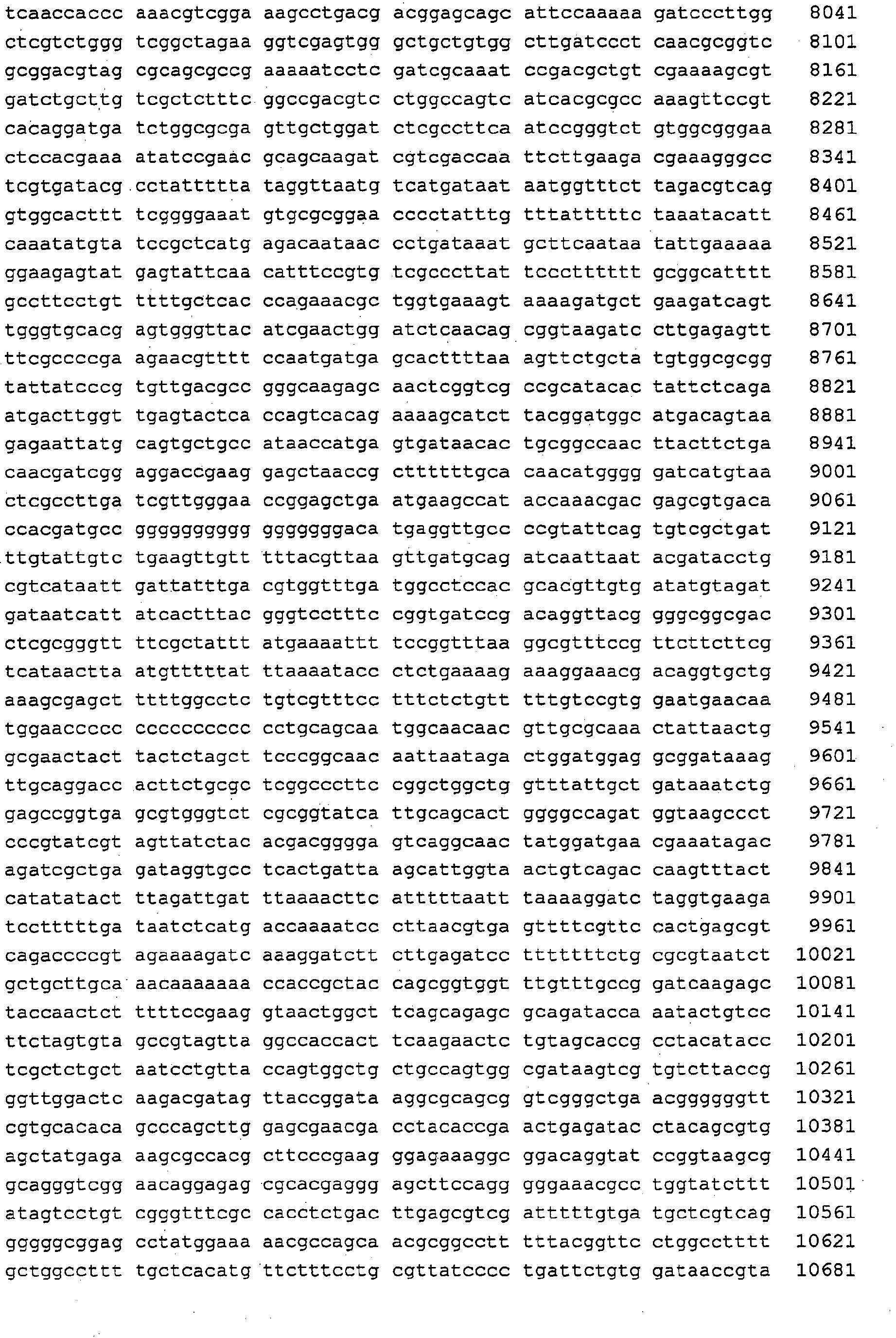


- <210> 213
<211> 638
<212> PRT
<213> Artificial - <220>
<223> Synthetic Construct - <400> 213


- <210> 214
<211> 225
<212> PRT
<213> Artificial - <220>
<223> Synthetic Construct - <400> 214


- <210> 215
<211> 271
<212> PRT
<213> Artificial - <220>
<223> Synthetic Construct - <400> 215


- <210> 216
<2I1> 12590
<212> DNA
<213> Artificial - <220>
<223> binary vector for expressing dsRed in maize - <220>
<221> repeat_region
<222> (42)..(66)
<223> Left T-DNA Border repeat region - <220>
<221> promoter
<222> (157)..(2144)
<223> Maize Ubiquitin promoter:maize ubiquitin intron - <220>
<221> CDS
<222> (2178)..(4094)
<223> ZmAHAS L2 5653(At)N (XI12) cds - <220>
<221> terminator
<222> (4095)..(5310)
<223> Maize AHASL2 [XI12] 3'/UTR sequence with terminator - <220>
<221> promoter
<222> (5368)..(6765)
<223> Sugarcane bacilliform virus [ScBV] promoter - <220>
<221> CDS
<222> (6784)..(7461)
<223> Discosoma sp. red fluorescent protein [drFP583;1] - <220>
<221> terminator
<222> (7496)..(7748)
<223> Nopaline Synthase oly-A terminator. - <220>
<221> repeat_region
<222> (7778)..(7922)
<223> pSB11's full RB - <220>
<221> rep_origin
<222> (10200)..(10480)
<223> pBR322 origin of replication [ecoli] from AF234316 pCambia2301 - <220>
<221> CDS
<222> (11339)..(12154)
<223> Kanamycin Resistance selection gene for microorganism. - <400> 216


- <210> 217
<211> 638
<212> PRT
<213> Artificial - <220>
<223> Synthetic Construct - <400> 217


- <210> 218
<211> 225
<212> PRT
<213> Artificial - <220>
<223> Synthetic Construct - <400> 218


- <210> 219
<211> 271
<212> PRT
<213> Artificial - <220>
<223> Synthetic Construct - <400> 219


- <210> 220
<211> 39
<212> DNA
<213> Artificial - <220>
<223> A short oligo contains miR172 tag - <220>
<221> misc_RNA
<222> (10)..(30)
<223> Nearly complementary to miR172 - <400> 220
agctcgccgc tgcagcatca tcaggattcc cactgctag 39 - <210> 221
<211> 38
<212> DNA
<213> Artificial - <220>
<223> miR 319 tag - <220>
<221> misc_feature
<222> (10)..(29)
<223> Nearly complementary to miR 319 - <400> 221
agctggatgc agagctccct tcaatccaaa gagcctag 38 - <210> 222
<211> 39
<212> DNA
<213> Artificial - <220>
<223> miR 396a tag - <220>
<221> misc_feature
<222> (10)..(31)
<223> complementary to miR 396a - <400> 222
agctgagggc agttcaataa agctgtggga aattgctag 39 - <210> 223
<211> 43
<212> DNA
<213> Artificial - <220>
<223> miR 398a tag - <220>
<221> misc_feature
<222> (11)..(31)
<223> Nearly complementary to miR 398a - <400> 223
agctctcctc aaggggtgac ctaagaacac caccaccacc tag 43 - <210> 224
<211> 40
<212> DNA
<213> Artificial - <220>
<223> miR 167 tag - <220>
<221> misc_feature
<222> (10)..(31)
<223> Nearly complementary to miR 167d - <400> 224
agctccctgt tagatcaggc tggcagcttg tatttcctag 40 - <210> 225
<211> 20
<212> RNA
<213> Arabidopsis thaliana - <400> 225
ugacagaaga gagugagcac 20 - <210> 226
<211> 21
<212> RNA
<213> Arabidopsis thaliana - <400> 226
cgacagaaga gagugagcac a 21 - <210> 227
<211> 21
<212> RNA
<213> Arabidopsis thaliana - <400> 227
uugacagaag aaagagagca c 21 - <210> 228
<211> 21
<212> RNA
<213> Arabidopsis thaliana - <400> 228
uugacagaag auagagagca c 21 - <210> 229
<211> 20
<212> RNA
<213> Arabidopsis thaliana - <400> 229
ucccaaaugu agacaaagca 20 - <210> 230
<211> 21
<212> RNA
<213> Arabidopsis thaliana - <400> 230
uuuggatuuga agggagcucu a 21 - <210> 231
<211> 21
<212> RNA
<213> Arabidopsis thaliana - <400> 231
uuuggauuga agggagcucu u 21 - <210> 232
<211> 21
<212> RNA
<213> Arabidopsis thaliana - <400> 232
uuuggauuga agggagcucc u 21 - <210> 233
<211> 21
<212> RNA
<213> Arabidopsis thaliana - <400> 233
uugaaaguga cuacaucggg g 21 - <210> 234
<211> 21
<212> RNA
<213> Arabidopsis thaliana - <400> 234
ucgauaaacc ucugcaucca g 21 - <210> 235
<211> 21
<212> RNA
<213> Arabidopsis thaliana - <400> 235
uggagaagca gggcacgugc a 21 - <210> 236
<211> 21
<212> RNA
<213> Arabidopsis thaliana - <400> 236
uggagaagca gggcacgugc g 21 - <210> 237
<211> 21
<212> RNA
<213> Arabidopsis thaliana - <400> 237
ucggaccagg cuucaucccc c 21 - <210> 238
<211> 21
<212> RNA
<213> Arabidopsis thaliana - <400> 238
ucggaccagg cuucauuccc c 21 - <210> 239
<211> 21
<212> RNA
<213> Arabidopsis thaliana - <400> 239
uuaagcugcc agcaugaucu u 21 - <210> 240
<211> 22
<212> RNA
<213> Arabidopsis thaliana - <400> 240
ugaagcugcc agcaugaucu gg 22 - <210> 241
<211> 21
<212> RNA
<213> Arabidopsis thaliana - <400> 241
ucgcuuggug caggucggga a 21 - <210> 242
<211> 21
<212> RNA
<213> Arabidopsis thaliana - <400> 242
cagccaagga ugacuugccg a 21 - <210> 243
<211> 21
<212> RNA
<213> Arabidopsis thaliana - <400> 243
cagccaagga ugacuugccg g 21 - <210> 244
<211> 21
<212> RNA
<213> Arabidopsis thaliana - <400> 244
ugagccaagg augacuugcc g 21 - <210> 245
<211> 21
<212> RNA
<213> Arabidopsis thaliana - <400> 245
uagccaagga ugacuugccu g 21 - <210> 246
<211> 21
<212> RNA
<213> Arabidopsis thaliana - <400> 246
ugauugagcc gugucaauau c 21 - <210> 247
<211> 21
<212> RNA
<213> Arabidopsis thaliana - <400> 247
ugauugagcc gcgccaauau c 21 - <210> 248
<211> 21
<212> RNA
<213> Arabidopsis thaliana - <400> 248
uugagccgug ccaauaucac g 21 - <210> 249
<211> 22
<212> RNA
<213> Arabidopsis thaliana - <400> 249
uucgcuugca gagagaaauc ac 22 - <210> 250
<211> 20
<212> RNA
<213> Arabidopsis thaliana - <400> 250
uuggacugaa gggagcuccc 20 - <210> 251
<211> 20
<212> RNA
<213> Arabidopsis thaliana - <400> 251
uuggacugaa gggagcuccu 20 - <210> 252
<211> 21
<212> RNA
<213> Arabidopsis thaliana - <400> 252
uccaaaggga ucgcauugau c 21 - <210> 253
<211> 20
<212> RNA
<213> Arabidopsis thaliana - <400> 253
uuggcauucu guccaccucc 20 - <210> 254
<211> 21
<212> RNA
<213> Arabidopsis thaliana - <400> 254
cugaaguguu ugggggaacu c 21 - <210> 255
<211> 21
<212> RNA
<213> Arabidopsis thaliana - <400> 255
cugaaguguu uggggggacu c 21 - <210> 256
<211> 21
<212> RNA
<213> Arabidopsis thaliana - <400> 256
uuccacagcu uucuugaacu g 21 - <210> 257
<211> 21
<212> RNA
<213> Arabidopsis thaliana - <400> 257
uuccacagcu uucuugaacu u 21 - <210> 258
<211> 21
<212> RNA
<213> Arabidopsis thaliana - <400> 258
ucauugagug cagcguugau g 21 - <210> 259
<211> 21
<212> RNA
<213> Arabidopsis thaliana - <400> 259
ucauugagug caucguugau g 21 - <210> 260
<211> 21
<212> RNA
<213> Arabidopsis thaliana - <400> 260
uguguucuca ggucaccccu u 21 - <210> 261
<211> 21
<212> RNA
<213> Arabidopsis thaliana - <400> 261
uguguucuca ggucaccccu g 21 - <210> 262
<211> 21
<212> RNA
<213> Arabidopsis thaliana - <400> 262
ugccaaagga gauuugcccu g 21 - <210> 263
<211> 21
<212> RNA
<213> Arabidopsis thaliana - <400> 263
ugccaaagga gaguugcccu g 21 - <210> 264
<211> 21
<212> RNA
<213> Arabidopsis thaliana - <400> 264
ugccaaagga gauuugcccc g 21 - <210> 265
<211> 21
<212> RNA
<213> Arabidopsis thaliana - <400> 265
ugccaaagga gauuugccuc g 21 - <210> 266
<211> 21
<212> RNA
<213> Arabidopsis thaliana - <400> 266
ugccaaagga gauuugcccg g 21
wherein expression of said chimeric RNA is suppressed in tissues, at times, and/or under environmental conditions where said endogenous miRNA is expressed. To allow for enhanced expression specificity, the microRNA (to which the sequence comprised in the nucleotide sequence to be expressed is substantially complementary) is preferably not constitutively expressed, but is varying in expression in at least one parameter selected from the group consisting of tissue, special, time, development, environmental or other exogenous factors. Preferably, the microRNA is tissue-specific expressed, spatially regulated, developmentally regulated, and/or regulated by biotic or abiotic stress factors.
wherein expression of said chimeric RNA is suppressed in tissues, at times, and/or under environmental conditions where said endogenous miRNA is expressed. It is not unusual that some 'tissue-specific' promoters having leakiness of expression in other tissues which could result in undesirable phenotype such as phytotoxicity. In other cases, it has been proved very challenge to generate tissue-specific promoter for certain application (e.g., 'syncytium-specific' promoters for achieving nematode resistance in plants). Given that some miRNAs have tissues-specific and/or temporal expression pattern, one could design a generic vector with a miRNA-tag (a short sequence substantially complementary or complementary to a given endogenous miRNA) at 3'UTR of an expression construct (e.g., comprised in a binary vector), so that leakiness of transgene expression in the tissues where miRNA are expressed will be reduced or eliminated.
Claims (10)
- A method to reduce or eliminate leakiness of transgene expression in monocotyledonous plants said method comprising the steps of:a) providing an expression construct comprising a promoter sequence functional in said plant or plant tissue and functionally linked thereto said transgene to transcribe a chimeric RNA sequence, said transgene comprisingi) an open reading frame encoding a protein of interest that is capable to confer a preferred phenotype or beneficial effect to said plant, andii) a sequence substantially complementary to an endogenous microRNA sequence,
wherein said endogenous microRNA is expressed in tissues, at times, and/or
under environmental conditions, where expression of the chimeric RNA sequence is not desired, and
wherein said endogenous microRNA is not or substantially less expressed in
tissues, at times, and/or under environmental conditions, where expression of the chimeric RNA sequence is desired,
wherein sequence i) and sequence ii) are heterologous to each other, andb) introducing said expression construct into a plant,
wherein the sequence being substantially complementary to the microRNA is positioned in a location of said transgene corresponding to the 5'-untranslated region or the 3'-untranslated region of said transgene and
wherein expression of said chimeric RNA is suppressed in tissues, at times, and/or under environmental conditions where said endogenous miRNA is expressed. - The method of claim 1, wherein said promoter is selected from the group consisting of constitutive promoters, tissue-specific or tissue-preferential promoters, and inducible promoters.
- The method of claim 1 or 2, wherein the sequence of claim 1 ii) being substantially complementary to the microRNA has an identity of at least 60% or not more than 6 mismatches over its entire sequence in comparison to the complement of microRNA sequence.
- The method of claim 3, wherein said mismatches are in the region corresponding to the 3'-region of said microRNA.
- The method of any of claim 1 to 4, wherein the microRNA is tissue-specific expressed, spatially-regulated, developmental regulated, and/or regulated by biotic or abiotic stress factors.
- The method of any of claim 1 to 5, wherein said expression construct is in a plasmid.
- The method of any of claim 1 to 6, wherein said promoter is selected from the group consisting of, tissue-specific or tissue-preferential promoters.
- The method of any of claim 1 to 7, wherein the microRNA has a natural expression profile in the plant selected from the group consisting ofa) substantially constitutive expression but no expression in seed,b) predominant expression in seeds but not in other tissues,c) drought or other abiotic stress - induced expression,d) plant pathogen - induced expression,e) temporal expression, andf) chemical induced expression.
- The method of claim 8, wherein the microRNA is a plant microRNA selected from the group consisting ofa) the sequences as described by SEQ ID NO: 1, 2, 3, 4, 5, 6, 7, 8, 9, 10, 11, 12, 13, 14, 15, 16, 17, 18, 19, 20, 21, 22, 23, 24, 25, 26, 27, 28, 29, 30, 31, 32, 33, 34, 35, 36, 37, 38, 39, 40, 41, 42, 43, 44, 45, 46, 47, 48, 49, 50, 51, 52, 53, 54, 55, 225, 226, 227, 228, 229, 230, 231, 232, 233, 234, 235, 236, 237, 238, 239, 240, 241, 242, 243, 245, 245, 246, 247, 248, 249, 250, 251, 252, 253, 254, 255, 256, 257, 258, 259, 260, 261, 262, 263, 264, 265, and 266 andb) derivatives of the sequences described by SEQ ID NO: 1, 2, 3, 4, 5, 6, 7, 8, 9, 10, 11, 12, 13, 14, 15, 16, 17, 18, 19, 20, 21, 22, 23, 24, 25, 26, 27, 28, 29, 30, 31, 32, 33, 34, 35, 36, 37, 38, 39, 40, 41, 42, 43, 44, 45, 46, 47, 48, 49, 50, 51, 52, 53, 54, 55, 225, 226, 227, 228, 229, 230, 231, 232, 233, 234, 235, 236, 237, 238, 239, 240, 241, 242, 243, 245, 245, 246, 247, 248, 249, 250, 251, 252, 253, 254, 255, 256, 257, 258, 259, 260, 261, 262, 263, 264, 265, and 266
- The method of claim 9, wherein the derivative microRNA has an identity of at least 70% to a miRNA as described by any of SEQ ID NO: 1, 2, 3, 4, 5, 6, 7, 8, 9, 10, 11, 12, 13, 14, 15, 16, 17, 18, 19, 20, 21, 22, 23, 24, 25, 26, 27, 28, 29, 30, 31, 32, 33, 34, 35, 36, 37, 38, 39, 40, 41, 42, 43, 44, 45, 46, 47, 48, 49, 50, 51, 52, 53, 54, 55, 225, 226, 227, 228, 229, 230, 231, 232, 233, 234, 235, 236, 237, 238, 239, 240, 241, 242, 243, 245, 245, 246, 247, 248, 249, 250, 251, 252, 253, 254, 255, 256, 257, 258, 259, 260, 261, 262, 263, 264, 265, and 266.
Applications Claiming Priority (2)
| Application Number | Priority Date | Filing Date | Title |
|---|---|---|---|
| US67297605P | 2005-04-19 | 2005-04-19 | |
| PCT/EP2006/061604 WO2006111512A1 (en) | 2005-04-19 | 2006-04-13 | Improved methods controlling gene expression |
Publications (2)
| Publication Number | Publication Date |
|---|---|
| EP1874936A1 EP1874936A1 (en) | 2008-01-09 |
| EP1874936B1 true EP1874936B1 (en) | 2013-10-30 |
Family
ID=36754673
Family Applications (1)
| Application Number | Title | Priority Date | Filing Date |
|---|---|---|---|
| EP06754739.8A Expired - Lifetime EP1874936B1 (en) | 2005-04-19 | 2006-04-13 | Improved methods controlling gene expression |
Country Status (9)
| Country | Link |
|---|---|
| US (2) | US9085774B2 (en) |
| EP (1) | EP1874936B1 (en) |
| CN (1) | CN101203611B (en) |
| AU (1) | AU2006237317B8 (en) |
| BR (1) | BRPI0608829A2 (en) |
| CA (1) | CA2604807C (en) |
| IL (1) | IL186542A0 (en) |
| WO (1) | WO2006111512A1 (en) |
| ZA (1) | ZA200709897B (en) |
Families Citing this family (120)
| Publication number | Priority date | Publication date | Assignee | Title |
|---|---|---|---|---|
| CN101942480A (en) * | 2004-12-20 | 2011-01-12 | 巴斯福植物科学有限公司 | The nucleic acid molecule of encoding fatty acid desaturase genes from plants and using method thereof |
| US20060200878A1 (en) | 2004-12-21 | 2006-09-07 | Linda Lutfiyya | Recombinant DNA constructs and methods for controlling gene expression |
| US20070199095A1 (en) | 2005-10-13 | 2007-08-23 | Edwards Allen | Methods for producing hybrid seed |
| US8697949B2 (en) | 2004-12-21 | 2014-04-15 | Monsanto Technology Llc | Temporal regulation of gene expression by MicroRNAs |
| WO2006107826A2 (en) | 2005-04-04 | 2006-10-12 | The Board Of Regents Of The University Of Texas System | Micro-rna's that regulate muscle cells |
| BRPI0714794A2 (en) | 2006-08-01 | 2013-05-21 | Univ Texas | identification of a micro-rna that activates beta-myosin heavy chain expression |
| ES2655700T3 (en) | 2006-08-31 | 2018-02-21 | Monsanto Technology, Llc | Small RNAs in phase |
| EP2664673A3 (en) * | 2006-10-05 | 2014-02-19 | E. I. du Pont de Nemours and Company | Maize microRNA sequences |
| AU2007352460C1 (en) | 2006-10-12 | 2013-05-23 | Monsanto Technology, Llc | Plant microRNAs and methods of use thereof |
| WO2008071959A1 (en) * | 2006-12-12 | 2008-06-19 | Oxford Biomedica (Uk) Limited | Lentiviral vectors comprising micrornas |
| EP2136846A4 (en) * | 2007-03-26 | 2011-04-13 | Crc For Asthma And Airways Ltd | THERAPEUTIC TARGETS AND MOLECULES |
| NZ583025A (en) | 2007-07-31 | 2012-06-29 | Univ Texas | Micro-rnas that control myosin expression and myofiber identity |
| ES2621161T3 (en) | 2007-07-31 | 2017-07-03 | The Board Of Regents Of The University Of Texas System | Family of micro-RNA that modulates fibrosis and its uses |
| CA2704043C (en) | 2007-10-29 | 2018-09-18 | Rosetta Genomics Ltd. | Targeting micrornas for the treatment of liver cancer |
| US8097712B2 (en) | 2007-11-07 | 2012-01-17 | Beelogics Inc. | Compositions for conferring tolerance to viral disease in social insects, and the use thereof |
| MX2010005166A (en) | 2007-11-09 | 2010-10-07 | Univ Texas | Micro-rnas of the mir-15 family modulate cardiomyocyte survival and cardiac repair. |
| CN101952443B (en) * | 2007-12-21 | 2014-11-12 | 纳幕尔杜邦公司 | Drought tolerant plants and related constructs and methods involving genes encoding miR827 |
| JP5653899B2 (en) | 2008-03-17 | 2015-01-14 | ボード・オブ・リージエンツ,ザ・ユニバーシテイ・オブ・テキサス・システム | Identification of microRNAs involved in the maintenance and regeneration of neuromuscular synapses |
| GB0807424D0 (en) * | 2008-04-23 | 2008-05-28 | Isis Innovation | Virus |
| WO2009142602A1 (en) * | 2008-05-19 | 2009-11-26 | Agency For Science, Technology And Research | Nucleic acid molecule and method of targeting gene expression to gliomas |
| AU2010210605B2 (en) | 2009-02-04 | 2015-08-13 | Board Of Regents, The University Of Texas System | Dual targeting of miR-208 and miR-499 in the treatment of cardiac disorders |
| US8962584B2 (en) | 2009-10-14 | 2015-02-24 | Yissum Research Development Company Of The Hebrew University Of Jerusalem, Ltd. | Compositions for controlling Varroa mites in bees |
| PE20130649A1 (en) | 2010-03-08 | 2013-07-13 | Monsanto Technology Llc | POLYNUCLEOTIDE MOLECULES FOR GENETIC REGULATION IN PLANTS |
| CA3075333C (en) | 2010-03-12 | 2021-10-19 | Monsanto Technology Llc | Plant health compositions comprising a water-soluble pesticide and a water-insoluble agrochemical |
| EP2385129A1 (en) * | 2010-05-03 | 2011-11-09 | BASF Plant Science Company GmbH | Enhanced methods for gene regulation in plants |
| NZ605420A (en) | 2010-07-06 | 2015-02-27 | Interna Technologies Bv | Mirna and its diagnostic and therapeutic uses in diseases or conditions associated with melanoma, or in diseases or conditions associated with activated braf pathway |
| CN102199619B (en) * | 2010-11-29 | 2013-05-15 | 北京未名凯拓作物设计中心有限公司 | Transformation method utilizing red fluorescent protein as selection marker of rice transformation |
| AR084319A1 (en) | 2010-12-15 | 2013-05-08 | Miragen Therapeutics | MicroRNA INHIBITORS (miRNA OR miR) THAT INCLUDE BLOCKED NUCLEOTIDES |
| EP2474617A1 (en) | 2011-01-11 | 2012-07-11 | InteRNA Technologies BV | Mir for treating neo-angiogenesis |
| CN102168086B (en) * | 2011-03-14 | 2012-09-05 | 复旦大学 | Phalaenopsis miR172 coding sequence and application thereof |
| US20120272406A1 (en) * | 2011-04-21 | 2012-10-25 | Basf Plant Science Company Gmbh | Methods of modifying lignin biosynthesis and improving digestibility |
| PE20141518A1 (en) | 2011-07-01 | 2014-11-17 | Monsanto Technology Llc | METHODS AND COMPOSITIONS FOR THE SELECTIVE REGULATION OF PROTEIN EXPRESSION |
| EP2755466A4 (en) | 2011-09-13 | 2015-04-15 | Monsanto Technology Llc | METHODS AND COMPOSITIONS FOR CONTROLLING WEEDS |
| US10760086B2 (en) | 2011-09-13 | 2020-09-01 | Monsanto Technology Llc | Methods and compositions for weed control |
| MX343072B (en) | 2011-09-13 | 2016-10-21 | Monsanto Technology Llc | Methods and compositions for weed control. |
| WO2013040116A1 (en) | 2011-09-13 | 2013-03-21 | Monsanto Technology Llc | Methods and compositions for weed control |
| CN103957697B (en) | 2011-09-13 | 2017-10-24 | 孟山都技术公司 | Methods and compositions for weed control |
| US10829828B2 (en) | 2011-09-13 | 2020-11-10 | Monsanto Technology Llc | Methods and compositions for weed control |
| US9840715B1 (en) | 2011-09-13 | 2017-12-12 | Monsanto Technology Llc | Methods and compositions for delaying senescence and improving disease tolerance and yield in plants |
| US10806146B2 (en) | 2011-09-13 | 2020-10-20 | Monsanto Technology Llc | Methods and compositions for weed control |
| US9920326B1 (en) | 2011-09-14 | 2018-03-20 | Monsanto Technology Llc | Methods and compositions for increasing invertase activity in plants |
| WO2013053070A1 (en) * | 2011-10-09 | 2013-04-18 | Shanghai Institutes For Biological Sciences, Cas | Heat tolerance microrna |
| CA2850223A1 (en) | 2011-10-06 | 2013-04-11 | Eva Van Rooij | Control of whole body energy homeostasis by microrna regulation |
| CN102676525A (en) * | 2012-05-17 | 2012-09-19 | 复旦大学 | Paddy rice miR399d and application thereof |
| US10240162B2 (en) | 2012-05-24 | 2019-03-26 | A.B. Seeds Ltd. | Compositions and methods for silencing gene expression |
| US9163235B2 (en) | 2012-06-21 | 2015-10-20 | MiRagen Therapeutics, Inc. | Inhibitors of the miR-15 family of micro-RNAs |
| CN104685056A (en) | 2012-06-21 | 2015-06-03 | 米拉根医疗股份有限公司 | Oligonucleotide-based inhibitors comprising locked nucleic acid motifs |
| AR093058A1 (en) | 2012-10-18 | 2015-05-13 | Monsanto Technology Llc | METHODS AND COMPOSITIONS FOR PLANT PEST CONTROL |
| US10190126B2 (en) | 2012-10-28 | 2019-01-29 | A.B. Seeds Ltd. | Transgenic plants with modified sugar content and methods of generating same |
| ES2921623T3 (en) | 2012-11-26 | 2022-08-30 | Modernatx Inc | terminally modified RNA |
| US20150329860A1 (en) * | 2012-12-18 | 2015-11-19 | The Rockefeller University | Gene silencing |
| UA118841C2 (en) | 2013-01-01 | 2019-03-25 | Ей.Бі. СІДС ЛТД. | METHOD OF FORMATION OF PLANTS THAT HAVE AN IMMEDIATE RESISTANCE TO THE PEST |
| US10683505B2 (en) | 2013-01-01 | 2020-06-16 | Monsanto Technology Llc | Methods of introducing dsRNA to plant seeds for modulating gene expression |
| JP2016504050A (en) * | 2013-01-17 | 2016-02-12 | モデルナ セラピューティクス インコーポレイテッドModerna Therapeutics,Inc. | Signal sensor polynucleotide for modification of cell phenotype |
| US10000767B2 (en) | 2013-01-28 | 2018-06-19 | Monsanto Technology Llc | Methods and compositions for plant pest control |
| EP2967082A4 (en) | 2013-03-13 | 2016-11-02 | Monsanto Technology Llc | METHODS AND COMPOSITIONS FOR USE AGAINST WEED CONTROL |
| WO2014164761A1 (en) | 2013-03-13 | 2014-10-09 | Monsanto Technology Llc | Methods and compositions for weed control |
| US20140283211A1 (en) | 2013-03-14 | 2014-09-18 | Monsanto Technology Llc | Methods and Compositions for Plant Pest Control |
| US10568328B2 (en) | 2013-03-15 | 2020-02-25 | Monsanto Technology Llc | Methods and compositions for weed control |
| AU2014267397A1 (en) | 2013-05-14 | 2015-11-19 | Bayer Cropscience Nv | Enhanced selective expression of transgenes in fiber producing plants |
| JP6668236B2 (en) | 2013-07-19 | 2020-03-18 | モンサント テクノロジー エルエルシー | Composition for controlling LEPTINOTARSA and method therefor |
| US9850496B2 (en) | 2013-07-19 | 2017-12-26 | Monsanto Technology Llc | Compositions and methods for controlling Leptinotarsa |
| US20150121569A1 (en) * | 2013-10-31 | 2015-04-30 | Centre National De La Recherche Scientifique | Micropeptides and use thereof for modulating gene expression |
| MX390055B (en) | 2013-11-04 | 2025-03-20 | Monsanto Technology Llc | COMPOSITIONS AND METHODS FOR CONTROLLING INFESTATIONS OF ARTHROPOD PESTS AND PARASITES. |
| UA119253C2 (en) | 2013-12-10 | 2019-05-27 | Біолоджикс, Інк. | METHOD FOR VARROA TREATMENT AND VEGETABLES |
| US10683513B2 (en) * | 2013-12-31 | 2020-06-16 | Dow Agrosciences Llc | Tissue-specific expression and hybrid plant production |
| CN105979770B (en) | 2014-01-15 | 2019-07-05 | 孟山都技术公司 | Methods and compositions for weed control using EPSPS polynucleotides |
| BR112016022711A2 (en) | 2014-04-01 | 2017-10-31 | Monsanto Technology Llc | compositions and methods for insect pest control |
| WO2015200223A1 (en) | 2014-06-23 | 2015-12-30 | Monsanto Technology Llc | Compositions and methods for regulating gene expression via rna interference |
| US11807857B2 (en) | 2014-06-25 | 2023-11-07 | Monsanto Technology Llc | Methods and compositions for delivering nucleic acids to plant cells and regulating gene expression |
| AU2015296700B2 (en) | 2014-07-29 | 2021-10-21 | Monsanto Technology Llc | Compositions and methods for controlling insect pests |
| CN105528532B (en) * | 2014-09-30 | 2019-08-16 | 深圳华大基因科技有限公司 | A kind of characteristic analysis method in rna editing site |
| CN107636003A (en) | 2015-01-20 | 2018-01-26 | 米拉根医疗股份有限公司 | Inhibitor of miR 92 and application thereof |
| US10968449B2 (en) | 2015-01-22 | 2021-04-06 | Monsanto Technology Llc | Compositions and methods for controlling Leptinotarsa |
| CN104830859B (en) * | 2015-04-24 | 2017-10-10 | 浙江大学 | A kind of tea tree miRNA and its application |
| US10883103B2 (en) | 2015-06-02 | 2021-01-05 | Monsanto Technology Llc | Compositions and methods for delivery of a polynucleotide into a plant |
| EP3302030A4 (en) | 2015-06-03 | 2019-04-24 | Monsanto Technology LLC | METHODS AND COMPOSITIONS FOR THE INTRODUCTION OF NUCLEIC ACIDS IN PLANTS |
| EP3359670B2 (en) | 2015-10-05 | 2024-02-14 | ModernaTX, Inc. | Methods for therapeutic administration of messenger ribonucleic acid drugs |
| US20190282679A1 (en) * | 2016-04-18 | 2019-09-19 | Rima McLeod | Toxoplasma gondii vaccines and their use |
| SG11201906795SA (en) | 2017-01-28 | 2019-08-27 | Inari Agriculture Inc | Novel plant cells, plants, and seeds |
| JP2020513192A (en) * | 2017-03-29 | 2020-05-07 | 中国医学科学院基礎医学研究所 | Small RNA and its application in the prevention and / or treatment of fibroproliferative diseases and / or syndromes |
| CN107312845B (en) * | 2017-07-07 | 2020-11-03 | 华中农业大学 | Primer, kit and identification method for identifying wax-free and non-heading cabbage |
| US11603536B2 (en) | 2017-09-29 | 2023-03-14 | Inari Agriculture Technology, Inc. | Methods for efficient maize genome editing |
| US11746355B2 (en) * | 2017-10-17 | 2023-09-05 | The Regents Of The University Of California | Controlling fungal pathogens using RNAi-based strategy |
| US11802288B1 (en) | 2018-01-29 | 2023-10-31 | Inari Agriculture Technology, Inc. | Methods for efficient soybean genome editing |
| US11926835B1 (en) | 2018-01-29 | 2024-03-12 | Inari Agriculture Technology, Inc. | Methods for efficient tomato genome editing |
| US11220694B1 (en) | 2018-01-29 | 2022-01-11 | Inari Agriculture, Inc. | Rice cells and rice plants |
| CN108588069B (en) * | 2018-03-07 | 2021-11-30 | 承德医学院 | Precursor gene of mulberry miR171a and application thereof in enhancing salt tolerance of plants |
| US11866719B1 (en) | 2018-06-04 | 2024-01-09 | Inari Agriculture Technology, Inc. | Heterologous integration of regulatory elements to alter gene expression in wheat cells and wheat plants |
| CN109234305B (en) * | 2018-07-16 | 2021-08-03 | 浙江理工大学 | Method for improving cotton character |
| CN108834900B (en) * | 2018-07-31 | 2022-03-11 | 安徽农业大学 | Cultivation method for inhibiting oxidative browning and endophyte contamination of explants in tea plant tissue culture |
| CN109867715B (en) * | 2019-02-28 | 2022-06-17 | 中国科学院昆明植物研究所 | Application of a mutant of chloroplast protein and ATPase enzyme activity in improving plant stress resistance |
| CN110699375A (en) * | 2019-03-07 | 2020-01-17 | 山东舜丰生物科技有限公司 | Genetic improvement method for specifically enhancing seed dormancy and application thereof |
| AR118478A1 (en) * | 2019-03-28 | 2021-10-06 | Syngenta Crop Protection Ag | MODULATION OF TRANSGENIC EXPRESSION |
| CN110295169B (en) * | 2019-06-27 | 2022-11-08 | 江西省农业科学院农业应用微生物研究所(江西省农村能源研究中心) | MiRNA and application thereof in killing Nilaparvata lugens |
| CN110423749A (en) * | 2019-07-17 | 2019-11-08 | 中国农业科学院棉花研究所 | Cotton fiber length correlation microRNA160 and its precursor dna and application |
| TWI738052B (en) * | 2019-09-06 | 2021-09-01 | 葉開溫 | Dna cassett construct and method for silencing phytoene synthase gene expression in a specific plant tissues |
| CN112553245B (en) * | 2019-09-25 | 2022-06-07 | 扬州大学 | Novel application of OsPIL16 gene |
| CN110714013B (en) * | 2019-09-29 | 2022-08-16 | 南京农业大学 | Application of soybean E2 ubiquitin-conjugating enzyme gene GmUBC1 |
| CN110476817A (en) * | 2019-09-29 | 2019-11-22 | 上海市农业科学院 | A kind of iris radioinduction dose screening method |
| CN110982921B (en) * | 2019-12-13 | 2020-10-27 | 南京林业大学 | Application of cymbidium miR159a in accelerating plant life cycle |
| EP3868882A1 (en) * | 2020-02-21 | 2021-08-25 | European Molecular Biology Laboratory | Archaeal pyrrolysyl trna synthetases for orthogonal use |
| CN111249299B (en) * | 2020-03-31 | 2022-03-22 | 南京财经大学 | Application of soybean RNA extract in preparing medicine for preventing and treating enteritis |
| WO2022020378A1 (en) * | 2020-07-20 | 2022-01-27 | Flagship Pioneering, Inc. | Viroid-derived polynucleotides for modifications of plants |
| CN112007043B (en) * | 2020-08-24 | 2021-07-20 | 谢琦 | Medicine or composition for resisting colorectal cancer |
| CN112575107A (en) * | 2020-12-21 | 2021-03-30 | 北京林业大学 | Reference gene for lily miRNA detection and application thereof |
| CN113430197B (en) * | 2021-05-17 | 2022-07-29 | 西北农林科技大学 | Movable miRNA for promoting root development and drought resistance of rootstock and identification method |
| WO2023010143A2 (en) * | 2021-07-30 | 2023-02-02 | The Board Of Trustees Of The Leland Stanford Junior University | Genetically-encoded volatile synthetic biomarkers for breath-based cancer detection |
| CN113564167B (en) * | 2021-07-30 | 2023-07-07 | 中山大学 | Rice insect-resistant microRNA and application thereof |
| CN113603747B (en) * | 2021-08-27 | 2023-11-07 | 上海交通大学 | Application of polypeptides encoded by Pri-miRNA in improving the cold resistance of grapes |
| CN113881685B (en) * | 2021-10-09 | 2024-03-29 | 江苏省农业科学院 | Gene PpHSP20-like1 for promoting plant organ to produce red color and application thereof |
| CN115927377B (en) * | 2022-09-22 | 2023-08-08 | 北京林业大学 | Wet-added pine age marker gene PtAP2L3, and screening method and application thereof |
| CN115804788B (en) * | 2022-12-22 | 2024-12-17 | 南京中医药大学 | Application of wolfberry miRNA in preparation of medicine or health care product for treating osteoporosis |
| CN118697757B (en) * | 2024-01-03 | 2025-06-13 | 中国科学院生物物理研究所 | Application of miRNA168a |
| CN118516351B (en) * | 2024-04-26 | 2025-03-21 | 海南省农业科学院三亚研究院(海南省实验动物研究中心) | A promoter element derived from porcine HSP40 gene and its application |
| CN118256506B (en) * | 2024-05-30 | 2024-08-13 | 上海惠盾因泰生物科技有限公司 | Artificially designed 5' UTR structure enhances expression of target gene |
| CN118910051A (en) * | 2024-07-24 | 2024-11-08 | 广东省农业科学院茶叶研究所 | Application of miR396-x in regulating content of theaflavine in purple bud |
| CN118910130A (en) * | 2024-08-07 | 2024-11-08 | 武汉大学 | Application of rice miR169i-5p.2 in brown planthopper resistance of rice |
| CN119614566B (en) * | 2024-11-26 | 2026-01-16 | 华南师范大学 | Application of arabidopsis miR168a-5p in pest control |
| CN119570844B (en) * | 2024-12-12 | 2026-02-03 | 中国农业大学 | Air pore density related MicroRNA probe in drought-resistant water-saving corn variety and detection method and application thereof |
Citations (6)
| Publication number | Priority date | Publication date | Assignee | Title |
|---|---|---|---|---|
| WO2003093441A2 (en) * | 2002-05-03 | 2003-11-13 | Duke University | A method of regulating gene expression |
| WO2005035769A2 (en) * | 2003-10-09 | 2005-04-21 | E. I. Du Pont De Nemours And Company | Gene silencing by using micro-rna molecules |
| WO2006073727A2 (en) * | 2004-12-21 | 2006-07-13 | Monsanto Technology, Llc | Recombinant dna constructs and methods for controlling gene expression |
| WO2006074400A2 (en) * | 2005-01-07 | 2006-07-13 | State Of Oregon Acting By And Through The State Board Of Higher Education On Behalf Of Oregon State University | Method to trigger rna interference |
| WO2006138638A1 (en) * | 2005-06-17 | 2006-12-28 | Pioneer Hi-Bred International, Inc. | Methods and compositions for gene silencing |
| WO2007047016A2 (en) * | 2005-10-13 | 2007-04-26 | Monsanto Technology, Llc | Methods for producing hybrid seed |
Family Cites Families (97)
| Publication number | Priority date | Publication date | Assignee | Title |
|---|---|---|---|---|
| US4407956A (en) | 1981-03-13 | 1983-10-04 | The Regents Of The University Of California | Cloned cauliflower mosaic virus DNA as a plant vehicle |
| CA1192510A (en) | 1981-05-27 | 1985-08-27 | Lawrence E. Pelcher | Rna plant virus vector or portion thereof, a method of construction thereof, and a method of producing a gene derived product therefrom |
| NL8200523A (en) | 1982-02-11 | 1983-09-01 | Univ Leiden | METHOD FOR TRANSFORMING IN VITRO PLANT PROTOPLASTS WITH PLASMIDE DNA. |
| US4536475A (en) | 1982-10-05 | 1985-08-20 | Phytogen | Plant vector |
| EP0290799B9 (en) | 1983-01-13 | 2004-09-01 | Max-Planck-Gesellschaft zur Förderung der Wissenschaften e.V. | Transgenic dicotyledonous plant cells and plants |
| WO1984002913A1 (en) | 1983-01-17 | 1984-08-02 | Monsanto Co | Chimeric genes suitable for expression in plant cells |
| US5352605A (en) | 1983-01-17 | 1994-10-04 | Monsanto Company | Chimeric genes for transforming plant cells using viral promoters |
| NL8300698A (en) | 1983-02-24 | 1984-09-17 | Univ Leiden | METHOD FOR BUILDING FOREIGN DNA INTO THE NAME OF DIABIC LOBAL PLANTS; AGROBACTERIUM TUMEFACIENS BACTERIA AND METHOD FOR PRODUCTION THEREOF; PLANTS AND PLANT CELLS WITH CHANGED GENETIC PROPERTIES; PROCESS FOR PREPARING CHEMICAL AND / OR PHARMACEUTICAL PRODUCTS. |
| US5504200A (en) | 1983-04-15 | 1996-04-02 | Mycogen Plant Science, Inc. | Plant gene expression |
| WO1985001856A1 (en) | 1983-11-03 | 1985-05-09 | Johannes Martenis Jacob De Wet | Method for the transfer of exogenous genes in plants using pollen as a vector |
| US5420034A (en) | 1986-07-31 | 1995-05-30 | Calgene, Inc. | Seed-specific transcriptional regulation |
| US4683195A (en) | 1986-01-30 | 1987-07-28 | Cetus Corporation | Process for amplifying, detecting, and/or-cloning nucleic acid sequences |
| DK162399C (en) | 1986-01-28 | 1992-03-23 | Danisco | PROCEDURE FOR EXPRESSION OF GENES IN BELGIUM PLANT CELLS, DNA FRAGMENT, RECOMBINED DNA FRAGMENT AND PLASMID FOR USE IN EXERCISING THE PROCEDURE |
| US4975374A (en) | 1986-03-18 | 1990-12-04 | The General Hospital Corporation | Expression of wild type and mutant glutamine synthetase in foreign hosts |
| US4962028A (en) | 1986-07-09 | 1990-10-09 | Dna Plant Technology Corporation | Plant promotors |
| IL84459A (en) | 1986-12-05 | 1993-07-08 | Agracetus | Apparatus and method for the injection of carrier particles carrying genetic material into living cells |
| KR0154872B1 (en) | 1987-12-21 | 1998-10-15 | 로버트 에이. 아미테이지 | Acrobacterium Mediated Transformation of Germinating Plant Seeds |
| US5922602A (en) | 1988-02-26 | 1999-07-13 | Biosource Technologies, Inc. | Cytoplasmic inhibition of gene expression |
| US5789214A (en) | 1988-03-08 | 1998-08-04 | Novartis Finance Corporation | Method of inducing gene transcription in a plant |
| US5614395A (en) | 1988-03-08 | 1997-03-25 | Ciba-Geigy Corporation | Chemically regulatable and anti-pathogenic DNA sequences and uses thereof |
| EP0333033A1 (en) | 1988-03-09 | 1989-09-20 | Meiji Seika Kaisha Ltd. | Glutamine synthesis gene and glutamine synthetase |
| NZ228320A (en) | 1988-03-29 | 1991-06-25 | Du Pont | Nucleic acid promoter fragments of the promoter region homologous to the em gene of wheat, dna constructs therefrom and plants thereof |
| WO1989012102A1 (en) | 1988-06-01 | 1989-12-14 | The Texas A&M University System | Method for transforming plants via the shoot apex |
| DE3843628A1 (en) | 1988-12-21 | 1990-07-05 | Inst Genbiologische Forschung | Wound-inducible and potato-tuber-specific transcriptional regulation |
| EP0388186A1 (en) | 1989-03-17 | 1990-09-19 | E.I. Du Pont De Nemours And Company | External regulation of gene expression |
| US5106739A (en) | 1989-04-18 | 1992-04-21 | Calgene, Inc. | CaMv 355 enhanced mannopine synthase promoter and method for using same |
| IL95132A0 (en) | 1989-07-19 | 1991-06-10 | Calgene Inc | Fruit-specific transcriptional factors |
| US5322783A (en) | 1989-10-17 | 1994-06-21 | Pioneer Hi-Bred International, Inc. | Soybean transformation by microparticle bombardment |
| GB9005772D0 (en) | 1990-03-14 | 1990-05-09 | Cambridge Advanced Tech | Plant promoter |
| ES2163392T3 (en) | 1990-03-16 | 2002-02-01 | Calgene Llc | NEW SEQUENCES EXPRESSED PREFERREDLY IN THE DEVELOPMENT OF PRECED SEEDS, AND PROCEDURES RELATED TO THEMSELVES. |
| US5451513A (en) | 1990-05-01 | 1995-09-19 | The State University of New Jersey Rutgers | Method for stably transforming plastids of multicellular plants |
| US5187267A (en) | 1990-06-19 | 1993-02-16 | Calgene, Inc. | Plant proteins, promoters, coding sequences and use |
| EP0536330B1 (en) | 1990-06-25 | 2002-02-27 | Monsanto Technology LLC | Glyphosate tolerant plants |
| US5225341A (en) | 1990-07-19 | 1993-07-06 | The Regents Of The University Of California | Biologically safe plant transformation system using a ds transposon |
| US5639949A (en) | 1990-08-20 | 1997-06-17 | Ciba-Geigy Corporation | Genes for the synthesis of antipathogenic substances |
| US5633435A (en) | 1990-08-31 | 1997-05-27 | Monsanto Company | Glyphosate-tolerant 5-enolpyruvylshikimate-3-phosphate synthases |
| ATE318318T1 (en) | 1990-11-23 | 2006-03-15 | Bayer Bioscience Nv | METHOD FOR TRANSFORMING MONOCOTYL PLANTS |
| GB9105420D0 (en) | 1991-03-14 | 1991-05-01 | Ici Plc | Expression of genes in transgenic plants |
| GB9114259D0 (en) | 1991-07-02 | 1991-08-21 | Ici Plc | Plant derived enzyme and dna sequences |
| ATE212671T1 (en) | 1991-08-01 | 2002-02-15 | Large Scale Biology Corp | RECOMBINED VIRAL NUCLEIC ACID FROM PLANTS |
| DK152291D0 (en) | 1991-08-28 | 1991-08-28 | Danisco | PROCEDURE AND CHEMICAL RELATIONS |
| UA48104C2 (en) | 1991-10-04 | 2002-08-15 | Новартіс Аг | Dna fragment including sequence that codes an insecticide protein with optimization for corn, dna fragment providing directed preferable for the stem core expression of the structural gene of the plant related to it, dna fragment providing specific for the pollen expression of related to it structural gene in the plant, recombinant dna molecule, method for obtaining a coding sequence of the insecticide protein optimized for corn, method of corn plants protection at least against one pest insect |
| US5593874A (en) | 1992-03-19 | 1997-01-14 | Monsanto Company | Enhanced expression in plants |
| AU3901993A (en) | 1992-04-13 | 1993-11-18 | Zeneca Limited | Dna constructs and plants incorporating them |
| US5428148A (en) | 1992-04-24 | 1995-06-27 | Beckman Instruments, Inc. | N4 - acylated cytidinyl compounds useful in oligonucleotide synthesis |
| DE69334225D1 (en) | 1992-07-07 | 2008-07-31 | Japan Tobacco Inc | METHOD FOR TRANSFORMING A MONOCOTYLEDONE PLANT |
| CA2158473A1 (en) | 1993-03-22 | 1994-09-29 | Umi Kalsom Abu-Bakar | Dna, dna constructs, cells and plants derived therefrom |
| GB9310177D0 (en) * | 1993-05-18 | 1993-06-30 | Cambridge Advanced Tech | Cell specific necrosis |
| DE69433809T2 (en) | 1993-09-03 | 2005-06-16 | Japan Tobacco Inc. | PROCESS FOR TRANSFORMATION OF MONOCOTYLEDONES USING THE SHIELD OF UNREQUIRED EMBRYOES |
| US5470353A (en) | 1993-10-20 | 1995-11-28 | Hollister Incorporated | Post-operative thermal blanket |
| GB9324707D0 (en) | 1993-12-02 | 1994-01-19 | Olsen Odd Arne | Promoter |
| CN1048254C (en) | 1993-12-09 | 2000-01-12 | 托马斯杰弗逊大学 | Compounds for introducing predetermined alterations into target genes |
| US5576198A (en) | 1993-12-14 | 1996-11-19 | Calgene, Inc. | Controlled expression of transgenic constructs in plant plastids |
| GB9403512D0 (en) | 1994-02-24 | 1994-04-13 | Olsen Odd Arne | Promoter |
| US5545817A (en) | 1994-03-11 | 1996-08-13 | Calgene, Inc. | Enhanced expression in a plant plastid |
| US5545818A (en) | 1994-03-11 | 1996-08-13 | Calgene Inc. | Expression of Bacillus thuringiensis cry proteins in plant plastids |
| GB9421286D0 (en) | 1994-10-21 | 1994-12-07 | Danisco | Promoter |
| US5879941A (en) | 1995-10-06 | 1999-03-09 | University Of Florida | Polypeptides and polynucleotides relating to the α-and β-subunits of a glutamate dehydrogenase and methods of use |
| DE59610869D1 (en) | 1995-10-17 | 2004-01-29 | Inventio Ag | Safety device for multimobile elevator groups |
| US5693512A (en) | 1996-03-01 | 1997-12-02 | The Ohio State Research Foundation | Method for transforming plant tissue by sonication |
| ATE301187T1 (en) | 1996-03-06 | 2005-08-15 | Univ Rutgers | PLASTIC TRANSFORMATION IN ARABIDOPSIS THALIANA |
| AR006928A1 (en) | 1996-05-01 | 1999-09-29 | Pioneer Hi Bred Int | AN ISOLATED DNA MOLECULA CODING A GREEN FLUORESCENT PROTEIN AS A TRACEABLE MARKER FOR TRANSFORMATION OF PLANTS, A METHOD FOR THE PRODUCTION OF TRANSGENIC PLANTS, A VECTOR OF EXPRESSION, A TRANSGENIC PLANT AND CELLS OF SUCH PLANTS. |
| IN1997CH00924A (en) | 1996-05-03 | 2005-03-04 | Syngenta Mogen Bv | Regulating metabolism by modifying the level of trehalose-6-phosphate |
| DE19619353A1 (en) | 1996-05-14 | 1997-11-20 | Bosch Gmbh Robert | Method for producing an integrated optical waveguide component and arrangement |
| US6420629B1 (en) | 1996-09-09 | 2002-07-16 | B.C. Research Inc. | Process of increasing plant growth and yield and modifying cellulose production in plants |
| US6025192A (en) | 1996-09-20 | 2000-02-15 | Cold Spring Harbor Laboratory | Modified retroviral vectors |
| US6255071B1 (en) | 1996-09-20 | 2001-07-03 | Cold Spring Harbor Laboratory | Mammalian viral vectors and their uses |
| DE19644478A1 (en) | 1996-10-25 | 1998-04-30 | Basf Ag | Leaf-specific expression of genes in transgenic plants |
| US5955361A (en) | 1996-11-20 | 1999-09-21 | Pioneer Hi-Bred International, Inc. | P gene promoter constructs for floral-tissue preferred gene expression |
| EP1015556A4 (en) | 1996-12-13 | 2004-05-26 | Gen Hospital Corp | TRANSGENIC PLANTS IN THE EVENT OF ENVIRONMENTAL AGGRESSIONS |
| US5998701A (en) | 1997-06-04 | 1999-12-07 | Her Majesty The Queen In Right Of Canada As Represented By The Department Of Agriculture | Potatoes having improved quality characteristics and methods for their production |
| GB9706381D0 (en) | 1997-03-27 | 1997-05-14 | Cambridge Advanced Tech | Improvements relating to the specificity of gene expression |
| US5977436A (en) | 1997-04-09 | 1999-11-02 | Rhone Poulenc Agrochimie | Oleosin 5' regulatory region for the modification of plant seed lipid composition |
| EP0870836A1 (en) | 1997-04-09 | 1998-10-14 | IPK Gatersleben | 2-Deoxyglucose-6-Phosphate (2-DOG-6-P) Phosphatase DNA sequences for use as selectionmarker in plants |
| WO1998050561A1 (en) | 1997-05-02 | 1998-11-12 | Mogen International N.V. | Regulating metabolism by modifying the level of trehalose-6-phosphate by inhibiting endogenous trehalase levels |
| US5929300A (en) | 1997-07-15 | 1999-07-27 | The United States Of America As Represented By The Secretary Of Agriculture | Pollen-based transformation system using solid media |
| ZA986308B (en) | 1997-07-18 | 1999-11-24 | Pioneer Hi Bred Int | The induction of stress-related factors in plants. |
| AU8604898A (en) | 1997-07-30 | 1999-02-22 | Purdue Research Foundation | Transgenic plants tolerant of salinity stress |
| EP1564296A1 (en) | 1997-08-01 | 2005-08-17 | Performance Plants, Inc. | Stress tolerance and delayed senescence in plants |
| CA2305628C (en) | 1997-09-30 | 2008-08-26 | The Regents Of The University Of California | Production of proteins in plant seeds |
| US5994624A (en) | 1997-10-20 | 1999-11-30 | Cotton Incorporated | In planta method for the production of transgenic plants |
| US6506559B1 (en) | 1997-12-23 | 2003-01-14 | Carnegie Institute Of Washington | Genetic inhibition by double-stranded RNA |
| US6429293B1 (en) | 1998-06-26 | 2002-08-06 | Hsc Research And Development Limited Partnership | Sculpin-type antifreeze polypeptides and nucleic acids |
| US6759236B1 (en) | 1998-08-18 | 2004-07-06 | Research Development Foundation | Methods to enhance and confine expression of genes |
| US6555732B1 (en) | 1998-09-14 | 2003-04-29 | Pioneer Hi-Bred International, Inc. | Rac-like genes and methods of use |
| DE19852195C2 (en) | 1998-11-04 | 2000-11-02 | Inst Pflanzengenetik & Kultur | New expression cassette for the expression of any genes in plant seeds |
| FR2794772B1 (en) * | 1999-06-10 | 2001-09-21 | Agronomique Inst Nat Rech | PROMOTER ALLOWING THE EXPRESSION OF TRANSGENES IN THE WHOLE PLANT EXCEPT IN THE SEED |
| US20010049828A1 (en) | 2000-04-12 | 2001-12-06 | Orosz Charles G. | Genetic system for controlling background expression of transgene products |
| AU2001280576A1 (en) | 2000-07-18 | 2002-01-30 | Uab Research Foundation | Tissue-specific self-inactivating gene therapy vector |
| CA2432380A1 (en) | 2000-12-22 | 2002-07-04 | Cropdesign N.V. | Sugar beet genes involved in stress tolerance |
| CA2349506C (en) | 2001-06-14 | 2009-12-08 | Duke University | A method for selective expression of therapeutic genes by hyperthermia |
| AU2002319285A1 (en) | 2001-07-13 | 2003-03-03 | Sungene Gmbh And Co. Kgaa | Expression cassettes for transgenically expressing selection markers |
| GB0201043D0 (en) | 2002-01-17 | 2002-03-06 | Swetree Genomics Ab | Plants methods and means |
| EP1551967B1 (en) | 2002-07-19 | 2011-08-31 | University Of South Carolina | Compositions and methods for the modulation of gene expression in plants |
| US20040220130A1 (en) | 2003-03-24 | 2004-11-04 | Robbins Paul D. | Compact synthetic expression vector comprising double-stranded DNA molecules and methods of use thereof |
| US20050144669A1 (en) * | 2003-07-01 | 2005-06-30 | Whitehead Institute For Biomedical Research | MicroRNAs in plants |
| CN104661454A (en) | 2013-11-22 | 2015-05-27 | 鸿富锦精密工业(深圳)有限公司 | Protecting shell and touch control electronic device |
-
2006
- 2006-04-13 BR BRPI0608829-5A patent/BRPI0608829A2/en not_active Application Discontinuation
- 2006-04-13 US US11/918,554 patent/US9085774B2/en active Active
- 2006-04-13 CA CA2604807A patent/CA2604807C/en not_active Expired - Lifetime
- 2006-04-13 CN CN2006800219915A patent/CN101203611B/en not_active Expired - Lifetime
- 2006-04-13 AU AU2006237317A patent/AU2006237317B8/en not_active Expired
- 2006-04-13 EP EP06754739.8A patent/EP1874936B1/en not_active Expired - Lifetime
- 2006-04-13 WO PCT/EP2006/061604 patent/WO2006111512A1/en not_active Ceased
-
2007
- 2007-10-10 IL IL186542A patent/IL186542A0/en unknown
- 2007-11-16 ZA ZA200709897A patent/ZA200709897B/en unknown
-
2015
- 2015-06-12 US US14/737,789 patent/US10676752B2/en active Active
Patent Citations (6)
| Publication number | Priority date | Publication date | Assignee | Title |
|---|---|---|---|---|
| WO2003093441A2 (en) * | 2002-05-03 | 2003-11-13 | Duke University | A method of regulating gene expression |
| WO2005035769A2 (en) * | 2003-10-09 | 2005-04-21 | E. I. Du Pont De Nemours And Company | Gene silencing by using micro-rna molecules |
| WO2006073727A2 (en) * | 2004-12-21 | 2006-07-13 | Monsanto Technology, Llc | Recombinant dna constructs and methods for controlling gene expression |
| WO2006074400A2 (en) * | 2005-01-07 | 2006-07-13 | State Of Oregon Acting By And Through The State Board Of Higher Education On Behalf Of Oregon State University | Method to trigger rna interference |
| WO2006138638A1 (en) * | 2005-06-17 | 2006-12-28 | Pioneer Hi-Bred International, Inc. | Methods and compositions for gene silencing |
| WO2007047016A2 (en) * | 2005-10-13 | 2007-04-26 | Monsanto Technology, Llc | Methods for producing hybrid seed |
Non-Patent Citations (1)
| Title |
|---|
| PARIZOTTO, E.A., ET AL., GENES & DEVELOPMENT, vol. 18, - 2004, pages 2237 - 2242 * |
Also Published As
| Publication number | Publication date |
|---|---|
| US9085774B2 (en) | 2015-07-21 |
| US20090293148A1 (en) | 2009-11-26 |
| CN101203611B (en) | 2013-08-14 |
| WO2006111512A1 (en) | 2006-10-26 |
| AU2006237317B2 (en) | 2011-03-24 |
| AU2006237317A1 (en) | 2006-10-26 |
| BRPI0608829A2 (en) | 2011-03-15 |
| AU2006237317B8 (en) | 2011-05-12 |
| US10676752B2 (en) | 2020-06-09 |
| US20160152994A1 (en) | 2016-06-02 |
| IL186542A0 (en) | 2008-01-20 |
| CN101203611A (en) | 2008-06-18 |
| ZA200709897B (en) | 2009-03-25 |
| EP1874936A1 (en) | 2008-01-09 |
| CA2604807C (en) | 2018-06-12 |
| CA2604807A1 (en) | 2006-10-26 |
Similar Documents
| Publication | Publication Date | Title |
|---|---|---|
| US10676752B2 (en) | Methods controlling gene expression | |
| US9708619B2 (en) | Methods for controlling gene expression using ta-siRNA | |
| CN101903525B (en) | Down-regulation of gene expression using artificial microRNAs | |
| US20160017349A1 (en) | Maize microrna sequences and targets thereof for agronomic traits | |
| CN102575257B (en) | Whole seed specific promoter | |
| AU2006217847B2 (en) | Expression cassettes for seed-preferential expression in plants | |
| AU2010270309A1 (en) | Expression cassettes for endosperm-specific expression in plants | |
| EP1681347A1 (en) | Improved methods for double-stranded RNA mediated gene silencing | |
| HUP0203513A2 (en) | Plant seed endosperm-specific promoter | |
| AU2006245701B2 (en) | Expression cassettes for seed-preferential expression in plants |
Legal Events
| Date | Code | Title | Description |
|---|---|---|---|
| PUAI | Public reference made under article 153(3) epc to a published international application that has entered the european phase |
Free format text: ORIGINAL CODE: 0009012 |
|
| 17P | Request for examination filed |
Effective date: 20071119 |
|
| AK | Designated contracting states |
Kind code of ref document: A1 Designated state(s): AT BE BG CH CY CZ DE DK EE ES FI FR GB GR HU IE IS IT LI LT LU LV MC NL PL PT RO SE SI SK TR |
|
| DAX | Request for extension of the european patent (deleted) | ||
| 17Q | First examination report despatched |
Effective date: 20090119 |
|
| GRAP | Despatch of communication of intention to grant a patent |
Free format text: ORIGINAL CODE: EPIDOSNIGR1 |
|
| INTG | Intention to grant announced |
Effective date: 20130730 |
|
| GRAS | Grant fee paid |
Free format text: ORIGINAL CODE: EPIDOSNIGR3 |
|
| GRAA | (expected) grant |
Free format text: ORIGINAL CODE: 0009210 |
|
| AK | Designated contracting states |
Kind code of ref document: B1 Designated state(s): AT BE BG CH CY CZ DE DK EE ES FI FR GB GR HU IE IS IT LI LT LU LV MC NL PL PT RO SE SI SK TR |
|
| REG | Reference to a national code |
Ref country code: GB Ref legal event code: FG4D |
|
| REG | Reference to a national code |
Ref country code: CH Ref legal event code: EP |
|
| REG | Reference to a national code |
Ref country code: AT Ref legal event code: REF Ref document number: 638503 Country of ref document: AT Kind code of ref document: T Effective date: 20131115 |
|
| REG | Reference to a national code |
Ref country code: IE Ref legal event code: FG4D |
|
| REG | Reference to a national code |
Ref country code: DE Ref legal event code: R096 Ref document number: 602006039047 Country of ref document: DE Effective date: 20131219 |
|
| REG | Reference to a national code |
Ref country code: NL Ref legal event code: VDEP Effective date: 20131030 |
|
| REG | Reference to a national code |
Ref country code: AT Ref legal event code: MK05 Ref document number: 638503 Country of ref document: AT Kind code of ref document: T Effective date: 20131030 |
|
| REG | Reference to a national code |
Ref country code: LT Ref legal event code: MG4D |
|
| PG25 | Lapsed in a contracting state [announced via postgrant information from national office to epo] |
Ref country code: IS Free format text: LAPSE BECAUSE OF FAILURE TO SUBMIT A TRANSLATION OF THE DESCRIPTION OR TO PAY THE FEE WITHIN THE PRESCRIBED TIME-LIMIT Effective date: 20140228 Ref country code: LT Free format text: LAPSE BECAUSE OF FAILURE TO SUBMIT A TRANSLATION OF THE DESCRIPTION OR TO PAY THE FEE WITHIN THE PRESCRIBED TIME-LIMIT Effective date: 20131030 Ref country code: NL Free format text: LAPSE BECAUSE OF FAILURE TO SUBMIT A TRANSLATION OF THE DESCRIPTION OR TO PAY THE FEE WITHIN THE PRESCRIBED TIME-LIMIT Effective date: 20131030 Ref country code: FI Free format text: LAPSE BECAUSE OF FAILURE TO SUBMIT A TRANSLATION OF THE DESCRIPTION OR TO PAY THE FEE WITHIN THE PRESCRIBED TIME-LIMIT Effective date: 20131030 Ref country code: SE Free format text: LAPSE BECAUSE OF FAILURE TO SUBMIT A TRANSLATION OF THE DESCRIPTION OR TO PAY THE FEE WITHIN THE PRESCRIBED TIME-LIMIT Effective date: 20131030 |
|
| PG25 | Lapsed in a contracting state [announced via postgrant information from national office to epo] |
Ref country code: AT Free format text: LAPSE BECAUSE OF FAILURE TO SUBMIT A TRANSLATION OF THE DESCRIPTION OR TO PAY THE FEE WITHIN THE PRESCRIBED TIME-LIMIT Effective date: 20131030 Ref country code: ES Free format text: LAPSE BECAUSE OF FAILURE TO SUBMIT A TRANSLATION OF THE DESCRIPTION OR TO PAY THE FEE WITHIN THE PRESCRIBED TIME-LIMIT Effective date: 20131030 Ref country code: LV Free format text: LAPSE BECAUSE OF FAILURE TO SUBMIT A TRANSLATION OF THE DESCRIPTION OR TO PAY THE FEE WITHIN THE PRESCRIBED TIME-LIMIT Effective date: 20131030 Ref country code: CY Free format text: LAPSE BECAUSE OF FAILURE TO SUBMIT A TRANSLATION OF THE DESCRIPTION OR TO PAY THE FEE WITHIN THE PRESCRIBED TIME-LIMIT Effective date: 20131030 |
|
| PG25 | Lapsed in a contracting state [announced via postgrant information from national office to epo] |
Ref country code: PT Free format text: LAPSE BECAUSE OF FAILURE TO SUBMIT A TRANSLATION OF THE DESCRIPTION OR TO PAY THE FEE WITHIN THE PRESCRIBED TIME-LIMIT Effective date: 20140228 |
|
| REG | Reference to a national code |
Ref country code: DE Ref legal event code: R026 Ref document number: 602006039047 Country of ref document: DE |
|
| PG25 | Lapsed in a contracting state [announced via postgrant information from national office to epo] |
Ref country code: EE Free format text: LAPSE BECAUSE OF FAILURE TO SUBMIT A TRANSLATION OF THE DESCRIPTION OR TO PAY THE FEE WITHIN THE PRESCRIBED TIME-LIMIT Effective date: 20131030 |
|
| PLBI | Opposition filed |
Free format text: ORIGINAL CODE: 0009260 |
|
| PG25 | Lapsed in a contracting state [announced via postgrant information from national office to epo] |
Ref country code: RO Free format text: LAPSE BECAUSE OF FAILURE TO SUBMIT A TRANSLATION OF THE DESCRIPTION OR TO PAY THE FEE WITHIN THE PRESCRIBED TIME-LIMIT Effective date: 20131030 Ref country code: IT Free format text: LAPSE BECAUSE OF FAILURE TO SUBMIT A TRANSLATION OF THE DESCRIPTION OR TO PAY THE FEE WITHIN THE PRESCRIBED TIME-LIMIT Effective date: 20131030 Ref country code: PL Free format text: LAPSE BECAUSE OF FAILURE TO SUBMIT A TRANSLATION OF THE DESCRIPTION OR TO PAY THE FEE WITHIN THE PRESCRIBED TIME-LIMIT Effective date: 20131030 Ref country code: SK Free format text: LAPSE BECAUSE OF FAILURE TO SUBMIT A TRANSLATION OF THE DESCRIPTION OR TO PAY THE FEE WITHIN THE PRESCRIBED TIME-LIMIT Effective date: 20131030 Ref country code: CZ Free format text: LAPSE BECAUSE OF FAILURE TO SUBMIT A TRANSLATION OF THE DESCRIPTION OR TO PAY THE FEE WITHIN THE PRESCRIBED TIME-LIMIT Effective date: 20131030 |
|
| 26 | Opposition filed |
Opponent name: WHITE, NINA LOUISE Effective date: 20140728 |
|
| PLAX | Notice of opposition and request to file observation + time limit sent |
Free format text: ORIGINAL CODE: EPIDOSNOBS2 |
|
| PG25 | Lapsed in a contracting state [announced via postgrant information from national office to epo] |
Ref country code: DK Free format text: LAPSE BECAUSE OF FAILURE TO SUBMIT A TRANSLATION OF THE DESCRIPTION OR TO PAY THE FEE WITHIN THE PRESCRIBED TIME-LIMIT Effective date: 20131030 |
|
| REG | Reference to a national code |
Ref country code: DE Ref legal event code: R026 Ref document number: 602006039047 Country of ref document: DE Effective date: 20140728 |
|
| PG25 | Lapsed in a contracting state [announced via postgrant information from national office to epo] |
Ref country code: LU Free format text: LAPSE BECAUSE OF FAILURE TO SUBMIT A TRANSLATION OF THE DESCRIPTION OR TO PAY THE FEE WITHIN THE PRESCRIBED TIME-LIMIT Effective date: 20140413 Ref country code: MC Free format text: LAPSE BECAUSE OF FAILURE TO SUBMIT A TRANSLATION OF THE DESCRIPTION OR TO PAY THE FEE WITHIN THE PRESCRIBED TIME-LIMIT Effective date: 20131030 |
|
| PLAF | Information modified related to communication of a notice of opposition and request to file observations + time limit |
Free format text: ORIGINAL CODE: EPIDOSCOBS2 |
|
| REG | Reference to a national code |
Ref country code: IE Ref legal event code: MM4A |
|
| PG25 | Lapsed in a contracting state [announced via postgrant information from national office to epo] |
Ref country code: SI Free format text: LAPSE BECAUSE OF FAILURE TO SUBMIT A TRANSLATION OF THE DESCRIPTION OR TO PAY THE FEE WITHIN THE PRESCRIBED TIME-LIMIT Effective date: 20131030 |
|
| PLBB | Reply of patent proprietor to notice(s) of opposition received |
Free format text: ORIGINAL CODE: EPIDOSNOBS3 |
|
| PG25 | Lapsed in a contracting state [announced via postgrant information from national office to epo] |
Ref country code: IE Free format text: LAPSE BECAUSE OF NON-PAYMENT OF DUE FEES Effective date: 20140413 |
|
| REG | Reference to a national code |
Ref country code: FR Ref legal event code: PLFP Year of fee payment: 11 |
|
| PG25 | Lapsed in a contracting state [announced via postgrant information from national office to epo] |
Ref country code: BG Free format text: LAPSE BECAUSE OF FAILURE TO SUBMIT A TRANSLATION OF THE DESCRIPTION OR TO PAY THE FEE WITHIN THE PRESCRIBED TIME-LIMIT Effective date: 20131030 |
|
| PG25 | Lapsed in a contracting state [announced via postgrant information from national office to epo] |
Ref country code: GR Free format text: LAPSE BECAUSE OF FAILURE TO SUBMIT A TRANSLATION OF THE DESCRIPTION OR TO PAY THE FEE WITHIN THE PRESCRIBED TIME-LIMIT Effective date: 20140131 |
|
| PG25 | Lapsed in a contracting state [announced via postgrant information from national office to epo] |
Ref country code: HU Free format text: LAPSE BECAUSE OF FAILURE TO SUBMIT A TRANSLATION OF THE DESCRIPTION OR TO PAY THE FEE WITHIN THE PRESCRIBED TIME-LIMIT; INVALID AB INITIO Effective date: 20060413 Ref country code: TR Free format text: LAPSE BECAUSE OF FAILURE TO SUBMIT A TRANSLATION OF THE DESCRIPTION OR TO PAY THE FEE WITHIN THE PRESCRIBED TIME-LIMIT Effective date: 20131030 |
|
| APAH | Appeal reference modified |
Free format text: ORIGINAL CODE: EPIDOSCREFNO |
|
| APBM | Appeal reference recorded |
Free format text: ORIGINAL CODE: EPIDOSNREFNO |
|
| APBP | Date of receipt of notice of appeal recorded |
Free format text: ORIGINAL CODE: EPIDOSNNOA2O |
|
| APBQ | Date of receipt of statement of grounds of appeal recorded |
Free format text: ORIGINAL CODE: EPIDOSNNOA3O |
|
| REG | Reference to a national code |
Ref country code: FR Ref legal event code: PLFP Year of fee payment: 12 |
|
| REG | Reference to a national code |
Ref country code: FR Ref legal event code: PLFP Year of fee payment: 13 |
|
| APBU | Appeal procedure closed |
Free format text: ORIGINAL CODE: EPIDOSNNOA9O |
|
| REG | Reference to a national code |
Ref country code: DE Ref legal event code: R100 Ref document number: 602006039047 Country of ref document: DE |
|
| PLCK | Communication despatched that opposition was rejected |
Free format text: ORIGINAL CODE: EPIDOSNREJ1 |
|
| STAA | Information on the status of an ep patent application or granted ep patent |
Free format text: STATUS: OPPOSITION REJECTED |
|
| PLBN | Opposition rejected |
Free format text: ORIGINAL CODE: 0009273 |
|
| 27O | Opposition rejected |
Effective date: 20200808 |
|
| P01 | Opt-out of the competence of the unified patent court (upc) registered |
Effective date: 20230517 |
|
| PGFP | Annual fee paid to national office [announced via postgrant information from national office to epo] |
Ref country code: DE Payment date: 20250428 Year of fee payment: 20 |
|
| PGFP | Annual fee paid to national office [announced via postgrant information from national office to epo] |
Ref country code: GB Payment date: 20250422 Year of fee payment: 20 |
|
| PGFP | Annual fee paid to national office [announced via postgrant information from national office to epo] |
Ref country code: BE Payment date: 20250424 Year of fee payment: 20 |
|
| PGFP | Annual fee paid to national office [announced via postgrant information from national office to epo] |
Ref country code: FR Payment date: 20250424 Year of fee payment: 20 |
|
| PGFP | Annual fee paid to national office [announced via postgrant information from national office to epo] |
Ref country code: CH Payment date: 20250501 Year of fee payment: 20 |
|
| REG | Reference to a national code |
Ref country code: CH Ref legal event code: H14 Free format text: ST27 STATUS EVENT CODE: U-0-0-H10-H14 (AS PROVIDED BY THE NATIONAL OFFICE) Effective date: 20260413 Ref country code: DE Ref legal event code: R071 Ref document number: 602006039047 Country of ref document: DE |
|
| REG | Reference to a national code |
Ref country code: GB Ref legal event code: PE20 Expiry date: 20260412 |