EP1856536B1 - Diagnoseverfahren für lebersteatose unter verwendung biochemischer marker - Google Patents
Diagnoseverfahren für lebersteatose unter verwendung biochemischer marker Download PDFInfo
- Publication number
- EP1856536B1 EP1856536B1 EP06710408A EP06710408A EP1856536B1 EP 1856536 B1 EP1856536 B1 EP 1856536B1 EP 06710408 A EP06710408 A EP 06710408A EP 06710408 A EP06710408 A EP 06710408A EP 1856536 B1 EP1856536 B1 EP 1856536B1
- Authority
- EP
- European Patent Office
- Prior art keywords
- log
- interval
- comprised
- steatosis
- hepatic steatosis
- Prior art date
- Legal status (The legal status is an assumption and is not a legal conclusion. Google has not performed a legal analysis and makes no representation as to the accuracy of the status listed.)
- Expired - Lifetime
Links
Images
Classifications
-
- G—PHYSICS
- G01—MEASURING; TESTING
- G01N—INVESTIGATING OR ANALYSING MATERIALS BY DETERMINING THEIR CHEMICAL OR PHYSICAL PROPERTIES
- G01N33/00—Investigating or analysing materials by specific methods not covered by groups G01N1/00 - G01N31/00
- G01N33/48—Biological material, e.g. blood, urine; Haemocytometers
- G01N33/50—Chemical analysis of biological material, e.g. blood, urine; Testing involving biospecific ligand binding methods; Immunological testing
- G01N33/53—Immunoassay; Biospecific binding assay; Materials therefor
- G01N33/576—Immunoassay; Biospecific binding assay; Materials therefor for hepatitis
-
- C—CHEMISTRY; METALLURGY
- C12—BIOCHEMISTRY; BEER; SPIRITS; WINE; VINEGAR; MICROBIOLOGY; ENZYMOLOGY; MUTATION OR GENETIC ENGINEERING
- C12Q—MEASURING OR TESTING PROCESSES INVOLVING ENZYMES, NUCLEIC ACIDS OR MICROORGANISMS; COMPOSITIONS OR TEST PAPERS THEREFOR; PROCESSES OF PREPARING SUCH COMPOSITIONS; CONDITION-RESPONSIVE CONTROL IN MICROBIOLOGICAL OR ENZYMOLOGICAL PROCESSES
- C12Q1/00—Measuring or testing processes involving enzymes, nucleic acids or microorganisms; Compositions therefor; Processes of preparing such compositions
- C12Q1/70—Measuring or testing processes involving enzymes, nucleic acids or microorganisms; Compositions therefor; Processes of preparing such compositions involving virus or bacteriophage
- C12Q1/701—Specific hybridization probes
- C12Q1/706—Specific hybridization probes for hepatitis
- C12Q1/707—Specific hybridization probes for hepatitis non-A, non-B Hepatitis, excluding hepatitis D
-
- G—PHYSICS
- G16—INFORMATION AND COMMUNICATION TECHNOLOGY [ICT] SPECIALLY ADAPTED FOR SPECIFIC APPLICATION FIELDS
- G16B—BIOINFORMATICS, i.e. INFORMATION AND COMMUNICATION TECHNOLOGY [ICT] SPECIALLY ADAPTED FOR GENETIC OR PROTEIN-RELATED DATA PROCESSING IN COMPUTATIONAL MOLECULAR BIOLOGY
- G16B20/00—ICT specially adapted for functional genomics or proteomics, e.g. genotype-phenotype associations
-
- G—PHYSICS
- G16—INFORMATION AND COMMUNICATION TECHNOLOGY [ICT] SPECIALLY ADAPTED FOR SPECIFIC APPLICATION FIELDS
- G16B—BIOINFORMATICS, i.e. INFORMATION AND COMMUNICATION TECHNOLOGY [ICT] SPECIALLY ADAPTED FOR GENETIC OR PROTEIN-RELATED DATA PROCESSING IN COMPUTATIONAL MOLECULAR BIOLOGY
- G16B40/00—ICT specially adapted for biostatistics; ICT specially adapted for bioinformatics-related machine learning or data mining, e.g. knowledge discovery or pattern finding
-
- G—PHYSICS
- G16—INFORMATION AND COMMUNICATION TECHNOLOGY [ICT] SPECIALLY ADAPTED FOR SPECIFIC APPLICATION FIELDS
- G16B—BIOINFORMATICS, i.e. INFORMATION AND COMMUNICATION TECHNOLOGY [ICT] SPECIALLY ADAPTED FOR GENETIC OR PROTEIN-RELATED DATA PROCESSING IN COMPUTATIONAL MOLECULAR BIOLOGY
- G16B40/00—ICT specially adapted for biostatistics; ICT specially adapted for bioinformatics-related machine learning or data mining, e.g. knowledge discovery or pattern finding
- G16B40/10—Signal processing, e.g. from mass spectrometry [MS] or from PCR
-
- G—PHYSICS
- G16—INFORMATION AND COMMUNICATION TECHNOLOGY [ICT] SPECIALLY ADAPTED FOR SPECIFIC APPLICATION FIELDS
- G16H—HEALTHCARE INFORMATICS, i.e. INFORMATION AND COMMUNICATION TECHNOLOGY [ICT] SPECIALLY ADAPTED FOR THE HANDLING OR PROCESSING OF MEDICAL OR HEALTHCARE DATA
- G16H50/00—ICT specially adapted for medical diagnosis, medical simulation or medical data mining; ICT specially adapted for detecting, monitoring or modelling epidemics or pandemics
- G16H50/20—ICT specially adapted for medical diagnosis, medical simulation or medical data mining; ICT specially adapted for detecting, monitoring or modelling epidemics or pandemics for computer-aided diagnosis, e.g. based on medical expert systems
Definitions
- the present invention is drawn to a new diagnosis method for detecting the extent of hepatic steatosis in a patient, in particular in a patient who suffers from a disease involving hepatic steatosis or who already had a positive diagnosis test of liver fibrosis and/or presence of liver necroinflammatory lesions, by using the serum concentration of easily detectable biological markers.
- the disclosure is also drawn to diagnosis kits for the implementation of the method.
- Fatty liver also named hepatic steatosis, is defined as an excessive accumulation of fat in hepatocytes ( Bravo AA, et al. N. Engl. J. Med. 2001:344;495-500 ; Angulo P. N. Engl. J. Med. 2002 Apr 18;346(16):1221-31 ).
- Fatty liver disease involves the accumulation of triglycerides in hepatocytes, necrosis of hepatocytes, inflammation ( Day CP. Best Pract. Res. Clin. Gastroenterol. 2002; 16:663-78 ; Browning JD, Horton JD. J. Clin. Invest.
- hepatic steatosis Worldwide the prevalence of hepatic steatosis is very high, associated with several factors such as alcohol, diabetes, overweight, hyperlipidemia, insulin resistance, hepatitis C genotype 3, abetalipoproteinemia and some drugs ( Bellentani S, et al. Ann. Intern. Med. 2000; 132:112-7 ; Levitsky J, Mailliard ME. Semin. Liver Dis. 2004;24:233-47 ).
- Non-alcoholic fatty liver disease is an adaptive response of the liver to insulin resistance that can trigger non-alcoholic steatohepatitis (NASH), which can itself induce a fibrogenic response that can result in cirrhosis ( Day CP. Best Pract. Res. Clin. Gastroenterol. 2002;16:663-78 ).
- NASH non-alcoholic steatohepatitis
- hepatic steatosis In patients with alcoholic liver disease ( Sorensen TI, et al. Lancet. 1984;2:241-4 ), chronic hepatitis C ( Fabris P, et al. J. Hepatol. 2004;41:644-51 ), and perhaps in hepatitis B ( Phillips MJ, et al. Am. J. Pathol. 1992;140:1295-308 ), the presence of hepatic steatosis is also associated with fibrosis progression, with or without associated necroinflammatory lesions (alcoholic or viral hepatitis).
- liver biopsy is still an invasive and costly procedure, with a potential sampling error, it could be advantageous to have a fast and easy to perform test that would give a good predictive value of the level of hepatic steatosis in the patient.
- non-invasive FibroTest (FT) (Biopredictive, Paris France, US Patent number 6,631,330 ) has been validated as surrogate marker in chronic hepatitis C ( Poynard T, et al. Comp Hepatol. 2004;3:8 ) and B ( Myers RP, et al. J Hepatol. 2003;39:222-30 ) and recently in alcoholic liver disease ( Callewaert N, et al. Nature Med 2004;10;1-6 ; Naria S, et al. Clin Gastroenterol Hepatol in press ).
- FT non-invasive FibroTest
- the present invention provides a method of diagnosis that assesses prospectively the predictive value of a combination of simple serum biochemical markers for the diagnosis of hepatic steatosis, in particular in the liver of a patient who suffers from a disease involving hepatic steatosis or who already had a positive diagnosis test of liver fibrosis and/or presence of liver necroinflammatory lesions.
- the reach of high positive predictive values (prediction of significant hepatic steatosis) or negative predictive values the number of biopsy indications could be reduced. This could be useful for patients and society in order to reduce the cost and the risk of liver biopsies.
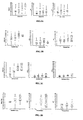
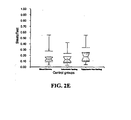
- Notched box plots showing the relationship in the training group ( FIG.2A ); in validation group 1, HCV patients before treatment ( FIG.2B ); in validation group 2, cured HCV patients ( FIG.2C ); in validation group 3, alcoholic liver disease ( FIG.2D ); and in controls, healthy volunteers fasting and non-fasting and non-fasting blood donors ( FIG.2E ).
- each box represents the median and the width of each box the median ⁇ 1.57 interquartile range / n to assess the 95% level of significance between group medians. Failure of the shaded boxes to overlap signifies statistical significance (P ⁇ 0.05).
- each box encompasses the interquartile range (from 25 th to 75 th percentile), and the vertical lines from the ends of the box encompass the adjacent values (upper: 75 th percentile plus 1.5 times interquartile range, lower 25 th percentile minus 1.5 times interquartile range).
- interquartile range from 25 th to 75 th percentile
- vertical lines from the ends of the box encompass the adjacent values (upper: 75 th percentile plus 1.5 times interquartile range, lower 25 th percentile minus 1.5 times interquartile range).
- group SO and S1 were combined.
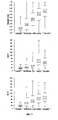
- FIG. 3 Relationship between SteatoTest, GGT (IU/L) and ALT (IU/L) and the grade of liver steatosis in the integrated database combining controls, training group and validation groups.
- the present invention is therefore drawn to a method for diagnosis of hepatic steatosis in a patient or from a serum or a plasma sample from a patient, comprising the steps of:
- Hepatic steatosis may be associated with several factors such as alcohol, diabetes, overweight, hyperlipidemia, insulin resistance, hepatitis C genotype 3, abetalipoproteinemia and some drugs.
- the present invention is directed to the diagnosis of both alcoholic and non-alcoholic steatosis.
- Step score the best index in term of discrimination was the logistic regression function combining the independent factors.
- the logistic function is obtained by combining the relative weight of each parameter, as individually determined in the logistic regression, with a negative sign when the markers harbor a negative correlation with the stage of hepatic steatosis. Logarithms are used for markers whose values have a very large range.
- ROC Receiver Operating Characteristic
- the diagnosis of the presence or absence hepatic steatosis in the patient can be further refined by the data concerning the expected prevalence of hepatic steatosis in the population.
- the logistic function may further comprise other clinical or biochemical markers.
- the logistic function also comprises the age and gender of the patient.
- the logistic function may also comprise other biochemical markers, such as total bilirubin, haptoglobin, AST (aspartate aminotransferase), glucose, and (cholesterol or HDL-cholesterol).
- the logistic function will comprise at least 1 or 2, more preferably 3 to 5 of these other biochemical markers.
- the logistic function may also comprise total bilirubin, haptoglobin, glucose, and cholesterol.
- biochemical markers that are dosed in step a) of the method according to the present invention are "simple" biochemical markers, which means that they are easily dosed with methods already known in the art (chromatography, electrophoresis, ELISA assay . . . ).
- the different coefficients used for the values obtained for the different markers in the logistic function can be calculated through statistical analysis, as described in the examples.
- An "interval of [a-x% ; a+x%]" means an interval of [(100-x)/100.a ; (100+x)/100.a].
- x is at most 90, 80 or 70, more preferably at most 60, 50, or 40, even more preferably at most 30, 20, 10 or 5. All a i coefficients are truncated to a number of 5 decimals. For instance, for x equal to 90, a13 is comprised in the interval of [0.03505; 0.66598].
- the numerical definitions for the coefficients in the different functions can vary depending on the number and characteristics of the patients studied. Therefore, the value given for the coefficients of the different markers have to be interpreted as capable to being slightly different, without reducing the scope of the invention.
- the invention thus concerns a method as previously described, wherein the end value of the logistic function is further used for the diagnosis of hepatic steatosis grade.
- the different grades of hepatic steatosis are defined according to histological features of liver biopsies. A more precise definition of hepatic steatosis grades is provided in Example 1.
- the method according to the invention may further comprise a step of prediction of the evolution of the disease, based on the hepatic steatosis grade deducted from the end value of the logistic function.
- a Steatosis score at the 0.30 cut off has a very high sensitivity ranging from 85% to 100% according to different groups (Table 4) and a Steatosis score at the 0.70 cutoff has a very high specificity ranging from 83% to 100%.
- Fibrotest Poynard 2004 Clin Chem 2004
- a clinician can have an estimate of major histological features leading to cirrhosis or explaining liver tests abnormalities: Steatosis score for steatosis, Fibrosis score (FibroTest, Biopredictive, Paris, France) for fibrosis, Activity score (ActiTest, Biopredictive, Paris, France) for the necrotico-inflammatory features of chronic hepatitis C and B. Biopsy should be indicated only in second line in case of non interpretable components as described for the Fibrosis score (FibroTest), i.e acute inflammation, Gilbert syndrome or hemolysis (Poynard Clin Chem 2004 ).
- the hepatic steatosis grade deducted from the end value of the logistic function can also be very valuable for the physician to choose a suitable treatment for the patient, according to the stage of the disease.
- said hepatic steatosis grade may be used by the physician to decide whether to perform a liver biopsy on the patient or not.
- the data obtained with the method of the invention can be used to determine the need to perform a liver biopsy on the patient. It is expected that the method of the invention will reduce the need of liver biopsy by around 80%.
- the method of the invention is intended to be used for patients suffering of any disease involving hepatic steatosis, that could develop to cirrhosis.
- a disease involving hepatic steatosis is meant any disease that may lead to the development of hepatic steatosis.
- the method of the invention is advantageously performed for detecting hepatic steatosis in patients suffering from a disease included in the group consisting of hepatitis B and C, alcoholism, hemochromatosis, metabolic disease, diabetes, obesity, autoimmune hepatitis, primary biliary cirrhosis, .alpha.1-antitrypsin deficit, Wilson disease.
- the method of the invention is particularly intended to be used for a patient who was already subjected to a diagnosis test of liver fibrosis and/or presence of liver necroinflammatory lesions.
- the method of the invention is intended to be used for a patient who was already subjected to a FibroTest/Acti-Test diagnostic test, as described in patent US 6,631,330 , which is herein incorporated by reference.
- the disclosure is also drawn to a kit of diagnosis of hepatic steatosis in a patient, comprising instructions allowing to determine the presence or absence of hepatic steatosis in said patient, after dosage of biochemical markers.
- the instructions may comprise the logistic function that has to be used after determination of the dosage of the biochemical markers. It can appear as a printed support as well as a computer usable support, such as a software.
- the instructions may also comprise the ROC curve depending of the threshold that is looked for, to allow the analysis of the end data obtained from the logistic function. They may also comprise different tables that allow to obtain the predictive values, depending of the expected prevalence of hepatic steatosis in the patient population.
- the diagnosis kit may also contain elements allowing the dosage of the biological markers of interest.
- the method of the invention can easily be automated, the dosage of the markers being performed automatically, the data being sent to a computer or a calculator that will calculate the value of the logistic function and analyze it with the aid of the ROC curve, and eventually the prevalence of hepatic steatosis in the patient population.
- the data obtained by the physician is therefore more easily interpretable, and will allow for an improvement in the process for deciding the need of a biopsy or the adequate treatment to prescribe.
- Non-inclusion criteria included non-available serum, and non-available biopsies and patients because biopsy and serum were collected more than 3 month apart. The analysis was performed on a first group (training group) and validated on 3 different groups (validation groups).
- Validation group 1 patients were retrospectively analyzed from a study of hepatic steatosis in patients with chronic hepatitis C ( Poynard T, et al. Hepatology. 2003;38:75-85 ). For this purpose, previously non-treated patients of a prospective multicentre randomized trial of PEG-IFN and Ribavirin were included. The biomarkers and the biopsy results at baseline were used.
- Validation group 2 patients were the patients of the same randomized trial as in validation group 1 ( Poynard T, et al. Hepatology. 2003;38:75-85 ), who have been "cured” with sustained virologic response, meaning that HCV RNA is undetectable 24 weeks after the end of the treatment. The biomarkers and the biopsy results performed 24 weeks after the end of the treatment were used.
- This group has been considered as a validation group of NAFLD because possible viral steatosis has been cured by the treatment ( Poynard T, et al. Hepatology. 2003;38:75-85 ).
- Validation group 3 patients were retrospectively included for this specific analysis, but were prospectively included between 1998 and 2000 in a cohort of alcoholic patients for which one primary endpoint was the identification of biochemical markers. The details of this cohort have been recently published in a validation study of FibroTest ( Naria S, et al. Clin. Gastroenterol. Hepatol. 2005 in press ). All were inpatients hospitalized in the Hepato-Gastroenterology Department of Hôpital Antoine Béclère for complications of alcoholic liver disease. Patients' characteristics of the different groups are listed in Table 1.
- a control group was also analyzed. It was constituted of fasting and non-fasting apparently healthy volunteers previously included in a validation of FibroTest ( Sloanu M,et al. Comp. Hepatol. 2004;3,3 ) and additional non-fasting blood donors.
- the 10 following biochemical markers were assessed for the different groups : ApoAl, ALT (alanine aminotransferase), AST (aspartate aminotransferase), alpha.2-macroglobulin, GGT (gammaglutamyl transpeptidase), total bilirubin, haptoglobin, cholesterol, glucose, and triglycerides.
- biochemical markers include the 6 components of the FibroTest-ActiTest adjusted by age and gender (patented artificial intelligence algorithm USPTO 6,631,330) plus the AST, cholesterol, glucose, and triglycerides markers and the BMI.
- FibroTest Biopredictive, Paris, France; FibroSURE LabCorp, Burlington, NC, USA was determined as previously published ( Poynard T, et al. Comp Hepatol. 2004;3:8 ; Myers RP, et al. J Hepatol. 2003;39:222-30 ; Callewaert N, et al. Nature Med 2004;10;1-6 ; Nzzi S, et al. Clin Gastroenterol Hepatol in press ; Imbert-Bismut F, et al. Clin Chem Lab Med 2004;42:323-33 ; Sloanu M, et al.Comp Hepatol 2004;3:3 ).
- GGT Garnier Glucose
- ALT serum glucose
- triglycerides triglycerides
- cholesterol total bilirubin
- haptoglobin were measured using an automatic nephelemeter BNII (Dade Behring; Marburg, Germany).
- ALT, GGT, serum glucose, triglycerides, cholesterol, total bilirubin and haptoglobin were measured by autoanalyzer (Olympus AU 640 Automate) using manufacturer's reagents (Olympus, Rungis France); alpha2-macroglobulin and apolipoprotein A1 were measured using an automatic nephelometer (BNII, Dade Behring; Marburg, Germany).
- Histological grading was performed based on liver biopsies. Common rules were applied in the different groups, and a single pathologist per group, unaware of patient characteristics, analyzed the histological features. Liver biopsy specimens were processed using standard techniques.
- the primary outcome was the identification of patients with hepatic steatosis grade 2, 3 or 4 (moderate, marked or severe).
- the first stage consisted of identifying factors which differed significantly between these groups by unidimensional analysis using the chi-square, Student t test or Mann-Whitney test.
- the second stage consisted of logistic regression analysis to assess the independent discriminative value of markers for the diagnosis of fibrosis.
- the third step was to construct an index combining these identified independent factors.
- the best index (“Steatosis score”) in term of discrimination was the logistic regression function combining the independent factors.
- the Steatosis score is further referred to as "SteatoTest score”.
- the SteatoTest score ranges from zero to 1.00, with higher scores indicating a greater probability of significant lesions.
- the diagnostic values of the markers were assessed using sensitivities, specificities, positive (PPV) and negative predictive values (NPV), and the areas under the Receiver Operating characteristic (ROC) curves (Hintze JL. NCSS 2003 User Guide. Number Cruncher Statistical Systems 2003 software NCSS, Kaysville, Utah).
- the respective overall diagnostic values were compared by the area under the ROC curves.
- the ROC curve is drawn by plotting the sensitivity versus (1-specificity), after classification of the patients, according to the value obtained for the logistic function, for different thresholds (from 0 to 1). It is usually acknowledged that a ROC curve the area under which has a value superior to 0.7 is a good predictive curve for diagnosis.
- the ROC curve has to be acknowledged as a curve allowing to predict the quality of a diagnosis method.
- StepTest score is defined as the logistic regression function combining the independent factors that returns the best index in term of discrimination between the presence or absence of hepatic steatosis.
- ALT alanine aminotransferase
- AST aspartate aminotransferase
- GGT ⁇ -glutamyl-transpeptidase.
- SteatoTest combines in a multivariate regression analysis adjusted for gender, age and body mass index: alanine and aspartate aminotransferases, alpha-macroglobulin, apolipoprotein A-I, haptoglobin, total bilirubin, and ⁇ -glutamyl-transpeptidase
- the value of the SteatoTest score combining 9 markers (alpha2-macroglobulin, ALT, apo A1, haptoglobin, GGT, and total bilirubin), adjusted by age, gender and BMI, had a high correlation with the presence or absence of hepatic steatosis, on the training sample as well as on validation samples (Table 2).
- the diagnostic value (area under the ROC curve) of the SteatoTest score was highly reproducible between the training group and validation groups 1, 2 and 3 (Table 3).
- the sensitivity was also quite reproducible between the training group and validation groups 1, 2 and 3 (Table 4).
- the sensitivities and specificities of the SteatoTest score observed in the different populations studied will probably increase in a more general population because of the excellent specificity observed in volunteers and blood donors ( Figure 2E ), and because of the fact that the present studies have included a limited number of patients with several metabolic risk factors such as morbid obesity.
- the diagnoses of the presence of hepatic steatosis by biopsy and by the SteatoTest score were discordant.
- the cause of discordance between presence of >5% hepatic steatosis predicted by biochemical markers and biopsy was attributed according to respective risk factors of failure as previously detailed ( Poynard T, et al. Clin. Chem. 2004;50:1344-55 ).
- Significant discordance was defined as discordance in predicting 5>% hepatic steatosis (grades 2-4) and a 30% or greater difference in >5% hepatic steatosis percentage as predicted by the SteatoTest score or as observed in the biopsy sample.
- the results obtained with the SteatoTest score were compared to those obtained with the use of isolated markers such as GGT and ALT, which are usually considered to be useful markers to indicate the presence or absence of hepatic steatosis.
- isolated markers such as GGT and ALT, which are usually considered to be useful markers to indicate the presence or absence of hepatic steatosis.
- the same standard cut-off value is used for GGT and ALT: 50 IU/L. Under said cut-off value, the diagnostic of hepatic steatosis is considered to be negative, over, it is considered to be positive.
- the SteatoTest score allows a much better discrimination between the presence or absence of hepatic steatosis in all groups analyzed, in particular for the training group and validation group 2 (Table 2).
- Diagnostic values areas under ROC curves of the SteatoTest score, GGT 50 IU/L and ALT 50 IU/L for the diagnosis of the main end point (that is, grade 2-4 hepatic steatosis), are displayed in Table 3.
- the SteatoTest score has higher areas under ROC curves than GGT 50 IU/L in all groups analyzed, and that ALT 50 IU/L in the training group and validation group 1 (Table 3).
- Sensitivity, specificity and positive and negative predictive values of the SteatoTest score with a cut-off of 0.30, 0.50, or 0.70, and of GGT 50 IU/L and ALT 50 IU/L are displayed in Table 4.
- a SteatoTest score with a 0.50 cut-off achieved a good sensitivity (0.69, 0.89, 0.68 and 0.62) and a good specificity (0.74, 0.58, 0.79, 1.00), according to training and validation groups respectively.
- SteatoTest score with a 0.50 cut-off displays higher positive and negative values than GGT 50 IU/L and ALT 50 IU/L in all groups analyzed, excepted for the negative predictive value of ALT 50 IU/L in validation group 1.
- the present invention presents a combination of at least 5, preferably 9, biochemical markers, adjusted by age, gender and BMI, to be used for the detection of the presence or absence of hepatic steatosis.
- the markers used in the present invention had never been combined in such a way, particularly with the age, gender, and BMI of the patients to give such a good predictive value, as illustrated by the area under the ROC curve.
Landscapes
- Health & Medical Sciences (AREA)
- Life Sciences & Earth Sciences (AREA)
- Engineering & Computer Science (AREA)
- Physics & Mathematics (AREA)
- Chemical & Material Sciences (AREA)
- Medical Informatics (AREA)
- Immunology (AREA)
- General Health & Medical Sciences (AREA)
- Biotechnology (AREA)
- Molecular Biology (AREA)
- Bioinformatics & Cheminformatics (AREA)
- Biophysics (AREA)
- Spectroscopy & Molecular Physics (AREA)
- Organic Chemistry (AREA)
- Communicable Diseases (AREA)
- Biomedical Technology (AREA)
- Public Health (AREA)
- Databases & Information Systems (AREA)
- Analytical Chemistry (AREA)
- Bioinformatics & Computational Biology (AREA)
- Proteomics, Peptides & Aminoacids (AREA)
- Evolutionary Biology (AREA)
- Epidemiology (AREA)
- Theoretical Computer Science (AREA)
- Data Mining & Analysis (AREA)
- Artificial Intelligence (AREA)
- Hematology (AREA)
- Evolutionary Computation (AREA)
- Computer Vision & Pattern Recognition (AREA)
- Bioethics (AREA)
- Microbiology (AREA)
- Software Systems (AREA)
- Wood Science & Technology (AREA)
- Zoology (AREA)
- Biochemistry (AREA)
- Urology & Nephrology (AREA)
- Pathology (AREA)
- Genetics & Genomics (AREA)
- General Engineering & Computer Science (AREA)
- Cell Biology (AREA)
Claims (9)
- In-vitro-Verfahren zur Diagnose von Lebersteatose aus einer Serum- oder Plasmaprobe eines Patienten, umfassend die folgenden Schritte:a) Untersuchen von 5 biochemischen Markern durch Messen der Werte ihrer Konzentration im Serum oder Plasma des Patienten, wobei die Marker sind:- ApoA1 (Apolipoprotein A1),- Alpha.2-Macroglobulin,- ALT (Alaninaminotransferase),- GGT (Gamma-Glutamyltranspeptidase), und- Triglyceride;b) Untersuchen eines klinischen Markers, der in der Gruppe gewählt wird, die aus dem Körper-Gewichts-Index (Gewicht/Größe2), dem Taillenmaß und dem (Taillenmaß/Hüftmaß)-Verhältnis besteht;c) Verknüpfen der Werte durch eine logistische Funktion, die die Marker umfasst, um einen Endwert zu erhalten, wobei die logistische Funktion durch das folgende Verfahren erhalten wird:i) Einteilung einer Kohorte von Patienten in verschiedene Gruppen gemäß dem Ausmaß ihrer Krankheit;ii) Identifikation von Faktoren, die sich zwischen diesen Gruppen wesentlich unterscheiden, durch eindimensionale Analyse;iii) logistische Regressionsanalyse, um den unabhängigen Unterscheidungswert von Markern für die Diagnose von Lebersteatose zu berechnen;iv) Konstruktion der logistischen Funktion durch die Verknüpfung dieser identifizierten unabhängigen Faktoren.
- Verfahren nach Anspruch 1, wobei die logistische Funktion ferner das Alter und das Geschlecht des Patienten berücksichtigt.
- Verfahren nach Anspruch 2, wobei die logistische Funktion ferner wenigstens einen biochemischen Marker umfasst, der in der Gruppe gewählt wird, die aus Gesamtbilirubin, Haptoglobin, AST (Aspartataminotransferase), Glucose und (Cholesterin oder HDL-Cholesterin) besteht.
- Verfahren nach Anspruch 3, wobei die logistische Funktion Gesamtbilirubin, Haptoglobin, Glucose und Cholesterin umfasst.
- Verfahren nach Anspruch 4, wobei die logistische Funktion ist:
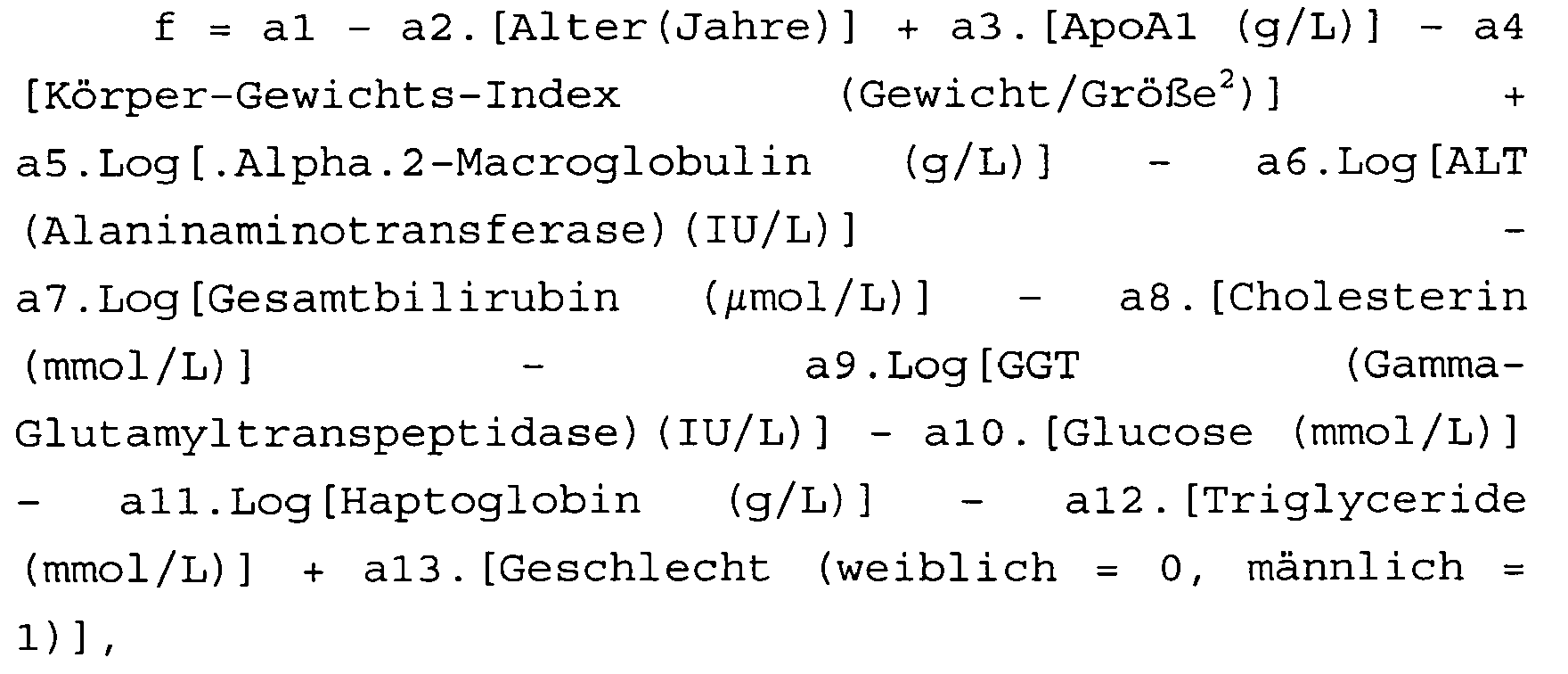 a1 im Intervall von [6,68805 - 90 %; 6,68805 + 90 %] enthalten ist,a2 im Intervall von [1,55337E-02 - 90 %; 1,55337E-02 + 90 %] enthalten ist,a3 im Intervall von [1,161531 - 90 %; 1,161531 + 90 %] enthalten ist,a4 im Intervall von [0,11889 - 90 %; 0,11889 + 90 %] enthalten ist,a5 im Intervall von [1,74791 - 90 %; 1,74791 + 90 %] enthalten ist,a6 im Intervall von [0, 96453 - 90 %; 0,96453 + 90 %] enthalten ist,a7 im Intervall von [0,11958 - 90 %; 0,11958 + 90 %] enthalten ist,a8 im Intervall von [0,68125 - 90 %; 0,68125 + 90 %] enthalten ist,a9 im Intervall von [1,17922 - 90 %; 1,17922 + 90 %] enthalten ist,a10 im Intervall von [1,46963 - 90 %; 1,46963 + 90 %] enthalten ist,a11 im Intervall von [0,34512 - 90 %; 0,34512 + 90 %] enthalten ist,a12 im Intervall von [1,17926 - 90 %; 1,17926 + 90 %] enthalten ist, unda13 im Intervall von [0,35052 - 90 %; 0,35052 + 90 %] enthalten ist.
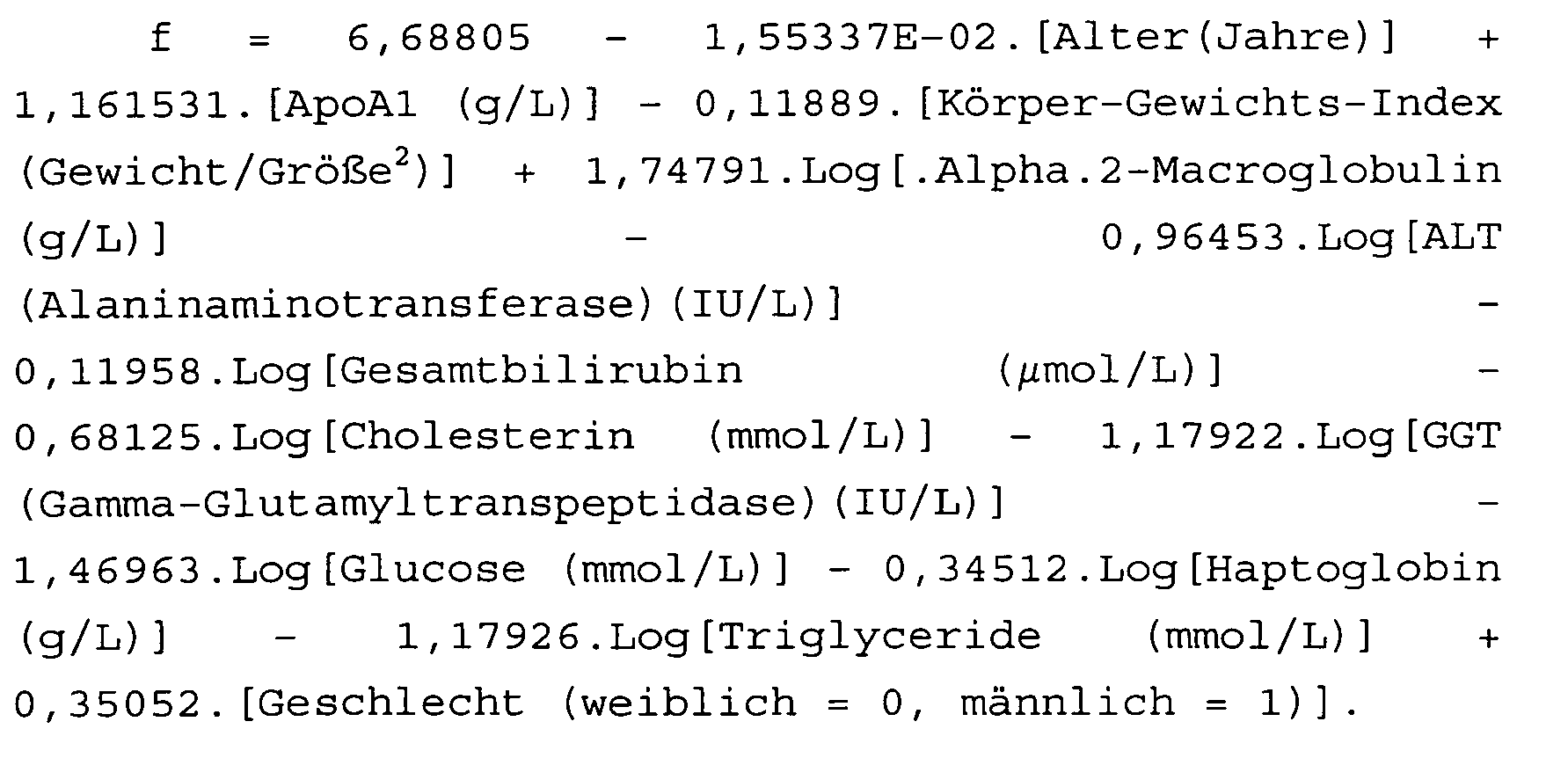
 - Verfahren nach Anspruch 5, wobei die logistische Funktion ist:
- Verfahren nach Anspruch 1, wobei der Patient an einer Krankheit leidet, die Steatose mit sich bringt.
- Verfahren nach Anspruch 7, wobei die Krankheit in der Gruppe bestehend aus Hepatitis B und C, Alkoholismus, Hämochromatose, Stoffwechselerkrankung, Diabetes, Obesität, Autoimmunleberkrankheit, primäre biliäre Zirrhose, Alpha.1-Antitrypsindefizit und Wilson-Krankheit enthalten ist.
- Verfahren nach Anspruch 1, wobei der Patient bereits einem Diagnosetest für Leberfibrose und/oder das Vorhandensein von nekroinflammatorischen Leberläsionen unterzogen wurde.
Applications Claiming Priority (2)
| Application Number | Priority Date | Filing Date | Title |
|---|---|---|---|
| US11/050,396 US7860656B2 (en) | 2005-02-03 | 2005-02-03 | Diagnosis method of hepatic steatosis using biochemical markers |
| PCT/IB2006/000333 WO2006082522A1 (en) | 2005-02-03 | 2006-02-03 | Diagnosis method of hepatic steatosis using biochemical markers |
Publications (2)
| Publication Number | Publication Date |
|---|---|
| EP1856536A1 EP1856536A1 (de) | 2007-11-21 |
| EP1856536B1 true EP1856536B1 (de) | 2008-10-29 |
Family
ID=36097137
Family Applications (1)
| Application Number | Title | Priority Date | Filing Date |
|---|---|---|---|
| EP06710408A Expired - Lifetime EP1856536B1 (de) | 2005-02-03 | 2006-02-03 | Diagnoseverfahren für lebersteatose unter verwendung biochemischer marker |
Country Status (13)
| Country | Link |
|---|---|
| US (2) | US7860656B2 (de) |
| EP (1) | EP1856536B1 (de) |
| JP (1) | JP2008529030A (de) |
| CN (1) | CN101175998A (de) |
| AT (1) | ATE412905T1 (de) |
| BR (1) | BRPI0606840A2 (de) |
| CA (1) | CA2596682A1 (de) |
| DE (1) | DE602006003414D1 (de) |
| IL (1) | IL185021A0 (de) |
| MA (1) | MA29282B1 (de) |
| MX (1) | MX2007009427A (de) |
| RU (1) | RU2403576C2 (de) |
| WO (1) | WO2006082522A1 (de) |
Families Citing this family (51)
| Publication number | Priority date | Publication date | Assignee | Title |
|---|---|---|---|---|
| US8178294B2 (en) * | 2002-06-14 | 2012-05-15 | Cedars-Sinai Medical Center | Method of haplotype-based genetic analysis for determining risk for developing insulin resistance, coronary artery disease and other phenotypes |
| US9012162B2 (en) | 2006-09-08 | 2015-04-21 | The Chancellor, Masters And Scholars Of The University Of Oxford | Clinical diagnosis of hepatic fibrosis using a novel panel of human serum protein biomarkers |
| US20100130600A1 (en) * | 2007-03-30 | 2010-05-27 | Cedars-Sinai Medical Center | Lipoprotein lipase and its effect on statin treatments |
| JP2009114092A (ja) * | 2007-11-02 | 2009-05-28 | Mcbi:Kk | 慢性肝炎、肝硬変、肝がんの分別診断のための新規バイオマーカーおよび該バイオマーカーを用いた慢性肝炎、肝硬変、肝がんの分別診断方法 |
| EP2546649B1 (de) | 2007-11-02 | 2015-02-25 | Metabolon Inc. | Biomarker für Fettleberkrankheit und Verfahren zur Verwendung davon |
| WO2009069776A1 (ja) * | 2007-11-30 | 2009-06-04 | National University Corporation Hokkaido University | 糖鎖分析による肝疾患の診断方法 |
| EP2286236B1 (de) * | 2008-05-28 | 2016-04-20 | Basf Se | Verfahren zur beurteilung einer lebertoxizität |
| EP2157431A1 (de) | 2008-08-11 | 2010-02-24 | One Way Liver Genomics, S.L. | Verfahren zur NASH-Diagnose unter Verwendung von Stoffwechselprofilen |
| CA2735582A1 (en) * | 2008-08-28 | 2010-03-04 | Salutria Pharmaceuticals, Llc | Screening method for identifying patients at risk of adverse hepatologic events |
| US20120088245A1 (en) * | 2008-10-31 | 2012-04-12 | Cedars-Sinai Medical Center | Methods of diagnosing insulin resistance and sensitivity |
| ES2621838T3 (es) | 2008-11-18 | 2017-07-05 | Universite D'angers | Método in vitro no invasivo para la cuantificación de lesiones hepáticas |
| US9585613B2 (en) * | 2009-02-26 | 2017-03-07 | Universite D'angers | Diagnosis of liver fibrosis and cirrhosis |
| ES2527455T3 (es) * | 2009-05-14 | 2015-01-23 | The Chancellor, Masters And Scholars Of The University Of Oxford | Diagnóstico clínico de fibrosis/cirrosis hepática usando biomarcadores de proteínas plasmáticas humanas poco abundantes |
| EP2309276A1 (de) | 2009-09-22 | 2011-04-13 | One Way Liver Genomics, S.L. | Verfahren zur Diagnose von nichtalkoholischer Steatohepatitis basierend auf einem metabolomischen Profil |
| EP2327988A1 (de) | 2009-11-28 | 2011-06-01 | Assistance Publique Hôpitaux De Paris | Verfahren zur Diagnose von fibrotischen Erkrankungen |
| EP2567241B1 (de) * | 2010-05-03 | 2015-11-04 | The Cleveland Clinic Foundation | Erkennung und überwachung von nicht alkoholbedingter fettleber |
| EP2418285A1 (de) * | 2010-08-09 | 2012-02-15 | Universiteit Maastricht | Verfahren zur Diagnose von Fettlebererkrankungen, insbesondere von nicht alkoholischer Steato-Hepatitis |
| FR2971256B1 (fr) | 2011-02-09 | 2024-09-27 | Bio Rad Pasteur | Combinaison de biomarqueurs pour la detection et l'evaluation d'une fibrose hepatique |
| RU2476154C1 (ru) * | 2011-08-12 | 2013-02-27 | Государственное образовательное учреждение высшего профессионального образования "Смоленская государственная медицинская академия" Министерства здравоохранения и социального развития Российской Федерации | Способ диагностики алкогольной болезни печени |
| US20140236621A1 (en) * | 2011-09-26 | 2014-08-21 | Universite Pierre Et Marie Curie (Paris 6) | Method for determining a predictive function for discriminating patients according to their disease activity status |
| EP2600266A1 (de) | 2011-12-02 | 2013-06-05 | Biopredictive | Verfahren zur Diagnose von fibrotischen Erkrankungen |
| EP2810079A4 (de) * | 2012-01-31 | 2015-08-05 | Teknologian Tutkimuskeskus Vtt Oy | Verfahren zur bestimmung der leberfettmenge und verfahren zur diagnose von nafld |
| WO2014049131A1 (en) * | 2012-09-28 | 2014-04-03 | Université d'Angers | Accurate blood test for the non-invasive diagnosis of non-alcoholic steatohepatitis |
| BR112015008621A2 (pt) * | 2012-10-17 | 2018-08-28 | Enterome | Métodos e kit de diagnóstico e/ou prognóstico in vitro microconjunto de ácidos nucleicos. |
| RU2545990C2 (ru) * | 2013-07-16 | 2015-04-10 | Государственное бюджетное учреждение здравоохранения города Москвы Московский клинический научно-практический центр Департамента здравоохранения города Москвы | Способ дифференциальной диагностики стеатоза печени и стеатогепатита |
| RU2557927C1 (ru) * | 2014-06-05 | 2015-07-27 | Государственное бюджетное образовательное учреждение высшего профессионального образования "Тихоокеанский государственный медицинский университет" Министерства здравоохранения Российской Федерации (ГБОУ ВПО ТГМУ Минздрава России) | Способ диагностики фиброза печени при хроническом вирусном гепатите с |
| FR3023003B1 (fr) | 2014-06-27 | 2016-07-15 | Bio-Rad Innovations | Combinaison synergique de biomarqueurs pour la detection et l'evaluation d'une fibrose hepatique |
| ES2741357T3 (es) | 2015-03-17 | 2020-02-10 | Servicio Andaluz De Salud | Métodos de análisis óptico computarizado de imágenes de MR (resonancia magnética) para cuantificar o determinar lesiones hepáticas |
| CN115236166A (zh) | 2016-05-29 | 2022-10-25 | 深圳市绘云生物科技有限公司 | 肝病相关生物标志物和其使用方法 |
| CN106127256A (zh) * | 2016-06-30 | 2016-11-16 | 张云超 | 一种肝纤维化检测方法及装置 |
| EP3267199A1 (de) | 2016-07-06 | 2018-01-10 | One Way Liver S.L. | Diagnostische methoden basierend auf lipidprofilen |
| EP3296744A1 (de) * | 2016-09-16 | 2018-03-21 | Biopredictive | Verfahren zur diagnose nichtalkoholischer fettlebererkrankungen |
| CN106771201A (zh) * | 2016-12-05 | 2017-05-31 | 江西惠肽生物科技有限公司 | 用于肝纤维化诊断试剂盒及其检测方法 |
| WO2018156717A1 (en) | 2017-02-24 | 2018-08-30 | The Cleveland Clinic Foundation | Method and apparatus for time-differential deployment of an endovascular device within a body lumen |
| EP3373012A1 (de) | 2017-03-07 | 2018-09-12 | Biopredictive | Verfahren zur diagnose von arzneimittelinduzierter leberverletzung |
| ES2902226T3 (es) | 2017-07-19 | 2022-03-25 | Bio Rad Europe Gmbh | Combinaciones de biomarcadores para evaluar la esteatohepatitis no alcohólica y/o el estatus de la fibrosis hepática |
| CN111279195B (zh) | 2017-10-16 | 2024-01-23 | 生物预测公司 | 原发性肝癌的预后和随访方法 |
| EP3470843A1 (de) | 2017-10-16 | 2019-04-17 | Biopredictive | Verfahren zur prognose von primärem leberkrebs |
| CN108565024B (zh) * | 2018-03-19 | 2020-05-05 | 首都医科大学附属北京地坛医院 | 一种确定单发的hbv相关原发性小肝癌术后1年内复发风险的系统 |
| CN108417267B (zh) * | 2018-03-19 | 2020-05-05 | 首都医科大学附属北京地坛医院 | 一种确定肝硬化肝肾综合征患者短期预后的系统 |
| CN108932976A (zh) * | 2018-06-11 | 2018-12-04 | 西安医学院 | 一种非酒精性脂肪性肝病无创性诊断程序 |
| RU2684201C1 (ru) * | 2018-07-05 | 2019-04-04 | Федеральное государственное бюджетное военное образовательное учреждение высшего образования Военно-медицинская академия имени С.М. Кирова Министерства обороны Российской Федерации (ВМедА) | Способ скрининговой диагностики жировой дегенерации печени при абдоминальном ожирении |
| EP3599615A1 (de) * | 2018-07-27 | 2020-01-29 | Biopredictive | Verfahren zur diagnose von lebersteatose |
| EP3836929A1 (de) * | 2018-08-14 | 2021-06-23 | Camp4 Therapeutics Corporation | Verfahren zur behandlung von lebererkrankungen |
| US20210005327A1 (en) * | 2019-07-05 | 2021-01-07 | Molecular You Corporation | Method and system for personalized, molecular based health management and digital consultation and treatment |
| CN111583993A (zh) * | 2020-05-29 | 2020-08-25 | 杭州广科安德生物科技有限公司 | 构建体外检测癌症的数学模型的方法及其应用 |
| RU2753455C1 (ru) * | 2020-12-11 | 2021-08-16 | Федеральное государственное унитарное предприятие «Государственный научно-исследовательский институт особо чистых биопрепаратов» Федерального медико-биологического агентства | Способ дифференциальной диагностики стеатоза печени и неалкогольного стеатогепатита у мужчин |
| RU2755974C1 (ru) * | 2021-03-11 | 2021-09-23 | Федеральное государственное бюджетное образовательное учреждение высшего образования "Пермский государственный медицинский университет имени академика Е.А. Вагнера" Министерства здравоохранения Российской Федерации | Способ диагностики неалкогольного стеатоза печени |
| RU2763257C1 (ru) * | 2021-05-14 | 2021-12-28 | Федеральное государственное бюджетное учреждение "Детский научно-клинический центр инфекционных болезней Федерального медико-биологического агентства" | Способ диагностики стадии фиброза печени при хронических заболеваниях печени у детей |
| JP2025500409A (ja) | 2021-12-22 | 2025-01-09 | キャンプ4 セラピューティクス コーポレイション | 調節rnaを標的とするアンチセンスオリゴヌクレオチドを用いた遺伝子転写の調節方法 |
| EP4555924A1 (de) | 2023-11-15 | 2025-05-21 | Assistance Publique - Hôpitaux de Paris | Verfahren zur bestimmung der gebrechlichkeit unter verwendung von anästhesiedaten |
Family Cites Families (4)
| Publication number | Priority date | Publication date | Assignee | Title |
|---|---|---|---|---|
| RU2183326C2 (ru) * | 2000-03-03 | 2002-06-10 | Харламова Флора Семеновна | Способ диагностики фиброза печени при хроническом гепатите у детей |
| US6631330B1 (en) * | 2000-08-21 | 2003-10-07 | Assistance Publique-Hopitaux De Paris (Ap-Hp) | Diagnosis method of inflammatory, fibrotic or cancerous disease using biochemical markers |
| RU2261441C2 (ru) * | 2003-10-06 | 2005-09-27 | Ягода Александр Валентинович | Способ неинвазивной диагностики степени выраженности фиброза печени у больных хроническим вирусным гепатитом |
| US7856319B2 (en) * | 2005-02-03 | 2010-12-21 | Assistance Publique-Hopitaux De Paris (Ap-Hp) | Diagnosis method of alcoholic steato-hepatitis using biochemical markers |
-
2005
- 2005-02-03 US US11/050,396 patent/US7860656B2/en active Active
-
2006
- 2006-02-03 WO PCT/IB2006/000333 patent/WO2006082522A1/en not_active Ceased
- 2006-02-03 CN CNA2006800072060A patent/CN101175998A/zh active Pending
- 2006-02-03 BR BRPI0606840-5A patent/BRPI0606840A2/pt not_active IP Right Cessation
- 2006-02-03 DE DE602006003414T patent/DE602006003414D1/de not_active Expired - Lifetime
- 2006-02-03 CA CA002596682A patent/CA2596682A1/en not_active Abandoned
- 2006-02-03 AT AT06710408T patent/ATE412905T1/de not_active IP Right Cessation
- 2006-02-03 MX MX2007009427A patent/MX2007009427A/es active IP Right Grant
- 2006-02-03 JP JP2007553738A patent/JP2008529030A/ja active Pending
- 2006-02-03 US US11/815,332 patent/US20090111132A1/en not_active Abandoned
- 2006-02-03 RU RU2007132921/15A patent/RU2403576C2/ru not_active IP Right Cessation
- 2006-02-03 EP EP06710408A patent/EP1856536B1/de not_active Expired - Lifetime
-
2007
- 2007-08-02 IL IL185021A patent/IL185021A0/en not_active IP Right Cessation
- 2007-08-31 MA MA30183A patent/MA29282B1/fr unknown
Also Published As
| Publication number | Publication date |
|---|---|
| US20090111132A1 (en) | 2009-04-30 |
| DE602006003414D1 (de) | 2008-12-11 |
| MX2007009427A (es) | 2008-03-06 |
| CA2596682A1 (en) | 2006-08-10 |
| WO2006082522A1 (en) | 2006-08-10 |
| BRPI0606840A2 (pt) | 2010-03-09 |
| RU2007132921A (ru) | 2009-03-10 |
| US20060173629A1 (en) | 2006-08-03 |
| EP1856536A1 (de) | 2007-11-21 |
| IL185021A0 (en) | 2007-12-03 |
| MA29282B1 (fr) | 2008-02-01 |
| JP2008529030A (ja) | 2008-07-31 |
| US7860656B2 (en) | 2010-12-28 |
| CN101175998A (zh) | 2008-05-07 |
| RU2403576C2 (ru) | 2010-11-10 |
| ATE412905T1 (de) | 2008-11-15 |
Similar Documents
| Publication | Publication Date | Title |
|---|---|---|
| EP1856536B1 (de) | Diagnoseverfahren für lebersteatose unter verwendung biochemischer marker | |
| Poynard et al. | The diagnostic value of biomarkers (SteatoTest) for the prediction of liver steatosis | |
| Poynard et al. | Prospective analysis of discordant results between biochemical markers and biopsy in patients with chronic hepatitis C | |
| EP1846862B1 (de) | Diagnoseverfahren für alkoholbedingte steato-hepatitis | |
| Halfon et al. | FibroTest-ActiTest as a non-invasive marker of liver fibrosis | |
| Naveau et al. | Biomarkers for the prediction of liver fibrosis in patients with chronic alcoholic liver disease | |
| US20040039553A1 (en) | Diagnosis method of inflammatory, fibrotic or cancerous disease using biochemical markers | |
| Morra et al. | FibroMAX™: towards a new universal biomarker of liver disease? | |
| Tempfer et al. | An endothelial nitric oxide synthase gene polymorphism is associated with preeclampsia | |
| Pierre et al. | AACC/NKF guidance document on improving equity in chronic kidney disease care | |
| Kumar et al. | A practical clinical approach to liver fibrosis | |
| Poynard et al. | Methodological aspects of the interpretation of non-invasive biomarkers of liver fibrosis: a 2008 update | |
| Kaul et al. | The case for laboratory developed procedures: quality and positive impact on patient care | |
| Semmler et al. | Simple blood tests to diagnose compensated advanced chronic liver disease and stratify the risk of clinically significant portal hypertension | |
| Poynard et al. | Assessment of liver fibrosis: noninvasive means | |
| Ajmera et al. | The impact of genetic risk on liver fibrosis in non‐alcoholic fatty liver disease as assessed by magnetic resonance elastography | |
| Davis et al. | Prevalence, incidence, and prognosis of hepatobiliary disease in community-based patients with type 2 diabetes: the Fremantle Diabetes Study | |
| Kim et al. | A risk prediction model for hepatocellular carcinoma in non‐alcoholic fatty liver disease without cirrhosis | |
| Palladino et al. | Analytical performance of the Enhanced liver fibrosis (ELF) test on the atellica IM analyzer | |
| CN114068026A (zh) | 一种超早期代谢相关脂肪性肝病的预测装置 | |
| Risch et al. | Prevalence of decreased glomerular filtration rate in patients seeking non-nephrological medical care—an evaluation using IDMS-traceable creatinine based MDRD as well as Mayo Clinic quadratic equation estimates | |
| CA3259129A1 (en) | Methods of assessing dementia risk | |
| Saarinen et al. | The use of ELF in predicting liver fibrosis prevalence and fibrosis progression in the general population | |
| Taibi et al. | Diagnostic accuracy of the Coopscore© to predict liver fibrosis in human immunodeficiency virus/hepatitis B virus co-infection | |
| Nguyen et al. | The simple multivariable model for predicting liver fibrosis in Vietnamese male adults: a combination of Bayesian model averaging and stepwise method |
Legal Events
| Date | Code | Title | Description |
|---|---|---|---|
| PUAI | Public reference made under article 153(3) epc to a published international application that has entered the european phase |
Free format text: ORIGINAL CODE: 0009012 |
|
| 17P | Request for examination filed |
Effective date: 20070903 |
|
| AK | Designated contracting states |
Kind code of ref document: A1 Designated state(s): AT BE BG CH CY CZ DE DK EE ES FI FR GB GR HU IE IS IT LI LT LU LV MC NL PL PT RO SE SI SK TR |
|
| GRAP | Despatch of communication of intention to grant a patent |
Free format text: ORIGINAL CODE: EPIDOSNIGR1 |
|
| DAX | Request for extension of the european patent (deleted) | ||
| GRAS | Grant fee paid |
Free format text: ORIGINAL CODE: EPIDOSNIGR3 |
|
| GRAA | (expected) grant |
Free format text: ORIGINAL CODE: 0009210 |
|
| AK | Designated contracting states |
Kind code of ref document: B1 Designated state(s): AT BE BG CH CY CZ DE DK EE ES FI FR GB GR HU IE IS IT LI LT LU LV MC NL PL PT RO SE SI SK TR |
|
| REG | Reference to a national code |
Ref country code: GB Ref legal event code: FG4D |
|
| REG | Reference to a national code |
Ref country code: CH Ref legal event code: EP |
|
| REG | Reference to a national code |
Ref country code: IE Ref legal event code: FG4D |
|
| REF | Corresponds to: |
Ref document number: 602006003414 Country of ref document: DE Date of ref document: 20081211 Kind code of ref document: P |
|
| REG | Reference to a national code |
Ref country code: RO Ref legal event code: EPE |
|
| NLV1 | Nl: lapsed or annulled due to failure to fulfill the requirements of art. 29p and 29m of the patents act | ||
| LTIE | Lt: invalidation of european patent or patent extension |
Effective date: 20081029 |
|
| PG25 | Lapsed in a contracting state [announced via postgrant information from national office to epo] |
Ref country code: LT Free format text: LAPSE BECAUSE OF FAILURE TO SUBMIT A TRANSLATION OF THE DESCRIPTION OR TO PAY THE FEE WITHIN THE PRESCRIBED TIME-LIMIT Effective date: 20081029 Ref country code: AT Free format text: LAPSE BECAUSE OF FAILURE TO SUBMIT A TRANSLATION OF THE DESCRIPTION OR TO PAY THE FEE WITHIN THE PRESCRIBED TIME-LIMIT Effective date: 20081029 Ref country code: ES Free format text: LAPSE BECAUSE OF FAILURE TO SUBMIT A TRANSLATION OF THE DESCRIPTION OR TO PAY THE FEE WITHIN THE PRESCRIBED TIME-LIMIT Effective date: 20090209 Ref country code: BG Free format text: LAPSE BECAUSE OF FAILURE TO SUBMIT A TRANSLATION OF THE DESCRIPTION OR TO PAY THE FEE WITHIN THE PRESCRIBED TIME-LIMIT Effective date: 20090129 |
|
| PG25 | Lapsed in a contracting state [announced via postgrant information from national office to epo] |
Ref country code: PL Free format text: LAPSE BECAUSE OF FAILURE TO SUBMIT A TRANSLATION OF THE DESCRIPTION OR TO PAY THE FEE WITHIN THE PRESCRIBED TIME-LIMIT Effective date: 20081029 Ref country code: PT Free format text: LAPSE BECAUSE OF FAILURE TO SUBMIT A TRANSLATION OF THE DESCRIPTION OR TO PAY THE FEE WITHIN THE PRESCRIBED TIME-LIMIT Effective date: 20090330 Ref country code: SI Free format text: LAPSE BECAUSE OF FAILURE TO SUBMIT A TRANSLATION OF THE DESCRIPTION OR TO PAY THE FEE WITHIN THE PRESCRIBED TIME-LIMIT Effective date: 20081029 Ref country code: IS Free format text: LAPSE BECAUSE OF FAILURE TO SUBMIT A TRANSLATION OF THE DESCRIPTION OR TO PAY THE FEE WITHIN THE PRESCRIBED TIME-LIMIT Effective date: 20090228 Ref country code: FI Free format text: LAPSE BECAUSE OF FAILURE TO SUBMIT A TRANSLATION OF THE DESCRIPTION OR TO PAY THE FEE WITHIN THE PRESCRIBED TIME-LIMIT Effective date: 20081029 Ref country code: LV Free format text: LAPSE BECAUSE OF FAILURE TO SUBMIT A TRANSLATION OF THE DESCRIPTION OR TO PAY THE FEE WITHIN THE PRESCRIBED TIME-LIMIT Effective date: 20081029 Ref country code: NL Free format text: LAPSE BECAUSE OF FAILURE TO SUBMIT A TRANSLATION OF THE DESCRIPTION OR TO PAY THE FEE WITHIN THE PRESCRIBED TIME-LIMIT Effective date: 20081029 |
|
| PG25 | Lapsed in a contracting state [announced via postgrant information from national office to epo] |
Ref country code: EE Free format text: LAPSE BECAUSE OF FAILURE TO SUBMIT A TRANSLATION OF THE DESCRIPTION OR TO PAY THE FEE WITHIN THE PRESCRIBED TIME-LIMIT Effective date: 20081029 Ref country code: DK Free format text: LAPSE BECAUSE OF FAILURE TO SUBMIT A TRANSLATION OF THE DESCRIPTION OR TO PAY THE FEE WITHIN THE PRESCRIBED TIME-LIMIT Effective date: 20081029 Ref country code: BE Free format text: LAPSE BECAUSE OF FAILURE TO SUBMIT A TRANSLATION OF THE DESCRIPTION OR TO PAY THE FEE WITHIN THE PRESCRIBED TIME-LIMIT Effective date: 20081029 |
|
| PG25 | Lapsed in a contracting state [announced via postgrant information from national office to epo] |
Ref country code: SE Free format text: LAPSE BECAUSE OF FAILURE TO SUBMIT A TRANSLATION OF THE DESCRIPTION OR TO PAY THE FEE WITHIN THE PRESCRIBED TIME-LIMIT Effective date: 20090129 Ref country code: CZ Free format text: LAPSE BECAUSE OF FAILURE TO SUBMIT A TRANSLATION OF THE DESCRIPTION OR TO PAY THE FEE WITHIN THE PRESCRIBED TIME-LIMIT Effective date: 20081029 |
|
| PLBE | No opposition filed within time limit |
Free format text: ORIGINAL CODE: 0009261 |
|
| STAA | Information on the status of an ep patent application or granted ep patent |
Free format text: STATUS: NO OPPOSITION FILED WITHIN TIME LIMIT |
|
| PG25 | Lapsed in a contracting state [announced via postgrant information from national office to epo] |
Ref country code: SK Free format text: LAPSE BECAUSE OF FAILURE TO SUBMIT A TRANSLATION OF THE DESCRIPTION OR TO PAY THE FEE WITHIN THE PRESCRIBED TIME-LIMIT Effective date: 20081029 Ref country code: MC Free format text: LAPSE BECAUSE OF NON-PAYMENT OF DUE FEES Effective date: 20090228 |
|
| 26N | No opposition filed |
Effective date: 20090730 |
|
| PG25 | Lapsed in a contracting state [announced via postgrant information from national office to epo] |
Ref country code: IE Free format text: LAPSE BECAUSE OF NON-PAYMENT OF DUE FEES Effective date: 20090203 |
|
| PGFP | Annual fee paid to national office [announced via postgrant information from national office to epo] |
Ref country code: RO Payment date: 20100203 Year of fee payment: 5 |
|
| PGFP | Annual fee paid to national office [announced via postgrant information from national office to epo] |
Ref country code: IT Payment date: 20100218 Year of fee payment: 5 |
|
| PGFP | Annual fee paid to national office [announced via postgrant information from national office to epo] |
Ref country code: TR Payment date: 20100202 Year of fee payment: 5 |
|
| PGFP | Annual fee paid to national office [announced via postgrant information from national office to epo] |
Ref country code: DE Payment date: 20100330 Year of fee payment: 5 |
|
| REG | Reference to a national code |
Ref country code: CH Ref legal event code: PL |
|
| GBPC | Gb: european patent ceased through non-payment of renewal fee |
Effective date: 20100203 |
|
| PG25 | Lapsed in a contracting state [announced via postgrant information from national office to epo] |
Ref country code: LI Free format text: LAPSE BECAUSE OF NON-PAYMENT OF DUE FEES Effective date: 20100228 Ref country code: GR Free format text: LAPSE BECAUSE OF FAILURE TO SUBMIT A TRANSLATION OF THE DESCRIPTION OR TO PAY THE FEE WITHIN THE PRESCRIBED TIME-LIMIT Effective date: 20090130 Ref country code: CH Free format text: LAPSE BECAUSE OF NON-PAYMENT OF DUE FEES Effective date: 20100228 |
|
| PG25 | Lapsed in a contracting state [announced via postgrant information from national office to epo] |
Ref country code: GB Free format text: LAPSE BECAUSE OF NON-PAYMENT OF DUE FEES Effective date: 20100203 |
|
| PG25 | Lapsed in a contracting state [announced via postgrant information from national office to epo] |
Ref country code: LU Free format text: LAPSE BECAUSE OF NON-PAYMENT OF DUE FEES Effective date: 20090203 |
|
| PG25 | Lapsed in a contracting state [announced via postgrant information from national office to epo] |
Ref country code: HU Free format text: LAPSE BECAUSE OF FAILURE TO SUBMIT A TRANSLATION OF THE DESCRIPTION OR TO PAY THE FEE WITHIN THE PRESCRIBED TIME-LIMIT Effective date: 20090430 |
|
| PG25 | Lapsed in a contracting state [announced via postgrant information from national office to epo] |
Ref country code: CY Free format text: LAPSE BECAUSE OF FAILURE TO SUBMIT A TRANSLATION OF THE DESCRIPTION OR TO PAY THE FEE WITHIN THE PRESCRIBED TIME-LIMIT Effective date: 20081029 |
|
| PG25 | Lapsed in a contracting state [announced via postgrant information from national office to epo] |
Ref country code: IT Free format text: LAPSE BECAUSE OF NON-PAYMENT OF DUE FEES Effective date: 20110203 |
|
| REG | Reference to a national code |
Ref country code: DE Ref legal event code: R119 Ref document number: 602006003414 Country of ref document: DE Effective date: 20110901 |
|
| PG25 | Lapsed in a contracting state [announced via postgrant information from national office to epo] |
Ref country code: TR Free format text: LAPSE BECAUSE OF NON-PAYMENT OF DUE FEES Effective date: 20110203 |
|
| PG25 | Lapsed in a contracting state [announced via postgrant information from national office to epo] |
Ref country code: DE Free format text: LAPSE BECAUSE OF NON-PAYMENT OF DUE FEES Effective date: 20110901 |
|
| REG | Reference to a national code |
Ref country code: FR Ref legal event code: PLFP Year of fee payment: 11 |
|
| REG | Reference to a national code |
Ref country code: FR Ref legal event code: PLFP Year of fee payment: 12 |
|
| REG | Reference to a national code |
Ref country code: FR Ref legal event code: PLFP Year of fee payment: 13 |
|
| PGFP | Annual fee paid to national office [announced via postgrant information from national office to epo] |
Ref country code: FR Payment date: 20250115 Year of fee payment: 20 |