EP1856529B1 - Compositions for use as a signal generation component and methods of using same - Google Patents
Compositions for use as a signal generation component and methods of using same Download PDFInfo
- Publication number
- EP1856529B1 EP1856529B1 EP06718583A EP06718583A EP1856529B1 EP 1856529 B1 EP1856529 B1 EP 1856529B1 EP 06718583 A EP06718583 A EP 06718583A EP 06718583 A EP06718583 A EP 06718583A EP 1856529 B1 EP1856529 B1 EP 1856529B1
- Authority
- EP
- European Patent Office
- Prior art keywords
- composition
- carrier
- aminodextran
- group
- immunoassay
- Prior art date
- Legal status (The legal status is an assumption and is not a legal conclusion. Google has not performed a legal analysis and makes no representation as to the accuracy of the status listed.)
- Expired - Lifetime
Links
Images


Classifications
-
- G—PHYSICS
- G01—MEASURING; TESTING
- G01N—INVESTIGATING OR ANALYSING MATERIALS BY DETERMINING THEIR CHEMICAL OR PHYSICAL PROPERTIES
- G01N33/00—Investigating or analysing materials by specific methods not covered by groups G01N1/00 - G01N31/00
- G01N33/48—Biological material, e.g. blood, urine; Haemocytometers
- G01N33/50—Chemical analysis of biological material, e.g. blood, urine; Testing involving biospecific ligand binding methods; Immunological testing
- G01N33/58—Chemical analysis of biological material, e.g. blood, urine; Testing involving biospecific ligand binding methods; Immunological testing involving labelled substances
- G01N33/585—Chemical analysis of biological material, e.g. blood, urine; Testing involving biospecific ligand binding methods; Immunological testing involving labelled substances with a particulate label, e.g. coloured latex
- G01N33/586—Liposomes, microcapsules or cells
-
- G—PHYSICS
- G01—MEASURING; TESTING
- G01N—INVESTIGATING OR ANALYSING MATERIALS BY DETERMINING THEIR CHEMICAL OR PHYSICAL PROPERTIES
- G01N33/00—Investigating or analysing materials by specific methods not covered by groups G01N1/00 - G01N31/00
- G01N33/48—Biological material, e.g. blood, urine; Haemocytometers
- G01N33/50—Chemical analysis of biological material, e.g. blood, urine; Testing involving biospecific ligand binding methods; Immunological testing
- G01N33/58—Chemical analysis of biological material, e.g. blood, urine; Testing involving biospecific ligand binding methods; Immunological testing involving labelled substances
- G01N33/582—Chemical analysis of biological material, e.g. blood, urine; Testing involving biospecific ligand binding methods; Immunological testing involving labelled substances with fluorescent label
-
- G—PHYSICS
- G01—MEASURING; TESTING
- G01N—INVESTIGATING OR ANALYSING MATERIALS BY DETERMINING THEIR CHEMICAL OR PHYSICAL PROPERTIES
- G01N2458/00—Labels used in chemical analysis of biological material
- G01N2458/40—Rare earth chelates
-
- Y—GENERAL TAGGING OF NEW TECHNOLOGICAL DEVELOPMENTS; GENERAL TAGGING OF CROSS-SECTIONAL TECHNOLOGIES SPANNING OVER SEVERAL SECTIONS OF THE IPC; TECHNICAL SUBJECTS COVERED BY FORMER USPC CROSS-REFERENCE ART COLLECTIONS [XRACs] AND DIGESTS
- Y10—TECHNICAL SUBJECTS COVERED BY FORMER USPC
- Y10S—TECHNICAL SUBJECTS COVERED BY FORMER USPC CROSS-REFERENCE ART COLLECTIONS [XRACs] AND DIGESTS
- Y10S435/00—Chemistry: molecular biology and microbiology
- Y10S435/968—High energy substrates, e.g. fluorescent, chemiluminescent, radioactive
Definitions
- the present invention relates generally to compositions useful as signal generation components in immunoassays.
- the invention relates to compositions that simultaneously provide a strong signal as well as an enhanced specificity for the analytes of interest.
- Immunoassay reagents have functionality that can be broken down into two broad components: signal generation (also known as amplification) functionality, and ligand binding functionality.
- signal generation functionality is required for detection of ligand binding to analyte
- ligand binding functionality is the specificity of the reagent for the analyte.
- the ligand binding activity is accomplished by covalently attaching ligands to the particle surface.
- Antibodies and small haptens of biological significance, such as thyroxin, are examples of common ligands.
- Flourescent and chemiluminescent compositions have been widely used in signal generation components of immunoassays.
- a typical signal generation component includes a carrier, such as a latex particle, dyed with a flurosecent or chemiluminescent composition.
- metal chelates have been widely used as fluroscent and chemiluminescent dyes because of their generally large stokes' shift, sharp emission peak and long emission wavelength.
- the metal chelates are a complex formed of a metal, such as europium, samarium, or terbium, and ligands such as thiophenetrifluorobutanedione (TTA), napthyltriflurobutanedione (NTA), and 4, 7-diphenyl-1,10-phenathroline (DPP) trioctyl phosphine oxide (TOPO), triphenyl phosphine oxide (TPPO).
- TTA thiophenetrifluorobutanedione
- NDA napthyltriflurobutanedione
- DPP 7-diphenyl-1,10-phenathroline
- TOPO trioctyl phosphine oxide
- TPPO triphenyl phosphine oxide
- Some commonly used metal chelates include Eu(TTA) 3 DPP and Eu(NTA) 3 DPP.
- Dyed carriers that are used to make assay reagents must have both the capability to provide signal generation, and the chemical functionality for covalent attachment of ligands.
- the process used to attach the ligands can be critical to the quality of the specificity of the ligand binding functionality.
- the specificity of the ligands can be compromised in several ways by inappropriate choices of attachment chemistry. For example, if passive adsorption of the ligands occurs simultaneously with covalent attachment, the passively adsorbed ligands may come off of the carrier during the assay. The resulting free ligand will interfere with the assay and reduce its sensitivity. Another problem that can occur is the non-specific binding of the reagent to the other carrier, which leads to elevation of the immunoassay signal in the absence of analyte.
- Ligands are often attached to polystyrene particles through carboxy groups that are attached directly to the surface of the particles. This approach can have both of the problems described above.
- the passive adsorption and nonspecific binding problems can be avoided by introducing one or more layers of immobilized hydrogel polymers, such as an aminodextran, between the polystyrene particles and the ligands. It is important for elimination of adsorption and nonspecific binding to have a continuous layer of these hydrogel polymers.
- the coating of particles that are dyed with conventional dyes such as Eu(TTA) 3 DPP or Eu(NTA) 3 DPP typically result in coating densities of aminodextran that are significantly less than optimal for preventing non-specific binding.
- the coupling density of the aminodextran is typically reduced by 40-50% from its maximum when these dyes are added at the optimum level for the chemiluminescent response of the reagent.
- Lower levels of dye give compositions that interfere less with the aminodextran coating process, but reducing the dye content also reduces the chemiluminescence necessary for a strong signal.
- compositions of the present invention provide signal generation components having an optimal balance between the reduction of non-specific binding while allowing an improved response signal.
- a composition suitable for use as a signal generation component in an immunoassay includes a carrier having a coating of an aminodextran and dyed with a metal chelate.
- the metal chelate is present in the amount of at least 0.065 ⁇ M per milligram of carrier, and the average aminodextran coating density is at least 45 ⁇ g per milligram of carrier.
- a method of detecting the presence or amount of an analyte in a test sample suspected of containing the analyte comprises performing an immunoassay using the compositions of the present invention as a signal generating component.
- FIG. 1 is a schematic illustrating the synthesis of one embodiment of a metal chelate according to the present invention.
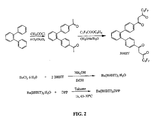
- FIG. 2 is a schematic illustrating the synthesis of another embodiment of a metal chelate according to the present invention.
- FIG. 3 is a graphical representation of aminodextran concentration and response signal as functions of metal concentration for a prior art composition.
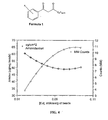
- FIG. 4 is a graphical representation of aminodextran concentration and response signal as functions of metal concentration for compositions according to the present invention.
- compositions of the present invention are useful as signal generation components in immunoassays.
- the compositions generally include a carrier coated with an aminodextran and have a metal chelate incorporated therein.
- the compositions provide strong response signals which allows for quantitative determinations of analytes of interest, while reducing errors caused by non-specific binding.
- Carriers suitable for the present invention include solid phase materials, typically a support or surface, that can have any one of a number of shapes, such as strip, sheet, rod, plate, well, tube, particle or bead.
- the material is usually of an organic or inorganic, swellable or non-swellable, porous or non-porous, magnetic or nonmagnetic, water-insoluble material.
- the surface can be hydrophilic or capable of being rendered hydrophilic.
- the solid support includes inorganic powders such as silica, magnesium sulfate, and alumina; natural polymeric materials, particularly cellulosic materials and materials derived from cellulose, such as fiber containing papers, e.g., filter paper, chromatographic paper, etc.; synthetic or modified naturally occurring polymers, such as nitrocellulose, cellulose acetate, polyvinylchloride, polyacrylamide, crosslinked dextran, agarose, polyacrylate, polyethylene, polypropylene, poly(4-methylbutene), polystyrene, polymethacrylate, polyethyleneterephthalate, nylon, polyvinylbutyrate, etc.; either used by themselves or in conjunction with other materials; glass available as Bioglass, ceramics, magnetic materials, metals, and the like. Natural or synthetic assemblies such as liposomes, phospholipid vesicles, and cells can also be employed.
- natural polymeric materials particularly cellulosic materials and materials derived from cellulose, such as fiber containing papers, e
- the carrier is a particle.
- particle encompasses spheres, spheroids, beads and other shapes as well. Suitable particles are typically at least 20 nm and not more than about 20 ⁇ m, usually at least about 40 nm and less than 10 ⁇ m, preferably 0.1 to 10 ⁇ m, more preferably, 0.1 to 5 ⁇ m, and even more preferably 0.15 to 3 ⁇ m.
- the particle may be organic or inorganic, swellable or non-swellable, porous or non-porous, having any density, but preferably of a density approximating water, generally from 0.7 to 1.5 g/ml, preferably suspendible in water, and composed of material that can be transparent, partially transparent, or opaque.
- the particles may be core-and-shell particles, such as particles with a magnetic core and a hard shell coating of polymerized monomer(s).
- the particles are preferably negative charged.
- the particles are preferably solid, e.g., polymer particles, metal sols (particles comprised of a heavy metal such as, e.g., gold or silver), glass particles, silicon particles, magnetic particles, dye crystallites.
- Latex means a particulate water-suspendible water-insoluble polymeric material.
- the latex is frequently a substituted polyethylene such as: polystyrene-butadiene, polyacrylamide polystyrene, polystyrene with amino groups, poly-acrylic acid, polymethacrylic acid, acrylonitrile-butadiene, styrene copolymers, polyvinyl acetate-acrylate, polyvinyl pyrridine, vinyl-chloride acrylate copolymers, and the like.
- Non-crosslinked polymers of styrene and carboxylated styrene or styrene functionalized with other active groups such as amino, hydroxyl, halo and the like are preferred. Frequently, copolymers of substituted styrenes with dienes such as butadiene will be used.
- the carriers according to the present invention are coated with one or more layers layers of an aminodextran.
- An aminodextran is a derivatized glucose polymer with amino groups having a molecular weight of 10,000 to 2,000,000, preferably 500,000.
- Methods of preparing aminodextrans and coating carriers are known in the art. Suitable methods are described in US 5,707,877 , columns 18-20, and US 5,639,620 , columns 21 and 22.
- aminodextran is coated on the carrier by covalent attachment of the amino group of aminodextran to the surface carboxyl groups or other amine-reactive functional group of the carrier.
- the aminodextran coating improves the specificity of the carrier in specific binding assays and therefore improves the sensitivity of immunoassays. It has been discovered that the metal chelate of the present invention unexpectedly allows for coating of carriers with aminodextran in the amount of at least about 45 ⁇ g per milligram of carrier in the presence of a dye concentration as high as at least 0.065 ⁇ M. According to one preferred embodiment of the present invention, the aminodextran coating is present in at least about 49 ⁇ g per milligram of carrier.
- the carrier may be coated with a second layer comprising a polysaccharide, as described in US-B-7,179,660 .
- the polysaccharide may be covalently coupled to the aminodextran layer by amine-reactive functional groups.
- the second layer comprises dextran aldheyde.
- a metal chelate is incorporated into the carrier through a known process, such as dyeing.
- the metal chelate allows for a fluorescent or chemiluminescent signal to be detected.
- the metal chelate is chosen such that relatively higher concentrations of the metal chelate do not interfere with the binding of the aminodextran coating to the carrier.
- the metal chelate is present in the amount of at least 0.065 ⁇ M per milligram of carrier, while the aminodextran average coating density is at least 45 ⁇ g per milligram of carrier.
- the metal chelate is present in the amount of at least 0.065 ⁇ M and less than 0.150 ⁇ M per milligram of carrier, more preferably 0.079 ⁇ M to 0.150 ⁇ M per milligram of carrier, and more preferably about 0.087 ⁇ M per milligram of carrier. In another embodiment of the invention, the metal chelate is present in the amount of 0.110 ⁇ M to 135 ⁇ M. These concentrations of metal chelate and aminodextran have been found to provide a proper balance of response signal and component specificity for the analyte of interest.
- Suitable electron donating groups are those that make available extra negative charge to the perfluoralkyl groups.
- the electron donating group R is selected from the group consisting of C 1 to C 6 alkyls, dialkylamines, ethers, thioethers, and aryl groups.
- the metal chelates of the present invention are effective in allowing optimized amounts of amindoextran to coat the carrier because the metal chelates provide an unexpectedly stable complex relative to prior metal chelate dyes.
- the stability of the complex reduces the amount of the free metal, which is believed to inhibit the attachment of the aminodextran to the carrier.
- electron donating groups R further add to the stability of the complex by making available additional negative charge to the perfluoroalkyl groups of the ligands, thereby improving the ability of the perfluoralkyl group to bind to the metal in the complex.
- M is europium and the carrier is a latex particle.
- L2 is selected from among the following formulas:
- the ligands L2 are 2-(1',1',1', 2', 2',3', 3'-heptafluoro-4', 6'-hexanedion-6'-yl)-naphthylene (NHA) and 4, 4'-bis (1",1",1",2", 2", 3", 3"- heptafluroro- 4", 6" - hexanedion-6"-yl)-o-terphenyl (BHHT).
- the metal chelate comprises Eu(NHA) 3 DPP and Eu(BHHT) 2 DPP.
- the metal chelates can be prepared by combining the metal chloride with the desired ratio of metal ligand molecules in an organic solvent and sufficient base to take up the released hydrochloric acid. Suitable syntheses are illustrated in FIGS. 1-2 , respectively.
- the metal chelate dyes of the present invention have been found to allow for a higher density of aminodextran coating at relatively higher concentrations of the metal chelate dyes when compared to conventional dyes, as demonstrated in the Comparative Examples below.
- the metal chelates of the present invention generally will allow an aminodextran coating at 45 to 55 ⁇ g per mg beads compared to 23 to 35 ⁇ g per mg of bead for the conventional dyes.
- the dyes of the present invention can be present in amounts sufficient to give strong response signals as part of a signal generation component in a specific binding assay, while allowing the carrier to be coated with an aminodextran in an amount sufficient to reduce the amount of non-specific binding.
- compositions of the present invention are suitable for use as a signal generation component in specific binding assays.
- the compositions are suitable for any immunoassay in which a signal is measured in response to ligand binding to an analyte.
- Those skilled in the art will readily appreciate the compositions have wide utility in a number of assay formats.
- the signal generating component is used to perform Luminescent Oxygen Channeling Immunoassay (LOCITM) as described in EP-A2-0 515 194 .
- LOCITM Luminescent Oxygen Channeling Immunoassay
- at least one specific binding partner is bound to a carrier according to the present invention.
- a medium suspected of containing an analyte is treated under conditions such the analyte affects the amount of a sensitizer capable in its excited state of generating singlet oxygen and a chemiluminescent compound that can come into close proximity such that singlet oxygen generated by said photosensitizer can activate said chemiluminescent compound, which subsequently produces light, and measuring the light, the amount thereof being related to the amount of analyte in said medium.
- the LOCITM method includes the steps of: (A) combining either simultaneously or wholly or partially sequentially (i) a medium suspected of containing the analyte; (ii) a first specific binding partner associated with a sensitizer capable in its excited state of generating singlet oxygen; and (iii) a second specific binding partner associated with a composition comprising a chemiluminescent compound, which is a substance that undergoes a chemical reaction with singlet oxygen to form a metastabile intermediate species that can decompose with the simultaneous or subsequent emission of light; (B) allowing the formation of complexes comprising the first and the second specific binding partner, the complex formation brings the sensitizer into close proximity to the chemiluminescent compound, (C) activating the sensitizer to generate singlet oxygen; and measuring the amount of light emitted by the chemiluminescent compound, the light is directly or inversely proportional to the amount of analyte in the medium.
- the carrier may be dyed both with a metal chelate and an oxygen acceptor.
- the oxygen acceptor is a component that reacts with singlet oxygen to form a highly unstable product that rapidly decomposes into an excited state. The excess energy of the excited state is transferred to the dye by a Forster energy transfer that takes place in a few nanoseconds. The metal chelate dye then emits a photon of light that can be detected with a photon counter.
- Suitable oxygen acceptors are disclosed in U.S. Pat. Nos. 5,578,498 and 5,811,311 .
- One particularly preferred oxygen acceptor is C-28 thioxene, which has the following formula:
- a mixture of 100 mL 10% solution of carboxylated latex beads (from Seradyn), 138 ml 1-methoxy-2-propanol, 280 mL D.I. water and 10 mL of 0.1 M NaOH is placed in a three-necked flask equipped with a mechanical stirrer and a thermometer. The mixture is brought to 80°C with stirring.
- a separate solution is then prepared with a 2g of C-28 thioxene and 2.7g Eu(NHA) 3 DPP in 220 mL of 1-methoxy-2-propanol, and the solution is heated to 80°C with stirring until dissolved.
- the dye solution is then poured into the bead solution and stirred for 30 min.
- the beads are then washed by diafiltration with 10% v/v ethanol in water adjusted to pH 10 with NaOH. The beads are then concentrated to about 20 mg/ml during the wash, and then stored at 4°C protected from light.
- the aminodextran coating is then applied as follows. 1mL of the dyed beads ( ⁇ 20mg/ml) is mixed with 20mg/ml of hydroxypropylaminodextran (MW 500K) in 0.05M MES / pH 6.0 in the presence of 3.8 mg/ml EDAC. After incubating this mixture for 16 hours at room temperature, (in the dark) the beads were washed once with 2ml of 0.05M MES / pH 6.0, then with 6ml of 0.05M MES, 1.0M NaCl/ pH 6.0. Finally the beads were resuspended in 1 ml of 0.05M MES / pH 6.0 to yield the coated beads. Washing was performed by centrifugation method (using Sorval RC-5B Plus centifruge or Ependorf centrifuge-5415 C) and pellets were resuspended by sonication (using Branson Sonifer-450).
- the dextran aldehyde layer may then be added as follows. 1ml of the 20mg/ml dextran aldehyde in 0.05M MES is mixed with 1ml of the aminodextran coated chemiluminescent beads in the presence of 2mg/ml NaBH 3 CN. After incubating for 37°C for 20 hours (in the dark), the beads were washed once with 4ml and then with another 5ml of MES buffer. The beads were resuspended in 0.5ml of 0.05MES, 0.4% Tween-20 / pH 6.0 to yield about 40 mg/ml of coated beads.
- a first set of latex particles were dyed with Eu (NTA) 3 DPP and thioxene and coated with an aminodextran according to the methods described herein.
- a second set of latex particles were dyed with Eu (NHA) 3 DPP and thioxene and coated with an aminodextran.
- the aminodextran coating densities and the chemiluminesence were simultaneously measured at several concentrations of the metal chelate.
- the aminodextran coating density was measured by a colorimetric test after being treated with anthrone and 80% sulfuric acid.
- the chemiluminescence was measured as LOCI counts by a Envision-Alpha reader sold by Perkin-Elmer.
- the data points for Eu (NTA) 3 DPP are tabulated in Table 1 and shown graphically with curve fitting in FIG. 3 .
- the data points for Eu(NHA) 3 DPP are tabulated in Table 2 and, for concentrations up to 0.094, are shown graphically with curve fitting in FIG. 4 .
- Table 1 LOCI counts and aminodextran concentration as a function of europium concentration in E (NTA) 3 DPP Eu (mMole/g beads) Aminodextran coating (ug/mg beads) LOCI signal, MM counts 0.169 30 9.7 0.085 36 9.2 0.042 45 6.7 0.021 55 2.8 0.000 62 0.0
- Table 2 LOCI counts and aminodextran concentration as a function of europium concentration in Eu (BHHT) 2 DPP Eu (mMole/g beads) Andex coating (ug/mg beads) LOCI signal, MM counts 0.020 3.8 60 0.028 5.3 57 0.035 6.6 55 0.043 7.7 53 0.050 8.6 51 0.057 9.4 50 0.065 10.0 49 0.072 10.5 49 0.079 10.8 49 0.087 10.9 50 0.094 10.8 50 0.0135* 10.8* 50* * results not shown in FIG. 4
- the aminodextran loading and the LOCI signal could not be simultaneously poised on a plateau for response with respect to composition.
- the response signal does not begin to plateau until about 0.085 mmol Eu / gram of beads.
- the aminodextran coating concentration is only at 36 ug/mg of beads, and continues to decline with increasing europium concentrations.
- the compound according to the present invention begins to plateau both in terms of aminodextran concentration and LOCI signal with as little as 0.065 mmol Eu / gram of beads.
- the average aminodextran coating concentration is 49 ⁇ g/mg beads.
- the concentration of aminodextran generally holds steady as the concentration of europium is increased.
- Latex beads from Seradyn were dyed with 0.171 mmol of Europium dye and 0.303 mmol of C-28 thioxene per gram of bead for each of two conventional dyes, Eu(TTA) 3 DPP and Eu(NTA) 3 DPP and two dyes according to the present invention, Eu(BHHT) 2 DPP and Eu(NHA) 3 DPP.
- the beads were then coated with aminodextran as described herein. The densities of the aminodextran was then determined, as well as the amplitude of its response signal. The data are tabulated on Table 3.
Landscapes
- Life Sciences & Earth Sciences (AREA)
- Health & Medical Sciences (AREA)
- Engineering & Computer Science (AREA)
- Urology & Nephrology (AREA)
- Biomedical Technology (AREA)
- Hematology (AREA)
- Immunology (AREA)
- Chemical & Material Sciences (AREA)
- Molecular Biology (AREA)
- Cell Biology (AREA)
- Food Science & Technology (AREA)
- General Health & Medical Sciences (AREA)
- Biotechnology (AREA)
- Medicinal Chemistry (AREA)
- Physics & Mathematics (AREA)
- Analytical Chemistry (AREA)
- Biochemistry (AREA)
- Microbiology (AREA)
- General Physics & Mathematics (AREA)
- Pathology (AREA)
- Investigating Or Analysing Materials By The Use Of Chemical Reactions (AREA)
- Catalysts (AREA)
- Inorganic Compounds Of Heavy Metals (AREA)
- Production Of Liquid Hydrocarbon Mixture For Refining Petroleum (AREA)
Applications Claiming Priority (2)
| Application Number | Priority Date | Filing Date | Title |
|---|---|---|---|
| US11/040,887 US20060166376A1 (en) | 2005-01-21 | 2005-01-21 | Compositions for use as a signal generation component and methods of using same |
| PCT/US2006/001529 WO2006078618A2 (en) | 2005-01-21 | 2006-01-17 | Compositions for use as a signal generation component and methods of using same |
Publications (3)
| Publication Number | Publication Date |
|---|---|
| EP1856529A2 EP1856529A2 (en) | 2007-11-21 |
| EP1856529A4 EP1856529A4 (en) | 2010-07-07 |
| EP1856529B1 true EP1856529B1 (en) | 2012-07-25 |
Family
ID=36692776
Family Applications (1)
| Application Number | Title | Priority Date | Filing Date |
|---|---|---|---|
| EP06718583A Expired - Lifetime EP1856529B1 (en) | 2005-01-21 | 2006-01-17 | Compositions for use as a signal generation component and methods of using same |
Country Status (6)
| Country | Link |
|---|---|
| US (3) | US20060166376A1 (enExample) |
| EP (1) | EP1856529B1 (enExample) |
| JP (1) | JP4741607B2 (enExample) |
| ES (1) | ES2392730T3 (enExample) |
| PT (1) | PT1856529E (enExample) |
| WO (1) | WO2006078618A2 (enExample) |
Families Citing this family (8)
| Publication number | Priority date | Publication date | Assignee | Title |
|---|---|---|---|---|
| CA2669398C (en) * | 2006-11-13 | 2016-01-05 | Perkinelmer Las, Inc. | Detecting molecular interactions comprising a target-selective binding agent and a target molecule with fluorescence resonance energy transfer (fret) |
| US8084215B2 (en) | 2008-04-29 | 2011-12-27 | Psychemedics Corporation | Non-proteolytic method for the determination of analytes in keratinized structures |
| CN105675892A (zh) | 2008-04-29 | 2016-06-15 | 赛凯米迪克斯股份有限公司 | 固相多分析物测试 |
| US9347947B2 (en) * | 2009-03-12 | 2016-05-24 | Siemens Healthcare Diagnostics Inc. | Immunoassays employing non-particulate chemiluminescent reagent |
| EP2230515B1 (en) * | 2009-03-16 | 2014-12-17 | Agilent Technologies, Inc. | Passivation of surfaces after ligand coupling |
| US8153442B2 (en) * | 2009-10-21 | 2012-04-10 | Siemens Healthcare Diagnostics Inc. | Stabilization of signal generation in particles used in assays |
| WO2012009721A1 (en) | 2010-07-16 | 2012-01-19 | Elitech Holding B.V. | Orthogonal nucleic acid affinity pairs |
| WO2014005065A1 (en) | 2012-06-28 | 2014-01-03 | Psychemedics Corporation | Detection of analytes in hair wash samples |
Family Cites Families (28)
| Publication number | Priority date | Publication date | Assignee | Title |
|---|---|---|---|---|
| US4283382A (en) * | 1977-12-28 | 1981-08-11 | Eastman Kodak Company | Fluorescent labels comprising rare earth chelates |
| US4220450A (en) * | 1978-04-05 | 1980-09-02 | Syva Company | Chemically induced fluorescence immunoassay |
| SE425439B (sv) | 1981-04-30 | 1982-09-27 | Wallac Oy | Immunologisk analys med lantanidkelatkomplex som markor |
| US4637988A (en) * | 1981-07-01 | 1987-01-20 | Eastman Kodak Company | Fluorescent labels for immunoassay |
| SE454115B (sv) * | 1982-09-13 | 1988-03-28 | Wallac Oy | Homogenfasanalys med lantanidkelat som merksubstans |
| US6165729A (en) * | 1986-04-30 | 2000-12-26 | Hyperion Catalysis International, Inc. | Electrochemiluminescent reaction utilizing amine-derived reductant |
| US4925804A (en) * | 1986-06-17 | 1990-05-15 | Baxter International Inc. | Interligand metal transfer assay |
| US4978625A (en) * | 1987-10-19 | 1990-12-18 | Becton, Dickinson And Company | Fluorescence immunoassay using water insoluble dyes |
| US5639620A (en) * | 1990-10-31 | 1997-06-17 | Coulter Corporation | Polymeric particles having a biodegradable gelatin or aminodextran coating and process for making same |
| US5466609A (en) * | 1990-10-31 | 1995-11-14 | Coulter Corporation | Biodegradable gelatin-aminodextran particle coatings of and processes for making same |
| FI88654C (fi) * | 1991-03-15 | 1993-06-10 | Datacity Center Oy | Fluorescenshoejningsmetod |
| US5578498A (en) * | 1991-05-22 | 1996-11-26 | Behringwerke Ag | Metal chelate containing compositions for use in chemiluminescent assays |
| ATE208039T1 (de) | 1991-05-22 | 2001-11-15 | Dade Behring Marburg Gmbh | Bestimmungsmethoden unter verwendung von induzierter lumineszenz |
| JP3464798B2 (ja) * | 1992-07-31 | 2003-11-10 | デイド・ベーリング・マルブルク・ゲゼルシヤフト・ミツト・ベシユレンクテル・ハフツング | 光活性化化学発光基質 |
| US6399397B1 (en) * | 1992-09-14 | 2002-06-04 | Sri International | Up-converting reporters for biological and other assays using laser excitation techniques |
| JP2000019171A (ja) * | 1998-04-28 | 2000-01-21 | Kazuko Matsumoto | 標識プローブによる分析方法 |
| US6080839A (en) * | 1998-06-25 | 2000-06-27 | Wallac Oy | Labeling reactants and their use |
| US6389318B1 (en) | 1998-07-06 | 2002-05-14 | Abiomed, Inc. | Magnetic shield for primary coil of transcutaneous energy transfer device |
| JP3497092B2 (ja) * | 1998-07-23 | 2004-02-16 | 名古屋大学長 | プラズマ密度情報測定方法、および測定に用いられるプローブ、並びにプラズマ密度情報測定装置 |
| US20010055763A1 (en) * | 1998-12-24 | 2001-12-27 | Sharat Singh | Individually addressable solid surfaces for multiplexed operations |
| US20010055776A1 (en) * | 2000-02-11 | 2001-12-27 | Dale Greenwalt | High throughput cell-based assay kits |
| WO2001067105A1 (en) * | 2000-03-06 | 2001-09-13 | Dade Behring Marburg Gmbh | Carriers coated with polysaccharides, their preparation and use |
| US6339397B1 (en) * | 2000-06-01 | 2002-01-15 | Lat-Lon, Llc | Portable self-contained tracking unit and GPS tracking system |
| US20030133972A1 (en) * | 2000-10-11 | 2003-07-17 | Targesome, Inc. | Targeted multivalent macromolecules |
| JP2002181816A (ja) * | 2000-12-08 | 2002-06-26 | Univ Waseda | 二本鎖核酸の検出試薬と二本鎖核酸検出方法 |
| JP4537053B2 (ja) | 2001-06-25 | 2010-09-01 | ジョージア テック リサーチ コーポレーション | 二重共鳴エネルギー転移核酸プローブ |
| US7053249B2 (en) * | 2002-10-25 | 2006-05-30 | Idexx Laboratories, Inc. | Metal chelates and methods of using them for time-resolved fluorescence |
| US20070106674A1 (en) * | 2005-11-10 | 2007-05-10 | Purusharth Agrawal | Field sales process facilitation systems and methods |
-
2005
- 2005-01-21 US US11/040,887 patent/US20060166376A1/en not_active Abandoned
-
2006
- 2006-01-17 PT PT06718583T patent/PT1856529E/pt unknown
- 2006-01-17 WO PCT/US2006/001529 patent/WO2006078618A2/en not_active Ceased
- 2006-01-17 JP JP2007552204A patent/JP4741607B2/ja not_active Expired - Lifetime
- 2006-01-17 EP EP06718583A patent/EP1856529B1/en not_active Expired - Lifetime
- 2006-01-17 ES ES06718583T patent/ES2392730T3/es not_active Expired - Lifetime
- 2006-08-04 US US11/499,519 patent/US7691647B2/en not_active Expired - Lifetime
-
2009
- 2009-09-08 US US12/555,734 patent/US20090325316A1/en not_active Abandoned
Also Published As
| Publication number | Publication date |
|---|---|
| EP1856529A4 (en) | 2010-07-07 |
| US20060166376A1 (en) | 2006-07-27 |
| US20060270063A1 (en) | 2006-11-30 |
| JP2008528969A (ja) | 2008-07-31 |
| US20090325316A1 (en) | 2009-12-31 |
| WO2006078618A2 (en) | 2006-07-27 |
| WO2006078618A3 (en) | 2006-11-16 |
| JP4741607B2 (ja) | 2011-08-03 |
| US7691647B2 (en) | 2010-04-06 |
| EP1856529A2 (en) | 2007-11-21 |
| ES2392730T3 (es) | 2012-12-13 |
| PT1856529E (pt) | 2012-09-24 |
Similar Documents
| Publication | Publication Date | Title |
|---|---|---|
| US20090325316A1 (en) | Compositions for use as a Signal Generation Component and Methods of Using Same | |
| US4259313A (en) | Fluorescent labels | |
| US4283382A (en) | Fluorescent labels comprising rare earth chelates | |
| US4735907A (en) | Stabilized fluorescent rare earth labels and labeled physiologically reactive species | |
| US4372745A (en) | Chemical luminescence amplification substrate system for immunochemistry involving microencapsulated fluorescer | |
| EP0002963B1 (en) | Aqueous stabilized fluorescent labels, proteins labelled therewith and methods of use | |
| EP0580979B1 (en) | Method of detection by inducing electrochemiluminescence | |
| US4181650A (en) | Procedure for the assay of pharmacologically immunologically and biochemically active compounds in biological fluids | |
| EP0195624B1 (en) | Fluorescent labels and labeled species and their use in analytical elements and determinations | |
| US20110097723A1 (en) | Methods and reagents for analyte detection | |
| US6846629B2 (en) | Methods and apparatus for improved luminescence assays using microparticles | |
| AU2011252833A1 (en) | Homogeneous chemiluminescence assay methods with increased sensitivity | |
| EP3839485B1 (en) | Microsphere composition for chemiluminescence analysis and use thereof | |
| CA1166133A (en) | Chemical luminescence amplification substrate system for immuno chemistry | |
| JPH06197796A (ja) | カチオン界面活性剤もしくはポリマー及び4′−ヒドロキシアセトアニリドを含有する化学ルミネセンス組成物、試験キット並びに分析方法におけるそれらの用途 | |
| EP0008233B1 (en) | Fluorimetric method for analysis for bilirubin | |
| DE69328013T2 (de) | Immunoassay unter Verwendung eines 4-Hydroxy- oder 4-Alkoxyacetamides als Stabilisator | |
| EP0704539A2 (en) | Chemiluminescent reagent and assay using a substituted acetanilide for light generation | |
| JPH02259567A (ja) | 酸化還元重合による免疫検定および核酸検定用の組成物およびその方法 | |
| AU697785B2 (en) | Analytical element,composition and method using modified apo-horseradish peroxidase | |
| JP3185215B2 (ja) | 免疫測定法 | |
| AU582341B2 (en) | Assay for immobilized reporter groups | |
| GB1578275A (en) | Procedure for the assay of pharmacologically immunologically and biochemically active compounds in biological fluids | |
| CN120441745B (zh) | 一种aipe磷光微球及其制备方法和应用 | |
| CA1255213A (en) | Assay for immobilized reporter groups |
Legal Events
| Date | Code | Title | Description |
|---|---|---|---|
| PUAI | Public reference made under article 153(3) epc to a published international application that has entered the european phase |
Free format text: ORIGINAL CODE: 0009012 |
|
| 17P | Request for examination filed |
Effective date: 20070821 |
|
| AK | Designated contracting states |
Kind code of ref document: A2 Designated state(s): AT BE BG CH CY CZ DE DK EE ES FI FR GB GR HU IE IS IT LI LT LU LV MC NL PL PT RO SE SI SK TR |
|
| DAX | Request for extension of the european patent (deleted) | ||
| RAP1 | Party data changed (applicant data changed or rights of an application transferred) |
Owner name: SIEMENS HEALTHCARE DIAGNOSTICS INC. |
|
| A4 | Supplementary search report drawn up and despatched |
Effective date: 20100604 |
|
| 17Q | First examination report despatched |
Effective date: 20110907 |
|
| GRAP | Despatch of communication of intention to grant a patent |
Free format text: ORIGINAL CODE: EPIDOSNIGR1 |
|
| GRAS | Grant fee paid |
Free format text: ORIGINAL CODE: EPIDOSNIGR3 |
|
| GRAA | (expected) grant |
Free format text: ORIGINAL CODE: 0009210 |
|
| AK | Designated contracting states |
Kind code of ref document: B1 Designated state(s): AT BE BG CH CY CZ DE DK EE ES FI FR GB GR HU IE IS IT LI LT LU LV MC NL PL PT RO SE SI SK TR |
|
| REG | Reference to a national code |
Ref country code: GB Ref legal event code: FG4D |
|
| REG | Reference to a national code |
Ref country code: CH Ref legal event code: EP |
|
| REG | Reference to a national code |
Ref country code: IE Ref legal event code: FG4D Ref country code: AT Ref legal event code: REF Ref document number: 567901 Country of ref document: AT Kind code of ref document: T Effective date: 20120815 |
|
| REG | Reference to a national code |
Ref country code: DE Ref legal event code: R096 Ref document number: 602006030944 Country of ref document: DE Effective date: 20120920 |
|
| REG | Reference to a national code |
Ref country code: PT Ref legal event code: SC4A Free format text: AVAILABILITY OF NATIONAL TRANSLATION Effective date: 20120918 |
|
| REG | Reference to a national code |
Ref country code: NL Ref legal event code: VDEP Effective date: 20120725 |
|
| REG | Reference to a national code |
Ref country code: ES Ref legal event code: FG2A Ref document number: 2392730 Country of ref document: ES Kind code of ref document: T3 Effective date: 20121213 |
|
| REG | Reference to a national code |
Ref country code: AT Ref legal event code: MK05 Ref document number: 567901 Country of ref document: AT Kind code of ref document: T Effective date: 20120725 |
|
| REG | Reference to a national code |
Ref country code: LT Ref legal event code: MG4D Effective date: 20120725 |
|
| PG25 | Lapsed in a contracting state [announced via postgrant information from national office to epo] |
Ref country code: LT Free format text: LAPSE BECAUSE OF FAILURE TO SUBMIT A TRANSLATION OF THE DESCRIPTION OR TO PAY THE FEE WITHIN THE PRESCRIBED TIME-LIMIT Effective date: 20120725 Ref country code: FI Free format text: LAPSE BECAUSE OF FAILURE TO SUBMIT A TRANSLATION OF THE DESCRIPTION OR TO PAY THE FEE WITHIN THE PRESCRIBED TIME-LIMIT Effective date: 20120725 Ref country code: AT Free format text: LAPSE BECAUSE OF FAILURE TO SUBMIT A TRANSLATION OF THE DESCRIPTION OR TO PAY THE FEE WITHIN THE PRESCRIBED TIME-LIMIT Effective date: 20120725 Ref country code: IS Free format text: LAPSE BECAUSE OF FAILURE TO SUBMIT A TRANSLATION OF THE DESCRIPTION OR TO PAY THE FEE WITHIN THE PRESCRIBED TIME-LIMIT Effective date: 20121125 Ref country code: BE Free format text: LAPSE BECAUSE OF FAILURE TO SUBMIT A TRANSLATION OF THE DESCRIPTION OR TO PAY THE FEE WITHIN THE PRESCRIBED TIME-LIMIT Effective date: 20120725 Ref country code: CY Free format text: LAPSE BECAUSE OF FAILURE TO SUBMIT A TRANSLATION OF THE DESCRIPTION OR TO PAY THE FEE WITHIN THE PRESCRIBED TIME-LIMIT Effective date: 20120725 |
|
| PG25 | Lapsed in a contracting state [announced via postgrant information from national office to epo] |
Ref country code: SI Free format text: LAPSE BECAUSE OF FAILURE TO SUBMIT A TRANSLATION OF THE DESCRIPTION OR TO PAY THE FEE WITHIN THE PRESCRIBED TIME-LIMIT Effective date: 20120725 Ref country code: LV Free format text: LAPSE BECAUSE OF FAILURE TO SUBMIT A TRANSLATION OF THE DESCRIPTION OR TO PAY THE FEE WITHIN THE PRESCRIBED TIME-LIMIT Effective date: 20120725 Ref country code: SE Free format text: LAPSE BECAUSE OF FAILURE TO SUBMIT A TRANSLATION OF THE DESCRIPTION OR TO PAY THE FEE WITHIN THE PRESCRIBED TIME-LIMIT Effective date: 20120725 Ref country code: GR Free format text: LAPSE BECAUSE OF FAILURE TO SUBMIT A TRANSLATION OF THE DESCRIPTION OR TO PAY THE FEE WITHIN THE PRESCRIBED TIME-LIMIT Effective date: 20121026 Ref country code: PL Free format text: LAPSE BECAUSE OF FAILURE TO SUBMIT A TRANSLATION OF THE DESCRIPTION OR TO PAY THE FEE WITHIN THE PRESCRIBED TIME-LIMIT Effective date: 20120725 |
|
| PG25 | Lapsed in a contracting state [announced via postgrant information from national office to epo] |
Ref country code: NL Free format text: LAPSE BECAUSE OF FAILURE TO SUBMIT A TRANSLATION OF THE DESCRIPTION OR TO PAY THE FEE WITHIN THE PRESCRIBED TIME-LIMIT Effective date: 20120725 |
|
| PG25 | Lapsed in a contracting state [announced via postgrant information from national office to epo] |
Ref country code: CZ Free format text: LAPSE BECAUSE OF FAILURE TO SUBMIT A TRANSLATION OF THE DESCRIPTION OR TO PAY THE FEE WITHIN THE PRESCRIBED TIME-LIMIT Effective date: 20120725 Ref country code: RO Free format text: LAPSE BECAUSE OF FAILURE TO SUBMIT A TRANSLATION OF THE DESCRIPTION OR TO PAY THE FEE WITHIN THE PRESCRIBED TIME-LIMIT Effective date: 20120725 Ref country code: DK Free format text: LAPSE BECAUSE OF FAILURE TO SUBMIT A TRANSLATION OF THE DESCRIPTION OR TO PAY THE FEE WITHIN THE PRESCRIBED TIME-LIMIT Effective date: 20120725 Ref country code: EE Free format text: LAPSE BECAUSE OF FAILURE TO SUBMIT A TRANSLATION OF THE DESCRIPTION OR TO PAY THE FEE WITHIN THE PRESCRIBED TIME-LIMIT Effective date: 20120725 |
|
| PG25 | Lapsed in a contracting state [announced via postgrant information from national office to epo] |
Ref country code: SK Free format text: LAPSE BECAUSE OF FAILURE TO SUBMIT A TRANSLATION OF THE DESCRIPTION OR TO PAY THE FEE WITHIN THE PRESCRIBED TIME-LIMIT Effective date: 20120725 |
|
| PLBE | No opposition filed within time limit |
Free format text: ORIGINAL CODE: 0009261 |
|
| STAA | Information on the status of an ep patent application or granted ep patent |
Free format text: STATUS: NO OPPOSITION FILED WITHIN TIME LIMIT |
|
| 26N | No opposition filed |
Effective date: 20130426 |
|
| PG25 | Lapsed in a contracting state [announced via postgrant information from national office to epo] |
Ref country code: BG Free format text: LAPSE BECAUSE OF FAILURE TO SUBMIT A TRANSLATION OF THE DESCRIPTION OR TO PAY THE FEE WITHIN THE PRESCRIBED TIME-LIMIT Effective date: 20121025 |
|
| REG | Reference to a national code |
Ref country code: DE Ref legal event code: R097 Ref document number: 602006030944 Country of ref document: DE Effective date: 20130426 |
|
| PG25 | Lapsed in a contracting state [announced via postgrant information from national office to epo] |
Ref country code: MC Free format text: LAPSE BECAUSE OF NON-PAYMENT OF DUE FEES Effective date: 20130131 |
|
| REG | Reference to a national code |
Ref country code: CH Ref legal event code: PL |
|
| REG | Reference to a national code |
Ref country code: IE Ref legal event code: MM4A |
|
| PG25 | Lapsed in a contracting state [announced via postgrant information from national office to epo] |
Ref country code: CH Free format text: LAPSE BECAUSE OF NON-PAYMENT OF DUE FEES Effective date: 20130131 Ref country code: LI Free format text: LAPSE BECAUSE OF NON-PAYMENT OF DUE FEES Effective date: 20130131 |
|
| PG25 | Lapsed in a contracting state [announced via postgrant information from national office to epo] |
Ref country code: IE Free format text: LAPSE BECAUSE OF NON-PAYMENT OF DUE FEES Effective date: 20130117 |
|
| PG25 | Lapsed in a contracting state [announced via postgrant information from national office to epo] |
Ref country code: TR Free format text: LAPSE BECAUSE OF FAILURE TO SUBMIT A TRANSLATION OF THE DESCRIPTION OR TO PAY THE FEE WITHIN THE PRESCRIBED TIME-LIMIT Effective date: 20120725 |
|
| PG25 | Lapsed in a contracting state [announced via postgrant information from national office to epo] |
Ref country code: HU Free format text: LAPSE BECAUSE OF FAILURE TO SUBMIT A TRANSLATION OF THE DESCRIPTION OR TO PAY THE FEE WITHIN THE PRESCRIBED TIME-LIMIT; INVALID AB INITIO Effective date: 20060117 Ref country code: LU Free format text: LAPSE BECAUSE OF NON-PAYMENT OF DUE FEES Effective date: 20130117 |
|
| REG | Reference to a national code |
Ref country code: FR Ref legal event code: PLFP Year of fee payment: 11 |
|
| REG | Reference to a national code |
Ref country code: FR Ref legal event code: PLFP Year of fee payment: 12 |
|
| REG | Reference to a national code |
Ref country code: FR Ref legal event code: PLFP Year of fee payment: 13 |
|
| PGFP | Annual fee paid to national office [announced via postgrant information from national office to epo] |
Ref country code: PT Payment date: 20241220 Year of fee payment: 20 |
|
| PGFP | Annual fee paid to national office [announced via postgrant information from national office to epo] |
Ref country code: DE Payment date: 20250320 Year of fee payment: 20 |
|
| PGFP | Annual fee paid to national office [announced via postgrant information from national office to epo] |
Ref country code: FR Payment date: 20250114 Year of fee payment: 20 |
|
| PGFP | Annual fee paid to national office [announced via postgrant information from national office to epo] |
Ref country code: IT Payment date: 20250122 Year of fee payment: 20 Ref country code: GB Payment date: 20250210 Year of fee payment: 20 |
|
| PGFP | Annual fee paid to national office [announced via postgrant information from national office to epo] |
Ref country code: ES Payment date: 20250422 Year of fee payment: 20 |
|
| REG | Reference to a national code |
Ref country code: DE Ref legal event code: R071 Ref document number: 602006030944 Country of ref document: DE |
|
| REG | Reference to a national code |
Ref country code: ES Ref legal event code: FD2A Effective date: 20260126 |
|
| REG | Reference to a national code |
Ref country code: GB Ref legal event code: PE20 Expiry date: 20260116 |
|
| PG25 | Lapsed in a contracting state [announced via postgrant information from national office to epo] |
Ref country code: ES Free format text: LAPSE BECAUSE OF EXPIRATION OF PROTECTION Effective date: 20260118 |
|
| PG25 | Lapsed in a contracting state [announced via postgrant information from national office to epo] |
Ref country code: PT Free format text: LAPSE BECAUSE OF EXPIRATION OF PROTECTION Effective date: 20260128 |