EP1855269B1 - Speech processing method and device, storage medium, and speech system - Google Patents
Speech processing method and device, storage medium, and speech system Download PDFInfo
- Publication number
- EP1855269B1 EP1855269B1 EP06714430A EP06714430A EP1855269B1 EP 1855269 B1 EP1855269 B1 EP 1855269B1 EP 06714430 A EP06714430 A EP 06714430A EP 06714430 A EP06714430 A EP 06714430A EP 1855269 B1 EP1855269 B1 EP 1855269B1
- Authority
- EP
- European Patent Office
- Prior art keywords
- spectrum
- spectrum envelope
- deformed
- speech
- envelope
- Prior art date
- Legal status (The legal status is an assumption and is not a legal conclusion. Google has not performed a legal analysis and makes no representation as to the accuracy of the status listed.)
- Expired - Lifetime
Links
Images










Classifications
-
- G—PHYSICS
- G10—MUSICAL INSTRUMENTS; ACOUSTICS
- G10L—SPEECH ANALYSIS TECHNIQUES OR SPEECH SYNTHESIS; SPEECH RECOGNITION; SPEECH OR VOICE PROCESSING TECHNIQUES; SPEECH OR AUDIO CODING OR DECODING
- G10L21/00—Speech or voice signal processing techniques to produce another audible or non-audible signal, e.g. visual or tactile, in order to modify its quality or its intelligibility
-
- G—PHYSICS
- G10—MUSICAL INSTRUMENTS; ACOUSTICS
- G10L—SPEECH ANALYSIS TECHNIQUES OR SPEECH SYNTHESIS; SPEECH RECOGNITION; SPEECH OR VOICE PROCESSING TECHNIQUES; SPEECH OR AUDIO CODING OR DECODING
- G10L21/00—Speech or voice signal processing techniques to produce another audible or non-audible signal, e.g. visual or tactile, in order to modify its quality or its intelligibility
- G10L21/02—Speech enhancement, e.g. noise reduction or echo cancellation
-
- G—PHYSICS
- G10—MUSICAL INSTRUMENTS; ACOUSTICS
- G10K—SOUND-PRODUCING DEVICES; METHODS OR DEVICES FOR PROTECTING AGAINST, OR FOR DAMPING, NOISE OR OTHER ACOUSTIC WAVES IN GENERAL; ACOUSTICS NOT OTHERWISE PROVIDED FOR
- G10K11/00—Methods or devices for transmitting, conducting or directing sound in general; Methods or devices for protecting against, or for damping, noise or other acoustic waves in general
- G10K11/16—Methods or devices for protecting against, or for damping, noise or other acoustic waves in general
- G10K11/175—Methods or devices for protecting against, or for damping, noise or other acoustic waves in general using interference effects; Masking sound
- G10K11/1752—Masking
- G10K11/1754—Speech masking
-
- G—PHYSICS
- G10—MUSICAL INSTRUMENTS; ACOUSTICS
- G10L—SPEECH ANALYSIS TECHNIQUES OR SPEECH SYNTHESIS; SPEECH RECOGNITION; SPEECH OR VOICE PROCESSING TECHNIQUES; SPEECH OR AUDIO CODING OR DECODING
- G10L19/00—Speech or audio signals analysis-synthesis techniques for redundancy reduction, e.g. in vocoders; Coding or decoding of speech or audio signals, using source filter models or psychoacoustic analysis
- G10L19/02—Speech or audio signals analysis-synthesis techniques for redundancy reduction, e.g. in vocoders; Coding or decoding of speech or audio signals, using source filter models or psychoacoustic analysis using spectral analysis, e.g. transform vocoders or subband vocoders
-
- G—PHYSICS
- G10—MUSICAL INSTRUMENTS; ACOUSTICS
- G10L—SPEECH ANALYSIS TECHNIQUES OR SPEECH SYNTHESIS; SPEECH RECOGNITION; SPEECH OR VOICE PROCESSING TECHNIQUES; SPEECH OR AUDIO CODING OR DECODING
- G10L19/00—Speech or audio signals analysis-synthesis techniques for redundancy reduction, e.g. in vocoders; Coding or decoding of speech or audio signals, using source filter models or psychoacoustic analysis
- G10L19/04—Speech or audio signals analysis-synthesis techniques for redundancy reduction, e.g. in vocoders; Coding or decoding of speech or audio signals, using source filter models or psychoacoustic analysis using predictive techniques
- G10L19/06—Determination or coding of the spectral characteristics, e.g. of the short-term prediction coefficients
-
- G—PHYSICS
- G10—MUSICAL INSTRUMENTS; ACOUSTICS
- G10L—SPEECH ANALYSIS TECHNIQUES OR SPEECH SYNTHESIS; SPEECH RECOGNITION; SPEECH OR VOICE PROCESSING TECHNIQUES; SPEECH OR AUDIO CODING OR DECODING
- G10L21/00—Speech or voice signal processing techniques to produce another audible or non-audible signal, e.g. visual or tactile, in order to modify its quality or its intelligibility
- G10L21/02—Speech enhancement, e.g. noise reduction or echo cancellation
- G10L21/0316—Speech enhancement, e.g. noise reduction or echo cancellation by changing the amplitude
- G10L21/0364—Speech enhancement, e.g. noise reduction or echo cancellation by changing the amplitude for improving intelligibility
-
- G—PHYSICS
- G10—MUSICAL INSTRUMENTS; ACOUSTICS
- G10L—SPEECH ANALYSIS TECHNIQUES OR SPEECH SYNTHESIS; SPEECH RECOGNITION; SPEECH OR VOICE PROCESSING TECHNIQUES; SPEECH OR AUDIO CODING OR DECODING
- G10L21/00—Speech or voice signal processing techniques to produce another audible or non-audible signal, e.g. visual or tactile, in order to modify its quality or its intelligibility
- G10L21/02—Speech enhancement, e.g. noise reduction or echo cancellation
- G10L21/0208—Noise filtering
- G10L21/0216—Noise filtering characterised by the method used for estimating noise
- G10L21/0232—Processing in the frequency domain
Definitions
- the present invention relates to a speech system which prevents a third party from eavesdropping on the contents of a conversational speech and a speech processing method and apparatus and a storage medium which are used for the system.
- the masking effect is a phenomenon in which when a person hearing a given sound hears another sound at a predetermined level or more, the original sound is canceled out, and the person cannot hear it.
- Document WO 02/054732 A concerns a method and a system for use in a telephone, which enable to attenuate, scramble, suppress, all or part of the sound emitted by a user's voice, which is propagated outside the apparatus during a telephone conversation.
- the method enables to generate simultaneously during a telephone conversation, appropriate synthetic sounds, and, as the case may be, identical or close in power, frequency, modulation, but in phases suitably shifted relative to those contained in a user's spectral speech pattern, so that the sound of the user's voice which is propagated outside the telephone, combined with the result of the method, counter each other to produce the desired effect.
- the method is based on the user's spectral speech pattern.
- the sounds produced by the user's voice are sensed by an appropriate receiver.
- the electric or sound wave signals are analysed and electronically reconditioned by the system, they are then transformed into acoustic waves and broadcast simultaneously with the conversation. To produce the desired effect, they directly or indirectly interfere with the acoustic waves produced by the user's words.
- JP 2002-251199 A is directed at a voice input information processor.
- the voice input information processor has a voice input means equipped with a voice detecting means for detecting an input voice,
- a sound signal generating means which generates a sound signal actively muting a voice to the outside by generating an opposite-phase sound from the detected voice or a sound signal for actively changing the voiceprint by varying the frequency spectrum of the input voice on the basis of a voice mode set in advance, and a sound output means which outputs the sound signal and a signal regarding the detected input voice is transmitted to a CPU to carry out an indicated process.
- a sound signal generating means which generates a sound signal actively muting a voice to the outside by generating an opposite-phase sound from the detected voice or a sound signal for actively changing the voiceprint by varying the frequency spectrum of the input voice on the basis of a voice mode set in advance
- a sound output means which outputs the sound signal and a signal regarding the detected input voice is transmitted to a CPU to carry out an indicated process.
- the frequency spectrum of an original voice has a particular form
- a part of the spectrum of the original voice is changed to generate an interference sound.
- a combined voice with changed voice prints which has
- the masking sound In order to use a steadily produced sound such as pink noise or BGM as a masking sound, the masking sound needs to be higher in level than original speech. Therefore, a person who hears such a masking sound perceives the sound as a kind of noise, and hence it is difficult to use such a sound in a bank, hospital, or the like.
- decreasing the level of a masking sound will reduce the masking effect, leading to perception of an original sound in a frequency domain in which the masking effect is small, in particular.
- a person can hear a sound like pink noise or BGM while clearly discriminating it from an original sound. For this reason, due to the auditory characteristics of a human who can catch only a specific sound among a plurality of kinds of sounds, i.e., the cocktail party effect, a third party may hear an original sound.
- FIG. 1 is a conceptual view of a speech system including a speech processing apparatus 10 according to an embodiment of the present invention.
- the speech processing apparatus 10 generates an output speech signal by processing the input speech signal obtained by capturing conversational speech through a microphone 11 placed at a position A near a place where a plurality of persons 1 and 2 in FIG. 1 are having a conversation.
- the output speech signal outputted from the speech processing apparatus 10 is supplied to a loudspeaker 20 placed at a position B to emit a sound from the loudspeaker 20.
- the sound emitted from the loudspeaker 20 has a purpose of preventing a third party from eavesdropping on a conversational speech in this manner, and hence will be referred to as a disrupting sound hereinafter.
- the sound since the sound emitted from the loudspeaker 20 has a purpose of preventing a third party from eavesdropping on a conversational speech, the sound may also be referred to as an "anti-eavesdropping sound".
- the speech processing apparatus 10 performs processing for an input speech signal to generate an output speech signal whose phonemic characteristics are destroyed while the sound source information of the input speech signal is maintained.
- the loudspeaker 20 emits a disrupting sound whose phonemic characteristics have been destroyed.
- conversational speech captured by the microphone 11 has a spectrum like that shown in FIG. 2A
- a disrupting sound emitted from the loudspeaker 20 through the speech processing apparatus 10 has a spectrum like that shown in FIG. 2B .
- a third party hears a sound having a spectrum like that shown in FIG. 2C , which is the spectrum of a fused sound of the disrupting sound and the direct sound of the conversational speech.
- FIG. 3 shows the arrangement of a speech processing apparatus according to the first embodiment.
- a microphone 11 is placed, for example, near a counter of a bank or at the outpatient reception desk of a hospital. This microphone captures conversational speech and outputs a speech signal.
- a speech input processing unit 12 receives the speech signal from the microphone 11.
- the speech input processing unit 12 includes, for example, an amplifier and an analog-to-digital converter. This unit amplifies a speech signal from the microphone 11 (to be referred to as an input speech signal hereinafter), digitalizes the signal, and outputs the resultant signal.
- a spectrum analyzing unit 13 receives the digital input speech signal from the speech input processing unit 12. The spectrum analyzing unit 13 performs FFT cepstrum analysis and analyzes the input speech signal by processing using a speech analysis synthesizing system based on the vocoder scheme.
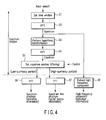
- the spectrum analyzing unit 13 multiplies a digital input speech signal by a time window such as a Hanning window or Hamming window, and then performs short-time spectrum analysis using fast Fourier transform (FFT) (steps S1 and S2).
- FFT fast Fourier transform
- This unit calculates the logarithm of the absolute value (amplitude spectrum) of the FFT result (step S3), and also obtains a cepstrum coefficient by performing inverse FFT (IFFT) (step S4).
- IFFT inverse FFT
- the unit then performs liftering for the cepstrum coefficient by using a cepstrum window and outputs low and high quefrency portions as analysis results (step S5).
- a spectrum envelope extracting unit 14 receives the low-quefrency portion of the cepstrum coefficient obtained as the analysis result by the spectrum analyzing unit 13.
- a spectrum fine structure extracting unit 16 receives the high-quefrency portion of the cepstrum coefficient.
- the spectrum envelope extracting unit 14 extracts the spectrum envelope of the speech spectrum of the input speech signal.
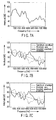
- the spectrum envelope represents the phonemic information of the input speech signal. If, for example, the input speech signal has the speech spectrum shown in FIG. 5A , the spectrum envelope is the one shown in FIG. 5B .
- the spectrum envelope extracting unit extracts a spectrum envelope by performing FFT (step S6) for the low-quefrency portion of the cepstrum coefficient, as shown in, for example, FIG. 4 .
- a spectrum envelope deforming unit 15 generates a deformed spectrum envelope by deforming the extracted spectrum envelope. If the extracted spectrum envelope is the one shown in FIG. 5B , the spectrum envelope deforming unit 15 deforms the spectrum envelope by inverting the spectrum envelope as shown in FIG. 5C . If, for example, FFT cepstrum analysis is used for the spectrum analyzing unit 13, a spectrum envelope is expressed by a low-order cepstrum coefficient. The spectrum envelope deforming unit 15 performs sign inversion with respect to such a low-order cepstrum coefficient. A more specific example of the spectrum envelope deforming unit 15 will be described in detail later.
- the spectrum fine structure extracting unit 16 extracts the spectrum fine structure of the speech spectrum of the input speech signal.
- the spectrum fine structure represents the sound source information of the input speech signal. If, for example, the input speech signal has the speech spectrum shown in FIG. 5A , the spectrum fine structure is the one shown in FIG. 5D .
- the spectrum fine structure extracting unit extracts a spectrum fine structure by performing FFT (step S7) for the high-quefrency portion of the cepstrum coefficient as shown in FIG. 4 .
- a deformed spectrum generating unit 17 receives the deformed spectrum envelope generated by the spectrum envelope deforming unit 15 and the spectrum fine structure extracted by the spectrum fine structure extracting unit 16.
- the deformed spectrum generating unit 17 generates a deformed spectrum, which is obtained by deforming the speech spectrum of the input speech signal, by combining the deformed spectrum envelope with the spectrum fine structure. If, for example, the deformed spectrum envelope is the one shown in FIG. 5C and the spectrum fine structure is the one shown in FIG. 5D , the deformed spectrum generated by combining them is the one shown in FIG. 5E .
- a speech generating unit 18 receives the deformed spectrum generated by the deformed spectrum generating unit 17.
- the speech generating unit 18 generates an output speech signal digitalized on the basis of the deformed spectrum.
- a speech output processing unit 19 receives the digital output speech signal.
- the speech output processing unit 19 converts the output speech signal into an analog signal by using a digital-to-analog converter, and amplifies the signal by using a power amplifier. This unit then supplies the resultant signal to a loudspeaker 20. With this operation, the loudspeaker 20 emits a disrupting sound.
- FIGS. 1 and 3 show a case wherein there are one each of the microphone 11 and the loudspeaker 20.
- the number of microphones and the number of loudspeakers may be two or more.
- the speech processing apparatus may individually perform processing for each of input speech signals from a plurality of microphones through a plurality of channels and emits disrupting sounds from a plurality of loudspeakers.
- the speech processing apparatus 10 shown in FIG. 3 can be implemented by hardware like a digital signal processing apparatus (DSP) but can also be implemented by programs using a computer. A processing procedure to be performed when this processing in the speech processing apparatus 10 is implemented by a computer will be described below with reference to FIG. 6 .
- DSP digital signal processing apparatus
- the computer performs spectrum analysis (step S102) with respect to an input speech signal input and digitalized in step S101 to extract a spectrum envelope (step S103), and performs spectrum envelope deformation (step S104) and extraction of a spectrum fine structure (step S105) in the above manner.
- the order of processing in steps S103, S104, and S105 is arbitrarily set. It suffices to concurrently perform processing in steps S103 and S104 and processing in step S105.
- the computer generates a deformed spectrum by combining the deformed spectrum envelope generated through steps S103 and S104 with the spectrum fine structure generated in step S105 (step S106). Finally, the computer generates and outputs a speech signal from the deformed spectrum (steps S107 and S108).
- a spectrum envelope is basically deformed by changing the formant frequency of a spectrum envelope (i.e., the peak and dip positions of the spectrum envelope).
- the purpose of deforming a spectrum envelope is to destroy phonemes.
- this operation can be implemented by deforming a spectrum envelope in at least one of the amplitude direction and the frequency axis direction.
- FIGS. 7A, 7B, 7C , 7D, and 7E show a technique of changing the positions of peaks and dips by deforming a spectrum envelope in the amplitude direction.
- the spectrum envelope deforming unit 15 sets an inversion axis with respect to the spectrum envelope shown in FIG. 7A and inverts the spectrum envelope about the inversion axis.
- an inversion axis one of various kinds of approximation functions can be used.
- FIG. 7B shows a case wherein an inversion axis is set by a cosine function.
- FIG. 7C shows a case wherein an inversion axis is set by a straight line.
- FIG. 7B shows a case wherein an inversion axis is set by a cosine function.
- FIG. 7C shows a case wherein an inversion axis is set by a straight line.
- FIG. 7D shows a case wherein an inversion axis is set by a logarithm.
- FIG. 7E shows a case wherein an inversion axis is set parallel to the average of the amplitudes of the spectrum envelope, i.e., the frequency axis.
- FIGS. 8A, 8B, and 8C show a technique of changing the positions of peaks and dips by deforming a spectrum envelope in the frequency axis direction.
- the spectrum envelope shown in FIG. 8A is shifted to the low-frequency side as shown in FIG. 8B or to the high-frequency side as shown in FIG. 8C .
- a method of deforming a spectrum envelope in the frequency axis direction there is also conceivable a method of performing a linear warping process or non-linear warping process on the frequency axis.
- Spectral envelope deforming methods 1 and 2 described above perform the processing of deforming the low-frequency component of the spectrum of an input speech signal, and hence are effective for phonemes whose first and second formants exist in a low-frequency range like vowels.
- deformation methods 1 and 2 are little effective for /e/ and /i/ whose second formants exist in a high-frequency range, the fricative sound /s/ which exhibits characteristics in a high-frequency range, the plosive sound /k/, and the like.
- FIG. 9A shows the spectrum of fricative sound.
- FIG. 9B shows the spectrum envelope of the fricative sound. If the spectrum envelope in FIG. 9B is inverted about the inversion axis represented by a cosine function as in, for example, FIG. 7B , the spectrum envelope shown in FIG. 9C is obtained. That is, the characteristics of the spectrum envelope change little. In such a case, as shown in, for example, FIG.
- inverting the spectrum envelope about the inversion axis set to the average of the amplitudes of the spectrum envelope as in FIG. 7E can noticeably change the characteristics.
- the first embodiment generates a deformed spectrum envelope by deforming the spectrum envelope of an input speech signal, and generates a deformed spectrum by combining the deformed spectrum envelope with the spectrum fine structure of the input speech signal, thereby generating an output speech signal on the basis of the deformed spectrum.
- an output speech signal is generated by performing the above processing for the input speech signal obtained by capturing conversational speech using the microphone 11 placed at the position A in FIG. 1 , and a disrupting sound in which the phonemic characteristics of the conversational speech are destroyed is output from the loudspeaker 20 placed at the position B by using the output speech signal, the conversational speech becomes obscure to the third party at the position C because the disrupting sound is perceptually fused with the direct sound of the conversational speech. As a result, it becomes difficult for the third party to perceive the contents of conversation.
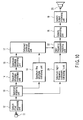
- FIG. 10 shows a speech processing apparatus according to the second embodiment, which is the same as the speech processing apparatus according to the first embodiment shown in FIG. 3 except that it additionally includes a spectrum high-frequency component extracting unit 21 and a high-frequency component replacing unit 22.
- the spectrum high-frequency component extracting unit 21 extracts the high-frequency component of the spectrum of an input speech signal through a spectrum analyzing unit 13.
- the high-frequency component of the spectrum represents individual information, which can be extracted from, for example, the FFT result (the spectrum of the input speech signal) in step S2 in FIG. 4 .
- the high-frequency component replacing unit 22 receives the extracted high-frequency component.
- the high-frequency component replacing unit 22 is inserted between the output of a deformed spectrum generating unit 17 and the input of a speech generating unit 18, and performs the processing of replacing the high-frequency component in the deformed spectrum generated by the deformed spectrum generating unit 17 with the high-frequency component extracted by the spectrum high-frequency component extracting unit 21.
- the speech generating unit 18 generates an output speech signal on the basis of the deformed spectrum after the high-frequency component is replaced.
- FIG. 11 shows part of the processing to be performed when a spectrum envelope deforming unit 15 performs the spectrum envelope deformation shown in FIGS. 7B, 7C , and 7D and the processing performed by the high-frequency component extracting unit 22.
- the spectrum envelope deforming unit 15 detects the slope of a spectrum envelope (step S201).
- the spectrum envelope deforming unit 15 determines a cosine function or an approximation function such as a linear or logarithmic function on the basis of the slope of the spectrum envelope detected in step S201 (step S202), and inverts the spectrum envelope in accordance with the approximation function (step S203).
- This processing performed by the spectrum envelope deforming unit 15 is the same as that in the first embodiment.
- the high-frequency component replacing unit 22 determines a replacement band from the slope of the spectrum envelope detected in step S201, and replaces the high-frequency component which is a frequency component in the replacement band with the high-frequency component extracted by the spectrum high-frequency component extracting unit 21.
- FIGS. 12A to 12D and 13A to 13D A specific example of processing in the second embodiment will be described next with reference to FIGS. 12A to 12D and 13A to 13D .
- the spectrum envelope of the input speech signal indicates a negative slope as indicated by FIG. 12B .
- the deformed spectrum shown in FIG. 12C is generated by combining the spectrum structure of an input speech signal with the deformed spectrum envelope obtained by inverting a spectrum envelope about an inversion axis conforming to, for example, the above cosine function or an approximation function such as a linear or logarithmic function.
- a disrupting sound having a spectrum like that shown in FIG. 12D is generated by replacing the high-frequency component (e.g., the frequency component equal to or higher than 3 kHz) of the deformed spectrum in FIG. 12C , which contains individual information, by the high-frequency component of the original speech spectrum in FIG. 12A , with the low-frequency component (e.g., the frequency component equal to or lower than 2.5 to 3 kHz) containing phonemic information being unchanged.
- the low-frequency component e.g., the frequency component equal to or lower than 2.5 to 3 kHz
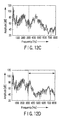
- the spectrum envelope of the input speech signal indicates a positive slope as shown in FIG. 13B .
- the deformed spectrum shown in FIG. 13C is generated by, for example, combining the spectrum fine structure of an input speech signal with the deformed spectrum envelope obtained by inverting the spectrum envelope about an inversion axis set to the average of the amplitudes of the spectrum envelope as described above.
- a disrupting sound having a spectrum like that shown in FIG. 13D is generated by replacing the high-frequency component of the deformed spectrum in FIG. 13C which contains individual information by the high-frequency component of the original speech spectrum in FIG. 13A , with the low-frequency component of the deformed spectrum which contains phonemic information being unchanged.
- a replacement band is set on a higher-frequency side, e.g., to a frequency band equal to or more than 6 kHz. In this case, it is possible to change the lower limit frequency of a replacement band in accordance with the positions of peaks of a spectrum envelope. This makes it possible to determine a band including individual information regardless of the sex or voice quality of a speaker.
- the speech processing apparatus shown in FIG. 10 can be implemented by hardware like a DSP but can also be implemented by programs using a computer.
- the present invention can provide a storage medium storing the programs.
- step S101 to step S106 is the same as that in the first embodiment.
- the computer extracts the high-frequency component of the spectrum (step S109) and replaces the high-frequency component (step S110).
- the computer then generates a speech signal from the deformed spectrum after high-frequency component replacement and outputs the speech signal (steps S107 and S108).
- the order of processing in steps S103 to S105 and step S109 is arbitrarily set. It suffices to concurrently perform processing in steps S103 and S104 and processing in step S105 or processing in step S109.
- the second embodiment generates an output speech signal by using the deformed spectrum obtained by replacing the high-frequency component of the deformed spectrum generated by combining a deformed spectrum envelope and a spectrum fine structure by the high-frequency component of an input speech signal.
- This can therefore generate a disrupting sound with the phonemic characteristics of conversational speech being destroyed by the deformation of the spectrum envelope and individual information which is the high-frequency component of the spectrum of the conversational speech being maintained. That is, the inversion of a spectrum envelope can prevent a deterioration in sound quality due to an increase in the high-frequency power of a disrupting sound.
- the above operation prevents a situation in which destroying the individual information of conversational speech in a disrupting sound will lead to an insufficient effect of the fusion of the disrupting sound with the conversational speech. This makes it possible to further enhance the effect of preventing a third party from eavesdropping on a conversational speech without annoying surrounding people.
- the second embodiment generates a deformed spectrum by combining a deformed spectrum envelope with a spectrum fine structure, and then generates a deformed spectrum with the high-frequency component being replaced.
- a spectrum envelope with respect to a component in a frequency band other than a high-frequency component (e.g., a low-frequency component and an intermediate-frequency component) can obtain the same effect as that described above.
- an output speech signal can be generated from an input speech signal based on conversational speech, with the phonemic characteristics being destroyed by the deformation of the spectrum envelope. Therefore, emitting a disrupting sound by using this output speech signal makes it possible to prevent a third party from eavesdropping on a conversational speech. That is, this technique is effective for security protection and privacy protection.
- an output speech signal is generated from the deformed spectrum obtained by combining a deformed spectrum envelope with the spectrum fine structure of an input speech signal, the sound source information of a speaker is maintained, and the original conversation is perceptually fused with a disrupting sound even against the auditory characteristics of a human, called the cocktail party effect.
- the present invention can be used for a technique of preventing a third party from eavesdropping on a conversation or on someone talking on a cellular phone or telephone in general.
Landscapes
- Engineering & Computer Science (AREA)
- Physics & Mathematics (AREA)
- Multimedia (AREA)
- Acoustics & Sound (AREA)
- Health & Medical Sciences (AREA)
- Audiology, Speech & Language Pathology (AREA)
- Signal Processing (AREA)
- Human Computer Interaction (AREA)
- Computational Linguistics (AREA)
- Quality & Reliability (AREA)
- Spectroscopy & Molecular Physics (AREA)
- General Health & Medical Sciences (AREA)
- Soundproofing, Sound Blocking, And Sound Damping (AREA)
- Telephone Function (AREA)
Applications Claiming Priority (2)
| Application Number | Priority Date | Filing Date | Title |
|---|---|---|---|
| JP2005056342A JP4761506B2 (ja) | 2005-03-01 | 2005-03-01 | 音声処理方法と装置及びプログラム並びに音声システム |
| PCT/JP2006/303290 WO2006093019A1 (ja) | 2005-03-01 | 2006-02-23 | 音声処理方法と装置及び記憶媒体並びに音声システム |
Publications (3)
| Publication Number | Publication Date |
|---|---|
| EP1855269A1 EP1855269A1 (en) | 2007-11-14 |
| EP1855269A4 EP1855269A4 (en) | 2009-04-22 |
| EP1855269B1 true EP1855269B1 (en) | 2010-05-05 |
Family
ID=36941053
Family Applications (1)
| Application Number | Title | Priority Date | Filing Date |
|---|---|---|---|
| EP06714430A Expired - Lifetime EP1855269B1 (en) | 2005-03-01 | 2006-02-23 | Speech processing method and device, storage medium, and speech system |
Country Status (7)
| Country | Link |
|---|---|
| US (1) | US8065138B2 (https=) |
| EP (1) | EP1855269B1 (https=) |
| JP (1) | JP4761506B2 (https=) |
| KR (1) | KR100931419B1 (https=) |
| CN (1) | CN101138020B (https=) |
| DE (1) | DE602006014096D1 (https=) |
| WO (1) | WO2006093019A1 (https=) |
Families Citing this family (29)
| Publication number | Priority date | Publication date | Assignee | Title |
|---|---|---|---|---|
| JP4757158B2 (ja) * | 2006-09-20 | 2011-08-24 | 富士通株式会社 | 音信号処理方法、音信号処理装置及びコンピュータプログラム |
| US8229130B2 (en) * | 2006-10-17 | 2012-07-24 | Massachusetts Institute Of Technology | Distributed acoustic conversation shielding system |
| JP5082541B2 (ja) * | 2007-03-29 | 2012-11-28 | ヤマハ株式会社 | 拡声装置 |
| US8140326B2 (en) * | 2008-06-06 | 2012-03-20 | Fuji Xerox Co., Ltd. | Systems and methods for reducing speech intelligibility while preserving environmental sounds |
| JP5511342B2 (ja) * | 2009-12-09 | 2014-06-04 | 日本板硝子環境アメニティ株式会社 | 音声変更装置、音声変更方法および音声情報秘話システム |
| JP5489778B2 (ja) * | 2010-02-25 | 2014-05-14 | キヤノン株式会社 | 情報処理装置およびその処理方法 |
| JP5605062B2 (ja) * | 2010-08-03 | 2014-10-15 | 大日本印刷株式会社 | 騒音源の快音化方法および快音化装置 |
| JP5569291B2 (ja) * | 2010-09-17 | 2014-08-13 | 大日本印刷株式会社 | 騒音源の快音化方法および快音化装置 |
| JP6007481B2 (ja) * | 2010-11-25 | 2016-10-12 | ヤマハ株式会社 | マスカ音生成装置、マスカ音信号を記憶した記憶媒体、マスカ音再生装置、およびプログラム |
| WO2012128678A1 (en) | 2011-03-21 | 2012-09-27 | Telefonaktiebolaget L M Ericsson (Publ) | Method and arrangement for damping of dominant frequencies in an audio signal |
| JP2014513320A (ja) * | 2011-03-21 | 2014-05-29 | テレフオンアクチーボラゲット エル エム エリクソン(パブル) | オーディオ信号におけるドミナント周波数を減衰する方法及び装置 |
| US8972251B2 (en) | 2011-06-07 | 2015-03-03 | Qualcomm Incorporated | Generating a masking signal on an electronic device |
| US8583425B2 (en) * | 2011-06-21 | 2013-11-12 | Genband Us Llc | Methods, systems, and computer readable media for fricatives and high frequencies detection |
| WO2013012312A2 (en) * | 2011-07-19 | 2013-01-24 | Jin Hem Thong | Wave modification method and system thereof |
| JP5849508B2 (ja) * | 2011-08-09 | 2016-01-27 | 株式会社大林組 | Bgmのマスキング効果評価方法及びbgmのマスキング効果評価装置 |
| JP5925493B2 (ja) * | 2012-01-11 | 2016-05-25 | グローリー株式会社 | 会話保護システム及び会話保護方法 |
| EP2862169A4 (en) * | 2012-06-15 | 2016-03-02 | Jemardator Ab | DIFFERENCE OF CEPSTRAL SEPARATION |
| US8670986B2 (en) | 2012-10-04 | 2014-03-11 | Medical Privacy Solutions, Llc | Method and apparatus for masking speech in a private environment |
| CN103818290A (zh) * | 2012-11-16 | 2014-05-28 | 黄金富 | 一种用于汽车司机与老板的隔声装置 |
| CN103826176A (zh) * | 2012-11-16 | 2014-05-28 | 黄金富 | 一种用于汽车司机与乘客之间的司机专用保密耳筒 |
| JP2014130251A (ja) * | 2012-12-28 | 2014-07-10 | Glory Ltd | 会話保護システム及び会話保護方法 |
| JP5929786B2 (ja) * | 2013-03-07 | 2016-06-08 | ソニー株式会社 | 信号処理装置、信号処理方法及び記憶媒体 |
| JP6371516B2 (ja) * | 2013-11-15 | 2018-08-08 | キヤノン株式会社 | 音響信号処理装置および方法 |
| JP6098654B2 (ja) * | 2014-03-10 | 2017-03-22 | ヤマハ株式会社 | マスキング音データ生成装置およびプログラム |
| JP7145596B2 (ja) * | 2017-09-15 | 2022-10-03 | 株式会社Lixil | 擬音装置 |
| CN108540680B (zh) * | 2018-02-02 | 2021-03-02 | 广州视源电子科技股份有限公司 | 讲话状态的切换方法及装置、通话系统 |
| US10757507B2 (en) * | 2018-02-13 | 2020-08-25 | Ppip, Llc | Sound shaping apparatus |
| WO2019245916A1 (en) * | 2018-06-19 | 2019-12-26 | Georgetown University | Method and system for parametric speech synthesis |
| US12556927B2 (en) | 2024-01-19 | 2026-02-17 | Cisco Technology, Inc. | Speech confidentiality monitoring and alerting |
Family Cites Families (24)
| Publication number | Priority date | Publication date | Assignee | Title |
|---|---|---|---|---|
| US3681530A (en) * | 1970-06-15 | 1972-08-01 | Gte Sylvania Inc | Method and apparatus for signal bandwidth compression utilizing the fourier transform of the logarithm of the frequency spectrum magnitude |
| US4827516A (en) * | 1985-10-16 | 1989-05-02 | Toppan Printing Co., Ltd. | Method of analyzing input speech and speech analysis apparatus therefor |
| JPH0522391A (ja) | 1991-07-10 | 1993-01-29 | Sony Corp | 音声マスキング装置 |
| JP3557662B2 (ja) * | 1994-08-30 | 2004-08-25 | ソニー株式会社 | 音声符号化方法及び音声復号化方法、並びに音声符号化装置及び音声復号化装置 |
| JPH09319389A (ja) * | 1996-03-28 | 1997-12-12 | Matsushita Electric Ind Co Ltd | 環境音発生装置 |
| US6904404B1 (en) * | 1996-07-01 | 2005-06-07 | Matsushita Electric Industrial Co., Ltd. | Multistage inverse quantization having the plurality of frequency bands |
| JP3246715B2 (ja) * | 1996-07-01 | 2002-01-15 | 松下電器産業株式会社 | オーディオ信号圧縮方法,およびオーディオ信号圧縮装置 |
| JP3266819B2 (ja) * | 1996-07-30 | 2002-03-18 | 株式会社エイ・ティ・アール人間情報通信研究所 | 周期信号変換方法、音変換方法および信号分析方法 |
| JP3707153B2 (ja) * | 1996-09-24 | 2005-10-19 | ソニー株式会社 | ベクトル量子化方法、音声符号化方法及び装置 |
| US6073100A (en) * | 1997-03-31 | 2000-06-06 | Goodridge, Jr.; Alan G | Method and apparatus for synthesizing signals using transform-domain match-output extension |
| SE512719C2 (sv) * | 1997-06-10 | 2000-05-02 | Lars Gustaf Liljeryd | En metod och anordning för reduktion av dataflöde baserad på harmonisk bandbreddsexpansion |
| JP3706249B2 (ja) * | 1998-06-16 | 2005-10-12 | ヤマハ株式会社 | 音声変換装置、音声変換方法、および音声変換プログラムを記録した記録媒体 |
| GB9927131D0 (en) * | 1999-11-16 | 2000-01-12 | Royal College Of Art | Apparatus for acoustically improving an environment and related method |
| FR2813722B1 (fr) * | 2000-09-05 | 2003-01-24 | France Telecom | Procede et dispositif de dissimulation d'erreurs et systeme de transmission comportant un tel dispositif |
| JP3590342B2 (ja) * | 2000-10-18 | 2004-11-17 | 日本電信電話株式会社 | 信号符号化方法、装置及び信号符号化プログラムを記録した記録媒体 |
| FR2819362A1 (fr) * | 2001-01-05 | 2002-07-12 | Rene Travere | Attenuateur, brouilleur, de conversation applique au telephone |
| JP3703394B2 (ja) * | 2001-01-16 | 2005-10-05 | シャープ株式会社 | 声質変換装置および声質変換方法およびプログラム記憶媒体 |
| JP2002251199A (ja) * | 2001-02-27 | 2002-09-06 | Ricoh Co Ltd | 音声入力情報処理装置 |
| AU2003213439A1 (en) * | 2002-03-08 | 2003-09-22 | Nippon Telegraph And Telephone Corporation | Digital signal encoding method, decoding method, encoding device, decoding device, digital signal encoding program, and decoding program |
| JP4195267B2 (ja) * | 2002-03-14 | 2008-12-10 | インターナショナル・ビジネス・マシーンズ・コーポレーション | 音声認識装置、その音声認識方法及びプログラム |
| US20030187663A1 (en) * | 2002-03-28 | 2003-10-02 | Truman Michael Mead | Broadband frequency translation for high frequency regeneration |
| US7143028B2 (en) * | 2002-07-24 | 2006-11-28 | Applied Minds, Inc. | Method and system for masking speech |
| US7451082B2 (en) * | 2003-08-27 | 2008-11-11 | Texas Instruments Incorporated | Noise-resistant utterance detector |
| JP4336552B2 (ja) * | 2003-09-11 | 2009-09-30 | グローリー株式会社 | マスキング装置 |
-
2005
- 2005-03-01 JP JP2005056342A patent/JP4761506B2/ja not_active Expired - Lifetime
-
2006
- 2006-02-23 CN CN2006800066680A patent/CN101138020B/zh not_active Expired - Fee Related
- 2006-02-23 KR KR1020077019988A patent/KR100931419B1/ko not_active Expired - Fee Related
- 2006-02-23 DE DE602006014096T patent/DE602006014096D1/de not_active Expired - Lifetime
- 2006-02-23 WO PCT/JP2006/303290 patent/WO2006093019A1/ja not_active Ceased
- 2006-02-23 EP EP06714430A patent/EP1855269B1/en not_active Expired - Lifetime
-
2007
- 2007-08-31 US US11/849,106 patent/US8065138B2/en not_active Expired - Fee Related
Also Published As
| Publication number | Publication date |
|---|---|
| DE602006014096D1 (de) | 2010-06-17 |
| US8065138B2 (en) | 2011-11-22 |
| CN101138020A (zh) | 2008-03-05 |
| WO2006093019A1 (ja) | 2006-09-08 |
| EP1855269A4 (en) | 2009-04-22 |
| EP1855269A1 (en) | 2007-11-14 |
| JP4761506B2 (ja) | 2011-08-31 |
| US20080281588A1 (en) | 2008-11-13 |
| KR20070099681A (ko) | 2007-10-09 |
| CN101138020B (zh) | 2010-10-13 |
| KR100931419B1 (ko) | 2009-12-11 |
| JP2006243178A (ja) | 2006-09-14 |
Similar Documents
| Publication | Publication Date | Title |
|---|---|---|
| EP1855269B1 (en) | Speech processing method and device, storage medium, and speech system | |
| CN108235211B (zh) | 包括动态压缩放大系统的听力装置及其运行方法 | |
| CN107801139B (zh) | 包括反馈检测单元的听力装置 | |
| US8085941B2 (en) | System and method for dynamic sound delivery | |
| AU771444B2 (en) | Noise reduction apparatus and method | |
| EP3122072B1 (en) | Audio processing device, system, use and method | |
| CN102804260B (zh) | 声音信号处理装置以及声音信号处理方法 | |
| US9325285B2 (en) | Method of reducing un-correlated noise in an audio processing device | |
| KR100643310B1 (ko) | 음성 데이터의 포먼트와 유사한 교란 신호를 출력하여송화자 음성을 차폐하는 방법 및 장치 | |
| US7761292B2 (en) | Method and apparatus for disturbing the radiated voice signal by attenuation and masking | |
| CN113823319A (zh) | 改进的语音可懂度 | |
| JP2013168856A (ja) | ノイズ低減装置、音声入力装置、無線通信装置、ノイズ低減方法、およびノイズ低減プログラム | |
| US20110105034A1 (en) | Active voice cancellation system | |
| RU2589298C1 (ru) | Способ повышения разборчивости и информативности звуковых сигналов в шумовой обстановке | |
| JP4680099B2 (ja) | 音声処理装置および音声処理方法 | |
| US20060020454A1 (en) | Method and system for noise suppression in inductive receivers | |
| Vashkevich et al. | Speech enhancement in a smartphone-based hearing aid | |
| EP1619926A1 (en) | Method and system for noise suppression in inductive receivers | |
| JP2003070097A (ja) | デジタル補聴装置 | |
| WO2014209434A1 (en) | Voice enhancement methods and systems | |
| Devi et al. | Linguistic Effects Based Novel Filter for Hearing Aid to Deliver Natural Sound and Speech Clarity in Universal Environment |
Legal Events
| Date | Code | Title | Description |
|---|---|---|---|
| PUAI | Public reference made under article 153(3) epc to a published international application that has entered the european phase |
Free format text: ORIGINAL CODE: 0009012 |
|
| 17P | Request for examination filed |
Effective date: 20070831 |
|
| AK | Designated contracting states |
Kind code of ref document: A1 Designated state(s): DE FR GB |
|
| RIN1 | Information on inventor provided before grant (corrected) |
Inventor name: TANAKA, YOSHITANE Inventor name: YANAGIUCHI, HISAKAZU Inventor name: IRIE, YOSHIHIRO Inventor name: FUTONAGANE, RIEKO Inventor name: AKAGI, MASATO |
|
| RBV | Designated contracting states (corrected) |
Designated state(s): DE FR GB |
|
| DAX | Request for extension of the european patent (deleted) | ||
| A4 | Supplementary search report drawn up and despatched |
Effective date: 20090323 |
|
| 17Q | First examination report despatched |
Effective date: 20090624 |
|
| RTI1 | Title (correction) |
Free format text: SPEECH PROCESSING METHOD AND DEVICE, STORAGE MEDIUM, AND SPEECH SYSTEM |
|
| GRAP | Despatch of communication of intention to grant a patent |
Free format text: ORIGINAL CODE: EPIDOSNIGR1 |
|
| GRAC | Information related to communication of intention to grant a patent modified |
Free format text: ORIGINAL CODE: EPIDOSCIGR1 |
|
| GRAS | Grant fee paid |
Free format text: ORIGINAL CODE: EPIDOSNIGR3 |
|
| GRAA | (expected) grant |
Free format text: ORIGINAL CODE: 0009210 |
|
| AK | Designated contracting states |
Kind code of ref document: B1 Designated state(s): DE FR GB |
|
| REG | Reference to a national code |
Ref country code: GB Ref legal event code: FG4D |
|
| REF | Corresponds to: |
Ref document number: 602006014096 Country of ref document: DE Date of ref document: 20100617 Kind code of ref document: P |
|
| PLBE | No opposition filed within time limit |
Free format text: ORIGINAL CODE: 0009261 |
|
| STAA | Information on the status of an ep patent application or granted ep patent |
Free format text: STATUS: NO OPPOSITION FILED WITHIN TIME LIMIT |
|
| 26N | No opposition filed |
Effective date: 20110208 |
|
| REG | Reference to a national code |
Ref country code: DE Ref legal event code: R097 Ref document number: 602006014096 Country of ref document: DE Effective date: 20110207 |
|
| REG | Reference to a national code |
Ref country code: FR Ref legal event code: PLFP Year of fee payment: 11 |
|
| PGFP | Annual fee paid to national office [announced via postgrant information from national office to epo] |
Ref country code: GB Payment date: 20160217 Year of fee payment: 11 Ref country code: FR Payment date: 20151230 Year of fee payment: 11 |
|
| PGFP | Annual fee paid to national office [announced via postgrant information from national office to epo] |
Ref country code: DE Payment date: 20160404 Year of fee payment: 11 |
|
| REG | Reference to a national code |
Ref country code: DE Ref legal event code: R119 Ref document number: 602006014096 Country of ref document: DE |
|
| GBPC | Gb: european patent ceased through non-payment of renewal fee |
Effective date: 20170223 |
|
| REG | Reference to a national code |
Ref country code: FR Ref legal event code: ST Effective date: 20171031 |
|
| PG25 | Lapsed in a contracting state [announced via postgrant information from national office to epo] |
Ref country code: DE Free format text: LAPSE BECAUSE OF NON-PAYMENT OF DUE FEES Effective date: 20170901 Ref country code: FR Free format text: LAPSE BECAUSE OF NON-PAYMENT OF DUE FEES Effective date: 20170228 |
|
| PG25 | Lapsed in a contracting state [announced via postgrant information from national office to epo] |
Ref country code: GB Free format text: LAPSE BECAUSE OF NON-PAYMENT OF DUE FEES Effective date: 20170223 |