EP1855152A1 - Prismenfolie, Rückbeleuchtungseinheit und Flüssigkristallanzeige - Google Patents
Prismenfolie, Rückbeleuchtungseinheit und Flüssigkristallanzeige Download PDFInfo
- Publication number
- EP1855152A1 EP1855152A1 EP06020143A EP06020143A EP1855152A1 EP 1855152 A1 EP1855152 A1 EP 1855152A1 EP 06020143 A EP06020143 A EP 06020143A EP 06020143 A EP06020143 A EP 06020143A EP 1855152 A1 EP1855152 A1 EP 1855152A1
- Authority
- EP
- European Patent Office
- Prior art keywords
- light
- liquid crystal
- prism
- disposed
- protective layer
- Prior art date
- Legal status (The legal status is an assumption and is not a legal conclusion. Google has not performed a legal analysis and makes no representation as to the accuracy of the status listed.)
- Ceased
Links
- 239000004973 liquid crystal related substance Substances 0.000 title claims abstract description 81
- 239000011241 protective layer Substances 0.000 claims abstract description 50
- 239000000463 material Substances 0.000 claims abstract description 29
- 239000002245 particle Substances 0.000 claims abstract description 26
- 238000009792 diffusion process Methods 0.000 claims abstract description 25
- 239000011347 resin Substances 0.000 claims abstract description 14
- 229920005989 resin Polymers 0.000 claims abstract description 14
- 239000011324 bead Substances 0.000 claims description 9
- 239000011295 pitch Substances 0.000 description 17
- 230000003287 optical effect Effects 0.000 description 12
- 230000001012 protector Effects 0.000 description 9
- 239000010410 layer Substances 0.000 description 7
- 229920003229 poly(methyl methacrylate) Polymers 0.000 description 7
- 239000004926 polymethyl methacrylate Substances 0.000 description 7
- 238000002834 transmittance Methods 0.000 description 5
- 239000004925 Acrylic resin Substances 0.000 description 4
- 230000000694 effects Effects 0.000 description 4
- 229920000139 polyethylene terephthalate Polymers 0.000 description 4
- 239000005020 polyethylene terephthalate Substances 0.000 description 4
- 239000000758 substrate Substances 0.000 description 4
- 230000008901 benefit Effects 0.000 description 3
- 230000008859 change Effects 0.000 description 3
- 238000000149 argon plasma sintering Methods 0.000 description 2
- 230000006866 deterioration Effects 0.000 description 2
- 238000010586 diagram Methods 0.000 description 2
- 238000000034 method Methods 0.000 description 2
- 229920000515 polycarbonate Polymers 0.000 description 2
- 239000004417 polycarbonate Substances 0.000 description 2
- -1 polyethylene terephthalate Polymers 0.000 description 2
- 238000004088 simulation Methods 0.000 description 2
- 229920005992 thermoplastic resin Polymers 0.000 description 2
- 230000000007 visual effect Effects 0.000 description 2
- 229920000178 Acrylic resin Polymers 0.000 description 1
- 238000010521 absorption reaction Methods 0.000 description 1
- 239000011248 coating agent Substances 0.000 description 1
- 238000000576 coating method Methods 0.000 description 1
- 239000003086 colorant Substances 0.000 description 1
- 230000007423 decrease Effects 0.000 description 1
- 230000007547 defect Effects 0.000 description 1
- 239000010954 inorganic particle Substances 0.000 description 1
- 238000004519 manufacturing process Methods 0.000 description 1
- 239000011159 matrix material Substances 0.000 description 1
- 239000002184 metal Substances 0.000 description 1
- 238000012986 modification Methods 0.000 description 1
- 230000004048 modification Effects 0.000 description 1
- 239000011146 organic particle Substances 0.000 description 1
- 239000004033 plastic Substances 0.000 description 1
- 229920003023 plastic Polymers 0.000 description 1
- 229920000058 polyacrylate Polymers 0.000 description 1
- 239000011148 porous material Substances 0.000 description 1
- 230000008569 process Effects 0.000 description 1
- 238000009827 uniform distribution Methods 0.000 description 1
- 230000037303 wrinkles Effects 0.000 description 1
Images


Classifications
-
- G—PHYSICS
- G02—OPTICS
- G02B—OPTICAL ELEMENTS, SYSTEMS OR APPARATUS
- G02B6/00—Light guides; Structural details of arrangements comprising light guides and other optical elements, e.g. couplings
- G02B6/0001—Light guides; Structural details of arrangements comprising light guides and other optical elements, e.g. couplings specially adapted for lighting devices or systems
- G02B6/0011—Light guides; Structural details of arrangements comprising light guides and other optical elements, e.g. couplings specially adapted for lighting devices or systems the light guides being planar or of plate-like form
- G02B6/0033—Means for improving the coupling-out of light from the light guide
- G02B6/005—Means for improving the coupling-out of light from the light guide provided by one optical element, or plurality thereof, placed on the light output side of the light guide
- G02B6/0053—Prismatic sheet or layer; Brightness enhancement element, sheet or layer
-
- G—PHYSICS
- G02—OPTICS
- G02B—OPTICAL ELEMENTS, SYSTEMS OR APPARATUS
- G02B6/00—Light guides; Structural details of arrangements comprising light guides and other optical elements, e.g. couplings
- G02B6/0001—Light guides; Structural details of arrangements comprising light guides and other optical elements, e.g. couplings specially adapted for lighting devices or systems
- G02B6/0011—Light guides; Structural details of arrangements comprising light guides and other optical elements, e.g. couplings specially adapted for lighting devices or systems the light guides being planar or of plate-like form
- G02B6/0033—Means for improving the coupling-out of light from the light guide
- G02B6/005—Means for improving the coupling-out of light from the light guide provided by one optical element, or plurality thereof, placed on the light output side of the light guide
- G02B6/0051—Diffusing sheet or layer
-
- G—PHYSICS
- G02—OPTICS
- G02F—OPTICAL DEVICES OR ARRANGEMENTS FOR THE CONTROL OF LIGHT BY MODIFICATION OF THE OPTICAL PROPERTIES OF THE MEDIA OF THE ELEMENTS INVOLVED THEREIN; NON-LINEAR OPTICS; FREQUENCY-CHANGING OF LIGHT; OPTICAL LOGIC ELEMENTS; OPTICAL ANALOGUE/DIGITAL CONVERTERS
- G02F1/00—Devices or arrangements for the control of the intensity, colour, phase, polarisation or direction of light arriving from an independent light source, e.g. switching, gating or modulating; Non-linear optics
- G02F1/01—Devices or arrangements for the control of the intensity, colour, phase, polarisation or direction of light arriving from an independent light source, e.g. switching, gating or modulating; Non-linear optics for the control of the intensity, phase, polarisation or colour
- G02F1/13—Devices or arrangements for the control of the intensity, colour, phase, polarisation or direction of light arriving from an independent light source, e.g. switching, gating or modulating; Non-linear optics for the control of the intensity, phase, polarisation or colour based on liquid crystals, e.g. single liquid crystal display cells
- G02F1/133—Constructional arrangements; Operation of liquid crystal cells; Circuit arrangements
- G02F1/1333—Constructional arrangements; Manufacturing methods
- G02F1/1335—Structural association of cells with optical devices, e.g. polarisers or reflectors
-
- G—PHYSICS
- G02—OPTICS
- G02F—OPTICAL DEVICES OR ARRANGEMENTS FOR THE CONTROL OF LIGHT BY MODIFICATION OF THE OPTICAL PROPERTIES OF THE MEDIA OF THE ELEMENTS INVOLVED THEREIN; NON-LINEAR OPTICS; FREQUENCY-CHANGING OF LIGHT; OPTICAL LOGIC ELEMENTS; OPTICAL ANALOGUE/DIGITAL CONVERTERS
- G02F1/00—Devices or arrangements for the control of the intensity, colour, phase, polarisation or direction of light arriving from an independent light source, e.g. switching, gating or modulating; Non-linear optics
- G02F1/01—Devices or arrangements for the control of the intensity, colour, phase, polarisation or direction of light arriving from an independent light source, e.g. switching, gating or modulating; Non-linear optics for the control of the intensity, phase, polarisation or colour
- G02F1/13—Devices or arrangements for the control of the intensity, colour, phase, polarisation or direction of light arriving from an independent light source, e.g. switching, gating or modulating; Non-linear optics for the control of the intensity, phase, polarisation or colour based on liquid crystals, e.g. single liquid crystal display cells
- G02F1/133—Constructional arrangements; Operation of liquid crystal cells; Circuit arrangements
- G02F1/1333—Constructional arrangements; Manufacturing methods
- G02F1/1335—Structural association of cells with optical devices, e.g. polarisers or reflectors
- G02F1/1336—Illuminating devices
- G02F1/133602—Direct backlight
- G02F1/133606—Direct backlight including a specially adapted diffusing, scattering or light controlling members
-
- G—PHYSICS
- G02—OPTICS
- G02B—OPTICAL ELEMENTS, SYSTEMS OR APPARATUS
- G02B5/00—Optical elements other than lenses
- G02B5/04—Prisms
-
- G—PHYSICS
- G02—OPTICS
- G02B—OPTICAL ELEMENTS, SYSTEMS OR APPARATUS
- G02B6/00—Light guides; Structural details of arrangements comprising light guides and other optical elements, e.g. couplings
- G02B6/0001—Light guides; Structural details of arrangements comprising light guides and other optical elements, e.g. couplings specially adapted for lighting devices or systems
- G02B6/0011—Light guides; Structural details of arrangements comprising light guides and other optical elements, e.g. couplings specially adapted for lighting devices or systems the light guides being planar or of plate-like form
- G02B6/0033—Means for improving the coupling-out of light from the light guide
- G02B6/0035—Means for improving the coupling-out of light from the light guide provided on the surface of the light guide or in the bulk of it
- G02B6/004—Scattering dots or dot-like elements, e.g. microbeads, scattering particles, nanoparticles
- G02B6/0043—Scattering dots or dot-like elements, e.g. microbeads, scattering particles, nanoparticles provided on the surface of the light guide
Definitions
- the present invention relates to a liquid crystal display having excellent brightness without moiré patterns.
- the present invention also relates to a prism sheet and a backlight unit which may improve the brightness of the liquid crystal display without developing the moiré patterns.
- the liquid crystal display also know as LCD, is an electronic device that transforms electrical signals into visual signals by utilizing the change in the transmittance of liquid crystals according to applied voltages.
- the liquid crystal display is a non-emitting display device. Therefore, the liquid crystal display needs to use an outside light source unit for illuminating uniformly the viewing plane of liquid crystal panel outside the liquid crystal panel in order to display visual information.
- the backlight unit is conventionally used to provide light to the viewing plane of the liquid crystal panel.
- the backlight unit may be classified into two types: direct type and edge-light type according to the position where the light source is disposed.
- direct type the light source is disposed directly at the back of the liquid crystal panel, whereas the light source is disposed along a side surface of the light guide plate in the edge-light type.
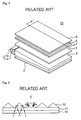
- Fig. 1 is a perspective view of the backlight unit for illuminating the liquid crystal panel from the back of the liquid crystal panel, wherein the backlight unit is of the edge-light type.
- the backlight unit 10 comprises a light source unit 1, a reflector sheet 2, a light guide plate 3, and a plurality of optical sheets 4, 5 and 6.
- the light source unit 1 comprises a light source 1a and a light source reflector 1b.
- the light source 1a is received inside the light source reflector 1b, and disposed along the side surface of the light guide plate 3.
- the light source reflector 1b reflects the light generated at the light source 1a toward the light guide plate 3, thereby the light efficiency of backlight unit 10 can be improved.
- the light guide plate 3 mixes the light input through the light incidence surface disposed at its side surface and emits the mixed light through the light emitting surface disposed at its upper surface in a direction toward the liquid crystal panel (not shown).
- the reflector sheet 2 reflects the light emitted through the lower surface of the light guide plate 3 so that the light is re-input into the inside of the light guide plate 3, which improves the light efficiency of the backlight unit 10.
- the optical sheets 4, 5 and 6 may be comprised of a diffuser sheet 4, a prism sheet 5 and a protector sheet 6.
- a diffuser sheet 4 a prism sheet 5
- a protector sheet 6 a protector sheet 6.
- the prism sheet 5 is provided in the backlight unit 10 to compensate such declination of brightness.
- the prism sheet 5 refracts the light emitted from the diffuser sheet 4 in a low angle to collimate the light toward the front direction, thereby the brightness is improved within the effective viewing angle.
- Fig. 2 is a cross-sectional view of the prism sheet of Fig. 1 taken along the line I-I'.
- the prism sheet 5 is comprised of a base film 10, a prism base 11 disposed on the base film and a plurality of prisms 12 disposed on the prism base.
- the prism sheet 5 reflects and resends toward the light guide plate (3 of Fig. 1) a portion of the light emitting from the diffuser sheet (4 of Fig. 1) in a certain angle.
- the prism sheet 5 also refracts the remaining portion of the light to be collimated toward the front direction where the liquid crystal panel (not shown) is disposed, thereby the brightness is improved within the effective viewing angle.
- the protector sheet 6 is disposed over the prism sheet 5.
- the protector sheet 6 prevents the surface of the prism sheet 5 from being damaged, and also widens the viewing angle narrowed by the prism sheet 5.
- the liquid crystal panel generally includes repeated patterns of a plurality of transistors and electrode components. However, the patterns of the liquid crystal panel along with the other patterns of the optical devices provided in the backlight unit illuminating the liquid crystal panel develops moiré patterns.
- An object of the present invention is to provide the backlight unit which emits in high brightness and has no moiré patterns, and the liquid crystal unit having such backlight unit.
- Another object of the present invention is to provide the prism sheet which has an excellent capability of collimating the light toward the viewing plane of the liquid crystal panel, i.e. light collimating efficiency, and addressing the problem of the moiré patterns.
- Another object of the present invention is to provide the prism sheet which has an excellent thermal resistance and mechanical strength.
- the present invention provides a backlight unit configured to illuminate a liquid crystal panel, comprising: at least one light source generating light to be provided to the liquid crystal panel; and at least one prism sheet disposed at the back of the liquid crystal panel to collimate the light such that the light through the prism sheet becomes substantially perpendicular to the viewing plane of the liquid crystal panel, the prism sheet including: a protective layer including a base material consisting of a light-transmissive resin; and a plurality of diffusion particles distributed in the protective layer to scatter the light input into the base material; a base film disposed on a surface of the protective layer, wherein the light emitted from the protective layer is input into the base film; and a plurality of linear prisms having a pitch of between about 32 ⁇ m and about 36 ⁇ m and disposed in parallel on a surface of the base film.
- the present invention also provides a liquid crystal display comprising: a liquid crystal panel displaying images according to electrical signals provided from the outside device; and a backlight unit configured to illuminate a liquid crystal panel, comprising: at least one light source generating light to be provided to the liquid crystal panel; and at least one prism sheet disposed at the back of the liquid crystal panel to collimate the light such that the light through the prism sheet becomes substantially perpendicular to the viewing plane of the liquid crystal panel, the prism sheet including: a protective layer including a base material consisting of a light-transmissive resin; and a plurality of diffusion particles distributed in the protective layer to scatter the light input into the base material; a base film disposed on a surface of the protective layer, wherein the light emitted from the protective layer is input into the base film; and a plurality of linear prisms disposed in parallel on a surface of the base film.
- the present invention also provides a prism sheet comprising: a protective layer including a base material consisting of a light-transmissive resin; and a plurality of diffusion particles distributed in the protective layer to scatter the light input into the base material; a base film disposed on a surface of the protective layer, wherein the light emitted from the protective layer is input into the base film; and a plurality of linear prisms having a pitch of between about 32 ⁇ m and about 36 ⁇ m and disposed in parallel on a surface of the base film.
- Fig. 1 is a perspective view of the backlight unit for illuminating the liquid crystal panel from the back of the liquid crystal panel;
- Fig. 2 is a cross-sectional view of the prism sheet of Fig. 1 taken along the line I-I';
- Fig. 3 is a cross-sectional view of the liquid crystal display according to one embodiment of the present invention.
- Fig. 4 is a cross-sectional view of an example of the liquid crystal panel of Fig. 3;
- Fig. 5a is a perspective view of one embodiment of the prism sheet of Fig. 3;
- Fig. 5b is a cross-sectional view of the prism sheet of Fig. 5a;
- Fig. 5c is a cross-sectional view of another embodiment of the prism sheet of Fig. 3;
- Fig. 6a is a cross-sectional view of another embodiment of the backlight unit of Fig. 6a;
- Fig. 6b is an enlarged view of the prism sheets of Fig. 6a.
- Fig. 7 is a diagram showing the relation of the variation of the brightness against the viewing angle in several samples for the backlight unit.
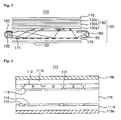
- Fig. 3 is a cross-sectional view of the liquid crystal display 100 according to one embodiment of the present invention
- Fig. 4 is a cross-sectional view of an example of the liquid crystal panel 110 of Fig. 3.
- the liquid crystal display 100 comprises a liquid crystal panel 110 displaying images according to driving signals and data signals provided by the outside device, and a backlight unit 120 illuminating the liquid crystal panel 110 from its back.
- liquid crystal panel 110 To understand and work the present invention, it is not important to describe the detailed structure of the liquid crystal panel 110. And the idea of the present invention is widely applicable to any type of liquid crystal panel usually employed in the liquid crystal display. Therefore, the structure of the liquid crystal panel 110 described hereinafter is presented only for the purpose of an example to help understand the present invention.
- the liquid crystal panel 110 comprises a lower substrate 111a, an upper substrate 111b, a color filter layer 112, a black matrix layer 117, pixel electrodes 114, a common electrode 115, a liquid crystal layer 116, TFT array 113 and a pair of polarizer films 118a and 118b each disposed on the outer surfaces of the lower substrate 111a and the upper substrates 111b respectively.
- the color filter layer 112 includes color filters which correspond to red color R, green color G and blue color B and generate images corresponding to red, green and blue colors when the light is provided to them.
- the TFT array 113 is a set of switching device for switching the pixel electrodes 114.
- the common electrode 115 and the pixel electrodes 114 change the arrangement of the liquid crystal molecules in the liquid crystal layer 116 according to the applied voltages.
- the liquid crystal layer 116 consists of a plurality of liquid crystal molecules.
- the liquid crystal molecules change their arrangement with the voltage difference generated between the pixel electrodes 114 and the common electrode 115, thereby the light provided from the backlight unit 120 is input into the color filter layer 112.
- the backlight unit 120 is disposed at the back of the liquid crystal panel 110 to provide light, for example white light.
- the backlight unit 120 comprises light sources 150, light source reflectors 160 each disposed at the outside of the light source 150, a light guide plate 170 receiving the light from the light source and emitting the light to the liquid crystal panel 110, and a set of optical sheets 130 disposed between the light guide plate 170 and the liquid crystal panel 110.
- the backlight unit 120 is of the edge-light type where the light sources 150 are disposed along the two side surfaces of the light guide plate 170.
- the light source 150 is a linear light source such as a cold cathode fluorescent lamp (CCFL) and an external electrode fluorescent lamp (EEFL).
- the light source 150 may be a point light source such as a light emitting diode (LED).
- the light source reflector 160 is disposed outside each light source 150.
- the light source reflector 160 may be made of metal or plastic.
- the inner surface of the light source reflector 160 may be coated with light reflective materials to reflect the light from the light source 150 to the side surface of the light guide plate 170.
- the light source reflector 160 reflects the light generated from the light source 150 to be input into the light guide plate 170 through its side surface, i.e. the light incidence surface, thereby the light efficiency of the backlight unit 120 can be improved.
- the light guide plate 170 mixes the light input through the light incidence surface before emitting the light through the light emitting surface while transporting the light in a direction substantially parallel to the viewing plane of the liquid crystal panel 110 located at the upper position by the principle of the total reflection.
- the upper surface of the light guide plate 170 becomes the light emitting surface for emitting the light toward the position where the liquid crystal panel 110 is disposed.
- light scattering patterns 171 may be printed on the lower surface of the light guide plate 170 by using dot-printing techniques.
- U.S. patent No. 6,123,431 discloses a print-less type of light guide plate which has the light scattering patterns obtained by forming grooves on a surface of the light guide plate
- U.S. patent No. 6,123,431 discloses another type of print-less light guide having additionally the function of a diffuser plate.
- the light guide plate disclosed in the U.S. patent No. 6,123,431 is obtained by dispersing inorganic or organic particles having different refractivity from that of the basic resin in the light guide plate to provide the light guide plate with the scattering function, wherein scattering may occur from the difference of the refractivity between the basic resin and the inorganic (or organic) particles.
- the light guide plate 170 may be formed of a transparent acrylate resin such as polymethyl methacrylate (PMMA).
- PMMA polymethyl methacrylate
- the reflector sheet 180 is disposed under the light guide plate 170 to re-input the light emitted through the lower surface of the light guide plate 170 into the inside of the light guide plate 170.
- the reflector sheet 180 may be manufactured by applying Ag on a sheet made of SUS, Brass, Al, PET, etc and coating it with Ti to prevent the thermal deterioration caused by heat absorption.
- the reflector sheet 180 may be obtained by dispersing micro-pores capable of scattering the light in a resin sheet such as PET.
- the backlight unit 120 comprises a set of optical sheets 130 disposed between the light guide plate 170 and the liquid crystal panel 110.
- the set of optical sheets 130 allow the light emitted through the light guide plate 170 to effectively enter the viewing plane of the liquid crystal panel 110, thereby the brightness is enhanced.
- the set of optical sheets 130 also make uniform the light entering the liquid crystal panel 110, thereby the brightness uniformity across the viewing plane is improved.
- the set of optical sheets 130 are comprised of a diffuser sheet 130a, a prism sheet 130b and a protector sheet 130c.
- the diffuser sheet 130a is disposed over the light guide plate 170 in parallel to the light emitting surface.
- the diffuser sheet 130a has diffusion particles such as beads which are randomly distributed in the diffuser sheet 130a and capable of scattering the light.
- the diffuser sheet 130a may also have a protective layer with high haze effect and high transmittance.
- the diffuser sheet 130a scatters the light emitted through the light guide plate 170 so that the brightness becomes uniform across the viewing plane of the liquid crystal panel 110. And, the diffuser sheet 130a widens the viewing angle and also hides the patterns formed on the light guide plate 170.
- the specified structure and materialistic property of the diffuser sheet 130a are not important to understand and work the present invention, and conventional structure and material normally used in the art are widely applicable to the diffuser sheet 130a of the present invention.
- the prism sheet is disposed over the diffuser sheet 130a to improve the light efficiency and the brightness.
- the preferred embodiments of the prism sheet 130b of the present invention will be described in detail with reference to the accompanying drawings.
- Fig. 5a is a perspective view of one embodiment of the prism sheet of Fig. 3; and Fig. 5b is a cross-sectional view of the prism sheet of Fig. 5a. And, Fig. 5c is a cross-sectional view of another embodiment of the prism sheet of Fig. 3.
- the prism sheet 130b according to one embodiment of the present invention comprises a protective layer 131, a base film 132 and a plurality of prisms 134 disposed on the base film 132. Also, the prism sheet 130b can be further comprise a prism base 133 disposed on the based film 132, as shown in Figs. 5a and 5b.
- the protective layer 131 serves to improve the thermal resistance of the prism sheet 130b, and to diffuse the light passing through the light guide plate (170 of Fig. 3), thereby to make the light uniform.
- the protective layer 131 comprises a base material 131a consisting of a resin and diffusion particles 131b distributed in the base material.
- the resin for the base material 131a may be an acrylate resin which has good light-transmittance and also has good thermal resistance and mechanical strength.
- the acrylate resin is polyacrylate, polymethyl methacrylate (PMMA) or a combination thereof.
- the diffusion particles 131b may be for example beads made of the same resin as the base material 131a or other resins.
- the diffusion particles 131b are preferably contained by about 25wt% to 35wt% against the base material 131a. Most preferably, the diffusion particles 131b are contained by about 30wt% against the base material 131a
- the diffusion particles 131b are of the same size, and uniformly distributed in the base material 131a. Such uniform distribution of the diffusion particles 131b of substantially the same size in the base material 131a enables the brightness to increase although the haze effect rather decreases.
- the diffusion particles 131b of different sizes may be randomly distributed in the base material 131a.
- Such structure increases the haze effect to prevent the defects such as scratches that physical contacts would make on a lower surface of the base material 131a or the diffuser sheet (130a of Fig. 3) from being projected onto the liquid crystal panel (110 of Fig. 3).
- the protective layer 131 may prevent the thermal deformation of the prism sheet 130b that would otherwise be caused because of the heat generated by the light source (150 of Fig. 3). Namely, the base material 131a with high thermal resistance rarely induces the wrinkles of the prism sheet 130b, and even if the prism sheet 130b is once deformed under high temperature, the prism sheet 130b may recover its original shape with its high elastic force.
- the protective layer 131 may prevent the surface of the prism sheet 130b from being damaged by the mechanical impact such as friction.
- the thickness of the protective layer 131 containing the diffusion particles 131b will vary widely according to the thickness of the base film 132, the prism base 133 and the prisms 134 disposed thereon. However, in general, the thickness of the protective layer 131 is about 2 ⁇ m to 10 ⁇ m. Preferably, the thickness of the protective layer 131 is about 2 ⁇ m to 5 ⁇ m. Most preferably, the thickness of the protective layer 131 is 3 ⁇ m.
- the thickness of the base film 132, the prism base 133 and the prisms 134 is not necessarily in proportion to the thickness of the protective layer 131.
- the protective layer 131 may be designed to be thin because the base film 132 and the prisms 134 themselves may provide the prism sheet 130b with enough thermal resistance.
- the base film 132 supports the prisms 134.
- the base film 132 includes a light incidence surface 132a through which the light passing through the protective layer 131 is input into the inside of the base film 132, and a light emitting surface 132b which is disposed oppositely to the light incidence surface 132a and through which the light is emitted outside the base film 132.
- the distance between the light incidence surface 132a and the light emitting surface 132b, i.e. the thickness of the base film 132 may be without limitation selected by the skilled person in the art considering the use of the prism sheet 130b. However, in general, the thickness of the base film 132 is about 30 ⁇ m to 60 ⁇ m. Preferably, the thickness of the base film 132 is about 45 ⁇ m to 55 ⁇ m.
- the base film 132 may be manufactured in the form of a sheet.
- the base film may consist of a thermoplastic resin which has good and balanced properties in terms of light transmittance, mechanical property (especially crashworthiness), thermal resistance and electrical property, for example without limitation polymethyl methacrylate, polyethylene terephthalate, polycarbonate or a combination thereof. And, it is more preferable that the base film 132 and the base material 131b of the protective layer 131 are different in refractivity to increase the haze effect.
- the prism base 133 is disposed between the plurality of prisms 134 and the base film 132.
- the prism base 133 is provided for the easiness in forming the shape of the prisms 134 and the structural stability of the prisms 134.
- the prism base 133 may not be provided in the prism sheet 130b as shown in Fig. 5c.
- the prisms 134 are disposed in parallel in a certain direction over the base film 132.
- the cross section of each prism 134 taken along the direction x normal to the axial direction of the prisms 134, i.e. the direction y is a triangle as shown in Fig. 5b.
- the cross-section of each prism 134 is an isosceles triangle or a scalene triangle.
- the prism 134 has a structure of an isosceles triangle where the angle a is 90° , and the angel b and the angle c are equal to each other. But from another point of view of the viewing angle, it is preferred that the prism 134 has a structure of a scalene triangle where the angle a is larger than 90° , and the angel b and the angle c are not equal to each other. Namely, the isosceles triangle where the angle a is 90° is preferred for the higher brightness whereas the scalene triangle where the angle a is lager than 90° is preferred for the wider viewing angle.
- the brightness depends on the pitch t of the prism 134 as well as the shape of the prism 134. Generally, the brightness increases as the pitch of the prism 134 gets larger, but the moiré patterns also get more conspicuous. Therefore, for the display quality, it is important to the pitch t of the prism 134 is selected within the range where the moiré patterns do not develop while the high brightness is maintained.
- the range of the pitch t of the prism 134 where the moiré patterns do not develop while the high brightness is maintained was found to be about 32 ⁇ m to 38 ⁇ m by the inventors of the present invention.
- the pitch t of the prism 134 is selected from the range of about 32 ⁇ m to 36 ⁇ m.
- the pitch t of the prism 134 is 35 ⁇ m.
- the prism 134 may consist of a thermoplastic resin selected from the group of polymethyl methacrylate, polyethylene terephthalate, polycarbonate or a combination thereof.
- the protector sheet 130c may be disposed over the prism sheet 130b to prevent the surface of the prism sheet 130b from being damaged and re-widen the viewing angle narrowed by the prism sheet 130b within a certain range.
- the specified structure and materialistic property of the protector sheet 130c are not important to understand and work the present invention, and conventional structure and material normally used in the art are widely applicable to the protector sheet 130c of the present invention.
- the idea of the present invention is not limited to the structure of the backlight unit 120 shown in the previous embodiment with reference to Fig. 3.
- the backlight unit 120 is of the edge-light type where the light from the light source 150 is input into the light guide plate 170 through its side surfaces, the idea of the present invention may, however, be applicable to the backlight unit described hereinafter.
- Fig. 6a is a cross-sectional view of another embodiment of the backlight unit of Fig. 6a
- Fig. 6b is an enlarged view of the prism sheets of Fig. 6a.
- the backlight unit 220 comprises a plurality of light sources 150, a reflector sheet 180, a bottom chassis 190 receiving the light sources 150 and the reflector sheet 180, a diffuser plate 140 and a set of optical sheets 130.
- the linear light source such as CCFL or EEFL as described regarding the backlight unit 120 of Fig. 3 may also be used for the light sources 150.
- the surface light source comprising the point light sources such as the LEDs mounted on a surface of a printed circuit board (PCB) may also be used.
- the reflector sheet 180 is disposed under the light sources 150 and reflects the light toward the position where the liquid crystal panel is disposed, thereby the light efficiency is improved.
- the light sources 150 and the reflector sheet 180 are received inside the bottom chassis 190.
- the light generated at the light sources 150 is input into the diffuser plate 140 disposed over the light sources 150.
- the diffuser plate 140 may consists of for example a transparent acrylic resin such as polymethyl methacrylate and include diffusers such as beads to scatter the light and widen the viewing angle.
- a set of optical sheets 130 are disposed over the diffuser plate 140.
- the set of optical sheets 130 may be comprised of a diffuser sheet 130a, a pair of prism sheets 130b1 and 130b2 and a protector sheet 130c.
- the light passing through the diffuser plate 140 is input into the diffuser sheet 130a which scatters the light to make the light uniform across the viewing plane of the liquid crystal panel and widen the viewing angle.
- a pair of prism sheets 130b1 and 130b2 is disposed over the diffuser sheet 130a to improve the light efficiency and the brightness.
- the pair of prism sheets 130b1 and 130b2 compensates the declined brightness due to the diffuser sheet 130a.
- the prism sheets 130b1 and 130b2 refract the light passing in low angles through the diffuser sheet 130a and collimate the light toward the front direction to improve the brightness within the effective viewing angle.
- the prism sheets 130b1 and 130b2 are provided in the backlight unit 220 in such a manner that the axes of the linear prisms of the prism sheets 130b1 and 130b2 are disposed to cross each other.
- Such structure has an advantage that the brightness is improved.
- the prism sheets 130b1 and 130b2 are disposed such that the axes of their linear prisms cross at right angles.
- the protector sheet 130c is disposed over the prism sheet 130b2 to protect the surface of the prism sheet 130b2 and widen the viewing angle narrowed by the prism sheets 130b1 and 130b2.
- Fig. 7 is a diagram showing the relation of the variation of the brightness against the viewing angle in several samples for the backlight unit.
- the samples used in the simulation test were the backlight units employed in a normal mobile handset display.
- Each sample had a prism sheet having a different structure each other. And all samples had a diffuser sheet Ets-D7 (haze 65.82%, transmittance 89.61%) in common commercially obtainable from LG Electronics Co. Ltd.
- the prism sheets were classified according to whether to have the protective layer, the pitch of the prism and the size of the diffusion particles in the protective layer.
- the curves 31, 32 and 33 represent the results of the samples which have the prism pitches of 30 ⁇ m, 24 ⁇ m and 35 ⁇ m respectively, and have no protective layer like conventional prism sheets.
- the curve 34 represents the prism sheet where the prism pitch is 35 ⁇ m and the size of the diffusion particles in the protective layer is 3 ⁇ m
- the curve 35 represents the prism sheet where the prism pitch is 35 ⁇ m and the size of the diffusion particles in the protective layer is 5 ⁇ m
- the curve 36 represents the prism sheet where the prism pitch is 35 ⁇ m and the size of the diffusion particles in the protective layer is 8 ⁇ m
- the curve 37 represents the prism sheet where the prism pitch is 35 ⁇ m and the size of the diffusion particles in the protective layer is 10 ⁇ m.
- the brightness as well as the viewing angle are more desirable compared to the conventional prism sheets represented by the curves 31, 32 and 33. Namely, it can be noted that according to the present invention, the problem of the moiré patterns can be solved without sacrificing the brightness.
Landscapes
- Physics & Mathematics (AREA)
- General Physics & Mathematics (AREA)
- Optics & Photonics (AREA)
- Nonlinear Science (AREA)
- Mathematical Physics (AREA)
- Chemical & Material Sciences (AREA)
- Crystallography & Structural Chemistry (AREA)
- Optical Elements Other Than Lenses (AREA)
- Liquid Crystal (AREA)
- Planar Illumination Modules (AREA)
Applications Claiming Priority (1)
| Application Number | Priority Date | Filing Date | Title |
|---|---|---|---|
| KR1020060041675A KR20070109134A (ko) | 2006-05-09 | 2006-05-09 | 프리즘 시트, 이를 구비한 백라이트 유닛 및 액정표시장치 |
Publications (1)
| Publication Number | Publication Date |
|---|---|
| EP1855152A1 true EP1855152A1 (de) | 2007-11-14 |
Family
ID=37507870
Family Applications (1)
| Application Number | Title | Priority Date | Filing Date |
|---|---|---|---|
| EP06020143A Ceased EP1855152A1 (de) | 2006-05-09 | 2006-09-26 | Prismenfolie, Rückbeleuchtungseinheit und Flüssigkristallanzeige |
Country Status (6)
| Country | Link |
|---|---|
| US (1) | US7710512B2 (de) |
| EP (1) | EP1855152A1 (de) |
| JP (1) | JP2007304553A (de) |
| KR (1) | KR20070109134A (de) |
| CN (1) | CN101071221A (de) |
| TW (1) | TW200742872A (de) |
Families Citing this family (43)
| Publication number | Priority date | Publication date | Assignee | Title |
|---|---|---|---|---|
| US20100302479A1 (en) * | 1996-03-21 | 2010-12-02 | Aronson Joseph T | Optical article |
| JP4923671B2 (ja) * | 2006-03-29 | 2012-04-25 | ソニー株式会社 | 液晶表示装置 |
| US7842376B2 (en) * | 2006-05-24 | 2010-11-30 | Zhijian Lu | Diffusers and methods of manufacture |
| US7670726B2 (en) * | 2006-07-20 | 2010-03-02 | Zhijian Lu | Optical diffusers, photomasks and their methods of fabrication |
| CN101118337B (zh) * | 2006-08-04 | 2010-04-07 | 鸿富锦精密工业(深圳)有限公司 | 光学板及其制备方法,以及采用该光学板的背光模组 |
| CN101122704B (zh) | 2006-08-11 | 2010-11-10 | 鸿富锦精密工业(深圳)有限公司 | 光学板及采用该光学板的背光模组 |
| CN101126822B (zh) * | 2006-08-18 | 2010-09-29 | 鸿富锦精密工业(深圳)有限公司 | 光学板及采用该光学板的背光模组 |
| US20080123347A1 (en) * | 2006-11-08 | 2008-05-29 | Mai Chien-Chin | Method for molding diffusion board of direct type backlight module and application thereof |
| KR20090088438A (ko) * | 2006-12-08 | 2009-08-19 | 미츠비시 레이온 가부시키가이샤 | 렌즈 시트, 면 광원 장치 및 액정 표시 장치 |
| TW200827863A (en) * | 2006-12-27 | 2008-07-01 | Lite On Technology Corp | Mobile handheld electronic apparatus with light guide device |
| JP2008177070A (ja) * | 2007-01-19 | 2008-07-31 | Sony Corp | 光制御素子、面光源装置および液晶表示装置 |
| KR101362729B1 (ko) * | 2007-05-08 | 2014-02-12 | 삼성디스플레이 주식회사 | 광학 시트, 이의 제조 방법 및 이를 갖는 표시 장치 |
| JP4551485B2 (ja) * | 2007-11-28 | 2010-09-29 | 五洋紙工株式会社 | レンズシート複合体 |
| WO2009101745A1 (ja) * | 2008-02-15 | 2009-08-20 | Sharp Kabushiki Kaisha | 液晶表示装置 |
| CN101952770A (zh) * | 2008-02-15 | 2011-01-19 | 夏普株式会社 | 背光源单元和液晶显示装置 |
| KR100906429B1 (ko) * | 2008-06-03 | 2009-07-09 | 엘지전자 주식회사 | 광학시트와 이를 이용한 액정표시장치 |
| US8730579B2 (en) * | 2008-07-29 | 2014-05-20 | Dae-Hwan Lee | Optical sheet having enhanced optical characteristics |
| KR100898100B1 (ko) * | 2008-07-29 | 2009-05-18 | 이대환 | 프리즘 시트 |
| TW201013097A (en) * | 2008-09-16 | 2010-04-01 | Univ Ishou | Light emitting diode lamp tube |
| CN102187264A (zh) * | 2008-10-16 | 2011-09-14 | 皇家飞利浦电子股份有限公司 | 配置成将第一发光装置和第二发光装置的光混合的照明装置 |
| JP5315963B2 (ja) * | 2008-12-11 | 2013-10-16 | 凸版印刷株式会社 | 光拡散デバイス、バックライトユニットおよびディスプレイ装置 |
| KR101624377B1 (ko) * | 2009-06-11 | 2016-05-25 | 니폰 제온 가부시키가이샤 | 면광원 장치, 조명 기구 및 백라이트 장치 |
| JP5478183B2 (ja) * | 2009-09-30 | 2014-04-23 | 富士フイルム株式会社 | 光透過性基材及び光透過性基材の製造方法、面光源装置、偏光板液晶表示装置 |
| EP2587284B1 (de) | 2009-10-19 | 2017-10-11 | LG Innotek Co., Ltd. | Optischer Film und Lichteinheit |
| KR20130005330A (ko) * | 2011-07-06 | 2013-01-16 | 글로텍 주식회사 | 광학시트 및 그 제조방법, 광학시트를 이용한 액정표시장치 |
| JP5959821B2 (ja) * | 2011-09-30 | 2016-08-02 | 恵和株式会社 | プリズムシート及びこれを用いたバックライトユニット |
| CN103245989A (zh) * | 2012-02-03 | 2013-08-14 | 苏州拓显光电材料有限公司 | 扩散板 |
| US20140125916A1 (en) * | 2012-11-02 | 2014-05-08 | Shenzhen China Star Optoelectronics Technology Co., Ltd. | Backlight module and display apparatus |
| US20160109640A1 (en) * | 2013-02-14 | 2016-04-21 | Ubright Optronics Corporation | Luminance enhancement film, backlight module and liquid crystal display device |
| US20140340490A1 (en) * | 2013-05-15 | 2014-11-20 | Paul Duffy | Portable simulated 3d projection apparatus |
| TWI497105B (zh) * | 2013-05-29 | 2015-08-21 | Ubright Optronics Corp | 多功能複合型光學膜 |
| KR101587351B1 (ko) | 2013-05-31 | 2016-01-20 | 주식회사 엘지화학 | 광산란 점착 필름, 편광판 및 액정 표시 장치 |
| CN105723252A (zh) * | 2013-09-02 | 2016-06-29 | 丹麦技术大学 | 用于结构性着色的纳米结构 |
| GB2531754B (en) * | 2014-10-29 | 2020-12-23 | Qioptiq Ltd | Field inversion waveguide using micro-prism array |
| TWM497787U (zh) * | 2014-12-02 | 2015-03-21 | Optivision Technology Inc | 具遮瑕性光學膜 |
| US10386564B2 (en) | 2014-12-16 | 2019-08-20 | Sony Corporation | Light emitting device, display unit, and illumination unit |
| KR20160111089A (ko) | 2015-03-16 | 2016-09-26 | 동우 화인켐 주식회사 | 편광판 및 이를 포함하는 화상 표시 장치 |
| CN111221069B (zh) * | 2018-11-23 | 2022-04-12 | 群创光电股份有限公司 | 背光模块及其导光板与应用背光模块的显示装置 |
| CN109597243B (zh) * | 2018-12-27 | 2024-11-29 | 凯鑫森(上海)功能性薄膜产业股份有限公司 | 液晶显示器用贴合膜及液晶显示器背光模组 |
| KR20200101722A (ko) * | 2019-02-20 | 2020-08-28 | 코닝 인코포레이티드 | 발광다이오드 장치용 광학 구조물 및 이를 구비하는 조명용 발광다이오드 장치 |
| CN112285814B (zh) * | 2020-11-08 | 2023-01-17 | 合肥乐凯科技产业有限公司 | 一种高辉度高遮盖的复合光学膜 |
| CN113777681A (zh) * | 2021-09-09 | 2021-12-10 | 东莞市锦富丽新材料科技有限公司 | 增光膜及其制作方法 |
| KR102815420B1 (ko) | 2022-07-19 | 2025-06-02 | 주식회사 창강화학 | 광학 필름 및 이를 포함하는 백라이트 유닛 |
Citations (5)
| Publication number | Priority date | Publication date | Assignee | Title |
|---|---|---|---|---|
| JPH0836179A (ja) * | 1994-07-26 | 1996-02-06 | Hitachi Ltd | 液晶表示装置 |
| WO1996010148A1 (en) * | 1994-09-27 | 1996-04-04 | Minnesota Mining And Manufacturing Company | Luminance control film |
| US6075649A (en) * | 1998-04-22 | 2000-06-13 | Dai Nippon Printing Co., Ltd. | Lens film and planar light source apparatus |
| US20040061944A1 (en) * | 1997-04-22 | 2004-04-01 | Dai Nippon Printing Co., Ltd. | Optical sheet lamination |
| US20040151123A1 (en) * | 2003-01-31 | 2004-08-05 | Richard Lau | Measurement of packet loss ratio in a network using end-point data |
Family Cites Families (26)
| Publication number | Priority date | Publication date | Assignee | Title |
|---|---|---|---|---|
| DE69220870T2 (de) * | 1991-08-22 | 1998-02-05 | Tosoh Corp | Vorrichtung zur rückseitigen Beleuchtung |
| JPH06102506A (ja) * | 1992-09-04 | 1994-04-15 | Minnesota Mining & Mfg Co <3M> | ディスプレー装置 |
| DE69418502T2 (de) * | 1993-02-01 | 2000-02-24 | Tosoh Corp | Vorrichtung zur Hintergrund-Beleuchtung |
| JPH07248494A (ja) * | 1994-03-14 | 1995-09-26 | Hitachi Ltd | 液晶表示装置 |
| US5808784A (en) * | 1994-09-06 | 1998-09-15 | Dai Nippon Printing Co., Ltd. | Lens array sheet surface light source, and transmission type display device |
| WO1997029398A1 (fr) * | 1996-02-07 | 1997-08-14 | Nitto Jushi Kogyo Kabushiki Kaisha | Dispositif de source de lumiere plate, affichage a cristaux liquides et plaque a prismes asymetrique |
| US6123431A (en) * | 1997-03-19 | 2000-09-26 | Sanyo Electric Co., Ltd | Backlight apparatus and light guide plate |
| JP3913870B2 (ja) * | 1997-08-26 | 2007-05-09 | 大日本印刷株式会社 | 光学シート、光学シート積層体、面光源装置、及び、透過型表示装置 |
| JP3654410B2 (ja) * | 1997-08-11 | 2005-06-02 | 株式会社エンプラス | サイドライト型面光源装置、液晶表示装置及び導光板 |
| JP4101339B2 (ja) * | 1997-09-25 | 2008-06-18 | 大日本印刷株式会社 | 光拡散フィルム、その製造方法、拡散層付偏光板及び液晶表示装置 |
| US6356389B1 (en) * | 1999-11-12 | 2002-03-12 | Reflexite Corporation | Subwavelength optical microstructure light collimating films |
| JP4560890B2 (ja) * | 2000-05-16 | 2010-10-13 | 東レ株式会社 | 積層光拡散性フィルムの製造方法 |
| JP3871913B2 (ja) * | 2000-11-14 | 2007-01-24 | シャープ株式会社 | 反射型表示装置およびプリズムアレイシート |
| EP2420873A3 (de) * | 2001-12-14 | 2013-01-16 | QUALCOMM MEMS Technologies, Inc. | Einförmiges Beleuchtungssystem |
| US6880946B2 (en) * | 2002-01-15 | 2005-04-19 | Reflexite Corporation | Grooved optical microstructure light collimating films |
| JP2003270633A (ja) * | 2002-03-13 | 2003-09-25 | Nippon Zeon Co Ltd | プリズムシート |
| KR100718355B1 (ko) * | 2003-03-06 | 2007-05-14 | 에스케이씨 주식회사 | 백라이트 유닛용 프리즘 시트 |
| US20040234724A1 (en) * | 2003-05-22 | 2004-11-25 | Eastman Kodak Company | Immisible polymer filled optical elements |
| JP5010831B2 (ja) * | 2003-06-04 | 2012-08-29 | 日本ポリエステル株式会社 | 液晶表示装置用光拡散板及び液晶表示装置の光拡散板用ポリカーボネート樹脂組成物 |
| KR100447801B1 (ko) | 2003-07-10 | 2004-09-08 | 주식회사 엘지에스 | 백라이트유닛용 광학필름 및 그 제조방법 |
| KR101023126B1 (ko) * | 2003-11-27 | 2011-03-24 | 삼성모바일디스플레이주식회사 | 액정표시장치용 휘도 강화 필름의 제조방법 |
| KR20060016518A (ko) * | 2004-08-18 | 2006-02-22 | 삼성전자주식회사 | 표시장치 |
| JP2006058533A (ja) * | 2004-08-19 | 2006-03-02 | Sharp Corp | 液晶表示装置 |
| KR20060021142A (ko) * | 2004-09-02 | 2006-03-07 | 삼성전자주식회사 | 표시장치 |
| KR100673990B1 (ko) * | 2005-05-24 | 2007-01-25 | 엘지전자 주식회사 | 백라이트 유닛, 액정 표시 장치 및 이에 사용되는 역프리즘시트 |
| KR100784551B1 (ko) * | 2005-10-19 | 2007-12-11 | 엘지전자 주식회사 | 백라이트 장치에 사용되는 프리즘시트 |
-
2006
- 2006-05-09 KR KR1020060041675A patent/KR20070109134A/ko not_active Ceased
- 2006-09-26 EP EP06020143A patent/EP1855152A1/de not_active Ceased
- 2006-09-28 US US11/528,417 patent/US7710512B2/en active Active
- 2006-10-05 TW TW095137093A patent/TW200742872A/zh unknown
- 2006-10-08 CN CNA200610142073XA patent/CN101071221A/zh active Pending
- 2006-12-05 JP JP2006328654A patent/JP2007304553A/ja active Pending
Patent Citations (5)
| Publication number | Priority date | Publication date | Assignee | Title |
|---|---|---|---|---|
| JPH0836179A (ja) * | 1994-07-26 | 1996-02-06 | Hitachi Ltd | 液晶表示装置 |
| WO1996010148A1 (en) * | 1994-09-27 | 1996-04-04 | Minnesota Mining And Manufacturing Company | Luminance control film |
| US20040061944A1 (en) * | 1997-04-22 | 2004-04-01 | Dai Nippon Printing Co., Ltd. | Optical sheet lamination |
| US6075649A (en) * | 1998-04-22 | 2000-06-13 | Dai Nippon Printing Co., Ltd. | Lens film and planar light source apparatus |
| US20040151123A1 (en) * | 2003-01-31 | 2004-08-05 | Richard Lau | Measurement of packet loss ratio in a network using end-point data |
Also Published As
| Publication number | Publication date |
|---|---|
| KR20070109134A (ko) | 2007-11-15 |
| TW200742872A (en) | 2007-11-16 |
| JP2007304553A (ja) | 2007-11-22 |
| US20070263412A1 (en) | 2007-11-15 |
| CN101071221A (zh) | 2007-11-14 |
| US7710512B2 (en) | 2010-05-04 |
Similar Documents
| Publication | Publication Date | Title |
|---|---|---|
| US7710512B2 (en) | Prism sheet, backlight unit and liquid crystal display | |
| KR100784551B1 (ko) | 백라이트 장치에 사용되는 프리즘시트 | |
| US7349039B2 (en) | Optical sheet and LCD apparatus using the same | |
| CN101646961B (zh) | 光学膜和具有该光学膜的背光单元 | |
| US8976311B2 (en) | Backlight unit and liquid crystal display device having the same | |
| KR100898100B1 (ko) | 프리즘 시트 | |
| US8049837B2 (en) | Multilayer film, backlight unit and liquid crystal display having the same | |
| EP1892465A1 (de) | Rückbeleuchtungseinheit und Anzeigevorrichtung damit | |
| US20070086191A1 (en) | Optical member, method of manufacturing the optical member, and display device having the optical member | |
| EP1837701A1 (de) | Oberflächenlichtquelle mit Hohllichtleiter für eine Rückbeleuchtungseinheit und eine Flüssigkristallanzeige die dieselbe benutzt | |
| KR100862554B1 (ko) | 복수의 구조체를 포함하는 광학 필름, 이를 포함하는백라이트 유닛 및 액정 표시 소자 | |
| KR100838681B1 (ko) | 광학 시트, 이를 이용한 백라이트 유닛 및 액정 표시 장치 | |
| EP1892563A1 (de) | Oberflächenlichtquelle, Rückbeleuchtungseinheit und damit ausgestattete Flüssigkristallanzeige | |
| JP2008071758A (ja) | バックライトアセンブリ及びこれを有する表示装置 | |
| US20070091642A1 (en) | Light guide plate and backlight unit having the same | |
| KR100793091B1 (ko) | 휘도 향상 시트 및 이를 포함하는 백라이트 장치 | |
| JP2002323607A (ja) | 光制御シート、面光源装置及び画像表示装置 | |
| KR20080063543A (ko) | 휘도향상용 플레이트 및 그 제조방법 | |
| KR100877411B1 (ko) | 휘도 향상 시트, 이를 포함하는 백라이트 장치, 액정 표시장치 및 그 제조 방법 | |
| KR100837305B1 (ko) | 광학 시트, 이를 이용한 백라이트 유닛 및 액정 표시 장치 | |
| CN101627324A (zh) | 用于棱镜与背光模块总成的覆盖片 | |
| KR20070040956A (ko) | 광 확산수단을 포함하는 프리즘 시트 및 이를 포함하는백라이트 유닛 | |
| KR100829696B1 (ko) | 백라이트 유닛 및 이를 구비한 액정표시장치 | |
| KR20070029392A (ko) | 오목부와 볼록부를 구비한 프리즘 시트 및 이를 포함하는백라이트 유닛 | |
| KR20080051792A (ko) | 프리즘 시트 및 이를 갖는 표시 장치 |
Legal Events
| Date | Code | Title | Description |
|---|---|---|---|
| PUAI | Public reference made under article 153(3) epc to a published international application that has entered the european phase |
Free format text: ORIGINAL CODE: 0009012 |
|
| 17P | Request for examination filed |
Effective date: 20060926 |
|
| AK | Designated contracting states |
Kind code of ref document: A1 Designated state(s): AT BE BG CH CY CZ DE DK EE ES FI FR GB GR HU IE IS IT LI LT LU LV MC NL PL PT RO SE SI SK TR |
|
| AX | Request for extension of the european patent |
Extension state: AL BA HR MK YU |
|
| 17Q | First examination report despatched |
Effective date: 20071221 |
|
| AKX | Designation fees paid |
Designated state(s): DE FR GB NL PL |
|
| STAA | Information on the status of an ep patent application or granted ep patent |
Free format text: STATUS: THE APPLICATION HAS BEEN REFUSED |
|
| 18R | Application refused |
Effective date: 20090709 |