EP1844585B1 - Detektion von Signalen - Google Patents
Detektion von Signalen Download PDFInfo
- Publication number
- EP1844585B1 EP1844585B1 EP06709588A EP06709588A EP1844585B1 EP 1844585 B1 EP1844585 B1 EP 1844585B1 EP 06709588 A EP06709588 A EP 06709588A EP 06709588 A EP06709588 A EP 06709588A EP 1844585 B1 EP1844585 B1 EP 1844585B1
- Authority
- EP
- European Patent Office
- Prior art keywords
- interference
- receiver
- user
- radio protocol
- channels
- Prior art date
- Legal status (The legal status is an assumption and is not a legal conclusion. Google has not performed a legal analysis and makes no representation as to the accuracy of the status listed.)
- Expired - Lifetime
Links
Images
Classifications
-
- H—ELECTRICITY
- H04—ELECTRIC COMMUNICATION TECHNIQUE
- H04B—TRANSMISSION
- H04B1/00—Details of transmission systems, not covered by a single one of groups H04B3/00 - H04B13/00; Details of transmission systems not characterised by the medium used for transmission
- H04B1/06—Receivers
- H04B1/10—Means associated with receiver for limiting or suppressing noise or interference
- H04B1/1027—Means associated with receiver for limiting or suppressing noise or interference assessing signal quality or detecting noise/interference for the received signal
-
- H—ELECTRICITY
- H04—ELECTRIC COMMUNICATION TECHNIQUE
- H04W—WIRELESS COMMUNICATION NETWORKS
- H04W16/00—Network planning, e.g. coverage or traffic planning tools; Network deployment, e.g. resource partitioning or cells structures
- H04W16/14—Spectrum sharing arrangements between different networks
-
- H—ELECTRICITY
- H04—ELECTRIC COMMUNICATION TECHNIQUE
- H04B—TRANSMISSION
- H04B1/00—Details of transmission systems, not covered by a single one of groups H04B3/00 - H04B13/00; Details of transmission systems not characterised by the medium used for transmission
- H04B1/69—Spread spectrum techniques
- H04B1/713—Spread spectrum techniques using frequency hopping
- H04B1/715—Interference-related aspects
-
- H—ELECTRICITY
- H04—ELECTRIC COMMUNICATION TECHNIQUE
- H04W—WIRELESS COMMUNICATION NETWORKS
- H04W24/00—Supervisory, monitoring or testing arrangements
-
- H—ELECTRICITY
- H04—ELECTRIC COMMUNICATION TECHNIQUE
- H04W—WIRELESS COMMUNICATION NETWORKS
- H04W80/00—Wireless network protocols or protocol adaptations to wireless operation
-
- H—ELECTRICITY
- H04—ELECTRIC COMMUNICATION TECHNIQUE
- H04W—WIRELESS COMMUNICATION NETWORKS
- H04W84/00—Network topologies
- H04W84/02—Hierarchically pre-organised networks, e.g. paging networks, cellular networks, WLAN [Wireless Local Area Network] or WLL [Wireless Local Loop]
- H04W84/10—Small scale networks; Flat hierarchical networks
- H04W84/12—WLAN [Wireless Local Area Networks]
-
- H—ELECTRICITY
- H04—ELECTRIC COMMUNICATION TECHNIQUE
- H04W—WIRELESS COMMUNICATION NETWORKS
- H04W84/00—Network topologies
- H04W84/18—Self-organising networks, e.g. ad-hoc networks or sensor networks
Definitions
- This invention relates to detecting wireless signals, and especially to detecting signals of one network (for instance a wireless LAN) using a receiver intended for another network (for instance a Bluetooth receiver).
- Laptop computers and other portable devices such as cameras and PDAs (personal digital assistants) are now commonly equipped with radio transceivers that allow them to be connected to wireless local area network (WLAN) points for the transfer of data.
- WLAN wireless local area network
- One example of a set of commonly used wireless network standards is the IEEE 802.11 system. In such a system access points are provided at fixed locations. Other devices can connect by radio to an access point and thereby transmit and receive data to and from a network to which the access point is connected. Typically, the access point will be connected to the internet.
- Access points are increasingly being provided in public locations such as cafes, hotels and airports. Users who find themselves in such locations can wirelessly connect their devices to an access point and thus exchange data with remote computers.
- the user needs to locate an access point that he can connect to.
- a wireless network radio transceiver in, for example, a user's laptop When a wireless network radio transceiver in, for example, a user's laptop is turned on it can search for signals from access points nearby and alert a user to the availability of a wireless network.
- portable devices are normally battery-powered and to reduce power consumption the user normally turns the wireless network radio transceiver off if it is not in use. Therefore, the user cannot normally rely on the wireless network radio transceiver to find an access point for him to connect to.
- One option to make it easier for the user to locate wireless network signals is for the wireless network radio transceiver to periodically turn on and scan for wireless network signals. However, in many situations the user might want to completely turn off the device in which the transceiver is fitted when there is no signal.
- the transceiver is in a laptop computer and the user simply wants to use the computer to access a remote network via a wireless network then he might not leave the computer on to allow it to detect wireless network signals since that would use up the laptop's power for potentially no gain.
- An increasing number of devices are being equipped with short range frequency-hopping radio systems such as Bluetooth. Examples of these devices include wireless headsets, mobile phones, laptop computers, wireless mice and PDAs. Such radio systems have relatively low power usage and are normally left powered on all the time, especially since for many of these devices the use of the radio system is essential for the operation of the device. For example, it is common for users of mobile phones to carry a wireless headset, and since an incoming call could be received at any time the radio transceiver of the headset must remain operational continuously so that it can be informed by the mobile phone of the incoming call.
- WO 03/090037 describes a system for managing activity in a shared radio frequency band.
- a receiver device comprising: a frequency hopping radio receiver for operation according to a frequency hopping radio protocol using multiple channels and arranged to detect the presence of interference characteristic of a predetermined other radio protocol; and a user-alerting unit responsive to the receiver; the receiver device being configurable to actuate the user-alerting unit for alerting a user in response to the detection of interference characteristic of the other radio protocol; wherein the receiver is capable of identifying interference as being characteristic of the other radio protocol by building up a picture of the energy signature of the interference by analysing the characteristics of the interference in a number of channels, the receiver being characterised in that it is configurable to log detected interference whilst performing frequency hopping according to the protocol in which it operates.
- a method of alerting a user to the presence of wireless- network of a first radio protocol comprising the steps of: detecting, by means of a frequency hopping radio receiver for operation according to a frequency hopping radio protocol using multiple channels, the presence of interference characteristic of the first radio protocol; alerting a user by means of a user-alerting unit in response to the detection of interference characteristic of the first radio protocol; and identifying interference as being characteristic of the other radio protocol by building up a picture of the energy signature of the interference by analysing the characteristics of the interference in a number of channels; characterised in that the step of detecting interference comprises logging detected interference whilst performing frequency hopping according to the protocol in which the receiver (4) operates.
- the receiver device comprises a user actuable control whereby the user can configure the device to actuate the user-alerting unit in response to the detection of interference characteristic of the other radio protocol.
- the user-alerting device may be an audio device operation of which generates an audible signal for a user.
- the user-alerting device may be a video device operation of which generates a visual signal for a user. That could be the display of a computer that incorporates or is attached to the receiver device, and operates to display the visual signal under the control of software operating on the computer and communicating with the receiver device.
- the receiver may be arranged to identify the presence of interference characteristic of the other radio protocol by identifying interference on one or more channels of the frequency hopping system that remains over a predetermined period of time.
- the receiver may be arranged to identify the presence of interference characteristic of the other radio protocol by identifying interference on a predetermined number of adjacent channels of the frequency hopping system.
- the receiver may be arranged to identify the presence of interference characteristic of the other radio protocol by identifying interference on a predetermined number of adjacent channels of the frequency hopping system that with frequency rises to a peak and then diminishes over that set of channels.
- the receiver may be arranged to identify the presence of interference characteristic of the other radio protocol by identifying interference on a predetermined number of adjacent channels of the frequency hopping system that with frequency rises to a peak substantially at the centre frequency of a channel of the other radio protocol and then diminishes over that set of channels .
- the receiver may be arranged to identify the presence of interference characteristic of the other radio protocol by detecting one or more of the following characteristics and either taking the presence of such a characteristic as indicating the presence of interference; or determining a value based on the extent to which that characteristic is present, optionally applying a weighting to that value by multiplying it by a predetermined weighting factor, summing the results of the multiplications if there are more than one, and taking the result as indicating the presence of interference if it exceeds a predetermined threshold.
- the characteristics are:
- the frequency hopping radio protocol may be Bluetooth, or it could be another protocol.
- the other radio protocol could be a wireless LAN protocol, for example an IEEE 802.11 protocol, or it could be another protocol.
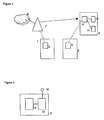
- Figure 1 shows a first device 1 that has a wireless LAN (local area network) IEEE 802.11 compatible transceiver 2.
- device 1 is a laptop computer.
- a second device 3 has a Bluetooth transceiver 4.
- device 3 is a wireless headset that is configured for use with a mobile phone 5 which has its own Bluetooth transceiver 6 for communication with the transceiver 4 of headset 3.
- Figure 1 also shows a WLAN IEEE 802.11 access point 7, which is connected to the internet 8 and which can communicate with the transceiver 2 of the laptop 1.
- the Bluetooth transceivers 4 and 6 operate according to a frequency-hopping signalling scheme, in accordance with the Bluetooth standard.
- the transceivers are therefore capable of determining the level of radio interference at the various frequencies in the band over which they perform frequency hopping.
- such a transceiver analyses the detected interference in order to detect forms of interference that are characteristic of wireless LAN systems.
- the transceiver then triggers the device of which it forms part to provide an alert to a user to inform the user of the presence of a wireless LAN system.
- the user can then choose to turn on a wireless LAN transceiver (e.g. transceiver 2) to allow his device with wireless LAN capability to connect to the detected wireless LAN system.
- a wireless LAN transceiver e.g. transceiver 2
- the transceiver 9 includes an antenna 10, a radio-frequency (RF) section 11 connected to the antenna for amplifying and demodulating received signals, and a base-band processor 12 connected to the RF section for generating signals to be transmitted and for decoding received signals.
- the base-band processor 12 also controls the operation of the RF section 11, for example for causing it to perform frequency hopping.
- transceiver 9 The detection of wireless LAN signals by transceiver 9 will now be described.
- a frequency-hopping radio receiver such as a Bluetooth receiver
- Such a receiver can build up a picture of the energy signature of a received foreign transmission or interferer by analysing the characteristics of the foreign transmission in a number of the channels. Transmissions by interfering devices obeying different foreign protocols tend to have different signature characteristics. Therefore, it is possible for the frequency hopping receiver to discriminate between interfering transmissions of different protocols.
- frequency hopping is performed for 79 channels 1 MHz wide in the range from 2402 to 2480 MHz.
- the IEEE 802.11 system up to 14 channels 22 MHz wide are allocated in the range from 2412 to 2484 MHz. Therefore, a transmitter of 802.11 signals will interfere with some of the Bluetooth channels. Each 802.11 channel will interfere with 22 of the Bluetooth channels.
- the centre frequencies of the available 802.11 channels are: Channel Frequency 1 2412 MHz 2 2417 MHz 3 2422 MHz 4 2427 MHz 5 2432 MHz 6 2437 MHz 7 2442 MHz 8 2447 MHz 9 2452 MHz 10 2457 MHz 11 2462 MHz 12 2467 MHz 13 2472 MHz 14 2484 MHz
- One simple way to detect 802.11 interferers is for the Bluetooth receiver to periodically scan the frequency range, and if interference is detected on a set of adjacent Bluetooth channels that correspond to an 802.11 channel then an 802.11 transmitter is determined to be nearby. Instead of scanning the frequency range deliberately, it could log detected interference whilst performing frequency hopping according to the designated pseudo-random frequency hopping scheme, and again if interference is detected on a set of nearby Bluetooth channels that correspond to an 802.11 channel then an 802.11 transmitter can be determined to be nearby.
- heuristics are employed, most preferably in both the frequency and time domains, to allow 802.11 interferers to be detected more reliably. A number of factors are taken as potentially indicating the presence of 802.11 interference, and a score is allocated to each. If a total score greater than a pre-determined threshold value is attained then 802.11 interference is determined as being present. Factors that may be taken as potentially indicating the presence of 802.11 interference include:
- the scores allocated to each indicator and the threshold total score can be selected dependant on the level of certainty required before the user is alerted.
- the receiver periodically scans the channels over its frequency range. If the channel spacing of the receiver is less than that of 802.11 then the receiver could scan a subset of its channels. If over two or three consecutive scans there is a channel on which interference over a threshold level has been detected on each scan then a more detailed scan is performed over the channels around that channel. A check is then performed of whether over a set of adjacent channels (e.g. 20 adjacent 1 MHz channels) around that channel the interference steadily increases to a peak and then steadily decreases. If it does so, a check is made as to whether the frequency of that peak is in the region of the centre frequency of an 802.11 channel. If it is then 802.11 interference is determined to be present. Instead of using a dedicated periodic scan to perform the initial search for interferers the system could scan whilst obeying frequency hopping according to the protocol in which it operates.
- a set of adjacent channels e.g. 20 adjacent 1 MHz channels
- the centre frequency of the wireless LAN channel might coincide with the frequency of one of the frequency hopping channels or it might lie between two frequency hopping channels.
- the location of the peak could be determined as lying at or between the frequencies of the frequency hopping channels at which the highest and second-highest levels of interference are detected.
- the process for detecting 802.11 interference could be combined with that for determining the frequencies to be used for adaptive frequency hopping (AFH) as mandated by version 1.2 of the Bluetooth standard. If the AFH process takes into account the detected presence of interference characteristic of an 802.11 device, then on such interference being detected the Bluetooth receiver may generate a signal that can be used to alert a user to the presence of such interference. It should be noted that the present invention relates to the use of such detection for a different purpose from AFH: that is the alerting of a user to the presence of interference characteristic of a certain other system.
- the user should preferably be able to selectively enable or disable alerting to detected 802.11 interference since in some locations, such as a busy office, the alarm would otherwise be sounding continually.
- the receiver that is capable of identifying 802.11 interference is comprised in a product that can provide an alert to a user by (for example) visual or audible means.
- the product may also have a user interface whereby the user can indicate to the receiver whether or not an alert is to be provided when 802.11 interference is detected.
- the headset 3 of figure 1 it may have a toggle switch 13 for allowing the user to select whether alerts are to be provided, and a speaker 14 for emitting an alerting noise when 802.11 interference is detected.
- the description above relates to the specific example of 802.11 interference being detected by a Bluetooth receiver.
- the present invention is applicable to other combinations of systems.
- the detecting receiver (which may be a transceiver) is a frequency hopping receiver, so that it is conveniently capable of detecting interference over a range of channel frequencies.
- the interfering system is not a frequency hopping system since then its interference will remain at relatively constant frequencies.
- the invention is most applicable for detecting other systems in shared bands such as the 2.4 GHz ISM band in which 802.11 and Bluetooth operate. Examples of other systems that could be detected include HomeRF and DECT.
- the detection of interference characteristic of a wireless network signal may be signalled to the user in any suitable way.
- One convenient way is by means of an audio signal, such as a characteristic sound.
- Another convenient way is by means of a visual signal such as a flashing LED or an icon on a display.
Landscapes
- Engineering & Computer Science (AREA)
- Computer Networks & Wireless Communication (AREA)
- Signal Processing (AREA)
- Mobile Radio Communication Systems (AREA)
- Circuits Of Receivers In General (AREA)
- Noise Elimination (AREA)
- Small-Scale Networks (AREA)
- Monitoring And Testing Of Transmission In General (AREA)
- Electrophonic Musical Instruments (AREA)
- Air Bags (AREA)
- Automatic Disk Changers (AREA)
Claims (12)
- Eine Empfängervorrichtung (3), die aufweist:einen Frequenzsprung-Funkempfänger (4) für den Betrieb gemäß einem Frequenzsprung-Protokoll, das mehrere Kanäle verwendet, wobei der Funkempfänger (4) dazu ausgebildet ist, die Anwesenheit von Störcharakteristika eines vorgegebenen anderen Funkprotokolls festzustellen; undBenutzeralarmierungs-Einheit (14), die auf den Empfänger reagiert;wobei der Funkempfänger konfigurierbar ist, die Benutzeralarmierungs-Einheit (14) zur Alarmierung des Benutzers als Reaktion auf die Detektion von Störcharakteristika des anderen Funkprotokolls zu betätigen;wobei der Empfänger imstande ist, Störungen als charakteristisch für das andere Funkprotokoll zu identifizieren, nämlich durch Aufbauen eines Abbilds der Energiesignatur der Störung mittels Analyse der Störcharakteristika in einer Mehrzahl von Kanälen;wobei der Empfänger dadurch gekennzeichnet ist, dass er konfigurierbar ist, detektierte Störungen während des Ausführens von Frequenzsprüngen gemäß dem Protokoll, in dem er betrieben wird, zu protokollieren.
- Empfängervorrichtung (3) gemäß Anspruch 1, bei dem die Empfängervorrichtung eine bedienbare Steuerung (13) aufweist, wobei der Benutzer die Vorrichtung so konfigurieren kann, dass die Benutzeralarmierungs-Einheit (14) als Reaktion auf die Detektion von Störcharakteristika des anderen Funksignals durch die Vorrichtung betätigt wird.
- Empfängervorrichtung (3) gemäß Anspruch 1 oder 2, bei der die Benutzeralarmierungs-Einheit (14) eine Funktion eines Audiogeräts ist, welches ein für den Benutzer hörbares Signal erzeugt.
- Empfängervorrichtung (3) gemäß Anspruch 1 oder 2, bei der die Benutzeralarmierungs-Einheit (14) eine Funktion eines Videogeräts ist, welches ein für den Benutzer sichtbares Signal erzeugt.
- Empfängervorrichtung (3) gemäß einem der vorangehenden Ansprüche, bei der der Empfänger (4) dazu ausgebildet ist, die Anwesenheit von Störcharakteristika des anderen Funkprotokolls zu erkennen durch Erkennen von Störungen auf einem oder mehreren Kanälen des Frequenzsprung-Systems, welches über eine Zeitdauer hinweg festgelegt bleibt.
- Empfängervorrichtung (3) gemäß einem der vorangehenden Ansprüche, bei der der Empfänger (4) dazu ausgebildet ist, die Anwesenheit von Störsignalcharakteristika des anderen Funkprotokolls zu erkennen durch Erkennen von Störungen auf einer festgelegten Anzahl von benachbarten Kanälen des Frequenzsprung-Systems.
- Empfängervorrichtung (3) gemäß Anspruch 6, bei der der Empfänger (4) dazu ausgebildet ist, die Anwesenheit von Störcharakteristika des anderen Funkprotokolls zu erkennen durch Erkennen von Störungen auf einer festgelegten Anzahl von benachbarten Kanälen des Frequenzsprung-Systems, wobei über diese benachbarten Kanäle die Frequenz auf ein Maximum ansteigt und dann wieder abfällt.
- Empfängervorrichtung (3) gemäß Anspruch 7, bei dem der Empfänger (4) dazu ausgebildet ist , die Anwesenheit von Störcharakteristika des anderen Funkprotokolls zu erkennen durch Erkennen von Störungen auf einer festgelegten Anzahl von benachbarten Kanälen des Frequenzsprung-Systems, wobei über diese benachbarten Kanäle die Frequenz bei der Mittenfrequenz auf ein Maximum ansteigt und dann wieder abfällt.
- Empfängervorrichtung (3) gemäß einem der vorhergehenden Ansprüche, bei der das Frequenzsprung-Funkprotokoll ein Bluetooth-Protokoll ist.
- Empfängervorrichtung (3) gemäß einem der vorhergehenden Ansprüche, bei der das andere Funkprotokoll ein WLAN-Protokoll ist.
- Empfängervorrichtung (3) gemäß einem der vorhergehenden Ansprüche, bei dem das andere Funkprotokoll ein IEEE-802.11-Protokoll ist.
- Verfahren zum Alarmieren eines Benutzers bezüglich der Anwesenheit eines Drahtlosnetzwerks mit einem ersten Funkprotokoll, wobei das Verfahren folgende Schritte aufweist:Detektieren der Anwesenheit von Störcharakteristika des ersten Funkprotokolls mittels eines Frequenzsprung-Funkempfängers (4) für den Betrieb gemäß einem Frequenzsprung-Funkprotokoll auf mehreren Kanälen;Alarmieren eines Benutzers als Reaktion auf die Detektion von Störcharakteristika des ersten Funkprotokolls unter Verwendung einer Benutzeralarmierungs-Einheit (14); undIdentifizieren von Störungen als charakteristisch für das erste Funkprotokoll durch Aufbauen eines Abbilds der Energiesignatur der Störungen mittels Analyse der Störcharakteristika auf einer Mehrzahl von Kanälen; dadurch gekennzeichnet, dassder Schritt des Identifizierens der Anwesenheit von Störcharakteristika das Protokollieren der detektierten Störungen während des Durchführens von Frequenzsprüngen gemäß dem Protokoll, in dem der Empfänger (4) betrieben wird, aufweist.
Priority Applications (1)
| Application Number | Priority Date | Filing Date | Title |
|---|---|---|---|
| EP10182735A EP2262189A1 (de) | 2005-02-03 | 2006-01-30 | Erkennung von Signalen |
Applications Claiming Priority (2)
| Application Number | Priority Date | Filing Date | Title |
|---|---|---|---|
| GB0502255A GB2422968A (en) | 2005-02-03 | 2005-02-03 | Detecting signals |
| PCT/GB2006/000299 WO2006082379A1 (en) | 2005-02-03 | 2006-01-30 | Detecting signals |
Related Child Applications (1)
| Application Number | Title | Priority Date | Filing Date |
|---|---|---|---|
| EP10182735.0 Division-Into | 2010-09-29 |
Publications (2)
| Publication Number | Publication Date |
|---|---|
| EP1844585A1 EP1844585A1 (de) | 2007-10-17 |
| EP1844585B1 true EP1844585B1 (de) | 2011-07-27 |
Family
ID=34307933
Family Applications (2)
| Application Number | Title | Priority Date | Filing Date |
|---|---|---|---|
| EP06709588A Expired - Lifetime EP1844585B1 (de) | 2005-02-03 | 2006-01-30 | Detektion von Signalen |
| EP10182735A Withdrawn EP2262189A1 (de) | 2005-02-03 | 2006-01-30 | Erkennung von Signalen |
Family Applications After (1)
| Application Number | Title | Priority Date | Filing Date |
|---|---|---|---|
| EP10182735A Withdrawn EP2262189A1 (de) | 2005-02-03 | 2006-01-30 | Erkennung von Signalen |
Country Status (7)
| Country | Link |
|---|---|
| US (1) | US8204445B2 (de) |
| EP (2) | EP1844585B1 (de) |
| JP (1) | JP5073503B2 (de) |
| AT (1) | ATE518340T1 (de) |
| GB (1) | GB2422968A (de) |
| TW (1) | TW200637201A (de) |
| WO (1) | WO2006082379A1 (de) |
Families Citing this family (16)
| Publication number | Priority date | Publication date | Assignee | Title |
|---|---|---|---|---|
| WO2007122188A1 (en) * | 2006-04-20 | 2007-11-01 | Wireless Audio I.P. B.V. | System and method for interference identification and frequency allocation |
| KR100765486B1 (ko) | 2006-09-08 | 2007-10-10 | 삼성전자주식회사 | 근거리 무선통신용 휴대 단말기 사이의 관계 표시 방법 |
| US8010050B2 (en) | 2006-09-28 | 2011-08-30 | Alcatel Lucent | Method and system for wireless access to a network by an isolated user |
| WO2008122916A2 (en) * | 2007-04-04 | 2008-10-16 | Philips Intellectual Property & Standards Gmbh | Detecting and discriminating between interference caused by different wireless technologies |
| CN101911749B (zh) * | 2008-01-17 | 2015-01-28 | 诺基亚公司 | 使用从一个无线介质获得的信息在另一无线介质中通信 |
| US9503905B2 (en) | 2008-10-17 | 2016-11-22 | Nokia Solutions And Networks Oy | Spectrum sharing |
| US8964692B2 (en) | 2008-11-10 | 2015-02-24 | Qualcomm Incorporated | Spectrum sensing of bluetooth using a sequence of energy detection measurements |
| US9078284B2 (en) * | 2008-12-31 | 2015-07-07 | Airvana Lp | Personal access point media server |
| US8396196B2 (en) * | 2009-05-08 | 2013-03-12 | Apple Inc. | Transfer of multiple microphone signals to an audio host device |
| US8571475B2 (en) * | 2009-08-19 | 2013-10-29 | Motorola Mobility Llc | System and method for mitigating the effects of interferers while performing conditional device scan |
| WO2012101679A1 (ja) | 2011-01-28 | 2012-08-02 | 三菱電機株式会社 | 無線通信装置および無線通信システム |
| WO2013078680A1 (zh) * | 2011-12-02 | 2013-06-06 | 华为技术有限公司 | 消除邻道干扰的方法、调制解调器及系统 |
| JP6037433B2 (ja) * | 2012-07-03 | 2016-12-07 | Necマグナスコミュニケーションズ株式会社 | 通信装置、その制御方法及びプログラム |
| TWI674027B (zh) | 2014-09-24 | 2019-10-01 | 日商新力股份有限公司 | 電訊設備及方法 |
| EP3001717B1 (de) | 2014-09-29 | 2020-11-04 | Keysight Technologies Singapore (Sales) Pte.Ltd. | Störungsdetektion |
| CN118399988B (zh) * | 2024-06-26 | 2024-11-15 | 深圳睿网云联科技有限公司 | 基于蓝牙通信的终端交互方法及系统 |
Family Cites Families (21)
| Publication number | Priority date | Publication date | Assignee | Title |
|---|---|---|---|---|
| US4355411A (en) * | 1980-03-24 | 1982-10-19 | Bell Telephone Laboratories, Incorporated | Technique for efficient spectrum utilization in mobile radio systems using space diversity |
| JPH11355178A (ja) * | 1998-06-05 | 1999-12-24 | Brother Ind Ltd | 周波数ホッピング方式を用いた無線通信装置 |
| GB2339647A (en) * | 1998-07-15 | 2000-02-02 | Ericsson Telefon Ab L M | Warning of Interference between Radio Links |
| US6928266B1 (en) * | 1999-11-12 | 2005-08-09 | Intel Corporation | Wireless apparatus interference avoidance/resolution method and apparatuses |
| US6711380B1 (en) * | 2000-05-25 | 2004-03-23 | Motorola, Inc. | Method and apparatus for reducing interference effects caused by microwave sources |
| GB2399999B (en) * | 2000-08-31 | 2005-03-09 | Intel Corp | Mitigating interference between wireless systems |
| JP3770586B2 (ja) * | 2000-12-27 | 2006-04-26 | 株式会社東芝 | 無線通信方法および無線通信装置 |
| JP3443094B2 (ja) * | 2000-12-27 | 2003-09-02 | 株式会社東芝 | 無線通信方法および無線通信装置 |
| JP4250875B2 (ja) * | 2001-03-28 | 2009-04-08 | 日本電気株式会社 | 警報装置及びそれに用いる警報発生方法並びにそのプログラム |
| US20030119558A1 (en) * | 2001-12-20 | 2003-06-26 | Karl Steadman | Adaptive antenna pattern formation in wireless ad-hoc packet-switched networks |
| US20030118015A1 (en) * | 2001-12-20 | 2003-06-26 | Magnus Gunnarsson | Location based notification of wlan availability via wireless communication network |
| US7424268B2 (en) * | 2002-04-22 | 2008-09-09 | Cisco Technology, Inc. | System and method for management of a shared frequency band |
| US7292656B2 (en) * | 2002-04-22 | 2007-11-06 | Cognio, Inc. | Signal pulse detection scheme for use in real-time spectrum analysis |
| TW595140B (en) | 2002-04-22 | 2004-06-21 | Cognio Inc | System and method for spectrum management of a shared frequency band |
| US7418240B2 (en) * | 2002-05-03 | 2008-08-26 | Broadcom Corporation | Dynamic adaptation of impaired RF communication channels in a communication system |
| US7171161B2 (en) * | 2002-07-30 | 2007-01-30 | Cognio, Inc. | System and method for classifying signals using timing templates, power templates and other techniques |
| JP2004166104A (ja) * | 2002-11-15 | 2004-06-10 | Canon Inc | 無線lanシステム |
| US7356104B2 (en) * | 2003-07-10 | 2008-04-08 | Shinji Fukuda | Radio communication apparatus and interference avoiding method |
| US7103316B1 (en) * | 2003-09-25 | 2006-09-05 | Rfmd Wpan, Inc. | Method and apparatus determining the presence of interference in a wireless communication channel |
| WO2006015349A2 (en) * | 2004-07-30 | 2006-02-09 | Reva Systems Corporation | Rfid tag data acquisition system |
| US7254399B2 (en) * | 2004-10-12 | 2007-08-07 | Nokia Corporation | Techniques for interference reduction in wireless communications networks |
-
2005
- 2005-02-03 GB GB0502255A patent/GB2422968A/en not_active Withdrawn
-
2006
- 2006-01-30 EP EP06709588A patent/EP1844585B1/de not_active Expired - Lifetime
- 2006-01-30 JP JP2007553684A patent/JP5073503B2/ja not_active Expired - Fee Related
- 2006-01-30 AT AT06709588T patent/ATE518340T1/de not_active IP Right Cessation
- 2006-01-30 US US11/815,026 patent/US8204445B2/en not_active Expired - Fee Related
- 2006-01-30 EP EP10182735A patent/EP2262189A1/de not_active Withdrawn
- 2006-01-30 WO PCT/GB2006/000299 patent/WO2006082379A1/en not_active Ceased
- 2006-02-03 TW TW095103746A patent/TW200637201A/zh unknown
Also Published As
| Publication number | Publication date |
|---|---|
| ATE518340T1 (de) | 2011-08-15 |
| EP1844585A1 (de) | 2007-10-17 |
| US20100041358A1 (en) | 2010-02-18 |
| WO2006082379A1 (en) | 2006-08-10 |
| GB2422968A (en) | 2006-08-09 |
| TW200637201A (en) | 2006-10-16 |
| EP2262189A1 (de) | 2010-12-15 |
| GB0502255D0 (en) | 2005-03-09 |
| US8204445B2 (en) | 2012-06-19 |
| JP2008537851A (ja) | 2008-09-25 |
| JP5073503B2 (ja) | 2012-11-14 |
Similar Documents
| Publication | Publication Date | Title |
|---|---|---|
| EP1844585B1 (de) | Detektion von Signalen | |
| CA2679677C (en) | Method and apparatus for detecting and identifying spectrum opportunities | |
| US10862518B1 (en) | Radio frequency decibel scaled wireless interference detector | |
| US7039358B1 (en) | Coexistence techniques in wireless networks | |
| CN101401316B (zh) | 用于改变频道的移动终端及其频道改变方法 | |
| US20040235453A1 (en) | Access point incorporating a function of monitoring illegal wireless communications | |
| CN106922013B (zh) | 同频段双射频模块的无线接入点和降低信号干扰的方法 | |
| EP2135363A2 (de) | Verfahren zur bestimmung der verfügbarkeit eines bestimmtes kanals, verfahren für den empfang eines detektionssignals und verfahren zur kommunikation in koexistenz mit einem anderen netzwerktyp in einer umgebung mit der koexistenz eines oder mehrerer netzwerke | |
| US10284728B1 (en) | Adaptive proximity thresholds for dynamic howling suppression | |
| US20120051262A1 (en) | Location Based Mobile Communications Device Auto-Configuration | |
| US20140153378A1 (en) | Wireless communication device, wireless communication system, and channel selection method | |
| JP2008252554A (ja) | 無線装置 | |
| JP4994463B2 (ja) | 一つ以上のネットワークが共存できる環境で、特定チャネルの使用可否を決定する方法、プリアンブル信号を受信する方法、及び異種ネットワークが共存して通信を行う方法 | |
| JP4762171B2 (ja) | 無線通信装置 | |
| JP6325367B2 (ja) | 通信装置、通信方法および通信プログラム | |
| JP4674573B2 (ja) | 携帯端末装置 | |
| JP3163320B2 (ja) | 送受信装置 | |
| JP4978630B2 (ja) | 無線通信装置、および無線通信制御方法 | |
| JP2005020110A (ja) | 携帯電話機、該携帯電話機に用いられる通信状態通知方法及び通知制御プログラム | |
| JP4600439B2 (ja) | ワイヤレスlanシステムのベース装置および端末装置 | |
| JP2004172953A (ja) | 移動通信装置 | |
| JP2006211359A (ja) | 携帯通信端末 | |
| JP2006093926A (ja) | 無線ネットワーク接続機器特定方法 | |
| JPH11161862A (ja) | ワイヤレス呼出受信器 | |
| KR20020080123A (ko) | 무선 인터컴 장치 및 그 제어방법 |
Legal Events
| Date | Code | Title | Description |
|---|---|---|---|
| PUAI | Public reference made under article 153(3) epc to a published international application that has entered the european phase |
Free format text: ORIGINAL CODE: 0009012 |
|
| 17P | Request for examination filed |
Effective date: 20070813 |
|
| AK | Designated contracting states |
Kind code of ref document: A1 Designated state(s): AT BE BG CH CY CZ DE DK EE ES FI FR GB GR HU IE IS IT LI LT LU LV MC NL PL PT RO SE SI SK TR |
|
| 17Q | First examination report despatched |
Effective date: 20071108 |
|
| DAX | Request for extension of the european patent (deleted) | ||
| GRAP | Despatch of communication of intention to grant a patent |
Free format text: ORIGINAL CODE: EPIDOSNIGR1 |
|
| RTI1 | Title (correction) |
Free format text: DETECTING SIGNALS |
|
| GRAS | Grant fee paid |
Free format text: ORIGINAL CODE: EPIDOSNIGR3 |
|
| RIN1 | Information on inventor provided before grant (corrected) |
Inventor name: WOOD, PETER |
|
| GRAA | (expected) grant |
Free format text: ORIGINAL CODE: 0009210 |
|
| AK | Designated contracting states |
Kind code of ref document: B1 Designated state(s): AT BE BG CH CY CZ DE DK EE ES FI FR GB GR HU IE IS IT LI LT LU LV MC NL PL PT RO SE SI SK TR |
|
| REG | Reference to a national code |
Ref country code: GB Ref legal event code: FG4D |
|
| REG | Reference to a national code |
Ref country code: CH Ref legal event code: EP |
|
| REG | Reference to a national code |
Ref country code: DE Ref legal event code: R081 Ref document number: 602006023314 Country of ref document: DE Owner name: QUALCOMM TECHNOLOGIES INTERNATIONAL, LTD., GB Free format text: FORMER OWNER: CAMBRIDGE SILICON RADIO LTD., CAMBRIDGE, CAMBRIDGESHIRE, GB |
|
| REG | Reference to a national code |
Ref country code: DE Ref legal event code: R081 Ref document number: 602006023314 Country of ref document: DE Owner name: QUALCOMM TECHNOLOGIES INTERNATIONAL, LTD., GB Free format text: FORMER OWNER: CAMBRIDGE SILICON RADIO LIMITED, CAMBRIDGE, GB |
|
| REG | Reference to a national code |
Ref country code: NL Ref legal event code: T3 |
|
| REG | Reference to a national code |
Ref country code: DE Ref legal event code: R096 Ref document number: 602006023314 Country of ref document: DE Effective date: 20110922 |
|
| REG | Reference to a national code |
Ref country code: AT Ref legal event code: MK05 Ref document number: 518340 Country of ref document: AT Kind code of ref document: T Effective date: 20110727 |
|
| PG25 | Lapsed in a contracting state [announced via postgrant information from national office to epo] |
Ref country code: SE Free format text: LAPSE BECAUSE OF FAILURE TO SUBMIT A TRANSLATION OF THE DESCRIPTION OR TO PAY THE FEE WITHIN THE PRESCRIBED TIME-LIMIT Effective date: 20110727 Ref country code: PT Free format text: LAPSE BECAUSE OF FAILURE TO SUBMIT A TRANSLATION OF THE DESCRIPTION OR TO PAY THE FEE WITHIN THE PRESCRIBED TIME-LIMIT Effective date: 20111128 Ref country code: IS Free format text: LAPSE BECAUSE OF FAILURE TO SUBMIT A TRANSLATION OF THE DESCRIPTION OR TO PAY THE FEE WITHIN THE PRESCRIBED TIME-LIMIT Effective date: 20111127 Ref country code: BE Free format text: LAPSE BECAUSE OF FAILURE TO SUBMIT A TRANSLATION OF THE DESCRIPTION OR TO PAY THE FEE WITHIN THE PRESCRIBED TIME-LIMIT Effective date: 20110727 Ref country code: LT Free format text: LAPSE BECAUSE OF FAILURE TO SUBMIT A TRANSLATION OF THE DESCRIPTION OR TO PAY THE FEE WITHIN THE PRESCRIBED TIME-LIMIT Effective date: 20110727 Ref country code: FI Free format text: LAPSE BECAUSE OF FAILURE TO SUBMIT A TRANSLATION OF THE DESCRIPTION OR TO PAY THE FEE WITHIN THE PRESCRIBED TIME-LIMIT Effective date: 20110727 |
|
| PG25 | Lapsed in a contracting state [announced via postgrant information from national office to epo] |
Ref country code: AT Free format text: LAPSE BECAUSE OF FAILURE TO SUBMIT A TRANSLATION OF THE DESCRIPTION OR TO PAY THE FEE WITHIN THE PRESCRIBED TIME-LIMIT Effective date: 20110727 Ref country code: PL Free format text: LAPSE BECAUSE OF FAILURE TO SUBMIT A TRANSLATION OF THE DESCRIPTION OR TO PAY THE FEE WITHIN THE PRESCRIBED TIME-LIMIT Effective date: 20110727 Ref country code: SI Free format text: LAPSE BECAUSE OF FAILURE TO SUBMIT A TRANSLATION OF THE DESCRIPTION OR TO PAY THE FEE WITHIN THE PRESCRIBED TIME-LIMIT Effective date: 20110727 Ref country code: GR Free format text: LAPSE BECAUSE OF FAILURE TO SUBMIT A TRANSLATION OF THE DESCRIPTION OR TO PAY THE FEE WITHIN THE PRESCRIBED TIME-LIMIT Effective date: 20111028 Ref country code: CY Free format text: LAPSE BECAUSE OF FAILURE TO SUBMIT A TRANSLATION OF THE DESCRIPTION OR TO PAY THE FEE WITHIN THE PRESCRIBED TIME-LIMIT Effective date: 20110727 Ref country code: LV Free format text: LAPSE BECAUSE OF FAILURE TO SUBMIT A TRANSLATION OF THE DESCRIPTION OR TO PAY THE FEE WITHIN THE PRESCRIBED TIME-LIMIT Effective date: 20110727 |
|
| PG25 | Lapsed in a contracting state [announced via postgrant information from national office to epo] |
Ref country code: SK Free format text: LAPSE BECAUSE OF FAILURE TO SUBMIT A TRANSLATION OF THE DESCRIPTION OR TO PAY THE FEE WITHIN THE PRESCRIBED TIME-LIMIT Effective date: 20110727 Ref country code: CZ Free format text: LAPSE BECAUSE OF FAILURE TO SUBMIT A TRANSLATION OF THE DESCRIPTION OR TO PAY THE FEE WITHIN THE PRESCRIBED TIME-LIMIT Effective date: 20110727 |
|
| PGFP | Annual fee paid to national office [announced via postgrant information from national office to epo] |
Ref country code: FR Payment date: 20120126 Year of fee payment: 7 |
|
| PG25 | Lapsed in a contracting state [announced via postgrant information from national office to epo] |
Ref country code: IT Free format text: LAPSE BECAUSE OF FAILURE TO SUBMIT A TRANSLATION OF THE DESCRIPTION OR TO PAY THE FEE WITHIN THE PRESCRIBED TIME-LIMIT Effective date: 20110727 Ref country code: RO Free format text: LAPSE BECAUSE OF FAILURE TO SUBMIT A TRANSLATION OF THE DESCRIPTION OR TO PAY THE FEE WITHIN THE PRESCRIBED TIME-LIMIT Effective date: 20110727 Ref country code: EE Free format text: LAPSE BECAUSE OF FAILURE TO SUBMIT A TRANSLATION OF THE DESCRIPTION OR TO PAY THE FEE WITHIN THE PRESCRIBED TIME-LIMIT Effective date: 20110727 |
|
| PLBE | No opposition filed within time limit |
Free format text: ORIGINAL CODE: 0009261 |
|
| STAA | Information on the status of an ep patent application or granted ep patent |
Free format text: STATUS: NO OPPOSITION FILED WITHIN TIME LIMIT |
|
| PG25 | Lapsed in a contracting state [announced via postgrant information from national office to epo] |
Ref country code: DK Free format text: LAPSE BECAUSE OF FAILURE TO SUBMIT A TRANSLATION OF THE DESCRIPTION OR TO PAY THE FEE WITHIN THE PRESCRIBED TIME-LIMIT Effective date: 20110727 |
|
| 26N | No opposition filed |
Effective date: 20120502 |
|
| PGFP | Annual fee paid to national office [announced via postgrant information from national office to epo] |
Ref country code: NL Payment date: 20120110 Year of fee payment: 7 |
|
| REG | Reference to a national code |
Ref country code: DE Ref legal event code: R097 Ref document number: 602006023314 Country of ref document: DE Effective date: 20120502 |
|
| PG25 | Lapsed in a contracting state [announced via postgrant information from national office to epo] |
Ref country code: MC Free format text: LAPSE BECAUSE OF NON-PAYMENT OF DUE FEES Effective date: 20120131 |
|
| REG | Reference to a national code |
Ref country code: CH Ref legal event code: PL |
|
| REG | Reference to a national code |
Ref country code: IE Ref legal event code: MM4A |
|
| PG25 | Lapsed in a contracting state [announced via postgrant information from national office to epo] |
Ref country code: CH Free format text: LAPSE BECAUSE OF NON-PAYMENT OF DUE FEES Effective date: 20120131 Ref country code: LI Free format text: LAPSE BECAUSE OF NON-PAYMENT OF DUE FEES Effective date: 20120131 |
|
| REG | Reference to a national code |
Ref country code: DE Ref legal event code: R082 Ref document number: 602006023314 Country of ref document: DE Representative=s name: OLSWANG GERMANY LLP, DE Ref country code: DE Ref legal event code: R082 Ref document number: 602006023314 Country of ref document: DE Representative=s name: MAUCHER JENKINS, DE Ref country code: DE Ref legal event code: R082 Ref document number: 602006023314 Country of ref document: DE Representative=s name: MAUCHER JENKINS PATENTANWAELTE & RECHTSANWAELT, DE |
|
| PG25 | Lapsed in a contracting state [announced via postgrant information from national office to epo] |
Ref country code: IE Free format text: LAPSE BECAUSE OF NON-PAYMENT OF DUE FEES Effective date: 20120130 |
|
| PG25 | Lapsed in a contracting state [announced via postgrant information from national office to epo] |
Ref country code: ES Free format text: LAPSE BECAUSE OF FAILURE TO SUBMIT A TRANSLATION OF THE DESCRIPTION OR TO PAY THE FEE WITHIN THE PRESCRIBED TIME-LIMIT Effective date: 20111107 |
|
| PG25 | Lapsed in a contracting state [announced via postgrant information from national office to epo] |
Ref country code: BG Free format text: LAPSE BECAUSE OF FAILURE TO SUBMIT A TRANSLATION OF THE DESCRIPTION OR TO PAY THE FEE WITHIN THE PRESCRIBED TIME-LIMIT Effective date: 20111027 |
|
| REG | Reference to a national code |
Ref country code: NL Ref legal event code: V1 Effective date: 20130801 |
|
| REG | Reference to a national code |
Ref country code: FR Ref legal event code: ST Effective date: 20130930 |
|
| PG25 | Lapsed in a contracting state [announced via postgrant information from national office to epo] |
Ref country code: NL Free format text: LAPSE BECAUSE OF NON-PAYMENT OF DUE FEES Effective date: 20130801 |
|
| PG25 | Lapsed in a contracting state [announced via postgrant information from national office to epo] |
Ref country code: FR Free format text: LAPSE BECAUSE OF NON-PAYMENT OF DUE FEES Effective date: 20130131 |
|
| PG25 | Lapsed in a contracting state [announced via postgrant information from national office to epo] |
Ref country code: TR Free format text: LAPSE BECAUSE OF FAILURE TO SUBMIT A TRANSLATION OF THE DESCRIPTION OR TO PAY THE FEE WITHIN THE PRESCRIBED TIME-LIMIT Effective date: 20110727 |
|
| PG25 | Lapsed in a contracting state [announced via postgrant information from national office to epo] |
Ref country code: LU Free format text: LAPSE BECAUSE OF NON-PAYMENT OF DUE FEES Effective date: 20120130 |
|
| PG25 | Lapsed in a contracting state [announced via postgrant information from national office to epo] |
Ref country code: HU Free format text: LAPSE BECAUSE OF FAILURE TO SUBMIT A TRANSLATION OF THE DESCRIPTION OR TO PAY THE FEE WITHIN THE PRESCRIBED TIME-LIMIT Effective date: 20060130 |
|
| REG | Reference to a national code |
Ref country code: DE Ref legal event code: R082 Ref document number: 602006023314 Country of ref document: DE Representative=s name: MAUCHER JENKINS, DE Ref country code: DE Ref legal event code: R082 Ref document number: 602006023314 Country of ref document: DE Representative=s name: OLSWANG GERMANY LLP, DE Ref country code: DE Ref legal event code: R081 Ref document number: 602006023314 Country of ref document: DE Owner name: QUALCOMM TECHNOLOGIES INTERNATIONAL, LTD., GB Free format text: FORMER OWNER: CAMBRIDGE SILICON RADIO LIMITED, CAMBRIDGE, GB Ref country code: DE Ref legal event code: R082 Ref document number: 602006023314 Country of ref document: DE Representative=s name: MAUCHER JENKINS PATENTANWAELTE & RECHTSANWAELT, DE |
|
| REG | Reference to a national code |
Ref country code: DE Ref legal event code: R082 Ref document number: 602006023314 Country of ref document: DE Representative=s name: MAUCHER JENKINS, DE Ref country code: DE Ref legal event code: R082 Ref document number: 602006023314 Country of ref document: DE Representative=s name: MAUCHER JENKINS PATENTANWAELTE & RECHTSANWAELT, DE |
|
| PGFP | Annual fee paid to national office [announced via postgrant information from national office to epo] |
Ref country code: GB Payment date: 20181227 Year of fee payment: 14 |
|
| PGFP | Annual fee paid to national office [announced via postgrant information from national office to epo] |
Ref country code: DE Payment date: 20181227 Year of fee payment: 14 |
|
| REG | Reference to a national code |
Ref country code: DE Ref legal event code: R119 Ref document number: 602006023314 Country of ref document: DE |
|
| GBPC | Gb: european patent ceased through non-payment of renewal fee |
Effective date: 20200130 |
|
| PG25 | Lapsed in a contracting state [announced via postgrant information from national office to epo] |
Ref country code: DE Free format text: LAPSE BECAUSE OF NON-PAYMENT OF DUE FEES Effective date: 20200801 Ref country code: GB Free format text: LAPSE BECAUSE OF NON-PAYMENT OF DUE FEES Effective date: 20200130 |