EP1840549B1 - Apparatus and method for detecting blockage of impulse lines - Google Patents
Apparatus and method for detecting blockage of impulse lines Download PDFInfo
- Publication number
- EP1840549B1 EP1840549B1 EP07005508A EP07005508A EP1840549B1 EP 1840549 B1 EP1840549 B1 EP 1840549B1 EP 07005508 A EP07005508 A EP 07005508A EP 07005508 A EP07005508 A EP 07005508A EP 1840549 B1 EP1840549 B1 EP 1840549B1
- Authority
- EP
- European Patent Office
- Prior art keywords
- time series
- data sets
- static pressure
- series data
- calculating unit
- Prior art date
- Legal status (The legal status is an assumption and is not a legal conclusion. Google has not performed a legal analysis and makes no representation as to the accuracy of the status listed.)
- Active
Links
Images


Classifications
-
- G—PHYSICS
- G01—MEASURING; TESTING
- G01L—MEASURING FORCE, STRESS, TORQUE, WORK, MECHANICAL POWER, MECHANICAL EFFICIENCY, OR FLUID PRESSURE
- G01L27/00—Testing or calibrating of apparatus for measuring fluid pressure
- G01L27/007—Malfunction diagnosis, i.e. diagnosing a sensor defect
Definitions
- the present invention generally relates to an apparatus and method for detecting blockage of impulse lines. More specifically, the present invention relates to an apparatus and method for detecting blockage of impulse lines that are coupled to a differential pressure transmitter, wherein the differential pressure transmitter is configured to measure the differential pressure of a fluid that flows through a tube.
- a differential pressure transmitter can be used to detect the differential pressure between upstream and downstream of an orifice that is provided in a tube.
- the differential pressure transmitter is coupled to upstream and downstream impulse lines. These upstream and downstream impulse lines are further coupled to the tube at upstream and downstream positions thereof, respectively. The upstream and downstream positions are positioned upstream and downstream of the orifice, respectively.
- the fluid may have different pressures upstream and downstream of the orifice.
- the pressure of a fluid upstream of the orifice will hereinafter be referred to as an upstream pressure.
- the pressure of a fluid downstream of the orifice will hereinafter be referred to as a downstream pressure.
- the upstream pressure is higher than the downstream pressure.
- the upstream and downstream impulse lines may also be referred to as higher and lower pressure impulse lines, respectively.
- the upstream and downstream impulse lines are respectively configured to allow the upstream and downstream pressures to travel from the tube to the differential pressure transmitter.
- the differential pressure transmitter is configured to measure the traveled upstream and downstream pressures so as to detect the differential pressure based on the measured upstream and downstream pressures.
- a blockage of the impulse line or impulse lines can prevent the differential pressure transmitter from accurately detecting the differential pressure. In view of monitoring the fluid in the tube, it is important to detect or diagnose that a blockage is present or absent in the impulse line or impulse lines.
- Dps(i) represents data sets that are related to differential pressure in the normal state in which the impulse lines are free from any blockage. These differential pressure data sets are obtainable in time series from the differential pressure transmitter.
- the differential pressure has fluctuations Fdps(i) that are given by the following equation (1), where Dps(i) is the current differential pressure data set that is currently obtained from the differential pressure transmitter, and Dps(i-1) is the last differential pressure data set that was last obtained from the differential pressure transmitter.
- the differential pressure fluctuations Fdps(i) have a variance Vas (root mean square) that is given by the following equation (2), where N is the total sample number of the differential pressure data sets Dps.
- the differential pressure fluctuation Fdps(i) and the fluctuation variance Va are determined based on the differential pressure data sets Dps(i) every time the impulse lines are diagnosed during the actual operation of the plant.
- the above-mentioned equations (1) and (2) can be used to determine the differential pressure fluctuations Fdps(i) and the fluctuation variance Va, respectively.
- the following equation (3) can be used to find the differential pressure fluctuation.
- the calculated differential pressure fluctuation may reflect a transitional variation component of the differential pressure.
- the transitional variation may be rising and dropping of the differential pressure.
- Fdps i Dps i - 2 Dps ⁇ i - 1 + Dps ⁇ i - 2
- Reference US 5680109 discloses a differential pressure sensor, which is attached to a process via a high and a low pressure impulse line. An absolute pressure sensor is also attached to each impulse line. To determine if an impulse line is blocked, a noise signal is acquired from the corresponding absolute pressure sensor. A variance of the noise signal is determined and compared to a threshold. If the variance is less than the threshold, an impulse line blockage is indicated.
- the variance of the differential pressure fluctuations may vary depending on not only blockage of the impulse lines but also the flow rate of a fluid in the tube.
- the above-described threshold and the standard fluctuation variance should be set by taking into account the flow rate of the fluid. In other words, to avoid a blockage misdiagnosis it is necessary to update the above-described threshold and the standard fluctuation variance based on variation in the flow rate of the fluid.
- the higher static pressure fluctuations Fsph(i) are calculated in accordance with the following equation (4) by using data sets Sph(i) related to the higher static pressure of a fluid.
- the higher static pressure is the static pressure of a fluid upstream of the orifice.
- the higher static pressure data sets Sph(i) are obtainable in time series from the differential pressure transmitter.
- the lower static pressure fluctuations Fspl(i) are calculated in accordance with the following equation (5) by using other data sets Spl(i) related to the lower static pressure.
- the lower static pressure is the static pressure of a fluid downstream of the orifice.
- the lower static pressure data sets Spl(i) are also obtainable in time series from the differential pressure transmitter.
- Fsph i Sph i - Sph ⁇ i - 1
- Fspl i Spl i - Spl ⁇ i - 1
- the calculated value (Ssph) shall theoretically be equal to zero, and the other calculated value (Sspl) shall theoretically be a predetermined threshold as a non-zero value.
- the differential pressure transmitter generates a noise-containing output signal.
- both the calculated values (Ssph) and (Sspl) are also increased together. Also, if the flow rate is decreased, then both the calculated values (Ssph) and (Sspl) are also decreased together.
- the higher and lower static pressure fluctuations Fsph(i) and Fspl(i) can be determined in the same manner as described above.
- the second conventional technique can be used to accurately detect or diagnose a blockage of the impulse line or impulse lines independently of the flow rate of a fluid in a tube.
- the determination range indicating that the higher impulse line is blocked is different in width from the other determination range indicating that the lower impulse line is blocked. This makes it inconvenient and difficult for a user to set the threshold.
- the pressure detecting unit may be configured to detect in time series a higher static pressure that travels through a higher pressure impulse line and generate time series data sets of the higher static pressure.
- the pressure detecting unit may be configured to detect in time series a lower static pressure that travels through a lower pressure impulse line and generate time series data sets of the lower static pressure.
- the pressure detecting unit may also be configured to detect in time series a differential pressure between the higher and lower pressure impulse lines and generate time series data sets of the differential pressure.
- the first fluctuation calculating unit may be configured to calculate time series data sets of a differential pressure fluctuation based on the time series data sets of the differential pressure.
- the second fluctuation calculating unit may be configured to calculate time series data sets of a higher static pressure fluctuation based on the time series data sets of the higher static pressure.
- the third fluctuation calculating unit may be configured to calculate time series data sets of a lower static pressure fluctuation based on the time series data sets of the lower static pressure.
- the first square sum calculating unit may be configured to calculate the square sum of the time series data sets of the differential pressure fluctuation.
- the second square sum calculating unit may be configured to calculate the square sum of the time series data sets of the higher static pressure fluctuation.
- the third square sum calculating unit may be configured to calculate the square sum of the time series data sets of the lower static pressure fluctuation.
- the correlation coefficient calculating unit may be configured to calculate a first correlation coefficient based on the time series data sets of the differential pressure fluctuation, the time series data sets of the higher static pressure fluctuation, the square sum of the time series data sets of the differential pressure fluctuation, and the square sum of the time series data sets of the higher static pressure fluctuation.
- the correlation coefficient calculating unit may also be configured to calculate a second correlation coefficient based on the time series data sets of the differential pressure fluctuation, the time series data sets of the lower static pressure fluctuation, the square sum of the time series data sets of the differential pressure fluctuation, and the square sum of the time series data sets of the lower static pressure fluctuation.
- the intermediate variable calculating unit may be configured to calculate an intermediate variable based on the first and second correlation coefficients.
- the blockage rate calculating unit may be configured to calculate a blockage rate based on the intermediate variable.
- the determination unit may be configured to determine a blockage of each of the higher and lower pressure impulse lines with reference to the blockage rate.
- an apparatus for detecting a blockage of impulse line may include, but is not limited to, a pressure detecting unit, a first fluctuation calculating unit, a second fluctuation calculating unit, a first square sum calculating unit, a second square sum calculating unit, a ratio calculating unit, a blockage rate calculating unit, and a determination unit.
- the pressure detecting unit may be configured to detect in time series a higher static pressure that travels through a higher pressure impulse line and generate time series data sets of the higher static pressure.
- the pressure detecting unit may also be configured to detect in time series a lower static pressure that travels through a lower pressure impulse line and generate time series data sets of the lower static pressure.
- the first fluctuation calculating unit may be configured to calculate time series data sets of a higher static pressure fluctuation based on the time series data sets of the higher static pressure.
- the second fluctuation calculating unit may be configured to calculate time series data sets of a lower static pressure fluctuation based on the time series data sets of the lower static pressure.
- the first square sum calculating unit may be configured to calculate the square sum of the time series data sets of the higher static pressure fluctuation.
- the second square sum calculating unit may be configured to calculate the square sum of the time series data sets of the lower static pressure fluctuation.
- the ratio calculating unit may be configured to calculate a ratio of the square sum of the time series data sets of the higher static pressure fluctuation to the square sum of the time series data sets of the lower static pressure fluctuation.
- the blockage rate calculating unit may be configured to calculate a blockage rate based on the ratio.
- the determination unit may be configured to determine a blockage of each of the higher and lower pressure impulse lines with reference to the blockage rate.
- a method of detecting a blockage of impulse line may include, but is not limited to, the following processes.
- a higher static pressure that travels through a higher pressure impulse line may be detected in time series to generate time series data sets of the higher static pressure.
- a lower static pressure that travels through a lower pressure impulse line is detected in time series to generate time series data sets of the lower static pressure.
- a differential pressure between the higher and lower pressure impulse lines is detected in time series to generate time series data sets of the differential pressure.
- Time series data sets of a differential pressure fluctuation are calculated based on the time series data sets of the differential pressure.
- Time series data sets of a higher static pressure fluctuation are calculated based on the time series data sets of the higher static pressure.
- Time series data sets of a lower static pressure fluctuation are calculated based on the time series data sets of the lower static pressure.
- the square sum of the time series data sets of the differential pressure fluctuation is calculated.
- the square sum of the time series data sets of the higher static pressure fluctuation is calculated.
- the square sum of the time series data sets of the lower static pressure fluctuation is calculated.
- a first correlation coefficient is calculated based on the time series data sets of the differential pressure fluctuation, the time series data sets of the higher static pressure fluctuation, the square sum of the time series data sets of the differential pressure fluctuation, and the square sum of the time series data sets of the higher static pressure fluctuation.
- a second correlation coefficient is calculated based on the time series data sets of the differential pressure fluctuation, the time series data sets of the lower static pressure fluctuation, the square sum of the time series data sets of the differential pressure fluctuation, and the square sum of the time series data sets of the lower static pressure fluctuation.
- An intermediate variable is calculated based on the first and second correlation coefficients.
- a blockage rate is calculated based on the intermediate variable.
- a blockage of each of the higher and lower pressure impulse lines is determined with reference to the blockage rate.
- a method of detecting a blockage of impulse line may include, but is not limited to, the following processes.
- a higher static pressure that travels through a higher pressure impulse line is detected in time series to generate time series data sets of the higher static pressure.
- a lower static pressure that travels through a lower pressure impulse line is detected in time series to generate time series data sets of the lower static pressure.
- Time series data sets of a higher static pressure fluctuation are calculated based on the time series data sets of the higher static pressure.
- FIG 1 is a schematic view illustrating an apparatus for detecting a blockage of impulse lines in accordance with a first embodiment of the present invention.
- the detecting apparatus is configured to detect a blockage of higher and lower pressure impulse lines 3 and 4.
- the higher and lower pressure impulse lines 3 and 4 are coupled to a tube 1 upstream and downstream of an orifice 2, respectively, wherein the tube 1 is configured to allow a fluid to flow in a direction from the lift side to the right side through the orifice 2 of the drawing of FIG 1 .
- the higher and lower pressure impulse lines 3 and 4 may be referred to as upstream and downstream impulse lines.
- the detecting apparatus may include, but is not limited to, a differential pressure transmitter 5, a differential pressure fluctuation calculating unit 6, a higher static pressure fluctuation calculating unit 7, a lower static pressure fluctuation calculating unit 8, a differential pressure square-sum calculating unit 9, a higher static pressure square-sum calculating unit 10, a lower static pressure square-sum calculating unit 11, a correlation coefficient calculating unit 12, an intermediate variable calculating unit 13, a blockage rate calculating unit 14, a blockage determination unit 15, and a display unit 16.
- the differential pressure transmitter 5 is configured to detect the differential pressure between upstream and downstream pressures that have traveled through the higher and lower pressure impulse lines 3 and 4 from the tube 1.
- the upstream and downstream pressures are pressures upstream and downstream of the orifice 2.
- the differential pressure transmitter 5 may be coupled to the higher and lower pressure impulse lines 3 and 4.
- the differential pressure transmitter 5 may further include, but is not limited to, first and second sensors.
- the first and second sensors are configured to detect higher and lower static pressures that have traveled through the higher and lower pressure impulse lines 3 and 4 from the tube 1, respectively.
- the first and second sensors are not illustrated.
- the first and second sensors may be realized by, but not limited to, resonant sensors.
- the differential pressure transmitter 5 is configured to detect the differential pressure based on the detected higher and lower pressures.
- the differential pressure transmitter 5 may also be configured to generate and output in time series differential pressure data sets Dp(i).
- the differential pressure data set Dp(i) indicates the detected differential pressure.
- the differential pressure transmitter 5 may also be configured to generate and output in time series higher and lower static pressure data sets Sph(i) and Spl(i).
- the higher and lower static pressure data sets Sph(i) and Spl(i) indicate the detected higher and lower static pressures, respectively.
- the differential pressure fluctuation calculating unit 6 may be functionally coupled to the differential pressure transmitter 5 to receive in time series the differential pressure data sets Dp(i) from the differential pressure transmitter 5.
- the differential pressure fluctuation calculating unit 6 may be configured to calculate in time series differential pressure fluctuations Fdp(i) based on the differential pressure data sets Dp(i) in accordance with the following equation (8), where Dp(i) is the current differential pressure data set that is currently obtained from the differential pressure transmitter 5, and Dps(i-1) is the last differential pressure data set that was last obtained from the differential pressure transmitter 5.
- Fdp i Dp i - Dp ⁇ i - 1
- the higher static pressure fluctuation calculating unit 7 may be functionally coupled to the differential pressure transmitter 5 to receive in time series the higher static pressure data sets Sph(i) from the differential pressure transmitter 5.
- the higher static pressure fluctuation calculating unit 7 may be configured to calculate in time series higher static pressure fluctuations Fsph(i) based on the higher static pressure data sets Sph(i) in accordance with the above-mentioned equation (4).
- the lower static pressure fluctuation calculating unit 8 may be functionally coupled to the differential pressure transmitter 5 to receive in time series the lower static pressure data sets Spl(i) from the differential pressure transmitter 5.
- the lower static pressure fluctuation calculating unit 8 may be configured to calculate in time series lower static pressure fluctuations Fspl(i) based on the lower static pressure data sets Spl(i) in accordance with the above-mentioned equation (5).
- the differential pressure square-sum calculating unit 9 may be functionally coupled to the differential pressure fluctuation calculating unit 6 to receive in time series the differential pressure fluctuations Fdp(i) from the differential pressure fluctuation calculating unit 6.
- the higher static pressure square-sum calculating unit 10 may be functionally coupled to the higher static pressure fluctuation calculating unit 7 to receive in time series the higher static pressure fluctuations Fsph(i) from the higher static pressure fluctuation calculating unit 7.
- the higher static pressure square-sum calculating unit 10 may be configured to calculate a square sum Ssph of the higher static pressure fluctuations Fsph(i) in accordance with the above-mentioned equation (6).
- the lower static pressure square-sum calculating unit 11 may be functionally coupled to the lower static pressure fluctuation calculating unit 8 to receive in time series the lower static pressure fluctuations Fspl(i) from the lower static pressure fluctuation calculating unit 8.
- the lower static pressure square-sum calculating unit 11 may be configured to calculate a square sum Sspl of the lower static pressure fluctuations Fspl(i) in accordance with the above-mentioned equation (7).
- the correlation coefficient calculating unit 12 may be functionally coupled to the differential pressure fluctuation calculating unit 6 to receive in time series the differential pressure fluctuations Fdp(i) from the differential pressure fluctuation calculating unit 6.
- the correlation coefficient calculating unit 12 may also be functionally coupled to the higher static pressure fluctuation calculating unit 7 to receive in time series the higher static pressure fluctuations Fsph(i) from the higher static pressure fluctuation calculating unit 7.
- the correlation coefficient calculating unit 12 may also be functionally coupled to the lower static pressure fluctuation calculating unit 8 to receive in time series the lower static pressure fluctuations Fspl(i) from the lower static pressure fluctuation calculating unit 8.
- the correlation coefficient calculating unit 12 may also be functionally coupled to the differential pressure square-sum calculating unit 9 to receive the square sum Sdp of the differential pressure fluctuations Fdp(i) from the differential pressure square-sum calculating unit 9.
- the correlation coefficient calculating unit 12 may also be functionally coupled to the higher static pressure square-sum calculating unit 10 to receive the square sum Ssph of the higher static pressure fluctuations Fsph(i) from the higher static pressure square-sum calculating unit 10.
- the correlation coefficient calculating unit 12 may also be functionally coupled to the lower static pressure square-sum calculating unit 11 to receive the square sum Sspl of the lower static pressure fluctuations Fspl(i) from the lower static pressure square-sum calculating unit 11.
- the correlation coefficient calculating unit 12 may be configured to calculate a first correlation coefficient Cor1 based on the higher static pressure fluctuations Fsph(i), the differential pressure fluctuations Fdp(i), the square sum Ssph, and the square sum Sdp in accordance with the following equation (10).
- the correlation coefficient calculating unit 12 may also be configured to calculate a second correlation coefficient Cor2 based on the lower static pressure fluctuations Fspl(i), the differential pressure fluctuations Fdp(i), the square sum Sspl, and the square sum Sdp in accordance with the following equation (11).
- the intermediate variable calculating unit 13 may be functionally coupled to the correlation coefficient calculating unit 12 to receive the first and second correlation coefficients Cor1 and Cor2 from the correlation coefficient calculating unit 12.
- the intermediate variable calculating unit 13 may be configured to calculate an intermediate variable Z based on the first and second correlation coefficients Cor1 and Cor2 in accordance with the following equation (12).
- Z 1 + C or 2 / 1 - C or 1
- the blockage rate calculating unit 14 may be functionally coupled to the intermediate variable calculating unit 13 to receive the intermediate variable Z from the intermediate variable calculating unit 13.
- the blockage determination unit 15 may be functionally coupled to the blockage rate calculating unit 14 to receive the blockage rate F from the blockage rate calculating unit 14.
- the blockage determination unit 15 may be configured to compare the blockage rate F to the predetermined thresholds thereby determining whether each of the higher and lower pressure impulse lines 3 and 4 is blocked or not.
- the blockage determination unit 15 may be configured to generate a determination result that indicates the presence or absence of a blockage in each of the higher and lower pressure impulse lines 3 and 4.
- the display unit 16 may be functionally coupled to the blockage determination unit 15 to receive the determination result from the blockage determination unit 15.
- the display unit 16 may be configured to display the determination result.
- the display unit 16 may be realized by a known display device such as a liquid crystal display.
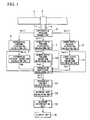
- FIG 2 is a flow chart illustrating sequential steps involved in a method of detecting a blockage in each of the higher and lower pressure impulse lines in accordance with the first embodiment of the present invention.
- the above-described detecting apparatus performs a set of the following processes every time a predetermined diagnostic time has come.
- Step S1 the differential pressure transmitter 5 detects the higher and lower static pressures that have traveled through the higher and lower pressure impulse lines 3 and 4 from the tube 1, respectively.
- the differential pressure transmitter 5 further detects the differential pressure based on the detected higher and lower pressures, thereby generating and outputting in time series differential pressure data sets Dp(i), each of which indicates the detected differential pressure.
- the differential pressure transmitter 5 supplies the differential pressure data sets Dp(i) to the differential pressure fluctuation calculating unit 6.
- Step S2 the differential pressure transmitter 5 further generates and outputs in time series the higher static pressure data sets Sph(i), each of which indicates the detected higher static pressure.
- the differential pressure transmitter 5 supplies the higher static pressure data sets Sph(i) to the higher static pressure fluctuation calculating unit 7.
- Step S3 the differential pressure transmitter 5 further generates and outputs in time series the lower static pressure data sets Spl(i), each of which indicates the detected lower static pressure.
- the differential pressure transmitter 5 supplies the lower static pressure data sets Spl(i) to the lower static pressure fluctuation calculating unit 8.
- the differential pressure transmitter 5 may further include the first and second sensors that are configured to detect the higher and lower static pressures that have traveled through the higher and lower pressure impulse lines 3 and 4 from the tube 1, respectively.
- the first and second sensors may also be realized by resonant sensors. It is assumed that the first and second sensors respectively output frequencies Fc and Fr.
- the differential pressure data sets Dp(i) are given by the following equation (14), where Ap is a constant.
- the constant Ap can be optimized to detect the differential pressure independently from the static pressures.
- the constant Ap can be set so that application of a static pressure of 0.5 (MPa) causes no variation of the differential pressure data sets Dp(i) under the condition that the differential pressure is equal to 0.
- the higher static pressure data sets Sph(i) are also given by the following equation (15), where Ap1 is a constant.
- the constant Ap1 can be optimized to detect the higher static pressure independently from the differential pressure.
- the constant Ap1 can be set so that the higher static pressure data sets Sph(i) that are obtained under the condition that no differential pressure is applied are equal to the higher static pressure data sets Sph(i) that are obtained under the condition that a differential pressure of 0.1 (MPa) is applied from the lower pressure side.
- the lower static pressure data sets Spl(i) are also given by the following equation (16), where Ap2 is a constant.
- the constant Ap2 can be optimized to detect the lower static pressure independently from the differential pressure.
- the constant Ap2 can be set so that the lower static pressure data sets Spl(i) that are obtained under the condition that no differential pressure is applied are equal to the lower static pressure data sets Spl(i) that are obtained under the condition that a differential pressure of 0.1 (MPa) is applied from the higher pressure side.
- Dp i Fc 2 - Ap ⁇ Fr 2
- S ph i Fc 2 - Ap 1 ⁇ Fr 2
- S pl i Fc 2 - Ap 2 ⁇ Fr 2
- Step S4 the differential pressure fluctuation calculating unit 6 receives in time series the differential pressure data sets Dp(i) from the differential pressure transmitter 5.
- the differential pressure fluctuation calculating unit 6 calculates in time series the differential pressure fluctuations Fdp(i) based on the differential pressure data sets Dp(i) in accordance with the above-described equation (8).
- the differential pressure fluctuation calculating unit 6 supplies the differential pressure fluctuations Fdp(i) to the differential pressure square-sum calculating unit 9 and the correlation coefficient calculating unit 12.
- Step S5 the higher static pressure fluctuation calculating unit 7 receives in time series the higher static pressure data sets Sph(i) from the differential pressure transmitter 5.
- the higher static pressure fluctuation calculating unit 7 calculates in time series the higher static pressure fluctuations Fsph(i) based on the higher static pressure data sets Sph(i) in accordance with the above-mentioned equation (4).
- the higher static pressure fluctuation calculating unit 7 supplies the higher static pressure fluctuations Fsph(i) to the higher static pressure square-sum calculating unit 10 and the correlation coefficient calculating unit 12.
- Step S6 the lower static pressure fluctuation calculating unit 8 receives in time series the lower static pressure data sets Spl(i) from the differential pressure transmitter 5.
- the lower static pressure fluctuation calculating unit 8 calculates in time series the lower static pressure fluctuations Fspl(i) based on the lower static pressure data sets Spl(i) in accordance with the above-mentioned equation (5).
- the lower static pressure fluctuation calculating unit 8 supplies the lower static pressure fluctuations Fspl(i) to the lower static pressure square-sum calculating unit 11 and the correlation coefficient calculating unit 12.
- Step S7 the differential pressure square-sum calculating unit 9 receives in time series the differential pressure fluctuations Fdp(i) from the differential pressure fluctuation calculating unit 6.
- the differential pressure square-sum calculating unit 9 calculates the square sum Sdp of the differential pressure fluctuations Fdp(i) in accordance with the above-mentioned equation (9).
- the differential pressure square-sum calculating unit 9 supplies the square sum Sdp of the differential pressure fluctuations Fdp(i) to the correlation coefficient calculating unit 12.
- Step S8 the higher static pressure square-sum calculating unit 10 receives in time series the higher static pressure fluctuations Fsph(i) from the higher static pressure fluctuation calculating unit 7.
- the higher static pressure square-sum calculating unit 10 calculates the square sum Ssph of the higher static pressure fluctuations Fsph(i) in accordance with the above-mentioned equation (6).
- the higher static pressure square-sum calculating unit 10 supplies the square sum Ssph of the higher static pressure fluctuations Fsph(i) to the correlation coefficient calculating unit 12.
- Step S9 the lower static pressure square-sum calculating unit 11 receives in time series the lower static pressure fluctuations Fspl(i) from the lower static pressure fluctuation calculating unit 8.
- the lower static pressure square-sum calculating unit 11 calculates the square sum Sspl of the lower static pressure fluctuations Fspl(i) in accordance with the above-mentioned equation (7).
- the lower static pressure square-sum calculating unit 11 supplies the square sum Sspl of the lower static pressure fluctuations Fspl(i) to the correlation coefficient calculating unit 12.
- the correlation coefficient calculating unit 12 receives in time series the differential pressure fluctuations Fdp(i) from the differential pressure fluctuation calculating unit 6.
- the correlation coefficient calculating unit 12 also receives in time series the higher static pressure fluctuations Fsph(i) from the higher static pressure fluctuation calculating unit 7.
- the correlation coefficient calculating unit 12 also receives in time series the lower static pressure fluctuations Fspl(i) from the lower static pressure fluctuation calculating unit 8.
- the correlation coefficient calculating unit 12 also receives the square sum Sdp of the differential pressure fluctuations Fdp(i) from the differential pressure square-sum calculating unit 9.
- the correlation coefficient calculating unit 12 also be receives the square sum Ssph of the higher static pressure fluctuations Fsph(i) from the higher static pressure square-sum calculating unit 10.
- the correlation coefficient calculating unit 12 also receives the square sum Sspl of the lower static pressure fluctuations Fspl(i) from the lower static pressure square-sum calculating unit 11.
- the correlation coefficient calculating unit 12 calculates the first correlation coefficient Cor1 based on the higher static pressure fluctuations Fsph(i), the differential pressure fluctuations Fdp(i), the square sum Ssph, and the square sum Sdp in accordance with the above-mentioned equation (10).
- the correlation coefficient calculating unit 12 calculates the second correlation coefficient Cor2 based on the lower static pressure fluctuations Fspl(i), the differential pressure fluctuations Fdp(i), the square sum Sspl, and the square sum Sdp in accordance with the above-described equation (11).
- the correlation coefficient calculating unit 12 supplies the first and second correlation coefficients Cor1 and Cor2 to the intermediate variable calculating unit 13.
- the differential pressure fluctuation Fdp(i) is given by the difference between the higher static pressure fluctuation Fsph(i) and the lower static pressure fluctuation Fspl(i). If the lower pressure impulse line 4 is blocked, then the differential pressure fluctuation Fdp(i) approaches the higher static pressure fluctuations Fsph(i), and the square sum Sdp of the differential pressure fluctuations Fdp(i) approaches the square sum Ssph of the higher static pressure fluctuations Fsph(i).
- the numerator of the above-mentioned equation (10) approaches the square sum of the higher static pressure fluctuations Fsph(i), while the denominator of the above-mentioned equation (10) approaches the square sum Ssph.
- the first correlation coefficient Cor1 approaches 1.
- the differential pressure fluctuation Fdp(i) approaches the lower static pressure fluctuations Fspl(i)
- the square sum Sdp of the differential pressure fluctuations Fdp(i) approaches the square sum Sspl of the lower static pressure fluctuations Fspl(i).
- the numerator of the above-mentioned equation (11) approaches the square sum (negative sign) of the lower static pressure fluctuations Fspl(i)
- the denominator of the above-mentioned equation (11) approaches the square sum Sspl.
- the second correlation coefficient Cor2 approaches - 1.
- the first correlation coefficient Cor1 approaches 1. If the higher pressure impulse line 3 is blocked, then the second correlation coefficient Cor2 approaches - 1. If both the higher and lower pressure impulse lines 3 and 4 are free of any blockage, then the first and second correlation coefficients Cor1 and Cor2 are approximately 0.
- Step S 11 the intermediate variable calculating unit 13 receives the first and second correlation coefficients Cor1 and Cor2 from the correlation coefficient calculating unit 12.
- the intermediate variable calculating unit 13 calculates the intermediate variable Z based on the first and second correlation coefficients Cor1 and Cor2 in accordance with the above-mentioned equation (12).
- the intermediate variable calculating unit 13 supplies the intermediate variable Z to the blockage rate calculating unit 14.
- the intermediate variable Z varies in the range from 0 to infinity.
- Step S12 the blockage rate calculating unit 14 receives the intermediate variable Z from the intermediate variable calculating unit 13.
- the blockage rate calculating unit 14 calculates the blockage rate F based on the intermediate variable Z in accordance with the above-mentioned equation (13).
- the blockage rate calculating unit 14 supplies the blockage rate F to the blockage determination unit 15.
- the blockage rate F approaches infinity, whereby the blockage rate F approaches - 1. If the higher pressure impulse line 13 is blocked, then the intermediate variable Z approaches 0, whereby the blockage rate F approaches 1.
- the intermediate variable Z approaches 1, whereby the blockage rate F approaches 0.
- the blockage rate F is normalized within the range of - 1 to +1 in accordance with the above-mentioned equation (13).
- FIG 3 is a diagram illustrating the characteristic curve of a blockage rate F which is calculated by the blockage rate calculating unit 14 included in the detecting apparatus shown in FIG 1 . If both the higher and lower pressure impulse lines 3 and 4 are free of any blockage, then the blockage rate F is 0.
- the characteristic curve of the blockage rate F has a rotational symmetry with reference to the origin of 0.
- the characteristic curve of the blockage rate F has first and second parts. The first part represents the blockage rate F for the higher pressure impulse line 3 and extends in the range of 0 to +1.
- the second part represents the blockage rate F for the lower pressure impulse line 4 and extends in the range of 0 to - 1.
- a first threshold is given to determine a blockage of the higher pressure impulse line 3.
- the first threshold is a positive value.
- a second threshold is also given to determine a blockage of the lower pressure impulse line 4.
- the second threshold is a negative value.
- the first and second thresholds have the same absolute value and the opposite signs. Typical examples of the first and second thresholds are + 0.4 and - 0.4, respectively. This means it is necessary to determine the same absolute value of the first and second thresholds. In other words, it is necessary to determine one of the first and second thresholds, because another has the sign opposing the determined one and the same absolute value as the determined one.
- Step S 13 the blockage determination unit 15 receives the blockage rate F from the blockage rate calculating unit 14.
- the blockage determination unit 15 compares the blockage rate F to the predetermined thresholds thereby determining whether each of the higher and lower pressure impulse lines 3 and 4 is blocked or not.
- the blockage determination unit 15 generates the determination result that indicates the presence or absence of a blockage in each of the higher and lower pressure impulse lines 3 and 4.
- the second threshold is automatically set - 0.4. In this case, if the blockage rate F satisfies 0.4 ⁇ F ⁇ 1, then the blockage determination unit 15 determines that the higher pressure impulse line 3 is blocked. If the blockage rate F satisfies - 1 ⁇ F ⁇ -0.4, then the blockage determination unit 15 determines that the lower pressure impulse line 4 is blocked. If the blockage rate F satisfies - 0.4 ⁇ F ⁇ + 0.4, then the blockage determination unit 15 determines that the higher and lower pressure impulse lines 3 and 4 are free of any blockage.
- the display unit 16 receives the determination result from the blockage determination unit 15 and displays the determination result that indicates a blockage of the higher and lower pressure impulse lines 3 and 4.
- the above-described detecting apparatus and method permit a user or an operator to set thresholds easily as compared to the above-described conventional apparatus.
- the numerator and the denominator of the above-mentioned equation (10) increase at the same rate, whereby the first correlation coefficient Cor1 remains unchanged. Also, the numerator and the denominator of the above-mentioned equation (11) increase at the same rate, whereby the second correlation coefficient Cor2 remains unchanged.
- the above-described detecting apparatus accurately detects a blockage of each of the higher and lower pressure impulse lines 3 and 4, independently of the flow rate of the fluid in the tube.
- the above-described detecting apparatus and method is independent of or has a reduced dependency on noises of the output signal from the differential pressure transmitter 5 that include the resonant sensors. In other words, the above-described detecting apparatus and method ensures high sensitivity for the reasons as follows.
- the differential pressure fluctuation Fdp(i) is given by the difference between the higher static pressure fluctuation Fsph(i) and the lower static pressure fluctuation Fspl(i). It is hereby assumed that the higher and lower static pressure fluctuations Fsph(i) and Fspl(i) have noise components Nsph(i) and Nspl(i), respectively.
- the numerator of the above-mentioned equation (10) is given by the following equation (17).
- the higher static pressure fluctuation Fsph(i) and the noise component Nsph(i) are independent from each other.
- the total sum of the products of the lower static pressure fluctuations Fspl(i) and the noise components Nspl(i) may approximately be 0.
- the lower static pressure fluctuation Fspl(i) and the noise component Nspl(i) are also independent from each other.
- the total sum of the products of the lower static pressure fluctuations Fspl(i) and the noise components Nspl(i) may approximately be 0.
- the noise component Nsph(i) and the higher static pressure fluctuation Fsph(i) are also independent from each other.
- the total sum of the products of the noise components Nsph(i) and the higher static pressure fluctuations Fsph(i) may approximately be 0.
- the noise component Nsph(i) and the lower static pressure fluctuation Fspl(i) are also independent from each other.
- the total sum of the products of the noise components Nsph(i) and the lower static pressure fluctuations Fspl(i) may approximately be 0.
- the noise component Nsph(i) and the noise component Nspl(i) are also independent from each other.
- the total sum of the products of the noise components Nsph(i) and the noise components Nspl(i) may approximately be 0.
- Equation (17) may be expanded to the following equation (18).
- ⁇ ⁇ F sph i + N sph i ⁇ F sph i - F spl i + N sph i - N spl i ⁇ F sph ⁇ i 2 - F sph i ⁇ F spl i + N sph ( i ⁇ ) 2
- the square of the noise component Nspl(i) 2 is extremely small. This means that the first correlation coefficient Cor1 has a remarkably reduced dependency on the noise component of the output signal from the differential pressure transmitter 5. Similarly, the second correlation coefficient Cor2 also has a remarkably reduced dependency on the noise component of the output signal from the differential pressure transmitter 5.
- the first and second correlation coefficients Cor1 and Cor2 can be used to detect a blockage in each of the higher and lower pressure impulse lines 3 and 4 at high sensitivity, independently of noises of the output signals from the differential pressure transmitter 5.
- the fluctuation of the differential pressure or of the static pressure can be small so that the above-described conventional technique can not be used to distinguish the fluctuation from noises of output signals from the differential pressure transmitter 5.
- the above-described conventional technique can not be used to accurately determine a premature blockage of the impulse line.
- the above-described apparatus and method in accordance with the embodiment can detect the fluctuation independently of noises of the output signal from the differential pressure transmitter 5.
- the above-described apparatus and method can accurately detect a premature blockage of the impulse line.
- Blockages of the higher and lower pressure impulse lines 3 and 4 can be expressed by the response time constants of the higher and lower pressure impulse lines 3 and 4, respectively. If the higher and lower pressure impulse lines 3 and 4 are free of any blockage, then the higher and lower pressure impulse lines 3 and 4 have almost the same response time constant. Thus, the blockage rate F is approximately 0. If the blockage rate F is apparently different from 0 even the higher and lower pressure impulse lines 3 and 4 are free of any blockage, then this indicates that the higher and lower pressure impulse lines 3 and 4 have abnormal response time constant or constants.
- the abnormal response time constant or constants suggest that the higher and lower pressure impulse lines 3 and 4 might be different in length, or either one or both of the higher and lower pressure impulse lines 3 and 4 are closed by valves. Namely, the above-described apparatus and method in accordance with the embodiment can detect not only a blockage of impulse lines but also other abnormality of the impulse lines.
- the blockage rate F can be calculated from the ratio K by using the following equation (19).
- the first and second correlation coefficients Cor1 and Cor2 are not used.
- F 1 - K / 1 + K
- the blockage rate F is normalized within the range of - 1 to +1.
- This method reduces the load to calculation operation but allows deterioration of the sensitivity or accuracy in detecting a blockage of the impulse lines.
- This method also allows deterioration of the accuracy in detecting a premature blockage of the impulse lines.
- This method can be realized by modifying the apparatus shown in FIG 1 .
- the modified apparatus does not include the differential pressure fluctuation calculating unit 6, the differential pressure square sum calculating unit 9, the correlation coefficient calculating unit 12, and the intermediate variable calculating unit 13.
- the blockage rate calculating unit 14 may be modified to receive the square sum Ssph of the higher static pressure fluctuations Fsph(i) from the higher static pressure square-sum calculating unit 10.
- the blockage rate calculating unit 14 may also be modified to receive the square sum Sspl of the lower static pressure fluctuations Fspl(i) from the lower static pressure square-sum calculating unit 11.
- the blockage rate calculating unit 14 may be modified to calculate the blockage rate F from the ratio K in accordance with the above-mentioned equation (19).
- the above-mentioned differential pressure fluctuation Fdp(i) can be calculated by using the above-mentioned equation (3) instead of the above-mentioned equation (4), provided that the suffixes are changed in the equation (3). Namely, the above-mentioned equation (3) can be used to eliminate a transient variation of the differential pressure, so as to detect the fluctuation component only.
- downstream and downstream refer to those directions of an apparatus equipped with the present invention. Accordingly, these terms, as utilized to describe the present invention should be interpreted relative to an apparatus equipped with the present invention.
Landscapes
- Health & Medical Sciences (AREA)
- Chemical & Material Sciences (AREA)
- Engineering & Computer Science (AREA)
- Analytical Chemistry (AREA)
- Biomedical Technology (AREA)
- Physics & Mathematics (AREA)
- General Physics & Mathematics (AREA)
- Measuring Fluid Pressure (AREA)
Applications Claiming Priority (1)
| Application Number | Priority Date | Filing Date | Title |
|---|---|---|---|
| JP2006084524A JP4970820B2 (ja) | 2006-03-27 | 2006-03-27 | 導圧管詰まり検出装置及び導圧管詰まり検出方法 |
Publications (3)
| Publication Number | Publication Date |
|---|---|
| EP1840549A2 EP1840549A2 (en) | 2007-10-03 |
| EP1840549A3 EP1840549A3 (en) | 2010-06-30 |
| EP1840549B1 true EP1840549B1 (en) | 2012-05-16 |
Family
ID=38247377
Family Applications (1)
| Application Number | Title | Priority Date | Filing Date |
|---|---|---|---|
| EP07005508A Active EP1840549B1 (en) | 2006-03-27 | 2007-03-16 | Apparatus and method for detecting blockage of impulse lines |
Country Status (4)
| Country | Link |
|---|---|
| US (1) | US7406387B2 (https=) |
| EP (1) | EP1840549B1 (https=) |
| JP (1) | JP4970820B2 (https=) |
| CN (1) | CN101046422B (https=) |
Cited By (3)
| Publication number | Priority date | Publication date | Assignee | Title |
|---|---|---|---|---|
| DE102013110059A1 (de) | 2013-09-12 | 2015-03-12 | Endress + Hauser Gmbh + Co. Kg | Differenzdruckmessanordnung mit Wirkdruckleitungen und Verfahren zum Erkennen von verstopften Wirkdruckleitungen |
| DE102023114027A1 (de) | 2023-05-26 | 2024-11-28 | Endress+Hauser SE+Co. KG | Verfahren zur Erkennung einer verstopften Wirkdruckleitung einer Druckmessanordnung |
| DE102023114025A1 (de) | 2023-05-26 | 2024-11-28 | Endress+Hauser SE+Co. KG | Verfahren zur Erkennung einer verstopften Wirkdruckleitung einer Druckmessanordnung |
Families Citing this family (23)
| Publication number | Priority date | Publication date | Assignee | Title |
|---|---|---|---|---|
| US7577543B2 (en) * | 2005-03-11 | 2009-08-18 | Honeywell International Inc. | Plugged impulse line detection |
| EP2044406B1 (de) * | 2006-07-20 | 2011-11-30 | Siemens Aktiengesellschaft | Verfahren zur diagnose einer verstopfung einer impulsleitung bei einem druckmessumformer sowie druckmessumformer |
| JP5005404B2 (ja) * | 2007-03-28 | 2012-08-22 | 横河電機株式会社 | 導圧管詰まり検出装置及び導圧管詰まり検出方法 |
| US8898036B2 (en) | 2007-08-06 | 2014-11-25 | Rosemount Inc. | Process variable transmitter with acceleration sensor |
| JP5249000B2 (ja) | 2008-12-01 | 2013-07-31 | アズビル株式会社 | 導圧管の詰まり診断装置および詰まり診断方法 |
| JP2010203943A (ja) * | 2009-03-04 | 2010-09-16 | Yamatake Corp | 導圧管の詰まり診断装置および詰まり診断方法 |
| JP5365456B2 (ja) * | 2009-10-07 | 2013-12-11 | 横河電機株式会社 | 導圧管詰まり検出装置及び導圧管詰まり検出方法 |
| JP5302178B2 (ja) | 2009-12-21 | 2013-10-02 | アズビル株式会社 | 導圧管の詰まり診断装置および詰まり診断方法 |
| US8810394B2 (en) * | 2010-04-16 | 2014-08-19 | Medtronic, Inc. | Reservoir monitoring for implantable fluid delivery devices |
| US9687603B2 (en) | 2010-04-16 | 2017-06-27 | Medtronic, Inc. | Volume monitoring for implantable fluid delivery devices |
| US9207670B2 (en) | 2011-03-21 | 2015-12-08 | Rosemount Inc. | Degrading sensor detection implemented within a transmitter |
| US20130080084A1 (en) * | 2011-09-28 | 2013-03-28 | John P. Miller | Pressure transmitter with diagnostics |
| DE102013205003A1 (de) * | 2012-03-22 | 2013-09-26 | First Sensor AG | Eichung von Durchflussmessgeräten |
| US9052240B2 (en) | 2012-06-29 | 2015-06-09 | Rosemount Inc. | Industrial process temperature transmitter with sensor stress diagnostics |
| JP5891139B2 (ja) * | 2012-07-18 | 2016-03-22 | アズビル株式会社 | 導圧管の詰まり診断装置および詰まり診断方法 |
| US9602122B2 (en) | 2012-09-28 | 2017-03-21 | Rosemount Inc. | Process variable measurement noise diagnostic |
| US20160047681A1 (en) * | 2014-08-15 | 2016-02-18 | Honeywell International Inc. | Fluctuation and phase-based method for detection of plugged impulse lines |
| DE102014119240A1 (de) * | 2014-12-19 | 2016-06-23 | Endress + Hauser Gmbh + Co. Kg | Durchflussmessanordnung nach dem Differenzdruckmessprinzip zur Messung eines Durchflusses eines Mediums |
| JP2017091258A (ja) * | 2015-11-11 | 2017-05-25 | 横河電機株式会社 | フィールド機器、フィールド機器システム、および診断方法 |
| EP3199927B1 (en) * | 2016-02-01 | 2023-11-01 | ABB Schweiz AG | A method and a system for metering flow through a fluid conduit |
| CN108803502B (zh) | 2017-04-27 | 2022-07-26 | 横河电机株式会社 | 数据收集装置及系统、数据服务器、数据收集方法及计算机可读取的非易失性的记录介质 |
| JP6658802B2 (ja) * | 2018-06-13 | 2020-03-04 | 横河電機株式会社 | フィールド機器、フィールド機器システム、および診断方法 |
| CN118817150B (zh) * | 2024-09-11 | 2025-03-18 | 中控技术股份有限公司 | 智能检测系统的运行状态的确定方法及装置 |
Family Cites Families (7)
| Publication number | Priority date | Publication date | Assignee | Title |
|---|---|---|---|---|
| US6907383B2 (en) * | 1996-03-28 | 2005-06-14 | Rosemount Inc. | Flow diagnostic system |
| US6654697B1 (en) * | 1996-03-28 | 2003-11-25 | Rosemount Inc. | Flow measurement with diagnostics |
| US5680109A (en) * | 1996-06-21 | 1997-10-21 | The Foxboro Company | Impulse line blockage detector systems and methods |
| JP4476540B2 (ja) * | 2002-10-10 | 2010-06-09 | 横河電機株式会社 | 管路閉塞検出装置 |
| JP4379680B2 (ja) * | 2003-03-26 | 2009-12-09 | 横河電機株式会社 | 導圧管閉塞検出装置 |
| JP4491834B2 (ja) * | 2004-03-26 | 2010-06-30 | 横河電機株式会社 | 圧力検出器及び圧力検出器の詰まり診断方法 |
| JP4804798B2 (ja) * | 2005-05-27 | 2011-11-02 | 横河電機株式会社 | 圧力検出器及び圧力検出器の詰まり診断方法 |
-
2006
- 2006-03-27 JP JP2006084524A patent/JP4970820B2/ja not_active Expired - Fee Related
-
2007
- 2007-03-16 EP EP07005508A patent/EP1840549B1/en active Active
- 2007-03-22 US US11/723,855 patent/US7406387B2/en active Active
- 2007-03-23 CN CN200710087189.2A patent/CN101046422B/zh active Active
Cited By (5)
| Publication number | Priority date | Publication date | Assignee | Title |
|---|---|---|---|---|
| DE102013110059A1 (de) | 2013-09-12 | 2015-03-12 | Endress + Hauser Gmbh + Co. Kg | Differenzdruckmessanordnung mit Wirkdruckleitungen und Verfahren zum Erkennen von verstopften Wirkdruckleitungen |
| DE102023114027A1 (de) | 2023-05-26 | 2024-11-28 | Endress+Hauser SE+Co. KG | Verfahren zur Erkennung einer verstopften Wirkdruckleitung einer Druckmessanordnung |
| DE102023114025A1 (de) | 2023-05-26 | 2024-11-28 | Endress+Hauser SE+Co. KG | Verfahren zur Erkennung einer verstopften Wirkdruckleitung einer Druckmessanordnung |
| WO2024245623A1 (de) | 2023-05-26 | 2024-12-05 | Endress+Hauser SE+Co. KG | Verfahren zur erkennung einer verstopften wirkdruckleitung einer druckmessanordnung |
| WO2024245683A1 (de) | 2023-05-26 | 2024-12-05 | Endress+Hauser SE+Co. KG | Verfahren zur erkennung einer verstopften wirkdruckleitung einer druckmessanordnung |
Also Published As
| Publication number | Publication date |
|---|---|
| JP4970820B2 (ja) | 2012-07-11 |
| JP2007256231A (ja) | 2007-10-04 |
| US7406387B2 (en) | 2008-07-29 |
| CN101046422B (zh) | 2010-07-21 |
| US20070225924A1 (en) | 2007-09-27 |
| EP1840549A3 (en) | 2010-06-30 |
| EP1840549A2 (en) | 2007-10-03 |
| CN101046422A (zh) | 2007-10-03 |
Similar Documents
| Publication | Publication Date | Title |
|---|---|---|
| EP1840549B1 (en) | Apparatus and method for detecting blockage of impulse lines | |
| CN107110675B (zh) | 根据差压测量原理的流率测量组件 | |
| DE19882239B3 (de) | Wirbel-Durchflußmesser mit Signalverarbeitung | |
| CN101256106B (zh) | 导管堵塞检测装置及导管堵塞检测方法 | |
| CN100573381C (zh) | 用于过程控制系统的诊断设备 | |
| EP2350575B1 (en) | Viscous fluid flow measurement using a differential pressure measurement and a sonar measured velocity | |
| JP2004132817A (ja) | 管路閉塞検出装置 | |
| EP4425138B1 (en) | Gas flow rate estimation method, hole diameter estimation method, gas flow rate estimation device, and hole diameter estimation device | |
| CN103575482B (zh) | 导压管的堵塞诊断装置及堵塞诊断方法 | |
| EP1893964A1 (en) | Diagnostic device for use in process control system | |
| JP2009085769A (ja) | 管路内流体の測定装置および導圧管の詰まり診断システム | |
| JPWO2019240075A1 (ja) | 配管容積の算出方法、及び、流量制御機器又は流量計測機器の校正器 | |
| EP1726937B1 (en) | Pressure detector and method of diagnosing blockage of impulse lines | |
| JP5005404B2 (ja) | 導圧管詰まり検出装置及び導圧管詰まり検出方法 | |
| EP3745094B1 (en) | Method for evaluating a frequency spectrum | |
| KR102269482B1 (ko) | 불감대 영역의 유량 측정이 가능한 전자식 유량계 및 이를 이용한 유량측정방법 | |
| JP4379680B2 (ja) | 導圧管閉塞検出装置 | |
| JP5891139B2 (ja) | 導圧管の詰まり診断装置および詰まり診断方法 | |
| JP2008203000A (ja) | 詰まり診断装置及び詰まり診断方法 | |
| JP4933305B2 (ja) | 導圧管詰まり検出装置及び導圧管詰まり検出方法 | |
| Kádár et al. | Simultaneous in-situ analysis of instabilities and first normal stress difference during polymer melt extrusion flows | |
| CN110864769A (zh) | 压差流量传感器分类方法及分类系统 | |
| JP6775403B2 (ja) | 流体特性測定システム | |
| JP4491834B2 (ja) | 圧力検出器及び圧力検出器の詰まり診断方法 | |
| NZ780359B2 (en) | Method for calibrating blood glucose value in continuous blood glucose measurement system |
Legal Events
| Date | Code | Title | Description |
|---|---|---|---|
| PUAI | Public reference made under article 153(3) epc to a published international application that has entered the european phase |
Free format text: ORIGINAL CODE: 0009012 |
|
| AK | Designated contracting states |
Kind code of ref document: A2 Designated state(s): AT BE BG CH CY CZ DE DK EE ES FI FR GB GR HU IE IS IT LI LT LU LV MC MT NL PL PT RO SE SI SK TR |
|
| AX | Request for extension of the european patent |
Extension state: AL BA HR MK YU |
|
| PUAL | Search report despatched |
Free format text: ORIGINAL CODE: 0009013 |
|
| AK | Designated contracting states |
Kind code of ref document: A3 Designated state(s): AT BE BG CH CY CZ DE DK EE ES FI FR GB GR HU IE IS IT LI LT LU LV MC MT NL PL PT RO SE SI SK TR |
|
| AX | Request for extension of the european patent |
Extension state: AL BA HR MK RS |
|
| 17P | Request for examination filed |
Effective date: 20101222 |
|
| AKX | Designation fees paid |
Designated state(s): DE GB NL |
|
| GRAP | Despatch of communication of intention to grant a patent |
Free format text: ORIGINAL CODE: EPIDOSNIGR1 |
|
| GRAS | Grant fee paid |
Free format text: ORIGINAL CODE: EPIDOSNIGR3 |
|
| GRAA | (expected) grant |
Free format text: ORIGINAL CODE: 0009210 |
|
| RIN1 | Information on inventor provided before grant (corrected) |
Inventor name: MIYAJI, NOBUO Inventor name: EINO, JYUN-ICHI Inventor name: HASHIZUME, TAKUMI Inventor name: WAKUI, TETSUYA |
|
| AK | Designated contracting states |
Kind code of ref document: B1 Designated state(s): DE GB NL |
|
| REG | Reference to a national code |
Ref country code: GB Ref legal event code: FG4D |
|
| REG | Reference to a national code |
Ref country code: DE Ref legal event code: R096 Ref document number: 602007022563 Country of ref document: DE Effective date: 20120719 |
|
| REG | Reference to a national code |
Ref country code: NL Ref legal event code: T3 |
|
| PLBE | No opposition filed within time limit |
Free format text: ORIGINAL CODE: 0009261 |
|
| STAA | Information on the status of an ep patent application or granted ep patent |
Free format text: STATUS: NO OPPOSITION FILED WITHIN TIME LIMIT |
|
| 26N | No opposition filed |
Effective date: 20130219 |
|
| REG | Reference to a national code |
Ref country code: DE Ref legal event code: R097 Ref document number: 602007022563 Country of ref document: DE Effective date: 20130219 |
|
| P01 | Opt-out of the competence of the unified patent court (upc) registered |
Free format text: CASE NUMBER: APP_32925/2024 Effective date: 20240603 |
|
| PGFP | Annual fee paid to national office [announced via postgrant information from national office to epo] |
Ref country code: DE Payment date: 20250327 Year of fee payment: 19 |
|
| PGFP | Annual fee paid to national office [announced via postgrant information from national office to epo] |
Ref country code: NL Payment date: 20250326 Year of fee payment: 19 |
|
| PGFP | Annual fee paid to national office [announced via postgrant information from national office to epo] |
Ref country code: GB Payment date: 20250322 Year of fee payment: 19 |