EP1837870A1 - Pre-exposure and curing of photo-sensitive material for optical data storage - Google Patents
Pre-exposure and curing of photo-sensitive material for optical data storage Download PDFInfo
- Publication number
- EP1837870A1 EP1837870A1 EP06111388A EP06111388A EP1837870A1 EP 1837870 A1 EP1837870 A1 EP 1837870A1 EP 06111388 A EP06111388 A EP 06111388A EP 06111388 A EP06111388 A EP 06111388A EP 1837870 A1 EP1837870 A1 EP 1837870A1
- Authority
- EP
- European Patent Office
- Prior art keywords
- exposure
- light beam
- coherent light
- curing
- data
- Prior art date
- Legal status (The legal status is an assumption and is not a legal conclusion. Google has not performed a legal analysis and makes no representation as to the accuracy of the status listed.)
- Withdrawn
Links
- 230000003287 optical effect Effects 0.000 title claims abstract description 39
- 239000000463 material Substances 0.000 title abstract description 31
- 238000013500 data storage Methods 0.000 title abstract description 12
- 230000001427 coherent effect Effects 0.000 claims abstract description 52
- 238000000034 method Methods 0.000 claims abstract description 20
- 230000002123 temporal effect Effects 0.000 claims description 5
- 238000009826 distribution Methods 0.000 description 9
- 230000035945 sensitivity Effects 0.000 description 9
- 230000000704 physical effect Effects 0.000 description 6
- 238000005286 illumination Methods 0.000 description 4
- HWKQNAWCHQMZHK-UHFFFAOYSA-N trolnitrate Chemical compound [O-][N+](=O)OCCN(CCO[N+]([O-])=O)CCO[N+]([O-])=O HWKQNAWCHQMZHK-UHFFFAOYSA-N 0.000 description 4
- 229960002485 trolnitrate Drugs 0.000 description 4
- 230000000694 effects Effects 0.000 description 2
- 239000011232 storage material Substances 0.000 description 2
- 230000007423 decrease Effects 0.000 description 1
- 125000006850 spacer group Chemical group 0.000 description 1
- 239000000758 substrate Substances 0.000 description 1
Images


Classifications
-
- G—PHYSICS
- G11—INFORMATION STORAGE
- G11B—INFORMATION STORAGE BASED ON RELATIVE MOVEMENT BETWEEN RECORD CARRIER AND TRANSDUCER
- G11B7/00—Recording or reproducing by optical means, e.g. recording using a thermal beam of optical radiation by modifying optical properties or the physical structure, reproducing using an optical beam at lower power by sensing optical properties; Record carriers therefor
- G11B7/24—Record carriers characterised by shape, structure or physical properties, or by the selection of the material
- G11B7/26—Apparatus or processes specially adapted for the manufacture of record carriers
-
- G—PHYSICS
- G03—PHOTOGRAPHY; CINEMATOGRAPHY; ANALOGOUS TECHNIQUES USING WAVES OTHER THAN OPTICAL WAVES; ELECTROGRAPHY; HOLOGRAPHY
- G03H—HOLOGRAPHIC PROCESSES OR APPARATUS
- G03H1/00—Holographic processes or apparatus using light, infrared or ultraviolet waves for obtaining holograms or for obtaining an image from them; Details peculiar thereto
- G03H1/04—Processes or apparatus for producing holograms
- G03H1/18—Particular processing of hologram record carriers, e.g. for obtaining blazed holograms
-
- G—PHYSICS
- G03—PHOTOGRAPHY; CINEMATOGRAPHY; ANALOGOUS TECHNIQUES USING WAVES OTHER THAN OPTICAL WAVES; ELECTROGRAPHY; HOLOGRAPHY
- G03H—HOLOGRAPHIC PROCESSES OR APPARATUS
- G03H1/00—Holographic processes or apparatus using light, infrared or ultraviolet waves for obtaining holograms or for obtaining an image from them; Details peculiar thereto
- G03H1/04—Processes or apparatus for producing holograms
-
- G—PHYSICS
- G11—INFORMATION STORAGE
- G11B—INFORMATION STORAGE BASED ON RELATIVE MOVEMENT BETWEEN RECORD CARRIER AND TRANSDUCER
- G11B7/00—Recording or reproducing by optical means, e.g. recording using a thermal beam of optical radiation by modifying optical properties or the physical structure, reproducing using an optical beam at lower power by sensing optical properties; Record carriers therefor
- G11B7/24—Record carriers characterised by shape, structure or physical properties, or by the selection of the material
- G11B7/26—Apparatus or processes specially adapted for the manufacture of record carriers
- G11B7/268—Post-production operations, e.g. initialising phase-change recording layers, checking for defects
-
- G—PHYSICS
- G03—PHOTOGRAPHY; CINEMATOGRAPHY; ANALOGOUS TECHNIQUES USING WAVES OTHER THAN OPTICAL WAVES; ELECTROGRAPHY; HOLOGRAPHY
- G03H—HOLOGRAPHIC PROCESSES OR APPARATUS
- G03H1/00—Holographic processes or apparatus using light, infrared or ultraviolet waves for obtaining holograms or for obtaining an image from them; Details peculiar thereto
- G03H1/04—Processes or apparatus for producing holograms
- G03H1/18—Particular processing of hologram record carriers, e.g. for obtaining blazed holograms
- G03H1/181—Pre-exposure processing, e.g. hypersensitisation
-
- G—PHYSICS
- G03—PHOTOGRAPHY; CINEMATOGRAPHY; ANALOGOUS TECHNIQUES USING WAVES OTHER THAN OPTICAL WAVES; ELECTROGRAPHY; HOLOGRAPHY
- G03H—HOLOGRAPHIC PROCESSES OR APPARATUS
- G03H2240/00—Hologram nature or properties
- G03H2240/50—Parameters or numerical values associated with holography, e.g. peel strength
- G03H2240/52—Exposure parameters, e.g. time, intensity
-
- G—PHYSICS
- G03—PHOTOGRAPHY; CINEMATOGRAPHY; ANALOGOUS TECHNIQUES USING WAVES OTHER THAN OPTICAL WAVES; ELECTROGRAPHY; HOLOGRAPHY
- G03H—HOLOGRAPHIC PROCESSES OR APPARATUS
- G03H2260/00—Recording materials or recording processes
- G03H2260/12—Photopolymer
-
- G—PHYSICS
- G11—INFORMATION STORAGE
- G11B—INFORMATION STORAGE BASED ON RELATIVE MOVEMENT BETWEEN RECORD CARRIER AND TRANSDUCER
- G11B7/00—Recording or reproducing by optical means, e.g. recording using a thermal beam of optical radiation by modifying optical properties or the physical structure, reproducing using an optical beam at lower power by sensing optical properties; Record carriers therefor
- G11B7/004—Recording, reproducing or erasing methods; Read, write or erase circuits therefor
- G11B7/0065—Recording, reproducing or erasing by using optical interference patterns, e.g. holograms
Definitions
- the present invention relates to a method for performing pre-exposure and curing of a photo-sensitive material for optical data storage, in particular for holographic data storage, and to an apparatus for writing to optical storage media using such method.
- holographic data storage One concept for increasing the capacity of optical storage media is to use holographic data storage.
- the whole volume of the holographic storage medium is used for storing information, not just a few layers as for conventional optical storage media.
- digital data are stored by recording the interference pattern produced by the superposition of two coherent laser beams, where one beam is modulated by a spatial light modulator and carries the information to be recorded in the form of data pages.
- photo-sensitive materials such as photopolymers are used for optical data recording. These materials change specific physical properties, e.g. the refractive index, in dependence on the total light energy that is locally absorbed by the material. These changes allow to record data within the material. For some materials it is necessary to pre-expose the material before data can be efficiently recorded, and to expose the material again after recording data. This last exposure or post-exposure is also known as curing or flood curing. Pre-exposure is necessary to increase the sensitivity of the material, which is needed for achieving a high recording data rate. Curing is necessary to process all unprocessed material after recording, i.e.
- pre-exposure and curing do not lead to any detectable data structure in the material.
- the aim of pre-exposure is to raise the sensitivity of the material before storing data.
- the aim of curing is to lower the sensitivity of the material after recording data.
- the volume of the photo-sensitive material where data is to be or has been recorded needs to be exposed to light in such a way that the resulting changes of the physical properties do not disturb the data recording quality. Usually this is achieved by exposing the material to incoherent light, which is emitted, for example, by an array of LEDs. In this way a homogeneous change of the physical properties is obtained throughout the recording volume. Using incoherent light sources an inhomogeneous exposure of the material, caused for example by interference effects, is avoided.
- US 4,799,746 and US 4,687,720 disclose methods for curing a photo-sensitive material used for holographic data storage. In both cases a special source of incoherent light is used for curing.
- this object is achieved by a method for pre-exposure and/or curing of an optical storage medium, wherein the optical storage medium is illuminated by a coherent light beam.
- the coherent light beam is advantageously emitted by a light source which is otherwise used for data recording.
- the idea is to dispense with the incoherent light source and to realize pre-exposure and/or curing/post-exposure with only a coherent light source, preferably the light source used for data recording. Pre-exposure and/or curing are performed in such a way that no detectable data is recorded. At the same time the resulting distribution of physical properties in the material is comparable with the distribution obtained by illumination with a source of incoherent light. This simplifies the optical data recording system and lowers its cost. In addition, curing can easily be done locally after having written data to a certain area of the optical storage medium.
- the invention is specifically suitable for a holographic storage medium, as many photopolymers used for these storage media require pre-exposure or curing.
- pre-exposure and/or curing is performed in one or more exposure steps, in which the coherent light beam carries a data pattern, wherein the exposure dose for each exposure step is smaller than a minimum dose such that the diffraction efficiency of the recorded data pattern is too low to distinguish data from noise.
- a series of different suitably chosen coherent illumination steps are applied to the photo-sensitive material instead of one or more incoherent exposure steps.
- Each exposure is realized with an adapted intensity and/or phase distribution.
- the exposure dose which is defined as the product of the total exposure intensity and the exposure time, for each exposure step is chosen smaller than a minimum dose.
- the data patterns of subsequent exposure steps are random patterns. This allows to minimize the correlation of the different distributions.
- subsequent exposure steps are performed with a constant exposure intensity but different exposure times, or with a constant exposure time but different exposure intensities.
- This allows to take into account the non-constant sensitivity of photopolymers, which generally depends on the total dose to which the material has been exposed before.
- the exposure dose By adjusting the exposure dose by varying the exposure time or the exposure intensity the resulting diffraction efficiency remains below a minimum value, so that no detectable data are recorded.
- the coherence of the coherent light beam is destroyed for pre-exposure and/or curing.
- pre-exposure and/or curing are performed similarly to the case of an incoherent light source.
- the temporal coherence of the coherent light beam is destroyed by modulating the light source with a modulator, e.g. a high-frequency modulator.
- the spatial coherence of the coherent light beam is destroyed by modulating a path difference between a first fraction of the coherent light beam and a second fraction of the coherent light beam, and/or by applying a diffuser such as a rotating phase plate to the coherent light beam, and/or by modulating the position and/or the tilt of an objective lens used for focusing the coherent light beam into the optical storage medium.
- a diffuser such as a rotating phase plate
- the optical storage medium with special areas, which lead to a diffuse reflection of the coherent light beam.
- the special areas preferably are rough reflective areas.
- the speckles caused by the diffuse reflection lead to a homogenous illumination of the optical storage medium, especially when the diffuse reflection of different areas is superimposed in two or more illumination steps.
- an apparatus for writing to optical storage media has means for performing a method according to the invention.
- These means include at least one of the following elements:
- Such an apparatus allows to realize pre-exposure and/or curing without the need for an additional incoherent light source.
- holographic data storage digital data are stored by recording the interference pattern produced by the superposition of two coherent laser beams.
- An exemplary setup of a holographic pickup 1 for use in a holographic storage system is shown in Fig. 1.
- a source of coherent light e.g. a laser diode 2
- a modulator 14 may be connected to the laser diode 2, whose function will be explained later with reference to Fig. 5.
- the light beam 3 is then divided into two separate light beams 7, 8. In the example the division of the light beam 3 is achieved using a first beam splitter 5.
- a spatial light modulator (SLM) 6 modulates one of the two beams, the so called “object beam” 7, to imprint a 2-dimensional data pattern.
- Both the object beam 7 and the further beam, the so called “reference beam” 8 are focused into a holographic storage medium 10, e.g. a holographic disk, by an objective lens 9.
- a holographic storage medium e.g. a holographic disk
- the optical path may further include a phase modulator 15 or a diffuser 16.
- the stored data are retrieved from the holographic storage medium 10 by illuminating a recorded hologram with the reference beam 8 only.
- the reference beam 8 is diffracted by the hologram structure and produces a copy of the original object beam 7, the reconstructed object beam 11.
- This reconstructed object beam 11 is collimated by the objective lens 9 and directed onto a 2-dimensional array detector 13, e.g. a CCD-array, by a second beam splitter 12.
- the array detector 13 allows to reconstruct the recorded data.
- the signal-to-noise ratio SNR of a bright pixel on the detector 13 has to exceed a minimum value. This means that when the signal-to-noise ratio is below the minimum value no data can be detected, as the recorded data cannot be distinguished from noise. Data should thus be recorded in such a way that during read-out the signal-to-noise ratio exceeds the minimum value. In the above exemplary holographic storage system this is achieved by recording the holograms with a sufficiently large exposure dose. The diffraction efficiency of one hologram can be controlled by choosing the right dose for the recording exposure.
- the dose to achieve a desired diffraction efficiency generally depends on the total dose to which the material has been exposed before. Knowing this specific function the dose can be adjusted in order to control if the recorded data can be read or not.
- Fig. 2 the photo-sensitive material is illuminated with coherent light beam carrying a data page 20 in a single exposure step 30.
- the exposure dose D which is defined as the product of the total exposure intensity and the exposure time, for this single exposure step 30 is chosen smaller than a minimum dose D_min. In this case during read-out the diffraction efficiency of the recorded hologram is too low to distinguish data from noise in the reconstructed data page 21.
- the above finding can now be used for pre-exposure and/or curing of a photo-sensitive material, e.g. a photopolymer.
- the single exposure step is repeated several times in order to achieve a desired total exposure dose for pre-exposure or curing.
- Each exposure is realized with a well-chosen intensity and/or phase distribution of the coherent exposure wave(s).
- the set of different distributions is chosen in such a way that the sum of coherent exposures leads to approximately the same change of the physical properties of the material as the incoherent exposure(s). This is preferably achieved by minimizing the correlation of the different distributions. For example, random patterns have a low correlation and are thus well-suited for this application.
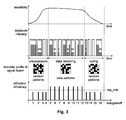
- a first exemplary exposure schedule for pre-exposure, data recording and curing is shown in Fig. 3.
- the upper graph indicates the sensitivity of the material, which is influenced by the subsequent exposures.
- the next lower graph indicates the exposure intensity against time, i.e. the rectangles in the graph are a measure of the exposure dose.
- Still further below exemplary data patterns are shown.
- the hologram number indicates the number of exposure steps at the specific position of the holographic storage medium during pre-exposure and curing. During data recording, the number indicates the number of multiplexed holograms at the specific position of the holographic storage medium.
- a constant exposure intensity of the coherent light beams is used.
- the exposure dose is controlled by changing the exposure time for the individual holograms.
- the exposure time is chosen such that the resulting diffraction efficiency remains below a minimum value eta_min, so that no detectable data are recoded.
- the material sensitivity increases, the exposure time of subsequent exposure steps is reduced in order to keep the diffraction efficiency below the minimum value.
- the material sensitivity decreases. Therefore, the exposure time of subsequent exposure steps is increased while still keeping the diffraction efficiency below the minimum value.
- eta_min a larger exposure time is used. The resulting diffraction efficiency in this case exceeds the minimum value eta_min.
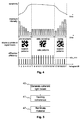
- a second exemplary exposure schedule for pre-exposure, data recording and curing is shown in Fig. 4.
- This exposure schedule during pre-exposure and curing a constant exposure time of the coherent light beams is used.
- the exposure dose is controlled by changing the exposure intensity for the individual holograms.
- the exposure intensity is chosen such that the resulting diffraction efficiency remains below a minimum value eta_min, so that no detectable data are recoded.
- the exposure intensity of subsequent exposure steps is reduced in order to keep the diffraction efficiency below the minimum value, while during curing the exposure intensity of subsequent exposure steps is increased.
- a larger exposure intensity is used.
- the resulting diffraction efficiency in this case exceeds the minimum value eta_min.
- the sum of the exposures using a series of random distributions during pre-exposure and/or curing causes a nearly homogeneous change of the physical properties, e.g. the refractive index, in the volume. This leads to a uniform change of the sensitivity in the recording volume.
- the photo-sensitive material is illuminated 42 by an incoherent light beam, which is obtained by destroying 41 the coherence of the coherent light beam emitted 40 by a laser diode, which is otherwise used for recording.
- the laser diode generating 40 the coherent light beam is modulated by a high-frequency modulator 14.
- a further solution is to modulate the optical path difference between the reference beam 8 and the signal beam 7.
- a phase modulator 15 is introduced into one of the beams 7, 8.
- a further solution is to introduce a rotating phase plate, i.e. a diffuser 16, into the optical path. All solutions average out any remaining coherence effects.
- a further solution is to provide the holographic storage medium with special areas, which destroy at least the spatial coherence of the coherent light beam 7, 8.
- An exemplary cross-section of such a holographic storage medium 10 is depicted in Fig. 6. Also illustrated is the propagation of a coherent beam 7, 8 during pre-exposure or curing.
- the beam 7, 8 travels through a cover layer 14, a holographic storage material layer 15, and a spacer layer 16.
- the holographic storage medium 10 further has a reflective layer 17 and a substrate 18.
- the optical axis of the coherent beam 7, 8 is chosen in such a way that the beam 7, 8 does not impinge on the reflective layer 17, but on a special area 19.
- the focus of the coherent beam 7, 8 is preferably situated in the special area 19.
- the area 19 destroys at least the spatial coherence of the coherent light beam 7, 8. This may be achieved, for example, by realizing the special area 19 as a rough reflective area.
- the reference beam 8 is used for pre-exposure and curing, it is preferably irradiated aslant into the holographic storage medium 10. In this case during recording of a hologram the diffuse reflected reference beam 8 performs pre-exposure of the adjacent holographic storage material used for subsequent holograms.
Landscapes
- Engineering & Computer Science (AREA)
- Manufacturing & Machinery (AREA)
- Physics & Mathematics (AREA)
- General Physics & Mathematics (AREA)
- Holo Graphy (AREA)
- Optical Recording Or Reproduction (AREA)
Priority Applications (8)
| Application Number | Priority Date | Filing Date | Title |
|---|---|---|---|
| EP06111388A EP1837870A1 (en) | 2006-03-20 | 2006-03-20 | Pre-exposure and curing of photo-sensitive material for optical data storage |
| EP07726603A EP1999750B1 (en) | 2006-03-20 | 2007-03-02 | Pre-exposure and curing of photo-sensitive material for optical data storage |
| DE602007003087T DE602007003087D1 (de) | 2006-03-20 | 2007-03-02 | Vorbelichtung und härtung eines lichtempfindlichen materials zur speicherung optischer daten |
| KR1020087021132A KR20080110588A (ko) | 2006-03-20 | 2007-03-02 | 광학 데이터 기록을 위한 감광성 물질의 전-노출 및 경화 |
| PCT/EP2007/052009 WO2007107439A1 (en) | 2006-03-20 | 2007-03-02 | Pre-exposure and curing of photo-sensitive material for optical data storage |
| JP2009500804A JP5048050B2 (ja) | 2006-03-20 | 2007-03-02 | 光学データ記憶のための感光材料の前露光および硬化 |
| US12/225,398 US8000206B2 (en) | 2006-03-20 | 2007-03-02 | Pre-exposure and curing of photo-sensitive material for optical data storage |
| CN200780009973XA CN101405797B (zh) | 2006-03-20 | 2007-03-02 | 光学数据存储的光敏材料的预曝光和固化 |
Applications Claiming Priority (1)
| Application Number | Priority Date | Filing Date | Title |
|---|---|---|---|
| EP06111388A EP1837870A1 (en) | 2006-03-20 | 2006-03-20 | Pre-exposure and curing of photo-sensitive material for optical data storage |
Publications (1)
| Publication Number | Publication Date |
|---|---|
| EP1837870A1 true EP1837870A1 (en) | 2007-09-26 |
Family
ID=36942003
Family Applications (2)
| Application Number | Title | Priority Date | Filing Date |
|---|---|---|---|
| EP06111388A Withdrawn EP1837870A1 (en) | 2006-03-20 | 2006-03-20 | Pre-exposure and curing of photo-sensitive material for optical data storage |
| EP07726603A Not-in-force EP1999750B1 (en) | 2006-03-20 | 2007-03-02 | Pre-exposure and curing of photo-sensitive material for optical data storage |
Family Applications After (1)
| Application Number | Title | Priority Date | Filing Date |
|---|---|---|---|
| EP07726603A Not-in-force EP1999750B1 (en) | 2006-03-20 | 2007-03-02 | Pre-exposure and curing of photo-sensitive material for optical data storage |
Country Status (7)
| Country | Link |
|---|---|
| US (1) | US8000206B2 (enExample) |
| EP (2) | EP1837870A1 (enExample) |
| JP (1) | JP5048050B2 (enExample) |
| KR (1) | KR20080110588A (enExample) |
| CN (1) | CN101405797B (enExample) |
| DE (1) | DE602007003087D1 (enExample) |
| WO (1) | WO2007107439A1 (enExample) |
Families Citing this family (5)
| Publication number | Priority date | Publication date | Assignee | Title |
|---|---|---|---|---|
| JP4881914B2 (ja) * | 2008-06-02 | 2012-02-22 | 株式会社日立製作所 | 光情報記録再生装置及び光情報記録方法 |
| JP2012074091A (ja) * | 2010-09-27 | 2012-04-12 | Toshiba Corp | ホログラム記録装置 |
| JP5647965B2 (ja) * | 2011-09-30 | 2015-01-07 | 日立コンシューマエレクトロニクス株式会社 | 光情報記録再生装置、光情報記録装置、光情報記録再生方法、光情報記録媒体 |
| JP6029167B2 (ja) * | 2012-09-26 | 2016-11-24 | 国立大学法人北海道大学 | ノイズ除去方法およびノイズ除去装置、記録再生方法および記録再生装置、ならびに、画像計測方法および画像計測装置 |
| CN109087577A (zh) * | 2018-10-09 | 2018-12-25 | 深圳市深大极光科技有限公司 | 一种批量生产体全息防伪标识的方法及装置 |
Citations (5)
| Publication number | Priority date | Publication date | Assignee | Title |
|---|---|---|---|---|
| US4687720A (en) | 1984-12-21 | 1987-08-18 | Hughes Aircraft Company | Side lobe suppression in holograms using pre-exposure |
| US4799746A (en) | 1985-02-27 | 1989-01-24 | Hughes Aircraft Company | Efficient holograms and method for making same |
| EP0415230A2 (en) * | 1989-08-31 | 1991-03-06 | Hughes Aircraft Company | Method for making edge faded holograms |
| US20030134105A1 (en) * | 2001-11-05 | 2003-07-17 | Tetsuya Toshine | Counterfeit-proof volume hologram multilayer structure, and counterfeit-proof volume hologram seal |
| US6730442B1 (en) * | 2000-05-24 | 2004-05-04 | Science Applications International Corporation | System and method for replicating volume holograms |
Family Cites Families (17)
| Publication number | Priority date | Publication date | Assignee | Title |
|---|---|---|---|---|
| JPS6034754B2 (ja) * | 1976-02-18 | 1985-08-10 | 松下電器産業株式会社 | ホログラム記録装置 |
| JP3452113B2 (ja) * | 1996-08-30 | 2003-09-29 | ソニー株式会社 | 光情報記録装置および方法、光情報再生装置および方法ならびに光情報記録媒体 |
| JP3403068B2 (ja) | 1998-02-27 | 2003-05-06 | 株式会社オプトウエア | 光情報記録装置、光情報再生装置および光情報記録再生装置 |
| JP2001256654A (ja) * | 2000-03-13 | 2001-09-21 | Optware:Kk | 光情報記録装置、光情報再生装置、光情報記録再生装置および光情報記録媒体 |
| JP2002139980A (ja) * | 2000-10-31 | 2002-05-17 | Pioneer Electronic Corp | ホログラム記録再生装置及びホログラム記録再生方法 |
| US6806982B2 (en) * | 2001-11-30 | 2004-10-19 | Zebra Imaging, Inc. | Pulsed-laser systems and methods for producing holographic stereograms |
| CN1475877A (zh) * | 2003-06-27 | 2004-02-18 | 中国科学院上海光学精密机械研究所 | 两次曝光全息层析装置及其使用方法 |
| JP4369743B2 (ja) * | 2003-12-26 | 2009-11-25 | Tdk株式会社 | ホログラフィック多重記録方法、これを用いたホログラフィック記録装置及びホログラフィック記録媒体 |
| US7088482B2 (en) * | 2004-02-10 | 2006-08-08 | Imation Corp. | Holographic recording techniques using first and second portions of a spatial light modulator |
| JP4479282B2 (ja) * | 2004-03-03 | 2010-06-09 | ソニー株式会社 | 記録媒体キュアー方法及びホログラム記録装置 |
| JP2005309007A (ja) | 2004-04-20 | 2005-11-04 | Tdk Corp | ホログラフィック記録方法及びホログラフィック記録装置 |
| JP4461901B2 (ja) * | 2004-05-11 | 2010-05-12 | Tdk株式会社 | ホログラム記録材料及びホログラム記録媒体 |
| JP4761432B2 (ja) * | 2004-10-13 | 2011-08-31 | 株式会社リコー | レーザ加工装置 |
| JP2006343533A (ja) * | 2005-06-09 | 2006-12-21 | Sony Corp | ホログラム装置及びインコヒーレント光生成方法 |
| JP2007025367A (ja) * | 2005-07-19 | 2007-02-01 | Sony Corp | ホログラム記録装置及びホログラム記録方法 |
| JP4218722B2 (ja) * | 2006-10-11 | 2009-02-04 | ソニー株式会社 | ホログラム記録装置、ホログラム記録媒体およびホログラム記録方法 |
| EP1933310A1 (en) * | 2006-12-13 | 2008-06-18 | Deutsche Thomson OHG | Pre-exposure and curing of photo-sensitive material for optical data storage |
-
2006
- 2006-03-20 EP EP06111388A patent/EP1837870A1/en not_active Withdrawn
-
2007
- 2007-03-02 WO PCT/EP2007/052009 patent/WO2007107439A1/en not_active Ceased
- 2007-03-02 JP JP2009500804A patent/JP5048050B2/ja not_active Expired - Fee Related
- 2007-03-02 DE DE602007003087T patent/DE602007003087D1/de active Active
- 2007-03-02 US US12/225,398 patent/US8000206B2/en not_active Expired - Fee Related
- 2007-03-02 CN CN200780009973XA patent/CN101405797B/zh not_active Expired - Fee Related
- 2007-03-02 EP EP07726603A patent/EP1999750B1/en not_active Not-in-force
- 2007-03-02 KR KR1020087021132A patent/KR20080110588A/ko not_active Withdrawn
Patent Citations (5)
| Publication number | Priority date | Publication date | Assignee | Title |
|---|---|---|---|---|
| US4687720A (en) | 1984-12-21 | 1987-08-18 | Hughes Aircraft Company | Side lobe suppression in holograms using pre-exposure |
| US4799746A (en) | 1985-02-27 | 1989-01-24 | Hughes Aircraft Company | Efficient holograms and method for making same |
| EP0415230A2 (en) * | 1989-08-31 | 1991-03-06 | Hughes Aircraft Company | Method for making edge faded holograms |
| US6730442B1 (en) * | 2000-05-24 | 2004-05-04 | Science Applications International Corporation | System and method for replicating volume holograms |
| US20030134105A1 (en) * | 2001-11-05 | 2003-07-17 | Tetsuya Toshine | Counterfeit-proof volume hologram multilayer structure, and counterfeit-proof volume hologram seal |
Also Published As
| Publication number | Publication date |
|---|---|
| CN101405797A (zh) | 2009-04-08 |
| US20100315931A1 (en) | 2010-12-16 |
| EP1999750B1 (en) | 2009-11-04 |
| DE602007003087D1 (de) | 2009-12-17 |
| JP2009530676A (ja) | 2009-08-27 |
| JP5048050B2 (ja) | 2012-10-17 |
| US8000206B2 (en) | 2011-08-16 |
| WO2007107439A1 (en) | 2007-09-27 |
| CN101405797B (zh) | 2011-05-04 |
| EP1999750A1 (en) | 2008-12-10 |
| KR20080110588A (ko) | 2008-12-18 |
Similar Documents
| Publication | Publication Date | Title |
|---|---|---|
| US20060002274A1 (en) | Hologram duplication method | |
| CN101373371B (zh) | 全息数据存储的相位掩模 | |
| EP1999750B1 (en) | Pre-exposure and curing of photo-sensitive material for optical data storage | |
| US6762865B1 (en) | Self-referenced holography using diffusive element | |
| JP2007079439A (ja) | ホログラム記録再生装置および記録再生用光学装置 | |
| US7813017B2 (en) | Method and system for increasing holographic data storage capacity using irradiance-tailoring element | |
| US7965430B2 (en) | Pre-exposure and curing of photo-sensitive material for optical data storage | |
| KR20060050045A (ko) | 홀로그램 장치 및 홀로그램 기록 방법 | |
| US20080259420A1 (en) | Apparatus for reading from and/or writing to holographic storage media | |
| US7589875B2 (en) | Intensity profile correction for data pages for holographic storage | |
| EP1933311B1 (en) | Pre-exposure and curing of photo-sensitive material for optical data storage | |
| WO2005064420A1 (ja) | ホログラフィック記録媒体、ホログラフィック記録消去方法及びホログラフィック記録再生装置 | |
| US8116185B2 (en) | Holographic storage medium with integrated phase mask | |
| EP2073203A1 (en) | Holographic recording medium and pickup for this medium | |
| US7847991B2 (en) | Holographic storage medium | |
| JP2002207412A (ja) | ホログラフィック記録方法とその装置、ホログラフィック再生方法とその装置、および、ホログラフィック記録・再生方法とその装置 | |
| Fukumoto | Coaxial holographic data recording | |
| JP2006277840A (ja) | ホログラム情報記録再生装置 | |
| JP2007256951A5 (enExample) | ||
| EP2200028A1 (en) | Apparatus for writing data to a holographic storage medium |
Legal Events
| Date | Code | Title | Description |
|---|---|---|---|
| PUAI | Public reference made under article 153(3) epc to a published international application that has entered the european phase |
Free format text: ORIGINAL CODE: 0009012 |
|
| AK | Designated contracting states |
Kind code of ref document: A1 Designated state(s): AT BE BG CH CY CZ DE DK EE ES FI FR GB GR HU IE IS IT LI LT LU LV MC NL PL PT RO SE SI SK TR |
|
| AX | Request for extension of the european patent |
Extension state: AL BA HR MK YU |
|
| AKX | Designation fees paid | ||
| STAA | Information on the status of an ep patent application or granted ep patent |
Free format text: STATUS: THE APPLICATION IS DEEMED TO BE WITHDRAWN |
|
| 18D | Application deemed to be withdrawn |
Effective date: 20080327 |
|
| REG | Reference to a national code |
Ref country code: DE Ref legal event code: 8566 |