EP1832005B1 - Verfahren zur mehrwegedetektion in spreizspektrum-empfängern - Google Patents
Verfahren zur mehrwegedetektion in spreizspektrum-empfängern Download PDFInfo
- Publication number
- EP1832005B1 EP1832005B1 EP05810454A EP05810454A EP1832005B1 EP 1832005 B1 EP1832005 B1 EP 1832005B1 EP 05810454 A EP05810454 A EP 05810454A EP 05810454 A EP05810454 A EP 05810454A EP 1832005 B1 EP1832005 B1 EP 1832005B1
- Authority
- EP
- European Patent Office
- Prior art keywords
- signal
- correlation
- signals
- code
- radio frequency
- Prior art date
- Legal status (The legal status is an assumption and is not a legal conclusion. Google has not performed a legal analysis and makes no representation as to the accuracy of the status listed.)
- Expired - Lifetime
Links
Images


Classifications
-
- H—ELECTRICITY
- H04—ELECTRIC COMMUNICATION TECHNIQUE
- H04B—TRANSMISSION
- H04B1/00—Details of transmission systems, not covered by a single one of groups H04B3/00 - H04B13/00; Details of transmission systems not characterised by the medium used for transmission
- H04B1/69—Spread spectrum techniques
- H04B1/707—Spread spectrum techniques using direct sequence modulation
- H04B1/7073—Synchronisation aspects
- H04B1/7075—Synchronisation aspects with code phase acquisition
-
- G—PHYSICS
- G01—MEASURING; TESTING
- G01S—RADIO DIRECTION-FINDING; RADIO NAVIGATION; DETERMINING DISTANCE OR VELOCITY BY USE OF RADIO WAVES; LOCATING OR PRESENCE-DETECTING BY USE OF THE REFLECTION OR RERADIATION OF RADIO WAVES; ANALOGOUS ARRANGEMENTS USING OTHER WAVES
- G01S19/00—Satellite radio beacon positioning systems; Determining position, velocity or attitude using signals transmitted by such systems
- G01S19/01—Satellite radio beacon positioning systems transmitting time-stamped messages, e.g. GPS [Global Positioning System], GLONASS [Global Orbiting Navigation Satellite System] or GALILEO
- G01S19/13—Receivers
- G01S19/22—Multipath-related issues
-
- H—ELECTRICITY
- H04—ELECTRIC COMMUNICATION TECHNIQUE
- H04B—TRANSMISSION
- H04B2201/00—Indexing scheme relating to details of transmission systems not covered by a single group of H04B3/00 - H04B13/00
- H04B2201/69—Orthogonal indexing scheme relating to spread spectrum techniques in general
- H04B2201/707—Orthogonal indexing scheme relating to spread spectrum techniques in general relating to direct sequence modulation
- H04B2201/70715—Orthogonal indexing scheme relating to spread spectrum techniques in general relating to direct sequence modulation with application-specific features
Definitions
- This invention generally relates to spread spectrum receiver, and more specifically to a multi-path detection analysis and selectivity of code modulated signals using spread spectrum receivers.
- GNSS global navigation satellite system
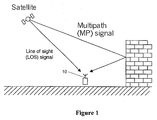
- GNSS receivers try to minimize the harmful effect of multi-path by making the range measurements less sensitive to multi-path.
- Several such methods are known, e.g., a narrow correlator described by A.J. van Dierendonck, P Fenton and T. Ford in "Theory and Performance of Narrow Correlator Spacing in a GPS Receiver", Navigation, Vol. 39, No. 3, Fall 1992, pp. 265-283 , a strobe correlator described by L. Garin, F. van Diggelen and J-M. Rousseau, in "Strobe & Edge Correlator Multi-path Mitigation for Code", ION GPS-96, September 17-20,1996, Kansas City, Missouri, pp.
- GPS global positioning system
- EP 1 117 187 A2 describes a method and system for recognizing as a valid receiving path a path having low level signals that conventionally is treated as useless. It describes calculating at least two correlation values of the set of signals with at least two spread codes and recognizing the path as a valid receiving path for demodulating the received signals based on the at least two correlation values.
- US 6,532,255 B1 describes a method relating to an arrangement for minimizing the autocorrelation error in the demodulation of a spread-spectrum signal subject to multipath propagation.
- WO 2004/036238 A1 describes processing of spread spectrum signals, where a continuous signal of a comparatively high frequency is received. Information obtained from data words is correlated with at least one representation of a signal source specific code sequence, which has been pre-generated in the form of a code vector.
- EP 1 143 652 A2 describes a method for compensating for multipath components in a received CDMA signal comprising a repetitive PRN code which uses delay times in addition to the early, late and prompt delay times for determining if a multipath component is present in the received signal, and if so, making an adjustment to the delay time of the replica code generated by a receiver so as to minimize the difference between the correlation values for a delay time equal to -1 chip and a delay time more negative than -1 chip.
- a method for a multi-path detection analysis of a radio frequency signal by a spread spectrum receiver comprising: receiving a radio frequency signal containing a multi-path component and converting the radio frequency signal to a digital signal; and detecting the multi-path component and determining using at least two pairs of correlation signals, each pair being symmetrical relative to a prompt signal, whether a distortion of the radio frequency signal caused by the multi-path component meets a predetermined condition using a correlation analysis of the digital signal with the at least two pairs of the correlation signals by maintaining equal the correlation signals of one pair of the two pairs using a delay-locked loop and evaluating a difference between the correlation signals of another pair of the two pairs, wherein each correlation signal is generated by a correlator using a delayed code signal and a data intermediate signal generated from the digital signal, and making a decision whether to further process the received radio frequency signal using results of the multi-path detection analysis.
- the determining may be performed by a processing means.
- the radio frequency signal may be used for further processing beyond the processing means after making the decision, only if the distortion meets the predetermined condition, for implementing a selective function of the multi-path detection operation.
- the digital signal may be generated by converting the radio frequency signal to a radio frequency electrical signal with subsequent converting the radio frequency electrical signal to a digital signal.
- the radio frequency signal may be a code division multiple access signal.
- the correlation analysis of the digital signal may be performed by a receiving channel block of the spread spectrum receiver, and the analysis may comprises: generating a data intermediate signal by removing a residual carrier frequency from the digital signal using a phase-loop feedback and providing the data intermediate signal to each of K correlators of the receiving channel block, wherein K is an odd integer of at least a value of five; providing a code signal indicative of a delay-loop feedback to a first delay module of the receiver processing block; providing each of K consecutively delayed code signals to one corresponding correlator module of K correlator modules, wherein the each of the K delayed code signals is consecutively and individually delayed by pre-selected values relative to a previously delayed code signal of the K consecutively delayed code signals starting with the code signal provided by the receiver processing block; and generating each of K correlation signals by a corresponding one of the K correlator modules using the data intermediate signal and the K delayed code signals and providing the K correlation signals to the receiver processing block for the determining, wherein the each of the K
- the amplitude parameter of two correlation signals of the K correlation signals, generated by corresponding correlation modules using corresponding delayed code signals of the K consecutively delayed code signals delayed by (K-1)/2 and (K+3)/2 times respectively, may be maintained equal using a delay-locked loop of the spread spectrum receiver.
- the distortion of the radio frequency signal caused by the multipath component may be evaluated by the processing means by comparing amplitude parameter of a first of the K correlation signals, generated using a first delayed code signal of the K consecutively delayed code signals and a last of the K correlation signals generated using a last delayed code signal of the K consecutively delayed code signals using the predetermined condition.
- K may be equal to 5.
- the phase parameter of one correlation signal of the K correlation signals may be maintained to be zero using a phase-locked loop, and phase parameters of the K correlation signals may be provided to the receiver processing block for the determining.
- the code signal may be generated by a code generating block of the receiving channel block in response to a code control signal indicative of the delay-loop feedback from the receiver processing block as a part of a delay-locked loop.
- the data intermediate signal may be generated by a residual carrier removing block of the receiving channel block in response to a frequency control signal indicative of the phase-loop feedback from the receiver processing block.
- the method may comprise: tracking to zero an early-minus-late signal of one of the at least two pairs of the correlation signals; and using a further early-minus-late signal of another of the at least two pairs of the correlation signals for the determining.
- a computer program product comprising: a computer readable storage structure embodying computer program code thereon for execution by a computer processor with the computer program code, wherein the computer program code comprises instructions for performing a method according to any preceding claim, indicated as being performed by any component of the spread spectrum receiver, or a terminal containing the spread spectrum receiver.
- a spread spectrum receiver comprising: means for performing a correlation analysis of a digital signal generated from a radio frequency signal comprising a multi-path component using at least two pairs of correlation signals, each pair being symmetrical relative to a prompt signal, by maintaining equal the correlation signals of one pair of the two pairs using a delay-locked loop and evaluating a difference between the correlation signals of another pair of the two pairs, wherein each correlation signal is generated by a correlator using a delayed code signal and a data intermediate signal generated from the digital signal; and processing means for detecting the multi-path component and determining whether a distortion of the radio frequency signal caused by the multi-path component meets a predetermined condition using a the correlation analysis of the digital signal, and for making a decision whether to further process the received radio frequency signal using results of the multi-path detection analysis for implementing a multi-path detection analysis of the radio frequency signal by the spread spectrum receiver.
- the radio frequency signal may be used by the spread spectrum receiver for further processing beyond the processing means after making the decision, only if the distortion meets the predetermined condition, for implementing a selective function of the multi-path detection operation of the spread spectrum receiver.
- the radio frequency signal may be a code division multiple access signal.
- the correlation analysis performing means may comprise N receiving channel blocks, N being an integer of at least a value of one, and each of the N receiving channel blocks may comprises: means for generating a data intermediate signal by removing a residual carrier frequency from the digital signal using a phase-loop feedback; means for generating a code signal indicative of a delay-loop feedback; K correlator modules, wherein K is an odd integer of at least a value of three, for generating each of K correlation signals by a corresponding one of the K correlator modules using the data intermediate signal and K delayed code signals and for providing the K correlation signals to the receiver processing block for the determining whether a distortion of the radio frequency signal caused by the multipath component meets a predetermined condition using a correlation analysis of the digital signal, wherein the each of the K correlation signals contains an amplitude parameter or a phase parameter or both the amplitude parameter and the phase parameter; and K delay modules, for providing each of K consecutively delayed code signals to one corresponding correlator module of the K correlator modules, wherein the
- the amplitude parameter of two correlation signals of the K correlation signals, generated by corresponding correlation modules using corresponding delayed code signals of the K consecutively delayed code signals delayed by (K-1)/2 and (K+3)/2 times respectively, may be maintained equal using the predetermined condition.
- the distortion of the radio frequency signal caused by the multi-path component may be evaluated by the processing means by comparing amplitude parameter of a first of the K correlation signals, generated using a first delayed code signal of the K consecutively delayed code signals and a last of the K correlation signals generated using a last delayed code signal of the K consecutively delayed code signals.
- K may be equal to 5.
- phase parameter of one correlation signal of the K correlation signals may be maintained to be zero using a phase-locked loop of the spread spectrum receiver, and phase parameters of the K correlation signals may be provided to the receiver processing block for the determining.
- the receiving channel block may comprise a code generating block, for generating the code signal in response to a code control signal indicative of the delay-loop feedback from the processing means as a part of a delay-locked loop.
- the receiving channel block may comprise a residual carrier removing block for generating the data intermediate signal in response to a frequency control signal indicative of the phase-loop feedback from the receiver processing block.
- the spread spectrum receiver may comprise: an antenna, responsive to the radio frequency signal containing a multi-path component, for providing a radio frequency electrical signal; and a preprocessor, responsive to the radio frequency electrical signal, for providing the digital signal.
- the spread spectrum receiver may be configured to track to zero an early-minus-late signal of another of the at least two pairs of the correlation signals for the determining.
- the spread spectrum receiver may be a global navigation satellite system receiver, a global positioning system receiver or a Galileo receiver.
- a system comprising: a satellite, for providing a radio frequency signal; a base station, for providing a further radio frequency signal used for mobile communications; and a terminal, responsive to the radio frequency signal or to the further radio frequency signal, both containing a multi-path component, wherein the terminal comprises the spread spectrum receiver.
- the present invention provides a method for a multi-path detection analysis and selectivity of code modulated signals using spread spectrum receivers using a correlation technique.
- the invention is based on determining by the spread spectrum receiver whether a distortion of a received radio frequency signal, caused by a multipath component of said received signal, meets a predetermined condition using a pre-selected correlation analysis of said received signal, thus implementing the multi-path detection analysis and selectivity of the code modulated (e.g., CDMA) signals.
- This invention is generally applicable to spread spectrum receivers and it is particularly useful in the GNSS receivers, such as GPS (global positioning system) and Galileo receivers.
- the invention can be applied in a broader sense to any communication system utilizing spread spectrum receivers. It can be applied to mobile phones, e.g., utilizing code-division multiple access (CDMA) or wideband CDMA (WCDMA), where it can be used, for example, for network positioning, where the mobile phone measures ranges to base stations.
- CDMA code-d
- the important goal of this invention is to provide a simple method for identifying signals that are corrupted by multi-path effects, and should thus be given a smaller weight or excluded from position calculations in the GNSS receivers.
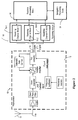
- FIG. 2 is a block diagram representing one example, among others, of a typical operation of a global navigation satellite system receiver (or a spread spectrum receiver) 10 wherein the present invention can be applied.
- the receiver 10 can be a GPS (global positioning system) receiver, a Galileo receiver, or any other compatible receiver presently available or a subject of future technological advances, according to the present invention.
- GPS global positioning system
- Galileo Galileo receiver
- a typical receiver operation includes receiving the radio frequency signal and converting said radio frequency signal containing a multi-path component to a radio frequency electrical signal 11a by an antenna 11 followed by converting said radio frequency electrical signal 11a to a digital intermediate frequency (IF) signal (or a digital signal) 14 by a preprocessor 12 and providing said digital signal 14 to each of N receiving channel blocks 16-1,16-2, ..., 16-N (N is an integer of at least a value of one) of a receiving module 16 which normally exchanges information with the receiver processing block 36 during its operation and the receiver processing block 36 further communicates with a navigation processing block 19.
- IF intermediate frequency
- the key innovation here involves a novel implementation and design of receiving channel blocks 16-1,16-2, ...,16-N using a novel multi-path detection technique and special processing of the correlation information generated by any block of said receiving channel blocks 16-1, 16-2, ...,16-N according to multi-path processing algorithms described below in regard to Figures 3a-3c , 4a, 4b , and 5 , according to the present invention.
- GNSS receivers use three correlators to track the code phase and the carrier phase of the received satellite signal. Usually these correlators are called early, prompt and late correlators. A code phase is tracked by a delay-locked loop, and a carrier phase is tracked by a phase-locked loop in the traditional GNSS receivers.
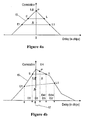
- Figure 3a is a diagram showing one example among many others of a correlation triangle 15 (a correlation function as a function of a time delay in chips) for a line of sight (LOS) signal (an ideal case, no multi-path component).
- the correlation function can be represented by an amplitude (or an amplitude parameter) and/or a phase (or phase parameter).
- the correlator output generally, is a complex signal, it has real and imaginary part (often referred to as inphase and quadrature components, I and Q).
- the amplitude parameter is the amplitude of this complex value, and the phase parameter is its phase.
- Figures 3a-3c and 4a-4b discussed here present the amplitude of the correlator output.
- Points marked E, P and L correspond to signals generated by the early, prompt and late correlators, respectively. Points E and L are usually symmetrical in the time delay domain relative to the point P.
- the receiver calculates an error signal describing how far away the prompt correlator is from the peak of the correlation triangle, and tries to keep that error signal at zero.
- the receiver is tracking the received code phase accurately.
- a typical error signal (or an early-minus-late error signal) is the correlation function (e.g., its amplitude parameter) at the E (early) point minus the correlation function at the L (late) point.
- the correlation signals at the E and L points are equal (on the same level), as shown in Figure 3a .
- Figures 3b and 3c demonstrate this situation.
- Figure 3b is an example, among others, of a diagram showing correlation triangle 15-1 for the line of sight signal and a correlation triangle 15-2 for a multi-path signal.
- Figure 3c is a diagram showing a correlation triangle 15 for a combined correlation function for the line of sight and for the multi-path signals shown in Figure 3b .
- the tracking point P is shifted from the peak of the LOS signal by a time delay error 17 .
- the present invention it is possible to introduce more than one of additional (further) early-late correlator pairs, also symmetrical in the time delay relative to the point P but with different time spacing (different time delay), and therefore it is possible to calculate an additional early-minus-late error signal for those further early-late correlator pairs, if it is required by an application (e.g., a more accurate determination is required).
- This is consistent with the main goal of the present invention of determining by the spread spectrum receiver 10 whether the distortion of the received radio frequency signal caused by a multi-path component of said received signal meets said predetermined condition using said pre-selected correlation analysis of said received signal for implementing the multi-path detection analysis and selectivity of the code modulated signals.
- the additional early-minus-late error signal should be also close to zero. Otherwise the correlation triangle is not symmetrical (e.g., said predetermined condition is not met), and the presence of a not acceptable multi-path component can be declared.
- the consequence of said "declaration” can be deselecting said code modulated signal (e.g., from a particular satellite) from further consideration and processing or assigning a smaller weight to information contained in said "multi-path" contaminated CDMA signal than to a "clean" multi-path-free signal.
- the magnitude of the additional early-minus-late error signal i.e., how much this additional early-minus-late error signal deviates from zero
- the magnitude of the additional early-minus-late error signal can be used to determine how much the weight of a signal from a particular satellite should be reduced in position calculations.
- the receiver calculates the phase of the prompt correlator, and tries to keep the phase close to zero at the prompt point (P point). If there is data modulation present in the received signal, e.g., a Costas loop can be used, otherwise (no data modulation) a plain phase-locked loop is enough.
- the multi-path signal has a different Doppler frequency than the LOS signal, thus the correlation triangle will be distorted also in a phase domain, and the phase tracking will be also in error. That means, e.g., that the phase (or the phase parameter of the correlation signal) of correlators at E, L, E1 and L1 can be different from zero (for the correlator P) and from each other.
- the phase of the prompt correlator signal and of all other correlator signals are the same, and the phase of the prompt correlator is driven to zero by the receiver.
- the phase of the prompt correlator output and other correlators is no longer the same. If the receiver is phase-locked, the phase of the prompt correlator signal remains zero, but the output signals of other correlators are no longer zeros due to the multi-path effects. Therefore, according to the present invention, the multi-path component can be detected by observing the phase difference between the output signals from different correlators.
- the phases of the output signals from the different correlators will be different disclosing the presence of the multi-path component and the phase method can be applied directly after the radio frequency signal acquisition without the need to wait for tracking to stabilize. It is also noted that for phase comparisons, the correlators do not have to be symmetrical about the prompt point.
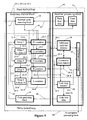
- Figure 5 is a block diagram representing one example, among others, for implementing the receiving channel block 16-1,16-2, ..., or 16-N of a receiving module 16 and the receiving processing block 36, both contained in the spread spectrum receiver 10, according to the present invention.
- Figure 5 shows components of the module 16 and the block 36 relevant to the present invention.
- the receiving channel block 16-1, 16-2, ..., or 16-N comprises a residual carrier removing block 20 used for generating a data intermediate signal 54 by removing a residual carrier frequency from the digital IF signal 14 using a feedback of a phase-loop (or phase-locked loop) 46, i.e., in response to a frequency control signal 50 indicative of said phase-loop feedback from said receiver processing block 36.
- a phase-loop or phase-locked loop
- the receiving channel block 16-1, 16-2, ..., or 16-N also comprises a code generating block 40 used for generating a code signal 58 indicative of a delay-loop (or delay-locked loop) 44 feedback, i.e., in response to a code control signal 38 indicative of said delay-loop feedback from the receiver processing block 36 as a part of a delay-locked loop 44.
- a code generating block 40 used for generating a code signal 58 indicative of a delay-loop (or delay-locked loop) 44 feedback, i.e., in response to a code control signal 38 indicative of said delay-loop feedback from the receiver processing block 36 as a part of a delay-locked loop 44.
- the data intermediate signal 54 is provided to each of five correlators (E1 E, P, L, L1) 24-1, 24-2, ..., 24-5.
- the correlators 24-1 and 24-2 correspond to the early correlators E1 and E, respectively, described above; the correlators 24-4 and 24-5 correspond to late correlators L and L1, respectively, described above; and the correlator 24-3 correspond to the prompt correlator described above.
- the code signal 58 is provided to a first delay module 22-1 and then each of five consecutively delayed code signals 25-1, 25-2, ..., 25-5 generated by a corresponding one of five delay modules 22-1, 22-2,..., 22-5 is provided to one corresponding correlator module of said five correlator modules 24-1, 24-2, ..., 25-4, as shown in Figure 5 , wherein said each of said five delayed code signals 25-1, 25-2, ..., 25-5 is consecutively and individually delayed by pre-selected values relative to a previously delayed code signal of said five consecutively delayed code signals 25-1, 25-2, ..., 25-5 starting with the code signal 58 provided by the code generating block 40 to the delay module 22-1.
- the pre-selected delay values are chosen based on the algorithm shown in Figures 4a and 4b , such that the delay signal 25-1 corresponds to the E1 point, the delay signal 25-2 corresponds to the E point, the delay signal 25-3 corresponds to the P point, the delay signal 25-4 corresponds to the L point, and the delay signal 25-5 corresponds to the L1 point.
- Each of the five correlator modules 24-1, 24-2, ..., 24-5 generates a corresponding one of five correlation signals 26-1, 26-2, ..., 26-5 and these correlation signals 26-1, 26-2, ..., 26-5 are provided to the receiver processing block 36 for determining whether the distortion of the received radio frequency signal caused by said multi-path component meets a predetermined condition.
- Each of the five correlation signals 26-1, 26-2, ..., 26-5 can contain an amplitude parameter or a phase parameter or both said amplitude parameter and said phase parameter, such that the correlation triangle shown in Figures 4a and 4b can be generated for the amplitude parameter and a plot of the phase parameter (or a phase parameter plot) as a function of different correlators (said plot is not a straight horizontal line if the multi-path is present because the phase parameter is different for different correlators) can be generated simultaneously, according to the present invention.
- the correlation signals 26-2 and 26-4 (E and L points in Figures 4 and 4b ), provided to a code loop detector 28 of the receiver processing block 36, corresponds to the traditional way of evaluating multi-path effects (e.g., maintaining the difference in the amplitude parameter of the correlation signals 26-2 and 26-4 close to zero through the delay-locked loop 44 using the code control signal 38 as shown in Figure 5 ).
- the correlation signals 26-2, 26-3 and 26-4 i.e., the phase difference between them
- the correlation signals 26-1 and 26-5 can be optionally used without a further need for the correlation signals 26-1 and 26-5 for the determining whether the distortion of the received radio frequency signal caused by said multi-path component meets a predetermined condition (as described above).
- said determining can be implemented by providing said correlation signals 26-1, 26-2, ..., 26-5 (or just 26-2, 26-3 and 26-4) to a correlation phase detector 31 which generates and provides phase parameters of the corresponding correlation signals 26-1, 26-2, ..., 26-5 (or 26-2, 26-3 and 26-4) to a multi-path processing block 32 of said block 36 for performing said determining.
- the block 32 can use a phase difference of signals 26-1, 26-2, ..., 26-5 (or 26-2, 26-3 and 26-4) but also, optionally, can include the phase of the signals 26-1, 26-3 and 26-5 in said determining.
- the correlation signals 26-1 and 26-5 are provided to an additional early-late detector 30 (in an alternative scenario, the block 30 can be combined with the block 28 and/or with the block 31 ) of the receiver processing block 36, as shown in Figure 5 .
- the additional early-late detector 30 can generate the amplitude parameters of the correlation signals 26-1 and 26-5 or directly the difference (the additional early-minus-late error) signal between the correlation signals 26-1 and 26-5 and provides these amplitude parameters or said difference to the multi-path processing block 32, while maintaining the difference in the amplitude parameter of the correlation signals 26-2 and 26-4 close to zero through the delay-locked loop 44 using the signal 38 as . described above.
- the multi-path processing block 32 determines, based on the inputs from the blocks 28, 31 and /or 30, whether the distortion of the received radio frequency signal caused by said multi-path component meets said predetermined condition. If the predetermined condition is not met, then the presence of the not acceptable multi-path component can be declared, such that, according to the present invention, the received radio code modulated signal (e.g., from a particular satellite) is deselected from further consideration and processing beyond the receiver processing block 36, i.e., no further signal is provided to the navigation processing block 19.
- the received radio code modulated signal e.g., from a particular satellite
- an intermediate measure can be assigning a smaller weight to information contained in said multi-path "contaminated” code modulated signal than to a "clean" multi-path-free signal, but still providing this "contaminated” code modulated signal to the navigation processing block 19 as explained above. If, however, the multi-path processing block 32 determines that the distortion of the received radio frequency signal caused by said multi-path component meets said predetermined condition, it provides said code modulated signal to the navigation processing block 19 for further processing.
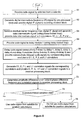
- Figure 6 is a flow chart representing an example of a multi-path selective detection operation of the global navigation satellite system receiver (spread spectrum receiver) 10, according to the present invention.
- a method according to the present invention in a first step 60, the radio frequency signal containing said multi-path component is received and converted to the radio frequency electrical signal 11 a by an antenna 11.
- said radio frequency electrical signal 11a is converted to a digital intermediate frequency (IF) signal (or a digital signal) 14 by a preprocessor 12 and said digital signal 14 is provided to each ofN receiving channel blocks 16-1,16-2, ...,16-N.
- IF digital intermediate frequency
- a next step 64 the residual carrier frequency is removed from the digital IF signal and the data intermediate signal is generated (using the carrier phase-locked loop) and provided to each of five correlators (E1 E, P, L, L1) 24-1, 24-2, ..., 24-5.
- a next step 66 the code signal 58 indicative of a delay-loop (or delay-locked loop) 44 feedback is generated and provided to the delay module 22-1.
- each of five consecutively delayed code signals 25-1, 25-2, ..., 25-5 generated by a corresponding one of five delay modules 22-1, 22-2,..., 22-5 is provided to one corresponding correlator module of said five correlator modules 24-1, 24-2, ..., 25-4, wherein said each of said five delayed code signals 25-1, 25-2, ..., 25-5 is consecutively and individually delayed by pre-selected values relative to a previously delayed code signal of said five consecutively delayed code signals 25-1, 25-2, ..., 25-5 starting with the code signal 58.
- the pre-selected delay values are chosen based on the algorithm shown in Figures 4a and 4b , such that the delay signal 25-1 corresponds to the E1 point, the delay signal 25-2 corresponds to the E point, the delay signal 25-3 corresponds to the P point, the delay signal 25-4 corresponds to the L point, and the delay signal 25-1 corresponds to the L1 point.
- Each of the five correlator modules 24-1, 24-2, ..., 24-5 generates a corresponding one of five correlation signals 26-1, 26-2, ..., 26-5 (E1 E, P, L, L1) and these correlation signals 26-1, 26-2, ..., 26-5 (both amplitude and phase) are provided to the receiver processing block 36 for determining whether the distortion of the received radio frequency signal caused by said multi-path component meets a predetermined condition.
- the receiver processing block 36 generates the difference (the additional early-minus-late error) signal between the correlation signals 26-1 and 26-5 (E1 and L1), and /or the phase difference between any correlation signals.
- a next step 74 it is determined by the receiver processing block 36 whether the predetermined condition is met (for the amplitude or/and for the phase) based on the results of step 72. If that is not the case, the evaluated radio signal from the particular satellite is not used (shown as step 76 ) for position calculations (e.g., the signal is not passed to the navigation processing block 19 ). If, however, it is determined that the predetermined condition is met, in a next step the evaluated radio signal from the particular satellite is used for position calculations (e.g., the signal is passed to the navigation processing block 19 ).
- a terminal (or a user equipment, UE) 84 is a communication device, such as a mobile device or a mobile phone, containing a CDMA receiver 83 according to the present invention.
- the CDMA receiver 83 can be, for instance, the spread spectrum (GNSS) receiver 10 described in the examples of Figures 2 and 5 .
- said CDMA receiver 83 contains a receiving module 16 with the key innovation as described above.
- the block 16 can be built as a removable unit.
- the receiving module 16 can be, for example, a combination of receiving channel blocks 16-1,16-2, ..., and 16-N as presented in Figure 2 .
- Figure 7 shows P satellites 86-1, ..., 86-P sending P satellite signals 80-1, ..., 80-P, to the CDMA spread spectrum receiver 83.
- Figure 7 also shows a base station 85, which communicates with the terminal 84 by sending, e.g., a mobile CDMA communication signal 82a to the CDMA spread spectrum receiver 83 and receiving back the outgoing communication signal 82b from the terminal 84.
- the signals 80-1, ..., 80-P and 82a can contain the multi-path components and are processed by the receiving module 16 as described in the present invention.
Landscapes
- Engineering & Computer Science (AREA)
- Radar, Positioning & Navigation (AREA)
- Remote Sensing (AREA)
- Computer Networks & Wireless Communication (AREA)
- Physics & Mathematics (AREA)
- General Physics & Mathematics (AREA)
- Signal Processing (AREA)
- Position Fixing By Use Of Radio Waves (AREA)
Claims (30)
- Verfahren für eine Mehrweg-Erfassungs-Analyse eines Funkfrequenzsignals durch einen Spread-Spectrum-Empfänger (10), umfassend:Empfangen eines Funkfrequenzsignals, das eine Mehrweg-Komponente enthält, und Umwandeln des Funkfrequenzsignals in ein digitales Signal; undErfassen der Mehrweg-Komponente und Bestimmen, unter Verwendung von mindestens zwei Paaren von Korrelationssignalen, wobei jedes Paar in Bezug auf ein Promptsignal symmetrisch ist, ob eine Verzerrung des Funkfrequenzsignals, die durch die Mehrweg-Komponente verursacht wird, eine vorbestimmte Bedingung erfüllt, unter Verwendung einer Korrelationsanalyse des digitalen Signals (14) mit den mindestens zwei Paaren von Korrelationssignalen, indem die Korrelationssignale eines Paars der zwei Paare unter Verwendung einer Delay-Locked-Loop (44) gleich gehalten werden, und Bewerten einer Differenz zwischen den Korrelationssignalen eines anderen Paares der zwei Paare, wobei jedes Korrelationssignal (26) durch einen Korrelator (24) unter Verwendung eines verzögerten Codesignals (25) und eines Daten-Zwischensignals (54) erzeugt wird, das aus dem digitalen Signal erzeugt wurde, und Fällen einer Entscheidung, ob das empfangene Funkfrequenzsignal weiter verarbeitet werden soll, unter Verwendung von Ergebnissen der Mehrweg-Erfassungs-Analyse.
- Verfahren gemäß Anspruch 1, wobei das Bestimmen durch ein Verarbeitungsmittel (36) durchgeführt wird.
- Verfahren gemäß Anspruch 2, wobei das Funkfrequenzsignal nur zur Weiterverarbeitung nach dem Verarbeitungsmittel (36) verwendet wird, nachdem die Entscheidung gefällt wurde, falls die Verzerrung die vorbestimmte Bedingung erfüllt, um eine selektive Funktion des Mehrweg-Erfassungs-Betrieb zu implementieren.
- Verfahren gemäß Anspruch 1, wobei das digitale Signal (14) durch Umwandeln des Funkfrequenzsignals in ein elektrisches Funkfrequenzsignal (11a) mit anschließendem Umwandeln des elektrischen Funkfrequenzsignals in ein digitales Signal (14) erzeugt wird.
- Verfahren gemäß Anspruch 1, wobei das Funkfrequenzsignal ein Code Division Multiple Access Signal ist.
- Verfahren gemäß Anspruch 1, wobei vor dem Bestimmen die Korrelationsanalyse des digitalen Signals (14) durch einen Empfangs-Kanalblock (16-1, 16-2, ..., oder 16-N) des Spread-Spectrum-Empfängers (10) durchgeführt wird, und die Analyse umfasst:Erzeugen eines Daten-Zwischensignals (54) durch Entfernen einer Rest-Trägerfrequenz von dem digitalen Signal (14) unter Verwendung einer Phase-Loop-Rückkopplung und Bereitstellen des Daten-Zwischensignals (54) an jeden von K Korrelatoren des Empfangs-Kanalblocks (16-1, 16-2, ..., oder 16-N), wobei K eine ungerade ganze Zahl mit mindestens dem Wert 5 ist;Bereitstellen eines Codesignals (58), das eine Delay-Loop-Rückkopplung an ein erstes Verzögerungs-Modul (22-1) des Empfänger-Verarbeitungsblocks (36) angibt;Bereitstellen von jedem von K fortlaufend verzögerten Codesignalen (25-1, 25-2,...25-K) an ein entsprechendes Korrelatormodul von K Korrelatormodulen (24-1, 24-2,...24-K), wobei jedes der K verzögerten Codesignale (25-1, 25-2,...25-K) fortlaufend und individuell durch vorgewählte Werte in Bezug auf ein vorhergehendes verzögertes Codesignal der K fortlaufend verzögerten Codesignale (25-1, 25-2,...25-K) verzögert ist, beginnend mit dem Codesignal (58), das durch den Empfänger-Verarbeitungsblock (36) bereitgestellt wird; undErzeugen jedes der K Korrelationssignale (26-1, 26-2,... 26-K) durch ein entsprechendes der K Korrelatormodule (24-1, 24-2,...24-K) unter Verwendung des Daten-Zwischensignals (54) und der K verzögerten Codesignale (25-1, 25-2,...25-K) und Bereitstellen der K Korrelationssignale an den Empfänger-Verarbeitungsblock (36) für das Bestimmen, wobei jedes der K Korrelationssignale (26-1, 26-2,... 26-K) einen Amplitudenparameter oder einen Phasenparameter oder sowohl den Amplitudenparameter als auch den Phasenparameter enthält.
- Verfahren gemäß Anspruch 6, wobei die Verzerrung des Funkfrequenzsignals, die durch die Mehrweg-Komponente verursacht wird, in dem Verarbeitungsmittel (36) unter Verwendung der vorbestimmten Bedingung bewertet wird, indem der Amplitudenparameter eines M-ten Korrelationssignals der K-Korrelationssignale (26-1, 26-2,... 26-K), das unter Verwendung eines M-ten verzögerten Codesignals der K fortlaufend verzögerten Codesignale (25-1, 25-2,...25-K) erzeugt wurde, wobei M= 1 oder 2 ... oder (K-1)/2 ist, und der Amplitudenparameter eines entsprechenden L-ten Korrelationssignals der K fortlaufend verzögerten Codesignale (25-1, 25-2,...25-K) verglichen werden, das unter Verwendung eines entsprechenden L-ten verzögerten Codesignals der K Korrelationssignale (26-1, 26-2,...26-K) erzeugt wurde, wobei L=K, oder K-1, ... oder (K+3)/2 ist.
- Verfahren gemäß Anspruch 7, wobei der Amplitudenparameter von zwei Korrelationssignalen der K Korrelationssignale (26-1, 26-2,... 26-K), die durch entsprechende Korrelationsmodule unter Verwendung entsprechender verzögerter Codesignale der K fortlaufend verzögerten Codesignale (25-1, 25-2,...25-K) erzeugt wurden, die um (K-1)/2 beziehungsweise (K+3)/2 Mal verzögert wurden, unter Verwendung eines Delay-Locked-Loop des Spread-Spectrum-Empfängers (10) gleich gehalten werden.
- Verfahren gemäß Anspruch 8, wobei die Verzerrung des Funkfrequenzsignals, die durch die Mehrweg-Komponente verursacht wird, in dem Verarbeitungsmittel (36) bewertet wird, indem ein Amplitudenparameter eines ersten der K-Korrelationssignale (26-1, 26-2,... 26-K), das unter Verwendung eines ersten verzögerten Codesignals der K fortlaufend verzögerten Codesignale (25-1, 25-2,...25-K) erzeugt wurde, und eines letzten der K Korrelationssignale (26-1, 26-2,...26-K) verglichen wird, das unter Verwendung eines letzen verzögerten Codesignals der K fortlaufend verzögerten Codesignale erzeugt wurde, unter Verwendung der vorbestimmten Bedingung.
- Verfahren gemäß Anspruch 9, wobei K=5.
- Verfahren gemäß Anspruch 6, wobei der Phasenparameter eines Korrelationssignals der K Korrelationssignale (26-1, 26-2,...26-K), das durch ein entsprechendes Korrelationsmodul unter Verwendung eines entsprechenden verzögerten Codesignals der K fortlaufend verzögerten Codesignale (25-1, 25-2,...25-K), die (K+1)/2 Mal verzögert wurden, erzeugt wurde, unter Verwendung eines Phase-Locked-Loop (46) auf Null gehalten wird, und wobei Phasenparameter der K Korrelationssignale (26-1, 26-2,... 26-K) dem Empfänger-Verarbeitungsblock (36) für das Bestimmen bereitgestellt werden.
- Verfahren gemäß Anspruch 6, wobei das Codesignal (58) durch einen Code-Erzeugungsblock (40) des Empfangs-Kanalblocks (16-1, 16-2, ..., oder 16-N) in Reaktion auf ein Code-Steuersignal (38) erzeugt wird, das die Delay-Loop-Rückkopplung von dem Empfänger-Verarbeitungsblock (36) als einen Teil eines Delay-Locked-Loop (44) angibt.
- Verfahren gemäß Anspruch 6, wobei das Daten-Zwischensignal (54) durch einen Restträger-Entfemungsblock (20) des Empfangs-Kanalblocks (16-1, 16-2, ..., oder 16-N) in Reaktion auf ein Frequenz-Steuersignal (50) erzeugt wird, das die Phase-Loop-Rückkopplung von dem Empfänger-Verarbeitungsblock (36) angibt.
- Verfahren gemäß einem der vorstehenden Ansprüche, umfassend:Nachführen eines Früh-Minus-Spät-Signals eines der mindestens zwei Paare von Korrelationssignalen auf Null;Verwenden eines weiteren Früh-Minus-Spät-Signals eines anderen der mindestens zwei Paare von Korrelationssignalen für das Bestimmen.
- Computerprogramm-Produkt, umfassend:eine computerlesbare Speicherstruktur, auf der ein Computerprogrammcode gespeichert ist, zur Ausführung durch einen Computerprozessor mit dem Computerprogrammcode, wobei der Computerprogrammcode Anweisungen zum Ausführen eines Verfahrens gemäß einem der vorstehenden Ansprüche umfasst, angegeben als ausgeführt durch eine Komponente des Spread-Spectrum-Empfängers oder eines Endgeräts, das den Spread-Spectrum-Empfänger umfasst.
- Spread-Spectrum-Empfänger, umfassend:Mittel (16) zum Ausführen einer Korrelationsanalyse eines digitalen Signals (14), das aus einem Funkfrequenzsignal erzeugt wurde, umfassend eine Mehrweg-Komponente, unter Verwendung mindestens zweier Paare von Korrelationssignalen, wobei jedes Paar in Bezug auf ein Promptsignal symmetrisch ist, indem die Korrelationssignale eines Paares der zwei Paare unter Verwendung eines Delay-Locked-Loop (44) gleich gehalten werden, und eine Differenz zwischen den Korrelationssignalen eines anderes Paares der zwei Paare bewertet wird, wobei jedes Korrelationssignal (26) durch einen Korrelator (24) unter Verwendung eines verzögerten Codesignals (25) und eines Daten-Zwischensignals (54) erzeugt wurde, das aus dem digitalen Signal erzeugt wurde; undVerarbeitungsmittel (36) zum Erfassen der Mehrweg-Komponente und zum Bestimmen, ob eine Verzerrung des Funkfrequenzsignals, die durch die Mehrweg-Komponente verursacht wird, eine vorbestimmte Bedingung erfüllt, unter Verwendung der Korrelationsanalyse des digitalen Signals (14), und zum Fällen einer Entscheidung, ob das empfangene Funkfrequenzsignal weiter verarbeitet wird, unter Verwendung von Ergebnissen der Mehrweg-Erfassungs-Analyse zum Implementieren einer Mehrweg-Erfassungs-Analyse des Funkfrequenzsignals durch den Spread-Spectrum-Empfänger.
- Spread-Spectrum-Empfänger (10) gemäß Anspruch 16, wobei das Funkfrequenzsignal durch den Spread-Spectrum-Empfänger (10) nur dazu verwendet wird, um über das Verarbeitungsmittel (36) hinaus weiter verarbeitet zu werden, nachdem die Entscheidung gefällt wurde, falls die Verzerrung die vorbestimmte Bedingung erfüllt, um eine selektive Funktion des Mehrweg-Erfassungs-Betriebs des Spread-Spectrum-Empfängers (10) zu implementieren.
- Spread-Spectrum-Empfänger gemäß Anspruch 16, wobei das Funkfrequenzsignal ein Code Division Multiple Access Signal ist.
- Spread-Spectrum-Empfänger gemäß Anspruch 16, wobei das Korrelationsanalyse-Ausführungsmittel (16) N Empfangs-Kanalblöcke umfasst, wobei N eine ganze Zahl mit mindestens einem Wert von eins ist, und wobei jeder der N Empfangs-Kanalblöcke (16-1, 16-2, ..., und 16-N) umfasst:Mittel (64) zum Erzeugen eines Daten-Zwischensignals (54) durch Entfernen einer Rest-Trägerfrequenz von dem digitalen Signal (14) unter Verwendung einer Phase-Loop-Rückkopplung,Mittel (66) zum Erzeugen eines Code-Signals (58) das eine Delay-Loop-Rückkopplung angibt;K Korrelatormodule (24-1, 24-2,...24-K), wobei K eine ungerade ganze Zahl mit mindestens einem Wert von drei ist, um jedes der K Korrelationssignale (26-1, 26-2,... 26-K) durch ein entsprechendes der K Korrelatormodule (24-1, 24-2,...24-K) unter Verwendung des Daten-Zwischensignals (54) und von K verzögerten Codesignalen (25-1, 25-2,...25-K) zu erzeugen, und um die K Korrelationssignale dem Empfänger-Verarbeitungsblock (36) für das Bestimmen bereitzustellen, ob eine Verzerrung des Funkfrequenzsignals, die durch Mehrweg-Komponente verursacht wird, eine vorbestimmte Bedingung erfüllt, unter Verwendung einer Korrelationsanalyse des digitalen Signals (14), wobei jedes der K Korrelationssignale (26-1, 26-2,... 26-K) einen Amplitudenparameter oder einen Phasenparameter oder sowohl den Amplitudenparameter als auch den Phasenparameter enthält; undK Verzögerungsmodule (22-1, 22-2, ... 22-K), um jedes von K fortlaufend verzögerten Codesignalen (25-1, 25-2, ... 25-K) einem entsprechenden Korrelatormodul der K Korrelatormodule (24-1, 24-2, ... 24-K) bereitzustellen, wobei jedes der K verzögerten Codesignale (25-1, 25-2, ... 25-K) fortlaufend und individuell durch vorgewählte Werte in Bezug auf ein vorhergehendes verzögertes Codesignal der K fortlaufend verzögerten Codesignale (25-1, 25-2, ... 25-K) verzögert ist, beginnend mit dem Codesignal (58), das einem ersten Verzögerungsmodul (22-1) aus den K Verzögerungsmodulen durch den Empfänger-Verarbeitungsblock (36) bereitgestellt wird.
- Spread-Spectrum-Empfänger (10) gemäß Anspruch 19, wobei die Verzerrung des Funkfrequenzsignals, die durch die Mehrweg-Komponente verursacht wird, durch das Verarbeitungsmittel (36) unter Verwendung der vorbestimmten Bedingung bewertet wird, durch Vergleichen des Amplitudenparameters eines M-ten Korrelationssignals der K Korrelationssignale (26-1, 26-2, ... 26-K), das unter Verwendung eines M-ten verzögerten Codesignals der K fortlaufend verzögerten Codesignale (25-1, 25-2, ... 25-K) erzeugt wurde, wobei M= 1, oder 2, ... oder (K-1)/2 ist, und des Amplitudenparameters eines entsprechenden L-ten Korrelationssignals der K fortlaufend verzögerten Codesignale (25-1, 25-2, ... 25-K), das unter Verwendung eines entsprechenden L-ten verzögerten Codesignals der K Korrelationssignale (26-1, 26-2, ... 26-K) erzeugt wurde, wobei L = K, oder K-1 ... oder (K+3)/2 ist.
- Spread-Spectrum-Empfänger (10) gemäß Anspruch 19, wobei der Amplitudenparameter von zwei Korrelationssignalen der K Korrelationssignale (26-1, 26-2, ... 26-K), die durch entsprechende Korrelationsmodule unter Verwendung entsprechender verzögerter Codesignale (25-1, 25-2, ... 25-K) der K fortlaufend verzögerten Codesignale, die um (K-1)/2 beziehungsweise (K+3)/2 Mal verzögert sind, erzeugt wurden, unter Verwendung der vorbestimmten Bedingung gleich gehalten werden.
- Spread-Spectrum-Empfänger (10) gemäß Anspruch 21, wobei die Verzerrung des Funkfrequenzsignals, die durch die Mehrweg-Komponente verursacht wird, durch das Verarbeitungsmittel (36) bewertet wird, durch Vergleichen eines Amplitudenparameters eines ersten der K Korrelationssignale (26-1, 26-2, ... 26-K), erzeugt unter Verwendung eines ersten verzögerten Codesignals der K fortlaufend verzögerten Codesignale (25-1, 25-2, ... 25-K), und eines letzten der K Korrelationssignale (26-1, 26-2, ... 26-K), erzeugt unter Verwendung eines letzten verzögerten Codesignals der K fortlaufend verzögerten Codesignale (25-1, 25-2, ... 25-K).
- Spread-Spectrum-Empfänger (10) gemäß Anspruch 22, wobei K=5.
- Spread-Spectrum-Empfänger (10) gemäß Anspruch 19, wobei der Phasenparameter eines Korrelationssignals der K Korrelationssignale (26-1, 26-2,...26-K), erzeugt durch ein entsprechendes Korrelatormodul der K Korrelatormodule, unter Verwendung eines entsprechenden verzögerten Codesignals der K fortlaufend verzögerten Codesignale (25-1, 25-2,...25-K), die (K+1)/2 Mal verzögert sind, unter Verwendung eines Phase-Locked-Loop (46) des Spread-Spectrum-Empfängers (10) auf Null gehalten wird, und wobei Phasenparameter der K Korrelationssignale (26-1, 26-2,... 26-K) dem Empfänger-Verarbeitungsblock (36) für das Bestimmen bereitgestellt werden.
- Spread-Spectrum-Empfänger (10) gemäß Anspruch 19, wobei der Empfangs-Kanalblock einen Code-Erzeugungsblock umfasst, um das Codesignal (58) in Reaktion auf ein Code-Steuersignal (38) zu erzeugen, das die Delay-Loop-Rückkopplung von dem Verarbeitungsmittel (36) als einen Teil eines Delay-Locked-Loop (44) angibt.
- Spread-Spectrum-Empfänger (10) gemäß Anspruch 19, wobei der Empfangs-Kanalblock einen Restträger-Entfemungsblock umfasst, um das Daten-Zwischensignal (54) in Reaktion auf ein Frequenz-Steuersignal (50) zu erzeugen, das die Phase-Loop-Rückkopplung von dem Empfänger-Verarbeitungsblock (36) angibt.
- Spread-Spectrum-Empfänger gemäß einem der Ansprüche 16 bis 26, umfassend:eine Antenne (11), die auf das Funkfrequenzsignal anspricht, das eine Mehrweg-Komponente enthält, um ein elektrisches Funkfrequenzsignal bereitzustellen; undeinen Vorverarbeitungsprozessor (12), der auf das elektrische Funkfrequenzsignal anspricht, um das digitale Signal bereitzustellen.
- Spread-Spectrum-Empfänger (10) gemäß einem der Ansprüche 16 bis 27, wobei der Spread-Spectrum-Empfänger konfiguriert ist, ein Früh-Minus-Spät-Signal eines anderen der mindestens zwei Paare der Korrelationssignale für das Bestimmen auf Null nachzuführen.
- Spread-Spectrum-Empfänger (10) gemäß einem der Ansprüche 15 bis 28, wobei der Spread-Spectrum-Empfänger ein Empfänger für ein globales Navigations-Satellitensystem, ein Empfänger für ein globales Positionierungssystem oder ein Galileo-Empfänger ist.
- System, umfassend:einen Satelliten, um ein Funkfrequenzsignal bereitzustellen;eine Basisstation, um ein weiteres Funkfrequenzsignal bereitzustellen, das für Mobilkommunikation genutzt wird; undein Endgerät, das auf das Funkfrequenzsignal oder auf das weitere Funkfrequenzsignal anspricht, die beide eine Mehrweg-Komponente enthalten, wobei das Endgerät einen Spread-Spectrum-Empfänger (10) gemäß einem der Ansprüche 16 bis 29 umfasst.
Priority Applications (1)
| Application Number | Priority Date | Filing Date | Title |
|---|---|---|---|
| PL05810454T PL1832005T3 (pl) | 2004-12-29 | 2005-10-27 | Sposób detekcji wielotorowej w odbiornikach o widmie rozproszonym |
Applications Claiming Priority (2)
| Application Number | Priority Date | Filing Date | Title |
|---|---|---|---|
| US11/026,503 US7440493B2 (en) | 2004-12-29 | 2004-12-29 | Multi-path detection method for CDMA receivers |
| PCT/IB2005/003203 WO2006070223A1 (en) | 2004-12-29 | 2005-10-27 | Method for multi-path detection in spread spectrum receivers |
Publications (3)
| Publication Number | Publication Date |
|---|---|
| EP1832005A1 EP1832005A1 (de) | 2007-09-12 |
| EP1832005A4 EP1832005A4 (de) | 2010-08-18 |
| EP1832005B1 true EP1832005B1 (de) | 2012-12-19 |
Family
ID=36611454
Family Applications (1)
| Application Number | Title | Priority Date | Filing Date |
|---|---|---|---|
| EP05810454A Expired - Lifetime EP1832005B1 (de) | 2004-12-29 | 2005-10-27 | Verfahren zur mehrwegedetektion in spreizspektrum-empfängern |
Country Status (5)
| Country | Link |
|---|---|
| US (2) | US7440493B2 (de) |
| EP (1) | EP1832005B1 (de) |
| ES (1) | ES2408306T3 (de) |
| PL (1) | PL1832005T3 (de) |
| WO (1) | WO2006070223A1 (de) |
Cited By (1)
| Publication number | Priority date | Publication date | Assignee | Title |
|---|---|---|---|---|
| CN106646362A (zh) * | 2016-12-14 | 2017-05-10 | 西北大学 | 一种基于多径信号空间谱的被动式目标定位方法 |
Families Citing this family (29)
| Publication number | Priority date | Publication date | Assignee | Title |
|---|---|---|---|---|
| US7286592B2 (en) * | 2004-02-24 | 2007-10-23 | Nokia Mobile Phones, Ltd. | Method and apparatus for receiving a signal |
| US8170085B2 (en) * | 2006-03-09 | 2012-05-01 | CSR Technology Holdings Inc. | Multipath error estimation in satellite navigation receivers |
| GB0615930D0 (en) * | 2006-08-10 | 2006-09-20 | Univ Surrey | A receiver of binary offset carrier modulated signals |
| US7817084B2 (en) * | 2006-08-23 | 2010-10-19 | Qualcomm Incorporated | System and/or method for reducing ambiguities in received SPS signals |
| GB0701296D0 (en) * | 2007-01-24 | 2007-02-28 | Univ Surrey | A receiver of multiplexed binary offset carrier (MBOC) modulated signals |
| US8284820B2 (en) * | 2007-10-17 | 2012-10-09 | Mediatek Inc. | Shared processor architecture applied to functional stages configured in a receiver system for processing signals from different transmitter systems and method thereof |
| EP2066040A1 (de) * | 2007-11-27 | 2009-06-03 | Nemerix SA | GNSS-Empfänger mit Mehrwegkompensation |
| US8406280B2 (en) | 2008-03-18 | 2013-03-26 | Argon St, Inc. | System and method for mitigating severe multipath interference for geolocation and navigation |
| WO2009142729A1 (en) * | 2008-05-20 | 2009-11-26 | Raytheon Company | Satellite receiver and method for navigation using merged satellite system signals |
| US8412093B2 (en) * | 2008-10-22 | 2013-04-02 | Mediatek Inc. | Receiver applying channel selection filter for receiving satellite signal and receiving method thereof |
| US9726764B1 (en) | 2009-12-07 | 2017-08-08 | Rockwell Collins, Inc. | System and mehtod for providing space-based precision position correlations for promoting improved availability, accuracy and integrity |
| US8908744B1 (en) * | 2010-02-10 | 2014-12-09 | Marvell International Ltd. | Discriminator system for timing error detection in presence and absence of multipath conditions |
| US8395544B2 (en) * | 2010-07-01 | 2013-03-12 | Broadcom Corporation | Method and system for inter-delay product test for signal degradation detection in a GNSS receiver |
| CN102508272B (zh) * | 2011-11-15 | 2013-09-04 | 中国航天科工信息技术研究院 | 一种伽利略卫星e1 b伪码跟踪的方法及装置 |
| JP6069840B2 (ja) * | 2012-02-06 | 2017-02-01 | セイコーエプソン株式会社 | 移動速度算出方法及び移動速度算出装置 |
| KR102065666B1 (ko) | 2012-12-12 | 2020-02-11 | 삼성전자 주식회사 | 위성 항법 시스템의 신호 추적 방법, 신호 추적 장치 및 이를 포함하는 위성신호 수신기 |
| US9178561B2 (en) | 2013-09-11 | 2015-11-03 | Marvell World Trade Ltd. | Method and apparatus for correlating signals received from a navigation satellite system |
| US10534087B1 (en) * | 2015-05-31 | 2020-01-14 | United States Of America As Represented By The Secretary Of The Air Force | Differential vector phase locked loop GPS reception method |
| US11808865B2 (en) | 2016-03-24 | 2023-11-07 | Focal Point Positioning Limited | Method and system for calibrating a system parameter |
| GB2566748B (en) | 2017-09-26 | 2022-08-17 | Focal Point Positioning Ltd | A method and system for calibrating a system parameter |
| US9780829B1 (en) * | 2016-03-24 | 2017-10-03 | Focal Point Positioning Ltd. | Method, apparatus, computer program, chip set, or data structure for correlating a digital signal and a correlation code |
| ES2853199T3 (es) * | 2017-08-02 | 2021-09-15 | Thales Man & Services Deutschland Gmbh | Método para operar un receptor GNSS, con deselección de señal GNSS |
| CN108562916B (zh) * | 2018-01-26 | 2019-07-09 | 中国科学院上海天文台 | 适用于复杂寒区冻融地表的前向gps多路径模型的建立方法 |
| EP3785050A1 (de) * | 2018-05-18 | 2021-03-03 | u-blox AG | Mehrwegabschwächung eines globalen navigationssatellitensystems (gnss) |
| EP3608691B1 (de) * | 2018-08-08 | 2020-10-21 | Thales Management & Services Deutschland GmbH | Verfahren zum betrieb einer vielzahl von gnss-empfängern zur detektion einer satellitensignalverformung |
| CN109541647B (zh) * | 2018-12-13 | 2019-12-10 | 武汉大学 | 基于半天球格网点模型的gnss多路径效应修正方法 |
| CN110830297B (zh) * | 2019-11-07 | 2020-07-03 | 中国人民解放军火箭军工程大学 | 基于层次分析法的卫星动中通通信方案选择方法及系统 |
| US11681009B1 (en) * | 2021-03-29 | 2023-06-20 | Topcon Positioning Systems, Inc. | Method and device for reducing multipath channel effects on phase measurements in navigation radio systems |
| CN118626939B (zh) * | 2024-08-09 | 2024-11-15 | 广东工业大学 | 基于图对比学习的城市动态环境下多径信号识别方法 |
Family Cites Families (12)
| Publication number | Priority date | Publication date | Assignee | Title |
|---|---|---|---|---|
| US5414729A (en) * | 1992-01-24 | 1995-05-09 | Novatel Communications Ltd. | Pseudorandom noise ranging receiver which compensates for multipath distortion by making use of multiple correlator time delay spacing |
| US5347536A (en) * | 1993-03-17 | 1994-09-13 | The United States Of America As Represented By The Administrator Of The National Aeronautics And Space Administration | Multipath noise reduction for spread spectrum signals |
| US5600670A (en) * | 1994-12-21 | 1997-02-04 | Trimble Navigation, Ltd. | Dynamic channel allocation for GPS receivers |
| CN1075302C (zh) * | 1994-12-28 | 2001-11-21 | Ntt移动通信网株式会社 | 码分多址传送系统中的发送器和发送方法 |
| US5953367A (en) * | 1995-08-09 | 1999-09-14 | Magellan Corporation | Spread spectrum receiver using a pseudo-random noise code for ranging applications in a way that reduces errors when a multipath signal is present |
| US6917644B2 (en) | 1996-04-25 | 2005-07-12 | Sirf Technology, Inc. | Spread spectrum receiver with multi-path correction |
| DE19842712C1 (de) * | 1998-09-17 | 2000-05-04 | Siemens Ag | Verfahren und Anordnung zur Minimierung des Autokorrelationsfehlers bei der Demodulation eines Spreizspektrum-Signals unter Mehrwegeausbreitung |
| GB2351864B (en) * | 1999-07-05 | 2004-05-26 | Symmetricom Inc | A receiver for receiving rf pseudo-random encoded signals |
| US6868110B2 (en) * | 1999-12-01 | 2005-03-15 | The Board Of Trustees Of The Leland Stanford Junior University | Multipath and tracking error reduction method for spread-spectrum receivers |
| JP4316759B2 (ja) | 2000-01-13 | 2009-08-19 | 株式会社日立国際電気 | パス認定方法、cdma方式無線通信端末およびcdma方式無線通信システム |
| US6658048B1 (en) | 2000-04-07 | 2003-12-02 | Nokia Mobile Phones, Ltd. | Global positioning system code phase detector with multipath compensation and method for reducing multipath components associated with a received signal |
| SE0203047D0 (sv) | 2002-10-15 | 2002-10-15 | Nordnav Technologies Ab | Spread spectrum signal processing |
-
2004
- 2004-12-29 US US11/026,503 patent/US7440493B2/en active Active
-
2005
- 2005-10-27 EP EP05810454A patent/EP1832005B1/de not_active Expired - Lifetime
- 2005-10-27 WO PCT/IB2005/003203 patent/WO2006070223A1/en not_active Ceased
- 2005-10-27 ES ES05810454T patent/ES2408306T3/es not_active Expired - Lifetime
- 2005-10-27 PL PL05810454T patent/PL1832005T3/pl unknown
-
2008
- 2008-10-21 US US12/288,645 patent/US7702003B2/en not_active Expired - Lifetime
Cited By (2)
| Publication number | Priority date | Publication date | Assignee | Title |
|---|---|---|---|---|
| CN106646362A (zh) * | 2016-12-14 | 2017-05-10 | 西北大学 | 一种基于多径信号空间谱的被动式目标定位方法 |
| CN106646362B (zh) * | 2016-12-14 | 2019-11-15 | 西北大学 | 一种基于多径信号空间谱的被动式目标定位方法 |
Also Published As
| Publication number | Publication date |
|---|---|
| WO2006070223A1 (en) | 2006-07-06 |
| US7702003B2 (en) | 2010-04-20 |
| ES2408306T3 (es) | 2013-06-20 |
| US7440493B2 (en) | 2008-10-21 |
| PL1832005T3 (pl) | 2013-05-31 |
| US20060140254A1 (en) | 2006-06-29 |
| EP1832005A1 (de) | 2007-09-12 |
| EP1832005A4 (de) | 2010-08-18 |
| US20090147833A1 (en) | 2009-06-11 |
Similar Documents
| Publication | Publication Date | Title |
|---|---|---|
| EP1832005B1 (de) | Verfahren zur mehrwegedetektion in spreizspektrum-empfängern | |
| CN100399044C (zh) | 开环跟踪gps信号的方法 | |
| JP4738692B2 (ja) | 強信号をキャンセルして弱スペクトラム拡散信号を強める方法 | |
| CA2622484C (en) | Apparatus for and method of correlating to rising chip edges | |
| US6725157B1 (en) | Indoor GPS clock | |
| WO2004093339A1 (en) | Apparatus for and method of making pulse-shape measurements | |
| CA3110047C (en) | Gnss correlation distortion detection and mitigation | |
| US10585195B2 (en) | Cepstrum-based multipath mitigation of a spread spectrum radiocommunication signal | |
| US20010004380A1 (en) | Method for synchronizing a receiver, a positioning system, a receiver and an electronic device | |
| KR20200099958A (ko) | 글로벌 네비게이션 위성 시스템 수신기에서 다중 경로 완화를 제공하는 시스템 및 방법 | |
| US7421011B2 (en) | Performing an acquisition in a receiver | |
| US20070248152A1 (en) | Fast fourier transform based phase locked loop for navigational receivers | |
| EP3362818B1 (de) | Satellitennavigationsempfänger mit fixpunkt-sigma-rho-filter | |
| EP2243035A1 (de) | Messung des energiepotenzials (signal-rausch-verhältnis) bei empfängern digitaler globaler navigationssatellitensysteme | |
| EP1734377A1 (de) | Verfahren zum Entwurf von einem Empfänger für Abstandsmessung | |
| Dovis et al. | Turbo dll: An innovative architecture for multipath mitigation in gnss receivers | |
| Khan et al. | Analysis of the satellite navigational data in the Baseband signal processing of Galileo E5 AltBOC signal | |
| WO2024258418A1 (en) | Mitigation of multipath-induced error effects in a navigation satellite signal receiver | |
| HK1071932B (en) | Method for open loop tracking gps signals | |
| HK1037813A (en) | Method for synchronizing a receiver, and a receiver |
Legal Events
| Date | Code | Title | Description |
|---|---|---|---|
| PUAI | Public reference made under article 153(3) epc to a published international application that has entered the european phase |
Free format text: ORIGINAL CODE: 0009012 |
|
| 17P | Request for examination filed |
Effective date: 20070628 |
|
| AK | Designated contracting states |
Kind code of ref document: A1 Designated state(s): AT BE BG CH CY CZ DE DK EE ES FI FR GB GR HU IE IS IT LI LT LU LV MC NL PL PT RO SE SI SK TR |
|
| DAX | Request for extension of the european patent (deleted) | ||
| A4 | Supplementary search report drawn up and despatched |
Effective date: 20100721 |
|
| REG | Reference to a national code |
Ref country code: DE Ref legal event code: R079 Ref document number: 602005037528 Country of ref document: DE Free format text: PREVIOUS MAIN CLASS: H04B0001707000 Ipc: G01S0019220000 |
|
| RIC1 | Information provided on ipc code assigned before grant |
Ipc: H04B 1/7075 20110101ALI20120620BHEP Ipc: G01S 19/22 20100101AFI20120620BHEP |
|
| GRAP | Despatch of communication of intention to grant a patent |
Free format text: ORIGINAL CODE: EPIDOSNIGR1 |
|
| GRAS | Grant fee paid |
Free format text: ORIGINAL CODE: EPIDOSNIGR3 |
|
| GRAA | (expected) grant |
Free format text: ORIGINAL CODE: 0009210 |
|
| AK | Designated contracting states |
Kind code of ref document: B1 Designated state(s): AT BE BG CH CY CZ DE DK EE ES FI FR GB GR HU IE IS IT LI LT LU LV MC NL PL PT RO SE SI SK TR |
|
| REG | Reference to a national code |
Ref country code: GB Ref legal event code: FG4D |
|
| REG | Reference to a national code |
Ref country code: CH Ref legal event code: EP |
|
| REG | Reference to a national code |
Ref country code: AT Ref legal event code: REF Ref document number: 589662 Country of ref document: AT Kind code of ref document: T Effective date: 20130115 |
|
| REG | Reference to a national code |
Ref country code: DE Ref legal event code: R096 Ref document number: 602005037528 Country of ref document: DE Effective date: 20130214 |
|
| RAP2 | Party data changed (patent owner data changed or rights of a patent transferred) |
Owner name: FRANCE BREVETS |
|
| PG25 | Lapsed in a contracting state [announced via postgrant information from national office to epo] |
Ref country code: LT Free format text: LAPSE BECAUSE OF FAILURE TO SUBMIT A TRANSLATION OF THE DESCRIPTION OR TO PAY THE FEE WITHIN THE PRESCRIBED TIME-LIMIT Effective date: 20121219 Ref country code: SE Free format text: LAPSE BECAUSE OF FAILURE TO SUBMIT A TRANSLATION OF THE DESCRIPTION OR TO PAY THE FEE WITHIN THE PRESCRIBED TIME-LIMIT Effective date: 20121219 Ref country code: FI Free format text: LAPSE BECAUSE OF FAILURE TO SUBMIT A TRANSLATION OF THE DESCRIPTION OR TO PAY THE FEE WITHIN THE PRESCRIBED TIME-LIMIT Effective date: 20121219 |
|
| REG | Reference to a national code |
Ref country code: NL Ref legal event code: T3 |
|
| REG | Reference to a national code |
Ref country code: AT Ref legal event code: MK05 Ref document number: 589662 Country of ref document: AT Kind code of ref document: T Effective date: 20121219 |
|
| REG | Reference to a national code |
Ref country code: LT Ref legal event code: MG4D |
|
| PG25 | Lapsed in a contracting state [announced via postgrant information from national office to epo] |
Ref country code: LV Free format text: LAPSE BECAUSE OF FAILURE TO SUBMIT A TRANSLATION OF THE DESCRIPTION OR TO PAY THE FEE WITHIN THE PRESCRIBED TIME-LIMIT Effective date: 20121219 Ref country code: GR Free format text: LAPSE BECAUSE OF FAILURE TO SUBMIT A TRANSLATION OF THE DESCRIPTION OR TO PAY THE FEE WITHIN THE PRESCRIBED TIME-LIMIT Effective date: 20130320 Ref country code: SI Free format text: LAPSE BECAUSE OF FAILURE TO SUBMIT A TRANSLATION OF THE DESCRIPTION OR TO PAY THE FEE WITHIN THE PRESCRIBED TIME-LIMIT Effective date: 20121219 |
|
| REG | Reference to a national code |
Ref country code: PL Ref legal event code: T3 |
|
| REG | Reference to a national code |
Ref country code: ES Ref legal event code: FG2A Ref document number: 2408306 Country of ref document: ES Kind code of ref document: T3 Effective date: 20130620 |
|
| REG | Reference to a national code |
Ref country code: NL Ref legal event code: SD Effective date: 20130620 |
|
| PG25 | Lapsed in a contracting state [announced via postgrant information from national office to epo] |
Ref country code: IS Free format text: LAPSE BECAUSE OF FAILURE TO SUBMIT A TRANSLATION OF THE DESCRIPTION OR TO PAY THE FEE WITHIN THE PRESCRIBED TIME-LIMIT Effective date: 20130419 Ref country code: BE Free format text: LAPSE BECAUSE OF FAILURE TO SUBMIT A TRANSLATION OF THE DESCRIPTION OR TO PAY THE FEE WITHIN THE PRESCRIBED TIME-LIMIT Effective date: 20121219 Ref country code: SK Free format text: LAPSE BECAUSE OF FAILURE TO SUBMIT A TRANSLATION OF THE DESCRIPTION OR TO PAY THE FEE WITHIN THE PRESCRIBED TIME-LIMIT Effective date: 20121219 Ref country code: CY Free format text: LAPSE BECAUSE OF FAILURE TO SUBMIT A TRANSLATION OF THE DESCRIPTION OR TO PAY THE FEE WITHIN THE PRESCRIBED TIME-LIMIT Effective date: 20121219 Ref country code: AT Free format text: LAPSE BECAUSE OF FAILURE TO SUBMIT A TRANSLATION OF THE DESCRIPTION OR TO PAY THE FEE WITHIN THE PRESCRIBED TIME-LIMIT Effective date: 20121219 Ref country code: BG Free format text: LAPSE BECAUSE OF FAILURE TO SUBMIT A TRANSLATION OF THE DESCRIPTION OR TO PAY THE FEE WITHIN THE PRESCRIBED TIME-LIMIT Effective date: 20130319 Ref country code: CZ Free format text: LAPSE BECAUSE OF FAILURE TO SUBMIT A TRANSLATION OF THE DESCRIPTION OR TO PAY THE FEE WITHIN THE PRESCRIBED TIME-LIMIT Effective date: 20121219 Ref country code: EE Free format text: LAPSE BECAUSE OF FAILURE TO SUBMIT A TRANSLATION OF THE DESCRIPTION OR TO PAY THE FEE WITHIN THE PRESCRIBED TIME-LIMIT Effective date: 20121219 |
|
| PG25 | Lapsed in a contracting state [announced via postgrant information from national office to epo] |
Ref country code: PT Free format text: LAPSE BECAUSE OF FAILURE TO SUBMIT A TRANSLATION OF THE DESCRIPTION OR TO PAY THE FEE WITHIN THE PRESCRIBED TIME-LIMIT Effective date: 20130419 Ref country code: RO Free format text: LAPSE BECAUSE OF FAILURE TO SUBMIT A TRANSLATION OF THE DESCRIPTION OR TO PAY THE FEE WITHIN THE PRESCRIBED TIME-LIMIT Effective date: 20121219 |
|
| PLBE | No opposition filed within time limit |
Free format text: ORIGINAL CODE: 0009261 |
|
| STAA | Information on the status of an ep patent application or granted ep patent |
Free format text: STATUS: NO OPPOSITION FILED WITHIN TIME LIMIT |
|
| PG25 | Lapsed in a contracting state [announced via postgrant information from national office to epo] |
Ref country code: DK Free format text: LAPSE BECAUSE OF FAILURE TO SUBMIT A TRANSLATION OF THE DESCRIPTION OR TO PAY THE FEE WITHIN THE PRESCRIBED TIME-LIMIT Effective date: 20121219 |
|
| 26N | No opposition filed |
Effective date: 20130920 |
|
| PG25 | Lapsed in a contracting state [announced via postgrant information from national office to epo] |
Ref country code: IT Free format text: LAPSE BECAUSE OF FAILURE TO SUBMIT A TRANSLATION OF THE DESCRIPTION OR TO PAY THE FEE WITHIN THE PRESCRIBED TIME-LIMIT Effective date: 20121219 |
|
| REG | Reference to a national code |
Ref country code: DE Ref legal event code: R097 Ref document number: 602005037528 Country of ref document: DE Effective date: 20130920 |
|
| REG | Reference to a national code |
Ref country code: HU Ref legal event code: AG4A Ref document number: E017858 Country of ref document: HU |
|
| PG25 | Lapsed in a contracting state [announced via postgrant information from national office to epo] |
Ref country code: MC Free format text: LAPSE BECAUSE OF FAILURE TO SUBMIT A TRANSLATION OF THE DESCRIPTION OR TO PAY THE FEE WITHIN THE PRESCRIBED TIME-LIMIT Effective date: 20121219 |
|
| REG | Reference to a national code |
Ref country code: CH Ref legal event code: PL |
|
| REG | Reference to a national code |
Ref country code: IE Ref legal event code: MM4A |
|
| PG25 | Lapsed in a contracting state [announced via postgrant information from national office to epo] |
Ref country code: CH Free format text: LAPSE BECAUSE OF NON-PAYMENT OF DUE FEES Effective date: 20131031 Ref country code: LI Free format text: LAPSE BECAUSE OF NON-PAYMENT OF DUE FEES Effective date: 20131031 |
|
| REG | Reference to a national code |
Ref country code: DE Ref legal event code: R081 Ref document number: 602005037528 Country of ref document: DE Owner name: FRANCE BREVETS, FR Free format text: FORMER OWNER: NOKIA CORPORATION, ESPOO, FI Effective date: 20140624 Ref country code: DE Ref legal event code: R081 Ref document number: 602005037528 Country of ref document: DE Owner name: FRANCE BREVETS, FR Free format text: FORMER OWNER: NOKIA CORP., ESPOO, FI Effective date: 20121219 Ref country code: DE Ref legal event code: R081 Ref document number: 602005037528 Country of ref document: DE Owner name: FRANCE BREVETS, FR Free format text: FORMER OWNER: NOKIA CORP., 02610 ESPOO, FI Effective date: 20121219 Ref country code: DE Ref legal event code: R081 Ref document number: 602005037528 Country of ref document: DE Owner name: FRANCE BREVETS, FR Free format text: FORMER OWNER: NOKIA CORPORATION, 02610 ESPOO, FI Effective date: 20140624 |
|
| PG25 | Lapsed in a contracting state [announced via postgrant information from national office to epo] |
Ref country code: IE Free format text: LAPSE BECAUSE OF NON-PAYMENT OF DUE FEES Effective date: 20131027 |
|
| PG25 | Lapsed in a contracting state [announced via postgrant information from national office to epo] |
Ref country code: LU Free format text: LAPSE BECAUSE OF NON-PAYMENT OF DUE FEES Effective date: 20131027 |
|
| REG | Reference to a national code |
Ref country code: FR Ref legal event code: PLFP Year of fee payment: 12 |
|
| REG | Reference to a national code |
Ref country code: FR Ref legal event code: PLFP Year of fee payment: 13 |
|
| REG | Reference to a national code |
Ref country code: FR Ref legal event code: PLFP Year of fee payment: 14 |
|
| PGFP | Annual fee paid to national office [announced via postgrant information from national office to epo] |
Ref country code: NL Payment date: 20210928 Year of fee payment: 17 Ref country code: FR Payment date: 20210930 Year of fee payment: 17 |
|
| PGFP | Annual fee paid to national office [announced via postgrant information from national office to epo] |
Ref country code: GB Payment date: 20210922 Year of fee payment: 17 Ref country code: PL Payment date: 20210930 Year of fee payment: 17 |
|
| PGFP | Annual fee paid to national office [announced via postgrant information from national office to epo] |
Ref country code: ES Payment date: 20211109 Year of fee payment: 17 Ref country code: TR Payment date: 20211026 Year of fee payment: 17 Ref country code: DE Payment date: 20210923 Year of fee payment: 17 |
|
| PGFP | Annual fee paid to national office [announced via postgrant information from national office to epo] |
Ref country code: HU Payment date: 20211004 Year of fee payment: 17 |
|
| REG | Reference to a national code |
Ref country code: DE Ref legal event code: R119 Ref document number: 602005037528 Country of ref document: DE |
|
| REG | Reference to a national code |
Ref country code: NL Ref legal event code: MM Effective date: 20221101 |
|
| GBPC | Gb: european patent ceased through non-payment of renewal fee |
Effective date: 20221027 |
|
| PG25 | Lapsed in a contracting state [announced via postgrant information from national office to epo] |
Ref country code: NL Free format text: LAPSE BECAUSE OF NON-PAYMENT OF DUE FEES Effective date: 20221101 Ref country code: HU Free format text: LAPSE BECAUSE OF NON-PAYMENT OF DUE FEES Effective date: 20221028 Ref country code: FR Free format text: LAPSE BECAUSE OF NON-PAYMENT OF DUE FEES Effective date: 20221031 Ref country code: DE Free format text: LAPSE BECAUSE OF NON-PAYMENT OF DUE FEES Effective date: 20230503 |
|
| PG25 | Lapsed in a contracting state [announced via postgrant information from national office to epo] |
Ref country code: GB Free format text: LAPSE BECAUSE OF NON-PAYMENT OF DUE FEES Effective date: 20221027 |
|
| REG | Reference to a national code |
Ref country code: ES Ref legal event code: FD2A Effective date: 20231204 |
|
| PG25 | Lapsed in a contracting state [announced via postgrant information from national office to epo] |
Ref country code: ES Free format text: LAPSE BECAUSE OF NON-PAYMENT OF DUE FEES Effective date: 20221028 |
|
| PG25 | Lapsed in a contracting state [announced via postgrant information from national office to epo] |
Ref country code: ES Free format text: LAPSE BECAUSE OF NON-PAYMENT OF DUE FEES Effective date: 20221028 |
|
| PG25 | Lapsed in a contracting state [announced via postgrant information from national office to epo] |
Ref country code: PL Free format text: LAPSE BECAUSE OF NON-PAYMENT OF DUE FEES Effective date: 20221027 |