EP1827202B1 - Verfahren zur durchführung eines kontrastsehtests - Google Patents
Verfahren zur durchführung eines kontrastsehtests Download PDFInfo
- Publication number
- EP1827202B1 EP1827202B1 EP05786366A EP05786366A EP1827202B1 EP 1827202 B1 EP1827202 B1 EP 1827202B1 EP 05786366 A EP05786366 A EP 05786366A EP 05786366 A EP05786366 A EP 05786366A EP 1827202 B1 EP1827202 B1 EP 1827202B1
- Authority
- EP
- European Patent Office
- Prior art keywords
- computer
- contrast
- subject
- axis
- display device
- Prior art date
- Legal status (The legal status is an assumption and is not a legal conclusion. Google has not performed a legal analysis and makes no representation as to the accuracy of the status listed.)
- Expired - Lifetime
Links
Images

Classifications
-
- A—HUMAN NECESSITIES
- A61—MEDICAL OR VETERINARY SCIENCE; HYGIENE
- A61B—DIAGNOSIS; SURGERY; IDENTIFICATION
- A61B3/00—Apparatus for testing the eyes; Instruments for examining the eyes
- A61B3/02—Subjective types, i.e. testing apparatus requiring the active assistance of the patient
- A61B3/022—Subjective types, i.e. testing apparatus requiring the active assistance of the patient for testing contrast sensitivity
-
- A—HUMAN NECESSITIES
- A61—MEDICAL OR VETERINARY SCIENCE; HYGIENE
- A61B—DIAGNOSIS; SURGERY; IDENTIFICATION
- A61B3/00—Apparatus for testing the eyes; Instruments for examining the eyes
- A61B3/02—Subjective types, i.e. testing apparatus requiring the active assistance of the patient
- A61B3/06—Subjective types, i.e. testing apparatus requiring the active assistance of the patient for testing light sensitivity, e.g. adaptation; for testing colour vision
Definitions
- the invention relates to a method for carrying out a contrast vision test in a test person for determining a contrast sensitivity function.
- the invention also relates to a computer program for carrying out the method, and to a computer program product and a computer for executing the computer program.
- the contrast-vision ability of a subject is determined by means of a contrast-sensitivity function. This is done in previous devices and measurement methods by measuring discrete visual acuity (ie visual acuity) and contrast values. As measuring objects come here as for example from the US 5,500,699 Landolt rings, as well as letters in certain sizes with discrete contrast values are used. In addition, some sinusoidal gratings are used with a certain fixed frequency ie spatial frequency and a certain contrast value.
- Such tests have hitherto been used only for visually impaired persons or for the diagnosis of pathological changes in the visual system.
- the evaluation is usually carried out by detecting the discrete points in a visual contrast scheme and by a visual comparison of various acquired data.
- the individual contrast sensitivity function can provide information about the visual performance or problems with the visual performance.
- the discrete gradations of the known contrast visual tests are too crude.
- the previous tests do not cover the entire range of contrast and visual acuity for normal-sighted individuals.
- the previous evaluation procedures exist the problem that no continuous data are recorded digitally, which would allow an automatic further processing.
- a vision inspection apparatus having means for presenting a visual target to a subject, the image comprising an array of two sets of regions of different luminance with alternating sequence in a direction coordinated across the array, and wherein a control means by the subject to change the image contrast is adjustable. At least the areas of a set have an increasingly varying luminance over the luminance of the other set in a different, coordinated direction across the array.
- the control means is adjustable by the experimental position for changing the speed or the amount of luminance change.
- the present invention has for its object to provide a method of the type mentioned, which avoids the disadvantages of the prior art and in particular provides a meaningful Kontrastsehtest for determining a contrast sensitivity function even in normal deficient subjects available.
- the proposed method of performing a contrast test on a subject to determine a contrast sensitivity function is based on a continuous Si nusgitter, in which the frequency of the sinusoidal grid continuously changes on one axis, ie it changes the visual acuity or visual acuity or the visual angle to be recognized for the test person, while on the axis perpendicular thereto the contrast of the sinusoidal grid continuously is varied.
- the contrast vision test of the invention allows one to determine their individual contrast sensitivity function. This function is the enveloping curve below which it can still recognize a grid pattern.
- the individual contrast sensitivity function can also advantageously be determined in the case of persons with normal eyesight, because the fine, continuous resolution of the sinus lattice is ideal for this group of persons.
- the proposed contrast vision test can cover the entire range of contrast and visual acuity for normal-sighted persons.
- the subject is shown an image of a continuous sine grating 1 shown in Figure 1 for viewing, in which the spatial frequency continuously changes in the direction of an X-axis, ie in the present case increased from a Y-axis and at which the contrast on the Y-axis perpendicular to the X-axis continuously changes, ie in the present case reduced starting from the X-axis.
- the contrast sensitivity function of the subject becomes as follows FIG. 2 can be seen, defined by a curve 2, which includes a region 3 of the sine grating 1, in which the subject can still perceive the sine grid pattern when viewed.
- the spatial frequency and / or contrast ranges of the continuous sine grating 1 are adaptable. That the areas covered by the contrast vision test can be adapted to the required requirements or to the test subjects in both the visual (X) and contrast (Y) directions.
- the method for performing a contrast test on a subject to determine a contrast sensitivity function is advantageously implemented as a computer program on a computer.
- the inventive method can of course be carried out with other tools.
- the computer program By executing on a microprocessor of the computer, the computer program is executed.
- the computer program can be stored on a computer-readable data medium (floppy disk, CD, DVD, hard disk, USB memory stick or the like) or an Internet server as a computer program product and can be transferred from there to a memory of the computer.
- the image of the continuous sine grating 1 takes place on a display device of the computer (not shown). The computer or the display device, this must certain Meet prerequisites.
- the resolution of the display device must be such that it allows the error-free reproduction of the maximum frequency of the sine grating 1. In order to obtain clear and dark lines beyond doubt, a gray line must follow every light or dark line. To achieve this, the resolution of the display device or the playback device must be at least 2 times as large as is required to represent the maximum visual acuity. The contrast ratio of the display device must be at least so large that the desired number of different contrast levels can be displayed with sufficient accuracy.
- the test person now independently marks the curve or the contrast sensitivity function 2 in the sine grid 1 by means of an input device, in particular a pointing device, preferably a mouse of the computer, wherein the marked curve is stored in the computer.
- an input device in particular a pointing device, preferably a mouse of the computer
- the test person can enter his individual contrast sensitivity function directly with the mouse or another suitable input device (see FIG. 2 ).
- both the horizontal contrast sensitivity function and the vertical contrast sensitivity function of the subject can be detected.
- the minimum, the maximum and the average brightness of the sine grid 1 can also be adjusted via the computer as required.
- the base color can be adapted to the respective requirements.
- the sine grid is designed as a gray scale grating 1. Also conceivable, for example, sine grid with different red, blue or green tones, and other color variants.
- a contrast vision test can be performed for each environmental condition (ambient brightness, basic brightness of the contrast test, glare, various vision aids or the like).
- the individual contrast sensitivity function of the subject can be determined by statistical methods.
- the Kontrastsehtest can also be performed under glare conditions.
- Different metrics can then be applied to the contrast sensitivity function to evaluate the curve or to compare different curves.
- common metrics are the maximum visual acuity, the minimum contrast, or the area under the contrast sensitivity curve 2.
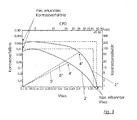
- FIG. 3 is used as a so-called metric ontrast C A cuity P roduct used (CAP).
- the shape or bending of the curves 2 ', 2 " is determined by the intersection points 4', 4" of the respective contrast sensitivity curves 2 ', 2 "with the diagonal 5', 5", which is defined by the rectangle with the vertices of maximum recognized visual acuity, minimal visual acuity (here: 0.1), minimum detected contrast, maximum contrast (here: 1.0) is defined.
- the CAP is then the product of the values of maximum detected visus of a contrast sensitivity curve 2 ', 2 ", minimum detected contrast of a contrast sensitivity curve 2', 2" and the length of the line 5 ', 5 "from the lower left corner of the displayed area to the one above described intersection 4 ', 4 "of a contrast sensitivity curve 2', 2".
Landscapes
- Life Sciences & Earth Sciences (AREA)
- Health & Medical Sciences (AREA)
- Medical Informatics (AREA)
- Biophysics (AREA)
- Ophthalmology & Optometry (AREA)
- Engineering & Computer Science (AREA)
- Biomedical Technology (AREA)
- Heart & Thoracic Surgery (AREA)
- Physics & Mathematics (AREA)
- Molecular Biology (AREA)
- Surgery (AREA)
- Animal Behavior & Ethology (AREA)
- General Health & Medical Sciences (AREA)
- Public Health (AREA)
- Veterinary Medicine (AREA)
- Eye Examination Apparatus (AREA)
- Testing, Inspecting, Measuring Of Stereoscopic Televisions And Televisions (AREA)
- Medicines Containing Antibodies Or Antigens For Use As Internal Diagnostic Agents (AREA)
- Electrochromic Elements, Electrophoresis, Or Variable Reflection Or Absorption Elements (AREA)
Description
- Die Erfindung betrifft ein Verfahren zur Durchführung eines Kontrastsehtests bei einer Testperson zur Bestimmung einer Kontrastsensitivitätsfunktion. Die Erfindung betrifft ebenfalls ein Computerprogramm zur Durchführung des Verfahrens, sowie ein Computerprogrammprodukt und einen Computer zur Ausführung des Computerprogramms.
- Bei Kontrastsehtests wird die Kontrastsehfähigkeit einer Testperson mit Hilfe einer Kontrastsensitivitätsfunktion ermittelt. Dies geschieht bei bisherigen Geräten und Messverfahren durch Messung von diskreten Visus- (d.h. Sehschärfe-) und Kontrastwerten. Als Messobjekte kommen hierbei wie beispielsweise aus der
US 5,500,699 bekannt, Landoltringe, sowie Buchstaben in bestimmten Größen mit bestimmen diskreten Kontrastswerten zum Einsatz. Außerdem werden teilweise Sinusgitter mit einer bestimmten festen Frequenz d.h. Ortsfrequenz und einem bestimmten Kontrastwert eingesetzt. - Derartige Tests werden bisher nur für sehbehinderte Personen oder zur Diagnose krankhafter Veränderungen des Sehapparates eingesetzt. Die Auswertung erfolgt üblicherweise durch Erfassen der diskreten Punkte in einem Visus-Kontrast-Schema und durch einen visuellen Vergleich verschiedener erfasster Daten.
- Auch bei normalfehlsichtigen Personen kann die individuelle Kontrastsensitivitätsfunktion über die Sehleistung bzw. über Probleme mit der Sehleistung Aufschluss geben. Für diese Gruppe von Personen sind die diskreten Abstufungen der bekannten Kontrastsehtests allerdings zu grob. Des weiteren decken die bisherigen Tests nicht den gesamten, für normalfehlsichtige Personen in Frage kommenden Kontrast- und Visusbereich ab. Bei den bisherigen Auswerteverfahren besteht zudem die Problematik, dass keine kontinuierlichen Daten digital erfasst werden, die eine automatische Weiterverarbeitung ermöglichen würden.
- Darüber hinaus existiert bisher keine aussagekräftige Metrik, mit der die Kontrastsensitivitätsfunktion beschrieben werden kann.
- In der
DE 30 09 049 ist eine Vorrichtung zum Prüfen des Sehvermögens mit einem Mittel zum Vorführen eines visuellen Zieles bzw. Bildes für eine Versuchsperson beschrieben, wobei das Bild eine Anordnung von zwei Sets von Bereichen jeweils unterschiedlicher Luminanz mit alternierender Sequenz in einer koordinierten Richtung quer zur Anordnung umfasst, und wobei ein Steuerungsmittel durch die Versuchsperson zur Veränderung des Bildkontrastes einstellbar ist. Mindestens die Bereiche eines Sets besitzen eine sich zunehmend verändernde Luminanz gegenüber der Luminanz des anderen Sets in einer anderen koordinierten Richtung quer zur Anordnung. Das Steuerungsmittel ist durch die Versuchsposition zur Änderung der Geschwindigkeit bzw. des Ausmaßes der Luminanzänderung einstellbar. - Der vorliegenden Erfindung liegt die Aufgabe zugrunde, ein Verfahren der eingangs erwähnten Art zu schaffen, das die Nachteile des Standes der Technik vermeidet und insbesondere einen aussagekräftigen Kontrastsehtest zur Bestimmung einer Kontrastsensitivitätsfunktion auch bei normalfehlsichtigen Testpersonen zur Verfügung stellt.
- Diese Aufgabe wird erfindungsgemäß durch ein Verfahren mit den Merkmalen von Anspruch 1 gelöst.
- Das vorgeschlagene Verfahren zur Durchführung eines Kontrastsehtests bei einer Testperson zur Bestimmung einer Kontrastsensitivitätsfunktion basiert auf einem kontinuierlichen Si nusgitter, bei dem sich auf der einen Achse die Frequenz des Sinusgitters kontinuierlich ändert, d.h. es ändert sich der für die Testperson zu erkennende Visus bzw. die Sehschärfe oder der zu erkennende Sehwinkel, während auf der dazu senkrechten Achse der Kontrast des Sinusgitters kontinuierlich variiert wird. Für jede Testperson gestattet der erfindungsgemäße Kontrastsehtest, ihre individuelle Kontrastsensitivitätsfunktion festzustellen. Diese Funktion ist diejenige einhüllende Kurve, unterhalb der sie noch ein Gittermuster erkennen kann. Auch bei normalfehlsichtigen Testpersonen kann in vorteilhafter Weise die individuelle Kontrastsensitivitätsfunktion bestimmt werden, denn für diese Personengruppe ist die feine kontinuierliche Auflösung des Sinusgitters ideal. Der vorgeschlagene Kontrastsehtest kann den gesamten, für normalfehlsichtige Personen in Frage kommenden Kontrast- und Visusbereich abdecken.
- Des weiteren wird ein Computerprogramm, ein Computerprogrammprodukt und ein Computer zur Ausführung des Computerprogramms vorgeschlagen, um das erfindungsgemäße Verfahren durchzuführen.
- Weitere vorteilhafte Ausgestaltungen und Weiterbildungen der Erfindung ergeben sich aus den restlichen Unteransprüchen. Nachfolgend ist anhand der Zeichnung prinzipmäßig ein Ausführungsbeispiel der Erfindung dargestellt.
- Dabei zeigen:
- Figur 1
- eine Darstellung eines kontinuierlichen Sinusgit- ters zur Verwendung bei einem erfindungsgemäßen Verfahren;
- Figur 2
- eine Darstellung des kontinuierlichen Sinusgitters gemäß
Figur 1 mit einer markierten Kontrast- sensitivitätskurve; und - Figur 3
- ein Diagramm einer Metrik zur Bewertung von zwei Kontrastsensitivitätskurven.
- Bei einem Verfahren zur Durchführung eines Kontrastsehtests bei einer Testperson zur Bestimmung einer Kontrastsensitivitätsfunktion wird der Testperson eine Abbildung eines in Figur 1 dargestellten kontinuierlichen Sinusgitters 1 zur Betrachtung angezeigt, bei welchem sich die Ortsfrequenz kontinuierlich in Richtung einer X-Achse ändert, d.h. vorliegend ausgehend von einer Y-Achse erhöht und bei welchem sich der Kontrast auf der zu der X-Achse senkrechten Y-Achse kontinuierlich ändert, d.h. vorliegend ausgehend von der X-Achse verringert. Die Kontrastsensitivitätsfunktion der Testperson wird, wie aus
Figur 2 ersichtlich, durch eine Kurve 2 definiert, die einen Bereich 3 des Sinusgitters 1 einschließt, in welchem die Testperson bei der Betrachtung das Sinusgittermuster noch wahrnehmen bzw. erkennen kann. - Die Ortsfrequenz- und/oder Kontrastbereiche des kontinuierlichen Sinusgitters 1 sind anpassbar. D.h. die Bereiche, die durch den Kontrastsehtest abgedeckt werden, können - sowohl in Visus- (X) als auch in Kontrastrichtung (Y) - den gewünschten Erfordernissen bzw. auf die Testpersonen angepasst werden.
- Das Verfahren zur Durchführung eines Kontrastsehtests bei einer Testperson zur Bestimmung einer Kontrastsensitivitätsfunktion ist in vorteilhafter Weise als Computerprogramm auf einem Computer realisiert. In weiteren Ausführungsbeispielen kann das erfindungsgemäße Verfahren selbstverständlich auch mit anderen Hilfsmitteln durchgeführt werden. Durch die Abarbeitung auf einem Mikroprozessor des Computers wird das Computerprogramm ausgeführt. Das Computerprogramm kann auf einem computerlesbaren Datenträger (Diskette, CD, DVD, Festplatte, USB-Memorystick, oder dergleichen) oder einem Internet-Server als Computerprogrammprodukt gespeichert sein und von dort aus in einen Speicher des Computers übertragen werden. Die Abbildung des kontinuierlichen Sinusgitters 1 erfolgt auf einer Anzeigevorrichtung des Computers (nicht dargestellt). Der Computer bzw. die Anzeigevorrichtung, muss hierzu gewisse Voraussetzungen erfüllen. Die Auflösung der Anzeigevorrichtung muss so beschaffen sein, dass sie die fehlerfreie Wiedergabe des Maximalfrequenz des Sinusgitters 1 erlaubt. Um zweifelsfrei helle und dunkle Linien zu erhalten, muss auf jede helle bzw. dunkle Linie eine graue Linie folgen. Um dies zu erreichen, muss die Auflösung der Anzeigevorrichtung bzw. des Wiedergabegeräts mindestens 2 mal so groß sein, wie zur Darstellung des maximalen Visus erforderlich ist. Das Kontrastverhältnis der Anzeigevorrichtung muss mindestens so groß sein, dass die gewünschte Anzahl von verschiedenen Kontraststufen mit genügender Genauigkeit dargestellt werden kann.
- Die Testperson markiert nun selbstständig die Kurve bzw. die Kontrastsensitivitätsfunktion 2 in dem Sinusgitter 1 mittels eines Eingabegeräts, insbesondere eines Zeigegeräts, bevorzugt einer Maus des Computers, wobei die markierte Kurve in dem Computer abgespeichert wird. D.h. der Proband kann seine individuelle Kontrastsensitivitätsfunktion mit der Maus oder einem anderen geeigneten Eingabegerät direkt eingeben (siehe
Figur 2 ). - Wenn die Anzeigevorrichtung des Computers oder die Abbildung des kontinuierlichen Sinusgitters 1 auf der Anzeigevorrichtung des Computers um 90 Grad zur Hauptblickrichtung der Testperson schwenkbar bzw. drehbar ist, kann sowohl die horizontale Kontrastsensitivitätsfunktion, als auch die vertikale Kontrastsensitivitätsfunktion der Testperson erfasst werden.
- Insbesondere kann über den Computer auch die minimale, die maximale und die mittlere Helligkeit des Sinusgitters 1 je nach Anforderung angepasst werden. Des weiteren kann die Grundfarbe auf die jeweiligen Erfordernisse angepasst werden. Vorliegend ist das Sinusgitter als Graustufengitter 1 ausgebildet. Denkbar sind beispielsweise auch Sinusgitter mit verschiedenen Rot-, Blau- oder Grüntönen, sowie weitere Farbvarianten.
- Somit kann für jede Gebrauchs- bzw. Umgebungsbedingung (Umgebungshelligkeit, Grundhelligkeit des Kontrastsehtests, Blendung, verschiedene Sehhilfen oder dergleichen) ein Kontrastsehtest durchgeführt werden. Durch mehrfaches Durchführen des Kontrastsehtests bei vorgegebenen Umgebungsbedingungen und durch eine kontinuierliche Aufnahme von Daten, kann über statistische Methoden die individuelle Kontrastsensitivitätsfunktion der Testperson ermittelt werden. Durch Anbringen einer geeigneten Beleuchtung in der Nähe bzw. im Bereich der Anzeigevorrichtung kann der Kontrastsehtest auch unter Blendbedingungen durchgeführt werden.
- Auf die Kontrastsensitivitätsfunktion können dann verschiedene Metriken angewandt werden, um die Kurve zu bewerten oder um verschiedene Kurven zu vergleichen. Geläufige Metriken sind beispielsweise der maximale Visus, der minimale Kontrast oder die Fläche unter der Kontrastsensitivitätskurve 2.
- In
Figur 3 wird als Metrik ein sogenanntes Contrast Acuity Produkt (CAP) verwendet. Dabei sind zwei Kontrastsensitivitätsfunktionen 2', 2 " vergleichend dargestellt. Im Diagramm sind Kontrastverhältnis (linke, vertikale Skala), Visus (untere, horizontale Skala), Kontrastsensitivität (rechte, vertikale Skala) und CPD, Cycles per Degree (obere, horizontale Skala) logarithmisch dargestellt. In die Berechnung des CAP gehen ein maximaler erkannter Visus, ein minimales erkanntes Kontrastverhältnis und eine Form bzw. eine Durchbiegung der Kontrastsensitivitätskurven 2', 2" multiplikativ ein. Die Form bzw. das Durchbiegen der Kurven 2', 2" wird durch die Schnittpunkte 4', 4" der jeweiligen Kontrastsensitivitätskurven 2', 2" mit der Diagonalen 5', 5" , die durch das Rechteck mit den Eckpunkten maximaler erkannter Visus, minimaler Visus (hier: 0,1), minimaler erkannter Kontrast, maximaler Kontrast (hier: 1,0) beschrieben wird, definiert. - Das CAP ist dann das Produkt der Werte maximaler erkannter Visus einer Kontrastsensitivitätskurve 2', 2", minimaler erkannter Kontrast einer Kontrastsensitivitätskurve 2', 2" und der Länge der Geraden 5', 5" von der linken unteren Ecke des dargestellten Bereiches zu dem oben beschriebenen Schnittpunkt 4', 4" einer Kontrastsensitivitätskurve 2', 2".
Claims (14)
- Verfahren zur Durchführung eines Kontrastsehtests bei einer Testperson zur Bestimmung einer Kontrastsensitivitätsfunktion, wobei der Testperson eine Abbildung eines kontinuierlichen Sinusgitters (1) zur Betrachtung angezeigt wird, bei welchem sich die Ortsfrequenz kontinuierlich in Richtung einer ersten Achse (X) ändert und bei welchem sich der Kontrast in Richtung einer zu der ersten Achse (X) senkrechten zweiten Achse (Y) kontinuierlich ändert, wobei die Kontrastsensitivitätsfunktion der Testperson durch eine Kurve (2) definiert wird, die einen Bereich (3) des Sinusgitters (1) einschließt, in welchem die Testperson bei der Betrachtung das Sinusgittermuster wahrnimmt, gekennzeichnet dadurch dass erfasste Kurven (2', 2") mit einer geeigneten Metrik bewertet bzw. verglichen werden, wobei ein maximaler erkannter Visus, ein minimales erkanntes Kontrastverhältnis und eine Form der Kontrastsensitivitätskurve in die Bewertung mit einbezogen werden.
- Verfahren nach Anspruch 1, dadurch gekennzeichnet, dass sich die Ortsfrequenz des Sinusgitters (1) ausgehend von der zweiten Achse (Y) kontinuierlich in Richtung der ersten Achse (X) erhöht und sich der Kontrast des Sinusgitters ausgehend von der ersten Achse (X) kontinuierlich in Richtung der zweiten Achse (Y) verringert.
- Verfahren nach Anspruch 1 oder 2, dadurch gekennzeichnet, dass die Ortsfrequenz- und/oder Kontrastbereiche des kontinuierlichen Sinusgitters (1) anpassbar sind.
- Verfahren nach Anspruch 1, 2 oder 3, dadurch gekennzeichnet, dass der Kontrastsehtest auf einem Computer durchgeführt wird und die Abbildung des kontinuierlichen Sinusgitters (1) auf einer Anzeigevorrichtung des Computers erfolgt.
- Verfahren nach Anspruch 4, dadurch gekennzeichnet, dass die Abbildung des kontinuierlichen Sinusgitters (1) auf der Anzeigevorrichtung des Computers um 90 Grad zur Hauptblickrichtung der Testperson schwenkbar ausgebildet wird.
- Verfahren nach einem der Ansprüche 1 bis 5, dadurch gekennzeichnet, dass der Kontrastsehtest mehrfach, insbesondere unter vorgegebenen Umgebungsbedingungen durchgeführt wird, wobei die Kontrastsensitivitätskurven aufgezeichnet werden.
- Verfahren nach einem der Ansprüche 1 bis 6, dadurch gekennzeichnet, dass der Kontrastsehtest unter Blendbedingungen durchgeführt wird.
- Verfahren nach einem der Ansprüche 4 bis 7, dadurch gekennzeichnet, dass die Testperson selbstständig die Kurve bzw. die Kontrastsensitivitätsfunktion mittels eines Eingabegeräts des Computers auf der Anzeigevorrichtung markiert, wobei die markierte Kurve (2) in dem Computer abgespeichert wird.
- Computerprogramm mit Programmcodemitteln, um alle Schritte von jedem beliebigen der Ansprüche 1 bis 7 durchzuführen, wenn das Programm auf einem Computer ausgeführt wird.
- Computerprogrammprodukt mit Programmcodemitteln, die auf einem computerlesbaren Datenträger gespeichert sind, um alle Schritte von jedem beliebigen der Ansprüche 1 bis 7 durchzuführen, wenn das Programmprodukt auf einem Computer ausgeführt wird.
- Computerprogramm nach Anspruch 9 oder Computerprogrammprodukt nach Anspruch 10, dadurch gekennzeichnet, dass eine durch die Testperson mittels eines Eingabegeräts des Computers auf der Anzeigevorrichtung markierte Kurve in dem Computer abgespeichert wird.
- Computer mit einer Anzeigevorrichtung und einem Eingabegerät, eingerichtet zur Ausführung des Computerprogramms gemäß Anspruch 9 oder 11.
- Computer nach Anspruch 12, dadurch gekennzeichnet, dass die Anzeigevorrichtung um 90 Grad zur Hauptblickrichtung der Testperson schwenkbar ist.
- Computer nach Anspruch 12 oder 13, dadurch gekennzeichnet, dass eine Beleuchtungseinrichtung im Bereich der Anzeigevorrichtung angeordnet ist.
Applications Claiming Priority (2)
| Application Number | Priority Date | Filing Date | Title |
|---|---|---|---|
| DE102004055754A DE102004055754B4 (de) | 2004-11-19 | 2004-11-19 | Verfahren zur Durchführung eines Kontrastsehtests |
| PCT/EP2005/009735 WO2006056252A1 (de) | 2004-11-19 | 2005-09-10 | Verfahren zur durchführung eines kontrastsehtests |
Publications (2)
| Publication Number | Publication Date |
|---|---|
| EP1827202A1 EP1827202A1 (de) | 2007-09-05 |
| EP1827202B1 true EP1827202B1 (de) | 2011-03-23 |
Family
ID=35285524
Family Applications (1)
| Application Number | Title | Priority Date | Filing Date |
|---|---|---|---|
| EP05786366A Expired - Lifetime EP1827202B1 (de) | 2004-11-19 | 2005-09-10 | Verfahren zur durchführung eines kontrastsehtests |
Country Status (6)
| Country | Link |
|---|---|
| US (1) | US7771052B2 (de) |
| EP (1) | EP1827202B1 (de) |
| JP (1) | JP4954082B2 (de) |
| AT (1) | ATE502563T1 (de) |
| DE (2) | DE102004055754B4 (de) |
| WO (1) | WO2006056252A1 (de) |
Cited By (1)
| Publication number | Priority date | Publication date | Assignee | Title |
|---|---|---|---|---|
| DE102012014399A1 (de) | 2012-07-20 | 2014-05-15 | Carl Zeiss Vision International Gmbh | Vorrichtung zum Ermitteln und Ausgeben eines für einen Brillenträger geeigneten Brillenlinsentyp |
Families Citing this family (15)
| Publication number | Priority date | Publication date | Assignee | Title |
|---|---|---|---|---|
| DE102008041458B4 (de) | 2008-08-22 | 2012-11-08 | Carl Zeiss Vision Gmbh | Verfahren und Vorrichtung zur Bestimmung der neuronalen Kontrastempfindlichkeit |
| DE102010055185B4 (de) | 2010-12-20 | 2019-09-05 | Carl Zeiss Vision International Gmbh | Vorrichtung mit einer Brillenlinse mit veränderbarer Wirkung sowie Verfahren zum Einstellen der Wirkung einer Brillenlinse |
| WO2013170091A1 (en) * | 2012-05-09 | 2013-11-14 | The Schepens Eye Research Institute, Inc. | Rapid measurement of visual sensitivity |
| DE102012022662A1 (de) * | 2012-11-21 | 2014-05-22 | Friedrich-Alexander-Universität Erlangen-Nürnberg | Vorrichtung und Verfahren zur Überprüfung der menschlichen Sehfähigkeit |
| GB2514529A (en) * | 2013-01-17 | 2014-12-03 | Univ Aston | Visual function testing device |
| US10357151B2 (en) | 2014-05-02 | 2019-07-23 | Ohio State Innovation Foundation | Method of identifying and eye disorder of an observer and apparatus for implementing the same |
| DE102015116110A1 (de) * | 2015-09-23 | 2017-03-23 | Carl Zeiss Vision International Gmbh | Verfahren und System zur Bestimmung der subjektiven Refraktionseigenschaften eines Auges |
| US9894475B2 (en) | 2015-10-20 | 2018-02-13 | Perfect Sense, Inc. | Micro-location monitoring techniques |
| US10448821B2 (en) | 2015-10-20 | 2019-10-22 | Denise A. Valenti | Method and device for detection and assessment of marijuana impairment |
| JP6753228B2 (ja) * | 2016-09-05 | 2020-09-09 | 株式会社ニデック | レンズ処方補助プログラム |
| JP6919141B2 (ja) * | 2017-05-10 | 2021-08-18 | 公益社団法人ネクストビジョン | 視覚ダイナミックレンジ計測装置及び方法 |
| US10413172B2 (en) | 2017-12-11 | 2019-09-17 | 1-800 Contacts, Inc. | Digital visual acuity eye examination for remote physician assessment |
| US20220304568A1 (en) * | 2019-09-02 | 2022-09-29 | Nippon Telegraph And Telephone Corporation | Contrast sensitivity measurement apparatus, contrast sensitivity measurement method, and program |
| JP7239004B2 (ja) * | 2019-09-02 | 2023-03-14 | 日本電信電話株式会社 | 画像生成装置、画像生成方法、およびプログラム |
| CN115251822B (zh) * | 2022-07-14 | 2023-08-18 | 中山大学中山眼科中心 | 一种基于神经网络的对比敏感度快速测量方法 |
Family Cites Families (13)
| Publication number | Priority date | Publication date | Assignee | Title |
|---|---|---|---|---|
| DE3009049A1 (de) * | 1979-03-12 | 1980-09-18 | John Spencer Dobson | Vorrichtung zum pruefen des sehvermoegens |
| JPS577535A (en) * | 1980-06-18 | 1982-01-14 | Takagi Seisakusho:Kk | Measurement of space frequency characteristics in vision system |
| US4511228A (en) * | 1982-07-29 | 1985-04-16 | The United States Of America As Represented By The Secretary Of The Air Force | Measurement of visual contrast sensitivity |
| US5414479A (en) * | 1990-12-17 | 1995-05-09 | Ginsburg; Arthur P. | Spatial frequency and contrast sensitivity test chart and protocol |
| JPH06165754A (ja) * | 1992-11-28 | 1994-06-14 | Canon Inc | 眼科装置 |
| US5589897A (en) * | 1995-05-01 | 1996-12-31 | Stephen H. Sinclair | Method and apparatus for central visual field mapping and optimization of image presentation based upon mapped parameters |
| JP3129404B2 (ja) * | 1997-06-19 | 2001-01-29 | 株式会社タカギセイコー | グレアコントラストテスタ |
| JP2002209851A (ja) * | 2001-01-24 | 2002-07-30 | Canon Inc | 検眼装置 |
| US7057615B2 (en) * | 2001-06-28 | 2006-06-06 | Microsoft Corporation | Method and system for representing and displaying digital ink |
| JP3782734B2 (ja) * | 2002-01-10 | 2006-06-07 | 株式会社トプコン | コントラスト感度測定装置、コントラスト感度測定方法 |
| US6755529B2 (en) * | 2002-03-12 | 2004-06-29 | Visionrx, Inc. | Method and apparatus for measuring contrast sensitivity |
| JP4018007B2 (ja) * | 2003-03-11 | 2007-12-05 | シャープ株式会社 | 液晶表示装置 |
| WO2005044096A2 (en) * | 2003-11-05 | 2005-05-19 | Neurovision, Inc. | Method for improving visual perception |
-
2004
- 2004-11-19 DE DE102004055754A patent/DE102004055754B4/de not_active Expired - Lifetime
-
2005
- 2005-09-10 AT AT05786366T patent/ATE502563T1/de active
- 2005-09-10 DE DE502005011175T patent/DE502005011175D1/de not_active Expired - Lifetime
- 2005-09-10 WO PCT/EP2005/009735 patent/WO2006056252A1/de not_active Ceased
- 2005-09-10 JP JP2007541709A patent/JP4954082B2/ja not_active Expired - Lifetime
- 2005-09-10 US US11/719,421 patent/US7771052B2/en not_active Expired - Lifetime
- 2005-09-10 EP EP05786366A patent/EP1827202B1/de not_active Expired - Lifetime
Cited By (2)
| Publication number | Priority date | Publication date | Assignee | Title |
|---|---|---|---|---|
| DE102012014399A1 (de) | 2012-07-20 | 2014-05-15 | Carl Zeiss Vision International Gmbh | Vorrichtung zum Ermitteln und Ausgeben eines für einen Brillenträger geeigneten Brillenlinsentyp |
| EP3539459A1 (de) | 2012-07-20 | 2019-09-18 | Carl Zeiss Vision International GmbH | Vorrichtung und verfahren zur ermittlung eines brillenglastyps sowie vorrichtung und verfahren zur bestimmung einer brechkraftverteilung eines gleitsichtbrillenglases |
Also Published As
| Publication number | Publication date |
|---|---|
| WO2006056252A1 (de) | 2006-06-01 |
| JP4954082B2 (ja) | 2012-06-13 |
| ATE502563T1 (de) | 2011-04-15 |
| US7771052B2 (en) | 2010-08-10 |
| US20080137037A1 (en) | 2008-06-12 |
| JP2008520296A (ja) | 2008-06-19 |
| DE102004055754A1 (de) | 2006-05-24 |
| DE502005011175D1 (de) | 2011-05-05 |
| DE102004055754B4 (de) | 2012-09-13 |
| EP1827202A1 (de) | 2007-09-05 |
Similar Documents
| Publication | Publication Date | Title |
|---|---|---|
| DE102004055754B4 (de) | Verfahren zur Durchführung eines Kontrastsehtests | |
| EP2697729B1 (de) | Verfahren und system zur unterstützung der diagnose eines wenigstens eine störung aufweisenden objektes | |
| EP3930563A1 (de) | Verfahren zur evaluierung von hautläsionen unter verwendung künstlicher intelligenz | |
| EP3160326B1 (de) | Verfahren für eine sehschärfebestimmung | |
| DE102009023722A1 (de) | Verfahren zur Ermittlung und Bewertung des Tragbilds von Zahnrädern | |
| DE102005031245A1 (de) | Verfahren zum Test eines klinischen und/oder medizintechnischen Systems und Verfahren zur Steuerung medizintechnischer Untersuchungsabläufe in einem klinischen und/oder medizintechnischen System | |
| DE102011076776A1 (de) | Verfahren zu einer Bilddatenaufnahme | |
| DE102018205561A1 (de) | Vorrichtung zur Klassifizierung von Signalen | |
| DE102020210549A1 (de) | Prüfsystem und Prüfverfahren für Scheibenwischer | |
| EP2243419B1 (de) | Integrale und differentiale visuelle Objekte zur Erhebung und Optimierung des Sehvermögens | |
| DE112010005480T5 (de) | Bild zeichnende Vorrichtung und Bild zeichnendes Verfahren | |
| EP3259736B1 (de) | Vorrichtung und verfahren zum kamerabasierten berechnen eines längenverhältnisses von fingern einer hand | |
| DE102007057015A1 (de) | Verfahren und Anzeigevorrichtung zur Darstellung digitaler Mammogramme | |
| EP4014845B1 (de) | Ausgabeeinrichtung zum ausgeben eines zeitlichen messwertverlaufs | |
| DE102021209296B4 (de) | Verfahren zum Bestimmen der Bewegung eines mit wenigstens einer Videokamera zur Bilderfassung ausgestatteten Objekts | |
| WO2011067249A1 (de) | Verfahren und vorrichtung zur anpassung von bildinformationen eines optischen systems | |
| AT503741B1 (de) | Verfahren zur analytischen erfassung einer macula degeneration | |
| DE102019126455A1 (de) | Informationsverarbeitungsvorrichtung und ein Programm enthaltendes computerlesbares Aufzeichnungsmedium | |
| EP3830752B1 (de) | Verfahren und vorrichtung zum ermitteln einer erklärungskarte | |
| DE102019109291B4 (de) | Verfahren zum Kompensieren von Bewegungen einer mobilen Anzeigevorrichtung und Computerprogrammprodukt zum Durchführen eines derartigen Verfahrens | |
| DE102024101961A1 (de) | Verfahren zur Darstellung einer virtuellen Komponente an einem realen Objekt sowie Referenzobjekt | |
| DE102023200431A1 (de) | Verfahren zur Bestimmung der Einsatzfähigkeit eines Rades | |
| Kolter | Characteristics of chronic depression before, during and after inpatient treatment | |
| DE102024200321A1 (de) | Verfahren und Vorrichtung zur Überwachung eines Anomalie-Scores in der Halbleiterfertigung | |
| DE102015107474B4 (de) | Verfahren zum Bestimmen einer individuellen Schärfe eines Bildes einer Iris und Verfahren zur Personenprüfung |
Legal Events
| Date | Code | Title | Description |
|---|---|---|---|
| PUAI | Public reference made under article 153(3) epc to a published international application that has entered the european phase |
Free format text: ORIGINAL CODE: 0009012 |
|
| 17P | Request for examination filed |
Effective date: 20070526 |
|
| AK | Designated contracting states |
Kind code of ref document: A1 Designated state(s): AT BE BG CH CY CZ DE DK EE ES FI FR GB GR HU IE IS IT LI LT LU LV MC NL PL PT RO SE SI SK TR |
|
| DAX | Request for extension of the european patent (deleted) | ||
| GRAP | Despatch of communication of intention to grant a patent |
Free format text: ORIGINAL CODE: EPIDOSNIGR1 |
|
| GRAS | Grant fee paid |
Free format text: ORIGINAL CODE: EPIDOSNIGR3 |
|
| GRAA | (expected) grant |
Free format text: ORIGINAL CODE: 0009210 |
|
| AK | Designated contracting states |
Kind code of ref document: B1 Designated state(s): AT BE BG CH CY CZ DE DK EE ES FI FR GB GR HU IE IS IT LI LT LU LV MC NL PL PT RO SE SI SK TR |
|
| REG | Reference to a national code |
Ref country code: GB Ref legal event code: FG4D Free format text: NOT ENGLISH |
|
| REG | Reference to a national code |
Ref country code: CH Ref legal event code: EP |
|
| REG | Reference to a national code |
Ref country code: IE Ref legal event code: FG4D |
|
| REF | Corresponds to: |
Ref document number: 502005011175 Country of ref document: DE Date of ref document: 20110505 Kind code of ref document: P |
|
| REG | Reference to a national code |
Ref country code: DE Ref legal event code: R096 Ref document number: 502005011175 Country of ref document: DE Effective date: 20110505 |
|
| REG | Reference to a national code |
Ref country code: NL Ref legal event code: VDEP Effective date: 20110323 |
|
| PG25 | Lapsed in a contracting state [announced via postgrant information from national office to epo] |
Ref country code: LT Free format text: LAPSE BECAUSE OF FAILURE TO SUBMIT A TRANSLATION OF THE DESCRIPTION OR TO PAY THE FEE WITHIN THE PRESCRIBED TIME-LIMIT Effective date: 20110323 Ref country code: SE Free format text: LAPSE BECAUSE OF FAILURE TO SUBMIT A TRANSLATION OF THE DESCRIPTION OR TO PAY THE FEE WITHIN THE PRESCRIBED TIME-LIMIT Effective date: 20110323 Ref country code: GR Free format text: LAPSE BECAUSE OF FAILURE TO SUBMIT A TRANSLATION OF THE DESCRIPTION OR TO PAY THE FEE WITHIN THE PRESCRIBED TIME-LIMIT Effective date: 20110624 Ref country code: LV Free format text: LAPSE BECAUSE OF FAILURE TO SUBMIT A TRANSLATION OF THE DESCRIPTION OR TO PAY THE FEE WITHIN THE PRESCRIBED TIME-LIMIT Effective date: 20110323 |
|
| LTIE | Lt: invalidation of european patent or patent extension |
Effective date: 20110323 |
|
| PG25 | Lapsed in a contracting state [announced via postgrant information from national office to epo] |
Ref country code: FI Free format text: LAPSE BECAUSE OF FAILURE TO SUBMIT A TRANSLATION OF THE DESCRIPTION OR TO PAY THE FEE WITHIN THE PRESCRIBED TIME-LIMIT Effective date: 20110323 Ref country code: CY Free format text: LAPSE BECAUSE OF FAILURE TO SUBMIT A TRANSLATION OF THE DESCRIPTION OR TO PAY THE FEE WITHIN THE PRESCRIBED TIME-LIMIT Effective date: 20110323 Ref country code: SI Free format text: LAPSE BECAUSE OF FAILURE TO SUBMIT A TRANSLATION OF THE DESCRIPTION OR TO PAY THE FEE WITHIN THE PRESCRIBED TIME-LIMIT Effective date: 20110323 Ref country code: BG Free format text: LAPSE BECAUSE OF FAILURE TO SUBMIT A TRANSLATION OF THE DESCRIPTION OR TO PAY THE FEE WITHIN THE PRESCRIBED TIME-LIMIT Effective date: 20110623 |
|
| REG | Reference to a national code |
Ref country code: IE Ref legal event code: FD4D |
|
| PG25 | Lapsed in a contracting state [announced via postgrant information from national office to epo] |
Ref country code: EE Free format text: LAPSE BECAUSE OF FAILURE TO SUBMIT A TRANSLATION OF THE DESCRIPTION OR TO PAY THE FEE WITHIN THE PRESCRIBED TIME-LIMIT Effective date: 20110323 Ref country code: PT Free format text: LAPSE BECAUSE OF FAILURE TO SUBMIT A TRANSLATION OF THE DESCRIPTION OR TO PAY THE FEE WITHIN THE PRESCRIBED TIME-LIMIT Effective date: 20110725 |
|
| PG25 | Lapsed in a contracting state [announced via postgrant information from national office to epo] |
Ref country code: IS Free format text: LAPSE BECAUSE OF FAILURE TO SUBMIT A TRANSLATION OF THE DESCRIPTION OR TO PAY THE FEE WITHIN THE PRESCRIBED TIME-LIMIT Effective date: 20110723 Ref country code: SK Free format text: LAPSE BECAUSE OF FAILURE TO SUBMIT A TRANSLATION OF THE DESCRIPTION OR TO PAY THE FEE WITHIN THE PRESCRIBED TIME-LIMIT Effective date: 20110323 Ref country code: RO Free format text: LAPSE BECAUSE OF FAILURE TO SUBMIT A TRANSLATION OF THE DESCRIPTION OR TO PAY THE FEE WITHIN THE PRESCRIBED TIME-LIMIT Effective date: 20110323 Ref country code: ES Free format text: LAPSE BECAUSE OF FAILURE TO SUBMIT A TRANSLATION OF THE DESCRIPTION OR TO PAY THE FEE WITHIN THE PRESCRIBED TIME-LIMIT Effective date: 20110704 Ref country code: CZ Free format text: LAPSE BECAUSE OF FAILURE TO SUBMIT A TRANSLATION OF THE DESCRIPTION OR TO PAY THE FEE WITHIN THE PRESCRIBED TIME-LIMIT Effective date: 20110323 |
|
| PG25 | Lapsed in a contracting state [announced via postgrant information from national office to epo] |
Ref country code: NL Free format text: LAPSE BECAUSE OF FAILURE TO SUBMIT A TRANSLATION OF THE DESCRIPTION OR TO PAY THE FEE WITHIN THE PRESCRIBED TIME-LIMIT Effective date: 20110323 |
|
| PLBE | No opposition filed within time limit |
Free format text: ORIGINAL CODE: 0009261 |
|
| STAA | Information on the status of an ep patent application or granted ep patent |
Free format text: STATUS: NO OPPOSITION FILED WITHIN TIME LIMIT |
|
| PG25 | Lapsed in a contracting state [announced via postgrant information from national office to epo] |
Ref country code: IE Free format text: LAPSE BECAUSE OF FAILURE TO SUBMIT A TRANSLATION OF THE DESCRIPTION OR TO PAY THE FEE WITHIN THE PRESCRIBED TIME-LIMIT Effective date: 20110323 |
|
| 26N | No opposition filed |
Effective date: 20111227 |
|
| PG25 | Lapsed in a contracting state [announced via postgrant information from national office to epo] |
Ref country code: DK Free format text: LAPSE BECAUSE OF FAILURE TO SUBMIT A TRANSLATION OF THE DESCRIPTION OR TO PAY THE FEE WITHIN THE PRESCRIBED TIME-LIMIT Effective date: 20110323 Ref country code: PL Free format text: LAPSE BECAUSE OF FAILURE TO SUBMIT A TRANSLATION OF THE DESCRIPTION OR TO PAY THE FEE WITHIN THE PRESCRIBED TIME-LIMIT Effective date: 20110323 |
|
| BERE | Be: lapsed |
Owner name: CARL ZEISS VISION G.M.B.H. Effective date: 20110930 |
|
| REG | Reference to a national code |
Ref country code: DE Ref legal event code: R097 Ref document number: 502005011175 Country of ref document: DE Effective date: 20111227 |
|
| PG25 | Lapsed in a contracting state [announced via postgrant information from national office to epo] |
Ref country code: MC Free format text: LAPSE BECAUSE OF NON-PAYMENT OF DUE FEES Effective date: 20110930 |
|
| REG | Reference to a national code |
Ref country code: CH Ref legal event code: PL |
|
| PG25 | Lapsed in a contracting state [announced via postgrant information from national office to epo] |
Ref country code: IT Free format text: LAPSE BECAUSE OF FAILURE TO SUBMIT A TRANSLATION OF THE DESCRIPTION OR TO PAY THE FEE WITHIN THE PRESCRIBED TIME-LIMIT Effective date: 20110323 |
|
| PG25 | Lapsed in a contracting state [announced via postgrant information from national office to epo] |
Ref country code: BE Free format text: LAPSE BECAUSE OF NON-PAYMENT OF DUE FEES Effective date: 20110930 |
|
| PG25 | Lapsed in a contracting state [announced via postgrant information from national office to epo] |
Ref country code: CH Free format text: LAPSE BECAUSE OF NON-PAYMENT OF DUE FEES Effective date: 20110930 Ref country code: LI Free format text: LAPSE BECAUSE OF NON-PAYMENT OF DUE FEES Effective date: 20110930 |
|
| REG | Reference to a national code |
Ref country code: AT Ref legal event code: MM01 Ref document number: 502563 Country of ref document: AT Kind code of ref document: T Effective date: 20110910 |
|
| PG25 | Lapsed in a contracting state [announced via postgrant information from national office to epo] |
Ref country code: AT Free format text: LAPSE BECAUSE OF NON-PAYMENT OF DUE FEES Effective date: 20110910 |
|
| PG25 | Lapsed in a contracting state [announced via postgrant information from national office to epo] |
Ref country code: LU Free format text: LAPSE BECAUSE OF NON-PAYMENT OF DUE FEES Effective date: 20110910 |
|
| PG25 | Lapsed in a contracting state [announced via postgrant information from national office to epo] |
Ref country code: TR Free format text: LAPSE BECAUSE OF FAILURE TO SUBMIT A TRANSLATION OF THE DESCRIPTION OR TO PAY THE FEE WITHIN THE PRESCRIBED TIME-LIMIT Effective date: 20110323 |
|
| PG25 | Lapsed in a contracting state [announced via postgrant information from national office to epo] |
Ref country code: HU Free format text: LAPSE BECAUSE OF FAILURE TO SUBMIT A TRANSLATION OF THE DESCRIPTION OR TO PAY THE FEE WITHIN THE PRESCRIBED TIME-LIMIT Effective date: 20110323 |
|
| REG | Reference to a national code |
Ref country code: FR Ref legal event code: PLFP Year of fee payment: 12 |
|
| REG | Reference to a national code |
Ref country code: FR Ref legal event code: PLFP Year of fee payment: 13 |
|
| REG | Reference to a national code |
Ref country code: FR Ref legal event code: PLFP Year of fee payment: 14 |
|
| PGFP | Annual fee paid to national office [announced via postgrant information from national office to epo] |
Ref country code: DE Payment date: 20240918 Year of fee payment: 20 |
|
| PGFP | Annual fee paid to national office [announced via postgrant information from national office to epo] |
Ref country code: GB Payment date: 20240919 Year of fee payment: 20 |
|
| PGFP | Annual fee paid to national office [announced via postgrant information from national office to epo] |
Ref country code: FR Payment date: 20240924 Year of fee payment: 20 |
|
| REG | Reference to a national code |
Ref country code: DE Ref legal event code: R071 Ref document number: 502005011175 Country of ref document: DE |
|
| REG | Reference to a national code |
Ref country code: GB Ref legal event code: PE20 Expiry date: 20250909 |