EP1824656B1 - Heat formed tpv co-extruded header trim - Google Patents
Heat formed tpv co-extruded header trim Download PDFInfo
- Publication number
- EP1824656B1 EP1824656B1 EP05813071A EP05813071A EP1824656B1 EP 1824656 B1 EP1824656 B1 EP 1824656B1 EP 05813071 A EP05813071 A EP 05813071A EP 05813071 A EP05813071 A EP 05813071A EP 1824656 B1 EP1824656 B1 EP 1824656B1
- Authority
- EP
- European Patent Office
- Prior art keywords
- tpv
- upper reveal
- carrier
- reveal
- window opening
- Prior art date
- Legal status (The legal status is an assumption and is not a legal conclusion. Google has not performed a legal analysis and makes no representation as to the accuracy of the status listed.)
- Expired - Lifetime
Links
Images


Classifications
-
- B—PERFORMING OPERATIONS; TRANSPORTING
- B29—WORKING OF PLASTICS; WORKING OF SUBSTANCES IN A PLASTIC STATE IN GENERAL
- B29C—SHAPING OR JOINING OF PLASTICS; SHAPING OF MATERIAL IN A PLASTIC STATE, NOT OTHERWISE PROVIDED FOR; AFTER-TREATMENT OF THE SHAPED PRODUCTS, e.g. REPAIRING
- B29C35/00—Heating, cooling or curing, e.g. crosslinking or vulcanising; Apparatus therefor
- B29C35/02—Heating or curing, e.g. crosslinking or vulcanizing during moulding, e.g. in a mould
- B29C35/04—Heating or curing, e.g. crosslinking or vulcanizing during moulding, e.g. in a mould using liquids, gas or steam
- B29C35/06—Heating or curing, e.g. crosslinking or vulcanizing during moulding, e.g. in a mould using liquids, gas or steam for articles of indefinite length
-
- B—PERFORMING OPERATIONS; TRANSPORTING
- B29—WORKING OF PLASTICS; WORKING OF SUBSTANCES IN A PLASTIC STATE IN GENERAL
- B29C—SHAPING OR JOINING OF PLASTICS; SHAPING OF MATERIAL IN A PLASTIC STATE, NOT OTHERWISE PROVIDED FOR; AFTER-TREATMENT OF THE SHAPED PRODUCTS, e.g. REPAIRING
- B29C35/00—Heating, cooling or curing, e.g. crosslinking or vulcanising; Apparatus therefor
- B29C35/18—Cold vulcanisation
-
- B—PERFORMING OPERATIONS; TRANSPORTING
- B29—WORKING OF PLASTICS; WORKING OF SUBSTANCES IN A PLASTIC STATE IN GENERAL
- B29C—SHAPING OR JOINING OF PLASTICS; SHAPING OF MATERIAL IN A PLASTIC STATE, NOT OTHERWISE PROVIDED FOR; AFTER-TREATMENT OF THE SHAPED PRODUCTS, e.g. REPAIRING
- B29C48/00—Extrusion moulding, i.e. expressing the moulding material through a die or nozzle which imparts the desired form; Apparatus therefor
- B29C48/03—Extrusion moulding, i.e. expressing the moulding material through a die or nozzle which imparts the desired form; Apparatus therefor characterised by the shape of the extruded material at extrusion
- B29C48/12—Articles with an irregular circumference when viewed in cross-section, e.g. window profiles
-
- B—PERFORMING OPERATIONS; TRANSPORTING
- B29—WORKING OF PLASTICS; WORKING OF SUBSTANCES IN A PLASTIC STATE IN GENERAL
- B29C—SHAPING OR JOINING OF PLASTICS; SHAPING OF MATERIAL IN A PLASTIC STATE, NOT OTHERWISE PROVIDED FOR; AFTER-TREATMENT OF THE SHAPED PRODUCTS, e.g. REPAIRING
- B29C48/00—Extrusion moulding, i.e. expressing the moulding material through a die or nozzle which imparts the desired form; Apparatus therefor
- B29C48/15—Extrusion moulding, i.e. expressing the moulding material through a die or nozzle which imparts the desired form; Apparatus therefor incorporating preformed parts or layers, e.g. extrusion moulding around inserts
-
- B—PERFORMING OPERATIONS; TRANSPORTING
- B29—WORKING OF PLASTICS; WORKING OF SUBSTANCES IN A PLASTIC STATE IN GENERAL
- B29D—PRODUCING PARTICULAR ARTICLES FROM PLASTICS OR FROM SUBSTANCES IN A PLASTIC STATE
- B29D99/00—Subject matter not provided for in other groups of this subclass
- B29D99/0053—Producing sealings
-
- B—PERFORMING OPERATIONS; TRANSPORTING
- B60—VEHICLES IN GENERAL
- B60J—WINDOWS, WINDSCREENS, NON-FIXED ROOFS, DOORS, OR SIMILAR DEVICES FOR VEHICLES; REMOVABLE EXTERNAL PROTECTIVE COVERINGS SPECIALLY ADAPTED FOR VEHICLES
- B60J10/00—Sealing arrangements
- B60J10/30—Sealing arrangements characterised by the fastening means
-
- B—PERFORMING OPERATIONS; TRANSPORTING
- B60—VEHICLES IN GENERAL
- B60J—WINDOWS, WINDSCREENS, NON-FIXED ROOFS, DOORS, OR SIMILAR DEVICES FOR VEHICLES; REMOVABLE EXTERNAL PROTECTIVE COVERINGS SPECIALLY ADAPTED FOR VEHICLES
- B60J10/00—Sealing arrangements
- B60J10/70—Sealing arrangements specially adapted for windows or windscreens
- B60J10/74—Sealing arrangements specially adapted for windows or windscreens for sliding window panes, e.g. sash guides
-
- B—PERFORMING OPERATIONS; TRANSPORTING
- B60—VEHICLES IN GENERAL
- B60J—WINDOWS, WINDSCREENS, NON-FIXED ROOFS, DOORS, OR SIMILAR DEVICES FOR VEHICLES; REMOVABLE EXTERNAL PROTECTIVE COVERINGS SPECIALLY ADAPTED FOR VEHICLES
- B60J10/00—Sealing arrangements
- B60J10/70—Sealing arrangements specially adapted for windows or windscreens
- B60J10/74—Sealing arrangements specially adapted for windows or windscreens for sliding window panes, e.g. sash guides
- B60J10/79—Sealing arrangements specially adapted for windows or windscreens for sliding window panes, e.g. sash guides for flush-glass windows, i.e. for windows flush with the vehicle body or the window frame
-
- B—PERFORMING OPERATIONS; TRANSPORTING
- B60—VEHICLES IN GENERAL
- B60J—WINDOWS, WINDSCREENS, NON-FIXED ROOFS, DOORS, OR SIMILAR DEVICES FOR VEHICLES; REMOVABLE EXTERNAL PROTECTIVE COVERINGS SPECIALLY ADAPTED FOR VEHICLES
- B60J10/00—Sealing arrangements
- B60J10/80—Sealing arrangements specially adapted for opening panels, e.g. doors
- B60J10/86—Sealing arrangements specially adapted for opening panels, e.g. doors arranged on the opening panel
- B60J10/88—Sealing arrangements specially adapted for opening panels, e.g. doors arranged on the opening panel mounted on, or integral with, the glass-run seals
-
- B—PERFORMING OPERATIONS; TRANSPORTING
- B29—WORKING OF PLASTICS; WORKING OF SUBSTANCES IN A PLASTIC STATE IN GENERAL
- B29C—SHAPING OR JOINING OF PLASTICS; SHAPING OF MATERIAL IN A PLASTIC STATE, NOT OTHERWISE PROVIDED FOR; AFTER-TREATMENT OF THE SHAPED PRODUCTS, e.g. REPAIRING
- B29C48/00—Extrusion moulding, i.e. expressing the moulding material through a die or nozzle which imparts the desired form; Apparatus therefor
-
- B—PERFORMING OPERATIONS; TRANSPORTING
- B29—WORKING OF PLASTICS; WORKING OF SUBSTANCES IN A PLASTIC STATE IN GENERAL
- B29C—SHAPING OR JOINING OF PLASTICS; SHAPING OF MATERIAL IN A PLASTIC STATE, NOT OTHERWISE PROVIDED FOR; AFTER-TREATMENT OF THE SHAPED PRODUCTS, e.g. REPAIRING
- B29C53/00—Shaping by bending, folding, twisting, straightening or flattening; Apparatus therefor
-
- B—PERFORMING OPERATIONS; TRANSPORTING
- B29—WORKING OF PLASTICS; WORKING OF SUBSTANCES IN A PLASTIC STATE IN GENERAL
- B29L—INDEXING SCHEME ASSOCIATED WITH SUBCLASS B29C, RELATING TO PARTICULAR ARTICLES
- B29L2031/00—Other particular articles
- B29L2031/26—Sealing devices, e.g. packaging for pistons or pipe joints
-
- B—PERFORMING OPERATIONS; TRANSPORTING
- B29—WORKING OF PLASTICS; WORKING OF SUBSTANCES IN A PLASTIC STATE IN GENERAL
- B29L—INDEXING SCHEME ASSOCIATED WITH SUBCLASS B29C, RELATING TO PARTICULAR ARTICLES
- B29L2031/00—Other particular articles
- B29L2031/30—Vehicles, e.g. ships or aircraft, or body parts thereof
- B29L2031/3005—Body finishings
-
- Y—GENERAL TAGGING OF NEW TECHNOLOGICAL DEVELOPMENTS; GENERAL TAGGING OF CROSS-SECTIONAL TECHNOLOGIES SPANNING OVER SEVERAL SECTIONS OF THE IPC; TECHNICAL SUBJECTS COVERED BY FORMER USPC CROSS-REFERENCE ART COLLECTIONS [XRACs] AND DIGESTS
- Y10—TECHNICAL SUBJECTS COVERED BY FORMER USPC
- Y10T—TECHNICAL SUBJECTS COVERED BY FORMER US CLASSIFICATION
- Y10T29/00—Metal working
- Y10T29/49—Method of mechanical manufacture
- Y10T29/49826—Assembling or joining
- Y10T29/49863—Assembling or joining with prestressing of part
- Y10T29/49867—Assembling or joining with prestressing of part of skin on frame member
-
- Y—GENERAL TAGGING OF NEW TECHNOLOGICAL DEVELOPMENTS; GENERAL TAGGING OF CROSS-SECTIONAL TECHNOLOGIES SPANNING OVER SEVERAL SECTIONS OF THE IPC; TECHNICAL SUBJECTS COVERED BY FORMER USPC CROSS-REFERENCE ART COLLECTIONS [XRACs] AND DIGESTS
- Y10—TECHNICAL SUBJECTS COVERED BY FORMER USPC
- Y10T—TECHNICAL SUBJECTS COVERED BY FORMER US CLASSIFICATION
- Y10T29/00—Metal working
- Y10T29/49—Method of mechanical manufacture
- Y10T29/49826—Assembling or joining
- Y10T29/49863—Assembling or joining with prestressing of part
- Y10T29/49867—Assembling or joining with prestressing of part of skin on frame member
- Y10T29/49869—Assembling or joining with prestressing of part of skin on frame member by flexing
-
- Y—GENERAL TAGGING OF NEW TECHNOLOGICAL DEVELOPMENTS; GENERAL TAGGING OF CROSS-SECTIONAL TECHNOLOGIES SPANNING OVER SEVERAL SECTIONS OF THE IPC; TECHNICAL SUBJECTS COVERED BY FORMER USPC CROSS-REFERENCE ART COLLECTIONS [XRACs] AND DIGESTS
- Y10—TECHNICAL SUBJECTS COVERED BY FORMER USPC
- Y10T—TECHNICAL SUBJECTS COVERED BY FORMER US CLASSIFICATION
- Y10T29/00—Metal working
- Y10T29/49—Method of mechanical manufacture
- Y10T29/49826—Assembling or joining
- Y10T29/49863—Assembling or joining with prestressing of part
- Y10T29/4987—Elastic joining of parts
-
- Y—GENERAL TAGGING OF NEW TECHNOLOGICAL DEVELOPMENTS; GENERAL TAGGING OF CROSS-SECTIONAL TECHNOLOGIES SPANNING OVER SEVERAL SECTIONS OF THE IPC; TECHNICAL SUBJECTS COVERED BY FORMER USPC CROSS-REFERENCE ART COLLECTIONS [XRACs] AND DIGESTS
- Y10—TECHNICAL SUBJECTS COVERED BY FORMER USPC
- Y10T—TECHNICAL SUBJECTS COVERED BY FORMER US CLASSIFICATION
- Y10T29/00—Metal working
- Y10T29/49—Method of mechanical manufacture
- Y10T29/4998—Combined manufacture including applying or shaping of fluent material
Definitions
- the invention relates to an upper reveal for a window opening of a motor vehicle door frame. More particularly, the invention relates to a method of manufacturing an upper reveal that conforms to the curvature of a window opening of a motor vehicle door frame.
- a door of a motor vehicle typically includes a door frame defining a window opening.
- a retractable window pane and a fixed window pane are disposed within the window opening.
- An upper reveal is typically secured to a header portion of the door frame and extends along the window opening. The upper reveal provides sealing engagement between the header and a body portion of the motor vehicle when the door is closed. At the same time, an outside surface of the upper reveal is disposed along the exterior of the door of the motor vehicle. Therefore, the upper reveal must have an aesthetically pleasing appearance.
- the window opening of the door frame has a curved portion or corner to complement the overall styling of the motor vehicle.
- the upper reveal must be able to be bent to conform to such curved portions or corners.
- Upper reveals generally include an outer layer, which is typically a thermoset material such as PVC or EPDM rubber, extruded onto a rolled metal carrier. The upper reveal is then stretch bent in order to conform to the curved or corner portion of the window opening. Bending the upper reveal tends, however, to adversely affect the upper reveal. More specifically, bending often results in appearance flaws such as crimping, creasing, bulging, buckling, or the like.
- Upper reveals made up of two discrete pieces for conforming to the curvature of the window opening have been utilized to avoid the aforementioned appearance flaws. These upper reveals include a generally planar, extruded portion and a stamped metal portion having molded edges. The extruded portion fits along a generally planar portion of the window opening while the stamped metal portion conforms to the curvature of the corner or curved portion of the window opening. This configuration results, however, in an unattractive, visible joint at the spot where the mismatched extruded and stamped portions meet, thereby detracting from the overall appearance of the motor vehicle. In addition, the need for expensive tooling required to manufacture the stamped metal portion of the upper reveal is not cost-effective.
- Prior art document US 5 350 211 discloses a windshield molding with a decorative part and a production method with a single cooling bath as well as a step of applying the decorative part to the windshield molding during a step of extruding the windshield molding (col, 9, l, 43 to 45).
- EP 1 040 950 A1 discloses opening trim weather strips (OT weather strips), wherein the appearance of the OT weather strips 31 is improved simply by colouring a TPO portion (olefine type thermoplastic elastomer) of the trim 32 and thus, no separate decorating layer needs to be provided (col. 9, l, 48 to 49).
- US 6 245 409 B1 discloses a method of forming a composite extrusion, wherein a thermoplastic material can be of any desired colour and after being cooled, it can be "post formed" to the required profile, and/or embossed if required. Furthermore, after cooling, a high colour coating can be sprayed onto the thermoplastic material to improve its surface appearance and its scuff resistance.
- EP 0 386 986 A1 discloses a molding which includes a finishing film sticked on a surface of a metal strip. After passing a heating unit, the finishing film supplied from a coil is laminated on an adhesive material backed onto the upper surface of the metal strip in such a way that a transparent resign layer forms an outermost layer (col. 5, l. 22 to 27).
- none of the documents discloses a step of curing an upper reveal by passing the upper reveal through a series of cooling baths including a usage of at least one sizing guide member according to the subject matter of new claim 1 of the present application. Furthermore, none of the documents discloses a step of simultaneously applying a decorative trim to the step of curing.
- a method for manufacturing an upper reveal that conforms to a curved portion of a window opening of a motor vehicle door frame.
- the upper reveal is formed from TPV and a carrier.
- the method includes the steps of: co-extruding the TPV with the carrier; curing the TPV to form the upper reveal; heating the upper reveal to a temperature greater than a heat deformation temperature of the TPV; and bending the upper reveal to conform to the curved portion of the window opening of the motor vehicle door frame.
- a method for manufacturing an upper reveal, having a decorative trim, for a window opening of a motor vehicle door frame from a TPV material and a carrier includes the steps of: co-extruding the TPV with the carrier; curing the TPV to form the upper reveal; heating the upper reveal to a temperature greater than a heat deformation temperature of the TPV; bending the upper reveal to conform to the curved portion of the window opening of the motor vehicle door frame; and applying the decorative trim to the upper reveal.
- a method for manufacturing an upper reveal, having opposing ends covered by end caps, for a window opening of a motor vehicle door frame from TPV and a carrier includes the steps of: co-extruding the TPV with the carrier; curing the TPV to form the upper reveal; and molding the end caps to the opposing ends of the upper reveal.
- a method for manufacturing an upper reveal from TPV of different durometer values for conforming to a curved portion of a window opening of a motor vehicle door frame includes the steps of: co-extruding the TPV of different durometer values, curing the TPV to form the upper reveal, heating the upper reveal to a temperature greater than a heat deformations temperature of the TPV; and bending the upper reveal to conform to the curved portion of the window opening of the door frame.
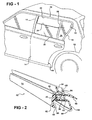
- Figure 1 is a fragmentary, perspective view of a motor vehicle including an upper reveal extending along a window opening of a door frame;
- Figure 2 is a cut-away perspective view of the upper reveal including a molded strip and a carrier;
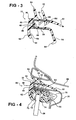
- Figure 3 is a cross-sectional view of the upper reveal
- Figure 4 is a cross-sectional view of the upper reveal secured to a header flange of the door frame
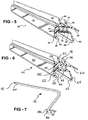
- Figure 5 is a cut-away, perspective view of the upper reveal including a decorative trim applied thereto;
- Figure 6 is a cut-away, perspective view of the upper reveal including the molded strip of TPV without the carrier;
- Figure 7 is a cut-away, perspective view of a bent upper reveal including end caps molded thereto;
- Figure 8 is a schematic of a method of manufacturing the upper reveal
- Figure 9 is a schematic of a method of manufacturing the upper reveal according to another embodiment of the invention including the step of applying a decorative trim;
- Figure 10 is a schematic of a method of manufacturing the upper reveal similar to Figure 9 wherein the step of applying the decorative trim is performed after the upper reveal has been bent;
- Figure 11 is a schematic of a method of manufacturing the upper reveal
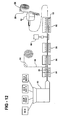
- Figure 12 is a schematic of a method of manufacturing the upper reveal.
- a door, generally indicated at 10, for a motor vehicle 12 includes a door frame 14.
- the door 10 may be any of numerous motor vehicle doors, in an exemplary embodiment the door 10 is a rear door.
- the door frame 14 of the rear door 10 includes a B-pillar portion 16, a C-pillar portion 18, and a belt line 20.
- the belt line 20 extends longitudinally between the B-pillar portion 16 and the C-pillar portion 18.
- the door frame 14 defines a window opening 22, the particular shape of which will vary depending upon vehicle styling considerations.
- a retractable window pane 24 selectively closes a portion of the window opening 22, and a fixed window pane 26 closes a remaining portion of the window opening 22.
- a division post 28 separates the retractable window pane 24 from the fixed window pane 26.
- the window opening 22 includes a curved portion 30 adjacent the C-pillar portion 18.
- the term "curved portion" is not intended to be narrowly construed. To this end, it is contemplated that the term “curved portion” encompasses any of numerous non-linear configurations, including a corner of the window opening 22.
- An upper reveal extends along the window opening 22 between the B-pillar portion 16 and the belt line 20 adjacent the C-pillar portion 18. Part of the upper reveal 32 is bent to conform to the curved portion 30 of the window opening 22.
- the upper reveal 32 is secured to a header flange 34, shown in Figure 4 , which extends out from an upper portion or header 35 of the door frame 14.
- the upper reveal 32 is disposed between the header 35 of the door frame 14 and each of the retractable 26 and fixed 28 window panes.
- the upper reveal 32 includes a molded strip, generally indicated at 36, and a carrier 38.
- the molded strip 36 is formed as an extruded member from TPV (thermoplastic vulcanisate) of different durometer values to meet varying flexibility and durability requirements.
- TPV thermoplastic vulcanisate
- the TPV is co-extruded with the carrier 38 so as to completely embed the carrier 38 within the molded strip 36.
- the upper reveal 32 is initially extruded as a generally linear piece, as shown in Figure 2 , which may be utilized for generally linear portions of the window opening 22.
- the molded strip 36 includes a retention portion 40 having first 42 and second 44 segments, and a connecting segment 46 extending between the first 42 and second 44 segments.
- the retention portion 40 has a durometer of approximately 40 Shore D.
- the first 42 and second 44 segments define an inner channel 48.
- a plurality of retention members 50 extends out from at least one of the first 42 and second 44 segments into the inner channel 48.
- the header flange 34 which extends along the upper portion 35 of the door frame 14 adjacent the window opening 22 (as shown in Figure 4 ), is received within the inner channel 48.
- the plurality of retention members 50 frictionally engages the header flange 34 within the inner channel 48 to mount the upper reveal 32 along the window opening 22 of the door frame 14.
- the carrier 38 is generally U-shaped and is embedded within the retention portion 40 of the molded strip 36. More specifically, the carrier 38 is embedded within the first segment 42, the second segment 44, and the connecting segment 46 to provide rigidity to the upper reveal 32.
- the carrier 38 may initially have a fishbone or diamond configuration prior to conforming to the illustrated U-shape during extrusion.
- the carrier 38 is a roll formed metal, such as aluminum or steel. It is, however, contemplated that the carrier 38 could be molded from a thermoplastic material.
- the retention portion 40 may be formed with an air gap (not shown) adjacent the connecting segment 46 to prevent read-thru of metal as the TPV is co-extruded with the carrier 38.
- the upper reveal 32 also includes a pair of spaced apart closeout lips 54, 56 extending out from the first segment 42 for concealing a portion of the frame 58.
- Each of the pair of spaced apart closeout lips 54, 56 has a durometer of approximately 75 Shore A. When the door 10 is closed, the pair of closeout lips 54, 56 sealingly engage the frame 58, as shown in Figure 4 .
- the upper reveal 32 further includes an interior sealing lip 60 extending out from the first segment 42 of the retention portion 40.
- the interior sealing lip 60 guides the header flange 34 into the inner channel 48 during attachment of the upper reveal 32 to the door frame 14.
- the interior sealing lip 60 also sealingly engages the header 35.
- the retention portion 40 of the upper reveal 32 further includes spaced apart first 62 and second 64 legs extending out from the second segment 44.
- the first 62 and second 64 legs define an outer channel 66 therebetween.
- Each of the first 62 and second 64 legs includes an end portion 68 extending into the outer channel 66.
- the first 62 and second 64 legs have a durometer of approximately 50 Shore D.
- a fastener 76 shown in Figure 4 , extends through the second leg 64 and a portion of the header 35 adjacent the header flange 34 to mount the upper reveal 32 to the door frame 14. It is appreciated that although only one fastener 76 is shown, a plurality of fasteners 76 is utilized to mount the upper reveal 32 along the entirety of the header flange 34.
- a glass run insert 70 is disposed within the outer channel 66 for receiving the retractable 26 and fixed 28 window panes thereagainst.
- the glass run insert 70 includes edge portions 72, 74 that contact the window panes 26, 28 within the outer channel 66 and provide sealing engagement between the window panes 26, 28 and the upper reveal 32. It is appreciated that although the glass run insert 70 has been disclosed as a discrete component that is snap fit into engagement with the upper reveal 32, the glass run insert 70 may, in the alternative, be integrally formed with the upper reveal 32.
- the upper reveal 32 includes a reveal or "A" surface 78 extending along the molded strip 36.
- the reveal surface 78 is disposed along the exterior of the motor vehicle 12 when the upper reveal 32 is secured to the header flange 34.
- a decorative trim 80 shown in Figure 5 , may be applied along the reveal surface 78 to provide the upper reveal 32 with an aesthetically pleasing, finished exterior. More particularly, the decorative trim 80 has either a high gloss black finish, a low gloss black finish, a chrome finish, or is colored to match, complement, or contrast the appearance of the rest of the motor vehicle 12.
- the decorative trim 80 is preferably formed from thermoplastic polyolefin (TPO).
- the upper reveal 32 may be formed exclusively from TPV of different durometer values.
- the upper reveal 32 is formed without the carrier 38. Forming the upper reveal 32 exclusively from TPV results in an upper reveal 32 this is completely recyclable.
- ends caps 82 may be molded to opposing ends 84, 86 of the upper reveal 32, which has been bent to conform to the window opening (not shown).
- the end caps 82 effectively close out the ends 84, 86 of the upper reveal 32, which hides the otherwise rough, cut appearance of the ends 84, 86 of the upper reveal 32.
- the end caps 82 may be utilized with any of the variations of the upper reveal 32 described above.
- the carrier 38 is first run through an extrusion die 82.
- the carrier 38 is either a roll formed metal or a molded thermoplastic component.
- the extrusion die 82 is also fed with TPV of different durometer values to co-extrude the molded strip 36 with the carrier 38 in order to form the generally linear upper reveal 32.
- the carrier 38 is completely embedded within the molded strip 36 of TPV.
- the upper reveal 32 is then passed through a series of cooling baths 84 in order to cure the TPV.
- the cooling bath 84 includes at least one sizing guide member 86 for maintaining the cross-section of the upper reveal 32 as the TPV is cured.
- the upper reveal 32 is then cut to a predetermined length by a cutter 88.
- the upper reveal 32 is heated in an oven 90 to a temperature that is above a heat deformation temperature of the TPV.
- the heat deformation temperature for TPV is a temperature between approximately 120°C and 150°C.
- a bending press 92 is utilized for bending the upper reveal 32 to conform to the curved portion 30 of the window opening 22.
- the upper reveal 32 is secured to the header flange 34 extending along the header 35 of the door frame 14, as shown in Figure 4 .
- the carrier 38 is first run through the extrusion die 82.
- the carrier 38 is either a roll formed metal or a molded thermoplastic component.
- the extrusion die 82 is also fed with TPV of different durometer values to co-extrude the molded strip 36 with the carrier 38 in order to form the generally linear upper reveal 32.
- the carrier 38 is completely embedded within the molded strip 36 of TPV.
- the upper reveal 32 is then passed through a series of cooling baths 84 in order to cure the TPV.
- the series of cooling baths 84 include at least one sizing guide member 86 for maintaining the cross-section of the upper reveal 32 as the TPV is cured.
- the decorative trim 80 may be applied to the reveal surface 78 of the molded strip 36 by an applicator 94, as shown in Figure 9 .
- the upper reveal 32 is then cut to a predetermined length by a cutter 88.
- the upper reveal 32 is heated in the oven 90 to a temperature that is above the heat deformation temperature of the TPV.
- the heat deformation temperature for TPV is a temperature between approximately 120°C and 150°C.
- the bending press 92 is utilized for bending the upper reveal 32 to conform to the curved portion 30 of the window opening 22.
- the carrier 38 is first run through the extrusion die 82.
- the carrier 38 is either a roll formed metal or a molded thermoplastic component.
- the extrusion die 82 is also fed with TPV of different durometer values to co-extrude the molded strip 36 with the carrier 38 in order to form the generally linear upper reveal 32.
- the carrier 38 is completely embedded within the molded strip 36 of TPV.
- the upper reveal 32 is then passed through a series of cooling baths 84 in order to cure the TPV.
- the series of cooling baths 84 include at least one sizing guide member 86 for maintaining the cross-section of the upper reveal 32 as the TPV is cured.
- the upper reveal 32 is then cut to a predetermined length by a cutter 88.
- the upper reveal 32 is placed inside a mold 100, where the ends caps 82 are molded to the opposing ends 84, 86 of the upper reveal 3 2.
- the upper reveal 32 is heated in the oven 90 to a temperature that is above the heat deformation temperature of the TPV.
- the heat deformation temperature for TPV is a temperature between approximately 120°C and 150°C.
- the bending press 92 is utilized for bending the upper reveal 32 to conform to the curved portion 30 of the window opening 22.
- the decorative trim 80 may be applied to the upper reveal 32 as the TPV is being cured
- the upper reveal 32 is secured to the header flange 34 extending along the header 35 of the door frame 14.
- the upper reveal 32 in yet another method of manufacturing the upper reveal 32 according to the invention, as shown in Figure 12 , TPV of different durometer values is fed into the extrusion die 82 to form the molded strip 36.
- the carrier 38 is not utilized in the current method.
- the upper reveal 32 includes the molded strip 36 of TPV of different durometer values.
- the upper reveal 32 is then passed through a series of cooling baths 84 in order to cure the TPV.
- the series of cooling baths 84 include at least one sizing guide member 86 for maintaining the cross-section of the upper reveal 32 as the TPV is cured.
- the upper reveal 32 is then cut to a predetermined length by a cutter 88.
- the upper reveal 32 is heated in the oven 90 to a temperature that is above the heat deformation temperature of the TPV.
- the heat deformation temperature for TPV is a temperature between approximately 120°C and 150°C.
- a bending press 92 is utilized for bending the upper reveal 3 2 to conform to the curved portion 30 of the window opening 22.
- the decorative trim 80 may be applied to the upper reveal 32 as the TPV is being cured
- the upper reveal 32 is secured to the header flange 34 extending along the header 35 of the door frame 14.
Landscapes
- Engineering & Computer Science (AREA)
- Mechanical Engineering (AREA)
- Physics & Mathematics (AREA)
- Health & Medical Sciences (AREA)
- Oral & Maxillofacial Surgery (AREA)
- Thermal Sciences (AREA)
- Extrusion Moulding Of Plastics Or The Like (AREA)
- Seal Device For Vehicle (AREA)
- Shaping Of Tube Ends By Bending Or Straightening (AREA)
Applications Claiming Priority (2)
| Application Number | Priority Date | Filing Date | Title |
|---|---|---|---|
| US10/967,924 US7531118B2 (en) | 2004-10-18 | 2004-10-18 | Heat formed TPV co-extruded header trim |
| PCT/US2005/037198 WO2006044766A2 (en) | 2004-10-18 | 2005-10-18 | Heat formed tpv co-extruded header door frame trim |
Publications (2)
| Publication Number | Publication Date |
|---|---|
| EP1824656A2 EP1824656A2 (en) | 2007-08-29 |
| EP1824656B1 true EP1824656B1 (en) | 2008-10-08 |
Family
ID=35985372
Family Applications (1)
| Application Number | Title | Priority Date | Filing Date |
|---|---|---|---|
| EP05813071A Expired - Lifetime EP1824656B1 (en) | 2004-10-18 | 2005-10-18 | Heat formed tpv co-extruded header trim |
Country Status (8)
| Country | Link |
|---|---|
| US (2) | US7531118B2 (enExample) |
| EP (1) | EP1824656B1 (enExample) |
| JP (1) | JP4990782B2 (enExample) |
| CN (1) | CN101044006B (enExample) |
| CA (1) | CA2584981C (enExample) |
| DE (1) | DE602005010297D1 (enExample) |
| MX (1) | MX2007004270A (enExample) |
| WO (1) | WO2006044766A2 (enExample) |
Families Citing this family (16)
| Publication number | Priority date | Publication date | Assignee | Title |
|---|---|---|---|---|
| US20100102597A1 (en) * | 2007-03-16 | 2010-04-29 | Peter John Ellis | Glass Run With Integrated Upper Reveal |
| US8166708B2 (en) * | 2008-07-30 | 2012-05-01 | Ellis Peter J | Integrated glass run and upper reveal with film |
| EP2454432B1 (en) * | 2009-07-17 | 2020-03-11 | Cooper-Standard Automotive, Inc. | Co-extruded u-channel with integrated glassrun |
| CA2788160A1 (en) * | 2010-02-16 | 2011-08-25 | Magna International Inc. | Decorative molding with film |
| JP5484201B2 (ja) * | 2010-05-31 | 2014-05-07 | 東海興業株式会社 | 車両用のウインドウモール及びその製造方法 |
| US10071522B2 (en) | 2012-07-10 | 2018-09-11 | U.S. Farathane Corporation | Roof ditch molding process incorporating conformed shaping features in a molding fixture |
| US10179435B2 (en) | 2012-07-10 | 2019-01-15 | U.S. Farathane Corporation | Roof ditch molding assembly and process with heated air assist |
| KR101317773B1 (ko) * | 2012-07-31 | 2013-10-15 | 에스케이더블유(주) | 디스플레이 중간 케비넷 제조방법 |
| US9038318B2 (en) | 2012-08-01 | 2015-05-26 | Henniges Automotive Sealing Systems North America, Inc. | Dual end cap for a seal assembly |
| FR2995259B1 (fr) * | 2012-09-10 | 2015-06-26 | Peugeot Citroen Automobiles Sa | Coulisse de vitre mobile avec profil amortissant. |
| JP5999447B2 (ja) * | 2013-09-30 | 2016-09-28 | 豊田合成株式会社 | 自動車用ガラスラン |
| BR112016018250A2 (pt) | 2014-02-07 | 2017-08-08 | Henniges Automotive Sealing Systems North America Inc | Arranjo de vedação para um veículo tendo uma janela fixa e um painel e método para fabricar um arranjo de vedação para um veículo tendo uma janela fixa e um painel |
| JP6237391B2 (ja) * | 2014-03-26 | 2017-11-29 | 豊田合成株式会社 | 自動車用ガラスラン |
| CN108621409A (zh) * | 2018-04-13 | 2018-10-09 | 申雅密封件有限公司 | 一种汽车密封条弯曲成型方法和一种汽车密封条弯曲成型装置 |
| US11059360B2 (en) * | 2018-09-14 | 2021-07-13 | Hutchinson Sealing Systems | Encapsulated fixed window module for a motor vehicle |
| US11969930B2 (en) | 2020-03-16 | 2024-04-30 | Bank Of America, N.A., As Administrative Agent | Extrusion process and assembly for producing a roof ditch molding having a bright film exterior layer |
Family Cites Families (22)
| Publication number | Priority date | Publication date | Assignee | Title |
|---|---|---|---|---|
| GB8827180D0 (en) | 1988-11-21 | 1988-12-29 | Schlegel Uk Holdings | Composite extrusion |
| JP2941299B2 (ja) | 1989-03-08 | 1999-08-25 | 東海興業株式会社 | 車両用モールディングとその製造法 |
| US5056850A (en) | 1991-02-11 | 1991-10-15 | General Motors Corporation | Window reveal molding |
| US5112101A (en) | 1991-06-17 | 1992-05-12 | General Motors Corporation | Window reveal molding |
| FR2683190B1 (fr) | 1991-09-30 | 1995-08-25 | Tokai Kogyo Co Ltd | Profile pour pare-brise et son procede de fabrication. |
| US5248179A (en) | 1992-07-10 | 1993-09-28 | Chrysler Corporation | Window reveal molding |
| CA2089978C (en) * | 1993-02-19 | 2005-04-12 | Tadeusz Borys | Automotive trim piece |
| US5424023A (en) | 1993-06-03 | 1995-06-13 | Crane Plastics Company Limited Partnership | Apparatus and method of forming curved extruded products |
| US5628150A (en) | 1996-03-26 | 1997-05-13 | The Standard Products Company | Glass run channel with a composite reinforcement |
| US6106047A (en) * | 1996-08-21 | 2000-08-22 | Kinugawa Rubber Ind. Co., Ltd. | Window molding, method and apparatus for producing same |
| US6023888A (en) | 1996-09-25 | 2000-02-15 | Schlegel Corporation | Door and window channel seal |
| US6106911A (en) * | 1998-11-16 | 2000-08-22 | Gencorp. Inc. | Beltstrip for a motor vehicle |
| JP2000344025A (ja) * | 1999-03-31 | 2000-12-12 | Toyoda Gosei Co Ltd | 自動車用シール部品及びその製造装置及び製造方法 |
| US6189198B1 (en) | 1999-08-26 | 2001-02-20 | Kingston-Warren Corporation | Method of making a vanishing warp carrier seal |
| JP2001105889A (ja) * | 1999-10-08 | 2001-04-17 | Kinugawa Rubber Ind Co Ltd | ウェザーストリップの製造方法 |
| US6422571B1 (en) | 2000-04-26 | 2002-07-23 | Hutchinson Sealing Systems, Inc. | Automotive vehicle seal and decorative trim strip |
| US6370824B1 (en) | 2000-05-10 | 2002-04-16 | Hutchinson Sealing Systems, Inc. | Automotive vehicle seal with decorative trim sealing surface |
| FR2809051B1 (fr) | 2000-05-18 | 2003-05-16 | Hutchinson | Procede de fabrication d'une garniture d'etancheite, en particulier pour fenetre vitree coulissante, et fenetre equipee d'une telle garniture |
| US6607622B2 (en) | 2001-02-15 | 2003-08-19 | Centre Luxembourgeois De Recherches Pour Le Verre Et La Ceramique S.A. (C.R.V.C.) | Method of applying an extruded profile to a window glazing |
| CN2529973Y (zh) * | 2001-03-23 | 2003-01-08 | 边小嘉 | 一种金属-橡胶复合型合页 |
| JP2003094514A (ja) * | 2001-09-21 | 2003-04-03 | Tokai Kogyo Co Ltd | 樹脂成形品及びその製造方法 |
| DE102004038467B4 (de) | 2004-08-07 | 2009-11-12 | Rehau Ag + Co. | Verfahren und Vorrichtung zur Herstellung von Kunststoffleisten sowie mittels eines derartigen Verfahrens hergestellte Kunststoffleiste |
-
2004
- 2004-10-18 US US10/967,924 patent/US7531118B2/en active Active
-
2005
- 2005-10-18 MX MX2007004270A patent/MX2007004270A/es active IP Right Grant
- 2005-10-18 DE DE602005010297T patent/DE602005010297D1/de not_active Expired - Lifetime
- 2005-10-18 EP EP05813071A patent/EP1824656B1/en not_active Expired - Lifetime
- 2005-10-18 JP JP2007536982A patent/JP4990782B2/ja not_active Expired - Lifetime
- 2005-10-18 CA CA2584981A patent/CA2584981C/en not_active Expired - Lifetime
- 2005-10-18 WO PCT/US2005/037198 patent/WO2006044766A2/en not_active Ceased
- 2005-10-18 CN CN2005800355510A patent/CN101044006B/zh not_active Expired - Lifetime
-
2009
- 2009-01-13 US US12/319,841 patent/US20090121378A1/en not_active Abandoned
Also Published As
| Publication number | Publication date |
|---|---|
| US7531118B2 (en) | 2009-05-12 |
| DE602005010297D1 (de) | 2008-11-20 |
| EP1824656A2 (en) | 2007-08-29 |
| JP4990782B2 (ja) | 2012-08-01 |
| WO2006044766A3 (en) | 2007-05-10 |
| US20090121378A1 (en) | 2009-05-14 |
| JP2008516840A (ja) | 2008-05-22 |
| CN101044006B (zh) | 2010-11-17 |
| WO2006044766A2 (en) | 2006-04-27 |
| MX2007004270A (es) | 2007-05-11 |
| CN101044006A (zh) | 2007-09-26 |
| US20060080824A1 (en) | 2006-04-20 |
| CA2584981A1 (en) | 2006-04-27 |
| CA2584981C (en) | 2013-07-30 |
Similar Documents
| Publication | Publication Date | Title |
|---|---|---|
| US20090121378A1 (en) | Heat fromad TPV co-extruded Header trim | |
| CA2147067C (en) | Weatherstrip assembly including a glass run channel and belt weatherstrip with decorative cover | |
| US4968543A (en) | Window molding members and method of manufacturing same | |
| EP2551138B1 (en) | A weather strip seal for an automotive vehicle, and its manufacturing method | |
| US6487820B1 (en) | Seals for vehicles | |
| EP2542432B1 (en) | Co-extruded roll formed bright extrusion with integral end forms | |
| US8657370B1 (en) | Roof ditch molding and method of manufacture | |
| US6370824B1 (en) | Automotive vehicle seal with decorative trim sealing surface | |
| US5741573A (en) | Recyclable pinch flange welt and method of making same | |
| US5618593A (en) | Weatherstrip molding and method of making same | |
| CA2243490A1 (en) | Flexible glass run with rigid molded support | |
| US6422571B1 (en) | Automotive vehicle seal and decorative trim strip | |
| CA2064367C (en) | Automobile windshield molding member and method of manufacturing the same | |
| EP1884392A2 (en) | Weather strip with metal reinforcement | |
| EP0614776B1 (en) | Window frame for vehicle door, and manufacturing of the frame | |
| JP2004537450A (ja) | 追加的なアイオノマー性装飾層を有する、コアに共押出し成形した熱可塑性エラストマーを有する押出し成形品 | |
| US20060226581A1 (en) | Method for reforming a thermoplastic weatherstrip | |
| JPH04356217A (ja) | 車両用ウインドモールディング |
Legal Events
| Date | Code | Title | Description |
|---|---|---|---|
| PUAI | Public reference made under article 153(3) epc to a published international application that has entered the european phase |
Free format text: ORIGINAL CODE: 0009012 |
|
| 17P | Request for examination filed |
Effective date: 20070411 |
|
| AK | Designated contracting states |
Kind code of ref document: A2 Designated state(s): AT BE BG CH CY CZ DE DK EE ES FI FR GB GR HU IE IS IT LI LT LU LV MC NL PL PT RO SE SI SK TR |
|
| AX | Request for extension of the european patent |
Extension state: AL BA HR MK YU |
|
| 17Q | First examination report despatched |
Effective date: 20070816 |
|
| DAX | Request for extension of the european patent (deleted) | ||
| GRAP | Despatch of communication of intention to grant a patent |
Free format text: ORIGINAL CODE: EPIDOSNIGR1 |
|
| RBV | Designated contracting states (corrected) |
Designated state(s): DE FR GB |
|
| GRAS | Grant fee paid |
Free format text: ORIGINAL CODE: EPIDOSNIGR3 |
|
| GRAA | (expected) grant |
Free format text: ORIGINAL CODE: 0009210 |
|
| AK | Designated contracting states |
Kind code of ref document: B1 Designated state(s): DE FR GB |
|
| REG | Reference to a national code |
Ref country code: GB Ref legal event code: FG4D |
|
| REF | Corresponds to: |
Ref document number: 602005010297 Country of ref document: DE Date of ref document: 20081120 Kind code of ref document: P |
|
| PLBE | No opposition filed within time limit |
Free format text: ORIGINAL CODE: 0009261 |
|
| STAA | Information on the status of an ep patent application or granted ep patent |
Free format text: STATUS: NO OPPOSITION FILED WITHIN TIME LIMIT |
|
| 26N | No opposition filed |
Effective date: 20090709 |
|
| PG25 | Lapsed in a contracting state [announced via postgrant information from national office to epo] |
Ref country code: GB Free format text: LAPSE BECAUSE OF NON-PAYMENT OF DUE FEES Effective date: 20091018 |
|
| REG | Reference to a national code |
Ref country code: FR Ref legal event code: PLFP Year of fee payment: 11 |
|
| REG | Reference to a national code |
Ref country code: FR Ref legal event code: PLFP Year of fee payment: 12 |
|
| REG | Reference to a national code |
Ref country code: DE Ref legal event code: R082 Ref document number: 602005010297 Country of ref document: DE Representative=s name: GLAWE DELFS MOLL PARTNERSCHAFT MBB VON PATENT-, DE |
|
| REG | Reference to a national code |
Ref country code: FR Ref legal event code: PLFP Year of fee payment: 13 |
|
| REG | Reference to a national code |
Ref country code: FR Ref legal event code: PLFP Year of fee payment: 14 |
|
| REG | Reference to a national code |
Ref country code: DE Ref legal event code: R079 Ref document number: 602005010297 Country of ref document: DE Free format text: PREVIOUS MAIN CLASS: B29C0047020000 Ipc: B29C0048150000 |
|
| P01 | Opt-out of the competence of the unified patent court (upc) registered |
Effective date: 20230517 |
|
| PGFP | Annual fee paid to national office [announced via postgrant information from national office to epo] |
Ref country code: FR Payment date: 20240909 Year of fee payment: 20 |
|
| PGFP | Annual fee paid to national office [announced via postgrant information from national office to epo] |
Ref country code: DE Payment date: 20240904 Year of fee payment: 20 |
|
| REG | Reference to a national code |
Ref country code: DE Ref legal event code: R082 Ref document number: 602005010297 Country of ref document: DE Representative=s name: WITTE, WELLER & PARTNER PATENTANWAELTE MBB, DE |
|
| REG | Reference to a national code |
Ref country code: DE Ref legal event code: R071 Ref document number: 602005010297 Country of ref document: DE |