EP1791966B1 - Methods for preventing, removing, reducing, or disrupting biofilm - Google Patents
Methods for preventing, removing, reducing, or disrupting biofilm Download PDFInfo
- Publication number
- EP1791966B1 EP1791966B1 EP05795624.5A EP05795624A EP1791966B1 EP 1791966 B1 EP1791966 B1 EP 1791966B1 EP 05795624 A EP05795624 A EP 05795624A EP 1791966 B1 EP1791966 B1 EP 1791966B1
- Authority
- EP
- European Patent Office
- Prior art keywords
- alpha
- amylase
- biofilm
- seq
- amino acid
- Prior art date
- Legal status (The legal status is an assumption and is not a legal conclusion. Google has not performed a legal analysis and makes no representation as to the accuracy of the status listed.)
- Expired - Lifetime
Links
Images


Classifications
-
- C—CHEMISTRY; METALLURGY
- C12—BIOCHEMISTRY; BEER; SPIRITS; WINE; VINEGAR; MICROBIOLOGY; ENZYMOLOGY; MUTATION OR GENETIC ENGINEERING
- C12N—MICROORGANISMS OR ENZYMES; COMPOSITIONS THEREOF; PROPAGATING, PRESERVING, OR MAINTAINING MICROORGANISMS; MUTATION OR GENETIC ENGINEERING; CULTURE MEDIA
- C12N9/00—Enzymes; Proenzymes; Compositions thereof; Processes for preparing, activating, inhibiting, separating or purifying enzymes
- C12N9/14—Hydrolases (3)
- C12N9/24—Hydrolases (3) acting on glycosyl compounds (3.2)
- C12N9/2402—Hydrolases (3) acting on glycosyl compounds (3.2) hydrolysing O- and S- glycosyl compounds (3.2.1)
- C12N9/2405—Glucanases
- C12N9/2408—Glucanases acting on alpha -1,4-glucosidic bonds
- C12N9/2411—Amylases
- C12N9/2414—Alpha-amylase (3.2.1.1.)
- C12N9/2417—Alpha-amylase (3.2.1.1.) from microbiological source
-
- B—PERFORMING OPERATIONS; TRANSPORTING
- B08—CLEANING
- B08B—CLEANING IN GENERAL; PREVENTION OF FOULING IN GENERAL
- B08B17/00—Methods preventing fouling
- B08B17/02—Preventing deposition of fouling or of dust
-
- B—PERFORMING OPERATIONS; TRANSPORTING
- B08—CLEANING
- B08B—CLEANING IN GENERAL; PREVENTION OF FOULING IN GENERAL
- B08B7/00—Cleaning by methods not provided for in a single other subclass or a single group in this subclass
-
- B—PERFORMING OPERATIONS; TRANSPORTING
- B08—CLEANING
- B08B—CLEANING IN GENERAL; PREVENTION OF FOULING IN GENERAL
- B08B9/00—Cleaning hollow articles by methods or apparatus specially adapted thereto
- B08B9/02—Cleaning pipes or tubes or systems of pipes or tubes
- B08B9/027—Cleaning the internal surfaces; Removal of blockages
- B08B9/032—Cleaning the internal surfaces; Removal of blockages by the mechanical action of a moving fluid, e.g. by flushing
-
- C—CHEMISTRY; METALLURGY
- C11—ANIMAL OR VEGETABLE OILS, FATS, FATTY SUBSTANCES OR WAXES; FATTY ACIDS THEREFROM; DETERGENTS; CANDLES
- C11D—DETERGENT COMPOSITIONS; USE OF SINGLE SUBSTANCES AS DETERGENTS; SOAP OR SOAP-MAKING; RESIN SOAPS; RECOVERY OF GLYCEROL
- C11D3/00—Other compounding ingredients of detergent compositions covered in group C11D1/00
- C11D3/16—Organic compounds
- C11D3/38—Products with no well-defined composition, e.g. natural products
- C11D3/386—Preparations containing enzymes, e.g. protease or amylase
-
- C—CHEMISTRY; METALLURGY
- C11—ANIMAL OR VEGETABLE OILS, FATS, FATTY SUBSTANCES OR WAXES; FATTY ACIDS THEREFROM; DETERGENTS; CANDLES
- C11D—DETERGENT COMPOSITIONS; USE OF SINGLE SUBSTANCES AS DETERGENTS; SOAP OR SOAP-MAKING; RESIN SOAPS; RECOVERY OF GLYCEROL
- C11D3/00—Other compounding ingredients of detergent compositions covered in group C11D1/00
- C11D3/16—Organic compounds
- C11D3/38—Products with no well-defined composition, e.g. natural products
- C11D3/386—Preparations containing enzymes, e.g. protease or amylase
- C11D3/38618—Protease or amylase in liquid compositions only
-
- C—CHEMISTRY; METALLURGY
- C12—BIOCHEMISTRY; BEER; SPIRITS; WINE; VINEGAR; MICROBIOLOGY; ENZYMOLOGY; MUTATION OR GENETIC ENGINEERING
- C12Y—ENZYMES
- C12Y304/00—Hydrolases acting on peptide bonds, i.e. peptidases (3.4)
- C12Y304/21—Serine endopeptidases (3.4.21)
- C12Y304/21062—Subtilisin (3.4.21.62)
-
- C—CHEMISTRY; METALLURGY
- C12—BIOCHEMISTRY; BEER; SPIRITS; WINE; VINEGAR; MICROBIOLOGY; ENZYMOLOGY; MUTATION OR GENETIC ENGINEERING
- C12Y—ENZYMES
- C12Y304/00—Hydrolases acting on peptide bonds, i.e. peptidases (3.4)
- C12Y304/22—Cysteine endopeptidases (3.4.22)
- C12Y304/22002—Papain (3.4.22.2)
-
- C—CHEMISTRY; METALLURGY
- C12—BIOCHEMISTRY; BEER; SPIRITS; WINE; VINEGAR; MICROBIOLOGY; ENZYMOLOGY; MUTATION OR GENETIC ENGINEERING
- C12Y—ENZYMES
- C12Y304/00—Hydrolases acting on peptide bonds, i.e. peptidases (3.4)
- C12Y304/22—Cysteine endopeptidases (3.4.22)
- C12Y304/22004—Bromelain (3.4.22.4)
-
- C—CHEMISTRY; METALLURGY
- C12—BIOCHEMISTRY; BEER; SPIRITS; WINE; VINEGAR; MICROBIOLOGY; ENZYMOLOGY; MUTATION OR GENETIC ENGINEERING
- C12Y—ENZYMES
- C12Y304/00—Hydrolases acting on peptide bonds, i.e. peptidases (3.4)
- C12Y304/24—Metalloendopeptidases (3.4.24)
- C12Y304/2404—Serralysin (3.4.24.40)
-
- C—CHEMISTRY; METALLURGY
- C02—TREATMENT OF WATER, WASTE WATER, SEWAGE, OR SLUDGE
- C02F—TREATMENT OF WATER, WASTE WATER, SEWAGE, OR SLUDGE
- C02F2303/00—Specific treatment goals
- C02F2303/20—Prevention of biofouling
-
- C—CHEMISTRY; METALLURGY
- C02—TREATMENT OF WATER, WASTE WATER, SEWAGE, OR SLUDGE
- C02F—TREATMENT OF WATER, WASTE WATER, SEWAGE, OR SLUDGE
- C02F2305/00—Use of specific compounds during water treatment
- C02F2305/04—Surfactants, used as part of a formulation or alone
-
- C—CHEMISTRY; METALLURGY
- C02—TREATMENT OF WATER, WASTE WATER, SEWAGE, OR SLUDGE
- C02F—TREATMENT OF WATER, WASTE WATER, SEWAGE, OR SLUDGE
- C02F3/00—Biological treatment of water, waste water, or sewage
- C02F3/34—Biological treatment of water, waste water, or sewage characterised by the microorganisms used
-
- C—CHEMISTRY; METALLURGY
- C02—TREATMENT OF WATER, WASTE WATER, SEWAGE, OR SLUDGE
- C02F—TREATMENT OF WATER, WASTE WATER, SEWAGE, OR SLUDGE
- C02F3/00—Biological treatment of water, waste water, or sewage
- C02F3/34—Biological treatment of water, waste water, or sewage characterised by the microorganisms used
- C02F3/342—Biological treatment of water, waste water, or sewage characterised by the microorganisms used characterised by the enzymes used
-
- C—CHEMISTRY; METALLURGY
- C11—ANIMAL OR VEGETABLE OILS, FATS, FATTY SUBSTANCES OR WAXES; FATTY ACIDS THEREFROM; DETERGENTS; CANDLES
- C11D—DETERGENT COMPOSITIONS; USE OF SINGLE SUBSTANCES AS DETERGENTS; SOAP OR SOAP-MAKING; RESIN SOAPS; RECOVERY OF GLYCEROL
- C11D2111/00—Cleaning compositions characterised by the objects to be cleaned; Cleaning compositions characterised by non-standard cleaning or washing processes
- C11D2111/10—Objects to be cleaned
- C11D2111/14—Hard surfaces
Definitions
- the present invention relates to improved methods of preventing, removing, reducing, or disrupting biofilm formation on a surface.
- Biofilms are biological films that develop and persist at the surfaces of biotic or abiotic objects in aqueous environments from the adsorption of microbial cells onto the solid surfaces. This adsorption can provide a competitive advantage for the microorganisms since they can reproduce, are accessible to a wider variety of nutrients and oxygen conditions, are not washed away, and are less sensitive to antimicrobial agents.
- the formation of the biofilm is also accompanied by the production of exo-polymeric materials (polysaccharides, polyuronic acids, alginates, glycoproteins, and proteins) which together with the cells form thick layers of differentiated structures separated by water-filled spaces.
- the resident microorganisms may be individual species of microbial cells or mixed communities of microbial cells, which may include aerobic and anaerobic bacteria, algae, protozoa, and fungi.
- the biofilm is a complex assembly of living microorganisms embedded in an organic structure composed of one or more matrix polymers which are secreted by the resident microorganisms.
- Biofilms can develop into macroscopic structures several millimeters or centimeters in thickness and cover large surface areas. These formations can play a role in restricting or entirely blocking flow in plumbing systems, decreasing heat transfer in heat exchangers, or causing pathogenic problems in municipal water supplies, food processing, medical devices (e.g., catheters, orthopedic devices, implants, endoscopes). Moreover, biofilms often decrease the life of materials through corrosive action mediated by the embedded microorganisms. This biological fouling is a serious economic problem in industrial water process systems, pulp and paper production processes, cooling water systems, injection wells for oil recovery, cooling towers, porous media (sand and soil), marine environments, and air conditioning systems, and any closed water recirculation system.
- Biofilms are also a severe problem in medical science and industry causing dental plaque, infections ( Costerton et al., 1999, Science 284: 1318-1322 ), contaminated endoscopes and contact lenses, prosthetic device colonisation and biofilm formation on medical implants.
- biofilm traditionally requires the use of dispersants, surfactants, detergents, enzyme formulations, anti-microbials, biocides, boil-out procedures, and/or corrosive chemicals, e.g., base. Procedures for using these measures are well known in the art. For example, removal of biofilm built-up in a paper machine in the pulp and paper industry traditionally requires a deposit control program including proper housekeeping to keep surfaces free of splashed stock, anti-microbial treatment of fresh water and additives, the use of biocides to reduce microbiological growth on the machine, and scheduled boil-outs to remove the deposits that do form.
- Bacteria growing in biofilms are more resistant to antibiotics and disinfectants than planktonic cells and the resistance increases with the age of the biofilm. Bacterial biofilm also exhibits increased physical resistance towards desiccation, extreme temperatures or light. As mentioned, biofilm formation causes industrial, environmental and medical problems and the difficulties in cleaning and disinfection of bacterial biofilm with chemicals is a major concern in many industries. Furthermore, the trend towards milder disinfection and cleaning compositions to reduce their environmental impact may increase the insufficient cleaning of surfaces covered with biofilm.
- WO00/22103 , WO99/20239 , WO98/26807 and WO01/98214 disclose Bacillus alkaline alpha-amylases and their use for the enzymatic treatment of biofilm.
- WO01/66712 discloses alpha-amylase variants.
- the present invention relates to a method for preventing, removing, reducing, or disrupt biofilm formation on a surface, comprising contacting the surface with alpha-amylase derived from a bacterium, where said alpha-amylase has alpha-amylase activity and an amino acid sequence having at least 80% identity with SEQ ID NO: 2, and wherein the alpha-amylase is selected from the group consisting of:
- the invention further relates to use of such alpha-amylases for prevention or removal of biofilm from surfaces.
- surface is defined herein as any surface which may be covered by biofilm or is prone to biofilm formation.
- surfaces may be any hard surface such as metal, plastics, rubber, board, glass, wood, paper, concrete, rock, marble, gypsum and ceramic materials, which optionally are coated, for example, with paint or enamel; any soft surface such as fibers of any kind (e.g., yarns, textiles, vegetable fibers, rock wool, and hair); or any porous surfaces; skin (human or animal); keratinous materials (e.g., nails); and internal organs (e.g., lungs).
- the hard surface can be present as a part of a cooling tower, water treatment plant, water tanks, dairy, food processing plant, chemical or pharmaceutical process plant, or medical device (e.g., catheters, orthopedic devices, implants).
- the porous surface can be present in a filter, e.g., a membrane filter.
- the term "effective amount” is defined herein as the amount of one or more alpha-amylases that is sufficient to degrade a microbially-produced biofilm comprising alpha-1,4 glucosidic linkages.
- the effective amount of the one or more alpha-amylase will depend on factors including: the alpha-amylase(s) in question, whether the aim is preventing, removing, or reducing biofilms present on a surface, the period of time desirable for, e.g., degrading a microbially-produced biofilm. High amounts/concentrations of enzyme(s) will in general require shorter times of treatment, while low amounts/concentrations longer times.
- biofilm control solution refers to a solution used according to the invention for preventing, removing, reducing or disrupting biofilm present on a surface.
- the method of the invention may result in 10-10 8 -fold, preferably 10 3 -10 6 -fold biofilm reduction in terms of average plate count under the conditions indicated in Example 4 below.
- the present invention relates to improved methods of preventing, removing, or reducing biofilms present on a surface, comprising contacting the surface with an effective amount of an alpha-amylase as defined below.
- the methods of the present invention may be used to prevent, remove, reduce, or disrupt biofilm formation on a surface.
- One of ordinary skill in the art will recognize that such methods may be employed at different stages of biofim formation.
- alpha-1,4 linked glucose polysaccharides such as amylose, amylopectin, mixtures of these two polysaccharides (i.e., starch), and glycogen.
- the invention relates to a method for preventing or removing biofilm on a surface, comprising contacting the surface with an alpha-amylase derived from a bacterium.
- an alpha-amylase derived from a bacterium.
- the bacterial alpha-amylase is derived from a strain of Bacillus.
- the alpha-amylase used according to the invention is derived from a bacterium, preferably derived from a strain of Bacillus sp., especially selected from the group consisting of: the AA560 alpha-amylase disclosed as SEQ ID NO: 2 in WO 00/60060 (SEQ ID NO: 2 herein), the Bacillus flavothermus disclosed in US patent application no. 10/877,847 , Bacillus sp. alpha-amylases disclosed in WO 95/26397 , alpha-amylases derived from Bacillus sp. NCIB 12289, NCIB 12512, NCIB 12513, DSM 9375, DSMZ no.
- KSM AP1378 ( WO 97/00324 ), KSM K36 or KSM K38 ( EP 1,022,334 ), and the #707 alpha-amylase disclosed by Tsukamoto et al., Biochemical and Biophysical Research Communications, 151 (1988), pp. 25-31 .
- the alpha-amylase is the AA560 alpha-amylase shown in SEQ ID NO: 2 herein and/or the AMY1048 alpha-amylase shown in SEQ ID NO: 4 herein, or an alpha-amylase having a degree of identity of at least 60%, preferably at least 70%, more preferred at least 80%, even more preferred at least 90%, such as at least 95%, at least 96%, at least 97%, at least 98% or at least 99% to any of the sequences shown in SEQ ID NOS: 2 or 4 herein.
- the alpha-amylase used is a variant of the parent alpha-amylase disclosed in SEQ ID NO: 2 herein having a deletion in positions D183 and/or G184, preferably wherein said alpha-amylase variant further has a substitution in or corresponding to position N195F, especially wherein the parent alpha-amylase has one or more of the following deletions/substitutions in SEQ ID NO: 2 herein: Delta (R81-G182); Delta (D183-G184); Delta (D183-G184)+N195F; R181Q+N445Q+K446N; Delta (D183-G184)+R181Q, Delta (D183-G184) and one or more of the following substitutions: R118K, N195F, R320K, R458K, especially wherein said parent alpha-amylase has the following mutations:
- the alpha-amylase is the AA560 alpha-amylase shown in SEQ ID NO: 2 or a variant thereof further comprising one or more of the following substitutions: M9L, M202L, V214T, M323T, M382Y or M9L, M202L, V214T, M323T and E345R.
- the alpha-amylase has a percentage (%) of hydrolyzed raw starch that is higher than 15, preferably 25, especially 35, after 5 hours at 40°C, 3 mg enzyme protein per g starch, pH 8.0 (See Example 2 and Fig. 1 ).
- the alpha-amylase comprises Asn-Gly-Thr-Met-Met-Gln-Tyr-Phe-Glu-Trp in its N-terminal amino acid region.
- alpha-amylase examples include Alpha-Amylase A and Alpha-Amylase B used in Example 2.
- the alpha-amylase is derived from a strain of Bacillus licheniformis with the sequence shown as SEQ ID NO: 6 herein, or an alpha-amylase having a degree of identity of at least 60%, preferably at least 70%, more preferred at least 80%, even more preferred at least 90%, such as at least 95%, at least 96%, at least 97%, at least 98% or at least 99% to any of the sequences shown in SEQ ID NO: 6 herein, preferably with a substitution in a position corresponding to position M197, preferably M197L, T, I, N, D, Q, E,P,W, especially M197L or T.
- alpha-amylase products or products comprising alpha amylases include product sold under the following trade names: STAINZYMETM, DURAMYLTM (Novozymes A/S, Denmark), BIOAMYLASE D(G), BIOAMYLASETM L (Biocon India Ltd.), KEMZYMTM AT 9000(Biozym Ges. m.b.H, Austria), PURASTARTM ST, PURASTARTM HPAmL, PURAFECTTM OxAm, RAPIDASETM TEX (Genencor Int. Inc, USA), KAM (KAO, Japan).
- surfaces prone to biofilm formation may be subjected to the methods of the present invention as a preventative measure prior to any biofilm formation so no biofilm forms.
- the methods may be used to prevent further formation and to remove the biofim that has deposited on a surface.
- the methods may be used to reduce the level of biofilm or to remove it partially or completely.
- a biofilm may comprise an integrated community of one or two or more microorganisms or predominantly a specific microorganism ( Palmer and White, 1997, Trends in Microbiology 5: 435-440 ; Costerton et al., 1987, Annual Reviews of Microbiology 41: 435-464 ; Mueller, 1994, TAPPI Proceedings, 1994 Biological Sciences Symposium 195-201 ).
- the one or more microorganisms may be any microorganism involved in biofilm formation including, but not limited to, aerobic bacteria or anaerobic bacteria (Gram positive and Gram negative), fungi (yeast or filamentous fungus), algae, and/or protozoa.
- Contemplated bacteria include bacteria selected from the group consisting of.
- Pseudomonas spp. including Pseudomonas aeruginosa, Azotobacter vinelandii, Escherichia coli, Corynebacterium. diphteriae, Clostridium botulinum, Streptococcus spp, Acetobacter, Leuconostoc, Betabacterium, Pneumococci, Mycobacterium tuberculosis, Aeromonas, Burkholderie, Flavobacterium, Salmonella, Staphylococcus.
- the microorganism is an aerobic bacterium.
- the aerobic bacterium is an Aeromonas strain.
- the aerobic bacterium is a Burkholderie strain.
- the aerobic bacterium is a Flavobacterium strain.
- the aerobic bacterium is a Microbacterium strain.
- the aerobic bacterium is a Pseudomonas strain.
- the aerobic bacterium is a Salmonella strain.
- the aerobic bacterium is a Staphylococcus strain.
- the aerobic bacterium is from the family Enterobacteriaceae (including e.g., Escherichia coli ).
- the aerobic bacterium is Burkholderie cepacia. In another most preferred embodiment, the aerobic bacterium is a Microbacterium imperiale or Mycobacterium tuberculosis. In another most preferred embodiment, the aerobic bacterium is Pseudomonas aeruginosa. In another most preferred embodiment, the aerobic bacterium is Pseudomonas fluorescens. In another most preferred embodiment, the aerobic bacterium is Pseudomonas oleovorans. In another most preferred embodiment, the aerobic bacterium is Pseudomonas pseudoalcaligenes. In another most preferred embodiment, the aerobic bacterium is Salmonella enteritidis. In another most preferred embodiment, the aerobic bacterium is Staphylococcus aureus. In another most preferred embodiment, the aerobic bacterium is Staphylococcus epidermidis.
- the microorganism is an anaerobic bacteria.
- the anaerobic bacterium is a Desulfovibrio strain.
- the anaerobic bacterium is Desulfovibrio desulfuricans.
- the microorganism is a fungus such as a yeast or filamentous fungus.
- the yeast is a Candida strain.
- the yeast is Candida albicans.
- the treatment time for preventing or removing biofilm will depend on the dosage of the alpha-amylase, and the level of biofilm on the surface or prone to the area in question, but should preferably be adapted to the time normally used for conventional treatment of biofilm with antibiotics, biocides, bactericides, fungicides, bleaching agents, surfactants, caustic, and/or biopolymer degrading agents. Consequently, the dosage of the alpha-amylase may be adjusted according to the time period used during conventional treatments. However, where the alpha-amylase treatment is a separate step in the processing, the dosage of the alpha-amylase used will depend on the time period desired to accomplish the treatment.
- alpha-amylase activity the appropriate dosage of alpha-amylase for preventing or removing biofilms will depend on the amount of biofilm on the surface or prone to the area in question.
- the skilled person may determine a suitable alpha-amylase unit dosage.
- the dosage may be expressed in alpha-amylase units.
- Alpha-amylase units may be determined as "KNU", using the assay described below in the "Materials & Methods"-section.
- Biofilm contaminated or prone areas are preferably treated for between 1 minute and 2 days, preferably between 10 minutes and 1 day, preferably between 1 hour and 15 hours, more preferably less that 10 hours, with an alpha-amylase dosage of between 0.005 to 500 mg of alpha-amylase protein per L biofilm control solution, preferably between 0.01 to 100 mg of alpha-amylase protein per L biofilm control solution.
- the alpha-amylase may be part of a composition to be used in the methods of the present invention.
- the composition may be in any form suitable for the use in question, e.g., in the form of a dry powder, agglomerated powder, or granulate, in particular a non-dusting granulate, liquid, in particular a stabilized liquid, or protected alpha-amylase.
- Granulates and agglomerated powders may be prepared by conventional methods, e.g., by spraying the alpha-amylase onto a carrier in a fluid-bed granulator.
- the carrier may consist of particulate cores having a suitable particle size.
- the carrier may be soluble or insoluble, e.g., a salt (such as sodium chloride or sodium sulfate), sugar (such as sucrose or lactose), sugar alcohol (such as sorbitol), or starch.
- the alpha-amylase may be contained in slow-release formulations. Methods for preparing slow-release formulations are well known in the art. Liquid alpha-amylase preparations may, for instance, be stabilized by adding nutritionally acceptable stabilizers such as a sugar, sugar alcohol, or another polyol, and/or lactic acid or another organic acid according to established methods.
- composition may be augmented with one or more agents for preventing or removing the formation of the biofilm.
- agents may include, but are not limited to, dispersants, surfactants, detergents, other enzymes, anti-microbials, and biocides.
- the agent is a surfactant.
- the surfactant may be a non-ionic including semi-polar and/or anionic and/or cationic and/or zwitterionic surfactant.
- Anionic surfactants contemplated include linear alkylbenzenesulfonate, alpha-olefinsulfonate, alkyl sulfate (fatty alcohol sulfate), alcohol ethoxysulfate, secondary alkanesulfonate, alpha-sulfo fatty acid methyl ester, alkyl- or alkenylsuccinic acid or soap.
- Non-ionic surfactants contemplated include alcohol ethoxylate, nonylphenol ethoxylate, alkylpolyglycoside, alkyldimethylamineoxide, ethoxylated fatty acid monoethanolamide, fatty acid monoethanolamide, polyhydroxy alkyl fatty acid amide, or N-acyl N-alkyl derivatives of glucosamine ("glucamides").
- the surfactants may be present at a level of from 0.1 % to 60% by weight of the enzyme biofilm removal composition.
- the surfactant is sodium dodecyl sulfate, quaternary ammonium compounds, alkyl pyridinium iodides, Tween 80, Tween, 85, Triton X-100, Brij 56, biological surfactants, rhamnolipid, surfactin, visconsin, or sulfonates.
- the formation of biofilm is generally accompanied by the production of exo-polymeric materials (polysaccharides, polyuronic acids, alginates, glycoproteins, and proteins) which together with the cells form thick layers of differentiated structures separated by water-filled spaces ( McEldowney and Fletcher, 1986, Journal of General Microbiology 132: 513-523 ; Sutherland, Surface Carbohydrates of the Prokaryotic Cell, Academic Press, New York, 1977, pp. 27-96 ).
- the alpha-amylase composition may further comprise one or more other enzymes capable of degrading the exo-polymeric materials such as polysaccharides, polyuronic acids, alginates, glycoproteins, and proteins.
- the one or more other enzymes may be selected from the group consisting of an aminopeptidase, amylase, carbohydrase, carboxypeptidase, catalase, cellulase, chitinase, cutinase, cyclodextrin glycosyltransferase, deoxyribonuclease, esterase, alpha-galactosidase, beta-galactosidase, glucoamylase, alpha-glucosidase, beta-glucosidase, haloperoxidase, invertase, oxididases, including carbohydrate oxidases, peroxidases, laccase, lipase, mannosidase, pectinolytic enzyme, peptidoglutaminase, phytase, polyphenoloxidase, proteolytic enzyme, ribonuclease, transglutaminase, or x
- the other enzyme(s) may be selected according to the properties of the specific biofilm which is to be removed, or a combination of several enzymes having different enzyme activities may be used.
- the other enzyme is selected from the group consisting of 1,2-1,3-alpha-D-mannan mannohydrolase, 1,3-beta-D-xylan xylanohydrolase, 1,3-beta-D-glucan glucanohydrolase, 1,3(1,3;1,4)-alpha-D-glucan 3-glucanohydrolase, 1,3(1,3;1,4)-beta-D-glucan 3(4)-glucanohydrolase, 1,3-1,4-alpha-D-glucan 4-glucanohydrolase, 1,4-alpha-D-glucanehydrolase, 1,4-alpha-D-glucan glucohydrolase, 1,4-(1,3:1,4)-beta-D-glucan 4-glucanohydrolase, 1,4-beta-D-glucan glucohydrolase, 1,4-beta-D-glucan glucohydrolase, 1,4-beta-D-glucan 4-glucanohydrolase
- the other enzyme may be any enzyme having proteolytic activity under the actual process conditions.
- the enzyme may be a proteolytic enzyme of plant origin, e.g., papain, bromelain, ficin, or of animal origin, e.g., trypsin and chymotrypsin, or of microbial origin, i.e., bacterial, yeast, or filamentous fungal. It is understood that any mixture of various proteolytic enzyme may be applicable in the process of the invention.
- the other enzyme is a proteolytic enzyme such as a serine protease, a metalloprotease, or an aspartate protease.
- subtilisins A sub-group of the serine proteases are commonly designated as subtilisins.
- a subtilisin is a serine protease produced by Gram-positive bacteria or fungi.
- the amino acid sequence of a number of subtilisins have been determined, including at least six subtilisins from Bacillus strains, namely, subtilisin 168, subtilisin BPN, subtilisin Carlsberg, subtilisin DY, subtilisin amylosacchariticus, and mesentericopeptidase, one subtilisin from an actinomycetales, thermitase from Thermoactinomyces vulgaris, and one fungal subtilisin, proteinase K from Tritirachium album.
- subtilisins A further subgroup of the subtilisins, subtilases, has been recognised more recently.
- Subtilases are described as highly alkaline subtilisins and comprise enzymes such as subtilisin PB92 (MAXACAL ® , Gist-Brocades NV), subtilisin 309 (SAVINASE ® , Novozymes A/S), and subtilisin 147 (ESPERASE ® , Novozymes A/S).
- subtilisin variant or mutated subtilisin protease is defined herein as a subtilisin that has been produced by an organism which is expressing a mutant gene derived from a parent microorganism which possessed an original or parent gene and which produced a corresponding parent enzyme, the parent gene having been mutated in order to produce the mutant gene from which said mutated subtilisin protease is produced when expressed in a suitable host.
- subtilisins and variants thereof constitute a preferred class of proteases which are useful in the method of the invention.
- subtilisin variant is a variant of subtilisin 309 (SAVINASE ® ) wherein, in position 195, glycine is substituted by phenylalanine (G195F or 195 Gly to 195 Phe).
- proteases may be used in the methods of the present invention.
- examples of such commercial proteases are ALCALASE ® (produced by submerged fermentation of a strain of Bacillus licheniformis), ESPERASE ® (produced by submerged fermentation of an alkalophilic species of Bacillus), RENNILASE ® (produced by submerged fermentation of a non-pathogenic strain of Mucor miehei ), SAVINASE ® (produced by submerged fermentation of a genetically modified strain of Bacillus), e.g., the variants disclosed in the International Patent Application published as WO 92/19729 , and DURAZYM ® (a protein-engineered variant of SAVINASE ® ), POLARZYMETM, EVERLASETM. All the above-mentioned commercial proteases are available from Novozymes A/S, DK-2880 Bagsv ⁇ rd, Denmark.
- proteases from Aspergillus, Bacillus such as Bacillus alcalophilus, Bacillus cereus, Bacillus vulgatus, Bacillus mycoide, Rhizopus, and subtilins from Bacillus, especially proteases from the species Nocardiopsis such as Nocardiopsis natto Nocardiopsis josonvillei (see, WO 88/03947 ), especially proteases from the species Nocardiopsis sp. NRRL 18262, and Nocardiopsis rougevillei NRRL 18133.
- Yet other preferred proteases are the serine proteases from mutants of Bacillus subtilisins disclosed in the International Patent Application No. PCT/DK89/00002 and WO 91/00345 , and the proteases disclosed in EP 415 296 .
- proteases are the metalloproteases of microbial origin.
- Conventional fermented commercial metalloproteases may be used in the methods of the present invention such as is NEUTRASE ® (Zn) (produced by submerged fermentation of a strain of Bacillus subtilis ), available from Novozymes A/S, DK-2880 Bagsv ⁇ rd, Denmark; BACTOSOL ® WO and BACTOSOL ® SI, available from Sandoz AG, Basle, Switzerland; TOYOZYME ® , available from Toyo Boseki Co. Ltd., Japan; and PROTEINASE K ® (produced by submerged fermentation of a strain of Bacillus sp. KSM-K16), available from Kao Corporation Ltd., Japan.
- NEUTRASE ® Zn
- BACTOSOL ® WO and BACTOSOL ® SI available from Sandoz AG, Basle, Switzerland
- TOYOZYME ® available from Toyo Boseki Co. Ltd.,
- the protease may be used in a dosage of between 0.005 to 500 mg enzyme protein per L biofilm control solution, preferably between 0.01 to 100 mg enzyme protein per L biofilm control solution.
- the other enzyme is a lipase, especially a microbial lipase.
- the lipase may be selected from yeast, e.g., Candida; bacteria, e.g., Pseudomonas or Bacillus; or filamentous fungi, e.g., Humicola or Rhizomucor.
- suitable lipases may be the Rhizomucor miehei lipase (e.g., prepared as described in EP 238 023 ), Thermomyces lanuginosa lipase e.g., prepared as described in EP 305 216 , Humicola insolens lipase, Pseudomonas stutzeri lipase, Pseudomonas cepacia lipase, Candida antarctica lipase A or B, or lipases from rGPL, Absidia blakesleena, Absidia corymbifera, Fusarium solani, Fusarium oxysporum, Penicillum cyclopium, Penicillum crustosum, Penicillum expansum, Rhodotorula glutinis, Thiarosporella phaseolina, Rhizopus microsporus, Sporobolomyces shibatanus, Aureobasidium pullulans, Hansenula anomala, Geo
- lipases examples include: LIPOLASETM, LIPOLASE ULTRATM, LIPOPRIMETM, LIPEXTM from Novozymes, Denmark).
- the lipase may be used in a dosage of between 0.005 to 500 mg enzyme protein per L biofilm control solution, preferably between 0.01 to 100 mg enzyme protein per L biofilm control solution.
- the other enzyme is a cellulase or cellulolytic enzyme, which refers to an enzyme which catalyses the degradation of cellulose to glucose, cellobiose, triose and other cellooligosaccharides.
- the cellulase is an endoglucanase, more preferably a microbial endoglucanase, especially a bacterial or fungal endoglucanase.
- bacterial endoglucanases are endoglucanases obtained from or producible by bacteria from the group of genera consisting of Pseudomonas or Bacillus lautus.
- the cellulase or endoglucanase may be an acid, neutral, or alkaline cellulase or endoglucanase, i.e., exhibiting maximum cellulolytic activity in the acid, neutral or alkaline pH range, respectively.
- a useful cellulase or endoglucanase is an acid cellulase or endoglucanase, preferably a fungal acid cellulase or endoglucanase, more preferably a fungal acid cellulase or endoglucanse enzyme with substantial cellulolytic activity under acidic conditions, which is obtained from or producible by fungi from the group consisting of Trichoderma, Actinomyces, Myrothecium, Aspergillus, and Botrytis.
- a preferred acid cellulase or endoglucanase is obtained from the group consisting of Aspergillus niger, Aspergillus oryzae, Botrytis cinerea, Myrothecium verrucaria, Trichoderma longibrachiatum, Trichoderma reesei, and Trichoderma viride.
- Another useful cellulase or endoglucanase is a neutral or alkaline cellulase or endoglucanse, preferably a fungal neutral or alkaline cellulase or endoglucanse, more preferably a fungal alkaline cellulase or endoglucanase with substantial cellulolytic activity under alkaline conditions, which is obtained from fungi selected from the group consisting of Acremonium, Aspergillus, Chaetomium, Cephalosporium, Fusarium, Gliocladium, Humicola, Irpex, Myceliophthora, Mycogone, Myrothecium, Papulospora, Penicillium, Scopulariopsis, Stachybotrys, and Verticillium.
- fungi selected from the group consisting of Acremonium, Aspergillus, Chaetomium, Cephalosporium, Fusarium, Gliocladium, Humicola, I
- a preferred alkaline cellulase or endoglucanase is obtained from the group consisting of Cephalosporium sp., Fusarium oxysporum, Humicola insolens, or Myceliopthora thermophila, or preferably from the group consisting of Cephalosporium sp., RYM-202, Fusarium oxysporum, DSM 2672, Humicola insolens, DSM 1800, or Myceliopthora thermophila, CBS 117.65.
- the other enzyme is a xylanase such as an endo-1,3-beta-xylosidase (EC 3.2.1.32), xylan 1,4-beta-xylosidase (EC 3.2.1.37), and alpha-L-arabinofuranosidase (EC 3.2.1.55).
- a xylanase such as an endo-1,3-beta-xylosidase (EC 3.2.1.32), xylan 1,4-beta-xylosidase (EC 3.2.1.37), and alpha-L-arabinofuranosidase (EC 3.2.1.55).
- the xylanase is obtained from Aspergillus aculeatus (an enzyme exhibiting xylanase activity, which enzyme is immunologically reactive with an antibody raised against a purified xylanase derived from Aspergillus aculeatus CBS 101.43, see, for example, WO 94/21785 ); Aspergillus oryzae (see, for example, SU 4610007); Aureobasidium pullulans (see, for example, EP 0 373 107 A2 ); Bacillus circulans ( WO 91/18978 ); Bacillus pumilus (see, for example, WO 92/03540 ); Bacillus stearothermophilus (see, for example; WO 91/18976 , WO 91/10724 ); Bacillus sp.
- Aspergillus aculeatus an enzyme exhibiting xylanase activity, which enzyme is immunologically reactive with an antibody raised against a purified x
- AC13 especially the strain NCIMB 40482, see, for example, WO 94/01532 ); Humicola insolens (see, for example, WO 92/17573 ); Rhodothermus (see, for example, WO 93/08275 ); Streptomyces lividans (see, for example, WO 93/03155 ); Streptomyces viridosporus (see, for example, EP 496 671 A ); Bacillus licheniformis (see, for example, JP 9213868 ); Thermoascus aurantiacus (see, for example, US patent 4,966,850 ); Trichoderma longibrachiatum and Chainia sp.
- xylanases may be variants (derivatives or homologues) of any one of the above-noted enzymes having xylanolytic activity.
- Examples of commercially available cellulase containing products include: NOVOZYMTM 342, CELLUZYMETM, CAREZYMETM, RENOZYMETM(all Novozymes, Denmark).
- the cellulase may be used in a dosage of between 0.005 to 500 mg enzyme protein per L biofilm control solution, preferably between 0.01 to 100 mg enzyme protein per L biofilm control solution.
- the other enzyme is a pectinase such as a polygalacturonase (EC 3.2.1.15), pectinesterase (EC 3.2.1.11), or pectin lyase (EC4.2.2.10).
- a suitable source organism for pectinases may be Aspergillus niger.
- the other enzyme in the alpha-amylase composition comprises a hydrolytic enzyme composition produced by a strain of the fungus Aspergillus aculeatus, preferably Aspergillus aculeatus, CBS 101.43. It is known that this strain produces an enzyme composition comprising pectinolytic and a range of hemicellulolytic enzyme activities.
- pectinase containing products examples include: BioPrepTM, SCOURZYMETM and PECTAWASHTM (Novozymes, Denmark).
- the pectinase may be used in a dosage of between 0.005 to 500 mg enzyme protein per L biofilm control solution, preferably between 0.01 to 100 mg enzyme protein per L biofilm control solution.
- the alpha-amylase is combined with an oxidoreductase, such as an oxidase, peroxidase, or laccase.
- an oxidoreductase such as an oxidase, peroxidase, or laccase.
- laccases examples include laccases derived from a strain of Polyporus sp., in particular a strain of Polyporus pinsitus or Polyporus versicolor, or a strain of Myceliophthora sp., in particular M . thermophila, a strain of Scytalidium sp., in particular S. thermophilium, a strain of Rhizoctonia sp., in particular Rhizoctonia praticola or Rhizoctonia solani, or a strain of a Rhus sp., in particular Rhus vernicifera.
- the laccase may also be derived from a fungus such as Collybia, Fomes, Lentinus, Pleurotus, Aspergillus, Neurospora, Podospora, Phlebia, e.g. P. radiata ( WO 92/01046 ), Coriolus sp., e.g., C. hirsitus ( JP 2-238885 ), or Botrytis.
- a fungus such as Collybia, Fomes, Lentinus, Pleurotus, Aspergillus, Neurospora, Podospora, Phlebia, e.g. P. radiata ( WO 92/01046 ), Coriolus sp., e.g., C. hirsitus ( JP 2-238885 ), or Botrytis.
- the laccase may be selected from the group consisting of: the Polyporus pinisitus laccase (also called Trametes villosa laccase) described in WO 96/00290 , the Myceliophthora thermophila laccase described in WO 95/33836 , the Scytalidium thermophilium laccase described in WO 95/33837 , the Pyricularia oryzae laccase which can be purchased from SIGMA under the trade name SIGMA no. L5510, the Coprinus cinereus laccase described in WO 96/06930 , and the Rhizoctonia solani laccase described WO 95/07988 .
- peroxidases examples include peroxidases derived from plants (e.g., horseradish peroxidase) or micro-organisms including fungi and bacteria, such as a strain of Coprinus sp., such as Coprinus cinereus or Coprinus macrorhizus, or bacteria such as Bacillus, such as Bacillus pumilus.
- plants e.g., horseradish peroxidase
- micro-organisms including fungi and bacteria, such as a strain of Coprinus sp., such as Coprinus cinereus or Coprinus macrorhizus, or bacteria such as Bacillus, such as Bacillus pumilus.
- the peroxidase may be selected from the group consisting of: the Coprinus cinereus IFO8371 peroxidase or variants thereof described in WO 95/10602 , and the haloperoxidase originating from a strain of Curvularia verruculosa CBS 147.63 described in WO 97/04102 .
- Contemplated oxidases include especially carbohydrate oxidases, which are enzymes classified under EC 1.1.3.
- Carbohydrate oxidases include glucose oxidase (E.C. 1.1.3.4), hexose oxidase (E.C. 1.1.3.5) xylitol oxidase, galactose oxidase (E.C. 1.1.3.9), pyranose oxidase (E.C. 1.1.3.10), alcohol oxidase (E.C. 1.1.3.13).
- Carbohydrate oxidases may be derived from any origin, including, bacterial, fungal, yeast or mammalian origin.
- glucose oxidases examples include glucose oxidases derived from Aspergillus sp., such as a strain of Aspergillus niger, or from a strain of Cladosporium sp. in particular Cladosporium oxysporum, especially Cl. oxysporum CBS 163 described in WO 95/29996 .
- hexose oxidases examples include hexose oxidases produced by the red sea-weed Chondrus crispus (commonly known as Irish moss) ( Sullivan and Ikawa, (1973), Biochim. Biophys. Acts, 309, p. 11-22 ; Ikawa, (1982), Meth. in Enzymol. 89, carbohydrate metabolism part D, 145-149 ) that oxidizes a broad spectrum of carbohydrates and the red sea-weed Iridophycus flaccidum that produces easily extractable hexose oxidases, which oxidize several different mono- and disaccharides ( Bean and Hassid, (1956), J. Biol. Chem, 218, p. 425 ; Rand et al. (1972, J. of Food Science 37, p. 698-710 ).
- the oxidoreductase may be used in a dosage of between 0.005 to 500 mg enzyme protein per L biofilm control solution, preferably between 0.01 to 100 mg enzyme protein per L biofilm control solution.
- the invention relates to the use of a Bacillus alpha-amylase for preventing, removing, reducing, or disrupting biofilm formation on a surface.
- the alpha-amylase is a Bacillus alpha-amylase, preferably one mentioned above in the "Alpha-Amylase" section.
- Chemicals used as buffers and reagents were commercial products of at least reagent grade.
- the variant is also disclosed in WO 01/66712 .
- the alkaline alpha-amylase was produced in batch 03AGE014-4.
- Alpha-amylase B is derived from a strain of Bacillus flavothermus and is disclosed in SEQ ID NO: 4.
- Alpha-amylase C is derived from a strain of Bacillus licheniformis and is shown as SEQ ID NO: 6 in WO 99/19467 .
- Lipase A is a lipase variant derived from Humicola lanuginosa strain DSM 4109 having the following mutations: T231R, N233R disclosed in US patent no: 6,939,702 -B (Available on request from Novozymes).
- Cellulase A is a multi-component cellulase from Humicola insolens (Available on request from Novozymes, Denmark).
- Biofilm medium Tryptic Soy Broth (TSB, purchased from VWR, P/N DF0370-07) medium was prepared according to the manufacturer's instructions, then diluted to 5% with water. 2 ml of trace elements were added per liter.
- Tryptic Soy Agar purchased from VWR, P/N DF0369-17 was used as per the manufacturer's directions.
- Stainless steel coupons. Stainless steel coupons No. 304 were obtained from Metal Samples Company (Munford, AL).
- the IC system consisted of the following components:
- Detergent Cleaner Base Obtained from Weiman Products (IL, USA) as Burnishine ME - multiple enzyme detergent. The enzymes were denatured prior to use by heating in a microwave on high setting for 1 minute.
- KNU Alpha-amylase activity
- the amylolytic activity may be determined using potato starch as substrate. This method is based on the break-down of modified potato starch by the enzyme, and the reaction is followed by mixing samples of the starch/enzyme solution with an iodine solution. Initially, a blackish-blue color is formed, but during the break-down of the starch the blue color gets weaker and gradually turns into a reddish-brown, which is compared to a colored glass standard.
- KNU Kilo Novo alpha amylase Unit
- Biofilm reactors consisted of a 400 ml beaker, a magnetic stirrer, and 2 stainless steel coupons. The coupons are taped vertically to the sides of the beaker so that the bottom edge of the coupon rested on the bottom of the beaker. A stir bar is added and the beakers are covered with a circle of aluminum foil and autoclaved. 200 ml of sterile biofilm medium is added to each beaker. To prepare the inoculum, each bacterial strain (from Bacillus subtilis) is grown overnight at 28°C on plate count agar. Using a sterile swab, each is suspended in sterile water to an OD 686 of 0.100 and then diluted additionally to 10 -1 .
- Each assay consisted of 4 control beakers without enzyme, 2 beakers with 50 mg of enzyme protein per liter of solution, and 2 beakers with 100 mg of enzyme protein per liter of solution. Beakers are first incubated at 37°C overnight with stirring to grow the biofilm on the stainless steel coupons. Following this incubation step, the enzymes are added in the 2 dosages noted above as per the table below and incubated for an additional 2 hours at 40°C. Thereafter, each beaker and stainless steel coupon is rinsed carefully with sterile water, stained with crystal violet, rinsed with smaschine water, the remaining biofilm solubilized with acetic acid, and the absorbance of an aliquot of each solution is measured at 600nm using a spectrophotometer.
- the measured absorbances of the solutions provide a direct indication of the amount of biofilm remaining on the stainless steel coupons.
- a low absorbance corresponds to a good enzyme effect and little remaining biofilm, whereas a high absorbance corresponds to a poor (or lack thereof) enzyme effect and considerable remaining biofilm.
- Sample # Enzyme Used Enzyme Protein Conc. 1 Alpha-amylase A 50 mg per L & 100 mg per L 2
- Alpha-Amylase C 50 mg per L & 100 mg per L 3
- the sample was then diluted, incubated with color reagent (PHABH, potassium sodium tartrate, NaOH) at 95°C for 10 minutes and finally centrifuged before measuring the OD at 410 nm on the supernatant.
- the control (100% hydrolyzed starch) was made by incubating a solution of 1% raw wheat starch in 1M HCl in an oven at 110°C for 4 hours. This treatment was used to calculate the maximum amount of glucose which could be produced per gram of the raw wheat starch. This value was set to 100% in the graph shown in Fig. 1 .
- a mono-component biofilm of Escherichia coli (ATCC #11229) is grown on polycarbonate coupons in a pre-sterilized CDC biofilm reactor.
- cultures of E. coli were grown on tryptic soy agar (TSA) overnight at 37°C.
- TSA tryptic soy agar
- a single colony was picked from the plate using a 1 microL sterile inoculation loop and added to a solution of 40 g TSB/liter of water. This solution was incubated at 37°C overnight to grow up the culture.
- 1 milliliter of this culture was added to 400 milliliters of minimal media (0.30 g TSB/liter sterile water) contained in the CDC biofilm reactor.
- the solution was slowly stirred at 130 rpm and grown for 2 days at 22°C in a non fed batch mode. After the 2 day growth period, the coupon holder rods and coupons were removed from the reactor, rinsed in sterile dilution water to remove planktonic cells, the coupons were carefully removed from the rods and then incubated at 40°C for 1 hour in the following solutions (30 milliliters each).
Landscapes
- Chemical & Material Sciences (AREA)
- Organic Chemistry (AREA)
- Life Sciences & Earth Sciences (AREA)
- Engineering & Computer Science (AREA)
- Health & Medical Sciences (AREA)
- Wood Science & Technology (AREA)
- Bioinformatics & Cheminformatics (AREA)
- Genetics & Genomics (AREA)
- Zoology (AREA)
- Biochemistry (AREA)
- General Engineering & Computer Science (AREA)
- General Health & Medical Sciences (AREA)
- Biomedical Technology (AREA)
- Biotechnology (AREA)
- Molecular Biology (AREA)
- Chemical Kinetics & Catalysis (AREA)
- Oil, Petroleum & Natural Gas (AREA)
- Medicinal Chemistry (AREA)
- Microbiology (AREA)
- Mechanical Engineering (AREA)
- Enzymes And Modification Thereof (AREA)
- Detergent Compositions (AREA)
- Agricultural Chemicals And Associated Chemicals (AREA)
- Micro-Organisms Or Cultivation Processes Thereof (AREA)
- Chemical Or Physical Treatment Of Fibers (AREA)
Description
- The present invention relates to improved methods of preventing, removing, reducing, or disrupting biofilm formation on a surface.
- Biofilms are biological films that develop and persist at the surfaces of biotic or abiotic objects in aqueous environments from the adsorption of microbial cells onto the solid surfaces. This adsorption can provide a competitive advantage for the microorganisms since they can reproduce, are accessible to a wider variety of nutrients and oxygen conditions, are not washed away, and are less sensitive to antimicrobial agents. The formation of the biofilm is also accompanied by the production of exo-polymeric materials (polysaccharides, polyuronic acids, alginates, glycoproteins, and proteins) which together with the cells form thick layers of differentiated structures separated by water-filled spaces. The resident microorganisms may be individual species of microbial cells or mixed communities of microbial cells, which may include aerobic and anaerobic bacteria, algae, protozoa, and fungi. Thus, the biofilm is a complex assembly of living microorganisms embedded in an organic structure composed of one or more matrix polymers which are secreted by the resident microorganisms.
- Biofilms can develop into macroscopic structures several millimeters or centimeters in thickness and cover large surface areas. These formations can play a role in restricting or entirely blocking flow in plumbing systems, decreasing heat transfer in heat exchangers, or causing pathogenic problems in municipal water supplies, food processing, medical devices (e.g., catheters, orthopedic devices, implants, endoscopes). Moreover, biofilms often decrease the life of materials through corrosive action mediated by the embedded microorganisms. This biological fouling is a serious economic problem in industrial water process systems, pulp and paper production processes, cooling water systems, injection wells for oil recovery, cooling towers, porous media (sand and soil), marine environments, and air conditioning systems, and any closed water recirculation system. Biofilms are also a severe problem in medical science and industry causing dental plaque, infections (Costerton et al., 1999, Science 284: 1318-1322), contaminated endoscopes and contact lenses, prosthetic device colonisation and biofilm formation on medical implants.
- The removal or prevention of biofilm traditionally requires the use of dispersants, surfactants, detergents, enzyme formulations, anti-microbials, biocides, boil-out procedures, and/or corrosive chemicals, e.g., base. Procedures for using these measures are well known in the art. For example, removal of biofilm built-up in a paper machine in the pulp and paper industry traditionally requires a deposit control program including proper housekeeping to keep surfaces free of splashed stock, anti-microbial treatment of fresh water and additives, the use of biocides to reduce microbiological growth on the machine, and scheduled boil-outs to remove the deposits that do form.
- Bacteria growing in biofilms are more resistant to antibiotics and disinfectants than planktonic cells and the resistance increases with the age of the biofilm. Bacterial biofilm also exhibits increased physical resistance towards desiccation, extreme temperatures or light. As mentioned, biofilm formation causes industrial, environmental and medical problems and the difficulties in cleaning and disinfection of bacterial biofilm with chemicals is a major concern in many industries. Furthermore, the trend towards milder disinfection and cleaning compositions to reduce their environmental impact may increase the insufficient cleaning of surfaces covered with biofilm.
WO00/22103 WO99/20239 WO98/26807 WO01/98214 WO01/66712 - It is an object of the present invention to provide improved methods for preventing or removing biofilm present on a surface.
-
-
Fig. 1 shows a comparison of the percentage (%) of total hydrolysis of raw wheat starch for three different alpha-amylases. -
Fig. 2 is a chromatogram comparing 1) Alpha-amylase A, 2) detergent alone 3) Alpha-amylase C biofilm removal. - The present invention relates to a method for preventing, removing, reducing, or disrupt biofilm formation on a surface, comprising contacting the surface with alpha-amylase derived from a bacterium, where said alpha-amylase has alpha-amylase activity and an amino acid sequence having at least 80% identity with SEQ ID NO: 2, and wherein the alpha-amylase is selected from the group consisting of:
- a) an alpha-amylase comprising an amino acid sequence having a deletion in positions D183 and/or G184 using SEQ ID NO:2 for numbering;
- b) an alpha-amylase comprising an amino acid sequence having deletions in positions D183+G184 using SEQ ID NO:2 for numbering; and
- c) an alpha-amylase comprising an amino acid sequence having one or more of substitutions selected from the group consisting of: R118K, N195F, R320K, and R458K, and having a deletion in positions D183 and/or G184 using SEQ ID NO:2 for numbering.
- The invention further relates to use of such alpha-amylases for prevention or removal of biofilm from surfaces.
- The term "surface" is defined herein as any surface which may be covered by biofilm or is prone to biofilm formation. Examples of surfaces may be any hard surface such as metal, plastics, rubber, board, glass, wood, paper, concrete, rock, marble, gypsum and ceramic materials, which optionally are coated, for example, with paint or enamel; any soft surface such as fibers of any kind (e.g., yarns, textiles, vegetable fibers, rock wool, and hair); or any porous surfaces; skin (human or animal); keratinous materials (e.g., nails); and internal organs (e.g., lungs). The hard surface can be present as a part of a cooling tower, water treatment plant, water tanks, dairy, food processing plant, chemical or pharmaceutical process plant, or medical device (e.g., catheters, orthopedic devices, implants). The porous surface can be present in a filter, e.g., a membrane filter.
- The term "effective amount" is defined herein as the amount of one or more alpha-amylases that is sufficient to degrade a microbially-produced biofilm comprising alpha-1,4 glucosidic linkages. The effective amount of the one or more alpha-amylase will depend on factors including: the alpha-amylase(s) in question, whether the aim is preventing, removing, or reducing biofilms present on a surface, the period of time desirable for, e.g., degrading a microbially-produced biofilm. High amounts/concentrations of enzyme(s) will in general require shorter times of treatment, while low amounts/concentrations longer times. Further, for instance, preventing biofilm on a surface prone to biofilm formation will in general require lower amounts/concentrations of enzyme(s) than the actual removal of biofilm from a corresponding contaminated surface. However, typical effective usage levels are between 0.005 to 500 mg of alpha-amylase protein per L biofilm control solution, preferably between 0.01 - 100 mg of enzyme protein per L biofilm control solution. The term "biofilm control solution" refers to a solution used according to the invention for preventing, removing, reducing or disrupting biofilm present on a surface. The method of the invention may result in 10-108-fold, preferably 103-106-fold biofilm reduction in terms of average plate count under the conditions indicated in Example 4 below.
- The present invention relates to improved methods of preventing, removing, or reducing biofilms present on a surface, comprising contacting the surface with an effective amount of an alpha-amylase as defined below. The methods of the present invention may be used to prevent, remove, reduce, or disrupt biofilm formation on a surface. One of ordinary skill in the art will recognize that such methods may be employed at different stages of biofim formation.
- By using an alpha-amylase in an effective amount of surfaces improved biofilm prevention and/or removal is obtained, especially in those instances where some of the microbes present in the biofilm produce alpha-1,4 linked glucose polysaccharides such as amylose, amylopectin, mixtures of these two polysaccharides (i.e., starch), and glycogen.
- In the first aspect the invention relates to a method for preventing or removing biofilm on a surface, comprising contacting the surface with an alpha-amylase derived from a bacterium. In a preferred embodiment the bacterial alpha-amylase is derived from a strain of Bacillus.
- The alpha-amylase used according to the invention is derived from a bacterium, preferably derived from a strain of Bacillus sp., especially selected from the group consisting of: the AA560 alpha-amylase disclosed as SEQ ID NO: 2 in
WO 00/60060 US patent application no. 10/877,847 WO 95/26397 WO 97/00324 EP 1,022,334 ), and the #707 alpha-amylase disclosed by Tsukamoto et al., Biochemical and Biophysical Research Communications, 151 (1988), pp. 25-31. - In a preferred specific embodiment of the invention the alpha-amylase is the AA560 alpha-amylase shown in SEQ ID NO: 2 herein and/or the AMY1048 alpha-amylase shown in SEQ ID NO: 4 herein, or an alpha-amylase having a degree of identity of at least 60%, preferably at least 70%, more preferred at least 80%, even more preferred at least 90%, such as at least 95%, at least 96%, at least 97%, at least 98% or at least 99% to any of the sequences shown in SEQ ID NOS: 2 or 4 herein.
- In a preferred embodiment the alpha-amylase used is a variant of the parent alpha-amylase disclosed in SEQ ID NO: 2 herein having a deletion in positions D183 and/or G184, preferably wherein said alpha-amylase variant further has a substitution in or corresponding to position N195F, especially wherein the parent alpha-amylase has one or more of the following deletions/substitutions in SEQ ID NO: 2 herein: Delta (R81-G182); Delta (D183-G184); Delta (D183-G184)+N195F; R181Q+N445Q+K446N; Delta (D183-G184)+R181Q, Delta (D183-G184) and one or more of the following substitutions: R118K, N195F, R320K, R458K, especially wherein said parent alpha-amylase has the following mutations:
- Delta (D183+G184)+R118K+N195F+R320K+R458K (i.e., in SEQ ID NO: 2 herein).
- In another preferred embodiment the alpha-amylase is the AA560 alpha-amylase shown in SEQ ID NO: 2 or a variant thereof further comprising one or more of the following substitutions: M9L, M202L, V214T, M323T, M382Y or M9L, M202L, V214T, M323T and E345R.
- In a preferred embodiment the alpha-amylase has a percentage (%) of hydrolyzed raw starch that is higher than 15, preferably 25, especially 35, after 5 hours at 40°C, 3 mg enzyme protein per g starch, pH 8.0 (See Example 2 and
Fig. 1 ). - In another preferred embodiment the alpha-amylase comprises Asn-Gly-Thr-Met-Met-Gln-Tyr-Phe-Glu-Trp in its N-terminal amino acid region. Examples of such alpha-amylase include Alpha-Amylase A and Alpha-Amylase B used in Example 2.
- In an embodiment the alpha-amylase is derived from a strain of Bacillus licheniformis with the sequence shown as SEQ ID NO: 6 herein, or an alpha-amylase having a degree of identity of at least 60%, preferably at least 70%, more preferred at least 80%, even more preferred at least 90%, such as at least 95%, at least 96%, at least 97%, at least 98% or at least 99% to any of the sequences shown in SEQ ID NO: 6 herein, preferably with a substitution in a position corresponding to position M197, preferably M197L, T, I, N, D, Q, E,P,W, especially M197L or T.
- Commercially available alpha-amylase products or products comprising alpha amylases include product sold under the following trade names: STAINZYME™, DURAMYL™ (Novozymes A/S, Denmark), BIOAMYLASE D(G), BIOAMYLASE™ L (Biocon India Ltd.), KEMZYM™ AT 9000(Biozym Ges. m.b.H, Austria), PURASTAR™ ST, PURASTAR™ HPAmL, PURAFECT™ OxAm, RAPIDASE™ TEX (Genencor Int. Inc, USA), KAM (KAO, Japan).
- In a preferred embodiment, surfaces prone to biofilm formation may be subjected to the methods of the present invention as a preventative measure prior to any biofilm formation so no biofilm forms. Alternatively, at the first indication of biofim formation, the methods may be used to prevent further formation and to remove the biofim that has deposited on a surface. Furthermore, in situations where there is a heavy build-up of biofilm on a surface, the methods may be used to reduce the level of biofilm or to remove it partially or completely.
- A biofilm may comprise an integrated community of one or two or more microorganisms or predominantly a specific microorganism (Palmer and White, 1997, Trends in Microbiology 5: 435-440; Costerton et al., 1987, Annual Reviews of Microbiology 41: 435-464; Mueller, 1994, TAPPI Proceedings, 1994 Biological Sciences Symposium 195-201). In the methods of the present invention, the one or more microorganisms may be any microorganism involved in biofilm formation including, but not limited to, aerobic bacteria or anaerobic bacteria (Gram positive and Gram negative), fungi (yeast or filamentous fungus), algae, and/or protozoa. Contemplated bacteria include bacteria selected from the group consisting of. Pseudomonas spp. including Pseudomonas aeruginosa, Azotobacter vinelandii, Escherichia coli, Corynebacterium. diphteriae, Clostridium botulinum, Streptococcus spp, Acetobacter, Leuconostoc, Betabacterium, Pneumococci, Mycobacterium tuberculosis, Aeromonas, Burkholderie, Flavobacterium, Salmonella, Staphylococcus.
- In a preferred embodiment, the microorganism is an aerobic bacterium. In a more preferred embodiment, the aerobic bacterium is an Aeromonas strain. In another more preferred embodiment, the aerobic bacterium is a Burkholderie strain. In another more preferred embodiment, the aerobic bacterium is a Flavobacterium strain. In another more preferred embodiment, the aerobic bacterium is a Microbacterium strain. In another more preferred embodiment, the aerobic bacterium is a Pseudomonas strain. In another more preferred embodiment, the aerobic bacterium is a Salmonella strain. In another more preferred embodiment, the aerobic bacterium is a Staphylococcus strain. In another more preferred embodiment, the aerobic bacterium is from the family Enterobacteriaceae (including e.g., Escherichia coli).
- In a most preferred embodiment, the aerobic bacterium is Burkholderie cepacia. In another most preferred embodiment, the aerobic bacterium is a Microbacterium imperiale or Mycobacterium tuberculosis. In another most preferred embodiment, the aerobic bacterium is Pseudomonas aeruginosa. In another most preferred embodiment, the aerobic bacterium is Pseudomonas fluorescens. In another most preferred embodiment, the aerobic bacterium is Pseudomonas oleovorans. In another most preferred embodiment, the aerobic bacterium is Pseudomonas pseudoalcaligenes. In another most preferred embodiment, the aerobic bacterium is Salmonella enteritidis. In another most preferred embodiment, the aerobic bacterium is Staphylococcus aureus. In another most preferred embodiment, the aerobic bacterium is Staphylococcus epidermidis.
- In another preferred embodiment, the microorganism is an anaerobic bacteria. In another more preferred embodiment, the anaerobic bacterium is a Desulfovibrio strain. In another most preferred embodiment, the anaerobic bacterium is Desulfovibrio desulfuricans.
- In another preferred embodiment, the microorganism is a fungus such as a yeast or filamentous fungus. In another more preferred embodiment, the yeast is a Candida strain. In another most preferred embodiment, the yeast is Candida albicans.
- As mentioned above the treatment time for preventing or removing biofilm will depend on the dosage of the alpha-amylase, and the level of biofilm on the surface or prone to the area in question, but should preferably be adapted to the time normally used for conventional treatment of biofilm with antibiotics, biocides, bactericides, fungicides, bleaching agents, surfactants, caustic, and/or biopolymer degrading agents. Consequently, the dosage of the alpha-amylase may be adjusted according to the time period used during conventional treatments. However, where the alpha-amylase treatment is a separate step in the processing, the dosage of the alpha-amylase used will depend on the time period desired to accomplish the treatment.
- In terms of alpha-amylase activity, the appropriate dosage of alpha-amylase for preventing or removing biofilms will depend on the amount of biofilm on the surface or prone to the area in question. The skilled person may determine a suitable alpha-amylase unit dosage. The dosage may be expressed in alpha-amylase units. Alpha-amylase units may be determined as "KNU", using the assay described below in the "Materials & Methods"-section. Biofilm contaminated or prone areas are preferably treated for between 1 minute and 2 days, preferably between 10 minutes and 1 day, preferably between 1 hour and 15 hours, more preferably less that 10 hours, with an alpha-amylase dosage of between 0.005 to 500 mg of alpha-amylase protein per L biofilm control solution, preferably between 0.01 to 100 mg of alpha-amylase protein per L biofilm control solution.
- The alpha-amylase may be part of a composition to be used in the methods of the present invention. The composition may be in any form suitable for the use in question, e.g., in the form of a dry powder, agglomerated powder, or granulate, in particular a non-dusting granulate, liquid, in particular a stabilized liquid, or protected alpha-amylase. Granulates and agglomerated powders may be prepared by conventional methods, e.g., by spraying the alpha-amylase onto a carrier in a fluid-bed granulator. The carrier may consist of particulate cores having a suitable particle size. The carrier may be soluble or insoluble, e.g., a salt (such as sodium chloride or sodium sulfate), sugar (such as sucrose or lactose), sugar alcohol (such as sorbitol), or starch. The alpha-amylase may be contained in slow-release formulations. Methods for preparing slow-release formulations are well known in the art. Liquid alpha-amylase preparations may, for instance, be stabilized by adding nutritionally acceptable stabilizers such as a sugar, sugar alcohol, or another polyol, and/or lactic acid or another organic acid according to established methods.
- The composition may be augmented with one or more agents for preventing or removing the formation of the biofilm. These agents may include, but are not limited to, dispersants, surfactants, detergents, other enzymes, anti-microbials, and biocides.
- In a preferred embodiment, the agent is a surfactant. The surfactant may be a non-ionic including semi-polar and/or anionic and/or cationic and/or zwitterionic surfactant.
- Anionic surfactants contemplated include linear alkylbenzenesulfonate, alpha-olefinsulfonate, alkyl sulfate (fatty alcohol sulfate), alcohol ethoxysulfate, secondary alkanesulfonate, alpha-sulfo fatty acid methyl ester, alkyl- or alkenylsuccinic acid or soap.
- Non-ionic surfactants contemplated include alcohol ethoxylate, nonylphenol ethoxylate, alkylpolyglycoside, alkyldimethylamineoxide, ethoxylated fatty acid monoethanolamide, fatty acid monoethanolamide, polyhydroxy alkyl fatty acid amide, or N-acyl N-alkyl derivatives of glucosamine ("glucamides").
- The surfactants may be present at a level of from 0.1 % to 60% by weight of the enzyme biofilm removal composition.
- In a more preferred embodiment, the surfactant is sodium dodecyl sulfate, quaternary ammonium compounds, alkyl pyridinium iodides, Tween 80, Tween, 85, Triton X-100, Brij 56, biological surfactants, rhamnolipid, surfactin, visconsin, or sulfonates.
- The formation of biofilm is generally accompanied by the production of exo-polymeric materials (polysaccharides, polyuronic acids, alginates, glycoproteins, and proteins) which together with the cells form thick layers of differentiated structures separated by water-filled spaces (McEldowney and Fletcher, 1986, Journal of General Microbiology 132: 513-523; Sutherland, Surface Carbohydrates of the Prokaryotic Cell, Academic Press, New York, 1977, pp. 27-96). In the methods of the present invention, the alpha-amylase composition may further comprise one or more other enzymes capable of degrading the exo-polymeric materials such as polysaccharides, polyuronic acids, alginates, glycoproteins, and proteins.
- In a preferred embodiment, the one or more other enzymes may be selected from the group consisting of an aminopeptidase, amylase, carbohydrase, carboxypeptidase, catalase, cellulase, chitinase, cutinase, cyclodextrin glycosyltransferase, deoxyribonuclease, esterase, alpha-galactosidase, beta-galactosidase, glucoamylase, alpha-glucosidase, beta-glucosidase, haloperoxidase, invertase, oxididases, including carbohydrate oxidases, peroxidases, laccase, lipase, mannosidase, pectinolytic enzyme, peptidoglutaminase, phytase, polyphenoloxidase, proteolytic enzyme, ribonuclease, transglutaminase, or xylanase.
- The other enzyme(s) may be selected according to the properties of the specific biofilm which is to be removed, or a combination of several enzymes having different enzyme activities may be used.
- In a preferred embodiment, the other enzyme is selected from the group consisting of 1,2-1,3-alpha-D-mannan mannohydrolase, 1,3-beta-D-xylan xylanohydrolase, 1,3-beta-D-glucan glucanohydrolase, 1,3(1,3;1,4)-alpha-D-glucan 3-glucanohydrolase, 1,3(1,3;1,4)-beta-D-glucan 3(4)-glucanohydrolase, 1,3-1,4-alpha-D-glucan 4-glucanohydrolase, 1,4-alpha-D-glucan glucanehydrolase, 1,4-alpha-D-glucan glucohydrolase, 1,4-(1,3:1,4)-beta-D-glucan 4-glucanohydrolase, 1,4-beta-D-glucan glucohydrolase, 1,4-beta-D-xylan xylanohydrolase, 1,4-beta-D-mannan mannanohydrolase, 1,5-alpha-L-arabinan 1,5-alpha-L-arabinanohydrolase, 1,4-alpha-D-glucan maltohydrolase, 1,6-alpha-D-glucan 6-glucanohydrolase, 2,6-beta-D-fructan fructanohydrolase, alpha-Dextrin 6-glucanohydrolase, alpha-D-galactoside galactohydrolase, alpha-D-glucoside glucohydrolase, alpha-D-mannoside mannohydrolase, acylneuraminyl hydrolase, Aerobacter-capsular-polysaccharide galactohydrolase, beta-D-fructofuranoside fructohydrolase, beta-D-fucoside fucohydrolase, beta-D-fructan fructohydrolase, beta-D-galactoside galactohydrolase, beta-D-glucoside glucohydrolase, beta-D-glucuronoside glucuronosohydrolase, beta-D-mannoside mannohydrolase, beta-N-acetyl-D-hexosaminide N-acetylhexosamino hydrolase, cellulose-sulfate sulfohydrolase, collagenase, dextrin 6-alpha-D-glucanohydrolase, glycoprotein-phosphatidylinositol phosphatidohydrolase, hyaluronate 4-glycanohydrolase, hyaluronoglucuronidase, pectin pectylhydrolase, peptidoglycan N-acetylmuramoylhydrolase, phosphatidylcholine 2-acylhydrolase, phosphatidylcholine 1-acylhydrolase, poly(1,4-alpha-D-galacturonide) galacturonohydrolase, poly(1,4-(N-acetyl-beta-D-glucosaminide))-glycanohydrolase, sucrose alpha-glucosidase, triacylglycerol acylhydrolase, and triacylglycerol protein-acylhydrolase.
- The other enzyme may be any enzyme having proteolytic activity under the actual process conditions. Thus, the enzyme may be a proteolytic enzyme of plant origin, e.g., papain, bromelain, ficin, or of animal origin, e.g., trypsin and chymotrypsin, or of microbial origin, i.e., bacterial, yeast, or filamentous fungal. It is understood that any mixture of various proteolytic enzyme may be applicable in the process of the invention.
- In another preferred embodiment, the other enzyme is a proteolytic enzyme such as a serine protease, a metalloprotease, or an aspartate protease.
- A sub-group of the serine proteases are commonly designated as subtilisins. A subtilisin is a serine protease produced by Gram-positive bacteria or fungi. The amino acid sequence of a number of subtilisins have been determined, including at least six subtilisins from Bacillus strains, namely, subtilisin 168, subtilisin BPN, subtilisin Carlsberg, subtilisin DY, subtilisin amylosacchariticus, and mesentericopeptidase, one subtilisin from an actinomycetales, thermitase from Thermoactinomyces vulgaris, and one fungal subtilisin, proteinase K from Tritirachium album. A further subgroup of the subtilisins, subtilases, has been recognised more recently. Subtilases are described as highly alkaline subtilisins and comprise enzymes such as subtilisin PB92 (MAXACAL®, Gist-Brocades NV), subtilisin 309 (SAVINASE®, Novozymes A/S), and subtilisin 147 (ESPERASE®, Novozymes A/S).
- A "subtilisin variant or mutated subtilisin protease" is defined herein as a subtilisin that has been produced by an organism which is expressing a mutant gene derived from a parent microorganism which possessed an original or parent gene and which produced a corresponding parent enzyme, the parent gene having been mutated in order to produce the mutant gene from which said mutated subtilisin protease is produced when expressed in a suitable host. These mentioned subtilisins and variants thereof constitute a preferred class of proteases which are useful in the method of the invention. An example of a useful subtilisin variant is a variant of subtilisin 309 (SAVINASE®) wherein, in position 195, glycine is substituted by phenylalanine (G195F or 195Gly to 195Phe).
- Commercially available proteases may be used in the methods of the present invention. Examples of such commercial proteases are ALCALASE® (produced by submerged fermentation of a strain of Bacillus licheniformis), ESPERASE® (produced by submerged fermentation of an alkalophilic species of Bacillus), RENNILASE® (produced by submerged fermentation of a non-pathogenic strain of Mucor miehei), SAVINASE® (produced by submerged fermentation of a genetically modified strain of Bacillus), e.g., the variants disclosed in the International Patent Application published as
WO 92/19729 - Other preferred serine proteases are proteases from Aspergillus, Bacillus such as Bacillus alcalophilus, Bacillus cereus, Bacillus vulgatus, Bacillus mycoide, Rhizopus, and subtilins from Bacillus, especially proteases from the species Nocardiopsis such as Nocardiopsis natto Nocardiopsis dassonvillei (see,
WO 88/03947 PCT/DK89/00002 WO 91/00345 EP 415 296 - Another preferred class of proteases is the metalloproteases of microbial origin. Conventional fermented commercial metalloproteases may be used in the methods of the present invention such as is NEUTRASE® (Zn) (produced by submerged fermentation of a strain of Bacillus subtilis), available from Novozymes A/S, DK-2880 Bagsværd, Denmark; BACTOSOL® WO and BACTOSOL® SI, available from Sandoz AG, Basle, Switzerland; TOYOZYME®, available from Toyo Boseki Co. Ltd., Japan; and PROTEINASE K® (produced by submerged fermentation of a strain of Bacillus sp. KSM-K16), available from Kao Corporation Ltd., Japan.
- The protease may be used in a dosage of between 0.005 to 500 mg enzyme protein per L biofilm control solution, preferably between 0.01 to 100 mg enzyme protein per L biofilm control solution.
- In another preferred embodiment, the other enzyme is a lipase, especially a microbial lipase. As such, the lipase may be selected from yeast, e.g., Candida; bacteria, e.g., Pseudomonas or Bacillus; or filamentous fungi, e.g., Humicola or Rhizomucor. More specifically, suitable lipases may be the Rhizomucor miehei lipase (e.g., prepared as described in
EP 238 023 EP 305 216 WO 92/05249 WO 93/11254 - Examples of commercially available lipases include: LIPOLASE™, LIPOLASE ULTRA™, LIPOPRIME™, LIPEX™ from Novozymes, Denmark).
- The lipase may be used in a dosage of between 0.005 to 500 mg enzyme protein per L biofilm control solution, preferably between 0.01 to 100 mg enzyme protein per L biofilm control solution.
- In another preferred embodiment, the other enzyme is a cellulase or cellulolytic enzyme, which refers to an enzyme which catalyses the degradation of cellulose to glucose, cellobiose, triose and other cellooligosaccharides. Preferably, the cellulase is an endoglucanase, more preferably a microbial endoglucanase, especially a bacterial or fungal endoglucanase. Examples of bacterial endoglucanases are endoglucanases obtained from or producible by bacteria from the group of genera consisting of Pseudomonas or Bacillus lautus.
- The cellulase or endoglucanase may be an acid, neutral, or alkaline cellulase or endoglucanase, i.e., exhibiting maximum cellulolytic activity in the acid, neutral or alkaline pH range, respectively. Accordingly, a useful cellulase or endoglucanase is an acid cellulase or endoglucanase, preferably a fungal acid cellulase or endoglucanase, more preferably a fungal acid cellulase or endoglucanse enzyme with substantial cellulolytic activity under acidic conditions, which is obtained from or producible by fungi from the group consisting of Trichoderma, Actinomyces, Myrothecium, Aspergillus, and Botrytis.
- A preferred acid cellulase or endoglucanase is obtained from the group consisting of Aspergillus niger, Aspergillus oryzae, Botrytis cinerea, Myrothecium verrucaria, Trichoderma longibrachiatum, Trichoderma reesei, and Trichoderma viride.
- Another useful cellulase or endoglucanase is a neutral or alkaline cellulase or endoglucanse, preferably a fungal neutral or alkaline cellulase or endoglucanse, more preferably a fungal alkaline cellulase or endoglucanase with substantial cellulolytic activity under alkaline conditions, which is obtained from fungi selected from the group consisting of Acremonium, Aspergillus, Chaetomium, Cephalosporium, Fusarium, Gliocladium, Humicola, Irpex, Myceliophthora, Mycogone, Myrothecium, Papulospora, Penicillium, Scopulariopsis, Stachybotrys, and Verticillium.
- A preferred alkaline cellulase or endoglucanase is obtained from the group consisting of Cephalosporium sp., Fusarium oxysporum, Humicola insolens, or Myceliopthora thermophila, or preferably from the group consisting of Cephalosporium sp., RYM-202, Fusarium oxysporum, DSM 2672, Humicola insolens, DSM 1800, or Myceliopthora thermophila, CBS 117.65.
- In another preferred embodiment, the other enzyme is a xylanase such as an endo-1,3-beta-xylosidase (EC 3.2.1.32), xylan 1,4-beta-xylosidase (EC 3.2.1.37), and alpha-L-arabinofuranosidase (EC 3.2.1.55). Preferably the xylanase is obtained from Aspergillus aculeatus (an enzyme exhibiting xylanase activity, which enzyme is immunologically reactive with an antibody raised against a purified xylanase derived from Aspergillus aculeatus CBS 101.43, see, for example,
WO 94/21785 EP 0 373 107 A2WO 91/18978 WO 92/03540 WO 91/18976 WO 91/10724 WO 94/01532 WO 92/17573 WO 93/08275 WO 93/03155 EP 496 671 A JP 9213868 US patent 4,966,850 ); Trichoderma longibrachiatum and Chainia sp. (see, for example,EP 0 353 342 A1US patent 4,725,544 ); Thermomyces lanuginosus (see, for example,EP 0 456 033 A2EP 0 473 545 A2WO 92/18612 US patent 5,116,746 ); and/or Thermotoga (see, for example,WO 93/19171 - Examples of commercially available cellulase containing products include: NOVOZYM™ 342, CELLUZYME™, CAREZYME™, RENOZYME™(all Novozymes, Denmark).
- The cellulase may be used in a dosage of between 0.005 to 500 mg enzyme protein per L biofilm control solution, preferably between 0.01 to 100 mg enzyme protein per L biofilm control solution.
- In another preferred embodiment, the other enzyme is a pectinase such as a polygalacturonase (EC 3.2.1.15), pectinesterase (EC 3.2.1.11), or pectin lyase (EC4.2.2.10). A suitable source organism for pectinases may be Aspergillus niger.
- In another preferred embodiment, the other enzyme in the alpha-amylase composition comprises a hydrolytic enzyme composition produced by a strain of the fungus Aspergillus aculeatus, preferably Aspergillus aculeatus, CBS 101.43. It is known that this strain produces an enzyme composition comprising pectinolytic and a range of hemicellulolytic enzyme activities.
- Examples of commercially available pectinase containing products include: BioPrep™, SCOURZYME™ and PECTAWASH™ (Novozymes, Denmark).
- The pectinase may be used in a dosage of between 0.005 to 500 mg enzyme protein per L biofilm control solution, preferably between 0.01 to 100 mg enzyme protein per L biofilm control solution.
- In another embodiment of the invention the alpha-amylase is combined with an oxidoreductase, such as an oxidase, peroxidase, or laccase.
- a) Laccases act on molecular oxygen and yield water (H2O) without any need for peroxide (e.g. H2O2),
- b) Oxidases act on molecular oxygen (O2) and yield peroxide (H2O2), and
- c) Peroxidases act on peroxide (e.g. H2O2) and yield water (H2O).
- Examples of laccases (E.C. 1.10.3.2) include laccases derived from a strain of Polyporus sp., in particular a strain of Polyporus pinsitus or Polyporus versicolor, or a strain of Myceliophthora sp., in particular M. thermophila, a strain of Scytalidium sp., in particular S. thermophilium, a strain of Rhizoctonia sp., in particular Rhizoctonia praticola or Rhizoctonia solani, or a strain of a Rhus sp., in particular Rhus vernicifera. The laccase may also be derived from a fungus such as Collybia, Fomes, Lentinus, Pleurotus, Aspergillus, Neurospora, Podospora, Phlebia, e.g. P. radiata (
WO 92/01046 JP 2-238885 - In specifically contemplated embodiments, the laccase may be selected from the group consisting of: the Polyporus pinisitus laccase (also called Trametes villosa laccase) described in
WO 96/00290 WO 95/33836 WO 95/33837 WO 96/06930 WO 95/07988 - Examples of peroxidases (1.11.1.7) include peroxidases derived from plants (e.g., horseradish peroxidase) or micro-organisms including fungi and bacteria, such as a strain of Coprinus sp., such as Coprinus cinereus or Coprinus macrorhizus, or bacteria such as Bacillus, such as Bacillus pumilus.
- In specifically contemplated embodiments, the peroxidase may be selected from the group consisting of: the Coprinus cinereus IFO8371 peroxidase or variants thereof described in
WO 95/10602 WO 97/04102 - Contemplated oxidases include especially carbohydrate oxidases, which are enzymes classified under EC 1.1.3. Carbohydrate oxidases include glucose oxidase (E.C. 1.1.3.4), hexose oxidase (E.C. 1.1.3.5) xylitol oxidase, galactose oxidase (E.C. 1.1.3.9), pyranose oxidase (E.C. 1.1.3.10), alcohol oxidase (E.C. 1.1.3.13).
- Carbohydrate oxidases may be derived from any origin, including, bacterial, fungal, yeast or mammalian origin.
- Examples of glucose oxidases include glucose oxidases derived from Aspergillus sp., such as a strain of Aspergillus niger, or from a strain of Cladosporium sp. in particular Cladosporium oxysporum, especially Cl. oxysporum CBS 163 described in
WO 95/29996 - Examples of hexose oxidases include hexose oxidases produced by the red sea-weed Chondrus crispus (commonly known as Irish moss) (Sullivan and Ikawa, (1973), Biochim. Biophys. Acts, 309, p. 11-22; Ikawa, (1982), Meth. in Enzymol. 89, carbohydrate metabolism part D, 145-149) that oxidizes a broad spectrum of carbohydrates and the red sea-weed Iridophycus flaccidum that produces easily extractable hexose oxidases, which oxidize several different mono- and disaccharides (Bean and Hassid, (1956), J. Biol. Chem, 218, p. 425; Rand et al. (1972, J. of Food Science 37, p. 698-710).
- The oxidoreductase may be used in a dosage of between 0.005 to 500 mg enzyme protein per L biofilm control solution, preferably between 0.01 to 100 mg enzyme protein per L biofilm control solution.
- In a final aspect the invention relates to the use of a Bacillus alpha-amylase for preventing, removing, reducing, or disrupting biofilm formation on a surface. In a preferred embodiment the alpha-amylase is a Bacillus alpha-amylase, preferably one mentioned above in the "Alpha-Amylase" section.
- The present invention is further described by the following examples which should not be construed as limiting the scope of the invention.
- Chemicals used as buffers and reagents were commercial products of at least reagent grade.
-
- Alpha-amylase A is a variant alpha-amylase of the parent Bacillus sp. alpha-amylase disclosed as SEQ ID NO: 2 in
WO 00/60060 
- The variant is also disclosed in
WO 01/66712 - Alpha-amylase B is derived from a strain of Bacillus flavothermus and is disclosed in SEQ ID NO: 4.
- Alpha-amylase C is derived from a strain of Bacillus licheniformis and is shown as SEQ ID NO: 6 in
WO 99/19467 - Protease E is a Bacillus clausii (old name: Bacillus lentus C360 = NCIB 10309) subtilisin having a M222S substitution covered by
EP patent no. 396,608-B1 - Lipase A is a lipase variant derived from Humicola lanuginosa strain DSM 4109 having the following mutations: T231R, N233R disclosed in
US patent no: 6,939,702 -B (Available on request from Novozymes). - Cellulase A is a multi-component cellulase from Humicola insolens (Available on request from Novozymes, Denmark).
-
- Bacillus subtilis obtained from ATCC 10774.
- E. coli ATCC #11229 and ATCC #25922
- Biofilm medium. Tryptic Soy Broth (TSB, purchased from VWR, P/N DF0370-07) medium was prepared according to the manufacturer's instructions, then diluted to 5% with water. 2 ml of trace elements were added per liter.
- Agar. Tryptic Soy Agar (TSA, purchased from VWR, P/N DF0369-17) was used as per the manufacturer's directions.
- Trace element solution. Per liter: 1.5 g CaCl2, 1.0 g FeSO47.H2O, 0.35 g MnSO4.2H2O, 0.5 g, NaMoO4.
- Stainless steel coupons. Stainless steel coupons No. 304 were obtained from Metal Samples Company (Munford, AL).
- BioLC Ion Chromatography System. The IC system consisted of the following components:
- GP50 Gradient Pump (P/N 059493)
- ED50A Electrochemical Detector (P/N 059499)
- AS50 Temperature Controlled Autosampler (P/N 056565)
- Electrochemical Cell for Integrated Amperometry, complete with Gold Electrode and Ag/AgCl Reference Electrode (P/N 060386)
- Chromelion Data Control Software CHM-1-IC (P/N 060930)
- CDC Biofilm Reactor. Purchased from Biosurface Technologies, Inc. (P/N CBR 90-2) complete with polycarbonate coupons (24 for each reactor, P/N RD 128-PC).
- Detergent Cleaner Base. Obtained from Weiman Products (IL, USA) as Burnishine ME - multiple enzyme detergent. The enzymes were denatured prior to use by heating in a microwave on high setting for 1 minute.
- The amylolytic activity may be determined using potato starch as substrate. This method is based on the break-down of modified potato starch by the enzyme, and the reaction is followed by mixing samples of the starch/enzyme solution with an iodine solution. Initially, a blackish-blue color is formed, but during the break-down of the starch the blue color gets weaker and gradually turns into a reddish-brown, which is compared to a colored glass standard.
- One Kilo Novo alpha amylase Unit (KNU) is defined as the amount of enzyme which, under standard conditions (i.e. at 37°C +/- 0.05; 0.0003 M Ca2+; and pH 5.6) dextrinizes 5260 mg starch dry substance Merck Amylum solubile.
- A folder EB-SM-0009.02/01 describing this analytical method in more detail is available upon request to Novozymes A/S, Denmark, which folder is hereby included by reference.
- For purposes of the present invention, the degree of identity between two amino acid sequences is determined by the Clustal method (Higgins, 1989, CABIOS 5: 151-153) using the LASERGENE™ MEGALIGN™ software (DNASTAR, Inc., Madison, WI) with an identity table and the following multiple alignment parameters: Gap penalty of 10, and gap length penalty of 10. Pairwise alignment parameters were Ktuple=1, gap penalty=3, windows=5, and diago-nals=5.
- Biofilm reactors consisted of a 400 ml beaker, a magnetic stirrer, and 2 stainless steel coupons. The coupons are taped vertically to the sides of the beaker so that the bottom edge of the coupon rested on the bottom of the beaker. A stir bar is added and the beakers are covered with a circle of aluminum foil and autoclaved. 200 ml of sterile biofilm medium is added to each beaker. To prepare the inoculum, each bacterial strain (from Bacillus subtilis) is grown overnight at 28°C on plate count agar. Using a sterile swab, each is suspended in sterile water to an OD686 of 0.100 and then diluted additionally to 10-1. Each assay consisted of 4 control beakers without enzyme, 2 beakers with 50 mg of enzyme protein per liter of solution, and 2 beakers with 100 mg of enzyme protein per liter of solution. Beakers are first incubated at 37°C overnight with stirring to grow the biofilm on the stainless steel coupons. Following this incubation step, the enzymes are added in the 2 dosages noted above as per the table below and incubated for an additional 2 hours at 40°C. Thereafter, each beaker and stainless steel coupon is rinsed carefully with sterile water, stained with crystal violet, rinsed with steile water, the remaining biofilm solubilized with acetic acid, and the absorbance of an aliquot of each solution is measured at 600nm using a spectrophotometer. The measured absorbances of the solutions provide a direct indication of the amount of biofilm remaining on the stainless steel coupons. A low absorbance corresponds to a good enzyme effect and little remaining biofilm, whereas a high absorbance corresponds to a poor (or lack thereof) enzyme effect and considerable remaining biofilm.
Sample # Enzyme Used Enzyme Protein Conc. 1 Alpha-amylase A 50 mg per L & 100 mg per L 2 Alpha-Amylase C 50 mg per L & 100 mg per L 3 No enzyme (control) NA - The rate at which various alpha-amylases solubilize raw, unhydrated wheat starch was measured. Alpha-Amylase A, B and C, respectively, were used in the study.
- Twenty five milliliters of a 1% raw wheat starch solution with
pH 8 tris buffer and 15°dH was poured into a tube with lid and placed in a 40°C water bath. The starting level of "reducing ends" was measured prior to addition of enzyme. The enzyme concentration used in the study was 3 mg enzyme protein per g raw wheat starch. One milliliter samples were taken out at different times. Twenty microliters of 1 M HCl was added prior to incubation at 99°C for 10 minutes. The combination of acid and heat inactivates the amylase. Then 20 microL 1 M NaOH was added to make sure the sample was no longer acidic. The sample was then diluted, incubated with color reagent (PHABH, potassium sodium tartrate, NaOH) at 95°C for 10 minutes and finally centrifuged before measuring the OD at 410 nm on the supernatant. The control (100% hydrolyzed starch) was made by incubating a solution of 1% raw wheat starch in 1M HCl in an oven at 110°C for 4 hours. This treatment was used to calculate the maximum amount of glucose which could be produced per gram of the raw wheat starch. This value was set to 100% in the graph shown inFig. 1 . - For Alpha-Amylase A and B it can be seen that the initial rate of raw wheat starch solubilization observed within the first 5 hours is significantly more rapid than for Alpha-Amylase C. This resulted in a greater percentage of the starch being solubilized by the former two alpha-amylases vs. for the latter over this time period.
- A mono-component biofilm of Escherichia coli (ATCC #11229) is grown on polycarbonate coupons in a pre-sterilized CDC biofilm reactor. At the start of the experiment, cultures of E. coli were grown on tryptic soy agar (TSA) overnight at 37°C. The next morning, a single colony was picked from the plate using a 1 microL sterile inoculation loop and added to a solution of 40 g TSB/liter of water. This solution was incubated at 37°C overnight to grow up the culture. The following day, 1 milliliter of this culture was added to 400 milliliters of minimal media (0.30 g TSB/liter sterile water) contained in the CDC biofilm reactor. The solution was slowly stirred at 130 rpm and grown for 2 days at 22°C in a non fed batch mode. After the 2 day growth period, the coupon holder rods and coupons were removed from the reactor, rinsed in sterile dilution water to remove planktonic cells, the coupons were carefully removed from the rods and then incubated at 40°C for 1 hour in the following solutions (30 milliliters each).
- A: Detergent cleaner base alone, 0.21g detergent in sterile water
- B: Detergent cleaner base, 0.21 g + 0.51 mg enzyme protein Protease E + 0.06 mg enzyme protein Alpha-amylase A
- C: Detergent cleaner base, 0.21g + 0.51 mg enzyme protein Protease E + 0.16 mg enzyme protein Alpha-amylase C.
- Following the incubation step, the coupons were removed. The solutions were filtered through 0.45□micro m Nylon syringe filters and their sugar contents measured by Ion Chromatography. PA100 guard and analytical columns (P/N 043055) were used for the separation. A mobile phase gradient between 60/40 deionized water/100mM NaOH and 100% 100mM NaOH/1M Sodium Acetate (exponential gradient started 10 minutes into the separation and ended at 85 minutes) was used to effect the separation.
Fig. 2 shows an overlay of the 3 chromatograms generated in this experiment. When Alpha-Amylase A is used, a significantly higher level of low molecular weight sugars (glucose = glu, maltose = mal, maltotriose = DP3, maltotetraose = DP4, maltopentaose = DP5) were generated versus with the detergent alone or with Alpha-Amylase C. This indicated an increased level of biofilm removal through increased breakdown of the amylopectin exopolysaccharides produced by the Ecoli bacteria. - Two CDC biofilm reactors fitted with polycarbonate coupons were autoclaved and filled with sterile 1/10 strength tryptic soy broth (TSB, 3g/liter strength) and inoculated with 1 ml log phase culture of Escherichia coli (ATCC # 25922). The initial cell count in the reactors averaged to 5x10⁸ cfu/mL. Both reactors were operated for 24 hours in batch mode at 37°C (no inflow or outflow). After this period, continuous flow of the 1/10 TSB was started at a flowrate of 12 ml/min at 37°C. The E. coli biofilm was grown for 4 days. After this time, 1 rod from each reactor (labeled as reactor 1 or 2) was pulled and placed into sterile glass beakers containing two hundred milliliters of the following filter-sterilized solutions.
- A: Detergent cleaner base alone, 1.4 g detergent in sterile water
- B: Detergent cleaner base, 1.4 g + 3.4 mg enzyme protein Protease E + 0.48 mg enzyme protein Lipase A + 0.23 mg enzyme protein Cellulase A + 0.40 mg enzyme protein Alpha-amylase A
- C: Detergent cleaner base, 1.4 g + 3.4 mg enzyme protein Protease E+ 0.48 mg enzyme protein Lipase A + 0.23 mg enzyme protein Cellulase A + 0.40 mg enzyme protein Alpha-amylase C.
- The solutions in each of the beakers were incubated at 40°C with moderate stirring for 30 minutes, after which each of the rods were gently rinsed in sterile water. Finally, E. coli was enumerated on 2 of the 3 coupons from each rod using tryptic soy agar (TSA). The average plate count results obtained from the study were as follows:
Treatment Average log10 cfu/cm2 on coupons A 4x10⁷ B 3x10⁴ C 2x10⁵ -
- <110> Deinhammer, Randy Andersen, Carsten
- <120> Methods for preventing,removing, reducing or disrupting biofilms
- <130> 10648.204-WO
- <160> 6
- <170> PatentIn version 3.3
- <210> 1
<211> 1455
<212> DNA
<213> Bacillus sp. - <220>
<221> CDS
<222> (1)..(1455)
<223> AA560 - <220> mat_peptide
<221> mat_peptide
<222> (1)..() - <400> 1

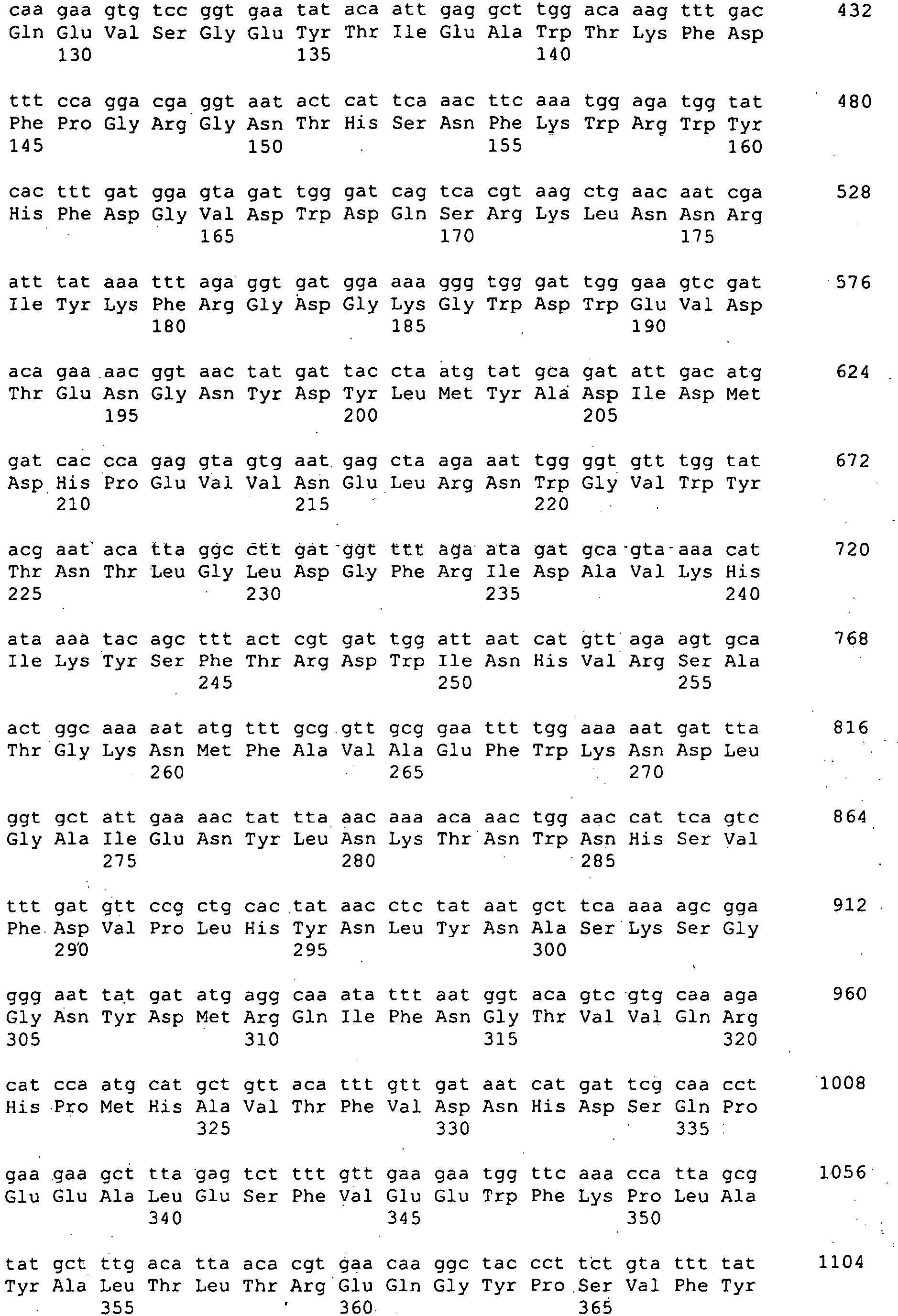

- <210> 2
<211> 485
<212> PRT
<213> Bacillus sp. - <400> 2


- <210> 3
<211> 1860
<212> DNA
<213> Bacillus flavothermus - <220>
<221> CDS
<222> (1)..(1857) - <220>
<221> sig_peptide
<222> (1)..(99) - <220>
<221> mat_peptide
<222> (100)..(1857) - <220>
<221> misc_feature
<222> (100)..(1551)
<223> catalystic domain - <220>
<221> misc_feature
<222> (1552)..(1857)
<223> carbohydrate binding domain - <400> 3


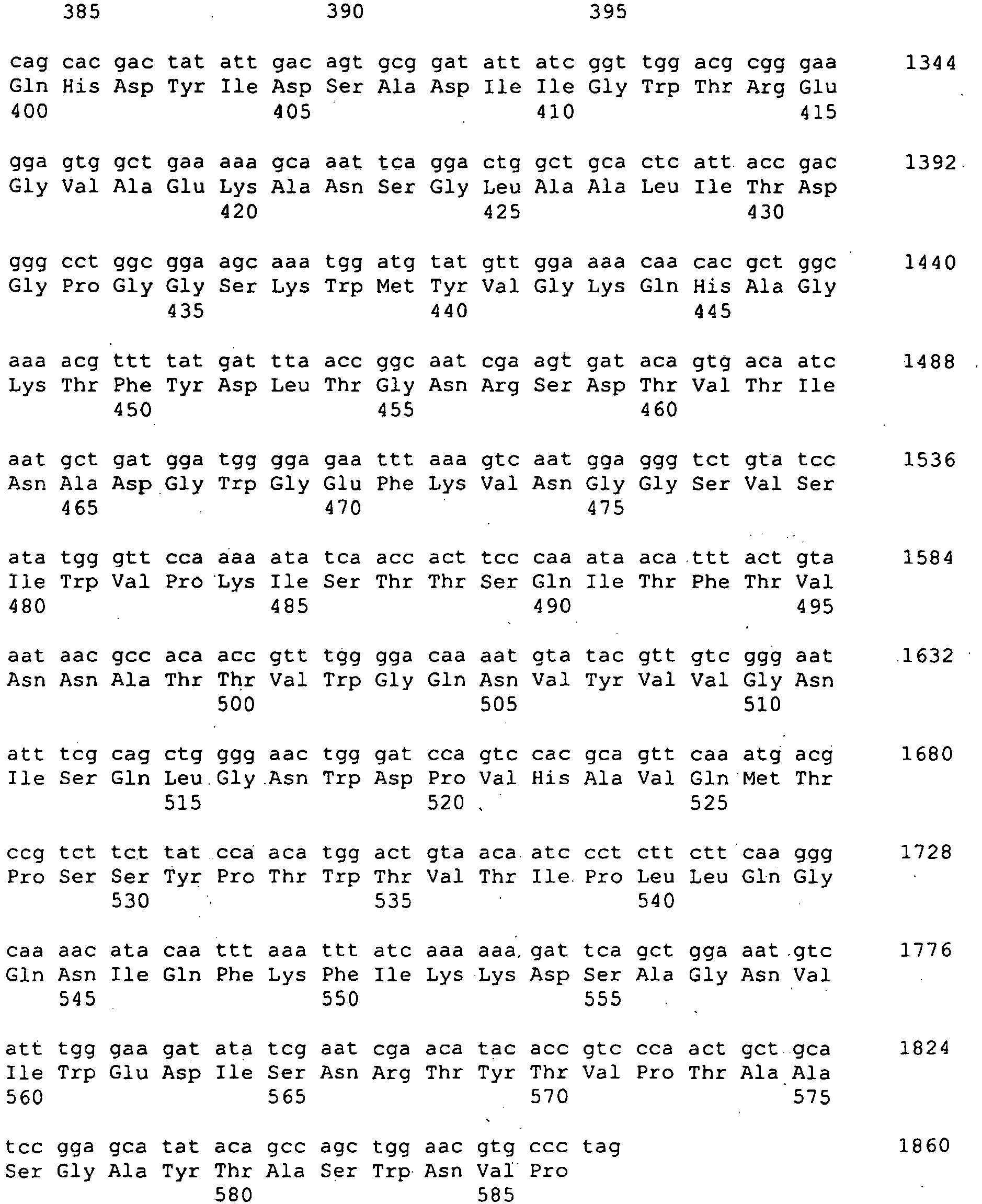
- <210> 4
<211> 619
<212> PRT
<213> Bacillus flavothermus - <400> 4


- <210> 5
<211> 1920
<212> DNA
<213> Bacillus licheniformis - <220>
<221> CDS
<222> (421)..(1872) - <400> 5
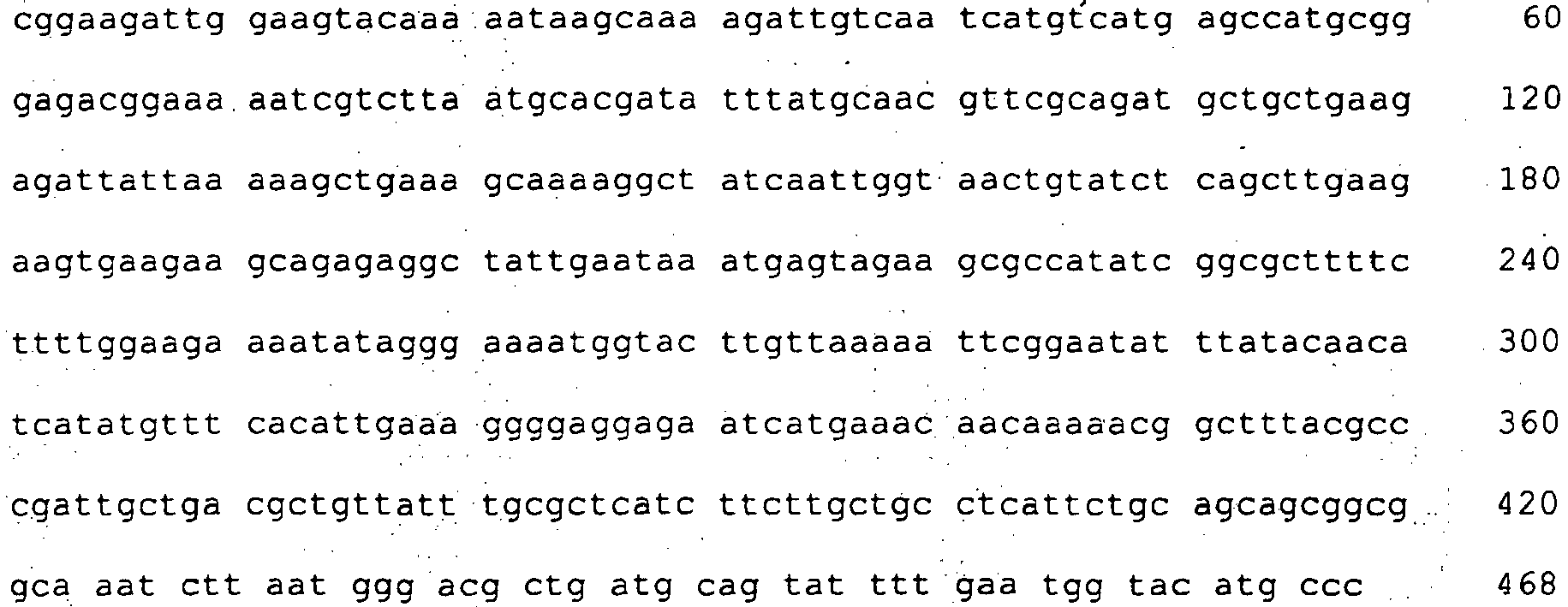


- <210> 6
<211> 483
<212> PRT
<213> Bacillus licheniformis - <400> 6


Claims (14)
- A method for preventing, removing, reducing or disrupting biofilm present on a surface, comprising contacting the surface with an alpha-amylase derived from a bacterium, where said alpha- amylase has alpha-amylase activity and an amino acid sequence having at least 80% identity with SEQ ID NO:2, and wherein the alpha-amylase is selected from the group consisting of:a) an alpha-amylase comprising an amino acid sequence having a deletion in positions D183 and/or G184 using SEQ ID NO:2 for numbering;b) an alpha-amylase comprising an amino acid sequence having deletions in positions D183+G184 using SEQ ID NO:2 for numbering; andc) an alpha-amylase comprising an amino acid sequence having one or more of substitutions selected from the group consisting of: R118K, N195F, R320K, and R458K, and having a deletion in positions D183 and/or G184 using SEQ ID NO:2 for numbering.
- The method of claim 1, wherein the biofilm contaminated or prone surface is contacted for between 1 minute and 2 days.
- The method of any of claims 1-2, wherein the alpha-amylase comprises Asn-Gly-Thr-Met-Met-Gln-Tyr-Phe-Glu-Trp in its N-terminal amino acid region.
- The method of any of claims 1-3, wherein the alpha-amylase is used in a concentration of between 0.005-500 mg enzyme protein per L biofilm control solution.
- The method of any of claims 1-4, wherein the alpha-amylase has a percentage (%) of hydrolyzed starch that is higher than 15, after 5 hours at 40°C, 3 mg enzyme protein per g starch, pH 8.0.
- The method of any of claims 1-5, wherein further enzymes are present, which enzymes are selected from the group consisting of an aminopeptidase, amylase, carbohydrase, carboxypeptidase, catalase, cellulase, chitinase, cutinase, cyclodextrin glycosyltransferase, deoxyribonuclease, esterase, alpha-galactosidase, beta-galactosidase, glucoamylase, alpha-glucosidase, beta-glucosidase, haloperoxidase, invertase, laccase, lipase, mannosidase, oxidoreductases, pectinolytic enzyme, peptidoglutaminase, peroxidase, phytase, polyphenoloxidase, proteolytic enzyme, ribonuclease, transglutaminase, or xylanase.
- The method of any of claims 1-6, wherein further one or more agents selected from the group consisting of dispersants, surfactants, anti-microbials, and biocides, are present.
- The method of any of claims 1-7, wherein the surface is a hard, soft, or porous surface.
- The method of claim 8, wherein the surface is a membrane.
- The method of any of claims 1-9, wherein the biofilm removal is done at a temperature between 10-70°C.
- Use of the alpha-amylase of claim 1 for prevention or removal of biofilm from surfaces.
- The use of claim 11 wherein further enzymes and/or agents as defined in claims 1-10 are used.
- The method of claim 1, comprising contacting the surface with an alpha-amylase derived from a bacterium, said alpha amylase has alpha-amylase activity and an amino acid sequence having at least 90% identity with SEQ ID NO:2, and wherein the alpha-amylase is selected from the group consisting of:a) an alpha-amylase comprising an amino acid sequence having a deletion in positions D183 and/or G184 using SEQ ID NO:2 for numbering;b) an alpha-amylase comprising an amino acid sequence having deletions in positions D183+G184 using SEQ ID NO:2 for numbering; andc) an alpha-amylase comprising an amino acid sequence having one or more of substitutions selected from the group consisting of: R118K, N195F, R320K, and R458K, and having a deletion in positions D183 and/or G184 using SEQ ID NO:2 for numbering.
- The method in accordance with claim 13 wherein the alpha-amylase comprises an amino acid sequence having at least 95% identity with SEQ ID NO:2 and a deletion in positions D183 and/or G184 using SEQ ID NO:2 for numbering.
Priority Applications (3)
| Application Number | Priority Date | Filing Date | Title |
|---|---|---|---|
| EP10180241A EP2258837A1 (en) | 2004-09-10 | 2005-09-07 | Methods for preventing, removing, reducing, or disrupting biofilm |
| EP10180231.2A EP2258836B1 (en) | 2004-09-10 | 2005-09-07 | Methods for preventing, removing, reducing, or disrupting biofilm |
| DK10180231.2T DK2258836T3 (en) | 2004-09-10 | 2005-09-07 | Methods for the prevention, elimination, reduction or destruction of biofilms |
Applications Claiming Priority (2)
| Application Number | Priority Date | Filing Date | Title |
|---|---|---|---|
| US60853504P | 2004-09-10 | 2004-09-10 | |
| PCT/US2005/031813 WO2006031554A2 (en) | 2004-09-10 | 2005-09-07 | Methods for preventing, removing, reducing, or disrupting biofilm |
Related Child Applications (3)
| Application Number | Title | Priority Date | Filing Date |
|---|---|---|---|
| EP10180231.2A Division EP2258836B1 (en) | 2004-09-10 | 2005-09-07 | Methods for preventing, removing, reducing, or disrupting biofilm |
| EP10180231.2A Division-Into EP2258836B1 (en) | 2004-09-10 | 2005-09-07 | Methods for preventing, removing, reducing, or disrupting biofilm |
| EP10180241A Division-Into EP2258837A1 (en) | 2004-09-10 | 2005-09-07 | Methods for preventing, removing, reducing, or disrupting biofilm |
Publications (3)
| Publication Number | Publication Date |
|---|---|
| EP1791966A2 EP1791966A2 (en) | 2007-06-06 |
| EP1791966A4 EP1791966A4 (en) | 2008-12-03 |
| EP1791966B1 true EP1791966B1 (en) | 2014-06-04 |
Family
ID=36060538
Family Applications (3)
| Application Number | Title | Priority Date | Filing Date |
|---|---|---|---|
| EP05795624.5A Expired - Lifetime EP1791966B1 (en) | 2004-09-10 | 2005-09-07 | Methods for preventing, removing, reducing, or disrupting biofilm |
| EP10180241A Ceased EP2258837A1 (en) | 2004-09-10 | 2005-09-07 | Methods for preventing, removing, reducing, or disrupting biofilm |
| EP10180231.2A Expired - Lifetime EP2258836B1 (en) | 2004-09-10 | 2005-09-07 | Methods for preventing, removing, reducing, or disrupting biofilm |
Family Applications After (2)
| Application Number | Title | Priority Date | Filing Date |
|---|---|---|---|
| EP10180241A Ceased EP2258837A1 (en) | 2004-09-10 | 2005-09-07 | Methods for preventing, removing, reducing, or disrupting biofilm |
| EP10180231.2A Expired - Lifetime EP2258836B1 (en) | 2004-09-10 | 2005-09-07 | Methods for preventing, removing, reducing, or disrupting biofilm |
Country Status (6)
| Country | Link |
|---|---|
| US (4) | US20080248558A1 (en) |
| EP (3) | EP1791966B1 (en) |
| JP (1) | JP5345781B2 (en) |
| CN (4) | CN103181400B (en) |
| DK (1) | DK2258836T3 (en) |
| WO (1) | WO2006031554A2 (en) |
Families Citing this family (172)
| Publication number | Priority date | Publication date | Assignee | Title |
|---|---|---|---|---|
| US6632429B1 (en) | 1999-12-17 | 2003-10-14 | Joan M. Fallon | Methods for treating pervasive development disorders |
| US20070053895A1 (en) | 2000-08-14 | 2007-03-08 | Fallon Joan M | Method of treating and diagnosing parkinsons disease and related dysautonomic disorders |
| US8030002B2 (en) | 2000-11-16 | 2011-10-04 | Curemark Llc | Methods for diagnosing pervasive development disorders, dysautonomia and other neurological conditions |
| AU2003201573B2 (en) * | 2002-01-22 | 2009-02-26 | Biomatera Inc. | Method of drying biodegradable polymers |
| US20080058282A1 (en) | 2005-08-30 | 2008-03-06 | Fallon Joan M | Use of lactulose in the treatment of autism |
| US7976873B2 (en) | 2006-05-10 | 2011-07-12 | Medtronic Xomed, Inc. | Extracellular polysaccharide solvating system for treatment of bacterial ear conditions |
| US7959943B2 (en) | 2006-05-10 | 2011-06-14 | Medtronics Xomed, Inc. | Solvating system and sealant for medical use in the middle or inner ear |
| US7993675B2 (en) | 2006-05-10 | 2011-08-09 | Medtronic Xomed, Inc. | Solvating system and sealant for medical use in the sinuses and nasal passages |
| US20070264296A1 (en) * | 2006-05-10 | 2007-11-15 | Myntti Matthew F | Biofilm extracellular polysachharide solvating system |
| US20080019956A1 (en) * | 2006-07-24 | 2008-01-24 | Manoj Kumar | Enzymatic prevention and control of biofilm |
| WO2008055501A1 (en) * | 2006-11-08 | 2008-05-15 | B-K Medical Aps | Method and apparatus for two-step sterilization |
| EP2099466B1 (en) * | 2006-12-01 | 2015-06-03 | Laclede, Inc. | Use of hydrolytic and oxidative enzymes to dissolve biofilm in ears |
| US8343536B2 (en) | 2007-01-25 | 2013-01-01 | Cook Biotech Incorporated | Biofilm-inhibiting medical products |
| US8088095B2 (en) | 2007-02-08 | 2012-01-03 | Medtronic Xomed, Inc. | Polymeric sealant for medical use |
| KR101461842B1 (en) * | 2007-02-08 | 2014-11-13 | 메드트로닉 좀드 인코퍼레이티드 | Solvating system and sealant for medical use |
| WO2008112459A2 (en) * | 2007-03-09 | 2008-09-18 | Danisco Us Inc., Genencor Division | Alkaliphilic bacillus species a-amylase variants, compositions comprising a-amylase variants, and methods of use |
| JP5427041B2 (en) | 2007-03-23 | 2014-02-26 | ノボザイムス バイオロジカルズ,インコーポレイティド | Prevention and reduction of biofilm formation and plankton-like growth |
| EP2155869A2 (en) | 2007-05-30 | 2010-02-24 | Danisco US, INC., Genencor Division | Variants of an alpha-amylase with improved production levels in fermentation processes |
| JP5520828B2 (en) | 2007-11-05 | 2014-06-11 | ダニスコ・ユーエス・インク | Bacillus sp. TS-23 alpha-amylase variants with altered characteristics |
| RU2495098C2 (en) | 2007-12-20 | 2013-10-10 | ДАНИСКО ЮЖс ИНК. | Method for enzymatic removal of biofilm, composition and set |
| US8658163B2 (en) | 2008-03-13 | 2014-02-25 | Curemark Llc | Compositions and use thereof for treating symptoms of preeclampsia |
| US8084025B2 (en) | 2008-04-18 | 2011-12-27 | Curemark Llc | Method for the treatment of the symptoms of drug and alcohol addiction |
| US8784790B2 (en) | 2008-06-12 | 2014-07-22 | Medtronic Xomed, Inc. | Method for treating chronic wounds with an extracellular polymeric substance solvating system |
| US9320780B2 (en) | 2008-06-26 | 2016-04-26 | Curemark Llc | Methods and compositions for the treatment of symptoms of Williams Syndrome |
| ES2732453T3 (en) | 2008-07-01 | 2019-11-22 | Curemark Llc | Methods and compositions for the treatment of symptoms of neurological and mental health disorders |
| US20100008893A1 (en) * | 2008-07-11 | 2010-01-14 | Novozymes A/S | Bacillus velezensis strain |
| WO2010014715A1 (en) * | 2008-07-30 | 2010-02-04 | Novozymes A/S | Bacillus amyloliquefaciens strain |
| US10776453B2 (en) | 2008-08-04 | 2020-09-15 | Galenagen, Llc | Systems and methods employing remote data gathering and monitoring for diagnosing, staging, and treatment of Parkinsons disease, movement and neurological disorders, and chronic pain |
| US20100092447A1 (en) | 2008-10-03 | 2010-04-15 | Fallon Joan M | Methods and compositions for the treatment of symptoms of prion diseases |
| US20100086576A1 (en) * | 2008-10-06 | 2010-04-08 | Myntti Matthew F | Antimicrobial composition and methods of making and using same |
| JP2012514604A (en) * | 2009-01-06 | 2012-06-28 | キュレロン リミテッド ライアビリティ カンパニー | Compositions and methods for the treatment or prevention of oral infection by E. coli |
| AU2015252099B2 (en) * | 2009-01-06 | 2017-08-10 | Galenagen, Llc | Compositions and methods for the treatment or prevention of staphylococcus aureus infections and for the eradication or reduction of staphylococcus aureus on surfaces |
| CA3050530A1 (en) * | 2009-01-06 | 2010-07-15 | Galenagen, Llc | Compositions and methods for the treatment or prevention of staphylococcus aureus infections and for the eradication or reduction of staphylococcus aureus on surfaces |
| US9056050B2 (en) | 2009-04-13 | 2015-06-16 | Curemark Llc | Enzyme delivery systems and methods of preparation and use |
| JP2011020977A (en) * | 2009-07-19 | 2011-02-03 | Tsutomu Takatani | Controlling agent for moss and blue algae and controlling method using the same |
| US9511125B2 (en) | 2009-10-21 | 2016-12-06 | Curemark Llc | Methods and compositions for the treatment of influenza |
| CN105384239B (en) | 2009-11-10 | 2019-05-03 | 诺维信生物股份有限公司 | For controlling method, composition and the system of film fouling |
| WO2011063394A2 (en) * | 2009-11-23 | 2011-05-26 | Olmstead Stephen F | Compositions and methods comprising serratia peptidase for inhibition and treatment of biofilms related to certain conditions |
| GB2477914B (en) | 2010-02-12 | 2012-01-04 | Univ Newcastle | Compounds and methods for biofilm disruption and prevention |
| US9234251B2 (en) | 2010-03-19 | 2016-01-12 | Novozymes Biologicals, Inc. | Bacillus amyloliquefaciens strain |
| ES2532537T3 (en) * | 2010-07-22 | 2015-03-27 | Unilever N.V. | Detergent compositions comprising a biotensive and lipase |
| BR112013000110B1 (en) | 2010-07-22 | 2021-05-11 | Unilever Ip Holdings B.V. | cleaning compositions and cleaning process |
| CA2817105A1 (en) * | 2010-10-15 | 2012-04-19 | S.A. Realco | Product and method for the removal of biofilms |
| ES2602446T3 (en) | 2010-10-15 | 2017-02-21 | Realco Sa | Procedure for biofilm removal |
| JP5856749B2 (en) * | 2011-04-01 | 2016-02-10 | 旭化成ケミカルズ株式会社 | Biofilm remover |
| MX362974B (en) | 2011-04-21 | 2019-02-28 | Curemark Llc | Compounds for the treatment of neuropsychiatric disorders. |
| US10653133B2 (en) | 2011-05-10 | 2020-05-19 | Next Science IP Holdings Pty Ltd | Antimicrobial solid and methods of making and using same |
| AU2012348192B2 (en) * | 2011-12-08 | 2017-12-07 | Thomas P. SUITER | Hose handling system and methods of use |
| US10150144B2 (en) | 2011-12-08 | 2018-12-11 | Thomas P. Suiter | Hose handling system and methods of use |
| DE102012201522A1 (en) * | 2012-02-02 | 2013-08-08 | Basf Se | Storage stable liquid dishwashing detergent containing protease and amylase |
| US10350278B2 (en) | 2012-05-30 | 2019-07-16 | Curemark, Llc | Methods of treating Celiac disease |
| JP6327496B2 (en) * | 2012-05-30 | 2018-05-23 | 有限会社カイ | Anti-infective treatment using enzyme treatment solution |
| WO2014087011A1 (en) * | 2012-12-07 | 2014-06-12 | Novozymes A/S | Preventing adhesion of bacteria |
| JPWO2014178380A1 (en) * | 2013-04-30 | 2017-02-23 | 株式会社カネカ | Purification method of radioactive cesium contaminated water |
| BE1021388B1 (en) * | 2013-05-22 | 2015-11-13 | Realco | METHOD OF AUMENTATION OF THE LIFETIME OF PERISHABLE FOODSTUFFS. |
| EP3004341B1 (en) | 2013-05-29 | 2017-08-30 | Danisco US Inc. | Novel metalloproteases |
| EP3636662B1 (en) | 2013-05-29 | 2022-07-13 | Danisco US Inc. | Novel metalloproteases |
| WO2014194032A1 (en) | 2013-05-29 | 2014-12-04 | Danisco Us Inc. | Novel metalloproteases |
| WO2014194117A2 (en) | 2013-05-29 | 2014-12-04 | Danisco Us Inc. | Novel metalloproteases |
| CN104222158A (en) * | 2013-06-19 | 2014-12-24 | 深圳市绿微康生物工程有限公司 | Microflora remover |
| CN106029881B (en) | 2013-12-13 | 2023-01-10 | 丹尼斯科美国公司 | Serine proteases of the bacillus gibsonii-clade |
| DK3080262T3 (en) | 2013-12-13 | 2019-05-06 | Danisco Us Inc | SERIN PROTEAS OF BACILLUS SPECIES |
| EP4163305B1 (en) | 2013-12-16 | 2024-07-10 | Nutrition & Biosciences USA 4, Inc. | Use of poly alpha-1,3-glucan ethers as viscosity modifiers |
| KR102410391B1 (en) | 2013-12-18 | 2022-06-16 | 뉴트리션 앤드 바이오사이언시스 유에스에이 4, 인크. | Cationic poly alpha-1,3-glucan ethers |
| EP3105256A1 (en) | 2014-02-14 | 2016-12-21 | E. I. du Pont de Nemours and Company | Poly-alpha-1,3-1,6-glucans for viscosity modification |
| EP3116914B8 (en) | 2014-03-11 | 2021-04-21 | E. I. du Pont de Nemours and Company | Oxidized poly alpha-1,3-glucan as detergent builder |
| JP6585698B2 (en) | 2014-03-21 | 2019-10-02 | ダニスコ・ユーエス・インク | Serine protease of Bacillus species |
| RU2737535C2 (en) * | 2014-04-11 | 2020-12-01 | Новозимс А/С | Detergent composition |
| BR112016024493A2 (en) | 2014-04-25 | 2018-01-23 | Basf Se | amylase, nucleic acid, expression set, recombinant host cell, enzyme composition and substance treatment method |
| US20170044468A1 (en) * | 2014-05-02 | 2017-02-16 | Novozymes A/S | Detergent Composition |
| WO2015195777A1 (en) | 2014-06-19 | 2015-12-23 | E. I. Du Pont De Nemours And Company | Compositions containing one or more poly alpha-1,3-glucan ether compounds |
| US9714403B2 (en) | 2014-06-19 | 2017-07-25 | E I Du Pont De Nemours And Company | Compositions containing one or more poly alpha-1,3-glucan ether compounds |
| DE102014009813A1 (en) * | 2014-07-03 | 2016-01-07 | Biopract Gmbh | Process for the prophylaxis of fungal infections in useful and ornamental plants, preferably in viticulture, and in woody plants |
| CN104286030A (en) * | 2014-09-30 | 2015-01-21 | 中国海洋石油总公司 | Biological enzyme biological slime inhibitor for circulating cooling water |
| EP3207129B1 (en) | 2014-10-17 | 2019-11-20 | Danisco US Inc. | Serine proteases of bacillus species |
| EP3212783B1 (en) | 2014-10-27 | 2024-06-26 | Danisco US Inc. | Serine proteases |
| US20180010074A1 (en) | 2014-10-27 | 2018-01-11 | Danisco Us Inc. | Serine proteases of bacillus species |
| DK3212662T3 (en) | 2014-10-27 | 2020-07-20 | Danisco Us Inc | serine proteases |
| EP3212782B1 (en) | 2014-10-27 | 2019-04-17 | Danisco US Inc. | Serine proteases |
| DK3212781T3 (en) | 2014-10-27 | 2019-12-16 | Danisco Us Inc | serine proteases |
| CN108064306B (en) | 2014-12-23 | 2022-11-01 | 营养与生物科学美国4公司 | Enzymatically produced cellulose |
| EP3872174B1 (en) | 2015-05-13 | 2023-03-01 | Danisco US Inc. | Aprl-clade protease variants and uses thereof |
| CN104909454B (en) * | 2015-05-19 | 2017-06-23 | 中国科学院广州能源研究所 | A kind of method of soft cellulose filler biomembrane conglomeration in releasing anaerobic reactor |
| WO2016196680A1 (en) * | 2015-06-01 | 2016-12-08 | Robert Caron | Biofilm control and frack fluid production using bacillus subtilis activated with gfak |
| WO2016201040A1 (en) | 2015-06-09 | 2016-12-15 | Danisco Us Inc. | Water-triggered enzyme suspension |
| WO2016201069A1 (en) | 2015-06-09 | 2016-12-15 | Danisco Us Inc | Low-density enzyme-containing particles |
| EP3307427B1 (en) | 2015-06-09 | 2023-08-16 | Danisco US Inc. | Osmotic burst encapsulates |
| WO2016205755A1 (en) | 2015-06-17 | 2016-12-22 | Danisco Us Inc. | Bacillus gibsonii-clade serine proteases |
| CN108367251A (en) * | 2015-10-14 | 2018-08-03 | 诺维信公司 | The cleaning of water filtration membrane |
| IL258550B (en) * | 2015-10-14 | 2022-06-01 | Novozymes As | Cleaning of water filtration membranes |
| CN108603183B (en) | 2015-11-05 | 2023-11-03 | 丹尼斯科美国公司 | Paenibacillus spp. and Bacillus spp. mannanase |
| CN109072208A (en) | 2015-11-05 | 2018-12-21 | 丹尼斯科美国公司 | Paenibacillus sp. mannanase |
| WO2017083226A1 (en) | 2015-11-13 | 2017-05-18 | E. I. Du Pont De Nemours And Company | Glucan fiber compositions for use in laundry care and fabric care |
| JP7045313B2 (en) | 2015-11-13 | 2022-03-31 | ニュートリション・アンド・バイオサイエンシーズ・ユーエスエー・フォー,インコーポレイテッド | Glucan fiber composition for use in laundry care and textile care |
| WO2017083229A1 (en) | 2015-11-13 | 2017-05-18 | E. I. Du Pont De Nemours And Company | Glucan fiber compositions for use in laundry care and fabric care |
| CN105567667A (en) * | 2015-11-24 | 2016-05-11 | 威海翔宇环保科技股份有限公司 | Bio-enzyme medicament capable of controlling biological slime in circulating water |
| EP3901257A1 (en) | 2015-12-09 | 2021-10-27 | Danisco US Inc. | Alpha-amylase combinatorial variants |
| EP3390625B1 (en) | 2015-12-18 | 2023-09-06 | Danisco US Inc. | Polypeptides with endoglucanase activity and uses thereof |
| AU2017246664B2 (en) * | 2016-04-05 | 2024-01-18 | President And Fellows Of Harvard College | Fungal species, compositions derived therefrom, and uses thereof |
| CN109715791B (en) | 2016-05-03 | 2023-07-14 | 丹尼斯科美国公司 | Protease variants and uses thereof |
| US20190136218A1 (en) | 2016-05-05 | 2019-05-09 | Danisco Us Inc | Protease variants and uses thereof |
| CN109477112B (en) | 2016-05-31 | 2024-09-06 | 丹尼斯科美国公司 | Protease variants and uses thereof |
| CA3027745A1 (en) | 2016-06-17 | 2017-12-21 | Danisco Us Inc. | Protease variants and uses thereof |
| CN106376597A (en) * | 2016-08-30 | 2017-02-08 | 北京达成生物科技有限公司 | Multienzyme composite antibacterial agent |
| CN110023474A (en) * | 2016-09-29 | 2019-07-16 | 诺维信公司 | Purposes, washing methods and utensil washing composition of the enzyme for washing |
| US20190264138A1 (en) | 2016-11-07 | 2019-08-29 | Danisco Us Inc. | Laundry detergent composition |
| CN110312794B (en) | 2016-12-21 | 2024-04-12 | 丹尼斯科美国公司 | Bacillus gibsonii clade serine protease |
| EP4520820A3 (en) | 2016-12-21 | 2025-04-16 | Danisco Us Inc | Protease variants and uses thereof |
| CN106621824B (en) * | 2017-01-03 | 2019-08-13 | 东北电力大学 | A disintegrating agent for alleviating biofilm fouling in membrane bioreactors |
| WO2018161899A1 (en) * | 2017-03-06 | 2018-09-13 | Novozymes A/S | Use of one or more enzymes in preventing, inhibiting or reducing microbe growth on a surface |
| CN110621778A (en) | 2017-03-15 | 2019-12-27 | 丹尼斯科美国公司 | Trypsin-like serine protease and uses thereof |
| EP3601551A1 (en) | 2017-03-31 | 2020-02-05 | Novozymes A/S | Polypeptides having rnase activity |
| US20200040283A1 (en) | 2017-03-31 | 2020-02-06 | Danisco Us Inc | Delayed release enzyme formulations for bleach-containing detergents |
| CN114480034A (en) | 2017-04-04 | 2022-05-13 | 诺维信公司 | Glycosyl hydrolase |
| AU2018250823A1 (en) | 2017-04-10 | 2019-10-17 | Curemark, Llc | Compositions for treating addiction |
| JP7680825B2 (en) | 2017-06-30 | 2025-05-21 | ダニスコ・ユーエス・インク | Low-aggregation enzyme-containing particles |
| CN107197877B (en) * | 2017-07-12 | 2020-04-21 | 宿迁研美生物科技有限公司 | Biological compound enzyme virus scavenger (disinfectant) |
| DE102017125560A1 (en) | 2017-11-01 | 2019-05-02 | Henkel Ag & Co. Kgaa | CLEANSING COMPOSITIONS CONTAINING DISPERSINE III |
| CN107991471A (en) * | 2017-11-24 | 2018-05-04 | 吉林建筑大学 | A kind of water-biomembrane visible ray shines analogue experiment installation |
| EP3717643A1 (en) | 2017-11-29 | 2020-10-07 | Danisco US Inc. | Subtilisin variants having improved stability |
| ES3058679T3 (en) | 2017-12-21 | 2026-03-12 | Danisco Us Inc | Enzyme-containing, hot-melt granules comprising a thermotolerant desiccant |
| US20200359656A1 (en) | 2018-02-08 | 2020-11-19 | Danisco Us Inc. | Thermally-resistant wax matrix particles for enzyme encapsulation |
| US20210363470A1 (en) | 2018-06-19 | 2021-11-25 | Danisco Us Inc | Subtilisin variants |
| WO2019245704A1 (en) | 2018-06-19 | 2019-12-26 | Danisco Us Inc | Subtilisin variants |
| CN109160615A (en) * | 2018-07-21 | 2019-01-08 | 东南大学 | A kind of synchronous method alleviated membrane pollution of membrane bioreactor and control sludge yield |
| EP3844255A1 (en) | 2018-08-30 | 2021-07-07 | Danisco US Inc. | Enzyme-containing granules |
| EP3849574A1 (en) | 2018-09-10 | 2021-07-21 | Lactobio A/S | Method for reducing the transfer of pathogenic microorganisms |
| CN109133356B (en) * | 2018-09-12 | 2021-09-14 | 浙江海洋大学 | Method for removing algae by using filter feeders |
| EP3856882A1 (en) | 2018-09-27 | 2021-08-04 | Danisco US Inc. | Compositions for medical instrument cleaning |
| CN112969788A (en) | 2018-10-02 | 2021-06-15 | 诺维信公司 | Endonuclease 1 ribonuclease for cleaning |
| WO2020070014A1 (en) | 2018-10-02 | 2020-04-09 | Novozymes A/S | Cleaning composition comprising anionic surfactant and a polypeptide having rnase activity |
| EP3887515A1 (en) | 2018-11-28 | 2021-10-06 | Danisco US Inc. | Subtilisin variants having improved stability |
| CN114174504B (en) | 2019-05-24 | 2026-04-17 | 丹尼斯科美国公司 | Subtilis protease variants and usage methods |
| WO2020247582A1 (en) | 2019-06-06 | 2020-12-10 | Danisco Us Inc | Methods and compositions for cleaning |
| KR20220121235A (en) * | 2019-12-20 | 2022-08-31 | 헨켈 아게 운트 코. 카게아아 | Cleaning Composition Comprising Dispersin and Carbohydrase |
| US20230072496A1 (en) | 2020-04-10 | 2023-03-09 | Liberty Biosecurity, Llc | Polypeptide compositions and uses thereof |
| WO2021207679A1 (en) | 2020-04-10 | 2021-10-14 | Liberty Biosecurity, Llc | Polypeptide compositions and uses thereof |
| CN113881645A (en) * | 2020-07-02 | 2022-01-04 | 北京世城双清科技有限公司 | Complex enzyme cleaning agent and application thereof |
| CN113881516A (en) * | 2020-07-02 | 2022-01-04 | 北京世城双清科技有限公司 | Complex enzyme cleaning agent |
| US20240034960A1 (en) | 2020-08-27 | 2024-02-01 | Danisco Us Inc | Enzymes and enzyme compositions for cleaning |
| US11541009B2 (en) | 2020-09-10 | 2023-01-03 | Curemark, Llc | Methods of prophylaxis of coronavirus infection and treatment of coronaviruses |
| CN112280765B (en) * | 2020-09-27 | 2021-10-08 | 扬州大学 | Application of sulfobetaine surfactant in improving the activity of bromelain |
| GB202017605D0 (en) * | 2020-11-06 | 2020-12-23 | Smarti Env Ltd | biocidal Composition |
| EP4284906A1 (en) | 2021-01-29 | 2023-12-06 | Danisco US Inc. | Compositions for cleaning and methods related thereto |
| WO2023278297A1 (en) | 2021-06-30 | 2023-01-05 | Danisco Us Inc | Variant lipases and uses thereof |
| WO2023034486A2 (en) | 2021-09-03 | 2023-03-09 | Danisco Us Inc. | Laundry compositions for cleaning |
| CN117957318A (en) | 2021-09-13 | 2024-04-30 | 丹尼斯科美国公司 | Particles containing biologically active substances |
| CN114410610A (en) * | 2021-12-08 | 2022-04-29 | 自然资源部第三海洋研究所 | Cyclomaltodextrinase and preparation method and application thereof |
| EP4448751A2 (en) | 2021-12-16 | 2024-10-23 | Danisco US Inc. | Subtilisin variants and methods of use |
| WO2023114932A2 (en) | 2021-12-16 | 2023-06-22 | Danisco Us Inc. | Subtilisin variants and methods of use |
| WO2023114939A2 (en) | 2021-12-16 | 2023-06-22 | Danisco Us Inc. | Subtilisin variants and methods of use |
| CN114209818A (en) * | 2021-12-21 | 2022-03-22 | 苏杰 | Composition containing hydrolase and polyglutamic acid for preventing and removing periodontal biofilm |
| CN115247106A (en) * | 2022-01-15 | 2022-10-28 | 郑州大学第一附属医院 | A kind of endoscopic multi-enzyme cleaning composition and its application |
| WO2023168234A1 (en) | 2022-03-01 | 2023-09-07 | Danisco Us Inc. | Enzymes and enzyme compositions for cleaning |
| US20250311734A1 (en) | 2022-05-14 | 2025-10-09 | Novozymes A/S | Compositions and Methods for Preventing, Treating, Suppressing and/or Eliminatting Phytopathogenic Infestations and Infections |
| CA3257737A1 (en) | 2022-06-20 | 2023-12-28 | Realco | Composition de decrochage et de prelevement de microorganismes |
| BE1030650B1 (en) * | 2022-06-20 | 2024-01-29 | Realco | COMPOSITION FOR STOPTING AND SAMPLING MICROORGANISMS |
| BE1030647B1 (en) * | 2022-06-20 | 2024-01-29 | Realco | METHOD FOR SAMPLING MICROORGANISMS ON AGRI-FOOD INDUSTRIAL SURFACES |
| BE1030645B1 (en) * | 2022-06-20 | 2024-01-29 | Realco | METHOD FOR DETECTING MICROORGANISMS |
| CN119487167A (en) | 2022-06-21 | 2025-02-18 | 丹尼斯科美国公司 | Compositions and methods for cleaning comprising polypeptides having thermolysin activity |
| JP2025530749A (en) | 2022-09-02 | 2025-09-17 | ダニスコ・ユーエス・インク | Detergent compositions and related methods |
| WO2024050339A1 (en) | 2022-09-02 | 2024-03-07 | Danisco Us Inc. | Mannanase variants and methods of use |
| US20260078362A1 (en) | 2022-09-02 | 2026-03-19 | Danisco Us Inc. | Subtilisin variants and methods related thereto |
| WO2024102698A1 (en) | 2022-11-09 | 2024-05-16 | Danisco Us Inc. | Subtilisin variants and methods of use |
| WO2024163584A1 (en) | 2023-02-01 | 2024-08-08 | Danisco Us Inc. | Subtilisin variants and methods of use |
| CN120712348A (en) | 2023-03-06 | 2025-09-26 | 丹尼斯科美国公司 | Subtilisin variants and methods of use |
| CN120813242A (en) | 2023-03-16 | 2025-10-17 | 营养与生物科学美国第四公司 | Brevibacillus brevis ferment extract for cleaning and odor control and uses thereof |
| CN121909283A (en) | 2023-09-28 | 2026-04-21 | 丹尼斯科美国公司 | Variant keratinases with improved solubility and their uses |
| WO2025085351A1 (en) | 2023-10-20 | 2025-04-24 | Danisco Us Inc. | Subtilisin variants and methods of use |
| CN117486439B (en) * | 2024-01-03 | 2024-03-08 | 北京哈泰克工程技术有限公司 | Papermaking wastewater treatment method with low sludge yield |
| WO2026024922A1 (en) | 2024-07-25 | 2026-01-29 | Danisco Us Inc. | Subtilisin variants and methods of use |
| WO2026050315A1 (en) | 2024-08-29 | 2026-03-05 | Danisco Us Inc. | Subtilisin variants and methods of use |
Family Cites Families (66)
| Publication number | Priority date | Publication date | Assignee | Title |
|---|---|---|---|---|
| DK122686D0 (en) | 1986-03-17 | 1986-03-17 | Novo Industri As | PREPARATION OF PROTEINS |
| US4725544A (en) | 1986-04-25 | 1988-02-16 | Tan Larry U | Method for purifying xylanase |
| DK564086A (en) | 1986-11-25 | 1988-06-17 | Novo Industri As | ENZYMATIC DETERGENT ADDITIVE |
| US4966850A (en) | 1987-01-21 | 1990-10-30 | Forintek Canada Corp. | Production of thermostable xylanase and cellulase |
| DE3854249T2 (en) | 1987-08-28 | 1996-02-29 | Novonordisk As | Recombinant Humicola Lipase and Process for the Production of Recombinant Humicola Lipases. |
| DK6488D0 (en) | 1988-01-07 | 1988-01-07 | Novo Industri As | ENZYMES |
| US5116746A (en) | 1988-03-04 | 1992-05-26 | Institut Armand Frappier | Cellulase-free endo-xylanase enzyme of use in pulp delignification |
| FI901509A0 (en) | 1988-07-27 | 1990-03-26 | Univ Iowa State Res Found Inc | XYLANASGLYKOPROTEIN MED LAOG MOLEKYLVIKT. |
| CA2003503A1 (en) | 1988-11-23 | 1990-05-23 | Roberta Lee Farrell | Use of aureobasidium pullulans in pulp bleaching |
| US5071765A (en) * | 1989-03-13 | 1991-12-10 | Nalco Chemical Company | Application of multiple enzyme blend to control industrial slime on equipment surfaces |
| US4936994A (en) * | 1989-03-13 | 1990-06-26 | Nalco Chemical Company | Application of cellulase to control industrial slime |
| CA2001538A1 (en) * | 1989-03-13 | 1990-09-13 | Christopher L. Wiatr | Application of glucanase to control industrial slime |
| JPH02238885A (en) | 1989-03-13 | 1990-09-21 | Oji Paper Co Ltd | Phenol oxidase genetically recombinant DNA, microorganisms transformed with the recombinant DNA, culture thereof, and method for producing phenol oxidase |
| DK316989D0 (en) | 1989-06-26 | 1989-06-26 | Novo Nordisk As | ENZYMES |
| DE4023458A1 (en) | 1989-08-31 | 1991-03-07 | Kali Chemie Ag | NEW HIGH ALKALINE PROTEASES |
| SE465320B (en) | 1990-01-10 | 1991-08-26 | Korsnaes Ab | PREPARATIONS SUBMITTING ENZYMATIC DELIGNIFICATION ACTIVITY, MADE TO MAKE THE SAME AND APPLICATIONS THEREOF |
| AT394730B (en) | 1990-05-08 | 1992-06-10 | Voest Alpine Ind Anlagen | METHOD FOR PRODUCING EXO- AND ENDOCELLULASE-FREE XYLANASE |
| WO1991018978A1 (en) | 1990-06-08 | 1991-12-12 | Valtion Teknillinen Tutkimuskeskus | β-XYLANASE PREPARATION, PROCESS FOR THE PREPARATION THEREOF AND ITS USE IN PULP BLEACHING |
| WO1991018976A1 (en) | 1990-06-08 | 1991-12-12 | Novo Nordisk A/S | HEMICELLULASES PRODUCED BY $i(BACILLUS STEAROTHERMOPHILUS) |
| FI903443A7 (en) | 1990-07-06 | 1992-01-07 | Valtion Teknillinen | FRAMSTAELLNING AV LACKAS GENOM RECOMBINANTORGANISMER. |
| GB9018426D0 (en) | 1990-08-22 | 1990-10-03 | Sandoz Ltd | Improvements in or relating to novel compounds |
| NZ239500A (en) | 1990-08-24 | 1993-08-26 | Novo Nordisk As | Xylanases obtained from bacillus pumilus and use in a lignocellulosic chemical pulping process |
| DK0548228T3 (en) | 1990-09-13 | 1999-05-10 | Novo Nordisk As | lipase variants |
| FR2672066B1 (en) | 1991-01-25 | 1997-01-31 | Du Pin Cellulose | ENZYMATIC TREATMENT OF A CHEMICAL LIGNOCELLULOSIC PASTE. |
| WO1992013807A1 (en) * | 1991-02-12 | 1992-08-20 | Buckman Laboratories International, Inc. | Composition and methods for removing or preventing biofilm |
| EP0579672B1 (en) | 1991-04-02 | 1999-02-03 | Novo Nordisk A/S | Xylanase, corresponding recombinant dna sequence, xylanase containing agent, and use of the agent |
| DK69591D0 (en) | 1991-04-18 | 1991-04-18 | Novo Nordisk As | NEW MICROORGANISMS |
| ES2121014T3 (en) | 1991-05-01 | 1998-11-16 | Novo Nordisk As | STABILIZED ENZYMES AND DETERGENT COMPOSITIONS. |
| CA2048322A1 (en) | 1991-08-08 | 1993-02-09 | Dieter Kluepfel | Xylanase for biobleaching |
| DK175391D0 (en) | 1991-10-18 | 1991-10-18 | Novo Nordisk As | NEW ENZYMER |
| FI942467A0 (en) | 1991-11-26 | 1994-05-26 | Novo Nordisk As | Protease stable proteins |
| DK34892D0 (en) | 1992-03-16 | 1992-03-16 | Novo Nordisk As | NEW ENZYM |
| FI946186A0 (en) | 1992-07-02 | 1994-12-30 | Novo Nordisk As | Alkalophilic Bacillus sp. AC13 and protease, xylanase, cellulase obtainable therefrom |
| EP1479765B1 (en) | 1993-03-10 | 2008-10-22 | Novozymes A/S | Enzymes with xylanase activity from aspergillus aculeatus |
| US5480801A (en) | 1993-09-17 | 1996-01-02 | Novo Nordisk A/S | Purified PH neutral Rhizoctonia laccases and nucleic acids encoding same |
| CA2173329C (en) * | 1993-10-08 | 2011-07-12 | Henrik Bisgard-Frantzen | Amylase variants |
| EP0724631A1 (en) | 1993-10-13 | 1996-08-07 | Novo Nordisk A/S | H 2?o 2?-stable peroxidase variants |
| CA2186592C (en) | 1994-03-29 | 2008-02-19 | Helle Outtrup | Alkaline bacillus amylase |
| AU695391B2 (en) | 1994-05-03 | 1998-08-13 | Novozymes A/S | Alkaline glucose oxidase |
| EP0763115B1 (en) | 1994-06-03 | 2000-09-06 | Novo Nordisk Biotech, Inc. | Purified scytalidium laccases and nucleic acids encoding same |
| JP3649338B2 (en) | 1994-06-03 | 2005-05-18 | ノボザイムス バイオテック,インコーポレイティド | Purified Myserioftra laccase and nucleic acid encoding it |
| NZ288901A (en) | 1994-06-24 | 1998-04-27 | Novo Nordisk As | Purified polyporus laccase, used for polymerising a lignin or lignosulphate substrate, in situ depolymerisation in kraft pulp, oxidising dyes and dying hair |
| WO1996006930A1 (en) | 1994-08-26 | 1996-03-07 | Novo Nordisk A/S | Coprinaceae laccases |
| JP3025627B2 (en) | 1995-06-14 | 2000-03-27 | 花王株式会社 | Liquefied alkaline α-amylase gene |
| DE69636754T2 (en) | 1995-07-14 | 2007-10-11 | Novozymes, Inc., Davis | HALOPEROXIDASES FROM CURVULARIA VERRUCULOSA AND NUCLEIC ACIDS COATING THEREOF |
| JPH09213868A (en) | 1996-01-30 | 1997-08-15 | Nec Corp | Lead frame for microwave semiconductor integrated circuit |
| AU4451597A (en) * | 1996-09-30 | 1998-04-24 | Danionics A/S | An electrolyte system, a method for the preparation thereof, the use thereof and a battery containing the electrolyte system |
| US6342386B1 (en) * | 1996-10-29 | 2002-01-29 | Warren Paul Powers | Methods for removing undesired growth from a surface |
| US6100080A (en) * | 1996-12-18 | 2000-08-08 | Novo Nordisk A/S | Method for enzymatic treatment of biofilm |
| AU9434398A (en) * | 1997-10-13 | 1999-05-03 | Novo Nordisk A/S | Alpha-amylase mutants |
| EP1023037A1 (en) * | 1997-10-17 | 2000-08-02 | Novo Nordisk A/S | Plaque-inhibiting oral compositions |
| CN1323345A (en) * | 1998-10-13 | 2001-11-21 | 诺沃奇梅兹有限公司 | A modified polypeptide with reduced immune response |
| US6592867B2 (en) * | 1998-11-09 | 2003-07-15 | Novozymes A/S | Antimicrobial composition containing an oxidoreductase and an enhancer of the N-hydroxyanilide-type |
| US6403355B1 (en) | 1998-12-21 | 2002-06-11 | Kao Corporation | Amylases |
| ES2618608T3 (en) * | 1999-03-30 | 2017-06-21 | Novozymes A/S | Alpha-amylase variants |
| ES2532606T3 (en) * | 1999-03-31 | 2015-03-30 | Novozymes A/S | Polypeptides with alkaline alpha-amylase activity and nucleic acids encoding them |
| KR20010108379A (en) | 1999-03-31 | 2001-12-07 | 피아 스타르 | Lipase variant |
| EP1263942B1 (en) * | 2000-03-08 | 2013-11-06 | Novozymes A/S | Variants with altered properties |
| AUPQ679100A0 (en) * | 2000-04-07 | 2000-05-11 | Novapharm Research (Australia) Pty Ltd | Process and composition for cleaning medical instruments |
| US6777223B2 (en) * | 2000-06-19 | 2004-08-17 | Novozymes Biotech, Inc. | Methods for eliminating the formation of biofilm |
| AUPQ921400A0 (en) * | 2000-08-04 | 2000-08-31 | Canon Kabushiki Kaisha | Method of enabling browse and search access to electronically-accessible multimedia databases |
| US7560126B2 (en) * | 2001-02-21 | 2009-07-14 | Verenium Corporation | Amylases, nucleic acids encoding them and methods for making and using them |
| AUPS328002A0 (en) * | 2002-06-28 | 2002-07-18 | Novapharm Research (Australia) Pty Ltd | Water treatment |
| FR2846665B1 (en) * | 2002-10-31 | 2006-09-08 | Karine Marion | PROCESS FOR REMOVING BIOFILM |
| JP2004231671A (en) * | 2002-12-03 | 2004-08-19 | Lion Corp | Detergent composition and sterilization / detergency evaluation method |
| ES2517245T3 (en) * | 2003-06-25 | 2014-11-03 | Novozymes A/S | Enzymes for the treatment of starch |
-
2005
- 2005-09-07 EP EP05795624.5A patent/EP1791966B1/en not_active Expired - Lifetime
- 2005-09-07 CN CN201210357051.0A patent/CN103181400B/en not_active Expired - Fee Related
- 2005-09-07 JP JP2007531293A patent/JP5345781B2/en not_active Expired - Fee Related
- 2005-09-07 CN CNA2005800300950A patent/CN101040052A/en active Pending
- 2005-09-07 DK DK10180231.2T patent/DK2258836T3/en active
- 2005-09-07 CN CN201210357075.6A patent/CN103182387B/en not_active Expired - Fee Related
- 2005-09-07 CN CN201210356472.1A patent/CN102919273B/en not_active Expired - Fee Related
- 2005-09-07 WO PCT/US2005/031813 patent/WO2006031554A2/en not_active Ceased
- 2005-09-07 US US11/574,688 patent/US20080248558A1/en not_active Abandoned
- 2005-09-07 EP EP10180241A patent/EP2258837A1/en not_active Ceased
- 2005-09-07 EP EP10180231.2A patent/EP2258836B1/en not_active Expired - Lifetime
-
2010
- 2010-11-29 US US12/955,251 patent/US20110104141A1/en not_active Abandoned
-
2013
- 2013-04-15 US US13/863,030 patent/US20130217099A1/en not_active Abandoned
-
2019
- 2019-01-07 US US16/241,310 patent/US20200181539A9/en not_active Abandoned
Also Published As
| Publication number | Publication date |
|---|---|
| EP2258837A1 (en) | 2010-12-08 |
| EP2258836B1 (en) | 2016-05-04 |
| US20130217099A1 (en) | 2013-08-22 |
| JP2008512468A (en) | 2008-04-24 |
| CN101040052A (en) | 2007-09-19 |
| EP1791966A4 (en) | 2008-12-03 |
| US20190256803A1 (en) | 2019-08-22 |
| CN102919273B (en) | 2016-03-16 |
| US20080248558A1 (en) | 2008-10-09 |
| CN103181400B (en) | 2016-08-10 |
| CN103182387B (en) | 2016-01-06 |
| US20200181539A9 (en) | 2020-06-11 |
| CN103182387A (en) | 2013-07-03 |
| EP1791966A2 (en) | 2007-06-06 |
| CN102919273A (en) | 2013-02-13 |
| DK2258836T3 (en) | 2016-07-25 |
| WO2006031554A2 (en) | 2006-03-23 |
| JP5345781B2 (en) | 2013-11-20 |
| US20110104141A1 (en) | 2011-05-05 |
| EP2258836A1 (en) | 2010-12-08 |
| WO2006031554A3 (en) | 2006-09-28 |
| CN103181400A (en) | 2013-07-03 |
Similar Documents
| Publication | Publication Date | Title |
|---|---|---|
| US20200181539A9 (en) | Methods for preventing, removing, reducing, or disrupting biofilm | |
| US6777223B2 (en) | Methods for eliminating the formation of biofilm | |
| CA2275157C (en) | A method for enzymatic treatment of biofilm | |
| CN101490232B (en) | Enzymatic prevention and control of biofilm | |
| CA2709480C (en) | Enzymatic prevention and control of biofilm | |
| US10675589B2 (en) | Cleaning of water filtration membranes | |
| IL258550A (en) | Cleaning of water filtration membranes |
Legal Events
| Date | Code | Title | Description |
|---|---|---|---|
| PUAI | Public reference made under article 153(3) epc to a published international application that has entered the european phase |
Free format text: ORIGINAL CODE: 0009012 |
|
| 17P | Request for examination filed |
Effective date: 20070410 |
|
| AK | Designated contracting states |
Kind code of ref document: A2 Designated state(s): AT BE BG CH CY CZ DE DK EE ES FI FR GB GR HU IE IS IT LI LT LU LV MC NL PL PT RO SE SI SK TR |
|
| DAX | Request for extension of the european patent (deleted) | ||
| A4 | Supplementary search report drawn up and despatched |
Effective date: 20081103 |
|
| RIC1 | Information provided on ipc code assigned before grant |
Ipc: C11D 3/386 20060101ALI20081028BHEP Ipc: B08B 7/00 20060101ALI20081028BHEP Ipc: B08B 17/02 20060101ALI20081028BHEP Ipc: C12N 9/28 20060101AFI20081028BHEP |
|
| 17Q | First examination report despatched |
Effective date: 20090225 |
|
| GRAP | Despatch of communication of intention to grant a patent |
Free format text: ORIGINAL CODE: EPIDOSNIGR1 |
|
| INTG | Intention to grant announced |
Effective date: 20140108 |
|
| GRAS | Grant fee paid |
Free format text: ORIGINAL CODE: EPIDOSNIGR3 |
|
| GRAA | (expected) grant |
Free format text: ORIGINAL CODE: 0009210 |
|
| AK | Designated contracting states |
Kind code of ref document: B1 Designated state(s): AT BE BG CH CY CZ DE DK EE ES FI FR GB GR HU IE IS IT LI LT LU LV MC NL PL PT RO SE SI SK TR |
|
| REG | Reference to a national code |
Ref country code: GB Ref legal event code: FG4D |
|
| REG | Reference to a national code |
Ref country code: CH Ref legal event code: EP |
|
| REG | Reference to a national code |
Ref country code: AT Ref legal event code: REF Ref document number: 671136 Country of ref document: AT Kind code of ref document: T Effective date: 20140615 |
|
| REG | Reference to a national code |
Ref country code: IE Ref legal event code: FG4D |
|
| REG | Reference to a national code |
Ref country code: DE Ref legal event code: R096 Ref document number: 602005043821 Country of ref document: DE Effective date: 20140717 |
|
| REG | Reference to a national code |
Ref country code: NL Ref legal event code: T3 |
|
| REG | Reference to a national code |
Ref country code: AT Ref legal event code: MK05 Ref document number: 671136 Country of ref document: AT Kind code of ref document: T Effective date: 20140604 |
|
| PG25 | Lapsed in a contracting state [announced via postgrant information from national office to epo] |
Ref country code: FI Free format text: LAPSE BECAUSE OF FAILURE TO SUBMIT A TRANSLATION OF THE DESCRIPTION OR TO PAY THE FEE WITHIN THE PRESCRIBED TIME-LIMIT Effective date: 20140604 Ref country code: CY Free format text: LAPSE BECAUSE OF FAILURE TO SUBMIT A TRANSLATION OF THE DESCRIPTION OR TO PAY THE FEE WITHIN THE PRESCRIBED TIME-LIMIT Effective date: 20140604 Ref country code: LT Free format text: LAPSE BECAUSE OF FAILURE TO SUBMIT A TRANSLATION OF THE DESCRIPTION OR TO PAY THE FEE WITHIN THE PRESCRIBED TIME-LIMIT Effective date: 20140604 Ref country code: GR Free format text: LAPSE BECAUSE OF FAILURE TO SUBMIT A TRANSLATION OF THE DESCRIPTION OR TO PAY THE FEE WITHIN THE PRESCRIBED TIME-LIMIT Effective date: 20140905 |
|
| REG | Reference to a national code |
Ref country code: LT Ref legal event code: MG4D |
|
| PG25 | Lapsed in a contracting state [announced via postgrant information from national office to epo] |
Ref country code: AT Free format text: LAPSE BECAUSE OF FAILURE TO SUBMIT A TRANSLATION OF THE DESCRIPTION OR TO PAY THE FEE WITHIN THE PRESCRIBED TIME-LIMIT Effective date: 20140604 Ref country code: SE Free format text: LAPSE BECAUSE OF FAILURE TO SUBMIT A TRANSLATION OF THE DESCRIPTION OR TO PAY THE FEE WITHIN THE PRESCRIBED TIME-LIMIT Effective date: 20140604 Ref country code: LV Free format text: LAPSE BECAUSE OF FAILURE TO SUBMIT A TRANSLATION OF THE DESCRIPTION OR TO PAY THE FEE WITHIN THE PRESCRIBED TIME-LIMIT Effective date: 20140604 |
|
| PG25 | Lapsed in a contracting state [announced via postgrant information from national office to epo] |
Ref country code: ES Free format text: LAPSE BECAUSE OF FAILURE TO SUBMIT A TRANSLATION OF THE DESCRIPTION OR TO PAY THE FEE WITHIN THE PRESCRIBED TIME-LIMIT Effective date: 20140604 Ref country code: CZ Free format text: LAPSE BECAUSE OF FAILURE TO SUBMIT A TRANSLATION OF THE DESCRIPTION OR TO PAY THE FEE WITHIN THE PRESCRIBED TIME-LIMIT Effective date: 20140604 Ref country code: SK Free format text: LAPSE BECAUSE OF FAILURE TO SUBMIT A TRANSLATION OF THE DESCRIPTION OR TO PAY THE FEE WITHIN THE PRESCRIBED TIME-LIMIT Effective date: 20140604 Ref country code: EE Free format text: LAPSE BECAUSE OF FAILURE TO SUBMIT A TRANSLATION OF THE DESCRIPTION OR TO PAY THE FEE WITHIN THE PRESCRIBED TIME-LIMIT Effective date: 20140604 Ref country code: RO Free format text: LAPSE BECAUSE OF FAILURE TO SUBMIT A TRANSLATION OF THE DESCRIPTION OR TO PAY THE FEE WITHIN THE PRESCRIBED TIME-LIMIT Effective date: 20140604 Ref country code: PT Free format text: LAPSE BECAUSE OF FAILURE TO SUBMIT A TRANSLATION OF THE DESCRIPTION OR TO PAY THE FEE WITHIN THE PRESCRIBED TIME-LIMIT Effective date: 20141006 |
|
| PG25 | Lapsed in a contracting state [announced via postgrant information from national office to epo] |
Ref country code: IS Free format text: LAPSE BECAUSE OF FAILURE TO SUBMIT A TRANSLATION OF THE DESCRIPTION OR TO PAY THE FEE WITHIN THE PRESCRIBED TIME-LIMIT Effective date: 20141004 Ref country code: PL Free format text: LAPSE BECAUSE OF FAILURE TO SUBMIT A TRANSLATION OF THE DESCRIPTION OR TO PAY THE FEE WITHIN THE PRESCRIBED TIME-LIMIT Effective date: 20140604 |
|
| REG | Reference to a national code |
Ref country code: DE Ref legal event code: R097 Ref document number: 602005043821 Country of ref document: DE |
|
| PLBE | No opposition filed within time limit |
Free format text: ORIGINAL CODE: 0009261 |
|
| STAA | Information on the status of an ep patent application or granted ep patent |
Free format text: STATUS: NO OPPOSITION FILED WITHIN TIME LIMIT |
|
| PG25 | Lapsed in a contracting state [announced via postgrant information from national office to epo] |
Ref country code: IT Free format text: LAPSE BECAUSE OF FAILURE TO SUBMIT A TRANSLATION OF THE DESCRIPTION OR TO PAY THE FEE WITHIN THE PRESCRIBED TIME-LIMIT Effective date: 20140604 Ref country code: MC Free format text: LAPSE BECAUSE OF FAILURE TO SUBMIT A TRANSLATION OF THE DESCRIPTION OR TO PAY THE FEE WITHIN THE PRESCRIBED TIME-LIMIT Effective date: 20140604 Ref country code: LU Free format text: LAPSE BECAUSE OF FAILURE TO SUBMIT A TRANSLATION OF THE DESCRIPTION OR TO PAY THE FEE WITHIN THE PRESCRIBED TIME-LIMIT Effective date: 20140907 Ref country code: DK Free format text: LAPSE BECAUSE OF FAILURE TO SUBMIT A TRANSLATION OF THE DESCRIPTION OR TO PAY THE FEE WITHIN THE PRESCRIBED TIME-LIMIT Effective date: 20140604 |
|
| REG | Reference to a national code |
Ref country code: CH Ref legal event code: PL |
|
| 26N | No opposition filed |
Effective date: 20150305 |
|
| REG | Reference to a national code |
Ref country code: IE Ref legal event code: MM4A |
|
| REG | Reference to a national code |
Ref country code: DE Ref legal event code: R097 Ref document number: 602005043821 Country of ref document: DE Effective date: 20150305 |
|
| PG25 | Lapsed in a contracting state [announced via postgrant information from national office to epo] |
Ref country code: CH Free format text: LAPSE BECAUSE OF NON-PAYMENT OF DUE FEES Effective date: 20140930 Ref country code: SI Free format text: LAPSE BECAUSE OF FAILURE TO SUBMIT A TRANSLATION OF THE DESCRIPTION OR TO PAY THE FEE WITHIN THE PRESCRIBED TIME-LIMIT Effective date: 20140604 Ref country code: LI Free format text: LAPSE BECAUSE OF NON-PAYMENT OF DUE FEES Effective date: 20140930 |
|
| PG25 | Lapsed in a contracting state [announced via postgrant information from national office to epo] |
Ref country code: IE Free format text: LAPSE BECAUSE OF NON-PAYMENT OF DUE FEES Effective date: 20140907 |
|
| PG25 | Lapsed in a contracting state [announced via postgrant information from national office to epo] |
Ref country code: BG Free format text: LAPSE BECAUSE OF FAILURE TO SUBMIT A TRANSLATION OF THE DESCRIPTION OR TO PAY THE FEE WITHIN THE PRESCRIBED TIME-LIMIT Effective date: 20140604 |
|
| PG25 | Lapsed in a contracting state [announced via postgrant information from national office to epo] |
Ref country code: TR Free format text: LAPSE BECAUSE OF FAILURE TO SUBMIT A TRANSLATION OF THE DESCRIPTION OR TO PAY THE FEE WITHIN THE PRESCRIBED TIME-LIMIT Effective date: 20140604 Ref country code: HU Free format text: LAPSE BECAUSE OF FAILURE TO SUBMIT A TRANSLATION OF THE DESCRIPTION OR TO PAY THE FEE WITHIN THE PRESCRIBED TIME-LIMIT; INVALID AB INITIO Effective date: 20050907 |
|
| REG | Reference to a national code |
Ref country code: FR Ref legal event code: PLFP Year of fee payment: 12 |
|
| REG | Reference to a national code |
Ref country code: FR Ref legal event code: PLFP Year of fee payment: 13 |
|
| REG | Reference to a national code |
Ref country code: FR Ref legal event code: PLFP Year of fee payment: 14 |
|
| PGFP | Annual fee paid to national office [announced via postgrant information from national office to epo] |
Ref country code: NL Payment date: 20220826 Year of fee payment: 18 |
|
| PGFP | Annual fee paid to national office [announced via postgrant information from national office to epo] |
Ref country code: GB Payment date: 20220818 Year of fee payment: 18 Ref country code: DE Payment date: 20220816 Year of fee payment: 18 |
|
| PGFP | Annual fee paid to national office [announced via postgrant information from national office to epo] |
Ref country code: FR Payment date: 20220822 Year of fee payment: 18 Ref country code: BE Payment date: 20220826 Year of fee payment: 18 |
|
| REG | Reference to a national code |
Ref country code: DE Ref legal event code: R119 Ref document number: 602005043821 Country of ref document: DE |
|
| REG | Reference to a national code |
Ref country code: NL Ref legal event code: MM Effective date: 20231001 |
|
| REG | Reference to a national code |
Ref country code: BE Ref legal event code: MM Effective date: 20230930 |
|
| GBPC | Gb: european patent ceased through non-payment of renewal fee |
Effective date: 20230907 |
|
| PG25 | Lapsed in a contracting state [announced via postgrant information from national office to epo] |
Ref country code: NL Free format text: LAPSE BECAUSE OF NON-PAYMENT OF DUE FEES Effective date: 20231001 |
|
| PG25 | Lapsed in a contracting state [announced via postgrant information from national office to epo] |
Ref country code: NL Free format text: LAPSE BECAUSE OF NON-PAYMENT OF DUE FEES Effective date: 20231001 |
|
| PG25 | Lapsed in a contracting state [announced via postgrant information from national office to epo] |
Ref country code: GB Free format text: LAPSE BECAUSE OF NON-PAYMENT OF DUE FEES Effective date: 20230907 |
|
| PG25 | Lapsed in a contracting state [announced via postgrant information from national office to epo] |
Ref country code: GB Free format text: LAPSE BECAUSE OF NON-PAYMENT OF DUE FEES Effective date: 20230907 Ref country code: FR Free format text: LAPSE BECAUSE OF NON-PAYMENT OF DUE FEES Effective date: 20230930 Ref country code: DE Free format text: LAPSE BECAUSE OF NON-PAYMENT OF DUE FEES Effective date: 20240403 |
|
| PG25 | Lapsed in a contracting state [announced via postgrant information from national office to epo] |
Ref country code: BE Free format text: LAPSE BECAUSE OF NON-PAYMENT OF DUE FEES Effective date: 20230930 |