EP1789487B1 - Rubber compound containing nanoscale, magnetic fillers - Google Patents
Rubber compound containing nanoscale, magnetic fillers Download PDFInfo
- Publication number
- EP1789487B1 EP1789487B1 EP05774438A EP05774438A EP1789487B1 EP 1789487 B1 EP1789487 B1 EP 1789487B1 EP 05774438 A EP05774438 A EP 05774438A EP 05774438 A EP05774438 A EP 05774438A EP 1789487 B1 EP1789487 B1 EP 1789487B1
- Authority
- EP
- European Patent Office
- Prior art keywords
- magnetic
- rubber compound
- nanoscale
- phr
- filler
- Prior art date
- Legal status (The legal status is an assumption and is not a legal conclusion. Google has not performed a legal analysis and makes no representation as to the accuracy of the status listed.)
- Expired - Lifetime
Links
Images
Classifications
-
- C—CHEMISTRY; METALLURGY
- C08—ORGANIC MACROMOLECULAR COMPOUNDS; THEIR PREPARATION OR CHEMICAL WORKING-UP; COMPOSITIONS BASED THEREON
- C08K—Use of inorganic or non-macromolecular organic substances as compounding ingredients
- C08K3/00—Use of inorganic substances as compounding ingredients
- C08K3/18—Oxygen-containing compounds, e.g. metal carbonyls
- C08K3/20—Oxides; Hydroxides
- C08K3/22—Oxides; Hydroxides of metals
-
- C—CHEMISTRY; METALLURGY
- C08—ORGANIC MACROMOLECULAR COMPOUNDS; THEIR PREPARATION OR CHEMICAL WORKING-UP; COMPOSITIONS BASED THEREON
- C08K—Use of inorganic or non-macromolecular organic substances as compounding ingredients
- C08K3/00—Use of inorganic substances as compounding ingredients
- C08K3/01—Use of inorganic substances as compounding ingredients characterized by their specific function
- C08K3/013—Fillers, pigments or reinforcing additives
-
- B—PERFORMING OPERATIONS; TRANSPORTING
- B82—NANOTECHNOLOGY
- B82Y—SPECIFIC USES OR APPLICATIONS OF NANOSTRUCTURES; MEASUREMENT OR ANALYSIS OF NANOSTRUCTURES; MANUFACTURE OR TREATMENT OF NANOSTRUCTURES
- B82Y30/00—Nanotechnology for materials or surface science, e.g. nanocomposites
-
- C—CHEMISTRY; METALLURGY
- C08—ORGANIC MACROMOLECULAR COMPOUNDS; THEIR PREPARATION OR CHEMICAL WORKING-UP; COMPOSITIONS BASED THEREON
- C08K—Use of inorganic or non-macromolecular organic substances as compounding ingredients
- C08K3/00—Use of inorganic substances as compounding ingredients
- C08K3/10—Metal compounds
-
- C—CHEMISTRY; METALLURGY
- C08—ORGANIC MACROMOLECULAR COMPOUNDS; THEIR PREPARATION OR CHEMICAL WORKING-UP; COMPOSITIONS BASED THEREON
- C08K—Use of inorganic or non-macromolecular organic substances as compounding ingredients
- C08K9/00—Use of pretreated ingredients
- C08K9/02—Ingredients treated with inorganic substances
-
- C—CHEMISTRY; METALLURGY
- C08—ORGANIC MACROMOLECULAR COMPOUNDS; THEIR PREPARATION OR CHEMICAL WORKING-UP; COMPOSITIONS BASED THEREON
- C08L—COMPOSITIONS OF MACROMOLECULAR COMPOUNDS
- C08L21/00—Compositions of unspecified rubbers
-
- C—CHEMISTRY; METALLURGY
- C08—ORGANIC MACROMOLECULAR COMPOUNDS; THEIR PREPARATION OR CHEMICAL WORKING-UP; COMPOSITIONS BASED THEREON
- C08K—Use of inorganic or non-macromolecular organic substances as compounding ingredients
- C08K2201/00—Specific properties of additives
- C08K2201/01—Magnetic additives
-
- C—CHEMISTRY; METALLURGY
- C08—ORGANIC MACROMOLECULAR COMPOUNDS; THEIR PREPARATION OR CHEMICAL WORKING-UP; COMPOSITIONS BASED THEREON
- C08K—Use of inorganic or non-macromolecular organic substances as compounding ingredients
- C08K2201/00—Specific properties of additives
- C08K2201/011—Nanostructured additives
-
- C—CHEMISTRY; METALLURGY
- C08—ORGANIC MACROMOLECULAR COMPOUNDS; THEIR PREPARATION OR CHEMICAL WORKING-UP; COMPOSITIONS BASED THEREON
- C08K—Use of inorganic or non-macromolecular organic substances as compounding ingredients
- C08K3/00—Use of inorganic substances as compounding ingredients
- C08K3/02—Elements
- C08K3/04—Carbon
-
- C—CHEMISTRY; METALLURGY
- C08—ORGANIC MACROMOLECULAR COMPOUNDS; THEIR PREPARATION OR CHEMICAL WORKING-UP; COMPOSITIONS BASED THEREON
- C08K—Use of inorganic or non-macromolecular organic substances as compounding ingredients
- C08K3/00—Use of inorganic substances as compounding ingredients
- C08K3/34—Silicon-containing compounds
- C08K3/36—Silica
-
- Y—GENERAL TAGGING OF NEW TECHNOLOGICAL DEVELOPMENTS; GENERAL TAGGING OF CROSS-SECTIONAL TECHNOLOGIES SPANNING OVER SEVERAL SECTIONS OF THE IPC; TECHNICAL SUBJECTS COVERED BY FORMER USPC CROSS-REFERENCE ART COLLECTIONS [XRACs] AND DIGESTS
- Y10—TECHNICAL SUBJECTS COVERED BY FORMER USPC
- Y10S—TECHNICAL SUBJECTS COVERED BY FORMER USPC CROSS-REFERENCE ART COLLECTIONS [XRACs] AND DIGESTS
- Y10S524/00—Synthetic resins or natural rubbers -- part of the class 520 series
- Y10S524/924—Treating or preparing a nonaqueous solution of a solid polymer or specified intermediate condensation product
-
- Y—GENERAL TAGGING OF NEW TECHNOLOGICAL DEVELOPMENTS; GENERAL TAGGING OF CROSS-SECTIONAL TECHNOLOGIES SPANNING OVER SEVERAL SECTIONS OF THE IPC; TECHNICAL SUBJECTS COVERED BY FORMER USPC CROSS-REFERENCE ART COLLECTIONS [XRACs] AND DIGESTS
- Y10—TECHNICAL SUBJECTS COVERED BY FORMER USPC
- Y10S—TECHNICAL SUBJECTS COVERED BY FORMER USPC CROSS-REFERENCE ART COLLECTIONS [XRACs] AND DIGESTS
- Y10S524/00—Synthetic resins or natural rubbers -- part of the class 520 series
- Y10S524/925—Natural rubber compositions having nonreactive materials, i.e. NRM, other than: carbon, silicon dioxide, glass titanium dioxide, water, hydrocarbon or halohydrocarbon
- Y10S524/929—Natural rubber broadly disclosed, nonclaimed
Definitions
- the invention relates to a rubber compound, which contains a nanoscale, magnetic filler, a vulcanisable mixture containing the rubber compound and a moulding thereof.
- magnetite a naturally occurring iron oxide of the formula Fe 3 O 4
- the average size (d 50 ) of the magnetite particles used is in a range of approx. 10 to 60 ⁇ m. While it is true that their use enables the microwave heating capacity of the rubber compound to be increased, however, very high concentrations of magnetite are needed to achieve these effects. Even with these high concentrations, only a low heating rate results. Finally, the high concentration of magnetite leads to a disadvantageous change in the mechanical properties of the rubber compound.
- DE-A-10163399 a preparation is known in which superparamagnetic particles, containing at least one mixed metal oxide of the general formula M(II)M(III)O 4 , are present in dispersed form in a coherent phase.
- the coherent phase polymerisable monomers suitable for adhesives can be used.
- DE-A-10163399 gives no indications of the use of vulcanisable polymers.
- a disadvantage of the particles used is their reagglomeration tendency during the production of the preparation. This can result in these particles losing their superparamagnetic properties. Moreover, there is the risk of uneven distribution of the particles in the preparation. To avoid this, the particles in DE-A-10163399 are preferably used in surface-modified form.
- the object of the present invention is to provide a rubber compound with magnetic properties, which has a good heating capacity compared with the prior art and which does not disadvantageously modify the mechanical properties of the rubber compound.
- the object of the invention is also to provide a vulcanisable mixture and mouldings which can be produced therefrom.
- the invention provides a rubber compound containing at least one non-magnetic filler and at least one nanoscale, magnetic filler.
- magnetic means ferro-, ferri-, para- or superparamagnetic.
- Nanoscale fillers are intended to mean those exhibiting a particle size of less than 250 nm in the rubber compound.
- the magnetic, nanoscale filler of the rubber compound according to the invention consists of aggregates of a non-magnetic metal oxide matrix, in which nanoscale, magnetic metal oxide domains are present.
- the term 'domains' means areas within the matrix separated from one another spatially.
- the average diameter of the nanoscale metal oxide domains is 3 to 100 nm.
- the domains can be completely or only partly enclosed by the surrounding matrix. Partly enclosed means that individual domains protrude from the surface of an aggregate.
- the ratio, based on the weight, of domains to matrix is not limited, provided that domains, i.e. areas spatially separated from one another, are present.
- the matrix-domain structure of the magnetic filler present in the rubber compound according to the invention prevents an agglomeration or an aggregation of the nanoscale, magnetic domains. As a result, the superparamagnetic behaviour, and thus an efficient heating capacity, are ensured. Good dispersibility results, with a homogeneous distribution of these particles in the rubber compound or in the vulcanisable mixture. It is known that nanoscale particles that are not embedded in a matrix can fuse to form larger aggregates.
- the proportion of the metal oxide domains, based on the magnetic filler, has no upper limit, provided that domains are still present.
- These can preferably be powders with a ratio, based on the weight, of domains to matrix of 1:99 to 90:10.
- the nanoscale, magnetic fillers of the rubber compound according to the invention are, as far as possible, pore-free and have free hydroxyl groups on the surface.
- Aggregate refers to three-dimensional structures of fused primary particles.
- Primary particles within the meaning of the invention, are the particles formed primarily during the oxidation reaction in a flame. Several aggregates can bond together to form agglomerates.
- the metal oxide matrix of the nanoscale, magnetic fillers is preferably an oxide of silicon, aluminium, cerium, titanium, zinc or zirconium. Silicon is particularly preferred.
- the magnetic, nanoscale fillers can be produced according to EP-A-1284485 and the German patent application, application number 103 17 067.7 of 14.04.2003.
- nanoscale, magnetic fillers are present in a surface-modified form.
- interactions with other components of the rubber compound according to the invention, particularly rubber components, can be influenced. This can lead to improved mechanical properties of a vulcanised rubber compound.
- Suitable surface-modified, magnetic particles are in particular those obtained by treatment with a halosilane, alkoxysilane, silazane and/or siloxane. Suitable substances for a surface modification are contained in DE-A-19500764 .
- Trimethoxyoctylsilane, hexamethyldisilazane, octamethylcyclotetrasiloxane, polydimethylsiloxane, octylsilane and/or hexamethyldisilazane can preferably be used for the surface modification of the nanoscale, magnetic fillers.
- the surface modification can be carried out by spraying the nanoscale, magnetic filler with a surface-modifying reagent, which can optionally be dissolved in an organic solvent, such as e.g. ethanol, and then heat-treating the mixture at a temperature of 105 to 400°C over a period of 1 to 6 h.
- a surface-modifying reagent such as e.g. ethanol
- the rubber compound according to the invention can preferably contain as the rubber component natural rubber, polybutadiene, polyisoprene, fluororubber, styrene/butadiene copolymers, isobutylene/isoprene copolymers, halogenated isobutylene/isoprene copolymers, butadiene/acrylonitrile copolymers (NBR), partially hydrogenated or completely hydrogenated NBR (HNBR), partially hydrogenated or completely hydrogenated carboxylated NBR, ethylene/propylene/diene copolymers, ethylene/propylene copolymers, brominated isobutylene/paramethylstyrene copolymers, silicone rubber, such as LSR and VMQ, and mixtures thereof.
- natural rubber polybutadiene, polyisoprene, fluororubber, styrene/butadiene copolymers, isobutylene/isoprene copolymers, hal
- the rubber compound according to the invention also contains at least one non-magnetic filler.
- Preferred non-magnetic fillers can be silicon dioxide and/or carbon black.
- the silicon dioxide powder can be present here as precipitated or pyrogenically produced silicon dioxide, optionally together with an organosilane.
- the organosilane reacts with the hydroxyl groups on the surface of the silicon dioxide powder.
- a silicon dioxide powder already surface-modified previously with the organosilane can also optionally be used.
- organosilanes used for the surface modification are the same as can be used for the surface modification of the nanoscale, magnetic fillers in the rubber compound according to the invention.
- the use of silicon dioxide powder in rubber compounds is known to the person skilled in the art and described e.g. in Ullmann's Encyclopedia, 5th edition, vol. A 23, pages 395 to 397 .
- carbon black it is possible to use furnace black, gas black, channel black, flame black, thermal black, acetylene black, plasma black, inversion carbon blacks, known from DE 195 21 565 , Si-containing carbon blacks, known from WO 98/45361 or DE 196 13 796 , or metal-containing carbon blacks, known from WO 98/42778 , arc black and carbon blacks that are by-products of chemical production processes. The person skilled in the art will select these according to the intended application.
- the proportion of nanoscale, magnetic filler or non-magnetic filler is preferably 0.1 to 80 wt.%, based on the total quantity of the rubber compound, in each case.
- the rubber compound according to the invention can contain other rubber auxiliaries, such as reaction accelerators, reaction inhibitors, antioxidants, stabilisers, processing auxiliaries, plasticisers, oils, waxes, metal oxides and activators, such as triethanolamine, polyethylene glycol, hexane triol, which are known to the rubber industry.
- rubber auxiliaries such as reaction accelerators, reaction inhibitors, antioxidants, stabilisers, processing auxiliaries, plasticisers, oils, waxes, metal oxides and activators, such as triethanolamine, polyethylene glycol, hexane triol, which are known to the rubber industry.
- the rubber auxiliaries are used in conventional quantities, which depend on the intended application, among other things.
- Conventional quantities are e.g. quantities of 0.1 to 200 phr.
- the rubber compound according to the invention can be obtained by mixing the rubbers with the nanoscale, magnetic fillers and the fillers, such as silicon dioxide and/or carbon black, rubber auxiliaries or organosilanes in conventional mixers, such as rollers, internal mixers and mixing extruders.
- the fillers such as silicon dioxide and/or carbon black, rubber auxiliaries or organosilanes in conventional mixers, such as rollers, internal mixers and mixing extruders.
- the rubber compound according to the invention is conventionally produced in internal mixers, wherein the rubber and the fillers are first incorporated in one or more consecutive, thermomechanical mixing steps, optionally together with organosilanes and the rubber auxiliaries, at 100 to 170°C.
- the sequence of addition and the time of addition of the individual components can have a decisive effect on the properties of the compound obtained and can therefore be varied according to the intended application.
- the process leads to a uniform distribution of the components of the rubber compound according to the invention, as far as possible.
- the invention also provides a vulcanisable mixture, which contains the rubber compound according to the invention and at least one crosslinking agent and/or vulcanisation accelerator.
- Sulfur, organic sulfur donors or radical formers can be used as crosslinking agents.
- suitable vulcanisation accelerators are mercaptobenzothiazoles, sulfenamides, guanidines, thiurams, dithiocarbamates, thioureas, thiocarbonates or zinc oxide.
- the vulcanisation accelerators and crosslinking agents can be used in quantities of 0.1 to 20 phr (parts per hundred rubber).
- the vulcanisable mixture is obtained by adding the crosslinking agents and/or vulcanisation accelerators to the rubber compound according to the invention, generally in an internal mixture or on a roller, at 40-130°C.
- the vulcanisable mixture is processed for the subsequent process steps, such as e.g. shaping and vulcanisation.
- the invention also provides a moulding, which is obtainable by
- Heat treatment means the thermal vulcanisation of the vulcanisable mixture according to the invention by introducing heat by means of heater assemblies.
- magnetic and electromagnetic alternating fields are suitable.
- the nanoscale, magnetic fillers display superparamagnetic behaviour. When magnetic alternating fields are used, these can be heated particularly effectively.
- the nanoscale, magnetic fillers contained in the vulcanisable mixture according to the invention enable the Curie temperature and the magnetic relaxation time of the nanoscale, magnetic fillers to be optimised at the same time.
- the Curie temperature is the maximum temperature to which a magnetic substance can be heated by the action of a magnetic or electromagnetic alternating field.
- the frequency of suitable magnetic alternating fields is generally in a range of about 30 Hz to 100 MHz. Both frequencies in a range of about 100 Hz to 100 kHz and high frequencies in a range of 10 kHz to 60 MHz, particularly 50 kHz to 3 MHz, are suitable.
- the vulcanisable mixture according to the invention can be exposed to an electromagnetic alternating field.
- This is preferably the electromagnetic alternating field of microwave radiation with a frequency in the range of about 0.3 to 300 GHz.
- the vulcanisable mixture according to the invention can be exposed to a direct current magnetic field, the field strength of which can be in a range of 0.001 to 10 Tesla, for example.
- the introduction of energy by means of an electrical, magnetic or electromagnetic alternating field can also, of course, take place in the moulding already produced by vulcanisation.
- the heating preferably takes place at the points where the nanoscale, magnetic fillers are located.
- the invention also provides a moulding obtainable from the vulcanisable mixture according to the invention by heat treatment with the simultaneous action of a static magnetic field. This leads either to a moulding in which the nanoscale, magnetic fillers are no longer uniformly distributed in the moulding but, depending on the selection of the reaction conditions, are concentrated at certain points.
- This moulding has the advantage that, when an electrical, magnetic or electromagnetic alternating field acts on the moulding, heating occurs preferentially where the nanoscale, magnetic filler particles are located. Thus, for example, it is possible not to heat temperature-sensitive parts of a moulding.
- mouldings which experience mechanical pre-stress along the magnetic field lines, so that mouldings with anisotropic (e.g. mechanical, thermal, magnetic) properties result.
- anisotropic e.g. mechanical, thermal, magnetic
- the nanoscale, magnetic filler has the following physicochemical values: BET surface area 43 m 2 /g, silicon dioxide content 50 wt.%, iron oxide content 50 wt.%, saturation magnetisation 29.7 Am 2 /kg, Curie temperature approx. 620°C.
- the nanoscale, magnetic filler has the following physicochemical values: BET surface area 44 m 2 /g, silicon dioxide content 15 wt.%, iron oxide content 85 wt.%, saturation magnetisation 54.2 Am 2 /kg, Curie temperature 620°C.
- Examples B Rubber compound containing nanoscale magnetic filler, EPDM and carbon black
- Step 1 Mixer Brabender 350S Speed 80 / min Ram pressure 5 bar Empty volume 0.39 litres Fill level 0.68 Throughput temperature 80°C Mixing operation 0 min - 1 min All components of 1st step 1 min Clean 1 min - 3.5 min Mix 3.5 min Discharge Batch temperature 135°C - 145°C Storage 4 hours at room temperature
- Step 2 Mixer Brabender 350S Speed 50 / min Ram pressure 5 bar Empty volume 0.39 litres Fill level 0.66 Throughput temperature 50°C Mixing operation 0 min Add 1st step batch, accelerator and crosslinking chemicals 0 min - 2.5 min Mix 2.5 min Discharge and form sheet using laboratory mixing rolls: Homogenising: Cut 3 times on the left, 3 times on the right and pass 8 times through a narrow roll nip (1mm) and 3 times through a wide roll nip (3.5mm) Sheet out Batch temperature 95°C - 105°C
- Examples C Rubber compound containing nanoscale magnetic filler, EPDM and silica
- Step 1 Mixer Brabender 350S Speed 100 / min Ram pressure 5 bar Empty volume 0.39 litres Fill level 0.68 Throughput temperature 95°C Mixing operation 0 min Add all components of step 1 0 min - 3 min Mix 3 min Clean 3 min - 4.5 min Mix 4.5 min Discharge Batch temperature 135°C - 145°C Storage 4 hours at room temperature
- Step 2 Mixer Brabender 350S Speed 70 / min Ram pressure 5 bar Empty volume 0.39 litres Fill level 0.66 Throughput temperature 60°C Mixing operation 0 min Add 1st step batch + 2 nd step substances 0 min - 2 min Mix 2 min Discharge and form sheet using laboratory mixing rolls: Homogenising: Cut 3 times on the left, 3 times on the right and pass 8 times through a narrow roll nip (1mm) and 3 times through a wide roll nip (3.5mm) Sheet out Batch temperature 95°C - 105°C
- Examples D Rubber compound containing nanoscale or microscale magnetic filler, EPDM and silicon dioxide
- Step 1 Mixer Brabender 350S Speed 100 / min Ram pressure 5 bar Empty volume 0.39 litre Fill level 0.68 Throughput temperature 95 Mixing operation 0 min Add all components of 1 st step 0 min - 3 min Mix 3 min Clean 3 min - 4.5 min Mix 4.5 min Discharge Batch temperature 135°C - 145°C Storage 4 hours at room temperature
- Step 2 Mixer Brabender 350S Speed 70 / min Ram pressure 5 bar Empty volume 0.39 litre Fill level 0.66 Throughput temperature 60°C Mixing operation 0 min Add batch of 1 st step, accelerators and crosslinking chemicals 0 min - 2 min Mix 2 min Discharge and form sheet using laboratory mixing roller: Homogenising: Cut 3 times on the left, 3 times on the right and pass 8 times through a narrow roll nip (1mm) and 3 times through a wide roll nip (3.5mm) Sheet out Batch temperature 95°C - 105°C
- Examples E Rubber compound containing nanoscale or microscale magnetic filler, EPDM and carbon black
- Step 1 Mixer Brabender 350S Speed 80 / min Ram pressure 5 bar Empty volume 0.39 litre Fill level 0.68 Throughput temperature 80°C Mixing operation 0 min - 1 min Add all components of 1 st step 1 min Clean 1 min - 3.5 min Mix 3.5 min Discharge Batch temperature 135°C - 145°C Storage 4 hours at room temperature
- Step 2 Mixer Brabender 350S Speed 50 / min Ram pressure 5 bar Empty volume 0.39 litre Fill level 0.66 Throughput temperature 50°C Mixing operation 0 min Add batch of 1 st step, accelerators and crosslinking chemicals 0 min - 2.5 min Mix 2.5 min Discharge and form sheet using laboratory mixing roller: Homogenising: Cut 3 times on the left, 3 times on the right and pass 8 times through a narrow roll nip (1mm) and 3 times through a wide roll nip (3.5mm) Sheet out Batch temperature 95°C - 105°C
- Examples F Tire compound ("Green Tire”) containing nanoscale or microscale magnetic filler
- Step 1 Mixer Internal mixer GK1.5E,Werner&Pfleiderer Speed 70 / min Ram pressure 5.5 bar Empty volume 1.58 litre Fill level 0.56 Throughput temperature 80°C Mixing operation 0 min - 1 min Polymers 1 min - 2 min 1 st half Ultrasil 7000; Edenor, ZnO, oil, silane; magnetic filler - depending on formulation 2 min - 4 min 2 nd half Ultrasil 7000; anti-ageing agent 4 min Clean 4 min - 5 min Mix 5 min Aerate 5 min - 6 min Mix and discharge Batch temperature 140°C - 150°C Storage 24 hours at room temperature
- Step 2 Mixer Internal mixer GK1.5E,Werner&Pfleiderer Speed 70 / min Ram pressure 5.5 bar Empty volume 1.58 Litre Fill level 0.54 Throughput temperature 90°C Mixing operation 0 min - 2 min Plasticise batch of 1 st step 2 min - 5 min Pinch at 145°C batch temperature 5 min discharge Batch temperature Storage 140°C -
- Examples B Rubber compound containing nanoscale magnetic filler, EPDM and carbon black
- Examples C Rubber compound containing nanoscale magnetic filler, EPDM and silicon dioxide
- Example C1 C2 C3 C4 Step 1 EPDM Keltan® 2340-A phr 100 100 100 100 100 Precipitated silica Ultrasil® VN 2 GR phr 50 50 50 50 50 ZnO RS RAL 844 C phr 3 3 3 3 3 Edenor ST1 GS (stearic acid) phr 1 1 1 1 TESPT Si69® phr 3 3 3 3 Sunpar 150® phr 30 30 30 30 30 30 30 30 30 30 30 30 30 30 Filler from Example A1 phr 0 3.9 9.7 0 wt.% (*) 1.97 4.77 Filler from Example A2 phr 0 0 0 5.7 wt.% (*) 2.86 Step 2 Total step 1 phr 187 190.9 196.7 192.7 MBT Vulkacit® mercapto/ MGC phr 1 1 1 1 1 TMTD Vulkacit® thiuram / C phr 1 1 1 1 1
- Examples D Rubber compound containing nanoscale or microscale magnetic filler, EPDM and silicon dioxide
- Example D1 D2 D3 Step 1 EPDM Keltan® 2340-A phr 100 100 100 precipitated silica Ultrasil® VN 2 GR phr 50 50 50 ZnO RS RAL 844 C phr 3 3 3 3 Edenor ST1 GS (stearic acid) phr 1 1 1 TESPT Si69® phr 3 3 3 Sunpar 150® phr 30 30 30 30 Filler from Example A2 phr 0 5.7 0 wt.% (*) 2.86 Filler MagniF 10 phr 0 0 5.7 wt.% (*) 2.86 Step 2 Total step 1 phr 187 192.7 192.7 MBT Vulkacit® Merkapto/ MGC phr 1 1 1 TMTD Vulkacit® Thiuram / C phr 1 1 1 Sulfur phr 1.3 1.3 1.3 Zn dialkyl dithiophosphate Rhenocure® TP/G ph
- Examples E Rubber compound containing nanoscale or microscale magnetic filler, EPDM and carbon black
- Examples F Tire compound ("Green Tire”) containing nanoscale or microscale magnetic filler
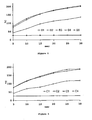
- the samples B1-B5 and C1-C4 in the form of plates with the dimensions 30x8x8 mm or sheets with the dimensions 30x8x1 mm, were exposed to a high-frequency field of 350 kHz at a power of 55 kW.
- the heating performance was determined as a function of the heating period.
- the temperature in °C is shown as a function of the heating period in sec.
- samples containing nanoscale, magnetic fillers (B2-B4 and C2-C4) are heated rapidly in the high-frequency field, while the comparative samples B1, B5 and C1 do not undergo any heating.
- the quantity of nanoscale, magnetic filler in the sample is very small at no more than approx. 5 wt.%.
- Examples B4 and C4 show the influence of the content of the domains in a nanoscale, magnetic filler with a matrix-domain structure.
- B4 (C4) shows similar heating characteristics compared with B3 (C3).
- the proportion of nanoscale, magnetic domains in the filler of Example A2 is approx. 80 wt.%, and in the filler of Example A1 only 50 wt.%. Accordingly, the quantity of nanoscale filler can be reduced to achieve similar heating characteristics.
- the absolute quantity of nanoscale, magnetic domains in a filler with a matrix-domain structure is decisive. Thus, when nanoscale, magnetic fillers with a matrix-domain structure are used, it is possible to adjust the heating rate both via the content of filler itself and the content of the magnetic domains within the filler.
- Test procedure The samples are placed inside an inductor coil. For this purpose samples of dimensions 18 x 20 x 6 mm 3 were prepared and placed on cork in order to keep thermal losses as low as possible. The temperature was measured with an infrared sensor, which was placed at a distance of 5 cm from the coil. The infrared sensor (type: AMR FR 260 MV; manufacturer: Ahlborn) was mounted above the coil. The emission level adjusted by the manufacturer is 0.95. The measurement spot diameter at a distance of 5 cm is 14 mm. The accuracy of the infrared sensor is +/- 2% and +/- 2°C; the in each case larger value applies at an ambient temperature of 23°C.
- the inductor coil has the following specifications:
- the high-frequency semiconductor generator used has the following specifications:
- Examples D The heating up from room temperature (23°C) with the magnetic field switched on and for a duration of in each case 27 seconds is measured:
- Examples E The heating up from room temperature (23°C) with the magnetic field switched on and for a duration of in each case 28 seconds is measured:
- Examples F The heating up from room temperature (23°C) with the magnetic field switched on and for a duration of in each case 24 seconds is measured:
Landscapes
- Chemical & Material Sciences (AREA)
- Chemical Kinetics & Catalysis (AREA)
- Medicinal Chemistry (AREA)
- Polymers & Plastics (AREA)
- Organic Chemistry (AREA)
- Health & Medical Sciences (AREA)
- Engineering & Computer Science (AREA)
- Nanotechnology (AREA)
- Physics & Mathematics (AREA)
- Condensed Matter Physics & Semiconductors (AREA)
- General Physics & Mathematics (AREA)
- Materials Engineering (AREA)
- Crystallography & Structural Chemistry (AREA)
- Composite Materials (AREA)
- Compositions Of Macromolecular Compounds (AREA)
Abstract
Description
- The invention relates to a rubber compound, which contains a nanoscale, magnetic filler, a vulcanisable mixture containing the rubber compound and a moulding thereof.
- It is known to use magnetite, a naturally occurring iron oxide of the formula Fe3O4, in rubber compounds (Kautschuk Gummi Kunststoffe 56 (2003), pages 322 to 329). It is possible in this way to vary the heating capacity and the magnetic properties of the rubber compound. The average size (d50) of the magnetite particles used is in a range of approx. 10 to 60 µm. While it is true that their use enables the microwave heating capacity of the rubber compound to be increased, however, very high concentrations of magnetite are needed to achieve these effects. Even with these high concentrations, only a low heating rate results. Finally, the high concentration of magnetite leads to a disadvantageous change in the mechanical properties of the rubber compound.
- From
DE-A-10163399 a preparation is known in which superparamagnetic particles, containing at least one mixed metal oxide of the general formula M(II)M(III)O4, are present in dispersed form in a coherent phase. As the coherent phase, polymerisable monomers suitable for adhesives can be used.DE-A-10163399 gives no indications of the use of vulcanisable polymers. - A disadvantage of the particles used is their reagglomeration tendency during the production of the preparation. This can result in these particles losing their superparamagnetic properties. Moreover, there is the risk of uneven distribution of the particles in the preparation. To avoid this, the particles in
DE-A-10163399 are preferably used in surface-modified form. - The object of the present invention is to provide a rubber compound with magnetic properties, which has a good heating capacity compared with the prior art and which does not disadvantageously modify the mechanical properties of the rubber compound.
- The object of the invention is also to provide a vulcanisable mixture and mouldings which can be produced therefrom.
- The invention provides a rubber compound containing at least one non-magnetic filler and at least one nanoscale, magnetic filler.
- Within the meaning of the invention, magnetic means ferro-, ferri-, para- or superparamagnetic. Nanoscale fillers are intended to mean those exhibiting a particle size of less than 250 nm in the rubber compound.
- The magnetic, nanoscale filler of the rubber compound according to the invention consists of aggregates of a non-magnetic metal oxide matrix, in which nanoscale, magnetic metal oxide domains are present.
- The term 'domains' means areas within the matrix separated from one another spatially. The average diameter of the nanoscale metal oxide domains is 3 to 100 nm.
- The domains can be completely or only partly enclosed by the surrounding matrix. Partly enclosed means that individual domains protrude from the surface of an aggregate. The ratio, based on the weight, of domains to matrix is not limited, provided that domains, i.e. areas spatially separated from one another, are present.
- The matrix-domain structure of the magnetic filler present in the rubber compound according to the invention prevents an agglomeration or an aggregation of the nanoscale, magnetic domains. As a result, the superparamagnetic behaviour, and thus an efficient heating capacity, are ensured. Good dispersibility results, with a homogeneous distribution of these particles in the rubber compound or in the vulcanisable mixture. It is known that nanoscale particles that are not embedded in a matrix can fuse to form larger aggregates.
- As a result of the purely inorganic nature of the magnetic filler, the structure remains unchanged even in applications in which high temperatures occur.
- The proportion of the metal oxide domains, based on the magnetic filler, has no upper limit, provided that domains are still present. These can preferably be powders with a ratio, based on the weight, of domains to matrix of 1:99 to 90:10.
- The nanoscale, magnetic fillers of the rubber compound according to the invention are, as far as possible, pore-free and have free hydroxyl groups on the surface.
- Aggregate, within the meaning of the invention, refers to three-dimensional structures of fused primary particles. Primary particles, within the meaning of the invention, are the particles formed primarily during the oxidation reaction in a flame. Several aggregates can bond together to form agglomerates.
- The metal oxide matrix of the nanoscale, magnetic fillers is preferably an oxide of silicon, aluminium, cerium, titanium, zinc or zirconium. Silicon is particularly preferred.
- The magnetic, nanoscale fillers can be produced according to
EP-A-1284485 and theGerman patent application, application number 103 17 067.7 of 14.04.2003. - It may be advantageous if the nanoscale, magnetic fillers are present in a surface-modified form. As a result, interactions with other components of the rubber compound according to the invention, particularly rubber components, can be influenced. This can lead to improved mechanical properties of a vulcanised rubber compound.
- Suitable surface-modified, magnetic particles are in particular those obtained by treatment with a halosilane, alkoxysilane, silazane and/or siloxane. Suitable substances for a surface modification are contained in
DE-A-19500764 . - Trimethoxyoctylsilane, hexamethyldisilazane, octamethylcyclotetrasiloxane, polydimethylsiloxane, octylsilane and/or hexamethyldisilazane can preferably be used for the surface modification of the nanoscale, magnetic fillers.
- The surface modification can be carried out by spraying the nanoscale, magnetic filler with a surface-modifying reagent, which can optionally be dissolved in an organic solvent, such as e.g. ethanol, and then heat-treating the mixture at a temperature of 105 to 400°C over a period of 1 to 6 h.
- The rubber compound according to the invention can preferably contain as the rubber component natural rubber, polybutadiene, polyisoprene, fluororubber, styrene/butadiene copolymers, isobutylene/isoprene copolymers, halogenated isobutylene/isoprene copolymers, butadiene/acrylonitrile copolymers (NBR), partially hydrogenated or completely hydrogenated NBR (HNBR), partially hydrogenated or completely hydrogenated carboxylated NBR, ethylene/propylene/diene copolymers, ethylene/propylene copolymers, brominated isobutylene/paramethylstyrene copolymers, silicone rubber, such as LSR and VMQ, and mixtures thereof.
- The rubber compound according to the invention also contains at least one non-magnetic filler. Preferred non-magnetic fillers can be silicon dioxide and/or carbon black.
- The silicon dioxide powder can be present here as precipitated or pyrogenically produced silicon dioxide, optionally together with an organosilane. The organosilane reacts with the hydroxyl groups on the surface of the silicon dioxide powder. A silicon dioxide powder already surface-modified previously with the organosilane can also optionally be used.
- The organosilanes used for the surface modification are the same as can be used for the surface modification of the nanoscale, magnetic fillers in the rubber compound according to the invention. The use of silicon dioxide powder in rubber compounds is known to the person skilled in the art and described e.g. in Ullmann's Encyclopedia, 5th edition, vol. A 23, pages 395 to 397.
- As carbon black it is possible to use furnace black, gas black, channel black, flame black, thermal black, acetylene black, plasma black, inversion carbon blacks, known from
DE 195 21 565 , Si-containing carbon blacks, known fromWO 98/45361 DE 196 13 796 , or metal-containing carbon blacks, known fromWO 98/42778 - The proportion of nanoscale, magnetic filler or non-magnetic filler is preferably 0.1 to 80 wt.%, based on the total quantity of the rubber compound, in each case. A proportion of nanoscale, magnetic filler of 1 to 15 wt.%, based on the total quantity of the rubber compound, is particularly preferred.
- The rubber compound according to the invention can contain other rubber auxiliaries, such as reaction accelerators, reaction inhibitors, antioxidants, stabilisers, processing auxiliaries, plasticisers, oils, waxes, metal oxides and activators, such as triethanolamine, polyethylene glycol, hexane triol, which are known to the rubber industry.
- The rubber auxiliaries are used in conventional quantities, which depend on the intended application, among other things. Conventional quantities are e.g. quantities of 0.1 to 200 phr.
- The rubber compound according to the invention can be obtained by mixing the rubbers with the nanoscale, magnetic fillers and the fillers, such as silicon dioxide and/or carbon black, rubber auxiliaries or organosilanes in conventional mixers, such as rollers, internal mixers and mixing extruders.
- The rubber compound according to the invention is conventionally produced in internal mixers, wherein the rubber and the fillers are first incorporated in one or more consecutive, thermomechanical mixing steps, optionally together with organosilanes and the rubber auxiliaries, at 100 to 170°C. During this process, the sequence of addition and the time of addition of the individual components can have a decisive effect on the properties of the compound obtained and can therefore be varied according to the intended application. The process leads to a uniform distribution of the components of the rubber compound according to the invention, as far as possible.
- The invention also provides a vulcanisable mixture, which contains the rubber compound according to the invention and at least one crosslinking agent and/or vulcanisation accelerator. Sulfur, organic sulfur donors or radical formers can be used as crosslinking agents. Examples of suitable vulcanisation accelerators are mercaptobenzothiazoles, sulfenamides, guanidines, thiurams, dithiocarbamates, thioureas, thiocarbonates or zinc oxide.
- The vulcanisation accelerators and crosslinking agents can be used in quantities of 0.1 to 20 phr (parts per hundred rubber).
- The vulcanisable mixture is obtained by adding the crosslinking agents and/or vulcanisation accelerators to the rubber compound according to the invention, generally in an internal mixture or on a roller, at 40-130°C. The vulcanisable mixture is processed for the subsequent process steps, such as e.g. shaping and vulcanisation.
- The invention also provides a moulding, which is obtainable by
- heat treatment and/or
- action of an electrical, magnetic or an electromagnetic alternating field
- Heat treatment here means the thermal vulcanisation of the vulcanisable mixture according to the invention by introducing heat by means of heater assemblies.
- To introduce energy into the vulcanisable mixture according to the invention more advantageously, magnetic and electromagnetic alternating fields are suitable.
- In a particularly preferred embodiment, the nanoscale, magnetic fillers display superparamagnetic behaviour. When magnetic alternating fields are used, these can be heated particularly effectively.
- When energy is introduced by means of a high-frequency, magnetic alternating field, the nanoscale, magnetic fillers contained in the vulcanisable mixture according to the invention enable the Curie temperature and the magnetic relaxation time of the nanoscale, magnetic fillers to be optimised at the same time. The Curie temperature is the maximum temperature to which a magnetic substance can be heated by the action of a magnetic or electromagnetic alternating field. By selection of the nanoscale, magnetic fillers, a particular Curie temperature can be set and thus excessive heating of the vulcanisable mixture according to the invention or of a moulding according to the invention can be avoided.
- The frequency of suitable magnetic alternating fields is generally in a range of about 30 Hz to 100 MHz. Both frequencies in a range of about 100 Hz to 100 kHz and high frequencies in a range of 10 kHz to 60 MHz, particularly 50 kHz to 3 MHz, are suitable.
- Furthermore, the vulcanisable mixture according to the invention can be exposed to an electromagnetic alternating field. This is preferably the electromagnetic alternating field of microwave radiation with a frequency in the range of about 0.3 to 300 GHz. At the same time, the vulcanisable mixture according to the invention can be exposed to a direct current magnetic field, the field strength of which can be in a range of 0.001 to 10 Tesla, for example.
- The introduction of energy by means of an electrical, magnetic or electromagnetic alternating field can also, of course, take place in the moulding already produced by vulcanisation. Here again, the heating preferably takes place at the points where the nanoscale, magnetic fillers are located. By adjusting the Curie temperature or regulating the output, the maximum achievable temperature can be adjusted.
- The invention also provides a moulding obtainable from the vulcanisable mixture according to the invention by heat treatment with the simultaneous action of a static magnetic field. This leads either to a moulding in which the nanoscale, magnetic fillers are no longer uniformly distributed in the moulding but, depending on the selection of the reaction conditions, are concentrated at certain points.
- This moulding has the advantage that, when an electrical, magnetic or electromagnetic alternating field acts on the moulding, heating occurs preferentially where the nanoscale, magnetic filler particles are located. Thus, for example, it is possible not to heat temperature-sensitive parts of a moulding.
- Alternatively, this leads to mouldings which experience mechanical pre-stress along the magnetic field lines, so that mouldings with anisotropic (e.g. mechanical, thermal, magnetic) properties result.
- 0.57 kg/h SiCl4 are evaporated at approx. 200°C and fed into a mixing zone with 4.1 Nm3/h hydrogen and 11 Nm3/h air. In addition, an aerosol, obtained from a 25 wt.% aqueous iron(III)chloride solution (1.27 kg/h), is introduced into the mixing zone within the burner by means of a carrier gas (3 Nm3/h nitrogen). The homogeneously mixed gas-aerosol mixture burns there at an adiabatic combustion temperature of about 1200°C with a residence time of about 50 msec. After the flame hydrolysis, the reaction gases and the resulting magnetic filler are cooled and separated from the waste gas stream by means of a filter in a known manner. In a further step, any hydrochloric acid residues still adhering are removed from the magnetic filler by treating with steam-containing nitrogen.
- The nanoscale, magnetic filler has the following physicochemical values: BET surface area 43 m2/g,
silicon dioxide content 50 wt.%,iron oxide content 50 wt.%, saturation magnetisation 29.7 Am2/kg, Curie temperature approx. 620°C. - 0.17 kg/h SiCl4 are evaporated at approx. 200°C and fed into a mixing zone with 4.8 Nm3/h hydrogen and 12.5 Nm3/h air. In addition, an aerosol, obtained from a 25 wt.% aqueous iron(III)chloride solution (2.16 kg/h), is introduced into the mixing zone within the burner by means of a carrier gas (3 Nm3/h nitrogen). The homogeneously mixed gas-aerosol mixture burns there at an adiabatic combustion temperature of about 1200°C with a residence time of about 50 msec. After the flame hydrolysis, the reaction gases and the resulting magnetic filler are cooled and separated from the waste gas stream by means of a filter in a known manner. In a further step, any hydrochloric acid residues still adhering are removed from the magnetic filler by treating with steam-containing nitrogen.
- The nanoscale, magnetic filler has the following physicochemical values: BET surface area 44 m2/g,
silicon dioxide content 15 wt.%, iron oxide content 85 wt.%, saturation magnetisation 54.2 Am2/kg, Curie temperature 620°C. -
Step 1 Mixer Brabender 350S Speed 80 / min Ram pressure 5 bar Empty volume 0.39 litres Fill level 0.68 Throughput temperature 80° C Mixing operation 0 min - 1 min All components of 1st step 1 min Clean 1 min - 3.5 min Mix 3.5 min Discharge Batch temperature 135°C - 145°C Storage 4 hours at room temperature Step 2 Mixer Brabender 350S Speed 50 / min Ram pressure 5 bar Empty volume 0.39 litres Fill level 0.66 Throughput temperature 50° C Mixing operation 0 min Add 1st step batch, accelerator and crosslinking chemicals 0 min - 2.5 min Mix 2.5 min Discharge and form sheet using laboratory mixing rolls: Homogenising: Cut 3 times on the left, 3 times on the right and pass 8 times through a narrow roll nip (1mm) and 3 times through a wide roll nip (3.5mm) Sheet out Batch temperature 95°C - 105°C -
Step 1 Mixer Brabender 350S Speed 100 / min Ram pressure 5 bar Empty volume 0.39 litres Fill level 0.68 Throughput temperature 95° C Mixing operation 0 min Add all components of step 1 0 min - 3 min Mix 3 min Clean 3 min - 4.5 min Mix 4.5 min Discharge Batch temperature 135°C - 145°C Storage 4 hours at room temperature Step 2 Mixer Brabender 350S Speed 70 / min Ram pressure 5 bar Empty volume 0.39 litres Fill level 0.66 Throughput temperature 60° C Mixing operation 0 min Add 1st step batch + 2nd step substances 0 min - 2 min Mix 2 min Discharge and form sheet using laboratory mixing rolls: Homogenising: Cut 3 times on the left, 3 times on the right and pass 8 times through a narrow roll nip (1mm) and 3 times through a wide roll nip (3.5mm) Sheet out Batch temperature 95°C - 105°C -
Step 1 Mixer Brabender 350S Speed 100 / min Ram pressure 5 bar Empty volume 0.39 litre Fill level 0.68 Throughput temperature 95 Mixing operation 0 min Add all components of 1st step 0 min - 3 min Mix 3 min Clean 3 min - 4.5 min Mix 4.5 min Discharge Batch temperature 135°C - 145°C Storage 4 hours at room temperature Step 2 Mixer Brabender 350S Speed 70 / min Ram pressure 5 bar Empty volume 0.39 litre Fill level 0.66 Throughput temperature 60° C Mixing operation 0 min Add batch of 1st step, accelerators and crosslinking chemicals 0 min - 2 min Mix 2 min Discharge and form sheet using laboratory mixing roller: Homogenising: Cut 3 times on the left, 3 times on the right and pass 8 times through a narrow roll nip (1mm) and 3 times through a wide roll nip (3.5mm) Sheet out Batch temperature 95°C - 105°C -
Step 1 Mixer Brabender 350S Speed 80 / min Ram pressure 5 bar Empty volume 0.39 litre Fill level 0.68 Throughput temperature 80° C Mixing operation 0 min - 1 min Add all components of 1st step 1 min Clean 1 min - 3.5 min Mix 3.5 min Discharge Batch temperature 135°C - 145°C Storage 4 hours at room temperature Step 2 Mixer Brabender 350S Speed 50 / min Ram pressure 5 bar Empty volume 0.39 litre Fill level 0.66 Throughput temperature 50° C Mixing operation 0 min Add batch of 1st step, accelerators and crosslinking chemicals 0 min - 2.5 min Mix 2.5 min Discharge and form sheet using laboratory mixing roller: Homogenising: Cut 3 times on the left, 3 times on the right and pass 8 times through a narrow roll nip (1mm) and 3 times through a wide roll nip (3.5mm) Sheet out Batch temperature 95°C - 105°C -
Step 1 Mixer Internal mixer GK1.5E,Werner&Pfleiderer Speed 70 / min Ram pressure 5.5 bar Empty volume 1.58 litre Fill level 0.56 Throughput temperature 80°C Mixing operation 0 min - 1 min Polymers 1 min - 2 min 1st half Ultrasil 7000; Edenor, ZnO, oil, silane; magnetic filler - depending on formulation 2 min - 4 min 2nd half Ultrasil 7000; anti-ageing agent 4 min Clean 4 min - 5 min Mix 5 min Aerate 5 min - 6 min Mix and discharge Batch temperature 140°C - 150°C Storage 24 hours at room temperature Step 2 Mixer Internal mixer GK1.5E,Werner&Pfleiderer Speed 70 / min Ram pressure 5.5 bar Empty volume 1.58 Litre Fill level 0.54 Throughput temperature 90°C Mixing operation 0 min - 2 min Plasticise batch of 1st step 2 min - 5 min Pinch at 145°C batch temperature 5 min discharge Batch temperature Storage 140°C - 150°C 4 hours at room temperature Step 3 Mixer Internal mixer GK1.5E, Werner&Pfleiderer Speed 50 / min Ram pressure 5.5 bar Empty volume 1.58 litre Fill level 0.52 Throughput temperature 50°C Mixing operation 0 min Add batch of 2nd step, accelerators and crosslinking chemicals 0 min - 2 min Mix 2 min Discharge and form sheet using laboratory mixing rolls: Homogenising: Cut 3 times on the left, 3 times on the right and pass 8 times through a narrow roll nip and 3 times through a wide roll nip Sheet out Batch temperature 100°C - 110°C -
Example B1 B2 B3 B4 B5 Step 1 EPDM Keltan® 8340 A phr(§) 60 60 60 60 60 EPDM Keltan® 578 phr 40 40 40 40 40 Carbon black Corax® N 550 phr 40 40 40 40 80 Carbon black Corax® N 990 phr 80 80 80 80 40 ZnO RS RAL 844 C phr 3 3 3 3 3 Edenor ST1 GS phr 1.5 1.5 1.5 1.5 1.5 Sunpar 150phr 60 60 60 60 60 Filler from Example A1 phr 0 0 5.85 14.55 0 0 wt.% (*)0 1.98 4.78 0 0 Filler from Example A2 phr 0 0 0 8.55 0 wt.% (*)0 0 0 2.86 0 Step 2 Total step 1 phr 284.5 290.35 299.05 293.05 284.5 Rhenogran® TMTD-80 phr 1.25 1.25 1.25 1.25 1.25 Rhenogran S-80 phr 0.38 0.38 0.38 0.38 0.38 Rhenogran® ZDMC-80 phr 1.88 1.88 1.88 1.88 1.88 Rhenogran® ZDBC-80 phr 1.88 1.88 1.88 1.88 1.88 Keltan®: DSM; Corax®: Degussa; Edenor: Caldic Deutschland; ; Sunpar: Sun Oil Company; Rhenogran®: Rheinchemie; (§)phr: parts per hundred rubber; (*)based on the total accelerated rubber compound -
Example C1 C2 C3 C4 Step 1 EPDM Keltan® 2340- A phr 100 100 100 100 Precipitated silica Ultrasil® VN 2 GR phr 50 50 50 50 ZnO RS RAL 844 C phr 3 3 3 3 Edenor ST1 GS (stearic acid) phr 1 1 1 1 TESPT Si69® phr 3 3 3 3 Sunpar 150®phr 30 30 30 30 Filler from Example A1 phr 0 3.9 9.7 0 wt.% (*) 1.97 4.77 Filler from Example A2 phr 0 0 0 5.7 wt.% (*) 2.86 Step 2 Total step 1 phr 187 190.9 196.7 192.7 MBT Vulkacit® mercapto/ MGC phr 1 1 1 1 TMTD Vulkacit® thiuram / C phr 1 1 1 1 Sulfur phr 1.3 1.3 1.3 1.3 Zn-dialkyldithiophosphate Rhenocure® TP/G phr 3.5 3.5 3.5 3.5 Ultrasil: Degussa; TESPT Si69® Degussa; Vulkacit®: Bayer; Rhenocure®: Rheinchemie (*)based on the total accelerated rubber compound -
Example D1 D2 D3 Step 1 EPDM Keltan® 2340- A phr 100 100 100 precipitated silica Ultrasil® VN 2 GR phr 50 50 50 ZnO RS RAL 844 C phr 3 3 3 Edenor ST1 GS (stearic acid) phr 1 1 1 TESPT Si69® phr 3 3 3 Sunpar 150®phr 30 30 30 Filler from Example A2 phr 0 5.7 0 wt.% (*) 2.86 Filler MagniF 10phr 0 0 5.7 wt.% (*) 2.86 Step 2 Total step 1 phr 187 192.7 192.7 MBT Vulkacit® Merkapto/ MGC phr 1 1 1 TMTD Vulkacit® Thiuram / C phr 1 1 1 Sulfur phr 1.3 1.3 1.3 Zn dialkyl dithiophosphate Rhenocure® TP/G phr 3.5 3.5 3.5 Magnetite, Magni F10, Fa. Minelco -
Example E1 E2 E3 Step 1 EPDM Keltan® 8340 A phr(§) 60 60 60 EPDM Keltan® 578 phr 40 40 40 Carbon black Corax® N 550 phr 40 40 40 Carbon black Corax® N 990 phr 80 80 80 ZnO RS RAL 844 C phr 3 3 3 Edenor ST1 GS phr 1.5 1.5 1.5 Sunpar 150phr 60 60 60 Filler from Example A2 phr 0 8.55 0 wt.% (*)0 2.86 0 Filler MagniF 10phr 0 0 8.55 wt.% (*)0 0 2.86 Step 2 Total step 1 phr 284.5 293.05 293.05 Rhenogran® TMTD-80 phr 1.25 1.25 1.25 Rhenogran S-80 phr 0.38 0.38 0.38 Rhenogran® ZDMC-80 phr 1.88 1.88 1.88 Rhenogran® ZDBC-80 phr 1.88 1.88 1.88 -
Example F1 F2 F3 Step 1 BUNA VSL 5025-1 phr 96 96 96 BUNA CAN BE 24 phr 30 30 30 Precipitated silica Ultrasil® 7000 GR phr 80 80 80 TESPT Si69® phr 6.4 6.4 6.4 ZnO RS RAL 844 C phr 3 3 3 Filler from Example A2 phr 0 6.91 0 wt.% (*) 2.86 Filler MagniF 10phr 0 0 6.91 wt.% (*) 2.86 Edenor ST1 GS(stearic acid) phr 2 2 2 Naftolen ZD phr 10 10 10 Vulkanox 4020 phr 1.5 1.5 1.5 Protektor G 3108 phr 1 1 1 Step 2 phr 229.9 236.81 236.81 Step 3 phr 229.9 236.81 236.81 Vulkacit® D (DPG) phr 2 2 2 Vulkacit® CZ/EG-C (CBS) phr 1.5 1.5 1.5 Perkacit TBZTD-C phr 0.2 0.2 0.2 Sulfur phr 1.5 1.5 1.5 VSL 5025-1: SBR copolymer polymerised in solution, containing 37.5 phr oil; Buna CB24: cis 1,4-polybutadiene (neodymium type); Vulkanox 4020: 6PPD, all from Bayer AG; Naftolen ZD: aromatic oil, Chemetall; Ultrasil 7000: Degussa AG; Protektor G3108: wax from Paramelt B.V.; Perkacit: Flexsys - The samples B1-B5 and C1-C4, in the form of plates with the dimensions 30x8x8 mm or sheets with the dimensions 30x8x1 mm, were exposed to a high-frequency field of 350 kHz at a power of 55 kW.
- The heating performance was determined as a function of the heating period. In
Figure 1 and Figure 2 , the temperature in °C is shown as a function of the heating period in sec. - It is noted that the samples containing nanoscale, magnetic fillers (B2-B4 and C2-C4) are heated rapidly in the high-frequency field, while the comparative samples B1, B5 and C1 do not undergo any heating.
- Furthermore, it can be noted that the quantity of nanoscale, magnetic filler in the sample is very small at no more than approx. 5 wt.%.
- Examples B4 and C4 show the influence of the content of the domains in a nanoscale, magnetic filler with a matrix-domain structure.
- Thus, B4 (C4) shows similar heating characteristics compared with B3 (C3). The proportion of nanoscale, magnetic domains in the filler of Example A2 is approx. 80 wt.%, and in the filler of Example A1 only 50 wt.%. Accordingly, the quantity of nanoscale filler can be reduced to achieve similar heating characteristics. The absolute quantity of nanoscale, magnetic domains in a filler with a matrix-domain structure is decisive. Thus, when nanoscale, magnetic fillers with a matrix-domain structure are used, it is possible to adjust the heating rate both via the content of filler itself and the content of the magnetic domains within the filler.
- Test procedure: The samples are placed inside an inductor coil. For this purpose samples of dimensions 18 x 20 x 6 mm3 were prepared and placed on cork in order to keep thermal losses as low as possible. The temperature was measured with an infrared sensor, which was placed at a distance of 5 cm from the coil. The infrared sensor (type: AMR
FR 260
The emission level adjusted by the manufacturer is 0.95. The measurement spot diameter at a distance of 5 cm is 14 mm. The accuracy of the infrared sensor is +/- 2% and +/- 2°C; the in each case larger value applies at an ambient temperature of 23°C. - The inductor coil has the following specifications:
- Dimensions: 200 x 45 x 40 mm3 (L x B x H)
- Material: copper tubing, square 10 x 6 x 1 mm
- Output cross-sectional area: 28 mm2
- Coil feed length: 120 mm
- Number of coil windings: 3
- Coil winding length (eff.): 35 mm
- Coil diameter (internal): 20 mm to 40 mm
- Coil inner surface area: 720 mm2
- Inductivity (at 100 kHz): ca. 270 nH
- Operating frequency: 323 kHz
- The high-frequency semiconductor generator used has the following specifications:
- Manufacturer: STS - Systemtechnik Skorna GmbH
- Type identification: STS Type M260S
- Terminal output: 6 kW
- Inductivity range: 250 - 1200 nH
- Operating frequency: 150 - 400 kHz (323 kHz with the inductor coil that is used)
- Examples D: The heating up from room temperature (23°C) with the magnetic field switched on and for a duration of in each case 27 seconds is measured:
- Rubber compound 1 (no magnetic filler), no measurable heating.
- Rubber compound 2 (mixture according to the invention with nanoscale magnetic filler); heating to 170°C observed.
- Rubber compound 3 (comparison rubber compound with non-nanoscale magnetic filler MagniF 10); heating to only 88°C observed.
- Examples E: The heating up from room temperature (23°C) with the magnetic field switched on and for a duration of in each case 28 seconds is measured:
- Rubber compound 1 (no magnetic filler), no measurable heating.
- Rubber compound 2 (mixture according to the invention with nanoscale magnetic filler); heating to 170°C observed.
- Rubber compound 3 (comparison rubber compound with non-nanoscale magnetic filler MagniF 10); heating to only 78°C observed.
- Examples F: The heating up from room temperature (23°C) with the magnetic field switched on and for a duration of in each case 24 seconds is measured:
- Rubber compound 1 (no magnetic filler), no measurable heating.
- Rubber compound 2 (mixture according to the invention with nanoscale magnetic filler); heating to 170°C observed.
- Rubber compound 3 (comparison rubber compound with non-nanoscale magnetic filler MagniF 10); heating to only 70°C observed.
- The examples show that:
- Rubber compounds can be inductively heated only by adding magnetic fillers, irrespective of the rubber system or reinforcing filler system that is used. Rubber compounds according to the invention that contain a nanoscale magnetic filler can under otherwise identical conditions in principle heat up substantially more rapidly than rubber compounds that do not contain such a filler.
Claims (9)
- Rubber compound containing at least one non-magnetic filler and at least one nanoscale, magnetic filler, wherein the magnetic, nanoscale filler consists of aggregates of a non-magnetic metal oxide matrix with nanoscale, magnetic metal oxide domains.
- Rubber compound according to claim 1, characterised in that the metal oxide matrix consists of silicon dioxide, aluminium oxide, cerium oxide, titanium dioxide, zinc oxide or zirconium oxide.
- Rubber compound according to claims 1 or 2, characterised in that the magnetic filler is surface-modified.
- Rubber compound according to claims 1 to 3, characterised in that the rubber is selected from the group comprising natural rubber, polybutadiene, polyisoprene, fluororubber, styrene/butadiene copolymers, isobutylene/isoprene copolymers, halogenated isobutylene/isoprene copolymers, butadiene/acrylonitrile copolymers (NBR), partially hydrogenated or completely hydrogenated NBR (HNBR), partially hydrogenated or completely hydrogenated carboxylated NBR, ethylene/propylene/diene copolymers, ethylene/propylene copolymers, brominated isobutylene/paramethylstyrene copolymers, silicone rubber, such as LSR and VMQ, and mixtures thereof.
- Rubber compound according to claims 1 to 4, characterised in that the non-magnetic filler is silicon dioxide, optionally together with an organosilane and/or carbon black.
- Rubber compound according to claims 1 to 5, characterised in that the proportion of nanoscale, magnetic filler or non-magnetic filler is 0.1 to 80 wt.%, based on the total quantity of the rubber compound, in each case.
- Rubber compound according to claims 1 to 6, characterised in that it contains rubber auxiliaries.
- Vulcanisable mixture, containing the rubber compound according to claims 1 to 7 in the presence of at least one crosslinking agent and/or vulcanisation accelerator.
- Moulding, obtainable from the vulcanisable mixture according to claim 8 by- heat treatment and/or- action of an electrical, magnetic or electromagnetic alternating field.
Applications Claiming Priority (2)
| Application Number | Priority Date | Filing Date | Title |
|---|---|---|---|
| DE102004041746A DE102004041746A1 (en) | 2004-08-28 | 2004-08-28 | Rubber mixture containing nanoscale, magnetic fillers |
| PCT/EP2005/009019 WO2006024413A1 (en) | 2004-08-28 | 2005-08-20 | Rubber compound containing nanoscale, magnetic fillers |
Publications (2)
| Publication Number | Publication Date |
|---|---|
| EP1789487A1 EP1789487A1 (en) | 2007-05-30 |
| EP1789487B1 true EP1789487B1 (en) | 2008-02-27 |
Family
ID=35219336
Family Applications (1)
| Application Number | Title | Priority Date | Filing Date |
|---|---|---|---|
| EP05774438A Expired - Lifetime EP1789487B1 (en) | 2004-08-28 | 2005-08-20 | Rubber compound containing nanoscale, magnetic fillers |
Country Status (8)
| Country | Link |
|---|---|
| US (1) | US7837892B2 (en) |
| EP (1) | EP1789487B1 (en) |
| JP (1) | JP4740244B2 (en) |
| KR (1) | KR100829349B1 (en) |
| CN (1) | CN101044197B (en) |
| AT (1) | ATE387470T1 (en) |
| DE (2) | DE102004041746A1 (en) |
| WO (1) | WO2006024413A1 (en) |
Families Citing this family (37)
| Publication number | Priority date | Publication date | Assignee | Title |
|---|---|---|---|---|
| DE10353995A1 (en) * | 2003-11-19 | 2005-06-09 | Degussa Ag | Nanoscale, crystalline silicon powder |
| DE10353996A1 (en) * | 2003-11-19 | 2005-06-09 | Degussa Ag | Nanoscale, crystalline silicon powder |
| DE102004012682A1 (en) * | 2004-03-16 | 2005-10-06 | Degussa Ag | Process for the production of three-dimensional objects by means of laser technology and application of an absorber by inkjet method |
| DE102004041747A1 (en) * | 2004-08-28 | 2006-03-02 | Degussa Ag | Indium-tin mixed oxide powder |
| CA2603405C (en) * | 2005-04-18 | 2013-10-01 | Roehm Gmbh | Thermoplastic molding material and molding elements containing nanometric inorganic particles for making said molding material and said molding elements, and uses thereof |
| DE102005040157A1 (en) * | 2005-08-25 | 2007-03-01 | Degussa Ag | Nanoscale powder and dispersant paste |
| DE102005049718A1 (en) * | 2005-10-14 | 2007-04-19 | Degussa Gmbh | By welding in electromagnetic alternating field available plastic composite molding |
| DE102005056286A1 (en) * | 2005-11-24 | 2007-05-31 | Degussa Gmbh | Producing a composite part from plastic parts that cannot be directly welded together comprises using an intermediate film with surfaces compatible with each part |
| DE102005059405A1 (en) * | 2005-12-13 | 2007-06-14 | Degussa Gmbh | Zinc oxide-cerium oxide composite particles |
| DE102005060121A1 (en) * | 2005-12-16 | 2007-06-21 | Degussa Gmbh | Preparing zinc oxide powder, useful in e.g. dyes, comprises producing a flow containing zinc steam in vaporization zone, oxidizing the zinc steam in oxidation zone, cooling the reaction mixture and separating the powder in isolation zone |
| DE102006007564A1 (en) * | 2006-02-16 | 2007-08-30 | Röhm Gmbh | Nanoscale superparamagnetic poly (meth) acrylate polymers |
| DE102006017126B4 (en) * | 2006-04-12 | 2009-08-13 | Krones Ag | Method for producing a plastic hollow body |
| DE102006056680B4 (en) * | 2006-11-30 | 2014-03-06 | Siemens Aktiengesellschaft | Collecting container arrangement for magnetizable, spherical shaped bodies for protection against strong basic field magnets |
| DE102007009124B4 (en) * | 2007-02-24 | 2011-11-03 | Evonik Degussa Gmbh | Induction-based manufacturing processes |
| DE102007025053B4 (en) | 2007-04-20 | 2020-09-03 | Barlog Plastics Gmbh | Process for producing a permanently magnetic molded part and a permanent magnetic molded part |
| ATE539038T1 (en) * | 2007-06-06 | 2012-01-15 | Evonik Degussa Gmbh | SILICON-IRON MIXED OXIDE POWDER |
| GB2451700B (en) * | 2007-08-10 | 2012-01-25 | Walker & Co James | Seal structure |
| US8268436B2 (en) | 2007-12-15 | 2012-09-18 | The Goodyear Tire & Rubber Company | Tire with indicia containing composite magnetic nanoparticles |
| JP4783779B2 (en) * | 2007-12-21 | 2011-09-28 | タイガースポリマー株式会社 | Magnetite-containing silicone rubber composition |
| US7704438B2 (en) | 2008-04-25 | 2010-04-27 | Barlog Plastics Gmbh | Process for producing a permanently magnetic molding |
| DE102008001433A1 (en) * | 2008-04-28 | 2009-10-29 | Evonik Degussa Gmbh | Hydrophobised silicon-iron mixed oxide |
| DE102008001437A1 (en) * | 2008-04-28 | 2009-10-29 | Evonik Degussa Gmbh | Surface-modified, superparamagnetic oxide particles |
| DE102008027694B8 (en) | 2008-06-11 | 2022-12-22 | Continental Reifen Deutschland Gmbh | Rubber mixture with improved tear properties and the use of such |
| US8790774B2 (en) * | 2010-12-27 | 2014-07-29 | Xerox Corporation | Fluoroelastomer nanocomposites comprising CNT inorganic nano-fillers |
| KR101242534B1 (en) * | 2011-08-16 | 2013-03-12 | 전남대학교산학협력단 | Surface modification methods of titania added into silica-reinforced SBR compounds to enhance their dynamic properties |
| KR101302570B1 (en) * | 2012-01-27 | 2013-09-02 | 한국신발피혁연구원 | Supramolecular network thermo-reversible crosslinked elastomer having high mechanical properties and low compression set and Method producing thereof |
| US8959690B2 (en) | 2012-06-29 | 2015-02-24 | Nike, Inc. | Induction heating apparatuses and processes for footwear manufacturing |
| US9986787B2 (en) | 2012-06-29 | 2018-06-05 | Nike, Inc. | Induction heating apparatuses and processes for footwear manufacturing |
| DE102012216010A1 (en) * | 2012-09-10 | 2014-03-13 | Evonik Industries Ag | Rubber mixture containing iron-silicon oxide particles with improved heating rate |
| DE202013102717U1 (en) * | 2013-06-24 | 2014-09-25 | Rehau Ag + Co. | extrusion profile |
| JP6728622B2 (en) * | 2015-10-15 | 2020-07-22 | 横浜ゴム株式会社 | Rubber composition for tires |
| CN105367854A (en) * | 2015-12-03 | 2016-03-02 | 丁玉琴 | Preparation method for nanoscale iron slag-modified styrene-butadiene rubber composite wave-absorbing material |
| ITUA20164309A1 (en) * | 2016-06-13 | 2017-12-13 | Mondo Spa | MAGNETIC COMPOSITION, COATING THAT INCLUDES IT AND RELATED PROCEDURES |
| ITUA20164595A1 (en) * | 2016-06-22 | 2017-12-22 | Bridgestone Corp | LAYER SEALANT OF A TIRE |
| CN107868476A (en) * | 2018-01-09 | 2018-04-03 | 北京工业大学 | A kind of conductive rubber of magnetic field optimization enhancing and preparation method thereof |
| CN114644795B (en) * | 2020-12-17 | 2024-08-06 | 洛阳尖端技术研究院 | Wave-absorbing material, preparation method and application thereof |
| CN114133638A (en) * | 2021-12-13 | 2022-03-04 | 东营九洲奥华化工有限责任公司 | Chemical corrosion resistant butyronitrile latex for disposable gloves and preparation method thereof |
Citations (1)
| Publication number | Priority date | Publication date | Assignee | Title |
|---|---|---|---|---|
| EP1284485A1 (en) * | 2001-08-16 | 2003-02-19 | Degussa AG | Superparamagnetic oxidic particles,their preparation process and application |
Family Cites Families (23)
| Publication number | Priority date | Publication date | Assignee | Title |
|---|---|---|---|---|
| US5260364A (en) * | 1992-08-07 | 1993-11-09 | Wacker Silicones Corporation | Silicone rubber having reduced compression set |
| JP3111837B2 (en) * | 1994-10-31 | 2000-11-27 | 信越化学工業株式会社 | Fire resistant silicone rubber composition |
| US5695900A (en) | 1995-12-21 | 1997-12-09 | Colorado School Of Mines | Surface treatment of magnetic particles for use in reprographic processes |
| DE19942216C2 (en) * | 1999-09-03 | 2003-04-24 | Basf Drucksysteme Gmbh | Silicone rubber and iron-containing, inorganic solids and / or soot-containing recording material for the production of relief printing plates by means of laser engraving, process for the production of relief printing plates and the relief printing plate produced therewith |
| US20020183427A1 (en) * | 1999-11-30 | 2002-12-05 | Yoshihiko Yamaguchi | Magnetic rubber composition for encoder |
| JP2001181451A (en) | 1999-12-27 | 2001-07-03 | Denki Kagaku Kogyo Kk | Halogen-containing rubber composition |
| EP1263615A1 (en) | 2000-02-18 | 2002-12-11 | Continental Tire North America Inc. | Incorporating high levels of magnetic particulate into the rubber matrix of rubber compounds |
| US6476113B1 (en) * | 2000-06-07 | 2002-11-05 | Remington Products Company | Magnetically active flexible polymers |
| DE10153547A1 (en) | 2001-10-30 | 2003-05-22 | Degussa | Dispersion containing pyrogenically produced abrasive particles with superparamagnetic domains |
| KR100628841B1 (en) | 2001-11-13 | 2006-09-29 | 데구사 아게 | Curable bonded assemblies capable of being dissociated |
| DE10235758A1 (en) | 2002-08-05 | 2004-02-26 | Degussa Ag | Doped zinc oxide powder in aggregate form for use in e.g. electrically conductive lacquers and coatings, comprises doping component, e.g. aluminum oxide |
| DE10317067A1 (en) * | 2003-04-14 | 2004-11-11 | Degussa Ag | Domains in a metal oxide matrix |
| DE10343728A1 (en) | 2003-09-22 | 2005-04-21 | Degussa | zinc oxide powder |
| DE10353995A1 (en) | 2003-11-19 | 2005-06-09 | Degussa Ag | Nanoscale, crystalline silicon powder |
| DE10353996A1 (en) | 2003-11-19 | 2005-06-09 | Degussa Ag | Nanoscale, crystalline silicon powder |
| DE102004010504B4 (en) | 2004-03-04 | 2006-05-04 | Degussa Ag | Highly transparent laser-markable and laser-weldable plastic materials, their use and manufacture, and use of metal-mixed oxides and methods of marking of manufactured goods |
| WO2005084955A1 (en) | 2004-03-04 | 2005-09-15 | Degussa Ag | Laser-weldable which are transparently, translucently or opaquely dyed by means of colorants |
| DE102004012682A1 (en) | 2004-03-16 | 2005-10-06 | Degussa Ag | Process for the production of three-dimensional objects by means of laser technology and application of an absorber by inkjet method |
| US7704586B2 (en) | 2005-03-09 | 2010-04-27 | Degussa Ag | Plastic molded bodies having two-dimensional and three-dimensional image structures produced through laser subsurface engraving |
| CA2603405C (en) | 2005-04-18 | 2013-10-01 | Roehm Gmbh | Thermoplastic molding material and molding elements containing nanometric inorganic particles for making said molding material and said molding elements, and uses thereof |
| DE102005040157A1 (en) | 2005-08-25 | 2007-03-01 | Degussa Ag | Nanoscale powder and dispersant paste |
| DE102005059405A1 (en) | 2005-12-13 | 2007-06-14 | Degussa Gmbh | Zinc oxide-cerium oxide composite particles |
| DE102005060121A1 (en) | 2005-12-16 | 2007-06-21 | Degussa Gmbh | Preparing zinc oxide powder, useful in e.g. dyes, comprises producing a flow containing zinc steam in vaporization zone, oxidizing the zinc steam in oxidation zone, cooling the reaction mixture and separating the powder in isolation zone |
-
2004
- 2004-08-28 DE DE102004041746A patent/DE102004041746A1/en not_active Withdrawn
-
2005
- 2005-08-20 JP JP2007528709A patent/JP4740244B2/en not_active Expired - Fee Related
- 2005-08-20 WO PCT/EP2005/009019 patent/WO2006024413A1/en not_active Ceased
- 2005-08-20 AT AT05774438T patent/ATE387470T1/en not_active IP Right Cessation
- 2005-08-20 DE DE602005005076T patent/DE602005005076T2/en not_active Expired - Lifetime
- 2005-08-20 US US11/574,254 patent/US7837892B2/en not_active Expired - Fee Related
- 2005-08-20 KR KR1020077004737A patent/KR100829349B1/en not_active Expired - Fee Related
- 2005-08-20 EP EP05774438A patent/EP1789487B1/en not_active Expired - Lifetime
- 2005-08-20 CN CN2005800289468A patent/CN101044197B/en not_active Expired - Fee Related
Patent Citations (1)
| Publication number | Priority date | Publication date | Assignee | Title |
|---|---|---|---|---|
| EP1284485A1 (en) * | 2001-08-16 | 2003-02-19 | Degussa AG | Superparamagnetic oxidic particles,their preparation process and application |
Also Published As
| Publication number | Publication date |
|---|---|
| JP4740244B2 (en) | 2011-08-03 |
| KR20070051871A (en) | 2007-05-18 |
| ATE387470T1 (en) | 2008-03-15 |
| KR100829349B1 (en) | 2008-05-13 |
| CN101044197A (en) | 2007-09-26 |
| US7837892B2 (en) | 2010-11-23 |
| CN101044197B (en) | 2011-09-07 |
| WO2006024413A1 (en) | 2006-03-09 |
| DE602005005076T2 (en) | 2009-03-19 |
| DE602005005076D1 (en) | 2008-04-10 |
| JP2008511700A (en) | 2008-04-17 |
| US20080135799A1 (en) | 2008-06-12 |
| DE102004041746A1 (en) | 2006-03-02 |
| EP1789487A1 (en) | 2007-05-30 |
Similar Documents
| Publication | Publication Date | Title |
|---|---|---|
| US7837892B2 (en) | Rubber compound containing nanoscale, magnetic fillers | |
| KR101778799B1 (en) | Rubber mixture | |
| EP2844694B1 (en) | Rubber formulations including graphenic carbon particles | |
| EP4013628B1 (en) | Silica-graphenic carbon composite particles and elastomeric materials including such particles | |
| JP2000178381A (en) | Fine rubber powder, its production, and its use | |
| JP2006265097A (en) | Precipitated silicic acid, method for manufacturing the same, and rubber blend and vulcanized rubber containing the same | |
| KR101884964B1 (en) | Method for manufacturing particles | |
| WO2012057365A1 (en) | Method for producing vulcanized rubber composition | |
| EP3572457B1 (en) | Inorganic composite for rubber reinforcement, method for preparing the same, and rubber composition for tires comprising the same | |
| EP0553454B1 (en) | Adhesion promoter for rubber and plastic blends | |
| JP2005132865A (en) | Rubber composition comprising inorganic reinforcing agent compounded therein | |
| KR20180126850A (en) | Method for preparing aluminosilicate particles having excellent dispersion, a reinforcing materials for rubber comprising the aluminosilicate particles, and rubber composition for tires comprising the reinforcing materials | |
| JP6322474B2 (en) | Hydrophobic silica powder, rubber molding composition containing the same, and method for producing the same | |
| JP4360755B2 (en) | Filler-containing powder rubber and its production and use | |
| EP2436726A1 (en) | Rubber composition and pneumatic tire | |
| US4427452A (en) | Filled elastomer compositions | |
| JP4051614B2 (en) | Black composite filler for tire composition and tire composition | |
| JP4228192B2 (en) | Tire composition | |
| JP4063767B2 (en) | Method for producing surface-treated carbon black, surface-treated carbon black, and rubber composition containing the same | |
| JP5878816B2 (en) | Method for producing particles | |
| JPH11100525A (en) | Manufacture of modified carbon black for rubber reinforcement and rubber composition containing the same | |
| JP2012251134A (en) | Composition | |
| HK1027118B (en) | Powdery modified fillers containing rubber powder, method for the production and use thereof | |
| HK1027118A1 (en) | Powdery modified fillers containing rubber powder, method for the production and use thereof |
Legal Events
| Date | Code | Title | Description |
|---|---|---|---|
| PUAI | Public reference made under article 153(3) epc to a published international application that has entered the european phase |
Free format text: ORIGINAL CODE: 0009012 |
|
| 17P | Request for examination filed |
Effective date: 20070202 |
|
| AK | Designated contracting states |
Kind code of ref document: A1 Designated state(s): AT BE BG CH CY CZ DE DK EE ES FI FR GB GR HU IE IS IT LI LT LU LV MC NL PL PT RO SE SI SK TR |
|
| 17Q | First examination report despatched |
Effective date: 20070615 |
|
| GRAP | Despatch of communication of intention to grant a patent |
Free format text: ORIGINAL CODE: EPIDOSNIGR1 |
|
| RAP1 | Party data changed (applicant data changed or rights of an application transferred) |
Owner name: EVONIK DEGUSSA GMBH |
|
| DAX | Request for extension of the european patent (deleted) | ||
| GRAS | Grant fee paid |
Free format text: ORIGINAL CODE: EPIDOSNIGR3 |
|
| GRAA | (expected) grant |
Free format text: ORIGINAL CODE: 0009210 |
|
| AK | Designated contracting states |
Kind code of ref document: B1 Designated state(s): AT BE BG CH CY CZ DE DK EE ES FI FR GB GR HU IE IS IT LI LT LU LV MC NL PL PT RO SE SI SK TR |
|
| REG | Reference to a national code |
Ref country code: GB Ref legal event code: FG4D |
|
| REG | Reference to a national code |
Ref country code: CH Ref legal event code: EP |
|
| REG | Reference to a national code |
Ref country code: IE Ref legal event code: FG4D |
|
| REF | Corresponds to: |
Ref document number: 602005005076 Country of ref document: DE Date of ref document: 20080410 Kind code of ref document: P |
|
| PG25 | Lapsed in a contracting state [announced via postgrant information from national office to epo] |
Ref country code: IS Free format text: LAPSE BECAUSE OF FAILURE TO SUBMIT A TRANSLATION OF THE DESCRIPTION OR TO PAY THE FEE WITHIN THE PRESCRIBED TIME-LIMIT Effective date: 20080627 Ref country code: ES Free format text: LAPSE BECAUSE OF FAILURE TO SUBMIT A TRANSLATION OF THE DESCRIPTION OR TO PAY THE FEE WITHIN THE PRESCRIBED TIME-LIMIT Effective date: 20080607 Ref country code: FI Free format text: LAPSE BECAUSE OF FAILURE TO SUBMIT A TRANSLATION OF THE DESCRIPTION OR TO PAY THE FEE WITHIN THE PRESCRIBED TIME-LIMIT Effective date: 20080227 |
|
| RAP2 | Party data changed (patent owner data changed or rights of a patent transferred) |
Owner name: EVONIK DEGUSSA GMBH |
|
| PG25 | Lapsed in a contracting state [announced via postgrant information from national office to epo] |
Ref country code: AT Free format text: LAPSE BECAUSE OF FAILURE TO SUBMIT A TRANSLATION OF THE DESCRIPTION OR TO PAY THE FEE WITHIN THE PRESCRIBED TIME-LIMIT Effective date: 20080227 |
|
| PG25 | Lapsed in a contracting state [announced via postgrant information from national office to epo] |
Ref country code: SI Free format text: LAPSE BECAUSE OF FAILURE TO SUBMIT A TRANSLATION OF THE DESCRIPTION OR TO PAY THE FEE WITHIN THE PRESCRIBED TIME-LIMIT Effective date: 20080227 Ref country code: BE Free format text: LAPSE BECAUSE OF FAILURE TO SUBMIT A TRANSLATION OF THE DESCRIPTION OR TO PAY THE FEE WITHIN THE PRESCRIBED TIME-LIMIT Effective date: 20080227 Ref country code: PL Free format text: LAPSE BECAUSE OF FAILURE TO SUBMIT A TRANSLATION OF THE DESCRIPTION OR TO PAY THE FEE WITHIN THE PRESCRIBED TIME-LIMIT Effective date: 20080227 Ref country code: LV Free format text: LAPSE BECAUSE OF FAILURE TO SUBMIT A TRANSLATION OF THE DESCRIPTION OR TO PAY THE FEE WITHIN THE PRESCRIBED TIME-LIMIT Effective date: 20080227 |
|
| NLT2 | Nl: modifications (of names), taken from the european patent patent bulletin |
Owner name: EVONIK DEGUSSA GMBH Effective date: 20080806 |
|
| ET | Fr: translation filed | ||
| PG25 | Lapsed in a contracting state [announced via postgrant information from national office to epo] |
Ref country code: DK Free format text: LAPSE BECAUSE OF FAILURE TO SUBMIT A TRANSLATION OF THE DESCRIPTION OR TO PAY THE FEE WITHIN THE PRESCRIBED TIME-LIMIT Effective date: 20080227 Ref country code: SE Free format text: LAPSE BECAUSE OF FAILURE TO SUBMIT A TRANSLATION OF THE DESCRIPTION OR TO PAY THE FEE WITHIN THE PRESCRIBED TIME-LIMIT Effective date: 20080527 Ref country code: SK Free format text: LAPSE BECAUSE OF FAILURE TO SUBMIT A TRANSLATION OF THE DESCRIPTION OR TO PAY THE FEE WITHIN THE PRESCRIBED TIME-LIMIT Effective date: 20080227 Ref country code: CZ Free format text: LAPSE BECAUSE OF FAILURE TO SUBMIT A TRANSLATION OF THE DESCRIPTION OR TO PAY THE FEE WITHIN THE PRESCRIBED TIME-LIMIT Effective date: 20080227 Ref country code: PT Free format text: LAPSE BECAUSE OF FAILURE TO SUBMIT A TRANSLATION OF THE DESCRIPTION OR TO PAY THE FEE WITHIN THE PRESCRIBED TIME-LIMIT Effective date: 20080721 |
|
| PG25 | Lapsed in a contracting state [announced via postgrant information from national office to epo] |
Ref country code: RO Free format text: LAPSE BECAUSE OF FAILURE TO SUBMIT A TRANSLATION OF THE DESCRIPTION OR TO PAY THE FEE WITHIN THE PRESCRIBED TIME-LIMIT Effective date: 20080227 |
|
| PLBE | No opposition filed within time limit |
Free format text: ORIGINAL CODE: 0009261 |
|
| PG25 | Lapsed in a contracting state [announced via postgrant information from national office to epo] |
Ref country code: LT Free format text: LAPSE BECAUSE OF FAILURE TO SUBMIT A TRANSLATION OF THE DESCRIPTION OR TO PAY THE FEE WITHIN THE PRESCRIBED TIME-LIMIT Effective date: 20080227 |
|
| 26N | No opposition filed |
Effective date: 20081128 |
|
| PG25 | Lapsed in a contracting state [announced via postgrant information from national office to epo] |
Ref country code: MC Free format text: LAPSE BECAUSE OF NON-PAYMENT OF DUE FEES Effective date: 20080831 |
|
| PG25 | Lapsed in a contracting state [announced via postgrant information from national office to epo] |
Ref country code: BG Free format text: LAPSE BECAUSE OF FAILURE TO SUBMIT A TRANSLATION OF THE DESCRIPTION OR TO PAY THE FEE WITHIN THE PRESCRIBED TIME-LIMIT Effective date: 20080527 Ref country code: EE Free format text: LAPSE BECAUSE OF FAILURE TO SUBMIT A TRANSLATION OF THE DESCRIPTION OR TO PAY THE FEE WITHIN THE PRESCRIBED TIME-LIMIT Effective date: 20080227 |
|
| PG25 | Lapsed in a contracting state [announced via postgrant information from national office to epo] |
Ref country code: IE Free format text: LAPSE BECAUSE OF NON-PAYMENT OF DUE FEES Effective date: 20080820 Ref country code: CY Free format text: LAPSE BECAUSE OF FAILURE TO SUBMIT A TRANSLATION OF THE DESCRIPTION OR TO PAY THE FEE WITHIN THE PRESCRIBED TIME-LIMIT Effective date: 20080227 |
|
| REG | Reference to a national code |
Ref country code: CH Ref legal event code: PL |
|
| PG25 | Lapsed in a contracting state [announced via postgrant information from national office to epo] |
Ref country code: LI Free format text: LAPSE BECAUSE OF NON-PAYMENT OF DUE FEES Effective date: 20090831 Ref country code: CH Free format text: LAPSE BECAUSE OF NON-PAYMENT OF DUE FEES Effective date: 20090831 |
|
| PG25 | Lapsed in a contracting state [announced via postgrant information from national office to epo] |
Ref country code: LU Free format text: LAPSE BECAUSE OF NON-PAYMENT OF DUE FEES Effective date: 20080820 Ref country code: HU Free format text: LAPSE BECAUSE OF FAILURE TO SUBMIT A TRANSLATION OF THE DESCRIPTION OR TO PAY THE FEE WITHIN THE PRESCRIBED TIME-LIMIT Effective date: 20080828 |
|
| PG25 | Lapsed in a contracting state [announced via postgrant information from national office to epo] |
Ref country code: TR Free format text: LAPSE BECAUSE OF FAILURE TO SUBMIT A TRANSLATION OF THE DESCRIPTION OR TO PAY THE FEE WITHIN THE PRESCRIBED TIME-LIMIT Effective date: 20080227 |
|
| PG25 | Lapsed in a contracting state [announced via postgrant information from national office to epo] |
Ref country code: GR Free format text: LAPSE BECAUSE OF FAILURE TO SUBMIT A TRANSLATION OF THE DESCRIPTION OR TO PAY THE FEE WITHIN THE PRESCRIBED TIME-LIMIT Effective date: 20080528 |
|
| REG | Reference to a national code |
Ref country code: FR Ref legal event code: PLFP Year of fee payment: 11 |
|
| PGFP | Annual fee paid to national office [announced via postgrant information from national office to epo] |
Ref country code: DE Payment date: 20150821 Year of fee payment: 11 Ref country code: GB Payment date: 20150819 Year of fee payment: 11 |
|
| PGFP | Annual fee paid to national office [announced via postgrant information from national office to epo] |
Ref country code: FR Payment date: 20150820 Year of fee payment: 11 Ref country code: NL Payment date: 20150830 Year of fee payment: 11 |
|
| PGFP | Annual fee paid to national office [announced via postgrant information from national office to epo] |
Ref country code: IT Payment date: 20150824 Year of fee payment: 11 |
|
| REG | Reference to a national code |
Ref country code: DE Ref legal event code: R119 Ref document number: 602005005076 Country of ref document: DE |
|
| REG | Reference to a national code |
Ref country code: NL Ref legal event code: MM Effective date: 20160901 |
|
| GBPC | Gb: european patent ceased through non-payment of renewal fee |
Effective date: 20160820 |
|
| REG | Reference to a national code |
Ref country code: FR Ref legal event code: ST Effective date: 20170428 |
|
| PG25 | Lapsed in a contracting state [announced via postgrant information from national office to epo] |
Ref country code: NL Free format text: LAPSE BECAUSE OF NON-PAYMENT OF DUE FEES Effective date: 20160901 |
|
| PG25 | Lapsed in a contracting state [announced via postgrant information from national office to epo] |
Ref country code: DE Free format text: LAPSE BECAUSE OF NON-PAYMENT OF DUE FEES Effective date: 20170301 Ref country code: GB Free format text: LAPSE BECAUSE OF NON-PAYMENT OF DUE FEES Effective date: 20160820 Ref country code: FR Free format text: LAPSE BECAUSE OF NON-PAYMENT OF DUE FEES Effective date: 20160831 |
|
| PG25 | Lapsed in a contracting state [announced via postgrant information from national office to epo] |
Ref country code: IT Free format text: LAPSE BECAUSE OF NON-PAYMENT OF DUE FEES Effective date: 20160820 |