EP1772535A1 - Method for coloring surface of zirconium-based metallic glass component - Google Patents
Method for coloring surface of zirconium-based metallic glass component Download PDFInfo
- Publication number
- EP1772535A1 EP1772535A1 EP05743920A EP05743920A EP1772535A1 EP 1772535 A1 EP1772535 A1 EP 1772535A1 EP 05743920 A EP05743920 A EP 05743920A EP 05743920 A EP05743920 A EP 05743920A EP 1772535 A1 EP1772535 A1 EP 1772535A1
- Authority
- EP
- European Patent Office
- Prior art keywords
- zirconium
- metallic glass
- based metallic
- glass component
- coloring
- Prior art date
- Legal status (The legal status is an assumption and is not a legal conclusion. Google has not performed a legal analysis and makes no representation as to the accuracy of the status listed.)
- Granted
Links
Images

Classifications
-
- C—CHEMISTRY; METALLURGY
- C25—ELECTROLYTIC OR ELECTROPHORETIC PROCESSES; APPARATUS THEREFOR
- C25D—PROCESSES FOR THE ELECTROLYTIC OR ELECTROPHORETIC PRODUCTION OF COATINGS; ELECTROFORMING; APPARATUS THEREFOR
- C25D11/00—Electrolytic coating by surface reaction, i.e. forming conversion layers
- C25D11/02—Anodisation
- C25D11/26—Anodisation of refractory metals or alloys based thereon
Definitions
- the present invention relates to a method of coloring a surface of a zirconium-based metallic glass component for the purpose of even coloring without causing crystallization on the surface of the zirconium-based metallic glass component.
- the metallic glass Since the metallic glass has a wide supercooled liquid temperature range, superplastic forming utilizing a viscous flow is possible under conditions that do not reach a temperature and time at which the glass is transformed into crystals again. Thus, the metallic glass is expected to be put into practical use as a structural material.
- zirconium-based metallic glass containing zirconium as a basic component with a high affinity for oxygen has been expected to have its surface colored in several colors depending on its thickness by forming an oxide film on the surface.
- Patent Document 1 discloses a method of toning a surface of zirconium-based amorphous alloy in brown with a thickness of 0.1 ⁇ m or less, in black with a thickness of 0.1 to 8 ⁇ m and in gray with a thickness of 8 ⁇ m or more by subjecting the zirconium-based amorphous alloy to heat treatment in the atmosphere.
- the method proposed here is basically a method by which surface oxidation by heating at 350°C to 450°C in the atmosphere is expected.
- Patent Document 1 it is impossible to manage an oxide film in order that the entire zirconium-based metallic glass component can be evenly colored. Moreover, the type of color obtained is limited to brown, black or gray. Thus, the method has a problem that a decorative surface desired for the zirconium-based metallic glass component is extremely limited.
- the inventors of the present invention have carried out keen studies for the purpose of coloring the surface of the zirconium-based metallic glass component. As a result, the inventors have found out that it is possible to perform coloring in many colors without worrying about crystallization depending on the temperature by carrying out an anodizing process to form an interference film. Moreover, the inventors have also found out that it is possible to produce many colors without causing crystallization by heating while controlling an inert gas atmosphere. Furthermore, the present invention has been accomplished by optimizing conditions for formation of the film.
- the present invention has been made in consideration of the foregoing problems. It is an object of the present invention to provide a method of coloring a surface of a zirconium-based metallic glass component, the method makes it possible to realize a wide variety of colors to be produced on the surface of the zirconium-based metallic glass component (a component to be formed) without causing crystallization on the surface.
- a first aspect of the present invention is to provide a method of coloring a surface of a zirconium-based metallic glass component includes the step of imparting interference colors by carrying out an anodizing process using an alkaline solution to form a film having a thickness of 300 nm or less on the surface of the zirconium-based metallic glass component.
- the alkaline solution may be a potassium hydroxide solution.
- the first aspect of the present invention is to provide a method of coloring a surface of a zirconium-based metallic glass component includes the step of imparting interference colors by forming a film having a thickness of 300 nm or less on the surface of the zirconium-based metallic glass component by heating the zirconium-based metallic glass component at a temperature equal to or lower than a crystallization temperature of zirconium-based metallic glass in an inert gas atmosphere having an oxygen concentration of 500 ppm or less.
- Fig. 1 is a diagram showing an electrolytic apparatus 1 applied to the method of coloring a surface of a zirconium-based metallic glass component according to the first embodiment of the present invention.
- the method of coloring a surface of a zirconium-based metallic glass component according to the first embodiment of the present invention includes the step of imparting interference colors by carrying out an anodizing process using an alkaline solution to form a film having a thickness of 300 nm or less on the surface of the zirconium-based metallic glass component.
- a bath 2 for surface treatment in the electrolytic apparatus 1 is filled with an alkaline solution 3 which is to be an electrolytic solution.
- the electrolytic apparatus 1 is configured to use a zirconium-based metallic glass component 4 as an anode and to use a passive metal 5 such as aluminum and titanium, for example, as a cathode.
- the electrolytic apparatus 1 is configured to apply a voltage by electrically connecting the anode and the cathode to a direct-current power supply 6.
- a potassium hydroxide (KOH) solution is used as the alkaline solution 3, which realizes relatively easy selection and control of processing conditions for the current, voltage and conduction time.
- KOH potassium hydroxide
- the present invention is not necessarily limited to the above case but is also applicable to the case of using, as the alkaline solution 3, a sodium hydroxide solution, a calcium hydroxide solution, a barium hydroxide solution, a sodium carbonate solution, an ammonium carbonate solution, a sodium phosphate solution or the like.
- the alkaline solution is selected as the electrolytic solution since the zirconium-based metallic glass component did not get colored as a result of using various neutral solutions or acid solutions as the electrolytic solution to try the anodizing process.
- KOH potassium hydroxide
- an interference film is formed on the surface of the zirconium-based metallic glass component 4.
- processing conditions electrochemical conditions
- interference colors of the film including yellow, green, blue, purple, gold and the like.
- the present invention is not necessarily limited to the processing conditions described above but may be applied to processing within a short amount of time by allowing a larger current to flow under a larger voltage. It suffices to select the processing conditions depending on a size of the zirconium-based metallic glass component or processing efficiency desired.
- Fig. 2 is a diagram showing a heating apparatus 10 applied to a method of coloring a surface of a zirconium-based metallic glass component according to a second embodiment of the present invention.
- the method of coloring a surface of a zirconium-based metallic glass component includes the step of imparting interference colors by heating the zirconium-based metallic glass component at a temperature equal to or lower than a crystallization temperature of zirconium-based metallic glass in an inert gas atmosphere having an oxygen concentration of 500 ppm or less and by forming a film having a thickness of 300 nm or less on the surface of the zirconium-based metallic glass component.
- the heating apparatus 10 includes: a tubular vessel 11 having an inlet 11a and an outlet 11b for inert gas G; and a heater 12 provided around the tubular vessel 11.
- a zirconium-based metallic glass component 4 is placed in a stationary state inside the tubular vessel 11. Moreover, the heating apparatus 10 can form an interference film on the surface of the zirconium-based metallic glass component 4 by heating the zirconium-based metallic glass component at the crystallization temperature of zirconium-based metallic glass or less in the atmosphere of the inert gas G containing oxygen of 500 ppm or less.
- the zirconium-based metallic glass component 4 is immediately crystallized and therefore becomes fragile.
- the heating temperature is required to be set equal to or lower than the crystallization temperature of zirconium-based metallic glass.
- a crystallization temperature of the metallic glass should be around 480°C although there are changes depending on a history. Thus, heating is performed at 450°C or less.
- the reason why the concentration of oxygen in the heating atmosphere is set at 500 ppm or less is because the concentration is suitable for producing colors while controlling many interference colors. Note that, with the oxygen concentration of 500 ppm or more, the atmosphere approaches one in the case where heating is performed in the normal atmosphere. Thus, only very limited interference colors can be obtained.
- the inert gas it is possible to appropriately use argon (Ar) gas, nitrogen gas, helium gas and the like.
- the reason why the thickness of the film is set at 300 nm or less is because the interference film on the surface, which is considered to be mainly made of oxide that is a constituent element of the metallic glass, is less likely to be peeled off.
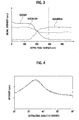
- Fig. 3 shows results of confirming, by XPS (X-ray photoelectron spectroscopy), the presence of oxygen in a depth direction in the interference films respectively formed by use of the methods of coloring a surface of a zirconium-based metallic glass component in the cases of the first and second embodiments described above.
- interference films formed by use of the methods of coloring a surface of a zirconium-based metallic glass component in the cases of the first and second embodiments described above has not yet been completed. However, it has been proven that the interference films are naturally formed to have the thickness within a range not exceeding 300 nm.
- the surface layer is covered with a film in a zirconia state and becomes fragile. This results in peeling off of the interference film and a structure that is easily destroyed.
- Fig. 4 shows structures of the surface layers of the zirconium-based metallic glass components respectively formed by use of the methods of coloring a surface of a zirconium-based metallic glass component in the cases of the first and second embodiments described above (results of observation by X-ray diffraction).
- Table 1 shows observation results and measurement results on interference films on zirconium-based metallic glass components 4 in the cases of Examples 1 to 7 and Comparative Examples 1 to 4.
- the interference films on the zirconium-based metallic glass components 4 were formed by use of the method of coloring a surface of a zirconium-based metallic glass component according to the first embodiment described above.
- the interference films on the zirconium-based metallic glass components 4 were formed in the following manner. Specifically, in the electrolytic apparatus 1 shown in Fig. 1, a zirconium-based metallic glass component 4 having a length of 20 mm, a width of 20 mm and a thickness of 0.5 mm was used as an anode, and a titanium plate 5 having a length of 100 mm, a width of 20 mm and a thickness of 1 mm was used as a cathode, inside the bath 2 filled with 2000 cc of the electrolytic solution. Moreover, the anode and the cathode were electrically connected to the direct-current power supply 6 to distribute power for an appropriate time.
- Table 1 shows processing conditions including "type of electrolytic solution,” “solution property,” “current value,” “voltage value” and “conduction time,” all of which were used here.
- Electrolytic solution Solution property Current A
- Voltage V
- Conduction time minute
- 3%KOH Alkaline 3 10 15 Green O 160
- Example 2 3%KOH Alkaline 3.5 9
- Blue O 190
- Example 3 3%KOH Alkaline 15 18 5 Yellow O 140
- Example 6 2%KOH Alkaline 3 18 30 Light brown O 180
- Example 7 2%KOH Alkaline 20 35 25 Black O 200
- Comparative Example 1 5% phosphoric acid Acidic 3 15 3 Not colored - - Comparative Example 2 5% Phosphoric acid Acidic 5 10 30 Not colored - - Comparative Example 3 phosphate solution Neutral 3 95 10 Not colored -
- the solution property of the electrolytic solution was "alkaline” in Examples 1 to 7, was “acidic” in Comparative Examples 1 and 2, and was “neutral” in Comparative Examples 3 and 4.
- Table 1 also shows "film color,” “color evenness” and “film thickness,” which are observation results and measurement results on the zirconium-based metallic glass components 4 obtained under the respective processing conditions (electrochemical conditions).
- Fig. 4 shows the X-ray diffraction result on Example 1, similar results were obtained for the other Examples 2 to 7. Thus, it was confirmed that the zirconium-based metallic glass components 4 were maintained to be amorphous.
- Table 2 shows observation results and measurement results on interference films on zirconium-based metallic glass components 4 in the cases of Examples 8 to 14 and Comparative Examples 5 to 7.
- the interference films on the zirconium-based metallic glass components 4 were formed by use of the method of coloring a surface of a zirconium-based metallic glass component according to the second embodiment described above.
- the interference films on the zirconium-based metallic glass components 4 were formed in the following manner. Specifically, in the heating apparatus 10 shown in Fig. 2, a zirconium-based metallic glass component 4 having a length of 20 mm, a width of 20 mm and a thickness of 0.5 mm was fixed in the center of the tubular vessel 11 having an inside diameter of 100 mm. Thereafter, the zirconium-based metallic glass component 4 was heated by the electric heater 12 provided around the tubular vessel 11.
- an oxygen-free atmosphere was set by allowing the inert gas G to pass through the tubular vessel 11 from the inlet 11a toward the outlet 11b. Thereafter, the vessel ventilated by switching to inert gas G prepared to contain 300 ppm of oxygen.
- Table 2 shows "type of the inert gas G,” “oxygen concentration in the inert gas G,” “flow rate of the inert gas G,” “heating temperature” and “processing time,” all of which were used here.
- the interference films on the zirconium-based metallic glass components 4 in the cases of Examples 8 to 14 were formed in a case where heating was performed at the heating temperature of 483°C or less in the inert gas atmosphere having the oxygen concentration of 500 ppm or less.
- the interference film on the zirconium-based metallic glass component 4 according to comparative Example 5 was formed in a case where heating was performed at the heating temperature of 440°C in the inert gas atmosphere having the oxygen concentration of 540 ppm.
- the interference film on the zirconium-based metallic glass component 4 according to comparative Example 6 was formed in a case where heating was performed at the heating temperature of 500°C in the inert gas atmosphere having the oxygen concentration of 300 ppm.
- the interference film on the zirconium-based metallic glass component 4 according to comparative Example 7 was formed in a case where heating was performed at the heating temperature of 400°C in the normal atmosphere.
- Table 2 also shows "film color,” “color evenness,” “film thickness” and “confirmation of whether component is maintained to be amorphous,” which are observation results and measurement results on the zirconium-based metallic glass components 4 obtained under the respective processing conditions (electrochemical conditions).
- the present invention it is possible to provide a method of coloring a surface of a zirconium-based metallic glass component, the method makes it possible to realize a wide variety of colors to be produced on the surface of the zirconium-based metallic glass component (a component to be formed) without causing crystallization on the surface.
Landscapes
- Chemical & Material Sciences (AREA)
- Engineering & Computer Science (AREA)
- Chemical Kinetics & Catalysis (AREA)
- Electrochemistry (AREA)
- Materials Engineering (AREA)
- Metallurgy (AREA)
- Organic Chemistry (AREA)
- Surface Treatment Of Glass (AREA)
- Other Surface Treatments For Metallic Materials (AREA)
Abstract
Description
- The present invention relates to a method of coloring a surface of a zirconium-based metallic glass component for the purpose of even coloring without causing crystallization on the surface of the zirconium-based metallic glass component.
- Metallic liquid normally enters an extremely unstable state when cooled below a melting point, and is immediately crystallized to become crystallized metal. In this event, time for which a supercooled liquid can exist in an uncrystallized state where atoms are randomly arranged, i.e., a so-called "amorphous state," is estimated to be 10-5 seconds or less at a nose temperature of a continuous cooling transformation (CCT) curve. Specifically, this means that it is impossible to obtain amorphous alloys unless a cooling rate of 106 K/s or more is achieved.
- However, there has recently been invented metallic glass which undergoes clear glass transition and is not crystallized even at a cooling rate of 100 K/s or less since a supercooled liquid state is extremely stabilized in a specific alloy group including a zirconium base (see, for example, The June 2002 edition of Kinou Zairyou (Functional Materials), Vol. 22, No. 6, p.p.5-9; Non-patent Document 1).
- Since the metallic glass has a wide supercooled liquid temperature range, superplastic forming utilizing a viscous flow is possible under conditions that do not reach a temperature and time at which the glass is transformed into crystals again. Thus, the metallic glass is expected to be put into practical use as a structural material.
- Among the metallic glass, as in the case of commercial titanium used as a structural material, zirconium-based metallic glass containing zirconium as a basic component with a high affinity for oxygen has been expected to have its surface colored in several colors depending on its thickness by forming an oxide film on the surface.
- For example,
Japanese Patent Publication No. 2003-166044 - However, in the method described in Patent Document 1, it is impossible to manage an oxide film in order that the entire zirconium-based metallic glass component can be evenly colored. Moreover, the type of color obtained is limited to brown, black or gray. Thus, the method has a problem that a decorative surface desired for the zirconium-based metallic glass component is extremely limited.
- Furthermore, in the method described in Patent Document 1, heating and oxidation in the atmosphere tend to accelerate crystallization of a normally amorphous surface layer more than necessary. Thus, the method also has a problem that the zirconium-based metallic glass component becomes fragile unless an amorphous structure of the surface layer of the entire zirconium-based metallic glass component is maintained and controlled by very strictly managing the temperature and time.
- Consequently, in order to solve the problems described above, the inventors of the present invention have carried out keen studies for the purpose of coloring the surface of the zirconium-based metallic glass component. As a result, the inventors have found out that it is possible to perform coloring in many colors without worrying about crystallization depending on the temperature by carrying out an anodizing process to form an interference film. Moreover, the inventors have also found out that it is possible to produce many colors without causing crystallization by heating while controlling an inert gas atmosphere. Furthermore, the present invention has been accomplished by optimizing conditions for formation of the film.
- The present invention has been made in consideration of the foregoing problems. It is an object of the present invention to provide a method of coloring a surface of a zirconium-based metallic glass component, the method makes it possible to realize a wide variety of colors to be produced on the surface of the zirconium-based metallic glass component (a component to be formed) without causing crystallization on the surface.
- A first aspect of the present invention is to provide a method of coloring a surface of a zirconium-based metallic glass component includes the step of imparting interference colors by carrying out an anodizing process using an alkaline solution to form a film having a thickness of 300 nm or less on the surface of the zirconium-based metallic glass component.
- In the first aspect of the present invention, the alkaline solution may be a potassium hydroxide solution.
- Moreover, the first aspect of the present invention is to provide a method of coloring a surface of a zirconium-based metallic glass component includes the step of imparting interference colors by forming a film having a thickness of 300 nm or less on the surface of the zirconium-based metallic glass component by heating the zirconium-based metallic glass component at a temperature equal to or lower than a crystallization temperature of zirconium-based metallic glass in an inert gas atmosphere having an oxygen concentration of 500 ppm or less.
-
- Fig. 1 is a schematic diagram of an electrolytic apparatus applied to a method of coloring a surface of a zirconium-based metallic glass component according to a first embodiment of the present invention.
- Fig. 2 is a schematic diagram of a heating apparatus applied to a method of coloring a surface of a zirconium-based metallic glass component according to a second embodiment of the present invention.
- Fig. 3 is a graph showing results of an analysis on an interference film, which is formed on the surface of the zirconium-based metallic glass component, in a depth direction by XPS (X-ray photoelectron spectroscopy).
- Fig. 4 is a graph showing a structure of a surface layer of the zirconium-based metallic glass component by X-ray diffraction.
- With reference to the drawings, description will be given below of a method of coloring a surface of a zirconium-based metallic glass component in the cases of first and second embodiments of the present invention.
- Fig. 1 is a diagram showing an electrolytic apparatus 1 applied to the method of coloring a surface of a zirconium-based metallic glass component according to the first embodiment of the present invention.
- The method of coloring a surface of a zirconium-based metallic glass component according to the first embodiment of the present invention includes the step of imparting interference colors by carrying out an anodizing process using an alkaline solution to form a film having a thickness of 300 nm or less on the surface of the zirconium-based metallic glass component.
- As shown in Fig. 1, a
bath 2 for surface treatment in the electrolytic apparatus 1 is filled with analkaline solution 3 which is to be an electrolytic solution. Moreover, the electrolytic apparatus 1 is configured to use a zirconium-basedmetallic glass component 4 as an anode and to use apassive metal 5 such as aluminum and titanium, for example, as a cathode. Furthermore, the electrolytic apparatus 1 is configured to apply a voltage by electrically connecting the anode and the cathode to a direct-current power supply 6. - In this embodiment, as the
alkaline solution 3, a potassium hydroxide (KOH) solution is used, which realizes relatively easy selection and control of processing conditions for the current, voltage and conduction time. Note, however, that the present invention is not necessarily limited to the above case but is also applicable to the case of using, as thealkaline solution 3, a sodium hydroxide solution, a calcium hydroxide solution, a barium hydroxide solution, a sodium carbonate solution, an ammonium carbonate solution, a sodium phosphate solution or the like. - Note that, in the present invention, the alkaline solution is selected as the electrolytic solution since the zirconium-based metallic glass component did not get colored as a result of using various neutral solutions or acid solutions as the electrolytic solution to try the anodizing process.
- To be more specific, about 0.5% to 10% of the potassium hydroxide (KOH) solution is preferable since the solution makes it relatively easy to control the processing conditions described above while selecting the conditions.
- Specifically, by applying a voltage of 5V to 20V to allow a direct current of 1A to 5A to flow for about 3 to 30 minutes, as time passes, an interference film is formed on the surface of the zirconium-based
metallic glass component 4. - Furthermore, the above-described processing conditions (electrochemical conditions) may be selected for each of interference colors of the film, including yellow, green, blue, purple, gold and the like.
- Note that the present invention is not necessarily limited to the processing conditions described above but may be applied to processing within a short amount of time by allowing a larger current to flow under a larger voltage. It suffices to select the processing conditions depending on a size of the zirconium-based metallic glass component or processing efficiency desired.
- Fig. 2 is a diagram showing a
heating apparatus 10 applied to a method of coloring a surface of a zirconium-based metallic glass component according to a second embodiment of the present invention. - The method of coloring a surface of a zirconium-based metallic glass component according to this embodiment includes the step of imparting interference colors by heating the zirconium-based metallic glass component at a temperature equal to or lower than a crystallization temperature of zirconium-based metallic glass in an inert gas atmosphere having an oxygen concentration of 500 ppm or less and by forming a film having a thickness of 300 nm or less on the surface of the zirconium-based metallic glass component.
- As shown in Fig. 2, the
heating apparatus 10 includes: atubular vessel 11 having aninlet 11a and anoutlet 11b for inert gas G; and aheater 12 provided around thetubular vessel 11. - In the
heating apparatus 10, a zirconium-basedmetallic glass component 4 is placed in a stationary state inside thetubular vessel 11. Moreover, theheating apparatus 10 can form an interference film on the surface of the zirconium-basedmetallic glass component 4 by heating the zirconium-based metallic glass component at the crystallization temperature of zirconium-based metallic glass or less in the atmosphere of the inert gas G containing oxygen of 500 ppm or less. - Here, in a case where a heating temperature selected in combination with processing time is equal to or higher than the crystallization temperature of zirconium-based metallic glass (metallic glass to be processed), the zirconium-based
metallic glass component 4 is immediately crystallized and therefore becomes fragile. Thus, the heating temperature is required to be set equal to or lower than the crystallization temperature of zirconium-based metallic glass. - For example, in this embodiment, in a case where Zr-Cu-Al-Ni metallic glass is used, a crystallization temperature of the metallic glass should be around 480°C although there are changes depending on a history. Thus, heating is performed at 450°C or less.
- Here, it is not particularly required to limit a lower limit of a heating temperature. However, in consideration of industrial processing efficiency, 300°C or more is preferable. Note that, at the temperature of 300°C or less, film formation does not proceed at an observable rate.
- Moreover, in this embodiment, the reason why the concentration of oxygen in the heating atmosphere is set at 500 ppm or less is because the concentration is suitable for producing colors while controlling many interference colors. Note that, with the oxygen concentration of 500 ppm or more, the atmosphere approaches one in the case where heating is performed in the normal atmosphere. Thus, only very limited interference colors can be obtained.
- Moreover, as the inert gas, it is possible to appropriately use argon (Ar) gas, nitrogen gas, helium gas and the like.
- Furthermore, in the first and second embodiments described above, the reason why the thickness of the film is set at 300 nm or less is because the interference film on the surface, which is considered to be mainly made of oxide that is a constituent element of the metallic glass, is less likely to be peeled off.
- Fig. 3 shows results of confirming, by XPS (X-ray photoelectron spectroscopy), the presence of oxygen in a depth direction in the interference films respectively formed by use of the methods of coloring a surface of a zirconium-based metallic glass component in the cases of the first and second embodiments described above.
- A close structural analysis on the interference films formed by use of the methods of coloring a surface of a zirconium-based metallic glass component in the cases of the first and second embodiments described above has not yet been completed. However, it has been proven that the interference films are naturally formed to have the thickness within a range not exceeding 300 nm.
- Note that, in a case where the interference film is formed to have a thickness of over 300 nm, the surface layer is covered with a film in a zirconia state and becomes fragile. This results in peeling off of the interference film and a structure that is easily destroyed.
- Fig. 4 shows structures of the surface layers of the zirconium-based metallic glass components respectively formed by use of the methods of coloring a surface of a zirconium-based metallic glass component in the cases of the first and second embodiments described above (results of observation by X-ray diffraction).
- As shown in Fig. 4, a gently angular curve graph is obtained. Moreover, it is possible to confirm that the zirconium-based metallic glass component in the cases of the first and second embodiments described above is maintained to be amorphous.
- Table 1 shows observation results and measurement results on interference films on zirconium-based
metallic glass components 4 in the cases of Examples 1 to 7 and Comparative Examples 1 to 4. - The interference films on the zirconium-based
metallic glass components 4 were formed by use of the method of coloring a surface of a zirconium-based metallic glass component according to the first embodiment described above. - The interference films on the zirconium-based
metallic glass components 4 were formed in the following manner. Specifically, in the electrolytic apparatus 1 shown in Fig. 1, a zirconium-basedmetallic glass component 4 having a length of 20 mm, a width of 20 mm and a thickness of 0.5 mm was used as an anode, and atitanium plate 5 having a length of 100 mm, a width of 20 mm and a thickness of 1 mm was used as a cathode, inside thebath 2 filled with 2000 cc of the electrolytic solution. Moreover, the anode and the cathode were electrically connected to the direct-current power supply 6 to distribute power for an appropriate time. Table 1 shows processing conditions including "type of electrolytic solution," "solution property," "current value," "voltage value" and "conduction time," all of which were used here.[Table 1] Electrolytic solution Solution property Current (A) Voltage (V) Conduction time (minute) Film color Color evenness Film thickness (nm) Example 1 3 %KOH Alkaline 3 10 15 Green O 160 Example 2 3%KOH Alkaline 3.5 9 20 Blue O 190 Example 3 3%KOH Alkaline 15 18 5 Yellow O 140 Example 4 5%KOH Alkaline 20 35 2 Blue O 280 Example 5 3%NaOH Alkaline 20 23 3 Gray O 120 Example 6 2 %KOH Alkaline 3 18 30 Light brown O 180 Example 7 2%KOH Alkaline 20 35 25 Black O 200 Comparative Example 1 5% phosphoric acid Acidic 3 15 3 Not colored - - Comparative Example 2 5% Phosphoric acid Acidic 5 10 30 Not colored - - Comparative Example 3 phosphate solution Neutral 3 95 10 Not colored - - Comparative Example 4 phosphate solution Neutral 1.5 30 7 Not colored - - - As shown in Table 1, the solution property of the electrolytic solution was "alkaline" in Examples 1 to 7, was "acidic" in Comparative Examples 1 and 2, and was "neutral" in Comparative Examples 3 and 4.
- Moreover, Table 1 also shows "film color," "color evenness" and "film thickness," which are observation results and measurement results on the zirconium-based
metallic glass components 4 obtained under the respective processing conditions (electrochemical conditions). - "Film color" and "color evenness" are the observation results obtained with the naked eye, and "film thickness" is the measurement result obtained by XPS (X-ray photoelectron spectroscopy). Note that, in Table 1, "O" means "even" under "color evenness."
- Furthermore, in the method of coloring a surface of a zirconium-based metallic glass component according to the first embodiment, no heating is performed. Thus, it is assumed as a matter of course that the zirconium-based
metallic glass component 4 is maintained to be amorphous. Therefore, confirmation was performed by X-ray diffraction. - Specifically, although Fig. 4 shows the X-ray diffraction result on Example 1, similar results were obtained for the other Examples 2 to 7. Thus, it was confirmed that the zirconium-based
metallic glass components 4 were maintained to be amorphous. - As is clear from Table 1, in Examples 1 to 7, it was possible to produce various kinds of interference colors, such as green, blue, yellow, gray, light brown and black by carrying out an anodizing process using an alkaline solution to form a film having a thickness of 300 nm or less on the surface of the zirconium-based
metallic glass component 4. Thus, it was possible to realize a wide variety of colors to be produced on the surface of the zirconium-basedmetallic glass component 4 without causing crystallization of zirconium-based metallic glass. - On the other hand, in any of Comparative Examples 1 to 4, it was not possible to confirm coloring of the surface of the zirconium based
metallic glass component 4. - Table 2 shows observation results and measurement results on interference films on zirconium-based
metallic glass components 4 in the cases of Examples 8 to 14 and Comparative Examples 5 to 7. - The interference films on the zirconium-based
metallic glass components 4 were formed by use of the method of coloring a surface of a zirconium-based metallic glass component according to the second embodiment described above. - The interference films on the zirconium-based
metallic glass components 4 were formed in the following manner. Specifically, in theheating apparatus 10 shown in Fig. 2, a zirconium-basedmetallic glass component 4 having a length of 20 mm, a width of 20 mm and a thickness of 0.5 mm was fixed in the center of thetubular vessel 11 having an inside diameter of 100 mm. Thereafter, the zirconium-basedmetallic glass component 4 was heated by theelectric heater 12 provided around thetubular vessel 11. - In this heating, an oxygen-free atmosphere was set by allowing the inert gas G to pass through the
tubular vessel 11 from theinlet 11a toward theoutlet 11b. Thereafter, the vessel ventilated by switching to inert gas G prepared to contain 300 ppm of oxygen. - After the ventilation for a sufficient amount of time with the prepared inert gas G, heating was performed for an appropriate amount of time while maintaining an appropriate temperature.
- Table 2 shows "type of the inert gas G," "oxygen concentration in the inert gas G," "flow rate of the inert gas G," "heating temperature" and "processing time," all of which were used here.
- Note that it was previously confirmed that a crystallization temperature of the zirconium-based metallic glass used here was 483°C. [Table 2]
Gas Oxygen concentration (ppm) Flow rate (L/min) Temperature (°C) Processing time (minute) Color evenness Film color Film thickness (nm) Confirmation of whether component is maintained to be amorphous Example 8 Ar 300 2 400 10 O Blue 120 O Example 9 Ar 480 1 445 10 O Purple 140 O Example 10 Ar 100 2 420 8 O Gold 140 O Example 11 Ar 80 2 450 1 O Yellow 180 O Example 12 N2 100 1 400 15 O Black 280 O Example 13 N2 150 1 420 10 O Brown 150 O Example 14 Ar 300 1 400 10 O Gray 80 O Comparative Example 5 Ar 540 1 440 10 X Purple 120 O Comparative Example 6 Ar 300 2 500 5 X Blue 180 X Comparative Example 7 Atmosphere - - 400 15 X Black Not evaluated X - As shown in Table 2, the interference films on the zirconium-based
metallic glass components 4 in the cases of Examples 8 to 14 were formed in a case where heating was performed at the heating temperature of 483°C or less in the inert gas atmosphere having the oxygen concentration of 500 ppm or less. - Meanwhile, the interference film on the zirconium-based
metallic glass component 4 according to comparative Example 5 was formed in a case where heating was performed at the heating temperature of 440°C in the inert gas atmosphere having the oxygen concentration of 540 ppm. - Moreover, the interference film on the zirconium-based
metallic glass component 4 according to comparative Example 6 was formed in a case where heating was performed at the heating temperature of 500°C in the inert gas atmosphere having the oxygen concentration of 300 ppm. - Furthermore, the interference film on the zirconium-based
metallic glass component 4 according to comparative Example 7 was formed in a case where heating was performed at the heating temperature of 400°C in the normal atmosphere. - Moreover, Table 2 also shows "film color," "color evenness," "film thickness" and "confirmation of whether component is maintained to be amorphous," which are observation results and measurement results on the zirconium-based
metallic glass components 4 obtained under the respective processing conditions (electrochemical conditions). - "Film color" and "color evenness" are the observation results obtained with the naked eye, and "film thickness" is the measurement result obtained by XPS (X-ray photoelectron spectroscopy). Moreover, as to "confirmation of whether component is maintained to be amorphous," as a result of checking a structure of the surface layer of the metallic glass component by X-ray diffraction, as according to the first embodiment, the same result as that shown in Fig. 4 was obtained for those of Examples 8 to 14, and the component itself was maintained to be amorphous.
- Note that, in Table 2, "O" means "even" and "X" means "uneven" under "color evenness." Moreover, "O" means "maintained to be amorphous" and "X" means "not maintained to be amorphous" under "confirmation of whether component is maintained to be amorphous."
- As is clear from Table 2, in Examples 8 to 14, it was possible to evenly produce various kinds of interference colors, such as blue, purple, gold, yellow, black, brown and gray by heating the zirconium-based metallic glass component at the crystallization temperature of zirconium-based metallic glass or less in the inert gas having the oxygen concentration of 500 ppm or less to form a film producing the interference colors with a thickness of 300 nm or less on the surface of the zirconium-based
metallic glass component 4. Thus, it was possible to realize a wide variety of colors to be produced on the surface of the zirconium-based metallic glass component without causing crystallization of the zirconium-based metallic glass. - On the other hand, in all of Comparative Examples 5 to 7, the surface of the zirconium-based metallic glass component was only colored in very limited interference colors including blue, purple and black. Moreover, the surface was unevenly colored. Furthermore, in Comparative Examples 6 and 7, the zirconium-based metallic glass was crystallized to lower strength of the zirconium-based metallic glass component.
- As described above, according to the present invention, it is possible to provide a method of coloring a surface of a zirconium-based metallic glass component, the method makes it possible to realize a wide variety of colors to be produced on the surface of the zirconium-based metallic glass component (a component to be formed) without causing crystallization on the surface.
Claims (3)
- A method of coloring a surface of a zirconium-based metallic glass component, comprising the step of;imparting interference colors by carrying out an anodizing process using an alkaline solution to form a film having a thickness of 300 nm or less on the surface of the zirconium-based metallic glass component.
- The method of coloring a surface of a zirconium-based metallic glass component of claim 1, wherein, the alkaline solution is a potassium hydroxide solution.
- A method of coloring a surface of a zirconium-based metallic glass component, comprising the step of;imparting interference colors by forming a film having a thickness of 300 nm or less on the surface of the zirconium-based metallic glass component by heating the zirconium-based metallic glass component at a temperature equal to or lower than a crystallization temperature of zirconium-based metallic glass in an inert gas atmosphere having an oxygen concentration of 500 ppm or less.
Applications Claiming Priority (2)
| Application Number | Priority Date | Filing Date | Title |
|---|---|---|---|
| JP2004160231 | 2004-05-28 | ||
| PCT/JP2005/009800 WO2005116301A1 (en) | 2004-05-28 | 2005-05-27 | Method for coloring surface of zirconium-based metallic glass component |
Publications (3)
| Publication Number | Publication Date |
|---|---|
| EP1772535A1 true EP1772535A1 (en) | 2007-04-11 |
| EP1772535A4 EP1772535A4 (en) | 2011-07-13 |
| EP1772535B1 EP1772535B1 (en) | 2013-05-22 |
Family
ID=35450918
Family Applications (1)
| Application Number | Title | Priority Date | Filing Date |
|---|---|---|---|
| EP05743920.0A Expired - Lifetime EP1772535B1 (en) | 2004-05-28 | 2005-05-27 | Method for coloring surface of zirconium-based metallic glass component |
Country Status (6)
| Country | Link |
|---|---|
| US (2) | US7923067B2 (en) |
| EP (1) | EP1772535B1 (en) |
| JP (1) | JP4482558B2 (en) |
| KR (1) | KR101184521B1 (en) |
| CN (1) | CN1957114B (en) |
| WO (1) | WO2005116301A1 (en) |
Cited By (1)
| Publication number | Priority date | Publication date | Assignee | Title |
|---|---|---|---|---|
| EP3967791A1 (en) * | 2020-09-15 | 2022-03-16 | Richemont International S.A. | Enhanced corrosion resistance process for bulk metallic glass substrates |
Families Citing this family (9)
| Publication number | Priority date | Publication date | Assignee | Title |
|---|---|---|---|---|
| US8048169B2 (en) * | 2003-07-28 | 2011-11-01 | Baronova, Inc. | Pyloric valve obstructing devices and methods |
| US7473278B2 (en) | 2004-09-16 | 2009-01-06 | Smith & Nephew, Inc. | Method of surface oxidizing zirconium and zirconium alloys and resulting product |
| US8361381B2 (en) * | 2008-09-25 | 2013-01-29 | Smith & Nephew, Inc. | Medical implants having a porous coated surface |
| CN102021525B (en) * | 2010-12-02 | 2013-01-16 | 武汉科技大学 | Colored stainless steel based on ion implantation and preparation method thereof |
| CN101994144A (en) * | 2010-12-08 | 2011-03-30 | 西安优耐特容器制造有限公司 | Processing method for anodic oxidation of zirconium surface |
| JP6364642B2 (en) * | 2014-03-27 | 2018-08-01 | 福井県 | Coloring method of coloring material |
| US9905367B2 (en) * | 2014-05-15 | 2018-02-27 | Case Western Reserve University | Metallic glass-alloys for capacitor anodes |
| CN109652853B (en) * | 2019-02-28 | 2020-07-28 | 安徽工业大学 | A method for preparing frosted surface on Zr-based bulk amorphous alloy |
| US11739425B2 (en) * | 2019-08-14 | 2023-08-29 | Apple Inc. | Electronic device coatings for reflecting mid-spectrum visible light |
Family Cites Families (19)
| Publication number | Priority date | Publication date | Assignee | Title |
|---|---|---|---|---|
| US3767541A (en) * | 1971-06-29 | 1973-10-23 | Gen Electric | Anodized film for electrolytic capacitor and method for preparation thereof |
| JPH079057B2 (en) * | 1985-04-26 | 1995-02-01 | 株式会社東芝 | Amorphous alloy magnetic core manufacturing method |
| JPH0645915B2 (en) | 1987-11-06 | 1994-06-15 | 三井造船株式会社 | How to decorate the surface of parts |
| JPH01136958A (en) * | 1987-11-19 | 1989-05-30 | Mitsui Eng & Shipbuild Co Ltd | Method for coloring member surface |
| US4994314A (en) * | 1989-02-03 | 1991-02-19 | Alcan International Limited | Color change devices incorporating thin anodic films |
| JPH03130397A (en) | 1989-07-20 | 1991-06-04 | Daido Steel Co Ltd | Surface coloring method and surface coloring products using the method |
| JP2886253B2 (en) * | 1990-04-11 | 1999-04-26 | 株式会社アマダ | Scale device used for error correction of drive system etc. in NC processing machine |
| JPH0413894A (en) | 1990-05-03 | 1992-01-17 | Sky Alum Co Ltd | Aluminum alloy material to be coated for automobile and its production |
| JPH05179484A (en) | 1991-12-26 | 1993-07-20 | Nippon Alum Co Ltd | Method for anodic oxidation treatment of ti and ti alloy |
| JPH0645915A (en) | 1992-07-24 | 1994-02-18 | Rohm Co Ltd | Divider circuit |
| JP3210776B2 (en) * | 1993-06-15 | 2001-09-17 | 松下電工株式会社 | Magnetic material using amorphous magnetic alloy, method for producing magnetic material |
| EP0657562B1 (en) * | 1993-11-12 | 2001-09-12 | PPG Industries Ohio, Inc. | Durable sputtered metal oxide coating |
| US5563765A (en) * | 1994-08-29 | 1996-10-08 | Motorola, Inc. | Amorphous cobalt alloy electrodes for aqueous electrochemical devices |
| SK121099A3 (en) | 1997-03-11 | 2000-06-12 | Almag Al | Process and apparatus for coating metals |
| US6514621B1 (en) * | 1997-12-24 | 2003-02-04 | Ppg Industries Ohio, Inc. | Patterned coated articles and methods for producing the same |
| KR20000076300A (en) | 1999-09-11 | 2000-12-26 | 알마그 알 | Process and apparatus for coating metals |
| DE10004888A1 (en) * | 2000-02-04 | 2001-08-09 | Eckart Standard Bronzepulver | Luster pigment and process for its manufacture |
| US6436268B1 (en) * | 2000-08-02 | 2002-08-20 | Kemet Electronics Corporation | Non-aqueous electrolytes for anodizing |
| JP3808354B2 (en) * | 2001-11-29 | 2006-08-09 | Ykk株式会社 | Toning method for zirconium-based amorphous alloys |
-
2005
- 2005-05-27 US US11/597,942 patent/US7923067B2/en not_active Expired - Fee Related
- 2005-05-27 JP JP2006513967A patent/JP4482558B2/en not_active Expired - Fee Related
- 2005-05-27 CN CN2005800169235A patent/CN1957114B/en not_active Expired - Fee Related
- 2005-05-27 EP EP05743920.0A patent/EP1772535B1/en not_active Expired - Lifetime
- 2005-05-27 KR KR1020067026118A patent/KR101184521B1/en not_active Expired - Fee Related
- 2005-05-27 WO PCT/JP2005/009800 patent/WO2005116301A1/en not_active Ceased
-
2011
- 2011-01-19 US US13/009,082 patent/US8865253B2/en not_active Expired - Fee Related
Non-Patent Citations (2)
| Title |
|---|
| HABAZAKI ET AL: "Anodic film formation on sputter-deposited amorphous Al-Zr alloys", J.PHYS.D:APPL.PHYS., vol. 28, 1995, pages 2612-2618, XP002638424, * |
| See also references of WO2005116301A1 * |
Cited By (1)
| Publication number | Priority date | Publication date | Assignee | Title |
|---|---|---|---|---|
| EP3967791A1 (en) * | 2020-09-15 | 2022-03-16 | Richemont International S.A. | Enhanced corrosion resistance process for bulk metallic glass substrates |
Also Published As
| Publication number | Publication date |
|---|---|
| CN1957114B (en) | 2010-08-18 |
| US7923067B2 (en) | 2011-04-12 |
| EP1772535A4 (en) | 2011-07-13 |
| JPWO2005116301A1 (en) | 2008-04-03 |
| US8865253B2 (en) | 2014-10-21 |
| KR101184521B1 (en) | 2012-09-19 |
| EP1772535B1 (en) | 2013-05-22 |
| CN1957114A (en) | 2007-05-02 |
| US20110107795A1 (en) | 2011-05-12 |
| US20080038460A1 (en) | 2008-02-14 |
| KR20070040335A (en) | 2007-04-16 |
| JP4482558B2 (en) | 2010-06-16 |
| WO2005116301A1 (en) | 2005-12-08 |
Similar Documents
| Publication | Publication Date | Title |
|---|---|---|
| US8865253B2 (en) | Method of coloring surface of zirconium-based metallic glass component | |
| TWI564437B (en) | Non-metal coating and production method thereof | |
| KR101763850B1 (en) | Method for manufacturing substrate for superconducting compound | |
| JPH11200090A (en) | Nanostructure and method for manufacturing the same | |
| US8282807B2 (en) | Metal member having a metal oxide film and method of manufacturing the same | |
| EP3421646A1 (en) | Colouring method of aluminium alloy member | |
| CN106716559B (en) | Substrate for superconducting wire, manufacturing method thereof, and superconducting wire | |
| SI9420006A (en) | Process for the galvanic application of a surface coating | |
| JPH0347994A (en) | Method for coloring titanium or alloy thereof by controlling quantity of supplied electric current | |
| KR102188566B1 (en) | Superconducting wire material substrate, production method therefor, and superconducting wire material | |
| WO2010027031A1 (en) | Solar cell and method for manufacturing same | |
| CN1309880C (en) | Metal strip for epitaxial coating and method for production thereof | |
| CA1138373A (en) | Electrolytically tin-plating steel, remelting and alkaline cathodic treating | |
| DE1916292C3 (en) | Process for coating niobium with copper | |
| EP4148180A1 (en) | Manufacturing method for antibacterial fiber | |
| RU2049162C1 (en) | Method for obtaining protective coating on valve metals and their alloys | |
| US5073240A (en) | Anhydrous electrophoretic silver coating technique | |
| US6709719B2 (en) | Method for producing a tin-zinc alloy film | |
| JP4739015B2 (en) | Method for producing metal substrate for oxide superconductor, method for producing oxide superconductor | |
| KR20160024616A (en) | Method for fabricating oxidation film on metallic materials | |
| WO1996008448A2 (en) | Metafuse deposition process for forming superconducting ceramics | |
| KR20170065455A (en) | Forming method of aluminum film and aluminum film thereof | |
| JP2583577B2 (en) | Method for producing Bi-based oxide superconducting material | |
| JPH01166417A (en) | Manufacture of oxide superconductive wire material | |
| JPS5884995A (en) | Electrolytic coloring method for aluminum or its alloy |
Legal Events
| Date | Code | Title | Description |
|---|---|---|---|
| PUAI | Public reference made under article 153(3) epc to a published international application that has entered the european phase |
Free format text: ORIGINAL CODE: 0009012 |
|
| 17P | Request for examination filed |
Effective date: 20061218 |
|
| AK | Designated contracting states |
Kind code of ref document: A1 Designated state(s): DE FI FR GB SE |
|
| DAX | Request for extension of the european patent (deleted) | ||
| RBV | Designated contracting states (corrected) |
Designated state(s): DE FI FR GB SE |
|
| A4 | Supplementary search report drawn up and despatched |
Effective date: 20110610 |
|
| 17Q | First examination report despatched |
Effective date: 20120521 |
|
| GRAP | Despatch of communication of intention to grant a patent |
Free format text: ORIGINAL CODE: EPIDOSNIGR1 |
|
| GRAS | Grant fee paid |
Free format text: ORIGINAL CODE: EPIDOSNIGR3 |
|
| GRAA | (expected) grant |
Free format text: ORIGINAL CODE: 0009210 |
|
| AK | Designated contracting states |
Kind code of ref document: B1 Designated state(s): DE FI FR GB SE |
|
| REG | Reference to a national code |
Ref country code: GB Ref legal event code: FG4D |
|
| REG | Reference to a national code |
Ref country code: DE Ref legal event code: R096 Ref document number: 602005039699 Country of ref document: DE Effective date: 20130718 |
|
| REG | Reference to a national code |
Ref country code: SE Ref legal event code: TRGR |
|
| PLBE | No opposition filed within time limit |
Free format text: ORIGINAL CODE: 0009261 |
|
| STAA | Information on the status of an ep patent application or granted ep patent |
Free format text: STATUS: NO OPPOSITION FILED WITHIN TIME LIMIT |
|
| 26N | No opposition filed |
Effective date: 20140225 |
|
| REG | Reference to a national code |
Ref country code: DE Ref legal event code: R097 Ref document number: 602005039699 Country of ref document: DE Effective date: 20140225 |
|
| REG | Reference to a national code |
Ref country code: FR Ref legal event code: PLFP Year of fee payment: 12 |
|
| PGFP | Annual fee paid to national office [announced via postgrant information from national office to epo] |
Ref country code: DE Payment date: 20160524 Year of fee payment: 12 Ref country code: FI Payment date: 20160509 Year of fee payment: 12 Ref country code: GB Payment date: 20160525 Year of fee payment: 12 |
|
| PGFP | Annual fee paid to national office [announced via postgrant information from national office to epo] |
Ref country code: FR Payment date: 20160412 Year of fee payment: 12 Ref country code: SE Payment date: 20160511 Year of fee payment: 12 |
|
| REG | Reference to a national code |
Ref country code: DE Ref legal event code: R119 Ref document number: 602005039699 Country of ref document: DE |
|
| REG | Reference to a national code |
Ref country code: SE Ref legal event code: EUG |
|
| GBPC | Gb: european patent ceased through non-payment of renewal fee |
Effective date: 20170527 |
|
| PG25 | Lapsed in a contracting state [announced via postgrant information from national office to epo] |
Ref country code: FI Free format text: LAPSE BECAUSE OF NON-PAYMENT OF DUE FEES Effective date: 20170527 |
|
| PG25 | Lapsed in a contracting state [announced via postgrant information from national office to epo] |
Ref country code: SE Free format text: LAPSE BECAUSE OF NON-PAYMENT OF DUE FEES Effective date: 20170528 |
|
| REG | Reference to a national code |
Ref country code: FR Ref legal event code: ST Effective date: 20180131 |
|
| PG25 | Lapsed in a contracting state [announced via postgrant information from national office to epo] |
Ref country code: GB Free format text: LAPSE BECAUSE OF NON-PAYMENT OF DUE FEES Effective date: 20170527 Ref country code: DE Free format text: LAPSE BECAUSE OF NON-PAYMENT OF DUE FEES Effective date: 20171201 |
|
| PG25 | Lapsed in a contracting state [announced via postgrant information from national office to epo] |
Ref country code: FR Free format text: LAPSE BECAUSE OF NON-PAYMENT OF DUE FEES Effective date: 20170531 |