EP1764202A1 - Method for producing a cellular molded article - Google Patents
Method for producing a cellular molded article Download PDFInfo
- Publication number
- EP1764202A1 EP1764202A1 EP20060025720 EP06025720A EP1764202A1 EP 1764202 A1 EP1764202 A1 EP 1764202A1 EP 20060025720 EP20060025720 EP 20060025720 EP 06025720 A EP06025720 A EP 06025720A EP 1764202 A1 EP1764202 A1 EP 1764202A1
- Authority
- EP
- European Patent Office
- Prior art keywords
- mentioned
- mold pattern
- surface skin
- pattern
- skin material
- Prior art date
- Legal status (The legal status is an assumption and is not a legal conclusion. Google has not performed a legal analysis and makes no representation as to the accuracy of the status listed.)
- Withdrawn
Links
- 238000004519 manufacturing process Methods 0.000 title claims abstract description 23
- 230000001413 cellular effect Effects 0.000 title claims abstract description 13
- 239000000463 material Substances 0.000 claims abstract description 147
- 238000000465 moulding Methods 0.000 claims abstract description 82
- 238000000034 method Methods 0.000 claims description 37
- 239000002184 metal Substances 0.000 claims description 36
- 229910052751 metal Inorganic materials 0.000 claims description 36
- 229920005672 polyolefin resin Polymers 0.000 claims description 15
- 239000000919 ceramic Substances 0.000 claims description 5
- 239000011324 bead Substances 0.000 description 43
- 238000007666 vacuum forming Methods 0.000 description 31
- 238000010438 heat treatment Methods 0.000 description 14
- 238000009966 trimming Methods 0.000 description 12
- XLYOFNOQVPJJNP-UHFFFAOYSA-N water Substances O XLYOFNOQVPJJNP-UHFFFAOYSA-N 0.000 description 12
- -1 polypropylene Polymers 0.000 description 11
- 229920005989 resin Polymers 0.000 description 11
- 239000011347 resin Substances 0.000 description 11
- 239000004743 Polypropylene Substances 0.000 description 9
- 238000011049 filling Methods 0.000 description 9
- 239000000155 melt Substances 0.000 description 8
- 229920001155 polypropylene Polymers 0.000 description 7
- 230000006837 decompression Effects 0.000 description 6
- 229920005992 thermoplastic resin Polymers 0.000 description 6
- 238000007796 conventional method Methods 0.000 description 5
- 238000001816 cooling Methods 0.000 description 5
- 238000005520 cutting process Methods 0.000 description 5
- 238000004064 recycling Methods 0.000 description 5
- 239000000203 mixture Substances 0.000 description 4
- 230000001235 sensitizing effect Effects 0.000 description 4
- WSFSSNUMVMOOMR-UHFFFAOYSA-N Formaldehyde Chemical compound O=C WSFSSNUMVMOOMR-UHFFFAOYSA-N 0.000 description 3
- 239000000853 adhesive Substances 0.000 description 3
- 230000001070 adhesive effect Effects 0.000 description 3
- 229920001577 copolymer Polymers 0.000 description 3
- 238000004049 embossing Methods 0.000 description 3
- 238000011156 evaluation Methods 0.000 description 3
- 229920013716 polyethylene resin Polymers 0.000 description 3
- 229920000098 polyolefin Polymers 0.000 description 3
- 239000000758 substrate Substances 0.000 description 3
- 229920003002 synthetic resin Polymers 0.000 description 3
- 239000000057 synthetic resin Substances 0.000 description 3
- PXHVJJICTQNCMI-UHFFFAOYSA-N Nickel Chemical compound [Ni] PXHVJJICTQNCMI-UHFFFAOYSA-N 0.000 description 2
- 239000004698 Polyethylene Substances 0.000 description 2
- 150000001336 alkenes Chemical class 0.000 description 2
- 238000005452 bending Methods 0.000 description 2
- 230000000052 comparative effect Effects 0.000 description 2
- 238000000748 compression moulding Methods 0.000 description 2
- 238000005336 cracking Methods 0.000 description 2
- 239000005038 ethylene vinyl acetate Substances 0.000 description 2
- 239000006260 foam Substances 0.000 description 2
- 229920000554 ionomer Polymers 0.000 description 2
- 229920000092 linear low density polyethylene Polymers 0.000 description 2
- 239000004707 linear low-density polyethylene Substances 0.000 description 2
- 229920001684 low density polyethylene Polymers 0.000 description 2
- 239000004702 low-density polyethylene Substances 0.000 description 2
- JRZJOMJEPLMPRA-UHFFFAOYSA-N olefin Natural products CCCCCCCC=C JRZJOMJEPLMPRA-UHFFFAOYSA-N 0.000 description 2
- 239000002245 particle Substances 0.000 description 2
- 229920001200 poly(ethylene-vinyl acetate) Polymers 0.000 description 2
- 229920001083 polybutene Polymers 0.000 description 2
- 229920000573 polyethylene Polymers 0.000 description 2
- 229920000642 polymer Polymers 0.000 description 2
- 238000003825 pressing Methods 0.000 description 2
- 238000005096 rolling process Methods 0.000 description 2
- 238000010025 steaming Methods 0.000 description 2
- 229920002554 vinyl polymer Polymers 0.000 description 2
- 239000004604 Blowing Agent Substances 0.000 description 1
- 239000004709 Chlorinated polyethylene Substances 0.000 description 1
- BZHJMEDXRYGGRV-UHFFFAOYSA-N Vinyl chloride Chemical compound ClC=C BZHJMEDXRYGGRV-UHFFFAOYSA-N 0.000 description 1
- 229920000122 acrylonitrile butadiene styrene Polymers 0.000 description 1
- 239000004676 acrylonitrile butadiene styrene Substances 0.000 description 1
- 230000015572 biosynthetic process Effects 0.000 description 1
- DQXBYHZEEUGOBF-UHFFFAOYSA-N but-3-enoic acid;ethene Chemical compound C=C.OC(=O)CC=C DQXBYHZEEUGOBF-UHFFFAOYSA-N 0.000 description 1
- 239000011248 coating agent Substances 0.000 description 1
- 238000000576 coating method Methods 0.000 description 1
- 238000004040 coloring Methods 0.000 description 1
- 239000006185 dispersion Substances 0.000 description 1
- 238000005553 drilling Methods 0.000 description 1
- 239000000839 emulsion Substances 0.000 description 1
- 238000005530 etching Methods 0.000 description 1
- VXNZUUAINFGPBY-UHFFFAOYSA-N ethyl ethylene Natural products CCC=C VXNZUUAINFGPBY-UHFFFAOYSA-N 0.000 description 1
- 229920005676 ethylene-propylene block copolymer Polymers 0.000 description 1
- 229920005674 ethylene-propylene random copolymer Polymers 0.000 description 1
- 229920005677 ethylene-propylene-butene terpolymer Polymers 0.000 description 1
- 229920001903 high density polyethylene Polymers 0.000 description 1
- 239000004700 high-density polyethylene Substances 0.000 description 1
- 238000010030 laminating Methods 0.000 description 1
- 238000003754 machining Methods 0.000 description 1
- 238000002156 mixing Methods 0.000 description 1
- 229910052759 nickel Inorganic materials 0.000 description 1
- 239000003960 organic solvent Substances 0.000 description 1
- 150000002978 peroxides Chemical class 0.000 description 1
- 229920001568 phenolic resin Polymers 0.000 description 1
- 239000005011 phenolic resin Substances 0.000 description 1
- 229920005990 polystyrene resin Polymers 0.000 description 1
- 239000000843 powder Substances 0.000 description 1
- 238000007639 printing Methods 0.000 description 1
- 229920001384 propylene homopolymer Polymers 0.000 description 1
- 238000005086 pumping Methods 0.000 description 1
- 230000005855 radiation Effects 0.000 description 1
- 230000003014 reinforcing effect Effects 0.000 description 1
- 238000005245 sintering Methods 0.000 description 1
- 238000003892 spreading Methods 0.000 description 1
- 229920002994 synthetic fiber Polymers 0.000 description 1
- 229920001897 terpolymer Polymers 0.000 description 1
- 229920001187 thermosetting polymer Polymers 0.000 description 1
- 230000008016 vaporization Effects 0.000 description 1
- 238000009736 wetting Methods 0.000 description 1
- 239000002023 wood Substances 0.000 description 1
Images






Classifications
-
- B—PERFORMING OPERATIONS; TRANSPORTING
- B29—WORKING OF PLASTICS; WORKING OF SUBSTANCES IN A PLASTIC STATE IN GENERAL
- B29C—SHAPING OR JOINING OF PLASTICS; SHAPING OF MATERIAL IN A PLASTIC STATE, NOT OTHERWISE PROVIDED FOR; AFTER-TREATMENT OF THE SHAPED PRODUCTS, e.g. REPAIRING
- B29C44/00—Shaping by internal pressure generated in the material, e.g. swelling or foaming ; Producing porous or cellular expanded plastics articles
- B29C44/02—Shaping by internal pressure generated in the material, e.g. swelling or foaming ; Producing porous or cellular expanded plastics articles for articles of definite length, i.e. discrete articles
- B29C44/12—Incorporating or moulding on preformed parts, e.g. inserts or reinforcements
- B29C44/14—Incorporating or moulding on preformed parts, e.g. inserts or reinforcements the preformed part being a lining
- B29C44/146—Shaping the lining before foaming
-
- B—PERFORMING OPERATIONS; TRANSPORTING
- B60—VEHICLES IN GENERAL
- B60R—VEHICLES, VEHICLE FITTINGS, OR VEHICLE PARTS, NOT OTHERWISE PROVIDED FOR
- B60R13/00—Elements for body-finishing, identifying, or decorating; Arrangements or adaptations for advertising purposes
- B60R13/02—Internal Trim mouldings ; Internal Ledges; Wall liners for passenger compartments; Roof liners
-
- Y—GENERAL TAGGING OF NEW TECHNOLOGICAL DEVELOPMENTS; GENERAL TAGGING OF CROSS-SECTIONAL TECHNOLOGIES SPANNING OVER SEVERAL SECTIONS OF THE IPC; TECHNICAL SUBJECTS COVERED BY FORMER USPC CROSS-REFERENCE ART COLLECTIONS [XRACs] AND DIGESTS
- Y10—TECHNICAL SUBJECTS COVERED BY FORMER USPC
- Y10T—TECHNICAL SUBJECTS COVERED BY FORMER US CLASSIFICATION
- Y10T156/00—Adhesive bonding and miscellaneous chemical manufacture
- Y10T156/10—Methods of surface bonding and/or assembly therefor
- Y10T156/1002—Methods of surface bonding and/or assembly therefor with permanent bending or reshaping or surface deformation of self sustaining lamina
- Y10T156/1051—Methods of surface bonding and/or assembly therefor with permanent bending or reshaping or surface deformation of self sustaining lamina by folding
-
- Y—GENERAL TAGGING OF NEW TECHNOLOGICAL DEVELOPMENTS; GENERAL TAGGING OF CROSS-SECTIONAL TECHNOLOGIES SPANNING OVER SEVERAL SECTIONS OF THE IPC; TECHNICAL SUBJECTS COVERED BY FORMER USPC CROSS-REFERENCE ART COLLECTIONS [XRACs] AND DIGESTS
- Y10—TECHNICAL SUBJECTS COVERED BY FORMER USPC
- Y10T—TECHNICAL SUBJECTS COVERED BY FORMER US CLASSIFICATION
- Y10T428/00—Stock material or miscellaneous articles
- Y10T428/24—Structurally defined web or sheet [e.g., overall dimension, etc.]
- Y10T428/2419—Fold at edge
- Y10T428/24215—Acute or reverse fold of exterior component
-
- Y—GENERAL TAGGING OF NEW TECHNOLOGICAL DEVELOPMENTS; GENERAL TAGGING OF CROSS-SECTIONAL TECHNOLOGIES SPANNING OVER SEVERAL SECTIONS OF THE IPC; TECHNICAL SUBJECTS COVERED BY FORMER USPC CROSS-REFERENCE ART COLLECTIONS [XRACs] AND DIGESTS
- Y10—TECHNICAL SUBJECTS COVERED BY FORMER USPC
- Y10T—TECHNICAL SUBJECTS COVERED BY FORMER US CLASSIFICATION
- Y10T428/00—Stock material or miscellaneous articles
- Y10T428/249921—Web or sheet containing structurally defined element or component
- Y10T428/249953—Composite having voids in a component [e.g., porous, cellular, etc.]
-
- Y—GENERAL TAGGING OF NEW TECHNOLOGICAL DEVELOPMENTS; GENERAL TAGGING OF CROSS-SECTIONAL TECHNOLOGIES SPANNING OVER SEVERAL SECTIONS OF THE IPC; TECHNICAL SUBJECTS COVERED BY FORMER USPC CROSS-REFERENCE ART COLLECTIONS [XRACs] AND DIGESTS
- Y10—TECHNICAL SUBJECTS COVERED BY FORMER USPC
- Y10T—TECHNICAL SUBJECTS COVERED BY FORMER US CLASSIFICATION
- Y10T428/00—Stock material or miscellaneous articles
- Y10T428/249921—Web or sheet containing structurally defined element or component
- Y10T428/249953—Composite having voids in a component [e.g., porous, cellular, etc.]
- Y10T428/249987—With nonvoid component of specified composition
-
- Y—GENERAL TAGGING OF NEW TECHNOLOGICAL DEVELOPMENTS; GENERAL TAGGING OF CROSS-SECTIONAL TECHNOLOGIES SPANNING OVER SEVERAL SECTIONS OF THE IPC; TECHNICAL SUBJECTS COVERED BY FORMER USPC CROSS-REFERENCE ART COLLECTIONS [XRACs] AND DIGESTS
- Y10—TECHNICAL SUBJECTS COVERED BY FORMER USPC
- Y10T—TECHNICAL SUBJECTS COVERED BY FORMER US CLASSIFICATION
- Y10T428/00—Stock material or miscellaneous articles
- Y10T428/249921—Web or sheet containing structurally defined element or component
- Y10T428/249953—Composite having voids in a component [e.g., porous, cellular, etc.]
- Y10T428/249987—With nonvoid component of specified composition
- Y10T428/249988—Of about the same composition as, and adjacent to, the void-containing component
Definitions
- This invention relates to a method for producing a cellular molded article in a mold pattern having a surface skin.
- Said article is used, for example, as an automobile interior trim material or the like.
- the above-mentioned metal mold part is preheated by feeding steam into the inside of the above-mentioned chamber before the surface skin material is placed on.
- British Patent 1521063 describes a method and an apparatus for manufacturing upholstered foamed articles with an integral upholstery material adhering to the material of the foam. At first, there is vacuum-formed an upholstery material and subsequently, there is foamed a synthetic material into contact with said upholstery material. Said method comprises the step of moving inwardly the upholstery material to thereby induce at least one fold therein to straighten out the remaining upholstery material before the material of the foam is hardened.
- EP 0603498 A1 discloses a method for forming trim panels as upper and lower mold sections which performs a laminating between a substrate and a cover sheet, while simultaneously cooperating with a folding device to fold a sheet edge around a substrate rim to bond the sheet edge to the back of the substrate rim.
- the object of the invention is to provide a method for producing a cellular molded article in a mold pattern, which article has a surface skin.
- the invention refers to a method for producing a cellular molded article in a mold pattern, which article has a surface skin, characterized in that an expanded molded article formed in said mold pattern, which is made of metal, and the material of the above-mentioned surface skin are melt united to one piece by expansion molding within said mold pattern after the surface skin material is placed on one of two parts of said mold pattern which are composing the mold pattern, and a heater is assembled to a part of said one part of the mold pattern which part at least has an exposed face to the inside direction of said mold pattern as well as said heater is preheating said exposed face to a prescribed temperature before said expansion molding.
- the above-mentioned exposed face of the one part of the mold pattern is preheated at a prescribed temperature before the above-mentioned expansion molding. Accordingly, the surface skin material being placed on this exposed face is also preheated up to a prescribed temperature. Consequently, the expansion molding, namely the melt uniting of the surface skin material with the expanded beads which expand within the mold pattern can effectively be done, which is an advantage as well. Also, since the heating of only said exposed face is possible, the heat effectiveness is improved. Moreover, since moisture or water drops will not remain on this exposed face even when the preheating of said exposed face takes place, the surface appearance of the surface skin material can be improved. At the same time, when the surface skin material is placed on the one part of the metal mold pattern by heat-molding, the elongation property is also advantageously improved.
- the essential feature as defined in claim 2 is that the above-mentioned surface skin material and the expanded molded article consist of polyolefin resins. Accordingly, the melt uniting of that surface skin material with the expanded molded article becomes more tight. Furthermore, the obtained expanded molded article having a surface skin is a so-called "all olefin" article, the recycling of which is advantageously easy as well.
- the essential feature as defined in claim 3 is that the temperature of said exposed face before the above-mentioned expansion molding is set at 60 to 150 °C. Accordingly, the surface skin material placed on this exposed face becomes appropriately softened, and by this reason, the melt uniting of the surface skin material with the expanded beads can be done more effectively, which is advantageous as well.
- the essential feature as defined in claim 4 is that the above-mentioned surface skin material is placed on one of the metal mold parts by heat-molding. Accordingly, hand-works for pre-adjusting the surface of the above-mentioned one metal mold part by other molding steps or the like can advantageously be omitted.
- the essential feature as defined in claim 5 is that the above-mentioned exposed face is preheated to a prescribed temperature before said heat-molding. Accordingly, the lowering of the temperature of the softened surface skin material to be tightly contacted with that exposed face can be minimized. By this method, the heat-molding such as a vacuum-forming can effectively be done, which is also advantageous.
- the essential feature as defined in claim 6 is that the temperature of the exposed face before the above-mentioned heat-molding is set to 60 to 150 °C. Accordingly, if the above-mentioned surface skin material and the expanded molded article are composed of polyolefin resins, the surface skin material can be heat-molded in an appropriate softened state. Consequently, the final property of the product can advantageously be improved.
- the essential feature as defined in claim 7 is that at least a part of said exposed face consists of a gas permeable electric cast mold, a gas permeable metal mold or a gas permeable ceramic mold. Accordingly when the surface skin material is placed by vacuum-forming, air or gas being present between such gas permeable electric cast mold or the like and the surface skin material can easily be evacuated. By this reason, the surface skin material can more reliably be contacted with said exposed face. At the same time, since the diameter of the gas permeable holes of said exposed face is very small, marks of such gas permeable holes will not appear on the surface of the surface skin material, which is also advantageous.
- the essential feature as defined in claim 8 is that an unevenness for a product design pattern is formed on the above-mentioned exposed face beforehand. Accordingly, when the surface skin material is placed by heat-molding, such as the above-mentioned vacuum-forming, said unevenness for a product design pattern can be transferred to the surface of the surface skin material, and thus handworks for it can be omitted, which is an advantage.
- a method for producing an expanded molded article in a mold pattern having a surface skin which is relating to the embodiment of Example 1 comprises that, after a surface skin material 3 is heat-molded, such as by vacuum-forming, along cavity face 2a of a mold pattern 2, by expansion molding within this mold pattern 4, the above-mentioned surface skin material 3 is melt united to one piece with a surface 5a of an expanded molded article in the mold pattern 5 which is molded.
- one face 7a of the above-mentioned fold back part 7 is melt united to one piece with back face 5b of an expanded molded article in mold pattern 5, and at the same time, fold returning part 8, which is in a state that the outer edge part of the surface skin material 3 is folded returning toward the outside from tip 7c of this fold back part 7, is pressed so as to pile on the other face 7b of the above-mentioned fold back part 7.
- the above-mentioned mold pattern for folding back 6 is set up in a manner of projecting a prescribed length toward the inside direction from the opening edge 2b of the cavity face 2a.
- the above-mentioned mold pattern 2 is, for example, composed of the above-mentioned female mold pattern 9 and the male mold pattern 10 which are able to clamp and open the mold patterns in the up-down direction, and at the same time, the female mold pattern 9 is a lower mold pattern and the male mold pattern 10 is an upper mold pattern.
- its horizontal cross-sectional face has a concave shape and a chamber 9a is formed in its inside, and a plurality of decompression holes 9b connecting through to the above-mentioned chamber 9a are formed on its cavity face 2a side.
- a vapour valve A1, a decompression valve B1 and a drain valve C1 are connected with the above-mentioned chamber 9a respectively.
- the above-mentioned male mold pattern 10 for example, its horizontal cross-sectional face has a convex shape and a chamber 10a is formed in its inside, and for example, a plurality of vapour holes 10b connecting through to the above-mentioned chamber 10a are formed on its projected part.
- a vapour valve A2, a decompression valve B2 and a drain valve C2 are connected with the above-mentioned chamber 10a respectively, and a feeder 12 for feeding expanded beads 11 into the above-mentioned mold pattern is also set up.
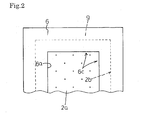
- the above-mentioned mold pattern for folding back 6 is, for example, as illustrated in Fig. 1 and Fig. 2 and is formed to a rectangle shape having a rectangle opening 6a in plan view toward the inside direction and is able to remove toward the outside direction by dividing into a plurality of pieces at a prescribed position (not shown).
- this mold pattern for folding back 6 is placed on the above-mentioned female mold pattern 9 by magnetic connecting or the like, it projects from the opening edge 2b of the above-mentioned cavity face 2a toward the inside direction with a prescribed length.
- this mold pattern for folding back 6 may divide into a plurality of pieces, and also, may slide freely on the in-out direction respectively by applying a cylinder or the like for placing it on and removing it out.
- the above-mentioned surface skin material 3 which is prepared to be in a heat-softened state beforehand, is placed on a mold pattern for folding back 6, and by opening a decompression valve B1 which is connected with the chamber 9a of the above-mentioned female mold pattern 9, by making the surface skin material 3 fit along the above-mentioned cavity face 2a such as by vacuum-forming, the outer part of this surface skin material 3 is formed to a shape with fold back part 7 by folding back toward the inside direction along the above-mentioned mold pattern for folding back 6, and at the same time, fold returning part 8 is also formed by fold returning toward the outer direction from tip 7c of this fold back part 7 in a manner of rolling up the mold pattern for folding back 6. Furthermore, in this state by heating up the above-mentioned female mold pattern 9 and/or the mold pattern for folding back 6 to a prescribed temperature in advance, the heat molding of surface skin material 3 can advantageously be done more effectively.
- the above-mentioned fold returning part 8 is composed of a vertical piece 8d which is folded by bending it toward the upper direction from tip 7c of the above-mentioned fold back part 7, and a horizontal piece 8e which is folded by bending toward the outer direction from the upper tip of said vertical piece 8d.
- the horizontal cross-sectional shape of tip 6c of the above-mentioned mold pattern for folding back 6 can have a triangle shape, a trapezoid shape, a round shape or an oval shape besides a rectangle shape.
- thermoplastic resin sheet including a vinyl chloride resin or a polyolefin resin such as a polyethylene resin or a polypropylene resin can be mentioned among others.
- this surface skin material is used as a surface skin of the cellular molded article having a surface skin 1, this surface skin material may be colored with a desired color by a coloring toner or the like according to the application.
- the method for heat molding said surface skin material along the above-mentioned cavity face 2a is not limited to vacuum-forming like in this embodiment, but any other molding such as compression molding can also be applied. If compression molding is applied, when the above-mentioned surface skin material 3 is heat-molded along the cavity face 2, it can be formed only of said fold back part 7 without forming the above-mentioned fold returning part 8.
- clamping is preferably made in a state of having a small open space in between (cracking state).
- clamping is preferably made in a manner that the outer edge part of the surface skin material 3, which will become the fold returning part 8, is folded returning toward the outer direction from tip 7c of fold returning part 7.
- a polyolefin resin and a polystyrene resin can be mentioned among others.
- polyethylene resin or polypropylene resin such as low density polyethylene, middle density polyethylene, high density polyethylene, linear low density polyethylene, ethylene-vinyl acetate copolymer, propylene homopolymer, ethylene-propylene random copolymer, ethylene-propylene block copolymer, ethylene-propylene-butene random terpolymer, propylene-vinyl chloride copolymer, propylene-butene copolymer, propylene-maleic anhydride copolymer, and poly-(butene-1) can be mentioned among others, and these can be used alone or as a mixture of not less than two.
- polyethylene resin or polypropylene resin such as low density polyethylene, middle density polyethylene, high density polyethylene, linear low density polyethylene, ethylene-vinyl acetate copolymer, propylene homopolymer, ethylene-propylene random copolymer, ethylene-propylene block copolymer, ethylene-propylene-
- the polyolefin resin is preferably not cross-linked. However, it may be cross-linked by using peroxide, radiation or the like.
- thermoplastic resin being mixed with the above-mentioned polypropylene resin, a low density polyethylene, linear low density polyethylene, vinyl aromatic polymer, polybutene, and a ionomer can be mentioned among others.
- a vinyl aromatic polymer, polybutene, and a ionomer can be mentioned among others.
- the amount of the thermoplastic resin to be mixed in these cases is preferably not more than 20 parts by weight based on 100 parts by weight of the polypropylene resin, more preferably 5 to 10 parts by weight.
- the above-mentioned expanded beads 11 may be produced, for example, to be pre-expanded by a method in which the above-mentioned synthetic resin is processed to form a particle shape in advance, is impregnated with a volatile blowing agent in a pressure vessel, is stirred while dispersed in water, and is heated up under pressure to a prescribed expansion temperature. Then this water dispersion is released into a low pressure region or the like.
- the expansion ratio at which the beads 11 are expanded in the mold pattern in a case of less than 3 times, the cushioning property or the like may be lowered, and in case of more than 60 times, the shrinkage of the above-mentioned expanded molded article in the mold pattern may be increased and at the same time it may have a tendency of lowering its strength due to be excessively softened. Therefore, 3 to 60 times of the expansion ratio is preferable, more preferably 5 to 50 times, even more preferably 8 to 45 times, and most preferably 10 to 35 times.
- EPERAN-PP (trade name; made by KANEKA CORPORATION, expansion ratio is 15 times) can be suitably used among others.
- the above-mentioned expanded beads may be filled into the above-mentioned mold pattern 4 in a state of being imparted with an inner pressure by spreading a pressurized gas in advance, or may be filled into it in a compressed state by using a pressurized gas, or may also be filled into it without such inner pressure or being compressed.
- an adhesive may be coated in advance on back face 3g of this surface skin material 3 which will contact the above-mentioned expanded beads 11, and on one face 7a which faces downward from the above-mentioned fold back part 7.
- an organic solvent solution of a synthetic resin, a resin emulsion and a resin powder can be mentioned among others.
- a polyolefin resin such as an ethylenevinylacetate resin, polypropylene, polyethylene, ethylene-propylene copolymer, chlorinated polypropylene, chlorinated polyethylene, ethylene-propylene-butene terpolymer, a mixture of these or the like can be mentioned among others.
- vapour valve A2 which is connected with chamber 10a of the above-mentioned male mold pattern 10 is opened and steam S is supplied into the inside of the mold pattern 4 through the above-mentioned vapour holes 10b, and thus the above-mentioned expanded beads are heat-expanded.
- pre-heating at a lower temperature than the temperature for melt uniting of said beads with each other may be done by steam S. Removal of drain by vacuum or the like after said steaming may also be done in advance.
- the complete clamping of the mold pattern is preferably done at a time when the above-mentioned expanded beads 11 are almost completely filled into the mold pattern 4. Then the expanded beads 11 are preferable filled into the mold pattern 4 completely.
- the vertical portion 8d of the above-mentioned fold returning part 8 will be bent toward the outer direction from tip 7c of the above-mentioned fold back part 7 and will be pressed on the other face 7b of this fold back part 7 for being piled up.
- the above-mentioned horizontal portion 8e will be pressed onto the other face 7b and onto the female pattern 9 for being piled up.
- the surface skin material 3 will be melt united to one piece with surface 5a of the expanded molded article in mold pattern 5 which will be formed, and simultaneously one face 7a of the above-mentioned fold back part 7 will be melt united to one piece with the back face 5b of the expanded molded article in mold pattern 5.
- fold returning part 8 will be pressed as mentioned above and simultaneously will be formed so as to be piled simply on the other face 7b of fold back part 7 or to be melt united to one piece therewith.
- fold returning part 8 may be simply bent, or may be melt united to one piece with the other face 7b of the above-mentioned fold back part 7 according to the property of the above-mentioned surface skin material 3, the condition of temperature or the like.
- the cellular molded article in the mold pattern having a surface skin 1a, which comprises the obtained expanded molded article in mold pattern 5 by expansion molding of the above-mentioned expanded beads 11 and the surface skin material 3, which comprises the surface skin part 3a which is melt united to one piece with surface 5a of the said expanded molded article in pattern 5, a fold back part 7 in which the edge part of said surface part 3a is folded back toward the inside direction and of which one face is melt united to one piece with the backside of the above-mentioned expanded molded article in mold pattern 5, and the fold returning part 8 which is folded returning to being piled on the other face 7b of this fold back part 7 from tip 7c of said fold back part 7 to the outside direction.
- the unnecessary outer edge part of surface skin material 3 is trimmed off.
- Tip 8c of the above-mentioned fold returning part 8 is trimmed off at an appropriate site for positioning it at the inside direction from the base edge 7d of the fold back part 7, namely the edge of the above-mentioned surface part 3a, and an expanded molded article in the mold pattern having a surface skin can be obtained as is illustrated in Fig. 7. Consequently, in order to trim off, the above-mentioned fold returning part 8 is preferable formed to a state wherein it is not melt united to one piece with the other face 7b of fold back part 7 but is simply bent to pile on.
- an expanded molded article in a mold pattern having a surface skin 1 being composed as mentioned above can be produced in one serial process by applying the above-mentioned mold pattern 2, the folding back and adhesion processes of surface skin material 3 with the back face 5b of the above-mentioned expanded molded article in mold pattern 5 by handworks can advantageously be omitted.
- the above-mentioned fold returning part 8 can easily be formed so as to pile on the other face 7b of fold back part 7, namely, to be approximately in parallel to back face 5b of the above-mentioned expanded molded article in mold pattern 5, which is advantageous.
- the above-mentioned fold returning part 8 when the above-mentioned fold returning part 8 is heat-molded such as by vacuum-forming, it is formed to be folded returning toward the outside direction to roll up said pattern for folding back 6 from tip 7c of the above-mentioned fold back part 7 in advance, as is mentioned above. Since this fold returning part 8 can easily be pressed onto the other face or the like of fold back part 7 so as to be piled up, when the above-mentioned expanded beads 11 are filled into the inside of mold pattern 4, handworks for the fold returning of the outer edge part of the surface skin material 3 which will become fold returning part 8 toward the outside direction from tip 7c of fold back part 7 can be omitted advantageously.
- the melt uniting of these surface skin material 3 with the expanded molded article in mold pattern 5 can be made stronger, and at the same time, as it is a so-called all olefin, recycling of it is easier, which is also advantage.
- a method for producing an expanded molded article in a mold pattern having a surface skin 21 which relates to the embodiment of Example 2 is, in the above-mentioned embodiment of Example 1, before the expansion molding.
- the outer edge part of the above-mentioned surface skin material 3 is trimmed off in advance so that tip 8c of fold returning part 8 is positioned inwardly from the base edge 7d of fold back part 7 at the time of the above-mentioned pressing.
- Examples of trimming off before the above-mentioned expansion molding are the case of trimming off in advance before the heat-molding such as the above-mentioned vacuum-forming, the case of trimming off simultaneously with the heat-molding, and the case of trimming off after the heat-molding and before filling the above-mentioned expanded beads 11 into the inside of said mold pattern 4.
- a method for a simultaneous trimming off with the heat-molding there can be mentioned, for example, a method wherein a trimming blade projecting downward at a prescribed site of the above-mentioned male mold pattern 10 is mounted on, and at the same time, a concave fitting part which fits to this trimming blade is mounted on the upper face of the above-mentioned mold pattern for folding back in advance, and by clamping said mold patterns at the time of the above-mentioned heat-molding, the outer edge part of surface skin material 3 is trimmed off.
- a method wherein on the above-mentioned male mold pattern 10 a projecting part for pressing the tip which has an obtuse angle mounted.
- a prescribed site of surface skin material 3 is pressed harder than the surrounding portion, and thus, said site is heat-molded to be thinner than the other portion in advance, thereafter said outer edge part can easily be trimmed off by a light drawing force. Furthermore, by this measure holes in form of a dotted-line are made on a prescribed site of the above-mentioned surface skin material 3. A trimming line for peeling off (machining line) can also be formed in advance.
- tip 8c of the fold returning part 8 is positioned at the inward direction from the base edge 7d of fold back part 7, at a time after the production of the expanded molded article in the mold pattern having a surface skin 21, since the trimming-off of the unnecessary outer edge portion of the surface skin material 3 can be omitted, the above-mentioned fold returning part 8 can be melt united to one piece with the other face 7b of the fold back part 7 so that it will not be peeled out, which is advantageous as well.
- the above-mentioned fold back part 7 which is shortened by trimming off as mentioned above, compared with the above-mentioned embodiment of Example 1, may be pressed by the above-mentioned fold returning part 8 and may be folded into a more or less downward direction.
- a method for producing an expanded molded article in a mold pattern having a surface skin 31 which relates to the embodiment of Example 3 resides, in the above-mentioned embodiment of Example 1 or 2, in that the angle D1 at the above-mentioned opening edge 2b, which is formed by the cavity face 2a and the mold pattern for folding back 6, is set larger in advance than the outer corner angle E of back face 5b of the above-mentioned expanded molded article in mold pattern 5.
- angle D2 of the above-mentioned opening edge 2b which is formed by fold back part 7 of surface skin material 3 and surface part 3a, can be made larger than that of the conventional case which is illustrated in above-mentioned Fig. 4 or Fig. 8.
- the expanded beads 11 when the expanded beads 11 are filled into the inside of the above-mentioned mold pattern 4, the expanded beads 11 can easily be filled also into a portion which will become the outer corner part of back face 5b of the above-mentioned expanded molded article in mold pattern 5, and thus there is the advantage of making said expansion molding of the expanded molded article in the mold pattern to be uniform.
- the filling of the above-mentioned expanded beads 11 may be done as mentioned above.
- the filling may be done such that the above-mentioned fold back part 7 is bent up to a prescribed downward site, and then the full filling of the mold pattern 4 may de done.
- the horizontal cross-sectional shape of the above-mentioned mold pattern for folding back 6 may be inverted to a trapezoid shape or the like, or the above-mentioned mold pattern for folding back 6 may be positioned so that its tip 6c inclines at a forward oblique upper direction toward the inside direction.
- a method for producing an expanded molded article in a mold pattern having a surface skin 41 which relates to the embodiment of Example 4 resides, in the above-mentioned embodiment of Example 2, in that at the time of the above-mentioned expansion molding, for example, the insert member 13 is connected with the above-mentioned fold returning part 8.
- the insert member 13 before heat-molding by the above-mentioned vacuum-forming or the like, or before filling of the above-mentioned expanded beads 11, the insert member 13 is placed on a prescribed site of the above-mentioned male mold pattern 10 in advance, and thereafter, when the expansion molding takes place, that is when the expansion molding in the mold pattern of the above-mentioned expanded beads 11 occurs, this insert member 13 may be connected with the above-mentioned fold returning part 8 or the like by adhesion or by melt uniting to one piece.
- this insert member 13 is not limited only to the above-mentioned fold returning part 8, it may also be on the above-mentioned fold back part 7 or on both the fold returning part 8 and the fold back part 7 together. It may also be melt united to one piece in a manner of extending to back face 5b of the above-mentioned expanded molded article in the mold pattern 5.
- the insert member 13 is connected only with the above-mentioned fold returning part 8, as mentioned above, it is preferably melt united to one piece with the above-mentioned fold back part 7 so as this fold returning part 8 is not peeled out.
- the connecting site of the insert member 13 is not limited to a specific site, but it can advantageously be connected with various sites in vicinity of the outer edge of the back face 5b of the above-mentioned expanded molded article in the mold pattern 5.
- the insert member 13 for example, various materials which include metal, wood, FRP, thermoplastic resins such as polyethylene, polypropylene or ABS, thermosetting resins such as phenolic resins or formaldehyde resins or the like can be mentioned among others.
- the insert member 13 is preferably also composed of a polyolefin resin.
- melt uniting of the surface skin material 3 with the expanded molded article in mold pattern 5 is stronger.
- the melt uniting of the insert member 13 with this surface skin material 3 and the expanded molded article in mold pattern 5 is also stronger, and on top of this, recycling can be easier, which are advantages also.
- a method for producing an expanded molded article in a mold pattern having a surface skin 51 which relates to the embodiment of Example 5 resides in the above-mentioned embodiment of Example 2, in that before the above-mentioned vacuum-forming (heat molding), a cutting part 14 is set up at tip 6c of the above-mentioned mold pattern for the folding back 6 in advance.
- the cutting part for connecting the insert member 14 which is, for example, shaped to a half circle figure in a plan view at tip 6c of the above-mentioned mold pattern for the folding back 6 in advance, as is illustrated in Fig. 15, when the above-mentioned vacuum-forming takes place, the space of a prescribed range 15 is opened to an inward direction of this cutting part for connecting the insert member 14, the above-mentioned fold back part 7 and the fold returning part 8 can be made to fold back and to fold return.
- insert member 13 can be connected with the back face 5b of the expanded molded article in the mold pattern 5 through the above-mentioned space 15.
- the fold back part 7 or the like can be formed with having the above-mentioned space 15 at the inward direction of this cutting part for the connecting insert member 14, when the insert member 13 is connected with the back face 5b of the expanded molded article in the mold pattern 5, the folding back or the like of the surface skin material 3 can be done automatically so as to avert this insert member 13, and consequently, handworks as in conventional methods can be omitted, which is advantageous as well.
- the insert member 13 preferably is composed of a polyolefin as well. In such case, melt uniting of the surface skin material 3 with the expanded molded article in mold pattern 5 is stronger, and at the same time, its recycling is advantageously easy, too.
- a method for producing an expanded molded article in a mold pattern having a surface skin 61 which relates to the embodiment of Example 6 resides in that on either one of the female pattern (metal mold) 9 and the male pattern (metal mold) 10 which form the mold pattern 2, for example, on the above-mentioned female pattern 9, after the surface skin material 3 is placed on by vacuum-forming (heat molding), for example, by expansion molding with the mold pattern 4, an expanded molded article in the mold pattern 5 being formed and the above-mentioned surface skin material 3 are melt united to one piece.
- This producing method resides in that on the exposed face 2a of the above-mentioned female pattern 9 forwarding inside of the above-mentioned mold pattern 4, that is, on a part which forms the cavity face 2a in this female pattern 9, by setting up an electric heater 62 before the above-mentioned expansion molding, this cavity face 2a is pre-heated up to a prescribed temperature.
- the above-mentioned surface skin material 3 is placed on by vacuum-forming, for example.
- the above-mentioned mold pattern 2 is composed of the female pattern 9 and the male pattern 10 which can be opened and clamped in the horizontal direction, for example, and are the same as in the above-mentioned embodiments of Examples 1 to 3.
- the above-mentioned electric heater 62 is as illustrated in Fig. 19 for example, buried in a part which comprises the cavity face 2a of the above-mentioned female pattern 9, in a state of meandering.
- a heat sensitizing measure for controlling the temperature (heart thermocouple or the like, for example) which is not illustrated, a measure for controlling or the like (such as a thermostat and a device for controlling the electric current, for example) and other measures are also placed on the above-mentioned female pattern 9 or on any other appropriate site.
- the heat sensitizing measure for controlling the temperature heat thermocouple or the like, for example
- a measure for controlling or the like such as a thermostat and a device for controlling the electric current, for example
- other measures are also placed on the above-mentioned female pattern 9 or on any other appropriate site.
- the heater is not limited to the electric heater 62 as mentioned above.
- a heat medium heater employing heat oil, steam, heated water or the like, or other measures can be adapted.
- This heat medium heater is, for example, composed of a circulation piping in which a heated medium is circulating inside, or it consists of other components. If such a heat medium heater is employed, a pump for feeding said heat medium in a pressurized condition, a heating measure for heating up said heat medium, a heat sensitizing measure, a refrigerator for cooling and other components may be placed on appropriate sites.
- the above-mentioned heater such as the electric heater 62, the heat medium heater or the like may be buried, as described in this embodiment, in a part where the above-mentioned cavity 2a is provided or in another part, it may be connected with a site located on the back side of this part or the like which is located on the inside of the above-mentioned chamber 9a.
- the part for connecting this heater is not only limited to the above-mentioned cavity face 2a, but also it can be connected with, for example, the whole part which is composing the surface 9d of the female pattern 9 including this cavity face 2a, or with other parts. The importance is that by the above-mentioned heater at least the above-mentioned cavity face 2a can be pre-heated up to a prescribed temperature.
- a shaped-up surface skin material which will fit to the shape of the surface 9d of this female pattern 9 in advance by vacuum-forming with using other mold pattern may be placed on.
- handworks for pre-forming it beforehand can advantageously be omitted.
- valve B1 being connected to the above-mentioned chamber 9a may be opened or the like.
- the softened surface skin material 3 which will contact tightly the cavity face 2a can be minimized in its temperature lowering, and as a result, heat holding such as vacuum-forming can effectively be done, which is also advantageous.
- said heating by a heater may be continued or may also be changed to a multi-step heating measure which can change its set-up temperature from a prescribed original temperature during said heat molding process.
- the temperature of the cavity face 2a before said heat molding is preferably set in a range of from 60 to 150 °C, more preferably from 60 to 130 °C and most preferably from 70 to 120 °C
- the property of the product can advantageously be improved.
- the temperature of the cavity face 2a is lower than 60 °C, the surface skin material 3 will not be appropriately softened, whereas if it is higher than 150 °C, said surface skin material will be excessively softened. Therefore, these temperatures are not preferable.
- the expanded beads 11 are filled into the inside of the mold pattern 4 from feeder 12.
- said clamping can be made to be in a state of opening a little gap (cracking state).
- a coating of adhesive may be provided in advance on the back face 3g of said surface skin material 3, which will come to contact with the above-mentioned expanded beads 11.
- vapor valve A2 which is connected to chamber 10a of the above-mentioned male pattern, is opened for feeding steam S into the inside of the mold pattern 4 from the above-mentioned vapour holes 10b so that the above mentioned expanded beads 11 are heat-expanded.
- the above-mentioned cavity face 2a may be preheated by the above-mentioned electric heater 62 or the like before the head expansion molding.
- this preheating is preferably done in advance before feeding the expanded beads 11.
- the surface skin material 3 having been placed on said cavity face 2a is simultaneously preheated up to a prescribed temperature therewith.
- the expansion molding namely, the melt uniting of the surface skin material 3 with the expanded beads 11 which will be expanded by the expansion molding in the mold pattern, can more effectively be done, which is advantageous as well.
- the heating of only the above-mentioned cavity face can be done without heating the whole female pattern 9 as in the conventional method, the heat efficiency is also advantageously improved.
- the surface appearance of the surface skin material 3 can be improved, and at the same time, as it is in this embodiment, since that surface skin material 3 is placed on the female pattern by heat molding such as vacuum-forming, the elongation at the time of its heat molding can also be improved, which is also advantageous.
- the heating by a heater during the expansion molding process may be continued or a multi-step heating which can change its set-up temperature from an original set-up temperature may be done as well.
- the melt uniting of these surface skin material 3 and the expanded molded article in the mold pattern 5 can be made stronger, and at the same time, since said cellular molded article in the mold pattern having a surface skin 61 to be obtained consists of a so-called all polyolefin, its recycling can easily be done, which is advantageous as well.
- the above-mentioned cavity face 2a is prepared to be in a range of 60 to 150 °C in advance, as mentioned above, since the surface skin material 3 which is placed on the cavity face 2a will come into an appropriate softened state, the melt uniting of the surface skin material 3 with the expanded beads 11 can more effectively be done as well.
- the expanded molded article in the mold pattern having a surface skin 61a which comprises the expanded molded article in the mold pattern 5 having been obtained by the above-mentioned expansion molding in the mold pattern of the expanded beads 11, and the surface skin material 3 having an edge part 3h, which has been melt united to one piece with the surface 5a of said expanded molded article in the mold pattern 5, can be obtained.
- the expanded molded article in the mold pattern having a surface skin 61 as illustrated in Fig. 24 can be obtained.
- the method for producing an expanded molded article in a mold pattern having a surface skin 61 which relates to the embodiment of Example 7, comprises in the above-mentioned embodiment of Example 6 a part which includes the above-mentioned cavity face 2a and comprises the using of a gas permeable electric cast mold pattern 63, for example.
- the above-mentioned gas permeable electric cast mold pattern 63 has minute gas permeable holes, which are connected with the above-mentioned chamber 9a, on its whole or on a prescribed portion of the cavity face 2a.
- Such mold pattern may be produced by a nickel electric cast or the like, for example (e.g. POROUS DENCHU; trade name, made by KONAN TOKUSYU SANGYO Co., Ltd.).
- the above-mentioned gas permeable electric cast mold 63 has minute gas permeable holes on the whole cavity face 2a or on a prescribed portion of it, as mentioned above, when the above-mentioned surface skin material 3 is placed on by vacuum-forming, the evacuation of air or gas residing between this gas permeable electric cast mold 63 and the surface skin material 3 can more effectively be done.
- the above-mentioned surface skin material 3 can more surely be contacted with the cavity face 2a, and at the same time, since the diameter of the above-mentioned gas permeable holes is so small in a range of from about some tens to some hundreds of ⁇ m, the advantage is also that marks of these gas permeable holes are not printed on the surface 3f of the above-mentioned surface skin material 3.
- a gas permeable metal mold or a gas permeable ceramic mold e.g. Porcerax II; trade name, made by SINTOKOGYO, LTD.
- a gas permeable metal mold or a gas permeable ceramic mold having minute gas permeable holes of about some ⁇ m of diameter on the whole cavity face 2a, obtained by sintering metal or ceramic particles under a prescribed condition, can be used.
- a gas permeable metal mold or a gas permeable ceramic mold having minute gas permeable holes with a diameter of not more than 0.4 mm or so, preferably not more than 0.2 mm, which are mechanically made by drilling or the like can be used.
- Example 6 and Example 7 there has been described a case wherein one of the metal mold patterns on which the above-mentioned surface skin material 3 is placed is a female pattern 9.
- the present invention is not limited to this case.
- a case wherein the above-mentioned one metal mold pattern 10 is a male pattern and the other metal mold pattern is a female pattern 9 can be adopted as well.
- the above-mentioned heater such as an electric heater 62, as it is illustrated in Fig. 18, can be connected with a part of the above-mentioned male pattern 10 which consists of at least the exposed face 4a toward the inside of the above-mentioned mold pattern 4.
- the above-mentioned mold pattern 2 can, besides with a horizontal motion, also be opened and clamped with a vertical motion as described in the embodiments of Examples 1 to 5, or the above-mentioned fold back part 7, the fold returning part 8 and the like can be formed by using the above-mentioned mold pattern for the folding back 6.
- an unevenness for a product design pattern such as a skin-like embossing may be formed in advance.
- this embossing is formed on the exposed face 2a (4a) toward the inside of the mold pattern of the above-mentioned one metal mold pattern in advance, at the time of placing the surface skin material 3 on one of the metal mold patterns by heat molding such as the above-mentioned vacuum-forming, since the above-mentioned unevenness for the product design pattern can be printed on the surface 3f of said surface skin material 3, hand-works for this can advantageously be omitted.
- said unevenness for the product design pattern can be formed by using various conventional methods such as etching or printing from other mold patterns.
- TPO sheet polyolefin thermoplastic resin sheet
- EPERAN-PP trade name, made by KANEKA CORPORATION, expansion ratio was 15 times, imparted with 2 kg/cm 2 of inner pressure in advance by using air pressure in an autoclave
- preheating was carried out by feeding steam (vapour pressure, 1.47 bar G, 1.5 Kg/cm 2 G) into the inside of said mold pattern through the above-mentioned vapour holes being formed in said male mold pattern. Then, after steaming of these expanded beads, drain and steam residing there were removed by low pressure. After heating up by feeding steam (vapour pressure, 3.13 ⁇ 3.62 bar G, 3.2 - 3.7 Kg/cm 2 G) again through the above-mentioned vapour holes, it was cooled by water, and a cellular molded article in the mold pattern having a surface skin was obtained. The cooling of the male mold pattern at the time of the above-mentioned water cooling was carried out by leading of cooled water into the above-mentioned stream piping.
- An expanded molded article in a mold pattern having a surface skin was obtained as in Examples 1 to 5 except that the cavity face of said female mold pattern was kept at a temperature shown in the Table by feeding of steam into the inside of the chamber of a female mold pattern which was not formed with the above-mentioned stream piping.
- a method for producing a cellular molded article in a mold pattern having a surface skin which relates to the present invention is useful for making an automobile interior trim material or the like.
- the method is particularly useful for producing an automobile interior trim material having the following advantages, among others:
Landscapes
- Moulds For Moulding Plastics Or The Like (AREA)
- Casting Or Compression Moulding Of Plastics Or The Like (AREA)
Abstract
Description
- This invention relates to a method for producing a cellular molded article in a mold pattern having a surface skin. Said article is used, for example, as an automobile interior trim material or the like.
- As for the conventional technique of this kind, for example,
- (a) a so-called simultaneous molding with surface skin in once (simultaneous one piece molding) is known as disclosed in
TOKUKAI-SHO 62-108039 mold pattern 2 is used, and after asurface skin material 3 is performed by vacuum-forming along acavity surface 2a of afemale pattern 9, an expansion molding is performed in the cavity (inside of the mold pattern) 4 which is shaped up by amale pattern 10 combined with asurface skin material 3, at the same time. The expanded molded article (expanded molded article in the mold pattern) 5 is united with the above-mentionedsurface skin material 3 simultaneously. In this simultaneous molding method, when the above-mentionedsurface skin material 3 is vacuum-formed, the outer edge part of saidsurface skin material 3 is folded back formed from anopening edge 2b toward the inside direction along a fold-back pattern (pattern for folding back) 6 which projects from theopening edge 2b of the above-mentionedcavity face 2a toward the inside direction in advance. When the above-mentioned expansion molding is performed, the foldedback part 7 of thesurface skin material 3 is united into one piece with thebackside face 5b of the above-mentioned expended molded articled (expanded molded article in the mold pattern) 5.
In this method, at the time of the above-mentioned vacuum-forming, the outer edge part of thesurface skin material 3 is formed in advance and folded back fromtip 7c of thefold back part 7 toward the outside direction in a manner of rolling up the folding pattern (pattern for folding back) 6, and an expansion molding is performed with this state. After having obtained an expanded molded article with a surface skin material (expanded molded article in the mold pattern with a surface skin) 71a, it is removed from the pattern, and the unnecessary outer edge part of thesurface skin material 3 is trimmed off attip 7c of the above-mentionedfold back part 7. - (b) On the other hand, it is known an expanded molded article in a mold pattern with a surface skin in which an insert member is melt united with the outer edge part of the
backside 5b of the expanded moldedarticle 5. When the outer edge part of thesurface skin material 3 is folded back to theback face 5b side of the expanded molded article in themold pattern 5, a prescribed range of the outer edge part of thesurface skin material 3 is cut off so as to avert the above-mentioned insert member. Thereafter, it is necessary that the foldedback part 7 is adhered to theback face 5b of the expanded molded article in themold pattern 5. - (c) Furthermore, in a simultaneous one piece molding as in the above, a chamber connected with a steam valve, decompression valve or the like is equipped in each of the two metal mold parts. One of the metal mold parts on which a surface skin material is placed is provided with a plurality of decompressing holes, and the other metal mold part is provided with a plurality of vapor holes connected with the above-mentioned chamber respectively. When expansion molding is performed, expanded beads filled in this mold pattern are heat-expanded by feeding steam from the vapour holes of the above-mentioned metal mold part to the inside of the mold pattern.
- In this case, for the purpose of an effective expansion molding by preheating of the above-mentioned surface skin material, it is common that the above-mentioned metal mold part is preheated by feeding steam into the inside of the above-mentioned chamber before the surface skin material is placed on.
- Nevertheless, in the above-mentioned conventional example (a), since the outer edge part of the above-mentioned
surface skin material 3 is in a state of standing from thetip 7c of the above-mentioned foldedback part 7 at a prescribed angle againstback face 5b of the expanded molded article (expanded molded article in the mold pattern) 5, when the above-mentioned outer edge part is trimmed off attip 7c of the foldingback part 7, a prescribed length of the projecting edge part may remain. In such a case, when transporting to an assembling process or the like of the cellular molded article with the surface skin material (the expanded molded article in the mold pattern with a surface skin), since the above-mentioned projecting edge part may often hang up with other members, there is the problem of easily peeling from thetip 7c of the above-mentionedfold back part 7. - In the above-mentioned conventional example (b), since the trim process and the adhesion process for a prescribed range of the
fold back part 7, which is necessary when an insert member material is melt united to one piece, need to be made by hand, there is the problem of requiring much labour. - Moreover, in the above-mentioned conventional example (c), when the above-mentioned one metal pattern part is preheated, whereby the metal pattern part is totally heated by feeding steam into the inside of its chamber, there is the problem of an insufficient heating efficiency. Furthermore, when the above-mentioned surface skin material is placed on by vacuum-forming, even though the above-mentioned one metal pattern part has been preheated by steam, at a time of decompression the heat is taken away by vaporizing heat of condensed moisture within the chamber and there is the problem of lowering the temperature of the metal pattern part, by which an efficient vacuum-forming will not be successful. Additionally, when the metal pattern part is preheated directly by steam, moisture or water drops will remain on the surface of the metal pattern part. Consequently, since these water drops or the like stick on the surface of the skin material, there is the problem that the appearance of the surface skin material is deteriorated at the time when the surface skin material is placed on one metal pattern part by heat forming such as vacuum-forming, and there is the problem of lowering its elongation property during heat forming.
-
British Patent 1521063 -
EP 0603498 A1 discloses a method for forming trim panels as upper and lower mold sections which performs a laminating between a substrate and a cover sheet, while simultaneously cooperating with a folding device to fold a sheet edge around a substrate rim to bond the sheet edge to the back of the substrate rim. - This invention has been done for solving the above-mentioned problems and to achieve the following advantages:
- (1) less hand working is necessary, even when an insert member material is assembled,
- (2) the expanded molding or the heat-forming of the surface skin material can be done effectively,
- (3) improving the surface property of the surface skin material and/or the elongation property at the heat-forming,
- (4) at the time of preheating, a good heat efficiency of the metal pattern part on which the surface skin material is placed, can be achieved.
- The object of the invention is to provide a method for producing a cellular molded article in a mold pattern, which article has a surface skin.
- The essential features residing in the method of the invention for producing a cellular molded article in a mold pattern, which article has a surface skin are defined in
present claim 1. Accordingly, the invention refers to a method for producing a cellular molded article in a mold pattern, which article has a surface skin, characterized in that an expanded molded article formed in said mold pattern, which is made of metal, and the material of the above-mentioned surface skin are melt united to one piece by expansion molding within said mold pattern after the surface skin material is placed on one of two parts of said mold pattern which are composing the mold pattern, and a heater is assembled to a part of said one part of the mold pattern which part at least has an exposed face to the inside direction of said mold pattern as well as said heater is preheating said exposed face to a prescribed temperature before said expansion molding. - By the method according to the invention, the above-mentioned exposed face of the one part of the mold pattern is preheated at a prescribed temperature before the above-mentioned expansion molding. Accordingly, the surface skin material being placed on this exposed face is also preheated up to a prescribed temperature. Consequently, the expansion molding, namely the melt uniting of the surface skin material with the expanded beads which expand within the mold pattern can effectively be done, which is an advantage as well. Also, since the heating of only said exposed face is possible, the heat effectiveness is improved. Moreover, since moisture or water drops will not remain on this exposed face even when the preheating of said exposed face takes place, the surface appearance of the surface skin material can be improved. At the same time, when the surface skin material is placed on the one part of the metal mold pattern by heat-molding, the elongation property is also advantageously improved.
- The essential feature as defined in
claim 2 is that the above-mentioned surface skin material and the expanded molded article consist of polyolefin resins. Accordingly, the melt uniting of that surface skin material with the expanded molded article becomes more tight. Furthermore, the obtained expanded molded article having a surface skin is a so-called "all olefin" article, the recycling of which is advantageously easy as well. - The essential feature as defined in
claim 3 is that the temperature of said exposed face before the above-mentioned expansion molding is set at 60 to 150 °C. Accordingly, the surface skin material placed on this exposed face becomes appropriately softened, and by this reason, the melt uniting of the surface skin material with the expanded beads can be done more effectively, which is advantageous as well. - The essential feature as defined in
claim 4 is that the above-mentioned surface skin material is placed on one of the metal mold parts by heat-molding. Accordingly, hand-works for pre-adjusting the surface of the above-mentioned one metal mold part by other molding steps or the like can advantageously be omitted. - The essential feature as defined in
claim 5 is that the above-mentioned exposed face is preheated to a prescribed temperature before said heat-molding. Accordingly, the lowering of the temperature of the softened surface skin material to be tightly contacted with that exposed face can be minimized. By this method, the heat-molding such as a vacuum-forming can effectively be done, which is also advantageous. - The essential feature as defined in
claim 6 is that the temperature of the exposed face before the above-mentioned heat-molding is set to 60 to 150 °C. Accordingly, if the above-mentioned surface skin material and the expanded molded article are composed of polyolefin resins, the surface skin material can be heat-molded in an appropriate softened state. Consequently, the final property of the product can advantageously be improved. - The essential feature as defined in
claim 7 is that at least a part of said exposed face consists of a gas permeable electric cast mold, a gas permeable metal mold or a gas permeable ceramic mold. Accordingly when the surface skin material is placed by vacuum-forming, air or gas being present between such gas permeable electric cast mold or the like and the surface skin material can easily be evacuated. By this reason, the surface skin material can more reliably be contacted with said exposed face. At the same time, since the diameter of the gas permeable holes of said exposed face is very small, marks of such gas permeable holes will not appear on the surface of the surface skin material, which is also advantageous. - The essential feature as defined in
claim 8 is that an unevenness for a product design pattern is formed on the above-mentioned exposed face beforehand. Accordingly, when the surface skin material is placed by heat-molding, such as the above-mentioned vacuum-forming, said unevenness for a product design pattern can be transferred to the surface of the surface skin material, and thus handworks for it can be omitted, which is an advantage. -
- Fig. 1 is a cross-sectional drawing of a state wherein a mold pattern for folding back is placed on a female mold pattern in a method for producing an expanded molded article in a mold pattern, which is relating to the embodiment of Example 1.
- Fig. 2 is a plan view illustrating a placement state of the mold pattern for folding back in Fig. 1.
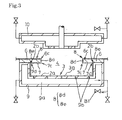
- Fig. 3 is a cross-sectional drawing illustrating a state of the vacuum-formed surface skin material described in Fig. 1.
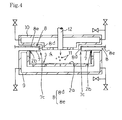
- Fig. 4 is a cross-sectional drawing illustrating a state of filling expanded beads to the inside of a mold pattern.
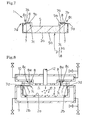
- Fig. 5 is a cross-sectional drawing illustrating a state of the expansion molding.
- Fig. 6 is a cross-sectional drawing illustrating a state of an expanded molded article in a mold pattern having a surface skin being removed from the mold pattern.
- Fig. 7 is a cross-sectional drawing illustrating a state after the unnecessary outer edge part of the surface skin material shown in Fig. 6 has been trimmed off.
- Fig. 8 is a cross-sectional drawing illustrating a state of filling expanded beads to the inside of the mold pattern in a method for producing an expanded molded article in a mold pattern having a surface skin, which is relating to the embodiment of Example 2.
- Fig. 9 is a cross-sectional drawing illustrating a state of expansion molding.
- Fig. 10 is a cross-sectional drawing illustrating a state of an expanded molded article in a mold pattern having a surface skin being removed from the mold pattern.
- Fig. 11 is a cross-sectional drawing illustrating a state of a surface skin material being vacuum-formed in a method for producing an expanded molded article in a mold pattern having a surface skin, which is relating to the embodiment of Example 3.
- Fig. 12 is a cross-sectional drawing illustrating a state of uniting an insert member with a fold back part when the expansion molding has been done, which is relating to a method for producing an expanded molded article in a mold pattern having a surface skin in the embodiment of Example 4.
- Fig. 13 is a cross-sectional drawing illustrating a state of an expanded molded article in a mold pattern having a surface skin being removed from the mold pattern.
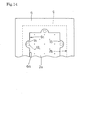
- Fig. 14 is a plan view illustrating the placement of a mold pattern for folding back, in which a trimmed space for assembling an insert member at the tip is set up in a method for producing an expanded molded article in a mold pattern having a surface skin, which is relating to the embodiment of Example 5.
- Fig. 15 is a cross-sectional drawing illustrating a state of a vacuum-formed surface skin material.
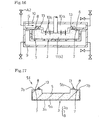
- Fig. 16 is a cross-sectional drawing illustrating a state of uniting to one piece of an insert member with the back face of an expanded molded article in a mold pattern to be formed when the expansion molding takes place.
- Fig. 17 is a cross-section drawing illustrating a state of an expanded molded article in a mold pattern having a surface skin being removed from the mold pattern.
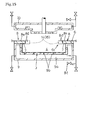
- Fig. 18 is a cross-sectional drawing illustrating a state of a surface skin material being placed on a female mold pattern by vacuum-forming in a method for producing an expanded molded article in a mold pattern having a surface skin, which is relating to the embodiment of Example 6.
- Fig. 19 is a plan view of the female mold pattern in Fig. 18.
- Fig. 20 is a cross-sectional drawing illustrating a state of the vacuum-formed surface skin material in Fig. 18.
- Fig. 21 is a cross-sectional drawing illustrating a state of the expanded beads being filled to the inside of a mold pattern.
- Fig. 22 is a cross-sectional drawing illustrating a state of an expansion molding taking place.
- Fig. 23 is a cross-sectional drawing illustrating an expanded molded articled in a mold pattern having a surface skin with an edge part.
- Fig. 24 is a cross-sectional drawing of an expanded molded article in a mold pattern having a surface skin after the edge part having been trimmed off in Fig. 23.
- Fig. 25 is a cross-sectional drawing illustrating a state of a vacuum-formed surface skin material in a method for producing an expanded molded article in a mold pattern having a surface skin, which is relating to the embodiment of Example 7.
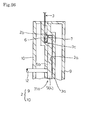
- Fig. 26 is a cross-sectional drawing illustrating a conventional example.
- Embodiments of this invention are described below, based on the drawings, and when the same composition as the mentioned prior art comes out, its explanation is abbreviated by referring to previous wordings.
- As illustrated in Fig. 1 to Fig. 7, a method for producing an expanded molded article in a mold pattern having a surface skin which is relating to the embodiment of Example 1 comprises that, after a
surface skin material 3 is heat-molded, such as by vacuum-forming, alongcavity face 2a of amold pattern 2, by expansion molding within thismold pattern 4, the above-mentionedsurface skin material 3 is melt united to one piece with asurface 5a of an expanded molded article in themold pattern 5 which is molded. - During the above-mentioned vacuum-forming, after the outer edge part of the above-mentioned
surface skin material 3 is folded back to the inside direction and is formed a fold backpart 7 along a mold pattern for folding back 6 which is placed as in a manner of projecting from anopening edge 2b of the above-mentionedcavity face 2a toward the inside direction, the above-mentioned mold pattern for folding back 6 is removed. Then, during the above-mentioned expansion molding oneface 7a of the above-mentioned fold backpart 7 is melt united to one piece withback face 5b of an expanded molded article inmold pattern 5, and at the same time,fold returning part 8, which is in a state that the outer edge part of thesurface skin material 3 is folded returning toward the outside fromtip 7c of this fold backpart 7, is pressed so as to pile on theother face 7b of the above-mentioned fold backpart 7. - Namely, as illustrated in Fig. 1, at first, onto a
female mold pattern 9 composing a lower mold pattern, for example, of the above-mentionedmold pattern 2, the above-mentioned mold pattern for folding back 6 is set up in a manner of projecting a prescribed length toward the inside direction from the openingedge 2b of thecavity face 2a. - In this stage, the above-mentioned
mold pattern 2 is, for example, composed of the above-mentionedfemale mold pattern 9 and themale mold pattern 10 which are able to clamp and open the mold patterns in the up-down direction, and at the same time, thefemale mold pattern 9 is a lower mold pattern and themale mold pattern 10 is an upper mold pattern. - With the above-mentioned
female mold pattern 9, for example, its horizontal cross-sectional face has a concave shape and achamber 9a is formed in its inside, and a plurality ofdecompression holes 9b connecting through to the above-mentionedchamber 9a are formed on itscavity face 2a side. A vapour valve A1, a decompression valve B1 and a drain valve C1 are connected with the above-mentionedchamber 9a respectively. - With the above-mentioned
male mold pattern 10, for example, its horizontal cross-sectional face has a convex shape and achamber 10a is formed in its inside, and for example, a plurality ofvapour holes 10b connecting through to the above-mentionedchamber 10a are formed on its projected part. A vapour valve A2, a decompression valve B2 and a drain valve C2 are connected with the above-mentionedchamber 10a respectively, and afeeder 12 for feeding expandedbeads 11 into the above-mentioned mold pattern is also set up. - The above-mentioned mold pattern for folding back 6 is, for example, as illustrated in Fig. 1 and Fig. 2 and is formed to a rectangle shape having a
rectangle opening 6a in plan view toward the inside direction and is able to remove toward the outside direction by dividing into a plurality of pieces at a prescribed position (not shown). When this mold pattern for folding back 6 is placed on the above-mentionedfemale mold pattern 9 by magnetic connecting or the like, it projects from the openingedge 2b of the above-mentionedcavity face 2a toward the inside direction with a prescribed length. In addition to it, this mold pattern for folding back 6 may divide into a plurality of pieces, and also, may slide freely on the in-out direction respectively by applying a cylinder or the like for placing it on and removing it out. - Next, as illustrated in Fig. 3, the above-mentioned
surface skin material 3, which is prepared to be in a heat-softened state beforehand, is placed on a mold pattern for folding back 6, and by opening a decompression valve B1 which is connected with thechamber 9a of the above-mentionedfemale mold pattern 9, by making thesurface skin material 3 fit along the above-mentionedcavity face 2a such as by vacuum-forming, the outer part of thissurface skin material 3 is formed to a shape with fold backpart 7 by folding back toward the inside direction along the above-mentioned mold pattern for folding back 6, and at the same time,fold returning part 8 is also formed by fold returning toward the outer direction fromtip 7c of this fold backpart 7 in a manner of rolling up the mold pattern for folding back 6. Furthermore, in this state by heating up the above-mentionedfemale mold pattern 9 and/or the mold pattern for folding back 6 to a prescribed temperature in advance, the heat molding ofsurface skin material 3 can advantageously be done more effectively. - In this state, if
tip 6c of the above-mentioned mold pattern for folding back 6 was prepared as in this embodiment to a rectangle of its horizontal cross-sectional face shape, the above-mentionedfold returning part 8 is composed of avertical piece 8d which is folded by bending it toward the upper direction fromtip 7c of the above-mentioned fold backpart 7, and ahorizontal piece 8e which is folded by bending toward the outer direction from the upper tip of saidvertical piece 8d. The horizontal cross-sectional shape oftip 6c of the above-mentioned mold pattern for folding back 6 can have a triangle shape, a trapezoid shape, a round shape or an oval shape besides a rectangle shape. - As examples of the above-mentioned
surface skin material 3, a thermoplastic resin sheet including a vinyl chloride resin or a polyolefin resin such as a polyethylene resin or a polypropylene resin can be mentioned among others. And since this surface skin material is used as a surface skin of the cellular molded article having asurface skin 1, this surface skin material may be colored with a desired color by a coloring toner or the like according to the application. - The method for heat molding said surface skin material along the above-mentioned
cavity face 2a is not limited to vacuum-forming like in this embodiment, but any other molding such as compression molding can also be applied. If compression molding is applied, when the above-mentionedsurface skin material 3 is heat-molded along thecavity face 2, it can be formed only of said fold backpart 7 without forming the above-mentionedfold returning part 8. - Next, as illustrated in Fig. 4, after the above-mentioned mold pattern for folding back 6 is removed toward the outside direction by pulling it out for example, the metal mold pattern is clamped and then expanded
beads 11 are filled into the inside ofmold pattern 4 from the above-mentionedfeeder 12. - In this stage, in order to evacuate the air from the above-mentioned
mold pattern 4 and also in order to avoid that fold backpart 7 of the above-mentionedsurface skin material 3 is folded downward, clamping is preferably made in a state of having a small open space in between (cracking state). And, as is stated above, when the above-mentionedsurface skin material 3 is heat-molded alongcavity face 2a, in a case of forming only the fold back part without forming the above-mentionedfold returning part 8, clamping is preferably made in a manner that the outer edge part of thesurface skin material 3, which will become thefold returning part 8, is folded returning toward the outer direction fromtip 7c offold returning part 7. - As examples of the synthetic resin comprising the above-mentioned expanded
beads 11, a polyolefin resin and a polystyrene resin can be mentioned among others. - As examples of the above-mentioned polyolefin resin, polyethylene resin or polypropylene resin such as low density polyethylene, middle density polyethylene, high density polyethylene, linear low density polyethylene, ethylene-vinyl acetate copolymer, propylene homopolymer, ethylene-propylene random copolymer, ethylene-propylene block copolymer, ethylene-propylene-butene random terpolymer, propylene-vinyl chloride copolymer, propylene-butene copolymer, propylene-maleic anhydride copolymer, and poly-(butene-1) can be mentioned among others, and these can be used alone or as a mixture of not less than two.
- The polyolefin resin is preferably not cross-linked. However, it may be cross-linked by using peroxide, radiation or the like.
- Furthermore, a mixture of this polyolefin resin with another thermoplastic resin can be used. As examples of these thermoplastic resins, being mixed with the above-mentioned polypropylene resin, a low density polyethylene, linear low density polyethylene, vinyl aromatic polymer, polybutene, and a ionomer can be mentioned among others. For mixing with the above-mentioned polyethylene resin, for example, a vinyl aromatic polymer, polybutene, and a ionomer can be mentioned among others. The amount of the thermoplastic resin to be mixed in these cases is preferably not more than 20 parts by weight based on 100 parts by weight of the polypropylene resin, more preferably 5 to 10 parts by weight.
- The above-mentioned expanded
beads 11 may be produced, for example, to be pre-expanded by a method in which the above-mentioned synthetic resin is processed to form a particle shape in advance, is impregnated with a volatile blowing agent in a pressure vessel, is stirred while dispersed in water, and is heated up under pressure to a prescribed expansion temperature. Then this water dispersion is released into a low pressure region or the like. - As for the expansion ratio at which the
beads 11 are expanded in the mold pattern, in a case of less than 3 times, the cushioning property or the like may be lowered, and in case of more than 60 times, the shrinkage of the above-mentioned expanded molded article in the mold pattern may be increased and at the same time it may have a tendency of lowering its strength due to be excessively softened. Therefore, 3 to 60 times of the expansion ratio is preferable, more preferably 5 to 50 times, even more preferably 8 to 45 times, and most preferably 10 to 35 times. As such expansion beads, for example, EPERAN-PP (trade name; made by KANEKA CORPORATION, expansion ratio is 15 times) can be suitably used among others. - In these occasions, the above-mentioned expanded beads may be filled into the above-mentioned
mold pattern 4 in a state of being imparted with an inner pressure by spreading a pressurized gas in advance, or may be filled into it in a compressed state by using a pressurized gas, or may also be filled into it without such inner pressure or being compressed. - On the other hand, in order to improve the adhesion property of the expanded molded article to be obtained by expansion molding in the
mold pattern 5 of the expandedbeads 11 with the above-mentionedsurface skin material 3, if necessary, an adhesive may be coated in advance onback face 3g of thissurface skin material 3 which will contact the above-mentioned expandedbeads 11, and on oneface 7a which faces downward from the above-mentioned fold backpart 7. As such adhesives, for example, an organic solvent solution of a synthetic resin, a resin emulsion and a resin powder can be mentioned among others. And as such resins, for example, a polyolefin resin such as an ethylenevinylacetate resin, polypropylene, polyethylene, ethylene-propylene copolymer, chlorinated polypropylene, chlorinated polyethylene, ethylene-propylene-butene terpolymer, a mixture of these or the like can be mentioned among others. - Next, as illustrated in Fig. 5, after clamping said mold pattern together, vapour valve A2 which is connected with
chamber 10a of the above-mentionedmale mold pattern 10 is opened and steam S is supplied into the inside of themold pattern 4 through the above-mentionedvapour holes 10b, and thus the above-mentioned expanded beads are heat-expanded. - When the above-mentioned expanded
beads 11 are heat-expanded, in order not to cause any insufficient melt uniting, if necessary, pre-heating at a lower temperature than the temperature for melt uniting of said beads with each other may be done by steam S. Removal of drain by vacuum or the like after said steaming may also be done in advance. - The complete clamping of the mold pattern is preferably done at a time when the above-mentioned expanded
beads 11 are almost completely filled into themold pattern 4. Then the expandedbeads 11 are preferable filled into themold pattern 4 completely. By such means, since the above-mentioned fold backpart 7 will not be folded downward by the support of the fully expandedbeads 11 which are filled into themold pattern 4, after the above-mentioned expansion molding the formation of voids between the fold backpart 7 and the above-mentionedfold returning part 8 can advantageously be avoided. - The
vertical portion 8d of the above-mentionedfold returning part 8 will be bent toward the outer direction fromtip 7c of the above-mentioned fold backpart 7 and will be pressed on theother face 7b of this fold backpart 7 for being piled up. The above-mentionedhorizontal portion 8e will be pressed onto theother face 7b and onto thefemale pattern 9 for being piled up. Then, since the expandedbeads 11 are heat-expanded at this state, thesurface skin material 3 will be melt united to one piece withsurface 5a of the expanded molded article inmold pattern 5 which will be formed, and simultaneously oneface 7a of the above-mentioned fold backpart 7 will be melt united to one piece with theback face 5b of the expanded molded article inmold pattern 5. In addition, the above-mentionedfold returning part 8 will be pressed as mentioned above and simultaneously will be formed so as to be piled simply on theother face 7b of fold backpart 7 or to be melt united to one piece therewith. As mentioned above, fold returningpart 8 may be simply bent, or may be melt united to one piece with theother face 7b of the above-mentioned fold backpart 7 according to the property of the above-mentionedsurface skin material 3, the condition of temperature or the like. - Next, after cooling as it is necessary, by opening the above-mentioned
mold pattern 2 and removing from it, as is illustrated in Fig. 6, there can be obtained the cellular molded article in the mold pattern having a surface skin 1a, which comprises the obtained expanded molded article inmold pattern 5 by expansion molding of the above-mentioned expandedbeads 11 and thesurface skin material 3, which comprises thesurface skin part 3a which is melt united to one piece withsurface 5a of the said expanded molded article inpattern 5, a fold backpart 7 in which the edge part of saidsurface part 3a is folded back toward the inside direction and of which one face is melt united to one piece with the backside of the above-mentioned expanded molded article inmold pattern 5, and thefold returning part 8 which is folded returning to being piled on theother face 7b of this fold backpart 7 fromtip 7c of said fold backpart 7 to the outside direction. - In order not to deteriorate the appearance, the unnecessary outer edge part of
surface skin material 3 is trimmed off.Tip 8c of the above-mentionedfold returning part 8 is trimmed off at an appropriate site for positioning it at the inside direction from thebase edge 7d of the fold backpart 7, namely the edge of the above-mentionedsurface part 3a, and an expanded molded article in the mold pattern having a surface skin can be obtained as is illustrated in Fig. 7. Consequently, in order to trim off, the above-mentionedfold returning part 8 is preferable formed to a state wherein it is not melt united to one piece with theother face 7b of fold backpart 7 but is simply bent to pile on. - Since an expanded molded article in a mold pattern having a
surface skin 1 being composed as mentioned above can be produced in one serial process by applying the above-mentionedmold pattern 2, the folding back and adhesion processes ofsurface skin material 3 with theback face 5b of the above-mentioned expanded molded article inmold pattern 5 by handworks can advantageously be omitted. By the above-mentioned serial process the above-mentionedfold returning part 8 can easily be formed so as to pile on theother face 7b of fold backpart 7, namely, to be approximately in parallel to backface 5b of the above-mentioned expanded molded article inmold pattern 5, which is advantageous. - Accordingly, when the expanded molded article in the mold pattern having a
surface skin 1 is transported or assembled, tip 7c of the above-mentioned fold backpart 7 and fold returningpart 8 hardly hung on another member or the like and thus it is advantageous that the above-mentioned fold backpart 7 hardly peels off. On the other hand, in order not to deteriorate the appearance of the above-mentionedsurface part 3a on the expanded molded article in the mold pattern having asurface skin 1, since the outer edge part of the above-mentionedsurface skin material 3 is simply trimmed off so thattip 8c of thefold returning part 8 is positioned at the inner direction from thebase edge 7d of fold backpart 7, the trimming work is easily done without particular caution, which is advantageous. On top of that, there is the advantage that the cushioning property and the reinforcing effect are improved in the piled portion of the above-mentionedfold returning part 8 with the fold backpart 7. - In this embodiment, when the above-mentioned
fold returning part 8 is heat-molded such as by vacuum-forming, it is formed to be folded returning toward the outside direction to roll up said pattern for folding back 6 fromtip 7c of the above-mentioned fold backpart 7 in advance, as is mentioned above. Since thisfold returning part 8 can easily be pressed onto the other face or the like of fold backpart 7 so as to be piled up, when the above-mentioned expandedbeads 11 are filled into the inside ofmold pattern 4, handworks for the fold returning of the outer edge part of thesurface skin material 3 which will becomefold returning part 8 toward the outside direction fromtip 7c of fold backpart 7 can be omitted advantageously. - If the above-mentioned
surface skin material 3 and the expanded molded article inmold pattern 5 in said expanded molded article in the mold pattern having thesurface skin 1 are composed of polyolefin resin, the melt uniting of thesesurface skin material 3 with the expanded molded article inmold pattern 5 can be made stronger, and at the same time, as it is a so-called all olefin, recycling of it is easier, which is also advantage. - As illustrated in Fig. 8 to Fig. 10, a method for producing an expanded molded article in a mold pattern having a
surface skin 21 which relates to the embodiment of Example 2 is, in the above-mentioned embodiment of Example 1, before the expansion molding. The outer edge part of the above-mentionedsurface skin material 3 is trimmed off in advance so thattip 8c offold returning part 8 is positioned inwardly from thebase edge 7d of fold backpart 7 at the time of the above-mentioned pressing. - Examples of trimming off before the above-mentioned expansion molding are the case of trimming off in advance before the heat-molding such as the above-mentioned vacuum-forming, the case of trimming off simultaneously with the heat-molding, and the case of trimming off after the heat-molding and before filling the above-mentioned expanded
beads 11 into the inside of saidmold pattern 4. Among these, as a method for a simultaneous trimming off with the heat-molding there can be mentioned, for example, a method wherein a trimming blade projecting downward at a prescribed site of the above-mentionedmale mold pattern 10 is mounted on, and at the same time, a concave fitting part which fits to this trimming blade is mounted on the upper face of the above-mentioned mold pattern for folding back in advance, and by clamping said mold patterns at the time of the above-mentioned heat-molding, the outer edge part ofsurface skin material 3 is trimmed off. There can also be mentioned a method wherein on the above-mentionedmale mold pattern 10 a projecting part for pressing the tip which has an obtuse angle mounted. When clamping said mold patterns at the above-mentioned heat-molding, a prescribed site ofsurface skin material 3 is pressed harder than the surrounding portion, and thus, said site is heat-molded to be thinner than the other portion in advance, thereafter said outer edge part can easily be trimmed off by a light drawing force. Furthermore, by this measure holes in form of a dotted-line are made on a prescribed site of the above-mentionedsurface skin material 3. A trimming line for peeling off (machining line) can also be formed in advance. - As mentioned above, if
tip 8c of thefold returning part 8 is positioned at the inward direction from thebase edge 7d of fold backpart 7, at a time after the production of the expanded molded article in the mold pattern having asurface skin 21, since the trimming-off of the unnecessary outer edge portion of thesurface skin material 3 can be omitted, the above-mentionedfold returning part 8 can be melt united to one piece with theother face 7b of the fold backpart 7 so that it will not be peeled out, which is advantageous as well. In addition, as illustrated in Fig. 9 and Fig. 10, the above-mentioned fold backpart 7 which is shortened by trimming off as mentioned above, compared with the above-mentioned embodiment of Example 1, may be pressed by the above-mentionedfold returning part 8 and may be folded into a more or less downward direction. - As illustrated in Fig. 11, a method for producing an expanded molded article in a mold pattern having a
surface skin 31 which relates to the embodiment of Example 3 resides, in the above-mentioned embodiment of Example 1 or 2, in that the angle D1 at the above-mentionedopening edge 2b, which is formed by thecavity face 2a and the mold pattern for folding back 6, is set larger in advance than the outer corner angle E ofback face 5b of the above-mentioned expanded molded article inmold pattern 5. - By this means, at the above-mentioned heat-molding such as the vacuum-forming, angle D2 of the above-mentioned
opening edge 2b, which is formed by fold backpart 7 ofsurface skin material 3 and surfacepart 3a, can be made larger than that of the conventional case which is illustrated in above-mentioned Fig. 4 or Fig. 8. By this reason, when the expandedbeads 11 are filled into the inside of the above-mentionedmold pattern 4, the expandedbeads 11 can easily be filled also into a portion which will become the outer corner part ofback face 5b of the above-mentioned expanded molded article inmold pattern 5, and thus there is the advantage of making said expansion molding of the expanded molded article in the mold pattern to be uniform. - On this occasion, the filling of the above-mentioned expanded
beads 11 may be done as mentioned above. However, when the clamping of said mold pattern is complete, the filling may be done such that the above-mentioned fold backpart 7 is bent up to a prescribed downward site, and then the full filling of themold pattern 4 may de done. - Besides, in order to enlarge the angle D1 which is formed by
cavity face 2a at the above-mentionedopening edge 2b and the mold pattern for the folding back 6, for example as is illustrated in this embodiment, the horizontal cross-sectional shape of the above-mentioned mold pattern for folding back 6 may be inverted to a trapezoid shape or the like, or the above-mentioned mold pattern for folding back 6 may be positioned so that itstip 6c inclines at a forward oblique upper direction toward the inside direction. - As illustrated in Fig. 12 and Fig. 13, a method for producing an expanded molded article in a mold pattern having a
surface skin 41 which relates to the embodiment of Example 4 resides, in the above-mentioned embodiment of Example 2, in that at the time of the above-mentioned expansion molding, for example, theinsert member 13 is connected with the above-mentionedfold returning part 8. - In this case, before heat-molding by the above-mentioned vacuum-forming or the like, or before filling of the above-mentioned expanded
beads 11, theinsert member 13 is placed on a prescribed site of the above-mentionedmale mold pattern 10 in advance, and thereafter, when the expansion molding takes place, that is when the expansion molding in the mold pattern of the above-mentioned expandedbeads 11 occurs, thisinsert member 13 may be connected with the above-mentionedfold returning part 8 or the like by adhesion or by melt uniting to one piece. - The site where this
insert member 13 is connected with, it is not limited only to the above-mentionedfold returning part 8, it may also be on the above-mentioned fold backpart 7 or on both thefold returning part 8 and the fold backpart 7 together. It may also be melt united to one piece in a manner of extending to backface 5b of the above-mentioned expanded molded article in themold pattern 5. When theinsert member 13 is connected only with the above-mentionedfold returning part 8, as mentioned above, it is preferably melt united to one piece with the above-mentioned fold backpart 7 so as thisfold returning part 8 is not peeled out. - As mentioned above, by connecting the above-mentioned
insert member 13 with at least one of the fold backpart 7 and thefold returning part 8, the trimming off process or the adhesion process of thesurface skin material 3 by hand-works as in the conventional method can advantageously be omitted. On the other hand, even when these fold backpart 7 and thefold returning part 8 are formed, the connecting site of theinsert member 13 is not limited to a specific site, but it can advantageously be connected with various sites in vicinity of the outer edge of theback face 5b of the above-mentioned expanded molded article in themold pattern 5. - Furthermore, in the expanded molded article in the mold pattern having a
surface skin 41 which is connected with theinsert member 13 as mentioned above, since the self strength of the above-mentioned fold backpart 7 or thefold returning part 8 is higher than the strength of the expanded molded article in themold pattern 5, the strength at the connected site of thisinsert member 13 with the above-mentioned fold backpart 7 or the like will be more increased, which is also advantageous. - As the above-mentioned
insert member 13, for example, various materials which include metal, wood, FRP, thermoplastic resins such as polyethylene, polypropylene or ABS, thermosetting resins such as phenolic resins or formaldehyde resins or the like can be mentioned among others. In case that both of the above-mentionedsurface skin material 3 and the expanded molded article inmold pattern 5 are composed of a polyolefin resin, theinsert member 13 is preferably also composed of a polyolefin resin. In such a case, like in the same as mentioned above, melt uniting of thesurface skin material 3 with the expanded molded article inmold pattern 5 is stronger. At the same time, the melt uniting of theinsert member 13 with thissurface skin material 3 and the expanded molded article inmold pattern 5 is also stronger, and on top of this, recycling can be easier, which are advantages also. - As illustrated in Fig. 14 to Fig. 17, a method for producing an expanded molded article in a mold pattern having a
surface skin 51 which relates to the embodiment of Example 5 resides in the above-mentioned embodiment of Example 2, in that before the above-mentioned vacuum-forming (heat molding), a cuttingpart 14 is set up attip 6c of the above-mentioned mold pattern for the folding back 6 in advance. - Namely, as illustrated in Fig. 14, in a case wherein the cutting part for connecting the
insert member 14 which is, for example, shaped to a half circle figure in a plan view attip 6c of the above-mentioned mold pattern for the folding back 6 in advance, as is illustrated in Fig. 15, when the above-mentioned vacuum-forming takes place, the space of aprescribed range 15 is opened to an inward direction of this cutting part for connecting theinsert member 14, the above-mentioned fold backpart 7 and thefold returning part 8 can be made to fold back and to fold return. - As illustrated in Fig. 16 and Fig. 17, when the expansion molding is done as mentioned above,
insert member 13 can be connected with theback face 5b of the expanded molded article in themold pattern 5 through the above-mentionedspace 15. - By means of setting up the above-mentioned cutting part for the connecting
insert member 14 in advance, since the fold backpart 7 or the like can be formed with having the above-mentionedspace 15 at the inward direction of this cutting part for the connectinginsert member 14, when theinsert member 13 is connected with theback face 5b of the expanded molded article in themold pattern 5, the folding back or the like of thesurface skin material 3 can be done automatically so as to avert thisinsert member 13, and consequently, handworks as in conventional methods can be omitted, which is advantageous as well. - If the expanded molded article in the mold pattern having a
surface skin 51 in which the fold backpart 7 and thefold returning part 8 are, as mentioned above, done to fold back and to fold return so as to avertinsert member 13 which is melt united to one piece with theback face 5b of the above-mentioned expanded molded article inmold pattern 5, the above-mentionedinsert member 13 can be melt united to one piece with theback face 5b of the expanded molded article inmold pattern 5 so as to be buried, and as a result, the freedom of the connecting method ofinsert member 13 can be widened, which is advantageous as well. - Furthermore, in case that both the above-mentioned
surface skin material 3 and the expanded molded article inmold pattern 5 are composed of a polyolefin resin, as mentioned above, theinsert member 13 preferably is composed of a polyolefin as well. In such case, melt uniting of thesurface skin material 3 with the expanded molded article inmold pattern 5 is stronger, and at the same time, its recycling is advantageously easy, too. - In the above embodiments of Examples 1 to 5, although there has been described a case wherein the
female mold pattern 9 is the lower mold and themale mold pattern 10 is the upper mold, the present invention is not limited to this. Said patterns may be positioned upside down of the above, or they can be placed to move in a horizontal direction for opening and clamping. In addition to this, an unevenness for a product design pattern, such as a skin-like embossing, can be formed on thecavity face 2a of the above-mentionedfemale mold pattern 9 in advance, if necessary. - As illustrated in Fig. 18 to Fig. 24, a method for producing an expanded molded article in a mold pattern having a
surface skin 61 which relates to the embodiment of Example 6 resides in that on either one of the female pattern (metal mold) 9 and the male pattern (metal mold) 10 which form themold pattern 2, for example, on the above-mentionedfemale pattern 9, after thesurface skin material 3 is placed on by vacuum-forming (heat molding), for example, by expansion molding with themold pattern 4, an expanded molded article in themold pattern 5 being formed and the above-mentionedsurface skin material 3 are melt united to one piece. - This producing method resides in that on the exposed
face 2a of the above-mentionedfemale pattern 9 forwarding inside of the above-mentionedmold pattern 4, that is, on a part which forms thecavity face 2a in thisfemale pattern 9, by setting up anelectric heater 62 before the above-mentioned expansion molding, thiscavity face 2a is pre-heated up to a prescribed temperature. - As illustrated in Fig. 18 to Fig. 20, at first, the above-mentioned
surface skin material 3 is placed on by vacuum-forming, for example. - In this case, the above-mentioned
mold pattern 2 is composed of thefemale pattern 9 and themale pattern 10 which can be opened and clamped in the horizontal direction, for example, and are the same as in the above-mentioned embodiments of Examples 1 to 3. - The above-mentioned
electric heater 62 is as illustrated in Fig. 19 for example, buried in a part which comprises thecavity face 2a of the above-mentionedfemale pattern 9, in a state of meandering. A heat sensitizing measure for controlling the temperature (heart thermocouple or the like, for example) which is not illustrated, a measure for controlling or the like (such as a thermostat and a device for controlling the electric current, for example) and other measures are also placed on the above-mentionedfemale pattern 9 or on any other appropriate site. By theelectric heater 62, the heat sensitizing measure for controlling the temperature (heat thermocouple or the like, for example) which is not illustrated, a measure for controlling or the like (such as a thermostat and a device for controlling the electric current, for example) and other measures are also placed on the above-mentionedfemale pattern 9 or on any other appropriate site. By theelectric heater 62, the heat sensitizing measure, the controlling measure, and the like the above-mentionedcavity face 2a can be adjusted as a whole to approximately the same temperature. - The heater is not limited to the
electric heater 62 as mentioned above. For example, a heat medium heater employing heat oil, steam, heated water or the like, or other measures can be adapted. This heat medium heater is, for example, composed of a circulation piping in which a heated medium is circulating inside, or it consists of other components. If such a heat medium heater is employed, a pump for feeding said heat medium in a pressurized condition, a heating measure for heating up said heat medium, a heat sensitizing measure, a refrigerator for cooling and other components may be placed on appropriate sites. - While the above-mentioned heater such as the
electric heater 62, the heat medium heater or the like may be buried, as described in this embodiment, in a part where the above-mentionedcavity 2a is provided or in another part, it may be connected with a site located on the back side of this part or the like which is located on the inside of the above-mentionedchamber 9a. Furthermore, the part for connecting this heater is not only limited to the above-mentionedcavity face 2a, but also it can be connected with, for example, the whole part which is composing thesurface 9d of thefemale pattern 9 including thiscavity face 2a, or with other parts. The importance is that by the above-mentioned heater at least the above-mentionedcavity face 2a can be pre-heated up to a prescribed temperature. - In order to place the above-mentioned
surface skin material 3 on thefemale pattern 9, a shaped-up surface skin material which will fit to the shape of thesurface 9d of thisfemale pattern 9 in advance by vacuum-forming with using other mold pattern may be placed on. However, as it is in this embodiment, in case of placing it on by heat molding such as by vacuum-forming, handworks for pre-forming it beforehand can advantageously be omitted. - In this stage, in order to make a vacuum-forming as illustrated in Fig. 20, as mentioned above, after the above-mentioned
surface skin material 3 is contacted with thefemale pattern 9 in a softened state by heat in advance, valve B1 being connected to the above-mentionedchamber 9a may be opened or the like. - In this case, supposing that the above-mentioned
cavity face 2a is pre-heated by the above-mentionedelectric heater 62 or any other means to a prescribed temperature, the softenedsurface skin material 3 which will contact tightly thecavity face 2a can be minimized in its temperature lowering, and as a result, heat holding such as vacuum-forming can effectively be done, which is also advantageous. And on top of that, in order to prevent the temperature lowering of thesurface skin material 3 during the heat molding process, even in this heat molding process said heating by a heater may be continued or may also be changed to a multi-step heating measure which can change its set-up temperature from a prescribed original temperature during said heat molding process. - In case of the above-mentioned
surface skin material 3 being composed of a polyolefin resin, when the temperature of thecavity face 2a before said heat molding is preferably set in a range of from 60 to 150 °C, more preferably from 60 to 130 °C and most preferably from 70 to 120 °C, since the above-mentionedsurface skin material 3 can be heat-molded in an appropriate condition, the property of the product can advantageously be improved. In this stage, if the temperature of thecavity face 2a is lower than 60 °C, thesurface skin material 3 will not be appropriately softened, whereas if it is higher than 150 °C, said surface skin material will be excessively softened. Therefore, these temperatures are not preferable. - Next, as illustrated in Fig. 21, after said clamping has been made, the expanded
beads 11 are filled into the inside of themold pattern 4 fromfeeder 12. At this state, as mentioned above, in order to ease the evacuation of the air residing in the above-mentionedmold pattern 4, as is described in this embodiment, said clamping can be made to be in a state of opening a little gap (cracking state). In order to increase the adhesion property of the expanded molded article in themold pattern 5, which is obtained by expansion molding in the mold pattern of said expandedbeads 11, with the above-mentionedsurface skin material 3, if necessary a coating of adhesive may be provided in advance on theback face 3g of saidsurface skin material 3, which will come to contact with the above-mentioned expandedbeads 11. - Subsequently, as illustrated in Fig. 22, after clamping the mold pattern completely, vapor valve A2, which is connected to
chamber 10a of the above-mentioned male pattern, is opened for feeding steam S into the inside of themold pattern 4 from the above-mentionedvapour holes 10b so that the above mentioned expandedbeads 11 are heat-expanded. At this state, the above-mentionedcavity face 2a may be preheated by the above-mentionedelectric heater 62 or the like before the head expansion molding. However, in order to shorten said molding cycle, this preheating is preferably done in advance before feeding the expandedbeads 11. - As is described above, by means of preheating of the above-mentioned
cavity face 2a by a heater, thesurface skin material 3 having been placed on saidcavity face 2a is simultaneously preheated up to a prescribed temperature therewith. As a result, the expansion molding, namely, the melt uniting of thesurface skin material 3 with the expandedbeads 11 which will be expanded by the expansion molding in the mold pattern, can more effectively be done, which is advantageous as well. Furthermore, since the heating of only the above-mentioned cavity face can be done without heating the wholefemale pattern 9 as in the conventional method, the heat efficiency is also advantageously improved. Since moisture or water drops will not remain on saidcavity face 2a even when the preheating of the above-mentionedcavity face 2a is done, the surface appearance of thesurface skin material 3 can be improved, and at the same time, as it is in this embodiment, since thatsurface skin material 3 is placed on the female pattern by heat molding such as vacuum-forming, the elongation at the time of its heat molding can also be improved, which is also advantageous. Furthermore, in order to prevent a temperature lowering of the above-mentionedcavity face 2a during their expansion molding process, as mentioned above, the heating by a heater during the expansion molding process may be continued or a multi-step heating which can change its set-up temperature from an original set-up temperature may be done as well. - On top of these, in a case wherein the above-mentioned
surface skin material 3 and the expanded molded article in themold pattern 5 are composed of polyolefin resin, the melt uniting of thesesurface skin material 3 and the expanded molded article in themold pattern 5 can be made stronger, and at the same time, since said cellular molded article in the mold pattern having asurface skin 61 to be obtained consists of a so-called all polyolefin, its recycling can easily be done, which is advantageous as well. In addition to this, if the above-mentionedcavity face 2a is prepared to be in a range of 60 to 150 °C in advance, as mentioned above, since thesurface skin material 3 which is placed on thecavity face 2a will come into an appropriate softened state, the melt uniting of thesurface skin material 3 with the expandedbeads 11 can more effectively be done as well. - After the cooling as required, by opening of the above-mentioned
mold pattern 2 and by taking out from said mold pattern, as is illustrated in Fig. 23, the expanded molded article in the mold pattern having asurface skin 61a, which comprises the expanded molded article in themold pattern 5 having been obtained by the above-mentioned expansion molding in the mold pattern of the expandedbeads 11, and thesurface skin material 3 having anedge part 3h, which has been melt united to one piece with thesurface 5a of said expanded molded article in themold pattern 5, can be obtained. By trimming off the above-mentionededge part 3h, the expanded molded article in the mold pattern having asurface skin 61 as illustrated in Fig. 24 can be obtained. - As illustrated in Fig. 25, the method for producing an expanded molded article in a mold pattern having a
surface skin 61, which relates to the embodiment of Example 7, comprises in the above-mentioned embodiment of Example 6 a part which includes the above-mentionedcavity face 2a and comprises the using of a gas permeable electriccast mold pattern 63, for example. - The above-mentioned gas permeable electric
cast mold pattern 63 has minute gas permeable holes, which are connected with the above-mentionedchamber 9a, on its whole or on a prescribed portion of thecavity face 2a. Such mold pattern may be produced by a nickel electric cast or the like, for example (e.g. POROUS DENCHU; trade name, made by KONAN TOKUSYU SANGYO Co., Ltd.). - Thus, since the above-mentioned gas permeable
electric cast mold 63 has minute gas permeable holes on thewhole cavity face 2a or on a prescribed portion of it, as mentioned above, when the above-mentionedsurface skin material 3 is placed on by vacuum-forming, the evacuation of air or gas residing between this gas permeableelectric cast mold 63 and thesurface skin material 3 can more effectively be done. By this reason, the above-mentionedsurface skin material 3 can more surely be contacted with thecavity face 2a, and at the same time, since the diameter of the above-mentioned gas permeable holes is so small in a range of from about some tens to some hundreds of µm, the advantage is also that marks of these gas permeable holes are not printed on thesurface 3f of the above-mentionedsurface skin material 3. - In place of the above-mentioned gas permeable
electric cast mold 63, a gas permeable metal mold or a gas permeable ceramic mold (e.g. Porcerax II; trade name, made by SINTOKOGYO, LTD.) having minute gas permeable holes of about some µm of diameter on thewhole cavity face 2a, obtained by sintering metal or ceramic particles under a prescribed condition, can be used. Alternatively, a gas permeable metal mold or a gas permeable ceramic mold having minute gas permeable holes with a diameter of not more than 0.4 mm or so, preferably not more than 0.2 mm, which are mechanically made by drilling or the like can be used. - As is described above, in the embodiments of Example 6 and Example 7 there has been described a case wherein one of the metal mold patterns on which the above-mentioned
surface skin material 3 is placed is afemale pattern 9. However, the present invention is not limited to this case. A case wherein the above-mentioned onemetal mold pattern 10 is a male pattern and the other metal mold pattern is afemale pattern 9 can be adopted as well. In this case, the above-mentioned heater such as anelectric heater 62, as it is illustrated in Fig. 18, can be connected with a part of the above-mentionedmale pattern 10 which consists of at least theexposed face 4a toward the inside of the above-mentionedmold pattern 4. - The above-mentioned
mold pattern 2 can, besides with a horizontal motion, also be opened and clamped with a vertical motion as described in the embodiments of Examples 1 to 5, or the above-mentioned fold backpart 7, thefold returning part 8 and the like can be formed by using the above-mentioned mold pattern for the folding back 6. - Further, on the
surface 3f of the above-mentionedsurface skin material 3, an unevenness for a product design pattern such as a skin-like embossing may be formed in advance. However, when this embossing is formed on the exposedface 2a (4a) toward the inside of the mold pattern of the above-mentioned one metal mold pattern in advance, at the time of placing thesurface skin material 3 on one of the metal mold patterns by heat molding such as the above-mentioned vacuum-forming, since the above-mentioned unevenness for the product design pattern can be printed on thesurface 3f of saidsurface skin material 3, hand-works for this can advantageously be omitted. Additionally, said unevenness for the product design pattern can be formed by using various conventional methods such as etching or printing from other mold patterns. - The present invention will be further illustrated by the following Examples. However, the scope of the invention is not limited to these Examples.
- With a female mold pattern part and a male mold pattern part which form a mold pattern, after the placement of a surface skin material on the above-mentioned female mold pattern by vacuum-forming, the expansion molding was carried out within this mold pattern. In the inside of a part which comprised a cavity face of the above-mentioned female pattern, a piping for leading a heating medium was formed in a state of meandering, and by leading steam into this stream pipe the cavity face was kept at a temperature as shown in the Table below. To the above-mentioned male pattern, vapour holes for feeding steam into the inside of the mold pattern and a feeder for filling expanded beads were mounted.
- In this stage, a polyolefin thermoplastic resin sheet (TPO sheet) was employed as the above-mentioned surface skin material, and then, after heat softening thereof, it was placed on the above-mentioned female mold pattern and formed by vacuum pumping. EPERAN-PP (trade name, made by KANEKA CORPORATION, expansion ratio was 15 times, imparted with 2 kg/cm2 of inner pressure in advance by using air pressure in an autoclave) was used for the expanded beads, and after the clamping said expanded beads were charged into the inside of said mold pattern through the above-mentioned feeder.
- After filling of said expanded beads, preheating was carried out by feeding steam (vapour pressure, 1.47 bar G, 1.5 Kg/cm2 G) into the inside of said mold pattern through the above-mentioned vapour holes being formed in said male mold pattern. Then, after steaming of these expanded beads, drain and steam residing there were removed by low pressure. After heating up by feeding steam (vapour pressure, 3.13 ~ 3.62 bar G, 3.2 - 3.7 Kg/cm2 G) again through the above-mentioned vapour holes, it was cooled by water, and a cellular molded article in the mold pattern having a surface skin was obtained. The cooling of the male mold pattern at the time of the above-mentioned water cooling was carried out by leading of cooled water into the above-mentioned stream piping.
- An expanded molded article in a mold pattern having a surface skin was obtained as in Examples 1 to 5 except that the cavity face of said female mold pattern was kept at a temperature shown in the Table by feeding of steam into the inside of the chamber of a female mold pattern which was not formed with the above-mentioned stream piping.
- In the above-mentioned Examples 1 to 5 and Comparative Examples 1 to 3, just before the vacuum-forming of said surface skin material, the presence or non-presence of water wetting the cavity face of said female mold pattern was observed. By observation of said expanded molded article in the mold pattern having a surface skin which had been obtained, each of them was evaluated according to an evaluation standard shown below. The results are shown in the following Table.
-
- Ⓞ :
- The product design' pattern of the metal mold was clearly printed.
- ○ :
- The product design pattern of the metal mold was almost printed.
- Δ :
- Although the product design pattern was printed, a lacking part was observed.
- X :
- The product design pattern was not printed at all.
- As described above, a method for producing a cellular molded article in a mold pattern having a surface skin which relates to the present invention is useful for making an automobile interior trim material or the like. The method is particularly useful for producing an automobile interior trim material having the following advantages, among others:
- (1) Even in case of assembling an insert member, handworks for it will be reduced;
- (2) The expansion molding or the heat molding of the skin material can more effectively be done;
- (3) The surface appearance of the surface skin material or the elongation property at the heat molding can be improved;
- (4) A good heat efficiency when preheating the metal mold on which a surface skin material will be placed.
| temperature of cavity face of female mold pattern (°C) | Water wet on cavity face of female mold pattern | evaluation result of surface property | ||
| at vacuum forming of surface skin material | at expansion molding | |||
| Ex-1 | 60 | 60 | no | ○ |
| Ex-2 | 80 | 80 | no | Ⓞ |
| Ex-3 | 110 | 110 | no | |
| Ex-4 | ||||
| 80 | 110 | no | Ⓞ | |
| Ex-5 | 110 | 80 | no | Ⓞ |
| C-Ex-1 | 50 | 50 | yes | × |
| C-Ex-2 | 80 | 80 | yes | △~× |
| C-Ex-3 | 110 | 110 | yes | △ |
Claims (8)
- A method for producing a cellular molded article in a mold pattern, which article has a surface skin, characterized in that an expanded molded article formed in said mold pattern, which is made of metal, and the material of the above-mentioned surface skin are melt united to one piece by expansion molding within said mold pattern after the surface skin material is placed on one of two parts of said mold pattern which are composing the mold pattern, and a heater is assembled to a part of said one part of the mold pattern which part at least has an exposed face to the inside direction of said mold pattern as well as said heater is preheating said exposed face to a prescribed temperature before said expansion molding.
- A method according to claim 1, wherein said surface skin material and said expanded molded article consist of a polyolefin resin.
- A method according to claim 2, wherein the temperature of the exposed face before said expansion molding is set to 60 to 150 °C.
- A method according to any of claims 1 to 3, wherein said surface skin material is placed on one of said metal mold parts by heat-molding.
- A method according to claim 4, wherein said exposed face is preheated to at a prescribed temperature before the said heat-molding.
- A method according to claim 5, wherein the prescribed temperature is from 60 to 150 °C.
- A method according to any of claims 4 to 6, wherein at least a part of said exposed face consists of a gas permeable electric cast mold, a gas permeable metal mold or a gas permeable ceramic mold.
- A method according to any of claims 4 to 7, wherein an unevenness for a product design pattern is formed on said exposed face beforehand.
Applications Claiming Priority (3)
| Application Number | Priority Date | Filing Date | Title |
|---|---|---|---|
| JP02681297A JP3738406B2 (en) | 1997-02-10 | 1997-02-10 | Method for producing in-mold foam molded body with skin and molded body thereof |
| JP11833897A JP3774787B2 (en) | 1997-05-08 | 1997-05-08 | Method for producing in-mold foam molded body with skin |
| EP98901569A EP1008430B1 (en) | 1997-02-10 | 1998-02-09 | Skin-carrying in-mold expanded molded body manufacturing method and the molded body |
Related Parent Applications (1)
| Application Number | Title | Priority Date | Filing Date |
|---|---|---|---|
| EP98901569A Division EP1008430B1 (en) | 1997-02-10 | 1998-02-09 | Skin-carrying in-mold expanded molded body manufacturing method and the molded body |
Publications (1)
| Publication Number | Publication Date |
|---|---|
| EP1764202A1 true EP1764202A1 (en) | 2007-03-21 |
Family
ID=26364648
Family Applications (2)
| Application Number | Title | Priority Date | Filing Date |
|---|---|---|---|
| EP98901569A Expired - Lifetime EP1008430B1 (en) | 1997-02-10 | 1998-02-09 | Skin-carrying in-mold expanded molded body manufacturing method and the molded body |
| EP20060025720 Withdrawn EP1764202A1 (en) | 1997-02-10 | 1998-02-09 | Method for producing a cellular molded article |
Family Applications Before (1)
| Application Number | Title | Priority Date | Filing Date |
|---|---|---|---|
| EP98901569A Expired - Lifetime EP1008430B1 (en) | 1997-02-10 | 1998-02-09 | Skin-carrying in-mold expanded molded body manufacturing method and the molded body |
Country Status (5)
| Country | Link |
|---|---|
| US (1) | US6492000B1 (en) |
| EP (2) | EP1008430B1 (en) |
| CN (1) | CN1246822A (en) |
| DE (1) | DE69837605T2 (en) |
| WO (1) | WO1998034770A1 (en) |
Cited By (1)
| Publication number | Priority date | Publication date | Assignee | Title |
|---|---|---|---|---|
| EP4667182A1 (en) * | 2024-06-19 | 2025-12-24 | PARAT Technology Group GmbH. | Method for producing a component |
Families Citing this family (22)
| Publication number | Priority date | Publication date | Assignee | Title |
|---|---|---|---|---|
| IT1303634B1 (en) * | 1998-12-01 | 2001-02-21 | Whirlpool Co | METHOD FOR MAKING A HOUSEHOLD APPLIANCE DOOR, IN PARTICULAR FOR REFRIGERATOR, IN PLASTIC MATERIAL WITH FOLDED EDGES AND DOOR |
| US20020018876A1 (en) * | 2000-03-29 | 2002-02-14 | Kiyoshi Matsuki | Composite molded article and producing method thereof as well as inner mold and metal mold being used for producing cellular molded article in mold pattern having surface skin |
| JP2002067067A (en) * | 2000-08-24 | 2002-03-05 | Jsp Corp | Method for producing skin material laminated foamed particle molded article |
| US6803008B2 (en) * | 2001-12-11 | 2004-10-12 | Valeo Electrical Systems, Inc. | Method of applying a resin-rich skin on the surface of reinforced material gear or other wear surface |
| US7201625B2 (en) * | 2004-03-11 | 2007-04-10 | Tzong In Yeh | Foam product having outer skin and method for producing the same |
| US20060145397A1 (en) * | 2005-01-05 | 2006-07-06 | Steil Frederick G | Method and tool for molding |
| US7670202B2 (en) * | 2005-11-14 | 2010-03-02 | Tzong In Yeh | Foam product |
| CN100579769C (en) * | 2005-11-28 | 2010-01-13 | 叶宗殷 | Method for manufacturing foamed product with skin |
| CN101676098B (en) * | 2005-11-28 | 2012-06-27 | 叶宗殷 | foam products |
| CN101186107B (en) * | 2006-11-17 | 2011-10-26 | 延锋伟世通汽车饰件系统有限公司 | Plastic piece shaping method |
| SG176841A1 (en) | 2009-06-26 | 2012-01-30 | Jsp Corp | Expanded polypropylene resin beads and expanded bead molding |
| GB201115724D0 (en) * | 2011-09-12 | 2011-10-26 | Origin Ltd | Methods of manufacturing plastic articles |
| DE102015203662A1 (en) * | 2015-03-02 | 2016-09-08 | Polytec Car Styling Hörsching GmbH | Foam punching tool and method for the production of foam parts |
| EP3519725B1 (en) * | 2016-09-30 | 2022-09-14 | Whirlpool Corporation | Method for forming a vacuum insulated structure |
| CN109803857B (en) * | 2016-12-28 | 2022-09-23 | 株式会社森傳 | Automobile interior board and manufacturing method thereof |
| CN107186943A (en) * | 2017-06-17 | 2017-09-22 | 滁州现代模具制造有限公司 | A kind of foaming mould and the method for composite molding of foaming |
| DE102018123703A1 (en) * | 2018-09-26 | 2020-03-26 | Parat Beteiligungs Gmbh | Process for the production of a flat component |
| DE102019109823A1 (en) * | 2019-04-12 | 2020-10-15 | Parat Beteiligungs Gmbh | Method for the production of a flat component |
| CN110394973A (en) * | 2019-08-23 | 2019-11-01 | 广州市德帝鑫皮具有限公司 | A kind of veneer laminating structure and method |
| IT202000000175A1 (en) * | 2020-01-08 | 2021-07-08 | Persico Spa | MOLDING PROCESS AND RELATED MOLDING MACHINE |
| KR102782529B1 (en) * | 2021-03-09 | 2025-03-18 | 주식회사 엘지화학 | Injection mold |
| KR20240082790A (en) * | 2022-12-02 | 2024-06-11 | 삼성전자주식회사 | Mold apparatus |
Citations (4)
| Publication number | Priority date | Publication date | Assignee | Title |
|---|---|---|---|---|
| FR2083527A1 (en) * | 1970-03-24 | 1971-12-17 | Jover Manuf Jose | Covered foam mouldings - by trapping a folded decorative cover in the foam mould |
| GB1521063A (en) * | 1974-08-01 | 1978-08-09 | Goodrich Europ | Method and apparatus for manufacturing upholstered foamed articles and upholstered foamed articles manufactured the-rby |
| FR2439525A1 (en) * | 1978-10-19 | 1980-05-16 | Faure Bertrand | Upholstery for vehicle seat - comprises plastics foam block core inside case shaped from initially flat sheet (BE 21.4.80) |
| JPH09300446A (en) * | 1996-05-15 | 1997-11-25 | Idemitsu Petrochem Co Ltd | Resin molded product and thermal molding thereof |
Family Cites Families (18)
| Publication number | Priority date | Publication date | Assignee | Title |
|---|---|---|---|---|
| US3696771A (en) * | 1971-06-21 | 1972-10-10 | Northern Fiber Products Co | Decorative seat welt |
| GB1595032A (en) * | 1978-01-16 | 1981-08-05 | Decorated Tinplate Sign Co Ltd | Method of making a display panel |
| JPS6278424A (en) | 1985-10-02 | 1987-04-10 | Yamaha Motor Co Ltd | Ventilation device for engine driven heat pump |
| JPS62108039A (en) | 1985-11-06 | 1987-05-19 | Sekisui Plastics Co Ltd | Simultaneous molding method for skin material |
| JPS6278424U (en) * | 1985-11-06 | 1987-05-19 | ||
| US4709523A (en) * | 1986-08-18 | 1987-12-01 | Owens-Corning Fiberglas Corporation | Insulation batt with press-on facing flanges |
| DE3850951T2 (en) * | 1987-12-28 | 1995-03-23 | Takeda Chemical Industries Ltd | Plate-shaped molding material. |
| JPH01235613A (en) * | 1988-03-16 | 1989-09-20 | Sumitomo Chem Co Ltd | Manufacture of multi-layer molded item |
| US4992224A (en) * | 1988-03-28 | 1991-02-12 | Davidson Textron Inc. | Method of making composite foamed articles using fluid pressure to position a skin layer |
| GB2220879B (en) * | 1988-06-24 | 1992-11-18 | Polistock Nv | A method of producing laminated panels |
| US5925207A (en) * | 1991-01-16 | 1999-07-20 | Kasai Kogyo Co., Ltd. | Automotive interior components, and method and device for manufacturing the same |
| US5391337A (en) * | 1991-06-24 | 1995-02-21 | Ford Motor Company | Method for making evaporative casting patterns |
| JP3136685B2 (en) * | 1991-09-10 | 2001-02-19 | 住友化学工業株式会社 | Molding method of multilayer molded product |
| US5616396A (en) * | 1991-11-25 | 1997-04-01 | Kasai Kogyo Co., Ltd. | Automotive door trim with attachment joined during molding |
| US5349796A (en) * | 1991-12-20 | 1994-09-27 | Structural Panels, Inc. | Building panel and method |
| US6033770A (en) * | 1992-04-23 | 2000-03-07 | Kanegafuchi Kagaku Kogyo Kabushiki Kaisha | Polypropylene resin cellular molded article having a skin and production method therefor |
| US5476618A (en) * | 1992-08-11 | 1995-12-19 | Toyoda Gosei Co., Ltd. | Method of forming a resin laminate containing foam beads |
| US5324384A (en) * | 1992-12-23 | 1994-06-28 | R & S Stanztechnik Gmbh | Apparatus for laminating a trim panel and folding a brim around the panel rim |
-
1998
- 1998-02-09 CN CN98802397A patent/CN1246822A/en active Pending
- 1998-02-09 DE DE1998637605 patent/DE69837605T2/en not_active Expired - Fee Related
- 1998-02-09 US US09/319,619 patent/US6492000B1/en not_active Expired - Lifetime
- 1998-02-09 EP EP98901569A patent/EP1008430B1/en not_active Expired - Lifetime
- 1998-02-09 EP EP20060025720 patent/EP1764202A1/en not_active Withdrawn
- 1998-02-09 WO PCT/JP1998/000536 patent/WO1998034770A1/en not_active Ceased
Patent Citations (4)
| Publication number | Priority date | Publication date | Assignee | Title |
|---|---|---|---|---|
| FR2083527A1 (en) * | 1970-03-24 | 1971-12-17 | Jover Manuf Jose | Covered foam mouldings - by trapping a folded decorative cover in the foam mould |
| GB1521063A (en) * | 1974-08-01 | 1978-08-09 | Goodrich Europ | Method and apparatus for manufacturing upholstered foamed articles and upholstered foamed articles manufactured the-rby |
| FR2439525A1 (en) * | 1978-10-19 | 1980-05-16 | Faure Bertrand | Upholstery for vehicle seat - comprises plastics foam block core inside case shaped from initially flat sheet (BE 21.4.80) |
| JPH09300446A (en) * | 1996-05-15 | 1997-11-25 | Idemitsu Petrochem Co Ltd | Resin molded product and thermal molding thereof |
Cited By (1)
| Publication number | Priority date | Publication date | Assignee | Title |
|---|---|---|---|---|
| EP4667182A1 (en) * | 2024-06-19 | 2025-12-24 | PARAT Technology Group GmbH. | Method for producing a component |
Also Published As
| Publication number | Publication date |
|---|---|
| EP1008430B1 (en) | 2007-04-18 |
| EP1008430A1 (en) | 2000-06-14 |
| EP1008430A4 (en) | 2002-02-20 |
| DE69837605T2 (en) | 2007-08-02 |
| US6492000B1 (en) | 2002-12-10 |
| DE69837605D1 (en) | 2007-05-31 |
| CN1246822A (en) | 2000-03-08 |
| WO1998034770A1 (en) | 1998-08-13 |
Similar Documents
| Publication | Publication Date | Title |
|---|---|---|
| EP1008430B1 (en) | Skin-carrying in-mold expanded molded body manufacturing method and the molded body | |
| EP0586908B1 (en) | Resin laminate and method of manufacturing the same | |
| EP0960719B1 (en) | Method of manufacturing skin-carrying internal-mold expansion molded body of synthetic resin, and metal mold used for the same method | |
| US5919324A (en) | Method of securing decorative insert to underlying plastic skin for trim panel | |
| US20020018876A1 (en) | Composite molded article and producing method thereof as well as inner mold and metal mold being used for producing cellular molded article in mold pattern having surface skin | |
| US5679197A (en) | Method for bonding a cover fabric to a cushion body using a pressurized environment | |
| US5925207A (en) | Automotive interior components, and method and device for manufacturing the same | |
| CA1275774C (en) | Process and apparatus for producing interior vehicular trim | |
| JPH0811200A (en) | Vacuum press lamination molding method and apparatus | |
| CZ65196A3 (en) | Method of linking up a cover with a shaped stuffing by adhesion | |
| US5234523A (en) | Method of laminating a fabric covered article | |
| EP0495292B1 (en) | Automotive interior components, and method and device for manufacturing the same | |
| US5643385A (en) | Method of manufacturing article including integrated cover material | |
| JP4819987B2 (en) | LAMINATED RESIN MOLDED ARTICLE AND METHOD FOR PRODUCING THE SAME | |
| JP3774787B2 (en) | Method for producing in-mold foam molded body with skin | |
| JP4597410B2 (en) | Treatment method for skin edge material | |
| JP3738406B2 (en) | Method for producing in-mold foam molded body with skin and molded body thereof | |
| JP4820050B2 (en) | Laminated resin material | |
| JPH03138114A (en) | Manufacture of stamping molded product | |
| JPS5921306B2 (en) | Pasting method for laminated resin molded products | |
| JP3629572B2 (en) | In-mold foam molding with skin | |
| JP2001277400A (en) | Composite molded article and method for producing the same | |
| AU2007214330A1 (en) | Method for Heat Forming Material | |
| JP2006082463A (en) | Decorative film, decorative film molded product, composite laminate, reflector, decorative film molding method, and composite laminate manufacturing method | |
| JPH1024435A (en) | Method for producing foamed molded article in synthetic resin mold with skin and mold used for the production |
Legal Events
| Date | Code | Title | Description |
|---|---|---|---|
| PUAI | Public reference made under article 153(3) epc to a published international application that has entered the european phase |
Free format text: ORIGINAL CODE: 0009012 |
|
| 17P | Request for examination filed |
Effective date: 20061212 |
|
| AC | Divisional application: reference to earlier application |
Ref document number: 1008430 Country of ref document: EP Kind code of ref document: P |
|
| AK | Designated contracting states |
Kind code of ref document: A1 Designated state(s): DE FR GB |
|
| RIN1 | Information on inventor provided before grant (corrected) |
Inventor name: MATSUKI, KIYOSHI Inventor name: KAKIMOTO, YORIKI C/O KANEKA CORPORATION |
|
| 17Q | First examination report despatched |
Effective date: 20071005 |
|
| AKX | Designation fees paid |
Designated state(s): DE FR GB |
|
| STAA | Information on the status of an ep patent application or granted ep patent |
Free format text: STATUS: THE APPLICATION IS DEEMED TO BE WITHDRAWN |
|
| 18D | Application deemed to be withdrawn |
Effective date: 20090901 |