EP1761879B1 - Methods, systems, and software for identifying funtional biomolecules - Google Patents
Methods, systems, and software for identifying funtional biomolecules Download PDFInfo
- Publication number
- EP1761879B1 EP1761879B1 EP05779687.2A EP05779687A EP1761879B1 EP 1761879 B1 EP1761879 B1 EP 1761879B1 EP 05779687 A EP05779687 A EP 05779687A EP 1761879 B1 EP1761879 B1 EP 1761879B1
- Authority
- EP
- European Patent Office
- Prior art keywords
- sequence
- activity
- model
- cross
- amino acid
- Prior art date
- Legal status (The legal status is an assumption and is not a legal conclusion. Google has not performed a legal analysis and makes no representation as to the accuracy of the status listed.)
- Expired - Lifetime
Links
Images



Classifications
-
- G—PHYSICS
- G16—INFORMATION AND COMMUNICATION TECHNOLOGY [ICT] SPECIALLY ADAPTED FOR SPECIFIC APPLICATION FIELDS
- G16B—BIOINFORMATICS, i.e. INFORMATION AND COMMUNICATION TECHNOLOGY [ICT] SPECIALLY ADAPTED FOR GENETIC OR PROTEIN-RELATED DATA PROCESSING IN COMPUTATIONAL MOLECULAR BIOLOGY
- G16B20/00—ICT specially adapted for functional genomics or proteomics, e.g. genotype-phenotype associations
-
- C—CHEMISTRY; METALLURGY
- C12—BIOCHEMISTRY; BEER; SPIRITS; WINE; VINEGAR; MICROBIOLOGY; ENZYMOLOGY; MUTATION OR GENETIC ENGINEERING
- C12N—MICROORGANISMS OR ENZYMES; COMPOSITIONS THEREOF; PROPAGATING, PRESERVING, OR MAINTAINING MICROORGANISMS; MUTATION OR GENETIC ENGINEERING; CULTURE MEDIA
- C12N15/00—Mutation or genetic engineering; DNA or RNA concerning genetic engineering, vectors, e.g. plasmids, or their isolation, preparation or purification; Use of hosts therefor
- C12N15/09—Recombinant DNA-technology
- C12N15/10—Processes for the isolation, preparation or purification of DNA or RNA
- C12N15/1034—Isolating an individual clone by screening libraries
- C12N15/1058—Directional evolution of libraries, e.g. evolution of libraries is achieved by mutagenesis and screening or selection of mixed population of organisms
-
- G—PHYSICS
- G01—MEASURING; TESTING
- G01N—INVESTIGATING OR ANALYSING MATERIALS BY DETERMINING THEIR CHEMICAL OR PHYSICAL PROPERTIES
- G01N33/00—Investigating or analysing materials by specific methods not covered by groups G01N1/00 - G01N31/00
- G01N33/48—Biological material, e.g. blood, urine; Haemocytometers
- G01N33/50—Chemical analysis of biological material, e.g. blood, urine; Testing involving biospecific ligand binding methods; Immunological testing
- G01N33/68—Chemical analysis of biological material, e.g. blood, urine; Testing involving biospecific ligand binding methods; Immunological testing involving proteins, peptides or amino acids
- G01N33/6803—General methods of protein analysis not limited to specific proteins or families of proteins
- G01N33/6818—Sequencing of polypeptides
-
- G—PHYSICS
- G06—COMPUTING OR CALCULATING; COUNTING
- G06F—ELECTRIC DIGITAL DATA PROCESSING
- G06F30/00—Computer-aided design [CAD]
-
- G—PHYSICS
- G06—COMPUTING OR CALCULATING; COUNTING
- G06N—COMPUTING ARRANGEMENTS BASED ON SPECIFIC COMPUTATIONAL MODELS
- G06N20/00—Machine learning
-
- G—PHYSICS
- G16—INFORMATION AND COMMUNICATION TECHNOLOGY [ICT] SPECIALLY ADAPTED FOR SPECIFIC APPLICATION FIELDS
- G16B—BIOINFORMATICS, i.e. INFORMATION AND COMMUNICATION TECHNOLOGY [ICT] SPECIALLY ADAPTED FOR GENETIC OR PROTEIN-RELATED DATA PROCESSING IN COMPUTATIONAL MOLECULAR BIOLOGY
- G16B20/00—ICT specially adapted for functional genomics or proteomics, e.g. genotype-phenotype associations
- G16B20/20—Allele or variant detection, e.g. single nucleotide polymorphism [SNP] detection
-
- G—PHYSICS
- G16—INFORMATION AND COMMUNICATION TECHNOLOGY [ICT] SPECIALLY ADAPTED FOR SPECIFIC APPLICATION FIELDS
- G16B—BIOINFORMATICS, i.e. INFORMATION AND COMMUNICATION TECHNOLOGY [ICT] SPECIALLY ADAPTED FOR GENETIC OR PROTEIN-RELATED DATA PROCESSING IN COMPUTATIONAL MOLECULAR BIOLOGY
- G16B35/00—ICT specially adapted for in silico combinatorial libraries of nucleic acids, proteins or peptides
-
- G—PHYSICS
- G16—INFORMATION AND COMMUNICATION TECHNOLOGY [ICT] SPECIALLY ADAPTED FOR SPECIFIC APPLICATION FIELDS
- G16B—BIOINFORMATICS, i.e. INFORMATION AND COMMUNICATION TECHNOLOGY [ICT] SPECIALLY ADAPTED FOR GENETIC OR PROTEIN-RELATED DATA PROCESSING IN COMPUTATIONAL MOLECULAR BIOLOGY
- G16B35/00—ICT specially adapted for in silico combinatorial libraries of nucleic acids, proteins or peptides
- G16B35/20—Screening of libraries
-
- G—PHYSICS
- G16—INFORMATION AND COMMUNICATION TECHNOLOGY [ICT] SPECIALLY ADAPTED FOR SPECIFIC APPLICATION FIELDS
- G16B—BIOINFORMATICS, i.e. INFORMATION AND COMMUNICATION TECHNOLOGY [ICT] SPECIALLY ADAPTED FOR GENETIC OR PROTEIN-RELATED DATA PROCESSING IN COMPUTATIONAL MOLECULAR BIOLOGY
- G16B40/00—ICT specially adapted for biostatistics; ICT specially adapted for bioinformatics-related machine learning or data mining, e.g. knowledge discovery or pattern finding
- G16B40/20—Supervised data analysis
-
- G—PHYSICS
- G16—INFORMATION AND COMMUNICATION TECHNOLOGY [ICT] SPECIALLY ADAPTED FOR SPECIFIC APPLICATION FIELDS
- G16C—COMPUTATIONAL CHEMISTRY; CHEMOINFORMATICS; COMPUTATIONAL MATERIALS SCIENCE
- G16C20/00—Chemoinformatics, i.e. ICT specially adapted for the handling of physicochemical or structural data of chemical particles, elements, compounds or mixtures
- G16C20/60—In silico combinatorial chemistry
-
- G—PHYSICS
- G16—INFORMATION AND COMMUNICATION TECHNOLOGY [ICT] SPECIALLY ADAPTED FOR SPECIFIC APPLICATION FIELDS
- G16B—BIOINFORMATICS, i.e. INFORMATION AND COMMUNICATION TECHNOLOGY [ICT] SPECIALLY ADAPTED FOR GENETIC OR PROTEIN-RELATED DATA PROCESSING IN COMPUTATIONAL MOLECULAR BIOLOGY
- G16B20/00—ICT specially adapted for functional genomics or proteomics, e.g. genotype-phenotype associations
- G16B20/50—Mutagenesis
-
- G—PHYSICS
- G16—INFORMATION AND COMMUNICATION TECHNOLOGY [ICT] SPECIALLY ADAPTED FOR SPECIFIC APPLICATION FIELDS
- G16B—BIOINFORMATICS, i.e. INFORMATION AND COMMUNICATION TECHNOLOGY [ICT] SPECIALLY ADAPTED FOR GENETIC OR PROTEIN-RELATED DATA PROCESSING IN COMPUTATIONAL MOLECULAR BIOLOGY
- G16B30/00—ICT specially adapted for sequence analysis involving nucleotides or amino acids
-
- G—PHYSICS
- G16—INFORMATION AND COMMUNICATION TECHNOLOGY [ICT] SPECIALLY ADAPTED FOR SPECIFIC APPLICATION FIELDS
- G16B—BIOINFORMATICS, i.e. INFORMATION AND COMMUNICATION TECHNOLOGY [ICT] SPECIALLY ADAPTED FOR GENETIC OR PROTEIN-RELATED DATA PROCESSING IN COMPUTATIONAL MOLECULAR BIOLOGY
- G16B30/00—ICT specially adapted for sequence analysis involving nucleotides or amino acids
- G16B30/10—Sequence alignment; Homology search
-
- G—PHYSICS
- G16—INFORMATION AND COMMUNICATION TECHNOLOGY [ICT] SPECIALLY ADAPTED FOR SPECIFIC APPLICATION FIELDS
- G16B—BIOINFORMATICS, i.e. INFORMATION AND COMMUNICATION TECHNOLOGY [ICT] SPECIALLY ADAPTED FOR GENETIC OR PROTEIN-RELATED DATA PROCESSING IN COMPUTATIONAL MOLECULAR BIOLOGY
- G16B40/00—ICT specially adapted for biostatistics; ICT specially adapted for bioinformatics-related machine learning or data mining, e.g. knowledge discovery or pattern finding
Definitions
- the present invention relates to the fields of molecular biology, molecular evolution, bioinformatics, and digital systems. More specifically, the invention relates to methods for computationally predicting the activity of a biomolecule. Systems, including digital systems, and system software for performing these methods are also provided. Methods of the present invention have utility in the optimization of proteins for industrial and therapeutic use.
- Protein design has long been known to be a difficult task if for no other reason than the combinatorial explosion of possible molecules that constitute searchable sequence space.
- the sequence space of proteins is immense and is impossible to explore exhaustively. Because of this complexity, many approximate methods have been used to design better proteins; chief among them is the method of directed evolution. Directed evolution of proteins is today dominated by various high throughput screening and recombination formats, often performed iteratively.
- WO 03/075129 discloses a method for identifying amino acids for variation in a protein library to affect a desired activity. Relatively speaking, these techniques are in their infancy and significant advances are still needed. Accordingly, new ways to efficiently search sequence space to identify functional proteins would be highly desirable.
- the present invention provides techniques for generating and using models that employ non-linear terms, particularly terms that account for interactions between two or more residues in the sequence.
- These non-linear terms may be "cross product" terms that involve multiplication of two or more variables, each representing the presence (or absence) of the residues participating in the interaction.
- the invention involves techniques for selecting the non-linear terms that best describe the activity of the sequence. Note that there are often far more possible non-linear interaction terms than there are true interactions between residues. Hence, to avoid overfitting, only a limited number of non-linear are typically employed and those employed should reflect interactions that affect activity.
- the invention provides a computer-implemented method for identifying amino acid residues for variation in a protein variant library in order to affect a desired activity, said method comprising:
- the invention also provides a computer-implemented method for identifying nucleotides for variation in nucleic acids encoding a protein variant library in order to affect a desired activity, said method comprising:
- the protein variant library may include proteins from various sources.
- the members include naturally occurring proteins such as those encoded by members of a single gene family.
- the members include proteins obtained by using a recombination-based diversity generation mechanism. For example, DNA fragmentation-mediated recombination, synthetic oligonucleotide-mediated recombination or a combination thereof may be performed on nucleic acids encoding all or part of one or more naturally occurring parent proteins for this purpose.
- the members are obtained by performing DOE to identify the systematically varied sequences.
- At least one non-linear term is a cross-product term containing a product of one variable representing the presence of one interacting residue and another variable representing the presence of another interacting residue.
- the form of the sequence-activity model may be a sum of at least one cross-product term and one or more linear terms, with each of the linear terms representing the presence of a variable residue in the training set.
- the cross-product terms may be selected from a group of potential cross-product terms by various techniques including, for example, running a genetic algorithm to select the cross-product terms based upon the predictive ability of various models employing different cross-product terms.
- the sequence activity model may be produced from the training set by many different techniques.
- the model is a regression model such as a partial least squares model or a principal component regression model.
- the model is a neural network.
- the method also includes (d) using the sequence activity model to identify one or more amino acid residues that are to remain fixed (as opposed to being varied) in new protein variant library.
- sequence activity model may involve any of many different possible analytical techniques.
- a "reference sequence" is used to define the variations.
- Such sequence may be one predicted by the model to have a highest value (or one of the highest values) of the desired activity.
- the reference sequence may be that of a member of the original protein variant library. From the reference sequence, the method may select subsequences for effecting the variations.
- the sequence activity model ranks residue positions (or specific residues at certain positions) in order of impact on the desired activity.
- One goal of the method may be to generate a new protein variant library.
- the method may identify sequences that are to be used for generating this new library. Such sequences include variations on the residues identified in (c) above or are precursors used to subsequently introduce such variations.
- the sequences may be modified by performing mutagenesis or a recombination-based diversity generation mechanism to generate the new library of protein variants. This may form part of a directed evolution procedure.
- the new library may also be used in developing a new sequence activity model.
- the new protein variant library is analyzed to assess effects on a particular activity such as stability, catalytic activity, therapeutic activity, resistance to a pathogen or toxin, toxicity, etc.
- the method involves selecting one or more members of the new protein variant library for production. One or more of these may then be synthesized and/or expressed in an expression system. In a specific embodiment, the method continues in the following manner: (i) providing an expression system from which a selected member of the new protein variant library can be expressed; and (ii) expressing the selected member of the new protein variant library.
- the methods employ nucleotide sequences to generate the models and predict activity. Variations in groups of nucleotides, e.g., codons, affect the activity of peptides encoded by the nucleotide sequences.
- the model may provide a bias for codons that are preferentially expressed (compared to other codons encoding the same amino acid) depending upon the host employed to express the peptide.
- Yet another aspect of the invention pertains to computer program products including machine-readable media on which are provided program instructions and/or arrangements of data for implementing the methods and software systems described above.
- the program instructions are provided as code for performing certain method operations.
- Data if employed to implement features of this invention, may be provided as data structures, database tables, data objects, or other appropriate arrangements of specified information. Any of the methods or systems of this invention may be represented, in whole or in part, as such program instructions and/or data provided on machine-readable media.
- an "or" conjunction is intended to be used in its correct sense as a Boolean logical operator, encompassing both the selection of features in the alternative (A or B, where the selection of A is mutually exclusive from B) and the selection of features in conjunction (A or B, where both A and B are selected).
- bio-molecule refers to a molecule that is generally found in a biological organism.
- Preferred biological molecules include biological macromolecules that are typically polymeric in nature being composed of multiple subunits (i.e., "biopolymers”).
- Typical bio-molecules include, but are not limited to, molecules that share some structural features with naturally occurring polymers such as RNAs (formed from nucleotide subunits), DNAs (formed from nucleotide subunits), and polypeptides (formed from amino acid subunits), including, e.g., RNAs, RNA analogues, DNAs, DNA analogues, polypeptides, polypeptide analogues, peptide nucleic acids (PNAs), combinations of RNA and DNA ( e.g., chimeraplasts), or the like.
- Bio-molecules also include, e.g., lipids, carbohydrates, or other organic molecules that are made by one or more genetically encodable molecules (e.g., one or
- nucleic acid refers to deoxyribonucleotides or ribonucleotides and polymer (e.g., oligonucleotides, polynucleotides, etc.) thereof in either single- or double-stranded form. Unless specifically limited, the term encompasses nucleic acids containing known analogs of natural nucleotides that have similar binding properties as the reference nucleic acid and are metabolized in a manner similar to naturally occurring nucleotides. Unless otherwise indicated, a particular nucleic acid sequence also implicitly encompasses conservatively modified variants thereof (e.g., degenerate codon substitutions) and complementary sequences as well as the sequence explicitly indicated.
- degenerate codon substitutions may be achieved by generating sequences in which the third position of one or more selected (or all) codons is substituted with mixed-base and/or deoxyinosine residues ( Batzer et al. (1991) Nucleic Acid Res. 19:5081 ; Ohtsuka et al. (1985) J. Biol. Chem. 260:2605-2608 ; Rossolini et al. (1994) Mol. Cell. Probes 8:91-98 ).
- nucleic acid is used interchangeably with, e.g., oligonucleotide, polynucleotide, cDNA, and mRNA.
- nucleic acid sequence refers to the order and identity of the nucleotides comprising a nucleic acid.
- a "polynucleotide” is a polymer of nucleotides (A, C, T, U, G, etc. or naturally occurring or artificial nucleotide analogues) or a character string representing a polymer of nucleotides, depending on context. Either the given nucleic acid or the complementary nucleic acid can be determined from any specified polynucleotide sequence.
- polypeptide and protein are used interchangeably herein to refer to a polymer of amino acid residues. Typically, the polymer has at least about 30 amino acid residues, and usually at least about 50 amino acid residues. More typically, they contain at least about 100 amino acid residues.
- the terms apply to amino acid polymers in which one or more amino acid residues are analogs, derivatives or mimetics of corresponding naturally occurring amino acids, as well as to naturally occurring amino acid polymers.
- polypeptides can be modified or derivatized, e.g., by the addition of carbohydrate residues to form glycoproteins.
- polypeptide and “protein” include glycoproteins, as well as non-glycoproteins.
- a “motif'” refers to a pattern of subunits in or among biological molecules.
- the motif can refer to a subunit pattern of the unencoded biological molecule or to a subunit pattern of an encoded representation of a biological molecule.
- Screening refers to the process in which one or more properties of one or more bio-molecule is determined.
- typical screening processes include those in which one or more properties of one or more members of one or more libraries is/are determined.
- variable refers to the correlated variation of two or more variables (e.g., amino acids in a polypeptide, etc.).
- Directed evolution or “artificial evolution” refers to a process of artificially changing a character string by artificial selection, recombination, or other manipulation, i.e., which occurs in a reproductive population in which there are (1) varieties of individuals, with some varieties being (2) heritable, of which some varieties (3) differ in fitness (reproductive success determined by outcome of selection for a predetermined property (desired characteristic).
- the reproductive population can be, e.g., a physical population or a virtual population in a computer system.
- a “data structure” refers to the organization and optionally associated device for the storage of information, typically multiple "pieces” of information.
- the data structure can be a simple recordation of the information (e.g., a list) or the data structure can contain additional information (e.g., annotations) regarding the information contained therein, can establish relationships between the various "members" (i.e ., information "pieces") of the data structure, and can provide pointers or links to resources external to the data structure.
- the data structure can be intangible but is rendered tangible when stored or represented in a tangible medium (e.g., paper, computer readable medium, etc.).
- the data structure can represent various information architectures including, but not limited to simple lists, linked lists, indexed lists, data tables, indexes, hash indices, flat file databases, relational databases, local databases, distributed databases, thin client databases; and the like.
- the data structure provides fields sufficient for the storage of one or more character strings.
- the data structure is optionally organized to permit alignment of the character strings and, optionally, to store information regarding the alignment and/or string similarities and/or string differences. In one embodiment, this information is in the form of alignment "scores" (e.g., similarity indices) and/or alignment maps showing individual subunit (e.g., nucleotide in the case of nucleic acid) alignments.
- encoded character string refers to a representation of a biological molecule that preserves desired sequence/structural information regarding that molecule.
- non-sequence properties of bio-molecules can be stored in a data structure and alignments of such non-sequence properties, in a manner analogous to sequence based alignment can be practiced.
- a “library” or “population” refers to a collection of at least two different molecules, character strings, and/or models, such as nucleic acid sequences (e.g., genes, oligonucleotides, etc.) or expression products (e.g. , enzymes) therefrom.
- a library or population generally includes a number of different molecules. For example, a library or population typically includes at least about 10 different molecules. Large libraries typically include at least about 100 different molecules, more typically at least about 1000 different molecules. For some applications, the library includes at least about 10000 or more different molecules.
- Systematic variance refers to different descriptors of an item or set of items being changed in different combinations.
- Systematically varied data refers to data produced, derived, or resulting from different descriptors of an item or set of items being changed in different combinations. Many different descriptors can be changed at the same time, but in different combinations. For example, activity data gathered from polypeptides in which combinations of amino acids have been changed is systematically varied data.
- sequence and “character strings” are used interchangeably herein to refer to the order and identity of amino acid residues in a protein (i.e., a protein sequence or protein character string) or to the order and identity of nucleotides in a nucleic acid (i.e., a nucleic acid sequence or nucleic acid character string).
- various methods are provided for generating new protein variant libraries that can be used to explore protein sequence and activity space.
- a feature of many such methods is a procedure for identifying amino acid residues in a protein sequence that are predicted to impact a desired activity.
- such procedure includes the following operations:
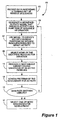
- Figure 1 presents a flow chart showing one application of the present invention. It presents various operations that may be performed in the order depicted or in some other order.
- a process 01 begins at a block 03 with receipt of data describing a training set comprising residue sequences for a protein variant library.
- the training set data is derived from a protein variant library.
- that data will include, for each protein in the library, a complete or partial residue sequence together with an activity value.
- multiple types of activities e.g., rate constant data and thermal stability data
- the individual members of the protein variant library represent a wide range of sequences and activities. This allows one to generate a sequence-activity model having applicability over a broad region of sequence space.
- Techniques for generating such diverse libraries include systematic variation of protein sequences and directed evolution techniques. Both of these are described in more detail elsewhere herein. Note however that it is often desirable to generate models from gene sequences representing a particular gene family; e.g ., a particular kinase found in multiple species. As most residues will be identical across all members of the family, the model describes only those residues that vary.
- statistical models based on such relatively small training sets, compared to the set of all possible variants are valid in a local sense. The goal is not to find a global fitness function since that is beyond the capacity (and often the need) of the systems under consideration.
- Activity data may be obtained by assays or screens appropriately designed to measure activity magnitudes. Such techniques are well known and are not central to this invention. The principles for designing appropriate assays or screens are widely understood. Techniques for obtaining protein sequences are also well known and are not central to this invention.
- the activity used with this invention may be protein stability (e.g., thermal stability). However, many important embodiments consider other activities such as catalytic activity, resistance to pathogens and/or toxins, therapeutic activity, toxicity, and the like.
- the process uses it to generate a sequence-activity model that predicts activity as a function of sequence information. See block 05.
- a sequence-activity model that predicts activity as a function of sequence information.
- Such model is a non-linear expression, algorithm or other tool that predicts the relative activity of a particular protein when provided with sequence information for that protein.
- protein sequence information is input and an activity prediction is output.
- the model can also rank the contribution of various residues to activity.
- a model generated at block 05 is employed to identify multiple residue positions (e.g., position 35) or specific residue values (e.g. glutamine at position 35) that are predicted to impact activity. See block 07. In addition to identifying such positions, it may "rank" the residue positions or residue values based on their contributions to activity. For example, the model may predict that glutamine at position 35 has the most pronounced, positive effect on activity, phenylalanine at position 208 has the second most pronounced, positive effect, and so on. In a specific approach described below, PLS or PCR regression coefficients are employed to rank the importance of specific residues. In another specific approach, a PLS load matrix is employed to rank the importance of specific residue positions.
- residues that impact activity are selected for variation as indicated at a block 09. This is done for the purpose of exploring sequence space. Residues are selected using any of a number of different selection protocols, some of which will be described below. In one example, specific residues predicted to have the most beneficial impact on activity are preserved ( i.e., not varied). A certain number of other residues predicted to have a lesser impact are, however, selected for variation. In another example, the residue positions found to have the biggest impact on activity are selected for variation, but only if they are found to vary in high performing members of the training set.
- the method next generates a new variant library having the specified residue variation. See block 11.
- Various methodologies are available for this purpose.
- an in vitro or in vivo recombination-based diversity generation mechanism is performed to generate the new variant library.
- Such procedures may employ oligonucleotides containing sequences or subsequences for encoding the proteins of the parental variant library. Some of the oligonucleotides will be closely related, differing only in the choice of codons for alternate amino acids selected for variation at 09.
- the recombination-based diversity generation mechanism may be performed for one or multiple cycles. If multiple cycles are used, each involves a screening step to identify which variants have acceptable performance to be used in a next recombination cycle. This is a form of directed evolution.
- a "reference" protein sequence is chosen and the residues selected at 09 are "toggled” to identify individual members of the variant library.
- the new proteins so identified are synthesized by an appropriate technique to generate the new library.
- the reference sequence may be a top-performing member of the training set or a "best" sequence predicted by a PLS or PCR model.
- sequence activity model is used as a "fitness function" in a genetic algorithm for exploring sequence space.
- a next generation library is identified for use as described in this flow chart.
- this strategy can be viewed as in silico directed evolution.
- one had in hand an accurate, precise global or local fitness function one could perform all the evolution in silico and synthesize a single best variant for use in the final commercial or research application. Though this is likely to be impossible to achieve in most cases such a view of the process lends clarity to the goals and approach of using machine learning techniques for directed evolution.
- the new library After the new library has been produced, it is screened for activity, as indicated in a block 13. Ideally, the new library will present one or more members with better activity than was observed in the previous library. However, even without such advantage, the new library can provide beneficial information. Its members may be employed for generating improved models that account for the effects of the variations selected in 09, and thereby more accurately predict activity across wider regions of sequence space. Further, the library may represent a passage in sequence space from a local maximum toward a global maximum (in activity).
- process 01 it may be desirable to generate a series of new protein variant libraries, with each one providing new members of a training set.
- the updated training set is then used to generate an improved model.
- process 01 is shown with a decision operation 15, which determines whether yet another protein variant library should be produced.
- Various criteria can be used to make this decision. Examples include the number of protein variant libraries generated so far, the activity of top proteins from the current library, the magnitude of activity desired, and the level of improvement observed in recent new libraries.
- the process returns to operation 05 where a new sequence-activity model is generated from sequence and activity data obtained for the current protein variant library.
- the sequence and activity data for the current protein variant library serves as part of the training set for the new model (or it may serve as the entire training set).
- operations 07, 09, 11, 13, and 15 are performed as described above, but with the new model.
- process 01 this cycle will end and no new library will be generated. At that point, the process may simply terminate or one or more sequences from one or more of the libraries may be selected for development and/or manufacture. See block 17.
- Protein variant libraries are groups of multiple proteins having one or more residues that vary from member to member in a library. They may be generated by methods of this invention. They may provide the data for training sets used to generate sequence-activity models in accordance with this invention. The number of proteins included in a protein variant library depends on the application and the cost.
- the protein variant library is generated from one or more naturally occurring proteins, which may be protein members encoded by a single gene family. Other starting points for the library may be used. From these seed or starting proteins, the library may be generated by various techniques. In one case, the library is generated by DNA fragmentation-mediated recombination as described in Stemmer (1994) Proc. Natl. Acad. Sci. USA 10747-10751 and WO 95/22625 , synthetic oligonucleotide-mediated recombination as described in Ness et al. (2002) Nature Biotechnology 20:1251-1255 and WO 00/42561 ) on nucleic acids encoding part or all of one or more parent proteins.
- a combination of these methods may be used as well (i.e., recombination of DNA fragments and synthetic oligonucleotides) as well as other recombination-based methods described in, for example, WO97/20078 and WO98/27230 .
- a single starting sequence is modified in various ways to generate the library.
- the library is generated by systematically varying the individual residues of the starting sequence.
- DOE design of experiment
- a "wet lab” procedure such as oligonucleotide-mediated recombination is used to introduce some level of systematic variation.
- systematically varied sequences refers to a set of sequences in which each residue is seen in multiple contexts.
- the level of systematic variation can be quantified by the degree to which the sequences are orthogonal from one another (maximally different compared to the mean).
- the process does not depend on having maximally orthogonal sequences, however, the quality of the model will be improved in direct relation to the orthogonality of the sequence space tested.
- a peptide sequence is systematically varied by identifying two residue positions, each of which can have one of two different amino acids.
- a maximally diverse library includes all four possible sequences.
- Protein variants having systematically varied sequences can be obtained in a number of ways using techniques that are well known to those having ordinary skill in the art. As indicated, suitable methods include recombination-based methods that generate variants based on one or more "parental" polynucleotide sequences. Polynucleotide sequences can be recombined using a variety of techniques, including, for example, DNAse digestion of polynucleotides to be recombined followed by ligation and/or PCR reassembly of the nucleic acids. These methods include those described in, for example, Stemmer (1994) Proc._Natl. Acad. Sci. USA, 91:10747-10751 , U.S. Pat. No.
- Synthetic recombination methods are also particularly well suited for generating protein variant libraries with systematic variation.
- synthetic recombination methods a plurality of oligonucleotides are synthesized which collectively encode a plurality of the genes to be recombined.
- the oligonucleotides collectively encode sequences derived from homologous parental genes.
- homologous genes of interest are aligned using a sequence alignment program such as BLAST ( Atschul, et al., J. Mol. Biol., 215:403-410 (1990 ). Nucleotides corresponding to amino acid variations between the homologues are noted.
- variations are optionally further restricted to a subset of the total possible variations based on covariation analysis of the parental sequences, functional information for the parental sequences, selection of conservative or non-conservative changes between the parental sequences, or other like criteria.
- Variations are optionally further increased to encode additional amino acid diversity at positions identified by, for example, covariation analysis of the parental sequences, functional information for the parental sequences, selection of conservative or non-conservative changes between the parental sequences, or apparent tolerance of a position for variation.
- the result is a degenerate gene sequence encoding a consensus amino acid sequence derived from the parental gene sequences, with degenerate nucleotides at positions encoding amino acid variations.
- Oligonucleotides are designed which contain the nucleotides required to assemble the diversity present in the degenerate gene. Details regarding such approaches can be found in, for example, Ness et al. (2002), Nature Biotechnology 20:1251-1255 , WO 00/42561 , "Oligonucleotide Mediated Nucleic Acid Recombination," WO 00/42560 , “Methods for Making Character Strings, Polynucleotides and Polypeptides having Desired Characteristics," WO 01/75767 , "In Silico Cross-Over Site Selection," and WO 01/64864 , "Single-Stranded Nucleic Acid Template-Mediated Recombination and Nucleic Acid Fragment Isolation.”
- the identified polynucleotide variant sequences may be transcribed and translated, either in vitro or in vivo, to create a set or library of protein variant sequences.
- the set of systematically varied sequences can also be designed a priori using design of experiment (DOE) methods to define the sequences in the data set.
- DOE design of experiment
- fractional factorial designs are used to define fewer experiments (than in full factorial designs) in which a factor is varied (toggled) between two or more levels. Optimization techniques are used to ensure that the experiments chosen are maximally informative in accounting for factor space variance.
- the same design approaches e.g., fractional factorial, D-optimal design
- a resolution IV factorial design would be appropriate.
- a resolution IV design is defined as one which is capable of elucidating the effects of all single variables, with no two-factor effects overlapping them.
- the design would then specify a set of 40 specific amino acid sequences that would cover the total diversity of 2 20 ( ⁇ 1 million) possible sequences. These sequences are then generated by a standard gene synthesis protocol and the function and fitness of these clones is determined.
- a sequence-activity model used with the present invention relates protein sequence information to protein activity.
- the protein sequence information used by the model may take many forms. Frequently, it is a complete sequence of the amino acid residues in a protein; e.g., HGPVFSTGGA.... In some cases, however, it may be unnecessary to provide the complete amino acid sequence. For example, it may be sufficient to provide only those residues that are to be varied in a particular research effort. At later stages in research, for example, many residues may be fixed and only limited regions of sequence space remain to be explored. In such situations, it may be convenient to provide sequence activity models that require, as inputs, only the identification of those residues in the regions of the protein where the exploration continues.
- some models may not require exact identities of residues at the residue positions, but instead identify one or more physical or chemical properties that characterize the amino acid at a particular residue position.
- the model may require specification of residue positions by bulk, hydrophobicity, acidity, etc. In some models, combinations of such properties are employed.
- sequence-activity model can vary widely, so long as it provides a vehicle for correctly approximating the relative activity of proteins based on sequence information. Generally, it will treat activity as a dependent variable and sequence/residue values as independent variables.
- mathematical/logical form of models include linear and non-linear mathematical expressions of various orders, neural networks, classification and regression trees/graphs, clustering approaches, recursive partitioning, support vector machines, and the like.
- the model form is a linear additive model in which the products of coefficients and residue values are summed.
- the model form is a non-linear product of various sequence/residue terms, including certain residue cross products (which represent interaction terms between residues).
- Models are developed from a training set of activity versus sequence information to provide the mathematical/logical relationship between activity and sequence. This relationship is typically validated prior to use for predicting activity of new sequences or residue importance.
- the technique should produce a model that can distinguish residues that have a significant impact on activity from those that do not.
- the model should also rank individual residues or residue positions based on their impact on activity.
- models are generated by a regression technique that identifies covariation of independent and dependent variables in a training set.
- Various regression techniques are known and widely used. Examples include multiple linear regression (MLR), principal component regression (PCR) and partial least squares regression (PLS).
- MLR is the most basic of these techniques. It simply solves a set of coefficient equations for members of a training set. Each equation relates to the activity of a training set member (dependent variable) with the presence or absence of a particular residue at a particular position (independent variables). Depending upon the number of residue options in the training set, these expressions can be quite large.
- PLS and PCR Like MLR, PLS and PCR generate models from equations relating sequence activity to residue values. However, these techniques do so in a different manner. They first perform a coordinate transformation to reduce the number of independent variables. They then perform the regression on the transformed variables. In MLR, there are a potentially very large number of independent variables: two or more for each residue position that varies within the training set. Given that proteins and peptides of interest are often quite large and the training set may provide many different sequences, the number of independent variables can quickly become very large. By reducing the number of variables to focus on those that provide the most variation in the data set, PLS and PCR generally require fewer samples and simplify 5 the problem of generating a model.
- PCR is similar to PLS regression in that the actual regression is done on a relatively small number of latent variables obtained by coordinate transformation of the raw independent variables (residue values).
- the difference between PLS and PCR is that the latent variables in PCR are constructed by maximizing covariation between the independent variables (residue values).
- the latent variables are constructed in such a way as to maximize the covariation between the independent variables and the dependent variables (activity values). Partial Least Squares regression is described in Hand, D.J., et al. (2001) Principles of Data Mining (Adaptive Computation and Machine Learning), Boston, MA, MIT Press , and in in Geladi, et al. (1986) "Partial Least-Squares Regression: a tutorial," Anal. Chim. Acta, 198:1-17 .
- the direct result of the regression is an expression for activity that is a function of the weighted latent variables.
- This expression can be transformed to an expression for activity as a function of the original independent variables by performing a coordinate transformation that converts the latent variables back to the original independent variables.
- both PCR and PLS first reduce the dimensionality of the information contained in the training set and then perform a regression analysis on a transformed data set; which has been transformed to produce new independent variables, but preserves the original dependent variable values.
- the transformed versions of the data sets may result in only a relatively few expressions for performing the regression analysis. Compare this with a situation where no dimension reduction is performed. In that situation, each separate residue for which there can be a variation must be considered. This can be a very large set of coefficients; 2 N coefficients, where N is the number of residue positions that may vary in the training set. In a typical principal component analysis, only 3, 4, 5, 6 principal components are employed.
- model fit The ability of machine learning techniques to fit the training data is often referred to as the "model fit" and in regression techniques such as MLR, PCR and PLS is typically measured by the sum squared difference between measured and predicted values.
- MLR the optimal model fit will always be achieved using MLR, with PCR and PLS often having a worse model fit (higher sum squared error between measurements and predictions).
- latent variable regression techniques such as PCR and PLS lies in the predictive ability of such models. Obtaining a model fit with very small sum squared error in no way guarantees the model will be able to accurately predicted new samples not seen in the training set - in fact, it is often the opposite case, particularly when there are many variables and only a few observations (samples).
- latent variable regression techniques PCR, PLS
- latent variable regression techniques while often having worse model fits on the training data are usually more robust and are able to predict new samples outside the training set more accurately.
- Support vector machines Another class of tools that can be used to generate models in accordance with this invention is the support vector machines. These mathematical tools take as inputs training sets of sequences that have been classified into two or more groups based on activity. Support vector machines operate by weighting different members of a training set differently depending upon how close they are to a hyperplane interface separating "active" and "inactive" members of the training set. This technique requires that the scientist first decide which training set members to place in the active group and which training set members to place in the inactive group. This may be accomplished by choosing an appropriate numerical value of activity to serve as the boundary between active and inactive members of the training set.
- the support vector machine will generate a vector, W, that can provide coefficient values for individual ones of the independent variables defining the sequences of the active and inactive group members in the training set. These coefficients can be used to "rank" individual residues as described elsewhere herein.
- the technique attempts to identify a hyperplane that maximizes the distance between the closest training set members on opposite sides of that plane.
- support vector regression modeling is carried out.
- the dependent variable is a vector of continuous activity values.
- the support vector regression model will generate a coefficient vector, W, which can be used to rank individual residues.
- SVMs have been used to look at large data sets in many studies and have been quite popular in the DNA microarray field. Their potential strengths include the ability to finely discriminate (by weighting) which factors separate samples from each other. To the extent that an SVM can tease out precisely which residues contribute to function, it can be a particularly useful tool for ranking residues in accordance with this invention. SVMs are described in S. Gunn (1998) "Support Vector Machines for Classification and Regressions," Technical Report, Faculty of Engineering and Applied Science, Department of Electronics and Computer Science, University of Southampt on.
- Another model generation technique of interest is genetic programming.
- This technique employs a Darwinian style evolution to discover the formulae and rules that characterize the data of a training set. It can be used in regression problems of the types described herein. The underlying effect can be linear or non-linear.
- Genetic programming is described in R. Goodacre et al. (2000) "Detection of the Dipicolinic Acid Biomarker in Bacillus Spores Using Curie-Point Pyrolysis Mass Spectrometry and Fourier Transform Infrared Spectroscopy," Anal. Chem., 72, 119-127 .
- Examples of software tools for performing genetic programming include the "GMAX” and the "GMAX-Bio” available from Aber Genomic Computing Ltd of Wales, UK.
- y is predicted response
- c ij and x ij are the regression coefficient and bit value or dummy variable used to represent residue choice, respectively at position i in the sequence.
- N residue positions in the sequences of the protein variant library and each of these may be occupied by one or more residues.
- j 1 through M separate residue types.
- This model assumes a linear (additive) relationship between the residues at every position.
- data in the form of activity and sequence information is derived from the initial protein variant library and used to determine the regression coefficients of the model.
- the dummy variables are first identified from an alignment of the protein variant sequences.
- Amino acid residue positions are identified from among the protein variant sequences in which the amino acid residues in those positions differ between sequences. Amino acid residue information in some or all of these variable residue positions may be incorporated in the sequence activity model.
- Table I contains sequence information in the form of variable residue positions and residue types for 10 illustrative variant proteins, along with activity values corresponding to each variant protein. Understand that these are representative members of a larger set that is required to generate enough equations to solve for all the coefficients. Thus, for example, for the illustrative protein variant sequences in Table I, positions 10, 166, 175, and 340 are variable residue positions and all other positions, i.e., those not indicated in the Table, contain residues that are identical between Variants 1-10.
- Table I Illustrative Sequence and Activity Data Variable Positions: 10 166 175 340 y (activity) Variant 1 Ala Ser Gly Phe y 1 Variant 2 Asp Phe Val Ala y 2 Variant 3 Lys Leu Gly Ala y 3 Variant 4 Asp Ile Val Phe y 4 Variant 5 Ala Ile Val Ala y 5 Variant 6 Asp Ser Gly Phe y 6 Variant 7 Lys Phe Gly Phe y 7 Variant 8 Ala Phe Val Ala y 8 Variant 9 Lys Ser Gly Phe y 9 Variant 10 Asp Leu Val Ala y 10 and so on.
- bit values can be represented as either 1 or 0 reflecting the presence or absence of the designated amino acid residue or alternatively, 1 or -1, or some other surrogate representation.
- X 10Ala would be “1” for Variant 1 and "0” for Variant 2.
- X 10Ala would be "1” for Variant 1 and "-1” for Variant 2.
- the regression coefficients can thus be derived from regression equations based on the sequence activity information for all variants in library.
- the complete set of equations can be readily solved using a regression technique (e.g., PCR, PLS, or MLR) to determine the value for regression coefficients corresponding to each residue and position of interest.
- a regression technique e.g., PCR, PLS, or MLR
- the relative magnitude of the regression coefficient correlates to the relative magnitude of contribution of that particular residue at the particular position to activity.
- the regression coefficients may then be ranked or otherwise categorized to determine which residues are more likely to favorably contribute to the desired activity.
- Table II provides illustrative regression coefficient values corresponding to the systematically varied library exemplified in Table I: Table II: Illustrative Rank Ordering of Regression Coefficients REGRESSION COEFFICIENT VALUE c 166Ile 62.15s c 175Gly 61.89 c 10Asp 60.23 c 340 Ala 57.45 c 10 Ala 50.12 c 166 Phe 49.65 c 166Leu 49.42 c 340 Phe 47.16 c 166Ser 45.34 c 175 Val 43.65 c 10 Lys 40.15
- the rank ordered list of regression coefficients can be used to construct a new library of protein variants that is optimized with respect to a desired activity (i.e ., improved fitness). This can be done in various ways. In one case, it is accomplished by retaining the amino acid residues having coefficients with the highest observed values. These are the residues indicated by the regression model to contribute the most to desired activity. If negative descriptors are employed to identify residues (e.g., 1 for leucine and -1 for glycine), it becomes necessary to rank residue positions based on absolute value of the coefficient. Note that in such situations, there is typically only a single coefficient for each residue. The absolute value of the coefficient magnitude gives the ranking of the corresponding residue position. Then, it becomes necessary to consider the signs of the individual residues to determine whether each of them is detrimental or beneficial in terms of the desired activity.
- a desired activity i.e ., improved fitness
- Non-linear modeling is employed to account for residue-residue interactions that contribute to activity in proteins.
- An N-K landscape describes this problem.
- the parameter N refers to the number of variable residues in a collection of related polypeptides sequences.
- the parameter K represents the interaction between individual residues within anyone of these polypeptides. Interaction is usually a result of close physical proximity between various residues whether in the primary, secondary, or tertiary structure of the polypeptide. The interaction may be due to direct interactions, indirect interactions, physicochemical interactions, interactions due to folding intermediates, translational effects, and the like.
- a purely linear, additive model of polypeptide activity can be improved by including one or more non-linear interaction terms representing specific interactions between 2 or more residues.
- these terms are depicted as "cross-products" containing two or more dummy variables representing the two or more particular residues (each associated with a particular position in the sequence) that interact to have a significant positive or negative impact on activity.
- a cross-product term may have the form c ab x a x b , where x a is a dummy variable representing the presence of a particular residue at a particular position on the sequence and the variable x b represents the presence of a particular residue at a different position (that interacts with the first position) in the polypeptide sequence.
- x a is a dummy variable representing the presence of a particular residue at a particular position on the sequence
- the variable x b represents the presence of a particular residue at a different position (that interacts with the first position) in the polypeptide sequence.
- each of the individual interacting residues when present alone in a polypeptide may have a negative impact on activity, but when each of them is present together in the polypeptide, the overall effect is positive. The opposite may be true in other cases.
- a non-linear model could include a cross-product term for every possible combination of interacting variable residues in the sequence. However, this would not represent physical reality, as only a subset of the variable residues actually interact with one another. In addition, it would result in "overfitting" to produce a model that provides spurious results that are manifestations of the particular polypeptides used to create the model and do not represent real interactions within the polypeptide.
- the approach to generating a non-linear model containing such interaction terms is the same as the approach described above for generating a linear model.
- a training set is employed to "fit" the data to a model.
- one or more non-linear terms preferably the cross-product terms discussed above, are added to the form of the model.
- the resulting non-linear model like the linear models described above, can be employed to rank the importance of various residues on the overall activity of a polypeptide.
- Various techniques can identify the best combination of variable residues as predicted by the non-linear equation. Unfortunately, unlike the linear case, it is often impossible to accomplish this by simple inspection of the additive model. Approaches to ranking the residues are described below.
- an appropriate fitness function and an appropriate mating procedure are defined.
- the fitness function provides a criterion for determining which models (combinations of cross-product terms) are "most fit” (i.e ., likely to provide the best results).
- the mating procedure provides a mechanism for introducing new combinations of cross-product terms from successful "parental" models in a previous generation.
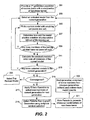
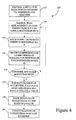
- a genetic algorithm for identifying a combination of cross-product terms will now be described with reference to Figure 2 .
- This algorithm begins with a first generation comprising multiple possible models, some of which do a better job of representing physical reality than others. See block 201.
- the first and each successive generation is represented as a number of models in a "population".
- model is a combination of linear terms (fixed across all models) and non-linear cross-product terms.
- model in this genetic algorithm does not intrinsically include coefficients for the individual linear and non-linear terms, only an identification of a combination of non-linear terms (e.g., the cross-product terms).
- the genetic algorithm proceeds towards convergence by marching through successive generations of models, each characterized by a different combination of non-linear interaction terms.
- Each model in a generation is used to fit a training set of polypeptides (having known sequences and associated activities).
- the training set is used to fit the individual models of the current generation. See block 203, 205, 207, and 209 of Figure 2 .
- a partial least squares technique or similar regression technique is used to perform the fit.
- the predictive power of the resulting model (including coefficients obtained by the regression on the training set data) is used as a fitting function.
- many different fits of a model may be provided for a given training set. See blocks 205, 207, and 209. Each fit provides its own unique set of coefficient values for the linear and non-linear terms of the model under consideration.
- a "leave one out” approach is employed in which all but one member of the training set is used to fit the model. This left out member is then used to test the predictive power of the resulting instance of the model.
- the model instance (model terms together coefficient values identified by fitting) is expected to do a good job of predicting the activities of the training set members employed to produce it.
- the aggregate measure is a predicted residual sum of squares (PRESS) for the various leave one out model instances of the current model.
- PRESS is, in effect, the fitting function of the genetic algorithm.
- model After each combination of non-linear cross-product terms (model) in a particular generation is evaluated for its predictive power (i.e., decision 213 is answered in the negative), the genetic algorithm is checked for convergence. See block 215. Assuming that the genetic algorithm has not yet converged, the models of the current generation are ranked. Those that do the best job of predicting activity may be preserved and used in the next generation. See block 217. For example, an elitism rate of 10% may be employed. In other words, the top 10% of models (as determined using the fitting function and measured by, e.g ., PRESS scores) are set aside to become members of the next generation. The remaining 90% of the members in the next generation are obtained by mating "parents" from the previous generation. See blocks 219, 221, and 223.
- the "parents" are models selected randomly from the previous generation. See block 219. However, the random selection is typically weighted toward more fit numbers of the previous generation.
- the parent models may be selected using a linear weighting (e.g., a model that performs 1.2 times better than another model is 20% more likely to be selected) or a geometric weighting (i.e., the predictive differences in models are raised to a power in order to obtain a probability of selection).
- pairs of such models are mated (block 221) to produce children models by providing some non-linear terms from one parent and other non-linear terms form the other parent.
- the non-linear terms (cross-products) of the two parents are aligned and each term is considered in succession to determine whether the child should take the term from parent A or from parent B.
- the mating process begins with parent A and randomly determines whether a "cross over" event should occur at the first non-linear term encountered. If so, the term is taken from parent B. If not, the term is taken from parent A. The next term in succession is considered for cross over, etc. The terms continue to come from the parent donating the previous term under consideration until a cross over event occurs.
- next generation After each non-linear term has been considered, a child "model" is defined for the next generation. Then another two parents are chosen to produce another child model, and so on. Eventually, after a complete generation has been selected in this manner (block 223), the next generation is ready for evaluation, and process control then returns to block 203, where the members of the next generation are evaluated as described above.
- the process continues generation-by-generation until convergence, (i.e., decision block 215 is answered in the negative. At that point, the top ranked model is selected from the current generation as the overall best model. See block 225. Convergence can be tested by many conventional techniques. Generally, it involves determining that the performance of the best model from a number of successive generations does not change appreciably.
- y is the response (activity)
- c n the regression coefficient for the residue choice at position n
- x the dummy variable coding for the residue choice (+1/-1) at position n
- co the mean value of the response co the mean value of the response.
- the variables are the same as those in Eq. (3) but now there are non-linear terms, e.g., c 1,2 is the regression coefficient for the interaction between variable positions 1 and 2.
- NK landscape Kauffman, 1993
- N the number of variable positions in a simulated protein
- K the epistatic coupling between residues.
- the synthetic data set was generated only in silico.
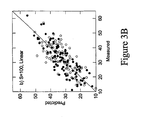
- the training sets were used to construct both linear and non-linear models using the methods described above. Some non-linear models were generated with selection of the cross-product terms (using a genetic algorithm as described above) and other non-linear models were generated without selection of such terms.
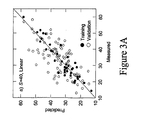
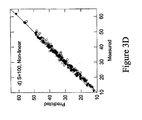
- the linear model was capable of correlating the measured and predicted values reasonably well, but demonstrated weaker correlation when validated against data not seen in the training set (see Figure 3A ).
- the dark data points represent the cross-validated predictions made by a linear model based on the other 39 data points in the training set and predicting the single held out data point. Thus there are actually 40 slightly different models represented by the dark data points.
- the light data points represent the predictions made by a single model constructed from the 40 training samples and used to predict the validation samples V, none of which were seen in the original training set.
- the use of the validation set then gives a good measure of the true predictive capacity of the model, as opposed to the cross validated training set, which can suffer from the model overfit problem especially for the non-linear cases described below.
- the sensitivity may be identified by simply considering the size of the coefficient associated with a given residue term in the model. For the non-linear model, this will not be possible. Instead the residue sensitivity may be determined by using the model to calculate changes in activity when a single residue is varied in the "best" predicted sequence.
- Residues may be considered in the order in which they are ranked. For each residue under consideration, the process determines whether to "toggle” that residue.
- the term “toggling” refers to the introduction of multiple amino acid residue types into a specific position in the sequences of protein variants in the optimized library. For example, serine may appear in position 166 in one protein variant, whereas phenylalanine may appear in position 166 in another protein variant in the same library. Amino acid residues that did not vary between protein variant sequences in the training set typically remain fixed in the optimized library.
- An optimized protein variant library can be designed such that all of the identified "high” ranking regression coefficient residues are fixed, and the remaining lower ranking regression coefficient residues are toggled. The rationale for this being that one should search the local space surrounding the 'best' predicted protein. Note that the starting point "backbone" in which the toggles are introduced may be the best protein predicted by a model or an already validated 'best' protein from a screened library.
- the starting point for toggling may be the best set of residues as predicted by the model or a best validated protein from an existing library. Or the starting point may be an "average" clone that models well. In this case, it may be desirable to toggle the residues predicted to be of higher importance. The rationale for this being that one should explore a larger space in search for activity hills previously omitted from the sampling. This type of library is typically more relevant in early rounds as it generates a more refined picture for subsequent rounds.
- the method introduces that position as a toggle position for the subsequent library. If the residue is present in the best clone, the method will not treat the position as a toggle position, and it will move the next position in succession. The process is repeated for various residues, moving through successively lower load values, until the library is of sufficient size is generated.
- the number of regression coefficient residues to retain, and number of regression coefficient residues to toggle, can be varied. Factors to consider include the desired library size, the magnitude of difference between regression coefficients, and the degree to which nonlinearity is thought to exist - retaining residues with small (neutral) coefficients may uncover important nonlinearities in subsequent rounds of evolution.
- Typical optimized protein variant libraries of the present invention contain about 2 N protein variants, where N represents the number of positions that are toggled between two residues. Stated another way, the diversity added by each additional toggle doubles the size of the library such that 10 toggle positions produces ⁇ 1,000 clones (1,024), 13 positions - 10,000 clones (8,192) and 20 positions ⁇ 1,000,000 clones (1,048,576).
- the appropriate size of library depends on factors such as cost of screen, ruggedness of landscape, preferred percentage sampling of space etc. In some cases, it has been found that a relatively large number of changed residues produces a library in which an inordinately large percentage of the clones are non-functional. Therefore for some applications, it may be recommended that the number of residues for toggling ranges from about 2 to about 30; i.e., the library size ranges from between about 4 and 2 30 ⁇ 10 9 clones.
- a wet-lab validated 'best' (or one of the few best) protein in the current optimized library may serve as a backbone where various schemes of changes are incorporated.
- a wet-lab validated 'best' (or one of the few best) protein in the current library that may not model well may serve as a backbone where various schemes of changes are incorporated.
- a sequence predicted by the sequence activity model to have the highest value (or one of the highest values) of the desired activity may serve as the backbone.
- the dataset for the "next generation” library (and possibly a corresponding model) is obtained by changing residues in one or a few of the best proteins.
- these changes comprise a systematic variation of the residues in the backbone.
- the changes comprise various mutagenesis, recombination and/or subsequence selection techniques. Each of these may be performed in vitro, in vivo, or in silico.
- the optimal sequence predicted by a non-linear model can be identified by testing all possible sequences with the model (assuming sufficient computational resources) or a searching algorithm such as a genetic algorithm.
- a genetic algorithm One exemplary genetic algorithm will now be described.
- the fitness function is simply the non-linear model's prediction of activity.
- an elitism rate of about 5-10% is employed.
- Selection of parents for mating involves a linear weighted fitness operation. The selected parents provide ordered sets of residues and a uniform cross over operation is employed. The best computer generated protein is picked after no improvement is seen for at least 15 generations.
- Optimized protein variant libraries can be generated using the recombination methods described herein, or alternatively, by gene synthesis methods, followed by in vivo or in vitro expression. After, the optimized protein variant libraries are screened for desired activity, they may be sequenced. As indicated above in the discussion of Figure 1 , the activity and sequence information from the optimized protein variant library can be employed to generate another sequence activity model from which a further optimized library can be designed, using the methods described herein. In one approach, all proteins from this new library are used as part of the dataset.
- the x ij variables are representations of the physical or chemical properties of amino acids - rather than the exact identities of the amino acids themselves (leucine versus valine versus proline, ). Examples of such properties include lipophilicity, bulk, and electronic properties (e.g., formal charge, van der Waals surface area associated a partial charge, etc.).
- the x ij values representing amino acid residues can be presented in terms of their properties or principal components constructed from the properties.
- the x ij variables represent nucleotides, rather than amino acid residues.
- the goal is to identify nucleic acid sequences that encode proteins for a protein variant library.
- nucleotides rather than amino acids
- protein expression in a particular host or vector may be a function of nucleotide sequence.
- Two different nucleotide sequences may encode a protein having one amino acid sequence, but one of the nucleotide sequences expresses greater quantities of protein and/or expresses the protein in a more active state.
- the methods of this invention can optimize for expression properties, for example, as well as specific activity.
- the nucleotide sequence is represented as codons.
- Models may employ codons as the atomic unit of a nucleotide sequence such that the predicted activities are a function of various codons in the nucleotide sequence.
- Each codon together with its position in the overall nucleotide sequence serves as an independent variable for generating sequence activity models.
- different codons for given amino acid express differently in a given organism. More specifically, each organism has a preferred codon, or distribution of codon frequencies, for a given amino acid.
- codons as the independent variables, the invention accounts for these preferences.
- the invention can be used to generate a library of expression variants (e.g., where "activity" includes expression level from a particular host organism).
- An outline of a particular method includes the following operations: (a) receiving data characterizing a training set of a protein variant library; (b) from the data, developing a non-linear sequence activity model that predicts activity as a function of nucleotide types and corresponding position in the nucleotide sequence; (c) using the sequence activity model to rank positions in a nucleotide sequence and/or nucleotide types at specific positions in the nucleotide sequence in order of impact on the desired activity; and (d) using the ranking to identify one or more nucleotides, in the nucleotide sequence, that are to be varied or fixed in order to impact the desired activity.
- the nucleotides to be varied are preferably codons encoding particular amino acids.
- PLS and other techniques provide other information, beyond regression coefficient magnitude, that can be used to rank specific residues or residue positions.
- Techniques such as PLS and Principle Component Analysis (PCA) or PCR provide information in the form of principle components or latent vectors. These represent directions or vectors of maximum variation through multi-dimensional data sets such as the protein sequence-activity space employed in this invention.
- These latent vectors are functions of the various sequence dimensions; i.e ., the individual residues or residue positions that comprise the protein sequences of the variant library used to construct the training set.
- a latent vector will therefore comprise a sum of contributions from each of the residue positions in the training set. Some positions will contribute more strongly to the direction of the vector.
- a training set may be comprised of tripeptides.
- the first latent vector will typically have contributions from all three residues.
- Vector 1 a ⁇ 1 residue position 1 + a ⁇ 2 residue position 2 + a ⁇ 3 residue position 3
- the coefficients, a1, a2, and a3, are the loads. Because these reflect the importance of the corresponding residue positions to variation in the dataset, they can be used to rank the importance of individual residue positions for purposes of "toggling" decisions, as described above. Loads, like regression coefficients, may be used to rank residues at each toggled position. Various parameters describe the importance of these loads. Some such Variable Importance in Projection (VIP) make use of a load matrix, which is comprised of the loads for multiple latent vectors taken from a training set. In Variable Importance for PLS Projection, the importance of the ith variable (e.g., residue position) is computed by calculating VIP (variable importance in projection).
- VIP Variable importance in projection
- a, (VIN) ak 2 is equal to the squared PLS weight (w ak ) 2 of a variable multiplied by the percent explained variability in y (dependent variable, e.g., certain function) by that PLS dimension.
- (VIN) ak 2 is summed over all PLS dimensions (components).
- VIP is then calculated by dividing the sum by the total percent variability in y explained by the PLS model and multiplying by the number of variables in the model. Variables with large VIP, larger than 1, are the most relevant for correlating with a certain function (y) and hence highest ranked for purposes of making toggling decisions.
- Another embodiment of the invention employs techniques that rank residues not simply by the magnitudes of their predicted contributions to activity, but by the confidence in those predicted contributions as well. In some cases the researcher will be concerned with spurious values of the coefficients or principal components.
- the ranking is based on a combination of magnitude and distribution. Coefficients with both high magnitudes and tight distributions give the highest ranking. In some cases, one coefficient with a lower magnitude than another may be given a higher ranking by virtue of having less variation. Thus, some embodiments of the invention rank residues or nucleotides based on both magnitude and standard deviation or variance. Various techniques can be used to accomplish this. One of these, a bootstrap p -value approach, will now be described.
- a method 125 begins at a block 127 where an original data set S is provided. This may be a training set as described above. For example, it may be generated by systematically varying the individual residues of a starting sequence in any one of the manners described above.
- the data set S has M different data points (activity and sequence information collected from amino acid or nucleotide sequences) for use in the analysis.
- bootstrap sets B are created. Each of these is obtained by sampling, with replacement, from set S to create a new set of M members - all taken from original set S. See block 129.
- the "with replacement" condition produces variations on the original set S.
- the new bootstrap set, B will sometimes contain replicate samples from S. And, it may also lack certain samples originally contained in S.
- Each bootstrap set B used in the method contains itself 100 sequences.
- a bootstrap set B is created by randomly selecting each of the 100 member sequences from the 100 sequences in the original set S. Thus, it is possible that some sequences will be selected more than once and others will not be selected at all.
- the method next builds a model. See block 131.
- the model may be built as described above, using PLS, PCR, a SVM, genetic programming, etc. This model will provide coefficients or other indicia of ranking for the residues or nucleotides found in the various samples from set B. As shown at a block 133, these coefficients or other indicia are recorded for subsequent use.
- the method determines whether another bootstrap set should be created. If yes, the method returns to block 129 where a new bootstrap set B is created as described above. If no, the method proceeds to a block 137 discussed below.
- the decision at block 135 turns on how many different sets of coefficient values are to be used in assessing the distributions of those values. The number of sets B should be sufficient to generate accurate statistics. As an example, 100 to 1000 bootstrap sets are prepared and analyzed. This is represented as about 100 to 1000 passes through blocks 129, 131, and 133 of method 125.
- the method then proceeds to block 137.
- a mean and standard deviation of a coefficient is calculated for each residue or nucleotide (including codons) using the coefficient values (e.g., 100 to 1000 of them, one from each bootstrap set). From this information, the method can calculate the t -statistic and determine the confidence interval that the measured value is different from zero. From the t -statistic it calculates the p -value for the confidence interval. In this case, the smaller p -value the more confidence that the measured regression coefficient is different from zero.
- the p -value is but one of many different types of characterization that can account for the statistical variation in a coefficient or other indicator of residue importance. Examples include calculating 95 per cent confidence intervals for regression coefficients and excluding any regression coefficient for consideration for which 95 per cent confidence interval crosses zero line. Basically, any characterization that accounts for standard deviation, variance, or other statistically relevant measure of data distribution can be used. Such characterization preferably also accounts for the magnitude of the coefficients.
- a large standard deviation can result from various sources.
- One source is poor measurements in the data set.
- Another is a limited representation of a particular residue or nucleotide in the original data set.
- some bootstrap sets will contain no occurrences of a particular residue or nucleotide. In such cases, the value of the coefficient for that residue will be zero.
- Other bootstrap sets will contain at least some occurrences of the residue or nucleotide and give a non-zero value of the corresponding coefficient. But the sets giving a zero value will cause the standard deviation of the coefficient to become relatively large. This reduces the confidence in the coefficient value and results in a lower rank. But this is to be expected, given that there is relatively little data on the residue or nucleotide in question.
- the method ranks the regression coefficients (or other indicators) from lower (best) p -value to highest (worst) p -value.
- This ranking correlates highly with the absolute value of the regression coefficients themselves, owing to the fact that the larger the absolute value, the more standard deviations removed from zero. Thus, for a given standard deviation, the p -value becomes smaller as the regression coefficient becomes larger.
- the absolute ranking will not always be the same with both p -value and pure magnitude methods, especially when relatively few data points are available to begin with in set S.
- the method fixes and toggles certain residues based on the rankings observed in the operation of block 139. This is essentially the same use of rankings described above for other embodiments.
- the method fixes the best residues (now those with the lowest p -values) and toggles the others (those with highest p- values).
- This method 125 has been shown in silico to perform well.
- the p-value ranking approach naturally deals with single or few instance residues: the p-values will generally be higher (worse) because in the bootstrap process, those residues that did not appear often in the original data set will be less likely to get picked up at random. Even if their coefficients are large, their variability (measured in standard deviations) will be quite high as well. Intuitively, this is the desired result, since those residues that are not well represented (either have not seen with sufficient frequency or have lower regression coefficients) may be good candidates for toggling in the next round of library design.
- embodiments of the present invention employ processes acting under control of instructions and/or data stored in or transferred through one or more computer systems.
- An apparatus for performing these operations is disclosed herein. Such apparatus may be specially designed and/or constructed for the required purposes, or it may be a general-purpose computer selectively activated or reconfigured by a computer program and/or data structure stored in the computer.
- the processes presented herein are not inherently related to any particular computer or other apparatus.
- various general-purpose machines may be used with programs written in accordance with the teachings herein. In some cases, however, it may be more convenient to construct a specialized apparatus to perform the required method operations. A particular structure for a variety of these machines will appear from the description given below.
- embodiments of the present invention relate to computer readable media or computer program products that include program instructions and/or data (including data structures) for performing various computer-implemented operations.
- Examples of computer-readable media include, but are not limited to, magnetic media such as hard disks, floppy disks, magnetic tape; optical media such as CD-ROM devices and holographic devices; magneto-optical media; semiconductor memory devices, and hardware devices that are specially configured to store and perform program instructions, such as read-only memory devices (ROM) and random access memory (RAM), and sometimes application-specific integrated circuits (ASICs), programmable logic devices (PLDs) and signal transmission media for delivering computer-readable instructions, such as local area networks, wide area networks, and the Internet.
- the data and program instructions of this invention may also be embodied on a carrier wave or other transport medium (e.g., optical lines, electrical lines, and/or airwaves).
- Examples of program instructions include both low-level code such as produced by a compiler, and files containing higher level code that may be executed by the computer using an interpreter. Further, the program instructions include machine code, source code and any other code that directly or indirectly controls operation of a computing machine in accordance with this invention. The code may specify input, output, calculations, conditionals, branches, iterative loops, etc.
- code embodying methods of the invention are embodied in a fixed media or transmissible program component containing logic instructions and/or data that when loaded into an appropriately configured computing device causes the device to perform a genetic operator on one or more character string.
- Figure 5 shows an example digital device 500 that should be understood to be a logical apparatus that can read instructions from media 517, network port 519, user input keyboard 509, user input 511 or other inputting means. Apparatus 500 can thereafter use those instructions to direct statistical operations in data space, e.g ., to construct one or more data set ( e.g., to determine a plurality of representative members of the data space).
- One type of logical apparatus that can embody the invention is a computer system as in computer system 500 comprising CPU 507, optional user input devices keyboard 509, and GUI pointing device 511, as well as peripheral components such as disk drives 515 and monitor 505 (which displays GO modified character strings and provides for simplified selection of subsets of such character strings by a user.
- Fixed media 517 is optionally used to program the overall system and can include, e.g., a disk-type optical or magnetic media or other electronic memory storage element.
- Communication port 519 can be used to program the system and can represent any type of communication connection.
- the invention can also be embodied within the circuitry of an application specific integrated circuit (ASIC) or programmable logic device (PLD).
- ASIC application specific integrated circuit
- PLD programmable logic device
- the invention is embodied in a computer readable descriptor language that can be used to create an ASIC or PLD.
- the invention can also be embodied within the circuitry or logic processors of a variety of other digital apparatus, such as PDAs, laptop computer systems, displays, image editing equipment, etc.
Landscapes
- Engineering & Computer Science (AREA)
- Life Sciences & Earth Sciences (AREA)
- Health & Medical Sciences (AREA)
- Physics & Mathematics (AREA)
- Bioinformatics & Cheminformatics (AREA)
- Chemical & Material Sciences (AREA)
- Theoretical Computer Science (AREA)
- Biotechnology (AREA)
- General Health & Medical Sciences (AREA)
- Bioinformatics & Computational Biology (AREA)
- Medical Informatics (AREA)
- Molecular Biology (AREA)
- Biophysics (AREA)
- Genetics & Genomics (AREA)
- Evolutionary Biology (AREA)
- Spectroscopy & Molecular Physics (AREA)
- Biochemistry (AREA)
- General Engineering & Computer Science (AREA)
- Biomedical Technology (AREA)
- Software Systems (AREA)
- Library & Information Science (AREA)
- Data Mining & Analysis (AREA)
- Proteomics, Peptides & Aminoacids (AREA)
- Analytical Chemistry (AREA)
- Evolutionary Computation (AREA)
- Wood Science & Technology (AREA)
- Zoology (AREA)
- Organic Chemistry (AREA)
- General Physics & Mathematics (AREA)
- Crystallography & Structural Chemistry (AREA)
- Computing Systems (AREA)
- Computer Vision & Pattern Recognition (AREA)
- Artificial Intelligence (AREA)
- Microbiology (AREA)
- Medicinal Chemistry (AREA)
- Urology & Nephrology (AREA)
- Hematology (AREA)
- Immunology (AREA)
- Plant Pathology (AREA)
- Ecology (AREA)
Applications Claiming Priority (2)
| Application Number | Priority Date | Filing Date | Title |
|---|---|---|---|
| US10/874,802 US20050084907A1 (en) | 2002-03-01 | 2004-06-22 | Methods, systems, and software for identifying functional biomolecules |
| PCT/US2005/022119 WO2006002267A1 (en) | 2004-06-22 | 2005-06-21 | Methods, systems, and software for identifying funtional biomolecules |
Publications (2)
| Publication Number | Publication Date |
|---|---|
| EP1761879A1 EP1761879A1 (en) | 2007-03-14 |
| EP1761879B1 true EP1761879B1 (en) | 2013-08-14 |
Family
ID=35159678
Family Applications (1)
| Application Number | Title | Priority Date | Filing Date |
|---|---|---|---|
| EP05779687.2A Expired - Lifetime EP1761879B1 (en) | 2004-06-22 | 2005-06-21 | Methods, systems, and software for identifying funtional biomolecules |
Country Status (5)
| Country | Link |
|---|---|
| US (10) | US20050084907A1 (da) |
| EP (1) | EP1761879B1 (da) |
| JP (1) | JP2008503589A (da) |
| DK (1) | DK1761879T3 (da) |
| WO (1) | WO2006002267A1 (da) |
Families Citing this family (184)
| Publication number | Priority date | Publication date | Assignee | Title |
|---|---|---|---|---|
| US5605793A (en) * | 1994-02-17 | 1997-02-25 | Affymax Technologies N.V. | Methods for in vitro recombination |
| US7024312B1 (en) * | 1999-01-19 | 2006-04-04 | Maxygen, Inc. | Methods for making character strings, polynucleotides and polypeptides having desired characteristics |
| US7430477B2 (en) | 1999-10-12 | 2008-09-30 | Maxygen, Inc. | Methods of populating data structures for use in evolutionary simulations |
| SG121902A1 (en) * | 2000-01-11 | 2006-05-26 | Maxygen Inc | Integrated systems for diversity generation and screening |
| US7747391B2 (en) | 2002-03-01 | 2010-06-29 | Maxygen, Inc. | Methods, systems, and software for identifying functional biomolecules |
| US20050084907A1 (en) * | 2002-03-01 | 2005-04-21 | Maxygen, Inc. | Methods, systems, and software for identifying functional biomolecules |
| EP2315145B1 (en) | 2002-03-01 | 2015-11-25 | Codexis Mayflower Holdings, LLC | Methods, systems, and software for identifying functional biomolecules |
| US7517494B2 (en) * | 2003-04-30 | 2009-04-14 | Hewlett-Packard Development Company, L.P. | Test tray and test system for determining response of a biological sample |
| US8005620B2 (en) | 2003-08-01 | 2011-08-23 | Dna Twopointo Inc. | Systems and methods for biopolymer engineering |
| WO2005012877A2 (en) * | 2003-08-01 | 2005-02-10 | Dna Twopointo Inc. | Systems and methods for antibody engineering |
| US7844926B1 (en) * | 2006-01-31 | 2010-11-30 | Oracle America, Inc. | Specification window violation identification with application in semiconductor device design |
| US8639445B2 (en) * | 2007-07-23 | 2014-01-28 | Microsoft Corporation | Identification of related residues in biomolecular sequences by multiple sequence alignment and phylogenetic analysis |
| HUE027683T2 (en) | 2007-10-01 | 2016-10-28 | Codexis Inc | Ketoreductase polypeptides for the production of azetidinone |
| WO2009102901A1 (en) | 2008-02-12 | 2009-08-20 | Codexis, Inc. | Method of generating an optimized, diverse population of variants |
| US8504498B2 (en) | 2008-02-12 | 2013-08-06 | Codexis, Inc. | Method of generating an optimized, diverse population of variants |
| WO2010025287A2 (en) * | 2008-08-27 | 2010-03-04 | Codexis, Inc. | Ketoreductase polypeptides for the production of 3-aryl-3-hydroxypropanamine from a 3-aryl-3-ketopropanamine |
| WO2010027710A2 (en) | 2008-08-27 | 2010-03-11 | Codexis, Inc. | Ketoreductase polypeptides and uses thereof |
| WO2010025238A2 (en) | 2008-08-27 | 2010-03-04 | Codexis, Inc. | Ketoreductase polypeptides for the production of a 3-aryl-3-hydroxypropanamine from a 3-aryl-3-ketopropanamine |
| SI2329014T1 (sl) | 2008-08-29 | 2015-01-30 | Codexis, Inc. | Polipeptidi ketoreduktaze za stereoselektivno produkcijo (4s)-3(5s)-5(4-fluorofenil)-5-hidroksipentanoil)-4-fenil-1,3-oksazolidin -2-ona |
| US8247192B2 (en) * | 2008-11-10 | 2012-08-21 | Codexis, Inc. | Penicillin-G acylases |
| EP2382308B1 (en) | 2008-12-25 | 2015-03-04 | Codexis, Inc. | Enone reductases |
| JP5707344B2 (ja) | 2009-02-26 | 2015-04-30 | コデクシス, インコーポレイテッド | トランスアミナーゼ生体触媒 |
| EP2401369B1 (en) | 2009-02-26 | 2014-12-24 | Codexis, Inc. | Beta-glucosidase variant enzymes and related polynucleotides |
| BRPI1013886A2 (pt) | 2009-03-17 | 2016-10-11 | Codexis Inc | variantes de endoglucanases, polinucleotídeos e usos a elas relacionados |
| CN102428170B (zh) | 2009-03-31 | 2015-03-18 | 科德克希思公司 | 改良的内切葡聚糖酶 |
| EP2443235A4 (en) | 2009-06-16 | 2013-07-31 | Codexis Inc | ß-glucosidase VARIANTS |
| CN102597226B (zh) | 2009-06-22 | 2015-08-19 | 科德克希思公司 | 转氨酶反应 |
| US8614081B2 (en) | 2009-07-23 | 2013-12-24 | Codexis, Inc. | Nitrilase biocatalysts |
| WO2011022548A2 (en) | 2009-08-19 | 2011-02-24 | Codexis, Inc. | Ketoreductase polypeptides for the preparation of phenylephrine |
| WO2011028708A1 (en) | 2009-09-04 | 2011-03-10 | Codexis, Inc. | Variant cbh2 cellulases and related polynucleotides |
| DK2483415T3 (da) | 2009-09-30 | 2015-02-09 | Codexis Inc | Rekombinant c1 b-glucosidase til fremstilling af sukkere fra cellulosebiomasse |
| US8916366B2 (en) | 2009-11-20 | 2014-12-23 | Codexis, Inc. | Multi-cellulase enzyme compositions for hydrolysis of cellulosic biomass |
| ES2455269T3 (es) | 2009-11-25 | 2014-04-15 | Codexis, Inc. | Variantes de beta-glucosidasa recombinante para la producción de azúcares solubles de biomasa celulósica |
| WO2011071982A2 (en) | 2009-12-08 | 2011-06-16 | Codexis, Inc. | Synthesis of prazole compounds |
| WO2013003290A1 (en) | 2011-06-28 | 2013-01-03 | Codexis, Inc. | Protein variant generation by region shuffling |
| WO2011123576A2 (en) | 2010-03-31 | 2011-10-06 | Codexis, Inc. | Production of monoterpenes |
| HUE026367T2 (en) | 2010-05-04 | 2016-06-28 | Codexis Inc | Biocatalysts for ezetimibe synthesis |
| WO2011143632A2 (en) | 2010-05-14 | 2011-11-17 | Codexis, Inc. | Cellobiohydrolase variants |
| EP2576804B1 (en) | 2010-05-28 | 2016-12-14 | Codexis, Inc. | Pentose fermentation by a recombinant microorganism |
| US8932836B2 (en) | 2010-08-16 | 2015-01-13 | Codexis, Inc. | Biocatalysts and methods for the synthesis of (1R,2R)-2-(3,4-dimethoxyphenethoxy)cyclohexanamine |
| US9322027B2 (en) | 2010-08-20 | 2016-04-26 | Shell Oil Company | Expression constructs comprising fungal promoters |
| ES2623288T3 (es) | 2010-08-20 | 2017-07-10 | Codexis, Inc. | Uso de proteínas de la familia de glicólido hidrolasa 61 en el procesamiento de celulosa |
| DK2635671T3 (da) | 2010-11-02 | 2016-10-24 | Codexis Inc | Forbedrede svampestammer |
| DK2635690T3 (da) | 2010-11-02 | 2016-02-15 | Codexis Inc | Sammensætninger og fremgangsmåder til fremstilling af fermenterbar sukker |
| DK2649187T3 (da) | 2010-12-08 | 2018-01-29 | Codexis Inc | Biokatalysatorer og fremgangsmåder til syntesen af armodafinil |
| CA2824615A1 (en) | 2010-12-21 | 2012-06-28 | Codexis, Inc. | Endoglucanase variants |
| US8663962B2 (en) | 2011-03-30 | 2014-03-04 | Codexis, Inc. | Pentose fermentation by a recombinant microorganism |
| HUE038800T2 (hu) | 2011-04-13 | 2018-11-28 | Codexis Inc | Biokatalitikus eljárás eszlikarbazepin és ennek analógjai elõállítására |
| US8778652B2 (en) | 2011-06-30 | 2014-07-15 | Codexis, Inc. | Pentose fermentation by a recombinant microorganism |
| WO2013028701A1 (en) | 2011-08-22 | 2013-02-28 | Codexis, Inc. | Gh61 glycoside hydrolase protein variants and cofactors that enhance gh61 activity |
| BR112014003740A2 (pt) | 2011-08-23 | 2018-08-14 | Codexis Inc | variantes da celobiohidrolase |
| EP2753640B1 (en) | 2011-09-08 | 2016-03-09 | Codexis, Inc. | Biocatalysts and methods for the synthesis of substituted lactams |
| EP2760997A4 (en) | 2011-09-30 | 2015-02-11 | Codexis Inc | MUSHROOM PROTEASE |
| CN106479990B (zh) | 2011-11-18 | 2020-09-18 | 科德克希思公司 | 用于制备羟基取代的氨基甲酸酯的生物催化剂 |
| EP2794893A4 (en) | 2011-12-20 | 2015-08-12 | Codexis Inc | PRODUCTION OF SATURATED FATTY ALCOHOLS FROM GENETICALLY MODIFIED MICROORGANISMS |
| US9611462B2 (en) | 2011-12-20 | 2017-04-04 | Codexis, Inc. | Endoglucanase 1B (EG1B) variants |
| US20130252280A1 (en) * | 2012-03-07 | 2013-09-26 | Genformatic, Llc | Method and apparatus for identification of biomolecules |
| WO2013142770A1 (en) | 2012-03-23 | 2013-09-26 | Codexis, Inc. | Biocatalysts and methods for synthesizing derivatives of tryptamine and tryptamine analogs |
| US20150133698A1 (en) | 2012-04-20 | 2015-05-14 | Codexis, Inc. | Production of fatty alcohols from engineered microorganisms |
| WO2013169725A2 (en) | 2012-05-08 | 2013-11-14 | Codexis, Inc. | Biocatalysts and methods for hydroxylation of chemical compounds |
| WO2013170050A1 (en) | 2012-05-11 | 2013-11-14 | Codexis, Inc. | Engineered imine reductases and methods for the reductive amination of ketone and amine compounds |
| US8980578B2 (en) | 2012-06-11 | 2015-03-17 | Codexis, Inc. | Fungal beta-xylosidase variants |
| WO2014015278A1 (en) | 2012-07-20 | 2014-01-23 | Codexis, Inc. | Production of fatty alcohols from engineered microorganisms |
| US9506087B2 (en) | 2012-08-07 | 2016-11-29 | Codexis, Inc. | Glucose and xylose co-utilization in E. coli |
| US9611515B2 (en) | 2012-11-20 | 2017-04-04 | Codexis, Inc. | Pentose fermentation by a recombinant microorganism |
| WO2014093070A1 (en) | 2012-12-14 | 2014-06-19 | Codexis, Inc. | Modified native beta-ketoacyl-acp synthases and engineered microorganisms |
| SG11201504752YA (en) | 2012-12-21 | 2015-07-30 | Codexis Inc | Engineered biocatalysts and methods for synthesizing chiral amines |
| CN105051180B (zh) | 2013-01-18 | 2020-06-12 | 科德克希思公司 | 用于碳青霉烯类合成的工程化的生物催化剂 |
| US10102333B2 (en) * | 2013-01-21 | 2018-10-16 | International Business Machines Corporation | Feature selection for efficient epistasis modeling for phenotype prediction |
| RU2695146C2 (ru) * | 2013-01-31 | 2019-07-22 | Кодексис, Инк. | Способы, системы и программное обеспечение для идентификации биомолекул со взаимодействующими компонентами |
| US9617573B2 (en) | 2013-02-28 | 2017-04-11 | Codexis, Inc. | Engineered transaminase polypeptides for industrial biocatalysis |
| EP2970869A4 (en) | 2013-03-14 | 2016-08-03 | Codexis Inc | REPRESSIBLE PROMOTER WITH LOW PHOSPHATE CONTENT |
| PL2986722T3 (pl) | 2013-04-18 | 2019-10-31 | Codexis Inc | Skonstruowane polipeptydy amoniakoliazy fenyloalaniny |
| KR102160389B1 (ko) | 2013-08-05 | 2020-09-28 | 트위스트 바이오사이언스 코포레이션 | 드 노보 합성된 유전자 라이브러리 |
| DK3049973T3 (da) | 2013-09-27 | 2018-10-22 | Codexis Inc | Automatiseret screenning af enzymvarianter |
| WO2015048573A1 (en) | 2013-09-27 | 2015-04-02 | Codexis, Inc. | Structure based predictive modeling |
| CN106232619B (zh) | 2013-11-13 | 2022-09-09 | 科德克希思公司 | 工程化的亚胺还原酶和用于酮和胺化合物的还原胺化的方法 |
| EP3145536B1 (en) | 2014-04-16 | 2021-10-27 | Codexis, Inc. | Engineered tyrosine ammonia lyase |
| US9708587B2 (en) | 2014-07-09 | 2017-07-18 | Codexis, Inc. | P450-BM3 variants with improved activity |
| US10273229B2 (en) | 2014-08-28 | 2019-04-30 | Codexis, Inc. | N-substituted 4-aminoquinazoline derivatives and methods of use |
| WO2016033304A1 (en) | 2014-08-28 | 2016-03-03 | Codexis, Inc. | Imidazoyl anilide derivatives and methods of use |
| CN107002050A (zh) | 2014-11-25 | 2017-08-01 | 科德克希思公司 | 工程化亚胺还原酶和用于酮和胺化合物的还原胺化的方法 |
| US9747636B2 (en) | 2014-12-08 | 2017-08-29 | Bank Of America Corporation | Enhancing information security using an information passport dashboard |
| CA2970638A1 (en) | 2014-12-22 | 2016-06-30 | Codexis, Inc. | Human alpha-galactosidase variants |
| CA2975852A1 (en) | 2015-02-04 | 2016-08-11 | Twist Bioscience Corporation | Methods and devices for de novo oligonucleic acid assembly |
| DK3256577T3 (da) | 2015-02-10 | 2020-09-14 | Codexis Inc | Ketoreduktase polypeptider til syntesen af chirale forbindelser |
| WO2016172377A1 (en) | 2015-04-21 | 2016-10-27 | Twist Bioscience Corporation | Devices and methods for oligonucleic acid library synthesis |
| CN107531762A (zh) | 2015-05-07 | 2018-01-02 | 科德克希思公司 | 青霉素g酰化酶 |
| JP6691558B2 (ja) | 2015-07-07 | 2020-04-28 | コデクシス, インコーポレイテッド | 改善された活性を持つ新規のp450−bm3バリアント |
| KR20180050411A (ko) | 2015-09-18 | 2018-05-14 | 트위스트 바이오사이언스 코포레이션 | 올리고핵산 변이체 라이브러리 및 그의 합성 |
| WO2017053450A1 (en) | 2015-09-22 | 2017-03-30 | Twist Bioscience Corporation | Flexible substrates for nucleic acid synthesis |
| EP3384077A4 (en) | 2015-12-01 | 2019-05-08 | Twist Bioscience Corporation | FUNCTIONALIZED SURFACES AND MANUFACTURE THEREOF |
| US10379502B2 (en) | 2016-04-11 | 2019-08-13 | Accenture Global Solutions Limited | Control system with machine learning time-series modeling |
| WO2017190211A1 (en) | 2016-05-04 | 2017-11-09 | Deep Genomics Incorporated | Methods and systems for producing an expanded training set for machine learning using biological sequences |
| KR102382489B1 (ko) | 2016-05-05 | 2022-04-01 | 코덱시스, 인코포레이티드 | 페니실린 g 아실라제 |
| IL263448B2 (en) | 2016-06-09 | 2023-10-01 | Codexis Inc | Biological catalysts and methods for hydroxylation of chemical compounds |
| EP3471744A4 (en) | 2016-06-15 | 2020-07-29 | Codexis, Inc. | REVISED BETA-GLUCOSIDASES AND GLUCOSYLATION PROCESSES |
| WO2018038772A1 (en) | 2016-08-22 | 2018-03-01 | Twist Bioscience Corporation | De novo synthesized nucleic acid libraries |
| WO2018038906A1 (en) | 2016-08-26 | 2018-03-01 | Codexis, Inc. | Engineered imine reductases and methods for the reductive amination of ketone and amine compounds |
| EP4664304A3 (en) | 2016-09-21 | 2026-01-21 | Atlas Data Storage, Inc. | Nucleic acid based data storage |
| GB2573069A (en) | 2016-12-16 | 2019-10-23 | Twist Bioscience Corp | Variant libraries of the immunological synapse and synthesis thereof |
| KR102696584B1 (ko) | 2017-01-05 | 2024-08-19 | 코덱시스, 인코포레이티드 | 페니실린 g 아실라아제 |
| KR20260006703A (ko) | 2017-02-03 | 2026-01-13 | 테이트 앤드 라일 솔루션스 유에스에이 엘엘씨 | 조작된 글리코실트랜스퍼라제 및 스테비올 글리코시드 글루코실화 방법 |
| AU2018217495B2 (en) | 2017-02-13 | 2021-03-04 | Codexis, Inc. | Engineered phenylalanine ammonia lyase polypeptides |
| WO2018156792A1 (en) | 2017-02-22 | 2018-08-30 | Twist Bioscience Corporation | Nucleic acid based data storage |
| CA3056388A1 (en) | 2017-03-15 | 2018-09-20 | Twist Bioscience Corporation | Variant libraries of the immunological synapse and synthesis thereof |
| JP7045725B2 (ja) | 2017-04-27 | 2022-04-01 | コデクシス, インコーポレイテッド | ケトレダクターゼポリペプチドおよびポリヌクレオチド |
| CA3062550A1 (en) | 2017-05-08 | 2018-11-15 | Codexis, Inc. | Engineered ligase variants |
| IL271205B2 (en) | 2017-06-12 | 2025-02-01 | Twist Bioscience Corp | Methods for assembling continuous nucleic acids |
| WO2018231864A1 (en) | 2017-06-12 | 2018-12-20 | Twist Bioscience Corporation | Methods for seamless nucleic acid assembly |
| WO2018231462A1 (en) | 2017-06-14 | 2018-12-20 | Codexis, Inc. | Engineered transaminase polypeptides for industrial biocatalysis |
| EP3645713A4 (en) | 2017-06-27 | 2021-06-30 | Codexis, Inc. | PENICILLIN-G ACYLASES |
| KR102773542B1 (ko) | 2017-06-30 | 2025-02-25 | 코덱시스, 인코포레이티드 | T7 rna 폴리머라제 변이체 |
| JP2020530267A (ja) | 2017-06-30 | 2020-10-22 | コデクシス, インコーポレイテッド | T7 rnaポリメラーゼバリアント |
| CN111566125A (zh) | 2017-09-11 | 2020-08-21 | 特韦斯特生物科学公司 | Gpcr结合蛋白及其合成 |
| CN111565834B (zh) | 2017-10-20 | 2022-08-26 | 特韦斯特生物科学公司 | 用于多核苷酸合成的加热的纳米孔 |
| SG11202003094PA (en) | 2017-11-07 | 2020-05-28 | Codexis Inc | Transglutaminase variants |
| AU2018383752B2 (en) | 2017-12-13 | 2025-01-30 | Codexis, Inc. | Carboxyesterase polypeptides for amide coupling |
| IL312616B2 (en) | 2018-01-04 | 2025-08-01 | Twist Bioscience Corp | Dna-based digital information storage |
| EP3814497A4 (en) | 2018-05-18 | 2022-03-02 | Twist Bioscience Corporation | POLYNUCLEOTIDES, REAGENTS AND METHODS FOR NUCLEIC ACID HYBRIDIZATION |
| EP3807409A4 (en) | 2018-06-12 | 2022-08-03 | Codexis, Inc. | Engineered tyrosine ammonia lyase |
| CN112673105A (zh) | 2018-07-09 | 2021-04-16 | 科德克希思公司 | 工程化脱氧核糖磷酸醛缩酶 |
| EP3821000A4 (en) | 2018-07-09 | 2022-07-20 | Codexis, Inc. | MANIPULATED GALACTOSE OXIDASE ENZYME VARIANTS |
| JP7491588B2 (ja) | 2018-07-09 | 2024-05-28 | コデクシス, インコーポレイテッド | 操作されたパントテン酸キナーゼ改変体酵素 |
| AU2019302422B2 (en) | 2018-07-09 | 2022-08-04 | Codexis, Inc. | Engineered phosphopentomutase variant enzymes |
| JP7461658B2 (ja) | 2018-07-09 | 2024-04-04 | コデクシス, インコーポレイテッド | 操作されたプリンヌクレオシドホスホリラーゼバリアント酵素 |
| EP3820833A4 (en) | 2018-07-12 | 2022-08-03 | Codexis, Inc. | MODIFIED AMMONIA-LYASE PHENYLALANINE POLYPEPTIDES |
| IL319918A (en) | 2018-07-30 | 2025-05-01 | Tate & Lyle Solutions Usa Llc | Engineered glycosyltransferases and methods for glycosylation of steviol glycoside |
| JP7780186B2 (ja) | 2018-10-29 | 2025-12-04 | コデクシス, インコーポレイテッド | 操作されたdnaポリメラーゼバリアント |
| AU2019397401A1 (en) | 2018-12-14 | 2021-06-17 | Codexis, Inc. | Engineered tyrosine ammonia lyase |
| MY207075A (en) | 2018-12-20 | 2025-01-28 | Codexis Inc | Human alpha-galactosidase variants |
| EP3902816A4 (en) | 2018-12-26 | 2022-09-14 | Twist Bioscience Corporation | HIGH-PRECISION DE NOVO POLYNUCLEOTIDE SYNTHESIS |
| CN113396218B (zh) | 2019-01-15 | 2025-02-18 | 科德克希思公司 | 工程化转氨酶多肽 |
| KR20210144698A (ko) | 2019-02-26 | 2021-11-30 | 트위스트 바이오사이언스 코포레이션 | 항체 최적화를 위한 변이 핵산 라이브러리 |
| CA3131689A1 (en) | 2019-02-26 | 2020-09-03 | Twist Bioscience Corporation | Variant nucleic acid libraries for glp1 receptor |
| WO2020219463A1 (en) | 2019-04-22 | 2020-10-29 | Orbit Genomics, Inc. | Methods and systems for microsatellite analysis |
| WO2020223422A1 (en) * | 2019-04-30 | 2020-11-05 | Amgen Inc. | Data-driven predictive modeling for cell line selection in biopharmaceutical production |
| US12215359B2 (en) | 2019-05-01 | 2025-02-04 | Codexis, Inc. | Engineered glucose dehydrogenases and methods for the reductive amination of ketone and amine compounds |
| EP3963057A4 (en) | 2019-05-01 | 2023-06-14 | Codexis, Inc. | MANIPULATED IMINE REDUCTASES AND METHODS FOR THE REDUCTIVE AMINATION OF KETONE AND AMINE COMPOUNDS |
| GB201906566D0 (en) * | 2019-05-09 | 2019-06-26 | Labgenius Ltd | Methods and systems for protein engineering and production |
| WO2020246617A1 (ja) * | 2019-06-07 | 2020-12-10 | 中外製薬株式会社 | 情報処理システム、情報処理方法、プログラム、及び、抗原結合分子或いはタンパク質を製造する方法 |
| EP3987019A4 (en) | 2019-06-21 | 2023-04-19 | Twist Bioscience Corporation | Barcode-based nucleic acid sequence assembly |
| AU2020300454A1 (en) | 2019-07-02 | 2021-12-23 | Codexis, Inc. | Engineered sucrose phosphorylase variant enzymes |
| KR20220025884A (ko) | 2019-07-02 | 2022-03-03 | 코덱시스, 인코포레이티드 | 조작된 아세테이트 키나제 변이체 효소 |
| BR112022003705A2 (pt) | 2019-08-30 | 2022-05-24 | Codexis Inc | Lipase recombinante, composição, sequência de polinucleotídeo recombinante, vetor de expressão, composição farmacêutica para o tratamento de insuficiência pancreática, célula hospedeira, métodos para produzir uma lipase recombinante e para tratar e/ou prevenir os sintomas de insuficiência pancreática, e, uso |
| CN114760980B (zh) | 2019-09-12 | 2024-10-18 | 科德克希思公司 | 针对10-乙酰基-3,7-二羟基吩噁嗪的过氧化物酶活性 |
| CN114651064A (zh) | 2019-09-13 | 2022-06-21 | 芝加哥大学 | 使用机器学习对蛋白质和其它序列定义的生物分子进行进化数据驱动设计的方法和设备 |
| US12091777B2 (en) | 2019-09-23 | 2024-09-17 | Twist Bioscience Corporation | Variant nucleic acid libraries for CRTH2 |
| CN115023440B (zh) | 2019-09-23 | 2025-09-12 | 特韦斯特生物科学公司 | 结合CD3ε的抗体 |
| IL293038A (en) | 2019-11-26 | 2022-07-01 | Codexis Inc | Biocatalysts and methods for hydroxylation of chemical compounds |
| CN110970098A (zh) * | 2019-11-26 | 2020-04-07 | 重庆大学 | 一种功能多肽苦味预测方法 |
| AU2020400030B2 (en) | 2019-12-09 | 2026-05-21 | Twist Bioscience Corporation | Variant nucleic acid libraries for adenosine receptors |
| MX2022007399A (es) | 2019-12-20 | 2022-09-19 | Codexis Inc | Variantes de alfa-glucosidasa ácida diseñadas. |
| EP4103711A4 (en) | 2020-02-04 | 2024-02-28 | Codexis, Inc. | Engineered leucine decarboxylases |
| US11049590B1 (en) | 2020-02-12 | 2021-06-29 | Peptilogics, Inc. | Artificial intelligence engine architecture for generating candidate drugs |
| CA3179679A1 (en) | 2020-04-10 | 2021-10-14 | Codexis, Inc. | Carboxyesterase polypeptides for kinetic resolution |
| US11788071B2 (en) | 2020-04-10 | 2023-10-17 | Codexis, Inc. | Engineered transaminase polypeptides |
| JP2023539634A (ja) | 2020-08-28 | 2023-09-15 | コデクシス, インコーポレイテッド | 操作されたアミラーゼバリアント |
| AU2021334371A1 (en) | 2020-08-28 | 2023-03-09 | Codexis, Inc. | Engineered protease variants |
| CN116209754A (zh) | 2020-09-28 | 2023-06-02 | 科德克希思公司 | 用于合成手性胺的工程化生物催化剂及方法 |
| CN116710558A (zh) | 2020-10-07 | 2023-09-05 | 科德克希思公司 | 工程化磷酸戊糖变位酶变体酶 |
| WO2022109462A1 (en) * | 2020-11-23 | 2022-05-27 | NE47 Bio, Inc. | Protein database search using learned representations |
| US20220165359A1 (en) | 2020-11-23 | 2022-05-26 | Peptilogics, Inc. | Generating anti-infective design spaces for selecting drug candidates |
| WO2022125960A1 (en) | 2020-12-11 | 2022-06-16 | Willow Biosciences, Inc. | Recombinant acyl activating enzyme (aae) genes for enhanced biosynthesis of cannabinoids and cannabinoid precursors |
| WO2022133289A2 (en) | 2020-12-18 | 2022-06-23 | Codexis, Inc. | Engineered uridine phosphorylase variant enzymes |
| US11439159B2 (en) | 2021-03-22 | 2022-09-13 | Shiru, Inc. | System for identifying and developing individual naturally-occurring proteins as food ingredients by machine learning and database mining combined with empirical testing for a target food function |
| WO2022212832A1 (en) | 2021-04-02 | 2022-10-06 | Codexis, Inc. | Engineered cyclic gmp-amp synthase (cgas) variant enzymes |
| EP4314261A1 (en) | 2021-04-02 | 2024-02-07 | Codexis, Inc. | Engineered acetate kinase variant enzymes |
| IL305922A (en) | 2021-04-02 | 2023-11-01 | Codexis Inc | Transgenic enzymes of variant guanylate kinase |
| US11913037B2 (en) | 2021-04-02 | 2024-02-27 | Codexis, Inc. | Engineered adenylate kinase variant enzymes |
| US11512345B1 (en) | 2021-05-07 | 2022-11-29 | Peptilogics, Inc. | Methods and apparatuses for generating peptides by synthesizing a portion of a design space to identify peptides having non-canonical amino acids |
| AU2022279241A1 (en) | 2021-05-21 | 2023-11-30 | Syntis Bio, Inc. | Engineered methionine gamma lyase variants |
| AU2022293680A1 (en) * | 2021-06-15 | 2024-01-18 | Protillion Biosciences, Inc. | Methods, systems, and compositions of generating and analyzing polypeptide libraries |
| WO2023010083A2 (en) | 2021-07-30 | 2023-02-02 | Willow Biosciences, Inc. | Recombinant prenyltransferase polypeptides engineered for enhanced biosynthesis of cannabinoids |
| WO2023023621A1 (en) | 2021-08-19 | 2023-02-23 | Willow Biosciences, Inc. | Recombinant olivetolic acid cyclase polypeptides engineered for enhanced biosynthesis of cannabinoids |
| WO2023069865A1 (en) | 2021-10-15 | 2023-04-27 | Codexis, Inc. | Engineered terminal deoxynucleotidyl transferase variants |
| WO2023064938A1 (en) | 2021-10-15 | 2023-04-20 | Codexis, Inc. | Engineered dna polymerase variants |
| WO2023069921A1 (en) | 2021-10-19 | 2023-04-27 | Epimeron Usa, Inc. | Recombinant thca synthase polypeptides engineered for enhanced biosynthesis of cannabinoids |
| JP2024540358A (ja) | 2021-11-01 | 2024-10-31 | シンティス バイオ,インコーポレイティド | 工学操作ロイシン脱炭酸酵素 |
| US20230290434A1 (en) * | 2021-12-03 | 2023-09-14 | Yale University | Regularized deep learning based improvement of biomolecules |
| WO2024040020A1 (en) | 2022-08-15 | 2024-02-22 | Absci Corporation | Quantitative affinity activity specific cell enrichment |
| US20260204353A1 (en) * | 2022-12-06 | 2026-07-16 | Revolka Ltd. | Antibody design method through machine learning |
| WO2025144700A1 (en) | 2023-12-27 | 2025-07-03 | Absci Corporation | Nanobody library screening using bacterial surface display |
| WO2025235589A1 (en) | 2024-05-08 | 2025-11-13 | Codexis, Inc. | Dna polymerase variants |
Family Cites Families (24)
| Publication number | Priority date | Publication date | Assignee | Title |
|---|---|---|---|---|
| US6335160B1 (en) | 1995-02-17 | 2002-01-01 | Maxygen, Inc. | Methods and compositions for polypeptide engineering |
| US6117679A (en) | 1994-02-17 | 2000-09-12 | Maxygen, Inc. | Methods for generating polynucleotides having desired characteristics by iterative selection and recombination |
| US6537776B1 (en) * | 1999-06-14 | 2003-03-25 | Diversa Corporation | Synthetic ligation reassembly in directed evolution |
| US20020048772A1 (en) | 2000-02-10 | 2002-04-25 | Dahiyat Bassil I. | Protein design automation for protein libraries |
| US7315786B2 (en) | 1998-10-16 | 2008-01-01 | Xencor | Protein design automation for protein libraries |
| US6376246B1 (en) | 1999-02-05 | 2002-04-23 | Maxygen, Inc. | Oligonucleotide mediated nucleic acid recombination |
| US7024312B1 (en) * | 1999-01-19 | 2006-04-04 | Maxygen, Inc. | Methods for making character strings, polynucleotides and polypeptides having desired characteristics |
| JP2002534965A (ja) | 1999-01-19 | 2002-10-22 | マキシジェン, インコーポレイテッド | 所望の特徴を有する文字ストリング、ポリヌクレオチドおよびポリペプチドを作製するための方法 |
| CA2293830C (en) * | 1999-12-31 | 2008-07-29 | Digital Security Controls Ltd. | Photoelectric smoke detector and chamber therefor |
| WO2001059066A2 (en) | 2000-02-10 | 2001-08-16 | Xencor, Inc. | Protein design automation for protein libraries |
| WO2001061344A1 (en) | 2000-02-17 | 2001-08-23 | California Institute Of Technology | Computationally targeted evolutionary design |
| US20010051855A1 (en) | 2000-02-17 | 2001-12-13 | California Institute Of Technology | Computationally targeted evolutionary design |
| US20030032059A1 (en) * | 2000-05-23 | 2003-02-13 | Zhen-Gang Wang | Gene recombination and hybrid protein development |
| EP1283877A2 (en) * | 2000-05-23 | 2003-02-19 | California Institute Of Technology | Gene recombination and hybrid protein development |
| WO2002031745A1 (en) * | 2000-10-10 | 2002-04-18 | Genencor International, Inc. | Information rich libraries |
| US20030036854A1 (en) * | 2001-02-06 | 2003-02-20 | The Penn State Research Foundation | Apparatus and method for designing proteins and protein libraries |
| EP2315145B1 (en) | 2002-03-01 | 2015-11-25 | Codexis Mayflower Holdings, LLC | Methods, systems, and software for identifying functional biomolecules |
| US20050084907A1 (en) | 2002-03-01 | 2005-04-21 | Maxygen, Inc. | Methods, systems, and software for identifying functional biomolecules |
| US7747391B2 (en) * | 2002-03-01 | 2010-06-29 | Maxygen, Inc. | Methods, systems, and software for identifying functional biomolecules |
| EP1498825A1 (en) * | 2002-04-04 | 2005-01-19 | Ishihara Sangyo Kaisha, Ltd. | Apparatus and method for analyzing data |
| US7991557B2 (en) | 2004-06-19 | 2011-08-02 | Genenews Corporation | Computer system and methods for constructing biological classifiers and uses thereof |
| US20090312196A1 (en) | 2008-06-13 | 2009-12-17 | Codexis, Inc. | Method of synthesizing polynucleotide variants |
| JP6510407B2 (ja) * | 2012-08-16 | 2019-05-08 | シンセティック ジェノミクス インコーポレーテッド | デジタル生物学的コンバータ |
| DK3082056T4 (da) | 2015-04-14 | 2022-05-02 | Peaccel | Fremgangsmåde og elektronisk system til forudsigelse af mindst en fitnessværdi af et protein, relateret computerprogramprodukt |
-
2004
- 2004-06-22 US US10/874,802 patent/US20050084907A1/en not_active Abandoned
-
2005
- 2005-06-21 EP EP05779687.2A patent/EP1761879B1/en not_active Expired - Lifetime
- 2005-06-21 JP JP2007518248A patent/JP2008503589A/ja active Pending
- 2005-06-21 WO PCT/US2005/022119 patent/WO2006002267A1/en not_active Ceased
- 2005-06-21 DK DK05779687.2T patent/DK1761879T3/da active
-
2007
- 2007-02-12 US US11/706,034 patent/US7747393B2/en not_active Expired - Lifetime
- 2007-10-30 US US11/981,578 patent/US8762066B2/en not_active Expired - Fee Related
- 2007-10-30 US US11/981,567 patent/US20080147369A1/en not_active Abandoned
- 2007-10-30 US US11/981,566 patent/US20080220990A1/en not_active Abandoned
-
2009
- 2009-09-10 US US12/557,467 patent/US20100004136A1/en not_active Abandoned
- 2009-09-10 US US12/557,465 patent/US20100004135A1/en not_active Abandoned
- 2009-09-10 US US12/557,469 patent/US20100005047A1/en not_active Abandoned
-
2014
- 2014-04-18 US US14/256,692 patent/US9864833B2/en not_active Expired - Fee Related
- 2014-11-07 US US14/536,242 patent/US10453554B2/en not_active Expired - Lifetime
Also Published As
| Publication number | Publication date |
|---|---|
| EP1761879A1 (en) | 2007-03-14 |
| US20140249035A1 (en) | 2014-09-04 |
| US20080220990A1 (en) | 2008-09-11 |
| US20080147369A1 (en) | 2008-06-19 |
| US8762066B2 (en) | 2014-06-24 |
| US10453554B2 (en) | 2019-10-22 |
| US20070239364A1 (en) | 2007-10-11 |
| US20150065357A1 (en) | 2015-03-05 |
| DK1761879T3 (da) | 2013-09-30 |
| US20100004135A1 (en) | 2010-01-07 |
| US7747393B2 (en) | 2010-06-29 |
| US20100005047A1 (en) | 2010-01-07 |
| US9864833B2 (en) | 2018-01-09 |
| US20100004136A1 (en) | 2010-01-07 |
| WO2006002267A1 (en) | 2006-01-05 |
| JP2008503589A (ja) | 2008-02-07 |
| US20050084907A1 (en) | 2005-04-21 |
| US20080132416A1 (en) | 2008-06-05 |
Similar Documents
| Publication | Publication Date | Title |
|---|---|---|
| US10453554B2 (en) | Methods, systems, and software for identifying functional bio-molecules | |
| US9996661B2 (en) | Methods, systems, and software for identifying functional bio-molecules | |
| AU2014212430B2 (en) | Methods, systems, and software for identifying bio-molecules with interacting components | |
| JP5319865B2 (ja) | 機能的生体分子を同定する方法、システム、およびソフトウェア | |
| CN114008711A (zh) | 优化生物序列理化性质的由计算机实现的方法 |
Legal Events
| Date | Code | Title | Description |
|---|---|---|---|
| PUAI | Public reference made under article 153(3) epc to a published international application that has entered the european phase |
Free format text: ORIGINAL CODE: 0009012 |
|
| 17P | Request for examination filed |
Effective date: 20070122 |
|
| AK | Designated contracting states |
Kind code of ref document: A1 Designated state(s): AT BE BG CH CY CZ DE DK EE ES FI FR GB GR HU IE IS IT LI LT LU MC NL PL PT RO SE SI SK TR |
|
| RIN1 | Information on inventor provided before grant (corrected) |
Inventor name: FOX, RICHARD, JOHN |
|
| DAX | Request for extension of the european patent (deleted) | ||
| 17Q | First examination report despatched |
Effective date: 20081223 |
|
| RAP1 | Party data changed (applicant data changed or rights of an application transferred) |
Owner name: CODEXIS MAYFLOWER HOLDINGS, LLC |
|
| GRAP | Despatch of communication of intention to grant a patent |
Free format text: ORIGINAL CODE: EPIDOSNIGR1 |
|
| INTG | Intention to grant announced |
Effective date: 20130410 |
|
| GRAS | Grant fee paid |
Free format text: ORIGINAL CODE: EPIDOSNIGR3 |
|
| GRAA | (expected) grant |
Free format text: ORIGINAL CODE: 0009210 |
|
| AK | Designated contracting states |
Kind code of ref document: B1 Designated state(s): AT BE BG CH CY CZ DE DK EE ES FI FR GB GR HU IE IS IT LI LT LU MC NL PL PT RO SE SI SK TR |
|
| REG | Reference to a national code |
Ref country code: GB Ref legal event code: FG4D |
|
| REG | Reference to a national code |
Ref country code: CH Ref legal event code: EP Ref country code: AT Ref legal event code: REF Ref document number: 627208 Country of ref document: AT Kind code of ref document: T Effective date: 20130815 |
|
| REG | Reference to a national code |
Ref country code: CH Ref legal event code: NV Representative=s name: E. BLUM AND CO. AG PATENT- UND MARKENANWAELTE , CH |
|
| REG | Reference to a national code |
Ref country code: IE Ref legal event code: FG4D |
|
| REG | Reference to a national code |
Ref country code: DK Ref legal event code: T3 Effective date: 20130927 Ref country code: DK Ref legal event code: T3 |
|
| REG | Reference to a national code |
Ref country code: DE Ref legal event code: R096 Ref document number: 602005040885 Country of ref document: DE Effective date: 20131010 |
|
| REG | Reference to a national code |
Ref country code: NL Ref legal event code: T3 |
|
| REG | Reference to a national code |
Ref country code: AT Ref legal event code: MK05 Ref document number: 627208 Country of ref document: AT Kind code of ref document: T Effective date: 20130814 |
|
| REG | Reference to a national code |
Ref country code: LT Ref legal event code: MG4D |
|
| PG25 | Lapsed in a contracting state [announced via postgrant information from national office to epo] |
Ref country code: PT Free format text: LAPSE BECAUSE OF FAILURE TO SUBMIT A TRANSLATION OF THE DESCRIPTION OR TO PAY THE FEE WITHIN THE PRESCRIBED TIME-LIMIT Effective date: 20131216 Ref country code: SE Free format text: LAPSE BECAUSE OF FAILURE TO SUBMIT A TRANSLATION OF THE DESCRIPTION OR TO PAY THE FEE WITHIN THE PRESCRIBED TIME-LIMIT Effective date: 20130814 Ref country code: CY Free format text: LAPSE BECAUSE OF FAILURE TO SUBMIT A TRANSLATION OF THE DESCRIPTION OR TO PAY THE FEE WITHIN THE PRESCRIBED TIME-LIMIT Effective date: 20130717 Ref country code: AT Free format text: LAPSE BECAUSE OF FAILURE TO SUBMIT A TRANSLATION OF THE DESCRIPTION OR TO PAY THE FEE WITHIN THE PRESCRIBED TIME-LIMIT Effective date: 20130814 Ref country code: LT Free format text: LAPSE BECAUSE OF FAILURE TO SUBMIT A TRANSLATION OF THE DESCRIPTION OR TO PAY THE FEE WITHIN THE PRESCRIBED TIME-LIMIT Effective date: 20130814 Ref country code: IS Free format text: LAPSE BECAUSE OF FAILURE TO SUBMIT A TRANSLATION OF THE DESCRIPTION OR TO PAY THE FEE WITHIN THE PRESCRIBED TIME-LIMIT Effective date: 20131214 |
|
| PG25 | Lapsed in a contracting state [announced via postgrant information from national office to epo] |
Ref country code: SI Free format text: LAPSE BECAUSE OF FAILURE TO SUBMIT A TRANSLATION OF THE DESCRIPTION OR TO PAY THE FEE WITHIN THE PRESCRIBED TIME-LIMIT Effective date: 20130814 Ref country code: GR Free format text: LAPSE BECAUSE OF FAILURE TO SUBMIT A TRANSLATION OF THE DESCRIPTION OR TO PAY THE FEE WITHIN THE PRESCRIBED TIME-LIMIT Effective date: 20131115 Ref country code: FI Free format text: LAPSE BECAUSE OF FAILURE TO SUBMIT A TRANSLATION OF THE DESCRIPTION OR TO PAY THE FEE WITHIN THE PRESCRIBED TIME-LIMIT Effective date: 20130814 Ref country code: PL Free format text: LAPSE BECAUSE OF FAILURE TO SUBMIT A TRANSLATION OF THE DESCRIPTION OR TO PAY THE FEE WITHIN THE PRESCRIBED TIME-LIMIT Effective date: 20130814 |
|
| PG25 | Lapsed in a contracting state [announced via postgrant information from national office to epo] |
Ref country code: CY Free format text: LAPSE BECAUSE OF FAILURE TO SUBMIT A TRANSLATION OF THE DESCRIPTION OR TO PAY THE FEE WITHIN THE PRESCRIBED TIME-LIMIT Effective date: 20130814 |
|
| PG25 | Lapsed in a contracting state [announced via postgrant information from national office to epo] |
Ref country code: CZ Free format text: LAPSE BECAUSE OF FAILURE TO SUBMIT A TRANSLATION OF THE DESCRIPTION OR TO PAY THE FEE WITHIN THE PRESCRIBED TIME-LIMIT Effective date: 20130814 Ref country code: RO Free format text: LAPSE BECAUSE OF FAILURE TO SUBMIT A TRANSLATION OF THE DESCRIPTION OR TO PAY THE FEE WITHIN THE PRESCRIBED TIME-LIMIT Effective date: 20130814 Ref country code: SK Free format text: LAPSE BECAUSE OF FAILURE TO SUBMIT A TRANSLATION OF THE DESCRIPTION OR TO PAY THE FEE WITHIN THE PRESCRIBED TIME-LIMIT Effective date: 20130814 Ref country code: EE Free format text: LAPSE BECAUSE OF FAILURE TO SUBMIT A TRANSLATION OF THE DESCRIPTION OR TO PAY THE FEE WITHIN THE PRESCRIBED TIME-LIMIT Effective date: 20130814 |
|
| PG25 | Lapsed in a contracting state [announced via postgrant information from national office to epo] |
Ref country code: ES Free format text: LAPSE BECAUSE OF FAILURE TO SUBMIT A TRANSLATION OF THE DESCRIPTION OR TO PAY THE FEE WITHIN THE PRESCRIBED TIME-LIMIT Effective date: 20130814 Ref country code: IT Free format text: LAPSE BECAUSE OF FAILURE TO SUBMIT A TRANSLATION OF THE DESCRIPTION OR TO PAY THE FEE WITHIN THE PRESCRIBED TIME-LIMIT Effective date: 20130814 |
|
| PLBE | No opposition filed within time limit |
Free format text: ORIGINAL CODE: 0009261 |
|
| STAA | Information on the status of an ep patent application or granted ep patent |
Free format text: STATUS: NO OPPOSITION FILED WITHIN TIME LIMIT |
|
| 26N | No opposition filed |
Effective date: 20140515 |
|
| REG | Reference to a national code |
Ref country code: DE Ref legal event code: R097 Ref document number: 602005040885 Country of ref document: DE Effective date: 20140515 |
|
| PG25 | Lapsed in a contracting state [announced via postgrant information from national office to epo] |
Ref country code: LU Free format text: LAPSE BECAUSE OF FAILURE TO SUBMIT A TRANSLATION OF THE DESCRIPTION OR TO PAY THE FEE WITHIN THE PRESCRIBED TIME-LIMIT Effective date: 20140621 Ref country code: MC Free format text: LAPSE BECAUSE OF FAILURE TO SUBMIT A TRANSLATION OF THE DESCRIPTION OR TO PAY THE FEE WITHIN THE PRESCRIBED TIME-LIMIT Effective date: 20130814 |
|
| REG | Reference to a national code |
Ref country code: IE Ref legal event code: MM4A |
|
| PG25 | Lapsed in a contracting state [announced via postgrant information from national office to epo] |
Ref country code: IE Free format text: LAPSE BECAUSE OF NON-PAYMENT OF DUE FEES Effective date: 20140621 |
|
| PG25 | Lapsed in a contracting state [announced via postgrant information from national office to epo] |
Ref country code: BG Free format text: LAPSE BECAUSE OF FAILURE TO SUBMIT A TRANSLATION OF THE DESCRIPTION OR TO PAY THE FEE WITHIN THE PRESCRIBED TIME-LIMIT Effective date: 20130814 |
|
| REG | Reference to a national code |
Ref country code: FR Ref legal event code: PLFP Year of fee payment: 12 |
|
| PG25 | Lapsed in a contracting state [announced via postgrant information from national office to epo] |
Ref country code: HU Free format text: LAPSE BECAUSE OF FAILURE TO SUBMIT A TRANSLATION OF THE DESCRIPTION OR TO PAY THE FEE WITHIN THE PRESCRIBED TIME-LIMIT; INVALID AB INITIO Effective date: 20050621 Ref country code: TR Free format text: LAPSE BECAUSE OF FAILURE TO SUBMIT A TRANSLATION OF THE DESCRIPTION OR TO PAY THE FEE WITHIN THE PRESCRIBED TIME-LIMIT Effective date: 20130814 |
|
| REG | Reference to a national code |
Ref country code: FR Ref legal event code: PLFP Year of fee payment: 13 |
|
| REG | Reference to a national code |
Ref country code: FR Ref legal event code: PLFP Year of fee payment: 14 |
|
| REG | Reference to a national code |
Ref country code: DE Ref legal event code: R079 Ref document number: 602005040885 Country of ref document: DE Free format text: PREVIOUS MAIN CLASS: G06F0019000000 Ipc: G16Z0099000000 |
|
| P01 | Opt-out of the competence of the unified patent court (upc) registered |
Effective date: 20230526 |
|
| REG | Reference to a national code |
Ref country code: DE Ref legal event code: R081 Ref document number: 602005040885 Country of ref document: DE Owner name: CODEXIS, INC., REDWOOD CITY, US Free format text: FORMER OWNER: CODEXIS MAYFLOWER HOLDINGS, LLC, REDWOOD CITY, CALIF., US |
|
| REG | Reference to a national code |
Ref country code: BE Ref legal event code: PD Owner name: CODEXIS, INC.; US Free format text: DETAILS ASSIGNMENT: CHANGE OF OWNER(S), ASSIGNMENT; FORMER OWNER NAME: CODEXIS MAYFLOWER HOLDINGS, LLC Effective date: 20240208 |
|
| REG | Reference to a national code |
Ref country code: GB Ref legal event code: 732E Free format text: REGISTERED BETWEEN 20240215 AND 20240221 |
|
| REG | Reference to a national code |
Ref country code: NL Ref legal event code: PD Owner name: CODEXIS, INC.; US Free format text: DETAILS ASSIGNMENT: CHANGE OF OWNER(S), ASSIGNMENT; FORMER OWNER NAME: CODEXIS MAYFLOWER HOLDINGS, LLC Effective date: 20240410 |
|
| PGFP | Annual fee paid to national office [announced via postgrant information from national office to epo] |
Ref country code: DE Payment date: 20240927 Year of fee payment: 20 |
|
| PGFP | Annual fee paid to national office [announced via postgrant information from national office to epo] |
Ref country code: DK Payment date: 20240925 Year of fee payment: 20 |
|
| PGFP | Annual fee paid to national office [announced via postgrant information from national office to epo] |
Ref country code: GB Payment date: 20240927 Year of fee payment: 20 |
|
| PGFP | Annual fee paid to national office [announced via postgrant information from national office to epo] |
Ref country code: BE Payment date: 20240927 Year of fee payment: 20 |
|
| PGFP | Annual fee paid to national office [announced via postgrant information from national office to epo] |
Ref country code: FR Payment date: 20240925 Year of fee payment: 20 |
|
| PGFP | Annual fee paid to national office [announced via postgrant information from national office to epo] |
Ref country code: NL Payment date: 20240926 Year of fee payment: 20 |
|
| PGFP | Annual fee paid to national office [announced via postgrant information from national office to epo] |
Ref country code: CH Payment date: 20241002 Year of fee payment: 20 |
|
| REG | Reference to a national code |
Ref country code: DE Ref legal event code: R071 Ref document number: 602005040885 Country of ref document: DE |
|
| REG | Reference to a national code |
Ref country code: DK Ref legal event code: EUP Expiry date: 20250621 |
|
| REG | Reference to a national code |
Ref country code: NL Ref legal event code: MK Effective date: 20250620 |
|
| REG | Reference to a national code |
Ref country code: CH Ref legal event code: PL |
|
| PG25 | Lapsed in a contracting state [announced via postgrant information from national office to epo] |
Ref country code: GB Free format text: LAPSE BECAUSE OF EXPIRATION OF PROTECTION Effective date: 20250620 |
|
| REG | Reference to a national code |
Ref country code: CH Ref legal event code: PL |
|
| REG | Reference to a national code |
Ref country code: GB Ref legal event code: PE20 Expiry date: 20250620 |
|
| REG | Reference to a national code |
Ref country code: BE Ref legal event code: MK Effective date: 20250621 |