EP1761859B1 - Dynamische spur, spannungs- und frequenzeinstellung für serielle verbindung - Google Patents
Dynamische spur, spannungs- und frequenzeinstellung für serielle verbindung Download PDFInfo
- Publication number
- EP1761859B1 EP1761859B1 EP05763841A EP05763841A EP1761859B1 EP 1761859 B1 EP1761859 B1 EP 1761859B1 EP 05763841 A EP05763841 A EP 05763841A EP 05763841 A EP05763841 A EP 05763841A EP 1761859 B1 EP1761859 B1 EP 1761859B1
- Authority
- EP
- European Patent Office
- Prior art keywords
- lane
- transmitter
- point
- coupled
- supply voltage
- Prior art date
- Legal status (The legal status is an assumption and is not a legal conclusion. Google has not performed a legal analysis and makes no representation as to the accuracy of the status listed.)
- Expired - Lifetime
Links
Images


Classifications
-
- G—PHYSICS
- G06—COMPUTING OR CALCULATING; COUNTING
- G06F—ELECTRIC DIGITAL DATA PROCESSING
- G06F13/00—Interconnection of, or transfer of information or other signals between, memories, input/output devices or central processing units
- G06F13/38—Information transfer, e.g. on bus
- G06F13/40—Bus structure
- G06F13/4063—Device-to-bus coupling
- G06F13/4068—Electrical coupling
- G06F13/4072—Drivers or receivers
-
- G—PHYSICS
- G06—COMPUTING OR CALCULATING; COUNTING
- G06F—ELECTRIC DIGITAL DATA PROCESSING
- G06F1/00—Details not covered by groups G06F3/00 - G06F13/00 and G06F21/00
- G06F1/26—Power supply means, e.g. regulation thereof
- G06F1/32—Means for saving power
- G06F1/3203—Power management, i.e. event-based initiation of a power-saving mode
-
- G—PHYSICS
- G06—COMPUTING OR CALCULATING; COUNTING
- G06F—ELECTRIC DIGITAL DATA PROCESSING
- G06F1/00—Details not covered by groups G06F3/00 - G06F13/00 and G06F21/00
- G06F1/26—Power supply means, e.g. regulation thereof
- G06F1/32—Means for saving power
- G06F1/3203—Power management, i.e. event-based initiation of a power-saving mode
- G06F1/3234—Power saving characterised by the action undertaken
- G06F1/3296—Power saving characterised by the action undertaken by lowering the supply or operating voltage
-
- Y—GENERAL TAGGING OF NEW TECHNOLOGICAL DEVELOPMENTS; GENERAL TAGGING OF CROSS-SECTIONAL TECHNOLOGIES SPANNING OVER SEVERAL SECTIONS OF THE IPC; TECHNICAL SUBJECTS COVERED BY FORMER USPC CROSS-REFERENCE ART COLLECTIONS [XRACs] AND DIGESTS
- Y02—TECHNOLOGIES OR APPLICATIONS FOR MITIGATION OR ADAPTATION AGAINST CLIMATE CHANGE
- Y02D—CLIMATE CHANGE MITIGATION TECHNOLOGIES IN INFORMATION AND COMMUNICATION TECHNOLOGIES [ICT], I.E. INFORMATION AND COMMUNICATION TECHNOLOGIES AIMING AT THE REDUCTION OF THEIR OWN ENERGY USE
- Y02D10/00—Energy efficient computing, e.g. low power processors, power management or thermal management
Definitions
- the field of invention relates generally to computing systems; and, more specifically, to dynamic lane, voltage and frequency adjustment for a serial interconnect.
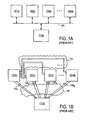
- FIG. 1a shows a depiction of a bus 120.
- a bus 120 is a "shared medium" communication structure that is used to transport communications between electronic components 101a - 10Na and 110a.
- Shared medium means that the components 101a - 10Na and 110a that communicate with one another physically share and are connected to the same electronic wiring 120. That is, wiring 120 is a shared resource that is used by any of components 101a - 10Na and 110a to communicate with any other of components 101a - 10Na and 110a.
- component 101 a wished to communicate to component 10Na, component 101 a would send information along wiring 120 to component 10Na; if component 103a wished to communicate to component 110a, component 103a would send information along the same wiring 120 to component 110a, etc.
- bus 120 corresponds to a PCI bus where components 101a - 10Na correspond to "I/O" components (e.g., LAN networking adapter cards, MODEMs, hard disk storage devices, etc.) and component 110a corresponds to an I/O Control Hub (ICH).
- I/O I/O Control Hub
- bus 120 corresponds to a "front side" bus where components 101 a - 10Na correspond to microprocessors and component 110a corresponds to a memory controller.
- busses are less and less practical as computing system speeds grow. Basically, as the capacitive loading of any wiring increases, the maximum speed at which that wiring can transport information decreases. That is, there is an inverse relationship between a wiring's capacitive loading and that same wiring's speed. Each component that is added to a wire causes that wire's capacitive loading to grow. Thus, because busses typically couple multiple components, bus wiring 120 is typically regarded as being heavily loaded with capacitance.
- FIG. 1b shows a comparative example vis-à-vis Figure 1a .
- computing system components 101 a - 10Na and 110a are interconnected through a mesh 140 of high speed bi-directional point-to-point links 130 1 through 130 N .
- a bi-directional point-to-point link typically comprises a first unidirectional point-to-point link that transmits information in a first direction and a second unidirectional point-to-point link that transmits information is a second direction that is opposite that of the first direction. Because a unidirectional point-to-point link typically has a single endpoint, its capacitive loading is substantially less than that of a shared media bus.
- Each point-to-point link can be constructed with copper or fiber optic cabling and appropriate drivers and receivers (e.g., single or differential line drivers and receivers for copper based cables; and LASER or LED E/O transmitters and O/E receivers for fiber optic cables;, etc.).
- the mesh 140 observed in Figure 1b is simplistic in that each component is connected by a point-to-point link to every other component. In more complicated schemes, the mesh 140 is a network having routing/switching nodes. Here, every component need not be coupled by a point-to-point link to every other component instead, hops across a plurality of links may take place through routing/switching nodes in order to transport information from a source component to a destination component.
- the routing/switching function may be a stand alone function within the mesh network or may be integrated into a substantive component of the computing system (e.g., processor, memory controller, I/O unit, etc.).
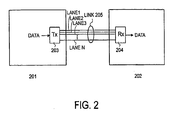
- Figure 2 shows a "zoom-in" of a type of uni-directional point-to-point link that may be referred to as a "multi-lane" uni-directional point-to-point link.
- a multi-lane uni-directional point-to-point link includes a plurality of serial channels referred to as "lanes".
- component 201 may be viewed as a first component within a link-based computing system and component 202 may be viewed as a second component within a link-based computing system.
- the observed unidirectional point-to-point link between them 205 includes N lanes LANE 1 through LANE N .
- Each lane is a serial channel that can be implemented as, for example, a differential signal line, a single-ended signal line or a fiber optic channel.
- transmitter 203 receives data to be transmitted over the link 205 to receiver 204.
- the receiver 204 would receive the eight bytes, ensure their alignment, and present the 8 byte word at its output (thus completing the transfer of the word from component 201 to 202).
- the lanes do not transport data from a same parallel word but instead are treated as separate individual communication lanes. For example, if lane 0 transmits as a first communication channel and lane 1 transmits as a second communication channel, the source of the data carried by lane 0 (e.g., that entity that sent the data to transmitter 203) would be different that the source of the data carried by lane 1.
- a problem is that the transmitter is apt to be designed with circuitry (such as a CMOS circuitry) that consumes increasingly more power as the speed of the lanes increase.
- circuitry such as a CMOS circuitry
- the present invention provides a method to control multilane point-to-point link transmission, a transmitter adapted for multilane point-to-point link transmission, a multilane point-to-point link including such a transmitter, and a computer system including such a multi-lane point-to-point link, all as set out in the appended claims.
- Figure 1a shows components interconnected through a bus
- Figure 1b shows components interconnected through a mesh of point-to-point links
- Figure 2 shows a multi lane unidirectional point-to-point link
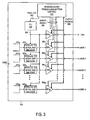
- Figure 3 shows a transmitter for a multi lane unidirectional point-to-point link having lane speed, the number of active lanes and the supply voltage as input parameters
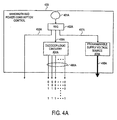
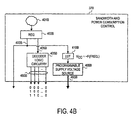
- Figures 4a - 4c show different implementations for effecting control of the three parameters described above with respect to Figure 3 .
- Figure 5 shows an exemplary model of a computing system using point-to-point links between an I/O control hub and I/O devices
- Figure 3 shows a transmitter design 303 for a multi-lane uni-directional point-to-point link that provides for variable control over three variables that together determine the transmitter's power consumption and bandwidth: 1) lane speed; 2) the number of active lanes; and, 3) supply voltage.
- the bandwidth of the transmitter should be understood to mean the bandwidth of the multi-lane unidirectional point-to-point link; which, in turn, is the lane speed factored by the number of active lanes.
- the transmitter can be configured to operate at an appropriate bandwidth with reduced power consumption.
- these programmable parameters might be used to provide for acceptable bandwidth and reduced power consumption, however, a discussion of the design of the transmitter 303 of Figure 3 will first be provided.
- each lane has a queue that queues parallel bits of information; where, each unit of parallel bits of information may be referred to as "word".
- word each unit of parallel bits of information
- each queue would receive one of these different bytes and each different byte would be referred to as a word (e.g., queue 310 1 would receive a first word/byte, queue 310 2 would receive a second word/byte, etc.).
- the circuitry that feeds the lane input queues 310 is not shown in Figure 3 .
- Each enqueued word is removed from its queue and processed by a parallel to serial and encoding block along each lane (i.e., the word removed from queue 310 1 is processed by parallel to serial and encoding block 320 1 ; the word removed from queue 3102 is processed by parallel to serial and encoding block 320 2 ; etc.).
- a parallel to serial and encoding block performs two functions: 1) parallel to serial conversion; and, 2) serial encoding.
- Parallel to serial conversion is the process of converting word into a serial bit stream. For example, again continuing with the example where the lane word size is one byte, the corresponding parallel to serial conversion would convert each byte from the queue into an 8 bit serial stream.
- Serial encoding is a process that attempts to reduce the probability of data corruptions stemming from specific data patterns and the manner in which these specific data patterns are processed at the receiving end of the lane.
- Various forms of serial encoding techniques exist such as 4B/5B and 8B/10B.
- lane speed is determined from the rate at which bits present themselves along the serial bit stream that is created by the parallel to serial conversion process (and, typically, the serial encoding technique as well). Because the serial to parallel and serial encoding circuitry is timed by a clock signal, the above described rate is a function of the frequency of the clock signal.
- the clock signal is generated by a phase lock loop (PLL) circuit 340 and is presented to each of the parallel to serial and encoding blocks 320 1 through 320 N (along trace 350 as depicted in Figure 3 ).
- PLL phase lock loop
- the PLL circuit 340 includes an input 360 for setting the frequency of the PLL output clock signal.
- input 360 flows to the PLL's feedback divider to set the PLL's frequency multiplication of its input oscillation frequency.
- input 360 sets the PLL input oscillation frequency outright (e.g., by multiplexing in signals from different input oscillators, or using an input oscillator capable of configurable oscillation frequency).
- circuitry 320 can be viewed as simply being a parallel to serial block that includes parallel to serial circuitry (e.g., a parallel to serial converter).
- the second of the three configurable parameters is the number of active lanes.
- the encoded serial bit stream that is created along each active lane is sent to a driver circuit (e.g., the encoded serial bit stream produced by block 320 1 is sent to driver 330 1 , the encoded serial bit stream produced by block 320 2 is sent to driver 330 2 , etc.).
- a driver is: 1 ) an electronic circuit designed to drive an electronic bit stream over an extended distance; or, 2) an electro/optic transmitter that converts an electronic bit stream into light that is launched onto a fiber optic cable for transmission over an extended distance.
- Activation of a driver's enable input causes the driver to be “enabled” so as to perform its driving function.
- Inactivation of a driver's enable input causes the driver to "disabled” so as to be unable perform its driving function. Because the driver circuitry (and/or light source in the case of an electro/optic driver) is effectively turned off when the driver is disabled, the driver consumes significantly less power when it is disabled as compared to when it is enabled.
- the driver enable/disable lines 380 therefore control how many active lanes are to exist and, in so doing, also effect the power consumption of the overall transmitter 303.
- an enable line that flows to a particular lane driver may also be used to enable/disable the circuitry preceding the lane driver (e.g., the lane's parallel to serial and encoding block and/or the lane's queue). As such, for a fixed lane speed per lane, increasing the number of active lanes will increase transmitter power consumption as whole (because more circuitry will be "on").
- CMOS circuits increasing the lane speed of an active lane (by increasing the PLL output clock signal frequency) will also increase transmitter power consumption.
- the number of active lanes and the lane speed not only determines overall transmitter bandwidth (as discussed in detail at the beginning of this detailed description) - but also plays an important factor in determining the overall transmitter power consumption.
- power consumption is best kept low, particularly in the case of battery operated devices such as laptop computers (so as to extend operation life time under battery power).
- the transmitter design 303 depicted in Figure 3 which is capable of adjusting the lane speed and the number of active lanes, likewise enables a particular desired bandwidth to be configured that takes in account, with the hope of reducing, the transmitter's power consumption.
- a 100 Mb/s link may be configured with a single active lane that operates at a 100 Mb/s (i.e., the number of active lanes is reduced to the minimum value of one).
- lane speed and number of active drivers that reaches or at least approaches a minimal transmitter power consumption operating point for a particular link bandwidth can be determined by those of ordinary skill; and, moreover, is a function of the underlying technology (e.g., electric vs. electro-optic, CMOS vs. Bi-CMOS, 0.25 ⁇ m vs. 90nm, etc.). As such, a detailed discussion of how to determine the appropriate combination is not necessary nor practical for purposes of the present description.
- That potentially a wealth of different combinations can be set for any one bandwidth (e.g., for a 2 Gb/s link: one 2 Gb/s lane; or, two 1 Gb/s lanes; or, four 500 Mb/s lanes; or, eight 250 Mb/s lanes, etc.) so as to provide a spread of different power consumption operating points - at least one of which is at or closest to a theoretical minimal power consumption operating point for the transmitter (regardless of the transmitter's underlying technology) - is the main point of emphasis.
- any one bandwidth e.g., for a 2 Gb/s link: one 2 Gb/s lane; or, two 1 Gb/s lanes; or, four 500 Mb/s lanes; or, eight 250 Mb/s lanes, etc.
- a third programmable feature is the power consumption of the driver itself.
- the architecture of Figure 3 shows each of the drivers receiving a same supply voltage from a power bus 390.
- the supply voltage that is presented on power bus 390 can be any of 3.3v, 2.5, 1.8v or 1.3v.
- the power bus can be routed so as to supply the circuitry that precedes the driver for each lane. As such, the power consumption of each lane can be directly effected through adjustment of the supply voltage.
- the drivers are deliberately designed to have their own, higher supply voltage (as compared to the circuitry that precedes the drivers) for purposes of driving stronger signals over the lane to the receiver (i.e., the "load” that the driver must drive). Regardless, because lower supply voltage results in lower power consumption for most (if not all) electronic circuitry, the power consumption of each active lane can be further modulated through supply voltage adjustment.
- the minimum acceptable power supply voltage will be configured for the transmitter.
- the two most significant factors that can affect the minimum acceptable power supply voltage will be: 1) the lowest supply voltage that is rated for the underlying technology (e.g., 1.8v for a 0.25 ⁇ m CMOS process); 2) the size of the largest load that any one of the drivers is configured to drive in light of the lane speed.
- the supply voltage should not be set beneath the lowest rated supply voltage (unless consultation with process and/or transistor level design engineers and/or thorough modeling is undertaken).
- the size of the largest load is readily determinable by those of ordinary skill in light of various factors such as the length of the lane between the transmitter and receiver (e.g., "lane length") and whether or not the lane is implemented as a controlled impedance transmission line.
- lane length the length of the lane between the transmitter and receiver
- the larger the lane load and the higher the lane speed the larger the supply voltage needed to ensure data is acceptably received at the receiver end of the link.
- those of ordinary skill can determine the appropriate lane speed, number of active lanes and lane supply voltage tradeoffs that apply so as to configure a transmitter operating point that corresponds to a working operating point (amongst the possible working operating points) that is at or closest to a theoretically lowest power consuming, working, operating point.
- the transmitter design of Figure 3 is capable of adjusting transmitter power consumption for a particular link bandwidth with three parameters: lane speed, the number of active lanes, and lane power supply voltage for purposes.
- the function that determines each of these three parameters for a particular application is conveniently observed as a bandwidth and power consumption control unit 370.
- the "intelligence" of the bandwidth and power consumption control unit that actually determines the proper parameter set for the applicable environment may be implemented "on-the-fly" according to any of a wealth of different techniques such as execution of software, reference to a look-up table, processing through combinatorial logic circuitry, combinations of the above, etc.
- the proper combination can be pre-determined (e.g., by any of the techniques described above) and loaded into a system that uses the transmitter as part of the system's manufacture (e.g., loading the proper parameters into the BIOS ROM of a laptop computer).
- the transmitter parameters are configured in accordance with the system's factory settings.
- cloud 401 provides at least some initial information from which all the parameters for the particular environment are determined.
- cloud 401 can be effected through execution of software, reference to one or more look-up tables, processing through combinatorial logic circuitry, combinations of the above, etc.
- cloud 401 is apt to be embedded in the system that transmitter is a part of (e.g., a computing system or networking system).
- cloud 401 may be a non volatile read only memory that is loaded with appropriate information during manufacturing of the system (e.g., a computing system's BIOS ROM).
- Figure 4a corresponds to an embodiment where all three parameters are effectively provided and loaded into register space 402a.
- Register space is the area of one or more registers that can be loaded with information.
- a first portion 403a of the register's contents are used to set the PLL output clock frequency (i.e., corresponds to PLL input 360 of Figure 3 ).
- a second portion 406a of the register's contents describes the number of lanes that are to be activated.
- the register content describes the number of lanes to be activated in a binary format and decoder logic circuitry 404a converts the binary representation into a "one-hot encoded" format output 480a.
- the one-hot encoded format provides a bit for each lane where a first bit state (e.g., "1") signifies the corresponding lane is to be activated and a second bit state (e.g., "0") signifies the corresponding lane is to be de-activated.
- Each bit is routed to the lane that it corresponds to in order to control its activation.
- a third portion 407a of the register space content indicates the appropriate supply voltage (e.g., in binary format) which is then provided to a programmable supply voltage source 405.
- the second region 406b of the register space 402b that indicates the number of active drivers can be implemented as described above with a binary to one-hot decoder 405b.
- the PLL clock frequency and power supply voltage are related in a way that enables the supply voltage to be determined from a first region 403b of the register space 402b that determines the PLL output clock frequency.
- the first region 403b is as described above with respect to Figure 4a (i.e., it sets the PLL output clock frequency) but is also used to set the supply voltage.
- the information that determines the PLL output clock frequency is forwarded to a look-up table (LUT) 410 that determines the appropriate supply voltage in light of information provided from register space 403b.
- the look-up table 410 in response to this information, provides a parameter (e.g., a word) that describes the appropriate supply voltage.
- the programmable supply voltage 405b provides the appropriate supply voltage for the configured PLL output clock frequency.
- LUT 410 could be implemented with a non-volatile ROM or random access memory.
- LUT 410 could be implemented with combinatorial logic that calculates the correct supply voltage outright.
- Figure 4c is similar to that described above with respect to Figure 4b except that the PLL output clock frequency is set as a function of the appropriate supply voltage. That is, register space 402c provides a description of the number of drivers to be activated 406c (which is then decoded into one-hot format by decoder 404c); and, an indication of the proper power supply voltage 407c. In response to its receiving of the indication of the power supply voltage 407c, LUT 410c provides information 460 that sets the PLL's output clock frequency. Again, LUT 410 could be implemented with a non-volatile ROM or random access memory. Alternatively, LUT 410 could be implemented with combinatorial logic that calculates the correct supply voltage outright.
- the receive side of a link can similarly adjust power consumption for a particular bandwidth by adjusting at least the number of active lanes and/or the power supply voltage of each channel's receiver (and perhaps various receive channel circuitry that follows the receiver such as a decoder circuit followed by a serial to parallel circuit).
- the number of active lanes on the receiver side should match the number of active lanes on the transmitter side.
- Receiver side circuitry typically mirrors its transmitter side circuitry, thus, referring to Figure 3 , in one embodiment, the receive circuitry for each lane would include a receiver, followed by a serial to parallel and serial decoding circuitry, followed by a buffer.
- a programmable power supply would be coupled to the power supply input of each lane's receiver if not one or more elements of the receiver's follow-on circuitry.
- Each lane could be configured active or inactive as described with respect to the transmitter circuitry.
- the received clock from the transmitter side would be used to clock the lane's active channels.
- Figure 5 shows an embodiment of a computing system.
- the exemplary computing system of Figure 5 includes: 1) one or more processors 501; 2) a memory control hub (MCH) 502; 3) a system memory 503 (of which different types exist such as DDR RAM, EDO RAM, etc,); 4) a cache 504; 5) an I/O control hub (ICH) 505; 6) a graphics controller 506; 7) a display/screen 507 (of which different types exist such as Cathode Ray Tube (CRT), Thin Film Transistor (TFT), Liquid Crystal Display (LCD), DPL, etc.; 8) one or more I/O devices 508; 9) one or more data transmitters 509.
- CTR Cathode Ray Tube
- TFT Thin Film Transistor
- LCD Liquid Crystal Display
- the one or more processors 501 execute instructions in order to perform whatever software routines the computing system implements.
- the instructions frequently involve some sort of operation performed upon data.
- Both data and instructions are stored in system memory 503 and cache 504.
- Cache 504 is typically designed to have shorter latency times than system memory 503.
- cache 504 might be integrated onto the same silicon chip(s) as the processor(s) and/or constructed with faster SRAM cells whilst system memory 503 might be constructed with slower DRAM cells.
- System memory 503 is deliberately made available to other components within the computing system. For example, the data received from various interfaces to the computing system (e.g., keyboard and mouse, printer port, LAN port, modem port, etc.) or retrieved from an internal storage element of the computing system (e.g., hard disk drive) are often temporarily queued into system memory 503 prior to their being operated upon by the one or more processor(s) 501 in the implementation of a software program.
- various interfaces to the computing system e.g., keyboard and mouse, printer port, LAN port, modem port, etc.
- an internal storage element of the computing system e.g., hard disk drive
- ICH 505 is responsible for ensuring that such data is properly passed between the system memory 503 and its appropriate corresponding computing system interface (and internal storage device if the computing system is so designed).
- the MCH 502 is responsible for managing the various contending requests for system memory 503 access amongst the processor(s) 501, interfaces and internal storage elements that may proximately arise in time with respect to one another.
- I/O devices 508 are also implemented in a typical computing system. I/O devices generally are responsible for transferring data to and/or from the computing system (e.g., a networking adapter); or, for large scale non-volatile storage within the computing system (e.g., hard disk drive).
- ICH 505 has bi-directional point-to-point links between itself and each I/O device 508. In one embodiment, each bi-directional point-to-point link consists of two unidirectional lines where each line's direction is opposite from the other.
- a data transmitter 509 may be placed on the driving end of any point-to-point link (between each T/O device 508 and ICH 505).
Landscapes
- Engineering & Computer Science (AREA)
- Theoretical Computer Science (AREA)
- General Engineering & Computer Science (AREA)
- Physics & Mathematics (AREA)
- General Physics & Mathematics (AREA)
- Computer Hardware Design (AREA)
- Power Sources (AREA)
- Communication Control (AREA)
- Small-Scale Networks (AREA)
- Networks Using Active Elements (AREA)
Claims (17)
- Verfahren zum Steuern von mehrspuriger Punkt-zu-Punkt-Verbindungsübertragung, bei der elektronische Signale innerhalb von Schaltungen propagiert werden, die eine Übertragungseinrichtung (303) umfassen, um:eine Anzahl von Spuren der Übertragungseinrichtung auszuwählen, wobei jede Spur Parallel-zu-Seriell-Schaltungen (320) und serielle Kodierungsschaltungen (320) aufweist;eine Geschwindigkeit für jede der Spuren durch Setzen einer Frequenz eines Phasenregelschleifenausgabesignals (350) zu setzen, wobei die Anzahl und die Geschwindigkeit die Bandbreite der Übertragungseinrichtung bestimmen; undeine Betriebsversorgungsspannung (390) für jede der Spuren zu setzen; wodurchals eine Konsequenz des Auswahlvorgangs und der beiden Setzvorgänge in Abhängigkeit von einer Übertragungsrate der von der Übertragungseinrichtung verbrauchte Strom kleiner als der Strom ist, der von der Übertragungseinrichtung bei der Übertragungsrate verbraucht worden wäre, wenn eine andere verfügbare Kombination von Spurenanzahl, Spurgeschwindigkeit und Versorgungsspannung für die Übertragungseinrichtung gewählt worden wäre.
- Verfahren nach Anspruch 1, wobei der Auswahlvorgang und die beiden Setzvorgänge den geringsten Stromverbrauch für die Übertragungsrate unter allen verfügbaren Kombinationen von Spurenanzahl, Spurengeschwindigkeit und Versorgungsspannung für die Übertragungseinrichtung aufweisen.
- Verfahren nach Anspruch 1, wobei die elektronischen Signale stromabwärts von einem Register (402) vorgesehen sind.
- Verfahren nach Anspruch 3, ferner umfassend das Ausführen einer Binär-zu-One-Hot-Kodierung aus vom Register (402) zur Verfügung gestellten Informationen, um die Anzahl von Spuren der Übertragungseinrichtung auszuwählen.
- Verfahren nach Anspruch 1, ferner umfassend das Setzen der Frequenz (350) des Phasenregelschleifenausgabesignals, um die Spurgeschwindigkeit zu setzen.
- Verfahren nach Anspruch 5, wobei die Frequenz (350) des Phasenregelschleifenausgabesignals eine Funktion der Versorgungsspannung ist.
- Verfahren nach Anspruch 1, wobei die Versorgungsspannung (390) eine Funktion der Frequenz (350) des Phasenregelschleifenausgabesignals ist.
- Übertragungseinrichtung, ausgelegt zur mehrspurigen Punkt-zu-Punkt-Übertragung, umfassend:a) eine Phasenregelschleifenschaltung (340) mit einer Eingabe (360), um eine Frequenz eines Ausgabesignals (350) der Phasenregelschleife zu justieren;b) eine Spurenschaltung für jede von mehreren Spuren, wobei jede Spur aufweist:(i) Parallel-zu-Seriell-Schaltungen (320) stromabwärts von einer Taktsignalausgabe der Phasenregelschleifenschaltung;(ii) einen Einschalt-/Ausschalteingabeknoten (380) zum Aktivieren/Deaktivieren der entsprechenden Spur der Spurenschaltung;(iii) eine Betriebseinrichtung (330), die unterhalb der seriellen Kodierungsschleifen verbunden ist; und(c) eine programmierbare Versorgungsspannungsquelle (490), die mindestens mit der Betriebseinrichtung von jeder Spurenschaltung verbunden ist; wobei
die Phasenregelschleifenschaltungseingabe (360), der Einschalt-/Ausschalteingabeknoten (380) jeder Spurenschaltung und die programmierbare Versorgungsspannungsquelle (490) jeweils dafür sorgen, dass die Spurgeschwindigkeit der Übertragungseinrichtung, die Anzahl von Spuren und die Spannungsversorgung der Spurenbetriebseinrichtung auf der Grundlage einer Rate, mit der die Übertragungseinrichtung Informationen übertragen soll, gesetzt werden, um so den Stromverbrauch der Übertragungseinrichtung während der Informationsübertragung bei der Rate zu minimieren oder zumindest zu verringern. - Übertragungseinrichtung nach Anspruch 8, ferner umfassend Steuerschaltungen (370) für Bandbreite und Stromverbrauch, die mit der Phasenregelschleifenschaltung (340) der programmierbaren Versorgungsspannungsquelle (405) und dem Einschalt-/Ausschalteingabeknoten (380) jeder Spurenschaltung verbunden sind.
- Übertragungseinrichtung nach Anspruch 9, wobei die Steuerschaltungen (370) für Bandbreite und Stromverbrauch ferner umfassen:ein Register (402), das umfasst:a) eine mit der Eingabe der Phasenregelschleifenschaltung verbundene erste Ausgabe (403);b) eine mit Dekodierungslogikschaltungen (406) verbundene zweite Ausgabe (406), wobei die Dekodierungslogikschaltungen Ausgabebitleitungen (480) aufweisen, die jeweils mit dem Einschalt-/Ausschalteingabeknoten jeder der Spurenschaltungen verbunden sind; undc) eine mit der programmierbaren Versorgungsspannungsquelle verbundene dritte Ausgabe (407).
- Übertragungseinrichtung nach Anspruch 9, wobei die Steuerschaltungen für Bandbreite und Stromverbrauch ferner umfassen:ein Register (402), das umfasst:eine sowohl mit der Phasenregelschleifenschaltung als auch Nachschlagetabellenschaltungen (410) verbundene erste Ausgabe (403) undeine mit einer Eingabe von Dekodierungslogikschaltungen (405) verbundene zweite Ausgabe (406), wobei die Dekodierungslogikschaltungen Ausgabebitleitungen (480) aufweisen, die jeweils mit dem Einschalt-/Ausschalteingabeknoten jeder Spurenschaltung verbunden sind.
- Übertragungseinrichtung nach Anspruch 11, wobei die Nachschlagetabellenschaltungen (410) ferner mit der programmierbaren Versorgungsspannungsquelle (405) verbunden sind.
- Übertragungseinrichtung nach Anspruch 9, wobei die Steuerschaltungen für Bandbreite und Stromverbrauch ferner umfassen:ein Register (402), das umfasst:eine sowohl mit der programmierbaren Übertragungsspannungsquelle als auch Nachschlagetabellenschaltungen verbundene erste Ausgabe (407) undeine mit einer Eingabe von Dekodierungslogikschaltungen verbundene zweite Ausgabe (406), wobei die Dekodierungslogikschaltungen Ausgabebitleitungen aufweisen, die jeweils mit dem Einschalt-/Ausschalteingabeknoten jeder Spurenschaltung verbunden sind.
- Mehrspurige Punkt-zu-Punkt-Verbindung, umfassend die Übertragungseinrichtung nach einem der Ansprüche 8 bis 13 und einer über mehrere Spuren mit der Übertragungseinrichtung verbundene Empfangseinrichtung.
- Mehrspurige Punkt-zu-Punkt-Verbindung nach Anspruch 14, wobei die Empfangseinrichtung eine programmierbare Stromversorgungsquelle und eine Einrichtung zum Justieren der Anzahl aktiver Spuren unter den mehreren Spuren umfasst und mit diesen verbunden ist.
- Computersystem, das die Übertragungseinrichtung nach einem der Ansprüche 8 bis 13 enthält.
- Computersystem nach Anspruch 16, umfassend:einen DDR-Systemspeicher (503);eine mit dem DDR-Systemspeicher verbundene Speichersteuerung (502);eine mit der Speichersteuerung verbundene Eingabe-/Ausgabesteuerung (505);eines oder mehrere Eingabe-/Ausgabegeräte (508) und Punkt-zu-Punkt-Verbindungen (509); undeinen oder mehrere jeweilige direkte mehrspurige Punkt-zu-Punkt-Verbindungen, die dazu ausgelegt sind, das eine oder die mehreren Eingabe-/Ausgabegeräte (508) mit der Eingabe-/Ausgabe-Steuerung zu verbinden; wobei
wenigstens eine der mehrspurigen Punkt-zu-Punkt-Verbindungen eine mehrspurige Punkt-zu-Punkt-Verbindung nach einem der vorhergehenden Ansprüche 14 oder 15 ist.
Applications Claiming Priority (2)
| Application Number | Priority Date | Filing Date | Title |
|---|---|---|---|
| US10/882,544 US7197591B2 (en) | 2004-06-30 | 2004-06-30 | Dynamic lane, voltage and frequency adjustment for serial interconnect |
| PCT/US2005/022976 WO2006004781A2 (en) | 2004-06-30 | 2005-06-27 | Dynamic lane, voltage and frequency adjustment for serial interconnect |
Publications (2)
| Publication Number | Publication Date |
|---|---|
| EP1761859A2 EP1761859A2 (de) | 2007-03-14 |
| EP1761859B1 true EP1761859B1 (de) | 2010-01-27 |
Family
ID=34973024
Family Applications (1)
| Application Number | Title | Priority Date | Filing Date |
|---|---|---|---|
| EP05763841A Expired - Lifetime EP1761859B1 (de) | 2004-06-30 | 2005-06-27 | Dynamische spur, spannungs- und frequenzeinstellung für serielle verbindung |
Country Status (7)
| Country | Link |
|---|---|
| US (2) | US7197591B2 (de) |
| EP (1) | EP1761859B1 (de) |
| CN (1) | CN100592275C (de) |
| AT (1) | ATE456831T1 (de) |
| DE (1) | DE602005019160D1 (de) |
| TW (1) | TWI294591B (de) |
| WO (1) | WO2006004781A2 (de) |
Families Citing this family (50)
| Publication number | Priority date | Publication date | Assignee | Title |
|---|---|---|---|---|
| US7571287B2 (en) | 2003-03-13 | 2009-08-04 | Marvell World Trade Ltd. | Multiport memory architecture, devices and systems including the same, and methods of using the same |
| US7136953B1 (en) * | 2003-05-07 | 2006-11-14 | Nvidia Corporation | Apparatus, system, and method for bus link width optimization |
| US7426597B1 (en) | 2003-05-07 | 2008-09-16 | Nvidia Corporation | Apparatus, system, and method for bus link width optimization of a graphics system |
| US7469311B1 (en) | 2003-05-07 | 2008-12-23 | Nvidia Corporation | Asymmetrical bus |
| US8046488B2 (en) * | 2004-05-21 | 2011-10-25 | Intel Corporation | Dynamically modulating link width |
| US7197591B2 (en) * | 2004-06-30 | 2007-03-27 | Intel Corporation | Dynamic lane, voltage and frequency adjustment for serial interconnect |
| US7694060B2 (en) * | 2005-06-17 | 2010-04-06 | Intel Corporation | Systems with variable link widths based on estimated activity levels |
| US7366817B2 (en) * | 2005-06-29 | 2008-04-29 | Intel Corporation | Frame order processing apparatus, systems, and methods |
| US7797463B2 (en) * | 2005-06-30 | 2010-09-14 | Intel Corporation | Hardware assisted receive channel frame handling via data offset comparison in SAS SSP wide port applications |
| KR100643606B1 (ko) * | 2005-08-12 | 2006-11-10 | 삼성전자주식회사 | 저전압 차동 신호 송신기의 프리앰퍼시스 장치 및 방법 |
| US7536490B2 (en) * | 2006-07-20 | 2009-05-19 | Via Technologies, Inc. | Method for link bandwidth management |
| US7660925B2 (en) * | 2007-04-17 | 2010-02-09 | International Business Machines Corporation | Balancing PCI-express bandwidth |
| US8234425B1 (en) | 2007-06-27 | 2012-07-31 | Marvell International Ltd. | Arbiter module |
| US7949817B1 (en) * | 2007-07-31 | 2011-05-24 | Marvell International Ltd. | Adaptive bus profiler |
| US8090969B2 (en) * | 2007-08-29 | 2012-01-03 | Ati Technologies Ulc | Method and apparatus for managing power consumption relating to a differential serial communication link |
| US7653773B2 (en) * | 2007-10-03 | 2010-01-26 | International Business Machines Corporation | Dynamically balancing bus bandwidth |
| US7809869B2 (en) * | 2007-12-20 | 2010-10-05 | International Business Machines Corporation | Throttling a point-to-point, serial input/output expansion subsystem within a computing system |
| US8131915B1 (en) | 2008-04-11 | 2012-03-06 | Marvell Intentional Ltd. | Modifying or overwriting data stored in flash memory |
| US8683085B1 (en) | 2008-05-06 | 2014-03-25 | Marvell International Ltd. | USB interface configurable for host or device mode |
| US8423710B1 (en) | 2009-03-23 | 2013-04-16 | Marvell International Ltd. | Sequential writes to flash memory |
| US8213236B1 (en) | 2009-04-21 | 2012-07-03 | Marvell International Ltd. | Flash memory |
| US20110173352A1 (en) * | 2010-01-13 | 2011-07-14 | Mellanox Technologies Ltd | Power Reduction on Idle Communication Lanes |
| US8688922B1 (en) | 2010-03-11 | 2014-04-01 | Marvell International Ltd | Hardware-supported memory management |
| US8572426B2 (en) | 2010-05-27 | 2013-10-29 | National Semiconductor Corporation | Hardware performance monitor (HPM) with extended resolution for adaptive voltage scaling (AVS) systems |
| US8756394B1 (en) | 2010-07-07 | 2014-06-17 | Marvell International Ltd. | Multi-dimension memory timing tuner |
| US8762760B2 (en) | 2010-09-14 | 2014-06-24 | Xilinx, Inc. | Method and apparatus for adaptive power control in a multi-lane communication channel |
| US8539132B2 (en) * | 2011-05-16 | 2013-09-17 | Qualcomm Innovation Center, Inc. | Method and system for dynamically managing a bus of a portable computing device |
| US8868955B2 (en) | 2011-07-01 | 2014-10-21 | Intel Corporation | Enhanced interconnect link width modulation for power savings |
| EP2685760B1 (de) * | 2011-07-27 | 2018-04-04 | Huawei Technologies Co., Ltd. | Vorrichtung, verbindungenergieverwaltungsverfahren und verbindungsenergieverwaltungssystem pci-express |
| US9929972B2 (en) * | 2011-12-16 | 2018-03-27 | Qualcomm Incorporated | System and method of sending data via a plurality of data lines on a bus |
| WO2013095422A1 (en) * | 2011-12-21 | 2013-06-27 | Intel Corporation | Dynamic link width adjustment |
| TW201349166A (zh) * | 2012-05-28 | 2013-12-01 | Hon Hai Prec Ind Co Ltd | 匯流排帶寬調整方法及系統 |
| US9043526B2 (en) * | 2012-06-20 | 2015-05-26 | International Business Machines Corporation | Versatile lane configuration using a PCIe PIe-8 interface |
| US9053244B2 (en) | 2012-06-28 | 2015-06-09 | Intel Corporation | Utilization-aware low-overhead link-width modulation for power reduction in interconnects |
| US9183171B2 (en) | 2012-09-29 | 2015-11-10 | Intel Corporation | Fast deskew when exiting low-power partial-width high speed link state |
| US9820229B2 (en) * | 2013-04-05 | 2017-11-14 | Qualcomm Incorporated | Dynamic voltage and frequency scaling in wireless modems |
| CN105593821B (zh) * | 2013-10-28 | 2018-04-06 | 英特尔公司 | 用于使用双电压数据传输的网格性能改善的方法、系统和装置 |
| US9904652B2 (en) * | 2013-11-14 | 2018-02-27 | Qualcomm Incorporated | System and method of sending data via additional secondary data lines on a bus |
| US10509761B2 (en) | 2013-11-14 | 2019-12-17 | Qualcomm Incorporated | System and method of sending data via additional secondary data lines on a bus |
| KR101867435B1 (ko) | 2014-03-20 | 2018-07-23 | 인텔 코포레이션 | 링크 인터페이스의 미사용 하드웨어의 전력 소모를 제어하는 방법, 장치, 및 시스템 |
| US20170251431A1 (en) * | 2014-10-03 | 2017-08-31 | Newtrax Holdings Inc. | Power Management of High-Bandwidth Wireless Mesh Network |
| CN107131921B (zh) * | 2016-02-26 | 2020-12-11 | 高准公司 | 用于计量电子器件的低功率模式 |
| US20170280385A1 (en) * | 2016-03-23 | 2017-09-28 | Qualcomm Incorporated | Link speed control systems for power optimization |
| US10412673B2 (en) | 2017-05-28 | 2019-09-10 | Mellanox Technologies Tlv Ltd. | Power-efficient activation of multi-lane ports in a network element |
| US10261923B2 (en) * | 2017-07-26 | 2019-04-16 | Intel Corporation | Configurable interconnect apparatus and method |
| US11188494B2 (en) | 2019-05-21 | 2021-11-30 | Google Llc | Asymmetric data communication for host-device interface |
| US11815976B2 (en) * | 2019-05-22 | 2023-11-14 | Qualcomm Incorporated | Bandwidth based power management for peripheral component interconnect express devices |
| US12190845B2 (en) | 2022-02-15 | 2025-01-07 | Samsung Display Co., Ltd. | Processor and electronic device including the same |
| JP2024014337A (ja) * | 2022-07-22 | 2024-02-01 | キオクシア株式会社 | メモリシステム |
| WO2026024638A1 (en) * | 2024-07-22 | 2026-01-29 | Apple Inc. | Bandwidth management of a serial interface |
Family Cites Families (18)
| Publication number | Priority date | Publication date | Assignee | Title |
|---|---|---|---|---|
| AU650242B2 (en) | 1989-11-28 | 1994-06-16 | International Business Machines Corporation | Methods and apparatus for dynamically managing input/output (I/O) connectivity |
| US5926049A (en) | 1997-04-11 | 1999-07-20 | Level One Communications, Inc. | Low power CMOS line driver with dynamic biasing |
| US6378018B1 (en) | 1997-10-10 | 2002-04-23 | Intel Corporation | Memory device and system including a low power interface |
| US6091300A (en) * | 1997-10-20 | 2000-07-18 | Lucent Technologies, Inc. | Method and apparatus for adjusting the input common mode voltage of a differential amplifier |
| US6369624B1 (en) * | 1998-11-03 | 2002-04-09 | Altera Corporation | Programmable phase shift circuitry |
| US6642758B1 (en) * | 1998-11-03 | 2003-11-04 | Altera Corporation | Voltage, temperature, and process independent programmable phase shift for PLL |
| US6366768B1 (en) | 1998-11-09 | 2002-04-02 | Motorola, Inc. | Circuit and method of frequency synthesizer control with a serial peripheral interface |
| US6347850B1 (en) | 1999-12-23 | 2002-02-19 | Intel Corporation | Programmable buffer circuit |
| US7032119B2 (en) * | 2000-09-27 | 2006-04-18 | Amphus, Inc. | Dynamic power and workload management for multi-server system |
| SE0004832L (sv) | 2000-12-22 | 2002-02-26 | Ericsson Telefon Ab L M | Digitalt bussystem |
| US6633178B2 (en) | 2001-09-28 | 2003-10-14 | Intel Corporation | Apparatus and method for power efficient line driver |
| US6975098B2 (en) * | 2002-01-31 | 2005-12-13 | Vlt, Inc. | Factorized power architecture with point of load sine amplitude converters |
| TW583571B (en) | 2002-06-18 | 2004-04-11 | Etoms Electronics Corp | Noise protection method and system of serial peripheral interface |
| US7093140B2 (en) | 2002-06-28 | 2006-08-15 | Intel Corporation | Method and apparatus for configuring a voltage regulator based on current information |
| US6885209B2 (en) * | 2002-08-21 | 2005-04-26 | Intel Corporation | Device testing |
| CN1784842B (zh) * | 2003-05-08 | 2010-04-14 | 斯欧普迪克尔股份有限公司 | 高速、硅基电-光调制器 |
| US8046488B2 (en) | 2004-05-21 | 2011-10-25 | Intel Corporation | Dynamically modulating link width |
| US7197591B2 (en) * | 2004-06-30 | 2007-03-27 | Intel Corporation | Dynamic lane, voltage and frequency adjustment for serial interconnect |
-
2004
- 2004-06-30 US US10/882,544 patent/US7197591B2/en not_active Expired - Fee Related
-
2005
- 2005-06-27 WO PCT/US2005/022976 patent/WO2006004781A2/en not_active Ceased
- 2005-06-27 CN CN200580021292A patent/CN100592275C/zh not_active Expired - Fee Related
- 2005-06-27 DE DE602005019160T patent/DE602005019160D1/de not_active Expired - Lifetime
- 2005-06-27 EP EP05763841A patent/EP1761859B1/de not_active Expired - Lifetime
- 2005-06-27 AT AT05763841T patent/ATE456831T1/de not_active IP Right Cessation
- 2005-06-29 TW TW094121906A patent/TWI294591B/zh not_active IP Right Cessation
-
2006
- 2006-08-23 US US11/509,131 patent/US7426598B2/en not_active Expired - Fee Related
Also Published As
| Publication number | Publication date |
|---|---|
| TWI294591B (en) | 2008-03-11 |
| ATE456831T1 (de) | 2010-02-15 |
| US7426598B2 (en) | 2008-09-16 |
| EP1761859A2 (de) | 2007-03-14 |
| US20060015761A1 (en) | 2006-01-19 |
| WO2006004781A3 (en) | 2006-06-01 |
| WO2006004781A2 (en) | 2006-01-12 |
| TW200614078A (en) | 2006-05-01 |
| DE602005019160D1 (de) | 2010-03-18 |
| US20060285553A1 (en) | 2006-12-21 |
| US7197591B2 (en) | 2007-03-27 |
| CN100592275C (zh) | 2010-02-24 |
| CN1977255A (zh) | 2007-06-06 |
Similar Documents
| Publication | Publication Date | Title |
|---|---|---|
| US7197591B2 (en) | Dynamic lane, voltage and frequency adjustment for serial interconnect | |
| US20250251776A1 (en) | Dynamically changing data access bandwidth by selectively enabling and disabling data links | |
| EP1716474B1 (de) | Adaptive zuteilung von e/a-bandbreite unter verwendung einer konfigurierbaren verbindungstopologie | |
| US7490209B1 (en) | Fully buffered DIMM system and method with hard-IP memory controller and soft-IP frequency controller | |
| US20090094476A1 (en) | Deriving clocks in a memory system | |
| US20020156953A1 (en) | Dynamic bus inversion method | |
| KR20080047998A (ko) | 장치, 장치를 전력 절감 모드로 스위칭하는 방법, 메모리시스템, 메모리 모듈 및 컴퓨터 판독가능한 기록 매체 | |
| US10911345B2 (en) | System and method for link based computing system having automatically adjustable bandwidth and corresponding power consumption | |
| US20070174344A1 (en) | Rate control of flow control updates | |
| US9444509B2 (en) | Non-blocking power management for on-package input/output architectures | |
| US7818546B2 (en) | Pipeline processing communicating adjacent stages and controls to prevent the address information from being overwritten | |
| US12425974B2 (en) | Power and temperature driven bandwidth throttling using delay insertion | |
| US7698482B2 (en) | Multiple data rates in integrated circuit device serial interface | |
| US9390775B2 (en) | Reference voltage setting circuit and method for data channel in memory system | |
| US20230131938A1 (en) | Techniques For Accessing Memory Circuits | |
| US10417148B2 (en) | Bus system and bus traffic control apparatus for controlling the same | |
| US20250306658A1 (en) | Power management message aggregation | |
| Arsid | The Future Of Next-Generation HPC At Scale: The Transformative Impact Of PCI Express 8.0 |
Legal Events
| Date | Code | Title | Description |
|---|---|---|---|
| PUAI | Public reference made under article 153(3) epc to a published international application that has entered the european phase |
Free format text: ORIGINAL CODE: 0009012 |
|
| 17P | Request for examination filed |
Effective date: 20070122 |
|
| AK | Designated contracting states |
Kind code of ref document: A2 Designated state(s): AT BE BG CH CY CZ DE DK EE ES FI FR GB GR HU IE IS IT LI LT LU MC NL PL PT RO SE SI SK TR |
|
| DAX | Request for extension of the european patent (deleted) | ||
| 17Q | First examination report despatched |
Effective date: 20070905 |
|
| GRAP | Despatch of communication of intention to grant a patent |
Free format text: ORIGINAL CODE: EPIDOSNIGR1 |
|
| GRAS | Grant fee paid |
Free format text: ORIGINAL CODE: EPIDOSNIGR3 |
|
| GRAA | (expected) grant |
Free format text: ORIGINAL CODE: 0009210 |
|
| AK | Designated contracting states |
Kind code of ref document: B1 Designated state(s): AT BE BG CH CY CZ DE DK EE ES FI FR GB GR HU IE IS IT LI LT LU MC NL PL PT RO SE SI SK TR |
|
| REG | Reference to a national code |
Ref country code: GB Ref legal event code: FG4D |
|
| REG | Reference to a national code |
Ref country code: CH Ref legal event code: EP |
|
| REG | Reference to a national code |
Ref country code: IE Ref legal event code: FG4D |
|
| REF | Corresponds to: |
Ref document number: 602005019160 Country of ref document: DE Date of ref document: 20100318 Kind code of ref document: P |
|
| REG | Reference to a national code |
Ref country code: DE Ref legal event code: R096 Ref document number: 602005019160 Country of ref document: DE Effective date: 20100318 |
|
| REG | Reference to a national code |
Ref country code: NL Ref legal event code: VDEP Effective date: 20100127 |
|
| LTIE | Lt: invalidation of european patent or patent extension |
Effective date: 20100127 |
|
| PG25 | Lapsed in a contracting state [announced via postgrant information from national office to epo] |
Ref country code: AT Free format text: LAPSE BECAUSE OF FAILURE TO SUBMIT A TRANSLATION OF THE DESCRIPTION OR TO PAY THE FEE WITHIN THE PRESCRIBED TIME-LIMIT Effective date: 20100127 |
|
| PG25 | Lapsed in a contracting state [announced via postgrant information from national office to epo] |
Ref country code: IS Free format text: LAPSE BECAUSE OF FAILURE TO SUBMIT A TRANSLATION OF THE DESCRIPTION OR TO PAY THE FEE WITHIN THE PRESCRIBED TIME-LIMIT Effective date: 20100527 Ref country code: LT Free format text: LAPSE BECAUSE OF FAILURE TO SUBMIT A TRANSLATION OF THE DESCRIPTION OR TO PAY THE FEE WITHIN THE PRESCRIBED TIME-LIMIT Effective date: 20100127 Ref country code: PT Free format text: LAPSE BECAUSE OF FAILURE TO SUBMIT A TRANSLATION OF THE DESCRIPTION OR TO PAY THE FEE WITHIN THE PRESCRIBED TIME-LIMIT Effective date: 20100527 Ref country code: NL Free format text: LAPSE BECAUSE OF FAILURE TO SUBMIT A TRANSLATION OF THE DESCRIPTION OR TO PAY THE FEE WITHIN THE PRESCRIBED TIME-LIMIT Effective date: 20100127 Ref country code: ES Free format text: LAPSE BECAUSE OF FAILURE TO SUBMIT A TRANSLATION OF THE DESCRIPTION OR TO PAY THE FEE WITHIN THE PRESCRIBED TIME-LIMIT Effective date: 20100508 |
|
| PG25 | Lapsed in a contracting state [announced via postgrant information from national office to epo] |
Ref country code: PL Free format text: LAPSE BECAUSE OF FAILURE TO SUBMIT A TRANSLATION OF THE DESCRIPTION OR TO PAY THE FEE WITHIN THE PRESCRIBED TIME-LIMIT Effective date: 20100127 Ref country code: SI Free format text: LAPSE BECAUSE OF FAILURE TO SUBMIT A TRANSLATION OF THE DESCRIPTION OR TO PAY THE FEE WITHIN THE PRESCRIBED TIME-LIMIT Effective date: 20100127 Ref country code: FI Free format text: LAPSE BECAUSE OF FAILURE TO SUBMIT A TRANSLATION OF THE DESCRIPTION OR TO PAY THE FEE WITHIN THE PRESCRIBED TIME-LIMIT Effective date: 20100127 |
|
| PG25 | Lapsed in a contracting state [announced via postgrant information from national office to epo] |
Ref country code: RO Free format text: LAPSE BECAUSE OF FAILURE TO SUBMIT A TRANSLATION OF THE DESCRIPTION OR TO PAY THE FEE WITHIN THE PRESCRIBED TIME-LIMIT Effective date: 20100127 Ref country code: GR Free format text: LAPSE BECAUSE OF FAILURE TO SUBMIT A TRANSLATION OF THE DESCRIPTION OR TO PAY THE FEE WITHIN THE PRESCRIBED TIME-LIMIT Effective date: 20100428 Ref country code: EE Free format text: LAPSE BECAUSE OF FAILURE TO SUBMIT A TRANSLATION OF THE DESCRIPTION OR TO PAY THE FEE WITHIN THE PRESCRIBED TIME-LIMIT Effective date: 20100127 Ref country code: CY Free format text: LAPSE BECAUSE OF FAILURE TO SUBMIT A TRANSLATION OF THE DESCRIPTION OR TO PAY THE FEE WITHIN THE PRESCRIBED TIME-LIMIT Effective date: 20100127 Ref country code: BE Free format text: LAPSE BECAUSE OF FAILURE TO SUBMIT A TRANSLATION OF THE DESCRIPTION OR TO PAY THE FEE WITHIN THE PRESCRIBED TIME-LIMIT Effective date: 20100127 Ref country code: SE Free format text: LAPSE BECAUSE OF FAILURE TO SUBMIT A TRANSLATION OF THE DESCRIPTION OR TO PAY THE FEE WITHIN THE PRESCRIBED TIME-LIMIT Effective date: 20100127 |
|
| PG25 | Lapsed in a contracting state [announced via postgrant information from national office to epo] |
Ref country code: CZ Free format text: LAPSE BECAUSE OF FAILURE TO SUBMIT A TRANSLATION OF THE DESCRIPTION OR TO PAY THE FEE WITHIN THE PRESCRIBED TIME-LIMIT Effective date: 20100127 Ref country code: BG Free format text: LAPSE BECAUSE OF FAILURE TO SUBMIT A TRANSLATION OF THE DESCRIPTION OR TO PAY THE FEE WITHIN THE PRESCRIBED TIME-LIMIT Effective date: 20100427 Ref country code: SK Free format text: LAPSE BECAUSE OF FAILURE TO SUBMIT A TRANSLATION OF THE DESCRIPTION OR TO PAY THE FEE WITHIN THE PRESCRIBED TIME-LIMIT Effective date: 20100127 |
|
| PLBE | No opposition filed within time limit |
Free format text: ORIGINAL CODE: 0009261 |
|
| STAA | Information on the status of an ep patent application or granted ep patent |
Free format text: STATUS: NO OPPOSITION FILED WITHIN TIME LIMIT |
|
| 26N | No opposition filed |
Effective date: 20101028 |
|
| PG25 | Lapsed in a contracting state [announced via postgrant information from national office to epo] |
Ref country code: MC Free format text: LAPSE BECAUSE OF NON-PAYMENT OF DUE FEES Effective date: 20100630 Ref country code: DK Free format text: LAPSE BECAUSE OF FAILURE TO SUBMIT A TRANSLATION OF THE DESCRIPTION OR TO PAY THE FEE WITHIN THE PRESCRIBED TIME-LIMIT Effective date: 20100127 |
|
| REG | Reference to a national code |
Ref country code: CH Ref legal event code: PL |
|
| REG | Reference to a national code |
Ref country code: DE Ref legal event code: R097 Ref document number: 602005019160 Country of ref document: DE Effective date: 20101028 |
|
| REG | Reference to a national code |
Ref country code: FR Ref legal event code: ST Effective date: 20110228 |
|
| PG25 | Lapsed in a contracting state [announced via postgrant information from national office to epo] |
Ref country code: IT Free format text: LAPSE BECAUSE OF FAILURE TO SUBMIT A TRANSLATION OF THE DESCRIPTION OR TO PAY THE FEE WITHIN THE PRESCRIBED TIME-LIMIT Effective date: 20100127 |
|
| PG25 | Lapsed in a contracting state [announced via postgrant information from national office to epo] |
Ref country code: LI Free format text: LAPSE BECAUSE OF NON-PAYMENT OF DUE FEES Effective date: 20100630 Ref country code: IE Free format text: LAPSE BECAUSE OF NON-PAYMENT OF DUE FEES Effective date: 20100627 Ref country code: CH Free format text: LAPSE BECAUSE OF NON-PAYMENT OF DUE FEES Effective date: 20100630 |
|
| PG25 | Lapsed in a contracting state [announced via postgrant information from national office to epo] |
Ref country code: FR Free format text: LAPSE BECAUSE OF NON-PAYMENT OF DUE FEES Effective date: 20100630 |
|
| PG25 | Lapsed in a contracting state [announced via postgrant information from national office to epo] |
Ref country code: LU Free format text: LAPSE BECAUSE OF NON-PAYMENT OF DUE FEES Effective date: 20100627 Ref country code: HU Free format text: LAPSE BECAUSE OF FAILURE TO SUBMIT A TRANSLATION OF THE DESCRIPTION OR TO PAY THE FEE WITHIN THE PRESCRIBED TIME-LIMIT Effective date: 20100728 |
|
| PG25 | Lapsed in a contracting state [announced via postgrant information from national office to epo] |
Ref country code: TR Free format text: LAPSE BECAUSE OF FAILURE TO SUBMIT A TRANSLATION OF THE DESCRIPTION OR TO PAY THE FEE WITHIN THE PRESCRIBED TIME-LIMIT Effective date: 20100127 |
|
| PGFP | Annual fee paid to national office [announced via postgrant information from national office to epo] |
Ref country code: DE Payment date: 20200617 Year of fee payment: 16 |
|
| REG | Reference to a national code |
Ref country code: DE Ref legal event code: R119 Ref document number: 602005019160 Country of ref document: DE |
|
| PG25 | Lapsed in a contracting state [announced via postgrant information from national office to epo] |
Ref country code: DE Free format text: LAPSE BECAUSE OF NON-PAYMENT OF DUE FEES Effective date: 20220101 |
|
| P01 | Opt-out of the competence of the unified patent court (upc) registered |
Effective date: 20230518 |
|
| PGFP | Annual fee paid to national office [announced via postgrant information from national office to epo] |
Ref country code: GB Payment date: 20230518 Year of fee payment: 19 |
|
| GBPC | Gb: european patent ceased through non-payment of renewal fee |
Effective date: 20240627 |
|
| PG25 | Lapsed in a contracting state [announced via postgrant information from national office to epo] |
Ref country code: GB Free format text: LAPSE BECAUSE OF NON-PAYMENT OF DUE FEES Effective date: 20240627 |