EP1760349A2 - Verfahren und Vorrichtung zur Ermittlung des Tastpunkts einer automatisierten Kupplung mittels der Positionsveränderung eines Elektromotors - Google Patents
Verfahren und Vorrichtung zur Ermittlung des Tastpunkts einer automatisierten Kupplung mittels der Positionsveränderung eines Elektromotors Download PDFInfo
- Publication number
- EP1760349A2 EP1760349A2 EP06026388A EP06026388A EP1760349A2 EP 1760349 A2 EP1760349 A2 EP 1760349A2 EP 06026388 A EP06026388 A EP 06026388A EP 06026388 A EP06026388 A EP 06026388A EP 1760349 A2 EP1760349 A2 EP 1760349A2
- Authority
- EP
- European Patent Office
- Prior art keywords
- clutch
- torque
- engine
- electric motor
- touch point
- Prior art date
- Legal status (The legal status is an assumption and is not a legal conclusion. Google has not performed a legal analysis and makes no representation as to the accuracy of the status listed.)
- Granted
Links
- 238000000034 method Methods 0.000 title abstract description 16
- 230000008859 change Effects 0.000 claims abstract description 20
- 238000012544 monitoring process Methods 0.000 claims abstract description 6
- 238000011156 evaluation Methods 0.000 claims description 8
- 230000004044 response Effects 0.000 claims description 3
- 230000006978 adaptation Effects 0.000 abstract description 11
- 230000005540 biological transmission Effects 0.000 description 9
- 238000005259 measurement Methods 0.000 description 7
- 238000006073 displacement reaction Methods 0.000 description 5
- 230000008878 coupling Effects 0.000 description 4
- 238000010168 coupling process Methods 0.000 description 4
- 238000005859 coupling reaction Methods 0.000 description 4
- 238000011161 development Methods 0.000 description 3
- 230000000694 effects Effects 0.000 description 3
- 230000008569 process Effects 0.000 description 3
- 230000001133 acceleration Effects 0.000 description 2
- 238000013459 approach Methods 0.000 description 2
- 230000008901 benefit Effects 0.000 description 2
- 238000012806 monitoring device Methods 0.000 description 2
- 238000012935 Averaging Methods 0.000 description 1
- 230000015572 biosynthetic process Effects 0.000 description 1
- 238000006243 chemical reaction Methods 0.000 description 1
- 238000001514 detection method Methods 0.000 description 1
- 230000007774 longterm Effects 0.000 description 1
- 238000004519 manufacturing process Methods 0.000 description 1
- 230000002277 temperature effect Effects 0.000 description 1
Images
Classifications
-
- F—MECHANICAL ENGINEERING; LIGHTING; HEATING; WEAPONS; BLASTING
- F16—ENGINEERING ELEMENTS AND UNITS; GENERAL MEASURES FOR PRODUCING AND MAINTAINING EFFECTIVE FUNCTIONING OF MACHINES OR INSTALLATIONS; THERMAL INSULATION IN GENERAL
- F16D—COUPLINGS FOR TRANSMITTING ROTATION; CLUTCHES; BRAKES
- F16D48/00—External control of clutches
- F16D48/06—Control by electric or electronic means, e.g. of fluid pressure
-
- B—PERFORMING OPERATIONS; TRANSPORTING
- B60—VEHICLES IN GENERAL
- B60W—CONJOINT CONTROL OF VEHICLE SUB-UNITS OF DIFFERENT TYPE OR DIFFERENT FUNCTION; CONTROL SYSTEMS SPECIALLY ADAPTED FOR HYBRID VEHICLES; ROAD VEHICLE DRIVE CONTROL SYSTEMS FOR PURPOSES NOT RELATED TO THE CONTROL OF A PARTICULAR SUB-UNIT
- B60W2540/00—Input parameters relating to occupants
- B60W2540/12—Brake pedal position
-
- F—MECHANICAL ENGINEERING; LIGHTING; HEATING; WEAPONS; BLASTING
- F16—ENGINEERING ELEMENTS AND UNITS; GENERAL MEASURES FOR PRODUCING AND MAINTAINING EFFECTIVE FUNCTIONING OF MACHINES OR INSTALLATIONS; THERMAL INSULATION IN GENERAL
- F16D—COUPLINGS FOR TRANSMITTING ROTATION; CLUTCHES; BRAKES
- F16D2500/00—External control of clutches by electric or electronic means
- F16D2500/10—System to be controlled
- F16D2500/104—Clutch
- F16D2500/10443—Clutch type
- F16D2500/10481—Automatic clutch, e.g. centrifugal masses
-
- F—MECHANICAL ENGINEERING; LIGHTING; HEATING; WEAPONS; BLASTING
- F16—ENGINEERING ELEMENTS AND UNITS; GENERAL MEASURES FOR PRODUCING AND MAINTAINING EFFECTIVE FUNCTIONING OF MACHINES OR INSTALLATIONS; THERMAL INSULATION IN GENERAL
- F16D—COUPLINGS FOR TRANSMITTING ROTATION; CLUTCHES; BRAKES
- F16D2500/00—External control of clutches by electric or electronic means
- F16D2500/30—Signal inputs
- F16D2500/306—Signal inputs from the engine
- F16D2500/3065—Torque of the engine
-
- F—MECHANICAL ENGINEERING; LIGHTING; HEATING; WEAPONS; BLASTING
- F16—ENGINEERING ELEMENTS AND UNITS; GENERAL MEASURES FOR PRODUCING AND MAINTAINING EFFECTIVE FUNCTIONING OF MACHINES OR INSTALLATIONS; THERMAL INSULATION IN GENERAL
- F16D—COUPLINGS FOR TRANSMITTING ROTATION; CLUTCHES; BRAKES
- F16D2500/00—External control of clutches by electric or electronic means
- F16D2500/30—Signal inputs
- F16D2500/308—Signal inputs from the transmission
- F16D2500/30806—Engaged transmission ratio
- F16D2500/30808—Detection of transmission in neutral
-
- F—MECHANICAL ENGINEERING; LIGHTING; HEATING; WEAPONS; BLASTING
- F16—ENGINEERING ELEMENTS AND UNITS; GENERAL MEASURES FOR PRODUCING AND MAINTAINING EFFECTIVE FUNCTIONING OF MACHINES OR INSTALLATIONS; THERMAL INSULATION IN GENERAL
- F16D—COUPLINGS FOR TRANSMITTING ROTATION; CLUTCHES; BRAKES
- F16D2500/00—External control of clutches by electric or electronic means
- F16D2500/30—Signal inputs
- F16D2500/314—Signal inputs from the user
- F16D2500/31406—Signal inputs from the user input from pedals
- F16D2500/31426—Brake pedal position
-
- F—MECHANICAL ENGINEERING; LIGHTING; HEATING; WEAPONS; BLASTING
- F16—ENGINEERING ELEMENTS AND UNITS; GENERAL MEASURES FOR PRODUCING AND MAINTAINING EFFECTIVE FUNCTIONING OF MACHINES OR INSTALLATIONS; THERMAL INSULATION IN GENERAL
- F16D—COUPLINGS FOR TRANSMITTING ROTATION; CLUTCHES; BRAKES
- F16D2500/00—External control of clutches by electric or electronic means
- F16D2500/30—Signal inputs
- F16D2500/314—Signal inputs from the user
- F16D2500/3146—Signal inputs from the user input from levers
- F16D2500/31473—Parking brake lever
-
- F—MECHANICAL ENGINEERING; LIGHTING; HEATING; WEAPONS; BLASTING
- F16—ENGINEERING ELEMENTS AND UNITS; GENERAL MEASURES FOR PRODUCING AND MAINTAINING EFFECTIVE FUNCTIONING OF MACHINES OR INSTALLATIONS; THERMAL INSULATION IN GENERAL
- F16D—COUPLINGS FOR TRANSMITTING ROTATION; CLUTCHES; BRAKES
- F16D2500/00—External control of clutches by electric or electronic means
- F16D2500/30—Signal inputs
- F16D2500/316—Other signal inputs not covered by the groups above
- F16D2500/3166—Detection of an elapsed period of time
-
- F—MECHANICAL ENGINEERING; LIGHTING; HEATING; WEAPONS; BLASTING
- F16—ENGINEERING ELEMENTS AND UNITS; GENERAL MEASURES FOR PRODUCING AND MAINTAINING EFFECTIVE FUNCTIONING OF MACHINES OR INSTALLATIONS; THERMAL INSULATION IN GENERAL
- F16D—COUPLINGS FOR TRANSMITTING ROTATION; CLUTCHES; BRAKES
- F16D2500/00—External control of clutches by electric or electronic means
- F16D2500/50—Problem to be solved by the control system
- F16D2500/502—Relating the clutch
- F16D2500/50245—Calibration or recalibration of the clutch touch-point
-
- F—MECHANICAL ENGINEERING; LIGHTING; HEATING; WEAPONS; BLASTING
- F16—ENGINEERING ELEMENTS AND UNITS; GENERAL MEASURES FOR PRODUCING AND MAINTAINING EFFECTIVE FUNCTIONING OF MACHINES OR INSTALLATIONS; THERMAL INSULATION IN GENERAL
- F16D—COUPLINGS FOR TRANSMITTING ROTATION; CLUTCHES; BRAKES
- F16D2500/00—External control of clutches by electric or electronic means
- F16D2500/50—Problem to be solved by the control system
- F16D2500/502—Relating the clutch
- F16D2500/50245—Calibration or recalibration of the clutch touch-point
- F16D2500/50251—During operation
- F16D2500/50254—Brake actuated
-
- F—MECHANICAL ENGINEERING; LIGHTING; HEATING; WEAPONS; BLASTING
- F16—ENGINEERING ELEMENTS AND UNITS; GENERAL MEASURES FOR PRODUCING AND MAINTAINING EFFECTIVE FUNCTIONING OF MACHINES OR INSTALLATIONS; THERMAL INSULATION IN GENERAL
- F16D—COUPLINGS FOR TRANSMITTING ROTATION; CLUTCHES; BRAKES
- F16D2500/00—External control of clutches by electric or electronic means
- F16D2500/50—Problem to be solved by the control system
- F16D2500/502—Relating the clutch
- F16D2500/50245—Calibration or recalibration of the clutch touch-point
- F16D2500/50251—During operation
- F16D2500/5026—Gear engaged
-
- F—MECHANICAL ENGINEERING; LIGHTING; HEATING; WEAPONS; BLASTING
- F16—ENGINEERING ELEMENTS AND UNITS; GENERAL MEASURES FOR PRODUCING AND MAINTAINING EFFECTIVE FUNCTIONING OF MACHINES OR INSTALLATIONS; THERMAL INSULATION IN GENERAL
- F16D—COUPLINGS FOR TRANSMITTING ROTATION; CLUTCHES; BRAKES
- F16D2500/00—External control of clutches by electric or electronic means
- F16D2500/50—Problem to be solved by the control system
- F16D2500/502—Relating the clutch
- F16D2500/50245—Calibration or recalibration of the clutch touch-point
- F16D2500/50266—Way of detection
- F16D2500/50281—Transmitted torque
-
- F—MECHANICAL ENGINEERING; LIGHTING; HEATING; WEAPONS; BLASTING
- F16—ENGINEERING ELEMENTS AND UNITS; GENERAL MEASURES FOR PRODUCING AND MAINTAINING EFFECTIVE FUNCTIONING OF MACHINES OR INSTALLATIONS; THERMAL INSULATION IN GENERAL
- F16D—COUPLINGS FOR TRANSMITTING ROTATION; CLUTCHES; BRAKES
- F16D2500/00—External control of clutches by electric or electronic means
- F16D2500/70—Details about the implementation of the control system
- F16D2500/704—Output parameters from the control unit; Target parameters to be controlled
- F16D2500/70402—Actuator parameters
- F16D2500/7041—Position
-
- F—MECHANICAL ENGINEERING; LIGHTING; HEATING; WEAPONS; BLASTING
- F16—ENGINEERING ELEMENTS AND UNITS; GENERAL MEASURES FOR PRODUCING AND MAINTAINING EFFECTIVE FUNCTIONING OF MACHINES OR INSTALLATIONS; THERMAL INSULATION IN GENERAL
- F16D—COUPLINGS FOR TRANSMITTING ROTATION; CLUTCHES; BRAKES
- F16D2500/00—External control of clutches by electric or electronic means
- F16D2500/70—Details about the implementation of the control system
- F16D2500/704—Output parameters from the control unit; Target parameters to be controlled
- F16D2500/70402—Actuator parameters
- F16D2500/7042—Voltage
-
- F—MECHANICAL ENGINEERING; LIGHTING; HEATING; WEAPONS; BLASTING
- F16—ENGINEERING ELEMENTS AND UNITS; GENERAL MEASURES FOR PRODUCING AND MAINTAINING EFFECTIVE FUNCTIONING OF MACHINES OR INSTALLATIONS; THERMAL INSULATION IN GENERAL
- F16D—COUPLINGS FOR TRANSMITTING ROTATION; CLUTCHES; BRAKES
- F16D2500/00—External control of clutches by electric or electronic means
- F16D2500/70—Details about the implementation of the control system
- F16D2500/704—Output parameters from the control unit; Target parameters to be controlled
- F16D2500/70492—Vehicle parameters
- F16D2500/70494—Vehicle speed
- F16D2500/70496—Vehicle acceleration
Definitions
- the present invention relates to a method for determining the touch point of an automated clutch of a vehicle having a drive motor.
- the invention also relates to a device for carrying out the method and a device for monitoring a change in position of a brushless electric motor.
- Automated clutches in vehicles with a drive motor have already become known.
- an automated clutch between the output side of the engine and the input side of a downstream transmission which may be a manual transmission, an automated manual transmission or even, for example, a conical-pulley transmission.
- Such an automated clutch is then controlled via an actuator in the form of, for example, an electric motor or a hydraulic drive.
- an actuator in the form of, for example, an electric motor or a hydraulic drive.
- the output torque originated by the engine is introduced into the transmission, wherein the clutch can act as a starting element such that it can be closed at a starting operation of the vehicle to the so-called touch point, from then on a further closing of the clutch which increases from this transferable clutch torque for starting the vehicle.
- the knowledge of the Tast Vietnameses is therefore on the one hand during the start-up of importance and on the other hand in subsequent gear changes.
- the transferable from the clutch clutch torque applied over the travel position of the clutch actuator or clutch actuator determines the transmittable clutch torque. Due to manufacturing tolerances, wear of the friction discs the coupling or due to temperature variations caused by changes in the drive train, the clutch characteristic changes. Since the clutch torque corresponding to the desired clutch torque is set via the travel path of the actuator and the clutch characteristic changes due to the above-described conditions, it is necessary to adapt the touch point regularly to avoid any loss of comfort.
- an object of the present invention to provide a method for determining the touch point of an automated clutch, which can be used in conjunction with a drive motor of a vehicle. Also, an apparatus for performing the method is to be created.
- the invention now provides a method for determining the touch point of an automated clutch of a vehicle having a drive motor, wherein the clutch is first opened according to the inventive method with actuated vehicle brake and engaged gear, so that sets a negative clutch torque and then the engine torque of the drive motor open clutch at idle (engine idling torque) is determined. In a next step, the clutch is then closed up to a coming from the previous adaptation cycle touch point or a start value and thereby determines the engine torque and then determines the target point to be determined on the basis of the torque difference from the determined engine torque and the determined engine idle torque.
- the engine idle torque with respect to changes in the engine idling torque in the Tast Vietnamese join can also be such that the target point to be determined is determined on the basis of a torque difference between the determined engine torque and weighted engine idling torque.
- an average value of values of the engine idling torque determined at several different times is, for example, the weighted engine idling torque understand.
- the thus weighted engine idle torque is then subtracted from the engine torque in the assumed new touch point, so that there is a moment difference and based on this torque difference of the newly determined to be determined tactile point is determined.
- the invention can be further developed in that at the beginning of the Tastreteadaption before the complete opening of the clutch, the clutch torque for a predetermined time interval is kept substantially constant, so that a Einregelvorgang the drive motor to idle speed is possible and this period is awaited.
- the clutch can initially be displaced along a flat torque characteristic, ie, first slightly opened along a flatter torque line to a moment of approximately zero (standby point) and then quickly fully opened along a steep torque ramp.
- control parameters can be used to control the clutch actuation actuator.
- a clutch actuation actuator for example, a brushless electric motor with an incremental displacement measurement can be used. Since due to the incremental path measurement Absolutwegress is not possible, is used to determine the traversing position of such an actuator with a confidence measure such that the confidence measure in the incremental displacement measurement in response to occurred error conditions can be incremented or decremented.
- control parameters are used to control the clutch actuation actuator, which parameters are changed as a function of the confidence level. For example, it is possible for the traversing speed and / or the acceleration and / or the drive voltage of the clutch actuation actuator to be included in the control parameters.
- control parameters can be changed within predetermined upper and lower range limits, so that at a low confidence measure control parameters in the range of lower range limits are used in conjunction with a low dynamics of the movement of the clutch actuation actuator and at a high confidence measure control parameters in the range of upper range limits used So, due to the high degree of confidence of the clutch actuation actuator is driven with a high dynamic, so for example, high acceleration values and a high travel speed.
- the coupling is controlled by means of a hydraulic transmission line, then it is necessary to perform a pressure equalization in the transmission path between the clutch actuator and the clutch, the so-called sniffing process. Since at the moment of pressure equalization could set an undefined position in the clutch, it must be completely closed during sniffing, which corresponds to a Aktorverfahrweg of zero. Since the transmission input shaft downstream of the clutch can have clearance, the zero point of the clutch is not fixed, but depends on the drive train torque during the sniffing process, the so-called sniffing torque. This makes it clear that the zero balance of the touch point is no longer absolute, but the adjusting state depends on the forces prevailing in the drive train forces, as the drive train acting axial forces can in turn lead to different effects of axial play in the drive train.
- the displacements thus occurring change the real coupling characteristic with regard to the touch point and the shape.
- different driveline torques are present in the drive train of the vehicle during the snooping process, so that different touch points and coefficients of friction are required for the different sniffer torque ranges.
- the invention now provides a remedy that the clutch characteristic or its adaptation parameters are adjusted in dependence on the current sniffing torque.
- the possible driveline torques are subdivided during the pressure equalization into a plurality of regions (sniffer moment regions) with associated clutch characteristic, which takes into account the displacement and the deformation.
- the device provided according to the invention has a clutch actuation actuator and means for detecting the drive torque of the drive motor and an evaluation device which compares the engine idling torque and the engine torque at the touch point and can determine therefrom the travel of the Kupplungsbetuschistsaktors to reach the new touch point.
- the clutch actuation actuator is a brushless electric motor.
- Such an electric motor usually has no absolute travel sensor.
- the incremental displacement measurement in such an electric motor can be carried out by means of an analysis of the activities of the Hall sensors.
- the invention therefore also provides a device for monitoring a change in position of a brushless electric motor, wherein the device has means for detecting and storing first Hall sensor patterns when turning off the electric motor and means for detecting and storing second Hall sensor patterns in the re-commissioning of the electric motor and an evaluation device for comparing the first and second Hall sensor patterns.
- the monitoring device can therefore detect a change in the position of the electric motor, that is, for example, a change in the rotational angle position of the rotor.
- the evaluation of the monitoring device generates a confidence measure that is decremented in response to error conditions, so that after falling below a predetermined confidence threshold re-initialization takes place, so for example a start of an end stop, whereupon the confidence measure back to a decrementable output value is reset.
- the coupling is first opened to determine the contact point of the clutch characteristic curve with the gear engaged and the service brake actuated, and then the engine idling torque is determined.
- the clutch is then closed to a moment of contact, for example, 4 Nm, while monitoring the reaction of the engine by measuring the engine torque. 1 shows a second message interval when the clutch is open (negative clutch torque), wherein the engine idle torque is determined again during this time interval, so that an average value can be formed from the two time intervals for determining the engine idle torque, which is included in the determination of the touch point, wherein the touch point is determined based on the torque difference of detected engine torque and engine idling torque.
- a Tastriosadaption is carried out when in the transmission of the vehicle, a gear is engaged and the accelerator pedal of the vehicle is not actuated.
- the service brake of the vehicle is actuated.
- a first step S1 the clutch is moved at a high travel speed by the clutch actuation actuator in the direction of opening, so that there is a high torque change rate at the clutch torque and thus sets a torque ramp with high gradient.
- the clutch is opened wide, but is not yet at the maximum opening, it turns a negative clutch torque.
- a step S2 the clutch torque is held for a predetermined period of time to await an engine speed adjusting operation to the idle speed.
- the clutch is fully opened.
- a predetermined time interval is again waited until the clutch actuation actuator has reached its end position and the rotational speed of the drive motor has stabilized again, since this can change after the clutch has been completely opened.
- the engine idling torque can be determined.
- the clutch actuation actuator is actuated such that it moves the clutch with an initially steep torque ramp and shortly before reaching the zero crossing of the clutch torque reduces the traversing speed of the clutch to achieve a flat torque ramp. Then the clutch is moved from the clutch actuation actuator with the achieved flat torque ramp up to the moment of contact, for example, 4 Nm in the direction of closing.
- a next step S6 the clutch is held at this moment of contact for a predetermined period of time during which the engine control readjustments are possible to achieve a stable engine speed.
- the engine torque output by the engine can now be determined, for example, as an average value during a predetermined time interval.
- step S7 the clutch torque is then reduced again with a flat torque ramp up to a standby point with a moment of about zero, and in a subsequent step S8 which follows, the clutch is fully opened with a steep torque ramp. From the determined during the step S4 engine idle torque and the determined during the step S6 engine torque now an adaptation increment can be determined to the can be moved when closing the clutch on the moment of contact, for example, 4 Nm assumed tactile point.
- an apparatus for carrying out the method described above, wherein the apparatus comprises a clutch actuation actuator and means for detecting the drive torque of the drive motor for determining the engine idle torque and the output during the application of the Tastmoments engine torque.
- the device also has an evaluation device which compares the engine idling torque and the engine torque in the touch point and determines therefrom the travel of the clutch actuation actuator to achieve the new touch point.
- the above-mentioned clutch actuating actuator may, for example, comprise a brushless electric motor whose rotor rotational angle change can be detected by means of Hall sensors. Since a change in the travel position of the actuator can lead to a shift of the clutch characteristic, the knowledge of the change in position of the electric motor is important, so that according to the invention, a device for monitoring a change in position of said brushless electric motor is provided.
- first and second Hall sensor patterns are detected and stored, wherein the first Hall sensor patterns are detected when storing the electric motor and stored and the second Hall sensor patterns when restarting the electric motor and by means of an evaluation, the two Hall sensor patterns are compared, so that upon detection a deviation of the Hall sensor pattern on a change in position of the electric motor can be concluded.
- the abovementioned evaluation device can determine a measure of confidence which is decremented as a function of predetermined error conditions, so that after falling below a predetermined confidence threshold a reinitialization takes place, ie the clutch actuation actuator is driven, for example, by a control unit so that it is known in the direction of a position End stop moves and after reaching the end stop a reset of the incremental value measurement can be performed and the confidence level can be reset to an initial value.
Landscapes
- Engineering & Computer Science (AREA)
- General Engineering & Computer Science (AREA)
- Physics & Mathematics (AREA)
- Fluid Mechanics (AREA)
- Mechanical Engineering (AREA)
- Hydraulic Clutches, Magnetic Clutches, Fluid Clutches, And Fluid Joints (AREA)
- Hybrid Electric Vehicles (AREA)
- Control Of Motors That Do Not Use Commutators (AREA)
- Electric Propulsion And Braking For Vehicles (AREA)
- Control Of Vehicle Engines Or Engines For Specific Uses (AREA)
- Input Circuits Of Receivers And Coupling Of Receivers And Audio Equipment (AREA)
- Supplying Of Containers To The Packaging Station (AREA)
- Numerical Control (AREA)
Abstract
Description
- Die vorliegende Erfindung betrifft ein Verfahren zur Ermittlung des Tastpunkts einer automatisierten Kupplung eines einen Antriebsmotor aufweisenden Fahrzeugs. Die Erfindung betrifft darüber hinaus auch eine Vorrichtung zur Durchführung des Verfahrens und eine Vorrichtung zur Überwachung einer Positionsveränderung eines bürstenlosen Elektromotors.
- Automatisierte Kupplungen in Fahrzeugen mit einem Antriebsmotor sind bereits bekannt geworden. So ist es beispielsweise möglich, eine automatisierte Kupplung zwischen der Abtriebsseite des Motors und der Eingangsseite eines nachgeschalteten Getriebes vorzusehen, bei dem es sich um ein Handschaltgetriebe, ein automatisiertes Schaltgetriebe oder auch beispielsweise ein Kegelscheibenumschlingungsgetriebe handeln kann.
- Eine solche automatisierte Kupplung wird dann über einen Aktuator in der Form beispielsweise eines Elektromotors oder eines hydraulischen Antriebs angesteuert. Über die geschlossene Kupplung wird das vom Motor stammende Abtriebsmoment in das Getriebe eingeleitet, wobei die Kupplung auch als Anfahrelement wirken kann derart, dass sie bei einem Anfahrvorgang des Fahrzeugs bis zum so genannten Tastpunkt geschlossen werden kann, ab dem dann bei einem weiteren Schließen der Kupplung das von dieser übertragbare Kupplungsmoment zum Anfahren des Fahrzeugs ansteigt.
- Die Kenntnis des Tastpunkts ist daher einerseits beim Anfahrvorgang von Bedeutung und andererseits auch bei nachfolgenden Gangwechselvorgängen. Das von der Kupplung übertragbare Kupplungsmoment aufgetragen über der Verfahrposition des Kupplungsaktors oder Kupplungsaktuators bestimmt das übertragbare Kupplungsmoment. Aufgrund von Fertigungstoleranzen, Verschleiß der Reibscheiben der Kupplung oder auch aufgrund von temperaturveränderungsbedingten Verschiebungen im Antriebsstrang verändert sich die Kupplungskennlinie. Da über den Verfahrweg des Aktuators das dem gewünschten Kupplungsmoment entsprechende Kupplungsmoment eingestellt wird und sich aufgrund der vorstehend geschilderten Gegebenheiten die Kupplungskennlinie verändert, ist es zur Vermeidung von Komforteinbußen erforderlich, den Tastpunkt regelmäßig neu zu adaptieren.
- Ausgehend hiervon ist es Aufgabe der vorliegenden Erfindung, ein Verfahren zur Ermittlung des Tastpunkts einer automatisierten Kupplung zu schaffen, die in Verbindung mit einem Antriebsmotor eines Fahrzeugs eingesetzt werden kann. Auch soll eine Vorrichtung zur Durchführung des Verfahrens geschaffen werden.
- Die Erfindung schafft nun ein Verfahren zur Ermittlung des Tastpunkts einer automatisierten Kupplung eines einen Antriebsmotor aufweisenden Fahrzeugs, wobei nach dem erfindungsgemäßen Verfahren bei betätigter Fahrzeugbremse und eingelegter Gangstufe die Kupplung zunächst geöffnet wird, so dass sich ein negatives Kupplungsmoment einstellt und dann das Motormoment des Antriebsmotors bei geöffneter Kupplung im Leerlauf (Motorleerlaufmoment) ermittelt wird. In einem nächsten Schritt wird dann die Kupplung bis zu einem vom vorherigen Adaptionszyklus stammenden Tastpunkt oder einen Startwert geschlossen und dabei das Motormoment ermittelt und sodann der zu bestimmende Tastpunkt bestimmt auf der Basis der Momentendifferenz aus dem ermittelten Motormoment und dem ermittelten Motorleerlaufmoment.
- Nach einer Weiterbildung der Erfindung ist es dabei möglich, dass das Motorleerlaufmoment auch bezüglich Änderungen des Motorleerlaufmoments in die Tastpunktermittlung mit eingehen kann derart, dass der zu bestimmende Tastpunkt auf der Basis einer Momentendifferenz aus ermitteltem Motormoment und gewichtetem Motorleerlaufmoment bestimmt wird. Unter dem gewichteten Motorleerlaufmoment ist dabei beispielsweise ein Mittelwert aus zu mehreren unterschiedlichen Zeitpunkten ermittelten Werten des Motorleerlaufmoments zu verstehen. So kann beispielsweise einer ersten Messung des Motorleerlaufmoments eine Ansteuerung des Kupplungsaktuators folgen derart, dass ein Tastmoment von etwa 4 Nm kupplungsseitig anliegt, woraufhin dann die Kupplung wieder vollständig geöffnet wird, so dass eine zweite Messung des Motorleerlaufmoments bei vollständig geöffneter Kupplung erfolgt und aufgrund von Mittelwertsbildung zwischen den beiden gemessenen Werten des Motorleerlaufmoments eine Bestimmung des Motorleerlaufmoments erfolgt. Das derart gewichtete Motorleerlaufmoment wird dann von dem Motormoment im angenommenen neuen Tastpunkt abgezogen, so dass sich eine Momentendifferenz ergibt und auf Basis dieser Momentendifferenz der neu zu bestimmende Tastpunkt ermittelt wird.
- Die Erfindung kann dadurch weitergebildet werden, dass zu Beginn der Tastpunktadaption vor dem vollständigen Öffnen der Kupplung das Kupplungsmoment für ein vorbestimmtes Zeitintervall weitgehend konstant gehalten wird, so dass ein Einregelvorgang des Antriebsmotors auf die Leerlaufdrehzahl möglich ist und dieser Zeitraum abgewartet wird.
- In ähnlicher Weise ist es nach einer Weiterbildung der Erfindung vorgesehen, dass nach dem vollständigen Öffnen der Kupplung ein vorbestimmtes Zeitintervall abgewartet wird, das zur Stabilisierung der Drehzahl des Antriebsmotors erforderlich ist.
- Schließlich ist es nach der Erfindung auch vorgesehen, dass beim Schließen der Kupplung zum Erreichen der Tastpunktsstellung der Kupplungsbetätigungsaktor die Kupplung zunächst schnell schließt, bis sich etwa der Nulldurchgang des Kupplungsmomehts einstellt, so dass dieser Verfahrweg schnell durchlaufen wird und der Kupplungsbetätigungsaktor dann die Kupplung entlang einer flacheren Kupplungsmomentenrampe bis zum Erreichen des Tastpunkts verfährt.
- Nach einer entsprechenden Weiterbildung der Erfindung ist es vorgesehen, dass nach dem Erreichen des Tastmoments für ein vorbestimmtes Zeitintervall Nachregelvorgänge des Kupplungsaktors abgewartet werden und dann das Motormoment zur Momentendifferenzbildung ermittelt wird.
- Nach dieser Ermittlung des Motormoments kann die Kupplung zunächst entlang einer flachen Momentenkennlinie verschoben werden, also zunächst entlang einer flacheren Momentenlinie bis zu einem Moment von etwa Null (Bereitschaftspunkt) leicht geöffnet werden und dann schnell entlang einer steilen Momentenrampe vollständig geöffnet werden.
- Die vorstehende Schilderung macht bereits deutlich, dass zur Ansteuerung des Kupplungsbetätigungsaktors unterschiedliche Regelparameter Verwendung finden können. Als Kupplungsbetätigungsaktor kann beispielsweise ein bürstenloser Elektromotor mit einer inkrementalen Wegmessung eingesetzt werden. Da aufgrund der inkrementalen Wegmessung keine Absolutwegmessung möglich ist, wird zur Bestimmung der Verfahrposition eines solchen Aktors mit einem Vertrauensmaß gearbeitet derart, dass das Vertrauensmaß in die inkrementale Wegmessung in Abhängigkeit von aufgetretenen Fehlerzuständen inkrementiert oder dekrementiert werden kann. Nach der Erfindung ist es daher vorgesehen, dass zur Ansteuerung des Kupplungsbetätigungsaktors Regelparameterwerwendet werden, die in Abhängigkeit von dem Vertrauensmaß verändert werden. So ist es beispielsweise möglich, dass in die Regelparameter die Verfahrgeschwindigkeit und/oder die Beschleunigung und/oder die Ansteuerspannung des Kupplungsbetätigungsaktors einfließen.
- Diese Regelparameter können dabei innerhalb vorbestimmter oberer und unterer Wertebereichsgrenzen verändert werden, so dass bei einem geringen Vertrauensmaß Regelparameter im Bereich der unteren Wertebereichsgrenzen in Verbindung mit einer niedrigen Dynamik der Verfahrbewegung des Kupplungsbetätigungsaktors verwendet werden und bei einem hohen Vertrauensmaß Regelparameter im Bereich der oberen Wertebereichsgrenzen zum Einsatz kommen, also aufgrund des hohen Vertrauensmaßes der Kupplungsbetätigungsaktor mit einer hohen Dynamik angesteuert wird, also beispielsweise hohen Beschleunigungswerten und einer hohen Verfahrgeschwindigkeit.
- Wenn die Kupplung mittels einer hydraulischen Übertragungsstrecke angesteuert wird, dann ist es erforderlich, einen Druckausgleich in der Übertragungsstrecke zwischen dem Kupplungsaktor und der Kupplung durchzuführen, den so genannten Schnüffelvorgang. Da sich im Augenblick des Druckausgleichs eine nicht definierte Stellung bei der Kupplung einstellen könnte, muss diese beim Schnüffelvorgang vollständig geschlossen werden, was einem Aktorverfahrweg von Null entspricht. Da die der Kupplung nachgeschaltete Getriebeeingangswelle Lagerspiel aufweisen kann, ist der Kupplungsnullpunkt nicht fest, sondern hängt vom Antriebsstrangmoment während des Schnüffelvorgangs ab, dem so genannten Schnüffelmoment. Damit wird deutlich, dass der Nullabgleich des Tastpunkts nicht mehr absolut ist, sondern der sich einstellende Zustand von den im Antriebsstrang herrschenden Kräften abhängt, da den Antriebsstrang beaufschlagende Axialkräfte wiederum zu unterschiedlichen Auswirkungen des Axialspiels im Antriebsstrang führen können. Die so auftretenden Verschiebungen verändern die reale Kupplungskennlinie hinsichtlich des Tastpunkts und der Form. In Abhängigkeit von der jeweiligen Betriebssituation des Fahrzeuges liegen im Antriebsstrang des Fahrzeugs unterschiedliche Antriebsstrangmomente während des Schnüffelvorganges vor, so dass für die verschiedenen Schnüffelmomentenbereiche unterschiedliche Tastpunkte und Reibwerte benötigt werden. Die Erfindung schafft nun dadurch Abhilfe, dass die Kupplungskennlinie bzw. deren Adaptionsparameter in Abhängigkeit vom aktuellen Schnüffelmoment angepasst werden.
- So ist nach einer ersten Alternative vorgesehen, dass die möglichen Antriebsstrangmomente während des Druckausgleichs in mehrere Bereiche (Schnüffelmomentenbereiche) mit zugehöriger Kupplungskennlinie unterteilt werden, die der Verschiebung und der Deformation Rechnung trägt. Diese Vorgehensweise weist den Vorteil auf, dass ansonsten für alle Schnüffelmomentehbereiche die gleichen Adaptionsparameter bezüglich Tastpunkt und Reibwert verwendet werden können.
- Nach einer Alternative hierzu ist es auch möglich, eine Unterteilung in mehrere Schnüffelmomentenbereiche mit den jeweiligen Bereichen zugehörigen Adaptionsparametern (Tastpunkte, Reibwerte) vorzusehen. Diese Vorgehensweise besitzt den Vorteil, dass keine Kupplungskennlinien vorab erstellt werden müssen: Es sind aber Adaptionen auf Grund von Temperatureffekten und Verschleiß in den jeweiligen Schnüffelmomentenbereichen durchzuführen.
- Nach einer weiteren Alternative ist es vorgesehen, das Antriebsstrangmoment während des Druckausgleichvorgangs in mehrere Schnüffelmomentenbereiche zu unterteilen mit jeweiligen zugehörigen Adaptionsparameteränderungeri, das heißt also Tastpunktsänderungen und Reibwertänderungen, so dass für alle Schnüffelmomentenbereiche die gleichen Adaptionsparameter (Tastpunkt, Reibwert) verwendet werden können und die benötigten Adaptionsparameteränderungen bei der Inbetriebnahme erfasst und im Fahrbetrieb dann adaptiert werden können. Schließlich ist es auch möglich, statt fester Werte in den Schnüffelmomentenbereichen Momentenstützpunkte zu definieren, zwischen denen sich die dann verwendeten Werte kontinuierlich ändern.
- Die nach der Erfindung vorgesehene Vorrichtung weist einen Kupplungsbetätigungsaktor auf und Mittel zur Erfassung des Antriebsmoments des Antriebsmotors sowie eine Auswerteeinrichtung, die das Motorleerlaufmoment und das Motormoment im Tastpunkt vergleicht und daraus den Verfahrweg des Kupplungsbetätigungsaktors zum Erreichen des neuen Tastpunkts ermitteln kann.
- Wie es vorstehend bereits erwähnt wurde, ist es nach der Erfindung auch vorgesehen, dass es sich bei dem Kupplungsbetätigungsaktor um einen bürstenlosen Elektromotor handelt. Ein solcher Elektromotor weist in der Regel keinen Absolutwegsensor auf. Die inkrementale Wegmessung bei einem solchen Elektromotor kann mittels einer Analyse der Aktivitäten der Hallsensoren durchgeführt werden.
- Da sich das Fahrzeug, dessen Kupplung über einen solchen bürstenlosen Elektromotor angesteuert wird, aber auch in Stillstandsphasen befindet, während deren auch ein den Elektromotor ansteuerndes Steuergerät ausgeschaltet ist, und aber eine Veränderung der Verfahrwegsposition des Elektromotors erhebliche Auswirkungen haben kann, ist es auch erforderlich, eine solche Verfahrwegsveränderung während der Stillstandszeit des bürstenlosen Elektromotors feststellen zu können.
- Die Erfindung schafft daher auch eine Vorrichtung zur Überwachung einer Positionsveränderung eines bürstenlosen Elektromotors, wobei die Vorrichtung Mittel zur Erfassung und Abspeicherung von ersten Hallsensormustern beim Abstellen des Elektromotors besitzt und Mittel zur Erfassung und Abspeicherung von zweiten Hallsensormustern bei der Wiederinbetriebnahme des Elektromotors und eine Auswerteeinrichtung zum Vergleichen der ersten und zweiten Hallsensormuster. Über diesen Vergleich der Hallsensormuster kann die Überwachungsvorrichtung daher eine Positionsveränderung des Elektromotors feststellen, also beispielsweise eine Veränderung der Drehwinkelstellung des Rotors.
- Schließlich ist es nach der Erfindung auch vorgesehen, dass die Auswerteeinrichtung der Überwachungsvorrichtung ein Vertrauensmaß erzeugt, das in Abhängigkeit von Fehlerbedingungen dekrementiert wird, so dass nach Unterschreiten einer vorbestimmten Vertrauensmaßschwelle eine Neuinitialisierung erfolgt, also beispielsweise ein Anfahren eines Endanschlags, woraufhin das Vertrauensmaß wieder auf einen dekrementierbaren Ausgangswert zurückgesetzt wird.
- Die Erfindung wird im Folgenden anhand der Zeichnung näher erläutert. Diese zeigt in:
- Fig. 1
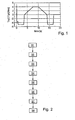
- ein Diagramm des Tastmoments aufgetragen über der Zeit; und
- Fig. 2
- ein Ablaufdiagramm zur Erläuterung des erfindungsgemäßen Verfahrens.
- Zu Beginn des in Fig. 1 dargestellten Adaptionszyklus wird zur Bestimmung des Tastpunkts der Kupplungskennlinie bei eingelegtem Gang und betätigter Betriebsbremse zunächst die Kupplung geöffnet und dann das Motorleerlaufmoment ermittelt. In einem nächsten Schritt wird dann die Kupplung bis zu einem Tastmoment von beispielsweise 4 Nm geschlossen und dabei die Reaktion des Motors durch Messung des Motormoments überwacht. Fig. 1 zeigt nun ein zweites Mitteilungsintervall bei geöffneter Kupplung (negatives Kupplungsmoment), wobei während dieses Zeitintervalls das Motorleerlaufmoment nochmals ermittelt wird, so dass aus den beiden Zeitintervallen zur Ermittlung des Motorleerlaufmoments ein Mittelwert gebildet werden kann, der in die Ermittlung des Tastpunkts eingeht, wobei der Tastpunkt auf der Basis der Momentendifferenz aus ermitteltem Motormoment und Motorleerlaufmoment bestimmt wird.
- Obwohl in Fig. 1 der Zeichnung das Zeitintervall, zu dem das Tastmoment von etwa 4 Nm anliegt, weitgehend mittig zu den beiden Zeitintervallen, zu denen das Motorleerlaufmoment bestimmt wird, liegt, können diese beiden Zeitintervalle auch in nicht-symmetrischer Weise zum Zeitintervall des Tastmoments gelegt werden, so dass zur Bestimmung des Motorleerlaufmoments auch Interpolationsverfahren herangezogen werden können.
- Anhand von Fig. 2 der Zeichnung wird nachfolgend detaillierter auf das erfindungsgemäße Verfahren eingegangen.
- Eine Tastpunktsadaption wird dann durchgeführt, wenn im Getriebe des Fahrzeugs eine Gangstufe eingelegt ist und das Gaspedal des Fahrzeugs nicht betätigt ist. Zudem ist als weitere Voraussetzung zu nennen, dass die Betriebsbremse des Fahrzeugs betätigt ist.
- In einem ersten Schritt S1 wird die Kupplung mit einer hohen Verfahrgeschwindigkeit durch den Kupplungsbetätigungsaktor in Richtung Öffnen verschoben, so dass sich eine hohe Momentenveränderungsgeschwindigkeit am Kupplungsmoment und damit eine Momentenrampe mit hoher Steigung einstellt. Die Kupplung wird dabei weit geöffnet, befindet sich aber noch nicht am Öffnungsmaximum, es stellt sich ein negatives Kupplungsmoment ein.
- In einem Schritt S2 wird das Kupplungsmoment für eine vorbestimmte Zeitdauer gehalten, um einen Einregelungsvorgang der Motordrehzahl auf die Leerlaufdrehzahl abzuwarten. In einem nächsten Schritt S3 wird die Kupplung vollständig geöffnet. Im nächsten Schritt S4 wird wieder ein vorbestimmtes Zeitintervall abgewartet, bis der Kupplungsbetätigungsaktor seine Endposition erreicht hat und sich die Drehzahl des Antriebsmotors wieder stabilisiert hat, da sich diese nach dem vollständigen Öffnen der Kupplung ändern kann. Während einer vorbestimmten Zeitdauer kann dann das Motorleerlaufmoment ermittelt werden. Im nächsten Schritt S5 wird der Kupplungsbetätigungsaktor so angesteuert, dass er die Kupplung mit einer zunächst steilen Momentenrampe verfährt und kurz vor Erreichen des Nulldurchgangs des Kupplungsmoments die Verfahrgeschwindigkeit der Kupplung zum Erreichen einer flachen Momentenrampe reduziert. Dann wird die Kupplung vom Kupplungsbetätigungsaktor mit der erreichten flachen Momentenrampe bis zum Tastmoment von beispielsweise 4 Nm in Richtung Schließen weiter verfahren.
- In einem nächsten Schritt S6 wird die Kupplung auf diesem Tastmoment gehalten und zwar für eine vorbestimmte Zeitdauer, während der Nachregelvorgänge der Motorsteuerung zum Erreichen einer stabilen Motordrehzahl möglich sind. Während einer vorbestimmten Zeitdauer kann nun das vom Motor abgegebene Motormoment beispielsweise als Mittelwert während eines vorbestimmten Zeitintervalls bestimmt werden.
- In einem nächsten Schritt S7 wird dann das Kupplungsmoment wieder mit einer flachen Momentenrampe bis zu einem Bereitschaftspunkt mit einem Moment von etwa Null verringert und in einem sich hieran anschließenden nächsten Schritt S8 die Kupplung mit einer steilen Momentenrampe vollständig geöffnet. Aus dem während des Schritts S4 ermittelten Motorleerlaufmoment und dem während des Schritts S6 ermittelten Motormoment kann nun ein Adaptionsinkrement bestimmt werden, um das der beim Schließen der Kupplung auf das Tastmoment von beispielsweise 4 Nm angenommene Tastpunkt verschoben werden kann.
- Da der vorstehend beschriebene Verfahrensablauf immer dann durchgeführt werden kann, wenn die eingangs benannten Bedingungen erfüllt sind und damit häufig durchgeführt werden kann, kann eine tendenziell in eine Richtung verlaufende Tastpunktsänderung auch zur Veränderung eines längerfristig angenommenen Tastpunkts, der als angenommener Tastpunkt vorstehend auch bereits erläutert wurde, herangezogen werden.
- Nach der Erfindung ist auch eine Vorrichtung vorgesehen zur Durchführung des vorstehend beschriebenen Verfahrens, wobei die Vorrichtung einen Kupplungsbetätigungsaktor aufweist und Mittel zur Erfassung des Antriebsmoments des Antriebsmotors zur Bestimmung des Motorleerlaufmoments und des während des Anliegens des Tastmoments abgegebenen Motormoments. Die Vorrichtung weist auch eine Auswerteeinrichtung auf, die das Motorleerlaufmoment und das Motormoment im Tastpunkt vergleicht und daraus den Verfahrweg des Kupplungsbetätigungsaktors zum Erreichung des neuen Tastpunkts ermittelt. Der vorstehend genannte Kupplungsbetätigungsaktor kann beispielsweise einen bürstenlosen Elektromotor aufweisen, dessen Rotordrehwinkelveränderung mittels Hallsensoren festgestellt werden kann. Da eine Veränderung der Verfahrposition des Aktors zu einer Verschiebung der Kupplungskennlinie führen kann, ist die Kenntnis der Positionsveränderung des Elektromotors von Bedeutung, so dass nach der Erfindung auch eine Vorrichtung zur Überwachung einer Positionsveränderung des genannten bürstenlosen Elektromotors vorgesehen ist.
- Mit dieser Vorrichtung werden erste und zweite Hallsensormuster erfasst und gespeichert, wobei die ersten Hallsensormuster beim Abstellen des Elektromotors erfasst und abgespeichert werden und die zweiten Hallsensormuster bei der Wiederinbetriebnahme des Elektromotors und mittels einer Auswerteeinrichtung die beiden Hallsensormuster miteinander verglichen werden, so dass bei der Feststellung einer Abweichung der Hallsensormuster auf eine Positionsveränderung des Elektromotors geschlossen werden kann.
- Die vorstehend genannte Auswerteeinrichtung kann ein Vertrauensmaß ermitteln, das in Abhängigkeit von vorbestimmten Fehlerbedingurigen dekrementiert wird, so dass nach dem Unterschreiten einer vorbestimmten Vertrauensmaßschwelle eine Neuinitialisierung stattfindet, also der Kupplungsbetätigungsaktor beispielsweise von einem Steuergerät so angesteuert wird, dass er in Richtung eines hinsichtlich der Lage bekannten Endanschlags verfährt und nach Erreichen des Endanschlags ein Reset der Inkrementalwertmessung durchgeführt werden kann und das Vertrauensmaß auf einen Ausgangswert zurückgesetzt werden kann.
- Hinsichtlich vorstehend im Einzelnen nicht näher erläuterter Merkmale der Erfindung wird im Übrigen ausdrücklich auf die Ansprüche und die Zeichnung verwiesen.
Claims (2)
- Vorrichtung zur Überwachung einer Positionsveränderung eines bürstenlosen Elektromotors, gekennzeichnet durch Mittel zur Erfassung und Abspeicherung von ersten Hallsensormustern beim Abstellen des Elektromotors und Mitteln zur Erfassung und Abspeicherung von zweiten Hallsensormuster bei der Wiederinbetriebnahme des Elektromotors und eine Auswerteeinrichtung zum Vergleichen der ersten und zweiten Hallsensormuster, so dass bei einer Abweichung der Hallsensormuster eine Positionsveränderung des Elektromotors feststellbar ist.
- Vorrichtung nach Anspruch 15, dadurch gekennzeichnet, dass die Auswerteeinrichtung ein Vertrauensmaß erzeugt, das in Abhängigkeit von Fehlerbedingungen dekrementiert wird, so dass nach Unterschreiten einer vorbestimmten Vertrauensmaßschwelle eine Neuinitialisierung erfolgt.
Applications Claiming Priority (2)
| Application Number | Priority Date | Filing Date | Title |
|---|---|---|---|
| DE10255385 | 2002-11-28 | ||
| EP03767462A EP1567782B1 (de) | 2002-11-28 | 2003-11-27 | Verfahren zur ermittlung des tastpunkts einer automatisierten kupplung und vorrichtung hierzu |
Related Parent Applications (2)
| Application Number | Title | Priority Date | Filing Date |
|---|---|---|---|
| EP03767462A Division EP1567782B1 (de) | 2002-11-28 | 2003-11-27 | Verfahren zur ermittlung des tastpunkts einer automatisierten kupplung und vorrichtung hierzu |
| EP03767462.9 Division | 2003-11-27 |
Publications (3)
| Publication Number | Publication Date |
|---|---|
| EP1760349A2 true EP1760349A2 (de) | 2007-03-07 |
| EP1760349A3 EP1760349A3 (de) | 2007-11-21 |
| EP1760349B1 EP1760349B1 (de) | 2010-03-03 |
Family
ID=32335798
Family Applications (2)
| Application Number | Title | Priority Date | Filing Date |
|---|---|---|---|
| EP06026388A Expired - Lifetime EP1760349B1 (de) | 2002-11-28 | 2003-11-27 | Vorrichtung zur Überwachung einer Positionsveränderung eines bürstenlosen Elektromotors |
| EP03767462A Expired - Lifetime EP1567782B1 (de) | 2002-11-28 | 2003-11-27 | Verfahren zur ermittlung des tastpunkts einer automatisierten kupplung und vorrichtung hierzu |
Family Applications After (1)
| Application Number | Title | Priority Date | Filing Date |
|---|---|---|---|
| EP03767462A Expired - Lifetime EP1567782B1 (de) | 2002-11-28 | 2003-11-27 | Verfahren zur ermittlung des tastpunkts einer automatisierten kupplung und vorrichtung hierzu |
Country Status (5)
| Country | Link |
|---|---|
| EP (2) | EP1760349B1 (de) |
| AT (2) | ATE459817T1 (de) |
| AU (1) | AU2003291952A1 (de) |
| DE (3) | DE50309497D1 (de) |
| WO (1) | WO2004048796A2 (de) |
Cited By (3)
| Publication number | Priority date | Publication date | Assignee | Title |
|---|---|---|---|---|
| CN111433478A (zh) * | 2017-12-13 | 2020-07-17 | Gkn汽车有限公司 | 操作离合器装置的方法 |
| WO2021233629A1 (de) * | 2020-05-20 | 2021-11-25 | Magna powertrain gmbh & co kg | Verfahren zur überprüfung der stellgenauigkeit einer kupplung bei stillstand eines elektro- oder hybridkraftfahrzeugs |
| DE102015109727B4 (de) | 2014-06-24 | 2024-03-21 | GM Global Technology Operations LLC (n. d. Ges. d. Staates Delaware) | Verfahren zum lernen des kupplungsgreifpunkts einer positionsgeregelten kupplung |
Families Citing this family (2)
| Publication number | Priority date | Publication date | Assignee | Title |
|---|---|---|---|---|
| DE102006042356A1 (de) * | 2006-09-08 | 2008-03-27 | Zf Friedrichshafen Ag | Verfahren zur Detektierung des Anlegepunktes einer Kupplung, insbesondere einer nassen Anfahrkupplung |
| SE535679C2 (sv) * | 2011-03-14 | 2012-11-06 | Scania Cv Ab | Förfarande och system vid bestämning av en kontaktpunkt för en koppling |
Citations (1)
| Publication number | Priority date | Publication date | Assignee | Title |
|---|---|---|---|---|
| DE19823089A1 (de) | 1997-05-30 | 1998-12-03 | Luk Getriebe Systeme Gmbh | Verfahren und Vorrichtung zur Steuerung einer Kupplung |
Family Cites Families (4)
| Publication number | Priority date | Publication date | Assignee | Title |
|---|---|---|---|---|
| NO314174B1 (no) * | 1995-12-18 | 2003-02-10 | Luk Getriebe Systeme Gmbh | Motorkjöretöy |
| FR2762265B1 (fr) * | 1997-04-18 | 1999-05-14 | Renault | Procede d'apprentissage du fonctionnement d'un embrayage pilote |
| US6022295A (en) * | 1998-11-12 | 2000-02-08 | Eaton Corporation | Touch point identification for vehicle master clutch |
| DE10054530B4 (de) * | 2000-07-27 | 2005-11-10 | Daimlerchrysler Ag | Verfahren zur Ermittlung der Winkellage einer drehbaren Welle |
-
2003
- 2003-11-27 DE DE50309497T patent/DE50309497D1/de not_active Expired - Lifetime
- 2003-11-27 AT AT06026388T patent/ATE459817T1/de not_active IP Right Cessation
- 2003-11-27 AT AT03767462T patent/ATE390574T1/de not_active IP Right Cessation
- 2003-11-27 EP EP06026388A patent/EP1760349B1/de not_active Expired - Lifetime
- 2003-11-27 DE DE50312489T patent/DE50312489D1/de not_active Expired - Lifetime
- 2003-11-27 WO PCT/DE2003/003922 patent/WO2004048796A2/de not_active Ceased
- 2003-11-27 AU AU2003291952A patent/AU2003291952A1/en not_active Abandoned
- 2003-11-27 EP EP03767462A patent/EP1567782B1/de not_active Expired - Lifetime
- 2003-11-27 DE DE10393282T patent/DE10393282D2/de not_active Ceased
Patent Citations (1)
| Publication number | Priority date | Publication date | Assignee | Title |
|---|---|---|---|---|
| DE19823089A1 (de) | 1997-05-30 | 1998-12-03 | Luk Getriebe Systeme Gmbh | Verfahren und Vorrichtung zur Steuerung einer Kupplung |
Cited By (8)
| Publication number | Priority date | Publication date | Assignee | Title |
|---|---|---|---|---|
| DE102015109727B4 (de) | 2014-06-24 | 2024-03-21 | GM Global Technology Operations LLC (n. d. Ges. d. Staates Delaware) | Verfahren zum lernen des kupplungsgreifpunkts einer positionsgeregelten kupplung |
| CN111433478A (zh) * | 2017-12-13 | 2020-07-17 | Gkn汽车有限公司 | 操作离合器装置的方法 |
| CN111433478B (zh) * | 2017-12-13 | 2021-10-19 | Gkn汽车有限公司 | 操作离合器装置的方法 |
| US11261925B2 (en) | 2017-12-13 | 2022-03-01 | Gkn Automotive Ltd. | Operating a clutch device |
| WO2021233629A1 (de) * | 2020-05-20 | 2021-11-25 | Magna powertrain gmbh & co kg | Verfahren zur überprüfung der stellgenauigkeit einer kupplung bei stillstand eines elektro- oder hybridkraftfahrzeugs |
| CN115667746A (zh) * | 2020-05-20 | 2023-01-31 | 麦格纳动力系有限两合公司 | 在电动或混合动力机动车的停车状态中检查离合器的调节精度的方法 |
| US12181006B2 (en) | 2020-05-20 | 2024-12-31 | Magna powertrain gmbh & co kg | Method for checking the actuating accuracy of a clutch when an electric or hybrid motor vehicle is at a standstill |
| US12516704B2 (en) | 2020-05-20 | 2026-01-06 | Magna powertrain gmbh & co kg | Method for checking the actuating accuracy of a clutch when an electric or hybrid motor vehicle is at a standstill |
Also Published As
| Publication number | Publication date |
|---|---|
| ATE390574T1 (de) | 2008-04-15 |
| EP1760349B1 (de) | 2010-03-03 |
| DE50309497D1 (de) | 2008-05-08 |
| ATE459817T1 (de) | 2010-03-15 |
| DE50312489D1 (de) | 2010-04-15 |
| WO2004048796A3 (de) | 2004-08-12 |
| AU2003291952A1 (en) | 2004-06-18 |
| EP1567782A2 (de) | 2005-08-31 |
| DE10393282D2 (de) | 2005-06-02 |
| EP1567782B1 (de) | 2008-03-26 |
| WO2004048796A2 (de) | 2004-06-10 |
| EP1760349A3 (de) | 2007-11-21 |
Similar Documents
| Publication | Publication Date | Title |
|---|---|---|
| EP2325512B1 (de) | Verfahren zur Kisspointadaption | |
| EP2013503B1 (de) | Verfahren zur ermittlung einer drehmomentkennlinie einer automatisierten reibungskupplung | |
| WO2009065458A1 (de) | Verfahren zur kisspointadaption | |
| WO2016008463A1 (de) | Verfahren zur bestimmung einer tastpunktänderung und zur adaption eines reibwertes einer hybridtrennkupplung eines hybridfahrzeuges | |
| DE3438594A1 (de) | Kupplungseinrichtung fuer ein kraftfahrzeug | |
| WO2007124710A1 (de) | Verfahren und vorrichtung zum adaptieren der steuerung der kupplungen eines doppelkupplungsgetriebes | |
| WO2002101258A2 (de) | Kupplungsbetätigungsvorrichtung sowie verfahren zum ermitteln von kupplugsparametern | |
| DE102007015679A1 (de) | Verfahren zur Steuerung einer automatisierten Reibungskupplung | |
| EP2542796A2 (de) | Verfahren zur steuerung einer reibungskupplung und vorrichtung hierzu | |
| DE10027330A1 (de) | Verfahren zum Betreiben einer Drehmoment-Übertragungseinrichtung | |
| WO2017108478A1 (de) | Verfahren zur steuerung und/oder regelung einer nasslaufenden kupplung eines kraftfahrzeugs | |
| DE102013210357A1 (de) | Verfahren zum Bestimmen eines Verschleißes einer Kupplung | |
| DE10051589A1 (de) | Betätigungsvorrichtung für eine Kupplungsvorrichtung | |
| EP3243009A1 (de) | Verfahren zur ermittlung eines tastpunktes einer hybridtrennkupplung eines hybridfahrzeuges | |
| DE4337021C2 (de) | Vorrichtung zum Steuern einer die Drehzahldifferenz einer Kupplung eines Kraftfahrzeuges bestimmenden Stellgröße | |
| DE102007025501A1 (de) | Verfahren und Vorrichtung zur Steuerung einer Kupplung | |
| EP2545303A1 (de) | Verfahren zur steuerung einer getriebebremse | |
| EP1760349B1 (de) | Vorrichtung zur Überwachung einer Positionsveränderung eines bürstenlosen Elektromotors | |
| DE10316436A1 (de) | Getriebesteuerung und Verfahren zum Kompensieren von Streckenveränderungen bei einer Getriebesteuerung eines automatisierten Getriebes eines Fahrzeuges | |
| DE102015103471B4 (de) | Adaptive steuerung eines linearaktors | |
| WO2017206980A1 (de) | Verfahren zur bestimmung einer leckage in einem hydraulischen kupplungssystem eines fahrzeuges | |
| WO2013135449A1 (de) | Verfahren zur inbetriebnahme einer reibungskupplung | |
| EP2025964B1 (de) | Verfahren zur Plausibilisierung eines Referenzpunktes eines Hebelaktors | |
| EP1887244B1 (de) | Verfahren zur Überprüfung der Kupplungsposition einer mittels eines Aktors automatisiert betätigten Kupplung | |
| DE102015226539A1 (de) | "Verfahren zur Steuerung und/oder Regelung einer nasslaufenden Kupplung eines Kraftfahrzeugs" |
Legal Events
| Date | Code | Title | Description |
|---|---|---|---|
| PUAI | Public reference made under article 153(3) epc to a published international application that has entered the european phase |
Free format text: ORIGINAL CODE: 0009012 |
|
| AC | Divisional application: reference to earlier application |
Ref document number: 1567782 Country of ref document: EP Kind code of ref document: P |
|
| AK | Designated contracting states |
Kind code of ref document: A2 Designated state(s): AT BE BG CH CY CZ DE DK EE ES FI FR GB GR HU IE IT LI LU MC NL PT RO SE SI SK TR |
|
| PUAL | Search report despatched |
Free format text: ORIGINAL CODE: 0009013 |
|
| AK | Designated contracting states |
Kind code of ref document: A3 Designated state(s): AT BE BG CH CY CZ DE DK EE ES FI FR GB GR HU IE IT LI LU MC NL PT RO SE SI SK TR |
|
| RIC1 | Information provided on ipc code assigned before grant |
Ipc: F16D 48/06 20060101AFI20070116BHEP Ipc: H02P 6/16 20060101ALI20071016BHEP |
|
| 17P | Request for examination filed |
Effective date: 20080521 |
|
| 17Q | First examination report despatched |
Effective date: 20080627 |
|
| AKX | Designation fees paid |
Designated state(s): AT BE BG CH CY CZ DE DK EE ES FI FR GB GR HU IE IT LI LU MC NL PT RO SE SI SK TR |
|
| GRAP | Despatch of communication of intention to grant a patent |
Free format text: ORIGINAL CODE: EPIDOSNIGR1 |
|
| RTI1 | Title (correction) |
Free format text: DEVICE FOR MONITORING A POSITION CHANGE OF A BRUSHLESS ELECTRIC MOTOR |
|
| GRAS | Grant fee paid |
Free format text: ORIGINAL CODE: EPIDOSNIGR3 |
|
| GRAA | (expected) grant |
Free format text: ORIGINAL CODE: 0009210 |
|
| AC | Divisional application: reference to earlier application |
Ref document number: 1567782 Country of ref document: EP Kind code of ref document: P |
|
| AK | Designated contracting states |
Kind code of ref document: B1 Designated state(s): AT BE BG CH CY CZ DE DK EE ES FI FR GB GR HU IE IT LI LU MC NL PT RO SE SI SK TR |
|
| REG | Reference to a national code |
Ref country code: GB Ref legal event code: FG4D Free format text: NOT ENGLISH |
|
| REG | Reference to a national code |
Ref country code: CH Ref legal event code: EP |
|
| REG | Reference to a national code |
Ref country code: IE Ref legal event code: FG4D |
|
| REF | Corresponds to: |
Ref document number: 50312489 Country of ref document: DE Date of ref document: 20100415 Kind code of ref document: P |
|
| REG | Reference to a national code |
Ref country code: NL Ref legal event code: VDEP Effective date: 20100303 |
|
| PG25 | Lapsed in a contracting state [announced via postgrant information from national office to epo] |
Ref country code: SI Free format text: LAPSE BECAUSE OF FAILURE TO SUBMIT A TRANSLATION OF THE DESCRIPTION OR TO PAY THE FEE WITHIN THE PRESCRIBED TIME-LIMIT Effective date: 20100303 Ref country code: FI Free format text: LAPSE BECAUSE OF FAILURE TO SUBMIT A TRANSLATION OF THE DESCRIPTION OR TO PAY THE FEE WITHIN THE PRESCRIBED TIME-LIMIT Effective date: 20100303 |
|
| RAP2 | Party data changed (patent owner data changed or rights of a patent transferred) |
Owner name: SCHAEFFLER TECHNOLOGIES GMBH & CO. KG |
|
| REG | Reference to a national code |
Ref country code: IE Ref legal event code: FD4D |
|
| PG25 | Lapsed in a contracting state [announced via postgrant information from national office to epo] |
Ref country code: GR Free format text: LAPSE BECAUSE OF FAILURE TO SUBMIT A TRANSLATION OF THE DESCRIPTION OR TO PAY THE FEE WITHIN THE PRESCRIBED TIME-LIMIT Effective date: 20100604 Ref country code: ES Free format text: LAPSE BECAUSE OF FAILURE TO SUBMIT A TRANSLATION OF THE DESCRIPTION OR TO PAY THE FEE WITHIN THE PRESCRIBED TIME-LIMIT Effective date: 20100614 Ref country code: EE Free format text: LAPSE BECAUSE OF FAILURE TO SUBMIT A TRANSLATION OF THE DESCRIPTION OR TO PAY THE FEE WITHIN THE PRESCRIBED TIME-LIMIT Effective date: 20100303 Ref country code: RO Free format text: LAPSE BECAUSE OF FAILURE TO SUBMIT A TRANSLATION OF THE DESCRIPTION OR TO PAY THE FEE WITHIN THE PRESCRIBED TIME-LIMIT Effective date: 20100303 Ref country code: CY Free format text: LAPSE BECAUSE OF FAILURE TO SUBMIT A TRANSLATION OF THE DESCRIPTION OR TO PAY THE FEE WITHIN THE PRESCRIBED TIME-LIMIT Effective date: 20100303 Ref country code: NL Free format text: LAPSE BECAUSE OF FAILURE TO SUBMIT A TRANSLATION OF THE DESCRIPTION OR TO PAY THE FEE WITHIN THE PRESCRIBED TIME-LIMIT Effective date: 20100303 Ref country code: SE Free format text: LAPSE BECAUSE OF FAILURE TO SUBMIT A TRANSLATION OF THE DESCRIPTION OR TO PAY THE FEE WITHIN THE PRESCRIBED TIME-LIMIT Effective date: 20100303 Ref country code: IE Free format text: LAPSE BECAUSE OF FAILURE TO SUBMIT A TRANSLATION OF THE DESCRIPTION OR TO PAY THE FEE WITHIN THE PRESCRIBED TIME-LIMIT Effective date: 20100303 |
|
| PG25 | Lapsed in a contracting state [announced via postgrant information from national office to epo] |
Ref country code: CZ Free format text: LAPSE BECAUSE OF FAILURE TO SUBMIT A TRANSLATION OF THE DESCRIPTION OR TO PAY THE FEE WITHIN THE PRESCRIBED TIME-LIMIT Effective date: 20100303 Ref country code: BG Free format text: LAPSE BECAUSE OF FAILURE TO SUBMIT A TRANSLATION OF THE DESCRIPTION OR TO PAY THE FEE WITHIN THE PRESCRIBED TIME-LIMIT Effective date: 20100603 Ref country code: SK Free format text: LAPSE BECAUSE OF FAILURE TO SUBMIT A TRANSLATION OF THE DESCRIPTION OR TO PAY THE FEE WITHIN THE PRESCRIBED TIME-LIMIT Effective date: 20100303 |
|
| PLBE | No opposition filed within time limit |
Free format text: ORIGINAL CODE: 0009261 |
|
| STAA | Information on the status of an ep patent application or granted ep patent |
Free format text: STATUS: NO OPPOSITION FILED WITHIN TIME LIMIT |
|
| PG25 | Lapsed in a contracting state [announced via postgrant information from national office to epo] |
Ref country code: DK Free format text: LAPSE BECAUSE OF FAILURE TO SUBMIT A TRANSLATION OF THE DESCRIPTION OR TO PAY THE FEE WITHIN THE PRESCRIBED TIME-LIMIT Effective date: 20100303 Ref country code: PT Free format text: LAPSE BECAUSE OF FAILURE TO SUBMIT A TRANSLATION OF THE DESCRIPTION OR TO PAY THE FEE WITHIN THE PRESCRIBED TIME-LIMIT Effective date: 20100705 |
|
| 26N | No opposition filed |
Effective date: 20101206 |
|
| PG25 | Lapsed in a contracting state [announced via postgrant information from national office to epo] |
Ref country code: IT Free format text: LAPSE BECAUSE OF FAILURE TO SUBMIT A TRANSLATION OF THE DESCRIPTION OR TO PAY THE FEE WITHIN THE PRESCRIBED TIME-LIMIT Effective date: 20100303 |
|
| BERE | Be: lapsed |
Owner name: LUK LAMELLEN UND KUPPLUNGSBAU BETEILIGUNGS K.G. Effective date: 20101130 |
|
| PG25 | Lapsed in a contracting state [announced via postgrant information from national office to epo] |
Ref country code: MC Free format text: LAPSE BECAUSE OF NON-PAYMENT OF DUE FEES Effective date: 20101130 |
|
| REG | Reference to a national code |
Ref country code: CH Ref legal event code: PL |
|
| GBPC | Gb: european patent ceased through non-payment of renewal fee |
Effective date: 20101127 |
|
| PG25 | Lapsed in a contracting state [announced via postgrant information from national office to epo] |
Ref country code: LI Free format text: LAPSE BECAUSE OF NON-PAYMENT OF DUE FEES Effective date: 20101130 Ref country code: CH Free format text: LAPSE BECAUSE OF NON-PAYMENT OF DUE FEES Effective date: 20101130 |
|
| PG25 | Lapsed in a contracting state [announced via postgrant information from national office to epo] |
Ref country code: BE Free format text: LAPSE BECAUSE OF NON-PAYMENT OF DUE FEES Effective date: 20101130 |
|
| PG25 | Lapsed in a contracting state [announced via postgrant information from national office to epo] |
Ref country code: GB Free format text: LAPSE BECAUSE OF NON-PAYMENT OF DUE FEES Effective date: 20101127 |
|
| REG | Reference to a national code |
Ref country code: AT Ref legal event code: MM01 Ref document number: 459817 Country of ref document: AT Kind code of ref document: T Effective date: 20101127 |
|
| PG25 | Lapsed in a contracting state [announced via postgrant information from national office to epo] |
Ref country code: AT Free format text: LAPSE BECAUSE OF NON-PAYMENT OF DUE FEES Effective date: 20101127 |
|
| PG25 | Lapsed in a contracting state [announced via postgrant information from national office to epo] |
Ref country code: HU Free format text: LAPSE BECAUSE OF FAILURE TO SUBMIT A TRANSLATION OF THE DESCRIPTION OR TO PAY THE FEE WITHIN THE PRESCRIBED TIME-LIMIT Effective date: 20100904 Ref country code: LU Free format text: LAPSE BECAUSE OF NON-PAYMENT OF DUE FEES Effective date: 20101127 |
|
| REG | Reference to a national code |
Ref country code: DE Ref legal event code: R081 Ref document number: 50312489 Country of ref document: DE Owner name: SCHAEFFLER TECHNOLOGIES AG & CO. KG, DE Free format text: FORMER OWNER: SCHAEFFLER TECHNOLOGIES GMBH & CO. KG, 91074 HERZOGENAURACH, DE Effective date: 20120828 Ref country code: DE Ref legal event code: R081 Ref document number: 50312489 Country of ref document: DE Owner name: SCHAEFFLER TECHNOLOGIES GMBH & CO. KG, DE Free format text: FORMER OWNER: SCHAEFFLER TECHNOLOGIES GMBH & CO. KG, 91074 HERZOGENAURACH, DE Effective date: 20120828 |
|
| PG25 | Lapsed in a contracting state [announced via postgrant information from national office to epo] |
Ref country code: TR Free format text: LAPSE BECAUSE OF FAILURE TO SUBMIT A TRANSLATION OF THE DESCRIPTION OR TO PAY THE FEE WITHIN THE PRESCRIBED TIME-LIMIT Effective date: 20100303 |
|
| REG | Reference to a national code |
Ref country code: DE Ref legal event code: R081 Ref document number: 50312489 Country of ref document: DE Owner name: SCHAEFFLER TECHNOLOGIES AG & CO. KG, DE Free format text: FORMER OWNER: SCHAEFFLER TECHNOLOGIES AG & CO. KG, 91074 HERZOGENAURACH, DE Effective date: 20140218 Ref country code: DE Ref legal event code: R081 Ref document number: 50312489 Country of ref document: DE Owner name: SCHAEFFLER TECHNOLOGIES GMBH & CO. KG, DE Free format text: FORMER OWNER: SCHAEFFLER TECHNOLOGIES AG & CO. KG, 91074 HERZOGENAURACH, DE Effective date: 20140218 |
|
| PGFP | Annual fee paid to national office [announced via postgrant information from national office to epo] |
Ref country code: FR Payment date: 20141126 Year of fee payment: 12 |
|
| REG | Reference to a national code |
Ref country code: DE Ref legal event code: R081 Ref document number: 50312489 Country of ref document: DE Owner name: SCHAEFFLER TECHNOLOGIES AG & CO. KG, DE Free format text: FORMER OWNER: SCHAEFFLER TECHNOLOGIES GMBH & CO. KG, 91074 HERZOGENAURACH, DE Effective date: 20150213 |
|
| REG | Reference to a national code |
Ref country code: FR Ref legal event code: ST Effective date: 20160729 |
|
| PG25 | Lapsed in a contracting state [announced via postgrant information from national office to epo] |
Ref country code: FR Free format text: LAPSE BECAUSE OF NON-PAYMENT OF DUE FEES Effective date: 20151130 |
|
| PGFP | Annual fee paid to national office [announced via postgrant information from national office to epo] |
Ref country code: DE Payment date: 20180131 Year of fee payment: 15 |
|
| REG | Reference to a national code |
Ref country code: DE Ref legal event code: R119 Ref document number: 50312489 Country of ref document: DE |
|
| PG25 | Lapsed in a contracting state [announced via postgrant information from national office to epo] |
Ref country code: DE Free format text: LAPSE BECAUSE OF NON-PAYMENT OF DUE FEES Effective date: 20190601 |
|
| P01 | Opt-out of the competence of the unified patent court (upc) registered |
Effective date: 20230523 |