EP1745740B1 - Apparatus for obtaining cardiac data - Google Patents
Apparatus for obtaining cardiac data Download PDFInfo
- Publication number
- EP1745740B1 EP1745740B1 EP06253786A EP06253786A EP1745740B1 EP 1745740 B1 EP1745740 B1 EP 1745740B1 EP 06253786 A EP06253786 A EP 06253786A EP 06253786 A EP06253786 A EP 06253786A EP 1745740 B1 EP1745740 B1 EP 1745740B1
- Authority
- EP
- European Patent Office
- Prior art keywords
- signal
- person
- variations
- discrete
- data
- Prior art date
- Legal status (The legal status is an assumption and is not a legal conclusion. Google has not performed a legal analysis and makes no representation as to the accuracy of the status listed.)
- Ceased
Links
Images



Classifications
-
- A—HUMAN NECESSITIES
- A61—MEDICAL OR VETERINARY SCIENCE; HYGIENE
- A61B—DIAGNOSIS; SURGERY; IDENTIFICATION
- A61B5/00—Measuring for diagnostic purposes; Identification of persons
- A61B5/24—Detecting, measuring or recording bioelectric or biomagnetic signals of the body or parts thereof
- A61B5/316—Modalities, i.e. specific diagnostic methods
- A61B5/318—Heart-related electrical modalities, e.g. electrocardiography [ECG]
- A61B5/346—Analysis of electrocardiograms
- A61B5/349—Detecting specific parameters of the electrocardiograph cycle
- A61B5/361—Detecting fibrillation
-
- A—HUMAN NECESSITIES
- A61—MEDICAL OR VETERINARY SCIENCE; HYGIENE
- A61B—DIAGNOSIS; SURGERY; IDENTIFICATION
- A61B5/00—Measuring for diagnostic purposes; Identification of persons
- A61B5/02—Detecting, measuring or recording for evaluating the cardiovascular system, e.g. pulse, heart rate, blood pressure or blood flow
- A61B5/024—Measuring pulse rate or heart rate
-
- A—HUMAN NECESSITIES
- A61—MEDICAL OR VETERINARY SCIENCE; HYGIENE
- A61B—DIAGNOSIS; SURGERY; IDENTIFICATION
- A61B5/00—Measuring for diagnostic purposes; Identification of persons
- A61B5/68—Arrangements of detecting, measuring or recording means, e.g. sensors, in relation to patient
- A61B5/6801—Arrangements of detecting, measuring or recording means, e.g. sensors, in relation to patient specially adapted to be attached to or worn on the body surface
- A61B5/6813—Specially adapted to be attached to a specific body part
- A61B5/6829—Foot or ankle
Definitions
- the present invention relates to an apparatus for obtaining cardiac data using conductive elements applied to the feet of a subject. While the invention is not so limited, the invention may be carried out using a body fat analysis scale.
- Scales are conventionally used to measure body weight.
- a person steps on footpads on the scale and the resulting compressive loading operates a mechanical or electrical apparatus to provide an indication of the person's weight.
- Scales have been developed that can also be used to measure a person's body fat.
- the footpads on such a scale are made electrically conductive. A small electrical current is passed through the body of a person standing on the footpads. Fat tissue has different electrical properties than muscle tissue, due to differing amounts of water in the different tissues. The bioelectrical impedance that exists between the footpads is measured and used to determine body fat properties, typically the body fat percentage.
- US 2005/004483 describes a bi-point detection type heart-rate monitor and heart-rate monitoring method.
- US 2005/0137628 relates to rhythm identification in ECG for resuscitation by controlling an automatic defibrillator without the need to stop cardio pulmonary resuscitation (CPR).
- CPR cardio pulmonary resuscitation
- information about the heart such as heart rate or the detection of arrhythmias, may be obtained from the feet of a person, as by using conductive footpads of a scale of the above type.
- the heart rate of a person is an important physiological measurement. Increases in the heart rate are indicative of a variety of different diseases and conditions in the body, such as the presence of fever or the consumption of alcohol, caffeine, nicotine, or certain drugs.
- a permanently high heart rate is a risk predicator for overall mortality as noted in literature such as Wojciech Zaeba, Prognostic Significance of a Standard 12-Lead ECG after Myocardial Infarction, International Journal of Bioelectromagnetism, Vol. 5, No. 1, 2003 .
- the convenience of obtaining a person's heart rate by simply stepping on a body fat analysis scale facilitates obtaining such information.
- Arrhythmias can occur when the muscle fibers of the heart fail to contract synchronously. This has the potential to lessen the efficiency of the heart to pump blood. In fibrillation, the muscles of the heart quiver randomly and erratically. Ventricular fibrillation is fatal in the absence of immediate medical intervention. However, if the atrial portion of the heart is in fibrillation, the heart can still pump some blood so that the condition can exist until diagnosed and treated.
- Atrial fibrillation The detection of atrial fibrillation is important because of its serious nature, because of its frequent existence among the elderly, and because of the adverse prognosis attendant the presence of atrial fibrillation. See Nusser, Trieb, Weidner, Differentialdiagnostik des EKG, Schattauer Verlag. In some subjects atrial fibrillation is intermittent in that it is sometimes present and disappears at other times.
- electrocardiographic (ECG) signal data is obtained from conductive footpads and processed to identify features, such as the reoccurring QRS complexes appearing in the electrocardiographic data.
- the timing between successive features is used to determine heart rate. Variations in the timing characteristics among successive heartbeats, or the absence of a heartbeat feature, are indicative of arrhythmias, such as those characterizing atrial fibrillation.
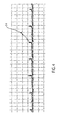
- Fig. 1 shows the electrical phenomena or signal 10 associated with a heartbeat, along with the conventional designations for its various components.
- An initial feature in the morphology of the signal is the P wave resulting from the contraction of the atria of the heart to commence the heartbeat.
- the major feature of the graph, the QRS complex is followed by the contraction of the ventricles, and in turn, by the T wave indicative of a refractory period for the heart muscle at the end of the heartbeat.
- An electrocardiographic signal 10 of the type shown in Fig. 1 is ordinarily obtained by electrodes applied to the chest and extremities of a person.
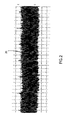
- Fig. 2 shows a typical electrocardiographic signal 20 received from the feet of a person containing a small magnitude ECG signal and a considerable amount of electrical noise in the output from conductive footpads applied to the feet.
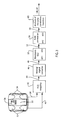
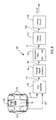
- Fig. 3 shows apparatus for obtaining information about the heart from output signal 20 obtained from electrodes applied to the feet of a person.
- Scale 30 has pairs of conductive footpads 32 and 34 on which a subject stands to determine his/her body weight and body fat. While the invention is not so limited, the use of pairs of footpads increases the quality of data collected as one set of footpads may be used for data collection and the other set used for common mode rejection of noise.
- Scale 30 has display 36 for providing this information. Leads 38 and 40 extend from scale 30 to provide the output signal shown in Fig. 2 .
- Leads 38 and 40 are connected to input ECG amplifier 42 having appropriate characteristics of frequency response, gain, circuit protection, and the like.
- the ECG lead signal output from amplifier 42 is provided in conductor 44 to analog/digital converter 46.
- Analog/digital converter 46 samples the signal in conductor 44 at an appropriate rate and converts the analog signal in conductor 44 to a digital signal in conductor 48.
- the minimum sampling rate to collect data that will reproduce a signal accurately is two times the highest frequency component of the signal, as determined by Nyquist's theorem. Therefore a sampling rate of at least twice the line frequency is required to filter out the line frequency. In an embodiment of the invention, a sampling rate of 200 Hz is used when the line frequency is 50 Hz or 240 Hz is used when the line frequency is 60 Hz.
- the signal in conductor 48 is supplied to bandpass filter 50 that carries out high pass and low pass filtering of the signal to improve the signal to noise ratio over that found in the digital signal in conductor 48.
- the bandpass filter 50 may have a low frequency cutoff at 2 Hz and a high frequency cutoff at 25 Hz.
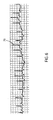
- the signal in conductor 52 may contain noise frequency components in a range from 0 - 1,000 Hz whereas the signal in conductor 52 will contain only noise components between 2 - 25 Hz so that a substantial amount of the frequency content of the signal is removed by the bandpass filter. This results in leaving the predominant ECG signal while removing a substantial amount of the noise, as can be seen by comparing Figs. 2 and 4 .
- the high pass filter found in element 50 may comprise an infinite impulse response (IIR) filter.
- IIR infinite impulse response
- An IIR filter is suited for use as a high pass filter because a lower order and easier to calculate and implement filter of this type will provide a steeper cut-off frequency.
- An IIR filter also provides faster real-time signal processing also making it advantageous for use as a high-pass filter.
- the low pass filter found in element 50 may comprise a finite impulse response (FIR) filter.
- FIR finite impulse response
- a FIR filter is appropriate for a low pass filter due to its stability and linear phase response and the ability to reject 60Hz or 50Hz line noise. It will be appreciated that other types of filters and sampling rates may be used in the apparatus shown in Fig. 3 .
- the output from bandpass filter 50 in conductor 52 is shown in Fig. 4 as the graph 54. It will be appreciated from an inspection of Fig. 4 that the features of the electrocardiographic data shown in Fig. 1 are augmented in the signal 54 in conductor 52 in the process of filtering signal 20 shown in Fig. 2 . This includes the prominent QRS complex of the electrocardiographic signal shown in Fig. 1 .
- the signal 54 in conductor 52 is supplied to element 56 that performs an autocorrelation on the signal.
- An autocorrelation is carried out by comparing and correlating a signal with itself.
- An autocorrelation function measures the dependence of time series values at one time on the values of that time series at another time.
- the autocorrelation removes any random signal processes, leaving the desired underlying periodic signal, in this case the ECG signal.
- An autocorrelation function is most useful in extracting an underlying periodic signal out of random background noise including circumstances in which the underlying signal is masked by high amplitude and high frequency noise. This is the case in ECG signal processing.
- the autocorrelation function pulls the ECG signal out of the underlying noise in the signal 54 in conductor 52 and provides the same to analysis element 60 in conductor 58.
- the analysis of the autocorrelation function is carried out in the following manner as shown graphically in Fig. 5 .
- the signal in conductor 58 is examined to locate a maximum spike amplitude 62 found in the autocorrelation function y(k).
- a threshold value is then defined as a percentage of the maximum spike amplitude. For example, the threshold may be set at 60% of the spike amplitude. This permits information about the heart to be determined even in the presence of ventricular and supraventricular extrasystoles. Extrasystoles, or premature beats, are typically contractions of the ventricles that do not alter the fundamental rhythm of the heart or inject significant amounts of blood into the circulatory system.
- the distance or timing from a first spike to a second spike that exceeds the threshold is determined. This is shown as the quantity K in Fig. 5 .
- the heart rate of a person standing on scale 30 is thus determined from the feet of the person. Typically 10 seconds of data may be used to determine the heart rate. The heart rate so determined may be provided to display 36 of scale 30.
- Fig. 6 shows an electrocardiographic signal 70 for a subject who is experiencing atrial fibrillation, as indicated by the high variability in the intervals between the QRS complexes in the ECG signal and the poor definition, or lack, of characteristics, such as the P wave.
- Fig. 7 shows the autocorrelation function for the signal 70 of Fig. 6 in a manner corresponding to that of Fig. 5 showing a normal ECG signal.
- the high variability, or conversely the low regularity, in the periodicity of the signal 70 shown in Fig. 6 results in low magnitude spikes in the autocorrelation function 72 of Fig. 7 .
- none of the spikes will exceed the threshold established in analysis element 60 and this phenomenon may be used to provide an indication at output of element 60 that the subject from whom the data is obtained is experiencing atrial fibrillation.
- FIG. 3 While discrete components are shown for illustrative purposes in Fig. 3 and to facilitate an explanation of the disclosed apparatus, it will be appreciated that many of the components may be formed by an appropriately programmed microprocessor or central processing unit (CPU), including that found in scale 30 for use in determining body weight and fat.
- CPU central processing unit
- Fig. 8 shows another embodiment of apparatus suitable for carrying out the present invention.
- Apparatus 100 shown in Fig. 8 employs QRS trigger element 102.
- QRS trigger element 102 employs the magnitude or rate of change properties contained in the filtered signal 54 in conductor 52 to identify the QRS complexes in signal 54.
- a digital equivalent of a Schmitt trigger may be used for this purpose.
- a change in state of the output signal is "triggered" when the input signal crosses a predetermined threshold level.
- the output of QRS trigger element 102 is provided in conductor 104 to element 106 that includes timing or other circuitry to identify the interval between successive QRS complexes.
- the interval between the feature in signal 54 corresponding to the R feature of the QRS complex in the ECG signal may be determined.
- the average of the duration of a series of intervals between R features, the average PR interval, for example from 10 seconds of ECG signal data is inserted in equation (4) to obtain the heart rate.
- H ⁇ R 60 / average R ⁇ R interval
- the irregularity in the intervals between QRS complexes may be used for this purpose.
- an average or median heart beat characteristic comprising the PQRST-data for a given number of cycles, for example 10 cycles, may be determined from the signal in conductor 104.
- the P-wave is absent or ill-defined. The absence of at least a proper P-wave within the time of an average or median heart beat may be used to detect atrial fibrillation.
- the present invention provides a convenient, simple way for a person to learn of an important health criteria from a small and noisy signal obtained from the feet.
- the information so obtained can be used along, or in connection, with other information, such as weight and body fat determined from a scale.
- the ability to enter age and gender information into the apparatus to personalize the data analysis carried out by analysis element 60 thus increasing the usefulness of the obtained cardiac data, for example, the accuracy of atrial fibrillation determination.
- the analysis carried out by element 60 can be modified based on past data or over time, thus increasing the accuracy of data analysis.
- Data storage capability also allows for long-term analysis and trending of the collected physiological parameters.
- the data obtained by the apparatus may be communicated via RF, modem, or broadband technology to a related data collection site, such as a healthcare provider.
- the communication ability may comprise RF, infrared or serial connection to a data storage unit, a computer, or a printer.
Landscapes
- Health & Medical Sciences (AREA)
- Life Sciences & Earth Sciences (AREA)
- Cardiology (AREA)
- Heart & Thoracic Surgery (AREA)
- Molecular Biology (AREA)
- Pathology (AREA)
- Engineering & Computer Science (AREA)
- Biomedical Technology (AREA)
- Physics & Mathematics (AREA)
- Medical Informatics (AREA)
- Biophysics (AREA)
- Surgery (AREA)
- Animal Behavior & Ethology (AREA)
- General Health & Medical Sciences (AREA)
- Public Health (AREA)
- Veterinary Medicine (AREA)
- Physiology (AREA)
- Measurement And Recording Of Electrical Phenomena And Electrical Characteristics Of The Living Body (AREA)
Applications Claiming Priority (1)
| Application Number | Priority Date | Filing Date | Title |
|---|---|---|---|
| US11/186,738 US7283870B2 (en) | 2005-07-21 | 2005-07-21 | Apparatus and method for obtaining cardiac data |
Publications (2)
| Publication Number | Publication Date |
|---|---|
| EP1745740A1 EP1745740A1 (en) | 2007-01-24 |
| EP1745740B1 true EP1745740B1 (en) | 2011-05-04 |
Family
ID=37025076
Family Applications (1)
| Application Number | Title | Priority Date | Filing Date |
|---|---|---|---|
| EP06253786A Ceased EP1745740B1 (en) | 2005-07-21 | 2006-07-19 | Apparatus for obtaining cardiac data |
Country Status (4)
| Country | Link |
|---|---|
| US (1) | US7283870B2 (enExample) |
| EP (1) | EP1745740B1 (enExample) |
| JP (1) | JP5416333B2 (enExample) |
| DE (1) | DE602006021671D1 (enExample) |
Families Citing this family (64)
| Publication number | Priority date | Publication date | Assignee | Title |
|---|---|---|---|---|
| EP1971259B1 (en) * | 2006-01-12 | 2017-02-15 | Arrow International, Inc. | Adaptive real time ecg triggering and uses thereof |
| WO2009096821A1 (en) * | 2008-01-29 | 2009-08-06 | St.Jude Medical Ab | Method and implantable medical device (imd) for monitoring permeability status of cell membranes. |
| CA2741043C (en) | 2008-11-05 | 2014-03-25 | Nellcor Puritan Bennett Llc | System and method for facilitating observation of monitored physiologic data |
| ES2370725B2 (es) * | 2010-02-23 | 2013-04-10 | Universitat Politècnica De Catalunya | Método y aparato para obtener el electrocardiograma mediante electrodos secos dobles. |
| RU2438568C1 (ru) * | 2010-06-15 | 2012-01-10 | ГОУВПО Рязанский государственный радиотехнический университет | Способ выявления аритмии электрокардиосигнала в реальном времени и устройство для его осуществления |
| WO2011159972A2 (en) | 2010-06-17 | 2011-12-22 | Welch Allyn, Inc. | Detection of noise during heart beat variation evaluation |
| US9241635B2 (en) | 2010-09-30 | 2016-01-26 | Fitbit, Inc. | Portable monitoring devices for processing applications and processing analysis of physiological conditions of a user associated with the portable monitoring device |
| US8805646B2 (en) | 2010-09-30 | 2014-08-12 | Fitbit, Inc. | Methods, systems and devices for linking user devices to activity tracking devices |
| US9390427B2 (en) | 2010-09-30 | 2016-07-12 | Fitbit, Inc. | Methods, systems and devices for automatic linking of activity tracking devices to user devices |
| US11243093B2 (en) | 2010-09-30 | 2022-02-08 | Fitbit, Inc. | Methods, systems and devices for generating real-time activity data updates to display devices |
| US8712724B2 (en) | 2010-09-30 | 2014-04-29 | Fitbit, Inc. | Calendar integration methods and systems for presentation of events having combined activity and location information |
| US8954291B2 (en) | 2010-09-30 | 2015-02-10 | Fitbit, Inc. | Alarm setting and interfacing with gesture contact interfacing controls |
| US10983945B2 (en) | 2010-09-30 | 2021-04-20 | Fitbit, Inc. | Method of data synthesis |
| US8744803B2 (en) | 2010-09-30 | 2014-06-03 | Fitbit, Inc. | Methods, systems and devices for activity tracking device data synchronization with computing devices |
| US8762102B2 (en) | 2010-09-30 | 2014-06-24 | Fitbit, Inc. | Methods and systems for generation and rendering interactive events having combined activity and location information |
| US9148483B1 (en) | 2010-09-30 | 2015-09-29 | Fitbit, Inc. | Tracking user physical activity with multiple devices |
| US8738323B2 (en) | 2010-09-30 | 2014-05-27 | Fitbit, Inc. | Methods and systems for metrics analysis and interactive rendering, including events having combined activity and location information |
| US8620617B2 (en) | 2010-09-30 | 2013-12-31 | Fitbit, Inc. | Methods and systems for interactive goal setting and recommender using events having combined activity and location information |
| US8954290B2 (en) | 2010-09-30 | 2015-02-10 | Fitbit, Inc. | Motion-activated display of messages on an activity monitoring device |
| US8615377B1 (en) | 2010-09-30 | 2013-12-24 | Fitbit, Inc. | Methods and systems for processing social interactive data and sharing of tracked activity associated with locations |
| US9167991B2 (en) | 2010-09-30 | 2015-10-27 | Fitbit, Inc. | Portable monitoring devices and methods of operating same |
| US8694282B2 (en) | 2010-09-30 | 2014-04-08 | Fitbit, Inc. | Methods and systems for geo-location optimized tracking and updating for events having combined activity and location information |
| US8738321B2 (en) | 2010-09-30 | 2014-05-27 | Fitbit, Inc. | Methods and systems for classification of geographic locations for tracked activity |
| US8762101B2 (en) | 2010-09-30 | 2014-06-24 | Fitbit, Inc. | Methods and systems for identification of event data having combined activity and location information of portable monitoring devices |
| US10004406B2 (en) | 2010-09-30 | 2018-06-26 | Fitbit, Inc. | Portable monitoring devices for processing applications and processing analysis of physiological conditions of a user associated with the portable monitoring device |
| US8475367B1 (en) | 2011-01-09 | 2013-07-02 | Fitbit, Inc. | Biometric monitoring device having a body weight sensor, and methods of operating same |
| US9202111B2 (en) | 2011-01-09 | 2015-12-01 | Fitbit, Inc. | Fitness monitoring device with user engagement metric functionality |
| US8744559B2 (en) | 2011-08-11 | 2014-06-03 | Richard P. Houben | Methods, systems and devices for detecting atrial fibrillation |
| US9693709B2 (en) | 2011-09-23 | 2017-07-04 | Nellcot Puritan Bennett Ireland | Systems and methods for determining respiration information from a photoplethysmograph |
| US9119597B2 (en) | 2011-09-23 | 2015-09-01 | Nellcor Puritan Bennett Ireland | Systems and methods for determining respiration information from a photoplethysmograph |
| US8880576B2 (en) | 2011-09-23 | 2014-11-04 | Nellcor Puritan Bennett Ireland | Systems and methods for determining respiration information from a photoplethysmograph |
| US9402554B2 (en) | 2011-09-23 | 2016-08-02 | Nellcor Puritan Bennett Ireland | Systems and methods for determining respiration information from a photoplethysmograph |
| US9675274B2 (en) | 2011-09-23 | 2017-06-13 | Nellcor Puritan Bennett Ireland | Systems and methods for determining respiration information from a photoplethysmograph |
| US9693736B2 (en) | 2011-11-30 | 2017-07-04 | Nellcor Puritan Bennett Ireland | Systems and methods for determining respiration information using historical distribution |
| US8755871B2 (en) | 2011-11-30 | 2014-06-17 | Covidien Lp | Systems and methods for detecting arrhythmia from a physiological signal |
| US9247896B2 (en) | 2012-01-04 | 2016-02-02 | Nellcor Puritan Bennett Ireland | Systems and methods for determining respiration information using phase locked loop |
| US9179876B2 (en) | 2012-04-30 | 2015-11-10 | Nellcor Puritan Bennett Ireland | Systems and methods for identifying portions of a physiological signal usable for determining physiological information |
| US9641239B2 (en) | 2012-06-22 | 2017-05-02 | Fitbit, Inc. | Adaptive data transfer using bluetooth |
| US20140073974A1 (en) * | 2012-09-11 | 2014-03-13 | Nellcor Puritan Bennett Llc | Methods and systems for determining physiological information using an autocorrelation sequence and a variable threshold |
| US20140073864A1 (en) * | 2012-09-11 | 2014-03-13 | Nellcor Puritan Bennett Llc | Methods and systems for determining physiological information based on fast start parameters |
| US20140073878A1 (en) * | 2012-09-11 | 2014-03-13 | Nellcor Puritan Bennett Llc | Methods and systems for determining physiological information using autocorrelation based on a modified signal |
| US20140073975A1 (en) * | 2012-09-11 | 2014-03-13 | Nellcor Puritan Bennett Llc | Methods and systems for determining physiological information based on threshold crossings of an autocorrelation sequence |
| FR3000544B1 (fr) * | 2013-01-02 | 2015-11-27 | Withings | Dispositif de pesage multi-fonction |
| US9728059B2 (en) | 2013-01-15 | 2017-08-08 | Fitbit, Inc. | Sedentary period detection utilizing a wearable electronic device |
| US9560978B2 (en) | 2013-02-05 | 2017-02-07 | Covidien Lp | Systems and methods for determining respiration information from a physiological signal using amplitude demodulation |
| US9554712B2 (en) | 2013-02-27 | 2017-01-31 | Covidien Lp | Systems and methods for generating an artificial photoplethysmograph signal |
| US9687159B2 (en) | 2013-02-27 | 2017-06-27 | Covidien Lp | Systems and methods for determining physiological information by identifying fiducial points in a physiological signal |
| US8788024B1 (en) | 2013-03-15 | 2014-07-22 | Apn Health, Llc | Multi-channel cardiac measurements |
| US8812091B1 (en) | 2013-03-15 | 2014-08-19 | Apn Health, Llc | Multi-channel cardiac measurements |
| US10022068B2 (en) | 2013-10-28 | 2018-07-17 | Covidien Lp | Systems and methods for detecting held breath events |
| US9078575B2 (en) | 2013-10-30 | 2015-07-14 | Apn Health, Llc | Heartbeat categorization |
| US9078572B2 (en) | 2013-10-30 | 2015-07-14 | Apn Health, Llc | Heartbeat detection and categorization |
| US9913587B2 (en) | 2013-11-01 | 2018-03-13 | Cardiio, Inc. | Method and system for screening of atrial fibrillation |
| WO2015105787A1 (en) | 2014-01-07 | 2015-07-16 | Covidien Lp | Apnea analysis system and method |
| US9901308B2 (en) | 2014-02-20 | 2018-02-27 | Covidien Lp | Systems and methods for filtering autocorrelation peaks and detecting harmonics |
| US9314179B1 (en) | 2014-09-25 | 2016-04-19 | Apn Health, Llc | Time transformation of local activation times |
| US10022057B1 (en) | 2015-06-19 | 2018-07-17 | Michael Blake | Wearable physiological monitoring and notification system based on real-time heart rate variability analysis |
| US9655532B2 (en) * | 2015-06-19 | 2017-05-23 | Michael Blake | Wearable physiological monitoring and notification system based on real-time heart rate variability analysis |
| US10264984B2 (en) | 2015-08-28 | 2019-04-23 | Maged Choucair | Non-invasive cardiovascular monitoring device |
| US10271741B2 (en) | 2015-09-15 | 2019-04-30 | Huami Inc. | Biometric scale |
| US10905371B2 (en) * | 2015-11-29 | 2021-02-02 | my.Flow, Inc. | Automatic detection of human physiological phenomena |
| US10357168B2 (en) | 2016-03-07 | 2019-07-23 | Apn Health, Llc | Time transformation of local activation times |
| CN108926348B (zh) * | 2018-08-06 | 2019-07-19 | 广东工业大学 | 一种房颤信号的提取方法及装置 |
| CN115530787B (zh) * | 2022-10-13 | 2024-09-17 | 中国第一汽车股份有限公司 | 车辆的信号处理方法、装置和车辆 |
Family Cites Families (26)
| Publication number | Priority date | Publication date | Assignee | Title |
|---|---|---|---|---|
| CA2033014C (en) * | 1990-12-21 | 1999-09-14 | Gregory Lekhtman | Heart rate monitor |
| US5415176A (en) * | 1991-11-29 | 1995-05-16 | Tanita Corporation | Apparatus for measuring body fat |
| JPH08501234A (ja) * | 1992-09-15 | 1996-02-13 | インクレア オイ | 人の心臓の活動に関する量を測定するための方法及び装置 |
| USRE37954E1 (en) * | 1992-09-23 | 2003-01-07 | Tanita Corporation | Method and apparatus for measuring body fat |
| JP3734350B2 (ja) * | 1997-10-17 | 2006-01-11 | 株式会社タニタ | 体内脂肪量計および体内脂肪量計付き体重計 |
| EP1726257B1 (en) * | 1999-09-21 | 2017-12-06 | Honeywell HomMed LLC | In-home patient monitoring system |
| US6519490B1 (en) | 1999-12-20 | 2003-02-11 | Joseph Wiesel | Method of and apparatus for detecting arrhythmia and fibrillation |
| JP2001212098A (ja) * | 2000-01-31 | 2001-08-07 | Tanita Corp | ワンチップに集積回路化した生体電気インピーダンス測定装置 |
| JP3688184B2 (ja) | 2000-04-20 | 2005-08-24 | 株式会社タニタ | 生体計測装置 |
| US6398740B1 (en) * | 2000-05-25 | 2002-06-04 | Salix Medical, Inc. | Apparatus and method for monitoring the temperatures on the plantar aspects of a human foot and other vital health information |
| JP2002065629A (ja) * | 2000-09-01 | 2002-03-05 | Tanita Corp | 生体インピーダンス測定装置 |
| JP2002306439A (ja) * | 2001-04-11 | 2002-10-22 | Tanita Corp | 内臓脂肪測定装置 |
| JP2003135431A (ja) * | 2001-10-31 | 2003-05-13 | Tanita Corp | 内臓脂肪推定装置 |
| US20030216654A1 (en) * | 2002-05-07 | 2003-11-20 | Weichao Xu | Bayesian discriminator for rapidly detecting arrhythmias |
| JP2004180939A (ja) * | 2002-12-03 | 2004-07-02 | Misaki:Kk | 身体指標出力装置 |
| US7103405B2 (en) * | 2002-12-04 | 2006-09-05 | Medtronic, Inc. | Methods and apparatus for discriminating polymorphic tachyarrhythmias from monomorphic tachyarrhythmias facilitating detection of fibrillation |
| TWI221765B (en) * | 2003-07-03 | 2004-10-11 | Tu Shiue He | Two-point-type device and method for measuring heart rate |
| JP2005080720A (ja) * | 2003-09-05 | 2005-03-31 | Tanita Corp | 生体電気インピーダンス測定装置 |
| EP2319410A1 (en) * | 2003-09-12 | 2011-05-11 | BodyMedia, Inc. | Apparatus for measuring heart related parameters |
| JP2005118193A (ja) * | 2003-10-15 | 2005-05-12 | Advanced Medical Kk | 複合計測装置 |
| DE20318933U1 (de) | 2003-12-04 | 2004-03-04 | Petriković, Peter | Digitale-Personen-Waage mit Puls-Frequenzmessgeräten |
| US7039457B2 (en) | 2003-12-19 | 2006-05-02 | Institute Of Critical Care Medicine | Rhythm identification in compression corrupted ECG signal |
| WO2006033104A1 (en) * | 2004-09-22 | 2006-03-30 | Shalon Ventures Research, Llc | Systems and methods for monitoring and modifying behavior |
| KR20060056843A (ko) * | 2004-11-22 | 2006-05-25 | 주식회사 자원메디칼 | 맥박 혹은 심박 측정이 가능한 체중계 |
| US20070055151A1 (en) * | 2005-01-20 | 2007-03-08 | Shertukde Hemchandra M | Apparatus and methods for acoustic diagnosis |
| US20070010721A1 (en) * | 2005-06-28 | 2007-01-11 | Chen Thomas C H | Apparatus and system of Internet-enabled wireless medical sensor scale |
-
2005
- 2005-07-21 US US11/186,738 patent/US7283870B2/en active Active
-
2006
- 2006-07-19 EP EP06253786A patent/EP1745740B1/en not_active Ceased
- 2006-07-19 JP JP2006196726A patent/JP5416333B2/ja not_active Expired - Fee Related
- 2006-07-19 DE DE602006021671T patent/DE602006021671D1/de active Active
Also Published As
| Publication number | Publication date |
|---|---|
| US20070021815A1 (en) | 2007-01-25 |
| DE602006021671D1 (de) | 2011-06-16 |
| US7283870B2 (en) | 2007-10-16 |
| JP5416333B2 (ja) | 2014-02-12 |
| EP1745740A1 (en) | 2007-01-24 |
| JP2007029723A (ja) | 2007-02-08 |
Similar Documents
| Publication | Publication Date | Title |
|---|---|---|
| EP1745740B1 (en) | Apparatus for obtaining cardiac data | |
| US8909332B2 (en) | Method and device for estimating morphological features of heart beats | |
| JP2618020B2 (ja) | 分娩中の胎児の監視 | |
| US9706952B2 (en) | System for ventricular arrhythmia detection and characterization | |
| EP2117645B1 (en) | Monitoring mechanical heart properties | |
| Contreras et al. | Correlations between frequency-domain HRV indices and lagged Poincaré plot width in healthy and diabetic subjects | |
| US20040228217A1 (en) | Devices and methods for heart rate measurement and wrist-watch incorporating same | |
| EP2592999B1 (en) | Methods and apparatus for estimating a blood volume of a mammalian subject | |
| US20170172443A1 (en) | Method, device, system and computer programme for filtering an rr series obtained from a cardiac signal with automatic checking of the quality of the rr series | |
| Peltokangas et al. | Night-time EKG and HRV monitoring with bed sheet integrated textile electrodes | |
| Farb et al. | Day-to-day variability of voltage measurements used in electrocardiographic criteria for left ventricular hypertrophy | |
| JP2006501903A (ja) | 高分解能生体インピーダンス装置 | |
| CN101014283A (zh) | 用于分析高频qrs波群的装置和方法 | |
| US5913308A (en) | Apparatus and method for determining respiratory effort from muscle tremor information in ECG signals | |
| KR102802002B1 (ko) | 휴대용 심전도계를 이용한 심전도 측정 서비스 제공방법 및 시스템 | |
| Jobbágy et al. | HRV-based stress level assessment using very short recordings | |
| US20060155199A1 (en) | Frequency processing of an rr series in an analogue cardiac signal | |
| Scarpetta et al. | Accurate simultaneous measurement of heartbeat and respiratory intervals using a smartphone | |
| JP5283381B2 (ja) | 心調律信号のシリーズ(rr)を処理するための方法、及び心調律の変動性を分析するための、特に生物の痛み又はストレスを評価するためのその使用 | |
| JP3137900B2 (ja) | 心電図信号を収集しかつ処理する装置 | |
| Kristiansen et al. | Design and evaluation of a handheld impedance plethysmograph for measuring heart rate variability | |
| US10292660B2 (en) | Method and device for automatically checking the quality of an RR series obtained from a cardiac signal | |
| KR102273117B1 (ko) | 리액턴스 성분을 이용한 심박출량 측정 장치 및 방법 | |
| Akbulut et al. | Estimation of Beat-to-Beat Interval from Wearable Photoplethysmography Sensor on Different Measurement Sites During Daily Activities | |
| Suominen | Design and implementation of a PC-based data acquisition system for measuring ECG and respiratory signals |
Legal Events
| Date | Code | Title | Description |
|---|---|---|---|
| PUAI | Public reference made under article 153(3) epc to a published international application that has entered the european phase |
Free format text: ORIGINAL CODE: 0009012 |
|
| AK | Designated contracting states |
Kind code of ref document: A1 Designated state(s): AT BE BG CH CY CZ DE DK EE ES FI FR GB GR HU IE IS IT LI LT LU LV MC NL PL PT RO SE SI SK TR |
|
| AX | Request for extension of the european patent |
Extension state: AL BA HR MK YU |
|
| RAP1 | Party data changed (applicant data changed or rights of an application transferred) |
Owner name: GENERAL ELECTRIC COMPANY |
|
| 17P | Request for examination filed |
Effective date: 20070724 |
|
| AKX | Designation fees paid |
Designated state(s): CH DE GB LI |
|
| 17Q | First examination report despatched |
Effective date: 20070831 |
|
| TPAC | Observations by third parties |
Free format text: ORIGINAL CODE: EPIDOSNTIPA |
|
| TPAC | Observations by third parties |
Free format text: ORIGINAL CODE: EPIDOSNTIPA |
|
| RIC1 | Information provided on ipc code assigned before grant |
Ipc: A61B 5/046 20060101ALI20100503BHEP Ipc: A61B 5/024 20060101AFI20100503BHEP |
|
| RTI1 | Title (correction) |
Free format text: APPARATUS FOR OBTAINING CARDIAC DATA |
|
| GRAP | Despatch of communication of intention to grant a patent |
Free format text: ORIGINAL CODE: EPIDOSNIGR1 |
|
| TPAC | Observations by third parties |
Free format text: ORIGINAL CODE: EPIDOSNTIPA |
|
| GRAS | Grant fee paid |
Free format text: ORIGINAL CODE: EPIDOSNIGR3 |
|
| GRAA | (expected) grant |
Free format text: ORIGINAL CODE: 0009210 |
|
| AK | Designated contracting states |
Kind code of ref document: B1 Designated state(s): CH DE GB LI |
|
| REG | Reference to a national code |
Ref country code: GB Ref legal event code: FG4D |
|
| REG | Reference to a national code |
Ref country code: CH Ref legal event code: NV Representative=s name: SERVOPATENT GMBH Ref country code: CH Ref legal event code: EP |
|
| REF | Corresponds to: |
Ref document number: 602006021671 Country of ref document: DE Date of ref document: 20110616 Kind code of ref document: P |
|
| REG | Reference to a national code |
Ref country code: DE Ref legal event code: R096 Ref document number: 602006021671 Country of ref document: DE Effective date: 20110616 |
|
| PLBE | No opposition filed within time limit |
Free format text: ORIGINAL CODE: 0009261 |
|
| STAA | Information on the status of an ep patent application or granted ep patent |
Free format text: STATUS: NO OPPOSITION FILED WITHIN TIME LIMIT |
|
| 26N | No opposition filed |
Effective date: 20120207 |
|
| REG | Reference to a national code |
Ref country code: DE Ref legal event code: R097 Ref document number: 602006021671 Country of ref document: DE Effective date: 20120207 |
|
| PGFP | Annual fee paid to national office [announced via postgrant information from national office to epo] |
Ref country code: CH Payment date: 20160727 Year of fee payment: 11 Ref country code: DE Payment date: 20160726 Year of fee payment: 11 Ref country code: GB Payment date: 20160727 Year of fee payment: 11 |
|
| REG | Reference to a national code |
Ref country code: DE Ref legal event code: R119 Ref document number: 602006021671 Country of ref document: DE |
|
| REG | Reference to a national code |
Ref country code: CH Ref legal event code: PL |
|
| GBPC | Gb: european patent ceased through non-payment of renewal fee |
Effective date: 20170719 |
|
| PG25 | Lapsed in a contracting state [announced via postgrant information from national office to epo] |
Ref country code: LI Free format text: LAPSE BECAUSE OF NON-PAYMENT OF DUE FEES Effective date: 20170731 Ref country code: GB Free format text: LAPSE BECAUSE OF NON-PAYMENT OF DUE FEES Effective date: 20170719 Ref country code: DE Free format text: LAPSE BECAUSE OF NON-PAYMENT OF DUE FEES Effective date: 20180201 Ref country code: CH Free format text: LAPSE BECAUSE OF NON-PAYMENT OF DUE FEES Effective date: 20170731 |