EP1741691A1 - Process for the production of ethylene - Google Patents
Process for the production of ethylene Download PDFInfo
- Publication number
- EP1741691A1 EP1741691A1 EP05014585A EP05014585A EP1741691A1 EP 1741691 A1 EP1741691 A1 EP 1741691A1 EP 05014585 A EP05014585 A EP 05014585A EP 05014585 A EP05014585 A EP 05014585A EP 1741691 A1 EP1741691 A1 EP 1741691A1
- Authority
- EP
- European Patent Office
- Prior art keywords
- process according
- acetylene
- feed
- temperature
- hydrogenation
- Prior art date
- Legal status (The legal status is an assumption and is not a legal conclusion. Google has not performed a legal analysis and makes no representation as to the accuracy of the status listed.)
- Withdrawn
Links
Images

Classifications
-
- C—CHEMISTRY; METALLURGY
- C07—ORGANIC CHEMISTRY
- C07C—ACYCLIC OR CARBOCYCLIC COMPOUNDS
- C07C11/00—Aliphatic unsaturated hydrocarbons
- C07C11/02—Alkenes
- C07C11/04—Ethene
-
- C—CHEMISTRY; METALLURGY
- C07—ORGANIC CHEMISTRY
- C07C—ACYCLIC OR CARBOCYCLIC COMPOUNDS
- C07C5/00—Preparation of hydrocarbons from hydrocarbons containing the same number of carbon atoms
- C07C5/02—Preparation of hydrocarbons from hydrocarbons containing the same number of carbon atoms by hydrogenation
- C07C5/08—Preparation of hydrocarbons from hydrocarbons containing the same number of carbon atoms by hydrogenation of carbon-to-carbon triple bonds
- C07C5/09—Preparation of hydrocarbons from hydrocarbons containing the same number of carbon atoms by hydrogenation of carbon-to-carbon triple bonds to carbon-to-carbon double bonds
-
- C—CHEMISTRY; METALLURGY
- C07—ORGANIC CHEMISTRY
- C07C—ACYCLIC OR CARBOCYCLIC COMPOUNDS
- C07C2/00—Preparation of hydrocarbons from hydrocarbons containing a smaller number of carbon atoms
- C07C2/02—Preparation of hydrocarbons from hydrocarbons containing a smaller number of carbon atoms by addition between unsaturated hydrocarbons
- C07C2/04—Preparation of hydrocarbons from hydrocarbons containing a smaller number of carbon atoms by addition between unsaturated hydrocarbons by oligomerisation of well-defined unsaturated hydrocarbons without ring formation
- C07C2/06—Preparation of hydrocarbons from hydrocarbons containing a smaller number of carbon atoms by addition between unsaturated hydrocarbons by oligomerisation of well-defined unsaturated hydrocarbons without ring formation of alkenes, i.e. acyclic hydrocarbons having only one carbon-to-carbon double bond
-
- C—CHEMISTRY; METALLURGY
- C07—ORGANIC CHEMISTRY
- C07C—ACYCLIC OR CARBOCYCLIC COMPOUNDS
- C07C2/00—Preparation of hydrocarbons from hydrocarbons containing a smaller number of carbon atoms
- C07C2/76—Preparation of hydrocarbons from hydrocarbons containing a smaller number of carbon atoms by condensation of hydrocarbons with partial elimination of hydrogen
- C07C2/78—Processes with partial combustion
-
- C—CHEMISTRY; METALLURGY
- C07—ORGANIC CHEMISTRY
- C07C—ACYCLIC OR CARBOCYCLIC COMPOUNDS
- C07C2/00—Preparation of hydrocarbons from hydrocarbons containing a smaller number of carbon atoms
- C07C2/76—Preparation of hydrocarbons from hydrocarbons containing a smaller number of carbon atoms by condensation of hydrocarbons with partial elimination of hydrogen
- C07C2/82—Preparation of hydrocarbons from hydrocarbons containing a smaller number of carbon atoms by condensation of hydrocarbons with partial elimination of hydrogen oxidative coupling
-
- C—CHEMISTRY; METALLURGY
- C07—ORGANIC CHEMISTRY
- C07C—ACYCLIC OR CARBOCYCLIC COMPOUNDS
- C07C5/00—Preparation of hydrocarbons from hydrocarbons containing the same number of carbon atoms
- C07C5/42—Preparation of hydrocarbons from hydrocarbons containing the same number of carbon atoms by dehydrogenation with a hydrogen acceptor
- C07C5/50—Preparation of hydrocarbons from hydrocarbons containing the same number of carbon atoms by dehydrogenation with a hydrogen acceptor with an organic compound as an acceptor
- C07C5/52—Preparation of hydrocarbons from hydrocarbons containing the same number of carbon atoms by dehydrogenation with a hydrogen acceptor with an organic compound as an acceptor with a hydrocarbon as an acceptor, e.g. hydrocarbon disproportionation, i.e. 2CnHp -> CnHp+q + CnHp-q
-
- Y—GENERAL TAGGING OF NEW TECHNOLOGICAL DEVELOPMENTS; GENERAL TAGGING OF CROSS-SECTIONAL TECHNOLOGIES SPANNING OVER SEVERAL SECTIONS OF THE IPC; TECHNICAL SUBJECTS COVERED BY FORMER USPC CROSS-REFERENCE ART COLLECTIONS [XRACs] AND DIGESTS
- Y02—TECHNOLOGIES OR APPLICATIONS FOR MITIGATION OR ADAPTATION AGAINST CLIMATE CHANGE
- Y02P—CLIMATE CHANGE MITIGATION TECHNOLOGIES IN THE PRODUCTION OR PROCESSING OF GOODS
- Y02P20/00—Technologies relating to chemical industry
- Y02P20/50—Improvements relating to the production of bulk chemicals
- Y02P20/582—Recycling of unreacted starting or intermediate materials
Definitions
- This invention relates to a process for the production of ethylene, and in particular combining traditional thermal pyrolysis for converting methane containing feed such as natural gas to acetylene with an in situ hydrogenation step to produce ethylene.
- Methane pyrolysis to acetylene is well known such as a one step partial oxidation process developed by BASF.
- the most recent features are covered by US Patents Nos. 5,824,834 and 5,789,644 .
- the general reactor configuration and mechanical design is described in US Patent No. 5,789,644 .
- This design includes three major parts, one is a mixing zone with a special diffuser, the second part is a burner zone followed by a reaction zone, and the final part is a quenching zone using an aqueous coolant or heavy oil.
- the key innovation of this patent is the use of a perforated plate to cover the burner zone tube for special control purpose.
- 5,824,834 describes the general process scheme and claims some of the critical feed ratios especially the carbon to oxygen ratio. This ratio is used to control the soot formation which can not be completely or effectively eliminated by this process. The ratio of acetylene to syngas can also be controlled by this process.
- Acetylene can also be produced by means of the two stage high temperature pyrolysis (HTP) developed by HOECHST (GB Patents Nos. 921,305 and 958,046 ).
- HTP high temperature pyrolysis
- This process comprises two main reaction zones and one quenching zone.
- the first reaction zone serves as a complete combustion to supply the necessary heat for the second reaction zone namely pyrolysis into which a fresh feed of methane is injected.
- a water or heavy oil is used as a coolant. Similarly some amount of carbon will be produced.
- the hydrogenation temperature may be controllable in a liquid-phase reactor, through which an adequate volume of liquid solvent is re-circulated continuously to maintain a steady temperature so as to reduce the deactivation rate of the catalysts ( US Patents Nos. 4,128,595 , 5,059,732 and U.S. Patent Applications Nos. 2005/0048658A1 , 2005/0049445A1 ) while the acetylene is mainly dissolved in the solvent.
- the type of solvent can affect the extent of hydrogenation as illustrated in US Patent No. 4,128,595 .
- the hydrogenation reaction has been carried out at 116-193°C in the presence of Pd/Al 2 O 3 catalyst with an inert paraffinic hydrocarbon solvent.
- Acetylene conversion was maintained at 99% with 84% selectivity for 9 days.
- DMF solvent is used instead, the acetylene conversion dropped from 100% to 50% in about 17 hours with 75% selectivity.
- US Patent Applications Nos. 2005/0048658A1 and 2005/0049445A1 disclose the method of acetylene hydrogenation by use of NMP as liquid solvent passing over Pd based catalyst.
- the reported concentration of acetylene dissolved in the solvent is about 4.2%. Based on such information this implies that the reactor size will be uneconomically large for the mass production of ethylene. This method could not effectively eliminate the oligomerization of acetylene.
- the catalyst was stable for about 6 days (140 hours), it still needed a regeneration step to sustain its activity.
- US Patent Application No. 2005/0065392A1 discloses a pyrolysis process for acetylene production followed by a traditional liquid phase hydrogenation scheme downstream. The scheme to be implemented complicates the process design in addition to the limited specific production rate due to the acetylene solubility in the solvent.
- the inventive process for the production of ethylene comprises the following steps:
- the thermal conversion is a pyrolysis or a partial oxidation process.
- the pyrolysis process is a two-stage process, preferably a high temperature pyrolysis (HTP).
- HTP high temperature pyrolysis
- a methane containing feed and oxygen are preheated to 550°C to 650°C and are fed in stoichiometric ratio or with oxygen slightly below stoichiometric ratio and reacted in a combustion zone (stage 1) to form to gases, which has a temperature of from 900°C to 2000°C and a pressure in the range of from 0.5 to 5 atmospheres, and wherein the hot combustion gas is then passed to a pyrolysis zone where methane is then introduced (stage 2) to form acetylene and wherein the pyrolysis zone is maintained at a temperature of 1300°C to 1600°C, wherein the contact time is 3 to 30 milliseconds and the pressure is maintained from 0.5 to 5 atmospheres.
- the contact time is 5 to 10 milliseconds and the pressure is maintained at about 2 atmospheres.
- the methane containing feed is fed into the reaction zone (stage 2) after preheating to about 600°C.
- the partial oxidation process is comprised of the preheating the methane containing feed and oxygen to from 600°C to 700°C wherein the oxygen to methane feed ratio is in sub-stoichiometric ratio from 0.5 to 0.7, preferably about 0.62, and the reaction zone is at a temperature of from 1500°C to 1600°C.
- acetylene, before the in situ hydrogenation is cooled by partial quenching using a coolant.
- Such coolant is preferably selected from the group consisting of water, heavy hydrocarbons, natural gas, ethane, methanol and mixtures thereof.
- the final temperature of the partial quench of the acetylene containing gases is between 800°C and 950°C, more preferably between 880°C and 910°C.
- the final temperature of the partial quench may be achieved by spray injection of the coolant into the acetylene containing gases.
- the in situ hydrogenation is performed by intimately mixing the acetylene containing effluent from the thermal pyrolysis or partial oxidation zone with an alkane feed to initiate the necessary reaction.
- the alkane feed rate and temperature together with the coolant rate is adjusted to keep the hydrogenation temperature from 800°C to 950°C, more preferably from 800°C to 910°C.
- the alkane feed is preferably selected from the group consisting of ethane, propane, butane, iso-butane or mixtures thereof, most preferably ethane.
- the alkane feed may be fed to the hydrogenation zone either as a separate feed or mixed with the coolant.
- the alkane to acetylene molar ratio ranges from 4:1 1 to 0.2:1, more preferably from 1:1 to 0.25:1.
- the contact time is from 0.01 to 1.0 seconds, more preferably from 0.05 to 0.8 seconds, and the pressure is from 0.5 to 5 atmospheres.
- the hydrogenation reaction zone is not limited to a single partial quench with a coolant but may be extended to multiple partial quench zones to prevent the temperature runaway due to the exothermic heat of hydrogen transfer and hydrogenation.
- the final quench may be conducted for stabilizing the product gases containing ethylene at a temperature of from 90°C to 150°C.
- the coolant may be water or heavy oil or natural gas.
- the residual acetylene remaining in the final quench product gas together with the unconverted alkane is separated downstream and is recycled back together with the make-up alkane feed to the in situ hydrogenation zone.
- the unconverted methane is separated from the final quench product gas downstream and is recycled back to the primary feed with the oxygen or sent to the fuel gas.
- C 3+ un-saturated and aromatic compounds contained in the final effluent gases are separated downstream.
- the methane containing feed is natural gas.
- the effluent from the thermal partial oxidation/pyrolysis processes typically containing 10-20% acetylene, 5-30% H 2 , 30-40% H 2 O and 9-40% CO can be fed to a secondary hydrogenation reaction zone without any further treatment.
- the reactor will operate with a contact time of 0.05 to 1.0 seconds, preferably from 0.14 to 0.6 second, at a temperature of 800°C to 1000°C, preferably between 860°C and 910°C, and at a pressure of 0.5 to 5 atmospheres. This can be achieved by using a proper reactor configuration and partial quenching with a coolant and alkane.
- the preferred molar ratio of alkane to acetylene is between 4:1 and 0.2:1, most preferred between 1:1 and 0.25:1.
- the achievable conversion of acetylene to ethylene is 85-92%.
- the ethylene selectivity from combined ethane and acetylene is 60-65%.
- Most acetylene which is not converted to ethylene is mainly converted back to saturated alkanes and higher alkenes such as methane, ethane, propylene and butylenes instead of decomposing to coke or forming green oil.
- the overall ethylene yield ranges between 17-45% related to methane feed.
- the acetylene concentration decreases to 0.8-1.2 mol% which can be safely recycled back to the hydrogenation zone with the alkane feed thus simplifying the overall plant operation.
- This process have significant advantages over the prior art, because it does not suffer from temperature runaway and catalyst deactivation resulting from green oil formation or catalyst poisoning by high CO concentration. This significantly reduces operating and capital cost of the plant due to simplification of downstream processing units by removal of unnecessary units such as hydrogenation unit and gas pretreatment units for CO removal.
- carbon formation formed by thermal cracking of higher hydrocarbon species in the outlet gases can be substantially suppressed by in situ hydrogenation.
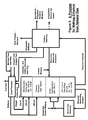
- this combined thermal pyrolysis and in-situ hydrogenation can serve as a compact single unit operation to produce ethylene from natural gas with an economically acceptable yield as shown in Figure 1.
- the HOECHST two-stage pyrolysis scheme and condition is selected for this embodiment.
- the general process scheme is shown in Figure 2 below.
- Methane obtained from natural gas is combined with unconverted methane recovered from reactor effluent and is preheated to 600°C.
- An oxygen stream is also preheated before feeding to the reactor.
- the reactor effluent of CO and hydrogen will be used as a fuel gas for feed preheating and steam generation.
- the preheated methane is split into two streams one is fed to mixing zone at a stoichiometric ratio with oxygen feed for complete combustion to supply the necessary heat for the endothermic reaction in the pyrolysis zone.
- the other methane stream is fed to the pyrolysis zone directly.
- the reactor wall can be protected from high temperature by a steam curtain if necessary.
- the temperature ranges between 900°C-2000°C.
- the preheated methane is quickly mixed with effluents from the mixing zone at 1300°C-1600°C to form acetylene.
- the desired residence time in the pyrolysis section is controlled in the range of 3 and 30 milliseconds, preferably between 5 and 10 milliseconds.
- the pressure is set between 0.5-5 atmosphere and preferably 2 atmospheres. Up to this point the traditional two stage pyrolysis is implemented.
- the pyrolysis products from the pyrolysis zone are partially quenched to the desired hydrogenation reaction temperature of between 800°C to 910°C.
- the quench can be made with cooling medium mixed alkane.
- the cooling medium is preferably water, natural gas or methanol but oil can also be used.
- This particular zone is referred to in this disclosure as in-situ hydrogenation zone.
- the required contact time may vary between 0.05 to 1.0 seconds, preferably from 0.14 -0.6 seconds, and the pressure is set between 0.5-5 atmospheres.
- the alkane to acetylene ratio can vary from 4:1 1 to 0.2:1.
- the reaction gas is further quenched with a coolant down to 200°C-90°C for product recovery.
- a two step quench is required for this in-situ hydrogenation operation.
- the unconverted acetylene and unconverted alkane are separated and recycled back together to the in-situ hydrogenation zone after being mixed with the fresh feed of alkane and coolant.
- the remainder gas mixture mainly hydrogen and CO mixed with some CO 2 is used as fuel gas.
- a BASF type partial oxidation reactor can be used similarly to make acetylene which is then in-situ hydrogenated in a similar hydrogenation zone to produce ethylene.
- Ethylene mass production from natural gas can therefore be economically realized by using this innovative and compact process design.
- This example shows the main reaction between acetylene and alkane feed such as ethane at a reaction temperature between 880°C and 890°C.
- alkane feed such as ethane
- the conversion of acetylene is higher than 90%, while the conversion of ethane is higher than 75%.
- Additional hydrogen used to hydrogenate the acetylene evidently came from the free hydrogen available in the feed. This is quite different from the Example 2 with no alkane added to the feed.
- the flow rate of the feed is controlled to have a constant time.
- a feed comprising 8.6% C 2 H 2 , 4.4% C 2 H 6 , 5.5% N 2 , 13% CO, 68.5% H 2 and water 0.06cc/min was tested.
- the observed results from the hydrogen transfer reaction are shown in Table 1.
- Table 2 also shows the full outlet composition, some higher hydrocarbons are formed as byproducts of the hydrogenation step in the outlet gas. Little traceable carbon is observed in the particular hydrogenation step after many days on stream.
- Table 2 Temperature, °C C 2 H 4 C 2 H 2 C 2 H 6 N 2 H 2 C 3 H 6 C 4 H 8 C 6 H 6 CH 4 With ethane Feed - - 8.8 17.2 36.0 37.2 Run 858 12.75 2.13 3.47 37.1 41.4 0.07 0.31 0.47 2.19 Without ethane Feed - - 13.7 - 43.9 42.5 Run 855 3.97 4.53 0.30 48.0 41.5 - 0.20 0.43 0.86
- the main reaction product is ethylene and is accompanied by some byproducts in small amounts of CH 4 , C 3 H 6 , C 4 H 8 and benzene. Some byproducts such as alkenes and benzene are considered recoverable valuable byproducts.
Landscapes
- Chemical & Material Sciences (AREA)
- Organic Chemistry (AREA)
- Engineering & Computer Science (AREA)
- Combustion & Propulsion (AREA)
- Organic Low-Molecular-Weight Compounds And Preparation Thereof (AREA)
- Low-Molecular Organic Synthesis Reactions Using Catalysts (AREA)
Priority Applications (10)
| Application Number | Priority Date | Filing Date | Title |
|---|---|---|---|
| EP05014585A EP1741691A1 (en) | 2005-07-06 | 2005-07-06 | Process for the production of ethylene |
| AT06762223T ATE474823T1 (de) | 2005-07-06 | 2006-06-22 | Verfahren zur herstellung von ethylen |
| EP06762223A EP1899285B1 (en) | 2005-07-06 | 2006-06-22 | Process for the production of ethylene |
| PCT/EP2006/006225 WO2007003312A2 (en) | 2005-07-06 | 2006-06-22 | Process for the production of ethylene |
| JP2008519834A JP5139281B2 (ja) | 2005-07-06 | 2006-06-22 | エチレンの製造方法 |
| DE602006015646T DE602006015646D1 (de) | 2005-07-06 | 2006-06-22 | Verfahren zur herstellung von ethylen |
| CN2006800245765A CN101218194B (zh) | 2005-07-06 | 2006-06-22 | 生产乙烯的方法 |
| US11/988,349 US8013196B2 (en) | 2005-07-06 | 2006-06-22 | Process for the production of ethylene |
| EA200800261A EA013242B1 (ru) | 2005-07-06 | 2006-06-22 | Способ производства этилена |
| KR1020087003061A KR101408633B1 (ko) | 2005-07-06 | 2006-06-22 | 에틸렌의 생산방법 |
Applications Claiming Priority (1)
| Application Number | Priority Date | Filing Date | Title |
|---|---|---|---|
| EP05014585A EP1741691A1 (en) | 2005-07-06 | 2005-07-06 | Process for the production of ethylene |
Publications (1)
| Publication Number | Publication Date |
|---|---|
| EP1741691A1 true EP1741691A1 (en) | 2007-01-10 |
Family
ID=35448004
Family Applications (2)
| Application Number | Title | Priority Date | Filing Date |
|---|---|---|---|
| EP05014585A Withdrawn EP1741691A1 (en) | 2005-07-06 | 2005-07-06 | Process for the production of ethylene |
| EP06762223A Not-in-force EP1899285B1 (en) | 2005-07-06 | 2006-06-22 | Process for the production of ethylene |
Family Applications After (1)
| Application Number | Title | Priority Date | Filing Date |
|---|---|---|---|
| EP06762223A Not-in-force EP1899285B1 (en) | 2005-07-06 | 2006-06-22 | Process for the production of ethylene |
Country Status (9)
| Country | Link |
|---|---|
| US (1) | US8013196B2 (https=) |
| EP (2) | EP1741691A1 (https=) |
| JP (1) | JP5139281B2 (https=) |
| KR (1) | KR101408633B1 (https=) |
| CN (1) | CN101218194B (https=) |
| AT (1) | ATE474823T1 (https=) |
| DE (1) | DE602006015646D1 (https=) |
| EA (1) | EA013242B1 (https=) |
| WO (1) | WO2007003312A2 (https=) |
Cited By (17)
| Publication number | Priority date | Publication date | Assignee | Title |
|---|---|---|---|---|
| WO2010065200A1 (en) * | 2008-11-25 | 2010-06-10 | Exxonmobil Chemical Patents Inc. | Conversion of co-fed methane and low hydrogen content hydrocarbon feedstocks to acetylene |
| EP2049456B1 (en) * | 2006-01-23 | 2012-03-14 | Saudi Basic Industries Corporation Inc. | Process for the production of ethylene from natural gas with heat integration |
| WO2012099674A3 (en) * | 2011-01-19 | 2013-03-21 | Exxonmobil Chemical Patents Inc. | Hydrocarbon conversion process |
| US9050935B2 (en) | 2012-09-26 | 2015-06-09 | Ford Global Technologies, Llc | Assessment of driving behavior of a driver of a motor vehicle |
| US9126882B2 (en) | 2012-02-10 | 2015-09-08 | Exxonmobil Chemical Patents Inc. | Hydrocarbon pyrolysis method |
| US9260361B2 (en) | 2011-11-22 | 2016-02-16 | Exxonmobil Chemical Patents Inc. | Hydrocarbon conversion process |
| US9346728B2 (en) | 2011-01-19 | 2016-05-24 | Exxonmobil Chemical Patents Inc. | Hydrocarbon conversion process |
| US9505680B2 (en) | 2011-01-19 | 2016-11-29 | Exxonmobil Chemical Patents Inc. | Method and apparatus for managing the conversion of hydrocarbons into olefins |
| WO2017052860A1 (en) | 2015-09-25 | 2017-03-30 | Exxonmobil Chemical Patents Inc. | Hydrocarbon dehydrocyclization |
| US9663419B2 (en) | 2011-01-19 | 2017-05-30 | Exxonmobil Chemical Patents Inc. | Hydrocarbon conversion process |
| US9677014B2 (en) | 2011-01-19 | 2017-06-13 | Exxonmobil Chemical Patents Inc. | Process and apparatus for converting hydrocarbons |
| US9676681B2 (en) | 2011-01-19 | 2017-06-13 | Exxonmobil Chemical Patents Inc. | Method and apparatus for managing hydrogen content through the conversion of hydrocarbons into olefins |
| US9708231B2 (en) | 2011-01-19 | 2017-07-18 | Exxonmobil Chemical Patents Inc. | Method and apparatus for converting hydrocarbons into olefins using hydroprocessing and thermal pyrolysis |
| US9708232B2 (en) | 2011-01-19 | 2017-07-18 | Exxonmobil Chemical Patents Inc. | Method and apparatus for converting hydrocarbons into olefins |
| US9809508B2 (en) | 2011-01-19 | 2017-11-07 | Exxonmobil Chemical Patents Inc. | Method and apparatus for converting hydrocarbons into olefins |
| US9815751B2 (en) | 2011-01-19 | 2017-11-14 | Exxonmobil Chemical Patents Inc. | Hydrocarbon and oxygenate conversion by high severity pyrolysis to make acetylene and ethylene |
| US9868680B2 (en) | 2011-01-19 | 2018-01-16 | Exxonmobil Chemical Patents Inc. | Method and apparatus for converting hydrocarbons into olefins |
Families Citing this family (28)
| Publication number | Priority date | Publication date | Assignee | Title |
|---|---|---|---|---|
| ES2330230T3 (es) * | 2005-03-23 | 2009-12-07 | Saudi Basic Industries Corporation | Proceso para la produccion simultanea de benceno y etileno por conversion de acetileno. |
| US9611437B2 (en) * | 2010-01-12 | 2017-04-04 | Lummus Technology Inc. | Producing low methane syngas from a two-stage gasifier |
| US8674155B2 (en) * | 2010-12-22 | 2014-03-18 | Kellogg Brown & Root, Llc | Systems and methods for processing hydrocarbons |
| US8937186B2 (en) | 2012-08-21 | 2015-01-20 | Uop Llc | Acids removal and methane conversion process using a supersonic flow reactor |
| US8933275B2 (en) | 2012-08-21 | 2015-01-13 | Uop Llc | Production of oxygenates from a methane conversion process |
| US9434663B2 (en) | 2012-08-21 | 2016-09-06 | Uop Llc | Glycols removal and methane conversion process using a supersonic flow reactor |
| US20140058128A1 (en) * | 2012-08-21 | 2014-02-27 | Uop Llc | Production of higher hydrocarbons from a methane conversion process |
| US9656229B2 (en) | 2012-08-21 | 2017-05-23 | Uop Llc | Methane conversion apparatus and process using a supersonic flow reactor |
| US9023255B2 (en) | 2012-08-21 | 2015-05-05 | Uop Llc | Production of nitrogen compounds from a methane conversion process |
| US9205398B2 (en) | 2012-08-21 | 2015-12-08 | Uop Llc | Production of butanediol from a methane conversion process |
| US9308513B2 (en) | 2012-08-21 | 2016-04-12 | Uop Llc | Production of vinyl chloride from a methane conversion process |
| US9370757B2 (en) | 2012-08-21 | 2016-06-21 | Uop Llc | Pyrolytic reactor |
| US8927769B2 (en) | 2012-08-21 | 2015-01-06 | Uop Llc | Production of acrylic acid from a methane conversion process |
| US9707530B2 (en) | 2012-08-21 | 2017-07-18 | Uop Llc | Methane conversion apparatus and process using a supersonic flow reactor |
| US9689615B2 (en) | 2012-08-21 | 2017-06-27 | Uop Llc | Steady state high temperature reactor |
| US9327265B2 (en) | 2012-08-21 | 2016-05-03 | Uop Llc | Production of aromatics from a methane conversion process |
| US20140058151A1 (en) * | 2012-08-21 | 2014-02-27 | Uop Llc | Oxygen removal and methane conversion process using a supersonic flow reactor |
| US20140058150A1 (en) * | 2012-08-21 | 2014-02-27 | Uop Llc | Removal of nitrogen containing compounds and methane conversion process using a supersonic flow reactor |
| TWI617536B (zh) | 2015-06-12 | 2018-03-11 | 薩比克環球科技公司 | 藉由甲烷之非氧化偶合製造烴類之方法 |
| US11666879B2 (en) | 2018-04-18 | 2023-06-06 | Sabic Global Technologies B.V. | Small channel short fixed bed adiabatic reactor for oxidative coupling of methane |
| WO2019236983A1 (en) * | 2018-06-08 | 2019-12-12 | Sabic Global Technologies B.V. | Method for conversion of methane to ethylene |
| KR102190110B1 (ko) | 2019-01-31 | 2020-12-11 | 한국화학연구원 | 메탄의 비산화 직접전환 반응기 및 이를 이용한 에틸렌 및 방향족 화합물의 제조방법 |
| US11718572B2 (en) * | 2019-06-24 | 2023-08-08 | Dow Global Technologies Llc | Methods for operating integrated chemical processing systems for producing olefins |
| AR123123A1 (es) | 2020-08-03 | 2022-11-02 | Shell Int Research | Proceso integrado de producción de etileno |
| KR102703952B1 (ko) | 2021-09-08 | 2024-09-06 | 한국화학연구원 | 메탄의 비산화 직접전환 반응기 및 이를 이용한 에틸렌 및 방향족 화합물의 제조방법 |
| DE102021131890A1 (de) | 2021-12-03 | 2023-06-07 | Georg Markowz | Verfahren zur Herstellung von synthetischem Flugturbinenkraftstoff oder Kraftzusatzstoff |
| KR102840477B1 (ko) * | 2023-08-22 | 2025-07-30 | 한국화학연구원 | 메탄의 비산화 직접전환 반응을 이용한 에틸렌의 제조시스템 및 제조방법 |
| KR102755274B1 (ko) | 2024-07-05 | 2025-01-22 | 최병렬 | 압축기와 반응기와 촉매제 기반 에틸렌과 프로판과 고분자 재료 혼합 복합 생산 시스템 및 그 운용방법 |
Citations (5)
| Publication number | Priority date | Publication date | Assignee | Title |
|---|---|---|---|---|
| JPS5711928A (en) * | 1980-06-24 | 1982-01-21 | Kyozo Kaneko | Method of producing ethylene and synthesis gas from methane |
| EP0225143A2 (en) * | 1985-11-27 | 1987-06-10 | The British Petroleum Company p.l.c. | The production of ethylene-derived chemicals from gaseous paraffins |
| US4726913A (en) * | 1984-10-18 | 1988-02-23 | The British Petroleum Company P.L.C. | Conversion process |
| US5270016A (en) * | 1990-05-17 | 1993-12-14 | Institut Francais Du Petrole | Apparatus for the thermal conversion of methane |
| RU2169755C1 (ru) * | 1999-11-12 | 2001-06-27 | ООО "Фирма Плазмохим" | Способ получения этилена из природного газа |
Family Cites Families (21)
| Publication number | Priority date | Publication date | Assignee | Title |
|---|---|---|---|---|
| DE1122054B (de) | 1960-04-16 | 1962-01-18 | Hoechst Ag | Verfahren zur Herstellung von niedermolekularen ungesaettigten Kohlenwasserstoffen |
| DE1250424B (de) | 1960-06-21 | 1967-09-21 | Farbwerke Hoechst Aktiengesell schaft vormals Meister Lucius &. Brunmg Frankfurt/M | Verfahren zur thermischen Spaltung von Kohlenwasserstoffen zu vorw egend Acetylen und Äthylen |
| US3321545A (en) | 1964-06-30 | 1967-05-23 | Exxon Research Engineering Co | Olefins by hydrogen transfer |
| US3267170A (en) | 1964-06-30 | 1966-08-16 | Exxon Research Engineering Co | Process for forming olefins by hydrogen transfer |
| US4128595A (en) | 1977-05-02 | 1978-12-05 | Phillips Petroleum Company | Acetylene hydrogenation in liquid phase with a liquid hydrocarbon reaction medium |
| JPS58126819A (ja) * | 1982-01-25 | 1983-07-28 | Idemitsu Petrochem Co Ltd | アセチレンの転換方法 |
| JPS58157894A (ja) * | 1982-03-11 | 1983-09-20 | Mitsubishi Heavy Ind Ltd | 炭化水素からオレフインを製造するための熱分解法 |
| FR2624115B1 (fr) * | 1987-12-03 | 1990-04-13 | Gaz De France | Procede et appareil pour la conversion des hydrocarbures |
| FR2629094B1 (fr) | 1988-03-23 | 1991-01-04 | Inst Francais Du Petrole | Procede d'hydrogenation catalytique selective en phase liquide d'une charge normalement gazeuse contenant de l'ethylene, de l'acetylene et de l'essence |
| US5015799A (en) * | 1989-07-06 | 1991-05-14 | Amoco Corporation | Oxidative coupling process for converting methane and/or natural gas to more transportable products |
| GB9208154D0 (en) * | 1991-05-03 | 1992-05-27 | Ici Plc | Transhydrogenation |
| DE4422815A1 (de) | 1994-06-29 | 1996-01-04 | Basf Ag | Verfahren zur Herstellung von Acetylen und Synthesegas |
| DE19535402A1 (de) | 1995-09-23 | 1997-03-27 | Basf Ag | Palladium-haltiger Trägerkatalysator zur selektiven katalytischen Hydrierung von Acetylen in Kohlenwasserstoffströmen |
| US5824834A (en) * | 1995-10-19 | 1998-10-20 | Basf Aktiengesellschaft | Process for the production of acetylene and synthesis gas |
| DE19914226A1 (de) * | 1999-03-29 | 2000-10-05 | Basf Ag | Verfahren zur Herstellung von Acetylen und Synthesegas |
| CA2463813C (en) * | 2001-10-18 | 2011-12-20 | Keith A. Bullin | High temperature hydrocarbon cracking |
| US7045670B2 (en) | 2003-09-03 | 2006-05-16 | Synfuels International, Inc. | Process for liquid phase hydrogenation |
| US7919431B2 (en) | 2003-09-03 | 2011-04-05 | Synfuels International, Inc. | Catalyst formulation for hydrogenation |
| US7208647B2 (en) | 2003-09-23 | 2007-04-24 | Synfuels International, Inc. | Process for the conversion of natural gas to reactive gaseous products comprising ethylene |
| US7183451B2 (en) * | 2003-09-23 | 2007-02-27 | Synfuels International, Inc. | Process for the conversion of natural gas to hydrocarbon liquids |
| US7846401B2 (en) * | 2005-12-23 | 2010-12-07 | Exxonmobil Research And Engineering Company | Controlled combustion for regenerative reactors |
-
2005
- 2005-07-06 EP EP05014585A patent/EP1741691A1/en not_active Withdrawn
-
2006
- 2006-06-22 US US11/988,349 patent/US8013196B2/en not_active Expired - Fee Related
- 2006-06-22 CN CN2006800245765A patent/CN101218194B/zh not_active Expired - Fee Related
- 2006-06-22 DE DE602006015646T patent/DE602006015646D1/de active Active
- 2006-06-22 KR KR1020087003061A patent/KR101408633B1/ko not_active Expired - Fee Related
- 2006-06-22 WO PCT/EP2006/006225 patent/WO2007003312A2/en not_active Ceased
- 2006-06-22 EP EP06762223A patent/EP1899285B1/en not_active Not-in-force
- 2006-06-22 EA EA200800261A patent/EA013242B1/ru not_active IP Right Cessation
- 2006-06-22 JP JP2008519834A patent/JP5139281B2/ja not_active Expired - Fee Related
- 2006-06-22 AT AT06762223T patent/ATE474823T1/de not_active IP Right Cessation
Patent Citations (5)
| Publication number | Priority date | Publication date | Assignee | Title |
|---|---|---|---|---|
| JPS5711928A (en) * | 1980-06-24 | 1982-01-21 | Kyozo Kaneko | Method of producing ethylene and synthesis gas from methane |
| US4726913A (en) * | 1984-10-18 | 1988-02-23 | The British Petroleum Company P.L.C. | Conversion process |
| EP0225143A2 (en) * | 1985-11-27 | 1987-06-10 | The British Petroleum Company p.l.c. | The production of ethylene-derived chemicals from gaseous paraffins |
| US5270016A (en) * | 1990-05-17 | 1993-12-14 | Institut Francais Du Petrole | Apparatus for the thermal conversion of methane |
| RU2169755C1 (ru) * | 1999-11-12 | 2001-06-27 | ООО "Фирма Плазмохим" | Способ получения этилена из природного газа |
Non-Patent Citations (2)
| Title |
|---|
| DATABASE WPI Section Ch Week 200153, Derwent World Patents Index; Class A41, AN 2001-487601, XP002359013 * |
| PATENT ABSTRACTS OF JAPAN vol. 006, no. 073 (C - 101) 8 May 1982 (1982-05-08) * |
Cited By (21)
| Publication number | Priority date | Publication date | Assignee | Title |
|---|---|---|---|---|
| EP2049456B1 (en) * | 2006-01-23 | 2012-03-14 | Saudi Basic Industries Corporation Inc. | Process for the production of ethylene from natural gas with heat integration |
| WO2010065200A1 (en) * | 2008-11-25 | 2010-06-10 | Exxonmobil Chemical Patents Inc. | Conversion of co-fed methane and low hydrogen content hydrocarbon feedstocks to acetylene |
| EP2367911A4 (en) * | 2008-11-25 | 2015-10-28 | Exxonmobil Chem Patents Inc | CONVERSION OF COMMONLY SUPPLIED METHANE AND HYDROCARBON INGREDIENTS WITH LOW HYDROGEN CONTENT IN ACETYLENE |
| US8748686B2 (en) * | 2008-11-25 | 2014-06-10 | Exxonmobil Chemical Patents Inc. | Conversion of co-fed methane and low hydrogen content hydrocarbon feedstocks to acetylene |
| US9346728B2 (en) | 2011-01-19 | 2016-05-24 | Exxonmobil Chemical Patents Inc. | Hydrocarbon conversion process |
| US9868680B2 (en) | 2011-01-19 | 2018-01-16 | Exxonmobil Chemical Patents Inc. | Method and apparatus for converting hydrocarbons into olefins |
| WO2012099674A3 (en) * | 2011-01-19 | 2013-03-21 | Exxonmobil Chemical Patents Inc. | Hydrocarbon conversion process |
| US9815751B2 (en) | 2011-01-19 | 2017-11-14 | Exxonmobil Chemical Patents Inc. | Hydrocarbon and oxygenate conversion by high severity pyrolysis to make acetylene and ethylene |
| US9505680B2 (en) | 2011-01-19 | 2016-11-29 | Exxonmobil Chemical Patents Inc. | Method and apparatus for managing the conversion of hydrocarbons into olefins |
| US9815919B2 (en) | 2011-01-19 | 2017-11-14 | Exxonmobil Chemical Patents Inc. | Hydrocarbon conversion process |
| US9663419B2 (en) | 2011-01-19 | 2017-05-30 | Exxonmobil Chemical Patents Inc. | Hydrocarbon conversion process |
| US9677014B2 (en) | 2011-01-19 | 2017-06-13 | Exxonmobil Chemical Patents Inc. | Process and apparatus for converting hydrocarbons |
| US9676681B2 (en) | 2011-01-19 | 2017-06-13 | Exxonmobil Chemical Patents Inc. | Method and apparatus for managing hydrogen content through the conversion of hydrocarbons into olefins |
| US9708231B2 (en) | 2011-01-19 | 2017-07-18 | Exxonmobil Chemical Patents Inc. | Method and apparatus for converting hydrocarbons into olefins using hydroprocessing and thermal pyrolysis |
| US9708232B2 (en) | 2011-01-19 | 2017-07-18 | Exxonmobil Chemical Patents Inc. | Method and apparatus for converting hydrocarbons into olefins |
| US9809508B2 (en) | 2011-01-19 | 2017-11-07 | Exxonmobil Chemical Patents Inc. | Method and apparatus for converting hydrocarbons into olefins |
| US9260361B2 (en) | 2011-11-22 | 2016-02-16 | Exxonmobil Chemical Patents Inc. | Hydrocarbon conversion process |
| US9126882B2 (en) | 2012-02-10 | 2015-09-08 | Exxonmobil Chemical Patents Inc. | Hydrocarbon pyrolysis method |
| US9050935B2 (en) | 2012-09-26 | 2015-06-09 | Ford Global Technologies, Llc | Assessment of driving behavior of a driver of a motor vehicle |
| US9815749B2 (en) | 2015-09-25 | 2017-11-14 | Exxonmobil Chemical Patents Inc. | Hydrocarbon dehydrocyclization |
| WO2017052860A1 (en) | 2015-09-25 | 2017-03-30 | Exxonmobil Chemical Patents Inc. | Hydrocarbon dehydrocyclization |
Also Published As
| Publication number | Publication date |
|---|---|
| EA200800261A1 (ru) | 2008-04-28 |
| US20090198090A1 (en) | 2009-08-06 |
| CN101218194A (zh) | 2008-07-09 |
| WO2007003312A2 (en) | 2007-01-11 |
| EP1899285B1 (en) | 2010-07-21 |
| US8013196B2 (en) | 2011-09-06 |
| WO2007003312A3 (en) | 2007-04-26 |
| DE602006015646D1 (de) | 2010-09-02 |
| JP2008544999A (ja) | 2008-12-11 |
| KR20080037012A (ko) | 2008-04-29 |
| ATE474823T1 (de) | 2010-08-15 |
| EA013242B1 (ru) | 2010-04-30 |
| CN101218194B (zh) | 2011-06-08 |
| EP1899285A2 (en) | 2008-03-19 |
| KR101408633B1 (ko) | 2014-06-17 |
| JP5139281B2 (ja) | 2013-02-06 |
Similar Documents
| Publication | Publication Date | Title |
|---|---|---|
| EP1741691A1 (en) | Process for the production of ethylene | |
| EP2049456B1 (en) | Process for the production of ethylene from natural gas with heat integration | |
| JP2008544999A5 (https=) | ||
| US5382741A (en) | Process for the production of mono-olefins | |
| US9776935B2 (en) | Method for olefins production | |
| US20190248717A1 (en) | Oxidative dehydrogenation of alkanes to alkenes, and related system | |
| KR20110033229A (ko) | 스티렌으로 되도록 하기 위한 에틸벤젠 탈수소화를 위한 배합 이산화탄소 및 산소 공정 | |
| EP1140744B1 (en) | Process for the production of olefins | |
| EA008210B1 (ru) | Способ получения олефинов | |
| EP1819653B1 (en) | Process for the production of methanol | |
| US8674155B2 (en) | Systems and methods for processing hydrocarbons | |
| US7355088B2 (en) | Process for producing benzene, ethylene and synthesis gas | |
| WO2018202828A1 (en) | A process for oxidative coupling of methane (ocm) and a process system for such a process |
Legal Events
| Date | Code | Title | Description |
|---|---|---|---|
| PUAI | Public reference made under article 153(3) epc to a published international application that has entered the european phase |
Free format text: ORIGINAL CODE: 0009012 |
|
| 17P | Request for examination filed |
Effective date: 20060427 |
|
| AK | Designated contracting states |
Kind code of ref document: A1 Designated state(s): AT BE BG CH CY CZ DE DK EE ES FI FR GB GR HU IE IS IT LI LT LU LV MC NL PL PT RO SE SI SK TR |
|
| AX | Request for extension of the european patent |
Extension state: AL BA HR MK YU |
|
| AKX | Designation fees paid |
Designated state(s): AT BE BG CH CY CZ DE DK EE ES FI FR GB GR HU IE IS IT LI LT LU LV MC NL PL PT RO SE SI SK TR |
|
| 17Q | First examination report despatched |
Effective date: 20080118 |
|
| STAA | Information on the status of an ep patent application or granted ep patent |
Free format text: STATUS: THE APPLICATION IS DEEMED TO BE WITHDRAWN |
|
| 18D | Application deemed to be withdrawn |
Effective date: 20080529 |