EP1736767A2 - Ultraschallsonde - Google Patents
Ultraschallsonde Download PDFInfo
- Publication number
- EP1736767A2 EP1736767A2 EP20060253118 EP06253118A EP1736767A2 EP 1736767 A2 EP1736767 A2 EP 1736767A2 EP 20060253118 EP20060253118 EP 20060253118 EP 06253118 A EP06253118 A EP 06253118A EP 1736767 A2 EP1736767 A2 EP 1736767A2
- Authority
- EP
- European Patent Office
- Prior art keywords
- piezoelectric elements
- axis direction
- group
- reference position
- light
- Prior art date
- Legal status (The legal status is an assumption and is not a legal conclusion. Google has not performed a legal analysis and makes no representation as to the accuracy of the status listed.)
- Withdrawn
Links
Images



Classifications
-
- G—PHYSICS
- G01—MEASURING; TESTING
- G01N—INVESTIGATING OR ANALYSING MATERIALS BY DETERMINING THEIR CHEMICAL OR PHYSICAL PROPERTIES
- G01N29/00—Investigating or analysing materials by the use of ultrasonic, sonic or infrasonic waves; Visualisation of the interior of objects by transmitting ultrasonic or sonic waves through the object
- G01N29/22—Details, e.g. general constructional or apparatus details
- G01N29/26—Arrangements for orientation or scanning by relative movement of the head and the sensor
- G01N29/265—Arrangements for orientation or scanning by relative movement of the head and the sensor by moving the sensor relative to a stationary material
-
- A—HUMAN NECESSITIES
- A61—MEDICAL OR VETERINARY SCIENCE; HYGIENE
- A61B—DIAGNOSIS; SURGERY; IDENTIFICATION
- A61B8/00—Diagnosis using ultrasonic, sonic or infrasonic waves
- A61B8/44—Constructional features of the ultrasonic, sonic or infrasonic diagnostic device
- A61B8/4444—Constructional features of the ultrasonic, sonic or infrasonic diagnostic device related to the probe
- A61B8/4461—Features of the scanning mechanism, e.g. for moving the transducer within the housing of the probe
-
- A—HUMAN NECESSITIES
- A61—MEDICAL OR VETERINARY SCIENCE; HYGIENE
- A61B—DIAGNOSIS; SURGERY; IDENTIFICATION
- A61B8/00—Diagnosis using ultrasonic, sonic or infrasonic waves
- A61B8/48—Diagnostic techniques
- A61B8/483—Diagnostic techniques involving the acquisition of a 3D volume of data
-
- G—PHYSICS
- G01—MEASURING; TESTING
- G01N—INVESTIGATING OR ANALYSING MATERIALS BY DETERMINING THEIR CHEMICAL OR PHYSICAL PROPERTIES
- G01N2291/00—Indexing codes associated with group G01N29/00
- G01N2291/10—Number of transducers
- G01N2291/106—Number of transducers one or more transducer arrays
Definitions
- the present invention relates to an ultrasonic probe in which a group of piezoelectric elements oscillates in the short-axis direction of the probe to obtain a three-dimensional image (hereinafter called a "short-axis oscillating probe") and, in particular, to a short-axis oscillating probe of a simple configuration that uses a stepping motor.
- a short-axis oscillating probe that is known in the art obtains a three-dimensional image by electronically scanning a group of piezoelectric elements in the long-axis direction of the probe and also by mechanically scanning (oscillating) the group of piezoelectric elements in that short-axis direction (see Japanese Patent Publication No. 7-38851 and Japanese Patent Laid-Open Publication No. 2003-175033 ). Since components such as wiring (connective wires) and scan circuitry of this type of short-axis oscillating probe can be configured simply, in comparison with a matrix type of probe in which piezoelectric elements are arrayed horizontally and vertically to provide a two-dimensional scan, this probe can be implemented easily.
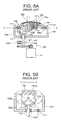
- FIGS. 5A A prior-art example of a short-axis oscillating probe (see Japanese Patent Publication No. 7-38851 ) is shown in FIGS. 5A, where FIG. 5A is a section taken along the long-axis direction (X-X direction) of the probe and FIG. 5B is a section taken along the short-axis direction (Y-Y direction) thereof.
- This prior-art short-axis oscillating probe is provided with a group of piezoelectric elements 101, a rotational mechanism portion 102, and a rotational angle detection mechanism 103.
- the group of piezoelectric elements 101 is arrayed on a base 104 to which backing material is attached, with the widthwise direction of the plurality of narrow card-shaped piezoelectric elements 101a aligned in the long-axis direction and also the lengthwise direction thereof aligned in the short-axis direction.
- This backing material is affixed on top of the base 104, which is formed of a plastic material in a convex dome shape in the long-axis direction, with the configuration being such that the group of piezoelectric elements 101 is curved outward in the long-axis direction.
- a flexible substrate 105 that has been connected electrically to the group of piezoelectric elements 101 over the entire region of the probe in the long-axis direction thereof is lead out downward from one end side of the probe in the short-axis direction, as shown in FIG. 5B.
- a conductive path 105a of the flexible substrate 105 is connected electrically to a drive electrode of each piezoelectric element 101a.
- the rotational mechanismportion 102 shown in FIG. 5A is formed of a retaining plate 106 of a metal material, a case 107, a segment-shaped first bevel gear 108a, a second bevel gear 108b, a control shaft 109, and a stepping motor 110.
- the retaining plate 106 has leg portions 106a and 106b on the lower surface thereof on both edge sides in the long-axis direction, and the base 104 holding the group of piezoelectric elements 101 consisting of the plurality of piezoelectric elements 101a is affixed to the upper surface thereof.
- center shafts 111a and 111b that penetrate through the leg portions 106a and 106b are supported in rotation by bearings 111c and 111d in the long-axis direction (on the line X-X in the horizontal direction of the case 107), with the leg portions 106a and 106b being provided to be freely rotatable about the center shafts 111a and 111b.
- the case 107 is formed to be concave in section with the upper surface thereof being open, and projecting ends of the center shafts 111a and 111b that bear the leg portions 106a and 106b are affixed to peripheral walls of the case 107.
- a slit 112 is formed in the long-axis direction of the bottom wall of the case 107, as shown in FIG. 5B, and the flexible substrate 105 that is connected to the group of piezoelectric elements 101 is lead out to the exterior of the case 107 therethrough.
- a material such as a plastic material is embedding in the slit 112 to seal the same.
- the first bevel gear 108a of a segment shape is affixed by screws or the like to the inner surface of the leg portion 106a that is one of the leg portions provided on the retaining plate 106, below the center shaft 111a that passes therethrough and is supported in rotation thereby, and has teeth in an arc (a fan shape) with a peak thereof at the lower end in the vertical direction.
- the second bevel gear 108b is supported rotatably on the free end of the control shaft 109 that is aligned in the vertical direction perpendicular to the center shafts 111a and 111b (the line X-X) , engages with the first bevel gear 108a, and rotates in the horizontal direction.
- the control shaft 109 is lead out of the case 107 from the bottom wall of the case 107 and is sealed by a bearing seal member 114, and the other end thereof is linked to the stepping motor 110 by means such as a gear linkage.
- the rotational angle detection mechanism 103 is configured as an optical encoder (see FIG. 6) and consists of an optical rotary plate 103a, which is integral with the control shaft 109, and an optical counter 103b, which is U-shaped in section and into which the outer periphery of the optical rotary plate 103a is inserted.
- a large number of small holes 103c are provided around the outer periphery of the optical rotary plate 103a, and the optical counter 103b has a light-emitting portion and a light-receiving portion on leg portions that face the optical rotary plate 103a.
- Light that has been transmitted through one of a number of small holes 103c from the light-emitting portion of the optical counter 103b is detected by the light-receiving portion, and the reference position of the group of piezoelectric elements 101 is detected by counting the number of times that light is transmitted therethrough.
- This reference position is positioned on the centerline that bisects the short-axis direction, by way of example, and is detected by means of a number of optical or magnetic sensors.
- a cover that encloses the group of piezoelectric elements 101 is provided for the case 107, the group of piezoelectric elements 101 and other components are hermetically sealed therein, and the interior thereof is filled with an ultrasound transmission medium such as oil.
- the rotation of the second bevel gear 108b of the rotational mechanism portion 102 horizontally to left and right causes the first bevel gear 108a that is engaged therewith to rotate and oscillate with respect to the vertical plane so that the peak thereof inclines upward to the left or right from the center.
- the peak of the first bevel gear 108a rotates and oscillates to the left and right of the vertical direction acting as center.
- the leg portions 106a and 106b of the retaining plate 106 rotate and oscillate to the left and right with respect to the center shafts 111a and 111b, and also the group of piezoelectric elements 101 rotate and oscillate to the left and right in the short-axis direction, in the opposite directions thereto.
- the rotational angle of the group of piezoelectric elements 101 in the short-axis direction is detected by the rotational angle detection mechanism 103, ensuring that biological information is obtained from precise positions of the object to be detected (organism).
- the prior-art short-axis oscillating probe of this configuration has a problem in that it is complicated both mechanically and structurally and thus is expensive, since the rotational angle in the short-axis direction from the reference position of the group of piezoelectric elements 101 is detected by an optical encoder that is the rotational angle detection mechanism 103.
- the prior-art probe disclosed in Japanese Patent Laid-Open Publication No. 2003-175033 has a configuration in which the drive motor 110 shown in FIG. 5A is a stepping motor that is rotated intermittently by pulses, and the rotational angle is detected by counting the number of pulses from the reference position of the group of piezoelectric elements 101, making an optical encoder unnecessary.
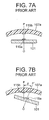
- a magnet 115a is provided in the center of the group of piezoelectric elements 101 in the short-axis direction thereof, as shown in FIG. 7A, and the reference position of the group of piezoelectric elements 101 is detected by the mutual operation of the magnet 115a with a Hall sensor 115b provided in the center of a case 107a of the probe.
- the reference position of the group of piezoelectric elements 101 is taken as the point at which a centerline OP that bisects the short-axis direction from a center of rotation O coincides with the center of the cover 107a, as shown in FIG. 7A.
- this reference position is taken as being where the center of the group of piezoelectric elements 101 in the short-axis direction lies on the centerline OP that bisects the rotational angle through which the group of piezoelectric elements 101 oscillates by rotating to the left and right.
- the reference position is detected by the reference position detection sensor that is configured of a magnetic sensor therefor.
- the flexible substrate 105 that extends outward from the group of piezoelectric elements 101 is sealed into and accommodated by the case 107 while retaining the flexibility thereof. For that reason, there is a danger that the flexible substrate 105 will come into contact with the components of the rotational mechanism portion 102, particularly the first bevel gear 108a, and the flexible substrate 105 will sustain damage such as breakage of the conductive path 105a thereof.
- a first objective of the present invention is to simplify the mechanism for detecting the rotational angle of the group of piezoelectric elements in the short-axis oscillating probe, and a second objective thereof is to prevent damage to the flexible substrate.
- the present invention relates to an ultrasonic probe comprising: a group of piezoelectric elements consisting of a plurality of piezoelectric elements of a narrow card shape arrayed in a long-axis direction of the probe and also connecting wires connected electrically to the piezoelectric elements and extending outward from at least one end side in a short-axis direction of the probe; a rotational mechanism portion that rotates and oscillates the group of piezoelectric elements in the short-axis direction about the center of the long-axis direction; a reference position detection sensor that detects a reference position in the short-axis direction of the group of piezoelectric elements; and a control shaft and a stepping motor linked to the reference position sensor and driving the rotational mechanism portion; wherein an optical rotary plate for the reference position sensor, which has a boundary region between a light-blocking portion and a light-transmitting portion, is linked to the control shaft; the light-blocking portion and the light-
- the present invention relates to an ultrasonic probe having at least: a group of piezoelectric elements consisting of a plurality of piezoelectric elements of a narrow card shape arrayed in a long-axis direction and also connecting wires such as a flexible substrate connected electrically to the piezoelectric elements and extending outward from at least one end side in a short-axis direction of the probe; a rotational mechanism portion that rotates and oscillates the group of piezoelectric elements in the short-axis direction about the center of the long-axis direction; a reference position detection sensor that detects a reference position in the short-axis direction of the group of piezoelectric elements; and a stepping motor linked to the reference position sensor that drives the rotational mechanism portion; wherein the rotational mechanism portion is provided with a retaining plate that supports the group of piezoelectric elements on an upper surface thereof and has a legportion on each side of a lower surface in the long-axis direction; a case
- the present invention enables detection of the boundary region of the optical rotary plated linked to the control shaft, to enable simple detection and setting of the reference of the group of piezoelectric elements.
- This enables a simple grasping of the position (rotational angle) in the short-axis direction of the group of piezoelectric elements from the reference position, by counting the number of pulsed generated by transmitting or blocking light by the optical rotary plate that is rotated by the stepping motor.
- This enables a simplification of the detection mechanism in the short-axis direction of the group of piezoelectric elements.
- the optical rotary plate that acts as the reference position sensor has a light-blocking portion and a light-transmitting portion that are sequential in mutually opposite directions from the boundary region, and also this optical rotary plate rotates no further than a predetermined angle with reference to that boundary region. Since only one point of the boundary region is encountered during the rotation of the optical rotary plate, the boundary region that defines the reference position can be detected reliably.
- the direction of that "shift” can be reliably sensed because there is a light-blocking portion and a light-transmitting portion on either side of the boundary region of the optical rotary plate that corresponds to the reference position. Therefore, since the optical rotary plate can be rotated toward the light-blocking side if the "shift" is toward the light-transmission side, or towards the light-transmission side if the "shift" is toward the light-blocking side, by way of example, the reference position for the group of piezoelectric elements can be detected simply and thus the reference position of the group of piezoelectric elements can be set simply.
- the protective cover which prevents contact between the flexible substrate and the second bevel gear in accordance with this invention, covers the second bevel gear.
- the rotational drive portion is not limited to a stepping motor; similar effects can be obtained with any of various other types of motor.
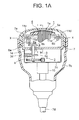
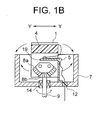
- FIGS. 1A and 1B An embodying example of a short-axis oscillating probe in accordance with the present invention is shown in FIGS. 1A and 1B, where FIG. 1A is a partially cutaway section taken in the long-axis direction (X-X direction) of a short-axis oscillating probe having a rotational angle detection mechanism (reference position detection sensor) and FIG. 1B is a lateral section taken in the short-axis direction (Y-Y direction) of the rotational mechanism portion of the probe.
- FIGS. 1A and 1B An embodying example of a short-axis oscillating probe in accordance with the present invention is shown in FIGS. 1A and 1B, where FIG. 1A is a partially cutaway section taken in the long-axis direction (X-X direction) of a short-axis oscillating probe having a rotational angle detection mechanism (reference position detection sensor) and FIG. 1B is a lateral section taken in the short-axis direction (Y-Y direction) of the rotational
- the short-axis oscillating probe of the present invention has a group of piezoelectric elements 1 consisting of a plurality of narrow card-shaped piezoelectric elements 1a arrayed in the long-axis direction of the probe (the X-X direction in FIG. 1A), with connecting wires such as a flexible substrate 5 extending outward therefrom, and a rotational mechanism portion 2 that rotates and oscillates in the short-axis direction thereof (in the Y-Y direction shown in FIG. 1B, perpendicular to the same plane that includes the X-X direction).
- a drive motor is configured as a stepping motor 10 that rotates intermittently in answer to pulses, and is provided with a reference position detection sensor 3 on a control shaft 9 thereof.
- the stepping motor 10 is attached to a frame member 7c that is affixed to a case 7, which will be described later, and power is supplied to the stepping motor 10 and the group of piezoelectric elements 1 through a power cable 7d.
- the short-axis oscillating probe of the present invention is provided with the group of piezoelectric elements 1, the rotational mechanism portion 2, and the rotational angle detection mechanism (reference position detection sensor) 3, in a similar manner to the probe of the prior art.
- the group of piezoelectric elements 1 is arrayed on a base 4 to which backing material is attached, with the widthwise direction of the plurality of narrow card-shaped piezoelectric elements 1a aligned in the long-axis direction and also the lengthwise direction thereof aligned in the short-axis direction.
- This backing material is affixed on top of the base 4, which is formed of a plastic material in a convex dome shape in the long-axis direction, with the configuration being such that the group of piezoelectric elements 1 is curved outward in the long-axis direction.
- the flexible substrate 5 that has been connected electrically to the group of piezoelectric elements 1 over the entire region of the probe in the long-axis direction thereof depends from and is lead out downward from one end side of the probe in the short-axis direction, as shown in FIG. 1B.
- a conductive path 5a of the flexible substrate 5 is connected electrically to a drive electrode of each of the plurality of narrow card-shaped piezoelectric elements 1a.
- the flexible substrate 5 shown in FIGS. 1A and 1B could either be connected directly to the piezoelectric elements 1a or it could be connected indirectly thereto by means such as silver foil and conductive wiring between the drive electrodes thereof and the conductive path 5a.
- the rotational mechanism portion 2 shown in FIGS. 1A and 1B is formed of a retaining plate 6 of a metal material, the case 7, a segment-shaped first bevel gear 8a, a second bevel gear 8b, the control shaft 9, and the stepping motor 10.
- the retaining plate 6 has leg portions 6a and 6b on the lower surface thereof on both edge sides in the long-axis direction, and the base 4 holding the group of piezoelectric elements 1 consisting of the plurality of piezoelectric elements 1a is affixed to the upper surface thereof.
- center shafts 11a and 11b that penetrate through the leg portions 6a and 6b are supported in rotation by bearings 11c and 11d in the long-axis direction (on the line X-X in the horizontal direction of the case 7), with the leg portions 6a and 6b being provided to be freely rotatable about the center shafts 11a and 11b.
- the case 7 is formed to be concave in section with the upper surface thereof being open, and projecting ends of the center shafts 11a and 11b that bear the leg portions 6a and 6b are affixed to peripheral walls of the case 7.
- a slit 12 is formed in the long-axis direction of the bottom wall of the case 7, as shown in FIG. 1B, and the flexible substrate 5 that is connected to the group of piezoelectric elements 1 is lead out to the exterior of the case 7 therethrough.
- a material such as a plastic material is embedding in the slit 12 to seal the same.
- the first bevel gear 8a of a segment shape is affixed by screws or the like to the inner surface of the leg portion 6a that is one of the leg portions provided on the retaining plate 6, below the center shaft 11a that passes therethrough and is supported in rotation thereby, and has teeth in an arc (a fan shape) with a peak thereof at the lower end in the vertical direction.
- the second bevel gear 8b is supported rotatably on the free end of the control shaft 9 that is aligned in the line Y-Y perpendicular to the center shafts 11a and 11b (the line X-X), engages with the first bevel gear 8a, and rotates in the horizontal direction.
- the control shaft 9 is lead out of the case 7 from the bottom wall of the case 7 and is sealed by a bearing seal member 14, and the other end thereof is linked to the stepping motor 10 by means such as a gear linkage.
- a cover 7a that encloses the group of piezoelectric elements 1 is provided for the case 7, the group of piezoelectric elements 1 and other components are hermetically sealed therein, the interior thereof is filled with an ultrasound transmission medium such as oil, and a housing 7b that accommodates the rotational mechanism portion 2 is engaged with the cover 7a.
- the rotation of the second bevel gear 8b of the rotational mechanism portion 2 horizontally to left and right causes the first bevel gear 8a that is engaged therewith to oscillate with respect to the vertical plane so that the peak thereof inclines upward to the left or right from the center.
- the peak of the first bevel gear 8a oscillates to the left and right of the vertical direction acting as center.
- the leg portions 6a and 6b of the retaining plate 6 rotate and oscillate to the left and right with respect to the center shafts 11a and 11b, and also the group of piezoelectric elements 1 rotate and oscillate to the left and right in the short-axis direction, in the opposite directions thereto. This ensures that the rotational angle of the group of piezoelectric elements 1 in the short-axis direction is detected by the rotational angle detection mechanism 3, so that biological information can be obtained from precise positions of the object to be detected (organism).
- the reference position detection sensor 3 is formed of an optical rotary plate 3a that is linked integrally to the control shaft 9 and a light detector 3d having a light-receiving portion of a U-shaped section, as shown in FIGS. 1A and 2A.
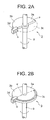
- the optical rotary plate 3a is formed of a light-blocking portion 3b and a light-transmitting portion 3c (the region indicated by a broken line in FIG. 2A) of a semicircular (half-moon) shape, and has a boundary region P formed of a linear angular position between the two.
- the light-blocking portion 3b and the light-transmitting portion 3c are formed sequentially to extend over 180° in mutually opposite directions from the center of rotation of the optical rotary plate 3a, with reference to the boundary region P.
- the configuration is also such that the rotation and oscillation of the optical rotary plate 3a shown in FIG. 2A is controlled within 180° in mutually opposite directions with reference to the boundary region P.
- the control is such that rotation is within an angle of 90° in mutually opposite directions.
- This angular control depends on the rotation of the control shaft 9 that is linked by gears to the stepping motor 10.
- the light detector 3d is affixed by clasping means such as screws to the frame member 7c with shims or the like therebetween, and an outer peripheral portion of the optical rotary plate 3a is inserted into a spatial portion S of the light detector (of U-shaped section) on the outer periphery of the optical rotary plate 3a.
- the initial position (reference position) of the optical rotary plate 3a is such that the boundary region P is located within the spatial portion S of the U-shaped portion of the light detector 3d, which is assumed to be the switchover point (on or off) between transmission and non-transmission of the light between the light-emitting and light-receiving portions of the light detector 3d.
- the group of piezoelectric elements 1 is disposed such that the centerline OP that bisects the short-axis direction from the center of rotation O is disposed on the reference position that coincides with the center of the cover 7a, in other words, the center front.
- a protective cover 19 of an L-shaped section is affixed to the inner bottom surface of the case 7 of the present invention, in a configuration that covers the second bevel gear 8b, as shown in FIG. 1B.
- the flexible substrate 5 that extends outward from one end side of the group of piezoelectric elements 1 in the short-axis direction is folded back on itself flexible, then is led out to the exterior from the slit 12 formed in the case 7, with that portion being sealed.
- the operation of the short-axis oscillating probe is started by pressing a start button (not shown in the figures).
- a start button (not shown in the figures).
- the boundary region P of the optical rotary plate 3a is rotated to within 90° ( ⁇ 2) counterclockwise from the reference position before the start of operation of the probe, as shown by way of example in FIG. 3A, so that the light-blocking portion 3b is positioned in the spatial portion S of the light detector 3b.
- the start button (not shown in the figures) is pressed in this case, the light detector 3d first catches the fact that the light-blocking portion 3b is present and detects a blocked signal.
- the stepping motor 10 is driven to rotate the optical rotary plate 3a clockwise.
- the boundary region P of the optical rotary plate 3a that forms the boundary between the blocking or transmission of light is then detected.
- the stepping motor 10 is then stopped to set the reference position.
- the boundary region P of the optical rotary plate 3a is rotated to within 90° ( ⁇ 1) clockwise from the reference position before the start of operation of the probe, as shown by way of example in FIG. 3B, so that the light-transmitting portion 3c is positioned in the spatial portion S of the light detector 3d.
- the pressing of the start button first causes the light detector 3d to detect the transmission signal.
- the stepping motor 10 is driven to rotate the optical rotary plate 3a counterclockwise.
- the boundary region P is set as the reference position.
- the above-described configuration makes it possible for the optical rotary plate 3a to oscillate and rotate, while being controlled within 90° in mutually opposite directions with reference to this boundary region P.
- the light detector 3d therefore senses either a blocked signal or a transmission signal, depending on the rotational position of the optical rotary plate 3a, so that rotating the optical rotary plate 3a either clockwise or counterclockwise in the predetermined manner will determine whether the boundary region P is present at one side or the other. It is therefore possible to detect the boundary region P reliably and determine the reference position of the group of piezoelectric elements 1 in a simple manner.
- the protective cover 19 is provided over the second bevel gear 8b, as shown in FIG. 1B, contact between the flexible substrate 5 and the second bevel gear 8b is prevented during the rotational oscillation of the group of piezoelectric elements 1. This makes it possible to prevent damage to the flexible substrate 5 and breakage of the conductive path 5a.
- the flexible substrate 5 is folded flexibly on top of the protective cover 19, sufficient space can be ensured within the case 7 and thus the rotation and oscillation of the group of piezoelectric elements 1 can be done smoothly.
- the optical rotary plate 3a is of a semicircular form, as shown in FIG. 2A, but since the rotational angle from the reference position (center front) of the group of piezoelectric elements 1 is, for example, within ⁇ 45° to ⁇ 90°, it is necessary to provide the light-blocking portion 3b and the light-transmitting portion 3c over a region of at least ⁇ 45° .
- the light-transmitting portion 3c could be such that the optical rotary plate 3a is a complete circle with an arc-shaped slit 3c provided around the outer periphery thereof as the light-transmitting portion, as shown in FIG. 2B.
- the configuration should be such that the light-blocking portion 3b and the light-transmitting portion 3c are formed in the optical rotary plate 3a in a continuous manner from the boundary region P.
- the reference position of the group of piezoelectric elements 1 is described above as being the center front, but it could equally well be set as necessary, without being positioned such that the maximum rotational angle is formed to left and right, by way of example.
- the protective cover 19 was described as being L-shaped, but it could equally well be of another shape in section, such as U-shaped.
- the connection between the control shaft 9 and the stepping motor 10 was described as being a gear linkage, but it could equally well be other linking means such as a belt and pulleys.
Landscapes
- Physics & Mathematics (AREA)
- Health & Medical Sciences (AREA)
- Life Sciences & Earth Sciences (AREA)
- Chemical & Material Sciences (AREA)
- Analytical Chemistry (AREA)
- Biochemistry (AREA)
- General Health & Medical Sciences (AREA)
- General Physics & Mathematics (AREA)
- Immunology (AREA)
- Pathology (AREA)
- Ultra Sonic Daignosis Equipment (AREA)
Applications Claiming Priority (1)
| Application Number | Priority Date | Filing Date | Title |
|---|---|---|---|
| JP2005175700A JP2006346125A (ja) | 2005-06-15 | 2005-06-15 | 超音波探触子 |
Publications (1)
| Publication Number | Publication Date |
|---|---|
| EP1736767A2 true EP1736767A2 (de) | 2006-12-27 |
Family
ID=37401145
Family Applications (1)
| Application Number | Title | Priority Date | Filing Date |
|---|---|---|---|
| EP20060253118 Withdrawn EP1736767A2 (de) | 2005-06-15 | 2006-06-15 | Ultraschallsonde |
Country Status (4)
| Country | Link |
|---|---|
| US (1) | US7554245B2 (de) |
| EP (1) | EP1736767A2 (de) |
| JP (1) | JP2006346125A (de) |
| CN (1) | CN1880921B (de) |
Cited By (3)
| Publication number | Priority date | Publication date | Assignee | Title |
|---|---|---|---|---|
| EP1987773A4 (de) * | 2006-02-21 | 2009-04-29 | Nihon Dempa Kogyo Co | Um eine kleinere achse schwingende ultraschallsonde |
| CN103344707A (zh) * | 2013-06-24 | 2013-10-09 | 长沙理工大学 | 一种用于复杂型面构件水浸超声自动检测的探头架 |
| EP3878370A4 (de) * | 2020-01-14 | 2021-11-10 | Sonotecho Biomedical Co., Ltd. | Sondenschaltvorrichtung |
Families Citing this family (23)
| Publication number | Priority date | Publication date | Assignee | Title |
|---|---|---|---|---|
| JP4668110B2 (ja) | 2006-03-30 | 2011-04-13 | 日本電波工業株式会社 | 超音波探触子 |
| JP2008023211A (ja) | 2006-07-25 | 2008-02-07 | Nippon Dempa Kogyo Co Ltd | 超音波探触子 |
| US20100076316A1 (en) * | 2006-07-25 | 2010-03-25 | Nihon Dempa Kogyo Co., Ltd. | Ultrasonic probe |
| JP4584321B2 (ja) | 2008-02-19 | 2010-11-17 | 日本電波工業株式会社 | 超音波探触子 |
| KR101495078B1 (ko) * | 2008-08-01 | 2015-02-24 | 삼성전자주식회사 | 지침 표시 장치 |
| WO2010131479A1 (ja) * | 2009-05-14 | 2010-11-18 | パナソニック株式会社 | 超音波探触子とこれを用いた超音波診断装置 |
| JP4468480B1 (ja) * | 2009-09-04 | 2010-05-26 | 日本電波工業株式会社 | 超音波探触子 |
| US11113299B2 (en) | 2009-12-01 | 2021-09-07 | Apple Inc. | System and method for metadata transfer among search entities |
| CN102087122B (zh) * | 2009-12-02 | 2014-10-29 | 深圳迈瑞生物医疗电子股份有限公司 | 一种3d机械探头 |
| JP5667420B2 (ja) * | 2010-09-29 | 2015-02-12 | 日本電波工業株式会社 | 超音波探触子 |
| CN102247161A (zh) * | 2011-04-07 | 2011-11-23 | 楼震 | 一种新型动物用b超探头 |
| JP5750325B2 (ja) * | 2011-07-15 | 2015-07-22 | 山洋電気株式会社 | エンコーダ |
| CN103169494A (zh) * | 2011-12-22 | 2013-06-26 | 深圳市威尔德医疗电子有限公司 | 一种超声医疗设备用三维超声探头 |
| CN102579083B (zh) * | 2012-03-22 | 2013-10-02 | 邓立新 | 牛用纵向扇扫直肠探头 |
| CN102988081A (zh) * | 2012-12-13 | 2013-03-27 | 无锡触典科技有限公司 | 超声扫描探头 |
| CN103006267B (zh) * | 2012-12-28 | 2015-07-15 | 汕头市超声仪器研究所有限公司 | 用于弹性成像的机械式压力感应超声探头 |
| CN104013423B (zh) * | 2014-05-09 | 2016-07-13 | 杨松 | B超扫描探头、b超扫描系统和b超扫描方法 |
| JP6321478B2 (ja) * | 2014-07-16 | 2018-05-09 | 日本電波工業株式会社 | メカニカル3d超音波探触子 |
| JP6609754B2 (ja) * | 2015-02-27 | 2019-11-27 | 国立大学法人浜松医科大学 | 超音波プローブ、及びそれを用いた超音波画像表示装置 |
| JP7066987B2 (ja) * | 2017-06-19 | 2022-05-16 | 船井電機株式会社 | 光走査装置及び光走査装置における反射部の角度検出方法 |
| CN110876628A (zh) * | 2018-09-06 | 2020-03-13 | 深圳市理邦精密仪器股份有限公司 | 三维超声机械探头 |
| CN111493929B (zh) * | 2020-05-21 | 2021-03-02 | 河南科技大学第一附属医院 | 一种医学超声波检测装置 |
| CN112413290B (zh) * | 2020-10-20 | 2021-09-28 | 中国环境科学研究院 | 一种基于自然保护区保护成效的数据探测装置 |
Family Cites Families (13)
| Publication number | Priority date | Publication date | Assignee | Title |
|---|---|---|---|---|
| US4494548A (en) * | 1982-04-20 | 1985-01-22 | Biosound, Inc. | Ultrasonic sector scanner |
| JPH0696006B2 (ja) * | 1986-01-30 | 1994-11-30 | 松下電器産業株式会社 | 超音波探触子 |
| JPS62140451U (de) * | 1986-02-26 | 1987-09-04 | ||
| US5377682A (en) * | 1991-09-05 | 1995-01-03 | Matsushita Electric Industrial Co., Ltd. | Ultrasonic probe for transmission and reception of ultrasonic wave and ultrasonic diagnostic apparatus including ultrasonic probe |
| JP3311821B2 (ja) | 1993-06-28 | 2002-08-05 | 株式会社東芝 | 映像圧縮記録再生装置 |
| US6020675A (en) * | 1995-09-13 | 2000-02-01 | Kabushiki Kaisha Toshiba | Ultrasonic probe |
| JP3150906B2 (ja) * | 1996-07-09 | 2001-03-26 | 立川ブラインド工業株式会社 | 電動ブラインドのスラット角度調節装置 |
| JP2002011005A (ja) * | 2000-06-30 | 2002-01-15 | Matsushita Electric Ind Co Ltd | 3次元駆動モータ装置とそれを使用した超音波振動子駆動モータ装置と超音波診断装置 |
| US20030055338A1 (en) * | 2001-09-18 | 2003-03-20 | Josef Steininger | Apparatus and methods for ultrasound imaging with positioning of the transducer array |
| US6813950B2 (en) * | 2002-07-25 | 2004-11-09 | R/D Tech Inc. | Phased array ultrasonic NDT system for tubes and pipes |
| JP3876206B2 (ja) * | 2002-09-02 | 2007-01-31 | 松下電器産業株式会社 | 超音波探触子 |
| JP3821435B2 (ja) * | 2002-10-18 | 2006-09-13 | 松下電器産業株式会社 | 超音波探触子 |
| JP4532294B2 (ja) * | 2005-01-19 | 2010-08-25 | パナソニック株式会社 | 超音波探触子 |
-
2005
- 2005-06-15 JP JP2005175700A patent/JP2006346125A/ja active Pending
-
2006
- 2006-06-08 US US11/449,544 patent/US7554245B2/en not_active Expired - Fee Related
- 2006-06-15 EP EP20060253118 patent/EP1736767A2/de not_active Withdrawn
- 2006-06-15 CN CN2006100922404A patent/CN1880921B/zh not_active Expired - Fee Related
Cited By (4)
| Publication number | Priority date | Publication date | Assignee | Title |
|---|---|---|---|---|
| EP1987773A4 (de) * | 2006-02-21 | 2009-04-29 | Nihon Dempa Kogyo Co | Um eine kleinere achse schwingende ultraschallsonde |
| CN103344707A (zh) * | 2013-06-24 | 2013-10-09 | 长沙理工大学 | 一种用于复杂型面构件水浸超声自动检测的探头架 |
| CN103344707B (zh) * | 2013-06-24 | 2015-08-05 | 长沙理工大学 | 一种用于复杂型面构件水浸超声自动检测的探头架 |
| EP3878370A4 (de) * | 2020-01-14 | 2021-11-10 | Sonotecho Biomedical Co., Ltd. | Sondenschaltvorrichtung |
Also Published As
| Publication number | Publication date |
|---|---|
| US20060284086A1 (en) | 2006-12-21 |
| CN1880921A (zh) | 2006-12-20 |
| CN1880921B (zh) | 2010-05-12 |
| JP2006346125A (ja) | 2006-12-28 |
| US7554245B2 (en) | 2009-06-30 |
Similar Documents
| Publication | Publication Date | Title |
|---|---|---|
| US7554245B2 (en) | Ultrasonic probe | |
| US7967755B2 (en) | Ultrasonic probe | |
| US20100076316A1 (en) | Ultrasonic probe | |
| CN100591281C (zh) | 产生四维图像的超声波探头 | |
| US5647364A (en) | Ultrasonic biometric imaging and identity verification system | |
| CN100379387C (zh) | 超声波探头 | |
| TWI313349B (de) | ||
| JPH0728863B2 (ja) | 機械的超音波スキャンヘッド | |
| WO1996025099A9 (en) | Ultrasonic biometric imaging and identity verification system | |
| JP6739670B2 (ja) | 印刷回路基板の縦置き構造 | |
| US6887204B2 (en) | Connector case, ultrasonic probe and ultrasonic imaging apparatus | |
| JP6609754B2 (ja) | 超音波プローブ、及びそれを用いた超音波画像表示装置 | |
| JP3845378B2 (ja) | 制御パネルを改良した経食道プローブ | |
| JP2011089797A (ja) | ロータリーエンコーダ及びそれを用いた医療用マニピュレータ | |
| JP2720710B2 (ja) | 機械走査式超音波探触子 | |
| JP4468480B1 (ja) | 超音波探触子 | |
| JP2022075950A (ja) | 携帯型超音波画像診断装置 | |
| JP4036382B2 (ja) | コネクタ、超音波プローブおよび超音波撮影装置 | |
| JP2005003539A (ja) | 回転検出装置、及びそれを用いた入力機器 | |
| JP2003148998A (ja) | ボリューム機構 | |
| JP4141458B2 (ja) | コネクタケース、超音波プローブおよび超音波撮影装置 | |
| JPH09117451A (ja) | 超音波探触子 | |
| JP2007159926A (ja) | 超音波診断装置 | |
| JP2001017431A (ja) | 超音波プローブ | |
| JP2003295093A (ja) | バーコード読取機構 |
Legal Events
| Date | Code | Title | Description |
|---|---|---|---|
| PUAI | Public reference made under article 153(3) epc to a published international application that has entered the european phase |
Free format text: ORIGINAL CODE: 0009012 |
|
| AK | Designated contracting states |
Kind code of ref document: A2 Designated state(s): AT BE BG CH CY CZ DE DK EE ES FI FR GB GR HU IE IS IT LI LT LU LV MC NL PL PT RO SE SI SK TR |
|
| AX | Request for extension of the european patent |
Extension state: AL BA HR MK YU |
|
| STAA | Information on the status of an ep patent application or granted ep patent |
Free format text: STATUS: THE APPLICATION IS DEEMED TO BE WITHDRAWN |
|
| 18D | Application deemed to be withdrawn |
Effective date: 20100105 |