EP1734047A1 - Verwendung von Ionischen Flüssigkeiten zur Proteinextraktion - Google Patents
Verwendung von Ionischen Flüssigkeiten zur Proteinextraktion Download PDFInfo
- Publication number
- EP1734047A1 EP1734047A1 EP06010463A EP06010463A EP1734047A1 EP 1734047 A1 EP1734047 A1 EP 1734047A1 EP 06010463 A EP06010463 A EP 06010463A EP 06010463 A EP06010463 A EP 06010463A EP 1734047 A1 EP1734047 A1 EP 1734047A1
- Authority
- EP
- European Patent Office
- Prior art keywords
- oder
- proteins
- peptides
- mit
- bis
- Prior art date
- Legal status (The legal status is an assumption and is not a legal conclusion. Google has not performed a legal analysis and makes no representation as to the accuracy of the status listed.)
- Granted
Links
- 239000002608 ionic liquid Substances 0.000 title claims abstract description 27
- 238000000751 protein extraction Methods 0.000 title 1
- 102000004169 proteins and genes Human genes 0.000 claims abstract description 58
- 108090000623 proteins and genes Proteins 0.000 claims abstract description 58
- 239000012472 biological sample Substances 0.000 claims abstract description 23
- 102000004196 processed proteins & peptides Human genes 0.000 claims abstract description 22
- 108090000765 processed proteins & peptides Proteins 0.000 claims abstract description 22
- 239000012634 fragment Substances 0.000 claims abstract description 21
- 238000000605 extraction Methods 0.000 claims abstract description 18
- -1 fluoroalkyl phosphates Chemical class 0.000 claims description 95
- 125000004432 carbon atom Chemical group C* 0.000 claims description 34
- 238000000034 method Methods 0.000 claims description 34
- WSFSSNUMVMOOMR-UHFFFAOYSA-N Formaldehyde Chemical compound O=C WSFSSNUMVMOOMR-UHFFFAOYSA-N 0.000 claims description 16
- 150000001768 cations Chemical class 0.000 claims description 9
- QGZKDVFQNNGYKY-UHFFFAOYSA-O Ammonium Chemical compound [NH4+] QGZKDVFQNNGYKY-UHFFFAOYSA-O 0.000 claims description 5
- 239000003153 chemical reaction reagent Substances 0.000 claims description 5
- XYFCBTPGUUZFHI-UHFFFAOYSA-O phosphonium Chemical compound [PH4+] XYFCBTPGUUZFHI-UHFFFAOYSA-O 0.000 claims description 5
- 229910019142 PO4 Inorganic materials 0.000 claims description 3
- 238000004113 cell culture Methods 0.000 claims description 3
- 150000003949 imides Chemical class 0.000 claims description 3
- 239000000203 mixture Substances 0.000 claims description 3
- 235000021317 phosphate Nutrition 0.000 claims description 3
- 230000006920 protein precipitation Effects 0.000 claims description 3
- 150000001450 anions Chemical class 0.000 claims description 2
- 210000001124 body fluid Anatomy 0.000 claims description 2
- 239000010839 body fluid Substances 0.000 claims description 2
- 125000005500 uronium group Chemical group 0.000 claims description 2
- 239000003795 chemical substances by application Substances 0.000 claims 1
- YNJBWRMUSHSURL-UHFFFAOYSA-N trichloroacetic acid Chemical compound OC(=O)C(Cl)(Cl)Cl YNJBWRMUSHSURL-UHFFFAOYSA-N 0.000 claims 1
- 125000001424 substituent group Chemical group 0.000 description 28
- 125000001997 phenyl group Chemical group [H]C1=C([H])C([H])=C(*)C([H])=C1[H] 0.000 description 22
- 125000000217 alkyl group Chemical group 0.000 description 16
- 229910052736 halogen Inorganic materials 0.000 description 16
- 150000002367 halogens Chemical group 0.000 description 16
- 125000000753 cycloalkyl group Chemical group 0.000 description 15
- UFHFLCQGNIYNRP-UHFFFAOYSA-N Hydrogen Chemical compound [H][H] UFHFLCQGNIYNRP-UHFFFAOYSA-N 0.000 description 12
- 229910004013 NO 2 Inorganic materials 0.000 description 11
- 125000003342 alkenyl group Chemical group 0.000 description 11
- 229910052739 hydrogen Inorganic materials 0.000 description 11
- 239000001257 hydrogen Substances 0.000 description 11
- 238000004458 analytical method Methods 0.000 description 10
- 229920006395 saturated elastomer Polymers 0.000 description 10
- 125000004051 hexyl group Chemical group [H]C([H])([H])C([H])([H])C([H])([H])C([H])([H])C([H])([H])C([H])([H])* 0.000 description 9
- 125000002496 methyl group Chemical group [H]C([H])([H])* 0.000 description 9
- 125000006340 pentafluoro ethyl group Chemical group FC(F)(F)C(F)(F)* 0.000 description 9
- 125000002914 sec-butyl group Chemical group [H]C([H])([H])C([H])([H])C([H])(*)C([H])([H])[H] 0.000 description 9
- ZXMGHDIOOHOAAE-UHFFFAOYSA-N 1,1,1-trifluoro-n-(trifluoromethylsulfonyl)methanesulfonamide Chemical compound FC(F)(F)S(=O)(=O)NS(=O)(=O)C(F)(F)F ZXMGHDIOOHOAAE-UHFFFAOYSA-N 0.000 description 8
- 239000007983 Tris buffer Substances 0.000 description 8
- 125000001495 ethyl group Chemical group [H]C([H])([H])C([H])([H])* 0.000 description 8
- 229910052731 fluorine Inorganic materials 0.000 description 8
- 229910052801 chlorine Inorganic materials 0.000 description 7
- 125000001449 isopropyl group Chemical group [H]C([H])([H])C([H])(*)C([H])([H])[H] 0.000 description 7
- 239000000523 sample Substances 0.000 description 7
- 125000000304 alkynyl group Chemical group 0.000 description 6
- 125000004429 atom Chemical group 0.000 description 6
- 229910052794 bromium Inorganic materials 0.000 description 6
- 125000000484 butyl group Chemical group [H]C([*])([H])C([H])([H])C([H])([H])C([H])([H])[H] 0.000 description 6
- JFZKOODUSFUFIZ-UHFFFAOYSA-N trifluoro phosphate Chemical compound FOP(=O)(OF)OF JFZKOODUSFUFIZ-UHFFFAOYSA-N 0.000 description 6
- 125000004169 (C1-C6) alkyl group Chemical group 0.000 description 5
- 229910006080 SO2X Inorganic materials 0.000 description 5
- 125000006193 alkinyl group Chemical group 0.000 description 5
- 125000000113 cyclohexyl group Chemical group [H]C1([H])C([H])([H])C([H])([H])C([H])(*)C([H])([H])C1([H])[H] 0.000 description 5
- 125000000623 heterocyclic group Chemical group 0.000 description 5
- 229910052740 iodine Inorganic materials 0.000 description 5
- 125000001436 propyl group Chemical group [H]C([*])([H])C([H])([H])C([H])([H])[H] 0.000 description 5
- 125000000999 tert-butyl group Chemical group [H]C([H])([H])C(*)(C([H])([H])[H])C([H])([H])[H] 0.000 description 5
- 210000001519 tissue Anatomy 0.000 description 5
- 125000002023 trifluoromethyl group Chemical group FC(F)(F)* 0.000 description 5
- 125000001797 benzyl group Chemical group [H]C1=C([H])C([H])=C(C([H])=C1[H])C([H])([H])* 0.000 description 4
- 125000003178 carboxy group Chemical group [H]OC(*)=O 0.000 description 4
- 150000001875 compounds Chemical class 0.000 description 4
- 238000001514 detection method Methods 0.000 description 4
- 239000007788 liquid Substances 0.000 description 4
- 238000002360 preparation method Methods 0.000 description 4
- LFQSCWFLJHTTHZ-UHFFFAOYSA-N Ethanol Chemical compound CCO LFQSCWFLJHTTHZ-UHFFFAOYSA-N 0.000 description 3
- OKKJLVBELUTLKV-UHFFFAOYSA-N Methanol Chemical compound OC OKKJLVBELUTLKV-UHFFFAOYSA-N 0.000 description 3
- 238000006555 catalytic reaction Methods 0.000 description 3
- 125000002704 decyl group Chemical group [H]C([H])([H])C([H])([H])C([H])([H])C([H])([H])C([H])([H])C([H])([H])C([H])([H])C([H])([H])C([H])([H])C([H])([H])* 0.000 description 3
- 201000010099 disease Diseases 0.000 description 3
- 208000037265 diseases, disorders, signs and symptoms Diseases 0.000 description 3
- 239000000284 extract Substances 0.000 description 3
- 125000001072 heteroaryl group Chemical group 0.000 description 3
- 150000002431 hydrogen Chemical class 0.000 description 3
- 125000004108 n-butyl group Chemical group [H]C([H])([H])C([H])([H])C([H])([H])C([H])([H])* 0.000 description 3
- 125000002347 octyl group Chemical group [H]C([*])([H])C([H])([H])C([H])([H])C([H])([H])C([H])([H])C([H])([H])C([H])([H])C([H])([H])[H] 0.000 description 3
- 125000001147 pentyl group Chemical group C(CCCC)* 0.000 description 3
- 238000001262 western blot Methods 0.000 description 3
- 125000000530 1-propynyl group Chemical group [H]C([H])([H])C#C* 0.000 description 2
- 125000004974 2-butenyl group Chemical group C(C=CC)* 0.000 description 2
- 125000000069 2-butynyl group Chemical group [H]C([H])([H])C#CC([H])([H])* 0.000 description 2
- 125000003903 2-propenyl group Chemical group [H]C([*])([H])C([H])=C([H])[H] 0.000 description 2
- 125000001494 2-propynyl group Chemical group [H]C#CC([H])([H])* 0.000 description 2
- 125000004975 3-butenyl group Chemical group C(CC=C)* 0.000 description 2
- 125000000474 3-butynyl group Chemical group [H]C#CC([H])([H])C([H])([H])* 0.000 description 2
- 125000004180 3-fluorophenyl group Chemical group [H]C1=C([H])C(*)=C([H])C(F)=C1[H] 0.000 description 2
- 125000001255 4-fluorophenyl group Chemical group [H]C1=C([H])C(*)=C([H])C([H])=C1F 0.000 description 2
- 102000034342 Calnexin Human genes 0.000 description 2
- 108010056891 Calnexin Proteins 0.000 description 2
- PEDCQBHIVMGVHV-UHFFFAOYSA-N Glycerine Chemical compound OCC(O)CO PEDCQBHIVMGVHV-UHFFFAOYSA-N 0.000 description 2
- RAXXELZNTBOGNW-UHFFFAOYSA-O Imidazolium Chemical compound C1=C[NH+]=CN1 RAXXELZNTBOGNW-UHFFFAOYSA-O 0.000 description 2
- KFZMGEQAYNKOFK-UHFFFAOYSA-N Isopropanol Chemical compound CC(C)O KFZMGEQAYNKOFK-UHFFFAOYSA-N 0.000 description 2
- DBMJMQXJHONAFJ-UHFFFAOYSA-M Sodium laurylsulphate Chemical compound [Na+].CCCCCCCCCCCCOS([O-])(=O)=O DBMJMQXJHONAFJ-UHFFFAOYSA-M 0.000 description 2
- 125000002947 alkylene group Chemical group 0.000 description 2
- HSFWRNGVRCDJHI-UHFFFAOYSA-N alpha-acetylene Natural products C#C HSFWRNGVRCDJHI-UHFFFAOYSA-N 0.000 description 2
- 125000003118 aryl group Chemical group 0.000 description 2
- 230000015572 biosynthetic process Effects 0.000 description 2
- 210000004027 cell Anatomy 0.000 description 2
- 230000001413 cellular effect Effects 0.000 description 2
- 125000004122 cyclic group Chemical group 0.000 description 2
- 125000001995 cyclobutyl group Chemical group [H]C1([H])C([H])([H])C([H])(*)C1([H])[H] 0.000 description 2
- 125000000582 cycloheptyl group Chemical group [H]C1([H])C([H])([H])C([H])([H])C([H])([H])C([H])(*)C([H])([H])C1([H])[H] 0.000 description 2
- 125000001511 cyclopentyl group Chemical group [H]C1([H])C([H])([H])C([H])([H])C([H])(*)C1([H])[H] 0.000 description 2
- 125000001559 cyclopropyl group Chemical group [H]C1([H])C([H])([H])C1([H])* 0.000 description 2
- ROSDSFDQCJNGOL-UHFFFAOYSA-O dimethylaminium Chemical compound C[NH2+]C ROSDSFDQCJNGOL-UHFFFAOYSA-O 0.000 description 2
- DAOSJUPOGKHGLD-UHFFFAOYSA-N ethoxymethyl-ethyl-dimethylazanium Chemical compound CCOC[N+](C)(C)CC DAOSJUPOGKHGLD-UHFFFAOYSA-N 0.000 description 2
- 125000002534 ethynyl group Chemical group [H]C#C* 0.000 description 2
- 125000006038 hexenyl group Chemical group 0.000 description 2
- 125000005980 hexynyl group Chemical group 0.000 description 2
- 125000004123 n-propyl group Chemical group [H]C([H])([H])C([H])([H])C([H])([H])* 0.000 description 2
- 150000002892 organic cations Chemical class 0.000 description 2
- JUJWROOIHBZHMG-UHFFFAOYSA-O pyridinium Chemical compound C1=CC=[NH+]C=C1 JUJWROOIHBZHMG-UHFFFAOYSA-O 0.000 description 2
- 238000002415 sodium dodecyl sulfate polyacrylamide gel electrophoresis Methods 0.000 description 2
- 239000002904 solvent Substances 0.000 description 2
- 229910052717 sulfur Inorganic materials 0.000 description 2
- DZLFLBLQUQXARW-UHFFFAOYSA-N tetrabutylammonium Chemical compound CCCC[N+](CCCC)(CCCC)CCCC DZLFLBLQUQXARW-UHFFFAOYSA-N 0.000 description 2
- PYVOHVLEZJMINC-UHFFFAOYSA-N trihexyl(tetradecyl)phosphanium Chemical compound CCCCCCCCCCCCCC[P+](CCCCCC)(CCCCCC)CCCCCC PYVOHVLEZJMINC-UHFFFAOYSA-N 0.000 description 2
- JCQGIZYNVAZYOH-UHFFFAOYSA-M trihexyl(tetradecyl)phosphanium;chloride Chemical compound [Cl-].CCCCCCCCCCCCCC[P+](CCCCCC)(CCCCCC)CCCCCC JCQGIZYNVAZYOH-UHFFFAOYSA-M 0.000 description 2
- DGVVWUTYPXICAM-UHFFFAOYSA-N β‐Mercaptoethanol Chemical compound OCCS DGVVWUTYPXICAM-UHFFFAOYSA-N 0.000 description 2
- 125000004400 (C1-C12) alkyl group Chemical group 0.000 description 1
- BOBMQZJXYHTQKD-UHFFFAOYSA-N 1-(2-ethoxyethyl)-3-methylimidazol-3-ium Chemical compound CCOCC[N+]=1C=CN(C)C=1 BOBMQZJXYHTQKD-UHFFFAOYSA-N 0.000 description 1
- IDTCZPKYVMKLRZ-UHFFFAOYSA-N 1-(2-methoxyethyl)-1-methylpyrrolidin-1-ium Chemical compound COCC[N+]1(C)CCCC1 IDTCZPKYVMKLRZ-UHFFFAOYSA-N 0.000 description 1
- LOPCHXHUZUVFEV-UHFFFAOYSA-N 1-(2-methoxyethyl)pyridin-1-ium Chemical compound COCC[N+]1=CC=CC=C1 LOPCHXHUZUVFEV-UHFFFAOYSA-N 0.000 description 1
- ZJACZNZOAGQFTP-UHFFFAOYSA-N 1-(ethoxymethyl)-1-methylpyrrolidin-1-ium Chemical compound CCOC[N+]1(C)CCCC1 ZJACZNZOAGQFTP-UHFFFAOYSA-N 0.000 description 1
- WJLIUHSNAWPCDY-UHFFFAOYSA-N 1-(ethoxymethyl)-3-methylimidazol-3-ium Chemical compound CCOC[N+]=1C=CN(C)C=1 WJLIUHSNAWPCDY-UHFFFAOYSA-N 0.000 description 1
- 125000004214 1-pyrrolidinyl group Chemical group [H]C1([H])N(*)C([H])([H])C([H])([H])C1([H])[H] 0.000 description 1
- 125000001462 1-pyrrolyl group Chemical group [*]N1C([H])=C([H])C([H])=C1[H] 0.000 description 1
- 125000006276 2-bromophenyl group Chemical group [H]C1=C([H])C(Br)=C(*)C([H])=C1[H] 0.000 description 1
- 125000004182 2-chlorophenyl group Chemical group [H]C1=C([H])C(Cl)=C(*)C([H])=C1[H] 0.000 description 1
- DZEYMIQHGFNVAY-UHFFFAOYSA-N 2-ethoxyethyl(triethyl)azanium Chemical compound CCOCC[N+](CC)(CC)CC DZEYMIQHGFNVAY-UHFFFAOYSA-N 0.000 description 1
- 125000004198 2-fluorophenyl group Chemical group [H]C1=C([H])C(F)=C(*)C([H])=C1[H] 0.000 description 1
- 125000002941 2-furyl group Chemical group O1C([*])=C([H])C([H])=C1[H] 0.000 description 1
- 125000006304 2-iodophenyl group Chemical group [H]C1=C([H])C(I)=C(*)C([H])=C1[H] 0.000 description 1
- 125000004493 2-methylbut-1-yl group Chemical group CC(C*)CC 0.000 description 1
- 125000004105 2-pyridyl group Chemical group N1=C([*])C([H])=C([H])C([H])=C1[H] 0.000 description 1
- 125000004485 2-pyrrolidinyl group Chemical group [H]N1C([H])([H])C([H])([H])C([H])([H])C1([H])* 0.000 description 1
- 125000000389 2-pyrrolyl group Chemical group [H]N1C([*])=C([H])C([H])=C1[H] 0.000 description 1
- 125000000175 2-thienyl group Chemical group S1C([*])=C([H])C([H])=C1[H] 0.000 description 1
- 125000005809 3,4,5-trimethoxyphenyl group Chemical group [H]C1=C(OC([H])([H])[H])C(OC([H])([H])[H])=C(OC([H])([H])[H])C([H])=C1* 0.000 description 1
- 125000004211 3,5-difluorophenyl group Chemical group [H]C1=C(F)C([H])=C(*)C([H])=C1F 0.000 description 1
- GVECPPQYIUUGEG-UHFFFAOYSA-N 3-(1-methylpyrrolidin-1-ium-1-yl)propan-1-ol Chemical compound OCCC[N+]1(C)CCCC1 GVECPPQYIUUGEG-UHFFFAOYSA-N 0.000 description 1
- ZFXCYNGTSCSHND-UHFFFAOYSA-N 3-(3-methylimidazol-3-ium-1-yl)propan-1-ol Chemical compound CN1C=C[N+](CCCO)=C1 ZFXCYNGTSCSHND-UHFFFAOYSA-N 0.000 description 1
- 125000006275 3-bromophenyl group Chemical group [H]C1=C([H])C(Br)=C([H])C(*)=C1[H] 0.000 description 1
- 125000004179 3-chlorophenyl group Chemical group [H]C1=C([H])C(*)=C([H])C(Cl)=C1[H] 0.000 description 1
- 125000003682 3-furyl group Chemical group O1C([H])=C([*])C([H])=C1[H] 0.000 description 1
- QOXOZONBQWIKDA-UHFFFAOYSA-N 3-hydroxypropyl Chemical group [CH2]CCO QOXOZONBQWIKDA-UHFFFAOYSA-N 0.000 description 1
- 125000006305 3-iodophenyl group Chemical group [H]C1=C([H])C(I)=C([H])C(*)=C1[H] 0.000 description 1
- 125000003349 3-pyridyl group Chemical group N1=C([H])C([*])=C([H])C([H])=C1[H] 0.000 description 1
- 125000004575 3-pyrrolidinyl group Chemical group [H]N1C([H])([H])C([H])([H])C([H])(*)C1([H])[H] 0.000 description 1
- 125000001397 3-pyrrolyl group Chemical group [H]N1C([H])=C([*])C([H])=C1[H] 0.000 description 1
- 125000001541 3-thienyl group Chemical group S1C([H])=C([*])C([H])=C1[H] 0.000 description 1
- 125000004800 4-bromophenyl group Chemical group [H]C1=C([H])C(*)=C([H])C([H])=C1Br 0.000 description 1
- 125000006306 4-iodophenyl group Chemical group [H]C1=C([H])C(*)=C([H])C([H])=C1I 0.000 description 1
- 125000004172 4-methoxyphenyl group Chemical group [H]C1=C([H])C(OC([H])([H])[H])=C([H])C([H])=C1* 0.000 description 1
- 125000000590 4-methylphenyl group Chemical group [H]C1=C([H])C(=C([H])C([H])=C1*)C([H])([H])[H] 0.000 description 1
- 125000000339 4-pyridyl group Chemical group N1=C([H])C([H])=C([*])C([H])=C1[H] 0.000 description 1
- KDDQRKBRJSGMQE-UHFFFAOYSA-N 4-thiazolyl Chemical compound [C]1=CSC=N1 KDDQRKBRJSGMQE-UHFFFAOYSA-N 0.000 description 1
- 125000004539 5-benzimidazolyl group Chemical group N1=CNC2=C1C=CC(=C2)* 0.000 description 1
- CWDWFSXUQODZGW-UHFFFAOYSA-N 5-thiazolyl Chemical group [C]1=CN=CS1 CWDWFSXUQODZGW-UHFFFAOYSA-N 0.000 description 1
- 241001136792 Alle Species 0.000 description 1
- 125000006539 C12 alkyl group Chemical group [H]C([H])([H])C([H])([H])C([H])([H])C([H])([H])C([H])([H])C([H])([H])C([H])([H])C([H])([H])C([H])([H])C([H])([H])C([H])([H])C([H])([H])* 0.000 description 1
- SNRUBQQJIBEYMU-UHFFFAOYSA-N Dodecane Natural products CCCCCCCCCCCC SNRUBQQJIBEYMU-UHFFFAOYSA-N 0.000 description 1
- 238000002965 ELISA Methods 0.000 description 1
- YCKRFDGAMUMZLT-UHFFFAOYSA-N Fluorine atom Chemical compound [F] YCKRFDGAMUMZLT-UHFFFAOYSA-N 0.000 description 1
- SXRSQZLOMIGNAQ-UHFFFAOYSA-N Glutaraldehyde Chemical compound O=CCCCC=O SXRSQZLOMIGNAQ-UHFFFAOYSA-N 0.000 description 1
- NQRYJNQNLNOLGT-UHFFFAOYSA-O Piperidinium(1+) Chemical compound C1CC[NH2+]CC1 NQRYJNQNLNOLGT-UHFFFAOYSA-O 0.000 description 1
- 108010026552 Proteome Proteins 0.000 description 1
- RWRDLPDLKQPQOW-UHFFFAOYSA-O Pyrrolidinium ion Chemical compound C1CC[NH2+]C1 RWRDLPDLKQPQOW-UHFFFAOYSA-O 0.000 description 1
- 238000001042 affinity chromatography Methods 0.000 description 1
- 150000001298 alcohols Chemical class 0.000 description 1
- 150000001449 anionic compounds Chemical class 0.000 description 1
- 239000011324 bead Substances 0.000 description 1
- 125000003236 benzoyl group Chemical group [H]C1=C([H])C([H])=C(C([H])=C1[H])C(*)=O 0.000 description 1
- 238000001574 biopsy Methods 0.000 description 1
- QTWXKUATXFJTAM-UHFFFAOYSA-N bis(trifluoromethylsulfonyl)azanide;1-(2-methoxyethyl)-3-methylimidazol-3-ium Chemical compound COCC[N+]=1C=CN(C)C=1.FC(F)(F)S(=O)(=O)[N-]S(=O)(=O)C(F)(F)F QTWXKUATXFJTAM-UHFFFAOYSA-N 0.000 description 1
- FKXJTTMLNYZAOH-UHFFFAOYSA-N bis(trifluoromethylsulfonyl)azanide;ethyl-dimethyl-propylazanium Chemical compound CCC[N+](C)(C)CC.FC(F)(F)S(=O)(=O)[N-]S(=O)(=O)C(F)(F)F FKXJTTMLNYZAOH-UHFFFAOYSA-N 0.000 description 1
- CFAPFDTWIGBCQK-UHFFFAOYSA-N bis(trifluoromethylsulfonyl)azanide;tetrabutylazanium Chemical compound FC(F)(F)S(=O)(=O)[N-]S(=O)(=O)C(F)(F)F.CCCC[N+](CCCC)(CCCC)CCCC CFAPFDTWIGBCQK-UHFFFAOYSA-N 0.000 description 1
- PBVQLVFWBBDZNU-UHFFFAOYSA-N bis(trifluoromethylsulfonyl)azanide;tetraethylazanium Chemical compound CC[N+](CC)(CC)CC.FC(F)(F)S(=O)(=O)[N-]S(=O)(=O)C(F)(F)F PBVQLVFWBBDZNU-UHFFFAOYSA-N 0.000 description 1
- HYNYWFRJHNNLJA-UHFFFAOYSA-N bis(trifluoromethylsulfonyl)azanide;trihexyl(tetradecyl)phosphanium Chemical compound FC(F)(F)S(=O)(=O)[N-]S(=O)(=O)C(F)(F)F.CCCCCCCCCCCCCC[P+](CCCCCC)(CCCCCC)CCCCCC HYNYWFRJHNNLJA-UHFFFAOYSA-N 0.000 description 1
- 210000004369 blood Anatomy 0.000 description 1
- 239000008280 blood Substances 0.000 description 1
- UDSAIICHUKSCKT-UHFFFAOYSA-N bromophenol blue Chemical compound C1=C(Br)C(O)=C(Br)C=C1C1(C=2C=C(Br)C(O)=C(Br)C=2)C2=CC=CC=C2S(=O)(=O)O1 UDSAIICHUKSCKT-UHFFFAOYSA-N 0.000 description 1
- 239000000872 buffer Substances 0.000 description 1
- 210000004899 c-terminal region Anatomy 0.000 description 1
- 229910052799 carbon Inorganic materials 0.000 description 1
- 238000005119 centrifugation Methods 0.000 description 1
- 210000001175 cerebrospinal fluid Anatomy 0.000 description 1
- 238000004132 cross linking Methods 0.000 description 1
- 125000001162 cycloheptenyl group Chemical group C1(=CCCCCC1)* 0.000 description 1
- 125000002100 cyclohexa-1,3-dienyl group Chemical group [H]C1([*])C([H])=C([H])C([H])=C([H])C1([H])[H] 0.000 description 1
- 125000002150 cyclohexa-1,4-dienyl group Chemical group [H]C1=C([H])C([H])(*)C([H])=C([H])C1([H])[H] 0.000 description 1
- 125000000596 cyclohexenyl group Chemical group C1(=CCCCC1)* 0.000 description 1
- 125000002433 cyclopentenyl group Chemical group C1(=CCCC1)* 0.000 description 1
- 125000001028 difluoromethyl group Chemical group [H]C(F)(F)* 0.000 description 1
- LOKCTEFSRHRXRJ-UHFFFAOYSA-I dipotassium trisodium dihydrogen phosphate hydrogen phosphate dichloride Chemical compound P(=O)(O)(O)[O-].[K+].P(=O)(O)([O-])[O-].[Na+].[Na+].[Cl-].[K+].[Cl-].[Na+] LOKCTEFSRHRXRJ-UHFFFAOYSA-I 0.000 description 1
- 125000003438 dodecyl group Chemical group [H]C([H])([H])C([H])([H])C([H])([H])C([H])([H])C([H])([H])C([H])([H])C([H])([H])C([H])([H])C([H])([H])C([H])([H])C([H])([H])C([H])([H])* 0.000 description 1
- 239000003814 drug Substances 0.000 description 1
- 230000000694 effects Effects 0.000 description 1
- 238000001962 electrophoresis Methods 0.000 description 1
- 125000005745 ethoxymethyl group Chemical group [H]C([H])([H])C([H])([H])OC([H])([H])* 0.000 description 1
- 239000000834 fixative Substances 0.000 description 1
- 239000011737 fluorine Substances 0.000 description 1
- 238000001502 gel electrophoresis Methods 0.000 description 1
- 235000011187 glycerol Nutrition 0.000 description 1
- 125000005843 halogen group Chemical group 0.000 description 1
- 210000002216 heart Anatomy 0.000 description 1
- 125000006343 heptafluoro propyl group Chemical group 0.000 description 1
- 125000003187 heptyl group Chemical group [H]C([*])([H])C([H])([H])C([H])([H])C([H])([H])C([H])([H])C([H])([H])C([H])([H])[H] 0.000 description 1
- 125000005842 heteroatom Chemical group 0.000 description 1
- 238000000265 homogenisation Methods 0.000 description 1
- 230000000984 immunochemical effect Effects 0.000 description 1
- LPAGFVYQRIESJQ-UHFFFAOYSA-N indoline Chemical class C1=CC=C2NCCC2=C1 LPAGFVYQRIESJQ-UHFFFAOYSA-N 0.000 description 1
- 229910001412 inorganic anion Inorganic materials 0.000 description 1
- 125000000959 isobutyl group Chemical group [H]C([H])([H])C([H])(C([H])([H])[H])C([H])([H])* 0.000 description 1
- 238000002955 isolation Methods 0.000 description 1
- 125000001972 isopentyl group Chemical group [H]C([H])([H])C([H])(C([H])([H])[H])C([H])([H])C([H])([H])* 0.000 description 1
- 210000003734 kidney Anatomy 0.000 description 1
- 210000004185 liver Anatomy 0.000 description 1
- 210000004072 lung Anatomy 0.000 description 1
- 238000004949 mass spectrometry Methods 0.000 description 1
- 239000000463 material Substances 0.000 description 1
- 239000011159 matrix material Substances 0.000 description 1
- 238000002844 melting Methods 0.000 description 1
- 230000008018 melting Effects 0.000 description 1
- 125000000956 methoxy group Chemical group [H]C([H])([H])O* 0.000 description 1
- DBVZKGVJQRTZIC-UHFFFAOYSA-N methyl-tris(trifluoromethyl)azanium Chemical compound FC(F)(F)[N+](C)(C(F)(F)F)C(F)(F)F DBVZKGVJQRTZIC-UHFFFAOYSA-N 0.000 description 1
- 125000002950 monocyclic group Chemical group 0.000 description 1
- 125000001421 myristyl group Chemical group [H]C([*])([H])C([H])([H])C([H])([H])C([H])([H])C([H])([H])C([H])([H])C([H])([H])C([H])([H])C([H])([H])C([H])([H])C([H])([H])C([H])([H])C([H])([H])C([H])([H])[H] 0.000 description 1
- 125000001971 neopentyl group Chemical group [H]C([*])([H])C(C([H])([H])[H])(C([H])([H])[H])C([H])([H])[H] 0.000 description 1
- 230000007935 neutral effect Effects 0.000 description 1
- 125000005246 nonafluorobutyl group Chemical group FC(F)(F)C(F)(F)C(F)(F)C(F)(F)* 0.000 description 1
- 125000001400 nonyl group Chemical group [H]C([*])([H])C([H])([H])C([H])([H])C([H])([H])C([H])([H])C([H])([H])C([H])([H])C([H])([H])C([H])([H])[H] 0.000 description 1
- 125000004365 octenyl group Chemical group C(=CCCCCCC)* 0.000 description 1
- 125000005069 octynyl group Chemical group [H]C([H])([H])C([H])([H])C([H])([H])C([H])([H])C([H])([H])C([H])([H])C#C* 0.000 description 1
- 229910052760 oxygen Inorganic materials 0.000 description 1
- 125000004430 oxygen atom Chemical group O* 0.000 description 1
- 125000003854 p-chlorophenyl group Chemical group [H]C1=C([H])C(*)=C([H])C([H])=C1Cl 0.000 description 1
- 125000000636 p-nitrophenyl group Chemical group [H]C1=C([H])C(=C([H])C([H])=C1*)[N+]([O-])=O 0.000 description 1
- 239000012188 paraffin wax Substances 0.000 description 1
- 230000036285 pathological change Effects 0.000 description 1
- 231100000915 pathological change Toxicity 0.000 description 1
- 125000003538 pentan-3-yl group Chemical group [H]C([H])([H])C([H])([H])C([H])(*)C([H])([H])C([H])([H])[H] 0.000 description 1
- 125000000286 phenylethyl group Chemical group [H]C1=C([H])C([H])=C(C([H])=C1[H])C([H])([H])C([H])([H])* 0.000 description 1
- 125000004346 phenylpentyl group Chemical group C1(=CC=CC=C1)CCCCC* 0.000 description 1
- 125000004344 phenylpropyl group Chemical group 0.000 description 1
- 239000002953 phosphate buffered saline Substances 0.000 description 1
- FFUQCRZBKUBHQT-UHFFFAOYSA-N phosphoryl fluoride Chemical class FP(F)(F)=O FFUQCRZBKUBHQT-UHFFFAOYSA-N 0.000 description 1
- 210000002381 plasma Anatomy 0.000 description 1
- 229920000642 polymer Polymers 0.000 description 1
- 238000001556 precipitation Methods 0.000 description 1
- 238000003498 protein array Methods 0.000 description 1
- 230000002797 proteolythic effect Effects 0.000 description 1
- 125000003373 pyrazinyl group Chemical group 0.000 description 1
- 125000002206 pyridazin-3-yl group Chemical group [H]C1=C([H])C([H])=C(*)N=N1 0.000 description 1
- 125000004940 pyridazin-4-yl group Chemical group N1=NC=C(C=C1)* 0.000 description 1
- 125000006513 pyridinyl methyl group Chemical group 0.000 description 1
- 125000004076 pyridyl group Chemical group 0.000 description 1
- 125000000246 pyrimidin-2-yl group Chemical group [H]C1=NC(*)=NC([H])=C1[H] 0.000 description 1
- 125000004527 pyrimidin-4-yl group Chemical group N1=CN=C(C=C1)* 0.000 description 1
- 125000004528 pyrimidin-5-yl group Chemical group N1=CN=CC(=C1)* 0.000 description 1
- 125000004943 pyrimidin-6-yl group Chemical group N1=CN=CC=C1* 0.000 description 1
- 238000003127 radioimmunoassay Methods 0.000 description 1
- 229920005989 resin Polymers 0.000 description 1
- 239000011347 resin Substances 0.000 description 1
- 230000000717 retained effect Effects 0.000 description 1
- 238000012552 review Methods 0.000 description 1
- 210000003296 saliva Anatomy 0.000 description 1
- 150000003839 salts Chemical class 0.000 description 1
- 125000003548 sec-pentyl group Chemical group [H]C([H])([H])C([H])([H])C([H])([H])C([H])(*)C([H])([H])[H] 0.000 description 1
- 238000000926 separation method Methods 0.000 description 1
- 210000002966 serum Anatomy 0.000 description 1
- 239000000243 solution Substances 0.000 description 1
- 241000894007 species Species 0.000 description 1
- 210000000952 spleen Anatomy 0.000 description 1
- 239000000126 substance Substances 0.000 description 1
- 239000010414 supernatant solution Substances 0.000 description 1
- 238000003786 synthesis reaction Methods 0.000 description 1
- BJQWBACJIAKDTJ-UHFFFAOYSA-N tetrabutylphosphanium Chemical compound CCCC[P+](CCCC)(CCCC)CCCC BJQWBACJIAKDTJ-UHFFFAOYSA-N 0.000 description 1
- CBXCPBUEXACCNR-UHFFFAOYSA-N tetraethylammonium Chemical compound CC[N+](CC)(CC)CC CBXCPBUEXACCNR-UHFFFAOYSA-N 0.000 description 1
- UBFFMZFGAGCZNQ-UHFFFAOYSA-N tetrakis(trifluoromethyl)azanium Chemical compound FC(F)(F)[N+](C(F)(F)F)(C(F)(F)F)C(F)(F)F UBFFMZFGAGCZNQ-UHFFFAOYSA-N 0.000 description 1
- QEMXHQIAXOOASZ-UHFFFAOYSA-N tetramethylammonium Chemical compound C[N+](C)(C)C QEMXHQIAXOOASZ-UHFFFAOYSA-N 0.000 description 1
- 229910052723 transition metal Inorganic materials 0.000 description 1
- 150000003624 transition metals Chemical class 0.000 description 1
- AEXDMFVPDVVSQJ-UHFFFAOYSA-N trifluoro(trifluoromethylsulfonyl)methane Chemical compound FC(F)(F)S(=O)(=O)C(F)(F)F AEXDMFVPDVVSQJ-UHFFFAOYSA-N 0.000 description 1
- VLHULKFZDRGQAJ-UHFFFAOYSA-N trihexyl(tetradecyl)azanium Chemical compound CCCCCCCCCCCCCC[N+](CCCCCC)(CCCCCC)CCCCCC VLHULKFZDRGQAJ-UHFFFAOYSA-N 0.000 description 1
- LAGQNGWYNLUQRI-UHFFFAOYSA-N trioctylmethylammonium bis(trifluoromethylsulfonyl)imide Chemical compound FC(F)(F)S(=O)(=O)[N-]S(=O)(=O)C(F)(F)F.CCCCCCCC[N+](C)(CCCCCCCC)CCCCCCCC LAGQNGWYNLUQRI-UHFFFAOYSA-N 0.000 description 1
- LENZDBCJOHFCAS-UHFFFAOYSA-N tris Chemical compound OCC(N)(CO)CO LENZDBCJOHFCAS-UHFFFAOYSA-N 0.000 description 1
- 125000002948 undecyl group Chemical group [H]C([*])([H])C([H])([H])C([H])([H])C([H])([H])C([H])([H])C([H])([H])C([H])([H])C([H])([H])C([H])([H])C([H])([H])C([H])([H])[H] 0.000 description 1
- 210000002700 urine Anatomy 0.000 description 1
- 238000003260 vortexing Methods 0.000 description 1
Classifications
-
- C—CHEMISTRY; METALLURGY
- C07—ORGANIC CHEMISTRY
- C07K—PEPTIDES
- C07K1/00—General methods for the preparation of peptides, i.e. processes for the organic chemical preparation of peptides or proteins of any length
- C07K1/14—Extraction; Separation; Purification
- C07K1/145—Extraction; Separation; Purification by extraction or solubilisation
Definitions
- the present invention relates to a method for the extraction of proteins, protein fragments and / or peptides from biological samples, wherein as extractants ionic liquids of the general formula K + A - are used, a kit for the extraction of proteins, protein fragments and / or peptides and its use ,
- the present invention accordingly provides methods for extracting proteins, protein fragments and / or peptides from biological samples, using ionic liquids of the general formula K + A - as extractant.
- Lonic liquids or liquid salts are ionic species consisting of an organic cation and a generally inorganic anion. They contain no neutral molecules and usually have melting points less than 373 K.
- ionic liquids of the general formula K + A - are suitable for extracting proteins, protein fragments and / or peptides from biological samples.
- the biological samples are fixed, as is usually the case in the sample preparation of biological samples.
- the extraction method according to the invention can also be applied to fixed samples, which enormously expands the possible uses of the methods.
- biological samples can be treated universally with the method according to the invention in order to extract proteins, protein fragments and / or peptides therefrom.
- the inventive method has the advantage that the components to be extracted are not degraded, that is, their chemical constitution is retained.
- the extraction of proteins, protein fragments and / or peptides in the method according to the invention can be carried out from all biological samples known to the person skilled in the art.
- the biological samples are tissues, e.g. Biopsies and histological preparations, cells, cell cultures and / or body fluids, e.g. Blood, plasma, serum, urine, cerebrospinal fluid or saliva.
- the extraction of proteins from tissues and cell cultures in particular allows the detection of specific proteins, e.g. for the detection of proteins that indicate the presence of diseases. Therefore, the inventive method is particularly advantageous for pathologically interesting tissue samples.
- the biological samples may be unfixed or fixed, preferably they are fixed.
- the fixation may be carried out by all methods known to the person skilled in the art, for example by using formalin, glutaraldehyde, formalin substitutes, alcohols, for example ethanol, methanol, isopropanol, or inert materials, for example paraffin, resins or polymers.
- the biological samples are fixed with formalin.
- Formalin is the most common fixative in the preparation of histological specimens and, because of the low price and the good fixation effect, has been used in many places and now for more than one hundred years.
- the fixation with formalin has the disadvantage, however, that it leads to a cross-linking of the proteins with the sample matrix.
- the proteins were generally insoluble and were not available for further analysis.
- the proteins can be extracted from these samples while retaining their structure to further analyze them.
- the most common fixation method with formalin is extended in its practicality, without the possibilities of restrict subsequent analysis.
- ionic liquids of the general formula K + A - for example, hexafluorophosphate, Tetrafluroborat- or halide anions.
- suitable ionic liquids are trihexyl (tetradecyl) phosphonium hexafluorophosphate, trihexyl (tetradecyl) phosphonium chloride or trihexyl (tetradecyl) phosphonium tetrafluoroborate.
- the anion A- of the ionic liquid is selected from the group of imides, especially those of the general formula [N (R f ) 2 ] - wherein R f is partially or fully fluorine-substituted alkyl having 1 to 8 carbon atoms or R f2 X, wherein R f2 partially or completely fluorine-substituted alkyl having 1 to 8 carbon atoms and X is SO 2 or CO, from the Group of fluoroalkyl phosphates, especially those of the general formula [PF x (C y F 2y + 1-z H z ) 6-x ] - with 1 ⁇ x ⁇ 6, 1 ⁇ y ⁇ 8 and 0 ⁇ z ⁇ 2y + 1 or mixtures thereof.
- R f is trifluoromethyl, pentafluoroethyl, nonaflurobutyl or R f2 SO 2 , in particular trifluoromethyl or R f2 SO 2 , R f2 particularly preferably being trifluoromethyl.
- Lonic liquids containing the particularly preferred [(CF 3 SO 2 ) 2 N] - or [PF 3 (C 2 F 5 ) 3 ] - anions are particularly suitable for the extraction of proteins, protein fragments and / or peptides in the inventive method ,
- the cation K + of the ionic liquid ionic liquid there are no limitations per se.
- they are organic cations, with particular preference being given to ammonium, phosphonium, uronium, thiouronium, guanidinium cations or heterocyclic cations.
- Suitable substituents R and R 2 to R 13 of the compounds of the formulas (1) to (5) according to the invention are preferably hydrogen in addition to hydrogen: C 1 - to C 20 -, in particular C 1 - to C 14 -alkyl groups, and saturated or unsaturated, that is also aromatic, C 3 - to C 7 -cycloalkyl groups which may be substituted by C 1 - to C 6 -alkyl groups, in particular phenyl.
- the substituents R and R 2 in the compounds of formula (1) or (2) may be the same or different. Preferably, the substituents R and R 2 are different.
- the substituents R and R 2 are particularly preferably methyl, ethyl, isopropyl, propyl, butyl, sec-butyl, tert-butyl, pentyl, hexyl, octyl, decyl or tetradecyl.
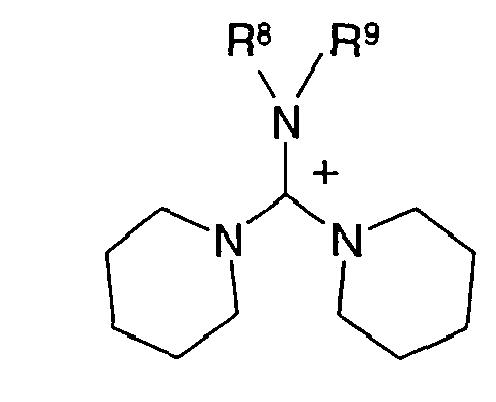
- guanidinium cation [C (NR 8 R 9 ) (NR 10 R 11 ) (NR 12 R 13 )] + may also be linked in pairs to form mono-, bi-, or polycyclic cations.
- examples of such guanidinium cations are: or where the substituents R 8 to R 10 and R 13 may have a previously given or particularly preferred meaning.
- the carbocycles or heterocycles of the above guanidinium cations can still by C 1 - to C 6 alkyl, C 1 - bis C 6 alkenyl, NO 2 , F, Cl, Br, I, OH, C 1 -C 6 alkoxy, SCF 3 , SO 2 CF 3 , COOH, SO 2 NR ' 2 , SO 2 X' or SO 3 H be substituted, where X and R 'have the meaning given above, substituted or unsubstituted phenyl or unsubstituted or substituted heterocycle substituted.
- the carbocycles or heterocycles of the abovementioned cations can also be replaced by C 1 - to C 6 -alkyl, C 1 - to C 6 -alkenyl, NO 2 , F, Cl, Br, I, OH, C 1 -C 6 alkoxy, SCF 3 , SO 2 CF 3 , COOH, SO 2 NR ' 2 , SO 2 X or SO 3 H or substituted or unsubstituted phenyl or unsubstituted or substituted heterocycle be substituted, wherein X and R 'have the meaning given above.
- the substituents R 3 to R 13 are each, independently of one another, preferably a straight-chain or branched alkyl group having 1 to 10 C atoms.
- the substituents R 3 and R 4 , R 6 and R 7 , R 8 and R 9 , R 10 and R 11 and R 12 and R 13 in compounds of the formulas (3) to (5) may be the same or different.
- R 3 to R 13 are each particularly preferably, independently of one another, methyl, ethyl, n-propyl, isopropyl, n-butyl, tert-butyl, sec-butyl, phenyl or cyclohexyl, very particularly preferably methyl, ethyl, n-propyl, Isopropyl or n-butyl.
- Suitable substituents R 1 ' to R 4' of compounds of the formula (6) according to the invention are preferably hydrogen in addition to hydrogen: C 1 - to C 20 , especially C 1 - to C 12 -alkyl groups, and saturated or unsaturated, ie also aromatic , C 3 - to C 7 -cycloalkyl groups which may be substituted by C 1 - to C 6 -alkyl groups, in particular phenyl.
- the substituents R 1 ' and R 4' are each, in each case independently of one another, particularly preferably methyl, ethyl, isopropyl, propyl, butyl, sec-butyl, tert-butyl, pentyl, hexyl, octyl, decyl, cyclohexyl, phenyl or benzyl. They are very particularly preferably methyl, ethyl, n-butyl or hexyl. In pyrrolidinium, piperidinium or indolinium compounds, the two substituents R 1 ' and R 4' are preferably different.
- R 2 ' or R 3' is in each case independently of one another in particular hydrogen, methyl, ethyl, isopropyl, propyl, butyl, sec-butyl, tert-butyl, cyclohexyl, phenyl or benzyl.
- R 2 ' is particularly preferably hydrogen, methyl, ethyl, isopropyl, propyl, butyl or sec-butyl. Most preferably, R 2 ' and R 3' are hydrogen.
- the C 1 -C 12 -alkyl group is, for example, methyl, ethyl, isopropyl, propyl, butyl, sec-butyl or tert-butyl, and also pentyl, 1-, 2- or 3-methylbutyl, 1,1-, 1 , 2- or 2,2-dimethylpropyl, 1-ethylpropyl, hexyl, heptyl, octyl, nonyl, decyl, undecyl or dodecyl.
- a straight-chain or branched alkenyl having 2 to 20 C atoms, wherein several double bonds may also be present, is for example allyl, 2- or 3-butenyl, isobutenyl, sec-butenyl, furthermore 4-pentenyl, iso-pentenyl, hexenyl, Heptenyl, octenyl, -C 9 H 17 , -C 10 H 19 to -C 20 H 39 ; preferably allyl, 2- or 3-butenyl, isobutenyl, sec-butenyl, furthermore preferred is 4-pentenyl, iso-pentenyl or hexenyl.
- a straight-chain or branched alkynyl having 2 to 20 C atoms, wherein a plurality of triple bonds may also be present, is, for example, ethynyl, 1- or 2-propynyl, 2- or 3-butynyl, furthermore 4-pentynyl, 3-pentynyl, hexynyl, Heptynyl, octynyl, -C 9 H 15 , -C 10 H 17 to -C 20 H 37 , preferably ethynyl, 1- or 2-propynyl, 2- or 3-butynyl, 4-pentynyl, 3-pentynyl or hexynyl.
- Aryl-C 1 -C 6 -alkyl is, for example, benzyl, phenylethyl, phenylpropyl, phenylbutyl, phenylpentyl or phenylhexyl, where both the phenyl ring and the alkylene chain, as described above, partially or completely with halogens, in particular -F and / or -Cl, or partially with -OH, -OR ', -CN, -C (O) OH, -C (O) NR' 2 , -SO 2 NR ' 2 , -C (O) X, -SO 2 OH, -SO 2 X, -NO 2 may be substituted.
- Unsubstituted saturated or partially or fully unsaturated cycloalkyl groups having 3-7 C atoms are therefore cyclopropyl, cyclobutyl, cyclopentyl, cyclohexyl, cycloheptyl, cyclopentenyl, cyclopenta-1,3-dienyl, cyclohexenyl, cyclohexa-1,3-dienyl, cyclohexa-1 , 4-dienyl, phenyl, Cycloheptenyl, cyclohepta-1,3-dienyl, cyclohepta-1,4-dienyl or cyclohepta-1,5-dienyl which may be substituted by C 1 - to C 6 -alkyl groups, in which case the cycloalkyl group or C 1 - Cycloalkyl group substituted to C 6 alkyl groups also with halogen atoms such as F, Cl, Br or I, in
- C 3 - to C 7 -cycloalkyl is, for example, cyclopropyl, cyclobutyl, cyclopentyl, cyclohexyl or cycloheptyl.
- R ' substituted phenyl, by C 1 - to C 6 -alkyl, C 1 - to C 6 -alkenyl, NO 2 , F, Cl, Br, I, OH, C 1 -C 6 -alkoxy, SCF 3 , SO 2 CF 3 , COOH, SO 2 X ', SO 2 NR " 2 or SO 3 H substituted phenyl, where X' is F, Cl or Br and R" is a non, partially or perfluorinated C 1 to C 6 alkyl or C 3 to C 7 cycloalkyl as defined for R ', for example, o-, m- or p-methylphenyl, o-, m- or p-ethylphenyl, o-, m- or p-propylphenyl, o-, m- or p-isopropylphenyl, o -, m- or p-tert-butylphenyl
- R 1 ' to R 4' is understood as a heteroaryl saturated or unsaturated mono- or bicyclic heterocyclic radical having 5 to 13 ring members, wherein 1, 2 or 3 N and / or 1 or 2 S or O atoms may be present and the heterocyclic radical is mono- or polysubstituted by C 1 - to C 6 -alkyl, C 1 - to C 6 -alkenyl, NO 2 , F, Cl, Br, I, OH, C 1 -C 6 -alkoxy, SCF 3 , SO 2 CF 3 , COOH, SO 2 X ', SO 2 NR " 2 or SO 3 H may be substituted, wherein X' and R" have a meaning given above.
- the heterocyclic radical is preferably substituted or unsubstituted 2- or 3-furyl, 2- or 3-thienyl, 1-, 2- or 3-pyrrolyl, 1-, 2-, 4- or 5-imidazolyl, 3-, 4- or 5-pyrazolyl, 2-, 4- or 5-oxazolyl, 3-, 4- or 5-isoxazolyl, 2-, 4- or 5-thiazolyl, 3-, 4- or 5-isothiazolyl, 2-, 3- or 4-pyridyl, 2-, 4-, 5- or 6-pyrimidinyl, more preferably 1,2,3-triazole-1, -4- or -5-yl, 1,2,4-triazole-1 , -4- or -5-yl, 1- or 5-tetrazolyl, 1,2,3-oxadiazol-4 or -5-yl 1,2,4-oxadiazol-3 or -5-yl, 1, 3,4-thiadiazol-2 or -5-yl, 1,2,4-thiadiazol-3 or -5-yl, 1,2,3-thiadiazol
- Heteroaryl-C 1 -C 6 -alkyl is now analogous to aryl-C 1 -C 6 -alkyl, for example, pyridinyl-methyl, pyridinyl-ethyl, pyridinyl-propyl, pyridinyl, pyridinyl-pentyl, pyridinyl-hexyl understood, further the heterocycles described above can be linked in this way with the alkylene chain.
- HetN + is preferred or wherein the substituents R 1 ' to R 4' each independently have a meaning as described above.
- the cations of the ionic liquid according to the invention are ammonium, phosphonium, imidazolium, pyridinium or pyrrolidinium cations.
- the processes of the invention can be carried out at temperatures of 0 to 95 ° C, preferably at 55 to 65 ° C and most preferably at 60 ° C. At the preferred temperatures, improved extraction is observed in a relatively short time. For gentle extraction, especially of more sensitive proteins, protein fragments and / or peptides, the implementation of the method according to the invention at lower temperatures within the specified temperature interval, taking into account a longer extraction time required for this purpose, is recommended.
- the methods according to the invention are suitable for extracting proteins, protein fragments and / or peptides from biological samples to obtain the cellular basic structure of the samples.
- the application of the method according to the invention to appropriately pretreated samples is conceivable in which e.g. the cellular framework was destroyed prior to application of the methods of the invention.
- This pretreatment may be carried out in any manner known to those skilled in the art, e.g. by manual homogenization or by vortexing.
- the extracts obtained by the methods of the invention contain proteins, protein fragments and / or peptides. These are suitable for all types of protein analysis known to those skilled in the art, eg electrophoresis (eg 2-dimensional gel electrophoresis), immunochemical detection methods (eg Western blot analysis, ELISA, RIA), protein arrays (eg planar and bead-based systems), mass spectrometry (eg Maldi, Esi and Seldi) and all biochromatographic separation methods (IEX, SEC, HIC and affinity chromatography).
- electrophoresis eg 2-dimensional gel electrophoresis
- immunochemical detection methods eg Western blot analysis, ELISA, RIA
- protein arrays eg planar and bead-based systems
- mass spectrometry eg Maldi, Esi and Seldi
- IEX, SEC, HIC and affinity chromatography all biochromatographic separation methods
- kits for the extraction of proteins, protein fragments and / or peptides with one of the previously described inventive methods comprising at least one ionic liquid.
- the kit of the invention may comprise one or more ionic liquids. If the kit contains several ionic liquids, these may be present separately or together as a mixture. Preferably, the above-mentioned and particularly preferred ionic liquids are included in the kit.
- the kit may additionally contain at least one reagent suitable for the precipitation of proteins, protein fragments and / or peptides, which reagent may be selected from any precipitation reagent known to those skilled in the art, e.g. Trichloroacetic.
- the kit according to the invention makes it possible for the user to extract proteins from biological samples in a simple manner and if appropriate also to precipitate them for use in the further analysis.
- kits according to the invention for the extraction of proteins, protein fragments and / or peptides from biological samples is likewise an object of the present invention.
- a formalin-fixed tissue sample e.g., lung, heart, kidney, liver, spleen
- 10 ml of isotonic phosphate-buffered saline e.g., a formalin-fixed tissue sample
- 0.1 g of the comminuted sample are mixed with 60 ⁇ l of trihexyl (tetradecyl) phosphonium trifluoromethylsulfonylimide and incubated at 60 ° C. over a period of two hours in a rotary mixer.
- the supernatant solution is separated and can be used for further analysis of the proteins contained therein.
- SDS-polyacrylamide gel electrophoresis is carried out with the extract obtained in Example 1 as follows: 3 ⁇ l of the protein extract are mixed with 16 ⁇ l SDS sample application buffer (3M Tris pH 8.5, glycerin 24% (v / v), sodium dodecyl sulfate 8% (w / v), 2-mercaptoethanol 2%, bromophenol blue 0.1% (w / v)) and incubated at 95 ° C for 5 minutes. After centrifugation at 10000xg, the sample is applied to a 10% SDS page and separated at 120 volts for 90 minutes.
- SDS sample application buffer 3M Tris pH 8.5, glycerin 24% (v / v), sodium dodecyl sulfate 8% (w / v), 2-mercaptoethanol 2%, bromophenol blue 0.1% (w / v)
- a Western blot of the gel is carried out using antibodies, for example to the membrane protein calnexin (90 kDa, anti-calnexin, C-terminal, 1: 2000, Calbiochem Cat.No: 208880).
- Western blot analysis identifies calnexin in its native molecular size.
Landscapes
- Chemical & Material Sciences (AREA)
- Organic Chemistry (AREA)
- Medicinal Chemistry (AREA)
- Molecular Biology (AREA)
- Biochemistry (AREA)
- Biophysics (AREA)
- General Health & Medical Sciences (AREA)
- Genetics & Genomics (AREA)
- Health & Medical Sciences (AREA)
- Life Sciences & Earth Sciences (AREA)
- Proteomics, Peptides & Aminoacids (AREA)
- Analytical Chemistry (AREA)
- Peptides Or Proteins (AREA)
- Organic Low-Molecular-Weight Compounds And Preparation Thereof (AREA)
- Plural Heterocyclic Compounds (AREA)
- Extraction Or Liquid Replacement (AREA)
Abstract
Description
- Die vorliegende Erfindung betrifft ein Verfahren zur Extraktion von Proteinen, Proteinfragmenten und/oder Peptiden aus biologischen Proben, wobei als Extraktionsmittel lonische Flüssigkeiten der allgemeinen Formel K+A- eingesetzt werden, ein Kit zur Extraktion von Proteinen, Proteinfragmenten und/oder Peptiden sowie dessen Verwendung.
- Der Nachweis beziehungsweise die Analyse von Proteinen gewinnt in der Medizin zunehmende Bedeutung. Dies betrifft insbesondere die Analyse von Gewebeproben, um Anzeichen einer Erkrankung oder den Nachweis einer krankhaften Veränderung festzustellen. Zu diesem Zwecke werden Analysen des Gesamtproteoms der Zelle untersucht. Hierzu ist es essentiell, alle Proteine einer gegebenen Probe quantitativ zu extrahieren, da nur die Analyse aller beteiligten Proteine in ihrer Gesamtheit Rückschlüsse auf Krankheiten und deren Entstehung zulässt.
- Es bestand daher die Aufgabe, Verfahren bereit zu stellen, mit deren Hilfe Proteine aus biologischen Proben extrahiert werden können, um sie weiter analysieren zu können.
- Gegenstand der vorliegenden Erfindung sind demgemäss Verfahren zur Extraktion von Proteinen, Proteinfragmenten und/oder Peptiden aus biologischen Proben, wobei als Extraktionsmittel lonische Flüssigkeiten der allgemeinen Formel K+A- eingesetzt werden.
- lonische Flüssigkeiten oder flüssige Salze sind ionische Spezies, die aus einem organischen Kation und einem in der Regel anorganischen Anion bestehen. Sie enthalten keine neutralen Moleküle und weisen meistens Schmelzpunkte kleiner 373 K auf.
- Das Gebiet der ionischen Flüssigkeiten wird zur Zeit intensiv erforscht, da die Anwendungsmöglichkeiten vielfältig sind. Übersichtsartikel zu ionischen Flüssigkeiten sind beispielsweise R. Sheldon "Catalytic reactions in ionic liquids", Chem. Commun., 2001, 2399-2407; M.J. Earle, K.R. Seddon "lonic liquids. Green solvent for the future", Pure Appl. Chem., 72 (2000), 1391-1398; P. Wasserscheid, W. Keim "Ionische Flüssigkeiten ― neue Lösungen für die Übergangsmetallkatalyse", Angew. Chem., 112 (2000), 3926-3945; T. Welton "Room temperature ionic liquids. Solvents for synthesis and catalysis", Chem. Rev., 92 (1999), 2071-2083 oder R. Hagiwara, Ya. Ito "Room temperature ionic liquids of alkylimidazolium cations and fluoroanions", J. Fluorine Chem., 105 (2000), 221-227).
- Es hat sich überraschend herausgestellt, dass ionische Flüssigkeiten der allgemeinen Formel K+A- geeignet sind, Proteine, Proteinfragmente und/oder Peptide aus biologischen Proben zu extrahieren. Dies gilt auch dann, wenn die biologischen Proben fixiert sind, wie es üblicherweise bei der Probenpräparation von biologischen Proben der Fall ist. Das erfindungsgemäße Extraktionsverfahren kann überraschenderweise auch auf fixierte Proben angewendet werden, was die Einsatzmöglichkeiten der Verfahren enorm erweitert. Auf diese Weise lassen sich mit den erfindungsgemäßen Verfahren biologische Proben universell behandeln, um daraus Proteine, Proteinfragmente und/oder Peptide zu extrahieren. Dabei hat das erfindungsgemäße Verfahren den Vorteil, dass die zu extrahierenden Bestandteile nicht degradiert werden, das heißt ihre chemische Konstitution bleibt erhalten. Dies ist ein wesentlicher Vorteil gegenüber bekannten Verfahren, wie sie beispielsweise in
W02004/080579 beschrieben sind, bei denen die zu extrahierenden Proteine in einem proteolytischen Schritt zu Peptiden degradiert werden müssen, um sie nachfolgend analysieren zu können. Insgesamt wird damit mit dem erfindungsgemäßen Verfahren eine einfache Aufbereitung biologischer Proben zur Isolierung von Proteinen, Proteinfragmenten und/oder Peptiden möglich, die mit dem aus dem Stand der Technik beschriebenen Verfahren nicht zugänglich war. - Die Extraktion von Proteinen, Proteinfragmenten und/oder Peptiden in den erfindungsgemäßen Verfahren kann aus allen dem Fachmann bekannten biologischen Proben erfolgen. Vorzugsweise handelt es sich bei den biologischen Proben um Gewebe, wie z.B. Biopsien und histologische Präparate, Zellen, Zellkulturen und/oder Körperflüssigkeiten, wie z.B. Blut, Plasma, Serum, Urin, Liquor oder Speichel. Die Extraktion von Proteinen aus Geweben und Zellkulturen erlaubt insbesondere den Nachweis spezifischer Proteine, z.B. zum Nachweis von Proteinen, die auf das Vorhandensein von Krankheiten schließen lassen. Daher ist das erfindungsgemäße Verfahren insbesondere auch für pathologisch interessante Gewebeproben vorteilhaft.
- Die biologischen Proben können unfixiert oder fixiert sein, vorzugsweise sind sie fixiert. Dabei kann die Fixierung nach allen dem Fachmann bekannten Methoden erfolgt sein, z.B. durch Einsatz von Formalin, Glutaraldehyd, Formalinsubstituten, Alkoholen, wie z.B. Ethanol, Methanol, Isopropanol, oder inerten Materialien, wie z.B. Paraffin, Harzen oder Polymeren. Vorzugsweise sind die biologischen Proben mit Formalin fixiert. Formalin ist das gängigste Fixierungsmittel bei der Präparation histologischer Proben und wird, wegen des geringen Preises und der guten Fixierungswirkung, vielerorts und nunmehr seit mehr als hundert Jahren eingesetzt. Die Fixierung mit Formalin hat aber den Nachteil, dass es zu einer Quervernetzung der Proteine mit der Probenmatrix kommt. Dadurch wurden die Proteine generell unlöslich und standen einer weiteren Analytik nicht zur Verfügung. Durch Einsatz von lonischen Flüssigkeiten in den erfindungsgemäßen Verfahren können die Proteine jedoch unter Erhalt ihrer Struktur auch aus diesen Proben extrahiert werden, um sie weiter zu analysieren. Auf diese Weise wird die gängigste Fixierungsmethode mit Formalin in ihrer Praktikabilität erweitert, ohne die Möglichkeiten der nachfolgenden Analytik einzuschränken. Damit können nun unter Einsatz der erfindungsgemäßen Verfahren auch Proben mit der modernen Proteinanalytik untersucht werden, die bereits sehr lange mittels Einsatz von Formalin konserviert wurden, das heißt eine zeitliche Begrenzung der Analysierbarkeit von Proben entfällt.
- Generell eignen sich in den erfindungsgemäßen Verfahren alle dem Fachmann bekannten lonischen Flüssigkeiten der allgemeinen Formel K+A-, beispielsweise mit Hexafluorophosphat-, Tetrafluroborat- oder Halogenid-Anionen. Beispiele für geeignete lonische Flüssigkeiten sind Trihexyl(tetradecyl)-phosphoniumhexafluorophosphat, Trihexyl(tetradecyl)-phosphoniumchlorid oder Trihexyl(tetradecyl)-phosphoniumtetrafluoroborat.
- Vorzugsweise ist das Anion A- der lonischen Flüssigkeit ausgewählt aus der Gruppe der lmide, insbesondere jene der allgemeinen Formel
[N(Rf)2]-
wobei Rf teilweise oder vollständig mit Fluor substituiertes Alkyl mit 1 bis 8 C-Atomen oder Rf2X bedeutet, wobei Rf2 teilweise oder vollständig mit Fluor substituiertes Alkyl mit 1 bis 8 C-Atomen und X SO2 oder CO bedeutet, aus der Gruppe der Fluoralkylphosphate, insbesondere jene der allgemeinen Formel
[PFx(CyF2y+1-zHz)6-x]-
mit 1 ≤ x < 6, 1 ≤ y ≤ 8 und 0 ≤ z ≤ 2y+1 oder aus Mischungen hieraus. - Vorzugsweise ist Rf Trifluormethyl, Pentafluorethyl, Nonaflurobutyl oder Rf2SO2, insbesondere Trifluormethyl oder Rf2SO2, wobei besonders bevorzugt Rf2 Trifluormethyl ist. Im Falle der Fluoralkylphosphate ist bevorzugt x = 3, z = 0 und y = 2, 3 oder 4, wobei y = 2 ganz besonders bevorzugt ist. lonische Flüssigkeiten enthaltend die besonders bevorzugten [(CF3SO2)2N]-- oder [PF3(C2F5)3]--Anionen sind besonders zur Extraktion von Proteinen, Proteinfragmenten und/oder Peptiden in den erfindungsgemäßen Verfahren geeignet.
- In bezug auf die Wahl des Kations K+ der lonischen Flüssigkeit der ionischen Flüssigkeit gibt es per se keine Einschränkungen. Vorzugsweise handelt es sich aber um organische Kationen, wobei es sich insbesondere bevorzugt um Ammonium-, Phosphonium, Uronium-, Thiouronium-, Guanidiniumkationen oder um heterocyclische Kationen handelt.
- Ammoniumkationen können beispielsweise durch die Formel (1)
[NR4]+ (1),
beschrieben werden, wobei - R jeweils unabhängig voneinander
- H, wobei nicht alle Substituenten R gleichzeitig H sein dürfen,
- OR', NR'2, mit der Maßgabe, dass maximal ein Substituent R in Formel (1) OR', NR'2 ist,
- geradkettiges oder verzweigtes Alkyl mit 1-20 C-Atomen,
- geradkettiges oder verzweigtes Alkenyl mit 2-20 C-Atomen und einer oder mehreren Doppelbindungen,
- geradkettiges oder verzweigtes Alkinyl mit 2-20 C-Atomen und einer oder mehreren Dreifachbindungen,
- gesättigtes, teilweise oder vollständig ungesättigtes Cycloalkyl mit 3-7 C-Atomen, das mit Alkylgruppen mit 1-6 C-Atomen substituiert sein kann, bedeutet, wobei ein oder mehrere R teilweise oder vollständig mit Halogenen, insbesondere -F und/oder -Cl, oder teilweise mit -OH, -OR', - CN, -C(O)OH, -C(O)NR'2, -SO2NR'2, -C(O)X, -SO2OH, -SO2X, -NO2, substituiert sein können, und wobei ein oder zwei nicht benachbarte und nicht α-ständige Kohlenstoffatome des R, durch Atome und/oder Atomgruppierungen ausgewählt aus der Gruppe -O-, -S-, -S(O)-, -SO2-, - SO2O-, -C(O)-, -C(O)O-, -N+R'2-, -P(O)R'O-, -C(O)NR'-, -SO2NR'-, - OP(O)R'O-, -P(O)(NR'2)NR'-, -PR'2=N- oder -P(O)R'- ersetzt sein können mit R' = H, nicht, teilweise oder perfluoriertes C1- bis C6-Alkyl, C3- bis C7-Cycloalkyl, unsubstituiertes oder substituiertes Phenyl und X =Halogen sein kann.
- Phosphoniumkationen können beispielsweise durch die Formel (2)
[PR2 4]+ (2),
beschrieben werden, wobei - R2 jeweils unabhängig voneinander
- H, OR' oder NR'2
- geradkettiges oder verzweigtes Alkyl mit 1-20 C-Atomen,
- geradkettiges oder verzweigtes Alkenyl mit 2-20 C-Atomen und einer oder mehreren Doppelbindungen,
- geradkettiges oder verzweigtes Alkinyl mit 2-20 C-Atomen und einer oder mehreren Dreifachbindungen,
- gesättigtes, teilweise oder vollständig ungesättigtes Cycloalkyl mit 3-7 C-Atomen, das mit Alkylgruppen mit 1-6 C-Atomen substituiert sein kann, bedeutet, wobei ein oder mehrere R2 teilweise oder vollständig mit Halogenen, insbesondere -F und/oder -Cl, oder teilweise mit -OH, -OR', - CN, -C(O)OH, -C(O)NR'2, -SO2NR'2, -C(O)X, -SO2OH, -SO2X, -NO2, substituiert sein können, und wobei ein oder zwei nicht benachbarte und nicht α-ständige Kohlenstoffatome des R2, durch Atome und/oder Atomgruppierungen ausgewählt aus der Gruppe -O-, -S-, -S(O)-, -SO2-, - SO2O-, -C(O)-, -C(O)O-, -N+R'2-, -P(O)R'O-, -C(O)NR'-, -SO2NR'-, - OP(O)R'O-, -P(O)(NR'2)NR'-, -PR'2=N- oder -P(O)R'- ersetzt sein können mit R' = H, nicht, teilweise oder perfluoriertes C1- bis C6-Alkyl, C3- bis C7-Cycloalkyl, unsubstituiertes oder substituiertes Phenyl und X =Halogen.
- Ausgeschlossen sind jedoch Kationen der Formeln (1) und (2), in denen alle vier oder drei Substituenten R und R2 vollständig mit Halogenen substituiert sind, beispielsweise das Tris(trifluormethyl)methylammoniumkation, das Tetra(trifluormethyl)ammoniumkation oder das Tetra(nonafluorbutyl)ammoniumkation.
- Uroniumkationen können beispielsweise durch die Formel (3)
[(R3R4N)-C(=OR5)(NR6R7)]+ (3),
und Thiouroniumkationen durch die Formel (4),
[(R3R4N)-C(=SR5)(NR6R7)]+ (4),
beschrieben werden, wobei - R3 bis R7 jeweils unabhängig voneinander Wasserstoff, wobei Wasserstoff für R5 ausgeschlossen wird,
- geradkettiges oder verzweigtes Alkyl mit 1 bis 20 C-Atomen,
- geradkettiges oder verzweigtes Alkenyl mit 2-20 C-Atomen und einer oder mehreren Doppelbindungen,
- geradkettiges oder verzweigtes Alkinyl mit 2-20 C-Atomen und einer oder mehreren Dreifachbindungen,
- gesättigtes, teilweise oder vollständig ungesättigtes Cycloalkyl mit 3-7 C-Atomen, das mit Alkylgruppen mit 1-6 C-Atomen substituiert sein kann, bedeutet, wobei ein oder mehrere der Substituenten R3 bis R7 teilweise oder vollständig mit Halogenen, insbesondere -F und/oder -Cl, oder teilweise mit -OH, -OR', -CN, -C(O)OH, -C(O)NR'2, -SO2NR'2, -C(O)X, - SO2OH, -SO2X, -NO2, substituiert sein können, und wobei ein oder zwei nicht benachbarte und nicht α-ständige Kohlenstoffatome von R3 bis R7 durch Atome und/oder Atomgruppierungen ausgewählt aus der Gruppe -O-, -S-, -S(O)-, -SO2-, -SO2O-, -C(O)-, -C(O)O-, -N+R'2-, -P(O)R'O-, -C(O)NR'-, -SO2NR'-, -OP(O)R'O-, -P(O)(NR'2)NR'-, -PR'2=N- oder -P(O)R'- ersetzt sein können mit R' = H, nicht, teilweise oder perfluoriertes C1- bis C6-Alkyl, C3- bis C7-Cycloalkyl, unsubstituiertes oder substituiertes Phenyl und X =Halogen.
- Guanidiniumkationen können durch die Formel (5)
[C(NR8R9)(NR10R11)(NR12R13)]+ (5),
beschrieben werden, wobei - R8 bis R13 jeweils unabhängig voneinander Wasserstoff, -CN, NR'2, -OR'
- geradkettiges oder verzweigtes Alkyl mit 1 bis 20 C-Atomen,
- geradkettiges oder verzweigtes Alkenyl mit 2-20 C-Atomen und einer oder mehreren Doppelbindungen,
- geradkettiges oder verzweigtes Alkinyl mit 2-20 C-Atomen und einer oder mehreren Dreifachbindungen,
- gesättigtes, teilweise oder vollständig ungesättigtes Cycloalkyl mit 3-7 C-Atomen, das mit Alkylgruppen mit 1-6 C-Atomen substituiert sein kann, bedeutet, wobei ein oder mehrere der Substituenten R8 bis R13 teilweise oder vollständig mit Halogenen, insbesondere -F und/oder -Cl, oder teilweise mit -OH, -OR', -CN, -C(O)OH, -C(O)NR'2, -SO2NR'2, -C(O)X, - SO2OH, -SO2X, -NO2, substituiert sein können, und wobei ein oder zwei nicht benachbarte und nicht α-ständige Kohlenstoffatome von R8 bis R13 durch Atome und/oder Atomgruppierungen ausgewählt aus der Gruppe -O-, -S-, -S(O)-, -SO2-, -SO2O-, -C(O)-, -C(O)O-, -N+R'2-, -P(O)R'O-, -C(O)NR'-, -SO2NR'-, -OP(O)R'O-, -P(O)(NR'2)NR'-, -PR'2=N- oder -P(O)R'- ersetzt sein können mit R' = H, nicht, teilweise oder perfluoriertes C1- bis C6-Alkyl, C3- bis C7-Cycloalkyl, unsubstituiertes oder substituiertes Phenyl und X = Halogen.
- Darüber hinaus können Kationen der allgemeinen Formel (6)
[HetN]+ (6)
eingesetzt werden, wobei - HetN+ ein heterocyclisches Kation, ausgewählt aus der Gruppe


- R1' bis R4' jeweils unabhängig voneinander Wasserstoff, -CN, -OR', -NR'2, -P(O)R'2, -P(O)(OR')2, -P(O)(NR'2)2, - C(O)R', -C(O)OR',
- geradkettiges oder verzweigtes Alkyl mit 1-20 C-Atomen,
- geradkettiges oder verzweigtes Alkenyl mit 2-20 C-Atomen und einer oder mehreren Doppelbindungen,
- geradkettiges oder verzweigtes Alkinyl mit 2-20 C-Atomen und einer oder mehreren Dreifachbindungen,
- gesättigtes, teilweise oder vollständig ungesättigtes Cycloalkyl mit 3-7 C-Atomen, das mit Alkylgruppen mit 1-6 C-Atomen substituiert sein kann, gesättigtes, teilweise oder vollständig ungesättigtes Heteroaryl, Heteroaryl-C1-C6-alkyl oder Aryl-C1-C6-alkyl bedeutet,
- wobei die Substituenten R1', R2', R3' und/oder R4' zusammen auch ein Ringsystem bilden können,
- wobei ein oder mehrere Substituenten R1' bis R4' teilweise oder vollständig mit Halogenen, insbesondere -F und/oder -Cl, oder ―OH, -OR', -CN, -C(O)OH, -C(O)NR'2, -SO2NR'2, -C(O)X, -SO2OH, -SO2X, -NO2, substituiert sein können, wobei jedoch nicht gleichzeitig R1' und R4' vollständig mit Halogenen substituiert sein dürfen, und wobei ein oder zwei nicht benachbarte und nicht am Heteroatom gebundene Kohlenstoffatome der Substituenten R1' bis R4', durch Atome und/oder Atomgruppierungen ausgewählt aus der -O-, -S-, -S(O)-, -SO2-, -SO2O-, -C(O)-, -C(O)O-, - N+R'2-, -P(O)R'O-, -C(O)NR'-, -SO2NR'-, -OP(O)R'O-, -P(O)(NR'2)NR'-, - PR'2=N- oder -P(O)R'- ersetzt sein können mit R' = H, nicht, teilweise oder perfluoriertes C1- bis C6-Alkyl, C3- bis C7-Cycloalkyl, unsubstituiertes oder substituiertes Phenyl und X =Halogen.
- Unter vollständig ungesättigten Substituenten werden im Sinne der vorliegenden Erfindung auch aromatische Substituenten verstanden.
- Als Substituenten R und R2 bis R13 der Verbindungen der Formeln (1) bis (5) kommen erfindungsgemäß dabei neben Wasserstoff bevorzugt in Frage: C1- bis C20-, insbesondere C1- bis C14-Alkylgruppen, und gesättigte oder ungesättigte, d.h. auch aromatische, C3- bis C7-Cycloalkylgruppen, die mit C1- bis C6-Alkylgruppen substituiert sein können, insbesondere Phenyl.
- Die Substituenten R und R2 in den Verbindungen der Formel (1) oder (2) können dabei gleich oder verschieden sein. Bevorzugt sind die Substituenten R und R2 verschieden.
- Die Substituenten R und R2 sind insbesondere bevorzugt Methyl, Ethyl, Isopropyl, Propyl, Butyl, sek.-Butyl, tert.-Butyl, Pentyl, Hexyl, Octyl, Decyl oder Tetradecyl.
- Bis zu vier Substituenten des Guanidinium-Kations [C(NR8R9)(NR10R11)(NR12R13)]+ können auch paarweise derart verbunden sein, dass mono-, bi- oder polycyclische Kationen entstehen.
Ohne Einschränkung der Allgemeinheit sind Beispiele für solche Guanidinium-Kationen:


- Gegebenenfalls können die Carbocyclen oder Heterocyclen der zuvor angegebenen Guanidinium-Kationen noch durch C1- bis C6-Alkyl, C1- bis C6-Alkenyl, NO2, F, Cl, Br, I, OH, C1-C6-Alkoxy, SCF3, SO2CF3, COOH, SO2NR'2, SO2X' oder SO3H substituiert sein, wobei X und R' eine zuvor angegebene Bedeutung haben, substituiertes oder unsubstituiertes Phenyl oder unsubstituierter oder substituierter Heterocyclus substituiert sein.
- Bis zu vier Substituenten des Uroniumkations [(R3R4N)-C(=OR5)(NR6R7)]+ oder des Thiouroniumkations [(R3R4N)-C(=SR5)(NR6R7)]+ können auch paarweise derart verbunden sein, dass mono-, bi- oder polycyclische Kationen entstehen.
- Ohne Einschränkung der Allgemeinheit sind Beispiele für solche Kationen im folgenden angegeben, wobei Y = O oder S bedeutet:


- Gegebenenfalls können die Carbocyclen oder Heterocyclen der zuvor angegebenen Kationen noch durch C1- bis C6-Alkyl, C1- bis C6-Alkenyl, NO2, F, Cl, Br, I, OH, C1-C6-Alkoxy, SCF3, SO2CF3, COOH, SO2NR'2, SO2X oder SO3H oder substituiertes oder unsubstituiertes Phenyl oder unsubstituierter oder substituierter Heterocyclus substituiert sein, wobei X und R' eine zuvor angegebene Bedeutung haben.
- Die Substituenten R3 bis R13 sind jeweils unabhängig voneinander bevorzugt eine geradkettige oder verzweigte Alkylgruppe mit 1 bis 10 C-Atomen. Die Substituenten R3 und R4, R6 und R7, R8 und R9, R10 und R11 und R12 und R13 in Verbindungen der Formeln (3) bis (5) können dabei gleich oder verschieden sein. Besonders bevorzugt sind R3 bis R13 jeweils unabhängig voneinander Methyl, Ethyl, n-Propyl, Isopropyl, n-Butyl, tert.-Butyl, sek.-Butyl, Phenyl oder Cyclohexyl, ganz besonders bevorzugt Methyl, Ethyl, n-Propyl, Isopropyl oder n-Butyl.
- Als Substituenten R1' bis R4' von Verbindungen der Formel (6) kommen erfindungsgemäß dabei neben Wasserstoff bevorzugt in Frage: C1- bis C20, insbesondere C1- bis C12-Alkylgruppen, und gesättigte oder ungesättigte, d.h. auch aromatische, C3- bis C7-Cycloalkylgruppen, die mit C1- bis C6-Alkylgruppen substituiert sein können, insbesondere Phenyl.
- Die Substituenten R1' und R4' sind jeweils unabhängig voneinander insbesondere bevorzugt Methyl, Ethyl, Isopropyl, Propyl, Butyl, sek.-Butyl, tert.-Butyl, Pentyl, Hexyl, Octyl, Decyl, Cyclohexyl, Phenyl oder Benzyl. Sie sind ganz besonders bevorzugt Methyl, Ethyl, n-Butyl oder Hexyl. In Pyrrolidinium-, Piperidinium- oder Indolinium-Verbindungen sind die beiden Substituenten R1' und R4' bevorzugt unterschiedlich.
- Der Substituent R2' oder R3' ist jeweils unabhänigig voneinander insbesondere Wasserstoff, Methyl, Ethyl, Isopropyl, Propyl, Butyl, sek.-Butyl, tert.-Butyl, Cyclohexyl, Phenyl oder Benzyl. Besonders bevorzugt ist R2' Wasserstoff, Methyl, Ethyl, lsopropyl, Propyl, Butyl oder sek.-Butyl. Ganz besonders bevorzugt sind R2' und R3' Wasserstoff.
- Die C1-C12-Alkylgruppe ist beispielsweise Methyl, Ethyl, Isopropyl, Propyl, Butyl, sek.-Butyl oder tert.-Butyl, ferner auch Pentyl, 1-, 2- oder 3-Methylbutyl, 1,1-, 1,2- oder 2,2-Dimethylpropyl, 1-Ethylpropyl, Hexyl, Heptyl, Octyl, Nonyl, Decyl, Undecyl oder Dodecyl. Gegebenenfalls Difluormethyl, Trifluormethyl, Pentafluorethyl, Heptafluorpropyl oder Nonafluorbutyl.
- Ein geradkettiges oder verzweigtes Alkenyl mit 2 bis 20 C-Atomen, wobei auch mehrere Doppelbindungen vorhanden sein können, ist beispielsweise Allyl, 2- oder 3-Butenyl, Isobutenyl, sek.-Butenyl, ferner 4-Pentenyl, iso-Pentenyl, Hexenyl, Heptenyl, Octenyl, -C9H17, -C10H19 bis -C20H39; vorzugsweise Allyl, 2- oder 3-Butenyl, Isobutenyl, sek.-Butenyl, ferner bevorzugt ist 4-Pentenyl, iso-Pentenyl oder Hexenyl.
- Ein geradkettiges oder verzweigtes Alkinyl mit 2 bis 20 C-Atomen, wobei auch mehrere Dreifachbindungen vorhanden sein können, ist beispielsweise Ethinyl, 1- oder 2-Propinyl, 2- oder 3-Butinyl, ferner 4-Pentinyl, 3-Pentinyl, Hexinyl, Heptinyl, Octinyl, -C9H15, -C10H17 bis -C20H37, vorzugsweise Ethinyl, 1- oder 2-Propinyl, 2- oder 3-Butinyl, 4-Pentinyl, 3-Pentinyl oder Hexinyl.
- Aryl-C1-C6-alkyl bedeutet beispielsweise Benzyl, Phenylethyl, Phenylpropyl, Phenylbutyl, Phenylpentyl oder Phenylhexyl, wobei sowohl der Phenylring als auch die Alkylenkette, wie zuvor beschrieben teilweise oder vollständig mit Halogenen, insbesondere -F und/oder -Cl, oder teilweise mit -OH, -OR', -CN, -C(O)OH, -C(O)NR'2, -SO2NR'2, -C(O)X, -SO2OH, -SO2X, -NO2 substituiert sein können.
- Unsubstituierte gesättigte oder teilweise oder vollständig ungesättigte Cycloalkylgruppen mit 3-7 C-Atomen sind daher Cyclopropyl, Cyclobutyl, Cyclopentyl, Cyclohexyl, Cycloheptyl, Cyclopentenyl, Cyclopenta-1,3-dienyl, Cyclohexenyl, Cyclohexa-1,3-dienyl, Cyclohexa-1,4-dienyl, Phenyl, Cycloheptenyl, Cyclohepta-1,3-dienyl, Cyclohepta-1,4-dienyl oder Cyclohepta-1,5-dienyl, welche mit C1- bis C6-Alkylgruppen substituiert sein können, wobei wiederum die Cycloalkylgruppe oder die mit C1- bis C6-Alkylgruppen substituierte Cycloalkylgruppe auch mit Halogenatomen wie F, Cl, Br oder I, insbesondere F oder Cl oder mit -OH, -OR', -CN, -C(O)OH, -C(O)NR'2, -SO2NR'2, -C(O)X, -SO2OH, -SO2X, -NO2 substituiert sein kann.
- In den Substituenten R, R2 bis R13 oder R1' bis R4' können auch ein oder zwei nicht benachbarte und nicht α-ständig zum Heteroatom gebundene Kohlenstoffatome, durch Atome und/oder Atomgruppierungen ausgewählt aus der Gruppe -O-, -S-, -S(O)-, -SO2-, -SO2O-, -C(O)-, -C(O)O-, -N+R'2-, - P(O)R'O-, -C(O)NR'-, -SO2NR'-, -OP(O)R'O-, -P(O)(NR'2)NR'-, -PR'2=N-oder -P(O)R'- ersetzt werden, mit R' = nicht, teilweise oder perfluoriertes C1- bis C6-Alkyl, C3- bis C7-Cycloalkyl, unsubstituiertes oder substituiertes Phenyl.
- Ohne Einschränkung der Allgemeinheit sind Beispiele für derart modifizierte Substituenten R, R2 bis R13 und R1' bis R4':
- OCH3, -OCH(CH3)2, -CH2OCH3, -CH2-CH2-O-CH3, -C2H4OCH(CH3)2, - C2H4SC2H5, -C2H4SCH(CH3)2, -S(O)CH3, -SO2CH3, -SO2C6H5, -SO2C3H7, - SO2CH(CH3)2, -SO2CH2CF3, -CH2SO2CH3, -O-C4H8-O-C4H9, -CF3, -C2F5, - C3F7, -C4F9, -C(CF3)3, -CF2SO2CF3, -C2F4N(C2F5)C2F5, -CHF2, -CH2CF3, - C2F2H3, -C3FH6, -CH2C3F7, -C(CFH2)3, -CH2C(O)OH, -CH2C6H5, -C(O)C6H5 oder P(O)(C2H5)2.
- In R' ist C3- bis C7-Cycloalkyl beispielweise Cyclopropyl, Cyclobutyl, Cyclopentyl, Cyclohexyl oder Cycloheptyl.
- In R' bedeutet substituiertes Phenyl, durch C1- bis C6-Alkyl, C1- bis C6-Alkenyl, NO2, F, Cl, Br, I, OH, C1-C6-Alkoxy, SCF3, SO2CF3, COOH, SO2X', SO2NR"2 oder SO3H substituiertes Phenyl, wobei X' F, Cl oder Br und R" ein nicht, teilweise oder perfluoriertes C1- bis C6-Alkyl oder C3- bis C7-Cycloalkyl wie für R' definiert bedeutet, beispielsweise, o-, m- oder p-Methylphenyl, o-, m- oder p-Ethylphenyl, o-, m- oder p-Propylphenyl, o-, m-oder p-Isopropylphenyl, o-, m- oder p-tert.-Butylphenyl, o-, m- oder p-Nitrophenyl, o-, m- oder p-Hydroxyphenyl, o-, m- oder p-Methoxyphenyl, o-, m- oder p-Ethoxyphenyl, o-, m-, p-(Trifluormethyl)phenyl, o-, m-, p-(Trifluormethoxy)phenyl, o-, m-, p-(Trifluormethylsulfonyl)phenyl, o-, m-oder p-Fluorphenyl, o-, m- oder p-Chlorphenyl, o-, m- oder p-Bromphenyl, o-, m- oder p-Iodphenyl, weiter bevorzugt 2,3-, 2,4-, 2,5-, 2,6-, 3,4- oder 3,5-Dimethylphenyl, 2,3-, 2,4-, 2,5-, 2,6-, 3,4- oder 3,5-Dihydroxyphenyl, 2,3-, 2,4-, 2,5-, 2,6-, 3,4- oder 3,5-Difluorphenyl, 2,3-, 2,4-, 2,5-, 2,6-, 3,4-oder 3,5-Dichlorphenyl, 2,3-, 2,4-, 2,5-, 2,6-, 3,4- oder 3,5-Dibromphenyl, 2,3-, 2,4-, 2,5-, 2,6-, 3,4- oder 3,5-Dimethoxyphenyl, 5-Fluor-2-methylphenyl, 3,4,5-Trimethoxyphenyl oder 2,4,5-Trimethylphenyl.
- In R1' bis R4' wird als Heteroaryl ein gesättigter oder ungesättigter mono-oder bicyclischer heterocyclischer Rest mit 5 bis 13 Ringgliedern verstanden, wobei 1, 2 oder 3 N- und/oder 1 oder 2 S- oder O-Atome vorliegen können und der heterocyclische Rest ein- oder mehrfach durch C1- bis C6-Alkyl, C1- bis C6-Alkenyl, NO2, F, Cl, Br, I, OH, C1-C6-Alkoxy, SCF3, SO2CF3, COOH, SO2X', SO2NR"2 oder SO3H substituiert sein kann, wobei X' und R" eine zuvor angegebene Bedeutung haben.
Der heterocyclische Rest ist vorzugsweise substituiertes oder unsubstituiertes 2- oder 3-Furyl, 2- oder 3-Thienyl, 1-, 2- oder 3-Pyrrolyl, 1-, 2-, 4- oder 5-Imidazolyl, 3-, 4- oder 5-Pyrazolyl, 2-, 4- oder 5-Oxazolyl, 3-, 4- oder 5-Isoxazolyl, 2-, 4- oder 5-Thiazolyl, 3-, 4- oder 5-Isothiazolyl, 2-, 3-oder 4-Pyridyl, 2-, 4-, 5- oder 6-Pyrimidinyl, weiterhin bevorzugt 1,2,3-Triazol-1-, -4- oder -5-yl, 1,2,4-Triazol-1-, -4- oder -5-yl, 1- oder 5-Tetrazolyl, 1,2,3-Oxadiazol-4- oder -5-yl 1,2,4-Oxadiazol-3- oder -5-yl, 1,3,4-Thiadiazol-2- oder -5-yl, 1,2,4-Thiadiazol-3- oder -5-yl, 1,2,3-Thiadiazol-4- oder -5-yl, 2-, 3-, 4-, 5- oder 6-2H-Thiopyranyl, 2-, 3- oder 4-4H-Thiopyranyl, 3- oder 4-Pyridazinyl, Pyrazinyl, 2-, 3-, 4-, 5-, 6- oder 7-Benzofuryl, 2-, 3-, 4-, 5-, 6- oder 7-Benzothienyl, 1-, 2-, 3-, 4-, 5-, 6- oder 7-1 H-Indolyl, 1-, 2-, 4- oder 5-Benzimidazolyl, 1-, 3-, 4-, 5-, 6- oder 7-Benzopyrazolyl, 2-, 4-, 5-, 6- oder 7-Benzoxazolyl, 3-, 4-, 5-, 6- oder 7-Benzisoxazolyl, 2-, 4-, 5-, 6- oder 7-Benzthiazolyl, 2-, 4-, 5-, 6- oder 7-Benzisothiazolyl, 4-, 5-, 6- oder 7-Benz-2,1,3-oxadiazolyl, 1-, 2-, 3-, 4-, 5-, 6-, 7- oder 8-Chinolinyl, 1-, 3-, 4-, 5-, 6-, 7- oder 8-Isochinolinyl, 1-, 2-, 3-, 4-oder 9-Carbazolyl, 1-, 2-, 3-, 4-, 5-, 6-, 7-, 8- oder 9-Acridinyl, 3-, 4-, 5-, 6-, 7- oder 8-Cinnolinyl, 2-, 4-, 5-, 6-, 7- oder 8-Chinazolinyl oder 1-, 2- oder 3-Pyrrolidinyl. - Unter Heteroaryl-C1-C6-alkyl wird nun in Analogie zu Aryl-C1-C6-alkyl beispielsweise Pyridinyl-methyl, Pyridinyl-ethyl, Pyridinyl-propyl, Pyridinylbutyl, Pyridinyl-pentyl, Pyridinyl-hexyl verstanden, wobei weiterhin die zuvor beschriebenen Heterocyclen in dieser Weise mit der Alkylenkette verknüpft werden können.
- HetN+ ist bevorzugt


- Vorzugsweise handelt es sich bei den Kationen der erfindungsgemäßen ionischen Flüssigkeit um Ammonium-, Phosphonium-, Imidazolium-, Pyridinium- oder Pyrrolidinium-Kationen.
- Ganz besonders bevorzugt werden Ammonium-, Phosphonium-, Imidazolium-, Pyridinium- oder Pyrrolidiniumtrifluormethylsulfonylimide, oder Ammonium- oder Phosphoniumtris(pentafluorethyl)trifluorophosphate zur Extraktion in den erfindungsgemäßen Verfahren eingesetzt, wobei Trihexyl(tetradecyl)-phosphonium-hexafluorophosphat, Trihexyl(tetradecyl)-phosphonium-chlorid, Trihexyl(tetradecyl)-phosphonium-tetrafluorborat, N-(3-Hydroxypropyl)-N-methylpyrrolidinium-bis-(trifluormethylsulfonyl)imid, N-(Ethoxymethyl)-N-methylpyrrolidinium-bis-(trifluormethylsulfonyl)imid, N-(2-Methoxyethyl)-N-methylpyrrolidinium-bis-(trifluormethylsulfonyl)imid, N-(2-Methoxyethyl)pyridinium-bis-(trifluormethylsulfonyl)imid, N-Ethyl-4-(N,N-dimethylammonium)pyridinium-bis-(trifluormethylsulfonyl)imid, N-Butyl-4-(N,N-dimethylammonium)pyridinium-bis-(trifluormethylsulfonyl)imid, N-Hexyl-4-(N,N-dimethylammonium)pyridinium-bis-(trifluormethylsulfonyl)imid, 1-(3-Hydroxypropyl)-3-methyl-imidazolium-bis-(trifluormethylsulfonyl)imid, 1-(Ethoxymethyl)-3-methyl-imidazolium-bis-(trifluormethylsulfonyl)imid, 1-(2-Methoxyethyl)-3-methyl-imidazolium-bis-(trifluormethylsulfonyl)imid, 1-(2-Ethoxyethyl)-3-methyl-imidazolium-bis-(trifluormethylsulfonyl)imid, Tetra-butyl-ammonium-bis-(trifluormethylsulfonyl)imid, Tetra-ethyl-ammonium-bis-(trifluormethylsulfonyl)imid, Trihexyl(tetradecyl)ammonium-trifluormethylsulfonylimid, Methyl-trioctyl-ammonium-bis-(trifluormethylsulfonyl)imid, (Ethoxymethyl)ethyldimethylammonium-bis-(trifluormethylsulfonyl)imid, (2-Ethoxymethyl)ethyldimethylammonium-bis-(trifluormethylsulfonyl)imid, (2-Ethoxyethyl)ethyldiethylammonium-bis-(trifluormethylsulfonyl)imid, Ehyldimethylpropylammonium-bis-(trifluormethylsulfonyl)imid, Trihexyl(tetradecyl)-phosphonium-bis(trifluormethylsulfonyl)imid, Trihexyl(tetradecyl)-phosphonium-tris(pentafluorethyl)trifluorphosphat, Tetrabutyl-phosphonium-tris(pentafluorethyl)trifluorphosphat, Tetra-methyl-ammonium-tris(pentafluorethyl)trifluorphosphat, Tetra-ethyl-ammonium-tris(pentafluorethyl)trifluorphosphat oder Tetra-butyl-ammonium-tris(pentafluorethyl)trifluorphosphat, und besonders bevorzugt N-(3-Hydroxypropyl)-N-methylpyrrolidinium-bis-(trifluormethylsulfonyl)imid, N-(Ethoxymethyl)-N-methylpyrrolidinium-bis-(trifluormethylsulfonyl)imid, Trihexyl(tetradecyl)ammoniumtrifluormethylsulfonylimid, Trihexyl(tetradecyl)phosphoniumtrifluormethylsulfonylimid oder Tetra-butyl-ammonium-tris(pentafluorethyl)trifluorphosphat, besonders gute Ergebnisse bei den erfindungsgemäßen Verfahren liefern.
- Die erfindungsgemäßen Verfahren können bei Temperaturen von 0 bis 95°C erfolgen, vorzugsweise bei 55 bis 65°C und ganz besonders bevorzugt bei 60°C. Bei den bevorzugten Temperaturen wird eine verbesserte Extraktion in relativ kurzer Zeit beobachtet. Zur schonenden Extraktion, insbesondere von empfindlicheren Proteinen, Proteinfragmenten und/oder Peptiden empfiehlt sich die Durchführung des erfindungsgemäßen Verfahrens bei tieferen Temperaturen innerhalb des angegebenen Temperaturintervalls, unter Berücksichtigung einer dafür erforderlichen längeren Extraktionszeit.
- Die erfindungsgemäßen Verfahren eignen sich zur Extraktion von Proteinen, Proteinfragmenten und/oder Peptiden aus biologischen Proben unter Erhalt der zellularen Grundstruktur der Proben. Darüber hinaus ist aber auch die Anwendung der erfindungsgemäßen Verfahren auf entsprechend vorbehandelte Proben denkbar, bei denen z.B. die zellulare Grundstruktur vor Anwendung der erfindungsgemäßen Verfahren zerstört wurde. Diese Vorbehandlung kann auf alle dem Fachmann bekannten Arten erfolgen, z.B. durch manuelle Homogenisierung oder durch Vortexing.
- Die mit Hilfe der erfindungsgemäßen Verfahren gewonnenen Extrakte enthalten Proteine, Proteinfragmente und/oder Peptide. Diese eignen sich für alle dem Fachmann bekannten Arten von Proteinanalytik, z.B. Elektrophorese (z.B. 2-dimensionale Gelelektrophorese), immunchemische Nachweismethoden (z.B. Western Blot Analyse, ELISA, RIA), Protein-Arrays (z.B planare und beadbasierende Systeme), Massenspektrometrie (z.B. Maldi, Esi und Seldi) sowie alle biochromatographischen Trennverfahren (IEX, SEC, HIC und Affinitätschromatographie).
- Ebenfalls Gegenstand der vorliegenden Erfindung ist ein Kit zur Extraktion von Proteinen, Proteinfragmenten und/oder Peptiden mit einem der vorab beschriebenen erfindungsgemäßen Verfahren, umfassend mindestens eine lonische Flüssigkeit. Der erfindungsgemäße Kit kann eine oder mehrere lonische Flüssigkeiten umfassen. Enthält der Kit mehrere lonische Flüssigkeiten, so können diese getrennt oder zusammen als Mischung vorliegen. Vorzugsweise sind die oben genannten und besonders bevorzugten lonischen Flüssigkeiten im Kit enthalten.
- Darüber hinaus kann der Kit in einer weiteren Ausführungsform zusätzlich mindestens eines zur Fällung von Proteinen, Proteinfragmenten und/oder Peptiden geeigneten Reagenzes enthalten, wobei das Reagenz aus allen dem Fachmann bekannten Fällungsreagenzien ausgewählt sein kann, z.B. Trichloressigsäure.
- Mit dem erfindungsgemäßen Kit wird es dem Anwender ermöglicht, Proteine aus biologischen Proben auf einfache Weise zu extrahieren und gegebenenfalls auch für die Anwendung in der weiteren Analytik auszufällen.
- Die Verwendung der erfindungsgemäßen Kits zur Extraktion von Proteinen, Proteinfragmenten und/oder Peptiden aus biologischen Proben ist ebenfalls Gegenstand der vorliegenden Erfindung.
- Auch ohne weitere Ausführungen wird davon ausgegangen, dass ein Fachmann die obige Beschreibung im weitesten Umfang nutzen kann. Die bevorzugten Ausführungsformen und Beispiele sind deswegen lediglich als beschreibende, keineswegs als in irgendeiner Weise limitierende Offenbarung aufzufassen.
- 1 g einer mit Formalin fixierten Gewebeprobe (z.B. Lunge, Herz, Niere, Leber, Milz) wird mehrmals mit 10 ml isotonischer Phosphat-gepufferter Kochsalzlösung gewaschen und mit einem Skalpell zerkleinert. 0.1 g der zerkleinerten Probe werden mit 60 µl Trihexyl(tetradecyl)phosphonium-trifluormethylsulfonylimid vermischt und über einen Zeitraum von zwei Stunden in einem Rotationsmischer bei 60°C inkubiert. Die überstehende Lösung wird abgetrennt und kann zur weiteren Analytik der darin enthaltenen Proteine eingesetzt werden.
- Mit dem in Beispiel 1 erhaltenen Extrakt wird eine SDS-Polyacrylamid-Gelelektrophorese wie folgt durchgeführt: 3 µl des Proteinextraktes werden mit 16 µl SDS Probenauftragspuffer (3M Tris pH 8.5, Glyzerin 24 % (v/v), Natriumdodecylsulfat 8% (w/v), 2-Mercaptoethanol 2%, Bromphenolblau 0.1 % (w/v)) vermischt und 5 Minuten bei 95°C inkubiert. Nach Zentrifugation bei 10000xg wird die Probe auf ein 10% SDS Page aufgetragen und 90 Minuten bei 120 Volt aufgetrennt.
- Zur Identifizierung der extrahierten Proteine wird ein Westernblot des Gels unter Verwendung von Antikörpern, beispielsweise gegen das Membranprotein Calnexin (90 kDa, Anti-Calnexin, C-terminal, 1:2000, Calbiochem Cat.No: 208880) durchgeführt. In der Westernblot-Analyse wird Calnexin in seiner nativen molekularen Größe identifiziert.
- Insgesamt zeigt sich, dass sich die erfindungsgemäßen Verfahren in vorteilhafter Weise zur Extraktion von Proteinen aus biologischen Proben eignen.
Claims (11)
- Verfahren zur Extraktion von Proteinen, Proteinfragmenten und/oder Peptiden aus biologischen Proben, dadurch gekennzeichnet, dass als Extraktionsmittel lonische Flüssigkeiten der allgemeinen Formel K+A- eingesetzt werden.
- Verfahren gemäß Anspruch 1, dadurch gekennzeichnet, dass es sich bei den biologischen Proben um Gewebe, Zellen, Zellkulturen und/oder Körperflüssigkeiten handelt.
- Verfahren gemäß Anspruch 1 oder 2, dadurch gekennzeichnet, dass die biologischen Proben fixiert sind.
- Verfahren gemäß Anspruch 3, dadurch gekennzeichnet, dass die biologischen Proben mit Formalin fixiert sind.
- Verfahren gemäß einem der Ansprüche 1 bis 4, dadurch gekennzeichnet, dass die Anionen A- der lonischen Flüssigkeit ausgewählt sind aus der Gruppe der Imide der allgemeinen Formel [N(Rf)2]- wobei Rf teilweise oder vollständig mit Fluor substituiertes Alkyl mit 1 bis 8 C-Atomen oder Rf2X bedeutet, wobei Rf2 teilweise oder vollständig mit Fluor substituiertes Alkyl mit 1 bis 8 C-Atomen und X SO2 oder CO bedeutet, aus der Gruppe der Fluoralkylphosphate der allgemeinen Formel [PFx(CyF2y+1-zHz)6-x]- mit 1 ≤ x < 6, 1 ≤ y ≤ 8 und 0 ≤ z ≤ 2y+1 oder aus Mischungen hieraus.
- Verfahren gemäß einem der Ansprüche 1 bis 5, dadurch gekennzeichnet, dass die Kationen K+ der lonischen Flüssigkeit ausgewählt sind aus der Gruppe der Ammonium-, Phosphonium, Uronium-, Thiouronium-, Guanidiniumkationen oder heterocyclischen Kationen.
- Verfahren gemäß einem der Ansprüche 1 bis 6, dadurch gekennzeichnet, dass die Extraktion bei Temperaturen von 0 bis 95°C erfolgt.
- Kit zur Extraktion von Proteinen, Proteinfragmenten und/oder Peptiden nach einem Verfahren gemäß einem der Ansprüche 1 bis 7, umfassend mindestens eine lonische Flüssigkeit.
- Kit gemäß Anspruch 8, dadurch gekennzeichnet, dass es zusätzlich mindestens eines zur Fällung von Proteinen, Proteinfragmenten und/oder Peptiden geeigneten Reagenzes enthält.
- Kit gemäß Anspruch 9, dadurch gekennzeichnet, dass das mindestens eine zur Fällung von Proteinen, Proteinfragmenten und/oder Peptiden geeignete Reagenz Trichloressigsäure ist.
- Verwendung eines Kits gemäß Anspruch 8 bis 10 zur Extraktion von Proteinen, Proteinfragmenten und/oder Peptiden aus biologischen Proben.
Applications Claiming Priority (1)
| Application Number | Priority Date | Filing Date | Title |
|---|---|---|---|
| DE102005027172A DE102005027172A1 (de) | 2005-06-13 | 2005-06-13 | Verwendung von Ionischen Flüssigkeiten zur Proteinextraktion |
Publications (2)
| Publication Number | Publication Date |
|---|---|
| EP1734047A1 true EP1734047A1 (de) | 2006-12-20 |
| EP1734047B1 EP1734047B1 (de) | 2014-05-07 |
Family
ID=36754220
Family Applications (1)
| Application Number | Title | Priority Date | Filing Date |
|---|---|---|---|
| EP06010463.5A Not-in-force EP1734047B1 (de) | 2005-06-13 | 2006-05-20 | Verwendung von Ionischen Flüssigkeiten zur Proteinextraktion |
Country Status (5)
| Country | Link |
|---|---|
| US (1) | US7470778B2 (de) |
| EP (1) | EP1734047B1 (de) |
| JP (1) | JP2006348031A (de) |
| DE (1) | DE102005027172A1 (de) |
| ES (1) | ES2483943T3 (de) |
Cited By (4)
| Publication number | Priority date | Publication date | Assignee | Title |
|---|---|---|---|---|
| WO2008058604A1 (de) * | 2006-11-17 | 2008-05-22 | Merck Patent Gmbh | Verwendung von ionischen flüssigkeiten zur membranproteinextraktion |
| DE102007001347A1 (de) * | 2007-01-04 | 2008-07-10 | Universität Rostock | Verfahren zur Extraktion von Biomolekülen |
| WO2009046840A1 (en) * | 2007-10-12 | 2009-04-16 | Merck Patent Gmbh | Method and agent for refolding proteins |
| CN103512981A (zh) * | 2012-06-19 | 2014-01-15 | 复旦大学 | 一种离子液-红外辅助萃取中药中有效成分的方法 |
Families Citing this family (9)
| Publication number | Priority date | Publication date | Assignee | Title |
|---|---|---|---|---|
| CN101505844B (zh) * | 2006-08-18 | 2012-07-11 | 因温斯特技术公司 | 萃取方法 |
| DE102007060599A1 (de) * | 2007-12-15 | 2009-06-18 | Merck Patent Gmbh | Verfahren zur Extraktion von Membranproteinen |
| FR2933814B1 (fr) * | 2008-07-11 | 2011-03-25 | Commissariat Energie Atomique | Electrolytes liquides ioniques comprenant un surfactant et dispositifs electrochimiques tels que des accumulateurs les comprenant |
| NL2004835C2 (en) * | 2010-06-07 | 2011-12-08 | Univ Leiden | Process for extracting materials from biological material. |
| DE102011080230A1 (de) | 2011-08-01 | 2013-02-07 | Helmholtz-Zentrum Dresden - Rossendorf E.V. | Extraktion von Edelmetall(ionen) mittels ionischer Flüssigkeiten |
| WO2015143611A1 (zh) * | 2014-03-24 | 2015-10-01 | 金仕生物科技(常熟)有限公司 | 一种处理生物材料的方法及经该方法处理的生物材料 |
| CN106323705A (zh) * | 2015-07-03 | 2017-01-11 | 中国科学院大连化学物理研究所 | 一种基于离子液体的蛋白质组样品快速预处理方法 |
| CN108529732B (zh) * | 2018-03-19 | 2021-05-25 | 河南师范大学 | 一种基于离子液体净化含铁蛋白质废水的方法 |
| CN111662193B (zh) * | 2020-05-13 | 2023-01-10 | 珠海中科先进技术研究院有限公司 | 一种醇胺脂肪酸离子液体及其制备方法和应用 |
Citations (3)
| Publication number | Priority date | Publication date | Assignee | Title |
|---|---|---|---|---|
| DE10240098A1 (de) * | 2002-08-30 | 2004-03-18 | MAX-PLANCK-Gesellschaft zur Förderung der Wissenschaften e.V. | Verfahren zur Synthese und selektiven biokatalytischen Modifizierung von Peptiden, Peptidmimetika und Proteinen |
| WO2004024279A2 (en) * | 2002-08-14 | 2004-03-25 | Large Scale Proteomics Corporation | Electrophoresis process using ionic liquids |
| WO2005103070A1 (en) * | 2004-04-21 | 2005-11-03 | The University Of York | Affinity chromatography using ionic liquids |
Family Cites Families (2)
| Publication number | Priority date | Publication date | Assignee | Title |
|---|---|---|---|---|
| US7410753B2 (en) | 1998-09-03 | 2008-08-12 | Ventana Medical Systems, Inc. | Removal of embedding media from biological samples and cell conditioning on automated staining instruments |
| DK1601450T3 (da) | 2003-03-10 | 2013-09-08 | Expression Pathology Inc | Flydende vævspræparat ud fra histopatologisk bearbejdede biologiske prøver, væv og celler |
-
2005
- 2005-06-13 DE DE102005027172A patent/DE102005027172A1/de not_active Withdrawn
-
2006
- 2006-05-20 ES ES06010463.5T patent/ES2483943T3/es active Active
- 2006-05-20 EP EP06010463.5A patent/EP1734047B1/de not_active Not-in-force
- 2006-06-12 JP JP2006161757A patent/JP2006348031A/ja active Pending
- 2006-06-12 US US11/450,889 patent/US7470778B2/en not_active Expired - Fee Related
Patent Citations (3)
| Publication number | Priority date | Publication date | Assignee | Title |
|---|---|---|---|---|
| WO2004024279A2 (en) * | 2002-08-14 | 2004-03-25 | Large Scale Proteomics Corporation | Electrophoresis process using ionic liquids |
| DE10240098A1 (de) * | 2002-08-30 | 2004-03-18 | MAX-PLANCK-Gesellschaft zur Förderung der Wissenschaften e.V. | Verfahren zur Synthese und selektiven biokatalytischen Modifizierung von Peptiden, Peptidmimetika und Proteinen |
| WO2005103070A1 (en) * | 2004-04-21 | 2005-11-03 | The University Of York | Affinity chromatography using ionic liquids |
Non-Patent Citations (2)
| Title |
|---|
| JAIN N ET AL: "Chemical and biochemical transformations in ionic liquids", TETRAHEDRON, ELSEVIER SCIENCE PUBLISHERS, AMSTERDAM, NL, vol. 61, no. 5, 31 January 2005 (2005-01-31), pages 1015 - 1060, XP004714479, ISSN: 0040-4020 * |
| YANG Z ET AL: "Ionic liquids: Green solvents for nonaqueous biocatalysis", ENZYME AND MICROBIAL TECHNOLOGY, STONEHAM, MA, US, vol. 37, no. 1, 1 June 2005 (2005-06-01), pages 19 - 28, XP004873852, ISSN: 0141-0229 * |
Cited By (5)
| Publication number | Priority date | Publication date | Assignee | Title |
|---|---|---|---|---|
| WO2008058604A1 (de) * | 2006-11-17 | 2008-05-22 | Merck Patent Gmbh | Verwendung von ionischen flüssigkeiten zur membranproteinextraktion |
| US8143381B2 (en) | 2006-11-17 | 2012-03-27 | Merck Patent Gmbh | Use of ionic liquids for membrane protein extraction |
| DE102007001347A1 (de) * | 2007-01-04 | 2008-07-10 | Universität Rostock | Verfahren zur Extraktion von Biomolekülen |
| WO2009046840A1 (en) * | 2007-10-12 | 2009-04-16 | Merck Patent Gmbh | Method and agent for refolding proteins |
| CN103512981A (zh) * | 2012-06-19 | 2014-01-15 | 复旦大学 | 一种离子液-红外辅助萃取中药中有效成分的方法 |
Also Published As
| Publication number | Publication date |
|---|---|
| DE102005027172A1 (de) | 2006-12-14 |
| JP2006348031A (ja) | 2006-12-28 |
| US7470778B2 (en) | 2008-12-30 |
| EP1734047B1 (de) | 2014-05-07 |
| ES2483943T3 (es) | 2014-08-08 |
| US20070026460A1 (en) | 2007-02-01 |
Similar Documents
| Publication | Publication Date | Title |
|---|---|---|
| EP1734047B1 (de) | Verwendung von Ionischen Flüssigkeiten zur Proteinextraktion | |
| EP2089414A1 (de) | Verwendung von ionischen flüssigkeiten zur membranproteinextraktion | |
| EP2373390B1 (de) | Parallel-extraktion von unterschiedlichen biomolekülen aus formalin-fixiertem gewebe | |
| DE3922089A1 (de) | Neue proteine und ihre herstellung | |
| JP2010510181A5 (de) | ||
| US4544552A (en) | Process for the preparation of cell and tissue regenerating substances | |
| EP3548864A1 (de) | Verfahren zur herstellung transparenter biologischer präparate für eine lichtmikroskopische untersuchung | |
| WO2008014859A1 (de) | Verfahren und reagenzzusammenstellung zur sichtbarmachung von aminosäuren und peptiden | |
| Epova et al. | Identification of proteins involved in pH adaptation in extremophile yeast Yarrowia lipolytica | |
| Yu et al. | Isolation and characterization of the major protein component of sarcotubular membranes | |
| EP4145105A1 (de) | Lösung für die asservierung von zellen | |
| EP1899413A2 (de) | Oberflächenmodifizierung von festen trägermaterialien | |
| Bilusich et al. | The host‐defence skin peptide profiles of Peron's Tree Frog Litoria peronii in winter and summer. Sequence determination by electrospray mass spectrometry and activities of the peptides | |
| DE19748734A1 (de) | Verfahren zur Gewinnung von biologisch aktiven Dimeren von rekombinanten humanen Wachstumsfaktoren aus der Cystein-Knoten-Familie sowie Verwendung der gewonnenen Dimere | |
| DE10230631A1 (de) | Verwendungen von an Ngal bindenden Substanzen zur Diagnose und Behandlung von Krebserkrankungen | |
| CN107074909B (zh) | 芋螺毒素多肽κ-CPTx-btl01、其制备方法及应用 | |
| DE10215320A1 (de) | Verwendungen von TFF3 bindenden Substanzen zur Diagnose und Behandlung von Krebserkrankungen | |
| CN121499817A (zh) | 一种快速蛋白电泳缓冲液干粉及其制备与应用 | |
| WO1990005181A1 (de) | REINIGUNG VON Cu/Zn-SUPEROXIDDISMUTASE | |
| WO2007087949A2 (de) | Oxonium- und sulfoniumsalze | |
| DE69230674T2 (de) | Sequentieller abbau von proteinen und peptiden vom n-terminalen ende aus | |
| WO2025087483A1 (de) | Verfahren zum nachweis von peptiden und/oder proteinen | |
| DE10223246A1 (de) | Slit1 und MEGF4 Isoformen und deren Verwendung | |
| LOH et al. | Specific, Water-Soluble Polypeptides in Identified Neurons of Aplysia californica | |
| DE10336540B4 (de) | Verfahren zur Isolierung von Metall-Cofaktoren aus biologisch-organischen Systemen unter Anwendung der präparativen nativen kontinuierlichen Polyacrylamid-Gelelektrophorese (PNC-PAGE) |
Legal Events
| Date | Code | Title | Description |
|---|---|---|---|
| PUAI | Public reference made under article 153(3) epc to a published international application that has entered the european phase |
Free format text: ORIGINAL CODE: 0009012 |
|
| 17P | Request for examination filed |
Effective date: 20060520 |
|
| AK | Designated contracting states |
Kind code of ref document: A1 Designated state(s): AT BE BG CH CY CZ DE DK EE ES FI FR GB GR HU IE IS IT LI LT LU LV MC NL PL PT RO SE SI SK TR |
|
| AX | Request for extension of the european patent |
Extension state: AL BA HR MK YU |
|
| AKX | Designation fees paid |
Designated state(s): AT BE BG CH CY CZ DE DK EE ES FI FR GB GR HU IE IS IT LI LT LU LV MC NL PL PT RO SE SI SK TR |
|
| 17Q | First examination report despatched |
Effective date: 20070807 |
|
| GRAP | Despatch of communication of intention to grant a patent |
Free format text: ORIGINAL CODE: EPIDOSNIGR1 |
|
| INTG | Intention to grant announced |
Effective date: 20140109 |
|
| GRAS | Grant fee paid |
Free format text: ORIGINAL CODE: EPIDOSNIGR3 |
|
| GRAA | (expected) grant |
Free format text: ORIGINAL CODE: 0009210 |
|
| AK | Designated contracting states |
Kind code of ref document: B1 Designated state(s): AT BE BG CH CY CZ DE DK EE ES FI FR GB GR HU IE IS IT LI LT LU LV MC NL PL PT RO SE SI SK TR |
|
| REG | Reference to a national code |
Ref country code: GB Ref legal event code: FG4D Free format text: NOT ENGLISH |
|
| REG | Reference to a national code |
Ref country code: AT Ref legal event code: REF Ref document number: 666608 Country of ref document: AT Kind code of ref document: T Effective date: 20140515 |
|
| REG | Reference to a national code |
Ref country code: IE Ref legal event code: FG4D Free format text: LANGUAGE OF EP DOCUMENT: GERMAN |
|
| REG | Reference to a national code |
Ref country code: DE Ref legal event code: R096 Ref document number: 502006013718 Country of ref document: DE Effective date: 20140618 |
|
| REG | Reference to a national code |
Ref country code: ES Ref legal event code: FG2A Ref document number: 2483943 Country of ref document: ES Kind code of ref document: T3 Effective date: 20140808 |
|
| REG | Reference to a national code |
Ref country code: NL Ref legal event code: T3 |
|
| REG | Reference to a national code |
Ref country code: LT Ref legal event code: MG4D |
|
| PG25 | Lapsed in a contracting state [announced via postgrant information from national office to epo] |
Ref country code: FI Free format text: LAPSE BECAUSE OF FAILURE TO SUBMIT A TRANSLATION OF THE DESCRIPTION OR TO PAY THE FEE WITHIN THE PRESCRIBED TIME-LIMIT Effective date: 20140507 Ref country code: IS Free format text: LAPSE BECAUSE OF FAILURE TO SUBMIT A TRANSLATION OF THE DESCRIPTION OR TO PAY THE FEE WITHIN THE PRESCRIBED TIME-LIMIT Effective date: 20140907 Ref country code: LT Free format text: LAPSE BECAUSE OF FAILURE TO SUBMIT A TRANSLATION OF THE DESCRIPTION OR TO PAY THE FEE WITHIN THE PRESCRIBED TIME-LIMIT Effective date: 20140507 Ref country code: CY Free format text: LAPSE BECAUSE OF FAILURE TO SUBMIT A TRANSLATION OF THE DESCRIPTION OR TO PAY THE FEE WITHIN THE PRESCRIBED TIME-LIMIT Effective date: 20140507 Ref country code: GR Free format text: LAPSE BECAUSE OF FAILURE TO SUBMIT A TRANSLATION OF THE DESCRIPTION OR TO PAY THE FEE WITHIN THE PRESCRIBED TIME-LIMIT Effective date: 20140808 |
|
| PG25 | Lapsed in a contracting state [announced via postgrant information from national office to epo] |
Ref country code: PL Free format text: LAPSE BECAUSE OF FAILURE TO SUBMIT A TRANSLATION OF THE DESCRIPTION OR TO PAY THE FEE WITHIN THE PRESCRIBED TIME-LIMIT Effective date: 20140507 Ref country code: SE Free format text: LAPSE BECAUSE OF FAILURE TO SUBMIT A TRANSLATION OF THE DESCRIPTION OR TO PAY THE FEE WITHIN THE PRESCRIBED TIME-LIMIT Effective date: 20140507 Ref country code: LV Free format text: LAPSE BECAUSE OF FAILURE TO SUBMIT A TRANSLATION OF THE DESCRIPTION OR TO PAY THE FEE WITHIN THE PRESCRIBED TIME-LIMIT Effective date: 20140507 |
|
| PG25 | Lapsed in a contracting state [announced via postgrant information from national office to epo] |
Ref country code: PT Free format text: LAPSE BECAUSE OF FAILURE TO SUBMIT A TRANSLATION OF THE DESCRIPTION OR TO PAY THE FEE WITHIN THE PRESCRIBED TIME-LIMIT Effective date: 20140908 |
|
| PG25 | Lapsed in a contracting state [announced via postgrant information from national office to epo] |
Ref country code: DK Free format text: LAPSE BECAUSE OF FAILURE TO SUBMIT A TRANSLATION OF THE DESCRIPTION OR TO PAY THE FEE WITHIN THE PRESCRIBED TIME-LIMIT Effective date: 20140507 Ref country code: SK Free format text: LAPSE BECAUSE OF FAILURE TO SUBMIT A TRANSLATION OF THE DESCRIPTION OR TO PAY THE FEE WITHIN THE PRESCRIBED TIME-LIMIT Effective date: 20140507 Ref country code: RO Free format text: LAPSE BECAUSE OF FAILURE TO SUBMIT A TRANSLATION OF THE DESCRIPTION OR TO PAY THE FEE WITHIN THE PRESCRIBED TIME-LIMIT Effective date: 20140507 Ref country code: EE Free format text: LAPSE BECAUSE OF FAILURE TO SUBMIT A TRANSLATION OF THE DESCRIPTION OR TO PAY THE FEE WITHIN THE PRESCRIBED TIME-LIMIT Effective date: 20140507 Ref country code: CZ Free format text: LAPSE BECAUSE OF FAILURE TO SUBMIT A TRANSLATION OF THE DESCRIPTION OR TO PAY THE FEE WITHIN THE PRESCRIBED TIME-LIMIT Effective date: 20140507 |
|
| REG | Reference to a national code |
Ref country code: DE Ref legal event code: R097 Ref document number: 502006013718 Country of ref document: DE |
|
| REG | Reference to a national code |
Ref country code: IE Ref legal event code: MM4A |
|
| PLBE | No opposition filed within time limit |
Free format text: ORIGINAL CODE: 0009261 |
|
| STAA | Information on the status of an ep patent application or granted ep patent |
Free format text: STATUS: NO OPPOSITION FILED WITHIN TIME LIMIT |
|
| 26N | No opposition filed |
Effective date: 20150210 |
|
| PG25 | Lapsed in a contracting state [announced via postgrant information from national office to epo] |
Ref country code: IE Free format text: LAPSE BECAUSE OF NON-PAYMENT OF DUE FEES Effective date: 20140520 |
|
| REG | Reference to a national code |
Ref country code: DE Ref legal event code: R097 Ref document number: 502006013718 Country of ref document: DE Effective date: 20150210 |
|
| REG | Reference to a national code |
Ref country code: AT Ref legal event code: MM01 Ref document number: 666608 Country of ref document: AT Kind code of ref document: T Effective date: 20140520 |
|
| PG25 | Lapsed in a contracting state [announced via postgrant information from national office to epo] |
Ref country code: SI Free format text: LAPSE BECAUSE OF FAILURE TO SUBMIT A TRANSLATION OF THE DESCRIPTION OR TO PAY THE FEE WITHIN THE PRESCRIBED TIME-LIMIT Effective date: 20140507 |
|
| PG25 | Lapsed in a contracting state [announced via postgrant information from national office to epo] |
Ref country code: AT Free format text: LAPSE BECAUSE OF NON-PAYMENT OF DUE FEES Effective date: 20140520 |
|
| REG | Reference to a national code |
Ref country code: FR Ref legal event code: PLFP Year of fee payment: 11 |
|
| PG25 | Lapsed in a contracting state [announced via postgrant information from national office to epo] |
Ref country code: MC Free format text: LAPSE BECAUSE OF FAILURE TO SUBMIT A TRANSLATION OF THE DESCRIPTION OR TO PAY THE FEE WITHIN THE PRESCRIBED TIME-LIMIT Effective date: 20140507 |
|
| PG25 | Lapsed in a contracting state [announced via postgrant information from national office to epo] |
Ref country code: BG Free format text: LAPSE BECAUSE OF FAILURE TO SUBMIT A TRANSLATION OF THE DESCRIPTION OR TO PAY THE FEE WITHIN THE PRESCRIBED TIME-LIMIT Effective date: 20140507 |
|
| PG25 | Lapsed in a contracting state [announced via postgrant information from national office to epo] |
Ref country code: TR Free format text: LAPSE BECAUSE OF FAILURE TO SUBMIT A TRANSLATION OF THE DESCRIPTION OR TO PAY THE FEE WITHIN THE PRESCRIBED TIME-LIMIT Effective date: 20140507 Ref country code: HU Free format text: LAPSE BECAUSE OF FAILURE TO SUBMIT A TRANSLATION OF THE DESCRIPTION OR TO PAY THE FEE WITHIN THE PRESCRIBED TIME-LIMIT; INVALID AB INITIO Effective date: 20060520 Ref country code: LU Free format text: LAPSE BECAUSE OF NON-PAYMENT OF DUE FEES Effective date: 20140520 |
|
| REG | Reference to a national code |
Ref country code: FR Ref legal event code: PLFP Year of fee payment: 12 |
|
| REG | Reference to a national code |
Ref country code: FR Ref legal event code: PLFP Year of fee payment: 13 |
|
| PGFP | Annual fee paid to national office [announced via postgrant information from national office to epo] |
Ref country code: BE Payment date: 20190315 Year of fee payment: 14 |
|
| PGFP | Annual fee paid to national office [announced via postgrant information from national office to epo] |
Ref country code: NL Payment date: 20190412 Year of fee payment: 14 |
|
| PGFP | Annual fee paid to national office [announced via postgrant information from national office to epo] |
Ref country code: DE Payment date: 20190508 Year of fee payment: 14 Ref country code: IT Payment date: 20190527 Year of fee payment: 14 Ref country code: ES Payment date: 20190604 Year of fee payment: 14 |
|
| PGFP | Annual fee paid to national office [announced via postgrant information from national office to epo] |
Ref country code: FR Payment date: 20190410 Year of fee payment: 14 |
|
| PGFP | Annual fee paid to national office [announced via postgrant information from national office to epo] |
Ref country code: CH Payment date: 20190516 Year of fee payment: 14 |
|
| PGFP | Annual fee paid to national office [announced via postgrant information from national office to epo] |
Ref country code: GB Payment date: 20190515 Year of fee payment: 14 |
|
| REG | Reference to a national code |
Ref country code: DE Ref legal event code: R119 Ref document number: 502006013718 Country of ref document: DE |
|
| REG | Reference to a national code |
Ref country code: NL Ref legal event code: MM Effective date: 20200601 |
|
| PG25 | Lapsed in a contracting state [announced via postgrant information from national office to epo] |
Ref country code: LI Free format text: LAPSE BECAUSE OF NON-PAYMENT OF DUE FEES Effective date: 20200531 Ref country code: CH Free format text: LAPSE BECAUSE OF NON-PAYMENT OF DUE FEES Effective date: 20200531 |
|
| PG25 | Lapsed in a contracting state [announced via postgrant information from national office to epo] |
Ref country code: NL Free format text: LAPSE BECAUSE OF NON-PAYMENT OF DUE FEES Effective date: 20200601 |
|
| REG | Reference to a national code |
Ref country code: BE Ref legal event code: MM Effective date: 20200531 |
|
| GBPC | Gb: european patent ceased through non-payment of renewal fee |
Effective date: 20200520 |
|
| PG25 | Lapsed in a contracting state [announced via postgrant information from national office to epo] |
Ref country code: GB Free format text: LAPSE BECAUSE OF NON-PAYMENT OF DUE FEES Effective date: 20200520 Ref country code: FR Free format text: LAPSE BECAUSE OF NON-PAYMENT OF DUE FEES Effective date: 20200531 |
|
| PG25 | Lapsed in a contracting state [announced via postgrant information from national office to epo] |
Ref country code: BE Free format text: LAPSE BECAUSE OF NON-PAYMENT OF DUE FEES Effective date: 20200531 Ref country code: DE Free format text: LAPSE BECAUSE OF NON-PAYMENT OF DUE FEES Effective date: 20201201 |
|
| REG | Reference to a national code |
Ref country code: ES Ref legal event code: FD2A Effective date: 20211004 |
|
| PG25 | Lapsed in a contracting state [announced via postgrant information from national office to epo] |
Ref country code: ES Free format text: LAPSE BECAUSE OF NON-PAYMENT OF DUE FEES Effective date: 20200521 |
|
| PG25 | Lapsed in a contracting state [announced via postgrant information from national office to epo] |
Ref country code: IT Free format text: LAPSE BECAUSE OF NON-PAYMENT OF DUE FEES Effective date: 20200520 |