EP1705331A1 - Lève-vitre - Google Patents
Lève-vitre Download PDFInfo
- Publication number
- EP1705331A1 EP1705331A1 EP06300259A EP06300259A EP1705331A1 EP 1705331 A1 EP1705331 A1 EP 1705331A1 EP 06300259 A EP06300259 A EP 06300259A EP 06300259 A EP06300259 A EP 06300259A EP 1705331 A1 EP1705331 A1 EP 1705331A1
- Authority
- EP
- European Patent Office
- Prior art keywords
- window
- vehicle
- door
- engine
- motor
- Prior art date
- Legal status (The legal status is an assumption and is not a legal conclusion. Google has not performed a legal analysis and makes no representation as to the accuracy of the status listed.)
- Granted
Links
- 230000007246 mechanism Effects 0.000 claims abstract description 6
- 239000011521 glass Substances 0.000 abstract description 13
- 230000005540 biological transmission Effects 0.000 abstract description 2
- 230000006870 function Effects 0.000 description 5
- 238000010586 diagram Methods 0.000 description 2
- 238000011084 recovery Methods 0.000 description 2
- 230000009471 action Effects 0.000 description 1
- 230000007547 defect Effects 0.000 description 1
- 238000001514 detection method Methods 0.000 description 1
- 230000008595 infiltration Effects 0.000 description 1
- 238000001764 infiltration Methods 0.000 description 1
- 238000000034 method Methods 0.000 description 1
- 230000008447 perception Effects 0.000 description 1
- 230000002028 premature Effects 0.000 description 1
- 230000008569 process Effects 0.000 description 1
- 230000008439 repair process Effects 0.000 description 1
- XLYOFNOQVPJJNP-UHFFFAOYSA-N water Substances O XLYOFNOQVPJJNP-UHFFFAOYSA-N 0.000 description 1
Images

Classifications
-
- E—FIXED CONSTRUCTIONS
- E05—LOCKS; KEYS; WINDOW OR DOOR FITTINGS; SAFES
- E05F—DEVICES FOR MOVING WINGS INTO OPEN OR CLOSED POSITION; CHECKS FOR WINGS; WING FITTINGS NOT OTHERWISE PROVIDED FOR, CONCERNED WITH THE FUNCTIONING OF THE WING
- E05F15/00—Power-operated mechanisms for wings
- E05F15/70—Power-operated mechanisms for wings with automatic actuation
-
- E—FIXED CONSTRUCTIONS
- E05—LOCKS; KEYS; WINDOW OR DOOR FITTINGS; SAFES
- E05F—DEVICES FOR MOVING WINGS INTO OPEN OR CLOSED POSITION; CHECKS FOR WINGS; WING FITTINGS NOT OTHERWISE PROVIDED FOR, CONCERNED WITH THE FUNCTIONING OF THE WING
- E05F15/00—Power-operated mechanisms for wings
- E05F15/60—Power-operated mechanisms for wings using electrical actuators
- E05F15/603—Power-operated mechanisms for wings using electrical actuators using rotary electromotors
- E05F15/665—Power-operated mechanisms for wings using electrical actuators using rotary electromotors for vertically-sliding wings
- E05F15/689—Power-operated mechanisms for wings using electrical actuators using rotary electromotors for vertically-sliding wings specially adapted for vehicle windows
- E05F15/695—Control circuits therefor
-
- E—FIXED CONSTRUCTIONS
- E05—LOCKS; KEYS; WINDOW OR DOOR FITTINGS; SAFES
- E05Y—INDEXING SCHEME ASSOCIATED WITH SUBCLASSES E05D AND E05F, RELATING TO CONSTRUCTION ELEMENTS, ELECTRIC CONTROL, POWER SUPPLY, POWER SIGNAL OR TRANSMISSION, USER INTERFACES, MOUNTING OR COUPLING, DETAILS, ACCESSORIES, AUXILIARY OPERATIONS NOT OTHERWISE PROVIDED FOR, APPLICATION THEREOF
- E05Y2900/00—Application of doors, windows, wings or fittings thereof
- E05Y2900/50—Application of doors, windows, wings or fittings thereof for vehicles
- E05Y2900/508—Application of doors, windows, wings or fittings thereof for vehicles for convertibles
-
- E—FIXED CONSTRUCTIONS
- E05—LOCKS; KEYS; WINDOW OR DOOR FITTINGS; SAFES
- E05Y—INDEXING SCHEME ASSOCIATED WITH SUBCLASSES E05D AND E05F, RELATING TO CONSTRUCTION ELEMENTS, ELECTRIC CONTROL, POWER SUPPLY, POWER SIGNAL OR TRANSMISSION, USER INTERFACES, MOUNTING OR COUPLING, DETAILS, ACCESSORIES, AUXILIARY OPERATIONS NOT OTHERWISE PROVIDED FOR, APPLICATION THEREOF
- E05Y2900/00—Application of doors, windows, wings or fittings thereof
- E05Y2900/50—Application of doors, windows, wings or fittings thereof for vehicles
- E05Y2900/53—Type of wing
- E05Y2900/55—Windows
Definitions
- the present invention relates to electric controls for closing a sliding window mounted in a door. It applies in particular to vehicles with doors without upper frame as in vehicles of the cabriolet type.
- a door window of a motor vehicle is slidably mounted between raised and lowered positions, through a substantially longitudinal slot of the door separating an inner panel to the passenger compartment and a panel external to the passenger compartment of the door.
- the window can be raised or lowered by means of a window lift system comprising a mechanism, an engine and in the case of modern vehicles, an electronic engine control system.
- the window In the case of a door without frame, the window is guided by two carriages integral with the sliding window in two respective substantially vertical rails arranged inside the door.
- the raised window When the door is closed and the vehicle is traveling at high speed, the raised window is subject to significant aerodynamic forces tending to push the window towards the outside of the cabin.
- a frame of the integral window of the door it is known to maintain firmly the raised window by housing the upper edge thereof in a groove rail secured to the roof of the vehicle or in a joint secured to the door. rigid frame of the hood, in the case of a convertible.
- the engagement value of the window in this rail or joint may be for example between 5 and 10 mm depending on the models. Under these conditions, the door can only be operated if the window is at least partially lowered. As a result, many coupe-cabriolet-type vehicles are equipped with the so-called short-drop function whereby, as soon as the user begins to handle the handle of the vehicle, the window is lowered about one centimeter to release the seal, and automatically reassembled as soon as the door is closed.
- the battery voltage and the external conditions of use act directly on the torque of the control motor of the window regulator. Because the engine torque is lower, the window lifters will no longer mechanical stop on their respective stops. The glass plate is no longer correct and the glass is not correctly positioned according to the predefined engagement dimension.
- the electric current of a vehicle is produced by an alternator that recharges a battery delivering a voltage of 12 volts.
- the stabilized voltage of the network is higher, for example of the order of 14 to 16 volts.
- the engine torque of the window regulator is lower with a stopped engine.
- this difference in torque is of no consequence.
- the lack of closure of the window is not necessarily perceptible by the driver, especially as he drives at moderate speed.
- the forces generated on the door system, in particular on all the joints are increased, especially as the aerodynamic forces urge the window towards the outside of the passenger compartment. In the long run, this can lead to leakage of the vehicle.
- a known solution to this problem is to opt to equip the vehicle with more powerful window motors motors and / or to provide greater power by adding a second battery.
- the authors of the present invention propose to automatically control the ascent of the window as soon as the engine of the vehicle is started.
- the electronic circuit which controls the electric motor associated with the control mechanism of the movement of the window can control this recovery after any start.
- this command is actuated only if the last maneuver of the glass was performed with a motor stopped.
- this variant of the invention amounts to actuate the raising of the window on the side of the driver at each restart of the engine and for the other doors, only if a passenger or the driver has maneuvered .
- the invention thus relates to a window lifter for a vehicle door comprising an electric motor associated with a mechanism for controlling the movement of the window, said electric motor being connected by an electrical network to an electric circuit powered by a battery recharged by an alternator when the engine of the vehicle is running and said electric motor being driven by an electronic circuit characterized in that said electronic circuit comprises means for actuating the automatic ascent of the window as soon as the engine is restarted.
- this command is actuated only if the last maneuver of the glass was performed with a motor stopped.
- this variant of the invention amounts to actuate the raising of the window on the side of the driver at each restart of the engine and for the other doors, only if a passenger or the driver has maneuvered .
- FIG. 1 a window 1 of a vehicle mounted in a conventional sliding manner in a door (not shown). In the raised position, the window 1 is engaged in a joint.
- this seal 2 is for example arranged in a rail forming an inverted U-shaped groove mounted on the roof of the habitable.
- the engagement value h of the window in the roof joint is set to a rating approaching, for example, about 10 mm.
- the invention proposes to associate a new functionality to the logic control circuit of the electric motor of the window lifter to control the ascent of the window as soon as the engine of the vehicle is running - either systematically or only if the window has been operated while the vehicle engine is stationary.
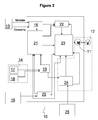
- FIG. 2 This can be obtained with a logic control circuit conforming, for example, to the block diagram of FIG. 2.
- the reference generally refers to the whole of the electronic circuit schematized by a gray rectangle whose functions will be detailed. the main ones, the electric motor and the glass.
- the circuit 10 includes 3 interfaces with the outside: the control button 13, the "frameless door” block 14 and the interface with the computer tools 15.
- the control button 13 is placed in the habitable at the disposal of an occupant of the vehicle and comprises at least two positions to allow the transmission of orders for raising, lowering or stopping one or more panes. These orders are acquired by the box 16 of the circuit.
- the "door without frame” block 14 detects the opening orders of the door associated with the window, either by an action on the lock 17 via an open door contactor (CPO), or by an intelligent system integrated into the control panel. outer opening 18 (COE). This block only exists on vehicles requiring a partial descent of the window to clear the door.
- CPO open door contactor
- COE outer opening 18
- the request to open the door is transmitted to the block 19 for acquiring requests for micro-descent of the window.
- the interface 15 corresponds to the diagnostic tools that a technician can come to connect to the diagnostic socket 20 of the vehicle for repairs, for example.
- the management of the link between the commands of the user and the electronic dialogue of the system is made in the dialogue box 21 with the vehicle network, which operates via on-board electronics on the vehicle, associated with the engine of the vehicle. window lifter or relocated in the vehicle according to its architecture.
- the box 22 makes it possible to manage the priorities between the commands coming from the different interfaces, for example by preventing the rise of the window following a clearance if the user controls the descent of the window - or on the contrary by forcing the micro-descent if the user simultaneously controls the raising of the window and the opening of the door.
- the motor control is managed by the block 23.
- This control is also controlled by an anti-pinch logic circuit, not shown here, to process the obstacle detection routine .
- This routine is implemented when the window V encounters an obstacle during its rise.
- the electronic circuit 10 furthermore comprises a block 24 for acquiring the position of the window which stores the position of the window and the state of the engine of the vehicle during the last control of the window, and which memorizes if the electric circuit was fed via the battery of the vehicle schematized by the block 25 during this last ascent.
- the block 24 having detected an ascent of the stopped engine glass indicates this position to the driving group 23 of the geared motor and as soon as the engine is running, a refueling of the geared motor 11 of the power window is controlled to ensure a positioning of the glass according to the preset engagement value.
- the invention has been described with reference to cabriolet-type vehicles having doors without frame in the upper part; the invention is not limited not to this embodiment and can be applied to any vehicle door whose sliding window engages at the top in a joint - knowing that similar problems can be seen if the closing order of the windows is actuated engine to the 'stop, even if the absence of short-drop function greatly limits the frequency of the problem.
Landscapes
- Power-Operated Mechanisms For Wings (AREA)
- Glass Compositions (AREA)
- Surgical Instruments (AREA)
- Valve Device For Special Equipments (AREA)
- Devices For Conveying Motion By Means Of Endless Flexible Members (AREA)
- Window Of Vehicle (AREA)
Abstract
Description
- La présente invention concerne les commandes électriques de fermeture d'une vitre coulissante montée dans une porte. Elle s'applique notamment aux véhicules comportant des portes sans encadrement supérieur comme dans des véhicules de type cabriolet.
- De façon classique, une vitre de porte de véhicule automobile est montée coulissante entre des positions relevée et abaissée, à travers une fente sensiblement longitudinale de cette porte séparant un panneau interne à l'habitacle et un panneau externe à l'habitacle de la porte. La vitre peut être relevée ou abaissée au moyen d'un système lève-vitre comportant un mécanisme, un moteur et dans le cas des véhicules modernes, un système électronique de pilotage du moteur.
- Dans le cas d'une porte sans encadrement, la vitre est guidée par deux chariots solidaires de cette vitre coulissant dans deux rails respectifs sensiblement verticaux disposés à l'intérieur de la porte. Lorsque la porte est fermée et que le véhicule roule à vitesse élevée, la vitre relevée est soumise à des efforts aérodynamiques importants ayant tendance à pousser cette vitre vers l'extérieur de l'habitacle. En l'absence d'encadrement de la vitre solidaire de la porte, il est connu de maintenir solidement la vitre relevée en logeant le bord supérieur de celle-ci dans un rail formant gorge solidaire du toit du véhicule ou dans un joint solidaire de l'armature rigide de la capote, dans le cas d'un cabriolet.
- La valeur d'engagement de la vitre dans ce rail ou joint peut être comprise par exemple entre 5 et 10 mm selon les modèles. Dans ces conditions, la porte ne peut être manoeuvrée que si la vitre est au moins partiellement descendue. De ce fait, de nombreux véhicules du type coupé-cabriolet sont équipés de la fonction dite short-drop selon laquelle, dès que l'utilisateur commence à manipuler la poignée du véhicule, la vitre est abaissée sur environ un centimètre pour libérer le joint, et automatiquement remontée dès que la porte est refermée.
- Si un défaut de fermeture se produit, il existe un risque d'infiltrations d'eau (pluie) et/ou d'air - avec notamment des bruits de sifflement qui nuisent au confort du conducteur et des passagers.
- Les auteurs de la présente invention ont trouvé qu'un tel défaut de fermeture pouvait notamment se produire lorsque la commande de remontée de la vitre est actionnée alors que le moteur du véhicule est à l'arrêt et donc que le moteur électrique associé au mécanisme de commande du mouvement de la vitre est alimenté par la batterie.
- En effet ; les efforts engendrés sur le système porte (notamment les joints) en fonction de l'environnement ont un impact direct sur la valeur d'engagement de la vitre dans les joints de toit et de montant de baie après une descente partielle de la vitre, véhicule moteur non tournant.
- La tension de la batterie et les conditions d'utilisations extérieures (température, hygrométrie, etc.) agissent directement sur le couple du moteur de commande du lève-vitre. Du fait que le couple moteur soit plus faible, les curseurs de lève vitre ne seront plus en butée mécanique sur leurs butées respectives. L'assiette de vitre n'est plus conforme et la vitre n'est pas correctement positionnée selon la cote d'engagement prédéfinie.
- De façon classique, le courant électrique d'un véhicule est produit par un alternateur qui recharge une batterie délivrant une tension de 12 volts. Pour autant, lorsque le moteur du véhicule est en marche, la tension stabilisée du réseau est supérieure, par exemple de l'ordre de 14 à 16 volts. Dans ces conditions, le couple moteur du lève-vitre est plus faible avec un moteur arrêté. Pour la plus grande partie de la course de la vitre, cette différence de couple est sans conséquence. Par contre, les frottements sont nettement accrus dès lors que la partie haute de la vitre commence à être engagée dans le joint supérieur ce qui explique le défaut de remontée que nous venons d'évoquer.
- Il est à noter que dans les véhicules de type cabriolet, ce problème est d'autant plus critique que comme indiqué plus haut, la vitre doit être dégagée de ce joint supérieur pour permettre l'ouverture de la porte du véhicule et que à l'évidence, la fonction short-drop est dans la grande majorité des cas actionnée alors que le moteur du véhicule est à l'arrêt.
- Comme indiqué plus haut, le défaut de fermeture de la vitre n'est pas nécessairement perceptible par le conducteur, en particulier tant qu'il conduit à vitesse modérée. Pour autant, si la vitre n'est pas parfaitement logée en position haute ; les efforts engendrés sur le système porte, en particulier sur tous les joints, sont accrus, d'autant que les forces aérodynamiques sollicitent la vitre vers l'extérieur de l'habitacle. A la longue, ceci peut induire des défauts d'étanchéité du véhicule.
- Si le conducteur constate le défaut de fermeture, il peut y remédier simplement en commandant la manoeuvre de la vitre alors que le moteur du véhicule est engagé, mais pour autant, cette nécessité affecte la perception de la qualité du véhicule, surtout sur des véhicules relativement plus « prestigieux » comme les cabriolets.
- Une solution connue à ce problème consiste à opter pour équiper le véhicule avec des moteurs de lève-vitres plus puissants et/ou à prévoir une puissance électrique plus grande par l'ajout d'une seconde batterie. Ces deux solutions ont l'inconvénient de renchérir le coût du véhicule - et de plus dans le cas des cabriolets, et l'ajout d'une seconde batterie peut conduire à réduire la taille du coffre, déjà minimale dans ce type de véhicule.
- Les auteurs de la présente invention proposent de commander automatiquement la remontée de la vitre dès que le moteur du véhicule est mis en marche.
- Dans une première variante de l'invention, le circuit électronique qui pilote le moteur électrique associé au mécanisme de commande du mouvement de la vitre peut commander cette remontée après tout démarrage. Dans une autre variante de l'invention, cette commande n'est actionnée que si la dernière manoeuvre de la vitre a été effectuée avec un moteur à l'arrêt. Autrement dit, dans la plupart des cas, cette variante de l'invention revient à actionner la remontée de la vitre du coté du conducteur à chaque re-démarrage du moteur et pour les autres portes, uniquement si un passager ou le conducteur les a manoeuvrées.
- L'invention a ainsi pour objet un lève-vitre pour porte d'un véhicule comportant un moteur électrique associé à un mécanisme de commande du mouvement de la vitre, ledit moteur électrique étant raccordé par un réseau électrique à un circuit électrique alimenté par une batterie rechargé par un alternateur quand le moteur du véhicule est en marche et ledit moteur électrique étant piloté par un circuit électronique caractérisé en ce que ledit circuit électronique comporte des moyens pour actionner la remontée automatique de la vitre dès que le moteur est remis en marche.
- Dans une autre variante de l'invention, cette commande n'est actionnée que si la dernière manoeuvre de la vitre a été effectuée avec un moteur à l'arrêt. Autrement dit, dans la plupart des cas, cette variante de l'invention revient à actionner la remontée de la vitre du coté du conducteur à chaque re-démarrage du moteur et pour les autres portes, uniquement si un passager ou le conducteur les a manoeuvrées.
- Un exemple de réalisation de l'invention est décrit ci-dessous en se référant aux dessins annexés dans lesquels :
- la figure 1 est une vie schématique d'une vitre de véhicule engagée dans un joint ;
- la figure 2 est un schéma synoptique de la commande électronique du lève-vitre.
- On a représenté sur la figure 1 une vitre 1 d'un véhicule montée de façon classique coulissante dans une porte (non figurée). En position relevée, la vitre 1 est engagée dans un joint. Dans le cas d'un véhicule de type cabriolet, ce joint 2 est par exemple agencé dans un rail formant une gorge en U inversé monté sur le toit de l'habitable.
- Comme les forces aérodynamiques tendent à ce que la vitre s'écarte du véhicule, la valeur d'engagement h de la vitre dans le joint du toit est réglée selon une cote approchant par exemple environ 10 mm.
- L'engagement sur une hauteur aussi grande engendre des efforts assez importants, qui varient en fonction de l'environnement extérieur, notamment de paramètres tels que la température et la tension de la batterie. Selon ces conditions, l'engagement peut être plus au moins incomplet, sans que cela soit facilement perceptible par le conducteur - sauf lorsque le défaut d'engagement est tel qu'il engendre un bruit d'air.
- Pour éviter l'usure prématurée du point et de l'ensemble porte, l'invention propose d'associer une nouvelle fonctionnalité au circuit logique de pilotage du moteur électrique du lève-vitre pour commander la remontée de la vitre dès que le moteur du véhicule est en marche - soit systématiquement soit seulement si la vitre a été manoeuvrée alors que le moteur du véhicule était à l'arrêt.
- Ceci peut être obtenu avec un circuit logique de pilotage conforme par exemple au schéma synoptique de la figure 2. Sur cette figure, on a désigné généralement par la référence 10 l'ensemble du circuit électronique schématisé par un rectangle grisé dont on va détailler les fonctions principales, en 11 le moteur électrique et en 12 la vitre.
- Le circuit 10 comprend 3 interfaces avec l'extérieur : le bouton de commande 13, le bloc « porte sans cadre » 14 et l'interface avec les outils informatiques 15.
- Le bouton de commande 13 est placé dans l'habitable à la disposition d'un occupant du véhicule et comporte au moins deux positions pour permettre la transmission des ordres de montée, descente ou d'arrêt d'une ou plusieurs vitres. Ces ordres sont acquis par la boite 16 du circuit.
- Le bloc « porte sans cadre » 14 détecte les ordres d'ouverture de la porte associée à la vitre, soit par une action sur la serrure 17 via un contacteur de porte ouverte (CPO), soit par un système intelligent intégré à la commande d'ouverture extérieure 18 (COE). Ce bloc n'existe que sur les véhicules nécessitant une descente partielle de la vitre pour dégager la porte.
- La demande d'ouverture de la porte est transmise au bloc 19 d'acquisition des demandes de micro-descente de la vitre.
- L'interface 15 correspond aux outils de diagnostic qu'un technicien peut venir connecter sur la prise diagnostic 20 du véhicule pour des interventions de réparation par exemple.
- La gestion de la liaison entre les commandes de l'utilisateur et le dialogue électronique du système est opérée dans la boite 21 de dialogue avec le réseau véhicule, qui opère par l'intermédiaire d'une électronique embarquée sur le véhicule, associée au moteur du lève-vitre ou délocalisée dans le véhicule selon son architecture.
- La boite 22 permet de gérer les priorités entre les commandes provenant des différentes interfaces, par exemple en empêchant la remontée de la vitre suite à un dégagement si l'utilisateur commande la descente de la vitre - ou au contraire en forçant la micro-descente si l'utilisateur commande simultanément la remontée de la vitre et l'ouverture de la porte.
- Après le traitement des commandes provenant des différentes interfaces, le pilotage du moteur est géré par le bloc 23. Ce pilotage est par ailleurs contrôlé par un circuit logique d'anti-pincement, ici non représenté, pour traiter la routine de détection d'obstacle. Cette routine est mise en oeuvre lorsque la vitre V rencontre un obstacle au cours de sa montée.
- Conformément à l'invention, le circuit électronique 10 comporte de plus un bloc 24 d'acquisition de la position de la vitre qui mémorise la position de la vitre et l'état du moteur du véhicule lors de la dernière commande de la vitre, et qui mémorise si le circuit électrique était alimenté via la batterie du véhicule schématisée par le bloc 25 lors de cette dernière remontée.
- Si tel était le cas, le bloc 24 ayant détecté une remontée de la vitre moteur arrêté signale cette position au groupe 23 de pilotage du moto-réducteur et dès que le moteur est tournant, une réalimentation du moto-réducteur 11 du lève-vitre est commandée pour assurer un positionnement de la vitre conforme à la valeur d'engagement prédéfinie.
- Bien que l'invention a été décrite en référence aux véhicules de type cabriolet disposant de portes sans encadrement en partie haute ; l'invention ne se limite pas à ce mode de réalisation et peut s'appliquer à toute porte de véhicule dont la vitre coulissante s'engage en partie haute dans un joint - sachant que des problèmes similaires peuvent être constatés si la commande de fermeture des vitres est actionnée moteur à l'arrêt, même si l'absence de fonction « short-drop » limite de beaucoup la fréquence du problème.
Claims (6)
- Lève-vitre pour porte d'un véhicule comportant un moteur électrique associé à un mécanisme de commande du mouvement de la vitre, ledit moteur électrique étant raccordé par un réseau électrique à un circuit électrique alimenté par une batterie rechargé par un alternateur quand le moteur du véhicule est en marche et ledit moteur électrique étant piloté par un circuit électronique caractérisé en ce que ledit circuit électronique comporte des moyens pour actionner la remontée automatique de la vitre dès que le moteur du véhicule est mis en marche.
- Lève-vitre selon la revendication 1, caractérisé en ce que ladite commande de remontée automatique n'est effectuée que si la dernière manoeuvre de remontée de la vitre a été effectuée lorsque le moteur du véhicule était à l'arrêt.
- Lève-vitre selon l'une quelconque des revendications précédentes, caractérisé en ce que ladite commande de remontée de la vitre est précédée d'une commande de descente.
- Lève-vitre selon la revendication 3 caractérisé en ce que la vitre est descendue sur une hauteur sensiblement voisine à la hauteur d'engagement théorique de la vitre.
- Lève-vitre selon l'une quelconque des revendications précédentes caractérisé en ce que la vitre est montée dans une porte sans cadre.
- Véhicule équipé d'un lève-vitre selon l'une quelconque des revendications précédentes.
Applications Claiming Priority (1)
| Application Number | Priority Date | Filing Date | Title |
|---|---|---|---|
| FR0550750A FR2883595B1 (fr) | 2005-03-23 | 2005-03-23 | Leve vitre |
Publications (2)
| Publication Number | Publication Date |
|---|---|
| EP1705331A1 true EP1705331A1 (fr) | 2006-09-27 |
| EP1705331B1 EP1705331B1 (fr) | 2008-09-24 |
Family
ID=35124347
Family Applications (1)
| Application Number | Title | Priority Date | Filing Date |
|---|---|---|---|
| EP06300259A Expired - Lifetime EP1705331B1 (fr) | 2005-03-23 | 2006-03-21 | Lève-vitre |
Country Status (4)
| Country | Link |
|---|---|
| EP (1) | EP1705331B1 (fr) |
| AT (1) | ATE409270T1 (fr) |
| DE (1) | DE602006002833D1 (fr) |
| FR (1) | FR2883595B1 (fr) |
Citations (1)
| Publication number | Priority date | Publication date | Assignee | Title |
|---|---|---|---|---|
| DE10338767A1 (de) * | 2003-08-23 | 2005-03-17 | Daimlerchrysler Ag | Türscheibensteuerungssystem |
-
2005
- 2005-03-23 FR FR0550750A patent/FR2883595B1/fr not_active Expired - Fee Related
-
2006
- 2006-03-21 AT AT06300259T patent/ATE409270T1/de not_active IP Right Cessation
- 2006-03-21 EP EP06300259A patent/EP1705331B1/fr not_active Expired - Lifetime
- 2006-03-21 DE DE602006002833T patent/DE602006002833D1/de not_active Expired - Lifetime
Patent Citations (1)
| Publication number | Priority date | Publication date | Assignee | Title |
|---|---|---|---|---|
| DE10338767A1 (de) * | 2003-08-23 | 2005-03-17 | Daimlerchrysler Ag | Türscheibensteuerungssystem |
Also Published As
| Publication number | Publication date |
|---|---|
| DE602006002833D1 (de) | 2008-11-06 |
| FR2883595B1 (fr) | 2007-04-27 |
| EP1705331B1 (fr) | 2008-09-24 |
| FR2883595A1 (fr) | 2006-09-29 |
| ATE409270T1 (de) | 2008-10-15 |
Similar Documents
| Publication | Publication Date | Title |
|---|---|---|
| US10927581B2 (en) | Tailgate step stowage assistance | |
| US9567791B2 (en) | Method for actuating a drive means of a window positioning device for positioning a window pane of a vehicle, and control device suitable therefor | |
| CN103516295B (zh) | 用于控制开闭构件的开闭构件控制装置和方法 | |
| US7814704B2 (en) | Method for controlling door and door control system for vehicle | |
| US10844647B2 (en) | Method for operating a door module of a motor vehicle | |
| US8661735B2 (en) | Actuation method for an electric window winder | |
| US10378264B2 (en) | Drive motor for opening and closing body | |
| US10233686B2 (en) | System and method of controlling a vehicle window assembly | |
| KR102294587B1 (ko) | 차량 도어용 동력 구동 모듈 | |
| CN103590696A (zh) | 软启动车窗调节器 | |
| FR2740571A1 (fr) | Procede servant a controler le trajet de deplacement d'une piece | |
| EP1705331B1 (fr) | Lève-vitre | |
| JP2003336448A (ja) | 車両用開閉体の制御機構 | |
| JP2004522881A (ja) | 自動車の電動式ウインドウリフターを操作する方法 | |
| KR101758738B1 (ko) | 차량용 적재함 도어의 개폐 시스템 | |
| US12473757B2 (en) | Motor vehicle lock | |
| JP4962347B2 (ja) | 自動車用ウィンドウガラスの昇降制御方法 | |
| US6867562B2 (en) | Control system and method for movement of window panes in convertibles | |
| JP4935512B2 (ja) | スライドドアの挟み込み防止構造 | |
| JP5317778B2 (ja) | 車両制御装置 | |
| FR3059275B1 (fr) | Procede de pilotage de vitre d’un vehicule pour la fermeture d’un hayon | |
| FR3097170A1 (fr) | Commande d’occultation d’un toit vitré de véhicule automobile | |
| JPH1191354A (ja) | 自動車用サッシュレスドア構造 | |
| US20050173942A1 (en) | System and method for controlling vehicle doors and windows | |
| JP2024065549A (ja) | ウインドウ駆動装置 |
Legal Events
| Date | Code | Title | Description |
|---|---|---|---|
| PUAI | Public reference made under article 153(3) epc to a published international application that has entered the european phase |
Free format text: ORIGINAL CODE: 0009012 |
|
| AK | Designated contracting states |
Kind code of ref document: A1 Designated state(s): AT BE BG CH CY CZ DE DK EE ES FI FR GB GR HU IE IS IT LI LT LU LV MC NL PL PT RO SE SI SK TR |
|
| AX | Request for extension of the european patent |
Extension state: AL BA HR MK YU |
|
| 17P | Request for examination filed |
Effective date: 20061006 |
|
| AKX | Designation fees paid |
Designated state(s): AT BE BG CH CY CZ DE DK EE ES FI FR GB GR HU IE IS IT LI LT LU LV MC NL PL PT RO SE SI SK TR |
|
| GRAP | Despatch of communication of intention to grant a patent |
Free format text: ORIGINAL CODE: EPIDOSNIGR1 |
|
| GRAS | Grant fee paid |
Free format text: ORIGINAL CODE: EPIDOSNIGR3 |
|
| GRAA | (expected) grant |
Free format text: ORIGINAL CODE: 0009210 |
|
| AK | Designated contracting states |
Kind code of ref document: B1 Designated state(s): AT BE BG CH CY CZ DE DK EE ES FI FR GB GR HU IE IS IT LI LT LU LV MC NL PL PT RO SE SI SK TR |
|
| REG | Reference to a national code |
Ref country code: GB Ref legal event code: FG4D Free format text: NOT ENGLISH |
|
| REG | Reference to a national code |
Ref country code: CH Ref legal event code: EP |
|
| REG | Reference to a national code |
Ref country code: IE Ref legal event code: FG4D Free format text: LANGUAGE OF EP DOCUMENT: FRENCH |
|
| REF | Corresponds to: |
Ref document number: 602006002833 Country of ref document: DE Date of ref document: 20081106 Kind code of ref document: P |
|
| REG | Reference to a national code |
Ref country code: GB Ref legal event code: 746 Effective date: 20081222 |
|
| PG25 | Lapsed in a contracting state [announced via postgrant information from national office to epo] |
Ref country code: LT Free format text: LAPSE BECAUSE OF FAILURE TO SUBMIT A TRANSLATION OF THE DESCRIPTION OR TO PAY THE FEE WITHIN THE PRESCRIBED TIME-LIMIT Effective date: 20080924 |
|
| PG25 | Lapsed in a contracting state [announced via postgrant information from national office to epo] |
Ref country code: AT Free format text: LAPSE BECAUSE OF FAILURE TO SUBMIT A TRANSLATION OF THE DESCRIPTION OR TO PAY THE FEE WITHIN THE PRESCRIBED TIME-LIMIT Effective date: 20080924 Ref country code: SI Free format text: LAPSE BECAUSE OF FAILURE TO SUBMIT A TRANSLATION OF THE DESCRIPTION OR TO PAY THE FEE WITHIN THE PRESCRIBED TIME-LIMIT Effective date: 20080924 Ref country code: FI Free format text: LAPSE BECAUSE OF FAILURE TO SUBMIT A TRANSLATION OF THE DESCRIPTION OR TO PAY THE FEE WITHIN THE PRESCRIBED TIME-LIMIT Effective date: 20080924 Ref country code: LV Free format text: LAPSE BECAUSE OF FAILURE TO SUBMIT A TRANSLATION OF THE DESCRIPTION OR TO PAY THE FEE WITHIN THE PRESCRIBED TIME-LIMIT Effective date: 20080924 |
|
| NLV1 | Nl: lapsed or annulled due to failure to fulfill the requirements of art. 29p and 29m of the patents act | ||
| REG | Reference to a national code |
Ref country code: IE Ref legal event code: FD4D |
|
| PG25 | Lapsed in a contracting state [announced via postgrant information from national office to epo] |
Ref country code: BG Free format text: LAPSE BECAUSE OF FAILURE TO SUBMIT A TRANSLATION OF THE DESCRIPTION OR TO PAY THE FEE WITHIN THE PRESCRIBED TIME-LIMIT Effective date: 20081224 Ref country code: ES Free format text: LAPSE BECAUSE OF FAILURE TO SUBMIT A TRANSLATION OF THE DESCRIPTION OR TO PAY THE FEE WITHIN THE PRESCRIBED TIME-LIMIT Effective date: 20090104 |
|
| PG25 | Lapsed in a contracting state [announced via postgrant information from national office to epo] |
Ref country code: NL Free format text: LAPSE BECAUSE OF FAILURE TO SUBMIT A TRANSLATION OF THE DESCRIPTION OR TO PAY THE FEE WITHIN THE PRESCRIBED TIME-LIMIT Effective date: 20080924 Ref country code: SK Free format text: LAPSE BECAUSE OF FAILURE TO SUBMIT A TRANSLATION OF THE DESCRIPTION OR TO PAY THE FEE WITHIN THE PRESCRIBED TIME-LIMIT Effective date: 20080924 Ref country code: CZ Free format text: LAPSE BECAUSE OF FAILURE TO SUBMIT A TRANSLATION OF THE DESCRIPTION OR TO PAY THE FEE WITHIN THE PRESCRIBED TIME-LIMIT Effective date: 20080924 Ref country code: RO Free format text: LAPSE BECAUSE OF FAILURE TO SUBMIT A TRANSLATION OF THE DESCRIPTION OR TO PAY THE FEE WITHIN THE PRESCRIBED TIME-LIMIT Effective date: 20080924 Ref country code: PT Free format text: LAPSE BECAUSE OF FAILURE TO SUBMIT A TRANSLATION OF THE DESCRIPTION OR TO PAY THE FEE WITHIN THE PRESCRIBED TIME-LIMIT Effective date: 20090224 Ref country code: IS Free format text: LAPSE BECAUSE OF FAILURE TO SUBMIT A TRANSLATION OF THE DESCRIPTION OR TO PAY THE FEE WITHIN THE PRESCRIBED TIME-LIMIT Effective date: 20090124 |
|
| PG25 | Lapsed in a contracting state [announced via postgrant information from national office to epo] |
Ref country code: EE Free format text: LAPSE BECAUSE OF FAILURE TO SUBMIT A TRANSLATION OF THE DESCRIPTION OR TO PAY THE FEE WITHIN THE PRESCRIBED TIME-LIMIT Effective date: 20080924 Ref country code: IE Free format text: LAPSE BECAUSE OF FAILURE TO SUBMIT A TRANSLATION OF THE DESCRIPTION OR TO PAY THE FEE WITHIN THE PRESCRIBED TIME-LIMIT Effective date: 20080924 Ref country code: DK Free format text: LAPSE BECAUSE OF FAILURE TO SUBMIT A TRANSLATION OF THE DESCRIPTION OR TO PAY THE FEE WITHIN THE PRESCRIBED TIME-LIMIT Effective date: 20080924 |
|
| PLBE | No opposition filed within time limit |
Free format text: ORIGINAL CODE: 0009261 |
|
| STAA | Information on the status of an ep patent application or granted ep patent |
Free format text: STATUS: NO OPPOSITION FILED WITHIN TIME LIMIT |
|
| PG25 | Lapsed in a contracting state [announced via postgrant information from national office to epo] |
Ref country code: IT Free format text: LAPSE BECAUSE OF FAILURE TO SUBMIT A TRANSLATION OF THE DESCRIPTION OR TO PAY THE FEE WITHIN THE PRESCRIBED TIME-LIMIT Effective date: 20080924 |
|
| 26N | No opposition filed |
Effective date: 20090625 |
|
| BERE | Be: lapsed |
Owner name: PEUGEOT CITROEN AUTOMOBILES Effective date: 20090331 |
|
| PG25 | Lapsed in a contracting state [announced via postgrant information from national office to epo] |
Ref country code: MC Free format text: LAPSE BECAUSE OF NON-PAYMENT OF DUE FEES Effective date: 20090331 |
|
| PG25 | Lapsed in a contracting state [announced via postgrant information from national office to epo] |
Ref country code: SE Free format text: LAPSE BECAUSE OF FAILURE TO SUBMIT A TRANSLATION OF THE DESCRIPTION OR TO PAY THE FEE WITHIN THE PRESCRIBED TIME-LIMIT Effective date: 20081224 |
|
| PG25 | Lapsed in a contracting state [announced via postgrant information from national office to epo] |
Ref country code: BE Free format text: LAPSE BECAUSE OF NON-PAYMENT OF DUE FEES Effective date: 20090331 |
|
| PG25 | Lapsed in a contracting state [announced via postgrant information from national office to epo] |
Ref country code: PL Free format text: LAPSE BECAUSE OF FAILURE TO SUBMIT A TRANSLATION OF THE DESCRIPTION OR TO PAY THE FEE WITHIN THE PRESCRIBED TIME-LIMIT Effective date: 20080924 |
|
| PG25 | Lapsed in a contracting state [announced via postgrant information from national office to epo] |
Ref country code: GR Free format text: LAPSE BECAUSE OF FAILURE TO SUBMIT A TRANSLATION OF THE DESCRIPTION OR TO PAY THE FEE WITHIN THE PRESCRIBED TIME-LIMIT Effective date: 20081225 |
|
| REG | Reference to a national code |
Ref country code: CH Ref legal event code: PL |
|
| PG25 | Lapsed in a contracting state [announced via postgrant information from national office to epo] |
Ref country code: CH Free format text: LAPSE BECAUSE OF NON-PAYMENT OF DUE FEES Effective date: 20100331 Ref country code: LI Free format text: LAPSE BECAUSE OF NON-PAYMENT OF DUE FEES Effective date: 20100331 |
|
| PG25 | Lapsed in a contracting state [announced via postgrant information from national office to epo] |
Ref country code: LU Free format text: LAPSE BECAUSE OF NON-PAYMENT OF DUE FEES Effective date: 20090321 |
|
| PG25 | Lapsed in a contracting state [announced via postgrant information from national office to epo] |
Ref country code: HU Free format text: LAPSE BECAUSE OF FAILURE TO SUBMIT A TRANSLATION OF THE DESCRIPTION OR TO PAY THE FEE WITHIN THE PRESCRIBED TIME-LIMIT Effective date: 20090325 |
|
| PG25 | Lapsed in a contracting state [announced via postgrant information from national office to epo] |
Ref country code: TR Free format text: LAPSE BECAUSE OF FAILURE TO SUBMIT A TRANSLATION OF THE DESCRIPTION OR TO PAY THE FEE WITHIN THE PRESCRIBED TIME-LIMIT Effective date: 20080924 |
|
| PG25 | Lapsed in a contracting state [announced via postgrant information from national office to epo] |
Ref country code: CY Free format text: LAPSE BECAUSE OF FAILURE TO SUBMIT A TRANSLATION OF THE DESCRIPTION OR TO PAY THE FEE WITHIN THE PRESCRIBED TIME-LIMIT Effective date: 20080924 |
|
| PGFP | Annual fee paid to national office [announced via postgrant information from national office to epo] |
Ref country code: FR Payment date: 20120410 Year of fee payment: 7 |
|
| PGFP | Annual fee paid to national office [announced via postgrant information from national office to epo] |
Ref country code: DE Payment date: 20120223 Year of fee payment: 7 |
|
| PGFP | Annual fee paid to national office [announced via postgrant information from national office to epo] |
Ref country code: GB Payment date: 20120224 Year of fee payment: 7 |
|
| GBPC | Gb: european patent ceased through non-payment of renewal fee |
Effective date: 20130321 |
|
| REG | Reference to a national code |
Ref country code: FR Ref legal event code: ST Effective date: 20131129 |
|
| REG | Reference to a national code |
Ref country code: DE Ref legal event code: R119 Ref document number: 602006002833 Country of ref document: DE Effective date: 20131001 |
|
| PG25 | Lapsed in a contracting state [announced via postgrant information from national office to epo] |
Ref country code: GB Free format text: LAPSE BECAUSE OF NON-PAYMENT OF DUE FEES Effective date: 20130321 Ref country code: FR Free format text: LAPSE BECAUSE OF NON-PAYMENT OF DUE FEES Effective date: 20130402 Ref country code: DE Free format text: LAPSE BECAUSE OF NON-PAYMENT OF DUE FEES Effective date: 20131001 |