EP1705220A1 - Phosphorhaltige thermostabilisierte Flammschutzmittelagglomerate - Google Patents
Phosphorhaltige thermostabilisierte Flammschutzmittelagglomerate Download PDFInfo
- Publication number
- EP1705220A1 EP1705220A1 EP06005452A EP06005452A EP1705220A1 EP 1705220 A1 EP1705220 A1 EP 1705220A1 EP 06005452 A EP06005452 A EP 06005452A EP 06005452 A EP06005452 A EP 06005452A EP 1705220 A1 EP1705220 A1 EP 1705220A1
- Authority
- EP
- European Patent Office
- Prior art keywords
- phosphorus
- component
- acid
- polymer
- weight
- Prior art date
- Legal status (The legal status is an assumption and is not a legal conclusion. Google has not performed a legal analysis and makes no representation as to the accuracy of the status listed.)
- Granted
Links
- 239000003063 flame retardant Substances 0.000 title claims description 87
- BHEPBYXIRTUNPN-UHFFFAOYSA-N hydridophosphorus(.) (triplet) Chemical compound [PH] BHEPBYXIRTUNPN-UHFFFAOYSA-N 0.000 title 1
- 229920000642 polymer Polymers 0.000 claims abstract description 97
- OAICVXFJPJFONN-UHFFFAOYSA-N Phosphorus Chemical compound [P] OAICVXFJPJFONN-UHFFFAOYSA-N 0.000 claims abstract description 62
- 229910052698 phosphorus Inorganic materials 0.000 claims abstract description 62
- 239000011574 phosphorus Substances 0.000 claims abstract description 62
- 239000002253 acid Substances 0.000 claims abstract description 25
- -1 phosphorous nitrogen compound Chemical class 0.000 claims abstract description 25
- 150000003839 salts Chemical class 0.000 claims abstract description 25
- 150000001875 compounds Chemical class 0.000 claims abstract description 22
- IJGRMHOSHXDMSA-UHFFFAOYSA-N Atomic nitrogen Chemical compound N#N IJGRMHOSHXDMSA-UHFFFAOYSA-N 0.000 claims abstract description 16
- 239000000835 fiber Substances 0.000 claims abstract description 16
- 239000000654 additive Substances 0.000 claims abstract description 14
- 238000002360 preparation method Methods 0.000 claims abstract description 14
- 229910052725 zinc Inorganic materials 0.000 claims abstract description 14
- 239000011164 primary particle Substances 0.000 claims abstract description 13
- 229910052791 calcium Inorganic materials 0.000 claims abstract description 10
- 229910017464 nitrogen compound Inorganic materials 0.000 claims abstract description 10
- 125000003118 aryl group Chemical group 0.000 claims abstract description 9
- 238000001746 injection moulding Methods 0.000 claims abstract description 9
- 229910052749 magnesium Inorganic materials 0.000 claims abstract description 9
- 229910052782 aluminium Inorganic materials 0.000 claims abstract description 8
- 229910052757 nitrogen Inorganic materials 0.000 claims abstract description 8
- 229910052708 sodium Inorganic materials 0.000 claims abstract description 8
- 125000000217 alkyl group Chemical group 0.000 claims abstract description 7
- 238000010438 heat treatment Methods 0.000 claims abstract description 7
- 229910052719 titanium Inorganic materials 0.000 claims abstract description 7
- 229910052787 antimony Inorganic materials 0.000 claims abstract description 6
- 229910052732 germanium Inorganic materials 0.000 claims abstract description 6
- 229910052742 iron Inorganic materials 0.000 claims abstract description 6
- 229910052744 lithium Inorganic materials 0.000 claims abstract description 6
- 229910052748 manganese Inorganic materials 0.000 claims abstract description 6
- 229910052700 potassium Inorganic materials 0.000 claims abstract description 6
- 229910052712 strontium Inorganic materials 0.000 claims abstract description 6
- 229910052718 tin Inorganic materials 0.000 claims abstract description 6
- 229910052726 zirconium Inorganic materials 0.000 claims abstract description 6
- 239000007789 gas Substances 0.000 claims abstract description 4
- 239000008187 granular material Substances 0.000 claims abstract description 4
- 239000011248 coating agent Substances 0.000 claims abstract description 3
- 238000000576 coating method Methods 0.000 claims abstract description 3
- 239000006260 foam Substances 0.000 claims abstract description 3
- 238000010030 laminating Methods 0.000 claims abstract description 3
- 238000003825 pressing Methods 0.000 claims abstract description 3
- RNFJDJUURJAICM-UHFFFAOYSA-N 2,2,4,4,6,6-hexaphenoxy-1,3,5-triaza-2$l^{5},4$l^{5},6$l^{5}-triphosphacyclohexa-1,3,5-triene Chemical compound N=1P(OC=2C=CC=CC=2)(OC=2C=CC=CC=2)=NP(OC=2C=CC=CC=2)(OC=2C=CC=CC=2)=NP=1(OC=1C=CC=CC=1)OC1=CC=CC=C1 RNFJDJUURJAICM-UHFFFAOYSA-N 0.000 claims description 84
- 239000000203 mixture Substances 0.000 claims description 49
- 238000000465 moulding Methods 0.000 claims description 40
- 238000000034 method Methods 0.000 claims description 24
- 229920001577 copolymer Polymers 0.000 claims description 23
- NIXOWILDQLNWCW-UHFFFAOYSA-N 2-Propenoic acid Natural products OC(=O)C=C NIXOWILDQLNWCW-UHFFFAOYSA-N 0.000 claims description 21
- 239000000178 monomer Substances 0.000 claims description 21
- SMZOUWXMTYCWNB-UHFFFAOYSA-N 2-(2-methoxy-5-methylphenyl)ethanamine Chemical compound COC1=CC=C(C)C=C1CCN SMZOUWXMTYCWNB-UHFFFAOYSA-N 0.000 claims description 20
- 229920000877 Melamine resin Chemical group 0.000 claims description 19
- XLOMVQKBTHCTTD-UHFFFAOYSA-N Zinc monoxide Chemical compound [Zn]=O XLOMVQKBTHCTTD-UHFFFAOYSA-N 0.000 claims description 19
- JDSHMPZPIAZGSV-UHFFFAOYSA-N melamine Chemical group NC1=NC(N)=NC(N)=N1 JDSHMPZPIAZGSV-UHFFFAOYSA-N 0.000 claims description 19
- VZCYOOQTPOCHFL-UHFFFAOYSA-N trans-butenedioic acid Natural products OC(=O)C=CC(O)=O VZCYOOQTPOCHFL-UHFFFAOYSA-N 0.000 claims description 19
- VZCYOOQTPOCHFL-UPHRSURJSA-N maleic acid Chemical compound OC(=O)\C=C/C(O)=O VZCYOOQTPOCHFL-UPHRSURJSA-N 0.000 claims description 18
- OFOBLEOULBTSOW-UHFFFAOYSA-N Propanedioic acid Natural products OC(=O)CC(O)=O OFOBLEOULBTSOW-UHFFFAOYSA-N 0.000 claims description 16
- XTXRWKRVRITETP-UHFFFAOYSA-N Vinyl acetate Chemical compound CC(=O)OC=C XTXRWKRVRITETP-UHFFFAOYSA-N 0.000 claims description 16
- 239000011976 maleic acid Substances 0.000 claims description 16
- 229920000388 Polyphosphate Polymers 0.000 claims description 15
- 239000001205 polyphosphate Substances 0.000 claims description 15
- 235000011176 polyphosphates Nutrition 0.000 claims description 15
- CERQOIWHTDAKMF-UHFFFAOYSA-N Methacrylic acid Chemical compound CC(=C)C(O)=O CERQOIWHTDAKMF-UHFFFAOYSA-N 0.000 claims description 13
- 229920005646 polycarboxylate Polymers 0.000 claims description 13
- 239000011701 zinc Substances 0.000 claims description 13
- 239000011787 zinc oxide Substances 0.000 claims description 12
- 229920002472 Starch Polymers 0.000 claims description 11
- 235000019698 starch Nutrition 0.000 claims description 11
- JBKVHLHDHHXQEQ-UHFFFAOYSA-N epsilon-caprolactam Chemical compound O=C1CCCCCN1 JBKVHLHDHHXQEQ-UHFFFAOYSA-N 0.000 claims description 10
- 229920001519 homopolymer Polymers 0.000 claims description 10
- YSRVJVDFHZYRPA-UHFFFAOYSA-N melem Chemical compound NC1=NC(N23)=NC(N)=NC2=NC(N)=NC3=N1 YSRVJVDFHZYRPA-UHFFFAOYSA-N 0.000 claims description 10
- 239000011734 sodium Substances 0.000 claims description 10
- 241000219112 Cucumis Species 0.000 claims description 9
- 235000015510 Cucumis melo subsp melo Nutrition 0.000 claims description 9
- FJJCIZWZNKZHII-UHFFFAOYSA-N [4,6-bis(cyanoamino)-1,3,5-triazin-2-yl]cyanamide Chemical compound N#CNC1=NC(NC#N)=NC(NC#N)=N1 FJJCIZWZNKZHII-UHFFFAOYSA-N 0.000 claims description 9
- 238000005054 agglomeration Methods 0.000 claims description 9
- 230000002776 aggregation Effects 0.000 claims description 9
- 239000011575 calcium Substances 0.000 claims description 9
- 239000008107 starch Substances 0.000 claims description 9
- 229920000663 Hydroxyethyl cellulose Polymers 0.000 claims description 8
- 229920002678 cellulose Polymers 0.000 claims description 8
- 239000001913 cellulose Substances 0.000 claims description 8
- 239000000945 filler Substances 0.000 claims description 8
- 238000005469 granulation Methods 0.000 claims description 8
- 230000003179 granulation Effects 0.000 claims description 8
- JVTAAEKCZFNVCJ-UHFFFAOYSA-N lactic acid Chemical compound CC(O)C(O)=O JVTAAEKCZFNVCJ-UHFFFAOYSA-N 0.000 claims description 8
- 239000011777 magnesium Substances 0.000 claims description 8
- 229920000172 poly(styrenesulfonic acid) Polymers 0.000 claims description 8
- 229940005642 polystyrene sulfonic acid Drugs 0.000 claims description 8
- YZEZMSPGIPTEBA-UHFFFAOYSA-N 2-n-(4,6-diamino-1,3,5-triazin-2-yl)-1,3,5-triazine-2,4,6-triamine Chemical compound NC1=NC(N)=NC(NC=2N=C(N)N=C(N)N=2)=N1 YZEZMSPGIPTEBA-UHFFFAOYSA-N 0.000 claims description 7
- IMROMDMJAWUWLK-UHFFFAOYSA-N Ethenol Chemical class OC=C IMROMDMJAWUWLK-UHFFFAOYSA-N 0.000 claims description 7
- 239000004354 Hydroxyethyl cellulose Substances 0.000 claims description 7
- HCHKCACWOHOZIP-UHFFFAOYSA-N Zinc Chemical compound [Zn] HCHKCACWOHOZIP-UHFFFAOYSA-N 0.000 claims description 7
- 239000002671 adjuvant Substances 0.000 claims description 7
- 235000019447 hydroxyethyl cellulose Nutrition 0.000 claims description 7
- KAKZBPTYRLMSJV-UHFFFAOYSA-N Butadiene Chemical compound C=CC=C KAKZBPTYRLMSJV-UHFFFAOYSA-N 0.000 claims description 6
- SOGAXMICEFXMKE-UHFFFAOYSA-N Butylmethacrylate Chemical compound CCCCOC(=O)C(C)=C SOGAXMICEFXMKE-UHFFFAOYSA-N 0.000 claims description 6
- VTYYLEPIZMXCLO-UHFFFAOYSA-L Calcium carbonate Chemical compound [Ca+2].[O-]C([O-])=O VTYYLEPIZMXCLO-UHFFFAOYSA-L 0.000 claims description 6
- WHNWPMSKXPGLAX-UHFFFAOYSA-N N-Vinyl-2-pyrrolidone Chemical compound C=CN1CCCC1=O WHNWPMSKXPGLAX-UHFFFAOYSA-N 0.000 claims description 6
- 239000007859 condensation product Substances 0.000 claims description 6
- ACVYVLVWPXVTIT-UHFFFAOYSA-N phosphinic acid Chemical class O[PH2]=O ACVYVLVWPXVTIT-UHFFFAOYSA-N 0.000 claims description 6
- XZTOTRSSGPPNTB-UHFFFAOYSA-N phosphono dihydrogen phosphate;1,3,5-triazine-2,4,6-triamine Chemical group NC1=NC(N)=NC(N)=N1.OP(O)(=O)OP(O)(O)=O XZTOTRSSGPPNTB-UHFFFAOYSA-N 0.000 claims description 6
- GOXQRTZXKQZDDN-UHFFFAOYSA-N 2-Ethylhexyl acrylate Chemical compound CCCCC(CC)COC(=O)C=C GOXQRTZXKQZDDN-UHFFFAOYSA-N 0.000 claims description 5
- AGBXYHCHUYARJY-UHFFFAOYSA-N 2-phenylethenesulfonic acid Chemical compound OS(=O)(=O)C=CC1=CC=CC=C1 AGBXYHCHUYARJY-UHFFFAOYSA-N 0.000 claims description 5
- BZHJMEDXRYGGRV-UHFFFAOYSA-N Vinyl chloride Chemical compound ClC=C BZHJMEDXRYGGRV-UHFFFAOYSA-N 0.000 claims description 5
- YUWBVKYVJWNVLE-UHFFFAOYSA-N [N].[P] Chemical compound [N].[P] YUWBVKYVJWNVLE-UHFFFAOYSA-N 0.000 claims description 5
- CQEYYJKEWSMYFG-UHFFFAOYSA-N butyl acrylate Chemical compound CCCCOC(=O)C=C CQEYYJKEWSMYFG-UHFFFAOYSA-N 0.000 claims description 5
- LYCAIKOWRPUZTN-UHFFFAOYSA-N ethylene glycol Natural products OCCO LYCAIKOWRPUZTN-UHFFFAOYSA-N 0.000 claims description 5
- 150000002482 oligosaccharides Chemical class 0.000 claims description 5
- 229920000747 poly(lactic acid) Polymers 0.000 claims description 5
- NTHWMYGWWRZVTN-UHFFFAOYSA-N sodium silicate Chemical compound [Na+].[Na+].[O-][Si]([O-])=O NTHWMYGWWRZVTN-UHFFFAOYSA-N 0.000 claims description 5
- OYPRJOBELJOOCE-UHFFFAOYSA-N Calcium Chemical compound [Ca] OYPRJOBELJOOCE-UHFFFAOYSA-N 0.000 claims description 4
- 229920002153 Hydroxypropyl cellulose Polymers 0.000 claims description 4
- VVQNEPGJFQJSBK-UHFFFAOYSA-N Methyl methacrylate Chemical compound COC(=O)C(C)=C VVQNEPGJFQJSBK-UHFFFAOYSA-N 0.000 claims description 4
- JBSLOWBPDRZSMB-FPLPWBNLSA-N dibutyl (z)-but-2-enedioate Chemical compound CCCCOC(=O)\C=C/C(=O)OCCCC JBSLOWBPDRZSMB-FPLPWBNLSA-N 0.000 claims description 4
- 150000002148 esters Chemical class 0.000 claims description 4
- UIWXSTHGICQLQT-UHFFFAOYSA-N ethenyl propanoate Chemical compound CCC(=O)OC=C UIWXSTHGICQLQT-UHFFFAOYSA-N 0.000 claims description 4
- 239000001863 hydroxypropyl cellulose Substances 0.000 claims description 4
- 235000010977 hydroxypropyl cellulose Nutrition 0.000 claims description 4
- 239000004310 lactic acid Substances 0.000 claims description 4
- 235000014655 lactic acid Nutrition 0.000 claims description 4
- VTHJTEIRLNZDEV-UHFFFAOYSA-L magnesium dihydroxide Chemical compound [OH-].[OH-].[Mg+2] VTHJTEIRLNZDEV-UHFFFAOYSA-L 0.000 claims description 4
- 125000002496 methyl group Chemical group [H]C([H])([H])* 0.000 claims description 4
- 150000002829 nitrogen Chemical class 0.000 claims description 4
- 229920001542 oligosaccharide Polymers 0.000 claims description 4
- XFZRQAZGUOTJCS-UHFFFAOYSA-N phosphoric acid;1,3,5-triazine-2,4,6-triamine Chemical group OP(O)(O)=O.NC1=NC(N)=NC(N)=N1 XFZRQAZGUOTJCS-UHFFFAOYSA-N 0.000 claims description 4
- 229920002037 poly(vinyl butyral) polymer Polymers 0.000 claims description 4
- 239000004626 polylactic acid Substances 0.000 claims description 4
- 235000019353 potassium silicate Nutrition 0.000 claims description 4
- SJMYWORNLPSJQO-UHFFFAOYSA-N tert-butyl 2-methylprop-2-enoate Chemical compound CC(=C)C(=O)OC(C)(C)C SJMYWORNLPSJQO-UHFFFAOYSA-N 0.000 claims description 4
- BIKXLKXABVUSMH-UHFFFAOYSA-N trizinc;diborate Chemical compound [Zn+2].[Zn+2].[Zn+2].[O-]B([O-])[O-].[O-]B([O-])[O-] BIKXLKXABVUSMH-UHFFFAOYSA-N 0.000 claims description 4
- 229920001567 vinyl ester resin Polymers 0.000 claims description 4
- 125000000391 vinyl group Chemical group [H]C([*])=C([H])[H] 0.000 claims description 4
- 229920002554 vinyl polymer Polymers 0.000 claims description 4
- 125000006832 (C1-C10) alkylene group Chemical group 0.000 claims description 3
- LMAUULKNZLEMGN-UHFFFAOYSA-N 1-ethyl-3,5-dimethylbenzene Chemical compound CCC1=CC(C)=CC(C)=C1 LMAUULKNZLEMGN-UHFFFAOYSA-N 0.000 claims description 3
- OEPOKWHJYJXUGD-UHFFFAOYSA-N 2-(3-phenylmethoxyphenyl)-1,3-thiazole-4-carbaldehyde Chemical compound O=CC1=CSC(C=2C=C(OCC=3C=CC=CC=3)C=CC=2)=N1 OEPOKWHJYJXUGD-UHFFFAOYSA-N 0.000 claims description 3
- CCJAYIGMMRQRAO-UHFFFAOYSA-N 2-[4-[(2-hydroxyphenyl)methylideneamino]butyliminomethyl]phenol Chemical compound OC1=CC=CC=C1C=NCCCCN=CC1=CC=CC=C1O CCJAYIGMMRQRAO-UHFFFAOYSA-N 0.000 claims description 3
- FEWFXBUNENSNBQ-UHFFFAOYSA-N 2-hydroxyacrylic acid Chemical compound OC(=C)C(O)=O FEWFXBUNENSNBQ-UHFFFAOYSA-N 0.000 claims description 3
- XEEYSDHEOQHCDA-UHFFFAOYSA-N 2-methylprop-2-ene-1-sulfonic acid Chemical compound CC(=C)CS(O)(=O)=O XEEYSDHEOQHCDA-UHFFFAOYSA-N 0.000 claims description 3
- RUMACXVDVNRZJZ-UHFFFAOYSA-N 2-methylpropyl 2-methylprop-2-enoate Chemical compound CC(C)COC(=O)C(C)=C RUMACXVDVNRZJZ-UHFFFAOYSA-N 0.000 claims description 3
- CFVWNXQPGQOHRJ-UHFFFAOYSA-N 2-methylpropyl prop-2-enoate Chemical compound CC(C)COC(=O)C=C CFVWNXQPGQOHRJ-UHFFFAOYSA-N 0.000 claims description 3
- MXRGSJAOLKBZLU-UHFFFAOYSA-N 3-ethenylazepan-2-one Chemical compound C=CC1CCCCNC1=O MXRGSJAOLKBZLU-UHFFFAOYSA-N 0.000 claims description 3
- JLBJTVDPSNHSKJ-UHFFFAOYSA-N 4-Methylstyrene Chemical compound CC1=CC=C(C=C)C=C1 JLBJTVDPSNHSKJ-UHFFFAOYSA-N 0.000 claims description 3
- HRPVXLWXLXDGHG-UHFFFAOYSA-N Acrylamide Chemical compound NC(=O)C=C HRPVXLWXLXDGHG-UHFFFAOYSA-N 0.000 claims description 3
- NLHHRLWOUZZQLW-UHFFFAOYSA-N Acrylonitrile Chemical compound C=CC#N NLHHRLWOUZZQLW-UHFFFAOYSA-N 0.000 claims description 3
- JIGUQPWFLRLWPJ-UHFFFAOYSA-N Ethyl acrylate Chemical compound CCOC(=O)C=C JIGUQPWFLRLWPJ-UHFFFAOYSA-N 0.000 claims description 3
- FYYHWMGAXLPEAU-UHFFFAOYSA-N Magnesium Chemical compound [Mg] FYYHWMGAXLPEAU-UHFFFAOYSA-N 0.000 claims description 3
- CERQOIWHTDAKMF-UHFFFAOYSA-M Methacrylate Chemical compound CC(=C)C([O-])=O CERQOIWHTDAKMF-UHFFFAOYSA-M 0.000 claims description 3
- GYCMBHHDWRMZGG-UHFFFAOYSA-N Methylacrylonitrile Chemical compound CC(=C)C#N GYCMBHHDWRMZGG-UHFFFAOYSA-N 0.000 claims description 3
- QYKIQEUNHZKYBP-UHFFFAOYSA-N Vinyl ether Chemical class C=COC=C QYKIQEUNHZKYBP-UHFFFAOYSA-N 0.000 claims description 3
- DPXJVFZANSGRMM-UHFFFAOYSA-N acetic acid;2,3,4,5,6-pentahydroxyhexanal;sodium Chemical compound [Na].CC(O)=O.OCC(O)C(O)C(O)C(O)C=O DPXJVFZANSGRMM-UHFFFAOYSA-N 0.000 claims description 3
- 150000001299 aldehydes Chemical class 0.000 claims description 3
- 150000001336 alkenes Chemical class 0.000 claims description 3
- 229920013820 alkyl cellulose Polymers 0.000 claims description 3
- 150000001408 amides Chemical class 0.000 claims description 3
- QNRMTGGDHLBXQZ-UHFFFAOYSA-N buta-1,2-diene Chemical compound CC=C=C QNRMTGGDHLBXQZ-UHFFFAOYSA-N 0.000 claims description 3
- 229910000019 calcium carbonate Inorganic materials 0.000 claims description 3
- IKRMZAOEXULJQX-UHFFFAOYSA-N calcium;3,7-dioxido-2,4,6,8,9-pentaoxa-1,3,5,7-tetraborabicyclo[3.3.1]nonane Chemical compound [Ca+2].O1B([O-])OB2OB([O-])OB1O2 IKRMZAOEXULJQX-UHFFFAOYSA-N 0.000 claims description 3
- 239000001768 carboxy methyl cellulose Substances 0.000 claims description 3
- 125000004181 carboxyalkyl group Chemical group 0.000 claims description 3
- LDHQCZJRKDOVOX-NSCUHMNNSA-N crotonic acid Chemical compound C\C=C\C(O)=O LDHQCZJRKDOVOX-NSCUHMNNSA-N 0.000 claims description 3
- 150000002118 epoxides Chemical class 0.000 claims description 3
- GLVVKKSPKXTQRB-UHFFFAOYSA-N ethenyl dodecanoate Chemical compound CCCCCCCCCCCC(=O)OC=C GLVVKKSPKXTQRB-UHFFFAOYSA-N 0.000 claims description 3
- SUPCQIBBMFXVTL-UHFFFAOYSA-N ethyl 2-methylprop-2-enoate Chemical compound CCOC(=O)C(C)=C SUPCQIBBMFXVTL-UHFFFAOYSA-N 0.000 claims description 3
- LNCPIMCVTKXXOY-UHFFFAOYSA-N hexyl 2-methylprop-2-enoate Chemical compound CCCCCCOC(=O)C(C)=C LNCPIMCVTKXXOY-UHFFFAOYSA-N 0.000 claims description 3
- LNMQRPPRQDGUDR-UHFFFAOYSA-N hexyl prop-2-enoate Chemical compound CCCCCCOC(=O)C=C LNMQRPPRQDGUDR-UHFFFAOYSA-N 0.000 claims description 3
- PBOSTUDLECTMNL-UHFFFAOYSA-N lauryl acrylate Chemical compound CCCCCCCCCCCCOC(=O)C=C PBOSTUDLECTMNL-UHFFFAOYSA-N 0.000 claims description 3
- ZLNQQNXFFQJAID-UHFFFAOYSA-L magnesium carbonate Chemical compound [Mg+2].[O-]C([O-])=O ZLNQQNXFFQJAID-UHFFFAOYSA-L 0.000 claims description 3
- 239000001095 magnesium carbonate Substances 0.000 claims description 3
- 239000000347 magnesium hydroxide Substances 0.000 claims description 3
- 229910001862 magnesium hydroxide Inorganic materials 0.000 claims description 3
- FPYJFEHAWHCUMM-UHFFFAOYSA-N maleic anhydride Chemical compound O=C1OC(=O)C=C1 FPYJFEHAWHCUMM-UHFFFAOYSA-N 0.000 claims description 3
- ZQKXQUJXLSSJCH-UHFFFAOYSA-N melamine cyanurate Chemical compound NC1=NC(N)=NC(N)=N1.O=C1NC(=O)NC(=O)N1 ZQKXQUJXLSSJCH-UHFFFAOYSA-N 0.000 claims description 3
- FQPSGWSUVKBHSU-UHFFFAOYSA-N methacrylamide Chemical compound CC(=C)C(N)=O FQPSGWSUVKBHSU-UHFFFAOYSA-N 0.000 claims description 3
- XJRBAMWJDBPFIM-UHFFFAOYSA-N methyl vinyl ether Chemical class COC=C XJRBAMWJDBPFIM-UHFFFAOYSA-N 0.000 claims description 3
- PNJWIWWMYCMZRO-UHFFFAOYSA-N pent‐4‐en‐2‐one Natural products CC(=O)CC=C PNJWIWWMYCMZRO-UHFFFAOYSA-N 0.000 claims description 3
- 229920000058 polyacrylate Polymers 0.000 claims description 3
- 229920000036 polyvinylpyrrolidone Polymers 0.000 claims description 3
- 239000001267 polyvinylpyrrolidone Substances 0.000 claims description 3
- 235000013855 polyvinylpyrrolidone Nutrition 0.000 claims description 3
- PNXMTCDJUBJHQJ-UHFFFAOYSA-N propyl prop-2-enoate Chemical compound CCCOC(=O)C=C PNXMTCDJUBJHQJ-UHFFFAOYSA-N 0.000 claims description 3
- 125000004805 propylene group Chemical group [H]C([H])([H])C([H])([*:1])C([H])([H])[*:2] 0.000 claims description 3
- 235000019812 sodium carboxymethyl cellulose Nutrition 0.000 claims description 3
- 229920001027 sodium carboxymethylcellulose Polymers 0.000 claims description 3
- RPACBEVZENYWOL-XFULWGLBSA-M sodium;(2r)-2-[6-(4-chlorophenoxy)hexyl]oxirane-2-carboxylate Chemical compound [Na+].C=1C=C(Cl)C=CC=1OCCCCCC[C@]1(C(=O)[O-])CO1 RPACBEVZENYWOL-XFULWGLBSA-M 0.000 claims description 3
- LDHQCZJRKDOVOX-UHFFFAOYSA-N trans-crotonic acid Natural products CC=CC(O)=O LDHQCZJRKDOVOX-UHFFFAOYSA-N 0.000 claims description 3
- VLCLHFYFMCKBRP-UHFFFAOYSA-N tricalcium;diborate Chemical compound [Ca+2].[Ca+2].[Ca+2].[O-]B([O-])[O-].[O-]B([O-])[O-] VLCLHFYFMCKBRP-UHFFFAOYSA-N 0.000 claims description 3
- 150000003673 urethanes Chemical class 0.000 claims description 3
- UGZADUVQMDAIAO-UHFFFAOYSA-L zinc hydroxide Chemical compound [OH-].[OH-].[Zn+2] UGZADUVQMDAIAO-UHFFFAOYSA-L 0.000 claims description 3
- 229910021511 zinc hydroxide Inorganic materials 0.000 claims description 3
- 229940007718 zinc hydroxide Drugs 0.000 claims description 3
- LRXTYHSAJDENHV-UHFFFAOYSA-H zinc phosphate Chemical compound [Zn+2].[Zn+2].[Zn+2].[O-]P([O-])([O-])=O.[O-]P([O-])([O-])=O LRXTYHSAJDENHV-UHFFFAOYSA-H 0.000 claims description 3
- 229910000165 zinc phosphate Inorganic materials 0.000 claims description 3
- OMSYGYSPFZQFFP-UHFFFAOYSA-J zinc pyrophosphate Chemical compound [Zn+2].[Zn+2].[O-]P([O-])(=O)OP([O-])([O-])=O OMSYGYSPFZQFFP-UHFFFAOYSA-J 0.000 claims description 3
- 238000000071 blow moulding Methods 0.000 claims description 2
- 238000003490 calendering Methods 0.000 claims description 2
- 238000005266 casting Methods 0.000 claims description 2
- 238000013329 compounding Methods 0.000 claims description 2
- 229910000021 magnesium carbonate Inorganic materials 0.000 claims description 2
- QQONPFPTGQHPMA-UHFFFAOYSA-N propylene Natural products CC=C QQONPFPTGQHPMA-UHFFFAOYSA-N 0.000 claims description 2
- NBRKLOOSMBRFMH-UHFFFAOYSA-N tert-butyl chloride Chemical compound CC(C)(C)Cl NBRKLOOSMBRFMH-UHFFFAOYSA-N 0.000 claims description 2
- ISXSCDLOGDJUNJ-UHFFFAOYSA-N tert-butyl prop-2-enoate Chemical compound CC(C)(C)OC(=O)C=C ISXSCDLOGDJUNJ-UHFFFAOYSA-N 0.000 claims description 2
- NFMWFGXCDDYTEG-UHFFFAOYSA-N trimagnesium;diborate Chemical compound [Mg+2].[Mg+2].[Mg+2].[O-]B([O-])[O-].[O-]B([O-])[O-] NFMWFGXCDDYTEG-UHFFFAOYSA-N 0.000 claims description 2
- JPNZKPRONVOMLL-UHFFFAOYSA-N azane;octadecanoic acid Chemical class [NH4+].CCCCCCCCCCCCCCCCCC([O-])=O JPNZKPRONVOMLL-UHFFFAOYSA-N 0.000 claims 1
- 238000004519 manufacturing process Methods 0.000 claims 1
- 239000012752 auxiliary agent Substances 0.000 abstract description 4
- 125000002947 alkylene group Chemical group 0.000 abstract description 2
- 238000001816 cooling Methods 0.000 abstract description 2
- 239000012778 molding material Substances 0.000 abstract 3
- 230000003449 preventive effect Effects 0.000 abstract 2
- 125000000732 arylene group Chemical group 0.000 abstract 1
- 239000011888 foil Substances 0.000 abstract 1
- PPBRXRYQALVLMV-UHFFFAOYSA-N Styrene Chemical compound C=CC1=CC=CC=C1 PPBRXRYQALVLMV-UHFFFAOYSA-N 0.000 description 16
- 239000000047 product Substances 0.000 description 15
- 239000000243 solution Substances 0.000 description 14
- XLYOFNOQVPJJNP-UHFFFAOYSA-N water Substances O XLYOFNOQVPJJNP-UHFFFAOYSA-N 0.000 description 12
- NBIIXXVUZAFLBC-UHFFFAOYSA-N Phosphoric acid Chemical compound OP(O)(O)=O NBIIXXVUZAFLBC-UHFFFAOYSA-N 0.000 description 11
- ZJKCITHLCNCAHA-UHFFFAOYSA-K aluminum dioxidophosphanium Chemical compound [Al+3].[O-][PH2]=O.[O-][PH2]=O.[O-][PH2]=O ZJKCITHLCNCAHA-UHFFFAOYSA-K 0.000 description 11
- 229920001897 terpolymer Polymers 0.000 description 11
- 235000014692 zinc oxide Nutrition 0.000 description 11
- 239000010408 film Substances 0.000 description 10
- 239000002245 particle Substances 0.000 description 10
- NIXOWILDQLNWCW-UHFFFAOYSA-M Acrylate Chemical compound [O-]C(=O)C=C NIXOWILDQLNWCW-UHFFFAOYSA-M 0.000 description 9
- 239000007864 aqueous solution Substances 0.000 description 9
- 150000007513 acids Chemical class 0.000 description 8
- 238000002156 mixing Methods 0.000 description 8
- 239000000463 material Substances 0.000 description 7
- ACVYVLVWPXVTIT-UHFFFAOYSA-M phosphinate Chemical compound [O-][PH2]=O ACVYVLVWPXVTIT-UHFFFAOYSA-M 0.000 description 7
- HGINCPLSRVDWNT-UHFFFAOYSA-N Acrolein Chemical compound C=CC=O HGINCPLSRVDWNT-UHFFFAOYSA-N 0.000 description 6
- 150000003751 zinc Chemical class 0.000 description 6
- 229920000805 Polyaspartic acid Polymers 0.000 description 5
- 229910000147 aluminium phosphate Inorganic materials 0.000 description 5
- 239000002585 base Substances 0.000 description 5
- 238000002845 discoloration Methods 0.000 description 5
- 238000001035 drying Methods 0.000 description 5
- 229920002451 polyvinyl alcohol Polymers 0.000 description 5
- 238000007873 sieving Methods 0.000 description 5
- 239000000126 substance Substances 0.000 description 5
- 239000010936 titanium Substances 0.000 description 5
- 125000004169 (C1-C6) alkyl group Chemical group 0.000 description 4
- QGZKDVFQNNGYKY-UHFFFAOYSA-N Ammonia Chemical compound N QGZKDVFQNNGYKY-UHFFFAOYSA-N 0.000 description 4
- 125000004648 C2-C8 alkenyl group Chemical group 0.000 description 4
- 239000004372 Polyvinyl alcohol Substances 0.000 description 4
- 229920002125 Sokalan® Polymers 0.000 description 4
- 238000005299 abrasion Methods 0.000 description 4
- XECAHXYUAAWDEL-UHFFFAOYSA-N acrylonitrile butadiene styrene Chemical compound C=CC=C.C=CC#N.C=CC1=CC=CC=C1 XECAHXYUAAWDEL-UHFFFAOYSA-N 0.000 description 4
- 229920000122 acrylonitrile butadiene styrene Polymers 0.000 description 4
- 239000004676 acrylonitrile butadiene styrene Substances 0.000 description 4
- 229920000578 graft copolymer Polymers 0.000 description 4
- XEEYBQQBJWHFJM-UHFFFAOYSA-N iron Substances [Fe] XEEYBQQBJWHFJM-UHFFFAOYSA-N 0.000 description 4
- 238000010327 methods by industry Methods 0.000 description 4
- 108010064470 polyaspartate Proteins 0.000 description 4
- 238000012216 screening Methods 0.000 description 4
- 159000000000 sodium salts Chemical class 0.000 description 4
- QTBSBXVTEAMEQO-UHFFFAOYSA-N Acetic acid Chemical compound CC(O)=O QTBSBXVTEAMEQO-UHFFFAOYSA-N 0.000 description 3
- MUBZPKHOEPUJKR-UHFFFAOYSA-N Oxalic acid Chemical compound OC(=O)C(O)=O MUBZPKHOEPUJKR-UHFFFAOYSA-N 0.000 description 3
- 230000000996 additive effect Effects 0.000 description 3
- WPYMKLBDIGXBTP-UHFFFAOYSA-N benzoic acid Chemical compound OC(=O)C1=CC=CC=C1 WPYMKLBDIGXBTP-UHFFFAOYSA-N 0.000 description 3
- 150000001720 carbohydrates Chemical class 0.000 description 3
- 235000014633 carbohydrates Nutrition 0.000 description 3
- 238000006243 chemical reaction Methods 0.000 description 3
- 239000007795 chemical reaction product Substances 0.000 description 3
- KRKNYBCHXYNGOX-UHFFFAOYSA-N citric acid Chemical compound OC(=O)CC(O)(C(O)=O)CC(O)=O KRKNYBCHXYNGOX-UHFFFAOYSA-N 0.000 description 3
- 239000002274 desiccant Substances 0.000 description 3
- 150000004676 glycans Chemical class 0.000 description 3
- 230000007062 hydrolysis Effects 0.000 description 3
- 238000006460 hydrolysis reaction Methods 0.000 description 3
- 125000002887 hydroxy group Chemical group [H]O* 0.000 description 3
- 150000004715 keto acids Chemical class 0.000 description 3
- 239000004417 polycarbonate Substances 0.000 description 3
- 229920001282 polysaccharide Polymers 0.000 description 3
- 239000005017 polysaccharide Substances 0.000 description 3
- 239000000843 powder Substances 0.000 description 3
- 239000007921 spray Substances 0.000 description 3
- 229920001169 thermoplastic Polymers 0.000 description 3
- ZTWTYVWXUKTLCP-UHFFFAOYSA-N vinylphosphonic acid Chemical compound OP(O)(=O)C=C ZTWTYVWXUKTLCP-UHFFFAOYSA-N 0.000 description 3
- XOOUIPVCVHRTMJ-UHFFFAOYSA-L zinc stearate Chemical class [Zn+2].CCCCCCCCCCCCCCCCCC([O-])=O.CCCCCCCCCCCCCCCCCC([O-])=O XOOUIPVCVHRTMJ-UHFFFAOYSA-L 0.000 description 3
- 125000004209 (C1-C8) alkyl group Chemical group 0.000 description 2
- BPXVHIRIPLPOPT-UHFFFAOYSA-N 1,3,5-tris(2-hydroxyethyl)-1,3,5-triazinane-2,4,6-trione Chemical compound OCCN1C(=O)N(CCO)C(=O)N(CCO)C1=O BPXVHIRIPLPOPT-UHFFFAOYSA-N 0.000 description 2
- 125000002853 C1-C4 hydroxyalkyl group Chemical group 0.000 description 2
- QOSSAOTZNIDXMA-UHFFFAOYSA-N Dicylcohexylcarbodiimide Chemical compound C1CCCCC1N=C=NC1CCCCC1 QOSSAOTZNIDXMA-UHFFFAOYSA-N 0.000 description 2
- VGGSQFUCUMXWEO-UHFFFAOYSA-N Ethene Chemical compound C=C VGGSQFUCUMXWEO-UHFFFAOYSA-N 0.000 description 2
- 239000005977 Ethylene Substances 0.000 description 2
- VZCYOOQTPOCHFL-OWOJBTEDSA-N Fumaric acid Chemical compound OC(=O)\C=C\C(O)=O VZCYOOQTPOCHFL-OWOJBTEDSA-N 0.000 description 2
- DHMQDGOQFOQNFH-UHFFFAOYSA-N Glycine Chemical compound NCC(O)=O DHMQDGOQFOQNFH-UHFFFAOYSA-N 0.000 description 2
- ZRALSGWEFCBTJO-UHFFFAOYSA-N Guanidine Chemical compound NC(N)=N ZRALSGWEFCBTJO-UHFFFAOYSA-N 0.000 description 2
- UFHFLCQGNIYNRP-UHFFFAOYSA-N Hydrogen Chemical compound [H][H] UFHFLCQGNIYNRP-UHFFFAOYSA-N 0.000 description 2
- DGAQECJNVWCQMB-PUAWFVPOSA-M Ilexoside XXIX Chemical compound C[C@@H]1CC[C@@]2(CC[C@@]3(C(=CC[C@H]4[C@]3(CC[C@@H]5[C@@]4(CC[C@@H](C5(C)C)OS(=O)(=O)[O-])C)C)[C@@H]2[C@]1(C)O)C)C(=O)O[C@H]6[C@@H]([C@H]([C@@H]([C@H](O6)CO)O)O)O.[Na+] DGAQECJNVWCQMB-PUAWFVPOSA-M 0.000 description 2
- 229910019142 PO4 Inorganic materials 0.000 description 2
- 239000004952 Polyamide Substances 0.000 description 2
- VYPSYNLAJGMNEJ-UHFFFAOYSA-N Silicium dioxide Chemical compound O=[Si]=O VYPSYNLAJGMNEJ-UHFFFAOYSA-N 0.000 description 2
- 229910000831 Steel Inorganic materials 0.000 description 2
- DTQVDTLACAAQTR-UHFFFAOYSA-N Trifluoroacetic acid Chemical compound OC(=O)C(F)(F)F DTQVDTLACAAQTR-UHFFFAOYSA-N 0.000 description 2
- XSQUKJJJFZCRTK-UHFFFAOYSA-N Urea Chemical compound NC(N)=O XSQUKJJJFZCRTK-UHFFFAOYSA-N 0.000 description 2
- 230000002378 acidificating effect Effects 0.000 description 2
- 150000001252 acrylic acid derivatives Chemical class 0.000 description 2
- 239000013543 active substance Substances 0.000 description 2
- 125000002252 acyl group Chemical group 0.000 description 2
- 125000004423 acyloxy group Chemical group 0.000 description 2
- 229910052783 alkali metal Inorganic materials 0.000 description 2
- 125000003545 alkoxy group Chemical group 0.000 description 2
- POJWUDADGALRAB-UHFFFAOYSA-N allantoin Chemical compound NC(=O)NC1NC(=O)NC1=O POJWUDADGALRAB-UHFFFAOYSA-N 0.000 description 2
- XAGFODPZIPBFFR-UHFFFAOYSA-N aluminium Chemical compound [Al] XAGFODPZIPBFFR-UHFFFAOYSA-N 0.000 description 2
- PNEYBMLMFCGWSK-UHFFFAOYSA-N aluminium oxide Inorganic materials [O-2].[O-2].[O-2].[Al+3].[Al+3] PNEYBMLMFCGWSK-UHFFFAOYSA-N 0.000 description 2
- 229910021529 ammonia Inorganic materials 0.000 description 2
- 125000003710 aryl alkyl group Chemical group 0.000 description 2
- 239000011230 binding agent Substances 0.000 description 2
- 229910021538 borax Inorganic materials 0.000 description 2
- 235000010216 calcium carbonate Nutrition 0.000 description 2
- 125000004432 carbon atom Chemical group C* 0.000 description 2
- 125000003178 carboxy group Chemical group [H]OC(*)=O 0.000 description 2
- 150000001732 carboxylic acid derivatives Chemical class 0.000 description 2
- 150000001768 cations Chemical class 0.000 description 2
- 239000003795 chemical substances by application Substances 0.000 description 2
- 238000009833 condensation Methods 0.000 description 2
- 230000005494 condensation Effects 0.000 description 2
- 239000012530 fluid Substances 0.000 description 2
- 229910001679 gibbsite Inorganic materials 0.000 description 2
- 150000002431 hydrogen Chemical class 0.000 description 2
- 239000001257 hydrogen Substances 0.000 description 2
- 229910052739 hydrogen Inorganic materials 0.000 description 2
- BDAGIHXWWSANSR-UHFFFAOYSA-N methanoic acid Natural products OC=O BDAGIHXWWSANSR-UHFFFAOYSA-N 0.000 description 2
- 150000002763 monocarboxylic acids Chemical class 0.000 description 2
- 238000006386 neutralization reaction Methods 0.000 description 2
- 125000001997 phenyl group Chemical group [H]C1=C([H])C([H])=C(*)C([H])=C1[H] 0.000 description 2
- 235000021317 phosphate Nutrition 0.000 description 2
- 229920002647 polyamide Polymers 0.000 description 2
- 229920000515 polycarbonate Polymers 0.000 description 2
- 229920000728 polyester Polymers 0.000 description 2
- 159000000001 potassium salts Chemical class 0.000 description 2
- 238000007127 saponification reaction Methods 0.000 description 2
- 239000004328 sodium tetraborate Substances 0.000 description 2
- 235000010339 sodium tetraborate Nutrition 0.000 description 2
- 238000005507 spraying Methods 0.000 description 2
- 239000010959 steel Substances 0.000 description 2
- 229920001187 thermosetting polymer Polymers 0.000 description 2
- GBXQPDCOMJJCMJ-UHFFFAOYSA-M trimethyl-[6-(trimethylazaniumyl)hexyl]azanium;bromide Chemical compound [Br-].C[N+](C)(C)CCCCCC[N+](C)(C)C GBXQPDCOMJJCMJ-UHFFFAOYSA-M 0.000 description 2
- 150000003752 zinc compounds Chemical class 0.000 description 2
- ZNVKGUVDRSSWHV-UHFFFAOYSA-L zinc;4-hydroxybenzenesulfonate Chemical compound [Zn+2].OC1=CC=C(S([O-])(=O)=O)C=C1.OC1=CC=C(S([O-])(=O)=O)C=C1 ZNVKGUVDRSSWHV-UHFFFAOYSA-L 0.000 description 2
- XAEWLETZEZXLHR-UHFFFAOYSA-N zinc;dioxido(dioxo)molybdenum Chemical compound [Zn+2].[O-][Mo]([O-])(=O)=O XAEWLETZEZXLHR-UHFFFAOYSA-N 0.000 description 2
- KZLSZWJUMZTTNT-BTJKTKAUSA-N (z)-but-2-enedioic acid;4-ethenylbenzenesulfonic acid Chemical compound OC(=O)\C=C/C(O)=O.OS(=O)(=O)C1=CC=C(C=C)C=C1 KZLSZWJUMZTTNT-BTJKTKAUSA-N 0.000 description 1
- REWARORKCPYWIH-UHFFFAOYSA-N 1-(prop-2-enoylamino)butan-2-ylphosphonic acid Chemical compound CCC(P(O)(O)=O)CNC(=O)C=C REWARORKCPYWIH-UHFFFAOYSA-N 0.000 description 1
- VXNZUUAINFGPBY-UHFFFAOYSA-N 1-Butene Chemical group CCC=C VXNZUUAINFGPBY-UHFFFAOYSA-N 0.000 description 1
- JAHNSTQSQJOJLO-UHFFFAOYSA-N 2-(3-fluorophenyl)-1h-imidazole Chemical compound FC1=CC=CC(C=2NC=CN=2)=C1 JAHNSTQSQJOJLO-UHFFFAOYSA-N 0.000 description 1
- XHZPRMZZQOIPDS-UHFFFAOYSA-N 2-Methyl-2-[(1-oxo-2-propenyl)amino]-1-propanesulfonic acid Chemical compound OS(=O)(=O)CC(C)(C)NC(=O)C=C XHZPRMZZQOIPDS-UHFFFAOYSA-N 0.000 description 1
- WROUWQQRXUBECT-UHFFFAOYSA-N 2-ethylacrylic acid Chemical compound CCC(=C)C(O)=O WROUWQQRXUBECT-UHFFFAOYSA-N 0.000 description 1
- KXGFMDJXCMQABM-UHFFFAOYSA-N 2-methoxy-6-methylphenol Chemical compound [CH]OC1=CC=CC([CH])=C1O KXGFMDJXCMQABM-UHFFFAOYSA-N 0.000 description 1
- VLYCLCSXVFGKBF-UHFFFAOYSA-N 3-chloro-2,2-dimethylhexane Chemical compound CCCC(Cl)C(C)(C)C VLYCLCSXVFGKBF-UHFFFAOYSA-N 0.000 description 1
- YYPNJNDODFVZLE-UHFFFAOYSA-N 3-methylbut-2-enoic acid Chemical compound CC(C)=CC(O)=O YYPNJNDODFVZLE-UHFFFAOYSA-N 0.000 description 1
- OSWFIVFLDKOXQC-UHFFFAOYSA-N 4-(3-methoxyphenyl)aniline Chemical class COC1=CC=CC(C=2C=CC(N)=CC=2)=C1 OSWFIVFLDKOXQC-UHFFFAOYSA-N 0.000 description 1
- MAGFQRLKWCCTQJ-UHFFFAOYSA-M 4-ethenylbenzenesulfonate Chemical compound [O-]S(=O)(=O)C1=CC=C(C=C)C=C1 MAGFQRLKWCCTQJ-UHFFFAOYSA-M 0.000 description 1
- GZVHEAJQGPRDLQ-UHFFFAOYSA-N 6-phenyl-1,3,5-triazine-2,4-diamine Chemical compound NC1=NC(N)=NC(C=2C=CC=CC=2)=N1 GZVHEAJQGPRDLQ-UHFFFAOYSA-N 0.000 description 1
- PFPSOZSOSPOAPX-UHFFFAOYSA-N 7-(7-oxoazepane-2-carbonyl)azepan-2-one Chemical compound C1CCCC(=O)NC1C(=O)C1CCCCC(=O)N1 PFPSOZSOSPOAPX-UHFFFAOYSA-N 0.000 description 1
- 229920005789 ACRONAL® acrylic binder Polymers 0.000 description 1
- POJWUDADGALRAB-PVQJCKRUSA-N Allantoin Natural products NC(=O)N[C@@H]1NC(=O)NC1=O POJWUDADGALRAB-PVQJCKRUSA-N 0.000 description 1
- 239000005711 Benzoic acid Substances 0.000 description 1
- 239000004135 Bone phosphate Substances 0.000 description 1
- ZOXJGFHDIHLPTG-UHFFFAOYSA-N Boron Chemical compound [B] ZOXJGFHDIHLPTG-UHFFFAOYSA-N 0.000 description 1
- GAWIXWVDTYZWAW-UHFFFAOYSA-N C[CH]O Chemical group C[CH]O GAWIXWVDTYZWAW-UHFFFAOYSA-N 0.000 description 1
- 239000004471 Glycine Substances 0.000 description 1
- 229920005692 JONCRYL® Polymers 0.000 description 1
- CKLJMWTZIZZHCS-REOHCLBHSA-N L-aspartic acid Chemical compound OC(=O)[C@@H](N)CC(O)=O CKLJMWTZIZZHCS-REOHCLBHSA-N 0.000 description 1
- CHJJGSNFBQVOTG-UHFFFAOYSA-N N-methyl-guanidine Natural products CNC(N)=N CHJJGSNFBQVOTG-UHFFFAOYSA-N 0.000 description 1
- BUZAHHWYIYJFDZ-UHFFFAOYSA-N NC1=NC(N)=NC(N)=N1.NC1=NC(N)=NC(N)=N1.NC1=NC(N)=NC(N)=N1.NC1=NC(N)=NC(N)=N1.NC1=NC(N)=NC(N)=N1.OP(O)(=O)OP(O)(=O)OP(O)(O)=O Chemical compound NC1=NC(N)=NC(N)=N1.NC1=NC(N)=NC(N)=N1.NC1=NC(N)=NC(N)=N1.NC1=NC(N)=NC(N)=N1.NC1=NC(N)=NC(N)=N1.OP(O)(=O)OP(O)(=O)OP(O)(O)=O BUZAHHWYIYJFDZ-UHFFFAOYSA-N 0.000 description 1
- 229920002845 Poly(methacrylic acid) Polymers 0.000 description 1
- 229910004298 SiO 2 Inorganic materials 0.000 description 1
- 239000004115 Sodium Silicate Substances 0.000 description 1
- KDYFGRWQOYBRFD-UHFFFAOYSA-N Succinic acid Natural products OC(=O)CCC(O)=O KDYFGRWQOYBRFD-UHFFFAOYSA-N 0.000 description 1
- 229930006000 Sucrose Natural products 0.000 description 1
- CZMRCDWAGMRECN-UGDNZRGBSA-N Sucrose Chemical compound O[C@H]1[C@H](O)[C@@H](CO)O[C@@]1(CO)O[C@@H]1[C@H](O)[C@@H](O)[C@H](O)[C@@H](CO)O1 CZMRCDWAGMRECN-UGDNZRGBSA-N 0.000 description 1
- QAOWNCQODCNURD-UHFFFAOYSA-N Sulfuric acid Chemical class OS(O)(=O)=O QAOWNCQODCNURD-UHFFFAOYSA-N 0.000 description 1
- FEWJPZIEWOKRBE-UHFFFAOYSA-N Tartaric acid Natural products [H+].[H+].[O-]C(=O)C(O)C(O)C([O-])=O FEWJPZIEWOKRBE-UHFFFAOYSA-N 0.000 description 1
- RTAQQCXQSZGOHL-UHFFFAOYSA-N Titanium Chemical compound [Ti] RTAQQCXQSZGOHL-UHFFFAOYSA-N 0.000 description 1
- GSEJCLTVZPLZKY-UHFFFAOYSA-N Triethanolamine Chemical compound OCCN(CCO)CCO GSEJCLTVZPLZKY-UHFFFAOYSA-N 0.000 description 1
- CANRESZKMUPMAE-UHFFFAOYSA-L Zinc lactate Chemical compound [Zn+2].CC(O)C([O-])=O.CC(O)C([O-])=O CANRESZKMUPMAE-UHFFFAOYSA-L 0.000 description 1
- 239000004110 Zinc silicate Substances 0.000 description 1
- FDJZNXLKZOXHPN-UHFFFAOYSA-N [hydroxy(phosphonooxy)phosphoryl] phosphono hydrogen phosphate;1,3,5-triazine-2,4,6-triamine Chemical compound NC1=NC(N)=NC(N)=N1.OP(O)(=O)OP(O)(=O)OP(O)(=O)OP(O)(O)=O FDJZNXLKZOXHPN-UHFFFAOYSA-N 0.000 description 1
- RHNMFWJPEQPWMO-UHFFFAOYSA-N acetic acid;1,3,5-triazine-2,4,6-triamine Chemical compound CC(O)=O.NC1=NC(N)=NC(N)=N1 RHNMFWJPEQPWMO-UHFFFAOYSA-N 0.000 description 1
- 125000005396 acrylic acid ester group Chemical group 0.000 description 1
- 230000002411 adverse Effects 0.000 description 1
- 150000001298 alcohols Chemical class 0.000 description 1
- 229910000272 alkali metal oxide Inorganic materials 0.000 description 1
- 229910052910 alkali metal silicate Inorganic materials 0.000 description 1
- 150000001340 alkali metals Chemical class 0.000 description 1
- 229960000458 allantoin Drugs 0.000 description 1
- IYABWNGZIDDRAK-UHFFFAOYSA-N allene Chemical group C=C=C IYABWNGZIDDRAK-UHFFFAOYSA-N 0.000 description 1
- AZDRQVAHHNSJOQ-UHFFFAOYSA-N alumane Chemical class [AlH3] AZDRQVAHHNSJOQ-UHFFFAOYSA-N 0.000 description 1
- WNROFYMDJYEPJX-UHFFFAOYSA-K aluminium hydroxide Chemical compound [OH-].[OH-].[OH-].[Al+3] WNROFYMDJYEPJX-UHFFFAOYSA-K 0.000 description 1
- ILRRQNADMUWWFW-UHFFFAOYSA-K aluminium phosphate Chemical compound O1[Al]2OP1(=O)O2 ILRRQNADMUWWFW-UHFFFAOYSA-K 0.000 description 1
- PXKOHOHNAWVFJW-UHFFFAOYSA-K aluminum;magnesium;zinc;carbonate;hydroxide Chemical compound [OH-].[Mg+2].[Al+3].[Zn+2].[O-]C([O-])=O PXKOHOHNAWVFJW-UHFFFAOYSA-K 0.000 description 1
- 150000001412 amines Chemical class 0.000 description 1
- 235000001014 amino acid Nutrition 0.000 description 1
- 229920001276 ammonium polyphosphate Polymers 0.000 description 1
- 150000003863 ammonium salts Chemical class 0.000 description 1
- 239000003963 antioxidant agent Substances 0.000 description 1
- 235000003704 aspartic acid Nutrition 0.000 description 1
- COAPBYURHXLGMG-UHFFFAOYSA-N azane;1,3,5-triazine-2,4,6-triamine Chemical compound N.NC1=NC(N)=NC(N)=N1 COAPBYURHXLGMG-UHFFFAOYSA-N 0.000 description 1
- 229910001680 bayerite Inorganic materials 0.000 description 1
- 235000010233 benzoic acid Nutrition 0.000 description 1
- OQFSQFPPLPISGP-UHFFFAOYSA-N beta-carboxyaspartic acid Natural products OC(=O)C(N)C(C(O)=O)C(O)=O OQFSQFPPLPISGP-UHFFFAOYSA-N 0.000 description 1
- 229920002988 biodegradable polymer Polymers 0.000 description 1
- 239000004621 biodegradable polymer Substances 0.000 description 1
- DINPNTGCMXOXDE-UHFFFAOYSA-N bis[hydroxy(phosphonooxy)phosphoryl] hydrogen phosphate 1,3,5-triazine-2,4,6-triamine Chemical compound NC1=NC(N)=NC(N)=N1.NC1=NC(N)=NC(N)=N1.NC1=NC(N)=NC(N)=N1.NC1=NC(N)=NC(N)=N1.NC1=NC(N)=NC(N)=N1.NC1=NC(N)=NC(N)=N1.OP(O)(=O)OP(O)(=O)OP(O)(=O)OP(O)(=O)OP(O)(O)=O DINPNTGCMXOXDE-UHFFFAOYSA-N 0.000 description 1
- 229910001593 boehmite Inorganic materials 0.000 description 1
- 229910052796 boron Inorganic materials 0.000 description 1
- 150000001639 boron compounds Chemical class 0.000 description 1
- YZYDPPZYDIRSJT-UHFFFAOYSA-K boron phosphate Chemical compound [B+3].[O-]P([O-])([O-])=O YZYDPPZYDIRSJT-UHFFFAOYSA-K 0.000 description 1
- 229910000149 boron phosphate Inorganic materials 0.000 description 1
- PVEOYINWKBTPIZ-UHFFFAOYSA-N but-3-enoic acid Chemical compound OC(=O)CC=C PVEOYINWKBTPIZ-UHFFFAOYSA-N 0.000 description 1
- NTXGQCSETZTARF-UHFFFAOYSA-N buta-1,3-diene;prop-2-enenitrile Chemical compound C=CC=C.C=CC#N NTXGQCSETZTARF-UHFFFAOYSA-N 0.000 description 1
- DQSNUOLMAKKASD-KUNOYEQWSA-N calamin Chemical compound C=1([C@H]2[C@]3(C)CCC4[C@@](C(C(=O)[C@H](O)[C@@]4(C)[C@]33O[C@@H]3C(=O)O2)C(C)(C)O)(C)[C@@H](O)CC(=O)OC)C=COC=1 DQSNUOLMAKKASD-KUNOYEQWSA-N 0.000 description 1
- DQSNUOLMAKKASD-UHFFFAOYSA-N calamin Natural products COC(=O)CC(O)C1(C)C2CCC3(C)C(OC(=O)C4OC34C2(C)C(O)C(=O)C1C(C)(C)O)c5cocc5 DQSNUOLMAKKASD-UHFFFAOYSA-N 0.000 description 1
- 229940043430 calcium compound Drugs 0.000 description 1
- 150000001674 calcium compounds Chemical class 0.000 description 1
- AXCZMVOFGPJBDE-UHFFFAOYSA-L calcium dihydroxide Chemical compound [OH-].[OH-].[Ca+2] AXCZMVOFGPJBDE-UHFFFAOYSA-L 0.000 description 1
- JUNWLZAGQLJVLR-UHFFFAOYSA-J calcium diphosphate Chemical compound [Ca+2].[Ca+2].[O-]P([O-])(=O)OP([O-])([O-])=O JUNWLZAGQLJVLR-UHFFFAOYSA-J 0.000 description 1
- 239000000920 calcium hydroxide Substances 0.000 description 1
- 229910001861 calcium hydroxide Inorganic materials 0.000 description 1
- 229940043256 calcium pyrophosphate Drugs 0.000 description 1
- HHSPVTKDOHQBKF-UHFFFAOYSA-J calcium;magnesium;dicarbonate Chemical class [Mg+2].[Ca+2].[O-]C([O-])=O.[O-]C([O-])=O HHSPVTKDOHQBKF-UHFFFAOYSA-J 0.000 description 1
- 239000004202 carbamide Substances 0.000 description 1
- 150000001718 carbodiimides Chemical class 0.000 description 1
- 230000000052 comparative effect Effects 0.000 description 1
- 238000004132 cross linking Methods 0.000 description 1
- 230000007423 decrease Effects 0.000 description 1
- 229910001648 diaspore Inorganic materials 0.000 description 1
- 235000019821 dicalcium diphosphate Nutrition 0.000 description 1
- 150000001991 dicarboxylic acids Chemical class 0.000 description 1
- QGBSISYHAICWAH-UHFFFAOYSA-N dicyandiamide Chemical compound NC(N)=NC#N QGBSISYHAICWAH-UHFFFAOYSA-N 0.000 description 1
- XZTWHWHGBBCSMX-UHFFFAOYSA-J dimagnesium;phosphonato phosphate Chemical compound [Mg+2].[Mg+2].[O-]P([O-])(=O)OP([O-])([O-])=O XZTWHWHGBBCSMX-UHFFFAOYSA-J 0.000 description 1
- SWSQBOPZIKWTGO-UHFFFAOYSA-N dimethylaminoamidine Natural products CN(C)C(N)=N SWSQBOPZIKWTGO-UHFFFAOYSA-N 0.000 description 1
- 239000001177 diphosphate Substances 0.000 description 1
- XPPKVPWEQAFLFU-UHFFFAOYSA-J diphosphate(4-) Chemical compound [O-]P([O-])(=O)OP([O-])([O-])=O XPPKVPWEQAFLFU-UHFFFAOYSA-J 0.000 description 1
- 235000011180 diphosphates Nutrition 0.000 description 1
- 239000006185 dispersion Substances 0.000 description 1
- 239000004815 dispersion polymer Substances 0.000 description 1
- 238000009826 distribution Methods 0.000 description 1
- MFGZXPGKKJMZIY-UHFFFAOYSA-N ethyl 5-amino-1-(4-sulfamoylphenyl)pyrazole-4-carboxylate Chemical compound NC1=C(C(=O)OCC)C=NN1C1=CC=C(S(N)(=O)=O)C=C1 MFGZXPGKKJMZIY-UHFFFAOYSA-N 0.000 description 1
- 125000001495 ethyl group Chemical group [H]C([H])([H])C([H])([H])* 0.000 description 1
- 229920006226 ethylene-acrylic acid Polymers 0.000 description 1
- 235000019253 formic acid Nutrition 0.000 description 1
- 239000001530 fumaric acid Substances 0.000 description 1
- VPVSTMAPERLKKM-UHFFFAOYSA-N glycoluril Chemical compound N1C(=O)NC2NC(=O)NC21 VPVSTMAPERLKKM-UHFFFAOYSA-N 0.000 description 1
- 238000000227 grinding Methods 0.000 description 1
- 229930195733 hydrocarbon Natural products 0.000 description 1
- 150000002430 hydrocarbons Chemical class 0.000 description 1
- XLYOFNOQVPJJNP-UHFFFAOYSA-M hydroxide Chemical compound [OH-] XLYOFNOQVPJJNP-UHFFFAOYSA-M 0.000 description 1
- FAHBNUUHRFUEAI-UHFFFAOYSA-M hydroxidooxidoaluminium Chemical compound O[Al]=O FAHBNUUHRFUEAI-UHFFFAOYSA-M 0.000 description 1
- XXROGKLTLUQVRX-UHFFFAOYSA-N hydroxymethylethylene Natural products OCC=C XXROGKLTLUQVRX-UHFFFAOYSA-N 0.000 description 1
- 238000010348 incorporation Methods 0.000 description 1
- ZFSLODLOARCGLH-UHFFFAOYSA-N isocyanuric acid Chemical compound OC1=NC(O)=NC(O)=N1 ZFSLODLOARCGLH-UHFFFAOYSA-N 0.000 description 1
- 125000001449 isopropyl group Chemical group [H]C([H])([H])C([H])(*)C([H])([H])[H] 0.000 description 1
- 150000002576 ketones Chemical class 0.000 description 1
- 239000004611 light stabiliser Substances 0.000 description 1
- 235000011160 magnesium carbonates Nutrition 0.000 description 1
- 150000002681 magnesium compounds Chemical class 0.000 description 1
- HCWCAKKEBCNQJP-UHFFFAOYSA-N magnesium orthosilicate Chemical compound [Mg+2].[Mg+2].[O-][Si]([O-])([O-])[O-] HCWCAKKEBCNQJP-UHFFFAOYSA-N 0.000 description 1
- 239000000395 magnesium oxide Substances 0.000 description 1
- CPLXHLVBOLITMK-UHFFFAOYSA-N magnesium oxide Inorganic materials [Mg]=O CPLXHLVBOLITMK-UHFFFAOYSA-N 0.000 description 1
- GVALZJMUIHGIMD-UHFFFAOYSA-H magnesium phosphate Chemical compound [Mg+2].[Mg+2].[Mg+2].[O-]P([O-])([O-])=O.[O-]P([O-])([O-])=O GVALZJMUIHGIMD-UHFFFAOYSA-H 0.000 description 1
- 239000000391 magnesium silicate Substances 0.000 description 1
- 229910052919 magnesium silicate Inorganic materials 0.000 description 1
- 235000019792 magnesium silicate Nutrition 0.000 description 1
- OUHCLAKJJGMPSW-UHFFFAOYSA-L magnesium;hydrogen carbonate;hydroxide Chemical class O.[Mg+2].[O-]C([O-])=O OUHCLAKJJGMPSW-UHFFFAOYSA-L 0.000 description 1
- AXZKOIWUVFPNLO-UHFFFAOYSA-N magnesium;oxygen(2-) Chemical compound [O-2].[Mg+2] AXZKOIWUVFPNLO-UHFFFAOYSA-N 0.000 description 1
- 150000007974 melamines Chemical class 0.000 description 1
- MYWUZJCMWCOHBA-VIFPVBQESA-N methamphetamine Chemical compound CN[C@@H](C)CC1=CC=CC=C1 MYWUZJCMWCOHBA-VIFPVBQESA-N 0.000 description 1
- MBBQAVVBESBLGH-UHFFFAOYSA-N methyl 4-bromo-3-hydroxybutanoate Chemical compound COC(=O)CC(O)CBr MBBQAVVBESBLGH-UHFFFAOYSA-N 0.000 description 1
- LVHBHZANLOWSRM-UHFFFAOYSA-N methylenebutanedioic acid Natural products OC(=O)CC(=C)C(O)=O LVHBHZANLOWSRM-UHFFFAOYSA-N 0.000 description 1
- 238000003801 milling Methods 0.000 description 1
- 150000007522 mineralic acids Chemical class 0.000 description 1
- 102000035118 modified proteins Human genes 0.000 description 1
- 108091005573 modified proteins Proteins 0.000 description 1
- 150000002762 monocarboxylic acid derivatives Chemical class 0.000 description 1
- 150000002772 monosaccharides Chemical class 0.000 description 1
- 125000004108 n-butyl group Chemical group [H]C([H])([H])C([H])([H])C([H])([H])C([H])([H])* 0.000 description 1
- 125000000740 n-pentyl group Chemical group [H]C([H])([H])C([H])([H])C([H])([H])C([H])([H])C([H])([H])* 0.000 description 1
- 125000004123 n-propyl group Chemical group [H]C([H])([H])C([H])([H])C([H])([H])* 0.000 description 1
- 125000004957 naphthylene group Chemical group 0.000 description 1
- 150000002830 nitrogen compounds Chemical class 0.000 description 1
- 150000007524 organic acids Chemical class 0.000 description 1
- 150000002891 organic anions Chemical class 0.000 description 1
- 235000006408 oxalic acid Nutrition 0.000 description 1
- LCLMKSPTPNBUGU-UHFFFAOYSA-N oxotin;hydrate Chemical class O.[Sn]=O LCLMKSPTPNBUGU-UHFFFAOYSA-N 0.000 description 1
- ZKGFCAMLARKROZ-UHFFFAOYSA-N oxozinc;hydrate Chemical compound O.[Zn]=O ZKGFCAMLARKROZ-UHFFFAOYSA-N 0.000 description 1
- HVAMZGADVCBITI-UHFFFAOYSA-N pent-4-enoic acid Chemical compound OC(=O)CCC=C HVAMZGADVCBITI-UHFFFAOYSA-N 0.000 description 1
- UOURRHZRLGCVDA-UHFFFAOYSA-D pentazinc;dicarbonate;hexahydroxide Chemical compound [OH-].[OH-].[OH-].[OH-].[OH-].[OH-].[Zn+2].[Zn+2].[Zn+2].[Zn+2].[Zn+2].[O-]C([O-])=O.[O-]C([O-])=O UOURRHZRLGCVDA-UHFFFAOYSA-D 0.000 description 1
- 229920001568 phenolic resin Polymers 0.000 description 1
- 239000005011 phenolic resin Substances 0.000 description 1
- 150000002989 phenols Chemical class 0.000 description 1
- 125000000843 phenylene group Chemical group C1(=C(C=CC=C1)*)* 0.000 description 1
- XRBCRPZXSCBRTK-UHFFFAOYSA-N phosphonous acid Chemical class OPO XRBCRPZXSCBRTK-UHFFFAOYSA-N 0.000 description 1
- 150000003013 phosphoric acid derivatives Chemical class 0.000 description 1
- QVJYHZQHDMNONA-UHFFFAOYSA-N phosphoric acid;1,3,5-triazine-2,4,6-triamine Chemical compound OP(O)(O)=O.NC1=NC(N)=NC(N)=N1.NC1=NC(N)=NC(N)=N1 QVJYHZQHDMNONA-UHFFFAOYSA-N 0.000 description 1
- 239000000049 pigment Substances 0.000 description 1
- 229920001495 poly(sodium acrylate) polymer Polymers 0.000 description 1
- 239000004584 polyacrylic acid Substances 0.000 description 1
- 229920001228 polyisocyanate Polymers 0.000 description 1
- 239000005056 polyisocyanate Substances 0.000 description 1
- 229920002959 polymer blend Polymers 0.000 description 1
- 238000006116 polymerization reaction Methods 0.000 description 1
- 229920000193 polymethacrylate Polymers 0.000 description 1
- 229920001955 polyphenylene ether Polymers 0.000 description 1
- 229920000137 polyphosphoric acid Polymers 0.000 description 1
- 229920002635 polyurethane Polymers 0.000 description 1
- 239000004814 polyurethane Substances 0.000 description 1
- 229920003009 polyurethane dispersion Polymers 0.000 description 1
- UIIIBRHUICCMAI-UHFFFAOYSA-N prop-2-ene-1-sulfonic acid Chemical compound OS(=O)(=O)CC=C UIIIBRHUICCMAI-UHFFFAOYSA-N 0.000 description 1
- VEYCPJGKKJULEP-UHFFFAOYSA-N prop-2-enoic acid sulfuric acid Chemical class OC(=O)C=C.OS(O)(=O)=O VEYCPJGKKJULEP-UHFFFAOYSA-N 0.000 description 1
- HJWLCRVIBGQPNF-UHFFFAOYSA-N prop-2-enylbenzene Chemical compound C=CCC1=CC=CC=C1 HJWLCRVIBGQPNF-UHFFFAOYSA-N 0.000 description 1
- RZKYDQNMAUSEDZ-UHFFFAOYSA-N prop-2-enylphosphonic acid Chemical compound OP(O)(=O)CC=C RZKYDQNMAUSEDZ-UHFFFAOYSA-N 0.000 description 1
- 235000018102 proteins Nutrition 0.000 description 1
- 102000004169 proteins and genes Human genes 0.000 description 1
- 108090000623 proteins and genes Proteins 0.000 description 1
- 238000005029 sieve analysis Methods 0.000 description 1
- 239000000377 silicon dioxide Substances 0.000 description 1
- KKCBUQHMOMHUOY-UHFFFAOYSA-N sodium oxide Chemical compound [O-2].[Na+].[Na+] KKCBUQHMOMHUOY-UHFFFAOYSA-N 0.000 description 1
- 229910001948 sodium oxide Inorganic materials 0.000 description 1
- 229910052911 sodium silicate Inorganic materials 0.000 description 1
- 239000007787 solid Substances 0.000 description 1
- 229920001909 styrene-acrylic polymer Polymers 0.000 description 1
- 239000005720 sucrose Substances 0.000 description 1
- 239000011975 tartaric acid Substances 0.000 description 1
- 235000002906 tartaric acid Nutrition 0.000 description 1
- 125000000999 tert-butyl group Chemical group [H]C([H])([H])C(*)(C([H])([H])[H])C([H])([H])[H] 0.000 description 1
- 239000004416 thermosoftening plastic Substances 0.000 description 1
- 239000010409 thin film Substances 0.000 description 1
- 150000003606 tin compounds Chemical class 0.000 description 1
- XOLBLPGZBRYERU-UHFFFAOYSA-N tin dioxide Chemical compound O=[Sn]=O XOLBLPGZBRYERU-UHFFFAOYSA-N 0.000 description 1
- 229910001887 tin oxide Inorganic materials 0.000 description 1
- FBGKGORFGWHADY-UHFFFAOYSA-L tin(2+);dihydroxide Chemical compound O[Sn]O FBGKGORFGWHADY-UHFFFAOYSA-L 0.000 description 1
- 229910021509 tin(II) hydroxide Inorganic materials 0.000 description 1
- AFNRRBXCCXDRPS-UHFFFAOYSA-N tin(ii) sulfide Chemical compound [Sn]=S AFNRRBXCCXDRPS-UHFFFAOYSA-N 0.000 description 1
- 229910052723 transition metal Inorganic materials 0.000 description 1
- 150000003918 triazines Chemical class 0.000 description 1
- QORWJWZARLRLPR-UHFFFAOYSA-H tricalcium bis(phosphate) Chemical compound [Ca+2].[Ca+2].[Ca+2].[O-]P([O-])([O-])=O.[O-]P([O-])([O-])=O QORWJWZARLRLPR-UHFFFAOYSA-H 0.000 description 1
- 235000019731 tricalcium phosphate Nutrition 0.000 description 1
- 239000001226 triphosphate Substances 0.000 description 1
- 235000011178 triphosphate Nutrition 0.000 description 1
- UNXRWKVEANCORM-UHFFFAOYSA-N triphosphoric acid Chemical compound OP(O)(=O)OP(O)(=O)OP(O)(O)=O UNXRWKVEANCORM-UHFFFAOYSA-N 0.000 description 1
- OXAGUGIXGVHDGD-UHFFFAOYSA-H trizinc;2-hydroxypropane-1,2,3-tricarboxylate;dihydrate Chemical compound O.O.[Zn+2].[Zn+2].[Zn+2].[O-]C(=O)CC(O)(CC([O-])=O)C([O-])=O.[O-]C(=O)CC(O)(CC([O-])=O)C([O-])=O OXAGUGIXGVHDGD-UHFFFAOYSA-H 0.000 description 1
- 238000001291 vacuum drying Methods 0.000 description 1
- 235000013311 vegetables Nutrition 0.000 description 1
- NLVXSWCKKBEXTG-UHFFFAOYSA-N vinylsulfonic acid Chemical compound OS(=O)(=O)C=C NLVXSWCKKBEXTG-UHFFFAOYSA-N 0.000 description 1
- 239000012463 white pigment Substances 0.000 description 1
- YZYKBQUWMPUVEN-UHFFFAOYSA-N zafuleptine Chemical compound OC(=O)CCCCCC(C(C)C)NCC1=CC=C(F)C=C1 YZYKBQUWMPUVEN-UHFFFAOYSA-N 0.000 description 1
- MJIBOYFUEIDNPI-HBNMXAOGSA-L zinc 5-[2,3-dihydroxy-5-[(2R,3R,4S,5R,6S)-4,5,6-tris[[3,4-dihydroxy-5-(3,4,5-trihydroxybenzoyl)oxybenzoyl]oxy]-2-[[3,4-dihydroxy-5-(3,4,5-trihydroxybenzoyl)oxybenzoyl]oxymethyl]oxan-3-yl]oxycarbonylphenoxy]carbonyl-3-hydroxybenzene-1,2-diolate Chemical compound [Zn++].Oc1cc(cc(O)c1O)C(=O)Oc1cc(cc(O)c1O)C(=O)OC[C@H]1O[C@@H](OC(=O)c2cc(O)c(O)c(OC(=O)c3cc(O)c(O)c(O)c3)c2)[C@H](OC(=O)c2cc(O)c(O)c(OC(=O)c3cc(O)c(O)c(O)c3)c2)[C@@H](OC(=O)c2cc(O)c(O)c(OC(=O)c3cc(O)c(O)c(O)c3)c2)[C@@H]1OC(=O)c1cc(O)c(O)c(OC(=O)c2cc(O)c([O-])c([O-])c2)c1 MJIBOYFUEIDNPI-HBNMXAOGSA-L 0.000 description 1
- DJWUNCQRNNEAKC-UHFFFAOYSA-L zinc acetate Chemical class [Zn+2].CC([O-])=O.CC([O-])=O DJWUNCQRNNEAKC-UHFFFAOYSA-L 0.000 description 1
- 235000013904 zinc acetate Nutrition 0.000 description 1
- 239000011667 zinc carbonate Substances 0.000 description 1
- 235000004416 zinc carbonate Nutrition 0.000 description 1
- 229910000010 zinc carbonate Inorganic materials 0.000 description 1
- 239000011576 zinc lactate Substances 0.000 description 1
- 235000000193 zinc lactate Nutrition 0.000 description 1
- 229940050168 zinc lactate Drugs 0.000 description 1
- XSMMCTCMFDWXIX-UHFFFAOYSA-N zinc silicate Chemical compound [Zn+2].[O-][Si]([O-])=O XSMMCTCMFDWXIX-UHFFFAOYSA-N 0.000 description 1
- 235000019352 zinc silicate Nutrition 0.000 description 1
- ZMLPZCGHASSGEA-UHFFFAOYSA-M zinc trifluoromethanesulfonate Chemical compound [Zn+2].[O-]S(=O)(=O)C(F)(F)F ZMLPZCGHASSGEA-UHFFFAOYSA-M 0.000 description 1
- CITILBVTAYEWKR-UHFFFAOYSA-L zinc trifluoromethanesulfonate Substances [Zn+2].[O-]S(=O)(=O)C(F)(F)F.[O-]S(=O)(=O)C(F)(F)F CITILBVTAYEWKR-UHFFFAOYSA-L 0.000 description 1
- 229940006174 zinc valerate Drugs 0.000 description 1
- VRGNUPCISFMPEM-ZVGUSBNCSA-L zinc;(2r,3r)-2,3-dihydroxybutanedioate Chemical compound [Zn+2].[O-]C(=O)[C@H](O)[C@@H](O)C([O-])=O VRGNUPCISFMPEM-ZVGUSBNCSA-L 0.000 description 1
- LPEBYPDZMWMCLZ-CVBJKYQLSA-L zinc;(z)-octadec-9-enoate Chemical compound [Zn+2].CCCCCCCC\C=C/CCCCCCCC([O-])=O.CCCCCCCC\C=C/CCCCCCCC([O-])=O LPEBYPDZMWMCLZ-CVBJKYQLSA-L 0.000 description 1
- VUNLDTPRUICHRY-UHFFFAOYSA-L zinc;2,2,2-trifluoroacetate;hydrate Chemical compound O.[Zn+2].[O-]C(=O)C(F)(F)F.[O-]C(=O)C(F)(F)F VUNLDTPRUICHRY-UHFFFAOYSA-L 0.000 description 1
- KWYJWINJFMIDIE-UHFFFAOYSA-L zinc;2-hydroxypropanoate;trihydrate Chemical compound O.O.O.[Zn+2].CC(O)C([O-])=O.CC(O)C([O-])=O KWYJWINJFMIDIE-UHFFFAOYSA-L 0.000 description 1
- WDHVIZKSFZNHJB-UHFFFAOYSA-L zinc;butanoate Chemical compound [Zn+2].CCCC([O-])=O.CCCC([O-])=O WDHVIZKSFZNHJB-UHFFFAOYSA-L 0.000 description 1
- MQWLIFWNJWLDCI-UHFFFAOYSA-L zinc;carbonate;hydrate Chemical compound O.[Zn+2].[O-]C([O-])=O MQWLIFWNJWLDCI-UHFFFAOYSA-L 0.000 description 1
- JQOAZIZLIIOXEW-UHFFFAOYSA-N zinc;chromium(3+);oxygen(2-) Chemical compound [O-2].[O-2].[O-2].[O-2].[Cr+3].[Cr+3].[Zn+2] JQOAZIZLIIOXEW-UHFFFAOYSA-N 0.000 description 1
- XOBMCBQSUCOAOC-UHFFFAOYSA-L zinc;diformate Chemical class [Zn+2].[O-]C=O.[O-]C=O XOBMCBQSUCOAOC-UHFFFAOYSA-L 0.000 description 1
- NDKWCCLKSWNDBG-UHFFFAOYSA-N zinc;dioxido(dioxo)chromium Chemical compound [Zn+2].[O-][Cr]([O-])(=O)=O NDKWCCLKSWNDBG-UHFFFAOYSA-N 0.000 description 1
- BNEMLSQAJOPTGK-UHFFFAOYSA-N zinc;dioxido(oxo)tin Chemical compound [Zn+2].[O-][Sn]([O-])=O BNEMLSQAJOPTGK-UHFFFAOYSA-N 0.000 description 1
- YMTQMTSQMKJKPX-UHFFFAOYSA-L zinc;diphenoxide Chemical compound [Zn+2].[O-]C1=CC=CC=C1.[O-]C1=CC=CC=C1 YMTQMTSQMKJKPX-UHFFFAOYSA-L 0.000 description 1
- PCHQDTOLHOFHHK-UHFFFAOYSA-L zinc;hydrogen carbonate Chemical compound [Zn+2].OC([O-])=O.OC([O-])=O PCHQDTOLHOFHHK-UHFFFAOYSA-L 0.000 description 1
- CHJMFFKHPHCQIJ-UHFFFAOYSA-L zinc;octanoate Chemical compound [Zn+2].CCCCCCCC([O-])=O.CCCCCCCC([O-])=O CHJMFFKHPHCQIJ-UHFFFAOYSA-L 0.000 description 1
- ZPEJZWGMHAKWNL-UHFFFAOYSA-L zinc;oxalate Chemical compound [Zn+2].[O-]C(=O)C([O-])=O ZPEJZWGMHAKWNL-UHFFFAOYSA-L 0.000 description 1
- BUDAIZWUWHWZPQ-UHFFFAOYSA-L zinc;pentanoate Chemical compound [Zn+2].CCCCC([O-])=O.CCCCC([O-])=O BUDAIZWUWHWZPQ-UHFFFAOYSA-L 0.000 description 1
- XDWXRAYGALQIFG-UHFFFAOYSA-L zinc;propanoate Chemical compound [Zn+2].CCC([O-])=O.CCC([O-])=O XDWXRAYGALQIFG-UHFFFAOYSA-L 0.000 description 1
- GTLQJUQHDTWYJC-UHFFFAOYSA-N zinc;selenium(2-) Chemical class [Zn+2].[Se-2] GTLQJUQHDTWYJC-UHFFFAOYSA-N 0.000 description 1
- DRDVZXDWVBGGMH-UHFFFAOYSA-N zinc;sulfide Chemical class [S-2].[Zn+2] DRDVZXDWVBGGMH-UHFFFAOYSA-N 0.000 description 1
- DUBNHZYBDBBJHD-UHFFFAOYSA-L ziram Chemical compound [Zn+2].CN(C)C([S-])=S.CN(C)C([S-])=S DUBNHZYBDBBJHD-UHFFFAOYSA-L 0.000 description 1
Classifications
-
- C—CHEMISTRY; METALLURGY
- C08—ORGANIC MACROMOLECULAR COMPOUNDS; THEIR PREPARATION OR CHEMICAL WORKING-UP; COMPOSITIONS BASED THEREON
- C08K—Use of inorganic or non-macromolecular organic substances as compounding ingredients
- C08K5/00—Use of organic ingredients
- C08K5/49—Phosphorus-containing compounds
- C08K5/51—Phosphorus bound to oxygen
- C08K5/53—Phosphorus bound to oxygen bound to oxygen and to carbon only
- C08K5/5313—Phosphinic compounds, e.g. R2=P(:O)OR'
-
- C—CHEMISTRY; METALLURGY
- C08—ORGANIC MACROMOLECULAR COMPOUNDS; THEIR PREPARATION OR CHEMICAL WORKING-UP; COMPOSITIONS BASED THEREON
- C08K—Use of inorganic or non-macromolecular organic substances as compounding ingredients
- C08K5/00—Use of organic ingredients
- C08K5/16—Nitrogen-containing compounds
- C08K5/34—Heterocyclic compounds having nitrogen in the ring
- C08K5/3467—Heterocyclic compounds having nitrogen in the ring having more than two nitrogen atoms in the ring
- C08K5/3477—Six-membered rings
- C08K5/3492—Triazines
Definitions
- the invention relates to phosphorus-containing thermally stabilized flame retardant agglomerates of high thermal resistance to discoloration, which contain aggregates and / or primary particles of phosphinic acid salts and / or diphosphinic salts and / or their polymers and together by means of an adjuvant.
- the invention also relates to a process for the preparation of these phosphorus-containing flame retardant agglomerates and the use thereof as flame retardants in polymers.
- the agglomerates described in the prior art are disadvantageous since they discolour on heating. Since such heating is carried out in the proper processing of the agglomerates to flame-retardant molding compounds or flame-retardant moldings, also resulting in adverse discoloration in these products.
- This object is achieved by an agglomerate of a phosphorus-containing flame retardant containing a suitable auxiliary.
- the phosphorus-containing thermally stabilized flame retardant agglomerates preferably contain From 20 to 99.9% by weight of component A. 0 to 74 wt .-% of component B 0 to 10 wt .-% of component C 0.1 to 5 wt .-% of component D.
- the phosphorus-containing thermally stabilized flame retardant agglomerates preferably contain From 6 to 99.99% by weight of component A. 6 to 90 wt .-% of component B 0 to 20 wt .-% of component C 0.01 to 20 wt .-% of component D.
- the phosphorus-containing thermally stabilized flame retardant agglomerates preferably contain From 20 to 99.9% by weight of component A. From 20 to 74% by weight of component B 0 to 10 wt .-% of component C 0.1 to 5 wt .-% of component D.
- the phosphorus-containing thermally stabilized flame retardant agglomerates preferably contain From 6 to 99.89% by weight of component A. 6 to 90 wt .-% of component B 0.1 to 20 wt .-% of component C 0.01 to 20 wt .-% of component D.
- the phosphorus-containing thermally stabilized flame retardant agglomerates preferably contain 20 to 98.9 wt .-% of component A. From 20 to 74% by weight of component B 1 to 10 wt .-% of component C 0.1 to 5 wt .-% of component D.
- the sum of the components is always 100 wt .-%.
- Component B is preferably melamine phosphate, melamine pyrophosphate, melamine polyphosphates, melampolyphosphates, melem polyphosphates, melon polyphosphates, melamine cyanurate and / or melamine condensation products such as melam, melem and / or melon.
- Component C is preferably a compound of the elements calcium, magnesium and / or zinc.
- Component C is preferably magnesium hydroxide, magnesium carbonate, magnesium borate, calcium carbonate, calcium borate, calcium pyroborate, zinc oxide, zinc hydroxide, zinc borate, zinc phosphate and / or zinc pyrophosphate.
- the auxiliaries are preferably homopolymers or mixed polymers based on at least one monomer selected from the group consisting of 1,2-butadiene, 1,3-butadiene, 2-ethylhexyl acrylate, acrylamide, acrylic ester, acrylonitrile, acrylic acid, amides, caprolactam, crotonic acid, Dibutyl maleate, epoxides, esters, ethyl acrylate, ethylene, ethylene glycol, ethylhexyl acrylate, ethyl methacrylate, hydroxyacrylic acid, isobutyl acrylate, isobutyl methacrylate, lauryl acrylate, maleic acid, maleic anhydride, methacrylamide, methacrylate, methacrylonitrile, methacrylic acid, methallylsulfonic acid, methyl methacrylate, methylstyrene, lactic acid, mono-, di- or Oligosaccharides,
- the assistant is preferably also polyvinylpyrrolidone, polycarboxylates, polystyrenesulfonic acid, polystyrenesulfonic acid-maleic anhydride copolymers, waterglass, vinyl acetate polymers, acrylate polymers, polylactic acid, starch and / or cellulose derivatives.
- the phosphorus-containing thermally stabilized flame retardant agglomerates according to the invention have, after heat treatment, preferred L color values of from 80 to 99.9, particularly preferably from 85 to 98.
- the phosphorus-containing thermally stabilized flame retardant agglomerates according to the invention have preferred a color values of from 2 to +2, more preferably from -1 to + 1.5.
- the phosphorus-containing thermally stabilized flame retardant agglomerates according to the invention have preferred b color values of from -2 to +8, more preferably from -1 to +7.
- At least one synergist which contains a nitrogen, phosphorus or phosphorus nitrogen compound and / or compounds of the elements of the second main group and / or subgroup during the agglomeration is preferably added to the abovementioned process.
- the invention also relates to flameproofed polymer molding compositions and flameproofed polymer moldings, films, filaments and fibers which contain the phosphorus-containing thermally stabilized flame retardant agglomerates according to at least one of claims 1 to 14 according to the invention.
- the flame-retardant polymer molding composition preferably contains 1 to 50% by weight of phosphorus-containing thermally stabilized flame retardant agglomerates according to the invention according to at least one of Claims 1 to 14, 1 to 99 wt .-% polymer or mixtures thereof 0 to 60% by weight of additives 0 to 60 wt .-% filler.
- the invention also relates to a process for the preparation of flame-retardant polymer molding compositions in which the inventive phosphorus-containing thermally stabilized flame retardant agglomerates according to at least one of claims 1 to 14 with the polymer granules and any additives in a compounding at higher temperatures in the polymer melt are homogenized and then stripped of the homogenized polymer strand, cooled and portioned.
- the invention also relates to polymer moldings, films, filaments and fibers comprising 1 to 50% by weight of phosphorus-containing thermally stabilized flame retardant agglomerates according to the invention as claimed in at least one of claims 1 to 14 1 to 99 wt .-% polymer or mixtures thereof 0 to 60% by weight of additives 0 to 60 wt .-% filler.
- the invention also relates to flame-retardant polymer moldings, films, filaments and fibers, characterized in that they contain flame-retardant polymer molding compositions according to claim 16.
- the flame-retardant polymer moldings, films, filaments and fibers preferably comprise 60 to 98% by weight of flameproofed polymer molding composition according to claim 16, 2 to 40% by weight of polymer or mixtures thereof.
- the invention also relates to a process for the preparation of flame-retardant polymer moldings, films, filaments and fibers, in which the flame-retardant polymer molding compositions according to claim 16 by injection molding and pressing, foam injection molding, internal gas pressure injection molding, blow molding, film casting, calendering, Laminating or coating at higher temperatures to the flame-retardant polymer molding and, if necessary, films, filaments and fibers are processed.
- the average particle size of the phosphorus-containing thermally stabilized flame-retardant agglomerates according to the invention is preferably from 0.1 to 3,000 ⁇ m, particularly preferably from 100 to 3,000 ⁇ m and in particular from 200 to 2,000 ⁇ m. Smaller particle sizes do not fulfill the purpose of dust-free. Larger particle sizes result in products with increased abrasion and low bulk density.
- the bulk density of the phosphorus-containing thermally stabilized flame-retardant agglomerates according to the invention is preferably 80 to 1500 g / l, particularly preferably 80 to 800 g / l and in particular 200 to 500 g / l and 200 to 400 g / l.
- Lower bulk densities complicate the incorporation into the polymer with the extruder to flame-retardant polymer molding compounds because of the high air content. Larger bulk densities are difficult or impossible to produce by agglomeration.
- the residual moisture content of the phosphinate or synergist aggregates used is preferably from 0.05 to 30% by weight, preferably from 0.1 to 50% by weight. Phosphinate or synergist aggregates with higher residual moisture contents are no longer manageable, since they tend to clump. Phosphinate or synergist aggregates with lower residual moisture contents are technically difficult to produce.
- the average particle diameter of the phosphinate or synergist aggregates used is preferably 0.1 to 500 ⁇ m, more preferably 1 to 100 ⁇ m.
- the average particle diameter of the phosphinate or synergist primary particles is preferably 0.1 to 50 ⁇ m, more preferably 1 to 10 ⁇ m.
- Phosphinate or synergist aggregates with larger average particle diameters result in inhomogeneities in the flame-retardant polymer moldings. Phosphinate or synergist aggregates with lower average particle diameters are technically difficult to produce.
- L values range from 0 (black) to 100 (white), a values from -a (green) to + a (red), and b values from -b (blue) to + b (yellow).
- Phosphorus-containing thermally stabilized flame retardant agglomerates with L values below the range according to the invention mentioned on page 5 require a higher use of white pigments.
- Diorganylphosphinic salts with a or b values outside the range according to the invention likewise require a higher proportion of white pigment. This deteriorates the mechanical stability properties of the polymer molding (eg modulus of elasticity).
- the abrasion of the phosphorus-containing thermally stabilized flame-retardant agglomerates is preferably from 30 to 95%, particularly preferably from 40 to 80%.
- the residual moisture content of the phosphorus-containing thermally stabilized flame-retardant agglomerates is preferably from 0.05 to 2, particularly preferably from 0.1 to 1,% by weight. Residual moistures outside the range preferred according to the invention impair the compatibility with the polymer. This means inferior strength and elasticity properties of the flameproofed polymer molding compounds and of the flameproofed polymer molding.
- the term phosphorus-containing thermostabilized flame retardant agglomerates is likewise understood as meaning particles of a phosphorus-containing thermostabilized flame-retardant composition consisting of primary particles and / or aggregates / primary particles of a phosphinic acid salt of the formula (I) and / or of a diphosphinic acid salt of the formula (II) and / or their polymers and consist of at least one synergist and are bound together by an adjuvant.
- M in the formulas (I) and (II) is calcium, aluminum, zinc or titanium.
- Protonated nitrogen bases are preferably understood to mean the protonated bases of ammonia, melamine, triethanolamine, in particular NH 4 + .
- R 1 , R 2 are preferably identical or different and are C 1 -C 6 -alkyl, linear or branched and / or phenyl.
- R 1 , R 2 are particularly preferably identical or different and are methyl, ethyl, n-propyl, isopropyl, n-butyl, tert-butyl, n-pentyl and / or phenyl.
- R 3 is methylene, ethylene, n-propylene, iso-propylene, n-butylene, tert-butylene, n-pentylene, n-octylene or n-dodecylene; Phenylene or naphthylene; Methylphenylene, ethylphenylene, tert-butylphenylene, methylnaphthylene, Ethylnaphthylene or tert-butylnaphthylene; Phenylmethylene, phenylethylene, phenylpropylene or phenyl-butylene.
- the synergist is one containing a nitrogen, phosphorus or phosphorus nitrogen compound.
- Suitable synergists are melamine phosphate (eg ®Melapur MPH, ®Melapur MP from Ciba-DSM Melapur), melamine acetate, dimelamine phosphate, pentamelamine triphosphate, trimelamine diphosphate, tetrakismelamine triphosphate, hexakismelamine pentaphosphate, melamine diphosphate, melamine tetraphosphate, melamine pyrophosphate (eg ® budit 311 from Budenheim, ® MPP-B from Sanwa Chemicals), melamine polyphosphates, melam polyphosphates, melem polyphosphates and / or melon polyphosphates.
- melamine phosphate eg ®Melapur MPH, ®Melapur MP from Ciba-DSM Melapur
- melamine acetate dimelamine phosphate
- dimelamine phosphate pentamelamine triphosphate
- melamine polyphosphates such as ®Melapur 200/70, ®Melapur CGX FR231 Ciba-DSM Melapur, ® Budit 3141, 3141 CA and 3141 CB and melamine polyphosphate / melamine pyrophosphate types 13-1100, 13-1105, 13-1115, MPP02-244 from Hummel Croton and ® PMP-100 or ® PMP-200 from Nissan Chemical Industries, Japan.
- ® Melapur MC 25, ® Melapur MC or ®Melapur MC XL from Ciba-DSM Melapur and melamine-ammonium polyphosphates are also preferred.
- condensation products of melamine for example melam, melem and / or melon
- reaction products of melamine with phosphoric acid or reaction products of condensation products of melamine with phosphoric acid and mixtures of the products mentioned are preferred.
- Condensation products of melamine are z. As melem, melam or melon or higher condensed compounds of this type and mixtures thereof and can be prepared for example by a method as described in the WO-96/16948 is described.
- the reaction products with phosphoric acid are compounds which are formed by reacting melamine or the condensed melamine compounds such as melam, melem or melon, etc., with phosphoric acid.
- melamine polyphosphate melampolyphosphate (® PMP-200 TM from Nissan Chemical Industries) and melem polyphosphate (® PMP-300 TM from Nissan Chemical Industries) or mixed polysalts, as z. B. in the WO 98/39306 are described.
- the compounds mentioned are already known from the literature and can also be prepared by methods other than the direct reaction with phosphoric acid.
- Melamine polyphosphate can, for example, analog WO 98/45364 be prepared by the reaction of polyphosphoric acid and melamine or analog WO 98/08898 by the condensation of melamine phosphate or melamine pyrophosphate.
- synergists according to the invention are oligomeric esters of tris (hydroxyethyl) isocyanurate with aromatic polycarboxylic acids, benzoguanamine, tris (hydroxyethyl) isocyanurate, melamine condensation products such as melam, melem and / or melon, melamine cyanurate (eg ®Melapur MC or ® Melapur MC XL from Fa. Ciba-DSM Melapur), dicyandiamide and / or guanidine.
- Nitrogen-containing phosphates of the formulas (NH 4 ) yH 3 -yPO 4 or (NH 4 PO 3 ) z, where y is 1 to 3 and z is 1 to 10 000, are furthermore preferred according to the invention as synergists.
- Preferred synergists are compounds of the elements of the second main and / or subgroup, particular preference is given to compounds of the elements calcium, magnesium and zinc.
- magnesium oxide examples include magnesium oxide, magnesium hydroxide (eg, ®Magnifin H5 from Albermarle), Magnesium oxide hydroxides, hydrotalcites, dihydrotalcite, magnesium carbonates, magnesium hydroxide carbonates, magnesium calcium carbonates, monobasic, dibasic, tribasic magnesium phosphate and / or magnesium pyrophosphate.
- magnesium hydroxide eg, ®Magnifin H5 from Albermarle
- Preferred synergists among the calcium compounds are calcium borate, calcium pyroborate, calcium carbonate, calcium hydroxide, monobasic, dibasic, tribasic calcium phosphate and / or calcium pyrophosphate.
- Preferred synergists are zinc compounds, e.g. Zinc oxide (eg zinc oxide active from Rhein Chemie, Brüggemann KG, Zincit or Calamin), standard zinc oxide, zinc white G6, zinc oxide 2011, zinc oxide F-80, zinc white Pharma 8, zinc white Pharma A, zinc white red seal, zinc white white crucible of the company Grillo-Werke AG), zinc hydroxide and / or zinc oxide hydrate.
- Zinc oxide eg zinc oxide active from Rhein Chemie, Brüggemann KG, Zincit or Calamin
- standard zinc oxide zinc white G6, zinc oxide 2011, zinc oxide F-80, zinc white Pharma 8, zinc white Pharma A, zinc white red seal, zinc white white crucible of the company Grillo-Werke AG
- zinc hydroxide e.g. Zinc oxide (eg zinc oxide active from Rhein Chemie, Brüggemann KG, Zincit or Calamin)
- standard zinc oxide e.g. Zinc oxide active from Rhein Chemie, Brüggemann KG, Zincit or
- Preferred synergists are zinc salts of the oxo acids of the fourth main group (anhydrous zinc carbonate, basic zinc carbonate, zinc hydroxide carbonate, basic zinc carbonate hydrate, (basic) zinc silicate, zinc hexafluorosilicate, zinc hexafluorosilicate hexahydrate, zinc stannate and / or zinc magnesium aluminum hydroxide carbonate).
- Preferred synergists are also zinc salts of the oxo acids of the third main group (zinc borate, for example ® Firebrake ZB, ® Firebrake 415 from Borax).
- Preferred synergists are also zinc salts of the oxo acids of the fifth main group (zinc phosphate, zinc pyrophosphate).
- synergists are zinc salts of the transition metal oxo acids (zinc chromate (VI) hydroxide, zinc chromite, zinc molybdate, e.g., Kemgard 911 B, zinc permanganate, zinc molybdate magnesium silicate, e.g., Kemgard 911 C from Sherwin-Williams Company, zinc permanganate).
- transition metal oxo acids zinc chromate (VI) hydroxide, zinc chromite, zinc molybdate, e.g., Kemgard 911 B, zinc permanganate, zinc molybdate magnesium silicate, e.g., Kemgard 911 C from Sherwin-Williams Company, zinc permanganate).
- Preferred synergists are also zinc salts with organic anions, such as zinc salts of mono-, di-, oligo-, polycarboxylic acids (salts of formic acid (zinc formates), acetic acid (zinc acetates, zinc acetate dihydrate, galazine), Trifluoroacetic acid (zinc trifluoroacetate hydrate), zinc propionate, zinc butyrate, zinc valerate, zinc caprylate, zinc oleate, zinc stearate (Liga 101 from Greven Fett-Chemie), oxalic acid (zinc oxalate), tartaric acid (zinc tartrate), citric acid (tribasic zinc citrate dihydrate), benzoic acid ( Benzoate), zinc salicylate, lactic acid (zinc lactate, zinc lactate trihydrate), acrylic acid, maleic acid, succinic acid, amino acids (glycine), acidic hydroxo-functions (zinc phenolate, etc.), zinc para-phenolsulfon
- Preferred synergists are also zinc phosphides, zinc sulfides, zinc selenides and zinc tellurides.
- Preferred synergists are compounds of the elements of the third main group, more preferably of aluminum and boron.
- Preferred synergists are aluminum compounds, e.g. Alumina, alumina hydroxide (boehmite, diaspore), aluminum hydroxide (bayerite, gibbsite, hydrargillite) or aluminum phosphate.
- Preferred synergists are boron compounds, eg boron phosphate.
- Preferred synergists are tin compounds, for example tin oxide, tin oxide hydrates, tin (II) hydroxide and / or tin sulfide.
- Preferred synergists are also carbodiimides (eg, Stabaxol 1, Stabaxol P, Stabaxol KE 9193 from Rhein Chemie) N, N'-dicyclohexylcarbodiimide and / or polyisocyanates (eg, ® Basonat HI 100 or ® Vestanat T 1890/100), carbonylbiscaprolactam (eg Fa Allinco) or styrene-acrylic polymers (® Joncryl ADR-4357 from Johnson); sterically hindered phenols (eg ® Hostanox OSP 1), sterically hindered amines and light stabilizers (eg ® Chimasorb 944, ® Hostavin types), phosphonites and antioxidants (eg Sandostab® P-EPQ from Clariant) and release agents (® Licomont types the Fa. Clariant).
- carbodiimides eg, Stabaxol 1, Stabaxol P,
- the assistant is chosen so that the agglomerate when incorporated into the polymer breaks up into separate aggregates and / or primary particles having an average particle size of 0.1 to 500 microns.
- the aid binds the aggregates and primary particles together, but not so much that they can not be redispersed in a polymer. This means that depending on the process and / or process conditions with which the phosphorus-containing thermally stabilized flame retardant is to be incorporated into polymers, different adjuvants must be selected.
- the auxiliaries are preferably homopolymers or mixed polymers based on at least one monomer from the group of acrylic acid, amides, cellulose derivatives, epoxides, esters, hydroxyacrylic acid, methacrylic acid, olefins, stearates, urethanes, vinyl acetate, vinyl alcohol derivatives, vinylcaprolactam, vinylpyrrolidone or mixtures thereof ,
- Polyvinyl alcohol, polyvinyl butyral (PVB), polyvinyl caprolactam, hydroxyethyl cellulose, hydroxypropyl cellulose and / or sodium carboxymethyl cellulose are also preferably used as auxiliaries.
- Preferred auxiliaries are in particular polycarboxylates.
- Preferred polycarboxylates are polymers based on at least one of the following monomers, such as polyacrylates, polyhydroxyacrylates, polymaleates, polymethacrylates or mixtures thereof.
- Suitable polycarboxylates are, for example, the sodium salts of polyacrylic acid or polymethacrylic acid, for example those having a relative molecular weight of 800 to 150,000 (based on acid).
- Suitable copolymeric polycarboxylates are, in particular, those of acrylic acid with methacrylic acid, acrolein, vinyl acetate and acrylic acid or methacrylic acid with maleic acid.
- Copolymers of acrylic acid with maleic acid which contain 50 to 90% by weight of acrylic acid and 50 to 10% by weight of maleic acid have proven to be particularly suitable.
- the ratio of acrylate to maleate units in such copolymers may preferably be from 30: 1 to about 1: 1, more preferably from about 10: 1 to 2: 1.
- Their molecular weight relative to free acids is generally from 2,000 to 200,000, preferably from 10,000 to 120,000 and in particular from 50,000 to 100,000.
- Commercially available products are z. B. ® Sokalan CP 5 and PA 30 from BASF, ® Alcosperse 175 by 177 from Alco, ® LMW 45 from NorsoHAAS.
- the polycarboxylate used is preferably a homo- and / or copolymer of acrylic acid, methacrylic acid, maleic acid, polyaspartic acid, sugar carboxylic acid and / or further monomers.
- These include the homopolymers of acrylic acid or of methacrylic acid or copolymers thereof with other ethylenically unsaturated monomers such as acrolein, dimethylacrylic acid, ethylacrylic acid, vinylacetic acid, allylacetic acid, maleic acid, fumaric acid, itaconic acid, meth (allylsulfonic acid), vinylsulfonic acid, styrenesulfonic acid, acrylamidomethylpropanesulfonic acid and phosphoric acid groups Monomers such as vinylphosphonic acid, allylphosphonic acid and acrylamidomethylpropanephosphonic acid and salts thereof and hydroxyethyl (meth) acrylate sulfates, allyl alcohol sulfates and phosphates.
- ethylenically unsaturated monomers such as acrolein, dimethylacrylic acid, ethylacrylic acid, vinylacetic acid, allylacetic acid, maleic acid, fum
- saponification in an acidic medium is preferred.
- graft polymers of monosaccharides, oligosaccharides, polysaccharides and modified polysaccharides are also well suited for the use according to the invention.
- polyaspartic acids or their derivatives are polyaspartic acids or their derivatives in non-neutralized or partially neutralized form.
- the polyaspartic acids are obtained in the form of their alkali metal or ammonium salts. You can not make it out of it or win only partially neutralized products by adding appropriate amounts of organic or inorganic acids and optionally separating the resulting salts.
- Such products can also be obtained by the thermal reaction of maleic acid and ammonia or by the condensation of aspartic acid and the subsequent hydrolysis of the resulting polysuccinimide.
- Particularly suitable for the preparation of a soluble zinc compound of a polycarboxylic acid are graft polymers of acrylic acid, methacrylic acid, maleic acid and other ethylenically unsaturated monomers to salts of polyaspartic acid, as they usually incurred in the hydrolysis of polysuccinimide described above. This can be dispensed with the otherwise necessary addition of acid for the preparation of only partially neutralized form of polyaspartic acid.
- the amount of polyaspartate is usually chosen so that the degree of neutralization of all incorporated in the polymer carboxyl groups, 80%, preferably 60%, does not exceed.
- Average molecular weight 1,000 to 100,000 g / mol, preferably 2,000 to 70,000 g / mol and more preferably 2,000 to 35,000 g / mol.
- Neutralization degree of the acid groups 0 to 90%, preferably 30 to 70%.
- Water content of the polymer solutions 30 to 70 wt .-%, preferably 40 to 60 wt .-%.
- Viscosity of polymer solutions less than 2000 Pa * s at 20 ° C.
- the pH of the polymer solution should be less than 5.5.
- Preferred auxiliaries are also biodegradable polymers having more than two different monomer units, for example those containing as monomers salts of acrylic acid and maleic acid and vinyl alcohol or vinyl alcohol derivatives or as monomers salts of acrylic acid and 2-alkylallylsulfonic acid and sugar derivatives ,
- Preferred auxiliaries are copolymers of acrylic acid or methacrylic acid with vinyl ethers, such as vinylmethyl ethers, vinyl esters, ethylene, propylene and styrene, in which the proportion of the acid is at least 50% by weight.
- Preferred polycarboxylates come into consideration in the form of their water-soluble salts, in particular in the form of the alkali metal salts, especially the sodium and / or potassium salts.
- Preferred polycarboxylates are also terpolymers.
- Preferred terpolymers contain from 60 to 95% by weight, in particular from 70 to 90% by weight, of (meth) acrylic acid or (meth) acrylate, particularly preferably acrylic acid or acrylate, and maleic acid or maleate and from 5 to 40% by weight. %, preferably 10 to 30 wt .-% of vinyl alcohol and / or vinyl acetate.
- the weight ratio of (meth) acrylic acid or (meth) acrylate to maleic acid or maleate is between 1: 1 and 4: 1, preferably between 2: 1 and 3: 1 and in particular 2.1 and 2.5: 1 lies. Both the amounts and the weight ratios are based on the acids.
- Preferred polycarboxylates are terpolymers which contain from 40 to 60% by weight, in particular from 45 to 55% by weight, of (meth) acrylic acid or (meth) acrylate, particularly preferably acrylic acid or acrylate, from 10 to 30% by weight, preferably 15 to 25 wt .-% methallylsulfonic acid or Methallylsulfonat and as third monomers to 40 wt .-%, preferably 20 to 40 wt .-% of a carbohydrate.
- This carbohydrate may be, for example, a mono-, di-oligo- or polysaccharide, mono-, di- or oligosaccharides being preferred, sucrose being particularly preferred.
- Preferred polycarboxylates are terpolymers having a molecular weight between 1,000 and 200,000, preferably between 200 and 50,000 and especially between 3,000 and 10,000.
- Preferred polycarboxylates are terpolymers which are neutralized either completely or at least partially, in particular more than 50%, based on the carboxyl groups present. Particularly preferred is a completely neutralized terpolymer which thus consists of the salts of the monomeric acids, in particular the sodium or potassium salts of the monomeric acids, and vinyl alcohol or a carbohydrate.
- Preferred auxiliaries are polycarboxylates which can be used either as a powder or as an aqueous solution, preference being given to from 20 to 55% by weight aqueous solutions.
- Preferred auxiliaries are polymers based on at least one of the following monomers or mixtures thereof: maleic acid, maleic anhydride, methylstyrene, styrene, styrenesulfonic acid. Homo- and copolymers of polystyrenesulfonic acid are particularly preferred. Preferred are polystyrene sulfonic acid homopolymers having molecular weights of 10,000 to 1,200,000.
- polystyrenesulfonic acid homopolymers Preference is given to polystyrenesulfonic acid homopolymers as aqueous solutions with 20 to 50 wt .-% of active substance.
- Polystyrenesulfonic acid homopolymers are preferred as aqueous solutions with pH values of 7 to 11.
- polystyrenesulfonic acid-maleic anhydride copolymers having molecular weights of 10,000 to 1,200,000. Preference is given to polystyrenesulfonic acid copolymers having a molar ratio of styrenesulfonic acid to maleic acid of from 1: 1 to 4: 1.
- a tool according to the invention can be used u. a. also water glass, vinyl acetate polymers, acrylates, polylactic acid, starch and cellulose as well as film-forming binders.
- aqueous alkali metal silicate solutions having a silica / sodium oxide molar ratio of from 1: 2 to 4: 1.
- the active substance content of the solutions is preferably from 5 to 50% by weight.
- polymers based on at least one of the following monomers or mixtures thereof: vinyl acetate, 2-ethylhexyl acrylate, acrolein, acrylic esters, acrylic acid, crotonic acid, dibutyl maleate, ethylene, methyl methacrylate, n-butyl acrylate, N-hydroxymethylacrylamide, N-vinylpyrrolidone, styrene, tert-butyl Butyl chloride, vinyl chloride, vinyl laurate, vinyl propionate.
- polymers based on at least one of the following monomers or mixtures thereof: methacrylate, 1,2-butadiene, 1,3-butadiene, 2-ethylhexyl acrylate, acrylamide, acrylonitrile, acrylic acid, ethyl acrylate, ethyl methacrylate, isobutyl acrylate, isobutyl methacrylate, lauryl acrylate and / or Methyl methacrylate, methacrylamide, methacrylonitrile, methacrylic acid, n-butyl acrylate, n-butyl methacrylate, n-hexyl acrylate, n-hexyl methacrylate, n-propyl acrylate, sec-butyl acrylate, styrene, tert-butyl acrylate, tert-butyl methacrylate, vinyl acetate, vinyl chloride, vinylidene chloride, vinyl prop
- homopolymers of lactic acid (polylactides) or poly (lactide-caprolactone) copolymers are also preferred.
- poly (lactide-glycolide) copolymers are also preferred.
- poly (lactide-caprolactone-glycolide) terpolymers poly (lactide-glycolide-ethylene glycol) terpolymers.
- the preferred molecular weights are 5,000 to 150,000.
- soluble starch preparations and other than the above-mentioned starch products can be used, for. Degraded starch, aldehyde levels, etc.
- Carboxyalkyl cellulose (Na salt), hydroxyethyl cellulose, hydroxypropyl cellulose, alkyl cellulose, alkyl hydroxyethyl cellulose, and alkyl is preferably methyl.
- Auxiliaries are also homopolymers based on vinyl acetate, copolymers based on vinyl acetate, ethylene and vinyl chloride, copolymers based on vinyl acetate and a vinyl ester of a long-chain, branched carboxylic acid, copolymers based on vinyl acetate and di-n-butyl maleate, copolymers based on vinyl acetate and acrylic ester, Copolymers based on styrene and acrylic acid esters, copolymers based on acrylate / vinyltoluene, copolymers Base acrylate / styrene, copolymers based on acrylate / vinyl and / or self-crosslinking polyurethane dispersions.
- the components a to d) can be mixed and granulated in one operation or in various separate operations in any order.
- a specific energy input of 0.1 to 0.4 kW / kg is preferred.
- the agglomeration is carried out in one or more stages, preferably at a pressure of 10 to 100,000,000 Pa, over a period of 0.01 to 1,000 h and a temperature of -20 to + 500 ° C, more preferably at 50 to 350 ° C.
- the granulation is preferably at least one member selected from the group consisting of alcohols, ketones, hydrocarbons, water.
- the agglomeration is preferably carried out in mixers of the type double cone mixer from Fa. TELSCHIG process engineering GmbH, double-shaft paddle mixer Fa. Eirich, Flexomix mixer types from. Schugi, fluidized bed mixer from. TELSCHIG process engineering GmbH, fluid mixer from the company Thyssen Henschel Industrietechnik GmbH, free fall mixer Companies TELSCHIG process engineering GmbH (type WPA6) or Hauf, intensive mixer - mixer of the company Eirich (eg type R02, R 12, DE 18, Evactherm, cone screw mixer of the company Nauta, in which the mixture is circulated by the Archimedes principle by a screw is, cooling mixers of the companies Papenmeier or Thyssen Henschel Industrietechnik GmbH, air blast from TELSCHIG Maschinenstechnik GmbH, ploughshare types of companies Lödige (types M5 or M20), TELSCHIG process engineering GmbH, or Minox (types PSM 10 to 10,000), planetary mixing machines of the Fa Hobart, annular gap and ring layer mixers from
- the process according to the invention can be carried out both in high-intensity and in low-speed mixers.
- the high-intensity mixers can be operated in a low-speed operation in a first stage of the process and the energy input required for a second stage of the process in the low-speed mixers can be provided by additional units such as knife rings.
- high-speed mixers examples include the Lödige TM CB 30 Recycler, the Schugi TM Granulator, the Schugi TM Flexomix, the Eirich TM Mixer Type R or the Drais TM K-TTP 80.
- Examples of low-speed mixing granulators are the Drais TM KT 160 and the Lödige TM KM 300. The latter is often referred to as the Lödige ploughshare mixer.
- Suitable ploughshare mixers preferably have speeds of between 2 and 7 m / s as circulating speed of the mixing elements, while others suitable mixers circulation speeds of 3 to 50 m / s, in particular between 5 and 20 m / s have.
- the granulation aid is preferably removed by drying.
- Convective dryers with desiccant flow over the dry material are preferred, for example chamber dryers, channel dryers, belt dryers, mixed dryers (floor dryers, drum dryers, paddle dryers).
- convective dryers with desiccant flow through the dry matter e.g. Spotify (grate dryer), chamber hanger dryer, paddle dryer (tumble dryer), grinders.
- convective dryers with desiccant flow around the dry material e.g. Floating dryers (current dryer, fluid bed dryer, cyclone dryer, spray dryer), ball bed dryer (carrier ball dryer).
- Floating dryers current dryer, fluid bed dryer, cyclone dryer, spray dryer
- ball bed dryer carrier ball dryer
- contact dryers e.g. Cabinet dryers, thin-film dryers (swirl tube dryers, drum dryers, screw evaporators), mixer dryers (tube dryers, stacked drum dryers, paddle dryers).
- vacuum dryers e.g. Vacuum drying ovens, vacuum drum dryers, vacuum paddle dryers.
- the gas inlet temperature to the dryers is 50 to 320 ° C, preferably 60 to 250 ° C, the outlet temperature is preferably 25 to 180 ° C.
- the agglomerates of suitable size are sorted out by the classification methods according to the prior art (sieving, sifting etc).
- non-grain size suitable agglomerates is preferably accomplished by milling.
- the invention also relates to a flame-retardant polymer molding composition containing the phosphorus-containing thermally stabilized flame retardant agglomerates according to the invention.
- the flame-retardant polymer molding composition preferably contains
- the polymer is a thermoplastic or thermoset polymer.
- thermoset polymers are preferably formaldehyde, epoxide, melamine, phenolic resin polymers and / or polyurethanes.
- thermoplastic polymers are preferably polystyrene-HI (high-impact), polyphenylene ethers, polyamides, polyesters, polycarbonates and blends or polymer blends of the ABS (acrylonitrile-butadiene-styrene) or PC / ABS (polycarbonate / acrylonitrile-butadiene) type. styrene).
- thermoplastic polymers are polyamide, polyester or ABS.
- the invention also relates to polymer moldings, films, filaments and fibers which contain the phosphorus-containing thermally stabilized flame-retardant agglomerates according to the invention and / or the novel flame-retardant polymer molding compositions.
- the inserts are used with desired sieves.
- the mesh size of the sieves decreases from top to bottom.
- 50 g of the powder to be tested are placed on the widest sieve. Due to the oscillating motion of the screening machine, the powder material is conveyed through the various screens.
- the residues on the sieves are balanced and calculated based on the material weight. From the values d 50 (mean particle diameter) and d 90 values can be calculated.
- the granules to be tested are heat-treated in a muffle furnace at 280 ° C. for 15 minutes. Thereafter, with a colorimeter of the type ® Luci 100 Fa. Long the whiteness determines.
- the color values are specified in the Hunter system (CIE LAB system). L values range from 0 (black) to 100 (white), a values from -a (green) to + a (red), and b values from -b (blue) to + b (yellow). The greater the negative value of the b value, the more intense the blue material is.
- the sample is sieved with a vibration vibrator VE 1000 from Retsch for 2 min at an amplitude of 2 mm without interval over a 0.2 mm sieve.
- the amount of sample should be chosen so that after screening at least 50 g of material coarser than 200 microns is present. 50 g of the fraction which is coarser than 200 ⁇ m are weighed to the nearest 0.1 g into a 200 ⁇ m sieve. 18 steel balls (diameter 10 mm, total weight 72.8 g) are added, then the screening machine is started for 5 min at an amplitude of 2 mm without interval. After grinding, the steel balls are removed and the entire sample is placed on a 200 ⁇ m sieve and sieved again for 2 minutes at an amplitude of 2 mm without interval. The percentage of material finer than 200 microns gives the abrasion.
- an agglomerate is prepared by mixing, drying and sieving.
- an agglomerate is prepared from 1470 kg of a mixture of 67% by weight of aluminum phosphinate and 33% by weight of Synergist 1 and a solution of 67 kg of PCA in 411 kg of water by mixing, drying and sieving.
- 0.376 kg of a mixture of 10% by weight of aluminum phosphinate and 90% by weight of synergist 1 are placed on a granulating plate with a diameter of about 70 cm and granulated by spraying a solution of 0.050 kg of PAS in 0.264 kg of water.
- the rotational speed of the plate is 70 U / min, the angle of attack 70 to 75 degrees, it is at room temperature.
- the product is dried in a laboratory dryer from Retsch for 60 min at 120 ° C air inlet temperature, then sieved through two sieves (600 microns and 3000 microns). Good product is the grain fraction greater than 600 microns and less than 3000 microns.
- Example 1 As in Example 1, from 3.978 kg of a mixture of 90% by weight of aluminum phosphinate and 10% by weight of Synergist 1 and a solution of 0.067 kg of PSS dissolved in 1.668 kg of water, an agglomerate is prepared by mixing, drying and sieving ,
- Example 1 As in Example 1, 3.962 kg of a mixture of 64% by weight of aluminum phosphinate, 31% by weight of Synergist 1 and 5% by weight of Synergist 2 and a solution of 0.160 kg of PMS dissolved in 1.594 kg of water are passed through Mix, dry and sieve an agglomerate.
- Example 5 As in Example 5, from 0.380 g of a mixture of 92% by weight of aluminum phosphinate and 10% by weight of Synergist 2 and a solution of 0.054 kg of Na 4/1 dissolved in 0.263 kg of water are mixed, dried and sieved made an agglomerate.
- Example 2 In a Lödige ploughshare mixer, 2.626 kg of aluminum phosphinate and 1.294 kg of synergist are mixed. Thereafter, as in Example 1, by spraying 0.402 kg of AM dissolved in 1.952 kg of water and further drying and sieving, an agglomerate is prepared.
Landscapes
- Chemical & Material Sciences (AREA)
- Health & Medical Sciences (AREA)
- Chemical Kinetics & Catalysis (AREA)
- Medicinal Chemistry (AREA)
- Polymers & Plastics (AREA)
- Organic Chemistry (AREA)
- Compositions Of Macromolecular Compounds (AREA)
- Fireproofing Substances (AREA)
- Processes Of Treating Macromolecular Substances (AREA)
- Artificial Filaments (AREA)
Abstract
als Komponente A 6 bis 99,99 Gew.-% Aggregate und/oder Primärteilchen von einem Phosphinsäuresalz der Formel (I) und/oder von einem Diphosphinsäuresalz der Formel (II) und/oder von deren Polymeren,
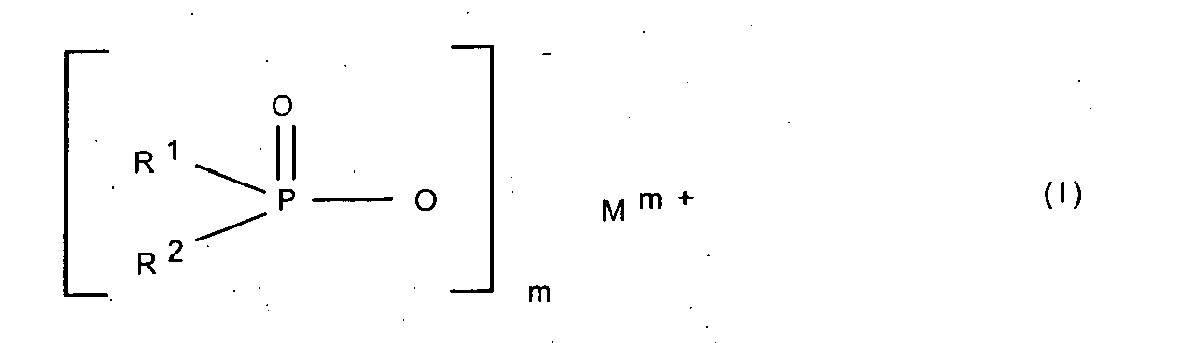
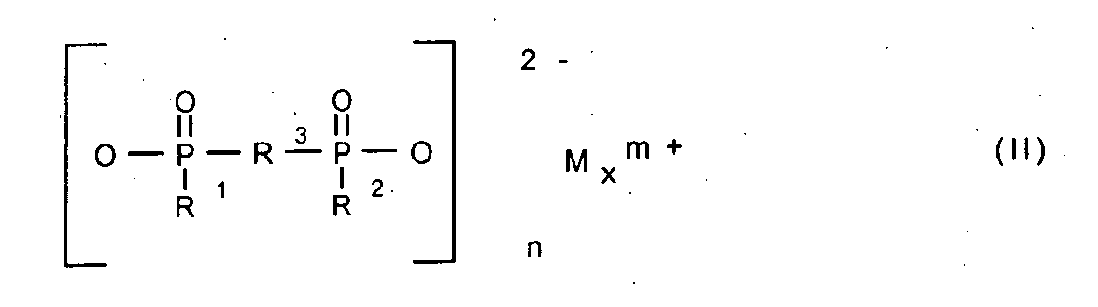
R1, R2
gleich oder verschieden sind und C1-C6-Alkyl, linear oder verzweigt und/oder Aryl;
R3
C1-C10-Alkylen, linear oder verzweigt, C6-C10-Arylen, -Alkylarylen oder -Arylalkylen;
M
Mg, Ca, Al, Sb, Sn, Ge, Zn, Ti, Fe, Zr, Ce, Bi, Sr, Mn, Li, Na, K und/oder eine protonierte Stickstoffbase;
m
1 bis 4; n 1 bis 4; x 1 bis 4 bedeuten;
als Komponente B 0 bis 90 Gew.-% eines Synergisten, der eine Stickstoff-, Phosphor- oder Phosphorstickstoffverbindung enthält;
als Komponente C 0 bis 20 Gew.-% Verbindungen der Elemente der zweiten Haupt- und Nebengruppe; und
als Komponente D 0,01 bis 20 Gew.-% Hilfsmittel.
Description
- Die Erfindung bezieht sich auf phosphorhaltige thermostabilisierte Flammschutzmittelagglomerate von hoher thermischer Beständigkeit gegen Verfärbung, die Aggregate und/oder Primärteilchen aus Phosphinsäuresalzen und/oder Diphosphinsäuresalzen und/oder deren Polymeren enthalten und mit Hilfe eines Hilfsmittels zusammenhaften. Die Erfindung betrifft auch ein Verfahren zur Herstellung dieser phosphorhaltigen Flammschutzmittelagglomerate und die Verwendung derselben als Flammschutzmittel in Polymeren.
- Nach dem Stand der Technik (
DE-A-103 47 012 ) gelingt es, phosphorhaltige Flammschutzmittel durch Sprühagglomeration herzustellen. Es werden dabei Bindemittel eingesetzt, die das Agglomerat mechanisch stabilisieren sollen. - Die im Stand der Technik beschriebenen Agglomerate sind nachteilig, da sie sich beim Erhitzen verfärben. Da ein derartiges Erhitzen bei der bestimmungsgemäßen Verarbeitung der Agglomerate zu flammgeschützten Formmassen bzw. flammgeschützten Formkörpern erfolgt, ergeben sich ebenfalls nachteilige Verfärbungen bei diesen Produkten.
- Es ist Aufgabe der vorliegenden Erfindung, phosphorhaltige thermostabilisierte Flammschutzmittel-Agglomerate zur Verfügung zu stellen, die thermische gegen Verfärbung wesentlich beständiger sind.
- Gelöst wird diese Aufgabe durch ein Agglomerat eines phosphorhaltigen Flammschutzmittels, das ein geeignetes Hilfsmittel enthält.
- Überraschend wurde gefunden, dass durch Wahl des geeigneten Hilfsmittels die Verfärbung beim Erhitzen der phosphorhaltigen Flammschutzmittelagglomerate weitgehend verhindert werden kann.
- Gegenstand der Erfindung sind daher phosphorhaltige thermostabilisierte Flammschutzmittelagglomerate, enthaltend
als Komponente A 6 bis 99,99 Gew.-% Aggregate und/oder Primärteilchen von einem Phosphinsäuresalz der Formel (I) und/oder von einem Diphosphinsäuresalz der Formel (II) und/oder von deren Polymeren,

- R1, R2
- gleich oder verschieden sind und C1-C6-Alkyl, linear oder verzweigt und/oder Aryl;
- R3
- C1-C10-Alkylen, linear oder verzweigt, C6-C10-Arylen, -Alkylarylen oder -Arylalkylen;
- M
- Mg, Ca, Al, Sb, Sn, Ge, Zn, Ti, Fe, Zr, Ce, Bi, Sr, Mn, Li, Na, K und/oder eine protonierte Stickstoffbase;
- m
- 1 bis 4; n 1 bis 4; x 1 bis 4 bedeuten;
- Bevorzugt enthalten die phosphorhaltigen thermostabilisierten Flammschutzmittelagglomerate
20 bis 99,9 Gew.-% an Komponente A
0 bis 74 Gew.-% an Komponente B
0 bis 10 Gew.-% an Komponente C
0,1 bis 5 Gew.-% an Komponente D. - Bevorzugt enthalten die phosphorhaltigen thermostabilisierten Flammschutzmittelagglomerate
6 bis 99,99 Gew.-% an Komponente A
6 bis 90 Gew.-% an Komponente B
0 bis 20 Gew.-% an Komponente C
0,01 bis 20 Gew.-% an Komponente D. - Bevorzugt enthalten die phosphorhaltigen thermostabilisierten Flammschutzmittelagglomerate
20 bis 99,9 Gew.-% an Komponente A
20 bis 74 Gew.-% an Komponente B
0 bis 10 Gew.-% an Komponente C
0,1 bis 5 Gew.-% an Komponente D. - Bevorzugt enthalten die phosphorhaltigen thermostabilisierten Flammschutzmittelagglomerate
6 bis 99,89 Gew.-% an Komponente A
6 bis 90 Gew.-% an Komponente B
0,1 bis 20 Gew.-% an Komponente C
0,01 bis 20 Gew.-% an Komponente D. - Bevorzugt enthalten die phosphorhaltigen thermostabilisierten Flammschutzmittelagglomerate
20 bis 98,9 Gew.-% an Komponente A
20 bis 74 Gew.-% an Komponente B
1 bis 10 Gew.-% an Komponente C
0,1 bis 5 Gew.-% an Komponente D. - Die Summe der Komponenten beträgt immer 100 Gew.-%.
- Bevorzugt handelt es sich bei der Komponente B um Melaminphosphat, Melaminpyrophosphat, Melaminpolyphosphate, Melampolyphosphate, Melempolyphosphate, Melonpolyphosphate, Melamincyanurat und/oder Melaminkondensationsprodukte wie Melam, Melem und/oder Melon.
- Bevorzugt handelt es sich bei der Komponente C um Verbindungen der Elemente Calcium, Magnesium und/oder Zink.
- Bevorzugt handelt es sich bei der Komponente C um Magnesiumhydroxid, Magnesiumcarbonat, Magnesiumborat, Calciumcarbonat, Calciumborat, Calciumpyroborat, Zinkoxid, Zinkhydroxid, Zinkborat, Zinkphosphat und/oder Zinkpyrophosphat.
- Bevorzugt handelt es sich bei dem Hilfsmittel um Homopolymere oder gemischte Polymere basierend auf mindestens einem Monomer aus der Gruppe 1,2-Butadien, 1,3-Butadien, 2-Ethylhexylacrylat, Acrylamid, Acrylester, Acrylnitril, Acrylsäure, Amide, Caprolactam, Crotonsäure, Dibutylmaleat, Epoxide, Ester, Ethylacrylat, Ethylen, Ethylenglycol, Ethylhexylacrylat, Ethylmethacrylat, Hydroxyacrylsäure, Isobutylacrylat, Isobutylmethacrylat, Laurylacrylat, Maleinsäure, Maleinsäureanhydrid, Methacrylamid, Methacrylat, Methacrylnitril, Methacrylsäure, Methallylsulfonsäure, Methylmethacrylat, Methylstyrol, Milchsäure, Mono-, Di- oder Oligosaccharide, n-Butylacrylat, n-Butylmethacrylat, n-Hexylacrylat, n-Hexylmethacrylat, N-hydroxymethylacrylamid, n-Propylacrylat, N-Vinylpyrrolidon, Olefine, Polyvinylbutyral, Polyvinylcaprolactam, Propylen, sec-Butylacrylat, Stearate, Styrol, Styrolsulfonsäure, tert-Butylacrylat, tert.-Butylchlorid, tert-Butylmethacrylat, Urethane, Vinylacetat, Vinylalkoholderivate, Vinylcaprolactam, Vinylchlorid, Vinylester, Vinylethern, Vinylidenchlorid, Vinyllaurat, Vinylmethylethern, Vinylpropionat, Vinylpyrrolidon, abgebaute Stärke, Aldehydstärken, Alkylcellulose, Alkylhydroxyethylcellulose und Alkyl ist bevorzugt Methyl-, Carboxyalkylcellulose (Na-Salz), Hydroxyethylcellulose, Hydroxypropylcellulose, Natriumcarboxymethylcellulose und/oder Mischungen davon.
- Bevorzugt handelt es sich bei dem Hilfsmittel auch um Polyvinylpyrrolidon, Polycarboxylate, Polystyrolsulfonsäure, Polystyrolsulfonsäure-Maleinsäureanhydrid-Copolymere, Wasserglas, Vinylacetat-Polymere, Acrylat-Polymere, Polymilchsäure, Stärke und/oder Cellulosederivate.
- Die erfindungsgemäßen phosphorhaltigen thermostabilisierten Flammschutzmittelagglomerate haben nach Wärmebehandlung bevorzugte L-Farbwerte von 80 bis 99,9, besonders bevorzugt 85 bis 98.
- Die erfindungsgemäßen phosphorhaltigen thermostabilisierten Flammschutzmittelagglomerate haben bevorzugte a-Farbwerte von-2 bis +2, besonders bevorzugt -1 bis + 1,5.
- Die erfindungsgemäßen phosphorhaltigen thermostabilisierten Flammschutzmittelagglomerate haben, bevorzugte b-Farbwerte von -2 bis +8, besonders bevorzugt -1 bis +7.
- Die Erfindung betrifft auch ein Verfahren zur Herstellung von phosphorhaltigen thermostabilisierten Flammschutzmittelagglomeraten, dadurch gekennzeichnet, dass man Aggregate und/oder Primärteilchen von einem Phosphinsäuresalz der Formel (I) und/oder von einem Diphosphinsäuresalz der Formel (II) und/oder von deren Polymeren


- R1, R2
- gleich oder verschieden sind und C1-C6-Alkyl, linear oder verzweigt und/oder Aryl;
- R3
- C1-C10-Alkylen, linear oder verzweigt, C6-C10-Arylen, -Alkylarylen oder -Arylalkylen;
- M
- Mg, Ca, Al, Sb, Sn, Ge, Zn, Ti, Fe, Zr, Ce, Bi, Sr, Mn, Li, Na, K und/oder eine protonierte Stickstoffbase;
- m
- 1 bis 4; n 1 bis 4; x 1 bis 4 bedeuten,
- Bevorzugt fügt man beim vorgenannten Verfahren mindestens einen Synergisten, der eine Stickstoff-, Phosphor- oder Phosphorstickstoffverbindung enthält und/oder Verbindungen der Elemente der zweiten Haupt- und/oder Nebengruppe während der Agglomeration hinzu.
- Die Erfindung betrifft auch flammgeschützte Polymerformmassen und flammgeschützte Polymer-Formkörper, -Filme, -Fäden und -Fasern, die die erfindungsgemäßen phosphorhaltigen thermostabilisierte Flammmittelagglomerate nach mindestens einem der Ansprüche 1 bis 14 enthalten.
- Bevorzugt enthält die flammgeschützte Polymerformmasse
1 bis 50 Gew.-% erfindungsgemäße phosphorhaltige thermostabilisierte Flammschutzmittelagglomerate nach mindestens einem der Ansprüche 1 bis 14,
1 bis 99 Gew.-% Polymer oder Mischungen derselben
0 bis 60 Gew.-% Additive
0 bis 60 Gew.-% Füllstoff. - Die Erfindung betrifft auch ein Verfahren zur Herstellung von flammgeschützten Polymerformmassen, bei dem die erfindungsgemäßen phosphorhaltigen thermostabilisierten Flammschutzmittelagglomerate nach mindestens einem der Ansprüche 1 bis 14 mit dem Polymergranulat und evtl. Additiven in einem Compoundieraggregat bei höheren Temperaturen in der Polymerschmelze homogenisiert werden und anschließend der homogenisierte Polymerstrang abgezogen, gekühlt und portioniert wird.
- Die Erfindung betrifft auch Polymer-Formkörper, -Filme, -Fäden und -Fasern enthaltend 1 bis 50 Gew.-% erfindungsgemäße phosphorhaltige thermostabilisierte Flammschutzmittelagglomerate nach mindestens einem der Ansprüche 1 bis 14
1 bis 99 Gew.-% Polymer oder Mischungen derselben
0 bis 60 Gew.-% Additive
0 bis 60 Gew.-% Füllstoff.
Die Erfindung betrifft auch flammgeschützte Polymer-Formkörper, -Filme, -Fäden und -Fasern, dadurch gekennzeichnet, dass sie flammgeschützte Polymerformmassen nach Anspruch 16 enthalten. - Bevorzugt enthalten die flammgeschützte Polymer-Formkörper, -Filme, -Fäden und -Fasern 60 bis 98 Gew.- % flammgeschützte Polymerformmasse nach Anspruch 16, 2 bis 40 Gew.-% Polymer oder Mischungen derselben enthalten.
- Die Erfindung betrifft auch ein Verfahren zur Herstellung von flammgeschützten Polymer-Formkörpern , -Filmen, -Fäden und -Fasern, bei dem die flammgeschützte Polymer-Formmassen nach Anspruch 16 durch Spritzgießen und Pressen, Schaumspritzgießen, Gasinnendruck-Spritzgießen, Blasformen, Foliengießen, Kalandern, Laminieren oder Beschichten bei höheren Temperaturen zum flammgeschützten Polymer-Formkörper und ggf. -Filmen, -Fäden und -Fasern verarbeitet werden.
- Bevorzugt beträgt die mittlere Teilchengröße der erfindungsgemäßen phosphorhaltigen thermostabilisierten Flammmittelagglomerate 0,1 bis 3.000 µm, besonders bevorzugt 100 bis 3.000 µm und insbesondere 200 bis 2.000 µm. Geringere Teilchengrößen erfüllen nicht den Zweck der Staubfreiheit. Größere Teilchengrößen ergeben Produkte mit erhöhtem Abrieb und geringen Schüttgewichtes.
- Bevorzugt beträgt die Schüttdichte der erfindungsgemäßen phosphorhaltigen thermostabilisierten Flammmittelagglomerate 80 bis 1500 g/l, besonders bevorzugt 80 bis 800 g/l und insbesondere 200 bis 500 g/l und 200 bis 400 g/l. Geringere Schüttdichten erschweren wegen des hohen Luftgehaltes die Einarbeitung in das Polymer mit dem Extruder zu flammgeschützten Polymerformmassen. Größere Schüttdichten sind durch Agglomerierung nicht oder nur schwer herzustellen.
- Bevorzugt beträgt der Restfeuchtegehalt der eingesetzten Phosphinat- bzw. Synergisten-Aggregate 0,05 bis 30 Gew.-%, bevorzugt 0,1 bis 50 Gew.-%. Phosphinat- bzw. Synergisten-Aggregate mit höheren Restfeuchtegehalten sind nicht mehr handhabbar, da sie zum Verklumpen neigen. Phosphinat- bzw. Synergisten-Aggregate mit niedrigeren Restfeuchtegehalten sind technisch schwer herzustellen. Bevorzugt beträgt der mittlere Teilchendurchmesser der eingesetzten Phosphinat- bzw. Synergisten-Aggregate 0,1 bis 500 µm, besonders bevorzugt 1 bis 100 µm.
- Bevorzugt beträgt der mittlere Teilchendurchmesser der Phosphinat- bzw. Synergisten-Primärpartikel 0,1 bis 50 µm, besonders bevorzugt 1 bis 10 µm.
- Phosphinat- bzw. Synergisten-Aggregate mit größeren mittleren Teilchendurchmesser ergeben Inhomogenitäten in den flammgeschützten Polymerformkörpern. Phosphinat- bzw. Synergisten-Aggregate mit niedrigeren mittleren Teilchendurchmesser sind technisch schwer herzustellen.
- Die vorgenannten Farbwerte werden im System nach Hunter (CIE-LAB-System, Commission Internationale d'Eclairage) angegeben. L-Werte gehen von 0 (schwarz) bis 100 (weiß), a-Werte von -a (grün) bis +a (rot) und b-Werte von -b (blau) bis +b (gelb).
- Phosphorhaltige thermostabilisierte Flammschutzmittelagglomerate mit L-Werten unterhalb des auf Seite 5 genannten erfindungsgemäßen Bereiches erfordern einen höheren Weißpigmenteinsatz. Diorganylphosphinsäure-Salze mit a- bzw. b-Werten außerhalb des erfindungsgemäßen Bereiches erfordern ebenfalls einen höheren Weißpigmenteinsatz. Dieser verschlechtert die mechanischen Stabilitätseigenschaften des Polymerformkörpers (z.B. E-Modul).
- Bevorzugt beträgt der Abrieb der phosphorhaltigen thermostabilisierten Flammmittelagglomerate 30 bis 95 %, besonders bevorzugt 40 bis 80 %.
- Bevorzugt beträgt der Restfeuchtegehalt der phosphorhaltigen thermostabilisierten Flammmittelagglomerate 0,05 bis 2, besonders bevorzugt 0,1 bis 1 Gew.-%. Restfeuchten außerhalb des erfindungsgemäß bevorzugten Bereiches beeinträchtigen die Verträglichkeit mit dem Polymer. Dies bedeutet schlechtere Festigkeits- und Elastizitätseigenschaften der flammgeschützten Polymerformmassen und der flammgeschützten Polymerformkörper.
- Unter dem Begriff phosphorhaltige thermostabilisierte Flammschutzmittelagglomerate werden erfindungsgemäß ebenfalls Teilchen einer phosphorhaltigen thermostabilisierten Flammmittel-Zusammensetzung verstanden, die aus Primärpartikeln und/oder Aggregaten/ Primärteilchen eines Phosphinsäuresalzes der Formel (I) und/oder eines Diphosphinsäuresalz der Formel (II) und/oder deren Polymeren und mindestens eines Synergisten bestehen und die durch ein Hilfsmittel aneinander gebunden sind.
- Bevorzugt bedeutet M in den Formeln (I) und (II) Calcium, Aluminium, Zink oder Titan.
- Unter protonierten Stickstoffbasen werden bevorzugt die protonierten Basen von Ammoniak, Melamin, Triethanolamin, insbesondere NH4 +, verstanden.
- Bevorzugt sind R1, R2 gleich oder verschieden und bedeuten C1-C6-Alkyl, linear oder verzweigt und/oder Phenyl.
- Besonders bevorzugt sind R1, R2 gleich oder verschieden und bedeuten Methyl, Ethyl, n-Propyl, iso-Propyl, n-Butyl, tert.-Butyl, n-Pentyl und/oder Phenyl.
- Bevorzugt bedeutet R3 Methylen, Ethylen, n-Propylen, iso-Propylen, n-Butylen, tert.-Butylen, n-Pentylen, n-Octylen oder n-Dodecylen; Phenylen oder Naphthylen; Methylphenylen, Ethylphenylen, tert.-Butylphenylen, Methylnaphthylen, Ethylnaphthylen oder tert.-Butylnaphthylen; Phenylmethylen, Phenylethylen, Phenylpropylen oder Phenyl-butylen.
- Bevorzugt handelt es sich bei dem Synergisten um einen solchen, der eine Stickstoff-, Phosphor- oder Phosphorstickstoffverbindung enthält.
- Geeignete Synergisten sind Melaminphosphat (z.B. ®Melapur MPH, ®Melapur MP der Fa. Ciba-DSM Melapur), Melaminacetat, Dimelaminphosphat, Pentamelamintriphosphat, Trimelamindiphosphat, Tetrakismelamintriphosphat, Hexakismelaminpentaphosphat, Melamindiphosphat, Melamintetraphosphat, Melaminpyrophosphat (z.B. ® budit 311 der Fa. Budenheim, ® MPP-B der Fa. Sanwa Chemicals), Melaminpolyphosphate, Melampolyphosphate, Melempolyphosphate und/oder Melonpolyphosphate. Besonders bevorzugt sind Melaminpolyphosphate wie ®Melapur 200/70, ®Melapur CGX
FR231 - In einer weiteren Ausführungsform sind Kondensationsprodukte des Melamins (z.B. Melam, Melem und/oder Melon) oder Umsetzungsprodukte des Melamins mit Phosphorsäure bzw. Umsetzungsprodukte von Kondensationsprodukten des Melamins mit Phosphorsäure sowie Gemische der genannten Produkte bevorzugt. Kondensationsprodukte des Melamins sind z. B. Melem, Melam oder Melon bzw. höher kondensierte Verbindungen dieses Typs sowie Gemische derselben und können z.B. durch ein Verfahren hergestellt werden, wie es in der
WO-96/16948 - Unter den Umsetzungsprodukten mit Phosphorsäure versteht man Verbindungen, die durch Umsetzung von Melamin oder den kondensierten Melaminverbindungen wie Melam, Melem oder Melon etc. mit Phosphorsäure entstehen. Beispiele hierfür sind Melaminpolyphosphat, Melampolyphosphat (® PMP-200™ von Fa. Nissan Chemical Industries) und Melempolyphosphat (® PMP-300™ von Fa. Nissan Chemical Industries) bzw. gemischte Polysalze, wie sie z. B. in der
WO 98/39306 WO 98/45364 WO 98/08898 - Erfindungsgemäß sind als Synergisten weiterhin bevorzugt oligomere Ester des Tris(hydroxyethyl)isocyanurats mit aromatischen Polycarbonsäuren, Benzoguanamin, Tris(hydroxyethyl)isocyanurat, Melaminkondensationsprodukte wie Melam, Melem und/oder Melon, Melamincyanurat (z.B. ®Melapur MC oder ® Melapur MC XL der Fa. Ciba-DSM Melapur), Dicyandiamid und/oder Guanidin.
- Erfindungsgemäß sind als Synergisten weiterhin bevorzugt stickstoffhaltige Phosphate der Formeln (NH4)yH3-yPO4 bzw. (NH4PO3)z, mit y gleich 1 bis 3 und z gleich 1 bis 10.000.
- Erfindungsgemäß sind als Synergisten Stickstoffverbindungen wie Allantoin, Melamin, Cyanursäure, Glycoluril, Harnstoff und ihre Derivate bevorzugt, z.B. solche der Formeln (III) bis (VIII) oder Gemische davon


- R5 bis R7
- Wasserstoff, C1-C8-Alkyl, C5-C16-Cycloalkyl oder -Alkylcycloalkyl, möglicherweise substituiert mit einer Hydroxy- oder einer C1-C4-Hydroxyalkyl-Funktion, C2-C8-Alkenyl, C1-C8-Alkoxy, -Acyl, -Acyloxy, C6-C12-Aryl oder -Arylalkyl, OR8 und -N(R8)R9, sowie N-alicyclisch oder N-aromatisch,
- R8
- Wasserstoff, C1-C8-Alkyl, C5-C16-Cycloalkyl oder -Alkylcycloalkyl, möglicherweise substituiert mit einer Hydroxy- oder einer C1-C4-Hydroxyalkyl-Funktion, C2-C8-Alkenyl, C1-C8-Alkoxy, -Acyl, -Acyloxy oder C6-C12-Aryl oder -Arylalkyl,
- R9 bis R13
- die gleichen Gruppen wie R8 sowie -O-R8,
- m und n
- unabhängig voneinander 1, 2, 3 oder 4,
- X
- Säuren, die Addukte mit Triazinverbindungen (III) bilden können, bedeuten.
- Bevorzugte Synergisten sind Verbindungen der Elemente der zweiten Haupt-und/oder Nebengruppe, besonders bevorzugt sind Verbindungen der Elemente Calcium, Magnesium und Zink.
- Bevorzugte Synergisten unter den Magnesiumverbindungen sind Magnesiumoxid, Magnesiumhydroxid (z.B. ® Magnifin H5 der Fa. Albermarle), Magnesiumoxidhydroxide, Hydrotalcite, Dihydrotalcit, Magnesium-Carbonate, Magnesiumhydroxidcarbonate, Magnesium-Calcium-Carbonate, monobasisches, dibasisches, tribasisches Magnesiumphosphat und/oder Magnesiumpyrophosphat.
- Bevorzugte Synergisten unter den Calciumverbindungen sind Calciumborat, Calciumpyroborat, Calciumcarbonat, Calciumhydroxid, monobasisches, dibasisches, tribasisches Calciumphosphat und/oder Calciumpyrophosphat.
- Bevorzugte Synergisten sind Zinkverbindungen, z.B. Zinkoxid (z.B. Zinkoxid aktiv von Rhein Chemie, Brüggemann KG, Zincit oder Calamin; Standard-Zinkoxid, Zinkweiß G6, Zinkoxid 2011, Zinkoxid F-80, Zinkweiß Pharma 8, Zinkweiß Pharma A, Zinkweiß Rotsiegel, Zinkweiß Weissiegel der Fa. Grillo-Werke AG), Zinkhydroxid und/oder Zinkoxidhydrat.
- Bevorzugte Synergisten sind Zinksalze der Oxosäuren der vierten Hauptgruppe (wasserfreies Zinkcarbonat, basisches Zinkcarbonat, Zinkhydroxidcarbonat, basisches Zinkcarbonathydrat, (basisches) Zinksilicat, Zinkhexafluorosilicat, Zinkhexafluorosilicat hexahydrat, Zinkstannat und/oder Zink-Magnesium-AluminiumHydroxid-Carbonat).
- Bevorzugte Synergisten sind auch Zinksalze der Oxosäuren der dritten Hauptgruppe (Zinkborat, z.B. ® Firebrake ZB, ® Firebrake 415 der Fa. Borax).
- Bevorzugte Synergisten sind auch Zinksalze der Oxosäuren der fünften Hauptgruppe (Zinkphosphat, Zinkpyrophosphat).
- Bevorzugte Synergisten sind weiterhin Zinksalze der Oxosäuren der Übergangsmetalle (Zinkchromat(VI)hydroxyd (Zinkgelb), Zinkchromit, Zinkmolybdat, z.B. ® Kemgard 911 B, Zinkpermanganat, Zinkmolybdat-Magnesiumsilicat, z.B. ® Kemgard 911 C der Fa. Sherwin-Williams Company, Zinkpermanganat)
- Bevorzugt als Synergisten sind auch Zinksalze mit organischen Anionen, wie Zinksalze von Mono-, Di-, Oligo-, Polycarbonsäuren (Salze der Ameisensäure (Zinkformiate), der Essigsäure (Zinkacetate, Zinkacetatdihydrat, Galzin), der Trifluoressigsäure (Zinktrifluoracetathydrat), Zinkpropionat, Zinkbutyrat, Zinkvalerat, Zinkcaprylat, Zinkoleat, Zinkstearat (® Liga 101 der Fa. Greven Fett-Chemie), der Oxalsäure (Zinkoxalat), der Weinsäure (Zinktartrat), Zitronensäure (tribasisches Zinkcitrat dihydrat), Benzoesäure (Benzoat), Zinksalicylat, Milchsäure (Zinklactat, Zinklactat trihydrat), Acrylsäure, Maleinsäure, Bernsteinsäure, von Aminosäuren (Glyzin), von sauren Hydroxofunktionen (Zinkphenolat etc.), Zink-para-Phenolsulfonat, Zink-para-Phenolsulfonathydrat, Zinkacetylacetonathydrat, Zinktannat, Zinkdimethyl-dithiocarbamat und/oder Zinktrifluormethansulfonat.
- Bevorzugte Synergisten sind zudem Zinkphosphide, Zinksulfide, Zinkselenide und Zinktelluride.
- Bevorzugte Synergisten sind Verbindungen der Elemente der dritten Hauptgruppe, besonders bevorzugt des Aluminiums und Bors.
- Bevorzugte Synergisten sind Aluminiumverbindungen, z.B. Aluminiumoxid, Aluminiumoxidhydroxid (Böhmit, Diaspor), Aluminiumhydroxid (Bayerit, Gibbsit, Hydrargillit) oder Aluminiumphosphat.
- Bevorzugte Synergisten sind Borverbindungen, z.B. Borphosphat.
Bevorzugte Synergisten sind Zinnverbindungen, z.B. Zinnoxid, Zinnoxidhydrate, Zinn(II)hydroxid und/oder Zinnsulfid. - Bevorzugte Synergisten sind auch Carbodiimide (z.B. ® Stabaxol 1, ® Stabaxol P, Stabaxol KE 9193 der Fa. Rhein Chemie) N,N'Dicyclohexylcarbodiimid und/oder Polyisocyanate (z.B. ® Basonat HI 100 oder ® Vestanat T 1890/100), Carbonylbiscaprolactam (Fa Allinco) oder Styrol-Acryl-Polymere (® Joncryl ADR-4357 der Fa. Johnson); sterisch gehinderten Phenole (z.B. ® Hostanox OSP 1), sterisch gehinderte Amine und Lichtstabilisatoren (z.B. ® Chimasorb 944, ® Hostavin-Typen), Phosphonite und Antioxidantien (z.B. Sandostab® P-EPQ der Fa. Clariant) und Trennmittel (® Licomont-Typen der Fa. Clariant).
- Das Hilfsmittel ist so gewählt, dass das Agglomerat beim Einarbeiten in das Polymer in separate Aggregate und/oder Primärpartikel mit einer mittleren Teilchengrößen von 0,1 bis 500 µm aufbricht.
- Das Hilfsmittel bindet die Aggregate und Primärpartikel aneinander, allerdings nicht so stark, dass diese sich nicht wieder in einem Polymer dispergieren lassen. Das bedeutet, dass je nach Prozess und/oder Prozessbedingungen, mit denen das phosphorhaltige thermostabilisierte Flammschutzmittel in Polymere eingearbeitet werden soll, unterschiedliche Hilfsmittel gewählt werden müssen.
- Bevorzugt handelt es sich bei dem Hilfsmittel um Homopolymere oder gemischte Polymere basierend auf mindestens einem Monomer aus der Gruppe Acrylsäure, Amide, Cellulosederivative, Epoxide, Ester, Hydroxyacrylsäure, Methacrylsäure, Olefine, Stearate, Urethane, Vinylacetat, Vinylalkoholderivate, Vinylcaprolactam, Vinylpyrrolidon oder Mischungen davon.
- Bevorzugt wird als Hilfsmittel ein Polyvinylpyrrolidon mit einem Molekulargewicht zwischen 5.000 und 2.000.000 eingesetzt, bevorzugt ein solches mit einem Molekulargewicht zwischen 5.000 bis 200.000, besonders bevorzugt ein solches mit einem Molekulargewicht zwischen 7.000 bis 11.000 oder in einer anderen Ausführungsform mit einem Mölekulargewicht zwischen 1.200.000 bis 2.000.000.
- Bevorzugt wird als Hilfsmittel auch Polyvinylalkohol, Polyvinylbutyral (PVB), Polyvinylcaprolactam, Hydroxyethylcellulose, Hydroxypropylcellulose und/oder Natriumcarboxymethylcellulose eingesetzt.
- Bevorzugte Hilfsmittel sind insbesondere Polycarboxylate.
- Bevorzugte Polycarboxylate sind Polymere auf Basis mindestens eines der folgenden Monomere, wie Polyacrylate, Polyhydroxyacrylate, Polymaleate, Polymethacrylate oder Mischungen davon.
- Geeignete Polycarboxylate sind beispielsweise die Natriumsalze der Polyacrylsäure oder der Polymethacrylsäure, beispielsweise solche mit einer relativen Molekülmasse von 800 bis 150.000 (auf Säure bezogen).
- Geeignete copolymere Polycarboxylate sind insbesondere solche der Acrylsäure mit Methacrylsäure, Acrolein, Vinylacetat und der Acrylsäure oder Methacrylsäure mit Maleinsäure. Als besonders geeignet haben sich Copolymere der Acrylsäure mit Maleinsäure erwiesen, die 50 bis 90 Gew.-% Acrylsäure und 50 bis 10 Gew.-% Maleinsäure enthalten. Das Verhältnis von Acrylat- zu Maleat-Einheiten in solchen Copolymeren kann bevorzugt von 30:1 bis etwa 1:1 betragen, besonders bevorzugt von etwa 10:1 bis 2:1. Ihre relative Molekülmasse, bezogen auf freie Säuren, beträgt im allgemeinen 2.000 bis 200.000, vorzugsweise 10.000 bis 120.000 und insbesondere 50.000 bis 100.000. Handelsübliche Produkte sind z. B. ® Sokalan CP 5 und PA 30 von BASF, ® Alcosperse 175 mal 177 von Alco, ® LMW 45 von NorsoHAAS.
- Bevorzugt wird als Polycarboxylat ein Homo- und/oder Copolymer aus Acrylsäure, Methacrylsäure, Maleinsäure, Polyasparaginsäure, Zuckercarbonsäure und/oder weiteren Monomeren eingesetzt.
- Hierzu gehören die Homopolymere der Acrylsäure oder der Methacrylsäure bzw. deren Copolymere mit weiteren ethylenisch ungesättigten Monomeren wie beispielsweise Acrolein, Dimethylacrylsäure, Ethylacrylsäure, Vinylessigsäure, Allylessigsäure, Maleinsäure, Fumarsäure, Itaconsäure, Meth(allylsulfonsäure), Vinylsulfonsäure, Styrolsulfonsäure, Acrylamidomethylpropansulfonsäure, sowie Phosphorsäuregruppen enthaltende Monomere wie beispielsweise Vinylphosphonsäure, Allylphosphonsäure und Acrylamidomethylpropanphosphonsäure und deren Salze sowie Hydroxyethyl(meth)acrylatsulfate, Allylalkoholsulfate und -phosphate.
- Für die erfindungsgemäße Anwendung sind insbesondere biologisch abbaubare Terpolymere geeignet, die sich durch Polymerisation von
- a) 10 bis 70 Gew.-%monoethylenisch ungesättigten Dicarbonsäuren mit 4 bis 8 C-Atomen bzw. deren Salze
- b) 20 bis 85 Gew.-% monoethylenisch ungesättigten Monocarbonsäuren mit 3 bis 10 C-Atomen bzw. deren Salze
- c) 1 bis 50 Gew.-% einfach ungesättigte Monomere, welche nach der Verseifung Hydroxylgruppen an der Polymerkette freisetzen
- d) 0 bis 10 Gew.-% weiterer, radikalisch copolymerisierbarer Monomere, wobei die Summe der Monomeren nach a) bis d) 100 Gew.-% beträgt, in wässriger Lösung und Verseifung der Monomere nach c) erhalten lassen.
- Für die erfindungsgemäße Anwendung wird eine Verseifung im sauren Milieu bevorzugt.
- Ebenfalls geeignet für die erfindungsgemäße Anwendung sind Pfropfpolymerisate von Monosacchariden, Oligosacchariden, Polysacchariden und modifizierten Polysacchariden. Pfropfpolymerisate mit Proteinen tierischen und pflanzlichen Ursprungs, insbesondere auch mit modifizierten Proteinen, sind ebenfalls für die erfindungsgemäße Anwendung gut geeignet.
- Aus der Gruppe der Pfropfcopolymerisate werden bevorzugt Copolymerisate aus Zucker oder anderen Polyhydroxyverbindungen und einer Monomermischung der folgenden Zusammensetzung eingesetzt:
- a) 45 bis 96 Gew.-% monoethylenisch ungesättigte C3 bis C10-Monocarbonsäure oder Mischungen von C3 bis C10-Monocarbonsäuren und/oder deren Salze mit einwertigen Kationen
- b) 4 bis 55 Gew.-% monoethylenisch ungesättigte Monosulfonsäuregruppen enthaltende Monomere, monoethylenisch ungesättigte Schwefelsäureester, Vinylphosphonsäure und/oder die Salze dieser Säuren mit einwertigen Kationen
- c) 0 bis 30 Gew.-% wasserlösliche, monoethylenisch ungesättigte Verbindungen, die mit 2 bis 50 Mol Alkylenoxid pro Mol monoethylenisch ungesättigter Verbindung modifiziert sind.
- Weitere geeignet Polymere sind Polyasparagirisäuren bzw. deren Derivate in nicht oder nur teilneutralisierter Form. Üblicherweise fallen die Polyasparaginsäuren in Form ihrer Alkalimetall- oder Ammoniumsalze an. Man kann hieraus die nicht oder nur teilneutralisierten Produkte durch Zugabe entsprechender Mengen organischer oder anorganischer Säuren und ggf. Abtrennung der entstehenden Salze gewinnen.
- Solche Produkte lassen sich auch durch die thermische Umsetzung von Maleinsäure und Ammoniak oder durch die Kondensation von Asparaginsäure und die anschließende Hydrolyse des entstandenen Polysuccinimids erhalten.
- Besonders geeignet für die Herstellung einer löslichen Zinkverbindung einer Polycarbonsäure sind Pfropfpolymerisate von Acrylsäure, Methacrylsäure, Maleinsäure und weiteren ethylenisch ungesättigten Monomeren auf Salze der Polyasparaginsäure, wie sie üblicherweise bei der zuvor beschriebenen Hydrolyse des Polysuccinimids anfallen. Hierbei kann auf die sonst notwendige Zugabe von Säure zur Herstellung der nur teilneutralisierten Form der Polyasparaginsäure verzichtet werden. Die Menge an Polyaspartat wird üblicherweise so gewählt, dass der Neutralisationsgrad aller im Polymerisat eingebauter Carboxylgruppen, 80 %, vorzugsweise 60 %, nicht überschreitet.
- Mittlere Molmasse: 1.000 bis 100.000 g/mol, bevorzugt 2.000 bis 70.000 g/mol und besonders bevorzugt 2.000 bis 35.000 g/mol.
Neutralisationsgrad der Säuregruppen: 0 bis 90 %, bevorzugt 30 bis 70 %. Wassergehalt der Polymerlösungen: 30 bis 70 Gew.-%, bevorzugt 40 bis 60 Gew.-%. Viskosität der Polymerlösungen: weniger als 2000 Pa*s bei 20°C.
Der pH-Wert der Polymerlösung sollte kleiner 5,5 sein. - Bevorzugte Hilfsmittel sind auch biologisch abbaubare Polymere mit mehr als zwei verschiedenen Monomereinheiten, beispielsweise solche, die als Monomere Salze der Acrylsäure und der Maleinsäure sowie Vinylalkohol bzw. Vinylalkohol-Derivate oder die als Monomere Salze der Acrylsäure und der 2-Alkylallylsulfonsäure sowie Zucker-Derivate enthalten.
- Bevorzugte Hilfsmittel sind Copolymere der Acrylsäure oder Methacrylsäure mit Vinylethern, wie Vinylmethylethern, Vinylester, Ethylen, Propylen und Styrol, in denen der Anteil der Säure mindestens 50 Gew.-% beträgt.
- Bevorzugte Polycarboxylate kommen in Form ihrer wasserlöslichen Salze, insbesondere in Form der Alkalimetalsalze, besonders der Natrium- und/oder Kaliumsalze, in Betracht.
- Bevorzugte Polycarboxylate sind auch Terpolymere. Bevorzugte Terpolymere enthalten dabei 60 bis 95 Gew.-%, insbesondere 70 bis 90 Gew.-% (Meth)acrylsäure bzw. (Meth)acrylat, besonders bevorzugt Acrylsäure bzw. Acrylat, und Maleinsäure bzw. Maleat sowie 5 bis 40 Gew.-%, vorzugsweise 10 bis 30 Gew.-% Vinylalkohol und/oder Vinylacetat. Ganz besonders bevorzugt sind dabei Terpolymere, in denen das Gewichtsverhältnis (Meth)acrylsäure bzw. (Meth)acrylat zu Maleinsäure bzw. Maleat zwischen 1 : 1 und 4 : 1, vorzugsweise zwischen 2 : 1 und 3 : 1 und insbesondere 2,1 und 2,5 : 1 liegt. Dabei sind sowohl die Mengen als auch die Gewichtsverhältnisse auf die Säuren bezogen.
- Bevorzugte Polycarboxylate sind Terpolymere, die dabei 40 bis 60 Gew.-%, insbesondere 45 bis 55 Gew.-% (Meth)acrylsäure bzw. (Meth)acrylat enthalten, besonders bevorzugt Acrylsäure bzw. Acrylat, 10 bis 30 Gew.-%, vorzugsweise 15 bis 25 Gew.-% Methallylsulfonsäure bzw. Methallylsulfonat und als drittes Monomere bis 40 Gew.-%, vorzugsweise 20 bis 40 Gew.-% eines Kohlenhydrats. Dieses Kohlenhydrat kann dabei beispielsweise ein Mono-, Di- Oligo- oder Polysaccharid sein, wobei Mono-, Di- oder Oligosaccharide bevorzugt sind, besonders bevorzugt ist Saccharose.
- Bevorzugte Polycarboxylate sind Terpolymere, die eine relative Molekülmasse zwischen 1.000 und 200.000 aufweisen, vorzugsweise zwischen 200 und 50.000 und insbesondere zwischen 3.000 und 10.000.
- Bevorzugte Polycarboxylate sind Terpolymere, die entweder vollständig oder zumindest partiell, insbesondere zu mehr als 50 %, bezogen auf die vorhandenen Carboxylgruppen, neutralisiert sind. Besonders bevorzugt ist dabei ein vollständig neutralisiertes Terpolymer das also aus den Salzen der monomeren Säuren, insbesondere den Natrium- oder Kaliumsalzen der monomeren Säuren, und Vinylalkohol oder einem Kohlenhydrat besteht.
- Bevorzugte Hilfsmittel sind Polycarboxylate die entweder als Pulver oder als wässrige Lösung eingesetzt werden können, wobei 20 bis 55 gew.-%ige wässrige Lösungen bevorzugt sind.
- Bevorzugte Hilfsmittel sind Polymere auf Basis von mindestens einem folgender Monomere oder Mischungen davon: Maleinsäure, Maleinsäureanhydrid, Methylstyrol, Styrol, Styrolsulfonsäure. Besonders bevorzugt sind dabei Homo- und Copolymere der Polystyrolsulfonsäure. Bevorzugt sind Polystyrolsulfonsäure-Homopolymere mit Molgewichten von 10.000 bis 1.200.000.
- Bevorzugt sind Polystyrolsulfonsäure-Homopolymere als wässrige Lösungen mit 20 bis 50 Gew.-% Aktivsubstanz.
- Bevorzugt sind Polystyrolsulfonsäure-Homopolymere als wässrige Lösungen mit Viskositäten von 5 bis 1600 mPa*s.
- Bevorzugt sind Polystyrolsulfonsäure-Homopolymere als wässrige Lösungen mit pH-Werten von 7 bis 11.
- Bevorzugt sind Polystyrolsulfonsäure-Maleinsäureanhydrid-Copolymere mit Molgewichten von 10.000 bis 1.200.000.
Bevorzugt sind Polystyrolsulfonsäure- Copolymere mit Molverhältnis von Stryolsulfonsäure zu Maleinsäure von 1:1 bis 4:1. - Als erfindungsgemäße Hilfsmittel einsetzbar sind u. a. auch Wasserglas, Vinylacetat-Polymere, Acrylate, Polymilchsäure, Stärke und Cellulose sowie filmbildende Bindemittel.
- Bevorzugt sind wässrige Alkalisilicatlösungen mit einem Siliciumdioxid/Natriumoxid-Molverhältnis von 1 zu 2 bis 4 zu 1. Bevorzugt beträgt der Aktivsubstanzgehalt der Lösungen 5 bis 50 Gew.-%.
- Bevorzugt sind Polymere auf Basis von mindestens einem folgender Monomere oder Mischungen davon: Vinylacetat, 2-Ethylhexylacrylat, Acrolein, Acrylester, Acrylsäure, Crotonsäure, Dibutylmaleat, Ethylen, Methylmetacrylat, n-Butylacrylat, N-hydroxymethylacrylamid, N-Vinylpyrrolidon, Styrol, tert-Butylchlorid, Vinylchlorid, Vinyllaurat, Vinylpropionat.
- Bevorzugt sind Polymere auf Basis von mindestens einem folgender Monomere oder Mischungen davon: Methacrylat, 1,2-Butadien, 1,3-Butadien, 2-Ethylhexylacrylat, Acrylamid, Acrylnitril, Acrylsäure, Ethylacrylat, Ethylmethacrylat, Isobutylacrylat, Isobutylmethacrylat, Laurylacrylat und/oder Methylmethacrylat, Methacrylamid Methacrylnitril, Methacrylsäure, n-Butylacrylat, n-Butylmethacrylat, n-Hexylacrylat, n-Hexylmethacrylat, n-Propylacrylat, sec-Butylacrylat, Styrol, tert-Butylacrylat, tert-Butylmethacrylat, Vinylacetat, Vinylchlorid, Vinylidenchlorid, Vinylpropionat.
- Bevorzugt sind weiterhin Homopolymere der Milchsäure (Polylactide) oder Poly(lactid-caprolacton)-Copolymere, Poly(lactid-glycolid)-Copolymere, Poly(lactid-caprolacton-glycolid)-Terpolymere Poly(lactid-glycolid-ethylenglycol)-Terpolymere. Die bevorzugten Molekulargewichte sind 5.000 bis 150.000.
- Weiterhin lassen sich lösliche Stärkepräparate und andere als die oben genannten Stärkeprodukte verwenden, z. B. abgebaute Stärke, Aldehydstärken usw. Carboxyalkylcellulose (Na-Salz), Hydroxyethylcellulose, Hydroxypropylcellulose, Alkylcellulose, Alkylhydroxyethylcellulose und Alkyl ist bevorzugt Methyl.
- Hilfsmittel sind auch Homopolymerisate auf Basis Vinylacetat, Copolymerisate auf Basis Vinylacetat, Ethylen und Vinylchlorid, Copolymerisate auf Basis Vinylacetat und einem Vinylester einer langkettigen, verzweigten Carbonäsure, Copolymerisate auf Basis Vinylacetat und Maleinsäure-di-n-Butylester, Copolymerisate auf Basis Vinylacetat und Acrylsäureester, Copolymerisate auf Basis Styrol und Acrylsäureester, Copolymerisate auf Basis Acrylat/Vinyltoluol, Copolymerisate auf Basis Acrylat/Styrol, Copolymerisate auf Basis Acrylat/Vinyl und/oder selbstvernetzende Polyurethan-Dispersionen.
- Die Erfindung betrifft auch ein Verfahren zur Herstellung von phosphorhaltigen thermostabilisierten Flammmittelagglomeraten, dadurch gekennzeichnet, dass man Aggregate und/oder Primärteilchen von
- a) einem Phosphinsäuresalz der Formel (I) und/oder von einem Diphosphinsäuresalz der Formel (II) und/oder von deren Polymeren und ggf.
- b) mindestens einem Synergisten in Gegenwart
- c) eines Hilfsmittels und ggf.
- d) eines Granulierhilfsmittels agglomeriert
- Die Komponenten a bis d) können in einem Arbeitsgang gemischt und granuliert werden oder in verschiedenen getrennten Arbeitsgängen in beliebiger Abfolge.
- Bevorzugt ist bei der Granulierung ein spezifischer Energieeintrag von 0,1 bis 0,4 kW/kg.
- Die Agglomeration erfolgt einstufig oder mehrstufig bevorzugt bei einem Druck von 10 bis 100.000.000 Pa, über eine Zeitdauer von 0,01 bis 1.000 h und einer Temperatur von -20 bis +500°C, besonders bevorzugt bei 50 bis 350°C.
- Das Granulierhilfsmittel ist bevorzugt mindestens ein Vertreter aus der Gruppe Alkohole, Ketone, Kohlenwasserstoffe, Wasser.
- Bevorzugt ist der Zusatz von 5 bis 50 Gew.-% Granulierhilfsmittel bezogen auf trockener Feststoff, besonders bevorzugt 10 bis 40 Gew.-%.
- Die Agglomerierung erfolgt bevorzugt in Mischern des Typs Doppelkonusmischer der Fa. TELSCHIG Verfahrenstechnik GmbH, Doppelwellen-Paddelmischer Fa. Eirich, Flexomix-Mischertypen der Fa. Schugi, Fliessbettmischer der Fa. TELSCHIG Verfahrenstechnik GmbH, Fluidmischer der Fa. Thyssen Henschel Industrietechnik GmbH, Freifallmischer der Firmen TELSCHIG Verfahrenstechnik GmbH (Typ WPA6) oder Hauf, Intensivmischer - Mischer der Fa. Eirich (z.B. Typ R02, R 12, DE 18, Evactherm, Kegelschneckenmischer der Fa. Nauta, in denen das Mischgut nach dem Archimedes-Prinzip durch eine Schnecke umwälzt wird, Kühlmischer der Firmen Papenmeier oder Thyssen Henschel Industrietechnik GmbH, Luftstrahlmischer der Fa. TELSCHIG Verfahrenstechnik GmbH, Pflugscharmischertypen der Firmen Lödige (Typen M5 oder M20), TELSCHIG Verfahrenstechnik GmbH, oder Minox (Typen PSM 10 bis 10.000), Planeten-Mischmaschinen der Fa. Hobart, Ringspalt- und Ringschichtmischer der Firmen Lödige, (z.B. Typ CB30, CB Konti-Mischer), Niro (Typ HEC), Drais/Mannheim (z.B. Typ K-TTE4), Sprühmischer der Fa. TELSCHIG Verfahrenstechnik GmbH, Taumel- bzw. Container-Mischer z.B. der Fa. Thyssen Henschel Industrietechnik GmbH, Zig-Zag-Mischer der Fa. Niro.
- Das erfindungsgemäße Verfahren kann sowohl in Hochintensitäts- als auch in langsamlaufenden Mischern durchgeführt werden.
- Die Hochintensitätsmischer können in einer ersten Verfahrensstufe langsamlaufend betrieben werden und der für eine zweite Verfahrensstufe benötigte Energieeintrag bei den langsamlaufenden Mischern durch Zusatzaggregate wie beispielsweise Messerkränze erbracht werden.
- Beispiele für schnelllaufende Mischer sind der Lödige™ CB 30 Recycler, der Schugi™ Granulator, der Schugi™ Flexomix, der Eirich™ -Mischer Typ R oder der Drais™ K-TTP 80.
- Beispiele für langsamlaufende Mischgranulatoren sind der Drais™ K-T 160 sowie der Lödige™ KM 300. Letzterer wird oftmals als Lödige Pflugscharmischer bezeichnet. Geeignete Pflugscharmischer weisen als Umlaufgeschwindigkeit der Mischorgane vorzugsweise Geschwindigkeiten zwischen 2 und 7 m/s auf, während andere geeignete Mischer Umlaufgeschwindigkeiten von 3 bis 50 m/s, insbesondere zwischen 5 und 20 m/s aufweisen.
- Das Granulierhilfsmittel wird bevorzugt durch Trocknen entfernt.
Bevorzugt sind Konvektivtrockner mit Trockenmittelstrom über das Trockengut, z.B. Kammertrockner, Kanaltrockner, Bandtrockner, Mischtrockner (Etagentrockner, Trommeltrockner, Schaufeltrockner). - Bevorzugt sind Konvektivtrockner mit Trockenmittelstrom durch das Trockengut, z.B. Darren (Rosttrockner), Kammer-Hordentrockner, Schaufeltrockner(Schleudertrockner), Mahltrockner.
- Bevorzugt sind Konvektivtrockner mit Trockenmittelstrom um das Trockengut, z.B. Schwebetrockner (Stromtrockner, Fließbetttrockner, Zyklontrockner, Sprühtrockner), Kugelbett-Trockner (Trägerkugeltrockner).
- Bevorzugt sind Kontakttrockner, z.B. Schranktrockner, Dünnschichttrockner (Drallrohrtrockner, Walzentrockner, Schneckenverdampfer), Mischtrockner (Röhrentrockner, Etagen-Trommeltrockner, Schaufeltrockner).
- Bevorzugt sind Vakuumtrockner, z.B. Vakuumtrockenschränke, Vakuumwalzentrockner, Vakuumschaufeltrockner.
- Die Gas-Einlasstemperatur zu den Trocknern beträgt 50 bis 320°C, bevorzugt 60 bis 250°C, die Austrittstemperatur ist bevorzugt 25 bis 180°C.
- Die Agglomerate geeigneter Größe werden durch die Klassierungsverfahren nach dem Stand der Technik (Sieben, Sichten etc) aussortiert.
- Die Aufbereitung nicht korngrößengeeigneter Agglomerate wird bevorzugt durch Mahlen bewerkstelligt.
- Die Erfindung betrifft auch eine flammgeschützte Polymerformmasse, die die erfindungsgemäße phosphorhaltigen thermostabilisierten Flammmittelagglomerate enthält.
-
- 1 bis 50 Gew.-% phosphorhaltige thermostabilisierte Flammschutzmittelagglomerate,
- 1 bis 99 Gew.-% Polymer oder Mischungen derselben
- 0 bis 60 Gew.-% Additive
- 0 bis 60 Gew.-% Füllstoff.
- Besonders bevorzugt enthält die flammgeschützte Polymerformmasse
- 5 bis 30 Gew.-% phosphorhaltige thermostabilisierte Flammschutzmittelagglomerate,
- 5 bis 90 Gew.-% Polymer oder Mischungen derselben
- 5 bis 40 Gew.-% Additive
- 5 bis 40 Gew.-% Füllstoff.
- Bevorzugt handelt es sich bei dem Polymer um ein thermoplastisches oder duroplastisches Polymer.
- Bevorzugt handelt es sich bei den duroplastischen Polymeren um Formaldehyd-, Epoxid-, Melamin- Phenolharz-Polymere und/oder Polyurethane.
- Bevorzugt handelt es sich bei den thermoplastischen Polymeren um Polystyrol-HI (High-Impact), Polyphenylenether, Polyamide, Polyester, Polycarbonate und Blends oder Polymerblends vom Typ ABS (Acrylnitril-Butadien-Styrol) oder PC/ABS (Polycarbonat/Acrylnitril-Butadien-Styrol).
- Insbesondere handelt es sich bei den thermoplastischen Polymeren um Polyamid, Polyester oder ABS.
- Die Erfindung betrifft auch Polymer-Formkörper, -Filme, -Fäden und -Fasern, die die erfindungsgemäßen phosphorhaltigen thermostabilisierten Flammmittelagglomerate und/oder die erfindungsgemäßen flammgeschützten Polymerformmassen enthalten.
- Bevorzugt enthalten die Polymer-Formkörper, -Filme, -Fäden und -Fasern
- 1 bis 50 Gew.-% phosphorhaltige thermostabilisierte Flammschutzmittelagglomerate
- 1 bis 99 Gew.-% Polymer oder Mischungen derselben
- 0 bis 60 Gew.-% Additive
- 0 bis 60 Gew.-% Füllstoff.
- Besonders bevorzugt enthalten die Polymer-Formkörper, -Filme, -Fäden und -Fasern
- 5 bis 30 Gew.-% phosphorhaltige thermostabilisierte Flammschutzmittelagglomerate
- 5 bis 90 Gew.-% Polymer oder Mischungen derselben
- 5 bis 40 Gew.-% Additive
- 5 bis 40 Gew.-% Füllstoff.
- In eine Siebmaschine der Fa. Retsch werden die Einsätze mit gewünschten Sieben eingesetzt. Dabei nimmt die Maschenweite der Siebe von oben nach unten ab. 50 g des zu untersuchenden Pulvers werden auf das weiteste Sieb aufgegeben. Durch die Schwingbewegung der Siebmaschine wird das Pulvermaterial durch die verschiedenen Siebe befördert. Die Rückstände auf den Sieben werden ausgewogen und rechnerisch auf die Materialeinwaage bezogen. Aus den Werten können d50-(mittlerer Teilchendurchmesser) und d90-Werte berechnet werden.
- Das zu untersuchende Granulat wird 15 min in einem Muffelofen bei 280°C wärmebehandelt. Danach wird mit einem Farbmessgerät des Types ® Luci 100 der Fa. Dr. Lange der Weißgrad bestimmt. Die Farbwerte werden im System nach Hunter (CIE-LAB-System) angegeben. L-Werte gehen von 0 (schwarz) bis 100 (weiß), a-Werte von -a (grün) bis +a (rot) und b-Werte von -b (blau) bis +b (gelb). Je größer negativ der b-Wert also ist, desto intensiver blau ist das untersuchte Material.
- Die Probe wird mit einem Vibrationsrüttler VE 1000 der Firma Retsch 2 min bei einer Amplitude von 2 mm ohne Intervall über ein 0,2 mm Sieb abgesiebt. Die Probenmenge soll so gewählt werden, dass nach der Siebung mindestens 50 g von Material gröber als 200 µm vorhanden ist. 50 g der Fraktion, die gröber als 200 µm ist, werden auf 0,1 g genau in ein 200 µm-Sieb eingewogen. 18 Stahlkugeln (Durchmesser 10 mm, Gesamtgewicht 72,8 g) werden dazugegeben, anschließend wird die Siebmaschine gestartet für 5 min bei einer Amplitude von 2 mm ohne Intervall. Nach der Mahlung werden die Stahlkugeln entfernt und die gesamte Probe auf ein 200 µm-Sieb gegeben und erneut 2 min bei einer Amplitude von 2 mm ohne Intervall gesiebt. Der prozentuale Anteil von Material, das feiner als 200 µm ist, ergibt den Abrieb.
- In einem 201-Pflugscharmischer der Fa. Lödige werden 3,920 g Aluminiumphosphinat vorgelegt. Bei Raumtemperatur werden 0,080 kg PVA, das in 1,333 kg Wasser gelöst ist, während 15 min aufgedüst. Dies geschieht unter kontinuierlichem Mischen bei Nenndrehzahl (ca. 230 U/min) und eingeschalteten Messerköpfen. Dann wird 5 min nachgemischt. Das Produkt wird in einem Labortrockner der Fa. Retsch 60 min bei 120°C Lufteintrittstemperatur getrocknet, dann durch zwei Siebe (200 µm und 1700 µm) gesiebt. Gutprodukt ist die Kornfraktion größer 200 µm und unter 1700 µm.
- Wie in Beispiel 1 wird aus 3,920 g Aluminiumphosphinat und 0,178 kg PCA, das in 1,236 kg Wasser gelöst ist, durch Mischen, Trocknen und Sieben ein Agglomerat hergestellt.
- In einem Mischer der Fa. Schugi (Typ Flexomix 160) mit nachgeschaltetem Batch-Fließbett werden während einer Stunde 1470 kg einer Mischung aus 67 Gew.-% Aluminiumphosphinat und 33 Gew.-% Synergist 1 und eine Lösung von 30 kg PVA in 448 kg Wasser miteinander vermischt und auf den gewünschten Feuchtegehalt nachgetrocknet (Lufteintrittstemperatur 150°C). Das Produkt wird mit einem Allgaier-Sieb durch ein 800 µm-Sieb und über ein 200 µm-Sieb abgesiebt.
- Wie in Beispiel 4 wird aus 1470 kg einer Mischung aus 67 Gew.-% Aluminiumphosphinat und 33 Gew.-% Synergist 1 und einer Lösung von 67 kg PCA in 411 kg Wasser durch Mischen, Trocknen und Sieben ein Agglomerat hergestellt.
- Auf einem Granulierteller mit ca. 70 cm Durchmesser werden 0,376 kg einer Mischung von 10 Gew.-% Aluminiumphosphinat und 90 Gew.-% Synergist 1 vorgelegt und durch Aufsprühen einer Lösung von 0,050 kg PAS in 0,264 kg Wasser granuliert. Die Drehgeschwindigkeit des Tellers beträgt 70 U/min, der Anstellwinkel 70 bis 75 Grad, es herrscht Raumtemperatur. Das Produkt wird in einem Labortrockner der Fa. Retsch 60 min bei 120°C Lufteintrittstemperatur getrocknet, dann durch zwei Siebe (600 µm und 3.000 µm) gesiebt. Gutprodukt ist die Kornfraktion größer 600 µm und kleiner 3.000 µm.
- Wie in Beispiel 1 wird aus 3,978 kg einer Mischung von 90 Gew.-% Aluminiumphosphinat und 10 Gew.-% Synergist 1 und einer Lösung von 0,067 kg PSS, das in 1,668 kg Wasser gelöst ist, durch Mischen, Trocknen und Sieben ein Agglomerat hergestellt.
- Wie in Beispiel 1 wird aus 3,962 kg einer Mischung von 64 Gew.-% Aluminiumphosphinat, 31 Gew.-% Synergist 1 und 5 Gew.-% Synergist 2 und einer Lösung von 0,160 kg PMS, das in 1,594 kg Wasser gelöst ist, durch Mischen, Trocknen und Sieben ein Agglomerat hergestellt.
- Wie in Beispiel 5 wird aus 0,380 g einer Mischung von 92 Gew.-% Aluminiumphosphinat und 10 Gew.-% Synergist 2 und einer Lösung von 0,054 kg Na 4/1, das in 0,263 kg Wasser gelöst ist, durch Mischen, Trocknen und Sieben ein Agglomerat hergestellt.
- In einem Lödige Pflugscharmischer werden 2,626 kg Aluminiumphosphinat und 1,294 kg Synergist gemischt. Danach werden wie in Beispiel 1 durch Aufsprühen von 0,402 kg AM, das in 1,952 kg Wasser gelöst ist und weiteres Trocknen und Sieben, ein Agglomerat hergestellt.
- In einem 20 1-Pflugscharmischer der Fa. Lödige werden 1,280 kg Aluminiumphosphinat und 2,640 kg Synergist 1 gemischt. Bei Raumtemperatur werden 2,135 kg Wasser während 15 min aufgesprüht. Dann werden während 5 min 0,039 kg EVA zudosiert. Dies geschieht unter kontinuierlichem Mischen bei Nenndrehzahl (ca. 230 U/min) und eingeschalteten Messerköpfen. Dann wird 5 min nachgemischt. Das Produkt wird in einem Labortrockner der Fa. Retsch 60 min bei 120°C Lufteintrittstemperatur getrocknet, dann durch zwei Siebe (200 µm und 1700 µm) gesiebt. Gutprodukt ist die Kornfraktion größer 200 µm und kleiner 1700 µm.
- Es wurde gefunden, dass mit der Wahl eines geeigneten Hilfsmittels, wie aus dem Vergleich der Farbwerte der Beispiele 1 und 3 (Vergleichsbeispiele) mit den Farbwerten der erfindungsgemäßen Beispiele 2 und 4 bis10 die Verfärbung beim Erhitzen der phosphorhaltigen Flammschutzmittelagglomerate weitgehend verhindert werden kann. In den erfindungsgemäßen Beispielen ergibt sich dies aus den hohen Werten für die L-Farbwerte (erfindungsgemäßer Bereich: 80 bis 99,9, besonders bevorzugt 85 bis 98) und den geringen Werten für die a- und b-Farbwerte (erfindungsgemäß Bereiche: a-Farbwerte von -2 bis +2, besonders bevorzugt -1 bis +1,5 und für die b-Farbwerte von -2 bis +8, besonders bevorzugt -1 bis +7.


-
- Aluminiumphosphinat
- ® Exolit OP1230 der Fa. Clariant GmbH
- AM
- wässrige Acrylsäureester-Methacrylsäureester-Polymer-Dispersion, 49,8 %, ® Acronal 18D, Fa. BASF
- EVA
- wässrige Ethylen-Acrylsäureester-Vinylacetat-Terpolymer-Dispersion, ca. 51 Gew.-%, ® Airflex EAF375, Fa. Air
- Products
- Na 4/1
- Wässrige Natriumsilicatlösung, 8,3 Gew.-% Na2O, 28,18 Gew.-% SiO2, Fa. Clariant France
- PAS
- Polyacrylsäure, Natriumsalz MW = 30.000 40 Gew.-% wässrige Lösung, Fa. Sigma-Aldrich
- PCA
- Acryl/Maleinsäure-Copolymer, Natriumsalz MW = 50.000 ® Sokalan CP 5, 45 Gew.-% Lösung, Fa. BASF
- PSM
- (4-Styrolsulfonsäuremaleinsäure)-copolymer, Natriumsalz MW = 20.000 25 Gew.-% wässrige Lösung,
Fa. Sigma-Aldrich - PSS
- Poly-(4-Styrolsulfonat), Natriumsalz 30 Gew.-% wässrige Lösung, Fa. Sigma-Aldrich
- PVA
- Polyvinylalkohol, ® Mowiol 3-85, Fa. Kuraray
- Synergist 1
- ® Melapur 200-70, Fa. Ciba SC
- Synergist 2
- ® Firebrake 500, Fa. Borax
als Komponente C 0 bis 20 Gew.-% Verbindungen der Elemente der zweiten Haupt-und/oder Nebengruppe; und
als Komponente D 0,01 bis 20 Gew.-% Hilfsmittel.
und wahlweise Agglomerate geeigneter Größe aussortiert
und wahlweise Agglomerate nicht geeigneter Größe aufbereitet und in den Agglomerier-Prozess zurückführt.
Claims (23)
- Phosphorhaltige thermostabilisierte Flammschutzmittelagglomerate, enthaltend
als Komponente A 6 bis 99,99 Gew.-% Aggregate und/oder Primärteilchen von einem Phosphinsäuresalz der Formel (I) und/oder von einem Diphosphinsäuresalz der Formel (II) und/oder von deren Polymeren,
 R1, R2 gleich oder verschieden sind und C1-C6-Alkyl, linear oder verzweigt und/oder Aryl;R3 C1-C10-Alkylen, linear oder verzweigt, C6-C10-Arylen, -Alkylarylen oder -Arylalkylen;M Mg, Ca, Al, Sb, Sn, Ge, Zn, Ti, Fe, Zr, Ce, Bi, Sr, Mn, Li, Na, K und/oder eine protonierte Stickstoffbase;m 1 bis 4; n 1 bis 4; x 1 bis 4 bedeuten;als Komponente B 0 bis 90 Gew.-% eines Synergisten, der eine Stickstoff-, Phosphor- oder Phosphorstickstoffverbindung enthält;
als Komponente C 0 bis 20 Gew.-% Verbindungen der Elemente der zweiten Haupt-und Nebengruppe; und
als Komponente D 0,01 bis 20 Gew.-% Hilfsmittel. - Phosphorhaltige thermostabilisierte Flammschutzmittelagglomerate nach Anspruch 1, dadurch gekennzeichnet, dass sie20 bis 99,9 Gew.-% an Komponente A0 bis 74 Gew.-% an Komponente B0 bis 10 Gew.-% an Komponente C0,1 bis 5 Gew.-% an Komponente Denthalten.
- Phosphorhaltige thermostabilisierte Flammschutzmittelagglomerate nach Anspruch 1 oder 2, dadurch gekennzeichnet, dass sie6 bis 99,99 Gew.-% an Komponente A6 bis 90 Gew.-% an Komponente B0 bis 20 Gew.-% an Komponente C0,01 bis 20 Gew.-% an Komponente Denthalten.
- Phosphorhaltige thermostabilisierte Flammschutzmittelagglomerate nach einem oder mehreren der Ansprüche 1 bis 3, dadurch gekennzeichnet, dass sie20 bis 99,9 Gew.-% an Komponente A20 bis 74 Gew.-% an Komponente B0 bis 10 Gew.-% an Komponente C0,1 bis 5 Gew.-% an Komponente Denthalten.
- Phosphorhaltige thermostabilisierte Flammschutzmittelagglomerate nach einem oder mehreren der Ansprüche 1 bis 4, dadurch gekennzeichnet, dass sie6 bis 99,89 Gew.-% an Komponente A6 bis 90 Gew.-% an Komponente B0,1 bis 20 Gew.-% an Komponente C0,01 bis 20 Gew.-% an Komponente Denthalten.
- Phosphorhaltige thermostabilisierte Flammschutzmittelagglomerate nach einem oder mehreren der Ansprüche 1 bis 5, dadurch gekennzeichnet, dass sie20 bis 98,9 Gew.-% an Komponente A20 bis 74 Gew.-% an Komponente B1 bis 10 Gew.-% an Komponente C0,1 bis 5 Gew.-% an Komponente Denthalten.
- Phosphorhaltige thermostabilisierte Flammschutzmittelagglomerate nach einem oder mehreren der Ansprüche 1 bis 6, dadurch gekennzeichnet, dass es sich bei der Komponente B um Melaminphosphat, Melaminpyrophosphat, Melaminpolyphosphate, Melampolyphosphate, Melempolyphosphate, Melonpolyphosphate, Melamincyanurat und/oder Melaminkondensationsprodukte wie Melam, Melem und/oder Melon, handelt.
- Phosphorhaltige thermostabilisierte Flammschutzmittelagglomerate nach einem oder mehreren der Ansprüche 1 bis 7, dadurch gekennzeichnet, dass es sich bei der Komponente C um Verbindungen der Elemente Calcium, Magnesium und/oder Zink handelt.
- Phosphorhaltige thermostabilisierte Flammschutzmittelagglomerate nach einem oder mehreren der Ansprüche 1 bis 8, dadurch gekennzeichnet, dass es sich bei der Komponente C um Magnesiumhydroxid, Magnesiumcarbonat, Magnesiumborat, Calciumcarbonat, Calciumborat, Calciumpyroborat, Zinkoxid, Zinkhydroxid, Zinkborat, Zinkphosphat und/oder Zinkpyrophosphat handelt.
- Phosphorhaltige thermostabilisierte Flammschutzmittelagglomerate nach einem oder mehreren der Ansprüche 1 bis 9, dadurch gekennzeichnet, dass es sich bei dem Hilfsmittel um Homopolymere oder gemischte Polymere basierend auf mindestens einem Monomer aus der Gruppe 1,2-Butadien, 1,3-Butadien, 2-Ethylhexylacrylat, Acrylamid, Acrylester, Acrylnitril, Acrylsäure, Amide, Caprolactam, Crotonsäure, Dibutylmaleat, Epoxide, Ester, Ethylacrylat, Ethylen, Ethylenglycol, Ethylmethacrylat, Hydroxyacrylsäure, Isobutylacrylat, Isobutylmethacrylat, Laurylacrylat, Maleinsäure, Maleinsäureanhydrid, Methacrylamid, Methacrylat, Methacrylnitril, Methacrylsäure, Methallylsulfonsäure, Methylmethacrylat, Methylstyrol, Milchsäure, Mono-, Di- oder Oligosaccharide, n-Butylacrylat, n-Butylmethacrylat, n-Hexylacrylat, n-Hexylmethacrylat, N-hydroxymethylacrylamid, n-Propylacrylat, N-Vinylpyrrolidon, Olefine, Polyvinylbutyral, Polyvinylcaprolactam, Propylen, sec-Butylacrylat, Stearate, Styrol, Styrolsulfonsäure, tert-Butylacrylat, tert-Butylchlorid, tert-Butylmethacrylat, Urethane, Vinylacetat, Vinylalkoholderivate, Vinylcaprolactam, Vinylchlorid, Vinylester, Vinylethern Vinylidenchlorid, Vinyllaurat, Vinylmethylethern, Vinylpropionat, Vinylpyrrolidon, abgebaute Stärke, Aldehydstärken, Alkylcellulose, Alkylhydroxyethylcellulose und Alkyl ist bevorzugt Methyl-, Carboxyalkylcellulose (Na-Salz), Hydroxyethylcellulose, Hydroxypropylcellulose, Natriumcarboxymethylcellulose und/oder Mischungen davon handelt.
- Phosphorhaltige thermostabilisierte Flammschutzmittelagglomerate nach einem oder mehreren der Ansprüche 1 bis 10, dadurch gekennzeichnet, dass es sich bei dem Hilfsmittel um Polyvinylpyrrolidon, Polycarboxylate, Polystyrolsulfonsäure, Polystyrolsulfonsäure-Maleinsäureanhydrid-Copolymere, Wasserglas, Vinylacetat-Polymere, Acrylat-Polymere, Polymilchsäure, Stärke und/oder Cellulosederivate handelt.
- Phosphorhaltige thermostabilisierte Flammschutzmittelagglomerate nach mindestens nach einem oder mehreren der Ansprüche 1 bis 11, dadurch gekennzeichnet, dass die L-Farbwerte nach Wärmebehandlung von 80 bis 99,9, bevorzugt von 85 bis 98, betragen.
- Phosphorhaltige thermostabilisierte Flammschutzmittelagglomerate nach einem oder mehreren der Ansprüche 1 bis 12, dadurch gekennzeichnet, dass die a-Farbwerte von -2 bis +2, bevorzugt -1 bis +1,5, betragen.
- Phosphorhaltige thermostabilisierte Flammschutzmittelagglomerate nach einem oder mehreren der Ansprüche 1 bis 13, dadurch gekennzeichnet, dass die b-Farbwerte von -2 bis +8, bevorzugt -1 bis +7, betragen.
- Verfahren zur Herstellung von phosphorhaltigen thermostabilisierten Flammschutzmittelagglomeraten nach einem oder mehreren der Ansprüche 1 bis 14, dadurch gekennzeichnet, dass man Aggregate und/oder Primärteilchen von einem Phosphinsäuresalz der Formel (I) und/oder von einem Diphosphinsäuresalz der Formel (II) und/oder von deren Polymeren in Gegenwart eines Hilfsmittels und ggf. eines Granulierhilfsmittels agglomeriert, wahlweise das Granulierhilfsmittel entfernt, wahlweise Agglomerate geeigneter Größe aussortiert und wahlweise Agglomerate nicht geeigneter Größe aufbereitet und in den Agglomerier-Prozess zurückführt.
- Verfahren nach Anspruch 15, dadurch gekennzeichnet, dass man mindestens einen Synergisten, der eine Stickstoff-, Phosphor- oder Phosphorstickstoffverbindung enthält und/oder Verbindungen der Elemente der zweiten Haupt- und Nebengruppe während der Agglomeration hinzufügt.
- Flammgeschützte Polymerformmassen und flammgeschützte Polymer-Formkörper, -Filme, -Fäden und -Fasern, dadurch gekennzeichnet, dass sie phosphorhaltige thermostabilisierte Flammmittelagglomerate nach mindestens einem der Ansprüche 1 bis 14 enthalten.
- Flammgeschützte Polymerformmasse, enthaltend1 bis 50 Gew.-% phosphorhaltige thermostabilisierte Flammschutzmittelagglomerate nach mindestens einem der Ansprüche 1 bis 14,1 bis 99 Gew.-% Polymer oder Mischungen derselben0 bis 60 Gew.-% Additive0 bis 60 Gew.-% Füllstoff.
- Verfahren zur Herstellung von flammgeschützten Polymerformmassen nach Anspruch 18, dadurch gekennzeichnet, dass die phosphorhaltige thermostabilisierte Flammschutzmittelagglomerate nach mindestens einem der Ansprüche 1 bis 14 mit dem Polymergranulat und evtl. Additiven in einem Compoundieraggregat bei höheren Temperaturen in der Polymerschmelze homogenisiert werden und anschließend der homogenisierte Polymerstrang abgezogen, gekühlt und portioniert wird.
- Polymer-Formkörper, -Filme, -Fäden und -Fasern enthaltend 1 bis 50 Gew.-% phosphorhaltige thermostabilisierte Flammschutzmittelagglomerate nach mindestens einem der Ansprüche 1 bis 141 bis 99 Gew.-% Polymer oder Mischungen derselben0 bis 60 Gew.-% Additive0 bis 60 Gew.-% Füllstoff.
- Flammgeschützte Polymer-Formkörper, -Filme, -Fäden und -Fasern, dadurch gekennzeichnet, dass sie flammgeschützte Polymerformmassen nach Anspruch 18 enthalten.
- Flammgeschützte Polymer-Formkörper, -Filme, -Fäden und -Fasern, nach Anspruch 21 dadurch gekennzeichnet, dass sie60 bis 98 Gew.- % flammgeschützte Polymerformmasse nach Anspruch 18,2 bis 40 Gew.-% Polymer oder Mischungen derselben enthalten.
- Verfahren zur Herstellung von flammgeschützten Polymer-Formkörpern, -Filmen, -Fäden und -Fasern nach Anspruch 22, dadurch gekennzeichnet, dass flammgeschützte Polymer-Formmassen nach Anspruch 18 durch Spritzgießen und Pressen, Schaumspritzgießen, Gasinnendruck-Spritzgießen, Blasformen, Foliengießen, Kalandern, Laminieren oder Beschichten bei höheren Temperaturen zum flammgeschützten Polymer-Formkörper verarbeitet werden.
Applications Claiming Priority (1)
| Application Number | Priority Date | Filing Date | Title |
|---|---|---|---|
| DE102005013957A DE102005013957A1 (de) | 2005-03-26 | 2005-03-26 | Phosphorhaltige thermostabilisierte Flammschutzmittelagglomerate |
Publications (2)
| Publication Number | Publication Date |
|---|---|
| EP1705220A1 true EP1705220A1 (de) | 2006-09-27 |
| EP1705220B1 EP1705220B1 (de) | 2009-10-28 |
Family
ID=36127490
Family Applications (1)
| Application Number | Title | Priority Date | Filing Date |
|---|---|---|---|
| EP06005452A Expired - Lifetime EP1705220B1 (de) | 2005-03-26 | 2006-03-17 | Phosphorhaltige thermostabilisierte Flammschutzmittelagglomerate |
Country Status (6)
| Country | Link |
|---|---|
| US (1) | US20060214144A1 (de) |
| EP (1) | EP1705220B1 (de) |
| JP (1) | JP5190181B2 (de) |
| AT (1) | ATE446984T1 (de) |
| DE (2) | DE102005013957A1 (de) |
| ES (1) | ES2332235T3 (de) |
Cited By (4)
| Publication number | Priority date | Publication date | Assignee | Title |
|---|---|---|---|---|
| WO2012045414A1 (de) * | 2010-10-09 | 2012-04-12 | Clariant International Ltd | Flammschutzmittel- stabilisator-kombination für thermoplastische polymere |
| US9481831B2 (en) | 2011-12-05 | 2016-11-01 | Clariant International Ltd. | Mixtures of flame protection means containing flame protection means and aluminium phosphites, method for production and use thereof |
| US10508238B2 (en) | 2014-01-29 | 2019-12-17 | Clariant International Ltd. | Halogen-free solid flame retardant mixture and use thereof |
| EP2593505B1 (de) * | 2010-07-13 | 2020-05-13 | Clariant International Ltd | Flammschutzmittel-stabilisator-kombination für thermoplastische polymere |
Families Citing this family (22)
| Publication number | Priority date | Publication date | Assignee | Title |
|---|---|---|---|---|
| DE102005016195A1 (de) * | 2005-04-08 | 2006-10-12 | Clariant Produkte (Deutschland) Gmbh | Stabilisiertes Flammschutzmittel |
| DE102005021086A1 (de) * | 2005-05-06 | 2006-11-09 | Basf Coatings Ag | Beschichtungsstoff, Verfahren zu seiner Herstellung und seine Verwendung zur Herstellung haftfester, korrosionshemmender Beschichtungen |
| DE102006010362A1 (de) * | 2006-03-07 | 2007-09-13 | Clariant International Limited | Mischungen aus Mono-Carboxylfunktionalisierten Dialkylphosphinsäuren, ein Verfahren zu ihrer Herstellung und ihre Verwendung |
| DE102006010361A1 (de) * | 2006-03-07 | 2007-09-13 | Clariant International Limited | Mischungen aus Mono-Carboxylfunktionalisierten Dialkylphosphinsäureestern und weiteren Komponenten |
| DE102006010352A1 (de) * | 2006-03-07 | 2007-09-13 | Clariant International Limited | Mischungen aus Mono-Carboxylfunktionalisierten Dialkylphosphinsäure-Salzen und weiteren Komponenten, ein Verfahren zu ihrer Herstellung und Verwendung |
| JP4891167B2 (ja) * | 2007-07-12 | 2012-03-07 | 本田技研工業株式会社 | 難燃性合成皮革 |
| JP2009091532A (ja) * | 2007-10-12 | 2009-04-30 | Mitsubishi Engineering Plastics Corp | 難燃性ポリアミド樹脂組成物及び成形品 |
| DE102009000179A1 (de) * | 2009-01-13 | 2010-07-15 | Evonik Degussa Gmbh | Schnelltest zur Ermittlung des Einflusses einer Bestrahlung auf den Abrieb eines Granulats |
| DE102009000175A1 (de) * | 2009-01-13 | 2010-07-15 | Evonik Degussa Gmbh | Schnellabriebtest für Granulate |
| US8088310B2 (en) * | 2009-10-22 | 2012-01-03 | Orr Charles L | Orr formular |
| EP2343335A1 (de) * | 2009-12-21 | 2011-07-13 | LANXESS Deutschland GmbH | Flammgeschützte Polymerzusammensetzungen |
| EP2336229A1 (de) * | 2009-12-21 | 2011-06-22 | LANXESS Deutschland GmbH | Flammgeschützte Polymerzusammensetzungen |
| JP2013541181A (ja) * | 2010-08-18 | 2013-11-07 | イー・アイ・デュポン・ドウ・ヌムール・アンド・カンパニー | 発光ダイオードアセンブリおよび熱制御ブランケット、ならびにそれに関する方法 |
| US8604105B2 (en) | 2010-09-03 | 2013-12-10 | Eastman Chemical Company | Flame retardant copolyester compositions |
| EP2532498B1 (de) * | 2011-06-10 | 2013-11-27 | Advachem Sa | Verfahren zur Reduzierung der Emission von Formaldehyd aus formaldehydbeladenen Holzpaneelen |
| EP2532499B1 (de) * | 2011-06-10 | 2013-11-27 | Advachem Sa | Verfahren zur Herstellung flammhemmender Paneele |
| CN111315810A (zh) | 2017-10-17 | 2020-06-19 | 塞拉尼斯销售德国有限公司 | 阻燃剂聚酰胺组合物 |
| US12031080B2 (en) | 2018-02-14 | 2024-07-09 | Winona Building Products, Llc | Flame- and smoke-retardant adhesive packages and insulation products |
| EP3628705A1 (de) * | 2018-09-28 | 2020-04-01 | Omya International AG | Verfahren zur herstellung eines groben oberflächenbehandelten füllstoffprodukts |
| JP7675603B2 (ja) * | 2021-09-02 | 2025-05-13 | 長瀬産業株式会社 | 難燃剤造粒物 |
| JP7705824B2 (ja) * | 2022-04-28 | 2025-07-10 | 長瀬産業株式会社 | 難燃剤造粒物、難燃剤造粒物の製造方法および使用 |
| CN114805937B (zh) * | 2022-05-05 | 2023-10-13 | 清远市一丞阻燃材料有限公司 | 一种苯乙烯包覆的含磷类酸源颗粒及其制备方法 |
Citations (5)
| Publication number | Priority date | Publication date | Assignee | Title |
|---|---|---|---|---|
| EP1396523A1 (de) * | 2002-09-06 | 2004-03-10 | Clariant GmbH | Kompaktierte Flammschutzmittelzusammensetzung |
| EP1396522A1 (de) * | 2002-09-06 | 2004-03-10 | Clariant GmbH | Granulare Flammschutzmittelzusammensetzung |
| WO2004046235A1 (en) * | 2002-11-21 | 2004-06-03 | Ciba Specialty Chemicals Holding Inc. | Flame retardant composition comprising a phosphonic acid metal salt and a nitrogen-containing compound |
| EP1522551A1 (de) * | 2003-10-07 | 2005-04-13 | Clariant GmbH | Phosphorhaltige Flammschutzmittelagglomerate |
| EP1602685A1 (de) * | 2004-06-02 | 2005-12-07 | Clariant GmbH | Pressgranulierte Flammschutzmittelzusammensetzung |
Family Cites Families (5)
| Publication number | Priority date | Publication date | Assignee | Title |
|---|---|---|---|---|
| DE4430932A1 (de) * | 1994-08-31 | 1996-03-07 | Hoechst Ag | Flammgeschützte Polyesterformmasse |
| DE19607635A1 (de) * | 1996-02-29 | 1997-09-04 | Hoechst Ag | Schwerentflammbare Polyamidformmassen |
| DE10241373A1 (de) * | 2002-09-06 | 2004-03-18 | Clariant Gmbh | Oberflächenmodifizierte Phosphinsäuresalze |
| JP2004292751A (ja) * | 2003-03-28 | 2004-10-21 | Toyo Ink Mfg Co Ltd | 変性ポリエステル樹脂を用いた水性被覆組成物及びその利用 |
| DE102005016195A1 (de) * | 2005-04-08 | 2006-10-12 | Clariant Produkte (Deutschland) Gmbh | Stabilisiertes Flammschutzmittel |
-
2005
- 2005-03-26 DE DE102005013957A patent/DE102005013957A1/de not_active Withdrawn
-
2006
- 2006-03-17 EP EP06005452A patent/EP1705220B1/de not_active Expired - Lifetime
- 2006-03-17 ES ES06005452T patent/ES2332235T3/es not_active Expired - Lifetime
- 2006-03-17 AT AT06005452T patent/ATE446984T1/de active
- 2006-03-17 DE DE502006005220T patent/DE502006005220D1/de not_active Expired - Lifetime
- 2006-03-24 JP JP2006081832A patent/JP5190181B2/ja not_active Expired - Fee Related
- 2006-03-24 US US11/388,916 patent/US20060214144A1/en not_active Abandoned
Patent Citations (6)
| Publication number | Priority date | Publication date | Assignee | Title |
|---|---|---|---|---|
| EP1396523A1 (de) * | 2002-09-06 | 2004-03-10 | Clariant GmbH | Kompaktierte Flammschutzmittelzusammensetzung |
| EP1396522A1 (de) * | 2002-09-06 | 2004-03-10 | Clariant GmbH | Granulare Flammschutzmittelzusammensetzung |
| WO2004046235A1 (en) * | 2002-11-21 | 2004-06-03 | Ciba Specialty Chemicals Holding Inc. | Flame retardant composition comprising a phosphonic acid metal salt and a nitrogen-containing compound |
| EP1522551A1 (de) * | 2003-10-07 | 2005-04-13 | Clariant GmbH | Phosphorhaltige Flammschutzmittelagglomerate |
| DE10347012A1 (de) | 2003-10-07 | 2005-05-25 | Clariant Gmbh | Phosphorhaltige Flammschutzmittelagglomerate |
| EP1602685A1 (de) * | 2004-06-02 | 2005-12-07 | Clariant GmbH | Pressgranulierte Flammschutzmittelzusammensetzung |
Cited By (4)
| Publication number | Priority date | Publication date | Assignee | Title |
|---|---|---|---|---|
| EP2593505B1 (de) * | 2010-07-13 | 2020-05-13 | Clariant International Ltd | Flammschutzmittel-stabilisator-kombination für thermoplastische polymere |
| WO2012045414A1 (de) * | 2010-10-09 | 2012-04-12 | Clariant International Ltd | Flammschutzmittel- stabilisator-kombination für thermoplastische polymere |
| US9481831B2 (en) | 2011-12-05 | 2016-11-01 | Clariant International Ltd. | Mixtures of flame protection means containing flame protection means and aluminium phosphites, method for production and use thereof |
| US10508238B2 (en) | 2014-01-29 | 2019-12-17 | Clariant International Ltd. | Halogen-free solid flame retardant mixture and use thereof |
Also Published As
| Publication number | Publication date |
|---|---|
| EP1705220B1 (de) | 2009-10-28 |
| ATE446984T1 (de) | 2009-11-15 |
| ES2332235T3 (es) | 2010-01-29 |
| JP2006274261A (ja) | 2006-10-12 |
| JP5190181B2 (ja) | 2013-04-24 |
| US20060214144A1 (en) | 2006-09-28 |
| DE102005013957A1 (de) | 2006-09-28 |
| DE502006005220D1 (de) | 2009-12-10 |
Similar Documents
| Publication | Publication Date | Title |
|---|---|---|
| EP1705220B1 (de) | Phosphorhaltige thermostabilisierte Flammschutzmittelagglomerate | |
| EP1705221B1 (de) | Verwendung von Stabilisatoren in Phoshorhaltigen thermostabilisierten Flammschutzmittelagglomeraten | |
| EP1710275B1 (de) | Stabilisiertes Flammschutzmittel | |
| EP1522551B1 (de) | Phosphorhaltige Flammschutzmittelagglomerate | |
| EP1602685B1 (de) | Pressgranulierte Flammschutzmittelzusammensetzung | |
| DE10241374B3 (de) | Staubarme, pulverförmige Flammschutzmittelzusammensetzung, Verfahren zu deren Herstellung und deren Verwendung, sowie flammgeschützte Polymerformmassen | |
| EP1544206B1 (de) | Verwendung von Dialkylphosphinsäure-Salze | |
| EP2788284B1 (de) | Mischungen von aluminium-hydrogenphosphiten mit aluminiumsalzen, verfahren zu ihrer herstellung sowie ihre verwendung | |
| EP1396522A1 (de) | Granulare Flammschutzmittelzusammensetzung | |
| EP2788286B1 (de) | Aluminium-hydrogenphosphite, ein verfahren zu ihrer herstellung sowie ihre verwendung | |
| DE10321298B4 (de) | Halogenhaltige Flammschutzmittel-Kombination und deren Verwendung | |
| EP1070754A2 (de) | Flammschutzmittel-Kombination | |
| DE102011120200A1 (de) | Flammschutzmittel-Mischungen enthaltend Flammschutzmittel und Aluminiumphosphite, Verfahren zu ihrer Herstellung und ihre Verwendung | |
| WO2016207087A1 (de) | Antikorrosive flammschutzformulierungen für thermoplastische polymere | |
| DE10241376A1 (de) | Kompaktierte Flammschutzmittelzusammensetzung | |
| WO2017089293A1 (de) | Polymere flammschutzmittelmischungen |
Legal Events
| Date | Code | Title | Description |
|---|---|---|---|
| PUAI | Public reference made under article 153(3) epc to a published international application that has entered the european phase |
Free format text: ORIGINAL CODE: 0009012 |
|
| AK | Designated contracting states |
Kind code of ref document: A1 Designated state(s): AT BE BG CH CY CZ DE DK EE ES FI FR GB GR HU IE IS IT LI LT LU LV MC NL PL PT RO SE SI SK TR |
|
| AX | Request for extension of the european patent |
Extension state: AL BA HR MK YU |
|
| 17P | Request for examination filed |
Effective date: 20070327 |
|
| 17Q | First examination report despatched |
Effective date: 20070503 |
|
| AKX | Designation fees paid |
Designated state(s): AT BE BG CH CY CZ DE DK EE ES FI FR GB GR HU IE IS IT LI LT LU LV MC NL PL PT RO SE SI SK TR |
|
| APBK | Appeal reference recorded |
Free format text: ORIGINAL CODE: EPIDOSNREFNE |
|
| APBN | Date of receipt of notice of appeal recorded |
Free format text: ORIGINAL CODE: EPIDOSNNOA2E |
|
| APBR | Date of receipt of statement of grounds of appeal recorded |
Free format text: ORIGINAL CODE: EPIDOSNNOA3E |
|
| APBV | Interlocutory revision of appeal recorded |
Free format text: ORIGINAL CODE: EPIDOSNIRAPE |
|
| GRAP | Despatch of communication of intention to grant a patent |
Free format text: ORIGINAL CODE: EPIDOSNIGR1 |
|
| GRAS | Grant fee paid |
Free format text: ORIGINAL CODE: EPIDOSNIGR3 |
|
| GRAA | (expected) grant |
Free format text: ORIGINAL CODE: 0009210 |
|
| RBV | Designated contracting states (corrected) |
Designated state(s): AT BE CH DE ES FR GB IT LI LV NL |
|
| AK | Designated contracting states |
Kind code of ref document: B1 Designated state(s): AT BE CH DE ES FR GB IT LI LV NL |
|
| REG | Reference to a national code |
Ref country code: GB Ref legal event code: FG4D Free format text: NOT ENGLISH |
|
| REG | Reference to a national code |
Ref country code: CH Ref legal event code: EP |
|
| REF | Corresponds to: |
Ref document number: 502006005220 Country of ref document: DE Date of ref document: 20091210 Kind code of ref document: P |
|
| REG | Reference to a national code |
Ref country code: ES Ref legal event code: FG2A Ref document number: 2332235 Country of ref document: ES Kind code of ref document: T3 |
|
| PG25 | Lapsed in a contracting state [announced via postgrant information from national office to epo] |
Ref country code: LV Free format text: LAPSE BECAUSE OF FAILURE TO SUBMIT A TRANSLATION OF THE DESCRIPTION OR TO PAY THE FEE WITHIN THE PRESCRIBED TIME-LIMIT Effective date: 20091028 |
|
| PLBE | No opposition filed within time limit |
Free format text: ORIGINAL CODE: 0009261 |
|
| STAA | Information on the status of an ep patent application or granted ep patent |
Free format text: STATUS: NO OPPOSITION FILED WITHIN TIME LIMIT |
|
| 26N | No opposition filed |
Effective date: 20100729 |
|
| PGFP | Annual fee paid to national office [announced via postgrant information from national office to epo] |
Ref country code: GB Payment date: 20120210 Year of fee payment: 7 Ref country code: IT Payment date: 20120223 Year of fee payment: 7 |
|
| PGFP | Annual fee paid to national office [announced via postgrant information from national office to epo] |
Ref country code: AT Payment date: 20120215 Year of fee payment: 7 |
|
| PGFP | Annual fee paid to national office [announced via postgrant information from national office to epo] |
Ref country code: FR Payment date: 20130402 Year of fee payment: 8 Ref country code: CH Payment date: 20130314 Year of fee payment: 8 |
|
| PGFP | Annual fee paid to national office [announced via postgrant information from national office to epo] |
Ref country code: NL Payment date: 20130221 Year of fee payment: 8 |
|
| PGFP | Annual fee paid to national office [announced via postgrant information from national office to epo] |
Ref country code: ES Payment date: 20120229 Year of fee payment: 7 |
|
| PGFP | Annual fee paid to national office [announced via postgrant information from national office to epo] |
Ref country code: BE Payment date: 20130409 Year of fee payment: 8 |
|
| REG | Reference to a national code |
Ref country code: AT Ref legal event code: MM01 Ref document number: 446984 Country of ref document: AT Kind code of ref document: T Effective date: 20130317 |
|
| GBPC | Gb: european patent ceased through non-payment of renewal fee |
Effective date: 20130317 |
|
| PG25 | Lapsed in a contracting state [announced via postgrant information from national office to epo] |
Ref country code: GB Free format text: LAPSE BECAUSE OF NON-PAYMENT OF DUE FEES Effective date: 20130317 Ref country code: AT Free format text: LAPSE BECAUSE OF NON-PAYMENT OF DUE FEES Effective date: 20130317 |
|
| REG | Reference to a national code |
Ref country code: ES Ref legal event code: FD2A Effective date: 20140611 |
|
| PG25 | Lapsed in a contracting state [announced via postgrant information from national office to epo] |
Ref country code: ES Free format text: LAPSE BECAUSE OF NON-PAYMENT OF DUE FEES Effective date: 20130318 |
|
| REG | Reference to a national code |
Ref country code: NL Ref legal event code: V1 Effective date: 20141001 |
|
| REG | Reference to a national code |
Ref country code: CH Ref legal event code: PL |
|
| REG | Reference to a national code |
Ref country code: FR Ref legal event code: ST Effective date: 20141128 |
|
| PG25 | Lapsed in a contracting state [announced via postgrant information from national office to epo] |
Ref country code: FR Free format text: LAPSE BECAUSE OF NON-PAYMENT OF DUE FEES Effective date: 20140331 Ref country code: CH Free format text: LAPSE BECAUSE OF NON-PAYMENT OF DUE FEES Effective date: 20140331 Ref country code: LI Free format text: LAPSE BECAUSE OF NON-PAYMENT OF DUE FEES Effective date: 20140331 |
|
| PG25 | Lapsed in a contracting state [announced via postgrant information from national office to epo] |
Ref country code: NL Free format text: LAPSE BECAUSE OF NON-PAYMENT OF DUE FEES Effective date: 20141001 |
|
| PG25 | Lapsed in a contracting state [announced via postgrant information from national office to epo] |
Ref country code: IT Free format text: LAPSE BECAUSE OF NON-PAYMENT OF DUE FEES Effective date: 20140317 |
|
| PGFP | Annual fee paid to national office [announced via postgrant information from national office to epo] |
Ref country code: DE Payment date: 20150216 Year of fee payment: 10 |
|
| REG | Reference to a national code |
Ref country code: DE Ref legal event code: R119 Ref document number: 502006005220 Country of ref document: DE |
|
| PG25 | Lapsed in a contracting state [announced via postgrant information from national office to epo] |
Ref country code: DE Free format text: LAPSE BECAUSE OF NON-PAYMENT OF DUE FEES Effective date: 20161001 |
|
| PG25 | Lapsed in a contracting state [announced via postgrant information from national office to epo] |
Ref country code: BE Free format text: LAPSE BECAUSE OF NON-PAYMENT OF DUE FEES Effective date: 20140331 |