EP1702907B1 - Enhanced boron nitride composition and polymer-based compositions made therewith - Google Patents
Enhanced boron nitride composition and polymer-based compositions made therewith Download PDFInfo
- Publication number
- EP1702907B1 EP1702907B1 EP20050257291 EP05257291A EP1702907B1 EP 1702907 B1 EP1702907 B1 EP 1702907B1 EP 20050257291 EP20050257291 EP 20050257291 EP 05257291 A EP05257291 A EP 05257291A EP 1702907 B1 EP1702907 B1 EP 1702907B1
- Authority
- EP
- European Patent Office
- Prior art keywords
- boron nitride
- coupling agent
- zirconate
- composition
- powder
- Prior art date
- Legal status (The legal status is an assumption and is not a legal conclusion. Google has not performed a legal analysis and makes no representation as to the accuracy of the status listed.)
- Expired - Lifetime
Links
Images
Classifications
-
- C—CHEMISTRY; METALLURGY
- C08—ORGANIC MACROMOLECULAR COMPOUNDS; THEIR PREPARATION OR CHEMICAL WORKING-UP; COMPOSITIONS BASED THEREON
- C08K—Use of inorganic or non-macromolecular organic substances as compounding ingredients
- C08K9/00—Use of pretreated ingredients
- C08K9/04—Ingredients treated with organic substances
-
- C—CHEMISTRY; METALLURGY
- C01—INORGANIC CHEMISTRY
- C01B—NON-METALLIC ELEMENTS; COMPOUNDS THEREOF; METALLOIDS OR COMPOUNDS THEREOF NOT COVERED BY SUBCLASS C01C
- C01B21/00—Nitrogen; Compounds thereof
- C01B21/06—Binary compounds of nitrogen with metals, with silicon, or with boron, or with carbon, i.e. nitrides; Compounds of nitrogen with more than one metal, silicon or boron
- C01B21/064—Binary compounds of nitrogen with metals, with silicon, or with boron, or with carbon, i.e. nitrides; Compounds of nitrogen with more than one metal, silicon or boron with boron
-
- A—HUMAN NECESSITIES
- A61—MEDICAL OR VETERINARY SCIENCE; HYGIENE
- A61K—PREPARATIONS FOR MEDICAL, DENTAL OR TOILETRY PURPOSES
- A61K8/00—Cosmetics or similar toiletry preparations
- A61K8/02—Cosmetics or similar toiletry preparations characterised by special physical form
- A61K8/11—Encapsulated compositions
-
- A—HUMAN NECESSITIES
- A61—MEDICAL OR VETERINARY SCIENCE; HYGIENE
- A61K—PREPARATIONS FOR MEDICAL, DENTAL OR TOILETRY PURPOSES
- A61K8/00—Cosmetics or similar toiletry preparations
- A61K8/18—Cosmetics or similar toiletry preparations characterised by the composition
- A61K8/19—Cosmetics or similar toiletry preparations characterised by the composition containing inorganic ingredients
-
- A—HUMAN NECESSITIES
- A61—MEDICAL OR VETERINARY SCIENCE; HYGIENE
- A61K—PREPARATIONS FOR MEDICAL, DENTAL OR TOILETRY PURPOSES
- A61K8/00—Cosmetics or similar toiletry preparations
- A61K8/18—Cosmetics or similar toiletry preparations characterised by the composition
- A61K8/30—Cosmetics or similar toiletry preparations characterised by the composition containing organic compounds
- A61K8/58—Cosmetics or similar toiletry preparations characterised by the composition containing organic compounds containing atoms other than carbon, hydrogen, halogen, oxygen, nitrogen, sulfur or phosphorus
-
- A—HUMAN NECESSITIES
- A61—MEDICAL OR VETERINARY SCIENCE; HYGIENE
- A61Q—SPECIFIC USE OF COSMETICS OR SIMILAR TOILETRY PREPARATIONS
- A61Q1/00—Make-up preparations; Body powders; Preparations for removing make-up
-
- A—HUMAN NECESSITIES
- A61—MEDICAL OR VETERINARY SCIENCE; HYGIENE
- A61Q—SPECIFIC USE OF COSMETICS OR SIMILAR TOILETRY PREPARATIONS
- A61Q19/00—Preparations for care of the skin
-
- C—CHEMISTRY; METALLURGY
- C01—INORGANIC CHEMISTRY
- C01B—NON-METALLIC ELEMENTS; COMPOUNDS THEREOF; METALLOIDS OR COMPOUNDS THEREOF NOT COVERED BY SUBCLASS C01C
- C01B35/00—Boron; Compounds thereof
- C01B35/08—Compounds containing boron and nitrogen, phosphorus, oxygen, sulfur, selenium or tellurium
-
- C—CHEMISTRY; METALLURGY
- C04—CEMENTS; CONCRETE; ARTIFICIAL STONE; CERAMICS; REFRACTORIES
- C04B—LIME, MAGNESIA; SLAG; CEMENTS; COMPOSITIONS THEREOF, e.g. MORTARS, CONCRETE OR LIKE BUILDING MATERIALS; ARTIFICIAL STONE; CERAMICS; REFRACTORIES; TREATMENT OF NATURAL STONE
- C04B41/00—After-treatment of mortars, concrete, artificial stone or ceramics; Treatment of natural stone
- C04B41/009—After-treatment of mortars, concrete, artificial stone or ceramics; Treatment of natural stone characterised by the material treated
-
- C—CHEMISTRY; METALLURGY
- C04—CEMENTS; CONCRETE; ARTIFICIAL STONE; CERAMICS; REFRACTORIES
- C04B—LIME, MAGNESIA; SLAG; CEMENTS; COMPOSITIONS THEREOF, e.g. MORTARS, CONCRETE OR LIKE BUILDING MATERIALS; ARTIFICIAL STONE; CERAMICS; REFRACTORIES; TREATMENT OF NATURAL STONE
- C04B41/00—After-treatment of mortars, concrete, artificial stone or ceramics; Treatment of natural stone
- C04B41/45—Coating or impregnating, e.g. injection in masonry, partial coating of green or fired ceramics, organic coating compositions for adhering together two concrete elements
- C04B41/4584—Coating or impregnating of particulate or fibrous ceramic material
-
- C—CHEMISTRY; METALLURGY
- C04—CEMENTS; CONCRETE; ARTIFICIAL STONE; CERAMICS; REFRACTORIES
- C04B—LIME, MAGNESIA; SLAG; CEMENTS; COMPOSITIONS THEREOF, e.g. MORTARS, CONCRETE OR LIKE BUILDING MATERIALS; ARTIFICIAL STONE; CERAMICS; REFRACTORIES; TREATMENT OF NATURAL STONE
- C04B41/00—After-treatment of mortars, concrete, artificial stone or ceramics; Treatment of natural stone
- C04B41/80—After-treatment of mortars, concrete, artificial stone or ceramics; Treatment of natural stone of only ceramics
- C04B41/81—Coating or impregnation
- C04B41/82—Coating or impregnation with organic materials
- C04B41/84—Compounds having one or more carbon-to-metal of carbon-to-silicon linkages
-
- C—CHEMISTRY; METALLURGY
- C08—ORGANIC MACROMOLECULAR COMPOUNDS; THEIR PREPARATION OR CHEMICAL WORKING-UP; COMPOSITIONS BASED THEREON
- C08K—Use of inorganic or non-macromolecular organic substances as compounding ingredients
- C08K9/00—Use of pretreated ingredients
- C08K9/02—Ingredients treated with inorganic substances
-
- C—CHEMISTRY; METALLURGY
- C09—DYES; PAINTS; POLISHES; NATURAL RESINS; ADHESIVES; COMPOSITIONS NOT OTHERWISE PROVIDED FOR; APPLICATIONS OF MATERIALS NOT OTHERWISE PROVIDED FOR
- C09C—TREATMENT OF INORGANIC MATERIALS, OTHER THAN FIBROUS FILLERS, TO ENHANCE THEIR PIGMENTING OR FILLING PROPERTIES ; PREPARATION OF CARBON BLACK ; PREPARATION OF INORGANIC MATERIALS WHICH ARE NO SINGLE CHEMICAL COMPOUNDS AND WHICH ARE MAINLY USED AS PIGMENTS OR FILLERS
- C09C1/00—Treatment of specific inorganic materials other than fibrous fillers; Preparation of carbon black
-
- A—HUMAN NECESSITIES
- A61—MEDICAL OR VETERINARY SCIENCE; HYGIENE
- A61K—PREPARATIONS FOR MEDICAL, DENTAL OR TOILETRY PURPOSES
- A61K2800/00—Properties of cosmetic compositions or active ingredients thereof or formulation aids used therein and process related aspects
- A61K2800/40—Chemical, physico-chemical or functional or structural properties of particular ingredients
- A61K2800/41—Particular ingredients further characterized by their size
- A61K2800/412—Microsized, i.e. having sizes between 0.1 and 100 microns
-
- C—CHEMISTRY; METALLURGY
- C01—INORGANIC CHEMISTRY
- C01P—INDEXING SCHEME RELATING TO STRUCTURAL AND PHYSICAL ASPECTS OF SOLID INORGANIC COMPOUNDS
- C01P2004/00—Particle morphology
- C01P2004/30—Particle morphology extending in three dimensions
-
- C—CHEMISTRY; METALLURGY
- C01—INORGANIC CHEMISTRY
- C01P—INDEXING SCHEME RELATING TO STRUCTURAL AND PHYSICAL ASPECTS OF SOLID INORGANIC COMPOUNDS
- C01P2004/00—Particle morphology
- C01P2004/80—Particles consisting of a mixture of two or more inorganic phases
- C01P2004/82—Particles consisting of a mixture of two or more inorganic phases two phases having the same anion, e.g. both oxidic phases
- C01P2004/84—Particles consisting of a mixture of two or more inorganic phases two phases having the same anion, e.g. both oxidic phases one phase coated with the other
Definitions
- the present invention relates to a boron nitride composition, for use in applications including forming polymer-based compounds containing the boron nitride.
- Boron nitride comes in a variety of crystalline structures and has a variety of uses from polishing agents to lubricants.
- Hexagonal boron nitride (“hBN”) is a very desirable form and a white composition having hexagonal layer structure similar to graphite. Because of its properties, it has found uses in heat conductivity applications, electrical insulation applications, corrosion resistance applications, lubrication applications, and as a plastic additive.
- Boron nitride can be molded and used in composite materials or as a raw material for cubic boron nitride. It is used in many applications including electronic materials, non-oxidizing ceramics sintering filler powder, makeup materials, medical additives, etc.
- BN may be manufactured in a high temperature reaction between inorganic raw materials into a white powder composition of BN particles, having a hexagonal structure similar to graphite in platelet morphology.
- platelet BN is added as a filler to a polymer, a blended material is formed having poor rheological properties.
- the blended material is so viscous that it is difficult to dispense from a mechanical dispenser such as a syringe.
- US Patent No. 6,731,088 discloses a process to manufacture BN, forming a dry powder of spherically shaped agglomerates of irregular non-spherical particles bound together by a binder and subsequently spray-dried.
- the spherically shaped BN agglomerates can be compounded into polymer compositions at levels of 35-50 wt. % for compositions with viscosity below about 300 cp.
- JP Publication No. 05-051540 discloses BN powder treated with at least a titanate coupling agent, a silane coupling agent, and a non-inonic coupling agent in an amount of 0.1 to 5 wt. %, to improve the wettability of the BN in applications such as a release agent, a lubricant, a low-friction material, a coating material, etc.
- US Patent No. 6,162,849 discloses a thermally conductive moldable polymer blend having at least 60 wt. % of BN powder having an average particle size of at least 60 microns and coated with a coupling agent, and wherein the thermally conductive composition has a thermal conductivity of at least 15 W/m°K.
- BN compositions there is still a need for improved BN compositions, particularly for BN compositions that can be used in large quantities as a filler in applications such as electronic materials, thermally conductive compositions, and the like.
- Applicants have found the surface functionalization of BN with a zirconate coupling agent helps reduce the viscosity of the polymeric compound, allowing more BN filler to be added and thus improving the overall thermal conductivity of the material.
- a boron nitride composition comprising boron nitride powder, the boron nitride powder having its surface treated with a coating layer comprising at least one of a zirconate coupling agent, a zirconium aluminate coupling agent, an aluminate coupling agent, and mixtures thereof.
- a boron nitride powder having deposited on the surface thereof a coating layer comprising 0.5 to 5 wt. % of at least one of a zirconate coupling agent, a zirconium aluminate coupling agent, an aluminate coupling agent, and mixtures thereof.
- the boron nitride powder comprises spherically shaped agglomerates of irregular non-spherical BN particles bound together by a binder and subsequently spray-dried.
- the invention further relates to a polymeric composition comprising at least 35 wt. % of a boron nitride powder coated with 0.5 to 5 wt. % of a zirconate coupling agent.
- the invention relates to a method for increasing the thermal conductivity of polymeric compositions, said method comprises mixing in the composition at least 35 wt. % of a boron nitride powder having deposited on the surface thereof a coating layer comprising at least one of a zirconate coupling agent, a zirconium aluminate coupling agent, an aluminate coupling agent, or mixtures thereof.
- approximating language may be applied to modify any quantitative representation that may vary without resulting in a change in the basic function to which it is related. Accordingly, a value modified by a term or terms, such as “about” and “substantially,” may not to be limited to the precise value specified, in some cases.
- the terni “functionalized” may be used interchangeably with “surface functionalized,” “functionalized surface,” “coated,” “surface treated,” or “treated,” referring to the coating of the boron nitride component in agglomerate form or platelet form with the coupling agent of the invention.
- the term “functionalization” or “functionalized” relates to modification of the BN surface to provide a plurality of functional groups on the BN surface.
- a “functionalized surface” as used herein refers to the coating that has been modified so that a plurality of functional groups are covalently attached thereto, either directly or indirectly.
- the phrase "effective amount” or “sufficient amount” means that amount sufficient to bring about the desired effect, e.g., lowering the viscosity of a polymeric composition at least 20% over the viscosity of a polymeric composition not having this effective amount.
- the BN component comprises crystalline or partially crystalline boron nitride particles made by processes known in the art. These include spherical BN particles in the micron size range produced in a process utilizing a plasma gas as disclosed in US Patent No. 6,652,822 ; hBN powder comprising spherical boron nitride agglomerates are formed of irregular non-spherical BN particles bound together by a binder and subsequently spray-dried, as disclosed in US Patent Publication No. US2001/0021740 ; BN powder produced from a pressing process as disclosed in US Patent Nos.
- the BN powder has an average particle size of at least 50 microns. In another embodiment, the BN powder has an average particle size of 5 to 500 microns. In a third embodiment, from 10 to 100 microns.
- the BN powder comprises irregularly-shaped agglomerates of hBN platelets, having an average particle size of above 10 microns.
- the BN powder is in the form of spherical agglomerates of hBN platelets.
- the agglomerates have an average agglomerate size distribution (ASD) or diameter from 10 to 500 microns.
- the BN powder is in the form of spherical agglomerates having an ASD in the range of 30 to 125 microns. In one embodiment, the ASD is 74 to 100 microns. In another embodiment, 10 to 40 microns.
- the BN powder is in the form of platelets having an average diameter of at least about 1 micron, and typically between about 1 and 20 ⁇ m, and a thickness of no more than about 50. In another embodiment, the powder is in the form of platelets having an average aspect ratio of from 50 to 300.
- the BN is a h-BN powder having a highly ordered hexagonal structure with a crystallization index of at least 0.12.
- the BN powder has a crystallinity of 0.20 to 0.55, and in yet another embodiment, from 0.30 to 0.55.
- the BN powder In applications wherein the BN powder is to be used as fillers in polymer composites, e.g., microprocessor packaging requiring high thermal conductivity properties, 10 to 40 vol. % of the BN powder display an average particle size of about 5 to 25 microns; about 60 to 90 vol. % of the particles display an average particle size of 40 to 80 microns.
- the BN powder is dried in a forced air oven for about 300°F for at least 6 hrs. and then kept at 120°F before being treated or before mixing.
- the BN is sintered at a temperature of at least 1800°C for 1 to 4 hrs.
- Suitable atmospheres for sintering include inert gas, nitrogen, and argon.
- the sintering is in a vacuum.
- the hBN particles are first washed in 2% glacial acetic acid deionized water solution to remove possible residual surface contaminants from powder processing, in an amount of 5 - 10 wt. % BN solid in water solution.
- the solution is stirred at 80-100°C for a few hours then vacuum filtered.
- the BN particles may then be washed again with fresh deionized water before being dried in air circulating oven at 110°C prior to the next step of being functionalized / coated with the coupling agent.
- the BN powder of the invention is functionalized or coated with 0.5 to 10 wt. % of an organometallic coupling agent. In another embodiment, the BN is coated with 1 to 5 wt. % of an organometallic coupling agent.
- the coupling agent comprises a zirconate containing compound.
- zirconate containing compound examples include ethyleneically unsaturated zirconate containing compound, neoalkoxy zirconate containing compound, neoalkoxytrisneodecanoyl zirconate, neoalkoxytris(dodecyl)benzenesulfonyl zirconate, neoalkoxytris(dioctyl)phosphate zirconate, neoalkoxytris(dioctyl)pyrophosphate zirconate, neoalkoxytris (ethylenediamino)ethyl zirconate, neoalkoxytris(m-amino)phenyl zirconate, tetra (2,2 diallyloxymethyl)butyl, di(ditridecyl)phosphito zirconate (commercially available as KZ 55 from
- the zirconate-coupling agent is an organo functional alkoxide of zirconium, and wherein the alkoxide is compatible and active in water.
- active it is meant that the zirconate is not fully reacted or do not have too rapid a rate of reaction with water to produce substantial amounts of zirconium dioxide.
- Examples include neoalkoxytrisneodecanoyl zirconate, neoalkoxytris (dodecyl) benzenesulfonyl zirconate, neoalkoxytris (dioctyl) phosphate zirconate, neoalkoxytris (dioctyl) pyrophosphate zirconate, neoalkoxytris (ethylenediamino) ethyl zirconate, neoalkoxytris (m-amino)phenyl zirconate, and the like as disclosed in Japanese Patent Application No. 64-52786 , Japanese Patent Application No. 01-108277 , and Japanese Application No. 01-129031 .
- the coupling agent comprises a coupling agent system of aluminum such as a zirconium aluminate coupling agent, or an aluminate coupling agent as disclosed in EP Patent Publication No. 198374 .
- aluminate coupling agents include diisobutyl (oleyl) aceto acetyl aluminate or alkylacetoacetate aluminum diisopropylate, commercially available from Ajinomoto.
- additives including initiators, dispersants, defoaming agents, and adhesion promoters may be optionally added to the coupling agent.
- Initiator examples include thermal initiators, chemical initiators, electron beam initiators, and photoinitiators.
- Method for Preparing the BN Composition There are various methods for preparing the BN composition of the invention, including a dry method and a wet method.
- a dry method is mixing, wherein the zirconate coupling agent is mixed directly with the BN to be treated using a mixer or the like.
- Other dry methods including tumbling, prilling (also known as perforated pan coating), among others.
- the zirconate coupling agent, the BN powder, and optional materials are treated in a solvent and the solvent is subsequently removed.
- the solvent can be organic solvents and water.
- Other wet methods include spray coating and washing.
- organic solvents examples include aromatic solvents such as toluene, xylene, and the like; hydrocarbon solvents such as hexane, octane, and the like; esters such as ethyl acetate, butyl acetate, and the like; and ethers such as ethyl ether and the like.
- the solvent is used in an amount of 30-3000 parts by weight based on 100 parts by weight of the zirconate coupling agent.
- the BN particles are treated with a mixture of a cycolo[dineopentyl(diallyl)] pyrophosphate dineopentyl(diallyl) zirconate and a surfactant such as sodium dodecylbenzene-sulfonate, ethoxylated nonyl phenol or cetyl trimethyl ammonium chloride.
- a surfactant such as sodium dodecylbenzene-sulfonate, ethoxylated nonyl phenol or cetyl trimethyl ammonium chloride.
- the BN composition prepared in any of the methods above may be used in the powder form, or incorporate into a paste form of 60 to 80 wt. % of solid BN in an aqueous or non-aqueous medium of IPA, methanol, ethanol and the like.
- the BN in powder or paste form is used in amounts of 30 to 80 wt.
- % of BN to total weight of the compounds along with a polymeric matrix component such as a polyester, a melt-processable polymer, a phenolic, a silicone polymer (e.g., a silicone rubber), an acrylic, a wax, a thermoplastic polymer, a low molecular weight fluid, or an epoxy molding compound, for a thermal conductivity of about 1 W/mK to about 25 W/mK.
- a polymeric matrix component such as a polyester, a melt-processable polymer, a phenolic, a silicone polymer (e.g., a silicone rubber), an acrylic, a wax, a thermoplastic polymer, a low molecular weight fluid, or an epoxy molding compound, for a thermal conductivity of about 1 W/mK to about 25 W/mK.
- the zirconate surface treated BN is used as a filler in levels of up to 90% for increasing thermal conductivity of up to 37.5 W/mK or higher.
- the thermoplastic polymer matrix comprises at least one of a liquid crystal polymer; a polyester such as polyethylene naphthalate, polyethylene terephthalate, polybutylene terephthalate; a polyamide; a polyphthalamide; a polyimide; a polyphenylene sulfide; a polycarbonates; a polyetheretherketone; apolyaryletherketone; a polyphenylene oxide; and a mixture thereof.
- a liquid crystal polymer such as polyethylene naphthalate, polyethylene terephthalate, polybutylene terephthalate
- a polyamide such as polyethylene naphthalate, polyethylene terephthalate, polybutylene terephthalate
- a polyamide such as polyethylene naphthalate, polyethylene terephthalate, polybutylene terephthalate
- a polyamide such as polyethylene naphthalate, polyethylene terephthalate, polybutylene terephthalate
- the polymeric compound containing zirconate coated BN may be prepared by techniques known in the art, such as melt-mixing in equipment such as a mill, a Banbury, a Brabender, a single or twin screw extruder, continuous mixers, kneaders, etc.
- the polymer, the untreated BN powder, and the zirconate coupling agent may all be intimately mixed in the form of granules and / or powder in a high shear mixer.
- the zirconate coupling agent may be first added to the polymer matrix, the BN filler is subsequently added to the mixture for an intimate mixing process in which the BN particles are surface treated with the zirconate coupling agent.
- the surface-treated BN of the invention allows the loading concentration of BN to be raised with little increases in the viscosity of the composite, relative to the same composite loaded with untreated BN; thereby providing enhanced thermal conductivity and lower viscosity or simply to reduce the viscosity of the filled polymer composite to enhance its processability.
- the surface-treated BN composition when blended into a polymer composite lowers the viscosity of the polymeric composite at least 20% over the viscosity of the polymeric composition containing the same amount of boron nitride powder not treated with the zirconate coupling agent.
- the viscosity is lowered at least 50%, particularly when the surface-treated BN is added in an amount of greater than 20 wt. % (based on the total weight of the polymer composite with BN filler)
- Polymer composites comprising the BN powder functionalized with the zirconate coupling agent of the invention may be used for a number of applications, including microprocessor packaging, bearing housings, heat-exchanger applications such as heat sinks for microprocessors and integrated circuit chips, plastic ball grid array packages, quad flat packs, and other common surface-mounted integrated circuit packages, etc., particularly applications demanding a high thermal conductivity which is close to that of pure alumina (about 25 W/m°K).
- Ken-React® KZ TPP® Zirconate, or Zirconium IV 2,2-bis(2-propenolatomethyl) butanolato, cyclo di [2,2-(bis 2 - propenolatomethyl) butanolato] pyrophosphato -O,O, from Kenrich is used as the coupling agent.
- BN powder is commercially available from GE Advanced Ceramics located in Cleveland, OH, as PTX60 (spherical agglomerates of hexagonal platelet BN with an average particle size of 60 microns); PT120 (hexagonal platelet BN having an average particle size of 12 microns); and PT110 (hexagonal platelet BN having an average particle size of 45 microns).
- PTX60 spherical agglomerates of hexagonal platelet BN with an average particle size of 60 microns
- PT120 hexagonal platelet BN having an average particle size of 12 microns
- PT110 hexagonal platelet BN having an average particle size of 45 microns.
- Example 1 In this example, 1 part of Ken-React® KZ TPP® zirconate coupling agent from Kenrich is dissolved in 1000 parts of toluene, then 100 parts PT120 (BN powder having ave. particle sizes of 12 ⁇ ) is added to the mixture. The mixture is agitated for about 10 minutes, then the toluene solvent is removed by suction filtration.
- PT120 BN powder having ave. particle sizes of 12 ⁇
- Example 2 PT110 BN powder is added to a high speed churning machine such as a Henschel mixer, then Ken-React® KZ TPP® zirconate coupling agent is slowly added to the mixer while churning continues for uniform mixing / coating of the BN particles.
- the surface functionalized BN is subsequently used as filler in lubricant materials or thermally conductive composites.
- PTX60 BN powder is first coated with 1.44 wt. % Ken-React® KZ TPP® zirconate via V-blending for about 15 to 60 minutes. The blended powder is then mixed with silicone fluid (Dow Coming 200 fluid-100 CST) using a FlackTek speed mixer for 20 seconds at approximately 3500 rpm. The viscosity, in poise, is measured using Advanced Rheometer 2000 (TA Instruments). The results using various surface treated BN levels are shown in Table 1. Table 1 Example Treated BN loading (wt.%) Ave. Viscosity (poise, 1s -1 ) 3 35 58 4 40 341 5 45 1202
- Examples 6 - 7 In the examples, polymer composites comprising treated and untreated BN fillers are prepared and measured for thermal conductivity.
- treated BN powder is prepared by first mixing the powder with Ken-React® KZ TPP® zirconate via V-blending for about 15 to 60 minutes. The treated BN powder is then mixed with 27 wt. % Sylgard 184 Silicone Resin and 3 wt. % curing agent Sylgard 184 in a FlackTek speed mixer at approximately 3500 rpm. The mixture is placed in a 3"x6"rectangular mold and pressed at 125°C for 45 minutes to form pads of 0.5 to 1.5 mm in thickness.
- Examples 8 - 24 BN coated with different levels of zirconate and at different loadings In the examples as shown in Table 3, PTX60 BN powder is v-blended with Ken-React® KZ TPP® zirconate and then mixed with silicone fluid (Dow Coming 200 fluid-100 CST) using a FlackTek speed mixer for 20 seconds at approximately 3500. The viscosity, in poise, is measured using Advanced Rheometer 2000 (TA Instruments). The BN coated is also mixed in a FlackTek speed mixer at approximately 3500 rpm with 35-60 wt.% of Sylgard 184 Silicone Resin and 3.5 to 6.0 wt.% curing agent Sylgard 184, both from Dow Corning.
- the filler content of spherical BN ranges from 35 to 59 wt.% (20 to 40 vol.%).
- the mixture is placed in a 3"x6"rectangular mold and pressed at 125°C for 45 minutes to form pads of 0.5 to 1.5 mm in thickness.
- the bulk thermal conductivity is measured via a Hot Disk® Thermal Constants Analyzer.
- Table 4 illustrates the properties of some of zirconate coated BN powder in the examples above. Oxygen %, soluble borates, and carbon content increase with addition of zirconates. The average particle size (D50) is shown as well as the D10 and D90 correspond to the 10% and 90% percentile of the distribution, respectively.
- Table 4 PTX60 BN PTX60 + 1.4% Zirconate TPP PTX60 + 2.5% Zirconate TPP PTX60 + 3% Zirconate TPP Oxygen (%) 0.1017 1.009 1.528 2.259 Carbon (%) 0.01561 0.982 1.82 2.22 SA (m2/g) 5.92 Sol.
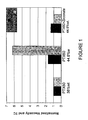
- Examples 25-28 The samples are prepared in the same manner as in Examples 10 - 26 and the results are shown in Table 5 and also as illustrated in Figure 1 . These demonstrate that surface functionalization of BN with a zirconate coupling agent help reduce the viscosity of the polymeric compound, allowing more BN filler to be added and thus improving the overall thermal conductivity of the material.
- the untreated BN powder PTX60 is not V-blended and used as received.
- Table 5 Example Treated BN loading (wt.%) Wt. % zirconate in BN Ave. Viscosity (poise, 1s -1 ) Thermal Conductivity (W/mK) 25 38 0.0 755 2.33 26 38 2.5 114 1.86 27 44.6 0 4652 3.96 28 44.6 2.5 755 3.22
- Comparative Examples In the comparative examples with polymeric resins as a coating / functionalization agent, spherical BN PTX60 is V-blended with 0-15 wt. % silicone fluid (Dow Coming 200 fluid-5 CST), and further mixed with silicone fluid (Dow Corning 200 fluid-100 CST) using a FlackTek speed mixer for 20 seconds and at approximately 3500. The viscosity, in poise, is measured using Advanced Rheometer 2000 (TA Instruments).
- spherical BN PTX60 coated with silicone fluid at various levels (35 to 59 wt.% or 20 to 40 vol.%) is mixed in a FlackTek speed mixer at approximately 3500 rpm with 35-60 wt.% of Sylgard 184 Silicone Resin and 3.5 to 6.0 wt.% curing agent Sylgard 184.
- the mixture is placed in a 3"x6"rectangular mold and pressed at 125°C for 45 minutes to form pads of 0.5 to 1.5 mm in thickness.
Landscapes
- Chemical & Material Sciences (AREA)
- Health & Medical Sciences (AREA)
- Organic Chemistry (AREA)
- Life Sciences & Earth Sciences (AREA)
- Engineering & Computer Science (AREA)
- Ceramic Engineering (AREA)
- Animal Behavior & Ethology (AREA)
- General Health & Medical Sciences (AREA)
- Public Health (AREA)
- Veterinary Medicine (AREA)
- Epidemiology (AREA)
- Birds (AREA)
- Materials Engineering (AREA)
- Structural Engineering (AREA)
- Inorganic Chemistry (AREA)
- Chemical Kinetics & Catalysis (AREA)
- Medicinal Chemistry (AREA)
- Polymers & Plastics (AREA)
- Dermatology (AREA)
- Compositions Of Macromolecular Compounds (AREA)
- Pigments, Carbon Blacks, Or Wood Stains (AREA)
Description
- The present invention relates to a boron nitride composition, for use in applications including forming polymer-based compounds containing the boron nitride.
- Boron nitride ("BN") comes in a variety of crystalline structures and has a variety of uses from polishing agents to lubricants. Hexagonal boron nitride ("hBN") is a very desirable form and a white composition having hexagonal layer structure similar to graphite. Because of its properties, it has found uses in heat conductivity applications, electrical insulation applications, corrosion resistance applications, lubrication applications, and as a plastic additive. Boron nitride can be molded and used in composite materials or as a raw material for cubic boron nitride. It is used in many applications including electronic materials, non-oxidizing ceramics sintering filler powder, makeup materials, medical additives, etc.
- In the prior art, BN may be manufactured in a high temperature reaction between inorganic raw materials into a white powder composition of BN particles, having a hexagonal structure similar to graphite in platelet morphology. When platelet BN is added as a filler to a polymer, a blended material is formed having poor rheological properties. At loaded concentrations above 30 wt. % BN, the blended material is so viscous that it is difficult to dispense from a mechanical dispenser such as a syringe.
-
US Patent No. 6,731,088 discloses a process to manufacture BN, forming a dry powder of spherically shaped agglomerates of irregular non-spherical particles bound together by a binder and subsequently spray-dried. The spherically shaped BN agglomerates can be compounded into polymer compositions at levels of 35-50 wt. % for compositions with viscosity below about 300 cp. -
JP Publication No. 05-051540 US Patent No. 6,162,849 discloses a thermally conductive moldable polymer blend having at least 60 wt. % of BN powder having an average particle size of at least 60 microns and coated with a coupling agent, and wherein the thermally conductive composition has a thermal conductivity of at least 15 W/m°K. - There is still a need for improved BN compositions, particularly for BN compositions that can be used in large quantities as a filler in applications such as electronic materials, thermally conductive compositions, and the like. Applicants have found the surface functionalization of BN with a zirconate coupling agent helps reduce the viscosity of the polymeric compound, allowing more BN filler to be added and thus improving the overall thermal conductivity of the material.
- A boron nitride composition comprising boron nitride powder, the boron nitride powder having its surface treated with a coating layer comprising at least one of a zirconate coupling agent, a zirconium aluminate coupling agent, an aluminate coupling agent, and mixtures thereof.
- A boron nitride powder having deposited on the surface thereof a coating layer comprising 0.5 to 5 wt. % of at least one of a zirconate coupling agent, a zirconium aluminate coupling agent, an aluminate coupling agent, and mixtures thereof. In one embodiment, the boron nitride powder comprises spherically shaped agglomerates of irregular non-spherical BN particles bound together by a binder and subsequently spray-dried.
- The invention further relates to a polymeric composition comprising at least 35 wt. % of a boron nitride powder coated with 0.5 to 5 wt. % of a zirconate coupling agent. Lastly, the invention relates to a method for increasing the thermal conductivity of polymeric compositions, said method comprises mixing in the composition at least 35 wt. % of a boron nitride powder having deposited on the surface thereof a coating layer comprising at least one of a zirconate coupling agent, a zirconium aluminate coupling agent, an aluminate coupling agent, or mixtures thereof.
-
-
Figure 1 is a graph showing the changes in viscosity and thermal conductivity (TC) in compositions with untreated BN and BN functionalized with a zirconate coupling agent. - As used herein, approximating language may be applied to modify any quantitative representation that may vary without resulting in a change in the basic function to which it is related. Accordingly, a value modified by a term or terms, such as "about" and "substantially," may not to be limited to the precise value specified, in some cases.
- As used herein, the terni "functionalized" may be used interchangeably with "surface functionalized," "functionalized surface," "coated," "surface treated," or "treated," referring to the coating of the boron nitride component in agglomerate form or platelet form with the coupling agent of the invention.
- As used herein, the term "functionalization" or "functionalized" relates to modification of the BN surface to provide a plurality of functional groups on the BN surface. A "functionalized surface" as used herein refers to the coating that has been modified so that a plurality of functional groups are covalently attached thereto, either directly or indirectly.
- As used herein, the phrase "effective amount" or "sufficient amount" means that amount sufficient to bring about the desired effect, e.g., lowering the viscosity of a polymeric composition at least 20% over the viscosity of a polymeric composition not having this effective amount.
- Boron Nitride Component. As the starting material, the BN component comprises crystalline or partially crystalline boron nitride particles made by processes known in the art. These include spherical BN particles in the micron size range produced in a process utilizing a plasma gas as disclosed in
US Patent No. 6,652,822 ; hBN powder comprising spherical boron nitride agglomerates are formed of irregular non-spherical BN particles bound together by a binder and subsequently spray-dried, as disclosed in US Patent Publication No.US2001/0021740 ; BN powder produced from a pressing process as disclosed inUS Patent Nos. 5,898,009 and6,048,511 ; BN agglomerated powder as disclosed inUS Patent Publication No. 2005.0041373 ; BN powder having high thermal diffusivity as disclosed in US Patent Publication No.US20040208812A1 ; and highly delaminated BN powder as disclosed inUS Patent No. 6,951,583 . - In one embodiment, the BN powder has an average particle size of at least 50 microns. In another embodiment, the BN powder has an average particle size of 5 to 500 microns. In a third embodiment, from 10 to 100 microns.
- In one embodiment, the BN powder comprises irregularly-shaped agglomerates of hBN platelets, having an average particle size of above 10 microns.
- In another embodiment, the BN powder is in the form of spherical agglomerates of hBN platelets. In one embodiment of spherical BN powder, the agglomerates have an average agglomerate size distribution (ASD) or diameter from 10 to 500 microns. In another embodiment, the BN powder is in the form of spherical agglomerates having an ASD in the range of 30 to 125 microns. In one embodiment, the ASD is 74 to 100 microns. In another embodiment, 10 to 40 microns.
- In one embodiment, the BN powder is in the form of platelets having an average diameter of at least about 1 micron, and typically between about 1 and 20 µm, and a thickness of no more than about 50. In another embodiment, the powder is in the form of platelets having an average aspect ratio of from 50 to 300.
- In one embodiment, the BN is a h-BN powder having a highly ordered hexagonal structure with a crystallization index of at least 0.12. In another embodiment, the BN powder has a crystallinity of 0.20 to 0.55, and in yet another embodiment, from 0.30 to 0.55.
- In applications wherein the BN powder is to be used as fillers in polymer composites, e.g., microprocessor packaging requiring high thermal conductivity properties, 10 to 40 vol. % of the BN powder display an average particle size of about 5 to 25 microns; about 60 to 90 vol. % of the particles display an average particle size of 40 to 80 microns. In one embodiment and prior to being functionalized or mixed into a polymer composite, the BN powder is dried in a forced air oven for about 300°F for at least 6 hrs. and then kept at 120°F before being treated or before mixing.
- In one embodiment and prior to being functionalized or mixed into a polymer composite, the BN is sintered at a temperature of at least 1800°C for 1 to 4 hrs. Suitable atmospheres for sintering include inert gas, nitrogen, and argon. In one embodiment, the sintering is in a vacuum.
- In another embodiment, the hBN particles are first washed in 2% glacial acetic acid deionized water solution to remove possible residual surface contaminants from powder processing, in an amount of 5 - 10 wt. % BN solid in water solution. The solution is stirred at 80-100°C for a few hours then vacuum filtered. The BN particles may then be washed again with fresh deionized water before being dried in air circulating oven at 110°C prior to the next step of being functionalized / coated with the coupling agent.
- Organometallic Coupling Agent. The BN powder of the invention is functionalized or coated with 0.5 to 10 wt. % of an organometallic coupling agent. In another embodiment, the BN is coated with 1 to 5 wt. % of an organometallic coupling agent.
- In one embodiment, the coupling agent comprises a zirconate containing compound. Examples include ethyleneically unsaturated zirconate containing compound, neoalkoxy zirconate containing compound, neoalkoxytrisneodecanoyl zirconate, neoalkoxytris(dodecyl)benzenesulfonyl zirconate, neoalkoxytris(dioctyl)phosphate zirconate, neoalkoxytris(dioctyl)pyrophosphate zirconate, neoalkoxytris (ethylenediamino)ethyl zirconate, neoalkoxytris(m-amino)phenyl zirconate, tetra (2,2 diallyloxymethyl)butyl, di(ditridecyl)phosphito zirconate (commercially available as KZ 55 from Kenrich Petrochemicals, Inc. "Kenrich"), neopentyl(diallyl)oxy, trineodecanoyl zirconate (commercially available as NZ 01 from Kenrich), neopentyl(diallyl)oxy, tri(dodecyl)benzene-sulfony zirconate (commercially available as NZ 09 from Kenrich), neopentyl(diallyl)oxy, tri(dioctyl)phosphato zirconate (commercially available as NZ 12 from Kenrich), neopentyl(diallyl)oxy, tri(dioctyl)pyro-phosphato zirconate (commercially available as NZ 38 from Kenrich), neopentyl(diallyl)oxy, tri(N-ethylenediamino)ethyl zirconate (commercially available as NZ 44 from Kenrich), neopentyl(diallyl)oxy, tri(m-amino)phenyl zirconate (commercially available as NZ 97 from Kenrich), neopentyl(diallyl)oxy, trimethacryl zirconate (commercially available as NZ 33 from Kenrich), neopentyl(diallyl)oxy, triacryl zirconate (formerly available as NZ 39 from Kenrich), dineopentyl(diallyl)oxy, diparamino benzoyl zirconate (commercially available as NZ 37 from Kenrich), dineopentyl(aiallyl)oxy, di(3-mercapto) propionic zirconate (commercially available as NZ 66A from Kenrich), zirconium IV 2,2-bis(2-propenolatomethyl) butanolato, cyclo di [2,2-(bis 2 - propenolatomethyl) butanolato] pyrophosphato -O,O (commercially available as Ken-React® KZ TPP® from Kenrich), and mixtures thereof.
- In one embodiment, the zirconate-coupling agent is an organo functional alkoxide of zirconium, and wherein the alkoxide is compatible and active in water. By active, it is meant that the zirconate is not fully reacted or do not have too rapid a rate of reaction with water to produce substantial amounts of zirconium dioxide. Examples include neoalkoxytrisneodecanoyl zirconate, neoalkoxytris (dodecyl) benzenesulfonyl zirconate, neoalkoxytris (dioctyl) phosphate zirconate, neoalkoxytris (dioctyl) pyrophosphate zirconate, neoalkoxytris (ethylenediamino) ethyl zirconate, neoalkoxytris (m-amino)phenyl zirconate, and the like as disclosed in
Japanese Patent Application No. 64-52786 Japanese Patent Application No. 01-108277 Japanese Application No. 01-129031 - In one embodiment, the coupling agent comprises a coupling agent system of aluminum such as a zirconium aluminate coupling agent, or an aluminate coupling agent as disclosed in
EP Patent Publication No. 198374 - Optional Additives: In one embodiment, additives including initiators, dispersants, defoaming agents, and adhesion promoters may be optionally added to the coupling agent. Initiator examples include thermal initiators, chemical initiators, electron beam initiators, and photoinitiators.
- Method for Preparing the BN Composition There are various methods for preparing the BN composition of the invention, including a dry method and a wet method.
- An example of a dry method is mixing, wherein the zirconate coupling agent is mixed directly with the BN to be treated using a mixer or the like. Other dry methods including tumbling, prilling (also known as perforated pan coating), among others.
- In the wet method, the zirconate coupling agent, the BN powder, and optional materials are treated in a solvent and the solvent is subsequently removed. The solvent can be organic solvents and water. Other wet methods include spray coating and washing.
- Examples of organic solvents include aromatic solvents such as toluene, xylene, and the like; hydrocarbon solvents such as hexane, octane, and the like; esters such as ethyl acetate, butyl acetate, and the like; and ethers such as ethyl ether and the like. In one embodiment, the solvent is used in an amount of 30-3000 parts by weight based on 100 parts by weight of the zirconate coupling agent.
- In an embodiment of a wet method wherein the solvent is water, the BN particles are treated with 100 parts by weight of a zirconate base coupling agent having unhydrolyzable side chains with a solubility parameter (x) of 6.5 - 12; 3 to 30 parts by weight of a nonionic surface active agent blended therewith having an HLB value (y) of 2-30 and containing no protonic hydrogen(s) in its molecule, wherein x and y satisfy a relationship of 4x - 24 <= y <= 4x - 18.
- In a second embodiment of a wet method using water as a solvent, the BN particles are treated with a mixture of a cycolo[dineopentyl(diallyl)] pyrophosphate dineopentyl(diallyl) zirconate and a surfactant such as sodium dodecylbenzene-sulfonate, ethoxylated nonyl phenol or cetyl trimethyl ammonium chloride.
- The BN composition prepared in any of the methods above may be used in the powder form, or incorporate into a paste form of 60 to 80 wt. % of solid BN in an aqueous or non-aqueous medium of IPA, methanol, ethanol and the like. In polymeric compounds, the BN in powder or paste form is used in amounts of 30 to 80 wt. % of BN to total weight of the compounds, along with a polymeric matrix component such as a polyester, a melt-processable polymer, a phenolic, a silicone polymer (e.g., a silicone rubber), an acrylic, a wax, a thermoplastic polymer, a low molecular weight fluid, or an epoxy molding compound, for a thermal conductivity of about 1 W/mK to about 25 W/mK. In one embodiment, the zirconate surface treated BN is used as a filler in levels of up to 90% for increasing thermal conductivity of up to 37.5 W/mK or higher.
- In one embodiment, the thermoplastic polymer matrix comprises at least one of a liquid crystal polymer; a polyester such as polyethylene naphthalate, polyethylene terephthalate, polybutylene terephthalate; a polyamide; a polyphthalamide; a polyimide; a polyphenylene sulfide; a polycarbonates; a polyetheretherketone; apolyaryletherketone; a polyphenylene oxide; and a mixture thereof.
- The polymeric compound containing zirconate coated BN may be prepared by techniques known in the art, such as melt-mixing in equipment such as a mill, a Banbury, a Brabender, a single or twin screw extruder, continuous mixers, kneaders, etc.
- In one embodiment, the polymer, the untreated BN powder, and the zirconate coupling agent may all be intimately mixed in the form of granules and / or powder in a high shear mixer. In yet another embodiment, the zirconate coupling agent may be first added to the polymer matrix, the BN filler is subsequently added to the mixture for an intimate mixing process in which the BN particles are surface treated with the zirconate coupling agent.
- The surface-treated BN of the invention allows the loading concentration of BN to be raised with little increases in the viscosity of the composite, relative to the same composite loaded with untreated BN; thereby providing enhanced thermal conductivity and lower viscosity or simply to reduce the viscosity of the filled polymer composite to enhance its processability. In one embodiment, the surface-treated BN composition when blended into a polymer composite, lowers the viscosity of the polymeric composite at least 20% over the viscosity of the polymeric composition containing the same amount of boron nitride powder not treated with the zirconate coupling agent. In another embodiment, the viscosity is lowered at least 50%, particularly when the surface-treated BN is added in an amount of greater than 20 wt. % (based on the total weight of the polymer composite with BN filler)
- Polymer composites comprising the BN powder functionalized with the zirconate coupling agent of the invention may be used for a number of applications, including microprocessor packaging, bearing housings, heat-exchanger applications such as heat sinks for microprocessors and integrated circuit chips, plastic ball grid array packages, quad flat packs, and other common surface-mounted integrated circuit packages, etc., particularly applications demanding a high thermal conductivity which is close to that of pure alumina (about 25 W/m°K).
- Examples are provided herein to illustrate the invention.
- In all examples, Ken-React® KZ TPP® Zirconate, or Zirconium IV 2,2-bis(2-propenolatomethyl) butanolato, cyclo di [2,2-(bis 2 - propenolatomethyl) butanolato] pyrophosphato -O,O, from Kenrich is used as the coupling agent.
- BN powder is commercially available from GE Advanced Ceramics located in Cleveland, OH, as PTX60 (spherical agglomerates of hexagonal platelet BN with an average particle size of 60 microns); PT120 (hexagonal platelet BN having an average particle size of 12 microns); and PT110 (hexagonal platelet BN having an average particle size of 45 microns).
- Example 1: In this example, 1 part of Ken-React® KZ TPP® zirconate coupling agent from Kenrich is dissolved in 1000 parts of toluene, then 100 parts PT120 (BN powder having ave. particle sizes of 12 µ) is added to the mixture. The mixture is agitated for about 10 minutes, then the toluene solvent is removed by suction filtration.
- Example 2: PT110 BN powder is added to a high speed churning machine such as a Henschel mixer, then Ken-React® KZ TPP® zirconate coupling agent is slowly added to the mixer while churning continues for uniform mixing / coating of the BN particles. The surface functionalized BN is subsequently used as filler in lubricant materials or thermally conductive composites.
- Examples 3 -5- viscosity measurements: PTX60 BN powder is first coated with 1.44 wt. % Ken-React® KZ TPP® zirconate via V-blending for about 15 to 60 minutes. The blended powder is then mixed with silicone fluid (Dow Coming 200 fluid-100 CST) using a FlackTek speed mixer for 20 seconds at approximately 3500 rpm. The viscosity, in poise, is measured using Advanced Rheometer 2000 (TA Instruments). The results using various surface treated BN levels are shown in Table 1.
Table 1 Example Treated BN loading (wt.%) Ave. Viscosity (poise, 1s-1) 3 35 58 4 40 341 5 45 1202 - Examples 6 - 7: In the examples, polymer composites comprising treated and untreated BN fillers are prepared and measured for thermal conductivity. In the examples, treated BN powder is prepared by first mixing the powder with Ken-React® KZ TPP® zirconate via V-blending for about 15 to 60 minutes. The treated BN powder is then mixed with 27 wt. % Sylgard 184 Silicone Resin and 3 wt. % curing agent Sylgard 184 in a FlackTek speed mixer at approximately 3500 rpm. The mixture is placed in a 3"x6"rectangular mold and pressed at 125°C for 45 minutes to form pads of 0.5 to 1.5 mm in thickness. The bulk thermal conductivity in W/mK is measured via a Hot Disk® Thermal Constants Analyzer. The results are shown in Table 2:
Table 2 Example Composition Thermal Conductivity 6 30% Silicone Resin + 70% untreated BN (64% PT110 and 6% PT120) 11.53 W/mK 7 30% Silicone Resin + 70% Zirconate treated BN (64% PT110 with 2.15%Zirconate and 6% PT120 with 2.3%Zirconate) 10.47 W/mK - Examples 8 - 24 BN coated with different levels of zirconate and at different loadings: In the examples as shown in Table 3, PTX60 BN powder is v-blended with Ken-React® KZ TPP® zirconate and then mixed with silicone fluid (Dow Coming 200 fluid-100 CST) using a FlackTek speed mixer for 20 seconds at approximately 3500. The viscosity, in poise, is measured using Advanced Rheometer 2000 (TA Instruments). The BN coated is also mixed in a FlackTek speed mixer at approximately 3500 rpm with 35-60 wt.% of Sylgard 184 Silicone Resin and 3.5 to 6.0 wt.% curing agent Sylgard 184, both from Dow Corning. The filler content of spherical BN ranges from 35 to 59 wt.% (20 to 40 vol.%). The mixture is placed in a 3"x6"rectangular mold and pressed at 125°C for 45 minutes to form pads of 0.5 to 1.5 mm in thickness. The bulk thermal conductivity is measured via a Hot Disk® Thermal Constants Analyzer.
- For samples containing untreated BN powder, the BN (PTX60) is V-blended by itself just for comparison.
Table 3 Example Treated BN loading (wt.%) Wt. % zirconate in BN Ave. Viscosity (poise, 1 s-1) Thermal Conductivity (W/mK) 8 35 0.0 103 1.80 9 35 1.4 58 1.64 10 35 2.5 45 1.63 11 35 3.5 46 1.62 12 40 0.0 494 2.47 13 40 1.4 341 2.27 14 40 2.5 238 1.97 15 40 3.5 275 2.16 16 45 0.0 3079 3.55 17 45 1.4 1202 3.49 18 45 2.5 708 3.26 19 45 3.5 769 3.27 20 50 0.0 37716 5.20 21 50 1.4 6020 5.06 22 50 2.5 2784 4.81 23 50 3.5 3661 4.59 24 60 2.1 - 8.86 - Table 4 illustrates the properties of some of zirconate coated BN powder in the examples above. Oxygen %, soluble borates, and carbon content increase with addition of zirconates. The average particle size (D50) is shown as well as the D10 and D90 correspond to the 10% and 90% percentile of the distribution, respectively.
Table 4 PTX60 BN PTX60 + 1.4% Zirconate TPP PTX60 + 2.5% Zirconate TPP PTX60 + 3% Zirconate TPP Oxygen (%) 0.1017 1.009 1.528 2.259 Carbon (%) 0.01561 0.982 1.82 2.22 SA (m2/g) 5.92 Sol. Borate (%) 0.03 0.09 0.05 0.05 D10 (microns) 17.1 9.805 11.71 16.29 D50 (microns) 55.77 38.28 41.88 48.15 D90 (microns) 87.23 77.39 78.39 82.13 - Examples 25-28: The samples are prepared in the same manner as in Examples 10 - 26 and the results are shown in Table 5 and also as illustrated in
Figure 1 . These demonstrate that surface functionalization of BN with a zirconate coupling agent help reduce the viscosity of the polymeric compound, allowing more BN filler to be added and thus improving the overall thermal conductivity of the material. In examples 27 and 29, the untreated BN powder PTX60 is not V-blended and used as received.Table 5 Example Treated BN loading (wt.%) Wt. % zirconate in BN Ave. Viscosity (poise, 1s-1) Thermal Conductivity (W/mK) 25 38 0.0 755 2.33 26 38 2.5 114 1.86 27 44.6 0 4652 3.96 28 44.6 2.5 755 3.22 - Comparative Examples: In the comparative examples with polymeric resins as a coating / functionalization agent, spherical BN PTX60 is V-blended with 0-15 wt. % silicone fluid (Dow Coming 200 fluid-5 CST), and further mixed with silicone fluid (Dow Corning 200 fluid-100 CST) using a FlackTek speed mixer for 20 seconds and at approximately 3500. The viscosity, in poise, is measured using Advanced Rheometer 2000 (TA Instruments).
- For thermal conductivity measurements, spherical BN PTX60 coated with silicone fluid at various levels (35 to 59 wt.% or 20 to 40 vol.%) is mixed in a FlackTek speed mixer at approximately 3500 rpm with 35-60 wt.% of Sylgard 184 Silicone Resin and 3.5 to 6.0 wt.% curing agent Sylgard 184. The mixture is placed in a 3"x6"rectangular mold and pressed at 125°C for 45 minutes to form pads of 0.5 to 1.5 mm in thickness.
- As illustrated in Table 6, the use of spherical BN coated with silicone fluid in polymeric compositions helps reduce viscosity and increase the loading. However, the thermal conductivity data is not as good as with spherical BN coated with ziroconate.
Table 6. Example wt.% loading of BN treated with silicone Wt. % silicone fluid (5CST) in BN Ave. Viscosity Thermal Conductivity 29 39 0.0 1220 2.64 30 39 5.0 1033 - 31 39 10.0 355 - 32 39 15.00 122 - 33 42 5.00 1220 2.52 34 44.5 10.0 1220 2.50 35 48 15.00 1220 2.46 - It should be noted that the zirconate coupling agent of the invention may be used to functionalize other ceramic fillers besides boron nitride, including the typical ceramic fillers used for thermal interface management (TIM) applications such as aluminum nitride, aluminum oxide, and the like. '
- This written description uses examples to disclose the invention, including the best mode, and also to enable any person skilled in the art to make and use the invention. The patentable scope of the invention is defined by the claims, and may include other examples that occur to those skilled in the art. Such other examples are intended to be within the scope of the claims if they have structural elements that do not differ from the literal language of the claims, or if they include equivalent structural elements with insubstantial differences from the literal languages of the claims.
- All citations referred herein are expressly incorporated herein by reference.
Claims (11)
- A boron nitride composition comprising boron nitride powder, the boron nitride powder having its surface treated with a coating layer comprising 0.5 to 10 wt. % of at least one of a zirconate coupling agent, a zirconium aluminate coupling agent, an aluminate coupling agent, and mixtures thereof.
- The boron nitride composition of claim 1, wherein the coating layer comprises about 1 to about 5 wt. % of a zirconate coupling agent.
- The boron nitride composition of any of claims 1 - 2, wherein the zirconate coupling agent is selected from the group consisting of an ethyleneically unsaturated zirconate containing compound, a neoalkoxy zirconate containing compound, an organo functional alkoxide of zirconium wherein the alkoxide is compatible and active in water, and mixtures thereof.
- The boron nitride composition of any of claims 1 - 3, wherein the boron nitride powder is in the form of: a) spherically shaped agglomerates of irregular non-spherical particles bound together by a binder and subsequently spray-dried; b) irregularly-shaped agglomerates of hexagonal boron nitride platelets, having an average particle size of at least 10 microns; and mixtures of spherically shaped agglomerates of irregular non-spherical particles bound together by a binder and subsequently spray-dried and irregularly-shaped agglomerates of hexagonal boron nitride platelets, having an average particle size of least 10 microns.
- The boron nitride composition of any of claims 1 - 4, wherein the boron nitride powder comprises hexagonal boron nitride platelets having at least one of: a) an aspect ratio of from 50 to 300; and an average diameter of from 2 µm to 20 µm.
- The boron nitride composition of any of claims 1 - 5 wherein said composition when blended into a polymeric composition, lowers the viscosity of the polymeric composition at least 20% over the viscosity of the polymeric composition containing the same amount of boron nitride powder not treated with the zirconate coupling agent
- A polymer composite composition comprising a polymer matrix selected from the group of a thermoplastic resin, an epoxy resin, a silicone resin, and a filler material comprising particles of boron nitride treated with a coating layer comprising 0.5 to 10 wt. % of at least one of a zirconate coupling agent, a zirconium aluminate coupling agent, an aluminate coupling agent, and mixtures thereof.
- The polymer composite composition of claim 7, wherein
the polymer matrix comprises at least one of a liquid crystal polymer; a polyester such as polyethylene naphthalate, polyethylene terephthalate, polybutylene terephthalate; a polyamide; a polyimide; a polyphthalamide; a polyphenylene sulfide; a polycarbonate; a polyetheretherketone; a polyaryletherketone; a polyphenylene oxide; and a mixture thereof; and
the boron nitride is treated with a coating layer comprising about 1 to about 5 wt. % of a zirconate coupling agent selected from the group consisting of an ethyleneically unsaturated zirconate containing compound, a neoalkoxy zirconate containing compound, an organo functional alkoxide of zirconium wherein the alkoxide is compatible and active in water, and mixtures thereof. - An article comprising the composition of any of claims 1 - 7.
- A method for producing boron nitride powder for forming polymer composites having reduced viscosity, said process comprises the step of coating the boron nitride powder with a composition comprising a zirconate coupling agent for a sufficient amount of time for the boron nitride powder to be coated with a sufficient amount of 0.5 to 10 wt.% of at least one of a zirconate to coupling agent, a zirconium aluminate coupling agent, an aluminate coupling agent, and mixtures thereof,
wherein said coated boron nitride powder, when blended into a polymeric composition, lowers the viscosity of the polymeric composition at least 20% over the viscosity of the polymeric composition containing the same amount of boron nitride powder not treated with the zirconate coupling agent. - The method of claim 10, wherein the boron nitride powder is coated with a zirconate coupling agent selected from the group consisting of a zirconate coupling agent selected from the group consisting of an ethyleneically unsaturated zirconate containing compound, a neoalkoxy zirconate containing compound, an organo functional alkoxide of zirconium wherein the alkoxide is compatible and active in water, and mixtures thereof.
Applications Claiming Priority (3)
| Application Number | Priority Date | Filing Date | Title |
|---|---|---|---|
| US66139505P | 2005-03-14 | 2005-03-14 | |
| US11/207,865 US20070241303A1 (en) | 1999-08-31 | 2005-08-19 | Thermally conductive composition and method for preparing the same |
| US11/248,095 US7445797B2 (en) | 2005-03-14 | 2005-10-12 | Enhanced boron nitride composition and polymer-based compositions made therewith |
Publications (3)
| Publication Number | Publication Date |
|---|---|
| EP1702907A2 EP1702907A2 (en) | 2006-09-20 |
| EP1702907A3 EP1702907A3 (en) | 2007-09-12 |
| EP1702907B1 true EP1702907B1 (en) | 2012-04-25 |
Family
ID=36013276
Family Applications (1)
| Application Number | Title | Priority Date | Filing Date |
|---|---|---|---|
| EP20050257291 Expired - Lifetime EP1702907B1 (en) | 2005-03-14 | 2005-11-28 | Enhanced boron nitride composition and polymer-based compositions made therewith |
Country Status (6)
| Country | Link |
|---|---|
| US (1) | US7445797B2 (en) |
| EP (1) | EP1702907B1 (en) |
| JP (1) | JP5036176B2 (en) |
| KR (1) | KR101216794B1 (en) |
| CN (1) | CN1834167B (en) |
| TW (1) | TW200634142A (en) |
Cited By (1)
| Publication number | Priority date | Publication date | Assignee | Title |
|---|---|---|---|---|
| USRE45803E1 (en) | 2001-08-07 | 2015-11-17 | Saint-Gobain Ceramics & Plastics, Inc. | High solids HBN slurry, HBN paste, spherical HBN powder, and methods of making and using them |
Families Citing this family (68)
| Publication number | Priority date | Publication date | Assignee | Title |
|---|---|---|---|---|
| US6713088B2 (en) * | 1999-08-31 | 2004-03-30 | General Electric Company | Low viscosity filler composition of boron nitride particles of spherical geometry and process |
| US20070241303A1 (en) * | 1999-08-31 | 2007-10-18 | General Electric Company | Thermally conductive composition and method for preparing the same |
| US7976941B2 (en) * | 1999-08-31 | 2011-07-12 | Momentive Performance Materials Inc. | Boron nitride particles of spherical geometry and process for making thereof |
| US7494635B2 (en) | 2003-08-21 | 2009-02-24 | Saint-Gobain Ceramics & Plastics, Inc. | Boron nitride agglomerated powder |
| US7524560B2 (en) * | 2005-08-19 | 2009-04-28 | Momentive Performance Materials Inc. | Enhanced boron nitride composition and compositions made therewith |
| TW200803703A (en) * | 2006-06-21 | 2008-01-01 | Delta Electronics Inc | Power supply apparatus with passive heat-dissipation function and the manufacturing method therefor |
| US8933157B2 (en) | 2006-10-07 | 2015-01-13 | Momentive Performance Materials Inc. | Mixed boron nitride composition and method for making thereof |
| US7527859B2 (en) * | 2006-10-08 | 2009-05-05 | Momentive Performance Materials Inc. | Enhanced boron nitride composition and compositions made therewith |
| JP2008179724A (en) * | 2007-01-25 | 2008-08-07 | Nitto Denko Corp | Epoxy resin composition for semiconductor encapsulation and semiconductor device obtained using the same |
| JP2008248048A (en) * | 2007-03-30 | 2008-10-16 | Shin Kobe Electric Mach Co Ltd | High thermal conductivity thermoplastic resin molding material |
| US8039527B2 (en) * | 2008-06-06 | 2011-10-18 | E.I. Du Pont De Nemours And Company | Polymers containing hexagonal boron nitride particles coated with turbostratic carbon and process for preparing same |
| WO2010033635A1 (en) * | 2008-09-17 | 2010-03-25 | Shocking Technologies, Inc. | Voltage switchable dielectric material containing boron compound |
| US8288466B2 (en) | 2009-05-13 | 2012-10-16 | E I Du Pont De Nemours And Company | Composite of a polymer and surface modified hexagonal boron nitride particles |
| US8440292B2 (en) * | 2009-05-13 | 2013-05-14 | E I Du Pont De Nemours And Company | Multi-layer article for flexible printed circuits |
| US8784980B2 (en) * | 2009-05-13 | 2014-07-22 | E I Du Pont De Nemours And Company | Film prepared from a casting composition comprising a polymer and surface modified hexagonal boron nitride particles |
| US8258346B2 (en) * | 2009-05-13 | 2012-09-04 | E I Du Pont De Nemours And Company | Surface modified hexagonal boron nitride particles |
| WO2010141432A1 (en) * | 2009-06-02 | 2010-12-09 | Rogers Corporation | Thermally conductive circuit subassemblies, method of manufacture thereof, and articles formed therefrom |
| WO2011014641A1 (en) | 2009-07-30 | 2011-02-03 | The Procter & Gamble Company | Fabric conditioning fabric care articles comprising a particulate lubricant agent |
| TW201131716A (en) * | 2010-01-29 | 2011-09-16 | Nitto Denko Corp | Thermal conductive sheet, light-emitting diode mounting substrate, and thermal conductive adhesive sheet |
| JP5159812B2 (en) * | 2010-03-03 | 2013-03-13 | 株式会社東芝 | Rotating electric machine |
| EP2434619B1 (en) * | 2010-09-22 | 2018-11-14 | General Electric Technology GmbH | Arrangement of conducting bar ends |
| US8834739B1 (en) | 2011-10-19 | 2014-09-16 | The Boeing Company | Boron nitride nano-platelete based materials |
| JPWO2013073496A1 (en) * | 2011-11-14 | 2015-04-02 | 三菱電機株式会社 | Electromagnetic coil, manufacturing method thereof, and insulating tape |
| EP3269682B1 (en) | 2011-11-29 | 2020-01-01 | Mitsubishi Chemical Corporation | Agglomerated boron nitride particles, composition containing said particles, and three-dimensional integrated circuit having layer comprising said composition |
| EP2791232A1 (en) | 2011-12-16 | 2014-10-22 | Ticona LLC | Nucleating system for polyarylene sulfide compositions |
| US8852487B2 (en) | 2011-12-16 | 2014-10-07 | Ticona Llc | Injection molding of polyarylene sulfide compositions |
| WO2013090172A1 (en) | 2011-12-16 | 2013-06-20 | Ticona Llc | Method for low temperature injection molding of polyarylene sulfide compositions and injection molded part obtained thereby |
| CN103998506B (en) | 2011-12-16 | 2016-08-24 | 提克纳有限责任公司 | Boracic nucleator for polyphenylene sulfide |
| EP2615133A1 (en) * | 2012-01-12 | 2013-07-17 | Bruker Biospin (Société par Actions Simplifiée) | Composite material with enhanced conductivity, part made from said material and uses thereof |
| KR101493781B1 (en) | 2013-02-27 | 2015-02-17 | 한양대학교 에리카산학협력단 | High thermally conductive ceramic-poly composite and manufacturing method of the same |
| JPWO2015105106A1 (en) * | 2014-01-08 | 2017-03-23 | Jnc株式会社 | Resin composition for thermally conductive sheet, thermally conductive sheet, resin-coated metal, electronic device |
| MY179291A (en) | 2014-02-05 | 2020-11-03 | Mitsubishi Chem Corp | Agglomerated boron nitride particles, production method for agglomerated boron nitride particles, resin composition including agglomerated boron nitride particles, moulded body, and sheet |
| US9464214B2 (en) | 2014-02-25 | 2016-10-11 | The Boeing Company | Thermally conductive flexible adhesive for aerospace applications |
| JP6394115B2 (en) * | 2014-06-27 | 2018-09-26 | 三菱ケミカル株式会社 | Resin composition, heat dissipation sheet made of resin composition, and power device device including heat dissipation sheet |
| US9353245B2 (en) * | 2014-08-18 | 2016-05-31 | 3M Innovative Properties Company | Thermally conductive clay |
| WO2016049477A1 (en) * | 2014-09-26 | 2016-03-31 | Momentive Performance Materials Inc. | Lamination composite of boron nitride in paper for transformer insulation |
| RU2565432C1 (en) * | 2014-11-20 | 2015-10-20 | Федеральное государственное автономное образовательное учреждение высшего профессионального образования "Национальный исследовательский технологический университет "МИСиС" | Method of obtaining nanoparticles of boron nitride for delivery of anti-tumour medications |
| WO2017012119A1 (en) * | 2015-07-23 | 2017-01-26 | Dow Global Technologies Llc | Thermally conductive core-shell structured particles |
| TWI708814B (en) * | 2015-07-31 | 2020-11-01 | 美商堤康那責任有限公司 | Thermally conductive polymer composition for use in a camera module |
| US10407605B2 (en) | 2015-07-31 | 2019-09-10 | Ticona Llc | Thermally conductive polymer composition |
| US9862809B2 (en) | 2015-07-31 | 2018-01-09 | Ticona Llc | Camera module |
| TWI708806B (en) | 2015-08-17 | 2020-11-01 | 美商堤康那責任有限公司 | Liquid crystalline polymer composition for camera modules |
| TWI708805B (en) | 2015-12-30 | 2020-11-01 | 美商聖高拜陶器塑膠公司 | Modified nitride particles, oligomer functionalized nitride particles, polymer based composites and methods of forming thereof |
| WO2017131005A1 (en) | 2016-01-26 | 2017-08-03 | 富士フイルム株式会社 | Surface-modified inorganic substance and production method therefor, resin composition, thermally-conductive material, and device |
| WO2017131006A1 (en) | 2016-01-26 | 2017-08-03 | 富士フイルム株式会社 | Resin composition, thermally conductive material, and device including surface-modified inorganic substance |
| WO2017203965A1 (en) | 2016-05-25 | 2017-11-30 | 富士フイルム株式会社 | Surface-modified inorganic nitride, composition, heat conductive material, device with heat conductive layer, and method for producing surface-modified inorganic nitride |
| US10689496B2 (en) | 2016-08-24 | 2020-06-23 | Mitsubishi Gas Chemical Company, Inc. | Resin composition, prepreg, metal foil-clad laminate, resin sheet and printed circuit board |
| WO2018066277A1 (en) | 2016-10-07 | 2018-04-12 | デンカ株式会社 | Boron nitride aggregated grain, method for producing same, and thermally conductive resin composition using same |
| WO2018074077A1 (en) * | 2016-10-21 | 2018-04-26 | デンカ株式会社 | Spherical boron nitride fine powder, method for manufacturing same and thermally conductive resin composition using same |
| CN106633916B (en) * | 2016-12-26 | 2019-09-24 | 中国科学院宁波材料技术与工程研究所 | A kind of graphene-based heat-conducting interface material and preparation method thereof |
| US10633535B2 (en) | 2017-02-06 | 2020-04-28 | Ticona Llc | Polyester polymer compositions |
| JP6897245B2 (en) * | 2017-04-05 | 2021-06-30 | 日亜化学工業株式会社 | Resin composition, manufacturing method of resin composition and light emitting device |
| CN107501610A (en) * | 2017-08-30 | 2017-12-22 | 桂林电子科技大学 | A kind of composite heat interfacial material based on boron nitride and preparation method thereof |
| CN111263968B (en) | 2017-10-12 | 2021-12-28 | 普睿司曼股份公司 | Cable with improved thermoplastic insulation |
| EP3749710A1 (en) | 2018-02-08 | 2020-12-16 | Celanese Sales Germany GmbH | Polymer composite containing recycled carbon fibers |
| JP2019137581A (en) * | 2018-02-09 | 2019-08-22 | 三菱瓦斯化学株式会社 | Surface-roughened hexagonal boron nitride particles, composition, cured product, monolayer resin sheet, multilayer resin sheet, prepreg, metal foil-coated multilayer plate, printed circuit board, sealing material, fiber-reinforced composite material and adhesive |
| EP3755515A4 (en) | 2018-02-20 | 2021-11-10 | Ticona LLC | THERMALLY CONDUCTIVE POLYMERIC COMPOSITION |
| CN109777111B (en) * | 2019-02-22 | 2021-06-25 | 中国工程物理研究院核物理与化学研究所 | A functionalized boride-filled silicone rubber-based thermally conductive material and preparation method thereof |
| WO2021035383A1 (en) * | 2019-08-23 | 2021-03-04 | Evonik Specialty Chemicals (Shanghai) Co., Ltd. | Thermal conductive filler and preparation method thereof |
| US11560101B2 (en) | 2020-11-17 | 2023-01-24 | Ford Global Technologies, Llc | Headliner-mounted telematics control unit package |
| JP2022183821A (en) * | 2021-05-31 | 2022-12-13 | スリーエム イノベイティブ プロパティズ カンパニー | Method for producing surface-coated hexagonal boron nitride particle and surface-coated hexagonal boron particle |
| US20230405903A1 (en) | 2021-10-14 | 2023-12-21 | Saint-Gobain Ceramics & Plastics, Inc. | Method of forming a multi-layer composite body |
| WO2023085326A1 (en) * | 2021-11-10 | 2023-05-19 | デンカ株式会社 | Heat dissipation sheet |
| JP7262699B1 (en) * | 2021-11-17 | 2023-04-21 | デンカ株式会社 | thermal grease |
| WO2023090240A1 (en) * | 2021-11-17 | 2023-05-25 | デンカ株式会社 | Heat dissipation grease |
| KR102578083B1 (en) * | 2022-06-14 | 2023-09-13 | 윌코 주식회사 | Boron nitride composite and manufacturing method thereof |
| CN119343315A (en) * | 2022-06-30 | 2025-01-21 | 松下知识产权经营株式会社 | Boron nitride materials and their application products |
| CN119286261B (en) * | 2024-11-08 | 2025-06-13 | 深圳市佰盈新材料科技有限公司 | A low-density weight-reducing thermally conductive silica gel and preparation method thereof |
Family Cites Families (29)
| Publication number | Priority date | Publication date | Assignee | Title |
|---|---|---|---|---|
| US4623738A (en) | 1985-04-22 | 1986-11-18 | Kenrich Petrochemicals, Inc. | Neoalkoxy organo-titanates and organo-zirconates useful as coupling and polymer processing agents |
| US4634785A (en) | 1984-09-14 | 1987-01-06 | Kenrich Petrochemicals, Inc. | Titanium and zirconium pyrophosphates, their preparation and use |
| CN1005265B (en) | 1985-04-12 | 1989-09-27 | 福建师范大学 | New Aluminum System Coupling Agent |
| JPH01112523A (en) * | 1987-10-24 | 1989-05-01 | Hitachi Maxell Ltd | Magnetic recording medium |
| US5001091A (en) | 1987-11-02 | 1991-03-19 | Norton Company | Readily moldable or castable ceramic powders |
| JPH0820818B2 (en) * | 1987-12-09 | 1996-03-04 | 東海ゴム工業株式会社 | roll |
| EP0424094A1 (en) | 1989-10-17 | 1991-04-24 | The Carborundum Company | Process for producing a stable, purified boron nitride powder and product produced thereby |
| JP2624027B2 (en) | 1991-05-14 | 1997-06-25 | 富士ゼロックス株式会社 | Electrophotographic developer using surface-treated inorganic fine powder |
| JPH0551557A (en) | 1991-08-27 | 1993-03-02 | Kawasaki Steel Corp | Lubrication / heat resistant coating composition |
| JPH0551540A (en) | 1991-08-27 | 1993-03-02 | Kawasaki Steel Corp | Treatment method for boron nitride |
| KR100284727B1 (en) | 1992-09-04 | 2001-03-15 | 에가시라 구니오 | Water treatment filler surface treatment agent and filler treated with the surface treatment agent |
| JPH07215705A (en) | 1994-02-07 | 1995-08-15 | Shin Etsu Chem Co Ltd | Boron nitride powder for silicone rubber addition and silicone rubber products |
| JP3468615B2 (en) * | 1995-06-26 | 2003-11-17 | 電気化学工業株式会社 | Filler and adhesive sheet |
| US5681883A (en) | 1996-03-05 | 1997-10-28 | Advanced Ceramics Corporation | Enhanced boron nitride composition and polymer based high thermal conductivity molding compound |
| US6160042A (en) | 1997-05-01 | 2000-12-12 | Edison Polymer Innovation Corporation | Surface treated boron nitride for forming a low viscosity high thermal conductivity polymer based boron nitride composition and method |
| JP3948834B2 (en) * | 1998-07-16 | 2007-07-25 | 電気化学工業株式会社 | Boron nitride for resin addition, resin composition using the same, and heat dissipation component |
| US6162849A (en) | 1999-01-11 | 2000-12-19 | Ferro Corporation | Thermally conductive thermoplastic |
| JP2000309628A (en) * | 1999-02-26 | 2000-11-07 | Hitachi Chem Co Ltd | Cycloolefin composition |
| US7976941B2 (en) * | 1999-08-31 | 2011-07-12 | Momentive Performance Materials Inc. | Boron nitride particles of spherical geometry and process for making thereof |
| US6713177B2 (en) | 2000-06-21 | 2004-03-30 | Regents Of The University Of Colorado | Insulating and functionalizing fine metal-containing particles with conformal ultra-thin films |
| US6652822B2 (en) | 2001-05-17 | 2003-11-25 | The Regents Of The University Of California | Spherical boron nitride particles and method for preparing them |
| US6645612B2 (en) | 2001-08-07 | 2003-11-11 | Saint-Gobain Ceramics & Plastics, Inc. | High solids hBN slurry, hBN paste, spherical hBN powder, and methods of making and using them |
| JP2003060134A (en) * | 2001-08-17 | 2003-02-28 | Polymatech Co Ltd | Thermal conductive sheet |
| US20030171487A1 (en) * | 2002-03-11 | 2003-09-11 | Tyco Electronics Corporation | Curable silicone gum thermal interface material |
| KR100493021B1 (en) | 2002-07-10 | 2005-06-07 | 삼성전자주식회사 | Semiconductor memory device and method for manufacturing the same |
| DE10319937A1 (en) | 2003-05-02 | 2004-12-02 | Wacker-Chemie Gmbh | Organofunctional surface modified metal oxides |
| TWI237463B (en) * | 2003-08-20 | 2005-08-01 | Benq Corp | Method for capturing an image of a printing media and related apparatus |
| US7494635B2 (en) | 2003-08-21 | 2009-02-24 | Saint-Gobain Ceramics & Plastics, Inc. | Boron nitride agglomerated powder |
| US7214423B2 (en) | 2004-01-08 | 2007-05-08 | Xerox Corporation | Wear resistant fluoropolymer |
-
2005
- 2005-10-12 US US11/248,095 patent/US7445797B2/en not_active Expired - Lifetime
- 2005-11-25 TW TW094141560A patent/TW200634142A/en unknown
- 2005-11-28 EP EP20050257291 patent/EP1702907B1/en not_active Expired - Lifetime
- 2005-11-29 JP JP2005343606A patent/JP5036176B2/en not_active Expired - Lifetime
- 2005-11-30 KR KR1020050115827A patent/KR101216794B1/en not_active Expired - Lifetime
- 2005-11-30 CN CN200510138048XA patent/CN1834167B/en not_active Expired - Lifetime
Cited By (2)
| Publication number | Priority date | Publication date | Assignee | Title |
|---|---|---|---|---|
| USRE45803E1 (en) | 2001-08-07 | 2015-11-17 | Saint-Gobain Ceramics & Plastics, Inc. | High solids HBN slurry, HBN paste, spherical HBN powder, and methods of making and using them |
| USRE45923E1 (en) | 2001-08-07 | 2016-03-15 | Saint-Gobain Ceramics & Plastics, Inc. | High solids HBN slurry, HBN paste, spherical HBN powder, and methods of making and using them |
Also Published As
| Publication number | Publication date |
|---|---|
| TW200634142A (en) | 2006-10-01 |
| CN1834167A (en) | 2006-09-20 |
| JP2006257392A (en) | 2006-09-28 |
| KR20060100914A (en) | 2006-09-21 |
| EP1702907A3 (en) | 2007-09-12 |
| CN1834167B (en) | 2011-11-16 |
| US20070041918A1 (en) | 2007-02-22 |
| EP1702907A2 (en) | 2006-09-20 |
| KR101216794B1 (en) | 2012-12-31 |
| US7445797B2 (en) | 2008-11-04 |
| JP5036176B2 (en) | 2012-09-26 |
Similar Documents
| Publication | Publication Date | Title |
|---|---|---|
| US7445797B2 (en) | Enhanced boron nitride composition and polymer-based compositions made therewith | |
| US8933157B2 (en) | Mixed boron nitride composition and method for making thereof | |
| JP7694635B2 (en) | Boron nitride agglomerated particles, method for producing the boron nitride agglomerated particles, resin composition containing the boron nitride agglomerated particles, and molded body | |
| EP1908802B1 (en) | Enhanced boron nitride composition and compositions made therewith | |
| EP1806384B1 (en) | Enhanced boron nitride composition and compositions made therewith | |
| KR102185730B1 (en) | Aluminum nitride powder | |
| JP7786500B2 (en) | Boron nitride agglomerated powder, heat dissipation sheet and semiconductor device | |
| JP7431417B2 (en) | Hexagonal boron nitride powder, resin composition, resin sheet, and method for producing hexagonal boron nitride powder | |
| EP3560890B1 (en) | Hexagonal boron nitride powder and method for producing same | |
| JP5867426B2 (en) | Method for producing boron nitride powder | |
| TW201827382A (en) | Silicone-based hybrid polymer-coated AlN filler | |
| KR102282500B1 (en) | Nanocomposite insulation materials with enhanced thermal conductivity by dispersion of inorganic nanoparticles and their manufacturing method | |
| JP3572692B2 (en) | α-Alumina powder-containing resin composition and rubber composition | |
| JP2008001536A (en) | Aluminum nitride / boron nitride composite powder and method for producing the same | |
| JP7438442B1 (en) | Boron nitride aggregated particles, sheet member, and method for producing boron nitride aggregated particles | |
| JP7438443B1 (en) | Boron nitride aggregated particles, sheet member, and method for producing boron nitride aggregated particles | |
| JP2025112957A (en) | Boron nitride agglomerated powder, resin composition, heat dissipation sheet and semiconductor device | |
| WO2023044478A1 (en) | Coated glass bubbles, composites therefrom, and methods of making the same | |
| JP2026066214A (en) | Boron nitride aggregate powder, resin composition, heat dissipation sheet, and semiconductor device | |
| JPH048740A (en) | Filler for resin | |
| WO2023085326A1 (en) | Heat dissipation sheet |
Legal Events
| Date | Code | Title | Description |
|---|---|---|---|
| PUAI | Public reference made under article 153(3) epc to a published international application that has entered the european phase |
Free format text: ORIGINAL CODE: 0009012 |
|
| AK | Designated contracting states |
Kind code of ref document: A2 Designated state(s): AT BE BG CH CY CZ DE DK EE ES FI FR GB GR HU IE IS IT LI LT LU LV MC NL PL PT RO SE SI SK TR |
|
| AX | Request for extension of the european patent |
Extension state: AL BA HR MK YU |
|
| PUAL | Search report despatched |
Free format text: ORIGINAL CODE: 0009013 |
|
| AK | Designated contracting states |
Kind code of ref document: A3 Designated state(s): AT BE BG CH CY CZ DE DK EE ES FI FR GB GR HU IE IS IT LI LT LU LV MC NL PL PT RO SE SI SK TR |
|
| AX | Request for extension of the european patent |
Extension state: AL BA HR MK YU |
|
| 17P | Request for examination filed |
Effective date: 20080227 |
|
| 17Q | First examination report despatched |
Effective date: 20080401 |
|
| AKX | Designation fees paid |
Designated state(s): DE FR GB |
|
| GRAP | Despatch of communication of intention to grant a patent |
Free format text: ORIGINAL CODE: EPIDOSNIGR1 |
|
| GRAS | Grant fee paid |
Free format text: ORIGINAL CODE: EPIDOSNIGR3 |
|
| GRAA | (expected) grant |
Free format text: ORIGINAL CODE: 0009210 |
|
| AK | Designated contracting states |
Kind code of ref document: B1 Designated state(s): DE FR GB |
|
| REG | Reference to a national code |
Ref country code: GB Ref legal event code: FG4D |
|
| REG | Reference to a national code |
Ref country code: DE Ref legal event code: R096 Ref document number: 602005033831 Country of ref document: DE Effective date: 20120621 |
|
| PLBE | No opposition filed within time limit |
Free format text: ORIGINAL CODE: 0009261 |
|
| STAA | Information on the status of an ep patent application or granted ep patent |
Free format text: STATUS: NO OPPOSITION FILED WITHIN TIME LIMIT |
|
| 26N | No opposition filed |
Effective date: 20130128 |
|
| REG | Reference to a national code |
Ref country code: DE Ref legal event code: R097 Ref document number: 602005033831 Country of ref document: DE Effective date: 20130128 |
|
| GBPC | Gb: european patent ceased through non-payment of renewal fee |
Effective date: 20121128 |
|
| REG | Reference to a national code |
Ref country code: FR Ref legal event code: ST Effective date: 20130731 |
|
| PG25 | Lapsed in a contracting state [announced via postgrant information from national office to epo] |
Ref country code: FR Free format text: LAPSE BECAUSE OF NON-PAYMENT OF DUE FEES Effective date: 20121130 Ref country code: GB Free format text: LAPSE BECAUSE OF NON-PAYMENT OF DUE FEES Effective date: 20121128 |
|
| PGFP | Annual fee paid to national office [announced via postgrant information from national office to epo] |
Ref country code: DE Payment date: 20241128 Year of fee payment: 20 |
|
| REG | Reference to a national code |
Ref country code: DE Ref legal event code: R071 Ref document number: 602005033831 Country of ref document: DE |