EP1699178B1 - Verfahren zur iterativen Bestimmung der Assoziationen zwischen mobilen Endgeräten und Zugangspunkt zum erreichen von Lastverteilung - Google Patents
Verfahren zur iterativen Bestimmung der Assoziationen zwischen mobilen Endgeräten und Zugangspunkt zum erreichen von Lastverteilung Download PDFInfo
- Publication number
- EP1699178B1 EP1699178B1 EP06250536A EP06250536A EP1699178B1 EP 1699178 B1 EP1699178 B1 EP 1699178B1 EP 06250536 A EP06250536 A EP 06250536A EP 06250536 A EP06250536 A EP 06250536A EP 1699178 B1 EP1699178 B1 EP 1699178B1
- Authority
- EP
- European Patent Office
- Prior art keywords
- time period
- mobile device
- during
- access point
- iterative time
- Prior art date
- Legal status (The legal status is an assumption and is not a legal conclusion. Google has not performed a legal analysis and makes no representation as to the accuracy of the status listed.)
- Ceased
Links
- 238000000034 method Methods 0.000 title claims 11
- 230000005540 biological transmission Effects 0.000 claims 4
- 238000012544 monitoring process Methods 0.000 claims 2
- 238000005259 measurement Methods 0.000 claims 1
Images
Classifications
-
- H—ELECTRICITY
- H04—ELECTRIC COMMUNICATION TECHNIQUE
- H04W—WIRELESS COMMUNICATION NETWORKS
- H04W28/00—Network traffic management; Network resource management
- H04W28/02—Traffic management, e.g. flow control or congestion control
- H04W28/08—Load balancing or load distribution
- H04W28/086—Load balancing or load distribution among access entities
- H04W28/0861—Load balancing or load distribution among access entities between base stations
-
- H—ELECTRICITY
- H04—ELECTRIC COMMUNICATION TECHNIQUE
- H04L—TRANSMISSION OF DIGITAL INFORMATION, e.g. TELEGRAPHIC COMMUNICATION
- H04L47/00—Traffic control in data switching networks
- H04L47/10—Flow control; Congestion control
- H04L47/12—Avoiding congestion; Recovering from congestion
- H04L47/125—Avoiding congestion; Recovering from congestion by balancing the load, e.g. traffic engineering
-
- H—ELECTRICITY
- H04—ELECTRIC COMMUNICATION TECHNIQUE
- H04W—WIRELESS COMMUNICATION NETWORKS
- H04W28/00—Network traffic management; Network resource management
- H04W28/16—Central resource management; Negotiation of resources or communication parameters, e.g. negotiating bandwidth or QoS [Quality of Service]
- H04W28/18—Negotiating wireless communication parameters
- H04W28/22—Negotiating communication rate
-
- H—ELECTRICITY
- H04—ELECTRIC COMMUNICATION TECHNIQUE
- H04W—WIRELESS COMMUNICATION NETWORKS
- H04W48/00—Access restriction; Network selection; Access point selection
- H04W48/20—Selecting an access point
-
- H—ELECTRICITY
- H04—ELECTRIC COMMUNICATION TECHNIQUE
- H04W—WIRELESS COMMUNICATION NETWORKS
- H04W84/00—Network topologies
- H04W84/02—Hierarchically pre-organised networks, e.g. paging networks, cellular networks, WLAN [Wireless Local Area Network] or WLL [Wireless Local Loop]
- H04W84/10—Small scale networks; Flat hierarchical networks
- H04W84/12—WLAN [Wireless Local Area Networks]
Definitions
- Wireless, local area networks are typically comprised of many mobile devices (e.g., wireless laptops, etc.). Each of the mobile devices is associated with a so-called “access point” (AP).
- the AP acts as a conduit through which messages, information, signaling, etc. may be transferred to, and from, a mobile device.
- AP access point
- one AP may have many mobile devices associated with it while another AP may have far fewer mobile devices associated with it.
- the first AP may be viewed as being "congested” or overloaded while the latter AP may be viewed as relatively uncongested.
- an existing technique may alleviate congestion in an AP by associating mobile devices located far from another AP with that AP. In such a case, though an AP's congestion level has been reduced, a mobile device's transmission rate may also be reduced because the mobile device is located so far from its associated AP.
- WLAN load balancing methods and devices that take into consideration the congestion levels and transmission rates of APs and mobile devices, respectively in order to associate a mobile device to an access point.
- U.S. Patent No. 6,879,600 discusses the use of a mobile device in "arbitrating" and handing off communication sessions in a wireless network.
- U.S. Patent Publication No. 20052026660102032 discloses methods for allowing access points to perform automatic channel selection.
- a controller is operable to (a) generate a transmission rate ratio from transmission rates derived from transmissions between a mobile device and a currently associated access point (AP) and between the mobile device and another AP during an iterative time period; (b) generate a congestion level ratio from congestion measurements of the APs during the iterative time period; and (c) generate an effectiveness index from the transmission rate and congestion level ratios during the iterative time period.
- AP access point
- the so-generated index is a relative indication of the desirability to continue to associate the mobile device with the current AP or to associate the mobile device with the other AP to achieve load balancing objectives of the WLAN during the iterative time period.
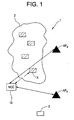
- FIG. 1 depicts a simplified diagram of a WLAN that includes mobile devices that may be associated with APs while meeting the load balancing objectives of the WLAN in accordance with embodiments of the present invention.
- a WLAN 1 which comprises a plurality of mobile devices 2,3.
- a group of mobile devices 2 is currently associated with an access point designated AP u while a single mobile device 3 is currently associated with another access point designated as AP u .
- a mobile device x is shown as part of the group of devices 2.
- access point AP u is congested or overloaded in comparison with access point AP u because many more mobile devices are currently associated with access point AP u than are associated with access point AP u .
- the transmission rate between mobile device x and access point AP u may be higher than the transmission rate between mobile device x and access point AP v during a given time period, mobile device x may not be able to benefit from this transmission rate advantage even if it is associated with AP u because access point AP u is congested. Said another way, because access point AP u is associated with many mobile devices 2 it may take, relatively speaking, a long period of time before mobile device x is granted the right to send transmissions to, or receive transmissions from, access point AP u using its advantageous transmission rate. Instead, mobile device x may have to wait its turn to receive the benefit of the advantageous transmission rate.
- mobile device x may be immediately granted the right to send and receive transmissions to and from access point AP v because access point AP v is less congested than access point AP u . Said another way, mobile device x may not have to wait very long to send or receive transmissions to and from access point AP v .
- controller 10 which may be part of a network operations center (NOC) is operable to carry out load balancing by controlling the association of one or more mobile devices to an access point after taking into consideration the congestion levels of AP u and AP v as well as the transmission rates between mobile devices, such as x , and the two access points.
- NOC network operations center
- the controller 10 is operable to receive indicators associated with the transmission rates, R x,v, R x,u from mobile device x during an iterative time period, T , and is thereafter operable to generate a transmission rate ratio; R x,v /R x , u , from the received indicators.
- each of the indicators is based upon a transmission rate between the mobile device x and one of the access points AP u or AP v .
- the controller 10 is further operable to generate a congestion level ratio.
- the congestion level ratio is derived from measurements of congestion on both access points AP u and AP v .
- access point AP u may be referred to as a "current” AP
- access point AP u may be referred to as a "potential", “other” or “new” AP, the former designation indicating that the mobile device x is currently associated with AP u while the latter designations indicating that mobile device ix may become associated with access point AP v in the future.
- the congestion of access points AP u and AP v may be measured by each of the access points during the iterative time period T, respectively, for example, and then sent to the controller 10.
- a controller 10 may be further operable to generate an effectiveness index, I x,u,v from the transmission rate and congestion level ratios.
- an effectiveness index I x,u,v are repeatedly made on an iterative basis, i.e. once during each iteration of T, seconds.
- decisions regarding whether or not to transfer the responsibility of an access point from a current AP to another AP are also carried out on an iterative basis. That is, such functions are carried out during a first, iterative time period (e.g., ten seconds) and then repeated during a next, and each successive time period.
- the designation I x,u,v indicates a particular relationship. In one embodiment of the present invention, this designation (sometimes referred to as a triplet by those skilled in the art) indicates the effectiveness index for a given mobile device x , its current access point AP u and another access point AP v to which it may potentially be transferred.
- the parameter ⁇ is set equal to 1
- the two ratios are given equal importance.
- the congestion level ratio is given a higher importance than the transmission rate ratio, R x,v / R x,u .
- the value of a given index I x,u,v is a relative indication of the desirability to continue to associate a given mobile device x with its currently associated access point, AP u , or to associate the mobile device x with another access point, namely, potential access point, AP v , during a given iterative time period.
- the index I x , u . v is a relative indication of whether or not a mobile device should remain associated with its current access point or be re-assigned and associated with another access point in order to meet the load balancing objectives of WLAN 1 during a given iterative time period.
- a mobile device may be associated with a given access point (i.e., either its current access point or a potential access point) without compromising overall network throughput and load balancing objectives of a WLAN.
- the controller 10 may associate mobile device x with the potential access point, AP v (i.e., change mobile device x's association from its current access point AP u to potential access point AP v ), when the generated index I x,u,v is equal to or greater than a threshold value, ⁇ during a given iterative time period. That is, a network operator may select a particular threshold value ⁇ for each index I x,u,v.
- a mobile device's association may only be changed from its current access point (e.g., AP u ) to another access point (e.g., AP v ) if the generated effectiveness index I x,u,v is equal to 2 or more.
- the value of the threshold ⁇ is one of design choice and may be varied from WLAN to WLAN or from one iterative time period to another iterative time period. However, generally speaking the value of the threshold ⁇ should be set equal to 1 or more.
- the congestion level ratio was based on the congestion levels at access points AP u and AP v .
- these congestion levels are based on the congestion experienced by the downlink packet streams for each access point, AP u of AP v , not uplink streams, during an iterative time period.
- the rationale for this is that it is fairly easy for an access point to measure downlink delays while it is fairly difficult for an access point to measure uplink delays.
- using downlink delays is a good approximation of an overall delay because most information is transmitted in the downlink direction anyway.
- AP w the designation Dw(t) can be used to indicate such a measured downlink delay.
- the congestion level at each access point also takes into consideration the loss probability of each access point (i.e., the probability that a downlink packet will be dropped by an access point due to congestion).
- the loss probability for AP w during iteration T can be represented by the value Lw(t).
- Dw(t ) and Lw(t ) may be measured based on downlink packets handled by an AP during an iterative time period, T.
- D ⁇ w t Q ⁇ w t / A ⁇ w t
- Aw(t) denotes the average rate of packets arriving at an AP w that will be transmitted on a downlink channel to one or more mobile devices
- Qw(t) is the number of downlink packets present at the queue of AP w , during an iterative time period, T .
- the discussion above has mostly centered on a single mobile device x and two access points AP u and AP v .
- the present invention is applicable to a plurality of mobile devices and access points.
- the present invention provides for load balancing methods and devices that make use of a plurality of generated effectiveness indices derived from a plurality of mobile devices and access points where each index is repeatedly recalculated and generated during each iterative time period, T .
- the controller 10 may be operable to determine which of the generated indices equals or exceeds a threshold ⁇ . For each index whose value equals or exceeds the threshold ⁇ , there exists the possibility of transferring or changing a mobile device's association from a current access point to another potential access point (hereinafter sometimes referred to as a "transfer” or "transfers”) during a particular iterative time period, T .
- each transfer candidate may be represented as the triplet, x, u, v where, as before, x is a mobile device, u is the access point x is currently associated with and v is an access point to which x may be potentially switched to during some later time period, T .
- the transfer candidates in such a table may be listed in decreasing order, such that those transfer candidates having large indices, I x , u , v are ordered before those with smaller indices.
- the controller 10 may be operable to select a highest index and its associated transfer candidates in order to determine if a transfer is warranted. After making such a decision for the first selected index, the controller 10 is operable to repeatedly select the next highest ranked index and its transfer candidates, etc. The selection of a next index continues until each index in the ranked order has been selected or until another constraint (discussed subsequently) has been met.
- Such an ordered table of indices I x,u,v and transfer candidates gives the controller 10 (and thus a network operator) the ability to prioritize transfers; that is, those mobile device-to-access point associations that are most adversely affecting the overall load balancing objectives of a WLAN can be addressed first.
- the present invention may require that the controller 10 satisfy itself that other conditions are present or have been met. That is, during each iterative time period before carrying out a transfer of a mobile device from one access point to another, the controller 10 may be operable to verify that certain other constraints do not prohibit such a transfer.
- congestion oscillations occur when a load on one access point is shifted to another access point only to result in the congestion of the other access point. Thereafter, in response, the other access point may shift the same load back to the original access point, at which point the original access point may attempt to again shift the load back to the other access point, thus creating a cycle.
- the present inventors developed additional features which may be used by controller 10 to determine whether a transfer is appropriate after selecting an index during a given iterative time period.
- the present invention provides that the controller 10 may be operable to complete a transfer provided that during the current iterative time period the total number of transfers from the current access point, AP u , has not exceeded a first allowable percentage (e.g., 10%) of the load on access point AP u and the total number of transfers into the potential access point, AP v , has not exceeded a second allowable percentage (e.g., 10%) of the load on access point AP u .
- a first allowable percentage e.g. 10%
- AP v the total number of transfers into the potential access point
- controller 10 may be further operable to cease attempting to make new transfers from access point AP u and into access point AP v . By so preventing transfers from access point AP u and into access point AP v , congestion oscillation can be avoided.
- AP load considerations may be of less concern than still other, more important concerns.
- a network operator may realize that a particular mobile device is responsible for a large percentage of an access point's load which, under certain circumstances, results in the congestion of the access point. For example, it may occur that mobile device x is responsible for 25% of the load handled by current access point APi u during a given iterative time period. If this is so, then it may be next to impossible to ever change the access point that mobile device x is associated with without violating a load constraint, such as the one just described above.
- controllers such as controller 10, that are operable to allow a mobile device x to change its association from its current access point AP u to access point APi v provided such a transfer is the first transfer from AP u during an iterative time period.
- the controller 10 may be operable to allow such a transfer to proceed during a particular iterative time period regardless of the loads on the current and potential access points involved in the transfer provided such a change represents the very first transfer from the current access point.
- controller 10 may decide not to place the index transfer candidates representing such a situation in a transfer candidate table in the first place; in effect setting this index I x,u,v equal to 0.
- a network operator may consider a mobile device to be active when its so-called packet arrival rate during a particular iteration time period is greater than a particular percentage of a total, packet arrival rate at a particular access point, such as access point AP u . For example, if the arrival rate associated with mobile device x is equal to or greater than at least 2% of the total arrival rate of packets at access point, AP u , then mobile device x may be considered to be an active access point.
- controllers such as controller 10, that may be operable to measure downlink arrival rates during a particular iteration time period, T.
- This downlink arrival rate is associated with the mobile device x and the current access point AP u . If the measured arrival rate is not at least a certain percentage of the total arrival rate of the current access point AP u , then controller 10 may be operable to decline to add the transfer candidates associated with such a situation into the table as well.
- the controller 10 proceeds to select each index, and its associated transfer candidates from the set of qualified indexes (i.e., those that exceed a threshold, ⁇ , in decreasing order, and upon making such a selection proceeds to determine whether a transfer associated with the selected index is appropriate after taking into consideration some or all of the constraints discussed before.
- the controller 10 may once again build a table of indices and their associated transfer candidates and initiate any indicated transfers.
- the iteration time period, T may be synonymous with a so-called "run time” period.
- run time a so-called "run time” period.
- the controller 10 may permit a mobile device x to remain associated with a current access point AP u .
- the controller 10 may be operable to receive indicators of transmission rates and congestion levels from mobile device x , and access points AP u and AP v , respectively.
- the controller 10 may be further operable to determine an effectiveness index I x , u , v based on the generated transmission rate and congestion level ratios.
- controller 10 may be operable to apply one or more of the constraints discussed above before deciding whether to carry out a transfer.
- the controller 10 may be operable to change the AP association of mobile device x from its current access point AP u to a new access point AP v . Thereafter, the controller 10 may then repeat the process just described.
- controller 10 mobile device x
- access points AP u and AP v may be carried out by software, firmware, hardware or some combination of the three. If software or firmware, one or more programmable memory devices may be used to store one or more programs which in turn may carry out or control the functions and features of the controller 10, mobile device x , and/or access points AP u and AP v .
- the techniques of the present invention may be used in conjunction with one or more additional techniques to actually change the settings within a mobile device, e.g., "forcing" a mobile device to become associated with a particular access point, as dictated by load balancing objectives, not just signal-to-noise objectives.
- One such technique is disclosed in co-pending U.S. Patent Application No. 11/026,904 , the disclosure of which is incorporated herein as if set forth in full herein.
Landscapes
- Engineering & Computer Science (AREA)
- Computer Networks & Wireless Communication (AREA)
- Signal Processing (AREA)
- Mobile Radio Communication Systems (AREA)
- Small-Scale Networks (AREA)
Claims (10)
- Ein Verfahren zur iterativen Bestimmung der Assoziation zwischen einem mobilen Endgerät und einem Zugangspunkt in einem drahtlosen lokalen Netzwerk (WLAN) (1, 10) zum Erreichen einer Lastverteilung, GEKENNZEICHNET DURCH:(a) Erzeugen einer Übertragungsraten-Ratio aus den von Übertragungen zwischen einem mobilen Endgerät (x) und einem momentan assoziierten Zugangspunkt (AP) (APu) und zwischen dem mobilen Endgerät und einem anderen AP (APv) während eines iterativen Zeitraums abgeleiteten Übertragungsraten;(b) Erzeugen einer Überlastungspegelratio aus Überlastungsmessungen der APs während des iterativen Zeitraums;(c) Erzeugen eines Effizienzindexes aus der Übertragungsraten-Ratio und einem von der Überlastungspegelratio während des iterativen Zeitraums abgeleiteten Exponentialwert,wobei der Index eine relative Angabe darüber ist, ob ein Fortfahren des Assoziierens des mobilen Endgeräts mit dem momentanen AP wünschenswert ist, oder ob das mobile Endgerät mit dem anderen AP assoziiert werden soll, um während des iterativen Zeitraums die Lastverteilungszielsetzungen des WLAN zu erreichen.
- Das Verfahren nach Anspruch 1, weiterhin die folgenden Schritte umfassend:Wiederholen der Schritte (a) bis (c) für ein jedes einer Vielzahl von mobilen Endgeräten und jeden dem Endgerät momentan zugeteilten AP und einen anderen AP während eines iterativen Zeitraums;Ermitteln, welche Werte der erzeugten Indexe während des iterativen Zeitraums einem Grenzwert entsprechen oder diesen überschreiten; undOrganisieren der Indexe, deren Wert dem Grenzwert entspricht oder diesen überschreitet, in eine Gruppe von Indexen in absteigender Reihenfolge, vom höchsten bis zum niedrigsten Indexwert, während des iterativen Zeitraums.
- Das Verfahren nach Anspruch 2, weiterhin die folgenden Schritte umfassend:Auswählen eines höchsten verbleibenden Indexwertes; undAssoziieren eines von dem ausgewählten Index angegebenen mobilen Endgeräts mit einem AP, der sich von dem momentan zugeordneten AP unterscheidet, während des iterativen Zeitraums.
- Das Verfahren nach Anspruch 1, welches weiterhin den Schritt des Assoziierens des mobilen Endgeräts mit dem anderen AP, wenn der Index während des iterativen Zeitraums einem Grenzwert entspricht oder diesen überschreitet, umfasst.
- Das Verfahren nach Anspruch 2, weiterhin die folgenden Schritte umfassend:Überwachen einer Anzahl von Transfers von einem momentan zugeordneten AP während eines iterativen Zeitraums;Überwachen einer Anzahl von Transfers an einen anderen AP während des iterativen Zeitraums; undAssoziieren eines mobilen Endgeräts mit dem anderen AP, wenn der Index einem Grenzwert entspricht oder diesen überschreitet, unter der Voraussetzung, dass die Anzahl der Transfers von dem momentan zugeordneten AP nicht einen ersten zulässigen Prozentsatz während des iterativen Zeitraums überschritten hat, und dass die Anzahl der Transfers an den anderen AP nicht einen zweiten zulässigen Prozentsatz während des iterativen Zeitraums überschritten hat.
- Das Verfahren nach Anspruch 5, wobei der erste und der zweite zulässige Prozentsatz gleichwertig sind.
- Das Verfahren nach Anspruch 6, wobei der erste und der zweite zulässige Prozentsatz 10 % entsprechen.
- Das Verfahren nach Anspruch 2, weiterhin die folgenden Schritte umfassend:Assoziieren des mobilen Endgeräts mit einem anderen AP, wenn eine solche Assoziation die erste Assoziation von dem momentanen AP während des iterativen Zeitraums ist, unter der Voraussetzung, dass der Index einem Grenzwert entspricht oder diesen überschreitet.
- Das Verfahren nach Anspruch 2, weiterhin den folgenden Schritt umfassend:Verweigern der Assoziation eines mobilen Endgeräts mit einem anderen AP, wenn ein momentaner AP während eines iterativen Zeitraums nicht überlastet ist.
- Das Verfahren nach Anspruch 2, weiterhin die folgenden Schritte umfassend:Messen einer Downlink-Ankunftsrate, welche mit einem mobilen Endgerät und einem momentanen AP assoziiert ist, wenn der Index während des iterativen Zeitraums dem Grenzwert entspricht oder diesen überschreitet;Assoziieren des mobilen Endgeräts mit einem anderen AP, unter der Voraussetzung, dass die gemessene Ankunftsrate während des iterativen Zeitraums mindestens einem minimalen Prozentsatz einer Gesamtankunftsrate an dem momentanen AP beträgt; undVerweigern der Assoziation des mobilen Endgeräts mit dem anderen AP, wenn die gemessene Ankunftsrate während des iterativen Zeitraums niedriger als der minimale Prozentsatz der Gesamtankunftsrate ist.
Applications Claiming Priority (1)
| Application Number | Priority Date | Filing Date | Title |
|---|---|---|---|
| US11/057,769 US20060182023A1 (en) | 2005-02-15 | 2005-02-15 | Methods and devices for iteratively determining mobile device-to-access point associations to achieve load balancing |
Publications (2)
| Publication Number | Publication Date |
|---|---|
| EP1699178A1 EP1699178A1 (de) | 2006-09-06 |
| EP1699178B1 true EP1699178B1 (de) | 2008-10-29 |
Family
ID=36087736
Family Applications (1)
| Application Number | Title | Priority Date | Filing Date |
|---|---|---|---|
| EP06250536A Ceased EP1699178B1 (de) | 2005-02-15 | 2006-02-01 | Verfahren zur iterativen Bestimmung der Assoziationen zwischen mobilen Endgeräten und Zugangspunkt zum erreichen von Lastverteilung |
Country Status (5)
| Country | Link |
|---|---|
| US (1) | US20060182023A1 (de) |
| EP (1) | EP1699178B1 (de) |
| JP (1) | JP5073211B2 (de) |
| CN (2) | CN103957562B (de) |
| DE (1) | DE602006003356D1 (de) |
Families Citing this family (30)
| Publication number | Priority date | Publication date | Assignee | Title |
|---|---|---|---|---|
| US8254347B2 (en) * | 2004-12-31 | 2012-08-28 | Alcatel Lucent | Methods and devices for associating a mobile device to access points within a WLAN |
| US7430189B2 (en) * | 2004-12-31 | 2008-09-30 | Lucent Technologies Inc. | Methods and devices for determining the adjacency of access points in a wireless network |
| US9215745B1 (en) | 2005-12-09 | 2015-12-15 | Meru Networks | Network-based control of stations in a wireless communication network |
| US9025581B2 (en) | 2005-12-05 | 2015-05-05 | Meru Networks | Hybrid virtual cell and virtual port wireless network architecture |
| US9142873B1 (en) | 2005-12-05 | 2015-09-22 | Meru Networks | Wireless communication antennae for concurrent communication in an access point |
| US9185618B1 (en) | 2005-12-05 | 2015-11-10 | Meru Networks | Seamless roaming in wireless networks |
| US9794801B1 (en) | 2005-12-05 | 2017-10-17 | Fortinet, Inc. | Multicast and unicast messages in a virtual cell communication system |
| US8160664B1 (en) | 2005-12-05 | 2012-04-17 | Meru Networks | Omni-directional antenna supporting simultaneous transmission and reception of multiple radios with narrow frequency separation |
| US9215754B2 (en) | 2007-03-07 | 2015-12-15 | Menu Networks | Wi-Fi virtual port uplink medium access control |
| US8472359B2 (en) | 2009-12-09 | 2013-06-25 | Meru Networks | Seamless mobility in wireless networks |
| US8064601B1 (en) | 2006-03-31 | 2011-11-22 | Meru Networks | Security in wireless communication systems |
| US7894436B1 (en) | 2007-09-07 | 2011-02-22 | Meru Networks | Flow inspection |
| JP2009225053A (ja) * | 2008-03-14 | 2009-10-01 | Advanced Telecommunication Research Institute International | 無線通信システム、それに用いられる基地局および無線装置 |
| CN101272353B (zh) * | 2008-05-21 | 2010-12-22 | 杭州华三通信技术有限公司 | 无线负载均衡方法及接入控制器 |
| JP5211163B2 (ja) * | 2008-06-04 | 2013-06-12 | 株式会社エヌ・ティ・ティ・ドコモ | 移動通信方法、無線基地局、無線制御装置、ネットワーク装置及び集約装置 |
| US8792349B2 (en) * | 2008-08-26 | 2014-07-29 | University Of Miami | Concurrent association of a wireless mobile node with access points for increasing capacity of access points |
| CN101355521B (zh) * | 2008-09-12 | 2010-12-15 | 北京星网锐捷网络技术有限公司 | 负载均衡控制方法、通信装置与通信系统 |
| US9197482B1 (en) | 2009-12-29 | 2015-11-24 | Meru Networks | Optimizing quality of service in wireless networks |
| CN102006627B (zh) * | 2010-11-01 | 2013-04-17 | 中国电信股份有限公司 | Wlan切换方法和系统 |
| JP5673150B2 (ja) * | 2011-01-31 | 2015-02-18 | ソニー株式会社 | 情報処理方法、情報処理装置および通信システム |
| US8941539B1 (en) | 2011-02-23 | 2015-01-27 | Meru Networks | Dual-stack dual-band MIMO antenna |
| US9917752B1 (en) | 2011-06-24 | 2018-03-13 | Fortinet, Llc | Optimization of contention paramaters for quality of service of VOIP (voice over internet protocol) calls in a wireless communication network |
| US9906650B2 (en) | 2011-06-26 | 2018-02-27 | Fortinet, Llc | Voice adaptation for wireless communication |
| KR101958859B1 (ko) * | 2011-09-29 | 2019-03-18 | 삼성전자 주식회사 | 이동통신 시스템 및 그 이동통신 시스템에서 체감 성능을 개선하기 위한 정보 처리 방법 |
| KR102166093B1 (ko) * | 2014-02-17 | 2020-10-15 | 삼성전자주식회사 | 무선통신시스템에서 액세스 포인트 연결장치 및 방법 |
| KR20150129510A (ko) * | 2014-05-12 | 2015-11-20 | 삼성전자주식회사 | 이동통신 시스템에서 이동성 앵커 선택 방법 및 장치 |
| KR102172046B1 (ko) | 2014-05-27 | 2020-10-30 | 삼성전자주식회사 | 무선 통신 시스템에서 접속 포인트 스캔 방법 및 장치 |
| EP3162113B1 (de) * | 2014-06-26 | 2017-11-22 | Telefonaktiebolaget LM Ericsson (publ) | Verfahren, knoten und system zur ermöglichung von verteilung der zellenlast |
| US11432223B2 (en) | 2015-07-08 | 2022-08-30 | Nokia Solutions And Networks Oy | Methods and apparatuses for selecting a first base station or a second base station to transmit a packet data unit (PDU) to a user equipment (UE) |
| CN111522277B (zh) * | 2020-05-21 | 2021-04-09 | 苏州讯如电子科技有限公司 | 一种采用mcu控制单元的网络信号控制系统及方法 |
Family Cites Families (29)
| Publication number | Priority date | Publication date | Assignee | Title |
|---|---|---|---|---|
| US5815811A (en) * | 1989-06-29 | 1998-09-29 | Symbol Technologies, Inc. | Preemptive roaming in a cellular local area wireless network |
| US5175867A (en) * | 1991-03-15 | 1992-12-29 | Telefonaktiebolaget L M Ericsson | Neighbor-assisted handoff in a cellular communications system |
| DE69936806T2 (de) * | 1998-03-26 | 2008-04-30 | Mitsubishi Denki K.K. | Spreizspektrumnachrichtenübertragungsverfahren |
| US6574474B1 (en) * | 1999-05-20 | 2003-06-03 | Avaya Technology Corp. | Load balancing for cellular and wireless systems |
| JP4297568B2 (ja) * | 1999-09-02 | 2009-07-15 | 富士通株式会社 | 無線通信制御装置および移動無線通信システム |
| FI109163B (fi) * | 2000-02-24 | 2002-05-31 | Nokia Corp | Menetelmä ja laitteisto liikkuvuuden tukemiseksi tietoliikennejärjestelmässä |
| US6522881B1 (en) * | 2000-03-08 | 2003-02-18 | Lucent Technologies Inc. | Method and apparatus for selecting an access point in a wireless network |
| DE60026454T2 (de) * | 2000-05-19 | 2006-11-09 | Lucent Technologies Inc. | Drahtloses lokales Netzwerk mit Lastverteilung |
| US7146636B2 (en) * | 2000-07-24 | 2006-12-05 | Bluesocket, Inc. | Method and system for enabling centralized control of wireless local area networks |
| EP1325660B1 (de) * | 2000-10-09 | 2008-08-27 | Nokia Corporation | Funkressourcenverwaltung |
| US6944462B2 (en) * | 2000-12-11 | 2005-09-13 | Telefonaktiebolaget Lm Ericsson (Publ) | Control node handover in radio access network |
| JP2002185458A (ja) * | 2000-12-13 | 2002-06-28 | Matsushita Electric Ind Co Ltd | 無線lanシステムおよび端末 |
| US7346023B2 (en) * | 2001-08-22 | 2008-03-18 | Lucent Technologies Inc. | Reconfigurable wireless communication access system and method |
| US20030046335A1 (en) * | 2001-08-30 | 2003-03-06 | International Business Machines Corporation | Efficiently serving large objects in a distributed computing network |
| KR20030052038A (ko) * | 2001-12-20 | 2003-06-26 | 엘지전자 주식회사 | 고속 데이터 통신 망간의 핸드오프 방법 |
| US6842621B2 (en) * | 2001-12-21 | 2005-01-11 | Motorola, Inc. | Method and apparatus for splitting control and media content from a cellular network connection |
| US6879600B1 (en) * | 2002-06-03 | 2005-04-12 | Sprint Spectrum, L.P. | Method and system for intersystem wireless communication session arbitration |
| US7444149B2 (en) * | 2002-06-13 | 2008-10-28 | Ntt Docomo, Inc. | Proactive deployment of decision mechanisms for optimal handover |
| US7058400B2 (en) * | 2002-06-14 | 2006-06-06 | Denso Corporation | Forward and reverse link channels dynamic processing gain |
| CA2497184C (en) * | 2002-08-30 | 2009-06-30 | Sprint Spectrum, L.P. | Method and system for intersystem wireless communication session arbitration |
| US8179833B2 (en) * | 2002-12-06 | 2012-05-15 | Qualcomm Incorporated | Hybrid TDM/OFDM/CDM reverse link transmission |
| KR100580244B1 (ko) * | 2003-01-23 | 2006-05-16 | 삼성전자주식회사 | 무선랜상의 핸드오프 방법 |
| WO2004077711A2 (en) * | 2003-02-24 | 2004-09-10 | Hawe William R | System, method and apparatus for ascertaining a dynamic attribute of a system |
| EP1639844B1 (de) * | 2003-06-23 | 2015-10-21 | Spreadtrum Communications Inc. | Zeitverschachtelte Mehrstandard-Einzelfunksystemvorrichtung und Verfahren |
| US7477610B2 (en) * | 2004-03-01 | 2009-01-13 | Alcatel-Lucent Usa Inc. | Methods and devices for coordinating the transmissions of access points in WLANs |
| CN100423501C (zh) * | 2004-04-27 | 2008-10-01 | Ut斯达康通讯有限公司 | 无线接入点负载均衡方法 |
| US7283823B2 (en) * | 2004-09-10 | 2007-10-16 | Cisco Technology, Inc. | Handoff between cellular and enterprise wireless networks |
| US7430189B2 (en) * | 2004-12-31 | 2008-09-30 | Lucent Technologies Inc. | Methods and devices for determining the adjacency of access points in a wireless network |
| US8254347B2 (en) * | 2004-12-31 | 2012-08-28 | Alcatel Lucent | Methods and devices for associating a mobile device to access points within a WLAN |
-
2005
- 2005-02-15 US US11/057,769 patent/US20060182023A1/en not_active Abandoned
-
2006
- 2006-02-01 DE DE602006003356T patent/DE602006003356D1/de not_active Expired - Lifetime
- 2006-02-01 EP EP06250536A patent/EP1699178B1/de not_active Ceased
- 2006-02-14 CN CN201410196063.9A patent/CN103957562B/zh not_active Expired - Fee Related
- 2006-02-14 CN CN200610004446.7A patent/CN1822555A/zh active Pending
- 2006-02-15 JP JP2006037631A patent/JP5073211B2/ja not_active Expired - Fee Related
Also Published As
| Publication number | Publication date |
|---|---|
| JP2006229972A (ja) | 2006-08-31 |
| CN1822555A (zh) | 2006-08-23 |
| EP1699178A1 (de) | 2006-09-06 |
| US20060182023A1 (en) | 2006-08-17 |
| CN103957562B (zh) | 2018-08-24 |
| JP5073211B2 (ja) | 2012-11-14 |
| DE602006003356D1 (de) | 2008-12-11 |
| CN103957562A (zh) | 2014-07-30 |
Similar Documents
| Publication | Publication Date | Title |
|---|---|---|
| EP1699178B1 (de) | Verfahren zur iterativen Bestimmung der Assoziationen zwischen mobilen Endgeräten und Zugangspunkt zum erreichen von Lastverteilung | |
| US8477689B2 (en) | System and methods for distributed medium access control and QOS scheduling in mobile ad-hoc networks | |
| JP4572200B2 (ja) | ソフトハンドオーバのための方法、基地局及びユーザ装置 | |
| EP1386508B1 (de) | Verfahren und einrichtung zur steuerung der zulassung von benutzern zu einem zellularfunknetzwerk | |
| JP4671995B2 (ja) | 無線リソースの管理 | |
| CN100534215C (zh) | 使用用户设备缓冲区占用率作为选择标准的软切换中的小区选择 | |
| EP1879339B1 (de) | Verfahren und Vorrichtung zur Überlastungsregelung in einem drahtlosen Kommunikationssystem | |
| JP4510826B2 (ja) | ユーザ装置の上りリンク送信をスケジューリングする方法及び基地局 | |
| EP2941044A1 (de) | Lastenausgleichsverfahren und netzsteuerungsknoten | |
| US20040072565A1 (en) | Best-cell amendment method for amending hysteresis margin according to the degree of congestion | |
| Wang et al. | Load balancing for heterogeneous traffic in datacenter networks | |
| JP2007507951A (ja) | 仮想的にセントラル化されるアップリンクスケジューリング | |
| US7193992B2 (en) | Method of radio resource management for integrated voice and data CDMA networks | |
| KR20070094982A (ko) | 무선 통신 시스템에서 자원 할당을 최적화하기 위한시스템들 및 방법들 | |
| US6205335B1 (en) | Zone selection method for mobile radio communication system | |
| EP1941672B1 (de) | Qos-bewusste funkbetriebsmittelverwaltung (für drahtlose kommunikation) mit aktivitätsdetektion | |
| EP2965579B1 (de) | Verfahren und netzwerkknoten zur durchführung eines verbindungsempfangs in einem zellfunkkommunikationsnetz | |
| CN103987087A (zh) | 一种移动负载均衡方法及装置 | |
| US20170111855A1 (en) | Access point selection depending on signal strength and load | |
| JP4150622B2 (ja) | パケット送信制御装置及びパケット送信制御方法 | |
| EP2785129A2 (de) | Annehmen oder Ablehnen von Zugriffsanforderungen | |
| CN112203329B (zh) | 一种基于负载均衡的邻区选择方法及装置 | |
| KR100679393B1 (ko) | 패킷 스케줄링 장치 및 그 방법 | |
| US8036671B2 (en) | Multi-cellular load dependent scheduling | |
| JP4857947B2 (ja) | 移動通信システムの負荷分散方式および基地局装置と端末装置 |
Legal Events
| Date | Code | Title | Description |
|---|---|---|---|
| PUAI | Public reference made under article 153(3) epc to a published international application that has entered the european phase |
Free format text: ORIGINAL CODE: 0009012 |
|
| 17P | Request for examination filed |
Effective date: 20060221 |
|
| AK | Designated contracting states |
Kind code of ref document: A1 Designated state(s): AT BE BG CH CY CZ DE DK EE ES FI FR GB GR HU IE IS IT LI LT LU LV MC NL PL PT RO SE SI SK TR |
|
| AX | Request for extension of the european patent |
Extension state: AL BA HR MK YU |
|
| 17Q | First examination report despatched |
Effective date: 20060524 |
|
| AKX | Designation fees paid |
Designated state(s): DE FR GB |
|
| GRAP | Despatch of communication of intention to grant a patent |
Free format text: ORIGINAL CODE: EPIDOSNIGR1 |
|
| GRAS | Grant fee paid |
Free format text: ORIGINAL CODE: EPIDOSNIGR3 |
|
| GRAA | (expected) grant |
Free format text: ORIGINAL CODE: 0009210 |
|
| AK | Designated contracting states |
Kind code of ref document: B1 Designated state(s): DE FR GB |
|
| REG | Reference to a national code |
Ref country code: GB Ref legal event code: FG4D |
|
| REF | Corresponds to: |
Ref document number: 602006003356 Country of ref document: DE Date of ref document: 20081211 Kind code of ref document: P |
|
| RAP4 | Party data changed (patent owner data changed or rights of a patent transferred) |
Owner name: LUCENT TECHNOLOGIES INC. |
|
| PLBE | No opposition filed within time limit |
Free format text: ORIGINAL CODE: 0009261 |
|
| STAA | Information on the status of an ep patent application or granted ep patent |
Free format text: STATUS: NO OPPOSITION FILED WITHIN TIME LIMIT |
|
| 26N | No opposition filed |
Effective date: 20090730 |
|
| REG | Reference to a national code |
Ref country code: GB Ref legal event code: 732E Free format text: REGISTERED BETWEEN 20131031 AND 20131106 |
|
| REG | Reference to a national code |
Ref country code: FR Ref legal event code: CD Owner name: ALCATEL-LUCENT USA INC. Effective date: 20131122 |
|
| REG | Reference to a national code |
Ref country code: FR Ref legal event code: GC Effective date: 20140410 |
|
| REG | Reference to a national code |
Ref country code: FR Ref legal event code: RG Effective date: 20141015 |
|
| REG | Reference to a national code |
Ref country code: FR Ref legal event code: PLFP Year of fee payment: 10 |
|
| REG | Reference to a national code |
Ref country code: FR Ref legal event code: PLFP Year of fee payment: 11 |
|
| REG | Reference to a national code |
Ref country code: FR Ref legal event code: PLFP Year of fee payment: 12 |
|
| REG | Reference to a national code |
Ref country code: FR Ref legal event code: PLFP Year of fee payment: 13 |
|
| PGFP | Annual fee paid to national office [announced via postgrant information from national office to epo] |
Ref country code: GB Payment date: 20180216 Year of fee payment: 13 Ref country code: DE Payment date: 20180219 Year of fee payment: 13 |
|
| PGFP | Annual fee paid to national office [announced via postgrant information from national office to epo] |
Ref country code: FR Payment date: 20190111 Year of fee payment: 14 |
|
| REG | Reference to a national code |
Ref country code: DE Ref legal event code: R119 Ref document number: 602006003356 Country of ref document: DE |
|
| GBPC | Gb: european patent ceased through non-payment of renewal fee |
Effective date: 20190201 |
|
| PG25 | Lapsed in a contracting state [announced via postgrant information from national office to epo] |
Ref country code: DE Free format text: LAPSE BECAUSE OF NON-PAYMENT OF DUE FEES Effective date: 20190903 Ref country code: GB Free format text: LAPSE BECAUSE OF NON-PAYMENT OF DUE FEES Effective date: 20190201 |
|
| PG25 | Lapsed in a contracting state [announced via postgrant information from national office to epo] |
Ref country code: FR Free format text: LAPSE BECAUSE OF NON-PAYMENT OF DUE FEES Effective date: 20200229 |