EP1693704A2 - Resist composition and pattern forming method using the same - Google Patents
Resist composition and pattern forming method using the same Download PDFInfo
- Publication number
- EP1693704A2 EP1693704A2 EP06001970A EP06001970A EP1693704A2 EP 1693704 A2 EP1693704 A2 EP 1693704A2 EP 06001970 A EP06001970 A EP 06001970A EP 06001970 A EP06001970 A EP 06001970A EP 1693704 A2 EP1693704 A2 EP 1693704A2
- Authority
- EP
- European Patent Office
- Prior art keywords
- group
- fluorine
- resist composition
- acid
- compound
- Prior art date
- Legal status (The legal status is an assumption and is not a legal conclusion. Google has not performed a legal analysis and makes no representation as to the accuracy of the status listed.)
- Withdrawn
Links
- 239000000203 mixture Substances 0.000 title claims abstract description 73
- 238000000034 method Methods 0.000 title claims description 29
- -1 sulfonate anion Chemical class 0.000 claims abstract description 204
- 125000001424 substituent group Chemical group 0.000 claims abstract description 87
- 239000002253 acid Substances 0.000 claims abstract description 54
- 125000004435 hydrogen atom Chemical group [H]* 0.000 claims abstract description 35
- 125000005647 linker group Chemical group 0.000 claims abstract description 11
- 150000001875 compounds Chemical class 0.000 claims description 104
- 229920005989 resin Polymers 0.000 claims description 102
- 239000011347 resin Substances 0.000 claims description 102
- 229910052731 fluorine Inorganic materials 0.000 claims description 84
- 125000000217 alkyl group Chemical group 0.000 claims description 70
- 125000001153 fluoro group Chemical group F* 0.000 claims description 64
- 125000003118 aryl group Chemical group 0.000 claims description 52
- 125000003545 alkoxy group Chemical group 0.000 claims description 41
- 125000005843 halogen group Chemical group 0.000 claims description 34
- 239000011737 fluorine Substances 0.000 claims description 33
- YCKRFDGAMUMZLT-UHFFFAOYSA-N Fluorine atom Chemical compound [F] YCKRFDGAMUMZLT-UHFFFAOYSA-N 0.000 claims description 30
- 229920000642 polymer Polymers 0.000 claims description 29
- 125000002887 hydroxy group Chemical group [H]O* 0.000 claims description 26
- 239000003431 cross linking reagent Substances 0.000 claims description 22
- 230000005855 radiation Effects 0.000 claims description 20
- 125000003710 aryl alkyl group Chemical group 0.000 claims description 17
- 150000001732 carboxylic acid derivatives Chemical class 0.000 claims description 17
- 125000002252 acyl group Chemical group 0.000 claims description 16
- 125000004453 alkoxycarbonyl group Chemical group 0.000 claims description 13
- 238000010894 electron beam technology Methods 0.000 claims description 13
- 229910052740 iodine Inorganic materials 0.000 claims description 13
- 230000009471 action Effects 0.000 claims description 12
- 239000003513 alkali Substances 0.000 claims description 12
- 125000004423 acyloxy group Chemical group 0.000 claims description 10
- 230000000694 effects Effects 0.000 claims description 10
- 229920002120 photoresistant polymer Polymers 0.000 claims description 8
- 125000000472 sulfonyl group Chemical group *S(*)(=O)=O 0.000 claims description 8
- 125000006296 sulfonyl amino group Chemical group [H]N(*)S(*)(=O)=O 0.000 claims description 6
- 238000004132 cross linking Methods 0.000 claims description 5
- 229940077388 benzenesulfonate Drugs 0.000 claims description 3
- SRSXLGNVWSONIS-UHFFFAOYSA-M benzenesulfonate Chemical compound [O-]S(=O)(=O)C1=CC=CC=C1 SRSXLGNVWSONIS-UHFFFAOYSA-M 0.000 claims description 3
- PSZYNBSKGUBXEH-UHFFFAOYSA-M naphthalene-1-sulfonate Chemical compound C1=CC=C2C(S(=O)(=O)[O-])=CC=CC2=C1 PSZYNBSKGUBXEH-UHFFFAOYSA-M 0.000 claims description 3
- 150000008052 alkyl sulfonates Chemical class 0.000 claims description 2
- OKTJSMMVPCPJKN-UHFFFAOYSA-N Carbon Chemical compound [C] OKTJSMMVPCPJKN-UHFFFAOYSA-N 0.000 description 98
- 229910052799 carbon Inorganic materials 0.000 description 97
- 239000000243 solution Substances 0.000 description 42
- WGTYBPLFGIVFAS-UHFFFAOYSA-M tetramethylammonium hydroxide Chemical compound [OH-].C[N+](C)(C)C WGTYBPLFGIVFAS-UHFFFAOYSA-M 0.000 description 32
- 239000004094 surface-active agent Substances 0.000 description 27
- OKKJLVBELUTLKV-UHFFFAOYSA-N Methanol Chemical group OC OKKJLVBELUTLKV-UHFFFAOYSA-N 0.000 description 26
- 125000000753 cycloalkyl group Chemical group 0.000 description 24
- 238000006243 chemical reaction Methods 0.000 description 23
- 230000035945 sensitivity Effects 0.000 description 22
- 230000015572 biosynthetic process Effects 0.000 description 21
- 125000003178 carboxy group Chemical group [H]OC(*)=O 0.000 description 20
- 238000003756 stirring Methods 0.000 description 19
- WPYMKLBDIGXBTP-UHFFFAOYSA-N benzoic acid Chemical class OC(=O)C1=CC=CC=C1 WPYMKLBDIGXBTP-UHFFFAOYSA-N 0.000 description 18
- 125000004122 cyclic group Chemical group 0.000 description 18
- 125000001997 phenyl group Chemical group [H]C1=C([H])C([H])=C(*)C([H])=C1[H] 0.000 description 17
- XLYOFNOQVPJJNP-UHFFFAOYSA-N water Substances O XLYOFNOQVPJJNP-UHFFFAOYSA-N 0.000 description 17
- XUIMIQQOPSSXEZ-UHFFFAOYSA-N Silicon Chemical compound [Si] XUIMIQQOPSSXEZ-UHFFFAOYSA-N 0.000 description 16
- 150000007933 aliphatic carboxylic acids Chemical class 0.000 description 16
- 239000000126 substance Substances 0.000 description 16
- 238000003786 synthesis reaction Methods 0.000 description 16
- 125000001495 ethyl group Chemical group [H]C([H])([H])C([H])([H])* 0.000 description 15
- 150000002989 phenols Chemical class 0.000 description 15
- 229910052710 silicon Inorganic materials 0.000 description 15
- 239000010703 silicon Substances 0.000 description 15
- 229920001577 copolymer Polymers 0.000 description 14
- 125000000449 nitro group Chemical group [O-][N+](*)=O 0.000 description 14
- 230000002829 reductive effect Effects 0.000 description 14
- 125000003342 alkenyl group Chemical group 0.000 description 13
- 150000001450 anions Chemical class 0.000 description 13
- 150000007514 bases Chemical class 0.000 description 13
- 125000002496 methyl group Chemical group [H]C([H])([H])* 0.000 description 13
- ARXJGSRGQADJSQ-UHFFFAOYSA-N 1-methoxypropan-2-ol Chemical compound COCC(C)O ARXJGSRGQADJSQ-UHFFFAOYSA-N 0.000 description 12
- ZCYVEMRRCGMTRW-UHFFFAOYSA-N 7553-56-2 Chemical compound [I] ZCYVEMRRCGMTRW-UHFFFAOYSA-N 0.000 description 12
- XEKOWRVHYACXOJ-UHFFFAOYSA-N Ethyl acetate Chemical compound CCOC(C)=O XEKOWRVHYACXOJ-UHFFFAOYSA-N 0.000 description 12
- CERQOIWHTDAKMF-UHFFFAOYSA-M Methacrylate Chemical compound CC(=C)C([O-])=O CERQOIWHTDAKMF-UHFFFAOYSA-M 0.000 description 12
- 125000002947 alkylene group Chemical group 0.000 description 12
- 125000004093 cyano group Chemical group *C#N 0.000 description 12
- 125000004029 hydroxymethyl group Chemical group [H]OC([H])([H])* 0.000 description 12
- 230000008569 process Effects 0.000 description 12
- 239000002904 solvent Substances 0.000 description 12
- 125000004849 alkoxymethyl group Chemical group 0.000 description 11
- 229910052801 chlorine Inorganic materials 0.000 description 11
- 125000001436 propyl group Chemical group [H]C([*])([H])C([H])([H])C([H])([H])[H] 0.000 description 11
- 230000004304 visual acuity Effects 0.000 description 11
- 125000006165 cyclic alkyl group Chemical group 0.000 description 10
- 125000000113 cyclohexyl group Chemical group [H]C1([H])C([H])([H])C([H])([H])C([H])(*)C([H])([H])C1([H])[H] 0.000 description 10
- 239000000178 monomer Substances 0.000 description 10
- 229910052757 nitrogen Inorganic materials 0.000 description 10
- 239000003921 oil Substances 0.000 description 10
- 125000004430 oxygen atom Chemical group O* 0.000 description 10
- 239000000047 product Substances 0.000 description 10
- NIXOWILDQLNWCW-UHFFFAOYSA-M Acrylate Chemical compound [O-]C(=O)C=C NIXOWILDQLNWCW-UHFFFAOYSA-M 0.000 description 9
- WSFSSNUMVMOOMR-UHFFFAOYSA-N Formaldehyde Chemical compound O=C WSFSSNUMVMOOMR-UHFFFAOYSA-N 0.000 description 9
- HEMHJVSKTPXQMS-UHFFFAOYSA-M Sodium hydroxide Chemical compound [OH-].[Na+] HEMHJVSKTPXQMS-UHFFFAOYSA-M 0.000 description 9
- WYURNTSHIVDZCO-UHFFFAOYSA-N Tetrahydrofuran Chemical compound C1CCOC1 WYURNTSHIVDZCO-UHFFFAOYSA-N 0.000 description 9
- YXFVVABEGXRONW-UHFFFAOYSA-N Toluene Chemical compound CC1=CC=CC=C1 YXFVVABEGXRONW-UHFFFAOYSA-N 0.000 description 9
- 125000004108 n-butyl group Chemical group [H]C([H])([H])C([H])([H])C([H])([H])C([H])([H])* 0.000 description 9
- 125000001624 naphthyl group Chemical group 0.000 description 9
- ISWSIDIOOBJBQZ-UHFFFAOYSA-N phenol group Chemical group C1(=CC=CC=C1)O ISWSIDIOOBJBQZ-UHFFFAOYSA-N 0.000 description 9
- WKBOTKDWSSQWDR-UHFFFAOYSA-N Bromine atom Chemical compound [Br] WKBOTKDWSSQWDR-UHFFFAOYSA-N 0.000 description 8
- 125000004183 alkoxy alkyl group Chemical group 0.000 description 8
- 230000000052 comparative effect Effects 0.000 description 8
- 125000001511 cyclopentyl group Chemical group [H]C1([H])C([H])([H])C([H])([H])C([H])(*)C1([H])[H] 0.000 description 8
- 239000011630 iodine Substances 0.000 description 8
- 229920002521 macromolecule Polymers 0.000 description 8
- 125000004433 nitrogen atom Chemical group N* 0.000 description 8
- 125000002914 sec-butyl group Chemical group [H]C([H])([H])C([H])([H])C([H])(*)C([H])([H])[H] 0.000 description 8
- 239000007787 solid Substances 0.000 description 8
- 230000003746 surface roughness Effects 0.000 description 8
- ZAMOUSCENKQFHK-UHFFFAOYSA-N Chlorine atom Chemical compound [Cl] ZAMOUSCENKQFHK-UHFFFAOYSA-N 0.000 description 7
- 239000004593 Epoxy Substances 0.000 description 7
- KWYUFKZDYYNOTN-UHFFFAOYSA-M Potassium hydroxide Chemical compound [OH-].[K+] KWYUFKZDYYNOTN-UHFFFAOYSA-M 0.000 description 7
- 125000004450 alkenylene group Chemical group 0.000 description 7
- 239000000460 chlorine Substances 0.000 description 7
- 125000001559 cyclopropyl group Chemical group [H]C1([H])C([H])([H])C1([H])* 0.000 description 7
- 238000011161 development Methods 0.000 description 7
- 230000018109 developmental process Effects 0.000 description 7
- GLUUGHFHXGJENI-UHFFFAOYSA-N diethylenediamine Natural products C1CNCCN1 GLUUGHFHXGJENI-UHFFFAOYSA-N 0.000 description 7
- 238000004090 dissolution Methods 0.000 description 7
- 238000010438 heat treatment Methods 0.000 description 7
- 239000000758 substrate Substances 0.000 description 7
- YEJRWHAVMIAJKC-UHFFFAOYSA-N 4-Butyrolactone Chemical compound O=C1CCCO1 YEJRWHAVMIAJKC-UHFFFAOYSA-N 0.000 description 6
- VHYFNPMBLIVWCW-UHFFFAOYSA-N 4-Dimethylaminopyridine Chemical compound CN(C)C1=CC=NC=C1 VHYFNPMBLIVWCW-UHFFFAOYSA-N 0.000 description 6
- QTBSBXVTEAMEQO-UHFFFAOYSA-N Acetic acid Chemical compound CC(O)=O QTBSBXVTEAMEQO-UHFFFAOYSA-N 0.000 description 6
- CSCPPACGZOOCGX-UHFFFAOYSA-N Acetone Chemical compound CC(C)=O CSCPPACGZOOCGX-UHFFFAOYSA-N 0.000 description 6
- IJGRMHOSHXDMSA-UHFFFAOYSA-N Atomic nitrogen Chemical compound N#N IJGRMHOSHXDMSA-UHFFFAOYSA-N 0.000 description 6
- VEXZGXHMUGYJMC-UHFFFAOYSA-N Hydrochloric acid Chemical compound Cl VEXZGXHMUGYJMC-UHFFFAOYSA-N 0.000 description 6
- ZMANZCXQSJIPKH-UHFFFAOYSA-N Triethylamine Chemical compound CCN(CC)CC ZMANZCXQSJIPKH-UHFFFAOYSA-N 0.000 description 6
- 125000002057 carboxymethyl group Chemical group [H]OC(=O)C([H])([H])[*] 0.000 description 6
- JHIVVAPYMSGYDF-UHFFFAOYSA-N cyclohexanone Chemical compound O=C1CCCCC1 JHIVVAPYMSGYDF-UHFFFAOYSA-N 0.000 description 6
- 125000004185 ester group Chemical group 0.000 description 6
- LZCLXQDLBQLTDK-UHFFFAOYSA-N ethyl 2-hydroxypropanoate Chemical compound CCOC(=O)C(C)O LZCLXQDLBQLTDK-UHFFFAOYSA-N 0.000 description 6
- CATSNJVOTSVZJV-UHFFFAOYSA-N heptan-2-one Chemical compound CCCCCC(C)=O CATSNJVOTSVZJV-UHFFFAOYSA-N 0.000 description 6
- RAXXELZNTBOGNW-UHFFFAOYSA-N imidazole Natural products C1=CNC=N1 RAXXELZNTBOGNW-UHFFFAOYSA-N 0.000 description 6
- 229920006395 saturated elastomer Polymers 0.000 description 6
- 238000006467 substitution reaction Methods 0.000 description 6
- 125000000999 tert-butyl group Chemical group [H]C([H])([H])C(*)(C([H])([H])[H])C([H])([H])[H] 0.000 description 6
- 125000003944 tolyl group Chemical group 0.000 description 6
- LFQSCWFLJHTTHZ-UHFFFAOYSA-N Ethanol Chemical compound CCO LFQSCWFLJHTTHZ-UHFFFAOYSA-N 0.000 description 5
- 239000004793 Polystyrene Substances 0.000 description 5
- 239000002250 absorbent Substances 0.000 description 5
- 230000002745 absorbent Effects 0.000 description 5
- 239000007864 aqueous solution Substances 0.000 description 5
- 125000000732 arylene group Chemical group 0.000 description 5
- 238000000576 coating method Methods 0.000 description 5
- 235000019441 ethanol Nutrition 0.000 description 5
- 125000001301 ethoxy group Chemical group [H]C([H])([H])C([H])([H])O* 0.000 description 5
- 238000011156 evaluation Methods 0.000 description 5
- 125000006162 fluoroaliphatic group Chemical group 0.000 description 5
- 238000005227 gel permeation chromatography Methods 0.000 description 5
- FUZZWVXGSFPDMH-UHFFFAOYSA-N hexanoic acid Chemical compound CCCCCC(O)=O FUZZWVXGSFPDMH-UHFFFAOYSA-N 0.000 description 5
- 125000004051 hexyl group Chemical group [H]C([H])([H])C([H])([H])C([H])([H])C([H])([H])C([H])([H])C([H])([H])* 0.000 description 5
- 125000000956 methoxy group Chemical group [H]C([H])([H])O* 0.000 description 5
- 229920003986 novolac Polymers 0.000 description 5
- 229920002223 polystyrene Polymers 0.000 description 5
- 125000002572 propoxy group Chemical group [*]OC([H])([H])C(C([H])([H])[H])([H])[H] 0.000 description 5
- LLHKCFNBLRBOGN-UHFFFAOYSA-N propylene glycol methyl ether acetate Chemical compound COCC(C)OC(C)=O LLHKCFNBLRBOGN-UHFFFAOYSA-N 0.000 description 5
- 230000009467 reduction Effects 0.000 description 5
- 125000000391 vinyl group Chemical group [H]C([*])=C([H])[H] 0.000 description 5
- JAMNSIXSLVPNLC-UHFFFAOYSA-N (4-ethenylphenyl) acetate Chemical compound CC(=O)OC1=CC=C(C=C)C=C1 JAMNSIXSLVPNLC-UHFFFAOYSA-N 0.000 description 4
- OZAIFHULBGXAKX-UHFFFAOYSA-N 2-(2-cyanopropan-2-yldiazenyl)-2-methylpropanenitrile Chemical compound N#CC(C)(C)N=NC(C)(C)C#N OZAIFHULBGXAKX-UHFFFAOYSA-N 0.000 description 4
- 239000005711 Benzoic acid Substances 0.000 description 4
- JJHHIJFTHRNPIK-UHFFFAOYSA-N Diphenyl sulfoxide Chemical class C=1C=CC=CC=1S(=O)C1=CC=CC=C1 JJHHIJFTHRNPIK-UHFFFAOYSA-N 0.000 description 4
- 229920000877 Melamine resin Polymers 0.000 description 4
- AFVFQIVMOAPDHO-UHFFFAOYSA-N Methanesulfonic acid Chemical compound CS(O)(=O)=O AFVFQIVMOAPDHO-UHFFFAOYSA-N 0.000 description 4
- 229920003171 Poly (ethylene oxide) Polymers 0.000 description 4
- JUJWROOIHBZHMG-UHFFFAOYSA-N Pyridine Chemical compound C1=CC=NC=C1 JUJWROOIHBZHMG-UHFFFAOYSA-N 0.000 description 4
- VYPSYNLAJGMNEJ-UHFFFAOYSA-N Silicium dioxide Chemical compound O=[Si]=O VYPSYNLAJGMNEJ-UHFFFAOYSA-N 0.000 description 4
- 125000005073 adamantyl group Chemical group C12(CC3CC(CC(C1)C3)C2)* 0.000 description 4
- 125000004448 alkyl carbonyl group Chemical group 0.000 description 4
- 125000004414 alkyl thio group Chemical group 0.000 description 4
- VSCWAEJMTAWNJL-UHFFFAOYSA-K aluminium trichloride Chemical compound Cl[Al](Cl)Cl VSCWAEJMTAWNJL-UHFFFAOYSA-K 0.000 description 4
- 125000003277 amino group Chemical group 0.000 description 4
- 150000001491 aromatic compounds Chemical class 0.000 description 4
- 125000005129 aryl carbonyl group Chemical group 0.000 description 4
- 235000010233 benzoic acid Nutrition 0.000 description 4
- GDTBXPJZTBHREO-UHFFFAOYSA-N bromine Substances BrBr GDTBXPJZTBHREO-UHFFFAOYSA-N 0.000 description 4
- 229910052794 bromium Inorganic materials 0.000 description 4
- 239000004202 carbamide Substances 0.000 description 4
- 239000003153 chemical reaction reagent Substances 0.000 description 4
- 125000001309 chloro group Chemical group Cl* 0.000 description 4
- 239000011248 coating agent Substances 0.000 description 4
- 239000013078 crystal Substances 0.000 description 4
- 125000002993 cycloalkylene group Chemical group 0.000 description 4
- SWSQBOPZIKWTGO-UHFFFAOYSA-N dimethylaminoamidine Natural products CN(C)C(N)=N SWSQBOPZIKWTGO-UHFFFAOYSA-N 0.000 description 4
- 238000009826 distribution Methods 0.000 description 4
- 125000003438 dodecyl group Chemical group [H]C([H])([H])C([H])([H])C([H])([H])C([H])([H])C([H])([H])C([H])([H])C([H])([H])C([H])([H])C([H])([H])C([H])([H])C([H])([H])C([H])([H])* 0.000 description 4
- 239000000975 dye Substances 0.000 description 4
- VKYKSIONXSXAKP-UHFFFAOYSA-N hexamethylenetetramine Chemical compound C1N(C2)CN3CN1CN2C3 VKYKSIONXSXAKP-UHFFFAOYSA-N 0.000 description 4
- XMBWDFGMSWQBCA-UHFFFAOYSA-N hydrogen iodide Chemical class I XMBWDFGMSWQBCA-UHFFFAOYSA-N 0.000 description 4
- 125000002768 hydroxyalkyl group Chemical group 0.000 description 4
- 125000000959 isobutyl group Chemical group [H]C([H])([H])C([H])(C([H])([H])[H])C([H])([H])* 0.000 description 4
- 125000001449 isopropyl group Chemical group [H]C([H])([H])C([H])(*)C([H])([H])[H] 0.000 description 4
- 238000004519 manufacturing process Methods 0.000 description 4
- 125000002950 monocyclic group Chemical group 0.000 description 4
- 125000002347 octyl group Chemical group [H]C([*])([H])C([H])([H])C([H])([H])C([H])([H])C([H])([H])C([H])([H])C([H])([H])C([H])([H])[H] 0.000 description 4
- 125000001147 pentyl group Chemical group C(CCCC)* 0.000 description 4
- 125000003367 polycyclic group Chemical group 0.000 description 4
- YLQBMQCUIZJEEH-UHFFFAOYSA-N tetrahydrofuran Natural products C=1C=COC=1 YLQBMQCUIZJEEH-UHFFFAOYSA-N 0.000 description 4
- RNIPJYFZGXJSDD-UHFFFAOYSA-N 2,4,5-triphenyl-1h-imidazole Chemical compound C1=CC=CC=C1C1=NC(C=2C=CC=CC=2)=C(C=2C=CC=CC=2)N1 RNIPJYFZGXJSDD-UHFFFAOYSA-N 0.000 description 3
- ZWEHNKRNPOVVGH-UHFFFAOYSA-N 2-Butanone Chemical compound CCC(C)=O ZWEHNKRNPOVVGH-UHFFFAOYSA-N 0.000 description 3
- 125000003903 2-propenyl group Chemical group [H]C([*])([H])C([H])=C([H])[H] 0.000 description 3
- FUGYGGDSWSUORM-UHFFFAOYSA-N 4-hydroxystyrene Chemical compound OC1=CC=C(C=C)C=C1 FUGYGGDSWSUORM-UHFFFAOYSA-N 0.000 description 3
- WFDIJRYMOXRFFG-UHFFFAOYSA-N Acetic anhydride Chemical compound CC(=O)OC(C)=O WFDIJRYMOXRFFG-UHFFFAOYSA-N 0.000 description 3
- UHOVQNZJYSORNB-UHFFFAOYSA-N Benzene Chemical compound C1=CC=CC=C1 UHOVQNZJYSORNB-UHFFFAOYSA-N 0.000 description 3
- DKPFZGUDAPQIHT-UHFFFAOYSA-N Butyl acetate Natural products CCCCOC(C)=O DKPFZGUDAPQIHT-UHFFFAOYSA-N 0.000 description 3
- RTZKZFJDLAIYFH-UHFFFAOYSA-N Diethyl ether Chemical compound CCOCC RTZKZFJDLAIYFH-UHFFFAOYSA-N 0.000 description 3
- RWSOTUBLDIXVET-UHFFFAOYSA-N Dihydrogen sulfide Chemical class S RWSOTUBLDIXVET-UHFFFAOYSA-N 0.000 description 3
- KFZMGEQAYNKOFK-UHFFFAOYSA-N Isopropanol Chemical compound CC(C)O KFZMGEQAYNKOFK-UHFFFAOYSA-N 0.000 description 3
- ZMXDDKWLCZADIW-UHFFFAOYSA-N N,N-Dimethylformamide Chemical compound CN(C)C=O ZMXDDKWLCZADIW-UHFFFAOYSA-N 0.000 description 3
- 238000005481 NMR spectroscopy Methods 0.000 description 3
- KYQCOXFCLRTKLS-UHFFFAOYSA-N Pyrazine Natural products C1=CN=CC=N1 KYQCOXFCLRTKLS-UHFFFAOYSA-N 0.000 description 3
- QAOWNCQODCNURD-UHFFFAOYSA-N Sulfuric acid Chemical compound OS(O)(=O)=O QAOWNCQODCNURD-UHFFFAOYSA-N 0.000 description 3
- 125000002777 acetyl group Chemical group [H]C([H])([H])C(*)=O 0.000 description 3
- 239000003377 acid catalyst Substances 0.000 description 3
- 125000001931 aliphatic group Chemical group 0.000 description 3
- ZRALSGWEFCBTJO-UHFFFAOYSA-N anhydrous guanidine Natural products NC(N)=N ZRALSGWEFCBTJO-UHFFFAOYSA-N 0.000 description 3
- 125000001204 arachidyl group Chemical group [H]C([*])([H])C([H])([H])C([H])([H])C([H])([H])C([H])([H])C([H])([H])C([H])([H])C([H])([H])C([H])([H])C([H])([H])C([H])([H])C([H])([H])C([H])([H])C([H])([H])C([H])([H])C([H])([H])C([H])([H])C([H])([H])C([H])([H])C([H])([H])[H] 0.000 description 3
- 239000003054 catalyst Substances 0.000 description 3
- 238000001816 cooling Methods 0.000 description 3
- 230000007423 decrease Effects 0.000 description 3
- 125000002704 decyl group Chemical group [H]C([H])([H])C([H])([H])C([H])([H])C([H])([H])C([H])([H])C([H])([H])C([H])([H])C([H])([H])C([H])([H])C([H])([H])* 0.000 description 3
- 230000002708 enhancing effect Effects 0.000 description 3
- UHKJHMOIRYZSTH-UHFFFAOYSA-N ethyl 2-ethoxypropanoate Chemical compound CCOC(C)C(=O)OCC UHKJHMOIRYZSTH-UHFFFAOYSA-N 0.000 description 3
- 229940116333 ethyl lactate Drugs 0.000 description 3
- 238000001914 filtration Methods 0.000 description 3
- 125000003187 heptyl group Chemical group [H]C([*])([H])C([H])([H])C([H])([H])C([H])([H])C([H])([H])C([H])([H])C([H])([H])[H] 0.000 description 3
- FFUAGWLWBBFQJT-UHFFFAOYSA-N hexamethyldisilazane Chemical compound C[Si](C)(C)N[Si](C)(C)C FFUAGWLWBBFQJT-UHFFFAOYSA-N 0.000 description 3
- 125000002510 isobutoxy group Chemical group [H]C([H])([H])C([H])(C([H])([H])[H])C([H])([H])O* 0.000 description 3
- 125000002960 margaryl group Chemical group [H]C([*])([H])C([H])([H])C([H])([H])C([H])([H])C([H])([H])C([H])([H])C([H])([H])C([H])([H])C([H])([H])C([H])([H])C([H])([H])C([H])([H])C([H])([H])C([H])([H])C([H])([H])C([H])([H])C([H])([H])[H] 0.000 description 3
- 239000000463 material Substances 0.000 description 3
- 125000004184 methoxymethyl group Chemical group [H]C([H])([H])OC([H])([H])* 0.000 description 3
- 125000001570 methylene group Chemical group [H]C([H])([*:1])[*:2] 0.000 description 3
- JESXATFQYMPTNL-UHFFFAOYSA-N mono-hydroxyphenyl-ethylene Natural products OC1=CC=CC=C1C=C JESXATFQYMPTNL-UHFFFAOYSA-N 0.000 description 3
- 125000001421 myristyl group Chemical group [H]C([*])([H])C([H])([H])C([H])([H])C([H])([H])C([H])([H])C([H])([H])C([H])([H])C([H])([H])C([H])([H])C([H])([H])C([H])([H])C([H])([H])C([H])([H])C([H])([H])[H] 0.000 description 3
- VLKZOEOYAKHREP-UHFFFAOYSA-N n-Hexane Chemical compound CCCCCC VLKZOEOYAKHREP-UHFFFAOYSA-N 0.000 description 3
- 125000006606 n-butoxy group Chemical group 0.000 description 3
- 125000001971 neopentyl group Chemical group [H]C([*])([H])C(C([H])([H])[H])(C([H])([H])[H])C([H])([H])[H] 0.000 description 3
- 125000001196 nonadecyl group Chemical group [H]C([*])([H])C([H])([H])C([H])([H])C([H])([H])C([H])([H])C([H])([H])C([H])([H])C([H])([H])C([H])([H])C([H])([H])C([H])([H])C([H])([H])C([H])([H])C([H])([H])C([H])([H])C([H])([H])C([H])([H])C([H])([H])C([H])([H])[H] 0.000 description 3
- 125000001400 nonyl group Chemical group [H]C([*])([H])C([H])([H])C([H])([H])C([H])([H])C([H])([H])C([H])([H])C([H])([H])C([H])([H])C([H])([H])[H] 0.000 description 3
- 125000002868 norbornyl group Chemical group C12(CCC(CC1)C2)* 0.000 description 3
- 125000000913 palmityl group Chemical group [H]C([*])([H])C([H])([H])C([H])([H])C([H])([H])C([H])([H])C([H])([H])C([H])([H])C([H])([H])C([H])([H])C([H])([H])C([H])([H])C([H])([H])C([H])([H])C([H])([H])C([H])([H])C([H])([H])[H] 0.000 description 3
- 125000002958 pentadecyl group Chemical group [H]C([*])([H])C([H])([H])C([H])([H])C([H])([H])C([H])([H])C([H])([H])C([H])([H])C([H])([H])C([H])([H])C([H])([H])C([H])([H])C([H])([H])C([H])([H])C([H])([H])C([H])([H])[H] 0.000 description 3
- 125000005007 perfluorooctyl group Chemical group FC(C(C(C(C(C(C(C(F)(F)F)(F)F)(F)F)(F)F)(F)F)(F)F)(F)F)(F)* 0.000 description 3
- 229920001296 polysiloxane Polymers 0.000 description 3
- 239000000843 powder Substances 0.000 description 3
- 230000001376 precipitating effect Effects 0.000 description 3
- 125000005920 sec-butoxy group Chemical group 0.000 description 3
- 125000004079 stearyl group Chemical group [H]C([*])([H])C([H])([H])C([H])([H])C([H])([H])C([H])([H])C([H])([H])C([H])([H])C([H])([H])C([H])([H])C([H])([H])C([H])([H])C([H])([H])C([H])([H])C([H])([H])C([H])([H])C([H])([H])C([H])([H])C([H])([H])[H] 0.000 description 3
- 229910052717 sulfur Inorganic materials 0.000 description 3
- 125000004434 sulfur atom Chemical group 0.000 description 3
- 125000004213 tert-butoxy group Chemical group [H]C([H])([H])C(O*)(C([H])([H])[H])C([H])([H])[H] 0.000 description 3
- 125000002889 tridecyl group Chemical group [H]C([*])([H])C([H])([H])C([H])([H])C([H])([H])C([H])([H])C([H])([H])C([H])([H])C([H])([H])C([H])([H])C([H])([H])C([H])([H])C([H])([H])C([H])([H])[H] 0.000 description 3
- 125000002948 undecyl group Chemical group [H]C([*])([H])C([H])([H])C([H])([H])C([H])([H])C([H])([H])C([H])([H])C([H])([H])C([H])([H])C([H])([H])C([H])([H])C([H])([H])[H] 0.000 description 3
- XLOLWBTYFFTMCW-UHFFFAOYSA-N 1,2,3,5,6,7-hexahydroimidazo[1,5-a]pyridine Chemical compound C1CCN2CNCC2=C1 XLOLWBTYFFTMCW-UHFFFAOYSA-N 0.000 description 2
- SWJPEBQEEAHIGZ-UHFFFAOYSA-N 1,4-dibromobenzene Chemical compound BrC1=CC=C(Br)C=C1 SWJPEBQEEAHIGZ-UHFFFAOYSA-N 0.000 description 2
- SGUVLZREKBPKCE-UHFFFAOYSA-N 1,5-diazabicyclo[4.3.0]-non-5-ene Chemical compound C1CCN=C2CCCN21 SGUVLZREKBPKCE-UHFFFAOYSA-N 0.000 description 2
- CCFAKBRKTKVJPO-UHFFFAOYSA-N 1-anthroic acid Chemical class C1=CC=C2C=C3C(C(=O)O)=CC=CC3=CC2=C1 CCFAKBRKTKVJPO-UHFFFAOYSA-N 0.000 description 2
- TVBBBGXDQQURHJ-UHFFFAOYSA-N 1-benzothiophene 1-oxide Chemical compound C1=CC=C2S(=O)C=CC2=C1 TVBBBGXDQQURHJ-UHFFFAOYSA-N 0.000 description 2
- BKPUJIXMLSYIFB-UHFFFAOYSA-N 1-cyclohexyl-4-(2-ethenoxyethoxy)benzene Chemical compound C1=CC(OCCOC=C)=CC=C1C1CCCCC1 BKPUJIXMLSYIFB-UHFFFAOYSA-N 0.000 description 2
- UAJRSHJHFRVGMG-UHFFFAOYSA-N 1-ethenyl-4-methoxybenzene Chemical compound COC1=CC=C(C=C)C=C1 UAJRSHJHFRVGMG-UHFFFAOYSA-N 0.000 description 2
- DOVZUKKPYKRVIK-UHFFFAOYSA-N 1-methoxypropan-2-yl propanoate Chemical compound CCC(=O)OC(C)COC DOVZUKKPYKRVIK-UHFFFAOYSA-N 0.000 description 2
- WKBALTUBRZPIPZ-UHFFFAOYSA-N 2,6-di(propan-2-yl)aniline Chemical compound CC(C)C1=CC=CC(C(C)C)=C1N WKBALTUBRZPIPZ-UHFFFAOYSA-N 0.000 description 2
- HUHXLHLWASNVDB-UHFFFAOYSA-N 2-(oxan-2-yloxy)oxane Chemical group O1CCCCC1OC1OCCCC1 HUHXLHLWASNVDB-UHFFFAOYSA-N 0.000 description 2
- WYGWHHGCAGTUCH-UHFFFAOYSA-N 2-[(2-cyano-4-methylpentan-2-yl)diazenyl]-2,4-dimethylpentanenitrile Chemical compound CC(C)CC(C)(C#N)N=NC(C)(C#N)CC(C)C WYGWHHGCAGTUCH-UHFFFAOYSA-N 0.000 description 2
- ICSNLGPSRYBMBD-UHFFFAOYSA-N 2-aminopyridine Chemical compound NC1=CC=CC=N1 ICSNLGPSRYBMBD-UHFFFAOYSA-N 0.000 description 2
- OMIGHNLMNHATMP-UHFFFAOYSA-N 2-hydroxyethyl prop-2-enoate Chemical compound OCCOC(=O)C=C OMIGHNLMNHATMP-UHFFFAOYSA-N 0.000 description 2
- XLLIQLLCWZCATF-UHFFFAOYSA-N 2-methoxyethyl acetate Chemical compound COCCOC(C)=O XLLIQLLCWZCATF-UHFFFAOYSA-N 0.000 description 2
- 125000000094 2-phenylethyl group Chemical group [H]C1=C([H])C([H])=C(C([H])=C1[H])C([H])([H])C([H])([H])* 0.000 description 2
- QRJZGVVKGFIGLI-UHFFFAOYSA-N 2-phenylguanidine Chemical compound NC(=N)NC1=CC=CC=C1 QRJZGVVKGFIGLI-UHFFFAOYSA-N 0.000 description 2
- CUYKNJBYIJFRCU-UHFFFAOYSA-N 3-aminopyridine Chemical compound NC1=CC=CN=C1 CUYKNJBYIJFRCU-UHFFFAOYSA-N 0.000 description 2
- PLIKAWJENQZMHA-UHFFFAOYSA-N 4-aminophenol Chemical compound NC1=CC=C(O)C=C1 PLIKAWJENQZMHA-UHFFFAOYSA-N 0.000 description 2
- XLSZMDLNRCVEIJ-UHFFFAOYSA-N 4-methylimidazole Chemical compound CC1=CNC=N1 XLSZMDLNRCVEIJ-UHFFFAOYSA-N 0.000 description 2
- NLHHRLWOUZZQLW-UHFFFAOYSA-N Acrylonitrile Chemical compound C=CC#N NLHHRLWOUZZQLW-UHFFFAOYSA-N 0.000 description 2
- NLXLAEXVIDQMFP-UHFFFAOYSA-N Ammonia chloride Chemical compound [NH4+].[Cl-] NLXLAEXVIDQMFP-UHFFFAOYSA-N 0.000 description 2
- LSNNMFCWUKXFEE-UHFFFAOYSA-M Bisulfite Chemical compound OS([O-])=O LSNNMFCWUKXFEE-UHFFFAOYSA-M 0.000 description 2
- FERIUCNNQQJTOY-UHFFFAOYSA-N Butyric acid Chemical compound CCCC(O)=O FERIUCNNQQJTOY-UHFFFAOYSA-N 0.000 description 2
- IAZDPXIOMUYVGZ-UHFFFAOYSA-N Dimethylsulphoxide Chemical compound CS(C)=O IAZDPXIOMUYVGZ-UHFFFAOYSA-N 0.000 description 2
- QUSNBJAOOMFDIB-UHFFFAOYSA-N Ethylamine Chemical compound CCN QUSNBJAOOMFDIB-UHFFFAOYSA-N 0.000 description 2
- KMTRUDSVKNLOMY-UHFFFAOYSA-N Ethylene carbonate Chemical compound O=C1OCCO1 KMTRUDSVKNLOMY-UHFFFAOYSA-N 0.000 description 2
- LRHPLDYGYMQRHN-UHFFFAOYSA-N N-Butanol Chemical compound CCCCO LRHPLDYGYMQRHN-UHFFFAOYSA-N 0.000 description 2
- CHJJGSNFBQVOTG-UHFFFAOYSA-N N-methyl-guanidine Natural products CNC(N)=N CHJJGSNFBQVOTG-UHFFFAOYSA-N 0.000 description 2
- PCNDJXKNXGMECE-UHFFFAOYSA-N Phenazine Natural products C1=CC=CC2=NC3=CC=CC=C3N=C21 PCNDJXKNXGMECE-UHFFFAOYSA-N 0.000 description 2
- NQRYJNQNLNOLGT-UHFFFAOYSA-N Piperidine Chemical compound C1CCNCC1 NQRYJNQNLNOLGT-UHFFFAOYSA-N 0.000 description 2
- 229920001665 Poly-4-vinylphenol Polymers 0.000 description 2
- 229920001214 Polysorbate 60 Polymers 0.000 description 2
- KAESVJOAVNADME-UHFFFAOYSA-N Pyrrole Chemical compound C=1C=CNC=1 KAESVJOAVNADME-UHFFFAOYSA-N 0.000 description 2
- CDBYLPFSWZWCQE-UHFFFAOYSA-L Sodium Carbonate Chemical compound [Na+].[Na+].[O-]C([O-])=O CDBYLPFSWZWCQE-UHFFFAOYSA-L 0.000 description 2
- 239000004115 Sodium Silicate Substances 0.000 description 2
- 239000004147 Sorbitan trioleate Substances 0.000 description 2
- PRXRUNOAOLTIEF-ADSICKODSA-N Sorbitan trioleate Chemical compound CCCCCCCC\C=C/CCCCCCCC(=O)OC[C@@H](OC(=O)CCCCCCC\C=C/CCCCCCCC)[C@H]1OC[C@H](O)[C@H]1OC(=O)CCCCCCC\C=C/CCCCCCCC PRXRUNOAOLTIEF-ADSICKODSA-N 0.000 description 2
- GWEVSGVZZGPLCZ-UHFFFAOYSA-N Titan oxide Chemical compound O=[Ti]=O GWEVSGVZZGPLCZ-UHFFFAOYSA-N 0.000 description 2
- WYGWHHGCAGTUCH-ISLYRVAYSA-N V-65 Substances CC(C)CC(C)(C#N)\N=N\C(C)(C#N)CC(C)C WYGWHHGCAGTUCH-ISLYRVAYSA-N 0.000 description 2
- MBHRHUJRKGNOKX-UHFFFAOYSA-N [(4,6-diamino-1,3,5-triazin-2-yl)amino]methanol Chemical compound NC1=NC(N)=NC(NCO)=N1 MBHRHUJRKGNOKX-UHFFFAOYSA-N 0.000 description 2
- VDRSDNINOSAWIV-UHFFFAOYSA-N [F].[Si] Chemical compound [F].[Si] VDRSDNINOSAWIV-UHFFFAOYSA-N 0.000 description 2
- 230000001133 acceleration Effects 0.000 description 2
- 125000004036 acetal group Chemical group 0.000 description 2
- 230000002378 acidificating effect Effects 0.000 description 2
- 125000005910 alkyl carbonate group Chemical group 0.000 description 2
- 125000005907 alkyl ester group Chemical group 0.000 description 2
- 125000000304 alkynyl group Chemical group 0.000 description 2
- 125000005428 anthryl group Chemical group [H]C1=C([H])C([H])=C2C([H])=C3C(*)=C([H])C([H])=C([H])C3=C([H])C2=C1[H] 0.000 description 2
- SRSXLGNVWSONIS-UHFFFAOYSA-N benzenesulfonic acid Chemical group OS(=O)(=O)C1=CC=CC=C1 SRSXLGNVWSONIS-UHFFFAOYSA-N 0.000 description 2
- 229940092714 benzenesulfonic acid Drugs 0.000 description 2
- 150000001558 benzoic acid derivatives Chemical class 0.000 description 2
- 125000003236 benzoyl group Chemical group [H]C1=C([H])C([H])=C(C([H])=C1[H])C(*)=O 0.000 description 2
- 125000001797 benzyl group Chemical group [H]C1=C([H])C([H])=C(C([H])=C1[H])C([H])([H])* 0.000 description 2
- IISBACLAFKSPIT-UHFFFAOYSA-N bisphenol A Chemical compound C=1C=C(O)C=CC=1C(C)(C)C1=CC=C(O)C=C1 IISBACLAFKSPIT-UHFFFAOYSA-N 0.000 description 2
- PXKLMJQFEQBVLD-UHFFFAOYSA-N bisphenol F Chemical compound C1=CC(O)=CC=C1CC1=CC=C(O)C=C1 PXKLMJQFEQBVLD-UHFFFAOYSA-N 0.000 description 2
- 229920001400 block copolymer Polymers 0.000 description 2
- 125000005382 boronyl group Chemical group 0.000 description 2
- 244000309464 bull Species 0.000 description 2
- 125000004369 butenyl group Chemical group C(=CCC)* 0.000 description 2
- 125000001951 carbamoylamino group Chemical group C(N)(=O)N* 0.000 description 2
- 125000002915 carbonyl group Chemical group [*:2]C([*:1])=O 0.000 description 2
- 125000005708 carbonyloxy group Chemical group [*:2]OC([*:1])=O 0.000 description 2
- 150000007942 carboxylates Chemical class 0.000 description 2
- 125000003262 carboxylic acid ester group Chemical group [H]C([H])([*:2])OC(=O)C([H])([H])[*:1] 0.000 description 2
- 239000003795 chemical substances by application Substances 0.000 description 2
- OEYIOHPDSNJKLS-UHFFFAOYSA-N choline Chemical compound C[N+](C)(C)CCO OEYIOHPDSNJKLS-UHFFFAOYSA-N 0.000 description 2
- 229960001231 choline Drugs 0.000 description 2
- 238000007334 copolymerization reaction Methods 0.000 description 2
- OPQARKPSCNTWTJ-UHFFFAOYSA-L copper(ii) acetate Chemical compound [Cu+2].CC([O-])=O.CC([O-])=O OPQARKPSCNTWTJ-UHFFFAOYSA-L 0.000 description 2
- HGCIXCUEYOPUTN-UHFFFAOYSA-N cyclohexene Chemical compound C1CCC=CC1 HGCIXCUEYOPUTN-UHFFFAOYSA-N 0.000 description 2
- 125000000596 cyclohexenyl group Chemical group C1(=CCCCC1)* 0.000 description 2
- 125000004956 cyclohexylene group Chemical group 0.000 description 2
- BGTOWKSIORTVQH-UHFFFAOYSA-N cyclopentanone Chemical compound O=C1CCCC1 BGTOWKSIORTVQH-UHFFFAOYSA-N 0.000 description 2
- GHVNFZFCNZKVNT-UHFFFAOYSA-N decanoic acid Chemical compound CCCCCCCCCC(O)=O GHVNFZFCNZKVNT-UHFFFAOYSA-N 0.000 description 2
- 125000005520 diaryliodonium group Chemical group 0.000 description 2
- JQVDAXLFBXTEQA-UHFFFAOYSA-N dibutylamine Chemical compound CCCCNCCCC JQVDAXLFBXTEQA-UHFFFAOYSA-N 0.000 description 2
- 235000014113 dietary fatty acids Nutrition 0.000 description 2
- XBDQKXXYIPTUBI-UHFFFAOYSA-N dimethylselenoniopropionate Natural products CCC(O)=O XBDQKXXYIPTUBI-UHFFFAOYSA-N 0.000 description 2
- POULHZVOKOAJMA-UHFFFAOYSA-N dodecanoic acid Chemical compound CCCCCCCCCCCC(O)=O POULHZVOKOAJMA-UHFFFAOYSA-N 0.000 description 2
- 238000000609 electron-beam lithography Methods 0.000 description 2
- 125000005678 ethenylene group Chemical group [H]C([*:1])=C([H])[*:2] 0.000 description 2
- 125000005745 ethoxymethyl group Chemical group [H]C([H])([H])C([H])([H])OC([H])([H])* 0.000 description 2
- SUPCQIBBMFXVTL-UHFFFAOYSA-N ethyl 2-methylprop-2-enoate Chemical compound CCOC(=O)C(C)=C SUPCQIBBMFXVTL-UHFFFAOYSA-N 0.000 description 2
- 239000000194 fatty acid Substances 0.000 description 2
- 229930195729 fatty acid Natural products 0.000 description 2
- 125000002485 formyl group Chemical group [H]C(*)=O 0.000 description 2
- 125000000524 functional group Chemical group 0.000 description 2
- 238000001879 gelation Methods 0.000 description 2
- 125000003055 glycidyl group Chemical group C(C1CO1)* 0.000 description 2
- IPCSVZSSVZVIGE-UHFFFAOYSA-N hexadecanoic acid Chemical compound CCCCCCCCCCCCCCCC(O)=O IPCSVZSSVZVIGE-UHFFFAOYSA-N 0.000 description 2
- 239000004312 hexamethylene tetramine Substances 0.000 description 2
- 235000010299 hexamethylene tetramine Nutrition 0.000 description 2
- 239000001257 hydrogen Substances 0.000 description 2
- 229910052739 hydrogen Inorganic materials 0.000 description 2
- 230000007062 hydrolysis Effects 0.000 description 2
- 238000006460 hydrolysis reaction Methods 0.000 description 2
- 238000003384 imaging method Methods 0.000 description 2
- 239000003999 initiator Substances 0.000 description 2
- KQNPFQTWMSNSAP-UHFFFAOYSA-N isobutyric acid Chemical compound CC(C)C(O)=O KQNPFQTWMSNSAP-UHFFFAOYSA-N 0.000 description 2
- 125000000555 isopropenyl group Chemical group [H]\C([H])=C(\*)C([H])([H])[H] 0.000 description 2
- 238000004811 liquid chromatography Methods 0.000 description 2
- OTCKOJUMXQWKQG-UHFFFAOYSA-L magnesium bromide Chemical group [Mg+2].[Br-].[Br-] OTCKOJUMXQWKQG-UHFFFAOYSA-L 0.000 description 2
- 229910001623 magnesium bromide Inorganic materials 0.000 description 2
- FDZZZRQASAIRJF-UHFFFAOYSA-M malachite green Chemical compound [Cl-].C1=CC(N(C)C)=CC=C1C(C=1C=CC=CC=1)=C1C=CC(=[N+](C)C)C=C1 FDZZZRQASAIRJF-UHFFFAOYSA-M 0.000 description 2
- 229940098779 methanesulfonic acid Drugs 0.000 description 2
- MKQLBNJQQZRQJU-UHFFFAOYSA-N morpholin-4-amine Chemical class NN1CCOCC1 MKQLBNJQQZRQJU-UHFFFAOYSA-N 0.000 description 2
- 125000004923 naphthylmethyl group Chemical group C1(=CC=CC2=CC=CC=C12)C* 0.000 description 2
- FBUKVWPVBMHYJY-UHFFFAOYSA-N nonanoic acid Chemical compound CCCCCCCCC(O)=O FBUKVWPVBMHYJY-UHFFFAOYSA-N 0.000 description 2
- 239000002736 nonionic surfactant Substances 0.000 description 2
- WWZKQHOCKIZLMA-UHFFFAOYSA-N octanoic acid Chemical compound CCCCCCCC(O)=O WWZKQHOCKIZLMA-UHFFFAOYSA-N 0.000 description 2
- 238000006384 oligomerization reaction Methods 0.000 description 2
- 125000000962 organic group Chemical group 0.000 description 2
- 125000006353 oxyethylene group Chemical group 0.000 description 2
- 125000005003 perfluorobutyl group Chemical group FC(F)(F)C(F)(F)C(F)(F)C(F)(F)* 0.000 description 2
- KHIWWQKSHDUIBK-UHFFFAOYSA-N periodic acid Chemical compound OI(=O)(=O)=O KHIWWQKSHDUIBK-UHFFFAOYSA-N 0.000 description 2
- 239000003505 polymerization initiator Substances 0.000 description 2
- 238000006116 polymerization reaction Methods 0.000 description 2
- BWHMMNNQKKPAPP-UHFFFAOYSA-L potassium carbonate Chemical compound [K+].[K+].[O-]C([O-])=O BWHMMNNQKKPAPP-UHFFFAOYSA-L 0.000 description 2
- BDERNNFJNOPAEC-UHFFFAOYSA-N propan-1-ol Chemical compound CCCO BDERNNFJNOPAEC-UHFFFAOYSA-N 0.000 description 2
- 125000001325 propanoyl group Chemical group O=C([*])C([H])([H])C([H])([H])[H] 0.000 description 2
- 125000006410 propenylene group Chemical group 0.000 description 2
- WGYKZJWCGVVSQN-UHFFFAOYSA-N propylamine Chemical compound CCCN WGYKZJWCGVVSQN-UHFFFAOYSA-N 0.000 description 2
- RUOJZAUFBMNUDX-UHFFFAOYSA-N propylene carbonate Chemical compound CC1COC(=O)O1 RUOJZAUFBMNUDX-UHFFFAOYSA-N 0.000 description 2
- UMJSCPRVCHMLSP-UHFFFAOYSA-N pyridine Natural products COC1=CC=CN=C1 UMJSCPRVCHMLSP-UHFFFAOYSA-N 0.000 description 2
- 150000003242 quaternary ammonium salts Chemical class 0.000 description 2
- 238000001226 reprecipitation Methods 0.000 description 2
- 150000003839 salts Chemical class 0.000 description 2
- 239000004065 semiconductor Substances 0.000 description 2
- 239000000377 silicon dioxide Substances 0.000 description 2
- NDVLTYZPCACLMA-UHFFFAOYSA-N silver oxide Chemical compound [O-2].[Ag+].[Ag+] NDVLTYZPCACLMA-UHFFFAOYSA-N 0.000 description 2
- NTHWMYGWWRZVTN-UHFFFAOYSA-N sodium silicate Chemical compound [Na+].[Na+].[O-][Si]([O-])=O NTHWMYGWWRZVTN-UHFFFAOYSA-N 0.000 description 2
- 229910052911 sodium silicate Inorganic materials 0.000 description 2
- 235000019337 sorbitan trioleate Nutrition 0.000 description 2
- 229960000391 sorbitan trioleate Drugs 0.000 description 2
- 238000003860 storage Methods 0.000 description 2
- DYHSDKLCOJIUFX-UHFFFAOYSA-N tert-butoxycarbonyl anhydride Chemical compound CC(C)(C)OC(=O)OC(=O)OC(C)(C)C DYHSDKLCOJIUFX-UHFFFAOYSA-N 0.000 description 2
- DLYUQMMRRRQYAE-UHFFFAOYSA-N tetraphosphorus decaoxide Chemical compound O1P(O2)(=O)OP3(=O)OP1(=O)OP2(=O)O3 DLYUQMMRRRQYAE-UHFFFAOYSA-N 0.000 description 2
- JOXIMZWYDAKGHI-UHFFFAOYSA-N toluene-4-sulfonic acid Chemical compound CC1=CC=C(S(O)(=O)=O)C=C1 JOXIMZWYDAKGHI-UHFFFAOYSA-N 0.000 description 2
- SZHOJFHSIKHZHA-UHFFFAOYSA-N tridecanoic acid Chemical compound CCCCCCCCCCCCC(O)=O SZHOJFHSIKHZHA-UHFFFAOYSA-N 0.000 description 2
- ZDPHROOEEOARMN-UHFFFAOYSA-N undecanoic acid Chemical compound CCCCCCCCCCC(O)=O ZDPHROOEEOARMN-UHFFFAOYSA-N 0.000 description 2
- JOYRKODLDBILNP-UHFFFAOYSA-N urethane group Chemical group NC(=O)OCC JOYRKODLDBILNP-UHFFFAOYSA-N 0.000 description 2
- MPBCUCGKHDEUDD-UHFFFAOYSA-N (5-methylpyrazin-2-yl)methanamine Chemical compound CC1=CN=C(CN)C=N1 MPBCUCGKHDEUDD-UHFFFAOYSA-N 0.000 description 1
- FFJCNSLCJOQHKM-CLFAGFIQSA-N (z)-1-[(z)-octadec-9-enoxy]octadec-9-ene Chemical compound CCCCCCCC\C=C/CCCCCCCCOCCCCCCCC\C=C/CCCCCCCC FFJCNSLCJOQHKM-CLFAGFIQSA-N 0.000 description 1
- KYVBNYUBXIEUFW-UHFFFAOYSA-N 1,1,3,3-tetramethylguanidine Chemical compound CN(C)C(=N)N(C)C KYVBNYUBXIEUFW-UHFFFAOYSA-N 0.000 description 1
- ZORQXIQZAOLNGE-UHFFFAOYSA-N 1,1-difluorocyclohexane Chemical compound FC1(F)CCCCC1 ZORQXIQZAOLNGE-UHFFFAOYSA-N 0.000 description 1
- WSLDOOZREJYCGB-UHFFFAOYSA-N 1,2-Dichloroethane Chemical compound ClCCCl WSLDOOZREJYCGB-UHFFFAOYSA-N 0.000 description 1
- NWUYHJFMYQTDRP-UHFFFAOYSA-N 1,2-bis(ethenyl)benzene;1-ethenyl-2-ethylbenzene;styrene Chemical compound C=CC1=CC=CC=C1.CCC1=CC=CC=C1C=C.C=CC1=CC=CC=C1C=C NWUYHJFMYQTDRP-UHFFFAOYSA-N 0.000 description 1
- KQDQZEZWWRPNQH-UHFFFAOYSA-N 1,3-diazabicyclo[2.2.2]octane Chemical compound C1CC2CCN1CN2 KQDQZEZWWRPNQH-UHFFFAOYSA-N 0.000 description 1
- QDVBKXJMLILLLB-UHFFFAOYSA-N 1,4'-bipiperidine Chemical compound C1CCCCN1C1CCNCC1 QDVBKXJMLILLLB-UHFFFAOYSA-N 0.000 description 1
- IANQTJSKSUMEQM-UHFFFAOYSA-N 1-benzofuran Chemical group C1=CC=C2OC=CC2=C1 IANQTJSKSUMEQM-UHFFFAOYSA-N 0.000 description 1
- DNJRKFKAFWSXSE-UHFFFAOYSA-N 1-chloro-2-ethenoxyethane Chemical compound ClCCOC=C DNJRKFKAFWSXSE-UHFFFAOYSA-N 0.000 description 1
- MCTWTZJPVLRJOU-UHFFFAOYSA-N 1-methyl-1H-imidazole Chemical compound CN1C=CN=C1 MCTWTZJPVLRJOU-UHFFFAOYSA-N 0.000 description 1
- LNETULKMXZVUST-UHFFFAOYSA-N 1-naphthoic acid Chemical class C1=CC=C2C(C(=O)O)=CC=CC2=C1 LNETULKMXZVUST-UHFFFAOYSA-N 0.000 description 1
- KWKAKUADMBZCLK-UHFFFAOYSA-N 1-octene Chemical group CCCCCCC=C KWKAKUADMBZCLK-UHFFFAOYSA-N 0.000 description 1
- 125000004206 2,2,2-trifluoroethyl group Chemical group [H]C([H])(*)C(F)(F)F 0.000 description 1
- FTVFPPFZRRKJIH-UHFFFAOYSA-N 2,2,6,6-tetramethylpiperidin-4-amine Chemical compound CC1(C)CC(N)CC(C)(C)N1 FTVFPPFZRRKJIH-UHFFFAOYSA-N 0.000 description 1
- YQTCQNIPQMJNTI-UHFFFAOYSA-N 2,2-dimethylpropan-1-one Chemical group CC(C)(C)[C]=O YQTCQNIPQMJNTI-UHFFFAOYSA-N 0.000 description 1
- DHGUMNJVFYRSIG-UHFFFAOYSA-N 2,3,4,5-tetrahydropyridin-6-amine Chemical compound NC1=NCCCC1 DHGUMNJVFYRSIG-UHFFFAOYSA-N 0.000 description 1
- KEQTWHPMSVAFDA-UHFFFAOYSA-N 2,3-dihydro-1h-pyrazole Chemical compound C1NNC=C1 KEQTWHPMSVAFDA-UHFFFAOYSA-N 0.000 description 1
- 125000004215 2,4-difluorophenyl group Chemical group [H]C1=C([H])C(*)=C(F)C([H])=C1F 0.000 description 1
- GHGCHYOFZGPCNY-UHFFFAOYSA-N 2-(2-methylprop-2-enoylamino)benzoic acid Chemical compound CC(=C)C(=O)NC1=CC=CC=C1C(O)=O GHGCHYOFZGPCNY-UHFFFAOYSA-N 0.000 description 1
- KJOLAZDWVDOTSF-UHFFFAOYSA-N 2-(prop-2-enoylamino)benzoic acid Chemical compound OC(=O)C1=CC=CC=C1NC(=O)C=C KJOLAZDWVDOTSF-UHFFFAOYSA-N 0.000 description 1
- XNWFRZJHXBZDAG-UHFFFAOYSA-N 2-METHOXYETHANOL Chemical compound COCCO XNWFRZJHXBZDAG-UHFFFAOYSA-N 0.000 description 1
- WOXFMYVTSLAQMO-UHFFFAOYSA-N 2-Pyridinemethanamine Chemical compound NCC1=CC=CC=N1 WOXFMYVTSLAQMO-UHFFFAOYSA-N 0.000 description 1
- ZNQVEEAIQZEUHB-UHFFFAOYSA-N 2-ethoxyethanol Chemical compound CCOCCO ZNQVEEAIQZEUHB-UHFFFAOYSA-N 0.000 description 1
- SVONRAPFKPVNKG-UHFFFAOYSA-N 2-ethoxyethyl acetate Chemical compound CCOCCOC(C)=O SVONRAPFKPVNKG-UHFFFAOYSA-N 0.000 description 1
- LXBGSDVWAMZHDD-UHFFFAOYSA-N 2-methyl-1h-imidazole Chemical compound CC1=NC=CN1 LXBGSDVWAMZHDD-UHFFFAOYSA-N 0.000 description 1
- DGMOBVGABMBZSB-UHFFFAOYSA-N 2-methylpropanoyl chloride Chemical compound CC(C)C(Cl)=O DGMOBVGABMBZSB-UHFFFAOYSA-N 0.000 description 1
- ZCUJYXPAKHMBAZ-UHFFFAOYSA-N 2-phenyl-1h-imidazole Chemical compound C1=CNC(C=2C=CC=CC=2)=N1 ZCUJYXPAKHMBAZ-UHFFFAOYSA-N 0.000 description 1
- CJNRGSHEMCMUOE-UHFFFAOYSA-N 2-piperidin-1-ylethanamine Chemical compound NCCN1CCCCC1 CJNRGSHEMCMUOE-UHFFFAOYSA-N 0.000 description 1
- NAHHNSMHYCLMON-UHFFFAOYSA-N 2-pyridin-3-ylethanamine Chemical compound NCCC1=CC=CN=C1 NAHHNSMHYCLMON-UHFFFAOYSA-N 0.000 description 1
- IDLHTECVNDEOIY-UHFFFAOYSA-N 2-pyridin-4-ylethanamine Chemical compound NCCC1=CC=NC=C1 IDLHTECVNDEOIY-UHFFFAOYSA-N 0.000 description 1
- WRXNJTBODVGDRY-UHFFFAOYSA-N 2-pyrrolidin-1-ylethanamine Chemical compound NCCN1CCCC1 WRXNJTBODVGDRY-UHFFFAOYSA-N 0.000 description 1
- PYSRRFNXTXNWCD-UHFFFAOYSA-N 3-(2-phenylethenyl)furan-2,5-dione Chemical compound O=C1OC(=O)C(C=CC=2C=CC=CC=2)=C1 PYSRRFNXTXNWCD-UHFFFAOYSA-N 0.000 description 1
- REEBWSYYNPPSKV-UHFFFAOYSA-N 3-[(4-formylphenoxy)methyl]thiophene-2-carbonitrile Chemical compound C1=CC(C=O)=CC=C1OCC1=C(C#N)SC=C1 REEBWSYYNPPSKV-UHFFFAOYSA-N 0.000 description 1
- RGDQRXPEZUNWHX-UHFFFAOYSA-N 3-methylpyridin-2-amine Chemical compound CC1=CC=CN=C1N RGDQRXPEZUNWHX-UHFFFAOYSA-N 0.000 description 1
- VPWNQTHUCYMVMZ-UHFFFAOYSA-N 4,4'-sulfonyldiphenol Chemical compound C1=CC(O)=CC=C1S(=O)(=O)C1=CC=C(O)C=C1 VPWNQTHUCYMVMZ-UHFFFAOYSA-N 0.000 description 1
- MCGBIXXDQFWVDW-UHFFFAOYSA-N 4,5-dihydro-1h-pyrazole Chemical compound C1CC=NN1 MCGBIXXDQFWVDW-UHFFFAOYSA-N 0.000 description 1
- CPHGOBGXZQKCKI-UHFFFAOYSA-N 4,5-diphenyl-1h-imidazole Chemical compound N1C=NC(C=2C=CC=CC=2)=C1C1=CC=CC=C1 CPHGOBGXZQKCKI-UHFFFAOYSA-N 0.000 description 1
- DUFGYCAXVIUXIP-UHFFFAOYSA-N 4,6-dihydroxypyrimidine Chemical compound OC1=CC(O)=NC=N1 DUFGYCAXVIUXIP-UHFFFAOYSA-N 0.000 description 1
- NUKYPUAOHBNCPY-UHFFFAOYSA-N 4-aminopyridine Chemical compound NC1=CC=NC=C1 NUKYPUAOHBNCPY-UHFFFAOYSA-N 0.000 description 1
- OAHMVZYHIJQTQC-UHFFFAOYSA-N 4-cyclohexylphenol Chemical compound C1=CC(O)=CC=C1C1CCCCC1 OAHMVZYHIJQTQC-UHFFFAOYSA-N 0.000 description 1
- 125000001255 4-fluorophenyl group Chemical group [H]C1=C([H])C(*)=C([H])C([H])=C1F 0.000 description 1
- ORLGLBZRQYOWNA-UHFFFAOYSA-N 4-methylpyridin-2-amine Chemical compound CC1=CC=NC(N)=C1 ORLGLBZRQYOWNA-UHFFFAOYSA-N 0.000 description 1
- 125000004199 4-trifluoromethylphenyl group Chemical group [H]C1=C([H])C(=C([H])C([H])=C1*)C(F)(F)F 0.000 description 1
- AWQSAIIDOMEEOD-UHFFFAOYSA-N 5,5-Dimethyl-4-(3-oxobutyl)dihydro-2(3H)-furanone Chemical compound CC(=O)CCC1CC(=O)OC1(C)C AWQSAIIDOMEEOD-UHFFFAOYSA-N 0.000 description 1
- FYTLHYRDGXRYEY-UHFFFAOYSA-N 5-Methyl-3-pyrazolamine Chemical compound CC=1C=C(N)NN=1 FYTLHYRDGXRYEY-UHFFFAOYSA-N 0.000 description 1
- WQUNBEPKWJLYJD-UHFFFAOYSA-N 5-methyl-2-(4-methylphenyl)pyrazol-3-amine Chemical compound N1=C(C)C=C(N)N1C1=CC=C(C)C=C1 WQUNBEPKWJLYJD-UHFFFAOYSA-N 0.000 description 1
- CMBSSVKZOPZBKW-UHFFFAOYSA-N 5-methylpyridin-2-amine Chemical compound CC1=CC=C(N)N=C1 CMBSSVKZOPZBKW-UHFFFAOYSA-N 0.000 description 1
- RNMDNPCBIKJCQP-UHFFFAOYSA-N 5-nonyl-7-oxabicyclo[4.1.0]hepta-1,3,5-trien-2-ol Chemical compound C(CCCCCCCC)C1=C2C(=C(C=C1)O)O2 RNMDNPCBIKJCQP-UHFFFAOYSA-N 0.000 description 1
- XZIIFPSPUDAGJM-UHFFFAOYSA-N 6-chloro-2-n,2-n-diethylpyrimidine-2,4-diamine Chemical compound CCN(CC)C1=NC(N)=CC(Cl)=N1 XZIIFPSPUDAGJM-UHFFFAOYSA-N 0.000 description 1
- QUXLCYFNVNNRBE-UHFFFAOYSA-N 6-methylpyridin-2-amine Chemical compound CC1=CC=CC(N)=N1 QUXLCYFNVNNRBE-UHFFFAOYSA-N 0.000 description 1
- LPEKGGXMPWTOCB-UHFFFAOYSA-N 8beta-(2,3-epoxy-2-methylbutyryloxy)-14-acetoxytithifolin Natural products COC(=O)C(C)O LPEKGGXMPWTOCB-UHFFFAOYSA-N 0.000 description 1
- DLFVBJFMPXGRIB-UHFFFAOYSA-N Acetamide Chemical group CC(N)=O DLFVBJFMPXGRIB-UHFFFAOYSA-N 0.000 description 1
- VHUUQVKOLVNVRT-UHFFFAOYSA-N Ammonium hydroxide Chemical compound [NH4+].[OH-] VHUUQVKOLVNVRT-UHFFFAOYSA-N 0.000 description 1
- KYNSBQPICQTCGU-UHFFFAOYSA-N Benzopyrane Chemical group C1=CC=C2C=CCOC2=C1 KYNSBQPICQTCGU-UHFFFAOYSA-N 0.000 description 1
- 239000005632 Capric acid (CAS 334-48-5) Substances 0.000 description 1
- 239000005635 Caprylic acid (CAS 124-07-2) Substances 0.000 description 1
- 235000003913 Coccoloba uvifera Nutrition 0.000 description 1
- 229920003270 Cymel® Polymers 0.000 description 1
- SNRUBQQJIBEYMU-UHFFFAOYSA-N Dodecane Natural products CCCCCCCCCCCC SNRUBQQJIBEYMU-UHFFFAOYSA-N 0.000 description 1
- XXRCUYVCPSWGCC-UHFFFAOYSA-N Ethyl pyruvate Chemical compound CCOC(=O)C(C)=O XXRCUYVCPSWGCC-UHFFFAOYSA-N 0.000 description 1
- 101000766096 Halorubrum sodomense Archaerhodopsin-3 Proteins 0.000 description 1
- 239000005639 Lauric acid Substances 0.000 description 1
- FYYHWMGAXLPEAU-UHFFFAOYSA-N Magnesium Chemical compound [Mg] FYYHWMGAXLPEAU-UHFFFAOYSA-N 0.000 description 1
- PEEHTFAAVSWFBL-UHFFFAOYSA-N Maleimide Chemical compound O=C1NC(=O)C=C1 PEEHTFAAVSWFBL-UHFFFAOYSA-N 0.000 description 1
- 239000004640 Melamine resin Substances 0.000 description 1
- SECXISVLQFMRJM-UHFFFAOYSA-N N-Methylpyrrolidone Chemical compound CN1CCCC1=O SECXISVLQFMRJM-UHFFFAOYSA-N 0.000 description 1
- 235000021314 Palmitic acid Nutrition 0.000 description 1
- 239000005643 Pelargonic acid Substances 0.000 description 1
- 229920001774 Perfluoroether Polymers 0.000 description 1
- 229920001213 Polysorbate 20 Polymers 0.000 description 1
- 239000004372 Polyvinyl alcohol Substances 0.000 description 1
- 240000008976 Pterocarpus marsupium Species 0.000 description 1
- KDCGOANMDULRCW-UHFFFAOYSA-N Purine Natural products N1=CNC2=NC=NC2=C1 KDCGOANMDULRCW-UHFFFAOYSA-N 0.000 description 1
- WTKZEGDFNFYCGP-UHFFFAOYSA-N Pyrazole Chemical compound C=1C=NNC=1 WTKZEGDFNFYCGP-UHFFFAOYSA-N 0.000 description 1
- CZPWVGJYEJSRLH-UHFFFAOYSA-N Pyrimidine Chemical compound C1=CN=CN=C1 CZPWVGJYEJSRLH-UHFFFAOYSA-N 0.000 description 1
- BQCADISMDOOEFD-UHFFFAOYSA-N Silver Chemical compound [Ag] BQCADISMDOOEFD-UHFFFAOYSA-N 0.000 description 1
- VMHLLURERBWHNL-UHFFFAOYSA-M Sodium acetate Chemical compound [Na+].CC([O-])=O VMHLLURERBWHNL-UHFFFAOYSA-M 0.000 description 1
- IYFATESGLOUGBX-YVNJGZBMSA-N Sorbitan monopalmitate Chemical compound CCCCCCCCCCCCCCCC(=O)OC[C@@H](O)[C@H]1OC[C@H](O)[C@H]1O IYFATESGLOUGBX-YVNJGZBMSA-N 0.000 description 1
- HVUMOYIDDBPOLL-XWVZOOPGSA-N Sorbitan monostearate Chemical compound CCCCCCCCCCCCCCCCCC(=O)OC[C@@H](O)[C@H]1OC[C@H](O)[C@H]1O HVUMOYIDDBPOLL-XWVZOOPGSA-N 0.000 description 1
- 235000021355 Stearic acid Nutrition 0.000 description 1
- 229920000147 Styrene maleic anhydride Polymers 0.000 description 1
- LINDOXZENKYESA-UHFFFAOYSA-N TMG Natural products CNC(N)=NC LINDOXZENKYESA-UHFFFAOYSA-N 0.000 description 1
- 239000004809 Teflon Substances 0.000 description 1
- 229920006362 Teflon® Polymers 0.000 description 1
- RTAQQCXQSZGOHL-UHFFFAOYSA-N Titanium Chemical compound [Ti] RTAQQCXQSZGOHL-UHFFFAOYSA-N 0.000 description 1
- NRTOMJZYCJJWKI-UHFFFAOYSA-N Titanium nitride Chemical compound [Ti]#N NRTOMJZYCJJWKI-UHFFFAOYSA-N 0.000 description 1
- GSEJCLTVZPLZKY-UHFFFAOYSA-N Triethanolamine Chemical compound OCCN(CCO)CCO GSEJCLTVZPLZKY-UHFFFAOYSA-N 0.000 description 1
- WGLPBDUCMAPZCE-UHFFFAOYSA-N Trioxochromium Chemical compound O=[Cr](=O)=O WGLPBDUCMAPZCE-UHFFFAOYSA-N 0.000 description 1
- QYKIQEUNHZKYBP-UHFFFAOYSA-N Vinyl ether Chemical class C=COC=C QYKIQEUNHZKYBP-UHFFFAOYSA-N 0.000 description 1
- IJCWFDPJFXGQBN-RYNSOKOISA-N [(2R)-2-[(2R,3R,4S)-4-hydroxy-3-octadecanoyloxyoxolan-2-yl]-2-octadecanoyloxyethyl] octadecanoate Chemical compound CCCCCCCCCCCCCCCCCC(=O)OC[C@@H](OC(=O)CCCCCCCCCCCCCCCCC)[C@H]1OC[C@H](O)[C@H]1OC(=O)CCCCCCCCCCCCCCCCC IJCWFDPJFXGQBN-RYNSOKOISA-N 0.000 description 1
- 125000003668 acetyloxy group Chemical group [H]C([H])([H])C(=O)O[*] 0.000 description 1
- 150000003926 acrylamides Chemical class 0.000 description 1
- 150000001252 acrylic acid derivatives Chemical class 0.000 description 1
- 125000005396 acrylic acid ester group Chemical group 0.000 description 1
- NIXOWILDQLNWCW-UHFFFAOYSA-N acrylic acid group Chemical group C(C=C)(=O)O NIXOWILDQLNWCW-UHFFFAOYSA-N 0.000 description 1
- 230000032683 aging Effects 0.000 description 1
- 150000001338 aliphatic hydrocarbons Chemical group 0.000 description 1
- 125000003282 alkyl amino group Chemical group 0.000 description 1
- 150000001346 alkyl aryl ethers Chemical class 0.000 description 1
- 125000005011 alkyl ether group Chemical group 0.000 description 1
- 150000005215 alkyl ethers Chemical class 0.000 description 1
- 150000001350 alkyl halides Chemical class 0.000 description 1
- 125000005227 alkyl sulfonate group Chemical group 0.000 description 1
- HSFWRNGVRCDJHI-UHFFFAOYSA-N alpha-acetylene Natural products C#C HSFWRNGVRCDJHI-UHFFFAOYSA-N 0.000 description 1
- 125000003368 amide group Chemical group 0.000 description 1
- 150000001408 amides Chemical group 0.000 description 1
- 125000004103 aminoalkyl group Chemical group 0.000 description 1
- IMUDHTPIFIBORV-UHFFFAOYSA-N aminoethylpiperazine Chemical compound NCCN1CCNCC1 IMUDHTPIFIBORV-UHFFFAOYSA-N 0.000 description 1
- 229950011175 aminopicoline Drugs 0.000 description 1
- 150000003927 aminopyridines Chemical class 0.000 description 1
- QGZKDVFQNNGYKY-UHFFFAOYSA-N ammonia Natural products N QGZKDVFQNNGYKY-UHFFFAOYSA-N 0.000 description 1
- 235000019270 ammonium chloride Nutrition 0.000 description 1
- 150000003863 ammonium salts Chemical class 0.000 description 1
- 229910021417 amorphous silicon Inorganic materials 0.000 description 1
- 238000010539 anionic addition polymerization reaction Methods 0.000 description 1
- ILFFFKFZHRGICY-UHFFFAOYSA-N anthracene-1-sulfonic acid Chemical compound C1=CC=C2C=C3C(S(=O)(=O)O)=CC=CC3=CC2=C1 ILFFFKFZHRGICY-UHFFFAOYSA-N 0.000 description 1
- 125000002178 anthracenyl group Chemical group C1(=CC=CC2=CC3=CC=CC=C3C=C12)* 0.000 description 1
- 125000005427 anthranyl group Chemical group 0.000 description 1
- VUEDNLCYHKSELL-UHFFFAOYSA-N arsonium Chemical class [AsH4+] VUEDNLCYHKSELL-UHFFFAOYSA-N 0.000 description 1
- 125000005110 aryl thio group Chemical group 0.000 description 1
- 125000004104 aryloxy group Chemical group 0.000 description 1
- 125000004429 atom Chemical group 0.000 description 1
- 239000002585 base Substances 0.000 description 1
- 239000000981 basic dye Substances 0.000 description 1
- 230000008901 benefit Effects 0.000 description 1
- RWCCWEUUXYIKHB-UHFFFAOYSA-N benzophenone Chemical compound C=1C=CC=CC=1C(=O)C1=CC=CC=C1 RWCCWEUUXYIKHB-UHFFFAOYSA-N 0.000 description 1
- 239000012965 benzophenone Substances 0.000 description 1
- 239000011230 binding agent Substances 0.000 description 1
- 125000005998 bromoethyl group Chemical group 0.000 description 1
- 125000005997 bromomethyl group Chemical group 0.000 description 1
- 125000005569 butenylene group Chemical group 0.000 description 1
- 125000004106 butoxy group Chemical group [*]OC([H])([H])C([H])([H])C(C([H])([H])[H])([H])[H] 0.000 description 1
- 125000000484 butyl group Chemical group [H]C([*])([H])C([H])([H])C([H])([H])C([H])([H])[H] 0.000 description 1
- 125000004063 butyryl group Chemical group O=C([*])C([H])([H])C([H])([H])C([H])([H])[H] 0.000 description 1
- MIOPJNTWMNEORI-UHFFFAOYSA-M camphorsulfonate anion Chemical compound C1CC2(CS([O-])(=O)=O)C(=O)CC1C2(C)C MIOPJNTWMNEORI-UHFFFAOYSA-M 0.000 description 1
- 150000001721 carbon Chemical group 0.000 description 1
- 125000004181 carboxyalkyl group Chemical group 0.000 description 1
- 125000002843 carboxylic acid group Chemical group 0.000 description 1
- 150000001735 carboxylic acids Chemical class 0.000 description 1
- 238000010538 cationic polymerization reaction Methods 0.000 description 1
- 230000008859 change Effects 0.000 description 1
- 239000007795 chemical reaction product Substances 0.000 description 1
- 229920005556 chlorobutyl Polymers 0.000 description 1
- 125000002603 chloroethyl group Chemical group [H]C([*])([H])C([H])([H])Cl 0.000 description 1
- 125000004218 chloromethyl group Chemical group [H]C([H])(Cl)* 0.000 description 1
- 229910000423 chromium oxide Inorganic materials 0.000 description 1
- 229910052681 coesite Inorganic materials 0.000 description 1
- 238000004040 coloring Methods 0.000 description 1
- 238000004440 column chromatography Methods 0.000 description 1
- 239000013065 commercial product Substances 0.000 description 1
- 238000006482 condensation reaction Methods 0.000 description 1
- 229910052906 cristobalite Inorganic materials 0.000 description 1
- LDHQCZJRKDOVOX-NSCUHMNNSA-N crotonic acid Chemical class C\C=C\C(O)=O LDHQCZJRKDOVOX-NSCUHMNNSA-N 0.000 description 1
- ZXJXZNDDNMQXFV-UHFFFAOYSA-M crystal violet Chemical compound [Cl-].C1=CC(N(C)C)=CC=C1[C+](C=1C=CC(=CC=1)N(C)C)C1=CC=C(N(C)C)C=C1 ZXJXZNDDNMQXFV-UHFFFAOYSA-M 0.000 description 1
- 125000002933 cyclohexyloxy group Chemical group C1(CCCCC1)O* 0.000 description 1
- MAWOHFOSAIXURX-UHFFFAOYSA-N cyclopentylcyclopentane Chemical group C1CCCC1C1CCCC1 MAWOHFOSAIXURX-UHFFFAOYSA-N 0.000 description 1
- 125000004979 cyclopentylene group Chemical group 0.000 description 1
- 125000001887 cyclopentyloxy group Chemical group C1(CCCC1)O* 0.000 description 1
- 230000007547 defect Effects 0.000 description 1
- 238000003795 desorption Methods 0.000 description 1
- 239000012954 diazonium Substances 0.000 description 1
- 150000001989 diazonium salts Chemical class 0.000 description 1
- HPNMFZURTQLUMO-UHFFFAOYSA-N diethylamine Chemical compound CCNCC HPNMFZURTQLUMO-UHFFFAOYSA-N 0.000 description 1
- 125000006264 diethylaminomethyl group Chemical group [H]C([H])([H])C([H])([H])N(C([H])([H])*)C([H])([H])C([H])([H])[H] 0.000 description 1
- GYZLOYUZLJXAJU-UHFFFAOYSA-N diglycidyl ether Chemical group C1OC1COCC1CO1 GYZLOYUZLJXAJU-UHFFFAOYSA-N 0.000 description 1
- 125000006222 dimethylaminomethyl group Chemical group [H]C([H])([H])N(C([H])([H])[H])C([H])([H])* 0.000 description 1
- DMBHHRLKUKUOEG-UHFFFAOYSA-N diphenylamine Chemical class C=1C=CC=CC=1NC1=CC=CC=C1 DMBHHRLKUKUOEG-UHFFFAOYSA-N 0.000 description 1
- KPUWHANPEXNPJT-UHFFFAOYSA-N disiloxane Chemical group [SiH3]O[SiH3] KPUWHANPEXNPJT-UHFFFAOYSA-N 0.000 description 1
- 238000004821 distillation Methods 0.000 description 1
- 239000012153 distilled water Substances 0.000 description 1
- ODQWQRRAPPTVAG-GZTJUZNOSA-N doxepin Chemical compound C1OC2=CC=CC=C2C(=C/CCN(C)C)/C2=CC=CC=C21 ODQWQRRAPPTVAG-GZTJUZNOSA-N 0.000 description 1
- 238000001035 drying Methods 0.000 description 1
- 238000001803 electron scattering Methods 0.000 description 1
- 125000003500 enol ether group Chemical group 0.000 description 1
- 125000003700 epoxy group Chemical group 0.000 description 1
- 150000002148 esters Chemical group 0.000 description 1
- FJKIXWOMBXYWOQ-UHFFFAOYSA-N ethenoxyethane Chemical group CCOC=C FJKIXWOMBXYWOQ-UHFFFAOYSA-N 0.000 description 1
- 125000001033 ether group Chemical group 0.000 description 1
- 125000005677 ethinylene group Chemical group [*:2]C#C[*:1] 0.000 description 1
- 125000003754 ethoxycarbonyl group Chemical group C(=O)(OCC)* 0.000 description 1
- 229940093499 ethyl acetate Drugs 0.000 description 1
- 229940117360 ethyl pyruvate Drugs 0.000 description 1
- 125000000816 ethylene group Chemical group [H]C([H])([*:1])C([H])([H])[*:2] 0.000 description 1
- 125000004705 ethylthio group Chemical group C(C)S* 0.000 description 1
- 238000002474 experimental method Methods 0.000 description 1
- 238000000605 extraction Methods 0.000 description 1
- 229960004979 fampridine Drugs 0.000 description 1
- 150000002222 fluorine compounds Chemical class 0.000 description 1
- 238000013467 fragmentation Methods 0.000 description 1
- 238000006062 fragmentation reaction Methods 0.000 description 1
- 239000011521 glass Substances 0.000 description 1
- 150000002357 guanidines Chemical class 0.000 description 1
- 150000004820 halides Chemical class 0.000 description 1
- 125000001188 haloalkyl group Chemical group 0.000 description 1
- 229910052736 halogen Inorganic materials 0.000 description 1
- 150000002367 halogens Chemical class 0.000 description 1
- 125000006343 heptafluoro propyl group Chemical group 0.000 description 1
- 125000005549 heteroarylene group Chemical group 0.000 description 1
- 125000004836 hexamethylene group Chemical group [H]C([H])([*:2])C([H])([H])C([H])([H])C([H])([H])C([H])([H])C([H])([H])[*:1] 0.000 description 1
- 150000002430 hydrocarbons Chemical group 0.000 description 1
- 239000000413 hydrolysate Substances 0.000 description 1
- 230000003301 hydrolyzing effect Effects 0.000 description 1
- CBOIHMRHGLHBPB-UHFFFAOYSA-N hydroxymethyl Chemical compound O[CH2] CBOIHMRHGLHBPB-UHFFFAOYSA-N 0.000 description 1
- 239000005457 ice water Substances 0.000 description 1
- 150000002462 imidazolines Chemical class 0.000 description 1
- 125000003453 indazolyl group Chemical class N1N=C(C2=C1C=CC=C2)* 0.000 description 1
- 230000010354 integration Effects 0.000 description 1
- 238000011835 investigation Methods 0.000 description 1
- MGFYSGNNHQQTJW-UHFFFAOYSA-N iodonium Chemical compound [IH2+] MGFYSGNNHQQTJW-UHFFFAOYSA-N 0.000 description 1
- 239000003456 ion exchange resin Substances 0.000 description 1
- 229920003303 ion-exchange polymer Polymers 0.000 description 1
- 150000002500 ions Chemical group 0.000 description 1
- 230000001678 irradiating effect Effects 0.000 description 1
- 230000001788 irregular Effects 0.000 description 1
- 238000001459 lithography Methods 0.000 description 1
- 239000011777 magnesium Substances 0.000 description 1
- 229910052749 magnesium Inorganic materials 0.000 description 1
- 229940107698 malachite green Drugs 0.000 description 1
- 239000011159 matrix material Substances 0.000 description 1
- JDSHMPZPIAZGSV-UHFFFAOYSA-N melamine Chemical compound NC1=NC(N)=NC(N)=N1 JDSHMPZPIAZGSV-UHFFFAOYSA-N 0.000 description 1
- 150000007974 melamines Chemical class 0.000 description 1
- 239000012528 membrane Substances 0.000 description 1
- 150000002734 metacrylic acid derivatives Chemical class 0.000 description 1
- 229910052751 metal Inorganic materials 0.000 description 1
- 239000002184 metal Substances 0.000 description 1
- FQPSGWSUVKBHSU-UHFFFAOYSA-N methacrylamide Chemical class CC(=C)C(N)=O FQPSGWSUVKBHSU-UHFFFAOYSA-N 0.000 description 1
- 125000005397 methacrylic acid ester group Chemical group 0.000 description 1
- 239000000113 methacrylic resin Substances 0.000 description 1
- 125000001160 methoxycarbonyl group Chemical group [H]C([H])([H])OC(*)=O 0.000 description 1
- BDJSOPWXYLFTNW-UHFFFAOYSA-N methyl 3-methoxypropanoate Chemical compound COCCC(=O)OC BDJSOPWXYLFTNW-UHFFFAOYSA-N 0.000 description 1
- 229940057867 methyl lactate Drugs 0.000 description 1
- CWKLZLBVOJRSOM-UHFFFAOYSA-N methyl pyruvate Chemical compound COC(=O)C(C)=O CWKLZLBVOJRSOM-UHFFFAOYSA-N 0.000 description 1
- CXKWCBBOMKCUKX-UHFFFAOYSA-M methylene blue Chemical compound [Cl-].C1=CC(N(C)C)=CC2=[S+]C3=CC(N(C)C)=CC=C3N=C21 CXKWCBBOMKCUKX-UHFFFAOYSA-M 0.000 description 1
- 125000002816 methylsulfanyl group Chemical group [H]C([H])([H])S[*] 0.000 description 1
- 229960000907 methylthioninium chloride Drugs 0.000 description 1
- 238000001471 micro-filtration Methods 0.000 description 1
- 239000012046 mixed solvent Substances 0.000 description 1
- 238000002156 mixing Methods 0.000 description 1
- 125000001064 morpholinomethyl group Chemical group [H]C([H])(*)N1C([H])([H])C([H])([H])OC([H])([H])C1([H])[H] 0.000 description 1
- XRPITCBWOUOJTH-UHFFFAOYSA-N n,n-diethylpyridin-2-amine Chemical compound CCN(CC)C1=CC=CC=N1 XRPITCBWOUOJTH-UHFFFAOYSA-N 0.000 description 1
- PSHKMPUSSFXUIA-UHFFFAOYSA-N n,n-dimethylpyridin-2-amine Chemical compound CN(C)C1=CC=CC=N1 PSHKMPUSSFXUIA-UHFFFAOYSA-N 0.000 description 1
- WQEPLUUGTLDZJY-UHFFFAOYSA-N n-Pentadecanoic acid Natural products CCCCCCCCCCCCCCC(O)=O WQEPLUUGTLDZJY-UHFFFAOYSA-N 0.000 description 1
- RWIVICVCHVMHMU-UHFFFAOYSA-N n-aminoethylmorpholine Chemical compound NCCN1CCOCC1 RWIVICVCHVMHMU-UHFFFAOYSA-N 0.000 description 1
- 125000004708 n-butylthio group Chemical group C(CCC)S* 0.000 description 1
- GNVRJGIVDSQCOP-UHFFFAOYSA-N n-ethyl-n-methylethanamine Chemical compound CCN(C)CC GNVRJGIVDSQCOP-UHFFFAOYSA-N 0.000 description 1
- 125000001280 n-hexyl group Chemical group C(CCCCC)* 0.000 description 1
- 125000004123 n-propyl group Chemical group [H]C([H])([H])C([H])([H])C([H])([H])* 0.000 description 1
- PSZYNBSKGUBXEH-UHFFFAOYSA-N naphthalene-1-sulfonic acid Chemical compound C1=CC=C2C(S(=O)(=O)O)=CC=CC2=C1 PSZYNBSKGUBXEH-UHFFFAOYSA-N 0.000 description 1
- 150000005209 naphthoic acids Chemical class 0.000 description 1
- 125000004957 naphthylene group Chemical group 0.000 description 1
- 239000012299 nitrogen atmosphere Substances 0.000 description 1
- QJGQUHMNIGDVPM-UHFFFAOYSA-N nitrogen group Chemical group [N] QJGQUHMNIGDVPM-UHFFFAOYSA-N 0.000 description 1
- 125000003518 norbornenyl group Chemical group C12(C=CC(CC1)C2)* 0.000 description 1
- QIQXTHQIDYTFRH-UHFFFAOYSA-N octadecanoic acid Chemical compound CCCCCCCCCCCCCCCCCC(O)=O QIQXTHQIDYTFRH-UHFFFAOYSA-N 0.000 description 1
- OQCDKBAXFALNLD-UHFFFAOYSA-N octadecanoic acid Natural products CCCCCCCC(C)CCCCCCCCC(O)=O OQCDKBAXFALNLD-UHFFFAOYSA-N 0.000 description 1
- 229960002446 octanoic acid Drugs 0.000 description 1
- 125000005447 octyloxy group Chemical group [H]C([H])([H])C([H])([H])C([H])([H])C([H])([H])C([H])([H])C([H])([H])C([H])([H])C([H])([H])O* 0.000 description 1
- 150000004812 organic fluorine compounds Chemical class 0.000 description 1
- 150000002896 organic halogen compounds Chemical class 0.000 description 1
- 125000006340 pentafluoro ethyl group Chemical group FC(F)(F)C(F)(F)* 0.000 description 1
- 125000000538 pentafluorophenyl group Chemical group FC1=C(F)C(F)=C(*)C(F)=C1F 0.000 description 1
- 125000005010 perfluoroalkyl group Chemical group 0.000 description 1
- 125000005459 perfluorocyclohexyl group Chemical group 0.000 description 1
- 239000005011 phenolic resin Substances 0.000 description 1
- 125000000843 phenylene group Chemical group C1(=C(C=CC=C1)*)* 0.000 description 1
- 150000004714 phosphonium salts Chemical class 0.000 description 1
- 238000000206 photolithography Methods 0.000 description 1
- 150000004885 piperazines Chemical class 0.000 description 1
- IUGYQRQAERSCNH-UHFFFAOYSA-N pivalic acid Chemical compound CC(C)(C)C(O)=O IUGYQRQAERSCNH-UHFFFAOYSA-N 0.000 description 1
- 239000002861 polymer material Substances 0.000 description 1
- 229920000259 polyoxyethylene lauryl ether Polymers 0.000 description 1
- 239000000256 polyoxyethylene sorbitan monolaurate Substances 0.000 description 1
- 235000010486 polyoxyethylene sorbitan monolaurate Nutrition 0.000 description 1
- 239000000249 polyoxyethylene sorbitan monopalmitate Substances 0.000 description 1
- 235000010483 polyoxyethylene sorbitan monopalmitate Nutrition 0.000 description 1
- 239000001818 polyoxyethylene sorbitan monostearate Substances 0.000 description 1
- 235000010989 polyoxyethylene sorbitan monostearate Nutrition 0.000 description 1
- 239000001816 polyoxyethylene sorbitan tristearate Substances 0.000 description 1
- 235000010988 polyoxyethylene sorbitan tristearate Nutrition 0.000 description 1
- 229920002503 polyoxyethylene-polyoxypropylene Polymers 0.000 description 1
- 229920002451 polyvinyl alcohol Polymers 0.000 description 1
- 239000011148 porous material Substances 0.000 description 1
- 229910000027 potassium carbonate Inorganic materials 0.000 description 1
- TVSQXZJQCNQCDK-UHFFFAOYSA-M potassium;2,3,4-tripropylbenzenesulfonate Chemical compound [K+].CCCC1=CC=C(S([O-])(=O)=O)C(CCC)=C1CCC TVSQXZJQCNQCDK-UHFFFAOYSA-M 0.000 description 1
- 239000002244 precipitate Substances 0.000 description 1
- 239000002243 precursor Substances 0.000 description 1
- 150000003141 primary amines Chemical class 0.000 description 1
- 238000012545 processing Methods 0.000 description 1
- 125000004368 propenyl group Chemical group C(=CC)* 0.000 description 1
- 235000019260 propionic acid Nutrition 0.000 description 1
- 125000001501 propionyl group Chemical group O=C([*])C([H])([H])C([H])([H])[H] 0.000 description 1
- ILPVOWZUBFRIAX-UHFFFAOYSA-N propyl 2-oxopropanoate Chemical compound CCCOC(=O)C(C)=O ILPVOWZUBFRIAX-UHFFFAOYSA-N 0.000 description 1
- 125000004805 propylene group Chemical group [H]C([H])([H])C([H])([*:1])C([H])([H])[*:2] 0.000 description 1
- 125000004742 propyloxycarbonyl group Chemical group 0.000 description 1
- MWWATHDPGQKSAR-UHFFFAOYSA-N propyne Chemical group CC#C MWWATHDPGQKSAR-UHFFFAOYSA-N 0.000 description 1
- 125000006239 protecting group Chemical group 0.000 description 1
- 125000000561 purinyl group Chemical class N1=C(N=C2N=CNC2=C1)* 0.000 description 1
- 150000003216 pyrazines Chemical class 0.000 description 1
- 150000003217 pyrazoles Chemical class 0.000 description 1
- 150000003219 pyrazolines Chemical class 0.000 description 1
- YAAWASYJIRZXSZ-UHFFFAOYSA-N pyrimidine-2,4-diamine Chemical compound NC1=CC=NC(N)=N1 YAAWASYJIRZXSZ-UHFFFAOYSA-N 0.000 description 1
- 150000003230 pyrimidines Chemical class 0.000 description 1
- 229940079877 pyrogallol Drugs 0.000 description 1
- SBMSLRMNBSMKQC-UHFFFAOYSA-N pyrrolidin-1-amine Chemical class NN1CCCC1 SBMSLRMNBSMKQC-UHFFFAOYSA-N 0.000 description 1
- NGXSWUFDCSEIOO-UHFFFAOYSA-N pyrrolidin-3-amine Chemical compound NC1CCNC1 NGXSWUFDCSEIOO-UHFFFAOYSA-N 0.000 description 1
- IUVKMZGDUIUOCP-BTNSXGMBSA-N quinbolone Chemical compound O([C@H]1CC[C@H]2[C@H]3[C@@H]([C@]4(C=CC(=O)C=C4CC3)C)CC[C@@]21C)C1=CCCC1 IUVKMZGDUIUOCP-BTNSXGMBSA-N 0.000 description 1
- 238000010526 radical polymerization reaction Methods 0.000 description 1
- 239000011541 reaction mixture Substances 0.000 description 1
- 230000009257 reactivity Effects 0.000 description 1
- 230000007261 regionalization Effects 0.000 description 1
- 239000011342 resin composition Substances 0.000 description 1
- 229920003987 resole Polymers 0.000 description 1
- PYWVYCXTNDRMGF-UHFFFAOYSA-N rhodamine B Chemical compound [Cl-].C=12C=CC(=[N+](CC)CC)C=C2OC2=CC(N(CC)CC)=CC=C2C=1C1=CC=CC=C1C(O)=O PYWVYCXTNDRMGF-UHFFFAOYSA-N 0.000 description 1
- 229940043267 rhodamine b Drugs 0.000 description 1
- 239000000523 sample Substances 0.000 description 1
- 239000012488 sample solution Substances 0.000 description 1
- 150000003335 secondary amines Chemical class 0.000 description 1
- SPVXKVOXSXTJOY-UHFFFAOYSA-O selenonium Chemical class [SeH3+] SPVXKVOXSXTJOY-UHFFFAOYSA-O 0.000 description 1
- 235000012239 silicon dioxide Nutrition 0.000 description 1
- 229910052814 silicon oxide Inorganic materials 0.000 description 1
- 229910052709 silver Inorganic materials 0.000 description 1
- 239000004332 silver Substances 0.000 description 1
- 229910001923 silver oxide Inorganic materials 0.000 description 1
- 239000001632 sodium acetate Substances 0.000 description 1
- 235000017281 sodium acetate Nutrition 0.000 description 1
- 229910000029 sodium carbonate Inorganic materials 0.000 description 1
- 235000019795 sodium metasilicate Nutrition 0.000 description 1
- 229940035044 sorbitan monolaurate Drugs 0.000 description 1
- 239000001593 sorbitan monooleate Substances 0.000 description 1
- 235000011069 sorbitan monooleate Nutrition 0.000 description 1
- 229940035049 sorbitan monooleate Drugs 0.000 description 1
- 239000001570 sorbitan monopalmitate Substances 0.000 description 1
- 235000011071 sorbitan monopalmitate Nutrition 0.000 description 1
- 229940031953 sorbitan monopalmitate Drugs 0.000 description 1
- 239000001587 sorbitan monostearate Substances 0.000 description 1
- 235000011076 sorbitan monostearate Nutrition 0.000 description 1
- 229940035048 sorbitan monostearate Drugs 0.000 description 1
- 239000001589 sorbitan tristearate Substances 0.000 description 1
- 235000011078 sorbitan tristearate Nutrition 0.000 description 1
- 229960004129 sorbitan tristearate Drugs 0.000 description 1
- 241000894007 species Species 0.000 description 1
- 238000004544 sputter deposition Methods 0.000 description 1
- 239000008117 stearic acid Substances 0.000 description 1
- 229910052682 stishovite Inorganic materials 0.000 description 1
- 150000003440 styrenes Chemical class 0.000 description 1
- 125000000547 substituted alkyl group Chemical group 0.000 description 1
- 150000003460 sulfonic acids Chemical group 0.000 description 1
- RWSOTUBLDIXVET-UHFFFAOYSA-O sulfonium Chemical compound [SH3+] RWSOTUBLDIXVET-UHFFFAOYSA-O 0.000 description 1
- 230000008961 swelling Effects 0.000 description 1
- 230000002194 synthesizing effect Effects 0.000 description 1
- 230000003797 telogen phase Effects 0.000 description 1
- SJMYWORNLPSJQO-UHFFFAOYSA-N tert-butyl 2-methylprop-2-enoate Chemical compound CC(=C)C(=O)OC(C)(C)C SJMYWORNLPSJQO-UHFFFAOYSA-N 0.000 description 1
- 125000005931 tert-butyloxycarbonyl group Chemical group [H]C([H])([H])C(OC(*)=O)(C([H])([H])[H])C([H])([H])[H] 0.000 description 1
- 150000003512 tertiary amines Chemical class 0.000 description 1
- 238000012360 testing method Methods 0.000 description 1
- JRMUNVKIHCOMHV-UHFFFAOYSA-M tetrabutylammonium bromide Chemical compound [Br-].CCCC[N+](CCCC)(CCCC)CCCC JRMUNVKIHCOMHV-UHFFFAOYSA-M 0.000 description 1
- TUNFSRHWOTWDNC-HKGQFRNVSA-N tetradecanoic acid Chemical compound CCCCCCCCCCCCC[14C](O)=O TUNFSRHWOTWDNC-HKGQFRNVSA-N 0.000 description 1
- 229940073455 tetraethylammonium hydroxide Drugs 0.000 description 1
- LRGJRHZIDJQFCL-UHFFFAOYSA-M tetraethylazanium;hydroxide Chemical compound [OH-].CC[N+](CC)(CC)CC LRGJRHZIDJQFCL-UHFFFAOYSA-M 0.000 description 1
- BFKJFAAPBSQJPD-UHFFFAOYSA-N tetrafluoroethene Chemical group FC(F)=C(F)F BFKJFAAPBSQJPD-UHFFFAOYSA-N 0.000 description 1
- 125000000383 tetramethylene group Chemical group [H]C([H])([*:1])C([H])([H])C([H])([H])C([H])([H])[*:2] 0.000 description 1
- 125000000101 thioether group Chemical group 0.000 description 1
- 239000010936 titanium Substances 0.000 description 1
- 229910052719 titanium Inorganic materials 0.000 description 1
- 239000004408 titanium dioxide Substances 0.000 description 1
- 125000005628 tolylene group Chemical group 0.000 description 1
- 238000012546 transfer Methods 0.000 description 1
- 229910052905 tridymite Inorganic materials 0.000 description 1
- 125000004044 trifluoroacetyl group Chemical group FC(C(=O)*)(F)F 0.000 description 1
- 125000005951 trifluoromethanesulfonyloxy group Chemical group 0.000 description 1
- 125000000876 trifluoromethoxy group Chemical group FC(F)(F)O* 0.000 description 1
- 125000002023 trifluoromethyl group Chemical group FC(F)(F)* 0.000 description 1
- 125000001889 triflyl group Chemical group FC(F)(F)S(*)(=O)=O 0.000 description 1
- 229910021642 ultra pure water Inorganic materials 0.000 description 1
- 239000012498 ultrapure water Substances 0.000 description 1
- NQPDZGIKBAWPEJ-UHFFFAOYSA-N valeric acid Chemical compound CCCCC(O)=O NQPDZGIKBAWPEJ-UHFFFAOYSA-N 0.000 description 1
- 238000007740 vapor deposition Methods 0.000 description 1
- 229920001567 vinyl ester resin Polymers 0.000 description 1
- 229920002554 vinyl polymer Polymers 0.000 description 1
Classifications
-
- G—PHYSICS
- G03—PHOTOGRAPHY; CINEMATOGRAPHY; ANALOGOUS TECHNIQUES USING WAVES OTHER THAN OPTICAL WAVES; ELECTROGRAPHY; HOLOGRAPHY
- G03F—PHOTOMECHANICAL PRODUCTION OF TEXTURED OR PATTERNED SURFACES, e.g. FOR PRINTING, FOR PROCESSING OF SEMICONDUCTOR DEVICES; MATERIALS THEREFOR; ORIGINALS THEREFOR; APPARATUS SPECIALLY ADAPTED THEREFOR
- G03F7/00—Photomechanical, e.g. photolithographic, production of textured or patterned surfaces, e.g. printing surfaces; Materials therefor, e.g. comprising photoresists; Apparatus specially adapted therefor
- G03F7/004—Photosensitive materials
- G03F7/0045—Photosensitive materials with organic non-macromolecular light-sensitive compounds not otherwise provided for, e.g. dissolution inhibitors
-
- G—PHYSICS
- G03—PHOTOGRAPHY; CINEMATOGRAPHY; ANALOGOUS TECHNIQUES USING WAVES OTHER THAN OPTICAL WAVES; ELECTROGRAPHY; HOLOGRAPHY
- G03F—PHOTOMECHANICAL PRODUCTION OF TEXTURED OR PATTERNED SURFACES, e.g. FOR PRINTING, FOR PROCESSING OF SEMICONDUCTOR DEVICES; MATERIALS THEREFOR; ORIGINALS THEREFOR; APPARATUS SPECIALLY ADAPTED THEREFOR
- G03F7/00—Photomechanical, e.g. photolithographic, production of textured or patterned surfaces, e.g. printing surfaces; Materials therefor, e.g. comprising photoresists; Apparatus specially adapted therefor
- G03F7/004—Photosensitive materials
- G03F7/0046—Photosensitive materials with perfluoro compounds, e.g. for dry lithography
-
- G—PHYSICS
- G03—PHOTOGRAPHY; CINEMATOGRAPHY; ANALOGOUS TECHNIQUES USING WAVES OTHER THAN OPTICAL WAVES; ELECTROGRAPHY; HOLOGRAPHY
- G03F—PHOTOMECHANICAL PRODUCTION OF TEXTURED OR PATTERNED SURFACES, e.g. FOR PRINTING, FOR PROCESSING OF SEMICONDUCTOR DEVICES; MATERIALS THEREFOR; ORIGINALS THEREFOR; APPARATUS SPECIALLY ADAPTED THEREFOR
- G03F7/00—Photomechanical, e.g. photolithographic, production of textured or patterned surfaces, e.g. printing surfaces; Materials therefor, e.g. comprising photoresists; Apparatus specially adapted therefor
- G03F7/004—Photosensitive materials
- G03F7/038—Macromolecular compounds which are rendered insoluble or differentially wettable
- G03F7/0382—Macromolecular compounds which are rendered insoluble or differentially wettable the macromolecular compound being present in a chemically amplified negative photoresist composition
-
- G—PHYSICS
- G03—PHOTOGRAPHY; CINEMATOGRAPHY; ANALOGOUS TECHNIQUES USING WAVES OTHER THAN OPTICAL WAVES; ELECTROGRAPHY; HOLOGRAPHY
- G03F—PHOTOMECHANICAL PRODUCTION OF TEXTURED OR PATTERNED SURFACES, e.g. FOR PRINTING, FOR PROCESSING OF SEMICONDUCTOR DEVICES; MATERIALS THEREFOR; ORIGINALS THEREFOR; APPARATUS SPECIALLY ADAPTED THEREFOR
- G03F7/00—Photomechanical, e.g. photolithographic, production of textured or patterned surfaces, e.g. printing surfaces; Materials therefor, e.g. comprising photoresists; Apparatus specially adapted therefor
- G03F7/004—Photosensitive materials
- G03F7/039—Macromolecular compounds which are photodegradable, e.g. positive electron resists
- G03F7/0392—Macromolecular compounds which are photodegradable, e.g. positive electron resists the macromolecular compound being present in a chemically amplified positive photoresist composition
-
- G—PHYSICS
- G03—PHOTOGRAPHY; CINEMATOGRAPHY; ANALOGOUS TECHNIQUES USING WAVES OTHER THAN OPTICAL WAVES; ELECTROGRAPHY; HOLOGRAPHY
- G03F—PHOTOMECHANICAL PRODUCTION OF TEXTURED OR PATTERNED SURFACES, e.g. FOR PRINTING, FOR PROCESSING OF SEMICONDUCTOR DEVICES; MATERIALS THEREFOR; ORIGINALS THEREFOR; APPARATUS SPECIALLY ADAPTED THEREFOR
- G03F7/00—Photomechanical, e.g. photolithographic, production of textured or patterned surfaces, e.g. printing surfaces; Materials therefor, e.g. comprising photoresists; Apparatus specially adapted therefor
- G03F7/004—Photosensitive materials
- G03F7/039—Macromolecular compounds which are photodegradable, e.g. positive electron resists
- G03F7/0392—Macromolecular compounds which are photodegradable, e.g. positive electron resists the macromolecular compound being present in a chemically amplified positive photoresist composition
- G03F7/0397—Macromolecular compounds which are photodegradable, e.g. positive electron resists the macromolecular compound being present in a chemically amplified positive photoresist composition the macromolecular compound having an alicyclic moiety in a side chain
Definitions
- the present invention relates to a resist composition suitably used in the ultramicrolithography process such as production of VLSI or high-capacity microchip or in other photofabrication processes. More specifically, the present invention relates to a positive resist composition and a negative resist composition, which can form a highly refined pattern with use of an electron beam, EUV or an X-ray.
- the integration degree of an integrated circuit is increasing and formation of an ultrafine pattern having a line width of half-micron or less is required in the production of a semiconductor substrate such as VLSI.
- the wavelength used in an exposure apparatus employed for photolithography becomes shorter and shorter.
- far ultraviolet light or excimer laser light e.g., XeCl, KrF, ArF
- studies on the formation of a finer pattern by an electron beam or an X-ray are also proceeding.
- the electron beam lithography is positioned as a pattern formation technique of the next generation or next-next generation, and development of a positive resist and a negative resist which can attain high sensitivity, high resolution and rectangular profile shape is keenly demanded.
- the electron beam lithography in the course of an accelerated electron beam causing collision scattering with the atoms constituting a resist material, an energy is supplied to the compound to bring about a reaction of the resist material and thereby form an image.
- Use of a highly accelerated electron beam yields increase in the straight-going property and decrease in the effect of electron scattering, and a high-resolution rectangular pattern with good edge roughness can be formed, but on the other hand, the electron beam transmissivity is elevated and the sensitivity is lowered. In this way, there is a trade-off relationship in the sensitivity, resolution-resist shape, dissolution contrast and edge roughness, and it is a problem to be solved how these can be satisfied at the same time.
- the lithography using EUV or an X-ray also has the same problems.
- the positive resist for use with an electron beam or an X-ray a resist technique for a KrF excimer laser has been heretofore mainly used and studied.
- the negative resist an alkali-soluble resin has been proposed.
- various compounds capable of generating an acid by the effect of an electron beam or an X-ray have been conventionally proposed.
- JP-A-6-199770 the term "JP-A" as used herein means an "unexamined published Japanese patent application”
- JP-A-4-210960 and JP-A-4-217249 a diazodisulfone compound and a diazosulfone compound
- a sulfonate compound is disclosed, for example, in JP-A-3-87746.
- a compound capable of generating an acid is described, for example, in JP-A-2004-101645.
- the outgas problem that the compound in the resist film is destroyed by fragmentation and volatizes as a low molecular component during exposure to contaminate the environment in the exposure apparatus becomes prominent and at the same time, the development defect increases.
- the outgas degree is compared by the percentage variation of the resist film thickness between before and after exposure.
- the conventionally known resist can hardly possess various performances at the same time, such as sufficiently high sensitivity and high resolution, reduction in the outgas (vaporized product from the resist film during exposure), and surface roughness of the resist pattern (roughness on the surface of the resist pattern top after development). It is strongly demanded to satisfy all of these performances.
- An object of the present invention is to solve the technical problem of enhancing the performance in the fine processing of a semiconductor device and provide a resist composition satisfying all the requirements regarding sufficiently high sensitivity and high resolution, reduction in the outgas (vaporized product from the resist film during exposure) and surface roughness of the resist pattern (roughness on the surface of the resist pattern top after development).
- the present invention is attained by the following constitutions.
- an "alkyl group” includes not only an alkyl group having no substituent (unsubstituted alkyl group) but also an alkyl group having a substituent (substituted alkyl group).
- a compound represented by formula (1) is used as the compound capable of generating an acid upon irradiation of actinic rays or radiation (sometimes referred to as a "component (A1)” or “compound of (A1)”).
- S 1 to S 8 each independently represents a substituent
- a, n, m,1, k, o, p, q and r each independently represents an integer of 0 to 2
- X represents a single bond or a divalent linking group
- R 1 and R 2 each independently represents a hydrogen atom or a substituent
- R 1 and R 2 may combine with each other to represent a single bond or a divalent linking group
- Y - and Z - each independently represents an organic sulfonate anion.
- Examples of the group represented by R 1 , R 2 and S 1 to S 8 include an aryl group, an alkyl group, a cycloalkyl group, an alkoxyl group, a carboxyl group, a hydroxyl group, a halogen atom (e.g., fluorine, chlorine, bromine, iodine), a cyano group, a nitro group, an arylcarbonyl group and an alkylcarbonyl group.
- a halogen atom e.g., fluorine, chlorine, bromine, iodine
- the alkyl group is, for example, an alkyl group having a carbon number of 1 to 30, and specific examples thereof include a methyl group, an ethyl group, a propyl group, an isopropyl group, an n-butyl group, an isobutyl group, a sec-butyl group, a pentyl group, a neopentyl group, a hexyl group, a heptyl group, an octyl group, a nonyl group, a decyl group, an undecyl group, a dodecyl group, a tridecyl group, a tetradecyl group, a pentadecyl group, a hexadecyl group, a heptadecyl group, an octadecyl group, a nonadecyl group and an eicosyl group.
- the cycloalkyl group is, for example, a cycloalkyl group having a carbon number of 3 to 30, and specific examples thereof include a cyclopropyl group, a cyclopentyl group, a cyclohexyl group, an adamantyl group, a norbornyl group and a boronyl group.
- the aryl group includes, for example, a phenyl group, a naphthyl group and an anthracenyl group.
- These groups each may further have a substituent, and examples of the substituent which each group may further have include a halogen atom, an alkyl group having a carbon number of 1 to 8, an alkoxy group having a carbon number of 1 to 8, a nitro group, a cyano group, an alkylcarbonyl group having a carbon number of 2 to 8, an arylcarbonyl group having a carbon number of 7 to 11, and a carboxylic acid ester group having a carbon number of 2 to 10.
- an alkyl group having a carbon number of 1 to 8 preferred is an alkyl group having a carbon number of 1 to 8, and more preferred are a methyl group, an ethyl group, an i-propyl group, an n-propyl group, a tert-butyl group, an i-butyl group, an n-butyl group, a tert-amyl group, a cyclopentyl group, an n-hexyl group, a cyclohexyl group, an n-octyl group and a 2-ethylhexyl group.
- X is preferably a single bond or a sulfur atom.
- Examples of the organic sulfonate anion of Y - and Z - include an aliphatic sulfonate anion, an aromatic sulfonate anion and a camphorsulfonate anion.
- the aliphatic group in the aliphatic sulfonate anion is preferably an alkyl group having a carbon number of 1 to 30, and examples thereof include a methyl group, an ethyl group, a propyl group, an isopropyl group, an n-butyl group, an isobutyl group, a sec-butyl group, a pentyl group, a neopentyl group, a hexyl group, a heptyl group, an octyl group, a nonyl group, a decyl group, an undecyl group, a dodecyl group, a tridecyl group, a tetradecyl group, a pentadecyl group, a hexadecyl group, a heptadecyl group, an octadecyl group, a nonadecyl group, an ei
- the aromatic group in the aromatic sulfonate anion is preferably an aryl group having a carbon number of 6 to 14, and examples thereof include a phenyl group, a tolyl group and a naphthyl group.
- the aliphatic group and aromatic group in the aliphatic sulfonate anion and aromatic sulfonate anion each may have a substituent.
- substituents examples include a halogen atom, an alkyl group, an alkoxy group and an alkylthio group.
- halogen atom examples include a chlorine atom, a bromine atom, a fluorine atom and an iodine atom.
- the alkyl group is preferably, for example, an alkyl group having a carbon number of 1 to 15, and examples thereof include a methyl group, an ethyl group, a propyl group, an isopropyl group, an n-butyl group, an isobutyl group, a sec-butyl group, a pentyl group, a neopentyl group, a hexyl group, a heptyl group, an octyl group, a nonyl group, a decyl group, an undecyl group, a dodecyl group, a tridecyl group, a tetradecyl group, a pentadecyl group, a hexadecyl group, a heptadecyl group, an octadecyl group, a nonadecyl group and an eicosyl group.
- the alkoxy group is preferably, for example, an alkoxy group having a carbon number of 1 to 5, and examples thereof include a methoxy group, an ethoxy group, a propoxy group and a butoxy group.
- the alkylthio group is preferably, for example, an alkylthio group having a carbon number of 1 to 15, and examples thereof include a methylthio group, an ethylthio group, a propylthio group, an isopropylthio group, an n-butylthio group, an isobutylthio group, a secbutylthio group, a pentylthio group, a neopentylthio group, a hexylthio group, a heptylthio group, an octylthio group, a nonylthio group, a decylthio group, an undecylthio group, a dodecylthio group, a tridecylthio group, a tetradecylthio group, a pentadecylthio group, a hexadecylthio group, a hepta
- the organic sulfonate anion of Y - is preferably a sulfonic acid substituted with fluorine at the 1-position, more preferably a perfluoroalkanesulfonic acid.
- a benzenesulfonic acid substituted with a fluorine atom or a substituent having a fluorine atom is also preferred as the organic sulfonate anion of Y.
- These groups each may further have a substituent, and examples of the substituent which each group may further have include an aryl group, an alkyl group, a cycloalkyl group, an alkoxy group, a carboxyl group, a hydroxyl group, a halogen atom (e.g., fluorine, chlorine, bromine, iodine), a cyano group, a nitro group, an arylcarbonyl group and an alkylcarbonyl group.
- substituent which each group may further have include an aryl group, an alkyl group, a cycloalkyl group, an alkoxy group, a carboxyl group, a hydroxyl group, a halogen atom (e.g., fluorine, chlorine, bromine, iodine), a cyano group, a nitro group, an arylcarbonyl group and an alkylcarbonyl group.
- the substituent which Y may have is preferably an electron-withdrawing substituent, that is, a halogen atom (e.g., fluorine, chlorine, bromine, iodine), a cyano group, a nitro group, an arylcarbonyl group or an alkylcarbonyl group.
- a halogen atom e.g., fluorine, chlorine, bromine, iodine
- the compound represented by formula (1) can be synthesized by reacting benzothiophene oxide with a magnesium bromide form (Grignard's reagent) derived from p-dibromobenzene.
- Grignard's reagent a magnesium bromide form
- the content of the compound represented by formula (1) in the composition is suitably from 0.5 to 20 mass%, preferably from 1 to 15 mass%, more preferably from 2 to 10 mass%, based on the solid content of the entire resist composition. (In this specification, mass% and parts by mass are equal to weight% and parts by weight, respectively.)
- the resist composition of the present invention may further contain a compound of (A2) as the acid generator.
- R 1 to R 37 which may be the same or different, each represents a hydrogen atom, an alkyl group, a cycloalkyl group, an alkoxy group, a hydroxyl group, a halogen atom or an -S-R 38 group (wherein R 38 represents an alkyl group or an aryl group).
- the alkyl group of R 1 to R 38 may be either linear or branched and includes an alkyl group having a carbon number of 1 to 4, which may have a substituent, such as methyl group, ethyl group, propyl group, n-butyl group, sec-butyl group and tert-butyl group.
- the cycloalkyl group of R 1 to R 38 includes a cycloalkyl group having a carbon number of 3 to 8, which may have a substituent, such as cyclopropyl group, cyclopentyl group and cyclohexyl group.
- the alkoxy group of R 1 to R 37 may be linear, branched or cyclic, and the linear or branched alkyl group includes, for example, an alkoxy group having a carbon number of 1 to 8, such as methoxy group, ethoxy group, hydroxyethoxy group, propoxy group, n-butoxy group, isobutoxy group, sec-butoxy group, tert-butoxy group and octyloxy group, which groups each may further have a substituent.
- the cyclic alkoxy group includes, for example, a cyclopentyloxy group and a cyclohexyloxy group, which groups each may further have a substituent.
- the halogen atom of R 1 to R 37 includes a fluorine atom, a chlorine atom, a bromine atom and an iodine atom.
- the aryl group of R 38 includes, for example, an aryl group having a carbon number of 6 to 14, which may have a substituent, such as phenyl group, tolyl group, methoxyphenyl group and naphthyl group.
- Preferred examples of the substituent for these groups include an alkyl group, a cycloalkyl group, an alkoxy group having a carbon number of 1 to 4, a halogen atom (e.g., fluorine, chlorine, iodine), an aryl group having a carbon number of 6 to 10, an alkenyl group having a carbon number of 2 to 6, a cyano group, a hydroxy group, a carboxy group, an alkoxycarbonyl group and a nitro group.
- a halogen atom e.g., fluorine, chlorine, iodine
- X is an alkylsulfonate, benzenesulfonate, naphthalenesulfonate or anthracenesulfonate anion each having at least one species selected from the groups shown below:
- the alkyl group in X - may be linear, branched or cyclic and is preferably an alkyl group having a carbon number of 1 to 12 and being substituted with 1 to 25 fluorine atoms.
- Specific examples thereof include a trifluoromethyl group, a pentafluoroethyl group, a 2,2,2-trifluoroethyl group, a heptafluoropropyl group, a heptafluoroisopropyl group, a perfluorobutyl group, a perfluorooctyl group, a perfluorododecyl group and a perfluorocyclohexyl group.
- a perfluoroalkyl group having a carbon number of 1 to 4, in which all hydrogen atoms are substituted with fluorine is preferred, and a perfluorobutyl group is more preferred.
- the alkoxyl group in X - may be linear, branched or cyclic and is preferably an alkoxy group having a carbon number of 1 to 12 and being substituted with 1 to 25 fluorine atoms.
- a trifluoromethoxy group examples include a trifluoromethoxy group, a pentafluoroethoxy group, a heptafluoroisopropyloxy group, a perfluorobutoxy group, a perfluorooctyloxy group, a perfluorododecyloxy group and a perfluorocyclohexyloxy group.
- a perfluoroalkoxy group having a carbon number of 1 to 4, in which all hydrogen atoms are substituted with fluorine is preferred.
- the acyl group in X - is preferably an acyl group having a carbon number of 2 to 12 and being substituted with 1 to 23 fluorine atoms. Specific examples thereof include a trifluoroacetyl group, a fluoroacetyl group, a pentafluoropropionyl group and a pentafluorobenzoyl group.
- the acyloxy group in X is preferably an acyloxy group having a carbon number of 2 to 12 and being substituted with 1 to 23 fluorine atoms. Specific examples thereof include a trifluoroacetoxy group, a fluoroacetoxy group, a pentafluoropropionyloxy group and a pentafluorobenzoyloxy group.
- the sulfonyl group in X - is preferably a sulfonyl group having a carbon number of 1 to 12 and being substituted with 1 to 25 fluorine atoms. Specific examples thereof include a trifluoromethanesulfonyl group, a pentafluoroethanesulfonyl group, a perfluorobutanesulfonyl group, a perfluorooctanesulfonyl group, a pentafluorobenzenesulfonyl group and a 4-trifluoromethylbenzenesulfonyl group.
- the sulfonyloxy group in X - is preferably a sulfonyloxy group having a carbon number of 1 to 12 and being substituted with 1 to 25 fluorine atoms. Specific examples thereof include a trifluoromethanesulfonyloxy group, a perfluorobutanesulfonyloxy group and a 4-trifluoromethylbenzenesulfonyloxy group.
- the sulfonylamino group in X - is preferably a sulfonylamino group having a carbon number of 1 to 12 and being substituted with 1 to 25 fluorine atoms. Specific examples thereof include a trifluoromethanesulfonylamino group, a perfluorobutanesulfonylamino group, a perfluorooctanesulfonylamino group and a pentafluorobenzenesulfonylamino group.
- the aryl group in X - is preferably an aryl group having a carbon number of 6 to 14 and being substituted with 1 to 9 fluorine atoms. Specific examples thereof include a pentafluorophenyl group, a 4-trifluoromethylphenyl group, a heptafluoronaphthyl group, a nonafluoroanthranyl group, a 4-fluorophenyl group and a 2,4-difluorophenyl group.
- the aralkyl group in X - is preferably an aralkyl group having a carbon number of 7 to 10 and being substituted with 1 to 15 fluorine atoms. Specific examples thereof include a pentafluorophenylmethyl group, a pentafluorophenylethyl group, a perfluorobenzyl group and a perfluorophenethyl group.
- the alkoxycarbonyl group in X- is preferably an alkoxycarbonyl group having a carbon number of 2 to 13 and being substituted with 1 to 25 fluorine atoms. Specific examples thereof include a trifluoromethoxycarbonyl group, a pentafluoroethoxycarbonyl group, a pentafluorophenoxycarbonyl group, a perfluorobutoxycarbonyl group and a perfluorooctyloxycarbonyl group.
- X - is preferably a fluorine-substituted benzenesulfonate anion, more preferably a pentafluorobenzenesulfonate anion.
- the alkylsulfonic acid, benzenesulfonic acid, naphthalenesulfonic acid or anthracenesulfonic acid having such a fluorine-containing substituent may be further substituted with, for example, a linear, branched or cyclic alkoxyl group, an acyl group, an acyloxy group, a sulfonyl group, a sulfonyloxy group, a sulfonylamino group, an aryl group, an aralkyl group, an alkoxycarbonyl group (the carbon number range of each of these groups is the same as that described above), a halogen (excluding fluorine), a hydroxyl group or a nitro group.
- a linear, branched or cyclic alkoxyl group an acyl group, an acyloxy group, a sulfonyl group, a sulfonyloxy group, a sulfonyla
- the compounds represented by formulae (I) and (II) can be synthesized, for example, by a method of reacting an aryl Grignard's reagent such as aryl magnesium bromide with a substituted or unsubstituted phenylsulfoxide, and salt-exchanging the obtained triarylsulfonium halide with a corresponding sulfonic acid; a method of condensing and salt-exchanging a substituted or unsubstituted phenylsulfoxide and a corresponding aromatic compound by using an acid catalyst such as methanesulfonic acid/diphosphorus pentoxide or aluminum chloride; or a method of condensing and salt-exchanging a diaryl iodonium salt and diaryl sulfide by using a catalyst such as copper acetate.
- an aryl Grignard's reagent such as aryl magnesium bromide
- the compound of formula (III) can be synthesized through salt-exchange of reacting an aromatic compound by using a periodate.
- the compound of (A1) and the compound of (A2) can be used in combination at the following ratio.
- the ratio of compound of (A1)/compound of (A2) is, in terms of the molar ratio, from 100/0 to 10/90, preferably from 90/10 to 30/70, more preferably from 80/20 to 40/60.
- (A3) Compound capable of generating a fluorine-containing carboxylic acid upon irradiation of actinic rays or radiation (hereinafter sometimes referred to as a "compound of (A3))
- the resist composition of the present invention may further contain a compound of (A3) as the acid generator.
- fluorine-containing carboxylic acid examples include a fluorine-substituted aliphatic carboxylic acid and a fluorine-substituted aromatic carboxylic acid.
- Examples of the fluorine-substituted aliphatic carboxylic acid include a fluorine-substitution product of an aliphatic carboxylic acid such as acetic acid, propionic acid, n-butyric acid, isobutyric acid, valerianic acid, trimethylacetic acid, caproic acid, heptanoic acid, caprylic acid, pelargonic acid, capric acid, lauric acid, myristic acid, palmitic acid, stearic acid, undecanoic acid and tridecanoic acid.
- These carboxylic acids each may have a hydroxyl group, an alkoxy group or a halogen atom (excluding a fluorine atom) as the substituent.
- the aliphatic chain thereof may contain a linking group such as oxygen atom, sulfur atom, carbonyl group, ester group and sulfonyl group.
- Preferred examples of the fluorine-substituted aliphatic carboxylic acid include an aliphatic carboxylic acid represented by the following formula: L-(CH 2 ) p (CF 2 ) q (CH 2 ) r -COOH wherein L represents a hydrogen atom or a fluorine atom, p and r each independently represents an integer of 0 to 15 and q represents an integer of 1 to 15.
- the hydrogen atom or fluorine atom of the alkyl chain in this formula may be substituted with an alkyl group (preferably having a carbon number of 1 to 5) which may be substituted with a fluorine atom, an alkoxy group (preferably having a carbon number of 1 to 5) which may be substituted with a fluorine atom, or a hydroxyl group.
- the fluorine-substituted aliphatic carboxylic acid is preferably a fluorine-substitution product of a saturated aliphatic carboxylic acid having a carbon number of 2 to 20, more preferably from 4 to 20.
- a fluorine-substitution product of a linear or branched saturated aliphatic carboxylic acid having a carbon number of 4 to 18 is preferred.
- the fluorine-substituted aromatic carboxylic acid is preferably a fluorine-substitution product of an aromatic carboxylic acid having a carbon number of 7 to 20, more preferably from 7 to 15, still more preferably from 7 to 11.
- a fluorine-substitution product of an aromatic carboxylic acid such as benzoic acid, substituted benzoic acid, naphthoic acid, substituted naphthoic acid, anthracenecarboxylic acid and substituted anthracenecarboxylic acid (examples of the substituent include an alkyl group, an alkoxy group, a hydroxyl group, a halogen atom, an aryl group, an acyl group, an acyloxy group, a nitro group, an alkylthio group and an arylthio group).
- a fluorine-substitution product of benzoic acid or substituted benzoic acid is preferred.
- the fluorine atom-substituted aliphatic or aromatic carboxylic acid is an aliphatic or aromatic carboxylic acid where one or more hydrogen atom present in the skeleton except for the carboxyl group is substituted with a fluorine atom, preferably an aliphatic or aromatic carboxylic acid where all hydrogen atoms present in the skeleton except for the carboxyl group are substituted with a fluorine atom (that is, a perfluoro saturated aliphatic carboxylic acid or a perfluoro aromatic carboxylic acid).
- a fluorine atom that is, a perfluoro saturated aliphatic carboxylic acid or a perfluoro aromatic carboxylic acid.
- Preferred examples of the compound of (A3) include an onium salt compound (e.g., sulfonium salt, iodonium salt) having, as the counter anion, an anion of the above-described fluorine atom-substituted aliphatic or aromatic carboxylic acid, an imidocarboxylate compound having a carboxylic acid ester group, and a nitrobenzyl ester compound.
- an onium salt compound e.g., sulfonium salt, iodonium salt having, as the counter anion, an anion of the above-described fluorine atom-substituted aliphatic or aromatic carboxylic acid, an imidocarboxylate compound having a carboxylic acid ester group, and a nitrobenzyl ester compound.
- the compound of (A3) is more preferably a compound represented by the following formula (IF), (IIF) or (IIIF).
- This compound generates a saturated aliphatic or aromatic carboxylic acid substituted with at least one fluorine atom, corresponding to X - of formulae (IF) to (IIIF), upon irradiation of actinic rays or radiation and functions as an acid generator.
- R 1 to R 37 each independently represents a hydrogen atom, a linear, branched or cyclic alkyl group, a linear, branched or cyclic alkoxy group, a hydroxy group, a halogen atom or an - S-R 38 group
- R 38 represents a linear, branched or cyclic alkyl group or an aryl group
- X - represents an anion of an aliphatic or aromatic carboxylic acid substituted with at least one fluorine atom
- X is preferably an anion of a perfluoro-aliphatic or aromatic carboxylic acid, more preferably an anion of a fluorine-substituted alkylcarboxylic acid having a carbon number of 4 or more.
- the linear or branched alkyl group of R 1 to R 38 includes a linear or branched alkyl group having a carbon number of 1 to 4, which may have a substituent, such as methyl group, ethyl group, propyl group, n-butyl group, sec-butyl group and tert-butyl group.
- the cyclic alkyl group includes a cyclic alkyl group having a carbon number of 3 to 8, which may have a substituent, such as cyclopropyl group, cyclopentyl group and cyclohexyl group.
- the alkoxy group of R 1 to R 37 includes an alkoxy group having a carbon number of 1 to 4, which may have a substituent, such as methoxy group, ethoxy group, hydroxyethoxy group, propoxy group, n-butoxy group, isobutoxy group, sec-butoxy group and tert-butoxy group.
- the halogen atom of R 1 to R 37 includes a fluorine atom, a chlorine atom, a bromine atom and an iodine atom.
- the aryl group of R 38 includes an aryl group having a carbon number of 6 to 14, such as phenyl group, tolyl group, methoxyphenyl group and naphthyl group.
- the aryl group may have a substituent.
- Preferred examples of the substituent include an alkoxy group having a carbon number of 1 to 4, a halogen atom (e.g., fluorine; chlorine, iodine), an aryl group having a carbon number of 6 to 10, an alkenyl group having a carbon number of 2 to 6, a cyano group, a hydroxy group, a carboxy group, an alkoxycarbonyl group and a nitro group.
- a halogen atom e.g., fluorine; chlorine, iodine
- an aryl group having a carbon number of 6 to 10 an alkenyl group having a carbon number of 2 to 6, a cyano group, a hydroxy group, a carboxy group, an alkoxycarbonyl group and a nitro group.
- the iodonium or sulfonium compound represented by formulae (IF) to (IIIF) for use in the present invention has, as the counter anion X - , an anion of a saturated aliphatic or aromatic carboxylic acid substituted with at least one fluorine atom.
- This anion is an anion (-COO - ) resulting from desorption of a hydrogen atom of the carboxylic acid (-COOH).
- the compound represented by formula (IF) can be synthesized by reacting an aromatic compound with use of a periodate, and salt-exchanging the obtained iodonium salt with a corresponding carboxylic acid.
- the compounds represented by formulae (IIF) and (IIIF) can be synthesized, for example, by a method of reacting an aryl Grignard's reagent such as aryl magnesium bromide with a substituted or unsubstituted phenylsulfoxide, and salt-exchanging the obtained triarylsulfonium halide with a corresponding carboxylic acid.
- an aryl Grignard's reagent such as aryl magnesium bromide
- These compounds can also be synthesized by a method of condensing and salt-exchanging a substituted or unsubstituted phenylsulfoxide and a corresponding aromatic compound with use of an acid catalyst such as methanesulfonic acid/diphosphorus pentoxide or aluminum chloride, or a method of condensing and salt-exchanging a diaryl iodonium salt and diaryl sulfide with use of a catalyst such as copper acetate.
- an acid catalyst such as methanesulfonic acid/diphosphorus pentoxide or aluminum chloride
- a method of condensing and salt-exchanging a diaryl iodonium salt and diaryl sulfide with use of a catalyst such as copper acetate such as copper acetate.
- the salt-exchange can be performed by once synthesizing a halide salt and converting it into a carboxylate with use of a silver reagent such as silver oxide, or by using an ion exchange resin.
- the carboxylic acid or carboxylate for use in the salt-exchange may be a commercially available product or may be obtained by the hydrolysis of a commercially available carboxylic acid halide.
- a carboxylic acid derived from a fluoro-aliphatic compound produced by a telomerization process (also called a telomer process) or an oligomerization process (also called an oligomer process) is also preferred.
- the production process of this fluoro-aliphatic compound is described, for example, in Nobuo Ishikawa (supervisor), Fusso Kagobutsu no Gosei to Kino (Synthesis and Function of Fluorine Compounds), CMC, pp. 117-118 (1987), and Milos Hudlicky and Attila E.
- the telomerization process is a method of radical-polymerizing a fluorine-containing vinyl compound such as tetrafluoroethylene by using, as the telogen, an alkyl halide having a large chain transfer constant, such as iodide, to synthesize a telomer.
- a mixture containing a plurality of compounds differing in the carbon chain length is obtained. This mixture may be used as it is or may be purified before use.
- the compound of (A1) and the compound of (A3) can be used in combination at the following ratio.
- the ratio of compound of (A1)/compound of (A3) is, in terms of the molar ratio, from 100/0 to 10/90, preferably from 90/10 to 30/70, more preferably from 80/20 to 40/60.
- (A4) Compound capable of generating a fluorine-free carboxylic acid upon irradiation of actinic rays or radiation (hereinafter sometimes referred to as a "compound of (A4)")
- the resist composition of the present invention may further contain a compound of (A4) as the acid generator.
- Examples of the compound of (A4) include the compounds represented by the following formulae (AI) to (AV): wherein R 301 to R 337 each independently represents a hydrogen atom, a linear, branched or cyclic alkyl group, a linear, branched or cyclic alkoxy group, a hydroxy group, a halogen atom or an - S-R 0 group, R 0 represents a linear, branched or cyclic alkyl group or an aryl group, Ra and Rb each independently represents a hydrogen atom, a nitro group, a halogen atom or an alkyl or alkoxy group which may have a substituent, Rc and Rd each independently represents a halogen atom or an alkyl or aryl group which may have a substituent, Rc and Rd may combine to form an aromatic ring or a monocyclic or polycyclic aliphatic hydrocarbon ring (the ring may contain an oxygen atom or a nitrogen atom), Y 1 and
- R 338 represents a linear, branched or cyclic alkyl group having a carbon number of 1 to 30 (the alkyl group may contain in the chain thereof an oxygen atom or a nitrogen atom), a linear, branched or cyclic alkenyl group having a carbon number of 2 to 20, a linear, branched or cyclic alkynyl group having a carbon number of 2 to 20, a linear, branched or cyclic alkoxyl group having a carbon number of 1 to 20, a group where at least a part of the hydrogen atom in the above-described alkyl group is substituted with a halogen atom and/or a hydroxyl group, a group where at least a part of the hydrogen atom in the above-described alkenyl group is substituted with a halogen atom and/or a hydroxyl group, or a substituted or unsubstituted aryl group having a carbon number of 6 to 20.
- R 339 represents a single bond, a linear, branched or cyclic alkylene group having a carbon number of 1 to 20 (the alkylene group may contain in the chain thereof an oxygen atom or a nitrogen atom), a linear, branched or cyclic alkenylene group having a carbon number of 2 to 20, a group where at least a part of the hydrogen atom in the above-described alkylene group is substituted with a halogen atom and/or a hydroxyl group, a group where at least a part of the hydrogen atom in the above-described alkenylene group is substituted with a halogen atom, or an alkoxyalkylene group having a carbon number of 2 to 20, and a plurality of R 338 's or a plurality of R 339 's may be the same or different.
- R 340 represents a hydroxyl group or a halogen atom, and a plurality of R 340 's may be the same or different.
- m, n, p and q each independently represents an integer of 0 to 3, provided that m+n ⁇ 5 and p+q ⁇ 5, and z represents 0 or 1.
- the linear or branched alkyl group of R 301 to R 337 , Ra, Rb, Rc, Rd and R 0 includes a linear or branched alkyl group having a carbon number of 1 to 4, which may have a substituent, such as methyl group, ethyl group, propyl group, n-butyl group, sec-butyl group and tert-butyl group.
- the cyclic alkyl group includes a cyclic alkyl group having a carbon number of 3 to 8, which may have a substituent, such as cyclopropyl group, cyclopentyl group and cyclohexyl group.
- the alkoxy group of R 301 to R 337 , Ra and Rb includes an alkoxy group having a carbon number of 1 to 4, such as methoxy group, ethoxy group, hydroxyethoxy group, propoxy group, n-butoxy group, isobutoxy group, sec-butoxy group and tert-butoxy group.
- the halogen atom of R 301 to R 337 , Ra, Rb, Rc and Rd includes a fluorine atom, a chlorine atom, a bromine atom and an iodine atom.
- the aryl group of R 0 , Rc and Rd includes an aryl group having a carbon number of 6 to 14, which may have a substituent, such as phenyl group, tolyl group, methoxyphenyl group and naphthyl group.
- Preferred examples of the substituent include an alkoxy group having a carbon number of 1 to 4, a halogen atom (e.g., fluorine, chlorine, iodine), an aryl group having a carbon number of 6 to 10, an alkenyl group having a carbon number of 2 to 6, a cyano group, a hydroxy group, a carboxy group, an alkoxycarbonyl group and a nitro group.
- a halogen atom e.g., fluorine, chlorine, iodine
- an aryl group having a carbon number of 6 to 10 an alkenyl group having a carbon number of 2 to 6, a cyano group, a hydroxy group, a carboxy group, an alkoxycarbonyl group and a nitro group.
- Examples of the aromatic ring and the monocyclic or polycyclic hydrocarbon ring (these rings each may contain an oxygen atom or a nitrogen atom) formed by combining Rc and Rd include a benzene structure, a naphthalene structure, a cyclohexane structure, a norbornene structure and an oxabicyclo structure.
- the sulfonium or iodonium compound represented by formulae (AI) to (AIII) for use in the present invention contains, as the counter anion X - , an anion (-COO - ) formed from a carboxyl group (-COOH) of at least one compound out of the carboxylic acid compounds represented by formulae (C1) to (C10).
- the compound represented by formula (AIV) or (AV) for use in the present invention contains, as the substituent X 1 or X 2 , a substituent resulting from conversion of the carboxyl group (-COOH) of at least one compound out of the carboxylic acid compounds represented by formula (C1) to (C10) into an ester group (-COO-).
- the linear, branched or cyclic alkyl group having a carbon number of 1 to 30 (the alkyl group may contain in the chain thereof an oxygen atom or a nitrogen atom) of R 338 includes, for example, methyl, ethyl, propyl, butyl, pentyl, hexyl, cyclohexyl, dodecyl, 1-ethoxyethyl and adamantyl.
- the linear, branched or cyclic alkenyl group having a carbon number of 1 to 20 includes, for example, ethenyl, propenyl, isopropenyl and cyclohexene.
- the linear, branched or cyclic alkynyl group having a carbon number of 2 to 20 includes, for example, acetylene and propenylene.
- the linear, branched or cyclic alkoxy group having a carbon number of 1 to 20 includes, for example, methoxy, ethoxy, propyloxy, butoxy, cyclohexyloxy, isobutoxy and dodecyloxy.
- the substituted or unsubstituted aryl group having a carbon number of 6 to 20 includes, for example, phenyl, naphthyl and anthranyl.
- substituent for the aryl group examples include an alkyl group, a nitro group, a hydroxyl group, an alkoxy group, an acyl group, an alkoxycarbonyl group and a halogen atom.
- the linear, branched or cyclic alkylene group having a carbon number of 1 to 20 (the alkylene group may contain in the chain thereof an oxygen atom or a nitrogen atom) of R 339 includes, for example, methylene, ethylene, propylene, butylene, isobutylene; ethoxyethylene and cyclohexylene.
- the linear, branched or cyclic alkenylene group having a carbon number of 2 to 20 includes, for example, vinylene and allylene.
- the compound of (A1) and the compound of (A4) can be used in combination at the following ratio.
- the ratio of compound of (A1)/compound of (A4) is, in terms of the molar ratio, from 100/0 to 10/90, preferably from 90/10 to 30/70, more preferably from 80/20 to 40/60.
- a compound capable of generating an acid upon irradiation of radiation other than the compounds of (A1), (A2), (A3) and (A4), may also be used in combination.
- the ratio of the compounds (total amount) of (A1), (A2), (A3) and (A4) to the compound capable of generating an acid upon irradiation of radiation which can be further used in combination, is, in terms of the molar ratio, from 100/0 to 10/90, preferably from 98/2 to 40/60, more preferably from 95/5 to 50/50.
- Such a compound capable of generating an acid upon irradiation of actinic rays or radiation may be appropriately selected from a photoinitiator for cationic polymerization, a photoinitiator for photoradical polymerization, a photo-decoloring agent for coloring matters, a photo-discoloring agent, a compound capable of generating an acid upon irradiation of known light used for microresist or the like, and a mixture thereof.
- Examples thereof include an onium salt such as diazonium salt described in S.I. Schlesinger, Photogr. Sci. Eng., 18, 387 (1974), and T.S. Bal et al., Polymer, 21, 423 (1980), ammonium salt described in U.S. Patents 4,069,055, 4,069,056 and Re27,992, and JP-A-3-140140, phosphonium salt described in D.C. Necker et al., Macromolecules, 17, 2468 (1984), C.S. Wen et al., Teh, Proc. Conf. Rad. Curing ASIA, p. 478, Tokyo, Oct. (1988), and U.S.
- onium salt such as diazonium salt described in S.I. Schlesinger, Photogr. Sci. Eng., 18, 387 (1974), and T.S. Bal et al., Polymer, 21, 423 (1980), ammonium salt described in U.S. Patents 4,069,055, 4,069
- Patents 3,902,114, 4,933,377, 4,760,013, 4,734,444 and 2,833,827 German Patents 2,904,626, 3,604,580 and 3,604,581, selenonium salt described in J.V. Crivello et al., Macromolecules, 10 (6), 1307 (1977), J.V. Crivello et al., J. Polymer Sci., Polymer Chem. Ed., 17, 1047 (1979), and arsonium salt described in C.S. Wen et al., Teh, Proc. Conf. Rad. Curing ASIA, p. 478, Tokyo, Oct. (1988); an organic halogen compound described in U.S.
- Patent 3,905,815, JP-B-46-4605 (the term "JP-B” as used herein means an "examined Japanese patent publication"), JP-A-48-36281, JP-A-55-32070, JP-A-60-239736, JP-A-61-169835, JP-A-61-169837, JP-A-62-58241, JP-A-62-212401, JP-A-63-70243 and JP-A-63-298339; an organic metal/an organic halide described in K. Meier et al., J. Rad. Curing, 13 (4), 26 (1986), T.P. Gill et al., Inorg. Chem., 19, 3007 (1980), D.
- a compound obtained by incorporating such a group or compound capable of generating an acid by the effect of light into the main or side chain of a polymer can be used, and examples thereof include the compounds described in M.E. Woodhouse et al., J. Am. Chem. Soc., 104, 5586 (1982), S.P. Pappas et al., J. Imaging Sci., 30 (5), 218 (1986), S. Kondo et al., Makromol. Chem., Rapid Commun., 9, 625 (1988), Y. Yamada et al., Makromol. Chem., 152, 153, 163 (1972), J.V. Crivello et al., J.
- BP component (BP) Polymer which is insoluble or sparingly soluble in an aqueous alkali solution but becomes soluble in an aqueous alkali solution under the action of an acid (sometimes referred to as a "component (BP)”)
- the component (BP) for use in the positive resist composition of the present invention is a resin having a group capable of decomposing under the action of an acid, in the main or side chain or both main and side chains of the resin.
- a resin having a group capable of decomposing under the action of an acid, in the side chain is preferred.
- Preferred examples of the group capable of decomposing under the action of an acid include a -COOA 0 group and a -0-B 0 group.
- a 0 represents -C(R 01 )(R 02 )(R 03 ), -Si(R 01 )(R 02 )(R 03 ) or -C(R 04 )(R 05 )-O-R 06
- B 0 represents A° or a -CO-O-A 0 group.
- R 01 to R 06 which may be the same or different, each represents an alkyl group which may have a substituent, a cycloalkyl group which may have a substituent, an alkenyl group which may have a substituent, an aralkyl group which may have a substituent, or an aryl group which may have a substituent.
- Preferred examples of the acid-decomposable group include a silyl ether group, a cumyl ester group, an acetal group, a tetrahydropyranyl ether group, an enol ether group, an enol ester group, a tertiary alkyl ether group, a tertiary alkyl ester group and a tertiary alkyl carbonate group.
- a tertiary alkyl ester group a tertiary alkyl carbonate group, a cumyl ester group, an acetal group and a tetrahydropyranyl ether group, and still more preferred is a tert-butoxycarbonyl group.
- the matrix resin is an alkali-soluble resin having a -OH or -COOH group in the side chain.
- alkali-soluble resins which are described later.
- the alkali-soluble resin preferably has an alkali dissolution rate of 170 A/sec or more, more preferably 330 A/sec or more (A is angstrom), as measured (23°C) with 0.261 N tetramethylammonium hydroxide (TMAH).
- TMAH tetramethylammonium hydroxide
- preferred alkali-soluble resins are an o-, m- or p-(hydroxystyrene) copolymer, a hydrogenated poly(hydroxystyrene), a halogen- or alkylsubstituted poly(hydroxystyrene), a partially O-alkylated or O-acylated poly(hydroxystyrene), a styrene-hydroxystyrene copolymer, an ⁇ -methylstyrene-hydroxystyrene copolymer and a hydrogenated novolak resin.
- a resin having a structural unit containing a group represented by formula (X1) or (X2) is also preferred.
- R 1b and R 2b which may be the same or different, each represents a hydrogen atom or an alkyl group.
- R 3b and R 4b which may be the same or different, each represents a hydrogen atom, an alkyl group which may have a substituent, or a cycloalkyl group which may have a substituent.
- R 5b represents an alkyl group which may have a substituent, a cycloalkyl group which may have a substituent, an aryl group which may have a substituent, or an aralkyl group which may have a substituent.
- m represents an integer of 0 to 20
- n represents an integer of 0 to 5.
- R 6b and R 7b which may be the same or different, each represents a hydrogen atom or an alkyl group.
- W represents a divalent organic group.
- R 8b represents an alkyl group which may have a substituent, a cycloalkyl group which may have a substituent, an aryl group which may have a substituent, or an aralkyl group which may have a substituent.
- the alkyl group of R 01 to R 06 and R 1b to R 8b may be either linear or branched and is preferably an alkyl group having a carbon number of 1 to 4, which may have a substituent, such as methyl group, ethyl group, propyl group, n-butyl group, sec-butyl group and tert-butyl group.
- the cycloalkyl group of R 01 to R 06 , R 3b to R 5b and R 8b is preferably a cycloalkyl group having a carbon number of 3 to 8, which may have a substituent, such as cyclopropyl group, cyclopentyl group and cyclohexyl group.
- the alkenyl group of R 01 to R 06 is preferably an alkenyl group having a carbon number of 2 to 8, and examples thereof include a vinyl group, an allyl group, a butenyl group and a cyclohexenyl group.
- the aralkyl group of R 01 to R 06 , R 5b and R 8b is preferably an aralkyl group having a carbon number of 7 to 12, and examples thereof include a benzyl group, a phenethyl group and a naphthylmethyl group.
- the aryl group of R 01 to R 06 , R 5b and R 8b is preferably an aryl group having a carbon number of 6 to 15, and examples thereof include a phenyl group, a tolyl group, a naphthyl group and an anthryl group.
- Examples of the further substituent in the above-described alkyl group, cycloalkyl group, alkenyl group, aralkyl group and aryl group include a carboxyl group, an acyloxy group, a cyano group, an aryl group, an alkyl group, a cycloalkyl group, a halogen atom, a hydroxyl group, an alkoxy group, an acetylamide group, an alkoxycarbonyl group and an acyl group.
- R 4c represents a hydrogen atom or an alkyl group (specific examples of the alkyl group are the same as those described for R 01 and the like).
- the component (BP) for use in the present invention can be obtained by reacting a precursor of a group capable of decomposing under the action of an acid with an alkali-soluble resin or by copolymerizing an alkali-soluble resin monomer having bonded thereto a group capable of decomposing under the action of an acid with various monomers, and this is disclosed, for example, in European Patent 254,853, JP-A-2-25850, JP-A-3-223860 and JP-A-4-251259.
- component (BP) for use in the present invention are set forth below, but the present invention is not limited thereto.
- the content of the group capable of decomposing under the action of an acid which is expressed by B/(B+S) using the number (B) of groups capable of decomposing under the action of an acid and contained in the resin and the number (S) of alkali-soluble groups not protected by a group capable of decomposing under the action of an acid, is preferably from 0.01 to 0.7, more preferably from 0.05 to 0.50, still more preferably from 0.05 to 0.40.
- the weight average molecular weight (Mw) of the component (BP) is preferably from 2,000 to 200,000, more preferably from 5,000 to 100,000, still more preferably from 8,000 to 50,000.
- the molecular weight distribution (Mw/Mn) is preferably from 1.0 to 4.0, more preferably from 1.0 to 2.0, still more preferably from 1.0 to 1.6.
- the weight average molecular weight as used herein is defined by the polystyrene-reduced value according to gel permeation chromatography.
- the polymers as the component (BP) may be used in combination of two or more thereof.
- the amount added of the polymer as the component (BP) is suitably from 70 to 98 mass%, preferably from 80 to 96 mass%, based on the solid content of the positive resist composition.
- (BN) Alkali-soluble resin hereinafter sometimes referred to as a “component (BN)” or a “resin of (BN)"
- alkali-soluble resin for use in the present invention polymers having a phenol skeleton heretofore disclosed for resist can be widely used, such as phenol novolak resin, polyvinylphenol resin, copolymer having a structural unit derived from vinylphenol, and resin obtained by partially protecting or modifying a polyvinylphenol resin.
- the resin as the component (BN) is preferably a resin having a repeating unit represented by formula (a): wherein R 1 represents a hydrogen atom, a halogen atom, a cyano group or an alkyl group, R 2 represents a hydrogen atom, an alkyl group, a cycloalkyl group, an aryl group, an aralkyl group or an acyl, R 3 and R 4 , which be the same or different, each represents a hydrogen atom, a halogen atom, a cyano group, an alkyl group, a cycloalkyl group, an alkenyl group, an aralkyl group or an aryl group, A represents a single bond, an alkylene, alkenylene, cycloalkylene or arylene group which may have a substituent, -O-, -SO 2 -, -O-CO-R 5 -, -CO-O-R 6 - or -CO-N(R
- the resin is more preferably a phenol resin having a repeating structural unit represented by formula (a).
- the alkyl group of R 1 to R 4 and R 7 is, for example, an alkyl group having a carbon number of 1 to 8, and specific preferred examples thereof include a methyl group, an ethyl group, a propyl group, an n-butyl group, a sec-butyl group, a hexyl group, a 2-ethylhexyl group, an octyl group and a haloalkyl group (e.g., chloromethyl, chloroethyl, chloropropyl, chlorobutyl, bromomethyl, bromoethyl).
- the cycloalkyl group of R 2 to R 4 and R 7 may be monocyclic or polycyclic.
- Preferred examples of the monocyclic cycloalkyl group include a cycloalkyl group having a carbon number of 3 to 8, such as cyclopropyl group, cyclopentyl group and cyclohexyl group.
- Preferred examples of the polycyclic cycloalkyl group include an adamantyl group, a norbornyl group, an isoboronyl group, a dicyclopentyl group, an ⁇ -pinel group and a tricyclodecanyl group.
- the alkenyl group of R 3 and R 4 is, for example, an alkenyl group having a carbon number of 2 to 8, and specific preferred examples thereof include a vinyl group, an allyl group, a butenyl group and a cyclohexenyl group.
- the aryl group of R 2 to R 4 and R 7 is, for example, an aryl group having a carbon number of 6 to 15, and specific preferred examples thereof include a phenyl group, a tolyl group, a dimethylphenyl group, a 2,4,6-trimethylphenyl group, a naphthyl group and an anthryl group.
- the aralkyl group of R 2 to R 4 and R 7 is, for example, an aralkyl group having a carbon number of 7 to 12, and specific preferred examples thereof include a benzyl group, a phenethyl group and a naphthylmethyl group.
- the acyl group of R 2 is, for example, an acyl group having a carbon number of 1 to 8, and specific preferred examples thereof include a formyl group, an acetyl group, a propanoyl group, a butanoyl group, a pivaloyl group and benzoyl group.
- the alkylene group of A, R 5 , R 6 and R 8 is preferably an alkylene group having a carbon number of 1 to 8, which may have a substituent, such as methylene group, ethylene group, propylene group, butylene group, hexylene group and octylene group.
- the alkenylene group of A, R 5 , R 6 and R 8 is preferably an alkenylene group having a carbon number of 2 to 6, which may have a substituent, such as ethenylene group, propenylene group and butenylene group.
- the cycloalkylene group of A, R 5 , R 6 and R 8 is preferably a cycloalkylene group having a carbon number of 5 to 8, which may have a substituent, such as cyclopentylene group and cyclohexylene group.
- the arylene group of A, R 5 , R 6 and R 8 is preferably an arylene group having a carbon number of 6 to 12, which may have a substituent, such as phenylene group, tolylene group and naphthylene group.
- substituent substituted to these groups include those having active hydrogen, such as amino group, amido group, ureido group, urethane group, hydroxyl group and carboxyl group, a halogen atom (e.g., fluorine, chlorine, bromine, iodine), an alkoxy group (e.g., methoxy, ethoxy, propoxy, butoxy), a thioether group, an acyl group (e.g., acetyl, propanoyl, benzoyl), an acyloxy group (e.g., acetoxy, propanoyloxy, benzoyloxy), an alkoxycarbonyl group (e.g., methoxycarbonyl, ethoxycarbonyl, propoxycarbonyl), a cyano group and a nitro group.
- active hydrogen such as amino group, amido group, ureido group, urethane group, hydroxyl group and carboxyl group, a halogen
- Examples of the ring formed by combining a plurality of R 2 's or combining a pair of R 2 and R 3 or R 4 include an oxygen atom-containing 4- to 7-membered ring such as benzofuran ring, benzodioxonol ring and benzopyran ring.
- the resin (BN) for use in the present invention may be a resin comprising only the repeating unit represented by formula (a), but for the purpose of more enhancing the resist performance, another polymerizable monomer may be copolymerized.
- copolymerization monomer examples include a compound having one addition-polymerizable unsaturated bond selected from acrylic acid esters, acrylamides, methacrylic acid esters, methacrylamides, allyl compounds, vinyl ethers, vinyl esters, styrenes and crotonic acid esters.
- a monomer having a carboxyl group such as N-(carboxyphenyl)acrylamide and N-(carboxyphenyl)methacrylamide
- a monomer capable of enhancing the alkali solubility such as maleimide
- the content of the another polymerizable monomer in the resin for use in the present invention is preferably 50 mol% or less, more preferably 30 mol% or less, based on all repeating units.
- n represents a positive integer
- x, y and z represent a molar ratio of the resin composition.
- the molecular weight of the resin of (BN) preferably having a structural unit represented by formula (a) is, in terms of the weight average molecular weight, preferably from 1,000 to 200,000, more preferably from 3,000 to 50,000.
- the molecular weight distribution is from 1 to 10, preferably from 1 to 3, more preferably from 1 to 1.5. As the molecular weight distribution is narrower, higher resolution, better resist profile, smoother side wall of resist pattern and more excellent roughness property are obtained.
- the content of the repeating structural unit represented by formula (a) is from 5 to 100 mol%, preferably from 10 to 90 mol%, based on the resin having a repeating unit of formula (a).
- the alkali-soluble resin containing a structural unit represented by formula (a) for use in the present invention can be synthesized by a method described in Macromolecules, 28(11), 3787-3789 (1995), Polym. Bull. (Berlin), 24(4), 385-389 (1990) or JP-A-8-286375. That is, the objective alkali-soluble resin can be obtained by radical polymerization or living anion polymerization.
- One of such resins may be used or a plurality of these resins may be used as a mixture.
- the weight average molecular weight as used herein is defined by the polystyrene-reduced value according to gel permeation chromatography.
- the alkali dissolution rate of the alkali-soluble resin is preferably 20 ⁇ /sec or more, more preferably 200 ⁇ /sec or more, as measured (at 23°C) in 0.261N tetramethylammonium hydroxide (TMAH).
- TMAH tetramethylammonium hydroxide
- the alkali-soluble resin having a repeating unit represented by formula (a) may be used alone but may be used in combination with another alkali-soluble resin.
- the another alkali-soluble resin can be used in combination in an amount of maximally 100 parts by mass per 100 parts by mass of the alkali-soluble resin having a repeating unit represented by formula (a). Examples of the alkali-soluble resin which can be used in combination are described below.
- a novolak resin for example, a novolak resin, a hydrogenated novolak resin, an acetone-pyrogallol resin, a styrene-maleic anhydride copolymer, a carboxyl group-containing methacrylic resin and a derivative thereof may be used, but the alkali-soluble resin which can be used in combination is not limited thereto.
- the amount of the resin (BN) added is from 30 to 95 mass%, preferably from 40 to 90 mass%, more preferably from 50 to 80 mass%, based on the entire solid content of the composition.
- the compound that crosslinks by the effect of an acid for use in the negative resist composition of the present invention is a compound capable of crosslinking the alkali-soluble resin in the presence of an acid, for example, an acid generated upon irradiation of radiation.
- a crosslinking agent includes, for example, a compound containing one or more substituent (hereinafter, referred to as a "crosslinkable substituent") having a crosslinking reactivity with the alkali-soluble resin.
- crosslinkable substituent examples include (i) a hydroxyalkyl group and a derivative thereof, such as hydroxyalkyl group, alkoxyalkyl group and acetoxyalkyl group; (ii) a carbonyl group and a derivative thereof, such as formyl group and carboxyalkyl group; (iii) a substituent having a nitrogen-containing group, such as dimethylaminomethyl group, diethylaminomethyl group, dimethylolaminomethyl group, diethylolaminomethyl group and morpholinomethyl group; (iv) a glycidyl group-containing substituent such as glycidyl ether group, glycidyl ester group and glycidyl amino group; (v) an aromatic derivative such as arylcarbonyloxyalkyl group (e.g., benzyloxymethyl, benzoyloxymethyl) and arallcyloxyalkyl group; and (vi) a polymerizable
- crosslinking agent having the above-described crosslinkable substituent examples include (i) a methylol group-containing compound such as methylol group-containing melamine compound, methylol group-containing benzoguanamine compound, methylol group-containing urea compound, methylol group-containing glycoluril compound and methylol group-containing phenol compound; (ii) an alkoxyalkyl group-containing compound such as alkoxyalkyl group-containing melamine compound, alkoxyalkyl group-containing benzoguanamine compound, alkoxyalkyl group-containing urea compound, alkoxyalkyl group-containing glycoluril compound and alkoxyalkyl group-containing phenol compound; (iii) a carboxymethyl group-containing compound such as carboxymethyl group-containing melamine compound, carboxymethyl group-containing benzoguanamine compound, carboxymethyl group-containing urea compound, carboxymethyl group-containing glycoluril compound and carboxymethyl group-containing phenol
- the crosslinking agent a resin imparted with a property as a crosslinking agent by introducing the above-described crosslinkable substituent into an acidic functional group of an alkali-soluble resin can also be used.
- the introduction ratio of the crosslinkable substituent is usually controlled to be from 5 to 60 mol%, preferably from 10 to 50 mol%, more preferably from 15 to 40 mol%, based on all acidic functional groups in the alkali-soluble resin.
- the introduction ratio of the crosslinkable substituent is less than 5 mol%, a sufficient crosslinking reaction can be hardly brought about and this readily causes, for example, reduction in the residual film ratio and swelling phenomenon or meandering of the pattern, whereas if it exceeds 60 mol%, the alkali solubility of the alkali-soluble resin tends to decrease, giving rise to worsening of the developability.
- the crosslinking agent for use in the resist composition of the present invention is preferably an alkoxymethylated urea compound or a resin thereof, or an alkoxymethylated glycoluril compound or a resin thereof.
- crosslinking agent (C1) include a compound represented by any one of formulae (4) to (6) and an alkoxymethylated melamine compound.
- R 5b in formulae (4) to (6) each independently represents a hydrogen atom, an alkyl group (preferably having a carbon number of 1 to 5, more preferably from 1 to 3, such as methyl group, ethyl group or propyl group) or an acyl group (preferably having a carbon number of 2 to 6, more preferably from 2 to 4, such as acetyl group or propionyl group).
- R 6b to R 9b in formula (4) each independently represents a hydrogen atom, a hydroxyl group, an alkyl group (preferably having a carbon number of 1 to 5, more preferably from 1 to 3, such as methyl group, ethyl group or propyl group) or an alkoxyl group (preferably a carbon number of 1 to 5, more preferably from 1 to 3, such as methoxy group, ethoxy group or propoxy group).
- X represents a single bond, a methylene group or an oxygen atom. X is preferably a single bond or a methylene group.
- these groups each may further have a substituent such as alkyl group (e.g., methyl, ethyl), alkoxy group (e.g., methoxy, ethoxy), hydroxyl group or halogen atom.
- alkyl group e.g., methyl, ethyl
- alkoxy group e.g., methoxy, ethoxy
- hydroxyl group e.g., hydroxyl group or halogen atom.
- the crosslinking agent can be obtained, for example, by introducing a methylol group through a condensation reaction of a urea compound or glycoluril compound with formalin, etherifying the methylol group with a lower alcohol (e.g., methyl alcohol, ethyl alcohol, propyl alcohol, butyl alcohol), cooling the reaction solution, and recovering the precipitated compound or a resin thereof.
- a lower alcohol e.g., methyl alcohol, ethyl alcohol, propyl alcohol, butyl alcohol
- the crosslinking agent is also available as a commercial product, for example, CYMEL (produced by Mitsui Cyanamid Co., Ltd.) or Nikarad (produced by Sanwa Chemical Co., Ltd.).
- crosslinking agent (C2) further include a compound which is a phenol derivative having from 1 to 6 benzene rings within the molecule and in which two or more hydroxymethyl groups and/or alkoxymethyl groups are present in the entire molecule and these groups are connected to at least any one of the benzene rings.
- a phenol derivative having a molecular weight of 1,500 or less, containing from 1 to 6 benzene rings within the molecule and having two or more hydroxymethyl groups and/or alkoxymethyl groups in total, in which the hydroxymethyl groups and/or alkoxy methyl groups are connected concentrically to any one of those benzene rings or distributedly to the benzene rings.
- the alkoxymethyl group connected to the benzene ring is preferably an alkoxymethyl group having a carbon number of 6 or less. Specific preferred examples thereof include a methoxymethyl group, an ethoxymethyl group, an n-propoxymethyl group, an i-propoxymethyl group, an n-butoxymethyl group, an i-butoxymethyl group, a sec-butoxymethyl group and a tert-butoxymethyl group. Furthermore, an alkoxy- substituted alkoxy group such as 2-methoxyethoxy group and 2-methoxy-1-propoxy group is also preferred. Among these phenol derivatives, the followings are particularly preferred. (wherein L 1 to L 8 , which may be the same or different, each represents a hydroxymethyl group, a methoxymethyl group or an ethoxymethyl group).
- the phenol derivative having a hydroxymethyl group can be obtained by reacting a corresponding phenol compound not having a hydroxymethyl group (a compound when L 1 to L 8 in the formulae above are a hydrogen atom) with formaldehyde in the presence of a base catalyst. At this time, the reaction is preferably performed at a temperature of 60°C or less so as to prevent occurrence of resinification or gelation. More specifically, the phenol derivative can be synthesized by the method described, for example, in JP-A-6-282067 and JP-A-7-64285.
- the phenol derivative having an alkoxymethyl group can be obtained by reacting a corresponding phenol derivative having a hydroxymethyl group with an alcohol in the presence of an acid catalyst. At this time, the reaction is preferably performed at a temperature of 100°C or less so as to prevent occurrence of resinification or gelation. More specifically, the phenol derivative can be synthesized by the method described, for example, in EP-A-632003.
- a phenol derivative having a hydroxymethyl group or an alkoxymethyl group is preferred in view of stability during storage, but a phenol derivative having an alkoxymethyl group is more preferred in view of stability during storage.
- One of the phenol derivatives having two or more hydroxymethyl groups or alkoxymethyl groups in total, in which these groups are connected concentrically to any one of the benzene rings or distributedly to the benzene rings, may be used alone, or two or more thereof may be used in combination.
- the crosslinking agent in view of residual film ratio and resolving power, is used in an amount of 3 to 70 mass%, preferably from 5 to 50 mass%, based on the entire solid content of the resist composition.
- the resist composition of the present invention may further contain, for example, an organic basic compound, a dye, a solvent, a fluorine-containing surfactant and/or silicon-containing surfactant, and another surfactant, if desired.
- organic Basic Compound a dye, a solvent, a fluorine-containing surfactant and/or silicon-containing surfactant, and another surfactant, if desired.
- R 250 , R 251 and R 252 which may be the same or different, each represents a hydrogen atom, an alkyl group having a carbon number of 1 to 20, a cycloalkyl group having a carbon number of 1 to 20, or a substituted or unsubstituted aryl group having a carbon number of 6 to 20, and R 251 and R 252 may combine with each other to form a ring.
- the alkyl group may be unsubstituted or may have a substituent, and the alkyl group having a substituent is preferably an aminoalkyl group having a carbon number of 1 to 6 or a hydroxyalkyl group having a carbon number of 1 to 6.
- R 253 , R 254 , R 255 and R 256 which may be the same or different, each represents an alkyl group having a carbon number of 1 to 6.
- the compound is more preferably a nitrogen-containing basic compound having two or more nitrogen atoms differing in the chemical environment within one molecule, still more preferably a compound containing both a substituted or unsubstituted amino group and a nitrogen atom-containing ring structure, or a compound having an alkylamino group.
- Specific preferred examples thereof include a substituted or unsubstituted guanidine, a substituted or unsubstituted aminopyridine, a substituted or unsubstituted aminoalkylpyridine, a substituted or unsubstituted aminopyrrolidine, a substituted or unsubstituted indazole, an imidazole, a substituted or unsubstituted pyrazole, a substituted or unsubstituted pyrazine, a substituted or unsubstituted pyrimidine, a substituted or unsubstituted purine, a substituted or unsubstituted imidazoline, a substituted or unsubstituted pyrazoline, a substituted or unsubstituted piperazine, a substituted or unsubstituted aminomorpholine and a substituted or unsubstituted aminoalkylmorpholine.
- Preferred examples of the substituent include an amino group, an alkyl group, an alkoxy group, an acyl group, an acyloxy group, an aryl group, an aryloxy group, a nitro group, a hydroxyl group and a cyano group.
- the compound include, but are not limited to, guanidine, 1,1-dimethylguanidine, 1,1,3,3-tetramethylguanidine, imidazole, 2-methylimidazole, 4-methylimidazole, N-methylimidazole, 2-phenylimidazole, 4,5-diphenylimidazole, 2,4,5-triphenylimidazole, 2-aminopyridine, 3-aminopyridine, 4-aminopyridine, 2-dimethylaminopyridine, 4-dimethylaminopyridine, 2-diethylaminopyridine, 2-(aminomethyl)pyridine, 2-amino-3-methylpyridine, 2-amino-4-methylpyridine, 2-amino-5-methylpyridine, 2-amino-6-methylpyridine, 3-aminoethylpyridine, 4-aminoethylpyridine, 3-aminopyrrolidine, piperazine, N-(2-aminoethyl)piperazine, N
- One of these organic basic compounds is used alone or two or more thereof are used in combination.
- the (acid generator)/(organic basic compound) (by mol) is more preferably from 5.0 to 200, still more preferably from 7.0 to 150.
- the amount of the organic basic compound used is usually from 0.001 to 10 mass%, preferably from 0.01 to 5 mass%, based on the entire solid content of the negative resist composition.
- the resist composition of the present invention contains a fluorine-containing and/or silicon-containing surfactant, a resist pattern with good sensitivity and resolution and less failure of adhesion and development can be obtained on use of an exposure light source of 250 nm or less, particularly 220 nm or less.
- fluorine-containing and/or silicon-containing surfactant examples include surfactants described in JP-A-62-36663, JP-A-61-226746, JP-A-61-226745, JP-A-62-170950, JP-A-63-34540, JP-A-7-230165, JP-A-8-62834, JP-A-9-54432, JP-A-9-5988, JP-A-2002-277862 and U.S. Patents 5,405,720, 5,360,692, 5,529,881, 5,296,330, 5,436,098, 5,576,143, 5,294,511 and 5,824,451. The following commercially available surfactants each may also be used as it is.
- fluorine-containing and/or silicon-containing surfactant examples include a fluorine-containing or silicon-containing surfactant such as EFtop EF301 and EF303 (produced by Shin-Akita Kasei K.K.); Florad FC430 and 431 (produced by Sumitomo 3M Inc.); Megafac F171, F173, F176, F189 and R08 (produced by Dainippon Ink & Chemicals, Inc.); Surflon S-382, SC101, 102, 103, 104, 105 and 106 (produced by Asahi Glass Co., Ltd.); and Troysol S-366 (produced by Troy Chemical).
- a polysiloxane polymer KP-341 produced by Shin-Etsu Chemical Co., Ltd.
- a surfactant using a polymer having a fluoro-aliphatic group which is derived from a fluoro-aliphatic compound produced by telomerization process (also called telomer process) or oligomerization process (also called oligomer process), may be used.
- the fluoro-aliphatic compound can be synthesized by the method described in JP-A-2002-90991.
- the polymer having a fluoro-aliphatic group is preferably a copolymer of a fluoro-aliphatic group-containing monomer with (poly(oxyalkylene)) acrylate and/or (poly(oxyalkylene)) methacrylate, and the polymer may have an irregular distribution or may be a block copolymer.
- the poly(oxyalkylene) group include a poly(oxyethylene) group, a poly(oxypropylene) group and a poly(oxybutylene) group.
- This group may also be a unit having alkylenes differing in the chain length within the same chain, such as block-linked poly(oxyethylene, oxypropylene and oxyethylene) group and block-linked poly(oxyethylene and oxypropylene) group.
- the copolymer of a fluoro-aliphatic group-containing monomer with (poly(oxyalkylene)) acrylate (or methacrylate) may be not only a binary copolymer but also a ternary or higher copolymer obtained by simultaneously copolymerizing two or more different fluoro-aliphatic group-containing monomers or two or more different (poly(oxyalkylene)) acrylates (or methacrylates).
- Examples thereof include a commercially available fluorine-containing and/or silicon-containing surfactant such as Megafac F-178, F-470, F-473, F-475, F-476 and F-472 (produced by Dainippon Ink & Chemicals, Inc.); a copolymer of an acrylate (or methacrylate) having C 6 F 13 group and a (poly(oxyalkylene)) acrylate (or methacrylate); a copolymer of an acrylate (or methacrylate) having C 6 F 13 group, a (poly(oxyethylene)) acrylate (or methacrylate) and a (poly-(oxypropylene)) acrylate (or methacrylate); a copolymer of an acrylate (or methacrylate) having C 8 F 17 group and a (poly(oxyalkylene)) acrylate (or methacrylate); and a copolymer of an acrylate (or methacrylate) having C 8 F
- the amount of the fluorine-containing and/or silicon-containing surfactant used is preferably from 0.0001 to 2 mass%, more preferably from 0.001 to 1 mass%, based on the entire amount of the resist composition (excluding the solvent).
- Another Surfactant is preferably from 0.0001 to 2 mass%, more preferably from 0.001 to 1 mass%, based on the entire amount of the resist composition (excluding the solvent).
- the blending amount of this another surfactant is usually 2 parts by mass or less, preferably 1 part by mass or less, per 100 parts by mass of the solid content in the composition of the present invention.
- the step of forming a pattern on a resist film is performed by coating the resist composition of the present invention on a substrate (for example, transparent substrate such as silicon/silicon dioxide-coated substrate, glass substrate or ITO substrate) by an appropriate coating method such as spinner or coater, exposing the resist film through a predetermined mask, and then subjecting the resist film to heating, development, rinsing and drying, whereby a good resist pattern can be formed.
- a substrate for example, transparent substrate such as silicon/silicon dioxide-coated substrate, glass substrate or ITO substrate
- the resist composition of the present invention is not limited in the type of the exposure light source, but an electron beam, EUV (extreme ultraviolet) light and an X ray may also be suitably used.
- a known inorganic or organic antireflection film may be used, if desired.
- an antireflection film may be used by coating it to underlie the resist layer.
- the antireflection film used as the lower layer of the resist may be either an inorganic film such as titanium, titanium dioxide, titanium nitride, chromium oxide, carbon and amorphous silicon, or an organic film comprising a light absorbent and a polymer material.
- the former requires equipment for the film formation, such as vacuum vapor-deposition apparatus, CVD apparatus and sputtering apparatus.
- organic antireflection film examples include a film comprising a diphenylamine derivative and formaldehyde-modified melamine resin condensate, an alkali-soluble resin and a light absorbent described in JP-B-7-69611, a reaction product of a maleic anhydride copolymer and a diamine-type light absorbent described in U.S.
- Patent 5,294,680 a film comprising a resin binder and a methylolmelamine-based heat crosslinking agent described in JP-A-6-118631, an acrylic resin-type antireflection film containing a carboxylic acid group, an epoxy group and a light absorbing group within the same molecule described in JP-A-6-118656, a film comprising methylolmelamine and a benzophenone-based light absorbent described in JP-A-8-87115, and a film obtained by adding a low molecular light absorbent to a polyvinyl alcohol resin described in JP-A-8-179509.
- the organic antireflection film may be a commercially available organic antireflection film such as DUV-30 Series and DUV-40 Series (produced by Brewer Science, Inc.); and AR-2, AR-3 and AR-5 (produced by Shipley Co., Ltd.).
- the developer which can be used for the resist composition of the present invention is an aqueous solution of alkalis such as inorganic alkalis (e.g., sodium hydroxide, potassium hydroxide, sodium carbonate, sodium silicate, sodium metasilicate, aqueous ammonia), primary amines (e.g., ethylamine, n-propylamine), secondary amines (e.g., diethylamine, di-n-butylamine), tertiary amines (e.g., triethylamine, methyldiethylamine), alcohol amines (e.g., dimetylethanolamine, triethanolamine), quaternary ammonium salt (e.g., tetramethylammonium hydroxide, tetraethylammonium hydroxide, choline), and cyclic amines (e.g., pyrrole, piperidine). Furthermore, this aqueous solution of an alkali may be used
- alkali developers preferred is an aqueous solution of a quaternary ammonium salt, and more preferred is an aqueous solution of tetramethylammonium hydroxide or choline.
- p-Acetoxystyrene (32.4 g) (0.2 mol) and 7.01 g (0.07 mol) of tert-butyl methacrylate were dissolved in 120 ml of butyl acetate and in a nitrogen stream, 0.033 g of azobisisobutyronitrile (AIBN) was added thereto with stirring at 80°C three times every 2.5 hours. The stirring was further continued for 5 hours, whereby the polymerization reaction was performed. The resulting reaction solution was poured in 1,200 ml of hexane to precipitate a white resin. The obtained resin was dried and then dissolved in 200 ml of methanol.
- AIBN azobisisobutyronitrile
- Poly(p-hydroxystyrene) (10 g) (VP-8000, produced by Nippon Soda Co., Ltd.) was dissolved in 50 ml of pyridine, and 3.63 g of di-tert-butyl dicarbonate was added dropwise thereto with stirring at room temperature.
- p-Cyclohexylphenol (83.1 g) (0.5 mol) was dissolved in 300 ml of toluene, and 150 g of 2-chloroethyl vinyl ether, 25 g of sodium hydroxide, 5 g of tetrabutylammonium bromide and 60 g of triethylamine were added thereto and allowed to react at 120°C for 5 hours.
- the resulting reaction solution was washed with water and the excess chloroethyl vinyl ether and toluene were distilled out.
- the obtained oil was purified by distillation under reduced pressure to obtain 4-cyclohexylphenoxyethyl vinyl ether.
- Poly(p-hydroxystyrene) (20 g) (VP-8000, produced by Nippon Soda Co., Ltd.) and 6.5 g of 4-cyclohexylphenoxyethyl vinyl ether were dissolved in 80 ml of THF, and 0.01 g of p-toluenesulfonic acid was added thereto and allowed to react at room temperature for 18 hours.
- the resulting reaction solution was added dropwise in 5 L of distilled water with vigorous stirring, and the powder precipitated was filtered and dried to obtain Resin (B-32).
- 4-Acetoxystyrene (3.9 g (0.024 mol)) and 0.8 g (0.006 mol) of 4-methoxystyrene were dissolved in 30 ml of 1-methoxy-2-propanol and in a nitrogen stream, a 1-methoxy-2-propanol (70 ml) solution containing 50 mg of 2,2'-azobis(2,4-dimethylvaleronitrile) (V-65, trade name, produced by Wako Pure Chemical Industries, Ltd.) as the polymerization initiator, 9.1 g (0.056 mol) of 4-acetoxystyrene and 1.9 g (0.014 mol) of 4-methoxystyrene was added dropwise thereto with stirring at 70°C over 2 hours.
- V-65 2,2'-azobis(2,4-dimethylvaleronitrile
- Poly(4-hydroxystyrene) (12.0 g) (Mw: 10,500, Mw/Mn: 1.2) was dissolved in 100 ml of acetone, and 2.0 g of pyridine and then 1.3 g of acetic anhydride were added thereto.
- the reaction was allowed to proceed for 3 hours with stirring at 50°C, and the resulting reaction solution was poured into 1 L of ion-exchanged water with vigorous stirring, thereby precipitating a white resin.
- the obtained resin was dried under reduced pressure to obtain 12.2 g of Resin a-(39) of the present invention.
- HM-0-X 0.8 mol
- KOH 0.8 mol
- 500 ml of water and an aqueous 37% formalin solution 4.8 mol
- the phenol derivative [HM-1] having a hydroxymethyl group obtained above (20 g) was added to 1 liter of methanol and dissolved under heating with stirring. Subsequently, 1 ml of concentrated sulfuric acid was added to this solution, and the mixture was refluxed under heating for 12 hours. After the completion of reaction, the reaction solution was cooled and 2 g of potassium carbonate was added thereto. The resulting mixture was thoroughly concentrated, and 300 ml of ethyl acetate was added thereto. This solution was washed with water and concentrated and exsiccated, as a result, 22 g of a phenol derivative [MM-1] containing a methoxymethyl group having a structure shown below was obtained as a white solid. The purity was 90% (as determined by liquid chromatography).
- Examples 1 to 18 and Comparative Examples 1 to 5 (1) Application of Resist Composition
- the components shown in Table 3 each in the following amount were dissolved in 26.0 g (in total) of a solvent to prepare a resist composition solution.
- the ratio is a ratio by mass.
- Acid-decomposable resin (BP) 2,0 g Acid generator 0.20 g Basic compound, if desired 0.0040 g Surfactant, if desired 0.0020 g
- BP Acid-decomposable resin
- Basic compound if desired 0.0040 g
- Surfactant if desired 0.0020 g
- Each solution obtained was subjected to microfiltration through a membrane filter having a pore diameter of 0.1 ⁇ m to prepare a resist solution.
- the obtained resist solution was coated on a 6-inch silicon wafer by using a spin coater, Mark 8, manufactured by Tokyo Electron Ltd. and baked at 110°C for 90 seconds to form a uniform film having a thickness of 0.30 ⁇ m.
- the thus-formed resist film was irradiated with an electron beam by using an electron beam image-drawing apparatus (HL750, manufactured by Hitachi, Ltd., acceleration voltage: 50 KeV). After the irradiation, the resist film was baked at 110°C for 90 seconds, dipped in an aqueous 2.38 mass% tetramethylammonium hydroxide (TMAH) solution for 60 seconds, rinsed with water for 30 seconds and dried.
- TMAH tetramethylammonium hydroxide
- the limiting resolving power (the line and space being separately resolved) at the irradiation amount where the above-described sensitivity was exhibited was defined as the resolving power.
- a wafer sample irradiated with EUV light in an exposure amount corresponding to the sensitivity determined in the test above was developed for a development time in steps of 5 seconds from 1 to 60 seconds (with an aqueous 2.38 mass% tetramethylammonium hydroxide (TMAH) solution), and the surface roughness (Ra) was determined by observing each surface through AFM (atomic force microscope). The maximum value (nm) obtained was used as an index of the surface roughness.
- TMAH aqueous 2.38 mass% tetramethylammonium hydroxide
- EUV exposing machine EUV exposing machine
- the wafer was heated at 110°C for 90 seconds, paddle-developed with an aqueous 0.262N TMAH solution, wished with pure water for 30 seconds and then spin-dried.
- Eth the exposure amount necessary for resolving the resist film to the bottom
- the (film loss) at an exposure amount three times Eth was used as an index of the outgas volume. A smaller value is better.
- the basic compounds are as follows.
- the positive resist composition of the present invention is excellent in the sensitivity and resolving power and reduced in the surface roughness and outgas.
- Each sample solution was filtered through a 0.1- ⁇ m Teflon filter and coated on a silicon wafer treated with hexamethyldisilazane, by a spin coater, Mark 8, manufactured by Tokyo Electron Ltd. Subsequently, the coating was dried under heating on a vacuum contact-type hot plate at 110°C for 90 seconds to form a resist film having a thickness of 0.3 ⁇ m.
- the thus-formed resist film was irradiated by using an electron beam image-drawing apparatus (HL750, manufactured by Hitachi, Ltd., acceleration voltage: 50 KeV). After the irradiation, each resist film was heated on a vacuum contact-type hot plate at 110°C for 60 seconds, dipped in an aqueous 2.38 mass% tetramethylammonium hydroxide (TMAH) solution for 60 seconds, rinsed with water for 30 seconds and dried. The cross-sectional shape of the obtained 0.15 ⁇ m (line: space) pattern was observed through a scanning electron microscope.
- TMAH tetramethylammonium hydroxide
- the resolving power as the limit was used for the resolving power.
- composition (molar ratio) and molecular weight of each of Resins a-(1), a-(2), a-(3), a-(25), a-(27), a-(29), a-(30), a-(31), a-(32), a-(35), a-(39), a-(57), a-(91) and a-(93) are as follows.
- the organic basic compounds are as follows.
- Table 2 reveal that the composition of the present invention has excellent performance with high sensitivity, high resolving power and reduced outgas or surface roughness.
- the positive resist composition of the present invention is excellent with high sensitivity and reduced outgas in comparison to the composition of Comparative Example.
- a resist composition excellent in the sensitivity and resolving power and reduced in the outgas and surface roughness can be provided.
Landscapes
- Physics & Mathematics (AREA)
- Spectroscopy & Molecular Physics (AREA)
- General Physics & Mathematics (AREA)
- Materials For Photolithography (AREA)
- Exposure And Positioning Against Photoresist Photosensitive Materials (AREA)
Abstract

Description
- The present invention relates to a resist composition suitably used in the ultramicrolithography process such as production of VLSI or high-capacity microchip or in other photofabrication processes. More specifically, the present invention relates to a positive resist composition and a negative resist composition, which can form a highly refined pattern with use of an electron beam, EUV or an X-ray.
- Recently, the integration degree of an integrated circuit is increasing and formation of an ultrafine pattern having a line width of half-micron or less is required in the production of a semiconductor substrate such as VLSI. To meet this requirement, the wavelength used in an exposure apparatus employed for photolithography becomes shorter and shorter. At present, far ultraviolet light or excimer laser light (e.g., XeCl, KrF, ArF) is being studied. Furthermore, studies on the formation of a finer pattern by an electron beam or an X-ray are also proceeding.
- The electron beam lithography is positioned as a pattern formation technique of the next generation or next-next generation, and development of a positive resist and a negative resist which can attain high sensitivity, high resolution and rectangular profile shape is keenly demanded.
- According to the electron beam lithography, in the course of an accelerated electron beam causing collision scattering with the atoms constituting a resist material, an energy is supplied to the compound to bring about a reaction of the resist material and thereby form an image. Use of a highly accelerated electron beam yields increase in the straight-going property and decrease in the effect of electron scattering, and a high-resolution rectangular pattern with good edge roughness can be formed, but on the other hand, the electron beam transmissivity is elevated and the sensitivity is lowered. In this way, there is a trade-off relationship in the sensitivity, resolution-resist shape, dissolution contrast and edge roughness, and it is a problem to be solved how these can be satisfied at the same time. The lithography using EUV or an X-ray also has the same problems.
- With respect to the positive resist for use with an electron beam or an X-ray, a resist technique for a KrF excimer laser has been heretofore mainly used and studied. On the other hand, as for the negative resist, an alkali-soluble resin has been proposed. Furthermore, various compounds capable of generating an acid by the effect of an electron beam or an X-ray have been conventionally proposed. An iodonium salt and a sulfonium salt are disclosed, for example, in JP-A-6-199770 (the term "JP-A" as used herein means an "unexamined published Japanese patent application"), a diazodisulfone compound and a diazosulfone compound are disclosed in JP-A-4-210960 and JP-A-4-217249, and a sulfonate compound is disclosed, for example, in JP-A-3-87746. Also, in recent years, a compound capable of generating an acid is described, for example, in JP-A-2004-101645.
- Particularly, in the case of irradiating a high-energy ray such as EUV light, the outgas problem that the compound in the resist film is destroyed by fragmentation and volatizes as a low molecular component during exposure to contaminate the environment in the exposure apparatus, becomes prominent and at the same time, the development defect increases. The outgas degree is compared by the percentage variation of the resist film thickness between before and after exposure.
- In this way, the conventionally known resist can hardly possess various performances at the same time, such as sufficiently high sensitivity and high resolution, reduction in the outgas (vaporized product from the resist film during exposure), and surface roughness of the resist pattern (roughness on the surface of the resist pattern top after development). It is strongly demanded to satisfy all of these performances.
- An object of the present invention is to solve the technical problem of enhancing the performance in the fine processing of a semiconductor device and provide a resist composition satisfying all the requirements regarding sufficiently high sensitivity and high resolution, reduction in the outgas (vaporized product from the resist film during exposure) and surface roughness of the resist pattern (roughness on the surface of the resist pattern top after development).
- As a result of intensive investigations, the present inventors have found that the above-described object can be attained by a resist composition containing a specific acid generator. The present invention has been accomplished based on this finding.
- That is, the present invention is attained by the following constitutions.
- (1) A resist composition comprising (A) an acid generator represented by formula (1):

a, n, m, 1, k, o, p, q and r each independently represents an integer of 0 to 2;
X represents a single bond or a divalent linking group;
R1 and R2 each independently represents a hydrogen atom or a substituent, and R1 and R2 may combine with each other to represent a single bond or a divalent linking group; and
Y- and Z- each independently represents an organic sulfonate anion. - (2) The resist composition as described in (1) above, which is a positive resist composition, and the resist composition further comprising (BP) a polymer which is insoluble or sparingly soluble in an aqueous alkali solution but becomes soluble in an aqueous alkali solution under an action of an acid.
- (3) The resist composition as described in (1) above, which is a negative resist composition, and the resist composition further comprising: (BN) an alkali-soluble resin; and (C) a crosslinking agent capable of crosslinking by an effect of an acid.
- (4) The resist composition as described in any of (1) to (3) above, further comprising (A2) a compound having a structure represented by one of formulae (I) to (III), which generates an acid upon irradiation with one of an actinic ray and radiation:


X- represents an alkylsulfonate, a benzenesulfonate, a naphthalenesulfonate or an anthracenesulfonate anion each having at least one selected from the group consisting of
at least one fluorine atom,
an alkyl group substituted with at least one fluorine atom,
an alkoxy group substituted with at least one fluorine atom,
an acyl group substituted with at least one fluorine atom,
an acyloxy group substituted with at least one fluorine atom,
a sulfonyl group substituted with at least one fluorine atom,
a sulfonyloxy group substituted with at least one fluorine atom,
a sulfonylamino group substituted with at least one fluorine atom,
an aryl group substituted with at least one fluorine atom,
an aralkyl group substituted with at least one fluorine atom, and
an alkoxycarbonyl group substituted with at least one fluorine atom. - (5) The resist composition as described in any of (2) to (4) above, further comprising at least one of (A3) a compound capable of generating a fluorine-containing carboxylic acid upon irradiation with one of an actinic ray and radiation and (A4) a compound capable of generating a fluorine-free carboxylic acid upon irradiation with one of an actinic ray and radiation.
- (6) The resist composition as described in any of (1) to (5) above, which is utilized with an electron beam, EUV or an X-ray.
- (7) A pattern forming method comprising:
- forming a resist film from a resist composition as described in any of (1) to (6) above; and
- exposing and developing the resist film.
- The present invention is described in detail below.
- In the present invention, when a group (atomic group) is denoted without specifying whether substituted or unsubstituted, the group includes a group having no substituent and a group having a substituent. For example, an "alkyl group" includes not only an alkyl group having no substituent (unsubstituted alkyl group) but also an alkyl group having a substituent (substituted alkyl group).
- In the present invention, a compound represented by formula (1) is used as the compound capable of generating an acid upon irradiation of actinic rays or radiation (sometimes referred to as a "component (A1)" or "compound of (A1)").

S1 to S8 each independently represents a substituent,
a, n, m,1, k, o, p, q and r each independently represents an integer of 0 to 2,
X represents a single bond or a divalent linking group,
R1 and R2 each independently represents a hydrogen atom or a substituent, and R1 and R2 may combine with each other to represent a single bond or a divalent linking group, and
Y- and Z- each independently represents an organic sulfonate anion. - Examples of the group represented by R1, R2 and S1 to S8 include an aryl group, an alkyl group, a cycloalkyl group, an alkoxyl group, a carboxyl group, a hydroxyl group, a halogen atom (e.g., fluorine, chlorine, bromine, iodine), a cyano group, a nitro group, an arylcarbonyl group and an alkylcarbonyl group.
- The alkyl group is, for example, an alkyl group having a carbon number of 1 to 30, and specific examples thereof include a methyl group, an ethyl group, a propyl group, an isopropyl group, an n-butyl group, an isobutyl group, a sec-butyl group, a pentyl group, a neopentyl group, a hexyl group, a heptyl group, an octyl group, a nonyl group, a decyl group, an undecyl group, a dodecyl group, a tridecyl group, a tetradecyl group, a pentadecyl group, a hexadecyl group, a heptadecyl group, an octadecyl group, a nonadecyl group and an eicosyl group.
- The cycloalkyl group is, for example, a cycloalkyl group having a carbon number of 3 to 30, and specific examples thereof include a cyclopropyl group, a cyclopentyl group, a cyclohexyl group, an adamantyl group, a norbornyl group and a boronyl group.
- The aryl group includes, for example, a phenyl group, a naphthyl group and an anthracenyl group.
- These groups each may further have a substituent, and examples of the substituent which each group may further have include a halogen atom, an alkyl group having a carbon number of 1 to 8, an alkoxy group having a carbon number of 1 to 8, a nitro group, a cyano group, an alkylcarbonyl group having a carbon number of 2 to 8, an arylcarbonyl group having a carbon number of 7 to 11, and a carboxylic acid ester group having a carbon number of 2 to 10. Among these substituents, preferred is an alkyl group having a carbon number of 1 to 8, and more preferred are a methyl group, an ethyl group, an i-propyl group, an n-propyl group, a tert-butyl group, an i-butyl group, an n-butyl group, a tert-amyl group, a cyclopentyl group, an n-hexyl group, a cyclohexyl group, an n-octyl group and a 2-ethylhexyl group.
- The divalent linking group represented by X and the divalent linking group which may be formed by combining R1 and R2 each is preferably an alkylene group, an oxygen atom or a sulfur atom. X is preferably a single bond or a sulfur atom.
- Examples of the organic sulfonate anion of Y- and Z- include an aliphatic sulfonate anion, an aromatic sulfonate anion and a camphorsulfonate anion.
- The aliphatic group in the aliphatic sulfonate anion is preferably an alkyl group having a carbon number of 1 to 30, and examples thereof include a methyl group, an ethyl group, a propyl group, an isopropyl group, an n-butyl group, an isobutyl group, a sec-butyl group, a pentyl group, a neopentyl group, a hexyl group, a heptyl group, an octyl group, a nonyl group, a decyl group, an undecyl group, a dodecyl group, a tridecyl group, a tetradecyl group, a pentadecyl group, a hexadecyl group, a heptadecyl group, an octadecyl group, a nonadecyl group, an eicosyl group, a cyclopropyl group, a cyclopentyl group, a cyclohexyl group, an adamantyl group, a norbornyl group and a boronyl group.
- The aromatic group in the aromatic sulfonate anion is preferably an aryl group having a carbon number of 6 to 14, and examples thereof include a phenyl group, a tolyl group and a naphthyl group.
- The aliphatic group and aromatic group in the aliphatic sulfonate anion and aromatic sulfonate anion each may have a substituent.
- Examples of the substituent include a halogen atom, an alkyl group, an alkoxy group and an alkylthio group.
- Examples of the halogen atom include a chlorine atom, a bromine atom, a fluorine atom and an iodine atom.
- The alkyl group is preferably, for example, an alkyl group having a carbon number of 1 to 15, and examples thereof include a methyl group, an ethyl group, a propyl group, an isopropyl group, an n-butyl group, an isobutyl group, a sec-butyl group, a pentyl group, a neopentyl group, a hexyl group, a heptyl group, an octyl group, a nonyl group, a decyl group, an undecyl group, a dodecyl group, a tridecyl group, a tetradecyl group, a pentadecyl group, a hexadecyl group, a heptadecyl group, an octadecyl group, a nonadecyl group and an eicosyl group.
- The alkoxy group is preferably, for example, an alkoxy group having a carbon number of 1 to 5, and examples thereof include a methoxy group, an ethoxy group, a propoxy group and a butoxy group.
- The alkylthio group is preferably, for example, an alkylthio group having a carbon number of 1 to 15, and examples thereof include a methylthio group, an ethylthio group, a propylthio group, an isopropylthio group, an n-butylthio group, an isobutylthio group, a secbutylthio group, a pentylthio group, a neopentylthio group, a hexylthio group, a heptylthio group, an octylthio group, a nonylthio group, a decylthio group, an undecylthio group, a dodecylthio group, a tridecylthio group, a tetradecylthio group, a pentadecylthio group, a hexadecylthio group, a heptadecylthio group, an octadecylthio group, a nonadecylthio group and an eicosylthio group. The alkyl group, alkoxy group and allcylthio group each may be further substituted with a halogen atom (preferably a fluorine atom).
- The organic sulfonate anion of Y- is preferably a sulfonic acid substituted with fluorine at the 1-position, more preferably a perfluoroalkanesulfonic acid.
- A benzenesulfonic acid substituted with a fluorine atom or a substituent having a fluorine atom is also preferred as the organic sulfonate anion of Y.
- These groups each may further have a substituent, and examples of the substituent which each group may further have include an aryl group, an alkyl group, a cycloalkyl group, an alkoxy group, a carboxyl group, a hydroxyl group, a halogen atom (e.g., fluorine, chlorine, bromine, iodine), a cyano group, a nitro group, an arylcarbonyl group and an alkylcarbonyl group. In view of reduction potential, the substituent which Y may have is preferably an electron-withdrawing substituent, that is, a halogen atom (e.g., fluorine, chlorine, bromine, iodine), a cyano group, a nitro group, an arylcarbonyl group or an alkylcarbonyl group.
- Specific examples of the compound represented by formula (1) are set forth below, but the present invention is not limited thereto.


- In the present invention, the compound represented by formula (1) can be synthesized by reacting benzothiophene oxide with a magnesium bromide form (Grignard's reagent) derived from p-dibromobenzene.
- In the present invention, the content of the compound represented by formula (1) in the composition is suitably from 0.5 to 20 mass%, preferably from 1 to 15 mass%, more preferably from 2 to 10 mass%, based on the solid content of the entire resist composition. (In this specification, mass% and parts by mass are equal to weight% and parts by weight, respectively.)
- The resist composition of the present invention may further contain a compound of (A2) as the acid generator.


- In formulae (I) to (III), R1 to R37, which may be the same or different, each represents a hydrogen atom, an alkyl group, a cycloalkyl group, an alkoxy group, a hydroxyl group, a halogen atom or an -S-R38 group (wherein R38 represents an alkyl group or an aryl group).
- The alkyl group of R1 to R38 may be either linear or branched and includes an alkyl group having a carbon number of 1 to 4, which may have a substituent, such as methyl group, ethyl group, propyl group, n-butyl group, sec-butyl group and tert-butyl group.
- The cycloalkyl group of R1 to R38 includes a cycloalkyl group having a carbon number of 3 to 8, which may have a substituent, such as cyclopropyl group, cyclopentyl group and cyclohexyl group.
- The alkoxy group of R1 to R37 may be linear, branched or cyclic, and the linear or branched alkyl group includes, for example, an alkoxy group having a carbon number of 1 to 8, such as methoxy group, ethoxy group, hydroxyethoxy group, propoxy group, n-butoxy group, isobutoxy group, sec-butoxy group, tert-butoxy group and octyloxy group, which groups each may further have a substituent. The cyclic alkoxy group includes, for example, a cyclopentyloxy group and a cyclohexyloxy group, which groups each may further have a substituent.
- The halogen atom of R1 to R37 includes a fluorine atom, a chlorine atom, a bromine atom and an iodine atom.
- The aryl group of R38 includes, for example, an aryl group having a carbon number of 6 to 14, which may have a substituent, such as phenyl group, tolyl group, methoxyphenyl group and naphthyl group.
- Preferred examples of the substituent for these groups include an alkyl group, a cycloalkyl group, an alkoxy group having a carbon number of 1 to 4, a halogen atom (e.g., fluorine, chlorine, iodine), an aryl group having a carbon number of 6 to 10, an alkenyl group having a carbon number of 2 to 6, a cyano group, a hydroxy group, a carboxy group, an alkoxycarbonyl group and a nitro group.
- In formulae (I) to (III), X is an alkylsulfonate, benzenesulfonate, naphthalenesulfonate or anthracenesulfonate anion each having at least one species selected from the groups shown below:
- at least one fluorine atom,
- an alkyl group substituted with at least one fluorine atom,
- an alkoxy group substituted with at least one fluorine atom,
- an acyl group substituted with at least one fluorine atom,
- an acyloxy group substituted with at least one fluorine atom,
- a sulfonyl group substituted with at least one fluorine atom,
- a sulfonyloxy group substituted with at least one fluorine atom,
- a sulfonylamino group substituted with at least one fluorine atom,
- an aryl group substituted with at least one fluorine atom,
- an aralkyl group substituted with at least one fluorine atom, and
- an alkoxycarbonyl group substituted with at least one fluorine atom.
- The alkyl group in X- may be linear, branched or cyclic and is preferably an alkyl group having a carbon number of 1 to 12 and being substituted with 1 to 25 fluorine atoms.
- Specific examples thereof include a trifluoromethyl group, a pentafluoroethyl group, a 2,2,2-trifluoroethyl group, a heptafluoropropyl group, a heptafluoroisopropyl group, a perfluorobutyl group, a perfluorooctyl group, a perfluorododecyl group and a perfluorocyclohexyl group. Among these, a perfluoroalkyl group having a carbon number of 1 to 4, in which all hydrogen atoms are substituted with fluorine, is preferred, and a perfluorobutyl group is more preferred.
- The alkoxyl group in X- may be linear, branched or cyclic and is preferably an alkoxy group having a carbon number of 1 to 12 and being substituted with 1 to 25 fluorine atoms.
- Specific examples thereof include a trifluoromethoxy group, a pentafluoroethoxy group, a heptafluoroisopropyloxy group, a perfluorobutoxy group, a perfluorooctyloxy group, a perfluorododecyloxy group and a perfluorocyclohexyloxy group. Among these, a perfluoroalkoxy group having a carbon number of 1 to 4, in which all hydrogen atoms are substituted with fluorine, is preferred.
- The acyl group in X- is preferably an acyl group having a carbon number of 2 to 12 and being substituted with 1 to 23 fluorine atoms. Specific examples thereof include a trifluoroacetyl group, a fluoroacetyl group, a pentafluoropropionyl group and a pentafluorobenzoyl group.
- The acyloxy group in X is preferably an acyloxy group having a carbon number of 2 to 12 and being substituted with 1 to 23 fluorine atoms. Specific examples thereof include a trifluoroacetoxy group, a fluoroacetoxy group, a pentafluoropropionyloxy group and a pentafluorobenzoyloxy group.
- The sulfonyl group in X- is preferably a sulfonyl group having a carbon number of 1 to 12 and being substituted with 1 to 25 fluorine atoms. Specific examples thereof include a trifluoromethanesulfonyl group, a pentafluoroethanesulfonyl group, a perfluorobutanesulfonyl group, a perfluorooctanesulfonyl group, a pentafluorobenzenesulfonyl group and a 4-trifluoromethylbenzenesulfonyl group.
- The sulfonyloxy group in X- is preferably a sulfonyloxy group having a carbon number of 1 to 12 and being substituted with 1 to 25 fluorine atoms. Specific examples thereof include a trifluoromethanesulfonyloxy group, a perfluorobutanesulfonyloxy group and a 4-trifluoromethylbenzenesulfonyloxy group.
- The sulfonylamino group in X- is preferably a sulfonylamino group having a carbon number of 1 to 12 and being substituted with 1 to 25 fluorine atoms. Specific examples thereof include a trifluoromethanesulfonylamino group, a perfluorobutanesulfonylamino group, a perfluorooctanesulfonylamino group and a pentafluorobenzenesulfonylamino group.
- The aryl group in X- is preferably an aryl group having a carbon number of 6 to 14 and being substituted with 1 to 9 fluorine atoms. Specific examples thereof include a pentafluorophenyl group, a 4-trifluoromethylphenyl group, a heptafluoronaphthyl group, a nonafluoroanthranyl group, a 4-fluorophenyl group and a 2,4-difluorophenyl group.
- The aralkyl group in X- is preferably an aralkyl group having a carbon number of 7 to 10 and being substituted with 1 to 15 fluorine atoms. Specific examples thereof include a pentafluorophenylmethyl group, a pentafluorophenylethyl group, a perfluorobenzyl group and a perfluorophenethyl group.
- The alkoxycarbonyl group in X- is preferably an alkoxycarbonyl group having a carbon number of 2 to 13 and being substituted with 1 to 25 fluorine atoms. Specific examples thereof include a trifluoromethoxycarbonyl group, a pentafluoroethoxycarbonyl group, a pentafluorophenoxycarbonyl group, a perfluorobutoxycarbonyl group and a perfluorooctyloxycarbonyl group.
- X- is preferably a fluorine-substituted benzenesulfonate anion, more preferably a pentafluorobenzenesulfonate anion.
- The alkylsulfonic acid, benzenesulfonic acid, naphthalenesulfonic acid or anthracenesulfonic acid having such a fluorine-containing substituent may be further substituted with, for example, a linear, branched or cyclic alkoxyl group, an acyl group, an acyloxy group, a sulfonyl group, a sulfonyloxy group, a sulfonylamino group, an aryl group, an aralkyl group, an alkoxycarbonyl group (the carbon number range of each of these groups is the same as that described above), a halogen (excluding fluorine), a hydroxyl group or a nitro group.
- Specific examples of the compounds represented by formulae (I) to (III) are set forth below, but the present invention is not limited thereto.


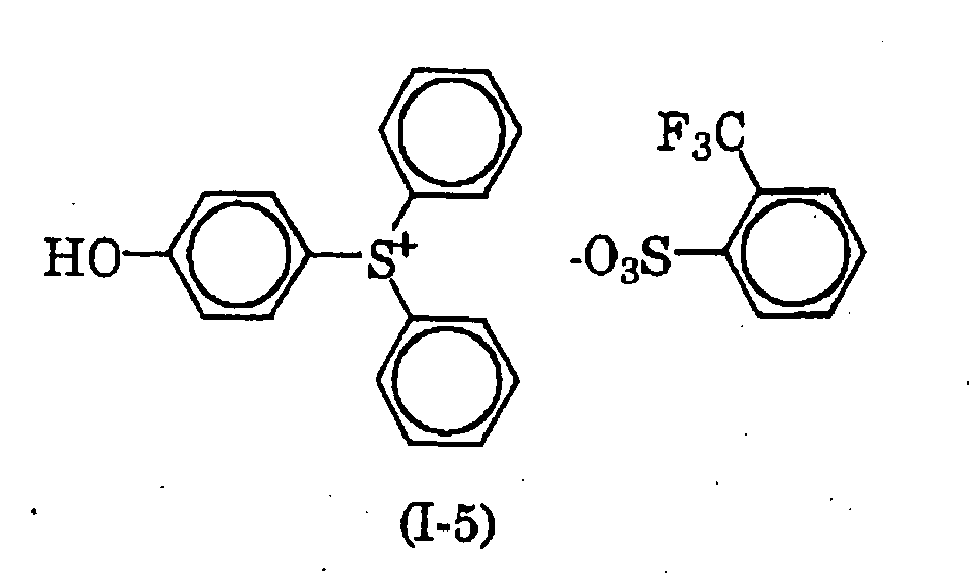
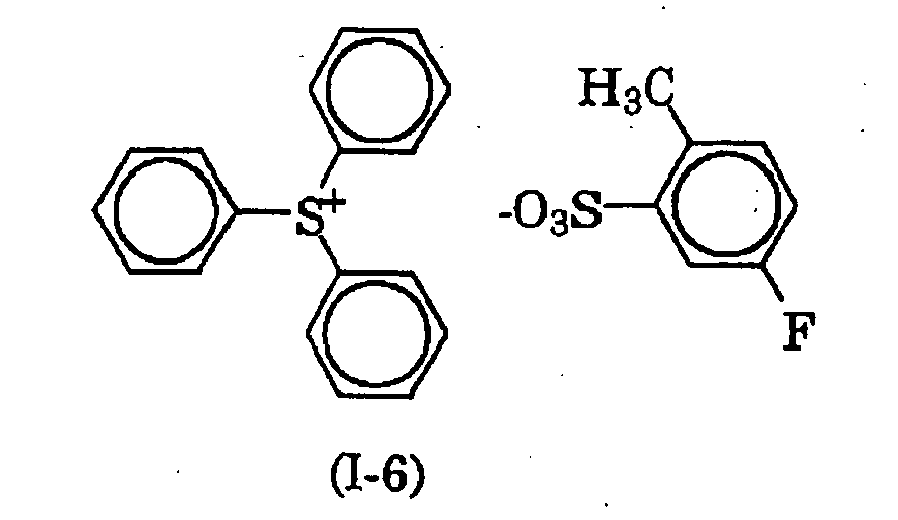


- The compounds represented by formulae (I) and (II) can be synthesized, for example, by a method of reacting an aryl Grignard's reagent such as aryl magnesium bromide with a substituted or unsubstituted phenylsulfoxide, and salt-exchanging the obtained triarylsulfonium halide with a corresponding sulfonic acid; a method of condensing and salt-exchanging a substituted or unsubstituted phenylsulfoxide and a corresponding aromatic compound by using an acid catalyst such as methanesulfonic acid/diphosphorus pentoxide or aluminum chloride; or a method of condensing and salt-exchanging a diaryl iodonium salt and diaryl sulfide by using a catalyst such as copper acetate.
- The compound of formula (III) can be synthesized through salt-exchange of reacting an aromatic compound by using a periodate.
- In the present invention, the compound of (A1) and the compound of (A2) can be used in combination at the following ratio. The ratio of compound of (A1)/compound of (A2) is, in terms of the molar ratio, from 100/0 to 10/90, preferably from 90/10 to 30/70, more preferably from 80/20 to 40/60.
- The resist composition of the present invention may further contain a compound of (A3) as the acid generator.
- Examples of the fluorine-containing carboxylic acid include a fluorine-substituted aliphatic carboxylic acid and a fluorine-substituted aromatic carboxylic acid.
- Examples of the fluorine-substituted aliphatic carboxylic acid include a fluorine-substitution product of an aliphatic carboxylic acid such as acetic acid, propionic acid, n-butyric acid, isobutyric acid, valerianic acid, trimethylacetic acid, caproic acid, heptanoic acid, caprylic acid, pelargonic acid, capric acid, lauric acid, myristic acid, palmitic acid, stearic acid, undecanoic acid and tridecanoic acid. These carboxylic acids each may have a hydroxyl group, an alkoxy group or a halogen atom (excluding a fluorine atom) as the substituent. Also, the aliphatic chain thereof may contain a linking group such as oxygen atom, sulfur atom, carbonyl group, ester group and sulfonyl group.
- Preferred examples of the fluorine-substituted aliphatic carboxylic acid include an aliphatic carboxylic acid represented by the following formula:
L-(CH2)p(CF2)q(CH2)r-COOH
wherein L represents a hydrogen atom or a fluorine atom, p and r each independently represents an integer of 0 to 15 and q represents an integer of 1 to 15. The hydrogen atom or fluorine atom of the alkyl chain in this formula may be substituted with an alkyl group (preferably having a carbon number of 1 to 5) which may be substituted with a fluorine atom, an alkoxy group (preferably having a carbon number of 1 to 5) which may be substituted with a fluorine atom, or a hydroxyl group. - The fluorine-substituted aliphatic carboxylic acid is preferably a fluorine-substitution product of a saturated aliphatic carboxylic acid having a carbon number of 2 to 20, more preferably from 4 to 20. By having a carbon number of 4 or more, diffusibility of the carboxylic acid generated decreases and the change in line width due to aging after exposure until heating can be more suppressed. In particular, a fluorine-substitution product of a linear or branched saturated aliphatic carboxylic acid having a carbon number of 4 to 18 is preferred.
- The fluorine-substituted aromatic carboxylic acid is preferably a fluorine-substitution product of an aromatic carboxylic acid having a carbon number of 7 to 20, more preferably from 7 to 15, still more preferably from 7 to 11. Specific examples thereof include a fluorine-substitution product of an aromatic carboxylic acid such as benzoic acid, substituted benzoic acid, naphthoic acid, substituted naphthoic acid, anthracenecarboxylic acid and substituted anthracenecarboxylic acid (examples of the substituent include an alkyl group, an alkoxy group, a hydroxyl group, a halogen atom, an aryl group, an acyl group, an acyloxy group, a nitro group, an alkylthio group and an arylthio group). Among these, a fluorine-substitution product of benzoic acid or substituted benzoic acid is preferred.
- The fluorine atom-substituted aliphatic or aromatic carboxylic acid is an aliphatic or aromatic carboxylic acid where one or more hydrogen atom present in the skeleton except for the carboxyl group is substituted with a fluorine atom, preferably an aliphatic or aromatic carboxylic acid where all hydrogen atoms present in the skeleton except for the carboxyl group are substituted with a fluorine atom (that is, a perfluoro saturated aliphatic carboxylic acid or a perfluoro aromatic carboxylic acid). By this constitution, more excellent sensitivity is obtained.
- Preferred examples of the compound of (A3) include an onium salt compound (e.g., sulfonium salt, iodonium salt) having, as the counter anion, an anion of the above-described fluorine atom-substituted aliphatic or aromatic carboxylic acid, an imidocarboxylate compound having a carboxylic acid ester group, and a nitrobenzyl ester compound.
- The compound of (A3) is more preferably a compound represented by the following formula (IF), (IIF) or (IIIF).
- By using such a compound, the sensitivity, resolution and exposure margin are more enhanced. This compound generates a saturated aliphatic or aromatic carboxylic acid substituted with at least one fluorine atom, corresponding to X- of formulae (IF) to (IIIF), upon irradiation of actinic rays or radiation and functions as an acid generator.


- X is preferably an anion of a perfluoro-aliphatic or aromatic carboxylic acid, more preferably an anion of a fluorine-substituted alkylcarboxylic acid having a carbon number of 4 or more.
- In formulae (IF) to (IIIF), the linear or branched alkyl group of R1 to R38 includes a linear or branched alkyl group having a carbon number of 1 to 4, which may have a substituent, such as methyl group, ethyl group, propyl group, n-butyl group, sec-butyl group and tert-butyl group. The cyclic alkyl group includes a cyclic alkyl group having a carbon number of 3 to 8, which may have a substituent, such as cyclopropyl group, cyclopentyl group and cyclohexyl group.
- The alkoxy group of R1 to R37 includes an alkoxy group having a carbon number of 1 to 4, which may have a substituent, such as methoxy group, ethoxy group, hydroxyethoxy group, propoxy group, n-butoxy group, isobutoxy group, sec-butoxy group and tert-butoxy group.
- The halogen atom of R1 to R37 includes a fluorine atom, a chlorine atom, a bromine atom and an iodine atom.
- The aryl group of R38 includes an aryl group having a carbon number of 6 to 14, such as phenyl group, tolyl group, methoxyphenyl group and naphthyl group. The aryl group may have a substituent.
- Preferred examples of the substituent include an alkoxy group having a carbon number of 1 to 4, a halogen atom (e.g., fluorine; chlorine, iodine), an aryl group having a carbon number of 6 to 10, an alkenyl group having a carbon number of 2 to 6, a cyano group, a hydroxy group, a carboxy group, an alkoxycarbonyl group and a nitro group.
- The iodonium or sulfonium compound represented by formulae (IF) to (IIIF) for use in the present invention has, as the counter anion X-, an anion of a saturated aliphatic or aromatic carboxylic acid substituted with at least one fluorine atom. This anion is an anion (-COO-) resulting from desorption of a hydrogen atom of the carboxylic acid (-COOH).
- Specific examples of these compounds are set forth below, but the present invention is not limited thereto.
Specific Examples (I-1f) to (I-36f) of Acid Generator Represented by Formula (IF):





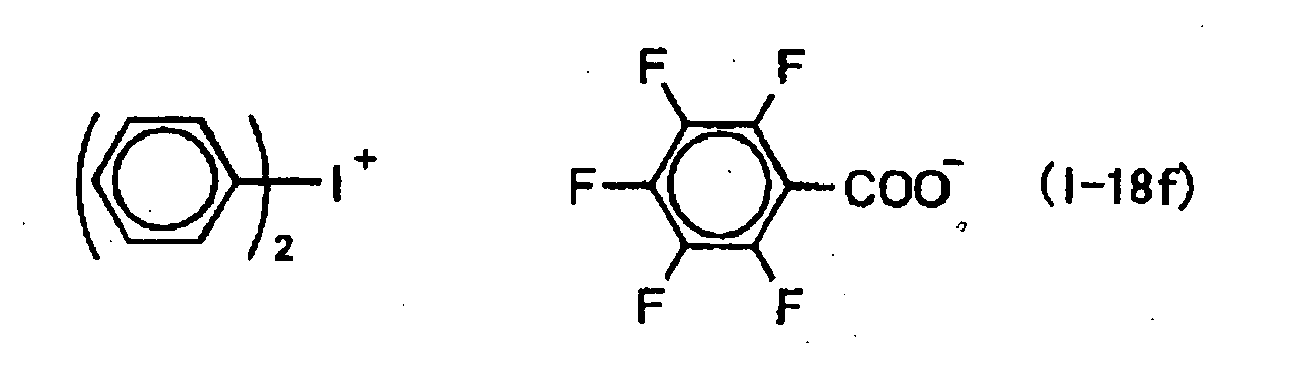


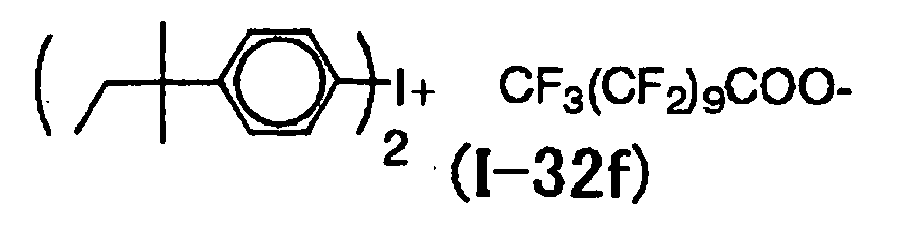


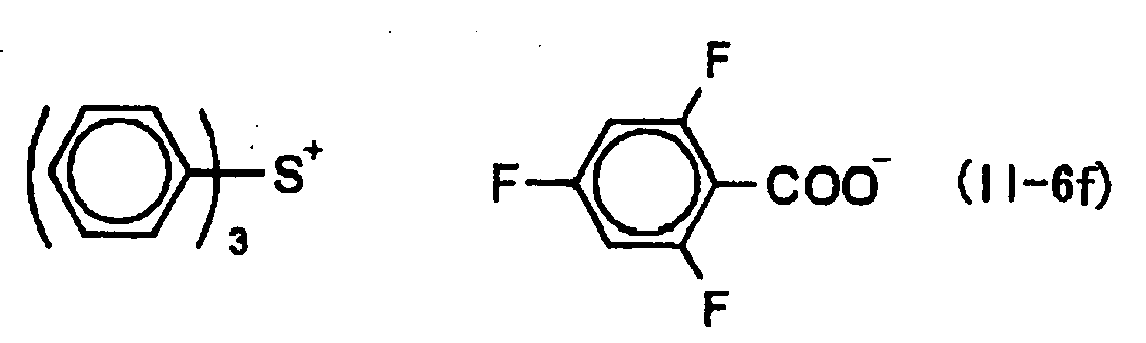


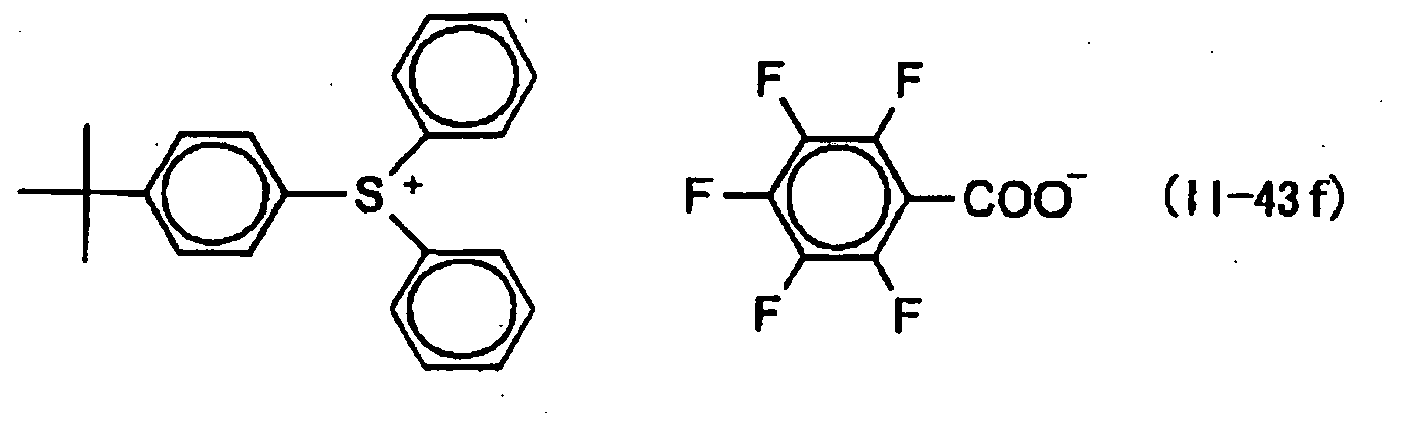

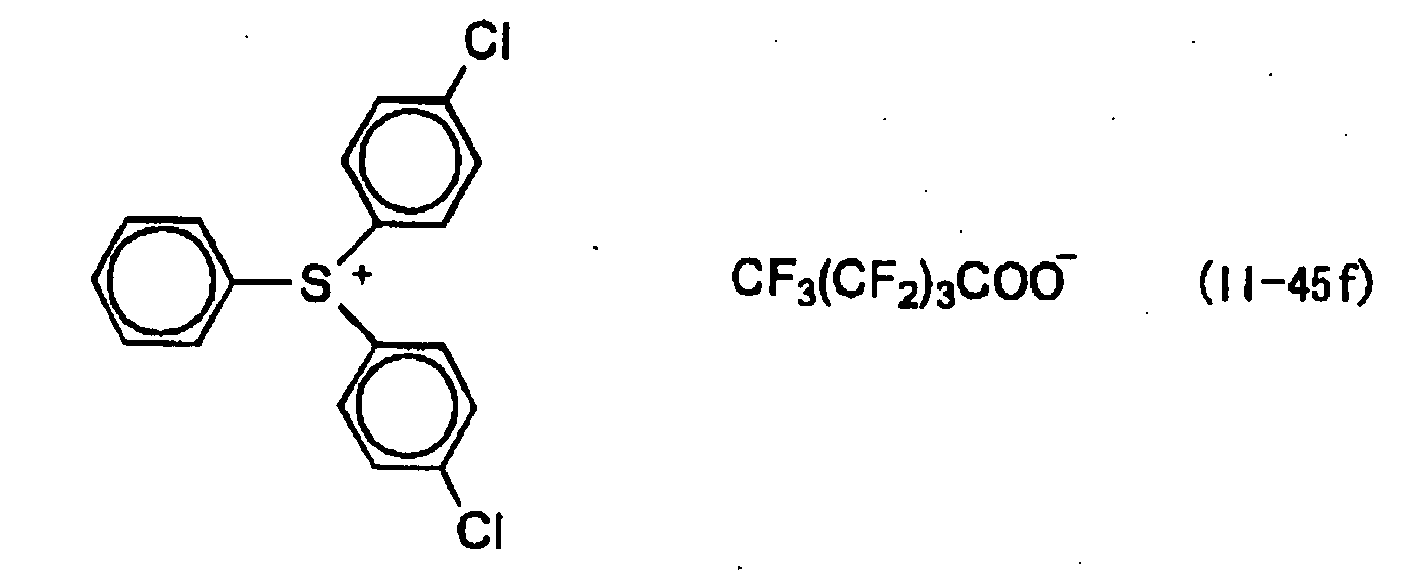


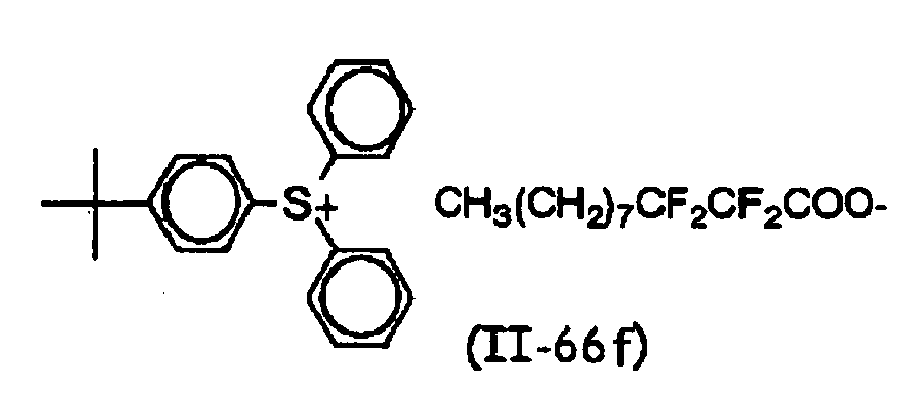


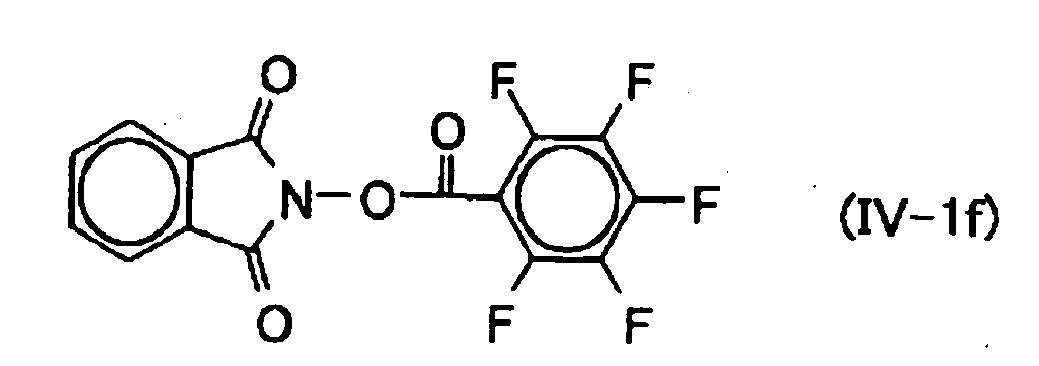


- The compound represented by formula (IF) can be synthesized by reacting an aromatic compound with use of a periodate, and salt-exchanging the obtained iodonium salt with a corresponding carboxylic acid.
- The compounds represented by formulae (IIF) and (IIIF) can be synthesized, for example, by a method of reacting an aryl Grignard's reagent such as aryl magnesium bromide with a substituted or unsubstituted phenylsulfoxide, and salt-exchanging the obtained triarylsulfonium halide with a corresponding carboxylic acid. These compounds can also be synthesized by a method of condensing and salt-exchanging a substituted or unsubstituted phenylsulfoxide and a corresponding aromatic compound with use of an acid catalyst such as methanesulfonic acid/diphosphorus pentoxide or aluminum chloride, or a method of condensing and salt-exchanging a diaryl iodonium salt and diaryl sulfide with use of a catalyst such as copper acetate.
- The salt-exchange can be performed by once synthesizing a halide salt and converting it into a carboxylate with use of a silver reagent such as silver oxide, or by using an ion exchange resin. The carboxylic acid or carboxylate for use in the salt-exchange may be a commercially available product or may be obtained by the hydrolysis of a commercially available carboxylic acid halide.
- With respect to the fluorine-substituted carboxylic acid as the anion moiety, a carboxylic acid derived from a fluoro-aliphatic compound produced by a telomerization process (also called a telomer process) or an oligomerization process (also called an oligomer process) is also preferred. The production process of this fluoro-aliphatic compound is described, for example, in Nobuo Ishikawa (supervisor), Fusso Kagobutsu no Gosei to Kino (Synthesis and Function of Fluorine Compounds), CMC, pp. 117-118 (1987), and Milos Hudlicky and Attila E. Pavlath, Chemistry of Organic Fluorine Compounds II, Monograph 187, pp. 747-752, American Chemical Society (1995). The telomerization process is a method of radical-polymerizing a fluorine-containing vinyl compound such as tetrafluoroethylene by using, as the telogen, an alkyl halide having a large chain transfer constant, such as iodide, to synthesize a telomer. By the synthesis according to the telomer process, a mixture containing a plurality of compounds differing in the carbon chain length is obtained. This mixture may be used as it is or may be purified before use.
- In the present invention, the compound of (A1) and the compound of (A3) can be used in combination at the following ratio. The ratio of compound of (A1)/compound of (A3) is, in terms of the molar ratio, from 100/0 to 10/90, preferably from 90/10 to 30/70, more preferably from 80/20 to 40/60.
- The resist composition of the present invention may further contain a compound of (A4) as the acid generator.
- Examples of the compound of (A4) include the compounds represented by the following formulae (AI) to (AV):


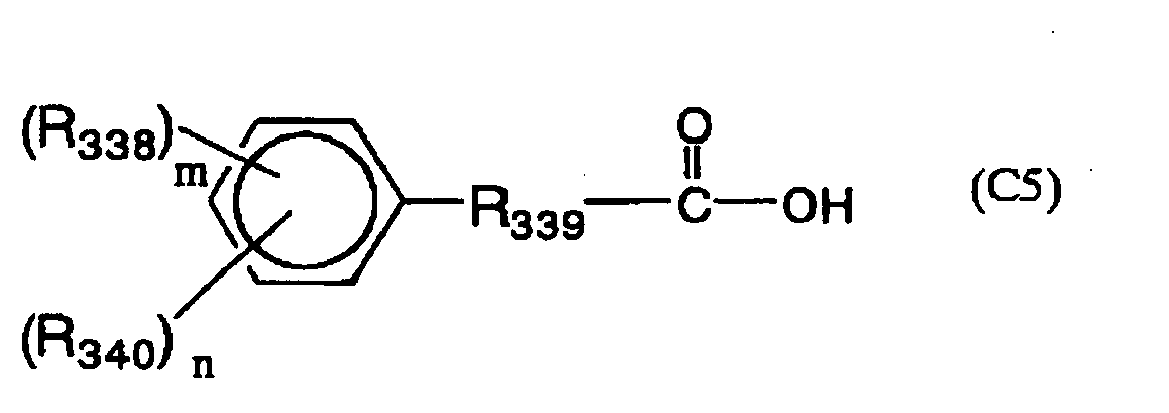


- In these formulae, R338 represents a linear, branched or cyclic alkyl group having a carbon number of 1 to 30 (the alkyl group may contain in the chain thereof an oxygen atom or a nitrogen atom), a linear, branched or cyclic alkenyl group having a carbon number of 2 to 20, a linear, branched or cyclic alkynyl group having a carbon number of 2 to 20, a linear, branched or cyclic alkoxyl group having a carbon number of 1 to 20, a group where at least a part of the hydrogen atom in the above-described alkyl group is substituted with a halogen atom and/or a hydroxyl group, a group where at least a part of the hydrogen atom in the above-described alkenyl group is substituted with a halogen atom and/or a hydroxyl group, or a substituted or unsubstituted aryl group having a carbon number of 6 to 20. Examples of the substituent for the aryl group include an alkyl group, a nitro group, a hydroxyl group, an alkoxy group, an acyl group, an alkoxycarbonyl group and a halogen atom).
- R339 represents a single bond, a linear, branched or cyclic alkylene group having a carbon number of 1 to 20 (the alkylene group may contain in the chain thereof an oxygen atom or a nitrogen atom), a linear, branched or cyclic alkenylene group having a carbon number of 2 to 20, a group where at least a part of the hydrogen atom in the above-described alkylene group is substituted with a halogen atom and/or a hydroxyl group, a group where at least a part of the hydrogen atom in the above-described alkenylene group is substituted with a halogen atom, or an alkoxyalkylene group having a carbon number of 2 to 20, and a plurality of R338's or a plurality of R339's may be the same or different.
- R340 represents a hydroxyl group or a halogen atom, and a plurality of R340's may be the same or different. m, n, p and q each independently represents an integer of 0 to 3, provided that m+n≤5 and p+q≤5, and z represents 0 or 1.
- In formulae (AI) to (AV), the linear or branched alkyl group of R301 to R337, Ra, Rb, Rc, Rd and R0 includes a linear or branched alkyl group having a carbon number of 1 to 4, which may have a substituent, such as methyl group, ethyl group, propyl group, n-butyl group, sec-butyl group and tert-butyl group. The cyclic alkyl group includes a cyclic alkyl group having a carbon number of 3 to 8, which may have a substituent, such as cyclopropyl group, cyclopentyl group and cyclohexyl group.
- The alkoxy group of R301 to R337, Ra and Rb includes an alkoxy group having a carbon number of 1 to 4, such as methoxy group, ethoxy group, hydroxyethoxy group, propoxy group, n-butoxy group, isobutoxy group, sec-butoxy group and tert-butoxy group.
- The halogen atom of R301 to R337, Ra, Rb, Rc and Rd includes a fluorine atom, a chlorine atom, a bromine atom and an iodine atom.
- The aryl group of R0, Rc and Rd includes an aryl group having a carbon number of 6 to 14, which may have a substituent, such as phenyl group, tolyl group, methoxyphenyl group and naphthyl group.
- Preferred examples of the substituent include an alkoxy group having a carbon number of 1 to 4, a halogen atom (e.g., fluorine, chlorine, iodine), an aryl group having a carbon number of 6 to 10, an alkenyl group having a carbon number of 2 to 6, a cyano group, a hydroxy group, a carboxy group, an alkoxycarbonyl group and a nitro group.
- Examples of the aromatic ring and the monocyclic or polycyclic hydrocarbon ring (these rings each may contain an oxygen atom or a nitrogen atom) formed by combining Rc and Rd include a benzene structure, a naphthalene structure, a cyclohexane structure, a norbornene structure and an oxabicyclo structure.
- The sulfonium or iodonium compound represented by formulae (AI) to (AIII) for use in the present invention contains, as the counter anion X-, an anion (-COO-) formed from a carboxyl group (-COOH) of at least one compound out of the carboxylic acid compounds represented by formulae (C1) to (C10).
- The compound represented by formula (AIV) or (AV) for use in the present invention contains, as the substituent X1 or X2, a substituent resulting from conversion of the carboxyl group (-COOH) of at least one compound out of the carboxylic acid compounds represented by formula (C1) to (C10) into an ester group (-COO-).
- The linear, branched or cyclic alkyl group having a carbon number of 1 to 30 (the alkyl group may contain in the chain thereof an oxygen atom or a nitrogen atom) of R338 includes, for example, methyl, ethyl, propyl, butyl, pentyl, hexyl, cyclohexyl, dodecyl, 1-ethoxyethyl and adamantyl.
- The linear, branched or cyclic alkenyl group having a carbon number of 1 to 20 includes, for example, ethenyl, propenyl, isopropenyl and cyclohexene.
- The linear, branched or cyclic alkynyl group having a carbon number of 2 to 20 includes, for example, acetylene and propenylene.
- The linear, branched or cyclic alkoxy group having a carbon number of 1 to 20 includes, for example, methoxy, ethoxy, propyloxy, butoxy, cyclohexyloxy, isobutoxy and dodecyloxy.
- The substituted or unsubstituted aryl group having a carbon number of 6 to 20 includes, for example, phenyl, naphthyl and anthranyl.
- Examples of the substituent for the aryl group include an alkyl group, a nitro group, a hydroxyl group, an alkoxy group, an acyl group, an alkoxycarbonyl group and a halogen atom.
- The linear, branched or cyclic alkylene group having a carbon number of 1 to 20 (the alkylene group may contain in the chain thereof an oxygen atom or a nitrogen atom) of R339 includes, for example, methylene, ethylene, propylene, butylene, isobutylene; ethoxyethylene and cyclohexylene.
- The linear, branched or cyclic alkenylene group having a carbon number of 2 to 20 includes, for example, vinylene and allylene.
- Specific examples of these compounds are set forth below, but the present invention is not limited thereto.






- In the present invention, the compound of (A1) and the compound of (A4) can be used in combination at the following ratio. The ratio of compound of (A1)/compound of (A4) is, in terms of the molar ratio, from 100/0 to 10/90, preferably from 90/10 to 30/70, more preferably from 80/20 to 40/60.
- Furthermore, a compound capable of generating an acid upon irradiation of radiation, other than the compounds of (A1), (A2), (A3) and (A4), may also be used in combination.
- The ratio of the compounds (total amount) of (A1), (A2), (A3) and (A4) to the compound capable of generating an acid upon irradiation of radiation, which can be further used in combination, is, in terms of the molar ratio, from 100/0 to 10/90, preferably from 98/2 to 40/60, more preferably from 95/5 to 50/50.
- Such a compound capable of generating an acid upon irradiation of actinic rays or radiation, which can be further used in combination, may be appropriately selected from a photoinitiator for cationic polymerization, a photoinitiator for photoradical polymerization, a photo-decoloring agent for coloring matters, a photo-discoloring agent, a compound capable of generating an acid upon irradiation of known light used for microresist or the like, and a mixture thereof.
- Examples thereof include an onium salt such as diazonium salt described in S.I. Schlesinger, Photogr. Sci. Eng., 18, 387 (1974), and T.S. Bal et al., Polymer, 21, 423 (1980), ammonium salt described in U.S. Patents 4,069,055, 4,069,056 and Re27,992, and JP-A-3-140140, phosphonium salt described in D.C. Necker et al., Macromolecules, 17, 2468 (1984), C.S. Wen et al., Teh, Proc. Conf. Rad. Curing ASIA, p. 478, Tokyo, Oct. (1988), and U.S. Patents 4,069,055 and 4,069,056, iodonium salt described in J.V. Crivello et al., Macromolecules, 10 (6), 1307 (1977), Chem. & Eng. News, Nov. 28, page 31 (1988), European Patents 104,143, 339,049 and 410,201, JP-A-2-150848, and JP-A-2-296514, sulfonium salt described in J.V. Crivello et al., Polymer J., 17, 73 (1985), J.V. Crivello et al., J. Org. Chem., 43, 3055 (1978), W.R. Watt et al., J. Polymer Sci., Polymer Chem. Ed., 22, 1789 (1984), J.V. Crivello et al., Polymer Bull., 14, 279 (1985), J.V. Crivello et al., Macromolecules, 14 (5), 1141 (1981), J.V. Crivello et al., J. Polymer Sci., Polymer Chem. Ed., 17, 2877 (1979), European Patents 370,693, 161,811, 410,201, 339,049, 233,567, 297,443 and 297,442, U.S. Patents 3,902,114, 4,933,377, 4,760,013, 4,734,444 and 2,833,827, German Patents 2,904,626, 3,604,580 and 3,604,581, selenonium salt described in J.V. Crivello et al., Macromolecules, 10 (6), 1307 (1977), J.V. Crivello et al., J. Polymer Sci., Polymer Chem. Ed., 17, 1047 (1979), and arsonium salt described in C.S. Wen et al., Teh, Proc. Conf. Rad. Curing ASIA, p. 478, Tokyo, Oct. (1988); an organic halogen compound described in U.S. Patent 3,905,815, JP-B-46-4605 (the term "JP-B" as used herein means an "examined Japanese patent publication"), JP-A-48-36281, JP-A-55-32070, JP-A-60-239736, JP-A-61-169835, JP-A-61-169837, JP-A-62-58241, JP-A-62-212401, JP-A-63-70243 and JP-A-63-298339; an organic metal/an organic halide described in K. Meier et al., J. Rad. Curing, 13 (4), 26 (1986), T.P. Gill et al., Inorg. Chem., 19, 3007 (1980), D. Astruc, Acc. Chem. Res., 19 (12), 377 (1896) and JP-A-2-161445; a photoacid generator having an o-nitrobenzyl type protective group described in S. Hayase et al., J. Polymer Sci., 25, 753 (1987), E. Reichmanis et al., J. Polymer Sci., Polymer Chem. Ed., 23, 1 (1985), Q.Q. Zhu et al., J. Photochem., 36, 85, 39, 317 (1987), B. Amit et al., Tetrahedron Lett., (24) 2205 (1973), D.H.R. Barton et al., J. Chem. Soc., 3571 (1965), P.M. Collins et al., J. Chem. Soc., Perkin I, 1695 (1975), M. Rudinstein et al., Tetrahedron Lett., (17), 1445 (1975), J.W. Walker et al., J. Am. Chem. Soc., 110, 7170 (1988), S.C. Busman et al., J. Imaging Technol., 11 (4), 191 (1985), H.M. Houlihan et al., Macromolecules, 21, 2001 (1988), P.M. Collins et al., J. Chem. Commun., 532 (1972), S. Hayase et al., Macromolecules, 18, 1799 (1985), E. Reichmanis et al., J. Electrochem. Soc., Solid State Sci. Technol., 130 (6), F.M. Houlihan et al., Macromolecules, 21, 2001 (1988), European Patents 0,290,750, 046,083, 156,535, 271,851 and 0,388,343, U.S. Patents 3,901,710 and 4,181,531, JP-A-60-198538 and JP-A-53-133022; a compound capable of photochemically decomposing to generate a sulfonic acid, as represented by iminosulfonate, described in M. TUNOOKA et al., Polymer Preprints Japan, 35 (8), G. Bemer et al., J. Rad. Curing, 13 (4), W.J. Mijs et al., Coating Technol., 55 (697), 45 (1983), Akzo, H. Adachi et al., Polymer Preprints, Japan, 37 (3), European Patents 0,199,672, 84,515, 044,115, 618,564 and 0,101,122, U.S. Patents 4,371,605 and 4,431,774, JP-A-64-18143, JP-A-2-245756 and JP-A-3-140109; and a disulfone compound described in JP-A-61-166544.
- Furthermore, a compound obtained by incorporating such a group or compound capable of generating an acid by the effect of light into the main or side chain of a polymer can be used, and examples thereof include the compounds described in M.E. Woodhouse et al., J. Am. Chem. Soc., 104, 5586 (1982), S.P. Pappas et al., J. Imaging Sci., 30 (5), 218 (1986), S. Kondo et al., Makromol. Chem., Rapid Commun., 9, 625 (1988), Y. Yamada et al., Makromol. Chem., 152, 153, 163 (1972), J.V. Crivello et al., J. Polymer Sci., Polymer Chem. Ed., 17, 3845 (1979), U.S. Patent 3,849,137, German Patent 3,914,407, JP-A-63-26653, JP-A-55-164824, JP-A-62-69263, JP-A-63-146038, JP-A-63-163452, JP-A-62-153853 and JP-A-63-146029.
- Also, a compound capable of generating an acid by the effect of light described, for example, in V.N.R. Pillai, Synthesis, (1), 1 (1980), A. Abad et al., Tetrahedron Lett., (47) 4555 (1971), D.H.R. Barton et al., J. Chem. Soc., (C), 329 (1970), U.S. Patent 3,779,778 and European Patent 126,712 may be used.
- The component (BP) for use in the positive resist composition of the present invention is a resin having a group capable of decomposing under the action of an acid, in the main or side chain or both main and side chains of the resin. A resin having a group capable of decomposing under the action of an acid, in the side chain is preferred.
- Preferred examples of the group capable of decomposing under the action of an acid include a -COOA0 group and a -0-B0 group.
- A0 represents -C(R01)(R02)(R03), -Si(R01)(R02)(R03) or -C(R04)(R05)-O-R06, and B0 represents A° or a -CO-O-A0 group. R01 to R06, which may be the same or different, each represents an alkyl group which may have a substituent, a cycloalkyl group which may have a substituent, an alkenyl group which may have a substituent, an aralkyl group which may have a substituent, or an aryl group which may have a substituent.
- Preferred examples of the acid-decomposable group include a silyl ether group, a cumyl ester group, an acetal group, a tetrahydropyranyl ether group, an enol ether group, an enol ester group, a tertiary alkyl ether group, a tertiary alkyl ester group and a tertiary alkyl carbonate group. Among these, more preferred are a tertiary alkyl ester group, a tertiary alkyl carbonate group, a cumyl ester group, an acetal group and a tetrahydropyranyl ether group, and still more preferred is a tert-butoxycarbonyl group.
- In the case where such a group capable of decomposing under the action of an acid is bonded as a side chain, the matrix resin is an alkali-soluble resin having a -OH or -COOH group in the side chain. Examples thereof include alkali-soluble resins which are described later.
- The alkali-soluble resin preferably has an alkali dissolution rate of 170 A/sec or more, more preferably 330 A/sec or more (A is angstrom), as measured (23°C) with 0.261 N tetramethylammonium hydroxide (TMAH).
- From this standpoint, preferred alkali-soluble resins are an o-, m- or p-(hydroxystyrene) copolymer, a hydrogenated poly(hydroxystyrene), a halogen- or alkylsubstituted poly(hydroxystyrene), a partially O-alkylated or O-acylated poly(hydroxystyrene), a styrene-hydroxystyrene copolymer, an α-methylstyrene-hydroxystyrene copolymer and a hydrogenated novolak resin.
- As for the component (BP), a resin having a structural unit containing a group represented by formula (X1) or (X2) is also preferred.
- In formula (X1), R1b and R2b, which may be the same or different, each represents a hydrogen atom or an alkyl group. R3b and R4b, which may be the same or different, each represents a hydrogen atom, an alkyl group which may have a substituent, or a cycloalkyl group which may have a substituent. R5b represents an alkyl group which may have a substituent, a cycloalkyl group which may have a substituent, an aryl group which may have a substituent, or an aralkyl group which may have a substituent. m represents an integer of 0 to 20, and n represents an integer of 0 to 5.
- In formula (X2), R6b and R7b, which may be the same or different, each represents a hydrogen atom or an alkyl group. W represents a divalent organic group. R8b represents an alkyl group which may have a substituent, a cycloalkyl group which may have a substituent, an aryl group which may have a substituent, or an aralkyl group which may have a substituent.
- The alkyl group of R01 to R06 and R1b to R8b may be either linear or branched and is preferably an alkyl group having a carbon number of 1 to 4, which may have a substituent, such as methyl group, ethyl group, propyl group, n-butyl group, sec-butyl group and tert-butyl group.
- The cycloalkyl group of R01 to R06, R3b to R5b and R8b is preferably a cycloalkyl group having a carbon number of 3 to 8, which may have a substituent, such as cyclopropyl group, cyclopentyl group and cyclohexyl group.
- The alkenyl group of R01 to R06 is preferably an alkenyl group having a carbon number of 2 to 8, and examples thereof include a vinyl group, an allyl group, a butenyl group and a cyclohexenyl group.
- The aralkyl group of R01 to R06, R5b and R8b is preferably an aralkyl group having a carbon number of 7 to 12, and examples thereof include a benzyl group, a phenethyl group and a naphthylmethyl group.
- The aryl group of R01 to R06, R5b and R8b is preferably an aryl group having a carbon number of 6 to 15, and examples thereof include a phenyl group, a tolyl group, a naphthyl group and an anthryl group.
- Examples of the further substituent in the above-described alkyl group, cycloalkyl group, alkenyl group, aralkyl group and aryl group include a carboxyl group, an acyloxy group, a cyano group, an aryl group, an alkyl group, a cycloalkyl group, a halogen atom, a hydroxyl group, an alkoxy group, an acetylamide group, an alkoxycarbonyl group and an acyl group.
- The divalent organic group in W is preferably a linear, branched or cyclic alkylene group, arylene group, heteroarylene group or aralkylene group which may have a substituent, - S-, -C(=O)-, -N(R4c)-, -SO-, -SO2- -CO2-, -N(R4c)SO2-, or a divalent group comprising a combination of two or more of these groups. R4c represents a hydrogen atom or an alkyl group (specific examples of the alkyl group are the same as those described for R01 and the like).
- The component (BP) for use in the present invention can be obtained by reacting a precursor of a group capable of decomposing under the action of an acid with an alkali-soluble resin or by copolymerizing an alkali-soluble resin monomer having bonded thereto a group capable of decomposing under the action of an acid with various monomers, and this is disclosed, for example, in European Patent 254,853, JP-A-2-25850, JP-A-3-223860 and JP-A-4-251259.
- Specific examples of the component (BP) for use in the present invention are set forth below, but the present invention is not limited thereto.


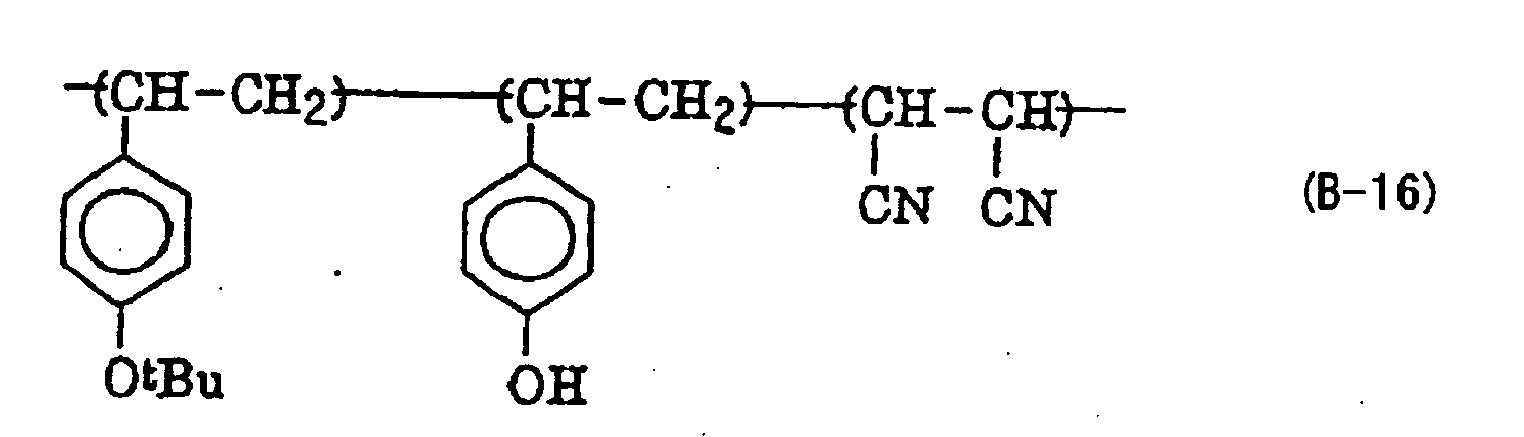


- In view of the film shrinkage after PEB, adhesion to substrate, reduction of scumming, and standing wave on the pattern side wall, the content of the group capable of decomposing under the action of an acid, which is expressed by B/(B+S) using the number (B) of groups capable of decomposing under the action of an acid and contained in the resin and the number (S) of alkali-soluble groups not protected by a group capable of decomposing under the action of an acid, is preferably from 0.01 to 0.7, more preferably from 0.05 to 0.50, still more preferably from 0.05 to 0.40.
- The weight average molecular weight (Mw) of the component (BP) is preferably from 2,000 to 200,000, more preferably from 5,000 to 100,000, still more preferably from 8,000 to 50,000.
- The molecular weight distribution (Mw/Mn) is preferably from 1.0 to 4.0, more preferably from 1.0 to 2.0, still more preferably from 1.0 to 1.6.
- The weight average molecular weight as used herein is defined by the polystyrene-reduced value according to gel permeation chromatography.
- The polymers as the component (BP) may be used in combination of two or more thereof.
- The amount added of the polymer as the component (BP) is suitably from 70 to 98 mass%, preferably from 80 to 96 mass%, based on the solid content of the positive resist composition. (BN) Alkali-soluble resin (hereinafter sometimes referred to as a "component (BN)" or a "resin of (BN)")
- As for the alkali-soluble resin for use in the present invention, polymers having a phenol skeleton heretofore disclosed for resist can be widely used, such as phenol novolak resin, polyvinylphenol resin, copolymer having a structural unit derived from vinylphenol, and resin obtained by partially protecting or modifying a polyvinylphenol resin.
- The resin as the component (BN) is preferably a resin having a repeating unit represented by formula (a):

R2 represents a hydrogen atom, an alkyl group, a cycloalkyl group, an aryl group, an aralkyl group or an acyl,
R3 and R4, which be the same or different, each represents a hydrogen atom, a halogen atom, a cyano group, an alkyl group, a cycloalkyl group, an alkenyl group, an aralkyl group or an aryl group,
A represents a single bond, an alkylene, alkenylene, cycloalkylene or arylene group which may have a substituent, -O-, -SO2-, -O-CO-R5-, -CO-O-R6- or -CO-N(R7)-R8-,
R5, R6 and R8, which may be the same or different, each represents a single bond, an alkylene group, an alkenylene group, a cycloalkylene group, an arylene group, or a divalent group formed by combining at least one of these groups with at least one structure selected from the group consisting of an ether structure, an ester structure, an amide structure, a urethane structure and a ureido structure,
R7 represents a hydrogen atom or an alkyl, cycloalkyl, aralkyl or aryl group which may have a substituent,
n represents an integer of 1 to 3, and
a plurality of R2's or a pair of R2 and R3 or R4 may combine to form a ring. - The resin is more preferably a phenol resin having a repeating structural unit represented by formula (a).
- The alkyl group of R1 to R4 and R7 is, for example, an alkyl group having a carbon number of 1 to 8, and specific preferred examples thereof include a methyl group, an ethyl group, a propyl group, an n-butyl group, a sec-butyl group, a hexyl group, a 2-ethylhexyl group, an octyl group and a haloalkyl group (e.g., chloromethyl, chloroethyl, chloropropyl, chlorobutyl, bromomethyl, bromoethyl). The cycloalkyl group of R2 to R4 and R7 may be monocyclic or polycyclic. Preferred examples of the monocyclic cycloalkyl group include a cycloalkyl group having a carbon number of 3 to 8, such as cyclopropyl group, cyclopentyl group and cyclohexyl group. Preferred examples of the polycyclic cycloalkyl group include an adamantyl group, a norbornyl group, an isoboronyl group, a dicyclopentyl group, an α-pinel group and a tricyclodecanyl group.
- The alkenyl group of R3 and R4 is, for example, an alkenyl group having a carbon number of 2 to 8, and specific preferred examples thereof include a vinyl group, an allyl group, a butenyl group and a cyclohexenyl group.
- The aryl group of R2 to R4 and R7 is, for example, an aryl group having a carbon number of 6 to 15, and specific preferred examples thereof include a phenyl group, a tolyl group, a dimethylphenyl group, a 2,4,6-trimethylphenyl group, a naphthyl group and an anthryl group.
- The aralkyl group of R2 to R4 and R7 is, for example, an aralkyl group having a carbon number of 7 to 12, and specific preferred examples thereof include a benzyl group, a phenethyl group and a naphthylmethyl group.
- The acyl group of R2 is, for example, an acyl group having a carbon number of 1 to 8, and specific preferred examples thereof include a formyl group, an acetyl group, a propanoyl group, a butanoyl group, a pivaloyl group and benzoyl group.
- The alkylene group of A, R5, R6 and R8 is preferably an alkylene group having a carbon number of 1 to 8, which may have a substituent, such as methylene group, ethylene group, propylene group, butylene group, hexylene group and octylene group.
- The alkenylene group of A, R5, R6 and R8 is preferably an alkenylene group having a carbon number of 2 to 6, which may have a substituent, such as ethenylene group, propenylene group and butenylene group.
- The cycloalkylene group of A, R5, R6 and R8 is preferably a cycloalkylene group having a carbon number of 5 to 8, which may have a substituent, such as cyclopentylene group and cyclohexylene group.
- The arylene group of A, R5, R6 and R8 is preferably an arylene group having a carbon number of 6 to 12, which may have a substituent, such as phenylene group, tolylene group and naphthylene group.
- Examples of the substituent substituted to these groups include those having active hydrogen, such as amino group, amido group, ureido group, urethane group, hydroxyl group and carboxyl group, a halogen atom (e.g., fluorine, chlorine, bromine, iodine), an alkoxy group (e.g., methoxy, ethoxy, propoxy, butoxy), a thioether group, an acyl group (e.g., acetyl, propanoyl, benzoyl), an acyloxy group (e.g., acetoxy, propanoyloxy, benzoyloxy), an alkoxycarbonyl group (e.g., methoxycarbonyl, ethoxycarbonyl, propoxycarbonyl), a cyano group and a nitro group. Among these, those having active hydrogen, such as amino group, hydroxyl group and carboxyl group, are preferred.
- Examples of the ring formed by combining a plurality of R2's or combining a pair of R2 and R3 or R4 include an oxygen atom-containing 4- to 7-membered ring such as benzofuran ring, benzodioxonol ring and benzopyran ring.
- The resin (BN) for use in the present invention may be a resin comprising only the repeating unit represented by formula (a), but for the purpose of more enhancing the resist performance, another polymerizable monomer may be copolymerized.
- Examples of the copolymerization monomer which can be used include a compound having one addition-polymerizable unsaturated bond selected from acrylic acid esters, acrylamides, methacrylic acid esters, methacrylamides, allyl compounds, vinyl ethers, vinyl esters, styrenes and crotonic acid esters.
- Among these copolymerization components, preferred are a monomer having a carboxyl group, such as N-(carboxyphenyl)acrylamide and N-(carboxyphenyl)methacrylamide, and a monomer capable of enhancing the alkali solubility, such as maleimide.
- The content of the another polymerizable monomer in the resin for use in the present invention is preferably 50 mol% or less, more preferably 30 mol% or less, based on all repeating units.
- Specific examples of the resin having a repeating structural unit represented by formula (a) are set forth below, but the present invention is not limited thereto.


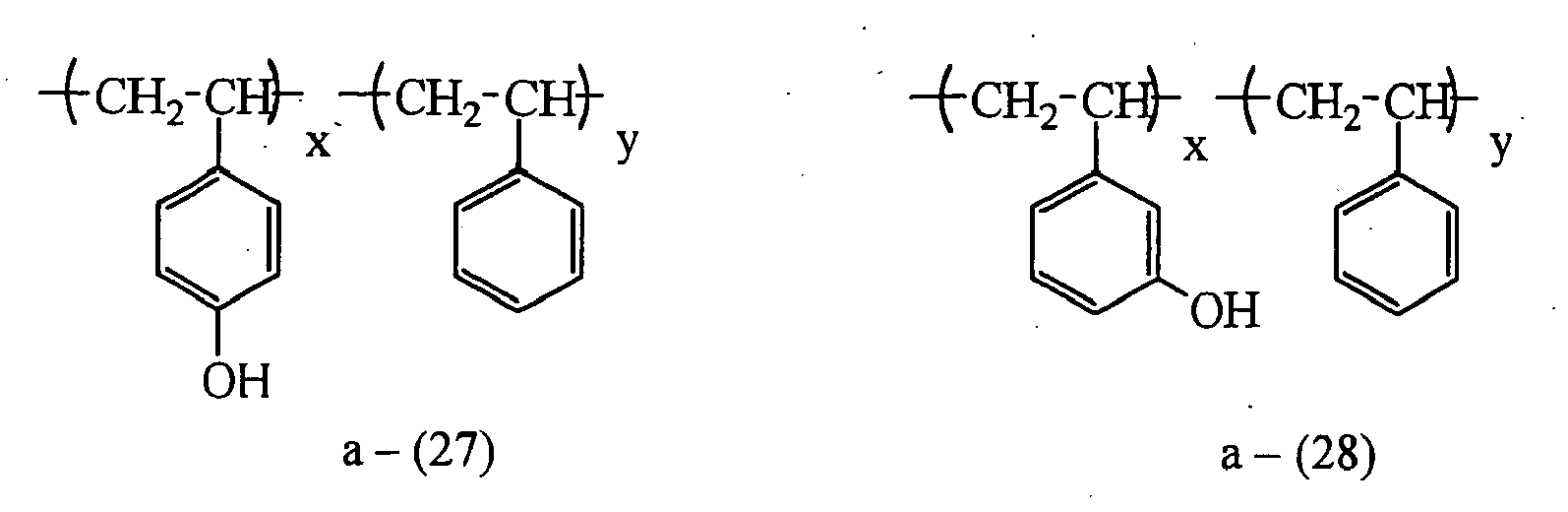

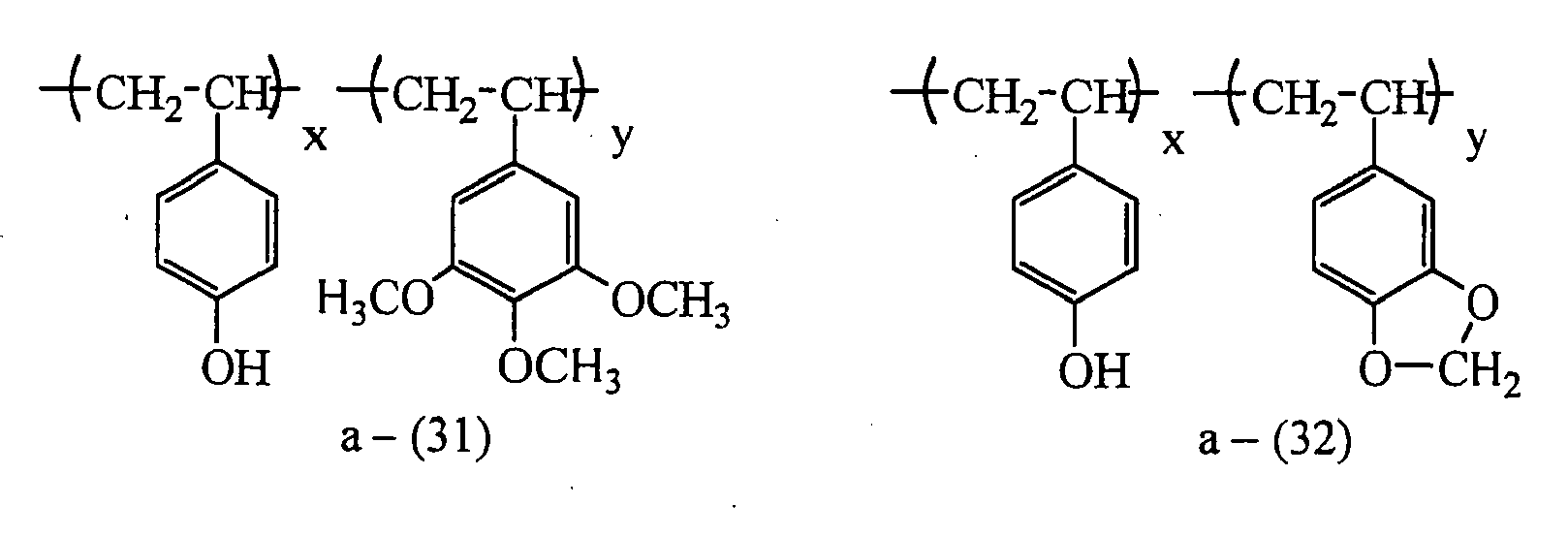


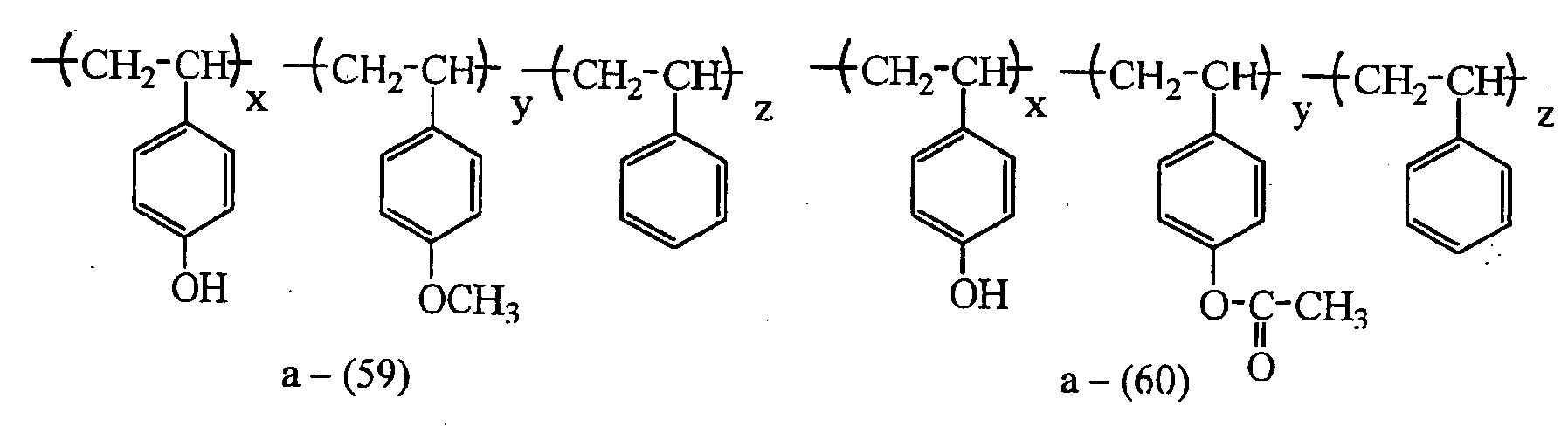


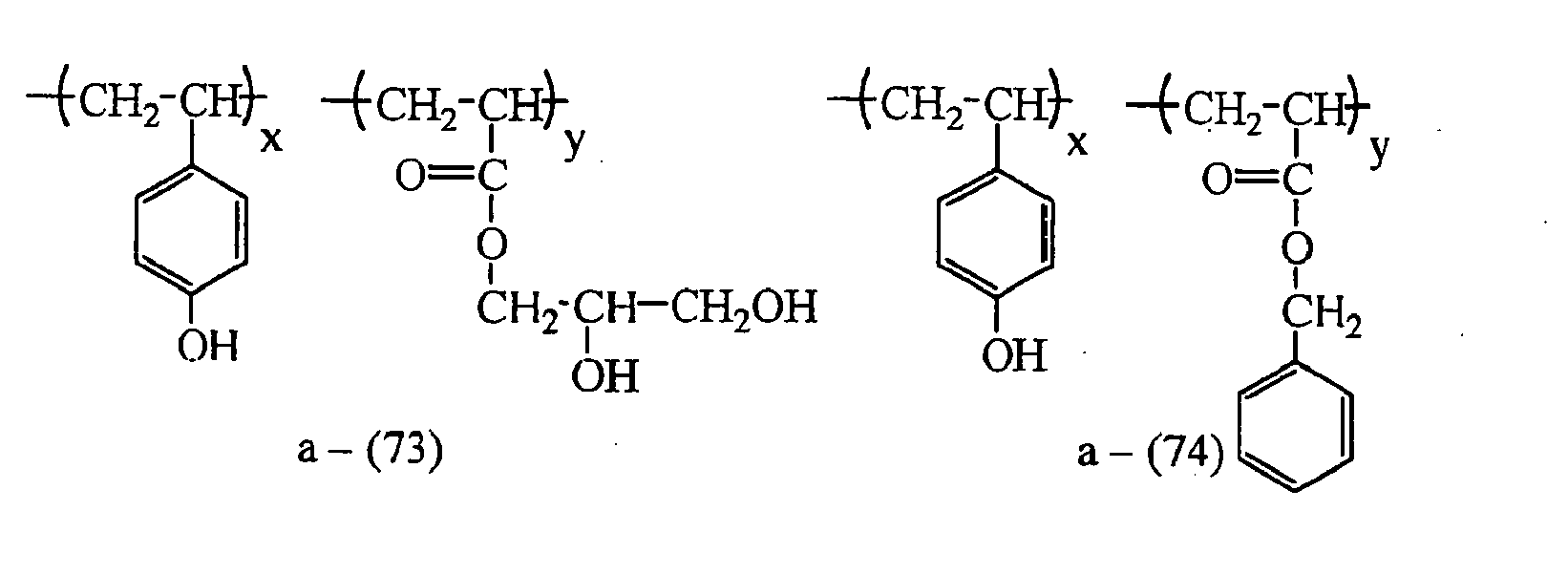


- In these specific examples, n represents a positive integer, and x, y and z represent a molar ratio of the resin composition. In the case of a resin comprising two components, x=10 to 95 and y=5 to 90, preferably x=40 to 90 and y=10 to 60, and in the case of a resin comprising three components, x=10 to 90, y=5 to 85 and z=5 to 85, preferably x=40 to 80, y=10 to 50 and z=10 to 50.
- The molecular weight of the resin of (BN) preferably having a structural unit represented by formula (a) is, in terms of the weight average molecular weight, preferably from 1,000 to 200,000, more preferably from 3,000 to 50,000. The molecular weight distribution is from 1 to 10, preferably from 1 to 3, more preferably from 1 to 1.5. As the molecular weight distribution is narrower, higher resolution, better resist profile, smoother side wall of resist pattern and more excellent roughness property are obtained.
- The content of the repeating structural unit represented by formula (a) is from 5 to 100 mol%, preferably from 10 to 90 mol%, based on the resin having a repeating unit of formula (a).
- The alkali-soluble resin containing a structural unit represented by formula (a) for use in the present invention can be synthesized by a method described in Macromolecules, 28(11), 3787-3789 (1995), Polym. Bull. (Berlin), 24(4), 385-389 (1990) or JP-A-8-286375. That is, the objective alkali-soluble resin can be obtained by radical polymerization or living anion polymerization.
- One of such resins may be used or a plurality of these resins may be used as a mixture.
- The weight average molecular weight as used herein is defined by the polystyrene-reduced value according to gel permeation chromatography.
- The alkali dissolution rate of the alkali-soluble resin is preferably 20 Å/sec or more, more preferably 200 Å/sec or more, as measured (at 23°C) in 0.261N tetramethylammonium hydroxide (TMAH).
- In the present invention, the alkali-soluble resin having a repeating unit represented by formula (a) may be used alone but may be used in combination with another alkali-soluble resin. As for the ratio of the resins used, the another alkali-soluble resin can be used in combination in an amount of maximally 100 parts by mass per 100 parts by mass of the alkali-soluble resin having a repeating unit represented by formula (a). Examples of the alkali-soluble resin which can be used in combination are described below.
- For example, a novolak resin, a hydrogenated novolak resin, an acetone-pyrogallol resin, a styrene-maleic anhydride copolymer, a carboxyl group-containing methacrylic resin and a derivative thereof may be used, but the alkali-soluble resin which can be used in combination is not limited thereto.
- The amount of the resin (BN) added is from 30 to 95 mass%, preferably from 40 to 90 mass%, more preferably from 50 to 80 mass%, based on the entire solid content of the composition.
- The compound that crosslinks by the effect of an acid for use in the negative resist composition of the present invention (hereinafter, appropriately referred to as an "acid crosslinking agent" or simply as a "crosslinking agent") is a compound capable of crosslinking the alkali-soluble resin in the presence of an acid, for example, an acid generated upon irradiation of radiation. Such a crosslinking agent includes, for example, a compound containing one or more substituent (hereinafter, referred to as a "crosslinkable substituent") having a crosslinking reactivity with the alkali-soluble resin.
- Specific examples of the crosslinkable substituent include (i) a hydroxyalkyl group and a derivative thereof, such as hydroxyalkyl group, alkoxyalkyl group and acetoxyalkyl group; (ii) a carbonyl group and a derivative thereof, such as formyl group and carboxyalkyl group; (iii) a substituent having a nitrogen-containing group, such as dimethylaminomethyl group, diethylaminomethyl group, dimethylolaminomethyl group, diethylolaminomethyl group and morpholinomethyl group; (iv) a glycidyl group-containing substituent such as glycidyl ether group, glycidyl ester group and glycidyl amino group; (v) an aromatic derivative such as arylcarbonyloxyalkyl group (e.g., benzyloxymethyl, benzoyloxymethyl) and arallcyloxyalkyl group; and (vi) a polymerizable multiple bond-containing substituent such as vinyl group and isopropenyl group. The crosslinkable substituent of the crosslinking agent for use in the present invention is preferably, for example, a hydroxyalkyl group or an alkoxyalkyl group, more preferably an alkoxymethyl group.
- Examples of the crosslinking agent having the above-described crosslinkable substituent include (i) a methylol group-containing compound such as methylol group-containing melamine compound, methylol group-containing benzoguanamine compound, methylol group-containing urea compound, methylol group-containing glycoluril compound and methylol group-containing phenol compound; (ii) an alkoxyalkyl group-containing compound such as alkoxyalkyl group-containing melamine compound, alkoxyalkyl group-containing benzoguanamine compound, alkoxyalkyl group-containing urea compound, alkoxyalkyl group-containing glycoluril compound and alkoxyalkyl group-containing phenol compound; (iii) a carboxymethyl group-containing compound such as carboxymethyl group-containing melamine compound, carboxymethyl group-containing benzoguanamine compound, carboxymethyl group-containing urea compound, carboxymethyl group-containing glycoluril compound and carboxymethyl group-containing phenol compound; and (iv) an epoxy compound such as Bisphenol A-based epoxy compound, Bisphenol F-based epoxy compound, Bisphenol S-based epoxy compound, novolak resin-based epoxy compound, resol resin-based epoxy compound and poly(hydroxystyrene)-based epoxy compound.
- As for the crosslinking agent, a resin imparted with a property as a crosslinking agent by introducing the above-described crosslinkable substituent into an acidic functional group of an alkali-soluble resin can also be used. In this case, the introduction ratio of the crosslinkable substituent is usually controlled to be from 5 to 60 mol%, preferably from 10 to 50 mol%, more preferably from 15 to 40 mol%, based on all acidic functional groups in the alkali-soluble resin. If the introduction ratio of the crosslinkable substituent is less than 5 mol%, a sufficient crosslinking reaction can be hardly brought about and this readily causes, for example, reduction in the residual film ratio and swelling phenomenon or meandering of the pattern, whereas if it exceeds 60 mol%, the alkali solubility of the alkali-soluble resin tends to decrease, giving rise to worsening of the developability.
- The crosslinking agent for use in the resist composition of the present invention is preferably an alkoxymethylated urea compound or a resin thereof, or an alkoxymethylated glycoluril compound or a resin thereof.
- Particularly preferred examples of the crosslinking agent (C1) include a compound represented by any one of formulae (4) to (6) and an alkoxymethylated melamine compound.
- R5b in formulae (4) to (6) each independently represents a hydrogen atom, an alkyl group (preferably having a carbon number of 1 to 5, more preferably from 1 to 3, such as methyl group, ethyl group or propyl group) or an acyl group (preferably having a carbon number of 2 to 6, more preferably from 2 to 4, such as acetyl group or propionyl group).
- R6b to R9b in formula (4) each independently represents a hydrogen atom, a hydroxyl group, an alkyl group (preferably having a carbon number of 1 to 5, more preferably from 1 to 3, such as methyl group, ethyl group or propyl group) or an alkoxyl group (preferably a carbon number of 1 to 5, more preferably from 1 to 3, such as methoxy group, ethoxy group or propoxy group). X represents a single bond, a methylene group or an oxygen atom. X is preferably a single bond or a methylene group.
- Incidentally, these groups each may further have a substituent such as alkyl group (e.g., methyl, ethyl), alkoxy group (e.g., methoxy, ethoxy), hydroxyl group or halogen atom.
- Specific examples of the compounds represented by formulae (4) to (6) and the alkoxymethylated melamine compound are set forth below, but the present invention is limited thereto.


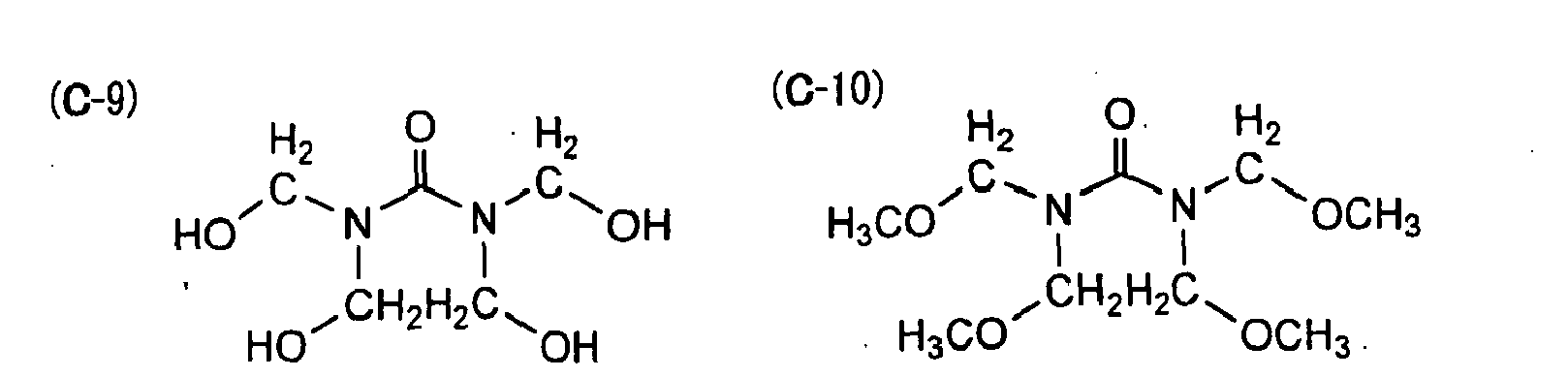


- The crosslinking agent can be obtained, for example, by introducing a methylol group through a condensation reaction of a urea compound or glycoluril compound with formalin, etherifying the methylol group with a lower alcohol (e.g., methyl alcohol, ethyl alcohol, propyl alcohol, butyl alcohol), cooling the reaction solution, and recovering the precipitated compound or a resin thereof. The crosslinking agent is also available as a commercial product, for example, CYMEL (produced by Mitsui Cyanamid Co., Ltd.) or Nikarad (produced by Sanwa Chemical Co., Ltd.).
- Particularly preferred examples of the crosslinking agent (C2) further include a compound which is a phenol derivative having from 1 to 6 benzene rings within the molecule and in which two or more hydroxymethyl groups and/or alkoxymethyl groups are present in the entire molecule and these groups are connected to at least any one of the benzene rings.
- Among these, preferred is a phenol derivative having a molecular weight of 1,500 or less, containing from 1 to 6 benzene rings within the molecule and having two or more hydroxymethyl groups and/or alkoxymethyl groups in total, in which the hydroxymethyl groups and/or alkoxy methyl groups are connected concentrically to any one of those benzene rings or distributedly to the benzene rings.
- The alkoxymethyl group connected to the benzene ring is preferably an alkoxymethyl group having a carbon number of 6 or less. Specific preferred examples thereof include a methoxymethyl group, an ethoxymethyl group, an n-propoxymethyl group, an i-propoxymethyl group, an n-butoxymethyl group, an i-butoxymethyl group, a sec-butoxymethyl group and a tert-butoxymethyl group. Furthermore, an alkoxy- substituted alkoxy group such as 2-methoxyethoxy group and 2-methoxy-1-propoxy group is also preferred. Among these phenol derivatives, the followings are particularly preferred.

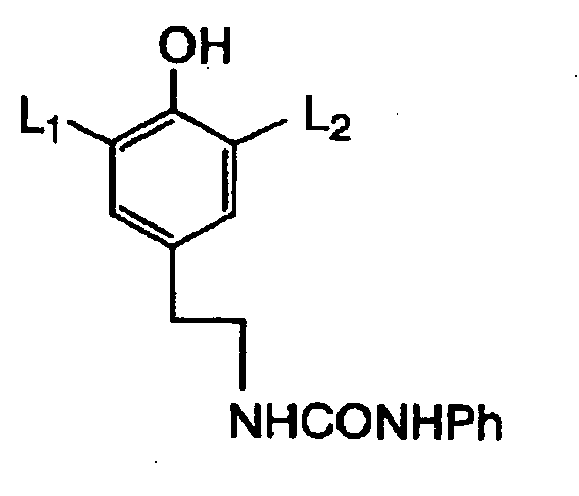


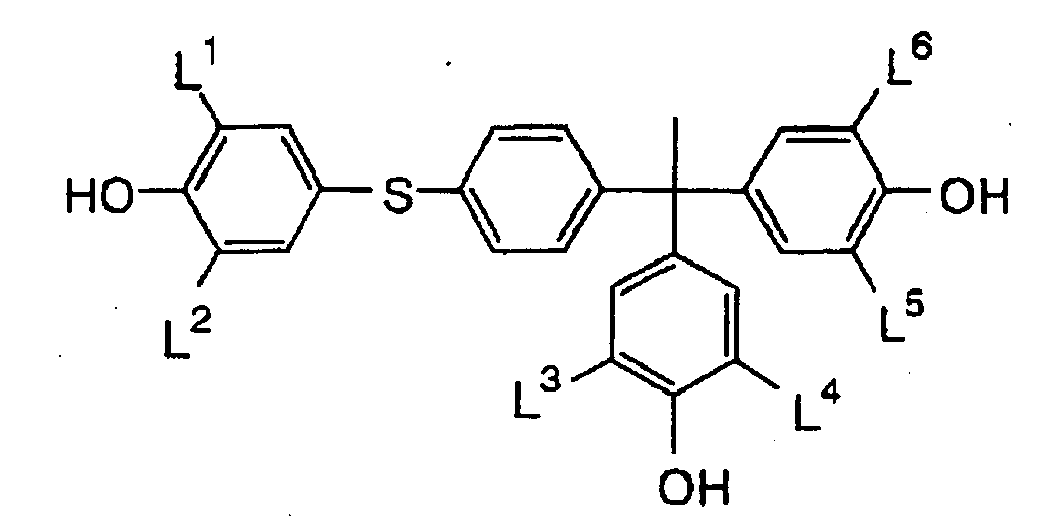


- The phenol derivative having a hydroxymethyl group can be obtained by reacting a corresponding phenol compound not having a hydroxymethyl group (a compound when L1 to L8 in the formulae above are a hydrogen atom) with formaldehyde in the presence of a base catalyst. At this time, the reaction is preferably performed at a temperature of 60°C or less so as to prevent occurrence of resinification or gelation. More specifically, the phenol derivative can be synthesized by the method described, for example, in JP-A-6-282067 and JP-A-7-64285.
- The phenol derivative having an alkoxymethyl group can be obtained by reacting a corresponding phenol derivative having a hydroxymethyl group with an alcohol in the presence of an acid catalyst. At this time, the reaction is preferably performed at a temperature of 100°C or less so as to prevent occurrence of resinification or gelation. More specifically, the phenol derivative can be synthesized by the method described, for example, in EP-A-632003.
- A phenol derivative having a hydroxymethyl group or an alkoxymethyl group is preferred in view of stability during storage, but a phenol derivative having an alkoxymethyl group is more preferred in view of stability during storage. One of the phenol derivatives having two or more hydroxymethyl groups or alkoxymethyl groups in total, in which these groups are connected concentrically to any one of the benzene rings or distributedly to the benzene rings, may be used alone, or two or more thereof may be used in combination.
- In the present invention, in view of residual film ratio and resolving power, the crosslinking agent is used in an amount of 3 to 70 mass%, preferably from 5 to 50 mass%, based on the entire solid content of the resist composition.
- Two or more of the compounds having an N-hydroxymethyl group, an N-alkoxymethyl group or an N-acyloxymethyl group, or two or more of the phenol derivatives having a hydroxymethyl group or an alkoxymethyl group may be used in combination. Other Components for Use in Resist Composition of the Present Invention:
- The resist composition of the present invention may further contain, for example, an organic basic compound, a dye, a solvent, a fluorine-containing surfactant and/or silicon-containing surfactant, and another surfactant, if desired.
Organic Basic Compound: - The organic basic compound for use in the present invention is preferably an organic basic compound having basicity higher than that of phenol. Among such compounds, a nitrogen-containing basic compound is preferred.
- The chemical environment of the nitrogen-containing basic compound is preferably a structure represented by any one of the following formulae (A) to (E):


- In these formulae, R250, R251 and R252, which may be the same or different, each represents a hydrogen atom, an alkyl group having a carbon number of 1 to 20, a cycloalkyl group having a carbon number of 1 to 20, or a substituted or unsubstituted aryl group having a carbon number of 6 to 20, and R251 and R252 may combine with each other to form a ring.
- The alkyl group may be unsubstituted or may have a substituent, and the alkyl group having a substituent is preferably an aminoalkyl group having a carbon number of 1 to 6 or a hydroxyalkyl group having a carbon number of 1 to 6.
- R253, R254, R255 and R256, which may be the same or different, each represents an alkyl group having a carbon number of 1 to 6.
- The compound is more preferably a nitrogen-containing basic compound having two or more nitrogen atoms differing in the chemical environment within one molecule, still more preferably a compound containing both a substituted or unsubstituted amino group and a nitrogen atom-containing ring structure, or a compound having an alkylamino group.
- Specific preferred examples thereof include a substituted or unsubstituted guanidine, a substituted or unsubstituted aminopyridine, a substituted or unsubstituted aminoalkylpyridine, a substituted or unsubstituted aminopyrrolidine, a substituted or unsubstituted indazole, an imidazole, a substituted or unsubstituted pyrazole, a substituted or unsubstituted pyrazine, a substituted or unsubstituted pyrimidine, a substituted or unsubstituted purine, a substituted or unsubstituted imidazoline, a substituted or unsubstituted pyrazoline, a substituted or unsubstituted piperazine, a substituted or unsubstituted aminomorpholine and a substituted or unsubstituted aminoalkylmorpholine. Preferred examples of the substituent include an amino group, an alkyl group, an alkoxy group, an acyl group, an acyloxy group, an aryl group, an aryloxy group, a nitro group, a hydroxyl group and a cyano group.
- Particularly preferred examples of the compound include, but are not limited to, guanidine, 1,1-dimethylguanidine, 1,1,3,3-tetramethylguanidine, imidazole, 2-methylimidazole, 4-methylimidazole, N-methylimidazole, 2-phenylimidazole, 4,5-diphenylimidazole, 2,4,5-triphenylimidazole, 2-aminopyridine, 3-aminopyridine, 4-aminopyridine, 2-dimethylaminopyridine, 4-dimethylaminopyridine, 2-diethylaminopyridine, 2-(aminomethyl)pyridine, 2-amino-3-methylpyridine, 2-amino-4-methylpyridine, 2-amino-5-methylpyridine, 2-amino-6-methylpyridine, 3-aminoethylpyridine, 4-aminoethylpyridine, 3-aminopyrrolidine, piperazine, N-(2-aminoethyl)piperazine, N-(2-aminoethyl)piperidine, 4-amino-2,2,6,6-tetramethylpiperidine, 4-piperidinopiperidine, 2-iminopiperidine, 1-(2-aminoethyl)pyrrolidine, pyrazole, 3-amino-5-methylpyrazole, 5-amino-3-methyl-1-p-tolylpyrazole, pyrazine, 2-(aminomethyl)-5-methylpyrazine, pyrimidine, 2,4-diaminopyrimidine, 4,6-dihydroxypyrimidine, 2-pyrazoline, 3-pyrazoline, N-aminomorpholine and N-(2-aminoethyl)morpholine.
- One of these organic basic compounds is used alone or two or more thereof are used in combination.
- The ratio of the acid generator and the organic basic compound used in the positive resist composition is preferably (acid generator)/(organic basic compound) (by mol) = 2.5 to 300. The (acid generator)/(organic basic compound) (by mol) is more preferably from 5.0 to 200, still more preferably from 7.0 to 150.
- The amount of the organic basic compound used is usually from 0.001 to 10 mass%, preferably from 0.01 to 5 mass%, based on the entire solid content of the negative resist composition.
Dye: - Suitable dyes include an oily dye and a basic dye. Specific examples thereof include Oil Yellow #101, Oil Yellow #103, Oil Pink #312, Oil Green BG, Oil Blue BOS, Oil Blue #603, Oil Black BY, Oil Black BS, Oil Black T-505 (all produced by Orient Chemical Industries Co., Ltd.), Crystal Violet (CI42555), Methyl Violet (CI42535), Rhodamine B (CI45170B), Malachite Green (CI42000) and Methylene Blue (CI52015).
- The resist composition of the present invention is dissolved in a solvent which can dissolve the above-described components, and then coated on a support. Preferred examples of the solvent used here include ethylene dichloride, cyclohexanone, cyclopentanone, 2-heptanone, γ-butyrolactone, methyl ethyl ketone, ethylene glycol monomethyl ether, ethylene glycol monoethyl ether, 2-methoxyethyl acetate, ethylene glycol monoethyl ether acetate, propylene glycol monomethyl ether, propylene glycol monomethyl ether acetate, toluene, ethyl acetate, methyl lactate, ethyl lactate, methyl methoxypropionate, ethyl ethoxypropionate, methyl pyruvate, ethyl pyruvate, propyl pyruvate, N,N-dimethylformamide, dimethylsulfoxide, N-methylpyrrolidone and tetrahydrofuran. One of these solvents is used alone, or two or more thereof are used as a mixture.
- In particular, the solvent is preferably propylene glycol monomethyl ether acetate or a mixed solvent of propylene glycol monomethyl ether acetate/propylene glycol monomethyl ether.
- The resist composition of the present invention preferably further contains any one fluorine-containing and/or silicon-containing surfactant (a fluorine-containing surfactant, a silicon-containing surfactant or a surfactant containing both a fluorine atom and a silicon atom), or two or more thereof.
- When the resist composition of the present invention contains a fluorine-containing and/or silicon-containing surfactant, a resist pattern with good sensitivity and resolution and less failure of adhesion and development can be obtained on use of an exposure light source of 250 nm or less, particularly 220 nm or less.
- Examples of the fluorine-containing and/or silicon-containing surfactant include surfactants described in JP-A-62-36663, JP-A-61-226746, JP-A-61-226745, JP-A-62-170950, JP-A-63-34540, JP-A-7-230165, JP-A-8-62834, JP-A-9-54432, JP-A-9-5988, JP-A-2002-277862 and U.S. Patents 5,405,720, 5,360,692, 5,529,881, 5,296,330, 5,436,098, 5,576,143, 5,294,511 and 5,824,451. The following commercially available surfactants each may also be used as it is.
- Examples of the commercially available fluorine-containing and/or silicon-containing surfactant which can be used include a fluorine-containing or silicon-containing surfactant such as EFtop EF301 and EF303 (produced by Shin-Akita Kasei K.K.); Florad FC430 and 431 (produced by Sumitomo 3M Inc.); Megafac F171, F173, F176, F189 and R08 (produced by Dainippon Ink & Chemicals, Inc.); Surflon S-382, SC101, 102, 103, 104, 105 and 106 (produced by Asahi Glass Co., Ltd.); and Troysol S-366 (produced by Troy Chemical). In addition, a polysiloxane polymer KP-341 (produced by Shin-Etsu Chemical Co., Ltd.) may also be used as the silicon-containing surfactant.
- Other than these known fluorine-containing and/or silicon-containing surfactants, a surfactant using a polymer having a fluoro-aliphatic group, which is derived from a fluoro-aliphatic compound produced by telomerization process (also called telomer process) or oligomerization process (also called oligomer process), may be used. The fluoro-aliphatic compound can be synthesized by the method described in JP-A-2002-90991.
- The polymer having a fluoro-aliphatic group is preferably a copolymer of a fluoro-aliphatic group-containing monomer with (poly(oxyalkylene)) acrylate and/or (poly(oxyalkylene)) methacrylate, and the polymer may have an irregular distribution or may be a block copolymer. Examples of the poly(oxyalkylene) group include a poly(oxyethylene) group, a poly(oxypropylene) group and a poly(oxybutylene) group. This group may also be a unit having alkylenes differing in the chain length within the same chain, such as block-linked poly(oxyethylene, oxypropylene and oxyethylene) group and block-linked poly(oxyethylene and oxypropylene) group. Furthermore, the copolymer of a fluoro-aliphatic group-containing monomer with (poly(oxyalkylene)) acrylate (or methacrylate) may be not only a binary copolymer but also a ternary or higher copolymer obtained by simultaneously copolymerizing two or more different fluoro-aliphatic group-containing monomers or two or more different (poly(oxyalkylene)) acrylates (or methacrylates).
- Examples thereof include a commercially available fluorine-containing and/or silicon-containing surfactant such as Megafac F-178, F-470, F-473, F-475, F-476 and F-472 (produced by Dainippon Ink & Chemicals, Inc.); a copolymer of an acrylate (or methacrylate) having C6F13 group and a (poly(oxyalkylene)) acrylate (or methacrylate); a copolymer of an acrylate (or methacrylate) having C6F13 group, a (poly(oxyethylene)) acrylate (or methacrylate) and a (poly-(oxypropylene)) acrylate (or methacrylate); a copolymer of an acrylate (or methacrylate) having C8F17 group and a (poly(oxyalkylene)) acrylate (or methacrylate); and a copolymer of an acrylate (or methacrylate) having C8F17 group, a (poly(oxyethylene)) acrylate (or methacrylate) and a (poly(oxypropylene)) acrylate (or methacrylate).
- The amount of the fluorine-containing and/or silicon-containing surfactant used is preferably from 0.0001 to 2 mass%, more preferably from 0.001 to 1 mass%, based on the entire amount of the resist composition (excluding the solvent).
Another Surfactant: - Specific examples of another surfactant which can be used include a nonionic surfactant such as polyoxyethylene alkyl ethers (e.g., polyoxyethylene lauryl ether, polyoxyethylene stearyl ether, polyoxyethylene cetyl ether, polyoxyethylene oleyl ether), polyoxyethylene alkylaryl ethers (e.g., polyoxyethylene octylphenol ether, polyoxyethylene nonylphenol ether), polyoxyethylene polyoxypropylene block copolymers, sorbitan fatty acid esters (e.g., sorbitan monolaurate, sorbitan monopalmitate, sorbitan monostearate, sorbitan monooleate, sorbitan trioleate, sorbitan tristearate) and polyoxyethylene sorbitan fatty acid esters (e.g., polyoxyethylene sorbitan monolaurate, polyoxyethylene sorbitan monopalmitate, polyoxyethylene sorbitan monostearate, polyoxyethylene sorbitan trioleate, polyoxyethylene sorbitan tristearate).
- The blending amount of this another surfactant is usually 2 parts by mass or less, preferably 1 part by mass or less, per 100 parts by mass of the solid content in the composition of the present invention.
- In the production of a precision integrated circuit device, the step of forming a pattern on a resist film is performed by coating the resist composition of the present invention on a substrate (for example, transparent substrate such as silicon/silicon dioxide-coated substrate, glass substrate or ITO substrate) by an appropriate coating method such as spinner or coater, exposing the resist film through a predetermined mask, and then subjecting the resist film to heating, development, rinsing and drying, whereby a good resist pattern can be formed.
- The resist composition of the present invention is not limited in the type of the exposure light source, but an electron beam, EUV (extreme ultraviolet) light and an X ray may also be suitably used.
- In the present invention, a known inorganic or organic antireflection film may be used, if desired. Furthermore, an antireflection film may be used by coating it to underlie the resist layer.
- The antireflection film used as the lower layer of the resist may be either an inorganic film such as titanium, titanium dioxide, titanium nitride, chromium oxide, carbon and amorphous silicon, or an organic film comprising a light absorbent and a polymer material. The former requires equipment for the film formation, such as vacuum vapor-deposition apparatus, CVD apparatus and sputtering apparatus. Examples of the organic antireflection film include a film comprising a diphenylamine derivative and formaldehyde-modified melamine resin condensate, an alkali-soluble resin and a light absorbent described in JP-B-7-69611, a reaction product of a maleic anhydride copolymer and a diamine-type light absorbent described in U.S. Patent 5,294,680, a film comprising a resin binder and a methylolmelamine-based heat crosslinking agent described in JP-A-6-118631, an acrylic resin-type antireflection film containing a carboxylic acid group, an epoxy group and a light absorbing group within the same molecule described in JP-A-6-118656, a film comprising methylolmelamine and a benzophenone-based light absorbent described in JP-A-8-87115, and a film obtained by adding a low molecular light absorbent to a polyvinyl alcohol resin described in JP-A-8-179509.
- Also, the organic antireflection film may be a commercially available organic antireflection film such as DUV-30 Series and DUV-40 Series (produced by Brewer Science, Inc.); and AR-2, AR-3 and AR-5 (produced by Shipley Co., Ltd.).
- The developer which can be used for the resist composition of the present invention is an aqueous solution of alkalis such as inorganic alkalis (e.g., sodium hydroxide, potassium hydroxide, sodium carbonate, sodium silicate, sodium metasilicate, aqueous ammonia), primary amines (e.g., ethylamine, n-propylamine), secondary amines (e.g., diethylamine, di-n-butylamine), tertiary amines (e.g., triethylamine, methyldiethylamine), alcohol amines (e.g., dimetylethanolamine, triethanolamine), quaternary ammonium salt (e.g., tetramethylammonium hydroxide, tetraethylammonium hydroxide, choline), and cyclic amines (e.g., pyrrole, piperidine). Furthermore, this aqueous solution of an alkali may be used after adding thereto an alcohol (e.g., isopropyl alcohol) and a surfactant (e.g., nonionic surfactant) each in an appropriate amount.
- Among these alkali developers, preferred is an aqueous solution of a quaternary ammonium salt, and more preferred is an aqueous solution of tetramethylammonium hydroxide or choline.
- The present invention is described in greater detail below by referring to Examples, but the present invention is not limited thereto.
- In a nitrogen atmosphere, 23.5 g (0.1mol) of p-dibromobenzene was added to 150 ml of dehydrated tetrahydrofuran (THF). After cooling the flask, 5.0 g of magnesium was added little by little with stirring and subsequently, 0.1 g of iodine was added. The obtained magnesium bromide form was reacted with 40 g of benzothiophene oxide, and the resulting reaction solution was added to an aqueous ammonium chloride solution and after extraction with ethyl acetate, mixed with an aqueous potassium tripropylbenzenesulfonate to effect a salt exchange reaction, whereby the objective material (BP-4) was obtained.
- p-Acetoxystyrene (32.4 g) (0.2 mol) and 7.01 g (0.07 mol) of tert-butyl methacrylate were dissolved in 120 ml of butyl acetate and in a nitrogen stream, 0.033 g of azobisisobutyronitrile (AIBN) was added thereto with stirring at 80°C three times every 2.5 hours. The stirring was further continued for 5 hours, whereby the polymerization reaction was performed. The resulting reaction solution was poured in 1,200 ml of hexane to precipitate a white resin. The obtained resin was dried and then dissolved in 200 ml of methanol.
- An aqueous solution containing 7.7 g (0.19 mol) of sodium hydroxide/50 ml of water was added to the solution obtained above, and the resulting solution was refluxed under heat for 1 hour, thereby effecting hydrolysis. The resulting hydrolysate was diluted by adding 200 ml of water and then neutralized with hydrochloric acid to precipitate a white resin. This resin was separated by filtration, washed with water, dried and then dissolved in 200 ml of tetrahydrofuran, and the resulting solution was added dropwise in 5 L of ultrapure water with vigorous stirring, thereby effecting reprecipitation. This reprecipitation operation was repeated 3 times. The obtained resin was dried in a vacuum drier at 120°C for 12 hours to obtain a poly(p-hydroxystyrene/tert-butyl methacrylate) copolymer.
- Poly(p-hydroxystyrene) (10 g) (VP-8000, produced by Nippon Soda Co., Ltd.) was dissolved in 50 ml of pyridine, and 3.63 g of di-tert-butyl dicarbonate was added dropwise thereto with stirring at room temperature.
- After stirring for 3 hours at room temperature, the reaction solution was added dropwise to a solution containing 1 L of ion exchanged water/20 g of concentrated hydrochloric acid. The powder precipitated was filtered, washed with water and dried to obtain Resin (B-3).
- p-Cyclohexylphenol (83.1 g) (0.5 mol) was dissolved in 300 ml of toluene, and 150 g of 2-chloroethyl vinyl ether, 25 g of sodium hydroxide, 5 g of tetrabutylammonium bromide and 60 g of triethylamine were added thereto and allowed to react at 120°C for 5 hours. The resulting reaction solution was washed with water and the excess chloroethyl vinyl ether and toluene were distilled out. The obtained oil was purified by distillation under reduced pressure to obtain 4-cyclohexylphenoxyethyl vinyl ether.
- Poly(p-hydroxystyrene) (20 g) (VP-8000, produced by Nippon Soda Co., Ltd.) and 6.5 g of 4-cyclohexylphenoxyethyl vinyl ether were dissolved in 80 ml of THF, and 0.01 g of p-toluenesulfonic acid was added thereto and allowed to react at room temperature for 18 hours. The resulting reaction solution was added dropwise in 5 L of distilled water with vigorous stirring, and the powder precipitated was filtered and dried to obtain Resin (B-32).
- Other resins were synthesized in the same manner. The weight average molecular weight and molar ratio of repeating units of each resin used in the following Examples are shown below.
Resin Weight Average Molecular Weight Molar Ratio* of Repeating Units (B-3) 8500 25/75 (B-4) 8500 25/75 (B-21) 12000 65/35 (B-26) 11500 15/60/25 (B-28) 15000 78/22 (B-30) 8000 80/20 (B-31) 15000 65/10/25 (B-32) 12000 82/18 * In the order of parenthesized repeating units from left to right in the resin structure shown above. - 4-Acetoxystyrene (3.9 g (0.024 mol)) and 0.8 g (0.006 mol) of 4-methoxystyrene were dissolved in 30 ml of 1-methoxy-2-propanol and in a nitrogen stream, a 1-methoxy-2-propanol (70 ml) solution containing 50 mg of 2,2'-azobis(2,4-dimethylvaleronitrile) (V-65, trade name, produced by Wako Pure Chemical Industries, Ltd.) as the polymerization initiator, 9.1 g (0.056 mol) of 4-acetoxystyrene and 1.9 g (0.014 mol) of 4-methoxystyrene was added dropwise thereto with stirring at 70°C over 2 hours. After 2 hours, 50 mg of the initiator was additionally added and the reaction was allowed to proceed for another 2 hours. Thereafter, the temperature was raised to 90°C and stirring was continued for 1 hour. The resulting reaction solution was allowed to cool and then poured into 1 L of ion-exchanged water with vigorous stirring, thereby precipitating a white resin. The obtained resin was dried and then dissolved in 100 ml of methanol and after hydrolyzing the acetoxy group in the resin by adding an aqueous 25% tetramethylammonium hydroxide solution, the resulting solution was neutralized with an aqueous hydrochloric acid solution to precipitate a white resin. The obtained resin was washed with ion-exchanged water and dried under reduced pressure to obtain 11.6 g of Resin a-(29) of the present invention.
- The molecular weight of the resin was measured by GPC and found to be 9,200 in terms of the weight average molecular weight (Mw, polystyrene-reduced), and the dispersity (Mw/Mn) was 2.2. Also, the compositional ratio was calculated by the NMR measurement and found to be x/y=80/20 by mol.
- Poly(4-hydroxystyrene) (12.0 g) (Mw: 10,500, Mw/Mn: 1.2) was dissolved in 100 ml of acetone, and 2.0 g of pyridine and then 1.3 g of acetic anhydride were added thereto. The reaction was allowed to proceed for 3 hours with stirring at 50°C, and the resulting reaction solution was poured into 1 L of ion-exchanged water with vigorous stirring, thereby precipitating a white resin. The obtained resin was dried under reduced pressure to obtain 12.2 g of Resin a-(39) of the present invention.
- The molecular weight of the resin was measured by GPC and found to be 11,400 in terms of the weight average molecular weight (Mw, polystyrene-reduced), and the dispersity (Mw/Mn) was 1.2. Also, the compositional ratio was calculated by the NMR measurement and found to be x/y (4-hydroxystyrene/4-acetoxystyrene)=88/12 by mol.
- 2-[(4'-Hydoxyphenyl)carbonyloxy]ethyl methacrylate (3.8 g (0.015 mol)), 1.0 g (0.009 mol) of 2-hydroxyethyl acrylate and 0.3 g (0.006 mol) of acrylonitrile were dissolved in 30 ml of 1-methoxy-2-propanol and in a nitrogen stream, a 1-methoxy-2-propanol (70 ml) solution containing 50 mg of 2,2'-azobis(2,4-dimethylvaleronitrile) (V-65, trade name, produced by Wako Pure Chemical Industries, Ltd.) as the polymerization initiator, 8.8 g (0.035 mol) of 2-[(4'-hydoxyphenyl)carbonyloxy]ethyl methacrylate, 2.4 g (0.021 mol) of 2-hydroxyethyl acrylate and 0.7 g (0.014 mol) of acrylonitrile was added dropwise thereto with stirring at 70°C over 2 hours. After 2 hours, 50 mg of the initiator was additionally added and the reaction was allowed to proceed for another 2 hours. Thereafter, the temperature was raised to 90°C and the stirring was continued for 1 hour. The resulting reaction solution was allowed to cool and poured into 1 L of ion-exchanged water with vigorous stirring, thereby precipitating a white resin. The obtained resin was dried under reduced pressure to obtain 15.8 g of Resin a-(91) of the present invention.
- The molecular weight of the resin was measured by GPC and found to be 11,000 in terms of the weight average molecular weight (Mw, polystyrene-reduced), and the dispersity (Mw/Mn) was 1.5. Also, the compositional ratio was calculated by the NMR measurement and found to be x/y/z=60/30/10 by mol.
- The resins of (BN) of the present invention were synthesized in the same manner.
- p-Aminophenol (1 mol), sodium acetate (1 mol) and acetone (1 liter) were charged into a flask, and isobutyric chloride (1 mol) was added dropwise thereto under ice-cooling. After 5 hours, the reaction mixture was poured into ice water to precipitate crystals, and the crystals were collected by filtration to obtain HM-0-X at a yield of 80%.
- The obtained HM-0-X (0.8 mol), KOH (0.8 mol), 500 ml of water and an aqueous 37% formalin solution (4.8 mol) were charged into a flask and after heating at 50°C for 5 hours, the reaction solution was neutralized with acetic acid and then subjected to concentration of the solvent under reduced pressure. The resulting oily product was dissolved in ethyl acetate/methanol (=1/1) and separated by SiO2 column chromatography, as a result, the objective [HM-0] (L1=L2=CH2OH) was obtained as a colorless crystal at a total yield of 50%.

- 1 -[α-Methyl-α-(4-hydroxyphenyl)ethyl]-4-[α,α-bis(4-hydroxyphenyl)ethyl]benzene (20 g) (Trisp-PA, produced by Honshu Chemical Industry Co., Ltd.) was added to an aqueous 10% potassium hydroxide solution and dissolved with stirring. Subsequently, while stirring the resulting solution, 60 ml of an aqueous 37% formalin solution was gradually added thereto at room temperature over 1 hour. After further stirring at room temperature for 6 hours, the reaction solution was poured into an aqueous dilute sulfuric acid solution. The precipitate was collected by filtration, thoroughly washed with water and then recrystallized from 30 ml of methanol, whereby 20 g of a phenol derivative [HM-1] containing a hydroxymethyl group having a structure shown below was obtained as white powder. The purity was 92% (as determined by liquid chromatography).

- The phenol derivative [HM-1] having a hydroxymethyl group obtained above (20 g) was added to 1 liter of methanol and dissolved under heating with stirring. Subsequently, 1 ml of concentrated sulfuric acid was added to this solution, and the mixture was refluxed under heating for 12 hours. After the completion of reaction, the reaction solution was cooled and 2 g of potassium carbonate was added thereto. The resulting mixture was thoroughly concentrated, and 300 ml of ethyl acetate was added thereto. This solution was washed with water and concentrated and exsiccated, as a result, 22 g of a phenol derivative [MM-1] containing a methoxymethyl group having a structure shown below was obtained as a white solid. The purity was 90% (as determined by liquid chromatography).

- Examples 1 to 18 and Comparative Examples 1 to 5:
(1) Application of Resist Composition
The components shown in Table 3 each in the following amount were dissolved in 26.0 g (in total) of a solvent to prepare a resist composition solution. In Table 3, when a plurality of compounds are used for each component, the ratio is a ratio by mass.Acid-decomposable resin (BP) 2,0 g Acid generator 0.20 g Basic compound, if desired 0.0040 g Surfactant, if desired 0.0020 g
The obtained resist solution was coated on a 6-inch silicon wafer by using a spin coater, Mark 8, manufactured by Tokyo Electron Ltd. and baked at 110°C for 90 seconds to form a uniform film having a thickness of 0.30 µm.
(2) Formation and Evaluation of Resist Pattern - The thus-formed resist film was irradiated with an electron beam by using an electron beam image-drawing apparatus (HL750, manufactured by Hitachi, Ltd., acceleration voltage: 50 KeV). After the irradiation, the resist film was baked at 110°C for 90 seconds, dipped in an aqueous 2.38 mass% tetramethylammonium hydroxide (TMAH) solution for 60 seconds, rinsed with water for 30 seconds and dried. The obtained pattern was evaluated by the following methods.
- The minimum irradiation energy on resolving a 0.15 µm-line (line :space= 1:1) was defined as the sensitivity.
- The limiting resolving power (the line and space being separately resolved) at the irradiation amount where the above-described sensitivity was exhibited was defined as the resolving power.
- A wafer sample irradiated with EUV light in an exposure amount corresponding to the sensitivity determined in the test above was developed for a development time in steps of 5 seconds from 1 to 60 seconds (with an aqueous 2.38 mass% tetramethylammonium hydroxide (TMAH) solution), and the surface roughness (Ra) was determined by observing each surface through AFM (atomic force microscope). The maximum value (nm) obtained was used as an index of the surface roughness.
- Each positive resist composition was coated to a thickness of 1,000 Å by a spin coater on a silicon wafer which was treated with hexamethyldisilazane (HMDS) at 23°C for 20 seconds, and then dried under heating at 120°C for 60 seconds on a vacuum contact-type hot plate. Thereafter, the wafer was exposed in open frame by using an EUV exposing machine (EUVES, manufactured by Litho Tech Japan Co., Ltd.) while stepwise changing the exposure amount and then, (film loss (%))=((initial film thickness) - (film thickness after exposure))/(initial film thickness) was calculated by measuring the film thickness and recorded. Subsequently, the wafer was heated at 110°C for 90 seconds, paddle-developed with an aqueous 0.262N TMAH solution, wished with pure water for 30 seconds and then spin-dried. At this time, the exposure amount necessary for resolving the resist film to the bottom is defined as Eth, and the (film loss) at an exposure amount three times Eth was used as an index of the outgas volume. A smaller value is better.
- The evaluation results are shown in Table 1.

- The abbreviations used in Table 1 indicate the followings.
- The basic compounds are as follows.
- (1): 1,8-Diazabicyclo[4.3.0]non-5-ene
- (2): 2,6-Diisopropylaniline
- (3): 4-Dimethylaminopyridine
- (4): 2,4,5-Triphenylimidazole
- (5): Piperazine
- (6): 1,5-Diazabicyclo[4.3.0]non-5-ene
- (7): 1,5-Diazabicyclo[2.2.2]octane
- (8): Hexamethylenetetramine
- (9): Phenylguanidine
The surfactants are as follows. - W1: Megafac F 176 (produced by Dainippon Ink & Chemicals, Inc.) (fluorine-containing)
- W2: Megafac R08 (produced by Dainippon Ink & Chemicals, Inc.) (fluorine- and silicon-containing)
- W3: Polysiloxane polymer KP-341 (produced by Shin-Etsu Chemical Co., Ltd.)
- W4: Polyoxyethylene phenyl ether
- W5: Troysol S-366 (produced by Troy Chemical Industries, Inc.)
The solvents are as follows. - S 1: Propylene glycol monomethyl ether acetate
- S2: Propylene glycol monomethyl ether propionate
- S3: Ethyl lactate
- S4: Butyl acetate
- S5: 2-Heptanone
- S6: Propylene glycol monomethyl ether
- S7: Ethoxyethyl propionate
- S8: γ-Butyrolactone
- S9: Ethylene carbonate
- S10: Propylene carbonate
- S11: Cyclohexanone
- As apparent from Table 1, the positive resist composition of the present invention is excellent in the sensitivity and resolving power and reduced in the surface roughness and outgas. Examples 19 to 35 and Comparative Examples 6 to 10:
- The components shown in Table 4 each in the following amount were dissolved in 18.0 g (in total) of a solvent to prepare a negative resist composition.
Alkali-soluble resin (BN) 2.0 g Total amount of acid generator 0.20 g Total amount of crosslinking agent (C) 0.35 g Organic basic compound, if desired 0.0080 g . Surfactant, if desired 0.0040 g - Each sample solution was filtered through a 0.1-µm Teflon filter and coated on a silicon wafer treated with hexamethyldisilazane, by a spin coater, Mark 8, manufactured by Tokyo Electron Ltd. Subsequently, the coating was dried under heating on a vacuum contact-type hot plate at 110°C for 90 seconds to form a resist film having a thickness of 0.3 µm.
- The thus-formed resist film was irradiated by using an electron beam image-drawing apparatus (HL750, manufactured by Hitachi, Ltd., acceleration voltage: 50 KeV). After the irradiation, each resist film was heated on a vacuum contact-type hot plate at 110°C for 60 seconds, dipped in an aqueous 2.38 mass% tetramethylammonium hydroxide (TMAH) solution for 60 seconds, rinsed with water for 30 seconds and dried. The cross-sectional shape of the obtained 0.15 µm (line: space) pattern was observed through a scanning electron microscope.
- Also, the minimum irradiation energy on resolving a 0.20-µm line (line :space= 1:1) was defined as the sensitivity, and the limiting resolving power (the line and space being separately resolved) at this irradiation amount was defined as the resolving power. In the case where a 0.20-µm line (line: space= 1: 1) was not resolved, the resolving power as the limit was used for the resolving power.
- The results of performance evaluation are shown in Table 2.

- In Table 2, the composition (molar ratio) and molecular weight of each of Resins a-(1), a-(2), a-(3), a-(25), a-(27), a-(29), a-(30), a-(31), a-(32), a-(35), a-(39), a-(57), a-(91) and a-(93) are as follows.
- a-(1) Mw=15,000, Mw/Mn=1.1
- a-(2) Mw=9,000, Mw/Mn=1.2
- a-(3) Mw=8,000, Mw/Mn=1.3
- a-(25) x/y=70:30, Mw=16,000, Mw/Mn=1.5
- a-(27) x/y=80:20, Mw=9,500, Mw/Mn=1.5
- a-(29) x/y=80:20, Mw=9,200, Mw/Mn=2.2
- a-(30) x/y=80:20, Mw=12,000, Mw/Mn=1.2
- a-(31) x/y=90:10, Mw=8,500, Mw/Mn=1.3
- a-(32) x/y=75:25, Mw=9,000, Mw/Mn=1.2
- a-(35) x/y=75:25, Mw=20,000,Mw/Mn=2.1
- a-(39) x/y=88:12, Mw=11,400, Mw/Mn=1.2
- a-(57) x/y=95:5, Mw=5,000, Mw/Mn=1.2
- a-(91) x/y/z=60:30:10, Mw=11,000, Mw/Mn=1.5
- a-(93) x/y=85:15, Mw=9,300, Mw/Mn=1.1
- The acid generators used in Table 2 are shown below.


- The organic basic compounds are as follows.
- (1): 1,8-Diazabicyclo[4.3.0]non-5-ene
- (2): 2,6-Diisopropylaniline
- (3): 4-Dimethylaminopyridine
- (4): 2,4,5-Triphenylimidazole
- (5): Piperazine
- (6): 1,5-Diazabicyclo[4.3.0]non-5-ene
- (7): Phenylguanidine
- (8): Hexamethylenetetramine
The surfactants are as follows. - W1: Megafac F176 (produced by Dainippon Ink & Chemicals, Inc.) (fluorine-containing)
- W2: Megafac R08 (produced by Dainippon Ink & Chemicals, Inc.) (fluorine- and silicon-containing)
- W3: Polysiloxane polymer KP-341 (produced by Shin-Etsu Chemical Co., Ltd.)
- W4: Polyoxyethylene triphenyl ether
- W5: Troysol S-366 (produced by Troy Chemical Industries, Inc.)
The solvents are as follows. - S 1: Propylene glycol monomethyl ether acetate
- S2: Propylene glycol monomethyl ether propionate
- S3: Ethyl lactate
- S4: Butyl acetate
- S5: 2-Heptanone
- S6: Propylene glycol monomethyl ether
- S7: Ethoxyethyl propionate
- S8: γ-Butyrolactone
- S9: Ethylene carbonate
- S10: Propylene carbonate
- S 11: Cyclohexanone
- The results in Table 2 reveal that the composition of the present invention has excellent performance with high sensitivity, high resolving power and reduced outgas or surface roughness.
- Also, the same effects were obtained in experiments using an X-ray image-drawing apparatus.
Examples 36 and 37 and Comparative Example 11: - Using each resist solution of Examples 1 and 2 and Comparative Example 1, a resist film was prepared in the same manner as in Examples 1 and 2 and Comparative Example 1 except for changing the thickness of the resist film to 0.25 µm. The obtained resist film was planarly exposed with EUV light (wavelength: 13 nm) while changing the exposure amount in 0.5-mJ steps from 0 to 5.0 mJ and baked at 110°C for 90 seconds. Thereafter, the dissolution rate at each exposure amount was measured by using an aqueous 2.38% tetramethylammonium hydroxide (TMAH) solution, and a sensitivity curve was obtained from the measured values. On the sensitivity curve, the exposure amount when the dissolution rate of resist was saturated was defined as the sensitivity. Also, the dissolution contrast (γ value) was calculated from the gradient in the straight line part of the sensitivity curve. As the γ value is larger, the dissolution contrast is better.
- The results are shown in Table 3.
Table 3 Composition Sensitivity (mJ/cm2) γ Value Outgas Example 54 same as in Example 1 3.0 10.0 96 Example 55 same as in Example 2 2.0 9.5 96 Comparative Example 16 same as in Comparative Example 1 >5.0 70 73 - It is seen from Table 3 that in the characteristic evaluation by irradiation of EUV light, the positive resist composition of the present invention is excellent with high sensitivity and reduced outgas in comparison to the composition of Comparative Example.
- According to the present invention, a resist composition excellent in the sensitivity and resolving power and reduced in the outgas and surface roughness can be provided.
- The entire disclosure of each and every foreign patent application from which the benefit of foreign priority has been claimed in the present application is incorporated herein by reference, as if fully set forth.
Claims (9)
- A resist composition comprising (A) an acid generator represented by formula (1):

a, n, m, I, k, o, p, q and r each independently represents an integer of 0 to 2;
X represents a single bond or a divalent linking group;
R1 and R2 each independently represents a hydrogen atom or a substituent, and R1 and R2 may combine with each other to represent a single bond or a divalent linking group; and
Y- and Z- each independently represents an organic sulfonate anion. - The resist composition according to claim 1, which is a positive resist composition, and the resist composition further comprising (BP) a polymer which is insoluble or sparingly soluble in an aqueous alkali solution but becomes soluble in an aqueous alkali solution under an action of an acid.
- The resist composition according to claim 1, which is a negative resist composition, and the resist composition further comprising: (BN) an alkali-soluble resin; and (C) a crosslinking agent capable of crosslinking by an effect of an acid.
- The resist composition according to claim 1, further comprising (A2) a compound having a structure represented by one of formulae (I) to (III), which generates an acid upon irradiation with one of an actinic ray and radiation:


X- represents an alkylsulfonate, a benzenesulfonate, a naphthalenesulfonate or an anthracenesulfonate anion each having at least one selected from the group consisting of
at least one fluorine atom,
an alkyl group substituted with at least one fluorine atom,
an alkoxy group substituted with at least one fluorine atom,
an acyl group substituted with at least one fluorine atom,
an acyloxy group substituted with at least one fluorine atom,
a sulfonyl group substituted with at least one fluorine atom,
a sulfonyloxy group substituted with at least one fluorine atom,
a sulfonylamino group substituted with at least one fluorine atom,
an aryl group substituted with at least one fluorine atom,
an aralkyl group substituted with at least one fluorine atom, and
an alkoxycarbonyl group substituted with at least one fluorine atom. - The resist composition according to claim 2, further comprising at least one of (A3) a compound capable of generating a fluorine-containing carboxylic acid upon irradiation with one of an actinic ray and radiation and (A4) a compound capable of generating a fluorine-free carboxylic acid upon irradiation with one of an actinic ray and radiation.
- The resist composition according to claim 3, further comprising at least one of (A3) a compound capable of generating a fluorine-containing carboxylic acid upon irradiation with one of an actinic ray and radiation and (A4) a compound capable of generating a fluorine-free carboxylic acid upon irradiation with one of an actinic ray and radiation.
- The resist composition according to claim 4, further comprising at least one of (A3) a compound capable of generating a fluorine-containing carboxylic acid upon irradiation with one of an actinic ray and radiation and (A4) a compound capable of generating a fluorine-free carboxylic acid upon irradiation with one of an actinic ray and radiation.
- The resist composition according to claim 1, which is utilized with an electron beam, EUV or an X-ray.
- A pattern forming method comprising:forming a resist film from a resist composition according to claim 1; andexposing and developing the resist film.
Applications Claiming Priority (1)
| Application Number | Priority Date | Filing Date | Title |
|---|---|---|---|
| JP2005026780A JP4439409B2 (en) | 2005-02-02 | 2005-02-02 | Resist composition and pattern forming method using the same |
Publications (2)
| Publication Number | Publication Date |
|---|---|
| EP1693704A2 true EP1693704A2 (en) | 2006-08-23 |
| EP1693704A3 EP1693704A3 (en) | 2009-09-02 |
Family
ID=36636967
Family Applications (1)
| Application Number | Title | Priority Date | Filing Date |
|---|---|---|---|
| EP06001970A Withdrawn EP1693704A3 (en) | 2005-02-02 | 2006-01-31 | Resist composition and pattern forming method using the same |
Country Status (3)
| Country | Link |
|---|---|
| US (1) | US20060172226A1 (en) |
| EP (1) | EP1693704A3 (en) |
| JP (1) | JP4439409B2 (en) |
Cited By (1)
| Publication number | Priority date | Publication date | Assignee | Title |
|---|---|---|---|---|
| WO2009047105A1 (en) * | 2007-10-10 | 2009-04-16 | Basf Se | Sulphonium salt initiators |
Families Citing this family (3)
| Publication number | Priority date | Publication date | Assignee | Title |
|---|---|---|---|---|
| JP5611652B2 (en) * | 2010-05-06 | 2014-10-22 | 信越化学工業株式会社 | Negative resist material, pattern forming method, and photomask blank |
| KR101830595B1 (en) * | 2010-11-09 | 2018-02-21 | 스미또모 가가꾸 가부시키가이샤 | Resin and photoresist composition |
| JP2012252077A (en) * | 2011-06-01 | 2012-12-20 | Tokyo Ohka Kogyo Co Ltd | Resist composition and method for forming resist pattern, and polymer compound and method for producing the same |
Citations (99)
| Publication number | Priority date | Publication date | Assignee | Title |
|---|---|---|---|---|
| US2833827A (en) | 1955-01-17 | 1958-05-06 | Bayer Ag | Tri (3, 5-di lower alkyl-4-hydroxy phenyl)-sulfonium chlorides and method of preparing same |
| JPS4836281A (en) | 1971-09-03 | 1973-05-28 | ||
| US3779778A (en) | 1972-02-09 | 1973-12-18 | Minnesota Mining & Mfg | Photosolubilizable compositions and elements |
| USRE27992E (en) | 1973-01-31 | 1974-04-30 | Fig.io | |
| US3849137A (en) | 1971-10-12 | 1974-11-19 | Basf Ag | Lithographic printing plates and photoresists comprising a photosensitive polymer |
| US3902114A (en) | 1967-10-20 | 1975-08-26 | Gunther Alich | Method of and apparatus for measuring the distance between cooperating rollers of a rolling mill |
| US3901710A (en) | 1972-08-26 | 1975-08-26 | Agfa Gevaert Ag | Photographic material comprising a light-sensitive 1,4-dihydropyridine derivative |
| US3905815A (en) | 1971-12-17 | 1975-09-16 | Minnesota Mining & Mfg | Photopolymerizable sheet material with diazo resin layer |
| US4069055A (en) | 1974-05-02 | 1978-01-17 | General Electric Company | Photocurable epoxy compositions containing group Va onium salts |
| US4069056A (en) | 1974-05-02 | 1978-01-17 | General Electric Company | Photopolymerizable composition containing group Va aromatic onium salts |
| JPS53133022A (en) | 1977-04-23 | 1978-11-20 | Du Pont | Light sensitive element |
| DE2904626A1 (en) | 1978-02-08 | 1979-08-09 | Minnesota Mining & Mfg | TRIARYLSULFONIUM COMPLEX SALTS, METHOD FOR THE PRODUCTION THEREOF AND PHOTOPOLYMERIZABLE MIXTURES CONTAINING THESE SALTS |
| US4181531A (en) | 1978-04-07 | 1980-01-01 | E. I. Du Pont De Nemours And Company | Positive non-silver systems containing nitrofuryldihydropyridine |
| JPS5532070A (en) | 1978-08-29 | 1980-03-06 | Fuji Photo Film Co Ltd | Photosensitive resin composition |
| JPS55164824A (en) | 1979-06-05 | 1980-12-22 | Basf Ag | Positiveeprocessing layerrtype transfer print material |
| EP0044115A1 (en) | 1980-07-14 | 1982-01-20 | Akzo N.V. | Thermosetting coating composition containing a blocked acid catalyst |
| EP0046083A2 (en) | 1980-08-11 | 1982-02-17 | Minnesota Mining And Manufacturing Company | Photolabile blocked surfactants and compositions containing the same |
| US4371605A (en) | 1980-12-09 | 1983-02-01 | E. I. Du Pont De Nemours And Company | Photopolymerizable compositions containing N-hydroxyamide and N-hydroxyimide sulfonates |
| EP0084515A2 (en) | 1982-01-11 | 1983-07-27 | Ciba-Geigy Ag | Acid-curable composition containing a blocked catalyst, and a curing method |
| US4431774A (en) | 1981-09-14 | 1984-02-14 | Ciba-Geigy Corporation | Process for the curing of stoving lacquers |
| EP0101122A1 (en) | 1982-08-09 | 1984-02-22 | Akzo N.V. | Thermosetting coating composition containing a blocked acid as catalyst |
| EP0104143A1 (en) | 1982-09-18 | 1984-03-28 | Ciba-Geigy Ag | Photopolymerizable compositions containing diaryliodosyl salts |
| EP0126712A1 (en) | 1983-05-18 | 1984-11-28 | Ciba-Geigy Ag | Curable composition and use thereof |
| EP0156535A2 (en) | 1984-03-20 | 1985-10-02 | Minnesota Mining And Manufacturing Company | Spectrally-sensitized imaging system |
| JPS60198538A (en) | 1984-03-22 | 1985-10-08 | Toshiba Corp | Positive type resist material |
| EP0161811A2 (en) | 1984-04-16 | 1985-11-21 | Nippon Oil And Fats Company, Limited | Composition for use as a hair-rinse |
| JPS60239736A (en) | 1984-05-14 | 1985-11-28 | Fuji Photo Film Co Ltd | Photosensitive composition |
| JPS61166544A (en) | 1985-01-18 | 1986-07-28 | Fuji Photo Film Co Ltd | Photosolubilizable composition |
| JPS61169837A (en) | 1985-01-22 | 1986-07-31 | Fuji Photo Film Co Ltd | Photosolubilizable composition |
| JPS61169835A (en) | 1985-01-22 | 1986-07-31 | Fuji Photo Film Co Ltd | Photosolubilizable composition |
| JPS61226746A (en) | 1985-03-30 | 1986-10-08 | Japan Synthetic Rubber Co Ltd | Radiation sensitive composition |
| JPS61226745A (en) | 1985-03-30 | 1986-10-08 | Japan Synthetic Rubber Co Ltd | Radiation sensitive composition |
| EP0199672A1 (en) | 1985-04-12 | 1986-10-29 | Ciba-Geigy Ag | Oxime sulphonates containing reactive groups |
| JPS6236663A (en) | 1985-08-12 | 1987-02-17 | Mitsubishi Chem Ind Ltd | Naphthoquinonediazide type compound and positive type photoresist composition containing it |
| JPS6258241A (en) | 1985-09-09 | 1987-03-13 | Fuji Photo Film Co Ltd | Photosensitive composition |
| JPS6269263A (en) | 1985-09-24 | 1987-03-30 | Toshiba Corp | Photosensitive composition |
| JPS62153853A (en) | 1985-12-27 | 1987-07-08 | Toshiba Corp | Photosensitive composition |
| JPS62170950A (en) | 1986-01-23 | 1987-07-28 | Fuji Photo Film Co Ltd | Photosensitive composition |
| DE3604581A1 (en) | 1986-02-14 | 1987-08-20 | Basf Ag | 4-Acylbenzylsulphonium salts, their preparation, and photocurable mixtures and recording materials containing these compounds |
| DE3604580A1 (en) | 1986-02-14 | 1987-08-20 | Basf Ag | CURABLE MIXTURES CONTAINING N-SULFONYLAMINOSULFONIUM SALTS AS CATIONICALLY EFFECTIVE CATALYSTS |
| JPS62212401A (en) | 1986-03-14 | 1987-09-18 | Fuji Photo Film Co Ltd | Photopolymerizable composition |
| EP0254853A2 (en) | 1986-07-28 | 1988-02-03 | International Business Machines Corporation | Lithographic method employing thermally stable photoresists with high sensitivity forming a hydogen-bonded network |
| JPS6326653A (en) | 1986-07-21 | 1988-02-04 | Tosoh Corp | Photoresist material |
| JPS6334540A (en) | 1986-07-30 | 1988-02-15 | Mitsubishi Chem Ind Ltd | Positive type photoresist composition |
| JPS6370243A (en) | 1986-09-11 | 1988-03-30 | Fuji Photo Film Co Ltd | Photosensitive composition |
| JPS63146038A (en) | 1986-12-10 | 1988-06-18 | Toshiba Corp | Photosensitive composition |
| JPS63146029A (en) | 1986-12-10 | 1988-06-18 | Toshiba Corp | Photosensitive composition |
| EP0271851A2 (en) | 1986-12-16 | 1988-06-22 | E.I. Du Pont De Nemours And Company | Light sensitive mixtures for making repeatedly tonable layers |
| JPS63163452A (en) | 1986-12-17 | 1988-07-06 | チバ−ガイギー アクチェンゲゼルシャフト | Image formation |
| US4760013A (en) | 1987-02-17 | 1988-07-26 | International Business Machines Corporation | Sulfonium salt photoinitiators |
| EP0290750A2 (en) | 1987-03-19 | 1988-11-17 | Xytronyx, Inc. | Systems for the visualization of exposure to ultraviolet radiation and for the utilization of ultraviolet radiation to effect color changes |
| JPS63298339A (en) | 1987-05-29 | 1988-12-06 | Fuji Photo Film Co Ltd | Photosensitive composition |
| EP0297442A1 (en) | 1987-07-01 | 1989-01-04 | BASF Aktiengesellschaft | Sulfonium salts comprising groups which are labile in acid environment |
| EP0297443A2 (en) | 1987-07-01 | 1989-01-04 | BASF Aktiengesellschaft | Light sensitive mixture for light sensitive coating materials |
| EP0339049A1 (en) | 1987-10-21 | 1989-11-02 | Caterpillar Inc. | Countershaft transmission |
| JPH0225850A (en) | 1988-07-15 | 1990-01-29 | Hitachi Ltd | Radiation sensitive composition and pattern forming method using same |
| EP0370693A2 (en) | 1988-11-21 | 1990-05-30 | Eastman Kodak Company | Novel onium salts and the use thereof as photoinitiators |
| JPH02150848A (en) | 1988-12-02 | 1990-06-11 | Hitachi Ltd | Photobleachable radiation-sensitive composition and pattern formation method using the same |
| US4933377A (en) | 1988-02-29 | 1990-06-12 | Saeva Franklin D | Novel sulfonium salts and the use thereof as photoinitiators |
| JPH02161445A (en) | 1988-12-15 | 1990-06-21 | Fujitsu Ltd | Photosensitive material to be used for recording with visible laser |
| EP0388343A2 (en) | 1989-03-14 | 1990-09-19 | International Business Machines Corporation | Chemically amplified photoresist |
| JPH02245756A (en) | 1989-03-20 | 1990-10-01 | Hitachi Ltd | Pattern forming material containing acid precursor and pattern forming method using same |
| DE3914407A1 (en) | 1989-04-29 | 1990-10-31 | Basf Ag | RADIATION-SENSITIVE POLYMERS AND POSITIVE WORKING RECORDING MATERIAL |
| JPH02296514A (en) | 1989-05-12 | 1990-12-07 | Matsushita Electric Ind Co Ltd | Vehicle suspension control device |
| EP0410201A1 (en) | 1989-07-25 | 1991-01-30 | Dolomite S.P.A. | A rear-entry ski boot |
| JPH0387746A (en) | 1989-05-22 | 1991-04-12 | Shipley Co Inc | photoresist composition |
| JPH03140140A (en) | 1989-10-27 | 1991-06-14 | Hitachi Ltd | Area extracting method |
| JPH03140109A (en) | 1989-10-18 | 1991-06-14 | Silver Syst Ltd | Supporting means |
| JPH03223860A (en) | 1990-01-30 | 1991-10-02 | Wako Pure Chem Ind Ltd | Novel resist material |
| JPH04210960A (en) | 1990-01-30 | 1992-08-03 | Wako Pure Chem Ind Ltd | Novel diazodisulfone compound |
| JPH04217249A (en) | 1990-02-28 | 1992-08-07 | Hoechst Ag | Irradiation sensitive mixture in processing of negative and irradiation sensitive recording material manufactured therefrom |
| JPH04251259A (en) | 1990-08-31 | 1992-09-07 | Wako Pure Chem Ind Ltd | Novel resist material and pattern forming method |
| US5294511A (en) | 1990-01-16 | 1994-03-15 | Fuji Photo Film Co., Ltd. | Photosensitive composition |
| US5294680A (en) | 1992-07-24 | 1994-03-15 | International Business Machines Corporation | Polymeric dyes for antireflective coatings |
| US5296330A (en) | 1991-08-30 | 1994-03-22 | Ciba-Geigy Corp. | Positive photoresists containing quinone diazide photosensitizer, alkali-soluble resin and tetra(hydroxyphenyl) alkane additive |
| JPH06118631A (en) | 1991-11-15 | 1994-04-28 | Shipley Co Inc | Antihalation composition |
| JPH06118656A (en) | 1992-10-05 | 1994-04-28 | Japan Synthetic Rubber Co Ltd | Method for forming antireflection film and resist pattern |
| JPH06199770A (en) | 1992-12-28 | 1994-07-19 | Japan Synthetic Rubber Co Ltd | New onium salt and radiation sensitive resin composition containing the same |
| EP0618564A1 (en) | 1993-04-02 | 1994-10-05 | Gec Alsthom Transport Sa | Method for the control of the noise generated by a device, and system for the implementation of the method |
| JPH06282067A (en) | 1992-09-14 | 1994-10-07 | Fuji Photo Film Co Ltd | Positive photosensitive lithographic printing plate |
| US5360692A (en) | 1992-06-04 | 1994-11-01 | Fuji Photo Film Co., Ltd. | Positive type 1,2-naphthoquinonediazide photoresist composition containing benzotriazole light absorbing agent |
| EP0632003A1 (en) | 1993-06-30 | 1995-01-04 | Fuji Photo Film Co., Ltd. | Novel phenol compounds containing methoxymethyl group or hydroxymethyl group |
| JPH0764285A (en) | 1993-08-31 | 1995-03-10 | Fuji Photo Film Co Ltd | Positive photosensitive planographic printing plate |
| US5405720A (en) | 1985-08-07 | 1995-04-11 | Japan Synthetic Rubber Co., Ltd. | Radiation-sensitive composition containing 1,2 quinonediazide compound, alkali-soluble resin and monooxymonocarboxylic acid ester solvent |
| JPH0769611B2 (en) | 1986-12-01 | 1995-07-31 | 東京応化工業株式会社 | Base material for photosensitive resin |
| JPH07230165A (en) | 1993-06-30 | 1995-08-29 | Tokyo Ohka Kogyo Co Ltd | Positive type photoresist composition |
| JPH0862834A (en) | 1994-08-22 | 1996-03-08 | Mitsubishi Chem Corp | Photoresist composition |
| JPH0887115A (en) | 1994-07-18 | 1996-04-02 | Tokyo Ohka Kogyo Co Ltd | Base material for lithography and multilayered resist material using heat |
| US5529881A (en) | 1994-03-17 | 1996-06-25 | Fuji Photo Film Co., Ltd. | Postive photoresist composition |
| JPH08179509A (en) | 1994-10-28 | 1996-07-12 | Mitsubishi Chem Corp | Antireflection composition and method for forming resist pattern |
| JPH08286375A (en) | 1995-04-12 | 1996-11-01 | Shin Etsu Chem Co Ltd | Polymer compound and chemically amplified positive resist composition |
| US5576143A (en) | 1991-12-03 | 1996-11-19 | Fuji Photo Film Co., Ltd. | Light-sensitive composition |
| JPH095988A (en) | 1995-06-21 | 1997-01-10 | Mitsubishi Chem Corp | Radiation-sensitive coating composition |
| JPH0954432A (en) | 1995-08-18 | 1997-02-25 | Dainippon Ink & Chem Inc | Photoresist composition |
| US5824451A (en) | 1994-07-04 | 1998-10-20 | Fuji Photo Film Co., Ltd. | Positive photosensitive composition |
| JP2001075283A (en) * | 1999-09-06 | 2001-03-23 | Fuji Photo Film Co Ltd | Positive type electron beam or x-ray resist composition |
| JP2002090991A (en) | 2000-09-13 | 2002-03-27 | Fuji Photo Film Co Ltd | Positive type resist composition |
| JP2002277862A (en) | 2001-03-21 | 2002-09-25 | Nippon Hoso Kyokai <Nhk> | Liquid crystal light modulator and display device using the same |
| JP2004101645A (en) | 2002-09-05 | 2004-04-02 | Fuji Photo Film Co Ltd | Resist composition |
Family Cites Families (7)
| Publication number | Priority date | Publication date | Assignee | Title |
|---|---|---|---|---|
| US5731364A (en) * | 1996-01-24 | 1998-03-24 | Shipley Company, L.L.C. | Photoimageable compositions comprising multiple arylsulfonium photoactive compounds |
| CA2452566C (en) * | 2001-07-19 | 2011-08-23 | Lamberti Spa | Sulfonium salts, methods for their preparation and use thereof as photoinitiators for radiation curable systems |
| JP4083035B2 (en) * | 2002-02-13 | 2008-04-30 | 富士フイルム株式会社 | Resist composition for electron beam, EUV or X-ray |
| US7160666B2 (en) * | 2002-03-06 | 2007-01-09 | Fuji Photo Film Co., Ltd. | Photosensitive resin composition |
| JP2003316005A (en) * | 2002-04-24 | 2003-11-06 | Fuji Photo Film Co Ltd | Positive resist composition |
| AU2003233559A1 (en) * | 2002-05-16 | 2003-12-02 | Rensselaer Polytechnic Institute | Photopolymerizable compositions comprising thianthrenium salt cationic photoinitiators |
| JP4056332B2 (en) * | 2002-09-06 | 2008-03-05 | 富士フイルム株式会社 | Resist composition |
-
2005
- 2005-02-02 JP JP2005026780A patent/JP4439409B2/en not_active Expired - Fee Related
-
2006
- 2006-01-23 US US11/336,912 patent/US20060172226A1/en not_active Abandoned
- 2006-01-31 EP EP06001970A patent/EP1693704A3/en not_active Withdrawn
Patent Citations (102)
| Publication number | Priority date | Publication date | Assignee | Title |
|---|---|---|---|---|
| US2833827A (en) | 1955-01-17 | 1958-05-06 | Bayer Ag | Tri (3, 5-di lower alkyl-4-hydroxy phenyl)-sulfonium chlorides and method of preparing same |
| US3902114A (en) | 1967-10-20 | 1975-08-26 | Gunther Alich | Method of and apparatus for measuring the distance between cooperating rollers of a rolling mill |
| JPS4836281A (en) | 1971-09-03 | 1973-05-28 | ||
| US3849137A (en) | 1971-10-12 | 1974-11-19 | Basf Ag | Lithographic printing plates and photoresists comprising a photosensitive polymer |
| US3905815A (en) | 1971-12-17 | 1975-09-16 | Minnesota Mining & Mfg | Photopolymerizable sheet material with diazo resin layer |
| US3779778A (en) | 1972-02-09 | 1973-12-18 | Minnesota Mining & Mfg | Photosolubilizable compositions and elements |
| US3901710A (en) | 1972-08-26 | 1975-08-26 | Agfa Gevaert Ag | Photographic material comprising a light-sensitive 1,4-dihydropyridine derivative |
| USRE27992E (en) | 1973-01-31 | 1974-04-30 | Fig.io | |
| US4069055A (en) | 1974-05-02 | 1978-01-17 | General Electric Company | Photocurable epoxy compositions containing group Va onium salts |
| US4069056A (en) | 1974-05-02 | 1978-01-17 | General Electric Company | Photopolymerizable composition containing group Va aromatic onium salts |
| JPS53133022A (en) | 1977-04-23 | 1978-11-20 | Du Pont | Light sensitive element |
| DE2904626A1 (en) | 1978-02-08 | 1979-08-09 | Minnesota Mining & Mfg | TRIARYLSULFONIUM COMPLEX SALTS, METHOD FOR THE PRODUCTION THEREOF AND PHOTOPOLYMERIZABLE MIXTURES CONTAINING THESE SALTS |
| US4181531A (en) | 1978-04-07 | 1980-01-01 | E. I. Du Pont De Nemours And Company | Positive non-silver systems containing nitrofuryldihydropyridine |
| JPS5532070A (en) | 1978-08-29 | 1980-03-06 | Fuji Photo Film Co Ltd | Photosensitive resin composition |
| JPS55164824A (en) | 1979-06-05 | 1980-12-22 | Basf Ag | Positiveeprocessing layerrtype transfer print material |
| EP0044115A1 (en) | 1980-07-14 | 1982-01-20 | Akzo N.V. | Thermosetting coating composition containing a blocked acid catalyst |
| EP0046083A2 (en) | 1980-08-11 | 1982-02-17 | Minnesota Mining And Manufacturing Company | Photolabile blocked surfactants and compositions containing the same |
| US4371605A (en) | 1980-12-09 | 1983-02-01 | E. I. Du Pont De Nemours And Company | Photopolymerizable compositions containing N-hydroxyamide and N-hydroxyimide sulfonates |
| US4431774A (en) | 1981-09-14 | 1984-02-14 | Ciba-Geigy Corporation | Process for the curing of stoving lacquers |
| EP0084515A2 (en) | 1982-01-11 | 1983-07-27 | Ciba-Geigy Ag | Acid-curable composition containing a blocked catalyst, and a curing method |
| EP0101122A1 (en) | 1982-08-09 | 1984-02-22 | Akzo N.V. | Thermosetting coating composition containing a blocked acid as catalyst |
| EP0104143A1 (en) | 1982-09-18 | 1984-03-28 | Ciba-Geigy Ag | Photopolymerizable compositions containing diaryliodosyl salts |
| EP0126712A1 (en) | 1983-05-18 | 1984-11-28 | Ciba-Geigy Ag | Curable composition and use thereof |
| EP0156535A2 (en) | 1984-03-20 | 1985-10-02 | Minnesota Mining And Manufacturing Company | Spectrally-sensitized imaging system |
| JPS60198538A (en) | 1984-03-22 | 1985-10-08 | Toshiba Corp | Positive type resist material |
| EP0161811A2 (en) | 1984-04-16 | 1985-11-21 | Nippon Oil And Fats Company, Limited | Composition for use as a hair-rinse |
| JPS60239736A (en) | 1984-05-14 | 1985-11-28 | Fuji Photo Film Co Ltd | Photosensitive composition |
| JPS61166544A (en) | 1985-01-18 | 1986-07-28 | Fuji Photo Film Co Ltd | Photosolubilizable composition |
| JPS61169837A (en) | 1985-01-22 | 1986-07-31 | Fuji Photo Film Co Ltd | Photosolubilizable composition |
| JPS61169835A (en) | 1985-01-22 | 1986-07-31 | Fuji Photo Film Co Ltd | Photosolubilizable composition |
| JPS61226746A (en) | 1985-03-30 | 1986-10-08 | Japan Synthetic Rubber Co Ltd | Radiation sensitive composition |
| JPS61226745A (en) | 1985-03-30 | 1986-10-08 | Japan Synthetic Rubber Co Ltd | Radiation sensitive composition |
| EP0199672A1 (en) | 1985-04-12 | 1986-10-29 | Ciba-Geigy Ag | Oxime sulphonates containing reactive groups |
| US5405720A (en) | 1985-08-07 | 1995-04-11 | Japan Synthetic Rubber Co., Ltd. | Radiation-sensitive composition containing 1,2 quinonediazide compound, alkali-soluble resin and monooxymonocarboxylic acid ester solvent |
| JPS6236663A (en) | 1985-08-12 | 1987-02-17 | Mitsubishi Chem Ind Ltd | Naphthoquinonediazide type compound and positive type photoresist composition containing it |
| JPS6258241A (en) | 1985-09-09 | 1987-03-13 | Fuji Photo Film Co Ltd | Photosensitive composition |
| JPS6269263A (en) | 1985-09-24 | 1987-03-30 | Toshiba Corp | Photosensitive composition |
| JPS62153853A (en) | 1985-12-27 | 1987-07-08 | Toshiba Corp | Photosensitive composition |
| JPS62170950A (en) | 1986-01-23 | 1987-07-28 | Fuji Photo Film Co Ltd | Photosensitive composition |
| DE3604580A1 (en) | 1986-02-14 | 1987-08-20 | Basf Ag | CURABLE MIXTURES CONTAINING N-SULFONYLAMINOSULFONIUM SALTS AS CATIONICALLY EFFECTIVE CATALYSTS |
| EP0233567A2 (en) | 1986-02-14 | 1987-08-26 | BASF Aktiengesellschaft | Curable compositions containing N-sulfonylaminosulfonium salts as cationically active catalysts |
| US4734444A (en) | 1986-02-14 | 1988-03-29 | Basf Aktiengesellschaft | Curable mixtures containing N-sulfonylaminosulfonium salts as cationically active catalysts |
| DE3604581A1 (en) | 1986-02-14 | 1987-08-20 | Basf Ag | 4-Acylbenzylsulphonium salts, their preparation, and photocurable mixtures and recording materials containing these compounds |
| JPS62212401A (en) | 1986-03-14 | 1987-09-18 | Fuji Photo Film Co Ltd | Photopolymerizable composition |
| JPS6326653A (en) | 1986-07-21 | 1988-02-04 | Tosoh Corp | Photoresist material |
| EP0254853A2 (en) | 1986-07-28 | 1988-02-03 | International Business Machines Corporation | Lithographic method employing thermally stable photoresists with high sensitivity forming a hydogen-bonded network |
| JPS6334540A (en) | 1986-07-30 | 1988-02-15 | Mitsubishi Chem Ind Ltd | Positive type photoresist composition |
| JPS6370243A (en) | 1986-09-11 | 1988-03-30 | Fuji Photo Film Co Ltd | Photosensitive composition |
| JPH0769611B2 (en) | 1986-12-01 | 1995-07-31 | 東京応化工業株式会社 | Base material for photosensitive resin |
| JPS63146038A (en) | 1986-12-10 | 1988-06-18 | Toshiba Corp | Photosensitive composition |
| JPS63146029A (en) | 1986-12-10 | 1988-06-18 | Toshiba Corp | Photosensitive composition |
| EP0271851A2 (en) | 1986-12-16 | 1988-06-22 | E.I. Du Pont De Nemours And Company | Light sensitive mixtures for making repeatedly tonable layers |
| JPS63163452A (en) | 1986-12-17 | 1988-07-06 | チバ−ガイギー アクチェンゲゼルシャフト | Image formation |
| US4760013A (en) | 1987-02-17 | 1988-07-26 | International Business Machines Corporation | Sulfonium salt photoinitiators |
| EP0290750A2 (en) | 1987-03-19 | 1988-11-17 | Xytronyx, Inc. | Systems for the visualization of exposure to ultraviolet radiation and for the utilization of ultraviolet radiation to effect color changes |
| JPS63298339A (en) | 1987-05-29 | 1988-12-06 | Fuji Photo Film Co Ltd | Photosensitive composition |
| EP0297442A1 (en) | 1987-07-01 | 1989-01-04 | BASF Aktiengesellschaft | Sulfonium salts comprising groups which are labile in acid environment |
| EP0297443A2 (en) | 1987-07-01 | 1989-01-04 | BASF Aktiengesellschaft | Light sensitive mixture for light sensitive coating materials |
| EP0339049A1 (en) | 1987-10-21 | 1989-11-02 | Caterpillar Inc. | Countershaft transmission |
| US4933377A (en) | 1988-02-29 | 1990-06-12 | Saeva Franklin D | Novel sulfonium salts and the use thereof as photoinitiators |
| JPH0225850A (en) | 1988-07-15 | 1990-01-29 | Hitachi Ltd | Radiation sensitive composition and pattern forming method using same |
| EP0370693A2 (en) | 1988-11-21 | 1990-05-30 | Eastman Kodak Company | Novel onium salts and the use thereof as photoinitiators |
| JPH02150848A (en) | 1988-12-02 | 1990-06-11 | Hitachi Ltd | Photobleachable radiation-sensitive composition and pattern formation method using the same |
| JPH02161445A (en) | 1988-12-15 | 1990-06-21 | Fujitsu Ltd | Photosensitive material to be used for recording with visible laser |
| EP0388343A2 (en) | 1989-03-14 | 1990-09-19 | International Business Machines Corporation | Chemically amplified photoresist |
| JPH02245756A (en) | 1989-03-20 | 1990-10-01 | Hitachi Ltd | Pattern forming material containing acid precursor and pattern forming method using same |
| DE3914407A1 (en) | 1989-04-29 | 1990-10-31 | Basf Ag | RADIATION-SENSITIVE POLYMERS AND POSITIVE WORKING RECORDING MATERIAL |
| JPH02296514A (en) | 1989-05-12 | 1990-12-07 | Matsushita Electric Ind Co Ltd | Vehicle suspension control device |
| JPH0387746A (en) | 1989-05-22 | 1991-04-12 | Shipley Co Inc | photoresist composition |
| EP0410201A1 (en) | 1989-07-25 | 1991-01-30 | Dolomite S.P.A. | A rear-entry ski boot |
| JPH03140109A (en) | 1989-10-18 | 1991-06-14 | Silver Syst Ltd | Supporting means |
| JPH03140140A (en) | 1989-10-27 | 1991-06-14 | Hitachi Ltd | Area extracting method |
| US5294511A (en) | 1990-01-16 | 1994-03-15 | Fuji Photo Film Co., Ltd. | Photosensitive composition |
| JPH03223860A (en) | 1990-01-30 | 1991-10-02 | Wako Pure Chem Ind Ltd | Novel resist material |
| JPH04210960A (en) | 1990-01-30 | 1992-08-03 | Wako Pure Chem Ind Ltd | Novel diazodisulfone compound |
| JPH04217249A (en) | 1990-02-28 | 1992-08-07 | Hoechst Ag | Irradiation sensitive mixture in processing of negative and irradiation sensitive recording material manufactured therefrom |
| JPH04251259A (en) | 1990-08-31 | 1992-09-07 | Wako Pure Chem Ind Ltd | Novel resist material and pattern forming method |
| US5296330A (en) | 1991-08-30 | 1994-03-22 | Ciba-Geigy Corp. | Positive photoresists containing quinone diazide photosensitizer, alkali-soluble resin and tetra(hydroxyphenyl) alkane additive |
| US5436098A (en) | 1991-08-30 | 1995-07-25 | Ciba-Geigy Corporation | Positive photoresists with enhanced resolution and reduced crystallization containing novel tetra(hydroxyphenyl)alkanes |
| JPH06118631A (en) | 1991-11-15 | 1994-04-28 | Shipley Co Inc | Antihalation composition |
| US5576143A (en) | 1991-12-03 | 1996-11-19 | Fuji Photo Film Co., Ltd. | Light-sensitive composition |
| US5360692A (en) | 1992-06-04 | 1994-11-01 | Fuji Photo Film Co., Ltd. | Positive type 1,2-naphthoquinonediazide photoresist composition containing benzotriazole light absorbing agent |
| US5294680A (en) | 1992-07-24 | 1994-03-15 | International Business Machines Corporation | Polymeric dyes for antireflective coatings |
| JPH06282067A (en) | 1992-09-14 | 1994-10-07 | Fuji Photo Film Co Ltd | Positive photosensitive lithographic printing plate |
| JPH06118656A (en) | 1992-10-05 | 1994-04-28 | Japan Synthetic Rubber Co Ltd | Method for forming antireflection film and resist pattern |
| JPH06199770A (en) | 1992-12-28 | 1994-07-19 | Japan Synthetic Rubber Co Ltd | New onium salt and radiation sensitive resin composition containing the same |
| EP0618564A1 (en) | 1993-04-02 | 1994-10-05 | Gec Alsthom Transport Sa | Method for the control of the noise generated by a device, and system for the implementation of the method |
| EP0632003A1 (en) | 1993-06-30 | 1995-01-04 | Fuji Photo Film Co., Ltd. | Novel phenol compounds containing methoxymethyl group or hydroxymethyl group |
| JPH07230165A (en) | 1993-06-30 | 1995-08-29 | Tokyo Ohka Kogyo Co Ltd | Positive type photoresist composition |
| JPH0764285A (en) | 1993-08-31 | 1995-03-10 | Fuji Photo Film Co Ltd | Positive photosensitive planographic printing plate |
| US5529881A (en) | 1994-03-17 | 1996-06-25 | Fuji Photo Film Co., Ltd. | Postive photoresist composition |
| US5824451A (en) | 1994-07-04 | 1998-10-20 | Fuji Photo Film Co., Ltd. | Positive photosensitive composition |
| JPH0887115A (en) | 1994-07-18 | 1996-04-02 | Tokyo Ohka Kogyo Co Ltd | Base material for lithography and multilayered resist material using heat |
| JPH0862834A (en) | 1994-08-22 | 1996-03-08 | Mitsubishi Chem Corp | Photoresist composition |
| JPH08179509A (en) | 1994-10-28 | 1996-07-12 | Mitsubishi Chem Corp | Antireflection composition and method for forming resist pattern |
| JPH08286375A (en) | 1995-04-12 | 1996-11-01 | Shin Etsu Chem Co Ltd | Polymer compound and chemically amplified positive resist composition |
| JPH095988A (en) | 1995-06-21 | 1997-01-10 | Mitsubishi Chem Corp | Radiation-sensitive coating composition |
| JPH0954432A (en) | 1995-08-18 | 1997-02-25 | Dainippon Ink & Chem Inc | Photoresist composition |
| JP2001075283A (en) * | 1999-09-06 | 2001-03-23 | Fuji Photo Film Co Ltd | Positive type electron beam or x-ray resist composition |
| JP2002090991A (en) | 2000-09-13 | 2002-03-27 | Fuji Photo Film Co Ltd | Positive type resist composition |
| JP2002277862A (en) | 2001-03-21 | 2002-09-25 | Nippon Hoso Kyokai <Nhk> | Liquid crystal light modulator and display device using the same |
| JP2004101645A (en) | 2002-09-05 | 2004-04-02 | Fuji Photo Film Co Ltd | Resist composition |
Non-Patent Citations (46)
| Title |
|---|
| "FUSSO KAGOBUTSU NO GOSEI TO KINO (SYNTHESIS AND FUNCTION OF FLUORINE COMPOUNDS", 1987, CMC, article "Nobuo Ishikawa (supervisor", pages: 117 - 118 |
| A. ABAD, TETRAHEDRON LETT., no. 47, 1971, pages 4555 |
| AKZO, H. ADACHI, POLYMER PREPRINTS, vol. 37, no. 3 |
| B. AMIT, TETRAHEDRON LETT., vol. 2205, no. 24, 1973 |
| C.S. WEN, TEH, PROC. CONF. RAD. CURING ASIA, October 1988 (1988-10-01), pages 478 |
| CHEM. & ENG. NEWS, 28 October 1988 (1988-10-28), pages 31 |
| D. ASTRUC, ACC. CHEM. RES., vol. 19, no. 12, 1896, pages 377 |
| D.C. NECKER, MACROMOLECULES, vol. 17, 1984, pages 2468 |
| D.H.R. BARTON, J. CHEM. SOC., no. C, 1970, pages 329 |
| D.H.R. BARTON, J. CHEM. SOC., vol. 3571, 1965 |
| E. REICHMANIS, J. ELECTROCHEM. SOC., SOLID STATE SCI. TECHNOL., vol. 130, no. 6 |
| E. REICHMANIS, J. POLYMER SCI., POLYMER CHEM. ED., vol. 23, 1985, pages 1 |
| F.M. HOULIHAN, MACROMOLECULES, vol. 21, 1988, pages 2001 |
| G. BEMER, J. RAD. CURING, vol. 13, no. 4 |
| H.M. HOULIHAN, MACROMOLECULES, vol. 21, 1988, pages 2001 |
| J.V. CRIVELLO, J. ORG. CHEM., vol. 43, 1978, pages 3055 |
| J.V. CRIVELLO, J. POLYMER SCI., POLYMER CHEM. ED., vol. 17, 1979, pages 1047 |
| J.V. CRIVELLO, J. POLYMER SCI., POLYMER CHEM. ED., vol. 17, 1979, pages 2877 |
| J.V. CRIVELLO, J. POLYMER SCI., POLYMER CHEM. ED., vol. 17, 1979, pages 3845 |
| J.V. CRIVELLO, MACROMOLECULES, vol. 10, no. 6, 1977, pages 1307 |
| J.V. CRIVELLO, MACROMOLECULES, vol. 14, no. 5, 1981, pages 1141 |
| J.V. CRIVELLO, POLYMER BULL., vol. 14, 1985, pages 279 |
| J.V. CRIVELLO, POLYMER J., vol. 17, 1985, pages 73 |
| J.W. WALKER, J. AM. CHEM. SOC., vol. 110, 1988, pages 7170 |
| K. MEIER, J. RAD. CURING, vol. 13, no. 4, 1986, pages 26 |
| M. RUDINSTEIN, TETRAHEDRON LETT., vol. 1445, no. 17, 1975 |
| M. TUNOOKA, POLYMER PREPRINTS JAPAN, vol. 35, no. 8 |
| M.E. WOODHOUSE, J. AM. CHEM. SOC., vol. 104, 1982, pages 5586 |
| MACROMOLECULES, vol. 28, no. 11, 1995, pages 3787 - 3789 |
| MILOS HUDLICKY; ATTILA E. PAVLATH: "CHEMISTRY OF ORGANIC FLUORINE COMPOUNDS II, MONOGRAPH", vol. 187, 1995, AMERICAN CHEMICAL SOCIETY, pages: 747 - 752 |
| P.M. COLLINS, J. CHEM. COMMUN., vol. 532, 1972 |
| P.M. COLLINS, J. CHEM. SOC., PERKIN I, vol. 1695, 1975 |
| POLYM. BULL. (BERLIN, vol. 24, no. 4, 1990, pages 385 - 389 |
| Q.Q. ZHU, J. PHOTOCHEM., vol. 36, 1987, pages 317 |
| S. HAYASE, J. POLYMER SCI., vol. 25, 1987, pages 753 |
| S. HAYASE, MACROMOLECULES, vol. 18, 1985, pages 1799 |
| S. KONDO, MAKROMOL. CHEM., RAPID COMMUN., vol. 9, 1988, pages 625 |
| S.C. BUSMAN, J. IMAGING TECHNOL., vol. 11, no. 4, 1985, pages 191 |
| S.I. SCHLESINGER, PHOTOGR. SCI. ENG., vol. 18, 1974, pages 387 |
| S.P. PAPPAS, J. IMAGING SCI., vol. 30, no. 5, 1986, pages 218 |
| T.P. GILL, INORG. CHEM., vol. 19, 1980, pages 3007 |
| T.S. BAL, POLYMER, vol. 21, 1980, pages 423 |
| V.N.R. PILLAI, SYNTHESIS, no. 1, 1980, pages 1 |
| W.J. MIJS, COATING TECHNOL., vol. 55, no. 697, 1983, pages 45 |
| W.R. WATT, J. POLYMER SCI., POLYMER CHEM. ED., vol. 22, 1984, pages 1789 |
| Y. YAMADA, MAKROMOL. CHEM., vol. 152, 1972, pages 163 |
Cited By (3)
| Publication number | Priority date | Publication date | Assignee | Title |
|---|---|---|---|---|
| WO2009047105A1 (en) * | 2007-10-10 | 2009-04-16 | Basf Se | Sulphonium salt initiators |
| US8652752B2 (en) | 2007-10-10 | 2014-02-18 | Basf Se | Sulphonium salt initiators |
| CN101952269B (en) * | 2007-10-10 | 2014-06-25 | 巴斯夫欧洲公司 | Sulphonium salt initiators |
Also Published As
| Publication number | Publication date |
|---|---|
| US20060172226A1 (en) | 2006-08-03 |
| EP1693704A3 (en) | 2009-09-02 |
| JP4439409B2 (en) | 2010-03-24 |
| JP2006215202A (en) | 2006-08-17 |
Similar Documents
| Publication | Publication Date | Title |
|---|---|---|
| US7521168B2 (en) | Resist composition for electron beam, EUV or X-ray | |
| US6939662B2 (en) | Positive-working resist composition | |
| JP4083035B2 (en) | Resist composition for electron beam, EUV or X-ray | |
| JP4701231B2 (en) | Negative resist composition for electron beam, EUV or X-ray and pattern forming method using the same | |
| US6720128B2 (en) | Positive resist composition | |
| KR100751771B1 (en) | Positive resist composition to be irradiated with one of an electron beam and x-ray | |
| JP4056345B2 (en) | Positive resist composition | |
| JP2004062049A (en) | Positive resist composition | |
| US20060035165A1 (en) | Positive resist composition and method of forming a resist pattern using the same | |
| JP2004004227A (en) | Positive resist composition | |
| JP2006215271A (en) | Resist composition and pattern forming method using the same | |
| JP2004029542A (en) | Positive resist composition | |
| US20020058206A1 (en) | Positive resist composition | |
| JP4115322B2 (en) | Positive resist composition | |
| US20060172226A1 (en) | Resist composition and pattern forming method using the same | |
| JP2004012898A (en) | Photosensitive resin composition | |
| JP2004020933A (en) | Negative resist composition | |
| JP2004004226A (en) | Positive resist composition | |
| JP2004271843A (en) | Positive resist composition | |
| JP2004318045A (en) | Positive resist composition and method for forming pattern using the same | |
| JP2004302200A (en) | Positive resist composition | |
| JP4048529B2 (en) | Positive resist composition | |
| JP2004102264A (en) | Chemical amplification type resist composition and pattern forming method using same | |
| JP2004093768A (en) | Positive resist composition | |
| JP2004286845A (en) | Chemically amplifying resin composition |
Legal Events
| Date | Code | Title | Description |
|---|---|---|---|
| PUAI | Public reference made under article 153(3) epc to a published international application that has entered the european phase |
Free format text: ORIGINAL CODE: 0009012 |
|
| AK | Designated contracting states |
Kind code of ref document: A2 Designated state(s): AT BE BG CH CY CZ DE DK EE ES FI FR GB GR HU IE IS IT LI LT LU LV MC NL PL PT RO SE SI SK TR |
|
| AX | Request for extension of the european patent |
Extension state: AL BA HR MK YU |
|
| RAP1 | Party data changed (applicant data changed or rights of an application transferred) |
Owner name: FUJIFILM CORPORATION |
|
| PUAL | Search report despatched |
Free format text: ORIGINAL CODE: 0009013 |
|
| AK | Designated contracting states |
Kind code of ref document: A3 Designated state(s): AT BE BG CH CY CZ DE DK EE ES FI FR GB GR HU IE IS IT LI LT LU LV MC NL PL PT RO SE SI SK TR |
|
| AX | Request for extension of the european patent |
Extension state: AL BA HR MK YU |
|
| 17P | Request for examination filed |
Effective date: 20100302 |
|
| AKX | Designation fees paid |
Designated state(s): AT BE BG CH CY CZ DE DK EE ES FI FR GB GR HU IE IS IT LI LT LU LV MC NL PL PT RO SE SI SK TR |
|
| 17Q | First examination report despatched |
Effective date: 20101111 |
|
| STAA | Information on the status of an ep patent application or granted ep patent |
Free format text: STATUS: THE APPLICATION IS DEEMED TO BE WITHDRAWN |
|
| 18D | Application deemed to be withdrawn |
Effective date: 20151022 |