EP1690702A2 - Adhesive composition, resin material, rubber article and pneumatic tire - Google Patents
Adhesive composition, resin material, rubber article and pneumatic tire Download PDFInfo
- Publication number
- EP1690702A2 EP1690702A2 EP06010474A EP06010474A EP1690702A2 EP 1690702 A2 EP1690702 A2 EP 1690702A2 EP 06010474 A EP06010474 A EP 06010474A EP 06010474 A EP06010474 A EP 06010474A EP 1690702 A2 EP1690702 A2 EP 1690702A2
- Authority
- EP
- European Patent Office
- Prior art keywords
- adhesive composition
- compound
- polymer
- weight
- group
- Prior art date
- Legal status (The legal status is an assumption and is not a legal conclusion. Google has not performed a legal analysis and makes no representation as to the accuracy of the status listed.)
- Granted
Links
- 239000000853 adhesive Substances 0.000 title claims abstract description 295
- 230000001070 adhesive effect Effects 0.000 title claims abstract description 295
- 239000000203 mixture Substances 0.000 title claims abstract description 286
- 229920005989 resin Polymers 0.000 title claims description 95
- 239000011347 resin Substances 0.000 title claims description 95
- 239000000463 material Substances 0.000 title claims description 93
- 229920001971 elastomer Polymers 0.000 title claims description 78
- 239000005060 rubber Substances 0.000 title claims description 78
- -1 urethane compound Chemical class 0.000 claims abstract description 154
- 229920000642 polymer Polymers 0.000 claims abstract description 140
- 150000001875 compounds Chemical class 0.000 claims abstract description 106
- 229920000126 latex Polymers 0.000 claims abstract description 62
- IQPQWNKOIGAROB-UHFFFAOYSA-N isocyanate group Chemical group [N-]=C=O IQPQWNKOIGAROB-UHFFFAOYSA-N 0.000 claims abstract description 48
- 229910052751 metal Inorganic materials 0.000 claims abstract description 39
- 239000002184 metal Substances 0.000 claims abstract description 39
- 239000005056 polyisocyanate Substances 0.000 claims abstract description 38
- 229920001228 polyisocyanate Polymers 0.000 claims abstract description 38
- 150000003839 salts Chemical class 0.000 claims abstract description 38
- 239000002981 blocking agent Substances 0.000 claims abstract description 28
- 229910044991 metal oxide Inorganic materials 0.000 claims abstract description 28
- 150000004706 metal oxides Chemical class 0.000 claims abstract description 28
- 125000004435 hydrogen atom Chemical group [H]* 0.000 claims abstract description 20
- 125000001997 phenyl group Chemical class [H]C1=C([H])C([H])=C(*)C([H])=C1[H] 0.000 claims abstract description 5
- 125000000325 methylidene group Chemical group [H]C([H])=* 0.000 claims abstract 5
- 238000006243 chemical reaction Methods 0.000 claims description 74
- 229920006158 high molecular weight polymer Polymers 0.000 claims description 69
- 229920001169 thermoplastic Polymers 0.000 claims description 61
- 239000004416 thermosoftening plastic Substances 0.000 claims description 57
- 239000000178 monomer Substances 0.000 claims description 51
- 229920001577 copolymer Polymers 0.000 claims description 44
- 239000011593 sulfur Substances 0.000 claims description 36
- 229910052717 sulfur Inorganic materials 0.000 claims description 36
- NINIDFKCEFEMDL-UHFFFAOYSA-N Sulfur Chemical compound [S] NINIDFKCEFEMDL-UHFFFAOYSA-N 0.000 claims description 35
- 239000011203 carbon fibre reinforced carbon Substances 0.000 claims description 26
- JOYRKODLDBILNP-UHFFFAOYSA-N Ethyl urethane Chemical compound CCOC(N)=O JOYRKODLDBILNP-UHFFFAOYSA-N 0.000 claims description 22
- 125000003178 carboxy group Chemical group [H]OC(*)=O 0.000 claims description 19
- 125000003700 epoxy group Chemical group 0.000 claims description 19
- 125000003903 2-propenyl group Chemical group [H]C([*])([H])C([H])=C([H])[H] 0.000 claims description 16
- 239000000835 fiber Substances 0.000 claims description 16
- 239000001257 hydrogen Substances 0.000 claims description 16
- 229910052739 hydrogen Inorganic materials 0.000 claims description 16
- 229910052783 alkali metal Inorganic materials 0.000 claims description 15
- 150000001340 alkali metals Chemical class 0.000 claims description 15
- LFQSCWFLJHTTHZ-UHFFFAOYSA-N Ethanol Chemical compound CCO LFQSCWFLJHTTHZ-UHFFFAOYSA-N 0.000 claims description 13
- YZCKVEUIGOORGS-IGMARMGPSA-N Protium Chemical compound [1H] YZCKVEUIGOORGS-IGMARMGPSA-N 0.000 claims description 13
- 239000007795 chemical reaction product Substances 0.000 claims description 12
- FPYJFEHAWHCUMM-UHFFFAOYSA-N maleic anhydride Chemical group O=C1OC(=O)C=C1 FPYJFEHAWHCUMM-UHFFFAOYSA-N 0.000 claims description 12
- 238000003860 storage Methods 0.000 claims description 12
- UFHFLCQGNIYNRP-UHFFFAOYSA-N Hydrogen Chemical compound [H][H] UFHFLCQGNIYNRP-UHFFFAOYSA-N 0.000 claims description 11
- 229920000139 polyethylene terephthalate Polymers 0.000 claims description 11
- 239000005020 polyethylene terephthalate Substances 0.000 claims description 11
- 239000011248 coating agent Substances 0.000 claims description 10
- 238000000576 coating method Methods 0.000 claims description 10
- 229920001225 polyester resin Polymers 0.000 claims description 9
- 239000004645 polyester resin Substances 0.000 claims description 9
- 230000003014 reinforcing effect Effects 0.000 claims description 8
- 239000004760 aramid Substances 0.000 claims description 7
- 229920003235 aromatic polyamide Polymers 0.000 claims description 7
- 229920002994 synthetic fiber Polymers 0.000 claims description 7
- 239000012209 synthetic fiber Substances 0.000 claims description 7
- BRLQWZUYTZBJKN-UHFFFAOYSA-N Epichlorohydrin Chemical compound ClCC1CO1 BRLQWZUYTZBJKN-UHFFFAOYSA-N 0.000 claims description 5
- VQTUBCCKSQIDNK-UHFFFAOYSA-N Isobutene Chemical group CC(C)=C VQTUBCCKSQIDNK-UHFFFAOYSA-N 0.000 claims description 5
- 125000000129 anionic group Chemical group 0.000 claims description 4
- 229920003207 poly(ethylene-2,6-naphthalate) Polymers 0.000 claims description 4
- 239000011112 polyethylene naphthalate Substances 0.000 claims description 4
- 239000004925 Acrylic resin Substances 0.000 claims description 2
- 229920000178 Acrylic resin Polymers 0.000 claims description 2
- 230000005484 gravity Effects 0.000 claims description 2
- 238000000034 method Methods 0.000 description 74
- XLYOFNOQVPJJNP-UHFFFAOYSA-N water Substances O XLYOFNOQVPJJNP-UHFFFAOYSA-N 0.000 description 64
- WSFSSNUMVMOOMR-UHFFFAOYSA-N Formaldehyde Chemical compound O=C WSFSSNUMVMOOMR-UHFFFAOYSA-N 0.000 description 48
- 238000004132 cross linking Methods 0.000 description 48
- 239000000243 solution Substances 0.000 description 43
- 239000007787 solid Substances 0.000 description 39
- 239000000047 product Substances 0.000 description 38
- 239000007864 aqueous solution Substances 0.000 description 35
- 230000006866 deterioration Effects 0.000 description 33
- 230000015572 biosynthetic process Effects 0.000 description 32
- 125000000524 functional group Chemical group 0.000 description 32
- 230000000052 comparative effect Effects 0.000 description 31
- 238000003786 synthesis reaction Methods 0.000 description 31
- 230000002349 favourable effect Effects 0.000 description 29
- 239000012948 isocyanate Substances 0.000 description 29
- IJGRMHOSHXDMSA-UHFFFAOYSA-N Atomic nitrogen Chemical compound N#N IJGRMHOSHXDMSA-UHFFFAOYSA-N 0.000 description 26
- 125000001570 methylene group Chemical group [H]C([H])([*:1])[*:2] 0.000 description 26
- 229960001755 resorcinol Drugs 0.000 description 26
- 239000003513 alkali Substances 0.000 description 25
- 239000004816 latex Substances 0.000 description 25
- ZMANZCXQSJIPKH-UHFFFAOYSA-N Triethylamine Chemical compound CCN(CC)CC ZMANZCXQSJIPKH-UHFFFAOYSA-N 0.000 description 24
- 150000002513 isocyanates Chemical class 0.000 description 24
- 238000002360 preparation method Methods 0.000 description 24
- 230000000694 effects Effects 0.000 description 23
- NIXOWILDQLNWCW-UHFFFAOYSA-M Acrylate Chemical compound [O-]C(=O)C=C NIXOWILDQLNWCW-UHFFFAOYSA-M 0.000 description 22
- 229920003986 novolac Polymers 0.000 description 22
- 229920000728 polyester Polymers 0.000 description 22
- HEMHJVSKTPXQMS-UHFFFAOYSA-M Sodium hydroxide Chemical compound [OH-].[Na+] HEMHJVSKTPXQMS-UHFFFAOYSA-M 0.000 description 21
- KAKZBPTYRLMSJV-UHFFFAOYSA-N Butadiene Chemical compound C=CC=C KAKZBPTYRLMSJV-UHFFFAOYSA-N 0.000 description 20
- 239000012790 adhesive layer Substances 0.000 description 20
- GHMLBKRAJCXXBS-UHFFFAOYSA-N resorcinol Chemical compound OC1=CC=CC(O)=C1 GHMLBKRAJCXXBS-UHFFFAOYSA-N 0.000 description 20
- 125000003504 2-oxazolinyl group Chemical group O1C(=NCC1)* 0.000 description 19
- 150000001412 amines Chemical class 0.000 description 19
- 238000010438 heat treatment Methods 0.000 description 19
- PPBRXRYQALVLMV-UHFFFAOYSA-N Styrene Chemical compound C=CC1=CC=CC=C1 PPBRXRYQALVLMV-UHFFFAOYSA-N 0.000 description 18
- 239000000126 substance Substances 0.000 description 18
- 238000012360 testing method Methods 0.000 description 18
- 239000000839 emulsion Substances 0.000 description 17
- 229920005862 polyol Polymers 0.000 description 17
- LYCAIKOWRPUZTN-UHFFFAOYSA-N Ethylene glycol Chemical compound OCCO LYCAIKOWRPUZTN-UHFFFAOYSA-N 0.000 description 16
- 230000035882 stress Effects 0.000 description 16
- KVBYPTUGEKVEIJ-UHFFFAOYSA-N benzene-1,3-diol;formaldehyde Chemical compound O=C.OC1=CC=CC(O)=C1 KVBYPTUGEKVEIJ-UHFFFAOYSA-N 0.000 description 15
- 239000006185 dispersion Substances 0.000 description 15
- 125000002887 hydroxy group Chemical group [H]O* 0.000 description 15
- 239000011159 matrix material Substances 0.000 description 15
- 229910052757 nitrogen Inorganic materials 0.000 description 15
- 239000003795 chemical substances by application Substances 0.000 description 14
- 150000003077 polyols Chemical class 0.000 description 14
- 229920003048 styrene butadiene rubber Polymers 0.000 description 14
- RTZKZFJDLAIYFH-UHFFFAOYSA-N ether Substances CCOCC RTZKZFJDLAIYFH-UHFFFAOYSA-N 0.000 description 13
- 230000001976 improved effect Effects 0.000 description 13
- 239000002904 solvent Substances 0.000 description 13
- 238000004073 vulcanization Methods 0.000 description 13
- HIXDQWDOVZUNNA-UHFFFAOYSA-N 2-(3,4-dimethoxyphenyl)-5-hydroxy-7-methoxychromen-4-one Chemical compound C=1C(OC)=CC(O)=C(C(C=2)=O)C=1OC=2C1=CC=C(OC)C(OC)=C1 HIXDQWDOVZUNNA-UHFFFAOYSA-N 0.000 description 12
- 125000003118 aryl group Chemical group 0.000 description 12
- 238000013329 compounding Methods 0.000 description 12
- 239000007788 liquid Substances 0.000 description 12
- 238000003756 stirring Methods 0.000 description 12
- 239000004593 Epoxy Substances 0.000 description 11
- 150000001555 benzenes Chemical class 0.000 description 11
- ISWSIDIOOBJBQZ-UHFFFAOYSA-N phenol group Chemical group C1(=CC=CC=C1)O ISWSIDIOOBJBQZ-UHFFFAOYSA-N 0.000 description 11
- 229920000647 polyepoxide Polymers 0.000 description 11
- 229920002803 thermoplastic polyurethane Polymers 0.000 description 11
- UPMLOUAZCHDJJD-UHFFFAOYSA-N 4,4'-Diphenylmethane Diisocyanate Chemical compound C1=CC(N=C=O)=CC=C1CC1=CC=C(N=C=O)C=C1 UPMLOUAZCHDJJD-UHFFFAOYSA-N 0.000 description 10
- QGZKDVFQNNGYKY-UHFFFAOYSA-N Ammonia Chemical compound N QGZKDVFQNNGYKY-UHFFFAOYSA-N 0.000 description 10
- IISBACLAFKSPIT-UHFFFAOYSA-N Bisphenol A Natural products C=1C=C(O)C=CC=1C(C)(C)C1=CC=C(O)C=C1 IISBACLAFKSPIT-UHFFFAOYSA-N 0.000 description 10
- 238000006460 hydrolysis reaction Methods 0.000 description 10
- 229920000570 polyether Polymers 0.000 description 10
- XOAAWQZATWQOTB-UHFFFAOYSA-N taurine Chemical compound NCCS(O)(=O)=O XOAAWQZATWQOTB-UHFFFAOYSA-N 0.000 description 10
- NIXOWILDQLNWCW-UHFFFAOYSA-N 2-Propenoic acid Natural products OC(=O)C=C NIXOWILDQLNWCW-UHFFFAOYSA-N 0.000 description 9
- XEKOWRVHYACXOJ-UHFFFAOYSA-N Ethyl acetate Chemical compound CCOC(C)=O XEKOWRVHYACXOJ-UHFFFAOYSA-N 0.000 description 9
- 239000004721 Polyphenylene oxide Substances 0.000 description 9
- KWYUFKZDYYNOTN-UHFFFAOYSA-M Potassium hydroxide Chemical compound [OH-].[K+] KWYUFKZDYYNOTN-UHFFFAOYSA-M 0.000 description 9
- YXFVVABEGXRONW-UHFFFAOYSA-N Toluene Chemical compound CC1=CC=CC=C1 YXFVVABEGXRONW-UHFFFAOYSA-N 0.000 description 9
- 239000002253 acid Substances 0.000 description 9
- 230000003247 decreasing effect Effects 0.000 description 9
- 238000002156 mixing Methods 0.000 description 9
- 239000002245 particle Substances 0.000 description 9
- 150000002989 phenols Chemical class 0.000 description 9
- 238000006116 polymerization reaction Methods 0.000 description 9
- 229920006389 polyphenyl polymer Polymers 0.000 description 9
- 230000001737 promoting effect Effects 0.000 description 9
- 238000011282 treatment Methods 0.000 description 9
- QTWJRLJHJPIABL-UHFFFAOYSA-N 2-methylphenol;3-methylphenol;4-methylphenol Chemical compound CC1=CC=C(O)C=C1.CC1=CC=CC(O)=C1.CC1=CC=CC=C1O QTWJRLJHJPIABL-UHFFFAOYSA-N 0.000 description 8
- 230000008859 change Effects 0.000 description 8
- 229930003836 cresol Natural products 0.000 description 8
- 239000003822 epoxy resin Substances 0.000 description 8
- JBKVHLHDHHXQEQ-UHFFFAOYSA-N epsilon-caprolactam Chemical compound O=C1CCCCCN1 JBKVHLHDHHXQEQ-UHFFFAOYSA-N 0.000 description 8
- 125000000717 hydrazino group Chemical group [H]N([*])N([H])[H] 0.000 description 8
- 230000003993 interaction Effects 0.000 description 8
- 239000003607 modifier Substances 0.000 description 8
- 229920001568 phenolic resin Polymers 0.000 description 8
- 230000002829 reductive effect Effects 0.000 description 8
- 229940086542 triethylamine Drugs 0.000 description 8
- IMSODMZESSGVBE-UHFFFAOYSA-N 2-Oxazoline Chemical compound C1CN=CO1 IMSODMZESSGVBE-UHFFFAOYSA-N 0.000 description 7
- IAYPIBMASNFSPL-UHFFFAOYSA-N Ethylene oxide Chemical compound C1CO1 IAYPIBMASNFSPL-UHFFFAOYSA-N 0.000 description 7
- 125000002947 alkylene group Chemical group 0.000 description 7
- 239000002585 base Substances 0.000 description 7
- 239000000945 filler Substances 0.000 description 7
- 230000001965 increasing effect Effects 0.000 description 7
- DVKJHBMWWAPEIU-UHFFFAOYSA-N toluene 2,4-diisocyanate Chemical compound CC1=CC=C(N=C=O)C=C1N=C=O DVKJHBMWWAPEIU-UHFFFAOYSA-N 0.000 description 7
- SMZOUWXMTYCWNB-UHFFFAOYSA-N 2-(2-methoxy-5-methylphenyl)ethanamine Chemical compound COC1=CC=C(C)C=C1CCN SMZOUWXMTYCWNB-UHFFFAOYSA-N 0.000 description 6
- LPIQIQPLUVLISR-UHFFFAOYSA-N 2-prop-1-en-2-yl-4,5-dihydro-1,3-oxazole Chemical compound CC(=C)C1=NCCO1 LPIQIQPLUVLISR-UHFFFAOYSA-N 0.000 description 6
- WYURNTSHIVDZCO-UHFFFAOYSA-N Tetrahydrofuran Chemical compound C1CCOC1 WYURNTSHIVDZCO-UHFFFAOYSA-N 0.000 description 6
- 230000009471 action Effects 0.000 description 6
- 150000001735 carboxylic acids Chemical class 0.000 description 6
- 238000006757 chemical reactions by type Methods 0.000 description 6
- 125000003055 glycidyl group Chemical group C(C1CO1)* 0.000 description 6
- 229920001778 nylon Polymers 0.000 description 6
- 239000005011 phenolic resin Substances 0.000 description 6
- 238000010992 reflux Methods 0.000 description 6
- 239000000758 substrate Substances 0.000 description 6
- 229960003080 taurine Drugs 0.000 description 6
- GETQZCLCWQTVFV-UHFFFAOYSA-N trimethylamine Chemical compound CN(C)C GETQZCLCWQTVFV-UHFFFAOYSA-N 0.000 description 6
- RYHBNJHYFVUHQT-UHFFFAOYSA-N 1,4-Dioxane Chemical compound C1COCCO1 RYHBNJHYFVUHQT-UHFFFAOYSA-N 0.000 description 5
- CDAWCLOXVUBKRW-UHFFFAOYSA-N 2-aminophenol Chemical compound NC1=CC=CC=C1O CDAWCLOXVUBKRW-UHFFFAOYSA-N 0.000 description 5
- ISPYQTSUDJAMAB-UHFFFAOYSA-N 2-chlorophenol Chemical compound OC1=CC=CC=C1Cl ISPYQTSUDJAMAB-UHFFFAOYSA-N 0.000 description 5
- KGIGUEBEKRSTEW-UHFFFAOYSA-N 2-vinylpyridine Chemical compound C=CC1=CC=CC=N1 KGIGUEBEKRSTEW-UHFFFAOYSA-N 0.000 description 5
- IGFHQQFPSIBGKE-UHFFFAOYSA-N 4-nonylphenol Chemical compound CCCCCCCCCC1=CC=C(O)C=C1 IGFHQQFPSIBGKE-UHFFFAOYSA-N 0.000 description 5
- 239000004677 Nylon Substances 0.000 description 5
- 125000001931 aliphatic group Chemical group 0.000 description 5
- 229910021529 ammonia Inorganic materials 0.000 description 5
- 239000003431 cross linking reagent Substances 0.000 description 5
- 150000002148 esters Chemical class 0.000 description 5
- 230000009477 glass transition Effects 0.000 description 5
- 150000002431 hydrogen Chemical class 0.000 description 5
- WGCNASOHLSPBMP-UHFFFAOYSA-N hydroxyacetaldehyde Natural products OCC=O WGCNASOHLSPBMP-UHFFFAOYSA-N 0.000 description 5
- 230000033001 locomotion Effects 0.000 description 5
- 238000004519 manufacturing process Methods 0.000 description 5
- WSFSSNUMVMOOMR-NJFSPNSNSA-N methanone Chemical compound O=[14CH2] WSFSSNUMVMOOMR-NJFSPNSNSA-N 0.000 description 5
- 239000000843 powder Substances 0.000 description 5
- VZCYOOQTPOCHFL-UHFFFAOYSA-N trans-butenedioic acid Natural products OC(=O)C=CC(O)=O VZCYOOQTPOCHFL-UHFFFAOYSA-N 0.000 description 5
- XDRLAGOBLZATBG-UHFFFAOYSA-N 1-phenylpenta-1,4-dien-3-one Chemical compound C=CC(=O)C=CC1=CC=CC=C1 XDRLAGOBLZATBG-UHFFFAOYSA-N 0.000 description 4
- HVBSAKJJOYLTQU-UHFFFAOYSA-N 4-aminobenzenesulfonic acid Chemical compound NC1=CC=C(S(O)(=O)=O)C=C1 HVBSAKJJOYLTQU-UHFFFAOYSA-N 0.000 description 4
- VTYYLEPIZMXCLO-UHFFFAOYSA-L Calcium carbonate Chemical compound [Ca+2].[O-]C([O-])=O VTYYLEPIZMXCLO-UHFFFAOYSA-L 0.000 description 4
- VZCYOOQTPOCHFL-OWOJBTEDSA-N Fumaric acid Chemical compound OC(=O)\C=C\C(O)=O VZCYOOQTPOCHFL-OWOJBTEDSA-N 0.000 description 4
- OAKJQQAXSVQMHS-UHFFFAOYSA-N Hydrazine Chemical group NN OAKJQQAXSVQMHS-UHFFFAOYSA-N 0.000 description 4
- QIGBRXMKCJKVMJ-UHFFFAOYSA-N Hydroquinone Chemical compound OC1=CC=C(O)C=C1 QIGBRXMKCJKVMJ-UHFFFAOYSA-N 0.000 description 4
- XEEYBQQBJWHFJM-UHFFFAOYSA-N Iron Chemical compound [Fe] XEEYBQQBJWHFJM-UHFFFAOYSA-N 0.000 description 4
- RRHGJUQNOFWUDK-UHFFFAOYSA-N Isoprene Chemical compound CC(=C)C=C RRHGJUQNOFWUDK-UHFFFAOYSA-N 0.000 description 4
- PEEHTFAAVSWFBL-UHFFFAOYSA-N Maleimide Chemical compound O=C1NC(=O)C=C1 PEEHTFAAVSWFBL-UHFFFAOYSA-N 0.000 description 4
- SUZRRICLUFMAQD-UHFFFAOYSA-N N-Methyltaurine Chemical compound CNCCS(O)(=O)=O SUZRRICLUFMAQD-UHFFFAOYSA-N 0.000 description 4
- PXHVJJICTQNCMI-UHFFFAOYSA-N Nickel Chemical compound [Ni] PXHVJJICTQNCMI-UHFFFAOYSA-N 0.000 description 4
- 239000002202 Polyethylene glycol Substances 0.000 description 4
- OFOBLEOULBTSOW-UHFFFAOYSA-N Propanedioic acid Natural products OC(=O)CC(O)=O OFOBLEOULBTSOW-UHFFFAOYSA-N 0.000 description 4
- CDBYLPFSWZWCQE-UHFFFAOYSA-L Sodium Carbonate Chemical compound [Na+].[Na+].[O-]C([O-])=O CDBYLPFSWZWCQE-UHFFFAOYSA-L 0.000 description 4
- XSQUKJJJFZCRTK-UHFFFAOYSA-N Urea Chemical group NC(N)=O XSQUKJJJFZCRTK-UHFFFAOYSA-N 0.000 description 4
- IBVAQQYNSHJXBV-UHFFFAOYSA-N adipic acid dihydrazide Chemical compound NNC(=O)CCCCC(=O)NN IBVAQQYNSHJXBV-UHFFFAOYSA-N 0.000 description 4
- 125000000217 alkyl group Chemical group 0.000 description 4
- 125000003277 amino group Chemical group 0.000 description 4
- 229940106691 bisphenol a Drugs 0.000 description 4
- 238000003795 desorption Methods 0.000 description 4
- 150000001991 dicarboxylic acids Chemical class 0.000 description 4
- GYZLOYUZLJXAJU-UHFFFAOYSA-N diglycidyl ether Chemical compound C1OC1COCC1CO1 GYZLOYUZLJXAJU-UHFFFAOYSA-N 0.000 description 4
- 238000010790 dilution Methods 0.000 description 4
- 239000012895 dilution Substances 0.000 description 4
- 238000001035 drying Methods 0.000 description 4
- 230000002708 enhancing effect Effects 0.000 description 4
- SLGWESQGEUXWJQ-UHFFFAOYSA-N formaldehyde;phenol Chemical compound O=C.OC1=CC=CC=C1 SLGWESQGEUXWJQ-UHFFFAOYSA-N 0.000 description 4
- 239000011976 maleic acid Substances 0.000 description 4
- 239000011259 mixed solution Substances 0.000 description 4
- DNIAPMSPPWPWGF-UHFFFAOYSA-N monopropylene glycol Natural products CC(O)CO DNIAPMSPPWPWGF-UHFFFAOYSA-N 0.000 description 4
- 230000003472 neutralizing effect Effects 0.000 description 4
- 229920001223 polyethylene glycol Polymers 0.000 description 4
- 230000009257 reactivity Effects 0.000 description 4
- GEHJYWRUCIMESM-UHFFFAOYSA-L sodium sulfite Chemical compound [Na+].[Na+].[O-]S([O-])=O GEHJYWRUCIMESM-UHFFFAOYSA-L 0.000 description 4
- 229920003002 synthetic resin Polymers 0.000 description 4
- 239000000057 synthetic resin Substances 0.000 description 4
- 229920005992 thermoplastic resin Polymers 0.000 description 4
- PUPZLCDOIYMWBV-UHFFFAOYSA-N (+/-)-1,3-Butanediol Chemical compound CC(O)CCO PUPZLCDOIYMWBV-UHFFFAOYSA-N 0.000 description 3
- ALQLPWJFHRMHIU-UHFFFAOYSA-N 1,4-diisocyanatobenzene Chemical compound O=C=NC1=CC=C(N=C=O)C=C1 ALQLPWJFHRMHIU-UHFFFAOYSA-N 0.000 description 3
- PTBDIHRZYDMNKB-UHFFFAOYSA-N 2,2-Bis(hydroxymethyl)propionic acid Chemical compound OCC(C)(CO)C(O)=O PTBDIHRZYDMNKB-UHFFFAOYSA-N 0.000 description 3
- LCPVQAHEFVXVKT-UHFFFAOYSA-N 2-(2,4-difluorophenoxy)pyridin-3-amine Chemical compound NC1=CC=CN=C1OC1=CC=C(F)C=C1F LCPVQAHEFVXVKT-UHFFFAOYSA-N 0.000 description 3
- ZWEHNKRNPOVVGH-UHFFFAOYSA-N 2-Butanone Chemical compound CCC(C)=O ZWEHNKRNPOVVGH-UHFFFAOYSA-N 0.000 description 3
- FJFSLFBPXBEUJM-UHFFFAOYSA-N 2-chlorophenol 2,6-dihydroxybenzaldehyde Chemical compound C1(O)=C(C(O)=CC=C1)C=O.ClC1=C(C=CC=C1)O FJFSLFBPXBEUJM-UHFFFAOYSA-N 0.000 description 3
- 125000000954 2-hydroxyethyl group Chemical group [H]C([*])([H])C([H])([H])O[H] 0.000 description 3
- WXNZTHHGJRFXKQ-UHFFFAOYSA-N 4-chlorophenol Chemical compound OC1=CC=C(Cl)C=C1 WXNZTHHGJRFXKQ-UHFFFAOYSA-N 0.000 description 3
- CSCPPACGZOOCGX-UHFFFAOYSA-N Acetone Chemical compound CC(C)=O CSCPPACGZOOCGX-UHFFFAOYSA-N 0.000 description 3
- VHUUQVKOLVNVRT-UHFFFAOYSA-N Ammonium hydroxide Chemical compound [NH4+].[OH-] VHUUQVKOLVNVRT-UHFFFAOYSA-N 0.000 description 3
- KFZMGEQAYNKOFK-UHFFFAOYSA-N Isopropanol Chemical compound CC(C)O KFZMGEQAYNKOFK-UHFFFAOYSA-N 0.000 description 3
- WMFOQBRAJBCJND-UHFFFAOYSA-M Lithium hydroxide Chemical compound [Li+].[OH-] WMFOQBRAJBCJND-UHFFFAOYSA-M 0.000 description 3
- OKKJLVBELUTLKV-UHFFFAOYSA-N Methanol Chemical compound OC OKKJLVBELUTLKV-UHFFFAOYSA-N 0.000 description 3
- SJRJJKPEHAURKC-UHFFFAOYSA-N N-Methylmorpholine Chemical compound CN1CCOCC1 SJRJJKPEHAURKC-UHFFFAOYSA-N 0.000 description 3
- IIGAAOXXRKTFAM-UHFFFAOYSA-N N=C=O.N=C=O.CC1=C(C)C(C)=C(C)C(C)=C1C Chemical compound N=C=O.N=C=O.CC1=C(C)C(C)=C(C)C(C)=C1C IIGAAOXXRKTFAM-UHFFFAOYSA-N 0.000 description 3
- DKGAVHZHDRPRBM-UHFFFAOYSA-N Tert-Butanol Chemical compound CC(C)(C)O DKGAVHZHDRPRBM-UHFFFAOYSA-N 0.000 description 3
- XLOMVQKBTHCTTD-UHFFFAOYSA-N Zinc monoxide Chemical compound [Zn]=O XLOMVQKBTHCTTD-UHFFFAOYSA-N 0.000 description 3
- 125000002723 alicyclic group Chemical group 0.000 description 3
- 150000001408 amides Chemical class 0.000 description 3
- 235000011114 ammonium hydroxide Nutrition 0.000 description 3
- 239000012298 atmosphere Substances 0.000 description 3
- 238000005452 bending Methods 0.000 description 3
- HIFVAOIJYDXIJG-UHFFFAOYSA-N benzylbenzene;isocyanic acid Chemical class N=C=O.N=C=O.C=1C=CC=CC=1CC1=CC=CC=C1 HIFVAOIJYDXIJG-UHFFFAOYSA-N 0.000 description 3
- 230000000903 blocking effect Effects 0.000 description 3
- MTAZNLWOLGHBHU-UHFFFAOYSA-N butadiene-styrene rubber Chemical class C=CC=C.C=CC1=CC=CC=C1 MTAZNLWOLGHBHU-UHFFFAOYSA-N 0.000 description 3
- 229910052791 calcium Inorganic materials 0.000 description 3
- 230000015556 catabolic process Effects 0.000 description 3
- 239000000470 constituent Substances 0.000 description 3
- 238000006731 degradation reaction Methods 0.000 description 3
- 238000011161 development Methods 0.000 description 3
- 230000018109 developmental process Effects 0.000 description 3
- 150000001993 dienes Chemical class 0.000 description 3
- 238000000113 differential scanning calorimetry Methods 0.000 description 3
- 238000009792 diffusion process Methods 0.000 description 3
- 239000000539 dimer Substances 0.000 description 3
- UHESRSKEBRADOO-UHFFFAOYSA-N ethyl carbamate;prop-2-enoic acid Chemical compound OC(=O)C=C.CCOC(N)=O UHESRSKEBRADOO-UHFFFAOYSA-N 0.000 description 3
- 238000009661 fatigue test Methods 0.000 description 3
- 238000005243 fluidization Methods 0.000 description 3
- 238000005227 gel permeation chromatography Methods 0.000 description 3
- 125000005843 halogen group Chemical group 0.000 description 3
- 230000020169 heat generation Effects 0.000 description 3
- 230000007062 hydrolysis Effects 0.000 description 3
- 238000004898 kneading Methods 0.000 description 3
- VZCYOOQTPOCHFL-UPHRSURJSA-N maleic acid Chemical compound OC(=O)\C=C/C(O)=O VZCYOOQTPOCHFL-UPHRSURJSA-N 0.000 description 3
- 238000002844 melting Methods 0.000 description 3
- 230000008018 melting Effects 0.000 description 3
- 150000002739 metals Chemical class 0.000 description 3
- 125000002496 methyl group Chemical group [H]C([H])([H])* 0.000 description 3
- 239000003960 organic solvent Substances 0.000 description 3
- 229920005906 polyester polyol Polymers 0.000 description 3
- 229920001451 polypropylene glycol Polymers 0.000 description 3
- 229920001021 polysulfide Polymers 0.000 description 3
- 239000005077 polysulfide Substances 0.000 description 3
- 150000008117 polysulfides Polymers 0.000 description 3
- 230000002787 reinforcement Effects 0.000 description 3
- CHQMHPLRPQMAMX-UHFFFAOYSA-L sodium persulfate Substances [Na+].[Na+].[O-]S(=O)(=O)OOS([O-])(=O)=O CHQMHPLRPQMAMX-UHFFFAOYSA-L 0.000 description 3
- 239000004094 surface-active agent Substances 0.000 description 3
- 238000005979 thermal decomposition reaction Methods 0.000 description 3
- RMVRSNDYEFQCLF-UHFFFAOYSA-N thiophenol Chemical compound SC1=CC=CC=C1 RMVRSNDYEFQCLF-UHFFFAOYSA-N 0.000 description 3
- 125000000391 vinyl group Chemical group [H]C([*])=C([H])[H] 0.000 description 3
- 229920002554 vinyl polymer Polymers 0.000 description 3
- UTOVMEACOLCUCK-SNAWJCMRSA-N (e)-4-butoxy-4-oxobut-2-enoic acid Chemical compound CCCCOC(=O)\C=C\C(O)=O UTOVMEACOLCUCK-SNAWJCMRSA-N 0.000 description 2
- VGHSXKTVMPXHNG-UHFFFAOYSA-N 1,3-diisocyanatobenzene Chemical compound O=C=NC1=CC=CC(N=C=O)=C1 VGHSXKTVMPXHNG-UHFFFAOYSA-N 0.000 description 2
- UNVGBIALRHLALK-UHFFFAOYSA-N 1,5-Hexanediol Chemical compound CC(O)CCCCO UNVGBIALRHLALK-UHFFFAOYSA-N 0.000 description 2
- XQUPVDVFXZDTLT-UHFFFAOYSA-N 1-[4-[[4-(2,5-dioxopyrrol-1-yl)phenyl]methyl]phenyl]pyrrole-2,5-dione Chemical group O=C1C=CC(=O)N1C(C=C1)=CC=C1CC1=CC=C(N2C(C=CC2=O)=O)C=C1 XQUPVDVFXZDTLT-UHFFFAOYSA-N 0.000 description 2
- YAJYJWXEWKRTPO-UHFFFAOYSA-N 2,3,3,4,4,5-hexamethylhexane-2-thiol Chemical compound CC(C)C(C)(C)C(C)(C)C(C)(C)S YAJYJWXEWKRTPO-UHFFFAOYSA-N 0.000 description 2
- SDJHPPZKZZWAKF-UHFFFAOYSA-N 2,3-dimethylbuta-1,3-diene Chemical compound CC(=C)C(C)=C SDJHPPZKZZWAKF-UHFFFAOYSA-N 0.000 description 2
- UFBJCMHMOXMLKC-UHFFFAOYSA-N 2,4-dinitrophenol Chemical compound OC1=CC=C([N+]([O-])=O)C=C1[N+]([O-])=O UFBJCMHMOXMLKC-UHFFFAOYSA-N 0.000 description 2
- JAHNSTQSQJOJLO-UHFFFAOYSA-N 2-(3-fluorophenyl)-1h-imidazole Chemical compound FC1=CC=CC(C=2NC=CN=2)=C1 JAHNSTQSQJOJLO-UHFFFAOYSA-N 0.000 description 2
- HZAXFHJVJLSVMW-UHFFFAOYSA-N 2-Aminoethan-1-ol Chemical compound NCCO HZAXFHJVJLSVMW-UHFFFAOYSA-N 0.000 description 2
- 125000000022 2-aminoethyl group Chemical group [H]C([*])([H])C([H])([H])N([H])[H] 0.000 description 2
- GJYCVCVHRSWLNY-UHFFFAOYSA-N 2-butylphenol Chemical compound CCCCC1=CC=CC=C1O GJYCVCVHRSWLNY-UHFFFAOYSA-N 0.000 description 2
- SVTBMSDMJJWYQN-UHFFFAOYSA-N 2-methylpentane-2,4-diol Chemical compound CC(O)CC(C)(C)O SVTBMSDMJJWYQN-UHFFFAOYSA-N 0.000 description 2
- IQUPABOKLQSFBK-UHFFFAOYSA-N 2-nitrophenol Chemical compound OC1=CC=CC=C1[N+]([O-])=O IQUPABOKLQSFBK-UHFFFAOYSA-N 0.000 description 2
- TUAMRELNJMMDMT-UHFFFAOYSA-N 3,5-xylenol Chemical compound CC1=CC(C)=CC(O)=C1 TUAMRELNJMMDMT-UHFFFAOYSA-N 0.000 description 2
- CWLKGDAVCFYWJK-UHFFFAOYSA-N 3-aminophenol Chemical compound NC1=CC=CC(O)=C1 CWLKGDAVCFYWJK-UHFFFAOYSA-N 0.000 description 2
- IZUVGRMMRWJVKU-UHFFFAOYSA-N 3-ethoxycarbonylbut-3-enoic acid Chemical compound CCOC(=O)C(=C)CC(O)=O IZUVGRMMRWJVKU-UHFFFAOYSA-N 0.000 description 2
- ASHGTJPOSUFTGB-UHFFFAOYSA-N 3-methoxyphenol Chemical compound COC1=CC=CC(O)=C1 ASHGTJPOSUFTGB-UHFFFAOYSA-N 0.000 description 2
- OFNISBHGPNMTMS-UHFFFAOYSA-N 3-methylideneoxolane-2,5-dione Chemical compound C=C1CC(=O)OC1=O OFNISBHGPNMTMS-UHFFFAOYSA-N 0.000 description 2
- GRFNBEZIAWKNCO-UHFFFAOYSA-N 3-pyridinol Chemical compound OC1=CC=CN=C1 GRFNBEZIAWKNCO-UHFFFAOYSA-N 0.000 description 2
- PLIKAWJENQZMHA-UHFFFAOYSA-N 4-aminophenol Chemical compound NC1=CC=C(O)C=C1 PLIKAWJENQZMHA-UHFFFAOYSA-N 0.000 description 2
- ZUTYZAFDFLLILI-UHFFFAOYSA-N 4-sec-Butylphenol Chemical compound CCC(C)C1=CC=C(O)C=C1 ZUTYZAFDFLLILI-UHFFFAOYSA-N 0.000 description 2
- NLHHRLWOUZZQLW-UHFFFAOYSA-N Acrylonitrile Chemical compound C=CC#N NLHHRLWOUZZQLW-UHFFFAOYSA-N 0.000 description 2
- ZOXJGFHDIHLPTG-UHFFFAOYSA-N Boron Chemical compound [B] ZOXJGFHDIHLPTG-UHFFFAOYSA-N 0.000 description 2
- OYPRJOBELJOOCE-UHFFFAOYSA-N Calcium Chemical compound [Ca] OYPRJOBELJOOCE-UHFFFAOYSA-N 0.000 description 2
- ROSDSFDQCJNGOL-UHFFFAOYSA-N Dimethylamine Chemical compound CNC ROSDSFDQCJNGOL-UHFFFAOYSA-N 0.000 description 2
- QUSNBJAOOMFDIB-UHFFFAOYSA-N Ethylamine Chemical compound CCN QUSNBJAOOMFDIB-UHFFFAOYSA-N 0.000 description 2
- 238000005033 Fourier transform infrared spectroscopy Methods 0.000 description 2
- PEDCQBHIVMGVHV-UHFFFAOYSA-N Glycerine Chemical compound OCC(O)CO PEDCQBHIVMGVHV-UHFFFAOYSA-N 0.000 description 2
- DHMQDGOQFOQNFH-UHFFFAOYSA-N Glycine Chemical compound NCC(O)=O DHMQDGOQFOQNFH-UHFFFAOYSA-N 0.000 description 2
- 239000005058 Isophorone diisocyanate Substances 0.000 description 2
- 229920000271 Kevlar® Polymers 0.000 description 2
- FYYHWMGAXLPEAU-UHFFFAOYSA-N Magnesium Chemical compound [Mg] FYYHWMGAXLPEAU-UHFFFAOYSA-N 0.000 description 2
- CERQOIWHTDAKMF-UHFFFAOYSA-N Methacrylic acid Chemical compound CC(=C)C(O)=O CERQOIWHTDAKMF-UHFFFAOYSA-N 0.000 description 2
- BAVYZALUXZFZLV-UHFFFAOYSA-N Methylamine Chemical compound NC BAVYZALUXZFZLV-UHFFFAOYSA-N 0.000 description 2
- YNAVUWVOSKDBBP-UHFFFAOYSA-N Morpholine Chemical compound C1COCCN1 YNAVUWVOSKDBBP-UHFFFAOYSA-N 0.000 description 2
- CNCOEDDPFOAUMB-UHFFFAOYSA-N N-Methylolacrylamide Chemical compound OCNC(=O)C=C CNCOEDDPFOAUMB-UHFFFAOYSA-N 0.000 description 2
- SECXISVLQFMRJM-UHFFFAOYSA-N N-Methylpyrrolidone Chemical compound CN1CCCC1=O SECXISVLQFMRJM-UHFFFAOYSA-N 0.000 description 2
- QSBINWBNXWAVAK-PSXMRANNSA-N PE-NMe(16:0/16:0) Chemical compound CCCCCCCCCCCCCCCC(=O)OC[C@H](COP(O)(=O)OCCNC)OC(=O)CCCCCCCCCCCCCCC QSBINWBNXWAVAK-PSXMRANNSA-N 0.000 description 2
- NBIIXXVUZAFLBC-UHFFFAOYSA-N Phosphoric acid Chemical compound OP(O)(O)=O NBIIXXVUZAFLBC-UHFFFAOYSA-N 0.000 description 2
- 229920000265 Polyparaphenylene Polymers 0.000 description 2
- 239000004793 Polystyrene Substances 0.000 description 2
- GOOHAUXETOMSMM-UHFFFAOYSA-N Propylene oxide Chemical compound CC1CO1 GOOHAUXETOMSMM-UHFFFAOYSA-N 0.000 description 2
- VYPSYNLAJGMNEJ-UHFFFAOYSA-N Silicium dioxide Chemical compound O=[Si]=O VYPSYNLAJGMNEJ-UHFFFAOYSA-N 0.000 description 2
- 229920002125 Sokalan® Polymers 0.000 description 2
- 239000002174 Styrene-butadiene Substances 0.000 description 2
- KKEYFWRCBNTPAC-UHFFFAOYSA-N Terephthalic acid Chemical compound OC(=O)C1=CC=C(C(O)=O)C=C1 KKEYFWRCBNTPAC-UHFFFAOYSA-N 0.000 description 2
- ZJCCRDAZUWHFQH-UHFFFAOYSA-N Trimethylolpropane Chemical compound CCC(CO)(CO)CO ZJCCRDAZUWHFQH-UHFFFAOYSA-N 0.000 description 2
- XTXRWKRVRITETP-UHFFFAOYSA-N Vinyl acetate Chemical compound CC(=O)OC=C XTXRWKRVRITETP-UHFFFAOYSA-N 0.000 description 2
- HCHKCACWOHOZIP-UHFFFAOYSA-N Zinc Chemical compound [Zn] HCHKCACWOHOZIP-UHFFFAOYSA-N 0.000 description 2
- 238000010521 absorption reaction Methods 0.000 description 2
- YRKCREAYFQTBPV-UHFFFAOYSA-N acetylacetone Chemical compound CC(=O)CC(C)=O YRKCREAYFQTBPV-UHFFFAOYSA-N 0.000 description 2
- 150000008065 acid anhydrides Chemical class 0.000 description 2
- 150000007513 acids Chemical class 0.000 description 2
- 229920006243 acrylic copolymer Polymers 0.000 description 2
- 238000007259 addition reaction Methods 0.000 description 2
- 239000002318 adhesion promoter Substances 0.000 description 2
- 239000004840 adhesive resin Substances 0.000 description 2
- 229920006223 adhesive resin Polymers 0.000 description 2
- WNLRTRBMVRJNCN-UHFFFAOYSA-N adipic acid Chemical compound OC(=O)CCCCC(O)=O WNLRTRBMVRJNCN-UHFFFAOYSA-N 0.000 description 2
- 230000032683 aging Effects 0.000 description 2
- 150000001298 alcohols Chemical class 0.000 description 2
- 229910052782 aluminium Inorganic materials 0.000 description 2
- XAGFODPZIPBFFR-UHFFFAOYSA-N aluminium Chemical compound [Al] XAGFODPZIPBFFR-UHFFFAOYSA-N 0.000 description 2
- 150000001414 amino alcohols Chemical class 0.000 description 2
- 238000004873 anchoring Methods 0.000 description 2
- 239000003125 aqueous solvent Substances 0.000 description 2
- 229910052788 barium Inorganic materials 0.000 description 2
- DSAJWYNOEDNPEQ-UHFFFAOYSA-N barium atom Chemical compound [Ba] DSAJWYNOEDNPEQ-UHFFFAOYSA-N 0.000 description 2
- 239000000440 bentonite Substances 0.000 description 2
- 229910000278 bentonite Inorganic materials 0.000 description 2
- SVPXDRXYRYOSEX-UHFFFAOYSA-N bentoquatam Chemical compound O.O=[Si]=O.O=[Al]O[Al]=O SVPXDRXYRYOSEX-UHFFFAOYSA-N 0.000 description 2
- 235000010290 biphenyl Nutrition 0.000 description 2
- 229910052796 boron Inorganic materials 0.000 description 2
- VMHLCAPNSPEJGO-UHFFFAOYSA-N buta-1,3-diene 1-phenylpenta-1,4-dien-3-one Chemical compound C=CC=C.C(=O)(C=C)C=CC1=CC=CC=C1 VMHLCAPNSPEJGO-UHFFFAOYSA-N 0.000 description 2
- QUEICCDHEFTIQD-UHFFFAOYSA-N buta-1,3-diene;2-ethenylpyridine;styrene Chemical compound C=CC=C.C=CC1=CC=CC=C1.C=CC1=CC=CC=N1 QUEICCDHEFTIQD-UHFFFAOYSA-N 0.000 description 2
- WERYXYBDKMZEQL-UHFFFAOYSA-N butane-1,4-diol Chemical compound OCCCCO WERYXYBDKMZEQL-UHFFFAOYSA-N 0.000 description 2
- CQEYYJKEWSMYFG-UHFFFAOYSA-N butyl acrylate Chemical compound CCCCOC(=O)C=C CQEYYJKEWSMYFG-UHFFFAOYSA-N 0.000 description 2
- UTOVMEACOLCUCK-PLNGDYQASA-N butyl maleate Chemical compound CCCCOC(=O)\C=C/C(O)=O UTOVMEACOLCUCK-PLNGDYQASA-N 0.000 description 2
- 239000011575 calcium Substances 0.000 description 2
- 229910000019 calcium carbonate Inorganic materials 0.000 description 2
- 239000004202 carbamide Chemical group 0.000 description 2
- 229910052799 carbon Inorganic materials 0.000 description 2
- 150000001732 carboxylic acid derivatives Chemical class 0.000 description 2
- 239000003054 catalyst Substances 0.000 description 2
- YCIMNLLNPGFGHC-UHFFFAOYSA-N catechol Chemical compound OC1=CC=CC=C1O YCIMNLLNPGFGHC-UHFFFAOYSA-N 0.000 description 2
- 239000000084 colloidal system Substances 0.000 description 2
- 239000012141 concentrate Substances 0.000 description 2
- 238000001816 cooling Methods 0.000 description 2
- JHIVVAPYMSGYDF-UHFFFAOYSA-N cyclohexanone Chemical compound O=C1CCCCC1 JHIVVAPYMSGYDF-UHFFFAOYSA-N 0.000 description 2
- 239000008367 deionised water Substances 0.000 description 2
- 229910021641 deionized water Inorganic materials 0.000 description 2
- JBSLOWBPDRZSMB-BQYQJAHWSA-N dibutyl (e)-but-2-enedioate Chemical compound CCCCOC(=O)\C=C\C(=O)OCCCC JBSLOWBPDRZSMB-BQYQJAHWSA-N 0.000 description 2
- 150000005690 diesters Chemical class 0.000 description 2
- ZEFVHSWKYCYFFL-UHFFFAOYSA-N diethyl 2-methylidenebutanedioate Chemical compound CCOC(=O)CC(=C)C(=O)OCC ZEFVHSWKYCYFFL-UHFFFAOYSA-N 0.000 description 2
- 238000007865 diluting Methods 0.000 description 2
- 229910001873 dinitrogen Inorganic materials 0.000 description 2
- DMBHHRLKUKUOEG-UHFFFAOYSA-N diphenylamine Chemical compound C=1C=CC=CC=1NC1=CC=CC=C1 DMBHHRLKUKUOEG-UHFFFAOYSA-N 0.000 description 2
- 238000007720 emulsion polymerization reaction Methods 0.000 description 2
- FJKIXWOMBXYWOQ-UHFFFAOYSA-N ethenoxyethane Chemical compound CCOC=C FJKIXWOMBXYWOQ-UHFFFAOYSA-N 0.000 description 2
- 125000001495 ethyl group Chemical group [H]C([H])([H])C([H])([H])* 0.000 description 2
- 229940093476 ethylene glycol Drugs 0.000 description 2
- 238000001704 evaporation Methods 0.000 description 2
- 230000008020 evaporation Effects 0.000 description 2
- 239000004744 fabric Substances 0.000 description 2
- 239000001530 fumaric acid Substances 0.000 description 2
- 239000007789 gas Substances 0.000 description 2
- 229910052736 halogen Inorganic materials 0.000 description 2
- 230000006872 improvement Effects 0.000 description 2
- 229910052742 iron Inorganic materials 0.000 description 2
- NIMLQBUJDJZYEJ-UHFFFAOYSA-N isophorone diisocyanate Chemical compound CC1(C)CC(N=C=O)CC(C)(CN=C=O)C1 NIMLQBUJDJZYEJ-UHFFFAOYSA-N 0.000 description 2
- QQVIHTHCMHWDBS-UHFFFAOYSA-N isophthalic acid Chemical compound OC(=O)C1=CC=CC(C(O)=O)=C1 QQVIHTHCMHWDBS-UHFFFAOYSA-N 0.000 description 2
- 239000004761 kevlar Substances 0.000 description 2
- 239000010410 layer Substances 0.000 description 2
- 230000000670 limiting effect Effects 0.000 description 2
- RLSSMJSEOOYNOY-UHFFFAOYSA-N m-cresol Chemical compound CC1=CC=CC(O)=C1 RLSSMJSEOOYNOY-UHFFFAOYSA-N 0.000 description 2
- 229910052749 magnesium Inorganic materials 0.000 description 2
- 239000011777 magnesium Substances 0.000 description 2
- FSQQTNAZHBEJLS-UPHRSURJSA-N maleamic acid Chemical compound NC(=O)\C=C/C(O)=O FSQQTNAZHBEJLS-UPHRSURJSA-N 0.000 description 2
- 238000005259 measurement Methods 0.000 description 2
- CRVGTESFCCXCTH-UHFFFAOYSA-N methyl diethanolamine Chemical compound OCCN(C)CCO CRVGTESFCCXCTH-UHFFFAOYSA-N 0.000 description 2
- XJRBAMWJDBPFIM-UHFFFAOYSA-N methyl vinyl ether Chemical compound COC=C XJRBAMWJDBPFIM-UHFFFAOYSA-N 0.000 description 2
- LVHBHZANLOWSRM-UHFFFAOYSA-N methylenebutanedioic acid Natural products OC(=O)CC(=C)C(O)=O LVHBHZANLOWSRM-UHFFFAOYSA-N 0.000 description 2
- 239000004570 mortar (masonry) Substances 0.000 description 2
- WHIVNJATOVLWBW-UHFFFAOYSA-N n-butan-2-ylidenehydroxylamine Chemical compound CCC(C)=NO WHIVNJATOVLWBW-UHFFFAOYSA-N 0.000 description 2
- 229910052759 nickel Inorganic materials 0.000 description 2
- 125000004433 nitrogen atom Chemical group N* 0.000 description 2
- QJGQUHMNIGDVPM-UHFFFAOYSA-N nitrogen group Chemical group [N] QJGQUHMNIGDVPM-UHFFFAOYSA-N 0.000 description 2
- IXQGCWUGDFDQMF-UHFFFAOYSA-N o-Hydroxyethylbenzene Natural products CCC1=CC=CC=C1O IXQGCWUGDFDQMF-UHFFFAOYSA-N 0.000 description 2
- QWVGKYWNOKOFNN-UHFFFAOYSA-N o-cresol Chemical compound CC1=CC=CC=C1O QWVGKYWNOKOFNN-UHFFFAOYSA-N 0.000 description 2
- OIPPWFOQEKKFEE-UHFFFAOYSA-N orcinol Chemical compound CC1=CC(O)=CC(O)=C1 OIPPWFOQEKKFEE-UHFFFAOYSA-N 0.000 description 2
- IWDCLRJOBJJRNH-UHFFFAOYSA-N p-cresol Chemical compound CC1=CC=C(O)C=C1 IWDCLRJOBJJRNH-UHFFFAOYSA-N 0.000 description 2
- XUWHAWMETYGRKB-UHFFFAOYSA-N piperidin-2-one Chemical compound O=C1CCCCN1 XUWHAWMETYGRKB-UHFFFAOYSA-N 0.000 description 2
- 239000004584 polyacrylic acid Substances 0.000 description 2
- 229920002223 polystyrene Polymers 0.000 description 2
- SCVFZCLFOSHCOH-UHFFFAOYSA-M potassium acetate Chemical compound [K+].CC([O-])=O SCVFZCLFOSHCOH-UHFFFAOYSA-M 0.000 description 2
- BWHMMNNQKKPAPP-UHFFFAOYSA-L potassium carbonate Chemical compound [K+].[K+].[O-]C([O-])=O BWHMMNNQKKPAPP-UHFFFAOYSA-L 0.000 description 2
- USHAGKDGDHPEEY-UHFFFAOYSA-L potassium persulfate Chemical compound [K+].[K+].[O-]S(=O)(=O)OOS([O-])(=O)=O USHAGKDGDHPEEY-UHFFFAOYSA-L 0.000 description 2
- 125000002924 primary amino group Chemical group [H]N([H])* 0.000 description 2
- 230000008569 process Effects 0.000 description 2
- WGYKZJWCGVVSQN-UHFFFAOYSA-N propylamine Chemical compound CCCN WGYKZJWCGVVSQN-UHFFFAOYSA-N 0.000 description 2
- 229960004063 propylene glycol Drugs 0.000 description 2
- 235000013772 propylene glycol Nutrition 0.000 description 2
- 238000010298 pulverizing process Methods 0.000 description 2
- WQGWDDDVZFFDIG-UHFFFAOYSA-N pyrogallol Chemical compound OC1=CC=CC(O)=C1O WQGWDDDVZFFDIG-UHFFFAOYSA-N 0.000 description 2
- 238000007342 radical addition reaction Methods 0.000 description 2
- 125000000467 secondary amino group Chemical group [H]N([*:1])[*:2] 0.000 description 2
- 238000000926 separation method Methods 0.000 description 2
- 229910052710 silicon Inorganic materials 0.000 description 2
- 239000010703 silicon Substances 0.000 description 2
- 229910021647 smectite Inorganic materials 0.000 description 2
- 229910052708 sodium Inorganic materials 0.000 description 2
- 239000011734 sodium Substances 0.000 description 2
- 235000010265 sodium sulphite Nutrition 0.000 description 2
- 239000007858 starting material Substances 0.000 description 2
- IIACRCGMVDHOTQ-UHFFFAOYSA-N sulfamic acid Chemical class NS(O)(=O)=O IIACRCGMVDHOTQ-UHFFFAOYSA-N 0.000 description 2
- 229950000244 sulfanilic acid Drugs 0.000 description 2
- 230000002194 synthesizing effect Effects 0.000 description 2
- 150000003512 tertiary amines Chemical class 0.000 description 2
- 238000010998 test method Methods 0.000 description 2
- UMGDCJDMYOKAJW-UHFFFAOYSA-N thiourea Chemical compound NC(N)=S UMGDCJDMYOKAJW-UHFFFAOYSA-N 0.000 description 2
- KUAZQDVKQLNFPE-UHFFFAOYSA-N thiram Chemical compound CN(C)C(=S)SSC(=S)N(C)C KUAZQDVKQLNFPE-UHFFFAOYSA-N 0.000 description 2
- 229960002447 thiram Drugs 0.000 description 2
- 229920003169 water-soluble polymer Polymers 0.000 description 2
- 229910052725 zinc Inorganic materials 0.000 description 2
- 239000011701 zinc Substances 0.000 description 2
- 239000011787 zinc oxide Substances 0.000 description 2
- 235000014692 zinc oxide Nutrition 0.000 description 2
- DNIAPMSPPWPWGF-VKHMYHEASA-N (+)-propylene glycol Chemical compound C[C@H](O)CO DNIAPMSPPWPWGF-VKHMYHEASA-N 0.000 description 1
- PRBHEGAFLDMLAL-GQCTYLIASA-N (4e)-hexa-1,4-diene Chemical compound C\C=C\CC=C PRBHEGAFLDMLAL-GQCTYLIASA-N 0.000 description 1
- 239000001124 (E)-prop-1-ene-1,2,3-tricarboxylic acid Substances 0.000 description 1
- DNIAPMSPPWPWGF-GSVOUGTGSA-N (R)-(-)-Propylene glycol Chemical compound C[C@@H](O)CO DNIAPMSPPWPWGF-GSVOUGTGSA-N 0.000 description 1
- SNVRDQORMVVQBI-OWOJBTEDSA-N (e)-but-2-enedihydrazide Chemical compound NNC(=O)\C=C\C(=O)NN SNVRDQORMVVQBI-OWOJBTEDSA-N 0.000 description 1
- KYPOHTVBFVELTG-OWOJBTEDSA-N (e)-but-2-enedinitrile Chemical compound N#C\C=C\C#N KYPOHTVBFVELTG-OWOJBTEDSA-N 0.000 description 1
- SNVRDQORMVVQBI-UPHRSURJSA-N (z)-but-2-enedihydrazide Chemical compound NNC(=O)\C=C/C(=O)NN SNVRDQORMVVQBI-UPHRSURJSA-N 0.000 description 1
- BQCIDUSAKPWEOX-UHFFFAOYSA-N 1,1-Difluoroethene Chemical compound FC(F)=C BQCIDUSAKPWEOX-UHFFFAOYSA-N 0.000 description 1
- ZWVMLYRJXORSEP-UHFFFAOYSA-N 1,2,6-Hexanetriol Chemical compound OCCCCC(O)CO ZWVMLYRJXORSEP-UHFFFAOYSA-N 0.000 description 1
- NNOZGCICXAYKLW-UHFFFAOYSA-N 1,2-bis(2-isocyanatopropan-2-yl)benzene Chemical compound O=C=NC(C)(C)C1=CC=CC=C1C(C)(C)N=C=O NNOZGCICXAYKLW-UHFFFAOYSA-N 0.000 description 1
- 229940083957 1,2-butanediol Drugs 0.000 description 1
- 229940015975 1,2-hexanediol Drugs 0.000 description 1
- 229940031723 1,2-octanediol Drugs 0.000 description 1
- RTTZISZSHSCFRH-UHFFFAOYSA-N 1,3-bis(isocyanatomethyl)benzene Chemical compound O=C=NCC1=CC=CC(CN=C=O)=C1 RTTZISZSHSCFRH-UHFFFAOYSA-N 0.000 description 1
- YPFDHNVEDLHUCE-UHFFFAOYSA-N 1,3-propanediol Substances OCCCO YPFDHNVEDLHUCE-UHFFFAOYSA-N 0.000 description 1
- 229940035437 1,3-propanediol Drugs 0.000 description 1
- 239000005059 1,4-Cyclohexyldiisocyanate Substances 0.000 description 1
- SBJCUZQNHOLYMD-UHFFFAOYSA-N 1,5-Naphthalene diisocyanate Chemical compound C1=CC=C2C(N=C=O)=CC=CC2=C1N=C=O SBJCUZQNHOLYMD-UHFFFAOYSA-N 0.000 description 1
- 229940043375 1,5-pentanediol Drugs 0.000 description 1
- 229940008841 1,6-hexamethylene diisocyanate Drugs 0.000 description 1
- RSJWKIDVVZWYTD-UHFFFAOYSA-N 1-(2-isocyanatopropan-2-yl)-2-prop-1-en-2-ylbenzene Chemical compound CC(=C)C1=CC=CC=C1C(C)(C)N=C=O RSJWKIDVVZWYTD-UHFFFAOYSA-N 0.000 description 1
- KCFXNGDHQPMIAQ-UHFFFAOYSA-N 1-(4-methylphenyl)pyrrole-2,5-dione Chemical compound C1=CC(C)=CC=C1N1C(=O)C=CC1=O KCFXNGDHQPMIAQ-UHFFFAOYSA-N 0.000 description 1
- JNPCNDJVEUEFBO-UHFFFAOYSA-N 1-butylpyrrole-2,5-dione Chemical compound CCCCN1C(=O)C=CC1=O JNPCNDJVEUEFBO-UHFFFAOYSA-N 0.000 description 1
- BQTPKSBXMONSJI-UHFFFAOYSA-N 1-cyclohexylpyrrole-2,5-dione Chemical compound O=C1C=CC(=O)N1C1CCCCC1 BQTPKSBXMONSJI-UHFFFAOYSA-N 0.000 description 1
- GVEDOIATHPCYGS-UHFFFAOYSA-N 1-methyl-3-(3-methylphenyl)benzene Chemical group CC1=CC=CC(C=2C=C(C)C=CC=2)=C1 GVEDOIATHPCYGS-UHFFFAOYSA-N 0.000 description 1
- HIDBROSJWZYGSZ-UHFFFAOYSA-N 1-phenylpyrrole-2,5-dione Chemical compound O=C1C=CC(=O)N1C1=CC=CC=C1 HIDBROSJWZYGSZ-UHFFFAOYSA-N 0.000 description 1
- NLPBRTBBFUOESW-UHFFFAOYSA-N 1-trimethoxysilylpropyl 2-methylprop-2-enoate Chemical compound CO[Si](OC)(OC)C(CC)OC(=O)C(C)=C NLPBRTBBFUOESW-UHFFFAOYSA-N 0.000 description 1
- IGGDKDTUCAWDAN-UHFFFAOYSA-N 1-vinylnaphthalene Chemical compound C1=CC=C2C(C=C)=CC=CC2=C1 IGGDKDTUCAWDAN-UHFFFAOYSA-N 0.000 description 1
- HECLRDQVFMWTQS-RGOKHQFPSA-N 1755-01-7 Chemical compound C1[C@H]2[C@@H]3CC=C[C@@H]3[C@@H]1C=C2 HECLRDQVFMWTQS-RGOKHQFPSA-N 0.000 description 1
- JCTXKRPTIMZBJT-UHFFFAOYSA-N 2,2,4-trimethylpentane-1,3-diol Chemical compound CC(C)C(O)C(C)(C)CO JCTXKRPTIMZBJT-UHFFFAOYSA-N 0.000 description 1
- JVYDLYGCSIHCMR-UHFFFAOYSA-N 2,2-bis(hydroxymethyl)butanoic acid Chemical compound CCC(CO)(CO)C(O)=O JVYDLYGCSIHCMR-UHFFFAOYSA-N 0.000 description 1
- JTINZFQXZLCHNS-UHFFFAOYSA-N 2,2-bis(oxiran-2-ylmethoxymethyl)butan-1-ol Chemical compound C1OC1COCC(CO)(CC)COCC1CO1 JTINZFQXZLCHNS-UHFFFAOYSA-N 0.000 description 1
- IVIDDMGBRCPGLJ-UHFFFAOYSA-N 2,3-bis(oxiran-2-ylmethoxy)propan-1-ol Chemical compound C1OC1COC(CO)COCC1CO1 IVIDDMGBRCPGLJ-UHFFFAOYSA-N 0.000 description 1
- FPZZQJWKBRDZIF-UHFFFAOYSA-N 2,3-dihydroxy-4,5-dimethoxypentanoic acid Chemical compound COCC(OC)C(O)C(O)C(O)=O FPZZQJWKBRDZIF-UHFFFAOYSA-N 0.000 description 1
- CDULGHZNHURECF-UHFFFAOYSA-N 2,3-dimethylaniline 2,4-dimethylaniline 2,5-dimethylaniline 2,6-dimethylaniline 3,4-dimethylaniline 3,5-dimethylaniline Chemical group CC1=CC=C(N)C(C)=C1.CC1=CC=C(C)C(N)=C1.CC1=CC(C)=CC(N)=C1.CC1=CC=C(N)C=C1C.CC1=CC=CC(N)=C1C.CC1=CC=CC(C)=C1N CDULGHZNHURECF-UHFFFAOYSA-N 0.000 description 1
- KRIDOPOPBBSDNT-UHFFFAOYSA-N 2,4,5-trimethyl-1,3-benzenediol Natural products CC1=CC(O)=C(C)C(O)=C1C KRIDOPOPBBSDNT-UHFFFAOYSA-N 0.000 description 1
- ZWNMRZQYWRLGMM-UHFFFAOYSA-N 2,5-dimethylhexane-2,5-diol Chemical compound CC(C)(O)CCC(C)(C)O ZWNMRZQYWRLGMM-UHFFFAOYSA-N 0.000 description 1
- PRAMZQXXPOLCIY-UHFFFAOYSA-N 2-(2-methylprop-2-enoyloxy)ethanesulfonic acid Chemical compound CC(=C)C(=O)OCCS(O)(=O)=O PRAMZQXXPOLCIY-UHFFFAOYSA-N 0.000 description 1
- OEPOKWHJYJXUGD-UHFFFAOYSA-N 2-(3-phenylmethoxyphenyl)-1,3-thiazole-4-carbaldehyde Chemical compound O=CC1=CSC(C=2C=C(OCC=3C=CC=CC=3)C=CC=2)=N1 OEPOKWHJYJXUGD-UHFFFAOYSA-N 0.000 description 1
- BPSUVCAKLAPDJU-UHFFFAOYSA-N 2-[1-(oxiran-2-ylmethoxy)propan-2-yloxymethyl]oxirane;prop-2-enoic acid Chemical compound OC(=O)C=C.C1OC1COC(C)COCC1CO1 BPSUVCAKLAPDJU-UHFFFAOYSA-N 0.000 description 1
- AOBIOSPNXBMOAT-UHFFFAOYSA-N 2-[2-(oxiran-2-ylmethoxy)ethoxymethyl]oxirane Chemical compound C1OC1COCCOCC1CO1 AOBIOSPNXBMOAT-UHFFFAOYSA-N 0.000 description 1
- SEFYJVFBMNOLBK-UHFFFAOYSA-N 2-[2-[2-(oxiran-2-ylmethoxy)ethoxy]ethoxymethyl]oxirane Chemical compound C1OC1COCCOCCOCC1CO1 SEFYJVFBMNOLBK-UHFFFAOYSA-N 0.000 description 1
- WTYYGFLRBWMFRY-UHFFFAOYSA-N 2-[6-(oxiran-2-ylmethoxy)hexoxymethyl]oxirane Chemical compound C1OC1COCCCCCCOCC1CO1 WTYYGFLRBWMFRY-UHFFFAOYSA-N 0.000 description 1
- KUAUJXBLDYVELT-UHFFFAOYSA-N 2-[[2,2-dimethyl-3-(oxiran-2-ylmethoxy)propoxy]methyl]oxirane Chemical compound C1OC1COCC(C)(C)COCC1CO1 KUAUJXBLDYVELT-UHFFFAOYSA-N 0.000 description 1
- VADKRMSMGWJZCF-UHFFFAOYSA-N 2-bromophenol Chemical compound OC1=CC=CC=C1Br VADKRMSMGWJZCF-UHFFFAOYSA-N 0.000 description 1
- SBYMUDUGTIKLCR-UHFFFAOYSA-N 2-chloroethenylbenzene Chemical compound ClC=CC1=CC=CC=C1 SBYMUDUGTIKLCR-UHFFFAOYSA-N 0.000 description 1
- OYUNTGBISCIYPW-UHFFFAOYSA-N 2-chloroprop-2-enenitrile Chemical compound ClC(=C)C#N OYUNTGBISCIYPW-UHFFFAOYSA-N 0.000 description 1
- BQBSIHIZDSHADD-UHFFFAOYSA-N 2-ethenyl-4,5-dihydro-1,3-oxazole Chemical compound C=CC1=NCCO1 BQBSIHIZDSHADD-UHFFFAOYSA-N 0.000 description 1
- PBYIFPWEHGSUEY-UHFFFAOYSA-N 2-ethenyl-4-methyl-4,5-dihydro-1,3-oxazole Chemical compound CC1COC(C=C)=N1 PBYIFPWEHGSUEY-UHFFFAOYSA-N 0.000 description 1
- HMEVYZZCEGUONQ-UHFFFAOYSA-N 2-ethenyl-5-methyl-4,5-dihydro-1,3-oxazole Chemical compound CC1CN=C(C=C)O1 HMEVYZZCEGUONQ-UHFFFAOYSA-N 0.000 description 1
- VNAWKNVDKFZFSU-UHFFFAOYSA-N 2-ethyl-2-methylpropane-1,3-diol Chemical compound CCC(C)(CO)CO VNAWKNVDKFZFSU-UHFFFAOYSA-N 0.000 description 1
- HFHFGHLXUCOHLN-UHFFFAOYSA-N 2-fluorophenol Chemical compound OC1=CC=CC=C1F HFHFGHLXUCOHLN-UHFFFAOYSA-N 0.000 description 1
- FEWFXBUNENSNBQ-UHFFFAOYSA-N 2-hydroxyacrylic acid Chemical compound OC(=C)C(O)=O FEWFXBUNENSNBQ-UHFFFAOYSA-N 0.000 description 1
- KQDJTBPASNJQFQ-UHFFFAOYSA-N 2-iodophenol Chemical compound OC1=CC=CC=C1I KQDJTBPASNJQFQ-UHFFFAOYSA-N 0.000 description 1
- CRBJBYGJVIBWIY-UHFFFAOYSA-N 2-isopropylphenol Chemical compound CC(C)C1=CC=CC=C1O CRBJBYGJVIBWIY-UHFFFAOYSA-N 0.000 description 1
- KXGFMDJXCMQABM-UHFFFAOYSA-N 2-methoxy-6-methylphenol Chemical compound [CH]OC1=CC=CC([CH])=C1O KXGFMDJXCMQABM-UHFFFAOYSA-N 0.000 description 1
- JVZZUPJFERSVRN-UHFFFAOYSA-N 2-methyl-2-propylpropane-1,3-diol Chemical compound CCCC(C)(CO)CO JVZZUPJFERSVRN-UHFFFAOYSA-N 0.000 description 1
- NEWFQHAOPHWBPR-UHFFFAOYSA-N 2-methylidenebutanedihydrazide Chemical compound NNC(=O)CC(=C)C(=O)NN NEWFQHAOPHWBPR-UHFFFAOYSA-N 0.000 description 1
- AGBXYHCHUYARJY-UHFFFAOYSA-N 2-phenylethenesulfonic acid Chemical compound OS(=O)(=O)C=CC1=CC=CC=C1 AGBXYHCHUYARJY-UHFFFAOYSA-N 0.000 description 1
- UDXXYUDJOHIIDZ-UHFFFAOYSA-N 2-phosphonooxyethyl prop-2-enoate Chemical compound OP(O)(=O)OCCOC(=O)C=C UDXXYUDJOHIIDZ-UHFFFAOYSA-N 0.000 description 1
- WJQOZHYUIDYNHM-UHFFFAOYSA-N 2-tert-Butylphenol Chemical compound CC(C)(C)C1=CC=CC=C1O WJQOZHYUIDYNHM-UHFFFAOYSA-N 0.000 description 1
- YVHAOWGRHCPODY-UHFFFAOYSA-N 3,3-dimethylbutane-1,2-diol Chemical compound CC(C)(C)C(O)CO YVHAOWGRHCPODY-UHFFFAOYSA-N 0.000 description 1
- XTKBHSDZCIPVGS-UHFFFAOYSA-N 3,4-dihydroxy-2,5,6-trimethoxyhexanoic acid Chemical compound COCC(OC)C(O)C(O)C(OC)C(O)=O XTKBHSDZCIPVGS-UHFFFAOYSA-N 0.000 description 1
- PYSRRFNXTXNWCD-UHFFFAOYSA-N 3-(2-phenylethenyl)furan-2,5-dione Chemical compound O=C1OC(=O)C(C=CC=2C=CC=CC=2)=C1 PYSRRFNXTXNWCD-UHFFFAOYSA-N 0.000 description 1
- SLJFKNONPLNAPF-UHFFFAOYSA-N 3-Vinyl-7-oxabicyclo[4.1.0]heptane Chemical compound C1C(C=C)CCC2OC21 SLJFKNONPLNAPF-UHFFFAOYSA-N 0.000 description 1
- CPGFMWPQXUXQRX-UHFFFAOYSA-N 3-amino-3-(4-fluorophenyl)propanoic acid Chemical compound OC(=O)CC(N)C1=CC=C(F)C=C1 CPGFMWPQXUXQRX-UHFFFAOYSA-N 0.000 description 1
- 229940018563 3-aminophenol Drugs 0.000 description 1
- MNOJRWOWILAHAV-UHFFFAOYSA-N 3-bromophenol Chemical compound OC1=CC=CC(Br)=C1 MNOJRWOWILAHAV-UHFFFAOYSA-N 0.000 description 1
- HORNXRXVQWOLPJ-UHFFFAOYSA-N 3-chlorophenol Chemical compound OC1=CC=CC(Cl)=C1 HORNXRXVQWOLPJ-UHFFFAOYSA-N 0.000 description 1
- SJTBRFHBXDZMPS-UHFFFAOYSA-N 3-fluorophenol Chemical compound OC1=CC=CC(F)=C1 SJTBRFHBXDZMPS-UHFFFAOYSA-N 0.000 description 1
- FXTKWBZFNQHAAO-UHFFFAOYSA-N 3-iodophenol Chemical compound OC1=CC=CC(I)=C1 FXTKWBZFNQHAAO-UHFFFAOYSA-N 0.000 description 1
- RTZZCYNQPHTPPL-UHFFFAOYSA-N 3-nitrophenol Chemical compound OC1=CC=CC([N+]([O-])=O)=C1 RTZZCYNQPHTPPL-UHFFFAOYSA-N 0.000 description 1
- GZFGOTFRPZRKDS-UHFFFAOYSA-N 4-bromophenol Chemical compound OC1=CC=C(Br)C=C1 GZFGOTFRPZRKDS-UHFFFAOYSA-N 0.000 description 1
- RHMPLDJJXGPMEX-UHFFFAOYSA-N 4-fluorophenol Chemical compound OC1=CC=C(F)C=C1 RHMPLDJJXGPMEX-UHFFFAOYSA-N 0.000 description 1
- VSMDINRNYYEDRN-UHFFFAOYSA-N 4-iodophenol Chemical compound OC1=CC=C(I)C=C1 VSMDINRNYYEDRN-UHFFFAOYSA-N 0.000 description 1
- MBLQIMSKMPEILU-UHFFFAOYSA-N 4-methyl-2-prop-1-en-2-yl-4,5-dihydro-1,3-oxazole Chemical compound CC1COC(C(C)=C)=N1 MBLQIMSKMPEILU-UHFFFAOYSA-N 0.000 description 1
- BTJIUGUIPKRLHP-UHFFFAOYSA-N 4-nitrophenol Chemical compound OC1=CC=C([N+]([O-])=O)C=C1 BTJIUGUIPKRLHP-UHFFFAOYSA-N 0.000 description 1
- NTDQQZYCCIDJRK-UHFFFAOYSA-N 4-octylphenol Chemical compound CCCCCCCCC1=CC=C(O)C=C1 NTDQQZYCCIDJRK-UHFFFAOYSA-N 0.000 description 1
- JTHGIRIGZAGNOX-UHFFFAOYSA-N 4-pentan-2-ylphenol Chemical compound CCCC(C)C1=CC=C(O)C=C1 JTHGIRIGZAGNOX-UHFFFAOYSA-N 0.000 description 1
- QHPQWRBYOIRBIT-UHFFFAOYSA-N 4-tert-butylphenol Chemical compound CC(C)(C)C1=CC=C(O)C=C1 QHPQWRBYOIRBIT-UHFFFAOYSA-N 0.000 description 1
- INYHZQLKOKTDAI-UHFFFAOYSA-N 5-ethenylbicyclo[2.2.1]hept-2-ene Chemical compound C1C2C(C=C)CC1C=C2 INYHZQLKOKTDAI-UHFFFAOYSA-N 0.000 description 1
- IRHWINGBSHBXAD-UHFFFAOYSA-N 5-ethyl-2-prop-1-en-2-yl-4,5-dihydro-1,3-oxazole Chemical compound CCC1CN=C(C(C)=C)O1 IRHWINGBSHBXAD-UHFFFAOYSA-N 0.000 description 1
- QTBSBXVTEAMEQO-UHFFFAOYSA-M Acetate Chemical compound CC([O-])=O QTBSBXVTEAMEQO-UHFFFAOYSA-M 0.000 description 1
- WDJHALXBUFZDSR-UHFFFAOYSA-N Acetoacetic acid Natural products CC(=O)CC(O)=O WDJHALXBUFZDSR-UHFFFAOYSA-N 0.000 description 1
- HRPVXLWXLXDGHG-UHFFFAOYSA-N Acrylamide Chemical compound NC(=O)C=C HRPVXLWXLXDGHG-UHFFFAOYSA-N 0.000 description 1
- RNIHAPSVIGPAFF-UHFFFAOYSA-N Acrylamide-acrylic acid resin Chemical compound NC(=O)C=C.OC(=O)C=C RNIHAPSVIGPAFF-UHFFFAOYSA-N 0.000 description 1
- 229920002972 Acrylic fiber Polymers 0.000 description 1
- 239000004953 Aliphatic polyamide Substances 0.000 description 1
- 229920003329 Araldite® ECN 1400 Polymers 0.000 description 1
- 102100021745 BRO1 domain-containing protein BROX Human genes 0.000 description 1
- 239000004342 Benzoyl peroxide Substances 0.000 description 1
- OMPJBNCRMGITSC-UHFFFAOYSA-N Benzoylperoxide Chemical compound C=1C=CC=CC=1C(=O)OOC(=O)C1=CC=CC=C1 OMPJBNCRMGITSC-UHFFFAOYSA-N 0.000 description 1
- 229930185605 Bisphenol Natural products 0.000 description 1
- LSNNMFCWUKXFEE-UHFFFAOYSA-M Bisulfite Chemical compound OS([O-])=O LSNNMFCWUKXFEE-UHFFFAOYSA-M 0.000 description 1
- HZNVEXAGTJLRSP-UHFFFAOYSA-N CC(C)(c(cc1)ccc1O)c(cc1)cc(OC)c1O Chemical compound CC(C)(c(cc1)ccc1O)c(cc1)cc(OC)c1O HZNVEXAGTJLRSP-UHFFFAOYSA-N 0.000 description 1
- FEXMXSGOUNZQJA-UHFFFAOYSA-N CC(CI)c(cc(C(C)(C)c(cc1)ccc1O)cc1)c1O Chemical compound CC(CI)c(cc(C(C)(C)c(cc1)ccc1O)cc1)c1O FEXMXSGOUNZQJA-UHFFFAOYSA-N 0.000 description 1
- YUEDZVRMWQBEPT-UHFFFAOYSA-N CC1=CC=CC(C(C2=CC=CC=C2)C2=CC=CC=C2)=C1C.N=C=O.N=C=O.N=C=O.N=C=O Chemical compound CC1=CC=CC(C(C2=CC=CC=C2)C2=CC=CC=C2)=C1C.N=C=O.N=C=O.N=C=O.N=C=O YUEDZVRMWQBEPT-UHFFFAOYSA-N 0.000 description 1
- YYUBVKBCXKQEGL-UHFFFAOYSA-N CCC(C)(c1ccc(C(C)(C)c(cc2)cc(Cl)c2O)cc1)c(cc1)cc(C)c1O Chemical compound CCC(C)(c1ccc(C(C)(C)c(cc2)cc(Cl)c2O)cc1)c(cc1)cc(C)c1O YYUBVKBCXKQEGL-UHFFFAOYSA-N 0.000 description 1
- KXDHJXZQYSOELW-UHFFFAOYSA-N Carbamic acid Chemical class NC(O)=O KXDHJXZQYSOELW-UHFFFAOYSA-N 0.000 description 1
- OKTJSMMVPCPJKN-UHFFFAOYSA-N Carbon Chemical compound [C] OKTJSMMVPCPJKN-UHFFFAOYSA-N 0.000 description 1
- 239000004215 Carbon black (E152) Substances 0.000 description 1
- BVKZGUZCCUSVTD-UHFFFAOYSA-L Carbonate Chemical compound [O-]C([O-])=O BVKZGUZCCUSVTD-UHFFFAOYSA-L 0.000 description 1
- VEXZGXHMUGYJMC-UHFFFAOYSA-M Chloride anion Chemical compound [Cl-] VEXZGXHMUGYJMC-UHFFFAOYSA-M 0.000 description 1
- XDTMQSROBMDMFD-UHFFFAOYSA-N Cyclohexane Chemical compound C1CCCCC1 XDTMQSROBMDMFD-UHFFFAOYSA-N 0.000 description 1
- FBPFZTCFMRRESA-FSIIMWSLSA-N D-Glucitol Natural products OC[C@H](O)[C@H](O)[C@@H](O)[C@H](O)CO FBPFZTCFMRRESA-FSIIMWSLSA-N 0.000 description 1
- RWSOTUBLDIXVET-UHFFFAOYSA-N Dihydrogen sulfide Chemical compound S RWSOTUBLDIXVET-UHFFFAOYSA-N 0.000 description 1
- VGGSQFUCUMXWEO-UHFFFAOYSA-N Ethene Chemical compound C=C VGGSQFUCUMXWEO-UHFFFAOYSA-N 0.000 description 1
- JIGUQPWFLRLWPJ-UHFFFAOYSA-N Ethyl acrylate Chemical compound CCOC(=O)C=C JIGUQPWFLRLWPJ-UHFFFAOYSA-N 0.000 description 1
- 239000005977 Ethylene Substances 0.000 description 1
- CTKINSOISVBQLD-UHFFFAOYSA-N Glycidol Chemical compound OCC1CO1 CTKINSOISVBQLD-UHFFFAOYSA-N 0.000 description 1
- 239000004471 Glycine Substances 0.000 description 1
- 244000043261 Hevea brasiliensis Species 0.000 description 1
- 101000896790 Homo sapiens BRO1 domain-containing protein BROX Proteins 0.000 description 1
- WOBHKFSMXKNTIM-UHFFFAOYSA-N Hydroxyethyl methacrylate Chemical compound CC(=C)C(=O)OCCO WOBHKFSMXKNTIM-UHFFFAOYSA-N 0.000 description 1
- DGAQECJNVWCQMB-PUAWFVPOSA-M Ilexoside XXIX Chemical compound C[C@@H]1CC[C@@]2(CC[C@@]3(C(=CC[C@H]4[C@]3(CC[C@@H]5[C@@]4(CC[C@@H](C5(C)C)OS(=O)(=O)[O-])C)C)[C@@H]2[C@]1(C)O)C)C(=O)O[C@H]6[C@@H]([C@H]([C@@H]([C@H](O6)CO)O)O)O.[Na+] DGAQECJNVWCQMB-PUAWFVPOSA-M 0.000 description 1
- 108090001005 Interleukin-6 Proteins 0.000 description 1
- QNAYBMKLOCPYGJ-REOHCLBHSA-N L-alanine Chemical compound C[C@H](N)C(O)=O QNAYBMKLOCPYGJ-REOHCLBHSA-N 0.000 description 1
- 239000004472 Lysine Substances 0.000 description 1
- KDXKERNSBIXSRK-UHFFFAOYSA-N Lysine Natural products NCCCCC(N)C(O)=O KDXKERNSBIXSRK-UHFFFAOYSA-N 0.000 description 1
- NTIZESTWPVYFNL-UHFFFAOYSA-N Methyl isobutyl ketone Chemical compound CC(C)CC(C)=O NTIZESTWPVYFNL-UHFFFAOYSA-N 0.000 description 1
- UIHCLUNTQKBZGK-UHFFFAOYSA-N Methyl isobutyl ketone Natural products CCC(C)C(C)=O UIHCLUNTQKBZGK-UHFFFAOYSA-N 0.000 description 1
- GYCMBHHDWRMZGG-UHFFFAOYSA-N Methylacrylonitrile Chemical compound CC(=C)C#N GYCMBHHDWRMZGG-UHFFFAOYSA-N 0.000 description 1
- KEQFTVQCIQJIQW-UHFFFAOYSA-N N-Phenyl-2-naphthylamine Chemical compound C=1C=C2C=CC=CC2=CC=1NC1=CC=CC=C1 KEQFTVQCIQJIQW-UHFFFAOYSA-N 0.000 description 1
- WHNWPMSKXPGLAX-UHFFFAOYSA-N N-Vinyl-2-pyrrolidone Chemical compound C=CN1CCCC1=O WHNWPMSKXPGLAX-UHFFFAOYSA-N 0.000 description 1
- QORUGOXNWQUALA-UHFFFAOYSA-N N=C=O.N=C=O.N=C=O.C1=CC=C(C(C2=CC=CC=C2)C2=CC=CC=C2)C=C1 Chemical compound N=C=O.N=C=O.N=C=O.C1=CC=C(C(C2=CC=CC=C2)C2=CC=CC=C2)C=C1 QORUGOXNWQUALA-UHFFFAOYSA-N 0.000 description 1
- 229910002651 NO3 Inorganic materials 0.000 description 1
- NHNBFGGVMKEFGY-UHFFFAOYSA-N Nitrate Chemical compound [O-][N+]([O-])=O NHNBFGGVMKEFGY-UHFFFAOYSA-N 0.000 description 1
- 241000047703 Nonion Species 0.000 description 1
- CTQNGGLPUBDAKN-UHFFFAOYSA-N O-Xylene Chemical compound CC1=CC=CC=C1C CTQNGGLPUBDAKN-UHFFFAOYSA-N 0.000 description 1
- VWGKEVWFBOUAND-UHFFFAOYSA-N Oc(cc1)ccc1Sc(cc1)ccc1O Chemical compound Oc(cc1)ccc1Sc(cc1)ccc1O VWGKEVWFBOUAND-UHFFFAOYSA-N 0.000 description 1
- BPQQTUXANYXVAA-UHFFFAOYSA-N Orthosilicate Chemical compound [O-][Si]([O-])([O-])[O-] BPQQTUXANYXVAA-UHFFFAOYSA-N 0.000 description 1
- 229910019142 PO4 Inorganic materials 0.000 description 1
- ALQSHHUCVQOPAS-UHFFFAOYSA-N Pentane-1,5-diol Chemical compound OCCCCCO ALQSHHUCVQOPAS-UHFFFAOYSA-N 0.000 description 1
- 239000005062 Polybutadiene Substances 0.000 description 1
- 239000004743 Polypropylene Substances 0.000 description 1
- ZLMJMSJWJFRBEC-UHFFFAOYSA-N Potassium Chemical compound [K] ZLMJMSJWJFRBEC-UHFFFAOYSA-N 0.000 description 1
- 229920000297 Rayon Polymers 0.000 description 1
- XUIMIQQOPSSXEZ-UHFFFAOYSA-N Silicon Chemical compound [Si] XUIMIQQOPSSXEZ-UHFFFAOYSA-N 0.000 description 1
- VMHLLURERBWHNL-UHFFFAOYSA-M Sodium acetate Chemical compound [Na+].CC([O-])=O VMHLLURERBWHNL-UHFFFAOYSA-M 0.000 description 1
- 239000004902 Softening Agent Substances 0.000 description 1
- 235000021355 Stearic acid Nutrition 0.000 description 1
- 229920000147 Styrene maleic anhydride Polymers 0.000 description 1
- QAOWNCQODCNURD-UHFFFAOYSA-L Sulfate Chemical compound [O-]S([O-])(=O)=O QAOWNCQODCNURD-UHFFFAOYSA-L 0.000 description 1
- LSNNMFCWUKXFEE-UHFFFAOYSA-N Sulfurous acid Chemical compound OS(O)=O LSNNMFCWUKXFEE-UHFFFAOYSA-N 0.000 description 1
- 239000004809 Teflon Substances 0.000 description 1
- 229920006362 Teflon® Polymers 0.000 description 1
- RTAQQCXQSZGOHL-UHFFFAOYSA-N Titanium Chemical compound [Ti] RTAQQCXQSZGOHL-UHFFFAOYSA-N 0.000 description 1
- GSEJCLTVZPLZKY-UHFFFAOYSA-N Triethanolamine Chemical compound OCCN(CCO)CCO GSEJCLTVZPLZKY-UHFFFAOYSA-N 0.000 description 1
- 239000007983 Tris buffer Substances 0.000 description 1
- BZHJMEDXRYGGRV-UHFFFAOYSA-N Vinyl chloride Chemical compound ClC=C BZHJMEDXRYGGRV-UHFFFAOYSA-N 0.000 description 1
- QYKIQEUNHZKYBP-UHFFFAOYSA-N Vinyl ether Chemical class C=COC=C QYKIQEUNHZKYBP-UHFFFAOYSA-N 0.000 description 1
- 229910021536 Zeolite Inorganic materials 0.000 description 1
- UKLDJPRMSDWDSL-UHFFFAOYSA-L [dibutyl(dodecanoyloxy)stannyl] dodecanoate Chemical compound CCCCCCCCCCCC(=O)O[Sn](CCCC)(CCCC)OC(=O)CCCCCCCCCCC UKLDJPRMSDWDSL-UHFFFAOYSA-L 0.000 description 1
- 150000001242 acetic acid derivatives Chemical class 0.000 description 1
- PXAJQJMDEXJWFB-UHFFFAOYSA-N acetone oxime Chemical compound CC(C)=NO PXAJQJMDEXJWFB-UHFFFAOYSA-N 0.000 description 1
- 230000002378 acidificating effect Effects 0.000 description 1
- 229940091181 aconitic acid Drugs 0.000 description 1
- 125000005396 acrylic acid ester group Chemical group 0.000 description 1
- 150000001253 acrylic acids Chemical class 0.000 description 1
- 239000001361 adipic acid Substances 0.000 description 1
- 235000011037 adipic acid Nutrition 0.000 description 1
- 235000004279 alanine Nutrition 0.000 description 1
- 229920003231 aliphatic polyamide Polymers 0.000 description 1
- 229910052784 alkaline earth metal Inorganic materials 0.000 description 1
- 150000001342 alkaline earth metals Chemical class 0.000 description 1
- 150000001346 alkyl aryl ethers Chemical class 0.000 description 1
- XYLMUPLGERFSHI-UHFFFAOYSA-N alpha-Methylstyrene Chemical compound CC(=C)C1=CC=CC=C1 XYLMUPLGERFSHI-UHFFFAOYSA-N 0.000 description 1
- WNROFYMDJYEPJX-UHFFFAOYSA-K aluminium hydroxide Chemical compound [OH-].[OH-].[OH-].[Al+3] WNROFYMDJYEPJX-UHFFFAOYSA-K 0.000 description 1
- 229910000147 aluminium phosphate Inorganic materials 0.000 description 1
- BFNBIHQBYMNNAN-UHFFFAOYSA-N ammonium sulfate Chemical compound N.N.OS(O)(=O)=O BFNBIHQBYMNNAN-UHFFFAOYSA-N 0.000 description 1
- 229910052921 ammonium sulfate Inorganic materials 0.000 description 1
- 235000011130 ammonium sulphate Nutrition 0.000 description 1
- 238000004458 analytical method Methods 0.000 description 1
- 150000001450 anions Chemical class 0.000 description 1
- 150000001491 aromatic compounds Chemical class 0.000 description 1
- 125000003710 aryl alkyl group Chemical group 0.000 description 1
- JXLHNMVSKXFWAO-UHFFFAOYSA-N azane;7-fluoro-2,1,3-benzoxadiazole-4-sulfonic acid Chemical compound N.OS(=O)(=O)C1=CC=C(F)C2=NON=C12 JXLHNMVSKXFWAO-UHFFFAOYSA-N 0.000 description 1
- 125000000852 azido group Chemical group *N=[N+]=[N-] 0.000 description 1
- 125000004069 aziridinyl group Chemical group 0.000 description 1
- 150000007514 bases Chemical class 0.000 description 1
- ALHNLFMSAXZKRC-UHFFFAOYSA-N benzene-1,4-dicarbohydrazide Chemical compound NNC(=O)C1=CC=C(C(=O)NN)C=C1 ALHNLFMSAXZKRC-UHFFFAOYSA-N 0.000 description 1
- 229940077388 benzenesulfonate Drugs 0.000 description 1
- PASDCCFISLVPSO-UHFFFAOYSA-N benzoyl chloride Chemical compound ClC(=O)C1=CC=CC=C1 PASDCCFISLVPSO-UHFFFAOYSA-N 0.000 description 1
- 235000019400 benzoyl peroxide Nutrition 0.000 description 1
- QKDNWBLIDKDUNN-UHFFFAOYSA-N benzylbenzene;2-oxoazepane-3-carboxamide Chemical compound NC(=O)C1CCCCNC1=O.NC(=O)C1CCCCNC1=O.C=1C=CC=CC=1CC1=CC=CC=C1 QKDNWBLIDKDUNN-UHFFFAOYSA-N 0.000 description 1
- 239000004305 biphenyl Substances 0.000 description 1
- 125000006267 biphenyl group Chemical group 0.000 description 1
- 229910052797 bismuth Inorganic materials 0.000 description 1
- JCXGWMGPZLAOME-UHFFFAOYSA-N bismuth atom Chemical compound [Bi] JCXGWMGPZLAOME-UHFFFAOYSA-N 0.000 description 1
- 238000009835 boiling Methods 0.000 description 1
- BMRWNKZVCUKKSR-UHFFFAOYSA-N butane-1,2-diol Chemical compound CCC(O)CO BMRWNKZVCUKKSR-UHFFFAOYSA-N 0.000 description 1
- 235000019437 butane-1,3-diol Nutrition 0.000 description 1
- OWBTYPJTUOEWEK-UHFFFAOYSA-N butane-2,3-diol Chemical compound CC(O)C(C)O OWBTYPJTUOEWEK-UHFFFAOYSA-N 0.000 description 1
- IAQRGUVFOMOMEM-UHFFFAOYSA-N butene Natural products CC=CC IAQRGUVFOMOMEM-UHFFFAOYSA-N 0.000 description 1
- 125000000484 butyl group Chemical group [H]C([*])([H])C([H])([H])C([H])([H])C([H])([H])[H] 0.000 description 1
- 238000004364 calculation method Methods 0.000 description 1
- VPKDCDLSJZCGKE-UHFFFAOYSA-N carbodiimide group Chemical group N=C=N VPKDCDLSJZCGKE-UHFFFAOYSA-N 0.000 description 1
- 150000001718 carbodiimides Chemical class 0.000 description 1
- 150000001721 carbon Chemical group 0.000 description 1
- 239000006229 carbon black Substances 0.000 description 1
- 150000004649 carbonic acid derivatives Chemical class 0.000 description 1
- 125000002915 carbonyl group Chemical group [*:2]C([*:1])=O 0.000 description 1
- 239000001913 cellulose Substances 0.000 description 1
- 229920002678 cellulose Polymers 0.000 description 1
- 239000012986 chain transfer agent Substances 0.000 description 1
- 239000003153 chemical reaction reagent Substances 0.000 description 1
- YACLQRRMGMJLJV-UHFFFAOYSA-N chloroprene Chemical compound ClC(=C)C=C YACLQRRMGMJLJV-UHFFFAOYSA-N 0.000 description 1
- GTZCVFVGUGFEME-IWQZZHSRSA-N cis-aconitic acid Chemical compound OC(=O)C\C(C(O)=O)=C\C(O)=O GTZCVFVGUGFEME-IWQZZHSRSA-N 0.000 description 1
- HNEGQIOMVPPMNR-IHWYPQMZSA-N citraconic acid Chemical compound OC(=O)C(/C)=C\C(O)=O HNEGQIOMVPPMNR-IHWYPQMZSA-N 0.000 description 1
- 229940018557 citraconic acid Drugs 0.000 description 1
- 239000004927 clay Substances 0.000 description 1
- 229910052570 clay Inorganic materials 0.000 description 1
- 239000011247 coating layer Substances 0.000 description 1
- 238000001246 colloidal dispersion Methods 0.000 description 1
- 238000009833 condensation Methods 0.000 description 1
- 230000005494 condensation Effects 0.000 description 1
- 238000006482 condensation reaction Methods 0.000 description 1
- 238000011109 contamination Methods 0.000 description 1
- 238000005520 cutting process Methods 0.000 description 1
- 125000004122 cyclic group Chemical group 0.000 description 1
- VEZUQRBDRNJBJY-UHFFFAOYSA-N cyclohexanone oxime Chemical compound ON=C1CCCCC1 VEZUQRBDRNJBJY-UHFFFAOYSA-N 0.000 description 1
- ZWLIYXJBOIDXLL-UHFFFAOYSA-N decanedihydrazide Chemical compound NNC(=O)CCCCCCCCC(=O)NN ZWLIYXJBOIDXLL-UHFFFAOYSA-N 0.000 description 1
- 230000007812 deficiency Effects 0.000 description 1
- 230000002542 deteriorative effect Effects 0.000 description 1
- 150000004985 diamines Chemical class 0.000 description 1
- AFZSMODLJJCVPP-UHFFFAOYSA-N dibenzothiazol-2-yl disulfide Chemical compound C1=CC=C2SC(SSC=3SC4=CC=CC=C4N=3)=NC2=C1 AFZSMODLJJCVPP-UHFFFAOYSA-N 0.000 description 1
- LEOJDCQCOZOLTQ-UHFFFAOYSA-N dibutylcarbamothioyl n,n-dibutylcarbamodithioate Chemical compound CCCCN(CCCC)C(=S)SC(=S)N(CCCC)CCCC LEOJDCQCOZOLTQ-UHFFFAOYSA-N 0.000 description 1
- 239000012975 dibutyltin dilaurate Substances 0.000 description 1
- ZBCBWPMODOFKDW-UHFFFAOYSA-N diethanolamine Chemical compound OCCNCCO ZBCBWPMODOFKDW-UHFFFAOYSA-N 0.000 description 1
- 229940043237 diethanolamine Drugs 0.000 description 1
- 125000000118 dimethyl group Chemical group [H]C([H])([H])* 0.000 description 1
- VAYGXNSJCAHWJZ-UHFFFAOYSA-N dimethyl sulfate Chemical compound COS(=O)(=O)OC VAYGXNSJCAHWJZ-UHFFFAOYSA-N 0.000 description 1
- 235000019329 dioctyl sodium sulphosuccinate Nutrition 0.000 description 1
- 150000002009 diols Chemical class 0.000 description 1
- HNPSIPDUKPIQMN-UHFFFAOYSA-N dioxosilane;oxo(oxoalumanyloxy)alumane Chemical compound O=[Si]=O.O=[Al]O[Al]=O HNPSIPDUKPIQMN-UHFFFAOYSA-N 0.000 description 1
- YHAIUSTWZPMYGG-UHFFFAOYSA-L disodium;2,2-dioctyl-3-sulfobutanedioate Chemical compound [Na+].[Na+].CCCCCCCCC(C([O-])=O)(C(C([O-])=O)S(O)(=O)=O)CCCCCCCC YHAIUSTWZPMYGG-UHFFFAOYSA-L 0.000 description 1
- 238000010494 dissociation reaction Methods 0.000 description 1
- 230000005593 dissociations Effects 0.000 description 1
- 238000004090 dissolution Methods 0.000 description 1
- FRNQLQRBNSSJBK-UHFFFAOYSA-N divarinol Natural products CCCC1=CC(O)=CC(O)=C1 FRNQLQRBNSSJBK-UHFFFAOYSA-N 0.000 description 1
- 239000003792 electrolyte Substances 0.000 description 1
- 238000010894 electron beam technology Methods 0.000 description 1
- 238000004945 emulsification Methods 0.000 description 1
- 239000003995 emulsifying agent Substances 0.000 description 1
- 238000005516 engineering process Methods 0.000 description 1
- 230000007613 environmental effect Effects 0.000 description 1
- 238000006735 epoxidation reaction Methods 0.000 description 1
- 238000005886 esterification reaction Methods 0.000 description 1
- SWRGUMCEJHQWEE-UHFFFAOYSA-N ethanedihydrazide Chemical compound NNC(=O)C(=O)NN SWRGUMCEJHQWEE-UHFFFAOYSA-N 0.000 description 1
- UYMKPFRHYYNDTL-UHFFFAOYSA-N ethenamine Chemical class NC=C UYMKPFRHYYNDTL-UHFFFAOYSA-N 0.000 description 1
- HDERJYVLTPVNRI-UHFFFAOYSA-N ethene;ethenyl acetate Chemical group C=C.CC(=O)OC=C HDERJYVLTPVNRI-UHFFFAOYSA-N 0.000 description 1
- KRWWZDVIEFSIOT-UHFFFAOYSA-N ethenyl acetate;furan-2,5-dione Chemical compound CC(=O)OC=C.O=C1OC(=O)C=C1 KRWWZDVIEFSIOT-UHFFFAOYSA-N 0.000 description 1
- QBDADGJLZNIRFQ-UHFFFAOYSA-N ethenyl octanoate Chemical compound CCCCCCCC(=O)OC=C QBDADGJLZNIRFQ-UHFFFAOYSA-N 0.000 description 1
- BLZSRIYYOIZLJL-UHFFFAOYSA-N ethenyl pentanoate Chemical compound CCCCC(=O)OC=C BLZSRIYYOIZLJL-UHFFFAOYSA-N 0.000 description 1
- MASNVFNHVJIXLL-UHFFFAOYSA-N ethenyl(ethoxy)silicon Chemical compound CCO[Si]C=C MASNVFNHVJIXLL-UHFFFAOYSA-N 0.000 description 1
- 150000002170 ethers Chemical class 0.000 description 1
- 229920006242 ethylene acrylic acid copolymer Polymers 0.000 description 1
- 239000010419 fine particle Substances 0.000 description 1
- XUCNUKMRBVNAPB-UHFFFAOYSA-N fluoroethene Chemical compound FC=C XUCNUKMRBVNAPB-UHFFFAOYSA-N 0.000 description 1
- 229960002598 fumaric acid Drugs 0.000 description 1
- RPOCFUQMSVZQLH-UHFFFAOYSA-N furan-2,5-dione;2-methylprop-1-ene Chemical compound CC(C)=C.O=C1OC(=O)C=C1 RPOCFUQMSVZQLH-UHFFFAOYSA-N 0.000 description 1
- UPBDXRPQPOWRKR-UHFFFAOYSA-N furan-2,5-dione;methoxyethene Chemical compound COC=C.O=C1OC(=O)C=C1 UPBDXRPQPOWRKR-UHFFFAOYSA-N 0.000 description 1
- 239000011521 glass Substances 0.000 description 1
- 235000011187 glycerol Nutrition 0.000 description 1
- 150000002367 halogens Chemical class 0.000 description 1
- LNEPOXFFQSENCJ-UHFFFAOYSA-N haloperidol Chemical compound C1CC(O)(C=2C=CC(Cl)=CC=2)CCN1CCCC(=O)C1=CC=C(F)C=C1 LNEPOXFFQSENCJ-UHFFFAOYSA-N 0.000 description 1
- 239000003779 heat-resistant material Substances 0.000 description 1
- SXCBDZAEHILGLM-UHFFFAOYSA-N heptane-1,7-diol Chemical compound OCCCCCCCO SXCBDZAEHILGLM-UHFFFAOYSA-N 0.000 description 1
- RRAMGCGOFNQTLD-UHFFFAOYSA-N hexamethylene diisocyanate Chemical compound O=C=NCCCCCCN=C=O RRAMGCGOFNQTLD-UHFFFAOYSA-N 0.000 description 1
- FHKSXSQHXQEMOK-UHFFFAOYSA-N hexane-1,2-diol Chemical compound CCCCC(O)CO FHKSXSQHXQEMOK-UHFFFAOYSA-N 0.000 description 1
- XXMIOPMDWAUFGU-UHFFFAOYSA-N hexane-1,6-diol Chemical compound OCCCCCCO XXMIOPMDWAUFGU-UHFFFAOYSA-N 0.000 description 1
- OHMBHFSEKCCCBW-UHFFFAOYSA-N hexane-2,5-diol Chemical compound CC(O)CCC(C)O OHMBHFSEKCCCBW-UHFFFAOYSA-N 0.000 description 1
- XKDJKRZMDPEYQG-UHFFFAOYSA-N hexanedioic acid;3-methylpentane Chemical compound CCC(C)CC.OC(=O)CCCCC(O)=O XKDJKRZMDPEYQG-UHFFFAOYSA-N 0.000 description 1
- 230000036571 hydration Effects 0.000 description 1
- 238000006703 hydration reaction Methods 0.000 description 1
- 229930195733 hydrocarbon Natural products 0.000 description 1
- 150000002430 hydrocarbons Chemical class 0.000 description 1
- 229910000037 hydrogen sulfide Inorganic materials 0.000 description 1
- XLYOFNOQVPJJNP-UHFFFAOYSA-M hydroxide Chemical compound [OH-] XLYOFNOQVPJJNP-UHFFFAOYSA-M 0.000 description 1
- 150000004679 hydroxides Chemical class 0.000 description 1
- RXFZJKXZSLVQJV-UHFFFAOYSA-N icosa-8,12-dienedihydrazide Chemical compound NNC(=O)CCCCCCC=CCCC=CCCCCCCC(=O)NN RXFZJKXZSLVQJV-UHFFFAOYSA-N 0.000 description 1
- 125000001841 imino group Chemical group [H]N=* 0.000 description 1
- 150000002500 ions Chemical class 0.000 description 1
- 230000002427 irreversible effect Effects 0.000 description 1
- 150000002576 ketones Chemical class 0.000 description 1
- 150000003951 lactams Chemical class 0.000 description 1
- 238000003475 lamination Methods 0.000 description 1
- 150000002605 large molecules Chemical class 0.000 description 1
- 238000011068 loading method Methods 0.000 description 1
- 230000007774 longterm Effects 0.000 description 1
- 229920002521 macromolecule Polymers 0.000 description 1
- 238000012423 maintenance Methods 0.000 description 1
- 229940098895 maleic acid Drugs 0.000 description 1
- 125000005439 maleimidyl group Chemical group C1(C=CC(N1*)=O)=O 0.000 description 1
- WPBNNNQJVZRUHP-UHFFFAOYSA-L manganese(2+);methyl n-[[2-(methoxycarbonylcarbamothioylamino)phenyl]carbamothioyl]carbamate;n-[2-(sulfidocarbothioylamino)ethyl]carbamodithioate Chemical compound [Mn+2].[S-]C(=S)NCCNC([S-])=S.COC(=O)NC(=S)NC1=CC=CC=C1NC(=S)NC(=O)OC WPBNNNQJVZRUHP-UHFFFAOYSA-L 0.000 description 1
- 238000013208 measuring procedure Methods 0.000 description 1
- FQPSGWSUVKBHSU-UHFFFAOYSA-N methacrylamide Chemical compound CC(=C)C(N)=O FQPSGWSUVKBHSU-UHFFFAOYSA-N 0.000 description 1
- RBQRWNWVPQDTJJ-UHFFFAOYSA-N methacryloyloxyethyl isocyanate Chemical compound CC(=C)C(=O)OCCN=C=O RBQRWNWVPQDTJJ-UHFFFAOYSA-N 0.000 description 1
- 229940043265 methyl isobutyl ketone Drugs 0.000 description 1
- 230000000116 mitigating effect Effects 0.000 description 1
- BSCJIBOZTKGXQP-UHFFFAOYSA-N n-(2-hydroxyethyl)-2-methylprop-2-enamide Chemical compound CC(=C)C(=O)NCCO BSCJIBOZTKGXQP-UHFFFAOYSA-N 0.000 description 1
- UUORTJUPDJJXST-UHFFFAOYSA-N n-(2-hydroxyethyl)prop-2-enamide Chemical compound OCCNC(=O)C=C UUORTJUPDJJXST-UHFFFAOYSA-N 0.000 description 1
- DZCCLNYLUGNUKQ-UHFFFAOYSA-N n-(4-nitrosophenyl)hydroxylamine Chemical compound ONC1=CC=C(N=O)C=C1 DZCCLNYLUGNUKQ-UHFFFAOYSA-N 0.000 description 1
- DNTMQTKDNSEIFO-UHFFFAOYSA-N n-(hydroxymethyl)-2-methylprop-2-enamide Chemical compound CC(=C)C(=O)NCO DNTMQTKDNSEIFO-UHFFFAOYSA-N 0.000 description 1
- SEEYREPSKCQBBF-UHFFFAOYSA-N n-methylmaleimide Chemical compound CN1C(=O)C=CC1=O SEEYREPSKCQBBF-UHFFFAOYSA-N 0.000 description 1
- 229920003052 natural elastomer Polymers 0.000 description 1
- 229930003811 natural phenol Natural products 0.000 description 1
- 229920001194 natural rubber Polymers 0.000 description 1
- 229920006173 natural rubber latex Polymers 0.000 description 1
- SLCVBVWXLSEKPL-UHFFFAOYSA-N neopentyl glycol Chemical compound OCC(C)(C)CO SLCVBVWXLSEKPL-UHFFFAOYSA-N 0.000 description 1
- 238000006386 neutralization reaction Methods 0.000 description 1
- 150000002825 nitriles Chemical class 0.000 description 1
- 239000012299 nitrogen atmosphere Substances 0.000 description 1
- 229910017464 nitrogen compound Inorganic materials 0.000 description 1
- 150000002830 nitrogen compounds Chemical class 0.000 description 1
- RBXVOQPAMPBADW-UHFFFAOYSA-N nitrous acid;phenol Chemical class ON=O.OC1=CC=CC=C1 RBXVOQPAMPBADW-UHFFFAOYSA-N 0.000 description 1
- 239000004745 nonwoven fabric Substances 0.000 description 1
- XNGIFLGASWRNHJ-UHFFFAOYSA-N o-dicarboxybenzene Natural products OC(=O)C1=CC=CC=C1C(O)=O XNGIFLGASWRNHJ-UHFFFAOYSA-N 0.000 description 1
- QIQXTHQIDYTFRH-UHFFFAOYSA-N octadecanoic acid Chemical compound CCCCCCCCCCCCCCCCCC(O)=O QIQXTHQIDYTFRH-UHFFFAOYSA-N 0.000 description 1
- OQCDKBAXFALNLD-UHFFFAOYSA-N octadecanoic acid Natural products CCCCCCCC(C)CCCCCCCCC(O)=O OQCDKBAXFALNLD-UHFFFAOYSA-N 0.000 description 1
- AEIJTFQOBWATKX-UHFFFAOYSA-N octane-1,2-diol Chemical compound CCCCCCC(O)CO AEIJTFQOBWATKX-UHFFFAOYSA-N 0.000 description 1
- OEIJHBUUFURJLI-UHFFFAOYSA-N octane-1,8-diol Chemical compound OCCCCCCCCO OEIJHBUUFURJLI-UHFFFAOYSA-N 0.000 description 1
- 239000004058 oil shale Substances 0.000 description 1
- 150000007524 organic acids Chemical class 0.000 description 1
- 125000000962 organic group Chemical group 0.000 description 1
- 150000002918 oxazolines Chemical class 0.000 description 1
- 150000002923 oximes Chemical class 0.000 description 1
- 230000000149 penetrating effect Effects 0.000 description 1
- UCUUFSAXZMGPGH-UHFFFAOYSA-N penta-1,4-dien-3-one Chemical class C=CC(=O)C=C UCUUFSAXZMGPGH-UHFFFAOYSA-N 0.000 description 1
- WXZMFSXDPGVJKK-UHFFFAOYSA-N pentaerythritol Chemical compound OCC(CO)(CO)CO WXZMFSXDPGVJKK-UHFFFAOYSA-N 0.000 description 1
- WCVRQHFDJLLWFE-UHFFFAOYSA-N pentane-1,2-diol Chemical compound CCCC(O)CO WCVRQHFDJLLWFE-UHFFFAOYSA-N 0.000 description 1
- GLOBUAZSRIOKLN-UHFFFAOYSA-N pentane-1,4-diol Chemical compound CC(O)CCCO GLOBUAZSRIOKLN-UHFFFAOYSA-N 0.000 description 1
- GTCCGKPBSJZVRZ-UHFFFAOYSA-N pentane-2,4-diol Chemical compound CC(O)CC(C)O GTCCGKPBSJZVRZ-UHFFFAOYSA-N 0.000 description 1
- LGYJSPMYALQHBL-UHFFFAOYSA-N pentanedihydrazide Chemical compound NNC(=O)CCCC(=O)NN LGYJSPMYALQHBL-UHFFFAOYSA-N 0.000 description 1
- PNJWIWWMYCMZRO-UHFFFAOYSA-N pent‐4‐en‐2‐one Natural products CC(=O)CC=C PNJWIWWMYCMZRO-UHFFFAOYSA-N 0.000 description 1
- 239000003208 petroleum Substances 0.000 description 1
- 238000005191 phase separation Methods 0.000 description 1
- ZUOUZKKEUPVFJK-UHFFFAOYSA-N phenylbenzene Natural products C1=CC=CC=C1C1=CC=CC=C1 ZUOUZKKEUPVFJK-UHFFFAOYSA-N 0.000 description 1
- 235000021317 phosphate Nutrition 0.000 description 1
- 150000003013 phosphoric acid derivatives Chemical class 0.000 description 1
- 230000000704 physical effect Effects 0.000 description 1
- 238000009832 plasma treatment Methods 0.000 description 1
- 229920001084 poly(chloroprene) Polymers 0.000 description 1
- 229920000058 polyacrylate Polymers 0.000 description 1
- 229920000768 polyamine Polymers 0.000 description 1
- 229920002857 polybutadiene Polymers 0.000 description 1
- 229920001610 polycaprolactone Polymers 0.000 description 1
- 239000004632 polycaprolactone Substances 0.000 description 1
- 239000004417 polycarbonate Substances 0.000 description 1
- 229920000515 polycarbonate Polymers 0.000 description 1
- 229920000921 polyethylene adipate Polymers 0.000 description 1
- 239000002861 polymer material Substances 0.000 description 1
- 230000000379 polymerizing effect Effects 0.000 description 1
- 229920006324 polyoxymethylene Polymers 0.000 description 1
- 229920001155 polypropylene Polymers 0.000 description 1
- 229920001296 polysiloxane Polymers 0.000 description 1
- 229920006295 polythiol Polymers 0.000 description 1
- 229920000166 polytrimethylene carbonate Polymers 0.000 description 1
- 229920002635 polyurethane Polymers 0.000 description 1
- 239000004814 polyurethane Substances 0.000 description 1
- 229920005749 polyurethane resin Polymers 0.000 description 1
- 229910052700 potassium Inorganic materials 0.000 description 1
- 239000011591 potassium Substances 0.000 description 1
- 235000011056 potassium acetate Nutrition 0.000 description 1
- 229910000027 potassium carbonate Inorganic materials 0.000 description 1
- 238000004321 preservation Methods 0.000 description 1
- 230000002250 progressing effect Effects 0.000 description 1
- HJWLCRVIBGQPNF-UHFFFAOYSA-N prop-2-enylbenzene Chemical compound C=CCC1=CC=CC=C1 HJWLCRVIBGQPNF-UHFFFAOYSA-N 0.000 description 1
- PSIKPHJLTVSQFO-UHFFFAOYSA-N propanedihydrazide Chemical compound NNC(=O)CC(=O)NN PSIKPHJLTVSQFO-UHFFFAOYSA-N 0.000 description 1
- QQONPFPTGQHPMA-UHFFFAOYSA-N propylene Natural products CC=C QQONPFPTGQHPMA-UHFFFAOYSA-N 0.000 description 1
- 230000001681 protective effect Effects 0.000 description 1
- 229940079877 pyrogallol Drugs 0.000 description 1
- 125000001453 quaternary ammonium group Chemical group 0.000 description 1
- 238000010791 quenching Methods 0.000 description 1
- 230000000171 quenching effect Effects 0.000 description 1
- 239000002994 raw material Substances 0.000 description 1
- 239000002964 rayon Substances 0.000 description 1
- 239000012783 reinforcing fiber Substances 0.000 description 1
- 238000006798 ring closing metathesis reaction Methods 0.000 description 1
- 229920006395 saturated elastomer Polymers 0.000 description 1
- 150000003333 secondary alcohols Chemical class 0.000 description 1
- 150000004756 silanes Chemical class 0.000 description 1
- 239000000377 silicon dioxide Substances 0.000 description 1
- 239000001632 sodium acetate Substances 0.000 description 1
- 235000017281 sodium acetate Nutrition 0.000 description 1
- 229910000029 sodium carbonate Inorganic materials 0.000 description 1
- 239000001488 sodium phosphate Substances 0.000 description 1
- 159000000000 sodium salts Chemical class 0.000 description 1
- 239000000600 sorbitol Substances 0.000 description 1
- 238000005507 spraying Methods 0.000 description 1
- 239000008117 stearic acid Substances 0.000 description 1
- 238000005728 strengthening Methods 0.000 description 1
- 239000011115 styrene butadiene Substances 0.000 description 1
- 239000000454 talc Substances 0.000 description 1
- 229910052623 talc Inorganic materials 0.000 description 1
- MHSKRLJMQQNJNC-UHFFFAOYSA-N terephthalamide Chemical compound NC(=O)C1=CC=C(C(N)=O)C=C1 MHSKRLJMQQNJNC-UHFFFAOYSA-N 0.000 description 1
- 150000003509 tertiary alcohols Chemical class 0.000 description 1
- YLQBMQCUIZJEEH-UHFFFAOYSA-N tetrahydrofuran Natural products C=1C=COC=1 YLQBMQCUIZJEEH-UHFFFAOYSA-N 0.000 description 1
- 125000003396 thiol group Chemical group [H]S* 0.000 description 1
- RYYWUUFWQRZTIU-UHFFFAOYSA-K thiophosphate Chemical compound [O-]P([O-])([O-])=S RYYWUUFWQRZTIU-UHFFFAOYSA-K 0.000 description 1
- KSBAEPSJVUENNK-UHFFFAOYSA-L tin(ii) 2-ethylhexanoate Chemical compound [Sn+2].CCCCC(CC)C([O-])=O.CCCCC(CC)C([O-])=O KSBAEPSJVUENNK-UHFFFAOYSA-L 0.000 description 1
- 229910052719 titanium Inorganic materials 0.000 description 1
- 239000010936 titanium Substances 0.000 description 1
- JOXIMZWYDAKGHI-UHFFFAOYSA-N toluene-4-sulfonic acid Chemical compound CC1=CC=C(S(O)(=O)=O)C=C1 JOXIMZWYDAKGHI-UHFFFAOYSA-N 0.000 description 1
- 150000003613 toluenes Chemical class 0.000 description 1
- GTZCVFVGUGFEME-UHFFFAOYSA-N trans-aconitic acid Natural products OC(=O)CC(C(O)=O)=CC(O)=O GTZCVFVGUGFEME-UHFFFAOYSA-N 0.000 description 1
- YFTHZRPMJXBUME-UHFFFAOYSA-N tripropylamine Chemical compound CCCN(CCC)CCC YFTHZRPMJXBUME-UHFFFAOYSA-N 0.000 description 1
- RYFMWSXOAZQYPI-UHFFFAOYSA-K trisodium phosphate Chemical compound [Na+].[Na+].[Na+].[O-]P([O-])([O-])=O RYFMWSXOAZQYPI-UHFFFAOYSA-K 0.000 description 1
- 229910000406 trisodium phosphate Inorganic materials 0.000 description 1
- 235000019801 trisodium phosphate Nutrition 0.000 description 1
- 229960004418 trolamine Drugs 0.000 description 1
- 239000008096 xylene Substances 0.000 description 1
- 150000003739 xylenols Chemical class 0.000 description 1
- 239000010457 zeolite Substances 0.000 description 1
- 239000004711 α-olefin Substances 0.000 description 1
- PAPBSGBWRJIAAV-UHFFFAOYSA-N ε-Caprolactone Chemical compound O=C1CCCCCO1 PAPBSGBWRJIAAV-UHFFFAOYSA-N 0.000 description 1
Images

Classifications
-
- B—PERFORMING OPERATIONS; TRANSPORTING
- B60—VEHICLES IN GENERAL
- B60C—VEHICLE TYRES; TYRE INFLATION; TYRE CHANGING; CONNECTING VALVES TO INFLATABLE ELASTIC BODIES IN GENERAL; DEVICES OR ARRANGEMENTS RELATED TO TYRES
- B60C9/00—Reinforcements or ply arrangement of pneumatic tyres
- B60C9/0042—Reinforcements made of synthetic materials
-
- B—PERFORMING OPERATIONS; TRANSPORTING
- B60—VEHICLES IN GENERAL
- B60C—VEHICLE TYRES; TYRE INFLATION; TYRE CHANGING; CONNECTING VALVES TO INFLATABLE ELASTIC BODIES IN GENERAL; DEVICES OR ARRANGEMENTS RELATED TO TYRES
- B60C1/00—Tyres characterised by the chemical composition or the physical arrangement or mixture of the composition
-
- B—PERFORMING OPERATIONS; TRANSPORTING
- B60—VEHICLES IN GENERAL
- B60C—VEHICLE TYRES; TYRE INFLATION; TYRE CHANGING; CONNECTING VALVES TO INFLATABLE ELASTIC BODIES IN GENERAL; DEVICES OR ARRANGEMENTS RELATED TO TYRES
- B60C9/00—Reinforcements or ply arrangement of pneumatic tyres
- B60C9/02—Carcasses
-
- B—PERFORMING OPERATIONS; TRANSPORTING
- B60—VEHICLES IN GENERAL
- B60C—VEHICLE TYRES; TYRE INFLATION; TYRE CHANGING; CONNECTING VALVES TO INFLATABLE ELASTIC BODIES IN GENERAL; DEVICES OR ARRANGEMENTS RELATED TO TYRES
- B60C9/00—Reinforcements or ply arrangement of pneumatic tyres
- B60C9/18—Structure or arrangement of belts or breakers, crown-reinforcing or cushioning layers
- B60C9/20—Structure or arrangement of belts or breakers, crown-reinforcing or cushioning layers built-up from rubberised plies each having all cords arranged substantially parallel
-
- C—CHEMISTRY; METALLURGY
- C08—ORGANIC MACROMOLECULAR COMPOUNDS; THEIR PREPARATION OR CHEMICAL WORKING-UP; COMPOSITIONS BASED THEREON
- C08G—MACROMOLECULAR COMPOUNDS OBTAINED OTHERWISE THAN BY REACTIONS ONLY INVOLVING UNSATURATED CARBON-TO-CARBON BONDS
- C08G18/00—Polymeric products of isocyanates or isothiocyanates
- C08G18/06—Polymeric products of isocyanates or isothiocyanates with compounds having active hydrogen
- C08G18/08—Processes
- C08G18/0804—Manufacture of polymers containing ionic or ionogenic groups
- C08G18/0819—Manufacture of polymers containing ionic or ionogenic groups containing anionic or anionogenic groups
- C08G18/0823—Manufacture of polymers containing ionic or ionogenic groups containing anionic or anionogenic groups containing carboxylate salt groups or groups forming them
-
- C—CHEMISTRY; METALLURGY
- C08—ORGANIC MACROMOLECULAR COMPOUNDS; THEIR PREPARATION OR CHEMICAL WORKING-UP; COMPOSITIONS BASED THEREON
- C08G—MACROMOLECULAR COMPOUNDS OBTAINED OTHERWISE THAN BY REACTIONS ONLY INVOLVING UNSATURATED CARBON-TO-CARBON BONDS
- C08G18/00—Polymeric products of isocyanates or isothiocyanates
- C08G18/06—Polymeric products of isocyanates or isothiocyanates with compounds having active hydrogen
- C08G18/08—Processes
- C08G18/0804—Manufacture of polymers containing ionic or ionogenic groups
- C08G18/0819—Manufacture of polymers containing ionic or ionogenic groups containing anionic or anionogenic groups
- C08G18/0828—Manufacture of polymers containing ionic or ionogenic groups containing anionic or anionogenic groups containing sulfonate groups or groups forming them
-
- C—CHEMISTRY; METALLURGY
- C08—ORGANIC MACROMOLECULAR COMPOUNDS; THEIR PREPARATION OR CHEMICAL WORKING-UP; COMPOSITIONS BASED THEREON
- C08G—MACROMOLECULAR COMPOUNDS OBTAINED OTHERWISE THAN BY REACTIONS ONLY INVOLVING UNSATURATED CARBON-TO-CARBON BONDS
- C08G18/00—Polymeric products of isocyanates or isothiocyanates
- C08G18/06—Polymeric products of isocyanates or isothiocyanates with compounds having active hydrogen
- C08G18/08—Processes
- C08G18/10—Prepolymer processes involving reaction of isocyanates or isothiocyanates with compounds having active hydrogen in a first reaction step
-
- C—CHEMISTRY; METALLURGY
- C08—ORGANIC MACROMOLECULAR COMPOUNDS; THEIR PREPARATION OR CHEMICAL WORKING-UP; COMPOSITIONS BASED THEREON
- C08G—MACROMOLECULAR COMPOUNDS OBTAINED OTHERWISE THAN BY REACTIONS ONLY INVOLVING UNSATURATED CARBON-TO-CARBON BONDS
- C08G18/00—Polymeric products of isocyanates or isothiocyanates
- C08G18/06—Polymeric products of isocyanates or isothiocyanates with compounds having active hydrogen
- C08G18/08—Processes
- C08G18/10—Prepolymer processes involving reaction of isocyanates or isothiocyanates with compounds having active hydrogen in a first reaction step
- C08G18/12—Prepolymer processes involving reaction of isocyanates or isothiocyanates with compounds having active hydrogen in a first reaction step using two or more compounds having active hydrogen in the first polymerisation step
-
- C—CHEMISTRY; METALLURGY
- C08—ORGANIC MACROMOLECULAR COMPOUNDS; THEIR PREPARATION OR CHEMICAL WORKING-UP; COMPOSITIONS BASED THEREON
- C08G—MACROMOLECULAR COMPOUNDS OBTAINED OTHERWISE THAN BY REACTIONS ONLY INVOLVING UNSATURATED CARBON-TO-CARBON BONDS
- C08G18/00—Polymeric products of isocyanates or isothiocyanates
- C08G18/06—Polymeric products of isocyanates or isothiocyanates with compounds having active hydrogen
- C08G18/28—Polymeric products of isocyanates or isothiocyanates with compounds having active hydrogen characterised by the compounds used containing active hydrogen
- C08G18/65—Low-molecular-weight compounds having active hydrogen with high-molecular-weight compounds having active hydrogen
- C08G18/66—Compounds of groups C08G18/42, C08G18/48, or C08G18/52
- C08G18/6633—Compounds of group C08G18/42
- C08G18/6659—Compounds of group C08G18/42 with compounds of group C08G18/34
-
- C—CHEMISTRY; METALLURGY
- C08—ORGANIC MACROMOLECULAR COMPOUNDS; THEIR PREPARATION OR CHEMICAL WORKING-UP; COMPOSITIONS BASED THEREON
- C08G—MACROMOLECULAR COMPOUNDS OBTAINED OTHERWISE THAN BY REACTIONS ONLY INVOLVING UNSATURATED CARBON-TO-CARBON BONDS
- C08G18/00—Polymeric products of isocyanates or isothiocyanates
- C08G18/06—Polymeric products of isocyanates or isothiocyanates with compounds having active hydrogen
- C08G18/28—Polymeric products of isocyanates or isothiocyanates with compounds having active hydrogen characterised by the compounds used containing active hydrogen
- C08G18/67—Unsaturated compounds having active hydrogen
- C08G18/671—Unsaturated compounds having only one group containing active hydrogen
- C08G18/672—Esters of acrylic or alkyl acrylic acid having only one group containing active hydrogen
-
- C—CHEMISTRY; METALLURGY
- C08—ORGANIC MACROMOLECULAR COMPOUNDS; THEIR PREPARATION OR CHEMICAL WORKING-UP; COMPOSITIONS BASED THEREON
- C08G—MACROMOLECULAR COMPOUNDS OBTAINED OTHERWISE THAN BY REACTIONS ONLY INVOLVING UNSATURATED CARBON-TO-CARBON BONDS
- C08G18/00—Polymeric products of isocyanates or isothiocyanates
- C08G18/06—Polymeric products of isocyanates or isothiocyanates with compounds having active hydrogen
- C08G18/70—Polymeric products of isocyanates or isothiocyanates with compounds having active hydrogen characterised by the isocyanates or isothiocyanates used
- C08G18/72—Polyisocyanates or polyisothiocyanates
- C08G18/77—Polyisocyanates or polyisothiocyanates having heteroatoms in addition to the isocyanate or isothiocyanate nitrogen and oxygen or sulfur
- C08G18/78—Nitrogen
- C08G18/79—Nitrogen characterised by the polyisocyanates used, these having groups formed by oligomerisation of isocyanates or isothiocyanates
- C08G18/798—Nitrogen characterised by the polyisocyanates used, these having groups formed by oligomerisation of isocyanates or isothiocyanates containing urethdione groups
-
- C—CHEMISTRY; METALLURGY
- C08—ORGANIC MACROMOLECULAR COMPOUNDS; THEIR PREPARATION OR CHEMICAL WORKING-UP; COMPOSITIONS BASED THEREON
- C08G—MACROMOLECULAR COMPOUNDS OBTAINED OTHERWISE THAN BY REACTIONS ONLY INVOLVING UNSATURATED CARBON-TO-CARBON BONDS
- C08G18/00—Polymeric products of isocyanates or isothiocyanates
- C08G18/06—Polymeric products of isocyanates or isothiocyanates with compounds having active hydrogen
- C08G18/70—Polymeric products of isocyanates or isothiocyanates with compounds having active hydrogen characterised by the isocyanates or isothiocyanates used
- C08G18/72—Polyisocyanates or polyisothiocyanates
- C08G18/80—Masked polyisocyanates
- C08G18/8061—Masked polyisocyanates masked with compounds having only one group containing active hydrogen
- C08G18/8064—Masked polyisocyanates masked with compounds having only one group containing active hydrogen with monohydroxy compounds
- C08G18/8067—Masked polyisocyanates masked with compounds having only one group containing active hydrogen with monohydroxy compounds phenolic compounds
-
- C—CHEMISTRY; METALLURGY
- C08—ORGANIC MACROMOLECULAR COMPOUNDS; THEIR PREPARATION OR CHEMICAL WORKING-UP; COMPOSITIONS BASED THEREON
- C08G—MACROMOLECULAR COMPOUNDS OBTAINED OTHERWISE THAN BY REACTIONS ONLY INVOLVING UNSATURATED CARBON-TO-CARBON BONDS
- C08G18/00—Polymeric products of isocyanates or isothiocyanates
- C08G18/06—Polymeric products of isocyanates or isothiocyanates with compounds having active hydrogen
- C08G18/70—Polymeric products of isocyanates or isothiocyanates with compounds having active hydrogen characterised by the isocyanates or isothiocyanates used
- C08G18/72—Polyisocyanates or polyisothiocyanates
- C08G18/80—Masked polyisocyanates
- C08G18/8061—Masked polyisocyanates masked with compounds having only one group containing active hydrogen
- C08G18/807—Masked polyisocyanates masked with compounds having only one group containing active hydrogen with nitrogen containing compounds
-
- C—CHEMISTRY; METALLURGY
- C08—ORGANIC MACROMOLECULAR COMPOUNDS; THEIR PREPARATION OR CHEMICAL WORKING-UP; COMPOSITIONS BASED THEREON
- C08G—MACROMOLECULAR COMPOUNDS OBTAINED OTHERWISE THAN BY REACTIONS ONLY INVOLVING UNSATURATED CARBON-TO-CARBON BONDS
- C08G18/00—Polymeric products of isocyanates or isothiocyanates
- C08G18/06—Polymeric products of isocyanates or isothiocyanates with compounds having active hydrogen
- C08G18/70—Polymeric products of isocyanates or isothiocyanates with compounds having active hydrogen characterised by the isocyanates or isothiocyanates used
- C08G18/72—Polyisocyanates or polyisothiocyanates
- C08G18/80—Masked polyisocyanates
- C08G18/8061—Masked polyisocyanates masked with compounds having only one group containing active hydrogen
- C08G18/807—Masked polyisocyanates masked with compounds having only one group containing active hydrogen with nitrogen containing compounds
- C08G18/8074—Lactams
-
- C—CHEMISTRY; METALLURGY
- C08—ORGANIC MACROMOLECULAR COMPOUNDS; THEIR PREPARATION OR CHEMICAL WORKING-UP; COMPOSITIONS BASED THEREON
- C08G—MACROMOLECULAR COMPOUNDS OBTAINED OTHERWISE THAN BY REACTIONS ONLY INVOLVING UNSATURATED CARBON-TO-CARBON BONDS
- C08G18/00—Polymeric products of isocyanates or isothiocyanates
- C08G18/06—Polymeric products of isocyanates or isothiocyanates with compounds having active hydrogen
- C08G18/70—Polymeric products of isocyanates or isothiocyanates with compounds having active hydrogen characterised by the isocyanates or isothiocyanates used
- C08G18/72—Polyisocyanates or polyisothiocyanates
- C08G18/80—Masked polyisocyanates
- C08G18/8061—Masked polyisocyanates masked with compounds having only one group containing active hydrogen
- C08G18/807—Masked polyisocyanates masked with compounds having only one group containing active hydrogen with nitrogen containing compounds
- C08G18/8077—Oximes
-
- C—CHEMISTRY; METALLURGY
- C09—DYES; PAINTS; POLISHES; NATURAL RESINS; ADHESIVES; COMPOSITIONS NOT OTHERWISE PROVIDED FOR; APPLICATIONS OF MATERIALS NOT OTHERWISE PROVIDED FOR
- C09J—ADHESIVES; NON-MECHANICAL ASPECTS OF ADHESIVE PROCESSES IN GENERAL; ADHESIVE PROCESSES NOT PROVIDED FOR ELSEWHERE; USE OF MATERIALS AS ADHESIVES
- C09J161/00—Adhesives based on condensation polymers of aldehydes or ketones; Adhesives based on derivatives of such polymers
- C09J161/04—Condensation polymers of aldehydes or ketones with phenols only
- C09J161/06—Condensation polymers of aldehydes or ketones with phenols only of aldehydes with phenols
-
- C—CHEMISTRY; METALLURGY
- C09—DYES; PAINTS; POLISHES; NATURAL RESINS; ADHESIVES; COMPOSITIONS NOT OTHERWISE PROVIDED FOR; APPLICATIONS OF MATERIALS NOT OTHERWISE PROVIDED FOR
- C09J—ADHESIVES; NON-MECHANICAL ASPECTS OF ADHESIVE PROCESSES IN GENERAL; ADHESIVE PROCESSES NOT PROVIDED FOR ELSEWHERE; USE OF MATERIALS AS ADHESIVES
- C09J175/00—Adhesives based on polyureas or polyurethanes; Adhesives based on derivatives of such polymers
- C09J175/04—Polyurethanes
-
- C—CHEMISTRY; METALLURGY
- C08—ORGANIC MACROMOLECULAR COMPOUNDS; THEIR PREPARATION OR CHEMICAL WORKING-UP; COMPOSITIONS BASED THEREON
- C08G—MACROMOLECULAR COMPOUNDS OBTAINED OTHERWISE THAN BY REACTIONS ONLY INVOLVING UNSATURATED CARBON-TO-CARBON BONDS
- C08G2170/00—Compositions for adhesives
- C08G2170/80—Compositions for aqueous adhesives
-
- C—CHEMISTRY; METALLURGY
- C08—ORGANIC MACROMOLECULAR COMPOUNDS; THEIR PREPARATION OR CHEMICAL WORKING-UP; COMPOSITIONS BASED THEREON
- C08L—COMPOSITIONS OF MACROMOLECULAR COMPOUNDS
- C08L23/00—Compositions of homopolymers or copolymers of unsaturated aliphatic hydrocarbons having only one carbon-to-carbon double bond; Compositions of derivatives of such polymers
- C08L23/02—Compositions of homopolymers or copolymers of unsaturated aliphatic hydrocarbons having only one carbon-to-carbon double bond; Compositions of derivatives of such polymers not modified by chemical after-treatment
- C08L23/18—Homopolymers or copolymers of hydrocarbons having four or more carbon atoms
- C08L23/20—Homopolymers or copolymers of hydrocarbons having four or more carbon atoms having four to nine carbon atoms
- C08L23/22—Copolymers of isobutene; Butyl rubber; Homopolymers or copolymers of other iso-olefins
-
- C—CHEMISTRY; METALLURGY
- C08—ORGANIC MACROMOLECULAR COMPOUNDS; THEIR PREPARATION OR CHEMICAL WORKING-UP; COMPOSITIONS BASED THEREON
- C08L—COMPOSITIONS OF MACROMOLECULAR COMPOUNDS
- C08L2666/00—Composition of polymers characterized by a further compound in the blend, being organic macromolecular compounds, natural resins, waxes or and bituminous materials, non-macromolecular organic substances, inorganic substances or characterized by their function in the composition
- C08L2666/02—Organic macromolecular compounds, natural resins, waxes or and bituminous materials
- C08L2666/04—Macromolecular compounds according to groups C08L7/00 - C08L49/00, or C08L55/00 - C08L57/00; Derivatives thereof
-
- Y—GENERAL TAGGING OF NEW TECHNOLOGICAL DEVELOPMENTS; GENERAL TAGGING OF CROSS-SECTIONAL TECHNOLOGIES SPANNING OVER SEVERAL SECTIONS OF THE IPC; TECHNICAL SUBJECTS COVERED BY FORMER USPC CROSS-REFERENCE ART COLLECTIONS [XRACs] AND DIGESTS
- Y10—TECHNICAL SUBJECTS COVERED BY FORMER USPC
- Y10T—TECHNICAL SUBJECTS COVERED BY FORMER US CLASSIFICATION
- Y10T428/00—Stock material or miscellaneous articles
- Y10T428/29—Coated or structually defined flake, particle, cell, strand, strand portion, rod, filament, macroscopic fiber or mass thereof
- Y10T428/2904—Staple length fiber
- Y10T428/2907—Staple length fiber with coating or impregnation
-
- Y—GENERAL TAGGING OF NEW TECHNOLOGICAL DEVELOPMENTS; GENERAL TAGGING OF CROSS-SECTIONAL TECHNOLOGIES SPANNING OVER SEVERAL SECTIONS OF THE IPC; TECHNICAL SUBJECTS COVERED BY FORMER USPC CROSS-REFERENCE ART COLLECTIONS [XRACs] AND DIGESTS
- Y10—TECHNICAL SUBJECTS COVERED BY FORMER USPC
- Y10T—TECHNICAL SUBJECTS COVERED BY FORMER US CLASSIFICATION
- Y10T428/00—Stock material or miscellaneous articles
- Y10T428/29—Coated or structually defined flake, particle, cell, strand, strand portion, rod, filament, macroscopic fiber or mass thereof
- Y10T428/2913—Rod, strand, filament or fiber
- Y10T428/2933—Coated or with bond, impregnation or core
Definitions
- This invention relates to an adhesive composition, a resin material treated therewith, a rubber article reinforced by the resin material, and a pneumatic tire applied with the rubber article.
- polyester fibers such as polyethylene terephthalate fiber and polyethylene naphthalate fiber and the like, and aromatic polyamide fibers possess a higher initial modulus and an excellent dimensional stability under heat, they are very useful in forms of filament, cord, cable, cord fabric, canvas and the like as a reinforcement for rubber articles such as a tire, a belt, an air spring, a rubber hose and the like.
- these reinforcements are compact in their molecular structure and less in the number of functional groups on their resin surface, so that they hardly adhere to rubber with an adhesive composition comprising resorcin, formaldehyde and a rubber latex (hereinafter referred to as RFL) capable of well adhering a reinforcement such as nylon fiber and rayon fiber to rubber.
- RFL rubber latex
- the adhering method there are a one-bath treating adhering method and a two-bath treating adhering method.
- the one-bath treating adhering method there is a method wherein an adhesive composition obtained by mixing the RFL with a compound containing a chain structure made from methylene diphenyls in its molecule (adhesion improver) such as a condensate of phenol-formaldehyde obtained through novolak reaction (see WO 97/13818) is applied onto the cord.
- This one-bath treating adhering method is less in the amount of the adhesive composition used and excellent in the raw material cost and production cost because the adhesive composition is applied onto the cord surface only once. And also, the adhesive composition is flexible, so that stress concentration and heat generation accompanied therewith are small, and the fatigue property of the cord is excellent. Therefore, it is effective in the application to general-purpose tires.
- the adhesive composition includes a rubber latex, so that it reacts with sulfur migrated from adherend rubber to cause sulfur crosslinking, which renders the modulus of the adhesive layer high, while it shrinks to create strain stress at an interface between the fiber and the adhesive layer, leading to lower an adhesion force (see the aforementioned WO 97/13818).
- the sulfur crosslinking in the latex rubber changes from a polysulfide bond to a monosulfide bond, so that the crosslinking portion are shortened and the number of crosslinkings is increased accompanied therewith, and hence the shrinkage of the adhesive layer becomes large and the adhesion force considerably lowers.
- the environmental temperature of the tire in the running at a high-temperature reaches, for example, 180°C or higher, there is a possibility that the adhesion force in the high-temperature running of the tire becomes insufficient.
- the two-bath treating adhering method there are a method wherein the surface of a fiber cord is firstly coated with an adhesive composition containing an epoxy compound and a blocked isocyanate and then coated with an adhesive composition containing the RFL, and the like.
- the fiber cord treated by the two-bath treating adhering method becomes hard and the handling thereof is difficult in view of the production (see JP-A-06-173172).
- a rubber article reinforced therewith initially exhibits a high adhesion force even at a high temperature, but after it is used under a high temperature and a high strain, the degradation of adhesion and cord fatigue are violently caused and there is an inconvenience that the service life of the article is considerably reduced.
- the thermal deformation condition of a resin material such as a polyester, a nylon or the like depends not only on the temperature but also on the strain. Namely, as the strain becomes large, creep deformation may be caused even at a temperature lower than its melting point.
- the heat-resistant performance required in an adhesive for tire cords lies in a point that the adhesion state is kept up to a condition where the tire cord is thermally deformed by heat and strain. Although this condition differs depending upon the cord material, it is preferable that the adhesive layer is not peeled at least up to a temperature near 200°C.
- a rubber hardened by increasing a sulfur content is used as a reinforcing rubber for a tire.
- the amount of sulfur migrating from the reinforcing rubber into the adhesive layer is increased and strain deterioration produced by the sulfur crosslinking of the adhesive layer under a high heat may be increased.
- the adhesion durability is insufficient in both of the adhesive compositions based on the above one-bath treating adhering method and two-bath treating adhering method.
- the vulcanization is demanded to be carried out at a high temperature, for example, above 190°C in order to improve the tire performances and also to shorten the process time even at the vulcanization step in the manufacture of rubber articles such as tires and so on, so that it is required to develop an adhesive composition endurable to thermal deterioration.
- the adhesive composition satisfying these demands is required to be high in the initial adhesion force and excellent in the following three performances. That is, (i) the adhesion property at a high temperature is high, (ii) the thermal deterioration of adhesion force at a high temperature is less, and (iii) the fatigue resistance of the cord under a high strain is good.
- a method of using a high Tg material in the adhesive composition a method of crosslinking molecules of the adhesive with a crosslinking agent or the like.
- thermal motion of the molecule at the high temperature lowers to increase the resistance to cohesive failure of the adhesive layer, while when molecules of the adhesive composition are properly crosslinked with the crosslinking agent or the like, the fluidization of the molecular chains by the high temperature is controlled and the adhesive layer hardly causes thermal deformation (creep) at the high temperature.
- the adhesive layer is not broken during the running of the tire at the high temperature or in a peeling test at the high temperature, it is required that the resistance to cohesive failure of the adhesive layer at the high temperature is made higher than that of rubber or fiber as an adherend.
- crosslinking reaction in the inside of the adhesive compositions mention may be made of a crosslinking reaction of an epoxy resin (see Koichi Ochi, Kazuhiro Odera, "Japan Adhering Society Magazine", 28, 272 (1992)), a crosslinking reaction of a rubber latex containing carbon-carbon double bond or the like with sulfur (see the aforementioned WO 97/13818).
- the internal stress created by the crosslinking reaction of epoxy differs in accordance with the kind and amount of the epoxy resin and the type of a curing agent.
- so-called flexible epoxy resins such as glycidyl ester of a long chain aliphatic acid, glycidyl ether of a polyvalent alcohol and the like (see “Increasing Performance of Epoxy Resin and Market View” p162; 1990; CMC) are small in the strain at the adhesion accompanied with the curing reaction, so that they are used in an adhesive composition between rubber and fiber from the old time.
- CMC Increasing Performance of Epoxy Resin and Market View
- the above polymer is suitable in the adhesive composition for the coating of the resin material having a relatively weak interaction at the adhesive-resin interface.
- the adhesive composition "directly" coating the resin material is preferable to have a property being less in the sulfur-reactivity.
- alkali component easily promoting such a hydrolysis reaction of ester bond
- These alkali components easily diffuse in the adhesive composition at a high temperature and migrates into the resin material such as polyester or the like.
- alkali components contained in the adhesive composition high molecular weight amines, a base of a polyvalent metal and volatile amine are mentioned, for example, as an alkali component having a relatively small effect of promoting the hydrolysis reaction of the ester bond in the resin material. This is due to the fact that in the deterioration of the adhered resin material through thermal decomposition, the effect of promoting the deterioration by the alkali contained in the adhesive composition becomes smaller as the amount of alkali diffused and migrated from the adhesive composition into the resin material under heat.
- the high molecular weight amine hardly diffuses owing to the large molecule and hence the amount of alkali mitigating into the resin material becomes less.
- most of the bases of polyvalent metals hardly dissociate ionic bond as compared with the monovalent metal, so that as ion is hardly dissociated, they are not dissolved in a solvent for the adhesive composition such as water or the like and easily dispersed thereinto as particles. Such particles are dissolved in the adhesive composition and hardly diffuse thereinto, so that the amount of alkali migrating into the resin material becomes less.
- the volatile amine volatilize together with a solvent such as water when the adhesive composition is applied to the resin material and subjected to a heat treatment, so that the amount of such an amine is decreased from the adhesive composition and hence the amount of alkali migrating into the resin material becomes less.
- the nonvolatile amines having relatively low to medium molecular weight or the base of the monovalent metal such as alkali metal or the like, which promotes the deterioration of the resin material through hydrolysis reaction, from the adhesive composition directly applied onto the resin material.
- the adhesive composition When the adhesive composition is hard and brittle, cracks are created in the adhesive layer by continuous strain during the running of tire, and hence strain stress is apt to concentrate at cord filaments in a crack progressing direction. Particularly, as the adhesive composition becomes harder and more brittle, the cords are locally bent without uniformly flexing and stress concentrates in the bent portion and also heat build up becomes locally larger, and the cords are broken due to thermal deformation as the case may be.
- a high stiffness cord obtained by treating a cord of polyethylene terephthalate material with a hard adhesive composition fuses and cuts in a fatigue time of 10 ⁇ 20 minutes according to a tube fatigue test.
- a soft adhesive composition heat generation of the tube is small even in the tube fatigue time of more than one day and there is not caused a phenomenon of fusing and cutting the cord or the like.
- the higher flexibility of the adhesive composition is important to improve the fatigue resistance of cord under continuous high strain caused by rotation.
- the above properties can be improved by a method wherein a greater amount of a heat-resistant material is compounded to raise Tg of the adhesive composition.
- the flexibility at room temperature region or in a tire running temperature region is apt to become less, resulting in such a contradiction that the durability of the adhesive composition under continuous strain lowers.
- the above properties can be improved by a method wherein the number of intermolecular crosslinkings in the adhesive composition is increased.
- the crosslinking shrinkage of the adhesive composition becomes too large, the adhesion force after heat deterioration lowers.
- thermoplastic resin or the like as a modifier with an adhesive composition matrix comprising an epoxide compound and a blocked isocyanate.
- the resin compounded as a modifier acts to decrease internal stress created in the adhesive composition or to suppress the thermal deformation.
- a method for modifying an adhesive composition in an aqueous solvent useful for the environment mention may be made of a method of blending a water-soluble polymer as a modifier, and a method of blending a water-dispersible polymer such as latex, emulsion or the like.
- a method for adding a water-dispersible thermoplastic high polymer as a modifier to the adhesive composition matrix there is mentioned, for example, a method of blending a rubber latex (see the aforementioned JP-A-60-24226). This is considered to have such an effect that flexible latex particles are dispersed into the adhesive composition matrix being tough and having the resistance to cohesive failure at a high temperature region but being brittle to thereby improve a property capable of absorbing strain inside the adhesive layer accompanied with the crosslinking of the epoxy resin or the like and strain in the running.
- JP-A-11-03418 discloses, for example, a method wherein the adhesion property at an interface to the adhesive matrix or the like can be more improved by compounding an epoxy-modified styrene-butadiene copolymer rubber latex to introduce crosslinkable functional group into the latex.
- the rubber latex component contained in the adhesive composition causes heat deterioration through vulcanization reaction between rubber latex and sulfur migrating from the adhered rubber under a high temperature of about 200°C to lower the adhesion force.
- the adhesion for tire cord is exemplarily of a method of adding a water-dispersible polymer such as an emulsion of a thermoplastic polymer containing in its main chain structure substantially free of carbon-carbon double bond with a hydrogen radical at its allyl position or the like other than the rubber latex
- JP-B-3-26690 discloses an oxazoline group-containing latex as a thermoplastic polymer containing in its main chain structure a pendant group provided with at least one functional group having a crosslinking property and substantially free of carbon-carbon double bond with a hydrogen radical at its allyl position.
- JP-A-5-339552 discloses a fibrous adhesive composition obtained by dissolving the oxazoline group-containing water-soluble polymer into an aqueous solvent
- JP-A-6-123078 discloses a method of treating with a first treating solution containing a polyepoxide compound, a blocked polyisocyanate compound and a rubber latex, and then treating with a second treating solution obtained by adding and compounding a compound having an oxazoline group with RFL.
- thermoplastic polymer containing in its main chain structure a pendant group provided with at least one functional group having the crosslinking property and substantially free of carbon-carbon double bond with a hydrogen radical at its allyl position there is known an urethane resin having a hydrazino group (hydrazine residue) such as a polyurethane resin for a gravure lamination ink or the like, in which the hydrazino group is crosslinked with a carbonyl group at the surface of the synthetic resin such as polyethylene terephthalate (formation of covalent bonding) to obtain an effect of strengthening the adhesion force between an ink coating and an adhered resin (see Kenji Miyamoto, "Japan Adhesion Academy Magazine" VOL. 32, No. 8 (1996), p.316, JP-A-10-139839 and the like).
- an adhesive composition comprised of the thermoplastic polymer containing in its main chain structure a pendant group provided with at least one crosslinking functional group and substantially free of carbon-carbon double bond with a hydrogen radical at its allyl position, and having sufficient heat-resistant adhesion force, particularly adhesion durability under a severe temperature condition of 200°C, and fatigue resistance of cord when treated to synthetic fibers.
- thermoplastic resin containing, for example, an amino group or a carboxyl group as a modifier
- an adhesive composition containing the water-soluble high polymer obtained by copolymerizing maleic anhydride and the monomer including maleic anhydride, an epoxide compound and a metal salt or a metal oxide or a rubber latex comprised of styrene-butadiene copolymer is disclosed in JP-A-46-20521, JP-A-10-310755 and the like.
- benzene derivative having the (blocked) isocyanate group there are mentioned (blocked) isocyanates such as tolylene diisocyanate (dimer thereof), m-phenylene diisocyanate, p-phenylene diisocyanate, tetramethylxylene diisocyanate, isopropenyl dimethylbenzyl isocyanate and the like.
- the compound having a structure with methylene linked aromatics having a polar functional group there are mentioned (blocked) isocyanates such as diphenylmethane-4,4'-diisocyanate, blocked product thereof and the like; phenolic resins such as resorcin-formaldehyde condensate, chlorophenol-resorcinol-formaldehyde condensate and the like obtained through novolak reaction; modified phenolic resins such as cresol novolak resin having an epoxy group and the like; an aqueous urethane compound obtained by reacting an organic polyisocyanate having a structure with methylene linked aromatics, a compound having two or more active hydrogens and a component including a thermally dissociatable blocking agent, and so on.
- blocked isocyanates
- phenolic resins such as resorcin-formaldehyde condensate, chlorophenol-resorcinol-formaldehyde condensate and
- adhesion promoters are used in many adhesive compositions disclosed in tire cord and rubber owing to the action enhancing adhesive performances and adhesion property to the resin material such as polyester or the like.
- JP-B-63-51474 discloses, for example, a heat-reactive type aqueous urethane resin as an adhesion improver for an organic high polymer material.
- JP-A-9-111050 discloses a rubber/cord composition treated with a heat-reactive type aqueous urethane resin and an epoxy compound
- JP-A-11-35702 discloses a rubber/cord composition treated with a first treating solution comprised of styrene-butadiene copolymer rubber latex or epoxy-modified styrene-butadiene copolymer rubber latex and thereafter treated with a second treating solution comprised of RFL.
- the styrene-butadiene copolymer rubber latex is used in these adhesive compositions, so that the heat-resistant adhesion force of the synthetic fiber treated, particularly the adhesion force after the heat deterioration at 200°C can not be said to be sufficient as compared with the adhesive composition containing the polymer, water-soluble high polymer or the like containing substantially free of carbon-carbon double bond with a hydrogen radical at its allyl position as in the invention.
- the metal salt or the metal oxide as a filler with the adhesive composition
- an adhesive composition compounded with maleic anhydride-isobutylene copolymer and a metal salt or metal oxide as disclosed in JP-B-46-20521 a method of adding bentonite (JP-B-60-24226) or smectite (JP-B-57-29586) as a mixture of metal oxides to epoxy and blocked isocyanate compounds, and the like.
- the carboxylated polymer such as maleic anhydride-isobutylene copolymer or the like
- carboxylated polymer such as maleic anhydride-isobutylene copolymer or the like
- an interaction of ionic bonding between a metal position of the filler and the adhesive composition is developed to provide ductility and toughening effect to the adhesive composition (see "Japan Adhering Society Magazine", p287, Vol. 10, No. 6 (1974)).
- the adhesive composition containing the metal salt and metal oxide as a filler it can not be said that the three subject matters of heat deterioration under a high temperature of about 200°C and through sulfur at the high temperature and the durability under a high strain can be fully established as compared with the adhesive composition including the thermoplastic high molecular weight polymer (A), the water-soluble high polymer (B) and the compound (C) or the aqueous urethane compound (I).
- an object of the invention to provide an adhesive composition having a sufficient durability to adhesion deterioration at a high temperature, for example, an initial adhesion and an adhesion property under a high temperature condition of 200°C and an adhesion force after the heat deterioration at 200°C for 30 minutes and good adhesion durability under continuous strain in a tire or the like, a resin material such as a cord or the like treated with such an adhesive composition, a rubber article reinforced with such a resin material, which has excellent fatigue resistance and heat resistance, and a pneumatic tire controlling the lowering of adhesion force in heat endurance by using such a rubber article and having an excellent durability.
- an adhesive composition including (A) a thermoplastic high molecular weight polymer containing a pendant group provided with a crosslinkable functional group and substantially free of carbon-carbon double bond with a hydrogen radical at its allyl position, (B) a water-soluble high polymer and (C) a compound having a structure with methylene linked aromatics having a polar functional group is effective as an adhesive composition directly covering a resin material, and as a result, the invention has been accomplished.
- the invention is constituted as follows:
- the term "pendant group” means a functional group modifying a high polymer chain.
- the introduction of the pendant group into the high polymer chain can be carried out by any known methods such as a method of introducing a pendant group into the high polymer chain through chemically modifying reaction and the like in addition to a method of polymerizing a monomer containing a group to be pendant as in the invention.
- aqueous in the aqueous urethane compound or the like indicates water soluble or water dispersible
- water soluble does not necessarily mean completely water soluble but also means partially water soluble or a feature that phase separation does not occur in the aqueous solution of the adhesive composition according to the invention
- water dispersible means that it disperses in water or in the aqueous solution of the adhesive composition according to the invention
- carbon-carbon double bond with a hydrogen radical at its allyl position means a "carbon-carbon double bond with a hydrogen radical at a saturated carbon atom of its allyl position” and does not include a carbon-carbon double bond having a resonance stability such as an aromatic six-membered ring or the like.
- (co)polymer means “polymer or copolymer”
- (blocked) isocyanate means "blocked isocyanate or isocyanate” and includes a blocked isocyanate produced by reacting a blocking agent to an isocyanate group, an isocyanate with an isocyanate group not reacted with a blocking agent, an isocyanate obtained by dissociation of the blocking agent in the blocked isocyanate and so on.
- the water-soluble high polymer (B) according to the invention is preferable to have a carboxyl group. Moreover, it includes such a case that a carboxyl group is isolated when an adhesive composition is dissolved into water in use or the like.
- a water-soluble high polymer there are mentioned a salt of water-soluble high polymer with a basic compound, and a water-soluble high polymer containing a unit capable of isolating a carboxyl group through hydrolysis such as a maleic anhydride unit, an anhydrous maleimide unit or the like, and so on.
- thermoplastic high molecular weight polymer (A) will be described below.
- thermoplastic high molecular weight polymer (A) is a thermoplastic resin included as a modifier in the adhesive composition for the purpose of enhancing a flexibility of a matrix of the adhesive composition which tends to become hard and brittle through the crosslinking component such as the compound (C) or the aqueous urethane compound (I) or the aliphatic epoxide compound (D).
- thermoplastic high molecular weight polymer (A) enhances the flexibility of the adhesive composition while controlling the adhesion strain caused by the crosslinking reaction with sulfur, the lowering of cord tenacity under a high strain can be prevented and the adhesion force after the heat aging and the flexibility under the high strain can be maintained.
- the fracture toughness and the resistance to thermal deformation can be held by the action of a relatively high flexibility provided by a crosslinking reaction at a crosslinkable pendant group included in the thermoplastic high molecular weight polymer (A).
- thermoplastic high molecular weight polymer (A) a crosslinkable functional group is provided as a pendant group. This is due to the fact that the molecular motion at a high temperature can be suppressed by intermolecular crosslinking or the like of the thermoplastic high molecular weight polymer (A) to thereby improve the adhesion force at the high temperature in addition to the obtention of bond between the adhesive layer and the resin surface. However, when the amount of the crosslinkable functional group becomes excessive, the chemical heat resistance lowers.
- the crosslinkable functional group in the pendant group of the thermoplastic high molecular weight polymer (A) preferably includes any of an oxazoline group, a bismaleimide group, a (blocked) isocyanate group, an epoxy group, an aziridine group, a carbodiimide group, a hydrazino group and an epithio group.
- the oxazoline group, hydrazino group or (blocked) isocyanate group is favorable.
- the preferable amount of the crosslinkable functional group included in the thermoplastic high molecular weight polymer (A) depends upon the molecular weight of the main chain structure in the thermoplastic high molecular weight polymer (A), the kind of the crosslinkable functional groups included in the pendant group, and the molecular weight of the pendant group, but is generally favorable to be within a range of 0.01 millimol/g - 8.0 millimol/g based on the total weight of the dried thermoplastic high molecular weight polymer (A).
- the crosslinkable functional group is a self-crosslinkable functional group capable of crosslinking in the molecule of the thermoplastic high molecular weight polymer (A)
- the amount is preferable to be 0.01 millimol/g - 6.0 millimol/g.
- thermoplastic high molecular weight polymer (A) This is to avoid an increase in modulus through the self-crosslinking which lowers the effect of improving the flexibility, which is the main purpose of adding the thermoplastic high molecular weight polymer (A), and deteriorates the adhesion due to strain produced by the internal stress.
- the preferable amount of the pendant group provided with the crosslinkable functional group to be introduced into the thermoplastic high molecular weight polymer (A) is within a range of improving the adhesion at an interface between the adhesive matrix and the high molecular weight polymer and of not generating the lowering of the flexibility through the self-crosslinking.
- the main chain of the thermoplastic high molecular weight polymer (A) is substantially free of carbon-carbon double bond with a hydrogen radical at its allyl position in order to avoid the heat deterioration of adhesion accompanied with the sulfur crosslinking which becomes large in the use of the rubber article containing sulfur and the like when the main chain of the thermoplastic high molecular weight polymer (A) is sulfur reactive.
- thermoplastic high molecular weight polymer (A) may have a carbon-carbon double bond when it has a structure having a side chain and the like in addition to the main chain.
- a double bond just like that in the main chain, is favorable to have a low reactivity with sulfur such as an aromatic carbon-carbon double bond, which is stable owing to, for example, resonance structure or the like.
- thermoplastic high molecular weight polymer (A) is preferable to be a high molecular weight polymer having mainly a straight chain structure and being in a relatively high molecular weight region. More preferably, it has a weight average molecular weight of not less than 10,000, more particularly not less than 20,000 as converted into polystyrene through a gel permeation chromatography.
- thermoplastic high molecular weight polymer (A) can be synthesized from the same starting material as in the aqueous urethane compound (I) although the aqueous urethane compound (I) preferably has a molecular weight within a range of relatively low to middle molecular weight, more preferably, not more than 9,000 as will be mentioned later.
- an alkali can be used as a starting material.
- the kind and amount of the alkali differ depending on the polymer and are not particularly limited.
- the amount of the alkali is favorable to be decreased as far as possible when using a base of an alkali metal and non-volatile and relatively low to middle molecular weight amines.
- an amine component may be used insofar as it is incorporated into the polymer in the reaction of the polymer.
- thermoplastic high molecular weight polymer (A) is water dispersible because water can be used as a solvent and contamination into the environment can be decreased.
- the glass transition temperature of the thermoplastic high molecular weight polymer (A) is preferably not lower than -90°C and not higher than 180°C.
- the glass transition temperature is lower than -90°C, the creeping property becomes large in use at a high temperature, while when it is higher than 180°C, the polymer becomes too hard and the stress relaxation inherent to the soft thermoplastic resin becomes small, and the fatigue resistance of cord under a high strain as used in a tire or the like lowers.
- the glass transition temperature is more preferably not lower than -50°C and not higher than 120°C, particularly not lower than 0°C and not higher than 100°C.
- thermoplastic high molecular weight polymer (A) use may be preferably made of an ethylenic addition polymers such as an acrylic polymer, a vinyl acetate based polymer, a vinyl acetate-ethylene based polymer and the like; and a urethane based high molecular weight polymer mainly having a straight-chain structure.
- an ethylenic addition polymers such as an acrylic polymer, a vinyl acetate based polymer, a vinyl acetate-ethylene based polymer and the like
- a urethane based high molecular weight polymer mainly having a straight-chain structure This is due to the fact that the urethane bond in such a urethane based high molecular weight polymer is high in the cohesive energy existing in the molecule and in the resistance to cohesive failure based on the intermolecular secondary bond through the urethane bond, so that the durability is improved.
- These polymers may be used alone or in a combination thereof.
- thermoplastic high molecular weight polymer (A) The main chain structure of the thermoplastic high molecular weight polymer (A) will be described below by dividing into cases of [1-1] an ethylenic addition polymer and [1-2] a urethane based high molecular weight polymer.
- thermoplastic high molecular weight polymer (A) is made of an ethylenic addition polymer, it comprises (a) an ethylenically unsaturated monomer having a single carbon-carbon double bond and (b) a monomer having two or more carbon-carbon double bonds.
- These monomers may be used alone or in combination of two or more monomers. Further, it is preferable to obtain the polymer (A) by a radical addition polymerization.
- the method of introducing a crosslinkable functional group is not specifically limited.
- the addition polymerizable monomer containing oxazoline in its pendant group can be represented by the following general formula: [wherein R 1 , R 2 , R 3 and R 4 each independently represents a hydrogen atom, a halogen atom, an alkyl group, an aralkyl group, a phenyl group or a substituted phenyl group, and R 5 represents a non-cyclic organic group having an addition polymerizable unsaturated bond].
- 2-vinyl-2-oxazoline 2-vinyl-4-methyl-2-oxazoline, 2-vinyl-5-methyl-2-oxazoline, 2-isopropenyl-2-oxazoline, 2-isopropenyl-4-methyl-2-oxazoline and 2-isopropenyl-5-ethyl-2-oxazoline.
- 2-isopropenyl-2-oxazoline is favorable because it is industrially available with ease.
- glycidyl esters of unsaturated carboxylic acids such as glycidyl (metha)acrylate, ⁇ -methylglycidyl (metha)acrylate, dicyclopentenyl (metha)acrylate, (metha)acrylic monomer having an alicyclic epoxy group such as 4-vinylepoxy cyclohexane, 6-vinyl epoxynorbornane or the like, and so on.
- glycidyl (metha)acrylate is preferable.
- maleimide As the addition polymerizable monomer containing a bismaleimide group in its pendant group, mention may be made of maleimide, N-methylmaleimide, N-butylmaleimide, N-(p-methylphenyl) maleimide, N-phenylmaleimide, N-cyclohexylmaleimide and the like. Particularly, maleimide is preferable.
- the addition polymerizable monomer containing a blocked isocyanate group in its pendant group can be obtained by an addition reaction of a well-known blocking agent with a polymerizable monomer having an isocyanate group such as 2-methacryloyloxyethyl isocyanate or the like.
- phenols such as phenol, thiophenol, chlorophenol, cresol, resorcinol, p-sec-butylphenol, p-tert-butylphenol, p-sec-amylphenol, p-octylphenol, p-nonylphenol and the like
- secondary or tertiary alcohols such as isopropyl alcohol, tert-butyl alcohol and the like
- aromatic secondary amines such as diphenylamine, xylidine and the like
- phthalic acid imides lactams such as ⁇ -caprolactam, ⁇ -valerolactam and the like
- caprolactams such as ⁇ -caprolactam and the like
- active methylene compounds such as maronic acid dialkylester, acetylacetone, acetoacetic acid alkylester and the like
- oximes such as acetoxime, methyle
- 2,3-epithiopropyl-(metha)acrylate As the addition polymerizable monomer containing an epithio group in its pendant group, mention may be made of 2,3-epithiopropyl-(metha)acrylate; ⁇ -methylglycidyl (metha)acrylate; glycidyl esters of unsaturated carboxylic acids such as (metha)acrylic monomer having an alicyclic epoxy group and the like. Particularly, 2,3-epithiopropyl-(metha)acrylate is preferable.
- thermoplastic high molecular weight polymer (A) containing an oxazoline group in its pendant group is preferably used because the preservation stability of the crosslinkable functional group in long-term storage is good.
- thermoplastic high molecular weight polymer (A) is made of the urethane based high molecular weight polymer
- the main chain structure has many bonds generated through the reaction between an isocyanate group and an active hydrogen such as urethane bond, urea bond and the like which are obtained mainly by polyaddition reaction between polyisocyanate and compound having two or more active hydrogens.
- an ester bond, an ether bond and an amide bond included in the molecule of the compound having an active hydrogen, and urethodione, carbodiimide and the like produced by the reaction between isocyanate groups are also included in addition to the bonds generated through the reaction between an isocyanate group and an active hydrogen.
- the urethane based high molecular weight polymer having an epoxy group can be obtained, for example, by a polyaddition reaction of a compound having a hydroxyl group of diglycidyl ether and an epoxy group such as glycidol, glycerine diglycidyl ether, trimethylolpropane diglycidyl ether bisphenol-A or the like to a terminal isocyanate group of a urethane based high molecular weight polymer having an isocyanate group at its terminal produced by a method as will be described later.
- a blocked isocyanate group is obtained, for example, by treating a urethane based high molecular weight polymer having a terminal isocyanate group with a well-known blocking agent.
- polyisocyanate (a) used in the synthesis of the urethane based high molecular weight polymer according to the invention mention may be made of aromatic, aliphatic and alicyclic organic polyisocyanates usually used from the old time.
- isocyanate compounds such as toluene diisocyanate, diphenylmethane diisocyanate,1,6-hexamethylene diisocyanate, 2,2,4(2,4,4)-trimethylhexamethylene diisocyanate, p-phenylene diisocyanate, 4,4'-dicyclohexylmethane diisocyanate, 3,3'-dimethyldiphenyl 4,4'-diisocyanate, dianisydine isocyanate, m-xylene diisocyanate, hydrogenated xylene diisocyanate, 1,3-bis(isocyanatemethyl) cyclohexane, tetramethylxylene diisocyanate, isophorone diisocyanate, 1,5-naphthalene diisocyanate, 1,4-cyclohexyl diisocyanate, lysine isocyanate, dimethyltriphenylmethane tet
- the compound having two or more active hydrogens (b) used in the synthesis of the urethane based high molecular weight polymer according to the invention mention may be made of well-known polyethers, polyesters, polyether-esters, polythioethers, polyacetals, polysiloxanes and the like having two or more hydroxyl groups, carboxyl groups, amino groups or mercapto groups at a terminal of the molecule or in the molecule.
- polyether or polyester having two or more hydroxyl groups at the terminal of the molecule is preferable.
- Such a compound having two or more active hydrogens is preferable to have a molecular weight of 50-5,000.
- low molecular weight polyols such as ethylene glycol, 1,2-propane diol, 1,3-propane diol, 1,2-butane diol, 1,3-butane diol,1,4-butane diol, 2,3-butane diol, 2,2-dimethyl-1,3-propane diol, 1,2-pentane diol, 1,4-pentane diol, 1,5-pentane diol, 2,4-pentane diol, 3,3-dimethyl-1,2-butane diol, 2-ethyl-2-methyl-1,3-propane diol, 1,2-hexane diol, 1,5-hexane diol, 1,6-hexane diol, 2,5-hexane diol, 2-methyl-2,4-pentane diol, 1,7-heptane diol, 2-methyl-2-propyl-1,3-propan
- polyether polyols such as polypropylene glycol, polyethylene glycol, polytetramethylene glycol, ethylene oxide/propylene oxide copolymer, THF/ethylene oxide copolymer, THF/propylene oxide copolymer and the like; polyester polyols such as dimethylolpropionic acid, polyethylene adipate, poly(propylene adipate), poly-e-caprolactone, and their copolymers; polyether ester polyols, polycarbonate polyols of polycarbonoic ester compound or the like, hydrocarbon skeletal polyols, and their polyaddition products and so on, but are not intended as limitations thereof. They may be used alone or in combination of two or more kinds.
- the compound having two or more active hydrogens used in the polyurethane polymer according to the invention it is favorable to include at least one aromatic compound or a compound having a structure with methylene linked aromatics. This is due to the fact that the adhesion performances to polyester material or the like is obtained by including the structure with methylene linked aromatics. And also, compounds having a structure with a linkage of the aromatic other than methylene linked aromatics are favorable because of similar effect.
- a concrete synthesizing method for the urethane based high molecular weight polymer containing a hydrazino group in its pendant group is not particularly limited.
- the synthesis of the urethane based high molecular weight polymer containing a hydrazino group in its pendant group according to the invention is carried out by firstly reacting a compound having two or more active hydrogens with an excessive amount of polyisocyanate through polyaddition reaction or the like to produce a urethane based high molecular weight polymer having a terminal isocyanate, neutralizing with a neutralizing agent such as a tertiary amine or the like, adding with water to conduct phase reversal, and conducting treatments for chain extension and terminal isocyanate blockage with polyfunctional carboxylic acid polyhidrazide.
- the reaction between the compound having two or more active hydrogens and the excessive amount of polyisocyanate can be carried out by the conventionally known single-stage or multi-stage isocyanate addition reaction method at room temperature or under a temperature condition of about 40-120°C.
- reaction may be used a well-known catalyst such as dibutyltin dilaurate, stannous octoate, triethyl amine or the like, a reaction controlling agent such as phosphoric acid, adipic acid, benzoylchloride or the like, and an organic solvent inactive with the isocyanate group.
- a well-known catalyst such as dibutyltin dilaurate, stannous octoate, triethyl amine or the like
- reaction controlling agent such as phosphoric acid, adipic acid, benzoylchloride or the like
- organic solvent inactive with the isocyanate group such as phosphoric acid, adipic acid, benzoylchloride or the like.
- ketones such as acetone, methylethyl ketone, methylisobutyl ketone, cyclohexanone and the like
- ethers such as tetrahydrofuran, dioxane and the like
- esters such as ethyl acetate and the like
- amide based solvents such as N-methylpyrrolidone and the like
- toluene, xylene and so on mention may be made of ketones such as acetone, methylethyl ketone, methylisobutyl ketone, cyclohexanone and the like
- ethers such as tetrahydrofuran, dioxane and the like
- esters such as ethyl acetate and the like
- amide based solvents such as N-methylpyrrolidone and the like
- toluene, xylene and so on mention may be made of ketones such as acetone, methyleth
- neutralizing agent used in the above reaction mention may be made of ammonia; amines such as trimethylamine, triethylamine, tripropylamine, triethanol amine, monoethanol amine, N-methylmorpholine, morpholine, 2,2-dimethylmonoethanol amine, N,N-dimethylmonoethanol amine and the like; sodium hydroxide, potassium hydroxide and so on.
- amines such as trimethylamine, triethylamine, tripropylamine, triethanol amine, monoethanol amine, N-methylmorpholine, morpholine, 2,2-dimethylmonoethanol amine, N,N-dimethylmonoethanol amine and the like
- sodium hydroxide potassium hydroxide and so on.
- polyfunctional carboxylic acid polyhidrazide used in the above reaction, mention may be made of oxalic dihydrazide, malonic dihydrazide, glutaric dihydrazide, adipic dihydrazide (ADH), sebacic dihydrazide, dodecanedionic dihydrazide, maleic dihydrazide, fumaric dihydrazide, itaconic dihydrazide, isophthalic dihydrazide, terephthalic dihydrazide, 4,4'-oxybisbenzenesulphonyl hydrazide, trimesinic trihydrazide, 1,3-bis(hydrazinocarboethyl)-5-isopropylhydantoin (VDH), enocoic dihydrazide, 7,11-octadecadiene-1,18-dicarbohydrazide, polyacrylic hydrazide, acrylamide-acrylic hydrazide copo
- chain extending agent such as diamine, polyamine, N-alkyldialkanolamine such as N-methyldiethanol amine, dihydrazide compound or the like, if necessary.
- the organic solvent when the organic solvent is existent in the aqueous dispersion of the resulting urethane based high molecular weight polymer (A), it can be distilled off in a heating condition under a reduced pressure, if necessary.
- the water-soluble high polymer (B) is added as a modifier to the adhesive composition to strengthen the adhesive composition through the interaction with the adhesive composition matrix to thereby enhance the ductility and fracture toughness of the adhesive composition.
- the water-soluble high polymer (B) contains carboxyl group, it can enhance more the ductility and fracture toughness through the crosslinking reaction with the crosslinkable functional group in the aliphatic epoxide compound (D), aqueous urethane compound (I) or the like constituting the matrix, or through ionic interaction with the metal salt (E) or metal oxide (F).
- the water-soluble high polymer (B) is soluble in water or an aqueous solution containing an electrolyte and is not particularly critical in its structure. That is, its chain may be straight, branched, two-dimensionally or three-dimensionally crosslinked. However, it is favorable to be a polymer having only a straight chain or branched-chain structure from a viewpoint of performances.
- this polymer it is favorable that the main chain extends as far as possible without enrolling like a rubber ball during the process of blending it into an aqueous solution of the adhesive composition or the like. Because, the resistance to thermal deformation of the adhesive composition can be improved by extending the main chain and interacting the carboxyl group with the adhesive matrix.
- the water-soluble high polymer when the water-soluble high polymer is partially dissolved in water, for example, as a colloidal dispersion, even if it is not extended sufficiently, the effect can be obtained insofar as the water-soluble high polymer is partially compatible with the adhesive composition matrix.
- the water-soluble high polymer (B) is preferable to contain in its molecule at least one hydrophilic functional group selected from the group consisting of a hydroxyl group, a carboxyl group, an amino group, an imino group, a tertiary amine, a quaternary ammonium base, an oxazoline group, a hydrazino group and an azido group.
- ethylenic carboxylic acids such as itaconic acid, fumaric acid, maleic acid, aconitic acid, citraconic acid, methaconic acid, acrylic acid, methacrylic acid, butene tricarboxylic acid and the like, and salts thereof; acid anhydrides such as maleic anhydride, itaconic anhydride and the like; hydroxy group-containing acrylic acids such as poly- ⁇ -hydroxyacrylic acid and the like; esters of unsaturated carboxylic acids such as methyl (metha)acrylate, ethyl (metha)acrylate, butyl-(metha)acrylate, 2-ethylhexyl (metha)acrylate, methoxypolyethylene glycol (metha)acrylate, 2-hydroxyethyl (metha)acrylate, 2-aminoethyl (metha)acrylate and the like; monoesters of ethylenic carboxylic acids such as itaconic acid, fumaric acid, maleic acid
- the other monomer mention may be made of a long-chain alkylene, styrene, methyl vinyl ether, ethylene, acrylonitrile, butadiene, isoprene, acryloxyethyl phosphate, methacryloxyethyl sulphonate, styrene sulphonate and so on without limiting thereto.
- the water-soluble high polymer according to the invention may be in a salt form.
- the water-soluble high polymer (B) can be used by dissolving in water, and can be also used by dissolving it as a salt neutralized with a basic substance.
- the water-soluble high polymer (B) there are mentioned polyacrylic acid; poly-( ⁇ -hydroxy carboxylic acid); acrylamide-acrylic acid; (metha)acrylic acid-(metha)acrylic acid ester; vinyl acetate-maleic anhydride; styrene-maleic acid copolymer; ethylene-acrylic acid copolymer; (metha)acrylic acid ester-maleic anhydride copolymer; ⁇ -olefin-maleic anhydride copolymer such as isobutene-maleic anhydride or the like; alkyl vinyl ether-maleic anhydride copolymer such as methyl vinyl ether-maleic anhydride, aryl ether-maleic anhydride or the like; styrene-acrylic acid copolymer; ⁇ -olefin-(metha)acrylic acid ester-maleic acid copolymer; or products of these water-soluble high polymers neutralized with a basic substance
- the basic substances neutralizing the water-soluble high polymer (B) are not particularly limited and include, for example, hydroxides of alkali metal or alkaline earth metal such as sodium hydroxide, potassium hydroxide, lithium hydroxide and the like; ammonia; amines such as methylamine, ethylamine, propylamine, dimethylamine, triethylamine, monoethanol amine, diethanol amine and the like; carbonates of alkali metal such as sodium carbonate, potassium carbonate and the like; acetates of alkali metal such as sodium acetate, potassium acetate and the like; and phosphates of alkali metal such as trisodium phosphate and the like.
- hydroxides of alkali metal or alkaline earth metal such as sodium hydroxide, potassium hydroxide, lithium hydroxide and the like
- ammonia amines such as methylamine, ethylamine, propylamine, dimethylamine, triethylamine, monoethanol amine, diethanol
- sodium hydroxide, potassium hydroxide, ammonia, trimethylamine, triethylamine are preferably used.
- organic amines having a boiling point of not higher than 150°C, more preferably not higher than 100°C and being volatile such as ammonia, trimethylamine, triethylamine and the like, which fly at the heating step or the like after the application onto the resin material, are favorable rather than bases containing the alkali metal which hydrolyze or deteriorate the resin material such as polyester or the like.
- the water-soluble high polymer (B) is favorable to substantially comprise a unit derived from a monomer having one carbon-carbon double bond. Because, if it is sulfur-reactive, the heat deterioration of adhesion accompanied with the sulfur crosslinking becomes large. When the carbon-carbon double bond with a hydrogen radical at its allyl position is decreased from the main chain structure of the water-soluble high polymer (B), it is possible to reduce the heat deterioration of the adhesion force resulted from the irreversible chemical deterioration among chemical structure shrinking changes accompanied with the crosslinking with sulfur used in the rubber article.
- the water-soluble high polymer (B) is favorable to be a polymer of a relatively high molecular weight range and has a weight average molecular weight of not less than 3,000, preferably not less than 10,000, more particularly not less than 80,000.
- the compound (C) is mainly included for the purpose of promoting the adhesion of the adhesive composition to the resin material which is an adherend.
- the compound (C) has a structure with methylene linked aromatics having a polar functional group.
- the synthetic resin material such as a polyester resin or the like as a substrate is comprised of a flat and linear high polymer chain, and the high polymer chain has ⁇ electronic atmosphere derived from the aromatics included in the high polymer chain. Therefore, when a molecular structure having an aromatic ⁇ electron at its molecular side face is included in the components of the adhesion composition, there can easily be obtained effects such as adhesion performances of the adhesive composition onto the resin surface, diffusion among the high polymer chains of the resin and the like by ⁇ electronic interaction between the above molecular structure portion and the ⁇ electronic atmosphere portion of the high polymer chain of the resin.
- the polar functional group of the compound (C) is preferable to be a group reacting with a carboxyl group, an epoxy group as a crosslinking component, a (blocked) isocyanate group or the like included in the adhesive composition.
- a crosslinkable functional group such as an epoxy group, a (blocked) isocyanate group or the like, a hydroxyl group, an amino group, a carboxyl group and so on.
- molecular structure with methylene linked aromatics there are mentioned molecular structures seen in, for example, diphenylmethane diisocyanate, polyphenylene-polymethylene polyisocyanate, a condensate of phenols and formaldehyde and the like.
- the molecular structure portion with methylene linked aromatics is preferable to be a straight-chain without branching or the like.
- the molecular structure with methylene linked aromatics is favorable to be a structure of methylene diphenyl or polymethylene polyphenyl having a relatively linear molecular structure.
- the molecular weight of the molecular structure with methylene linked aromatics is not particularly limited, but is preferably not more than 6,000, more preferably not more than 2,000. Because, when the molecular weight exceeds 6,000, the molecular weight becomes too high and the diffusion into the substrate becomes small irrespectively of the substantially constant anchoring effect.
- the compound (C) is favorable to be a molecule in relatively low to middle molecular weight region and to have a molecular weight of not more than 9,000.
- the compound (C) is preferable to be aqueous (water-soluble or water-dispersible).
- the compound (C) mention may be made of a compound containing an aromatic polyisocyanate and a thermally dissociatable blocking agent, a water-dispersible compound containing a component obtained by blocking diphenylmethane diisocyanate or an aromatic polyisocyanate with a thermally dissociatable blocking agent, a bisphenolic epoxide compound, a condensate of a phenol and formaldehyde or a modified product thereof, a condensate of resorcin and formaldehyde through novolak reaction, a condensate of chlorophenol-resorcinol-formaldehyde, a phenolic resin such as a cresol novolak resin having an epoxy group or a modified product thereof; an aqueous urethane compound (I) and the like.
- a bisphenolic epoxide compound a condensate of a phenol and formaldehyde or a modified product thereof, a condensate
- the compound containing an aromatic polyisocyanate and a thermally dissociatable blocking agent there are favorably mentioned a blocked isocyanate compound containing diphenylmethane diisocyanate and a known isocyanate blocking agent, and so on.
- the water-dispersible compound containing the component obtained by blocking diphenylmethane diisocyanate or an aromatic polyisocyanate with a thermally dissociatable blocking agent there is mentioned a reaction product obtained by blocking diphenylmethane diisocyanate or a polymethylene polyphenyl polyisocyanate with the above known blocking agent which blocks the isocyanate group.
- a reaction product obtained by blocking diphenylmethane diisocyanate or a polymethylene polyphenyl polyisocyanate with the above known blocking agent which blocks the isocyanate group Concretely, commercially available blocked polyisocyanate compounds such as ELASTRON BN 69, DELION PAS-037 and the like as used in the examples can be used.
- phenol As the phenols, mention may be made of phenol; alkylphenols; halophenols; monovalent phenols such as aminophenol, nitrophenol, dinitrophenol, m-methoxyphenol and the like; polyvalent phenols such as resorcin, alkyl resorcins, pyrogallol, catechol, hydroquinone, bisphenol, natural phenolic resins, and the like.
- alkylphenols there are mentioned o-cresol, m-cresol, p-cresol, ethylphenol, isopropylphenol, xylenol, 3,5-xylenol, butylphenol, t-butylphenol, nonyl phenol and the like.
- halophenols there are mentioned o-fluorophenol, m-fluorophenol, p-fluorophenol, o-chlorophenol, m-chlorophenol, p-chlorophenol, o-bromophenol, m-bromophenol, p-bromophenol, o-iodophenol, m-iodophenol, p-iodophenol and the like.
- aminophenols there are mentioned o-aminophenol, m-aminophenol, p-aminophenol and the like.
- nitrophenols there are mentioned o-nitrophenol, m-nitrophenol, p-nitrophenol, 2,4-dinitrophenol and the like.
- alkyl resorcins there are 5-methyl resorcin, 5-ethyl resorcin, 5-propyl resorcin, 5-n-butyl resorcin, 4,5-diethyl resorcin, 2,5-diethyl resorcin, 4,5-dipropyl resorcin, 2,5-dipropyl resorcin, 4-methyl-5-propyl resorcin, 2-methyl-5-propyl resorcin, 2,4,5-trimethyl resorcin, 2,4,5-triethyl resorcin and the like.
- polyvalent phenol mixture (alkylace) obtained by dry distilling oil shale produced from Estonia and the like.
- reaction product obtained by condensing one or more of these phenols with formaldehyde.
- the condensate of one of phenols and formaldehyde can favorably be used as a modified derivative through epoxidation, sulfomethylation, sulfilmethylation or the like.
- a resorcin-formaldehyde condensate obtained through novolak reaction a novolak chlorophenol-resorcinol-formaldehyde condensate, and a cresol novolak resin having an epoxy group.
- a resorcin-formaldehyde condensate obtained through novolak reaction a condensate of aminophenol, cresol and formaldehyde, a condensate of p-chlorophenol and formaldehyde, a condensate of chlorophenol, resorcin and formaldehyde, and so on.
- the resorcin-formaldehyde condensate obtained through novolak reaction the condensate of p-chlorophenol, resorcin and formaldehyde and the like are mentioned.
- resorcin-formaldehyde condensates obtained through novolak reaction there can be used a resorcin-formaldehyde condensate obtained through novolak reaction as described in the example of the above WO 97/13818, and as the condensate of chlorophenol, resorcin and formaldehyde, there can be used DENABOND, DENABOND-AL, DENABOND-AF and the like made by Nagase Kasei Kogyo Co., Ltd.
- epoxy cresol novolak resins there can be used commercially available products such as ARALDITE ECN1400 made by Asahi Chiba Co., Ltd., DENAKOL EM-150 made by Nagase Kasei Kogyo Co., Ltd. and the like. Since these epoxy novolak resins are epoxide compounds, they also serve as an intermolecular crosslinking component of an adhesive molecule for suppressing the fluidization of the adhesive composition at a high temperature.
- the sulfomethylated compound of the phenol-formaldehyde condensate is a compound obtained by reacting with a sulfomethylating agent under heating on or before or after the condensation reaction of the phenols and formaldehyde.
- a sulfomethylating agent there is mentioned a salt of sulfurous acid or bisulfite with a basic substance.
- the aqueous urethane compound (I) is included as an adhesion improver for mainly promoting the adhesion of the adhesive composition to the resin material.
- the aqueous urethane compound (I) is preferable to have two or more molecular structures with methylene linked aromatics in its molecule.
- the aqueous urethane compound (I) has not only the aforementioned action as an adhesion improver but also an action controlling the fluidization of the adhesive layer at a high temperature as a flexible crosslinking agent owing to the flexible molecular structure.
- the aqueous urethane compound (I) is preferable to have two or more thermally dissociatable blocked isocyanate groups in its molecule. Because the adhesion can be promoted through crosslinking reaction with the active hydrogen existing in the vicinity of the surface of the polyester resin material as a substrate or the adhesive composition the adhered rubber.
- the aqueous urethane compound (I) is favorable to have a group capable of producing a salt or a hydrophilic group such as a hydrophilic polyether chain or the like. Because, water advantageous to the sanitary can be used as a solvent. From the same reason, the aqueous urethane compound (I) is preferable to be an aqueous resin.
- the compound ( ⁇ ) there can be exemplified a compound having one active hydrogen in its molecule, for example, an alcohol such as methanol, ethanol or the like, urea, thiourea and so on.
- the molecular structure with methylene linked aromatics is preferable to be a structure of methylene diphenyl, or polymethylene polyphenyl if it has a relatively linear molecular structure.
- the molecular weight at the molecular structure portion with methylene linked aromatics is not particularly limited, but the molecular weight is preferably not more than 6,000, more preferably not more than 2,000. When the molecular weight is more than 6,000, the diffusion into the substrate becomes small irrespectively of the substantially constant anchoring effect.
- the molecular weight of the aqueous urethane compound (I) is not particularly limited, but is preferably not more than 9,000, more preferably not more than 5,000.
- the compound ( ⁇ ) is not particularly limited insofar as it is a compound having at least one active hydrogen and an anionic and/or a nonionic hydrophilic group.
- the compounds having at least one active hydrogen and an anionic hydrophilic group there can be exemplified taurine, N-methyl taurine, N-butyl taurine, aminosulfonic acids such as sulfanilic acid and the like; aminocarboxylic acids such as glycine, alanine and so on.
- compounds having at least one active hydrogen and a nonionic hydrophilic group compounds having a hydrophilic polyether chain can be exemplified.
- an anionic hydrophilic group there can be exemplified a method wherein a part of terminal isocyanate group in the product after the reaction between polyisocyanate and polyol is reacted with a salt of an organic acid having an active hydrogen such as taurine, N-methyl taurine, N-butyl taurine, or a sodium salt or the like of aminosulfonic acid such as sulfanilic acid or the like; and a method wherein a tertiary nitrogen atom is previously introduced by adding N-methyl-diethanol amine or the like at the step of reacting polyisocyanate and polyol and such a tertiary nitrogen atom is quaternarized with dimethyl sulfuric acid.
- a salt of an organic acid having an active hydrogen such as taurine, N-methyl taurine, N-butyl taurine, or a sodium salt or the like of aminosulfonic acid such as sulfanilic acid or the like
- a tertiary nitrogen atom is
- hydrophilic group such as hydrophilic polyether chain or the like
- a hydrophilic polyether chain such as monofunctional polyethylene glycol monoalkyl ether having a molecular weight of 350 ⁇ 3000 (such as BROX 350, 550, 750, made by BP Chemical Co., Ltd.) or the like.
- the hydrophilic polyether chain of these compounds includes at least 80 %, preferably 100 % of alkylene oxide unit such as ethylene oxide and/or propylene oxide and the like.
- the aqueous urethane compound (I) is favorable to be represented by the following general formula: [wherein A is a residue of an organic polyisocyanate compound ( ⁇ ) after desorption of active hydrogen, Y is a residue of a thermally dissociatable blocking agent ( ⁇ ) after desorption of active hydrogen, Z is a residue of a compound ( ⁇ ) after desorption of active hydrogen, X is a residue of a compound ( ⁇ ) after desorption of active hydrogen, n is an integer of 2 ⁇ 4, and p+m is an integer of 2 ⁇ 4 (m ⁇ 0.25)].
- organic polyisocyanate ( ⁇ ) having a structure with methylene linked aromatics mention may be made of methylene diphenyl polyisocyanate, polymethylene polyphenyl polyisocyanate and so on.
- methylene diphenyl polyisocyanate polymethylene polyphenyl polyisocyanate
- polymethylene polyphenyl polyisocyanate Preferably, it is polymethylene polyphenyl polyisocyanate having a molecular weight of not more than 6,000, more preferably not more than 40,000.
- the compound ( ⁇ ) is a compound having preferably 2-4 active hydrogens and an average molecular weight of not more than 5,000.
- the compound having such plural active hydrogens there are mentioned compounds selected from the group consisting of the followings (i) ⁇ (vii):
- the aforementioned polyols constituting the thermoplastic high molecular weight polymer (A) can also be used as long as its average molecular weight is not more than 5,000.
- the polyol compound having the structure with methylene linked aromatics such as an addition product of bisphenol A with ethylene oxide or the like can introduce the structure with methylene linked aromatics not only into the residue of the organic isocyanate ( ⁇ ) of the aqueous urethane compound (I) but also into the residue of the compound ( ⁇ ).
- thermally dissociatable blocking agent ( ⁇ ) isolating the isocyanate group through heat treatment there are mentioned well-known isocyanate blocking agents.
- the aqueous urethane compound (I) can concretely be manufactured by well-known synthesizing methods such as a method described in JP-B-63-51474.
- aqueous urethane resin synthesized by the above methods there can be used commercial products such as ELASTRON BN27, ELASTRON BN77 and the like made by Daiichi Kogyo Seiyaku Co., Ltd..
- ELASTRON BN27 corresponds to the compound represented by the aforementioned general formula
- some molecular structure portions with methylene linked aromatics are arranged in the relatively flexible molecular chain of the aqueous urethane compound (I) through urethane linkage, so that when the molecular structure portion with methylene linked aromatics is closely adhered to the substrate, the other portions form anchors or IPN (interpenetrating polymer network) in the adhesive composition and hence the adhesion promoting effect can be efficiently obtained.
- IPN interpenetrating polymer network
- a compound having one molecular structure with methylene linked aromatics in its molecule may simultaneously be added as an adhesion promoting agent to the adhesive composition together with the aqueous urethane compound (I).
- the aliphatic epoxide compound is included as a crosslinking agent of the adhesive composition.
- the aliphatic epoxide compound (D) is a compound having preferably not less than two, more preferably not less than 4 epoxy groups in its molecule.
- the effect of controlling creep or flow through stress of the adhesive composition at a high temperature region becomes high and the adhesion force at the high temperature becomes higher.
- the compound having 2 or more epoxy groups is preferable to be a reaction product of polyvalent alcohols and epichlorohydrin.
- aliphatic epoxide compound there are mentioned glycidyl esters of aliphatic acid, glycidyl ethers of aliphatic polyvalent alcohol, cyclic aliphatic epoxide compounds and so on.
- this epoxide compound are favorably used glycidyl esters of long chain aliphatic acid, which is particularly the aforementioned epoxy resin, glycidyl ethers of polyvalent alcohol and the like.
- reaction products between polyvalent alcohol and epichlorohydrin such as diethylene glycol-diglycidyl ether, polyethylene-diglycidyl ether, polypropylene glycol-diglycidyl ether, neopentyl glycol-diglycidyl ether, 1,6-hexanediol-diglycidyl ether, glycerol-polyglycidyl ether, trimethylol propane-polyglycidyl ether, polyglycerol-polyglycidyl ether, pentaerythiol-polyglycidyl ether, diglycerol-polyglycidyl ether, sorbitol-polyglycidyl ether and so on.
- reaction products between polyvalent alcohol and epichlorohydrin such as diethylene glycol-diglycidyl ether, polyethylene-diglycidyl ether, polypropylene glycol-diglycidyl ether, neopenty
- polyglycerol-polyglycidyl ether and sorbitol-polyglycidyl ether are particularly preferable.
- the epoxy group is polyfunctional, and is less in the lowering of the adhesion force at a high temperature due to flow and creep based on the stress of the adhesive layer at a high temperature, and has a long-chain and soft main skeletal structure and is flexible, so that the occurrence of hardening/shrinkage of the adhesive layer through the crosslinking is less and the lowering of the adhesion force due to the internal strain stress becomes small.
- Such a polyepoxide compound can be used by dissolving in water, or by dispersing in water through emulsification.
- a polyepoxide compound is dissolved in water as it is, or it is dissolved in a small amount of a solvent, if necessary, and can be emulsified in water with a known emulsifying agent such as sodium alkyl benzene sulfonate, sodium dioctyl sulfosuccinate, addition product of nonyl phenol with ethylene oxide or the like.
- the metal salt (E) and metal oxide (F) are included as an inexpensive filler in the adhesive composition and can give ductility and toughness to the adhesive composition.
- metal salt and metal oxide polyvalent metal salts and polyvalent metal oxides are favorable.
- metal used herein covers analogous metals such as boron, silicon and so on.
- the polyvalent metal salt and polyvalent metal oxide are favorably less in the action of deteriorating the resin material such as polyester or the like as a substrate through alkali hydrolysis or the like as compared with the monovalent alkali such as sodium hydroxide.
- polyvalent metal salt there are mentioned salts such as sulfate, nitrate, acetate, carbonate, chloride, hydroxide, silicate and the like of bivalent or polyvalent metals such as calcium, magnesium, zinc, barium, aluminum, iron, nickel and so on.
- the polyvalent metal oxide there are mentioned oxides of magnesium, calcium, barium, zinc, aluminum, titanium, boron, silicon, bismuth, manganese, iron, and nickel; or bentonite, silica, zeolite, clay, talc, satin white, smectite and the like containing these oxides as a constituent element.
- these polyvalent metal salts and polyvalent metal oxides hardly dissolve in a solvent such as water or the like, but easily disperse into the adhesive composition rather than the dissolution, so that they easily act as a filler. Therefore, these metal salts and metal oxides are preferable to be added as fine particles, and an averaged particle size thereof is not more than 20 ⁇ m, more preferably not more than 5 ⁇ m. Since, the thickness of the coating layer made of the adhesive composition is generally about several ⁇ m to 50 ⁇ m in tire cords and the like, it is desirable that the particle size is smaller than the above thickness.
- the metal salt and metal oxide can be used by dispersing in water with a known surfactant or water-soluble high polymer.
- a relatively stable aqueous dispersion is obtained by utilizing the water-soluble high polymer (B) as a protecting colloid, but the invention is not limited to such a method insofar as the metal salts and metal oxides can be dispersed in water.
- rubber latex well-known rubber latex can be used.
- synthetic latexes such as a vinylpyridine-conjugated diene compound based copolymer latex and its modified latex, a styrene-butadiene copolymer latex and its modified latex, an acrylonitrile-butadiene copolymer latex and its modified latex and the like; and a natural rubber latex and so on. They can be used alone or in combination of two or more.
- the synthetic latex may contain a monomer having a crosslinkable functional group such as carboxyl group, epoxy group or the like which can crosslink with the adhesive composition matrix.
- modified latexes such as carboxyl modified, epoxy modified latexes and the like may be used.
- the latex contains a crosslinkable functional group for the adhesive composition matrix
- the resistance to cohesive failure of the matrix is improved, and hence the initial adhesion force and the adhesion durability under a strain are preferably improved.
- the vinylpyridine-conjugated diene compound based copolymer latex there can be used a copolymer having a lower butadiene amount obtained by a multi-stage feed polymerization method without damaging the adhesion performance as disclosed in WO 97/13818 and the like.
- this nVp latex products made by JSR Corporation and so on can be used.
- benzene derivative (H) mention may be made of isocyanate derivatives of benzene such as tolylene diisocyanate, m-phenylene diisocyanate, p-phenylene diisocyanate, tetramethylxylene diisocyanate, isopropenyl dimethylbenzyl diisocyanate and the like or dimers thereof.
- the adhesive composition is favorable to comprise 2-75% of the thermoplastic high molecular weight polymer (A), 5-75% of the water soluble high polymer (B) and 15-77% of the compound (C) on dry weight.
- amount of the thermoplastic high molecular weight polymer (A) is less than 2% by weight, the effect of controlling the deterioration of adhesion force through strain absorption in the adhesion for the purpose of adding the polymer (A) is not sufficiently obtained, while when it exceeds 75% by weight, the amount of the thermoplastic high molecular weight polymer (A) contained in the adhesive composition is too large and hence the adhesion force at a high temperature is unfavorably deteriorated by plasticization through heat.
- the amount of the water-soluble high polymer (B) is less than 5% by weight, the effect of enhancing the durability to thermal deformation, toughness and the like in the adhesive composition for the purpose of adding the water soluble high polymer (B) can not be sufficiently obtained, while when it exceeds 75% by weight, the amount of the water soluble high polymer (B) contained in the adhesive composition becomes large and the amount of compound (C) becomes too small and hence the initial adhesion force lowers.
- the amount of the compound (C) is less than 15% by weight, the content of the compound (C) as an adhesion improver is too small and the adhesion force lowers from an initial stage, while when it exceeds 77% by weight, the amounts of other components in the adhesive composition become too small and the adhesion force at a high temperature or the heat resistant adhesion force lowers.
- the amount of the thermoplastic high molecular weight polymer (A) is preferably 6-65%, more particularly 10-55%, and the amount of the water-soluble high polymer (B) is preferably 15-60%, more particularly 18-45%, and the amount of the compound (C) is preferably 15-55%, more particularly 18-55%.
- thermoplastic high molecular weight polymer (A) The amount of the thermoplastic high molecular weight polymer (A) and the reason thereof are the same as mentioned above.
- the aqueous urethane compound (I) is preferable to be 15-87% by weight in the adhesive composition on dry weight.
- the amount is less than 15% by weight, the aqueous urethane compound (I) as an adhesion improver is too small and the adhesion force lowers from the initial stage, while when it exceeds 87% by weight, the amounts of other components in the adhesive composition become too small and the adhesion force at a high temperature or the heat resistant adhesion force lowers.
- the amount of the aqueous urethane compound (I) is preferably 15-60%, more particularly 18-45%.
- the amount of the water soluble high polymer (B) is the same as mentioned above.
- the content of the water-soluble high polymer (B) is less than 5% by weight on dry weight, it is too small and the effect of enhancing the durability to thermal deformation, toughness and the like in the adhesive composition for the purpose of adding the water-soluble high polymer (B) can not sufficiently be obtained, while when it exceeds 75% by weight, the amount of the water-soluble high polymer (B) contained in the adhesive composition becomes too large and the crosslinking of the water-soluble high polymer (B) in the adhesive composition becomes less and the adhesion force lowers.
- the aqueous urethane compound (I) is preferable to be 15-77%.
- the amount of the aqueous urethane compound (I) as an adhesion improver becomes too small and the adhesion force lowers from the initial stage, while when it exceeds 77% by weight, the amounts of other components in the adhesive composition become too small and the adhesion force at a high temperature or the heat resistant adhesion force lowers.
- the amount of the water-soluble high polymer (B) is preferably 15-60%, more particularly 18-45%, and the amount of the aqueous urethane compound (I) is preferably 15-55%, more particularly 18-55%.
- all of the adhesive compositions [9-1], [9-2] and [9-3] can further contain at least one component of the aliphatic epoxide compound (D), metal salt (E), metal oxide (F), rubber latex (G) and benzene derivative (H) having two or more (blocked) isocyanate groups.
- D aliphatic epoxide compound
- E metal salt
- F metal oxide
- G rubber latex
- H benzene derivative having two or more (blocked) isocyanate groups.
- the aliphatic epoxide compound (D) is preferable to be not more than 70% in the adhesive composition on dry weight.
- the adhesive composition When it exceeds 70% by weight, the adhesive composition becomes too hard and the fatigue property under strain such as tube fatigue or the like lowers.
- it is preferably not more than 45%, more particularly 10-30%.
- the total of "contents of the aliphatic epoxide compound (D) and the compound (C)" contained in the adhesive composition is preferable to be 9 ⁇ 70% or less on the dry weight of the adhesive composition.
- the compound (C) When it is less than 9% by weight, the compound (C) becomes less and the effect of suppressing the molecular motion of the adhesive composition through the crosslinking lowers and hence there is a case of lowering the adhesion force at a high temperature, while when it exceeds 70% by weight, the adhesive composition becomes too hard and the fatigue property under strain such as tube fatigue or the like lowers.
- the metal salt (E) is preferable to be not more than 50%. When it exceeds 50% by weight, the toughness of the adhesive composition is decreased to lower the adhesion force. From the similar viewpoint, it is preferably 3-40%, more particularly 5-25%.
- the metal oxide (F) is preferable to be not more than 50%. When it exceeds 50% by weight, the toughness is also decreased to lower the adhesion force. From the similar viewpoint, it is preferably 3-40%, more particularly 5-25%.
- the rubber latex (G) is preferable to be not more than 18%. When it exceeds 18%, the adhesive composition reacts with sulfur and the adhesion force lowers due to strain based on internal stress. From the similar viewpoint, it is preferably not more than 15%.
- the benzene derivative (H) is preferable to be not more than 50%. When it exceeds 50%, the toughness of the adhesive composition becomes low to lower the adhesion force. From the similar viewpoint, it is preferably not more than 20%.
- each of the above components (A)-(H) two or more kinds of the respective constituents may be used without limiting to one constituent.
- the total amount is favorable to be within the above composition range.
- the adhesive composition according to the invention contains the above components (A)-(H) as the main component, but may contain another aqueous resin component such as aqueous urethane resin containing no crosslinkable functional group, cellulose based copolymer and the like. In general, these aqueous components are preferable to be not more than 30% of the dry weight of the adhesive, but are not limited thereto.
- each component can be used by dissolving or dispersing in various solvents such as water, an organic solvent and the like at steps of production, application and the like of the adhesive composition.
- the alkali metal is preferable to be not more than 2% in the adhesive composition on dry weight. This is due to the fact that when the adhesive composition is basic, the alkali metal deteriorates the molecule of the resin material as an adherend such as polyester or the like through hydrolysis. Even when the adhesive composition is not basic, the alkali metal is preferable to be not more than 2% from the following reason. Namely, the amine component generated from the vulcanization accelerator component in rubber at the vulcanization step or the like in the manufacture of rubber articles penetrates into the adhesive composition to affect the resin material.
- the alkali metal interacting with the carboxyl group of the water-soluble high polymer or the like in the adhesive composition becomes less, the effect of shielding the amine component penetrating into the adhesive composition is obtained, so that in case of the polyester or the like, the effect of decreasing the lowering of the cord tenacity is obtained as the alkali metal contained in the adhesive composition becomes less.
- the resin material such as polyester or the like, it is favorable to decrease the alkali metal included in the adhesive composition for providing the adhesive composition having a good durability at a high temperature.
- the physical properties of the adhesive composition are desirable that it is not softened at a high temperature of about 200°C being a temperature during the running under high strain, and that at about 60°C being a temperature in the usual running it is flexible to strain and high in the flexibility and the hardness is maintained.
- the adhesive composition according to the invention is favorable to have a storage modulus G' of not more than 10 9 when the dynamic viscoelasticity is measured at 60°C and a frequency of 10 Hz by using a plate type dynamic viscoelasticity measuring device.
- G' storage modulus
- the material When it exceeds 10 9 , the material generally renders substantially into vitreous state, and the durability as a tire lowers in the running under a high strain, or in the tube fatigue test or the like. From the similar viewpoint, it is more preferably not more than 14 8 .
- Such an effect is obtained by the action of the thermoplastic high molecular weight polymer (A) or the water-soluble high polymer (B).
- the storage modulus G' is preferable to be not less than 10 6 at 200°C and a frequency of 10 Hz. At a high temperature, it is a feature that the modulus at about 200°C is improved by intermolecular crosslinking of the adhesive composition matrix or crosslinking of the functional group contained in the thermoplastic high molecular weight polymer (A) or the water-soluble high polymer (B) to provide so-called wide plateau region (storage modulus is about 10 6 -10 8 ).
- the storage modulus G' is less than 10 6 , the material generally enters a low modulus region near to so-called tackifier and the adhesive composition is unfavorably apt to be deformed and broken by heat in the running of the tire at a high temperature or the like.
- the integrated reaction heat quantity is interrelated to a reaction heat based on the reaction between carbon-carbon double bond with a hydrogen radical at its allyl position and sulfur, the amount of the above double bond can be evaluated from such a quantity.
- the integrated reaction heat quantity per 1 g of the dried adhesive composition is not more than 85 J (joule) when 100 parts by dry weight of the adhesive composition and 10 parts by weight of sulfur are reacted with each other at 160°C for 90 minutes according to the method described in the example.
- the sulfur reactivity of the adhesive composition can be determined by measuring the reaction heat quantity at the vulcanizing temperature by using to the method defined in the example according to the invention.
- vulcanizing agent there are mentioned sulfur; thiuram polysulfide compounds such as tetramethyl thiuram disulfide, dipentamethylene thiuram tetrasulfide and the like; organic vulcanizing agents such as 4,4-dithiomorpholine, p-quinone dioxime, p,p'-dibenzoquinone dioxime, cyclic sulfur imide and so on.
- a resin material adhered on its surface with an adhesive composition can be prepared by applying the above adhesive composition onto a surface of a resin material such as polyester resin, aromatic polyamide resin or acrylic resin and subjecting it to a suitable heat treatment.
- a resin material such as polyester resin, aromatic polyamide resin or acrylic resin
- a polyester resin material is particularly preferable.
- the polyester is a high polymer having ester bond in its main chain, wherein not less than 80% of the bonding form of repeating unit in the main chain is minutely ester bonding form.
- Such a polyester is obtained by condensing through an esterification reaction or ester interchange reaction between a glycol such as ethylene glycol, propylene glycol, butylene glycol, methoxypolyethylene glycol, pentaerythritol or the like and a dicarboxylic acid such as terephthalic acid, isophthalic acid or a dimethyl derivative thereof.
- the most representative polyester is polyethylene terephthalate and polyethylene naphthalate.
- polyester resin material there are mentioned aliphatic polyamide resin materials such as 6-nylon, 6,6-nylon, 4,6-nylon and the like, and aromatic polyamide resin materials such as paraphenylene terephthalamide and the like.
- a cord, cable, a film, a filament, a filament chip, a cord fabric, a canvas, a short fiber, a nonwoven fabric and so on are mentioned.
- a cord obtained by twisting plural filaments of the above resin material are preferably used for reinforcing a rubber article such a tire, a conveyor belt or the like.
- Such a cord comprises a ply twist and a cable twist of the synthetic fibers, wherein it is favorable that a twisting coefficient N1 of the ply twist is 0-0.70 and a twisting coefficient N2 of the cable twist is 0.12 ⁇ 0.90 as defined by the following equations (1) and (2).
- N 1 n 1 ⁇ ( 0.125 ⁇ D 1 / ⁇ ) 1 / 2 ⁇ 10 ⁇ 3
- N 2 n 2 ⁇ ( 0.125 ⁇ D 2 / ⁇ ) 1 / 2 ⁇ 10 ⁇ 3
- D 1 is an indicated decitex number of the ply twist bundle
- D2 is a total indicated decitex number
- n1 is the number of ply twist (turns/10 cm)
- n2 is the number of cable twist (turns/10 cm)
- ⁇ is a specific gravity of the organic fiber.
- the twisting coefficient N1 of the ply twist exceeds 0.70, the elastic modulus of the cord becomes low. More preferably, it is 0.15-0.60.
- the twisting coefficient N2 of the cable twist is less than 0.12, the cord tends to become "untangled" to degrade the workability.
- it is preferable to be not more than 0.9 and is more preferably 0.18 ⁇ 0.75.
- the amount of the adhesive composition coating the above cord is preferable to be 0.5-6.0% by weight per the weight of the cord on dry weight.
- a Galley type cord stiffness is preferably not more than 150 mN, more preferably not more than 100 mN.
- the softening of such a cord may be carried out by a cord softening device or the like.
- the coating procedure is not particularly limited, and there can be selected a suitable procedure such as a method of immersing the resin material in the adhesive composition, a method of coating the adhesive composition with a brush, a method of spraying the adhesive composition or the like, if necessary.
- a suitable procedure such as a method of immersing the resin material in the adhesive composition, a method of coating the adhesive composition with a brush, a method of spraying the adhesive composition or the like, if necessary.
- a suitable procedure such as a method of immersing the resin material in the adhesive composition, a method of coating the adhesive composition with a brush, a method of spraying the adhesive composition or the like, if necessary.
- a suitable procedure such as a method of immersing the resin material in the adhesive composition, a method of coating the adhesive composition with a brush, a method of spraying the adhesive composition or the like, if necessary.
- the adhesive composition is dissolved in various types of solvent to decrease the viscosity thereof because the application work becomes easy.
- solvent
- the resin material with the adhesive composition coated on its surface is dried, for example, at a temperature of 100°C-200°C and then subjected to a heat treatment at a temperature higher than a glass transition temperature of the polymer constituting the resin material, preferably not lower than (melting temperature of the polymer - 70°C) but not higher than (melting temperature of the polymer - 10 °C).
- a glass transition temperature of the polymer preferably not lower than (melting temperature of the polymer - 70°C) but not higher than (melting temperature of the polymer - 10 °C.
- the resin materials may previously be subjected to a pretreatment such as electron beam, microwave, corona discharge, plasma treatment or the like.
- the thus obtained resin material coated with the adhesive composition may be directly embedded in an uncured rubber and adhered by vulcanization to provide a good adhesion. Further, the resin material coated with the adhesive composition may be adhered to rubber by a method wherein the resin material is coated with a treating solution containing RFL prepared by a well-known method and then embedded in the uncured rubber to conduct vulcanization.
- an adhesion improver having a structure with methylene linked aromatics such as resorcin-formalin condensate obtained through novolak reaction, an aqueous dispersion of a blocked isocyanate containing methylene diphenyl dipolyisocyanate
- a method of preparing a matured solution of RFL there are a two-step maturing method wherein water, resorcin and/or resorcin-formaldehyde condensate, formaldehyde and an alkali are mixed and condensation between resorcin and formaldehyde is conducted up to a certain extent and the resulting solution is mixed with a rubber latex and is further matured, and a one-step maturing method wherein water, resorcin and/or resorcin-formaldehyde condensate, formaldehyde, an alkali and a rubber latex are mixed from the first stage and matured. Either method may be used.
- a rubber latex liquid generally contains a large amount of an alkali for holding the dispersion stability thereof, even if no alkali catalyst for reacting resorcin and formaldehyde is added, a matured RFL solution might be obtained by mixing resorcin (or resorcin-formaldehyde condensate) and formaldehyde and the rubber latex liquid.
- the method for obtaining a matured RFL solution by alkali contained in the rubber latex is shown by a compounding example T-2 in the following example.
- the decrease of alkali content included in the RFL solution by such a maturing method is favorable when the adherend is a material such as polyester or the like being easily deteriorated under heat.
- the cord As a method of treating a cord with a treating solution containing RFL, the cord is covered with the composition of the RFL treating solution in an amount of 0.5-6.0% by weight, preferably 2-6% by weight per the cord weight on dry weight.
- the covered cord is dried (e.g. at a temperature of 100-150°C) and further subjected to a heat treatment at a temperature of 200-250°C.
- the rubber article to be reinforced with the resin material coated with the adhesive composition according to the invention there are mentioned a tire, a conveyor belt, a belt, a hose, an air spring and so on.
- the rubber article can be preferably applied to a rubber member such as carcass ply, a belt reinforcing layer or the like.
- the solid concentration in the examples is measured according to a method of measuring a nonvolatile component of an adhesive in the measuring methods of "Other Adhesives" of JIS K6833.
- thermoplastic high molecular weight polymer A
- HITENOL N-08 ammonium sulfate of polyoxyethylene nonylphenylether, made by Daiichi Kogyo Seiyaku Co., Ltd.
- Into a beaker is charged 125 parts of an ion-exchanged water, to which are added 10 parts of NOIGEN EA190D (nonion type surfactant, made by Daiichi Kogyo Seiyaku Co., Ltd.) and 15 parts of PLYSURF A-215E (anion type surfactant, made by Daiichi Kogyo Seiyaku Co., Ltd.) and uniformly dissolved therein with stirring.
- NOIGEN EA190D nonion type surfactant, made by Daiichi Kogyo Seiyaku Co., Ltd.
- PLYSURF A-215E anion type surfactant, made by Daiichi Kogyo Seiyaku Co., Ltd.
- a thermometer and a stirrer Into a four-necked flask provided with a reflux condenser, a thermometer and a stirrer are charged 80 parts by weight of polycaprolactone (made by Daicel Chemical Industries Ltd.; molecular weight 2,000), 99.9 parts by weight of isophorone diisocyanate, 30 parts by weight of dimethylol propionic acid, 100 parts by weight of polyester polyol (ERITEL 3320, molecular weight 2,000, made by Unitika Ltd.), 28.1 parts by weight of propylene glycol diglycidyl ether-acrylic acid addition product (made by Kyoeisha Kagaku Co., Ltd.), 30 parts by weight of N-methylpyrolidone and 150 parts by weight of ethyl acetate, which are stirred in a nitrogen atmosphere and heated to 90°C, and then urethane reaction is conducted at this temperature for 1 hour.
- polycaprolactone made by Daicel Chemical Industries Ltd.; molecular weight
- the polystyrene converted weight average molecular weight (Mw) is 35,000 as measured by a GPC (gel permeation chromatography).
- a reaction vessel provided with a thermometer, a stirrer, a reflux condenser and a dropping funnel are charged 100 parts by weight of resorcin, 16.3 parts by weight of water and 0.16 part by weight of paratoluene sulfonic acid, which are dissolved at room temperature and added dropwise with 97.7 parts by weight of 37% formalin solution over 0.5 hour with stirring at 110°C. After the stirring is continued for 5.0 hours, 6.3 parts by weight of sodium sulfite is added to conduct reaction at 90°C for 2 hours with stirring to thereby obtain a sulfomethylated phenol based condensate.
- a monomer mixture comprising 7.5 parts by weight of 2-vinylpyridine, 36 parts by weight of styrene and 16.5 parts by weight of 1,3-butadiene and 0.2 part by weight of t-dodecylmercaptan as a chain transfer agent, and emulsified. Thereafter, the temperature is raised to 50°C and 0.5 part by weight of potassium persulfate is added to start polymerization.
- a monomer mixture (b) comprising 6 parts by weight of 2-vinylpyridine, 6 parts by weight of styrene and 28 parts by weight of 1,3-butadiene and 0.2 parts by weight of t-dodecylmercaptan are added to continue polymerization.
- a monomer mixture (b) comprising 6 parts by weight of 2-vinylpyridine, 6 parts by weight of styrene and 28 parts by weight of 1,3-butadiene and 0.2 parts by weight of t-dodecylmercaptan are added to continue polymerization.
- 0.1 part by weight of hydroquinone is added to stop polymerization.
- unreacted monomers are removed under a reduced pressure and then the concentration is adjusted to obtain a copolymer rubber latex having a solid concentration of 40%.
- the water-soluble high polymer (B) is added to water or a mixed solution of water and 25% alcohol in a compounding amount shown in Table 1, dissolved at a temperature of about 90°C and cooled to room temperature. Moreover, the water-soluble high polymer (B) reaches not lower than 90°C through heat of hydration, it is gradually added so as not to cause bumping.
- the concentration is made slightly higher than solid content of 10% due to water evaporation at the time of adding the water-soluble high polymer, so that the solid concentration is measured and adjusted to 10% by diluting with water.
- C-3 is already an aqueous solution, when it is diluted with water, solid is precipitated, so that water dilution is conducted so as to render the solid concentration at dry into 10% by mixing 20 parts by weight of C-3 with a mixed solution comprising 74 parts by weight of water and 6 parts by weight of 25 % ammonia water and sufficiently stirring them.
- Each of D-1 and D-2 being water-soluble aliphatic epoxide compounds is dissolved so as to obtain a solid concentration of 10% by adding 10 parts by weight of the aliphatic epoxide compound to 90 parts by weight of water and sufficiently stirring them.
- Aqueous solutions of kinds and weight% as shown in Tables 2-10 having an adjusted solid concentration of 10% are compounded in an order of C-aqueous solution, I-aqueous solution, A-aqueous solution, G-aqueous solution, B-aqueous solution, and D-aqueous solution and sufficiently mixed with stirring.
- metal salt (E), metal oxide (F) or benzene derivative (H) as a solid component having a concentration of 100% is mixed into B-aqueous solution of kind and weight% as shown in Tables 2-10 and well stirred to form a water dispersion.
- B-aqueous solution of kind and weight% as shown in Tables 2-10 and well stirred to form a water dispersion.
- the aqueous dispersion containing the water-soluble high polymer (B) as a protective colloid and having a more stabilized dispersion stability is previously prepared.
- a resin material to be surface-treated with the adhesive solution (S) there are used three kinds of tire cords having denier and twisting structure (twist number, twisting coefficient) as shown in Table 11. That is, polyethylene terephthalate tire cord and polyethylene naphthalate tire cord (Trademark: Pentex, made by Allied Signal Corporation) as a polyester resin material, and an aramid tire cord (Trademark: Kevlar, made by DuPon Ltd.) as an aromatic resin material are used.
- the dry weight of the adhesive composition covering the cord is adjusted by vacuum suctioning or the like.
- the dry weight (Solid pick up; which is abbreviated to SPU hereinafter) of the adhesive composition per the cord weight is measured from a weight difference of the adhesive composition before and after the treatment of the cord, and the results are shown in Tables 2-10 as an adhesion rate (S).
- the adhesive solution T-2 is used in Example 76
- the adhesive solution T-3 is used in Example 77
- the adhesive solution T-1 is used in the other comparative examples and examples.
- the tire cord coated on the surface of the resin material with the adhesive composition according to the invention at the above step (7) is immersed into the adhesive solution (T) and subjected to a treatment drying water solvent in the adhesive solution (T) and further to an adhesion treatment under heating.
- the dry treating condition (dry temperature and dry time) and the adhesion treating condition under heating (hot temperature and hot time) for the adhesive composition (T) are shown in Table 11.
- the dry weight of the adhesive composition covering the cord is not particularly limited. However, for the comparison of the examples and the comparative examples in the invention, the adhering amount is adjusted by vacuum suctioning or the like so as to become about 1.5-2.5% by weight per the cord weight.
- the cord treated with the adhesive composition in the step (8) is embedded in a rubber composition of an uncured state having a compounding recipe as shown in Table 13 to prepare a test specimen, which is cured under a pressure of 20 Kg/cm 2 at 160°C ⁇ 20 minutes.
- the cured product is cooled to room temperature and the cord is dug up therefrom and then the strength in the peeling of the cord from the cured product at a rate of 30 cm/min is measured at an indoor atmosphere temperature of 25 ⁇ 1°C to obtain results as an initial adhesion force as shown in Tables 2-10.
- the peeling strength is measured in the same manner as mentioned above except that the cord is peeled off from the cured product in an oven kept at an atmospheric temperature of 200 ⁇ 1°C and represented by a high-temperature adhesion force, and also the rubber adhered rate (rubber adhesion) is measured in the similar manner.
- the results are shown in Tables 2-10.
- the peeling strength is measured in the same manner as in the above step (9) except that the vulcanizing temperature and time are 200°C ⁇ 30 minutes and represented by an adhesion property after heat deterioration, and also the rubber adhered rate (rubber adhesion) is measured in the same manner.
- the results are shown in Tables 2-10.
- the heat deterioration of 200°C in this test method is conducted by applying a curing pressure higher than the atmospheric pressure, which is a condition largely promoted than the heat deterioration under the atmospheric pressure.
- the cord treated with the adhesive composition in the step (8) is embedded in an uncured rubber composition having a compounding recipe as shown in Table 13 and cured under a pressure of 20 Kg/cm 2 at 160°C ⁇ 20 minutes.
- the cured product is cooled to room temperature and the cord is dug up therefrom to prepare an adhesion test specimen, which is left to stand in an oven of 200 ⁇ 1°C for 30 minutes and the strength in the peeling of the cord from the cured product at a rate of 30 cm/min is measured at the same atmospheric temperature of 200 ⁇ 1 °C as an overall heat-resistant adhesion force. And also, the rubber adhered state after the peeling is observed as a rubber adhered rate (rubber adhesion) ranked by Table 14. These results are shown in Tables 2-10.
- the tube fatigue time is measured according to 3.2.2.1 method-A of JIS L1017-1983 to obtain results as shown in Tables 2-10.
- the curing conditions of the sample are 160°C ⁇ 20 minutes, and 20 kg/cm 2 .
- the integrated reaction calorie of the adhesive composition is measured as follows.
- each of the adhesive solutions (S) at a state of water mixture is air-dried on a Teflon petri dish and left to stand at 40°C under a reduced pressure of not more than 1 Torr for 1 day to prepare a dry film.
- This dry film is subjected to a heat treatment in an oven at 140°C for 80 seconds, 200°C for 60 seconds, 140°C for 80 seconds and 240°C for 60 seconds.
- the heat treated film is pulverized by the following method. Firstly, the heat treated film is placed into a mortar vessel (or a metallic bowl) and a liquid nitrogen is poured thereinto up to 80% of the vessel. After the sample and vessel are cooled down and evaporation of the liquid nitrogen is relatively settled, the film in the liquid nitrogen is pulverized by a pestle. This pulverized film is filtered through a 80 mesh wire net together with the liquid nitrogen and then the liquid nitrogen is evaporated to obtain an adhesive powder classified into not more than 80 mesh.
- the pulverization can be carried out by using a small-size grinder (a blender made by Woring or the like, use by attaching a lid onto a small-size grinder made of a metallic vessel) instead of the mortar.
- a small-size grinder a blender made by Woring or the like, use by attaching a lid onto a small-size grinder made of a metallic vessel
- the reason of using the liquid nitrogen is due to the fact that the pulverization becomes easy as the film to be pulverized becomes hard.
- reaction calorie at the curing temperature is measured by a differential scanning calorimetry meter capable of controlling temperature setting for the measurement as follows.
- the pressure-resistant stainless pan including the sample is set on the differential scanning calorimetry meter and held at 90°C not starting the vulcanization for 5 minutes and then raised up to 160( ⁇ 1)°C in one minute and held at this temperature.
- the calories measured from 3 minutes after the start of the temperature rise over 90 minutes are integrated (RUN 1).
- the pan is treated at 180°C for 10 minutes and again held at 90°C for 5 minutes and then raised up to 160( ⁇ 1)°C in one minute, and then the calories measured from 3 minutes after the start of temperature rise over 90 minutes are integrated (RUN 2).
- the integrated reaction calorie when 100 parts by dry weight of the adhesive composition and 10 parts by weight of sulfur are reacted at 160°C for 90 minutes is obtained by subtracting the value of RUN 2 (heat capacity of vessel and sample) from the value of RUN 1 (reaction calorie + heat capacity of the vessel and sample) and converting the difference into the above unit weight.
- the thus measured integrated reaction calorie (J/g) of the adhesive composition (S) is shown as follows.
- Example 38 113 J/g
- Example 40 66 J/g
- Example 41 72 J/g
- the vessel used in the differential scanning calorimetry is a pressure-resistant pan causing no change of weight during the measurement, and the material therefor is favorable to be a stainless product (SUS 15) having a low reactivity with sulfur.
- the state of insufficiently mixing and kneading sulfur and adhesive powder can be judged from a fact that the pan is placed in the liquid nitrogen at the time of 2 minutes after the temperature rise at 160°C to conduct quenching and the sample is cut to observe sulfur particles on the cut surface (by a scanning electron microscope and an X-ray material analysis).
- the storage modulus G' of the adhesive composition is measured as follows.
- each of the adhesive solutions (S) at a state of water mixture is dried on a petri dish under a reduced pressure of 120-30 Torr and then dried under a reduced pressure of not more than 1 Torr for one day to prepare a dry film having a thickness of 1.00 ⁇ 0.05 mm.
- This dry film is set on a parallel plate-type measuring portion of 8 mm in diameter in a dynamic viscoelasticity measuring device (made by Perphysica, UDS200).
- the viscoelasticity measuring device While applying a constant force (automatically corrected at 2N) to the plate so as to lightly push the sample of the dry film by the plate for preventing the shifting beneath the plate or peeling from the plate due to heat shrinkage, the viscoelasticity measuring device is firstly heated at a temperature raising speed of 60°C/min and upon reaching 240°C, it is subjected to a heat treatment at 240°C for 1 minute and then cooled up to 0°C at a cooling rate of 20°C/min using a cooling device such as a gas chiller or the like.
- a cooling device such as a gas chiller or the like.
- the storage modulus G' (dyn/cm) of the thus dried and heat-treated sample at a frequency of 10 Hz, a strain of 0.05% and a temperature raising rate of 10°C/min is measured at 60°C and 200°C by the above dynamic viscoelasticity measuring device, respectively.
- the results are as follows.
- Comparative Example 12 8.83 ⁇ 10 8 (60°C) 2.73 ⁇ 10 5 (200°C) Comparative Example 28 1.39 ⁇ 10 9 (60°C) 9.20 ⁇ 10 8 (200°C) Comparative Example 31 1.78 ⁇ 10 9 (60°C) 1.04 ⁇ 10 9 (200°C)
- Example 2 8.20 ⁇ 10 8 (60°C) 3.82 ⁇ 10 7 (200°C)
- Example 7 8.71 ⁇ 10 8 (60°C) 6.94 ⁇ 10 7 (200°C)
- Comparative Example 33 2.26 ⁇ 10 9 (60°C) 8.95 ⁇ 10 8 (200°C) Comparative Example 36 2.70 ⁇ 10 9 (60°C) 1.11 ⁇ 10 9 (200°C)
- Example 21 8.43 ⁇ 10 8 (60°C) 2.63 ⁇ 10 7 (200°C)
- Example 43 1.48 ⁇ 10 9 (60°C) 8.75 ⁇ 10 8 (200°C)
- Example 58 7.73 ⁇ 10 8 (60°C) 2.47 ⁇ 10 7 (200°C)
- Example 69 5.63 ⁇ 10 8 (
- the Galley stiffness value as a bending rigidity of the cord treated with the adhesive composition in the steps (7) and (8) is measured according to a cord stiffness testing method described in JP-A-5-29304. That is, the treated cord is fixed to a frame and thermally set at a temperature of 130°C for 30 minutes to keep the cord at a straight state. This is cut into a given sample length to measure the stiffness thereof by a Galley stiffness tester (made by Toyo Seiki Co., Ltd.).
- Fig. 1 is shown a perspective view of the Galley type testing machine, and Fig. 2 shows a main part thereof.
- Numeral 1 is a movable arm (A), numeral 2 a pendulum (B), numeral 3 a level, numeral 4 a level screw, numeral 5 a chuck, numeral 6 a test piece, numeral 7 a bearing (fulcrum), numeral 8 a scale plate, numeral 9 a weight, and numeral 10 a driving switch button.
- the mounting and measuring procedures of the test specimen are as follows.
- the calculation procedure is as follows.
- the stiffness is calculated from the average of the measured values according to the following equation.
- a bending rigidity value (stiffness: mN) of the cord obtained in the step (7) as a stiffness (S treatment)
- a bending rigidity value (stiffness: mN) of the cord obtained in the step (8) as a stiffness (S+T treatment).
- a radial tire for passenger car having a tire size of 225/50ZR15 is prepared by using the treated cords obtained in the step (8) as a carcass ply.
- the thus obtained tire is assembled onto an approved rim (standard rim) of JATMA YEAR BOOK-1999 standard, adjusted to an inner pressure of 1.9 kPa in a room of 25°C ⁇ 2°C, left to stand for 24 hours, and then the air pressure is readjusted and a 100% load of the JATMA standard (air pressure: 1.9 kPa, speed: 210 km/hr) is applied to the tire, and thereafter the tire is continuously run on a drum having a diameter of about 3 m at a speed of 60 km/hr over 20,000 km. This is a case that the fatigue in the running on a street road is given to the adhesive composition.
- the high-speed durable test applying high temperature and high strain to the tire is carried out by a step speed method (speed is increased every 30 minutes) according to a test method of U.S. FMVSS No. 109 until the occurrence of tire trouble.
- this trouble is a separation failure in the vicinity of the carcass ply ranging from the tire shoulder toward the side portion. Then, the rubber adhered state to the tire cords in such a separation failure is observed and ranked according to Table 14 to obtain results as shown in Tables 2-10.
- Comparative Examples 10-13, Comparative Examples 16-18 and Comparative Examples 26-29 it can be understood that the initial adhesion force is low and hence various performances such as adhesion forces and tube fatigue time are low when the compound (C) or the aqueous urethane compound (I) is not included as an adhesion improver.
- thermoplastic high molecular weight polymer (A) nor aqueous urethane compound (I) is low in the overall adhesion force.
- Examples 1-4 and Examples 14-17 are embodiments where the composition of the adhesive composition is within a preferable range.
- Comparative Example 38 is an embodiment wherein the polymer (A) contains more than 10% of carbon-carbon double bond having an addition reactivity with sulfur as a monomer composition ratio, from which it can be understood that the heat of reaction is not less than 85 J, the heat-resistant adhesion force is low and hence the overall adhesion force becomes low.
- Comparative Example 39 is an embodiment wherein the polymer (A) does not contain a crosslinkable functional group at its pendant group. This is understood to be an embodiment that the initial adhesion force is low and hence the overall adhesion force becomes low.
- Examples 44-62 are embodiments that the adhesion force at a high temperature and hence the overall adhesion force are improved when the adhesive composition comprising the water soluble high polymer (B) and the aqueous urethane compound (I) further contains the aliphatic epoxide compound (D).
- Example 47 is an example that the adhered amount of the adhesive composition according to the invention is 4.2%.
- Comparative Example 40 is an embodiment including not less than 18% of the rubber latex (G), from which it can be understood that the heat-resistant adhesion force is low and hence the overall adhesion force becomes low.
- Example 76 is an embodiment that the heat-resistant adhesion force is enhanced when using T-2 having a compounding amount of sodium hydroxide lower than that of T-1.
- Example 77 is an embodiment wherein the adhesive solution (T) contains an RFL liquid and the novolak type resorcin-formaldehyde condensate (C-3). This is a case that the RFL liquid and the compound (C) may be contained in the adhesive solution (T).
- Example 34 is an embodiment that the polymer may be a polymer having not more than 10% of an addition-reactive carbon-carbon double bond derived from a conjugated diene monomer as a composition ratio in the main chain monomer.
- Examples 5-17, 19-42, 44-67, 69-77 are embodiments wherein the aliphatic epoxide compound (D) is a reaction product of a polyvalent alcohol and epichlorohydrin.
- Examples 37, 63, 71 are embodiments wherein the metal salt (E) is heavy calcium carbonate.
- the initial adhesion force is excellent and also there can be obtained effects of controlling the lowering of the adhesion force under a high temperature of about 200°C, the lowering of the adhesion force after the heat deterioration and the lowering of the cord fatigue resistance under a high strain.
- the resin materials treated with the adhesive composition according to the invention, the rubber parts reinforced therewith, and various pneumatic tires using such a rubber article as a rubber member such as general-purpose tire, high-speed running tire, run flat tire and so on have high performances and durability even under high temperature and high strain, so that they are very useful in industry.
Landscapes
- Chemical & Material Sciences (AREA)
- Organic Chemistry (AREA)
- Health & Medical Sciences (AREA)
- Chemical Kinetics & Catalysis (AREA)
- Medicinal Chemistry (AREA)
- Polymers & Plastics (AREA)
- Engineering & Computer Science (AREA)
- Mechanical Engineering (AREA)
- Manufacturing & Machinery (AREA)
- Adhesives Or Adhesive Processes (AREA)
- Tires In General (AREA)
- Treatments For Attaching Organic Compounds To Fibrous Goods (AREA)
Abstract
- 1. An adhesive composition comprising a water-soluble high polymer (B) and an aqueous urethane compound (I) obtained by reacting an organic polyisocyanate (α) having a structure with methylene linked aromatics, a compound (β) having plural active hydrogens and a thermally dissociatable blocking agent (γ) for an isocyanate group.
- 2. An adhesive composition comprising a water-soluble high polymer (B) and an aqueous urethane compound (I) obtained by reacting an organic polyisocyanate (α) having a structure with methylene linked aromatics, a compound (β) having plural active hydrogens and a thermally dissociatable blocking agent (γ) for an isocyanate group and further containing at least one component selected from the group consisting of an aliphatic epoxide compound (D), a metal salt (E), a metal oxide (F), a rubber latex (G) and a benzene derivative (H) having two or more (blocked) isocyanate groups.
Description
- This invention relates to an adhesive composition, a resin material treated therewith, a rubber article reinforced by the resin material, and a pneumatic tire applied with the rubber article.
- Since polyester fibers such as polyethylene terephthalate fiber and polyethylene naphthalate fiber and the like, and aromatic polyamide fibers possess a higher initial modulus and an excellent dimensional stability under heat, they are very useful in forms of filament, cord, cable, cord fabric, canvas and the like as a reinforcement for rubber articles such as a tire, a belt, an air spring, a rubber hose and the like.
- However, these reinforcements are compact in their molecular structure and less in the number of functional groups on their resin surface, so that they hardly adhere to rubber with an adhesive composition comprising resorcin, formaldehyde and a rubber latex (hereinafter referred to as RFL) capable of well adhering a reinforcement such as nylon fiber and rayon fiber to rubber.
- For this end, there have variously been proposed not only adhesive compositions but also adhering methods, treated fibers and the like in order to adhere synthetic fibers to rubber well.
- As the adhering method, there are a one-bath treating adhering method and a two-bath treating adhering method. As the one-bath treating adhering method, there is a method wherein an adhesive composition obtained by mixing the RFL with a compound containing a chain structure made from methylene diphenyls in its molecule (adhesion improver) such as a condensate of phenol-formaldehyde obtained through novolak reaction (see WO 97/13818) is applied onto the cord.
- This one-bath treating adhering method is less in the amount of the adhesive composition used and excellent in the raw material cost and production cost because the adhesive composition is applied onto the cord surface only once. And also, the adhesive composition is flexible, so that stress concentration and heat generation accompanied therewith are small, and the fatigue property of the cord is excellent. Therefore, it is effective in the application to general-purpose tires.
- However, the adhesive composition includes a rubber latex, so that it reacts with sulfur migrated from adherend rubber to cause sulfur crosslinking, which renders the modulus of the adhesive layer high, while it shrinks to create strain stress at an interface between the fiber and the adhesive layer, leading to lower an adhesion force (see the aforementioned WO 97/13818).
- As the temperature is raised, the sulfur crosslinking in the latex rubber changes from a polysulfide bond to a monosulfide bond, so that the crosslinking portion are shortened and the number of crosslinkings is increased accompanied therewith, and hence the shrinkage of the adhesive layer becomes large and the adhesion force considerably lowers. Thus, in non-general-purpose tires wherein the environmental temperature of the tire in the running at a high-temperature reaches, for example, 180°C or higher, there is a possibility that the adhesion force in the high-temperature running of the tire becomes insufficient.
- On the other hand, as the two-bath treating adhering method, there are a method wherein the surface of a fiber cord is firstly coated with an adhesive composition containing an epoxy compound and a blocked isocyanate and then coated with an adhesive composition containing the RFL, and the like.
- The fiber cord treated by the two-bath treating adhering method becomes hard and the handling thereof is difficult in view of the production (see JP-A-06-173172). A rubber article reinforced therewith initially exhibits a high adhesion force even at a high temperature, but after it is used under a high temperature and a high strain, the degradation of adhesion and cord fatigue are violently caused and there is an inconvenience that the service life of the article is considerably reduced.
- Since a high adhesion force is obtained just for a short time, however, if the above adhesion degradation and cord fatigue could be improved, such a method may be able to be applied to tires running at the high temperature and the like.
- Recently, tire performances are improved, while strain or heat input to the cord through the rotation of the tire becomes severer. For example, it has been conventionally sufficient to ensure an adhesion performance up to about 190°C during the running even in case of a racing tire (see "Tire Engineering for Driver", p.182, line 3: Grand Prix Press Co. Ltd.; 1989).
- Lately, run flat tires capable of running at a puncture state are noticed. In this tire, the heat generation due to the running at the puncture state is large, and particularly, the temperature becomes higher in local portions causing the concentration of strain stress, so that the temperature of the tire reinforcing cord easily causing the concentration of strain stress in view of its structure may reach a temperature thennally deforming the tire reinforcing cord made of polyester or nylon.
- The thermal deformation condition of a resin material such as a polyester, a nylon or the like depends not only on the temperature but also on the strain. Namely, as the strain becomes large, creep deformation may be caused even at a temperature lower than its melting point.
- Under such circumstances, the heat-resistant performance required in an adhesive for tire cords lies in a point that the adhesion state is kept up to a condition where the tire cord is thermally deformed by heat and strain. Although this condition differs depending upon the cord material, it is preferable that the adhesive layer is not peeled at least up to a temperature near 200°C.
- In some cases, a rubber hardened by increasing a sulfur content is used as a reinforcing rubber for a tire. In the vicinity of such a reinforcing rubber, the amount of sulfur migrating from the reinforcing rubber into the adhesive layer is increased and strain deterioration produced by the sulfur crosslinking of the adhesive layer under a high heat may be increased.
- From a viewpoint of the adhesion durability and fatigue property of cord under high strain in such a condition, the adhesion durability is insufficient in both of the adhesive compositions based on the above one-bath treating adhering method and two-bath treating adhering method.
- Therefore, under a situation that the tire carcass material and the like of the run flat tire reach a high temperature during the running of the tire, there is no example of practically using polyester fiber, aromatic polyamide fiber, acrylic fiber or the like as a tire reinforcing fiber.
- Moreover, the vulcanization is demanded to be carried out at a high temperature, for example, above 190°C in order to improve the tire performances and also to shorten the process time even at the vulcanization step in the manufacture of rubber articles such as tires and so on, so that it is required to develop an adhesive composition endurable to thermal deterioration.
- From the above view points, there is strongly demanded an adhesive composition having a good durability under high temperature and high strain.
- The adhesive composition satisfying these demands is required to be high in the initial adhesion force and excellent in the following three performances. That is, (i) the adhesion property at a high temperature is high, (ii) the thermal deterioration of adhesion force at a high temperature is less, and (iii) the fatigue resistance of the cord under a high strain is good.
- (i) Firstly, an adhesive composition having a high adhesion property at a high temperature is required to be high in the resistance to cohesive failure at the high temperature. The resistance to cohesive failure of the adhesive composition at the high temperature can be explained from a change of physical state of molecules reversibly changing through a temperature such as cohesive state of molecule and motion of molecular chain in the adhesive composition (see "Development and Application of Functional Adhesive" (the latter volume), p174; 1997; CMC).
- In order to increase the resistance to cohesive failure drag at the high temperature, there are, for example, a method of using a high Tg material in the adhesive composition, a method of crosslinking molecules of the adhesive with a crosslinking agent or the like. When the high Tg material is used in the adhesive composition, thermal motion of the molecule at the high temperature lowers to increase the resistance to cohesive failure of the adhesive layer, while when molecules of the adhesive composition are properly crosslinked with the crosslinking agent or the like, the fluidization of the molecular chains by the high temperature is controlled and the adhesive layer hardly causes thermal deformation (creep) at the high temperature.
- In order that the adhesive layer is not broken during the running of the tire at the high temperature or in a peeling test at the high temperature, it is required that the resistance to cohesive failure of the adhesive layer at the high temperature is made higher than that of rubber or fiber as an adherend.
- (ii) In order to reduce the thermal deterioration of the adhesion force at a high temperature, it is required to make small a change of a chemical structure caused depending on temperature and time (see the aforementioned "Development and Application of Function Adhesive" (the latter volume), p174).
- As factors of the chemical structure change decreasing the adhesion force, mention may be made of (ii-1) generation of strain accompanied with the structure change in the inside of the adhesive composition through the crosslinking reaction, (ii-2) degradation of the resin material as an adherend by thermal decomposition promoted by components of the adhesive composition or the like.
- There will be firstly explained (ii-1) strain accompanied with the structural change in the inside of the adhesive composition through the crosslinking reaction.
- Particularly, in case of a resin material having a relatively weak interaction at an adhesive-resin interface such as polyester or the like, it is needless to say that it is important to control the chemical structure change in shrinking-curing through intermolecular crosslinking of the adhesive composition applied onto the surface of the resin material so as not to become excessively large.
- As the crosslinking reaction in the inside of the adhesive compositions, mention may be made of a crosslinking reaction of an epoxy resin (see Koichi Ochi, Kazuhiro Odera, "Japan Adhering Society Magazine", 28, 272 (1992)), a crosslinking reaction of a rubber latex containing carbon-carbon double bond or the like with sulfur (see the aforementioned WO 97/13818).
- The internal stress created by the crosslinking reaction of epoxy differs in accordance with the kind and amount of the epoxy resin and the type of a curing agent. For example, so-called flexible epoxy resins such as glycidyl ester of a long chain aliphatic acid, glycidyl ether of a polyvalent alcohol and the like (see "Increasing Performance of Epoxy Resin and Market View" p162; 1990; CMC) are small in the strain at the adhesion accompanied with the curing reaction, so that they are used in an adhesive composition between rubber and fiber from the old time. However, it can not be said that the sufficient and chemical heat resistance is obtained in the adhesive composition using only the flexible epoxy resin.
- Since a polymer having a sulfur-reactive carbon-carbon double bond with a hydrogen group in its allyl position such as rubber latex or the like reacts with sulfur migrating from rubber as an adherend, it is effective to reduce the number of carbon-carbon double bonds reacting with sulfur.
- Moreover, as the temperature is raised, the crosslinking through sulfur changes from polysulfide bonding to monosulfide bonding, and hence the number of crosslinked points increases and the length of the crosslinked portion becomes extremely short, and also the lowering of the adhesion force becomes rapidly large. Therefore, it is not said that the above polymer is suitable in the adhesive composition for the coating of the resin material having a relatively weak interaction at the adhesive-resin interface. And also, in non-general-purpose tires requiring the heat resistance, the adhesive composition "directly" coating the resin material is preferable to have a property being less in the sulfur-reactivity.
- In order that the breakage is not caused between the adhesive layer and the synthetic resin during the running of the tire at the high temperature or in the peeling test after the heat aging, it is necessary to reduce strain in the inside of the adhesive layer generated by the crosslinking reaction in the adhesive layer directly coating the resin material.
- Next, there will be explained (ii-2) the deterioration of the resin material adhered through thermal decomposition promoted by the components of the adhesive composition and the like.
- In general, it is known that in the resin material such as polyester or the like, hydrolysis reaction is promoted by an alkali component under heating. In the past, it has been known that in the rubber articles such as tire and the like, as an amine component derived from a component of a vulcanization accelerator included in the adhered rubber, the heat deterioration of polyester becomes remarkable. This is due to the fact that the hydrolysis reaction of the ester under a high temperature is promoted by the alkali component, whereby the molecule of the polyester resin material is changed into a brittle state in view of its chemical structure to lower the strength of the resin material. For this end, the improvements have been made by largely decreasing an amount of a vulcanization accelerator component contained in the adhered rubber.
- Namely, it is needless to say that even in the adhesive composition coating the resin material such as polyester or the like, it is preferable to remove the alkali component promoting the hydrolysis reaction of the ester bond as much as possible.
- As the alkali component easily promoting such a hydrolysis reaction of ester bond, mention may be made of nonvolatile amines having relatively low to medium molecular weights, and a base of a monovalent metal such as an alkali metal or the like. These alkali components easily diffuse in the adhesive composition at a high temperature and migrates into the resin material such as polyester or the like.
- Among the alkali components contained in the adhesive composition, high molecular weight amines, a base of a polyvalent metal and volatile amine are mentioned, for example, as an alkali component having a relatively small effect of promoting the hydrolysis reaction of the ester bond in the resin material. This is due to the fact that in the deterioration of the adhered resin material through thermal decomposition, the effect of promoting the deterioration by the alkali contained in the adhesive composition becomes smaller as the amount of alkali diffused and migrated from the adhesive composition into the resin material under heat.
- Among the above alkali components, the high molecular weight amine hardly diffuses owing to the large molecule and hence the amount of alkali mitigating into the resin material becomes less. In general, most of the bases of polyvalent metals hardly dissociate ionic bond as compared with the monovalent metal, so that as ion is hardly dissociated, they are not dissolved in a solvent for the adhesive composition such as water or the like and easily dispersed thereinto as particles. Such particles are dissolved in the adhesive composition and hardly diffuse thereinto, so that the amount of alkali migrating into the resin material becomes less. Further, the volatile amine volatilize together with a solvent such as water when the adhesive composition is applied to the resin material and subjected to a heat treatment, so that the amount of such an amine is decreased from the adhesive composition and hence the amount of alkali migrating into the resin material becomes less.
- As described above, in the non-general-purpose tires requiring the heat resistance, it can be said that it is preferable to decrease the nonvolatile amines having relatively low to medium molecular weight or the base of the monovalent metal such as alkali metal or the like, which promotes the deterioration of the resin material through hydrolysis reaction, from the adhesive composition directly applied onto the resin material.
- (iii) Finally, in order to obtain an adhesive composition providing a good fatigue resistance of cord under a high strain, it is required that the fatigue resistance under a rotating strain is high.
- When the adhesive composition is hard and brittle, cracks are created in the adhesive layer by continuous strain during the running of tire, and hence strain stress is apt to concentrate at cord filaments in a crack progressing direction. Particularly, as the adhesive composition becomes harder and more brittle, the cords are locally bent without uniformly flexing and stress concentrates in the bent portion and also heat build up becomes locally larger, and the cords are broken due to thermal deformation as the case may be.
- For example, a high stiffness cord obtained by treating a cord of polyethylene terephthalate material with a hard adhesive composition fuses and cuts in a fatigue time of 10~20 minutes according to a tube fatigue test. On the other hand, when the same cord is treated with a soft adhesive composition, heat generation of the tube is small even in the tube fatigue time of more than one day and there is not caused a phenomenon of fusing and cutting the cord or the like.
- Therefore, the higher flexibility of the adhesive composition is important to improve the fatigue resistance of cord under continuous high strain caused by rotation.
- As described above, there has been obtained such a knowledge that the adhesive composition used under high temperature and high strain is important to maintain the adhesion property at the high temperature, adhesion force after heat deterioration and flexibility under the high strain, respectively.
- In the adhesive composition being tough in a high temperature region and having a resistance to cohesive failure, the above properties can be improved by a method wherein a greater amount of a heat-resistant material is compounded to raise Tg of the adhesive composition. However, the flexibility at room temperature region or in a tire running temperature region is apt to become less, resulting in such a contradiction that the durability of the adhesive composition under continuous strain lowers.
- And also, the above properties can be improved by a method wherein the number of intermolecular crosslinkings in the adhesive composition is increased. However, there is such a contradiction that when the crosslinking shrinkage of the adhesive composition becomes too large, the adhesion force after heat deterioration lowers.
- Therefore, there is examined a method of blending a thermoplastic resin or the like as a modifier with an adhesive composition matrix comprising an epoxide compound and a blocked isocyanate. In this case, it is considered that the resin compounded as a modifier acts to decrease internal stress created in the adhesive composition or to suppress the thermal deformation. Further, as a method for modifying an adhesive composition in an aqueous solvent useful for the environment, mention may be made of a method of blending a water-soluble polymer as a modifier, and a method of blending a water-dispersible polymer such as latex, emulsion or the like.
- As the method for adding a water-dispersible thermoplastic high polymer as a modifier to the adhesive composition matrix, there is mentioned, for example, a method of blending a rubber latex (see the aforementioned JP-A-60-24226). This is considered to have such an effect that flexible latex particles are dispersed into the adhesive composition matrix being tough and having the resistance to cohesive failure at a high temperature region but being brittle to thereby improve a property capable of absorbing strain inside the adhesive layer accompanied with the crosslinking of the epoxy resin or the like and strain in the running. And also, JP-A-11-03418 discloses, for example, a method wherein the adhesion property at an interface to the adhesive matrix or the like can be more improved by compounding an epoxy-modified styrene-butadiene copolymer rubber latex to introduce crosslinkable functional group into the latex.
- However, there is such a deficiency that the rubber latex component contained in the adhesive composition causes heat deterioration through vulcanization reaction between rubber latex and sulfur migrating from the adhered rubber under a high temperature of about 200°C to lower the adhesion force.
- And also, the adhesion for tire cord is exemplarily of a method of adding a water-dispersible polymer such as an emulsion of a thermoplastic polymer containing in its main chain structure substantially free of carbon-carbon double bond with a hydrogen radical at its allyl position or the like other than the rubber latex, and JP-B-3-26690 discloses an oxazoline group-containing latex as a thermoplastic polymer containing in its main chain structure a pendant group provided with at least one functional group having a crosslinking property and substantially free of carbon-carbon double bond with a hydrogen radical at its allyl position. Furthermore, JP-A-5-339552 discloses a fibrous adhesive composition obtained by dissolving the oxazoline group-containing water-soluble polymer into an aqueous solvent, and JP-A-6-123078 discloses a method of treating with a first treating solution containing a polyepoxide compound, a blocked polyisocyanate compound and a rubber latex, and then treating with a second treating solution obtained by adding and compounding a compound having an oxazoline group with RFL.
- As the thermoplastic polymer containing in its main chain structure a pendant group provided with at least one functional group having the crosslinking property and substantially free of carbon-carbon double bond with a hydrogen radical at its allyl position, there is known an urethane resin having a hydrazino group (hydrazine residue) such as a polyurethane resin for a gravure lamination ink or the like, in which the hydrazino group is crosslinked with a carbonyl group at the surface of the synthetic resin such as polyethylene terephthalate (formation of covalent bonding) to obtain an effect of strengthening the adhesion force between an ink coating and an adhered resin (see Kenji Miyamoto, "Japan Adhesion Academy Magazine" VOL. 32, No. 8 (1996), p.316, JP-A-10-139839 and the like).
- However, there has not yet been found out an adhesive composition comprised of the thermoplastic polymer containing in its main chain structure a pendant group provided with at least one crosslinking functional group and substantially free of carbon-carbon double bond with a hydrogen radical at its allyl position, and having sufficient heat-resistant adhesion force, particularly adhesion durability under a severe temperature condition of 200°C, and fatigue resistance of cord when treated to synthetic fibers.
- As an example of adding a water-soluble high polymer as a modifier to an adhesive composition matrix, there are mentioned a method of adding a thermoplastic resin containing, for example, an amino group or a carboxyl group as a modifier and so on.
- Particularly, according to a literature (Large Encyclopedia for Adhesion; supervised and translated by H. Mizumachi et al., 1993, Asakura Bookstore, p. 195), it is considered that the carboxyl group can play a main role of chemical reaction exerting upon a crosslinking inside and between chains of the polymer and upon an affinity to an adherend and is related to a fact that an acid or other electron accepting group improving the adhesion force causes an electron movement at an interface between the polymer and the adherend. Therefore, there are made various proposals on the application of a carboxylated polymer to the adhesive composition.
- In connection with a water-soluble high polymer obtained by copolymerizing maleic anhydride and a monomer including isobutylene among the carboxylated polymers, an adhesive composition containing the water-soluble high polymer obtained by copolymerizing maleic anhydride and the monomer including maleic anhydride, an epoxide compound and a metal salt or a metal oxide or a rubber latex comprised of styrene-butadiene copolymer is disclosed in JP-A-46-20521, JP-A-10-310755 and the like.
- However, the heat resistance and durability of the adhesion performance are examined by applying such a carboxyl group-containing water-soluble high polymer to the adhesive composition, but there has not yet been found an adhesive composition sufficiently establishing the three subject matters of heat deteriorations under a high temperature of about 200°C and through sulfur at the high temperature and durability under high strain.
- Further, there are disclosed many examples of adding a benzene derivative containing a (blocked) isocyanate group or a compound having a structure with methylene linked aromatics having a polar functional group to the adhesive composition as an adhesion promoter to be added to the adhesive composition.
- As the benzene derivative having the (blocked) isocyanate group, there are mentioned (blocked) isocyanates such as tolylene diisocyanate (dimer thereof), m-phenylene diisocyanate, p-phenylene diisocyanate, tetramethylxylene diisocyanate, isopropenyl dimethylbenzyl isocyanate and the like.
- As the compound having a structure with methylene linked aromatics having a polar functional group, there are mentioned (blocked) isocyanates such as diphenylmethane-4,4'-diisocyanate, blocked product thereof and the like; phenolic resins such as resorcin-formaldehyde condensate, chlorophenol-resorcinol-formaldehyde condensate and the like obtained through novolak reaction; modified phenolic resins such as cresol novolak resin having an epoxy group and the like; an aqueous urethane compound obtained by reacting an organic polyisocyanate having a structure with methylene linked aromatics, a compound having two or more active hydrogens and a component including a thermally dissociatable blocking agent, and so on.
- These adhesion promoters are used in many adhesive compositions disclosed in tire cord and rubber owing to the action enhancing adhesive performances and adhesion property to the resin material such as polyester or the like.
- As regard to the aqueous urethane compound (I) obtained by reacting the organic polyisocyanate having a structure of bonding an aromatic to methylene, the compound having two or more active hydrogens and the component including a thermally dissociatable blocking agent, JP-B-63-51474 discloses, for example, a heat-reactive type aqueous urethane resin as an adhesion improver for an organic high polymer material.
- And also, JP-A-9-111050 discloses a rubber/cord composition treated with a heat-reactive type aqueous urethane resin and an epoxy compound, and JP-A-11-35702 discloses a rubber/cord composition treated with a first treating solution comprised of styrene-butadiene copolymer rubber latex or epoxy-modified styrene-butadiene copolymer rubber latex and thereafter treated with a second treating solution comprised of RFL.
- However, the styrene-butadiene copolymer rubber latex is used in these adhesive compositions, so that the heat-resistant adhesion force of the synthetic fiber treated, particularly the adhesion force after the heat deterioration at 200°C can not be said to be sufficient as compared with the adhesive composition containing the polymer, water-soluble high polymer or the like containing substantially free of carbon-carbon double bond with a hydrogen radical at its allyl position as in the invention.
- As an example of compounding the metal salt or the metal oxide as a filler with the adhesive composition, there are mentioned, for example, an adhesive composition compounded with maleic anhydride-isobutylene copolymer and a metal salt or metal oxide as disclosed in JP-B-46-20521, a method of adding bentonite (JP-B-60-24226) or smectite (JP-B-57-29586) as a mixture of metal oxides to epoxy and blocked isocyanate compounds, and the like. By the addition of the filler such as metal salt or metal oxide is improved the cost performance if the filler is inexpensive. Particularly, when the carboxylated polymer such as maleic anhydride-isobutylene copolymer or the like is included in the adhesive composition, there is known an example that an interaction of ionic bonding between a metal position of the filler and the adhesive composition is developed to provide ductility and toughening effect to the adhesive composition (see "Japan Adhering Society Magazine", p287, Vol. 10, No. 6 (1974)).
- Even in the adhesive composition containing the metal salt and metal oxide as a filler, however, it can not be said that the three subject matters of heat deterioration under a high temperature of about 200°C and through sulfur at the high temperature and the durability under a high strain can be fully established as compared with the adhesive composition including the thermoplastic high molecular weight polymer (A), the water-soluble high polymer (B) and the compound (C) or the aqueous urethane compound (I).
- It is, therefore, an object of the invention to provide an adhesive composition having a sufficient durability to adhesion deterioration at a high temperature, for example, an initial adhesion and an adhesion property under a high temperature condition of 200°C and an adhesion force after the heat deterioration at 200°C for 30 minutes and good adhesion durability under continuous strain in a tire or the like, a resin material such as a cord or the like treated with such an adhesive composition, a rubber article reinforced with such a resin material, which has excellent fatigue resistance and heat resistance, and a pneumatic tire controlling the lowering of adhesion force in heat endurance by using such a rubber article and having an excellent durability.
- The inventor has made various studies with respect to the adhesion property under a high temperature condition, deterioration of adhesion force through strain in the adhesion created with a lapse of time at the high temperature and fatigue property of the adhesive composition under a high strain, and found that an adhesive composition including (A) a thermoplastic high molecular weight polymer containing a pendant group provided with a crosslinkable functional group and substantially free of carbon-carbon double bond with a hydrogen radical at its allyl position, (B) a water-soluble high polymer and (C) a compound having a structure with methylene linked aromatics having a polar functional group is effective as an adhesive composition directly covering a resin material, and as a result, the invention has been accomplished.
- In order to achieve the above object, the invention is constituted as follows:
- (1) A first adhesive composition according to the invention comprises (A) a thermoplastic high molecular weight polymer containing a pendant group provided with a crosslinkable functional group and substantially free of carbon-carbon double bond with a hydrogen radical at its allyl position, (B) a water-soluble high polymer and (C) a compound having a structure with methylene linked aromatics having a polar functional group. Alternatively, in addition to the above components, the adhesive composition includes at least one component selected from the group consisting of (D) an aliphatic epoxide compound, (E) a metal salt, (F) a metal oxide, (G) a rubber latex and (H) a benzene derivative having two or more (blocked) isocyanate groups.
- (2) A second adhesive composition according to the invention comprises (A) the above thermoplastic high molecular weight polymer and (I) an aqueous urethane compound obtained by reacting (α) an organic polyisocyanate having a structure with methylene linked aromatics, (β) a compound having plural active hydrogens and (γ) a thermally dissociatable blocking agent for an isocyanate group. Alternatively, in addition to the above components, the adhesive composition includes at least one component selected from the group consisting of (D) an aliphatic epoxide compound, (E) a metal salt, (F) a metal oxide, (G) a rubber latex and (H) a benzene derivative having two or more (blocked) isocyanate groups.
- (3) A third adhesive composition according to the invention comprises (B) the above water-soluble high polymer and (I) the above aqueous urethane compound. Alternatively, in addition to the above components, the adhesive composition includes at least one component selected from the group consisting of (D) an aliphatic epoxide compound, (E) a metal salt, (F) a metal oxide, (G) a rubber latex and (H) a benzene derivative having two or more (blocked) isocyanate groups.
- In the invention, the term "pendant group" means a functional group modifying a high polymer chain. And also, the introduction of the pendant group into the high polymer chain can be carried out by any known methods such as a method of introducing a pendant group into the high polymer chain through chemically modifying reaction and the like in addition to a method of polymerizing a monomer containing a group to be pendant as in the invention. Further, the term "aqueous" in the aqueous urethane compound or the like indicates water soluble or water dispersible, and the term "water soluble" does not necessarily mean completely water soluble but also means partially water soluble or a feature that phase separation does not occur in the aqueous solution of the adhesive composition according to the invention, and the term "water dispersible" means that it disperses in water or in the aqueous solution of the adhesive composition according to the invention, and the term "carbon-carbon double bond with a hydrogen radical at its allyl position" means a "carbon-carbon double bond with a hydrogen radical at a saturated carbon atom of its allyl position" and does not include a carbon-carbon double bond having a resonance stability such as an aromatic six-membered ring or the like. Further, the term "(co)polymer" means "polymer or copolymer", and the term "(blocked) isocyanate" means "blocked isocyanate or isocyanate" and includes a blocked isocyanate produced by reacting a blocking agent to an isocyanate group, an isocyanate with an isocyanate group not reacted with a blocking agent, an isocyanate obtained by dissociation of the blocking agent in the blocked isocyanate and so on.
- And also, the water-soluble high polymer (B) according to the invention is preferable to have a carboxyl group. Moreover, it includes such a case that a carboxyl group is isolated when an adhesive composition is dissolved into water in use or the like. As such a water-soluble high polymer, there are mentioned a salt of water-soluble high polymer with a basic compound, and a water-soluble high polymer containing a unit capable of isolating a carboxyl group through hydrolysis such as a maleic anhydride unit, an anhydrous maleimide unit or the like, and so on.
- (4) The resin material according to the invention is characterized in that its surface is coated with the above adhesive composition.
- (5) The rubber article according to the invention is characterized in that it is reinforced with the above resin material.
- (6) The pneumatic tire according to the invention is characterized in that the above rubber article is applied as a rubber member.
- The invention will be described in detail below.
- The thermoplastic high molecular weight polymer (A) is a thermoplastic resin included as a modifier in the adhesive composition for the purpose of enhancing a flexibility of a matrix of the adhesive composition which tends to become hard and brittle through the crosslinking component such as the compound (C) or the aqueous urethane compound (I) or the aliphatic epoxide compound (D).
- Because the thermoplastic high molecular weight polymer (A) enhances the flexibility of the adhesive composition while controlling the adhesion strain caused by the crosslinking reaction with sulfur, the lowering of cord tenacity under a high strain can be prevented and the adhesion force after the heat aging and the flexibility under the high strain can be maintained.
- Further, the fracture toughness and the resistance to thermal deformation can be held by the action of a relatively high flexibility provided by a crosslinking reaction at a crosslinkable pendant group included in the thermoplastic high molecular weight polymer (A).
- In the thermoplastic high molecular weight polymer (A), a crosslinkable functional group is provided as a pendant group. This is due to the fact that the molecular motion at a high temperature can be suppressed by intermolecular crosslinking or the like of the thermoplastic high molecular weight polymer (A) to thereby improve the adhesion force at the high temperature in addition to the obtention of bond between the adhesive layer and the resin surface. However, when the amount of the crosslinkable functional group becomes excessive, the chemical heat resistance lowers.
- The crosslinkable functional group in the pendant group of the thermoplastic high molecular weight polymer (A) preferably includes any of an oxazoline group, a bismaleimide group, a (blocked) isocyanate group, an epoxy group, an aziridine group, a carbodiimide group, a hydrazino group and an epithio group. Particularly, the oxazoline group, hydrazino group or (blocked) isocyanate group is favorable.
- The preferable amount of the crosslinkable functional group included in the thermoplastic high molecular weight polymer (A) depends upon the molecular weight of the main chain structure in the thermoplastic high molecular weight polymer (A), the kind of the crosslinkable functional groups included in the pendant group, and the molecular weight of the pendant group, but is generally favorable to be within a range of 0.01 millimol/g - 8.0 millimol/g based on the total weight of the dried thermoplastic high molecular weight polymer (A).
- Particularly, when the crosslinkable functional group is a self-crosslinkable functional group capable of crosslinking in the molecule of the thermoplastic high molecular weight polymer (A), the amount is preferable to be 0.01 millimol/g - 6.0 millimol/g.
- This is to avoid an increase in modulus through the self-crosslinking which lowers the effect of improving the flexibility, which is the main purpose of adding the thermoplastic high molecular weight polymer (A), and deteriorates the adhesion due to strain produced by the internal stress.
- For this end, the preferable amount of the pendant group provided with the crosslinkable functional group to be introduced into the thermoplastic high molecular weight polymer (A) is within a range of improving the adhesion at an interface between the adhesive matrix and the high molecular weight polymer and of not generating the lowering of the flexibility through the self-crosslinking.
- And also, the main chain of the thermoplastic high molecular weight polymer (A) is substantially free of carbon-carbon double bond with a hydrogen radical at its allyl position in order to avoid the heat deterioration of adhesion accompanied with the sulfur crosslinking which becomes large in the use of the rubber article containing sulfur and the like when the main chain of the thermoplastic high molecular weight polymer (A) is sulfur reactive.
- Moreover, the thermoplastic high molecular weight polymer (A) may have a carbon-carbon double bond when it has a structure having a side chain and the like in addition to the main chain. In this case, such a double bond, just like that in the main chain, is favorable to have a low reactivity with sulfur such as an aromatic carbon-carbon double bond, which is stable owing to, for example, resonance structure or the like.
- Further, the thermoplastic high molecular weight polymer (A) is preferable to be a high molecular weight polymer having mainly a straight chain structure and being in a relatively high molecular weight region. More preferably, it has a weight average molecular weight of not less than 10,000, more particularly not less than 20,000 as converted into polystyrene through a gel permeation chromatography.
- Because, when the molecular weight is too small, the effect of improvement by absorbing the strain through the adhesion is not obtained.
- Moreover, the thermoplastic high molecular weight polymer (A) can be synthesized from the same starting material as in the aqueous urethane compound (I) although the aqueous urethane compound (I) preferably has a molecular weight within a range of relatively low to middle molecular weight, more preferably, not more than 9,000 as will be mentioned later.
- In the synthesis or the like of the thermoplastic high molecular weight polymer (A), an alkali can be used as a starting material. In this case, the kind and amount of the alkali differ depending on the polymer and are not particularly limited. However, the amount of the alkali is favorable to be decreased as far as possible when using a base of an alkali metal and non-volatile and relatively low to middle molecular weight amines. Even when using a volatile amine or the non-volatile and relatively low to middle molecular weight amines, an amine component may be used insofar as it is incorporated into the polymer in the reaction of the polymer.
- This is due to the fact that when the alkali component diffuses into the resin material as previously mentioned, it promotes the hydrolysis reaction of ester bond in the resin material.
- It is favorable that the thermoplastic high molecular weight polymer (A) is water dispersible because water can be used as a solvent and contamination into the environment can be decreased.
- The glass transition temperature of the thermoplastic high molecular weight polymer (A) is preferably not lower than -90°C and not higher than 180°C.
- When the glass transition temperature is lower than -90°C, the creeping property becomes large in use at a high temperature, while when it is higher than 180°C, the polymer becomes too hard and the stress relaxation inherent to the soft thermoplastic resin becomes small, and the fatigue resistance of cord under a high strain as used in a tire or the like lowers.
From the similar point of view, the glass transition temperature is more preferably not lower than -50°C and not higher than 120°C, particularly not lower than 0°C and not higher than 100°C. - As the main chain of the thermoplastic high molecular weight polymer (A), use may be preferably made of an ethylenic addition polymers such as an acrylic polymer, a vinyl acetate based polymer, a vinyl acetate-ethylene based polymer and the like; and a urethane based high molecular weight polymer mainly having a straight-chain structure. This is due to the fact that the urethane bond in such a urethane based high molecular weight polymer is high in the cohesive energy existing in the molecule and in the resistance to cohesive failure based on the intermolecular secondary bond through the urethane bond, so that the durability is improved.
- These polymers may be used alone or in a combination thereof.
- The main chain structure of the thermoplastic high molecular weight polymer (A) will be described below by dividing into cases of [1-1] an ethylenic addition polymer and [1-2] a urethane based high molecular weight polymer.
- When the thermoplastic high molecular weight polymer (A) is made of an ethylenic addition polymer, it comprises (a) an ethylenically unsaturated monomer having a single carbon-carbon double bond and (b) a monomer having two or more carbon-carbon double bonds.
- (a) As the ethylenically unsaturated monomer having a single carbon-carbon double bond, mention may be made of α-olefins such as ethylene, propylene, butylene, isobutylene and the like; α, β-unsaturated aromatic monomers such as styrene, α-methylstyrene, monochlorostyrene, vinyl toluene, vinyl naphthalene, sodium sulphonate and the like; ethylenic carboxylic acids such as itaconic acid, fumaric acid, maleic acid, acrylic acid, methacrylic acid, butenetricarboxylic acid and the like or salts thereof; acid anhydrides such as maleic anhydride, itaconic anhydride and the like; esters of unsaturated carboxylic acids such as methyl (metha)acrylate, ethyl (metha)acrylate, butyl (metha)acrylate, 2-ethylhexyl (metha)acrylate, (metha)acrylic acid methoxypolyethylene glycol, 2-hydroxyethyl (metha)acrylate, 2-aminoethyl (metha)acrylate and the like; monoesters of ethylenic dicarboxylic acids such as itaconic acid monoethylester, fumaric acid monobutylester, maleic acid monobutylester and the like; diesters of ethylenic dicarboxylic acids such as itaconic acid diethylester, fumaric acid dibutylester and the like; amides of α, β-ethylenically unsaturated acids such as acrylamide, maleic amide, N-methylol acrylamide, N-(2-hydroxyethyl)acrylamide, methacrylamide, N-methylol methacrylamide, N-(2-hydroxyethyl)methacrylamide, maleic amide and the like; hydroxyl group-containing monomers such as 2-hydroxyethyl (metha)acrylate, polyethylene glycol mono(metha)acrylate and the like; unsaturated nitriles such as acrylonitrile, methacrylonitrile, fumaronitrile, α-chloroacrylnitrile and the like; vinyl ethers such as methyl vinyl ether, ethyl vinyl ether and the like; vinyl ketones; vinyl amides; halogen-containing α, β-unsaturated monomers such as vinyl chloride, vinylidene chloride, vinyl fluoride, vinylidene fluoride and the like; vinyl compounds such as vinyl acetate, vinyl valerate, vinyl caprylate, vinylpyridine and the like; addition polymerizable oxazolines such as 2-isopropenyl-2-oxazoline and the like; heterocyclic vinyl compounds such as vinylpyrrolidone and the like; unsaturated-bond-containing silane compounds such as vinyl ethoxysilane, α-methacryloxy propyltrimethoxy silane and the like.
- (b) As the monomer having two or more carbon-carbon double bonds, mention may be made of conjugated diene monomers such as 1, 3-butadiene, 2-methyl-1,3-butadiene, 2,3-dimethyl-1,3-butadiene and halogen substituted butadiene such as chloroprene or the like; and non-conjugated diene monomers such as vinyl norbornene, dicyclopentadiene, 1,4-hexadiene and the like.
- These monomers may be used alone or in combination of two or more monomers. Further, it is preferable to obtain the polymer (A) by a radical addition polymerization.
- The method of introducing a crosslinkable functional group is not specifically limited. For example, there can be adopted a method of copolymerizing an addition polymerizable monomer having any of an oxazoline, an epoxy group, a maleimide, a blocked isocyanate group or an epithio group in the polymerization of any of the above-mentioned monomers through a radical addition polymerization or the like.
- The addition polymerizable monomer containing oxazoline in its pendant group can be represented by the following general formula:

- Concretely, mention may be made of 2-vinyl-2-oxazoline, 2-vinyl-4-methyl-2-oxazoline, 2-vinyl-5-methyl-2-oxazoline, 2-isopropenyl-2-oxazoline, 2-isopropenyl-4-methyl-2-oxazoline and 2-isopropenyl-5-ethyl-2-oxazoline. Among them, 2-isopropenyl-2-oxazoline is favorable because it is industrially available with ease.
- As the addition polymerizable monomer containing an epoxy group in its pendant group, mention may be made of glycidyl esters of unsaturated carboxylic acids such as glycidyl (metha)acrylate, β-methylglycidyl (metha)acrylate, dicyclopentenyl (metha)acrylate, (metha)acrylic monomer having an alicyclic epoxy group such as 4-vinylepoxy cyclohexane, 6-vinyl epoxynorbornane or the like, and so on. Particularly, glycidyl (metha)acrylate is preferable.
- As the addition polymerizable monomer containing a bismaleimide group in its pendant group, mention may be made of maleimide, N-methylmaleimide, N-butylmaleimide, N-(p-methylphenyl) maleimide, N-phenylmaleimide, N-cyclohexylmaleimide and the like. Particularly, maleimide is preferable.
- As the addition polymerizable monomer containing a blocked isocyanate group in its pendant group, there can preferably be exemplified a compound represented by the following general formula:

- The addition polymerizable monomer containing a blocked isocyanate group in its pendant group can be obtained by an addition reaction of a well-known blocking agent with a polymerizable monomer having an isocyanate group such as 2-methacryloyloxyethyl isocyanate or the like.
- As the well-known blocking agent which can block the isocyanate group, mention may be made of phenols such as phenol, thiophenol, chlorophenol, cresol, resorcinol, p-sec-butylphenol, p-tert-butylphenol, p-sec-amylphenol, p-octylphenol, p-nonylphenol and the like; secondary or tertiary alcohols such as isopropyl alcohol, tert-butyl alcohol and the like; aromatic secondary amines such as diphenylamine, xylidine and the like; phthalic acid imides; lactams such as ε-caprolactam, δ-valerolactam and the like; caprolactams such as ε-caprolactam and the like; active methylene compounds such as maronic acid dialkylester, acetylacetone, acetoacetic acid alkylester and the like; oximes such as acetoxime, methylethylketoxime, cyclohexanonoxime and the like; basic nitrogen compounds such as 3-hydroxypyridine and the like, and acidic sodium sulfite, and so on.
- As the addition polymerizable monomer containing an epithio group in its pendant group, mention may be made of 2,3-epithiopropyl-(metha)acrylate; β-methylglycidyl (metha)acrylate; glycidyl esters of unsaturated carboxylic acids such as (metha)acrylic monomer having an alicyclic epoxy group and the like. Particularly, 2,3-epithiopropyl-(metha)acrylate is preferable.
- Among these thermoplastic high molecular weight polymers (A), the thermoplastic high molecular weight polymer (A) containing an oxazoline group in its pendant group is preferably used because the preservation stability of the crosslinkable functional group in long-term storage is good.
- When the thermoplastic high molecular weight polymer (A) is made of the urethane based high molecular weight polymer, the main chain structure has many bonds generated through the reaction between an isocyanate group and an active hydrogen such as urethane bond, urea bond and the like which are obtained mainly by polyaddition reaction between polyisocyanate and compound having two or more active hydrogens.
- Moreover, it is needless to say that an ester bond, an ether bond and an amide bond included in the molecule of the compound having an active hydrogen, and urethodione, carbodiimide and the like produced by the reaction between isocyanate groups are also included in addition to the bonds generated through the reaction between an isocyanate group and an active hydrogen.
- The urethane based high molecular weight polymer having an epoxy group can be obtained, for example, by a polyaddition reaction of a compound having a hydroxyl group of diglycidyl ether and an epoxy group such as glycidol, glycerine diglycidyl ether, trimethylolpropane diglycidyl ether bisphenol-A or the like to a terminal isocyanate group of a urethane based high molecular weight polymer having an isocyanate group at its terminal produced by a method as will be described later.
- And also, a blocked isocyanate group is obtained, for example, by treating a urethane based high molecular weight polymer having a terminal isocyanate group with a well-known blocking agent.
- As a polyisocyanate (a) used in the synthesis of the urethane based high molecular weight polymer according to the invention, mention may be made of aromatic, aliphatic and alicyclic organic polyisocyanates usually used from the old time. Concretely, it includes, for example, isocyanate compounds such as toluene diisocyanate, diphenylmethane diisocyanate,1,6-hexamethylene diisocyanate, 2,2,4(2,4,4)-trimethylhexamethylene diisocyanate, p-phenylene diisocyanate, 4,4'-dicyclohexylmethane diisocyanate, 3,3'-
dimethyldiphenyl 4,4'-diisocyanate, dianisydine isocyanate, m-xylene diisocyanate, hydrogenated xylene diisocyanate, 1,3-bis(isocyanatemethyl) cyclohexane, tetramethylxylene diisocyanate, isophorone diisocyanate, 1,5-naphthalene diisocyanate, 1,4-cyclohexyl diisocyanate, lysine isocyanate, dimethyltriphenylmethane tetraisocyanate, triphenylmethane triisocyanate, tris(isocyanatephenyl) thiophosphate, urethane-modified toluene diisocyanate, allophanate-modified toluene diisocyanate, burett-modified toluene diisocyanurate, isocyanurate-modified toluene diisocyanate, urethane-modified diphenylmethane diisocyanate, carbodiimide-modified diphenylmethane diisocyanate, acylurea-modified diphenylmethane diisocyanate, polymeric diphenylmethane diisocyanate and the like, but is not intended as limitations thereof. They may be used alone or in combination of two or more kinds. - As the compound having two or more active hydrogens (b) used in the synthesis of the urethane based high molecular weight polymer according to the invention, mention may be made of well-known polyethers, polyesters, polyether-esters, polythioethers, polyacetals, polysiloxanes and the like having two or more hydroxyl groups, carboxyl groups, amino groups or mercapto groups at a terminal of the molecule or in the molecule.
- Among them, polyether or polyester having two or more hydroxyl groups at the terminal of the molecule is preferable. Such a compound having two or more active hydrogens is preferable to have a molecular weight of 50-5,000.
- Concretely, mention may be made of low molecular weight polyols such as ethylene glycol, 1,2-propane diol, 1,3-propane diol, 1,2-butane diol, 1,3-butane diol,1,4-butane diol, 2,3-butane diol, 2,2-dimethyl-1,3-propane diol, 1,2-pentane diol, 1,4-pentane diol, 1,5-pentane diol, 2,4-pentane diol, 3,3-dimethyl-1,2-butane diol, 2-ethyl-2-methyl-1,3-propane diol, 1,2-hexane diol, 1,5-hexane diol, 1,6-hexane diol, 2,5-hexane diol, 2-methyl-2,4-pentane diol, 1,7-heptane diol, 2-methyl-2-propyl-1,3-propane diol, 2,5-dimethyl-2,5-hexane diol, 1,2-octane diol, 1,8-octane diol, 2,2,4-trimethyl-1,3-pentane diol, propylene diol, glycerin, trimethylolpropane, 1,2,6-hexanetriol, hydrogenated bisphenol A, ethylene oxide or propylene oxide addition product of bisphenol A and the like; and low molecular weight polyols of carboxyl group-containing polyols such as 2,2-bis(hydroxymethyl) propionic acid, 2,2-bis(hydroxymethyl) butanoic acid, 2,5,6-trimethoxy-3,4-dihydroxyhexanoic acid, 2,3-dihydroxy-4,5-dimethoxy pentanoic acid and the like.
- As the high molecular weight polyol, mention may be made of polyether polyols such as polypropylene glycol, polyethylene glycol, polytetramethylene glycol, ethylene oxide/propylene oxide copolymer, THF/ethylene oxide copolymer, THF/propylene oxide copolymer and the like; polyester polyols such as dimethylolpropionic acid, polyethylene adipate, poly(propylene adipate), poly-e-caprolactone, and their copolymers; polyether ester polyols, polycarbonate polyols of polycarbonoic ester compound or the like, hydrocarbon skeletal polyols, and their polyaddition products and so on, but are not intended as limitations thereof. They may be used alone or in combination of two or more kinds.
- As the compound having two or more active hydrogens used in the polyurethane polymer according to the invention, it is favorable to include at least one aromatic compound or a compound having a structure with methylene linked aromatics. This is due to the fact that the adhesion performances to polyester material or the like is obtained by including the structure with methylene linked aromatics. And also, compounds having a structure with a linkage of the aromatic other than methylene linked aromatics are favorable because of similar effect.
- As the compound having such a structure, there are mentioned diols represented by the following chemical formulae, but are not intended as limitations thereof.









- A concrete synthesizing method for the urethane based high molecular weight polymer containing a hydrazino group in its pendant group is not particularly limited.
- The synthesis of the urethane based high molecular weight polymer containing a hydrazino group in its pendant group according to the invention is carried out by firstly reacting a compound having two or more active hydrogens with an excessive amount of polyisocyanate through polyaddition reaction or the like to produce a urethane based high molecular weight polymer having a terminal isocyanate, neutralizing with a neutralizing agent such as a tertiary amine or the like, adding with water to conduct phase reversal, and conducting treatments for chain extension and terminal isocyanate blockage with polyfunctional carboxylic acid polyhidrazide.
- The reaction between the compound having two or more active hydrogens and the excessive amount of polyisocyanate can be carried out by the conventionally known single-stage or multi-stage isocyanate addition reaction method at room temperature or under a temperature condition of about 40-120°C.
- In the above reaction may be used a well-known catalyst such as dibutyltin dilaurate, stannous octoate, triethyl amine or the like, a reaction controlling agent such as phosphoric acid, adipic acid, benzoylchloride or the like, and an organic solvent inactive with the isocyanate group.
- As the solvent, mention may be made of ketones such as acetone, methylethyl ketone, methylisobutyl ketone, cyclohexanone and the like; ethers such as tetrahydrofuran, dioxane and the like; esters such as ethyl acetate and the like; amide based solvents such as N-methylpyrrolidone and the like; and toluene, xylene and so on.
- As the neutralizing agent used in the above reaction, mention may be made of ammonia; amines such as trimethylamine, triethylamine, tripropylamine, triethanol amine, monoethanol amine, N-methylmorpholine, morpholine, 2,2-dimethylmonoethanol amine, N,N-dimethylmonoethanol amine and the like; sodium hydroxide, potassium hydroxide and so on.
- As the polyfunctional carboxylic acid polyhidrazide used in the above reaction, mention may be made of oxalic dihydrazide, malonic dihydrazide, glutaric dihydrazide, adipic dihydrazide (ADH), sebacic dihydrazide, dodecanedionic dihydrazide, maleic dihydrazide, fumaric dihydrazide, itaconic dihydrazide, isophthalic dihydrazide, terephthalic dihydrazide, 4,4'-oxybisbenzenesulphonyl hydrazide, trimesinic trihydrazide, 1,3-bis(hydrazinocarboethyl)-5-isopropylhydantoin (VDH), enocoic dihydrazide, 7,11-octadecadiene-1,18-dicarbohydrazide, polyacrylic hydrazide, acrylamide-acrylic hydrazide copolymer and the like. Among them, adipic dihydrazide, isophthalic dihydrazide and 1,3-bis(hydrazinocarboethyl)-5-isopropylhydantoin (VDH) are preferably used.
- There may be used a well-known chain extending agent such as diamine, polyamine, N-alkyldialkanolamine such as N-methyldiethanol amine, dihydrazide compound or the like, if necessary.
- Moreover, when the organic solvent is existent in the aqueous dispersion of the resulting urethane based high molecular weight polymer (A), it can be distilled off in a heating condition under a reduced pressure, if necessary.
- The water-soluble high polymer (B) is added as a modifier to the adhesive composition to strengthen the adhesive composition through the interaction with the adhesive composition matrix to thereby enhance the ductility and fracture toughness of the adhesive composition.
- Particularly, when the water-soluble high polymer (B) contains carboxyl group, it can enhance more the ductility and fracture toughness through the crosslinking reaction with the crosslinkable functional group in the aliphatic epoxide compound (D), aqueous urethane compound (I) or the like constituting the matrix, or through ionic interaction with the metal salt (E) or metal oxide (F).
- The water-soluble high polymer (B) is soluble in water or an aqueous solution containing an electrolyte and is not particularly critical in its structure. That is, its chain may be straight, branched, two-dimensionally or three-dimensionally crosslinked. However, it is favorable to be a polymer having only a straight chain or branched-chain structure from a viewpoint of performances.
- As a characteristic of this polymer, it is favorable that the main chain extends as far as possible without enrolling like a rubber ball during the process of blending it into an aqueous solution of the adhesive composition or the like. Because, the resistance to thermal deformation of the adhesive composition can be improved by extending the main chain and interacting the carboxyl group with the adhesive matrix.
- Moreover, when the water-soluble high polymer is partially dissolved in water, for example, as a colloidal dispersion, even if it is not extended sufficiently, the effect can be obtained insofar as the water-soluble high polymer is partially compatible with the adhesive composition matrix.
- The water-soluble high polymer (B) is preferable to contain in its molecule at least one hydrophilic functional group selected from the group consisting of a hydroxyl group, a carboxyl group, an amino group, an imino group, a tertiary amine, a quaternary ammonium base, an oxazoline group, a hydrazino group and an azido group.
- As the main chain of the water-soluble high polymer (B), use may be preferably made of ethylenic carboxylic acids such as itaconic acid, fumaric acid, maleic acid, aconitic acid, citraconic acid, methaconic acid, acrylic acid, methacrylic acid, butene tricarboxylic acid and the like, and salts thereof; acid anhydrides such as maleic anhydride, itaconic anhydride and the like; hydroxy group-containing acrylic acids such as poly-α-hydroxyacrylic acid and the like; esters of unsaturated carboxylic acids such as methyl (metha)acrylate, ethyl (metha)acrylate, butyl-(metha)acrylate, 2-ethylhexyl (metha)acrylate, methoxypolyethylene glycol (metha)acrylate, 2-hydroxyethyl (metha)acrylate, 2-aminoethyl (metha)acrylate and the like; monoesters of ethylenic dicarboxylic acids such as itaconic acid monoethylester, fumaric acid monobutylester, maleic acid monobutylester and the like; diesters of ethylenic dicarboxylic acids such as itaconic acid diethylester, fumaric acid dibutylester and the like; and (co)polymers with one or more water-soluble monomers of amides of α, β-ethylenically unsaturated acids or with the other monomer.
As the other monomer, mention may be made of a long-chain alkylene, styrene, methyl vinyl ether, ethylene, acrylonitrile, butadiene, isoprene, acryloxyethyl phosphate, methacryloxyethyl sulphonate, styrene sulphonate and so on without limiting thereto. - Particularly, it is favorable to be an isobutene-maleic anhydride copolymer. Further, the water-soluble high polymer according to the invention may be in a salt form.
- Moreover, the water-soluble high polymer (B) can be used by dissolving in water, and can be also used by dissolving it as a salt neutralized with a basic substance.
- As a concrete example of the water-soluble high polymer (B), there are mentioned polyacrylic acid; poly-(α-hydroxy carboxylic acid); acrylamide-acrylic acid; (metha)acrylic acid-(metha)acrylic acid ester; vinyl acetate-maleic anhydride; styrene-maleic acid copolymer; ethylene-acrylic acid copolymer; (metha)acrylic acid ester-maleic anhydride copolymer; α-olefin-maleic anhydride copolymer such as isobutene-maleic anhydride or the like; alkyl vinyl ether-maleic anhydride copolymer such as methyl vinyl ether-maleic anhydride, aryl ether-maleic anhydride or the like; styrene-acrylic acid copolymer; α-olefin-(metha)acrylic acid ester-maleic acid copolymer; or products of these water-soluble high polymers neutralized with a basic substance. Particularly, isobutene-maleic anhydride copolymer or a product thereof neutralized with a basic substance is preferable.
- The basic substances neutralizing the water-soluble high polymer (B) are not particularly limited and include, for example, hydroxides of alkali metal or alkaline earth metal such as sodium hydroxide, potassium hydroxide, lithium hydroxide and the like; ammonia; amines such as methylamine, ethylamine, propylamine, dimethylamine, triethylamine, monoethanol amine, diethanol amine and the like; carbonates of alkali metal such as sodium carbonate, potassium carbonate and the like; acetates of alkali metal such as sodium acetate, potassium acetate and the like; and phosphates of alkali metal such as trisodium phosphate and the like. Among them, sodium hydroxide, potassium hydroxide, ammonia, trimethylamine, triethylamine are preferably used. Particularly, organic amines having a boiling point of not higher than 150°C, more preferably not higher than 100°C and being volatile such as ammonia, trimethylamine, triethylamine and the like, which fly at the heating step or the like after the application onto the resin material, are favorable rather than bases containing the alkali metal which hydrolyze or deteriorate the resin material such as polyester or the like.
- And also, the water-soluble high polymer (B) is favorable to substantially comprise a unit derived from a monomer having one carbon-carbon double bond. Because, if it is sulfur-reactive, the heat deterioration of adhesion accompanied with the sulfur crosslinking becomes large. When the carbon-carbon double bond with a hydrogen radical at its allyl position is decreased from the main chain structure of the water-soluble high polymer (B), it is possible to reduce the heat deterioration of the adhesion force resulted from the irreversible chemical deterioration among chemical structure shrinking changes accompanied with the crosslinking with sulfur used in the rubber article.
- Furthermore, the water-soluble high polymer (B) is favorable to be a polymer of a relatively high molecular weight range and has a weight average molecular weight of not less than 3,000, preferably not less than 10,000, more particularly not less than 80,000.
- The compound (C) is mainly included for the purpose of promoting the adhesion of the adhesive composition to the resin material which is an adherend.
- The compound (C) has a structure with methylene linked aromatics having a polar functional group. Because, the synthetic resin material such as a polyester resin or the like as a substrate is comprised of a flat and linear high polymer chain, and the high polymer chain has π electronic atmosphere derived from the aromatics included in the high polymer chain. Therefore, when a molecular structure having an aromatic π electron at its molecular side face is included in the components of the adhesion composition, there can easily be obtained effects such as adhesion performances of the adhesive composition onto the resin surface, diffusion among the high polymer chains of the resin and the like by π electronic interaction between the above molecular structure portion and the π electronic atmosphere portion of the high polymer chain of the resin.
- And also, the polar functional group of the compound (C) is preferable to be a group reacting with a carboxyl group, an epoxy group as a crosslinking component, a (blocked) isocyanate group or the like included in the adhesive composition. Concretely, mention may be made of a crosslinkable functional group such as an epoxy group, a (blocked) isocyanate group or the like, a hydroxyl group, an amino group, a carboxyl group and so on.
- As the molecular structure with methylene linked aromatics, there are mentioned molecular structures seen in, for example, diphenylmethane diisocyanate, polyphenylene-polymethylene polyisocyanate, a condensate of phenols and formaldehyde and the like. The molecular structure portion with methylene linked aromatics is preferable to be a straight-chain without branching or the like.
- The molecular structure with methylene linked aromatics is favorable to be a structure of methylene diphenyl or polymethylene polyphenyl having a relatively linear molecular structure. Moreover, the molecular weight of the molecular structure with methylene linked aromatics is not particularly limited, but is preferably not more than 6,000, more preferably not more than 2,000. Because, when the molecular weight exceeds 6,000, the molecular weight becomes too high and the diffusion into the substrate becomes small irrespectively of the substantially constant anchoring effect.
- Furthermore, the compound (C) is favorable to be a molecule in relatively low to middle molecular weight region and to have a molecular weight of not more than 9,000.
- Moreover, the compound (C) is preferable to be aqueous (water-soluble or water-dispersible).
- As the compound (C), mention may be made of a compound containing an aromatic polyisocyanate and a thermally dissociatable blocking agent, a water-dispersible compound containing a component obtained by blocking diphenylmethane diisocyanate or an aromatic polyisocyanate with a thermally dissociatable blocking agent, a bisphenolic epoxide compound, a condensate of a phenol and formaldehyde or a modified product thereof, a condensate of resorcin and formaldehyde through novolak reaction, a condensate of chlorophenol-resorcinol-formaldehyde, a phenolic resin such as a cresol novolak resin having an epoxy group or a modified product thereof; an aqueous urethane compound (I) and the like.
- As the compound containing an aromatic polyisocyanate and a thermally dissociatable blocking agent, there are favorably mentioned a blocked isocyanate compound containing diphenylmethane diisocyanate and a known isocyanate blocking agent, and so on.
- As the water-dispersible compound containing the component obtained by blocking diphenylmethane diisocyanate or an aromatic polyisocyanate with a thermally dissociatable blocking agent, there is mentioned a reaction product obtained by blocking diphenylmethane diisocyanate or a polymethylene polyphenyl polyisocyanate with the above known blocking agent which blocks the isocyanate group. Concretely, commercially available blocked polyisocyanate compounds such as ELASTRON BN 69, DELION PAS-037 and the like as used in the examples can be used.
- As the phenols, mention may be made of phenol; alkylphenols; halophenols; monovalent phenols such as aminophenol, nitrophenol, dinitrophenol, m-methoxyphenol and the like; polyvalent phenols such as resorcin, alkyl resorcins, pyrogallol, catechol, hydroquinone, bisphenol, natural phenolic resins, and the like.
- As the alkylphenols, there are mentioned o-cresol, m-cresol, p-cresol, ethylphenol, isopropylphenol, xylenol, 3,5-xylenol, butylphenol, t-butylphenol, nonyl phenol and the like.
- As the halophenols, there are mentioned o-fluorophenol, m-fluorophenol, p-fluorophenol, o-chlorophenol, m-chlorophenol, p-chlorophenol, o-bromophenol, m-bromophenol, p-bromophenol, o-iodophenol, m-iodophenol, p-iodophenol and the like.
- As the aminophenols, there are mentioned o-aminophenol, m-aminophenol, p-aminophenol and the like.
- As the nitrophenols, there are mentioned o-nitrophenol, m-nitrophenol, p-nitrophenol, 2,4-dinitrophenol and the like.
- As the alkyl resorcins, there are 5-methyl resorcin, 5-ethyl resorcin, 5-propyl resorcin, 5-n-butyl resorcin, 4,5-diethyl resorcin, 2,5-diethyl resorcin, 4,5-dipropyl resorcin, 2,5-dipropyl resorcin, 4-methyl-5-propyl resorcin, 2-methyl-5-propyl resorcin, 2,4,5-trimethyl resorcin, 2,4,5-triethyl resorcin and the like.
- As the natural phenol resins, mention may be made of polyvalent phenol mixture (alkylace) obtained by dry distilling oil shale produced from Estonia and the like.
- It is favorable to use a phenol resin obtained through novolak reaction (Development and New Technology of Functional Adhesives (Former Volume) p.82; 1997; CMC Co., Ltd.).
- There may be mentioned a reaction product obtained by condensing one or more of these phenols with formaldehyde.
- And also, the condensate of one of phenols and formaldehyde can favorably be used as a modified derivative through epoxidation, sulfomethylation, sulfilmethylation or the like.
- More preferably, there are mentioned a resorcin-formaldehyde condensate obtained through novolak reaction, a novolak chlorophenol-resorcinol-formaldehyde condensate, and a cresol novolak resin having an epoxy group.
- As the concrete example of the phenol-formaldehyde condensate, there are mentioned a resorcin-formaldehyde condensate obtained through novolak reaction, a condensate of aminophenol, cresol and formaldehyde, a condensate of p-chlorophenol and formaldehyde, a condensate of chlorophenol, resorcin and formaldehyde, and so on. Preferably, the resorcin-formaldehyde condensate obtained through novolak reaction, the condensate of p-chlorophenol, resorcin and formaldehyde and the like are mentioned.
- More concretely, as the resorcin-formaldehyde condensates obtained through novolak reaction, there can be used a resorcin-formaldehyde condensate obtained through novolak reaction as described in the example of the above WO 97/13818, and as the condensate of chlorophenol, resorcin and formaldehyde, there can be used DENABOND, DENABOND-AL, DENABOND-AF and the like made by Nagase Kasei Kogyo Co., Ltd.
- As the epoxy cresol novolak resins, there can be used commercially available products such as ARALDITE ECN1400 made by Asahi Chiba Co., Ltd., DENAKOL EM-150 made by Nagase Kasei Kogyo Co., Ltd. and the like. Since these epoxy novolak resins are epoxide compounds, they also serve as an intermolecular crosslinking component of an adhesive molecule for suppressing the fluidization of the adhesive composition at a high temperature.
- The sulfomethylated compound of the phenol-formaldehyde condensate is a compound obtained by reacting with a sulfomethylating agent under heating on or before or after the condensation reaction of the phenols and formaldehyde. As the sulfomethylating agent, there is mentioned a salt of sulfurous acid or bisulfite with a basic substance.
- Concretely, use may be made of a sulfomethylated product of a phenol-formaldehyde condensate as described in the example of a publication of Japanese Patent Application No. 10-203356.
- The aqueous urethane compound (I) is included as an adhesion improver for mainly promoting the adhesion of the adhesive composition to the resin material.
- The aqueous urethane compound (I) is preferable to have two or more molecular structures with methylene linked aromatics in its molecule.
- Moreover, the aqueous urethane compound (I) has not only the aforementioned action as an adhesion improver but also an action controlling the fluidization of the adhesive layer at a high temperature as a flexible crosslinking agent owing to the flexible molecular structure.
- Further, the aqueous urethane compound (I) is preferable to have two or more thermally dissociatable blocked isocyanate groups in its molecule. Because the adhesion can be promoted through crosslinking reaction with the active hydrogen existing in the vicinity of the surface of the polyester resin material as a substrate or the adhesive composition the adhered rubber.
- Moreover, the aqueous urethane compound (I) is favorable to have a group capable of producing a salt or a hydrophilic group such as a hydrophilic polyether chain or the like. Because, water advantageous to the sanitary can be used as a solvent. From the same reason, the aqueous urethane compound (I) is preferable to be an aqueous resin.
- Preferably, the aqueous urethane compound (I) is a reaction product of 40-85% by weight of an organic polyisocyanate compound (α), 5-35% by weight of a compound (β), 5-35% by weight of a blocking agent (γ) and 5-35% by weight of a compound (δ). More preferably, the amount of the thermally dissociatable blocked isocyanate group in the molecular weight of the reaction product is 0.5-11 % by weight (calculated as NCO = 42). Moreover, if the amount is 0-50% by weight, another compound (ε) having an active hydrogen may be included. As the compound (ε), there can be exemplified a compound having one active hydrogen in its molecule, for example, an alcohol such as methanol, ethanol or the like, urea, thiourea and so on.
- The molecular structure with methylene linked aromatics is preferable to be a structure of methylene diphenyl, or polymethylene polyphenyl if it has a relatively linear molecular structure. Moreover, the molecular weight at the molecular structure portion with methylene linked aromatics is not particularly limited, but the molecular weight is preferably not more than 6,000, more preferably not more than 2,000. When the molecular weight is more than 6,000, the diffusion into the substrate becomes small irrespectively of the substantially constant anchoring effect.
- And also, the molecular weight of the aqueous urethane compound (I) is not particularly limited, but is preferably not more than 9,000, more preferably not more than 5,000.
- The compound (δ) is not particularly limited insofar as it is a compound having at least one active hydrogen and an anionic and/or a nonionic hydrophilic group. As the compounds having at least one active hydrogen and an anionic hydrophilic group, there can be exemplified taurine, N-methyl taurine, N-butyl taurine, aminosulfonic acids such as sulfanilic acid and the like; aminocarboxylic acids such as glycine, alanine and so on. And also, as the compounds having at least one active hydrogen and a nonionic hydrophilic group, compounds having a hydrophilic polyether chain can be exemplified.
- As the method for introducing an anionic hydrophilic group, there can be exemplified a method wherein a part of terminal isocyanate group in the product after the reaction between polyisocyanate and polyol is reacted with a salt of an organic acid having an active hydrogen such as taurine, N-methyl taurine, N-butyl taurine, or a sodium salt or the like of aminosulfonic acid such as sulfanilic acid or the like; and a method wherein a tertiary nitrogen atom is previously introduced by adding N-methyl-diethanol amine or the like at the step of reacting polyisocyanate and polyol and such a tertiary nitrogen atom is quaternarized with dimethyl sulfuric acid.
- As the method for introducing the hydrophilic group such as hydrophilic polyether chain or the like, there can be exemplified a method wherein a part of terminal isocyanate group in the product after the reaction of polyisocyanate and polyol is reacted with a compound having at least one active hydrogen and a hydrophilic polyether chain such as monofunctional polyethylene glycol monoalkyl ether having a molecular weight of 350~3000 (such as BROX 350, 550, 750, made by BP Chemical Co., Ltd.) or the like.
- The hydrophilic polyether chain of these compounds includes at least 80 %, preferably 100 % of alkylene oxide unit such as ethylene oxide and/or propylene oxide and the like.
- And also, the aqueous urethane compound (I) is favorable to be represented by the following general formula:

- As the organic polyisocyanate (α) having a structure with methylene linked aromatics, mention may be made of methylene diphenyl polyisocyanate, polymethylene polyphenyl polyisocyanate and so on. Preferably, it is polymethylene polyphenyl polyisocyanate having a molecular weight of not more than 6,000, more preferably not more than 40,000.
- And also, the compound (β) is a compound having preferably 2-4 active hydrogens and an average molecular weight of not more than 5,000. As the compound having such plural active hydrogens, there are mentioned compounds selected from the group consisting of the followings (i)~(vii):
- (i) polyvalent alcohols having 2-4 hydroxyl groups;
- (ii) polyvalent amines having 2-4 primary and/or secondary amino groups;
- (iii) aminoalcohols having 2-4 primary and/or secondary amino group(s) and hydroxyl group(s);
- (iv) polyester polyols having 2-4 hydroxyl groups;
- (v) polybutadiene polyols having 2-4 hydroxyl groups, and copolymers thereof with another vinyl monomer;
- (vi) polychloroprene polyols having 2-4 hydroxyl groups, and copolymers thereof with another vinyl monomer;
- (vii) polyether polyols having 2-4 hydroxyl groups, such as polyaddition products with C2-C4 alkylene oxide of polyvalent amine, polyhydric phenol and amino alcohol, polyaddition products with C2-C4 alkylene oxide of C3 or more polyvalent alcohol, copolymer of C2-C4 alkylene oxide or polymer of C3-C4 alkylene oxide.
- As the polyol compound having 2 to 4 hydroxyl groups and an average molecular weight of not more than 5,000, the aforementioned polyols constituting the thermoplastic high molecular weight polymer (A) can also be used as long as its average molecular weight is not more than 5,000. Among them, the polyol compound having the structure with methylene linked aromatics such as an addition product of bisphenol A with ethylene oxide or the like can introduce the structure with methylene linked aromatics not only into the residue of the organic isocyanate (α) of the aqueous urethane compound (I) but also into the residue of the compound (β).
- As the thermally dissociatable blocking agent (γ) isolating the isocyanate group through heat treatment, there are mentioned well-known isocyanate blocking agents.
- The aqueous urethane compound (I) can concretely be manufactured by well-known synthesizing methods such as a method described in JP-B-63-51474. In addition to the heat-reactive type aqueous urethane resin synthesized by the above methods, there can be used commercial products such as ELASTRON BN27, ELASTRON BN77 and the like made by Daiichi Kogyo Seiyaku Co., Ltd.. ELASTRON BN27 corresponds to the compound represented by the aforementioned general formula, while ELASTRON BN77 corresponds to a compound having m=0 in the general formula. Since the hydrophilic portion is existent in the portion X of the general formula, ELASTRON BN77 also exhibits a water-solubility.
- Moreover, some molecular structure portions with methylene linked aromatics are arranged in the relatively flexible molecular chain of the aqueous urethane compound (I) through urethane linkage, so that when the molecular structure portion with methylene linked aromatics is closely adhered to the substrate, the other portions form anchors or IPN (interpenetrating polymer network) in the adhesive composition and hence the adhesion promoting effect can be efficiently obtained.
- Of course, a compound having one molecular structure with methylene linked aromatics in its molecule may simultaneously be added as an adhesion promoting agent to the adhesive composition together with the aqueous urethane compound (I).
- The aliphatic epoxide compound is included as a crosslinking agent of the adhesive composition.
- The aliphatic epoxide compound (D) is a compound having preferably not less than two, more preferably not less than 4 epoxy groups in its molecule.
- Because, as the epoxy group becomes more polyfunctional, the effect of controlling creep or flow through stress of the adhesive composition at a high temperature region becomes high and the adhesion force at the high temperature becomes higher.
- And also, the compound having 2 or more epoxy groups is preferable to be a reaction product of polyvalent alcohols and epichlorohydrin.
- As the aliphatic epoxide compound, there are mentioned glycidyl esters of aliphatic acid, glycidyl ethers of aliphatic polyvalent alcohol, cyclic aliphatic epoxide compounds and so on.
- As this epoxide compound are favorably used glycidyl esters of long chain aliphatic acid, which is particularly the aforementioned epoxy resin, glycidyl ethers of polyvalent alcohol and the like.
- As a concrete example of the epoxy compound (D), there are mentioned reaction products between polyvalent alcohol and epichlorohydrin such as diethylene glycol-diglycidyl ether, polyethylene-diglycidyl ether, polypropylene glycol-diglycidyl ether, neopentyl glycol-diglycidyl ether, 1,6-hexanediol-diglycidyl ether, glycerol-polyglycidyl ether, trimethylol propane-polyglycidyl ether, polyglycerol-polyglycidyl ether, pentaerythiol-polyglycidyl ether, diglycerol-polyglycidyl ether, sorbitol-polyglycidyl ether and so on.
- Among the reaction products between polyvalent alcohol and epichlorohydrin, polyglycerol-polyglycidyl ether and sorbitol-polyglycidyl ether are particularly preferable.
- Because, the epoxy group is polyfunctional, and is less in the lowering of the adhesion force at a high temperature due to flow and creep based on the stress of the adhesive layer at a high temperature, and has a long-chain and soft main skeletal structure and is flexible, so that the occurrence of hardening/shrinkage of the adhesive layer through the crosslinking is less and the lowering of the adhesion force due to the internal strain stress becomes small.
- Commercially available chemicals can be used as the sorbitol-polyglycidyl ether, polyglycerol-polyglycidyl ether and novolak type epoxy resin.
- Such a polyepoxide compound can be used by dissolving in water, or by dispersing in water through emulsification. In the preparation of an emulsion, such a polyepoxide compound is dissolved in water as it is, or it is dissolved in a small amount of a solvent, if necessary, and can be emulsified in water with a known emulsifying agent such as sodium alkyl benzene sulfonate, sodium dioctyl sulfosuccinate, addition product of nonyl phenol with ethylene oxide or the like.
- The metal salt (E) and metal oxide (F) are included as an inexpensive filler in the adhesive composition and can give ductility and toughness to the adhesive composition.
- As the metal salt and metal oxide, polyvalent metal salts and polyvalent metal oxides are favorable. The term "metal" used herein covers analogous metals such as boron, silicon and so on. The polyvalent metal salt and polyvalent metal oxide are favorably less in the action of deteriorating the resin material such as polyester or the like as a substrate through alkali hydrolysis or the like as compared with the monovalent alkali such as sodium hydroxide. In addition, there can be expected an effect of crosslinking polymers containing a carboxyl group in the adhesive composition by an ionic bonding interaction.
- As the polyvalent metal salt, there are mentioned salts such as sulfate, nitrate, acetate, carbonate, chloride, hydroxide, silicate and the like of bivalent or polyvalent metals such as calcium, magnesium, zinc, barium, aluminum, iron, nickel and so on.
- As the polyvalent metal oxide, there are mentioned oxides of magnesium, calcium, barium, zinc, aluminum, titanium, boron, silicon, bismuth, manganese, iron, and nickel; or bentonite, silica, zeolite, clay, talc, satin white, smectite and the like containing these oxides as a constituent element.
- In general, these polyvalent metal salts and polyvalent metal oxides hardly dissolve in a solvent such as water or the like, but easily disperse into the adhesive composition rather than the dissolution, so that they easily act as a filler. Therefore, these metal salts and metal oxides are preferable to be added as fine particles, and an averaged particle size thereof is not more than 20 µm, more preferably not more than 5 µm. Since, the thickness of the coating layer made of the adhesive composition is generally about several µm to 50 µm in tire cords and the like, it is desirable that the particle size is smaller than the above thickness.
- And also, the metal salt and metal oxide can be used by dispersing in water with a known surfactant or water-soluble high polymer. In the invention, a relatively stable aqueous dispersion is obtained by utilizing the water-soluble high polymer (B) as a protecting colloid, but the invention is not limited to such a method insofar as the metal salts and metal oxides can be dispersed in water.
- As the rubber latex, well-known rubber latex can be used.
- There can be mentioned synthetic latexes such as a vinylpyridine-conjugated diene compound based copolymer latex and its modified latex, a styrene-butadiene copolymer latex and its modified latex, an acrylonitrile-butadiene copolymer latex and its modified latex and the like; and a natural rubber latex and so on. They can be used alone or in combination of two or more.
- Moreover, the synthetic latex may contain a monomer having a crosslinkable functional group such as carboxyl group, epoxy group or the like which can crosslink with the adhesive composition matrix. Further, modified latexes such as carboxyl modified, epoxy modified latexes and the like may be used.
- Particularly, when the latex contains a crosslinkable functional group for the adhesive composition matrix, the resistance to cohesive failure of the matrix is improved, and hence the initial adhesion force and the adhesion durability under a strain are preferably improved.
- As the vinylpyridine-conjugated diene compound based copolymer latex, there can be used a copolymer having a lower butadiene amount obtained by a multi-stage feed polymerization method without damaging the adhesion performance as disclosed in WO 97/13818 and the like. As this nVp latex, products made by JSR Corporation and so on can be used.
- As the benzene derivative (H), mention may be made of isocyanate derivatives of benzene such as tolylene diisocyanate, m-phenylene diisocyanate, p-phenylene diisocyanate, tetramethylxylene diisocyanate, isopropenyl dimethylbenzyl diisocyanate and the like or dimers thereof.
- The adhesive composition is favorable to comprise 2-75% of the thermoplastic high molecular weight polymer (A), 5-75% of the water soluble high polymer (B) and 15-77% of the compound (C) on dry weight. When the amount of the thermoplastic high molecular weight polymer (A) is less than 2% by weight, the effect of controlling the deterioration of adhesion force through strain absorption in the adhesion for the purpose of adding the polymer (A) is not sufficiently obtained, while when it exceeds 75% by weight, the amount of the thermoplastic high molecular weight polymer (A) contained in the adhesive composition is too large and hence the adhesion force at a high temperature is unfavorably deteriorated by plasticization through heat.
- When the amount of the water-soluble high polymer (B) is less than 5% by weight, the effect of enhancing the durability to thermal deformation, toughness and the like in the adhesive composition for the purpose of adding the water soluble high polymer (B) can not be sufficiently obtained, while when it exceeds 75% by weight, the amount of the water soluble high polymer (B) contained in the adhesive composition becomes large and the amount of compound (C) becomes too small and hence the initial adhesion force lowers.
- When the amount of the compound (C) is less than 15% by weight, the content of the compound (C) as an adhesion improver is too small and the adhesion force lowers from an initial stage, while when it exceeds 77% by weight, the amounts of other components in the adhesive composition become too small and the adhesion force at a high temperature or the heat resistant adhesion force lowers.
- From the similar viewpoint, the amount of the thermoplastic high molecular weight polymer (A) is preferably 6-65%, more particularly 10-55%, and the amount of the water-soluble high polymer (B) is preferably 15-60%, more particularly 18-45%, and the amount of the compound (C) is preferably 15-55%, more particularly 18-55%.
- The amount of the thermoplastic high molecular weight polymer (A) and the reason thereof are the same as mentioned above.
- The aqueous urethane compound (I) is preferable to be 15-87% by weight in the adhesive composition on dry weight.
- When the amount is less than 15% by weight, the aqueous urethane compound (I) as an adhesion improver is too small and the adhesion force lowers from the initial stage, while when it exceeds 87% by weight, the amounts of other components in the adhesive composition become too small and the adhesion force at a high temperature or the heat resistant adhesion force lowers.
- From the similar viewpoint, the amount of the aqueous urethane compound (I) is preferably 15-60%, more particularly 18-45%.
- The amount of the water soluble high polymer (B) is the same as mentioned above. When the content of the water-soluble high polymer (B) is less than 5% by weight on dry weight, it is too small and the effect of enhancing the durability to thermal deformation, toughness and the like in the adhesive composition for the purpose of adding the water-soluble high polymer (B) can not sufficiently be obtained, while when it exceeds 75% by weight, the amount of the water-soluble high polymer (B) contained in the adhesive composition becomes too large and the crosslinking of the water-soluble high polymer (B) in the adhesive composition becomes less and the adhesion force lowers.
- The aqueous urethane compound (I) is preferable to be 15-77%.
- When the amount is less than 15% by weight, the amount of the aqueous urethane compound (I) as an adhesion improver becomes too small and the adhesion force lowers from the initial stage, while when it exceeds 77% by weight, the amounts of other components in the adhesive composition become too small and the adhesion force at a high temperature or the heat resistant adhesion force lowers.
- From the similar viewpoint, the amount of the water-soluble high polymer (B) is preferably 15-60%, more particularly 18-45%, and the amount of the aqueous urethane compound (I) is preferably 15-55%, more particularly 18-55%.
- In addition to the above components, all of the adhesive compositions [9-1], [9-2] and [9-3] can further contain at least one component of the aliphatic epoxide compound (D), metal salt (E), metal oxide (F), rubber latex (G) and benzene derivative (H) having two or more (blocked) isocyanate groups. The compounding amounts in such a case will be explained hereinafter.
- The aliphatic epoxide compound (D) is preferable to be not more than 70% in the adhesive composition on dry weight.
- When it exceeds 70% by weight, the adhesive composition becomes too hard and the fatigue property under strain such as tube fatigue or the like lowers.
- From the similar viewpoint, it is preferably not more than 45%, more particularly 10-30%.
- In case that the compound (C) is a crosslinkable compound containing epoxy group such as epoxy cresol novolak resin or the like, the total of "contents of the aliphatic epoxide compound (D) and the compound (C)" contained in the adhesive composition is preferable to be 9~70% or less on the dry weight of the adhesive composition.
- When it is less than 9% by weight, the compound (C) becomes less and the effect of suppressing the molecular motion of the adhesive composition through the crosslinking lowers and hence there is a case of lowering the adhesion force at a high temperature, while when it exceeds 70% by weight, the adhesive composition becomes too hard and the fatigue property under strain such as tube fatigue or the like lowers.
- The metal salt (E) is preferable to be not more than 50%. When it exceeds 50% by weight, the toughness of the adhesive composition is decreased to lower the adhesion force. From the similar viewpoint, it is preferably 3-40%, more particularly 5-25%.
- The metal oxide (F) is preferable to be not more than 50%. When it exceeds 50% by weight, the toughness is also decreased to lower the adhesion force. From the similar viewpoint, it is preferably 3-40%, more particularly 5-25%.
- The rubber latex (G) is preferable to be not more than 18%. When it exceeds 18%, the adhesive composition reacts with sulfur and the adhesion force lowers due to strain based on internal stress. From the similar viewpoint, it is preferably not more than 15%.
- The benzene derivative (H) is preferable to be not more than 50%. When it exceeds 50%, the toughness of the adhesive composition becomes low to lower the adhesion force. From the similar viewpoint, it is preferably not more than 20%.
- Moreover, in each of the above components (A)-(H), two or more kinds of the respective constituents may be used without limiting to one constituent. In this case, the total amount is favorable to be within the above composition range.
- The adhesive composition according to the invention contains the above components (A)-(H) as the main component, but may contain another aqueous resin component such as aqueous urethane resin containing no crosslinkable functional group, cellulose based copolymer and the like.
In general, these aqueous components are preferable to be not more than 30% of the dry weight of the adhesive, but are not limited thereto. - And also, each component can be used by dissolving or dispersing in various solvents such as water, an organic solvent and the like at steps of production, application and the like of the adhesive composition.
- Furthermore, the alkali metal is preferable to be not more than 2% in the adhesive composition on dry weight. This is due to the fact that when the adhesive composition is basic, the alkali metal deteriorates the molecule of the resin material as an adherend such as polyester or the like through hydrolysis. Even when the adhesive composition is not basic, the alkali metal is preferable to be not more than 2% from the following reason.
Namely, the amine component generated from the vulcanization accelerator component in rubber at the vulcanization step or the like in the manufacture of rubber articles penetrates into the adhesive composition to affect the resin material. At this time, as the alkali metal interacting with the carboxyl group of the water-soluble high polymer or the like in the adhesive composition becomes less, the effect of shielding the amine component penetrating into the adhesive composition is obtained, so that in case of the polyester or the like, the effect of decreasing the lowering of the cord tenacity is obtained as the alkali metal contained in the adhesive composition becomes less. - Therefore, in case of the resin material such as polyester or the like, it is favorable to decrease the alkali metal included in the adhesive composition for providing the adhesive composition having a good durability at a high temperature.
- In the above adhesive composition, it is important to control the viscoelasticity of the adhesive composition at each temperature. Particularly, in the non-general-purpose tires, the physical properties of the adhesive composition are desirable that it is not softened at a high temperature of about 200°C being a temperature during the running under high strain, and that at about 60°C being a temperature in the usual running it is flexible to strain and high in the flexibility and the hardness is maintained.
- The adhesive composition according to the invention is favorable to have a storage modulus G' of not more than 109 when the dynamic viscoelasticity is measured at 60°C and a frequency of 10 Hz by using a plate type dynamic viscoelasticity measuring device. When it exceeds 109, the material generally renders substantially into vitreous state, and the durability as a tire lowers in the running under a high strain, or in the tube fatigue test or the like. From the similar viewpoint, it is more preferably not more than 148. Such an effect is obtained by the action of the thermoplastic high molecular weight polymer (A) or the water-soluble high polymer (B).
- And also, the storage modulus G' is preferable to be not less than 106 at 200°C and a frequency of 10 Hz. At a high temperature, it is a feature that the modulus at about 200°C is improved by intermolecular crosslinking of the adhesive composition matrix or crosslinking of the functional group contained in the thermoplastic high molecular weight polymer (A) or the water-soluble high polymer (B) to provide so-called wide plateau region (storage modulus is about 106-108). When the storage modulus G' is less than 106, the material generally enters a low modulus region near to so-called tackifier and the adhesive composition is unfavorably apt to be deformed and broken by heat in the running of the tire at a high temperature or the like.
- Thus, it is one of preferable features for obtaining an adhesive composition having a good durability under a high temperature and high strain that the control of the storage modulus G' at 60°C for maintaining the flexibility is simultaneously established together with the control of the softening and maintenance of high storage modulus G' at a high temperature of 200°C.
- Since the integrated reaction heat quantity is interrelated to a reaction heat based on the reaction between carbon-carbon double bond with a hydrogen radical at its allyl position and sulfur, the amount of the above double bond can be evaluated from such a quantity.
- It is favorable that the integrated reaction heat quantity per 1 g of the dried adhesive composition is not more than 85 J (joule) when 100 parts by dry weight of the adhesive composition and 10 parts by weight of sulfur are reacted with each other at 160°C for 90 minutes according to the method described in the example.
- When it is more than 85 J, the lowering of the adhesion force after the heat deterioration and the amount of rubber adhered becomes remarkable, and particularly the ratio of rubber adhered is undesirably no more than C-level on the standard in Table 14. As a result, the overall heat-resistant adhesion force and the adhered rubber level are deteriorated.
- This is due to the fact that as the vulcanization reaction is promoted by thermal stimulus, rubber is hardened to decrease a soft stress relaxation property inherent to the thermoplastic high molecular weight polymer (A) and also stress is created accompanied with the restraint of the molecular chain through the crosslinking and hence deterioration of chemical adhesion through the vulcanization becomes remarkable. From the similar viewpoint, it is more preferably not more than 65 J.
- Moreover, the sulfur reactivity of the adhesive composition can be determined by measuring the reaction heat quantity at the vulcanizing temperature by using to the method defined in the example according to the invention.
- It is needless to say that the effect of defining the integrated reaction heat quantity to a predetermined range is obtained in an adhering method wherein a vulcanizing agent included in either of an adherend of a synthetic resin material such as synthetic fiber or the like and an adherend of a rubber composition containing a vulcanizing agent such as sulfur or the like migrates into the adhesive composition and hence the adhesive composition may be crosslinked by such a vulcanizing agent.
- As the vulcanizing agent, there are mentioned sulfur; thiuram polysulfide compounds such as tetramethyl thiuram disulfide, dipentamethylene thiuram tetrasulfide and the like; organic vulcanizing agents such as 4,4-dithiomorpholine, p-quinone dioxime, p,p'-dibenzoquinone dioxime, cyclic sulfur imide and so on.
- A resin material adhered on its surface with an adhesive composition can be prepared by applying the above adhesive composition onto a surface of a resin material such as polyester resin, aromatic polyamide resin or acrylic resin and subjecting it to a suitable heat treatment.
- As the resin material adhered with the adhesive composition according to the invention, a polyester resin material is particularly preferable. The polyester is a high polymer having ester bond in its main chain, wherein not less than 80% of the bonding form of repeating unit in the main chain is minutely ester bonding form. Such a polyester is obtained by condensing through an esterification reaction or ester interchange reaction between a glycol such as ethylene glycol, propylene glycol, butylene glycol, methoxypolyethylene glycol, pentaerythritol or the like and a dicarboxylic acid such as terephthalic acid, isophthalic acid or a dimethyl derivative thereof. The most representative polyester is polyethylene terephthalate and polyethylene naphthalate.
- In addition to the above polyester resin material, there are mentioned aliphatic polyamide resin materials such as 6-nylon, 6,6-nylon, 4,6-nylon and the like, and aromatic polyamide resin materials such as paraphenylene terephthalamide and the like.
- As the form of these resin materials, there are mentioned a cord, cable, a film, a filament, a filament chip, a cord fabric, a canvas, a short fiber, a nonwoven fabric and so on. Particularly, a cord obtained by twisting plural filaments of the above resin material are preferably used for reinforcing a rubber article such a tire, a conveyor belt or the like.
- Such a cord comprises a ply twist and a cable twist of the synthetic fibers, wherein it is favorable that a twisting coefficient N1 of the ply twist is 0-0.70 and a twisting coefficient N2 of the cable twist is 0.12~0.90 as defined by the following equations (1) and (2).


- When the twisting coefficient N1 of the ply twist exceeds 0.70, the elastic modulus of the cord becomes low. More preferably, it is 0.15-0.60. On the other hand, when the twisting coefficient N2 of the cable twist is less than 0.12, the cord tends to become "untangled" to degrade the workability. In order to keep the elastic modulus of the cord, it is preferable to be not more than 0.9 and is more preferably 0.18~0.75.
- And also, the amount of the adhesive composition coating the above cord is preferable to be 0.5-6.0% by weight per the weight of the cord on dry weight.
- Moreover, as the stiffness of the cord treated with the adhesive composition according to the invention becomes too hard, the tube fatigue resistance becomes undesirably low. In a cord where the adhesive composition according to the invention is adhered to a polyethylene terephthalate tire cord as a resin material having a twisting structure of 1670 dtex/2, cable twist number of 40 turns/10 cm and ply twist number of 40 turns/10 cm in an amount of about 2.0-2.5% by weight on dry weight per the cord weight, a Galley type cord stiffness is preferably not more than 150 mN, more preferably not more than 100 mN. When the cord stiffness exceeds 150 mN, the cord becomes too hard and the service life through the tube fatigue becomes short.
- Further, after the cord is treated with the adhesive composition, the softening of such a cord may be carried out by a cord softening device or the like.
- The coating procedure is not particularly limited, and there can be selected a suitable procedure such as a method of immersing the resin material in the adhesive composition, a method of coating the adhesive composition with a brush, a method of spraying the adhesive composition or the like, if necessary. In the coating treatment, it is favorable that the adhesive composition is dissolved in various types of solvent to decrease the viscosity thereof because the application work becomes easy. Such a solvent is preferably water for the environment.
- It is preferable that the resin material with the adhesive composition coated on its surface is dried, for example, at a temperature of 100°C-200°C and then subjected to a heat treatment at a temperature higher than a glass transition temperature of the polymer constituting the resin material, preferably not lower than (melting temperature of the polymer - 70°C) but not higher than (melting temperature of the polymer - 10 °C). When it is lower than the glass transition temperature of the polymer, the molecular mobility of the polymer is poor and the adhesion promoting component of the adhesive composition and the polymer can not conduct the sufficient interaction and hence the bonding force between the adhesive composition and the resin material is not obtained.
- The resin materials may previously be subjected to a pretreatment such as electron beam, microwave, corona discharge, plasma treatment or the like.
- The thus obtained resin material coated with the adhesive composition may be directly embedded in an uncured rubber and adhered by vulcanization to provide a good adhesion. Further, the resin material coated with the adhesive composition may be adhered to rubber by a method wherein the resin material is coated with a treating solution containing RFL prepared by a well-known method and then embedded in the uncured rubber to conduct vulcanization.
- The treating solution containing the RFL is, for example, a combination of resorcin-formalin initial condensate/rubber latex (for example, 30-60% emulsion of styrene-butadiene latex, vinylpyridine-styrene-butadiene polymer latex or the like) = 1:2-1:20 (weight ratio), and may contain an adhesion improver having a structure with methylene linked aromatics such as resorcin-formalin condensate obtained through novolak reaction, an aqueous dispersion of a blocked isocyanate containing methylene diphenyl dipolyisocyanate or the like and so on, if necessary.
- As a method of preparing a matured solution of RFL, there are a two-step maturing method wherein water, resorcin and/or resorcin-formaldehyde condensate, formaldehyde and an alkali are mixed and condensation between resorcin and formaldehyde is conducted up to a certain extent and the resulting solution is mixed with a rubber latex and is further matured, and a one-step maturing method wherein water, resorcin and/or resorcin-formaldehyde condensate, formaldehyde, an alkali and a rubber latex are mixed from the first stage and matured. Either method may be used.
- In the one-step maturing method, since a rubber latex liquid generally contains a large amount of an alkali for holding the dispersion stability thereof, even if no alkali catalyst for reacting resorcin and formaldehyde is added, a matured RFL solution might be obtained by mixing resorcin (or resorcin-formaldehyde condensate) and formaldehyde and the rubber latex liquid. In the invention, the method for obtaining a matured RFL solution by alkali contained in the rubber latex is shown by a compounding example T-2 in the following example. The decrease of alkali content included in the RFL solution by such a maturing method is favorable when the adherend is a material such as polyester or the like being easily deteriorated under heat.
- As a method of treating a cord with a treating solution containing RFL, the cord is covered with the composition of the RFL treating solution in an amount of 0.5-6.0% by weight, preferably 2-6% by weight per the cord weight on dry weight. The covered cord is dried (e.g. at a temperature of 100-150°C) and further subjected to a heat treatment at a temperature of 200-250°C.
- As the rubber article to be reinforced with the resin material coated with the adhesive composition according to the invention, there are mentioned a tire, a conveyor belt, a belt, a hose, an air spring and so on.
- In case of a pneumatic tire, the rubber article can be preferably applied to a rubber member such as carcass ply, a belt reinforcing layer or the like.
-
- Fig. 1 is a perspective view of a Galley type testing machine.
- Fig. 2 is an enlarged view of a main part of Fig. 1.
- The invention will be concretely described below, but the scope of the invention is not limited to these examples.
- Moreover, the solid concentration in the examples is measured according to a method of measuring a nonvolatile component of an adhesive in the measuring methods of "Other Adhesives" of JIS K6833.
- The components used in the examples are as follows:
- [Polymer A]
Example products: A-1, A-2, A-3, A-4, A-5, A-8, A-9
Comparative Example products: A-6, A-7 - A-1 EPOCLOTH K1010E; made by Nippon Shokubai Co., Ltd:
Solid concentration: 40%
(emulsion of acryl-styrene based copolymer containing 2-oxazoline group)
Tg of polymer: -50°C, Amount of oxazoline group: 0.9 (mmol/g, solid) - A-2 EPOCLOTH K1030E; made by Nippon Shokubai Co., Ltd.
Solid concentration: 40%
(emulsion of acryl-styrene based copolymer containing 2-oxazoline group)
Tg of polymer: 50°C, Amount of oxazoline group: 0.9 (mmol/g, solid) - A-3 EPOCLOTH K2030E; made by Nippon Shokubai Co., Ltd.
Solid concentration: 40%
(emulsion of acryl-styrene type copolymer containing 2-oxazoline group)
Tg of polymer: 50°C, Amount of oxazoline group: 1.8 (mmol/g, solid) - A-4 Polymer of Synthesis Example 1 (the preparation method will be described later)
(emulsion of styrene based copolymer containing 2-oxazoline group)
Tg of polymer: 140°C - A-5 Polymer of Synthesis Example 2 (the preparation method will be described later)
(emulsion of acryl-styrene-butadiene based copolymer containing 2-oxazoline group, but butadiene is included in not more than 10% as a monomer composition ratio) - A-6 Polymer of Synthesis Example 3 (the preparation method will be described later)
(emulsion of acryl-styrene-butadiene based copolymer containing 2-oxazoline group, but butadiene is included in more than 10% as a monomer composition ratio) - A-7 Polymer of Synthesis Example 4 (the preparation method will be described later)
(emulsion of acryl-styrene based copolymer containing no oxazoline group) - A-8 Polymer of Synthesis Example 5 (the preparation method will be described later)
(emulsion of acrylic copolymer containing blocked isocyanate group) - A-9 Polymer of Synthesis Example 6 (the preparation method will be described later)
(emulsion of urethane based copolymer containing a hydrazino group) - B-1
ISOBAM 10; made by Kuraray Co., Ltd.
solid content: 100%
(copolymer of isobutylene and maleic anhydride)
Molecular weight: 160,000∼170,000 - B-2 ISOBAM 04; made by Kuraray Co., Ltd.
Solid content: 100%
(copolymer of isobutylene and maleic anhydride)
Molecular weight: 55,000∼65,000 - B-3 ISOBAM 110; from Kuraray Co., Ltd.
Solid content: 100%.
(derivative of copolymer of isobutylene and maleic anhydride, obtained by reacting maleic anhydride unit with ammonia to form a monoamide unit of maleic acid and conducting ring closure under heating to form maleimide unit)
Molecular weight: 190,000~200,000 - B-4 JULIMER AC-10L; made by Nippon Junyaku Co., Ltd.
Polyacrylic acid - B-5 SCRIPSET 520; made by Monsanto
(styrene-maleic anhydride copolymer; molecular weight: 350,000) B-6 Polymer of Synthesis Example 7 (the preparation method will be described later)
Solid content: 100%
(allyl ether-maleic anhydride copolymer; molecular weight: 27,000) - C-1 DELION PAS-037; made by Takemoto Yushi Co., Ltd.
(diphenylmethane bis(4,4'-carbamoyl-ε-caprolactam): including a molecular structure of diphenylmethane diisocyanate and a blocking agent)
Solid concentration: 27.5% - C-2 GRILBOND IL-6; made by EMS-CHEMIE AG
(Caprolactam Blocked dipheylmethane-diisocyanate; including diphenylmethane diisocyanate and a blocking agent)
Solid concentration: 50% - C-3 PENACOLITE R-50; made by Indspec Chem. Co.
(Condensate of resorcin and formaldehyde through novolak reaction)
Solid concentration: 50% - C-4 DENABOND-AF; made by Nagase Kasei Kogyo Co., Ltd.
(Condensate of chlorophenol and formaldehyde and resorcinol)
Solid concentration: 30% - C-5 Polymer of Synthesis Example 8 (the preparation method will be described later)
(Sulfomethylated product of resorcin-formaldehyde condensate through novolak reaction) - C-6 ARLDITE ECN1400; made by Asahi Chiba Co., Ltd.
Solid concentration: 40%
(40% aqueous dispersion of epoxy cresol novolak resin, pH 7.5, epoxy value 0.44(equivalent/100 g, solid)) - I-1 Polymer of Synthesis Example 9 (the preparation method will be described later)
(Heat-reaction type aqueous urethane resin containing polymethylene polyphenylene polyisocyanate) - I-2 ELASTRON BN27; made by Daiichi Kogyo Seiyaku Co., Ltd.
Solid concentration: 30%
(Heat-reaction type aqueous urethane resin having a molecular structure of methylene diphenyl) - I-3 Polymer of Synthesis Example 10 (the preparation method will be described later)
(Heat-reaction type aqueous urethane resin containing polymethylene polyphenylene polyisocyanate) - I-4 ELASTRON BN77; made by Daiichi Kogyo Seiyaku Co., Ltd.
Solid concentration: 31 %
(Heat-reaction type aqueous urethane resin having a molecular structure of methylene diphenyl) - D-1 DENAKOL EX614B; made by Nagase Kasei Kogyo Co., Ltd.
(Sorbitol polyglycidyl ether) - D-2 SR-4GL; made by Sakamoto Yakuhin Kogyo Co., Ltd.
(Polyglycerin polyglycidyl ether) - E-1 WHITON P-30; made by Shiraishi Calcium Co., Ltd.
(Calcium carbonate); Average particle size 0.15 µm. - E-2 Aluminum hydroxide; commercially available reagent, made by Wako Junyaku Co., Ltd.
- F-1 FINEX-75; made by Sakai Kagaku Kogyo Co., Ltd. (Zinc oxide); Average particle size 0.01 µm.
- G-1 JSR2108; made by JSR Corporation
Solid concentration: 40%
(styrene-butadiene copolymer latex (SBR latex)) - G-2 Polymer of Synthesis Example 11 (the preparation method will be described later)
(vinylpyridine-butadiene-styrene copolymer latex (the name: nVp latex) - H-1 Thanecure T9; made by TSE Industry Inc.
(1,3-bis(3-isocyanato-4-methylphenyl)-1,2-diazetidin-2,4-dione; dimer of tolylene diisocyanate)
Solid content: 100% - Into a flask provided with a stirrer, a reflux condenser, a nitrogen introducting tube, a thermometer and a dropping funnel are charged 782.4 parts of deionized water and 128 parts of 15% aqueous solution of HITENOL N-08 (ammonium sulfate of polyoxyethylene nonylphenylether, made by Daiichi Kogyo Seiyaku Co., Ltd.), which is adjusted to pH 9.0 with a suitable amount of 28 % ammonia water and then heated to 70°C while gently flowing a nitrogen gas. 64 parts of 5 % aqueous solution of potassium persulfate is poured thereinto and then a previously prepared monomer mixture comprising 576 parts of styrene and 64 parts of 2-isopropenyl-2-oxazoline is added dropwise for 3 hours. During the reaction, the nitrogen gas was blown thereinto and the temperature inside the flask is kept at 70±1°C. Even after the dropping, the same temperature is kept for 2 hours, and then the inside temperature is raised to 80°C, and the stirring is kept for 1 hour to complete the reaction. Thereafter, it is cooled to obtain an aqueous dispersion of a polymer containing 2-oxazoline group and having 39.5 % of non-volatile matter and pH of 8.0.
- The presence of 2-oxazoline group in the resulting aqueous dispersion is confirmed by a Fourier transform infrared spectrophotometer (FT-IR) based on a strong absorption of carbon-nitrogen double bond in the 2-oxazoline group (wave number 1655-1657 cm-1).
- The same procedure as in Synthesis Example 1 is repeated except that the previously prepared monomer mixture comprises 18.8 parts of 1,3-butadiene, 557.2 parts of styrene and 64 parts of 2-isopropenyl-2-oxazoline, whereby there is obtained an aqueous dispersion of a 2-oxazoline group-containing polymer having 39.3% of non-volatile matter and pH of 8.0.
- The presence of 2-oxazoline group is confirmed in the same manner as mentioned above.
- The same procedure as in Synthesis Example 1 is repeated except that the previously prepared monomer mixture comprises 105 parts of 1,3-butadiene, 471 parts of styrene and 64 parts of 2-isopropenyl-2-oxazoline, whereby there is obtained an aqueous dispersion of a 2-oxazoline group-containing polymer having 40.1 % of non-volatile matter and pH of 8.0.
- The presence of 2-oxazoline group is confirmed in the same manner as mentioned above.
- The same procedure as in Synthesis Example 1 is repeated except that the previously prepared monomer mixture comprises 2200 parts of butyl acrylate and 432 parts of styrene, whereby there is obtained an aqueous dispersion of a polymer having 39.5% of non-volatile matter and pH of 8.0.
- Into a four-necked flask provided with a stirrer, a condenser and a thermometer are charged 1500 parts of 3-methylpentane adipate having a molecular weight of 500, 134 parts of trimethylol propane and 1464 parts of tetramethylxylylene isocyanate. Thereafter, they are warmed to 100°C and reacted for 5 hours to obtain polyfunctional terminal isocyanate prepolymer (ratio of NCO content 4.1%). Then, the temperature of the product is rendered into 60°C and 174 parts of β-hydroxyethyl methacrylate is added to conduct the reaction for 2 hours. Thereafter, 130 parts of methylethyl ketoxime is further added to conduct the reaction for 2 hours, whereby there is obtained urethane acrylate.
- Into a beaker is charged 125 parts of an ion-exchanged water, to which are added 10 parts of NOIGEN EA190D (nonion type surfactant, made by Daiichi Kogyo Seiyaku Co., Ltd.) and 15 parts of PLYSURF A-215E (anion type surfactant, made by Daiichi Kogyo Seiyaku Co., Ltd.) and uniformly dissolved therein with stirring. Then, 130 parts of the urethane acrylate obtained at the above step i, 250 parts of ethylacrylate, 100 parts of butylacrylate, 10 parts of N-methylol acrylamide and 10 parts of acrylic acid are added and fully emulsified in water to obtain a monomer mixture.
- An inside of a cylindrical flask provided with a stirrer, two dropping funnels, a condenser and a thermometer is completely substituted with nitrogen. Then, 250 parts of an ion-exchanged water is added thereto and 1 part of PLYSURF A-215E is added with stirring and warmed to 70°C, and 20 parts of the monomer mixture obtained at the step ii is added thereto. After 15 minutes, 25 parts of 5% aqueous solution of sodium persulfate is added to start polymerization for 15 minutes.
- Subsequently, 630 parts of the remaining monomer mixture and 25 parts of 5% aqueous solution of sodium persulfate are added dropwise over 3 hours and polymerized. After 30 minutes from the completion of the dropping, 50 parts of 5% aqueous solution of sodium persulfate is added dropwise over 1 hour. Thereafter, it is cooled and filtered through a 200 mesh wire net to obtain an emulsion. This emulsion has a solid concentration of 50%.
- f) Synthesis Example 6 (A-9) (See: Synthesis Example 1 of JP-A-10-139839)
- Into a four-necked flask provided with a reflux condenser, a thermometer and a stirrer are charged 80 parts by weight of polycaprolactone (made by Daicel Chemical Industries Ltd.; molecular weight 2,000), 99.9 parts by weight of isophorone diisocyanate, 30 parts by weight of dimethylol propionic acid, 100 parts by weight of polyester polyol (ERITEL 3320, molecular weight 2,000, made by Unitika Ltd.), 28.1 parts by weight of propylene glycol diglycidyl ether-acrylic acid addition product (made by Kyoeisha Kagaku Co., Ltd.), 30 parts by weight of N-methylpyrolidone and 150 parts by weight of ethyl acetate, which are stirred in a nitrogen atmosphere and heated to 90°C, and then urethane reaction is conducted at this temperature for 1 hour. Thereafter, it is cooled to 40°C to obtain a prepolymer having a terminal NCO. Then, 20 parts by weight of triethylamine is added to the prepolymer, and 600 parts by weight of an ion-exchanged water is added after the neutralization. Then, 12.0 parts by weight of adipic acid dihydrazide is added to the reaction system and stirred at 50°C for 1 hour, and thereafter ethyl acetate is distilled off under a reduced pressure and water dilution is conducted so as to obtain 30% of solid content, whereby there is obtained a urethane based copolymer emulsion having terminal hydrazine.
- The polystyrene converted weight average molecular weight (Mw) is 35,000 as measured by a GPC (gel permeation chromatography).
- Into a glass reaction vessel provided with a thermometer, a stirrer, a dropping funnel, a nitrogen introduction tube and a reflux condenser are charged 336 parts of methoxy-6-ethylene glycol allyl ether (made by NOF Corporation), 98.0 parts of maleic anhydride, 6.0 parts of benzoyl peroxide and 566.0 parts of toluene. After an inside of the vessel is substituted with nitrogen with stirring, it is heated to 80°C and this temperature is kept for 4 hours to progress the reaction. After toluene is distilled off at 110°C under a reduced pressure of 10 mmHg, the inside is turned to a normal temperature and a normal pressure to obtain allyl ether-maleic anhydride copolymer having a weight average molecular weight of 27,000 (polyethylene glycol conversion).
- Into a reaction vessel provided with a thermometer, a stirrer, a reflux condenser and a dropping funnel are charged 100 parts by weight of resorcin, 16.3 parts by weight of water and 0.16 part by weight of paratoluene sulfonic acid, which are dissolved at room temperature and added dropwise with 97.7 parts by weight of 37% formalin solution over 0.5 hour with stirring at 110°C. After the stirring is continued for 5.0 hours, 6.3 parts by weight of sodium sulfite is added to conduct reaction at 90°C for 2 hours with stirring to thereby obtain a sulfomethylated phenol based condensate.
- a) Synthesis Example 9 (I-1) (see: Example (6) of JP-A-58-49770)
- In a flask provided with a stirrer, a reflux condenser, a nitrogen introducting tube, a thermometer and a dropping funnel are reacted 100 parts of polymethylene polyphenyl polyisocyanate (NCO content 31.5%) and 24.4 parts of 2 mole ethylene oxide addition product of bisphenol A (hydroxyl value = 35.4) at 85°C for 30 minutes to obtain a urethane prepolymer having 20.7% of free isocyanate. Then, 62.2 parts of dioxane, 72 parts of p-sec-butylphenol and 0.25 part of triethylamine are added at 50°C and reacted at a temperature inside system of 75°C for 120 minutes to obtain a partially blocked prepolymer having 4.2% of free isocyanate per the sum of polymethylene polyphenyl polyisocyanate and 2 mole ethylene oxide addition product of bisphenol A. Next, 55 parts of an aqueous solution of taurine soda having a concentration of 30% is added at a temperature inside system of 40°C and reacted at 40-45°C for 30 minutes. Thereafter, water dilution and dioxane removal are conducted so as to obtain a solid content of 30%, whereby there is obtained a heat-reaction type aqueous urethane resin.
- b) Synthesis Example 10 (I-3) (see: Example of JP-A-9-111050)
- In a flask provided with a stirrer, a reflux condenser, a nitrogen introduction tube, a thermometer and a dropping funnel are reacted 100 parts of polymethylene polyphenyl polyisocyanate (NCO content 31.5%) and 46 parts of polypropylene glycol having an average molecular weight of 500 at 85°C for 30 minutes to obtain a urethane prepolymer having 15.4% of free isocyanate. Then, 70 parts of dioxane, 43 parts of ε-caprolactam and 0.2 part of triethylamine are added and reacted at a temperature inside system of 75°C for 120 minutes to obtain a partially blocked prepolymer having 4.8% of free isocyanate per the sum of polymethylene polyphenyl polyisocyanate and polypropylene glycol. Next, 80 parts of an aqueous solution of taurine soda having a concentration of 30% is added at a temperature inside system of 40°C and reacted at 40-45°C for 30 minutes. Thereafter, water dilution and dioxane removal are conducted so as to obtain a solid content of 30%, whereby there is obtained a heat-reaction type aqueous urethane resin.
- a) Synthesis Example 11 (G-2) (see: Example 1 of WO 97/13818, nVp latex produced through a multi-stage feed polymerization)
- Into a nitrogen-purged autoclave of 5 liter capacity provided with a stirrer are charged dissolved 130 parts by weight of deionized water and 4.0 parts by weight of potassium rosinate. Into the resulting solution are charged a monomer mixture (a) comprising 7.5 parts by weight of 2-vinylpyridine, 36 parts by weight of styrene and 16.5 parts by weight of 1,3-butadiene and 0.2 part by weight of t-dodecylmercaptan as a chain transfer agent, and emulsified. Thereafter, the temperature is raised to 50°C and 0.5 part by weight of potassium persulfate is added to start polymerization. After the conversion of the monomer mixture (a) reaches 80~90%, a monomer mixture (b) comprising 6 parts by weight of 2-vinylpyridine, 6 parts by weight of styrene and 28 parts by weight of 1,3-butadiene and 0.2 parts by weight of t-dodecylmercaptan are added to continue polymerization. After the conversion reaches 95%, 0.1 part by weight of hydroquinone is added to stop polymerization. Then, unreacted monomers are removed under a reduced pressure and then the concentration is adjusted to obtain a copolymer rubber latex having a solid concentration of 40%.
- In a flask provided with a stirrer, the water-soluble high polymer (B) is added to water or a mixed solution of water and 25% alcohol in a compounding amount shown in Table 1, dissolved at a temperature of about 90°C and cooled to room temperature. Moreover, the water-soluble high polymer (B) reaches not lower than 90°C through heat of hydration, it is gradually added so as not to cause bumping. In each aqueous solution obtained by dissolving at the part by weight in Table 1, the concentration is made slightly higher than solid content of 10% due to water evaporation at the time of adding the water-soluble high polymer, so that the solid concentration is measured and adjusted to 10% by diluting with water.
- As regard A-1- A-9, C-1, C-2, C-4 - C-6, G-1, G-2 and I-1- 1-4, each of which being already an aqueous solution or aqueous dispersion, the solid concentration is adjusted to 10% by diluting with water.
- Although C-3 is already an aqueous solution, when it is diluted with water, solid is precipitated, so that water dilution is conducted so as to render the solid concentration at dry into 10% by mixing 20 parts by weight of C-3 with a mixed solution comprising 74 parts by weight of water and 6 parts by weight of 25 % ammonia water and sufficiently stirring them.
- Each of D-1 and D-2 being water-soluble aliphatic epoxide compounds is dissolved so as to obtain a solid concentration of 10% by adding 10 parts by weight of the aliphatic epoxide compound to 90 parts by weight of water and sufficiently stirring them.
- Aqueous solutions of kinds and weight% as shown in Tables 2-10 having an adjusted solid concentration of 10% are compounded in an order of C-aqueous solution, I-aqueous solution, A-aqueous solution, G-aqueous solution, B-aqueous solution, and D-aqueous solution and sufficiently mixed with stirring.
- Firstly, metal salt (E), metal oxide (F) or benzene derivative (H) as a solid component having a concentration of 100% is mixed into B-aqueous solution of kind and weight% as shown in Tables 2-10 and well stirred to form a water dispersion. In this way, the aqueous dispersion containing the water-soluble high polymer (B) as a protective colloid and having a more stabilized dispersion stability is previously prepared. Then, 9% by weight of water, and C-aqueous solution, I-aqueous solution and A-aqueous solution of kinds and weight% as shown in Tables 2-10 are compounded in this order and thereafter the above aqueous dispersion is compounded and further D-aqueous solution of kind and weight% as shown in Tables 2-10 is compounded and fully mixed with stirring.
- As a resin material to be surface-treated with the adhesive solution (S), there are used three kinds of tire cords having denier and twisting structure (twist number, twisting coefficient) as shown in Table 11. That is, polyethylene terephthalate tire cord and polyethylene naphthalate tire cord (Trademark: Pentex, made by Allied Signal Corporation) as a polyester resin material, and an aramid tire cord (Trademark: Kevlar, made by DuPon Ltd.) as an aromatic resin material are used.
- These resin materials are immersed in the adhesive solution (S), and subjected to a treatment drying water solvent in the adhesive solution (S) and further to an adhesion treatment under heating. In this case, the dry treating conditions (drying temperature and drying time) and adhesion treating conditions under heating (hot temperature and hot time) are shown in Table 11.
- And also, the dry weight of the adhesive composition covering the cord is adjusted by vacuum suctioning or the like. The dry weight (Solid pick up; which is abbreviated to SPU hereinafter) of the adhesive composition per the cord weight is measured from a weight difference of the adhesive composition before and after the treatment of the cord, and the results are shown in Tables 2-10 as an adhesion rate (S).
- This is an adhesive composition containing a rubber latex to be coated onto a surface of a layer of the adhesive composition (S) according to the invention applied onto the surface of the resin in the above step (7).
- Firstly, there is prepared a mixture by compounding water, resorcin, formalin and 10% aqueous solution of sodium hydroxide at the kinds and weight% as shown in Table 12 in this order with sufficient stirring. These mixtures are matured at a temperature and a time as shown in Table 12, if necessary, to obtain resorcin-formaldehyde mixed solutions.
- Then, vinylpyridine-styrene-butadiene copolymer latex (JSR0655, made by JSR Corporation, solid concentration 41 %, actually measured pH value = 10.7) and styrene-butadiene copolymer latex (JSR2108, made by JSR Corporation, solid concentration 40%, actually measured pH value = 10.6) having parts by weight as shown in Table 12 are added to the resorcin-formaldehyde mixed solution and matured at a temperature and a time as shown in Table 12 to obtain a matured RFL solution.
- Moreover, the adhesive solution T-2 is used in Example 76, and the adhesive solution T-3 is used in Example 77, and the adhesive solution T-1 is used in the other comparative examples and examples.
- The tire cord coated on the surface of the resin material with the adhesive composition according to the invention at the above step (7) is immersed into the adhesive solution (T) and subjected to a treatment drying water solvent in the adhesive solution (T) and further to an adhesion treatment under heating. In this case, the dry treating condition (dry temperature and dry time) and the adhesion treating condition under heating (hot temperature and hot time) for the adhesive composition (T) are shown in Table 11. And also, the dry weight of the adhesive composition covering the cord is not particularly limited. However, for the comparison of the examples and the comparative examples in the invention, the adhering amount is adjusted by vacuum suctioning or the like so as to become about 1.5-2.5% by weight per the cord weight.
- The cord treated with the adhesive composition in the step (8) is embedded in a rubber composition of an uncured state having a compounding recipe as shown in Table 13 to prepare a test specimen, which is cured under a pressure of 20 Kg/cm2 at 160°C × 20 minutes.
- The cured product is cooled to room temperature and the cord is dug up therefrom and then the strength in the peeling of the cord from the cured product at a rate of 30 cm/min is measured at an indoor atmosphere temperature of 25±1°C to obtain results as an initial adhesion force as shown in Tables 2-10.
- Further, the rubber adhered state after the peeling is observed to obtain results as a rubber adhered rate (rubber adhesion) ranked by Table 14 as shown in Tables 2-10.
- The peeling strength is measured in the same manner as mentioned above except that the cord is peeled off from the cured product in an oven kept at an atmospheric temperature of 200± 1°C and represented by a high-temperature adhesion force, and also the rubber adhered rate (rubber adhesion) is measured in the similar manner. The results are shown in Tables 2-10.
- The peeling strength is measured in the same manner as in the above step (9) except that the vulcanizing temperature and time are 200°C × 30 minutes and represented by an adhesion property after heat deterioration, and also the rubber adhered rate (rubber adhesion) is measured in the same manner. The results are shown in Tables 2-10.
- Moreover, the heat deterioration of 200°C in this test method is conducted by applying a curing pressure higher than the atmospheric pressure, which is a condition largely promoted than the heat deterioration under the atmospheric pressure.
- The cord treated with the adhesive composition in the step (8) is embedded in an uncured rubber composition having a compounding recipe as shown in Table 13 and cured under a pressure of 20 Kg/cm2 at 160°C × 20 minutes.
- The cured product is cooled to room temperature and the cord is dug up therefrom to prepare an adhesion test specimen, which is left to stand in an oven of 200±1°C for 30 minutes and the strength in the peeling of the cord from the cured product at a rate of 30 cm/min is measured at the same atmospheric temperature of 200±1 °C as an overall heat-resistant adhesion force. And also, the rubber adhered state after the peeling is observed as a rubber adhered rate (rubber adhesion) ranked by Table 14. These results are shown in Tables 2-10.
- The tube fatigue time is measured according to 3.2.2.1 method-A of JIS L1017-1983 to obtain results as shown in Tables 2-10. The curing conditions of the sample are 160°C × 20 minutes, and 20 kg/cm2.
- The integrated reaction calorie of the adhesive composition is measured as follows.
- Firstly, each of the adhesive solutions (S) at a state of water mixture is air-dried on a Teflon petri dish and left to stand at 40°C under a reduced pressure of not more than 1 Torr for 1 day to prepare a dry film. This dry film is subjected to a heat treatment in an oven at 140°C for 80 seconds, 200°C for 60 seconds, 140°C for 80 seconds and 240°C for 60 seconds.
- Then, the heat treated film is pulverized by the following method. Firstly, the heat treated film is placed into a mortar vessel (or a metallic bowl) and a liquid nitrogen is poured thereinto up to 80% of the vessel. After the sample and vessel are cooled down and evaporation of the liquid nitrogen is relatively settled, the film in the liquid nitrogen is pulverized by a pestle. This pulverized film is filtered through a 80 mesh wire net together with the liquid nitrogen and then the liquid nitrogen is evaporated to obtain an adhesive powder classified into not more than 80 mesh. Moreover, the pulverization can be carried out by using a small-size grinder (a blender made by Woring or the like, use by attaching a lid onto a small-size grinder made of a metallic vessel) instead of the mortar. And also, the reason of using the liquid nitrogen is due to the fact that the pulverization becomes easy as the film to be pulverized becomes hard.
- About 10 mg of the obtained adhesive powder is sampled in a pressure-resistant stainless pan and weighed. To the pressure-resistant stainless pan is further added insoluble sulfur having a particle size of not more than 80 mesh in an amount of 10% by weight (±0.5%) per the weight of the adhesive powder, which is then weighed. Next, the sulfur and adhesive powder in the pressure-resistant stainless pan are uniformly mixed with sharp tipped tweezers and then kneaded sufficiently. After the kneading, it is confirmed that the change of weight is within ±1 % before the kneading and the pan is closely sealed.
- Thereafter, the reaction calorie at the curing temperature is measured by a differential scanning calorimetry meter capable of controlling temperature setting for the measurement as follows.
- Firstly, the pressure-resistant stainless pan including the sample is set on the differential scanning calorimetry meter and held at 90°C not starting the vulcanization for 5 minutes and then raised up to 160(±1)°C in one minute and held at this temperature. The calories measured from 3 minutes after the start of the temperature rise over 90 minutes are integrated (RUN 1).
- Thereafter, the pan is treated at 180°C for 10 minutes and again held at 90°C for 5 minutes and then raised up to 160(±1)°C in one minute, and then the calories measured from 3 minutes after the start of temperature rise over 90 minutes are integrated (RUN 2).
- The integrated reaction calorie when 100 parts by dry weight of the adhesive composition and 10 parts by weight of sulfur are reacted at 160°C for 90 minutes is obtained by subtracting the value of RUN 2 (heat capacity of vessel and sample) from the value of RUN 1 (reaction calorie + heat capacity of the vessel and sample) and converting the difference into the above unit weight. The thus measured integrated reaction calorie (J/g) of the adhesive composition (S) is shown as follows.
Example 27 34 J/g Example 34 68 J/g Example 38 113 J/g Example 40 66 J/g Example 41 72 J/g - Since hydrogen sulfide gas is generated during vulcanization, the vessel used in the differential scanning calorimetry is a pressure-resistant pan causing no change of weight during the measurement, and the material therefor is favorable to be a stainless product (SUS 15) having a low reactivity with sulfur. And also, the state of insufficiently mixing and kneading sulfur and adhesive powder can be judged from a fact that the pan is placed in the liquid nitrogen at the time of 2 minutes after the temperature rise at 160°C to conduct quenching and the sample is cut to observe sulfur particles on the cut surface (by a scanning electron microscope and an X-ray material analysis).
- The storage modulus G' of the adhesive composition is measured as follows.
- Firstly, each of the adhesive solutions (S) at a state of water mixture is dried on a petri dish under a reduced pressure of 120-30 Torr and then dried under a reduced pressure of not more than 1 Torr for one day to prepare a dry film having a thickness of 1.00±0.05 mm. This dry film is set on a parallel plate-type measuring portion of 8 mm in diameter in a dynamic viscoelasticity measuring device (made by Perphysica, UDS200). While applying a constant force (automatically corrected at 2N) to the plate so as to lightly push the sample of the dry film by the plate for preventing the shifting beneath the plate or peeling from the plate due to heat shrinkage, the viscoelasticity measuring device is firstly heated at a temperature raising speed of 60°C/min and upon reaching 240°C, it is subjected to a heat treatment at 240°C for 1 minute and then cooled up to 0°C at a cooling rate of 20°C/min using a cooling device such as a gas chiller or the like. In this way, the storage modulus G' (dyn/cm) of the thus dried and heat-treated sample at a frequency of 10 Hz, a strain of 0.05% and a temperature raising rate of 10°C/min is measured at 60°C and 200°C by the above dynamic viscoelasticity measuring device, respectively. The results are as follows.
Comparative Example 12 8.83×10⁸ (60°C) 2.73×10⁵ (200°C) Comparative Example 28 1.39×10⁹ (60°C) 9.20×10⁸ (200°C) Comparative Example 31 1.78×10⁹ (60°C) 1.04×10⁹ (200°C) Example 2 8.20×10⁸ (60°C) 3.82×10⁷ (200°C) Example 7 8.71×10⁸ (60°C) 6.94×10⁷ (200°C) Comparative Example 33 2.26×10⁹ (60°C) 8.95×10⁸ (200°C) Comparative Example 36 2.70×10⁹ (60°C) 1.11×10⁹ (200°C) Example 21 8.43×10⁸ (60°C) 2.63×10⁷ (200°C) Example 43 1.48×10⁹ (60°C) 8.75×10⁸ (200°C) Example 58 7.73×10⁸ (60°C) 2.47×10⁷ (200°C) Example 69 5.63×10⁸ (60°C) 2.47×10⁷ (200°C) - The Galley stiffness value as a bending rigidity of the cord treated with the adhesive composition in the steps (7) and (8) is measured according to a cord stiffness testing method described in JP-A-5-29304. That is, the treated cord is fixed to a frame and thermally set at a temperature of 130°C for 30 minutes to keep the cord at a straight state. This is cut into a given sample length to measure the stiffness thereof by a Galley stiffness tester (made by Toyo Seiki Co., Ltd.).
- In Fig. 1 is shown a perspective view of the Galley type testing machine, and Fig. 2 shows a main part thereof. Numeral 1 is a movable arm (A), numeral 2 a pendulum (B), numeral 3 a level, numeral 4 a level screw, numeral 5 a chuck, numeral 6 a test piece, numeral 7 a bearing (fulcrum), numeral 8 a scale plate, numeral 9 a weight, and numeral 10 a driving switch button.
- The mounting and measuring procedures of the test specimen are as follows.
- (a) The chuck attached to the movable arm is adjusted and fixed to a marking position "1 inch" of the movable arm. The test piece (sample cord) is attached to the chuck vertically (90 ± 1°).
- (b) The weight is attached to the lower portion of the movable arm (lower than the bearing). Since the attaching holes for the weight are at positions of 1 inch (w1 in Fig. 1), 2 inch (w2 in Fig. 1) and 4 inch (w3 in Fig. 1) from the bearing, the weight is attached in accordance with loading weight and hole position corresponding to the flexibility of the test piece (sample). Moreover, the concrete "manner to select the weight load and hole position" lies in that the weight load and the hole position are selected so that the "weight load" and "hole position" are variously changed and "scale plate measured value" of the test piece is actually measured by the following operation (c) and the read value is within a range of 2.0-4.0.
- (c) Upon completion of setting "weight load and hole position" suitable for the flexibility of the test piece, the driving switch button is pushed to move the pendulum in left and right directions. In this case, an indicator at a lower end of the movable arm pushed by the pendulum is swung at an amplitude corresponding to the stiffness of the test piece. The "maximum swinging value" at this time is read by the scale plate of Fig. 1 to a value precision of 0.1 unit to provide a "scale plate measured value".
- (d) An average value of one sample is determined by measuring one leftward value and rightward value for one test piece and total 20 values for 10 test pieces.
- The calculation procedure is as follows. The stiffness is calculated from the average of the measured values according to the following equation.
- Stiffness (mN)=RGx{(W1×1)+(W2×2)+(W3×4)1/5×L2[W×0.1089 wherein RG: an average value of "scale plate measured value",
- W1: load (unit g) applied to a load position (hole) of 1 inch,
- W2: load (unit g) applied to a load position (hole) of 2 inch,
- W3: load (unit g) applied to a load position (hole) of 4 inch,
- L: sample length - 1/2 inch (inch),
- W: width of sample (mm).
- In Tables 2-10 are shown a bending rigidity value (stiffness: mN) of the cord obtained in the step (7) as a stiffness (S treatment) and a bending rigidity value (stiffness: mN) of the cord obtained in the step (8) as a stiffness (S+T treatment).
- A radial tire for passenger car having a tire size of 225/50ZR15 is prepared by using the treated cords obtained in the step (8) as a carcass ply.
- The thus obtained tire is assembled onto an approved rim (standard rim) of JATMA YEAR BOOK-1999 standard, adjusted to an inner pressure of 1.9 kPa in a room of 25°C±2°C, left to stand for 24 hours, and then the air pressure is readjusted and a 100% load of the JATMA standard (air pressure: 1.9 kPa, speed: 210 km/hr) is applied to the tire, and thereafter the tire is continuously run on a drum having a diameter of about 3 m at a speed of 60 km/hr over 20,000 km. This is a case that the fatigue in the running on a street road is given to the adhesive composition.
- With respect to the tire continuously run over 20,000 km, the high-speed durable test applying high temperature and high strain to the tire is carried out by a step speed method (speed is increased every 30 minutes) according to a test method of U.S. FMVSS No. 109 until the occurrence of tire trouble. Moreover, this trouble is a separation failure in the vicinity of the carcass ply ranging from the tire shoulder toward the side portion. Then, the rubber adhered state to the tire cords in such a separation failure is observed and ranked according to Table 14 to obtain results as shown in Tables 2-10.
- The consideration for the above results will be described hereinafter.
- From Comparative Examples 1-9 and Comparative Example 33, it can be understood that various performances such as adhesion forces and tube fatigue are low when the component of the adhesive composition is only one.
- From Comparative Examples 10-13, Comparative Examples 16-18 and Comparative Examples 26-29, it can be understood that the initial adhesion force is low and hence various performances such as adhesion forces and tube fatigue time are low when the compound (C) or the aqueous urethane compound (I) is not included as an adhesion improver.
- From Comparative Examples 14 and 15, it can be understood that the thermal deformation is easily caused at a high temperature, and particularly the adhesion force at the high temperature is low and hence the overall adhesion force becomes low when the crosslinking component in the adhesive composition is less.
- From Comparative Examples 19-23, it can be understood that the adhesive composition containing no crosslinking agent is fluidized under a high temperature so that the adhesion force at the high temperature is low and hence the overall adhesion force becomes low.
- From Comparative Example 24, it can be understood that the overall adhesion force is low in the adhesive composition containing the compound (C), a component of the compound (C) having a crosslinking property, but containing no thermoplastic high molecular weight polymer (A) nor aqueous urethane compound (I).
- From Comparative Examples 25-29, it can be understood that the adhesive composition containing no thermoplastic high molecular weight polymer (A) nor aqueous urethane compound (I) is low in the overall adhesion force.
- From Comparative Examples 30-32 and Comparative Examples 34-37, it can be understood that when the adhesive composition does not contain either one of the thermoplastic high molecular weight polymer (A) and the water soluble high polymer (B), the adhesion force after the heat deterioration is low and hence the overall adhesion force becomes low because the thermoplastic component absorbing strain accompanied with the reaction under heating is less.
- Examples 1-4 and Examples 14-17 are embodiments where the composition of the adhesive composition is within a preferable range.
- From Examples 19-36, it can be understood that the adhesion force at a high temperature and hence the overall adhesion force are improved when the adhesive composition comprising the polymer (A) and the urethane compound (I) further contains the aliphatic epoxide compound (D).
- Comparative Example 38 is an embodiment wherein the polymer (A) contains more than 10% of carbon-carbon double bond having an addition reactivity with sulfur as a monomer composition ratio, from which it can be understood that the heat of reaction is not less than 85 J, the heat-resistant adhesion force is low and hence the overall adhesion force becomes low.
- Comparative Example 39 is an embodiment wherein the polymer (A) does not contain a crosslinkable functional group at its pendant group. This is understood to be an embodiment that the initial adhesion force is low and hence the overall adhesion force becomes low.
- Examples 44-62 are embodiments that the adhesion force at a high temperature and hence the overall adhesion force are improved when the adhesive composition comprising the water soluble high polymer (B) and the aqueous urethane compound (I) further contains the aliphatic epoxide compound (D).
- Example 47 is an example that the adhered amount of the adhesive composition according to the invention is 4.2%.
- Comparative Example 40 is an embodiment including not less than 18% of the rubber latex (G), from which it can be understood that the heat-resistant adhesion force is low and hence the overall adhesion force becomes low.
- Example 76 is an embodiment that the heat-resistant adhesion force is enhanced when using T-2 having a compounding amount of sodium hydroxide lower than that of T-1.
- Example 77 is an embodiment wherein the adhesive solution (T) contains an RFL liquid and the novolak type resorcin-formaldehyde condensate (C-3). This is a case that the RFL liquid and the compound (C) may be contained in the adhesive solution (T).
- Example 34 is an embodiment that the polymer may be a polymer having not more than 10% of an addition-reactive carbon-carbon double bond derived from a conjugated diene monomer as a composition ratio in the main chain monomer.
- Examples 5-17, 19-42, 44-67, 69-77 are embodiments wherein the aliphatic epoxide compound (D) is a reaction product of a polyvalent alcohol and epichlorohydrin.
- Examples 37, 63, 71 are embodiments wherein the metal salt (E) is heavy calcium carbonate.
- From Comparative Examples 47, 49 and 50, it can be understood that the initial adhesion force is low and hence the various adhesion forces become low when the adhesive composition does not contain the compound (C) or the aqueous urethane compound (I) as an adhesion improver.
- From Comparative Example 48, it can be understood that when the crosslinking component in the adhesive composition is less, the thermal deformation is easily caused and the adhesion force at a high temperature is low and hence the overall adhesion force becomes low.
- From Comparative Example 51, it can be understood that the overall adhesion force is low in the adhesive composition containing the compound (C), a component of the compound (C) having a crosslinking property, but containing no thermoplastic high molecular weight polymer (A) nor aqueous urethane compound (I).
- From Comparative Examples 52 and 53, it can be understood that the overall adhesion force is low in the adhesive composition containing no thermoplastic high molecular weight polymer (A) nor the aqueous urethane compound (I).
- From Comparative Example 54, it can be understood that when the adhesive composition does not contain either one of the thermoplastic high molecular weight polymer (A) and the water soluble high polymer (B), the adhesion force after the heat deterioration is low and hence the overall adhesion force becomes low because the thermoplastic component absorbing strain accompanied with the reaction under heating is less.
- From Comparative Examples 61, 63 and 64, it can be understood that the initial adhesion force is low and hence the various adhesion forces become low when the compound (C) or the aqueous urethane compound (I) is not contained as an adhesion improver.
- From Comparative Example 62, it can be understood that when the crosslinking component in the adhesive composition is less, the thermal deformation is easily caused and the adhesion force at a high temperature is low and hence the overall adhesion force becomes low.
- From Comparative Examples 65-67, it can be understood that the overall adhesion force is low in the adhesive composition containing no thermoplastic high molecular weight polymer (A) and the urethane compound (I).
- From Comparative Example 68, it can be understood that when the adhesive composition does not contain either one of the thermoplastic high molecular weight polymer (A) and the water soluble high polymer (B), the adhesion force after the heat deterioration is low and hence the overall adhesion force becomes low because the thermoplastic component absorbing strain accompanied with the reaction under heating is less.
Table 1 B-aqueous Solution Water 25% ammonia water Water-soluble high polymer (parts by weight of solid content) Aqueous B-1 solution B-1 212.5 parts 12.5 parts 25.0 parts of B-1 Aqueous B-2 solution B-2 212.5 parts 12.5 parts 25.0 parts of B-2 Aqueous B-3 solution B-3 225.0 parts - 25.0 parts of B-3 Aqueous B-4 solution B-4 213.0 parts 12.0 parts 25.0 parts of B-4 Aqueous B 5 solution B-5 210.7 parts 14.3 parts 25.0 parts of B-5 Aqueous B-6 solution B-6 210.7 parts 14.3 parts 25.0 parts of B-6 


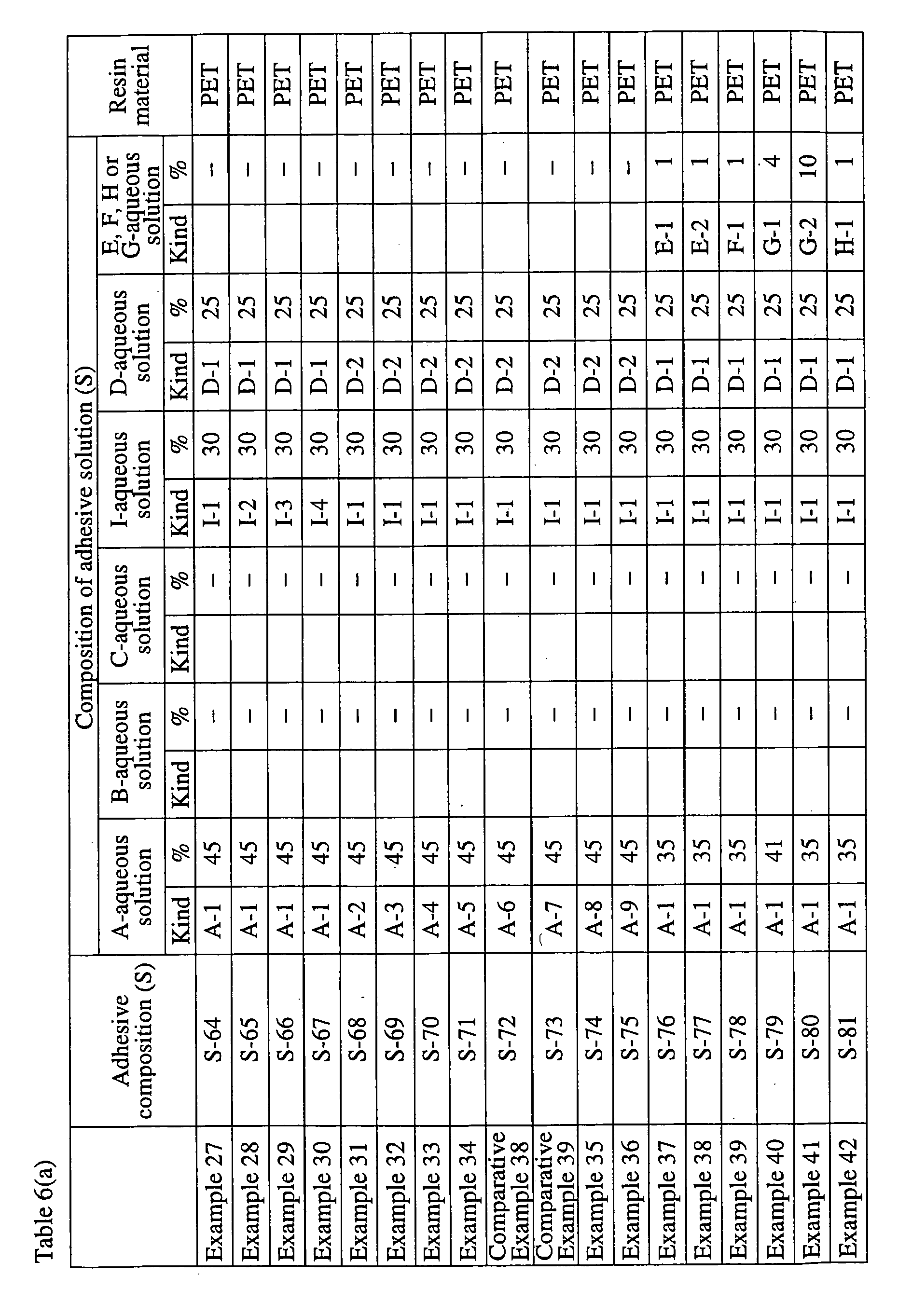


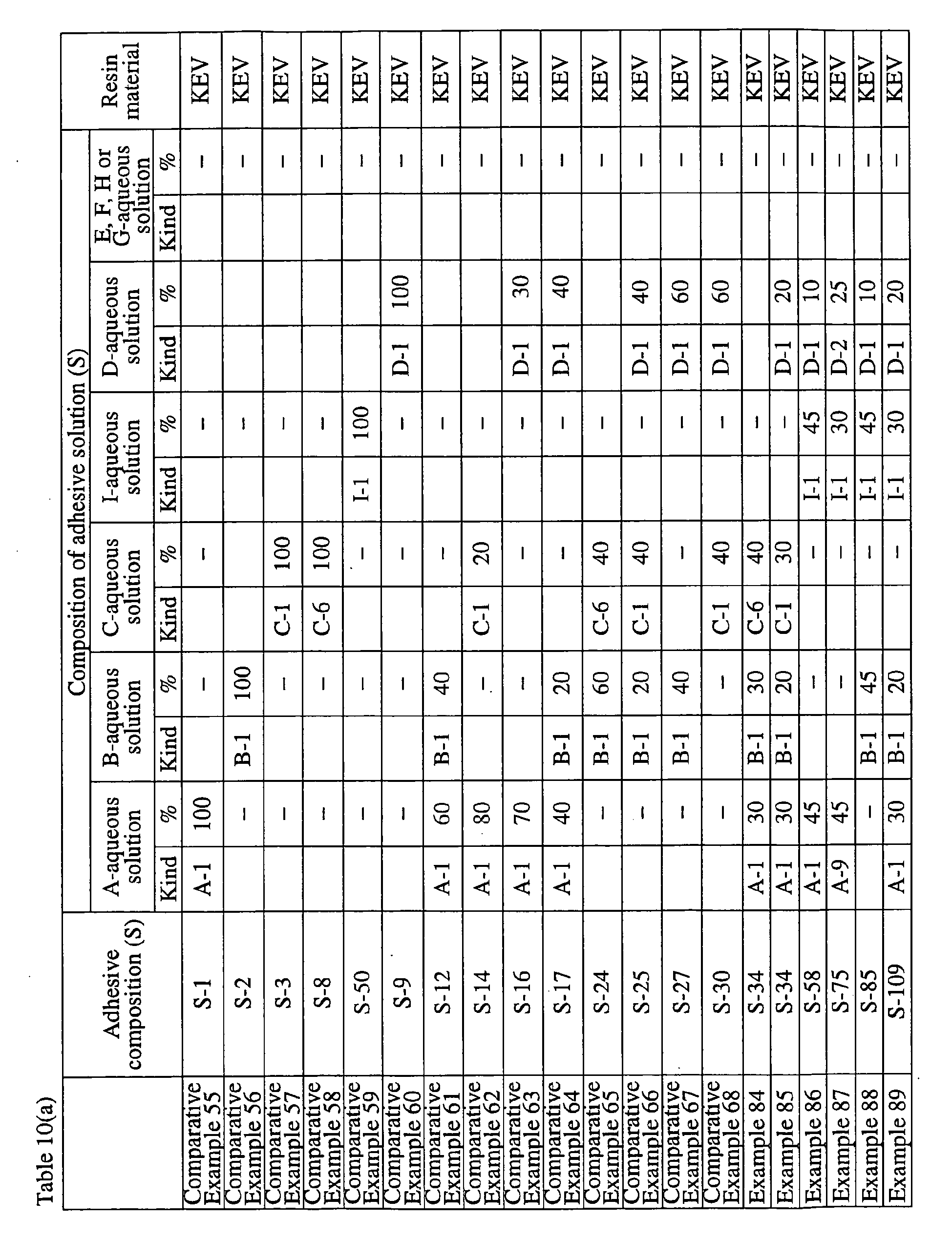

Table 11 Resin material Polyethylene terephthalate (PET) Polyethylene terephthalate (PEN) Aramid (Kevlar) (KEV) Cord Denier 1670dtex/2 1670dtex/2 1670dtex/2 Twist number 40 × 40 39 × 39 32 × 32 Cable twist coefficient 0.70 0.68 0.54 Ply twist coefficient 0.49 0.45 0.39 Treating conditions of adhesive solution (S) Dry Temperature 140°C 150°C 120°C Time 80 seconds 60 seconds 120 seconds Hot Hot Temperature 200°C 180°C 240°C Time 60 seconds 60 seconds 60 seconds Treating conditions of adhesive solution (T) Dry Temperature 140°C 160°C 120°C Time 80 seconds 60 seconds 120 seconds Hot Temperature 240°C 240°C 220°C Time 60 seconds 60 seconds 60 seconds Table 1 2 (Compounding unit: parts by weight) Adhesive solution (T) T-1 T-2 T-3 Water 524.01 467.70 269.50 Resorcin 15.12 24.43 10.61 Formalin (37%) 16.72 28.81 9.39 Sodium hydroxide (10% aqueous solution) 4.00 - 1.40 Maturing temperature Room temperature - - Maturing time 8 hours - - Vinylpyridine-styrene-butadiene copolymer latex 233.15 328.00 184.06 Styrene-butadiene copolymer latex 207.00 151.0 125.77 Maturing temperature Maturing temperature Room temperature Room temperature Room temperature Maturing time 12 hours 36 hours 24 hours Aqueous solution C-3 - - 400.00 Table 13 (Compounding unit: parts by weight) Natural rubber 80 Styrene-butadiene copolymer rubber 20 Carbon black 40 Stearic acid 2 Petroleum softening agent 10 Pipe tar 4 zinc white 5 N-phenyl-β-naphthylamine 1.5 2-benzothiazyldisulfide 0.75 Diphenyl quanidine 0.75 Sulfur 2.5 Table 14 Rank of rubber adhered rate (Rubber adhesion) Area ratio of adhered rubber to surface area of cord State of code filament A+ - Filament is broken A 100 - 80% Filament is not broken B 80 - 60% Filament is not broken C 60 - 40% Filament is not broken D 40 - 20% Filament is not broken E 20 - 0% Filament is not broken Note) The state of breaking the cord filament usually shows that the breakage in the peeling test is caused in the cord filament rather than in the adhesive layer and the adhesion is good. - As mentioned above, when using the adhesive composition according to the invention, the initial adhesion force is excellent and also there can be obtained effects of controlling the lowering of the adhesion force under a high temperature of about 200°C, the lowering of the adhesion force after the heat deterioration and the lowering of the cord fatigue resistance under a high strain.
- Therefore, the resin materials treated with the adhesive composition according to the invention, the rubber parts reinforced therewith, and various pneumatic tires using such a rubber article as a rubber member such as general-purpose tire, high-speed running tire, run flat tire and so on have high performances and durability even under high temperature and high strain, so that they are very useful in industry.
Example products: B-1, B-2, B-3, B-4, B-5, B-6
Example products: C-1, C-2, C-3, C-4, C-5, C-6.
Example products: I-1, I-2, I-3, I-4;
Example products: D-1, D-2
Example products: E-1, E-2
Example product: F-1
Example products: G-1, G-2
Example product: H-1
Claims (26)
- An adhesive composition comprising a water-soluble high polymer (B) and an aqueous urethane compound (I) obtained by reacting an organic polyisocyanate (α) having a structure with methylene linked aromatics, a compound (β) having plural active hydrogens and a thermally dissociatable blocking agent (γ) for an isocyanate group.
- An adhesive composition comprising a water-soluble high polymer (B) and an aqueous urethane compound (I) obtained by reacting an organic polyisocyanate (α) having a structure with methylene linked aromatics, a compound (β) having plural active hydrogens and a thermally dissociatable blocking agent (γ) for an isocyanate group and further containing at least one component selected from the group consisting of an aliphatic epoxide compound (D), a metal salt (E), a metal oxide (F), a rubber latex (G) and a benzene derivative (H) having two or more (blocked) isocyanate groups.
- An adhesive composition according to claim 1 or 2, wherein the water-soluble high polymer (B) is a water-soluble high polymer containing a carboxyl group.
- An adhesive composition according to any one of claims 1 to 3, wherein the water-soluble high polymer (B) contains substantially free of carbon-carbon double bond with a hydrogen radical at its allyl position and has a weight average molecular weight of not less than 3,000.
- An adhesive composition according to any one of claims 1 to 4, wherein the water-soluble high polymer (B) is a (co)polymer containing an ethylenic unit inclusive of a monomer containing a carboxyl group.
- An adhesive composition according to any one of claims 1 to 5, wherein the water-soluble high polymer (B) is a copolymer containing a maleic anhydride unit and an isobutylene unit, or a derivative thereof.
- An adhesive composition according to claim 1, wherein the aqueous urethane compound (I) is an aqueous urethane compound having at least a thermally dissociatable blocked isocyanate group and a hydrophilic group, and the aqueous urethane compound is a reaction product obtained by (i) reacting an organic polyisocyanate compound (α) having a structure with methylene linked aromatics with a compound (β) having plural active hydrogens to obtain a urethane prepolymer having a free isocyanate group and (ii) treating the urethane prepolymer with a thermally dissociatable blocking agent (γ) for an isocyanate group and a compound (δ) having at least one active hydrogen and at least one hydrophilic group of anionic and/or nonionic hydrophilic groups.
- An adhesive composition according to claim 7, wherein the aqueous urethane compound (I) is a reaction product comprising 40-85% by weight of the organic polyisocyanate compound (α) having 3-5 isocyanate groups and a molecular weight of not more than 2,000, 5-35% by weight of the compound (β) having 2-4 active hydrogens and a molecular weight of not more than 5,000, 5-35% by weight of the thermally dissociatable blocking agent (γ) and 5-35% by weight of the compound (δ), and the thermally dissociatable blocked isocyanate group in the molecular weight of the reaction product is 0.5-11% by weight (converted as NCO = 42).
- An adhesive composition according to claim 7 or 8, wherein the aqueous urethane compound (I) is represented by the following general formula:

- An adhesive composition according to claim 2, wherein the aliphatic epoxide compound (D) is a compound having two or more epoxy groups in one molecule.
- An adhesive composition according to claim 10, wherein the aliphatic epoxide compound (D) is a reaction product of polyvalent alcohol and epichlorohydrin.
- An adhesive composition according to claim 2, wherein the metal salt (E) is a salt of polyvalent metal.
- An adhesive composition according to claim 2, wherein the metal oxide (F) is an oxide of polyvalent metal.
- An adhesive composition according to claim 1, wherein the adhesive composition contains 5-75% of the thermoplastic high molecular weight polymer (A) and 15-77% of the aqueous urethane compound (I) on dry weight.
- An adhesive composition according to claim 2, wherein when the adhesive composition contains 5-75% of the thermoplastic high molecular weight polymer (A) and 15-77% of the aqueous urethane compound (I) on dry weight, it further contains not more than 70% of the aliphatic epoxide compound (D), not more than 50% of the metal salt (E), not more than 50% of the metal oxide (F), not more than 18% of the rubber latex (G) and not more than 50% of the benzene derivative (H).
- An adhesive composition according to any one of claims 1 to 15, wherein an alkali metal is not more than 2% on dry weight even when it is contained in the adhesive composition.
- An adhesive composition according to any one of claims 1 to 16, wherein the adhesive composition has storage moduli G' of not more than 109 at 60°C and a frequency of 10 Hz and not less than 106 at 200°C and a frequency of 10 Hz when a dynamic viscoelasticity is measured.
- An adhesive composition according to any one of claims 1 to 17, wherein an integrated reaction calorie per 1 g on dry weight of the adhesive composition is not more than 85 J(joule) when the adhesive composition is heat-treated at 240°C for 30 minutes, cooled to room temperature and 100 parts by dry weight of the adhesive composition is reacted with 10 parts by weight of sulfur at 160°C for 90 minutes.
- A resin material characterized by having a surface coated with a layer of an adhesive composition as claimed in any one of claims 1-18.
- A resin material according to claim 19, wherein a resin of the resin material is a polyester resin, an aromatic polyamide resin or an acrylic resin.
- A resin material according to claim 20, wherein the polyester resin is polyethylene terephthalate or polyethylene naphthalate.
- A resin material according to any one of claims 19 to 21, wherein the resin material is a cord obtained twisting plural filaments, and the cord comprises cable twist and ply twist of the synthetic fiber, in which a twisting coefficient N1 of the ply twist is 0-0.70 and a twisting coefficient N2 of the cable twist is 0.12-0.90 as defined by the following equations (1) and (2).


- A resin material according to claim 22, wherein the cord comprises cable twist and ply twist of the synthetic fiber, in which the twisting coefficient of the ply twist is 1300-2500 and the twisting coefficient of the cable twist is 900-1800.
- A resin material according to claim 22 or 23, wherein the adhesive composition coating the cord is 0.5-6.0% by weight per the cord weight on dry weight.
- A rubber article characterized by reinforcing with a resin material as claimed in any one of claims 19 -24.
- A pneumatic tire characterized by applying a rubber article as claimed in claim 25 as a rubber member.
Applications Claiming Priority (4)
| Application Number | Priority Date | Filing Date | Title |
|---|---|---|---|
| JP37372498 | 1998-12-28 | ||
| JP19184299A JP4928661B2 (en) | 1999-07-06 | 1999-07-06 | Adhesive composition, resin material treated thereby, and rubber article reinforced by the resin material |
| JP27807899A JP2001098245A (en) | 1999-09-30 | 1999-09-30 | Adhesive composition, resin material, rubber article, and pneumatic tire |
| EP99961484A EP1059346B1 (en) | 1998-12-28 | 1999-12-28 | Adhesive composition, resin material, rubber article and pneumatic tire |
Related Parent Applications (2)
| Application Number | Title | Priority Date | Filing Date |
|---|---|---|---|
| EP99961484.5 Division | 1999-12-28 | ||
| EP99961484A Division EP1059346B1 (en) | 1998-12-28 | 1999-12-28 | Adhesive composition, resin material, rubber article and pneumatic tire |
Publications (3)
| Publication Number | Publication Date |
|---|---|
| EP1690702A2 true EP1690702A2 (en) | 2006-08-16 |
| EP1690702A3 EP1690702A3 (en) | 2010-08-25 |
| EP1690702B1 EP1690702B1 (en) | 2012-05-30 |
Family
ID=27326530
Family Applications (2)
| Application Number | Title | Priority Date | Filing Date |
|---|---|---|---|
| EP99961484A Expired - Lifetime EP1059346B1 (en) | 1998-12-28 | 1999-12-28 | Adhesive composition, resin material, rubber article and pneumatic tire |
| EP06010474A Expired - Lifetime EP1690702B1 (en) | 1998-12-28 | 1999-12-28 | Adhesive composition, resin material, rubber article and pneumatic tire |
Family Applications Before (1)
| Application Number | Title | Priority Date | Filing Date |
|---|---|---|---|
| EP99961484A Expired - Lifetime EP1059346B1 (en) | 1998-12-28 | 1999-12-28 | Adhesive composition, resin material, rubber article and pneumatic tire |
Country Status (5)
| Country | Link |
|---|---|
| US (1) | US6774172B1 (en) |
| EP (2) | EP1059346B1 (en) |
| DE (1) | DE69932234T2 (en) |
| ES (2) | ES2267305T3 (en) |
| WO (1) | WO2000039237A1 (en) |
Cited By (2)
| Publication number | Priority date | Publication date | Assignee | Title |
|---|---|---|---|---|
| CN101235262B (en) * | 2007-12-28 | 2012-01-18 | 济南圣泉集团股份有限公司 | Adhesive used for enwinding type casting filtering screen and preparation method thereof |
| CN115461508A (en) * | 2020-04-30 | 2022-12-09 | 株式会社普利司通 | Binder composition for organic fiber cord, organic fiber cord-rubber composite, and tire |
Families Citing this family (34)
| Publication number | Priority date | Publication date | Assignee | Title |
|---|---|---|---|---|
| US8076445B2 (en) * | 2000-01-11 | 2011-12-13 | Robert Shane Porzio | Oligocarbodiimides for the formation of crosslinked latex films |
| DE102005052025B4 (en) * | 2005-10-31 | 2008-10-23 | Ems-Chemie Ag | Adhesive formulation, process for its preparation and its use |
| JP4880990B2 (en) | 2005-12-13 | 2012-02-22 | 住友ゴム工業株式会社 | Run flat tire |
| JP2007224093A (en) | 2006-02-21 | 2007-09-06 | Tokyo Ohka Kogyo Co Ltd | Composition for forming adhesive layer, and letterpress plate using the composition, and method for producing letterpress plate |
| US7964662B2 (en) | 2006-04-27 | 2011-06-21 | Bostik, Inc. | Adhesive formulation for vacuum forming applications |
| ES2336278T3 (en) | 2006-09-21 | 2010-04-09 | Clariant Finance (Bvi) Limited | WATERPROOF DISPERSIONS OF POLYURETHANS / POLYURES. |
| CN101687399A (en) * | 2007-05-31 | 2010-03-31 | 米其林技术公司 | Tire repair with cured patch |
| CN101255317B (en) * | 2008-04-03 | 2011-10-26 | 浙江东南橡胶机带有限公司 | High-strength thermoresistance adhesive for transmission belt and method of use thereof |
| JP5873229B2 (en) * | 2009-04-28 | 2016-03-01 | 株式会社ブリヂストン | Adhesive composition, adhesive-coated fiber, rubber article, and pneumatic tire |
| US9463669B2 (en) * | 2011-03-31 | 2016-10-11 | Bridgestone Corporation | Tire |
| JP5177252B2 (en) | 2011-04-12 | 2013-04-03 | 横浜ゴム株式会社 | Epoxy resin composition |
| JP6111204B2 (en) * | 2012-02-06 | 2017-04-05 | 株式会社ブリヂストン | Pneumatic radial tire |
| JP5928227B2 (en) * | 2012-07-31 | 2016-06-01 | 横浜ゴム株式会社 | Pneumatic tire manufacturing method |
| PL2931791T3 (en) * | 2012-12-13 | 2017-07-31 | Kordsa Global Endustriyel Iplik Ve Kord Bezi Sanayi Ve Ticaret As | A dipping material for cord fabrics and a production method thereof |
| JP5571206B1 (en) * | 2013-02-05 | 2014-08-13 | 株式会社ブリヂストン | Mounting method of electromagnetic generator and tire with built-in electromagnetic generator |
| US9340931B2 (en) | 2013-09-10 | 2016-05-17 | Fermi Research Alliance, Llc | Method and system for in-situ cross linking of polymers, bitumen and similar materials to increase strength, toughness and durability via irradiation with electron beams from mobile accelerators |
| US9186645B2 (en) | 2013-09-10 | 2015-11-17 | Fermi Research Alliance, Llc | Method and system for in-situ cross linking of polymers, bitumen and similar materials to increase strength, toughness and durability via irradiation with electron beams from mobile accelerators |
| AU2013404048B2 (en) | 2013-10-30 | 2016-11-03 | Halliburton Energy Services, Inc. | Vulcanized oil and water swellable particulate composite compositions |
| JP6402888B2 (en) * | 2014-02-03 | 2018-10-10 | ナガセケムテックス株式会社 | Adhesive composition for organic fiber and method for treating organic fiber |
| JP6423177B2 (en) * | 2014-06-09 | 2018-11-14 | 株式会社ブリヂストン | Pneumatic tire |
| CN106170386B (en) | 2014-08-22 | 2018-01-16 | 五行科技股份有限公司 | For exploiting the fracturing liquid delivery hose and its manufacture method of shale oil gas |
| KR101594150B1 (en) * | 2014-09-18 | 2016-02-17 | 주식회사 효성 | Polyester fiber, method for preparing the same and tire cord including the same |
| TWI519559B (en) | 2014-11-21 | 2016-02-01 | 財團法人工業技術研究院 | Resin formulations, resin polymers and composite materials comprising the resin polymers |
| CN107428211B (en) | 2015-03-06 | 2020-04-10 | 株式会社普利司通 | Tyre for vehicle wheels |
| JP6018727B1 (en) | 2015-03-06 | 2016-11-02 | 株式会社ブリヂストン | tire |
| US9850407B2 (en) * | 2015-09-08 | 2017-12-26 | United States Gypsum Company | Enhanced adhesive composition for re-enforcing joints in gypsum panel construction |
| BR112018009654B1 (en) | 2015-11-11 | 2022-02-01 | Gates Corporation | Composite material composition, elastomeric composition and power transmission belt |
| JP6952494B2 (en) * | 2017-05-25 | 2021-10-20 | 住友化学株式会社 | Adhesive composition and polarizing plate |
| US11224918B2 (en) | 2018-01-19 | 2022-01-18 | Fermi Research Alliance, Llc | SRF e-beam accelerator for metal additive manufacturing |
| KR102165321B1 (en) * | 2018-01-22 | 2020-10-14 | 주식회사 엘지화학 | Back grinding tape |
| US11123921B2 (en) | 2018-11-02 | 2021-09-21 | Fermi Research Alliance, Llc | Method and system for in situ cross-linking of materials to produce three-dimensional features via electron beams from mobile accelerators |
| US10829664B2 (en) * | 2019-03-15 | 2020-11-10 | Ppg Industries Ohio, Inc. | Coating compositions containing polythioethers and elastic barrier coatings formed therefrom |
| IT202000015664A1 (en) * | 2020-06-29 | 2021-12-29 | Pirelli | PRODUCTION PROCESS OF A REINFORCING COMPONENT FOR A TIRE, AND RELATED TIRE MANUFACTURING PROCESS |
| EP4219190A4 (en) * | 2020-09-23 | 2024-03-27 | Bridgestone Corporation | ADHESIVE COMPOSITION FOR RUBBER/RESIN BONDING, ORGANIC-FIBER-CORD/RUBBER COMPOSITE, AND TIRE |
Citations (1)
| Publication number | Priority date | Publication date | Assignee | Title |
|---|---|---|---|---|
| JPH0529304A (en) | 1991-07-17 | 1993-02-05 | Sony Corp | Horizontal reactor |
Family Cites Families (32)
| Publication number | Priority date | Publication date | Assignee | Title |
|---|---|---|---|---|
| DE1470781A1 (en) * | 1962-10-17 | 1969-01-02 | Dunlop Ag | Process for improving the adhesive strength of natural and synthetic rubber or such rubber mixtures on synthetic fibers |
| GB1092908A (en) * | 1963-10-21 | 1967-11-29 | Ici Ltd | Improvements in the bonding of polyethylene terephthalate fibres to rubber |
| US3707178A (en) * | 1970-10-14 | 1972-12-26 | Uniroyal Inc | Adhesion of rayon textile to rubber with aqueous dispersion of blocked isocyanate or isocyanate dimer, rubber latex and resorcinol-formaldehyde resin |
| JPS5342223A (en) * | 1976-09-30 | 1978-04-17 | Ishikawa Sangyo | Composition of adhesion for waste tire powder |
| JPS555937A (en) * | 1978-06-27 | 1980-01-17 | Koyo Sangyo Kk | Adhesive composition |
| JPS5849770A (en) | 1981-09-17 | 1983-03-24 | Dai Ichi Kogyo Seiyaku Co Ltd | Agent for improving adhesivity of organic polymeric material |
| US4448813A (en) * | 1982-09-20 | 1984-05-15 | The B. F. Goodrich Company | Preparation of cord for bonding to rubber |
| US4460029A (en) * | 1982-12-01 | 1984-07-17 | The Dow Chemical Company | Oxazoline latex for tire cord adhesion |
| JPS6079081A (en) * | 1983-10-07 | 1985-05-04 | Sunstar Giken Kk | Two-pack adhesive |
| US4720398A (en) * | 1984-03-19 | 1988-01-19 | Akzo Nv | Process for the improvement of the adhesion to rubber or a thermoplastic elastomer of synthetic yarns, cords or fabrics made therefrom |
| EP0270830A1 (en) | 1986-11-06 | 1988-06-15 | American Cyanamid Company | Method for regulating plant growth using polysubstituted butyric acids, esters and derivatives thereof |
| JP2537984B2 (en) * | 1988-08-25 | 1996-09-25 | ミサワセラミツクケミカル株式会社 | Adhesion method |
| JPH05229304A (en) | 1992-02-25 | 1993-09-07 | Bridgestone Corp | Pneumatic radial tires |
| JP3379069B2 (en) * | 1992-06-11 | 2003-02-17 | 株式会社日本触媒 | Adhesion method using adhesive composition for fiber |
| JP3382638B2 (en) * | 1992-07-17 | 2003-03-04 | コニシ株式会社 | Adhesive tape |
| JPH06123078A (en) * | 1992-10-07 | 1994-05-06 | Teijin Ltd | Method of treating polyester fiber |
| JPH06173172A (en) | 1992-12-04 | 1994-06-21 | Unitika Ltd | Treatment of polyester fiber cord for rubber-reinforcement |
| DE9304018U1 (en) * | 1993-03-18 | 1994-07-21 | H.B. Fuller Licensing & Financing, Inc., Wilmington, Del. | Laminating dispersion |
| JP3146920B2 (en) * | 1994-08-01 | 2001-03-19 | 東レ株式会社 | Adhesive composition for rubber and fiber, synthetic fiber for reinforcing rubber, and fiber-reinforced rubber structure |
| EP0755803B1 (en) * | 1995-02-14 | 2001-07-25 | Toray Industries, Inc. | Lithographic form plate |
| JP2969253B2 (en) * | 1995-04-04 | 1999-11-02 | 三洋化成工業株式会社 | Binder composition for fabric or cushion body |
| JP3280826B2 (en) * | 1995-05-08 | 2002-05-13 | 横浜ゴム株式会社 | Adhesive composition of fiber and rubber and cord / rubber composite obtained using the same |
| JPH0912997A (en) * | 1995-07-03 | 1997-01-14 | Bridgestone Corp | Adhesive composition |
| US5863987A (en) * | 1995-10-13 | 1999-01-26 | Bridgestone Corporation | Adhesive compositions and pneumatic tire |
| JP3090185B2 (en) | 1995-10-19 | 2000-09-18 | 横浜ゴム株式会社 | Rubber / cord composite |
| JPH09278975A (en) * | 1996-04-11 | 1997-10-28 | Nippon Shokubai Co Ltd | Water-based resin composition |
| JP4278191B2 (en) * | 1996-05-15 | 2009-06-10 | Dic株式会社 | Aqueous polyurethane resin composition and adhesive |
| JPH1046475A (en) * | 1996-07-25 | 1998-02-17 | Teijin Ltd | Processing method of polyester fiber |
| JP2837142B2 (en) | 1996-11-14 | 1998-12-14 | 大成化工株式会社 | Room temperature curable aqueous resin composition which is an aqueous acrylic-urethane composite and coating agent or ink using the same |
| JPH10310755A (en) | 1997-05-12 | 1998-11-24 | Kuraray Co Ltd | adhesive |
| JPH113418A (en) | 1997-06-13 | 1999-01-06 | Matsushita Electric Ind Co Ltd | Image processing method |
| JP3841519B2 (en) | 1997-07-15 | 2006-11-01 | 横浜ゴム株式会社 | Rubber / cord composite |
-
1999
- 1999-12-28 US US09/623,140 patent/US6774172B1/en not_active Expired - Lifetime
- 1999-12-28 DE DE69932234T patent/DE69932234T2/en not_active Expired - Lifetime
- 1999-12-28 WO PCT/JP1999/007421 patent/WO2000039237A1/en not_active Ceased
- 1999-12-28 EP EP99961484A patent/EP1059346B1/en not_active Expired - Lifetime
- 1999-12-28 ES ES99961484T patent/ES2267305T3/en not_active Expired - Lifetime
- 1999-12-28 ES ES06010474T patent/ES2388534T3/en not_active Expired - Lifetime
- 1999-12-28 EP EP06010474A patent/EP1690702B1/en not_active Expired - Lifetime
Patent Citations (1)
| Publication number | Priority date | Publication date | Assignee | Title |
|---|---|---|---|---|
| JPH0529304A (en) | 1991-07-17 | 1993-02-05 | Sony Corp | Horizontal reactor |
Cited By (3)
| Publication number | Priority date | Publication date | Assignee | Title |
|---|---|---|---|---|
| CN101235262B (en) * | 2007-12-28 | 2012-01-18 | 济南圣泉集团股份有限公司 | Adhesive used for enwinding type casting filtering screen and preparation method thereof |
| CN115461508A (en) * | 2020-04-30 | 2022-12-09 | 株式会社普利司通 | Binder composition for organic fiber cord, organic fiber cord-rubber composite, and tire |
| EP4144911A4 (en) * | 2020-04-30 | 2023-10-11 | Bridgestone Corporation | ADHESIVE COMPOSITION FOR ORGANIC FIBER CORDS, ORGANIC FIBER CORD-RUBBER COMPOSITE BODY AND TIRES |
Also Published As
| Publication number | Publication date |
|---|---|
| WO2000039237A1 (en) | 2000-07-06 |
| ES2267305T3 (en) | 2007-03-01 |
| EP1059346A1 (en) | 2000-12-13 |
| DE69932234T2 (en) | 2007-06-06 |
| EP1690702A3 (en) | 2010-08-25 |
| EP1059346A4 (en) | 2002-02-06 |
| EP1059346B1 (en) | 2006-07-05 |
| US6774172B1 (en) | 2004-08-10 |
| ES2388534T3 (en) | 2012-10-16 |
| DE69932234D1 (en) | 2006-08-17 |
| EP1690702B1 (en) | 2012-05-30 |
Similar Documents
| Publication | Publication Date | Title |
|---|---|---|
| EP1059346B1 (en) | Adhesive composition, resin material, rubber article and pneumatic tire | |
| JP6111204B2 (en) | Pneumatic radial tire | |
| JP4818497B2 (en) | Adhesive composition, resin material, rubber article and pneumatic tire | |
| JP2001098245A (en) | Adhesive composition, resin material, rubber article, and pneumatic tire | |
| JP5785448B2 (en) | Adhesive composition, resin material, rubber article, and pneumatic tire | |
| US6468654B1 (en) | Rubber-reinforcement glass fiber product | |
| EP4144911A1 (en) | Adhesive composition for organic fiber cords, organic fiber cord-rubber composite body, and tire | |
| EP4219190A1 (en) | Adhesive composition for rubber/resin bonding, organic-fiber-cord/rubber composite, and tire | |
| JP4928661B2 (en) | Adhesive composition, resin material treated thereby, and rubber article reinforced by the resin material | |
| JP5631800B2 (en) | tire | |
| JP5913825B2 (en) | Run flat tire | |
| JP5913827B2 (en) | Run flat tire | |
| JP3090185B2 (en) | Rubber / cord composite | |
| JP2006274492A (en) | Rubber reinforcing fiber cord and manufacturing method thereof | |
| JP5913826B2 (en) | tire | |
| JP2006045703A (en) | Adhesive method between aramid fiber cord and rubber composition and composite obtained by the adhesive method | |
| JPH09207508A (en) | Pneumatic radial tire | |
| JPH09207509A (en) | Pneumatic radial tire | |
| JP4782387B2 (en) | Method for manufacturing butyl rubber rubber hose reinforcing fiber material | |
| JPH0370037B2 (en) | ||
| JPH10280280A (en) | Polyester fiber bonding method | |
| JPH07304879A (en) | Adhesion treatment method for polyester fiber and acrylic rubber | |
| JP2000226776A (en) | Method for producing fiber for reinforcing rubber hose | |
| JP2005350793A (en) | Method for producing fiber for reinforcing rubber | |
| JPH0362832B2 (en) |
Legal Events
| Date | Code | Title | Description |
|---|---|---|---|
| PUAI | Public reference made under article 153(3) epc to a published international application that has entered the european phase |
Free format text: ORIGINAL CODE: 0009012 |
|
| 17P | Request for examination filed |
Effective date: 20060609 |
|
| AC | Divisional application: reference to earlier application |
Ref document number: 1059346 Country of ref document: EP Kind code of ref document: P |
|
| AK | Designated contracting states |
Kind code of ref document: A2 Designated state(s): DE ES FR GB IT |
|
| RIN1 | Information on inventor provided before grant (corrected) |
Inventor name: NAKAMURA, MASAAKI |
|
| PUAL | Search report despatched |
Free format text: ORIGINAL CODE: 0009013 |
|
| AK | Designated contracting states |
Kind code of ref document: A3 Designated state(s): DE ES FR GB IT |
|
| AKX | Designation fees paid |
Designated state(s): DE ES FR GB IT |
|
| 17Q | First examination report despatched |
Effective date: 20110506 |
|
| GRAP | Despatch of communication of intention to grant a patent |
Free format text: ORIGINAL CODE: EPIDOSNIGR1 |
|
| GRAS | Grant fee paid |
Free format text: ORIGINAL CODE: EPIDOSNIGR3 |
|
| GRAA | (expected) grant |
Free format text: ORIGINAL CODE: 0009210 |
|
| AC | Divisional application: reference to earlier application |
Ref document number: 1059346 Country of ref document: EP Kind code of ref document: P |
|
| AK | Designated contracting states |
Kind code of ref document: B1 Designated state(s): DE ES FR GB IT |
|
| REG | Reference to a national code |
Ref country code: GB Ref legal event code: FG4D |
|
| REG | Reference to a national code |
Ref country code: DE Ref legal event code: R096 Ref document number: 69944244 Country of ref document: DE Effective date: 20120802 |
|
| REG | Reference to a national code |
Ref country code: ES Ref legal event code: FG2A Ref document number: 2388534 Country of ref document: ES Kind code of ref document: T3 Effective date: 20121016 |
|
| PLBE | No opposition filed within time limit |
Free format text: ORIGINAL CODE: 0009261 |
|
| STAA | Information on the status of an ep patent application or granted ep patent |
Free format text: STATUS: NO OPPOSITION FILED WITHIN TIME LIMIT |
|
| 26N | No opposition filed |
Effective date: 20130301 |
|
| REG | Reference to a national code |
Ref country code: DE Ref legal event code: R097 Ref document number: 69944244 Country of ref document: DE Effective date: 20130301 |
|
| REG | Reference to a national code |
Ref country code: FR Ref legal event code: CA Effective date: 20140812 |
|
| PGFP | Annual fee paid to national office [announced via postgrant information from national office to epo] |
Ref country code: GB Payment date: 20141219 Year of fee payment: 16 Ref country code: ES Payment date: 20141226 Year of fee payment: 16 |
|
| PGFP | Annual fee paid to national office [announced via postgrant information from national office to epo] |
Ref country code: IT Payment date: 20141222 Year of fee payment: 16 |
|
| REG | Reference to a national code |
Ref country code: FR Ref legal event code: PLFP Year of fee payment: 17 |
|
| GBPC | Gb: european patent ceased through non-payment of renewal fee |
Effective date: 20151228 |
|
| PG25 | Lapsed in a contracting state [announced via postgrant information from national office to epo] |
Ref country code: GB Free format text: LAPSE BECAUSE OF NON-PAYMENT OF DUE FEES Effective date: 20151228 |
|
| REG | Reference to a national code |
Ref country code: FR Ref legal event code: PLFP Year of fee payment: 18 |
|
| PG25 | Lapsed in a contracting state [announced via postgrant information from national office to epo] |
Ref country code: IT Free format text: LAPSE BECAUSE OF NON-PAYMENT OF DUE FEES Effective date: 20151228 |
|
| REG | Reference to a national code |
Ref country code: ES Ref legal event code: FD2A Effective date: 20170127 |
|
| PG25 | Lapsed in a contracting state [announced via postgrant information from national office to epo] |
Ref country code: ES Free format text: LAPSE BECAUSE OF NON-PAYMENT OF DUE FEES Effective date: 20151229 |
|
| REG | Reference to a national code |
Ref country code: FR Ref legal event code: PLFP Year of fee payment: 19 |
|
| PGFP | Annual fee paid to national office [announced via postgrant information from national office to epo] |
Ref country code: DE Payment date: 20181210 Year of fee payment: 20 |
|
| PGFP | Annual fee paid to national office [announced via postgrant information from national office to epo] |
Ref country code: FR Payment date: 20181220 Year of fee payment: 20 |
|
| REG | Reference to a national code |
Ref country code: DE Ref legal event code: R071 Ref document number: 69944244 Country of ref document: DE |